
Moody City Zoning Code
ARTICLE IV
DEFINITIONS
§ 1.00.- Purpose of definition.
For the purpose of this zoning ordinance, certain terms used in this ordinance shall have the meanings defined by this article. In the event a term is not listed in this article or is not defined elsewhere in this ordinance, the conventional meaning of the term shall apply.
§ 2.00. - Interpretation.
The building inspector is authorized to make a final determination of the meaning of any term used in this ordinance. In the case of any dispute, an appeal of the building inspector's determination may be filed with the zoning board of adjustment.
§ 3.00. - Word usage.
In the interpretation of this zoning ordinance, the provisions and rules of this section shall be observed and applied, except when the context clearly requires otherwise.
A.
Words used or defined in one tense or form shall include other tenses and derivative forms.
B.
Words in the singular number shall include the plural number, and words in the plural number shall include the singular number.
C.
The masculine gender shall include the feminine, and the feminine gender shall include the masculine.
D.
The word "shall" is mandatory and the word "may" is permissive.
E.
The word "person" includes: an individual, firm, association, organization, partnership, trust, company or corporation.
§ 4.00. - Words and phrases defined.
The following general terms, when referred to in this ordinance, shall have the meanings defined by this section.
Abandoned motor vehicle. Any motor vehicle which is partially dismantled, inoperative (see inoperative motor vehicle), wrecked or junked, which is left at any place on a street or highway within the city for a period of at least seven days.
Abut, adjacent, adjoin or contiguous. To physically touch or border upon; to share a common border with; or, be separated from a common border by an easement.
Access. A way or means of approach to provide physical entrance to a property.
Accessory structure. A structure detached from a principal building on the same lot and customarily incidental and subordinate to the principal building or use.
Accessory use. A use of land or of a building, or portion thereof, commonly associated with and integrally related to the principal use of the land or building on the same lot.
Acre. A measure of land containing 43,560 square feet of area.
Addition. A structure added to the original structure at some time after completion of or after a certificate of occupancy has been issued for the original structure.
Alley. A service way providing a secondary means of access to abutting property and not intended for general traffic circulation.
Alteration. Any change or rearrangement in the supporting members of an existing building, such as: bearing walls, columns, beams, girders, etc., or any change in or any enlargement to a building or a structure whether horizontally or vertically, or the moving of a building or structure from one location to another.
Applicant. A person submitting an application for: development, a variance, a special exception use, or rezoning. Barndominium means a building designed to have the exterior appearance of a storage building or having the exterior appearance of a storage building, such as a barn, horse stable, other farm and ranch style buildings, metal storage building, warehouse, or like kind or style structures, and that is designed to be used or used as a dwelling. These structures may incorporate certain aspects or design features of or associated with residential structures and such incorporation shall not remove them from this designation when the overall character and appearance of the structure remains as above defined. The interior of such buildings may be either entirely livable space or may be dividing between livable and non-livable space.
Basement. A portion of a building located wholly or partially underground, with one-half or more of its floor-to-ceiling height below the average grade of the adjoining ground.
Bedroom. A room marketed, designed or otherwise intended to function primarily for sleeping.
Berm. A grass-covered or landscaped mound of earth with a slope of one-third or greater on both sides of the mound, used to screen activities or uses.
Block. A tract or parcel of land entirely surrounded by public street other than alleys.
Board of zoning adjustment. The zoning board of adjustment of the City of Moody, Alabama.
Boarder. An individual, other than a member of a family, occupying the dwelling unit or part thereof, who, for compensation, is furnished sleeping accommodations and is furnished meals and other services as a part of consideration.
Buffer. A strip of land that is retained in an undeveloped state for the purpose of: providing a means of screening or separating incompatible land uses, promoting visual harmony, reducing noise, diverting emissions, reducing the effects of adjacent lighting and enhancing the natural environment, thereby providing for a compatible mix of otherwise conflicting uses. A buffer may consist of the following:
1.
A natural barrier such as existing or planted trees or shrubs, or a combination of trees, shrubs or vegetation. Any combination of evergreen trees or other deciduous trees (hardwoods) or shrubs are acceptable as long as the desired visual barrier will be uniformly dense at the minimum height required.
2.
A solid opaque fence, a brick or masonry wall or an earth berm. (See typical illustration below.)
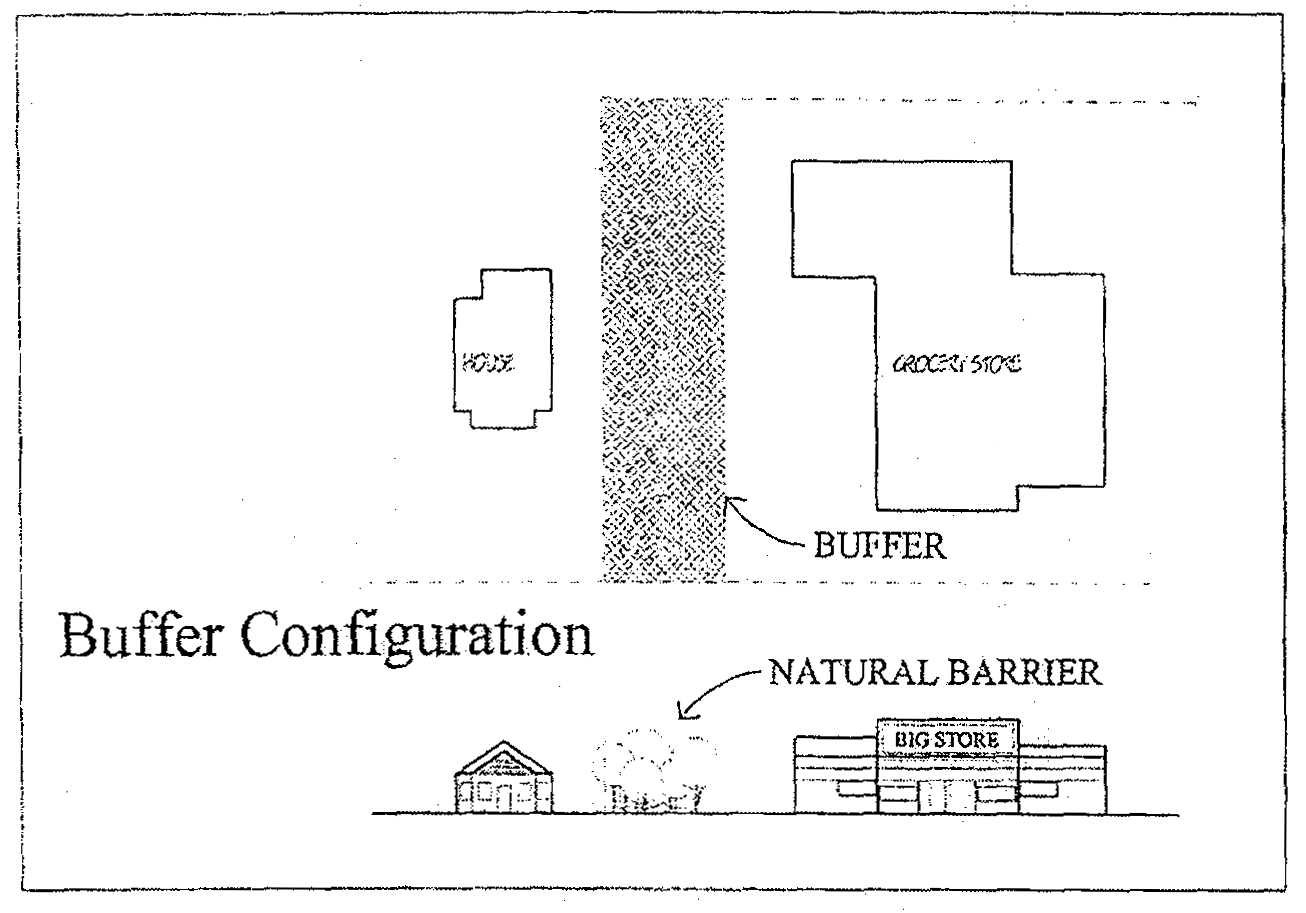
Buffer Configuration
Building. A structure designed to use as a place of occupancy, storage or shelter.
Building, principal. The primary building on a lot or a building that houses a principal use.
Building, front. The exterior wall of a building which faces the designated front lot line of the lot.
Building height. The vertical distance measured from the average elevation of the finished grade at the front of the building to the highest point of the roof.
Building line or building setback line. A line generally parallel to the street right-of-way line at a distance equal to the depth of the front yard required for the zoning district in which the lot is located.
Building spacing. The minimum distance between buildings, measured from the outermost projection, excluding: bay windows, chimneys, flues, columns, ornamental features, cornices and eaves.
Carport. A roofed structure providing space for the parking or storage of motor vehicles and enclosed on not more than three sides.
City. Shall mean the City of Moody, Alabama.
Condominium. An ownership arrangement and not a land use. It is allowed in any district and under the same restrictions as the land that it comprises. It is characterized by private ownership and maintenance of designated exterior spaces by a condominium association of unit owners.
Council or city council. Shall mean the city council of the City of Moody, Alabama.
Cul-de-sac. A short street designed to have one end permanently closed, with the closed end being terminated by a vehicular turnaround.
Density. The minimum required lot area per dwelling unit or the maximum number of dwelling units per acre of site area.
Development. The division of a parcel of land into two or more parcels; the construction, reconstruction, conversion, alteration, relocation or enlargement of a structure; any mining, dredging, fitting, grading, paving, excavation, drilling or disturbance of land; and, any use or extension of the use of the land.
Dwelling. Any building or portion thereof, which is designed and used for residential occupancy.
Dwelling, attached. Three or more dwelling units adjoining one another by a common wall, roof or floor, such as a townhouse or apartment.
Dwelling, detached. A dwelling designed for and occupied by not more than one family and having no roof, wall or floor in common with any other dwelling unit, such as: a single-family residence, manufactured (mobile) home, modular home, patio home or garden home.
Dwelling, multifamily. A building containing two or more dwelling units on a commonly shared lot, such as a duplex or apartment.
Dwelling, semi-family. Two dwelling units adjoining one another by a common wall, roof or floor, such as a duplex or twin townhouse.
Dwelling, single-family. A dwelling unit on an individual lot, such as: a single-family residence, garden home, patio home, manufactured (mobile) home, townhouse or modular home.
Easement. Authorization by a property owner of the use of a designated part of his or her property by another for a specified purpose.
Family. One or more persons living together as a single housekeeping unit.
Fence. An artificially constructed barrier of any material, combination of material or vegetation which is planted or retained as a means to enclose or screen areas of land.
Floor area, gross. The total area of a building measured by taking the outside dimensions of the building at each floor level intended for occupancy or storage.
Improvement. Any manmade immovable item which becomes a part of, placed upon or affixed to real estate.
Inoperative motor vehicle. A motor vehicle which cannot be driven upon the public streets for reasons including, but not limited to: being unlicensed, wrecked, abandoned, in a state of disrepair or incapable of being moved under its own power.
Livable floor area. Any floor area within a dwelling usable for any combination of sleeping, eating, cooking, recreation or working purposes.
Lot. A parcel of land in one ownership, used as or set aside and available for use as, the site of one or more buildings and accessory structures, or any other purpose.
Lot, corner. A lot abutting two or more streets at their intersections.
Lot, double frontage or through. A lot having frontage on two or more streets, but not at their intersections.
Lot, interior. A lot other than a corner lot.
Lot, reverse frontage. A double frontage lot having a rear yard on a major street and an front yard with access to a local or marginal access street.
Lot, flag. A parcel of land which does not have the required minimum lot width at the building line but has direct access to a public street through a narrow strip of land which is part of the same lot. The lot lines of the narrow portion of the lot (the flag pole) are parallel or nearly parallel. These provisions are intended for tracts with limited frontage that would limit the number of lots with the required width, would have sufficient area to the rear for an additional lot or two.
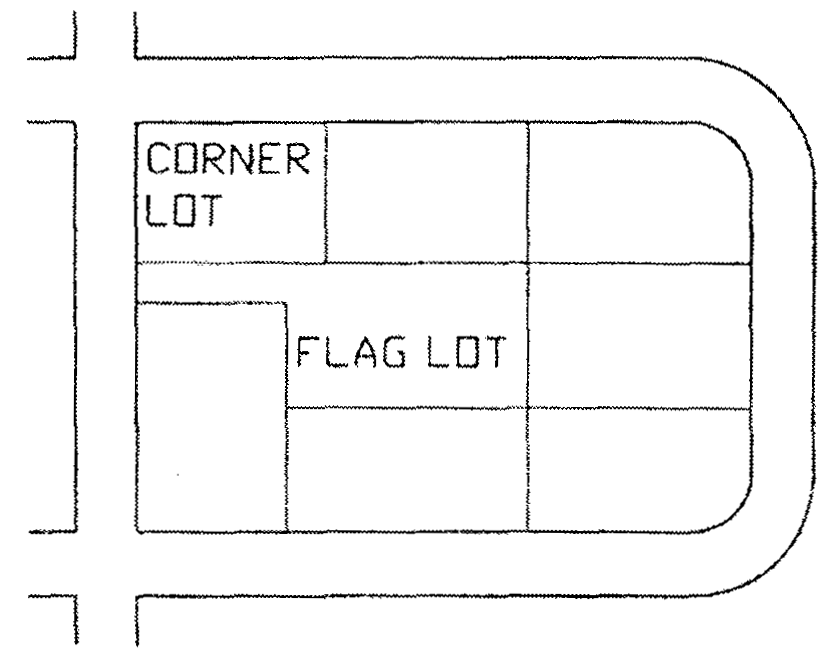
Flag Lot
Lot area or lot site. The minimum area contained within the property of the individual parcels of land shown on a subdivision plat or survey. Lot area excludes any area within an existing or future street right-of-way or any area devoted to common open space.
Lot frontage. The lot width measured at the street line. When a lot has more than one street line, lot width shall be measured and the minimum lot width required by this ordinance shall be provided at each such line.
Lot line. A line bounding a lot which divides one lot from another lot, street or any other public or private place.
Lot line, rear. That lot line which is parallel to and most distant from the front line of the lot. In the case of an irregular or triangular lot, a line ten feet in length, entirely within the lot, parallel to and at the maximum distance from the front lot, a line shall be considered to be the rear lot line. In the case of a corner lot or a double frontage lot, there are no rear lot lines, only side lot lines. See examples below.
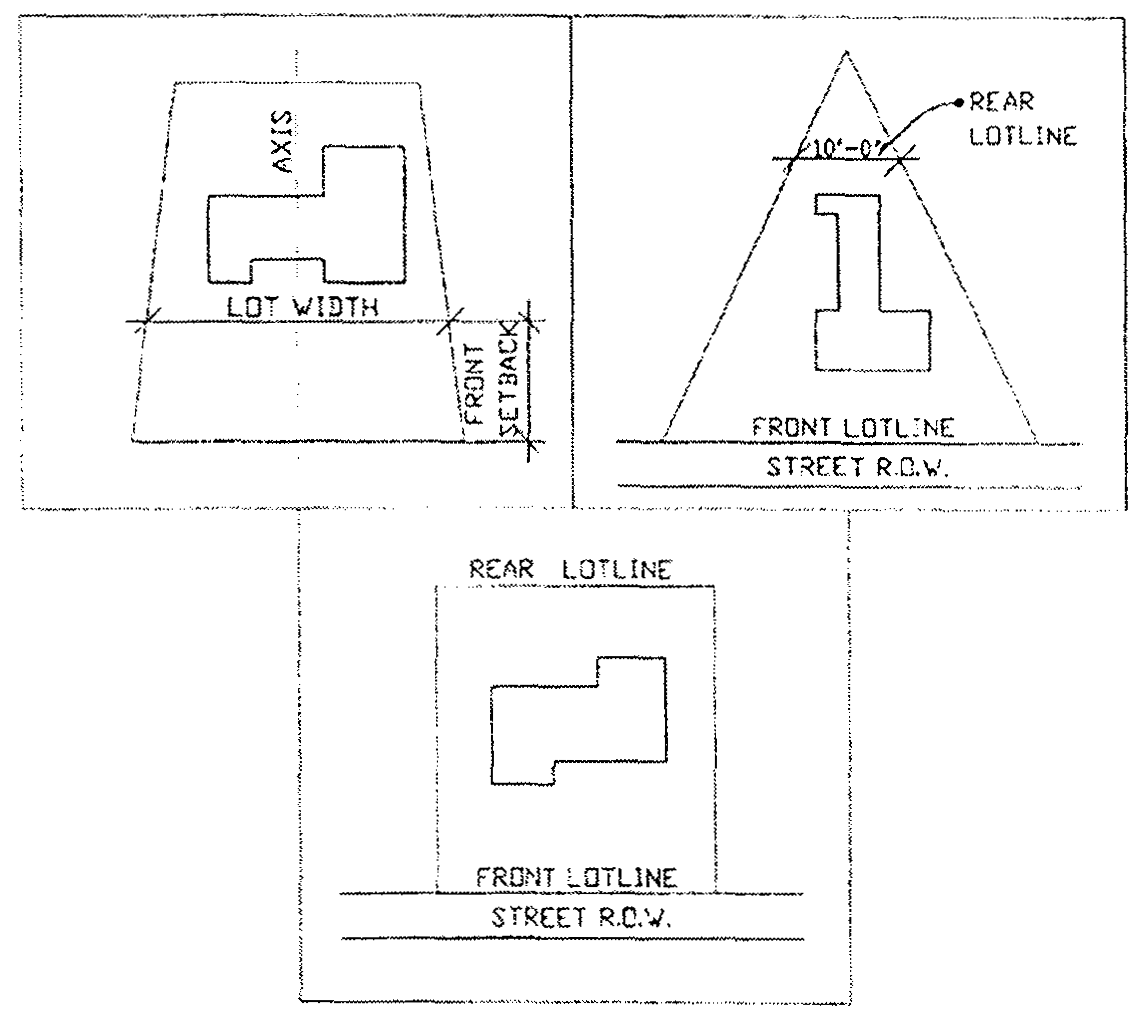
Lot Line Illustrations
Lot line, side. Any lot line other than a front lot line or a rear lot line.
Lot line, front. The lot line the principal structure parallels shall be considered the front yard of the lot. In cases where structures face two streets, the lot line that has the least frontage shall be deemed to be the front yard. Where lot lines are approximately the same, the owner shall specify which shall be considered the front yard.
Lot of record. Any validly recorded lot which, at the time of its recording, complied with all applicable laws, ordinances and regulations.
Lot width. The minimum distance measured between the side lot lines at the required building setback line. In the case of only one side lot line, lot width is the distance measured between the side lot line and the opposite lot line.
Nonconformities. Lawful uses of lots, structures or characteristics of uses which, as a result of the adoption or subsequent amendment to this ordinance, no longer conform to all applicable zoning provisions.
Open space, common. Land area within a residential development that is held in common ownership and maintained by a homeowner's association for all the residents in that area, for recreation, protection of natural land features, amenities or buffers. It is freely accessible to all residents of the development; and, is protected by the provisions of this ordinance to ensure that it remains in such uses. The common open space shall not include surface water bodies, (i.e., rivers, streams, lakes or ponds) land occupied by nonresidential buildings, common drive-ways or parking areas or street right-of-way or lots for single-family or multifamily dwellings. Common open space shall be left in a natural state or landscaped, except in the case of recreational structures.
Outdoor storage. The storage of any goods, materials, merchandise, products or vehicles in an unenclosed area for more than 48 hours.
Owner. The person or persons having the right and legal title to, the beneficial interest in or a contractual right to purchase a lot or parcel of land.
Perimeter. The boundaries or borders of a lot, tract or parcel of land.
Planning commission. Shall mean the planning commission of the City of Moody, Alabama.
Porch. A roofed open area, which may be windowed or screened, attached to and with direct access to or from a building. A porch becomes a room within the building when heated or air-conditioned or when the walled area is less than 20 percent windowed or screened.
Premises. A lot, parcel, tract or plot of land together with the structures thereon.
Property line. The lot line or boundary line.
Retail. The provision of services or the sale of goods and merchandise at retail prices to the general public at large, for personal or household use or consumption.
Satellite dish antenna. An accessory structure designed to receive television broadcasts relayed by microwave signals from earth orbiting communication satellites.
Screen. To visually shield or obscure an abutting or nearby structure or use from another by means of: opaque fencing, walls, berm or densely planted vegetation.
Sight triangle. A triangular-shaped portion of land established at street or driveway intersections in which nothing is erected, placed, planted or allowed to grow in such a manner as to limit or obstruct the sight distance of motorists entering or leaving the intersection. (See illustration.)
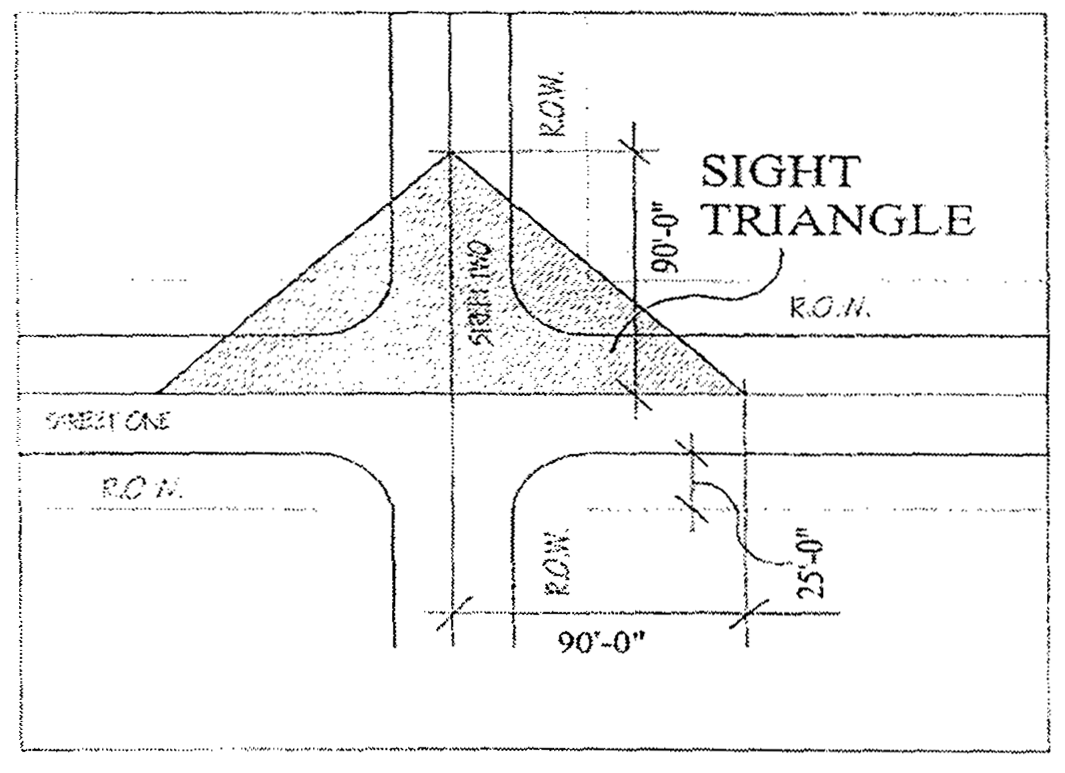
Sight Triangle
Site. A parcel or parcels of land intended to have one or more buildings, or intended to be subdivided into one or more lots.
Site area. A minimum land area required to qualify for a particular use or development. Site area is taken from an actual site survey and excludes:
1.
Land within an existing or future street right-of-way, or utility right-of-way easement.
2.
Land which is not contiguous or is cut off by a major barrier.
3.
Land which is part of a previously approved development.
4.
Land which is zoned for another use.
Special exception use. A use which is permitted subject to special exception is a use that would not generally be appropriate without restrictions(s) throughout the zoning district, but which, if controlled as to the number, area, location or relation to the neighborhood, would not be detrimental to public health or cause any nuisance. This use is permitted subject to a special exception use permit being granted by the Moody zoning board of adjustment and further subject to appropriate permits being issued in accordance with the provisions of this ordinance.
Story. That portion of a building included between the upper surface of a floor and upper surface of the floor or ceiling next above. A mezzanine or partial floor shall be counted as a story if the vertical distance from the floor next to the floor or ceiling above is 24 feet or more. A basement shall be counted as a story if it is used as livable area (in case of dwellings) or is used by the principal use (in the case of other uses).
Street. Any vehicular way which has been dedicated to the public use, including all land within the right-of-way.
Structure. Anything constructed or erected with a fixed location on the ground or attached to anything having a fixed location on the ground. All buildings are structures, but not all structures are buildings.
Subdivision. The division of a lot, tract or parcel of land into two or more lots, plats, sites or other divisions for the purpose, whether immediate or future, of sale of building development. Such term includes re-subdivision of land, and when appropriate to the context, relates to the process of subdivision or to the land or territory subdivided. (See also, City of Moody, subdivision regulations.)
Terrace. A leveled, landscaped or surfaced area on a lot directly adjacent to or close to a principal building and not covered by a permanent roof.
Travel trailer/recreation vehicle. A structure that is intended to be transported over the streets, either driven as a motor vehicle or attached to or hauled by a motor vehicle; and, it is designed for temporary recreational use as sleeping quarters but does not meet the criteria of a manufactured (mobile) home by definition.
Use. The activity or function that actually takes place or is intended to take place on a lot or site.
Yard. A minimum open area, unobstructed from the ground up, extending along a lot line and inward to the structure. The yard shall be measured as the shortest distance between the structure and the lot line.
Yard, front. A yard extending along the full width of the front lot line between side lot lines and from the front lot line to the front building line in depth.
Yard, side. A yard lying between the side line of the lot and the nearest line of the building and extending from the front yard to the rear yard, or in the absence of either of such front or rear yards, to the front or rear lot lines.
Yard, rear. A yard extending across the full width of the lot and lying between the rear lot line and the nearest line of the building. (See typical illustrations of yards below.)
Farm support business. A commercial establishment engaged in the sale of farm support goods and services, including the following activities [sic]:
Variance. A relaxation or waiver of the terms of this ordinance, including use provisions, as will not be contrary to the public interest where, owing to special conditions, a literal enforcement of the provisions of this ordinance will result in unnecessary hardship. In all such cases the spirit of this ordinance shall be observed and substantial justice done, as determined by the zoning board of adjustment.
(Ord. No. M2013-06-24, § 1, 7-22-2013)
§ 5.00. - Uses defined.
When referred to in this ordinance, the following uses shall have the meanings defined in this section:
5.01.
Agricultural uses.
Farm. A parcel of land, in one ownership, used for agricultural purposes, including: farming, dairy-related activities, pasturage, agriculture, horticulture, viticulture, animal and poultry husbandry; and, the necessary uses for packing, treating or storing the produce; however, the operation of any such accessory uses shall be secondary to that of normal agricultural activities.
1.
The sale of feed, grains, fertilizer, pesticides and similar farm support goods.
2.
The provision of warehousing and storage facilities for raw farm products.
3.
The provision of veterinary services to farm animals.
Fowl. Chicken, turkeys, ducks, geese, quail, guineas, etc.
Hobby farm. A two acre, or larger, tract of land used for the keeping or maintenance of farm animals, personally useful to the occupants of a dwelling on the same tract.
Kennel. The keeping of three or more dogs over six months of age for profit.
Livestock. Cows, horses, goats, sheep, swine, ponies, etc.
Livestock sales. The sale of animal livestock within an enclosed yard or structure, including: livestock markets, horse or cattle auctions and similar activities.
Stable, private. An accessory building in which horses are kept for private use and not for commercial purposes, hire or sale.
Stable, public. An accessory building in which horses are kept for commercial uses including: boarding, hire and sale.
Vehicle and equipment sales, major. A place of business engaged in the sale or rental of: heavy trucks (over one ton); construction equipment; tractors and farm implements; and similar equipment, including: the storage, maintenance, and servicing of such vehicles and equipment.
5.02.
Residential uses.
Apartment. Three or more attached, multifamily dwelling units within a building of three stories or less.
Duplex. Two attached, single-family dwelling units.
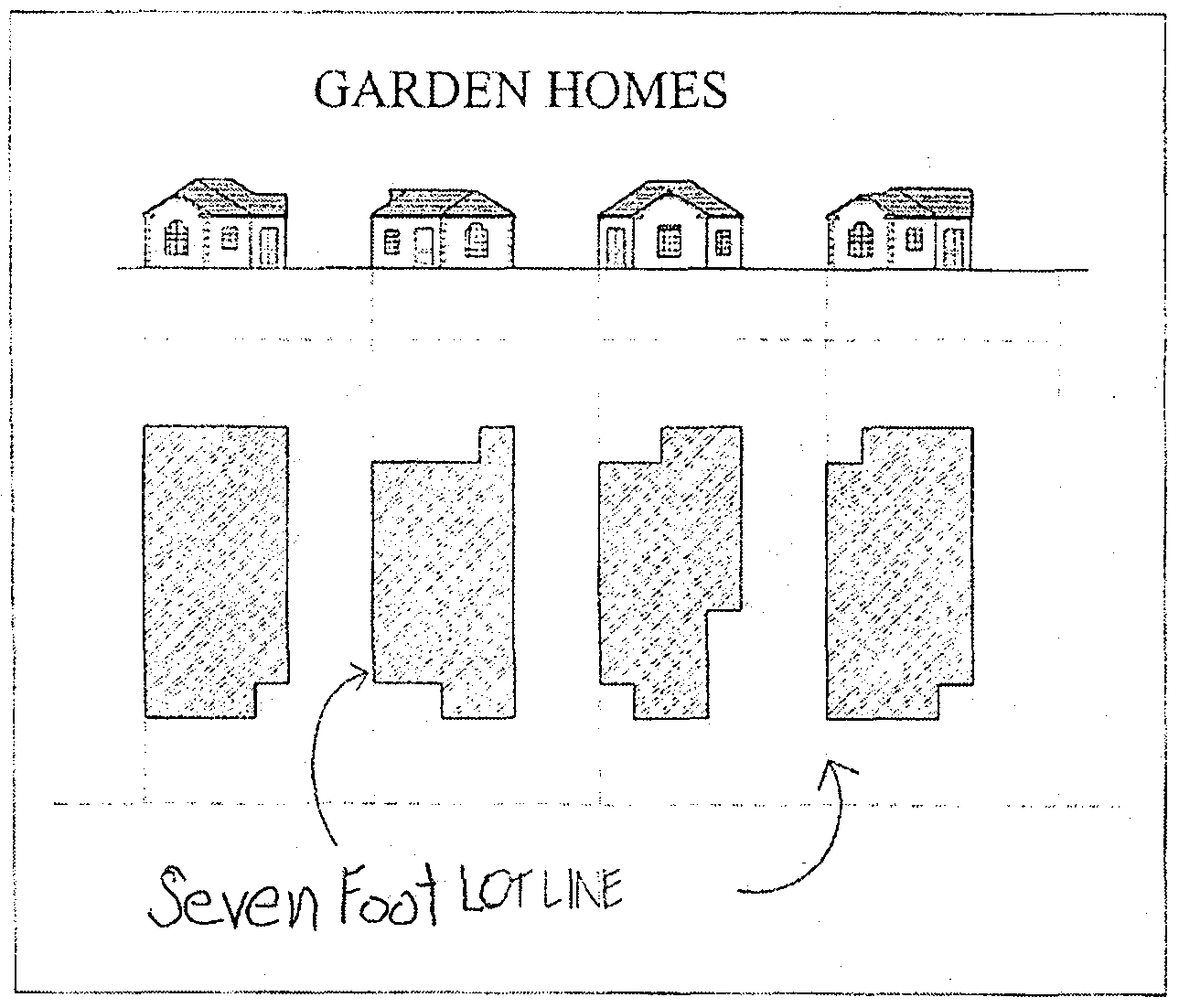
Garden home. A detached, single-family dwelling designed on a small lot with a seven-foot lot line on one side. (See typical illustration overleaf.)
Manufactured (mobile) home. A structure, transportable in one or more sections, which, in its traveling mode, is eight feet or more in width or 40 feet or more in length, or, when erected upon a site, is 320 square feet or more; and, which is built on a permanent chassis and designed to be used as a dwelling unit, with or without a permanent foundation, connected to the required utilities, including the plumbing, air conditioning and electrical systems contained therein. If constructed on or before June 15, 1976, the unit bears a seal certifying compliance with the Manufactured Home Construction and Safety Standards of the U.S. Department of Housing and Urban Development (DHUD). All homes built after June 15, 1976, are required to meet the dimensions/area mentioned above.
Manufactured (mobile) home subdivision. A division of a tract of land, 20 acres or more, into two or more lots, plats, sites or other subdivisions of land which meets all required regulations and are owner occupied.
Manufactured (mobile) home park. A 20 acres or larger tract of land used or designed to accommodate a manufactured (mobile) home community of multiple spaces for rent or lease.
Manufactured (mobile) home lot. A lot that is designed for use within a manufactured (mobile) home subdivision.
Manufactured (mobile) home space. A space that is designed for use within a manufactured (mobile) home park.
Modular home. A dwelling constructed on-site in accordance with the International Building Code (Ordinance # M02-11-25). It is composed of components substantially assembled in a manufacturing plant and transported to the building site for final assembly on a permanent foundation.
A modular home is not a manufactured home in that the latter (manufactured home) is constructed in a plant in accordance with the U.S. Manufactured Home Construction and Safety Standards Act of the U.S. Department of Housing and Urban Development (DHUD) and does not meet the requirements of the Standard Building Code (International Code). (Modular Homes should be treated in the same manner as single-family residences since they are required to meet the Standard Building Code (International Building Code) Requirements.
Planned residential development. A planned residential development district facilitates the accommodation of single-family residential uses, such as, conventional single-family homes, garden homes and townhouses. Such developments adhere to a site plan and any amendments made to this plan. A site of five contiguous acres or larger, with a minimum of 20 percent of it devoted to recreation/open spaces, is a requirement. (See article VI, § 9.00, Planned Residential Development District.)
Planned unit development. A planned unit development is a mixed use development with a flexible approach toward the designing of large area as a whole. The permitted uses include residential, commercial, office use, institutional and industrial areas. Such developments adhere to as site plan and other relevant design proposals. The conditions under which such a development is allowed is general in nature and shall be applied only upon the approval of actual drafted plans and design proposals. Such developments involve the expertise of personnel from different professions. They may be carried out in phases but any change made to the design and the plans must be approved by the City of Moody. A certain amount of flexibility in zoning and subdivision regulations is granted to the developer in order to achieve better overall design, urban spaces, street design, landscaping, infrastructure networks, etc.
Single-family residence. A detached single-family dwelling constructed on-site and in accordance with the requirements of the (Southern Building Code) International Code.
Townhouse. Townhouse means a form of ground-related housing, in which individual dwelling units are attached along at least one common wall to at least one other dwelling unit, with no more than six units attached together. Each of these units occupies interior space from the ground to the roof and has direct access to private open space.
5.03.
Institutional uses.
Animal shelter. A nonprofit or public organization providing shelter for small domestic animals.
Cemetery. Human burial grounds.
Cemetery, pet. Burial grounds for small domestic animals (pets).
Club. A group of people organized for a common purpose to pursue common goals, interests and activities and usually characterized by: certain membership qualifications, payment of fees/dues, regular meetings, a constitution or by-laws.
Community center or civic center. A building, structure, or other facility used for and providing: religious, fraternal, social and/or recreational programs and activities generally open to the public and designed to accommodate and serve significant segments of the community.
Country club. Land or buildings containing recreational facilities and a club house for private club members and their guests.
Domiciliary care facility. Licensed homes for the aged, intermediate institutions and related institutions (not otherwise defined in this ordinance) the primary purpose of which is to furnish room, board, laundry, personal care and other non-medical services (regardless of what it may be named or called) for not less than 24 hours in any week, to individuals not related by blood or marriage to the owner or administrator. This kind of care implies sheltered protection and a supervised environment for persons who, because of age or disability, are incapable of living independently in their own homes or in a commercial room and board situation, yet who do not require the medical and nursing services provided by a nursing home. In these facilities, there might be available, temporarily and incidentally, the same type of limited medical attention that an individual would receive if living at home.
Group care home. A dwelling shared by handicapped persons, including resident staff, who live together as a single housekeeping unit and in a long-term, family-like environment in which staff persons provide care and education and work toward enabling the resident to live as independently as possible in order that he or she may participate in community activities and, at the same time, work with the resident. The primary goal of such homes is for the handicapped person to reach his or her maximum potential.
(See Code of Alabama, 1975, § 11-52-75, regulations as to housing of mentally retarded or mentally ill persons in multifamily zone, as amended.) [Code of Ala. 1975, § 11-52-75.]
Halfway house. A licensed home for inmates on release from more restrictive custodial confinement or an initial place in lieu of such more restrictive custodial confinement, wherein supervision, rehabilitation and counseling are provided to guide residents back into society, enabling them to live independently.
Hospital. An establishment which provides health services primarily for inpatient medical or surgical care of the sick or injured, including accessory facilities such as: laboratories, pharmacies, out-patient clinics, training facilities, gift shops, coffee shops, cafeterias and staff offices.
Military installation. A government-sponsored defense facility, including: military bases, national guard armories, military reserve centers and similar uses.
Nursing care facility. A licensed institution maintained for the purpose of provided skilled nursing care and medical supervision at a lower level than that provided in a hospital but at a higher level than that provided in a domiciliary care facility.
Park. Publicly owned and operated parks, playgrounds, recreation facilities and open spaces.
Penal institution. A public institution housing inmates for correction or rehabilitation. (This definition shall not apply to jails.)
Place of worship. Buildings arranged for religious purposes, such as churches and synagogues, including related facilities for: instruction, meeting, recreation, lodging, eating and other integrally related activities.
Public assembly center. Buildings arranged for the general assembly of the public for community events, such as: coliseums, stadiums, etc.
Public building. Buildings arranged for the purpose of providing public services, not otherwise defined in this section, including: government offices, post offices, museums, libraries, transit stations, police and fire stations, emergency service stations, civil defense operations and similar uses.
Public utility facility. A facility that provides public utility services to the public at large, including: water and sewer, gas distribution, electric transmission and distribution and cable transmission and distribution facilities.
Public utility service. Essential utility services required to support development and which involve only minor structures such as lines and poles.
School. A public or nonprofit school.
5.04.
Commercial uses.
Airport. A place where commercial aircraft can land and take-off. Such use may include: terminals, hangers, refueling and repair facilities, passenger accommodations and other integrally related facilities.
Animal hospital. A place where small household pets are given medical treatment which may include surgical treatment, and where the short-term boarding of pets within an enclosed building may be provided.
Bakery, minor. An establishment which bakes goods for on-premises retail sale only.
Bank or financial institution. A business engaged in providing banking or financial services to the general public, such as: banks, savings and loan institutions, credit unions, finance companies and similar uses.
Bed and breakfast inn. A house, or portion thereof, where short-term lodging rooms and meals are provided. The operator of the inn shall live on the premises or in adjacent premises.
Boarding house. A dwelling for the residency of two or more boarders on a long-term basis (at least month-to-month). Each unit intended to be rented does not constitute a dwelling unit as defined in this ordinance.
Broadcast studio. Establishments primarily engaged in the provision of broadcasting and other information relay services accomplished through the use of electronic and telephonic mechanisms, including: film and sound recording, radio stations, television studios or telegraphic service offices.
Business or professional office. A place where the administrative affairs of a business or a profession are conducted, such as: a law firm; accounting or bookkeeping firm; real estate agency; insurance agency; financial planner; architect; secretarial service; physician or dentist; engineer; the administrative staff of a business or industry; and, similar uses.
Business support service. A place of business which supplies support services primarily to business or professional offices or services, such as: photocopying; office equipment; supplies and services; cleaning services; computer and office equipment repair; and, similar services.
Campground. A group of buildings or structures, on a site of ten acres or more, (planned as a whole) for seasonal recreation or vacation uses, including: tent campsites, travel trailer or recreational vehicle sites, vacation cottages, recreational facilities, eating facilities (such as picnic tables and/or outdoor grills), and bathrooms, which may include a facility which provides for the sale of personal items and gifts.
Car wash. A commercial establishment engaged in washing or cleaning of automobiles and light vehicles. Such a facility may be automated or may employ the services of individuals to perform such services manually.
Clinic. A facility providing medical, psychiatric or surgical services for sick or injured persons exclusively on an out-patient basis.
Commercial parking. Parking of motor vehicles on a temporary basis within a commercially operated, off-street parking lot or garage.
Commercial school. A one-story retail establishment, with less than 2,000 square feet of gross floor area, that is primarily designed to sell food, beverages and other household goods and products to customers who purchase only a relatively few items at a time (in contrast to a supermarket). Such an establishment may also engage in the incidental sale of vehicle fuel, oil and accessories; but, it shall not engage in either major or minor vehicle repair activities, as defined in this ordinance.
Day care center. A licensed facility, other than a residence, providing day care on a regular basis to more than six children, elderly, handicapped or infirm persons.
Day care home. A licensed service, operated from a dwelling by the resident, providing day car on a regular basis to more than six or less children, elderly or infirm persons.
Entertainment, indoor. A commercial establishment providing spectator entertainment within an enclosed building, including: movie theaters, playhouses, etc.
Entertainment, outdoor. A commercial establishment providing spectator entertainment in open or partially enclosed or screened facilities, including: sports arenas, racing tracks, drive-in theaters, amusement parks, etc.
Funeral home. A building or part thereof used for human funeral services. Such a building may contain space and facilities for the following:
A.
The embalming and the performance of other services used in preparation of the dead for burial.
B.
The performance of autopsies and other surgical procedures.
C.
The storage of caskets, funeral urns and other funeral supplies.
D.
Space for the storage of funeral vehicles is allowed, but funeral homes shall not include facilities for cremation.
Where a funeral home is permitted, a funeral chapel shall also be permitted as an incidental use.
Garage, repair. Any place of business engaged in major vehicle repair activities as defined in this ordinance. Such establishments may also engage in minor vehicle repair activities and in the sale of vehicle fuel. All major vehicle repair work shall be performed entirely within an enclosed building. No such building or premises shall be used for the parking of vehicles which are offered for sale, nor shall any abandoned or inoperative vehicles be permanently stored on the premises.
Garden center or nursery. The retail sale of plants, trees, shrubs and the like for ornamental purposes, conducted from a building, greenhouse, outdoor display area or stand, including incidental sales of items customarily associated with such sales activities, such as: containers, fertilizers, ornaments, mulch, potting soil, small gardening tools, gardening equipment, seeds, etc.
Gasoline service station. A commercial establishment providing fuel, lubricants, parts and accessories for vehicles, which may also engage in the incidental sale of food items and beverages. A gasoline service station may also engage in minor vehicle repair activities as defined in this section. The principal building or the premises shall not be used for the parking and display of motor vehicles offered for sale; or, for the permanent storage of inoperable motor vehicles. All gasoline storage tanks shall be in full compliance with the Alabama Department of Environmental Management (ADEM) requirements, as well as all local regulations.
General retail, enclosed. The retail sales of goods and services, not otherwise defined in this section, including, but not limited to: food sales, department stores, clothing stores, home furnishings, appliance stores, automobile parts and supply stores, video rental, gift shops, florist shops, hardware stores, specialty shops, jewelry stores, variety stores, sporting goods stores, antique shops and similar retail activities.
General retail, unenclosed. The retail sales of goods and services not otherwise defined in this section, conducted partially or fully outside of a building, including, but not limited to: sidewalk sales, flea markets, outdoor food service and similar activities.
Grocery store/super market. A retail establishment which is usually in excess of 2,000 square feet in which the following items are normally sold, food items, beverages, household supplies, personal care items, etc. Such an establishment may also include magazine sales, the sale of automobile maintenance supplies, a deli and/or bakery; but, shall not engage in any form of vehicle repair or maintenance or the sale of vehicle fuel.
Home occupation. A business, profession, occupation or trade which is conducted for the personal gain or support and is located entirely within the living area of a dwelling, as an incidental activity of the residents of that dwelling. Such an activity shall not alter the exterior of the building or the property or affect the residential character of the neighborhood in which it is located.
Home improvement center. A place of business providing building, yard and garden materials; appliances; and tools and supplies on retail or wholesale.
Hotel or motel. A commercial facility offering transient lodging accommodations on a daily or weekly basis to nine or more guests. Such a facility may also include, as an integral part of its operation, such services as: restaurants, meeting rooms, banquet rooms, gift shops, recreational facilities, etc. In addition, such a facility may include a bar or lounge as an incidental use in which alcoholic beverages are sold for on-premises consumption only.
Manufactured (mobile) home sales. A lot or tract of land used for the display of manufactured (mobile) homes for sale.
Medical support service. A place of business which supplies medical support services to individuals, medical practitioners, clinics and hospitals, such as: a pharmacy where the business activity is limited to the filling of prescriptions and the sale of drugs and medical and surgical supply store, an optician and the like.
Mini-warehouse. A structure (or group of structures) that is partitioned for leasing of individual storage spaces and is exclusively used for the storage of nonvolatile, non-toxic and non-explosive materials. The facility shall not be used for retail or wholesale operations. Such facilities may be permitted to hold periodic auctions to dispose of unclaimed materials and goods that are stored and not reclaimed by the party or parties signing the lease agreement.
Open air market. Retail sales of arts, crafts, produce, discount or used goods which are located partially or wholly outside an enclosed building. This may include: produce markets, craft markets, farmers markets or similar activities.
Personal service. A retail establishment engaged in providing services involving the care of a person or persons, such as: barber shops, beauty shops, cosmetic studios, laundromats, indoor exercise and fitness centers, tanning salons, seamstress, shoe repair, travel agencies, locksmiths, interior decorations, formal wear rentals, etc.
Printing establishment, minor. Blue printing, copying, printing, engraving and reproduction services limited to 2,500 square feet of floor space.
Recreation. A commercial establishment providing recreational or sports activities to participants, including: bowling alleys, billiard parlors, video game centers, ice and roller skating rinks, driving ranges, miniature golf courses, conventional golf courses, swimming pools, tennis courts and other commercial recreational and sports activities.
Restaurant, standard. An establishment where food and drink are prepared, served and primarily consumed within the building where patrons are seated and served.
Restaurant, fast food. An establishment where food and drink are rapidly prepared for carry-out, fast delivery, drive-through or drive-in services. It may also include facilities for standard sit-down consumption by patrons.
Shopping center. A group of commercial establishments located on a lot planned and developed in a unified manner and designed with shared parking and driveway facilities, all under a common ownership or management authority. The premises shall not be used for the parking of vehicles offered for sale.
Studio. A place of work for an artist, photographer, or craftsman, including instruction, display, production and retail sales of materials produced on the premises.
Truck stop. A commercial establishment which may contain a restaurant (standard) or a delicatessen; a gift shop; provisions for the incidental sale of gasoline, including diesel fuel; designated areas for the temporary parking of large trucks/rigs, including overnight parking; and, the sale of vehicle equipment, motor oil and other vehicle accessories. Such a facility may also engage in minor vehicle repair activities, as defined in this ordinance; however, such a facility or remise shall not be used for the permanent storage of the types of equipment mentioned above. There shall be no display of vehicles or equipment offered for sale or the storage of inoperable motor vehicles.
Vehicle sales or rental. A place of business engaged in the repair and maintenance of vehicles including: painting, body work, rebuilding of engines or transmission, upholstery work, fabrication of parts and similar activities, all of which shall be performed entirely within an enclosed building.
Vehicle repair, minor. A place of business engaged in sales, installation and servicing of mechanical equipment and parts, including audio equipment and electrical work, lubrication, tune-ups, wheel alignment, tire balancing, brake and muffler work, battery charging and/or replacement, and similar activities.
Warehousing, wholesaling and distribution; B-4 zoning district. Warehousing, wholesaling and distribution center refers to the use of land and structures for the purpose of storing materials with the intent to sell and/or distribute such materials. These facilities may be distribution centers, wholesale operations, etc., and may include minor assembly, packaging or repackaging; provided however, that manufacturing as defined in article IV, section 5.05 shall not be allowed. All storage and operations must be totally enclosed. No open-air or outside storage is allowed in the B-4 district. The premises may be used to store both perishable and non-perishable items (with adequate facilities to prevent pollution, toxicity, health and sanitary hazards and general nuisance); trucks, trailers, and other transportation devices and equipment; construction equipment and devices; and other bulk storage materials and equipment; provided however, that the following materials may not be stored in a warehousing, wholesaling and distribution structure located within the B-4 district: chemicals, gasoline/petroleum products, oil, gases, explosives and other hazardous materials (as the term "hazardous materials" or "hazardous wastes" is defined by the Alabama Department of Environmental Management, the U.S. Environmental Protection Agency, and the Hazardous Waste Management Act of 1978 (Code of Alabama Section 22-30-21)) [Code of Ala. 1975, § 22-30-21]. The storage of construction materials such as sand, gravel, bricks, cinder blocks, lumber, clay, steel; water and sanitary sewer supplies, fixtures, etc., should be done in a manner to prevent accidents and must be totally enclosed. The facility must be constructed in such a manner so as to prevent dust, excessive noise, and odors that would interfere with the uses of the adjoining properties. All driveways, roads, service yards, and loading/unloading and parking lots must be paved. All service yards and loading/unloading areas must be located on the side or rear of the primary structure unless permission to locate otherwise is obtained from the zoning board of adjustments. All storage must be conducted within a permanent, fully enclosed building that is constructed in accordance with the building code being enforced by the city at the time of its construction.
5.05.
Industrial uses.
Bakery, major. An establishment which bakes goods for wholesale and/or retail. It may include storage and distribution facilities.
Construction service. A place of business engaged in construction activities and incidental storage as well as wholesaling of building materials, such as: a building contractor, trade contractor or wholesale building supply store. This shall not include a home improvement center, which also sells material at retail.
Industry, heavy. All meat or poultry processing facilities, slaughterhouses; the storage or manufacturing, disposal or destruction of: flammable, explosive or toxic materials, or other materials generally considered to be hazardous or offensive.
Industry, light. A use engaged in the manufacturing, predominantly from previously prepared materials, finished products or parts, including processing, fabrication, assembling, treatment and packing of such products; and the incidental storage, sale and distribution of such products. This use excludes the basic industrial processing.
Manufacturing, general. The basic processing and manufacturing of materials or products predominantly from extracted or raw materials and the incidental storage, sale and distribution of such products.
Maintenance service. An establishment providing building and yard maintenance services, such as: janitorial, exterminating, landscaping, window cleaning, office cleaning, etc.
Printing establishment, major. An establishment engaging in blue printing, copying, printing, engraving or other reproduction services with no limit on its floor space/area.
Recycling plant. A facility in which recoverable resources, such as: newspapers; magazines; books and other paper products; glass; metal cans; and other products are recycled, reprocessed and treated to a condition that is adequate for their reuse. Such a facility is not a junk yard.
Research laboratory. A building or group of buildings in which scientific research, investigation, testing or experimentation facilities are located. There shall be no provision for the manufacturing or sale of products, except as incidental to the main purpose of the laboratory.
Resource extraction. The removal of soil, sand, clay, gravel, minerals, or similar materials for commercial purposes, including: quarries; sand and gravel operations; gas extraction; mining; etc.
Salvage yard or junk yard. A lot, structure or part thereof, used primarily for: the collecting, storage and sale of waste paper, rags scrap metal or discarded material: the collecting, dismantling, storage and salvaging of machinery or vehicles not in running condition, or for sale of parts thereof.
Sanitary landfill. A state-approved site for solid waste disposal employing an engineering method of waste disposal that minimizes environmental hazards. This operation shall employ processes of spreading, compacting to the smallest volume, and applying cover material over all exposed waste at the end of each operating day.
Note: A sanitary landfill should not be confused with a dump which is illegal in any location. Solid waste at a dump is disposed of without being compacted and covered. A sanitary landfill presents fewer health and aesthetic problems and has the potential of being reclaimed for other land uses later. The disposal of hazardous or radioactive waste material is not permitted in a sanitary landfill.
Surface mining. Any activity constituting all or part of a process for the removal of minerals, ores and other solid matter for sale or for processing or for consumption in the regular operation of a business.
Transmission tower, commercial. A commercially licensed and approved structure, situated on a nonresidential site, that is intended for the purpose of transmitting or receiving television, radio, or telephone communications, excluding those used exclusively for dispatch communications.
Transmission tower, noncommercial. A noncommercial structure, which may be situated in commercial or noncommercial areas and may include amateur radio towers, ham operators, private receivers, etc.
Truck terminal. The land and buildings used as a relay station for the transfer of a load from one vehicle to another or one party to another. The terminal cannot be used for permanent or long-term accessory storage for principal land uses at other locations. The terminal facility may include storage areas for trucks and buildings or areas for the repair and maintenance of trucks associated with the terminal.
Warehousing, wholesaling and distribution. Warehousing, wholesaling and distribution refers to the use of land and structures for the purpose of storing materials with the intent to sell and/or distribute such materials. These facilities may be distribution centers, wholesale operations, open air storage facilities, etc. The premises may be used to store both perishable and non-perishable items (with adequate facilities to prevent pollution, toxicity, health and sanitary hazards and general nuisance); trucks, trailers, and other transportation devices and equipment; construction equipment and devices; and, other bulk storage materials or equipment. The storage of construction materials, in the open, such as: sand, gravel, bricks, cinder blocks, timber, clay, steel (columns, girders, trusses, plated, sheets pipes, etc.); water and sanitary sewer supplies, fixtures, etc., should be done in a manner to prevent accidents. Materials, such as: sand, clay, etc., should be well-contained to prevent any form of their displacement that may occur due to rain, storms and other phenomena, resulting in the jeopardizing of any neighboring land uses, wetlands, parks floodplains, environmentally sensitive areas, surface water supplies, sewage disposal systems, etc.
5.06.
Landfill uses.
Agency. Any controlling agency, public or private, elected, appointed or volunteer utilizing methods approved by the health department for the purpose of controlling and supervising the collection and/or disposal of solid wastes.
Ashes. The solid residue from burning of wood, coal, coke or other combustible material used for heating or from incineration of solid wasters, but excepting solid residue, the storage or disposition of which is controlled by other agencies.
Biomedical waste. Any pathological waste, biological waste cultures, and stocks of infectious agents and associated biological matter, contaminated animal carcasses (body parts, their bedding and other wastes from such animals), sharps, chemotherapy waste, discarded medical equipment and parts, not including expendable supplies and materials which have not been decontaminated, as further defined by the Alabama Department of Environmental Management (ADEM) and other federal, state, county and local authorities, as required by law.
Composting or compost plant. An officially controlled method or operation whereby putrescible solid wastes are broken down through microbic action to a material offering no hazard or nuisance factors to public health or well-being.
Disposal. The discharge, deposit, injection, dumping, spilling, leaking, or placing of any solid waste into or on any land or water so that solid waste or hazardous waste or any constituent thereof may enter the environment or be emitted into the air or discharged into any waters, including ground waters.
Dump, open. Any officially recognized place, land or building which serves as a final depository for solid wastes, whether or not burned or buried, which does not meet the minimum requirements for a sanitary landfill, except approved incinerators, compost plants and salvage yards.
Dump, unauthorized. Any collection of solid wastes either dumped or caused to be dumped or placed on any property either public or private, whether or not regularly used, and not under the control and supervision of any person or agency. An abandoned automobile, large appliance or similar large item of solid waste shall be considered as forming an unauthorized dump within the meaning of this article, but not the careless littering of smaller individual items as tires, bottles, cans and the like. An unauthorized dump shall also mean any solid waste disposal site which does not meet the regulatory provisions of this article.
Garbage. Putrescible animal and vegetable wastes resulting from the handling, preparation, cooking and consumption of food, including wastes from markets, storage facilities, handling and sale of produce and other food products and excepting such materials that may be serviced by garbage grinders and handled as household sewage.
Hazardous wastes. Those wastes defined in the Hazardous Waste Management Act of 1978, as amended (section 22-30-21 et seq.).
Incinerator. A device designed to burn that portion of garbage and rubbish which will be consumed at temperatures generally ranging 1600 degrees F or over. The unburned residue from an incinerator, including metal, glass and the like shall be called ashes.
Landfill. A method of compaction and earthy cover of solid wastes other than those containing garbage or other putrescible waste, including, but not limited to, tree limbs and stumps, demolition materials, incinerator residues and like materials not constituting a health or nuisance hazard, where cover need not be applied on a per day used basis.
Landfill, sanitary. A controlled area of land upon which solid waste is deposited and is compacted and covered with compacted earth each day as deposited, with no on-site burning of wastes, and so located, contoured and drained that it will not constitute a source of water pollution as determined by the Alabama Department of Environmental Management (ADEM).
Rubbish. Nonputrescible solid wastes, excluding ashes, consisting of both combustible and noncombustible wastes. Combustible rubbish includes paper, rags, cartons, wood, furniture, rubber, plastics, yard trimmings, leaves and similar materials. Noncombustible rubbish includes glass, crockery, metal cans, metal furniture and like materials which will not burn at ordinary incinerator temperatures, not less than 166 degrees F.
Solid wastes. All putrescible and nonputrescible discarded materials, except household sewage and livestock and poultry wastes, including, but not limited to, garbage, rubbish, ashes, refuge from streets and highways, dead animals, including offal, abandoned automobiles and such industrial wastes as are not controlled by other agencies.
5.07.
Temporary uses.
Garage or yard sales. The sale of personal belongings by an individual, in his or her residence, property or premises. (See article VII, Supplemental regulations, § 9.00, Garage or yard sales.)
Seasonal sales. Unless otherwise specified in this ordinance, the seasonal sale of farm produce, firewood, Christmas trees and similar items shall be conducted either from motor vehicles or premises. Such items shall not be sold from permanent structures/locations. The use of structures or buildings in conjunction with the said activity shall be temporary, as specified by the city. Such sales shall be subject to the city's conditions at the time a business license is issued. The term "seasonal sales" shall not be confused with Open air market, defined in this ordinance.

