
Moody City Zoning Code
ARTICLE VII
SUPPLEMENTAL REGULATIONS
§ 1.00.- Area modification for lots of record.
The Moody zoning board of adjustment shall approve all proposed development involving nonconforming lots of record. (See article V, § 6.00 and subsection 6.01.)
§ 2.00. - General yard requirements.
A.
Every part of a required yard shall be open to the sky, unobstructed by any structure or part thereof and unoccupied for storage, servicing or similar uses, except as provided for herein.
B.
More than one multiple dwelling, office, institutional, industrial or public building may be located upon a lot or tract of land, but such dwellings shall not encroach upon the front, side or rear yards required by the district regulations.
2.01.
Front yard modifications.
A.
If 40 percent or more land area of a site, on the same side of a street between two intersecting streets is being developed or will be developed in [the] future, then the following rules shall apply. In the event of the existence of a building or buildings, the front yard requirements of the district in concern may or may not be met. If the existing front yards of such buildings are five feet or less than what is specified for that district, new buildings shall not be erected closer to the street than that distance established by taking the average front yard depths of the existing dwellings. (See illustration below.)
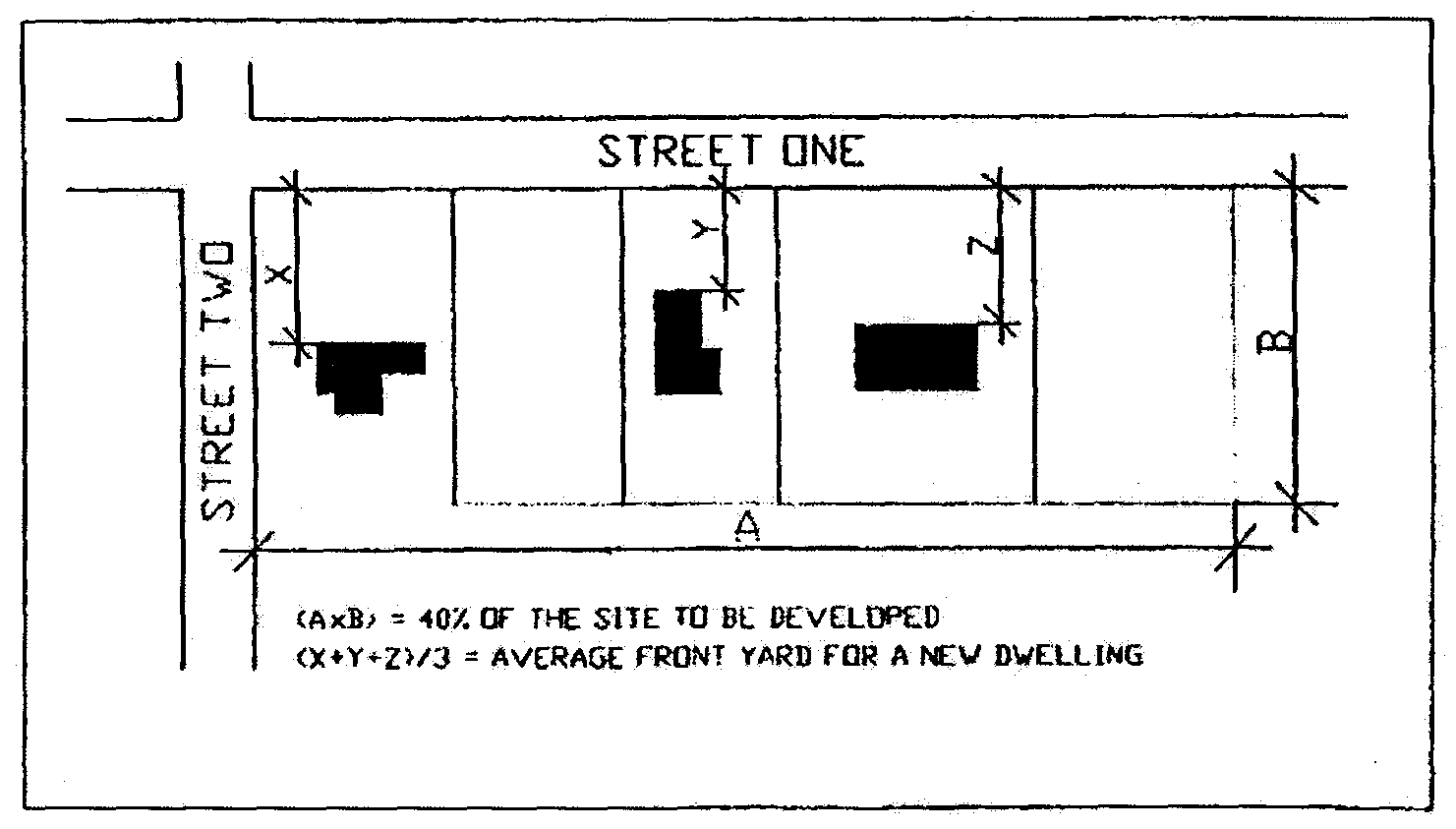
Street one street two
B.
Where 40 percent or more of the frontage on one side of [the] street between two intersecting streets is presently developed or may hereafter be developed with buildings that do not have a front yard as described in [subsection] A [of this section], the following shall apply:
1.
Where a building is to be erected on a parcel of land that is within 100 feet of existing [building] on both sides, the minimum front yard shall be a line drawn between the closest front corners of the adjacent buildings.
2.
Where a building is to be erected on a parcel of land that is within 100 feet of an existing building on one side only, such building may be erected as close to the street as the existing building.
C.
Through lots shall provide the required front yard on both streets.
D.
Corner lots shall provide a front yard on each street.
2.02.
Rear yard modifications. Where a lot abuts an alley, one-half of the alley width may be considered as part of the required rear yard.
§ 3.00. - Height modifications.
A.
Any limitations on the height shall not apply to the buildings used exclusively for storage purposes, provided such buildings do not exceed the height in feet permitted in the district in which they are located.
B.
All chimneys, cooling towers, elevators, bulkheads, fire towers, gas tanks, steeples, penthouses, stacks, stage towers or scenery lofts, tanks, water towers, ornamental towers and spires, wireless, television or radio towers or necessary mechanical appurtenances, where permitted, may be erected to any height not in conflict with existing or hereafter adopted ordinances of the City of Moody. Where permitted, in connection with residential uses, such structures shall be limited to a height of 25 feet above the average height of structures in that district.
§ 4.00. - Fences and walls.
A.
No fence shall be allowed beyond the front yard setback line in any single-family residential district.
B.
The height requirements in any single-family residential zone shall be as follows:
1.
Fences constructed on a side or rear lot line or behind the required front yard, as set forth elsewhere in these regulations, shall not exceed a height of 6.5 feet as measured from the top most point of the fence to the ground or surface along the center line of the fence.
C.
The following types of fences are permitted in residential districts: masonry walls, ornamental (iron), woven wire (chain link), wood or other manmade materials and hedges.
D.
The following type of fences are prohibited: any fence carrying electric current, any fence that utilizes spikes, barb wire or other pointed materials in its construction.
E.
When warranted, those fence types listed as prohibited above may be permitted in the AG-1 district, as well as the I-1 light industrial and I-2 heavy industrial districts.
F.
On any corner lots, no fence of any material shall be permitted to encroach a required 35-foot building line setback that would hinder site distances for motorists or pedestrians. No fence, split-rail, hedge or any type of planting, including ornamental, shall be placed or constructed in any location that would hinder access to fire hydrants.
G.
The following exceptions should be noted relative to fences, walls and hedges:
1.
Fences used for guard railing, around depressed ramps, along the tops of retaining walls, along driveways and adjacent to residential sidewalks, are not to exceed 42 inches in height. (See illustration of typical fence and/or wall configurations overleaf.)
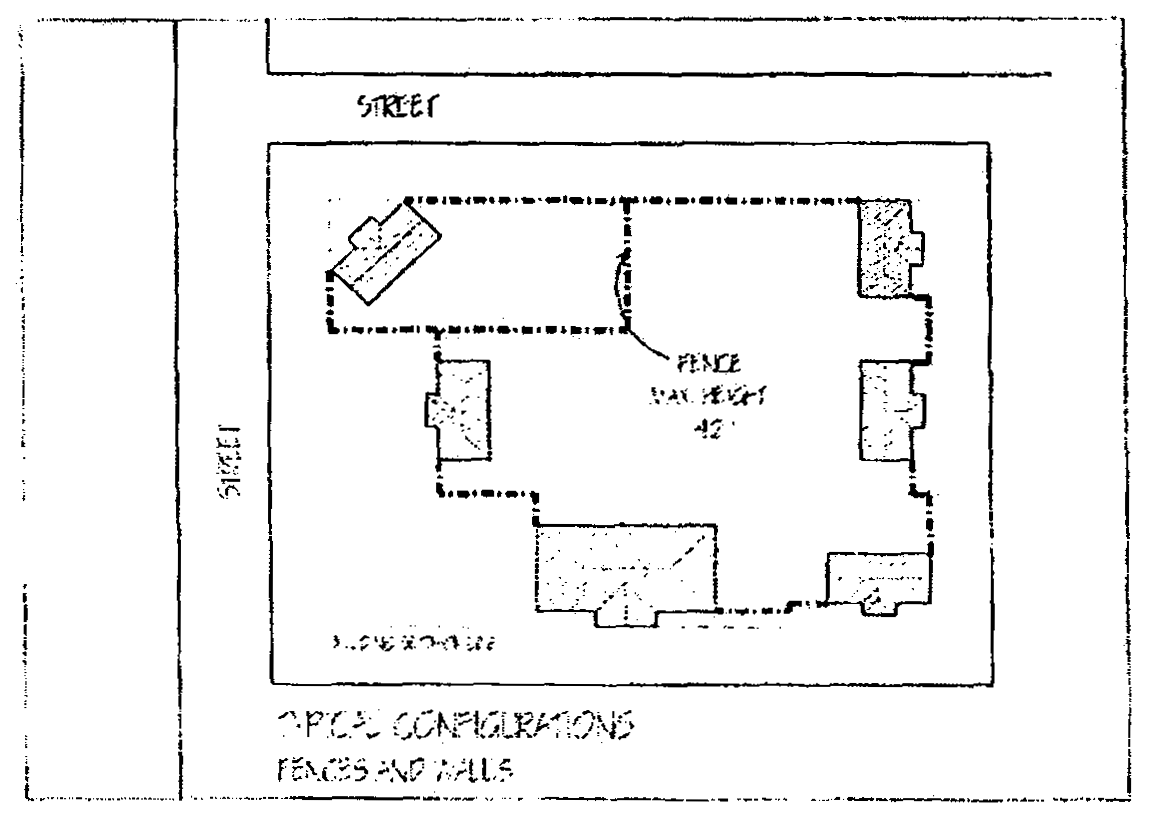
Fences and Walls
H.
For nonresidential districts, all fence construction shall be subject to site plan approval, with no height or setback restriction(s), except those deemed necessary and reasonable by the planning commission, unless otherwise stipulated elsewhere in this ordinance. (See special exception uses.)
§ 5.00. - Porches, terraces, balconies, cornices and eaves.
A.
Sills or ornamental features of a structure may project into any required yard no more than six inches.
B.
Cornices or eaves may project into any required yard no more than 24 inches.
C.
Terraces, unenclosed porches, underground fallout shelters or ornamental features (which are constructed as part of a single-family or two-family dwelling) may project into a required yard, provided such projections are not closer than 30 feet from the front lot line and 25 feet from the back lot line. The said terraces, porches, shelters and ornamental features (when constructed as part of a multifamily dwelling) may not exceed a maximum of five feet into the required side yards.
D.
In single-family and two-family residential zones, an unenclosed balcony, deck, porch or fire escape may project into a required rear yard, provided such structures are located not closer than 25 feet from the rear property line and ten feet from either side property lines.
E.
In multifamily residential zones, an unenclosed balcony, porch, deck or fire escape may project into a required rear yard for a distance not to exceed 12 feet and may project into a required side yard for a distance not to exceed eight feet; but, in no instance, shall the said structures be located closer than 25 feet from any property line in which a buffer is required as a means of separating incompatible land uses.
§ 6.00. - Accessory buildings and structures. (Ordinance # M 01-02-12).
A.
Nonresidential accessory buildings or structures, up to 12 feet in height, shall be permitted within five feet of any side or rear property line; but, such structures shall not occupy any portion of the front yard. All accessory buildings above 12 feet in height shall be set back one additional foot for each four feet in height above 12 feet up to the maximum building height limitation of the district in which located.
B.
All nonresidential accessory buildings shall be constructed of materials which are compatible with other buildings in the district in which they are located in order to ensure that the aesthetic value and appearance of the neighborhood is retained.
C.
The residential accessory buildings, attached and detached carports and garages on residential lots, in the E-1, R-1, R-2, R-3, RT, RG, PRD, RMHP and RMHS districts, shall meet the following requirements:
1.
The maximum floor area shall be 25 percent of the habitable floor of the principal building. The maximum floor area for enclosed, attached and detached garages shall be 40 percent of the habitable floor area of the principal building.
2.
The maximum height shall not exceed the height of the principal building.
3.
Such structures and additions shall be subject to the front yard requirements of the district in concern.
4.
All detached accessory structures shall be constructed in the rear yard but shall be located no closer than five feet from the property line.
5.
All accessory structures shall be constructed of materials which are compatible with other buildings in the district in which they are located in order to ensure that the aesthetic value and appearance of the neighborhood is retained.
6.
Accessory structures shall not be built prior to the construction of the primary structure. Such structures shall not be used for nonresidential purposes, which are not normally incidental to residential use.
7.
All electrical power service to the accessory buildings on residential lots shall originate from the main power service at the main building.
8.
Attached accessory buildings and structures, such as carports and garages, may be built in the side yard but they must conform with the side setbacks for the district in which they are located.
§ 7.00. - Satellite dish antennas.
A.
Satellite dish antennas and other ground-mounted antennas shall not be permitted in the front yard. The setback from all property lines shall have a distance equal to the height of the antenna. The setback of a satellite dish shall be equal to the minimum distance measured from the closest edge of the dish to the property line. All satellite dishes are subject to the district maximum building height limitations.
C.
All those satellite dish antennas shall be neutral in color and to the greatest extent possible, compatible with the appearance and character of the neighborhood in which they are located. In case the required placement prevents satisfactory reception or other problems of a unique nature, such shall be referred to the zoning board of adjustment for the resolution of the problems.
§ 8.00. - Temporary structures and building material storage.
Temporary buildings may be permitted for the storage of materials connected with construction projects. Such buildings may also be permitted as temporary offices until such time as the construction projects are completed and permanent buildings are ready for habitation. No such buildings or structures shall be permitted until appropriate building permits have been approved by the building inspector and issued by the city clerk.
§ 9.00. - Garage or yard sales.
A.
Garage or yard sales, on the same lot, shall not be conducted for more than three days (whether consecutive or not) during any 90-day period.
B.
All posters and/or signs, display tables, stands, racks, etc., shall be removed immediately after such sale by the person or persons conducting the garage or yard sale and such items shall be stored inside an enclosed building or screened from public view.
§ 10.00. - Private swimming pools.
A.
Where permitted, private swimming pools shall comply with the following requirements:
1.
Private swimming pools, which are wholly or partially above ground level, shall be located in the rear yard of a single- or two-family residential district no closer than 25 feet from any property line. No mechanical appurtenance shall be located within ten feet of any property line.
2.
Private swimming pools constructed below grade level shall be:
A.
Located, including mechanical appurtenances, no closer than ten feet from any property line.
B.
Enclosed at the time of construction by a fence of not less than five feet in height (measured from ground level to the highest point on the fence). All fences and gates shall be constructed of such materials so as to prevent unauthorized entry by persons or household pets. The gates shall be provided with permanent self-latching devices to be kept locked at all times when the pool is not in use.
3.
Above-ground pools shall be subject to the requirements of the Standard Swimming Pool Code, 1991, and any future amendments thereto.
4.
All exterior lighting fixtures shall be constructed to direct the beam of light below the horizontal plane of the fixture, reflecting away from any adjacent property. Said fixtures may not extend higher than 25 feet in height.
5.
Swimming pools for multifamily and commercial uses shall meet minimum standards deemed appropriate by the building inspection department upon review of each specific proposal.
§ 11.00. - Farms.
A.
The minimum land area shall be five acres.
B.
The following farming activities shall be permitted:
1.
Forage and sod crops.
2.
Grain and seed crops.
3.
Dairy animals and products.
4.
Livestock; such as: beef cattle, swine, sheep, goats, or any similar livestock; including the breeding and raising of such animals but excluding commercial meat processing operations.
5.
Poultry, including egg production but excluding commercial poultry processing operations.
6.
Nursery operations involving the raising of: plants, shrubs and trees for sale and transplantation, including: greenhouses and the incidental sale of items associated with a nursery operation.
7.
Bees and apiary products.
8.
Fisheries, excluding commercial fish processing operations.
9.
Fruit and vegetables of all kinds, including the growing and harvesting of such fruit and vegetables, but excluding commercial food processing operations.
10.
In the AG-1 agriculture zone, the minimum setback of livestock barns [and] commercial chicken (fowl) houses from adjoining property lines shall be 100 feet; from highway (road) right-of-way lines it shall be 300 feet; provided, however, that no livestock barn or chicken houses shall be built closer than 300 feet to the nearest then existing residence other than that of the owner. Swine (hogs) shall be housed, fed and watered not nearer than 100 feet to any adjoining property line or within 300 feet of any street or road right-of-way (unless otherwise stipulated elsewhere).
11.
All temporary sawmills and chippers (used in connection with timber cutting operations) shall be set back at least 200 feet from any lot line.
12.
Non-farm related single-family residences and subdivisions are permitted, provided that the recording of lots in this district contains a minimum of half (½) an acre and is in complete conformance with the city subdivision regulations. Applicants should also be apprised of the fact that a two-acre minimum lot is required for a hobby farm, in case the intent is to utilize the lot for that purpose.
C.
A booth or stall/farm stand, for the purpose of selling farm produce, grown on the same premises, shall be permitted, subject to the following:
1.
The sales areas shall be set back from all lot lines so as to meet the district yard requirements.
2.
The sales areas shall not occupy any part of a required off-street parking or loading area.
D.
All incidental structures and activities commonly associated with a farm may include: barns, silos, animal pens, loading and unloading platforms, chutes or other accessory uses.
§ 12.00. - Regulations pertaining to manufactured (mobile) homes.
A.
Manufactured (mobile) homes shall comply with the following:
1.
Manufactured (mobile) homes are permitted in the RMHP and RMHS districts only.
2.
Manufactured (mobile) homes may be located in the AG-1 agricultural district, upon the fulfillment of the following:
a.
The property owner must obtain the permission of all the adjoining property owners before putting a manufactured (mobile) home on his lot. A road is not considered a dividing line; therefore, a lot across a street from the property in concern shall be considered an adjoining lot.
b.
The homes, on a proposed site, shall be located at least 75 feet from the nearest residential structure, excluding another such home, on the same property under separate ownership.
c.
All water and sewer facilities must be approved by the City of Moody and the St. Clair County Health Department.
3.
Site requirements.
[a.]
Minimum lot width at front setback line: 100 feet.
[b.]
Minimum lot area: 15,000 sf.
4.
Yard requirements.
[a.]
Front: 35 feet.
[b.]
Un-dedicated street: 60 feet from centerline.
[c.]
Side: 15 feet.
[d.]
Rear: 35 feet.
5.
Only two additional homes (manufactured/mobile homes), three including the principal structure, shall be permitted in any parcel in this district, without subdividing the said parcel; furthermore, the approval of the property owners, contiguous to the site, will be required. These contiguous lots may not be under the ownership of the individual who owns the site in questions. Based on this requirement, a parcel or parcels and adjacent property, under the same ownership will allow the following:
[a.]
One home: 15,000 sf.
[b.]
Two homes: one acre minimum.
6.
All manufactured/mobile homes shall be installed according to all the requirements of the Standard Building Code, 1994, appendix H, or as same may be amended; and, these shall be completely skirted, with a weather resistant material, within 30 days from the date the home is moved into the park. Such weather resistant material(s), as chosen by the owner or contractor, should be painted or coated with some kind of outdoor water resistant paint or primer. The choice of color should be one, or more, that blend(s) with the color(s) or the color scheme of the manufactured (mobile) home. Any loud or severely contrasting color should be avoided to eliminate the possibility of creating an eye sore. The earth tones and neutral colors are often good choices that lend harmony. All skirting shall be adequately vented.
§ 13.00. - Buffers.
13.01.
General requirements for buffer/screening.
A.
The specifications for buffers shall follow the buffer matrix or as deemed by the planning commission or as specified during the review of the site development plan. The following criteria shall also be met:
1.
If a natural barrier is specified as a buffer, such shall be a planting strip, planted to provide a visually impervious barrier uniformly dense at all heights from the ground up, which would attain a height of at least four feet within one growing season.
2.
All buffers shall provide adequate plant cover (trees, shrubs).
3.
All planting strips shall have attained a minimum height of six feet, within three full growing seasons.
B.
If manmade screening methods are specified, the following shall apply:
1.
All screening material shall be continuously maintained, present an attractive exterior appearance and be of durable construction.
2.
Unless otherwise noted, the acceptable screening materials include: wood stockade fences, masonry walls, brick walls and earth berm.
3.
In the rear or the side yards, the screening walls or fences shall be minimum of six feet in height, or as modified by the planning commission; but, it shall not exceed three feet in height within any required front yard.
4.
The location of screening shall not obstruct the visibility of any traffic circulation.
C.
The buffers shall be of sufficient width, height, opacity and density to eliminate the adverse impact on adjacent properties.
13.02.
Modification or waiver.
A.
The screening and planting requirements of this section shall be applied to similarly classified and situated properties but may be modified or waived altogether, in certain cases, by the planning commission, where a building site is subject to any of the following circumstances:
1.
Where natural vegetation (trees and/or shrubs) exist on a piece of property, when application is made for a building permit, a strip of natural vegetation shall be left undisturbed until the building inspector has inspected such area and evaluated it with regard to the use and zone, as well as suitability. The building inspector may require the developer to retain a portion of the natural vegetation, where such exists, as a greenbelt/buffer, rather than require a manmade planting strip or other methods of screening. All such buffers must be sufficient in both height and density to achieve the desired purpose as a natural barrier.
2.
Where impending development of adjacent property would make these standards unreasonable or impractical.
3.
Where, after inspection by the building inspector, it is found that two different and incompatible zone districts abut each other but are already separated by a street or alley or where the view from the adjoining district is blocked by a change in grade or other natural or manmade features.
4.
Where a greenbelt or planting strip cannot, in the professional opinion of an expert, be expected to thrive due to poor soil conditions, intense shade or similar conditions.
5.
The fences, where installed, shall be constructed prior to the issuance of a certificate of occupancy.
6.
All plantings shall be permanently maintained in good growing condition by the party or parties required to provide such plantings. When necessary, such plantings shall be replaced with new growth. All fencing shall be permanently maintained in good condition and, whenever necessary, repaired or replaced by the party or parties required to provide such fences.
7.
In special cases, where the side and/or rear yards may be inadequate to meet the requirements for the buffer strip, the planning commission shall determine, based upon the site plan review or other pertinent information requested, an alternative method of screening or separation.
§ 14.00. - Irregularly shaped lots.
A.
Lot width at the building line shall be no less than the minimum lot width required in the specific zoning district.
B.
The minimum road, street or highway frontage shall be the same as provided for in the specific zoning district. An inability to conform to those requirements, due to constraints form the shape of the lot, terrain, etc., should be brought to the attention of the City of Moody zoning board of adjustment for adequate consideration.
§ 17.00. - Home occupation as a permitted use (Ordinance M2021-09-13).
A.
Notwithstanding anything to the contrary herein, a proposal for a home occupation under this ordinance shall be deemed a permitted use in the following zoning districts only AG-1, MF, E-1, R-1, R-2, R-3, R-T, R-G, PRD, RMHP, RMHS and only if said proposal meets all of the following requirements in the exclusive opinion of the city's building inspector or his/her designee:
1.
An application meeting the requirements of Article VIII § 1.01 is submitted to the building inspector.
2.
Written notice of the submission of an application for a home occupation is given by the building inspector to all contiguous property owners of the subject property at least fifteen (15) days before a final decision is rendered by the building inspector. Applicant shall pre-pay the costs of providing said notice(s) which shall be provided by registered mail addressed to any such property owners at their addresses as submitted with the application as well as the homeowner's association, if applicable. Such notice shall contain the following:
a.
The name of the applicant.
b.
The location of the subject property.
c.
The proposed home occupation use.
d.
A statement informing the property owner that if he / she objects to said application, they should do so by contacting the building inspector or clerk of the zoning board of adjustments whose names, office address, and telephone numbers shall be included along with a City email address for the submission of such objections, if one is maintained.
3.
No objections to the application are received within the time period allotted.
4.
The building inspector determines in writing that all of the requirements of article VIII, § 9.00 have been met by the applicant.
5.
The building inspector determines in writing that the home occupation, if operated as presented, will not be visible or discernable to the public; the building inspector may make reasonable inquiry of the applicant to make such determination.
B.
If the building inspector declines to approve an application submitted under this section, the applicant may request the application be presented to the zoning board of adjustment as a request for special exception, in which case the application shall be submitted to the zoning board of adjustment as any other application for a special exception use and notice provided as required by article VIII, § 1.02. All then-current fees and costs associated with provision of notice shall apply.
C.
Subsequent to the building inspector approving an application under this section, should he/she or a property owner later object to the operation of the home occupation as not satisfying the provisions herein as may be amended, the zoning board of adjustment will consider the home occupation as a special exception application under Article VIII § 1.00, et. seq.

