
Morgantown City Zoning Code
CHAPTER FIVE
GENERAL ZONING PROVISIONS
ARTICLE 1327.- ENACTMENT AND SCOPE OF ZONING ORDINANCE[1]
Editor's note— Article 1327 et seq. of Part Thirteen—Planning and Zoning Code contains the text of the zoning rules and regulations for the City of Morgantown which was reenacted by Ord. No. 06-01, adopted January 3, 2006. Amendments are indicated by parenthetical history notes following amended provisions. The absence of a history note indicates that the provision remains unchanged from the original resolution. Obvious misspellings and punctuation errors have been corrected without notation. For stylistic purposes, a uniform system of headings, catchlines, capitalization, citation to State statutes, and expression of numbers in text has been used to conform to the Code of Ordinances. Additions made for clarity are indicated by brackets.
State Law reference— Authority for zoning ordinance—see W. Va. Code 8A-7-1; contents of zoning ordinance—see W. Va. Code 8A-7-2; effect of zoning ordinance—see W. Va. Code 8A-7-10.
ARTICLE 1329. - DEFINITIONS[2]
Cross reference— General City Code definitions—see ADM. 101.02.
State Law reference— Land use planning definitions—see W. Va. Code 8A-1-2.
Sec. 1327.01. - Title.
These regulations and all accompanying maps, which are on file in the Planning Director's office, and all ordinances and regulations supplemental or amendatory thereto, shall be known and may be cited as the "City of Morgantown zoning ordinance" and are generally referred to herein as "the zoning ordinance," "this ordinance," "the ordinance" or "these regulations."
Sec. 1327.02. - Purpose.
These regulations are hereby adopted in order to:
(a)
Promote the orderly, responsible, and beneficial development and use of land within the City;
(b)
Promote the public health, safety, morals, comfort, convenience and general welfare of the City;
(c)
Protect the character and stability of residential, institutional, business, industrial and natural areas;
(d)
Minimize or avoid congestion in the public streets and to ensure safe, convenient and efficient traffic circulation;
(e)
Secure adequate light, air, convenience of access, and safety from fire, flood and other danger, which may include providing adequate open spaces for light, air and outdoor uses;
(f)
Preserve and enhance the scenic beauty, aesthetics and environmental integrity of the City;
(g)
Encourage compatibility between different land uses and to protect the scale and character of existing development from the encroachment of incompatible uses;
(h)
Regulate and restrict the location and intensity of use of buildings, structures and land for trade, residence and other uses;
(i)
Define the powers and duties of administrative officers and bodies as provided herein, and to establish procedures for the implementation and enforcement of these regulations; and
(j)
Further such other purposes as are stated hereinafter within specific provisions of these regulations.
Sec. 1327.03. - Prohibited uses and acts.
Except as provided in these regulations, no building, structure or premises may be used for any purpose other than those permitted in the zoning district in which the building, structure or premises is located. No land or lot area may be reduced, diminished, used or developed except in accordance with all applicable provisions of these regulations. No building or structure may be altered, erected, constructed, installed, moved, replaced or maintained except in accordance with all applicable provisions of these regulations.
Sec. 1327.04. - Authority and jurisdiction.
These regulations, enacted pursuant to the Code of West Virginia, Chapter 8A, Articles 1 through 12 et seq., as amended, and pursuant to the Morgantown City Code and all other applicable authorities and provisions of West Virginia statutory and common law, shall apply to all land use within the City limits, except where specifically exempted by State law.
Sec. 1327.05. - Inclusion and relationship to other ordinances.
(a)
The zoning ordinance shall be interpreted to include any and all other provisions of the Morgantown City Code, which are necessary for an understanding of this ordinance and the attainment of its purposes. The City Council of the City of Morgantown, West Virginia, intends that all Morgantown City Code provisions relating to land use, and all orders, rules, and regulations established pursuant to said provisions, be read as part of a uniform system of Morgantown land use regulation.
(b)
All departments, officials and employees of Morgantown, West Virginia, that are vested with the duty or authority to issue permits, certificates or approvals, shall conform to the provisions of this ordinance and shall issue no permit, certificate or approval for any use, structure or activity if the same would be in conflict with the provisions of this ordinance, unless otherwise provided for by law. Any permit, certificate or approval issued in conflict with the provisions of this ordinance shall be null and void and, in no event, shall act as a waiver of the standards and requirements of these regulations.
Sec. 1327.06. - Territorial applicability.
This ordinance shall apply to all areas within the incorporated boundaries of the City of Morgantown, West Virginia.
Sec. 1327.07. - Interpretation, conflict and severability.
(a)
In their interpretation and application, these regulations shall be held to be the minimum requirements for the promotion of the public health, safety and general welfare.
(b)
These regulations are not intended to interfere with, abrogate, or annul any other ordinance, rule or regulation, statute or other provision of law. Where the conditions imposed by, or pursuant to, these regulations are different from those imposed by any other provision of these regulations or any other ordinance, rule or regulation, statute or other provision of law, the provisions which are more restrictive and which impose the higher/greater standards shall control.
(c)
The provisions of this ordinance are separable. If any part or provision of these regulations or the application thereof to any person or circumstances is adjudged invalid by a court of competent jurisdiction, such judgment shall be confined in its operation to the part, provision, or application directly involved in the controversy in which such judgment shall have been rendered and shall not affect or impair the validity of the remainder of these regulations or the application thereof to other persons or circumstances. The City hereby declares that it would have enacted the remainder of these regulations even without any such part, provision or application.
Sec. 1327.08. - Computation of time.
Unless otherwise specifically provided, the time within which an act is to be done shall be computed by excluding the first and including the last day of the specified period of time. If the last day is a Saturday, Sunday or legal holiday, that day shall be excluded. When the period of time prescribed is less than seven days, intermediate Saturdays, Sundays and legal holidays shall be excluded.
Sec. 1327.09. - Saving provision.
These regulations shall not be construed as abating any action now pending under, or by virtue of, prior existing planning and zoning regulations, or as discontinuing, abating, modifying, or altering any penalty accruing or about to accrue, or as affecting the liability of any person, firm, or corporation, or as waiving any right of the City under any section or provision existing at the time of adoption of these regulations, or as vacating or annulling any rights obtained by any person, firm, or corporation, by lawful action of the City except as shall be expressly provided for in these regulations.
Sec. 1327.10. - Conditions.
The attachment of reasonable conditions to the use and development of land within the City as part of the approval of conditional uses, home occupations, temporary uses, variances, outline plans, development plans, plat vacations and amendments, or as otherwise authorized, is an exercise of valid police power delegated to the City by the State. The applicant has the duty of compliance with reasonable conditions laid down by the Planning Commission for design, dedication, improvement, and restrictive use of the land in order to conform to the physical and economical development of the City and to the safety and general welfare of present and future landowners and citizens of the City. The failure to comply with any such conditions may be cause for denial or revocation of the permits and approvals prescribed by these regulations and shall constitute a violation of the zoning ordinance.
Sec. 1327.11. - Notices.
For purposes of this ordinance, if written notice is required to be given to any person, such requirement shall be considered satisfied as of the date of deposit of the written notice in the United States mail, postage pre-paid, addressed to the person or agent thereof, at his last known address or principal place of delivery, as is currently on file with the Monongalia County Tax Assessor's office.
Sec. 1327.12. - Form of notations, applications and findings.
The Department shall establish the form of all notations, applications and findings required or permitted by these regulations. All such forms must be consistent with these regulations.
Sec. 1327.13. - Transition rules.
In determining the applicability of this zoning ordinance with respect to the previously applicable zoning regulations, the following rules shall apply:
(a)
When a use lawfully existing on the effective date of this zoning ordinance was classified as a permitted use prior to the effective date of this zoning ordinance, and such use is classified as a conditional use by this zoning ordinance, such use shall be deemed a lawful nonconforming use. Such use may be granted a conditional use permit in the manner prescribed by Article 1379 of these regulations or, alternatively, may continue subject to the nonconforming use provisions of Article 1373 of these regulations.
(b)
When a use lawfully existing as a permitted use on the effective date of this zoning ordinance, or any amendment thereto, or any building, structure or lot lawfully existing that does not meet all development standards set forth in this zoning ordinance, or any amendment thereto, or is no longer classified as permitted, such use building, structure, or lot shall be deemed lawfully nonconforming and shall be subject to the nonconforming use provisions of Article 1373 of these regulations.
(c)
When, before the effective date of this zoning ordinance, a complete application has been filed for a building permit for a building or structure which conforms to all applicable regulations in effect prior to the effective date of this zoning ordinance, the building or structure may be completed in accordance with the plans on the basis of which the application was submitted, subject to the provisions of Article 1373 of these regulations. Upon completion, said building or structure may be occupied for the use which was specified on the building permit application, provided said use at the time of application was classified as permitted, or if classified as a conditional use or as a special exception use, had been approved by the Planning Commission and/or Board of Zoning Appeals. Provided, also, if the use originally intended no longer complies with all requirements of this zoning ordinance such use shall be a lawful nonconforming use subject to the nonconforming use provisions of Article 1373 of these regulations or, alternatively, as a conditional use subject to the conditional use provisions of Article 1379 of these regulations. However, in the event that said application or permit expires or is suspended or revoked in accordance with Article 1391 of these regulations, any new permit application that is submitted after the effective date of this ordinance shall be subject to the regulations in this ordinance.
(d)
All variances granted prior to the effective date of this zoning ordinance shall remain in full force and effect subject to the conditions of variance approval. However, such variance shall apply only to the specific development standard granted.
(e)
All conditional use permits granted prior to the effective date of this zoning ordinance shall remain in full force and effect subject to the conditions of conditional use approval. Expansion or change in use shall require compliance with this zoning ordinance.
(f)
For planned unit developments, an outline plan approved under the previous zoning ordinance and shown on the previous zoning maps shall constitute an approved outline plan subject to the standards and conditions of outline plan approval. Subsequent development plans for the site shall comply with the previous zoning ordinance provisions concerning development plans or, alternatively, the developer may choose to comply with the development plan provisions of this ordinance, provided that the proposed development plan does not conflict with the standards and conditions applicable to the approved outline plan. A development plan approved under the previous ordinance shall constitute an approved development plan subject to the standards and conditions of development plan approval. Where an outline plan has been approved but has expired, prior to the effective date of this zoning ordinance, the outline plan shall be void and may not provide a basis for development plan approval.
(g)
A preliminary and/or final plat approved and recorded prior to the effective date of this zoning ordinance, shall remain in full force and effect, subject to the standards and conditions of plat approval. Final plats may be recorded as approved in accordance with the subdivision control ordinance. Preliminary plats shall be entitled to final plat approval subject to the conditions of preliminary plat approval and subject to the subdivision control ordinance and the zoning ordinance provisions that were in effect at the time of preliminary approval. Lots in such subdivisions shall be established in their platted size and configuration as lots of record. All subsequent resubdivision, vacation and/or amendment of such plats shall be made under the provisions of the current comprehensive land use plan, the current subdivision control ordinance and this zoning ordinance. A full and complete application for preliminary plat approval conforming to all applicable regulations in effect at the time of application shall be entitled to review under the regulations in effect at the time of application with respect to lot size and configuration. Upon approval, lots in such plats shall be established in their platted size and configuration as lots of record.
Sec. 1327.14. - Applicability.
This zoning ordinance, unless otherwise noted, shall apply to all public, private and institutional development unless otherwise exempted by State or Federal law.
Sec. 1329.01. - Rules of construction, intent and usage.
The following rules of construction shall apply to the text of this ordinance:
(a)
The particular shall control the general.
(b)
In the event there is any conflict or inconsistency between the heading of an article, section, subsection, or paragraph of this ordinance and the context thereof, the heading shall not be deemed to affect the scope, meaning, or intent of such context.
(c)
In case of any difference of meaning or implication between the text of this ordinance and any caption, illustration, summary table, or illustrative table, the text shall control.
(d)
In case of conflict between regulations the more restrictive shall apply.
(e)
Words used in the present tense shall include the future.
(f)
Words used in the singular number shall include the plural, and the plural the singular, unless the context indicates the contrary.
(g)
The masculine shall include the feminine and the neutral.
(h)
The word "shall" is always mandatory and not discretionary.
(i)
Unless the context clearly indicates the contrary, where a regulation involves two or more items, conditions, provisions, or events connected by the conjunction "and", "or", "either/or", the conjunction shall be interpreted as follows:
(1)
"And" indicates that all the connected items, conditions, provisions, or events shall apply.
(2)
"Or" indicates that the connected items, conditions, provisions, or events shall apply singly or in any combination.
(3)
"Either/or" indicates that the connected items, conditions, provisions, or events shall apply singly but not in combination.
(j)
The phrase "used for" includes "arranged for", "designed for", "intended for", "maintained for", or "occupied for".
(k)
The word "includes" or "including" or the phrase "such as" shall not limit a term to the specified examples, but is intended to extend its meaning to all other instances or circumstances of like or kind of character.
(l)
A "building" or "structure" shall include any part thereof.
Sec. 1329.02. - Definition of terms.
For the purpose of this ordinance, the following words and phrases shall have the meaning respectively prescribed to them by this section. If not defined herein, or within other sections of this ordinance, terms used in this ordinance shall have the meanings provided in any standard dictionary or American Planning Association publication as determined by the Planning Director.
Abandonment means the relinquishment of property or a cessation of the use of the property by the owner or lessee without any intention of transferring rights to the property to another owner or resuming the nonconforming use of the property for a period of one year.
Abutting means having a common border with, or being separated from such a common border only by a right-of-way, alley, or easement.
Access means a means of vehicular or pedestrian approach, entry to, or exit from property.
Access management means the process of providing and managing access to land development while preserving the regional flow of traffic in terms of safety, capacity and speed.
Accessory structure means subordinate structure(s) detached from a principal building (except by means of wires or pipes for purposes such as utilities) but located on the same parcel and in the same zoning district as a principal building. The use of an accessory structure is:
(1)
Subordinate in area and extent to the principal building; and
(2)
Contributes to the comfort, convenience or necessity of the principal building.
Acreage, gross means the total area within a parcel of land.
Acreage, net means the area within lot boundaries of all lands comprising the building site. A net acre shall not include any existing rights-of-way and flood or drainage control easements.
Addition means any increase in the gross floor area of a building or structure or use, including those in which the building footprint is not enlarged.
Administrative office means an office establishment primarily engaged in overall management and general supervisory functions, such as executive, personnel, finance, legal and sales activities, performed in a single location or building for other branches or divisions of the same company.
Adult book store means an establishment having more than ten square feet of floor area devoted to stock in trade, books, magazines, and other periodicals which are distinguished or characterized by their emphasis on matter depicting, describing or relating to "specified sexual activities" or "specified anatomical areas", as defined in this ordinance. Also referred to as a "sexually-oriented business."
Adult entertainment means an establishment used for presenting persons depicting, showing, or relating to "specified sexual activities" or "specified anatomical areas", as defined in this ordinance.
Adult motion picture theater means an establishment used for presenting motion picture material distinguished or characterized by an emphasis on matter depicting, describing, or relating to "specified sexual activities" or "specified anatomical areas", as defined in this ordinance, for observation by patrons thereto. Also referred to as a "sexually oriented business."
Adult video store means an establishment having more than ten square feet of floor area devoted to offering videos which are distinguished or characterized by their emphasis on matter depicting, describing, or relating to "specified sexual activities" or "specified anatomical areas", as defined in this ordinance, or an establishment with a segment or section devoted to the sale or display of such material. Also referred to as a "sexually oriented business."
Adverse impact means a negative consequence for the physical, social, or economic environment resulting from an action or project.
Affected persons means those owners of record of real property located in whole or in part within 200 feet, including public streets and other rights-of-way.
Affordable housing means housing renting for a monthly rent, or housing that may be purchased with monthly payments (including principal, interest, taxes, insurance, homeowners association fees, etc.) that are not more than 30 percent of the total monthly household income of low-income households (defined to be a household earning less than 80 percent of the median annual income, adjusted for household size, as determined by the United States Department of Housing and Urban Development).
Aggrieved person means a person who:
(1)
Is denied by the Planning Commission or the Board of Zoning Appeals, in whole or in part, the relief sought in any application or appeal; or
(2)
Has demonstrated that he or she will suffer a peculiar injury, prejudice or inconvenience beyond that which other residents of the City may suffer.
Agricultural activity means farming, including plowing, tillage, cropping, installation of best management practices, seeding, animal and poultry husbandry, cultivating, or harvesting for the production of food and fiber products (except commercial logging and timber harvesting).
AICP means the American Institute of Certified Planners.
Airport means any area of land or water designated, set aside, used, or intended for use, for the landing and take-off of aircraft, and any appurtenant areas designated, set aside, used, or intended for use, for airport buildings.
Alignment means arrangement along a straight line of structures or of one part of a structure to another.
Alley means a right-of-way dedicated to public use, other than a street, road, crosswalk, or easement, designed to provide a secondary means of access for the special accommodation of the property it reaches. An alley shall not be considered adequate as the sole access for a parcel of land.
Alteration means any change, addition or modification in construction or occupancy of an existing structure.
Amenity means aesthetic or other characteristics of a development that increase its desirability to a community or its marketability to the public. Amenities may differ from development to development but may include such things as a unified building design, recreational facilities (e.g. swimming pool, walking trails, bicycle trails, lakes, tennis courts, picnic areas, playgrounds, fitness center, etc. ), views, landscaping, bicycle storage, etc.
Amphitheater means an open air structure devoted primarily to the showing of theatrical or musical productions, with the provision of seating areas for patrons. These uses frequently include refreshment stands, as accessory uses.
Amusement, commercial indoor. See "recreation facility, commercial, indoor."
Amusement, commercial outdoor. See "recreation facility, commercial, outdoor."
Animal grooming service means any place or establishment whose primary service offered is to be a place where animals are bathed, clipped or combed for the purpose of enhancing their aesthetic value and/or health, and for which a fee is charged.
Animal shelter means a facility used to house or contain stray, homeless, abandoned, or unwanted animals and that is owned, operated, or maintained by a public body, an established humane society, animal welfare society, society for the prevention of cruelty to animals, or other nonprofit organization devoted to the welfare, protection and humane treatment of animals.
Antenna means any system of wires, poles, rods, reflecting discs, or similar devices used for the transmission or reception of electromagnetic waves, and external to or attached to the exterior of any building.
Antenna, dish. See "telecommunications, satellite dish antenna."
Antique firearms means:
A.
Any firearm, including, but not limited to, a firearm with a match lock, flintlock, percussion cap, or similar type of ignition system which was manufactured on or before 1898;
B.
Any replica of any firearm described in paragraph (A) of this subdivision if such replica is not designed or redesigned to use rimfire or conventional centerfire fixed ammunition which is no longer manufactured in the United States and which is not readily available in the ordinary channels of commercial trade; and
C.
Any muzzle-loading rifle, muzzle-loading shotgun, or muzzle-loading pistol, which is designed to use black powder, or black powder substitute, and which cannot use fixed ammunition. For purposes of this subdivision, the term "antique firearm" shall not include any weapon which includes a firearm frame or receiver, any firearm which is converted into a muzzle-loading weapon, or any muzzle-loading weapon which can be readily converted to fire fixed ammunition by replacing the barrel, bolt, breechblock, or any combination thereof, and shall have the same meaning as the term defined in W. Va. Code. § 61-7-2.
Apartment means one or more rooms in a building designed and intended for occupancy as a separate dwelling unit.
Apparel shop means an establishment involved in selling clothing and/or clothing accessories.
Appliance repair means establishments involved in repairing instruments or devices designed for a particular use, such as stoves, fans or refrigerators, that are operated by gas or electric current.
Appliance sales means establishments involved in selling instruments or devices designed for a particular use, such as stoves, fans or refrigerators, that are operated by gas or electric current.
Appropriate means suitable or compatible.
Architectural appurtenances means cornices, eaves, gutter, belt courses, sills, lintels, bay windows, and chimneys. These features may extend into any required yard by not more than three feet, provided they are at least two feet from any property line.
Architectural screen means a planar component of a durable material, such as metal or brick, that includes patterns and details to provide visual interest and is situated to minimize the visual impact of parked cars, utility and service areas, mechanical equipment, and/or other visual intrusions.
Area, buildable means the area of a lot remaining after the minimum yard and open space requirements of the zoning ordinance have been met.
Art gallery means an establishment engaged in the sale, loan, or display of art books, paintings, sculpture, or other works of art.
Art, public means any visual work of art, accessible to public view, on public or private property within the City neighborhood environs including residential, business, industrial building, or apartment complexes, parks, etc. The work of art may include but need not be limited to sculptures, murals, monuments, frescoes, fountains, paintings, stained glass or ceramics; but may not include any commercial speech or advertising copy that would classify the work as a sign.
Articulation means the clear distinction of individual building masses, architectural elements, and materials in order to achieve appropriate scale and add variety to street facades.
Artist studio means workspace for artists or artisans, including individuals practicing one or more of the fine arts or skilled in crafts.
Assembly hall means a meeting place at which the public or membership groups are assembled regularly or occasionally, including, but not limited to, schools, churches, theatres, auditoriums, funeral homes, stadiums, and similar places of assembly.
Assisted living facility means any facility, residence or place of accommodation available for four or more residents for the purpose of having personal assistance or supervision, or both, provided to any residents therein who are dependent upon the services of others by reason of physical or mental impairment and who may also require nursing care at a level that is not greater than limited and intermittent nursing care. Such facility shall comply with the provisions of West Virginia Code Section 16-5D.
Athletic field means outdoor sites designed for formal athletic competition in field sports that usually require equipment.
Attention-attracting device means any device or object visible from any public right-of-way, which is primarily designed to attract the attention of the public to a business, institution, sign or activity through means such as but not limited to illumination, color, size or location. Attention-attracting devices or objects oftentimes incorporate illumination, which may be stationary, moving, turning, blinking (including animation) or flashing. Attention-attracting devices may or may not convey a message and can include, but are not limited to, search lights, beacons, strobe lights, strings of lights, barber poles, internally illuminated translucent canopies or panels, electronically controlled message boards (time/temperature signs, gas price signs, public service announcements, etc.), banners, streamers, pennants, propellers and inflatable objects (including strings of balloons) or other device designed to attract attention. Approved traffic-control devices are not considered to be attention-attracting devices.
Attic means the part of a building that is immediately below and wholly or partly within the roof framing.
Automated teller machine (ATM) means an automated device that performs banking or financial functions at a location remote from the controlling financial institution. Such devices are considered to be accessory uses in commercial or office zones.
Automobile means every vehicle, except motorcycles, designed for carrying ten passengers or less and used for the transportation of persons and will fit within a standard nine-foot by 18-foot parking space.
Automobile repair facility, incidental means any building, structure or land used for the repair or maintenance of automobiles, motorcycles, trucks, trailers, or similar vehicles, and which is incidental to the primary use. Examples may include, but are not limited to, service bays associated with a gasoline station, and battery and tire repair services and/or oil change services associated with automobile parts stores.
Automotive paint shop means an establishment primarily engaged in automotive painting and refinishing.
Automotive rentals means establishments involved in renting passenger cars, noncommercial trucks, motor homes or recreational vehicles, including incidental parking and servicing of vehicles available for rent.
Automotive repair shop means any building, structure, improvements, or land used for the repair and/or maintenance of automobiles, motorcycles, trucks, trailers, or similar vehicles including but not limited to body, fender, muffler or upholstery work, oil change and lubrication, painting, tire service and sales, or installation of CB radios, car alarms, stereo equipment or cellular telephones.
Automotive sales means establishments involved in the retail sale of new and/or used automobiles, noncommercial trucks, motor homes or recreational vehicles, including incidental storage, maintenance and servicing.
Automotive supply means an establishment primarily engaged in the retail sale of automotive parts, tires and accessories.
Automotive tire repair/sales means an establishment primarily engaged in the sale, installation and/or repair of automotive tires.
Awning means any non-rigid material, such as fabric or flexible plastic, that extends from the exterior wall of a building and is supported by or attached to a frame.
Bakery, retail means an establishment primarily engaged in the retail sale of baked goods for consumption off-site.
Bakery, wholesale means an establishment primarily engaged in manufacturing bakery products for sale for home service delivery, or through one or more non-baking retail outlets.
Balcony means a raised deck or porch extending from a building wall that is not directly accessible from an exterior access point.
Barber shop/beauty salon means an establishment where the practice of barbering and/or cosmetology is offered on a regular basis for compensation.
Base, middle, cap design means a traditional building facade composition with well-defined ground or lower floors and a distinctive "cap" element framing middle building floors.
Basement means a space having one-half or more of its floor-to-ceiling height below the average level of the adjoining ground.
Beacon means any light with one or more beams directed into the atmosphere or directed at one or more points not on the same site as the light source; also, any light with one or more beams that rotate or move.
Bed and breakfast inn means a private residence that offers, for a fee, transient sleeping accommodations to visitors in up to five rooms of an owner-occupied single-family dwelling; and provides, at no extra charge, breakfast to the guests. For purposes of this definition, transient shall mean that a room is rented for not more than 30 days to any one visitor in any given calendar year.
Bicycle means any device propelled by human power upon which any person may ride, irrespective of the number of wheels in contact with the ground, except scooters, segways, and similar devices.
Bicycle storage, long-term means an indoor, secure and sheltered storage space for bicycles, which is provided as an amenity for residents, tenants, etc. of a development.
Bicycle storage, short-term means a secure storage space for bicycles, which is provided as an amenity for residents, tenants, etc. of a development for temporary purposes.
Bikeway means a pathway designed in whole or in part to be used for bicycling, walking and other recreation.
Block means property having frontage on both sides of a street, and lying between the two nearest intersecting or intercepting streets, or nearest intersecting or intercepting street and railroad right-of-way, waterway or other barrier (including an alley between zoned areas).
Board of Zoning Appeals means the officially constituted body appointed to carry out duties and responsibilities in accordance with the Code of the State of West Virginia Code Chapter 8A, Article 8 et seq., as amended.
Boarding house. See "lodging or rooming house."
Breezeway means a covered passage, open at least on one side, between two buildings.
Brew pub means a restaurant that manufactures up to 5,000 barrels of fermented malt beverages per year on premises for either consumption on premises in hand-capped or sealed containers, or sold directly to the consumer.
Buffer strip means land area used to visually separate one use from another or to shield or block noise, light or other nuisances. A strip may be required to include fencing, berms, shrubs and/or trees.
Building means a structure having a roof supported by columns or walls, for the shelter, support, enclosure or protection of persons, animals, chattels or property. When separated by party walls, without opening through such walls, each portion of such a building shall be considered a separate structure.
Building area means the maximum horizontal projected area of the principal and accessory building, excluding open steps or terraces, unenclosed porches and not exceeding one story in height, or architectural appurtenances projecting not more than three feet.
Building envelope means the area formed by the front, side and rear setback lines of a lot within which the principal building must be located.
Building footprint means the outline of the total area of a lot covered by a building's perimeter. Where a building has a recessed ground floor, the footprint shall be construed to be the outline of the largest perimeter of the building, excluding architectural appurtenances or features as defined herein.
Building height in feet means the vertical distance measured from the lot ground level to the highest point of the roof for a flat roof, to the deck line of a mansard roof, and to the mean height between eaves and ridges of gable, hip, and gambrel roofs. On lots with topographic elevation changes, the lot ground level shall be construed to mean the halfway point between the highest and lowest elevations of the building footprint. Building height calculation shall not include chimneys, spires, elevator and mechanical penthouses, water tanks, radio antennas, and similar projections.
Building height in stories means the number of stories in a building measured vertically at the front elevation from the ground level to the top of the building vertically above that same point. For the purposes of determining building height, a basement shall not be considered a story.
Building line means the line, parallel to the street line, that passes through the point of the principal building nearest the front lot line, exclusive of residential front porches.
Building materials supplier means establishments involved in selling lumber, and a general line of building materials and supplies, to the general public, which may include roofing, siding, shingles, wallboard, paint, cement, and so forth including incidental storage.
Building module means a part of a larger building that is shaped in order to appear as a unique facade along a street. A building can incorporate multiple modules.
Building wall means an exterior load-bearing or non-load-bearing vertical structure, that encompasses the area between the final grade elevation and eaves of the building, and used to enclose the space within the building. A porch, balcony or stoop is part of the building structure and may be considered as a building wall.
Building, accessory. See "accessory structure."
Building, detached means a building having no structural connection with another building.
Building, front line of means the line of the face of the building nearest the front lot line.
Building, principal means a building in which is conducted the main or principal use of the lot on which said building is situated.
Build-to line means an alignment established a certain distance from the front property line to a line along which the building shall be built.
Bulk requirements means standards that control the height, density and location of structures.
Bus shelter means a small, roofed structure, usually having three walls, located near a street and designed primarily for the protection and convenience of bus passengers.
Bus terminal. See "passenger station, railroad, motor bus."
Business or commercial means the engaging in the purchase, sale, barter or exchange of goods, wares, merchandise or services, the maintenance or operation of offices, or recreational and amusement enterprises for profit.
By-right means a use permitted or allowed in the district involved.
Caliper means a horticultural method of measuring the diameter of nursery stock. For trees less than four inches in diameter, the measurement should be taken at six inches above the ground level. For trees greater than four inches in diameter up to and including 12 inches, the caliper measurement must be taken 12 inches above the ground level. For trees greater than 12 inches in diameter, the trunk is measured at breast height, which is 4.5 feet above the ground.
Campus means the grounds and buildings of a public or private college, university, school, hospital or other institution.
Canopy means a permanently roofed shelter projecting over a sidewalk, driveway, entry, window, or similar area, which shelter may be wholly supported by a building or partially supported by columns, poles, or braces extending from the ground. Any roof overhang extending more than three feet from the face of a building shall be considered a canopy, and shall be subject to setback requirements.
Car wash/detailing means the use of a site for washing and cleaning of passenger vehicles, recreational vehicles or other light duty equipment.
Caretaker's residence means a residence located on a premises with a main nonresidential use and occupied only by a caretaker or guard employed on the premises.
Carport means a roofed structure not more than 75 percent enclosed by walls and for the purpose of providing shelter for one or more motor vehicles.
Cemetery means land used, or intended to be used, for burying the human dead and dedicated for cemetery purposes, including mausoleums and mortuaries when operated in conjunction with and within the boundary of the cemetery.
Change of occupancy/use means a discontinuance of an existing use and the substitution therefor of a use of a different kind or class. Change of occupancy is not intended to include a change of tenants or proprietors unless accompanied by a change in the type of use.
Character means all visual aspects and physical features that comprise the appearance of a structure, site, street or district. Character-defining elements include shape, material, craftsmanship and detail.
Charette means a structured democratic process for establishing consensus on future development or redevelopment of a particular area, usually in the form of a workshop facilitated by planning or design professionals.
Charitable, fraternal, or social organization means a facility for administrative, meeting, or social purposes for a private or nonprofit organization, primarily for use by administrative personnel, members and guests. Examples include, but are not limited to: Lions Club, Veterans of Foreign Wars, etc.
Church or place of worship means a building wherein persons regularly assemble for religious worship and which is maintained and controlled by a religious body organized to sustain public worship, together with all accessory buildings and uses customarily associated with such primary purpose. Includes synagogue, temple, mosque, or other such place for worship and religious activities. Customary accessory uses include a caretakers residence, a meeting or activity hall, a gymnasium, a playground, the sale of items associated with the practice of religion, etc., but not a medical clinic, homeless shelter, rehabilitation center, etc.
City means the City of Morgantown, West Virginia.
City Council means the City Council of Morgantown, West Virginia.
City Manager means the City Manager of the City of Morgantown, West Virginia.
Civic building means a building operated by governmental or not-for-profit organizations and limited to civic related uses including arts, culture, education, recreation, government, transit, municipal parking, and the like.
Clear vision triangle means a triangular area of unobstructed vision or measured sight distance at street intersections or where driveways enter a street or alley between three and one-half and eight feet above the proposed driveway surface and the street pavement surface. The form of this triangular area is determined by the stopping sight distance as defined and regulated under this zoning ordinance.
Clear zone means an area delineated on a site plan illustrating where structures similar to silos, grain bins, windmills, chimneys, stacks, spires, flag poles, skylights, derricks, conveyors, cooling towers, observation towers, water tanks, telecommunication facilities, etc., in excess of 50 feet may collapse based on the site and structural design.
Clear-cutting means removal of an entire stand of trees and shrubs.
Clinic, medical means an establishment providing medical, chiropractic, psychiatric or surgical services exclusively on an outpatient basis, including emergency treatment and diagnostic services.
Club or lodge means a use providing meeting, recreational or social facilities for a private or nonprofit association, primarily for use by members and guests.
Code of the State of West Virginia means the Code of West Virginia, 1931, as amended.
Coin-operated cleaning and laundry service means an establishment providing coin-operated or similar self-service laundry and dry cleaning equipment for use on the premises.
Co-location means locating wireless communication equipment for more than one provider on a single structure.
Column means a free-standing, upright member of circular or rectangular cross section. May be structural or non-structural.
Common area means any portion of a development that is not part of a lot or tract and is designed for the common usage of the development. These areas include green open spaces and may include such other uses as parking lots and pedestrian walkways. Maintenance of such areas is not the responsibility of City government and shall be set forth by the development association in the form of restrictive covenants, which shall guarantee the maintenance of these areas.
Common entrance means access point(s) that provides passageway from the outside to more than one dwelling unit and/or nonresidential space(s) and does not provide direct access to the individual dwelling units and/or nonresidential space(s) from a principal facade.
Communications equipment building means an unmanned building or cabinet containing communications equipment required for the operation of communications antennas and covering an area on the ground not greater than 250 feet.
Community center means a building or buildings used for activities that, through proximity to residents, benefit the community. Activities permitted include any combination of the following: meeting space for civic groups, clubs, or organizations; spaces for the provision of daycare services; group cultural and/or recreational activities, whether self-directed or organized; space for performing arts, artisans, crafters, etc., including occasional (not more than one day each week) sale of such merchandise produced on-premises; and educational and/or instructional programs. Excluding community centers permitted as conditional uses in the R-1 and R-1A Districts, multi-family housing may be a component of such a center but only when it is provided in conjunction with two or more additional activities permitted in a community center and provided that the multi-family housing component shall not occupy more than 30 percent of the total gross floor area of the facility. Community centers may be owned and/or operated by public or private entities. Only those activities specifically listed herein are permitted.
Community gardens means a private or public facility for cultivation of fruits, flowers, vegetables, or ornamental plants by more than one person or family.
Complementary medicine means any medical treatment that is not a part of traditional medicine or practice of a primary health system. Therapies most often include acupuncture, homeopathy, herbal medicine, massage therapy, aromatherapy, hypnosis, prayer, meditation, music therapy, biofeedback, yoga, tai chi, humor therapy, light therapy and autogenic training.
Composting operation means a solid waste processing facility specifically designed and operated for the express purpose of composting. This definition does not include home composting for personal use, which is not regulated by this ordinance and which is encouraged.
Comprehensive plan means the Morgantown Comprehensive Plan for the City of Morgantown, West Virginia adopted by ordinance by the Morgantown City Council on January 5, 1999, and as subsequently amended.
Concrete masonry unit (CMU) means a standardized, rectangular block made from cast concrete. May be solid or hollow in section.
Conference center means a facility used for service organizations, business and professional conferences, and seminars limited to accommodations for conference attendees. The accommodations can include sleeping, eating, and recreation. A conference center is not designed solely to be utilized by the general public for overnight purposes. Such facilities may also be permitted as an accessory use to a hotel.
Configuration means the particular arrangement of elements and details of a structure that define its character.
Consumer fireworks means small fireworks devices that are designed to produce visible effects by combustion that are required to comply with the construction, chemical composition and labeling regulations promulgated by the United States Consumer Product Safety Commission under 16 C.F.R. (Code of Federal Regulations) Parts 1500 and 1507 (2014), and that are listed in American Pyrotechnics Association (APA) Standard 87-1. Consumer fireworks do not include sparking devices, novelties, toy caps or model rockets.
Consumer fireworks retail sales means a retailer who purchases consumer fireworks for resale to consumers.
Consumer fireworks retail sales establishment means a retail sales establishment having as its primary function the supply of consumer fireworks to the end consumer. Such sales constitute the "primary function" of the business when such sales equal at least 80 percent of the gross sales of the business.
Context means the setting in which a site, structure, street or district exists.
Contiguous means lots, parcels, or City boundaries that are next to, abutting and having a boundary, or portion thereof, that is coterminous. Streets, highways, roads or other traffic or utility easements, streams, rivers, and other natural topography are not to be used to determine lots, parcels, or City boundaries as contiguous.
Convenience store, neighborhood means a retail establishment with a gross floor area of 5,000 square feet or less offering for sale a limited line of groceries and household items intended for the convenience of the neighborhood. The term is to be distinguished from "gas station mini-mart." No fuel sales are permitted on site.
Covenant means a restriction on the use of land set forth in a written document or plat. The restriction runs with the land and is binding upon subsequent owners of the property.
Cresting means a decorated ornamental finish along the top of a wall or roof—often made of ornamental metal.
Dance or social club, youth means an establishment that does not sell, serve or allow alcoholic beverages to be consumed on the premises, and where dancing and other social activities occur.
Day care facility, Class 1 means a facility for providing care for one to three:
(1)
Functionally-impaired adults; or
(2)
Elderly persons; or
(3)
Children within the residence of the primary caregiver.
Up to one additional person not residing on the premises may be employed to assist in the facility's operation.
Day care facility, Class 2 means a facility licensed by the State and established to provide care for four to 12:
(1)
Functionally-impaired adults; or
(2)
Elderly persons; or
(3)
Children in a protective setting for a portion of a 24-hour day.
Day care facility, Class 3 means a facility licensed by the State and established to provide care for 13 or more:
(1)
Functionally-impaired adults; or
(2)
Elderly persons; or
(3)
Children in a protective setting for a portion of a 24-hour day.
Deck means a structure, without a roof, directly adjacent to a principal building, usually elevated above grade. Such structures may encroach into the required yard.
Density means the number of dwelling units situated on or to be developed on a net acre (or smaller unit) of land, which shall be calculated by taking the total gross acreage and subtracting surface water, undevelopable lands (e.g. wetlands) and the area in rights-of-way for streets and roads.
Density bonus means the granting of the allowance of additional density in a development in exchange for the provision by the developer of other desirable amenities from a public perspective (e.g., public open spaces, plazas, art, landscaping, etc.).
Department store means a retail store carrying a general line of apparel, home furnishings, floor coverings, major household appliances, and housewares. These and other merchandise lines are normally arranged in separate sections or departments with accounting on departmentalized basis, integrated under a single management.
Development means:
(1)
Any man-made change to improved or unimproved land, including but not limited to the construction, reconstruction, conversion, structural alteration, relocation, enlargement or use of any structure or parking area;
(2)
Any mining, excavation, dredging, filling, grading, drilling or any land disturbance; or
(3)
Any use or extension of the use of the land.
Development, cluster means a development design technique that concentrates buildings in a specific area on a site to allow remaining land to be used for recreation, common open space, or the preservation of historically or environmentally sensitive features.
Development, neo-traditional means an approach to land-use planning and urban design that promotes the building of neighborhoods with a mix of uses and housing types, disciplined architectural variety, a central public gathering place, interconnecting streets and alleys, and edges defined by greenbelts or boulevards. The basic goal is integration of the activities of potential residents with work, shopping, recreation, and transit all within reasonable walking distance.
Development of significant impact means any proposed development whose characteristics warrant a more in-depth review by the Planning Commission in order to mitigate the negative impact these characteristics may have on surrounding land uses in particular and on the surrounding neighborhood in general.
Developments of significant impact (DSI) are those that have a Citywide or regional impact. Such impacts could involve the transportation network, environmental features such as parks or stream corridor, local schools, etc. Such developments could include large-scale residential, commercial, or mixed-use developments, employment centers, regional shopping centers, industrial and/or manufacturing, and extractive industry.
Any proposed residential or non-residential development which meets or exceeds any of the following criteria shall be determined to be a development of significant impact and will require a complete development plan to be submitted and reviewed by planning staff and the Planning Commission:
Development, planned unit means a tract of land developed as a unit under single ownership or unified control, which includes one or more principal buildings or uses and is processed under the planned unit development provisions of this ordinance.
Diameter at breast height (DBH) means diameter at breast height, or the diameter in inches of a tree measured at four and one-half feet above the existing grade.
Director means the Director of the Morgantown Department of Planning, unless otherwise noted.
Distribution center means a use where goods are received and/or stored for delivery to the ultimate customer at remote locations.
Dock means a structure built over or floating upon the water and used as a mooring place for boats and other marine transport, fishing, swimming, and other recreational uses.
Dock, commercial means a fixed or floating structure, including moorings used for the purpose of berthing buoyant vessels on a commercial basis. A commercial dock does not include a marina. A commercial dock may exist independently or as an incidental part of a marina.
Dock, private means a fixed or floating structure, including moorings, used for the purpose of berthing buoyant vessels and which does not produce income, and does not serve as an inducement for renting, purchasing, or using accompanying facilities. A dock may include a pier.
Dog run means an enclosed outdoor area intended for the exercising and/or containment of dogs and similar animals.
Donation collection bin means a receptacle designed with a door, slot, or other opening that is intended to accept and store donated items; provided, however, that the definition of donation collection bins shall not include trailers where personnel are present to accept donations.
Dormitory means a building or a space in a building in which group sleeping accommodations are provided for more than 16 persons, who are not members of the same family, in one room or a series of closely associated rooms under joint occupancy and single management, with or without meals, but without individual cooking facilities.
Downtown Design Review Committee means an informal advisory review committee appointed by the Morgantown Planning Commission to review and make recommendations on all site plans submitted for development proposed in the B-4 district.
Drainage means:
(1)
Surface water run-off; or
(2)
The removal of surface water or groundwater from land by drains, grading or other means which include runoff controls to minimize erosion and sedimentation during and after construction or development. (A.O.)
Drilling means digging or boring a new well for the purpose of exploring for, developing, or producing gas or other hydrocarbons, or for the purpose of injecting gas, water, or any other fluid or substance into the earth; includes induced hydraulic fracturing.
Drip line means an imaginary vertical line that extends from the outermost branches of a tree's canopy to the ground.
Drive-through facility means any portion of a building or structure from which business is transacted, or is capable of being transacted, directly with customers located in a motor vehicle during such business transactions.
Driveway means a private roadway providing access for vehicles to a parking space, garage, dwelling, or other structure.
Driveway, common means a driveway shared by adjacent property owners and privately owned and maintained.
Driveway, cross access means a service drive providing vehicular access between two or more contiguous sites so the driver need not enter the public street system.
Driving range, golf means an area typically equipped with distance markers, clubs, balls, and tees for practicing golf shots and putting, and which may include a snack-bar and pro-shop, but excludes miniature golf courses and "putt-putt" courses.
Drug store means an establishment engaged in the retail sale of prescription drugs and patient medicines and which may carry a number of related product lines, such as cosmetics, toiletries, tobacco and novelty merchandise, and which may also operate a soda fountain or lunch counter. "Drug store" shall not include or be construed to be a medical cannabis dispensary.
Dry cleaning and laundry pick-up means an establishment providing dry cleaning and laundry pickup services, but where no dry cleaning and laundering are done on the premises.
Dry cleaning and laundry service means an establishment providing dry cleaning and laundering services where dry cleaning and laundering are done on the premises.
Dwelling, accessory means a separate, complete housekeeping unit with separate entrance, kitchen, sleeping area, and full bathroom facilities, which is an attached or detached extension to an existing single-family structure. Also referred to as "ADUs."
Dwelling unit means a single unit providing complete, independent living facilities for a single housekeeping unit. In no case shall a motor home, trailer, hotel or motel, lodging or boarding house, automobile, tent, or portable building be considered a dwelling unit. Dwelling units are contained within single-family dwellings (in which case the definition is synonymous), garage apartments, two-family dwellings, mixed-use dwellings, and multifamily dwellings. Units without self-contained sanitary facilities and kitchens (as defined herein) are not classified as dwelling units, but rather are considered to be rental rooms. See "boarding house."
Dwelling, condominium means real estate, portions of which are designated for separate ownership and the remainder of which is designated for common ownership solely by the owners of those portions. Real estate is not a condominium unless the undivided interests in the common elements are vested in the unit owners. Yard requirements shall apply to structures only and not individual ownership units.
Dwelling, mixed use means a dwelling unit located within a mixed use building as permitted in the zoning district.
Dwelling, multi-family means a freestanding building containing three or more dwelling units, whether they have direct access to the outside, or access to a common building entrance. Multifamily dwellings can consist of rental apartment buildings, rental or owner occupied townhouse buildings, and rental or owner occupied condominium buildings, provided that all such freestanding buildings contain three or more dwelling units.
Dwelling, single family means a freestanding building designed solely for occupancy by one family for residential purposes, as a single housekeeping unit.
Dwelling, townhouse, also known as a rowhouse, means a one-family dwelling unit, with private entrance, which is part of a structure whose dwelling units are attached horizontally in a linear arrangement, and having a totally exposed front and rear wall to be used for access, light, and ventilation. For purposes of determining the required yard for townhouse developments, setbacks shall only apply from the perimeter of the main building to the perimeter of the parent parcel upon which the building is situated.
Dwelling, two-family means a freestanding building containing two dwelling units, each of which has direct access to the outside.
Earth toned means soft, neutral or weathered colors typically associated with forest vegetation, soil, bark or rock; principally blacks and browns and darker greens and greys.
Easement means a grant by a property owner to the use of the land by the public, a corporation, or persons for specific purposes.
Easement, conservation means a non-possessory interest in real property imposing limitations or affirmative obligations, the purposes of which include retaining or protecting natural, scenic, or open space values of real property; assuring its availability for agricultural, forest, recreational, or open space use; protecting natural resources; or maintaining air or water quality.
Eave means the underpart of the roof that projects beyond the face of a wall.
Electrical repair shop means an establishment primarily engaged in repairing electrical and electronic equipment, such as electrical household appliances, television and audio equipment, and the like, but not including offices for electrical contractors.
Element means a component or detail of a site, structure, street or district.
Elevation means:
(1)
A vertical distance above or below a fixed reference level;
(2)
A drawing made by projecting a face of the building onto a vertical plane; or
(3)
Any one of the external faces of the building.
Emergency shelter means a residential facility, which provides room and board for a temporary period, protection, counseling, and pre-placement screening for abused, displaced or transient adults or children.
Equipment or furniture rental establishment means an establishment involved in renting small tools and equipment, janitorial equipment, and small furniture and appliances, such as baby beds, chairs and tables, televisions and audio equipment and so forth.
Erosion means the process by which the ground surface is worn away by the action of wind, water, gravity, ice or a combination thereof, or the detachment and movement of soil or rock fragments.
Essential utilities and equipment means underground or overhead gas, communications not regulated by the Federal Communications Commission, electrical, water and sewage systems, including towers, pole structures, wires, lines, mains, drains, sewers, conduits, cables, fire alarm boxes and police call boxes, public telephone structures, traffic signals, hydrants, regulating and measuring devices and the structures in which they are housed, and other similar equipment accessories in connection therewith.
Establishment means an economic unit, generally at a single physical location, where business is conducted or services or industrial operations performed.
EV charging station, private means a parking space that is served by electric vehicle charging station equipment that has the primary purpose of transferring electric energy (by conductive or inductive means) to a battery or other energy source in an electric vehicle. These accessory uses may be provided to a specific dwelling unit, townhouse dwelling structure, multi-family dwelling structure, nonresidential structure, or business tenant and shall be considered a parking space for the purpose of determining or meeting minimum parking requirements.
EV charging station, public means a parking space that is served by electric vehicle charging station equipment that has the primary purpose of transferring electric energy (by conductive or inductive means) to a battery or other energy source in an electric vehicle. These accessory uses are provided to the general public and shall not be included in determining or meeting minimum parking requirements.
Excavation means removal or recovery by any means whatsoever of soil, rock, minerals, mineral substances, or organic substances other than vegetation, from water or land on or beneath the surface thereof, or beneath the land surface, whether exposed or submerged.
Exterior architectural features means the architectural character and general composition of the exterior of a structure, including, but not limited to, the kind, color and texture of the building material, and the type, design and character of all windows, doors, massing and rhythm, light fixtures, signs, other appurtenant elements and natural features when they are integral to the significance of the site, all of which are subject to public view from a public street, way or place.
Exterior display means the outdoor display of products, vehicles, equipment and machinery for sale or lease, and/or for customers to examine and compare products. (A.O.)
Extraction, mineral means all or any part of the process involved in the mining of minerals by removing overburden and mining directly from the mineral deposits, open pit mining or minerals naturally exposed, mining by auger method, dredging and quarrying, underground mining and surface work incidental to an underground mine.
Extraction, oil and gas means all or any part of the process involved in the drilling, stimulating, production or waste treatment and disposal of natural crude oil, petroleum, natural gas or other fluid hydrocarbons.
Extractive industry means a heavy industry use that involves the extraction of minerals, including solids, such as coal and ores; liquids, such as crude petroleum; and gasses, such as natural gasses. The term also includes quarrying; well operation; milling, such as crushing, screening, washing, and flotation; and other preparation customarily done at the extraction site or as a part of the extractive activity.
Facade means that portion of any exterior elevation on the building extending from grade to top of the parapet, wall, or eaves and the entire width of the building elevation.
Facade, nonprincipal means the exterior wall(s) of a structure that do not face a public right-of-way.
Facade, principal means exterior walls of a building which are adjacent to or front on a public street, park, or plaza. There may be more than one principal facade on a building.
Factory-built homes means modular and manufactured homes.
Fairgrounds means an area of land use including, but not limited to: Agricultural related office buildings, animal shows and judging, carnivals, circuses, community meeting or recreational buildings and uses, concerts, food booths and stands, games, rides, rodeos, sales, and auctions, storage, theaters.
Family. For determining residential dwelling unit occupancy within the City's many diverse neighborhoods and zoning districts, the following definitions shall apply:
(a)
Within single-family residential zoning districts—A person living alone or any of the following groups living together as a single housekeeping unit and sharing common living, cooking and eating facilities:
(1)
A person or any number of related persons, as that term is defined in this article;
(2)
Two unrelated people or two unrelated people and any children related to either of them by blood, marriage, or legal adoption;
(3)
One or two persons with foster children placed in the home by a government agency or court of authorized legal jurisdiction to do so;
(4)
A "group residential home" or "group residential facility" as defined in this article;
(5)
Three or more unrelated persons who the Planning Director determines to be a "functional family unit", as defined in this article.
(6)
Exceptions:
a.
Occupancy for legal, pre-existing, non-conforming dwelling units in single-family residential zoning districts shall be no more than three unrelated persons and any children related to either of them by blood, marriage, or legal adoption.
b.
Where disability requires that more than the maximum number of unrelated persons provided in this article to reside together; in such cases, there shall be no requirement for persons with disabilities to petition, apply, or experience a process to obtain approval to live in any zoning district of the City.
(b)
Within all other zoning districts, dwelling unit occupancy will be determined by the West Virginia State Building Code as adopted and implemented by the City.
Farmer's market means the offering for sale of fresh agricultural products directly to the consumer at an open-air market designated as a community activity.
Fence means an artificially constructed barrier of wood, masonry, stone, wire, metal, or other manufactured material or combination of materials erected to enclose, screen, or separate areas.
Fenestration means the arrangement, proportioning and design of non-opaque windows in a building.
Fenestration ratio means the percent of a building facade that is comprised of window area.
Fiber cement siding means a composite material made of sand, cement, and cellulose fibers that is used as an exterior building material.
Fill means sand, gravel, earth or other materials of any composition whatsoever placed or deposited by humans, for purposes of creating a new elevation of the ground.
Financial services means an establishment primarily engaged in providing financial and banking services. Typical uses include banks, savings and loan institutions, stock and bond brokers, loan and lending activities and similar services.
Firearm means any weapon which will expel a projectile by action of an explosion, and excludes any instrument or device, including any spring, rubber, or mechanical device, or compressed air cartridge. Provided, that it does not mean an antique firearm as defined in W. Va. Code 61-7-2(1).
Firearms sales establishments means an establishment engaged in the sale, manufacture for sale, rent/lease, purchase or repair of firearms, ammunition, or ammunition components. If an establishment is engaged in the activities described herein, the establishment shall not be deemed to constitute any other use for the purpose of determining where the land use is permitted with the City and any applicable conditions or limitations.
Flag means any fabric or bunting containing distinctive colors, patterns or symbols, used as a symbol of a government, political subdivision, corporation, lodge, fraternity or sorority, political party, nonprofit organization, charity, club, association or other entity.
Flag, business means a flag displaying the name, insignia, emblem, or logo of a profit-making entity.
Flag, public means a flag displaying the name, insignia, emblem, or logo of any nation, State, municipality, or noncommercial organization.
Flea market means an occasional or periodic market held in an open area or structure where goods are offered for sale to the general public by individual sellers from open or semi-open facilities or temporary structures. Flea markets shall not be construed to be farmers markets.
Flood-prone area means any land area susceptible to repeated inundation by water from any source.
Floor area (GFA), gross means the sum of the gross horizontal areas of all floors, including basements, of a building measured from the exterior faces of the exterior walls or from the centerline of walls separating two buildings. Floor area for outdoor display of merchandise or customer seating, whether uncovered or covered by a tent or canopy, shall mean the smallest rectangular area encompassing the display or customer seating area.
Floor area, gross leasable means the total floor area designed for tenant occupancy and exclusive use, including basements, mezzanines, and upper floors, if any; expressed in square feet and measured from the centerline of joint partitions and from outside wall faces.
Floor area (NFA), net means the gross floor area exclusive of but not limited to, the areas within columns, and interior walls; vent shafts without openings, areas within corridors, elevators, stairways, and ramps; areas within toilet rooms, mechanical rooms, maintenance rooms, storage rooms, and closets; interior courts open, uncovered and unobstructed to the sky.
Floor area ratio (FAR) means the gross floor area of the principal and accessory buildings on a lot divided by the area of the lot. The ratio is an expression of the intensity of development. For example, an FAR of 1.0 would allow one square foot of building area to be constructed for each square foot of lot area; an FAR of 4.0 would allow four square feet of building area for each square foot of lot area.
Form means the shape and configuration of a building. Fraternal organization. See "charitable, fraternal or social organization."
Fraternity or sorority house means a building used as group living quarters for students of a college, university or seminary, who are members of a fraternity or sorority that has been officially recognized by the college, university, or seminary. May also be considered a lodging or rooming house or dormitory, depending on the number of persons residing in the building.
Front gathering space means a semi-private and accessible building feature that is at least 20 square feet in area, located directly in front of the principal façade of a structure and includes balconies, canopies, decks, porches, porticos, and stairway ending in a stoop or landing abutting the building wall. A front gathering space is not a patio or plaza feature.
Frontage means:
(1)
The boundary of a lot fronting on a public street;
(2)
The front lot line.
Frontage buildout means the length of a front building facade compared to the length of the front lot line, expressed as a percentage.
Fully shielded fixture means an outdoor lighting fixture that is shielded or constructed so that all light emitted is projected below a horizontal plane running through the lowest part of the fixtures.
Functional family unit means three or more persons occupying a dwelling unit and living together as a single, non-profit housekeeping unit whose relationship is of a permanent and distinct domestic character, with a demonstrable and recognizable bond where each party is responsible for the basic material needs of the other, and all are living as a single housekeeping unit consistent with the purposes of zoning restrictions in the R-1, Single Family Residential District and the R-1A, Single-Family Residential District.
(a)
In determining whether or not a group of unrelated individuals is a "functional family unit" under the definition set forth above, the following characteristics must be present:
(1)
The occupants must share the entire dwelling unit. A dwelling unit in which the various occupants act as separate roomers cannot be deemed to be occupied by a "functional family unit".
(2)
The household must have stability with respect to the purpose of functioning as a family unit. Evidence of such stability may include the following:
a.
The presence of minor dependent children regularly residing in the household.
b.
Proof of the sharing of expenses for food, rent or ownership costs, utilities and other household expenses.
c.
Whether or not different members of the household have the same address for the purposes of:
1.
Voter registration.
2.
Drivers' licenses.
3.
Motor vehicle registration.
4.
The filing of taxes.
5.
Summer or other residences.
d.
Enrollment of dependent children in public or private schools within Monongalia County.
e.
Employment of householders in the local area.
f.
A showing that the householders have been living together as a "functional family unit" for 12 consecutive months or more, whether in the current dwelling unit or other dwelling units.
g.
Any other factor reasonably related to whether or not the unrelated persons are the functional equivalent of a family.
(b)
A group of individuals living in the same dwelling unit shall be presumed not to be a "functional family unit", as defined above, if such dwelling unit contains three or more unrelated persons whose association is temporary or seasonal in character or nature or a group whose sharing of a dwelling unit is merely for convenience and economics.
(c)
A group of individuals living in the same dwelling unit shall be presumed not to be a "functional family unit", as defined above, if such dwelling unit contains three or more college students over the age of 16 years.
(1)
A college student is a person who attends, at least half time, any college, university, or other institution authorized to confer degrees by the State of West Virginia.
(2)
For the purpose of this presumption, dependent children of any other member of the household shall be excluded in calculating the number of college students in the household.
(d)
The presumptions set forth in subsections (b) and (c) of this definition may be rebutted by sufficient evidence of the characteristics set forth in subsection (a) of this definition.
(e)
The initial determination of whether a "functional family unit" status exists shall be made by the Planning Director, either by application or investigation. Any person seeking the rights and privileges afforded a member of a "functional family unit" shall have the burden of proof by clear and convincing evidence of a "functional family unit" as provided above. Nothing in this section shall be deemed to confer any legal rights upon any person on the basis of conduct otherwise unlawful under any existing law. The City will limit disclosure of any information provided by a "functional family unit" status applicants to the extent permitted by law.
Funeral home means a building or part thereof used for human funeral services. Such building may contain space and facilities for:
(1)
Embalming and the performance of other services used in the preparation of the dead for burial;
(2)
The performance of autopsies and other surgical procedures;
(3)
The storage of caskets, funeral urns, and other related funeral supplies;
(4)
The storage of funeral vehicles; and
(5)
Facilities for cremation.
Furniture sales means establishments where furniture is the main item offered for sale; however, these places of business may also sell home furnishings, major appliances and floor coverings.
Garage, front-load means a private garage where:
(1)
The vehicular access or overhead door(s) is/are generally parallel to the lot front; and
(2)
The vehicular access or overhead door(s) is/are visible from the entire width of the lot front.
Garage, private means a detached accessory or portion of a main building housing the automobiles of the occupants of the premises, but not commercial vehicles.
Garage, public means a building or part thereof for the parking or storage of motor vehicles and in which no other use is conducted, which is available for public use.
Garden centers means establishments primarily engaged in selling containerized trees, shrubs, other plants, seeds, bulbs, mulches, soil conditioners, fertilizers, pesticides, garden tools and other garden supplies to the general public and where no trees, shrubs or plants are grown on the premises.
Gas station minimart means a place where gasoline, motor oil, lubricants, or other minor accessories are retailed directly to the public on the premises in combination with the retailing of items typically found in a convenience store, supermarket or fast-food restaurant.
Gasoline service station means a building, place of business, land area, or other premises, or portion thereof, used or intended to be used for the retail dispensing of gasoline, oil and grease, and other vehicle fuels, and including, as an accessory use, the sale and installation of batteries, tires, lubricants, and other automobile accessories and retail items. Minor repair service may also be rendered.
Glare means:
(1)
The reflection of harsh, bright light sufficient to cause annoyance, discomfort or loss in visual performance and visibility;
(2)
The physical effect resulting from high luminances or foot-candles or insufficiently shielded light sources in the field of view.
Golf course means a tract of land laid out with at least nine holes for playing a game of golf and improved with tees, greens, fairways, and hazards. A golf course may include a clubhouse, restrooms, a driving range and shelters as accessory uses.
Government facility means a building or structure owned, operated or occupied by a governmental agency or entity to provide a governmental service to the public. Such facilities are generally exempt from municipal zoning; except when they are sold or leased to a private firm or person for purposes of conducting a non-governmental use therein.
Grade means the average level of the finished surface of the ground adjacent to the exterior walls of the building.
Grade, percentage means the rise or fall of a slope in feet and tenths of a foot for each 100 feet of horizontal distance.
Grandfathered means the status accorded certain lots, buildings, uses, activities, features and signs that are legally existing prior to the effective date of this zoning ordinance or subsequent amendments thereto.
Green area means land shown on a development plan, master plan, or official map for preservation, recreation, landscaping, or park.
Greenhouse, commercial means a building used for the growing of plants, all or part of which are sold at retail or wholesale.
Greenhouse, non-commercial means a building or structure constructed chiefly of glass, glasslike or translucent material, cloth or lath, which is devoted to the protection or cultivation of flowers or other weather sensitive plants.
Grocery store means a retail establishment with a gross floor area greater than 5,000 square feet offering primarily food products and household items. On site fuel sales are a permitted accessory use.
Gross leasable area means the total floor area designed for tenant occupancy and exclusive use, including basements, mezzanines, and upper floors, if any; expressed in square feet and measured from the centerline of joint partitions and from outside wall faces.
Ground floor means the first floor of a building other than a cellar or basement.
Groundcover means any evergreen or broadleaf evergreen plant that does not attain a mature height of more than one foot. Sod and seed shall also be considered as qualifying groundcover.
Group residential facility means a facility which is owned or leased by a behavioral health service provider and which:
(1)
Provides residential services and supervision for individuals who are developmentally disabled or behaviorally disabled;
(2)
Is occupied as a residence by not more than eight individuals who are developmentally disabled and not more than three supervisors, or is occupied as a residence by not more than 12 individuals who are behaviorally disabled and not more than three supervisors;
(3)
Is licensed by the West Virginia Department of Health or the Division of Human Services;
(4)
Complies with the West Virginia State Fire Commission for residential facilities; and
(5)
Complies with the provisions of the Code of West Virginia Chapter 27, Article 17 et seq., as amended.
Group residential home means a building owned or leased by developmentally disabled or behaviorally disabled persons for purposes of establishing a personal residence. A behavioral health service provider may not lease a building to such persons if the provider is providing services to the persons without a license as provided for in the Code of West Virginia Chapter 27, Article 17 et seq., as amended.
Guest house means an attached or detached building that provides living quarters for guests, and:
(1)
Contains no kitchen or cooking facility;
(2)
Is clearly subordinate and incidental to the principal residence on the same building site; and
(3)
Is not rented or leased, whether compensation be direct or indirect.
Halfway house means a place for transitional group living arrangements for persons discharged from hospitals, correctional facilities, or in lieu of hospitalization, characterized by the presence of such live-in staff, emphasizing the development of skills necessary for more independent living. The facility shall be licensed and operated in accordance with all applicable laws.
Hardware store means a facility of 30,000 or fewer square feet gross floor area, primarily engaged in the retail sale of various basic hardware lines, such as tools, builders' hardware, plumbing and electrical supplies, paint and glass, housewares and household appliances, garden supplies and cutlery. If the facility is larger than 30,000 square feet, then it is a "home improvement center."
Harmony means arrangement of individual building elements to one another or of one building to another such that congruency is achieved through consistent alignment, fenestration, form, rhythm, and scale.
Hazardous material means any substance that, because of its quantity, concentration, or physical or chemical characteristics, poses a significant present or potential hazard to human health and safety or to the environment if released into the workplace or the environment. The term includes, but is not limited to, hazardous substances and hazardous wastes.
Health/sports club means a building or portion of a building designed and equipped for the conduct of sports, exercise, or other customary and usual recreational activities, operated for profit or not-for-profit. The sale of sports nutrition products, non-alcoholic beverages, packaged health foods, exercise clothing, and sports videos and magazines is permitted as an accessory use to such facilities.
Heavy machinery sales means establishments primarily engaged in marketing heavy machinery, such as road construction and maintenance machinery, mining machinery, agricultural machinery, industrial machinery and equipment, and so forth.
Height means the vertical distance of a building or structure measured in feet and/or stories as set forth herein.
Heliport or helipad means an area designed to be used for the landing or takeoff of helicopters including operations facilities, such as maintenance, loading and unloading, storage, fueling, or terminal facilities.
Helistop means an area designed to be used for the landing or takeoff of one helicopter, the temporary parking of one helicopter, and other facilities as may be required by Federal and State regulations, but not including operation facilities such as maintenance, storage, fueling, or terminal facilities.
Historic district means a geographically definable area, designated as historic on a national, State or local register, possessing a significant concentration, linkage or continuity of sites, buildings, structures or objects united historically or aesthetically by plan or physical development.
Historic landmark means a site, building, structure or object designated as historic on a national, State or local register.
Historic site means the location of a significant event, a prehistoric or historic occupation or activity, or a building or structure whether standing, ruined or vanished, where the location itself possesses historical, cultural or archaeological value regardless of the value of any existing structure and designated as historic on a national, State or local register.
Historic structure means any structure that is:
(1)
Listed individually in the National Register of Historic Places or preliminarily determined by the United States Secretary of the Interior as meeting the requirements for individual listing in the National Register;
(2)
Certified or preliminarily determined by the United States Secretary of the Interior as contributing to the historical significance of a registered historic district;
(3)
Individually listed on the West Virginia inventory of historic places;
(4)
Individually listed on a Monongalia County, Morgantown or other local inventory of historic places in communities with historic preservation programs that have been certified by an approved State program as determined by the United States Secretary of the Interior.
Holiday decorations means displays erected on a seasonal basis in observance of religious, national or State holidays, which are not intended to be permanent and contain no advertising material.
Home gardening means the growing of vegetables, produce or other plants on individual private lots, by the owner or resident of the lot, for personal enjoyment or consumption, or for sale at off-premise locations such as farmers' markets, produce stands, etc. Such activities may occur in any zoning district without permits. This activity is distinguished from "agricultural activity" in that the latter is primarily commercial in intent and nature.
Home improvement center means a facility of more than 30,000 square feet gross floor area, engaged in the retail sale of various basic hardware lines, such as tools, builders hardware, paint and glass, housewares and household appliances, garden supplies, lumber, plumbing and electrical supplies, etc.
Home occupation means any business activity conducted entirely within the owner's primary residence which requires a business license issued by the State of West Virginia and by the City of Morgantown; and is clearly incidental to or secondary to the residential use of the dwelling. Home occupations are divided into two classes, as follows:
(1)
Home occupation, Class 1. An accessory use intended to allow businesses that rely solely on electronic or off-premise transactions. Types in this category include, but are not necessarily limited to:
a.
Businesses where all work and communication is conducted over the Internet, telephone, and/or electronic mail; and that do not engage in any on-premise customer contact.
b.
Businesses where a service is provided off-premises to a client or customer, with no client or customer visitation to the business location. In these instances, the business location is used solely for bookkeeping and electronic or telephone communication with clients and customers.
c.
Businesses where the owner produces a product at the business location and offers it for sale over the internet or transports the product(s) to off- premise merchants, trade shows, flea markets, and the like for sale. No products are displayed or offered for sale to customers visiting the business location.
(2)
Home occupation, Class 2. A conditional use intended to allow businesses that generate limited quantities of customer visitation and/or merchandise deliveries. Any home occupation that is not clearly of type Class 1 shall be deemed to be Class 2.
Horizontal alignment means design elements such as moldings, belt courses, parapets, and cornice or changes in material and color that produce horizontal lines along a building facade. A block face may have buildings with coordinated elements of horizontal alignment.
Hospital means an institution specializing in giving clinical, temporary, and/or emergency services of a medical or surgical nature to human patients and injured persons, and licensed by State law to provide facilities and services in surgery, obstetrics, and general practice.
Hotel means an establishment occupying a building or a portion of a building in which lodging accommodations are provided and offered to the public for compensation, and which is open to transient guests and is not a lodging or rooming house. A customary and permitted accessory use includes a caretaker's residence.
Hotel, full-service means a hotel consisting of a building or a group of buildings in which lodging and meals prepared on-premises are provided and offered to guests for compensation; and which is open to transient guests and provides additional accessory services, which may include any of the following: restaurants, meetings rooms, convention and/or conference rooms, catering facilities.
Household means a family living together in a single dwelling unit with common access to, and common use of, all living and eating areas and all areas and facilities for the preparation and storage of food within the dwelling unit.
Hypermarket means a large-scale (minimum of 100,000 square feet) self-service retail store selling food, drugs, household merchandise, clothing, and a variety of other retail goods. The store may, in some cases, include limited, ancillary commercial tenants within the main building, such as medical offices, postage stores, snack counters, coffee shops, hair salons, etc. Hypermarket shall not include or be construed to be a medical cannabis dispensary.
Impervious surface means surfaces that do not absorb water. Examples of such surfaces include buildings and concrete or asphalt parking areas, roads, sidewalks, or driveways.
Improvement means any man-made, immovable item that becomes part of, placed on, or is affixed to real estate. (A.O.)
Induced hydraulic fracturing means the process of injecting water, steam, gas, or other substances into a well to improve hydrocarbon recovery; commonly referred to as "hydrofracking" and/or "fracking".
Industrial equipment repair establishment means an establishment primarily engaged in repairing industrial equipment, including repairing heavy construction and earth-moving equipment.
Industrial park means a planned, coordinated development of a tract of land designed to contain two or more separate industrial buildings. Such development is planned, designed, constructed and managed on an integrated and coordinated basis with special attention given to on-site vehicular circulation, parking, utility needs, building design and orientation, and open space.
Industrial supplies means establishments primarily engaged in marketing industrial supplies, such as bearings, boxes, gaskets, bottles, rubber goods, welding supplies, metal containers, and so forth.
Industry, heavy means a use engaged in the basic processing and manufacturing of materials, or a use engaged in storage of or manufacturing processes using flammable or explosive materials, or storage or manufacturing processes that potentially involve hazardous or commonly recognized offensive conditions.
Industry, light means research and development activities, the manufacturing, compounding, processing, packaging, storage, assembly, and/or treatment of finished or semi- finished products from previously prepared materials, which activities are conducted wholly within an enclosed building. Finished or semi-finished products may be temporarily stored outdoors pending shipment.
Infill means new construction where there had been vacant land before such as a new building between two older structures.
Institutional use means, for the purpose of determining allowable signage, a school, religious institution, or other use operated by a public agency or non-profit organization and permitted as a use in one or more residential zoning districts in the City.
Instructional studio means a facility offering educational instruction, having regular sessions with regularly employed instructors, but not a school as defined by the State.
Junk yard means any space for storage, abandonment or sale of junk, scrap material or similar waste, including the dismantling, demolition or abandonment of automobiles, other vehicles, machinery or parts. Junkyard shall be synonymous with salvage yard.
Kennel, commercial means any lot or premises on which four or more dogs, or small animals, at least four months of age, are kept.
Kitchen means any room principally used, intended or designed to be used for cooking or the preparation of food. The presence of a range or oven, or utility connections suitable for servicing a range or oven, shall normally be considered as establishing a kitchen.
Laboratories means facilities equipped for experimental study in a science or for testing and analysis; facilities providing opportunity for research, experimentation, observation or practice in a field of study.
Land development means the development of one or more lots, tracts or parcels of land by any means and for any purpose, but does not include easements, rights-of-way or construction of private roads for extraction, harvesting or transporting of natural resources.
Land trust means a private, nonprofit conservation organization formed to protect natural resources, such as productive farm and forest land, natural areas, historic structures, and recreational areas. Land trusts purchase and accept donations of conservation easements. They educate the public about the need to conserve land and some provide land-use and estate planning services to local governments and individual citizens.
Landscaped area means a portion of the site or property containing vegetation intended to exist after construction is completed. Landscaped areas include, but are not limited to, natural areas, buffers, streetscapes, lawns and plantings.
Landscaped buffer means an area of landscaping separating two distinct land uses, or a land use and a public right-of-way, and acts to soften or mitigate the effects of one land use on the other.
Landscaping means the bringing of the soil surface to a smooth finished grade, installing sufficient trees, shrubs, ground cover and grass to soften building lines, provide shade and generally produce a pleasing visual effect of the premises.
Landscaping plan means a site plan intended to demonstrate compliance with the landscaping section of this ordinance.
Laundromat means a business that provides washing, drying, and/or ironing machines for hire to be used by customers on the premises.
Library means a building containing printed and pictorial material for public use for purposes of study, reference and recreation.
Light trespass means light spill falling over property lines that illuminates adjacent premises or buildings in an objectionable manner.
Liquor store means an establishment operated under the authority of the Code of West Virginia Chapter 60, Article 3 or 3A primarily engaged in the retail sale of packaged alcoholic beverages, such as ale, beer, wine and whiskey, for off-premises consumption.
Loading dock/space means a space or berth available for the loading and/or unloading of goods from commercial vehicles. Lodging or rooming house means a building or portion of a mixed-use building that provides sleeping accommodations for no more than 16 people on a permanent basis (more than 30 consecutive days), without personal care services or separate cooking facilities for individual occupants. A building that contains a lodging or rooming housing use may not contain any additional such use nor any other residential dwelling use. Also called a boarding house.
Logo means the graphic or pictorial presentation of a message, including, but not limited to, the use of shapes, designs, decorations, emblems, trademarks, symbols or illustrations, or the superimposition of letters or numbers or any other use of graphics or images other than the sequential use of letters and numbers.
Lot. See "lot of record."
Lot area means the total area within the lot lines of a lot, excluding any public rights-of-way.
Lot, building means a parcel of land that was legally existing at the time of adoption of this ordinance, or is legally created through subdivision thereafter, upon which a building or structure may be erected in accordance with all relevant provisions in this ordinance (including variance provisions, if applicable). Parcels of land that are created in violation of any provision of the Morgantown subdivision ordinance shall not be eligible for the issuance of permits to build any structure thereupon.
Lot, corner means a lot located at the intersection of two or more streets. The minimum setback for the side yard abutting the street shall be 150 percent the minimum side yard setback for the district.
Lot coverage means the total area covered, measured from the outside of the exterior walls, by all principal and accessory buildings on a lot. Open porches, decks, balconies and similar features that are not covered by a roof shall not be counted.
Lot depth means the distance measured from the front lot line to the rear lot line. Where the front and rear lot lines are not parallel, the lot depth shall be measured by drawing lines from the front to rear lot lines at right angles to the front lot line, every ten feet and averaging the length of these lines.
Lot, flag means a polygonal-shaped lot with the appearance of a frying pan or flag and staff in which the handle is most often used as the point of access. The handle, when less than the minimum width for a building lot in the zoning district in which it is located, is not to be used in computing the minimum required lot area or delineating the minimum required building envelope.
Lot front means the side of a lot that abuts a public street is the front of the lot. For corner lots, the shortest side fronting upon a street shall be considered the front of the lot. Where buildings exist on the lot, the frontage may be established by the orientation of the building, or of the principal entrance, if building orientation does not clearly indicate lot frontage. Where no other method determines conclusively the front of a lot, the Planning Director shall select one frontage on the basis of traffic flow on adjacent streets, so that the lot is considered to front on the street with the greatest traffic flow.
Lot, irregular means a lot of such shape or configuration that technically meets the area and frontage requirements of the ordinance but has unusual elongations, angles or curvilinear lines.
Lot of record means a lot that is part of a subdivision or a parcel of land, the map or plat of which has been legally recorded with the office of the County Clerk, or, a lot or parcel of land, described by metes and bounds, the deed of which has been recorded with the office of the County Clerk. No building permits shall be issued for any parcel created by metes and bounds description, unless said parcel conforms to all requirements herein or contained within the Morgantown subdivision ordinance.
Graphic 1329.02.01: Types of Lots
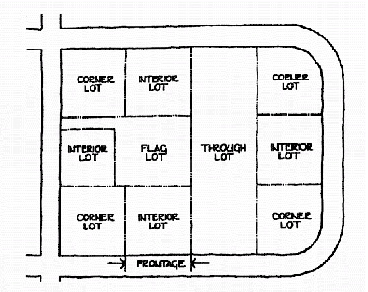
Lot, nonconforming means a lot or parcel of land that was of record and lawfully established and maintained but which, because of the enactment of this code, no longer conforms to the land-use standards or use regulations of the zone in which it is located.
Lot, through means a lot other than a corner lot with frontage on more than one street. Through lots abutting two streets may be referred to as double frontage lots.
Manufactured home means housing built in a factory according to the Federal Manufactured Home Construction and Safety Standards effective June 15, 1976.
Manufactured housing sales means establishments primarily engaged in the retail sale of new and used mobile homes, new manufactured houses, and new modular homes, including incidental storage of homes and materials used in the preparation or transport of such homes to customers.
Manufacturing, heavy means the manufacturing or compounding process of raw materials. These activities or processes would necessitate the storage of large volumes of highly flammable, toxic matter or explosive materials needed for the manufacturing process. These activities may involve outdoor operations as part of their manufacturing process.
Manufacturing, light. See "industry, light."
Marina, commercial means a business engaged in the secure mooring of boats, including facilities for storage and repair of boats and sale of boating supplies and fuel.
Marina, private means an establishment providing docking, moorage space, and related activities limited to the provisioning or minor repair of pleasure boats and yachts, and accessory facilities including, but not limited to showers, toilets, and self-service laundries. Use of a private marina is limited to the owner or resident of the lot upon which the facility is located.
Marine supplies means an establishment primarily engaged in the retail sale of motorboats and other watercraft, marine supplies, and outboard motors, including no more than incidental storage.
Marquee means a roof-like structure that cantilevers from the wall of a building over its principal entrance, that has no vertical supports other than the wall from which it cantilevers, and that provides a wall surface at least four feet high, generally constructed for purposes of containing a sign.
Masonry, manufactured means synthetic or panelized brick or stone manufactured to resemble traditional brick or stone unit masonry construction.
Masonry unit means construction of individual brick, stone and architectural cast stone units requiring mortar. Unit masonry does not include synthetic stucco systems, concrete masonry units (CMU), fiber cement siding or manufactured masonry.
Massing means the overall exterior composition of the major volumes of a building.
Medical cannabis dispensary means a place where processed medical cannabis products are permitted to be sold to qualifying consumers, as provided for in the Code of West Virginia Chapter 16A, as amended.
Medical cannabis growing facility means a place where medical cannabis is permitted to be grown, as provided for in the Code of West Virginia Chapter 16A, as amended.
Medical cannabis processing facility means a place where medical cannabis is permitted to be processed, refined, or otherwise converted into a legally permitted state, as provided for in the Code of West Virginia Chapter 16A, as amended.
Mixed and multi-use development means, specifically, the development or use of a tract of land or building(s) or structure(s) with two or more different component uses such as, but not limited to, residential, commercial, business, office retail, recreational, civic, entertainment, light industrial, and other miscellaneous uses in a compact urban form as permitted in the zoning district. Generally, mixed and multi-use development patterns are in close proximity, planned as a unified complementary whole, encourage a diversity of compatible land uses, and are functionally integrated with the use of shared vehicular and pedestrian access and parking areas.
Mixed-use building means a building containing residential in addition to nonresidential uses permitted in the zoning district.
Modular home means a factory built single family house that is constructed in two or more pieces to be assembled upon the parcel of land upon which it is to be situated. Modular homes are designed and constructed so that, once erected on a permanent foundation, they are certified to meet the same Building Code as is required for a "stick-built" house. For zoning purposes, such houses are considered to be identical to stick-built houses.
Motel means an establishment providing transient lodging in which the guest rooms are usually accessible from an outdoor parking lot.
Motorcycle means every motor vehicle, other than a tractor, having a saddle for the use of the operator and designed to travel on not more than three wheels in contact with the ground, including but not limited to motor vehicles known as motor driven cycles, motor scooters, or motorcycles without regard to weight or brake horsepower.
Motorcycle sales establishment means establishments primarily engaged in the retail sale of new and/or used motorcycles, motor scooters, clothing and accessories, and personal watercraft, including incidental storage, maintenance and servicing.
Movie theater, large means a building for showing motion pictures or for live dramatic, dance, musical, or other productions, which is usually commercially operated. Consists of five or more screens, audience seating and auditorium, and a lobby and refreshment stand.
Movie theater, small means a building for showing motion pictures or for live dramatic, dance, musical, or other productions, which is usually commercially operated. Consists of four or fewer screens, audience seating and auditorium, and a lobby and refreshment stand.
Multi-use nonresidential building means a building containing two or more nonresidential uses as permitted in the zoning district without a residential component use, but not including "shopping center" uses.
Neighborhood convenience store. See "convenience store, neighborhood."
Net facade area means the surface area of a building facade excluding the surface areas of windows and doors.
Newsstand means a temporary structure, manned by a vendor, that sells newspapers, magazines, and other periodicals.
Nonconforming feature means a characteristic of a building or property that no longer conforms to parking, loading, landscaping or other design standards or performance requirements of this zoning ordinance, but lawfully existed prior to the effective date of this zoning ordinance or subsequent amendments thereto and has not been abandoned.
Nonconforming lot means a lot or parcel of land that no longer conforms to the lot area, width, depth, street frontage, or other requirements of the zoning district in which it is located, but was lawfully created prior to the effective date of this zoning ordinance or subsequent amendments thereto and has not been abandoned.
Nonconforming sign means a sign or feature of a sign that no longer conforms to the requirements of this zoning ordinance, but was lawfully erected or constructed prior to the effective date of this zoning ordinance or subsequent amendments thereto and has not been abandoned.
Nonconforming structure means a building or structure, or a portion thereof, that no longer conforms to the site area, coverage, setback, or other open-space, height or the development requirements of this zoning ordinance, but was lawfully constructed prior to the effective date of this zoning ordinance or subsequent amendments thereto and has not been abandoned. This term does not apply to a substandard condition that was legally granted a variance.
Nonconforming use means the use of property lawfully existing at the effective date of this zoning ordinance or subsequent amendments thereto, which does not conform with the permitted land uses of the zoning district in which it is located, and has not been abandoned. A nonconforming use may or may not involve buildings or structures and may involve part or all of a building or property.
Nonprofit organization means a corporation established pursuant to the Code of West Virginia Chapter 31E-3 and duly organized for any lawful purpose including any one or more of the following: Charitable, benevolent, educational, civic, patriotic, political, religious, social, fraternal, literary, cultural, athletic, scientific, agricultural, horticultural, animal husbandry, and professional commercial, industrial or trade association.
Nursery, plant means an establishment for the growth, display, and sale of plants, shrubs, trees and materials used in indoor or outdoor planting, conducted within or without an enclosed building.
Nursing home means a use providing bed care and in-patient services for persons requiring regular medical attention but excluding a facility providing surgical or emergency medical services and excluding a facility providing care for alcoholism, drug addiction, mental disease, or communicable disease.
Office means a room or suite of rooms or portion of a building used for the practices of a profession or for the conduct of a business that involves the accessory sale of goods from the premises.
Office building means a building used primarily for offices that may include ancillary services for office workers, such as a restaurant, coffee shop, newspaper, or candy stand.
Office equipment repair establishment means an establishment involved in repairing office equipment, such as typewriters, copying machines, computers, calculators, and so forth.
Office, medical means an office for medical providers including doctors, surgeons and dentists.
Office park means a development that contains a number of separate office buildings, supporting uses and open space designed, planned, constructed, and managed on an integrated and coordinated basis, and located on one or more parcels under single ownership.
Office supplies establishment means places of business where stationery and other supplies typically used in offices are the main items offered for sale.
Oil change facility means operations that provide lubrication and/or checking, changing, or additions of those fluids and filters necessary to the maintenance of a vehicle. It is intended that these services will be provided while customers wait, generally within a 15 to 30 minute time period. Rotation of tires is also permitted. If the establishment offers tire sales, tune-ups or other mechanical servicing and repair, then the facility shall be deemed an "automobile repair facility."
Open space means any land or area devoid of buildings or structures, preserved for any of the following reasons:
(1)
Conserve or enhance natural or scenic resources; or
(2)
Promote protection of streams or water supply; or
(3)
Promote conservation of soils, or wetlands; or
(4)
Enhance the value to the public of abutting or neighboring parks, forests, wildlife preserves, nature reservations, or sanctuaries; or
(5)
Enhance recreational opportunities.
Open space, improved means parks, playgrounds, swimming pools, ball fields, plazas, landscaped green spaces, and other areas that are created or modified by man. Improved open space shall not include spaces belonging to schools, community centers or other similar areas in public ownership.
Open space, natural means areas of natural vegetation, water bodies, or other landforms that are to be left undisturbed. Creation of a graded and surfaced walking trail through areas of natural open space shall constitute disturbance of the area in the amount of the length of the walking trail multiplied by its approximate average width. Natural open space shall not include schools, community centers or other similar areas in public ownership. (A.O.)
Operator means, for the purpose of an extractive industry use, the person or company, either proprietor or lessee, in charge and in control of the management and day-to-day operations of an extractive industry development site.
Order means a column, or cylindrical upright member composed of a capital, shaft and base, as well as an entablature and pedestal appropriate to the order to which the column belongs. The most easily recognizable orders originated with classical architecture: Greek (doric, ionic and corinthian) and Roman (tuscan and composite).
Orientation means the relationship of a structure to the compass points or a site feature; may refer to the direction of a facade faces, such as the south elevation, or the duration of a main axis, as in an east-west orientation.
Outdoor flea market means the principal use of land as an open-air market for secondhand articles and/or antiques.
Outdoor storage means the storage of any material for a period of greater than 24 hours, including items for sale or, lease, processing, and repair (including vehicles) not in an enclosed building.
Outdoor storage, seasonal means outdoor storage of items for retail sale that are, by their nature, sold during a peak season, including such items as fruits, vegetables, Christmas trees, pumpkins, lawn accessories, bedding plants, etc. and in conjunction with existing commercial establishments.
Overlay district means an area where certain additional requirements are superimposed upon a base zoning district or underlying zoning district and where the requirements of the base or underlay district may or may not be altered. Where the standards of the overlay and base or underlying zoning district are different, the more restrictive standards shall apply.
Parapet means the portion of a wall which extends above the roofline.
Parcel means a single lot, or a grouping of old lots acquired by a single deed and considered as one buildable lot for zoning purposes. Parcels that consist of a grouping of old City lots acquired by a single deed may be subdivided for purposes of creating more buildable parcels, provided all regulations contained within this ordinance and the subdivision ordinance are adhered to.
Park means any area that is predominately open space, used principally for active or passive recreation, and not used for a profit-making purpose. Any area designated by the City as a park.
Park and recreation services means establishments which are non-commercial, not-for-profit facilities designed to serve the recreation needs of community residents. Such facilities include development recreation facilities (neighborhood parks), community parks, regional parks and special use facilities, school and religious institution ballfields, football fields and soccer fields.
Parking aisle means the clear space for either one or two-way traffic movement or maneuvering between rows of parking stalls.
Parking, automobile means parking of operational and street legal automobiles on a temporary basis within an off-street parking area.
Parking lot, accessory means an off-street, ground level facility including paved parking spaces and adjacent drives and aisles for maneuvering, access, entrance and exit; improved in a way to accommodate the parking of four or more motor vehicles for the use of the owners, tenants, lessees, occupants, customers and/or visitors of the principal use of premises on which the parking lot is located. This term includes deck parking and underground or under-building parking areas; provided, no more than one level of parking area is provided. Accessory parking lot facilities shall be considered a part of the principal use to which it is accessory and where applicable, shall be restricted by the maximum parking standards of the zoning ordinance.
Parking lot, principal use means an off-street, ground level facility including paved parking spaces and adjacent drives and aisles for maneuvering, access, entrance, and exit; improved in a way to accommodate the parking of four or more motor vehicles where the parking lot is either the principal use of the premises or the stand-alone use of the parcel.
Parking, motorcycle means parking of operational and street legal motorcycles on a temporary basis with a minimum width of four feet and a minimum length of nine feet.
Parking, public means a publicly owned or operated open area or parking garage, other than a street or alley, designed to be used for the temporary parking of more than four motor vehicles, whether free or for compensation, and available for public use or as an accommodation for clients or customers.
Parking, remote means a parking lot on a site other than the property that is serves, usually at a substantial distance, and often connected by a shuttle bus.
Parking, shared means joint use of a parking area by more than one use.
Parking space, compact means a space in a garage or parking area, not less than seven feet wide clear dimension and 16 feet long clear dimension, reserved for the parking of only one compact automobile.
Parking space, handicap means a space in a garage or parking area not less than 13 feet wide and 18 feet long in clear dimension, reserved exclusively for an automobile registered with the State with handicapped license plates or displaying an official State issued handicapped placard.
Parking structure, accessory means parking spaces and adjacent access drives, aisles, and ramps that are located in a structure with two or more levels for the use of the owners, tenants, lessees, occupants, customers and/or visitors of the principal use of premises on which the parking structure is located and where the parking structure is not the principal use of the premises or the stand-alone use of the parcel. A parking structure may be totally below grade (as in an underground parking garage) or either partially or totally above grade with those levels being either open or enclosed. This term includes parking spaces that are integrated into a larger structure that houses the principal use of the premises. Accessory parking structure facilities shall be considered a part of the principal use to which it is accessory.
Parking structure, principal use means parking spaces and adjacent access drives, aisles, and ramps that are located in a structure with two or more levels, where the parking structure is the principal use of the premises or the stand-alone use of the parcel. A parking structure may be totally below grade (as in an underground parking garage) or either partially or totally above grade with those levels being either open or enclosed.
Parking, tandem means the placement of parking spaces one behind the other, so that the space nearest the driveway or street access serves as the only means of access to the other space.
Parsonage means the permanent place of residence of the pastor or minister of a church. May be considered accessory to a church.
Passenger station, railroad, motor bus means a facility designed to accommodate passengers who arrive and depart on commercial buses, or rail which may include management offices, bus parking or storage areas and personal services for passengers.
Patio means a level surfaced area directly adjacent to a principal building, without walls or a roof. A patio may be constructed of any material or combination of materials, and is typically constructed at grade level or slightly higher, and is not intended for the parking or storage of vehicles.
Patio house means a detached, single family unit typically situated on a reduced size lot that orients outdoor activity within rear or side yard patio areas for better use of the site for outdoor living space.
Paved surface area means ground surface covered with cobblestones, clay fired bricks, concrete precast paver units (including, but not limited to, grasscrete) poured concrete with or without decorative surface materials, blacktop, or other asphalt or rubber mixture which may include sand or gravel as an ingredient and which creates a hard surface. A graded natural surface or one covered with rolled stone or overlaid with loose gravel is not considered a paved surface.
Pawnshop means any business that loans money on deposit of personal property or deals in the purchase or possession of personal property on condition of selling the same back again to the pledger or depositor, or loans or advances money on personal property by taking chattel mortgage security thereon, and takes or receives such personal property.
Penal/correctional institution means a facility for the confinement or safe custody of persons so confined as the result of a legal process and includes attendance centers established for persons sentenced to serve periods of community service.
Pennant means any lightweight plastic, fabric or other material, whether or not containing a message of any kind, which is suspended from a rope, wire, string or pole, usually in series, and which is designed to move in the wind.
Performance guarantee means any security that may be accepted by the City as a guarantee that improvements required as part of an application for development are satisfactorily completed.
Person means any association, company, corporation, firm, organization or partnership singular or plural, of any kind.
Personal services establishment means a business which is associated with the grooming of persons or the maintenance or repair of personal wardrobe articles and accessories, and may include a barber shop, beauty parlor, shoe repair shop, self-service laundry, tattoo/body piercing studio, and the like. The definition shall apply whether or not the individual engaged in the offering of said service is required to be licensed by the State of West Virginia.
Personal storage facility or self-service storage facility means a building or group of buildings consisting of individual, self-contained units leased to individuals, organizations, or businesses for self-service storage of personal property. Also commonly referred to as mini-warehouses.
Plan means a written description for the development of land.
Planning Commission means the officially constituted body appointed to carry out planning duties and responsibilities in accordance with the Code of West Virginia Chapter 8A, Articles 1 through 12 et seq., as amended. (A.O.)
Planning Director means the Director of the Department of Development Services for the City of Morgantown or his or her designee.
Plat means a map of a land development.
Plaza means an open space that may be improved, landscaped, or paved usually surrounded by buildings or streets. Such spaces are generally associated with commercial buildings.
Porch means a covered but unenclosed projection from the main wall of a building that may or may not use columns or other ground supports for structural purposes. If a porch is uncovered it is considered to be a deck.
Portico means a porch or walkway, open to the outside air that is covered by a roof supported by columns or pillars, typically leading to the entrance of a building. A portico is considered a "canopy" for purposes of determining signage.
Poster box means a box installed on a wall for the purpose of displaying posters of movies at a theater.
Premises means an area of land occupied by the building(s), structure(s) or other physical uses which are an integral part of the activity conducted upon the land and such open spaces as may be arranged and designed to be used in conjunction with that activity.
Private club means any corporation or unincorporated association meeting the definition of private club as contained and utilized within the Code of West Virginia Chapter 60, Article 7, Section 1 et seq. as the same applies to licensing for sale of alcoholic liquor. These establishments are permitted to sell liquor, beer and wine.
Professional services establishment means an establishment engaged in providing professional services such as physical and/or massage therapy, consulting, legal, engineering and the like, but not including personal services.
Proportion means the relationship of the size, shape and location of one building element to all the other elements; each architectural style typically has its own rules of proportion.
Public improvement means any improvement, facility, or service together with its associated public site or right-of-way necessary to provide transportation, drainage, public utilities, cable television, or similar essential services.
Public place means any lots, tracts or parcels of land, structures, buildings or parts thereof owned or leased by a governing body or unit of government.
Recreation facility, commercial, indoor means a privately owned commercial establishment designed and equipped for the conduct of leisure activities and other recreational activities wholly within an enclosed building. Examples of such uses include but are not limited to indoor play areas, training studios for martial arts, gymnastics and dance, bowling alleys, shooting ranges and skating/skateboard rinks. Publicly owned facilities are generally exempt from municipal zoning regulations.
Recreation facility, commercial, outdoor means a privately owned commercial establishment designed and equipped for the conduct of sports, leisure activities and other recreational activities wholly or partially outside of any building or structure. Examples of such uses include but are not limited to swimming pools, driving ranges, miniature golf courses, amusement parks, skateboard facilities and go-cart tracks. Publicly owned facilities are generally exempt from municipal zoning regulations.
Recreational vehicle (RV) means a vehicle built on a single chassis, containing 400 square feet or less when measured at the largest horizontal projections and designed to be self propelled or towed by another vehicle. A recreational vehicle is not designed or intended for use as a permanent dwelling, but as temporary living quarters for recreational camping, travel, or seasonal use. This definition includes vehicles such as travel trailers, motor homes, boats, houseboats, and campers.
Recyclable collection center/solid waste transfer station means a facility for the collection, separation, compaction, processing and storage of solid waste or recyclable materials until said waste can be transported or transferred to a sanitary landfill or other facility approved and licensed for the disposal of solid wastes or the recycling of materials by the State of West Virginia.
Recycling collection point means an accessory use, structure, or enclosed area that serves as a neighborhood drop-off point for temporary storage of recyclable materials. A recycling collection point may also include a facility for the temporary collection of used clothing and household goods.
Redevelopment means any repair, reconstruction or improvement, excluding additions as defined herein, to an existing structure where the costs of which is less than 50 percent of the total replacement cost of the structure either:
(1)
Before the improvement or repair is started; or
(2)
If the structure has been damaged and is being restored.
The term does not however, include any project for improvement of a structure to comply with existing State or local health, sanitary or safety code specifications which are solely necessary to assure safe living and/or occupancy.
Related persons means persons related by blood, marriage, adoption, guardianship or other duly-authorized custodial relationship but limited to the following: husband, wife, child, grandchild, great grandchild, stepchild, parent, grandparent, great grandparent, stepparent, aunt, uncle, nephew, niece, and first cousin.
Repair or maintenance means an activity that restores the character, scope, size, or design of a serviceable area, structure, or land use to its previously existing, authorized, and undamaged condition. Activities that change the character, size or scope of a project beyond the original design and drain, dredge, fill, flood, or otherwise alter additional regulated wetlands are not included in this definition.
Repair shop, small engine or motor means an establishment primarily engaged in the repair or refurbishment of engines and motors, excluding passenger vehicles.
Research and development center means research, development, and testing laboratories that do not involve the mass manufacture, fabrication, processing, sale of products, or, a structure or complex of structures designed or used primarily for research development functions related to industry and similar fields of endeavor.
Restaurant means a commercial establishment where food and beverages are prepared, served, and consumed primarily within the principal building and where food sales constitute more than 60 percent of the gross sales receipts.
Restaurant, drive-in means an establishment whose primary business is serving food to the public for consumption on the premises by order from and service to vehicular passengers outside the structure.
Restaurant, family means an establishment engaged in the preparation of food and beverages containing no more than 3,000 gross square feet and characterized primarily by table service to 30 or fewer customers in non-disposable containers. Typical uses include cafes, coffee shops, and small restaurants.
Restaurant, fast-food means restaurants where most customers order and are served their food at a counter or in a motor vehicle in packages prepared to leave the premises, or able to be taken to a table or counter to be consumed. This facility may or may not include a drive-through facility.
Restaurant, private club means a restaurant that also dispenses liquor and has been issued a license by the West Virginia Alcohol and Beverage Control Agency.
Restaurant, private wine means a restaurant that is licensed to sell beer and wine, but no liquor, and that sells at least $2,500.00 worth of food each month, as stated in West Virginia State law.
Retail sales establishment means a business having as its primary function the supply of merchandise or wares to the end consumer. Such sales constitute the "primary function" of the business when such sales equal at least 80 percent of the gross sales of the business.
Retaining wall means a wall or terraced combination of walls used to retain more than 18 vertical inches of material.
Rhythm means regular occurrence of elements or features, such as spacing between buildings, building modules or windows.
Right-of-way means a strip of land acquired by reservation, dedication, prescription, or condemnation and intended to be occupied by a street, trail, waterline, sanitary sewer, and/or other public utilities or facilities.
River walk means a publicly owned or privately owned way, generally open to the sky and unobstructed by buildings, that runs along the river edge and is open to the public during specified times. It may include without limitation, any combination of open space, paved areas, landscaped areas, pedestrian paths, and pedestrian furnishings.
Roundabout/traffic circle means an island that may be landscaped and located at the intersection of two streets used to reduce traffic speeds and accidents without diverting traffic onto adjacent residential streets.
Salvage yard means a facility or area for storing, keeping, selling, dismantling, shredding, compressing, or salvaging scrap or discarded material or equipment. Scrap or discarded material includes, but is not limited to, metal, paper, rage, tires, bottles, motor vehicle parts, machinery, structural steel, equipment and appliances. The term includes facilities for separating trash and debris from recoverable resources, such as paper products, glass, metal cans, and other products that can be returned to a condition in which they may again be used for production.
Scale means:
(1)
The size of one element of a building to another and to a whole building;
(2)
The size of one building in relation to another.
School K-12 means a school offering educational instruction in grades kindergarten (K) through 12, licensed by the West Virginia Department of Education.
Setback means the minimum distance by which any building or structure must be separated from a street right-of-way or lot line.
Setback, front means the shortest distance from the street right-of-way line to the closest point of the foundation of a building or projection thereof.
Setback, front, on corner lots means the front setback of a corner lot shall be measured from the side of the lot designated as the "front." On a corner lot, only one street line shall be considered a front line, which shall be the shorter street frontage.
Setback, garage entrance means a setback measured from a street lot line to the entrance to a garage or carport. It is essentially a minimum driveway length.
Setback, rear means the shortest distance between the building line and the rear lot line.
Setback, side means the shortest distance between the building line and the side lot line.
Setting means the sum of attributes of a locality, neighborhood, or property that defines its character.
Sexually-oriented business includes "adult book store", "adult motion picture theatre" and "adult videotape store." This excludes "adult entertainment."
Shooting range, indoor means the use of a structure for archery and/or the discharging of firearms for the purposes of target practice or temporary competitions.
Shopping center means a group of retail and other commercial establishments, as permitted in the zoning district, within one or more buildings, that is planned, owned, and managed as a single property.
Shopping center, large-scale means one or a group of buildings with a total gross floor area larger than 30,000 square feet engaged in the sale or rental of goods for consumer or household use. This type of shopping center may or may not contain hypermarkets.
Shopping center, medium-scale means one or a group of buildings with a total gross floor area of more than 10,000 square feet and not greater than 30,000 square feet engaged in the sale or rental of goods for consumer or household use; excluding, however, animal sales or service; building materials and/or supplies, sales, or rental; and food sales or markets.
Shopping center, small-scale means one or a group of buildings with a total gross floor area of 10,000 square feet or less engaged in the sale or rental of goods for consumer or household use; excluding, however, animal sales or service; building materials and/or supplies, sales or rental; and food sales or markets.
Sign means any device, fixture, placard or structure that uses any color, form, graphic, illumination, symbol or writing to advertise, announce the purpose of, or identify the purpose of a person or entity, or to communicate information of any kind to the public.
Sign, abandoned means a sign and/or supporting structure which no longer identifies a bona fide business conducted or product sold on the premises. A sign shall be deemed abandoned when these conditions have been in existence for a period exceeding 90 calendar days.
Sign, animated means any sign that uses movement or change of lighting to depict action or create a special effect or scene, except LED displays on restaurant menu boards.
Sign area means the entire face of a sign including the advertising surface and any framing, trim, or modeling, but not including the supporting structure.
Sign, awning means a sign located on an awning. See "canopy sign."
Sign, banner means a sign with or without characters, letters, illustrations, or ornamentations applied to cloth, paper, flexible plastic, or fabric of any kind with only such material for backing. All banners are temporary signs.
Sign, billboard means an off-premise sign, usually of the pole or pylon sign type, for which a static message or copy on the sign can be changed manually (e.g. paint, paper, vinyl, etc.), mechanically (e.g. tri-action, etc.) or electronically (e.g. digital displays using LED or similar technology controlled via electronic communication through a secure network). Such signs are prohibited within the City, except as provided in Article 1359 (ISOD, Interstate Sign Overlay District) and Article 1369 (Signs).
Sign, building means any sign attached to any part of a building, as contrasted to a ground sign.
Sign, building marker means any sign indicating the name of a building and date and incidental information about its construction. Such sign typically is cut into a masonry surface or made of bronze or other permanent material, and is not regulated under this ordinance.
Sign, canopy means any sign that is a part of or attached to a structural protective cover over a door, entrance, window or outdoor service area. A marquee is not a canopy sign.
Sign, changeable copy means any sign designed so that letters or numbers attached to the sign can be periodically changed to indicate a different message.
Sign, commercial message means any sign, wording, logo or other representation, except for the actual name of the business, that, directly or indirectly, names, advertises or calls attention to a business, product, service or other commercial activity.
Sign, construction means any sign bearing the names of contractors, architects, engineers and the like, or advertising, promotions, price ranges and similar information, that is placed at a construction site that has received development plan approval.
Graphic 1329.02.02: Types of Signs
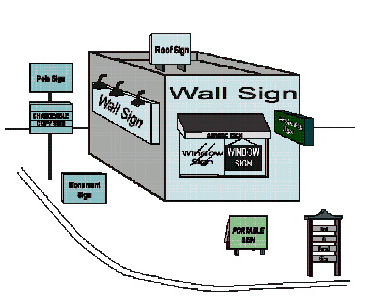
Sign copy means any word, letter, number or emblem affixed to the sign surface either permanently or in removable form.
Sign, directional means an on premise sign that includes information assisting in the flow of pedestrian or vehicular traffic such as enter, exit, and one-way. A directional sign excludes commercial messages and logos but may include information, that has a purpose secondary to the use of the site on which it is located, such as "no parking," "entrance," "loading only," "telephone," and similar information and directives. A directional sign may also include information stating the hours of operation of a business, emergency telephone numbers, credit card usage, or other information of a similar nature.
Sign, directory means a ground or building sign that lists tenants or occupants of a building or project, with unit numbers, arrows or other directional information.
Sign, electronic scrolling message means a sign with a fixed or changing display/message composed of a series of lights, wherein the sequence of message and the rate of change is electronically programmed and can be modified by electronic processes.
Sign, externally illuminated means a sign illuminated primarily by light directed toward or across it or by backlighting from a source not within it. Sources of illumination for such signs may be in the form of gooseneck lamps, spotlights, or luminous tubing.
Sign face means the area of a sign on which the copy is placed.
Sign flag, flagpole. See "flag, business flag" and "public flag" definitions.
Sign, flashing means a sign, the illumination of which is not constant in intensity when in use, and which exhibits sudden or marked changes in lighting effects. LED displays on restaurant menu boards are not considered flashing signs.
Sign, freestanding means a sign that is attached to, erected on, or supported by some structure (such as a post, mast, frame, or other structure) that is not itself an integral part of or attached to a building or other structure whose principal function is something other than support.
Sign, ground means any sign attached to the ground, as contrasted to a building sign; a freestanding sign.
Sign height means the vertical distance measured from the lowest adjacent grade to the highest point of the sign or sign structure.
Sign, identification means a sign bearing the address of the premises or name of occupant, but containing no logo or commercial message.
Sign, illuminated means a sign that is illuminated by electrical or other artificial devices.
Sign, internally illuminated means a sign whose light source is either located in the interior of the sign so that the rays go through the face of the sign, or which is attached to the face of the sign and is perceived as a design element of the sign. Such signs may not be located in any residential, office, or neighborhood services district.
Sign, marquee means a sign attached to or mounted on top of a marquee.
Sign, menu board means an accessory sign providing items and prices associated with a drive-thru window.
Sign, monument means a freestanding sign where the base of the sign structure is on the ground or a maximum of 12 inches above the adjacent grade. The width of the top of the sign structure can be no less than 90 and no more than 120 percent of the width of the base.
Sign, neon means a sign containing glass tube lighting in which gas and phosphors are used in combination to create a colored light.
Sign, off-premise means a sign that directs attention to a business, commodity, service, or entertainment not exclusively related to the premises where such a sign is located or to which it is affixed. Such signs may or may not be of the pole sign variety.
Sign, on-premise means any sign identifying or advertising a business, person, activity, goods, services, or products, located on the premises where the sign is installed and maintained.
Sign, pole means a sign that is mounted on a freestanding pole(s) or other support so that the bottom edge of the sign face is six feet or more above the grade. Such signs are prohibited within the City, except as provided in Article 1359 (ISOD, Interstate Sign Overlay District) and Article 1369 (Signs). Also called a "pylon sign."
Sign, political means a sign attracting attention to political candidates or issues, expressing support for a candidate for public office or another position regarding a public figure or issue, but bearing no commercial message.
Sign, portable means any sign not permanently attached to the ground or other permanent structure or a sign designed to be transported, including, but not limited to, signs designed to be transported by means of wheels; signs made as A-frames or T-frames; and balloons used as signs. Such signs are prohibited within the City.
Sign, post and panel means a sign consisting of one or more panels which are supported between two posts permanently anchored in the ground.
Sign, projecting means any sign attached to a building wall and extending laterally more than 18 inches from the face of such wall.
Sign, public event banner means a banner sign advertising or announcing a special community wide event or activity conducted by, or sponsored by, or on behalf of a unit of local government, West Virginia University, a charitable organization, or a not-for-profit corporation. A special community wide event or activity is one that occurs not more than twice in any 12-month period and seeks to attract donations, participants, or customers throughout the City.
Sign, public information means any sign erected and maintained by public officials or public agencies, or approved and authorized for use by State or local government authorities.
Sign, pylon. See "sign, pole."
Sign, real estate means a sign advertising real property for sale or for lease.
Sign, roof means a sign erected above the eaves of a building.
Sign, sandwich board means a sign not permanently attached to the ground or some type of permanent structure; a sign connected to or located on A- or T-frames; a two-sided sign attached to boards.
Sign, shingle means a sign suspended from and located entirely under a covered porch, covered walkway, or an awning. See "sign, suspended."
Sign, special event means a sign advertising or announcing a special community wide event or activity conducted by, or sponsored by, or on behalf of a unit of local government, West Virginia University, a charitable organization, or a nonprofit corporation. A special community wide event or activity is one that occurs not more than twice in any 12-month period and seeks to attract donations, participants, or customers throughout the City.
Sign, suspended means a sign that is suspended from the underside of a horizontal plane surface and supported by such surface.
Sign, temporary means any sign that is used only temporarily and is not permanently mounted, and that can be used only for a designated period of time.
Sign, traffic means a sign indicating Federal, State, or municipal regulations for automobile, truck, bicycle or pedestrian movement.
Sign, V-type means a type of sign with two faces connected at one end, but facing away from each other at angles that impart a "V" shape to the sign. For purposes of computing surface area, such signs are two separate signs if the angle between the two outer surfaces is less than 60 degrees; otherwise the wings shall be considered one sign.
Sign, wall means any sign painted on or attached to and extending not more than six inches from an exterior wall or retaining wall in a parallel manner.
Sign, window means any sign that is applied to the inside of glassed areas of a building. Such signs shall be treated as wall signs.
Sight distance means the distance measured between the height of a driver's eye and the height of an object without horizontal or vertical obstruction to the line of sight. For the purpose of measuring sight distance. the driver's eye height shall be three and one-half feet above the proposed street or driveway surface and street pavement surface and the vehicle's height shall be four and one-quarter feet above the proposed street or driveway surface and street pavement surface. The lateral placement of vehicles at the street or driveway and on the roadway shall be consistent with the operation of the street or driveway and roadway.
Site means a lot, tract or parcel of land considered as one land-unit for purposes of this ordinance. For a single-family residence, the site shall be the subdivided lot on which it is located. For multi-family projects, the site shall be all land occupied by the buildings in the project and adjoining such property and under common ownership with it. For vacant land, the site shall be all of the adjoining vacant land under single ownership. For single-occupancy, non-residential properties, the site shall be the subdivided lot that is occupied. For multiple-occupancy properties, the site shall be all land included under the original "site plan" or "subdivision plan" approval under the zoning ordinance.
Site feature means a component of the property surrounding the structure such as a fence, walkway or landscaping.
Site plan means a plan depicting the proposed development of a property, in terms of the location, scale and configuration of buildings and other features containing all the required information under the site plan review section of this ordinance.
Siting means the placement of a building, structure or object on a site in relation to natural features, boundaries, and other parts of the built environment.
Smart growth means planning, regulatory, and development practices and techniques founded upon and promoting the following principles:
(1)
Using land resources more efficiently through compact building forms, infill development, and modernization in street and parking standards in order to lessen land consumption and preserve natural resources;
(2)
Supporting the location of stores, offices, residences, schools, recreational spaces, and other public facilities within walking distance of each other in compact neighborhoods that are designed to provide alternate opportunities for easier movement and interaction;
(3)
Providing a variety of housing choices so that the young and old, single persons and families, and those of varying economic ability may find places to live;
(4)
Supporting walking, cycling, and transit as attractive alternatives to driving; providing alternate routes that disperse, rather than concentrate, traffic congestion; and lowering traffic speeds in neighborhoods;
(5)
Connecting infrastructure and development decisions to minimize future costs by creating neighborhoods where more people use existing services and facilities; and by integrating land use and development with transit routes and stations; and
(6)
Improving the development review process and development standards so that the developers are encouraged to apply the principles stated above.
Snack bar/snack shop means an establishment similar to a restaurant, but limited to the extent that no food is cooked on the premises other than heating by a microwave oven, no drive-through windows exist on the premises, and seating for customers does not exceed 12.
Specified anatomical areas means:
(1)
Less than completely and opaquely covered human genitals, pubic region, buttocks, or female breast below a point immediately above the top of the areola; or
(2)
Human male genitals in a discernibly turgid state, even if completely or opaquely covered.
Specified sexual activities means:
(1)
Human genitals in a state of sexual stimulation or arousal;
(2)
Acts of human masturbation, sexual intercourse or sodomy; or
(3)
Fondling, erotic display or erotic touching of human genitals, pubic region, buttocks or breasts, even if completely and opaquely covered.
Sporting goods means establishments primarily engaged in selling sporting goods, sporting equipment and accessories.
Sprawl means poorly planned or uncontrolled growth, usually of a low density nature, within previously rural or under-developed areas, that is land consumptive, auto-dependent, designed without respect to its surroundings, and some distance from existing development and infrastructure.
Square means open spaces that may encompass up to an entire block, located at the intersection of important streets, and set aside for civic purposes, and offering such amenities as paved walks, lawns, trees, and/or civic buildings.
Stacking lane means an area for temporary queuing of motor vehicles.
Staff means planning and/or other City of Morgantown department staff.
State means the State of West Virginia, unless otherwise specified.
Stealth technology means towers designed with alternative design structures such as clock towers, artificial trees and similar non-traditional structures that are compatible with the surroundings and camouflage or partially conceal the presence of telecommunications towers. Antennae erected on alternative structures such as ball field light poles, electric utility poles, water towers and similar existing structures.
Step back means upper-story building setbacks that add visual interest and reduce the visual mass and scale or potential looming impacts of a larger building.
Stick-built house means standard residential construction using permitted building materials and meeting all applicable City Building Codes.
Stopping sight distance means the distance required by a driver traveling at a given speed to stop the vehicle after an object on the roadway becomes visible to the driver. For each direction along the street, the shortest of the following lengths shall be measured sight distance for that direction along the street as described and illustrated.
(1)
The maximum length of roadway along which a driver at an intersecting street or driveway location can continuously see another vehicle approaching on the roadway. The driver's eyes at a driveway location shall be ten feet back from the pavement edge (curb or edge of shoulder) as illustrated below.
Graphic 1329.02.03: The Maximum Length of Roadway Along Which a Driver at an Access Location Can Continuously See Another Vehicle Approaching on the Roadway
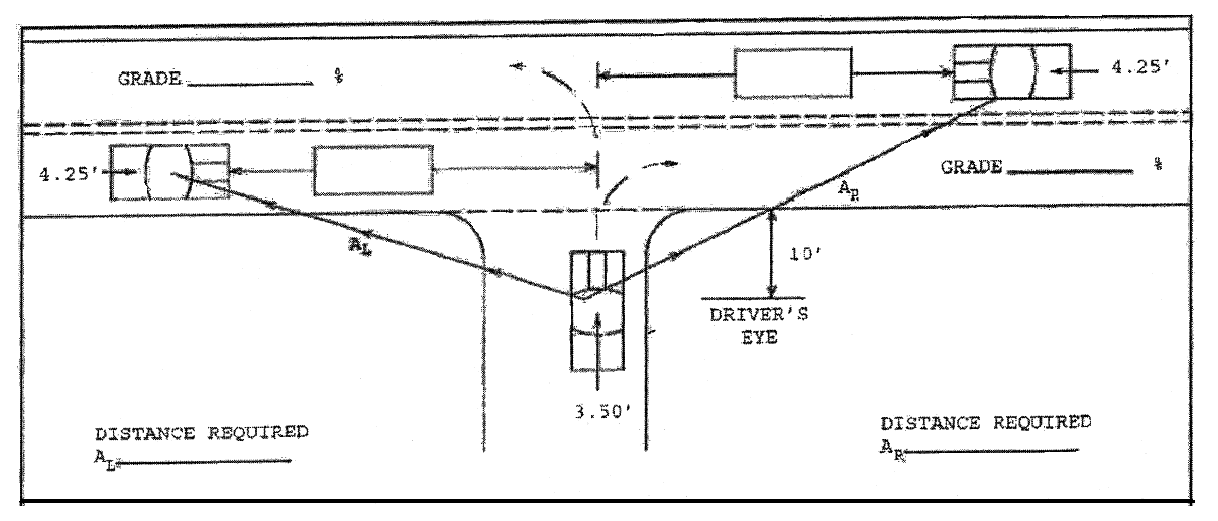
(2)
The maximum length of the roadway along which a driver on the roadway can continuously see a vehicle which is located in the driver's travel lane and which is intending to make a left turn into an intersecting street or driveway as illustrated below.
Graphic 1329.02.04: The Maximum Length of Roadway Along Which a Driver on the Roadway Can Continuously See a Vehicle Which is Located in the Driver's Travel Lane and Which is Intending to Make a Left Turn into an Access
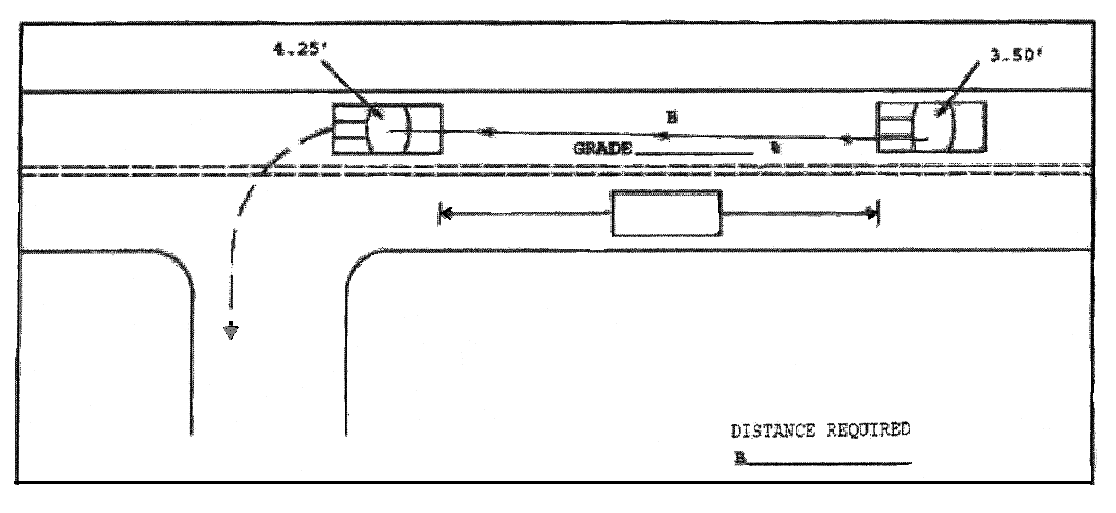
(3)
The maximum length of roadway along which a driver of a vehicle intending to make a left turn into an intersecting street or driveway can continuously see vehicles approaching from the opposite direction. This distance is measured from the location of the approaching vehicle to a point on the roadway where the left turning vehicle crosses the path of the approaching vehicle as illustrated below.
Graphic 1329.02.05: The Maximum Length of Roadway Along Which a Driver of a Vehicle Intending to Make a Left Turn into an Access Can Continuously See a Vehicle Approaching from the Opposite Direction
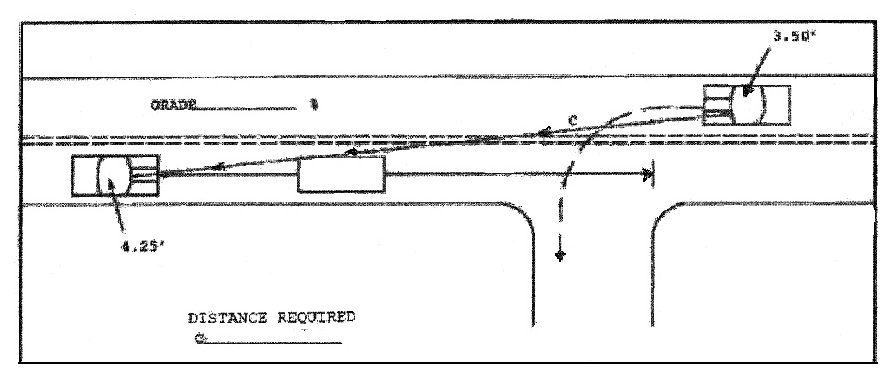
Storage, outside means the storage, collection or display for more than three consecutive days, or any part of a day for three consecutive days, of any products, materials, equipment, appliances, vehicles not in service, and/or personal property of any kind on an unenclosed, uncovered area.
Stormwater management means any storm water management technique, apparatus, or facility that controls or manages the path, storage, or rate of release of storm water runoff. Such facilities may include storm sewers, retention or detention basins, drainage channels, drainage swales, inlet or outlet structures, or other similar facilities.
Story means that portion of a building included between the upper surface of any floor and the upper surface of the floor next above, except that the topmost story shall be that portion of a building included between the upper surface of the topmost floor and the ceiling or roof above.
Street, alley means a public or private way permanently reserved as a secondary means of access to abutting property. For the purpose of determining setbacks, alley shall be synonymous with street. For the purpose of determining adjacent properties, parcels separated by an alley shall be considered abutting parcels.
Street, arterial means a street designated for large volumes of traffic movement. Certain arterial streets may be classed as limited access highways to which entrances and exits are provided only at controlled intersections and access is denied to abutting properties.
Street, collector means a street which primarily collects traffic from local streets and feeds it to an arterial street. Collector streets provide circulation within neighborhood areas.
Street, cul-de-loop means a street that turns into and reconnects with its main axis, with the center or island used for parking or open space purposes.
Street, cul-de-sac means a street with a single common ingress and egress and with a turnaround at the end. Such streets are typically associated with urban sprawl models of growth, and are known to diminish street connectivity.
Street, dead-end means a local street open at one end only and without a special provision for vehicles turning around. Such streets are typically associated with urban sprawl models of growth.
Street enclosure means an urban design principle whereby street space is semi-enclosed by placing building facades and/or street trees close to the curbs on both sides of the street, with as few gaps as possible. It is understood that this type of enclosure promotes pedestrian comfort, safety and visual interest. An ideal ratio for enclosure is 3:1, whereby the front facades of buildings on opposite sides of the streets are separated by not more than three times their average height. Any ratio smaller than 6:1 is generally regarded as ineffective in achieving enclosure.
Street frontage means the distance for which a lot line adjoins a public or private street from one lot line intersecting said street to the furthest lot line intersecting the same street.
Street, frontage road means a minor street, parallel to and adjacent to an arterial street, whose primary purpose is providing access to abutting properties.
Street, interstate highway means the highest type of primary arterial highway, with full access control, high design speeds. Access control is exercised to give preference to through traffic, by providing access connections with selected public roads only, and by prohibiting crossings at grade or direct private driveway connections.
Street, loop means a short, independent street that usually terminates along the same collector street of its origin.
Street, private means any road or street that is not publicly owned and maintained and used for access by the occupants of the development, their guests, and the general public.
Street, residential means a street used primarily for access to abutting properties, usually residential.
Street wall means the wall or part of the building nearest to the street line.
Streetscape means the relationship of the street, landscaping and buildings as seen by the eye in one view.
Structural alteration means:
(1)
Any change in the supporting members of a building, such as bearing walls or partitions, columns, beams or girders, or any rebuilding of the roof or exterior walls;
(2)
A change in the supportive structure of a sign such as support beams or poles, uprights or braces, cabinet supports, or any rebuilding of the supportive elements of a sign;
(3)
Any action that changes the height, size or shape of a sign or any action that affects the structural supports of a sign so as to prolong the life of a sign.
Structure means anything constructed, erected, or situated by man that requires location on the ground or being attached to something having location on the ground; but not including vehicles, recreational vehicles, campers, tents less than 36 square feet in area, retaining walls, fences, yard and play equipment, utility lines and underground facilities.
Structure, detached means a structure with no vertical common or party wall with another structure.
Style means a type of architecture distinguished by special characteristics of structure and ornament and often related in time; also, a general quality of a distinctive manner.
Subdivision means the division of a lot, tract or parcel of land into two or more lots, tracts or parcels, or the recombination of existing lots, tracts, or parcels.
Subdivision regulations means the Subdivision Regulations of the City of Morgantown, West Virginia, as adopted by ordinance by the Morgantown City Council and as subsequently amended.
Subdivision, cluster means a subdivision in which the lot sizes are reduced below those normally required in the zoning district in which the development is located, in return for the provision of permanent open space.
Subdivision, major means any subdivision not classified as a minor subdivision, including but not limited to subdivisions of five or more lots, or any size subdivision requiring any new street, other than an internal access drive in a shopping center or office park, or extension of the local governmental facilities, or the creation of any public improvements. Such subdivisions must be reviewed and approved by the Planning Commission.
Subdivision, minor means any subdivision containing not more than four lots in which all lots have frontage on an existing street, not involving any new street or the extension of municipal facilities, of the creation of any public improvements, and not in conflict with any provision or portion of the comprehensive plan, official zoning map, subdivision ordinance, or this ordinance. Such subdivisions are reviewed by the Planning Director.
Substantial damage means damage of any origin sustained by a structure whereby the cost of restoring the structure to its before-damaged condition would equal or exceed 50 percent of the market value of the structure before the damage occurred.
Substantial destruction means the repair or replacement of a building or structure which exceeds one of the following:
(a)
Seventy-five percent of the appraised value of the building or structure as determined by an appraiser licensed in the State of West Virginia.
(b)
Buildings or structures for which the value cannot be reliably determined, substantial destruction will occur at the point that 75 percent or more of the total square footage of the building or structure is replaced.
Substantial improvement means any reconstruction, rehabilitation, addition, or other improvement of a structure, the cost of which equals or exceeds 50 percent of the market value of the structure before the start of construction of the improvement. Includes structures that have incurred "substantial damage" regardless of the actual repair work performed. The term does not, however, include either:
(1)
Any project for improvement of a structure to correct existing violations of State or local health, sanitary, or safety code specifications that have been identified by the local code enforcement official and that are the minimum necessary to assure safe living conditions; or
(2)
Any alteration of a "historic structure," provided that the alteration will not preclude the structure's continued designation as a "historic structure."
Swimming pool means a pool or tub constructed either above or below grade and having a capacity of 1,000 or more gallons.
Synthetic stucco system means an exterior wall cladding system that includes synthetic stucco as a component. Includes exterior insulation and finish system (EIFS), direct-applied exterior finish systems, and drainable exterior finish systems.
Tanning studio means any business that uses artificial lighting systems to produce a tan on an individual's body. The use specifically excludes spas, gymnasiums, athletic clubs, health clubs, and any exercise equipment.
Tattoo/body-piercing studio means an establishment whose principal business activity, either in terms of operation or as held out to the public, is the practice of one or more of the following:
(1)
Placing of designs, letters, figures, symbols, or other marks upon or under the skin of any person, using ink or other substances that result in the permanent coloration of the skin by means of the use of needles or other instruments designed to contact or puncture the skin;
(2)
Creation of an opening in the body of a person for the purpose of inserting jewelry or other decoration.
Tavern means a place licensed to sell only beer and wine, but no liquor. Food may or may not be served. Taverns are allowed in all districts except residential and office districts.
Taxi means any motor vehicle other than a limousine offered to the public by a taxicab service for the purpose of carrying or transporting passengers for a charge or a fee.
Taxicab service means a service that offers transportation in passenger automobiles and/or vans to persons for compensation.
Telecommunications, Class I means Class I telecommunications facilities shall include but are not limited to such facilities as television antennas, ham radio antennas, am/fm reception. No Class I facility may be utilized for cell phone reception.
Telecommunications, Class II means Class II telecommunications facilities shall include but are not limited to such facilities as antennae and associated electronic equipment designed expressly for use by cell phone companies, as regulated under the Federal Telecommunication Act of 1996, that are not intended to be supported by or attached to a new telecommunications tower, as defined. They may be attached to existing, permitted tower structures, as provided for in this ordinance.
Telecommunications, Class III means Class III telecommunications facilities shall include but are not limited to such facilities as antennae and associated electronic equipment that is supported by or attached to a new telecommunications tower, as defined herein, and is designed expressly for use by cell phone companies, as regulated under the Federal Telecommunications Act of 1996.
Temporary lighting means lighting installed or erected for a specific purpose or activity and on a nonpermanent basis. Temporary lighting must be removed once the purpose or activity is discontinued.
Terminal, truck or terminal, motor freight means any premises used by a motor freight company regulated by the public utility commission and/or the Interstate Commerce Commission as a carrier of goods, which is the origin and/or destination point of goods being transported, for the purpose of storing, transferring, loading, and unloading goods.
Theater means an establishment offering to the public movies or live performances.
Theater, outdoor drive-in means an open-air lot devoted primarily to the showing of motion pictures for patrons in automobiles. These uses frequently include parks, playgrounds, recreational facilities and open spaces.
This ordinance means all portions of this zoning ordinance including the zoning maps for the City of Morgantown, West Virginia as adopted by the Morgantown City Council and as subsequently amended.
Towing service means establishment that provides for the removal and temporary storage of vehicles but does not include disposal, permanent disassembly, salvage, or accessory storage of inoperable vehicles.
Traditional neighborhood design means a "smart growth" development that exhibits several of the following characteristics: Alleys, streets laid out in a grid system, buildings oriented to the street, front porches on houses, pedestrian-orientation, compatible, mixed land uses, village squares and greens.
Traditional neighborhood district means a district that requires or is characterized by traditional neighborhood design.
Traffic calming means physical improvements installed on a street that are intended to reduce motorist speed, decrease motor vehicle volumes, and increase safety for pedestrians and non-motorized vehicles.
Traffic impact analysis means a formal analysis prepared by a traffic engineer or transportation planner, on the effect of traffic generated by a development on the capacity, operations, and safety of the public street and highway system.
Transient amusement enterprise means carnivals, circuses or other similar transient amusement enterprise.
Transit-oriented development means moderate and high-density housing concentrated in mixed use developments located along transit routes. Land is developed for commercial, industrial, social and public uses to complement and service the community. The location, design and mix of uses in a TOD emphasize pedestrian-oriented environments and encourage the use of public transportation.
Tree means a plant having at least one well defined stem or trunk and normally attaining a mature height of at least ten feet, with an average mature spread of ten feet, and having a trunk that shall be kept clear of leaves and branches at least six feet above grade at maturity.
Tree, public means any tree located on City owned or controlled property including parks, street rights-of-way, parkways, etc.
Triplex means a detached residential structure containing three and only three dwelling units, designed for occupancy by not more than three families living independently of each other. Such units are also classified as multi-family.
University or college means a public or private institution providing full-time or part-time education beyond the high school level and including any lodging rooms or housing for students or faculty. Business and trade schools are not considered colleges or universities.
Unnecessary hardship means a hardship by reason of exceptional shape of a lot, exceptional topographic conditions, or other exceptional physical conditions of a parcel of land. Unnecessary hardship shall not include personal or financial hardship or any other hardship that is self-imposed.
Upholstery/interior decorating service means an establishment offering re- upholstery and repair services and specific upholstery materials for sale.
Uplighting means any light source that distributes illumination above a 90-degree horizontal plane.
Urban area means all lands or lots within the jurisdiction of the Morgantown Municipal Planning Commission.
Use, accessory means a land-use that is:
(1)
Subordinate in area and extent to the principal use;
(2)
Contributes to the comfort, convenience, or necessity of the principal use; and
(3)
Is located on the same parcel and in the same zoning district as the principal use.
Use, conditional means a use which because of special requirements or characteristics may be permitted in a particular zoning district only after review by the Board of Zoning Appeals and upon issuance of a conditional use permit, and subject to the limitations and conditions specified in this ordinance.
Use, existing means the use of land, buildings or activity permitted or in existence prior to the adoption of this ordinance and subsequent amendments.
Use, permitted means any use allowed within a zoning district, subject to the restrictions applicable to that zoning district and is not a conditional use.
Use, principal means the primary use of any lot. The main use to which the premises is devoted and the primary purpose for which the premises exists, as distinguished from an accessory structure or use. Only one principal use may be permitted on a lot premises, unless authorized specifically by this ordinance (e.g., mixed and multi-use development, mixed use buildings, multi-use nonresidential buildings, etc. where permitted).
Use, public means a use by an agency or department of the City, county, State, or Federal government. This shall also include public utilities or uses by any organization that receives funding either all or in part from any agency or department of the City, county, State, or Federal government. This shall also include buildings and premises used in the operation of the public use.
Utility means a public or private distribution service to the public that is regulated by the West Virginia Public Service Commission.
Variance means a deviation from the minimum standards of this ordinance. A variance cannot permit a land use that is otherwise prohibited in the zoning district and cannot change the zoning classification of a parcel of land.
Vernacular means a locally or regionally developed building type or a local or regional adaptation of an architectural style.
Vested right means a right that has become fixed. Vested rights are often established by showing that some development permit has been obtained and substantial construction started on the project.
Veterinary clinic means a use or structure intended or used primarily for the testing and treatment of animals on an emergency or outpatient basis. Veterinary clinic shall not include the boarding or training of animals, except for medical purposes and shall not provide outdoor runs or kennels. Also includes veterinary hospital.
Video gaming or lottery means a lottery that allows a game to be played utilizing an electronic computer and an interactive terminal device, equipped with a video screen and keys, a keyboard or other equipment allowing input by an individual player, into which the player inserts coins or currency as consideration in order for play to be available, and through which terminal device, the player may receive free games or a voucher that can be redeemed for a cash or non-cash prize, or nothing, determined wholly or predominantly by chance. "Video lottery" does not include a lottery game that merely utilizes an electronic computer and a video screen to operate a lottery game and communicate the results of the game and which does not utilize an interactive electronic terminal device allowing input by one or more players. Video gaming or lottery shall be regulated in accordance with all applicable State and other regulations.
Video gaming or lottery establishment means an establishment at which any form of gambling of chance is permitted or played, including "video lottery" machines licensed by the West Virginia Lottery Commission pursuant to Chapter 29, Article 22B of the Code of West Virginia, but excluding establishments that only sell lottery tickets. Such establishments are permitted only in industrial zoning districts, and shall be subject to the same parking requirements as a food service establishment.
Video rental store means an establishment primarily engaged in the retail rental or lease of videotapes, films, CD-ROMs, DVDs, electronic games, cassettes or other electronic media. Sale of film, videotapes, laser discs, CD-ROMs, DVDs, and electronic merchandise associated with VCRs, video cameras, and electronic games are permitted accessory uses.
Vista means a distant view or prospect, especially one seen through an opening, as between rows of buildings or trees.
Visual anchor means an important building, monument, or civic structure that serves to terminate a vista, or as a dominant focal point for the average motorist or pedestrian.
Wall, exterior means a vertical, structural component of a building which encloses habitable or usable space; a parapet extending not more than 12 inches above a flat roof shall be considered part of the exterior wall for purposes of determining signage.
Wall offset means a notched inset between building modules or otherwise between areas of a building facade.
Wall projections means pilasters, moldings, or columns that generally rise the full height of the building facade to add visual interest and express traditional facade widths.
Warehouse means facilities characterized by extensive warehousing, frequent heavy trucking activity, open storage of material, or nuisances such as dust, noise and odors, but not involved in manufacturing or production.
Warehousing and distribution means establishments involved in storing, stocking or distributing of merchandise or commodities.
Wellness center means an establishment in which any combination of the following activities are provided: Stress management, aerobics and other exercise programs, nutrition counseling, complementary medicine, physical therapy, cardiac rehabilitation therapy and other similar non-invasive health-related activities.
Wholesale establishment means the sale of commodities to retailers or jobbers and shall include the sale of commodities for the purpose of carrying on any trade or business even if the said trade or business is the consumer or end user of the commodity.
Wholesale establishment, consumer fireworks means a wholesale establishment that sells consumer fireworks to a retailer or any other persons for resale and any establishment selling articles of pyrotechnics, display fireworks, and special effects to a person licensed to possess and use those devices.
Windblown device means any banner, pennant, spinner, streamer, propeller, disc, moored blimp, gas balloon or flag (which is not of local, State, Federal, corporate, nonprofit or religious origin) that is designed to inform or attract attention, whether or not such device carries a message, all or part of which is set in motion by wind, mechanical, electrical or any other means.
Wrecker service means a service for towing wrecked, illegally parked, or disabled automobiles or freeing automobiles stalled in snow or mud.
Zoning means the division of a municipality into districts or zones which specify permitted and conditional uses and development standards for real property within the districts or zones.
Zoning district means a specifically delineated area or district within the corporate limits of the City for which the requirements governing use, placement, spacing, size, lot dimensions, and bulk of buildings and premises are uniform.
Zoning map means the map or maps that geographically illustrate all zoning district boundaries within the City of Morgantown, as described within this Ordinance, and which is certified as the official zoning map for the City.
Zoning Officer means that person appointed by the City Manager and who has any other authority this zoning ordinance may confer upon him or her to administer the zoning ordinance and to issue zoning permits.
(Ord. No. 06-01, 1-3-2006; Ord. No. 16-17, 4-5-2016; Ord. No. 06-24, 07-18-2006; Ord. No. 06-40, 11-21-2006; Ord. No. 07-17, 6-5-2007; Ord. No. 08-06, 3-4-2008; Ord. No. 10-24, 7-6-2010; Ord. No. 12-26, 7-3-2012; Ord. No. 13-10, 3-6-2012; Ord. No. 14-48, 11-5-2014; Ord. No. 15-32, 6-2-2015; Ord. No. 16-03, 1-5-2016; Ord. No. 16-17, 4-5-2016; Ord. No. 16-29, 7-5-2016; Ord. No. 16-38, 8-2-2016; Ord. No. 16-42, 9-6-2016; Ord. No. 16-44, 9-6-2016; Ord. No. 17-07, 4-4-2017; Ord. No. 17-08, 4-4-2017; Ord. No. 17-09, 4-4-2017; Ord. No. 17-10, 4-4-2017; Ord. No. 17-29, 7-5-2017; Ord. No. 18-13, 4-3-2018; Ord. No. 18-14, 4-3-2018; Ord. No. 18-24, 7-10-2018; Ord. No. 18-25, 8-7-2018; Ord. No. 18-29, 10-16-2018; Ord. No. 2019-19, 7-2-2019; Ord. No. 2020-21, 7-7-2020; Ord. No. 2020-26, 8-4-2020; Ord. No. 2023-23, 8-15-2023)

