
Morgantown City Zoning Code
CHAPTER NINE
DEVELOPMENT STANDARDS
ARTICLE 1363.- HEIGHT, BULK, AREA AND DENSITY PROVISIONS[1]
Cross reference— Height, area and density defined—see P. & Z. 1329.02.
ARTICLE 1365. - PARKING, LOADING AND INTERNAL ROADWAYS[2]
Cross reference— Traffic Code provisions—see TRAF. Chap. Seven.
ARTICLE 1367. - LANDSCAPING AND SCREENING[3]
Cross reference— Landscaping defined—see P. & Z. 1329.02; fences—see P. & Z. 1331.08(b).
ARTICLE 1369. - SIGNS[4]
Cross reference— Sign definitions—see P. & Z. 1329.02; unauthorized traffic signs—see TRAF. 313.06; nonconforming signs—see P. & Z. 1373.05.
ARTICLE 1371. - LIGHTING[5]
Cross reference— Lighting of signs—see P. & Z. 1369.13.
ARTICLE 1373. - NONCONFORMING PROVISIONS[6]
Cross reference— Nonconforming signs—see P. & Z. 1369.15.
State Law reference— Nonconforming uses—see W. Va. Code 8A-7-10.
Appendix A. - DEVELOPMENT STANDARDS FOR ZONING DISTRICTS
This appendix is intended to serve as a resource to illustrate certain standards across all zoning districts set forth in preceding articles. There may be additional provisions that control standards illustrated below: E.g., overlay districts, specific use types, etc. Standards enumerated in the articles above shall control in the event there is any conflict or inconsistency in the information illustrated below.
(Ord. No. 08-07, 3-4-2008)
Sec. 1363.01. - Height, bulk, area and density regulations.
(a)
Except as provided in this chapter, no building or structure shall be erected, enlarged, altered, changed or otherwise modified, on a lot unless such building, structure or modification conforms to the height, bulk, area and density regulations of the zone in which it is located.
(b)
The conditions, standards, requirements and notes set forth in each district and otherwise prescribed by this chapter are established as the basic height, bulk, area and density regulations for the City.
Sec. 1363.02. - General exceptions to height, bulk, area and density regulations.
(a)
Height exceptions.
(1)
Structures or parts that shall be exempt from the height limitations are: Barns, silos, grain bins, windmills, chimneys, spires, flagpoles, skylights, derricks, conveyors, cooling towers, observation towers, power transmission towers and water tanks.
(b)
Yard, building setbacks, and open space exceptions.
(1)
No yard, open space or lot area required for a building or structure shall, during its life, be occupied by or counted as open space for any other building or structure.
(2)
The following structures or facilities shall be allowed to be constructed in any yard, when proper permits are obtained: Driveways, curbs, sidewalks, fences, walls, hedges (subject to the regulations of this section), flagpoles, non-permanent landscape features, planting boxes, recreational equipment, parking spaces, uncovered decks, patios and, only if adequately screened, composting or garbage disposal equipment.
(3)
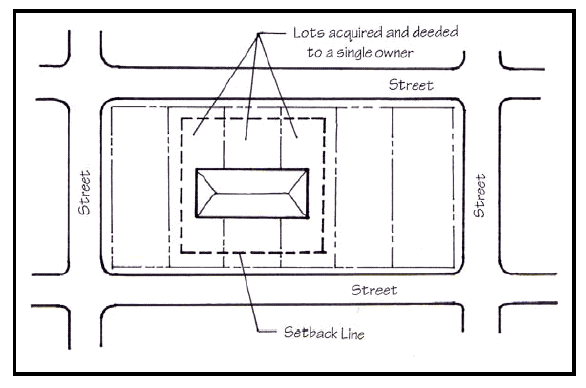
For adjoining lots under single ownership, setback requirements may be determined from the perimeter of the adjoining lots, ignoring interior lot lines, as shown in Graphic 1363.02.01, provided that only one main structure and its accessory structures shall be allowed within the perimeter of such adjoining lots and, the following notation is first placed on the recorded deed to each such adjoining lot: "For planning and zoning purposes, the lot described herein shall be considered as part and parcel of the adjacent lot(s) owned by [insert owner's name] pursuant to a deed (or deeds) recorded at Deed Record [#s] page [#s], in the Office of the Clerk of the County Commission of Monongalia County. The real estate described herein shall not be considered to be a separate parcel of real estate for land use, development, conveyance or transfer of ownership, without having first obtained the expressed approval of the Morgantown City Planning Commission. This restriction shall be a covenant running with the land."
Graphic 1363.02.01: Adjoining Lots Under Single Ownership
(c)
Developed blocks. If 75 percent or more of the lots in a block, on the same side of the street, are occupied by principal buildings, the following regulations shall apply:
(1)
Principal buildings in residential zoning districts. To preserve the rhythm of the predominant building line along developed blocks in residential zoning districts, the following shall supersede the normal minimum and maximum front setback standards or prevailing overlay district, if applicable.
a.
The front setback of the principal building to be constructed shall vary by not more than six feet from the average front building line of the nearest two principal buildings on either side; provided, the principal building to be constructed shall not have a front setback less than the principal building included in the averaging calculation having the least front yard depth. This superseding requirement shall also be applicable to additions onto existing principal buildings that extend into the front yard.
1.
When subject lot is a corner lot, the average front building line will be computed on the basis of the two adjacent principal buildings that front the same street as the subject lot.
2.
When the subject lot abuts a corner lot fronting the same street, the average front building line will be computed on the basis of the principal building on the abutting corner lot and the nearest two principal buildings that front the same street as the subject lot.
3.
Principal buildings fronting a different street than the subject lot or separated from the subject lot by a street or alley may not be used in computing the average front building line.
4.
The Planning Director may choose to disregard principal buildings from the front building line averaging calculation that have extraordinarily unusual front setbacks relative to the others included in the calculation.
(2)
Principal buildings in nonresidential zoning districts. Principal buildings in nonresidential zoning districts shall adhere to the normal minimum and maximum front setback standards of the respective zoning district or the prevailing overlay district, if applicable.
(Ord. No. 06-01, 1-3-2006; Ord. No. 18-25, 8-7-2018)
Sec. 1363.03. - Safety and vision.
The following regulations provide for the maximum safety of persons using sidewalks and streets as determined by the City Engineer:
(a)
On any corner lot at street intersections or where driveways enter a street or alley, a wall, fence, sign, structure, display of merchandise or any plant growth, which obstructs measured sight distance, shall not be placed or maintained within a clear vision triangle.
(b)
Sight distance for vehicles entering the street from another street or from a driveway shall meet the minimum stopping sight distance for the operating speed on the adjacent roadway as shown in Table 1363.03.01, "Safe Stopping Sight Distances Required at Different Operating Speeds," and should be as long as can be justified economically. The operating speed is normally assumed to be the posted speed limit. If a traffic study establishes that the operating speed is lower than the posted speed limit, then the lower speed may be used to determine the safe stopping distance.
Table 1363.03.01: Safe Stopping Sight Distances Required to Different Operating Speeds
The sight distance values in Table 1363.03.01 are for passenger vehicle and single-unit trucks only. If the driveway entrance is classified as an industrial driveway, then additional sight distance shall be provided as recommended in the current edition of American Association of State Highway and Transportation Officials (AASHTO) "A Policy on Geometric Design of Highways and Streets".
(c)
The applicant is expected to perform whatever work is necessary within the property and frontage boundary lines to meet the minimum requirements specified in Table 1363.03.01. If the minimum distance cannot be met by such work, the City Engineer may, but is not required to, determine a lesser distance as acceptable.
(Ord. No. 16-17, 4-5-2016)
Sec. 1363.04. - Special requirements.
The following special requirements are established to clarify certain conditions pertaining to the use of lots and access points:
(a)
Structures on a parcel. Only one principal building and its accessory structures may be located on a parcel unless development is approved as a planned unit development, industrial/manufacturing, shopping center, office park, research and development center, townhouse dwellings, or multi-family dwellings as permitted in Table 1331.05.01, "Permitted Land Uses."
(b)
Lot of record. Any lot recorded or in single ownership at the time of adoption of these regulations shall be permitted to exist in its present dimension.
(c)
Permanent outdoor display of goods. For nonresidential uses in nonresidential zones, a permanent outdoor display of goods shall conform to the required building setback. No display shall be permitted in any public right-of-way.
(d)
Temporary outdoor display of goods. Temporary outdoor display of merchandise may encroach ten feet on the required building setback. No display shall be permitted in any public right-of-way.
(Ord. No. 13-34, 7-2-2013; Ord. No. 17-08, 4-4-2017)
Sec. 1365.01. - Purpose.
The regulations of this section are designed to alleviate or prevent congestion of the public streets by establishing minimum requirements for on-site storage of motor vehicles, in accordance with the use for which the property is occupied.
Sec. 1365.02. - Scope.
(a)
Off-street parking and loading facilities shall be provided and maintained in accordance with the provisions of this section for all buildings, structures or premises used in whole or in part for purposes permitted by this Code.
(b)
When the intensity of use of any building, structure or premises shall be increased through the addition of dwelling units, floor area, beds, seating capacity, or other unit of measurement, parking and loading facilities as required herein shall be provided for such increase in intensity of use.
(c)
For any non-conforming use which is hereafter damaged or partially destroyed, and which is lawfully reconstructed, re-established, or repaired, off-street parking and loading facilities equivalent to those maintained at the time of such damage or partial destruction shall be restored and continued in operation; provided, however, in no case shall it be necessary to restore or maintain parking or loading facilities in excess of those required by this Code for equivalent new uses.
(d)
No building permit shall be issued, no use shall be established or changed, and no structure shall be erected, enlarged or reconstructed unless the applicant has presented satisfactory evidence via parking lot design, that the off-street parking and loading spaces herein are provided in the minimum amounts and maintained in the manner specified; provided, however:
(1)
For the enlargement of a structure or for the expansion of a use of structure or land there shall be required only the number of additional off-street parking and loading spaces as would be required if such enlargement or expansion were a separate new structure or use; and
(2)
For a change in the class or use of a structure or land, the number of additional off-street parking and loading spaces required shall be equal to the number required for the new use, less the number of spaces which would have been required for the previous use if it had been established in conformance with this section; but in no case shall the total number of spaces furnished be required to exceed the minimum required for the new use.
(e)
Off-street parking or loading facilities in existence at the time of the effective date of this article shall not hereafter be reduced below, or if already less than, shall not be further reduced below the requirements for a similar new use under the provisions of this Code.
(f)
Nothing in this Code shall be deemed to prevent the voluntary establishment of off-street parking or loading facilities to serve any existing use of land or buildings, provided that all regulations herein governing the location, design, and operation of such facilities are adhered to.
(g)
Off-street parking and loading facilities provided to comply with the provisions of this Code shall not subsequently be reduced below the requirements of this Code.
Sec. 1365.03. - General parking regulations.
(a)
Off-street parking and loading spaces shall be provided on the same lot as the use served, except as otherwise provided in this Code, and may be situated as one or more individual areas.
(b)
Off-street parking facilities required herein shall be utilized solely for the parking of passenger automobiles or light trucks with not more than two axles, belonging to patrons, occupants or employees of specified uses. Said parking facilities shall not be used for the storage, display, sale, repair, dismantling or wrecking of any vehicle, equipment or material, unless such facilities are enclosed in a building and otherwise permitted in the district, and unless such display is conducted upon stalls that are otherwise considered surplus to the requirements herein.
Sec. 1365.04. - Determining the number of spaces required.
(a)
In determining the minimum required number of off-street parking or loading spaces, the following instructions shall be applicable in such computations:
(1)
If the unit of measurement is any fraction of the unit specified in relation to the number of spaces to be provided, said fraction, if less than one-half or less than 0.5, the fraction shall be disregarded, however if the fraction is more than one-half or more than 0.5, then the fraction shall be considered as being the next unit and shall be counted as requiring one space.
(2)
In sports arenas, churches and other places of assembly in which patrons occupy benches, pews or other similar seating facilities, each 22 inches of such seating shall be counted as one seat for the purpose of determining requirements hereunder. In the special case of mosques or other facilities where religious services are offered without seating, the parking requirement shall be one stall for each 60 square feet of the main prayer hall or room, exclusive of stages or raised daises.
(b)
Shared parking facilities.
(1)
Shared parking facilities for two or more separate but adjacent buildings or mixed uses may be permitted as a conditional use provided that:
a.
The total number of spaces used is not less than the sum required for various buildings or uses if computed separately.
b.
That the lot is in the same zoning district as the principal use, or in a district that permits principal use parking lots or principal use parking structures as a principal or conditional use.
c.
Each use of the shared spaces shall function as if having been provided separately.
(2)
The Board of Zoning Appeals, upon recommendation from the Planning Commission may allow a reduction of total parking requirement up to 25 percent if the applicant can satisfactorily demonstrate the parking spaces will be shared with another adjacent land use and the lack of overlap between the peak parking needs of the land uses justifies such a reduction.
(c)
Shared parking facilities in the B-4 district.
(1)
For purposes of this section, the following definitions shall apply:
a.
Daytime use. A land use whose primary customer and employee traffic occurs during the morning and afternoon hours (before 6:00 p.m.), Monday through Friday. Such uses include, but are not limited to: Conference facilities, professional offices, restaurants serving primarily lunch, retail uses that customarily close at or before 6:00 p.m., manufacturing uses, schools, and the like.
b.
Nighttime use. A land use whose primary customer and employee traffic occurs during the evening (after 5:00 p.m.) and weekend hours. Such uses include, but are not limited to: hotels, restaurants whose majority of customers are served during dinner hours and on weekends, retail uses that are consistently open past 6:00 p.m., residential uses, entertainment uses (theaters, bowling alleys, private clubs and the like), dance schools, martial arts studios, arts and crafts instruction, auditoriums that are accessory to a school, and churches.
c.
Substantial overlap. Where the hours of operation and/or peak traffic generation times of two different land uses overlap by six or more hours in a given 24-hour period.
(2)
Shared parking facilities for two or more uses, whose main traffic generation peak times do not substantially overlap, may be approved as a conditional use provided that:
a.
Shared parking may be off-site or on-site.
b.
Uses may share parking without providing the minimum number of required spaces for each use based on the following calculation:
1.
Compute the total number of stalls that would normally be required for all daytime uses, as defined herein.
2.
Compute the total number of stalls that would normally be required for all nighttime uses, as defined herein.
3.
The larger of the two numbers shall be considered to be the baseline parking requirement.
4.
Add 25 percent of the required parking of the lesser number to the baseline number to achieve the total parking requirement for the shared uses.
c.
This reduction may, with the approval of the Board of Zoning Appeals, be in addition to the reductions allowed for proximity to public transit and/or motorcycle parking.
d.
No other reductions shall be permitted.
(3)
Shared parking facilities for two or more uses, whose main traffic generation peak times substantially overlap, may be approved as a conditional use provided that:
a.
Shared parking may be off-site or on-site.
b.
A reduction not to exceed 15 percent of the combined minimum parking requirement for all uses.
c.
This reduction may, with the approval of the Board of Zoning Appeals, be in addition to the reductions allowed for proximity to public transit and/or motorcycle parking.
d.
No other reductions shall be permitted.
(d)
Shared parking facilities—performance.
(1)
An approved shared parking facility must be owned by the owner of one or more of the uses. A legal agreement detailing the shared parking arrangement (if approved) shall be executed and filed with the City Planning Department and recorded in the County Clerk's office. In lieu of ownership, the parking lot may be leased by the owner of one of the uses, provided that the duration of any such lease and sublease subsequent be not less than 20 years.
(2)
No changes shall be made to the approved shared parking facility which would reduce the parking provided for the uses, unless the owner of one or more of the uses makes other arrangements to provide parking in conformance with minimum parking requirements. No such changes shall be made without prior approval from the Board of Zoning Appeals.
(3)
Any proposed change in the use of a structure or land utilizing an approved shared parking facility shall provide evidence satisfactory to the Board of Zoning Appeals that adequate parking is available to accommodate any such use change.
(4)
The City of Morgantown reserves the right to deny or revoke a certificate of occupancy to any land use, in the following situations:
a.
If a land use utilizing a shared parking facility changes from a daytime use to a nighttime use (or vice-versa); or changes to a use that requires more parking than the previous use, and the resulting change in parking requirements cannot be satisfied in the shared parking facility.
b.
If a land use utilizing a shared parking facility loses the legal right, whether through voluntary or involuntary actions and circumstances, to continue using the shared parking facility; and such use cannot make arrangements to provide required parking elsewhere in conformance with minimum parking requirements. The exception to this shall be in the event of a public construction project that temporarily (one year or less) makes use of the shared facility impossible, or reduces effective use of the facility.
(5)
Shared parking facilities shall provide signs on the premises indicating the availability of the facility for the patrons of the participating uses.
(6)
Parking spaces to be shared must not be reserved for a specific person, or use, on a 24-hour basis. This shall not be construed so as to limit the development of parking for persons with disabilities.
(e)
Required off-street loading and unloading spaces shall not be construed as being part of the required off-street parking spaces.
(f)
No part of any alley or street or other public right-of-way shall be used to meet the minimum parking requirements of this Code, unless otherwise provided for herein.
(g)
For purposes of determining off-street parking requirements under this section, gross floor area shall mean the total horizontal areas of the one or several floors of the building or portion thereof devoted to a particular use, including accessory storage areas located within selling or working space such as counters, racks, or closets and any basement floor area devoted to retailing activities, to the production or processing of goods or to offices; provided, however, gross floor area shall not include that area devoted entirely and permanently to storage purposes, parking and loading facilities, or space used for restrooms, utilities, stairwells or elevator shafts.
(h)
Number of employees indicates the number of employees on the largest shift, unless otherwise indicated.
(i)
In all non-residential districts the maximum number of parking lot spaces provided shall not exceed 115 percent of the minimum parking requirement, except for research and development centers and parking structures, where there shall be no maximum.
(j)
Off-street parking shall be provided in accordance with Table 1365.04.01, "Minimum Off-Street Parking Requirements."
(k)
Every company car, truck, tractor or trailer normally stored at a business site shall be provided with an off-street parking space. Such space shall be in addition to the parking requirements listed in Table 1365.04.01.
(l)
For uses not specified in this section, or in such instance when the requirement for an adequate number of spaces is unclear or not specified in another part of this section for conditional uses, shopping center plan, etc., the number of parking spaces shall be determined by the Planning Director on the basis of similar requirements, the number of persons served or employed, and the capability of adequately serving the visiting public. Such determination may be appealed to the Board of Zoning Appeals.
(m)
In case of conflict between the provisions of this section, the higher requirement shall govern.
(n)
Any land use which requires a minimum of 50 parking spaces shall be required to provide a pedestrian circulation plan for the proposed site.
(o)
In the B-1 districts, uses may provide less than the required number of off-street parking spaces, but in no case shall a use provide less than 75 percent of the minimum number of off-street parking spaces in accordance with Table 1365.04.01.
(p)
In the B-4 district, minimum parking requirements may be reduced as a conditional use under one or more of the following provisions:
(1)
By a factor of ten percent if the land use is located within 500 feet, measured from the closest edge of the building, of a parcel containing a fixed public transit stop, whether a bus, trolley, or personal rapid transit (PRT) station.
(2)
By a factor of ten percent if the land use is located within 500 feet, measured from the closest edge of the building, of a parcel containing 25—50 publicly owned and controlled parking spaces. If within 500 feet of a parcel containing more than 50 public parking stalls, the reduction may be a factor of 15 percent.
(3)
By a factor of one automobile parking space for each dedicated motorcycle parking space, up to a maximum reduction of three automobile parking spaces. This reduction shall not be permitted for uses that are required to provide six or fewer parking stalls. Nor shall this reduction be permitted for uses that primarily sell large, bulky merchandise not typically transported via motorcycle.
(q)
Bicycle storage. Long-term bicycle storage and short-term bicycle storage shall be provided in all developments of significant impact.
(1)
For all developments of significant impact, the minimum long-term bicycle storage amenities described in this subsection must be provided. The minimum long-term bicycle storage amenities are as follows:
a.
For residential uses and for residential use components of mixed-used development, one long-term bicycle storage space per dwelling unit.
b.
For non-residential uses and for non-residential use components of mixed-used development, one long-term bicycle storage space increasing by one additional space for every 20 automobile parking spaces as required in accordance with Table 1365.04.01, "Minimum Off-Street Parking Requirements."
c.
Long-term bicycle storage is required to be covered and shall include use of one of the following:
1.
A locked room;
2.
An area enclosed by a fence with a locked gate;
3.
An area within view of an attendant or security guard or monitored by a security camera; or
4.
An area visible from employee work areas.
d.
The long-term bicycle storage area should be located within 50 feet of the primary entrance of the building it serves and shall be in a location that can be reached by an accessible route. Long-term bicycle storage must be located either:
1.
On the same site as the use it serves; or
2.
Off-site within 300 feet of the use it serves; provided, conditional use approval is granted by the Board of Zoning Appeals. Conditional use approval shall include a condition that the off-site long-term bicycle storage amenity is encumbered by an easement or similar agreement duly executed and acknowledged, which specifies that the land upon which the off-site long-term bicycle storage amenity is located is encumbered by the bicycle storage use. Said instrument shall specify and bind the time period to the anticipated life of the building or use to which the long-term bicycle storage amenity are accessory. Said instrument shall be filed with the applicable building permit files of the Department of Planning, and placed on public record in the Office of the Clerk of the County Commission of Monongalia County, West Virginia.
Further, if the pedestrian access between the off-site long-term bicycle storage amenity and the use(s) it serves is to cross an arterial street, appropriate safety measures, as determined by the Planning Director and City Engineer, must be in place to ensure pedestrian safety.
e.
If the long-term bicycle storage is provided in an auto storage garage, the bicycle storage spaces shall be clearly marked as such and shall be separated from automobile parking.
f.
Long-term bicycle storage designs must adhere to the design standards in Section 1363.04(q)(3), bicycle rack requirements.
(2)
For all developments of significant impact, the minimum short-term bicycle storage amenities described in this subsection must be provided. The minimum short-term bicycle storage amenities are as follows:
a.
One short-term bicycle storage space increasing by one additional space for every 20 automobile parking spaces as required in accordance with Table 1365.04.01, "Minimum Off-Street Parking Requirements."
b.
Each short-term bicycle storage space shall be located:
1.
Outside a building, but not within the public right-of-way, or within an automobile garage; provided, that in the B-4 district where the public right-of-way may also be used with the approval of the City Engineer.
2.
Within 50 feet of a main building entrance; and
3.
At the same grade as the sidewalk or at a location that can be reached by an accessible route.
c.
Short-term bicycle storage space designs must adhere to the design standards in 1365.04(o)(3), bicycle rack requirements.
d.
Short-term bicycle storage spaces should be placed under roof to encourage cycling and bicycle rack use.
e.
Short-term bicycle storage shall consist of a physical improvement that is installed on a permanent foundation (e.g., concrete pad) to ensure stability; is securely anchored into or on the foundation with tamper-proof nuts if surface mounted; provides support for an upright bicycle by its frame horizontally in two or more places; keeps both bike wheels on the ground; is designed to prevent the bicycle from tipping over; is able to support a variety of bicycle sizes and frame shapes; provides space to secure the frame and one or both wheels to the rack with a cable, chain, or u-lock; and has a locking pole with a diameter of no more than 1.5 inches.
(3)
Bicycle rack requirements. Long-term and short-term bicycle storage spaces using bicycle rack facilities shall observe the following design standards:
a.
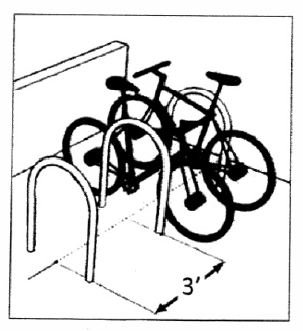
Each bicycle storage space shall a minimum dimension of three feet in width by six feet in length by four feet in height. Two bicycle storage spaces may occupy the same area provided, each individual bicycle occupying the same area is attached to a separate rack (see Graphic 1365.04.01).
Graphic 1365.04.01: Bicycle Storage Space Layout
b.
Bicycle storage areas shall include a minimum of three feet of clearance around racks or lockers to give cyclists room to maneuver and to prevent conflicts with pedestrians or parked automobiles.
c.
Adequate lighting (no less than 2.0 footcandles) must be provided for a bicycle storage area and the route from the storage area to the nearest building entrance intended for the cyclist.
d.
Racks shall conform to Americans with Disabilities Act (ADA) standards for protrusions in the right-of-way including the ability to detect the rack with a white cane. To be detected by a white cane, the protruding or leading edge of the rack shall be 27 inches or less above the sidewalk surface. Between 27 inches and 80 inches above the sidewalk surface, protruding or leading edges may overhang a maximum of 12 inches.
e.
The top of the bicycle rack design shall be a minimum of 36 inches tall. Except for the bicycle rack supporting brackets, the shortest section of the bicycle rack must be a minimum of 27 inches tall to be perceived by pedestrians and avoid tripping hazards.
f.
The space between rack features shall be larger than nine inches and smaller than three and one-half inches to avoid children trapping their heads.
g.
The design shall not include sharp edges.
h.
Areas having more than one row of racks shall be separated by aisles. An aisle is measured from tip to tip of the bicycle storage spaces between racks. The minimum separation between aisles shall be a minimum of four feet.
i.
Racks near walls should be placed so the rack's two bicycle connection points are perpendicular to such wall. Racks placed near walls shall maintain a four-foot minimum separation between the edge of the bicycle storage space and the wall.
j.
Racks placed near curbs should maintain a minimum separation between the edge of the bicycle storage space of four feet.
k.
Racks should have protective coatings designed to protect bicycle frames from scratching and damage.
l.
Racks should be able to resist being cut or detached using common hand tools, such as bolt cutters, pipe cutters, wrenches, and pry bars.
Table 1365.04.01: Minimum Off-Street Parking Requirements
GLA: Gross Leasable Floor Area
GFA: Gross Floor Area
Sq. ft.: Square feet
(Ord. No. 06-01, 1-3-2006; Ord. No. 06-24, 07-18-2006; Ord. No. 07-19, 6-5-2007; Ord. No. 08-06, 3-4-2008; Ord. No. 10-26, 7-6-2010; Ord. No. 11-04, 3-1-2011; Ord. No. 12-30, 7-3-2012; Ord. No. 15-30, 6-2-2015; Ord. No. 16-42, 9-6-2016; Ord. No. 16-44, 9-6-2016; Ord. No. 17-10, 4-4-2017; Ord. No. 18-24, 7-10-2018; Ord. No. 18-29, 10-16-2018; Ord. No. 2023-23, 8-15-2023)
Sec. 1365.05. - Drive-through stacking.
Drive-through establishments shall provide stacking space for queuing of vehicles awaiting use of drive-through windows. Each stacking space must be 18 feet long and each lane of stacking spaces must be at least nine feet wide. Lane widths should be delineated with pavement markings. However, individual spaces within the lane need not be marked. The Schedule of Parking Standards table denotes the number of stacking spaces required for common drive-through uses. Any drive through use not listed shall be required to provide at least four stacking spaces per drive-through window. Stacking spaces must be in addition to the required parking spaces and must not be located within a required driveway, internal circulation system, or parking aisle.
Table 1365.05.01: Stacking Space Requirements
* Planning Director may determine the specific number depending on lot size, use, site plan, etc.
Sec. 1365.06. - Parking spaces accessible to the disabled.
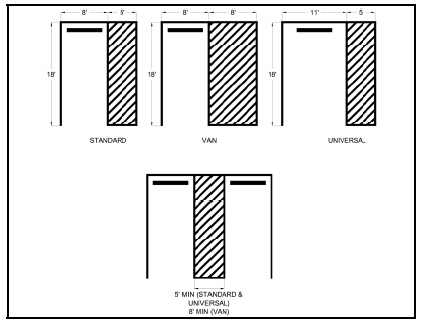
The City of Morgantown encourages all development within the City which serves the public to comply with the accessibility standards of the Americans with Disabilities Act of 1990. The City requires conformance with the accessibility standards contained within the West Virginia State Building Code and the Morgantown City Code.
Table 1365.06.01: Required Parking Spaces Accessible to the Disabled
per the West Virginia State Building Code
Graphic 1365.06.01: Accessible Parking Design
(Ord. 09-26, 7-7-2009)
Sec. 1365.07. - Off-site parking facilities.
(a)
In business, industrial and multi-family districts, the Board of Zoning Appeals may grant conditional use approval to provide required spaces on a site that is:
(1)
Within 300 feet of the principal use; and
(2)
Within a district that permits principal use parking lots or principal use parking structures as a principal or conditional use.
(3)
B-4 District—Within 500 feet of the principal use, but not within a residential district or within the B-4 Neighborhood Preservation Overlay District (B-4NPOD).
(b)
A site plan for such off-site parking facility shall be filed with the Board of Zoning Appeals as a required exhibit accompanying the conditional use application, and shall be made part of the conditions of any approval therefor. Said site plan shall demonstrate compliance with parking requirements and standards of this ordinance, shall be amended and re-approved to indicate any change or other modification of uses served, or number of parking spaces provided therefor, and shall indicate:
(1)
Adjacent streets, alleys and lots.
(2)
All individual primary uses to be served, including the location of the use and number of parking spaces for each such use.
(3)
A layout drawn to scale of one inch equals 50 feet or larger of aisles and driveways, entrances, exits and turn-off lanes, parking spaces, setbacks, drainage facilities, and landscaping and buffer screening.
(4)
Type of lighting and pavement proposed, and identification signs, including location, size and design thereof.
(c)
Offsite parking facilities shall be encumbered by an easement or similar agreement duly executed and acknowledged, which specifies that the land upon which the off-site parking facility is located is encumbered by the parking use. Said instrument shall specify and bind the time period to the anticipated life of the building or use to which the parking facilities are accessory. Said instrument shall be filed in the applicable building permit files of the Department of Planning, and placed on public record in the Office of the Clerk of the County Commission of Monongalia County, West Virginia.
(d)
It is the responsibility of the business owner to maintain current and valid parking as required by this ordinance. Evidence of such parking is required prior to approval and proof of current leases shall be made available at the request of the Planning Director. Each leased space shall have a sign noting the business for which the space is reserved. Signs shall be 12 inches wide by 18 inches tall and shall be mounted between three feet and five feet above the finished surface of the parking stall. The text on the sign shall state "This space is reserved for patrons of [name of the business] only, per City Code 1365.07(d)." All leased stalls shall be improved, paved and striped. Leasing of stalls shall not reduce the available parking below the minimum requirement for uses sharing the lot, except in conditions of shared parking as described in Section 1365.04(b) of this Code.
(e)
Offsite parking facilities shall be developed in accordance with the provisions of the parking development standards section. Further, said facilities shall be developed under such conditions imposed by the Board of Zoning Appeals as to protect residential districts and maintain at a minimum the disturbance to nearby residential uses.
(f)
If the pedestrian access between the off-site parking facility and the use(s) is to cross an arterial street, appropriate safety measures, as determined by the Planning Director and City Engineer, must be in place to ensure pedestrian and vehicular safety.
(Ord. No. 06-01, 1-3-2006; Ord. No. 08-06, 3-4-2008; Ord. No. 16-44, 9-6-2016)
Sec. 1365.08. - Parking and storage of certain vehicles.
(a)
Automotive vehicles. Automotive vehicles or trailers of any type without current license plates and inspection sticker or in an inoperable condition so as to be deemed dead storage shall be prohibited in residential districts other than within completely enclosed buildings, and shall not be parked or stored in any zone district unless specifically authorized under the terms of this ordinance.
(b)
Commercial vehicles on private property. The parking of a commercial vehicle in residential zone districts shall be prohibited, except that one commercial vehicle of not more than three tons capacity may be parked on any lot on which there is located a principal building, provided, however, that such vehicle is parked in an enclosed garage, accessory building or rear yard and is used by an occupant of the premises. This requirement shall not be interpreted to prohibit commercial vehicles from temporary loading and unloading in any residential district.
Sec. 1365.09. - Parking development standards.
All off-street parking areas for four or more automobiles shall be developed in accordance with the standards of this section, except in the case of one and two-family dwellings, agricultural and rural uses, and storage of vehicular merchandise not counting toward the minimum requirements as set forth in this Code.
(a)
Dimensions.
(1)
Each required off-street standard parking space shall be at least eight and one-half feet in width and at least 18 feet in depth, exclusive of access drives or aisles, ramps, columns, or office or work areas. Such space shall have adequate vertical clearance.
(2)
Up to ten percent of the total number of required parking spaces may be designed for compact cars; provided, compact spaces are limited to employees or residents only and the property owner/manager assigns and enforces such spaces accordingly. Compact spaces shall be grouped together and identified as "compact cars only" with pavement stenciling and/or signage. Compact spaces should be located furthest from building entrances to discourage use by noncompact vehicles. Each compact space shall be at least eight feet in width and at least 15 feet in depth, exclusive of access drives or aisles, ramps, columns, or office or work areas. Such space shall have adequate vertical clearance.
(3)
Except on lots occupied by one- and two-family dwellings, each off-street parking space shall open directly upon an aisle or driveway at least 12 feet wide or such additional width and design in accordance with Table 1365.09.01, so as to provide safe and efficient means of vehicular access to such parking space. Such aisle or driveway shall be unobstructed and allow for the passage of emergency vehicles at all times. This requirement may be waived by the Planning Director where such waiver will not cause a hazard.
(4)
All required parking spaces and aisles shall be provided wholly within the property lines and shall not extend into any public right-of-way.
Table 1365.09.01: Dimensions
(b)
Layout and design.
(1)
All off-street parking or loading facilities shall be designed with appropriate means of vehicular access to a street or an alley in a manner which will least interfere with traffic movement.
(2)
Driveway entrances or exits shall be no closer than 15 feet to an adjoining residential property line or five feet to an adjoining non-residential property line or designed in such a manner as to least interfere with traffic movement. No driveway across public property at the right-of-way line of the street shall exceed a width of 22 feet, unless a greater width is specifically approved by the City Engineer. No driveway shall be located closer than 30 feet of the nearest point of the intersection of two streets.
(3)
Connections between parking lots or reservations of land for future such connections may be required at the discretion of the Planning Director.
(4)
Required off-street parking spaces shall be so designed, arranged and regulated so that:
a.
Such parking areas are lined or designated to insure the most efficient use of the parking spaces.
b.
Individual spaces on lots with five percent average slope or greater are provided with anchored bumper guards or wheel guards. Under no circumstances shall parking spaces be provided on lots in excess of ten percent slope.
c.
Parking spaces are unobstructed and have access to an aisle or driveway so that any automobile may be moved without moving another, and so that no maneuvering directly incidental to entering or leaving a parking space shall be on any public right-of-way or walkway, unless otherwise permitted at the direction of the Planning Director.
d.
With the exception of drive-through windows and related stacking lanes, all parking spaces and maneuvering aisles shall be physically separated from any wall of a building by a vertical curb, maintained planting strip, and/or other suitable barrier.
(5)
Off-street parking spaces may be open to the sky or enclosed in a building. In any instance when a building is constructed or used for parking facilities on the lot, said building shall be treated as any major structure and subject to all requirements thereof.
(6)
All parking lots abutting residential uses or districts, and all parking lots in any district containing more than four spaces shall be subject to the landscaping and screening requirements for such parking lots as set forth in Article 1367, Landscaping and Screening.
(7)
Any lighting facilities used to illuminate off-street parking areas shall be so located, shielded and directed upon the parking area in such a manner that they do not reflect or cause glare onto adjacent properties or interfere with street traffic. In no instance shall bare, unshaded bulbs be used for such illumination.
(c)
Surfacing and drainage.
(1)
All open off-street parking areas shall be surfaced with an all-weather, dust-free concrete or asphalt material, and shall be maintained in good condition and free of weeds, dirt, trash and debris; except that, a gravel surface may be used for a period not exceeding six months after the date of granting the certificate of occupancy where ground conditions are not immediately suitable for permanent surfacing as specified above.
(2)
A gravel surface in the area of storage or handling may be used permanently in association with industries that handle liquids or chemicals which create a potential hazard if containment should be lost and where absorption into the ground through a loose surface material would eliminate or alleviate such hazard.
(3)
Such parking areas shall be graded and properly drained in such a manner that there will be no free flow of water onto either adjacent property or public sidewalks. Further, any run-off generated by such improved areas shall be disposed of in accordance with the stormwater management ordinance and other City regulations.
(4)
Other surface materials and designs may be utilized when specifically approved by the City Engineer, for purposes of reducing storm water runoff or other environmental and aesthetic considerations.
(Ord. No. 06-01, 1-3-2006; Ord. No. 13-33, 7-2-2013)
Sec. 1365.10. - Loading requirements.
Uses and buildings with a gross floor area of 5,000 square feet or more shall provide off-street loading spaces in accordance with Table 1365.10.01 provided that loading spaces shall not be required for uses which do not receive or transmit goods or wares by truck delivery.
(a)
Location. All required off-street loading berths shall be located on the same lot as the use to be served, and no portion of the vehicle shall project into a street or alley. No permitted or required loading berth shall be located within 30 feet of the nearest point of intersection of any two streets, nor shall it be located in a required front yard or side yard adjoining a residential use or district.
(b)
Each required off-street loading space shall be of a size not less than that required for an off-street parking space but scaled larger to delivery vehicles expected to be used, logically and conveniently located for bulk pickups and deliveries, and accessible to such vehicles when required off-street parking spaces are filled, provided that the off-street area required for the receipt or distribution by vehicles of materials or merchandise is held to be as follows:
(1)
For local pick-up and delivery trucks: 12 feet in width by 30 feet in length with a 45-foot maneuvering apron, and a 12-foot height clearance.
(2)
For over-the-road tractor-trailers: 14 feet in width by 60 feet in length with a 60-foot maneuvering apron, and a 14-foot height clearance.
(c)
Paving regulations for loading areas shall be in accordance with the paving regulations for parking areas as set forth in the development standards section. Drainage regulations shall be in accordance with the City's stormwater management ordinance and other City ordinances.
(d)
Loading berths shall be screened by either building walls, a solid fence, densely planted shrubbery, or any combination thereof, none of which may be less than six feet in height at maturity, unless located at the rear of the building.
Table 1365.10.01: Required Loading Spaces
(Ord. No. 07-57, 11-6-2007)
Sec. 1367.01. - Purpose.
The purpose of this section is to establish minimum standards for the provision, installation, and maintenance of landscape plantings in order to achieve a healthy, beautiful, and safe community.
Sec. 1367.02. - Applicability.
(a)
These landscape regulations shall apply to two-family, multi-family, commercial, office, industrial, and institutional development. Previously approved development need not comply unless new site development approval is being sought.
(b)
If a proposed addition or renovation to an existing structure equals or exceeds 50 percent of the assessed value of the structure, the site must be brought into compliance with the landscaping requirements of this section; provided, that where it is clearly demonstrated that compliance with this section will reduce the minimum number of required parking spaces for the use, compliance with this section shall be required only to the degree that the minimum parking requirement can still be met.
Sec. 1367.03. - Enforcement.
Wherever site plan review is required by this zoning ordinance, a landscape plan shall be a required part of such site plan. No permanent certificate of occupancy shall be issued without completion of all landscaping shown on the landscape plan required herein. A temporary certificate of occupancy may be issued for the building for a period of one year when weather conditions do not permit landscape installation. Failure to implement the approved landscape plan, including preservation of existing features, or to maintain the landscaping as long as incompatibility of adjoining uses exists, shall be a violation of this zoning ordinance subject to the penalties outlined in Article 1393.
Sec. 1367.04. - Content of landscape plan.
Where required, a landscape plan shall conform to the following requirements: All landscape plans submitted for approval as a component of a required site plan shall show the entire zoning lot to scale and shall contain the following information:
(a)
The location and dimensions of all existing and proposed structures, parking lots and drives, roadways and right-of-way, sidewalks, bicycle paths, ground signs, refuse disposal areas, freestanding electrical equipment, recreation facilities, utility lines and easements, freestanding structural features, and other landscape improvements, such as earth berms, walls, fences, screens, sculptures, fountains, street furniture, lights, and courts or paved areas;
(b)
The name, address and phone number of the owner, developer, and plan preparer, the date the plan was prepared, scale, and north arrow;
(c)
The location, quantity, size, and common name of all proposed planting materials;
(d)
The location, size, and common name of existing trees over eight inches diameter at breast height, areas of dense trees or shrubs, and other natural features, indicating which are to be preserved and which are to be removed;
(e)
Existing and proposed grading of the site, including proposed berming;
(f)
Specification of the type and boundaries of all proposed vegetative ground cover;
(g)
Design of fences and other significant accessory structures;
(h)
Planting and installation details as necessary to ensure conformance with all required standards; and
(i)
Details indicating specific grading measures or other protective devices where trees are to be preserved in areas of cut and fill.
Sec. 1367.05. - Preservation of existing features.
(a)
Trees and shrubs already existing on land subject to the provisions of this section should be preserved wherever feasible. Criteria for judging the feasibility of retaining existing vegetation include:
(1)
The practicability of arranging site plan components around existing features. In general, plans for groups of structures should be designed so as to preserve tree masses, individual tree specimens, and small stands of trees or shrubs;
(2)
The condition of the vegetation with respect to continued vitality;
(3)
The practical and economic possibility of designing the location and grades of proposed structures and paving to preserve existing vegetation;
(4)
The desirability or lack thereof of a particular tree or species by reason of its appearance; historic or ecological significance; botanical characteristics; and the function the vegetation would fulfill as a site plan component;
(5)
Interference with utility services or encroachment into the traffic visibility triangle; and
(6)
The possibility of preserving the vegetation while meeting the development needs through pruning rather than removal.
(b)
Existing trees that are preserved will contribute to the required landscaping. For each tree that is preserved, which is greater than eight-inch caliper, and is found on the approved list, the amount of new trees to be installed shall be reduced by two trees.
(c)
Substantial barriers shall be specified on the landscape plan and shall be placed at or beyond the drip line of trees to be protected. These barriers shall remain in place during heavy construction on the site, and no vehicle, machinery, tools, chemicals, construction materials, or temporary soil deposits may be permitted within the barriers, nor may any notice or other object be nailed or stapled to protected trees.
Sec. 1367.06. - General landscaping requirements.
(a)
All land areas that are not covered with buildings and pavement or used for agricultural purposes shall be appropriately landscaped in accordance with the requirements of this section. Landscaping shall be provided in the areas specified and of the minimum intensity, specified below.
(b)
The scale and nature of landscape materials shall be appropriate to the size of the structures and the available space. Materials shall be located to avoid interference with overhead and underground utilities and utility easements or vehicular or pedestrian movement and visibility. Growth characteristics should be carefully considered.
(c)
Trees shall be planted to maintain a minimum of ten to 15 feet clearance between the tree trunk and structures, building overhangs, walls, fences, and other trees.
(d)
Plantings should be arranged to promote energy conservation wherever practicable; e.g. use of tall deciduous trees on the south and west sides of buildings to provide shade from the summer sun and planting evergreens on the north of buildings to dissipate the effect of winter winds.
(e)
All trash dumpsters, trash pads, loading areas consisting of two or more loading spaces, loading docks, building service and outside storage areas shall be screened from land in a residential zone and must be screened if visible from a public street. Such screening may be achieved by using a minimum six feet high, completely opaque fence or wall, a six feet high berm, or a six foot high evergreen screen. Height of screen shall be measured from the grade of the nearest street.
(f)
Grass and other vegetative ground cover shall be used for all open space, including parking lot islands, except for:
(1)
Decorative mulch planting beds containing trees and/or shrubs.
(2)
Inert stabilization in areas subject to severe runoff, erosion, or ponding.
(g)
Where stone or other inert materials are to be used for ground cover, they shall be specifically identified on the landscape plan. Any area not so designated shall be required to have grass or vegetative ground cover.
(h)
All landscaping shall conform to the regulations established for visibility triangles to maintain safe sight distances and intersections and points of access as designated in Section 1363.03, Safety and Vision.
(i)
All landscaped areas at the front line of off-street parking spaces shall be protected from encroachment or intrusion of vehicles.
(j)
In no case may a tree or shrub be planted within a drainage, sewer or utility easement.
Sec. 1367.07. - Bufferyard landscaping requirements.
(a)
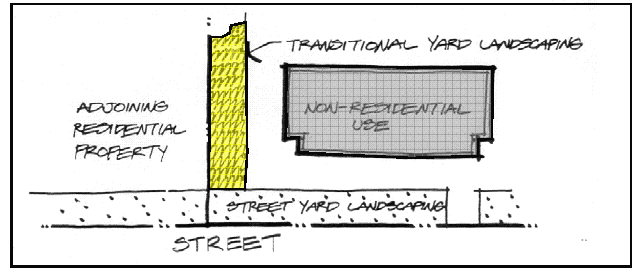
New non-residential buildings that abut a residential property (zoned or used) or new multi-family residential buildings that abut a single or two-family residential property (zoned or used) shall provide a landscape buffer ten feet wide planted with five medium to large trees and ten to 15 shrubs per 100 linear feet of transitional yard between the new non-residential and residential uses or new multi-family and single or two-family uses. This requirement may supersede the minimum setback requirement for the district.
(b)
Developed lots or lots with unexpired building permits at the time of adoption of this ordinance are exempt from this requirement.
Graphic 1367.07.01: Transitional Yard Landscaping
(c)
Undeveloped properties, expansions of more than 40 percent of existing floor area, and rezoned property are subject to the provisions of this section.
(Ord. No. 06-37, 11-8-2006)
Sec. 1367.08. - Parking lot landscaping requirements.
The following landscape requirements applied to parking lots are intended to screen parking areas from the street, prevent large expanses of unbroken paving, and provide shade to cool paved areas during the hot summer months.
(a)
General provisions.
(1)
Parking lots with four stalls or less are exempt from the requirements of this section. If only four stalls are required per this ordinance and the applicant chooses to provide more parking, then the requirements of this section shall apply.
(2)
All remaining unpaved areas of the parking lot shall be grassed or planted in ground cover, unless otherwise specified.
(b)
Development with no parking between building line and street.
Graphic 1367.08.01: Development with No Parking Between Building Line and Street
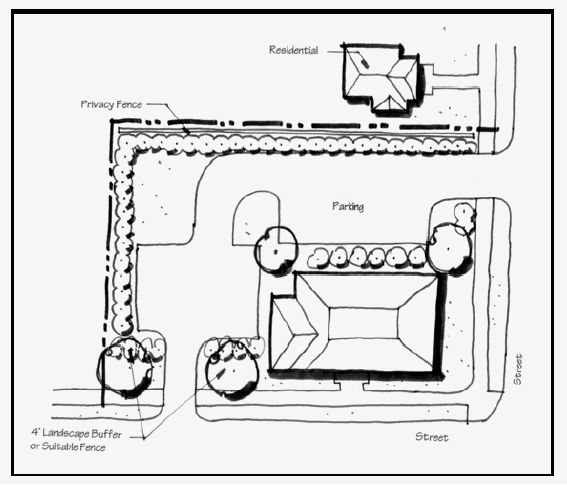
If there is no parking anywhere between the established building line, projected from corner of building to property lines:
(1)
A four-foot perimeter buffer shall be provided, along the sides and rear yard of the property, that contains at least one two-inch caliper tree every 20 feet and at least three shrubs of at least three gallons in size clustered between each two trees.
(2)
If the proposed parking lot contains 20 stalls or more, an additional five percent of the parking lot area shall be reserved for interior landscaping. Planting beds running adjacent to and parallel with the building, perimeter landscaping and buffer requirements shall not count towards this requirement.
(c)
Development with parking located between building and street. If any parking is located between the street and the building line, the following shall apply:
(1)
A ten-foot wide buffer shall be provided for the length of any parking area abutting the street. The buffer area shall contain at least one two-inch caliper trees for every 20 feet and at least three shrubs of at least three gallons in size clustered between each two trees.
(2)
A six-foot side and rear yard buffer shall be provided that shall contain at least one two-inch caliper tree for every 20 feet and three shrubs of at least three gallons in size clustered between each two trees.
(d)
Design standards for interior landscaping.
(1)
All interior landscaping required by this ordinance shall be in addition to any perimeter buffers required in Sections 1367.07 and 1367.08.
(2)
All rows of parking spaces, when a lot contains 20 or more parking stalls, shall provide a terminal island with concrete curbs and at least 130 square feet of area to protect parked vehicles, provide visibility, confine moving traffic to aisles and driveways, and provide space for landscaping. These islands may count toward fulfilling the five percent internal landscaping requirement.
(3)
Landscaped islands with concrete curbs and at least 130 square feet of area shall be provided every ten spaces or less within a row of spaces for multi-family residential sites and every 15 spaces or less within a row of spaces for commercial developments. Planting islands should be evenly spaced throughout the parking lot to consistently shade paved areas. Islands shall be utilized where needed to control vehicular circulation and define major drives. These islands may count toward fulfilling the five percent internal landscaping requirement. To prevent cars from parking too close to trees or damaging shrubs, an extended curb or wheel stop must be provided. Planting islands parallel to parking spaces must be a minimum of five feet wide to allow car doors to swing open.
(Ord. No. 06-01, 1-3-2006; Ord. No. 09-28, 7-7-2009)
Sec. 1367.09. - Modifications.
(a)
Under conditions where a strict interpretation of requirements may be either physically impossible or create practical difficulties, an alternative compliance procedure may be used to maintain the spirit—rather than the letter—of the law. The proposed solution must equal or exceed standard landscaping requirements. Requests to the Planning Director for use of alternative landscaping schemes may be justified only when one or more of the following conditions apply:
(1)
The sites involve space limitations or unusually shaped parcels;
(2)
Topography, soil, vegetation, or other site conditions are such that full compliance is impossible or impractical;
(3)
Due to a change of use of an existing site, the required bufferyard is larger than can be provided;
(4)
Existing utility lines or easements complicate the placement of required plant materials;
(5)
The applicant must provide a justification statement that describes which of the requirements established by the landscaping ordinance will be met with modifications, which project conditions justify using alternatives, and how the proposed measures equal or exceed normal compliance.
(b)
Where compliance is required as a result of change in use or expansion of an existing building and compliance with this section will necessitate removal of existing pavement, the Planning Director may approve a reduction of minimum planting areas, provided that proposed plantings, screens, and other landscape features are substantially equivalent to the minimum requirements in terms of landscaping.
(c)
After initial approval of the landscape plan the Planning Director may approve any substitute landscape proposal that he/she deems to be equivalent to the approved landscape.
(d)
Occasionally, plant substitutions for species specified on approved landscape plans are required due to seasonal planting problems and a lack of plant availability. Minor revisions to planting plans can be approved by the Planning Director if there is no reduction in the quantity of plant material, no significant change in size or location of plant materials, and if the substitute plants are of the same general category and have the same general design characteristics as the plants originally approved. Proposed materials must also be compatible with the microclimate of the site to ensure healthy plant growth.
Sec. 1367.10. - Installation and maintenance.
(a)
Plant materials shall conform to the requirements described in the latest edition of the American Standard for Nursery Stock, which is published by the American Association of Nurserymen. Plants shall be nursery grown.
(b)
Plants shall conform to the measurements specified below:
(1)
Caliper measurements shall be taken six inches above grade for trees under four inches in diameter and 12 inches above grade for trees four inches or larger in diameter.
(2)
Minimum size for shade trees shall be two inches in caliper.
(3)
Minimum size for ornamental trees shall be 1.5 inches in caliper.
(4)
Minimum size for evergreen trees shall be four feet above grade.
(c)
After cultivation, all plant materials shall be mulched with a two to three inch layer of shredded bark, peat moss, or another suitable material over the entire area of the bed.
(d)
The owner of the premises shall be responsible for the maintenance, repair, and replacement of all landscaping materials on the premises at the owner's expense. All landscape areas shall be kept free of refuse and debris. Fences, walls, and other barriers shall be maintained in good repair. It is the responsibility of each private property owner to remove any dead, diseased, or dangerous trees or shrubs, or parts thereof, which overhang or interfere with line of sight, traffic control devices, public sidewalks, rights-of-way, or property owned by the City. The City shall have the authority to order the removal of any such trees or shrubs.
Sec. 1367.11. - Approved street tree and shrub list.
Table 1367.11.01, "Approved Street Tree and Shrub List," identifies the approved species that may be used to meet street tree and landscaping requirements set forth herein. Plant materials proposed other than those listed in Table 1367.11.01 may be approved by the Planning Director or his/her designee.
Table 1367.11.01: Approved Street Tree and Shrub List
(Ord. No. 17-38, 10-3-2017)
Sec. 1369.01. - Purpose.
(a)
The purposes of these sign regulations are:
(1)
To encourage the effective use of signs as a means of communication in the City; to maintain and enhance the pleasing look of the City, which attracts to the City continued economic investment; to preserve Morgantown as a community that is attractive to business, to residents and to visitors;
(2)
To improve pedestrian and traffic safety;
(3)
To minimize the possible adverse effects of signs on nearby public and private property; and
(4)
To implement relevant provisions of the comprehensive plan, as updated periodically.
(b)
In that context, the City continuously invests in parks, trails, landscaping, quality public facilities and other features and amenities that enhance the attractiveness of the community; a major purpose of this ordinance is to ensure that signs in the community are compatible with the high quality image that the City seeks and in which the City continuously invests.
Sec. 1369.02. - Applicability.
A sign may be erected, placed, established, painted, created or maintained in the City only in conformance with the standards, procedures, exemptions and other requirements of this ordinance and other applicable City codes. Signs exempt from regulation under Section 1369.05, Signs Exempt from Regulations, shall not otherwise be subject to this ordinance.
Sec. 1369.03. - Effect.
The effect of this ordinance, as more specifically set forth herein, is:
(1)
To establish a permit system to allow a variety of types of signs in commercial and industrial zones, and a limited variety of signs in other zones, subject to the standards and the permit procedures of this ordinance;
(2)
To allow certain signs that are small, unobtrusive and incidental to the principal use of the respective lots on which they are located, subject to the substantive requirements of this ordinance, but without a requirement for permits;
(3)
To provide for temporary signs in limited circumstances;
(4)
To prohibit all signs not expressly permitted by this ordinance; and
(5)
To provide for the enforcement of the provisions of this ordinance.
Sec. 1369.04. - Rules of interpretation.
(a)
Area computation of individual signs. The area of a sign face (which is also the sign area of a wall sign or other sign with only one face) shall be computed by means of the smallest rectangle that will encompass the extreme limits of the writing, representation, emblem or other display, together with any material or color forming an integral part of the background of the display or used to differentiate the sign from the backdrop or structure against which it is placed, but not including any supporting framework, base, bracing or decorative fence or wall when such fence or wall otherwise meets the regulations of this Ordinance and is clearly incidental to the display itself.
(b)
Area computation of multi-faced signs. Where the sign faces of a double-faced sign are parallel or the interior angle formed by the faces is 60 degrees or less, only one display face shall be measured in computing sign area. If the two faces of a double-faced sign are of unequal area, the area of the sign shall be the area of the larger face. In all other cases, the areas of all faces of a multifaced sign shall be added together to compute the area of the sign. Sign area of multifaced signs is calculated based on the principle that all sign elements that can be seen at one time or from one vantage point should be considered in measuring that side of the sign.
(c)
Sign height computation. The height of a sign shall be computed as the distance from the base of the sign at normal grade to the top of the highest attached component of the sign. Normal grade shall be construed to be the newly established grade after construction, exclusive of any filling, berming, mounding or excavating solely for the purpose of locating the sign. In cases where the normal grade is below grade at street level, sign height shall be computed on the assumption that the elevation of the normal grade at the base of the sign is equal to the elevation of the nearest point of the crown of a public or private street.
Sec. 1369.05. - Signs exempt from regulations.
The following signs shall be exempt from regulation under this ordinance:
(a)
Any official or public notice or warning required by a valid and applicable Federal, State or local law, regulation or ordinance, by a public utility company or by order of a court of competent jurisdiction; or signs erected by any public entity that is statutorily exempt from local zoning.
(b)
Traffic signs on private property, such as stop, yield and similar signs, which meet the standards contained within the Federal Manual on Uniform Traffic Control Devices and contain no commercial message;
(c)
Signs hanging or standing inside a building, not attached to a window or door, visible from a public street;
(d)
Any sign inside an athletic field or other enclosed outdoor space;
(e)
Works of art with no commercial message;
(f)
Holiday decorations with no commercial message displayed between November 15 and January 15.
(g)
On-premise real estate signs indicating for sale, for lease, etc.;
(h)
Lettering attached to the window or door of a business that only describes hours of operation, street address, or other non-commercial copy/logos;
(i)
Yard sale signs;
(j)
Signs attached to or painted onto service vehicles;
(k)
Signs on fuel pumps that cannot generally be read from off the premises;
(l)
Political signs;
(m)
Signs erected by any entity legally exempt from municipal zoning.
Sec. 1369.06. - Permitted signs; location, size, number.
Signs shall be permitted in accordance with Table 1369.06.01 and the supplemental regulations following Table 1369.06.01 and subject to the height limits shown in Table 1369.09.01. The character "" in the row for a sign and in the column for a particular group of zoning districts shall indicate that the sign type is permitted in that district in accordance with the provisions of this section. The symbol "—" in any cell indicates that the sign type listed is not allowed in that district under any circumstances. The references in the "Supplemental Regulations" column refer to permit requirements, which shall apply to that sign in accordance with its terms.
Table 1369.06.01: Permitted Signs
BP - building permit; required for signs costing more than $250.00 which includes labor and materials
FP - Floodplain permit
SP - Sign permit
* The manner of attachment may determine whether or not a BP is required.
(Ord. No. 13-11, 3-6-2013)
Sec. 1369.07. - Conditions for permitted signs.
(a)
Construction sign. Construction signs shall be allowed, provided that:
(1)
Only one construction sign is permitted per acre of development.
(2)
Construction signs shall be removed prior to receiving a certificate of occupancy for the building.
(3)
Construction signs shall be allowed for nonresidential, institutional or multi-family residential buildings, provided that:
a.
Such signs shall not exceed 48 inches in height;
b.
Such signs shall not exceed 12 square feet in area per side;
c.
Setbacks shall be adequate to protect the clear sight triangle, in accordance with the zoning ordinance.
(b)
Directory sign. Directory signs shall be allowed where a particular site includes more than one tenant, provided that:
(1)
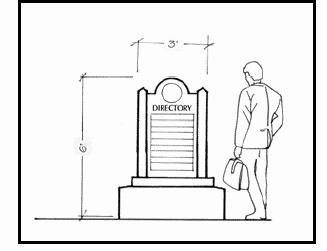
Logo/name directory signs in shopping centers may be located near entrances to parking areas, but not less than 20 feet from any public right-of-way, and at principal intersections within the site, where such intersections are not less than 20 feet from any public right-of-way. There may be one directory sign per entrance, which shall be in accordance with subsection (b)(3) below if more than one tenant. Such signs shall not exceed 18 square feet in area and six feet in height. Such signs may contain logos or business names with arrows or other directional information but shall not contain any commercial message. Such sign shall not be illuminated. In addition to such directory signs, any shopping center may have one detailed directory sign as described below.
(2)
All other signs for individual tenants must be wall signs, suspended signs, or sandwich board signs.
(3)
All directory signs shall be of the monument style.
Graphic 1369.07.01: Directory Sign
(c)
Marquee sign. In addition to permitted wall signs, marquee signs with changeable copy shall be allowed at movie or performance theaters. Such changeable copy signs may cover no more than one square foot of sign area for each linear foot of theater building frontage. Like poster boxes, such signs shall be subject to total wall sign area limits. Other non-changeable copy signs may be attached to or mounted on top of a marquee.
(d)
Menu board sign. Menu boards shall be allowed only as an accessory use to a restaurant permitted to have a drive-thru window under the zoning ordinance, provided that:
(1)
Such signs shall not exceed 32 square feet in area and six feet in height;
(2)
Such signs shall not be legible from a public right-of-way or adjacent property;
(3)
There shall be no more than one such sign per property;
(4)
The color of such signs shall be neutral or earth tone or have architectural ties to the main building;
(5)
Such signs may have changeable copy; and
(6)
Such signs may be internally or directly illuminated.
(e)
Monument sign.
(1)
Monument signs shall be allowed, provided that:
a.
Such signs shall not exceed 72 inches in height;
b.
Such signs shall not exceed 32 square feet in area per side;
c.
Setbacks shall be adequate to protect the clear sight triangle, in accordance with the zoning ordinance.
(2)
Both sides of a two-sided monument sign shall be identical in design and content;
(3)
For a single-occupant property, there shall be only one monument sign per principal entrance to the project, provided that no two ground signs on the same parcel shall be within 100 feet of each other;
(4)
For multi-tenant buildings, the only monument sign allowed on the property shall be a directory sign. All other signs for tenants shall be wall signs or sandwich board signs; and
(5)
Outparcels in shopping centers shall not be allowed principal ground signs.
(f)
Post and panel sign.
(1)
Post and panel signs shall be allowed, provided that:
a.
Such signs shall not exceed six feet in height;
b.
Such signs shall not exceed 32 square feet in area per side; and
c.
Setbacks shall be adequate to protect the clear sight triangle, in accordance with the zoning ordinance.
(2)
Both sides of a two-sided post and panel sign shall be identical in design and content;
(3)
For a single-occupant property, there shall be only one post and panel sign per principal entrance to the project, provided that no two ground signs on the same parcel shall be within 100 feet of each other;
(4)
For multi-tenant buildings the only post and panel sign allowed on the property shall be a directory sign. All other signs for tenants shall be wall signs or sandwich board signs; and
(5)
Outparcels in shopping centers shall not be allowed post and panel signs.
(g)
Suspended sign.
(1)
Such signs may be allowed in addition to wall signs provided that such signs may not exceed six square feet of total area which shall not count toward the total maximum sign area allowed;
(2)
Such signs shall not be separately illuminated;
(3)
Such signs shall contain only the address, suite number, logo or name of the occupant or business served by the entrance;
(4)
Only one such sign may be erected by any one tenant;
(5)
Such sign may protrude into the right-of-way only if the building is within two feet of the sidewalk;
(6)
A suspended sign can be located under a canopy, provided that such sign shall not exceed two square feet in area;
(7)
Such sign must maintain a clearance of nine feet above the sidewalk; and
(8)
Such signs must comply with all applicable local and State regulations.
(h)
Temporary sign. Signs for temporary uses, special events or the opening of businesses, as expressly permitted under the zoning ordinance, provided that:
(1)
Such signs shall be located only on private property;
(2)
Sign permits shall be limited to a duration of 30 days or, for a temporary use, for the period of time stated on the temporary use permit;
(3)
No more than three temporary sign permits shall be issued within any 12-month period for the same business in the same location and only one sign may be included on each permit;
(4)
Except as permitted by a temporary use permit, temporary signs shall be attached to and parallel with a wall of the building on which wall signs are permitted and shall not exceed 32 square feet in surface area;
(5)
Such signs must be made of cloth or vinyl;
(6)
Where a temporary use permit specifically authorizes the use of a temporary ground sign, such sign shall not exceed 42 inches in height and 16 square feet in area per side; and
(7)
Special events, such as those associated with civic, philanthropic, educational purposes, rodeos, and carnivals shall be allowed a temporary sign, regardless of whether a temporary use permit is required and whether the use is specifically permitted under the Zoning Ordinance, provided that:
a.
Up to two ground signs shall be allowed per property per event;
b.
Such sign shall be located only on private property;
c.
Such sign, if a monument sign, shall be limited to 20 square feet each; and
d.
Such sign shall be erected no sooner than ten days preceding the event and shall be removed no later than one day following the event.
(i)
Wall sign, nonresidential.
(1)
The total area of all wall signs on a building, or on the retaining wall(s) associated with the building, shall not exceed 0.6 square feet of wall sign area per linear foot of tenant building frontage in the B-5, B-2 and I-1 districts, and 0.4 feet in area in the B-1 and B-4 districts, for each linear foot of building frontage, and the fact that signs may be permitted on more than one wall of the building shall not increase this maximum. All wall signs shall be in accordance with the provisions in Section 1369.09.
(2)
Signs on awnings attached to buildings shall be considered wall signs for the purpose of this ordinance.
(3)
No wall sign shall project above the highest point of the building wall on the same side of the building as the sign; this shall include marquee signs and any other signs not affixed directly to such wall.
(4)
On a multi-occupancy building, each occupant with an outside entrance serving the general public may have a separate wall sign. Corner tenants with a door or window on their side walls and tenants with a separate outside entrance serving the general public where such entrance is in a different exterior wall from any other entrance for which such tenant shall be allowed one additional wall sign;
(5)
Conditions above shall not apply to changeable copy signs for a theater, which shall be subject to the requirements for marquee signs; and
(6)
In addition to other permitted signs, a theater may install one back-lighted or internally illuminated "poster box," provided that:
a.
Such boxes shall not exceed 36 by 54 inches each in area;
b.
The top of such boxes shall not be more than ten feet above ground;
c.
Such boxes shall be permanently mounted to a wall; and
d.
The number of boxes shall not exceed one per screen in the theater.
(j)
Sandwich board sign.
(1)
A single sandwich board sign shall be permitted to be placed on a private sidewalk or on a public sidewalk, for each business that is adjacent to such a sidewalk, provided that Section 905.02 of the City Code is adhered to;
(2)
Such sign shall not be higher than four feet and two feet wide;
(3)
Artwork, lettering and color of such sign should be consistent with the shopfront's architectural character; and
(4)
Such sign must not present a risk to public safety; must be removed from the street outside trading hours; and, must be removed in adverse weather conditions.
(k)
Directional sign.
(1)
Such sign may contain only instructions guiding traffic and excludes logos and commercial copy;
(2)
Such sign must be made of wood or masonry with painted or vinyl appliqued letters;
(3)
Such sign may not be internally illuminated;
(4)
Such sign may be painted in color, but not exceeding one primary and one trim color; and
(5)
The maximum area of any directional sign shall be four square feet.
(l)
Electronic, scrolling message sign.
(1)
Such signs are permitted only in the B-5 and I-1 districts, and only if designed as a wall or monument sign;
(2)
If such sign is a monument sign, tenants may not have any other monument signs on the property;
(3)
If such sign is a wall sign, the sign shall count toward the area allotment;
(4)
The advertisement of off-premise businesses or services shall not be allowed;
(5)
Such signs must comply with all other applicable local and State regulations.
(m)
Off-premise sign.
(1)
Such sign advertising the location of a church or other religious institution may be allowed in any zoning district provided it is ten square feet in size or less; and
(2)
Located on private property with the written consent of the property owner;
(3)
Such signs may be permitted in the sign overlay district.
(Ord. No. 06-01, 1-3-2006; Ord. No. 06-37, 11-8-2006; Ord. No. 16-29, 7-5-2016)
Sec. 1369.08. - Lighting and design standards.
(a)
Permitted signs in the B-2, I-1 and B-5 districts may be:
(1)
Internally illuminated.
(2)
Sign faces may be vinyl, plastic or other semi-translucent material or any material listed below in subsection (b)(3).
(b)
Permitted signs in the B-1, B-4, PRO, OI and residential districts shall comply with the following:
(1)
Sign faces shall be opaque;
(2)
Signs may not be internally illuminated, except for neon signs; and
(3)
Signs shall be made of wood; sculpted "sign foam"; ornamental metals such as bronze, brass, copper, etc.; painted aluminum panels, stone or masonry (with concrete blocks being covered with stucco); and have painted or vinyl letters attached to windows and doors.
(c)
Permitted signs in the B-1 and B-4 districts shall be restricted to the name and logo of the business establishment. No other copy shall be permitted.
Sec. 1369.09. - Size restrictions on permitted signs.
(a)
Signs for business uses in residentially zoned districts, including bed and breakfast establishments:
(1)
Shall have 0.15 square feet of sign area per linear foot of lot frontage on the primary street;
(2)
Home occupations may not have any signs.
(b)
Signs for multifamily residential uses in all districts:
(1)
Shall only advertise project names;
(2)
Shall be permitted six square feet of sign area, plus 0.1 square feet per dwelling unit, up to a maximum of 24 square feet.
(c)
Signs for business uses in the O-I and B-1 districts:
(1)
Shall have 0.4 square feet of wall sign area per linear foot of building frontage for single tenant buildings;
(2)
Shall have 0.5 square feet of wall sign area per lineal foot of building frontage for multiple tenant buildings;
(3)
For all other permitted signs (monument, directory, sandwich board, etc.) there may be an additional 0.3 square feet of sign area for each linear foot of building frontage. This may be divided up among other types of permissible signs, within the limits on the number of such signs set forth.
(d)
Signs for businesses in the B-5 and I-1 districts:
(1)
In the B-5 district signs shall have 0.6 square feet of wall sign area per linear foot of tenant building frontage;
(2)
In the I-1 district signs shall have 0.6 square feet of wall sign area per linear foot of tenant building frontage.
(e)
Signs for businesses in the PRO district:
(1)
Shall not exceed 20 square feet.
Table 1369.09.01: Freestanding Sign Height Limits (Inches)
* To be determined by the Board of Zoning Appeals
(Ord. No. 13-12, 3-5-2013)
Sec. 1369.10. - Prohibited signs and devices.
All signs not expressly permitted under this ordinance or exempt from regulation hereunder in accordance with the previous section are prohibited. Such signs include, but are not limited to:
(a)
Any sign that copies or imitates an official sign or purports to have official status;
(b)
Beacons;
(c)
Windblown devices;
(d)
Pennants, streamers, strings of light bulbs except for holiday decorations;
(e)
Animated signs;
(f)
Signs with moving or flashing lights, except as noted in the electronic scrolling message sign section. Neon signs may be used anywhere signs are permitted, except in residential districts, and provided they are one of the permitted types (wall, monument, etc.);
(g)
Any sign attached to an accessory structure if such sign is legible from the public right-of-way or from other property;
(h)
Any other attention-attracting device, except for those conforming to the dimensional, design, lighting and other standards applicable to a sign in the same location;
(i)
Any sign that obstructs or substantially interferes with any window, door, fire escape, stairway, ladder, or opening intended to provide light, air, ingress, or egress to any building;
(j)
Any sign attached to gas pumps or gas pump islands that can be read or understood from a public street by most persons of normal vision;
(k)
Off-premise and billboard signs of any kind except those allowed under this section;
(l)
Pylon signs, except those allowed under this section;
(m)
Signs mounted on or above the roofline of any building, except in the B-4 districts, where they may be permitted as a conditional use and shall count towards the total sign allotment of the site; and
(n)
Portable signs; and
(o)
Any sign located in a public right-of-way except as provided for in Section 1369.14.
(Ord. No. 13-13, 3-5-2013)
Sec. 1369.11. - Design and construction standards.
(a)
Construction standards. All signs shall be designed, constructed and maintained in accordance with the following standards:
(1)
All signs shall comply with applicable provisions of the West Virginia State Building Code and local floodplain management ordinance.
(2)
Electric signs that have internal wiring or lighting equipment, and external lighting equipment that directs light on signs, shall not be erected or installed until an electrical permit has been obtained from the Code Enforcement Department. All such signs and equipment shall bear the seal of approval of an electrical testing laboratory that is nationally recognized as having the facilities for testing and requires proper installation in accordance with the National Electrical Code. All wiring to electric signs or to freestanding equipment that lights a sign shall be installed underground.
(3)
Except for permitted banners, flags, temporary signs and window signs conforming in all respects with the requirements of this ordinance, all signs shall be constructed of permanent materials and shall be attached to the ground, a building, a retaining wall, or another structure by direct attachment to a wall, frame or structure.
(b)
Maintenance standards. All signs shall be maintained in good structural condition, in compliance with all building and electrical codes, and in conformance with this ordinance. Specifically: A sign shall not stand with bent or broken sign facing, with broken supports, with loose appendages or struts, or more than 15 degrees from vertical for a period of more than ten days.
(Ord. No. 16-29, 7-5-2016)
Sec. 1369.12. - Signs not to create traffic hazard.
Clear vision triangle. No sign shall be erected in the clear vision triangle as defined by this ordinance. Any such signs shall be removed at the direction of the Planning Director. If not removed by owners or occupants of the property within ten days of notice, the Director may cause the property owner to be cited for a violation of the zoning ordinance.
Sec. 1369.13. - Lighting.
In/near residential areas. Unless otherwise expressly prohibited by this ordinance or other ordinances of the City, any sign may be externally illuminated, provided that any lighting directed toward the sign is shielded so as to illuminate only the face of the sign.
Sec. 1369.14. - Signs in a public right-of-way.
(a)
Permanent signs. Permanent signs shall be limited to:
(1)
Signs erected by a public agency or utility; and
(2)
Awning signs or suspended signs projecting over a public right-of-way in the B-4 districts; provided, however, that no awning shall extend out three feet from the building or extend closer than 12 inches to the curb, whichever is less.
(b)
Other signs in public right-of-way. Any other sign placed in the public right-of-way in violation of this ordinance shall be deemed a public nuisance and may be seized by the enforcement official or other representative of the City.
(c)
Signs in the B-4 districts.
(1)
Signs may not be placed upon the ground within, attached to any object within, or projected into the airspace of a public right-of-way except in the B-4 districts, where sandwich board signs and suspended signs may be used.
(2)
In such cases, it is the responsibility of the property owner to insure that the signs are properly maintained and that they do not present a risk to the public safety.
Sec. 1369.15. - Sign permits.
(a)
Permits required for sign. Sign permits are required prior to the erection of any sign, as provided in Table 1369.06.01. In addition to sign permits, building permits and floodplain permits may also be required prior to issuance of a sign permit.
(b)
Application requirements.
(1)
An application for a sign permit may be filed only by the owner of the property on which the sign is to be erected, or by an agent, lessee, or contract purchaser specifically authorized by the owner to file such application. In addition, a building permit shall be required prior to the erection of any sign.
(2)
An application for a sign permit shall be filed with the Planning Department on a form prescribed by the Department, along with the fee as prescribed by the City Council.
(3)
The Planning Department shall determine whether the application is complete. If the Department determines that the application is not complete, then it shall notify the applicant of any deficiencies and shall take no further steps to process the application until the applicant remedies the deficiencies.
(c)
Approval procedure.
(1)
For all signs in the B-4 districts requiring a permit and that are larger than six square feet, consultation with the Downtown Design Review Committee shall be necessary. All smaller signs shall be approved following the procedure set forth below, in subsection (c)(2).
(2)
Signs identified on Table 1369.06.01 as requiring a permit shall be erected, installed or created only in accordance with a duly issued and valid sign permit from the Planning Director. Such permit shall be issued only in accordance with the following requirements and procedures:
a.
An application for construction, creation or installation of a new sign or for modification of an existing sign shall be accompanied by detailed drawing to show the dimensions, design, structure, and location of each particular sign. One application and permit may include multiple signs on the same site.
b.
No permit shall be issued for any new sign on any parcel of land upon which is situated an illegal sign. Examples of illegal signs include those that were erected or modified without a sign permit, or those that were not removed from the premises upon cessation of the business or enterprise that the sign is related to.
c.
Within five working days of receiving an application for a sign permit, the Planning Director shall review it for completeness. If the Planning Director finds that it is complete, the application shall then be processed. If the Planning Director finds that it is incomplete, the Planning Director shall inform the applicant of the specific ways in which the application is deficient.
1.
Within 20 working days of submission of a complete application for a sign permit, the Planning Director shall either:
2.
Issue the sign permit, if the sign conforms in every respect with the requirements of this ordinance; or
3.
Deny the sign permit if the sign fails in any respect to conform with the requirements of this ordinance. In case of a rejection, the Planning Director shall specify the sections of this ordinance with which the sign is inconsistent.
(d)
Lapse of sign permit. A sign permit shall lapse automatically if the business license for the premises lapses, is revoked or not renewed. A sign permit shall also lapse if the business is discontinued for a period of 90 days or more.
(e)
Permits for temporary signs. Temporary signs on private property shall be allowed only in accordance with the provisions of Section 1369.07 and only upon the issuance of a temporary sign permit, which shall be subject to the following terms:
(1)
A temporary sign permit shall allow the use of a temporary sign for a specified 30-day period.
(2)
Only one temporary sign permit shall be issued to the same business license holder on the same site for the same business.
(f)
Removal of signs upon discontinuation of use. Whenever the use of a building or premises by a specified business or other establishment is discontinued by the owner or occupant for a period of 90 days, the sign permits for all signs pertaining to that business or establishment that were installed by the occupant or owner shall deemed to have lapsed, and the signs shall be removed, as well as all signs which do not conform to the standards of this ordinance.
(Ord. No. 14-35, 9-2-2014)
Sec. 1371.01. - Purpose.
It is the goal of this section to provide guidance to developers in implementing minimum requirements for lighting for all non-residential projects and multi-family developments. The City recognizes that inappropriate and poorly designed or installed outdoor lighting causes unsafe and unpleasant conditions, limits residents' ability to enjoy the nighttime sky, and results in unnecessary use of electric power. Conversely, the City also recognizes that some outdoor lighting is appropriate and necessary in areas such as civic, commercial and industrial centers. To ensure appropriate lighting while minimizing its undesirable side effects, the following regulations are established.
Sec. 1371.02. - Applicability.
Lighting facilities shall be required for all off-street parking areas and off-street loading areas and for all driveways providing ingress and egress thereto for all non-residential and multi-family developments. In the approval of any development plan, the Planning Director or Planning Commission shall have the authority to require lighting to be incorporated for other uses or locations where in their reasonable discretion such lighting is warranted.
Sec. 1371.03. - General provisions and standards.
(a)
All exterior lights and illuminated signs shall be designed, located, installed and directed in such a manner as to prevent glare from encroaching onto adjoining properties or public rights-of-way.
(b)
Uplighting of any architectural feature of a building or of a sign is permitted, but such lighting may consist only of low wattage fixtures (designed for bulbs not exceeding 75 watts) trained directly onto the surface intended to be illuminated. Internally lit signs are acceptable in certain zoning districts provided that they meet the requirements of this ordinance.
(c)
All non-essential lighting will be required to be turned off after business hours, leaving only the necessary lighting for security. Non-essential lighting applies to display, aesthetic, parking and sign lighting.
(d)
When outdoor lighting installation or replacement is part of a development proposal for which site plan approval is required under these regulations, the Planning Commission shall review and approve the lighting installation as part of its site plan approval.
(e)
The applicant shall submit sufficient information, in the form of an overall exterior lighting plan, to enable the Planning Director or Planning Commission or Board of Zoning Appeals, as the case may be, to determine that the applicable provisions will be satisfied.
(f)
When an outdoor lighting installation is being modified, extended, expanded or added to, the entire outdoor lighting installation shall be subject to the requirements of this section.
(g)
Where practicable, electrical service to outdoor lighting fixtures shall be underground.
(h)
Temporary holiday lighting during the months of November, December and January shall be exempt from the provisions of this section, provided that such lighting does not create dangerous glare on adjacent streets or properties.
(i)
The Planning Commission or Board of Zoning Appeals may modify or waive the requirements of this section if it determines that in so doing, it will not jeopardize the intent of these regulations.
Sec. 1371.04. - Installation and maintenance.
(a)
Electrical feeds to lighting standards shall be run underground, not overhead.
(b)
Lighting fixtures shall be maintained by the property owner so as to always meet the requirements of this ordinance.
Sec. 1371.05. - Exemptions.
The following uses shall be exempt from the provisions of this ordinance:
(a)
Roadway and airport lighting and lighting activated by motion sensor devices.
(b)
Temporary circus, fair, carnival, or civic uses.
(c)
Construction or emergency lighting, provided such lighting is temporary and is discontinued immediately upon completion of the construction work or abatement of the emergency necessitating said lighting.
(d)
Temporary lighting.
Sec. 1373.01. - Intent.
(a)
Within the zoning districts established by this article and amendments thereto, there exists lots, features and/or uses of land and structures which were lawful at the time of their establishment but are prohibited, regulated or restricted under the existing district and/or zoning ordinance. These nonconformities are declared incompatible with the zoning district and/or zoning ordinance because they do not conform to the requirements of the zoning district in which they are located and/or the zoning ordinance.
(b)
To avoid undue hardship, nothing in this article shall be deemed to require a change in the plans, construction or designated use of any building or site legally established. The intent of this article is to set forth the conditions under which these nonconformities may continue to exist until such time they are abandoned.
(Ord. No. 17-29, 7-5-2017)
Sec. 1373.02. - Establishment of a legal nonconformity and applicability.
(a)
A party asserting the existence of a lawfully established nonconforming lot, use, feature or structure has the burden of proof that the lot, use, feature or structure was not substandard in meeting the requirements of the zoning district and/or the zoning ordinance or in compliance with applicable laws which were in effect at its creation.
(b)
The rules of this article are applied by first reviewing which provisions are applicable to the nonconformity. (Does the nonconformity involve a lot, use, structure, feature or a combination?) When a combination of nonconforming lot, use, structure or feature exists, each segment of the nonconformity is reviewed independent of the others.
(Ord. No. 17-29, 7-5-2017)
Sec. 1373.03. - Annexation.
Lots, structures, uses of land and/or structures that were legally in existence prior to annexation to the City, but that do not conform to the requirements of the zoning district in which they are located and/or the zoning ordinance following the date of annexation, shall become a legal nonconformity subject to the requirements of this article.
(Ord. No. 17-29, 7-5-2017)
Sec. 1373.04. - Nonconforming lots.
The following provisions shall apply to all lots meeting the definition of "nonconforming lot":
(a)
Continuation and development. A nonconforming lot may be developed for any use allowed by the zoning district, provided the development meets, through design or by approved variance, the requirements of the zoning district in which it is located.
(b)
Nonconforming lot modifications or split. The following is applicable to all lots:
(1)
No lot may be modified, divided or adjusted in a manner that would violate dimensional, area, or other requirements of the zoning district in which it is located unless a departure is authorized by the Planning Commission as provided in Section 1315.07.
(2)
A government agency may lawfully modify a lot in a manner that would result in nonconformity, if portions of a lot are acquired and used for a permitted public use or purpose of the government agency.
(Ord. No. 17-29, 7-5-2017)
Sec. 1373.05. - Nonconforming uses.
The following provisions shall apply to all uses meeting the definition of "nonconforming use":
(a)
Continuation. Any legally established nonconforming use may be continued until abandoned as prescribed in subsection (d) or (e) of this section.
(b)
Change of use. A structure or property containing a nonconforming use may be changed to a use that conforms to the requirements of the zoning district in which it is located or related zoning regulations. When the nonconforming use is superseded by a permitted use, the nonconforming use may not thereafter be resumed.
(c)
Expansion. A nonconforming use may not be expanded or enlarged, except under one of the following circumstances:
(1)
Alterations are permitted only within the existing physical space of the building occupied by the nonconforming use, or as permitted by Paragraph (c)(2) of this section.
(2)
Residential dwellings may have the building area expanded if the number of dwelling units is not increased above or below the requirements of the zoning district in which it is located, there is no decrease in the number of off-street parking spaces below the minimum requirements, and the addition complies with all zoning requirements other than permitted use classifications.
(3)
The acquisition of additional accessory off-street parking is not an expansion of a nonconforming use.
(d)
Abandonment. A nonconforming use that is abandoned shall have its legal nonconforming status terminated and any subsequent use of the property or building shall conform to the requirements of the zoning district in which it is located or related zoning regulations. In addition to any other circumstances constituting abandonment, a nonconforming use shall be considered abandoned if any of the following circumstances apply:
(1)
The nonconforming use is changed to a conforming use;
(2)
The nonconforming use has ceased for a period of one year.
(e)
Damage or destruction. If a structure containing a nonconforming use experiences substantial destruction, it shall constitute a discontinuation of the nonconforming use; except the nonconforming use may be allowed to continue if the structure has suffered substantial destruction as a result of fire, flood, explosion or similar unplanned event resulting in damage not intentionally or negligently caused by the owner or tenant and a completed building permit application for reconstruction of the structure is filed within one year of such event.
(f)
Repair and maintenance. A building or structure containing a nonconforming use may be repaired and maintained if the work does not restore it from substantial destruction. Normal repair and maintenance work to a building or structure containing a nonconforming use may be performed that maintains continued safe and sanitary conditions. If repair, maintenance, or alterations are performed to the structure containing a nonconforming use with the specific purpose of bringing the structure into further compliance with the West Virginia Building Code, and if such repair, maintenance or alterations are ordered by the Code Enforcement Department, and if such alterations necessitate the temporary abandonment of the nonconforming use, then the Board of Zoning Appeals, upon prior written request, may extend the 12-month abandonment clause for a reasonable period of time to effectuate said repairs, maintenance or alterations. Applicants seeking an extension of the 12-month abandonment clause must submit a schedule for such repair, maintenance or alterations. Normal repair and maintenance work that maintains continued safe and sanitary conditions may be performed on a structure without constituting abandonment of the nonconforming use therein.
(Ord. No. 17-29, 7-5-2017)
Sec. 1373.06. - Nonconforming structures.
The following provisions shall apply to all structures and buildings meeting the definition of "nonconforming structure":
(a)
Continuation. Any legally established nonconforming structure may be continued until abandoned as prescribed in subsection (c) of this section.
(b)
Expansion. Structure may be expanded, provided:
(1)
A nonconforming structure may be enlarged, extended or structurally altered, provided the enlargement or alteration complies with the setback, height, lot coverage, and other site development requirements of the zoning district in which the structure is located.
(2)
A nonconforming structure may not be enlarged, extended or structurally altered in such a manner that increases the extent of its nonconformity unless a variance from the terms of this article is obtained from the Board of Zoning Appeals.
(c)
Damage or destruction. A nonconforming structure experiencing substantial destruction shall be considered abandoned and have its nonconforming status terminated. Any subsequent repair or reconstruction of the structure shall comply with the requirements of the zoning district in which it is located and related zoning regulations, with the following exception:
(1)
The nonconforming structure may be allowed to be rebuilt within the same footprint and size if the structure has suffered substantial destruction as a result of fire, flood, explosion or similar unplanned event resulting in damage not intentionally or negligently caused by the owner or tenant, and a complete building permit application for reconstruction is filed within one year of such event.
(d)
Partial damage or destruction. A nonconforming structure suffering from less than substantial destruction may have its nonconforming status suspended for a reasonable time period determined by the Planning Director and be considered conforming for the purpose of improvements and repair, if:
(1)
The structure is damaged by fire, flood, explosion or similar unplanned event resulting in damage not intentionally or negligently caused by the owner or tenant and a complete building permit application is filed within one year of such event; and
(2)
The building permit must remain active and if it is allowed to expire, then legal nonconforming status shall terminate and subsequent repairs and improvements shall comply with the requirements of the zoning district in which it is located and related zoning regulations.
(e)
Repair and maintenance. Normal repair and maintenance work on a nonconforming structure may be performed that maintains continued safe and sanitary conditions. If repair, maintenance or alterations are performed on the nonconforming structure with the specific purpose of bringing the structure into further compliance with the West Virginia Building Code, and if such repair, maintenance or alterations are ordered by the Code Enforcement Department, and if such alterations necessitate the temporary abandonment of the nonconforming structure, then the Board of Zoning Appeals, upon prior written request, may extend the 12-month abandonment clause for a reasonable period of time to effectuate said repairs, maintenance or alterations. Applicants seeking an extension of the 12-month abandonment clause must submit a schedule for such repair, maintenance or alterations.
(Ord. No. 17-29, 7-5-2017)
Sec. 1373.07. - Nonconforming signs.
(a)
Applicability. This section applies to the maintenance, repair as appropriate, and removal of nonconforming signs.
(b)
Maintenance and repair of off-premises signs. Any nonconforming off-premises sign shall immediately lose its legal nonconforming designation, and be removed or brought into conformity with related sign regulations of this zoning ordinance, when one or more of the following events occur:
(1)
Alterations to sign.
a.
Any structural alteration to an off-premises sign shall result in the loss of its nonconforming status. This does not include re-facing the sign.
b.
In no case shall a nonconforming off-premise sign be permitted to be expanded or enlarged unless a variance from the terms of this article is obtained from the Board of Zoning Appeals.
(2)
Alteration to associated business or site. Should a business or site with an off-premises nonconforming sign undergo remodel or site improvements, the sign shall lose its nonconforming status under any of the following circumstances:
a.
The on-site renovation, construction or other site improvements exceed 75 percent of the assessed improvement value of the site; or
b.
On-site construction/improvements costs exceed $50,000.00; or
c.
Unless the structure was damaged by fire, flood, explosion or similar unplanned event resulting in damage not intentionally or negligently caused by the owner or tenant and a building permit is applied for within one year of such event.
(c)
Maintenance and repair of on-premises signs. Any nonconforming on-premises sign shall immediately lose its legal nonconforming designation and be removed or brought into conformity with related sign regulations of this zoning ordinance, when one or more of the following events occur:
(1)
Alterations to sign.
a.
If alterations are made to the sign that exceed 25 percent of the replacement cost of the sign, it shall lose its nonconforming status; or
b.
For freestanding signs, re-facing the sign with a new message is permitted; however, if the cabinetry housing the sign is removed, or is intended to be replaced, the sign shall lose its nonconforming status; or
c.
In no case shall a nonconforming on-premises sign be permitted to be expanded or enlarged unless a variance from the terms of this article is obtained from the Board of Zoning Appeals.
(2)
Alteration to associated business or site. Should a business with a nonconforming sign undergo remodel or site improvements, the sign shall lose its nonconforming status under any of the following circumstances:
a.
The on-site renovation, construction or other site improvements exceed 75 percent of the appraised improvement value of the site.
b.
On-site construction/improvements costs exceed $50,000.00.
c.
Unless the structure was damaged by fire, flood, explosion or similar unplanned event resulting in damage not intentionally or negligently caused by the owner or tenant and a building permit is applied for within one year of such event.
(d)
Abandonment. Any sign, including its frame and support structures, related to a use or business that ceases to exist or operate for a continuous period of 90 days shall be considered nonconforming and shall not be reused for sign purposes unless and until it is in full conformity with the sign regulations of this zoning ordinance, subject to the issuance of a new sign permit. This requirement shall apply whether the property owner has been specifically informed of the 90-day lapse, or not.
(Ord. No. 17-29, 7-5-2017; Ord. No. 18-09, 3-6-2018)
Sec. 1373.08. - Unlawful uses, structures and lots.
(a)
Nothing in this article shall be interpreted to be authorization for, or approval of the continuation of the use of a structure that is in violation of any ordinance in effect at the time of the passage of the ordinance codified in this article. The intermittent, temporary or illegal use of land or structures shall not be sufficient to establish the existence of a nonconforming use, structure and/or lot.
(b)
Any use, structure or lot which did not comply with the zoning requirements at the time it was established or constructed and does not comply with the current zoning regulations is illegal and shall be brought into compliance with the provisions of this zoning ordinance.
(Ord. No. 17-29, 7-5-2017)
Sec. 1373.09. - Nonconforming agricultural, industrial and manufacturing uses.
(a)
The provisions of this Article 1373 governing nonconforming uses shall apply with equal force to all nonconforming agricultural, industrial, and manufacturing uses, including the property and structures where such uses are conducted.
(b)
The provisions of Paragraphs (c) and (d) of West Virginia Code Section 8A-7-10, and any related or successor provision or amendment, that allow expansion or revival of a nonconforming agricultural, industrial or manufacturing use, shall not apply to property or land uses within the City of Morgantown, in accordance with authority duly granted pursuant to the Municipal Home Rule Pilot Program.
(Ord. No. 17-52, 12-19-2017)

