
Mount Pleasant City Zoning Code
SECTION 11
- SITE DEVELOPMENT STANDARDS
Sec. 11.1.- Purpose.
The standards in this section are intended to provide accessible, attractive, secure and well-maintained off-street parking and loading areas with the appropriate number of spaces in proportion to the needs of the proposed use, and increase public safety by reducing congestion of public streets. This section is also intended to reduce adverse impact caused by bright lights. The landscaping and screening requirements established by this section are intended to preserve and enhance the appearance, public health, safety, convenience, comfort and general welfare of the city. Proper landscaping contributes to the city in many ways: enhancing its character and scenic beauty, providing clean air, reducing noise, preventing erosion of topsoil, reducing the rate of stormwater runoff, providing nesting areas for birds and habitat for other wildlife, conserving energy, and providing shade and windbreaks. These regulations are also intended to increase the compatibility of adjacent uses, and minimize the adverse impact of noise, dust, motor vehicle headlight glare or other artificial light intrusions, and other objectionable activities or impacts conducted on, or created by, adjoining or neighboring uses.
(Ord. No. 2018-1028, § 1(Exh. A), 11-20-2018)
Sec. 11.2. - Off-street parking and loading.
A.
General provisions.
1.
Existing facilities.
a.
The existing number of off-street parking and loading spaces shall not be reduced below the requirements of this section. If the number of existing spaces is already less than the requirements of this section, it shall not be further reduced.
b.
Existing off-street parking and loading areas which do not conform to the requirements of this section but were in conformance with the requirements of this ordinance at the time the parking or loading facilities were established, are permitted to continue as a legal nonconforming structure.
c.
If a building permit for a building or structure was lawfully issued prior to the effective date of this ordinance, and if construction has begun within 180 days of the issuance of a permit, the number of off-street parking and loading spaces shall be provided in the amount required for the issuance of said building permit, regardless of what may be required by this section.
d.
Additions, renovations or alterations of more than 25 percent of the square footage of the building will require compliance with these site development standards.
2.
Damage or destruction. When a building is reconstructed or repaired after being damaged or destroyed, off-street parking and loading facilities shall be restored or maintained in an amount equivalent to that at the time of such damage or destruction. However, it shall not be necessary to restore or maintain parking and loading facilities in excess of the applicable requirements of this section.
3.
Change in land use. When the existing use of a building, structure or parcel of land is changed to a new use, parking and loading spaces shall be provided as required for the new use. Additional parking or loading spaces shall be required in the amount by which the requirements for the new use exceed the requirements for the existing use.
4.
Change in intensity of use.
a.
When the intensity of use of any building, structure or parcel of land is increased, additional parking and loading spaces shall be provided. The number of additional parking and loading spaces shall be based on the increase in the number of dwelling units, gross floor area, seating capacity, or other unit of measurement used to calculate the number of required number of parking or loading spaces.
b.
When the intensity of use of any building, structure or parcel of land is decreased, the number of parking and loading spaces may be reduced so long as the parking requirements of this section are met for the entire building, structure or parcel of land as modified.
5.
Provisions for additional spaces. Nothing in this section shall be deemed to prevent the voluntary establishment of off-street parking or loading facilities, provided that all regulations governing the location, design and control of such facilities shall be in accordance with this section.
6.
Limitations on use. No motor vehicle repair or cleaning of any kind shall be permitted in any parking space, parking lot or loading berth. No gasoline, motor oil or any other automobile accessory or similar product shall be sold or dispensed in such areas.
B.
Computation. The total number of required parking and loading spaces shall be based upon the requirements for the principal use of the lot. However, when more than one use occupies the same lot, the number of required spaces shall be the sum of the separate requirements for each use. Exception: Commercial centers (multi-tenant, mixed-use developments, i.e., retail, office, service, restaurants) shall provide parking as per table 8 (parking requirements). All off-street parking facilities shall be completed before occupancy of the building or structure served. In computing the number of off-street parking or loading spaces required by this section, the following standards for computation shall apply:
1.
Space allocated to any off-street loading space shall not be used to satisfy the requirement for any off-street parking space, or portion thereof. Conversely, the area allocated to any off-street parking space shall not be used to satisfy the replacement for any off-street loading space or portion thereof.
2.
Any fraction of parking or loading spaces shall be rounded up.
3.
In places of assembly in which patrons or spectators occupy benches, pews or similar seating facilities, each 24 inches of such seating facility shall be counted as one seat for the purpose of determining the requirement for off-street parking facilities.
4.
Except as otherwise specified, parking or loading spaces required on an employee basis shall be based on the maximum number of employees normally present on the premises at any one time. When the determination of the number of parking spaces is based on the number of employees, the owner and/or manager shall be counted as an employee(s).
C.
Construction of parking and loading facilities.
1.
Site plan review required. Site plan review, in accordance with section 4.6 (site plan and design review), is required prior to any construction, alteration or addition of any parking facility and for any loading facility. For purposes of this section, construction, alteration or addition shall include all paving of previously unpaved surfaces.
2.
Time of completion. Off-street parking and loading facilities required by this section shall be completed prior to the issuance of the use and occupancy permit for the use they serve.
D.
Collective provisions.
1.
Off-street parking spaces for individual uses may be provided collectively if the total number of spaces provided is equal to or greater than the sum of the spaces required for each individual use. Exception: Commercial centers (multi-tenant, mixed-use developments, i.e., retail, office, service, restaurants) shall provide parking as per table 8 (parking requirements). No parking space, or portion of a space, shall serve as the required space for more than one similar use, but can be shared among two or more individual uses under the following shared parking arrangements described in subsection 11.2.D.2.
2.
The use of a particular parking facility shall not occur by each use at the same time. The use with the highest demand must provide all required spaces. No shared use of parking spaces shall be permitted unless:
a.
Approval is obtained from the planning department that confirms that the use of such facility by each user does not take place at the same hours during the same days of the week.
b.
Any subsequent change in ownership or use shall require proof that the minimum parking requirements, per this section, have been met for each use, prior to the issuance of the required use and occupancy permit.
E.
Land banked future parking.. The planning commission may permit land banking of up to 25 percent of the required parking spaces through the site plan review process, if the following standards are met:
1.
Sufficient evidence shall be provided by the applicant that supports the reduced parking needs.
2.
The area proposed for land banking of parking spaces shall be an area suitable for parking at a future time.
3.
Landscaping of the land banked area shall be in full compliance of the zoning regulations and at a minimum landscaped with turf. As a result of the site plan review process, the planning commission may require additional landscaping of the land-banked area.
4.
The land banking area cannot be used for any other permanent use without amendment of the site plan.
5.
As part of the site plan review process, the applicant shall show the area to be banked on the site plan and marked as "land banked future parking."
6.
The planning department, on the basis of increased parking demand for the use, shall require the conversion of all or part of the land-banked area to off-street parking spaces. Evidence of increased demand includes the fact the parking lot is 100 percent occupied more than once per week.
7.
Failure to construct land-banked parking within 120 days of notification by the planning department shall be cause for revocation of the use and occupancy permit and to invoke other penalties authorized by this ordinance.
F.
Location of off-street parking spaces.
1.
Residential uses.
a.
All required parking spaces for residential uses shall be located on the same lot as the building or use served except for condominiums where the parking may be located on adjacent common open space.
b.
For single-, two-family and townhouse dwellings, parking shall be permitted in private driveways, but no such parking may encroach onto the public right-of-way or sidewalk.
c.
Parking lots in CDT and CN zoning districts should be located along the side and/or rear of the buildings rather than in front of the buildings. Parking on the side shall be screened as per section 11.4 (landscaping, screening and tree preservation).
2.
Non-residential uses.
a.
All required off-street parking areas for non-residential uses shall be located on the same lot as, or within 300 feet of, the building or use served. However, off-street parking accessory to a commercial or industrial use shall not be located in any residential district.
b.
When required off-street parking spaces are provided at an off-site parking area, such off-site parking areas shall be, and remain in, the same possession and ownership as the zoning lot occupied by said building or use.
c.
No such off-site parking areas, including land-banked parking, shall be authorized and no use and occupancy permit shall be issued, unless the planning department has reviewed the plans and has made findings that common ownership or possession does and will continue to exist with respect to the zoning lot and the land containing the off-site parking areas, and that the off-site parking area will be maintained at all times during the life of the proposed use or building. A covenant to this effect shall be recorded with the county register of deeds.
d.
Off-street parking spaces are permitted within any yard. However, where a yard abuts a residential district, no off-street parking spaces shall be permitted within ten feet of the lot line abutting the residential district.
G.
Design standards. All off-street parking facilities shall comply with the following standards:
1.
Dimensions.
a.
Off-street parking spaces shall be designed in accordance with figure 2 (off-street parking dimensions).
b.
All parking spaces shall have a minimum vertical clearance of seven feet six inches.
2.
Access.
a.
Each off-street parking space shall open directly upon an aisle or driveway of such width as will provide adequate means of vehicular access to such parking space. All off-street parking facilities shall be provided with appropriate means of vehicular access in a manner that least interferes with traffic movement and allows the driver of the vehicle to proceed forward into traffic rather than back out.
b.
All required off-street parking facilities shall have vehicular access from a street, alley, driveway or cross-access connection.
c.
Within off-street parking facilities one-way traffic aisles shall be at least 12 feet in width and two-way traffic aisles shall be at least 24 feet in width. Furthermore, all aisles shall be designed in accordance with figure 2 (off-street parking dimensions).
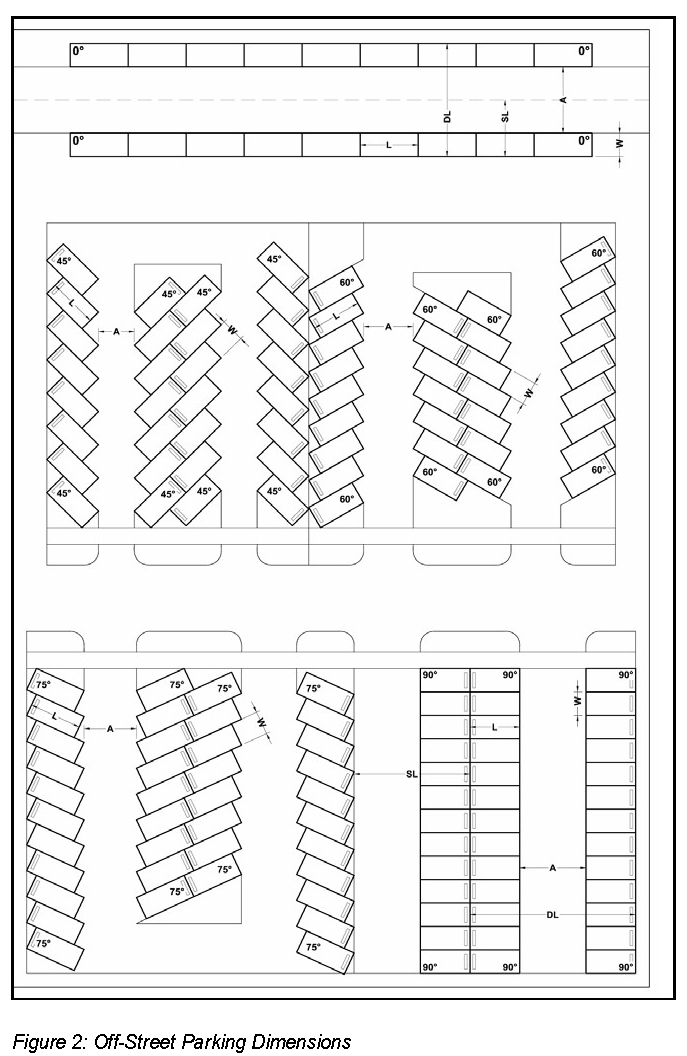
1. Two-way traffic permitted.
2. A module is defined as a drive aisle with automobiles parked on each side of the drive aisle.
3. Where a parking space abuts a sidewalk or landscape island that is seven feet in width or wider, the parking space depth may be reduced to 16 feet.
d.
Driveways.
i.
Residential driveways, excluding multi-family and townhouse dwellings.
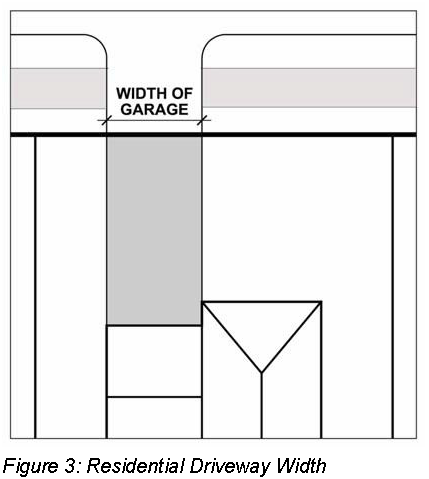
• A residential driveway shall be no wider than the width of the garage. See figure 3 (residential driveway width).
• Single-family and two-family dwellings are permitted an additional paved parking pad, located beside the house and up to 15 feet in width.
• For dwellings without a garage, facing the street, the driveway shall not exceed 24 feet in width.
ii.
Multi-family and townhouse dwellings, and non-residential driveways.
• No driveway shall have a width exceeding 24 feet, except for non-residential driveways which provide access to loading berths or which are striped with dual exit lanes. Such driveways shall not exceed 36 feet in width.
• Driveways, off-street parking areas and access aisles for multi-family residential and non-residential parking lots shall be designed in accordance with figure 2 (off-street parking dimensions). However, during the site plan review process, the planning commission may approve a reduction in the minimum width of a drive aisle subject to fire department approval.
iii.
Single-family dwelling units driveway curb cuts.
• One driveway curb cut shall be permitted on a zoning lot for a new single-family (detached) dwelling unit. Two curb-cuts not more than 12 feet wide may be approved for a circular driveway. For lots with more than one street frontage, one curb-cut is allowed per frontage. More than one curb cut in any other circumstance must be approved by the public works department. Existing lots with more than one curb cut and/or a circular driveway or straight driveway that exists at the time of adoption of this ordinance, may be replaced and repaired.
3.
Surfacing. All off-street parking areas and driveways shall be constructed of concrete, asphalt pavement or equivalent. Semi-pervious materials such as grass-crete and brick and concrete pavers may also be used, subject to the approval of the planning department.
4.
Striping. Off-street parking areas shall delineate parking spaces with paint or other permanent materials, which shall be maintained in clearly visible condition. Parking spaces for handicapped persons shall be identified with appropriate signage or markings.
5.
Curbing and bumper stops. All parking lots exceeding ten spaces shall be edged with concrete curbing. Bumper stops, wheel stops, or curbing shall be provided as needed to prevent vehicles from damaging or encroaching upon any adjacent loading space, sidewalk, landscaped area or parking lot island, fence, wall or building. Curbing shall be at least four inches in height. The length of the parking stall shall be as indicated in figure 2 (off-street parking dimensions). This standard shall not, however, prohibit the use of planting areas as on-site stormwater management devices, wherein curbing around such planting area may be waived by
6.
Drainage and grading. Except for parking spaces accessory to a single-family detached dwelling, no area of any parking facility shall have a slope of more than five percent. No access ramp shall have a slope of more than ten percent in the first 15 feet from the street.
7.
Lighting. Illumination of an off-street parking area shall be arranged so as to deflect the direct rays of light away from adjacent properties and streets in accordance with section 11.3 (outdoor lighting).
8.
Landscaping and screening. All parking lots shall be landscaped in accordance with section 11.4 (landscaping, screening and tree preservation).
9.
Special standards for downtown commercial. See subsection 12.3.G. (supplemental design standards for downtown commercial district) for special design standards within downtown commercial district zone.
H.
Accessible parking.
1.
Required spaces. With the exception of single- (detached and attached) and two-family dwellings, in all off-street parking facilities where parking is provided for employees, visitors, or both, parking spaces for disabled persons shall be provided. The number of accessible parking spaces shall be included in the total number of required parking spaces and shall be in accordance with applicable laws.
2.
Dimensions and design. Such spaces shall comply with the design and locational standards of all applicable laws.
I.
Stacking spaces for drive-through facilities.
1.
Design. Stacking spaces provided for drive-through uses shall be:
a.
A minimum of nine feet in width, as measured from the outermost point of any service window to the edge of the driveway, and 18 feet in length.
b.
Placed in a single line behind each drive-through facility. Multiple facilities, i.e. dual ordering stations at quick service restaurants, shall provide separate stacking lines for each station.
c.
Located so that, when in use, they do not obstruct ingress or egress to the site and do not obstruct access to required parking or loading spaces.
d.
Stacking spaces shall begin behind the vehicle parked at a last point of service, such as a window or car wash bay.
2.
Required spaces. Every drive-through facility shall provide a minimum of three stacking spaces per facility, unless otherwise required by table 8 (parking requirements) or this ordinance.
3.
Reduction of required spaces. The number of required stacking spaces may be reduced by the planning commission during the site plan review process if the petitioner presents information which demonstrates that a different requirement should be imposed. The approval of a reduced number of stacking spaces shall apply only to the specific business for which the study was conducted.
J.
Required off-street parking spaces. The minimum number of off-street parking spaces to be provided for the designated uses shall be as follows in table 8 (parking requirements). Table 8 lists parking requirements for the generic uses listed within the districts. In some cases, uses which are considered part of a generic use category are listed with specified parking requirements. These specific uses are listed only for the purposes of this section and do not indicate whether such uses are permitted or conditional uses within any district. Certain generic uses listed within the districts do not have parking requirements. These types of uses are not listed within table 8.
Within the CDT zoning district, a portion of the required number of parking spaces may be on-street. They must be adjacent to the lot for which the parking is required.
TABLE 8: PARKING REQUIREMENTS
GFA = Gross Floor Area sf = square feet
Note:
1. A commercial center is a multi-tenant development with a mixture of uses including, but not limited to, retail, service, office, and restaurants. Full service restaurants within such centers shall be provided with the number of parking spaces required for full service restaurants rather than the lesser number of spaces required for a commercial center.
K.
Required off-street loading spaces. Off-street loading spaces shall be provided for a building, structure or use which requires the receipt or distribution of materials or merchandise by trucks or other vehicles in accordance with table 9 (off-street loading requirements).
TABLE 9: OFF-STREET LOADING REQUIREMENTS
L.
Design of off-street loading spaces.
1.
Location.
a.
All off-street loading spaces shall be located on the same zone lot as the building or use served. No off-street loading spaces shall project into a public right-of-way.
b.
Off-street loading spaces shall not take up a required parking space and shall not interfere with entrances and exits to the property.
c.
No off-street loading space shall be located in a front or corner side yard.
d.
All off-street loading spaces shall be located a minimum of 50 feet from the lot line of any lot in a residential district, unless completely enclosed by building walls or a solid fence or wall, or any combination thereof, not less than six feet in height.
2.
Dimensions. All required off-street loading spaces shall be at least 12 feet in width and at least 30 feet in length, exclusive of maneuvering space, and shall have a minimum vertical clearance of at least 14 feet. During site plan review, the planning commission may require a loading space in excess of 30 feet in length based upon the proposed use and anticipated shipping/delivery methods. In no case, shall the planning commission require a length in excess of 60 feet.
3.
Surfacing. All off-street loading spaces shall be constructed of a heavy duty concrete, asphalt or equivalent conforming to the specifications of the public works department.
4.
Access control and signage. Each required off-street loading space shall be designed with adequate means of vehicular access to a street or alley in a manner that will minimize interference with traffic movement.
5.
Lighting. Loading facility lighting shall be in accordance with section 11.3 (outdoor lighting). Illumination of an off-street loading facility shall be arranged so as to deflect the direct rays of light away from adjacent properties and streets.
6.
Landscaping and screening. All loading facilities shall be landscaped and screened in accordance with section 11.4 (landscaping, screening and tree preservation).
(Ord. No. 2018-1028, § 1(Exh. A), 11-20-2018)
Sec. 11.3. - Outdoor lighting.
A.
Lighting levels and type. Parking lots, which exceed ten parking spaces and which are located within commercial districts and at multi-family residential/non-residential uses within residential districts shall be lighted at a minimum of 0.2 foot-candles and a maximum of ten foot-candles. Lighting beneath canopies, such as at fuel centers, shall not exceed 30 foot-candles. Canopy lights shall be fully recessed into the canopy ceiling. See light trespass restrictions below.
B.
Light distraction. Light fixtures in excess of 150 watts shall use full cut-off lenses or hoods to prevent glare or spillover onto adjacent lots and streets. No exterior lighting may be used in any manner that could interfere with the safe movement of motor vehicles on public thoroughfares. Specifically, the following types of light trespass are prohibited:
1.
Any light not designed for roadway illumination that produces direct or reflected glare that could disturb the operator of a motor vehicle.
2.
Any light that may be confused with, or construed as, a traffic control device, except as authorized by state, federal or local government.
3.
In addition, motor vehicle service station lighting shall comply with the requirements of subsection 9.3.H. (motor vehicle service stations).
4.
When possible the use of LEDs should be used.
C.
Light trespass. No lighting source from a commercial use shall cause more than one foot-candle of illumination to cross the property line of an adjoining residentially zoned property.
D.
Light pole and building mounted lighting heights. The maximum height of light poles on private property, as measured from grade at the base to the bottom of the luminaire, shall be as specified below. These standards do not apply to public right-of-way lighting. Permitted light pole heights shall be as follows:
1.
Non-residential districts. Lights poles and building-mounted fixtures shall be designed with fully shielded luminaires. Such poles or mounts shall not exceed 22 feet in height. The planning commission may approve, in appropriate circumstances as part of site plan review, a pole or mount of up to 30 feet.
2.
Residential districts. Light poles in residential districts shall not exceed 16 feet in heights. Light poles at places of worship, other non-residential uses and multi-family residential sites shall not exceed 22 feet in height. Light poles on public property, including at city parks and public schools shall be subject to the policies of their governing bodies.
E.
Light pole and fixture design standards. Light poles and fixtures in commercial districts should match and be aesthetically pleasing. The base of the lights should not exceed 30 inches above grade. Lights within parking lots should be placed within landscaped islands. Bases shall be painted or stained to prevent erosion and shall be screened with shrubs.
(Ord. No. 2018-1028, § 1(Exh. A), 11-20-2018)
Sec. 11.4. - Landscaping, screening and tree preservation.
A.
Applicability. This section shall apply to all development, construction, use of land and buildings and other activity for which site plan and/or design review approval is required as per section 4.6 (site plan and design review). No building permit or use and occupancy permit shall be issued for any lot or use subject to the requirements of this section unless all the requirements of this section have been fulfilled. Failure to implement the landscape plan, or to maintain the lot or use in conformance with the landscape plan, shall be cause for revocation of the occupancy certificate and/or the application of fines and penalties, as established in this ordinance. All landscaping is subject to periodic inspection by the planning department.
B.
Landscape plan.
1.
Landscape plan required. A detailed landscape plan shall be submitted to the city as part of site plan and design review as specified in section 4.6 (site plan and design review).
2.
Content of landscape plan.
a.
The location and dimensions of all existing and proposed structures, property lines, easements, parking lots and drives, roadways and rights-of-way, sidewalks, ground signs, refuse disposal and recycling areas, sidewalks, bicycle paths and parking facilities, fences, utility lines and equipment, recreational facilities, drainage facilities, and other freestanding structures, as determined necessary by the planning department.
b.
The location, quantity, size, botanical name and condition of all existing plant materials, including trees and other plant material in the right-of-way, and indicating plant material to be retained and removed.
c.
The location, quantity, size and name, both botanical and common, of all proposed plant material including, but not limited to, shade and evergreen trees, shrubs, groundcover, annuals/perennials and turf.
d.
The existing and proposed grading of the site indicating contours at one- to two-foot intervals. Proposed berming shall be indicated using one-foot contour intervals.
e.
Elevations of all proposed fences, steps, stairs, retaining walls both fixed (cast concrete, unitized walls) and any natural rock outcroppings on the site. Top-of-wall and bottom-of-wall elevations shall be shown for retaining walls.
3.
Changes to approved landscape plans. Changes to the landscape plan shall be governed by subsection 4.6.F.
C.
Selection, installation and maintenance of plant materials.
1.
Selection. All planting materials used shall be of good quality and meet American Standard for Nursery Stock, ANSI Z60.1 latest edition, developed by the American Nursery & Landscape Association, for minimum acceptable form, quality and size for species selected, and capable to withstand the seasonal temperature variations of Middle Tennessee, as well as the individual site microclimates. Size and density of plant material, both at the time of planting and at maturity, are additional criteria that shall be considered when selecting plant material. Plant materials shall conform to the city's standard tree selection specifications as included in appendix E (landscape standards).
2.
Installation. All landscaping materials shall be installed in accordance with the current planting procedures established by the ANLA. All plant materials shall be free of disease and shall be installed so that soil of sufficient volume, composition and nutrient balance are available to sustain healthy growth. Installation shall also be in accordance with the city's standard tree planting details.
3.
Required elements. Landscape materials depicted on landscape plans approved by the city shall be considered to be required site plan elements in the same manner as buildings, parking and other improvements. As such, the owner of record, or in some instances the property owner's association, shall be responsible for the maintenance, repair and replacement of all landscape materials, and fences, steps, retaining walls and similar landscaping elements over the entire life of the development.
4.
Maintenance. All landscaping materials shall be maintained in good condition, shall present a healthy, neat and orderly appearance, and shall be kept free of refuse and debris. Any dead, unhealthy or missing plants shall be replaced within six months or the next reasonable available growing/planting season. Fences, steps, retaining walls and similar landscaping elements shall be maintained in good repair. The owner of the premises shall be responsible for the maintenance, repair, and replacement of all landscape materials, fences, steps, retaining walls and similar landscaping elements, and refuse disposal areas. Irrigation systems, when provided, shall be maintained in good operating condition to promote the health of the plant material and the conservation of water. Shrubs that screen parking areas shall be maintained as a continuous, unbroken hedge. Trees shall only be pruned to maintain their natural form and to remove dead or diseased wood. Topping of trees is strictly prohibited, except that Pyrus calleryana species may be pruned to prevent wind damage. Trees that are topped in violation of this ordinance shall be replaced with new trees of like species and size, or multiples thereof.
D.
Landscape design standards. Landscape plans, as described above, shall be prepared by a licensed landscape architect, registered in the State of Tennessee, or a certified landscape designer and evaluated and approved based on the following design criteria.
1.
Scale and nature of landscape material. The scale and nature of landscape materials shall be appropriate to the size of the site and related structures. Required landscape beds (such as at building foundations and at parking lot perimeters) shall implement multiple layering of plant material to give a sense of depth, rather than distributing plants into thin ribbons or rows. Generous plantings should define the street edge and site entry/exit points, as well as building entries.
2.
Impervious surface ratio. The impervious surface ratio (ISR), computed by dividing the impervious surface area of the site by the total site area, shall not exceed 80 percent. In CDT zones, the ISR shall not exceed 90 percent. The remaining pervious area shall be landscaped.
3.
Selection of plant material. Plant materials shall be selected from the recommended plant materials list included in appendix E (landscape standards) or as approved by the city landscape architect. Plant material shall be selected for its form, texture, color, pattern of growth and suitability to local conditions. Plant sizes shall be specified according to the plant sizing chart in appendix E or as otherwise indicated in this section.
4.
Shade trees. Except as otherwise specified in this section, all deciduous shade trees shall have a minimum trunk size of two and one-half inches in caliper at time of planting, unless otherwise specified.
5.
Evergreen trees. Except as otherwise specified in this section, evergreens trees shall have a minimum height of six feet at planting and shall be incorporated into the landscape treatment of a site, particularly in those areas where year-round screening and buffering is required.
6.
Ornamental trees. Except as otherwise specified in this section, single stem ornamental trees shall have a minimum trunk size of two and one-half inches in caliper at planting, unless otherwise specified. Multiple stem ornamental trees shall have a minimum height of eight feet at planting, unless otherwise specified. Multi-trunk trees having more than five trunks shall be considered shrubs.
7.
Shrubs. Unless otherwise specified, all large deciduous and evergreen shrubs shall have a minimum growth height of three feet at installation, and all small-growing deciduous and evergreen shrubs shall have a minimum height of 18 inches at installation. Large shrubs shall be considered to be those shrubs that reach five or more feet in height at maturity. Small shrubs shall be considered to be those shrubs that can grow up to five feet in height if left unmaintained, but are generally kept at heights of 18 to 30 inches.
8.
Walls and fences. Plant material shall be placed intermittently against long expanses of building walls, walls, fences and other barriers to create a softening effect and to help break up long expanses of blank walls with little architectural detail.
9.
Natural and historic features. Streams, wetlands, large rock outcrops, stands of native vegetation, fence rows, cemeteries and other notable natural features must be indicated on the site plan and preserved wherever possible. Existing natural stone walls should be incorporated into the site design and preserved. Structures over 50 years old or valued for their local significance should be located on the site plan and retained if possible. Incorporation of such structures into the site's development as a special feature is encouraged. If the structures are not to be retained or adapted, reasons should be given.
10.
Planting beds.
a.
Planting beds shall be mulched with naturally colored shredded hardwood, mushroom compost or pine needles. Rock, gravel or synthetic mulches are not acceptable. Planting beds shall be a minimum of five feet in width, except where otherwise stated within this section.
b.
Trees planted within sidewalk or plaza zones shall be provided a minimum of 200 cubic feet of soil. A minimum of 60 square feet of pervious area shall be provided around each tree. Pervious paving may be used for this purpose if used in conjunction with structural soils.
11.
Irrigation. Automatic irrigation systems are required for all required landscaped areas within commercial and industrial districts as well as multi-family developments and institutional uses. The planning commission may waive automatic irrigation requirements for existing areas with existing vegetation; however, plant material planted within such areas to meet transitional buffering requirements must be within 100 feet of a hose bib or be provided a temporary above-ground irrigation system. All irrigation systems shall be designed to minimize the use of water. Plans shall be prepared and stamped by a certified irrigation designer, certified irrigation contractor, or landscape architect. Irrigation systems shall be designed to meet the standards shown in appendix E (landscape standards).
12.
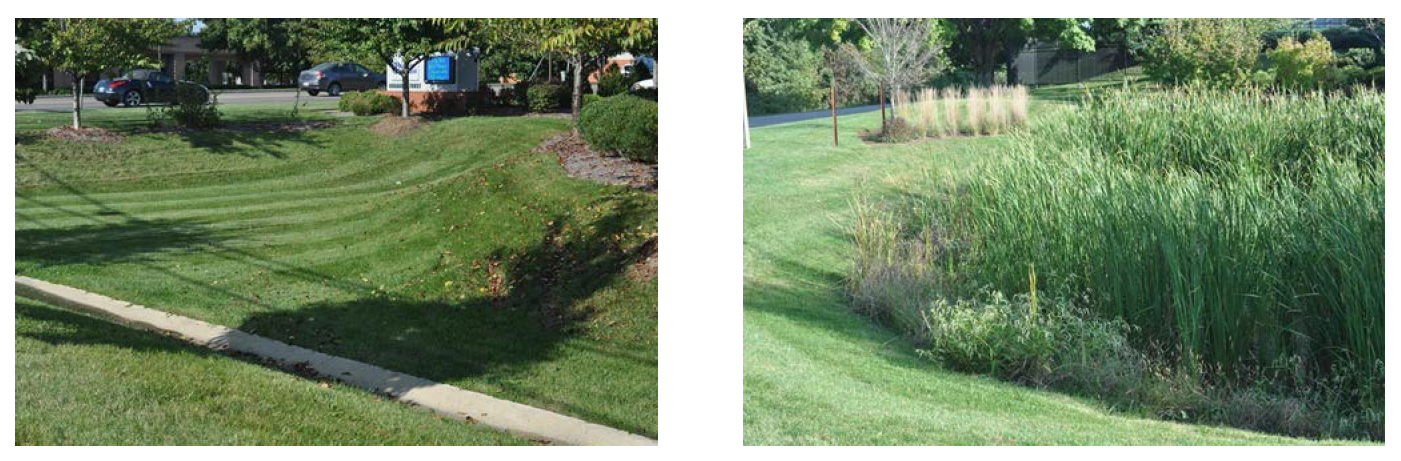
Detention and retention ponds. Detention and retention ponds shall be landscaped with trees, shrubs and turf. Detention ponds shall be considered a service area, and shall be screened from public view. Back slopes steeper than 4:1 exposed to public streets shall be screened with trees and shrubs.
Structures (such as headwalls and weirs) within ponds located in front and side yards adjacent to public streets shall be faced with brick or stone. Slopes exceeding 3:1 shall be vegetated with plants that do not require frequent mowing.
Groundcovers used for this purpose shall be planted with sufficiently tight spacing to provide 100 percent coverage within the first year.
13.
Berming. Earthen berms and existing topographic features may be incorporated into the landscape treatment of a site where there is a need to mitigate noise and sight lines from certain activities such as loading berths, outdoor storage, drive-thrus, auto service areas, heavy equipment operations, refuse disposal/storage areas, etc. Side slopes shall be no steeper than a 3:1 (three feet of run to one foot of rise) slope ratio to prevent erosion and be properly and safely maintained. Retained slopes may be implemented with the appropriate terracing necessary to reduce the need for safety railing.
14.
Topsoil. Topsoil shall be saved and set aside during grading activities to be used for landscape areas. Topsoil shall be screened and placed over landscape areas to a depth of at least six inches. All landscape beds shall have a minimum of 18 inches of topsoil. Each tree shall have a minimum of 24 inches topsoil depth over a 25 square foot area. Construction debris shall not be incorporated into the topsoil or otherwise buried on site.
15.
Steep slopes. Turf areas visible from the street should not exceed a slope of 3:1.
E.
Building foundation landscaping.
1.
Building foundation landscaping is required in all commercial and industrial districts, as well as all multi-family developments and institutional uses for all new construction and additions to buildings. Landscaping shall be placed on all sides that are visible from public areas. Plantings are not required where walkways access building entrances.
2.
Foundation plantings shall work in concert with transition yard plantings to frame important views, while visually softening long expanses of walls, particularly those that lack windows and/or other architectural details.
3.
The minimum width of the area provided to accommodate foundation plantings is as follows:
a.
Five feet of planting area width adjacent to one-story buildings.
b.
Ten feet of planting area width adjacent to buildings having two or more stories.
c.
Building segments that have long flat wall expanses (40 feet or longer) without significant architectural detailing, wall projections and recesses, shall have ten feet wide planting beds that incorporate ornamental trees, tall evergreens and a range of shrub sizes and ground covers.
F.
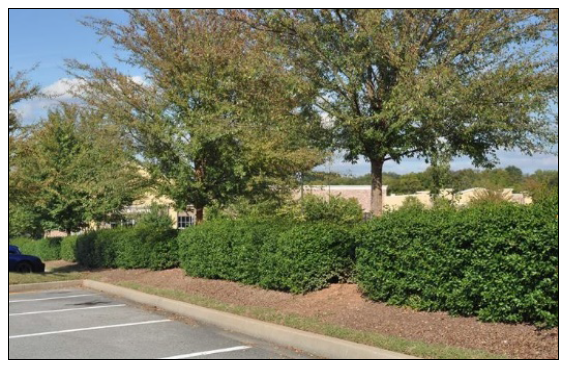
Parking lot perimeter landscape yard. Perimeter parking lot landscaping provides for the enhancement and screening of parking lots. Perimeter landscaping shall be required for all parking lots subject to site plan and design review and shall be established along the edge of the parking lot.
1.
Applicability. The perimeter landscape yard shall run the full length of the parking lot boundary, except on sides that are not exposed to the public, and shall be protected with raised concrete curbs. Sections of curbing may be eliminated for the purpose of facilitating a bioswale designed as part of an overall water quality and drainage plan.
2.
Width of parking lot perimeter landscape yard. A perimeter landscape yard shall be a minimum of seven feet in width and shall require six-inch curbing. In CDT zones, the perimeter landscape yard shall be a minimum of four feet in width, with shrubs planted a minimum of two and one-half feet from the face-of-curb.
3.
Required landscaping. The following landscaping shall be provided within the perimeter landscape yard.
a.
Amount of landscaping. Landscaping shall run the full length of the perimeter landscape yard.
b.
Shrubs. A continuous, double staggered row of shrubs shall be planted with a minimum height of 24 inches and a maximum on-center spacing of four feet. Shrubs shall be planted a minimum of three feet from the back-of-curb. The configuration of shrubs within the perimeter yard may be altered so long as the overall quantity is maintained, but in no case shall there be less than a single row of evergreen shrubs at the back of the parking lot curb. Shrubs placed in a single row shall be spaced a maximum of three feet on center.
c.
Groundcover. Landscaped areas outside of shrub and tree masses shall be planted in turf or other live groundcover, perennial or ornamental grass plantings.
G.
Interior parking lot landscaping. For parking lots consisting of more than ten spaces, interior parking lot landscaping shall be required. Ten percent of the total parking lot area shall be landscaped with parking lot islands and landscaped areas. Parking lot perimeter landscape yards shall not be included toward satisfying this requirement.
1.
Amount. Parking lot islands and landscaped areas shall be provided in the following amount:
a.
One 9'x18' or larger parking lot landscape island shall be provided every ten contiguous parking spaces. Runs of parking over ten spaces may accommodate up to a maximum of 20 spaces provided 18'x18' or larger landscape islands are provided. All rows of parking spaces shall be terminated by a parking lot island.
b.
Where parking medians are provided within interior parking bays, runs of parking, including adjacent perimeter parking, may be increased to 20 spaces, with a 9'x18' landscape island terminating each run. Parking medians are linear green spaces running between and perpendicular to parking rows and connecting the terminating landscaping islands together. Medians shall be a minimum of nine feet wide as measured from back-of-curb. Medians shall be landscaped with trees and shrubs. See illustration below.
c.
At least one shade tree shall be provided for every 2,000 square feet of vehicle use area (VUA). Such trees shall be planted within parking lot islands and landscaped areas.
d.
Each parking lot island shall contain at least one shade tree. If an island must also contain a light pole, an ornamental tree may be substituted for the shade tree. Tree and pole must be separated by at least 14 feet.
e.
Off-street parking facilities larger than 100,000 square feet of VUA or 250 spaces, shall be organized into a series of smaller modules separated by linear landscaped islands with a minimum width of nine feet, located at least every fourth parking bay, and running the length of the parking bays, to accommodate stormwater quality features, trees, shrubs groundcover, or light poles. Such planting strips or islands shall be landscaped with trees, shrub masses and suitable groundcover.
f.
Within the industrial zoning, interior landscape islands are not required.
2.
Design of planting areas. Parking lot islands and landscaped areas shall be at least six inches above the surface of the parking lot and protected with concrete curbing, except where designed specifically for the absorption of stormwater. Such islands and landscaped areas shall be properly drained and irrigated as appropriate to the site conditions to ensure survivability.
3.
Type of landscape material. Shade trees shall be the primary plant materials used in parking lot islands and landscaped areas. Ornamental trees, shrubs, hedges and other plant materials may be used to supplement the shade tree plantings but shall not create visibility concerns for automobiles and pedestrians.
4.
Quantity of landscape material within parking lot islands and landscaped areas. A minimum of one shade tree shall be provided for every parking lot island.
5.
Groundcover. A minimum of seventy percent (33%) of every parking lot island shall be planted in turf or other live groundcover, perennials or ornamental grasses. The remainder must be mulch.
6.
Fill. Soil used in parking lot islands, driveway medians, and other areas internal to a vehicular use area shall be screened prior to deposition in planting areas.
Construction debris shall not be buried on site. Islands shall be constructed in accordance with appendix E (landscape standards).
H.
Sign landscaping. Ground signs shall be landscaped at the base of the sign in accordance with subsection 13.6.C.9.
I.
Street yard. Except for points of access, a street yard shall be provided where the site adjoins the public street right-of-way. Properties in the CDT zoning district and alleys are exempt from this requirement.
1.
The street yard shall have a minimum depth of ten feet as measured from the property line towards the interior of the property. The yard shall consist of sod grass or other approved groundcover. Shrubs required for the screening of vehicle use areas or other site elements may be located within the yard. No parking or other impervious surfaces are permitted in the street yard area.
2.
Trees may be planted within the street yard exclusive of points of access. Trees shall be a minimum of two and one-half inches caliper.
3.
Existing woodlands or tree rows along the street right-of-way frontage can be substituted for the street yard tree requirement, provided the street yard depth is increased to at least 25 feet, as measured from the property line.
4.
Street trees shall not count towards other landscaping requirements.
5.
Vehicular entry and exit points shall be landscaped so as to be easily identified by users. No landscaping should interfere with the sight triangle shown on (page).
J.
Buffer yards.
1.
This section establishes standards for the dimensions and improvement requirements of buffer yards between land uses and/or zoning districts. The yard provides transition between incompatible uses by requiring a landscape yard of a minimum specified depth along the shared property line. Buffer yards shall provide a year-round visual, noise and dust barrier.
2.
In some instances, a buffer yard may not be required by the planning commission. These include, but are not limited to, instances where the rear wall of a commercial building is located on the rear property line or where an alley is located between a commercial property that abuts a residential property. Where it proves difficult to meet the buffer yard requirements of this ordinance due to pre-existing site constraints, the body approving the landscape plan may approve alternative approaches or waive requirements.
3.
Buffer yards shall be provided according to the matrix shown below on table 10. First identify the type of zoning for the proposed development along the left side of the matrix. Find where the zoning of the proposed development and each adjoining property intersect on the matrix. If a buffer is required, a capital letter will indicate the type of buffer to be applied. If the proposed use within a zone is also listed as a permitted use within a less-intensive zone, the corresponding class for the less intensive zone may be applied. For example, a proposed commercial use within an industrial zone may be classified as a commercial zone for the purposes of the matrix.
TABLE 10
4.
Buffer Type A. Provide a 30-foot deep (as measured towards the interior of the property) buffer yard along the shared property line planted with:
a.
A row of evergreen trees, ten feet to 15 feet on-center (depending on growth habit of species selected), a double staggered row of shrubs spaced a maximum of eight feet on-center, and one row of shade trees spaced a maximum of 33 feet on-center.
b.
All plants shall meet the installation and planting size requirements specified in appendix E (landscape standards).
5.
Buffer Type B. Provide a 20-foot deep (as measured towards the interior of the property) buffer yard along the shared property line planted with:
a.
Evergreen trees spaced a maximum of ten to 15 feet on-center, a row of shrubs spaced a maximum of eight feet on-center, and one row of shade trees spaced a maximum of 33 feet on-center.
b.
All plants shall meet the installation and planting size requirements specified in appendix E (landscape standards).
6.
Buffer Type C. Provide a ten-foot deep (as measured towards the interior of the property) buffer yard along the shared property line planted with:
a.
Evergreen trees spaced a maximum of ten to 15 feet on-center.
b.
All plants shall meet the installation and planting size requirements specified in appendix E (landscape standards).
7.
Responsibility for buffer installation shall be as follows:
a.
Where a developing parcel is adjacent to a vacant parcel, the developing parcel shall provide 100 percent of the buffer yard required adjacent to the vacant land.
b.
Where a developing parcel is adjacent to an existing use, the developing parcel shall provide the full buffer yard required adjacent to the existing use.
c.
Where all or part of a buffer yard exists on the adjacent developed parcel, but the yard does not fully comply with the standards of this subsection, the developing parcel shall be responsible for providing all the additional planting material required to conform to the above stated buffering requirements.
d.
If the existing developed parcel contains a buffer meeting the standards of this subsection, then the developing use is not required to provide a buffer.
8.
The minimum width of a required buffer yard may be reduced by up to 50 percent with the provision of a brick or stone wall at least six feet in height running the length of the reduced width. The quantity of required evergreen trees and shrubs may also be reduced by to 50 percent. The quantity of required shade trees shall not be reduced. Fencing may be installed within drainage or utility easements provided it does not interfere with drainage or the utilities within the easement.
9.
The minimum width of a required buffer yard may be reduced by up to 33 percent with the provision of a solid wood fence or heavy-duty commercial grade fence at least six feet in height running the length of the shared property boundary. The quantity of required evergreen trees and shrubs may also be reduced by to 33 percent. The quantity of required shade trees may not be reduced. Fencing may be installed within drainage or utility easements provided it does not interfere with drainage or the utilities within the easement.
10.
The required buffer yard shall not contain any development, impervious surfaces, or site features that do not function to meet the standards of this subsection or that require removal of existing vegetation, unless otherwise permitted in this ordinance. The following items shall be permitted within buffer yards provided the intent of the buffer yard is not compromised and damage to existing vegetation is minimized:
a.
Sidewalks, trails, and bike paths;
b.
Fences and walls;
c.
Required landscaping;
d.
Stormwater retention or detention facilities and best management practices, provided they do not interfere with the performance and maintenance of the buffer area;
e.
Driveway or parking lot drive aisles provided they cross the buffer yard at a 90-degree angle to the yard or do not encroach into the yard in a parallel fashion for more than 35 feet. In the latter instance, a six-foot tall brick or stone wall shall be installed within the encroached area.
f.
In the event that utility lines are installed within a buffer yard in a manner that is parallel to the buffer, additional width shall be added to the yard in an amount equivalent to the amount occupied by the utility lines and any associated easements. Any path cleared by utility installation shall be replaced with plant materials consistent with what was removed. Plant material under utility lines should be recommended by local power company to not interfere with power lines in the future.
11.
Existing vegetation located within the required buffer yard and meeting the minimum size requirements in this subsection may be credited toward the buffer standards. The amount of credit shall be at the discretion of the city's landscape architect, and shall be based on the quality, size, projected longevity and function of the vegetation.
K.
Screening requirements.
1.
Refuse disposal dumpsters and refuse storage areas. Refuse disposal containers, recycling containers, and refuse and recycling storage areas shall be screened on three sides by a solid brick or stone screen wall to a height at least two feet above the top elevation of the dumpster. The fourth side shall be enclosed by an opaque gate constructed of wood, vinyl, or other approved material, and situated on a concrete apron that extends a minimum of six feet beyond the opening of the enclosure, so as to support the weight of the waste disposal vehicle during unloading. Plants shall be installed to blend the enclosure into the surrounding landscape. An enclosure is not required when the dumpster is located behind the building, and is in an area where it will not be visible to nearby streets or adjacent properties. All refuse shall be stored within the covered refuse disposal containers. In residential districts, this provision shall not apply where refuse is collected by the city from containers less than 100 gallons in size at the street, curb or alley.
2.
Loading spaces. Loading spaces in all zoning districts should be located and oriented so as not be visible from the street, while still allowing access to the use it is serving. Loading docks in all zoning districts shall be screened as much as possible, unless such screening is determined unnecessary by the body approving the landscape plan. Such screening shall consist of a solid wood or simulated wood fence or masonry screen wall to a height of no less than six feet. A dense evergreen hedge may be substituted for a fence or wall, subject to approval of the landscape plan. If vegetative screening is used, a nine feet minimum width planting bed shall be provided along the length of the dock. Views into the dock shall also be screened.
3.
Outdoor storage areas. Outdoor storage areas, as regulated by subsection 10.4.N. (outdoor storage), shall be screened from view from all property lines and streets by a solid wood or simulated wood fence or masonry screen wall to a height of no less than six feet but no more than eight feet. Where feasible, plant materials shall be installed along the fence or wall located along the public right-of-way to provide a softening effect. No materials stored outdoors shall be of a greater height than that of the fence or wall. The required fence or wall may be substituted with a landscape screen conforming to the standards for a buffer type C as described in subsection 11.4.J.3.c.
4.
Drive-through facility. Drive aisles of drive-through facilities shall be effectively screened from view at the edges of sites adjacent to residential properties in order to minimize the impact of exterior site lighting, headlight glare and any menu intercom displays. Such screening shall be approved during the site plan review process and shall consist of a solid wood or simulated wood fence, masonry screen wall, or dense evergreen hedge at least six feet in height. Chain-link fencing is prohibited. Plant materials shall be installed along the fence or wall to provide a softening effect.
5.
Service areas, service bays and utility equipment.
a.
Service areas, such as laydown yards, equipment or material holding areas, and service bays with overhead or roll-up doors, shall be screened from public view. Screening shall consist of evergreen trees and shrubs of sufficient height, width and quantity to provide such screening at the time of planting. Planting beds shall be a minimum of 15 feet in width. Bed width may be reduced to ten feet if it can be demonstrated that sufficient quantities and sizes of plant material can be accommodated within that width to achieve the required screening. Screening is not required where transitional buffers provide an equal amount of screening.
b.
Utility equipment shall be screened from view from streets and other public areas. Screening shall consist of structural panels, architectural features, or evergreen plants of sufficient height, width and quantity to provide such screening at the time of planting.
L.
Tree preservation. In an effort to maintain existing natural surroundings, mature trees and natural vegetation shall be maintained where possible. Bands of trees such as fence rows, when present alongside and rear lot lines, shall be maintained as an effective screen and wind buffer where possible.
1.
A tree survey shall be required. The survey shall show the locations of each tree ten inches diameter at breast height (DBH) or greater. Species and condition shall also be noted. The survey shall be stamped by a licensed land surveyor. In situations where no grading will occur within 50 feet of a tree save area, limits of tree masses may be shown instead of individual locations.
2.
Saved trees ten inches DBH and greater shall be indicated on a tree plan. The tree protection zone shall also be shown. Saved trees shall not be disrupted by grading, construction activity, materials storage, or parking within their driplines. Tree protection fencing shall be installed at the dripline prior to any grading or construction activity. Fencing shall be installed in accordance with the city's standard tree protection fencing detail.
3.
In the event the root protection zone is disrupted, the planning department shall make a determination of damage and appropriate mitigation measures. At the discretion of the planning department, a registered consulting arborist shall be hired by the property owner to assist in this determination. Recommended measures shall be completed by the property owner.
4.
Removed trees ten inches DBH and greater shall be indicated on the tree plan. Trees shall be replaced at one-half the DBH value of the removed tree. For example, an existing 20-inch DBH tree would be replaced with new trees equaling ten caliper inches. Replacement trees may be planted on site, and may be used to fulfill other planting requirements. Disturbance of the root zone may occur to the extent a registered consulting arborist determines that it will not affect the long-term health of the tree. The minimum replacement size for new trees shall be two and one-half inches caliper. No more than 25 percent of replacement trees may be ornamental-type trees. The remainder shall be shade trees. Trees ten inches DBH and greater removed less than one year prior to the site plan submittal shall be replaced at 100 percent of the DBH.
5.
Trees 20 inches DBH and greater that are retained may, be credited at 50 percent value towards replacement requirements, if the tree is in good health and the full root protection zone remains undisturbed. For instance, if 60 tree inches are required to be replaced, and a 20-inch tree is saved, the total tree replacement required may be reduced by ten.
6.
If site constraints such as excessive rock, drainage problems, or inadequate space make it difficult to locate replacement trees on-site, planning staff may designate public property on which the trees may be planted. Alternatively, planning staff may allow the developer to make payment into the tree bank fund. Payment shall be made at the time the building permit is issued. The tree bank fund shall be administered by the planning department. A cost of $50.00 per caliper inch of replacement trees shall be required. Tree bank funds shall be used to install trees, landscaping and related irrigation measures on public property, rights-of-way or easements designated by the planning department.
(Ord. No. 2018-1028, § 1(Exh. A), 11-20-2018)
Sec. 11.5. - Multi-family site development standards.
The standards contained in this section are specific to multi-family residential developments. Additional standards are contained in other parts of this ordinance.
A.
Multi-family developments shall comply with minimum yard requirements, maximum building coverage and other lot and building bulk standards as specified by the bulk regulations of each applicable zoning district.
B.
Sidewalks shall be placed five feet back of the street curb on both sides of all internal streets and along all adjacent external streets. Paved pedestrian walkways shall be provided for convenient and safe access to all living units from streets, driveway, parking lots or garages and for convenient circulation and access to all facilities.
C.
Open space and amenities should include the following:
1.
Open space shall include playlots and/or playgrounds. These areas should include playground equipment sufficient to meet the needs of children expected to live within the development. All recreational equipment provided shall be durable commercial grade equipment. The playground shall be served by paved pedestrian walks linking individual buildings to the facility. Sitting areas may be substituted for playgrounds on a square foot for square foot basis when the development is planned for elderly adults only.
2.
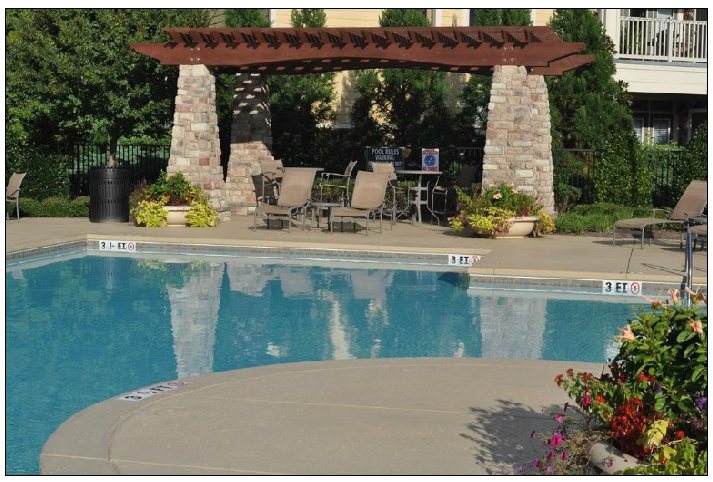
All multi-family developments containing 100 or more dwelling units should provide swimming pool facilities and club house facilities with a minimum floor spaced of 20 square feet for each dwelling unit located within the development.
3.
Centralized garbage disposal facilities. All dumping cart/bins shall be opaquely screened and landscaped.
D.
A screened and fenced parking and storage area for boats, trailers and campers with a minimum of one space for each eight dwelling units. This requirement may be waived by the planning commission if the developer agrees to prohibit the parking of boats, trailers and campers at any location within the development and a contingency plan is provided for said parking and storage area. In the event that the prohibition is not being enforced, the planning commission may require the implementation of the contingency plan.
E.
Street and area lights lighting the entire development.
(Ord. No. 2018-1028, § 1(Exh. A), 11-20-2018)
Sec. 11.6. - Residential subdivision and multi-family development entry ways, walls and fencing.
A.
Site plan and design review approval required. Any developer of a residential subdivision or multi-family development desiring to construct decorative walls, hardscape, landscape and similar decorative features at the entry way to the development and/or walls or fencing around the perimeter of the development shall first secure site plan and design review approval as specified by section 4.6. Application should be submitted concurrent with the application for subdivision approval. Site plan and design review approval for entry features for multi-family developments should be combined with site plan and design review approval for the multi-family site and buildings.
B.
Design standards.
1.
Entrance features should consist of decorative walls, fencing, columns, ornamental lighting and similar hardscape complimented with landscaping.
2.
Building materials of features should include brick, stone, wrought iron, and similar quality materials.
3.
All walls, fencing and other structures must be at least ten feet back from the edge of street pavement and three feet back from the edge of a center median and must not block visibility of motorists. Note: Walls, fencing and other structures are only permitted on private medians.
4.
The name of the development may be incorporated into the wall. Individual channel letters should be used or individual letters carved into the wall or a pre-cast inset. The size should be proportionate to the size of the wall.
5.
Lighting should be in the form of ground mounted spot lights. These lights must be screened from view by landscaping. Landscaping and other methods shall be utilized to prevent light glare and the resulting adverse impact on surrounding property.
6.
Such entry features may be located on each side of the entry and/or in any median of adequate size. Decorative brick and/or stone columns with the development's logo may be erected on each side of secondary entries. Height shall not exceed ten feet.
7.
Materials for perimeter fencing should be brick, wrought iron or aluminum or western cedar or equivalent with the framing away from the street. Brick columns should be erected at intervals of no more than 50 feet. Street trees and/or landscaping may be planted between the fence and street.
(Ord. No. 2018-1028, § 1(Exh. A), 11-20-2018)
Sec. 11.7. - Street and other required improvements.
The planning commission shall, in conjunction with the approval of any site plan, require the construction of any and all infrastructure and other improvements (if not already in place or guaranteed by an appropriate surety) necessary to support the development and to satisfy the purposes of this ordinance. These improvements shall include, but are not limited to, streets, curb and gutter, storm sewer, detention/retention and other drainage improvements, sidewalks, bicycle and pedestrian accommodations, utilities, lighting, landscaping, irrigation, fencing, screening, parking, loading areas, and driveways.
Street improvements which may be required include public and/or private streets and drives and may include rights-of-way for new streets or improvements to existing streets necessary to improve these streets to current city standards and especially includes major thoroughfare, arterial and collector streets as shown in the city's transportation plan and includes local streets as well. The owner/developer shall also be required to dedicate all public improvements to the city by dedicating right-of-way and/or easements or by other methods specified by the city. All improvements shall be constructed in accordance with the public works department construction manual and the construction plans as approved by the city engineer. Detention/retention ponds shall also conform to the design standards contained in subsection 11.4.D.12. Bike facilities shall conform to the land use and transportation plan. The city engineer may require a payment in-lieu-of construction of the above specified improvements. The planning commission may waive all or a portion of these improvements and payment if, after conferring with the staff, it is determined that the street(s) to be improved will not be further improved within the next ten years.
Note: these improvements are not required for any site plan which the staff is authorized to approve as per subsection 4.6.D.1.a (applications eligible for administrative site plan and design review approval).
(Ord. No. 2018-1028, § 1(Exh. A), 11-20-2018)
Sec. 11.8. - Utility service.
A.
Utility service to be underground. Electric, telephone, cable, internet and all other such service lines extending from the utility company's line to all buildings shall be installed underground in accordance with the utility company's underground installation requirements. Exceptions:
1.
New and replacement building service lines in residential subdivisions where the utility company-owned lines are overhead and more than 50 percent of the buildings on the same street and within 1,000 feet on the same street are served with overhead service lines.
2.
New and replacement building service lines in non-residential areas where the utility company-owned lines are overhead and more than 75 percent of the buildings on the same street and within 1,000 feet on the same street are served with overhead service lines.
3.
The planning commission may waive these underground requirements and approve overhead service in areas with less overhead service than specified above.
B.
Sewer. All new buildings which have sanitary sewer shall be connected to a state approved public sanitary sewer system, i.e., Mount Pleasant Public Utilities, or to an individual sanitary sewer or other method of disposing of sanitary sewer approved by the state or other agency authorized by law to approve such sanitary sewer disposal.
(Ord. No. 2018-1028, § 1(Exh. A), 11-20-2018)

