
Mount Pleasant City Zoning Code
SECTION 9
- SUPPLEMENTARY STANDARDS
Sec. 9.1.- Purpose.
The purpose of this section is to set forth supplemental standards for the use of land and buildings to ensure that the use is compatible with the surrounding area. This section is also intended to set forth standards for other structures and uses on a lot other than for the principal building and use. This includes accessory buildings, structures and uses, and permitted encroachments. This section also sets forth standards for temporary uses and structures.
(Ord. No. 2018-1028, § 1(Exh. A), 11-20-2018)
Sec. 9.2. - Use of land and buildings.
A.
Use to be in conformity. No building, structure, or premises shall be used or occupied except in conformity with the regulations for the zoning district in which it is located. No building or structure shall be erected, reconstructed, extended, enlarged, altered or moved except in conformity with the regulations of the zoning district in which it is located.
B.
Number of buildings on a lot. In the R1, R2 and R3 zoning districts there shall be no more than one principal building per lot. In all other districts, more than one building may be erected on a single lot, provided that each building shall comply with all yard and bulk requirements of a district as though it were a principal building on an individual lot.
C.
All activities within an enclosed building. Within all districts, all activities, including storage, shall be conducted entirely within an enclosed building, with the exception of the following activities and uses:
1.
Off-street parking and loading, in accordance with section 11.2 (off-street parking and loading).
2.
Outdoor businesses, and those businesses with an outdoor component, including, but not limited to, outdoor entertainment, outdoor recreation, restaurants, car sales, car washes, kennels and similar businesses. These businesses may be limited, or outdoor components prohibited, as a condition of a conditional use permit.
3.
Outdoor storage, and outdoor sales and display areas, in accordance with subsection 9.4.M. (outdoor display) and subsection 9.4.N (outdoor storage) below.
4.
Temporary uses, in accordance with section 10.11 (temporary uses).
D.
Frontage on a public or private street. All buildings shall front on a public or private street. Private streets include streets or drives within a recorded easement.
E.
Required yards. No lot shall be reduced in area so that the yards are less than required by this ordinance. The yards of a building or structure shall not be considered yard space for any other building or structure. All yards allocated to a building or structure shall be located on the same zoning lot as such building or structure. Yards may be used for parking, landscaping and other accessory uses provided all requirements of this ordinance are met. Rear yards shall not be required where a building in an industrial zone borders a railroad.
F.
Applicability of bulk requirements. All buildings and structures erected after the effective date of this ordinance shall meet the lot size, yard size and other bulk regulations for the zoning district in which the building or structure is located. No existing building shall be enlarged, altered, reconstructed or relocated in such a manner that conflicts with the regulations of the zoning district in which the building or structure shall be located except as may be allowed by section 14 (nonconforming use standards).
G.
Applicability of use restrictions. No building, structure or land shall be used for any use other than one allowed as either a permitted or conditional use in the zoning district in which such building, structure or land is located. Buildings, structures or land may also be used for a temporary use or accessory use, in accordance with the requirements of section 10.11 (temporary uses and structures) and section 10.4 (accessory uses, buildings and structures).
H.
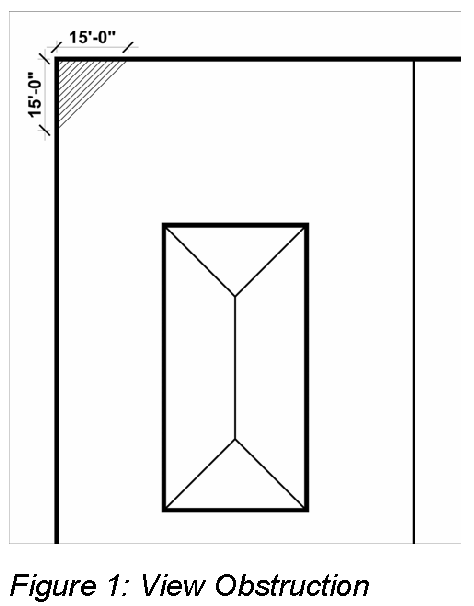
Motorist view obstruction in residential districts. The site clearance area at the intersection of two streets within residential districts shall be defined as a triangular area of a corner lot measured 15 feet from the point of intersection of the property lines of the lot along a street; and shall not be obstructed by any sign, wall, fence, hedge, shrub or other object which exceeds 24 inches in height. Trees may be maintained within this area as long as there is no foliage within 48 inches as measured from the ground to the lowest foliage. In the event that the grade of a lot is higher than the street grade, the height of the wall, fence, hedge, or shrub shall be reduced so that the site clearance is not obstructed 24 inches over the grade of the street. See Figure 1: View Obstruction.
I.
Buildings not to be on easements. No building, pool, deck, patio, or permanent structure shall be located on an easement except as allowed by this ordinance regarding accessory buildings without a permanent foundation.
(Ord. No. 2018-1028, § 1(Exh. A), 11-20-2018)
Sec. 9.3. - Use-specific standards.
In addition to the use standards below, all uses are required to comply with the provisions of this ordinance including, but not limited to, section 11 (site development standards), section 11.2 (off-street parking and loading), section 11.3 (outdoor lighting), section 11.4 (landscaping, screening and tree preservation), section 12 (building design standards) and section 13 (sign standards), and all other city regulations.
A.
Assisted living facility, independent living facility and nursing home. Assisted living facilities, independent living facilities and nursing homes shall meet all federal, state and local requirements including, but not limited to, licensing, health, safety and building code requirements. In addition, the following criteria shall be required:
1.
The location, design and operation of the facility shall be compatible with, and shall not adversely affect, adjacent properties and the surrounding area.
2.
The facility shall be harmonious with surrounding buildings, in respect to scale, architectural design and building placement. If located within a residential district, the facility shall not alter the residential character of the neighborhood.
3.
The surrounding street network shall be capable of accommodating the traffic generated by the facility.
B.
Community residence. Community residences shall meet all federal, state and local requirements including, but not limited to, licensing, health, safety and building code requirements. In addition, the following criteria shall be required.
1.
The location, design and operation of the facility will not alter the residential character of the neighborhood.
2.
The facility shall retain a residential character, which shall be compatible with the surrounding neighborhood.
3.
The operation of the facility shall not adversely impact surrounding properties.
C.
Day care center, adult and child. Day care centers shall meet all federal, state and local requirements including, but not limited to, licensing, health, safety and building code requirements. In addition, the following criteria shall be required:
1.
Adequate on-site drop-off zones, sidewalks and exterior lighting shall be provided.
2.
The amount of traffic or noise to be generated shall not be excessive.
3.
Adequate open space and recreational areas shall be provided.
D.
Day care home, adult and child.
1.
Day care homes shall meet all federal, state and local requirements including, but not limited to, licensing, health, safety and building code requirements. In addition, the following criteria shall be required:
a.
Adequate on-site drop-off zones, sidewalks and exterior lighting shall be provided.
b.
The amount of traffic or noise to be generated shall not be excessive.
c.
Adequate open space and recreational areas shall be provided.
d.
The day care home shall retain a residential character and the effect of the day care home shall not alter the residential character of the neighborhood.
e.
The operation of the day care home shall not adversely impact surrounding properties.
2.
Services are provided in a protective setting for more than four, up to a maximum of 12, children or adults for less than 24 hours per day.
3.
Child day care home does not include facilities which receive only children from a single household.
E.
Dwelling, multi-family and dwelling, townhouse. See section 11 (site development standards) and section 12 (building design standards).
F.
Entertainment and recreation facilities, indoor or outdoor. Entertainment and recreation facilities shall be designed so that the location of entrances and exits, exterior lighting, service areas, and parking and loading facilities will minimize traffic congestion, pedestrian hazards and adverse impacts on adjoining properties.
G.
Kennel.
1.
Exterior enclosures and runs shall provide protection against weather extremes. Floors of runs shall be made of impervious material to permit proper cleaning and disinfecting.
2.
All animal quarters and runs are to be kept in a clean, dry and sanitary condition.
3.
Fencing surrounding exercise areas and/or runs shall be of a sufficient height to prevent escape and shall be buried as part of installation to prevent escape by digging beneath the fence posts.
4.
Kennel noise shall be mitigated so as not to create a public nuisance for adjoining properties. This shall exclude noise from exercise or training while outdoors during the daytime. Kennels shall comply with all local noise regulations.
H.
Motor vehicle service station.
1.
Motor vehicle service station and fuel center canopies shall be designed with luminaires fully recessed into the ceiling of the canopy to minimize light pollution. Light intensity directly under the canopy shall not exceed 30 foot-candles at any location. All lighting mounted under the canopy, including auxiliary lighting within signage and panels over the pumps, shall be included in the 30 foot-candle limit. For service stations and fuel centers adjacent to residential zones, see subsection 11.3C (light trespass).
2.
All motor vehicle service station driveways must be located and designed to ensure that they will not adversely affect the safety and efficiency of traffic circulation on adjoining streets.
3.
Motor vehicle service stations may offer convenience items for sale as a secondary activity.
4.
Motor vehicle service stations may also include an automatic car wash with one bay. Stacking spaces shall be in accordance with section 11.2 (off-street parking and loading). More than one bay constitutes a separate principal use and requires compliance as such.
5.
Reserved.
6.
In addition, minor motor vehicle repair shops may be included as part of a motor vehicle service station. However, they shall be subject to the provisions of this section and the standards of subsection 9.3.J. (motor vehicle service and repair, major and minor) below.
I.
Motor vehicle operations facility. All repair operations and service bays shall be fully enclosed.
J.
Motor vehicle service and repair, major or minor.
1.
Minor motor vehicle service and repair shops may not store the same vehicles outdoors on the site for longer than ten days. Major motor vehicle service and repair shops may not store the same vehicles outdoors on the site for longer than 90 days.
2.
All driveways must be located and designed to ensure that they will not adversely affect the safety and efficiency of traffic circulation on adjoining streets.
3.
All repair operations shall be fully enclosed. Wrecked or junked vehicles shall not be stored for longer time periods than those specified above and shall be completely screened from the public right-of-way and any adjacent residential districts with a solid board fence and/or evergreen shrubs.
4.
Minor motor vehicle service and repair shops may also include gas stations as a secondary use. All gas stations which are part of such an establishment must comply with the regulations of subsection H. (motor vehicle service station).
K.
Sexually-oriented business. Sexually-oriented business shall be subject to the following standards:
1.
No sexually-oriented business shall be located within 1,000 feet of any other sexually-oriented business or any residential district, school, place of worship, liquor store or child care as measured in a straight line between the nearest parts of the two structures.
2.
The sexually-oriented business shall be so designed, located and operated so that the public health, safety, comfort, convenience and general welfare will be protected.
3.
The sexually-oriented business shall not unduly increase traffic congestion in the public streets and highways in the area in which it is located.
4.
The sexually-oriented business shall not cause additional public expense for fire or police protection.
5.
No sexually-oriented business shall be conducted in any manner that permits the observation of any material depicting, describing or relating to "specified sexual activities" or "specified anatomical areas" from any public way or from any adjacent property. This provision shall apply to any display, decoration, sign, show window or other opening.
L.
Radio and television towers and transmission facilities.
1.
Site plan and design review approval is required in accordance with section 4.6 (site plan and design review).
2.
All towers shall conform to the definition of tower as stated in section 15 (definitions).
3.
The maximum height is 150 feet unless further restricted by the board of zoning appeals in the granting of a conditional use permit, if required.
4.
All towers and facilities shall conform to the following provisions contained in appendix C (wireless telecommunications facilities and towers):
a.
AC.6 Setbacks.
b.
AC.7 Structural Requirements.
c.
AC.8 Separation of Towers.
d.
AC.9 Illumination.
e.
AC. 11 Exterior Finish.
f.
AC.12 Landscaping and Inspections.
g.
AC.15 Certifications and Inspections.
h.
AC.16 Maintenance.
i.
AC.18 Abandonment.
j.
AC.19 (Special conditions for location of telecommunications facilities within residential districts) subsections A. (property allowed), C. (tower design), D. (protection against climbing), E. (color) and F. (equipment enclosure).
M.
Social club or lodge.
1.
Social clubs or lodges shall be designed so that the location of entrances and exits, exterior lighting, service areas, and parking and loading facilities will minimize traffic congestion, pedestrian hazards, and adverse impacts on adjoining properties.
2.
Social clubs and lodges are permitted to serve food and meals on the premises. There shall be no sleeping facilities.
N.
Wireless telecommunications facilities and towers. See appendix C (wireless telecommunications facilities and towers).
O.
Recycling drop-off center.
1.
All recyclables to be kept in leak-free enclosed bins.
2.
All recyclables to be removed from the site no less than every two days.
3.
All storage/collection bins and equipment to be screened as per subsection 11.4.K.3 (outdoor storage areas).
4.
The site shall be kept odor free (at the property lines) and shall be kept free of bees and other insects.
5.
Site plan approval is required as per section 4.6 (site plan and design review).
6.
See also subsection 10.9.G (donation and recycle collection bins) for recycle collection bins as an accessory use.
(Ord. No. 2018-1028, § 1(Exh. A), 11-20-2018)

