
Mount Pleasant City Zoning Code
APPENDIX E
LANDSCAPE STANDARDS
AE.1 - IRRIGATION
With the initial site plan submittal, a schematic irrigation plan shall be provided which shows the information indicated below:
A.
Plans shall be drawn to scale, and shall show all existing and proposed physical features and boundaries of areas to be watered
B.
All areas of coverage shall be indicated.
C.
Turf, shrub beds and trees shall be zoned separately
D.
Indicate the type of irrigation (i.e. rotor, spray, drip, etc.) used in each zone.
E.
Indicate the point-of-connection
F.
Plan shall be stamped by an IA Certified Irrigation Designer or a registered Landscape Architect
G.
The following note shall be added to the plan: "A detailed irrigation plan complying with all requirements of the Mount Pleasant Zoning Ordinance shall be submitted to the City for approval prior to an application for Building Permit."
Prior to application for a building permit, detailed irrigation plans shall be submitted which show the information indicated above, as well as:
A.
Indicate piping routes, sizes, classes and sleeves.
B.
Piping shall be installed at a minimum depth of 12 inches.
C.
Indicate valve locations, flow and size
D.
Indicate head locations, types and spray patterns. Precipitation rates shall be matched within a zone.
E.
Indicate design pressure.
F.
Ensure 100% head-to-head coverage at all times and don't exceed spacing of a nozzle's range.
G.
System shall be zoned so as to not exceed the pressure and volume available at the water meter.
H.
Zone valves should be located at middle portion on zone and center feed whenever possible.
I.
Overspray of paved areas and structures shall be avoided.
J.
A rain/freeze sensor shall be installed and located where it can receive direct rainfall.
K.
Check valves and pressure regulators shall be employed to control low-head drainage and high pressure.
L.
Controller type and location shall be indicated.
M.
A backflow preventer shall be installed downstream of the meter and shall have an approved cover.
N.
Indicate meter size and location.
O.
Plan shall be stamped by an IA Certified Irrigation Designer or a registered Landscape Architect
As an alternative to submitting a detailed irrigation plan for approval, the developer or contractor may choose to conduct a post-construction field performance audit, using the Irrigation Association's Certified Landscape Irrigation Program. The irrigation system shall meet all performance criteria listed above. The audit shall check the performance of the system for conformance with state and local requirements including meeting standards for the minimum precipitation rate and lower quarter distribution uniformity (DU LQ ) (and where possible, emission uniformity for drip/micro-irrigation systems). In addition, the audit shall also verify the installation of specified water management devices such as a rain shutoff device. Audits shall be performed by an IA Certified Irrigation Auditor.
(Ord. No. 2018-1028, § 1(Exh. A), 11-20-2018)
AE.2 - RECOMMENDED PLANT MATERIALS
The following plants are recommended for use in projects submitted to the City. Plants not on this list will be evaluated on a case-by-case basis by the City's landscape architect.
The use of certain cultivars or varieties within a species may be required where needed to obtain a particular growth characteristic. For instance, Acer rubrum may be inappropriate to use near powerlines, while Acer rubrum 'Armstrong' may fit the available space.
Canopy trees:
Acer rubrum — Red Maple
Acer saccharum — Sugar Maple
Betula nigra — River Birch
Carpinus betulus — European Hornbeam
Carpinus carloliniana — American Hornbeam
Cercidiphyllum japonicum — Katsuratree
Cladrastis kentukea — Yellowwood
Diospyros virginiana — Persimmon
Ginkgo biloba — Ginkgo
Liriodendron tulipfera — Tulip Poplar
Liquidamber styraciflua 'Rotundiloba' — Sweetgum
Metasequoia glyptostroboides — Dawn Redwood
Nyssa sylvatica — Black Gum
Pistacia chinensis — Chinese Pistache
Quercus acutissima — Sawtooth oak
Quercus alba — White Oak
Quercus coccinea — Scarlet Oak
Quercus falcata — Southern Red Oak
Quercus imbricaria — Shingle oak
Quercus lyrata — Overcup oak
Quercus palustris — Pin oak
Quercus phellos — Willow oak
Quercus prinus — Chestnut oak
Quercus rubra — Red oak
Quercus shubardii — Shumard Oak
Tilia Americana — American Linden
Tilia cordata — Littleleaf Linden
Taxidium distichum — baldcypress
Ulmus parvifolia — Lacebark Elm
Zelkova serrata — Zelkova
Ornamental/Understory trees:
Acer buergeranum — Trident Maple
Acer griseum — Paper Bark Maple
Aesculus pavia — Red Buckeye
Amelanchier arborea — Serviceberry
Cercis Canadensis — Redbud
Chionanthus virginicus — Fringe tree
Cornus florida — Flowering Dogwood (anthracnose resistant cultivars)
Cornus kousa — Kousa Dogwood
Cornus mas — Corneliancherry Dogwood
Crataegus viridis 'Winter King' — Winter King Hawthorn
Franklinia alatamaha — Franklin tree
Koelreuteria panuculata — Golden Raintree
Lagerstroemia indica — Crepe Myrtle
Magnolia x soulangiana — Saucer magnolia
Magnolia stellate — Star magnolia
Magnolia virginiana — Sweetbay Magnolia
Malus cultivars, disease restistant only, e.g. 'Adirondack', 'Callaway', 'Centennial', 'Donald Wyman', 'Prairiefire', 'Sugar Tyme'
Ostrya virginiana — American Hophornbeam
Oxydendrum arboretum — Sourwood
Pinus thunbergia — black pine
Prunus campanulata — Okame Cherry
Prunus subhirtella var. autumnalis — Autumn Flowering Cherry
Prunus yedoensis — Yoshino cherry
Styrax japonica — Japanese Snowball
Syringa reticulata — Lilac Tree
Buffer trees:
Cedrus atlantica — Atlas cedar
Cedrus deodara — Deodar Cedar
Cryptomeria japonica — Cryptomeria
Ilex attenuate 'Fosteri' — Foster holly
Ilex x 'Nellie R. Stevens' — Nellie R. Stevens holly
Ilex opaca — American Holly
Juniperus virginiana — Eastern Red Cedar
Magnolia grandiflora — Southern Magnolia
Magnolia virginiana — Sweetbay Magnolia
Picea abies — Norway Spruce
Pinus nigra — Austrian Pine
Pinus sylvestris — Scots Pine
Pinus taeda — Loblolly Pine
Pinus thunbergii — Black Pine
Pinus virginiana — Virginia pine
Prunus caroliniana — Carolina Cherry Laurel
Thuja occidentalis — Arborvitae
Tsuga canadensis — Canadian Hemlock
Tsuga caroliniana — Hemlock
Buffer shrubs:
Eleagnus pungens — Fragrant olive
Ilex aquifolium — English holly
Ilex cornuta 'Burfordii' — Burford holly
Ilex cornuta 'Nellie R. Stevens' — Nellie R Stevens holly
Ilex crenata — Japanese Holly
Prunus caroliniana — cherry laurel
Prunus laurocerasis — English laurel
Viburnum rhytidophyllum — leatherleaf viburnum
Viburnum 'Pragense' — Prague viburnum
Supplemental buffer shrubs (These should be used in conjunction with buffer shrubs above):
Aesculus parviflora — Bottlebrush Buckeye
Aesculus pavia — Red Buckeye
Aronia arbutifolia — Red chokeberry
Forsythia x intermedia — Flowering forsythia
Ilex verticillata — Winterberry
Viburnum dentatum — Arrowwood viburnum
Hamemelis virginiana — Common witchhazel
Hamemelis x intermedia
(Ord. No. 2018-1028, § 1(Exh. A), 11-20-2018)
AE.3 - TREE SELECTION SPECIFICATIONS
A.
Plants shall be so trained in development and appearance as to be unquestionable superior in form, compactness and symmetry. They shall be sound, healthy, vigorous, well branched and densely foliated when in leaf, and free of disease and insect adult eggs, pupae or larvae. They shall have healthy, well-developed root systems and shall be free from physical damage or other conditions that would prevent thriving growth.
B.
There shall be no circling or girdling roots. Circling roots should be cut in at least one place.
C.
Trees should be rooted into the root ball so that soil or media remains intact and trunk and root ball move as one when lifted, but not root bound. The trunk should bend when gently pushed and should not be loose so it pivots at or below soil line.
D.
The point where the top-most root in the root ball emerges from the trunk shall be within two inches of the soil surface. It can be exposed and visible at the soil surface. If it is not within the top two inches of soil, gently remove the top layer of soil from the rootball until the first major root flare is visible.
E.
The relationship between caliper, height and root ball size shall meet the ANSI Z60.1 standard, latest edition.
F.
There should be one dominant leader to the top of the tree with the largest branches spaced at least 6 inches apart. There can be two leaders in the top 10% of the tree if it is otherwise of good quality.
G.
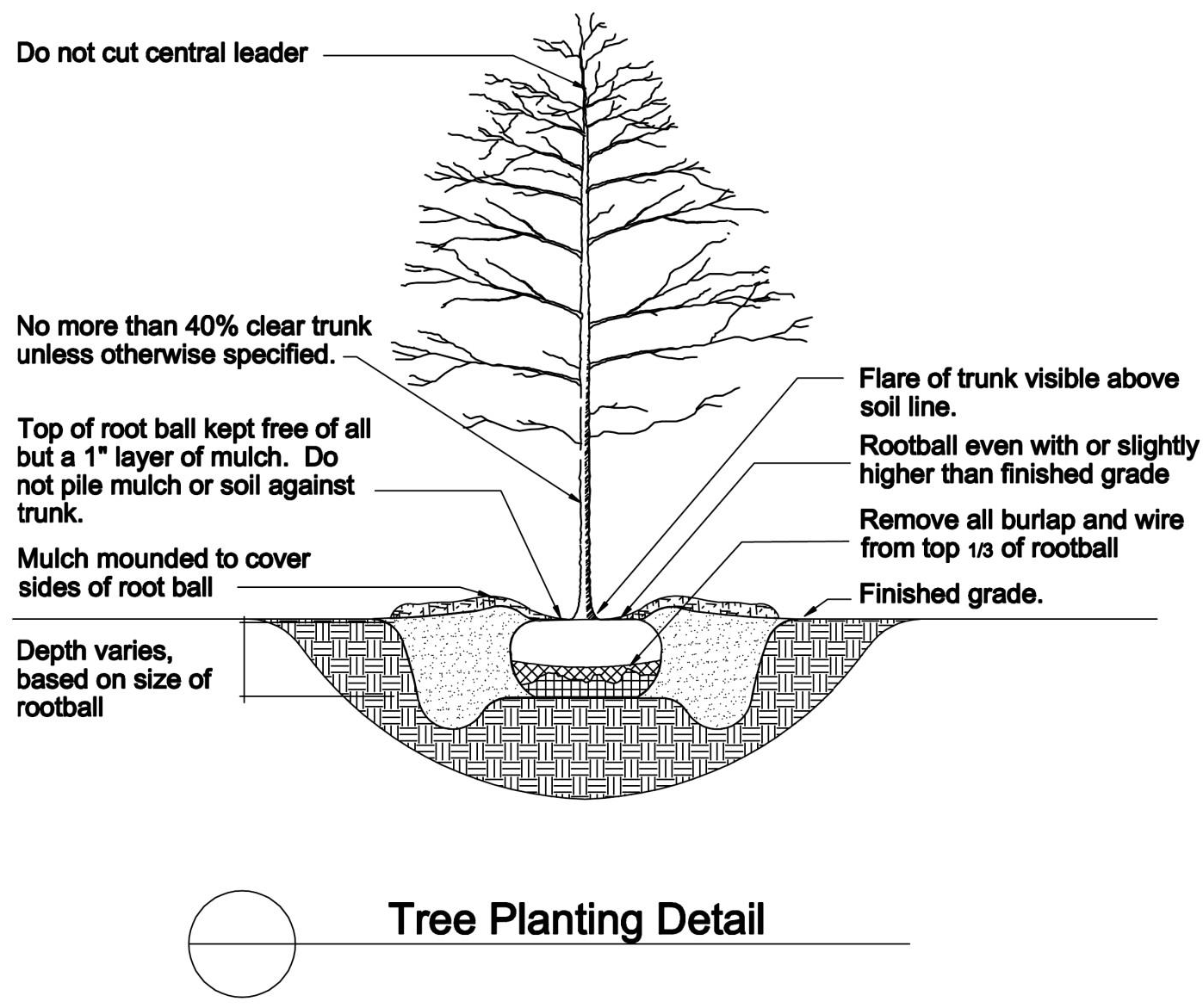
The tree canopy should be symmetrical and free of large voids. Clear trunk should be no more than 40% of tree height unless otherwise specified in the planting specifications. Clear trunk shall be of sufficient height to clear surrounding uses that may be impacted by the future growth of the tree.
H.
Open trunk and branch wounds shall be less than 10% of the circumference at the wound and no more than 2 inches tall. Properly made pruning cuts are not considered open trunk wounds. There should be no conks or bleeding, and there should be no signs of insects or disease on more than 5% of the tree.
I.
If any of the above conditions are not met, trees may be rejected.
(Ord. No. 2018-1028, § 1(Exh. A), 11-20-2018)
AE.4 - TREE PLANTING SPECIFICATIONS
A.
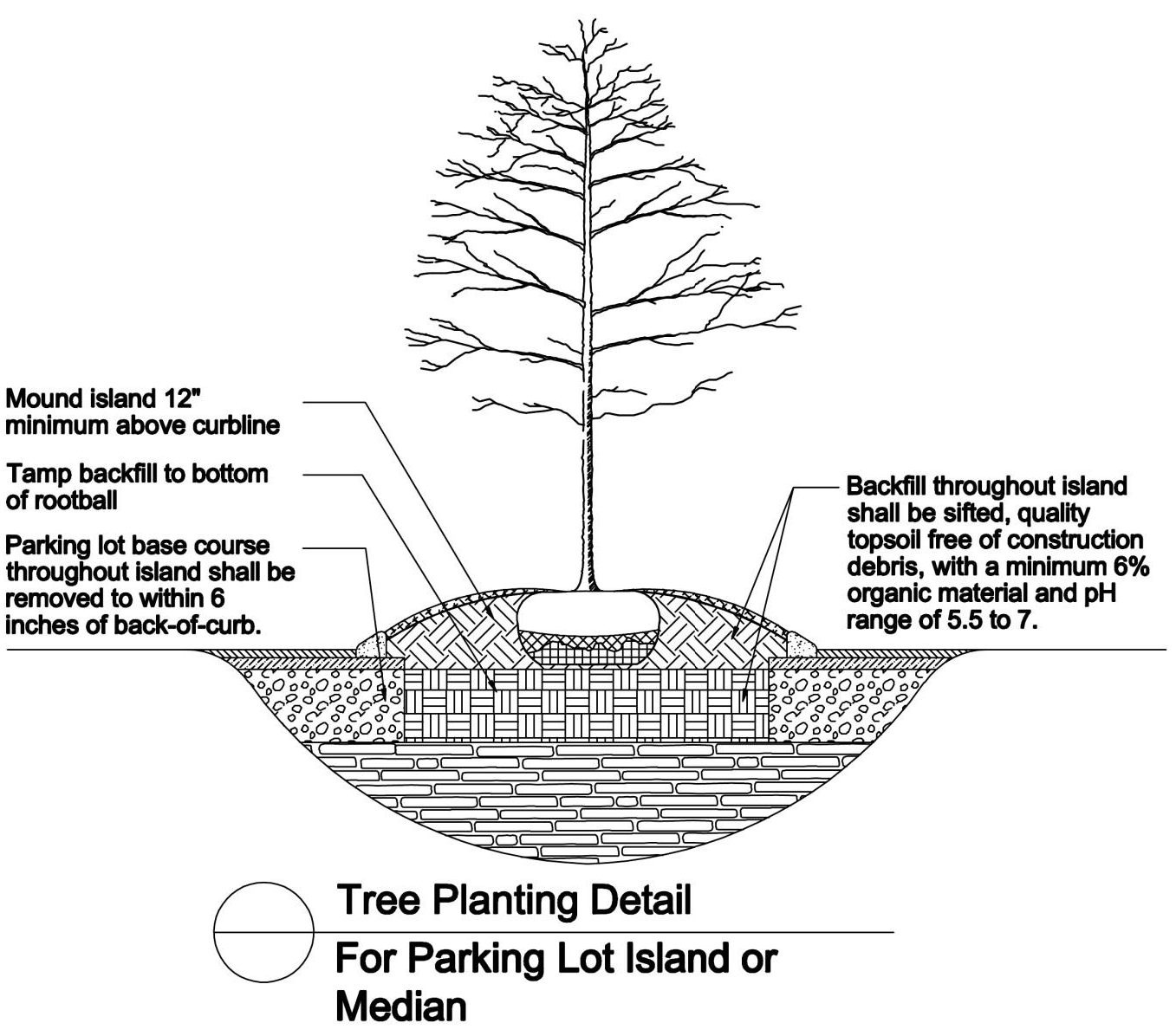
The depth of the hole dug should be about 10% less than the distance from the top-most root (measured where it joins the trunk) to the bottom of the rootball. The width of the hole shall be at least 2 times the width of the rootball.
B.
Cut away burlap and wiring so that at least 1/3 of the rootball is exposed. Synthetic burlap shall be removed entirely. All twine and rope shall be removed from the base of the tree and from any branches.
C.
After planting, the topmost root shall be no more than 2 inches below the soil surface. Additional soil should be removed. The surrounding grade should be even with or slightly lower than the top root. Please note: some trees will arrive from the nursery with too much soil covering the first major root flare. This soil should be removed. The resulting soil line should be even with or above the surrounding grade.
D.
3 inches of mulch shall be applied to cover the sides of the rootball to a point even with the dripline. Do not add any soil to the top of the rootball. Do not add more than 1 inch of mulch to the top of the root ball.
E.
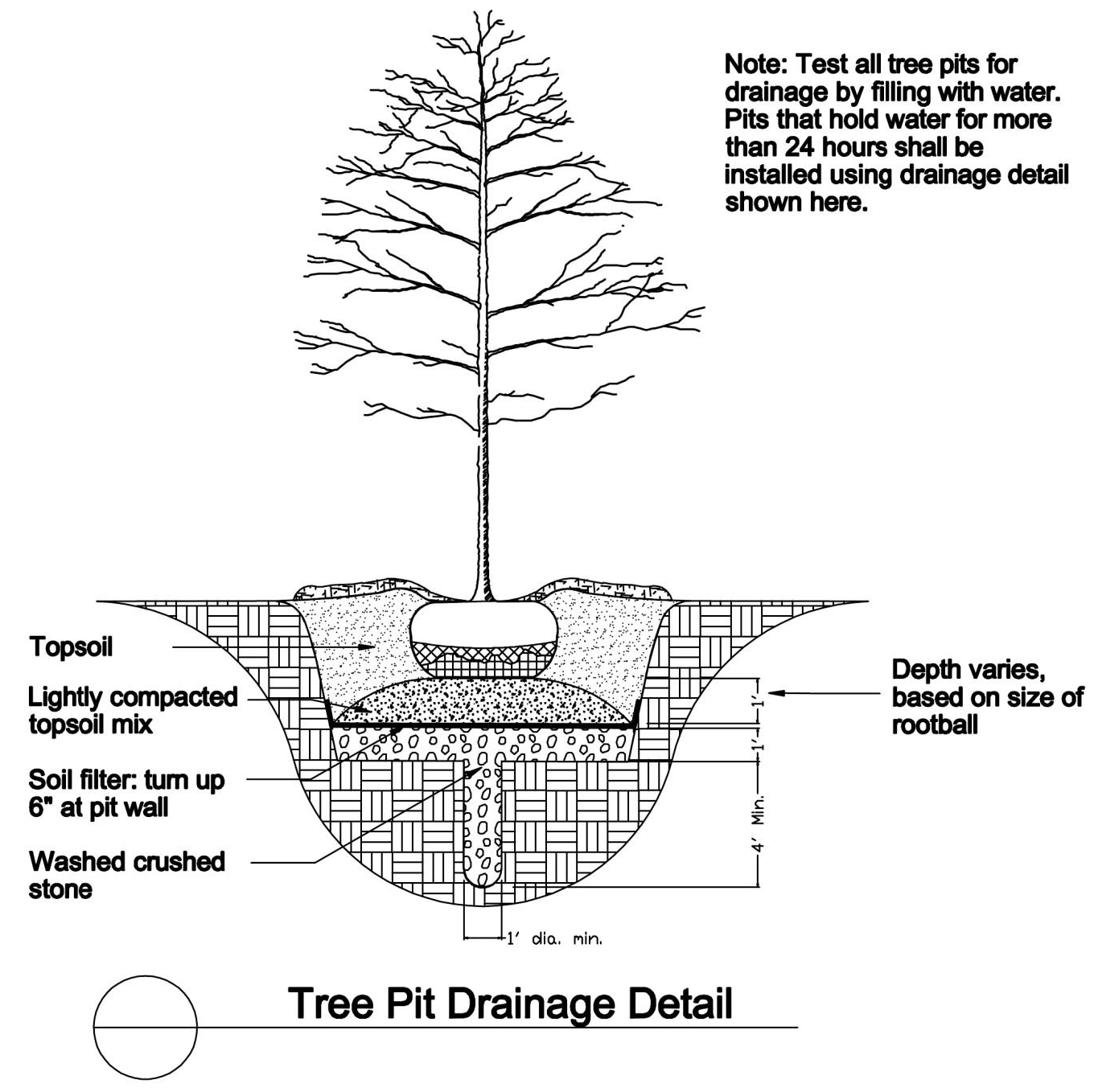
In poorly drained soil, position the top of the rootball 10% or more above the surrounding grade. No more than 20% of the rootball should be above the surrounding grade.
F.
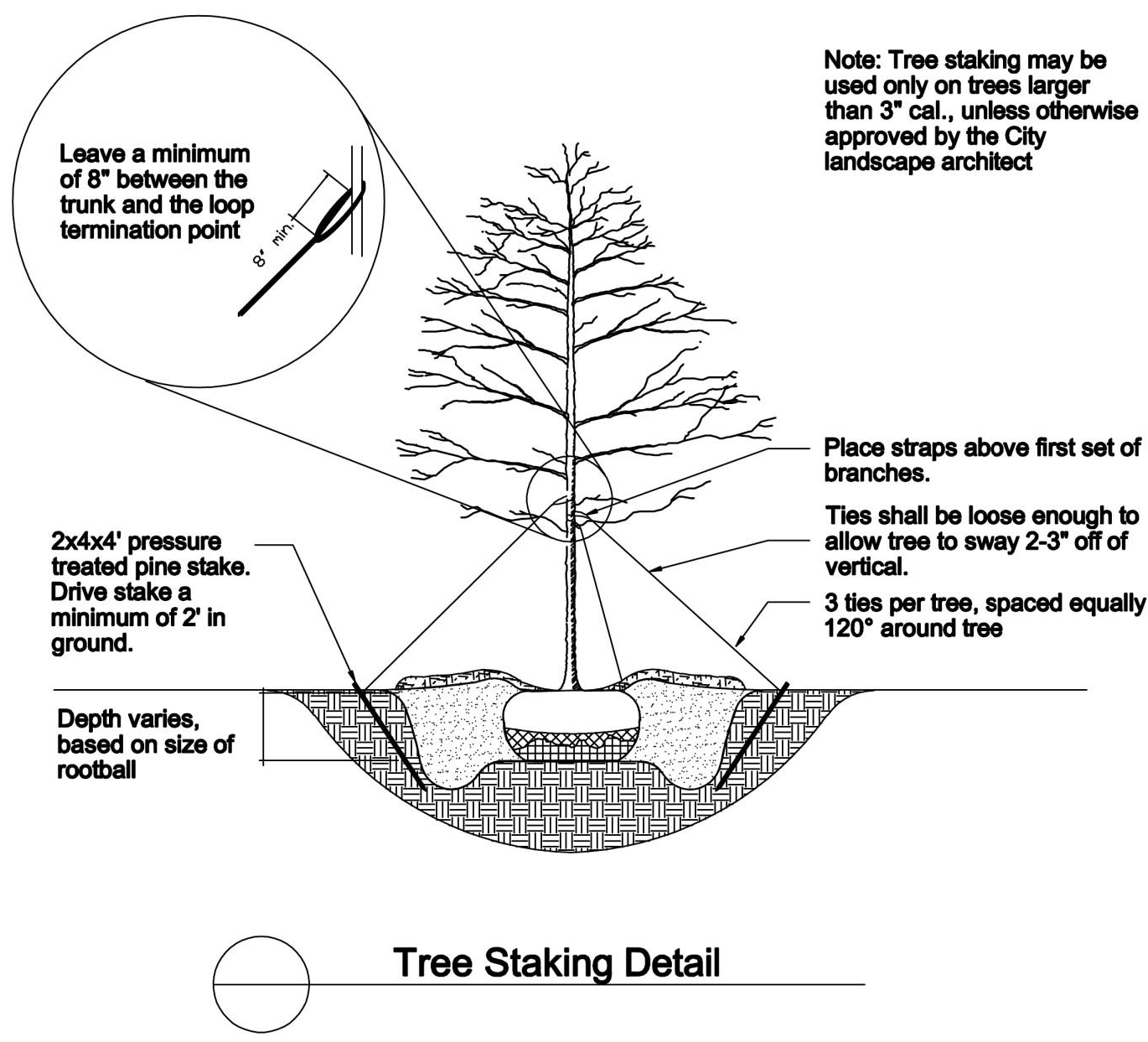
Staking of trees is not allowed unless permission is specifically obtained from the City Planning Department.
(Ord. No. 2018-1028, § 1(Exh. A), 11-20-2018)
AE.5 - PLANTING DETAILS
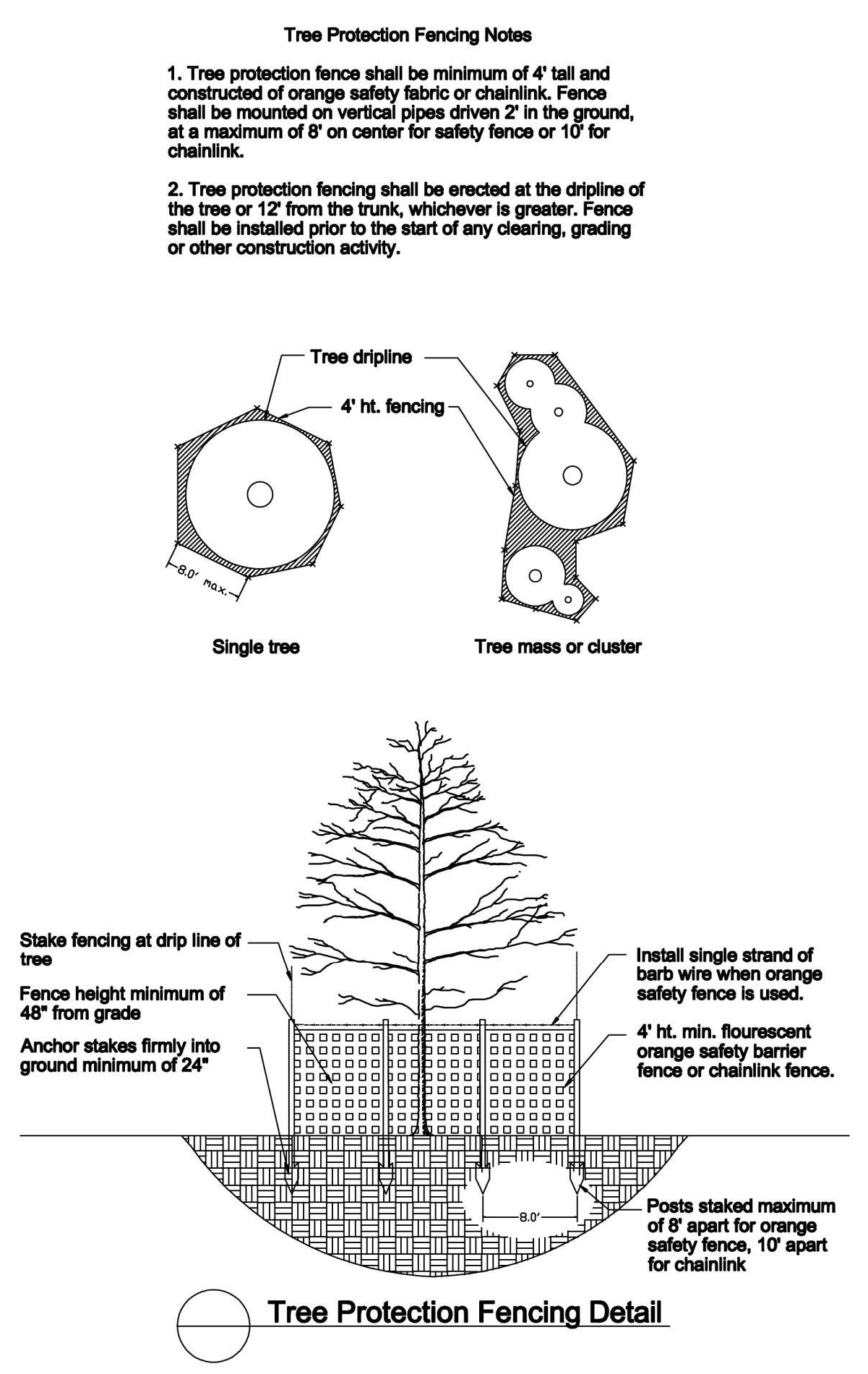
(Ord. No. 2018-1028, § 1(Exh. A), 11-20-2018)

