


Mustang City Zoning Code
CHAPTER 94
SIGNS
ARTICLE II. - ADMINISTRATION AND ENFORCEMENT[2]
Cross reference— Administration, ch. 2.
ARTICLE III. - CONTRACTORS[3]
Cross reference— Businesses, ch. 22.
Sec. 94-1. - Title; purpose and intent of chapter.
(a)
Title. This chapter shall be known and cited as the "City of Mustang Sign Code."
(b)
Purpose. It is the purpose of this chapter to establish effective sign regulations which recognize the public as well as private interest and investment in the city's environment, and which regulate the number, size and location of signs, regulate signs as to the individual use, site and structure, prohibit unsafe signs, cause removal of abandoned and nonconforming signs, and promote and protect the health, safety, welfare, convenience and enjoyment of the city for its residents and the general public.
(c)
Intent. It is the intent of this chapter to promote more effective signing practices which will be compatible with their surroundings and appropriate to the type of activity to which they pertain, to encourage greater consideration of influencing factors and thoughtful design of signs, to promote economic and business development, to protect property values, to reduce distractions and obstructions that may contribute to traffic accidents, and to enhance and protect the physical appearance and natural beauty of the city.
(Code 1977, §§ 14.02.10, 14.02.20)
Sec. 94-2. - Applicability of chapter.
The provisions of this chapter shall apply to the display, construction, erection, alteration, use, location and maintenance of all signs within the city, including any sign erected or constructed prior to the adoption of the ordinance from which this chapter is derived.
(Code 1977, § 14.02.30)
Sec. 94-3. - Definitions.
The following words, terms and phrases, when used in this chapter, shall have the meanings ascribed to them in this section, except where the context clearly indicates a different meaning:
Accessory sign means any advertising device which identifies or displays information concerning the proprietor of the business conducted on the premises.
A-frame sign, sandwich sign and swinger sign mean an advertising device which is ordinarily in the shape of an "A," spring mounted on a fixed base or some variation thereof, located on the ground but not otherwise attached thereto, and which is usually two-sided.
Aggregate use means a group of primary uses integrated in a single development not separated by an opened public street, under common ownership, and sharing private parking facilities and other services in common.
Animation means any visible mechanical movement in any sign, or apparent movement achieved by electrical pulsations or by other means, such as sequential light phasing.
Architectural projection means any projection, excluding signs, which is not intended for occupancy and which extends beyond the face of an exterior wall of a building, including but not limited to roof overhangs, wing walls, mansards, unenclosed exterior balconies, marquees, canopies, pilasters, fascias and awnings.
Attached sign means an accessory sign attached to, painted on or in any other way represented on a building or the structural elements of a building. Attached signs shall include canopy signs, combination signs, fascia signs, marquee signs, module signs, parapet wall signs, projecting signs, roof signs and wall signs.
Awning means a movable shelter supported entirely from the exterior wall of a building and of a type which can be retracted, folded or collapsed against the face of the supporting building.
Banner means any pennant, streamer, flag, sign, picture, figure or other object, regardless of the materials of which it is made, which is suspended or otherwise designed for decoration or advertisement, or to attract the attention of passersby; excepting, however, official warning devices, public service facilities, streetlights and similar safety devices.
Billboard (including poster and panel types) means a non-accessory sign or sign structure upon which advertising may be posted, painted or affixed, and which is primarily designed for the rental or lease of the sign space for advertising not related to the use of the property upon which the sign is located.
Building code means the latest building code as amended and adopted by the city.
Canopy means a permanently roofed shelter covering over a sidewalk, service station, driveway or other similar area, which is supported by posts or by the building to which it is attached.
Canopy sign means an attached accessory sign painted on or attached to the vertical side of, or erected on the roof surface of, a canopy.
Chief building official means the person charged with the administration and enforcement of this chapter, or his duly authorized representative.
Combination sign means any single attached accessory sign incorporating any combination of the features of the projecting, parapet wall, canopy, marquee, wall and fascia signs.
Decoration means an illustration, symbol, flag, streamer, bunting, wreath, figure, insignia or other device employed to express and illustrate a message of patriotic holiday or seasonal character. Decorations shall not be considered signs for the purpose of this chapter.
Directional and information sign, accessory means signs which direct attention to the location of a facility or group of facilities on the same property on which the sign is located, or which display brand name information as provided in this definition. Such signs may include entrance and exit signs, restroom signs, handicapped parking signs, license or permit information signs, and other similar groups. This also shall include the following specific signs: telephone booth or service signs, brand names on petroleum products pumps or other dispensing apparatus located outside of a building, identification and informational signs on public utility apparatus, and U.S. Postal Service signs on postal apparatus.
Display surface means the surface of the sign upon, against or through which the message is displayed or illustrated.
Display surface area means the net geometrical area enclosed by the display surface of the sign including the outer extremities of all letters, figures, characters and delineations; provided, however, that the display surface area shall not include the structural supports for freestanding signs if the structural supports are so arranged as not to become a part of the attention-attracting aspect of the sign. Unless specifically provided in this chapter, the display area to be computed shall be based on the following standards:
(1)
For signs of irregular design, the display surface area shall be determined by computing the area formed by an envelope of rectangles and triangles which shall be formed by drawing straight lines which connect the adjacent extreme points of the display surface of adjacent panels, figures, characters or delineations.
(2)
Where a sign has two faces which are joined in a "V" shape forming an angle not to exceed 60 degrees, or where such a sign contains three or more faces which are joined to form a polygon shape when viewed from above, the total display surface area of the sign may be increased by 150 percent of the allowable maximum as outlined in this chapter, provided that no one side of the sign exceeds 75 percent of the normal maximum size as set forth in this chapter.
(3)
The maximum display surface area of a double-faced sign shall be calculated on the basis of only one sign face.
(4)
The display surface area of a double-surface sign, when the two surfaces are more than 36 inches apart and not joined to form a "V," as permitted in subsection (2) of this definition, shall be computed by adding together the square footage of each display surface.
(5)
The space between modules in a module sign shall not be counted.
(6)
The display surface area of a fascia sign shall be calculated by adding together the individual display surface areas of the front and the larger side of the fascia sign.
Double-faced sign means any sign which has two display surface faces, each of which is parallel to the other, and which are not more than 36 inches apart.
Electric sign means any sign containing electrical wiring, but not including signs illuminated solely by exterior light sources such as floodlights.
Electrical code means the electrical code as adopted by the city.
Erect means to build, construct, place, locate, relocate or structurally alter any sign or other advertising device upon the site where it is to be utilized, whether permanent or temporary.
Fascia means a continuous translucent panel illuminated from within which may extend around one or more corners, and which is attached to and designed as a part of a building.
Fascia sign means a wall, canopy, marquee or parapet wall sign attached to or printed on a fascia surface. Unless specifically provided in this chapter, a fascia sign shall be subject to the standards covering the sign it represents.
Flare means any torch, fuse, wick or other illuminating device utilizing open flames to attract attention to an establishment.
Flashing sign means an illuminated sign on which the artificial or reflected light is not maintained stationary and constant in light intensity as a part of the sign.
Footlambert means the average brightness of any surface, or the uniform brightness of a perfectly diffusing surface, emitting or reflecting one lumen per square foot. Footlamberts are measured with an exposure meter equipped with a footlambert scale.
Frontage, building means the horizontal lineal dimension of that side of a building which abuts a street, a parking area, a mall or other circulation area open to the general public, and having either a main window display of the enterprise or a public entrance to the building. In industrial districts, a building side with an entrance open to industrial employees shall also qualify as a building frontage. Where more than one use occupies a building, each such use having a public entrance or main window display for its exclusive use shall be considered to have its own building frontage, which shall be the front width of the portion of the building occupied by that use.
Frontage, street means the lineal frontage (or frontages) of a lot or parcel abutting on a private or public street which provides principal access to, or visibility of, the premises.
Grade level means the average level of the finished or natural surface of the ground area adjacent to the exterior walls of a building or adjacent to the supports of a sign structure. In this instance, adjacent shall be limited to a radius of 25 feet from the center of the sign structure.
Ground sign means a freestanding accessory sign of limited height which is secured to a fixed base, usually at ground level or a slight elevation above ground, rather than being pole mounted. A sign attached to a wall or fence which serves as the boundary of a parcel shall be considered a ground sign.
Height means the vertical distance measured from the elevation of the nearest sidewalk, or, in the absence of a sidewalk within 25 feet, then from the lowest point of the finished grade on the lot upon which the sign is located and within 25 feet of the sign, to the uppermost point on the sign or sign structure.
Identification nameplate means an accessory sign as permitted in this chapter which is attached to and flat against the wall of a building or suspended from a canopy or marquee.
Illuminated sign means any sign which has characters, letters, figures, designs or outlines illuminated by electric lights or luminous tubes, whether such sources of illumination are a part of the sign or not.
Illumination, direct means illumination which is performed by electrical apparatus from within the sign structure or which is otherwise a part of the sign structure.
Illumination, indirect means illumination which is performed by spotlights or other lighting devices and which is not a part of the sign proper.
Marquee means a permanent fixed roof attached to, wholly supported by and projecting from a building.
Marquee sign means an attached accessory sign painted on or attached to the vertical side of, or erected on the roof surface of, a marquee.
Module means a separate unit of a sign which consists of an individual letter or an individual metal, plastic, masonry or wood unit upon which no more than one letter or message, as permitted in the definition of module sign, is mounted or printed. Modules shall be open on three sides or mounted on a building with no visible interconnections between modules.
Module sign means an accessory sign other than an identification sign or identification nameplate which is formed of individual modules which spell out only the name or nature of a business or the occupant of the premises. A module sign shall be erected so that there is a space between modules, and no more than one module shall contain information relating to the use of the property other than spelling out the name of the business or occupant. This sign shall be governed by the regulations applicable to the type of accessory sign which the module sign represents. Any sign not meeting this definition shall be subject to the regular accessory sign regulations.
Nonaccessory sign means a sign or advertising device which directs attention to an activity, service or product sold or offered elsewhere than on the premises on which the sign is located.
Parapet wall sign means an attached accessory sign erected on the top surface of a parapet.
Portable sign means a transportable sign more than six square feet in size designed for temporary use in compliance with the structural requirements of this chapter.
Primary sign means the single dominant use of any piece of property or lot.
Projecting sign means an attached accessory sign which projects from and which has one end attached to a building, and which does not employ ground support in any manner.
Right-of-way means any public right-of-way, boulevard, street, parkway, median or easement and any public park under the control of or maintained by the City of Mustang.
Roof sign.
(1)
Roof sign, type A means an attached accessory sign designed to permit, but not necessarily limited to, the erection of a shield, symbol or similar trademark or brand name. Such signs shall be located immediately and entirely over the roof of a building and attached to a wall or pylon or similar physical support that is part of the physical and architectural design of the building. This definition shall apply only to a building which is four stories or less in height.
(2)
Roof sign, type B means an attached accessory sign erected on a vertical framework supported by and located immediately and entirely over the roof of a building which is five stories or more in height.
Sight triangle means an area which is clear of all structures or other sight impediments formed by measuring back equal distances along two intersecting lines of street curblines, or driveway lines, a distance of 25 feet, and connecting these points to form a triangle.
Sign means any structure or part thereof or any device permanently or temporarily attached to, painted on, supported by or represented on a building, fence, post or other structure which is used or intended to be used to attract attention. The term "sign" shall not include a flag, pennant or insignia of any nation, association of nations, state, city or other political unit.
Sign location means the site where one or more freestanding sign structures may be erected. Where more than one structure is placed on either a permanent or temporary basis, there shall be no more than a 12-inch separation between structures at the same sign location.
Stake sign means a commercial accessory sign that is less than six square feet in size and less than two and a half feet in height. Such sign shall be constructed of plastic, cardboard, wood, metal, wallboard or other light material which is intended to be displayed for a limited period of time. Such sign shall be affixed to a stake or other light frame and shall not be electric.
Structure means anything built or constructed, whether or not permanently attached to the ground.
Temporary sign means any sign or advertising device over six square feet in size constructed of cloth, canvas, light fabric, portable cardboard, wood, wallboard, metal or other light materials, with or without frames, which is intended to be displayed for a limited period of time only, and is portable.
Wall sign means an attached accessory sign painted on or attached to the wall or surface of a building or display surface, which is parallel to the supporting surface. A sign attached to a wall or fence located on the boundary of a parcel shall be regulated as a ground sign.
Window sign means any accessory sign painted on the surface of, located on the interior of, or flashing through a display window.
(Code 1977, §§ 14.04.20—14.04.540; Ord. No. 882, § 1, 2-17-2004; Ord. No. 883, § 1, 2-17-2004; Ord. No. 884, § 1, 2-17-2004; Ord. No. 1214, § 1, 1-5-2021)
Cross reference— Definitions generally, § 1-2.
Sec. 94-4. - Penalty.
A person who shall violate a provision of this chapter or fail to comply therewith or with any of the requirements thereof, or who shall erect, construct, alter or repair a sign in violation thereof, shall be guilty of a misdemeanor, punishable as provided in section 1-8. Each day upon which a violation continues shall be deemed a separate offense.
(Code 1977, § 14.02.210)
Sec. 94-5. - Exemptions.
Except as specifically provided, the following signs shall be exempt from the provisions of this chapter. All of the following signs shall be securely attached to a structure or to stakes or posts that are firmly embedded in the ground. They shall not be illuminated.
(1)
Real estate signs, residential.
a.
Such signs shall advertise only the sale or lease of the premises on which the sign is placed.
b.
Such signs shall not exceed 12 square feet of display surface area and four feet in height.
c.
One sign is permitted per street frontage.
d.
Such signs shall be removed within 14 days of the sale, lease or rental of the property.
e.
In the case of a special event such as an annual or semiannual Parade of Homes or a neighborhood association or civic organization housing tour, a single sign for the event may be placed on a property included in the event, provided the sign shall not exceed 30 square feet of display surface area and shall not remain on the property longer than 21 days.
(2)
Real estate signs, commercial or industrial.
a.
Such signs shall advertise only the sale or lease of the premises on which the sign is placed.
b.
Such signs shall not exceed 60 square feet of display surface area and 14 feet in height.
c.
Such signs shall be limited to property zoned for office, commercial or industrial districts, provided that property in the A-1 district may be advertised for commercial use if the sign shall have placed on it letters at least six inches in height which state "PRESENTLY ZONED A-1."
d.
One sign is permitted per street frontage.
e.
Such signs shall be removed within 14 days of the sale, lease or rental of the property.
(3)
Temporary subdivision signs.
a.
Such signs shall be placed behind all platted setback lines.
b.
Such signs shall only advertise the sale or lease of property within the development on which the sign is placed.
c.
Such signs shall have a separation of at least 400 feet from another sign for the same subdivision.
d.
Such signs shall have a maximum display surface area of 250 square feet and a maximum height of 14 feet.
e.
Such signs may have indirect illumination from a source other than a residential structure.
f.
Such signs shall be removed upon sale by the developer of all lots and/or residences in the subdivision.
(4)
Construction signs for commercial projects, industrial projects, apartments and similar large projects.
a.
One sign is permitted per frontage per contractor, development company or financing institution participating in the construction. Subcontractors shall be identified on the sign of the contractor.
b.
The permitted size for all such signs shall be based on two square feet of display surface area for each lineal foot of frontage up to a maximum of 500 total square feet for all signs.
c.
Such signs may have indirect illumination.
d.
Such signs shall be removed within ten days of completion of construction.
(5)
Construction signs, one- through four-family residential.
a.
One sign is permitted per frontage per contractor.
b.
Such signs shall not exceed 12 square feet of display surface area for the builder or principal contractor and four square feet for each subcontractor.
c.
Such signs shall be removed within ten days of completion of construction.
(6)
Noncommercial expressive signs, residential. Noncommercial expressive signs limited to two signs per frontage with an aggregate of eight square feet of display surface area per frontage shall be permitted in residential areas.
(7)
Accessory directional and information signs.
a.
Such signs shall include signs directing traffic movement into the premises or within the premises.
b.
Such signs shall not exceed four square feet in area per sign.
c.
Illumination of such sign shall be permitted in accordance with the building code and the zoning district regulations for the district in which the premises are located, provided that no flashing lights shall be permitted.
d.
Horizontal directional signs painted on or installed flush with paved streets shall not be subject to the size regulations of this subsection.
e.
The use of such signs is prohibited except where needed for the safe and efficient movement of traffic and provision of information as provided in the definition in section 94-1.
(8)
Decorations, insignias and flags. The following are permitted:
a.
Seasonal decorations. Decorations pertaining to recognized national, state and local holidays and observances, provided that such decorations shall not be erected earlier than six weeks prior to the holiday or observance and shall be removed no later than two weeks after the holiday.
b.
Insignias, flags and banners. Such insignias, flags, banners and emblems of the United States, the State of Oklahoma and municipal and other bodies of established government, or flags which display the recognized symbol of a nonprofit and/or noncommercial organization.
c.
Seasonal signs by churches and other nonprofit organizations. Decorations and signs pertaining to holidays and observances, provided that decorations and signs shall not be erected earlier than six weeks prior to the holiday or observance and shall be removed one week after the holiday or observance, provided only two signs shall be permitted per frontage with a maximum surface area of 24 square feet and height no greater than four feet and shall not be placed in any right-of-way.
(9)
Public signs. This chapter shall not apply to signs erected by the city, county, state or federal government for traffic direction or street identification.
(10)
Certain wall signs. Memorial signs on tablets, containing names of buildings and date of erection, when cut into any masonry surface or when constructed of bronze or other incombustible materials, shall be exempt from this chapter.
(11)
Accessory signs within structure. There shall be no restrictions on placement of signs within a structure where they cannot be viewed from any point outside the structure, for example, in a shopping center mall. However, all signs so constructed shall require appropriate building and electrical permits.
(12)
Public utility signs. Temporary or permanent signs erected by public utility companies or construction companies to warn of danger or hazardous conditions, including signs indicating the presence of underground cables, gas lines and similar devices, shall be exempt from this chapter.
(13)
Political signs. Political signs may be erected at any occupancy or upon any premises, provided such signs comply with all other applicable requirements of this chapter. These signs shall not be placed in any right-of-way, and shall only be placed on property for which permission from the owner has been obtained. Political signs shall be permitted for a period of 30 days prior to any primary or general election and shall be removed within three days after the election.
(14)
Stake signs. Stake signs may be up to two and a half feet in height with a maximum area of six square feet. Stake signs are prohibited in the right-of-way and must have a 50-foot setback away from intersecting curb lines. Signs must be spaced 50 feet apart. Stake signs may be placed on private property only. Such signs shall be permitted as advertisements for only the property owner of the property on which they are placed.
(15)
[Weatherproof banners.] Weatherproof banners in commercial and industrial zoning districts that meet the following conditions:
a.
The weatherproof banner must also be an accessory sign;
b.
Display surface area is limited to a cumulative total of one square foot per ten lineal feet of street frontage per right-of-way or 32 square feet, whichever is greater.
c.
Any form of encroachment in the following areas is prohibited:
1.
Public or private rights-of-way;
2.
Sight triangles for street intersections or driveways;
3.
Utility easements;
4.
Parking required by the zoning district;
5.
Landscaping required by the zoning district.
d.
Sign contains no animation and conforms with subsections 94-155(a)—(c) of this chapter.
e.
A minimum of 45 feet of separation is maintained between other signs exempt by this section located on the same tract.
f.
Cannot block the view of landscaping or fencing required by the zoning district.
g.
Freestanding banners may not exceed 8 feet above adjacent grade. Banners attached to fencing, canopies, buildings or other structures may not exceed the height of the structure they are attached to.
h.
Must be properly maintained in good condition and be completely legible at all times.
(Code 1977, § 14.02.230; Ord. No. 839, § 1, 5-20-2003; Ord. No. 885, § 1, 2-17-2004; Ord. No. 886, § 1, 2-17-2004; Ord. No. 1078, § 1, 2-19-2013)
Sec. 94-6. - Tables, forms and examples.
The following is a design table for the construction of symmetrically loaded signs:
A × H = Area of sign in square feet (A) times height from ground to area centroid of sign in feet (H). (See note below for height to area centroid.)
Based on using A-36 and A-53 grade B steel and a 33 percent allowable overstress of steel or 29,326 p.s.i.
The area centroid of a rectangular sign is the mid-point of the sign. The area centroid of an irregularly shaped sign must be calculated.
Formula: Section modulus required equals the area of sign in square feet from ground to area centroid of sign in feet times 30 pounds per square foot wind load times 12 inches per foot divided steel in p.s.i.
SM Required =
A x H x 30 x 12 / 29,326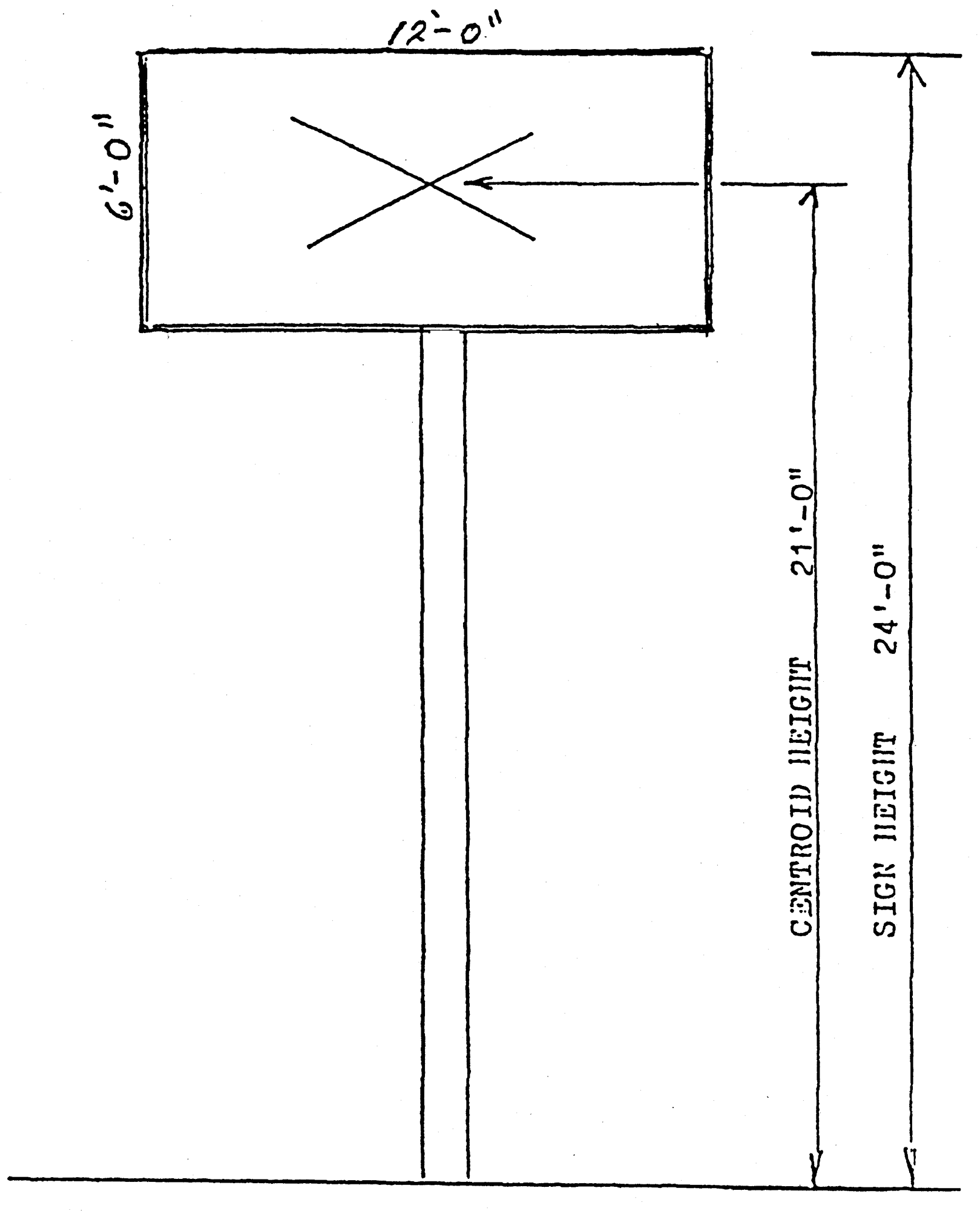
EXAMPLE—WILD STRESS CALCULATIONS
Area of Sign = 72.0 sq. ft.
Centroid Height = 21 ft.
Formula: A x H x 30 x 12 / 29,326 = 54,432 / 1,856
Section Modulus Required @ 1,856
SM Furnished One 10″ Std Wall Pipe @ 2,436 as per design table.
Three copies of each of the following must be submitted:
(1)
Plot Plan:
Plot plans shall be drawn to scale showing the location of all property lines, right-of-way, all existing buildings and structures and the location of the proposed sign showing the distance from lot lines and structures.
(2)
Elevations:
Elevations shall be drawn to scale showing the entire display area.
(3)
Stress Calculations:
Copy of stress sheets and calculations showing the structure is designed for dead load and wind pressure in any direction in the amount required by this and all other laws and ordinances of the city.
I hereby certify that the statements in this application and the attachments hereto are true and correct to the best of my knowledge and belief, and that all construction work under this proposed permit will conform to the attached plans, specifications and drawings and the current ordinances of the city, as amended.
Date _____ Applicant's Name _____
Address _____ Phone _____
By: _____
_____
TITLE
Approved: ________, 20___
Denied: ________, 20___
Reasons: _____
_____
_____
Permit Fee _____
All illuminated signs shall be subject to the National Electrical Code and the permit fees required thereof.
CITY OF MUSTANG
APPLICATION FOR SIGN PERMIT
I, (we) submit herewith the required plans, specifications and drawings for and request for sign permit for the work described below. I, (we) hereby agree to comply with all building, health, fire, traffic, engineering and zoning requirements of the City of Mustang, whether herein specified or not.
Job Address Information
Address of Sign _____
Lot _____ Block _____ Addition _____
Metes and Bound description - should be attached
Owner Information
Name _____ Home Phone _____
Street Address _____
City _____ State _____ Zip _____
Business Phone _____
Builder/Contractor/Application Information
Name _____
Address _____
City _____ State _____ Zip _____
Business Phone _____
Permit Information
□ Residential □ Commercial
□ Erect □ Alter □ Relocate
□ Illuminated nonflashing □ Illuminated flashing
□ Nonilluminated
Type of Sign _____
Estimated Cost _____
Square Feet _____ Height _____
Zoning District _____
CITY OF MUSTANG
SIGN PERMIT
Date ________
Applicant _____
Address _____ Phone _____
Owner Erecting Sign _____
Zoning on Property _____ Setback _____
Legal Description Lot _____ Block _____
Addition _____
_____
_____
_____
Location of Sign _____
Type and Size of Sign _____
Wind Stress Calculations Submitted _____
FEES
Sign Permit Fee _____
TOTAL FEE $_____
Having made the required application and paid the above fee, authority is hereby granted to erect the above type and size sign at the location indicated above, and in conformity with the applicable provision of Title 14, Sign Code. If electrical is required a separate electrical permit must be secured.
(Code 1977, § 14.08.080)
Sec. 94-151. - General prohibitions.
(a)
Unless specifically permitted in another section of this chapter, no sign shall be erected on or over the public right-of-way. Merchandise such as tires, produce, automotive vehicles and any other articles for display or sale shall not be located in any manner in the public right-of-way.
(b)
Where a parcel is occupied by a use or structure which does not conform to the use regulations of the zoning district in which the parcel is located, no sign shall be erected on the parcel until the use is changed to become conforming.
(c)
The use of any boulevards, streets, ways, terraces, drives and lanes, or park roads or parks, under the control of the city for any political, social, civic or charitable non-accessory advertising purpose within full view of those traveling on a public road is prohibited; provided that government use of these areas to display public information, for the placement of decorations, or for the placement of neighborhood identification signs as authorized by section 94-162 shall not be included in this restriction.
(d)
The painting, scattering, posting or spreading in any manner along any public right-of-way or public property of any signs, bills, wastepaper, paper, cloth or other materials used in advertising is prohibited. This prohibition shall include the posting of such materials on any utility pole or device.
(e)
No person shall permit the manufacturing, installing, erecting or displaying of any obscene, indecent or immoral matter.
(f)
A-frame signs, sandwich signs and swinger signs are prohibited.
(g)
The erection, construction or maintenance of any sign which will obstruct any fire escape, stairway or standpipe, or which will be attached to or supported by a fire escape or stairway, or which will interfere with human exit through any emergency opening, or which will obstruct the exterior door or required exit of any building, or which will obstruct any legally required light or ventilation, is prohibited.
(h)
No sign shall occupy any parking space required under the minimum standards of the zoning ordinance (chapter 122), unless additional parking is provided.
(Code 1977, § 14.02.240(A))
Sec. 94-152. - Signs on vehicles.
(a)
Signs shall be permitted to be painted or directly attached to a commercial vehicle, provided the sign identifies the business for which the vehicle is operated.
(b)
No trailer or vehicle larger than a 1½-ton capacity van or pickup truck shall be parked on the street side of a business property for purposes other than immediate loading or unloading.
(c)
Use of a message painted on or affixed to trucks or semitrailers as an advertising device shall be prohibited unless the vehicles are parked in a defined storage area as permitted by the zoning ordinance (chapter 122).
(d)
No portable, A-frame, sandwich, swinger or similar sign shall be mounted on a vehicle for purposes of advertising.
(Code 1977, § 14.02.240(B))
Sec. 94-153. - Alteration or relocation of signs.
A sign shall not be enlarged or relocated except in conformity with the provisions of this chapter for new signs, or until a proper permit has been secured. The changing of movable parts of an approved sign that is designed for such changes, or for the repainting or re-posting of display matter, shall not be deemed an alteration, provided the conditions of the original approval and the requirements of this chapter are not violated.
(Code 1977, § 14.02.240(C)(3))
Sec. 94-154. - Responsibility for maintenance.
The owner of any property on which a sign is located and those responsible for maintenance of the sign shall be equally responsible for the conditions of the area in the vicinity of the sign and shall be required to keep this area clean, sanitary, and free from noxious or offensive substances, rubbish and flammable waste materials.
(Code 1977, § 14.02.240(C)(4))
Sec. 94-155. - Flashing, moving and sound-emitting signs.
(a)
No sign or part of a sign shall move or be permitted to move, with the exception of movable and flashing signs as permitted in this chapter.
(b)
No sign shall emit any sound which is designed to attract attention.
(c)
No strobe or high-intensity flashing lights shall be permitted, except where required on structures for aircraft warning lights.
(d)
No flashing signs or lights on a sign used in a flashing manner shall be permitted unless approved by the city staff. The city staff shall use the following criteria:
(1)
The sign shall not be located within 150 feet of a residential district if such lighting can be seen from the residential district;
(2)
If the sign is an attached sign, it shall have a setback sufficient to avoid any traffic conflicts; and
(3)
If the sign is a freestanding sign, it must be set back from the street a distance adequate to avoid traffic conflicts, and shall use lights of a color or combination of colors which will not be confused with emergency or service vehicles and equipment.
(e)
The color of all flashing signs or lights on a sign used in a flashing manner shall be approved by the city staff.
(f)
The city staff shall review all applications for the placement of flashing, rotating and moveable signs, including time-temperature and moving message signs, in authorized zoning districts, to protect against traffic hazards, subject to the standards listed in this section. The city staff shall review any complaint by the public or a public official in reference to a possible traffic hazard caused by any sign. Where a hazard is determined to exist, the staff shall, by written report to the city manager, request that the sign be removed or altered.
(Code 1977, §§ 14.06.010—14.06.030)
State Law reference— Flashing signs and signs resembling traffic signs, 47 O.S. § 11-206.
Sec. 94-156. - Canopy signs, marquee signs, parapet wall signs, projecting signs, combination signs and wall signs.
(a)
Size. Canopy signs, marquee signs, parapet wall signs, projecting signs, combination signs and wall signs located in commercial zoning districts shall not exceed 100 square feet.
(b)
Clearance. The clearance above ground for these signs shall be not less than nine feet, or 14 feet if there will be vehicular access below them. Where there is no pedestrian access below a wall sign, there shall be no clearance requirement.
(c)
Location.
(1)
Regardless of building setback requirements, a canopy, marquee, parapet wall, projecting or combination sign may project from the supporting surface to a distance not to exceed ten feet or to within two feet of the nearest property line, whichever is the least. No such sign shall extend between the ground surface and the bottom level of the canopy or marquee to which the sign is attached, except as provided for identification nameplates in this chapter.
(2)
A wall sign may extend from the wall as follows:
a.
Where the bottom of the sign is less than 14 feet above the level of the ground below it, the sign may extend 12 inches from the wall;
b.
Where the bottom of the sign is more than 14 feet above the level of the ground below it, the sign may extend 24 inches from the wall; and
c.
No sign shall be wider than the surface to which it is affixed, except for a fascia sign.
(d)
Exemption for certain wall signs, cornerstones and tablets. Memorial signs on tablets, names of buildings and date of erection, when cut into any masonry surface, or when constructed of bronze or other incombustible material, shall be exempt from these regulations.
(e)
Accessory signs within structure. There shall be no restrictions on placement of signs within a structure where they cannot be viewed from any point outside the structure, for example in a shopping center mall. However, all signs so constructed shall require appropriate building and electrical permits.
(Code 1977, § 14.08.010)
Sec. 94-157. - Agricultural, residential and mobile home zoning districts.
The following shall apply in agricultural, residential and mobile home zoning districts:
(1)
No accessory sign shall be permitted for single-family through four-family uses, except for the temporary signs authorized in section 94-5.
(2)
Multiple-family residential uses shall be permitted either one ground sign or one attached sign as follows:
a.
Five to 12 units: One sign, not to exceed eight square feet.
b.
Thirteen to 29 units: One sign, not to exceed 20 square feet.
c.
Thirty or more units: One sign per street frontage. Permitted size shall be one square foot of display surface area for each three lineal feet of frontage, except that, where street frontage is not available, then the sign footage will be based upon the number of units, up to a maximum of 100 square feet.
(3)
Subdivisions or residential developments of five acres or larger shall be permitted one ground sign per entry street. The sign shall be nonilluminated, shall not exceed 18 square feet in area and six feet in height, and shall contain only the name of the subdivision or the street.
(4)
The following standards shall apply to nonresidential permitted uses and uses permitted on review and special exception uses in agricultural, residential and mobile home zoning districts. They shall also apply to mobile home parks and subdivisions permitted under the R-MH-1 and R-MH-2 district regulations of the zoning ordinance (chapter 122):
a.
Number: One per street frontage.
b.
Type: Ground sign or attached sign.
c.
Size: One square foot of display surface area for every three lineal feet of frontage, up to a maximum of 100 square feet.
d.
Illumination: Indirect lighting or interior lighting behind a translucent panel. No flashing or intermittent lighting shall be permitted in these districts.
(5)
Maximum height.
a.
The maximum height for a ground sign is 20 feet above grade level.
b.
The height of an attached sign shall not exceed the height of the surface to which it is attached.
(6)
Setback. All permitted freestanding signs shall observe sight triangles of 25 feet from all street curblines and driveways.
(7)
Installation by other than licensed sign contractor. In these zoning districts, nonilluminated signs and/or signs not affected by building code structural requirements may be installed by other than a licensed sign contractor, provided a permit is issued after application and review for conformance to all applicable regulations.
(Code 1977, § 14.08.020)
Sec. 94-158. - OPB and CN zoning districts.
The following standards shall apply in OPB and CN zoning districts:
(1)
No accessory sign shall be permitted for single-family through four-family uses, except for the temporary signs authorized in section 94-5.
(2)
Signs for permitted multiple-family residential uses shall be subject to the standards for residential districts in section 94-157.
(3)
Uses permitted in the OPB and CN districts shall be permitted signs as follows:
a.
Number. One ground sign location and attached sign per street frontage is permitted. The attached sign can be split into two signs, but cannot exceed the maximum square footage. In the case of multiple occupants, one attached sign shall be permitted for each occupant, provided the total display surface area of all signs does not exceed the maximum permitted total.
b.
Size. Size restrictions are as follows:
1.
Ground sign: One square foot of display surface area for each two lineal feet of frontage, not to exceed 150 square feet; or
2.
Attached signs: One square foot of display surface area for each two lineal feet of building width, not to exceed a total of 150 square feet. An attached sign can be two signs, but the total of both signs cannot exceed the maximum square footage.
c.
Maximum height.
1.
Maximum height of ground signs is 20 feet above grade level.
2.
Attached signs:
i.
The height of a wall sign shall not exceed the height of the structure to which it is attached.
ii.
The height of all other signs shall not exceed six feet above the structure to which the sign is attached.
d.
Illumination. Indirect lighting or interior lighting behind a translucent panel is permitted. No flashing or intermittent lighting shall be permitted in these districts.
e.
Setback. All permitted freestanding signs shall observe sight triangles of 25 feet from all street curbs or driveways.
f.
Installation by other than licensed sign contractor. In these zoning districts, nonilluminated signs and/or signs not affected by building code structural requirements may be installed by other than a licensed sign contractor, provided a permit is issued after application and review for conformance to all applicable regulations.
(Code 1977, § 14.08.030)
Sec. 94-159. - Other commercial and industrial zoning districts.
The following standards shall apply for all commercial and industrial zoning districts other than OPB and CN districts:
(1)
Residential uses. Signs for permitted multiple-family residential uses shall be subject to the standards for residential districts in section 94-157.
(2)
Number.
a.
One freestanding sign location per street frontage is permitted; provided that an additional sign location shall be permitted for each additional 150 lineal feet of frontage or portion thereof which is not included in calculations to permit a larger sign as provided in subsection (4) of this section.
b.
One roof sign is permitted for any structure with three stories or more.
c.
Attached signs are permitted for each occupant having street frontage, provided that the total display surface area of all such signs shall not exceed the maximum permitted total.
d.
One identification nameplate is permitted for each business or professional occupancy of a building without direct exterior access, with a maximum size of four square feet per nameplate; nonflashing illumination is permitted.
e.
There shall be no restriction on signs placed inside a display window.
_____
(3)
Size standards for attached signs. The following standards shall be used to permit a larger sign area for attached signs in proportion to increased setback and building width:
_____
(4)
Size standards for freestanding signs.
a.
Display surface area shall be permitted on the basis of two square feet of sign for each one lineal foot of frontage, up to the following maximum size:
1.
CG, SC and CI districts: 400 square feet.
2.
I-1 district: 400 square feet.
3.
I-2 and I-3 districts: 700 square feet.
b.
Any frontage above 400 feet utilized in calculations to permit an additional freestanding sign location under subsection (2)a of this section shall not also be included in calculations to permit a larger sign.
c.
Where an individual or aggregate use abuts a major thoroughfare, (Highway 4, Highway 92 or Highway 152) and the lineal foot frontage of the use is less than 100 feet, a freestanding sign location may have 200 feet of display surface for better identification of the use from the highway, provided that all other regulations of this chapter shall apply.
(5)
Height.
a.
Freestanding signs. A minimum clearance of 14 feet above any driveway, service drive or trafficway is required, and the following shall also apply:
1.
Lineal foot frontage from zero to 300 feet: Maximum height of 40 feet above grade level.
2.
Lineal foot frontage above 300 feet: One additional foot for each 40 additional feet of lineal frontage, to a maximum height of 50 feet above grade level.
3.
Use abutting a major thoroughfare: Maximum height of 50 feet above grade level on the thoroughfare frontage to provide better identification of the use from thoroughfares, subject to all other regulations of this chapter.
b.
Attached signs.
1.
The height of a wall sign shall not exceed the height of the surface to which it is attached.
2.
Roof signs shall have no maximum height.
3.
The height of all other signs shall not exceed six feet above the structure to which the sign is attached.
(6)
Illumination.
a.
Direct or indirect lighting is permitted.
b.
Flashing signs shall be permitted subject to all regulations of this chapter.
(7)
Setback. All permitted freestanding signs shall observe a sight triangle of 25 feet from all street curblines and driveways.
(8)
Installation by other than licensed sign contractor. In these zoning districts, nonilluminated signs and/or signs not affected by building code structural requirements may be installed by other than a licensed sign contractor, provided a permit is issued after application and review for conformance to all applicable regulations.
(Code 1977, § 14.08.040)
Sec. 94-160. - Portable signs.
In addition to being permitted and regulated in specified zoning districts as ground signs, portable signs shall be permitted as ground signs under the following conditions, and in no case for a period to exceed 90 days:
(1)
Construction work disrupting normal access to business. Where street, highway or other public works construction disrupts normal access to a business, the director of community development may authorize a portable sign to be located on private property (and in some instances on public property) to provide directions to the business, where he has determined that the location will not constitute a hazard to the health, safety and welfare of the public. This sign shall be permitted only as long as the construction disrupts access or until ordered to be moved by the director, whichever shall occur first.
(2)
Special events. When a spectator event or special entertainment event is proposed, one portable sign shall be permitted in place of an authorized permanent sign for a period not to exceed 30 days per event, provided that no more than one sign per location at a time shall be permitted, subject to all regulations for accessory signs in this chapter.
(3)
Temporary accessory signs. Where no more than one ground sign or freestanding sign is located upon a parcel and additional sign display surface in excess of 32 square feet is available for signing pursuant to this chapter, one portable sign shall be permitted as an accessory use. Permits may be issued for up to 90 days per year. The 90-day period may be broken into two or more periods for any one year, but in no case shall 90-consecutive-day periods be allowed. There shall be a minimum of a 60-day waiting period between renewals.
(4)
Construction requirements.
a.
Anchoring. All portable signs shall be secured by one of the following types of anchors:
1.
If placed upon a concrete slab, concrete anchors at least one-fourth inch in diameter shall be placed to a minimum depth of two inches to secure each corner ground support;
2.
If placed upon an earth base, a metal auger anchor at least three-eighths inch in diameter, with an expanded diameter of three inches, shall be placed to a minimum depth of 15 inches to secure each corner ground support; or
3.
If placed upon an asphalt base, a metal stake at least three-eighths inch in diameter shall be placed to a minimum depth of 18 inches to secure each corner ground support.
b.
Lighting and electrical wiring.
1.
Lighting and electrical wiring shall be subject to the National Electrical Code and the zoning district standards for the district in which the sign is located.
2.
Any sign which is located for a period in excess of 30 days shall be provided with a permanent underground wiring source.
3.
Portable signs may be electric only if using a permanent underground source in compliance under the National Electrical Code. Battery-powered electric portable signs will be allowed for a maximum of 30 days.
4.
Where no more than one ground sign is located upon a parcel and additional sign display surface in excess of 32 square feet is available for signing pursuant to this chapter, one portable sign shall be permitted as an accessory use. Permits may be issued for up to 90 days.
(Code 1977, § 14.08.050)
Sec. 94-161. - Billboards and commercial nonaccessory signs.
(a)
Billboards. Off-premises outdoor advertising signs located along arterials and highways and used for the express purpose of product advertisement shall be prohibited.
(b)
Commercial nonaccessory signs. No commercial nonaccessory signs shall be permitted within the city limits.
(Code 1977, § 14.08.060; Ord. No. 888, § 1, 2-17-2004)
Sec. 94-162. - Information signs on public right-of-way.
The community development director or his designated representative may issue a permit to erect a non-accessory directional or informational sign on the public right-of-way when it is not considered a traffic hazard and if the following conditions are met:
(1)
Sixty percent of the property owners or neighborhood association members within the boundaries of any delineated area must request the signs.
(2)
The sign must be used for public purposes, such as historical preservation markers, urban conservation markers and neighborhood watch signs.
(3)
The sign must not interfere with the sight triangle.
(4)
A map must be submitted to the director showing the location of all proposed signs.
(5)
A sketch of each type of sign proposed must be submitted showing height, length and width and square feet of display surface.
(6)
A letter from major utility companies shall be submitted indicating approval or disapproval of the location of the proposed sign.
(7)
The sign may not exceed four square feet in display area.
(Code 1977, § 14.08.070)
Sec. 94-31. - Enforcement generally.
(a)
The chief building official or his designee is hereby authorized and directed to enforce all provisions of this chapter. He shall appear for and on behalf of the city in all matters regarding the interpretation and application of this chapter, and shall resist and oppose any deviations from the provisions of this chapter.
(b)
Upon presentation of proper credentials, the chief building official or his authorized designee may enter at reasonable times any building, structure or premises usually open to the public in the city, to perform any duty imposed upon him by this chapter.
(Code 1977, § 14.02.200)
Sec. 94-32. - Inspections.
The chief building official or his official designee shall inspect, at such time as he deems necessary, each sign regulated by this chapter.
(Code 1977, § 14.02.120)
Sec. 94-33. - Impoundment, removal and disposal.
(a)
Removal and disposal without notice. Any sign erected in any right-of-way in violation of this chapter shall constitute a public nuisance endangering public safety and may be removed and disposed of by the chief building official or his designee.
(b)
Impoundment without notice. Sign impoundment without notice is authorized. Any unanchored sign, or one which has been damaged by a storm or collision in such a manner that its presence constitutes a threat to the health, safety and welfare of the public, is hereby declared a public nuisance endangering public safety and it may be impounded by the chief building official or his designee or any police officer of the city. If impounded, a reasonable effort shall be made to determine the identity of the sign owner for purposes of notification. If a sign contains ownership information as required by this chapter, the chief building official shall provide mailed notice that the sign has been impounded within three working days of the action.
(c)
Impoundment with notice. As provided in this subsection, signs may be impounded on three days' written notice of violation being given to any of the following: the property owner, the sign contractor or the business identified on the sign advertising copy. Attachment of a tag to the sign citing the nature of the violation shall constitute sufficient notice if none of these methods are available. The following signs are subject to being impounded:
(1)
A sign placed on private property without the owner's consent.
(2)
A sign placed without a permit, except as exempted by section 94-5.
(d)
Disposition of impounded signs; redemption by owner. All impounded signs shall be stored and, upon proper identification thereof by the owner, may be redeemed upon the payment of a reasonable charge as set forth in section 42-94, which is incurred by the city for removal, transportation, storage, safeguarding, accounting and bookkeeping resulting from the impoundment. All signs which are not redeemed shall be subject to disposal in the manner provided by law for the disposition of unclaimed property after a 30-day holding period.
(Code 1977, § 14.02.190; Ord. No. 1214, § 2, 1-5-2021)
Editor's note— Ord. No. 1214, § 2, adopted Jan. 5, 2021, changed the title of § 94-33 from "Impoundment" to read as set out herein.
Sec. 94-34. - Notice of violation; hearing; order to correct violation.
(a)
Notice of violation. Whenever the chief building official determines that violations of pertinent regulations exist under this chapter, he shall notify the licensee or permittee of such alleged violation. Such notice shall:
(1)
Be in writing;
(2)
Include a statement of the reasons for its issuance;
(3)
Contain an outline of remedial action which, if taken, will effect compliance with the provisions of this chapter and other pertinent regulations;
(4)
Allow a reasonable time, not to exceed seven working days, for the performance of any act it requires; and
(5)
Be served upon the owner or his agent as the case may require, provided that such notice or order shall be deemed as properly served upon the owner or agent when a copy thereof has been sent by certified mail to his last known address.
(b)
Request for hearing. Any person affected by a notice issued under this chapter or resulting regulations may request and shall be granted a hearing on the matter before the board of adjustment, provided that such person shall file with the chief building official a written request for such hearing setting forth briefly the grounds for such request within ten days after the day the notice was served. The filing of such request shall stay the notice of suspension of permits and licenses except in cases of orders issued under subsection (e) of this section. The hearing shall be held at the next board of adjustment meeting for which the agenda has not been completed, or at a later meeting if so requested by the petitioner, should the chief building official determine that sufficient cause for such delay exists.
(c)
Order by building official. After such hearing, the chief building official shall compile the findings of the board of adjustment as to compliance with this chapter and pursuant regulations and shall issue an order in writing sustaining, modifying or withdrawing the prior notice, which shall be served as provided in subsection (a)(5) of this section. Upon failure to comply with such order, the permit of the sign or sign company shall be revoked.
(d)
Appeals. Appeals from decisions of the board of adjustment shall be to the city council. Any person aggrieved by the decision of the city council may seek relief in district court.
(e)
Emergencies. Whenever the chief building official finds that an emergency exists which requires immediate action to protect the public health, he may, without notice or hearing, issue an order reciting the existence of such an emergency and requiring that such action be taken as he deems necessary to meet the emergency, including the suspension of the permit. Notwithstanding any other provisions of this chapter, such order shall be effective immediately. Any person to whom such an order is directed shall comply therewith immediately, but upon petition to the city council shall be afforded a hearing at the next regular meeting, even if the agenda has been completed. The provisions of subsections (c) and (d) of this section shall be applicable to such hearing and the order issued thereafter.
(Code 1977, § 14.02.220)
Sec. 94-51. - Continuation of legal nonconforming signs.
Any sign located within the city on October 16, 1984, or located in an area annexed to the city after such date, which does not conform with the provisions of this chapter shall be considered as a legal nonconforming sign and is permitted, provided that the sign was in all respects in compliance with applicable law on October 16, 1984. If such sign is not in conformance with the existing law such sign must be brought into conformance or removed according to the procedures established in this chapter. Such sign shall be maintained in a good condition and shall be allowed to remain in existence so long as, and only so long as, such sign is not:
(1)
Changed to another nonconforming sign;
(2)
Structurally altered, except to meet safety requirements, so as to prolong the life of the sign;
(3)
Expanded;
(4)
Reestablished after its discontinuance for 90 days;
(5)
Continued in use after cessation or change of ownership of the business or activity to which the sign pertains; or
(6)
Reestablished after damage or destruction if the estimated cost of reconstruction exceeds 50 percent of the appraised replacement cost, as determined by the chief building official.
(Code 1977, § 14.02.160)
Sec. 94-52. - Removal or alteration of prohibited signs.
Any nonconforming sign which is listed as a prohibited sign shall be removed or brought into conformance with the provisions of this chapter according to the following schedule: Within six months after October 16, 1984, any sign in these categories which is in existence on such date shall be altered in such a manner that its movement or illumination does not continue operating in a prohibited manner.
(Code 1977, § 14.02.170)
Sec. 94-53. - Removal of nonconforming portable or temporary signs.
Any nonconforming sign erected or displayed more than 90 days prior to October 16, 1984, which is defined as a portable or temporary sign under this chapter shall be removed.
(Code 1977, § 14.02.180)
Sec. 94-54. - Removal or restoration of obsolete signs.
Any sign which the chief building official determines no longer serves a bona fide enterprise shall be removed or restored to a serviceable condition by the owner, agent or person having the beneficial use of the land, buildings or structure upon which such sign is located within 15 days after written notification to do so from the chief building official or his designee. Upon failure to comply with such notice, the chief building official is hereby authorized to cause the removal of such sign, and any expense incident thereto shall be paid by the owner of the land, building or structure to which such sign is attached or upon which it is erected.
(Ord. No. 887, § 1, 2-17-2004)
Sec. 94-55. - Conversion of nonconforming signs.
Existing nonconforming billboards may convert to multiple message or electronic signage, subject to the following:
(1)
The billboard to be converted must be more than 300 feet from any residential zoning district. In measuring the distance from any residential district, the distance shall be measured as follows:
a.
If the billboard is single sided, the distance shall be measured outward from the lighted side of the billboard and in a 180-degree arc on a plane with such lighted side, with the center of the arc being the billboard support structure that is closest to any residential district.
b.
If the billboard is double-sided, the distance shall be measured outward in all directions, measured from the billboard support structure that is closest to any residential district.
(2)
The electronic signage may be no taller or wider, or contain more square footage of display area, than the signage it is replacing.
(3)
There shall be no structural change to the existing billboard to prolong its life; provided, minimal alteration to allow erection of the electronic signage will be permitted. Proposed changes to an existing nonconforming billboard must be set forth on detailed plans that bear the original seal of a professional structural engineer licensed to practice in Oklahoma and submitted to the traffic commission for approval prior to permitting.
(4)
Electronic signage must comply with existing sign ordinances of the City of Mustang. Signs which include the steady illumination of sign faces, panels or slats that rotate to different messages in a fixed position, commonly known as tri-vision faces or multiple message signs shall be allowed; provided, the rotation of one sign face to another is no more frequent than every ten seconds and the actual rotation process is accomplished in four seconds or less. Some LED or other electronic type displays may be used under these guidelines, however, moving or flashing lights are strictly prohibited. Change from one panel to another must be accomplished with static displays only. Scrolling or fading from one display to the next is not allowed.
(5)
Signs which contain, include, have attached or are illuminated by any flashing, blinking, intermittent or moving lights, or lights which involve any moving parts, or which fade, scroll, or have animation are prohibited.
(6)
Signs which are not effectively shielded as to prevent beams or rays of light from being directed at any portion of the traveled way of any street or highway and are of such intensity or brilliance as to cause glare or impair vision of the driver of any motor vehicle, or which otherwise interferes with any driver's operation of a motor vehicle, are prohibited.
(7)
Signs which are so illuminated that it interferes or potentially interferes with the effectiveness of, or obscures, any official traffic sign, signal or device, or imitates or may be confused with any such official traffic sign, signal or device, are prohibited.
(8)
No person may upgrade an existing nonconforming billboard to an electronic or multiple message sign without first obtaining a billboard conversion permit from the city council approving of the proposed upgrade and the design and placement thereof prior to actual changes being made.
a.
An application for a billboard conversion permit shall be submitted in writing, providing the location of the existing billboard, the type of technology intended to be used, the design and placement of the billboard and conversion features, and providing such other information as requested by the community development director and required by this section. The application shall be accompanied by a fee calculated in accordance with the permitting fee for signs set forth in this chapter.
b.
Every application for conversion of an existing billboard to an electronic or multiple message sign shall be referred by the council to the traffic commission for a report and recommendation to the city council prior to action. It is the intent of the city council to vote upon applications for billboard conversion permits within 90 days of the filing of same by applicants.
c.
Changes made in compliance with this section and subsequent to approval of the city council shall not constitute a prohibited change or structural alteration within the meaning of section 94-51 of this article.
(Ord. No. 1066, § 1, 2-7-2012; Ord. No. 1104, § 1, 7-15-2014)
Sec. 94-71. - Required; alteration of permit conditions.
(a)
It shall be unlawful to display, erect, relocate or alter any sign without first filing with the community development department an application in writing and obtaining a sign permit.
(b)
When a sign permit has been issued by the chief building official, it shall be unlawful to change, modify, alter or otherwise deviate from the terms or conditions of the permit without prior approval of the chief building official. A written record of such approval shall be entered upon the original permit application and maintained in the files of the building/construction officer.
(Code 1977, § 14.02.40)
Sec. 94-72. - Submission of plans and specifications.
(a)
The application for a sign permit shall be accompanied by the following plans and other information:
(1)
The name, address and telephone number of the owner or person entitled to possession of the sign and the sign contractor or erector.
(2)
The location, by street address and legal description, of the site of the proposed sign structure.
(3)
Complete information as required on the application forms provided by the community development department, including a site plan and elevation drawings of the proposed sign, the caption of the proposed sign and such other data as is pertinent to the application.
(4)
Plans indicating the scope and structural detail of the work to be done, including details of all connections, guy lines, supports and footings, and material to be used.
(5)
Application for, and required information for such application, an electrical permit for all electric signs if the person building the sign is to make the electrical connection.
(6)
Wind stress calculations as per the design table for the construction of symmetrically loaded signs, as an attachment to the sign application. Wind stress calculations shall meet the structural requirements of an 80 mile per hour wind as certified by a registered professional in the field or the calculations as shown on the design tables in such table.
(7)
A statement of valuation.
(b)
The application shall be accompanied by the written consent of the owner or lessee of the premises upon which the sign is to be erected.
(Code 1977, § 14.02.240(C)(1))
Sec. 94-73. - Application.
The application for a sign permit shall be made by the owner or a sign contractor licensed by the city. Such application shall be made in writing on forms furnished by the community development department and shall be signed by the applicant.
(Code 1977, § 14.02.50)
Sec. 94-74. - Identification on signs.
Every sign for which a permit has been issued and hereafter erected, constructed or maintained shall be plainly marked with the name of the person owning, erecting, maintaining or operating such sign. The method and location of this identification shall appear on the plans and within the specifications filed with the building official.
(Code 1977, §§ 14.02.140, 14.02.240(C)(2))
Sec. 94-75. - Revocation.
If the chief building official finds that work under any permit issued under this division is not in accordance with the information supplied in the permit application and/or is in violation of this chapter or any other pertinent provisions of this Code, or should he find that there has been any misrepresentation in connection with the application for the permit, he shall notify the owner or sign contractor of such findings and that the violation must be corrected without delay. If such correction is not made, the chief building official shall revoke the permit and serve written notice by mail thereof upon the owner or sign contractor. No person shall proceed with any part of such work after such notice is received.
(Code 1977, § 14.02.60)
Sec. 94-76. - Forfeiture of fee.
When any permit has been revoked under the terms of section 94-75, permit fees shall not be refunded.
(Code 1977, § 14.02.70)
Sec. 94-77. - Amount of fee.
A permit fee shall be paid to the city for each sign permit issued under this division; provided, however, that a fee shall not be charged for copy changes when no change in business is involved. The permit fee shall be in accordance with the schedule in section 42-94. The fees specified in this section do not include electrical permit fees, which shall be in addition to the sign permit fee.
(Code 1977, § 14.02.90)
Sec. 94-121. - Required; issuance; fee; expiration.
No person except a licensed sign contractor shall engage in the business of manufacturing, installing, erecting, repairing, painting, altering, servicing or removing signs requiring permits as provided in this chapter. A sign contractor's license may be obtained from the office of the city clerk upon presentation of satisfactory evidence of qualifications from the chief building official and payment of a license fee as set forth in section 42-94. Such license shall expire on October 31 following the date of issuance, and no reduction in fees for a partial year shall be given. Employees of duly licensed sign contractors shall not be required in the regular course of such employment to obtain such license or pay such fee in order to engage in the work of manufacturing, installing, erecting, repairing, painting, altering, servicing or removing signs.
(Code 1977, § 14.02.100)
Sec. 94-122. - Bond and insurance.
(a)
No sign contractor's license shall be issued to any applicant until the applicant therefor shall have deposited with the city clerk a surety bond with a power of attorney, in the sum of $1,000.00, to be known as the sign contractor's bond. Such bond shall be executed by the sign contractor, and the surety thereon shall be a corporate surety company authorized to do business in the state. The bond shall be payable to the city, and as a condition shall state that the licensee shall faithfully and properly conduct his business in compliance with all the ordinances of the city relating to signs and sign contractors; and the bond shall be conditioned for the payment of all fines and penalties imposed for the violation of such laws, and for the protection and indemnification of the city against all damages resulting directly or indirectly from any injury to person or property on account of negligence or unskilled work of the licensee.
(b)
The sign company is also required to show proof of workers' compensation insurance and general liability insurance coverage, and copies of such documents shall be attached to the contractor's bond.
(Code 1977, § 14.02.110)
Sec. 94-123. - Revocation.
The city council shall have the right to revoke the license of any sign contractor for a violation of any of the city ordinances relating to signs.
(Code 1977, § 14.02.130)
Sec. 94-124. - Transfer; allowing use by other person.
It shall be unlawful for any person holding a sign contractor's license to transfer the license or allow the use of the license, directly or indirectly, by any other person for the purpose of obtaining a permit to do any of the sign work specified in this chapter.
(Code 1977, § 14.02.150)