
New Meadows City Zoning Code
CHAPTER 2
Rules And Definitions
10-2-1 Rules Of Word Construction
For the purpose of this title, certain terms or words are herein interpreted. When not inconsistent with the content, words used in the present tense include the future tense, words in the singular number include the plural, words in the plural number include the singular; the word "persons" may include persons, association, firm, copartnership, partnership, company, trust or corporation or any other entity capable of owning or holding any interest in real property; the word "structure" includes building; the word "used" or occupied includes the words arranged, maintained, designed or intended to be used; the word "shall" or "must" is always mandatory and not merely directive, the word "may" is permissive and the word "should" is a preferred requirement. (Ord. 313-08, 6-9-2008)
10-2-2 Definitions
When used in this title, the following words and terms shall have the meanings ascribed to them in this section:
ABOVEGROUND COMBUSTIBLE LIQUID TANK(S):
- Any vessel containing more than sixty (60) gallons (227 L) of "Class II liquids", "Class III-A liquids", or "Class III-B liquids" as defined in this section as "combustible liquid" (e.g., diesel). Aboveground combustible liquids do not include LPG (propane). The use of any aboveground combustible liquid tank is prohibited except where listed as a conditional use. Home heating fuel for personal use is exempt from this definition.
- Any vessel containing more than sixty (60) gallons (227 L) of "Class I-A liquids", "Class I-B liquids", or "Class "I-C liquids" as defined in this section as "flammable liquid" (e.g., gasoline). Aboveground combustible liquids do not include LPG (propane). The use of any aboveground flammable liquid tank is prohibited except where listed as a conditional use. Home heating fuel for personal use is exempt from this definition.
ACCESSORY BUILDING: A building or a structure that is subordinate to and incidental to the principal building on the same lot and serving a purpose customarily incidental to the use of the primary building, but does not include any building containing a "dwelling unit" as defined in this section. Accessory buildings are subject to required setbacks.
Attached Accessory Structure: Any structure which is not part of the principal structure but which is located within three feet (3') or attached to the principal structure.
Detached Accessory Structure: Any structure located more than three feet (3') from the principal structure.
ACCESSORY USE: A use incidental and subordinate to the principal use of the same premises.
ADMINISTRATOR: An official of the City who is authorized by the Council to administer this title.
AFFECTED PERSON(S): One having an interest in real property which may be adversely affected by the issuance or denial of a permit authorizing a development.
AGRICULTURE OR AGRICULTURAL ACTIVITIES: Tilling of soil, horticulture, raising crops, livestock, dairying, farming, animal and poultry husbandry and pasturage including all uses customarily accessory and incidental thereto, but excluding slaughterhouses and commercial feedlots.
AIRPORT: Any area of land or water designed or used either publicly, privately or commercially by any person for all landing and taking off of aircraft including the necessary accessory structures or facilities located thereon.
ALLEY: A public right-of-way not over twenty feet (20') wide that affords, generally, a secondary means of access to abutting lots. (Ord 402-2024, 8-12-2024)
ALTERATION: Any change in size, shape, character, occupancy or use of a building or structure.
ANIMAL HOSPITAL: Any building or portion thereof designed or used for the care or treatment of cats, dogs, or other animals.
APARTMENT: A room or suite of rooms in a multiple-family structure which is arranged, designed or used as a single housekeeping unit and has complete kitchen and sanitary facilities permanently installed. As a minimum, the dwelling units shall be attached by common walls equal to fifty percent (50%) of the length of the longest unit in the complex.
APPLICANT: The owner or owner's representative.
ARTISAN SHOP: A use in a building which an artist or craftsman produces products and sells those same products to the public.
AUTOMOBILE SALES LOT: The premises on which new or used passenger automobiles, trailers, farm implements, or trucks in operating condition are displayed in the open for sale or trade, and where no repair or service work is done.
AUTOMOBILE SERVICE STATION: The premises used primarily for the retail sale and delivery to the vehicle of motor vehicle fuel and of lubricating oils, tires and incidental vehicular accessories, and providing vehicular lubrication and related services, including minor motor vehicle repairs.
AUTOMOBILE WRECKING YARD: Any use of premises, excluding fully enclosed buildings, on which two (2) or more motor vehicles not in operating condition are standing more than thirty (30) days, or on which used motor vehicles, or parts thereof, are dismantled or stored.
AUTOMOTIVE REPAIR: The repair, rebuilding, or reconditioning of motor vehicles or parts thereof, including collision service, painting and steam cleaning of vehicles.
BASE FLOOD ELEVATION (BFE): The height of the base flood, usually in feet, in relation to the National Geodetic Vertical Datum of 1929, the North American Vertical Datum of 1988, or other datum referenced in the Flood Insurance Study report and periodic addendums and future LOMAs, or depth of the base flood, usually in feet, above the ground surface.
BASEMENT: Any floor level below the first story in a building, provided such basement floor level is more than six feet (6') below grade for more than fifty percent (50%) of the perimeter.
BED AND BREAKFAST: An owner occupied building which has no more than eight (8) sleeping rooms available for rent for short term (less than 15 days) residential occupancy that is served through a main entrance.
BLOCK: The space along one side of a street between the two (2) nearest intersecting streets, or between an intersecting street and a right-of-way, waterway or other similar barrier, whichever is lesser.
BOARDING AND ROOMING HOUSE: A building other than a hotel or restaurant where meals and overnight accommodations are provided for compensation to three (3) or more persons, but not more than twelve (12) persons who are not members of the householder's family where the proprietor resides within the building.
BUFFER: Includes, but is not limited to, a landscape strip, berming, solid fence, or solid wall designed to lessen the negative impacts one land use may have on another.
BUILDING: Any structure with substantial walls and roof securely affixed to the land, mobile or demountable and entirely separated on all sides from any other structure by space or by walls in which there are no communicating doors, windows or openings, that is designed or intended for the shelter, enclosure or protection of persons, animals, chattels or property of any kind.
BUILDING, DETACHED: A building surrounded by open space on the same lot.
BUILDING FOOTPRINT: The area of the lot or parcel which is within the perimeter created by a vertical extension to the ground of the exterior walls of all enclosed portions of a building, including attached garages, carports, decks, bay windows, porches, solariums and similarly enclosed extensions, attachments and accessory annexes. Not included in the footprint are nonroofed or unenclosed portions or extensions of buildings, including, but not limited to, decks, porches, eaves and roof overhangs.
BUILDING HEIGHT: The vertical distance measured from the average elevation of the proposed finished grade at the front of the building to the highest point of the roof for flat roofs, to the deck line of mansard roofs, and the top of building walls for gable, hip and gambrel roofs.
BUILDING LINE: A line established by this title to govern the placement of a building with respect to highways, streets and alleys. The front property line shall be the front line as shown upon official plats of the property in all subdivisions platted.
BUILDING, NONCONFORMING: A building or structure or portion thereof lawfully existing or being lawfully constructed on the effective date hereof, which was designed, erected or structurally altered for a use or to dimensional standards that do not conform to the requirements for structures and/or uses as outlined by this title.
BUILDING, PRINCIPAL: A building in which is conducted the main or principal use of the lot on which the said building is situated.
BUILDING, PUBLIC (GOVERNMENT): A building owned or used by the Federal, State, County or City government, or any political subdivision, agency or instrumentality thereof.
BULK PLANT: An establishment where flammable liquids are received by tank, vessel, pipelines, tank car or tank vehicle and are stored or blended in bulk for the purpose of distributing such liquids by tank, vessel, pipeline, tank car, tank vehicle or container.
BULKY RETAIL: Retail sales of bulky items, including, but not limited to, farm equipment, manufactured homes, and farm and garden supplies.
BUSINESS OR COMMERCE: The purchase, sale, exchange or other transaction involving the handling or disposition of any article, substance or commodity for profit or livelihood, or the ownership or management of office buildings, offices, recreation or amusement enterprises, or the maintenance and use of offices or professions and trades rendering services.
CATERING SERVICES: A facility for the preparation and storage of food and food utensils for off premises consumption and service.
CEMETERY: Land dedicated for burial purposes, including mortuary, crematory, and mausoleum, when operated within the boundary of the cemetery.
CERTIFICATE OF OWNERSHIP: The certification of a reputable title insurance company licensed under the laws of the State of Idaho as to the ownership of property and of any interest shown therein of record.
CHANNEL: A natural or artificial watercourse with definite bed and banks to confine and conduct continuously flowing water, and which, in the absence of evidence to the contrary, shall be presumed to consist of the area between the boundaries of vegetation on either side of the watercourse.
CITY: The City of New Meadows, Idaho.
CITY CLERK-TREASURER: The City Clerk-Treasurer of the City.
CLINIC: A building or portion of a building containing offices and facilities for providing medical, dental or psychiatric services for out patients only.
COMBUSTIBLE LIQUID: A liquid having a flashpoint at or above one hundred degrees Fahrenheit (100°F). Combustible liquids are subdivided as follows. The category of combustible liquids does not include compressed gases or cryogenic fluids.
Class II Liquids: Those having closed cup flashpoints at or above one hundred degrees Fahrenheit (100°F) and below one hundred forty degrees Fahrenheit (140°F).
Class III-A Liquids: Those having closed cup flashpoints at or above one hundred forty degrees Fahrenheit (140°F) and below two hundred degrees Fahrenheit (200°F).
Class III-B Liquids: Those having closed cup flashpoints at or above two hundred degrees Fahrenheit (200°F).
COMMERCIAL USE: An occupancy of a building, structure or other property which involves any retail sale, wholesale distribution, professional office, entertainment service, recreational area, restaurant, light manufacturing or assembly work, or any combination of any of these uses with any other use. This definition shall not include residential rentals, churches, public schools, hospitals, public civic centers or public recreational facilities or other facilities owned by or operated strictly for the benefit of the public.
COMMISSION: The Planning and Zoning Commission of the City. The Planning Commission is declared to be also the Zoning Commission of the City.
COMPREHENSIVE PLAN: The Comprehensive Plan for the City officially adopted by the Council as such.
CONDITIONAL USE: A use or occupancy of a structure, or use of land, permitted only upon issuance of a conditional use permit and subject to the limitations and conditions specified therein.
CONDOMINIUM: The ownership of a single unit in a multi-unit project, together with an undivided interest in common in the common areas and facilities of the property.
CONDOMINIUM PROJECT: A real estate condominium project; a plan or project whereby two (2) or more units in a single building, whether contained in existing or proposed apartments, commercial or industrial buildings, or structure or otherwise, are separately offered or proposed to be offered for sale. Condominium project shall also mean the property when the context so requires.
CONDOMINIUM UNIT: A unit, together with the undivided interest in common areas and facilities appertaining to that unit. Any reference in this section to a condominium unit includes both a physical unit, together with its appurtenant and undivided interest in common areas and facilities.
CONVENIENCE STORE: A small scale grocery operation that may provide self-serve gasoline.
COTTAGE: A compact self-contained detached dwelling unit with at least one bedroom, kitchen, living area, laundry, and bathroom that is four hundred and one (401) square feet up to seven hundred ninety-nine (799) square feet. Each cottage shall be on its own lot and individually owned. Cottage homes shall be permitted structures built on a permanent foundation and typed as manufactured, modular, or standard construction.
COUNCIL: The City Council of the City.
DAYCARE BUSINESS: The care and supervision, provided for compensation, during part of a twenty four (24) hour day, for a child or children not related by blood or marriage to the person or persons providing the care, in a place other than the child's own home. This term includes preschools, nursery schools, play schools, kinder care and any like or similar operation.
Child: Any person under twelve (12) years of age.
Daycare Center: A daycare operation providing care for thirteen (13) or more children.
Daycare Facility: A daycare operation providing care for no more than twelve (12) children.
Daycare Home: A daycare operation providing care for six (6) or fewer children at any one time, having not more than three (3) employees, and operating between the hours of seven o'clock (7:00) A.M. and six o'clock (6:00) P.M.
Employee: Any person working for compensation in any daycare operation.
DECIBEL: A unit of measurement of the intensity (loudness) of sound weighted to the A-scale (dBA).
DECIBEL LEVELS OF COMMON NOISE SOURCES AND PERCEPTIONS
| Decibels | Source | Perception |
| 0 | Threshold of hearing | |
| 10 | Rustle of leaves | |
| 20 | A soft whisper | |
| 30 | Inside a suburban home | |
| 40 | A quiet office | |
| 50 | Ambient noise of a normal kitchen | Interferes with sustained conversation |
| 60 | Level of ordinary conversation | Noise becomes intrusive |
| 70 | 50 mph auto at 50 feet | Difficult to talk on the telephone |
| 80 | Busy City street | Noise is clearly annoying |
| 90 | Noisy kitchen | Some possibility of hearing damage if there is long exposure |
| 100 | Power lawn mower | Danger of hearing loss |
| 110 | Jack hammer; close thunder | |
| 120 | Amplified music | |
| 130 | Jet airplane at 100 feet | |
| 135 | Threshold of pain | |
| Source: Site Planning, Kevin Lynch, pg. 413 | ||
DECK: An unenclosed flat floored area, whether roofless or covered, whether on one level or multiple levels, adjoining or used in conjunction with a residential dwelling, including porches and patios. A fully enclosed porch is considered a room of the dwelling. A deck is subject to the setback requirements of this title but not included in the total coverage area unless it is to be roofed or covered.
DENSITY: A measurement of the number of dwelling units per acre of land.
Gross Density: The number of dwelling units per acre of total land to be developed including right-of-way.
Net Density: The number of dwelling units per acre of land when the acreage involved includes only the land devoted to residential uses, excluding public right-of-way.
DENSITY PROVISIONS: The requirements for each land use district to encourage, protect and preserve the health, safety, general welfare, and property values of the area, through standards that include yards, height, bulk, lot area, lot coverage, and occupancy limitations.
DISTRICT OR ZONE: A section or district of the City within which the standards governing the use of buildings and premises are uniform. These districts or zones are delineated on the Official Zoning Map of the City.
DORMITORY: A space in a building where group sleeping accommodations are provided in one room, or in a series of closely associated rooms, for persons not members of the same family group, under joint occupancy and single management, which may include individual restrooms per room, with a shared kitchen space. (Ord. 383-2022; 10-11-2022)
DRIVE-IN ESTABLISHMENT: An establishment, other than an automobile service station, that is designed to accommodate the motor vehicles of patrons in such manner as to permit the occupants of such vehicles, while remaining in the vehicle, to make purchases or receive services.
DUPLEX: A detached building designed for and occupied exclusively by two (2) families living independently of each other with the two (2) dwelling units sharing a common wall that is a minimum of fifty percent (50%) of the depth of the building.
DWELLING: A building, or a portion of a building, containing one or more dwelling units. The term dwelling does not include any trailer, motel, or boarding house as defined in this section.
DWELLING, SINGLE-FAMILY: A detached building designed for and occupied exclusively by one family. For purposes of this title, the classification of "dwelling, single-family" shall include group homes and manufactured homes as defined in this section.
DWELLING UNIT: One or more rooms designed for or used as a residence for not more than one family, including all necessary household employees of such family, and constituting a separate and independent housekeeping unit, with a single kitchen, bathroom facility and sleeping room permanently installed. The term does not imply or include such types of occupancy as a lodging or boarding house, club, sorority, fraternity or hotel. A dwelling unit shall contain no less than eight hundred (800) square feet.
EASEMENT: Authorization by a property owner for the use by another, and for a specified purpose, on any designated part of his property.
ERECTED: Includes built, constructed, reconstructed, moved upon, or any other physical operations on the premises required for building or development. Excavations, fill, drainage and like operations shall be considered a part of erection.
FAMILY: A person living alone or two (2) or more persons customarily living together as a single household or housekeeping unit and using common cooking, bathroom and sleeping facilities.
FENCE: A natural or artificial barrier intended to be an enclosure or to delineate a boundary between properties.
FLAMMABLE LIQUID: A liquid having a closed cup flashpoint below one hundred degrees Fahrenheit (100°F). The category of flammable liquids does not include compressed or cryogenic fluids. Flammable liquids are further categorized into a group known as Class I liquids. The Class I category is subdivided as follows:
Class I-A Liquids: Include those having a flashpoint below seventy three degrees Fahrenheit (73°F) and having a boiling point below one hundred degrees Fahrenheit (100°F).
Class I-B Liquids: Include those having a flashpoint below seventy three degrees Fahrenheit (73°F) and having a boiling point at or above one hundred degrees Fahrenheit (100°F).
Class I-C Liquids: Include those having a flashpoint at or above seventy three degrees Fahrenheit (73°F).
FLOOD: The temporary condition of partial or complete inundation of normally dry lands from the overflow of inland waters and/or the unusual and rapid accumulation of runoff and surface water from any source.
FLOODPLAIN: That portion of the flood hazard area that includes the channel and the portion of the adjacent area which conveys the major portion of the flow for the 100-year flood, as indicated by the Federal Emergency Management Agency.
100-Year Elevation: The maximum high water elevation of the 100-year flood at any given point of the floodplain, as provided by the Federal Emergency Management Agency.
100-Year Flood: Flood probability having an indicated average frequency of occurrence once in one hundred (100) years, although the flood may occur in any year, as provided by the Federal Emergency Management Agency.
FLOOR AREA, GROSS: The sum of the gross horizontal areas of the several floors including the exterior walls of a building or portion thereof.
FLOOR AREA, NET: That portion of the gross floor area of the building occupied by the listed use or uses and shall include hallways, storage and packaging space, dressing rooms or restrooms and laboratory rooms or workrooms; provided, however, that floor space within the building reserved for parking or loading of vehicles and basement space used only for building maintenance and utilities shall be excluded.
FRONTAGE: The portion of a lot, site, tract or parcel of land adjoining a public or private right-of-way and measured as a length along said road.
GARAGE: A building or portion thereof in which a motor vehicle containing flammable or combustible liquid or gas in its tank is or is intended to be stored, repaired or kept.
GROUP HOME: In accordance with Idaho Code section 67-6531, a home established for the supervised care of eight (8) or less persons with disabilities or elderly persons.
HEIGHT, BUILDING: The greatest vertical distance measured from the lowest point of record grade within any portion of the building footprint to the highest point of the roof surface thereof, exclusive of cupolas, chimneys up to ten feet (10') above the highest point of the roof surface, steeples and spires.
HEIGHT, FENCE: The vertical distance measured from the existing grade, prior to construction, to the top of the fence. The average height of the fence along any unbroken run may be used, provided the height at any point is not more than ten percent (10%) greater than that permitted by this title.
HOME OCCUPATION: Any gainful occupation conducted entirely within a dwelling which is incidental and secondary to the residential use and does not negatively impact the neighborhood. The occupation engaged in by an occupant of a dwelling unit may include, but not be limited to, handicrafts, dressmaking, millinery, laundering, food preparation, office of clergyman, teaching of music, dancing and other instruction when limited to attendance of one pupil at a time and other like occupancies that meet the conditions specified by section 10-11-8 of this title.
HOSPITAL: An institution specializing in giving clinical, temporary, and emergency services of a medical or surgical nature to human patients and injured persons, and licensed by the State of Idaho to provide facilities and services in surgery, obstetrics, and general medical practices.
HOTEL: A building in which short term lodging is provided and offered to the public for compensation and which is open to transient guests. Access to all sleeping rooms is through a main entrance, and food and entertainment may be available.
HYBRID PRODUCTION FACILITY: A use in a building over three thousand (3,000) square feet wherein finished consumer goods are manufactured or produced and those same goods are offered for sale to the general public. Hybrid production facilities must be similar in size, scale and scope of operation with adjacent or nearby uses.
INDIRECT ILLUMINATION: The source of light is separate from the object being lit.
JUNK: Old iron, chain, brass, copper, tin, lead, or other base metals, old rope, old bags, rags, wastepaper, paper clippings, scraps of cloth, rubber, glass, empty bottles, and all articles discarded and no longer used as a manufactured article composed of one or more of said materials.
JUNKYARD: An outdoor space where junk, waste, discarded or salvaged materials are stored or handled, including automobile wrecking yards, and yards for used building materials, and places or yards for storage of salvaged building and structural steel materials and equipment; excluding yards or establishments for the sale, purchase or storage of cars or machinery in operable condition, and the processing of used, discarded or salvaged materials as part of a permitted manufacturing operation on the same premises.
KENNEL, COMMERCIAL: A kennel where the owner or keeper of dogs, cats, exotic animals or other domestic animals sells, boards, breeds, trains, treats or handles animals for monetary consideration on a regular basis; provided, however, any clinic or veterinary operation licensed under State law shall not be considered a "commercial kennel".
KITCHEN: A room or area for the storage, preparation and cooking of food.
LIGHT MANUFACTURING: The warehousing, manufacturing, and/or processing of goods and materials which do not emit odor, dust, smoke, glare, gas, light, noise or vibration which cannot be confined to the site itself. Wholesaling is permitted as a light industrial use only if the items are manufactured on site and are not for sale as retail merchandise to the general public.
LIQUEFIED PETROLEUM GAS (LP-GAS): A material which is composed predominantly of the following hydrocarbons or mixtures of them: propane, propylene, butane (normal butane or isobutene) and butylenes.
LOADING AND UNLOADING SPACE, OFF STREET: An open off street area of land, other than a street or public way, the principal use of which is for the standing, loading and unloading of motor vehicles, tractors and trailers to avoid undue interference with public streets and alleys.
LOT: A quantity of land shown as an individual unit on the most recent relevant approved plat of record or approved record of survey; and also a quantity of land described in a deed recorded prior to March 24, 1994, and apparently executed for the purpose, whether immediate or future, of building development, with fixed boundaries of sufficient size to meet minimum zoning requirements for use, coverage, and area to provide such yards and other open spaces as are herein required. Such lot shall have frontage on an improved public street or an approved private street and may consist of a single lot of record or a combination of completed lots of record or portions of lots of record. The word "lot" includes the words "parcel" and "tract" where such parcel or tract is the smallest quantity of land that includes the site of a proposed use or building with respect to which a permit is sought, which quantity of land is the subject of a deed of record. "Lot" does not include a strip or gore of land which was apparently conveyed for the purpose of adjusting the boundary between ownerships of record. "Parcel" and "tract" can also mean a larger quantity of land out of which a subdivision is being created, or a tract of land set aside for future development, as the context makes most suitable. "Approved" as used in this paragraph means formally approved under these or predecessor subdivision regulations.
LOT AREA: The area of a lot as computed, exclusive of any portion of the public right-of-way.
LOT COVERAGE: The area of a lot occupied by the principal building or buildings and all accessory buildings.
LOT DEPTH: The horizontal distance between the front and rear lot lines.
LOT LINE: The boundary property line encompassing a lot. The front lot line is the boundary line which abuts a public street. For a corner lot, the owner may select either street line as the front lot line by placement of the front or primary entrance to the building. The rear lot line is the lot line most nearly parallel to and most remote from the front property line. All other lot lines are side lot lines. An interior lot line is a side line in common with another lot.
LOT TYPES: The terminology used in this title with reference to corner lots, interior lots, through lots and reversed frontage lots is as follows:
Corner Lot: A lot located at the intersection of two (2) or more streets.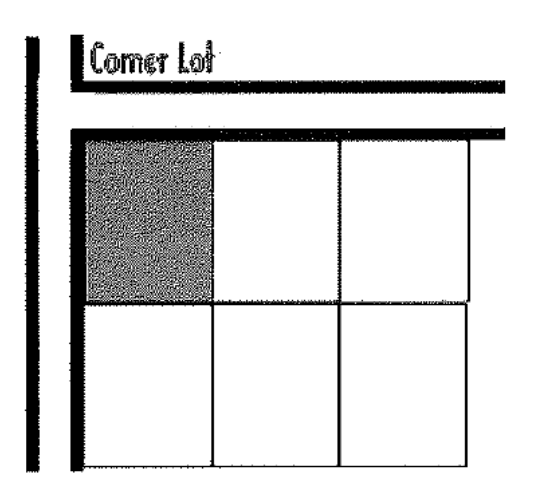
Interior Lot: A lot with only one frontage on a street.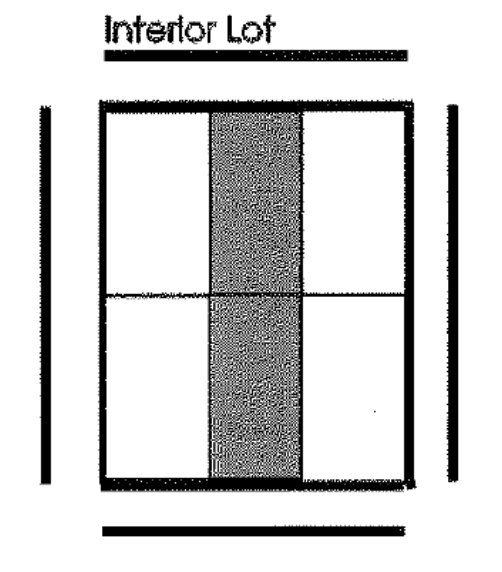
Reversed Frontage Lot: A lot on which frontage is at right angles to the general pattern in the area. A reversed frontage lot may also be a corner lot.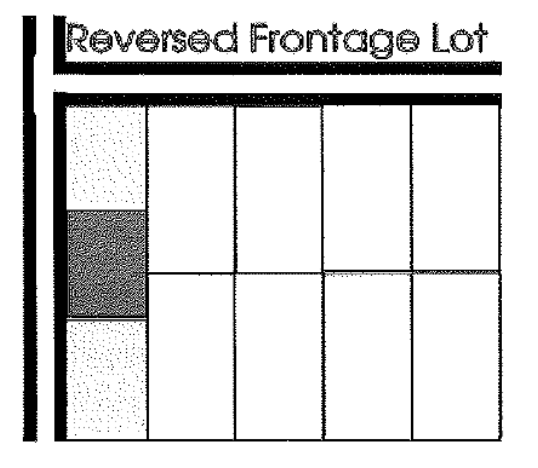
Through Lot: A lot other than a corner lot with frontage on more than one street. Through lots abutting two (2) streets may be referred to as double frontage lots.
LOT WIDTH: The horizontal distance between side lot lines measured at right angles to the depth at a point midway between the front and rear lot lines.
LOWEST FLOOR: The lowest floor, including the infrastructure attached underneath the floor, of the lowest area, including basement. An unfinished or flood resistant enclosure used solely for parking of vehicles, building access or storage in an area other than a basement area is not considered a building's lowest floor; provided, that such enclosure is not built so as to render the structure in violation of the applicable nonelevation design requirements of the Flood Hazard Overlay.
MAJOR ADDITION: Any extension or addition having a floor area of two hundred (200) square feet or greater to an existing building.
MANUFACTURED HOME: A detached single-family dwelling unit that has each of the following characteristics:
- The dwelling unit is multi-sectional and encloses a space of not less than one thousand (1,000) square feet.
- The dwelling unit has a pitched roof of a minimum slope of two feet (2') in height for each twelve feet (12') in width.
- The dwelling unit is placed upon an excavated and backfilled foundation and enclosed at the perimeter such that the home is not located more than twelve inches (12") above grade.
MEAN HIGH WATER MARK: The mark on all watercourses where the presence and action of waters is so common and continued in all ordinary years as to mark upon the soil a character, distinct from that of abutting upland, in respect to vegetation and destroy its value for agricultural purposes. In areas where riprap bank stabilization has occurred, the measurement shall begin on the landward side of such stabilization work.
MOBILE HOME: A detached single-family dwelling unit with all the following characteristics:
- Designed for long term occupancy and containing sleeping accommodations, a flush toilet, a tub or shower, bath and kitchen facilities with plumbing and electrical connections for attachments to outside systems.
- Designed to be transported after fabrication on its own wheels or on flatbed or other trailers or detachable wheels.
- Arriving at the site where it is to be occupied as a dwelling complete, including major appliances and furniture, and ready for occupancy except for minor and incidental unpacking and assembly operations, location of foundation supports, and connection to facilities.
- Does not meet the definition of a manufactured home in this section.
- Pre-1976 mobile homes that do not meet HUD/FHA construction standards must comply with State of Idaho improvement regulations before entering the City limits of New Meadows for placement and use.
MOBILE HOME PARK: A parcel of land under single ownership which is utilized for the placement of five (5) or more mobile homes or manufactured homes for dwelling or sleeping purposes.
MODULAR HOME: Any factory built housing designed primarily for residential occupancy by human beings which does not contain a permanent frame and must be mounted on a permanent foundation.
MOTEL: A building or group of buildings on the same premises, whether detached or in connected rows, containing sleeping or dwelling units independently accessible from the outside, with garage space or parking space located on the premises and designed for or occupied by travelers. The term includes, but is not limited to, any buildings or building groups designated as auto courts, motor lodges, tourist courts or any other title or sign intended to identify them as providing short term lodging to motorists.
MULTI-FAMILY DWELLING: A building containing two (2) or more dwelling units, including duplexes, triplexes, apartments, townhouses and condominiums.
MUNICIPAL USE: Uses for a public purpose by a governing agency.
NET AREA: The total usable area exclusive of space dedicated to such things as streets and easements.
NONCONFORMING LOT: A lot of record which lawfully existed at the effective date hereof, but which, because of the application of this title thereto, no longer conforms to lot area or width requirements prescribed in this title for the district in which it is situated.
NONCONFORMING USE: Any use lawfully occupying a building, structure or land at the effective date hereof, or of subsequent amendments hereto, which does not conform to the regulations for the district in which it is located.
NURSING HOME, CONVALESCENT HOME: A building housing any facility, however named, whether operated for profit or not, the purpose of which is to provide skilled nursing care and related medical services for two (2) or more individuals suffering from illness, disease, injury, deformity, or requiring care because of old age.
OFF STREET PARKING: An area adequate for parking an automobile with room for opening doors on both sides, together with properly related access to a public street or alley and maneuvering room, but shall be located totally outside of any street or alley right-of-way.
OPEN SPACE: Any open area free from structures, including, but not limited to, parks, yards, playgrounds, beaches, waterways, and streets.
OUTDOOR ADVERTISING DISPLAY: A freestanding structure of any kind or character erected or maintained for directing attention or for outdoor advertising purpose which exceeds two hundred fifty six (256) square feet of gross sign area.
OUTDOOR LIGHT FIXTURES: Shall include, but is not limited to, lighting for billboards, streetlights, shopping center parking area lights, externally or internally illuminated on site business advertising signs and area type lighting.
OUTPATIENT ANIMAL SERVICES: The examination, care, treatment and grooming of domestic animals, excluding livestock, within an outpatient facility, but does not include a purpose other than specified.
PARK MODEL: A prefabricated self-contained dwelling unit delivered on wheels, and built an a single chassis, has a gross square footage not exceeding four hundred (400) square feet in the set-up mode and is certified by it's manufacturer as complying with the American National Standards Institute (ANSI).
PARKING LOT: An open, graded and surfaced area, other than a street or public way, to be used for the storage, for limited periods of time, of operable passenger automobiles and commercial vehicles, and available to the public, whether for compensation, free, or as an accommodation to clients or customers.
PARKING SPACE: Usable space within a public or private parking area or a building, exclusive of access drives, aisles or ramps, for the storage of one passenger automobile or commercial vehicle. A standard space shall be a minimum of one hundred eighty (180) square feet or nine feet by twenty feet (9' x 20'), and a compact space shall be a minimum of one hundred twenty eight feet (128) or eight feet by sixteen feet (8' x 16'). Compact parking spaces shall use no more than twenty five percent (25%) of the total usable parking space within the public or private parking area or building.
PERMANENT FOUNDATION: A Permanent Foundation means a structure that is constructed of durable materials as defined by the International Building Code, that is designed or intended to:
A. Support a building from underneath;
B. Keep a building firmly affixed to the ground;
C. Prevent the building from moving; and
D. Not be removed from the ground or building.
PERSONAL SERVICE: Any enterprise conducted for pecuniary gain which offers services to the general public such as, but not limited to, shoe repair, watch repair, barbershops, beauty salons and spas, fitness and wellness facilities and similar activities.
PERSONAL WIRELESS SERVICE FACILITY (PWSF): A facility for the provision of personal wireless services, as defined by section 704 of the Telecommunications Act of 1996. A PWSF is any unstaffed facility for the transmission and/or reception of personal wireless services, usually consisting of an antenna array, transmission cables, equipment shelter and a mount.
PERSONAL WIRELESS SERVICES: Any personal wireless service defined in the Federal Communications Act which includes Federal Communications Commission (FCC) licensed commercial wireless telecommunications services. They include, without limitation, cellular, personal communications services (PCS), specialized mobile radio (SMR), enhanced specialized mobile radio (ESMR), paging as well as unlicensed wire services and common carrier wireless exchange access services.
PLANNED UNIT DEVELOPMENT: A project controlled by one owner, partnership, or corporation and characterized by an integrated site design for development of residential, commercial or industrial uses, or combination of such uses, in which one or more of the regulations of the district is waived or varied to allow flexibility and initiative in site and building design and location in accordance with an approved plan and imposed general requirements as specified in the planned unit development ordinance. A planned unit development may contain the development of compatible land uses arranged in such a way as to provide desirable living environments that may include private and common open spaces for recreation, circulation and aesthetics and/or the conversion of development of desirable amenities not possible by typical development standards and/or the creation of areas for multiple use that are of benefit to the neighborhood.
PLAT: A map or representation of a parcel, subdivision or division of land into lots, blocks, and roads to be filed as a public document.
PRINCIPAL USE: The specific purpose for which a lot is arranged, intended, designed, occupied or maintained.
PROFESSIONAL OFFICE: An office for the conduct of the following types of uses: accountant, architect, attorney, chiropractor, optometrist, engineer, surveyor, drafting service, designer, dentist, surgeon, and other similar activities.
PUBLIC NUISANCE: Any violation of the provisions of this title. Any violation of this title shall be subject to prevention or abatement in an action at equity to the same extent as are other public nuisances.
PUBLIC SERVICE FACILITY: A facility established for the protection and service to the welfare of the surrounding neighborhood including, but not limited to, police station, fire station, ambulance center or City administrative services.
PUBLIC USE: Use for a public purpose by a City, school district, County, State or any other public agency or public entity.
PUBLIC UTILITY FACILITY: A public utility facility involving construction of facilities of a complex nature, including, but not limited to, station houses or grounds, pumping stations, power substations, dam structures, telephone transmission stations, sewage disposal or storage stations, railroad transportation lines or spurs, railroad classification yards, high voltage or high pressure transmission lines, or structures principally used in interstate transmission of electricity, natural gas, or fuel.
RECORD GRADE: The natural grade existing prior to any site preparation, grading or filling unless a new record grade is approved at the time of subdivision approval and noted on the filed final plat.
RECREATIONAL VEHICLE: See definition of travel trailer.
RESEARCH AND DEVELOPMENT: Specialized nonpolluting activities with emphasis on investigation, experimentation, testing, engineering, inventing and conceptually designing prototypes and new technologies or associated light manufacturing. These technologies may include electronics, computer and data systems, medical and precision instruments, machine components, communications systems and equipment and other technological instruments, equipment and systems.
REST HOME, ELDERLY HOUSING: Rest homes and elderly housing complexes where medical care is not administered.
RESTAURANT: Any building or part thereof, other than a boarding house or bed and breakfast, where meals are provided for compensation, including, among others, such uses as cafe, cafeteria, coffee shop, lunchroom, tearoom and dining room.
RETAIL: The selling of goods to ultimate consumers for personal or household consumption.
RIGHT-OF-WAY, PRIVATE: Every way, lane, road, street and every way or place, not including private driveways serving only the owner of the property where situated, which is in private ownership inside the limits of the incorporated City, and is used, or subject to being used, for travel by the owner or owners or those persons having express or implied permission from the owner or owners, but not by other persons.
RIGHT-OF-WAY, PUBLIC: Every way, lane, road, street, and boulevard and every way or place in the City open or subject to being open, as a matter of right, to public vehicular travel inside the limits of the incorporated City.
RIPARIAN SETBACKS: The distance measured at right angles from the mean high water mark of a waterway between the mean high water mark and an imaginary line parallel to the mean high water mark, defining an area between such lines within which no building or other applicable structure may be placed, and whereby any existing vegetation shall remain undisturbed.
SCHOOL: An organization specializing in the instruction of students.
SCHOOL, ACADEMIC: An accredited school specializing in the instruction of students in kindergarten through twelfth grade.
SERVICE STATION: A place providing maintenance service, parts, and supplies for mechanical equipment and vehicles, and selling gasoline, diesel, oil and other supplies for motor vehicles including propane gas sales for retail only and not for wholesale.
SETBACK AREA: The space between the property lot line and a building roof's vertical drip line on a lot required to be left open and unoccupied by buildings or structures, either by the front, side or rear yard requirements of this title, or by delineation on a recorded subdivision map. 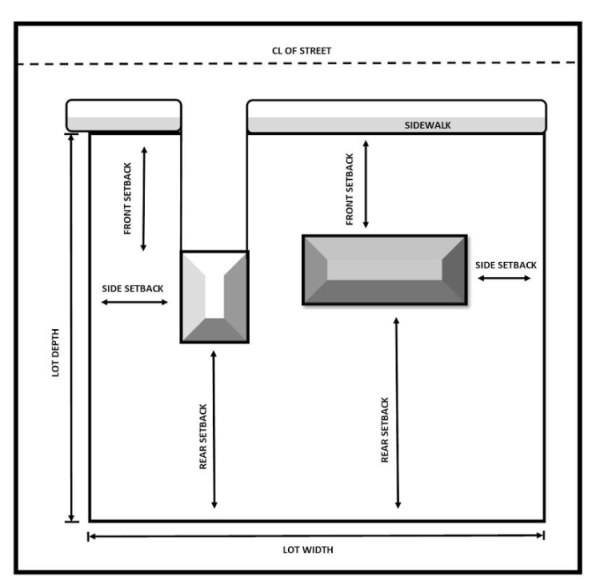
SHORT TERM OCCUPANCY: The rental or use of any unit or structure, or portion thereof, for a period of not more than thirty (30) days.
SIDEWALKS: Sidewalks shall be constructed of concrete with the proper base to ensure long life under severe temperature fluctuations and exposure to salt as specified in the latest edition of the Idaho Standards for Public Works Construction book of standards.
SIGHT OBSCURING: A year-round screen that blocks at least seventy five percent (75%) of the visibility between abutting structures or uses.
SIGN: Any structure or natural object, such as a tree, rock, bush, and the ground itself, or part thereof or device attached thereto or painted or represented thereon, which shall be used to attract attention to any object, product, place, activity, person, institution, organization or business, or which shall display or include any letter, word, model, banner, flag, pennant, insignia, device or representation used as, or which is in the nature of an announcement, direction or advertisement. For the purpose of this definition, the word "sign" does not include the flag, pennant or insignia of any nation, state, city or other political unit, or any political, educational, charitable, philanthropic, civic, professional, religious, or like campaign, drive, movement, or event.
SINGLE-FAMILY DWELLING: A detached building, including attached or detached carports and garages, containing living facilities including provisions for sleeping, eating, cooking and sanitation activities for not more than one family.
SOLAR ENERGY SYSTEMS: Any devices, structures or mechanisms which use solar radiation as an energy source for heating, cooling or electrical energy.
- Active: An indirect thermal system in which solar heat is collected and stored in devices separated from the building space to be conditioned using conventional energy systems (fans, pumps, etc.).
- Passive: The collection and storage of solar radiation for heating or cooling by nonmechanical means.
- A system that employs aspects of both active and passive designs.
SPECIALIZED MOBILE RADIO (SMR): A form of dispatch or two-way communication used by companies that rent space or time from an SMR carrier; used primarily for data, delivery vans, truckers or taxis within a small, definable geographic area.
STORY: That portion of a building included between the upper surface of any floor and the upper surface of the floor next above; except, that the topmost story shall be that portion of a building included between the upper surface of the topmost floor and the ceiling or roof above. If the finished floor elevation directly above a basement or cellar is more than six feet (6') above grade, such basement or cellar shall be considered a story.
STREAM ALTERATION: To obstruct, diminish, destroy, alter, modify, relocate or change the existing shape of the natural channel within or below the mean high water mark. The term includes removal of material or structures in the stream channel.
STREET: A public right-of-way which provides vehicular and pedestrian access to adjacent properties, acceptance or grant of which has been officially approved by the Council. The term "street" includes the terms highway, thoroughfare, road, avenue, boulevard, lane, place and other such terms.
STRUCTURE: Anything constructed or erected which requires permanent location on the ground or is attached to something having location on the ground.
SUBDIVISION: The division of land into lots, parcels, tracts, or sites for purposes of sale or lease, whether immediate or future, and shall include a redivision of land or future divisions.
TANK: A vessel capable of containing more than sixty (60) gallons.
TAVERN OR LOUNGE: A building where alcoholic beverages are sold for consumption on the premises not including restaurants where the principal business is serving food.
TEMPORARY PARKING: Parking not in excess of two (2) hours.
TINY HOME: A dwelling that is four hundred (400) square feet (37 m2) or less in floor area excluding lofts.
TOWNHOUSE DEVELOPMENT: A planned project of two (2) or more townhouse units constructed as a single building containing two (2) or more townhouse units. Each unit within the development shall be separated from the adjoining unit or units by fire walls as required by the International Building Code, as amended, each unit having its own access to the outside and no unit located over another unit in part or whole. All townhouse developments shall be platted under the procedures as contained in the subdivision title of this Code.
TOWNHOUSE SUBLOT: The lot resulting from platting a residential townhouse development.
TOWNHOUSE UNIT: One or more rooms, including a minimum of one bathroom, a single kitchen and sleeping facilities, designed for or occupied as a unit by one family for living and cooking purposes, located in a townhouse development on a platted townhouse sublot and meeting the efficiency dwelling unit standards established in the International Building Code, as amended.
TRAILER: Any vehicle designed to be towed or transported by another vehicle. The term "trailer" does not include mobile homes that exceed ten feet by fifty feet (10' x 50').
TRAILER PARK: A mobile home park (see definition of mobile home park).
TRAVEL TRAILER: A vehicle or structure constructed with or without wheels for use on the public highways which has sleeping, cooking and plumbing facilities, is intended for human occupancy, and is being used for recreational purposes. The term "travel trailer" does not apply to any prefabricated section of a factory built house to which wheels may be attached for the purpose of moving it to a permanent location where it becomes affixed to real property.
USABLE OPEN SPACE: An area not encumbered with any roadway, parking area, easement or substantial structure maintained for either informal or structured recreational uses.
USE: An activity or purpose for which land or premises or a building thereon is designed, arranged or intended or for which it is occupied or maintained, let or leased. Uses include, but are not limited to, residential, commercial, industrial and agricultural.
VARIANCE: A modification of the requirements of this title as to lot size, lot coverage, width, depth, front yard, side yard, rear yard, setbacks, parking space, height of buildings, or other provisions of this title affecting the size or shape of a structure, or the placement of the structure upon lots, or the size of lots. A variance shall not be considered a right or special privilege, but may be granted to an applicant only upon showing of undue hardship because of characteristics of the site and that the variance is not in conflict with the public interest. A variance shall not include a modification of allowed uses.
VEHICLE: Any apparatus designed or built to transport people, animals or inanimate objects, and generally, every device in, upon, or by which any person or property is or may be transported or drawn upon a highway, excepting devices used exclusively upon stationary rails or tracks.
VICINITY: The area surrounding a use in which such use produces a discernible influence by aesthetic appearance, traffic, noise, glare, smoke, or similar influences.
WIDTH: The measurement taken at right angles to the length which is the longer or longest dimension.
WIRELESS COMMUNICATIONS FACILITY (WCF): Those facilities that are nonpersonal wireless service facilities, by definition of the Telecommunications Act of 1996.
WRECKING YARD: See definition of automobile wrecking yard.
YARD: An open space on the same lot with a principal building or group of buildings, which is unoccupied and unobstructed from its lowest level upward, except as otherwise permitted in this title, and which extends along a lot line and at right angles thereto to a depth or width specified in the yard regulations for the district in which the lot is located.
YARD, FRONT: The yard extending across the face of the building where the main entrance is located, adjacent to the street.
YARD, REAR: The yard extending most nearly parallel to and most remote from the front yard.
YARD, SIDE: All yards not including the front and rear yard.
ZONING: The regulation of the use of private lands, or the manner of construction related thereto, in the interest of achieving a comprehensive plan of development. Such regulation shall also govern those public, quasi-public, and semipublic land uses and buildings which provide for the proprietary type service for the community's benefit as contrasted with governmental activities. Governmental activities are encouraged to cooperate under these regulations to secure harmonious development.
ZONING COMMISSION: The Planning and Zoning Commission (see definition of commission). (Ord. 313-08, 6-9-2008; amd. 2018 Code; Ord. 364-2019, 12-9-2019; Ord. 367-2020, 4-27-2020; Ord. 374-2021, 9-13-2021)

