
Newport City Zoning Code
ARTICLE I
- IN GENERAL
Sec. 36-1. - Rules of construction.
(a)
The language set forth in the text of this chapter shall be interpreted in accordance with the following rules of construction:
(1)
The term "lot" shall include the terms "plot," "piece" and "parcel."
(2)
The term "used for" shall include the phrases "arranged for," "designed for," "intended for," "maintained for" and "occupied for."
(Ord. No. 2026-02, § 3(Exh. A), 1-8-2026)
Sec. 36-2. - Purpose and intent.
(a)
The purpose and intent of this chapter shall be to:
(1)
Promote the general public health, safety, morals, comfort and general welfare of the inhabitants of the city;
(2)
Promote the character and preserve and enhance the stability of properties and areas within the city;
(3)
Divide the city into zones or districts as to the use, location, construction, reconstruction, alteration and use of land and structures for residence, business and industrial purposes;
(4)
Provide adequate light, air, privacy and safety;
(5)
Prevent the overcrowding of land, undue concentration of population;
(6)
Promote the proper use of land and structures;
(7)
Fix reasonable standards to which buildings, structures and land shall conform for the benefit of floor space than stores selling smaller items, as determined by the zoning administrator;
(8)
Prohibit the use of buildings, structures and lands that are incompatible with the intended use or development of lands within the specified zones;
(9)
Promote the safe, rapid and efficient movement of people and goods;
(10)
Facilitate the provision of public services;
(11)
Limit congestion in the public streets and protect the public health and welfare by providing for the off-street parking of vehicles and vehicle loading areas;
(12)
Protect against fire, explosion, panic, noxious fumes, offensive noise, vibration, dust, odor, heat, glare, other pollution and hazards in the interest of the public health, comfort and general welfare;
(13)
Define and limit the powers and duties of the administrative officers and bodies provided for;
(14)
Implement the comprehensive plan.
(Ord. No. 2026-02, § 3(Exh. A), 1-8-2026)
Sec. 36-3. - Scope, interpretation, etc.
(a)
Scope. From and after the effective date of the ordinance from which this chapter is derived, the use of all land and every building or portion of a building erected, altered with respect to height, area, or use, added to or relocated, and every use within a building or use accessory thereto, in the city shall be in conformity with the provisions of this chapter.
(b)
Interpretation. The provisions of this chapter should be the minimum requirements for the promotion of the public health, safety, morals, convenience and general welfare. Where the provisions of this chapter impose greater restrictions than those of any statute, code provision, other ordinance or regulation, the provisions of this chapter shall be controlling. Where the provisions of any statute, other code provision, ordinance or regulation impose greater restrictions than this chapter, the provisions of such statute, other code provision, ordinance or regulation shall be controlling.
(c)
Private agreements. This chapter shall not abrogate any easement, covenant, or any other private agreement where such is legally enforceable, provided that where the regulations of this chapter are more restrictive (or impose higher standards or requirements) than such easements, covenants, or other private agreements, the requirements of this chapter shall govern.
(Ord. No. 2026-02, § 3(Exh. A), 1-8-2026)
Sec. 36-4. - Relationship to existing city ordinances.
To the extent that the provisions of this chapter are the same in substance as the previously adopted provisions that they replace in the city's zoning, subdivision, or other land use control ordinances, they shall be considered as continuations thereof and not as new enactments unless otherwise specifically provided. In particular, a situation that did not constitute a lawful, nonconforming situation under the previously adopted zoning ordinance does not achieve lawful nonconforming status under this chapter merely by the repeal of the previous zoning ordinance and the adoption of a new ordinance.
(Ord. No. 2026-02, § 3(Exh. A), 1-8-2026)
Sec. 36-16. - Terms defined.
The following words, terms and phrases, when used in this chapter, shall have the meanings ascribed to them in this section, except where the context clearly indicates a different meaning:
Abandonment means to cease or discontinue a use or activity of a property for a period of 12 consecutive months or more unless otherwise specified.
Abut means to border upon a parcel of land and thereby share all or part of a common property line with another parcel of land.
Access path means an area designated to provide ingress and egress to public waters.
Accessory means a system designed as a secondary use to existing buildings or facilities, the power generated is used primarily for on-site consumption.
Accessory structure means any building or improvement subordinate to a principal structure or facility on the same lot as a principal structure, or part of the principal structure, exclusively by or devoted to a use incidental to the main use of the property.
Accessory use. See use, accessory.
Adjacent means having a boundary that physically touches or adjoins.
Adult use means those uses that are not open to the general public but exclude members of the public by means of age and in which there is an emphasis on the presentation, display, depiction, or description of specific sexual conduct or nudity as defined by M.S.A. §§ 617.241 and 617.292 or successor statutes. Adult uses can include sex shops, adult bookstores, adult theaters, adult massage parlors, cabarets, and other similar uses. Activities classified as obscene as defined by M.S.A. § 617.241 or its successor statutes are not lawful and are not included in the definition of adult uses.
Agricultural use means a use having the meaning given under M.S.A. § 40A.02.
Agriculture means the growing and marketing of fruits, vegetables, grains, trees, shrubs, flowers, or other plants, for commercial or private purposes, but not including the growing or raising of animals except as otherwise provided for by this Code.
Agritourism means a commercial or non-profit use on a working farm, plant nursery, or residential property in which the public or invited groups participate in educational activities such as classes or workshops, direct farm to consumer sales, and farm stays (a bed and breakfast use). All products sold must be grown or produced on the property. Events must be related to agriculture and incidental to the farm and residential use. No overnight camping is permitted with this use.
Airport means any area of land or water designated, set aside, used, or intended for use, for the landing and take-off of aircraft, and any appurtenant areas designated, set aside, used, or intended for use, for airport buildings or other airport facilities, rights-of-way, or approach zones, together with all airport buildings and facilities located thereon.
Alley means any dedicated public right-of-way providing a secondary means of access to abutting property.
Alternative design means subdivision design methods such as conservation design, transfer of development density, or similar zoning and site design techniques that protect open space and natural areas.
Alternative energy system means a ground source heat pump, wind or solar energy system.
Animal boarding means a fully enclosed building where domestic animals are cared for on a temporary basis.
Animal grooming means a place or establishment, where animals are bathed, clipped or combed for the purpose of enhancing their health or aesthetic value, typically for a fee.
Antenna means any structure, equipment or device used for collecting or radiating electromagnetic waves, telecommunication, microwave, television or radio signals, including, but not limited to, directional antennas, such as panels, microwave dishes and satellite dishes, and omnidirectional antennas, such as whips, or similar.
Applicant means any person who wishes to obtain a building permit, zoning, land use, or subdivision approval.
Artist studio means a workspace for one or more artists, artisans, or craftsperson, including persons engaged in the application, teaching, or performance of fine arts such as but not limited to drawing, vocal or instrumental music, painting, sculpture, and writing.
Asphalt-based sealer means a petroleum-based sealer material that is commonly used on driveways, parking lots, and other surfaces and which does not contain coal tar.
Assisted living facility means any facility licensed by the Minnesota Department of Human Services, public or private, which for financial gain or otherwise regularly provides one or more persons with 24 hour-per-day care, food, lodging, training, education, supervision, habilitation, rehabilitation, and treatment. Residential facilities may include, but are not limited to: state institutions under the control of the commissioner of human services, foster homes, halfway houses, residential treatment centers, group homes, continuing care retirement facilities, residential programs or schools for persons with disabilities including children.
Automobile salvage yard means a commercial use carried on outside of an enclosed building involving the dismantling or storage of vehicles or equipment, and any other lot used for wrecking or storing of inoperable motor vehicles or their parts.
Awning means a roof-like cover, often of fabric, plastic, metal or glass designed and intended for protection from the weather or as a decorative embellishment, and which projects from a wall or roof of a structure primarily over a window, walk or the like. Any part of an awning which also projects over a door shall be counted as an awning.
Bakeries, wholesale means an establishment that produces and sells flour based baked goods made in an oven in large quantities for sale to other businesses. A wholesale bakery may or may not have a retail storefront.
Banners and pennants mean attention-getting devices which resemble flags and are of a non-permanent paper, cloth, or plastic-like consistency.
Barge fleeting means temporarily parking and securing barges on the river, on or off channel, while tows are assembled or broken up.
Basement means any area of a structure, including crawl spaces, having its floor or base subgrade (below ground level) on all four sides, regardless of the depth of excavation below ground level.
Bed and breakfast means an owner-occupied residential structure used as a lodging establishment where a guest room or rooms are rented on a nightly basis and in which only the breakfast meal is included as a part of the price of lodging.
Berm means a landscaped mound of earth.
Billboard means a large outdoor advertising structure mounted on one or more legs and designed to display posters, composite graphics and/or electronic advertisements.
Biological and ecological functions means the functions of vegetation in stabilizing soils and slopes, retaining and filtering runoff, providing habitat, and recharging groundwater.
Block means a tract of land bounded by streets, or a combination of streets and public or private open space, cemeteries, railroad rights-of-way, shorelines, waterways, or city corporate limits.
Bluff means a topographic feature such as a hill, cliff, or embankment having the following characteristics:
(1)
Part or all of the feature is located in a shoreland area or the city's bluff-land area overlay district;
(2)
The slope rises at least 25 feet above the toe of bluff;
(3)
The grade of the slope from the toe of the bluff to a point 25 feet or more above the toe of the bluff averages 30 percent or greater, except that an area with an average slope of less than 18 percent over a distance of at least 50 feet shall not be considered part of the bluff; and
(4)
The slope must drain toward the water body if located in shoreland areas.
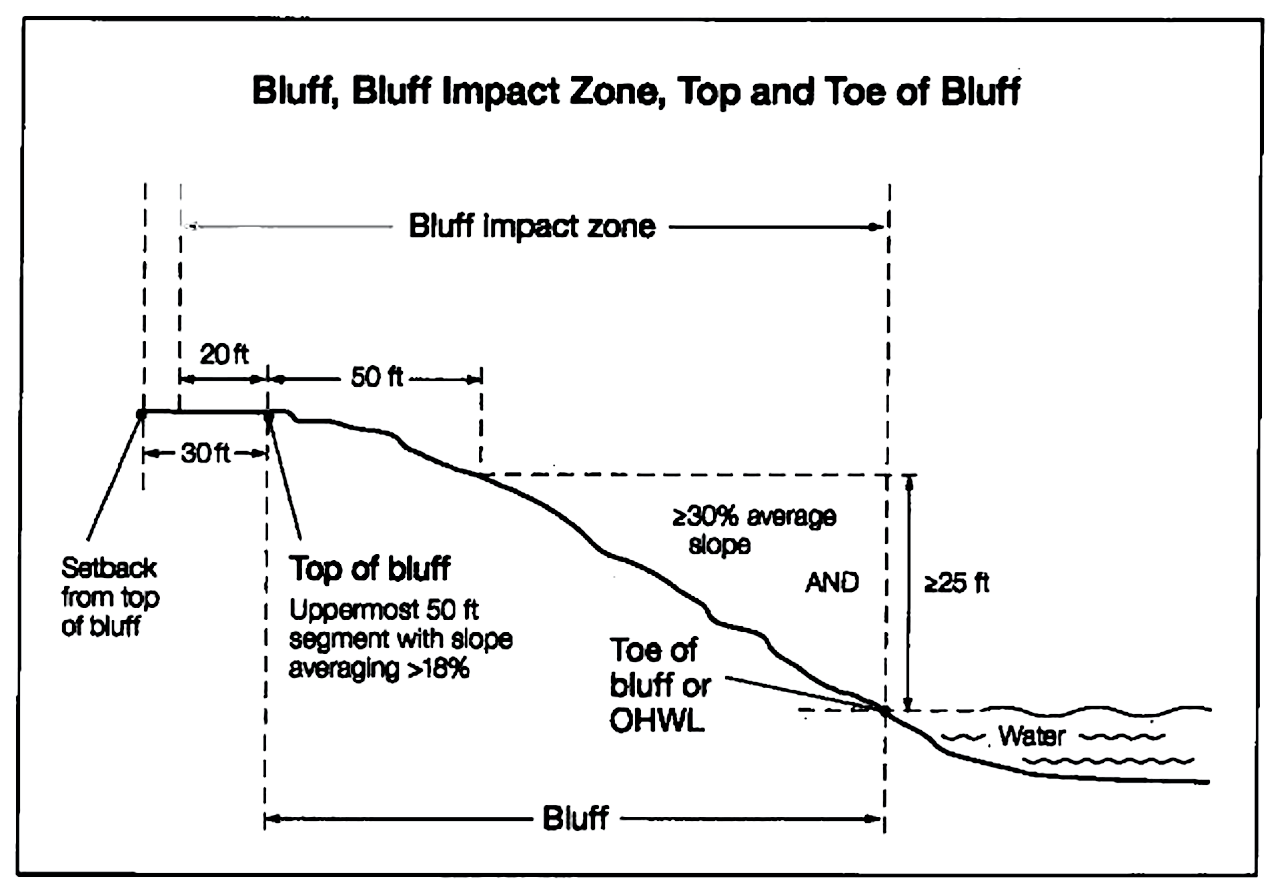
Bluff impact zone means a bluff and land located within 20 feet of the top of a bluff.
Bluff, toe of, means the lower point of a 50-foot segment with an average slope exceeding 18 percent or the ordinary high-water level, whichever is higher.
Bluff, top of, means the higher point of a 50-foot segment with an average slope exceeding 18 percent.
Bluffline means a line delineating the top of the bluff. More than one bluff-line may be encountered proceeding landward from the river. See figure 2 for natural escarpment or cliff example and figure 3 for more common bluff example.
Figure 2. [Natural Escarpment or Cliff]
![Figure 2. [Natural Escarpment or Cliff]](https://mcclibrary.blob.core.usgovcloudapi.net/codecontent/15425/461904/36-16b.png)
Figure 3. [Common Bluff]
![Figure 3. [Common Bluff]](https://mcclibrary.blob.core.usgovcloudapi.net/codecontent/15425/461904/36-16c.png)
Boathouse means a facility as defined by M.S.A. § 103G.245.
Brew-on-premises store means a retail business that sells the ingredients and equipment to customers to brew beer, other malt liquor or wine at the store for personal or family consumption.
Buffer means a vegetative feature as defined by M.S.A. § 103F.48.
Buildable area means the area upon which structures may be placed on a lot or parcel of land and excludes areas needed to meet requirements for setback, rights-of-way, bluff impact zones, significant historic sites, wetlands, designated floodways, land below the ordinary high water level of public waters, and other unbuildable areas.
Building means a structure with two or more outside rigid walls and a fully secured roof and affixed to a permanent site. When separated by dividing walls without openings, each portion of such a structure shall be deemed a separate building.
Building, accessory, means a subordinate building or structure on the same lot as a principal building, or part of the principal building, exclusively occupied by or devoted to a use incidental to the main use of the property.
Building height, unless otherwise specifically noted in this chapter, means the vertical distance measured from the average elevation of the finished grade adjacent to a building to:
(1)
The highest point on a building with a flat roof;
(2)
The deck line of a mansard type roof; or
(3)
The average height between the eaves and the peak of the highest gable of a pitched, hip, or gambrel roof.
For purposes of calculating building height, the finished grade shall be the highest point within five feet of the front of a building or, if the lowest grade within five feet of any side of the building is more than ten feet lower than the front, then the finished grade from which the height is measured shall be considered ten feet above the lowest grade.
Building line means a line parallel to a lot line or the ordinary high-water level at the required setback beyond which a structure may not extend.
Building materials and services means an establishment where building materials commonly used in construction are organized and stored for use off site with no on-site sales. This use may have operations similar to a contracting office.
Building, principal, means a building or structure occupied by or devoted to the principal or main use of the property.
Cannabis business means a business licensed by the office of cannabis management (OCM) as a cannabis business as defined by M.S.A. § 342.01.
Cannabis cultivation means a cannabis business that conducts an operation pursuant to M.S.A. § 342.30, as it may be amended.
Cannabis delivery means a cannabis business that conducts an operation pursuant to M.S.A. § 342.42, as it may be amended.
Cannabis event means a temporary cannabis event lasting no more than four days operating pursuant to M.S.A. § 342.39, as it may be amended.
Cannabis manufacturing means a cannabis business that conducts an operation pursuant to M.S.A. § 342.31, as it may be amended.
Cannabis, mezzobusiness means a cannabis business that conducts an operation pursuant to M.S.A. § 342.29, as it may be amended.
Cannabis, microbusiness means a cannabis business that conducts an operation pursuant to M.S.A. § 342.28, as it may be amended.
Cannabis sales means the sale of cannabis plants and seedlings, adult-use cannabis flower, and adult use cannabis products directly to consumers pursuant to M.S.A. § 342.27.
Cannabis testing facility means a cannabis business that conducts and operation pursuant to M.S.A. § 342.37, as it may be amended.
Canopy or marquee means any roof-like structure extending out from the side of a building.
Cemetery means property or a structure used for the interment of human or animal remains including mausoleums.
Certificate of compliance means a document written after a compliance inspection, certifying that the development complies with applicable requirements at the time of the inspection.
Cluster development means a development planned and constructed to group housing units into relatively tight patterns while providing a unified network of open space and wooded areas and meeting the overall density regulations of this chapter and the comprehensive plan.
Coal tar means a byproduct of the process used to refine coal.
Coal tar-based sealer means a sealer material containing coal tar that has not been mixed with asphalt and which is commonly used on driveways, parking lots and other surfaces.
Cold storage means the storing or keeping of articles of food in a cold storage warehouse or in any refrigerated space leased for public use other than an individual locker.
Commercial greenhouse operation means retail business whose principal activity is the selling of plants grown on the site and having outside storage, growing, or display.
Commercial vehicle means any self-propelled or towed motor vehicle used primarily in commerce to transport passengers or materials, often displaying company signage, company logos, commercial equipment, fixtures, or tools.
(1)
Class I. Commercial vehicles not exceeding the following:
a.
A gross vehicle weight rating (GVWR) of 14,000 pounds;
b.
A length of 20 feet.
(2)
Class II. Any semi-truck, tractor, trailer, and all other commercial vehicles not included as a Class I commercial vehicle.
Commissioner, DNR, means the commissioner of the Minnesota Department of Natural Resources.
Common property means any open space or structure including parks, nature areas, playgrounds, trails and recreational buildings and structures, which is an integral part of a development and is not owned on an individual basis by each owner of the dwelling unit.
Community garden means land which is cultivated by members of the community for the production of trees, vegetables, fruits, flowers, herbs and grasses not intended for commercial sale.
Comprehensive plan means a compilation of policy statements, goals, standards and maps adopted by the city to guide the physical, social and economic development, both private and public, of the city and its environs. A comprehensive plan shall represent the recommendations of the planning commission and city council for the future development of the community.
Conditional use means a use having the meaning given under M.S.A. ch. 462 or its successor statute.
Conference center means a facility used for service organizations, business and professional conferences, and seminars limited to accommodation for conference attendees. The accommodation can include eating and recreation.
Conservation design means a pattern of subdivision that is characterized by grouping lots within a portion of a parcel, where the remaining portion of the parcel is permanently protected as open space.
Conservation easement means an interest in real property created in a manner that imposes limitations or affirmative obligations in regard to the use of property including the retention, protection and maintenance of natural resource and open space.
Conservation residential subdivision means a grouping of residential structures on smaller lots than allowed in the RE zoning district, leaving some land dedicated as open space for the protection of ecologically significant areas, natural landscapes, scenic attributes, open space and cultural features.
Contracting offices means a land use which primarily includes administration of a contracting business which performs all work off site with no storage of heavy equipment. This use may include showroom areas or areas with interior storage for equipment or materials commonly used in daily operations.
Controlled access lot means a lot used to access public waters or as a recreation area for owners of non-riparian lots within the same subdivision containing the controlled access lot.
Conventional subdivision means a pattern of subdivision that is characterized by lots that are spread regularly throughout a parcel in a lot and block design.
Corner lot. See lot, corner.
Country club means a club with recreation facilities for members, their families, and invited guests.
Covered storage building means a temporary enclosure that is a moveable tent-like shelter that is typically constructed with wooden or metal framework and covered with a tarpaulin of plastic or canvas like material. These structures are most typically used for sheltering vehicles, RVs, or other materials stored outside residential neighborhoods.
Craft brewery means a facility with a capacity to manufacture 20,000 or fewer barrels of alcoholic and nonalcoholic malt liquor a year in compliance with M.S.A. § 340A.301 or its successor statutes. The term "craft brewery" excludes small breweries operated in conjunction with a bar or restaurant defined as an accessory use.
Craft distillery or microdistillery means a distillery producing premium, distilled spirits not exceeding 40,000 proof gallons in a calendar year as defined in M.S.A. §§ 340A.101 and 340A.201.
Craft winery means a facility that manufactures wine, as defined by M.S.A. § 340A.301, with a capacity of 620,000 or fewer gallons per year.
Crematorium means a location and related equipment where dead bodies, either human or animal, can be reduced to ashes. Also includes resomation facilities.
Crown cover means the ratio between the amount of land shaded by the vertical protection of the branches and foliage area of standing trees to the total area of land, usually expressed as a percentage.
Cultural resource means the historic and archeological characteristics of the land, including buildings and landscapes, which provide information regarding the history of the city and its people.
Data center means a building or tenant space with at least 50 percent of the floor area dedicated to the housing of networked computers, storage systems and computing infrastructure and associated components.
Day care means any facility, public or private, licensed by the state or the county, in which care, training, supervision, habilitation or developmental guidance for children is provided on a regular basis and for periods less than 24 hours per day.
Deck means a horizontal, unenclosed platform with or without attached railings, seats, trellises, or other features, attached or functionally related to a principal use or site and typically extending more than three feet above ground.
Density means a measure of the intensity of residential use on the land, expressed in terms of lot area per dwelling unit or dwelling units per acre. For such calculations, the land area shall be exclusive of water area and floodplain but may include protected wetlands and hydric soils.
Density bonus means an increase in the density of housing units over the otherwise maximum allowable residential density in a zoning district that is specified in the zoning ordinance.
Developer means a person or group having the meaning given under M.S.A. § 116G.03.
Development has the meaning given under M.S.A. § 116G.03.
Dimensional requirement means minimum and maximum setbacks, yard requirements, or structure height or size restriction as set in this chapter for the underlying zoning district.
Discretionary action means an action under this division related to land use that requires a public hearing by local ordinance or statute, such as preliminary plats, final subdivision plats, planned unit developments, conditional use permits, interim use permits, variances, appeals, and rezonings.
Dock has the meaning given under Minn. R. ch. 6115.
Driveway means a private road or path which is wholly located on the lot which it services and which affords vehicle access to a public road.
Drive through or drive-up facility means an establishment that, by design of physical facilities or by service or packaging procedures, encourages or permits customers to receive a service or obtain a product while inside their motor vehicle.
Dual purpose pond, stormwater means a detention facility without a permanent pool that functions as both a stormwater ponding basin and as a sedimentation basin. Sediment removal is accomplished through the use of filter media surrounding a slotted outlet pipe, with an overflow outlet set at an elevation that provides for minimum required run off volume and sediment storage.
Duplex. See dwelling, two-family.
Dwelling means a structure designed and used exclusively for residential purposes for the occupancy of a family.
Dwelling, attached (group, row or townhouse), means a dwelling joined to one or more other dwellings by a party wall.
Dwelling, detached, means a dwelling entirely surrounded by open space, and not attached or connected structurally to any other dwelling.
Dwelling, multiple family (or multi-family), means a dwelling containing three or more dwelling units, whether a townhouse, apartment, condominium, or other type of dwelling.
Dwelling, single-family, means a detached dwelling designed exclusively for occupancy by one family only.
Dwelling, two-family, means a dwelling designed with two dwelling units, exclusively for occupancy by two families living independently of each other.
Dwelling unit means one or more rooms in a dwelling designed for occupancy by one family for living purposes and having separate permanently installed cooking and sanitary facilities.
Electric power facilities mean equipment and associated facilities for generating electric power or devices for converting wind energy to electrical energy as identified and defined under M.S.A. ch. 216E.
Electronic message sign means displays, devices or portions thereof with lighted messages that change at intervals by electronic process or remove control. Also known as an automatic changeable copy sign, dynamic display message sign, electronic variable message center, electronic dynamic business sign, or video display sign. Electronic message signs are not identified as flashing or motion signs.
Erosion means the general process by which soils are removed by flowing surface or sub-surface water or wind.
Erosion control measure means a practice or combination of practices to control erosion and attendant pollution.
Essential services mean underground or overhead gas, electrical, communications steam, or water distribution, collection, supply, or disposal systems, including storm water. Essential services include poles, wires, mains, drains, pipes, conduits, cables, fire alarm boxes, traffic signals, hydrants, navigational structures, aviation safety facilities, or other similar equipment and accessories in conjunction with the systems. "Essential services" does not include buildings, treatment works as defined in M.S.A. § 115.01, or electric power facilities, or transmission services.
Equal degree of encroachment means a method of determining the location of floodway boundaries so that floodplain lands on both sides of a stream are capable of conveying a proportionate share of flood flows.
Excavation means the removal, relocation, or recovery by any means of soil, rock, minerals, debris, or organic substances other than vegetation form a parcel of land.
Exterior storage means the storage of goods, materials, equipment, vehicles, manufactured products, and similar items not fully enclosed by a building.
Extractive use means the use of land for surface or subsurface removal of sand, gravel, rock, industrial minerals, other nonmetallic minerals, and peat not regulated under M.S.A. §§ 93.44 to 93.51.
Fabrication and manufacturing means an establishment engaged in manufacturing, assembly, fabrication, packaging or other industrial processing of products primarily from extracted or raw materials or the bulk storage and handling of such products and materials, or an industrial establishment having potential to produce noise, dust, glare, odors or vibration beyond its property line.
Fabrication and manufacturing, small scale, of consumer goods means uses engaged in the manufacturing, processing, fabrication, packaging, assembly, and the like of finished or semifinished products from previously prepared materials, which activities are conducted wholly within an enclosed building, sold directly to the consumer.
Family means any number of individuals related by blood, legal adoption or marriage, or six or less unrelated individuals living together in a single housekeeping unit, as distinguished from a group occupying a boarding house, lodging house, licensed residential care facility, or hotel as described.
Feedlot has the meaning given for animal feedlots under Minn. R. ch. 7020.
Fence means a partition, structure, wall or gate erected as a diving marker, visual or physical barrier, or enclosure.
Fill means sand, gravel, earth or other materials deposited on, moved onto, or placed on a parcel of land.
Filling means the placement of fill on a parcel of land.
Financial services means an establishment providing financial and banking services to consumers or clients. Walk-in and drive-in services are generally provided on site. Typical uses include banks, savings and loan associations, savings banks, credit unions, lending establishments, and drive-up automatic teller machines (ATMs).
Fitness center means an establishment that provides exercise facilities such as running, jogging, aerobics, weightlifting, court sports, and swimming, as well as locker rooms, showers, massage rooms, saunas and related accessory uses.
Flag means any fabric or similar lightweight material attached at one end of the material, usually to a staff or pole, so as to allow movement of the material by atmospheric changes and which contains distinctive colors, patterns, symbols, emblems, insignia, or other symbolic devices.
Flood means a temporary increase in the flow or stage of a stream or in the stage of a wetland or lake that results in the inundation of normally dry areas.
Flood frequency means the frequency for which it is expected that a specific flood stage or discharge may be equaled or exceeded.
Flood fringe means that portion of the floodplain outside of the floodway. The term "flood fringe" is synonymous with the term "floodway fringe" used in the Flood Insurance Study for Washington County, Minnesota and Incorporated Areas.
Floodplain means the beds proper and the areas adjoining a wetland, lake or watercourse, which have been or hereafter may be covered by the regional flood (the critical 100-year storm). Or as may defined by a FEMA approved FIRM.
Floodproofing means a combination of structural provisions, changes, or adjustments to properties and structures subject to flooding, primarily for the reduction or elimination of flood damages.
Floodway means the bed of a wetland or lake and the channel of a watercourse and those portions of the adjoining floodplain which are reasonably required to carry or store the regional flood discharge.
Floor area means the sum of the gross horizontal areas of the several floors of a building, measured from the exterior faces of the exterior walls, or for a structure without walls (e.g., a carport), the total ground area covered by roof, not including area under a typical overhang dimension.
Floor area, livable, means the floor area of a dwelling excluding all areas occupied by basements, garages, porches, attics, stairways, storage, utility and heating rooms.
Floor area ratio (FAR) means the floor area of the building or buildings on a zoning lot divided by the area of such zoning lot, or, in the case of planned unit developments, by the net size area. The floor area ratio requirements shall determine the maximum floor area allowable for the building or buildings, including both principal and accessory buildings, in direct ratio to the gross area of the zoning lot.
Food catering means a service that prepares food for service under contract for an event such as a party, reception, luncheon, conference, ceremony, or trade show.
Footcandle means a standard unit of illumination intensity.
Frequency means the oscillations per second in a sound wave.
Frontage means that part of a lot fronting on one side of a street between the side lot lines or between a street right-of-way and a side lot line.
Funeral home means an establishment where the dead are prepared for burial or cremation and where wakes and funerals may be held. "Funeral home" includes mortuaries or morgues but does not include crematories, columbaria, cemeteries or mausoleums.
Garage, private, means an accessory building designed or used for the storage of motor-driven vehicles owned and used by the occupants of the dwelling unit to which it is accessory.
Garage, public, means any building, except a private garage, used for the storage or care of motor-driven vehicles, or a building where any such vehicles are equipped for operation, are repaired, or are kept for remuneration, hire, or sale.
Garage, truck, means a building used or intended to be used for the storage of motor trucks, truck trailers, tractors, and commercial vehicles exceeding one and one-half tons capacity.
Gas, diesel or other motor fuel retail sales means any place of business with fuel pumps and underground storage tanks that provide fuels and oil for motor vehicles. A neighborhood convenience store associated with automobile fuel sales shall be considered a gasoline station.
Golf course means a tract of land for playing golf, improved with tees, greens, fairways, hazards, and which may include clubhouses and shelters. Included would be executive or par three golf courses. Specifically excluded are independent driving ranges or miniature golf facilities, which are classified as outdoor recreation facilities.
Governmental agency training facility means an establishment for training state and local law enforcement, fire safety, national guard, or transit personnel and accessory facilities including but not limited to:
(1)
Dining and overnight accommodations;
(2)
Classrooms;
(3)
Indoor shooting ranges;
(4)
Auto test tracks; and
(5)
Fire suppression simulations.
Grade means the lowest point of elevation of the finished surface of the ground, paving, or sidewalk within the area between the building and the property line or, when the property line is more than five feet from the building, between the building and a line five feet from the building.
Grade, street, means the established elevation of the street in front of the building measured at the center of such front. Where no street grade has been established, the city engineer shall establish such street grade or its equivalent for the purpose of this chapter.
Guest cottage means a structure on a riparian lot in the shoreland overlay used as a dwelling unit that may contain sleeping spaces and kitchen and bathroom facilities in addition to those provided in the primary dwelling unit on a lot.
Hard-surface trail means a trail surfaced in asphalt, crushed aggregate, or other hard surface, for multi-purpose use, as determined by local, regional, or state agency plans.
Heat pump system, closed loop ground source means a system that circulates a heat transfer fluid, typically food-grade antifreeze, through pipes or coils buried beneath the land surface or anchored to the bottom in a body of water.
Heat pump system, ground source means a heat pump system that uses the relatively constant temperature of the earth or a body of water to provide heating in the winter and cooling in the summer. System components include open or closed loops of pipe, coils or plates; a fluid that absorbs and transfers heat; and a heat pump unit that processes heat for use or disperses heat for cooling; and an air distribution system.
Heat pump system, heat transfer fluid means a non-toxic and food-grade fluid such as potable water, aqueous solutions of propylene glycol not to exceed 20 percent by weight or aqueous solutions of potassium acetate not to exceed 20 percent by weight.
Heat pump system, horizontal ground source means a closed loop ground source heat pump system where the loops or coils are installed horizontally in a trench or series of trenches no more than 20 feet below the land surface.
Heat pump system, open loop ground source means a heat pump system that uses groundwater as a heat transfer fluid by drawing groundwater from a well to a heat pump and then discharging the water over land, directly in a water body or into an injection well.
Heat pump system, vertical ground source means a closed loop ground source heat pump system where the loops or coils are installed vertically in one or more borings below the land surface.
Heavy equipment means self-propelled, self-powered or pull-type equipment and machinery, including engines, weighing 5,000 pounds or more, primarily employed for construction, industrial, maritime, mining, forestry, or other similar uses.
Hemp business means a business licensed by the Office of Cannabis Management (OCM) as a hemp business as defined by M.S.A. § 342.01.
Home occupation means any gainful occupation or profession clearly secondary to the main use of the dwelling as a residence, which is conducted entirely within the dwelling, and which meets the requirements of this Code.
Homeowners' association means a formally constituted non-profit association or corporation made up of the property owners or residents of the development for the purpose of owning, operating and maintaining common open space and facilities.
Horticulture means the use of land for the growing or production for income, of fruits, vegetables, flowers, nursery stock, and trees, including forestry, ornamental plants and trees, and cultured sod.
Hospital means an institution for the reception and care of five or more sick or injured persons for a continuous period longer than 24 hours for the purpose of diagnosis or treatment bearing on the physical or mental health of such persons and where emergency medical services are offered 24 hours a day, seven days a week.
Hotel or motel means any building containing six or more guest rooms intended or designed to be used or which are used, rented or hired out to be occupied or which are occupied for sleeping purposes by guests.
Hydric soil means soils that are saturated, flooded, or ponded long enough during the growing season to develop anaerobic conditions in the upper part.
Hydrophytic vegetation means macrophytic plant life growing in water, soil or on a substrate that is at least periodically deficient in oxygen as a result of excessive water content.
Impervious surface means a constructed hard surface that prevents or retards entry of water into the soil and causes water to run off the surface in greater quantities and at an increased rate of flow than prior to development, including: rooftops; decks; sidewalks; patios; swimming pools; parking lots; concrete, asphalt, or gravel driveways; and other similar surfaces. Exception: decks allowing water to permeate through decking shall not be considered as an impervious surface when calculating lot coverage percentage.
Indoor recreation/entertainment means establishments primarily engaged in activities intended to provide personal amusement, with the largest number of patrons typically during the evening hours or on weekends, and where food and refreshments may be provided as an incidental service, including such uses as bowling alleys, bingo parlors, amusement arcades, and indoor skating rinks.
Intensive vegetation clearing means the removal of all or a majority of the trees or shrubs in a contiguous patch, strip, row, or block.
Interim use has the meaning given under M.S.A. § 462.
Intermodal container, freight container or shipping container means a reusable transport and storage unit for moving products and raw materials between locations or countries. A typical container has doors fitted at one end and is constructed of corrugated weathering steel.
Internet publishing and broadcasting means establishments within one structure primarily engaged in the provision of broadcasting and other information relay services accomplished through the use of electronic and telephone mechanisms. Excluded from this use type are facilities classified as essential services or broadcasting and communications towers. Typical uses include television studios, telecommunications service centers or film and sound recording facilities.
Junkyard means land or buildings where waste, discarded or salvaged materials are bought, sold, stored, exchanged, cleaned, packed, disassembled or handled on a commercial basis, including, but not limited to, scrap metal, rags, paper, hides, rubber products, glass products, lumber products and products resulting from the wrecking of automobiles or other vehicles.
Kennel (commercial or hobby) means any structure or premises on which four or more domestic animals over six months of age are kept.
Land alteration means an activity that exposes the soil or changes the topography, drainage, or cross section of the land, excluding gardening or similar minor soil disturbances.
Land disturbing or development activities means any change of the land surface including removing vegetative cover, excavating, filling, grading, and the construction of any structure or improvement.
Legally established nonconforming sign means a sign and its support structure lawfully erected prior to the effective date of the ordinance from which this article is derived which fails to conform to the requirements of this chapter. A sign which was erected in accordance with a variance granted prior to the adoption of this chapter and which does not comply with this chapter shall be deemed to be a legal nonconforming sign. A sign which was unlawfully erected shall be deemed to be an illegal sign.
Live-work unit means a dwelling unit that is designed to accommodate work facilities for those living in the unit.
Loading space or loading area means that portion of a lot or plot designed to serve the purpose of loading or unloading all types of vehicles.
Local government means counties, cities, and townships.
Lot means a parcel of land designated by plat, metes and bounds, registered land survey, auditors plot, or other accepted means and separated from other parcels or portions by said description for the purpose of sale, development, lease, transfer of ownership, or separation.
Lot area means the total surface area of a lot within the lot lines, excluding public right-of-way or street easements.
Lot, corner, means a lot bordered by a public right-of-way containing a public street or planned for a public street on at least two adjacent sides. The zoning administrator can determine which frontage is considered the front yard on a corner lot.
Lot coverage means the area of a lot occupied by impervious material, including, but not limited to, buildings, paved surfaces, and driveways.
Lot depth means the mean horizontal distance between the center points of the front and rear lot lines for standard lots. For lots of non-standard shape, the zoning administrator shall determine the lot depth.
Lot, double frontage, means a lot having frontage on two streets which do not intersect at a corner of the lot.
Lot, interior, means a lot other than a corner lot.
Lot line, front, means the boundary of a lot abutting a street easement or right-of-way. On a corner lot, the shortest street lot line shall be considered the front lot line. The zoning administrator shall determine the front lot line where clarification is required.
Lot line, rear, means the lot line or lot lines most nearly parallel to and furthest from the front lot line.
Lot of record means any lot for which a deed, registered land survey, or other legal record was recorded in the office of the register of deeds or the register of titles for Washington County, Minnesota, prior to August 7, 1964, and which contains identical lot dimensions as were present on that date.
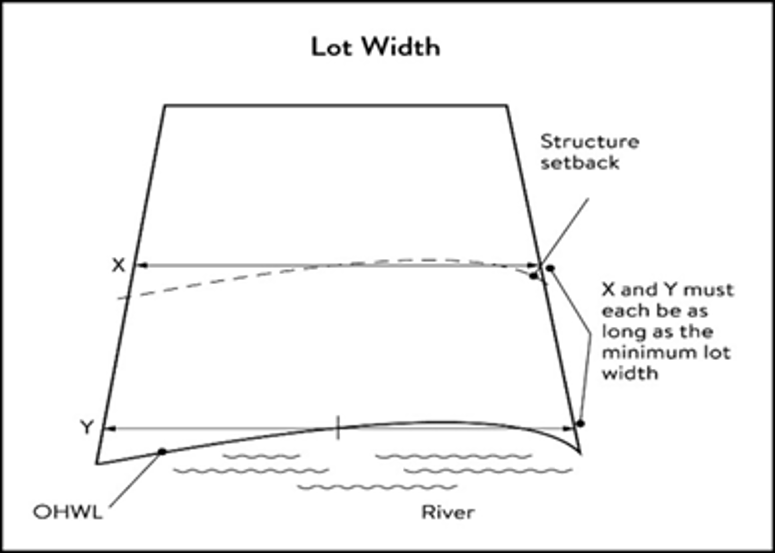
Lot width means the minimum horizontal distance between:
(1)
Side lot lines measured at right angles to the lot depth at the established front building setback line; and
(2)
Side lot lines at the ordinary high-water level, if applicable.
Lower-potency hemp edible manufacturing means a hemp business that conducts an operation pursuant to M.S.A. § 342.45, as it may be amended.
Lower-potency hemp edible sales means a hemp business that conducts an operation pursuant to M.S.A. § 342.46, as it may be amended.
Lowest floor means the lowest floor of the lowest enclosed area (including basement). An unfinished or flood resistant enclosure, used solely for parking of vehicles, building access, or storage in an area other than a basement area, is not considered a building's lowest floor.
Manufactured single-family dwelling means a structure, not affixed to or part of real estate, transportable in one or more sections, which in a traveling mode is eight body feet or more in width, or 40 body feet, or more in length, or, when erected on site, is 320 or more square feet, and which is built on a permanent chassis and designed to be used as a single-family dwelling with a permanent foundation when connected to required utilities, and includes the plumbing, heating, air conditioning, and electrical systems contained in it, except for accessory manufactured single-family dwellings and temporary manufactured single-family dwellings, as defined in this chapter. The term "manufactured single-family dwelling" shall not be construed to be a travel trailer or other form of recreational vehicle.
Marina has the meaning given under Minn. R. ch. 6115.
Medical or dental clinic means an establishment principally engaged in providing therapeutic, preventive, corrective, healing, and health-related treatment services on an outpatient basis by licensed medical, dental, chiropractic, or other similarly licensed health care practitioners. Typical uses include medical offices, dental offices, chiropractic clinics, and similar outpatient health care facilities.
Medical or dental laboratory means a laboratory where tests are done on clinical specimens to get information about the health of a patient, or where work is done on prosthetics.
Membership organization facilities means permanent, headquarters-type, and meeting facilities for organizations operating on a membership basis for the promotion of the interests of the members, including facilities for: business associations; civic, social, and fraternal organizations; labor unions and similar organizations; political organizations; professional membership organizations; other membership organizations.
Micro- and regional brewery means a facility with a capacity to manufacture 1,000,000 or fewer barrels of alcoholic and nonalcoholic malt liquor a year. The term "micro- and regional brewery" excludes brew on premises stores as defined in this chapter, or small breweries operated in conjunction with a bar or restaurant defined as an accessory use.
Mini-storage means a facility where rooms or lockers are rented to tenants, usually on a monthly basis, in which tenants can store and access their goods. The rented spaces are usually secured by the tenant's own lock and key. Unlike in a warehouse, self-storage facility employees do not have casual access to the contents of the space.
Mississippi River Corridor Critical Area (MRCCA) means the area within the river corridor boundary (see river corridor boundary).
Mississippi River Corridor Critical Area (MRCCA) Plan means a chapter or other element in the city's comprehensive plan.
Mixed use (or mixed-use) means dwelling unit(s) above ground floor commercial or other use(s).
Mobile home means a manufactured home that is less than 20 feet wide over at least 30 feet of its length in the erected mode, suitable for year-round occupancy and containing the same water supply, waste disposal and electrical conveniences as stationary housing; and subject to tax or registration under state law, and having no foundation other than wheels, jacks or skirtings. Overhangs and other projections beyond the principal exterior walls shall not be included in determining the width measurement. The term "mobile home" shall not include a recreational vehicle.
Mobile home park means a parcel of land under single ownership which has been planned and improved for the placement of mobile homes for non-transient use.
Modular manufactured or prefabricated home means a non-mobile housing unit that is entirely or mostly fabricated off site and transported to a building site where final installations are made, permanently affixing the module to the site. The term "modular manufactured or pre-fabricated home" shall be considered the same as a single-family dwelling under the standards in this Code, provided it meets the standards for floor area and other minimum standards.
Monopole tower means a tower constructed of tapered tubes that fit together symmetrically and are stacked one section on top of another and bolted to a concrete foundation without support cables.
Mooring facility has the meaning given under Minnesota Rules, chapter 6115.0170.
Motorcycle means all two or three wheeled motorized vehicles. Typical vehicles in this category have saddle type seats and are steered by handlebars rather than steering wheels. This category includes motorcycles, motor scooters, mopeds, and three wheel motorcycles which are subject to state insurance and licensing requirements.
Motion picture and sound recording means land, buildings, or structures used as a media production facility. Typically, structures involved in or with the production of (but not limited to): motion pictures; radio and television shows or movies; recording or broadcasting facilities; and other motion picture production and distribution service offices.
Motor vehicle means any self-propelled vehicle not operated exclusively on railroad tracks, and any vehicle propelled or drawn by a self-propelled vehicle, including, but not limited to, cars, trucks, buses, motorcycles, campers, recreational vehicles, and trailers.
Motor vehicle body work means repair or straightening of an automobile body, frame, or fender, including painting.
Motor vehicle repair, major, means repairs, replacement of parts, and motor service to automobiles, including body work or painting.
Motor vehicle repair, minor, means repairs, replacement of parts, and motor service to automobiles, not including body work or painting.
Motor vehicle sales—Single licensed dealer means the sale or trade of new or used motor vehicles, whether cars, trucks, buses, campers, motorcycles, or other motorized vehicles, including the display of new or used vehicles, or the possession of new or used vehicles for sale or trade at a business location that includes one dealer licensed by the State of Minnesota.
Motor vehicle sales—Multiple licensed dealer means the sale or trade of new or used motor vehicles or the possession of new or used vehicles for sale or trade at a business location that includes more than one dealer licensed by the State of Minnesota.
Motor vehicle storage lot means a lot used principally for the storage of vehicles for a period of greater than 48 hours.
MPCA means The Minnesota Pollution Control Agency.
Multi-family conversion means the alteration of an existing building for use as a multiple-family dwelling, meeting all applicable building codes and standards in this chapter.
Municipal water and sewer systems means utility systems serving a group of buildings, lots, or an area of the city, with the design and construction of such utility systems as approved by the city engineer.
Municipal/public facilities means any buildings and property owned or operated by municipal, school district, county, state or other governmental unit.
Native plant community means a plant community that has been identified as part of the Minnesota Biological Survey or biological survey issued or adopted by a local, state, or federal agency.
Natural-surface trail means a trail composed of native soil and rock or compacted granular stone, primarily intended for hiking, equestrian, or mountain bike use, as determined by local, regional, or state agency plans.
Natural vegetation means any combination of ground cover, understory, and tree canopy that, while it may have been altered by human activity, continues to stabilize soils, retain and filter runoff, provide habitat, and recharge groundwater.
Neighborhood means an area containing a contiguous group of residential lots where people live in close proximity to one another.
Nits means an International System of Units, unit of luminance, used to identify the brightness of computer displays.
Nameplate means a sign indicating the name or the address of a building, or the name of an occupant thereof or the practice of a permitted occupation.
Nonconforming lot means any lot lawfully existing prior to the date that new zoning provisions were adopted making the lot inconsistent with the provisions of this chapter.
Nonconforming structure means any legal structure or building existing prior to the date that new zoning provisions were adopted making the structure inconsistent with the provisions of this chapter.
Nonconforming use means any legal use existing upon the effective date of the ordinance from which this chapter is derived and which does not conform to the provisions of this chapter.
Nonmetallic mining means the construction, reconstruction, repair, relocation, expansion, or removal of any facility for the extraction, stockpiling, storage, disposal, or reclamation of nonmetallic minerals such a stone, sand, and gravel. Nonmetallic mining does not include ancillary facilities such as access roads, bridges, culverts, and water level control structures. For purposes of this subpart, "facility" includes all mine pits, quarries, stockpiles, basins, processing structures and equipment, and any structures that drain or divert public waters to allow mining.
Obstruction means any dam, wall, wharf, embankment, levee, dike, pile, abutment, projection, excavation, channel modification, culvert, building, wire, fence, stockpile, refuse, fill, structure, or matter in, along, across, or projecting into any channel, watercourse, or regulatory floodplain which may impede, retard, or change the direction of the flow of water, either in itself or by catching or collecting debris carried by such water.
Off-road motor vehicle means motor vehicle designed or used for track racing, off-road racing, off-road use or demolition derby.
Office means those commercial activities that take place in office buildings, where goods are not produced, sold, or repaired. These include: general offices; professional offices; freestanding office buildings; and similar uses.
Office, showroom, means finished office space in addition to showroom, warehousing and distribution uses including product display, storage, wholesale, and distribution of manufactured products, supplies, and equipment, but excluding bulk storage of materials that are inflammable or explosive or that create hazardous or commonly recognized offensive conditions.
Open space means land used for agriculture, natural habitat, pedestrian corridors or recreational purposes, that is undivided and permanently protected from future development.
Ordinary high water level or ordinary high water mark means the boundary of public waters and wetlands and shall be an elevation delineating the highest water level which has been maintained for a sufficient period of time to leave evidence upon the landscape, commonly that point where the natural vegetation changes from predominantly aquatic to predominantly terrestrial. For watercourses, the ordinary high-water level is the elevation of the top of the bank of the channel. For reservoirs and flowages, the ordinary high-water level is the operating elevation of the normal summer pool.
Outdoor furnaces means any equipment, device or apparatus, or any part thereof, which is installed, affixed or situated outdoors for the primary purpose of combustion of fuel to produce heat or energy used as a component of a heating system providing heat for any interior space ordinarily occupied by humans.
Outdoor recreation/entertainment means a commercial recreation facility that is primarily an open-air facility, such as baseball fields, swimming pools, skating rinks, golf driving ranges, or miniature golf facilities.
Outdoor sales means land devoted to the display of goods for sale, rent, lease or trade where the goods are not enclosed within a building.
Outside storage means the storage, including open storage, of goods, materials, equipment, manufactured products, vehicles, and similar items not fully enclosed by a building, for an indefinite period of time.
Overlay district means a zoning district that is applied over one or more previously established zoning districts, establishing additional or stricter standards and criteria for covered properties in addition to those of the underlying zoning district.
PAHs means polycyclic aromatic hydrocarbons. A group of organic chemicals formed during the incomplete burning of coal, oil, gas, or other organic substances which are present in coal tar and believed harmful to humans, fish, and other aquatic life.
Parcel has the meaning given under M.S.A. § 116G.03.
Parking facility means any structure associated with a non-residential use whose purpose is to provide the required off-street parking spaces for a principal use, or any site utilized for parking which constitutes the principal use on a parcel of land. This category also includes community lots, which are established to meet the parking needs in a residential area, and park and ride lots.
Parking space means an area of land exclusive of driveways and aisles, usable for the parking of a motor vehicle, and of a size, shape and location meeting the standards in this Code.
Passenger cars means all sedans, coupes, and station wagons manufactured primarily for the purpose of carrying passengers and including those passenger cars pulling recreational or other light trailers.
Patio means a constructed hard surface located at ground level with no railings and open to the sky.
Perimeter road means a road lying outside of and abutting the development parcel.
Person means any individual, or as may also be defined by law, a firm, corporation, partnership, franchisee, association or governmental entity.
Personal wireless communication services means licensed commercial wireless communication services including cellular, personal communication services (PCS), enhanced specialized mobilized radio (ESMR), paging and similar services.
Pharmacy means an establishment engaged in the retail sale of prescription drugs, nonprescription medicines, personal care products, and related supplies.
Picnic shelter means a roofed structure open on all sides, accessory to a recreational use.
Place of worship means a place of assembly where a non-profit religious body organized to sustain public worship owns or leases a building or portion thereof where people regularly assemble for religious worship. It shall be permissible to serve food, meals and alcoholic beverages on such premises providing that such service is secondary and incidental to the promotion of some other common objective of the organization and adequate dining room space and kitchen facilities for the purpose of serving food and meals are available.
Planned unit development means a method of land development that merges zoning and subdivision controls, allowing developers to plan and develop a designated area as a single entity, often characterized by a unified site design, a mix of structure types and land uses, and a phasing of development over a number of years.
Plant community means a grouping of plants with common environmental requirements living within the landscape (i.e., wetlands, grasslands, woodlands).
Plat has the meaning given under M.S.A. chs. 505 and 515B.
Plot means a tract of land, other than one unit of a recorded plat or subdivision occupied and used or intended to be occupied and used as a building site and improved or intended to be improved by the erection thereon of a building and accessory building and having a frontage upon a public street or highway and including such open spaces as required under this chapter.
Port means a transportation complex established and operated under the jurisdiction of a port authority according to M.S.A. ch. 458.
Post office means a facility that contains service windows for mailing packages and letters, post office boxes, offices, vehicle storage areas, and sorting and distribution facilities for mail.
Primary conservation areas mean resources and features, including shore impact zones, bluff impact zones, floodplains, wetlands, gorges, areas of confluence with tributaries, natural drainage routes, unstable soils and bedrock, native plant communities, cultural and significant historic sites, and significant existing vegetative stands, tree canopies, and other resources identified in local government plans.
Print shop means an establishment in which the principal business consists of duplicating and printing services using photocopy, blueprint, or offset printing equipment, including publishing, binding, and engraving.
Private facilities mean private roads, driveways, and parking areas, private water access and viewing facilities, decks and patios in setback areas, and private signs.
Private park and recreation facilities means a tract of land presently owned or controlled and used by private or semi-public persons, entities, groups, etc. for active and/or passive recreational purposes.
Processing and packaging of drugs, pharmaceuticals, perfumes and cosmetics means facilities primarily engaged in the formulation, compounding, blending, filling, packaging, labeling, and preparation of chemical, botanical, or synthetic products intended for medicinal, therapeutic, or cosmetic use. This land use includes operations involving sterile environments, laboratory testing, quality control, and regulatory compliance as required by relevant health and safety authorities.
Professional engineer means an engineer licensed to practice in Minnesota.
Protected water means any water body of the state designated or otherwise defined as protected by the state or as the result of regulations adopted by the state. However, no lake, pond or flowage of less than ten acres in size and no river or stream having a total drainage area less than two square miles shall be regulated for the purposes of these regulations.
Protective or restrictive covenant means a contract entered into between private parties that constitutes a restriction of the use of a particular parcel of property.
Public access means an area owned or operated by a governmental entity for the launching and retrieval of watercraft from the public waters, or other recreational activities adjacent to public waters.
Public facilities mean public utilities, public transportation facilities, and public recreational facilities.
Public recreation facilities mean recreational facilities provided by the City of Newport or another governmental entity and dedicated to public use, including parks, scenic overlooks, observation platforms, trails, docks, fishing piers, picnic shelters, water access ramps, and other similar water-oriented public facilities used for recreation.
Public river corridor views mean views toward the river from public parkland, significant historic sites, and public overlooks, as well as views toward bluffs from the ordinary high water level of the opposite shore, as seen during the summer months and documented in the MRCCA chapter of the comprehensive plan.
Public transportation facilities mean all transportation facilities provided by federal, state, or local government and dedicated to public use, such as roadways, transit facilities, railroads, and bikeways.
Public utility means any person, firm, corporation, municipal department, or board fully authorized by the city to furnish and furnishing to the public, electricity, gas, steam, communication services, transportation, water, or other essential public service.
Public water means any water body as defined in M.S.A. § 103G.005 or its successor statutes.
Raw materials processing (in an enclosed structure) means establishments involved in the manufacture, fabrication, processing, compounding, or assembling of materials from raw material or previously processed material. These uses have severe potential for adversely affecting surrounding land uses due to potential environmental impacts related to noise, smoke/particulate emissions, vibration, noxious gases, odor, glare/heat, fire/explosion hazards and waste disposal. In addition, these uses may generate large amounts of truck or auto traffic or may require large, tall structures that are unsightly.
Reach means a hydraulic engineering term to describe a longitudinal segment of a stream or river influenced by a natural or man-made obstruction. In an urban area, the segment of a stream or river between two consecutive bridge crossings would most typically constitute a reach.
Readily visible, shoreland, means land and development that are easily seen from the ordinary high-water level of the opposite shore during summer months.
Research and development laboratory means facilities primarily engaged in the scientific investigation, engineering innovation, experimental testing, and analytical services across diverse fields and are equipped for experimental study, testing, and analysis.
Recreational vehicle means a vehicle that is built on a single chassis, is 400 square feet or less when measured at the largest horizontal projection, is designed to be self-propelled or permanently towable by a light duty truck, and is not primarily designed for use as a permanent dwelling but as temporary living quarters for recreational, camping, travel, or seasonal use. For the purposes of this division, the term "recreational vehicle" shall be synonymous with the term "travel trailer/travel vehicle."
Redevelopment means the construction of new buildings, facilities or uses on a site that has existing uses.
Regional flood means a flood which is representative of large floods known to have occurred generally in Minnesota and reasonably characteristic of what can be expected to occur on an average frequency in the magnitude of the critical 100-year recurrence interval. Regional flood is synonymous with the term "base flood" used in a flood insurance study.
Regulatory flood protection elevation means the regulatory flood protection elevation shall be an elevation no lower than one foot above the elevation of the regional flood plus any increases in flood elevation caused by encroachments on the floodplain that result from designation of a floodway.
Rental of vehicles means a place where motor vehicles are available for short-term rental.
Residential care facility means any facility licensed by the Minnesota Department of Human Services pursuant to M.S.A. § 245A.11 or related statutes, public or private, which for gain or otherwise, regularly provides one or more persons with 24-hour per day substitute care, food, lodging, training, education, supervision, habilitation, rehabilitation, and treatment they need, but which for any reason cannot be furnished in the person's own home.
Residential street means a portion of a local street on which a residential use abuts on one or both sides of the street.
Resort has the meaning in M.S.A. § 103F.227.
Resource agency means a federal, state, regional, or local agency that engages in environmental, natural, or cultural resource protection or restoration activities, including planning, implementation, and monitoring.
Resource inventory means a survey of the land's features, including its natural resources, cultural resources, scenic views and physical characteristics.
Rest home, convalescent home or nursing home means a private home for the care of children or the aged or infirm, or a place of rest for those suffering bodily disorders, but not containing equipment for surgical care or for treatment of disease.
Restaurant means an establishment open to the public where food and or drink is prepared and offered to the public. To be considered a restaurant, at least 50 percent of the seating shall be available to the public during hours of operation.
Retail establishment means an establishment primarily engaged in the sale or rental of goods and the provision of services directly to the consumer, excluding those uses defined more specifically in this code.
Retaining wall means a vertical or nearly vertical structures constructed of mortar and rubble masonry, rock, or stone regardless of size, vertical timber pilings, horizontal timber planks with piling supports, sheet pilings, poured concrete, concrete blocks, or other durable materials.
Retention facility, stormwater, means a permanent natural or manmade structure that provides for the storage of stormwater runoff by means of a permanent pool of water.
River corridor boundary means the boundary approved and adopted by the metropolitan council under M.S.A. § 116G.06, as approved and adopted by the legislature in M.S.A. § 116G.15, and as legally described in the State Register, volume 43, pages 508 to 518.
River-dependent use means the use of land for commercial, industrial, or utility purposes, where access to and use of a public water feature is an integral part of the normal conduct of business and where the use is dependent on shoreline facilities.
Road reconstruction means the reconstruction of an existing impervious surface that involves site grading and subsurface excavation so that soil is exposed. Mill and overlay and other resurfacing activities are not considered fully reconstructed.
Rock riprap means natural coarse rock placed or constructed to armor shorelines, streambeds, bridge abutments, pilings and other shoreline structures against scour, or water or ice erosion.
School means a public or private institution for learning with a pre-school, kindergarten, elementary or secondary curriculum with buildings, equipment, courses of study, class schedules, enrollment of pupils and staff meeting the standards established by the state.
Screen means a barrier accomplished by a variety of means, intended to prevent visibility through the barrier. If accomplished by landscape materials, the screen shall be at least 80 percent opaque.
Sediment means solid matter carried by water, sewage, or other liquids.
Selective vegetation removal means the removal of isolated individual trees or shrubs that are not in a contiguous patch, strip, row, or block and that does not substantially reduce the tree canopy or understory cover.
Semi-public use means the use of land by private or private non-profit organizations to provide a public service that is ordinarily open to some persons outside the regular constituency of the organization. This use may include denominational cemeteries, private schools, clubs, lodges, recreation facilities and churches.
Service business means a business providing services to individuals such as dry cleaning (counter service but no on-site processing), hair care, laundry, massage, nail care, tailoring, tanning and the like.
Setback or setback line means the minimum horizontal distance between a structure, sewage treatment system, or other property improvement, and an easement, property line, ordinary high-water level, top of a bluff, roadway right-of-way or similar landmark as defined by the regulations of this Code.
Sewage treatment system means the meaning given under Minn. R. pt. 7080.1100, subpt. 82.
Sewer system, municipal means pipelines or conduits, pumping stations, and force main, and all other construction, devices, appliances, or appurtenances used for conducting sewage or industrial waste or other wastes to a point of ultimate disposal.
Shore impact zone means land located between the ordinary high-water level of a public water and a line parallel to it at a setback of 50 percent of the structure setback.
Shoreland means any land located within the following distances from public waters:
(1)
One thousand feet from the ordinary high-water level of a lake, pond, or flowage; and
(2)
Three hundred feet from a river or stream, or the landward extent of a floodplain designated by ordinance on a river or stream, whichever is greater.
Shoreline facilities means facilities that require a location adjoining public waters for ingress and egress, loading and unloading, and public water intake and outflow, such as barge facilities, port facilities, commodity loading and unloading equipment, watercraft lifts, marinas, short-term watercraft mooring facilities for patrons, and water access ramps. Structures that would be enhanced by a shoreline location, but do not require a location adjoining public waters as part of their function, are not shoreline facilities, such as restaurants, bait shops, and boat dealerships.
Shore recreation facilities means swimming areas, docks, watercraft mooring areas and launching ramps, and other water recreation facilities.
Short-term residential unit rental means a dwelling unit that is rented to transient guests for a period of less than 30 days.
Sign means any letter, word or symbol, device, poster, picture, statuary, reading matter or representation, in the nature of an advertisement, announcement, message or visual communication whether painted, posted, printed, affixed or constructed, which is displayed outdoors or on a window or on the interior of a building within three feet of a window and clearly visible from the outside of the building for informational or communicative purposes.
Sign, abandoned, means any sign or its supporting sign structure which remains without a message or whose display surface remains blank for a period of one year or more, or any sign which pertains to a time, event or purpose which no longer applies, shall be deemed to have been abandoned. Signs applicable to a business that has been suspended temporarily because of a change in ownership or management of such business shall not be deemed abandoned unless the property remains vacant for a period of one year or more. Any sign remaining on a parcel after demolition of a principal structure shall be deemed to be abandoned. Signs which are present because of being legally established nonconforming signs or signs which have required a conditional use permit or a variance shall also be subject to the definition of abandoned sign if the conditional use ends or the variance has been abandoned.
Sign, accessory, means a sign relating in its subject matter to the uses or activities on the premises on which it is located.
Sign, address, means postal identification numbers only, whether in written or in numeric form.
Sign, area, means that area within the marginal lines of the surface which bears the advertisement, or in the case of messages, figures or symbols attached directly to any part of the building, that area which is included in the smallest rectangle which can be made to circumscribe the message, figure or symbol displayed thereon. The stipulated maximum sign area for a freestanding sign refers to a single facing.
Sign, area identification, means a free-standing sign which identifies the name of a neighborhood, a residential subdivision, a multiple residential complex consisting of three or more structures, a shopping center or area, an industrial area, an office complex consisting of three or more structures or any combination of the above that could be termed an area.
Sign, awning, means a building sign or graphic printed on or in some fashion attached directly to the awning material.
Sign, bench, means a sign which is affixed to a bench or shelter at a bus stop.
Sign, canopy or marquee, means a sign that is part of or attached to a canopy or marquee.
Sign, dynamic display, means any characteristics of a sign that appear to have movement or that appear to change, caused by any method other than physically removing and replacing the sign or its components, whether the apparent movement or change is in the display, the sign structure itself, or any other component of the sign. The term "dynamic display sign" includes a display that incorporates a technology or method allowing the sign face to change the image without physically or mechanically replacing the sign face or its components. The term "dynamic display sign" also includes any rotating, revolving, moving, flashing, blinking or animated display and any display that incorporates rotating panels, LED lights manipulated though digital input, "digital ink" or any other method or technology that allows the sign face to present a series of images or displays.
Sign, dynamic display off-premises, means a billboard or portion thereof that displays electronic static or dynamic text, images, graphics, or pictures where the message change sequence is accomplished by any method other than physically or mechanically removing and replacing the sign face or its components, whether the apparent movement or change is in the display, the sign structure itself, or any other component of the billboard. This includes a display that incorporates a technology or method allowing the sign face to change the image without physically or mechanically replacing the sign face or its components. This also includes, but is not limited to, any display that incorporates light bulbs, fiber optics, LED lights manipulated through digital input, "digital ink," or any other method or technology that allows the sign face to present a series of text, images, or displays.
Sign, freestanding, means a sign which is placed in the ground and not affixed to any part of any structure.
Sign, height, means the vertical distance measured from the base of the sign at grade to the top of the highest attached component of the sign.
Sign, illuminated, means any sign which is illuminated by an artificial light source.
Sign, institutional, means any sign which identifies the name and other characteristics of a public or private institution that is located on the site where the institution is located.
Sign, interior, means a sign which is located within the interior of any building, or within an enclosed lobby or court of any building, and a sign for and located within the inner or outer body, court of entrance of any theater.
Sign, motion, means any sign which revolves, rotates, or has any moving parts. Included in this category are searchlights used for advertisement.
Sign, nameplate or identification, means a sign which bears the name and/or address of the occupants of the building.
Sign, non-accessory, means a sign other than an accessory sign.
Sign, permanent, means any sign which is not a temporary sign.
Sign, off-premises, means a sign that direct attention to a use or activity that is not located upon the premises where the sign is located or to which it is attached.
Sign, portable, means a sign which is not permanently attached to the ground or any structure and so designed as to be movable from one location to another, including by trailer or on its own wheels.
Sign, projecting, means any sign, all or any part of which extends over public property more than 12 inches.
Sign, pylon, means a freestanding sign erected on a single pole structure that greater than 20 feet in height, intended for highway or freeway advertising.
Sign, roof, means any sign erected upon or projecting above the roofline of a structure to which it is affixed.
Sign, structure, means a structure including the supports, uprights, bracing and framework which support or could support a sign.
Sign, temporary, means a sign which is erected or displayed for a limited time. Temporary signs are typically constructed of lightweight, non-permanent materials and structures. Temporary signs shall include: banners, pennants, portable bulletin signs, freestanding signs, streamers, and sandwich boards.
Sign, traffic directional, means a sign which is erected by a governmental unit for the purpose of directing or guiding traffic.
Sign, wall, means any sign which is affixed to a wall of any building.
Sign, window, means a building sign, pictures, symbol, or combination thereof that is placed inside a window, or upon the window glass, and is visible from the exterior of the window.
Significant historic site means any archaeological site, standing structure, or other property that meets the criteria for eligibility to the National Register of Historic Places or is listed in the state register of historic sites, or is determined to be an unplatted cemetery that falls under the provisions of M.S.A. § 307.08. A historic site meets these criteria if it is presently listed on either register or if it is determined to meet the qualifications for listing after review by the state archaeologist or the director of the state historical society. All unplatted cemeteries are automatically considered to be significant historic sites.
Significant tree means a healthy tree measuring a minimum of six inches in diameter for hardwood deciduous trees or eight inches in diameter for coniferous (evergreen) trees or 12 inches in diameter for "common" deciduous tree species including aspen, box elder, cottonwood, elm, locust, poplar, silver maple, and willow species.
Significant woodland means a treed area of at least 15,000 square feet which includes significant trees, or a treed area located on a slope or bluff with a slope of 18 percent or more.
Slope means the amount a land surface rises or falls from a horizontal plane. The term "slope" can be expressed as a fraction or percentage, arrived at by dividing the distance of the vertical rise or fall from the horizontal plane by the horizontal distance.
Slope, steep, means lands having average slopes over 12 percent, as measured over horizontal distances of 50 feet or more, which are not bluffs.
Small brewery or winery as an accessory use to a bar or restaurant or brewpub means a craft brewery or winery operated in conjunction with a bar or restaurant, provided the beer or wine is sold for consumption on the premises and not sold to other bars, restaurants or wholesalers; except that an establishment licensed under state statutes may sell "growlers" off-sale with an appropriate city license.
Solar energy system means a device or structural design feature, a substantial purpose of which is to provide daylight for interior lighting or provide for the collection, storage and distribution of solar energy for space heating or cooling, electricity generation or water heating.
Solar energy system, building-integrated means a solar energy system that is an integral part of a principal or accessory structure, rather than a separate mechanical device, replacing or substituting for an architectural or structural component of the building including, but not limited to, photovoltaic or hot water solar systems contained within roofing materials, windows, skylights and awnings.
Solar energy system, flush-mounted means a solar energy system mounted directly abutting the roof. The pitch of the solar collector may exceed the pitch of the roof up to five percent but shall not be higher than ten inches above the roof.
Solar energy system, passive means a solar energy system that captures solar light or heat without transforming it to another form of energy or transferring the energy via a heat exchanger.
Solar energy system, photovoltaic system means a solar energy system that converts solar energy directly into electricity.
Special purpose units of government mean the University of Minnesota, the St. Paul Port Authority, watershed management organizations established under M.S.A. ch. 103B, watershed districts established under M.S.A. ch. 103D, and any other unit of government other than local government or a state or regional agency.
State or regional agency means the metropolitan airports commission, Minnesota Historical Society, University of Minnesota, department of natural resources, department of transportation, metropolitan council, and other state agencies.
Storage means the storage of goods, materials, equipment, manufactured products, vehicles, and similar items fully enclosed by a building, for an indefinite period of time.
Storage and distribution of bulk petroleum products, oil and gasoline means the drilling, extraction, and transportation of subterranean fossil gas and petroleum, and necessary attendant uses and structures, but excluding refining, processing, or manufacturing thereof.
Storm water management facilities means facilities for the collection, conveyance, treatment, or disposal of storm water.
Story means that portion of a building included between the surface of any floor and the surface of the floor next above it, or, if there is no such floor above, the space between such floor and the ceiling next above it. A level containing independent apartment or living quarters shall be counted as a full story, whether or not that level is completely usable or finished.
Street, public means a thoroughfare which affords a principal means of access to abutting property and which has been accepted by the city as a public street.
Street frontage means the edge of a street along a parcel. An interior lot has one street frontage and a corner lot two such frontages.
Structural alteration means any change in the supporting members of a building such as bearing walls, columns, beams, or girders, or any substantial changes in the roof and exterior walls.
Structure means anything constructed or erected, the use of which requires permanent location on the ground or attachment to something having a permanent location on the ground. When a structure is divided into separate parts by a wall without openings, each part shall be deemed a separate structure.
Subdivision means the division of a parcel of land into two or more lots or parcels, for the purpose of transfer of ownership or building development and having the meaning given under M.S.A. § 462.352 or its successor statutes.
Substantial damage means damage of any origin sustained by a structure where the cost of restoring the structure to its pre-damaged condition would equal or exceed 50 percent of the market value of the structure before the damage occurred.
Substantial improvement means, within any consecutive 365-day period, any reconstruction, rehabilitation (including normal maintenance and repair), repair after damage, addition, or other improvement of a structure, the cost of which equals or exceeds 50 percent of the market value of the structure before the "start of construction" of the improvement. This term "substantial improvement" includes structures that have incurred "substantial damage," regardless of the actual repair work performed. The term does not, however, include either:
(1)
Any project for improvement of a structure to correct existing violations of state or local health, sanitary, or safety code specifications which have been identified by the local code enforcement official and which are the minimum necessary to assure safe living conditions.
(2)
Any alteration of an "historic structure," provided that the alteration will not preclude the structure's continued designation as an "historic structure." For the purposes of this division, the term "historic structure" shall be as defined in 44 CFR 59.1.
Subsurface sewage treatment system (SSTS) has the meaning given under Minn. R. pt. 7080.1100.
Suitability analysis means an evaluation of land to determine if it is appropriate for the proposed use. The analysis considers factors relevant to the proposed use and may include the following features: susceptibility to flooding; existence of wetlands; soils, erosion potential; slope steepness; water supply, sewage treatment capabilities; water depth, depth to groundwater and bedrock, vegetation, near-shore aquatic conditions unsuitable for water-based recreation; fish and wildlife habitat; presence of significant historic sites; or any other relevant feature of the natural land.
Swimming pool means any enclosure, above or below grade, having a water surface area exceeding 150 square feet and a water depth greater than 36 inches at any point.
Tent garages. See covered storage building.
Terrace means a relatively level area bordered on one or more sides by a retaining wall.
Theater means an establishment with audience seating, one or more screens and auditoriums, a lobby, and may include food and beverage sales and other concessions.
Tower means any pole, monopole, spire, or structure or combination thereof, including supporting lines, cables, wires, braces and masts, intended primarily for the purpose of mounting an antenna, meteorological device, or similar apparatus above grade.
Transit station means a parcel or portion thereof that is used for loading and unloading of public transit riders including the platform, station facilities, public open space and park-and-ride lots. The term "transit station" is inclusive of all public transit modes.
Transmission services means:
(1)
Electric power lines, cables, pipelines, or conduits that are:
a.
Used to transport power between two points, as identified and defined under M.S.A. § 216E.01, subd. 4; or
b.
For mains or pipelines for gas, liquids, or solids in suspension, used to transport gas, liquids, or solids in suspension between two points; and
(2)
Telecommunication lines, cables, pipelines, or conduits.
Tree means any woody plant that has at least one trunk whose diameter at four feet above ground is four inches or greater.
Treeline means the more or less continuous line formed by the tops of trees in a wooded area when viewed from a particular point. The treeline is determined during all seasons as if under full foliage.
Twin Cities Metropolitan Area means the area over which the metropolitan council has jurisdiction according to M.S.A. § 473.121, subd. 2.
UBC means the Uniform Building Code, published by the International Conference of Building Officials and adopted by the state to provide jurisdictions with building related standards and regulations.
Use means the purpose for which land or premises or a building thereon is designated, arranged or intended, or for which it is or may be occupied or maintained.
Use, accessory, means a use subordinate to the principal use on a lot and exclusively used for purposes incidental to those of the principal use.
Use, commercial, means the principal use of land or buildings for the sale, lease, rental, or trade of products, goods, and services.
Use, industrial, means the use of land or buildings for the production, manufacture, warehousing, storage, or transfer of goods, products, commodities, or other wholesale items.
Use, interim, means a temporary use of a property until a specified date, or until the occurrence of a particular event, as determined by the city council.
Use, permitted, means a use which may be lawfully established in a particular district, provided it conforms with all requirements, regulations, and performance standards of such district.
Use, principal, means the main use of land for an activity which is an allowable use of the zoning district in which the land is located.
Utility facility means any aboveground structure or facility, other than a principal building, owned by a governmental entity, a non-profit organization, a corporation, or any other entity defined as a public utility for any purpose by state statute and used in connection with the production, generation, transmission, delivery, collection, or storage of water, sewage, electricity, gas, oil, or electronic signals. Streets are exempt from this definition, as are wires or pipes and supporting poles or structures within a public right-of-way for electric power, telephone, cable television, gas, water, and sewer service.
Utility facility, community or regional, means any utility facility other than a neighborhood utility facility.
Utility facility, neighborhood, means a utility facility designed to serve the immediate neighborhood and that must be located in or near the neighborhood that the facilities serve.
Variance means a modification or variation of the provisions of the zoning ordinance, as applied to a specific piece of property. "Variance" means the same as that defined in M.S.A. § 394.22 or its successor statutes.
Vehicle, small, means any motor vehicle up to 20 feet in length and up to seven feet in height, commonly used as a passenger vehicle, not including trucks of any kind.
Veterinary means those uses concerned with the diagnosis, treatment, and medical care of animals, including animal or pet hospitals.
Warehousing means the storage of materials or equipment within an enclosed building as a principal use.
Water access ramp means a boat ramp, carry-down site, boarding dock, and approach road, or other access that allows launching and removal of a boat, canoe, or other watercraft with or without a vehicle and trailer.
Water-oriented accessory structure or facility means a small, above ground building or other improvement, except stairways, fences, docks, and retaining walls, which, because of the relationship of its use to surface water, reasonably needs to be located closer to public waters than the normal structure setback. Examples of such structures and facilities include watercraft and watercraft equipment storage structures, gazebos, screen houses, fish houses, pump houses, saunas, patios, and detached decks. Boathouses and boat storage structures given the meaning under M.S.A. § 103G.245 are not a water-oriented accessory structures.
Water-dependent use means the use of land for commercial, industrial, public or semi-public purposes, where access to and use of a public water is an integral part of the normal conduct of operation. Marinas, resorts, and restaurants with transient docking facilities are examples of commercial uses typically found in shoreland areas.
Water quality impact zone means land within the shore impact zone or within 50 feet of the OHWL of the river, whichever is greater, and land within 50 feet of a public water, wetland, or natural drainage route.
Wetland has the meaning given under M.S.A. § 103G.005 or its successor statutes.
Wharf has the meaning given under Minn. R. pt. 6115.0170.
Wholesale sales means on-premises sale of goods primarily to customers engaged in the business of reselling the goods.
Wind energy system means an electrical generating facility that consists of a wind turbine, feeder lines, associated controls and may include a tower.
Wind turbine means any piece of electrical generating equipment that converts the kinetic energy of blowing wind into electrical energy through the use of airfoils or similar devices to capture the wind.
Wind turbine, horizontal axis means a wind turbine designed so that the rotor shaft is parallel to the ground and the blades are perpendicular to the ground.
Wind turbine, hub means the center of a wind generator rotor, which holds the blades in place and attaches to the shaft.
Wind turbine, hub height means the distance measured from natural grade to the center of the turbine hub.
Wind turbine, residential means a wind turbine of ten kilowatts (kW) nameplate generating capacity or less.
Wind turbine, small means a wind turbine of 100 kilowatts (kW) nameplate generating capacity or less.
Wind turbine, total height means the highest point above natural grade reached by a rotor tip or any other part of a wind turbine.
Wind turbine, tower means a vertical structure that supports a wind turbine.
Wind turbine, utility means a wind turbine of more than 100 kilowatts (kW) nameplate generating capacity.
Wind turbine, vertical axis means a type of wind turbine where the main rotor shaft runs vertically.
Yard means an open space on the same lot with a building or structure, which is unoccupied and unobstructed from its lowest level to the sky, except as otherwise permitted in this chapter.
Yard, front, means a yard extending across the front of a lot between the side yard lines and lying between the front street line of the lot or right-of-way and the required front yard setback line.
Yard, rear, means a yard lying between the required rear yard setback line and rear line of the lot, for the full width of the lot.
Yard, side, means a yard on the same lot with a building between the side yard setback line and the side lot line and extending from the front lot line to the rear yard.
Zoning administrator means the person authorized to administer and enforce this chapter.
Zoning districts means the areas of the city designated for specific uses with specific requirements for use or development.
Zoning map means the map or maps incorporated into this chapter as a part thereof designating the zoning districts.
(Ord. No. 2026-02, § 3(Exh. A), 1-8-2026)
Sec. 36-21. - Temporary family health care dwellings.
Pursuant to authority granted by M.S.A. § 462.3593, subd. 9, the city opts-out of the requirements of M.S.A. § 462.3593, which defines and regulates temporary family health care dwellings.
(Ord. No. 2026-02, § 3(Exh. A), 1-8-2026)

