


Newport City Zoning Code
ARTICLE X
- ALTERNATIVE ENERGY SYSTEMS
Sec. 36-590.- Purpose and intent.
It is the goal of the city council to make careful and effective use of available natural, human and economic resources, and to maintain and enhance the quality of life for current and future city residents. In accordance with those goals, the city finds that it is in the public interest to permit and encourage alternative energy systems that have a positive impact on energy production and conservation and do not have an adverse impact on the community. Therefore, the goals of this article include:
(1)
To allow residents, businesses and organizations to choose to utilize alternative energy sources by removing regulatory barriers and creating a clear regulatory path for approving alternative energy systems;
(2)
To create a livable community where development incorporates resource and energy conservation and use of renewable energy;
(3)
To protect and enhance air quality, and decrease use of fossil fuels;
(4)
To encourage alternative energy development in locations where the technology is viable, and any environmental, economic and social impacts can be mitigated.
(Code 1997, § 1390.01)
Sec. 36-591. - Definitions.
The following words, terms and phrases, when used in this article, shall have the meanings ascribed to them in this section, except where the context clearly indicates a different meaning:
Accessory means a system designed as a secondary use to existing buildings or facilities, the power generated is used primarily for on-site consumption.
Alternative energy system means a ground source heat pump, wind or solar energy system.
Building-integrated solar energy system means a solar energy system that is an integral part of a principal or accessory building, rather than a separate mechanical device, replacing or substituting for an architectural or structural component of the building including, but not limited to, photovoltaic or hot water solar systems contained within roofing materials, windows, skylights and awnings.
Closed loop ground source heat pump system means a system that circulates a heat transfer fluid, typically food-grade antifreeze, through pipes or coils buried beneath the land surface or anchored to the bottom in a body of water.
Flush-mounted solar energy system means a solar energy system mounted directly abutting the roof. The pitch of the solar collector may exceed the pitch of the roof up to five percent but shall not be higher than ten inches above the roof.
Ground source heat pump system means a heat pump system that uses the relatively constant temperature of the earth or a body of water to provide heating in the winter and cooling in the summer. System components include open or closed loops of pipe, coils or plates; a fluid that absorbs and transfers heat; and a heat pump unit that processes heat for use or disperses heat for cooling; and an air distribution system.
Heat transfer fluid means a non-toxic and food-grade fluid such as potable water, aqueous solutions of propylene glycol not to exceed 20 percent by weight or aqueous solutions of potassium acetate not to exceed 20 percent by weight.
Horizontal axis wind turbine means a wind turbine designed so that the rotor shaft is parallel to the ground and the blades are perpendicular to the ground.
Horizontal ground source heat pump system means a closed loop ground source heat pump system where the loops or coils are installed horizontally in a trench or series of trenches no more than 20 feet below the land surface.
Hub means the center of a wind generator rotor, which holds the blades in place and attaches to the shaft.
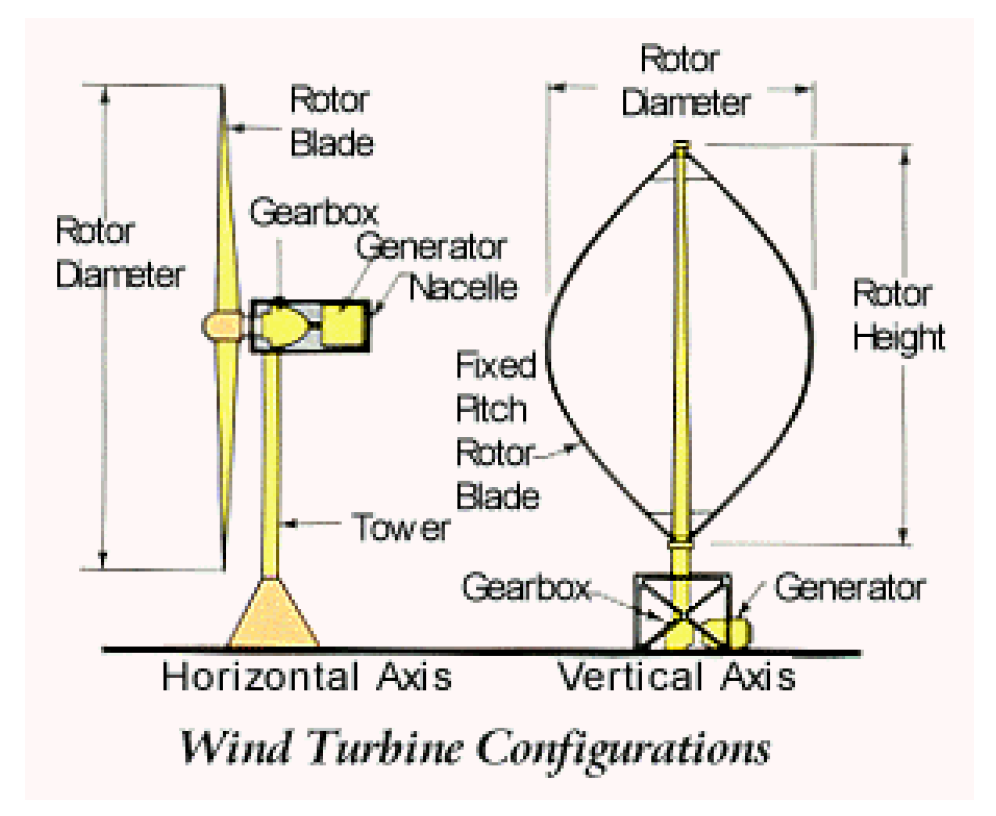
Hub height means the distance measured from natural grade to the center of the turbine hub.
Monopole tower means a tower constructed of tapered tubes that fit together symmetrically and are stacked one section on top of another and bolted to a concrete foundation without support cables.
Open loop ground source heat pump system means a heat pump system that uses groundwater as a heat transfer fluid by drawing groundwater from a well to a heat pump and then discharging the water over land, directly in a water body or into an injection well.
Passive solar energy system means a solar energy system that captures solar light or heat without transforming it to another form of energy or transferring the energy via a heat exchanger.
Photovoltaic system means a solar energy system that converts solar energy directly into electricity.
Residential wind turbine means a wind turbine of ten kilowatt (kW) nameplate generating capacity or less.
Small wind turbine means a wind turbine of 100 kW nameplate generating capacity or less.
Solar energy system means a device or structural design feature, a substantial purpose of which is to provide daylight for interior lighting or provide for the collection, storage and distribution of solar energy for space heating or cooling, electricity generation or water heating.
Total height, wind turbine, means the highest point above natural grade reached by a rotor tip or any other part of a wind turbine.
Tower, wind turbine, means a vertical structure that supports a wind turbine.
Utility wind turbine means a wind turbine of more than 100 kW nameplate generating capacity.
Vertical axis wind turbine means a type of wind turbine where the main rotor shaft runs vertically.
Vertical ground source heat pump system means a closed loop ground source heat pump system where the loops or coils are installed vertically in one or more borings below the land surface.
Wind energy system means an electrical generating facility that consists of a wind turbine, feeder lines, associated controls and may include a tower.
Wind turbine means any piece of electrical generating equipment that converts the kinetic energy of blowing wind into electrical energy through the use of airfoils or similar devices to capture the wind.
(Code 1997, § 1390.02)
Sec. 36-592. - Ground source heat pump systems.
(a)
Zoning districts. Ground source heat pump systems in accordance with the standards in this section are allowed as a permitted accessory use in all zoning districts.
(b)
Standards.
(1)
System requirements.
a.
Only closed loop ground source heat pump systems utilizing heat transfer fluids, as defined in section 36-591, are permitted. Open loop ground source heat pump systems are not permitted.
b.
Ground source heat pump systems in public waters may be permitted as an interim conditional use in accordance with sections 36-49 and 36-595 subject to approval from the state department of natural resources and subject to written consent of all property owners or approval by an association in accordance with its adopted bylaws.
c.
Ground source heat pump systems in water bodies owned or managed by the city are not permitted.
(2)
Setbacks.
a.
All components of ground source heat pump systems including pumps, borings and loops shall be set back at least five feet from interior side lot lines and at least ten feet from rear lot lines.
b.
Above-ground equipment associated with ground source heat pumps shall not be installed in the front yard of any lot or the side yard of a corner lot adjacent to a public right-of-way and shall meet all required setbacks for the applicable zoning district.
(3)
Easements. Ground source heat pump systems shall not encroach on public drainage, utility roadway or trail easements.
(4)
Noise. Ground source heat pump systems shall comply with state pollution control agency standards outlined in Minn. R. ch. 7030.
(5)
Screening. Ground source heat pumps are considered mechanical equipment and subject to the requirements of section 36-176.
(6)
Deviations. Any deviation from the required standards of this article may be permitted through an interim conditional use permit in accordance with sections 36-49 and 36-595.
(c)
Safety. Ground source heat pumps shall be certified by Underwriters Laboratories, Inc., and meet the requirements of the state building code.
(d)
Abandonment. If the ground source heat pump system remains nonfunctional or inoperative for a continuous period of one year, the system shall be deemed to be abandoned and shall constitute a public nuisance. The owner shall remove the abandoned system at their expense after a demolition permit has been obtained in accordance with the following:
(1)
The heat pump and any external mechanical equipment shall be removed.
(2)
Pipes or coils below the land surface shall be filled with grout to displace the heat transfer fluid. The heat transfer fluid shall be captured and disposed of in accordance with applicable regulations. The top of the pipe, coil or boring is uncovered and grouted.
(3)
Lake ground source heat pump systems shall be completely removed from the bottom of the body of water.
(e)
Permits. A building permit and interim conditional use permit, if required, shall be obtained for any ground source heat pump system prior to installation. Borings for vertical systems are subject to approval from the state department of public health.
(Code 1997, § 1390.03)
Sec. 36-593. - Wind energy systems.
(a)
Zoning districts. Residential wind turbines in accordance with the standards in this section are permitted accessory uses on lots at least three acres in size in the R-E, Residential Estates District, the R-1A, River Residential District, and the MX-3, Transit-Oriented Mixed Use District; and on lots at least 1.5 acres in size in the B-1, General Business District, the B-2, Business Park/Office/Warehouse District, the I-1, Light Industrial District, and the I-2, General Industrial District provided the lot does not abut a residential zoning district. Wind energy systems are not permitted in any other zoning districts.
(b)
Standards.
(1)
Number. No more than one wind energy system is permitted per parcel.
(2)
Height. In all zoning districts where wind energy systems are permitted, a maximum hub height of 45 feet is allowed as a permitted accessory use. Additional height, up to 75 feet in total height, may be permitted as an interim conditional use in accordance with section 36-595.
(3)
Blade length. A maximum blade length of 15 feet is permitted.
(4)
Roof mounting. Roof mounted wind turbines are not permitted.
(5)
Setbacks. The base of the wind turbine tower shall be set back from all property lines a distance equal to the hub height. Wind energy systems shall not be installed in the front yard of any lot or in the side yard of a corner lot adjacent to a public right-of-way.
(6)
Easements. Wind energy systems shall not encroach on public drainage, utility roadway or trail easements.
(7)
Noise. Wind energy systems shall comply with state pollution control agency standards outlined in Minn. R. ch. 7030 at all property lines.
(8)
Screening. Wind energy systems are exempt from the requirements of sections 36-161 and 36-162.
(9)
Aesthetics. All portions of the wind energy system shall be a non-reflective, non-obtrusive color, subject to the approval of the city administrator. Only monopole towers are permitted. The appearance of the turbine, tower and any other related components shall be maintained throughout the life of the wind energy system pursuant to industry standards. Systems shall not be used for displaying any advertising. Systems shall not be illuminated.
(10)
Feeder lines. The electrical collection system shall be placed underground within the interior of each parcel. The collection system may be placed overhead near substations or points of interconnection to the electric grid.
(11)
Deviations. Any deviation from the required standards of this chapter may be permitted through an interim conditional use permit in accordance with section 36-595.
(c)
Safety.
(1)
Standards and certification.
a.
Standards. Wind energy systems shall meet minimum standards such as International Electrotechnical commission (IEC) 61400-2 or the American Wind Energy Association's (AWEA) Small Wind Turbine Performance and Safety Standard or other standards as determined by the city administrator.
b.
Certification. Wind energy systems shall be certified by Underwriters Laboratories, Inc. and the National Renewable Energy Laboratory, the Small Wind Certification Council or other body as determined by the city administrator. The city reserves the right to deny a building permit for proposed wind energy systems deemed to have inadequate certification or testing for operation in a severe winter climate.
c.
Maintenance. Wind energy systems shall be maintained under an agreement or contract by the manufacturer or other qualified entity.
(2)
Utility connection. All grid connected systems shall have an agreement with the local utility prior to the issuance of a building permit. A visible external disconnect must be provided if required by the utility.
(d)
Abandonment. If the wind energy system remains nonfunctional or inoperative for a continuous period of one year, the system shall be deemed to be abandoned and shall constitute a public nuisance. The owner shall remove the abandoned system at their expense after a demolition permit has been obtained. Removal includes the entire structure including foundations to below natural grade and transmission equipment.
(e)
Permits. A building permit and interim conditional use permit, if required, shall be obtained for any wind energy system prior to installation.
(Code 1997, § 1390.04)
Sec. 36-594. - Solar energy systems.
(a)
Zoning districts. Solar energy systems in accordance with the standards in this section are allowed as a permitted accessory use in all zoning districts.
(b)
Standards.
(1)
Exemption. Passive or building-integrated solar energy systems are exempt from the requirements of this section and shall be regulated as any other building element.
(2)
Minimum lot size. In all zoning districts, a minimum lot size of 8,000 square feet is required for ground-mounted solar energy systems.
(3)
Height. Roof-mounted solar energy systems shall comply with the maximum height requirements in the applicable zoning district. Ground-mounted solar energy systems shall not exceed 15 feet in height.
(4)
Location. In residential zoning districts, ground-mounted solar energy systems are limited to the rear yard. In nonresidential zoning districts, ground-mounted solar energy systems may be permitted in the front yard of any lot or the side yards on corner lots.
(5)
Setbacks. Ground-mounted solar energy systems including any appurtenant equipment shall be set back a minimum of 15 feet from all property lines and a minimum of 30 feet from all dwellings located on adjacent lots. Roof-mounted systems shall comply with all building setbacks in the applicable zoning district and shall not extend beyond the exterior perimeter of the building on which the system is mounted.
(6)
Roof mounting. Roof-mounted solar collectors shall be flush mounted on pitched roofs. Solar collectors may be bracket mounted on flat roofs.
(7)
Easements. Solar energy systems shall not encroach on public drainage, utility roadway or trail easements.
(8)
Screening. Solar energy systems shall be screened from view to the extent possible without reducing their efficiency, but are exempt from the strict requirements of sections 36-161 and 36-162. Screening may include walls, fences or landscaping.
(9)
Maximum area. In the R-1, Low Density Single-Family Residential District, MX-1, Downtown Mixed Use District and the MX-2, Commercial Mixed Use District, ground-mounted solar energy systems shall be limited to a maximum area of 200 square feet. In other residential zoning districts, ground-mounted solar energy systems shall be limited to a maximum area consistent with the maximum lot coverage and accessory structure limitations in sections 36-208 and 36-594.
(10)
Aesthetics. All solar energy systems shall use colors that blend with the color of the roof or other structure. Reflection angles from collector surfaces shall be oriented away from neighboring windows. Where necessary, screening may be required to address glare.
(11)
Feeder lines. The electrical collection system shall be placed underground within the interior of each parcel. The collection system may be placed overhead near substations or points of interconnection to the electric grid.
(12)
Deviations. Any deviation from the required standards of this article may be permitted through an interim conditional use permit in accordance with section 36-595.
(c)
Safety.
(1)
Standards and certification.
a.
Standards. Solar energy systems shall meet the minimum standards outlined by the International Electrotechnical Commission (IEC),the American Society of Heating, Refrigerating, and Air-conditioning Engineers (ASHRAE), ASTM International, British Standards Institution (BSI), International Electrotechnical commission (IEC), International Organization for Standardization (ISO), Underwriter's Laboratory (UL), the Solar Rating and Certification Corporation (SRCC) or other standards as determined by the city administrator.
b.
Certification. Solar energy systems shall be certified by Underwriters Laboratories, Inc. and the National Renewable Energy Laboratory, the Solar Rating and Certification Corporation or other body as determined by the city administrator. The city reserves the right to deny a building permit for proposed solar energy systems deemed to have inadequate certification.
(2)
Utility connection. All grid connected systems shall have an agreement with the local utility prior to the issuance of a building permit. A visible external disconnect must be provided if required by the utility.
(d)
Abandonment. If the solar energy system remains nonfunctional or inoperative for a continuous period of one year, the system shall be deemed to be abandoned and shall constitute a public nuisance. The owner shall remove the abandoned system at their expense after a demolition permit has been obtained. Removal includes the entire structure including transmission equipment.
(e)
Permits. A building permit and interim conditional use permit, if required, shall be obtained for any solar energy system prior to installation.
(Code 1997, § 1390.05)
Sec. 36-595. - Interim conditional use permit.
Deviations to the standards in this article may be permitted as an interim conditional use in accordance with section 36-49. In granting an interim conditional use permit, the city council shall consider the criteria in section 36-45(a) and the following additional criteria unique to alternative energy systems:
(1)
That the deviation is required to allow for the improved operation of the alternative energy system;
(2)
That the alternative energy system has a net energy gain;
(3)
That the alternative energy system does not adversely affect solar access to adjacent properties;
(4)
That the alternative energy system complies with all other engineering, building, safety and fire regulations; and
(5)
That the alternative energy system is found to not have any adverse impacts on the area, including the health, safety and general welfare of occupants of neighboring properties and users of public rights-of-way.
(Code 1997, § 1390.06)
Sec. 36-596. - Interpretation.
In interpreting this article and its application, the provisions of these regulations shall be held to be the minimum requirements for the protection of public health, safety and general welfare. This article shall be construed broadly to promote the purposes for which it was adopted.
(Code 1997, § 1390.07)
Sec. 36-597. - Conflict.
This article is not intended to interfere with, abrogate or annul any other ordinance, rule or regulation, statute or other provision of law except as provided herein. If any provision of this article imposes restrictions different from any other ordinance, rule or regulation, statute or provision of law, the provision that is more restrictive or imposes higher standards shall control.
(Code 1997, § 1390.08)