
Newton City Zoning Code
ARTICLE I
- IN GENERAL
Sec. 102-1.- Repeal of existing regulations.
The existing regulations of the city relating to the use of land, water, structures and buildings, the provision of off-street parking and loading and related matters, being the city zoning ordinance, effective March 2, 1976, are repealed and replaced by this chapter.
(Code 1972, § 26-1.1; Ord. No. 91.53, 10-16-1991)
Sec. 102-2. - Effect on prior laws.
The enactment of this chapter shall not require the readoption of any local government ordinance enacted pursuant to laws that were in effect before the effective date of this chapter, and are restated or revised herein. The provisions of this chapter shall not affect any act heretofore done, any liability incurred, any right accrued or vested, or any suit or prosecution begun or cause of action accrued as of the effective date of this chapter. The enactment of this chapter shall not be deemed to amend the geographic area within which local government development regulations adopted prior to January 1, 2019, are effective.
(Code 1972, § 26-1.2; Ord. No. 91.53, 10-16-1991; Ord. No. 2021-58, 6-15-2021)
Sec. 102-3. - Legislative authority.
This chapter is enacted pursuant to the Charter of the city (1989 Session Laws of North Carolina, chapter 1042) and the provisions of G.S. ch. 160D (G.S. 160D-101 et seq.) and G.S. ch. 143, art. 21, pt. 6 (G.S. 143-211 et seq.), whereby authority is conferred on the council for the purposes of promoting health, safety, morals or the general welfare of the community, to permit the council to establish zoning classifications within the city and its extraterritorial planning jurisdiction, as it may from time to time exist.
(1)
To regulate and restrict the height, number of stories and size of buildings and other structures;
(2)
To regulate and restrict the percentage of lots that may be occupied, the size of yards, courts and other open spaces;
(3)
To regulate and restrict the density of population;
(4)
To regulate and restrict the erection, construction, reconstruction, alteration, repair or use of buildings, structures and land for trade, industry, residence and other purposes; and
(5)
To do all other things authorized by law in these matters.
(Code 1972, § 26-1.3; Ord. No. 91.53, 10-16-1991; Ord. No. 2002.31, 8-21-2002; Ord. No. 2021-58, 6-15-2021)
Sec. 102-4. - Intent and purpose.
(a)
This chapter is made in accordance with a comprehensive plan and designed to lessen congestion in the streets; to secure safety from fire, panic and other dangers; to promote health and the general welfare; to provide adequate light and air; to prevent the overcrowding of land; to avoid undue concentration of population; and to facilitate the adequate provision of transportation, water, sewerage, schools, parks and other public requirements. These regulations are made with reasonable consideration, among other things, as to the character of the district and its peculiar suitability for particular uses, and with a view to conserving the value of buildings and encouraging the most appropriate use of land throughout the city and its extraterritorial planning jurisdiction, as it may from time to time exist. This chapter is one of the instruments for the implementation of the land development plan for the city and its extraterritorial planning area, adopted by the council on May 18, 1988, and is declared to be in conformance therewith.
(b)
It is the intent and purpose of the land development plan and of this chapter, which aids in implementing the plan, to promote the public health, safety, morals, convenience, comfort, amenities, prosperity and general welfare of the citizens of the community and to provide, among other matters, a wholesome, serviceable, aesthetically pleasing and attractive community; to increase the safety and security of home life; to preserve and create a more favorable environment in which to rear children; to stabilize and enhance property and civic values; to develop meaningful and productive relationships between the private sector and city government; to provide for a more uniformly just land use pattern and tax assessment base; to aid in development and redevelopment of the city; to increase traffic safety and ease transportation problems; to provide more adequately for vehicular parking, parks, parkways, recreation, schools, public buildings and facilities, housing, job opportunities, light, air, water, sewerage, sanitation, and other public requirements; to lessen congestion, disorder, and danger which often occur in unplanned and unregulated suburban, urban and rural development; to prevent overcrowding of land and undue concentration of population; to ensure compatibility of new development with existing development and open space; to conserve and enhance the manmade resources of the community; to provide for the appropriate use, conservation and protection of natural resources in the city; and to provide more reasonable and serviceable means and methods of protecting and safeguarding the economic and social structure upon which the good of all depends.
(c)
In order to institute and carry out the interest and purpose of Chapter 102, Comprehensive Land Use Plans shall be adopted by the city council with the advice and consultation of the planning board. Adoption and amendment of a comprehensive plan is a legislative decision and shall follow the process mandated for zoning text amendments for notice and public hearing requirements pursuant to G.S. 160D-601. Plans adopted may be undertaken and adopted as part of or in conjunction with plans required under other statutes, including, but not limited to, the plans required by G.S. 113A-110. Plans adopted shall be advisory in nature without independent regulatory effect. Adopted comprehensive plans do not expand, diminish, or alter the scope of authority for development regulations adopted under this plan. Comprehensive plans shall be considered by the planning board and city council when considering proposed amendments to zoning regulations as required by G.S. 160D-604 and G.S. 160D-605. The planning director shall reasonably maintain the comprehensive plan that sets forth goals, policies, and programs intended to guide the present and future physical, social and economic development of the city in accordance with G.S. 160D-501.
(d)
The city may adopt temporary moratoria on any city development approval required by law in accordance with G.S. 160D-107. The duration of any moratorium shall be reasonable in light of the specific conditions that warrant imposition of the moratorium and may not exceed the period of time necessary to correct, modify, or resolve such conditions. To adopt a temporary moratorium the city council shall hold a legislative hearing and shall publish a notice of the hearing in a newspaper having general circulation in the area not less than seven days before the date set for the hearing. No moratorium may be subsequently renewed or extended for any additional period unless the local government shall have taken all reasonable and feasible steps proposed to be taken in its ordinance establishing the moratorium to address the problems or conditions leading to imposition of the moratorium and unless new facts and conditions warrant an extension.
(Code 1972, § 26-1.4; Ord. No. 91.53, 10-16-1991; Ord. No. 2002.31, 8-21-2002; Ord. No. 2021-58, 6-15-2021)
Sec. 102-5. - Title.
This chapter may be referred to and cited as the "Newton Zoning Ordinance."
(Code 1972, § 26-1.5; Ord. No. 91.53, 10-16-1991)
Sec. 102-6. - Rules for construction of language.
The following rules apply to the text of this chapter:
(1)
The particular controls the general.
(2)
In case of any difference of meaning or implication between the text of this chapter and any caption, illustration, summary table, or illustrative example, the text shall control.
(3)
The word "shall" is mandatory and not discretionary. The word "may" is permissive. The word "should" is discretionary.
(4)
Words used in the present tense shall include the future; and words used in the singular number shall include the plural, and the plural the singular, unless the context clearly indicates the contrary.
(5)
A "building" or "structure" includes any part thereof.
(6)
The phrase "used for" includes" arranged for," "designed for," "maintained for" or "occupied for."
(7)
The word "person" includes "arranged for," "designed for," "maintained for" or "occupied for."
(8)
Unless the context clearly indicates the contrary, where a regulation involves two or more times, conditions, provisions, or events connected by the conjunction "and," "or," or "either…or," the conjunction shall be interpreted as follows:
a.
"And" indicates that all the connected items, conditions, provisions, or events shall apply.
b.
"Or" indicates that the connected items, conditions, provisions, or events may apply singly or in any combination.
c.
"Either…or" indicates that the connected items, conditions, provisions, or events shall apply singly, but not in combination.
(9)
The word "includes" shall not limit a term to the specified examples, but is intended to extend its meaning to all other instances or circumstances of like kind or character.
(10)
"Written" or "in writing" is deemed to include electronic documentation.
(11)
Unless specified otherwise, in the absence of evidence to the contrary, delivery by first class mail shall be deemed received on the third business day following deposit of the item for mailing with the United States Postal Service and delivery by electronic mail shall be deemed received on the day sent.
(12)
Words not defined in section 102-7 shall have the meaning commonly assigned to them. The reference for dictionary common meanings shall be the latest edition of Webster's New World Dictionary of the American Language.
(13)
It is recognized and accepted that there are infinitesimal configurations of lots and tracts of land to which this section and section 102-7 shall apply and that when situations arise when these definitions and descriptive figures are difficult or impractical to apply, the planning director shall have authority to make all necessary interpretations in connection with enforcement of this chapter in order to carry out the intent and purpose thereof.
(Code 1972, § 26-2.1; Ord. No. 91.53, 10-16-1991; Ord. No. 92.47, § 1, 8-4-1992; Ord. No. 2021-58, 6-15-2021)
Sec. 102-7. - Definitions.
The following words shall be defined for uses within this chapter as detailed below:
Accessory means having a subordinate function. (See also Building, accessory; Structure, accessory and Use, accessory.)
Addition (to an existing building) means any walled and roofed expansion to the perimeter or height of a building in which the addition is connected by a common loadbearing wall other than a fire wall. Any walled and roofed addition which is connected by a fire wall or is separated by independent perimeter load-bearing walls is new construction.
Administrative approval means approval that the planning director or designee is authorized to grant after administrative review.
Administrative decision means decisions made in the implementation, administration, or enforcement of development regulations that involve the determination of facts and the application of objective standards set forth in this chapter or local government development regulations. These are sometimes referred to as ministerial decisions or administrative determinations.
Administrative hearing means a proceeding to gather facts needed to make an administrative decision.
Administrative review mean non-discretionary evaluation of an application by the planning director or designee. This process is not subject to a public hearing.
Agriculture means the use of land for:
(1)
The tilling of the soil.
(2)
The growing of crops or plants, including truck farming, field crops, vegetables, fruit, nut, sod, seed, or tree production.
(3)
Pasturage, including pasture for cattle, horse, sheep or goats and other farm animals.
(4)
Forestry and other forms of food and fiber production for human and animal consumption.
(5)
Greenhouses, nurseries and ornamental horticulture.
(6)
The raising, breeding, working and use of farm animals.
(7)
Aquaculture.
(8)
Bee keeping.
Alcoholic beverages means beverages containing more than one-half percent alcohol by volume.
Alley means a dedicated and publicly maintained right-of-way, 20 feet or less in width, that provides a secondary means of access to abutting property, and not intended for general vehicular traffic circulation.
Alternative tower structure means clock towers, sculptures, bell steeples, light poles and similar alternative-design mounting structures that conceal the presence of antennas or towers and are architecturally compatible with the area.
Amusement services means a commercial facility providing recreational activities including, but not limited to, swimming pools, amusement arcades, bowling alleys, shuffleboard courts, baseball hitting ranges, miniature and par-three golf courses, golf driving ranges, billiard and pool halls, skating rinks, movie theaters, dance and exercise studios.
Animal hospital and veterinary clinic, general, mean any structure and land used, primarily and essentially, for the medical and surgical care of ill, injured, or disabled animals other than humans.
Animal hospital and veterinary clinic, small animal, mean any structure and land used, primarily and essentially, for the medical and surgical care of ill, injured, or disabled animals (other than human) of no greater size than a dog.
Animals, household, means animals which are customarily kept for personal use or enjoyment within the home, not exhibited to the public, nor raised for commercial purposes. Animals which are dangerous to humans or property when they reach maturity or have cloven or solid hooves are not household animals. Household animals shall include, but not be limited to, domestic dogs, domestic cats, canaries, parakeets, love birds, parrots, cockatiels, finches, toucans, mynah birds, guinea pigs, hamsters, mice, rats, gerbils, small reptiles, small amphibians, and aquarium fish.
Appeal means a request for a review of the floodplain administrator's interpretation of any provision of this chapter.
Area of shallow flooding means a designated zone AO on a community's flood insurance rate map (FIRM) with base flood depths determined to be from one to three feet. These areas are located where a clearly defined channel does not exist, where the path of flooding is unpredictable and indeterminate, and where velocity flow may be evident.
Art gallery means the use of a structure or building for the display of sculpture, painting, photographs, or other artistic works for public viewing with only incidental sales.
Auction house means an indoor place of business offering for sale or resale art, antiques, jewelry, pottery, porcelain, and similar goods which are owned by the owner/operator or have been placed there by consignment for normal business sales, and which periodically holds auctions on the premises for the purpose of selling said goods to the highest bidder at public auction.
Bakery means the use of a structure or building for the production of bakery products including, but not limited to, breads, cakes, pastries, and doughnuts. When identified in this chapter as a use under "retail," the bakery products produced must be for the direct sale to the consumer with no wholesale production or sales. Wholesale bakeries, for the purpose of this chapter, shall be considered manufacturing.
Bank means a financial institution engaged in deposit banking and closely related functions such as the extension of credit by means of loans and investments, and fiduciary activities.
Base flood means the flood having a one percent chance of being equaled or exceeded in any given year.
Base flood elevation (BFE) means a determination of the water surface elevations of the base flood as published in the flood insurance study. When the BFE has not been provided in a special flood hazard area, it may be obtained from engineering studies available from a federal, state, or other source using FEMA approved engineering methodologies. This elevation, when combined with the freeboard, establishes the regulatory flood protection elevation.
Basement means any area of the building having its floor subgrade (below ground level) on all sides.
Boarding/rooming house means a dwelling or group of dwellings, as distinguished from a motel, containing, in combination, three or more lodging units intended primarily for rental or lease for periods of longer than one week, with or without board.
Bona fide farm means land that receives or is eligible to receive an agricultural use exemption from the county tax office and is used for the production and activities relating or incidental to the production of crops, fruits, vegetables, ornamental and flowering plants, dairy, livestock, poultry, and all other forms of agricultural products having a domestic or foreign market. The term does not include nonfarm activities conducted on farmland.
Brewery, under 15,000 barrels per year. An establishment where beer and malt beverages are made on the premises and then sold or distributed, and which produces less than 15,000 barrels of beer per year. Must have a tasting room that is open four days a week.
Brewery, over 15,000 barrels per year. An establishment where beer and malt beverages are made on the premises at an annual beer production rate of over 15,000 barrels. A tasting room may be a component of the facility.
Buildable area means the portion of a lot remaining after required yards have been provided, and any conservation or preservation areas, submerged lands, easements or road rights-of-way have been subtracted from the lot area.
Building means any one- and two-family dwelling or portion thereof, including townhouses, that is used, or designed or intended to be used for human habitation, for living, sleeping, cooking or eating purposes, or any combination thereof, and shall include accessory structures thereto.
Building, accessory, means a subordinate building detached from, but located on, the same lot as the principal building, the use of which is incidental and accessory to that of the principal building, but not including manufactured homes as defined in this chapter.
Building, principal, means a building or, where the context so indicates, a group of buildings in which is conducted the principal use of the lot on which such building is located.
Business school means an establishment offering to the public, for a consideration, instruction in administration, accounting, bookkeeping, computer use, typewriting and other skills for use in commercial or service activities.
Business services means an establishment offering primarily services to the business community and to individuals. Such services include, but are not limited to, advertising agencies, blueprinting and photocopying services, cleaning and maintenance of building services, computer and data processing services, detective agencies and security services, insurance agency, management consulting and public relations services, news syndicates, personnel services, photography, art and graphics services, and real estate services.
Cabinet shop, large, means an establishment where cabinetry and furniture are constructed in a finished or unfinished state using a production-oriented process. Such establishments may or may not use dry kilns, external dust collection systems or silos, and may or may not use a three-phase electrical supply. The product may or may not be finished on-site. It is anticipated that such establishments will have loading berths for shipping and receiving purposes.
Cabinet shop, small, means an establishment where custom cabinetry and furniture is crafted on a contracted basis, not of a production-oriented process and whose product may or may not be finished on site. Such establishments will have no dry kilns, have no external dust collection systems or silos, no external storage of material, waste and/or equipment, may or may not utilize a three-phase electrical supply, may or may not utilize loading berths for shipping and receiving purposes and shall incorporate a showroom/design studio equivalent to a minimum of five percent of the overall building size.
Camp means land containing two or more campsites which are located, established or maintained for occupancy by people in temporary living quarters, such as tents, recreation vehicles, or cabins, for recreation, education or vacation purposes.
Campsite means any plot of ground within a camp intended for the exclusive occupancy by a cabin, recreation vehicle or tent.
Car wash means an establishment engaged in the business of washing domestic vehicles with self-serve automated or staffed facilities.
Cemetery, human, means land used or intended to be used for the burial of the human dead and dedicated for cemetery purposes, including crematories, mausoleums, and mortuaries, if operated in connection with and within the boundaries of such cemetery.
Cemetery, pet, means land used or intended to be used for the burial of animals in individual burial plots or a mausoleum, and dedicated for cemetery purposes.
Certificate of occupancy means a document issued by an authorized official setting forth that land, a building or structure legally complies with the city fire codes and state building codes, this chapter and other pertinent local and state requirements, and that the same may be used for the purposes stated therein.
Chemical storage facility means a building, portion of a building, or exterior area adjacent to a building used for the storage of any chemical or chemically reactive products.
Child care center means any establishment that provides supervision and care for children on a regular basis for more than five children unrelated to the operator for a period of less than 24 hours a day, and which receives a payment, fee or grant for any of the children receiving care, wherever operated, and whether or not operated for profit, except that the following are not included: Public schools and nonpublic schools which are in compliance with the compulsory school attendance law, summer camps having children in full-time residence, summer day camps, and Bible schools normally conducted during vacation periods. The term includes kindergartens, nurseries, nursery schools, day care centers and day nurseries.
Church/synagogue means tax-exempt buildings used for nonprofit purposes by a recognized and legally established sect for purpose of worship, including buildings when operated by such church/synagogue.
College/university means a degree-granting establishment, accredited or qualified for accreditation by the Southern Association of Colleges and Schools, providing formal academic education and generally requiring for admission at least a high school diploma or equivalent academic training, including colleges, community colleges, universities, technical institutes, seminaries, and professional schools. Accessory uses under this definition include, but are not limited to, dormitories, cafeterias, bookstores, libraries, classrooms, administrative offices, research facilities, sports arenas, and auditoriums.
Commercial vehicle means any vehicle, licensed by any state of the United States or Mexico or province or territory of Canada, other than domestic vehicles, as defined in this chapter, or over one ton in weight or 20 feet in length.
Communication facilities means the use of land, buildings or structures for uses such as, but not limited to, motion picture studios; radio and television receiving antenna and dishes; accessory, radio and television studios; and radio and television transmitting and receiving facilities.
Community center means parks and playgrounds, community centers, recreation clubs, such as Boys and Girls Clubs; golf clubs; swimming clubs; tennis clubs; country clubs; and paddle, racquetball, handball courts and greenways.
Congregate living facility means any building, buildings, section of a building, or distinct part of a dwelling unit, boarding/rooming house, home for the aged or other place, whether operated for profit or not which undertakes through its ownership or management to provide, for a period exceeding 24 hours, housing, food services, and one or more personal care services to persons not related to the owner or operator by blood, marriage, or adoption and licensed, certified or approved by the state department of social services. ("Personal services," for the purpose of this definition, means services in addition to housing and food service which include, but are not limited to, personal assistance with bathing, dressing, ambulation, supervision of self-administered medication, transportation, emotional security, and other related service. Personal service does not include nursing or medical treatment.)
Contractor's office means an establishment engaged in the provision of construction activities including, but not limited to, plumbing, electrical work, building, paving, carpentry and other such contracting activities. This facility shall serve as the office and dispatch area only. All materials kept on site must be stored in completely enclosed buildings and no commercial vehicles may be parked on the site overnight.
Correctional facility means a public facility for the housing of persons convicted of a crime; it is not a jail.
Crematorium means an establishment for the burning of human or animal remains.
Cultural facility means the use of land, buildings, or structures to provide educational and informational services to the general public, including but not limited to, aquariums, arboreta, botanical and zoological gardens, art galleries, museums, and libraries.
Determination means a written, final and binding order, requirement, or determination regarding an administrative decision.
Developer means a person, including a governmental agency or redevelopment authority, who undertakes any development and who is the landowner of the property to be developed or who has been authorized by the landowner to undertake development on that property.
Development. Unless the context clearly indicates otherwise, the term means any of the following:
a.
The construction, erection, alteration, enlargement, renovation, substantial repair, movement to another site, or demolition of any structure.
b.
The excavation, grading, filling, clearing, or alteration of land.
c.
The subdivision of land as defined in G.S. 160D-802.
d.
The initiation or substantial change in the use of land or the intensity of use of land.
This definition does not alter the scope of regulatory authority granted by G.S. 160D-102.
Development approval means an administrative or quasi-judicial approval made pursuant to this chapter that is written and that is required prior to commencing development or undertaking a specific activity, project, or development proposal. Development approvals include, but are not limited to, zoning permits, site plan approvals, special use permits, variances, and certificates of appropriateness. The term also includes all other regulatory approvals required by regulations adopted pursuant to G.S. 160D, including plat approvals, permits issued, development agreements entered into, and building permits issued.
Development regulation means a unified development ordinance, zoning regulation, subdivision regulation, erosion and sedimentation control regulation, flood plain or flood damage prevention regulation, mountain ridge protection regulation, stormwater control regulation, wireless telecommunication facility regulation, historic preservation or landmark regulation, housing code, State Building Code enforcement, or any other regulation adopted pursuant to this chapter, or a local act or charter that regulates land use or development.
Discotheques means a nightclub establishment featuring dancing to recorded or live music.
Disposal means, as defined in G.S. 130A-290(a)(6), the discharge, deposit, injection, dumping, spilling, leaking, or placing of any solid waste into or on any land or water so that the solid waste or any constituent part of the solid waste may enter the environment or be emitted into the air or discharged into any waters, including groundwaters.
Distribution center means a warehouse that receives merchandise and distributes it to multiple locations, either in the same form as received or repackaged as needed.
Domestic vehicles means any vehicle licensed by any state of the United States or Mexico or province or territory of Canada as a private vehicle for operation on streets, and may include, but shall not be limited to, automobiles, private pickup trucks and vans.
Dormitory means a building used as group living quarters for a student body, religious order or other group as an associated use to a college, university, boarding school, orphanage, convent, monastery, or other similar use. Dormitories do not include kitchen facilities except a group kitchen to serve all residents.
Drinking establishments means an establishment where alcoholic beverages are obtainable within or thereon and where such beverages are consumed on the premises. If the facility also sells food, and the gross receipts from the sale of food and nonalcoholic beverages represent at least 40 percent of the facility's total sales, the facility shall be considered an "eating establishment, sit down."
Drive-in theater means a facility designed for the outdoor projection of motion pictures onto a permanent screen to be viewed from the patron's automobile.
Drive-in window means a window or other opening in the wall of a principal or accessory building through which goods or services are provided directly to customers in motor vehicles by means that eliminate the need for such customers to exit their motor vehicles.
Dry cleaners means an establishment engaged in providing laundry, dyeing and dry cleaning services to individual customers.
Dwelling means any building that contains one or two dwelling units used, intended, or designed to be built, used, rented, leased, let or hired out to be occupied, or that are occupied for living purposes.
Dwelling, multiple-family, means a structure containing three or more dwelling units.
Dwelling, two-family, means a structure containing two dwelling units.
Dwelling unit means a single unit providing complete independent living facilities for one or more persons, including permanent provisions for living, sleeping, eating, cooking and sanitation.
Eating establishment means an establishment whose principal business is the sale of food, frozen desserts or beverages to the customer in a ready-to-consume state.
Eating establishments, sit-down, means those at which food and/or beverages are served by waitresses or waiters to patrons seated at booths or tables.
Eating establishments, walk-in/drive-in, means those at which the customers receive but do not consume the food and/or beverages at a counter, bar, or from a drive-in window.
Electrical and electronic repair, large, means an establishment engaged in the repair of electrically powered equipment or electronic equipment such as, but not limited to, large appliances, large computers, radio and television broadcasting equipment, and similar items.
Electrical and electronic repair, small, means an establishment engaged in the repair of electrically powered equipment and electronic equipment such as, but not limited to, small appliances, televisions, radios, noncommercial stereo equipment, personal or mini-computers, and similar equipment. As a general rule, if the item is too large to be hand-carried by one or two people, it is not considered small equipment.
Elevated building means a non-basement building which has its lowest elevated floor raised above ground level by foundation walls, shear walls, posts, piers, pilings, or columns.
Enclosed compartmentalized storage means a structure which contains varying sizes of individual, compartmentalized, and controlled access stalls or lockers for the storage of customer's items. All access shall be from within the structure. Direct access to the units from the exterior of the building is prohibited.
Encroachment means the advance or infringement of uses, fill, excavation, buildings, structures or development into a floodplain, which may impede or alter the flow capacity of a floodplain.
Evidentiary hearing means a hearing to gather competent, material and substantial evidence in order to make findings for a quasi-judicial decision required by a development regulation adopted under this chapter.
Ex parte is a Latin legal term meaning "from (by or for) [the/a] party." An ex parte decision is one decided by a judge without requiring all of the parties to the controversy to be present.
Existing manufactured home park or manufactured home subdivision means a manufactured home park or subdivision for which the construction of facilities for servicing the lots on which the manufactured homes are to be affixed (including, at a minimum, the installation of utilities, the construction of streets, and either final site grading or the pouring of concrete pads) is completed before the effective date of this chapter (November 1, 1991).
Expansion to an existing manufactured home park or subdivision means the preparation of the additional sites by the construction of facilities for servicing the lots on which the manufactured homes are to be affixed (including the installation of utilities, the construction of streets, and either final site grading or the pouring of concrete slabs).
Fairground means a facility including assembly grounds to be used primarily for a fair, carnival, and other agricultural related activities as the primary use and to include events of a short-term nature and limited duration.
Family means any number of people related by blood, marriage or adoption or not more than five unrelated persons living together as a single housekeeping unit, using a single facility in a dwelling unit for culinary purposes. The term "family" shall not be construed to include a fraternity or sorority, club, rooming house, institutional group or the like, except that it shall include a group of persons living in a "family care home" as defined in G.S. 168-21(1), in accordance with the terms of G.S. 168-22.
Family day care home means a residence within which child care and supervision is provided for no more than five children, unrelated to the caregiver, for less than a 24-hour period.
Flood or flooding means a general and temporary condition of partial or complete inundation of normally dry land areas from:
(1)
The overflow of inland or tidal waters; and/or
(2)
The unusual and rapid accumulation of runoff of surface waters from any source.
Flood boundary and floodway map (FBFM) means a map on which the Federal Emergency Management Agency has delineated the special flood hazard areas and the floodways of the city and its extra-territorial planning jurisdiction. This official map is a supplement to and shall be used in conjunction with the flood insurance rate map (FIRM).
Flood hazard boundary map (FHBM) means a map, issued by the Federal Emergency Management Agency, where the boundaries of the special flood hazard areas have been designated as Zone A.
Flood insurance means the insurance coverage provided under the National Flood Insurance Program.
Flood insurance rate map (FIRM) means a map on which the Federal Emergency Management Agency has delineated the special flood hazard areas and the risk premium zones for the city and its extraterritorial zoning jurisdiction.
Flood insurance study (FIS) means an examination, evaluation, and determination of flood hazards, corresponding water surface elevations (if appropriate), flood hazard risk zones, and other flood data issued by the Federal Emergency Management Agency. The flood insurance study report includes flood insurance rate maps (FIRMs) and flood boundary and floodway maps (FBFMs), if published.
Flood-prone area. See "floodplain."
Floodplain means any land area susceptible to being inundated by water from any source.
Floodplain administrator is the individual appointed to administer and enforce the floodplain management regulations.
Floodplain development permit. See "zoning clearance permit."
Floodplain management means the operation of an overall program of corrective and preventive measures for reducing flood damage and preserving and enhancing, where possible, natural resources in the floodplain, including, but not limited to, emergency preparedness plans, flood control works, floodplain management regulations, and open space plans.
Floodplain management regulations means this chapter and other zoning ordinances, subdivision regulations, building codes, health regulations, special purpose ordinances, and other applications of police power. This term describes federal, state or local regulations, in any combination thereof, which provide standards for preventing and reducing flood loss and damage.
Floodproofing means any combination of structural and nonstructural additions, changes, or adjustments to structures which reduce or eliminate flood damage to real estate or improved real property, water and sanitation facilities, structures, and their contents.
Floodway means the channel of a river or other water course and the adjacent land areas that must be reserved in order to discharge the base flood without cumulatively increasing the water surface elevation more than one foot.
Flood zone means a geographical area shown on a flood hazard boundary map or flood insurance rate map that reflects the severity or type of flooding in the area.
Floor means the top surface of an enclosed area in a building (including basement), i.e., top of slab in concrete slab construction or top of wood flooring in wood frame construction. The term does not include the floor of a garage used solely for parking vehicles.
Floor area means the sum of enclosed areas on all floors of a building or buildings measured from the outside faces of the exterior walls, including halls, lobbies, arcades, stairways, elevator shafts, enclosed porches and balconies, and any below-grade floor area used for habitation, access and storage. Not countable as floor area are open terraces, patios, atriums, balconies, and breezeways, and space devoted to commercial and service uses.
Floor area ratio means the ratio of permitted floor area to the gross land area of the lot.
Floor area ratio, maximum permitted, means the floor area ratio permitted as of right in the several districts, excluding any bonus or transferred floor area.
Food business means an establishment engaged in the business of regularly and customarily selling food, primarily to be eaten off the premises. Food businesses shall include grocery stores, convenience stores, and other establishments, such as variety stores or drugstores, where food is regularly sold, and shall also include establishments engaged primarily in selling unfortified or fortified wine or both, for consumption off the premises.
Freeboard means the height added to the base flood elevation (BFE) to account for the many unknown factors that could contribute to flood heights greater that the height calculated for a selected size flood and floodway conditions, such as wave action, blockage of bridge openings, and the hydrological effect of urbanization of the watershed. The base flood elevation plus the freeboard establishes the regulatory flood protection elevation.
Functionally dependent facility means an operation which is dependent for its operation on close proximity to water, including but not limited to, port or docking facilities for loading and unloading of cargo or passengers, ship building and repair or seafood processing. This term does not include long-term storage, manufacture, sales or service facilities.
Funeral parlor means a facility used in the preparation of the dead for interment. Also a facility where funeral services are held, funeral vehicles are stored, and caskets and other funeral supplies are sold.
Furniture refinishing and repair means an establishment engaged in the stripping, cleaning, painting, staining, sealing, varnishing, or other like refinishing of the wood or metal components of furniture or the replacement or repair of broken or missing portions of a piece of furniture.
Garage, private, means a part of a building designed and used to contain no more than the number of vehicles in use in the principal structures, including not more than one commercial vehicle.
Gas station means an establishment where gasoline or diesel fuel is supplied and dispensed at retail and where no servicing or repair of vehicles is permitted. Convenience goods may be sold at such facilities but the sales shall be accessory to the sale of gasoline or diesel fuel.
Gross land area.
(1)
Of PD-H districts. Gross land area of PD-H districts shall be computed as all area, except that devoted to nonresidential purposes, within district boundaries, plus one-half of adjoining permanent open space such as streets, parks, lakes, cemeteries and the like, provided that width of such open space credited shall be limited to a number of feet equal to the LUI rating applying to the land involved. Where such space adjoins a PD-H district on two adjacent sides, the area thus added shall include the area required to complete the gap otherwise left at the intersection.
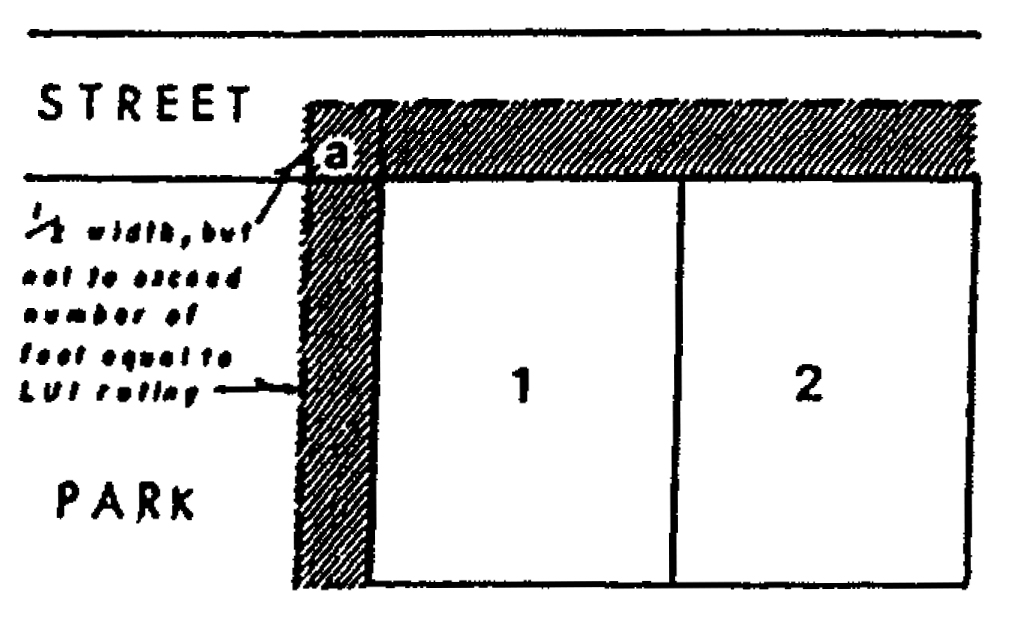
FIGURE 1-1
(2)
Of lots. Gross land area of lots shall be computed in the same manner as for PD-H districts, and as indicated in Figure 1-1. The gross area of Lot 1 is thus the area within its boundaries, plus the hatched areas at the top and side, including the small area marked "a". The gross area of Lot 2 is the area within its boundaries plus the hatched area across its front.
Hazardous waste management facility means, as defined in G.S. 130A, Article 9, a facility for the collection, storage, processing, treatment, recycling, recovery, or disposal of hazardous waste.
Health practitioner's office means an establishment offering diagnostic and routine health care on an outpatient basis by licensed practitioners such as, but not limited to, physicians, dentists, chiropractors, physical therapists, and massage therapists who have national certification in therapeutic massage and bodywork and/or have completed a state-licensed program in therapeutic massage therapy.
Health services means the use of land, buildings and structures for uses such as, but not limited to, health practitioners, animal hospital or veterinarian clinic, hospitals, medical and dental laboratories, nursing, convalescent and extended care facilities, rehabilitation centers and sanitarium/mental institutions.
Height means the vertical distance between the lowest proposed finished grade of the structure and the highest point of the structure. Finished grade shall be determined using all applicable regulations of the city, state and federal governments. See section 102-232 and section 102-233.
Highest adjacent grade (HAG) means the highest natural elevation of the ground surface, prior to construction, immediately next to the proposed walls of the structure.
Historic structure means any structure that is:
(a)
Listed individually in the National Register of Historic Places (a listing maintained by the U.S. Department of Interior) or preliminarily determined by the Secretary of Interior as meeting the requirements for individual listing on the National Register;
(b)
Certified or preliminarily determined by the secretary of interior as contributing to the historical significance of a registered historic district or a district preliminarily determined by the Secretary to qualify as a registered historic district;
(c)
Individually listed on a local inventory of historic landmarks in communities with a certified local government (CLG) program; or
(d)
Certified as contributing to the historical significance of a historic district designated by a community with a certified local government (CLG) program.
Certified local government (CLG) programs are approved by the U.S. Department of the Interior in cooperation with the North Carolina Department of Cultural Resources through the state historic preservation officer as having met the requirements of the National Historic Preservation Act of 1966 as amended in 1980.
Home occupation means an accessory use of a dwelling unit which constitutes, either entirely or partly, the livelihood of the person(s) living in the dwelling unit. See articles VI and X of this chapter.
Home office means an accessory use of a dwelling unit which constitutes, either entirely or partly, the livelihood of the person(s) living in the dwelling unit, where the nature of the activity is of an administrative nature and which does not involve customer services, manufacturing and/or alterations of a product at the dwelling unit.
Hospital means an institution providing physical and mental health services primarily for human inpatient medical or surgical care for the sick or injured, including related facilities such as laboratories, outpatient services, training facilities, central service facilities, emergency services and staff offices.
Hotel and motel mean a building or group of buildings containing lodging units intended primarily for rental or lease to transients by the day or week, and which often provides additional services such as restaurants, meeting rooms and recreation facilities, available to general public and guests.
Indoor shooting range means an indoor area designed and improved to encompass shooting stations or firing lines, target areas, berms and baffles, and other related components. The term includes training and education related to firearms and firearm safety.
Junk means old, dilapidated, scrap or abandoned metal, paper, building material and equipment, bottles, glass, appliances, furniture, beds and bedding, rags, rubber, motor vehicles and parts thereof.
Junkyard means land used for the storage, keeping, handling, or display of junk.
Kennel means any lot or premises on which six or more household or exotic animals, more than six months of age, or household animals are housed, groomed, bred, boarded, trained, or sold.
Land excavation means removal of 500 cubic yards or more of sand, soil, peat, muck, clay, stone, shell and the like, for disposal off-site.
Landfill means land used for the disposal of waste, excluding hazardous waste. Landfills are classified into two different types based upon the type of wastes received at the landfill.
(1)
Sanitary landfills. A facility used for the disposal of solid waste. Sanitary landfills are divided into two classes based on the amount of wastes received.
a.
Class A sanitary landfills are those which receive solid waste at a monthly average of more than 20 tons of solid waste per day or more than 50 cubic yards of solid waste per day.
b.
Class B sanitary landfills are those which receive solid waste at a monthly average of 20 tons or less of solid waste per day.
(2)
Clean material landfills. Land used for the disposal of only non-water-soluble, nondecomposable, inert material, consisting of concrete, brick, steel, clean fill dirt and other similar material.
Landowner means any owner of a legal or equitable interest in real property, including the heirs, devisees, successors, assigns, and personal representative of such owner. The landowner may allow a person holding a valid option to purchase to act as their agency or representative for purposes of submitting a proposed site specific development plan or a phased development plan under this chapter.
Legislative decision means the adoption, amendment, or repeal of a regulation under this chapter or an applicable local act. The term also includes the decision to approve, amend, or rescind a development agreement consistent with the provisions of Article 10 of this chapter.
Legislative hearing means a hearing to solicit public comment on a proposed legislative decision.
Levee means a manmade structure designed and constructed to contain, control or divert the flow of water, so as to provide protection from temporary flooding.
Levee system means a flood protection system consisting of a levee or levees and associated structures, such as closure and drainage devices.
Library means a building in which literary, musical, artistic or reference materials are kept for use but not generally for sale.
Life care treatment facility means an establishment which provides one or more levels of personal care services and which may include a nursing convalescent and extended care facility, eligible for approval by the state department of social services.
Liquor store means an establishment engaged in the retail sale of packaged alcoholic beverages for consumption off-premises.
Livability space. Livability space is part of total open space appropriately improved and located as outdoor living space for residents and for aesthetic appeal. Such space includes lawns and other landscaped areas, walkways, paved terraces and landscaped portions of street rights-of-way. Such space shall not be used for vehicles, except for incidental service, maintenance or emergency actions.
Loading, off-street, means space located outside of any street right-of-way easement and designed to accommodate the temporary parking of vehicles used for bulk pickups and deliveries. See article IX of this chapter.
Lodging places means the use of land, structures, or buildings for the provision of lodging, such as, but not limited to, boarding/rooming houses, camps, dormitories, and hotels/motels.
Lodging unit means a room or group of rooms forming a separate habitable unit used or intended to be used for living and sleeping purposes by one family only, without independent kitchen facilities; or a separate habitable unit, with or without independent kitchen facilities, occupied, or intended to be occupied, by transients on a rental or lease basis for periods of less than one week.
Lot means land bounded by lines legally established for the purpose of property division. As used in this chapter, unless the context indicates otherwise, the term refers to a zoning lot. (See definition of zoning lot.)
Lot line means a line that marks the boundary of a lot.
Lot line, interior, means any lot line that is not a street lot line; a lot line separating a lot from another lot.
Lot line, street, means any lot line separating a lot from a street right-of-way or general access easement. Where a lot line is located within such street right-of-way or easement, the right-of-way or easement boundary adjacent to the lot shall be considered the street lot line.
Lot of record means a lot which is part of a subdivision, the plat of which has been recorded in the office of the register of deeds, or any parcel of land, whether or not part of the subdivision, that has been officially recorded by a deed in said office; provided such lot was of a size which met the minimum dimensions for lots in the district in which it was located at the time of recording or was recorded prior to the effective date of zoning in the area where the lot is located.
Lot width means the horizontal distance measured along a straight line connecting the points where the minimum front yard line meets the interior lot lines or, if on a corner, the other front yard line.
Lounge means an establishment operated for profit (e.g., bar, tavern) used primarily for the serving of alcoholic beverages to patrons and where the sale of prepared food, if provided, is accessory to the primary use. Live entertainment and dancing facilities may be provided. Any lounge which provides facilities or services which will satisfy any portion of the definition of "adult establishment" per G.S. 14-202.10 shall be considered a "sexually oriented business." Lounges located within restaurants or motels shall be considered as accessory uses to such uses and are allowed in a particular zoning district to the same extent that the restaurant or motel are allowed. Any lounge, whether public or private, which serves alcoholic beverages shall be licensed to dispense such beverages by the state.
Lowest adjacent grade (LAG) means the elevation of the ground, sidewalk or patio slab immediately next to the building, or deck support, after completion of the building.
Lowest floor means lowest floor of the lowest enclosed area (including basement). An unfinished or flood resistant enclosure, usable solely for parking of vehicles, building access, or limited storage in an area other than a basement area is not considered a building's lowest floor, provided that such an enclosure is not built so as to render the structure in violation of the applicable non-elevation design requirements of this chapter.
Lumber and other building materials sales means an establishment engaged in the retail sale of finished lumber, packaged roofing materials, doors, and other materials used by individuals or builders. All materials shall be stored and sold from a completely enclosed building with the exception of the lumber which may be stored in buildings with a roof and at least three sides.
Lumberyard means an establishment engaged in the cutting, dressing, finishing and wholesale sale of lumber.
Manufactured home means a structure, transportable in one or more sections, which in the traveling mode is eight body feet or more in width, or 40 body feet or more in length, or, when erected on site, is 320 or more square feet; and which is built on a permanent chassis and designed to be used as a dwelling, with or without permanent foundation when connected to the required utilities, including the plumbing, heating, air conditioning and electrical systems contained therein. "Manufactured home" includes any structure that meets all of the requirements of this subsection except the size requirements and with respect to which the manufacturer voluntarily files a certification required by the Secretary of HUD and complies with the standards established under the National Manufactured Housing Construction and Safety Standards Act of 1974, 42 USC 5401 et seq. For manufactured homes built before June 15, 1976, "manufactured home" means a portable manufactured housing unit designed for transportation on its own chassis and placement on a temporary or semipermanent foundation having a measurement of over 32 feet in length and over eight feet in width. "Manufactured home" also means a double-wide manufactured home, which is two or more portable manufactured housing units designed for transportation on their own chassis that connect on site for placement on a temporary or semipermanent foundation having a measurement of over 32 feet in length and over eight feet in width. Manufactured homes are classified into three categories as follows:
(1)
Class A. Manufactured housing units which meet both State of North Carolina and U.S. Department of Housing and Urban Development Construction Standards that were in effect at the time of construction and also meet city appearance criteria, as determined by the code enforcement officer. It is the intent of these regulations to insure that Class A manufactured homes, when installed, shall have substantially the appearance of an on-site conventionally built single-family dwelling. Class A manufactured homes shall be permitted in the R-20A and R-7A districts only. See article VI of this chapter.
(2)
Class B. Manufactured housing units which meet both State of North Carolina and U.S. Department of Housing and Urban Development Construction Standards that were in effect at the time of construction but which do not meet city appearance criteria, as determined by the code enforcement officer. Class B manufactured homes shall be permitted only in the R-20A districts. See article VI of this chapter.
(3)
Class C. Manufactured housing units which do not meet State of North Carolina and U.S. Department of Housing and Urban Development Construction Standards or city appearance criteria. Class C manufactured homes shall be permitted only in the R-20A districts. See article VI of this chapter.
Manufactured home park or subdivision means a parcel (or contiguous parcels) of land divided into two or more manufactured home lots for rent or sale.
Manufacturing, processing and assembling means the mechanical or chemical transformation of materials or substances into new products. The land uses engaged in these activities are usually described as plants, factories, or mills and characteristically use power-driven machines and materials handling equipment. Establishments engaged in assembling component parts of manufactured products are also considered under this definition, if the new product is neither a fixed structure nor other fixed improvement. Also included is the blending of materials such as lubricating oils, plastics, resins or liquors.
Market value means the building value, not including the land value and that of any accessory structures or other improvements on the lot. Market value may be established by independent certified appraisal; replacement cost depreciated for age of building and quality of construction (actual cash value); or adjusted tax assessed values.
Mean sea level means, for purposes of this chapter, the National Geodetic Vertical Datum (NGVD) as corrected in 1929, the North American Vertical Datum (NAVD) as corrected in 1988, or other vertical control datum used as a reference for establishing varying elevations within the floodplain, to which base flood elevations (BFEs) shown on a FIRM are referenced. Refer to each FIRM panel to determine datum used.
Medical and dental laboratory means an establishment engaged in the testing and analysis of material for medical or dental services or for the patient on prescription of a health practitioner.
Membership organizations means an establishment that is organized and operated by a corporation or association of persons for activities which include but are not limited to, business, professional, social, literary, educational, fraternal, charitable, patriotic or labor activities, but which are not operated for profit or to render a service which is customarily conducted as a business.
Mini warehouse means a structure or group of structures with controlled access and secured perimeter that contains varying sizes of individual, compartmentalized, and controlled-access stalls or lockers for the storage of customers' items.
Motor vehicle repair, major, means any automotive repairs or servicing not listed under "Motor vehicle repair, minor."
Motor vehicle repair, minor, means:
(1)
Sale and service of spark plugs, batteries, and distributor and ignition system parts.
(2)
Sales, service and repair of tires, but not recapping or regrooving.
(3)
Replacement of mufflers, tail pipes, water hose, fan belts, brake fluids, light bulbs, fuses, floor mats, seat covers, windshield wipers and blades, grease retainers, wheel bearing, mirrors, and the like.
(4)
Radiator cleaning, flushing, and fluid replacement.
(5)
Greasing and lubrication.
(6)
Providing and repairing fuel pumps, oil pumps, and lines.
(7)
Minor adjustment and repair of carburetor.
(8)
Emergency repair of wiring.
(9)
Adjusting brakes and installing or exchanging braking shoes.
(10)
Minor motor adjustment not involving removal of the head or crankcase and grinding valves.
(11)
Wheel balancing.
(12)
Battery recharging.
(13)
Warranty maintenance and safety inspections.
(14)
Other minor servicing of a similar intensity to those listed above.
Municipal neighborhood public road means a street or road which:
(1)
Was, prior to annexation by the city, a neighborhood public road as provided for in G.S. 136-67;
(2)
Is described on a recorded subdivision plat, but which has not been accepted for maintenance by the city or the state, which provides access to one or more lots of record as defined by this chapter;
(3)
Provides access to a lot of record and is established within the instrument or document creating the lot of record and was created prior to annexation into the city or prior to June 29, 1972, which was the effective date of the initial subdivision regulations for the city.
Museum means an establishment engaged in the procurement, care, study and display of objects of historical, educational and cultural value and interest.
National Geodetic Vertical Datum (NGVD) is a vertical control, corrected in 1919, used as a reference for establishing varying elevations within the floodplain.
New construction means structures for which the start of construction commenced on or after the effective date of this chapter, and includes any subsequent improvements to such structures.
Nightclub means an establishment offering food, drink and entertainment after 6:00 p.m. Structures being held out for rental for the purposes of accommodating "private parties" shall be considered nightclubs if the activities are to occur after 6:00 p.m. This shall not apply to uses classified as recreation and amusement services by this chapter.
Nonconformity means lots, uses of land, uses of structures, or characteristics of uses, which were lawful before this chapter was passed or amended, but which could be prohibited, regulated or restricted under the terms of this chapter. The following constitute types of nonconformities:
(1)
Lots;
(2)
Uses of land without structures or with minor structures only;
(3)
Uses of major structures and premises;
(4)
Structures; and
(5)
Characteristics of use which were lawful but would be prohibited, regulated or restricted by the enactment of this chapter or a subsequent amendment thereto.
Nonconformity may also be created where lawful public taking or actions pursuant to a court order have the same effect as violations of this chapter, if undertaken privately. See article VIII of this chapter.
Non-encroachment area means the channel of a river or other watercourse and the adjacent land areas that must be reserved in order to discharge the base flood without cumulatively increasing the water surface elevation more than one foot as designated in the flood insurance study report.
Nursing, convalescent and extended care facility means any facility which provides nursing services as defined in the North Carolina General Statutes. "Facility" means any institution, building, residence, a private home, or other place, whether operated for profit or not, including those places operated by a county or municipality, which undertakes through its ownership or management to provide nursing care, personal care, or custodial care for persons not related to the owner or manager by blood or marriage, who for reason of illness, physical infirmity, or advanced age require such services, but shall not include any place providing care and treatment primarily for the acutely ill.
Off-premises means not located on the zoning lot with the principal use or structure.
Off-premises sign means a sign designed to attract the attention of persons not on the premise on which the sign is located. It also includes an outdoor advertising sign (billboard), on which space is leased or rented for the purpose of conveying a commercial or noncommercial message of a product or service not located on the premise on which the sign is located.
Open space.
(1)
Open space is the total horizontal area of uncovered open space plus one-half the total horizontal area of covered open space subject to limitations set forth below.
(2)
Uncovered open space is total gross residential land area not covered by buildings, plus open exterior balconies and roof areas improved as recreation space.
(3)
Covered open space is usable open space closed to the sky, but having two clear unobstructed open or partially open sides. Partially open is construed as 50 percent open or more. Examples of covered open space area are covered balconies, covered portions or improved roof areas, or spaces under buildings supported on columns or posts or cantilevers. The square footage countable as covered open space shall not exceed the square footage of the open sides.
Open storage means the storage outside of a building, or within buildings with less than three sides, of materials, supplies, merchandise, equipment, nonmotorized commercial vehicles and like items, but excluding junk.
Parking, off-street, means space located outside of any street right-of-way or easement and designed to accommodate the parking of motorized domestic and commercial vehicles.
Personal care services means the furnishing of services to residents including, but not limited to, individual assistance with, or supervision of, essential activities of daily living, such as eating, bathing, grooming, dressing and ambulation; the supervision of self-administered medication and other similar services. Personal care services shall not be construed to mean the provision of medical, nursing, dental or mental health services.
Personal services means an establishment that primarily provides services generally involving the care of a person or a person's apparel, including, but not limited to, barber shops, beauty salons, seamstress shops, dry cleaning and laundry pickup facilities.
Place of assembly means a place designed to accommodate the assembly of persons attending athletic events, musical performances, dramatic or dance performances, speeches or ceremonies, and other such entertainment events, and including, but not limited to, coliseums, athletic centers, concert halls, and auditoriums.
Planned development means land under unified control to be planned and developed as a whole in a single development operation or a definitely programmed series of development operations. A planned development includes principal and accessory structures and uses substantially related to the character and purposes of the planned development. A planned development is built according to general and detailed plans which include not only streets, utilities, lots and building location, and the like, but also site plans for all buildings as are intended to be located, constructed, used, and related to each other, and plans for other uses and improvements on the land as related to the buildings. A planned development includes a program for the provision, operation, and maintenance of such areas, facilities, and improvements as will be for common use by some or all of the occupants of the planned development district, but which will not be provided, operated, or maintained at general public expense.
Planning and development regulation jurisdiction means the geographic area defined in Part 2 of this chapter within which a city or county may undertake planning and apply the development regulations authorized by this chapter.
Planning board means the public agency in a community usually empowered to prepare a comprehensive plan and to evaluate proposed changes in land use, either by public or private developers, for conformance with the plan.
Post-FIRM means construction or other development for which the start of construction occurred on or after the effective date of the initial flood insurance rate map.
Pre-FIRM means construction or other development for which the start of construction occurred before the effective date of the initial flood insurance rate map.
Pre-existing towers and antennas means any tower or antenna for which a valid permit has been properly issued prior to January 22, 1997.
Principally above ground means that at least 51 percent of the actual cash value of the structure is above ground.
Professional residential facility means any residential establishment, other than a hospital, nursing home or residential maternity home, providing to persons in need of a structured environment, board, lodging, supervision, medication, counseling, or other diagnostic or therapeutic services and licensed by the state department of health and human services or their successor.
Professional services means an establishment containing practitioners of a calling or vocation in which a knowledge of some department of science or learning is used in its application to the affairs of others. Such activities would include, but not be limited to, accounting, auditing and bookkeeping services, architectural services, engineering and surveying services, interior design services and legal services. Physicians and dentists are classified as health practitioners. See "health services" and "health practitioners."
Public safety and/or nuisance means anything which is injurious to the public safety or health or neighborhood, or any considerable number of persons, or unlawfully obstructs the free passage or use, in the customary manner, of any navigable lake, or river, bay, stream, canal, or basin.
Public service facilities means the use of land, buildings, or structures by a public utility, railroad, or governmental agency, including water treatment plants, sewage treatment plants, telephone exchanges, resource recovery facilities, and other similar public service structures, but not including land, buildings, or structures devoted solely to the storage and maintenance of equipment and materials.
Public use facility means the use of land, buildings, or structures by a municipal or other governmental agency to provide protective, administrative and social services directly to the general public, including police and fire stations, municipal buildings, community centers, and any other public facility providing the above services, but not including public land or buildings devoted solely to the storage and maintenance of equipment and materials and not including public cultural facilities or public service facilities.
Public utility uses means electric transmission and distribution lines, gas and water pumping stations, transformer stations, but not including land used for storage of materials and maintenance of equipment.
Publishing and printing means an establishment primarily engaged in preparing, publishing, and printing newspapers, periodicals, books and pamphlets.
Quasi-judicial decision means a decision involving the finding of facts regarding a specific application of a development regulation and that requires the exercise of discretion when applying the standards of the regulation. The term includes, but is not limited to, decisions involving variances, special use permits, certificates of appropriateness, and appeals of administrative determinations. Decisions on the approval of subdivision plats and site plans are quasi-judicial in nature if the regulation authorizes a decision-making board to approve or deny the application based not only upon whether the application complies with the specific requirements set forth in the regulation, but also on whether the application complies with one or more generally stated standards requiring a discretionary decision on the findings to be made by the decision-making board.
Radio and television receiving antenna and dish, accessory, means an antenna or dish designed for the above-ground reception of airborne radio or television signals and serving only the needs of the occupants of a single building or of a single residential development.
Radio and television studio means a facility for the production and broadcast of radio and television shows, including such things as offices, dressing rooms, broadcast and taping studios, file rooms, set storage and related installations, but not including radio and television transmitting and receiving facilities, as defined in this chapter.
Radio or television transmitting or receiving facility means the use of land, buildings, or structures for the above-ground transmission or reception of airborne radio or television signals, including all transmitting and receiving towers, dishes and antennas except accessory radio or television receiving antennas and dishes.
Recreation and amusement services means a commercial facility providing recreational activities including, but not limited to, gymnasiums, amusement arcades, discotheques, bowling alleys, shuffleboard courts, baseball hitting ranges, miniature golf, golf driving ranges, par three golf, billiards or pool halls, dance schools or classes, skating rinks, zoos and indoor movie theaters.
Recreation services means privately owned outdoor amusement facilities such as golf and country clubs, swimming and tennis clubs, equestrian centers, marinas, not built as part of a residential development. The term also includes publicly owned and operated facilities such as athletic fields, golf courses, tennis courts, swimming pools, parks, marinas and similar uses not associated with a school.
Recreation space. Recreational space, a part of total and livability open space, is exterior area appropriately improved for common recreational use. In general, such space shall have a least dimension of 50 feet, an average dimension of 100 feet, and a minimum area of 10,000 square feet. A smaller least dimension is acceptable if the recreation space is suitably improved roof area. A smaller dimension and area are acceptable if 10,000 square feet is more than the total needed, or in cases where anticipated needs of residents require smaller facilities as, for example, tot lots. Active recreational space for common use shall be at least 20 feet from any primary or secondary residential window at the same general area.
Recreational vehicle means a self-propelled or towable vehicle which is designed primarily for recreational, camping, travel, or seasonal use. This definition includes, but is not limited to: motor homes, travel trailers, campers, and truck campers.
Recreational vehicle park means the provision of two or more recreational vehicle spaces on a single zoning lot.
Recreational vehicle space means an area of land designated for the location of a recreational vehicle while said recreational vehicle is in use as a dwelling unit.
Reference level is the top of the lowest floor for structures within special flood hazard areas designated as zone A1-A30, AE, A, A99 or AO.
Regulatory flood protection elevation means the base flood elevation plus the freeboard. In special flood hazard areas where base flood elevations (BFEs) have been determined, this elevation shall be the BFE plus two feet of freeboard. In special flood hazard areas where no BFE has been established, this elevation shall be at least two feet above the highest adjacent grade.
Rehabilitation centers means an establishment engaged exclusively in the provision of outpatient services to correct, cure or assist an individual in adjusting to a physical disability. Such services include, but are not limited to, physical therapy, occupational therapy, speech therapy, audiology, radiology and respiratory therapy, but excluding therapy for mental illness, drug or alcohol dependency, or rehabilitation of criminals.
Remedy a violation means to bring the structure or other development into compliance with state and city floodplain management regulations, or, if this is not possible, to reduce the impacts of its noncompliance. Ways that impacts may be reduced include protecting the structure or other affected development from flood damages, implementing the enforcement provisions of the ordinance or otherwise deterring future similar violations, or reducing federal financial exposure with regard to the structure or other development.
Rental and leasing of light equipment means an establishment engaged in the renting or leasing of equipment including, but not limited to, wedding supplies, party supplies, small appliances, hand tools, furniture, and like items.
Repair services means the use of land, structures or buildings for the purposes of mending or restoring items after decay, damage, dilapidation or partial destruction. Such services include, but are not limited to, motor vehicle repairs, bicycle repair, electrical and electronic repairs, gunsmiths, locksmiths, reupholster services, furniture refinishing and repair, small motor repair, and watch, clock and jewelry repair. Construction activities shall not be included in repair services.
Research activity means research, development, and prototype testing related to such fields as chemical, pharmaceutical, medical, electrical, transportation, and engineering, provided such activities are conducted within entirely enclosed buildings and produce no noise, smoke, glare, vibration, or odor detectable outside the buildings.
Residential land area means all land for residential development and related uses, including open space, within the district in the case of PD-H zoning, or on the lot where residential uses in other locations are established. Such land area shall be construed to include streets entirely within residential portions of the development, common open space, and lands accepted for dedication to public use. Residential land shall not be construed to include lands not beneficial to residential use due to character or location, or areas used predominantly for commercial or other nonresidential purposes. As a further guide, where floor area of a building is predominately in residential use, the building site shall be included in residential land area (as, for example, in the case of a multiple family building with ten percent for its floor area in accessory commercial and personal service uses).
Retail means the use of land, buildings or structures for the sale of merchandise to the consumer of the merchandise which may include, but not be limited to, convenience goods, shoppers goods, bicycle sales, gas stations, liquor stores, lumber and other building material sales, mail order pickup facilities, manufactured home sales, motor vehicle sales, service stations, and sales of used merchandise.
Retail sales, convenience goods, means commercial establishments that generally service day-to-day commercial needs of a residential neighborhood, including, but not limited to, convenience stores, tobacco shops, newsstands, bakeries, candy, nut and confectionery stores, delicatessens, dairy products, meat and seafood markets, produce markets, food stores with less than 10,000 square feet in floor area, and eating establishments.
Retail sales, shoppers' goods, means commercial establishments that supply the more durable and permanent needs of a community, including, but not limited to, apparel and footwear stores; appliance stores; art supplies stores; automotive supply stores; book and stationery stores; camera and photography supplies stores; department stores; discount stores; drug stores; drinking establishments; farm supplies stores; florist; furniture and home furnishing stores; gift shops; gun and ammunition sales; hardware stores; hobby, toy and crafts stores; jewelry stores; lawn and garden supply stores; novelty and souvenir shops; office equipment stores; optician and optical supplies stores; paint and wallpaper stores; pet shop; radio and television sales stores; sporting goods stores; supermarkets; trading stamps redemption stores; and variety stores.
Riverine means relating to, formed by, or resembling a river (including tributaries), stream, brook, etc.
Salvage yard means any property used for the storage, collection, and/or recycling of any type of equipment, and including but not limited to vehicles, appliances and related machinery.
Schools means a facility which is in compliance with the North Carolina Compulsory School Attendance Law and provides a curriculum of elementary and secondary academic instruction, including kindergartens, elementary schools, junior high schools, and high schools.
Service station means an establishment where gasoline and/or diesel fuel is supplied and dispensed at retail and where, in addition, the following services only may be rendered and sales dispensed at retail and where, in addition, the following services only may be rendered and sales made accessory to the sale of gasoline and/or diesel fuel:
(1)
Sales and service of spark plugs, batteries, and distributor and ignition system parts;
(2)
Sales, service, and repair of tires, but not recapping or regrooving;
(3)
Replacement of mufflers, tail pipes, water hose, fan belts, brake fluid, light bulbs, fuses, floor mats, seat covers, windshield wipers and blades, grease retainers, wheel bearings, mirrors, and the like;
(4)
Radiator cleaning, flushing, and fluid replacement;
(5)
Washing and polishing, and sale of automotive washing and polishing supplies;
(6)
Greasing and lubrication;
(7)
Providing and repairing fuel pumps, oil pumps and lines;
(8)
Minor adjustment and repair of carburetors;
(9)
Emergency repair of wiring;
(10)
Minor motor adjustment not involving removal of the head or crankcase;
(11)
Sale of beverages, packaged food, tobacco products, and similar convenience goods for customers, as accessory and incidental to principal uses;
(12)
Provision of road maps and other travel information to customers;
(13)
Provision of restroom facilities;
(14)
Warranty maintenance and safety inspections.
Uses permissible at a service station do not include major mechanical and body work, straightening of body parts, painting, welding, storage of automobiles not in operating condition, or other work involving noise, glare, fumes, smoke, or other characteristics to an extent greater than normally found in service stations.
Setback, front yard, means the minimum distance a principal structure must be from the street right-of-way at the front of a zoning lot. (See Figure 1-2, and articles IV and V of this chapter.)
Setback, rear yard, means the minimum distance a principal structure must be from the rear property line. (See Figure 1-2, and articles IV and V of this chapter.)
Setback, side yard, means the minimum distance a principal structure must be from the side property lines. (See Figure 1-2, and articles IV and V of this chapter.)
FIGURE 1-2
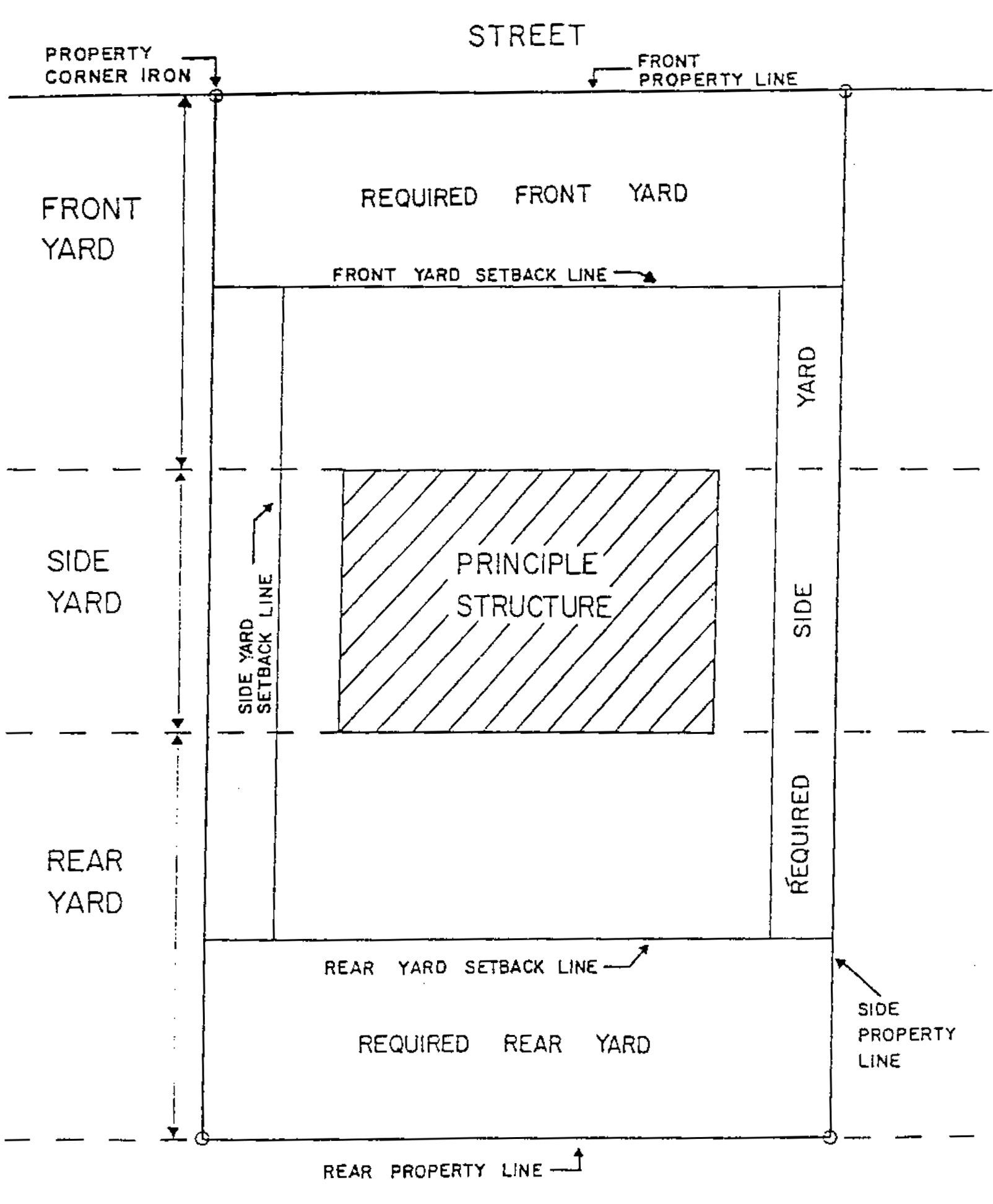
Sexually oriented business means an adult arcade, adult bookstore or adult video store, adult cabaret, adult motel, adult motion picture theater, adult theater, escort agency, nude modeling studio, sexual encounter center, or any combination of the foregoing as defined and regulated in chapter 22, article VI.
Sign means any structure designed to inform or attract the attention of persons not on the premises on which the device is located.
Sign area. The surface area of a sign shall be computed as including the entire area within a parallelogram, triangle, circle, semi-circle or other regular geometric figure, including all of the elements of the display, but not including blank masking (a plain strip, bearing no advertising matter around the edge of a sign), frames, display of identification or licensing officially required by any governmental body, or structural elements outside the sign surface and bearing no advertising matter. In the case of signs mounted back-to-back or angled away from each other, the surface area of each sign shall be computed. In the case of cylindrical signs, signs in the shape of cubes, or other signs which are substantially three-dimensional with respect to their display surfaces, the entire display surface or surfaces shall be included in computations of area. In the case of embellishments (display portions of signs extending outside the general display area), surface area extending outside a general display area and bearing advertising material shall be computed separately as part of the total surface area of the sign. (See Figure 1-3 on number and area of signs.)
FIGURE 1-3
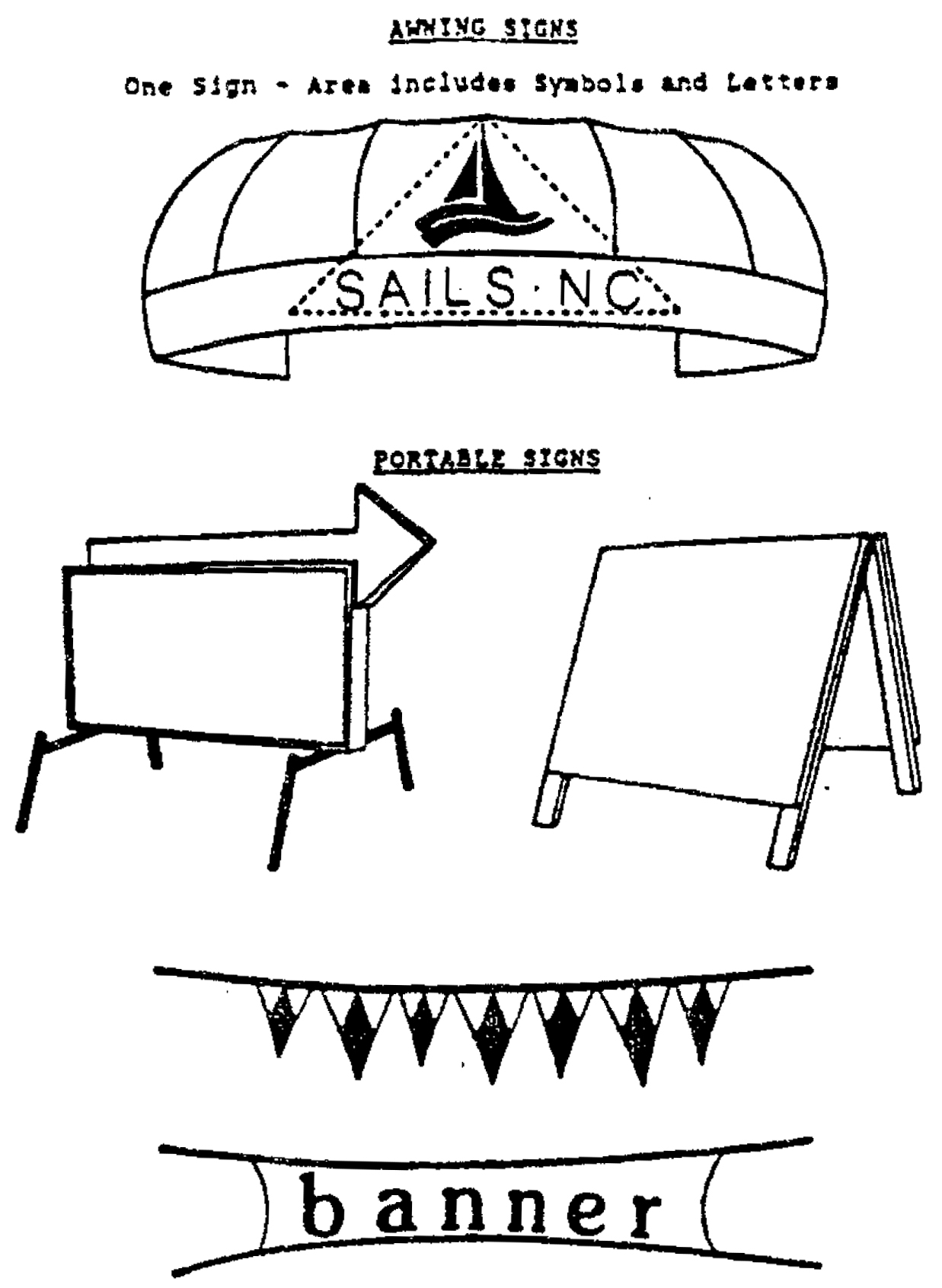
FIGURE 1-3 (Cont'd)
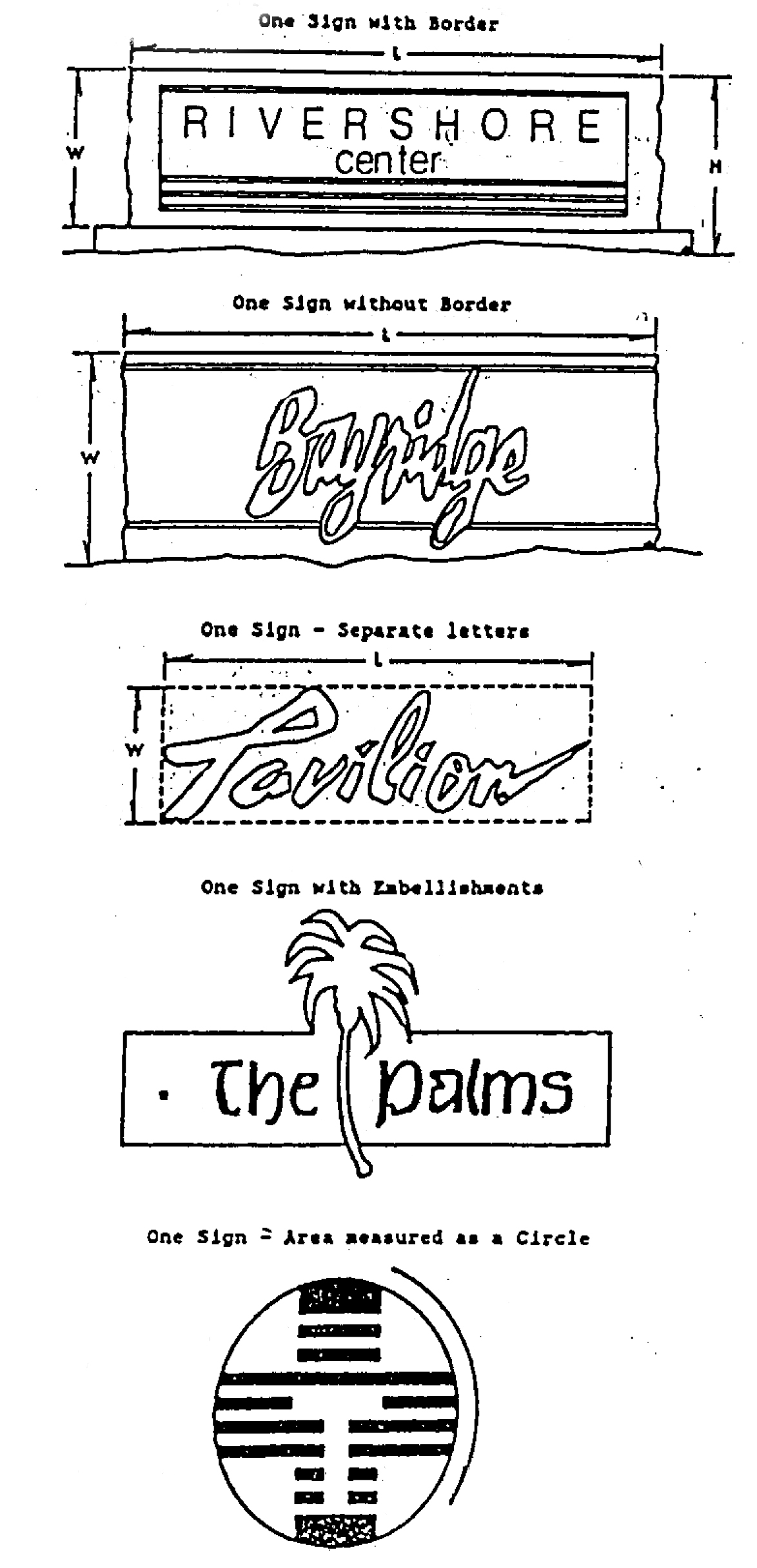
FIGURE 1-3 (Cont'd)
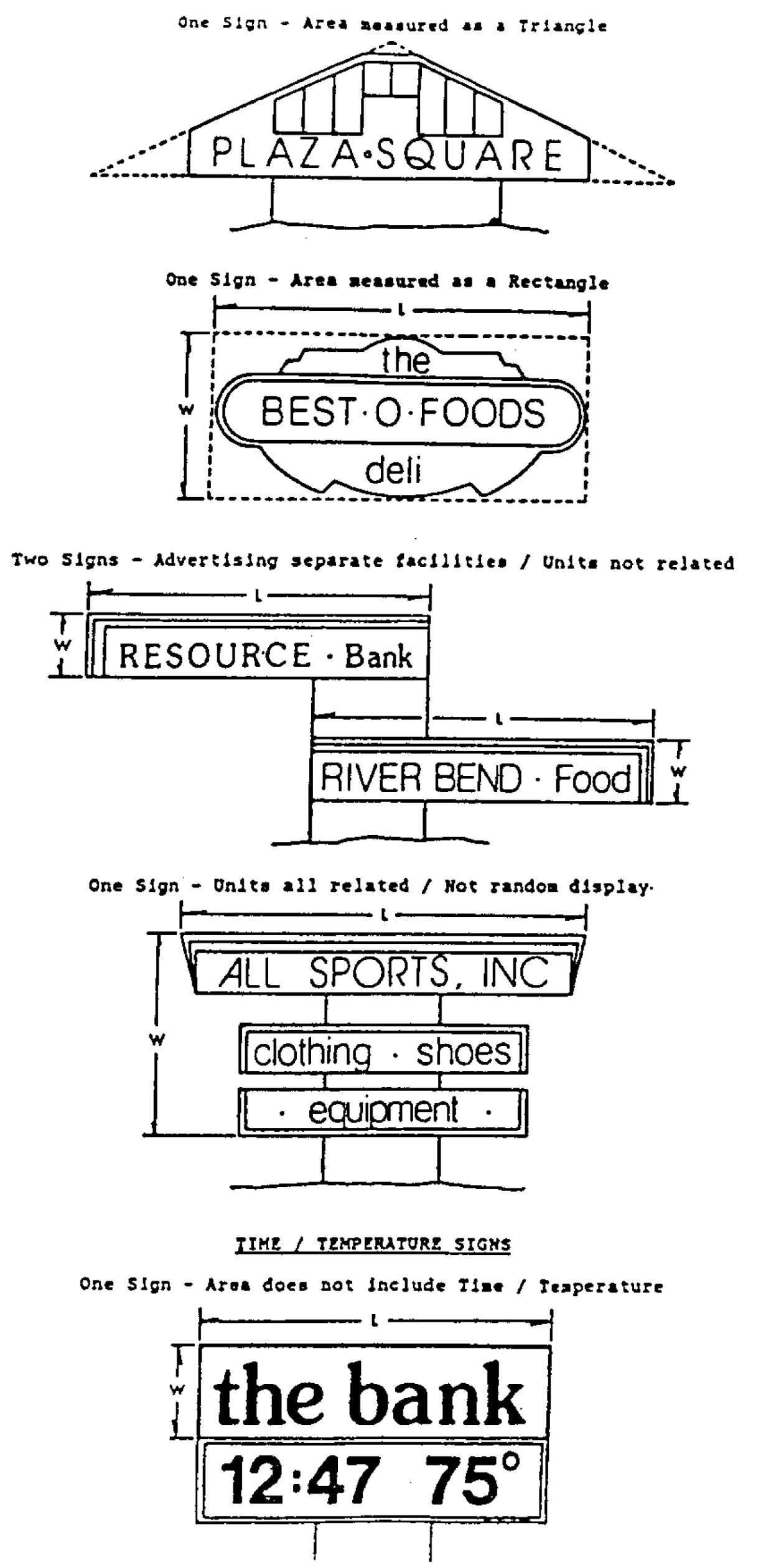
Signs, number of. For the purpose of determining the number of signs, a sign shall be considered to be a single display surface or display device containing elements organized, related, and composed to form a unit. Where matter is displayed in a random manner without organized relationship of units, where strings of lights are used, or where there is a reasonable doubt about relationship of elements, each element or light shall be considered to be a single sign; where sign surfaces are intended to be read from different directions (as in the case of back-to-back signs or those angled from each other) each surface shall be considered to be a single sign. (See Figure 1-3 on number and area of signs.)
Slaughterhouse means an establishment where animals are killed, butchered and prepared for further processing.
Sleeping room means a room designated as sleeping or bedroom on the plans and permit application.
Sleeping unit means a room or space in which people sleep, which can also include permanent provisions for living, eating, and either sanitation or kitchen facilities but not both. Such rooms are spaces that are also part of a dwelling unit are not sleeping units.
Solid waste means garbage, rubbish, refuse or other discarded solid or semisolid material resulting from domestic, commercial, industrial, agricultural activities and governmental operations, excluding solids or dissolved materials in domestic sewage or other significant pollutants in water resources such as silt, dissolved or suspended solids in industrial wastewater effluent, dissolved materials in irrigation return flows or other common water pollutants.
Solid waste disposal facility means any facility involved in the disposal of solid waste, as defined in G.S. 130A-290(a)(35).
Solid waste disposal site means, as defined in G.S. 130A-290(a)(36), any place at which solid wastes are disposed of by incineration, sanitary landfill, or any other method.
Solid waste landfill affiliated enterprise: means any enterprise which by virtue of its existence or operation will, pursuant to a contractual agreement with Catawba County, do any of the following: assist Catawba County in the operation of the Blackburn Solid Waste Landfill; use or recycle materials which would otherwise be directed to the Blackburn Solid Waste Landfill; use or market any by-product of the Blackburn Solid Waste Landfill; provide raw materials such as soils or clays, necessary to operation of the Blackburn Solid Waste Landfill; otherwise aid in the operation of the Blackburn Solid Waste Landfill. Any such enterprise must be located within an area described by a circle, the radius of which is a straight line extending one mile from the approximate center of the Blackburn Solid Waste Landfill. An enterprise meets the requirements of this definition even though its principal activity or activities are not directly related to any of the above-listed landfill affiliated activities. Should the principal activity or activities of the enterprise be a prohibited use in any zoning district located within the above-described area, this section shall control, overriding the prohibition contained elsewhere within the zoning ordinance. Further, the expiration or termination of the underlying contractual agreement by and between the enterprise and Catawba County, or the closing of the Blackburn Solid Waste Landfill, does not then make the enterprise a non-conforming use.
Special flood hazard area (SFHA) means the land in the floodplain subject to a one percent or greater chance of being flooded in any given year, as determined in section 102-583(b) of this chapter.
Special use means a use which would not be appropriate generally or without special study throughout the zoning district but which, if controlled as to number, size, location or relation to the neighborhood, would promote the public health, safety and general welfare. (See article X of this chapter.)
Sports and entertainment facility means a structure or structures and associated grounds that provide athletic and recreational activities including but not limited to ice skating, ice hockey, football, basketball, baseball, inline skating and hockey, and tennis as well as celebratory functions associated with public, private and nonprofit entities and individuals. Such facilities may serve musical and theatrical productions as well as exhibitions.
Start of construction means the date the building permit was issued, provided the actual start of construction, repair, reconstruction, rehabilitation, addition, or improvement was within 180 days of the permit date. The actual start means the first placement of permanent construction of a structure, including a manufactured home, on a site, such as the pouring of slabs or footings, installation of piles, construction of columns, or any work beyond the stage of excavation or the placement of a manufactured home on a foundation. Permanent construction does not include land preparation, such as clearing, grading, and filling; nor does it include the installation of streets and/or walkways; nor does it include excavation for a basement, footings, piers or foundations, or the erection of temporary forms; nor does it include the installation on the property of accessory buildings, such as garages or sheds not occupied as dwelling units or not part of the main structure. For a substantial improvement, the actual start of construction means the first alteration of any wall, ceiling, floor, or other structural part of the building, whether or not that alteration affects the external dimensions of the building.
Street, private, means a roadway, not dedicated to the public, providing primary access to adjacent properties and meeting the standards of the Manual of City Specifications for private street development.
Street, public, means a dedicated and accepted right-of-way maintained by the city or the state and providing access to adjacent property.
Structural alteration means any change, except for repair or replacement, in the supporting members of a structure, such as, but not limited to, bearing walls, columns, beams or girders.
Structure means anything constructed or erected which requires location on the ground or attachment to something having a fixed location on the ground, including, but not limited to, principal and accessory buildings, manufactured homes, signs, fences, walls, bridges, monuments, flagpoles, antennas, transmission poles, towers, and cables, above and below ground storage tanks, or other manmade facilities or infrastructures.
Structure, accessory, means a subordinate structure detached from, but located on the same lot as the principal structure, the use of which is incidental and accessory to that of the principal structure. Manufactured or mobile homes as defined in this chapter shall not be considered an accessory structure.
Structure, principal, means a structure or, where the context so indicates, a group of structures in or on which is conducted the principal use of the lot on which such structure is located.
Structured environment means a residential setting within which persons, progressing from relatively intensive treatment for crime, delinquency, mental or emotional illness, alcoholism, drug addiction or similar conditions to full participation in community life, are provided professional staff services, as well as board, lodging, supervision, medication and other treatment.
Substantial damage means damage of any origin sustained by a structure during any one-year period whereby the cost of restoring the structure to its before damaged condition would equal or exceed 50 percent of the market value of the structure before the damage occurred. See definition of substantial improvement.
Substantial improvement means any repair, reconstruction, improvement, or any combination thereof, of a structure that exceeds 50 percent of the market value during any 12-month period, either before the improvement or repair is started, or if the structure has been damaged and is being restored, before the damage occurred. For the purpose of this definition, "substantial improvement" is considered to occur when the first alteration of any wall, ceiling, floor, or other structural part of the building commences, whether or not that alteration affects the external dimensions of the structure. The term does not, however, include either any project for improvement of a structure to comply with existing state and local health, sanitary, or safety code specifications which are solely necessary to assure safe living conditions, or any alteration of a structure listed on the National Register of Historic Places or a state inventory of historic places.
Swimming pool (in ground): Any facility intended for swimming or recreational bathing that contains over 24 inches of depth for water, and requiring disturbance of ground to be placed below any adjacent grade.
Swimming pool (above ground, regulated): Any facility intended for swimming or recreational bathing that is capable of holding over 42 inches of depth for water, and is constructed and manufactured to be above adjacent grade.
Swimming or wading pools (not regulated): Any facility intended for swimming or recreational bathing that is not designed to hold over 42 inches of depth of water, and is constructed and manufactured to be above adjacent grade.
Tattoo parlor means an establishment where tattooing, as defined in G.S. 130A-283 is practiced. Tattooing of individuals younger than 18 is not permitted.
Technical schools means the use of land, structures or buildings for the provision of training in various skills and may include, but not limited to, business schools, trade schools and vocational schools.
Telecommunications tower means any structure that is designed and constructed primarily for the purpose of supporting one or more antennas, including self-supporting lattice towers, guy towers or monopole towers. The term includes radio and television transmission towers, personal communications service (PCS) towers, microwave towers, common-carrier towers, cellular telephone towers, alternative tower structures, and the like. This definition does not include any structure erected solely for a residential, noncommercial individual use, such as television antennas, satellite dishes or amateur radio antennas.
Use means the specific activity or function for which land, a building, or a structure is designated, arranged, occupied, or maintained.
Use, accessory, means a use on the same lot or in the same structure with, and of a nature and extent customarily incidental and subordinate to, the principal use of the lot or structure.
Use, principal, means the primary use and chief purpose of a lot or structure.
Used merchandise means an establishment engaged in the sale of previously owned goods, except the sale of used motor vehicles.
Variance means a relaxation by the board of adjustment of the dimensional regulations of this chapter where such action will not be contrary to the public interest and where, owing to conditions peculiar to the property and not the results of actions or the situation of the applicant, a literal enforcement of this chapter would result in unnecessary and undue hardship. (See article II, division 2 of this chapter.)
Violation means the failure of a structure or other development to be fully compliant with the community's floodplain management regulations. A structure or other development without the elevation certificate, other certifications, or other evidence of compliance required in section 102-584 and section 102-585 is presumed to be in violation until such time as that documentation is provided.
Vocational school means an establishment in which is offered, for compensation, instruction in a vocation such as, but not limited to, barbering, cosmetology, hair styling, bartending and interior decorating.
Warehouse, mini-, means a building or group of buildings in a controlled access and fenced compound that contains varying sizes of individual, compartmentalized and controlled access stalls or lockers for the storage of goods belonging to the individual lessees of the stalls and accessible to the lessees through individual doors.
Warehousing means a building or group of buildings for the storage of goods or wares belonging either to the owner of the facility or to one or more lessees of space in the facility or both, with access to contents only through management personnel.
Watercourse means a lake, river, creek, stream, wash, channel or other topographic feature on or over which waters flow at least periodically. Watercourse includes specifically designated areas in which substantial flood damage may occur.
Water surface elevation (WSE) means the height, in relation to mean sea level, of floods of various magnitudes and frequencies in the floodplains of coastal or riverine areas.
Wholesale distribution means establishments engaged in selling merchandise to retailers, to industrial, commercial, institutional or professional business users or to other wholesalers.
Yard means an open space unoccupied and unobstructed by any structure or portion of a structure from 36 inches above the general ground level of the graded lot upward (except as otherwise provided by these regulations); provided, however, that fences and walls may be permitted in any yard subject to height limitations established herein; and further provided that poles, posts and other customary yard accessories, ornaments, and furniture shall be permitted in any required yard, if they do not constitute substantial impediments to free flow of light and air across the yard to adjoining properties.
Yard, front, means that portion of a zoning lot extending between the side property lines and between the front property line and the front wall of the principal structure. (See Figure 1-2.)
Yard, rear, means that portion of a zoning lot extending between the side property lines and between the rear property line and the rear wall of the principal structure. (See Figure 1-2.)
Yard, required front, means that portion of a zoning lot between the front yard setback and the street right-of-way. (See Figure 1-2.)
Yard, required rear, means that portion of a zoning lot between the rear property line and the rear yard setback. (See Figure 1-2.)
Yard, required side, means that portion of a zoning lot between the side property line and the side yard setback. (See Figure 1-2.)
Yard, side, means that portion of a zoning lot extending between the front yard and the rear yard along the side of the principal structure. (See Figure 1-2.)
Yard, street, means a landscaped area parallel to the public street right-of-way and abutting an off-street parking area, the purpose of which is to provide continuity of vegetation along the right-of-way and a pleasing view from an adjoining street.
Zoning clearance permit means a permit issued by the code enforcement officer authorizing the recipient to make use of property in accord with the requirements of this chapter. This permit may either be a separate document or part of the normal permits associated with certificates of occupancy, occupational license applications, building permits, or the like.
Zoning districts means areas of land or water, whose boundaries are indicated on the official zoning atlas, within which all properties are regulated by the general regulations of this chapter and the specific regulations of the individual district.
Zoning lot means a lot or combination of lots shown on application for a zoning clearance permit.
(Code 1972, § 26-2.2; Ord. No. 91.53, 10-16-1991; Ord. No. 92.40, § 1, 8-4-1992; Ord. No. 94.28, § 1, 6-22-1994; Ord. No. 94.51, § 1, 11-16-1994; Ord. No. 95.49, § 1, 8-16-1995; Ord. No. 96.9, § 1, 2-21-1996; Ord. No. 97.4, § 1, 1-22-1997; Ord. No. 97.7, § 1, 1-23-1997; Ord. No. 97.17, § 1, 3-19-1997; Ord. No. 98.18, § 1, 3-24-1998; Ord. No. 2001.36, § 1, 9-19-2001; Ord. No. 2002.31, 8-21-2002; Ord. No. 2002.34, § 2, 8-21-2002; Ord. No. 2003.35, § 1, 8-20-2003; Ord. No. 2004.30, § 1, 6-23-2004; Ord. No. 2005.35, § 1, 12-14-2005; Ord. No. 2006-23, § 1, 10-17-2006; Ord. No. 2007.26, §§ 1, 2, 8-7-2007; Ord. No. 2007.21, § 1, 6-19-2007; Ord. No. 2007.36, § 1, 11-20-2007; Ord. No. 2008.28, § 1, 10-7-2008; Ord. No. 2011-4, § 1, 2-1-2011; Ord. No. 2011-7, § 1, 3-15-2011; Ord. No. 2011-8, § 1, 3-15-2011; Ord. No. 2011-7, § 1, 3-15-2011; Ord. No. 2011-8, § 1, 3-15-2011; Ord. No. 2013-3, § 3, 2-5-2013; Ord. No. 2013-32, §§ 1, 2, 9-3-2013; Ord. No. 2021-58, 6-15-2021; Ord. No. 2024-14, §§ 2, 3, 3-5-2024)
Sec. 102-8. - Violations.
Whenever, by the provisions of this chapter, the performance of any act is required, or the performance of any act is prohibited, or whenever any regulation or limitation is imposed on the use of any land and water, or on the erection of a structure, a failure to comply with such provisions shall constitute a violation of this chapter.
(Code 1972, § 26-19.1; Ord. No. 91.53, 10-16-1991)
Sec. 102-9. - Liability.
The owner, tenant, or occupant of any land or structure, or part thereof, and any architect, builder, contractor, agent or other person who participates in, assists, directs, creates, or maintains any situation that is contrary to the requirements of this chapter shall be held responsible for the violation and be subject to the penalties and remedies provided herein.
(Code 1972, § 26-19.2; Ord. No. 91.53, 10-16-1991)
Sec. 102-10. - Procedures upon discovery of violation.
(a)
When staff determines work or activity has been undertaken in violation of a development regulation or any state law delegated to the local government for enforcement purposes in lieu of the state or in violation of the terms of a development approval, a written notice of violation may be issued. The notice of violation shall be delivered to the holder of the development approval and to the landowner of the property involved, if the landowner is not the holder of the development approval, by personal delivery, electronic delivery, or first-class mail and may be provided by similar means to the occupant of the property or the person undertaking the work or activity. The notice of violation may be posted on the property pursuant to G.S. 160D-404. Additional written notices may be sent at the planning director's or his designee's discretion.
(b)
The final written notice, which may also be the initial notice, shall state the action the planning director intends to take, if the violation is not corrected within 30 days, and shall advise that the planning director may seek enforcement without prior written notice by invoking any of the remedies contained in section 102-12.
(c)
The planning director shall certify the notice of violation for the file.
(Code 1972, § 26-19.3; Ord. No. 91.53, 10-16-1991; Ord. No. 2021-58, 6-15-2021)
Sec. 102-11. - Penalties.
Any violation of this chapter or amendments thereto shall constitute a misdemeanor, and those convicted of such violation shall be punished as provided by G.S. 14-4 and section 1-6.
(1)
Any violation of this chapter shall subject the offender to a civil penalty in the amount of $50.00. Violators shall be issued a written citation which must be paid within 72 hours.
(2)
Each day's continuing violation shall be a separate and distinct offense.
(3)
Notwithstanding subsection (1) above, provisions of this chapter may be enforced through equitable remedies issued by a court of competent jurisdiction.
(4)
In addition to, or in lieu of, remedies authorized in subsections (1) and (3) above, violations of this chapter may be prosecuted as a misdemeanor or otherwise in accordance with G.S. 160A-175.
(Code 1972, § 26-19.4; Ord. No. 91.53, 10-16-1991)
Sec. 102-12. - Remedies; permit revocation.
If a building or structure is erected, constructed, reconstructed, altered, repaired, converted, or maintained, or any building, structure or land is used in violation of this chapter or a regulation made under authority conferred by this chapter, the planning director or his designee, in addition to other remedies, may institute any appropriate action or proceedings to prevent the unlawful erection, construction, reconstruction, alteration, repair, conversion, maintenance or use, to restrain, correct or abate the violation, to prevent occupancy of the building, structure or land, or to prevent any illegal act, conduct, business or use in or about the premises pursuant to G.S. 160D-404(c).
Development approvals shall be revoked for any substantial departure from the approved application, plans, or specifications; for refusal or failure to comply with the requirements of any applicable local development regulation or any state law delegated to the local government for enforcement purposes in lieu of the state; or for false statements or misrepresentations made in securing the approval. Any development approval mistakenly issued in violation of an applicable state or local law may also be revoked. Development approvals may be revoked by notifying the holder in writing stating the reason for the revocation. The local government shall follow the same development review and approval process required for issuance of the development approval, including any required notice or hearing, in the review and approval of any revocation of that approval. The revocation of a development approval by a staff member may be appealed pursuant to G.S. 160D-405.
Whenever any work or activity subject to regulation or any state law delegated to the local government for enforcement purposes in lieu of the state is undertaken in substantial violation of any state or local law, or in a manner that endangers life or property, staff may order the specific party of the work or activity that is in violation or presents such a hazard to be immediately stopped. The order shall be in writing, directed to the person doing the work or activity, and shall state the specific work or activity to be stopped, the reasons therefor, and the conditions under which the work or activity may be resumed. A copy of the order shall be delivered to the holder of the development approval and to the owner of the property involved (if that person is not the holder of the development approval) by personal delivery, electronic delivery, or first-class mail. No further work or activity shall take place in violation of a stop work order pending a ruling on the appeal. Violation of a stop work order shall constitute a Class 1 misdemeanor.
(Code 1972, § 26-19.5; Ord. No. 91.53, 10-16-1991; Ord. No. 2021-58, 6-15-2021)
Sec. 102-13. - Severability.
It is the legislative intent of the council in adopting this chapter that all provisions thereof shall be liberally construed to protect and preserve the peace, health, safety, and general welfare of the inhabitants of the city and its extraterritorial jurisdiction. It is the further intent of the council that this chapter shall stand, notwithstanding the invalidity of any part thereof, and that should any provision of this chapter be held to be unconstitutional or invalid, such holding shall not be construed as affecting the validity of any of the remaining provisions.
(Code 1972, § 26-20.1; Ord. No. 91.53, 10-16-1991; Ord. No. 2002.31, 8-21-2002)
Sec. 102-14. - Conflict with other laws.
When provisions of this chapter impose higher standards than required in any other statute or local ordinance or regulation, the provisions of this chapter shall govern. When the provisions of any other statute or local ordinance or regulation impose higher standards than are required by the provisions of this chapter, the provisions of that statute or local ordinance or regulation shall govern.
(Code 1972, § 26-20.2; Ord. No. 91.53, 10-16-1991)
Sec. 102-15. - Curative provision.
Notwithstanding any other provision contained herein, in the case where construction has been completed and either the setback requirements, minimum lot size, or lot width at building line requirements have been violated, and where a time period of 15 years has passed since a building permit has been issued or construction of the structure has been completed, and no legal action has been commenced in any court of competent jurisdiction to enjoin such construction or to cause removal of any such structure, then in that case, the city shall not bring any proceeding or take any action to require the removal of any such structure. Provided however, this provision shall not affect pending litigation or apply to any violation of any other ordinance or any other violations of the provisions of this chapter except those specifically set forth hereinabove. Provided further, the property owner shall have the burden of providing the applicability of this section.
(Code 1972, § 26-20.3; Ord. No. 91.53, 10-16-1991)
Sec. 102-16. - Effective date.
The provisions of this chapter shall be effective on and after November 1, 1991.
(Code 1972, § 26-20.4; Ord. No. 91.53, 10-16-1991)
Sec. 102-17. - Area of coverage.
The regulations of this chapter shall apply throughout the city's planning and development regulation jurisdiction as it may from time to time exist.
(Code 1972, § 26-3.1; Ord. No. 91.53, 10-16-1991; Ord. No. 2021-58, 6-15-2021)
Sec. 102-18. - Applicability to lands, water, structures, uses and occupancies.
No building, structure, land or water shall hereafter be used or occupied, and no building, structure, or part thereof shall hereafter be erected, reconstructed, moved, located, or structurally altered except in conformity with the regulations set out generally herein and for the district in which it is located. In clarification of the foregoing, it is the specific intent of the council that all floating structures and buildings, as well as buildings and structures built over or in water, shall meet all the requirements of this chapter and other ordinances and regulations of the city.
(Code 1972, § 26-3.2; Ord. No. 91.53, 10-16-1991; Ord. No. 2002.31, 8-21-2002)
Sec. 102-19. - Compliance.
In particular, no building or structure or part thereof shall hereafter be erected, constructed, reconstructed, located, moved or structurally altered in any manner so as to:
(1)
Exceed the permitted height, bulk or floor area;
(2)
Accommodate or house a greater number of families or other occupants, or to provide a greater number of dwelling units;
(3)
Occupy a greater percentage or portion of lot area;
(4)
Provide less lot area per dwelling unit or to occupy a smaller lot;
(5)
Provide narrower or smaller yards or other open spaces, or spaces or separations between buildings or portions thereof;
(6)
Provide less off-street parking or off-street loading space;
(7)
Display more signs, signs of greater area, or signs of a different character;
(8)
Permit the use of the building or structure for a use not permitted in the district in which it is located, than herein required or limited, or in any other manner contrary to any provisions of this chapter.
(Code 1972, § 26-3.3; Ord. No. 91.53, 10-16-1991)
Sec. 102-20. - Yard, area, open space, off-street parking and off-street loading space for one structure or use not to be used to meet requirements for another.
No part of a yard, area, open space, or off-street parking or off-street loading space required for one structure or use shall be included as meeting requirements for another, except where specific provisions therefor are made in this chapter.
(Code 1972, § 26-3.4; Ord. No. 91.53, 10-16-1991)
Sec. 102-21. - Creation of new lots; reduction of lot or yard dimensions below minimum requirements prohibited.
No new lot shall be created after the effective date of this chapter except in conformity with the requirements of applicable regulations. No yard or lot existing at the time of passage of these regulations shall be reduced by private action in width, depth, or area below the minimum requirements set forth herein.
(Code 1972, § 26-3.5; Ord. No. 91.53, 10-16-1991)
Sec. 102-22. - Reduction of required off-street parking or off-street loading space prohibited.
No off-street parking or off-street loading space, affected by these regulations, which meets all or part of the requirements of this chapter for such space, shall be reduced or eliminated by private action, except where approved alternative off-street parking or off-street loading space, meeting such requirements, is provided, unless no longer required by this chapter.
(Code 1972, § 26-3.6; Ord. No. 91.53, 10-16-1991)
Sec. 102-23. - Action where zoning lot contains two or more district designations.
(a)
Where a zoning lot contains two or more district designations with different permitted floor area ratio applying, the permitted floor ratio for the zoning lot shall not exceed the sum of the results obtained by multiplying the privately owned land area of the zoning lot in each district by the applicable permitted floor area ratio for that portion of the zoning lot.
(b)
Where a zoning lot contains two or more district designations with different density regulations (i.e., a differing amount of required lot area for each dwelling unit), the density (maximum number of dwelling units) shall not exceed the numeric sum of the maximum number of units that could be constructed on individual portions of the zoning lots in each zoning district.
(c)
Such permitted floor area or density may be distributed throughout the zoning lot without regard to district boundaries upon the approval by the planning director of an application for approval of a zoning compliance permit. Such application shall include a site plan showing proposed use, placement, bulk and interrelationship of all structures within the zoning lot.
(d)
Nothing in this section shall authorize the location of a use in a district where that use is not either a permitted principal or accessory use or a permissible special use.
(Code 1972, § 26-3.7; Ord. No. 91.53, 10-16-1991)
Sec. 102-24. - Required accessory uses on same zoning lot with same zoning.
All required accessory uses for any principal use, including but not limited to, off-street parking and loading areas, retention or drainage areas, and private sewer or water systems shall be located on the same zoning lot as the principal use and shall have the same zoning district designation as the principal use, except as permitted elsewhere in this chapter.
(Code 1972, § 26-3.8; Ord. No. 91.53, 10-16-1991)

