
Newton City Zoning Code
ARTICLE IX
OFF-STREET PARKING AND LOADING
Sec. 102-421.- Intent.
It is the intent of these regulations to encourage the appropriate location of off-street parking and off-street loading to provide the needed levels of service to the citizens of and visitors to the city and its environs, to avoid undue congestion on the streets, to protect the capacity of the street system to move traffic, to avoid unnecessary conflicts between vehicles and pedestrians, to preserve and enhance the designated pedestrian activity areas within the city and to facilitate access from streets to off-street parking lots and structures and off-street loading spaces.
(Code 1972, § 26-10.1; Ord. No. 91.53, 10-16-1991)
Sec. 102-422. - Off-street parking required.
In all districts, in connection with every industrial, commercial, institutional, residential or any other use, at the time any new structure is erected or any use of a structure or land is enlarged or increased in density or intensity, off-street parking shall be provided for motor vehicles in accordance with requirements herein, and shall be for the new use or the enlarged portion of the use(s) or structure(s) only and not the existing use or structure.
(Code 1972, § 26-10.2; Ord. No. 91.53, 10-16-1991)
Sec. 102-423. - Compliance with regulations.
The requirements for off-street parking space and off-street loading space applicable to newly erected or altered structures and uses shall be a continuing obligation of the owner of the real estate upon which any such structure is located, so long as the structure or use is in existence and its use requiring parking or loading, or both, continues. It shall be unlawful for an owner of any structure affected by this chapter to discontinue, change or dispense with, or cause the discontinuance or change of the required vehicle parking or loading space apart from the discontinuance of such structure, without establishing alternative parking and loading space which meets the requirements of and is in compliance with this chapter.
(Code 1972, § 26-10.3; Ord. No. 91.53, 10-16-1991)
Sec. 102-424. - Methods of providing required parking.
All required parking shall be located on the same zoning lot as the principal use(s) it serves, except as provided below. In lieu of actual construction of required on-site parking spaces, all or any portion of the off-street parking required in this article may be provided as follows:
(1)
Required parking for a use on a zoning lot may be located on another zoning lot, either by itself or combined with parking for other uses, subject to certification by the planning director that the following requirements have been met:
a.
The use being served by the off-site parking shall be a permitted principal use as established in article IV of this chapter in the zoning district within which the zoning lot containing such parking is located.
b.
The off-site parking spaces shall be located within 300 feet walking distance of a public entrance to the structure or land area containing the use for which such spaces are required. A safe, direct, attractive, lighted and convenient pedestrian route shall exist or be provided between the off-site parking and the use being served.
c.
The continued availability of off-site parking spaces, necessary to meet the requirements of this article, shall be ensured by an appropriate reciprocal easement, satisfactory to the office of the city attorney and recorded with the register of deeds of the county.
d.
For purposes of determining applicable minimum and maximum intensities, the land area devoted to off-site parking shall be added to the land area of the zoning lot containing the use being served by such parking and shall be subtracted from the area of the zoning lot containing the off-site parking.
e.
The provision of off-site required off-street parking shall only occur in industrial, commercial and office districts.
f.
Off-site required off-street parking shall not be separated from the use it serves by arterial or collector streets, as shown on the thoroughfare plan and the collector street plan, or other similar physical barriers to convenient access between the parking and the use.
(2)
Parking, whether required or not, for an industrial or commercial use on an abutting (streets excluded), residential or office and institution zoning lot may be allowed as a Class A special use, subject to standards applicable to individual special uses contained in section 102-468(17).
(Code 1972, § 26-10.4; Ord. No. 91.53, 10-16-1991; Ord. No. 95.53, § 1, 9-20-1995)
Sec. 102-425. - Joint use facilities and shared parking.
(a)
Nothing in the chapter shall be construed to prevent the joint use of off-street parking or off-street loading space for two or more structures or uses, if the total of such spaces, when used together, will not be less than the sum of the requirements of the various individual uses computed separately in accordance with the requirements of this chapter. An agreement for such joint use, in the form of a reciprocal easement acceptable to the city attorney shall be filed with the planning director and recorded with the register of deeds of the county.
(b)
No part of an off-street parking area or off-street loading area required for any structure or use for the purpose of complying with the provisions of this chapter shall be included as a part of an off-street parking area or off-street loading area similarly required for another structure or use, unless the planning director determines that the period(s) of peak demands for off-street parking for such structures or uses will not be simultaneous with or overlap each other. An agreement, with the city as one of the parties with a right of enforcement, for such joint use, in the form of a reciprocal easement acceptable to the city attorney shall be filed with the planning director and recorded with the county register of deeds. The zoning clearance permit covering such approval shall include the requirements that the permit is valid only so long as the conditions described in the application for the permit exist.
(Code 1972, § 26-10.5; Ord. No. 91.53, 10-16-1991)
Sec. 102-426. - Number of required off-street parking spaces.
(a)
Required off-street parking spaces. The number of required off-street parking spaces shall be as set forth in Table 9-1, below:
TABLE 9-1. REQUIRED PARKING SPACES
GFA = Gross floor area
(b)
Calculation of certain parking requirements. Where parking requirements relate to number of seats, and seating is in the form of undivided pews, benches, and the like, 20 lineal inches shall be construed to be equal to one seat. Where parking requirements relate to movable seating in auditoriums and other assembly rooms, 15 square feet of net floor area shall be construed to be equal to one seat, except where otherwise specified. Net floor area shall be the actual area occupied by seating and related aisles, and shall not include accessory unoccupied areas or the thickness of walls.
(Code 1972, § 26-10.6; Ord. No. 91.53, 10-16-1991; Ord. No. 97.20, § 1, 4-16-1997; Ord. No. 98.18, § 5, 3-24-1998; Ord. No. 2003.17, § 1, 4-16-2003; Ord. No. 2012-21, § 1, 7-10-2012)
Sec. 102-427. - Determinations for unlisted uses.
The planning director or his designee shall make a determination, in the cases of uses not listed in Table 9-1, of the required off-street parking spaces. In reaching the determination, the planning director or his designee shall be guided by the requirements for similar uses, the number and kind of vehicles likely to be attracted to the proposed uses and studies of the parking requirements of such uses in other jurisdictions.
(Code 1972, § 26-10.7; Ord. No. 91.53, 10-16-1991)
Sec. 102-428. - Off-street parking space standards.
(a)
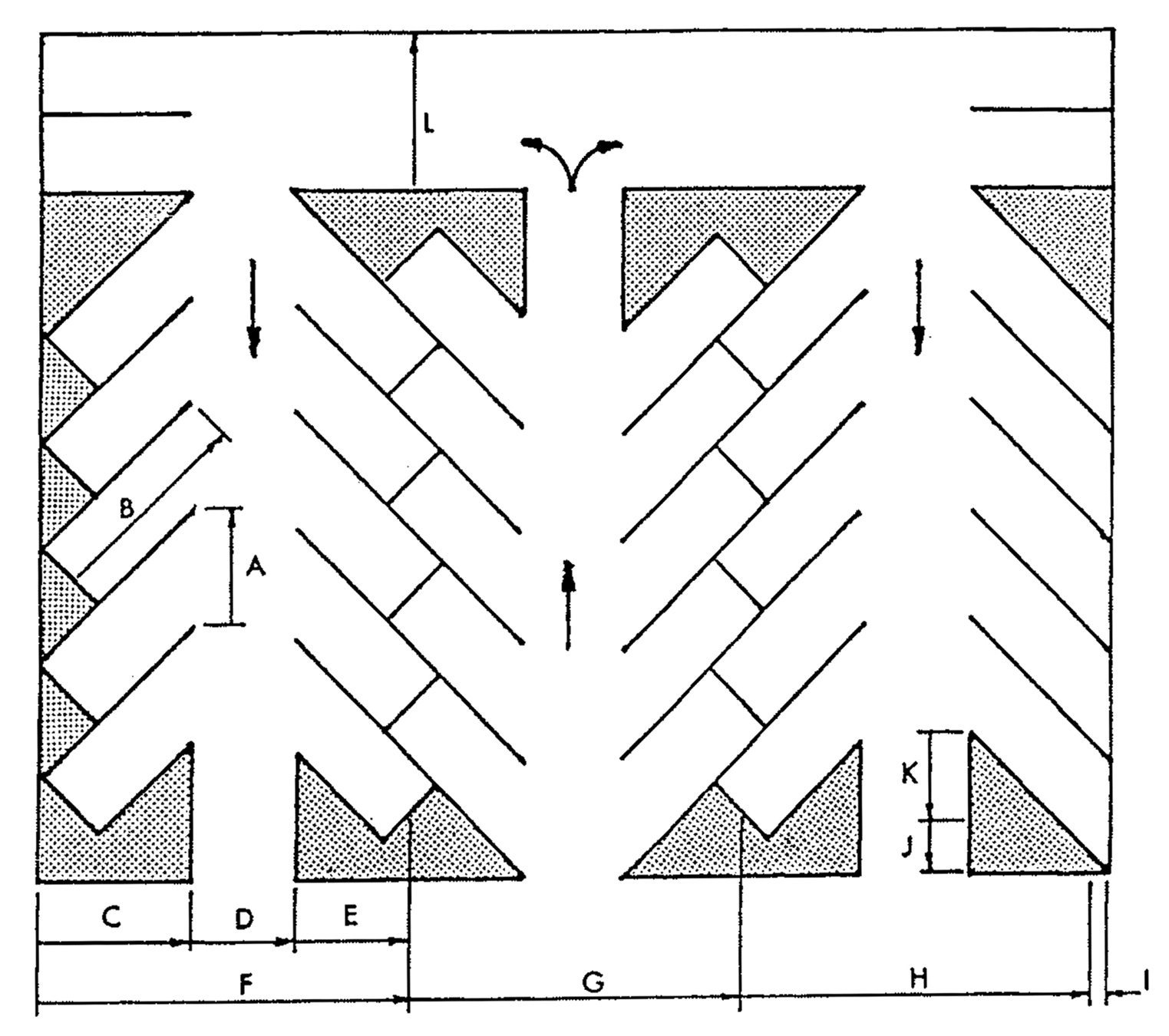
Regular car parking. The minimum dimensions for required off-street spaces shall be as shown in Tables 9-2 and 9-3:
TABLE 9-2
(b)
Compact car parking. Parking for compact cars may be provided for up to 30 percent of the required parking.
(1)
Compact car parking may be provided for only nonresidential land uses.
(2)
Compact car parking may only be provided for parking areas that have ten or more spaces.
(3)
For 90-degree compact parking, the minimum stall width shall be eight feet and the minimum stall length shall be 16 feet. There need be no provision for bumper overhang for compact parking.
(4)
Compact parking spaces must be designated as being for the exclusive use of compact cars through the use of signs or pavement marking.
(5)
The overall design must be reviewed and approved by the planning director.
(6)
The parking layout dimensions (in feet) for eight-foot compact parking stalls at various angles are shown in Table 9-3.
TABLE 9-3
*See Diagram 9-1, for applications of Tables 9-2 and 9-3.
DIAGRAM 9-1
(c)
Disabled parking. Parking for the disabled shall be provided in the following quantities:
Such parking spaces for the disabled shall be designed and located as required by the state building codes.
(d)
Surface. Except for single- and two-family dwellings and agricultural use, every off-street parking area shall provide a surface that will not contribute to subsidence, erosion or sedimentation, either on-site or off-site.
(e)
Grading and drainage. All off-street parking lots shall be graded and drained so as to dispose of all surface water accumulated within the area, in accordance with the design standards of the Manual of City Specifications.
(f)
Lighting. Lighting, if provided, shall be directed away from public streets and residential areas and shall not be a hazard or distraction to motorists traveling on a street.
(g)
Sales, storage, etc. Sales, dead storage, repair, dismantling and service of motor vehicles shall not be permitted on off-street parking spaces.
(h)
Location on private property. All off-street parking spaces, including all areas for maneuvering, shall be located solely on private property, and shall not use public property or public rights-of-way.
(i)
Circulation. All off-street parking areas shall be designed to provide safe and convenient circulation, in accordance with commonly accepted traffic engineering practices and subject to the review and approval of the planning director in accordance with said practices.
(Code 1972, § 26-10.8; Ord. No. 91.53, 10-16-1991; Ord. No. 92.44, § 1, 8-4-1992)
Sec. 102-429. - Landscaping standards for off-street parking.
(a)
Purpose. It is the intent of this section to protect and promote the public health, safety, and general welfare by requiring the landscaping of parking areas which will serve to control access, enhance safety, reduce radiant heat from surfaces, reduce wind and air turbulence, reduce noise, reduce the glare of motor vehicles and surfaces, ameliorate stormwater drainage problems, filter automotive exhaust, and protect and preserve the appearance, character, and value of adjacent properties.
(b)
Applicability. The landscaping requirements of this section shall apply to all new land development, public and private, designated as multifamily, recreational, office or institutional, commercial or industrial land uses. It is the intent of this section to encourage but not to require compliance with these standards whenever existing structures and/or uses are enlarged or expanded and additional parking is required by this chapter.
(c)
Predevelopment site review. Site plans for proposed development shall comply with the requirements of this section prior to issuance of a zoning permit. Such plans shall be reviewed and approved by the planning director.
(d)
Landscaping requirements.
(1)
Street yards. The minimum width of the street yard, as defined in section 102-7, shall be ten feet measured from and parallel to the public street right-of-way. It shall be landscaped and maintained with a vegetative cover and shall be planted with small (mature height less than four feet) and/or medium (mature height four to eight feet) shrubs as follows:
Explanation:
E = Evergreen
D = Deciduous
S = Sunny location
SPS = Full sun to shady locations
a.
Each shrub shall have a minimum amount of planting space based on the mature height of the shrub.
1.
A small shrub having a mature height of less than four feet will have a minimum of nine square feet of planting space, a three-foot by three-foot square surface area.
2.
A medium shrub having a mature height of less than eight feet will have a minimum of 16 square feet of planting space, a four-foot by four-foot square surface area.
b.
The planting surface of each shrub can touch the planting space of another shrub or tree but cannot overlap each other or be covered with a nonporous material, such as a concrete sidewalk. This is to provide sufficient room for good foliage and root development of each shrub and tree.
(2)
Interior areas of parking lots. The area(s) within the property used for vehicular storage, parking and movement shall provide landscaping as follows: The size of the mature tree to be used in a specific area should be based on the width of the planting area.
Small trees (mature height of less than 30 feet) should have a planting width of at least four feet and an open area of at least 24 square feet. Minimum planting area is a four-foot by six-foot rectangle.
Medium trees (mature height less than 45 feet) should have a planting width of at least six feet and an open space of at least 60 square feet. Minimum planting area is a six-foot by ten-foot rectangle.
Large trees (mature height greater than 45 feet) should have a planting area of at least ten feet and an open space of at least 160 square feet. Minimum planting area is a ten-foot by 16-foot rectangle.
a.
One small tree shall be required for every ten parking spaces or one medium tree shall be required for every 15 or fewer parking spaces; or one large tree for every 20 or fewer spaces; or a combination of tree sizes based on the number of parking spaces and the size of the planting area. The following example is given for illustrative and guidance purposes in the application of this subsection:
A parking lot having 38 parking spaces total would require a minimum of four small trees, or three medium trees, or two large trees, or two small trees and one large tree, or two small and two medium trees, or one small, one medium, and one large tree.
b.
One small shrub shall be required for every five or fewer parking spaces; or one medium shrub for every ten parking spaces; or a combination of small and medium shrubs based on the number of parking spaces, the amount of planting space available and any sight elevation problems that may be encountered in the parking lot.
c.
The minimum size of the planting area will be based on the total minimum square foot area required by each shrub and tree to be planted in that area. The following example is given for illustrative and guidance purposes in the application of this section:
One medium tree and four small shrubs are to be planted in a traffic island. The minimum size of the planting area will be:
One medium tree: One by 60 square feet.
Four small shrubs: Four by nine square feet.
Total area needed: 96 square feet.
d.
Required trees and shrubs shall be distributed throughout the vehicular area and placed as landscaped islands at each end of parking aisles to assist in traffic delineation and control.
e.
Planting areas shall comply with the specified calculations at a minimum and shall be protected from vehicular encroachment by curbing or wheel stops at least six inches in height.
f.
No more than 50 percent of trees may be evergreen and at least 50 percent of shrubs shall be evergreen.
g.
All tree planting areas not affected by turf grass or low-growing ground cover shall be adequately mulched with organic material, such as shredded bark or pine needles, to conserve moisture and discourage growth of noxious weeds. Small stone or gravel is acceptable as mulch in landscaped areas when used in conjunction with a landscape fabric.
(3)
Separation from structures: All parking areas, unless located on or within a structure, shall be separated from the exterior wall of a structure exclusive of paved pedestrian entranceways or loading areas by a buffer strip of at least five feet in width, which shall be landscaped with mulch, pine straw, small gravel or stone and shrubs.
(e)
Maintenance. It shall be the responsibility of the property owner, or, in the event of a property transfer, the subsequent property owner, to maintain and ensure the survival of the plant material and planting areas in perpetuity. Plants and trees that do not survive planting or for some reason succumb to injury, disease and/or insect infestation must be replaced during the first planting season following the death of the plant(s) in accordance with the specifications of this section.
(f)
Performance guarantee.
(1)
Landscape and tree planting requirements may be deferred to an appropriate planting season, based on a decision made by the planning director, in order to facilitate a property owner's desire to obtain a certificate of occupancy. This provision is meant to allow for seasonal extremes in weather and soil conditions which may be incompatible to landscaping. It is not, however, meant to be used in any way to circumvent the intent and purpose of this section. No certificate of occupancy shall be approved until:
a.
The required landscaping is completed in accordance with the approved plan; or
b.
A performance guarantee is posted in compliance with the terms required for a valid performance guarantee pursuant to and described in article VI, section 90-232 of the Newton Municipal Code.
(2)
Exceptions for underground and above-ground parking structures. When parking is provided underground or within buildings, the above requirements shall not apply.
(Code 1972, § 26-10.9; Ord. No. 91.53, 10-16-1991; Ord. No. 97.7, § 2, 1-23-1997; Ord. No. 2021-58, 6-15-2021)
Sec. 102-430. - Required off-street loading space.
(a)
Every use requiring the receipt or distribution, by vehicles, of materials and merchandise shall have one or more loading berths or other space for standing, loading and unloading on the same or adjoining premises. Loading space shall be sufficient to allow normal loading and unloading operations of a kind and magnitude appropriate to the property served. Also, a required loading space shall be available for the loading and unloading of vehicles and shall not be used for the storage of vehicles or materials, or to meet off-street parking requirements, or in conducting the use.
(b)
The requirements in Table 9-4 shall apply to new structures or additions to structures, and shall not be considered to make any existing structure nonconforming for lack of such off-street loading.
TABLE 9-4. OFF-STREET LOADING REQUIREMENTS
(Code 1972, § 26-10.10; Ord. No. 91.53, 10-16-1991)
Sec. 102-431. - Determination of unlisted uses.
For any land use which is not listed in Table 9-4, the planning director, upon review of the proposed use, shall specify the required number of loading spaces to be provided, using generally accepted traffic engineering practices and standards.
(Code 1972, § 26-10.11; Ord. No. 91.53, 10-16-1991)
Sec. 102-432. - Off-street loading space standards.
All off-street loading spaces shall meet the following standards:
(1)
Off-street loading spaces shall be located and arranged so that a semitrailer truck (WB-50 class) shall be able to gain access to and use such spaces.
(2)
Loading space shall observe the minimum street and interior setbacks established for structures.
(3)
All loading space and maneuvering space shall be surfaced with an all-weather material which shall be maintained in a safe, sanitary, and neat condition.
(4)
No loading space shall be located so that a vehicle using such space intrudes on or hinders the use of the public right-of-way, or adjacent properties.
(5)
Each required off-street loading space shall have a minimum width of 12 feet and a minimum vertical clearance of 16 feet above finished grade of the space. The length shall be a minimum of 30 feet for local delivery and 60 feet for semi-trailers. A maximum of two-thirds of the required loading spaces can be used for local delivery vehicles.
(Code 1972, § 26-10.12; Ord. No. 91.53, 10-16-1991)

