
Newton City Zoning Code
ARTICLE V
- APPLICATION OF AREA, HEIGHT AND PLACEMENT REGULATIONS
Sec. 102-231.- Regulations encumbering land required to satisfy chapter requirements.
No portion of a lot, used in connection with an existing or proposed building, structure or use, and necessary for compliance with the area, height and placement regulations of this chapter shall, through sale or otherwise, be used again as part of the lot required in connection with any other building, structure, or use.
(Code 1972, § 26-6.1; Ord. No. 91.53, 10-16-1991)
Sec. 102-232. - Height regulations generally.
(a)
Excluded portions of structures. Except as specifically provided herein, the height limitations of this chapter shall not apply to any roof structures for housing elevators, stairways, tanks, ventilating fans, solar energy collectors, or similar equipment required to operate and maintain a building, provided that such structures shall not cover more than 33 percent of roof area or extend over ten feet in height; nor to church spires, steeples, belfries, cupolas, domes, monuments, water towers, skylights, flag poles, vents, construction or mining cranes or draglines, or similar structures, which may be erected above the height limit; nor to fire or parapet walls, provided, however, that such walls shall not extend more than five feet above the roof.
(b)
Aviation hazards. No building or other structure, regardless of exclusions set forth in subsection (a) above, shall be located in a manner or built to a height which constitutes a hazard to aviation or creates hazards or property by reason of unusual exposure to aviation hazards.
(Code 1972, § 26-6.2; Ord. No. 91.53, 10-16-1991)
Sec. 102-233. - Unusually tall structures.
Unless specifically stated otherwise elsewhere in this chapter concerning height, towers that are principal structures in themselves, such as high voltage transmission line towers, telephone or electronic relay or transmission and receiving towers, grain elevators, silos and other such agricultural uses and similar principal structures, may only exceed the height limitations established for the district wherein they are proposed for location following review as Class B special use permit by the board of adjustment. The board of adjustment may only grant the special use permit where it finds:
(1)
That the proposed structure would not result in restriction or interference with air traffic or air travel to or from any existing or proposed airport.
(2)
That the proposed structure is consistent with the existing surrounding uses, and is compatible with the existing neighborhood development.
(3)
That the proposed structure is consistent with any adopted or projected development plan for the area.
(4)
That the proposed structure is not detrimental to the existing or proposed use of any neighboring property, and does not unreasonably restrict the free flow of light, sunlight and air to those properties.
(Code 1972, § 26-6.3; Ord. No. 91.53, 10-16-1991)
Sec. 102-234. - Accessory structures.
Accessory structures in a residential zoning district shall conform to the following regulations:
(1)
Detached garages and carports may be constructed or placed in either side yard or the front yard of a principal residential structure, provided they comply with the minimum front and side building setback requirements for the district in which they are to be located.
(2)
Accessory structures, in addition to detached garages and carports, shall be located in the rear yard, provided they do not occupy cumulatively more than 30 percent of the rear yard and that they be no closer to the rear or side property lines than five feet with the exception of fences which do not exceed eight feet in height.
(3)
Neither a manufactured home nor a recreational vehicle, as defined by this chapter, shall be permitted as a residential accessory structure.
(4)
Fences which do not exceed four feet in height may be constructed in the front yard. Fences which do not exceed eight feet in height may be constructed in either side yard or in the rear yard.
(5)
Swimming pools (in ground) and swimming pools (above ground, regulated) as defined by section 26-2.2 are allowed in rear and side yards. Provided they are able to meet a five feet setback off all property lines. In cases where a deck or other structure(s) are associated with the pool the same setbacks apply, unless specifically otherwise stated within other provisions of this chapter. Swimming pools (in ground) and swimming pools (above ground, regulated) are not generally permitted in front yards. In cases where the front yard setback is measured from the shortest frontage on a corner lot, and the principal structure faces the frontage on another street, swimming pools may be placed in front yards, subject to all other provisions being met.
(Code 1972, § 26-6.4; Ord. No. 91.53, 10-16-1991; Ord. No. 92.41, § 1, 8-4-1992; Ord. No. 2006.23, § 3, 10-17-2006)
Sec. 102-235. - Permitted projections into required setbacks.
(a)
Certain architectural features, such as, but not limited to, awnings, cornices, eaves, stoops and gutters, may project no more than three feet into the required front setback, five feet into the required rear setback and two feet into the required side setback.
(b)
Mechanical equipment, such as air conditioning units, heat pumps, heating equipment, solar panels, and similar installations, may not project into the required front setback, but may project five feet into the required rear setback and two feet into the required side setback.
(Code 1972, § 26-6.6; Ord. No. 91.53, 10-16-1991)
Sec. 102-236. - Averaging an existing residential front setback line.
In a residential district, where the average of the front setbacks for all adjacent lots, which are located within 200 feet of either side of a lot is greater than the required front setback specified in this chapter, a required setback line shall be provided on the lot equal to this greater average depth but not to exceed 40 feet. Where such average of the front setback is less than the minimum required from setback, the required setback line may be reduced to this lesser average depth, but in no case to less than ten feet. For the purpose of computing such average, an adjacent vacant lot shall be considered as having the minimum required front setback specified for the zoning district.
(Code 1972, § 26-6.7; Ord. No. 91.53, 10-16-1991)
Sec. 102-237. - Visibility at intersections.
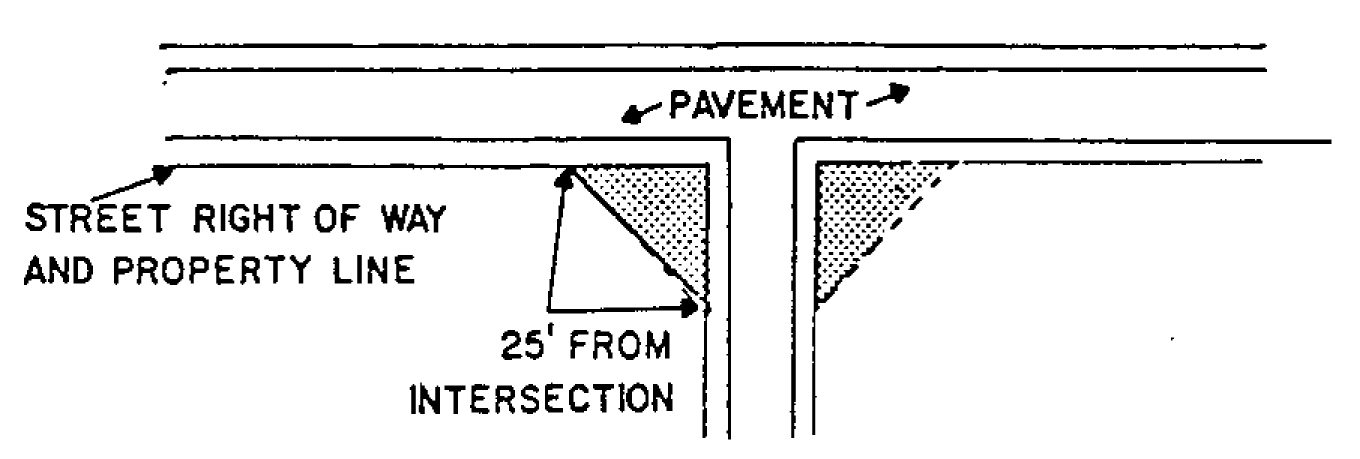
On corner lots within the triangular area formed by joining points with a straight line on the street right-of-way lines of intersecting or intercepting streets 25 feet from their intersection, there shall be no obstruction to vision by structures, parking of vehicles, grade or foliage, other than power or utility poles, between the height of three feet and the height of ten feet, measured above the average elevation of the existing surface of each street at the centerlines thereof. This section shall not apply to structures located within the B-3 central business district. Diagram 5-1 illustrates the methodology for measuring triangular area to preserve visibility at intersections.
DIAGRAM 5-1
(Code 1972, § 26-6.8; Ord. No. 91.53, 10-16-1991)
Sec. 102-238. - Calculation of combined requirements or limitations.
Where cumulative requirements or limitations are to be computed for a series of elements (as, for example, the number of off-street parking or loading spaces required for a combination of uses in the same building), fractions shall be carried forward in the summation, and the total rounded to the next largest whole number.
(Code 1972, § 26-6.9; Ord. No. 91.53, 10-16-1991)
Sec. 102-239. - Lot dimensions and area; yards.
(a)
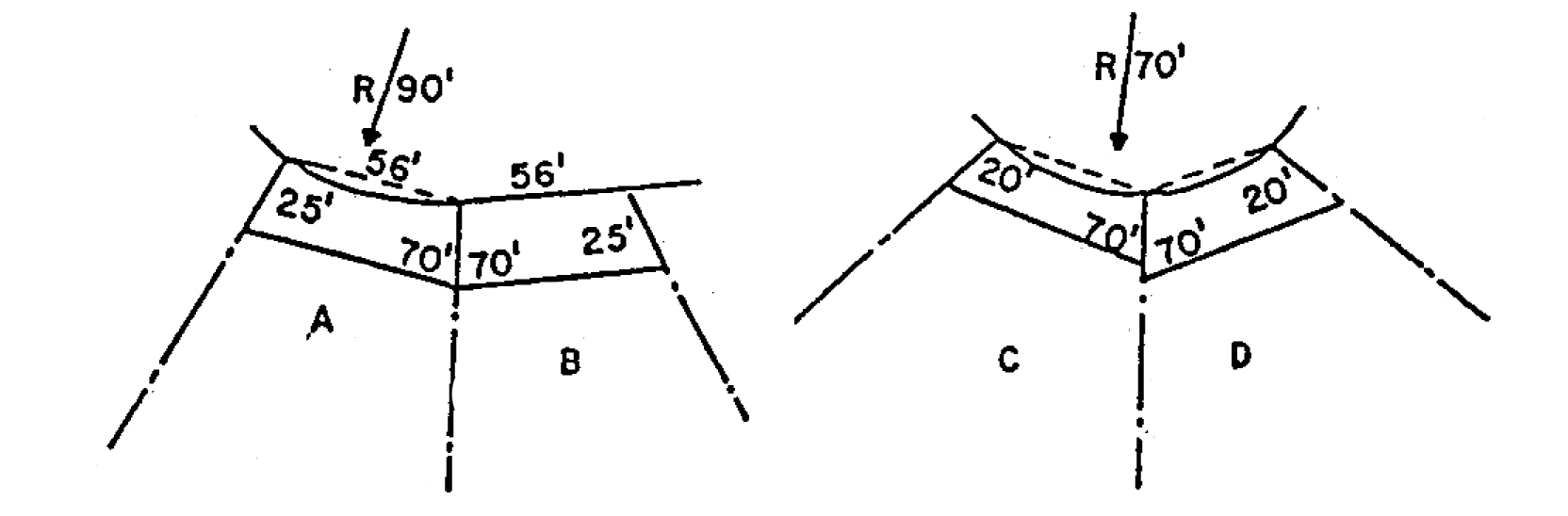
Measurement of lot width. The width of a lot shall be measured across the rear of the required front setback line, provided, however, that such width shall be not less than 25 feet and that such width between side lot lines where they intersect with the street line shall not be less than 80 percent of the required minimum lot width except in the case of lots on the turning circles of cul-de-sacs or at similar points of street curvature where the radius of the right-of-way line (or a circle approximately following the right-of-way line and intersecting the foremost points of the side lot lines) is less than 90 feet, in which case the 80 percent requirement shall not apply. Diagram 5-2 indicates the relationships involved.
DIAGRAM 5-2
(b)
Lot area. The area of a lot shall be construed as total area within its boundaries.
(c)
Lot types. Diagram 5-3 illustrates terminology used herein with reference to corner interior, reversed frontage, and through lots.
DIAGRAM 5-3
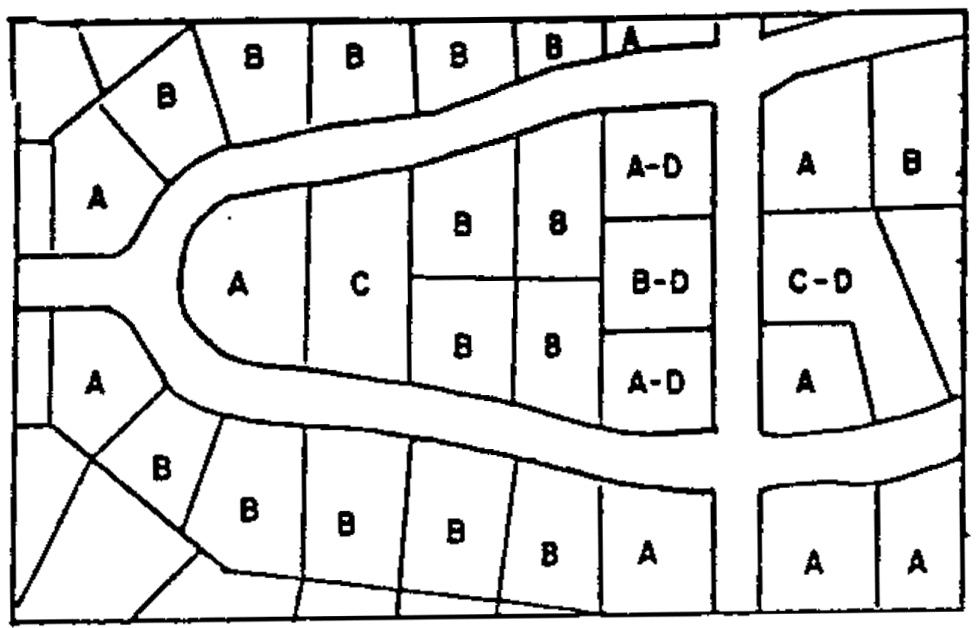
In Diagram 5-3, Lot A is a corner lot, defined as a lot located at the intersection of two or more streets. A lot abutting a curved street or streets shall be considered a corner lot if straight lines drawn from the foremost points of the side lot lines to the foremost point of the lot (projected if rounded) meet at an interior angle of less than 135 degrees.
Lot B is an interior lot, defined as a lot other than a corner lot and abutting one street. Alleys shall not be considered as streets for purposes of this definition.
Lot C is a through lot, defined as a lot other than a corner lot, and with frontage on more than one street. Through lots abutting two streets shall be referred to as double-frontage lots unless a corner lot. Alleys shall not be considered as streets for purposes of this definition.
Lot D is a reversed frontage lot, defined as a lot on which the frontage is at right angles or approximately right angles (interior angles less than 135 degrees) to the general pattern in the area. A reversed frontage lot may also be a corner lot (A-D in the diagram), an interior lot (B-D) or a through lot (C-D).
(d)
Lot frontage.
(1)
Interior lots. On interior lots, the front of a lot shall be construed as the portion nearest the street.
(2)
Corner lots. On corner lots, the frontage shall be construed as the shortest boundary to a street. When a lot has equal frontage on two or more streets, the planning director shall determine lot frontage in accordance with the prevailing building pattern or the prevailing lotting pattern. If a building pattern has not been established, then the owner shall have the option of determining lot frontage.
(3)
Through lots. On through lots, all portions adjacent to streets shall be considered as frontage for regulatory purposes. If the planning director finds that the pattern of lots or the pattern of required yards, on lots adjacent to portions of the through lot, is such as to justify the elimination of the requirement that more than one frontage be provided on the lot, such additional frontage shall not be required.
(e)
Measurement of yards; special yard requirements. The following rules shall apply with regard to determinations on yards on lots:
(1)
Yards adjacent to streets. Required yards adjacent to streets shall be measured as a line parallel to the street right-of-way line.
(2)
Interior side yards. Interior side yards shall be construed as running from the rear line of the required front yard to the front line of the required rear yard, if required, or, if no rear yard is required, to the opposite lot line. The width of a required side yard shall be measured perpendicular to the side lot line and the inner line of the required yard shall be parallel to such outer line, at the minimum distance therefrom prescribed in district regulations.
(3)
Interior side yards on through lots with more than one front yard. Interior side yards on through lots with more than one front yard shall be construed as running to the rear lines of the front yards involved, and measurements and requirements shall be as for subsection (e)(1), above.
(4)
Interior side yards on corner lots. On corner lots in all residential, office and institutional neighborhood shopping, and highway business districts, the side yard abutting a street shall not be less than 20 feet wide.
(f)
Rear yards.
(1)
Generally. Rear yards shall be construed as extending across the full width of the lot at its rear, except as stated in subsection (e)(4) above. Required depth of rear yards shall be determined in the same manner as required width of interior side yards.
(2)
No rear yard required on corner lots or lots providing two front yards. If the corner lot has more than four sides, the yards along the interior lot lines which do not intersect a street line shall be considered rear yard and meet the district requirement therefor.
(g)
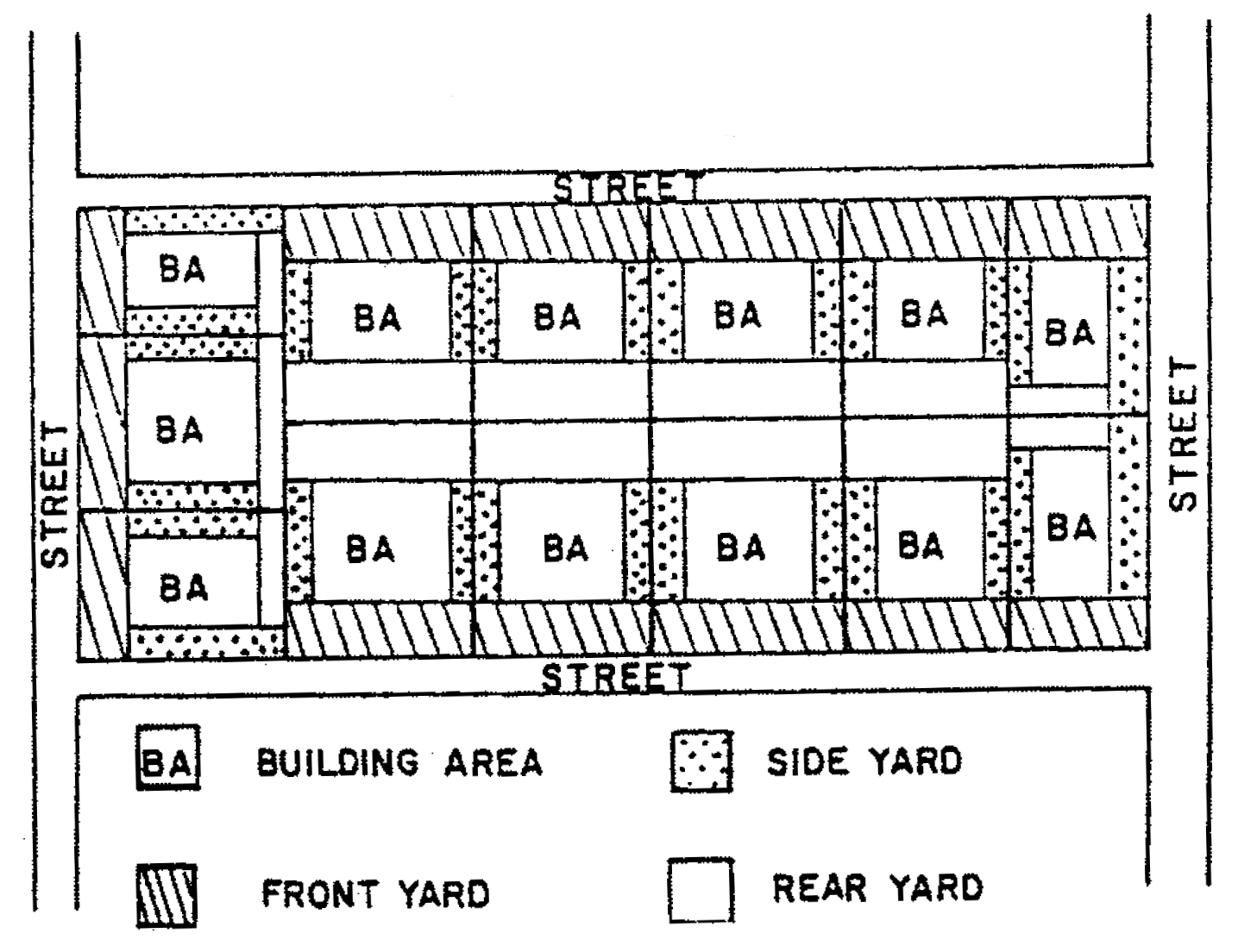
Yards diagram. Diagram 5-4 below indicates nomenclature, location, and yards.
DIAGRAM 5-4
(h)
Minimum lot area. Minimum lot area is the minimum square footage required by a lot by this chapter. The minimum area shall not include submerged lands. Roadways or rights-of-way provided by the owner or developer of the lot may be included with the zoning lot for the purposes of calculating density or compliance with the minimum lot area for individual lots. Square footage and minimum lot area requirements shall be measured and calculated from established right-of-way lines, or in situations of existing streets where no right-of-way has been legally established, from right-of-way lines, or in situations of existing streets where no right-of-way claimed for maintenance by the city or the state department of transportation.
(Code 1972, § 26-6.10; Ord. No. 91.53, 10-16-1991; Ord. No. 92.42, § 1, 8-4-1992)
Sec. 102-240. - Buildings to be located only on lot of record; access to lots.
(a)
Every building hereafter erected or structurally altered shall be located on a lot of record as defined by this chapter and, with the exception of planned developments, as defined and permitted by this chapter, there shall not be more than one principal building and its customary accessory buildings on such lot of record.
(b)
Every lot of record, except those created by a landlocked subdivision as provided for in chapter 90, shall abut upon either a publicly dedicated and maintained street, a neighborhood public road as provided for in G.S. 136-67, or a municipal neighborhood public road as defined by this chapter. No dwelling shall be erected on a lot which does not abut on at least one of the above defined streets or roads for a distance of at least 37½ feet, except where said lot was created as a result of a landlocked subdivision as provided for in chapter 90.
(Code 1972, § 26-6.11; Ord. No. 91.53, 10-16-1991; Ord. No. 96.9, § 2, 2-21-1996; Ord. No. 99.34, § 1, 4-21-1999)
Sec. 102-241. - Open space and building spacing in residential districts, PD-H districts and other districts in which two-family and multiple family residential uses are permitted.
(a)
Intent. Yards, courts, and other open space required herein in relation to structures or portions of structures containing dwelling or lodging units are intended to perform a variety of functions. Among these (as appropriate to and required by the uses involved and their locations) are assuring adequate privacy, desirable outlook, natural light and ventilation; access to and around services areas; space for landscaping; spacing between buildings and portions of buildings for reducing potential adverse effects of noise, odor, glare, or hazards from fire; and recreation space near buildings.
(b)
Calculation of building spacing requirements. Spacing requirements for buildings or portions of buildings containing dwelling or lodging units shall be based on horizontal length of walls, number of stories, type of windows in walls involved, and orientation of main exterior entrance to individual units Each building shall have yards surrounding it as calculated by the formulas described in subsection (g) below. The outer perimeter of these required yards shall be defined as the building site line. The distance between adjacent buildings shall be, at a minimum, the sum of the required yards for each building. The distance between a building and the lot line shall be, at a minimum, the yard required by this section. Diagram 5-5 illustrates these relationships.
DIAGRAM 5-5
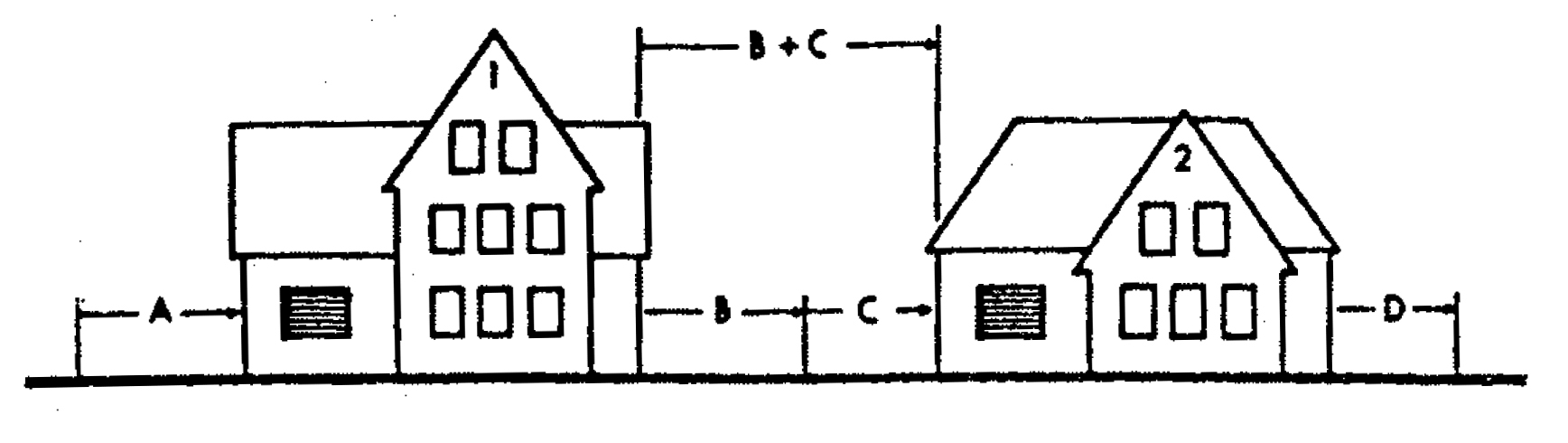
Yard A is the left yard required by Building 1
Yard B is the right yard required by Building 1
Yard C is the left yard required by Building 2
Yard D is the right yard required by Building 2
B + C = the required spacing between Buildings 1 and 2
(c)
Definitions and classifications relating to windows and building walls. For purposes of establishing open space requirements to adjacent to building walls enclosing dwellings or lodgings, the following definitions and classifications shall govern:
(1)
Habitable rooms are rooms designed and used for living, sleeping, eating, cooking, or combinations thereof. Bathrooms, toilet compartments, closets, halls, storage rooms, laundry and utility spaces, basement recreation rooms, and similar areas are not considered habitable rooms.
(2)
Primary windows are windows in habitable rooms except bedrooms and kitchens.
(3)
Primary walls are walls containing primary windows or main exterior entrances to individual living quarters when directly facing a primary wall.
(4)
Secondary walls are walls containing only secondary, or secondary and tertiary, windows.
(5)
Tertiary windows are windows other than for habitable rooms.
(d)
Length of walls. Length of walls shall be measured as the horizontal distance from corner to corner. Where walls in continuous general frontage (as in the case of attached dwellings) are offset by angles or setbacks of six feet or more, length of each segment so set off shall be measured separately in establishing pertinent yard depth. Where walls in continuous general frontage enclose portions of buildings varying one story or more in height, the length of each segment so varying shall be measured separately in computing pertinent yard depth. Length of the wall of a circular building shall be construed as the diameter of the buildings.
(e)
Height in stories. Height in stories shall be computed as the actual number of stories in the wall above ground level, with the following exceptions. Where the wall is along a slope, the number of stories shall be construed as the arithmetic mean number, with half a story or more considered as a full story, and less than half a story ignored in computations. When height per story exceeds an average of 11 feet, calculations involved in yard or spacing determination shall be based on an assumed number of stories served by dividing building height by ten feet. Penthouses, roof shelters, and housing for mechanical equipment shall be ignored in computations, except where they are visible from the ground level within the lot or the building site, are ten feet or more in height, or occupy 50 percent or more of the length of the wall at their bases, in which case an additional story shall be included in the computation.
(f)
Measurement of open space depth.
(1)
Yard or other open space depth between exterior building walls and adjacent lot or building site lines shall be measured horizontally in relation to the ground, and perpendicularly to straight walls or radially to curved walls. Distance at all points shall be at least equal to minimum requirements set forth herein, except yard space for two walls may overlap where it does not affect the distance between two buildings.
(2)
Where portions of buildings contain different numbers of stories, and different offsets, the required yard shall be as established for the portion of the portion of the proposed building nearest to the lot or adjacent building except where a portion of the proposed building requires a greater yard because of its greater number of stories or size. Lower portions of buildings may extend into yards required for upper portions, but shall provide the yards required by their size and height.
(3)
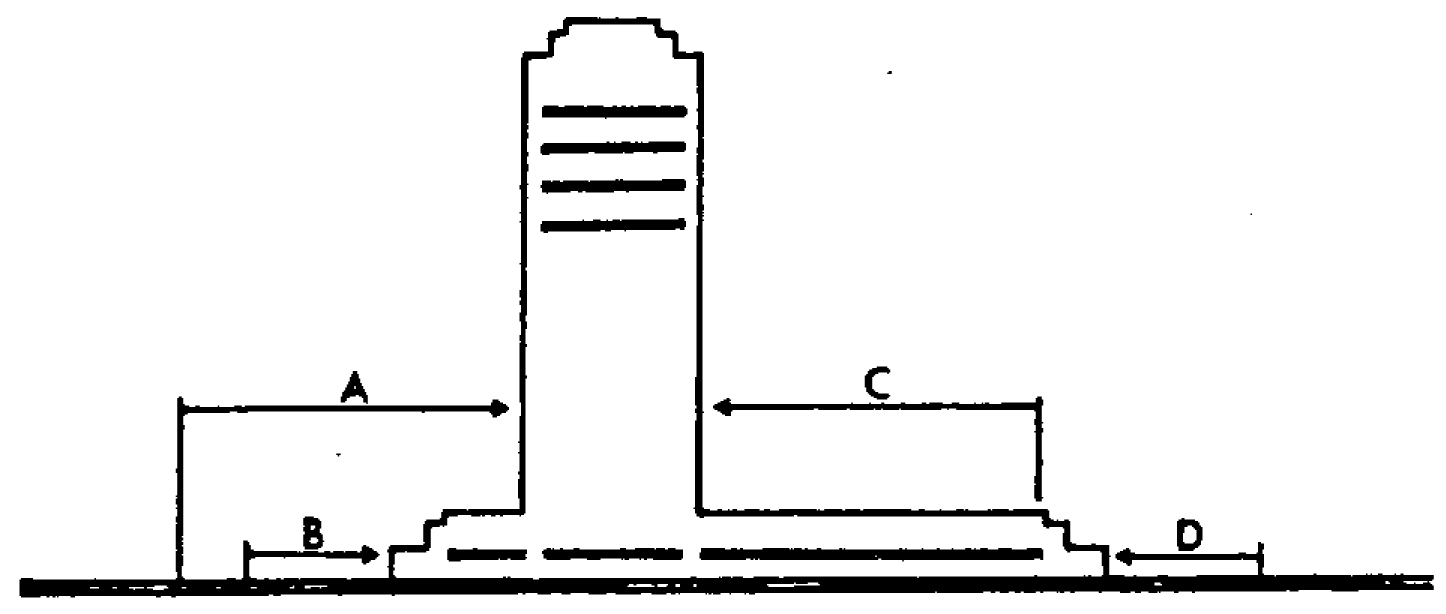
Diagram 5-6 illustrates these relationships. On the left side of the building, the height and size of the upper portion of the building results in a yard, (A), which is greater than the yard, (B), which would be required by the lower portion. The greater yard, (A), would be the required yard for the left side of the building. On the right side of the building, the lower portion of the building extends further toward the lot line such that its yard, (D), would move the building farther from the lot line than the yard, (C), required by the taller portion of the building. The yard labeled D would be the required yard for the right side of the building.
DIAGRAM 5-6
(g)
Formulas determining minimum open space requirements adjacent to walls. Minimum distance between building walls containing dwelling units shall be computed as follows, where D is depth in feet, L is length in feet, and S is height in stories:
(1)
Primary walls: D = 6 + 2S + L/10
(2)
Secondary walls: D = 2 + S + L/10, but not less than ten feet if adjacent to zoning lot boundaries.
(3)
Tertiary walls: Only as required for required yards, as required for fire protection by building or other applicable codes, or five feet, whichever is greater. If a tertiary wall occurs next to a zoning lot line, the minimum distance is ten feet.
The yard requirements stated above are minimums. If greater yard requirements are established elsewhere in this Code, said greater requirements shall apply. Diagram 5-6 illustrates these provisions.
(Code 1972, § 26-6.13; Ord. No. 91.53, 10-16-1991)

