
North Branch City Zoning Code
ARTICLE VI
SIGNS
Sec 66-821.1 General Intent
In order to preserve North Branch as a desirable city to live and to do business in, having a pleasing and visually attractive urban environment is important. The regulation of signs is an important means to help achieve the desired results of the city. As such, the City of North Branch has prepared these sign regulations to enhance the urban environment and to promote the well-being of the city.
(Ord. No. 200-13, § 1, 6-24-2013)
(Ord. No. 200-13, § 1, 6-24-2013)
Sec 66-821.2 Purpose
The purpose of this article is to protect and promote the public health, safety, and welfare within the city by the establishment of comprehensive standards, regulations, and procedures governing the erection, use, or display of devices serving as visual communications media; to promote and preserve aesthetics within the city; to preserve the residential character of residential neighborhoods; to preserve order and cleanliness; to avoid the appearance of clutter; to avoid litter and growth of weeds around signs; to provide for necessary visual communication, to preserve and promote a pleasant physical environment, to protect public and private property, and to encourage safety upon the streets and highways within the city by preserving sight lines and reducing distractions to motorists; and to reduce administrative burdens, by regulating the type, number, structure, size, location, height, lighting and the erection and maintenance of all outdoor signs and sign structures within said city. The provisions of this article regulating off-premises advertising signs are consistent with other efforts within the city to enhance aesthetics and promote traffic safety, such as regulations pertaining to solid waste disposal, littering, and traffic safety.
(Code 1996, § 17.36.010; Ord. No. 200-13, § 1, 6-24-2013)
(Code 1996, § 17.36.010; Ord. No. 200-13, § 1, 6-24-2013)
Sec 66-821.3 Scope Of Regulations
The sign regulations established in this article shall apply to all structures and all land uses. This article describes the sign standards for all the zoning districts of the city. The city establishes specific additional regulations for signs that are unique in purpose and not easily addressed by district regulations. No person, property owner or lessee shall place, erect, alter, modify, enhance or change a sign in any way that does not meet the requirements of this article and other applicable regulations.
(Ord. No. 200-13, § 1, 6-24-2013)
(Ord. No. 200-13, § 1, 6-24-2013)
Sec 66-821.4 Severability
If any section, subsection, sentence, clause, phase or other part of this article is held to be invalid, such invalidity shall not affect the validity or enforceability of the rest of this article. The city council hereby declares that it would have adopted the article in each section, subsection, sentence or phase thereof, irrespective of the fact that any one or more sections, subjections, sentences, clauses or phrases are declared invalid.
(Ord. No. 200-13, § 1, 6-24-2013)
(Ord. No. 200-13, § 1, 6-24-2013)
Sec 66-821.5 Substitution Provision
The owner or operator of any sign that this article would otherwise allow may substitute a non-commercial sign in lieu of any other commercial or non-commercial sign. The owner may make this substitution without any additional city approval or permit. The purpose of this provision is to prevent any inadvertent favoring of commercial speech over non-commercial speech, or the favoring of any particular non-commercial message over any other non-commercial message. This provision shall prevail over any more specific provision to the contrary.
(Ord. No. 200-13, § 1, 6-24-2013)
(Ord. No. 200-13, § 1, 6-24-2013)
Sec 66-822 Nonconforming Uses
- Any sign legally existing on the effective date of the ordinance from which this article is derived which does not conform to the requirements set forth in this article shall become a nonconforming use.
- Nonconforming, permanent signs shall be allowed to continue but shall not be rebuilt, materially altered, or relocated without being brought into compliance with the requirements of this article, except that any flashing portion shall be discontinued within 30 days after the effective date of this article.
(Code 1996, § 17.36.020)
Sec 66-823 Prohibited Signs
The following are prohibited signs:
- Signs that, by reason of position, shape, or color would interfere with the proper function of a traffic sign or signal.
- Signs within the public right-of-way or easement, except for government installed signs.
- Signs that resemble any official marker erected by a governmental agency or that display such words as "stop" or "danger."
- Flashing, blinking or fluttering signs including indoor signs which are visible from public streets.
- With the exception of searchlights which may be approved in conjunction with an administrative permit no rotating beam, beacon, or flashing illumination shall be used in connection with any display.
- Signs or sign structures that obstruct any window, door, fire escape, stairway, or opening intended to provide ingress or egress for any building structure. With reference to commercial and industrial districts, signs painted on the inside glass portion of windows or doors are permitted.
- Sign posters that are tacked or posted on trees, fences, utility poles or other such supports.
- Portable signs, except as provided in section 66-824(b)(6) unless approved in conjunction with an administrative permit may be allowed for a period not exceed 21 days, four times per year.
- Roof signs except as provided in section 66-824(c)(1)a.
- Off-premises advertising signs, including billboards, except as otherwise permitted in section 66-824. Signs advertising a business no longer operating on the premises shall be deemed off-premises advertising signs and must be removed within 30 days of closing.
- Signs painted directly on building walls.
- All other signs not expressly permitted by this article.
- Signs painted on a commercial vehicle which is parked at a commercial premises, public parking lot or street in such a manner as to constitute a static display advertising a business, product or service to the traveling public and which is not making a pickup or delivery or being appropriately stored on the premises.
- Temporary freestanding off-site directional real estate development signs.
(Code 1996, § 17.36.030; Ord. No. 153-10, § 1, 8-9-2010; Ord. No. 200-13, § 1, 6-24-2013)
Sec 66-824 Permitted Signs
- General requirements and standards for permitted signs.
- Where a sign is illuminated, the beam of light shall not shine directly upon any part of a residence or into the street.
- No projecting signs shall:
- Project more than 48 inches out from the wall to which it is attached.
- Extend above the roof line.
- Exceed the area of a freestanding signs which might be permitted according to subsection (c)(1)b.1.
- Extend into the public right-of-way.
- Project more than 48 inches out from the wall to which it is attached.
- Any sign or sign structure which may be, or may hereafter become rotted, unsafe, or unsightly shall be repaired or removed by the licensee, owner, or agent of the owner of the property upon which the sign stands upon written notice of the city administrator or his agent.
- No part of any permanent freestanding sign shall be closer than ten feet to the side lot line.
- No part of any sign shall project over or beyond the property line of the property upon which the sign is located.
- Unless set back ten or more feet from the street right-of-way line, the supporting column(s) of a freestanding sign exceeding 16 feet in area shall not materially impede vision between a height of 2½ and 7½ feet above the centerline grade of the street. Freestanding signs shall have a minimum vertical clearance of ten feet above the centerline grade of the intersecting streets.
- When electrical signs are installed, their installations shall be subject to the state's electrical code.
- Wall signs on office buildings shall be of a uniform design compatible with the exterior appearance of the building.
- When the occupant of a building or parcel ceases to use the property and abandons the site or building space, all signery associated with the former occupant shall be removed. It shall be the responsibility of the property owner to effect the removal of such signery and any support structure. If the owner of the property fails to remove all obsolete signery within 30 days after the former occupant vacates the premises, the city shall be entitled to have such signery removed, either by its own forces or by hire of a licensed sign contractor and the cost of such removal shall be assessed against the property. The owner of the property shall receive written notice of the city's intent to remove obsolete signery at least 15 days prior to the action.
- All signs shall have a minimum wind load of 30 pounds per square foot.
- No part of a freestanding sign shall be nearer than three feet to any building unless such sign is placed parallel to the side of the building.
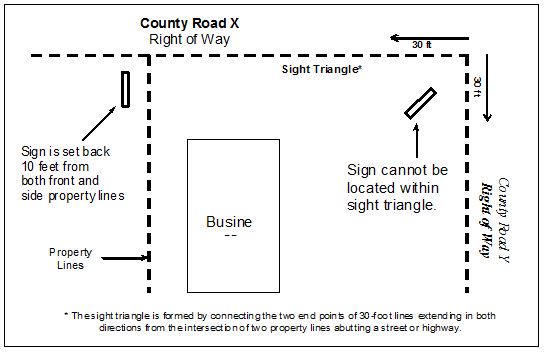
- No part of a freestanding sign shall be nearer than ten feet to any perimeter lot line nor located within a 30-foot sight triangle on any property abutting two intersecting street rights-of-way. (Refer to the graphic below.)
- No signs shall be located so as to obstruct the sign face of any existing permitted sign.
- The owner, lessee or occupant of the land on which the ground sign is located and the owner of the sign shall keep the property on which the sign is located free of long grass, weeds or other rank growth, rubbish or debris.
- Where a sign is illuminated, the beam of light shall not shine directly upon any part of a residence or into the street.
- Permitted signs not requiring a permit.
- Identification signs of one- and two-family dwellings provided that such signs are less than two square feet in area.
- Wall and freestanding site, pedestrian, vehicular traffic, parking and other appropriate types of directional signs as approved by the planning director, provided such signs are less than 16 square feet in area, and have a height no greater than 15 feet or ground floor height, whichever is less.
- Traffic control signs, noncommercial governmental signs, legal notices, railroad crossing signs and temporary nonadvertising safety or emergency signs.
- Signs denoting the architect, engineer, contractor, or owner when placed upon a respective worksite and not exceeding an aggregate of 48 square feet in area, to be removed ten days following completion of construction.
- Copy or message changing on a printed or painted sign which is permitted by this article.
- Portable and freestanding campaign signs of any size may be posted in any number from 46 days before the state primary in a state general election year until ten days following the state general election. Freestanding campaign signs may be installed only upon private property with the permission of the property owner who shall be responsible for removal thereof. The candidate whose candidacy is promoted by an improperly placed or otherwise illegal campaign sign shall be held responsible therefor.
- Signs or posters painted on or attached to the inside of a display window. This shall include illuminated signs, but not flashing signs.
- Flags, badges, or insignia of any government or governmental agency, or of any civic, religious, fraternal, or professional organization. Commercial and industrial establishments may display a sign flag consisting of the official corporate seal or insignia as identification of the individual establishment. Advertising or promotion of specific products or services is prohibited unless approved in conjunction with an administrative permit.
- Emergency signs required by other governmental agencies.
- Temporary displays which are erected to celebrate, commemorate, or observe a civil or religious holiday.
- Real estate signs as follows:
- Temporary freestanding or wall signs for the purpose of selling or leasing individual lots or entire buildings provided that such signs shall not exceed six square feet in area for residential property and 32 square feet for other property and that there shall be only one such freestanding or wall sign permitted for each property. The sign must be removed within ten days following the lease or sale.
- Temporary freestanding off-site real estate signs announcing an "open house" or similar activity for the purpose of showing or displaying a home for sale are permitted provided:
- The off-site sign is located on privately-owned residential property and there is no objection to the display of the sign on the part of that property owner. Off-site signs may not be placed in public right-of-way.
- The off-site sign is displayed only during the time of the "open house" or showing, or a maximum of three consecutive days.
- The size of the off-site sign shall not exceed three square feet in area.
- A temporary freestanding sign for the purpose of announcing or promoting of a new residential, commercial or industrial project development, provided that each residential project contains at least six dwellings or lots. Further provisions are that one such sign is permitted for each major thoroughfare the project abuts provided said sign is located on the project development property. Signs shall be located at least 130 feet from any preexisting structure. The sign is to be removed within two years on signing of the final plat or when the project is 75 percent sold out or rented, whichever is sooner; and each sign shall not exceed the following size limitations: Project area under 20 acres, 48 square feet. Project area over 20 acres, 200 square feet.
- Temporary signs for the purpose of leasing or selling dwelling units in buildings containing two or more units and temporary signs for the purpose of leasing or selling portions of commercial or industrial buildings, such as offices or individual tenant areas are permitted only when vacancies exist and are limited to walls facing public streets. The size of signs shall be determined on the basis of wall area and distance from public right-of-way in the following manner:
- For buildings with a wall area of 1,000 square feet or less facing a public street, the maximum size sign shall be ten square feet. For buildings with over 1,000 square feet of wall area facing a public street, the maximum size sign shall be 16 square feet.
- Buildings eligible for temporary real estate wall signs under subsection 66-824(b)(11)b.2. shall be entitled to a sign 50 percent greater in area if the building is over 100 feet from the right-of-way line and 100 percent greater if the building is over 300 feet from the right-of-way lines.
- Buildings entitled to temporary wall signs as specified in subsection 66-824 (b)(11)c. may utilize up to ten square feet or 50 percent of the area (whichever is less) of an existing freestanding identification sign in lieu of all other real estate signs.
- Rummage/garage sale signs as follows:
- A temporary on-site sign not exceeding six square feet in area, identifying the location of and/or information relating to a rummage sale. Banners, pennants, streamers, balloons, stringers or similar attention attracting devices may also be displayed on the property where the sale is being conducted. The sign and other devices may be displayed for the duration of the sale only, and must be removed at its termination.
- Temporary off-site signs not exceeding three square feet in area, indicating the location and/or time of a rummage sale may be located on other residential property (not commercial, industrial, or public property) provided that property owner's permission has been obtained to display such signery. These signs may be displayed for the duration of the sale only, and must be removed at its termination.
- Rummage sale signs must conform in all other respects with the provisions of this article.
- Noncommercial opinion or expression signs as follows:
- One such sign not to exceed six square feet in area is allowed on private residentially zoned or used property, with the consent of the property owner, provided it is not an illuminated sign and is erected and maintained in accordance with subsection (a) of this section and is not otherwise prohibited by this section.
- Any single sign or signable area allowed on a site which is devoted to any commercial or industrial use may be used, in lieu of other signage permitted under this article, as a noncommercial opinion or expression sign.
- Banners, pennants, streamers, balloons, stringers, or similar attention-attracting devices.
- Nonprofit signage for special events such as but not limited to craft sales, concerts, activity registration, farmers market etc.
- Permitted signs requiring a permit.
- Commercial and industrial districts.
- Wall signs and projecting signs.
- Individual establishments. Individual detached establishments or enterprises not clustered in a shopping center complex or in a multi-tenant office or industrial building may have wall signs and projecting signs on each wall, provided the aggregate area of such signs does not exceed ten percent of the area of the wall supporting the signs.
- Clustered establishments. Attached establishments or enterprises clustered in a shopping center complex or in a multi-tenant office or industrial building may have wall signs and projecting signs subject to the following:
- Each establishment or enterprise may have such signs on each of its exterior walls, provided the aggregate area of such signs does not exceed ten percent of the wall supporting the signs.
- In lieu of the above, the aggregate of the establishments or enterprises may have a wall or projecting sign on each wall identifying the tenants collectively, or identifying the complex or building; provided the area of each sign does not exceed ten percent of the area of the wall supporting it.
- Each establishment or enterprise located within an enclosed shopping center mall may have signs on exterior walls identifying tenants separately and/or collectively, or identifying the complex or building; provided the aggregate area of the sign or signs does not exceed ten percent of the area of the wall supporting it.
- Multistory office buildings. Multistory office buildings may have a wall or projecting sign identifying the building on each wall provided such sign does not exceed ten percent of the area of the wall supporting the sign.
- Freestanding signs.
- Individual detached establishments or enterprises not clustered in a shopping center complex or in a multi-tenant office or industrial building may have one freestanding sign according to the following schedule. In the event such establishments abut two or more streets that are at least collector or arterial in character, and if the abutment on each street exceeds 400 feet, one freestanding sign may be erected along each such street according to the following schedule. If the building has a shared freestanding sign the second sign face shall follow the maximum sign area and height requirements for the business it regards. If a business has a shared freestanding sign, no additional freestanding signs are permitted except by wall/freestanding sign tradeoff (subsection (c)(1)b.4. of this section).
Building Gross Floor Area Square Feet Maximum Sign Area Square Feet Maximum Sign Height (Above 1st Floor) Feet Up to 3,200 140 35 3,201 to 11,600 200 35 11,601 to 24,000 250 35 Above 24,000 350 35 - Clustered establishments. The aggregate of attached establishments or enterprises clustered in a shopping center complex or in a multi-tenant office or industrial building may have a single freestanding sign according to subsection (c)(1)b.1. of this section based upon the aggregate floor area of the establishments. In the event such establishments abut two or more streets which are at least collector or arterial in character, and if the abutment on each such street exceeds 400 feet, one freestanding sign may be erected along each such street.
- Outdoor sales and display. An individual establishment having a gross building floor area in excess of 15,000 square feet and a minimum lot located upon a land area of at least three acres may have a second freestanding sign provided 50 percent of the land area is utilized for outdoor sales, display, and storage of merchandise. The second free standing sign shall not exceed 125 square feet in area, 35 feet in height, and have a minimum separation of 200 feet from the principle freestanding sign.
- Wall/freestanding sign tradeoff. An individual or clustered establishment may be entitled to one additional freestanding identification sign if the building owner, or a duly authorized agent, agrees in writing to forego all permitted wall signs and the additional freestanding sign is consistent with the following standards:
- The additional freestanding sign shall consist of individual letters or cutouts, each affixed to a masonry retaining or landscape type wall structure which is no higher than six feet above ground level;
- The masonry retaining or landscape type wall structure may not be located in the required greenstrip area or a parking lot and must be within 50 feet of one of the walls of the principal building on the property;
- The area of the individual letters or cutouts which are affixed to the masonry retaining or landscape type wall structure may not exceed one-third of the permitted freestanding sign allowed for the property per subsection (c)(1)b.1. of this section; and
- Shared freestanding sign. Off-premises advertising is allowed in the CBD, B-2, B-3, I-1, I-2, and I-3 zoning districts, when a business wishes to locate its signage on the same sign structure of another business on an adjoining parcel or a parcel within a 75-foot radius of the perimeter of the property, thereby reducing the number of freestanding signs, enhancing aesthetics and promoting traffic safety. The size of each business's signage area on the shared freestanding sign shall be in accordance with the table in this section. Both businesses are allowed no other freestanding signs except directional signs (as outlined in subsection (b) of this section), or as a wall/freestanding sign tradeoff (as outlined in subsection (c)(1)b.4. of this section).
- The height of shared freestanding signs located in the B-2 and B-3 zoning district areas located east of the Falcon Avenue plain and west of the 12th Avenue plain shall not exceed 50 feet in height.
- Individual detached establishments or enterprises not clustered in a shopping center complex or in a multi-tenant office or industrial building may have one freestanding sign according to the following schedule. In the event such establishments abut two or more streets that are at least collector or arterial in character, and if the abutment on each street exceeds 400 feet, one freestanding sign may be erected along each such street according to the following schedule. If the building has a shared freestanding sign the second sign face shall follow the maximum sign area and height requirements for the business it regards. If a business has a shared freestanding sign, no additional freestanding signs are permitted except by wall/freestanding sign tradeoff (subsection (c)(1)b.4. of this section).
- Canopy signs. Individual and clustered establishments or enterprises and multi-story office buildings may have canopy signs, to be considered a type of wall sign, if the following conditions are met:
- The same conditions for canopy signs as set forth in this section.
- The area of the sign does not exceed ten percent of the canopy face or elevation which is parallel to the wall to which the canopy is attached.
- The sign in all other respects is consistent with the provisions of this article for wall signs.
- Temporary off-site advertising signs. Temporary off-site advertisings are allowed during community/area events, if the following conditions are met:
- The sign shall be allowed for no more than 14 days before and three days after the event.
- The sign shall not exceed 40 square feet if the speed limit is 40 mph or lower and shall not exceed 90 square feet if the speed limit is greater than 40 mph.
- The sign shall be located on private property with permission of the property owner.
- The sign must include the name of the event.
- Permanent off-premises advertising signs.
- The signs are permitted only along the State Highway 95, County Road 14, County Road 30 and Isanti Trail corridors.
- The sign shall be located no closer than 500 feet measured along the highway, from any other off-premise advertising sign on the same side of the highway.
- The sign shall not exceed the size and height requirements based on the table listed below:
Speed Limit Maximum Sign Area Square Feet Maximum Sign Height Up to 40 mph 40 10 Greater than 40 mph 90 16 - The sign shall be located on private property with permission of the property owner.
- Billboard signs.
- The signs are permitted only along the Interstate 35 corridor in commercial (B2 and B3) and industrial (I2 and I4) zoning districts.
- The signs shall have a maximum height of 35 feet measured from the grade at the base of the sign.
- The sign face shall not exceed 600 square feet and shall not exceed 1,200 square feet total for a multi-sided sign.
- The signs shall be located no closer than 750 feet measured along the freeway, from any billboard sign on the same side of the freeway.
- The signs shall be located no closer than 500 feet from a state, county or city park, historic site, church or school or any area zoned residential.
- Dynamic display signs.
- The city allows noncommercial dynamic display signs wherever the city allows commercial dynamic display signs. Such signs are subject to the same standards and total maximum allowances per site or building of each sign type specified in this article.
- The images and messages displayed on the sign must be static, complete in themselves, without continuation in content to any other sign. The messages, content and images on all such displays shall not flash or blink.
- No person or contractor shall install a dynamic display sign that because of its position, shape, movement or color, interferes with the proper functioning of a traffic sign, signal or that constitutes a traffic hazard.
- All dynamic display signs shall have ambient light monitors and shall, at all times, allow such monitors to automatically adjust the brightness level of the sign based on light conditions.
- The manufacturers, owners and operators of dynamic display signs must design and equip such signs with a fully functional monitoring off switch system that automatically shuts the sign off or will freeze the device or sign in one position if a malfunction with the sign occurs. The signs and displays also must be equipped with a means to shut off or discontinue the display if it malfunctions. The sign owner or operator must stop or shut off the dynamic display within one hour or as soon as reasonably possible of the city notification that the sign is not meeting the standards of this section or article.
- All dynamic display signs shall meet the following brightness standards:
- No sign shall be brighter than is necessary for clear and adequate visibility.
- No sign shall be of such intensity or brilliance as to impair the vision of a motor vehicle driver with average eyesight nor shall such a sign interfere with the driver's operation of a motor vehicle in any way or manner.
- No sign may be of such intensity or brilliance that it interferes with the effectiveness of an official traffic sign, device or signal.
- The person owning or controlling a sign with a dynamic display shall adjust the sign to meet the brightness standards according to the city's instructions. The sign owner or operator shall adjust the sign within one hour or as soon as reasonably possible upon notice of non-compliance from the city.
- All dynamic display signs shall be equipped and operated with an ambient light monitor or a mechanism that automatically adjusts the brightness level of the sign in response to light conditions. These signs also shall be equipped with a means to turn off immediately the sign lighting if the sign malfunctions and the sign owner or operator must turn off the sign lighting within one hour or as soon as reasonably possible after the city notifies the owner or operator that the sign it is not meeting the standards of this section or chapter.
- The city allows dynamic display signs on on-site freestanding or ground signs subject to this article of the city code, the above-mentioned standards for all dynamic display signs, and subject to the following additional conditions:
- The owners or operators of such signs shall not use messages, content or images that flash or blink.
- Such signs may be located only in the Central Business District (CBD), Limited Business (B-2), Regional Business (B-3), or Commercial Planned Unit Developments (PUD's) zoning districts.
- Such signs may be located on the sites of schools, churches, places of worship or other institutional land uses, Such signs shall not cause glare, disturbance or other problems to any residential properties or land uses.
- The owner or operator of a dynamic display sign shall control and display the primary or background images and messages on the sign so they maintain each display for a minimum of ten seconds. The city allows images, messages or content on such signs that are static, with secondary or accessory animation or movement that floats in, out, or across the primary message or those that have soft transitions.
- The city allows dynamic displays as part of a permanent freestanding or ground sign, only if the dynamic display part of the sign comprises no more than 50 square feet of the sign area or 50 percent of the total square footage of said sign face, whichever is less.
- Such signs may only display and advertise information about products, events, persons, institutions, activities, businesses, services, or subjects that are located on the premises or on the site or only to provide public service or community service information.
- Such signs must meet all other city location and setback requirements.
- The city allows off-site dynamic display signs subject to section 66-824(c)(1)f. (billboards) of the city's code, the above-mentioned standards for all dynamic display signs, and the following operational standards and additional conditions:
- The images and messages displayed on the billboard must be static and each display must be maintained for a minimum of ten seconds. The transition from one static display to another must be instantaneous and without any special effects or videos.
- The owner of the billboard shall apply to the city for and the city shall issue a permit to retrofit up to 100 percent of one sign face of an existing billboard structure with a dynamic display if the responsible person, applicant or contractor meets all the following requirements:
- The applicant or contractor may only convert one sign face on a billboard structure per request.
- Public safety. If city staff determines that a dynamic display sign is not being operated pursuant to this article due to its location or display capabilities, city staff can require the sign owner or operator to move, remove or modify the sign after the city notifies the property owner or operator about the operational issues.
- The city allows noncommercial dynamic display signs wherever the city allows commercial dynamic display signs. Such signs are subject to the same standards and total maximum allowances per site or building of each sign type specified in this article.
- Wall signs and projecting signs.
- Residential districts and agricultural districts.
- Multiple-family dwellings may have the following signs:
- One wall sign per building not to exceed ten square feet in area.
- Subdivisions involving not less than 36 dwelling units shall be entitled to one of the following options at each major entrance not to exceed the total of two entrances:
- One freestanding masonry sign no greater than 36 square feet in area and extending not more than ten feet above ground level.
- Two identical freestanding masonry signs located at opposite sides of the entrance each not greater than 18 square feet in area and each not more than five feet above ground level.
- Temporary off-site advertising signs. Temporary off-site advertisings are allowed during community/area events, if the following conditions are met:
- The sign shall be allowed for no more than 14 days before and three days after the event.
- The sign shall not exceed 40 square feet if the speed limit is 40 mph or lower and shall not exceed 90 square feet if the speed limit is greater than 40 mph.
- The sign shall be located on private property with permission of the property owner.
- The sign must include the name of the event.
- Permanent off-premise advertising signs.
- The signs are permitted only along the State Highway 95, County Road 14, County Road 30, and Isanti Trail corridors in the Rural Residential (RR) and Agricultural (AG1),(AG2) zoning districts.
- The sign shall be located no closer than 500 feet measured along the highway, from any other off-premise advertising sign on the same side of the highway.
- The sign shall not exceed the size and height requirements based on the table listed below:
Speed Limit Maximum Sign Area Square Feet Maximum Sign Height Up to 40 mph 40 10 Greater than 40 mph 90 16 - The sign shall be located on private property with permission of the property owner.
- Billboard signs.
- The signs are permitted only along the Interstate 35 corridor in the Agricultural (AG-1) and (AG-2) zoning districts.
- The signs shall have a maximum height of 35 feet measured from the grade at the base of the sign.
- The sign face shall not exceed 600 square feet and shall not exceed 1,200 square feet total for a multi-sided sign.
- The signs shall be located no closer than 750 feet measured along the highway, from any billboard sign on the same side of the highway.
- The signs shall be located no closer than 500 feet from a state, county or city park, historic site, church or school or any area zoned residential.
- Multiple-family dwellings may have the following signs:
- Public and semipublic places (all districts):
- Churches, synagogues and temples may have the following signs:
- One freestanding sign with the sign area not to exceed 36 square feet. The sign shall not extend more than ten feet above the ground level. There may be a second such sign if the use abuts two or more streets. Properties entitled to a second freestanding sign may elect to erect a single freestanding sign not exceeding 72 square feet in area nor 15 feet in height.
- One wall sign not to exceed 36 square feet.
- One wall sign immediately above or beside each public entrance to that part of the building which is used as a school and meets the requirements of the state department of education, or as a day care facility and is licensed by the state department of public welfare. The sign area shall not exceed ten square feet.
- Other public and semipublic uses, including private clubs and lodges.
- Freestanding signs as specified above for churches, synagogues, and temples.
- One wall sign, the maximum area not to exceed 36 square feet.
- Churches, synagogues and temples may have the following signs:
- Commercial and industrial districts.
Sec 66-825 Sign Permits
- No sign shall hereafter be erected, reerected or altered unless a permit for each such sign has been obtained or unless permitted by subsection 66-824(b). In addition, electrical permits shall be obtained for all electric signs.
- Application for a sign permit shall be made in writing upon forms furnished by the planning director. Such application shall contain the location by street and number of the proposed sign structures, as well as the name and address of the owner and the sign contractor or erector. The planning director may require filing of plans or other pertinent information where, in his opinion, such information is necessary to insure compliance with this article.
- Administrative permits required by this article shall be applied for on forms furnished by the planning director. Administrative permits may be allowed for a period not exceed 21 days, four times per year.
(Code 1996, § 17.36.050; Ord. No. 153-10, § 1, 8-9-2010)
Sec 66-826 Sign Permit Fees
A cash fee in the amount set by city council shall be collected before the issuance of any sign permit for which fees are required under the provisions of this article.
(Code 1996, § 17.36.060)
(Code 1996, § 17.36.060)
Sec 66-827 Review Process
- The city administrator or his or her designee shall approve or deny the sign permit application in an expedited manner from the receipt of the completed application, including all plans, specifications and applicable fees. The city will notify all applicants in writing if the city denies the sign application. Such notification shall include the reasons the city denied the proposed sign.
- Variances. In the event an application is made for a sign that does not conform to the requirements of this article, the city will deny the application or the applicant shall either modify the application or apply to the city for a variance according to the provisions established in chapter 66 of the zoning code. No permit for a nonconforming sign shall be issued without evidence of an approved variance.
(Ord. No. 200-13, § 1, 6-24-2013)
Sec 66-828 Sign Maintenance, Repair, Permits And Inspections
- All owners and property managers shall keep signs in good condition and repair and free from peeling paint, rust, damaged or rotted support, framework or other materials, broken or missing faces or missing letters. When any sign becomes insecure, in danger of falling, or is otherwise deemed unsafe or a nuisance by a city inspector, or if any sign shall have been unlawfully installed, erected or maintained in violation of any of the provisions of this section and article, the owner or firm using such sign shall, upon written notice by the city inspector, make such sign conform to the provisions of this section and article or shall remove the sign within ten days. If the sign owner, user or responsible party has not corrected such violation within ten days, the city inspector may remove or cause such sign to be removed at the expense of the owner or user of the sign.
- Obsolete sign copy. The owner or user of any property or sign copy advertising or identifying a use no longer conducted on the property on which the sign is located, or any off-premises sign or property advertising a use or activity that is no longer conducted at the advertised site, must cover or remove the sign copy within 30 days after written notification from the city inspector. The city considers such a sign to be a nuisance sign.
- The owner or user of any structure from which they have moved or removed a sign shall repair and/or paint the structure with colors and materials to match the existing background.
- Sign permit not required. Activities considered to be normal maintenance and repair shall not require a sign or building permit from the city. Such activities shall include replacing or repairing lamps, ballasts, transformers, trim, sign fasteners, nuts or washers; painting the pole or supports of freestanding signs; and painting the cabinet of the freestanding signs or building signs.
- Sign permit required. For any sign that initially required a permit, the city requires a permit for all of the following additional activities (the city does not consider such activities as normal maintenance):
- Changes made to a sign's size, illumination or electrical service, including, but not limited to, height, width, weight, area, adding or removing illumination.
- Changes to poles, structural supports, bases or shrouds, footings or anchor bolts, moving the sign to a new location, or replacement of the interior or exterior cabinet frame, except the sign face.
- Changes made to a sign's size, illumination or electrical service, including, but not limited to, height, width, weight, area, adding or removing illumination.
- Building permit. The city also may require a building permit for signs or sign repair that involves the construction of, or changes to, a sign, a sign structure, billboards and/or electrical connections, subject to the approval of the building official. All signs using electricity shall be subject to the state's current electrical code. The contractor shall bury or conceal all electrical wiring for such signs.
- Inspection authority. All signs are subject to inspection by the building official or his or her designee, who the city authorizes to enter any property or premise to determine if the provisions of this article are being met. The inspector or city staff person shall make such an entrance or inspection during regular business hours, unless there is an emergency.
- Signs in disrepair. The building official or their designee may order the removal of any sign that the owner or the responsible party is not maintaining according to the provisions of this article. Upon failure to meet the requirements of a correction notice in the specified time in such an order, the city council may declare the sign to be a public nuisance, may have it removed and impounded and assess the cost of the removal to the sign owner or to the property owner.
(Ord. No. 200-13, § 1, 6-24-2013)
Sec 66-829 Appeals
In order to secure relief where it is alleged that an administrative officer of the city has committed an error in interpretation of judgment in issuing order or making a determination, any person shall appeal said order or determination consistent with provisions of this article.
(Code 1996, § 17.36.070; Ord. No. 200-13, § 1, 6-24-2013)
(Code 1996, § 17.36.070; Ord. No. 200-13, § 1, 6-24-2013)

