
North Kansas City City Zoning Code
CHAPTER 17
12 - ZONING DISTRICT AND USE STANDARDS
17.12.010 - Zoning districts and intent.
For the purpose of regulating and restricting the use and development of land and buildings, the following districts are established, with the intent given for relationship to the master plan.
_____
Table 12-1: Zoning Districts and Intent
R-1A—Single-Family Residential. The R-1A district provides residential living in low-density suburban neighborhood settings, with access to supporting uses such as schools, churches, parks and other public facilities that reinforce residential neighborhoods. This district may also be used in limited applications to provide larger lots in, walkable neighborhoods, when integrated with zoning districts that provide other housing types and access to Downtown and other activity centers.
R-1B—Single-Family Residential—Compact. The R-1B district provides residential living in compact, walkable neighborhood settings, and supporting uses such as schools, churches, parks and other public facilities that reinforce residential neighborhoods. This district should be closely integrated with zoning districts that provide other housing types and access to Downtown and other activity centers.
R-2—Two-Family Residential. The R-2 district provides residential living that mixes multi-unit building formats into low-density suburban or walkable neighborhood settings, allowing a mix of housing options at strategic locations and create transitions to complimentary and supporting uses.
R-3—Cluster or Garden Apartment. The R-3 district provides residential living in a moderate-density pattern In suburban contexts, allowing transitions between neighborhoods and more intense uses, where a high level of accessibility, public amenity and support services are immediately available.
R-4—Mixed-Density Neighborhood. The R-4 district provides residential living with a wide range of housing types in a compact, walkable neighborhood setting, adjacent to Downtown or other activity centers and walkable destinations. In specific contexts and limited applications, mixed-use buildings may be integrated into the neighborhood. A well-designed public realm provides a focal point to integrate a variety of building types and create a consistent neighborhood character. This district can also be used in a limited manner to integrate small-scale, multi-unit residential projects into a mixed-use environment.
R-5—Multi-Family Residential. The R-5 district provides residential living in a high-density pattern at strategic locations where a concentration of housing near public amenities and other support facilities and services improves transitions to more intense uses or provides broader public benefits. This district can also be used in a limited manner to integrate higher-density residential projects into a mixed-use environment.
CIO—Campus—Institutional/Office. The CIO district provides service and employment uses in a campus format, where larger institutional and office complexes are arranged around internal streets and open spaces, along with other smaller scale and supporting uses and businesses.
C-1—Neighborhood Business. The C-1 district provides small-scale retail, service, civic and employment uses adjacent to supporting suburban or walkable neighborhoods. This district should be used to create destinations in close proximity to residential neighborhoods, and should be well integrated with the supporting neighborhoods character and pattern, whether suburban or walkable.
C-2—Downtown Business. The C-2 district provides a broad range of retail, entertainment and civic uses, and supporting accessory office, service, and residential uses, in a compact and walkable format. This district preserves the "main street" scale and small town character of North Kansas City. it is the vibrant heart of the community with a high level of civic design, walkable urban patterns, and a concentration of diverse, small-scale uses.
C-3—General Business. The C-3 district provides wide range retail, service and employment uses at a scale, intensity or in a format that requires a high level of vehicle accessibility and visibility, typically along corridors or other locations not easily integrated with other land uses or development patterns. Planned versions of this district can yield campus or mixed-use district patterns that are oriented to internal open space systems or other focal points of development.
M-1—Limited Industrial. The M-1 district provides primarily manufacturing and distribution uses at a scale, intensity and format that is unlikely to have significant impact on adjacent uses. Service, employment and retail uses that are compatible with these industrial uses may be integrated into the district.
M-2—General Industrial. The M-2 district provides industrial uses that are generally not compatible with residential and/or commercial activity due to the scale, operation, intensity or impacts of activities, or due to the high level of transportation access and support infrastructure required of the business.
G-1—Gaming. The G-1 district provides for large-scale regional destination entertainment and commercial uses.
(Ord. No. 9212, § 3(Exh. A), 7-2-2019)
17.12.020 - Allowed uses (use table).
A.
Permitted Uses. Table 12-2 indicates permitted uses (P) subject to general district and building type standards, planned uses (MP) allowed only by master plan through a planned district process in Section 17.08.080, and conditional uses (C) subject to the discretionary review process in Section 17.08.030. Use categories and specific types of uses are described in Section 17.36.010. Some uses, or specific types of uses may be subject to use-specific standards in Section 17.12.040.
Table 12-2: Use Table
P = Permitted Use
C = Use allowed through conditional review
L = Limited based on building type or use standards
A = Accessory/Administrative
MP = Allowed as planned district through master plan
Blank = use not allowed
(Ord. No. 9212, § 3(Exh. A), 7-2-2019; Ord. No. 9769, § 1, 3-17-2026)
17.12.030 - Accessory uses.
In addition to the general use and development standards applicable to all districts, permitted uses include other accessory uses that are clearly incidental to and customarily associated with the allowed use. This section provides basic performance standards for all accessory uses, and some specific standards for particular accessory uses.
A.
Accessory Uses, Generally. All principal uses shall include accessory uses and structures that are clearly incidental to and customarily associated with the principal use. These uses and structures shall:
1.
Be compatible with the general character of the area and comparable to uses of other property in the vicinity.
2.
Not be constructed, maintained or conducted in a way that produces noise, vibration, noxious odor or material, any visible light, glare or other visible impacts different from allowed principle uses and that are harmful, damaging or disturbing to the adjacent property.
3.
Be located on the same lot and subordinate to the principle use in terms of extent of area and scale of any accessory buildings, except that in a campus development pattern accessory uses may be on separate lots or parcels if they are under unified control, support the overall mission of the principle use, and are otherwise integrated into the campus design.
4.
Be conducted in a way that is consistent with the intent and objectives of all other design and development standards applicable to the property.
B.
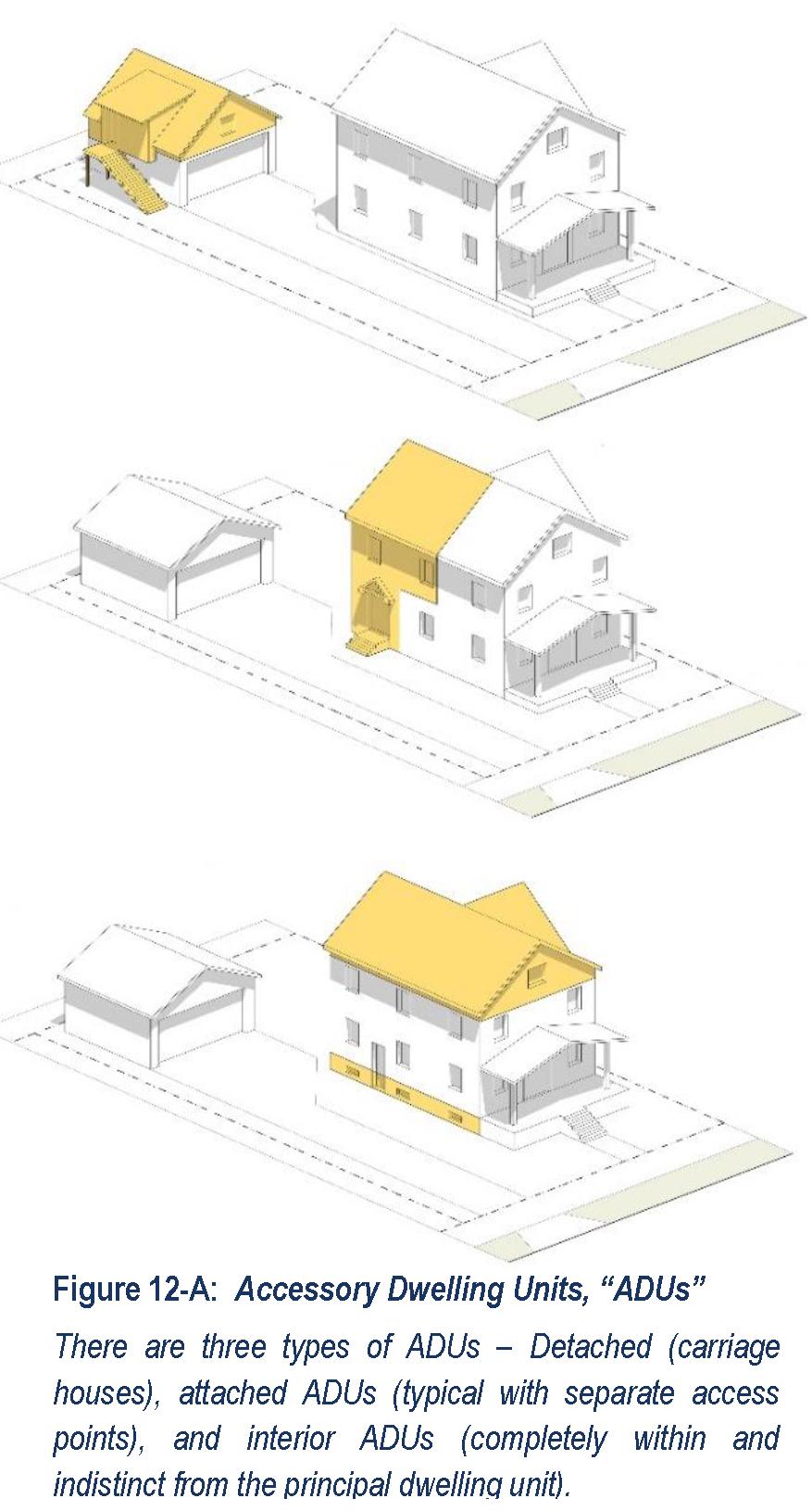
Accessory Dwelling. Accessory dwellings shall be accessory to a principal residential use on the lot and subject to the following additional standards:
1.
One accessory dwelling may be permitted per lot, only when associated with a detached house.
2.
Accessory dwelling units may be located in a detached accessory building or located within the principal building (such as an attic or basement apartment).
3.
The accessory dwelling shall not exceed fifty (50) percent of the living area of the principal dwelling or one thousand two hundred (1,200) square feet, whichever is less.
4.
One additional parking space shall be provided on site, although this provision may be waived by the director if the context and circumstances of each dwelling unit prove the space unnecessary.
5.
The property owner shall occupy either the principal or accessory dwelling as their permanent residence.
6.
The accessory dwelling shall be designed to maintain the architectural design, style, appearance and character of the principal building, and whether within the [principal] building or in a detached structure, shall ensure that the accessory dwelling is clearly subordinate to the principal dwelling through the location of parking, access, building entrances and other design features that accommodate the dwelling.
7.
A certificate of occupancy shall be issued by the city prior to use as a dwelling unit.
C.
Home Occupation. Home occupations shall meet all of the following standards:
1.
Only those who are permanent residents of the dwelling shall be employed by the business.
2.
All activity shall be conducted with an enclosed living area or the garage, and shall not involve any trailers, temporary structures or accessory buildings not clearly incidental and secondary to the principal dwelling.
3.
There shall be no outside storage of equipment or supplies associated with the business.
4.
There shall be no change in the residential appearance of the dwelling or premises, or any visible evidence of the conduct of a home occupation. On-site advertising of any nature is prohibited.
5.
Commercial vehicles associated with the business shall be limited to one vehicle not to exceed one ton, owned by a resident of the dwelling, which must be parked in a garage or a hard surfaced residential drive on site if available. Parking shall be handled in such a manner as to not impede or hinder traffic on any public right-of-way. Vehicles parked on public streets shall comply with all requirements of Section 10.48.040, "Parking not to obstruct traffic," and Section 10.48.190, "Oversize vehicles," of the city code.
6.
No equipment, machinery or operation shall be used in such activities that is perceptible off the premises by reason of noise, smoke, odor, dust, radiation, electrical interference or vibration.
7.
Visitors, customers or deliveries shall not exceed that normally and reasonably occurring in a residential neighborhood, including not more than two commercial deliveries (other than mail or parcel services) of products or materials per week. Delivery vehicles shall be limited to those that are single-unit vehicles and have only two axles.
a.
If the home occupation is the type in which customers or clients visit the premises, they shall be limited to eight business visitors a day per dwelling unit. Vehicular traffic associated with business visitors shall be limited to two vehicles at a time during allowable business hours stated below.
b.
If the home occupation is the type in which classes are held or instruction is given, they shall be limited to twelve (12) students or pupils a day and not more than four at the same time. Classes of three or more pupils must be scheduled at least thirty (30) minutes apart to reduce traffic congestion.
8.
In no case shall a home occupation be open to customers, clients or students at a time earlier than 8:00 a.m. or later than 8:00 p.m. with the exception of care providers for children or adults.
9.
The building and site shall be inspected and approved according to all applicable building codes, licenses, or other standards prior to the operation of any home occupation.
10.
No highly flammable, combustible or explosive material shall be used or stored on the premises in conjunction with a home occupation. No activity shall be allowed that would interfere with radio or television transmission in the area, nor shall there be any offensive noise, vibration, smoke, dust, odors, heat or glare noticeable outside the structure.
11.
Accumulation of inventories for public sale on premises and/or sale of any merchandise or products on display within or outside the residence is prohibited, except that orders placed by private clients or at a sales party may be filled on premises.
D.
Day Care (Accessory or In-home). Day care facilities accessory to residential dwellings, churches and schools shall be limited to (limits including the operator's own children):
1.
Two adults or four children with not more than two children under two years of age;
2.
Six children with none under two years of age.
3.
Day care facilities for three or more adults or seven or more children shall only be permitted through a conditional use permit according to the procedures and criteria of Section 17.08.030.
4.
All day care facilities shall meet the applicable statutes and regulations of the State Department of Health. (RSMo. ch. 210; and Title 19 CSR, Division 30, Chapter 61).
E.
Outdoor Storage, Residential. Accessory outdoor storage may be permitted in the residential zoning districts subject to the following standards:
1.
Recreational Vehicles. Outdoor storage or parking of recreational vehicles, watercraft or trailers may be allowed subject to the following limitations:
a.
No more than one per lot.
b.
Shall be located in the rear yard or in the side yard behind the front building line; except that on corner lots they shall be located behind the side building line facing the street.
c.
Shall be parked on a single pad of pavement constructed of asphalt, Portland cement.
d.
Except for temporary parking, the right-of-way of front driveway shall not be used to store items and no occupancy of the item shall occur.
e.
Temporary parking for the resident or guest may be permitted for seven consecutive days, up to two times per calendar year, except the code compliance official may extend this period to fourteen (14) days for special circumstances. Any other period shall only be approved by the city administrator, based on extraordinary circumstances, through a short-term conditional use process.
2.
Portable Storage Containers. Portable storage containers and temporary dumpsters may be permitted in conjunction with an active building or construction permit, subject to any terms and conditions of that permit. Where no building or construction permit is required, portable storage containers and temporary dumpsters may be permitted subject to the following limitations.
a.
No more than one per lot.
b.
No occupancy or habitation by animals, or other hazardous materials.
c.
Containers shall be placed on a paved surface and not over any easement or right-of-way, or otherwise create any sight obstruction.
d.
Only for a period reasonably necessary to complete the associated project or task, not to exceed fourteen (14) days or other time associated with a specific project or task and previously approved by the director or public works director in writing.
3.
Other Storage. All other accessory outdoor storage, except ordinary and incidental residential accessories such as patio furnishings, trash cans, or similar items, shall either be completely screened from adjacent property and public streets, or limited to no more than seventy-two (72) hours in any thirty-day period. The code compliance official may allow an exception to this for up to one hundred twenty (120) hours for special circumstances. This shall not exempt any outdoor storage from applicable property maintenance codes.
F.
Outdoor Storage, Non-residential. Accessory outdoor storage may be permitted in the non-residential districts subject to the following standards:
1.
Commercial Districts. In the CIO, C-1, C-2 and C-3 districts, accessory outdoor storage areas shall:
a.
Be located to the side or behind the principal building, but in all cases behind the front building line;
b.
Be fully screened from adjacent property, public spaces or streets according to the standards and design requirement of Section 17.24.030, and no materials shall be stacked higher than the screening;
c.
Be located at least fifteen (15) feet from any street or right-of-way;
d.
Be limited to:
(1)
No more than ten (10) percent of the building footprint in the CIO, C-1 or C-2 districts;
(2)
No more than thirty (30) percent of the building footprint in the C-3 district; and
e.
Be paved per the requirements for parking lots.
f.
Alternative surfaces, locations or screening can only be approved by the planning commission through site plan review procedures in Section 17.08.020.
2.
Industrial Districts. In the M-1 and M-2 districts, accessory outdoor storage shall meet the same screening requirements as outdoor storage as a principle use in 17.12.040.H.
G.
Outdoor Display and Service Areas. Accessory outdoor display and service areas accessory to an allowed retail or service use are subject to the following conditions:
1.
Outdoor display and areas shall be located on the same lot as the principal use, or in the immediate frontage where permitted on public sidewalks.
2.
The area shall be limited to no more than twenty (20) percent of the ground floor area of the principal use.
3.
Display and service areas shall not be arranged where they will interfere with pedestrian or building access or clear vision areas. At least five feet clear or at least fifty (50) percent of the width any sidewalk, whichever is greater, shall be maintained for any display or service areas located on a sidewalk.
4.
The area may be located in parking areas, provided it does not interfere with adequate parking and circulation of the entire site. The permanence of any structures shall be considered in evaluating the impact on adequate parking needs for the site.
5.
Any outdoor display area where the principle use is retail—outdoor sales shall be set back at least ten (10) feet from all property lines.
6.
The area shall be screened from view along any property line abutting a residential use or district according to Section 17.24.030.
7.
A site plan shall be provided for any outside display or service area more than two hundred (200) square feet, lasting more than seven consecutive days, or more than three separate occurrences per year. A site plan shall show the location, area, and dimensions of the display area, and specifications for all lighting, fencing, screening or temporary or permanent structures.
8.
In reviewing the site plan, additional conditions or performance standards to mitigate excess noise, visual or operational impacts may be added to address specific sites or contexts.
9.
Outdoor display and services not meeting these standards may only be approved through a temporary event permit or by the planning commission through site plan review procedures in Section 17.08.020.
H.
Accessory Drive-Through. Drive-through or drive-up service accessory to an allowed retail or service use is permitted subject to the following standards, provided it is not otherwise prohibited by a specific plan or standard for a particular area. These standards shall be evaluated on a block-specific context to ensure the appropriate balance between vehicle access, circulation and safety, and the pedestrian access and streetscape design in the area and along the frontage.
1.
The service area shall not substantially expand or alter the traffic patterns or vehicle circulation otherwise necessary for the site. In general, the service area shall use the same entrance and exit from the site as the principal use, unless a more remote or discrete service off an alley or secondary street better meets these criteria.
2.
Avoid potential pedestrian/vehicle conflicts on the site and along the streetscape. No access shall be provided on any street designed to walkable A frontage type designated in Chapter 17.20. Use of alleys, internal access and the back sides of buildings for drive-through services is required to preserve the urban design context of these areas. Other areas may warrant similar strategies due to pedestrian patterns and streetscape designs in the particular location.
3.
Service areas and windows shall be located on the most remote wall possible, considering adjacencies to public-streetscapes, residential property or other sensitive land use and urban design characteristics of the context. Additional screening or buffers, or architectural enhancements may be required beyond the standards of Section 17.24.030 or Chapter 17.20 in order to ensure compatibility with the streetscape or adjacent property.
4.
No service area or pick up window shall be located within one hundred (100) feet of any residentially zoned property unless enhanced site design demonstrate visual and noise impacts are mitigated.
5.
Adequate stacking spaces for automobiles shall be provided to eliminate any impact on public streets. Circulation, stacking and other access issues shall be designed in a manner that has the least impact on pedestrians entering the principal building both from public streets and from internal streets or parking area.
6.
Signs, service windows or other noise or lighting elements shall not be visible or audible from the public right-of-way or adjacent residential property. Additional screening or buffers may be required beyond the standards of Section 17.24.030.
7.
Any drive-through service area that does not clearly meet these criteria shall only be approved by the city council through a conditional use permit in Section 17.08.030.
I.
Solar Panels. Solar panels are permitted as an accessory use in all zoning districts subject to the following standards:
1.
No solar panel may cause a reflection onto other property.
2.
Panels mounted to the roof or wall may be installed at any angle, provided they are not visible from the public right-of-way or other public places immediately adjacent to the lot. If they are visible from such locations, they must be installed with an equivalent pitch angle as the roof itself.
3.
Free standing panels may only be authorized by conditional use permit if roof or wall mounted panels are shown to be infeasible.
4.
Solar panels may be mounted on light poles as a source of power for the light fixtures if they are designed as part of the fixtures.
5.
Exceptions to these standards may be considered for approval through conditional use permit process.
J.
Wind Energy Conversion Systems. Wind energy conversion systems are permitted as an accessory use in all zoning districts, subject to the following standards:
1.
In residential and commercial districts, facilities must be mounted on an existing structure; freestanding systems are not permitted.
2.
In industrial districts, facilities may be mounted on existing structures or may be free standing, provided such freestanding systems must be of monopole construction.
3.
The system may not be taller than one hundred (100) feet, or the maximum height permitted for other structures in the zoning district, whichever is less.
4.
The systems shall be sited in a manner that prevents shadowing or flicker impacts beyond the property line.
5.
Noise at the property line shall not exceed forty-five (45) decibels.
6.
No lighting is permitted unless to comply with other regulations.
7.
The systems shall be painted a neutral non-reflective color.
8.
Any systems not used or inoperable for twelve (12) months will be considered abandoned, and shall be removed within ninety (90) days.
9.
Exceptions to these standards may be considered for approval through conditional use permit process.
(Ord. No. 9212, § 3(Exh. A), 7-2-2019; Ord. No. 9678, § 5, 11-6-2024)
17.12.040 - Specific use standards.
In addition to the general use and development standards applicable to all districts, the following standards are specific to particular uses. These standards shall be met whether the use is a generally permitted use, accessory use or a conditional use according to Table 12-2. The uses in this section may include more specific types or formats of the uses generally enabled in Table 12-2.
A.
Lodging—Bed and Breakfast. Bed and breakfast establishments may be permitted to the extent the following conditions are met:
1.
The use is within, or near the downtown activity core of North Kansas City, such that guests may experience the convenience of nearby retail, office, entertainment and recreation amenities;
2.
The owner or the applicant shall occupy a residence on the site and must demonstrate a sufficient ability for site maintenance and property management;
3.
Guests must pay based on a daily rental rate, and must limit their stay to fourteen (14) days;
4.
There are to be no more than four guest rooms;
5.
Meals are restricted to breakfast and may only be served to guests. No cooking facilities are allowed in the guest rooms.
6.
Receptions or meetings of groups are prohibited;
7.
One off-street parking space shall be provided per guest room, and one per employee; or evidence that existing downtown parking is sufficient for the establishment;
8.
Additional conditions may be added where necessary to protect adjacent properties or the character of the district.
B.
Lodging—Short-Term Rental. Short-Term Rental establishments may be permitted to the extent the following conditions are met:
1.
Approved spaces for short-term rentals may include:
a.
Individual bedrooms in the principal building on the property, sharing common entrance, kitchen facilities, and living areas with the primary residents.
b.
Approved accessory dwelling on the property.
c.
The entirety of the property.
2.
Short-term rental is permitted in R-1A, R-1B, R-2, R-3, R-4, R-5, CIO, and C-1, except that in R-1A and R-1B short-term rental is allowed only as follows:
Owner-occupied dwelling unit as defined in Section 17.36.030. The owner shall provide proof of ownership and at least two of the following documents demonstrating that such dwelling unit is their primary residence:
a.
Proof of valid motor vehicle registration;
b.
Federal or state tax returns or other financial documentation;
c.
Proof of voter registration;
d.
A utility bill, and/or
e.
Any other legal documentation deemed sufficient by the director of community development that is pertinent to establishing primary residence.
3.
Only one short-term rental contract is permitted at a time per one approved short-term rental application. No more than one dwelling unit rental registration (including short-term and other rental unit registration) may be permitted per dwelling unit, regardless of building types.
4.
The proposed registrant, owner, and other local emergency contact information shall be posted within each dwelling unit offered, provided and/or operated as a short-term rental.
5.
For a short-term rental within a multi-unit building, a map is posted depicting all evacuation routes by doors in the event of an emergency. The map shall be posted on or immediately adjacent to every required egress door from each unit depicting all evacuation routes in the event of an emergency.
6.
Interconnected smoke and carbon monoxide detectors shall be installed and maintained in locations as specified in the Building Code.
7.
Fire extinguishers and a working, battery-powered flashlight or other emergency lighting device shall be located in each dwelling unit that is workable during an electrical power outage.
8.
No more than two persons per each bedroom being rented plus one additional person per dwelling unit, not to exceed eight guests per dwelling unit, shall occupy the dwelling unit at any given time.
9.
No food shall be prepared for or served to guests of any short-term rental by the proposed registrant or owner of the dwelling unit or their agents.
10.
No exterior evidence that the property is being used as a short-term rental is allowed, including signage.
11.
The short-term rental unit may not be rented or offered for use as reception space, party space, meeting space, or for other similar events open to non-resident guests.
12.
Registration is required with the City including the following information and documentation, upon forms provided by the director of community development department.
a.
The common name of the property, if any, and exact street address of each dwelling unit to be registered, including unit number and total number dwelling units in each dwelling structure;
b.
The legal names of all owners of the property;
c.
The complete mailing address and physical address of all owners;
d.
Telephone numbers of each owner, including mobile phone numbers;
e.
Date of birth of all owners.
f.
If the property is owned by a corporation, limited liability company, partnership, limited partnership, trust or real estate investment trust, the name, address, and phone number of the any of the following shall be provided:
(1)
For a corporation, a corporate officer, and the chief operating officer;
(2)
For a partnership, the managing partner;
(3)
For a limited liability company, the managing or administrative member;
(4)
For a limited partnership, a general partner;
(5)
For a trust, a trustee; or
(6)
For a real estate investment trust, a general partner, or an officer.
g.
The full name, address, telephone number, and email address of the owner to handle the affairs of the property. The owner shall reside within thirty (30) miles of the City limits.
13.
Regardless of ownership, each dwelling unit shall have separate applications. There will be an initial registration fee of two hundred dollars ($200.00) upon receiving of an application. All registrations issued shall expire on December 31 of each year and shall be subject to renewal annually. Application for renewal of registration in any year will be accepted beginning January 1 and may be made without penalty through January 31. There is a yearly registration fee of two hundred dollars ($200.00). A late renewal fee will be charged at fifty dollars ($50.00) per month.
14.
The dwelling unit shall comply with all applicable federal, state, and local laws, including but not limited to collection and certification of payment of taxes and procurement of any required licenses and permits, and all property maintenance, building, fire, electrical, mechanical, and plumbing codes.
15.
Every owner or owner's agent who manages a short-term rental dwelling unit shall upon the registration of said dwelling unit, be required to obtain from the City of North Kansas City, Community Development Department and Fire Department an inspection of the premises and an inspection report stating that no code violation was observed. No dwelling shall be reoccupied until the required inspection and report have been obtained from the Community Development Department.
16.
Staff shall have administrative approval authority for short-term rental application, provided all requirements of Section 17.12.040, Subsection B are adhered to. For instances where a variance or exception is requested, applicants will need to obtain a conditional use permit subject to the City's discretionary review process in Section 17.08.030.
17.
Upon approval of the registration, the property owner must apply and successfully obtain a city business license as required in Chapter 5.04 of the North Kansas City Municipal Code prior to establishing the use.
18.
The city issued short-term rental certificate for such dwelling unit shall be displayed in a conspicuous place in the interior of the rental unit.
19.
Lodging-short-term rental operation is prohibited in a dwelling unit that receives any City incentives, or located within a structure or upon a parcel that receives any City incentives. Such incentives may include any economic incentive granted by the City or any economic development agency created by the City, in the nature of capture and redirection, abatement, or exemption of taxes or the issuance of bonds or grants by the City or other City-backed financing.
20.
Change in either ownership or registration information shall require a new registration within thirty (30) days of such change.
21.
The City shall issue a violation notice to any person or entity who fails to comply with Section 17.12.040. Any person or entity fail to take actions to correct the violation within thirty (30) days is guilty of an ordinance violation and shall be fined not less than two hundred dollars ($200.00), but not more than five hundred dollars ($500.00). Each day may be considered as a separate offense.
22.
The City retains its right to deny, suspend or revoke the license when the short-term dwelling unit fails to meet or uphold any of Section 17.12.040, or any other provisions of the North Kansas City Municipal Code. Such dwelling units may not be eligible for registration within two years upon the issuance of denial, suspension, or revocation of the license.
23.
All short-term rentals in the City of North Kansas City are to be charged the Hotel/Motel Transient Guest Tax paid by transient guests of hotels, motels, bed and breakfast inns, and other short-term rental spaces of similar use, per Chapter 3.30 of the North Kansas City Municipal Code.
24.
As determined by the director of community development department, additional requirements may be added where necessary to protect adjacent properties or the character of the neighborhood.
C.
Residential Care—Homes. Residential or out-patient facilities for the treatment of alcohol and other drug abuse may be permitted to the extent the following conditions are met:
1.
The use shall be permitted in CIO, C-3, M-1 and M-2 zoning districts.
2.
State certification requirements of the division of alcohol and drug abuse of the department of mental health shall be met.
3.
The design of the facility shall be generally compatible with other physical structures in the surrounding neighborhood and in general no modifications necessary to meet the program of the building or other specific codes shall be permitted to the extent they are incompatible with other structures and the character of the area.
4.
The facility shall be located no closer than one thousand (1,000) feet from another such facility, and no closer than three hundred (300) feet from any residentially zoned districts.
5.
The applicant shall submit site plans to the planning commission for review and approval to demonstrate compliance with these standards.
D.
Adult Uses. Adult businesses may be permitted to the extent that the following conditions [are] met.
1.
The use shall meet all licensing, performance and operation standards in Chapter 5.08 of the city code.
2.
The use shall only be permitted in the M-1 and M-2 zoning districts.
3.
The use shall not be permitted on any lot abutting Burlington or Swift, and shall not be permitted on any lot abutting or north of 16 th Avenue.
4.
All signs shall be limited to the standards of downtown business district in the Chapter 15.44 of the city code.
5.
The use shall require a conditional use permit per the provisions of 17.08.030 to ensure compliance with these standards and the criteria of that review process.
E.
Pawn Shops and Short-term Lending. Pawn shops, car title lenders, check cashing lenders, and pay day lenders establishments may be permitted to the extent the following conditions are met:
1.
The use shall only be permitted in the C-3, M-1 and M-2 zoning districts.
2.
The use shall not be permitted on any lot abutting or north of 16 th Avenue.
3.
Pawn shops must be approved by the North Kansas City Police Department in accordance with RSMo. Ch. 367, and shall comply with all other applicable statutes of the State of Missouri, and all other city regulations.
F.
Short-Term Conditional Uses.
1.
Types. The following uses may be enabled by the city, where they may not otherwise meet the standards or criteria for the district, as a short-term conditional use approved by the city administrator:
a.
Trade shows and expositions such as boat shows, car shows.
b.
Community recreation or entertainment events such as street fairs, art fairs, carnivals and circuses.
c.
Promotional ventures or special commercial events such as sidewalk sales, trucks sales, and warehouse sales.
d.
Temporary off-site construction yards and offices such as storage yards for construction supplies, materials, or equipment for temporary use during a construction project. Sites of temporary construction yards and offices shall be restored to its original vegetative and topographic condition within a period determined by the director.
e.
Neighborhood Block Party.
2.
Criteria. A short-term conditional use shall be evaluated based on the following criteria:
a.
The applicant shall submit a complete description of the event or activity, including anticipated traffic, hours and peak times of operation, access and circulation plans, the ability to accommodate fire and police access, and any need for special protection or other public safety, health and welfare needs.
b.
The applicant shall submit a plan identifying the extent of the grounds, gathering places and circulation routes, any streets or public spaces to be dedicated to the event, the location of all structures, equipment or other accessory facilities, and any utility needs for these structures, equipment or fixtures.
c.
The need for any special signs, promotional elements or other permissions needed for the event beyond what the regulations would allow.
d.
The applicant shall submit any other information pertaining to the event required by the community development department.
3.
Exception. A short-term conditional use that meets one or more of the following condition(s) shall be enabled by action of the city council without referral to the planning commission:
a.
The proposed use is partially or fully located within Downtown Character Area as defined by the 2016 Master Plan and is expecting more than five hundred (500) attendees.
b.
The proposed used is partially or fully located within Downtown Character Area as defined by the 2016 Master Plan and is requesting any public street closure.
c.
The city administrator may refer any application to be reviewed and approved by the city council.
4.
Appeals. Any person aggrieved by the decision of the city administrator denying an application for a short term conditional use permit shall have the right to appeal to the city council. Such appeal shall be taken by filing with the city clerk a written request for city council consideration within fourteen (14) days after the city administrator's denial. The city clerk shall place the appeal on the next regularly scheduled city council meeting for city council consideration. The decision of the city council on such appeal shall be final.
G.
Marijuana. No building shall be constructed, altered, or used for a marijuana facility without complying with the following regulations.
1.
Buffer Requirement. No marijuana business shall be located within three hundred (300) feet of an existing elementary or secondary school, licensed child day care center, or church. Measurements shall be made in a straight line, without regard to intervening structures, from the nearest point on the exterior building wall of the school, childcare center, or church, to the nearest point on the property line containing the marijuana business.
2.
Outdoor Operations or Storage Prohibited. All operations and all storage of materials, products, or equipment shall be within a fully enclosed building. No outdoor operations or storage shall be permitted.
3.
Onsite Usage Prohibited. No marijuana may be smoked, ingested, or otherwise consumed on the premises of a marijuana business.
4.
Hours of Operation. All marijuana businesses shall be closed to the public, no persons not employed by the business shall be on the premises, and no sales or distribution of marijuana shall occur upon the premises or by delivery from the premises between the hours of 10:00 p.m. and 8:00 a.m.
5.
Display of Licenses Required. The marijuana license issued by the State of Missouri shall be displayed in an open and conspicuous place on the premises.
6.
Residential Dwelling Units Prohibited. No marijuana business shall be located in a building that contains a residence, except retail sales in a mixed-use building.
7.
Ventilation Required. All marijuana businesses shall install and operate a ventilation system that will prevent any odor of marijuana from leaving the premises of the business. No odors shall be detectable by a person with a normal sense of smell outside the boundary of the parcel on which the facility is located.
8.
Site Plan Review Required. A site plan meeting the requirements of this title shall be submitted for review and approval subject to the procedures of Section 17.08.030. The site plan shall include a description of the ventilation system to be used to contain odors within the building.
H.
Outdoor Storage. Where outdoor storage is allowed as a principle or accessory use in the M-1 and M-2 zoning districts, it shall meet the following standards.
1.
Storage areas shall either be located behind the [principal] building, or screened from view from the streetscape and public spaces with a fence, landscape buffer, or combination of these spaces.
2.
In the M-1 district, outdoor storage shall be screened from view by any combinations of buildings, fences or landscape buffers to not be visible at eye level from adjacent property.
3.
All outdoor storage shall be screened from residential property according to the landscape and buffer requirements of Section 17.24.030.
4.
Exceptions to these screening requirements may be approved by the director for areas on Service B frontages of the urban areas frontage map (Figure 20-A in Section 17.20.020) or by the planning commission for other areas through the site plan process.
(Ord. No. 9212, § 3(Exh. A), 7-2-2019; Ord. No. 9421, § 1, 9-21-2021; Ord. No. 9490, § 1, 7-19-2022; Ord. No. 9583, § 2, 7-5-2023, eff. 9-1-2023; Ord. No. 9623, § 1, 2-6-2024; Ord. No. 9678, § 6, 11-6-2024)
17.12.050 - Zoning district performance standards.
All principle and accessory uses in non-residential districts shall be operated in a manner that meets the performance standards in Table 12-3.
Table 12-3: Non-residential Performance Standards
(Ord. No. 9212, § 3(Exh. A), 7-2-2019)

