
North Kansas City City Zoning Code
CHAPTER 17
24 - OPEN SPACE AND LANDSCAPE DESIGN
17.24.010 - Intent and applicability.
A.
Intent. It is the intent of this section is to:
1.
Improve the aesthetic quality of development with natural landscape materials.
2.
Promote the distinct character of districts and neighborhoods as reflected in the master plan or any specific plans.
3.
Coordinate landscape and design amenities across multiple sites, with special attention to the relationship between lots and streetscapes.
4.
Enhance the environmental and ecological function of un-built portions of sites, including reduced air or water pollution and reduced heat gain from large expanses of blank walls or paved surfaces.
5.
Screen and mitigate the visual, noise or other impacts of high-intensity areas of sites, buildings and land uses.
B.
Applicability. The standards of this chapter shall apply to all new development, except:
1.
Detached houses and duplexes being built on an individual basis and on a previously platted lot, and which are not part of an application for a larger neighborhood plan or subdivision plat; and
2.
Improvements or repairs to existing development that do not result in an increase in building footprint by more than ten (10) percent, an increase in impervious surface, or changes in use that do not result in an increase in intensity.
In cases where improvements or repairs increase the building footprint by more than ten (10) percent, increase the impervious surface, or intensity of use, the intent is to bring the site into full compliance with these standards, except that the director or planning commission may pro-rate the requirements to the extent of new development on the site where full compliance is not possible or practical.
(Ord. No. 9212, § 3(Exh. A), 7-2-2019)
17.24.020 - Open space types.
A.
Design Objective. Open space shall be designed to meet the following objectives.
1.
Recognize open space as an important and enduring element of civic design and North Kansas City's image and identity.
2.
Plan and integrate an open and civic space system into the structure of streets, blocks and lots as a coordinated part of the public realm.
3.
Value the design, function, and appropriate application of different types of open space, rather than solely the quantity of space.
4.
Develop a greater perceived impact from open space by coordinating the design and location of open spaces across multiple development projects.
5.
Consider the context and multiple functions that open spaces can serve to support development, including ecological, recreation, aesthetic and urban design functions.
6.
Create gateways and focal points for the community, neighborhood, district, block or development site.
7.
Integrate natural systems into the design of common or public open spaces.
B.
Design Standards. Where open space is specifically required by these regulations (as opposed to general standards for setbacks or buffers, which may also have a landscape standard associated with it), it shall be designed as one of the following types according standards in Table 24-1.
Table 24-1: Open Space Types and Design Standards
Large trees and ornamental tree requirements may be substituted for each other at a rate of two large for one ornamental/evergreen rate for up to fifty (50) percent of either requirement.
(Ord. No. 9212, § 3(Exh. A), 7-2-2019)
17.24.030 - Buffers, screens and fences.
A.
Design Objectives. Buffers, screens and fences shall be designed to meet the following objectives. In addition to the requirements specified for each buffer type, the arrangement of plants, grading or berming of land, or inclusion of fences walls or other screens may be necessary to meet these objectives.
1.
Design the appropriate degree and extent of screening for the particular context, considering the character of the district, nature of typical uses, and design of the streetscape and public realm.
2.
Soften the extent of large expanses of buildings or paved surfaces with landscape elements.
3.
Reduce glare from traffic internal to the site, outdoor lighting or other operations on the site.
4.
Mitigate noise to comparable ambient noise levels found by other compatible uses throughout the area or district.
5.
Locate site components that require screening in a way that maintains proper lines of site.
6.
Locate impact site elements such as trash enclosures, service and loading areas, utility and mechanical equipment, or outdoor storage on remote portions of sites away from streetscapes, public view and from adjacent residential property.
7.
Use materials that complement the site and building to buffer or screen site elements, particularly where they are visible from public spaces.
B.
Buffer Design. The following buffers and planting requirements shall be located along the perimeter of sites to buffer more intense uses and to design effective transitions. The buffer width exists independent of and may include any setback, parking perimeter buffer or other open space requirement. Where the space is meeting more than one of these requirements, the plant requirement is in addition to any other required plants.
Table 24-2: Buffer Design and Planting Requirements
C.
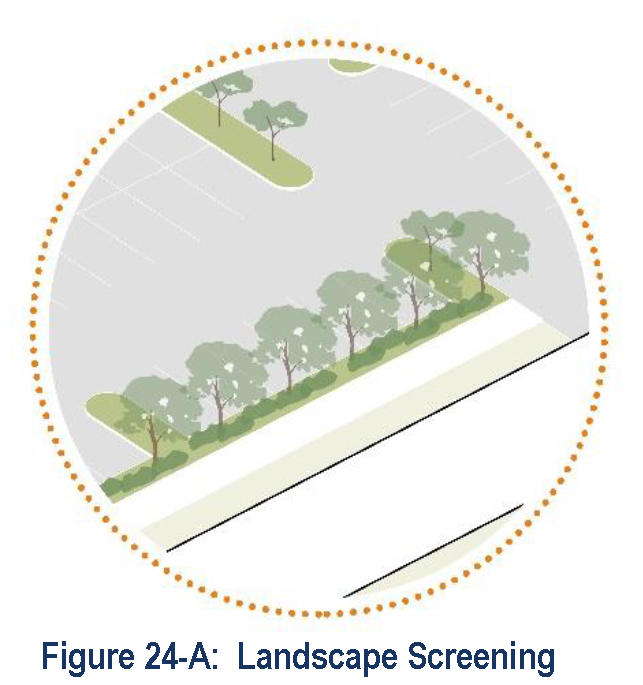
Screening. All of the following shall be screened from streets or adjacent property with dense evergreen vegetation, a decorative opaque fence or wall complementing the architectural details and materials of the building, or architectural features of the building, or a combination of these.
1.
Electrical and mechanical equipment such as transformers, air conditioners, or communication equipment and antennas, whether ground, wall or roof mounted;
2.
Permanent or temporary outdoor storage areas;
3.
Trash enclosures; and
4.
Utility stations;
5.
Delivery and vehicle service bays, except that bays do not need to be screened from adjacent property with the same or more intense zoning.
6.
Non-residential parking lots within thirty (30) feet of residential lots.
D.
Fencing. All fencing for screening, security, or privacy shall meet the following standards.
1.
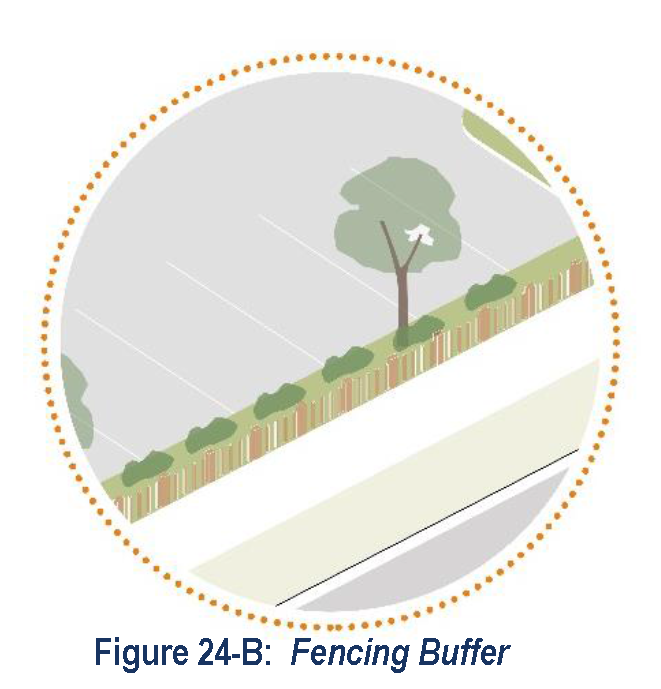
Front and Street-side Fencing. Fencing in front of the front building line, or on the street-side on corner lots shall:
a.
Be limited to no higher than four feet in residential and commercial districts and six feet in industrial districts; and
b.
Have a void of at least thirty-three (33) percent up to four feet, so that a four-foot high picket fence shall have a picket to void ratio of 2:1 or greater transparency. This standard shall not apply to any fence or screen required to screen permitted outdoor storage or required by subsection C. above.
c.
Any fence or wall constructed within twenty (20) feet of the street right-of-way in commercial or residential districts shall be limited to decorative or ornamental fencing and screening, with materials complementing the architectural style and materials of the [principal] building.
d.
On corner lots, street-side fencing more than six feet from a pedestrian facility in the public right-of-way and behind the front building line may meet the standards in for rear and side fencing in subsection 2. below.
2.
Rear and Side Fencing. All rear and interior side fencing located behind the front building line shall:
a.
Be limited to no higher than seven feet, or up to eight feet in all industrial districts.
b.
May have a solid screen.
3.
Other Fencing Design Standards.
a.
Any fencing that could potentially create a sight obstruction for vehicles crossing pedestrian areas or entering the street may require greater transparency or additional location restrictions to allow for safe sight distances for the vehicle.
b.
All fencing located along adjacent lot lines shall be constructed so that either:
(1)
The face of the fence is on the property line; or
(2)
The face of the fence is at least three feet from the property line. Any areas set back three feet or more from the property line, which could become enclosed by other similarly located fences, shall provide at least one gate for access and maintenance equipment.
c.
All fences shall be constructed so that the finished side faces adjacent property or any public right-of-way.
4.
Materials. Fences shall be constructed out of any of the following materials:
a.
Wood or vinyl simulating wood;
b.
Wrought iron or aluminum simulating wrought iron;
c.
Stone, brick, concrete with stone or brick veneer, or pre-cast concrete simulated stone or brick; or
d.
Chain link or vinyl clad chain link:
(1)
In all residential districts, in the rear or side yard only with a maximum height of four feet;
(2)
Permitted in the M-1 and M-2 districts;
(3)
Prohibited in all commercial districts.
e.
Barbed wire may be allowed only in the M-1 and M-2 districts, and if located above six feet. However, razor wire is prohibited in all districts.
f.
No fences shall be electrified.
5.
Exceptions. The planning commission may approve exceptions to the fence standards through the site plan process in 17.08, provided the proposed fence:
a.
Does not create any adverse impacts on traffic safety, design of public spaces, or on neighboring property;
b.
Is architecturally compatible with the site and surrounding area; and
c.
Otherwise meets or exceed the design objectives of this section, and the intent of this chapter.
E.
Visibility at Intersections. Screens, buffers, walls and feces shall be located and designed to maintain proper lines of sight at all intersections of streets, streets with alleys or driveways, and internal access streets. The proper line of sight shall be an unobstructed view from the stopping point on the approaching street to all points three feet above the roadway along the centerline of the intersecting street. The distance of the unobstructed view shall be based upon the design speed of the intersection street, specified below.
Table 24-3: Clear Sight Distance
Source: American Association of State Highway and Transportation Officials, A Policy on Geometric Design of Highways and Streets.
1.
Street trees, light poles or other limited obstructions are allowed within the sight triangle provided that they do not have any foliage, limbs, or other obstructions between two and eight feet, and are no closer than twenty (20) feet to the intersecting right-of-way line.
2.
Fully controlled intersections, where signalization establishes and prioritizes safe turning movements, may deviate from the above sight triangle standards if site conditions warrant and based upon a recommendation of the public works director.
(Ord. No. 9212, § 3(Exh. A), 7-2-2019)
17.24.040 - Plant requirements and specifications.
A.
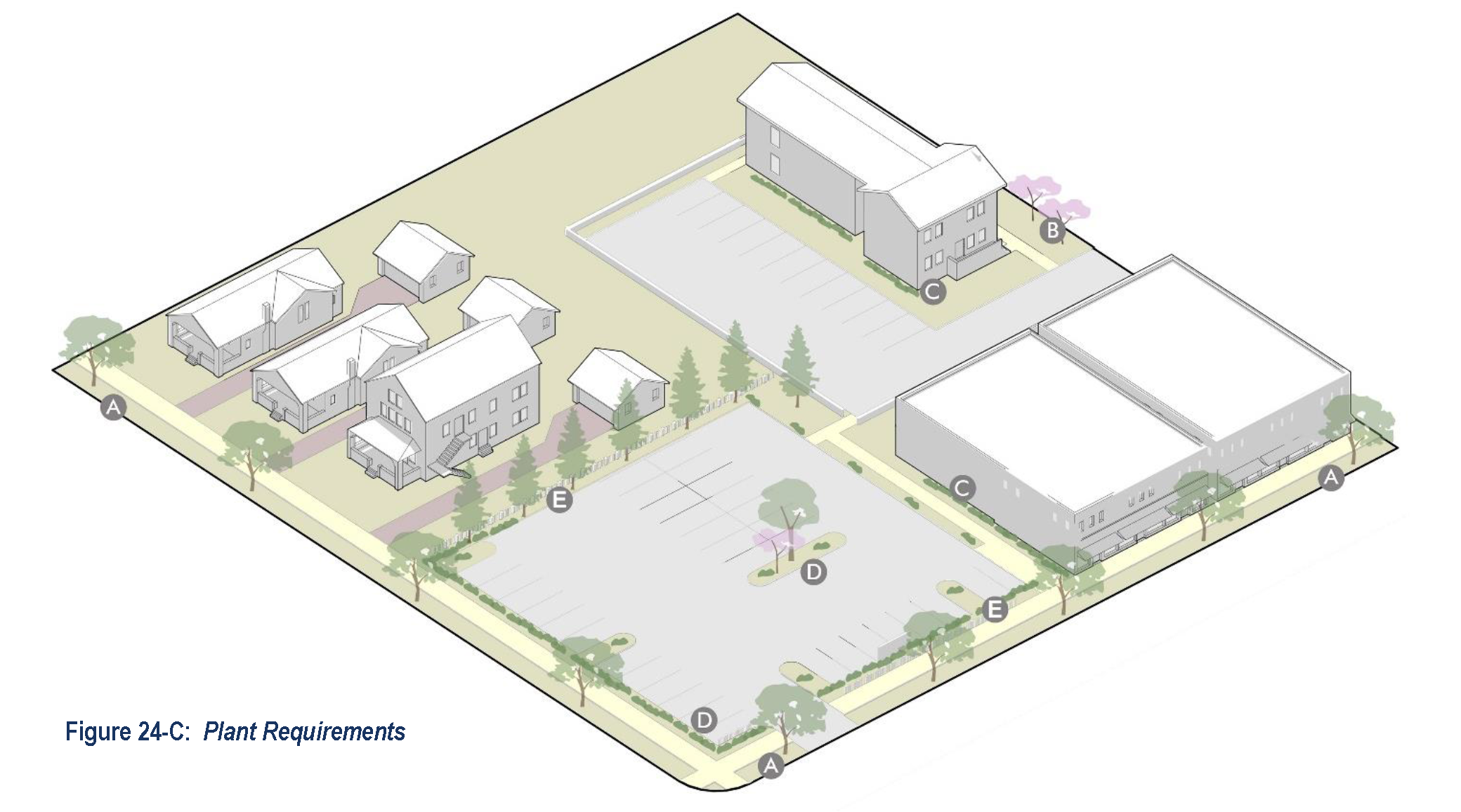
Plant Requirements. Required plant materials shall be based on specific site elements as follows:
Table 24-4: Plant Requirements
* Street trees shall be planted in tree lawns between the sidewalk and curb, at least six feet wide, or in tree-wells with a minimum permeable surface area of twenty-four (24) s.f. and minimum width of four feet. In cases where tree lawns cannot accommodate a large tree or where overhead utilities are present, small trees may be substituted. In cases where streets cannot accommodate planting in the right-of-way, planting shall be within the first ten (10) feet of the front lot line. Any lot fronting on a street with a specific streetscape plan, approved by the planning commission, may substitute the design specification of that plan for street tree requirements.
B.
Plant Species. All trees and shrubs shall be selected and planted according to Great Trees for the Kansas City Region, incorporated in Appendix B. The director is authorized to supplement and amend the list of required, preferred and prohibited plant species. In addition to any species on these lists, alternatives may be proposed and approved as part of the site plan provided they:
1.
Are documented by a landscape architect or other credible information comparable in type and performance to any species on this list;
2.
Are adaptable to the climate of the metropolitan region and the specific conditions in which they are proposed; and
3.
Are not invasive or otherwise problematic to the overall health of the landscape.
C.
Planting Specifications. All landscape materials shall meet the American Standards for Nursery Stock (ASNS), published by the American Nurserymen's Association, and be selected for its native characteristics or survival in the climate for the Kansas City region, and be planted and maintained ASNS specifications. Plants shall meet the following specifications at planting:
Table 24-5: Plant Specifications
D.
Tree Diversity. The required trees planted shall promote diversity with the following species selection criteria.
Table 24-6: Tree Diversity
* Any streetscape master plan or public realm plan may achieve street tree diversity on a block-scale or area-scale basis, while planting the same species on individual segments for the urban design affect.
E.
Credits for Existing Vegetation. Successful incorporation of existing and healthy vegetation that meet these performance criteria may be credited towards any landscape requirement. Credits shall be on a one for one basis for any vegetation that meets the minimum specifications, except that landscape material more than three times the specified size or otherwise of exceptional quality may be credited on a two for one basis.
F.
Design Objectives and Performance Criteria. In addition to the above planting requirements, all landscape plans shall be designed according to the following performance criteria, and in individual cases additional plantings may be warranted in order to meet these criteria:
1.
Existing natural features of the site, such as groves of trees, extreme slopes, areas intended to serve as buffers and areas not intended for development, shall be retained and incorporated into the design to the maximum extent practical.
2.
Landscape areas shall be utilized to the maximum extent possible for natural stormwater mitigation practices and to satisfy stormwater management criteria. Examples of natural stormwater mitigation practices include filter strips, vegetative swales, pervious pavement systems and sand filters.
3.
Native plants and vegetation shall be utilized to the maximum extent reasonable, i.e., drought tolerant plants should be planted in landscape islands and water-resistant plants should be planted near stormwater retention facilities.
4.
All required landscape and open space areas shall remain free of debris and refuse and be appropriately maintained.
5.
Designs shall best integrate sites and projects into their surroundings or promote any distinct characteristics of the area identified in the master plan or any specific plans.
6.
Designs should emphasize any focal points of an area or project, and pay particular attention to the relationship with the streetscapes.
(Ord. No. 9212, § 3(Exh. A), 7-2-2019)

