
Oak Island City Zoning Code
ARTICLE 10
- PERFORMANCE STANDARDS
PART VII. - FLOOD DAMAGE PREVENTION[3]
The owner and/or applicant developer shall comply with all applicable requirements and thresholds established by Chapter 18, Article IV - Flood Damage Prevention. All development must comply with Chapter 18, Article IV - Flood Damage Prevention (see Chapter 18, Article IV of the Code of Ordinances).
Editor's note—Amend. of 5-11-2021(1) repealed former Part VII, §§ 10.75—10.102, which pertained to flood damage prevention regulations—coastal regular phase, and derived from Ord. of 10-9-2018; Amend. of 2-9-2021(3); and Amend. of 6-8-2021(10).
SECTION 10.1 - PURPOSE.
The purpose of this section is to establish, in concert with the Town of Oak Island Tree Management Program, minimum requirements to provide adequate visual buffering and screening of permitted uses, structures, parking areas, and preservation of protected trees. The intention of these requirements is to satisfy the following objectives:
10.1.1. To provide attractive visual buffering between different land uses and enhance town beautification.
10.1.2. To safeguard and enhance property values and to protect public and private investment by providing standards for the protection of existing vegetation and root zones and the installation of new vegetation.
10.1.3. To mitigate stormwater runoff and erosion, enhance air quality, conserve energy, and aid in abating noise, glare, and heat.
10.1.4. To establish and maintain a substantial sustainable amount of tree cover on public and private lands.
10.1.5. To maintain trees in a healthy and non-hazardous condition through good arboricultural practices.
10.1.6. To establish, maintain, and protect appropriate diversity in tree species and age classes to provide a stable and sustainable urban forest.
10.1.7. To support the Town of Oak Island Tree Management Program.
(Ord. of 10-9-2018)
SECTION 10.2 - APPLICABILITY.
The four standard requirements in this section are: Street Yards (Section 10.4), Parking Facility Landscaping (Section 10.5), Bufferyards (Section 10.6), and Screening of Dumpsters (Section 10.7.4). The requirements of this Article 10, Part I, shall be applicable to the following situations:
10.2.1. Multi-Family Residential Development. When ten or more parking spaces are required for all phases of development excluding all residential developments which contain solely detached single-family dwelling units.
10.2.2. Nonresidential Development.
10.2.2.1. New Construction. When a permitted use, a use or combination of uses contained within a special use permit require ten or more parking spaces.
10.2.2.2. Existing Development. When there is a change from an existing use to a new use which requires additional parking and the new use requires ten or more additional parking spaces.
10.2.2.3. Expansion of Structure. When there is an expansion of an existing structure and that use requires ten or more additional parking spaces.
10.2.2.4. Reconstruction of Structure. When there is damage or destruction to an existing structure beyond 50 percent of its assessed value, the reconstruction must conform to the new construction standards of this section.
10.2.2.5. Expansion of Parking Facility. When there is an expansion of the parking facility and the use requires 10 or more additional parking spaces.
(Ord. of 10-9-2018; Amend. of 4-11-2023(5))
SECTION 10.3 - TREE MANAGEMENT PROGRAM.
Tree resource management regulations shall apply to all protected trees for both new and existing development in accordance with the Town of Oak Island Code of Ordinances Chapter 32. No building permit or certificate of occupancy shall be issued for any improvements upon a property where the provisions of this Chapter have not been complied with.
(Ord. of 10-9-2018; Amend. of 4-11-2023(5))
SECTION 10.4 - STREET YARD REQUIREMENTS.
Street yards are required for all commercial, industrial, and multi-family residential development with eight or more parking spaces.
 | 10.4.1. Minimum Standards. | |||
| The minimum depth of all street yards shall be 7.5 feet. For every 50 linear feet of frontage, or fraction thereof, the street yard shall contain a minimum of two Shade Trees and six Intermediate Shrubs. Newly installed plant material shall be evenly distributed, where possible. | ||||
 | 10.4.2. Tree Credits. | |||
| If there are existing trees in the proposed street yard area, the UDO Administrator may grant credit toward meeting the requirement for preservation of those trees as specified by the Tree Credits table (Section 10.7.1). | ||||
 | 10.4.3. Sight Visibility. | |||
| No planting material will be allowed which, at planting or at maturity, will impede vision between a height of three feet and ten feet in the sight visibility triangle specified by Section 2.17. | ||||
(Ord. of 10-9-2018)
SECTION 10.5 - PARKING FACILITY REQUIREMENTS.
 | 10.5.1. Minimum Standards. |
| For parking facilities having 15 or more parking spaces, at least eight percent of the gross paved area of the parking facility shall be landscaped and located in the interior of the facility. | |
 | 10.5.2. Planting Islands. |
| Planting islands shall include at least one Shade Tree or one Small Tree and six Small Shrubs. At least 50 percent of the trees planted shall be Shade Trees. | |
 | 10.5.3. Interior Plantings. |
| In support of the above, the following standards shall apply to interior plantings: | |
 | 10.5.3.1. All plantings shall be evenly distributed throughout the parking facility.
|
 | 10.5.3.2. All interior plantings shall be curbed or otherwise physically protected. Depressed
landscaped islands shall be permitted for stormwater management purposes as approved
by the UDO Administrator or Town Stormwater Administrator.
|
 | 10.5.3.3. Landscaped islands shall be installed at each block of 15 consecutive parking spaces
and at the ends of all parking rows. Landscaped islands shall contain at least 100
square feet in area and be at least 8 feet in width, measured from back of curb to
back of curb.
|
Street Yard and Parking Facility Landscape Example (Sections 10.4 and 10.5)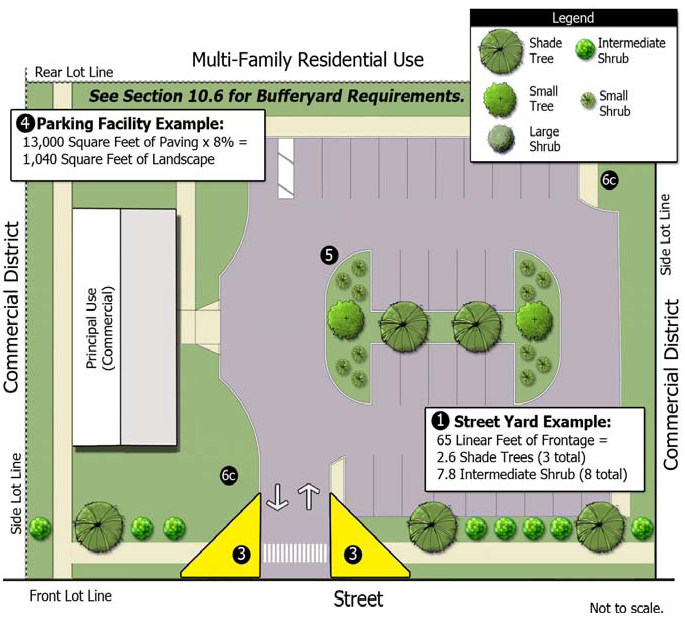
(Ord. of 10-9-2018)
SECTION 10.6 - BUFFERYARD REQUIREMENTS.
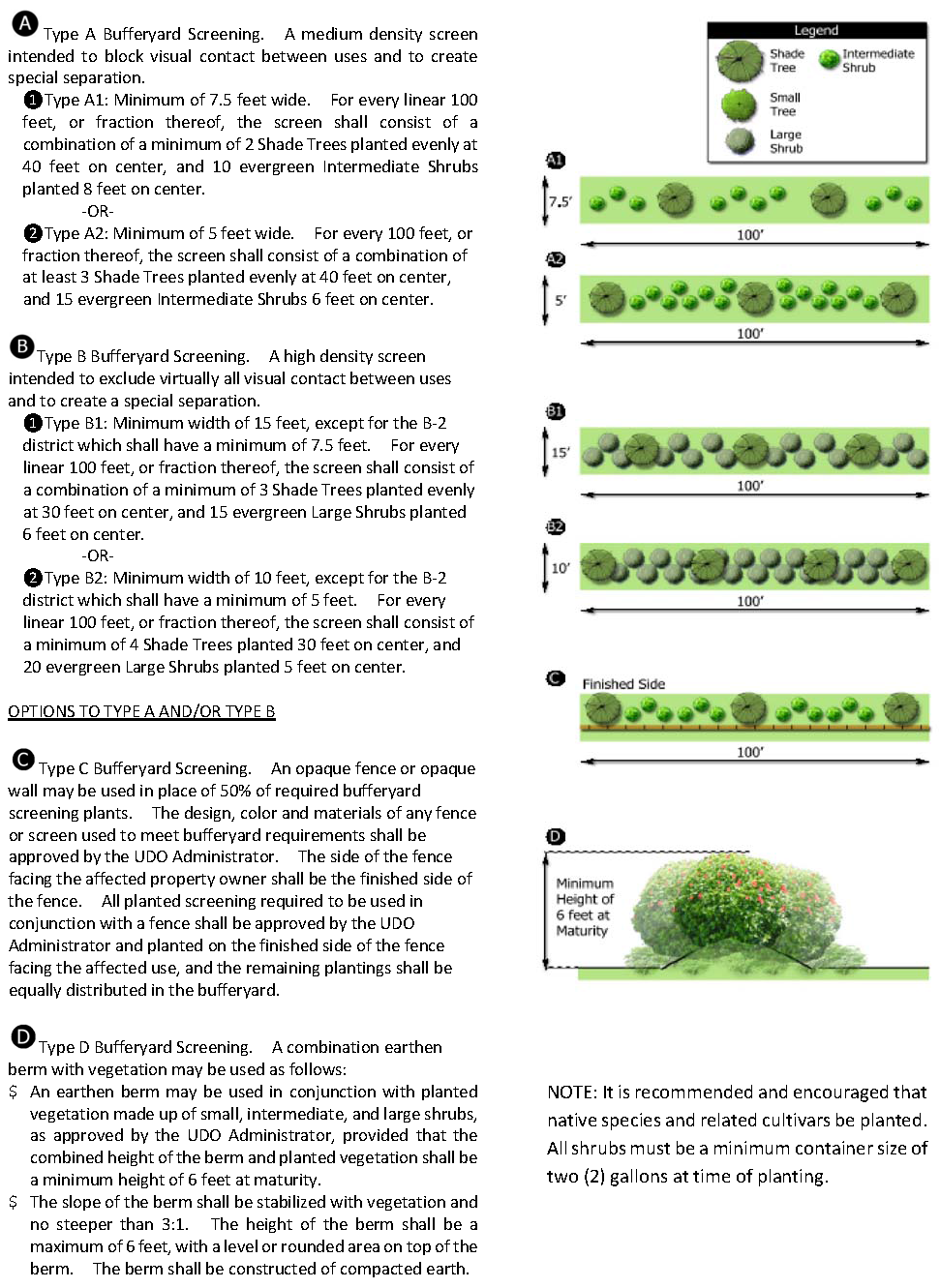
Bufferyards are required for multi-family residential development with ten or more parking spaces and nonresidential development as outlined in Section 10.2. See the table below to determine the type of bufferyard required.
Bufferyard requirements as they pertain to the Table of Uses and Activities (Section 6.5) are as follows:
(1)
Industrial shall include all uses allowed within the I-D district.
(2)
Commercial (including O/I) shall include all uses allowed within the O&I, CB, CR, and C-LD districts.
(3)
Multi-Family Residential shall include all uses allowed within the R-6MF district.
(4)
Single-Family Residential shall include all uses allowed within the R-20, R-9, R-7, R-6, and R-6MH districts.
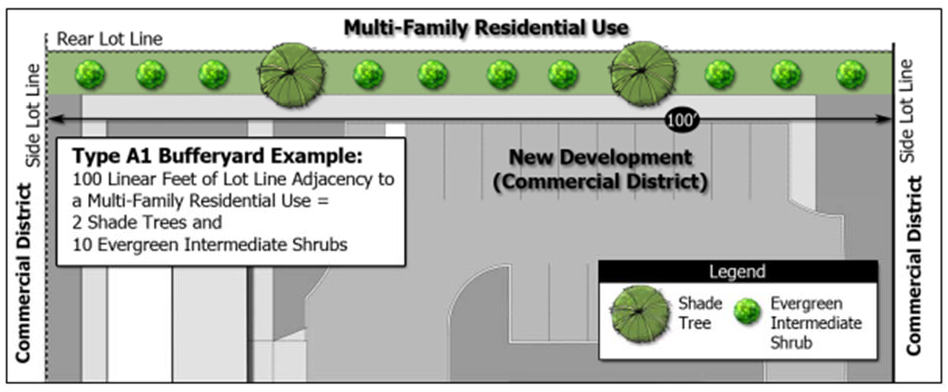
The following provides an example of a Type A bufferyard for a developed commercial district adjacent to a multi-family use in a residential district.
(Ord. of 10-9-2018; Amend. of 6-8-2021(10))
SECTION 10.7 - ADDITIONAL REQUIREMENTS.
10.7.1. Existing Trees and Shrubs.
Any existing trees within required bufferyards shall be encouraged to be utilized and supplemented as necessary to meet bufferyard screening requirements. Existing trees intended to meet bufferyard screening requirements shall be protected from detrimental actions such as vehicle or equipment movement, excavating and grading, and installation of storage or structured elements. Credit for existing trees will be based on the following:
10.7.2. Uses in the Bufferyard.
No activities shall occur in the bufferyard except for maintenance of the bufferyard, required ingress and egress and the installation and maintenance of water, sewer, electrical, and other utility systems where the installation causes minimal disturbance of existing vegetation.
10.7.3. Uses in the Rear Yard and Side Yards Abutting a Residential Use.
The following uses shall be shielded from view from the property line of adjacent residentially used or zoned property by means of an opaque fence, opaque privacy wall, or solid vegetative buffer:
10.7.3.1. Outside storage areas.
10.7.3.2. Loading/unloading areas.
10.7.4. Dumpsters or Other Trash Holding Areas.
All dumpsters or other trash holding areas shall be screened on three sides by means of an opaque fence, opaque wall, privacy wall or solid vegetative buffer.
10.7.5. Encroachment into Setbacks.
10.7.5.1. If an existing structure is located within a setback where the implementation of the Streetyard and/or Bufferyard requirements are physically impossible and the encroachment into the yard (streetyard or bufferyard) allows for a minimum of three feet of planting area, only the required shrubs shall be planted.
10.7.5.2. If the encroachment into the yard (streetyard or bufferyard) allows for less than three feet of planting area, no planting shall be required in that yard.
(Ord. of 10-9-2018; Amend. of 8-11-2020(2))
SECTION 10.8 - INSTALLATION.
Plants shall be installed per the installation details included in Appendix B of this Ordinance.
(Ord. of 10-9-2018)
SECTION 10.9 - MAINTENANCE.
10.9.1. All existing vegetation that is used to meet landscaping requirements, all required plants, and all required berms shall be maintained by the owner of the property on a continuing basis for the life of the development.
10.9.2. Opaque fences or opaque privacy walls shall be maintained, cleaned and repaired by the owner of the property on a continuing basis for the life of the development. Such fencing shall be kept free of litter and advertising. Opaque fences or privacy walls may be subject to periodic inspection by the UDO Administrator.
10.9.3. A new certificate of occupancy/building permit or a complaint will result in an inspection for compliance.
(Ord. of 10-9-2018; Amend. of 8-11-2020(2))
SECTION 10.10 - LANDSCAPE PLAN.
Landscape plans shall be submitted with minor or major site plans, special use permit application, and/or request for a zoning certificate of compliance, if Section 10.2 applies. These plans shall contain the following information:
10.10.1. Date of plan preparation.
10.10.2. Project name and description of land use.
10.10.3. Project owner and mailing address.
(Ord. of 10-9-2018)
SECTION 10.11 - TREE PROTECTION DURING CONSTRUCTION.
Tree preservation is a pre-planning activity and will be thoroughly considered prior to development of engineering and/or architectural plans and prior to initiation of construction projects. Protected trees shall be guarded during development against the following:
10.11.1. Unnecessary cutting, breaking, or skinning of roots.
10.11.2. Skinning and bruising of bark.
10.11.3. Excessive vehicular and foot traffic within drip lines.
10.11.4. Parking vehicles within drip lines.
10.11.5. During the land clearing and construction stage of development, the developer shall erect and maintain protective barriers (to the Building Inspector's specifications consistent with good management practices) around all trees or groups of trees to be protected from the center of the tree(s) to the dripline. The developer shall not allow the movement of equipment or the storage of equipment, materials, debris or fill to be placed within the protective barrier.
10.11.6. During the construction stage of development, the developer shall not allow the cleaning of equipment or material within the drip line of any tree or groups of trees to be protected. Neither shall the developer allow the disposal of waste materials such as paint, oil solvents, asphalt, concrete, mortar and so on within the drip line of any tree or groups of trees.
10.11.7. No attachments or wires other than those of a protective nature shall be attached to any tree.
10.11.8. Soil disturbances within the drip line of a protected tree shall be limited to two inches in depth removed or two inches in depth added. Any soil added under the drip line of the tree shall be a loamy soil mix to ensure minimal compaction.
10.11.9. During land clearing and construction stage of development, the UDO Administrator shall periodically inspect the site to ensure compliance with the provisions of this section.
10.11.10. Tree location and replacement activity permitted or required under this section shall be done in accordance with standard forestry practices and procedures, and all such plantings shall be reasonably maintained and attended to promote successful establishment thereof.
(Ord. of 10-9-2018)
SECTION 10.12 - RECOMMENDED PLANT LIST.
The following is a recommended plant list to be utilized in the preparation of Landscape Plans to meet vegetation requirements or comparable vegetation may be used from the list provided in Seacoast Plants of the Carolinas (University of North Carolina Sea Grant Program, Publication UNC-SG-73-06), "Trees for Oak Island" or any other town-approved tree list. NOTE: Native vegetation is preferred. Plants not listed may be accepted by the UDO Administrator if they meet the standards defined by this Section. Some plants are listed under multiple categories as many of these plants are offered in numerous varieties. Mature height and spread of each plant is contingent on the variety. It is highly recommended that Landscape Plans be prepared by or in consultation with a Registered Landscape Architect or qualified landscape design professional.
Key:
E = EVERGREEN
N = NATIVE
D = DROUGHT TOLERANT
S = SALT TOLERANT (MODERATE TO HIGH)
(Ord. of 10-9-2018)
SECTION 10.13 - INTENT.
In order to present an attractive face for the Town of Oak Island, buildings along roadways should enhance the image of the town's jurisdiction. The emphasis shall be on architectural detail and human-scale design to enhance the visual appearance of the built environment and to preserve the small-town atmosphere.
(Ord. of 10-9-2018; Amend. of 12-14-2021)
SECTION 10.14 - APPLICABILITY.
The requirements of this section shall apply in the following circumstances:
10.14.1. Construction of any new non-residential structure, condominium mixed-use, or dwelling over a business located in the CB and CR zoning districts or in the CL-D zoning district fronting NC 211 or Midway Road.
10.14.2. Reserved.
10.14.3. Expansion of an existing non-residential structure, condominium mixed-use, or dwelling over a business located in the CB and CR zoning districts or in the CL-D zoning district fronting NC 211 or Midway Road that increases the total enclosed floor area by at least 25 percent or 2,500 square feet, whichever is less. Modification or renovation of an existing non-residential structure, condominium mixed-use, or dwelling over a business located in the CB and CR zoning districts or in the CL-D zoning district fronting NC 211 or Midway Road that collectively exceeds 100 percent of the tax or appraised value of the structure.
10.14.4. Reserved.
(Ord. of 10-9-2018; Amend. of 12-14-2021)
SECTION 10.15 - EXEMPT.
Communication towers; church, synagogue, temple, or other religious building, including accessory services; community or municipal sewage and water treatment plants; and public or private utility towers, substations, pumping stations and storage tanks, shall be exempt from these requirements.
(Ord. of 10-9-2018; Amend. of 12-14-2021)
SECTION 10.16 - STANDARDS.
The Board of Adjustment may authorize a variance from these facade standards when, in its opinion, all the required General Statutes variance criteria have been met. In granting any variance, the Board of Adjustment shall make the findings required in Section 4.10.2.
10.16.1. Materials.
All facades that are visible from a public roadway or abutting a residential district or use shall be constructed of one or a combination of the following materials: concrete aggregate, stucco, brick, stone, glass, wood, or faced concrete block. All sides of the building facing a public roadway or abutting a residential district must comply with these requirements. Artificial materials which closely resemble these materials shall also be allowed. Pre-engineered metal building materials shall not be used on facades.
10.16.2. Scale.
Primary facades shall incorporate details at the pedestrian level (below ten feet) that emphasize human scale.
10.16.3. Transparency.
Facades of all applicable structures facing a street along the front lot line shall incorporate transparent features on at least 25 percent of the surface area on the ground floor. On corner lots, the transparency requirement may be reduced to 15 percent along the side street lot line(s).
10.16.4. Roofing Materials.
Recommended roofing materials include slate shingles, asphalt and fiberglass shingles, metal standing seam or tiles. Partial (occupying less than three sides) mansard roofs are discouraged.
10.16.5. Outdoor Site Lighting.
Shall be selected, designed, located, and installed so that light trespass onto public rights-of-way and adjacent residential property is significantly limited and direct glare is minimized (refer to Part V, Lighting).
10.16.6. Screening of Utilities and Mechanical Equipment.
10.16.6.1. Roof top mounted equipment, excluding solar farms, shall not be visible from public rights-of-way or adjacent residential property. Equipment shall be screened by parapet walls or continuous mechanical screens that are compatible with and complementary to the overall building design. Where complete screening is not technically feasible due to differences in grade elevations, then the parapet or screens shall be at least as tall as the tallest piece of equipment.
10.16.6.2. Ground mounted utilities and equipment, including outdoor service, storage, loading, and mechanical areas shall be located on side or rear yard building walls and shall be screened by garden walls, fences, or solid vegetation so they are not visible from public rights-of-way or adjacent residential properties.
10.16.6.3. Locate noise-generating equipment to mitigate the impact on adjacent properties and public rights-of-way. Equipment that generates more than 60 decibels shall not be located next to a residential zoning district or must incorporate mufflers or other noise-reducing equipment.
10.16.7. Architectural Consistency.
Ancillary architectural features shall coincide with the overall design of the building.
10.16.8. Fencing.
See Section 7.8 for fencing requirements.
(Ord. of 10-9-2018; Amend. of 7-13-2021(2); Amend. of 12-14-2021)
SECTION 10.17 - RESERVED.
Editor's note— Amend. of 7-13-2021(2) repealed § 10.17, which pertained to alternative compliance and derived from Ord. of 10-9-2018.
SECTION 10.18 - RESERVED.
Editor's note— Amend. of 7-13-2021(2) repealed § 10.18, which pertained to approval/appeal and derived from Ord. of 10-9-2018; and Amend. of 5-14-2019.
SECTION 10.19 - OFF-STREET PARKING REQUIREMENTS.
There shall be provided at the time of the erection of any building, or at the time any principal building is enlarged or increased in capacity by adding dwelling units, guest rooms, seats, outdoor seating areas, or floor area, permanent off-street parking space in the amount specified by this section. Such parking space may be provided in a parking garage or properly graded open space that complies with the standards for parking established in this section.
10.19.1. Certification of Minimum Parking Requirements. Each application for a building permit or certificate of zoning compliance submitted to the UDO Administrator as provided for in this Ordinance shall include information as to the location and dimensions of off-street parking and the means of entrance and exit to the space. This information shall be in sufficient detail to enable the UDO Administrator to determine whether or not the requirements of this section are met. In the case of mixed use developments, the total required off-street parking or loading space shall be the sum of the requirements for the various uses computed separately except for as provided below.
10.19.1.1. Up to one-half of the parking spaces required for one use in a mixed use development may be used to satisfy the parking requirements for a second use within the proposed development, subject to certification by the UDO Administrator that such joint usage parking complies with the following provisions:
10.19.1.1.1. The peak usage of the parking facility by one use will be at night or on Sundays and the peak usage of the parking facility by the second use will be at other times as provided in subsection 10.19.2; or
10.19.1.1.2. The second use is accessory to the first use, such as restaurants and meeting rooms to hotels and motels.
10.19.1.2. Minimum parking requirements for a mixed use development may be reduced if a traffic/parking study is submitted to demonstrate and the UDO Administrator finds that:
10.19.1.2.1. Sidewalks, bicycle facilities, transit service, and transit amenities are in place such that together with the number of parking spaces that are proposed, transportation is adequately served or the commercial establishment(s) existing or previously existing on the subject property have historically utilized on-street public parking for a significant portion of customer parking and there is sufficient on-street public parking available within a 400-foot radius of the mixed-use development to meet the demand for the commercial component of the mixed-use development; and provided the commercial component of the mixed use in the proposed project is equal to and not less than 100 percent of the previous commercial use as determined by heated square footage; and
10.19.1.2.2. Reduction of the minimum parking requirements will not be injurious to the general health, safety, and welfare.
10.19.2. Combination of Required Parking Space. The required parking space for any number of separate uses may be combined in one lot but the required space assigned to one use may not be assigned to another use. However, one-half of the parking space required for churches, theaters, or assembly halls whose peak attendance will be at night or on Sundays may be assigned to a use which will be closed at night or on Sunday mornings until 12:00 noon.
10.19.3. Bicycle Rack Requirements. For all parking lots containing 20 or more spaces, bicycle racks which accommodate at least five bicycles shall be installed. Bicycle rack location shall be clearly visible and easily accessible.
10.19.4. Manufactured Home/Travel Trailer/Utility and Boat Trailer Parking. It shall be unlawful to park or otherwise store for any purpose whatsoever any manufactured home, travel trailer, boat trailer, work trailer, or utility trailer within the town except as follows:
10.19.4.1. At a safe, lawful and non-obstructive location on a street, alley, highway, or other public place, provided that the trailer or manufactured home shall not be parked overnight.
10.19.4.2. Within a manufactured home park; provided, however, that the manufactured home shall either have the label of compliance permanently attached thereto or have a certificate of compliance from the Building Inspector if he has been certified by the state to issue such certificate or shall have a certificate of title or other satisfactory evidence on file with the state division of motor vehicles that such manufactured home was manufactured prior to September 1, 1971.
10.19.4.3. On any other lot or plot, provided that:
10.19.4.3.1. A storing permit for any manufactured home to be parked or stored for longer than 48 hours shall be obtained from the code official.
10.19.4.3.2. Travel trailers may be stored, provided that no facilities of such travel trailers are used for human or animal occupancy and provided that house and camping trailers shall be stored in a garage or carport or in the rear or side yard. Pickup coach and motor homes may be parked in the driveway as well, but in no other portion of the required front yard.
10.19.4.3.3. Travel trailers, boat trailers, work trailers, and utility trailers must be licensed/registered and be road-worthy.
10.19.4.4. This section shall not be construed to prohibit the parking and/or storing for the purposes of sale of any manufactured home or travel trailer by any owner or licensed dealer upon any lot, piece or parcel of land upon which the sale of such vehicle is permitted and/or licensed under the codes and ordinances of the town, provided that no living quarters be maintained in any of the travel trailers or manufactured homes so parked.
10.19.4.5. No manufactured home or travel trailer shall be parked on a parcel and used as an office or in any manner for business or commercial purposes except when used for temporary purposes, such as construction offices, blood mobiles, book mobiles, traveling museums, and political offices for no more than 48 hours at one site unless obtaining a storage permit from the town or unless in conjunction with a permanent manufactured home sales lot.
10.19.5 Parking Standards.
10.19.5.1. Parking lots shall be physically improved, landscaped, properly surfaced, marked, or otherwise designated and shall conform to the town standards as the parking area located on the lands on which the use is situated.
10.19.5.2. Yard Requirements. All parking lots shall observe the following yard requirements:
| 10.19.5.2.1. Minimum Front Setback—5 feet.
| |||
| 10.19.5.2.2. Corner Lots, Minimum Side Setback—5 feet.
| |||
10.19.5.3. Sidewalks. Paved sidewalks, per town specifications, shall be provided at the owner's expense.
10.19.5.4. Compact Parking. Twenty-five percent of all parking spaces may be established as compact parking stalls. The dimensions for standard and compact parking stalls are outlined in subsection 10.19.9.
10.19.5.5. Landscaping shall be provided as specified in Article 10, Part I.
10.19.5.6. Paved parking areas shall have lines demarcating each parking space.
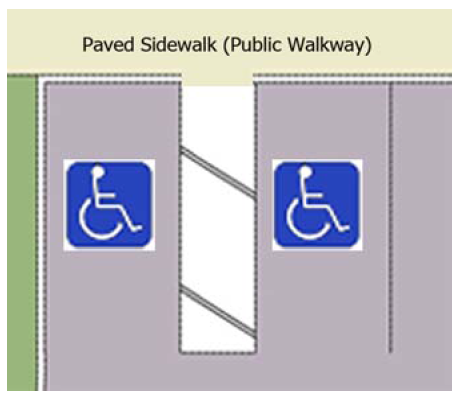
10.19.5.7. Handicapped Parking Requirements. Handicapped parking spaces shall be in accordance with the regulations set forth by the Americans with Disabilities Act (ADA), the North Carolina Department of Transportation, the North Carolina Division of Motor Vehicles ADA requirements, the North Carolina State Building Code, and ICC A 117.1. All handicapped spaces shall be identified by pavement markings and by appropriate signage approved by the North Carolina Department of Transportation. Handicapped parking shall be required on all multi-family and nonresidential sites.
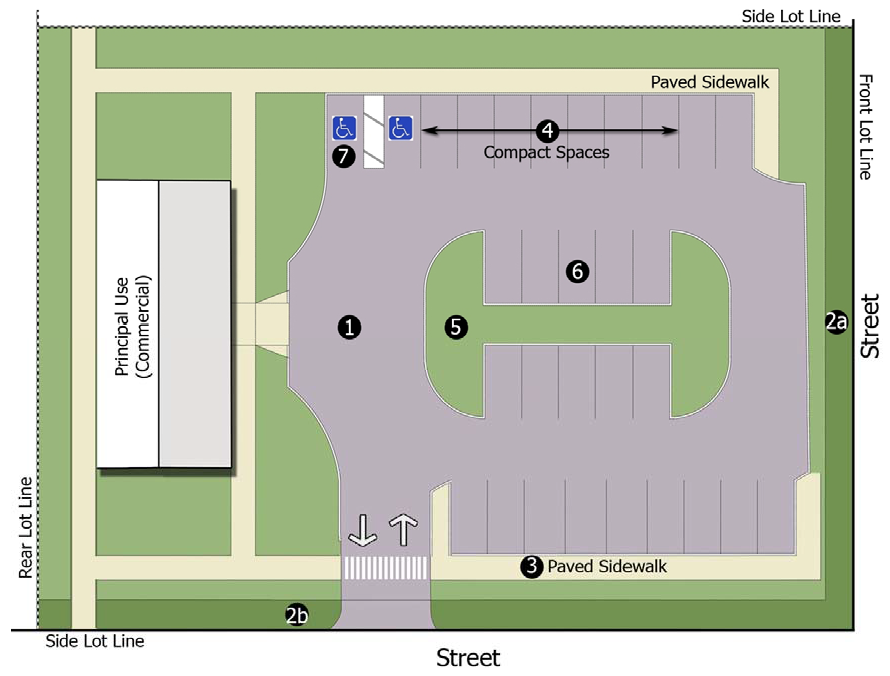
10.19.5.8. Lighting. Any parking lot/security lighting shall be erected and maintained in compliance with the town lighting ordinance but at a minimum shall be arranged so as to direct the light and glare away from streets and adjacent property. All such lighting shall be erected and maintained in accordance with the town lighting ordinance, or successor regulations. See Part V, Lighting.
10.19.5.9. Bumpers. The required setbacks shall be set off from parking areas by one noncontinuous stationary bumper for each parking space abutting a yard; bumper shall be not less than five inches or more than 12 inches high.
10.19.5.10. Separation of Bumper and Walkways. In the event any parking spaces abuts a walkway, there shall be a space of 3.5 feet between the wheel bumper and the edge of the walkway.
10.19.5.11. Drainage. All off-street parking, loading, and service areas shall be drained so as to prevent damage to abutting properties and public streets. All aforementioned areas subject to wheeled traffic shall be paved with bituminous concrete, blacktop, brick, stone, or equivalent surfacing material to ensure a dustless surface condition is maintained. All such areas shall be at all times maintained at the expense of the owners thereof, in a clean and serviceable condition.
10.19.5.12. On-street parking contiguous to the property line may be used to supplement off-street parking requirements under the following standards:
10.19.5.12.1. The parking area must be compliant with stormwater regulations, stormwater plans must be provided, and inspections performed.
10.19.5.12.2. Parking spaces shall be identified, and the points of ingress and egress to the contiguous property must be clearly distinguishable from the on-street parking.
10.19.5.12.3. At no point can on-street parking encroach into a roadway.
10.19.5.12.4. Any damage done to infrastructure in the parking area and the maintenance and upkeep of the parking area is the responsibility of the contiguous property owner.
10.19.5.12.5. The Town reserves the right to prohibit on-street parking if it conflicts with any stormwater or other infrastructure needs.
10.19.5.12.6. On-street parking must be located entirely in the right-of-way.
10.19.5.12.7. On-street parking must be accessible from the right-of-way only.
10.19.5.12.8. On-street parking cannot impede pedestrian pathways.
10.19.5.12.9. On-street parking cannot be within 20 feet of any corner lot intersection point.
10.19.5.12.10. On-street parking must meet the arrangement and dimensional standards in Section 10.19.9.
10.19.5.12.11. On-street parking shall not be located within a NC-DOT right-of-way.
10.19.5.12.12. On-street parking signage is not permitted unless approved by the Town Manager.
10.19.5.13. Off-street parking areas shall be designed:
10.19.5.13.1. To facilitate adequate movement and access by sanitation, emergency, and other public service vehicles.
10.19.5.13.2. So that parked vehicles do not encroach upon, extend into, or cause vehicles to back into public rights-of-way, sidewalks, or strike against or damage any wall, vegetation, utility, or other structure.
10.19.5.14. Off-street parking area shall be properly maintained in all respects. In particular, and without limiting the foregoing, off-street parking area surfaces shall be kept in good condition (free from potholes, etc.) and parking space lines or marking shall be kept clearly visible and distinct.
10.19.5.15. Lateral Access. All new nonresidential development, specifically commercial development, shall provide lateral access to adjacent property which is either: (1) existing nonresidential, or (2) zoned nonresidential. In the site plan process review, lateral access shall be displayed and labeled clearly by showing the appropriate existing or potential connections. This requirement recognizes that some adjacent parcels may be previously developed without provisions for lateral access and allows for potential future access. All lateral access connections shall be a minimum of 20 feet in width and maximum of 24 feet in width.
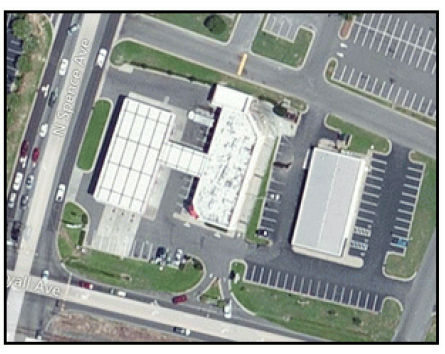
Cross access provided between sites
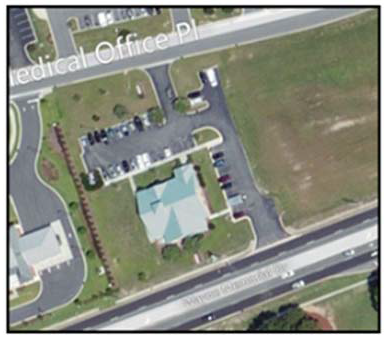
Cross access for future development
10.19.6. Off-Street Parking Requirements Per Land Use. No certificates of occupancy shall be issued for any units until the required number of parking spaces, with ingress and egress are fully constructed. In the event any of the required parking spaces for units for which certificates of occupancy are requested are provided on noncontiguous parking lands, such lands shall be fully constructed and dedicated by recorded lease agreement or memorandum of lease in accordance with all of the standards of this section before the certificates of occupancy shall be issued. If the lease agreement is terminated, then the special use permit or certificate of occupancy for the permitted use becomes invalid. The following off-street parking space shall be required and shall conform to the standards contained in subsection 10.19.5.
10.19.7. Exception in Parking Requirements.
10.19.7.1. Remote Parking Spaces. If the off-street parking space required by this Article cannot be reasonably provided on the same lot on which the principal use is located, remote parking, not exceeding 33 percent of the minimum required spaces as specified by this Article, may be provided on any land located not more than 400 feet from the main entrance to such principal use. Said land shall be used for no other purpose so long as no other adequate provisions of parking space meeting the requirements of this Article have been made for the principal use. In such cases, the applicant for a permit for the principal use shall submit with the application for a certificate of occupancy an instrument duly executed and acknowledged which subjects said land to parking use in connection with the principal use for which it is made available. Such instrument shall become a permanent record and be attached to the certificate of occupancy application. In the event such land is ever used for other than off-street parking for the principal use for which is it encumbered and no other off-street parking space meeting the terms of this Article is provided for the principal use, the certificate of occupancy for such principal use shall become void. Nothing in this section shall be construed as discouraging individual informal arrangements between commercial and other nonresidential uses that would provide for shared or overflow parking for special events, daytime or nighttime use or other similar situation while one of the uses is not in operation provided the minimum standards of this Article are met for each individual use and no traffic congestion or other safety concerns result.
10.19.8. Off-Street Parking Access to Paved Street.
No building or land use of any kind for which 75 or more off-street parking spaces are required under the terms of this section shall be permitted in any zoning district unless the lot on which the building or land use is located, adjoins and has access to a paved street, as defined in this Ordinance, having at least two paved lanes for access to adjacent parking spaces. Where the street facility does not exist at the time a project of land use is proposed, the developer shall be required to provide such additional right-of-way as may be necessary for this purpose.
10.19.9. Parking Space Arrangements and Dimensions.
10.19.9.1. Parallel Parking. Parallel parking stalls for standard size automobiles shall have a minimum size of eight feet by 23 feet. All parallel parking stalls shall have a minimum of ten feet for maneuvering space in one-way traffic and 20 feet maneuvering space in two-way traffic.
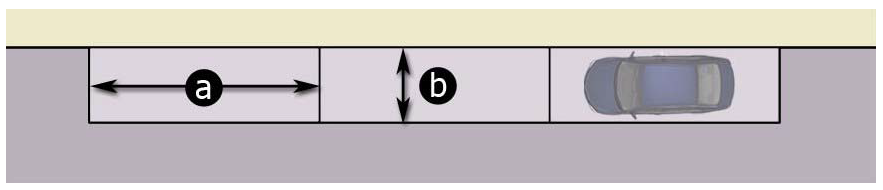
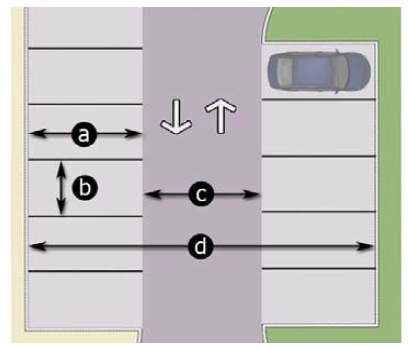
10.19.9.2 90 Degree Parking.
(a)
Length: 18 feet
(b)
Width: 9 feet
(c)
Aisle Width: 23 feet
(d)
Two Row Parking with Aisle: 59 feet total
(e)
Compact Cars: Length - 16 feet
Width - 8 feet
10.19.9.3. 60 Degree Parking.
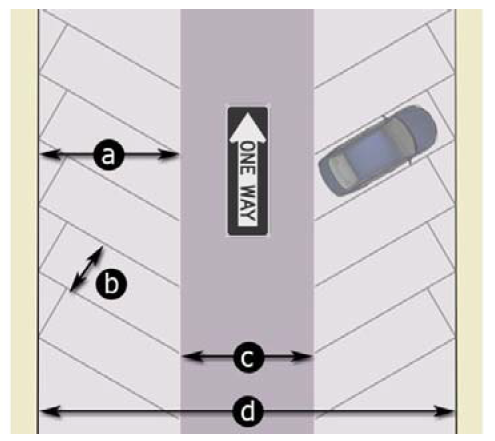
(a)
Length: 20 feet one inch
(measured from the end of striping perpendicular to the curb)
(b)
Width: nine feet
(c)
One-Way Aisle: 18 feet
Two-Way Aisle: 20 feet
(d)
Two Row Parking with One-Way Aisle:
56 feet two inches total
Two Row Parking with Two-Way Aisle: 60 feet two inches total
(e)
Compact Cars: Length - 17 feet six inches
(measured from the end of striping perpendicular to the curb)
Width - eight feet
10.19.9.4. 45 Degree Parking.
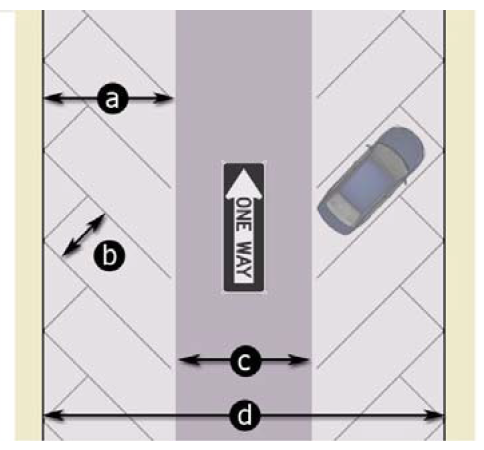
(a)
Length: 18 feet
(measured from the end of striping perpendicular to the curb)
(b)
Width: 9 feet
(c)
One-Way Aisle: 12 feet
Two-Way Aisle: 20 feet
(d)
Two Row Parking with One-Way Aisle: 53 feet 2 inches total
Two Row Parking with Two-Way Aisle: 58 feet 2 inches total
(e)
Compact Cars: Length - 16 feet 6 inches
(measured from the end of striping perpendicular to the curb)
Width - 8 feet
10.19.9.5. 30 Degree Parking.
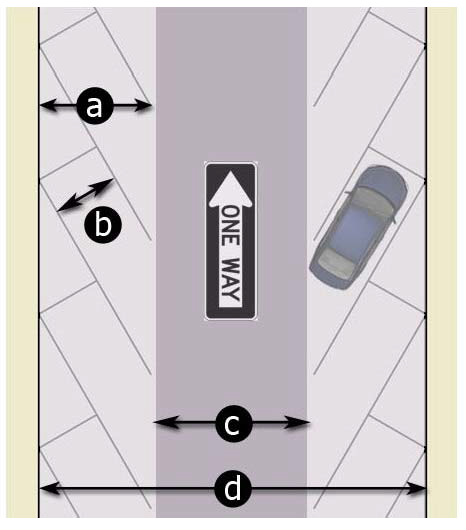
(a)
Length: 15 feet 11 inches
(measured from the end of striping perpendicular to the curb)
(b)
Width: 9 feet
(c)
One-Way Aisle: 14 feet
Two-Way Aisle: 19 feet
(d)
Two Row Parking with One-Way Aisle: 45 feet 10 inches total
Two Row Parking with Two-Way Aisle: 50 feet 10 inches total
(e)
Compact Cars: Length - 14 feet 6 inches
(measured from the end of striping perpendicular to the curb)
Width - 8 feet
(Ord. of 10-9-2018; Amend. of 11-13-2018; Amend. of 10-13-2020(3); Amend. of 11-10-2020; Amend. of 4-11-2023(5))
SECTION 10.20 - OFF-STREET LOADING REQUIREMENTS.
10.20.1. General Requirements.
The duty to provide the off-street loading space herein required shall be the joint responsibility of the owner and operator of the structure or structures for which off-street loading space is required. The space shall be provided in accordance with Section 10.20.2 and off-street loading spaces shall be designed so that the vehicles loading and unloading shall not rest upon or cross any public street or alley right-of-way. All off-street loading spaces shall be at least 12 feet wide, 20 feet long, and have an overhead clearance of 14 feet. On the island portion of the Town's corporate limits, alley ways adjacent to businesses may be utilized for loading/unloading in lieu of designated loading space.
10.20.2. Off-Street Loading Space Requirements.
(Ord. of 10-9-2018)
SECTION 10.21 - DRIVEWAY CONSTRUCTION.
10.21.1. General Requirements.
10.21.1.1. A permit is required through the Development Services Department prior to construction or reconstruction of a driveway approach.
10.21.1.2. The fee for the permit is specified in the town's fee schedule.
10.21.1.3. All driveway work done on state highway rights-of-way is subject to approval by the North Carolina Department of Transportation. No work shall be commenced until a valid copy of a NCDOT driveway permit, if applicable, is provided to the town.
10.21.1.4. All driveways shall meet state or town specifications. Driveway construction in the right-of-way of the town shall be inspected by appropriate town personnel.
10.21.1.5. Number of driveways permitted:
10.21.1.5.1. No more than two combined entrances and exits shall be allowed on any parcel of property, the frontage of which is less than 200 feet on each street. Additional entrance and exits on parcels with frontage of greater than 200 feet shall be allowed for one additional driveway for each additional 100 feet of right-of-way frontage. Where safely feasible, driveway access shall be restricted to streets other than West and East Oak Island Drive.
10.21.1.5.2. For corner lots, and lots abutting more than one street, one combined entrance-exit shall be permitted per street frontage provided that an additional point of entrance-exit may be permitted on parcels with greater than 250 feet in width. The additional point of entrance-exit may be applied on one street frontage only; the street frontage selected for the additional point must exceed the minimum 250 feet width standard.
10.21.1.5.3. Where frontage is less than 50 feet, only one combined entrance-exit shall be permitted.
10.21.1.6. No driveway may be installed in a manner that conflicts with any public facilities or uses such as traffic signals, utility poles, loading zones, and sewer cleanouts. Any adjustments of public facilities to accommodate driveways shall be at the expense of the permit applicant.
10.21.1.7. No driveway material shall be installed in a manner that the finished surface shall wash or collect on town or state maintained roads or streets or upon adjacent or abutting property.
10.21.1.8. Driveways shall be designed and installed so that the lot and driveway do not drain to the public right-of-way or upon adjacent or abutting property.
10.21.1.9. On sections of arterial or collector streets which are not constructed with curb and gutter or drainage channelization, island areas shall be introduced which shall serve as physical barriers to direct the flow of traffic and to separate street traffic from activity on private property. Island shape shall be defined by raised curbing constructed to the North Carolina Department of Transportation specifications, the interior surface of which shall be landscaped with grass or low growing shrubbery.
10.21.2. Design Requirements.
10.21.2.1. Residential Uses.
10.21.2.1.1. For a single drive, on an interior lot the maximum width shall be 24 feet at right-of-way. Tire runner driveways are permitted and encouraged.
10.21.2.1.2. For two drives, the maximum driveway width of any single drive is 24 feet in a dedicated right-of-way, with a combined maximum total for two drives of 32 feet where lot frontage is 60 feet or less and 40 feet where lot frontage is greater than 60 feet but less than 200 feet. Drives must have a minimum distance of five feet between each point of access as measured at the edge of pavement to the property line, plan is approved by the town stormwater director or designee, and is in compliance with all other sections of this Ordinance.
10.21.2.1.3. For a single drive on a corner lot, the maximum driveway width on a front lot line is 24 feet in a dedicated right-of-way.
10.21.2.1.4. For a single drive on a corner lot without water frontage, the maximum driveway width on a side lot line is 32 feet in a dedicated right-of-way where side lot frontage is greater than 60 feet but less than 200 feet. A second driveway is not permitted on the front lot line, the plan must be approved by the town stormwater administrator or designee, and it must be compliance with all other sections of this chapter.
10.21.2.2. Commercial Uses. The minimum driveway width at the property line shall be 16 feet and the maximum width shall be 36 feet at the edge of the street pavement. Where access by tractor trailers or other large vehicles is anticipated, one combined entrance-exit of 36 feet in width may be permitted, where this is allowed, there shall be no other entrance-exit allowed for single frontage lots and no other entrance-exit shall be permitted on the same street frontage on a corner lot. Any applicant desiring to construct a driveway or driveways connecting with any state highway located within the corporate limits of the town shall make application for a driveway access permit to the office of the District Engineer, North Carolina Department of Transportation for the district in which Oak Island is located. No permit shall be issued by the town Development Services Department until the application therefor has been approved by the N. C. State Highway Commission. The minimum standards for entrances to highways from commercial establishments, as set forth in the regulations of the North Carolina Department of Transportation designated as NCDOT Policy on Street and Driveway Access to North Carolina Highways must be met. If the commercial driveway dimensions meet the North Carolina Department of Transportation Policy on Street and Driveway Access to North Carolina Highways, then it shall be approved regardless of the dimensions referenced in this section. The North Carolina Department of Transportation standards for entrances also apply to town Powell Bill roads. In addition to the foregoing, the following design standards and principles shall be adhered to:
10.21.2.2.1. At street intersections, driveways shall be located as far from the intersection as practicable but in no case shall the closest point of a driveway be nearer than 25 feet from the intersecting right-of-way lines to the beginning of the outside driveway radius as measured at the right-of-way line.
10.21.2.2.2. The distance between two driveways on the same property on the same side of the street shall not be less than 20 feet, said distance shall be measured along the right-of-way line between the tangent projection of the inside edges of the two driveways.
10.21.2.2.3. Driveways shall be constructed to be no less than five feet from any property line.
10.21.2.2.4. No loading and/or unloading of vehicles shall take place on the right-of-way adjacent to service stations, convenience stores, or filling stations.
10.21.2.2.5. The use of joint or shared driveways shall be encouraged, where practicable. Usage should be made via access easement or agreement.
10.21.2.2.6. Proposed driveways shall be designed in consideration of existing driveway on adjacent properties and shall be designed to achieve the spacing objectives of this section to the degree practicable.
10.21.2.2.7. The location of proposed driveways shall be considered in relation to existing driveways on the opposite side of the street and may be required to align with such existing driveways to reduce the potential for turning movement conflicts on the fronting roadway.
10.21.2.3. The grade of entrance shall slope away from the street surface for a distance of at least six feet unless otherwise directed by the Development Services and/or Public Works department. Slope and drainage on all driveways governed by this section shall conform to the existing curb line conditions and shall be inspected by the town staff.
10.21.2.4. Expansion joints shall be required a minimum of 32 feet from each side of the center line of the public water and sewer line when a driveway of impervious surface is placed over these lines. These joints must be placed in, not cut. The Public Utilities department will locate the water and sewer lines. All paved driveways must have an expansion joint parallel to the property line.
10.21.2.5. If driveways are paved, the pavement shall meet the following standards: Driveways shall have a minimum base equal to four inches (nominal) of ABC stone (crusher run), and one inch of asphalt, or four inches (nominal) of concrete. Alternative paving materials intended to reduce the amount of stormwater runoff from the site may be approved by the Development Services and/or Public Works departments.
10.21.2.6. The end of a new driveway where the driveway meets the edge of the road pavement must be flush with the road so as not to create a noticeable bump when traversing over that point. If the right-of-way does not have a paved road the driveway must be even with the grade of the right-of-way.
(Ord. of 10-9-2018; Amend. of 10-13-2020(3); Amend. of 7-13-2021(3); Amend. of 4-11-2023(5))
SECTION 10.22 - PURPOSE AND INTENT.
The purpose and intent of this Part is to support and complement the various land uses allowed in Oak Island by the adoption of policies and regulations concerning the placement of signs.
10.22.1. The Oak Island Town Council does hereby find and declare the outdoor placement of signs to be a legitimate use of private property but that the erection of signs should be controlled and regulated in order to promote the health, safety, welfare and convenience and enjoyment of travel on and protection of the public investment in streets and roads in Oak Island and to promote the reasonable, orderly and effective display of such signs, displays and devices. Signs can obstruct views, distract motorists, displace alternative uses for land, and pose other problems that legitimately call for regulation. The purpose of this section is to regulate the size, color, illumination, movement, materials, location, height, and condition of all signs placed on private property for exterior observation, thus ensuring the protection of property values, the character of the various neighborhoods, the creation of a convenient, attractive and harmonious community, protection against destruction of or encroachment on historic convenience to citizens and encouraging economic development. This section allows adequate communication through signage while encouraging aesthetic quality in the design, location, size, safety, and purpose of all signs. This section must be interpreted in a manner consistent with the First Amendment guarantee of free speech. If any provision of this section is found by a court of competent jurisdiction to be invalid, such finding shall not affect the validity of other provisions of this section which can be given effect without the invalid provision.
10.22.2. A sign placed on land or on a building for the purpose of identification, protection or directing persons to a use conducted therein must be deemed to be an integral but accessory and subordinate part of the principal use of land or building. Therefore, the intent of this article is to regulate signs in order to ensure they are appropriate to the land, building or use to which they are appurtenant and are adequate for their, intended purpose while balancing the individual and community interests identified in subsection 10.22.1 of this section.
10.22.3. These regulations are intended to promote signs that are compatible with the use of the property to which they are appurtenant, landscape and architecture of surrounding buildings, are legible and appropriate to the activity to which they pertain, are not distracting to motorists, and are constructed and maintained in a structurally sound and attractive condition.
10.22.4. These regulations distinguish between portions of the town designed for primarily vehicular access and portions to the town designed for primarily pedestrian access.
10.22.5. These regulations do not regulate every form and instance of visual communication that may be displayed anywhere within the jurisdictional limits of the town. Rather, they are intended to regulate those forms and instances that are most likely to meaningfully affect one or more of the purposes set forth above.
10.22.6. These regulations do not entirely eliminate all of the harms that may be created by the installation and display of signs. Rather, they strike an appropriate balance that preserves ample channels of communication by means of visual display while still reducing and mitigating the extent of the harms caused by signs.
10.22.7. Severability.
Section 1.4, Severability applies to this Part IV, Sign Regulations, and is incorporated into this Part by reference.
(Ord. of 10-9-2018)
SECTION 10.23 - GENERAL PROVISIONS.
10.23.1. All signs within the jurisdictional area covered by these regulations shall be erected, constructed, and maintained in accordance with the provisions of this section. Only those signs listed in this section shall be erected within the jurisdictional areas of this division.
10.23.2. Any sign which requires a permit as set forth in this Ordinance, shall meet the requirements set forth in the North Carolina Building Code for Coastal Wind Zones and shall be certified by a professional engineer to ensure specific design criteria are met (where applicable).
10.23.3. Traffic Safety.
No sign shall be erected or continued that:
10.23.3.1. Obstructs the sight distance at intersections or along the public right-of-way.
10.23.3.2. Would tend by its location, color, or nature, to be confused with or obstruct the view of traffic signs or signals or would tend to be confused with a flashing light of an emergency vehicle.
10.23.3.3. Uses admonitions such as stop, go, slow, danger, etc., which might be confused with traffic directional signs or signals.
10.23.4. Setbacks.
All signs that require a permit shall be setback at least ten feet from any property line. In the case a structure is erected to the property line, a wall sign shall be erected flush to the building and no lower than eight feet above sidewalk grade. Unless specifically exempted herein, signs that do not require a permit shall be located entirely within the property lines and situated so no traffic hazards are created.
10.23.5. Unlawful Signs.
In case any sign shall be installed, erected, or constructed in violation of any of the terms of this section, the code enforcement official shall notify by first class mail, return receipt requested or by written notice served personally, the owner of lessee thereof to alter such signs so as to comply with this Ordinance and to secure the necessary permit therefore, or to remove the sign. If such order is not complied with in ten days of receipt, the code enforcement official shall remove such sign at the expense of the owner or lessee thereof. Refer to Section 1.8. Signs located in a public right-of-way shall be removed by the Town without notice. There will be a $25.00 fee for the return of removed signage.
10.23.6. Nonconforming Lot Signs.
For two adjacent nonconforming lots, one shared sign shall be permitted within ten feet of the shared side property line.
SECTION 10.24 - SIGNS NOT REQUIRING A PERMIT.
Signs listed in this section are exempt from the permit requirements of Section 10.29 and may be erected in any zoning district provided they comply with the conditions described herein.
10.24.1. Incidental Informational.
A sign, generally informational, that has a purpose to the use of the subject property on which it is located, such as, no parking, entrance, loading only, and other similar directives.
10.24.2. Flags.
Flags on a single, straight flagpole provided that:
10.24.2.1. The flagpole is attached to the ground, building, or other object at only one end and shall have a maximum height of 20 feet; it may not be attached to another pole;
10.24.2.2. Flags are not hung or stretched between two poles or a pole and another object or the ground;
10.24.2.3. Flags are attached to the pole (or rope) on one side only, are not weighted on an unattached side, and shall be a maximum of 35 square feet;
10.24.2.4. Flags hung from a horizontal or nearly horizontal, pole and displayed against, or nearly against, a wall, fence, or similar structure are prohibited (this applies only to flags permitted by this section);
10.24.2.5. More than one flag may fly on a single pole;
10.24.2.6. The flags are not "feather flags"; and
10.24.2.7. All applicable requirements of Article 10, Part IV are complied with.
10.24.3. Temporary Signs.
A banner, pennant, poster, or display constructed of paper, cloth, canvas, plastic sheet, cardboard, wall board, plywood, or other like materials, and that appears to be intended or determined by the UDO Administrator to be displayed for a limited period of time. See Sections 10.26.1 to 10.26.4 and 10.28.3 which include temporary signs requiring a permit.
10.24.4. Construction Signs.
One on-site temporary sign not exceeding 24 square feet identifying the names of the individuals and/or firms connected with the construction of an active project. Fence wraps displaying signage when affixed to perimeter fencing at a construction site are exempt until the certificate of occupancy is issued for the final portion of any construction at that site or 24 months from the time the fence wrap was installed, whichever is shorter. If construction is not completed at the end of 24 months from the time the fence wrap was installed, the Town may regulate the signage but shall continue to allow fence wrapping materials to be affixed to the perimeter fencing. No fence wrap affixed pursuant to this subsection may display any advertising other than advertising sponsored by a person directly involved in the construction project and for which monetary compensation for the advertisement is not paid or required.
10.24.5. Miscellaneous Exemptions.
10.24.5.1. Handicapped parking space signs; signs associated with the operation of equipment or other functional elements such as menu boards, automatic teller machines, gas pumps, vending machines, scoreboards, and similar incidental signs; signs visible only from the premises, markers which are non-commercial in nature.
10.24.5.2. Memorial signs, plaques or grave markers.
10.24.5.3. On-premises directional and instruction signs not exceeding four square feet in area apiece.
10.24.5.4. All signs located within the interior of a business or operation.
10.24.5.5. Public interest signs (i.e., historical markers).
10.24.5.6. Identification signs not exceeding four square feet in area (one only per premises). Identification signs may include signs associated with property functions or actions affecting the property.
10.24.5.7. Address and name signs. Signs or plates no larger than four square feet on residential structures giving the name and/or address of the occupant (one only per premises).
10.24.5.8. Integral decorative or architectural features of buildings or works of arts/murals, provided such features or works of art/murals do not contain advertisements, trademarks, moving parts, or lights.
10.24.5.9. Displays, including lighting, erected in connection with the observance of holidays. Such displays shall not be considered as illuminated signs and they shall be removed within ten days following the holiday.
10.24.5.10. Political signs erected in accordance with G.S. 136-32 as follows:
10.24.5.10.1. During the period beginning on the 30 th day before the beginning date of "one stop" early voting under G.S. 163-227.2 and ending on the 10 th day after the primary or election day, person may place political signs in the right-of-way of the State highway system or Town street as provided in this section. Signs must be placed in compliance with subsection 10.24.5.10.2 below and removed by the end of the period prescribed herein.
10.24.5.10.2. The permittee must obtain the permission of the property owner of a residence, business or religious institution fronting the right-of-way where a sign would be erected. Signs must be placed in accordance with the following:
10.24.5.10.2.1. No sign shall be permitted in the right-of-way of a fully controlled access highway.
10.24.5.10.2.2. No sign shall be closer than five feet from the edge of the pavement of the road.
10.24.5.10.2.3. No sign shall obscure motorist visibility at an intersection.
10.24.5.10.2.4. No sign shall be larger than six square feet with a maximum height of 42 inches from the ground to the top of the sign.
10.24.5.10.2.5. No sign shall obscure or replace another sign.
10.24.5.11. ID plaques of no more than four square feet per business or tenant in non-residential zoning districts and signs of no more than two square feet in area in residential zoning districts, including signs bearing only property identification numbers and names, post office/mail box numbers of occupants of the premises, or other identification of premises so that public safety agencies can easily identify the property from a public street. In cases where the building is not located within view of the public street, the identifier shall be located on a mail box or other suitable device visible from the street. Such signs shall not be illuminated. The size and location of the identifying numerals and letters (if any) must be proportional to the size of the building and the distance from the street to the building but no less than required by the North Carolina State Fire Code.
10.24.5.12 Noncommercial temporary signs for town sponsored events and programs, including feather flags, approved by the Town Manager or his designee, on Town-owned property.
(Ord. of 10-9-2018; Amend. of 10-10-2023)
SECTION 10.25 - PROHIBITED SIGNS.
The following list of signs are prohibited in the town; any violation is subject to the regulations as stated in this Article. Nonconforming signs located in a public right-of-way may be removed by the Town without prior notice.
10.25.1. No sign may be located so that it substantially interferes with the view necessary for motorists to proceed safely through intersections or to enter onto or exit from public streets or private roads.
10.25.2. Signs that revolve, have internally moving parts, are animated or that utilize movement or apparent movement within 200 feet of a traffic light. Open and closed business window signs, revolving barbershop light, service station fuel price listings, time and temperature displays, Town of Oak Island signs, message displays where copy changes no more often than 15 seconds, or those specifically permitted in Section 10.26 are exempt from this section.
10.25.3. No sign may be erected so that by its location, color, size, shape, nature, or message, it would tend to obstruct the view of or be confused with official traffic signs or other signs erected by governmental agencies.
10.25.4. Any sign, which interferes with free passage from or obstructs any fire escape, downspout, door, stairway, ladder, or opening intended as a means of ingress or egress or providing light or air.
10.25.5. No signs shall overhang or be erected in any public right-of-way. Traffic regulation, information, or warning signs erected by the State Department of Transportation or signs erected by the Town are exempt.
10.25.6. Any sign located in such a way as to intentionally deny an adjoining property owner visual access to an existing sign.
10.25.7. Flashing, swinging, rotating signs (except governmental signs and signs, which give time and temperature and other commercial public information message), including wind signs as defined in Appendix A.
10.25.8. Roof signs, or signs above the parapet of a building.
10.25.9. Electronic message boards in all Residential districts.
10.25.10. Portable signs, except for "sandwich boards."
10.25.11. All Beacons and Spotlights. Illumination system(s) shall not contain or utilize any beacon, spot, search, or stroboscopic light or reflector which is visible from any public right-of-way or adjacent property, nor shall such lights be operated outside, under any circumstances, except by authorized agencies for emergency services purposes.
10.25.12. Flood lights shall not be utilized as a part of a sign illumination system which are not hooded or shielded so that the light source is not visible from any public right-of-way or adjacent property, nor shall any sign otherwise reflect or emit a glaring light so as to impair driver vision.
10.25.13. Any sign or sign structure that is structurally unsafe as determined by the Building Inspector.
10.25.14. Signs painted on or attached to trees, fences, or fence posts, and telephone or utility poles or signs on or attached to rocks or other natural features (snipe signs). This prohibition does not apply to construction signs in accordance with Section 10.24.4 or "no trespassing" signs.
10.25.15. Pavement markings except those of a customary traffic-control nature, as found in the Manual of Uniform Traffic Control Devices.
10.25.16. Other signs not expressly permitted by this Ordinance.
(Ord. of 10-9-2018, Amend. of 11-12-2019(1); Amend. of 9-10-2024(1))
SECTION 10.26 - DISTRICT SIGNS.
10.26.1. Residential District Signs (R-20, R-9, R-7, R-6, R-6MF, R-6MH, and PUD).
10.26.1.1. Residential districts contain developments that may require signage. Such developments include, but are not limited to: Single-Family Subdivisions, Multi-Family Developments, Manufactured Home Parks, Churches, and Recreational Facilities. At any entrance to a subdivision or multi-family development, there may be not more than two signs located at the entrance to a development comprised of two or more lots. A single side of any such sign may not exceed 16 square feet in area, nor may the surface area of all such signs exceed 32 square feet in area. The surface area of the mainland monument signs shall not exceed 30 feet on each side.
10.26.1.2. Additionally, home occupations may install one sign with an area of no greater than one square foot. Home occupation signage shall be permanently fixed to the residence within which the home occupation resides.
10.26.1.3. For residentially zoned and used properties: Temporary signs not exceeding six square feet in area, and three feet in height if freestanding are allowed in all residential districts. The number of these signs is limited to one per 100 feet, or fraction thereof, of lot frontage of all immediately adjacent public streets. In no event shall there be more than three such signs allowed per lot. The temporary sign may be displayed up to 15 days prior to and 15 days following the specific event with which the sign is associated. Miscellaneous temporary use signs not tied or connected to a specific event may be displayed for up to 60 calendar days without a zoning permit. Display for longer than 60 days will require issuance of a zoning permit.
10.26.1.4. For residentially zoned non-residential uses: One freestanding sign or one wall sign per zoning lot of no more than 32 square feet in area, with a maximum height of eight feet if ground mounted or no higher than the roof line if wall mounted.
10.26.2. Business District Signs When Site Plan is Not Required (O-I, CB, CR, and C-LD).
1 Combined square footage of all signs shall not exceed 200 square feet.
2 Wall signs may project a maximum of 12 inches from the wall to which it is mounted.
3 Sign may not protrude above soffit, parapet, or eave line of the building to which it is attached.
4 Minimum eight feet above ground; no portion of the sign may extend within three feet of street pavement.
5 Sign must be placed no closer than ten feet from property line. One ground mounted or monument sign or column/pole sign is permitted provided the area of said sign and wall signage on the front of building, combined, shall not exceed square footage as defined above for the front facade only. However, in no event, can a ground mounted or monument sign exceed 30 square feet or a column/pole sign exceed 100 square feet. In the event of a double-sided sign, only one side shall be used to figure the square footage.
6 The temporary sign may be displayed up to 15 days prior to and 15 days following the specific event with which the sign is associated. Miscellaneous temporary use signs not tied or connected to a specific event may be displayed for up to 60 calendar days without a zoning permit. Display for longer than 60 days will require issuance of a zoning permit.
10.26.3. Industrial District Signs (ID).
1 Combined square footage of all signs shall not exceed 200 square feet.
2 Wall signs may project a maximum of 12 inches from the wall to which it is mounted.
3 Sign may not protrude above soffit, parapet, or eave line of the building to which it is attached.
4 Minimum eight feet above ground; no portion of the sign may extend within three feet of street pavement.
5 Sign must be placed no closer than ten feet from property line. One ground mounted or monument sign or column/pole sign is permitted provided the area of said sign and wall signage on the front of building, combined, shall not exceed square footage as defined above for the front facade only. However, in no event, can a ground mounted or monument sign exceed 30 square feet or a column/pole sign exceed 100 square feet. In the event of a double-sided sign, only one side shall be used to figure the square footage.
6 The temporary sign may be displayed up to 15 days prior to and 15 days following the specific event with which the sign is associated. Miscellaneous temporary use signs not tied or connected to a specific event may be displayed for up to 60 calendar days without a zoning permit. Display for longer than 60 days will require issuance of a zoning permit.
10.26.4. Commercial Major Site Plans and Developments (O-I, CB, CR, and C-LD)
1 In the C-LD district, shopping centers and/or business condominium development on the mainland (i.e., located to the north or west of the Intracoastal Waterway) may provide the following freestanding signs: (a) One freestanding sign along each public right-of-way frontage that displays the name of the center or development and one or more tenant businesses. Such signs shall not exceed a sign surface area of 125 square feet per face, and may not exceed 15 feet in total height. All total combined freestanding signage cannot exceed 250 square feet per sign; and (b) One freestanding sign for each outparcel with one or more tenants within the center or development. Such signs shall not exceed a sign surface area of 64 square feet per face, and may not exceed six feet in total height and width being not greater than twice the height.
2 The temporary sign may be displayed up to 15 days prior to and 15 days following the specific event with which the sign is associated. Miscellaneous temporary use signs not tied or connected to a specific event may be displayed for up to 60 calendar days without a zoning permit. Display for longer than 60 days will require issuance of a zoning permit.
3 Sign must be placed no closer than ten feet from property line. One ground mounted or monument sign is permitted provided the area of said sign and wall signage on the front of building, combined, shall not exceed square footage as defined above for the front facade only. However, in no event, can a ground mounted or monument sign exceed 30 square feet. In the event of a double-sided sign, only one side shall be used to figure the square footage.
1 Combined square footage of all signs shall not exceed 400 square feet.
2 Wall signs may project a maximum of 12 inches from the wall to which it is mounted.
3 Sign may not protrude above soffit, parapet, or eave line of the building to which it is attached.
4 Minimum eight feet above ground; no portion of the sign may extend within three feet of street pavement.
5 Additional requirements for wall signs in the C-LD district: (a) Each wall sign for a tenant occupying equal to or more than 35,000 square feet gross floor area shall have a maximum surface area (in square feet) of (i) 150 square feet or (ii) two times the linear frontage (in feet) of the wall of the building to which such sign is attached, whichever is less and two commercial accessory signs. Such a tenant may have no more than 350 square feet of total signage; and (b) Each wall sign for a tenant occupying less than 35,000 square feet gross floor area shall be considered accessory use signage and shall have a maximum surface area (in square feet) of (i) two times the linear frontage (in feet) of the wall of the building to which such sign is attached, (ii) 100 square feet, or (iii) 80 percent of the sign band area, whichever is less, and two commercial accessory signs. Such a tenant may have no more than 200 square feet of total signage. In the case of a shared frontage, only the linear footage equal to the width of the unit may be used to calculate sign area.
10.26.5. Signs in Right-of-Way and Public Properties.
10.26.5.1. No sign shall be permitted in any public right-of-way or within five feet of back of curb, whichever is farther from back of the curb.
10.26.5.2. Any sign hung, suspended, projected, or otherwise placed over or across, or partly over any sidewalk or curbing shall have its lower edge not less than eight feet above the sidewalk or curbing, and the owner shall keep it in such condition that the public will not be exposed to any danger from the sign.
10.26.5.3. The Administrator may remove any sign placed on public property or within any public right-of-way and hold at a town facility for not more than two weeks. This shall only apply to signs in violation of this Ordinance. Penalties may be levied for each such sign as prescribed in Section 1.8. After two weeks, all signs removed from public property shall be considered disposable.
10.26.5.4. Temporary signs may be placed 20 feet from the edge of the road pavement, five feet from the house/structure side of sidewalks, or on the property. Temporary signs are to be measured from the edge of the road pavement or sidewalk to the furthest most edge of the sign closest to the road, not the sign post.
10.26.6. Airport District Signs (AD)
1 Sign to be allowed on Brunswick County Airport Commission property only with a maximum number of one (1). Led/Digital Changeable copy allowed at 8 second intervals. The setback from the right of way shall be 5 feet with a total height of 35 feet. The base of the off-premises sign shall be surrounded by a ten (10) foot landscaping buffer. When a buffer is reduced, the qualified sign owner shall make a payment to the Town in lieu of providing any required landscaping. The amount of payment in lieu shall equal the estimated cost of any landscaping that is not provided by the sign owner.
2 Signs shall have a minimum radial separation of 3500 feet.
3 Signs may not exceed a maximum illumination level of 0.3 foot candles above ambient light, regardless of the method of illumination. The 0.3 foot candles above ambient light shall be measured at a distance from the subject sign equal to the following equation:
√(sign area in sq. ft. × 100)
(Ord. of 10-9-2018; Amend. of 11-12-2019(3); Amend. of 6-8-2021(10); Amend. of 5-14-2024(2); Amend. of 9-10-2024(1))
SECTION 10.27 - SIGN AREA.
The surface area of a sign is computed as including the entire area within a parallelogram, triangle, circle, semi-circle, or other regular geometric figure, including all of the elements of the display, but not including blank masking (a plain strip, bearing no advertising matter around the edge of a sign), frames, display of identification or licensing officially required by any governmental body, or structural elements outside the sign surface. In the case of signs mounted back-to-back (including sandwich board signs), only one side of the sign is to be included in the area. Otherwise, the surface area of each sign is to be separately computed. In the case of cylindrical signs, signs in the shape of cubes, or other signs, which are substantially three-dimensional with respect to their display surfaces, the entire display surface or surfaces, is included in computations of area.
In the case of embellishments (display portions of signs extending outside the general display area), surface area extending outside the general display area is to be computed as part of the total surface area of the sign. If a sign is attached to an entrance wall or fence, only that portion of that wall or fence on which the sign face or letters are placed shall be calculated in the sign area.
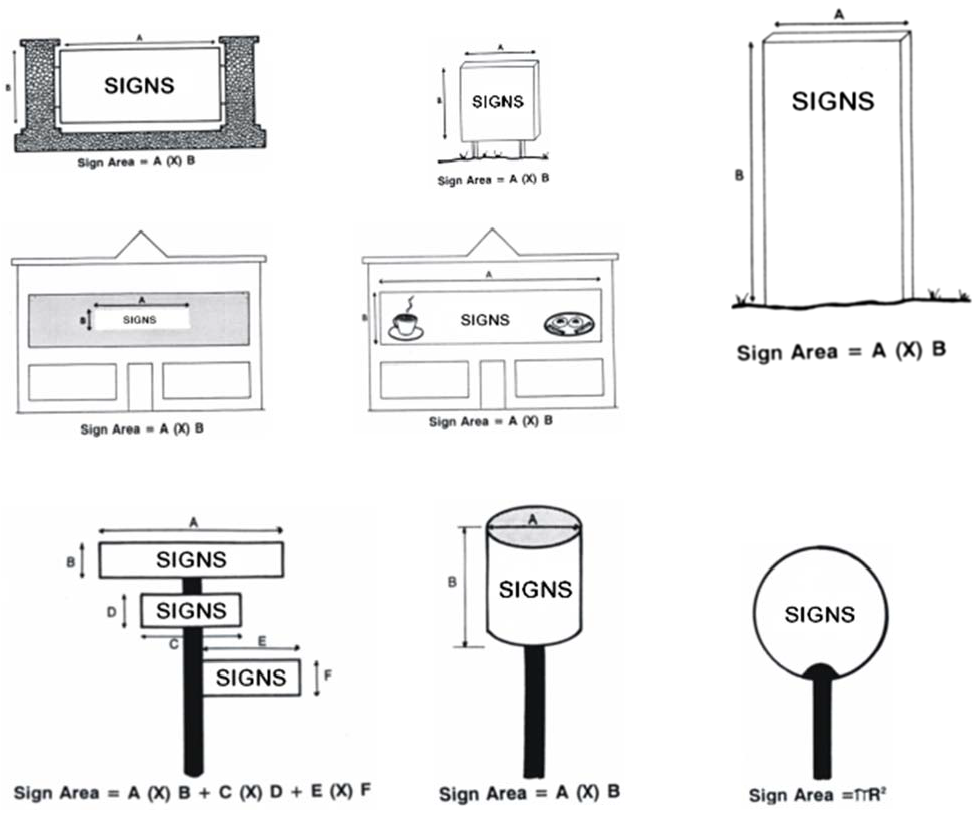
(Ord. of 10-9-2018)
SECTION 10.28 - SUPPLEMENTAL SIGN STANDARDS FOR THE O&I, CB, CR, AND C-LD DISTRICTS.
Sign standards for specific business operations are in addition to the general standards outlined in this Article and recognize the different types of traffic, use and need of signs for the assistance of the traveling public and the prosperity of business owners and employees through the attraction, retention, and furtherance of commerce throughout the town. Establishments in the six listed zoning districts may avail themselves of the maximum signage allowable under Section 10.26 and additionally may supplement such maximum via the standards of this subsection.
10.28.1. Sandwich Board/A-frame Signs.
Limited to two signs per business. Signs shall be limited to a maximum height of three feet and a maximum length of two feet (six square feet), and cannot be lighted. Folding and double-faced A-frame signs shall be considered one sign. Signs shall not be located on any public right-of-way, except that where the edge of the right-of-way is the face of the building and where such building abuts a public sidewalk, such signage may be allowed as a right-of-way encroachment. Sign placement shall not impede movement on the sidewalk.
10.28.2. Banners.
Limited to one banner per business. Banners shall be limited to a maximum height of six feet and a maximum horizontal length of ten feet. Banners may contain the imprint or logo of the business in which the banner is intended. No additional logos, joint advertising or insignia shall be permitted.
10.28.3. Feather Flags.
Limited to two flags per business, but no more than six flags at one time per approved major or minor site plan. Size limited to 12 feet in height and no greater than four feet in width and, on a temporary basis, shall be permitted and may contain the imprint or logo of the business in which the flag is intended. In a Planned Unit Development, the location of flags are limited to the premises of the business or in a common pedestrian ingress area immediately in-front or adjacent to the primary pedestrian entrance of any business, in no case shall the flag be placed further than ten feet from said primary pedestrian entrance. No flag shall be placed in the vehicular zone including parking areas, driveways, or vehicular ways. Placement of flags shall not impede ingress/egress to any building. Feather signs must be securely attached with an auger or a similar device as approved by the Town.
10.28.4. Sale/Event/Holiday Signs.
For no more than 40 days annually, special signage for sales/events/holidays may be placed by a business on premises with the issuance of a permit. Such signs shall be of one of the categories above with the following supplemental standard: for each item in this subsection 10.28.4, the quantity of signs may be double.
(Ord. of 10-9-2018; Amend. of 6-8-2021(10); Amend. of 4-11-2023(5))
SECTION 10.29 - SPECIFICATIONS FOR SIGNS REQUIRING A PERMIT.
The following are general specifications applicable to the various signs permitted. Additional specifications regarding size, number, location, and permitted types of signs are set forth in the individual zoning districts.
10.29.1. Specifications for all Permitted Signs. Unless specifically exempted by other sections of the Article, all signs will be required to have proper permits prior to construction or installation. Whether the sign is new, part of new construction, or an existing sign, the following information will be required as part of the permit application.
10.29.1.1. A detailed description of any new sign for which a permit is requested. This will include, but not necessarily be limited to, a detailed drawing of the sign showing size, height, and site location relative to property lines and street right-of-way.
10.29.1.2. Existing signs must meet the requirements of Article 10, Part IV, if, for any reason, the sign is to be changed or altered. Normal copy changes and routine maintenance matters are exceptions to this requirement.
10.29.1.3. Prior to issuance of a sign permit, all fees in accordance with the associated fee schedule shall be paid.
10.29.1.4. Upon notification of completion by the permit holder, the UDO Administrator or designee shall inspect the sign to verify conformance with applicable codes.
10.29.2. Wall Signs.
10.29.2.1. No wall sign shall project more than 12 inches from the building wall and must maintain a minimum of eight feet from the bottom of the sign to the sidewalk grade. Further, no wall sign or its supporting structure shall cover any window or part of a window, nor shall it extend above parapet walls or above rooflines of buildings without parapet walls. If the roof is a mansard type roof the sign may be attached flat against but may not extend above said roof.
10.29.2.2. Canopy and awning signs may be substituted for part or all of the allowable wall signage per premises. Signs may be painted or printed onto a canopy or awning. In no instance shall a canopy or awning sign extend into a street right-of-way.
10.29.2.3. No wall sign shall be attached to any cupola, tower, or other architectural feature that is above the roofline.
10.29.3. Projecting Signs.
10.29.3.1. All Projecting Signs.
10.29.3.1.1. A projecting sign will not project more than four feet from a building wall.
10.29.3.1.2. A projecting sign will not extend vertically above the roofline or parapet of a building.
10.29.3.1.3. The sign shall be a minimum of eight feet from the bottom of the sign above the finished grade.
10.29.3.2. Projecting Signs for Major Site Plans. Projecting signs may be permitted for individual tenants of a major site plan without altering detached sign provisions. Such sign shall be permitted provided:
10.29.3.2.1. Subject to the same provisions of 10.29.3.1.1 through 10.29.3.1.3, above.
10.29.3.2.2. A projecting sign shall not project into any required setback or yard.
10.29.3.2.3. The maximum area for the projecting sign shall be calculated as though it was a wall sign. The maximum area of a projecting sign shall be 75 feet.
10.29.3.2.4. No more than one projecting sign per business entrance.
10.29.4. Signs for Identification of Manufactured Home Parks. Permanent identification sign(s) shall be required for every manufactured home park. The size of the signs shall be as follows: Not more than two signs with a total maximum area of 48 square feet and a total minimum area of 12 square feet. Signs must be located on the park property within 50 feet of the entrance and at least ten feet off the front property line. Signs must be located a minimum of five feet from any side property lines. Only indirect non-flashing lighting may be used for illumination, and the sign must be constructed in such a manner as to prevent a direct view of the light source from any public road right-of-way.
10.29.5. Temporary Use Signs. A zoning permit for a temporary use may also authorize one temporary sign, not to exceed 40 square feet in sign surface area, associated with the temporary use. Such temporary sign shall conform to the requirements of Section 10.26.
10.29.6. Wireless Communication Facility Signage. Refer to Section 7.56.6.4.2 for requirements regarding wireless communication facilities.
(Ord. of 10-9-2018)
SECTION 10.30 - SIGN ILLUMINATION AND SIGNS CONTAINING LIGHTS.
10.30.1. Unless otherwise prohibited by this chapter, signs may be illuminated if such illumination is in accordance with this section.
10.30.2. No sign within 150 feet of a Residential-Agricultural (R-20) or Residential (R-9, R-7, R-6, R-6MF, R-6MH) Zoning District may be illuminated between the hours of 12:00 midnight and 6:00 a.m., unless the impact of such lighting beyond the boundaries of the lot where it is located is entirely inconsequential as determined by the UDO Administrator.
10.30.3. Lighting directed toward a sign shall be shielded so that it illuminates only the face of the sign and does not shine directly into a public right-of-way or residential premises.
10.30.4. Electronic message boards and kinetic sign lighted display areas shall not exceed 30 square feet.
10.30.5. Subject to Subsection 10.30.6, no sign may contain or be illuminated by flashing or intermittent lights or lights of changing degrees of intensity, except signs indicating the time, date, or weather conditions.
10.30.6. Subsections 10.30.1 and 10.30.5 do not apply to temporary signs or decorations erected or installed in connection with observance of holidays.
(Ord. of 10-9-2018)
SECTION 10.31 - SIGN CONSTRUCTION.
All signs shall be designed, constructed and maintained in accordance with the following additional standards:
10.31.1. All sign shall comply with applicable provisions of the North Carolina State Building code and Electrical Code as referenced in the Town of Oak Island's Code of Ordinances.
10.31.2. Except for permitted banners, flags, temporary signs, and window signs conforming in all respects with the requirements of this Unified Development Ordinance, all signs shall be constructed of permanent materials and shall be attached to the ground or building.
(Ord. of 10-9-2018)
SECTION 10.32 - SIGN MAINTENANCE.
All signs shall be maintained in good structural condition, in compliance with applicable building and electrical codes and the provisions of this Unified Development Ordinance. Specifically:
10.32.1. A sign shall not display disfigured, cracked, ripped or peeling paint, poster paper, or other material for a period of more than 60 consecutive days.
10.32.2. A sign shall not stand with bent or broken sign facing, with broken supports, with loose appendages or struts, or more than 15 degrees from vertical for a period of more than ten consecutive days.
10.32.3. A sign shall not have weeds, trees, vines, or other vegetation growing upon it, or obscuring the view of the sign from the public right-of-way from which it is to be viewed, for a period of more than 30 consecutive days.
10.32.4. An illuminated sign shall not be allowed to stand with partial illumination for a period of more than 30 consecutive days.
10.32.5. Whenever a sign becomes structurally unsafe or endangers the safety of the public health and welfare, the UDO Administrator shall order said sign to be made safe or removed. Such order shall be complied with within ten days of notification, unless the sign is an immediate danger to the public health, safety, and welfare, in which case the UDO Administrator may reduce the ten-day notice.
(Ord. of 10-9-2018)
SECTION 10.33 - NONCONFORMING SIGNS.
Refer to Article 9, Section 9.9 for nonconforming sign regulations.
SECTION 10.34 - RECONSTRUCTION OF DAMAGED SIGNS OR SIGN STRUCTURES.
10.34.1. Any conforming or permitted nonconforming sign or sign structure which has been damaged may be repaired and used as before, provided all repairs are initiated within 30 days and completed within 60 days of such damage. However, if the sign should be declared unsafe by the UDO Administrator, the owner of the sign or the owner of record of the real property whereon the sign is located, shall immediately correct all unsafe conditions in a manner satisfactory to the UDO Administrator.
10.34.2. For the purposes of this section, a nonconforming sign or its structure shall be considered destroyed, and therefore not repairable, if it receives damage to the extent of more than 50 percent of its value as listed for tax purposes by the Brunswick County Tax Office.
(Ord. of 10-9-2018)
SECTION 10.35 - DISCONTINUED SIGNS.
Upon the discontinuance of a business or occupancy of an establishment for a consecutive period of 180 days, the UDO Administrator shall require the removal of any nonconforming sign(s) advertising or identifying the establishment. The UDO Administrator shall give 30 days' notice to the property owner to remove the sign(s). Failure to remove the sign(s) within the 30-day period shall constitute a violation of this Article and shall be remedied in accordance with the provisions of Section 1.8.
(Ord. of 10-9-2018; Amend. of 4-11-2023(5))
SECTION 10.35-1 - HIGHWAY OVERLAY DISTRICT.
Permanent off-premise signs are not permitted in the overlay district, as shown on the Town of Oak Island Official Zoning District Map.
Editor's note— An amendment adopted May 14, 2024, added provisions intended for use as § 10.36. Inasmuch as there were already provisions so designated, and at the discretion of the editor, the provisions have been redesignated as § 10.35-1.
SECTION 10.36 - PURPOSE.
This division sets forth criteria for the installation of exterior lighting and lighting visible from the exterior of buildings and structures, the purposes of which are as follows:
10.36.1. Preserve and enhance public safety;
10.36.2. Protect drivers from disabling glare and thereby enhance traffic safety;
10.36.3. Enhance the Town's nighttime character;
10.36.4. Shield neighboring properties from nuisance glare;
10.36.5. Reduce light pollution;
10.36.6. Protect sea turtle hatchlings from disorienting light; and
10.36.7. Promote energy conservation through efficient light design and operation.
(Ord. of 10-9-2018)
SECTION 10.37 - COMMERCIAL PARKING LOTS AND DRIVEWAYS.
Lighting for parking lots and driveways shall be designed to provide the minimum lighting necessary to ensure adequate public safety, to control excessive glare onto adjacent streets and properties, and to prevent light trespass onto adjoining properties. Light fixtures for parking lots may also illuminate structures served by the parking lot.
10.37.1. All lighting fixtures used for the purpose of illuminating parking lots and driveways shall be cutoff fixtures.
10.37.2. Directional or floodlighting fixtures must be shielded and properly aimed so that they control glare, do not produce uplighting, and contain light so that it does not encroach on neighboring properties and rights-of-way.
10.37.3. The maximum mounting height for pole-mounted fixtures intended to illuminate parking lots is 30 feet measured from the base of the pole and must be compliant with table 10.45-1.1. and 10.45-1.2.
10.37.4. Special design areas may require the use of lighting fixtures of a particular period or architectural style. In such areas, fixtures that are not cut off, as defined by IESNA, are permitted provided that the maximum initial lumens generated by each lamp shall not exceed 9,500 lumens; the fixtures meet the requirements for sea turtle protection in Section 10.41; and post top fixtures are fitted with a solid top and open-bottom and dusk-to-dawn lights are fitted with skycap aluminum reflectors to control uplighting and reduce glare.
10.37.5. Temporary lighting is permitted if it meets the requirements for sea turtle protection in Section 10.41.
(Ord. of 10-9-2018; Amend. of 3-10-2020(2))
SECTION 10.38 - ILLUMINATION OF COMMERCIAL BUILDINGS.
Buildings may be lighted with lighting equipment mounted in front, at ground level, or with wall-mounted down lighting fixtures provided that:
10.38.1. Light fixtures are properly aimed and shielded to confine the light to the area of the building being lighted and to prevent light from encroaching on neighboring properties and adjoining public rights-of-way.
10.38.2. Building mounted light fixtures may not be mounted more than 20 feet in height above grade. These fixtures must be shielded and aimed in a manner that controls uplighting.
10.38.3. Ground-mounted fixtures must control uplighting.
10.38.4. Bare light sources (including but not limited to incandescent, fluorescent, high intensity discharge, and neon) used to outline property lines, open sales areas, rooflines, doors, windows, the edges of walls or any other area of the building or property visible from outside the building are prohibited, except for holiday lighting permitted from Thanksgiving through January 15 of the new year.
(Ord. of 10-9-2018)
SECTION 10.38A - ILLUMINATION OF AIRPORT BUILDINGS.
Airport use-related building and their lighting needs differ than traditional commercial structures; therefore the lighting needs are unique for the AD zoning district.
10.38A.1 On airport-use related structures, hangar-mounted light beams may not be mounted higher than the top of the building they are affixed to. Hangar-mounted lights beams must be directed downward and away from runway approaches, residential areas and structures, and control towers. Shielding of lights may be required to minimize unwanted glare. Hangar-mounted light spread should cover aircraft service areas in front of structure. Refer to Federal Aviation Administration (FAA) Advisory Circular (AC) 150/5300-13A, Airport Design, for additional requirements.
10.38A.2 In the AD (Airport) zoning district, pole-mounted light beams intended for illumination of aircraft operation areas must be directed downward and away from runway approaches and control towers. Shielding of lights are required to minimize unwanted glare. Pole mounted light spread will cover aircraft service areas. Height of apron floodlights shall not exceed the runway approach and departure surfaces or penetrate the Part 77 per FAA criteria. Maximum height of pole-mounted fixtures shall be 50 feet. Refer to Federal Aviation Administration (FAA) Advisory Circular (AC) 150/5300-13A, Airport Design, for additional requirements.
SECTION 10.39 - RESIDENTIAL AREAS (INCLUDING PRIVATE DOCKS AND PIERS).
10.39.1. Fixtures using lamps (bulbs) of 100 watts or less (or equivalent), such as typical porch lights, may be installed at any location in residentially zoned areas except those located within sea turtle protection areas.
10.39.2. Unshielded floodlights installed for security and activated by motion sensors are permitted. All other floodlight fixtures must have top and side shields capable of containing light below the roofline of the house and reducing light trespass on adjoining properties.
10.39.3. Area lights, or dusk-to-dawn lights are permitted. These lights must be equipped with a skycap to control glare and to prevent uplighting.
10.39.3.1. If pole-mounted, the fixture mounting height may be no more than 20 feet above grade at the base of the pole.
10.39.3.2. If wall-mounted, the fixture mounting height may be no more than 16 feet above grade, or 16 feet above any deck or porch of houses constructed on pilings.
(Ord. of 10-9-2018)
SECTION 10.40 - SIGNS.
10.40.1. Lighting fixtures used to illuminate on-premises or off-premises outdoor commercial signs must be mounted at the top of the sign structure.
10.40.2. The sign lighting fixture(s) must be shielded to control glare, to prevent encroachment on neighboring properties and rights-of-way and to contain light so that it is projected below a horizontal plane extending through the fixture.
10.40.3. The height of the sign lighting fixture shall be no greater than the maximum permitted height of the sign.
(Ord. of 10-9-2018)
SECTION 10.41 - SEA TURTLE PROTECTION.
The purpose of this section is to protect the threatened and endangered sea turtles that nest along the beaches of the Town by safeguarding egg-laying females and hatchlings from sources of artificial light that deter nesting and cause disorientation and subsequent death. To the maximum extent feasible and consistent with requirements for public safety, it is the policy of the Town that no artificial light shall directly or indirectly illuminate the Town's ocean beach and that the sources of lighting in the sea turtle protection area. To comply with this policy, outdoor lighting installed or upgraded within 300 feet of the frontal dune after the effective date of this division shall meet the following requirements:
10.41.1. Streetlights shall utilize cutoff fixtures and the fixtures shall be mounted no more than 25 feet above grade.
10.41.2. Streetlight fixtures shall be shielded and/or utilize lenses to create a light pattern that contains light landward of the frontal dune.
10.41.3. Where it is impractical to contain light from streetlight fixtures on the landward side of the frontal dune, colored lenses that modify light so that it is not disruptive to sea turtle hatchlings shall be employed.
10.41.4. Pole-mounted light fixtures installed on private property shall be cutoff fixtures and shall be shielded in such a manner as to contain light on the landward side of the frontal dune. The fixture mounting height may be no more than 20 feet above grade at the base of the pole.
10.41.5. Wall-mounted light fixtures shall be fitted with shields and hoods to contain light on the landward side of the frontal dune.
10.41.6. Floodlights installed for security purposes and operated by motion sensors are permitted. To the maximum extent feasible, these fixtures shall be mounted and aimed in a manner to contain light on the landward side of the frontal dune.
10.41.7. The source(s) of light within the 300-foot zone must not be visible from the seaward side of the frontal dune.
(Ord. of 10-9-2018; Amend. of 4-11-2023(5))
SECTION 10.42 - OFF-SITE ILLUMINATION.
Increases in illumination on off-site property shall be compliant with table 10.45-1.2.
(Ord. of 10-9-2018; Amend. of 3-10-2020(2))
SECTION 10.43 - IMPLEMENTATION; COMPLIANCE.
Building, electrical, and/or sign permits will state that the applicant must comply with the requirements of this division, and the requirements of this division must be met prior to the final inspection on the permit.
(Ord. of 10-9-2018)
SECTION 10.44-1 - EXTERIOR LIGHTING.
10.44-1.1. Purpose and Intent. Nonresidential and multifamily buildings and projects, including outparcels, shall be designed to provide safe, convenient, and efficient lighting for pedestrians and vehicles. Lighting shall be designed in a consistent and coordinated manner for the entire site. The lighting and lighting fixtures shall be integrated and designed so as to enhance the visual impact of the project on the community and/or should be designed to blend into the surrounding landscape. Lighting design and installation shall ensure that lighting accomplishes on-site lighting needs without intrusion on adjoining properties.
10.44-1.2. Applicability. The requirements of this Section shall apply to:
10.44-1.2.1. All nonresidential or multifamily development;
10.44-1.2.2. Lighting provided in conjunction with new subdivisions or planned developments;
10.44-1.2.3. Modification of an existing lighted area where the lamp color will change or where the number of light fixtures or foot-candles (fc) are increased; and
10.44-1.2.4. Expansion of areas that are increasing in size and in doing so will exceed the illumination levels in Section 10.45-1.1.
10.44-1.3. Exempt.
10.44-1.3.1. The following activities are exempt from the requirements of this Section.
10.44-1.3.1.1. Outdoor lights used for a temporary event; permitted through a temporary use permit.
10.44-1.3.1.2. Outdoor lights used exclusively for recreational activities, concerts, plays or other outdoor events that are open to the public, provided that the event or function meets all other applicable ordinance requirements. Such lighting shall be located at least 50 feet from any adjoining residential district or use.
10.44-1.3.1.3. Fixtures may be replaced with like fixtures that meet requirements of Section 10.44-1.5.1. Maintenance and repairs (excluding replacement of fixtures, modifications or expansions as defined in Section 10.44-1.5.1 like parts such as lamps, photo controls, lens and ballast may be performed.
10.44-1.3.1.4. Nonconforming outdoor lighting damaged by fire or other causes consistent with the following requirements:
10.44-1.3.1.3.1. In the event of damage by fire or other causes to an extent exceeding 75 percent of its value, reconstruction of a nonconforming structure shall be permitted only in compliance with the dimensional provisions of this Ordinance.
10.44-1.3.1.3.2. In the event of damage by fire or other causes to an extent of between 25 percent and 75 percent of its value, reconstruction of a nonconforming structure shall be permitted with the issuance of a variance by the Board of Adjustment.
10.44-1.3.1.3.3. In the event of damage by fire or other causes to an extent of below 25 percent of its value, reconstruction of a nonconforming structure shall be permitted provided it is:
10.44-1.3.1.3.3.1. In the same location and up to the same dimensions as original existed; or
10.44-1.3.1.3.3.2. In compliance with the current dimensional requirements.
10.44-1.3.2. Outdoor lighting exempt from the section shall only be illuminated while the activity takes place and during high traffic periods immediately before and after the event.
10.44-1.4. Lighting Plan. A site lighting plan shall be required as part of the application review for all areas proposed for illumination that exceed 40,000 square feet in area. Projects with multiple areas proposed to be illuminated (such as separate parking lots) shall submit a site lighting plan if the sum of the multiple areas exceeds 40,000 square feet.
10.44-1.5. Site Lighting Design Requirements. Lighting shall be used to provide safety while accenting key architectural elements and to emphasize landscape features. Light fixtures shall be designed as an integral design element that complements the design of the project. This can be accomplished through style, material or color. All lighting fixtures designed or placed so as to illuminate any portion of a site shall meet the following requirements:
10.44-1.5.1. Fixture (Luminaire).
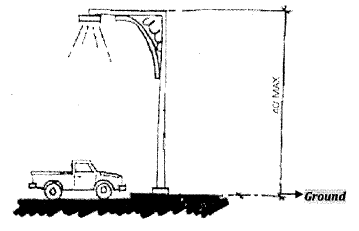
10.44-1.5.1. The light source shall be completely concealed behind an opaque surface and recessed within an opaque housing and shall not be visible from any street right-of-way or adjoining properties. Overhead lighting fixtures shall be designed to prevent light from emitting upwards towards the sky.
10.44-1.5.2. Under canopy lighting fixtures should be completely recessed within the canopy.
10.44-1.6. Fixture Height.
10.44-1.6.1. Lighting fixtures may not exceed 30 feet in height (as measured from the ground to the top of the pole) and illumination levels shall comply with Section 10.45-1.1.
10.44-1.7. The Town Manager or his/her designee may allow fixtures above this height to provide internal lighting for stadiums, arenas, parks, ballfields, tennis courts, multi-purpose fields, and other similar recreational facilities with a light pole maximum up to 50 feet.
10.44-1.8. Light Source (Lamp).
10.44-1.8.1. The light emitted by Light Emitting Diodes (LEDs) and fiber optics is preferred. Light emitted by incandescent, metal halide, or color corrected high-pressure sodium is acceptable. Non color corrected high-pressure sodium lamps are prohibited.
10.44-1.8.2. The same light source type must be used for the same or similar types of lighting on any one site throughout any development.
10.44-1.9. Mounting. Fixtures shall be mounted in such a manner that the cone of light is contained on-site and maximum illumination levels off-site does not exceed those found in Section 10.45-1.1 and not conflict with excessive illumination requirements found in Section 10.44-1.5.1.
10.44-1.10. Limit Lighting to Periods of Activity for Town Owned Properties. The use of sensor technologies, timers or other means to activate lighting during times when it will be needed may be required by the Town Manager or his/her designee to conserve energy, provide safety, and promote compatibility between different land uses.
(Amend. of 3-10-2020(2))
Editor's note— An Amendment adopted March 10, 2020, set out provisions intended for use as §§ 10.44—10.46. For purposes of classification, and at the editor's discretion, these provisions have been included as 10.44-1—10.46-1.
SECTION 10.45-1 - ILLUMINATION LEVELS.
10.45-1.1. To ensure uniform light distribution, all site lighting shall be designed so that the level of illumination as measured in foot-candles (fc) at any one point meets the standards in the table below with minimum and maximum levels measured on the pavement within the lighted area and average level (the overall generalized ambient light level), measured as a not-to-exceed value calculated using only the area of the site intended to receive illumination. The Town Manager or his/her designee may make reasonable adjustments to accommodate the specific lighting needs of the interior areas of projects; however, the measurements for the Maximum Illumination Levels pertaining to the project boundaries as outlined in the table below, shall not be exceeded.
10.45-1.2. All outdoor lighting shall be designed and located such that maximum illumination measured in foot-candles comply with those in the following table:
(Amend. of 3-10-2020(2))
Editor's note— See note at § 10.44-1.
SECTION 10.46-1 - EXCESSIVE ILLUMINATION.
10.46-1.1. Lighting within any lot that unnecessarily illuminates and substantially interferes with the use or enjoyment of any other property is prohibited. Lighting unnecessarily illuminates another lot if it exceeds the requirements of this section.
10.46-1.2. Lighting shall not be oriented so as to direct glare or excessive illumination onto streets in a manner that may distract or interfere with the vision of drivers on such streets.
10.46-1.3. Fixtures used to accent architectural features, landscaping or art shall be located, aimed or shielded to minimize light spill into the night sky.
10.46-1.4. Blinking or flashing lights shall be prohibited unless the lights are required as a safety feature (e.g. beacons on towers) or shall be permitted as part of a sign in accordance with Article 10, Sign Regulations.
(Amend. of 3-10-2020(2))
Editor's note— See note at § 10.44-1.
SECTION 10.44 - JURISDICTION OF PART VI SUBDIVISION REGULATIONS.
The regulations contained in this section shall govern each and every subdivision within the Town and its extraterritorial jurisdiction as shown on the official zoning map. After the effective date of this Ordinance, each individual subdivision plat of land within the Town's jurisdiction shall be approved as specified in Article 5.
(Ord. of 10-9-2018)
SECTION 10.45 - STANDARDS FOR REVIEW.
Refer to Article 5 for the subdivision review process. Decision on approval or denial of preliminary or final plats may be made only on the basis of standards explicitly set forth in Article 10, Part VI. Whenever the ordinance criteria for decisions requires application of judgment, those criteria must provide adequate guiding standards for the entity charged with plat approval.
(Ord. of 10-9-2018)
SECTION 10.46 - Reserved.
Editor's note— An amendment of April 11, 2023(5), repealed § 10.46, which pertained to sketch plans and derived from Ord. of October 9, 2018.
SECTION 10.47 - PRELIMINARY PLATS FOR MINOR AND MAJOR SUBDIVISIONS.
The preliminary plat shall depict or contain the information provided in Section 10.49. Preliminary plats shall be clearly and legibly drawn at a scale of not less than 200 feet to one inch. If a major subdivision is to be developed in stages, a phasing plan must be submitted with the preliminary plat.
(Ord. of 10-9-2018)
SECTION 10.48 - FINAL PLATS FOR ALL SUBDIVISIONS.
10.48.1. Final Plat Contents. The final plats shall depict or contain the information provided in Section 10.49. Final plats shall be clearly and legibly drawn by a registered land surveyor currently licensed in the State of North Carolina by the North Carolina State Board of Registration for Professional Engineers and Land Surveyors. The plat shall also be drawn at a scale of not less than 200 feet to one inch and shall be drawn on a sheet size of mylar acceptable to the Register of Deeds of Brunswick County. The final plat must be consistent with the approved preliminary plat.
10.48.2. Certifications. The final plat shall contain the certifications outlined in Section 10.70.
(Ord. of 10-9-2018)
SECTION 10.49 - INFORMATION TO BE PROVIDED ON PRELIMINARY AND FINAL PLATS.
The preliminary and final plats shall depict or contain the information indicated in the following table. An "X" indicates that the information is required.
(Ord. of 10-9-2018; Amend. of 4-11-2023(5))
SECTION 10.50 - RESERVED.
Editor's note— An amendment of April 11, 2023(5), repealed § 10.50, which pertained to presale of lots and derived from Ord. of October 9, 2018.
SECTION 10.51 - RECOMBINATION AND RESUBDIVISION OF LAND.
10.51.1. Recombination of Land.
10.51.1.1. Any plat or any part of any plat may be vacated by the owner at any time before the sale of any lot in the subdivision by a written instrument to which a copy of such plat shall be attached, declaring the plat to be vacated.
10.51.1.2. Such an instrument shall be approved by the same agencies as approved the final plat. The Town Council may reject any such instrument which abridges and destroys any public rights in any of its public uses, improvements, streets or alleys.
10.51.1.3. Such an instrument shall be executed, acknowledged or approved and recorded and filed in the same manner as a final plat; and being duly recorded or filed shall operate to destroy the force and effect of the recording of the plat so vacated, and to divest all public rights in the streets, alleys and public grounds, and all dedications laid out or described in such plat.
10.51.1.4. When lots have been sold, the plat may be vacated in the manner provided in subsections 10.51.1.1 to 10.51.1.3 of this section by all owners of the lots in such plat adjoining in the execution of such in writing.
10.51.1.5. Sewer assessment fees for the parcel to be absorbed must be paid in full; however, the parent parcel may continue to make payments.
10.51.2. Resubdivision Procedures. For any replatting or resubdivision of land, the same procedures, rules and regulations shall apply as prescribed in this section for an original subdivision except that lot sizes may be varied on an approved plat after recording, provided that:
10.51.2.1. Reserved.
10.51.2.2. Reserved.
10.51.2.3. Drainage, easements, or rights-of-way shall not be changed.
10.51.2.4. Street alignment and construction standards, including block sizes, shall not be changed.
10.51.2.5. The rear portion of lots shall not be subdivided from the front part.
10.51.2.6. Reserved.
(Ord. of 10-9-2018; Amend. of 4-11-2023(5))
SECTION 10.52 - COMPLIANCE WITH PROVISIONS REQUIRED.
10.52.1. Each subdivision shall contain the improvements specified in this section, which shall be installed in accordance with the requirements of this Ordinance and paid for by the subdivider, unless other means of financing is specifically stated in this Ordinance. Land shall be dedicated and reserved in each subdivision as specified in this section. Each subdivision shall adhere to the minimum standards of design established by this section.
10.52.2. No water system, drainage system, sanitary sewer collection system, street or other public right-of-way shall be accepted in accordance with Section 10.59, or be maintained by the Town, nor shall any permit be issued nor any service fee accepted by an administrative agent or department of the Town for the construction of any building requiring a permit or fee, upon any land concerning which a final plat is required to be approved, unless and until there is full compliance with the requirements set forth in this Ordinance.
(Ord. of 10-9-2018)
SECTION 10.53 - HOMEOWNERS ASSOCIATION AND COMMON AREAS.
10.53.1. A homeowner's association shall be established for each subdivision containing streets and/or common areas not maintained by the state, the county, or the town. Once the subdivision is recorded, the subdivider must provide the book and page number, if previously recorded, or where the covenants are recorded. The covenants, conditions and restrictions shall specify the lot owner's responsibilities for maintenance of such facilities, and shall provide for assessments to finance all maintenance activities.
10.53.2. All areas on the site plan, other than building sites and public rights-of-way, shall be shown and designated as common areas. All common areas shall be designated as a single parcel regardless of the proximity of each common area to one or all of the other common areas, and such areas shall not be subdivided. This shall be so stated in the covenants and restrictions, and shall be noted on the final plat.
(Ord. of 10-9-2018; Amend. of 4-11-2023(5))
SECTION 10.54 - RESERVED.
Editor's note— An amendment of April 11, 2023(5), repealed § 10.454, which pertained to suitability of land and derived from Ord. of October 9, 2018.
SECTION 10.55 - NAME DUPLICATION.
Subdivision names shall be approved by Brunswick County.
(Ord. of 10-9-2018; Amend. of 4-11-2023(5))
SECTION 10.56 - STORMWATER DRAINAGE FACILITIES.
The preliminary plat shall provide for stormwater drainage in accordance with Code of Ordinances Chapter 18, Article V, and compliant with the Town of Oak Island Phase II NPDES requirements.
(Ord. of 10-9-2018; Amend. of 4-11-2023(5))
SECTION 10.57 - EROSION AND SEDIMENTATION CONTROL.
The preliminary plat shall be contingent on an approval of any required soil erosion and sedimentation control plan in accordance with Article 10, Part VIII.
(Ord. of 10-9-2018; Amend. of 4-11-2023(5))
SECTION 10.58 - RIPARIAN BUFFERS.
Riparian buffers within a lot are to be shown on the recorded plat, and the area of a lot within the riparian buffer must still count toward any dimensional requirements for lot size. Riparian buffers must be shown on all subdivision plats, including those on platted lots. If a riparian buffer is designated as a privately-owned common area (e.g., owned by a property owners association), the Town may, upon request, attribute to each lot abutting the riparian buffer area a proportionate share based on the area of all lots abutting the riparian buffer area for purposes of development-regulated regulatory requirements based on property size. Dimensional lot requirements include calculations for, among other things, residential density standards, tree conservation area, open space or conservation area, setbacks, perimeter buffers, and lot area.
(Ord. of 10-9-2018; Amend. of 4-11-2023(5))
SECTION 10.59 - SUBDIVISION DESIGN.
10.59.1. Block Design.
10.59.1.1. The lengths, widths, and shapes of blocks shall be determined with due regard to: provision of adequate building sites suitable to the special needs of the type of use contemplated; zoning requirements; needs for vehicular and pedestrian circulation; control and safety of street traffic; limitations and opportunities of topography; and convenient access to water areas.
10.59.1.2. Blocks shall not be less than 400 feet or more than 1,200 feet. In blocks over 800 feet in length, the planning board may require pedestrian crosswalks, not less than ten feet in width, extending entirely across the block at one or more locations. Crosswalks are intended to permit easy pedestrian access within the subdivision and to permit convenient public access to a park, a public trust waters, or an adjacent shopping area.
10.59.1.3. Blocks shall have sufficient width to allow two tiers of lots except where single tier lots are required abutting a water area.
10.59.1.4. Block numbers shall conform to the town street numbering system, if applicable.
10.59.2. Lot Design.
10.59.2.1. All newly created lots to be utilized for residential purposes shall have a minimum gross area of 6,600 square feet, a minimum width at the building line of 60 feet and a minimum width at the street right-of-way line of 25 feet. Corner lots shall have an extra width of ten feet to permit adequate setback from side streets. On cul-de-sac lots, the front yard setback shall be the required setback for the applicable zoning district or no closer to the street than the building line at which the lot width is at least 60 feet. If the standards of the zoning district in which the property is located are more stringent or additional land area is required by the county environmental health section, then the stricter standards shall govern. Except where greater standards may be required by the county environmental health section, lots proposed on property where public water but no public sewer is available shall be not less than 15,000 square feet; where neither public water nor sewer is available, lots shall be not less than 20,000 square feet.
10.59.2.2. Reserved.
10.59.2.3. Reserved.
10.59.2.4. Every lot shall abut at least 25 feet in width upon one of the following:
10.59.2.4.1. A public street dedicated to and maintained by the Town or the state department of transportation.
10.59.2.4.2. A private street constructed to the standards of the Town or the state department of transportation with a written agreement concerning the future maintenance of the street.
10.59.2.5. Flag-shaped lots shall only be permitted in cases where the minimum area, width, depth and street frontage requirements of this article are maintained. The front yard setback of a flag lot shall be measured from the widest lot line facing the street to which the flag lot connects.
10.59.3. Easements. Easements shall be provided as follows:
10.59.3.1. Utility Easements. Easements for underground utilities shall be provided, where necessary, across lots or centered on rear or side lot lines and shall be at least 20 feet wide for water and sanitary sewer lines and as required by the companies involved, for telephone (telecommunications), gas or power lines. The Planning Board will determine whether one easement is sufficient or whether several easements are necessary to accommodate the various facilities and the subdivider shall provide the required easements.
10.59.3.2. Drainage Easements. Where a subdivision is traversed by a watercourse or drainageway, either natural or manmade, an easement shall be indicated on all plats of the subdivision. Such easement shall conform substantially with the lines of the watercourses or drainageways and shall be of sufficient width as determined by the Planning Board. The Planning Board, at its discretion, may require the subdivider to convey easements to the Town providing access to and along watercourses or drainageways traversing the subdivision for the purpose of maintaining such watercourses or drainageways.
(Ord. of 10-9-2018; Amend. of 4-11-2023(5))
SECTION 10.60 - RESIDENTIAL CLUSTER DEVELOPMENT.
10.60.1. Purpose and Intent. The purpose of residential cluster development is to provide an alternative development option that will:
10.60.1.1. Promote more efficient use of land resources than is otherwise possible under conventional zoning and subdivision regulations.
10.60.1.2. Reduce the per unit site development costs of dwellings by concentrating residential units on a portion of the site without increasing the overall net density above that which would normally be allowed pursuant to Article 8, Zoning District Development Standards.
10.60.1.3. Preserve the natural character of the site.
10.60.1.4. Provide for desirable and usable open space, tree cover, and the preservation of environmentally sensitive areas.
10.60.1.5. Provide variety in residential buildings and properties and provide design flexibility that can relate the location of units to unique site conditions.
10.60.2. Definition. For the purposes of this section, a residential cluster development is defined as:
10.60.2.1. A development design wherein conventional zoning standards are relaxed to permit modifications in lot area, lot width, lot frontage, lot coverage, required yards, and public street access, and to save infrastructure development cost, environmental damage, energy use and land resources by concentrating dwellings in specific areas of the site without increasing the net density above that which would normally be allowed pursuant to Article 8, Zoning District Development Standards.
10.60.2.2. Such development shall contain detached single-family dwellings only.
10.60.2.3. Such development shall provide a program for the provision, operation and maintenance of such areas, facilities, and improvements as shall be required for the perpetual common use by the occupants of the development.
10.60.2.4. A special use to be processed in accordance with Section 4.9.
10.60.3. Area; Permitted Districts; Exemption; Street Access; Open Space; Density; Dimensional Standards. Residential cluster developments shall contain not less than ten net acres. For purposes of this section, (net acres( shall be the total area of all lots and common area(s) exclusive of public street rights-of-way or private street easements. Addition to any existing residential cluster development may be allowed provided such addition meets or exceeds all other applicable requirements.
Subject to the paragraph above, a residential cluster development may as an option be allowed within any R-20, R-9, or R-7 zoning district. Such developments shall be exempt from the conventional zoning standards relative to lot area, lot width, lot frontage, lot coverage, required yards and public street access normally applicable to such districts, provided such development complies with the minimum standards set forth under this section.
Dwelling units within a residential cluster development may be constructed on lots fronting public or private streets. A residential cluster development shall provide open space(s) subject to all the following requirements:
10.60.3.1. Such open space shall be greater or equal in area to the total amount of area by which each lot was reduced below the minimum lot size requirement of the prevailing zoning district, or as provided under subsection 10.60.3.2 below, whichever is greater.
10.60.3.2. Residential cluster development shall reserve not less than 15 percent of the gross acreage as common open space.
10.60.3.3. Such area shall not be used as a building site. For purposes of this section, picnic areas or shelters, ball fields, walking or jogging trails, boat ramps and docks or other similar recreational facilities may be allowed.
10.60.3.4. Such area shall not be devoted to any public street right-of-way or private street easement, private driveway or parking area.
10.60.3.5. Such area shall be left in its natural or undisturbed state if wooded at the time of development, except for the cutting of trails for walking or jogging or, if not wooded at the time of development, is improved for the uses listed under subsection 10.60.3.3 above, or is properly vegetated and landscaped with the objectives of creating a wooded area or other area that is consistent with the objective set forth in subsection 10.60.3.6.
10.60.3.6. Such area shall be capable of being used and enjoyed for purposes of informal and unstructured recreation and relaxation or for horticulture if not devoted to other allowable uses in this subsection.
10.60.3.7. Such area shall be legally and practically accessible to the residents of the development, or to the public if so dedicated.
10.60.3.8. A minimum of one-half of the required open space shall be contained in one continuous undivided part.
10.60.3.9. Not more than 25 percent of the required open space shall lie within any floodway zone.
10.60.3.10. Not more than 25 percent of the required open space may be devoted to allowable improvements as set forth in subsection 10.60.3.3.
10.60.3.11. Such area shall be perpetually owned and maintained for the purposes of this article by a homeowners association or, with Town acceptance, dedicated or deeded to the public.
10.60.3.12. Reserved.
10.60.3.13. The owner shall, pursuant to the subdivision regulations, cause a final subdivision plat to be recorded in the Brunswick County Register of Deeds which clearly describes the open space(s), required deed restrictions, and conditions thereof, prior to the issuance of any building permit(s).
10.60.3.14. Any application for major subdivision on the mainland that is greater than 25 acres and more than 12 lots shall have a forestry plan submitted to the UDO Administrator before construction plans are approved.
10.60.4. Maximum Density Requirements.
10.60.4.1. Residential density shall not exceed that which would normally be permitted under single-family standards within the prevailing zoning district on a net area basis.
10.60.4.2. Public street rights-of-way and private street easements shall not be included or count towards the total net area for purposes of calculating allowable density.
10.60.4.3. Area dedicated or deeded to the Town pursuant to the sections above shall count towards net area for purposes of density calculation.
10.60.5. Minimum Dimensional Standards.
10.60.5.1. Lot Area. Not less than 60 percent of the minimum lot area which would normally be required under the single-family standards of the prevailing zoning district.
10.60.5.2. Lot Frontage. 40 feet, except on the radius of a cul-de-sac where such distance may be reduced to 20 feet.
10.60.5.3. Public or Private Street Setback. No principal or accessory structure shall be closer than 15 feet to a public street right-of-way or private street easement or as further provided herein.
10.60.5.4. Side Yard Setback. Shall be subject to Section 10.60.6, Zero Lot Line, or not less than 12 feet, provided however, that no structure shall be located on more than one side lot line. Dwellings which do not utilize the provisions of Section 10.60.6 shall maintain a minimum side setback of not less than six feet.
10.60.5.5. Rear Yard Setback. Shall be subject to Section 10.60.6, Zero Lot Line, or not less than 12 feet.
10.60.5.6. Building Separations. No portion of any principal structure shall be located less than 12 feet from any other principal structure or less than ten feet from any accessory structure as measured to the closest point.
10.60.5.7. Periphery Boundary Setback. Except as further provided, no principal or accessory structure shall be located less than 25 feet from the peripheral boundaries of the residential cluster development.
10.60.5.8. Maximum Height. Thirty-five feet outside the VE zone; 41 feet inside the VE zone.
10.60.5.9. Detached Accessory Structure Requirements.
10.60.5.9.1. Shall not be located within any front setback;
10.60.5.9.2. Shall not be located within ten feet of any other principal structure or within five feet of any other accessory structure;
10.60.5.9.3. Shall not cover more than 20 percent of any side or rear setback; and
10.60.5.9.4. The side or rear setback requirement for detached accessory structures shall be subject to the provisions of Section 10.60.6, Zero Lot Line, or not less than five feet.
10.60.6. Zero Side and/or Rear Setbacks. A zero side and/or rear setback as permitted herein, may be permitted in a cluster subdivision subject to the following provisions:
10.60.6.1. Any wall, constructed on the side or rear lot line shall be a solid doorless and windowless wall. Such wall shall contain no electrical, mechanical, heating, air conditioning, or other fixtures that project beyond such wall. If there is an offset of the wall from the lot line, such offset shall be subject to the applicable provisions of Section 10.60.5.6 and 10.60.5.7. Roof eaves may encroach two feet into the adjoining lot.
10.60.6.2. A five foot maintenance and access easement with a maximum eave encroachment easement of two feet within the maintenance easement shall be established on the adjoining lot and shall assure ready access to the lot line wall at reasonable periods of the day for normal maintenance.
10.60.6.3. Where zero side or rear setbacks are proposed, the buildable area for each lot shall be indicated on the preliminary and final subdivision plat.
10.60.6.4. Zero lot lines shall not be allowed on any perimeter boundary line or lot line of a cluster subdivision.
10.60.7. Private Streets. Private streets may be allowed pursuant to the subdivision regulations.
10.60.8. Compliance with Subdivision Standards. All development regulated in accordance with this section shall be subject to the requirements, conditions, and restrictions of the subdivision regulations.
(Ord. of 10-9-2018; Amend. of 4-11-2023(5))
SECTION 10.61 - STREETS.
10.61.1. Type of Street Required. All subdivision lots shall abut on a public or private street as specified in Section 10.60. Subdividers are required to provide street rights-of-way, street pavement widths, and street cross sections to adequately serve the lots in the proposed subdivision. The streets shall be consistent with the following design principles:
10.61.1.1. The street system shall discourage generation of excessive through traffic in the subdivision.
10.61.1.2. Rights-of-way and pavement widths shall be determined by the traffic carried or anticipated to be carried by the street.
10.61.1.3. Access to adjoining property shall be considered in planning for the street system.
10.61.1.4. Sidewalks shall be provided in accordance with Section 10.61.7.2.
10.61.1.5. Where culs-de-sac are used, they shall be as short as feasible.
All proposed public streets within the corporate limits of the Town shall be dedicated to the town; all proposed public streets in the town's extraterritorial jurisdiction shall be dedicated to the state. All streets shall be built to the standards of the state department of transportation. Streets not dedicated to the town which are not eligible for acceptance into the state highway system because there are too few lots or residences shall, nevertheless, be built in accordance with the standards necessary to be put on the state highway system. A written maintenance agreement with the provisions for the future maintenance of the street shall be included with the final plat.
10.61.2. Subdivision Street Disclosure Statement. Where streets are to be dedicated to the public but have not yet been accepted, by a public entity, a statement explaining the status of the street shall be included with the final plat. Such statement shall explain that the property and/or lot owners are ultimately responsible for the upkeep and maintenance of all streets until such time that the streets are assumed for maintenance by a public entity.
10.61.3. Half Streets. The dedication of half streets of less than the state requirement at the perimeter of a new subdivision shall be prohibited. If circumstances render this impracticable, adequate provision for the concurrent dedication of the remaining half of the street shall be furnished by the subdivider. Where there exists a half street in an adjoining subdivision, the remaining half shall be provided by the proposed subdivision. However, in circumstances where more than 60 feet of right-of-way is required, a partial width right-of-way, not less than 60 feet in width, may be dedicated when adjoining undeveloped property is owned or controlled by the subdivider; provided, however, that the width of the partial dedication is such as to permit the installation of such facilities as may be necessary to serve abutting lots. When the adjoining property is subdivided, the remainder of the full required right-of-way shall be dedicated.
10.61.4. Marginal Access Streets. Where a tract of land to be subdivided adjoins an arterial street, the subdivider shall be required to provide reverse frontage on a minor street for the lots to be developed adjacent to the arterial. Where reverse frontage is established, private driveways shall be prevented from having direct access to the arterial. In the case of a minor subdivision proposed to front onto an arterial street, the UDO Administrator may regulate access by requiring that:
10.61.4.1. Access be limited to a minor street, when available.
10.61.4.2. An alternative access design, such as joint driveways, be used to achieve the intent of this provision. Shared driveways may only serve two lots. The centerline of the shared driveway must be located on the side lot line of the two lots being provided access by the shared driveway.
10.61.5. Nonresidential Streets. The subdivider of a nonresidential subdivision shall provide streets in accordance with state department of transportation standards and the standards in this article, whichever are stricter in regard to each particular item.
10.61.6. Street Design Standards. The design of all streets and roads within the jurisdiction of this article shall be in accordance with the accepted policies of the state department of transportation, division of highways' subdivision roads minimum construction standards, and shall apply for any items not included in this article, or where stricter than this article. The provision of street rights-of-way shall conform to the recommendations of the mutually adopted "Transportation Plan Technical Report for Oak Island," or successor document. In cases where a dedication of right-of-way is required, the subdivider will only be required to dedicate a maximum of 100 feet of right-of-way. In cases where over 100 feet of right-of-way is desired, the subdivider will be required only to reserve the amount in excess of 100 feet. In all cases in which right-of-way is sought for an access controlled facility, the subdivider will only be required to make a reservation.
10.61.6.1. Right-of-Way Widths. Right-of-way widths shall not be less than required by state department of transportation standards for the type of road proposed and shall apply except in those cases where right-of-way requirements have been specifically set out in an approved thoroughfare plan.
10.61.6.2. Street Widths. Widths for street and road classifications, other than local, shall be as required by the state department of transportation. Width of local roads and streets shall be as follows:
10.61.6.2.1. Local residential:
10.61.6.2.1.1. Curb and gutter section: 26 feet, face of curb
10.61.6.2.1.2. Shoulder section: 20 feet to edge of pavement, four-foot shoulders
10.61.6.2.2. Residential collector:
10.61.6.2.2.1. Curb and gutter section: 34 feet, face to face of curb
10.61.6.2.2.2. Shoulder section: 22 feet to edge of pavement, six-foot shoulders
10.61.6.3. Intersections.
10.61.6.3.1. Streets shall be laid out so as to intersect as nearly as possible at right angles, and no street shall intersect any other street at any angle less than 60 degrees.
10.61.6.3.2. Property lines at intersections should be set so that the distance from the edge of pavement, of the street turnout, to the property line will be at least as great as the distance from the edge of pavement to the property line along the intersecting streets. This property line can be established as a radius or as a sight triangle. Greater offsets from the edge of pavement to the property lines will be required, if necessary, to provide sight distance for the vehicle on the side street.
10.61.6.3.3. Offset intersections are to be avoided unless exception is granted by the state department of transportation. Intersections which cannot be aligned should be separated by a minimum length of 200 feet between survey centerlines.
10.61.6.3.4. Intersections with arterials, collectors and thoroughfares shall be as required by the state department of transportation.
10.61.6.4. Culs-De-Sac. Permanent dead-end streets should not exceed 500 feet in length unless necessitated by topography or property accessibility and in no case shall be permitted to be over 700 feet in length. Measurement shall be from the point where the centerline of the dead-end street intersects with the center of a through street to the center of the turnaround of the cul-de-sac. The distance from the edge of the pavement on the vehicular turnaround to the center of the cul-de-sac shall be as provided by the North Carolina State Fire Code. Culs-de-sac may not be used to avoid connection with an existing street . In all cases, permanent easements must be granted to the town by the subdivider or property owner at locations which would allow the extension and intersection of the dead-end road with existing dedicated roadways. Such easements must be at least the size of the existing roadway which would join the dead-end road at that location.
10.61.6.5. Alleys.
10.61.6.5.1. Alleys shall be required to serve lots used for commercial and industrial purposes except that this requirement may be waived where other definite and ensured provision is made for service access. Alleys shall not be provided in residential subdivisions.
10.61.6.5.2. The width of an alley shall be at least 20 feet.
10.61.6.5.3. Dead-end alleys shall be avoided where possible, but if unavoidable, shall be provided with adequate turnaround facilities at the dead end.
10.61.6.5.4. Sharp changes in alignment and grade shall be avoided.
10.61.6.5.5. All alleys shall be designed in accordance with the state department of transportation standards.
10.61.7. Other street requirements.
10.61.7.1. Through traffic discouraged on residential collector and local streets. Residential collector and local streets shall be laid out in such a way that their use by through traffic will be discouraged. Streets shall be designed or walkways dedicated to ensure convenient access to parks, playgrounds, schools, or other places of public assembly.
10.61.7.2. Sidewalks. Sidewalks are considered necessary on all streets in both commercial and residential areas to provide for pedestrian safety. Sidewalks shall be constructed by the subdivider on both sides of major thoroughfares, minor thoroughfares, collector streets, and North Carolina roads and on one side of all local streets. Such sidewalks shall be constructed to a minimum width of four feet, and shall consist of a minimum depth of four inches of concrete. All sidewalks shall be placed in the right-of-way, unless the development is platted as a planned unit or group development. Sidewalks shall consist of a minimum of six inches of concrete at driveway crossings or shall be adequately reinforced otherwise.
10.61.7.3. Street Names. Proposed streets which are obviously in alignment with existing streets shall be given the same name. In assigning new names, duplication of existing names shall be avoided and in no case shall the proposed name be phonetically similar to existing names in the county irrespective of the use of a suffix such as a street, road, drive, place, court, etc. Prior to submittal to the Planning Board for review and recommendation, plats shall be forwarded to Brunswick County GIS to ensure street names are acceptable. Street names shall be subject to final approval by the Town Council.
10.61.7.4. Street Name Signs. The subdivider shall be required to provide and erect street name signs and stop signs to Town and state standards at all intersections within the subdivision.
10.61.7.5. Permits for Connection to State Roads. An approved permit is required for connection to any existing town or state system road. This permit is required prior to any construction on the street or road.
10.61.7.6. Offsets to Utility Service. Access for utilities should be located clear of roadway shoulders, preferably a minimum of at least 30 feet from the edge of pavement on arterial streets or major thoroughfares. On streets with curb and gutter, utility access should be set back a minimum distance of six feet from the face of the curb.
10.61.7.7. Wheelchair Ramps. In accordance with G.S. 136-44.14, all street curbs in the state being constructed or reconstructed for maintenance procedures, traffic operations, repairs, correction of utilities, or altered for any reason after September 1, 1973, shall provide wheelchair ramps for the physically handicapped at all intersections where both curb and gutter and sidewalks are provided and at other major points of pedestrian flow.
(Ord. of 10-9-2018; Amend. of 4-11-2023(5))
SECTION 10.62 - STREET CONNECTIVITY REQUIREMENTS.
10.62.1. An interconnected street system is necessary in order to protect the public health, safety, and welfare in order to ensure that streets will function in an interdependent manner, to provide adequate access for emergency and service vehicles, to enhance nonvehicular travel such as pedestrians and bicycles, and to provide continuous and comprehensible traffic routes.
10.62.2. All proposed streets shall be continuous and connect to existing or platted streets without offset with the exception of cul-de-sacs as permitted and except as provided below. Whenever practicable, provisions shall be made for the continuation of planned streets into adjoining areas.
10.62.3. The street network for any subdivision shall achieve a connectivity ratio of not less than 1.45 (see example below).
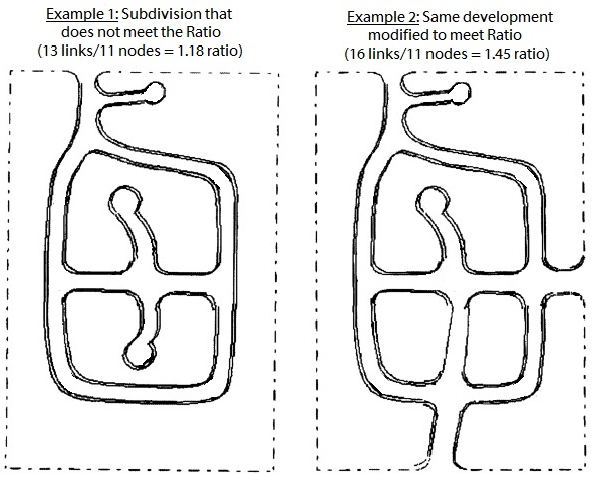
10.62.4. For the purposes of this section, the street links and nodes within the collector or thoroughfare streets providing access to a proposed subdivision shall not be considered in computing the connectivity ratio.
10.62.5. Residential streets shall be designed so as to minimize the length of local streets, to provide safe access to residences, and to maintain connectivity between and through residential neighborhoods for autos and pedestrians.
10.62.6. Where necessary to provide access or to permit the reasonable future subdivision of adjacent land, rights-of-way, and improvements shall be extended to the boundary of the development. A temporary turnaround may be required where the dead end exceeds 500 feet in length. The platting of partial width rights-of-way shall be prohibited except where the remainder of the necessary right-of-way has already been platted, dedicated, or established by other means.
10.62.7. Utility stub-outs shall be provided at all required points of street connectivity.
10.62.8. Exemptions. New subdivisions that intend to provide one new cul-de-sac street shall be exempt from the connectivity requirement when the UDO Administrator determines that the subdivision will provide for connectivity with adjacent future development and there are no options for providing stub streets due to topographic conditions, adjacent developed sites, or other limiting factors.
(Ord. of 10-9-2018)
SECTION 10.63 - UTILITIES.
10.63.1. Water and Sanitary Sewer Systems. Each lot in all subdivisions within the corporate limits of the Town shall be provided, at the subdivider's expense with an extension of the municipal water and sanitary sewer systems, where such systems are available to the subdivision according to current Town policies. Each subdivision in the extraterritorial area of the Town may be connected at the subdivider's expense to the municipal water and sanitary sewer systems Water and sanitary sewer lines, connections and equipment shall be in accordance with the Town standards and specifications, as such may be revised from time to time.
10.63.2. On-Site Waste Disposal Systems. On-site waste disposal systems are only permitted in subdivisions where the municipal or sewer district sanitary sewer system is not available according to current policies. Where on-site systems are permitted, the final plat recorded for the subdivision must contain a notice to lot purchasers that septic tanks must be abandoned and the property's wastewater system must be connected to the municipal or sewer district system when it becomes available. Connections must be made according to the town's or district's policies in effect at the time the connection is made. Any lots that are not to be served with municipal sewer service shall have a site/soil evaluation made by the county department of health, environmental health section, or other properly certified entity acceptable to the town, and a determination of lot suitability for on-site wastewater disposal. This determination shall be indicated for each lot shown on the preliminary and the final plat.
10.63.3. Package Treatment Systems. Where the municipal system is not available according to Town policies, package wastewater treatment plants, approved by the state department of environment and natural resources, may be considered for approval under the following conditions:
10.63.3.1. The owner/operator can demonstrate to the satisfaction of the town that the plant is designed and operated in a manner that results in no degradation of surface water quality.
10.63.3.2. The collection system meets the material and installation standards of the town.
10.63.3.3. The owner agrees to abandon the treatment plant and connect the collection system to the municipal system, at his expense, when the municipal system is available according to Town policies.
10.63.4. Water Reuse Piping. Subdividers may be required to install piping for the Town's water reuse system. Where required, water reuse piping shall comply with the standards and specifications of the Town.
(Ord. of 10-9-2018; Amend. of 4-11-2023(5))
SECTION 10.64 - STORMWATER DRAINAGE SYSTEM.
The subdivider shall install a stormwater management system constructed to the standards of Chapter 18, Article V of the Code of Ordinances and the Manual of Stormwater Management Practices. In accordance with G.S. 143-215.1(d) and 15A NCAC 02H.0201, the subdivider is required to apply to the state department of environment and natural resources, division of water quality, for a stormwater management permit if a CAMA major development or a sedimentation/erosion control plan is required.
10.64.1. No surface water shall be channeled or directed into a sanitary sewer.
10.64.2. Where feasible, the subdivider shall connect to an existing storm drainage system.
10.64.3. Where an existing storm drainage system cannot feasibly be extended to the subdivision, a surface drainage system shall be designed to protect the proposed development from water damage.
10.64.4. Surface drainage courses shall comply with the standards and specifications for erosion control of the North Carolina Sedimentation Pollution Control Act, G.S. 143-34.12, and 15A NCAC 04.
10.64.5. The minimum grade along the bottom of a surface drainage course shall be a vertical fall of at least one foot in each 200 feet of horizontal distance.
10.64.6. Streambanks and channels downstream from any land disturbing activity shall be protected from increased degradation by accelerated erosion caused by increased velocity of runoff from the land disturbing activity in accordance with the North Carolina Sedimentation Pollution Control Act, G.S. 143-34.12, and 15A NCAC 04.
10.64.7. Anyone constructing a dam or impoundment within the subdivision must comply with the North Carolina Dam Safety Law of 1967, G.S. 143-215.23 et seq., and 15A NCAC 02K.
10.64.8. In all areas of special flood hazards, all subdivision proposals shall have adequate drainage provided to reduce exposure to flood damage.
(Ord. of 10-9-2018)
SECTION 10.65 - RECREATION AND OPEN SPACE.
For all subdivisions having more than 12 lots, the subdivider shall dedicate a portion of such land for the purpose of parks, recreation, and/or open space or provide fees in lieu of providing such space in accordance with the following requirements:
10.65.1. Area Required. The minimum amount of land to be dedicated shall be one-half acre for each subdivision or 15 percent of the gross acreage determined by the formula, whichever is greater.
10.65.2. Suitability of Land. Criteria for evaluating suitability of proposed recreation, parks and open space areas shall include, but not be limited to, the following.
10.65.2.1. Unity. The dedicated land shall be a single parcel except where it is determined that two or more parcels would be in the public interest. Town Council may require that parcels be connected, and may require the dedication of a connecting path of up to 60 feet, and in no case less than 30 feet in width in addition to the land required in subsection 10.65.1 of this section.
10.65.2.2. Location. The dedicated land shall be located so as to serve the recreation needs of the immediate neighborhood within the subdivision.
10.65.2.3. Accessibility. Public access to the dedicated land shall be provided either by an abutting street or public easement. Such easement may be required to be up to 60 feet in width and shall in no case be less than 30 feet in width.
10.65.2.4. Usability. The dedicated land shall be usable for active recreation or passive recreation. Lakes may not be included in computing amount of land to be dedicated. If active recreation needs are being met by other dedicated parcels or existing recreation facilities either inside or outside the proposed subdivision, then land that is suitable for open space will not need to be dedicated.
10.65.2.5. Reserved.
10.65.2.6. Conservation and Historic Preservation. Conservation and historic preservation easements shall comply with G.S. 121-34. All facilities and improvements and open spaces which the owner makes an offer of dedication to public use shall be maintained by the owner until such offer of dedication is accepted by the appropriate public authority.
10.65.3. Acceptance, Maintenance, and Development. The Town reserves the right to accept, develop, and maintain the dedicated park, recreation, or open space in accordance with its determination of public needs.
10.65.4. Payments in Lieu of Dedication. The subdivider/developer may provide funds to the Town whereby the Town may acquire recreational land or areas to serve the development or subdivision, including the purchase of land that may be used to serve more than one subdivision or development within the immediate area. All funds received by the Town pursuant to this section shall be used only for the acquisition or development of recreation, park, or open space sites. Any formula enacted to determine the amount of funds that are to be provided under this section shall be based on the value of the development or subdivision for property tax purposes. A combination or partial payment of funds and partial dedication of land may be allowed
(Ord. of 10-9-2018; Amend. of 4-11-2023(5))
SECTION 10.66 - MAINTENANCE OF COMMON AREAS, IMPROVEMENTS, AND FACILITIES.
10.66.1. Any applicant for subdivision approval, or their successor, shall be responsible for maintaining all common areas, improvements, or facilities required by this Ordinance or any permit issued in accordance with its provisions, except those areas, improvements, or facilities with respect to which an offer of dedication to the public has been accepted by the Town of Oak Island. As illustrations, and without limiting the generality of the foregoing best management practices, this means that roads and parking areas, engineered stormwater drainage systems, water and sewer lines, and recreational facilities must be properly maintained so that they can be used in the manner intended and required vegetation and trees used for screening, landscaping, or shading must be replaced if they die or are destroyed.
10.66.2. As provided in Section 10.66.1, all facilities and improvements with respect to which the owner makes an offer of dedication to public use shall be maintained by the owner until such offer of dedication is accepted by the appropriate public authority.
(Ord. of 10-9-2018)
SECTION 10.67 - EFFECT OF PLAT APPROVAL ON DEDICATIONS AND ACCEPTANCES.
10.67.1. Plat Approval Shall Not Constitute Acceptance. Pursuant to G.S. 106D-806, the approval of a plat shall not be deemed to constitute or effect the acceptance by the municipality or public of the dedication of any street or other ground, public utility line, or other public facility shown on the plat. To be effective, all offers of dedication must be accepted by resolution.
10.67.2. Acceptance of Dedications.
10.67.2.1. At the time of submittal of a preliminary plat with streets, utilities, or other proposed to be dedicated for acceptance by the Town as public, the Town Council will decide if it will approve the dedication, subject to the street(s), parks, utilities, sidewalks, or other complying with all Town requirements for acceptance. The Town of Oak Island is not obligated to accept any offer of dedication.
10.67.2.2. Acceptance of dedication will be provided by adoption of a resolution of acceptance by the Town of Oak Island Town Council.
(Ord. of 10-9-2018; Amend. of 2-9-2021(3))
SECTION 10.68 - ADJUSTMENTS.
The Board of Adjustment may authorize a variance from these regulations when, in its opinion, undue hardship may result from strict compliance. In granting any variance, the Board of Adjustment shall make the findings required in Section 4.10.2.
(Ord. of 10-9-2018; Amend. of 6-8-2021(11))
SECTION 10.69 - CEMETERY SUBDIVISION LOT SIZE EXEMPTION.
Cemeteries and individual cemetery plot(s) may be platted and approved as minor subdivisions and recorded though not meeting the minimum lot size of the zoning district; however, the cemetery shall comply with all other zoning district restrictions. All lots must have access to recorded pedestrian and vehicular access. Vehicular access must be at least 18 feet in width and pedestrian access must be at least six feet in width.
(Ord. of 10-9-2018)
SECTION 10.70 - FINAL PLAT CERTIFICATIONS AND OTHER DOCUMENTATION.
10.70.1. Minor Subdivision Approval.
10.70.1.1. Certificate of Ownership. I hereby certify that I am (we are) the owner(s) of the property shown and described
hereon, which property is within the subdivision regulation jurisdiction of the Town
of Oak Island, and that I freely adopt this plan of subdivision.
________________
________________
Owner(s) Date
10.70.1.2. Certificate of Approval. I hereby certify that the minor subdivision shown on this plat does not involve the
creation of new public streets or improvements to existing public streets, or the
extension of public water or sewer facilities, that the subdivision shown is in all
respects in compliance with the Town of Oak Island Unified Development Ordinance,
and that therefore this plat has been approved by the UDO Administrator, subject to
its being recorded in the Brunswick County Registry within 60 days of the date below.
________________
________________
UDO Aministrator Date
10.70.1.3. Certificate of Survey and Accuracy. I, ___________, certify that this plat was drawn under my supervision from an actual
survey made under my supervision (deed description recorded in Book _____, Page _____
etc.) (other); that the boundaries not surveyed are clearly indicated as drawn from
information found in Book _____, Page _____, that the ratio of precision as calculated
is 1:_____, that this plat was prepared in accordance with G.S. 47-30 as amended Witness
my original signature, registration number and seal this _____ day of _______A.D.,
20___.
________________
Offical Seal
Professional Land Surveyor
________________
Registration Number
10.70.1.4. Flood Damage Prevention Certificate of Approval for Recording. I certify that the plat shown hereon complies with the Town of Oak Island Flood Damage
Prevention Regulations requirements and is approved by Oak Island for recording in
the Register of Deeds office.
________________
________________
UDO Administrator Date
10.70.1.5. Statement of Compliance with the Town of Oak Island Riparian Buffer Ordinance. I certify that this subdivision fully complies with the Town of Oak Island Code of
Ordinances Chapter 18, Article V Stormwater Management and Article VI Illicit Stormwater Discharge.
________________
________________
Stormwater Administrator Date
10.70.2. Major Subdivision Approval.
10.70.2.1. Certificate of Ownership and Dedication. I hereby certify that I am (we are) the owner(s) of the property shown and described
hereon, which property is within the subdivision regulation jurisdiction of the Town
of Oak Island, that I freely adopt this plan of subdivision and dedicate to public
use all areas shown on this plat as streets, alleys, walks, parks, open space, and
easements, and that I will maintain all such areas until the offer of dedication is
accepted by the appropriate public authority. All property shown on this plat as dedicated
for a public use shall be deemed to be dedicated for any other public use authorized
by law when such other use is approved by the Oak Island Town Council in the public
interest.
;b1;
________________
________________
Owners(s) Date
________________
(Notarized)
10.70.2.2. Certificate of Improvements. If the required improvements are completed prior to the submission of the Final Plat, the following certificate shall be lettered on the plat above the signature of the Town Engineer:
"Know all men by these present, that I hereby certify that on this, the _____ day of ___________, 20 ___, all of the improvements as required by the Oak Island Subdivision Regulations have been installed by the developer in an approved manner."
If the required improvements are not completed prior to the submission of the Final Plat, the following certificate shall be lettered on the plat above the signature of the Town Manager:
"Know all men by these presents, that I hereby certify performance guarantee sufficient to secure the amount of $________ has been posted with the Town of Oak Island by the developer, thereby guaranteeing that all improvements required by the Oak Island Subdivision Regulations shall be constructed. Such improvements shall be completed within _____ days from the date of this statement."
10.70.2.3. Certificate of Approval. I hereby certify that all streets and other improvements shown on this plat have been installed or completed or that their installation or completion has been ensured by the posting of a performance bond or other sufficient surety, that the subdivision shown on this plat appears to comply in all respects with the subdivision regulations of the Town of Oak Island and, therefore, has been approved.
________________
UDO Administrator
_______
Date
10.70.2.4. Certificate of Survey and Accuracy. I,___________, certify that this plat was drawn under my supervision from an actual
survey made under my supervision (deed description recorded in Book _____, Page _____
etc.) (other); that the boundaries not surveyed are clearly indicated as drawn from
information found in Book _____, Page _____, that the ratio of precision as calculated
is 1:___, that this plat was prepared in accordance with G.S. 47-30 as amended. Witness
my original signature, registration number and seal this _____ day of ___________A.D.,
20___.
________________
Offical Seal
Professional Land Surveyor
________________
Registration Number
10.70.2.5. Offer of Dedication. Town Council approved offer of dedication by resolution adopted at meeting held on
________, 20___.
;b1;
________________
________________
Town Clerk Date
10.70.2.6. Division of Highways District Engineer Certificate. I hereby certify that the streets shown on this plat have been completed, or that
a performance bond or other sufficient surety has been posted to guarantee their completion,
in accordance with at least the minimum specifications and standards of the State
Department of Transportation for acceptance of subdivision streets on the state highway
system for maintenance.
;b1;
________________
________________
Engineer Date
10.70.2.7. Flood Damage Prevention Certificate of Approval for Recording. I certify that the plat shown hereon complies with the Town of Oak Island Flood Damage
Prevention Regulations requirements and is approved by Oak Island for recording in
the Register of Deeds office.
________________
________________
UDO Administrator Date
10.70.2.8. Statement of Compliance with the Town of Oak Island Riparian Buffer Ordinance. I certify that this subdivision fully complies with the Town of Oak Island Code of
Ordinances Chapter 18, Article V Stormwater Management and Article VI Illicit Stormwater Discharge.
________________
________________
Stormwater Administrator Date
10.70.3. Exempt Plats.
The following statement shall be placed upon plats determined to be exempt under the Town of Oak Island Subdivision Regulations.
Exemption Statement. This plat has been reviewed and determined to be exempt under the Town of Oak Island
Subdivision Regulations.
________________
________________
UDO Administrator Date
SECTION 10.103 - GENERAL PROVISIONS.
All projects greater than one acre are required to comply with the North Carolina Sedimentation and Erosion Control regulations. All required permits must be provided to the Town of Oak Island UDO Administrator prior to project approval.
(Ord. of 10-9-2018)
SECTION 10.104 - GENERAL PROVISIONS.
The owner and/or applicant developer shall comply with all applicable requirements and thresholds established by the North Carolina Department of Environmental Quality (Division of Water Resources and Division of Energy, Mineral, and Land Resources), and the US Army Corps of Engineers, and as adopted by the Town in Code of Ordinances, Chapter 18, Article V - The Phase II Stormwater Ordinance, and Article VI - Illicit Stormwater Discharge Ordinance for the Town of Oak Island, North Carolina. All applications for approved stormwater control plans must be submitted to the UDO Administrator who will forward them to the Stormwater Administrator.
(Ord. of 10-9-2018)
SECTION 10.104.1 - FILL.
For projects for which fill over one foot is requested, engineered stormwater retention measures, such as retention ponds, or an underground infiltration system, and a Soil Stabilization Plan are required. Engineered fill plans must demonstrate how stormwater runoff, in excess of 1.5 inches, will be directed toward the street right-of-way and not towards adjacent properties. Residential lots seeking a Letter of Map Revision Based on Fill may have up to a maximum of one foot of fill.
(Amend. of 12-11-2018(1); Amend. of 9-10-2019)
SECTION 10.105 - GENERAL PROVISIONS.
All development must comply with the Town of Oak Island Code of Ordinances Chapter 32.
(Ord. of 10-9-2018; Amend. of 4-11-2023(5))
SECTION 10.106 - GENERAL PROVISIONS.
All development must comply with Chapter 14: Environment, Article III. Protection of Sand Dunes, Sea Turtles, and Other Wildlife Habitat; Sand Management Projects and Article IV. Beach Hazards of the Town's Code of Ordinances.
(Ord. of 10-9-2018)

