
Oak Island City Zoning Code
APPENDIX A
DEFINITIONS
SECTION A.1 - PURPOSE.
For the purposes of this Ordinance, certain words, concept, and ideas are defined herein. Except as defined herein, all other words used in this Ordinance shall have their customary dictionary definition.
(Ord. of 10-9-2018)
SECTION A.2 - INTERPRETATION.
A.2.1. As used in this Ordinance, words importing the masculine gender include the feminine and neuter.
A.2.2. Words used in the singular in this Ordinance include the plural and words used in the plural include the singular.
A.2.3. Words used in the present tense include future tense.
A.2.4. The word "person" includes a firm, association, organization, corporation, company, trust, and partnership as well as an individual.
A.2.5. The words "may" and "should" are permissive; an officially adopted course or method of action intended to be followed.
A.2.6. The words "shall" and "will" are always mandatory and not merely directive; expresses determination to implement/take action.
A.2.7. The word "used for" shall include the meaning "designed for."
A.2.8. The words "used" or "occupied" shall mean "intended, designed, and arranged to be used or occupied."
A.2.9. The word "lot" shall include the words "plot," "parcel," "site," and "premises."
A.2.10. The word "structure" shall include the word "building."
A.2.11. The word "street" includes the word "alley," "road," "cul-de-sac," "highway," or "thoroughfare," whether designated as public or private.
A.2.12. The word "includes" shall not limit the term to specified examples, but is intended to extend its meaning to all other instances or circumstances of like kind or character.
A.2.13. The word "UDO Administrator" shall mean the UDO Administrator or his/her designee.
A.2.14. The words "Planning Board" shall mean the "Town of Oak Island Planning Board."
A.2.15. The word "Town" shall mean the "Town of Oak Island," a municipality of the State of North Carolina.
A.2.16. The words "map," and "zoning map" shall mean the "Official Zoning Map for the Town of Oak Island, North Carolina."
A.2.17. The words "Board of Adjustment" shall mean the "Town of Oak Island Board of Adjustment."
(Ord. of 10-9-2018)
SECTION A.3 - DEFINITIONS.
"A"
Abutting
Having property or district lines in common. Lots are also considered to be abutting if they are directly opposite each other and separated by a street or alley.
Access
A way of approaching or entering a property. Access also includes ingress, the right to enter, and egress, the right to leave.
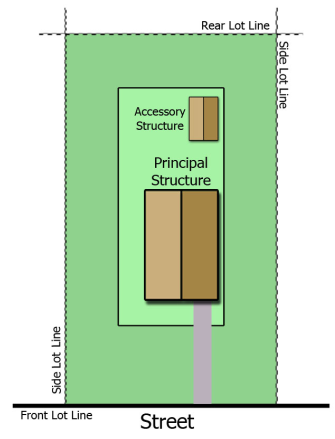
Accessory structure
A structure detached from the principal structure on the same property and customarily incidental and subordinate to the principal structure or use. An accessory structure includes garages, carports, swimming pools, pool houses, greenhouses, gazebos, pergolas, detached solar panels and storage sheds, and other urban accessory structures. Dog houses, tree houses, grade level walkways, and sheds equal to or less than 12 by 12 by 12 feet are not required to have a survey.
Accessory structures (freestanding)
Freestanding accessory structures are defined as any decorative and/or functional structure that is subordinate to, customarily found in association with, and is located on the same lot as a principal use (such as a dwelling unit). Freestanding accessory structures can include trellises, gates and gate posts, basketball goals, solid waste and recycling containers, fences, privacy wall, walls, flagpoles, signs, antennae structures, and other similar items.
Accessory use
A use of land or of a structure or portion thereof that is customarily incidental and subordinate to the principal use of land or structure and located on the same lot with such principal use or structure.
Administrative approval
Approval that the UDO Administrator or designee is authorized to grant after Administrative Review.
Administrative decision
Decisions made in the implementation, administration, or enforcement of development regulations that involve the determination of facts and the application of objective standards set forth in G.S. 160D or town development regulations. These are sometimes referred to as ministerial decisions or administrative determinations.
Administrative hearing
A proceeding to gather facts needed to make an administrative decision.
Administrative review
Non-discretionary evaluation of an application by the UDO Administrator or designee. This process is not subject to a public hearing.
Adult day care center
The provision of group care and supervision in a place other than their usual place of abode on a less than 24-hour basis to adults who may be physically or mentally disabled.
Alley
A roadway that affords only a secondary means of access to abutting property and not intended for general traffic circulation.
Apartment
A room or suite of one or more rooms in a multiple dwelling intended for use as a residence by a single-family.
Apartment house
See Dwelling, multiple.
Appeal
A request for a review of the UDO Administrator's interpretation of any provision of this Ordinance.
Arcade
An amusement center where more than 70 percent of business or business revenue is generated from games and machines operated by a coin or other thing of value.
Art, work of
All forms of original creations of visual art including but not limited to: sculpture, in any material or combination of materials, whether in the round, bas-relief, high relief, mobile, fountain, kinetic, or electronic; painting, whether portable or permanently fixed, as in the case of murals; mosiacs; photographs; crafts made from clay, fiber and textiles, wood, glass, metal, plastics, or any other material, or any combination thereof; calligraphy; mixed media composed of any combination of forms or media; unique architectural stylings or embellishments, including architectural crafts; environmental landscaping; or restoration and renovation of existing works of art of historical significance. Signs are not considered artwork.
Artisan's workshop
An establishment for the preparation, display, and sale of individually crafted artwork, jewelry, furniture, sculpture, pottery, leathercraft, hand-woven articles, and related items. An artisan's workshop includes an establishment that is engaged in the low-impact manufacturing, assembly, repair, or servicing of industrial, business, or consumer machinery, equipment, products, or by-products. Examples include contractors and building maintenance services and similar uses that perform services off-site, low-impact clothing or textile manufacturing, commercial bakery, food service contractor, movie production facility, printing, publishing, lithography, sign-making, welding, woodworking, arts-based (culinary, dance, art, music, photography) classroom, and other similar uses.
Assisted living residence
Any group housing and services program for two or more unrelated adults, by whatever name it is called, that makes available, at a minimum, one meal a day and housekeeping services and provides personal care services directly or through a formal written agreement with one or more licensed home care or hospice agencies. Settings in which services are delivered may include self-contained apartment units or single or shared room units with private or area baths. There are three types of assisted living residences: adult care homes, adult care homes that serve only elderly persons, and multi-unit assisted housing with services. As used in this definition, elderly person( means: (i) any person who has attained the age of 55 years or older and requires assistance with activities of daily living, housing, and services; or (ii) any adult who has a primary diagnosis of Alzheimer's disease or other form of dementia who requires assistance with activities of daily living, housing, and services provided by a licensed Alzheimer's and dementia care unit.
(1)
Adult care home. An assisted living residence in which the housing management provides 24-hour scheduled and unscheduled personal care services to two or more residents, either directly or for scheduled needs, through formal written agreement with licensed home care or hospice agencies. Some licensed adult care homes provide supervision to persons with cognitive impairments whose decisions, if made independently, may jeopardize the safety or well-being of themselves or others and therefore require supervision. Medication in an adult care home may be administered by designated trained staff. Adult care homes that provide care to two to six unrelated residents are commonly called family care homes. Adult care homes include halfway houses and drug rehab facilities.
(2)
Multi-unit assisted housing with services. An assisted living residence in which hands-on personal care services and nursing services which are arranged by housing management are provided by a licensed home care or hospice agency through an individualized written care plan. The housing management has a financial interest or financial affiliation or formal written agreement which makes personal care services accessible and available through at least one licensed home care or hospice agency. The resident has a choice of any provider, and the housing management may not combine charges for housing and personal care services. All residents, or other compensatory agents, must be capable, through informed consent, of entering into a contract and must not be in need of 24-hour supervision. Assistance with self-administration of medications may be provided by appropriately trained staff when delegated by a licensed nurse according to the home care agency's established plan of care.
"B"
Bar
An establishment open to the general public and licensed to sell on premises unfortified wine and beer and shall be in compliance with ABC laws. Also applies to Tavern.
Battery charging station
An electrical component assembly or cluster or component assemblies designed specifically to charge batteries within electric vehicles, which meet or exceed federal, state, and/or local requirements.
Battery exchange station
A fully automated facility that will enable an electric vehicle with a swappable battery to enter a drive lane and exchange the depleted battery with a fully charged battery through a fully automated process, which meets or exceeds federal, state, and/or local requirements.
Bed and breakfast inn
A house, or portion thereof, where short-term lodging rooms and meals are provided. The operator of the inn shall live on the premises or in adjacent premises.
Bedroom
See Sleeping room.
Board of adjustment
A local body, created by ordinance, whose responsibility is to hear appeals from decisions of the zoning administrator and other code officials and to consider requests for variances from the terms of the zoning ordinance.
Boardinghouse
A building other than a hotel or motel where, for compensation, meals are served and rooms rented.
Bona fide farm
Land that receives or is eligible to receive an agricultural use exemption from the county tax office and is used for the production and activities relating or incidental to the production of crops, fruits, vegetables, ornamental and flowering plants, dairy, livestock, poultry, and all other forms of agricultural products having a domestic or foreign market. The term does not include nonfarm activities conducted on farmland.
Brewpub
An eating and drinking establishment that prepares food and produces malt beverage on-site.
Buffer
An area within a lot or site, generally adjacent to and parallel with the property line, either consisting of natural existing vegetation or created by the use of trees, shrubs, fences, and/or berms, designed to limit continuously the view of and/or sound from the lot or site to adjacent lots or sites.
Building
See Structure.
Building, height of
The vertical distance from the average finished grade at the four corners of the structure to the highest point of the structure.
Building setback line, residential
A line establishing the minimum allowable distance between the foundation of the structure including porches, decks, and steps except where specifically exempted to the nearest lot line or street right-of-way line.
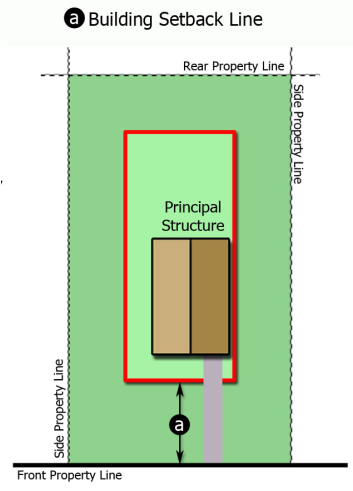
Building setback line, commercial
A line establishing the minimum allowable distance between the footprint of the structure (drip line) including porches, decks and steps to the nearest lot line or street right-of-way line.
Built upon area (BUA)
Impervious surface and partially impervious surface to the extent that the partially impervious surface does not allow water to infiltrate through the surface and into the subsoil. Built upon area does not include a slatted deck; the water area of a swimming pool; a surface of number 57 stone, as designated by the American Society for Testing and Materials, laid at least four inches thick over a geotextile fabric; or a trail as defined in G.S. 113A-85 that is either unpaved or paved as long as the pavement is porous with a hydraulic conductivity greater than 0.001 centimeters per second (1.41 inches per hour).
"C'
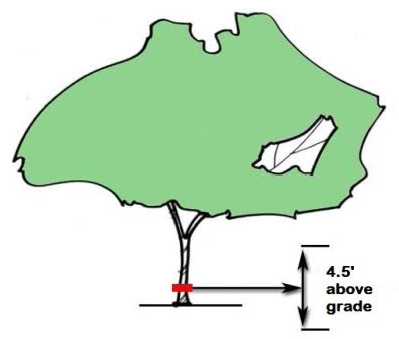
Caliper
The measurement of the diameter of a tree trunk. Measurement shall be taken 4.5 feet above grade.
Cane
The slender, strong but often flexible stem of a shrub.

Carport
A roofed structure not more than 75 percent enclosed by walls and attached to the main building for the purpose of providing shelter for one or more motor vehicles.
Cemetery
Land use or intended to be used for the burial of the dead and dedicated for cemetery purposes, including columbaria, crematories, mausoleums, and mortuaries when operated in conjunction with and within the boundaries of such cemetery.
Certificate of Occupancy
Official certification that a premises conforms to provisions of the zoning code and building code and may be used or occupied. Such a certificate is granted for new construction or for alterations or additions to existing structures or a change in use. Unless such a certificate is issued, a structure cannot be occupied.
Certify
Whenever this Ordinance requires that some agency certify the existence of some fact or circumstance to the Town, the Town may require that such certification be made in any manner that provides reasonable assurance of the accuracy of the certification. By way of illustration, and without limiting the foregoing, the Town may accept certification by telephone from some agency when the circumstances warrant it, or the Town may require that the certification be in the form of a letter or other document.
Certiorari, nature of
The review of the record of a case (minutes of a hearing) by a court for the issuance of a ruling to a board having some judicial power.
Child care
A program or arrangement where three or more children less than 13 years old, who do not reside where the care is provided, receive care on a regular basis of at least once per week for more than four hours but less than 24 hours per day from persons other than their guardians or full-time custodians, or from persons not related to them by birth, marriage, or adoption.
Child care facility
Includes child care centers, family child care homes, and any other child care arrangement not excluded by G.S. 110-86(2) that provides child care, regardless of the time of day, wherever operated, and whether or not operated for profit.
(1)
Child care center. An arrangement where, at any one time, there are three or more preschool-age children or nine or more school-age children receiving child care.
(2)
Small child care center. Small centers in a residence that are licensed for six to twelve children which may keep up to three additional school age children, depending upon the ages of other children in care. When the group has children of different ages, staff-child ratios and group size must be met for the youngest child in the group.
(3)
Family child care home. A child care arrangement located in a residence where, at any one time, more than two children, but less than nine children, receive child care.
Chimney
A vertical shaft of reinforced concrete, masonry, or other approved material enclosing one or more flues, for the purpose of removing products of combustion from solid, liquid, or gaseous fuel.
Churches and places of worship
Facilities used primarily for nonprofit purposes by a recognized and legally established sect to provide assembly and meeting areas for religious activities. Accessory uses include Sunday school facilities, parking, caretaker's housing, pastor's housing, and permanent group living facilities such as convents. Examples include churches, temples, synagogues, and mosques, but not associated schools, day care facilities, or other facilities not devoted to religious activity.
Circulation area
That portion of the vehicle accommodation area used for access to parking or loading areas or other facilities on the lot. Essentially, driveways and other maneuvering areas (other than parking aisles) comprise the circulation area.
Clinic, medical or dental
A building designed and used for outpatient medical, dental or surgical treatment.
Close family relationship
Means a spouse, parent, child, brother, sister, grandparent, or grandchild. The term includes the step, half, and in-law relationships pursuant to G.S. 160D-109.
Clubs and lodges
An incorporated or unincorporated association for civic, social, cultural, fraternal, literary, political, recreational or like activities, operated on a nonprofit basis for the benefit of its members.
Code official
An employee of the town with responsibility for administration and enforcement of development ordinances.
Commercial recreation establishments
Any business establishment which provides outdoor entertainment, recreation or amusement, for profit, to the general public. Commercial recreation includes, but is not limited to, such uses as miniature golf courses, water slides, mechanical rides, go-cart or motorcycle course, golf driving ranges or other similar uses.
Common area
All land not individually owned or dedicated and conveyed to a homeowner's association for purposes of property maintenance.
Community center, public
A land use or building owned and operated by the town or a nonprofit organization such as a church, YWCA or civic organization devoted to providing recreational and educational facilities to the general public without profit.
Community center, private
To include but not limited to, beach clubs, cabana clubs, property owners association facilities and similar type uses, a building or facility owned or operated by an incorporated, unincorporated, chartered association or an individual or individuals nominated by such entities for the purpose of engaging in social, civic, educational, recreational, cultural or similar activities; but not primarily for profit or to render a service that is customarily carried on as a business; that the use of the building or facility shall be used solely for the benefit of its members.
Community garden
Areas of land managed and maintained by a group of individuals to grow and harvest food crops and non-food ornamental crops, for personal or group use, consumption or donation. Community gardens may be divided into separate plots for cultivation by one or more individuals or may be farmed collectively by members of the group, and may include common areas maintained and used by the group.
Competent evidence
North Carolina General Statutes require that the rules of evidence as applied in the trial division of the General Court of Justice ordinarily be followed but adds the important exception that when evidence is not reasonably available under such rules to show relevant facts, they may be shown by the most reliable and substantial evidence available. The Board just limit itself to the type of evidence that ought to be admissible before local administrative agencies generally. The term "competent" is essentially a synonym for "admissible before a local board."
Condominium
A building or group of buildings, in which units are owned individually, and the structure, common areas and facilities are owned by all the owners on a proportional, undivided basis.
Condominium association
The association that administers and maintains the common property and common elements of a condominium.
Condominium, mixed use
A building or group of buildings containing a mix of uses that may include residential, office, business, professional services or other non-residential use that is organized, owned and maintained as a condominium.
Condominium, non-residential
A building, or group of buildings used for office, business, professional services and other commercial enterprise that is organized, owned and maintained as a condominium.
Condominium unit
An enclosed space consisting of one or more rooms occupying all or part of a floor in a building, regardless of whether it is designed for a residence, office or any other permitted use, and it shall include any accessory spaces and areas such as garages, storage spaces, balconies or patios. The units are sold as single units within a multiunit structure with areas also owned in common.
Convenience store
A one-story, retail store containing no more than 4,000 square feet of gross building area that is designed and stocked to sell primarily food, beverages, and other household supplies to customers who purchase only relatively few items (in contrast to a "supermarket"). It is designed to attract and depends upon a large volume of "stop and go" traffic. Illustrative examples of convenience stores are those operated by the "Fast Fare," "7-11," and "Pantry" chains.
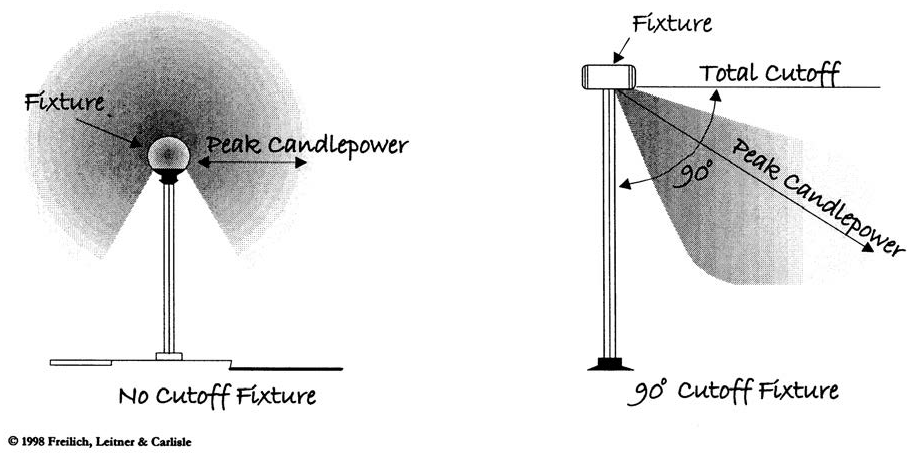
Cutoff
The point at which all light emitted from a source or fixture is eliminated at a specific angle above ground level.
Cutoff angle
The angle formed by a line drawn from the direction of light rays at the light source and a line perpendicular to the ground from the light source, above which no light is emitted.
Cutoff fixture
Fixtures shielded so that no more than 2.5 percent of their light output is emitted above 90 degrees at any lateral angle around the fixture.
Cutoff light
A fixture with elements such as shields, reflectors, or reflector panels which direct and cutoff the light at a cutoff angle that is not more than 90 degrees. Typically, this type of fixture conceals the light source, thus reducing glare and spillover of light.
"D"
Deck
An open and roofless platform that adjoins a house and is supported by a means other than the principal structure.
Determination
A written, final, and binding order, requirement, or determination regarding an administrative decision.
Developer
A person, including a governmental agency or redevelopment authority, who undertakes any development and who is the landowner of the property to be developed or who has been authorized by the landowner to undertake development on that property.
Development
Unless the context clearly indicates otherwise, the term means any of the following:
(1)
The construction, erection, alteration, enlargement, renovation, substantial repair, movement to another site, or demolition of any structure.
(2)
The excavation, grading, filling, clearing, or alteration of land.
(3)
The subdivision of land as defined in G.S. 160D-802.
(4)
The initiation or substantial change in the use of land or the intensity of use of land.
This definition does not alter the scope of regulatory authority granted by G.S. 160D.
Development approval
An administrative or quasi-judicial approval made pursuant to G.S. 160D that is written and that is required prior to commencing development or undertaking a specific activity, project, or development proposal. Development approvals include, but are not limited to, zoning permits, site plan approvals, special use permits, variances, and certificates of appropriateness. The term also includes all other regulatory approvals required by regulations adopted pursuant to G.S. 160D, including plat approvals, permits issued, development agreements entered into, and building permits issued.
Development regulation
A unified development ordinance, zoning regulation, subdivision regulation, erosion and sedimentation control regulation, floodplain or flood damage prevention regulation, mountain ridge protection regulation, stormwater control regulation, wireless telecommunication facility regulation, historic preservation or landmark regulation, housing code, State Building Code enforcement, or any other regulation adopted, pursuant to G.S. 160D or a local act or charter that regulates land use or development.
Distillery
A distillery as permitted by North Carolina General Statutes is an enterprise which engages in one or more of the following:
(1)
Manufacture, purchase, import, possess and transport ingredients and equipment used in the distillation of spirituous liquor;
(2)
Sell, deliver and ship spirituous liquor in closed containers at wholesale to exporters and local boards within the State, and, subject to the laws of other jurisdictions, at wholesale or retail to private or public agencies or establishments of other states or nations;
(3)
Transport into or out of the distillery the maximum amount of liquor allowed under federal law, if the transportation is related to the distilling process.
Drawings, construction
Drawings utilized during construction prepared by an architect, landscape architect, engineer, or surveyor licensed to practice in North Carolina.
Drawings, as-built
Engineering plans prepared after the completion of construction, by the engineer by an architect, landscape architect, engineer, or surveyor licensed to practice in North Carolina, in such a manner as to accurately identify and depict the location of all on-site improvements, which includes but is not limited to all structures, parking facilities, detention/retention areas, curbs, gutters, and sidewalks.
Driveway
That portion of the vehicle accommodation area that consists of a travel lane bounded on either side by an area that is not part of the vehicle accommodation area.
Dwelling
Any building that contains one or two dwelling units used, intended, or designed to be built, used, rented, leased, let or hired out to be occupied, or that are occupied for living purposes.
Dwelling, multiple-family
A detached building designed for or occupied exclusively by four or more families living independently of each other and doing their own cooking therein, including apartments, apartment hotels, and group houses.
Dwelling, single-family (island)
A detached building designed for or occupied exclusively by one family (for single-family dwellings located on the island side).
Dwelling, single-family (mainland)
A detached building designed for or occupied exclusively by one family (for single-family dwellings located on the mainland side).
Dwelling, three-family
A detached building designed for or occupied exclusively by three families living independently of each other.
Dwelling, two-family
A detached building designed for or occupied exclusively by two families living independently of each other.
Dwelling unit
A single unit providing complete independent living facilities for one or more persons, including permanent provisions for living, sleeping, eating, cooking and sanitation.
"E"
Easement
A grant by the property owner for use, by the public, a corporation, or a person(s), of a strip of land for a specified use.
Eave
An overhanging roof extension not exceeding three feet.
Effective date of this Ordinance
Whenever the effective date of this Ordinance is referred to, the reference shall be deemed to include the effective date of any amendments to this Ordinance if the amendment, rather than this Ordinance as originally adopted, creates a nonconforming situation.
Electric vehicle
Any vehicle that operates, either partially or exclusively, on electrical energy from the grid, or an off-board source, that is stored on-board for energy purpose. Electric vehicle includes: (1) a battery powered electric vehicle; and (2) a plug-in hybrid electric vehicle.
Electric vehicle charging station
A public or private parking space located together with a battery charging station which permits the transfer of electric energy (by conductive or inductive means) to a battery or other storage device in an electric vehicle. An electric vehicle charging station is permitted as an accessory use to any principal use.
Electric vehicle parking space
Any marked parking space that identifies the use to be exclusively for an electric vehicle.
Energy generating facility
A facility that uses a variety of sources and/or products for the production of power. Energy facilities may include, but are not limited to: petroleum; methane; ethanol; thermal; wind; solar; hydro-electric; and other energy generation facilities.
Evidentiary hearing
A hearing to gather competent, material, and substantial evidence in order to make findings for a quasi-judicial decision required by a development regulation adopted under G.S. 160D.
Ex parte
A Latin legal term meaning "from (by or for) [the/a] party". An ex parte decision is one decided by a judge without requiring all of the parties to the controversy to be present.
Extension, of public water or sewer
An addition or increased capacity usage to the public or private sewer system, consisting of sewer lines, force mains, pump stations, or any combination thereof that conveys wastewater to a designated wastewater treatment facility or separately-owned sewer system. For purposes of permitting, the collection system is considered to be any existing or newly installed system extension up to the wastewater treatment facility property or point of connection with a separately-owned sewer system.
Extraterritorial planning area
That portion of the town's planning jurisdiction that lies outside the corporate limits of the town.
"F"
Family
An individual or two or more persons related by blood, marriage or adoption and living together in a dwelling; or a group of not more than four unrelated persons living in a single unit.
Family care home
A home with support and supervisory personnel that provides room and board, personal care and habilitation services in a family environment for not more than six resident persons with disabilities. "Person with disabilities" means a person with a temporary or permanent physical, emotional, or mental disability, including but not limited to mental retardation, cerebral palsy, epilepsy, autism, hearing and sight impairments, emotional disturbances and orthopedic impairments but not including mentally ill persons who are dangerous to others as defined in G.S. 122C-3(11)b.
Family foster home
The private residence of one or more individuals who permanently reside as members of the household and who provide continuing full-time foster care for a child or children who are placed there by a child placing agency or who provide continuing full-time foster care for two or more children who are unrelated to the adult members of the household by blood, marriage, guardianship, or adoption.
Farmers/open air market
A public market held at regular intervals outdoors at which farmers and often other vendors sell agricultural and aquaculture products directly to consumers.
Farm stand
A temporary open air stand or place for the seasonal selling of agricultural produce. A produce stand is portable and capable of being dismantled or removed from the sales site.
Fence
A structure used to delineate, enclose, screen, separate, confine, protect, or define a boundary; particularly for privacy or to delineate the public or private realm of a property.
Fill, lot
The amount of fill added to a lot will be no greater than one foot above the crown of the road or even with the highest adjacent lot, whichever is less, and will not be greater than is necessary to meet the health department requirements for an improvement permit. Fill greater than one foot will have an engineered fill plan for stabilization and stormwater retention. Lots requiring fill greater than one foot for the purposes of elevating above flood for Letter of Map Revision Based on Fill (LOMR-F), leveling a lot with drastic elevations or for the purpose of commercial stormwater designs may do so in accordance with Section 10.104.1.
Filling station
See Service station.
Fixture
An assembly that houses the lamp and can include all or some of the following parts: a housing, a mounting bracket or pole socket, a lamp holder, a ballast, a reflector or mirror, and/or a refractor or lens.
Flagpole
A freestanding structure or a structure attached to a building or to the roof of a building on a parcel of record and used for the sole purpose of displaying flags.
Flea market
An occasional or periodic market held in an open area or structure where goods are offered for sale to the general public by individual sellers from open or semi-open facilities or temporary structures.
Flood Damage Prevention Definitions
See Chapter 18, Article IV - Flood Damage Prevention Section 18-553.
Food truck
A readily movable trailer or motorized wheeled vehicle, currently registered with the N.C. Division of Motor Vehicles, designed and equipped to serve food.
Foot-candle (FC)
A quantitative unit measuring the amount of light cast onto a given point, measured as one lumen per square foot. A foot-candle is how bright the light is one foot away from the source.
Forestland
Land that is devoted to growing trees for the production of timber, wood, and other forest products.
Forestry
The professional practice embracing the science, business, and art of creating, conserving, and managing forests and forestland for the sustained use and enjoyment of their resources, materials, or other forest products.
Forestry activity
Any activity associated with the growing, managing, harvesting, and related transportation, reforestation, or protection of trees and timber, provided that such activities comply with existing State rules and regulations pertaining to forestry.
Fraternal organization
Any facility which a class or group of people use for meetings or religious or philanthropic purposes, subject to the regulations of the organization. A fraternal organization shall differ from a club or lodge in that entertainment or recreational facilities shall not be provided.
Frontage
All of the property abutting on one side of a street between two intersecting streets measured along the street line.
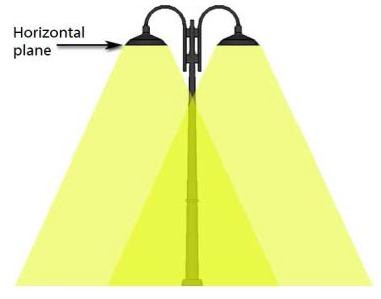
Fully-shielded lights
Outdoor light fixtures shielded or constructed so that no light rays are emitted by the installed fixture at angles above the horizontal plane.
"G"
Gameroom
A use providing video games or other games for playing for amusement and recreation. Any table games such as air hockey, football, pinball, or the like shall be included under this definition. More than three such games shall constitute a primary use and shall be allowed only in those zoning districts permitting gamerooms as a listed permitted use or by a special use permit. Three or fewer such games shall constitute an accessory use and may be permitted in any licensed retail business.
Garage, commercial
Any building or premises, except those described as a private or parking garage, used for the storage or care of motor vehicles, or where any such vehicles are equipped for operation, repaired, or kept for remuneration, hire or sale.
Garage, parking
Any building or premises, other than a private or commercial garage, used exclusively for the parking or storage of motor vehicles.
Garage, private
A building or space used as an accessory to or a part of the main building permitted in any residential district, and providing for the storage of motor vehicles and in which no business, occupation, or service for profit is in any way conducted.
Glare
The effect produced by a light source within the visual field that is sufficiently brighter than the level to which the eyes are adapted, to cause annoyance, discomfort, or loss of visual performance and ability.
Granny pod/temporary health care structure
A temporary structure that will house a single mentally or physically impaired person in accordance with G.S. 160D-915. The statute defines these to be North Carolina residents who require assistance with two or more activities of daily living (bathing, dressing, personal hygiene, ambulation, transferring, toileting, and eating). The impairment must be certified in writing by a physician licensed in North Carolina.
Grocery store
A retail establishment, not a convenience store, for the display and sale of meat, fruits, fresh and packaged foods, cleaning supplies, paper goods, pet supplies, health and beauty products, bakery products, dairy products, wine, beer, and similar items for human consumption and may include a bakery, delicatessen or prescription pharmacy.
Gross floor area
The total area of a building measured by taking the outside dimensions of the building at each floor level intended for occupancy or storage.
Ground disturbing activity
Any use of land by any person that results in a change in the natural cover or topography and that may cause or contribute to sedimentation. This term includes any activity involving, requiring or consisting of the construction or enlargement of a structure; excavation; dredging; filling; dumping; removal of clay, silt, sand, gravel or minerals; bulkheading, driving of pilings; and cleaning or alteration of the shore or bank of water bodies in the town's jurisdiction. The following activities shall not be considered ground disturbing activities under this article:
(1)
The use of land for the purposes of planting, growing, or harvesting plants, crops, trees, grass or other agricultural or forestry products.
(2)
Work by any utility company and other persons engaged in the distribution and transmission of petroleum products, water, telephone, or telegraph messages, or electricity for the purpose of inspecting, repairing, maintaining, or upgrading any existing substations, sewers, mains, pipes, cables, utility tunnels, lines, towers, poles and the line on any of its existing utility property or rights-of-way, or the extension of any of the distribution related facilities in this subsection (2) of this definition to serve development.
(3)
Work by any utility and other persons for the purpose of construction of facilities for the development, generation, and transmission of energy to the extent that such activities are regulated by other law or by present or future rules of the state's utility commission regulating the siting of such facilities, and work on facilities used directly in connection with the facilities in this subsection (3) of this definition.
(4)
Work by a highway or road agency for the maintenance of an existing road, if the work is carried out on land within the boundaries of the existing right-of-way.
Guesthouse (tourist home)
Any dwelling occupied by the owner or operator which rooms are rented for guests and for lodging of transients and travelers for compensation.
Gun range
An area or facility designed and operated for the use of firearms for the purpose of practice shooting and is for commercial purposes.
"H"
Habitable Room
A room or heated floor space used or intended to be used for living or sleeping, excluding bathrooms, kitchens, places for cooking or eating purposes, water closet compartments, laundries, heater rooms, foyers or communicating corridors, closets, and storage spaces.
Hazardous material
Any material defined as a hazardous substance under 29 Code of Federal Regulations 1910.120(a)(3).
Heath spa
A profit-making business or a private club as opposed to YMCA. Spa would include such activities as weight lifting, exercising, steam room, whirlpool, sauna, and possibly other gymnastics.
Heating and air conditioning installation and repair
A business primarily engaged in activity that services, repairs, and sells heating and air conditioning units.
Home occupation
Any profession or occupation carried on entirely within a dwelling providing that such use is clearly incidental and secondary to the use of the dwelling for dwelling purposes, that no more than 25 percent of the total floor area is used for such purposes, and that there is no outside or window display. No mechanical equipment shall be installed or used other than is normally used for domestic or home occupation purposes.
Hotel (motel)
A building or other structure kept, used, maintained, advertised as or held out to the public to be a place where sleeping accommodations are supplied for pay to transient or permanent guests or tenants, where rooms are furnished for the accommodation of such guests; and having or not having one or more dining rooms, restaurants, or cafes where meals or lunches are served to such transient or permanent guests, such sleeping accommodations and dining rooms, restaurants, or cafes, if existing, being conducted in the same buildings in connection therewith. In a residential zoning district, this definition includes any structure permitted after the date of adoption of this Ordinance for temporary or permanent occupancy by more than 14 individuals if the property is available for temporary rental to the general public.
"I"
Inoperable vehicle
Any vehicle, designed to be self-propelled, which by virtue of broken or missing component parts, is no longer capable of self-propulsion. For the purpose of this Ordinance, any vehicle which is registered with the North Carolina Department of Motor Vehicles and has a current North Carolina motor vehicle registration license affixed to it shall not be considered inoperable.
Institutionalized persons
Persons who are committed through some legal process (jail, hospital ward for the dangerously mentally ill), or persons committed to an institution, such as a halfway house, on a time-of-day basis.
"J"
Junkyard
Any land or area used, in whole or in part, for storage and/or sale of wastepaper, rags, scrap metal, vehicles or other junk, and including storage of inoperative motor vehicles and dismantling of such vehicles or machinery.
"K"
Kennel
A commercial operation that: (i) provides food and shelter and care of animals for purposes not primarily related to medical care (a kennel may or may not be run by or associated with a veterinarian), (ii) engages in the breeding of animals for sale, or (iii) engages in the training or breeding of animals.
"L"
Lamp
Part of the fixture that produces actual light.
Landowner
The holder of the title in fee simple. Absent evidence to the contrary, a local government may rely on the county tax records to determine who is a landowner. The landowner may authorize a person holding a valid option, lease, or contract to purchase to act as his or her agent or representative for the purpose of making applications for development approvals.
Legislative decision
The adoption, amendment, or repeal of a regulation under G.S. 160D or an applicable local act. The term also includes the decision to approve, amend, or rescind a development agreement consistent with the provisions of the Unified Development Ordinance.
Legislative hearing
A hearing to solicit public comment on a proposed legislative decision.
Light source
The element of a lighting fixture that is the point of origin of the lumens emitted by the fixture.
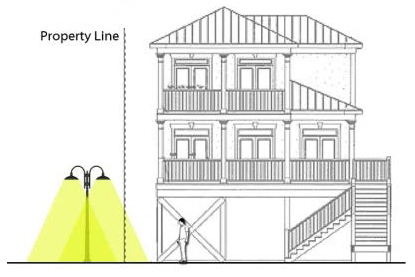
Light trespass
The shining of light produced by a light fixture beyond the boundaries of the property on which it is located as defined by the off-site illumination standards set forth in Section 10.42.
Loading and unloading area
That portion of the vehicle accommodation area used to satisfy the requirements of Article 10, Part III.
Lot
A parcel of land whose boundaries have been established by some legal instrument such as a recorded deed or a recorded map and which is recognized as a separate legal entity for purposes of transfer of title.
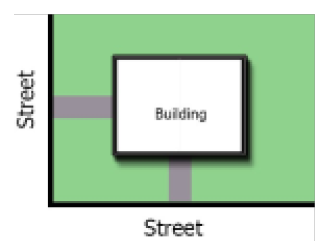
Lot, corner
A lot abutting upon two or more streets at their intersection.
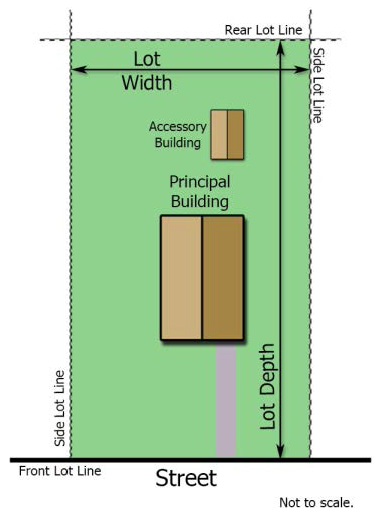
Lot depth
The distance measured in the mean direction of the side lines of the lot from the midpoint of the front line to the midpoint of the opposite main rear line of the lot.
Lot, flag
A flag-shaped lot with its widest point set back from the street or natural amenity, being Davis Creek, the Intracoastal Waterway, the Atlantic Ocean, or other navigable waters, at the rear of another lot and having a thin strip of land connecting to the road or natural amenity to provide legal access and frontage.
Lot, frontage
The length of the front lot line as measured at a street right of way line, with the exception of flag lots and interior lots adjacent to Davis Canal, the Intracoastal Waterway, the Atlantic Ocean, or other navigable waters where the setback shall be 25 feet from the water side.
Lot, front line
The portion of a lot abutting a street right of way from which the front yard setback shall be measured. For the purpose of establishing the setbacks required within this chapter and assigning addresses to developing properties, the following standards shall apply in determining the boundary of a lot that is to be considered the front lot line: (1) In the case of a corner lot, the boundary with the shortest dimension in linear feet abutting a street right of way line shall be considered the front lot line; (2) Where a corner lot exists with equal frontage along two street rights of way, the lot shall be considered to front on the street where the lots within that block have the greater lot frontage as measured in linear feet; and (3) In the case of a through lot, both lot lines abutting a street right of way shall be deemed front lot lines. Addresses shall be assigned to correspond with the front lot line as established in accordance with these standards regardless of the orientation of the structure to be placed upon the lot; therefore, since the front yard is the addressed side then the opposite side is the rear yard.
Lot, interior
A lot other than a corner lot.
Lot lines
The lines bounding a lot.
Lot of record
A lot which is a part of a subdivision, a plat of which has been recorded in the office of the county register of deeds, or a lot described by metes and bounds, the description of which has been recorded in the office of the register of deeds.
Lot, through
An interior lot having frontage on two parallel streets.
Lot width
The straight line distance between the points where the building setback line intersects the two side lot lines.
Lumen
Total quantity of light produced by a light source.
"M"
Manufactured home
A residential dwelling unit that is:
(1)
Not constructed in accordance with the standards set forth in the state building code;
(2)
Composed of one or more components, each of which was substantially assembled in a manufacturing plant and designed to be transported to the lot on its own chassis; and
(3)
At least 550 square feet in size.
(4)
As defined in G.S. 143-145(7).
(5)
Shall be compliant with G.S. 160D-910.
A manufactured home may also be referred to as a "mobile home."
Manufactured home, class A
A manufactured home that meets or exceeds the construction standards promulgated by the U.S. Department of Housing and Urban Development that were in effect at the time of construction and that satisfies each of the following additional criteria:
(1)
The minimum size is 550 square feet.
(2)
The pitch of the roof of the manufactured home has a minimum vertical rise of two point two feet for each 12 feet of horizontal run; the roof is finished with a type of shingle that is commonly used in standard residential construction and which does not exceed the reflectivity of gloss white paint.
(3)
The exterior siding consists of wood, hardboard, vinyl, brick or aluminum and shall be comparable in composition, appearance, and durability to the exterior siding commonly used in standard residential construction, and which does not exceed the reflectivity of gloss white paint.
(4)
Except for units located within an approved manufactured home park, a continuous masonry foundation or masonry curtain wall, unpierced except for required ventilation and access, shall be installed upon a poured concrete footer, as set forth in the North Carolina State Building Code, after placement on the lot and before occupancy.
(5)
Except for units located within an approved manufactured home park, the tongue, axis, transporting light, and removable apparatus are removed after placement on the lot and before occupancy.
(6)
The manufactured home is set up on the site in accordance with the standards set by the state department of insurance and any other applicable state and local laws.
(7)
Stairs, porches, entrance platforms and other means of entrance and exit to the manufactured home shall be installed and constructed in accordance with the standards set by the state department of insurance and any other applicable state and local laws.
(8)
The manufactured home shall be set back in accordance with the laws spelled out within the text of this article.
(9)
Shall be compliant with G.S. 160D-910.
Manufactured home park
Any site or tract of land of contiguous ownership upon which manufactured home spaces are provided for manufactured home occupancy whether or not a charge is made for such service. This does not include manufactured home sales lots on which unoccupied manufactured homes are parked for the purpose of inspection and sales.
Manufactured home space
A plot of land within a manufactured home park designed for the accommodation of one manufactured home.
Marina
Any publicly or privately owned dock, basin, or wet boat storage facility constructed to accommodate more than ten boats and providing any of the following services: permanent or transient docking spaces, dry storage, fueling facilities, haulout facilities, and repair service. Excluded from this definition are boat ramp facilities allowing access only, temporary docking and none of the preceding services.
Master development plan
A plan prepared to depict the uses, development density, generalized site characteristics, and character of a proposed conditional zoning district. Such plan shall be prepared in accordance with the requirements outlined in Article 4.
Master Plan
A dynamic long-term planning document that provides a conceptual layout to guide future growth and development.
Microbrewery
A facility for the production and packaging of malt beverages of low alcoholic content for distribution, retail, or wholesale, on or off premise.
Modular structure
A structure that is constructed in accordance with the construction standards of the state uniform residential building code for one- and two-family dwellings and composed of components substantially assembled in a manufacturing plant and transplanted to the building site for final assembly and placement on a permanent foundation.
Multi-use commercial
A building or buildings designed or constructed to accommodate three or more commercial uses totaling under 10,000 square feet of gross leasable area.
Mural
A graphic displayed on the exterior of a building, generally for the purposes of decoration or artistic expression, including but not limited to painting, fresco, or mosaic, but that does not contain any brand name, product name, letters of the alphabet spelling or abbreviating the name of any product, company, profession, or business, or any logo, trademark, or trade name.
"N"
Night club
An establishment dispensing liquor (aka alcohol) and meals and in which music, dancing, or entertainment is conducted.
Nonconforming lot
A lot that does not meet the minimum area requirements of the district in which the lot is located.
Nonconforming use
The use of a building, manufactured home, or land which does not conform to the use regulations of this article for the district in which it is located, either at the effective date of the ordinance from which this article is derived or as a result of subsequent amendments which may be incorporated into this article.
Nursing home
A facility, however named, which is advertised, announced, or maintained for the express or implied purpose of providing nursing or convalescent care for three or more persons unrelated to the licensee. A nursing home is a home for chronic or convalescent patients, who, on admission, are not as a rule, acutely ill and who do not usually require special facilities such as an operating room, X-ray facilities, laboratory facilities, and obstetrical facilities. A nursing home provides care for persons who have remedial ailments or other ailments, for which medical and nursing care are indicated; who, however, are not sick enough to require general hospital care. Nursing care is their primary need, but they will require continuing medical supervision.
"O"
Observation tower
A tower designed and intended to be used by the public that may be attached to a building or constructed on the ground that is maintained so as to be open and available to the public for observation of the surrounding area.
Oceanfront light trespass
The shining of light produced by a light fixture beyond the boundaries of the property on which it is located during turtle season.
Office
Quarters maintained by individuals or corporation for the purpose of offering services in which no goods or merchandise are sold or displayed over the counter.
Official maps and plans
Any maps or plans officially adopted by the City Council as a guide for the future development and growth of the City and the area immediately adjacent to it. Such maps or plans may consist of maps, charts, and text.
Open space
An area (land and/or water) generally lacking in man-made structures and reserved for enjoyment in its unaltered state.
Outdoor lighting
Nighttime illumination of an outside area, object, or building by any manmade device located outdoors or indoors that produces light by any means.
Outdoor sales and displays
An exhibition meant to enhance an existing business, or as a standalone use, where merchandise, wares or other tangible items are displayed for show and/or sale out-of-doors. Outdoor sales and displays can be primary use on a site if no other principal uses exist and an accessory use if there are existing principal uses already in effect.
"P"
Parking area aisles
That portion of the vehicle accommodation area consisting of lanes providing access to parking spaces.
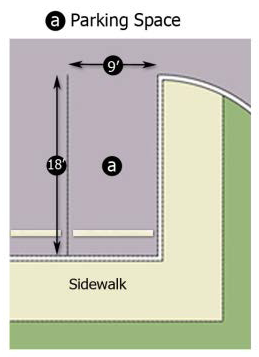
Parking facility (lot)
Any area, either open or enclosed, structural or on grade located outside of the public right-of-way and having an approved means of ingress and egress.
Parking space
A storage space of not less than nine feet by 18 feet for one automobile, plus the necessary access space.
Permitted use
Any use permitted as a right in a zoning district and subject to the limitations of the regulations of the zoning district.
Person
An individual, trustee, executor, other fiduciary, corporation, firm, partnership, association, organization, or other legal entity acting as a unit.
Pier
A wharf, deck, quay, or other structure allowing access to water for recreational and commercial boating, swimming, diving, fishing and transportation. The term pier includes docks.
Pier, commercial
A privately, jointly, or publicly owned structure used for recreational or commercial activity where a user fee is required or the use of the pier involves goods which are introduced into commerce.
Pier, private
A privately owned structure used specifically for recreational or fishing-related activities.
Photovoltaic power
An active solar energy system that converts solar energy directly into electricity.
Planned unit development (PUD)
A zoning district characterized by an approved site design for a mixture of land use types and densities.
Planning and development regulation jurisdiction
The geographic area within which the Town of Oak Island may undertake planning and apply the development regulations authorized by G.S. 160D.
Planning board
Any board or commission established pursuant to G.S. 160D-301.
Porch
A roofed structure not more than 75 percent enclosed by walls and attached to the main building for the purpose of sheltering from the rays of the sun and from rain and weather, exclusive of vehicles.
Premises
A parcel of land and its accompanying structure.
Principal use and principal use structure
A use or structure that constitutes or is occupied by the primary or predominant use of the lot, in accordance with the purposes established under division 4 of this article for the zoning district in which such lot is located.
Private club or lodge
A building and related facilities owned or operated by a corporation, association, or group of individuals established for the fraternal, social, educational, recreational, or cultural enrichment of its members, and whose members meet certain prescribed qualifications for membership and pay membership dues.
Private road or street
Any road or street, within a manufactured home park, group housing project, commercial center, industrial park or other development which is not publicly maintained and is used for access by the occupants of the development, their guests and the general public.
Property
All real property subject to zoning regulations and restrictions and zone boundaries by the town.
Public
Belonging or open to, enjoyed and used by and/or maintained for the public generally, but not limited to a facility the control of which is wholly or partially exercised by some governmental agency.
Public utility
A public service corporation performing some public service and subject to special governmental regulations. Such services shall include, but are not limited to, water supply, electric power and gas distribution.
"Q"
Quasi-judicial decisions
A decision involving the finding of facts regarding a specific application of a development regulation and that requires the exercise of discretion when applying the standards of the regulation. The term includes, but is not limited to, decisions involving variances, special use permits, certificates of appropriateness, and appeals of administrative determinations. Decisions on the approval of subdivision plats and site plans are quasi-judicial in nature if the regulation authorizes a decision-making board to approve or deny the application based not only upon whether the application complies with the specific requirements set forth in the regulation, but also on whether the application complies with one or more generally stated standards requiring a discretionary decision on the findings to be made by the decision-making board.
"R"
Real estate broker
A real estate broker as defined in G.S. 93A-2(a).
Reasonable accommodations
Accommodations held to be reasonable include conversion of a motel to a shelter and a variance from setback requirements. A total exclusion of all nursing home facilities and assisted living residences from a residential district has been held to be a failure to make reasonable accommodations.
Recreational vehicle
A vehicle which is:
(1)
Built on a single chassis;
(2)
Four hundred square feet or less when measured at the largest horizontal projection;
(3)
Designed to be self-propelled or permanently towable by a passenger motor vehicle or a light-duty truck or designed to be carried on a pickup truck; and
(4)
Designed primarily not for use as a permanent dwelling, but as temporary living quarters for recreational, camping, travel, or seasonal use.
Recreational vehicle park
A lot, parcel or tract of land designed to accommodate two or more recreational vehicles, motor homes and tents, but not manufactured homes, together with supporting facilities and required open spaces. This definition shall not include migrant labor camps, manufactured home parks or recreational vehicle sales lots.
Renewable energy resource
A solar electric, solar thermal, wind, hydropower, geothermal, or ocean current or wave energy resource; a biomass resource, including agricultural waste, animal waste, wood waste, spent pulping liquors, combustible residues, combustible liquids, combustible gases, energy crops, or landfill methane; waste heat derived from a renewable energy resource and used to produce electricity or useful, measurable thermal energy at a retail electric customer's facility; or hydrogen derived from a renewable energy resource. Renewable energy resource does not include peat, a fossil fuel, or nuclear energy resource.
Residential child-care facility
A staffed premise with paid or volunteer staff where children receive continuing full-time foster care. Residential child-care facility includes child-caring institutions, group homes, and children's camps which provide foster care, but not family care homes.
Residential cluster development
A development design wherein conventional zoning standards are relaxed to permit modifications in lot area, lot width, lot frontage, lot coverage, required yards, and public street access, and to save infrastructure development cost, environmental damage, energy use and land resources by concentrating dwellings in specific areas of the site without increasing the net density above that which would normally be allowed pursuant to Article 8, Zoning District Development Standards.
Residential property
An apartment, condominium, single-family home, townhouse, cottage, or other property that is devoted to residential use or occupancy by one or more persons for a definite or indefinite period. (G.S. 42A-4(2))
Restaurant
An establishment where food service is a primary activity. The facility may be designed to cater or accommodate the consumption of food either on or off the premises. The serving of alcoholic beverages in a restaurant shall be in compliance with the ABC laws.
Retaining Wall
A relatively rigid wall used for supporting soil laterally so that it can be retained at different levels on the two sides. Retaining walls are structures designed to restrain soil to a slope that it would not naturally keep to. They are used to bound soils between two different elevations often in areas of terrain possessing undesirable slopes or in areas where the landscape needs to be shaped severely and engineered for more specific purposes.
Right-of-way
The term "right-of-way" for land platting purposes shall mean that each street or road right-of-way hereafter established and shown on a final plat is to be SEPARATE AND DISTINCT from the lots or parcels of land adjoining such streets or road right-of-way and not included within area requirements for such lots or parcels.
"S"
Self-service storage facility (or mini-warehouse)
A structure containing separate, individual, and private storage spaces of varying size, leased or rented on individual leases for varying periods of time. Said spaces shall not be utilized for the storage of flammable or hazardous chemicals or explosives.
Service station
Any building or land used for the dispensing, sale or offering for sale at retail, any automobile fuels, lubricants, tires, and accessories, except that car washing, mechanical and electrical repairs, and tire repairs are only performed indoors. Incidental activities shall not include tire retreading, major body work, or major mechanical work.
Setbacks
The required distance between every structure and the lot lines of the lot on which it is located.
Sexually oriented businesses
Any place defined as an "adult establishment" by G.S. 14-202.10 as such statute may be amended, except that the definition of massage business shall not include any establishment or business where massage is practiced that is a health club, exercise studio, hospital, physical therapy business, or similar health related business. Sexually oriented businesses specifically include however, any massage business where massages are performed on any clients "specified anatomical areas" as this term is defined by G.S. 10-202.10, as amended. This term may also be used interchangeably with adult entertainment business.
Shadow flicker
The visible flicker effect when rotating turbine blades cast shadows on the ground and nearby structures causing the repeating pattern of light and shadow.
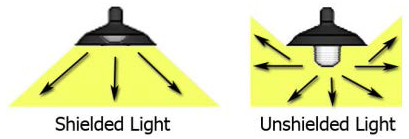
Shielding
A design feature or a device that is applied to a light fixture or to a structure on which a light fixture is mounted to prevent its light output from being visible from selected locations or horizontal and/or vertical angles.
Shelter, oceanfront
A freestanding, unenclosed structure located on an oceanfront lot. The maximum size of the structure footprint is 200 square feet. No utilities other than water for foot showers are allowed. The structure must meet the setback requirements for the district in which it is located.
Shopping center
A building or building located on the same site having three or more commercial uses with a minimum of 10,000 square feet of total gross leasable area, planned and constructed as a single or phased project.
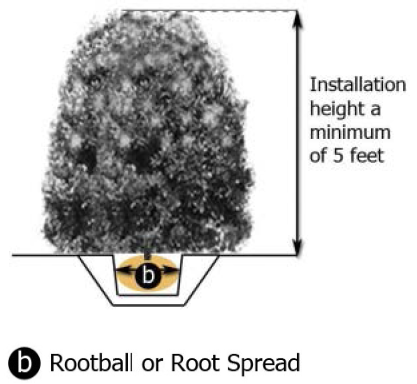
Shrub, intermediate
Deciduous or evergreen plants installed at a minimum height of 36 inches, a minimum of five canes, and a minimum spread of roots or rootball diameter of 14 inches.
Shrub, large
Deciduous and/or evergreen plants, as required in the applicable sections, installed at a minimum height of five feet, a minimum of six canes, and a minimum spread of roots or rootball diameter of 24-inches. Large shrubs shall be maintained at a height of six to ten feet, and shall be of a vegetation family which normally does not grow taller than ten feet.
Sign Regulations Definitions
(1)
Animation means the movement, or optical illusion of movement of any part of the sign. Also included in this definition are signs having chasing action which is the action of a row of lights commonly used to create the appearance of motion. Automatic changeable copy boards are permitted provided that there is no running action to copy and provided that the copy does not change more than once every one minute. No flashing, revolving, or intermittent illuminating shall be employed.
(2)
Beacon means any light with one or more beams directed into the atmosphere or directed at one or more points not on the same property as the light source. Also, any light with one or more beams that rotate or move.
(3)
Copy means any words, letters, numbers, figures, characters, symbols, logos, or insignia that are used on a sign display surface.
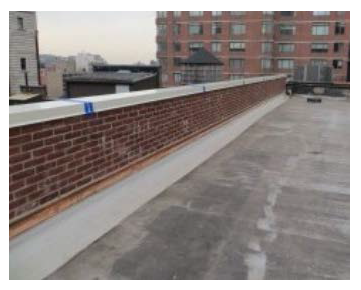
(4)
Parapet means the extension of a false front or a false wall above the roofline.
(5)
Roof Line means the top edge of a roof or building parapet, whichever is higher, excluding any cupolas, pylons, chimneys, or minor projections.
(6)
Sign means any words, lettering, figures, numerals, emblems, devices, trademarks or trade names, or any combination thereof, by which anything is made known and which is designed to attract attention and/or convey a message. The following shall not be included in the application of the regulations of this article:
(a)
Signs not exceeding one square foot in area and bearing only property numbers, post office box numbers, names of occupants of premises, or other identification of premises not having commercial connotation.
(b)
Flags and insignias of any government except when displayed in connection with commercial promotion.
(c)
Legal notices, identification, information, or directional signs erected or required by governmental bodies.
(d)
Integral decorative or architectural features on buildings except letters, trademarks, moving parts, or moving lights.
(e)
Signs directing and guiding traffic and parking on private property, but bearing no advertising matter.
(f)
Murals as defined in this Ordinance.

(7)
Sign, A-Frame means any sign constructed in such a manner as to form an "A" or tent-like shape, hinged or not hinged at the top; each angular face held at an approximate distance by a supporting member. Also referred to as sandwich boards.
(8)
Sign area means the entire face of a sign and all wall work including illuminating tubing incidental to its decoration shall be included for measurement of sign areas. In the case of an open sign made up of individual letters, figures or design, all intervening area shall be included as part of the sign area. In computing sign area, only one side of a double face sign structure shall be considered.
(9)
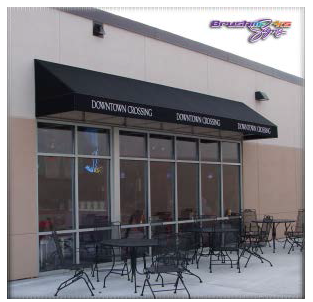
Sign, awning means any non-illuminated sign painted on or applied to a structure made of cloth, canvas, metal, or similar material that is affixed to a building and projects therefrom. Such signs may or may not be fixed or equipped with a mechanism for raising and holding an awning in a retracted position against the building.
(10)
Sign, business identification means any sign which advertises an establishment, a service, commodity, or activity conducted upon the premises where such sign is located.
(11)
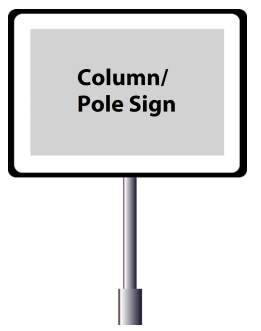
Sign, column/pole means a freestanding sign supported by one or more columns or poles or other similar support.
(12)
Sign, commercial accessory means a freestanding sign on a commercial parcel relating to the products sold thereon in addition to the principal use sign.
(13)
Sign, construction means a sign placed at a construction site identifying or announcing the project or the name of the architect, engineer, contractor, financier or others involved in the development of the project.
(14)
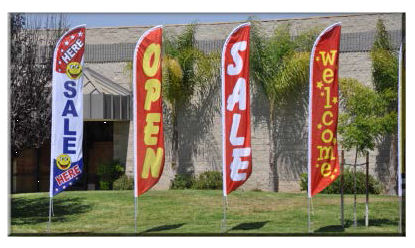
Sign, feather flag means freestanding temporary sign typically constructed of a single plastic or metal shaft driven in the ground with an attached pennant that is vertically elongated and attached to the shaft.
(15)
Sign, flag means a device generally made of flexible material, usually cloth, paper or plastic, typically used as a symbol of a government, school, or religion. The term "Flag" does not include feather flag signs.
(16)
Sign, freestanding means sign that (i) is not directly attached to, erected on, or supported by a building or other structure having a principal function other than the support of such sign, but (ii) is instead attached to, erected on, or supported by some structure (such as a pole, mast, frame, or other structure) that is not itself an integral part of a building or other structure having a principal function other than the support of a sign.
(17)
Sign, ground-mounted means freestanding sign, supported by a contiguous structural base or planter box that is permanently affixed to the ground.
(18)
Sign, height of means the vertical distance measured from the ground to the top of the sign face or sign structure, whichever is greater.
(19)
Sign, ID plaques means any sign indicating the name and addressing of a building; or the name of an occupant thereof, and the practice of a permitted occupation therein.
(20)
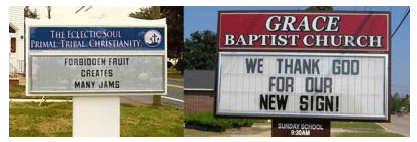
Sign, message board means a sign or portion thereof with characters, letters, or illustrations that can be changed or rearranged without altering the face or the surface of the sign. This definition does not include menu and sandwich board signs.
(21)
Sign, monument means any sign permanently attached to the ground and not attached to any building advertising multiple tenants, multiple uses, multiple buildings or multiple parcels. The design of the monument sign is to advertise multiple offerings in the building, group of buildings, or development area. Individual business within multi-tenant facilities are not permitted freestanding signs and shall have their signage located on a monument sign.
(22)
Sign, nonconforming means a sign which was legally erected prior to the effective date of this Ordinance, but which does not conform to these regulations.
(23)
Sign, outdoor advertising means any sign, including a standard poster panel, either freestanding or attached to a structure, which directs attention to a business, commodity, service, entertainment, or other activity conducted, sold, or offered elsewhere than on the premises on which such sign is located.
(24)
Sign, portable means any sign not permanently affixed or which is capable of being transported on its own chassis or by other mobile means.
(25)
Sign, principal use means a sign which directs attention to a business, commodity, service, entertainment, or other activity conducted, sold, or offered on the premises upon which such sign is located.
(26)
Sign, projecting means any sign, other than a wall, awning, canopy or marquee sign, which is affixed to a building and is supported only by the wall on which the sign is mounted.
(27)
Sign, roof means any sign erected, constructed, or maintained upon or over the roof of a building, or extending above the highest wall of the building, and having its principal support on the roof or walls of the building.
(28)
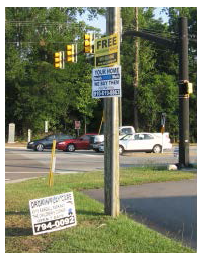
Sign, snipe means a sign that is tacked, nailed, posted, pasted, glued or otherwise attached to trees, poles, stakes, fences, or to other objects.
(29)
Sign, temporary means any sign that advertises or directs attention to a product, event, election, activity, meeting, exhibition, or performance of any kind where such a sign is not permanently affixed, placed, or erected and is allowed for a limited timeframe.
(30)
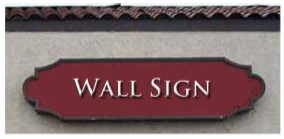
Sign, wall means any sign attached to, painted on, or erected against any wall of a building or structure so that the exposed face of the sign is on a plane parallel to the plane of said wall and which does not extend more than eighteen inches from the wall.

(31)
Sign, wind means any display or series of objects designed and fashioned in such a manner as to move when subjected to internal wind pressure.
(32)
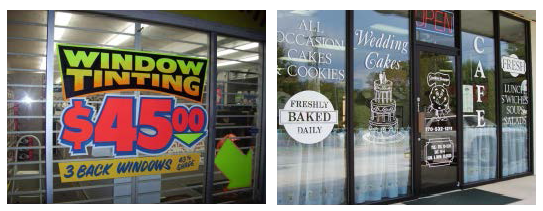
Sign, window means any sign appearing in, on or through a window of a structure and visible from outside. The term window sign shall not be used to define a window display.
Site plan
A scaled drawing and supporting text showing the relationship between lot lines and the existing or proposed uses, buildings, or structures on the lot. The site plan may include site-specific details such as building areas, building height and floor area, setbacks from lot lines and street rights-of-way, intensities, densities, utility lines and locations, parking, access points, roads, and stormwater control facilities that are depicted to show compliance with all legally required development regulations that are applicable to the project and the site plan review as defined in G.S. 160D-102.
Site plan, major
All site plans not meeting the requirements for a minor site plan.
Site plan, minor
Includes the following:
(1)
Buildings or additions with an aggregate enclosed square footage of less than 7,000 square feet;
(2)
Buildings or additions involving land disturbance of less than one acre;
(3)
Multi-family development involving fewer than ten dwelling units;
(4)
Parking lot expansions which comply with this Ordinance with no increase in enclosed floor area;
(5)
Revision to landscaping, signage, or lighting which comply with the requirements of this Ordinance;
(6)
Accessory uses which comply with the requirements of this Ordinance;
(7)
Site plans which do not require a variance or modification of the requirements of this Ordinance, and otherwise comply with this Ordinance; and
(8)
Site plans which do not require easement dedication or street construction.
Sleeping room
A room designated as sleeping or bedroom on the plans and permit application.
Sleeping unit
A room or space in which people sleep, which can also include permanent provisions for living, eating, and either sanitation or kitchen facilities but not both. Such rooms are spaces that are also part of a dwelling unit are not sleeping units.
Solar collector (accessory)
Any solar device that absorbs and accumulates solar radiation for use as a source of energy. The device may be roof-mounted or ground-mounted as an accessory use.
Solar energy
Radiant energy received from the sun that can be collected in the form of heat or light by a solar collector.
Solar energy system
A device or structural design feature, a substantial purpose of which is to provide daylight for interior lighting or provide for the collection, storage and distribution of solar energy for space heating or cooling, electricity generating, or water heating. Solar Energy Systems may include, but not be limited to, solar farms and any of several devices that absorb and collect solar radiation for use as a source of energy as an accessory use.
Solar farm
An area of land designated use for the sole purpose of deploying photovoltaic power and generating electric energy.
Special Use Permit
A use permitted in one or more zones but which, because of characteristics peculiar to such use, requires a special degree of control to make such uses compatible with other uses in the same districts.
Standing
The following persons shall have standing to file a petition or appeal under this Ordinance:
(1)
Any person meeting any of the following criteria:
(a)
Has an ownership interest in the property that is the subject of the decision being appealed, a leasehold interest in the property that is the subject of the decision being appealed, or an interest created by easement, restriction, or covenant in the property that is the subject of the decision being appealed.
(b)
Has an option or contract to purchase the property that is the subject of the decision being appealed.
(c)
Was an applicant before the decision-making board whose decision is being appealed.
(2)
Any other person who will suffer special damages as the result of the decision being appealed.
(3)
An incorporated or unincorporated association to which owners or lessees of property in a designated area belong by virtue of their owning or leasing property in that area, or an association otherwise organized to protect and foster the interest of the particular neighborhood or local area, so long as at least one of the members of the association would have standing as an individual to challenge the decision being appealed, and the association was not created in response to the particular development or issue that is the subject of the appeal.
(4)
A town whose decision-making board has made a decision that the Council believes improperly grants a variance or is otherwise inconsistent with the proper interpretation of an ordinance adopted by the Town Council.
Story
That portion of a building included between the surface of any floor and the surface of the next floor above it, or if there is no floor above it, then the space between such floor and the ceiling next above it. In computing the height of a building, the height of any basement or cellar, if below grade, shall not be included.
Street
A thoroughfare that affords the principal means of access to abutting property, including avenue, place, way, drive, land, boulevard, highway, road and any other thoroughfare except an alley.
Street line
The line between the street right-of-way and abutting property.
Street, through
Oak Island Drive, Yacht Drive, Beach Drive, Dolphin Drive, Ocean Drive, Elizabeth Drive, Country Club Drive and Long Beach Road.
Structure
Anything constructed or erected with a fixed location on or in the ground or attached to something having more or less a fixed location on or in the ground. Among other things, structures include buildings, manufactured homes, walls, fences, signs, billboards, poster panels and swimming pools.
Structural alterations
Any change, except for repair or replacement, in the supporting members of a structure, such as bearing walls, columns, beams or girders.
Subdivision
All divisions of a tract or parcel of land into two or more lots, building sites, or other divisions when any one or more of those divisions is created for the purpose of sale or building development (whether immediate or future) and shall include all divisions of land involving the dedication of a new street or a change in existing streets; but the following shall not be included within this definition nor be subject to the regulations authorized by article 10, part V:
(1)
The combination or recombination of portions of previously subdivided and recorded lots where the total number of lots is not increased and the resultant lots are equal to or exceed the standards of the municipality as shown on its subdivision regulations.
(2)
The division of land into parcels greater than ten acres where no street right-of-way dedication is involved.
(3)
The public acquisition by purchase of strips of land for the widening or opening of streets or for public transportation system corridors.
(4)
The division of a tract in single ownership whose entire area is no greater than two acres into not more than three lots, where no street right-of-way dedication is involved and where the resultant lots are equal to or exceed the standards of the municipality, as shown in its subdivision regulations.
(5)
The division of a tract into parcels in accordance with the terms of a probated will or in accordance with intestate succession under G.S. ch. 29.
Subdivision, major
Any subdivision other than a minor subdivision.
Subdivision, minor
A subdivision that does not involve any of the following: (i) the creation of more than a total of five lots; (ii) the creation of any new public streets; (iii) the extension of a public water or sewer system; or (iv) the installation of drainage improvements through one or more lots to serve one or more other lots.
Substantial improvement
Any repair, reconstruction or improvement of a building, the cost of which equals or exceeds 50 percent of the market value of the building, either before improvement or repair is started, or if the structure has been damaged. For the purposes of this definition, the term "substantial improvement" is considered to occur when the first alteration of any wall, ceiling, floor or other structural part of the building commences, whether or not that alteration affects the external dimensions of the structure.
Swimming pool
A structure, whether above or below grade level, designed to hold water more than 30 inches deep to be used for recreational purposes.
"T"
Temporary emergency, construction or repair residence ;b0;Temporary accommodations such as manufactured housing, recreational vehicle, or a travel trailer providing temporary housing accommodations for individuals or families whose homes have been destroyed or significantly damaged, through no fault of the owner, by an emergency or natural disaster as determined by the town manager. A subordinate residence (which may be a Class B manufactured home, travel trailer) that is: located on the same lot as a single-family dwelling made uninhabitable by fire, flood, or other natural disaster and occupied by the persons displaced by such disaster, or (ii) located on the same lot as a residence that is under construction or undergoing substantial repairs or reconstruction and occupied by the persons intending to live in such permanent residence when the work is completed.
Temporary outdoor lighting
Artificial illumination of an outside area for a period of less than seven days, with at least 90 days passing before being used again.
Temporary storage facility (portable storage units)
Any container intended for storing or keeping household goods, other personal property or business related goods intended to be filled, refilled, or emptied while located outdoors and later removed from the property for storage or disposal off-site. Temporary storage facilities are sometimes also known as portable storage units or portable storage containers.
Therapeutic foster home
A family foster home where, in addition to the provision of foster care, foster parents who receive appropriate training provide a child with behavioral health treatment services under the supervision of a county department of social services, an area mental health program, or a licensed private agency and in compliance with licensing rules adopted by the Commission.
Tiny house
A single-family detached home that is 200 square feet to 699 square feet in size (not including loft space) and complies with the North Carolina State Building Code, includes container homes. A tiny house on wheels for permanent occupancy (longer than 30 days) is considered a recreational vehicle.
Tower
A portion of a building that is higher than the remainder of the building, or a tall structure of small dimension separate from the building it accompanies such as the campanile of a church.
Transparency
Capable of transmitting light in a manner that permits a person standing outside of a building to view shapes, tones, and objects inside a building. A tinted window is considered "transparent" if it complies with the restrictions in NCGS 20-127(b).
Travel trailer
Any vehicle or structure originally designed to be transported and intended for human occupancy for a short period of time, such vehicle usually containing limited or no kitchen and bathroom facilities. Travel trailers shall include the following:
(1)
House trailer. A vehicular, portable structure built on a wheeled chassis, designed to be towed by a self-propelled vehicle for use for travel, recreation, and vacation purposes, having a body width of eight feet or less or a body length of 32 feet or less when equipped for road travel.
(2)
Pickup coach. A portable structure for use as a temporary dwelling for travel, recreation, and vacation, designed to be mounted on a truck chassis for a temporary dwelling while either mounted or dismounted.
(3)
Motor home. A portable, temporary dwelling to be used for travel, recreation, and vacation, constructed as an integral part of a self-propelled vehicle. This definition shall include vans or panel trucks equipped for camping.
(4)
Camping trailer. A folding structure manufactured of metal, wood, canvas, and/or other materials, mounted on wheels and designed for travel, recreation, and vacation use.
"U"
UDO administrator
The UDO Administrator is the Planning and Development Director or a designee appointed by the City Manager.
Unified tract development
A tract of land under single, individual, corporate, firm, partnership or association ownership, or under common control, that is planned and developed as an integral unit in which lot sizes, setbacks, densities and land uses may be adjusted in return for conformity with an approved plan for the entire project.
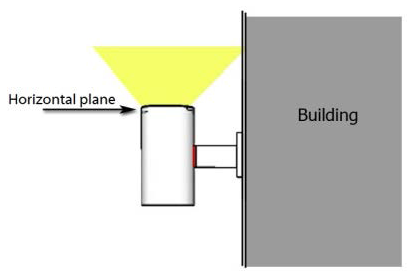
Uplighting
For pole-mounted or wall-mounted fixtures, light that projects above an imaginary horizontal plane through the fixture; for fixtures intended to light a nonresidential building, light that projects above the lowest roofline.
Use
The activity or function that actually takes place or is intended to take place on a lot.
"V"
Vacation rental
The rental of residential property for vacation, leisure, or recreational purposes for fewer than 90 days by a person who has a place of permanent residence to which he or she intends to return. (G.S. 42A-4(3))
Vacation rental agreement
A written agreement between a landlord or his or her real estate broker and a tenant in which the tenant agrees to rent residential property belonging to the landlord for a vacation rental.
Variance
A relaxation of the terms of this article where such variance will not be contrary to the public interest and where, owing to conditions peculiar to the property and not the result of the action of the applicant a literal enforcement of this article would result in unnecessary and undue hardship. As used in this article, a variance is authorized only for height, area, and size of a structure or size of yards and open spaces; establishment or expansion of a use otherwise prohibited shall not be allowed by variance, nor shall a variance be granted because of the presence of nonconformities in the zoning district or uses in an adjoining zoning district.
Vehicle accommodation area
That portion of a lot that is used by vehicles for access, circulation, parking, and loading and unloading. It comprises the total of circulation areas, loading and unloading areas, and parking areas (spaces and aisles).
Vendor
A person, other than a merchant with an established retail store in the town, who transports an inventory of goods to a building, vacant lot, or other location in a town and who, at that location, displays the goods for sale and sells the goods at retail or offers the goods for sale at retail.
"W"
Wall
A barrier intended to screen a view or to cover mechanical equipment and other similar unsightly items that is designed and built in a sound workmanlike manner with adequate footings to withstand normal wear while keeping an attractive appearance. Walls are freestanding accessory structures and must meet the standards in Section 7.57.
Wall (Privacy)
A privacy wall is a barrier which is designed to create a shield which provides privacy for a residence or business. Businesses, such as medical clinics and legal offices, may use privacy walls to maintain confidentiality. The intent of a privacy wall is privacy, not necessarily confinement or security. Privacy walls are freestanding accessory structures and must meet the standards in Section 7.56.
Water tower
A water shortage tank, a standpipe, or an elevated tank situated on a support structure, originally constructed for use as a reservoir or facility to store or deliver water.
Wind farm
An electricity-generating facility whose main purpose is to supply electricity to the electrical grid, consisting of one or more wind turbines and other accessory structures and buildings including substations, meteorological towers, electrical infrastructure, transmission lines, and other appurtenant structures and facilities, which has a rated capacity of greater than 100 kW.
Wind energy generator (accessory)
A single system consisting of a single wind turbine, a tower, and associated control or conversion electronics designed to supplement other electricity sources as an accessory use to existing buildings or facilities, which has a rated capacity of not more than 100 kW.
Wind power
Power that is generated in the form of electricity by converting the rotation of wind turbine blades into electrical current by means of an electrical generator.
Wind turbine
A wind energy conversion system that converts wind energy into electricity through the use of a wind turbine generator, and may include a nacelle, rotor, tower, and pad transformer.
Wind turbine height
The distance measured from grade to the highest point of the turbine rotor or tip of the turbine blade when it reaches its highest elevation.
Wireless Communication Facilities Definitions
(1)
Abandonment means cessation of use of a wireless support structure for wireless telecommunication activity for at least the minimum period of time specified under this Ordinance.
(2)
Accessory equipment means any equipment serving or being used in conjunction with a Wireless Facility or Wireless Support Structure. The term includes utility or transmission equipment, power supplies, generators, batteries, cables, equipment buildings, cabinets and storage sheds, shelters or similar structures.
(3)
Antenna means communications equipment that transmits, receives, or transmits and receives electromagnetic radio signals used in the provision of all types of wireless communications services.
(4)
Application, wireless facility means a formal request submitted to the UDO Administrator to construct or modify a wireless support structure or a wireless facility.
(5)
Carrier on wheels or cell on wheels (COW) means a portable self-contained Wireless Facility that can be moved to a location and set up to provide wireless services on a temporary or emergency basis. A COW is normally vehicle-mounted and contains a telescoping boom as the Antenna support structure.
(6)
Collocation means the mounting or installation of transmission equipment on a currently existing tower or base station for the purpose of transmitting and/or receiving radio frequency signals for communications purposes.
(7)
Communication tower means a new or existing structure, such as a monopole, lattice tower, guyed tower, fire observation tower, or water tower that is designed to support or is capable of supporting equipment used in the transmission or receipt of television broadcast signals, radio wave signals, or electromagnetic radio signals used in the provision of wireless communication service.
(8)
Concealed wireless facility means any Wireless Facility that is integrated as an architectural feature of an Existing Structure or any new Wireless Support Structure designed to camouflage or conceal the presence of antennas or towers so that the purpose of the Facility or Wireless Support Structure is not readily apparent to a casual observer.
(9)
Electrical transmission tower means an electrical transmission structure used to support high voltage overhead power lines. The term shall not include any Utility Pole.
(10)
Eligible facilities request means a request for modification of an existing wireless tower or base station that involves collocation of new transmission equipment or replacement of transmission equipment but does not include a substantial modification.
(11)
Equipment compound means an area surrounding or near the base of a Wireless Support Structure within which a wireless facility is located.
(12)
Existing structure means a Wireless Support Structure, erected prior to the application for collocation or substantial modification under this Ordinance, that is capable of supporting the attachment of Wireless Facilities, including, but not limited to, Electrical Transmission Towers, buildings, and Water Towers. The term shall not include any Utility Pole.
(13)
Fall zone means the area in which a Wireless Support Structure may be expected to fall in the event of a structural failure, as measured by engineering standards.
(14)
Monopole means a single, freestanding pole-type structure supporting one or more Antennas. For the purposes of this Ordinance, a Monopole is not a Tower or a Utility Pole.
(15)
Ordinary maintenance means ensuring that Wireless Facilities and Wireless Support Structures are kept in good operating condition. Ordinary Maintenance includes inspections, testing, and modifications that maintain functional capacity and structural integrity; for example, the strengthening of a Wireless Support Structure's foundation or of the Wireless Support Structure itself. Ordinary Maintenance includes replacing Antennas of a similar size, weight, shape, and color and Accessory Equipment within an existing Equipment Compound and relocating the Antennas to different height levels on an existing Monopole or Tower upon which they are currently located. Ordinary Maintenance does not include Substantial Modifications.
(16)
Replacement pole means a pole of equal proportions and of equal height or such other height that would not constitute a Substantial Modification to an Existing Structure in order to support Wireless Facilities or to accommodate Collocation. Requires removal of the Wireless Support Structure it replaces.
(17)
Satellite dish antenna or satellite earth station means an antenna and attendant processing equipment for reception of electronic signals from satellites.
(18)
Search ring means the area within which a Wireless Support Facility or Wireless Facility must be located in order to meet service objectives of the wireless service provider using the wireless facility or wireless support structure.
(19)
Substantial modification or change means the mounting of a proposed Wireless Facility on a Wireless Support Structure that substantially changes the physical dimensions of the support structure. A mounting is presumed to be a substantial modification if it meets any one or more of the criteria listed below. The burden is on the local government to demonstrate that a mounting that does not meet the listed criteria constitutes a substantial change to the physical dimensions of the Wireless Support Structure.
(a)
For towers other than towers in the public rights-of-way, it increases the height of the tower by more than ten percent, or by the height of one additional Antenna array with separation from the nearest existing Antenna not to exceed 20 feet, whichever is greater. For other eligible support structures, it increases the height of the structure by more than ten percent or more than ten feet, whichever is greater. Changes in height should be measured from the original support structure in cases where deployments are or will be separated horizontally, such as on buildings' rooftops; in other circumstances, changes in height should be measured from the dimensions of the tower or base station, inclusive of originally approved appurtenances and any modifications that were approved prior to the passage of the U.S. Spectrum Act.
(b)
For towers other than towers in the public rights-of-way, it involves adding an appurtenance to the body of a tower that would protrude from the edge of the tower more than 20 feet, or more than the width of the tower structure at the level of the appurtenance, whichever is greater. For other eligible support structures, it involves adding an appurtenance to the body of the structure that would protrude from the edge of the structure by more than six feet.
(c)
For any eligible support structure, it involves installation of more than the standard number of new equipment cabinets for the technology involved, but not to exceed four cabinets; or, for towers in the public rights-of-way and base stations, it involves installation of any new equipment cabinets on the ground if there are no pre-existing ground cabinets that are more than ten percent larger in height or overall volume than any other ground cabinets associated with the structure.
(d)
It entails any excavation or deployment outside the current site.
(e)
It would defeat the concealment elements of the eligible support structure.
(f)
It does not comply with conditions associated with the siting approval of the construction or modification of the eligible support structure or base station equipment, provided, however, that this limitation does not apply to any modification that is non-compliant only in a manner that would not exceed the thresholds identified in subsections (a) through (e) above.
(20)
Tower means a lattice-type structure, guyed or freestanding, that supports one or more Antennas.
(21)
Town right-of-way means a right-of-way owned, leased, or operated by a town, including any public street or alley that is not part of the State highway system.
(22)
Town utility pole means a utility pole owned or operated by a town in the right-of-way of any public street or alley that is not a part of the State highway system.
(23)
Utility pole means a structure that is designed for and used to carry lines, cables, or wires for telephone, cable television, or electricity, or to provide lighting.
(24)
Wireless facility or wireless facilities means the set of equipment and network components, exclusive of the underlying Wireless Support Structure or Tower, including Antennas, Accessory Equipment, transmitters, receivers, Base Stations, power supplies, cabling and associated equipment necessary to provide wireless data and wireless telecommunications services to a discrete geographic area.
(25)
Wireless support structure means a new or existing structure, such as a Monopole, Lattice Tower, or Guyed Tower that is designed to support or capable of supporting Wireless Facilities. This definition does not include Utility Poles.
"X"
None
"Y"
Yard
An open space on the same lot with a building, unoccupied and unobstructed from the ground upward, except by trees or shrubbery or as otherwise provided in this article.
Yard sale
The sale, or offer for sale, of miscellaneous items of personal property within the boundaries of a residential property, including street rights-of-way, within the corporate limits of the Town.
Yard, front
A yard across the full width of the lot, extending from the front line of the building, excluding steps and uncovered porches, to the front lot line.
Yard, rear
A yard extending across the full width of the lot and measured between the rear line of the lot and the rear line of the main building.
Yard, side
An open unoccupied space on the same lot with a building between the building and the side line of the lot extending through from the front building line to the rear yard or to the rear line of the lot, where no rear yard is required.
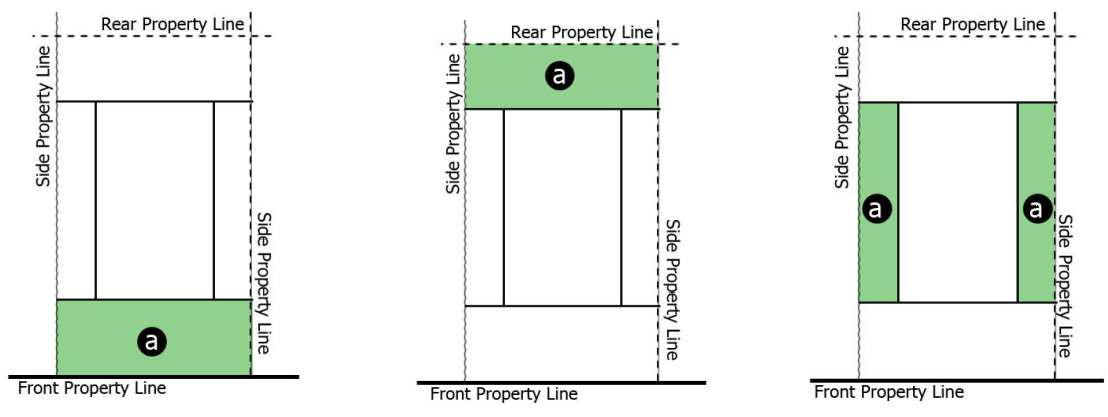
"Z"
Zoning
A police power measure, enacted primarily by general purpose units of local government, in which the community is divided into districts or zones within which permitted and special uses are established as are regulations governing lot size, building bulk, placement, and other development standards. Requirements vary from district to district, but they must be uniform within districts. The Zoning Code consists of two parts: a text and a map.
Zoning permit
A permit issued by the UDO Administrator that authorizes the recipient to make use of property in accordance with the requirements of this Ordinance.
(Ord. of 10-9-2018; Amend. of 12-11-2018; Amend. of 3-12-2019(1); Amend. of 9-10-2019; Amend. of 11-12-2019(2); Amend. of 8-11-2020(2); Amend. of 10-13-2020(2); Amend. of 2-9-2021(1); Amend. of 2-9-2021(2); Amend. of 2-9-2021(3); Amend. of 5-11-2021(1); Amend. of 6-8-2021(5); Amend. of 6-8-2021(7); Amend. of 6-8-2021(9); Amend. of 6-8-2021(10); Amend. of 6-8-2021(13); Amend. of 12-14-2021; Amend. of 1-11-2022(1); Amend. of 2-8-2022; Amend. of 10-11-2022; Amend. of 9-10-2024(5))

