
Oak Ridge City Zoning Code
ARTICLE VIII
SUBDIVISIONS
Sec. 30-620. - Exclusion determination.
If a proposed division of land meets one or more of the exclusions under the definition of "Subdivision" in article I, the owner may submit to the planning department maps, deeds, or other materials in sufficient detail to permit a conclusive determination by the enforcement officer.
(Ord. of 1-6-2000, § 5-1)
Sec. 30-621. - Coordination with other procedures.
To lessen the time required to attain all necessary approvals and to facilitate the processing of applications, an applicant may start the subdivision approval process simultaneously with applications for grading permits or other applications for approvals required for the particular project.
(Ord. of 1-6-2000, § 5-2)
Sec. 30-622. - Submission of plans.
Applications for subdivision approval, including group development approval, shall be submitted to the planning department. Subdivision requiring planning and zoning board approval shall be presented to the planning department at least 14 days prior to the next scheduled meeting of the planning and zoning board.
(Ord. of 1-6-2000, § 5-3)
Sec. 30-623. - Approval required.
(a)
Date of compliance. After the effective date of the ordinance from which this article is derived, no plat for the subdivision of land within the town shall be filed, accepted for recording, or recorded, nor shall the clerk of the superior court order the recording of a plat until it has been submitted to and approved by the jurisdiction. (See definition of "subdivision" in article I for exclusions.)
(b)
Duration of vesting. The statutory vesting granted by this section, once established, expires for an uncompleted development project if development work is intentionally and voluntarily discontinued for a period of not less than 24 consecutive months, and the statutory vesting period granted by this section for a nonconforming use of property expires if the use is intentionally and voluntarily discontinued for a period of not less than 24 consecutive months. The 24-month discontinuance period is automatically tolled during the pendency of any board of adjustment proceeding or civil action in a state or federal trial or appellate court regarding the validity of a development permit, the use of the property, or the existence of the statutory vesting period granted by this section. The 24-month discontinuance period is also tolled during the pendency of any litigation involving the development project or property that is the subject of the vesting.
(c)
No subdivision without approval. No real property, including property declared under the North Carolina Condominium Act G.S. 47C-1 et seq., lying within the jurisdiction as now or hereafter fixed shall be subdivided except in conformance with all applicable provisions of this article. Violation of this section shall be a misdemeanor.
(d)
Dedication and acceptance.
(1)
Rights-of-way and easements. The approval and recordation of a plat constitutes dedication to and acceptance by the jurisdiction and the public of the right-of-way of each public street, alley, or utility or drainage easement shown on such plat. The approval and recordation of a plat does not constitute acceptance for maintenance responsibility within such right-of-way or easement. Improvements within such rights-of-way or easements, such as utility lines, street paving, drainage facilities or sidewalks may be accepted for maintenance by the town council or by the administrative officer authorized to inspect and, where appropriate, accept the dedication of such improvements.
(2)
Open space. Land designated as public open space on a plat shall be considered to be offered for dedication until such offer is accepted by the jurisdiction. The offer may be accepted by the jurisdiction through:
a.
Express action by the town council;
b.
Express action by an administrative officer designated by the town council; or
c.
Conveyance of fee simple marketable title (unencumbered financially and environmentally) of the property to the jurisdiction at the time of final plat recordation. Until such dedication has been accepted, land so offered may be used for open space purposes by the owner or by the owner's association. Land so offered for dedication shall not be used for any purpose inconsistent with the proposed public use.
(Ord. of 1-6-2000, § 5-4; Ord. No. O-2021-13, § 1, 7-1-2021)
Sec. 30-650. - Conference.
In the interest of efficiency and economy, every subdivision applicant is strongly encouraged to schedule a pre-application conference with the planning staff prior to the submission of a preliminary plat.
(Ord. of 1-6-2000, § 5-5.1; Ord. No. O-2021-13, § 1, 7-1-2021)
Sec. 30-651. - Sketch plan.
(a)
Required for staff review. A sketch plan is required for staff review whenever adjoining land is owned by the subdivider seeking approval of a major subdivision.
(b)
Required for approval. A sketch plan is required for town council approval for any subdivision of property that involves more than 50 lots. Procedures for approval shall correspond to the procedures found in division 3 of this article.
(c)
Preparation. The sketch plan shall be prepared in accordance with appendix B to this Code and submitted to the planning department.
(Ord. of 1-6-2000, § 5-5.2)
Sec. 30-676. - Required.
A preliminary plat shall be required for all subdivisions, including group developments. Except that, when existing developments are converted from multifamily residential or group developments to condominium unit ownership, the developer shall submit a declaration of unit ownership, owner's association declaration, and a final plat for approval in accordance with division 7 of this article.
(Ord. of 1-6-2000, § 5-6.1)
Sec. 30-677. - Preparation.
The preliminary plat shall be prepared by a registered land surveyor, registered landscape architect, registered architect, or licensed engineer, and shall be prepared in accordance with appendix B to this Code.
(Ord. of 1-6-2000, § 5-6.2)
Sec. 30-678. - Submission.
The planning department shall present minor subdivisions of three or more lots, major subdivisions, and appealed minor subdivisions of two or fewer lots to the planning and zoning board at its next meeting. The planning and zoning board shall review the preliminary plat for compliance with existing regulations. The planning and zoning boards may provide for expedited review of specified classes of certain minor subdivisions.
(Ord. of 1-6-2000, § 5-6.3; Ord. of 3-1-2017; Ord. No. O-2021-13, § 1, 7-1-2021)
Sec. 30-679. - Preliminary plat approvals.
Plats shall meet all requirements of a minor or major subdivision before being approved. Approval may be granted to minor subdivisions of two or fewer lots by the planning department, or on appeal by the planning and zoning board. Minor subdivisions of three or more lots and major subdivisions must be reviewed and may be granted approval by the planning and zoning board by a simple majority vote, as provided for in section 30-680.
(Ord. of 1-6-2000, § 5-6.4; Ord. of 3-1-2017)
Sec. 30-680. - Action by planning and zoning board.
(a)
Timing. The planning and zoning board shall take action within 30 days of reviewing the preliminary plat.
(b)
Approval. If the preliminary plat is approved, the applicant may proceed toward final plat approval.
(c)
Conditional approval. If the preliminary plat is granted conditional approval, the applicant shall cause the plat to be revised, based upon the conditions of the approval and resubmitted. The planning department shall review the revised plat and, if it meets all the approval conditions and is otherwise substantially unaltered, shall signify on the plat the change from conditional approval to approval. If the plat is not revised within 60 days to meet the approval conditions or the applicant notifies the planning department that he is unwilling to revise the plat, it shall be deemed denied.
(d)
Denials. If the preliminary plat is denied the reasons shall be stated in writing. The applicant may revise and resubmit a plat which has been denied. Decisions of the planning and zoning board may be appealed to the town council within 30 days of the planning and zoning board decision.
(Ord. of 1-6-2000, § 5-6.5; Ord. of 3-1-2017)
Sec. 30-681. - Action by town council.
The town council may approve, grant conditional approval, or deny the plat in accordance with the procedures found in section 30-680.
(Ord. of 1-6-2000, § 5-6.6)
Sec. 30-682. - Environmental health division approval.
Once a subdivision plat, that does not have public sewer available, receives preliminary plat approval; such plat shall be approved by the environmental health division of the county health department before final plat approval, refer to section 30-863. The following approval procedure shall be utilized:
(1)
A health drawing or plot plan for each lot shall be submitted with every preliminary plat. Each health drawing or plot plan must contain the information required by appendix B to this Code and be accompanied by fee payment and a signed improvement permit application.
(2)
If the lot is determined to be suitable for an on site sub-surface sewage treatment and disposal system, a certificate pursuant to appendix B-A-3 to this Code will be entered on a copy of the approved preliminary plat.
(3)
If any lot is evaluated and rated unsuitable or the property owner does not choose to have the lot evaluated for an on site subsurface sewage treatment and disposal system, the lot will be crosshatched and labeled "NO IMPROVEMENT PERMIT HAS BEEN ISSUED FOR THIS LOT." Information on denied lots, or lots not evaluated will be the only information shown on the preliminary plat. The environmental health manager will sign and date each preliminary plat prior to its return to the land surveyor, landscape architect, or licensed engineer for final plat preparation.
(Ord. of 1-6-2000, § 5-6.7)
Sec. 30-683. - Appeals.
If the plat is denied, granted conditional approval, or if no action is taken by the planning and zoning board within 30 days the applicant may appeal the plat to the town council within 15 days after the planning and zoning board recommendation or lack of action. The town council shall approve, grant conditional approval, or deny the plat.
(Ord. of 1-6-2000, § 5-6.8)
Sec. 30-684. - Fees.
All fees shall be due and payable when the preliminary plat is submitted according to the schedule of fees.
(Ord. of 1-6-2000, § 5-6.9)
Sec. 30-712. - Plans.
Street and utility construction plans for all street, water, sanitary sewer, and storm sewer facilities shall be submitted to the jurisdiction following preliminary plat approval. For each subdivision section, the street and utility construction plans shall include all improvements lying within or adjacent to that section as well as all water and sanitary sewer lines lying outside that section and being required to serve that section.
(Ord. of 1-6-2000, § 5-7.1)
Sec. 30-713. - No construction without plan approval.
None of the improvements listed above shall be constructed until the street and utility construction plans for such improvements have been reviewed and approved by the jurisdiction.
(Ord. of 1-6-2000, § 5-7.2)
Sec. 30-714. - Inspection.
Work performed pursuant to approved street and utility construction plans shall be inspected and approved by the jurisdiction.
(Ord. of 1-6-2000, § 5-7.3)
Sec. 30-742. - Soil erosion and sedimentation control devices.
Any approved soil erosion and sedimentation control device may be installed prior to approval of street and utility construction plans.
(Ord. of 1-6-2000, § 5-8.1)
Sec. 30-743. - Permanent runoff control structures.
(a)
Coordination with streets and utilities. Any approved permanent runoff control structure may be installed prior to approval of street and utility construction plans. Such plans shall show the location of existing or proposed runoff control structures relative to the proposed improvements to avoid conflicts during street and utility construction.
(b)
Design and construction. Runoff control structures shall be designed and installed in accordance with the requirements of division 2 of article X.
(c)
Owner's association required. When a permanent runoff control structure serves more than one lot within a subdivision, an owner's association shall be required for the purposes of ownership and maintenance responsibility.
(d)
Maintenance responsibility. The owner's association shall be responsible for maintaining the completed permanent runoff control structure as directed by the governmental office having jurisdiction for watershed protection and, if the owner's association should be dissolved or cease to exist, then in that event all the owners of record at the time of required maintenance shall be jointly and severally liable for any and all costs attendant thereto.
(e)
Maintenance note required on final plat. When a subdivision contains a permanent runoff control structure to which subsection (c) of this section is applicable, each final plat in the subdivision shall contain a prominent note with the full text of subsection (d) of this section.
(f)
Plat recordation. The permanent runoff control structure shall be substantially completed and have full design volume available prior to any plat recordation for the site. This may require the cleanout and disposal of sediment from the pond.
(Ord. of 1-6-2000, § 5-8.2)
Sec. 30-770. - Establishment of owner's association.
(a)
Creation. An owner's association shall be established to fulfill the requirement of the North Carolina Condominium Act or to accept conveyance and maintenance of all common areas and facilities within a development containing common areas.
(b)
Conveyance. Where developments have common areas or facilities serving more than one dwelling unit, these areas shall be conveyed to the owner's association in which all owners of lots in the development shall be members. All areas other than public street rights-of-way, other areas dedicated to the jurisdiction, and lots shall be shown and designated as common areas. The fee-simple title of the common area shall be conveyed by the subdivider or developer to the owner's association.
(c)
Subdivision or conveyance of common area. Common areas shall not be subsequently subdivided or conveyed by the owner's association, unless a revised preliminary plat and a revised final plat showing such subdivision or conveyance have been submitted and approved.
(d)
Owner's association not required. Developments involving only two units attached by a party wall shall not be required to have common areas or an owner's association. Developments with only two units attached and not having an owner's association shall have an agreement between owners concerning maintenance of party walls.
(Ord. of 1-6-2000, § 5-9.1)
Sec. 30-771. - Submission of owner's association declaration.
Prior to or concurrently with the submission of the final plat for review and approval, the subdivider shall submit a copy of the proposed bylaws of the owner's association containing covenants and restraints governing the association, plats, and common areas. The restrictions shall include, (but not be limited to), provisions for the following:
(1)
Existence before any conveyance. The owner's association declaration shall be organized and in legal existence prior to the conveyance, lease-option, or other longterm transfer of control of any unit or lot in the development.
(2)
Membership. Membership in the owner's association shall be mandatory for each original purchaser and each successive purchaser of a lot or unit. Provisions shall be made for the assimilation of owners in subsequent sections of the development.
(3)
Owner's association declaration. The owner's association declaration shall contain the following items:
a.
Responsibilities of owner's association. The owner's association declaration shall state that association is responsible for:
1.
The payment of premiums for liability insurance and local taxes;
2.
Maintenance of recreational and/or other facilities located on the common areas; and
3.
Payment of assessments for public and private improvements made to or for the benefit of the common areas.
b.
Default of owner's association. Upon default by the owner's association in the payment to the jurisdiction entitled thereto of any assessments for public improvements or ad valorem taxes levied against the common areas, which default shall continue for a period of six months, each owner of a lot in the development shall become personally obligated to pay to the jurisdiction a portion of the taxes or assessments in an amount determined by dividing the total taxes and/or assessments due to the jurisdiction by the total number of lots in the development. If the sum is not paid by the owner within 30 days following receipt of notice of the amount due; the sum shall become a continuing lien on the property of the owner, his heirs, devisees, personal representatives and assigns. The taxing or assessing jurisdiction may either bring an action at law against the owner personally obligated to pay the same, or may elect to foreclose the lien against the property of the owner.
c.
Powers of the association. The owner's association is empowered to levy assessments against the owners of lots or units within the development. Such assessments shall be for the payment of expenditures made by the owner's association for the items set forth in this section, and any assessments not paid by the owner against whom such assessments are made shall constitute a lien on the lot of the owner.
d.
Easements. Easements over the common areas for access, ingress, and egress from and to public streets and walkways and easements for enjoyment of the common areas, and for parking, shall be granted to each lot owner.
e.
Maintenance and restoration. Provisions for common area maintenance of and restoration in the event of destruction or damage shall be established.
(4)
Nonresidential condominiums. If the condominium is a nonresidential condominium, the declaration shall contain the following provision:
"Parking spaces shall be allocated among the individual lots or units in such a manner that each unit is entitled to a sufficient number of parking spaces to comply with this chapter for the use intended to be located therein. The owner's association shall maintain a register listing the total number of parking spaces in the development and the number of parking spaces allocated to each lot or unit. A copy of this register shall be available to the enforcement officer at his request. The owner's association shall not reduce the number of parking spaces allocated to an individual lot or unit without the express written consent of the owner thereof, and in no case shall the number of parking spaces allocated to an individual unit be reduced to a number below that required by this chapter."
(Ord. of 1-6-2000, § 5-9.2)
Sec. 30-796. - Approval process.
(a)
Submission. Upon approval of the preliminary plat and other required plans the applicant shall be eligible to submit a final plat for approval. Approval of the preliminary plat shall constitute tentative approval of the final plat if the final plat is substantially unchanged from the approved preliminary plat.
(b)
Environmental health division review. Prior to final plat approval, a copy of the final plat shall be reviewed by the environmental health division. The final plat mylar and nine prints shall be submitted to the planning department. The environmental health division shall determine that no changes have occurred that affect lot suitability. Monuments must be set prior to environmental health review of the final plat. If changes have occurred that affect lot suitability, a new health drawing or plot plan and an improvement permit application and fee for each affected lot shall be submitted and a new evaluation shall occur. Improvements permits will be issued for approved lots recorded on the final plat.
(c)
Substantial change. Substantial changes from the preliminary plat will require an additional review by the planning and zoning board to insure compliance with existing regulations.
(Ord. of 1-6-2000, § 5-10.1)
Sec. 30-797. - Preparation.
The final plat shall be prepared by a registered land surveyor in accordance with appendix B to this Code.
(Ord. of 1-6-2000, § 5-10.2)
Sec. 30-798. - Required improvements.
No final plat shall be approved until all required improvements have been installed and approved or appropriate surety is provided as set forth in section 30-299.
(Ord. of 1-6-2000, § 5-10.3)
Sec. 30-799. - Assurance of completion of improvements.
Where the improvements required by this chapter have not been completed prior to the submission of the plat for final approval, such improvements shall be assured by the owner's filing of an approved surety bond issued by any company authorized to do business in this state, letter of credit issued by any financial institution licensed to do business in this state, or other form of guarantee that provides equivalent security to a surety bond or letter of credit. For purposes of this section, all of the following apply with respect to performance guarantees:
(1)
Type. The type of performance guarantee shall be at the election of the developer. The term "performance guarantee" means any of the following forms of guarantee executed in favor of the town:
a.
Surety bond issued by any company authorized to do business in this state.
b.
Letter of credit issued by any financial institution licensed to do business in this state.
c.
Other form of guarantee that provides equivalent security to a surety bond or letter of credit.
(1a)
Duration. The duration of the performance guarantee shall initially be one year, unless the developer determines that the scope of work for the required improvements necessitates a longer duration. In the case of a bonded obligation, the completion date shall be set one year from the date the bond is issued, unless the developer determines that the scope of work for the required improvements necessitates a longer duration.
(1b)
Extension. A developer shall demonstrate reasonable, good-faith progress toward completion of the required improvements that are secured by the performance guarantee or any extension. If the improvements are not completed to the specifications of the town, and the current performance guarantee is likely to expire prior to completion of the required improvements, the performance guarantee shall be extended, or a new performance guarantee issued, for an additional period. An extension under this subdivision shall only be for a duration necessary to complete the required improvements. If a new performance guarantee is issued, the amount shall be determined by the procedure provided in subdivision (3) of this subsection and shall include the total cost of all incomplete improvements.
(2)
Release. The performance guarantee shall be returned or released, as appropriate, in a timely manner upon the acknowledgement by the town that the improvements for which the performance guarantee is being required are complete. The town shall return letters of credit or escrowed funds upon completion of the required improvements to its specifications or upon acceptance of the required improvements, if the required improvements are subject to town acceptance. When required improvements that are secured by a bond are completed to the specifications of the town, or are accepted by the town, if subject to its acceptance, upon request by the developer, the town shall timely provide written acknowledgement that the required improvements have been completed.
(3)
Amount. The amount of the performance guarantee shall not exceed 125 percent of the reasonably estimated cost of completion at the time the performance guarantee is issued. The town may determine the amount of the performance guarantee or use a cost estimate determined by the developer. The reasonably estimated cost of completion shall include 100 percent of the costs for labor and materials necessary for completion of the required improvements. Where applicable, the costs shall be based on unit pricing. The additional 25 percent allowed under this subdivision includes inflation and all costs of administration regardless of how such fees or charges are denominated. The amount of any extension of any performance guarantee shall be determined according to the procedures for determining the initial guarantee and shall not exceed 125 percent of the reasonably estimated cost of completion of the remaining incomplete improvements still outstanding at the time the extension is obtained.
(3a)
Timing. The town, at its discretion, may require the performance guarantee to be posted either at the time the plat is recorded or at a time subsequent to plat recordation.
(4)
Coverage. The performance guarantee shall only be used for completion of the required improvements and not for repairs or maintenance after completion.
(5)
Legal responsibilities. No person shall have or may claim any rights under or to any performance guarantee provided pursuant to this subsection or in the proceeds of any such performance guarantee other than the following:
a.
The local government to whom the performance guarantee is provided.
b.
The developer at whose request or for whose benefit the performance guarantee is given.
c.
The person or entity issuing or providing the performance guarantee at the request of or for the benefit of the developer.
(6)
Multiple guarantees. The developer shall have the option to post one type of a performance guarantee as provided for in subdivision (1) of this section, in lieu of multiple bonds, letters of credit, or other equivalent security, for all development matters related to the same project requiring performance guarantees.
(7)
Exclusion. Performance guarantees associated with erosion control and stormwater control measures are not subject to the provisions of this section.
(Ord. of 1-6-2000, § 5-10.4; Ord. of 6-2-2016(1); Ord. No. O-2021-13, § 1, 7-1-2021)
Sec. 30-800. - Certification of final plat.
When the planning department has approved a final plat, a signed written statement to this effect shall be entered on the face of the plat. The statement can be found in appendix B to this Code.
(Ord. of 1-6-2000, § 5-10.5)
Sec. 30-801. - Permits.
Unless otherwise provided in this chapter, upon recordation of the final plat, the subdivider shall be eligible to apply for building and any other permits required by this chapter.
(Ord. of 1-6-2000, § 5-10.6)
Sec. 30-802. - Fees.
A fee according to the schedule of fees shall be due and payable when the final plat is submitted for approval.
(Ord. of 1-6-2000, § 5-10.7)
Sec. 30-803. - Recordation.
After approval, a final plat must be recorded in the office of the register of deeds within 60 days. No plat shall be regarded as finally approved until such plat has been recorded. If the final plat of all or part of the area shown on the approved preliminary plat is not recorded in the office of the register of deeds within two years of approval of the preliminary plat, or if there is a lapse of more than two years between the recordings of sections, the preliminary plat must be resubmitted for review in accordance with the requirements of this chapter.
(Ord. of 1-6-2000, § 5-11)
Sec. 30-830. - Approval authority.
The planning and zoning board may approve waivers to the standards of this article following a favorable majority vote.
(Ord. of 1-6-2000, § 5-12.1; Ord. No. 3-1-2017)
Sec. 30-831. - Grounds for waivers.
The plan approval agency may waive standards in this article under one of the following circumstances:
(1)
Physical hardship. Where because of the size of the tract to be subdivided, its topography, the condition or nature of adjoining areas, or the existence of other unusual physical conditions, strict compliance with the provisions of this article would cause unusual and unnecessary hardship on the subdivider.
(2)
Equal or better performance. Where in its opinion a waiver will result in equal or better performance in furtherance of the purposes of this chapter.
(3)
Unintentional error. Where through an unintentional error by the applicant, his agent, or the reviewing staff, there is a minor violation of a standard in this article, where such violation is not prejudicial to the value or development potential of the subdivision or adjoining properties.
(Ord. of 1-6-2000, § 5-12.2)
Sec. 30-832. - Grounds for waivers to section 30-860(f).
(a)
At the time of the waiver, a stub street to the subject property under consideration for waiver must exist. A new stub street to the subject property cannot be created for purposes of granting requested waiver herein.
(b)
The subject property must be completely land locked without any other means of access at the time of application and request for waiver.
(c)
That the granting of such waivers will not be of substantial or material harm to the intent, nor be prejudicial or contravene the intent of section 30-860(f) which is to limit single entrance residential subdivision streets to no more than 500 trips per day.
(Ord. of 1-6-2000, § 5-12.3)
Sec. 30-833. - Conditions.
In granting waivers, the approval authority may require such conditions as will secure, insofar as practicable, the purposes of the standards or requirements waived.
(Ord. of 1-6-2000, § 5-12.4)
Sec. 30-858. - General.
(a)
Design. All proposed subdivisions, including group developments, shall comply with this article, shall be designed to promote beneficial development of the community, and shall bear a reasonable relationship to the approved plans of the jurisdiction.
(b)
Development name. In no case shall the name of a proposed development duplicate or be phonetically similar to an existing development name in the jurisdiction unless the proposed development lies adjacent or in proximity to the existing development.
(c)
Reasonable relationship. All required improvements, easements, and rights-of-way (other than required reservations) shall substantially benefit the development or bear a reasonable connection to the need for public facilities attributable to the new development. Whenever a tract to be subdivided includes or adjoins any part of a thoroughfare or collector street as designated by the thoroughfare plan or collector street plan, that part of such proposed public right-of-way shall be dedication to public rights-of-way with the subdivision plat in the location and to the width recommended by the plans or this article.
(d)
Off-site connections. When in the opinion of the town council, it is necessary to connect streets and/or utilities off site to adjoining streets and/or utilities, said improvement may be required.
(Ord. of 1-6-2000, § 5-13.1)
Sec. 30-859. - Lot dimensions and standards.
The size, shape, and orientation of lots shall be appropriate for the location of the proposed subdivision and for the type of development contemplated and shall conform to the following:
(1)
Conformance to other regulations. Every lot shall have sufficient area, dimensions, and street access to permit a principal building to be erected thereon in compliance with all zoning and other requirements of this chapter;
(2)
Minimum building area. Every lot shall have at least 40 percent of its total area, or 3000 square feet, whichever is less, of contiguous buildable area of a shape sufficient to hold a principal building. Said area shall lie at or be filled to an elevation at least one foot above the 100-flood elevation. (Caution: article X or Federal Wetlands Regulations will prohibit or restrict fill placement in certain locations.)
(3)
Lot depth to width ratio. No lot shall have a depth greater than four times the width at the minimum building line.
(4)
Side lot line configuration. Side lines of lots should be at or near right angles or radial to street lines.
(5)
Lot lines and drainage. Lot boundaries shall coincide with natural and pre-existing manmade drainageways to the extent practicable to avoid lots that can be built upon only by altering such drainageways.
(6)
Lots on thoroughfares. Major subdivisions shall not be approved that permit individual residential lots to access thoroughfares, as shown on the adopted thoroughfare plan.
(7)
Access requirements. All lots must have public street access and frontage meeting the requirements set forth in article VII. The following exceptions may be approved:
a.
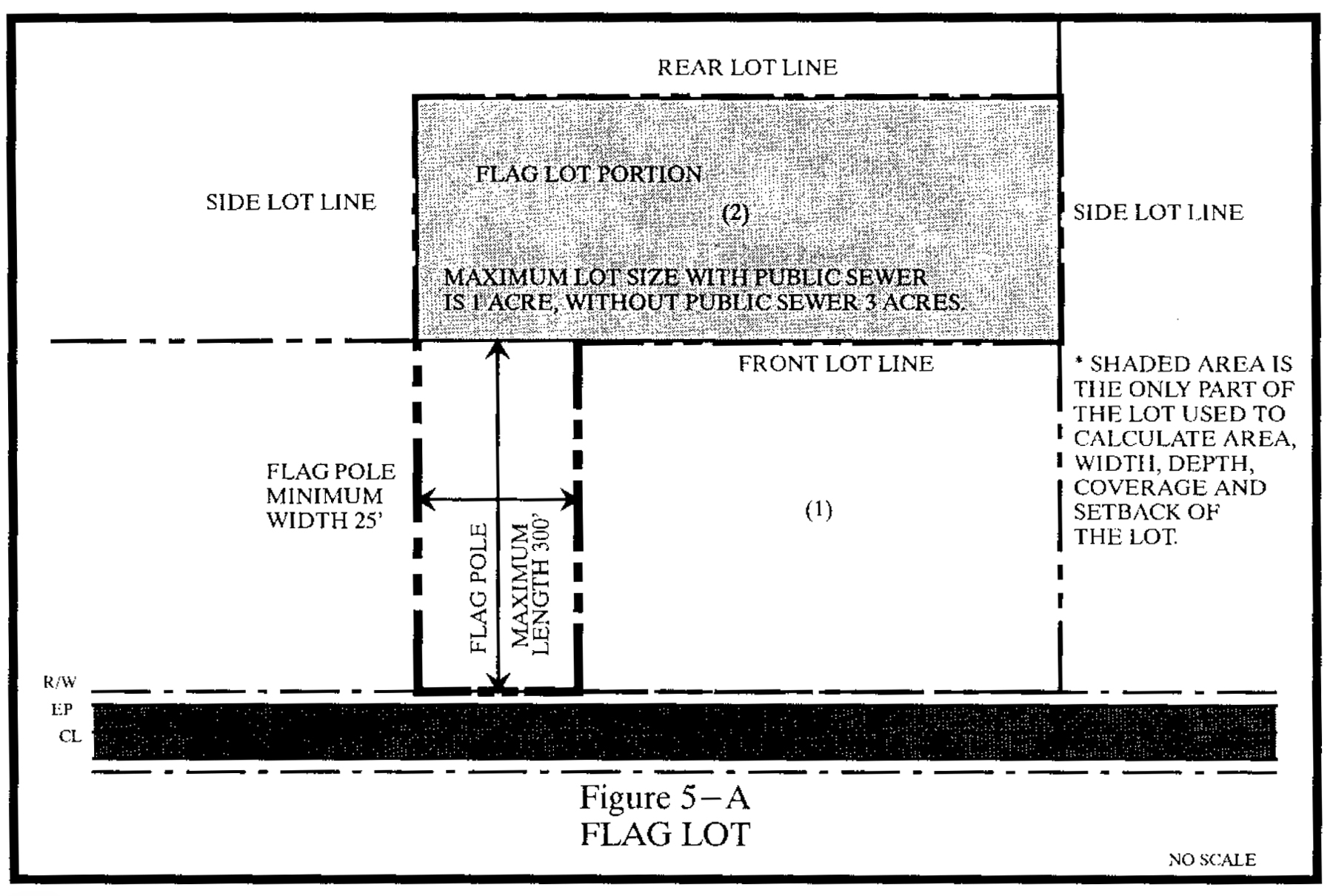
Flag lots (see figure 5-A) meeting the following requirements:
1.
A flag lot shall serve only one single-family dwelling and its uninhabited accessory structures;
2.
The maximum flagpole length shall be 300 feet;
3.
The minimum flagpole width shall be 25 feet;
4.
The maximum lot size in areas with public sewer shall be one acre;
5.
The maximum lot size without public sewer shall be three acres. Note: Flagpole portion of lot is not used to calculate area, width, depth, coverage and setbacks of the lot or to provide off-street parking;
6.
Where public water is available, any building on the flag lot must be within 500 feet of a hydrant. This distance shall be measured along the street, then along the flagpole, then in a straight line to the building location;
7.
Where public sewer is available, occupied buildings on the flag lot shall have a gravity service line, or the sewer pump requirement shall be noted on the plat; and
8.
Use of a single driveway to serve a flag lot and an adjoining lot is permitted and encouraged; the preferred location for the driveway is on the flagpole portion of the flag lot, with the conventional lot granted an access easement over the flagpole.
FIGURE 5-A FLAG LOT
b.
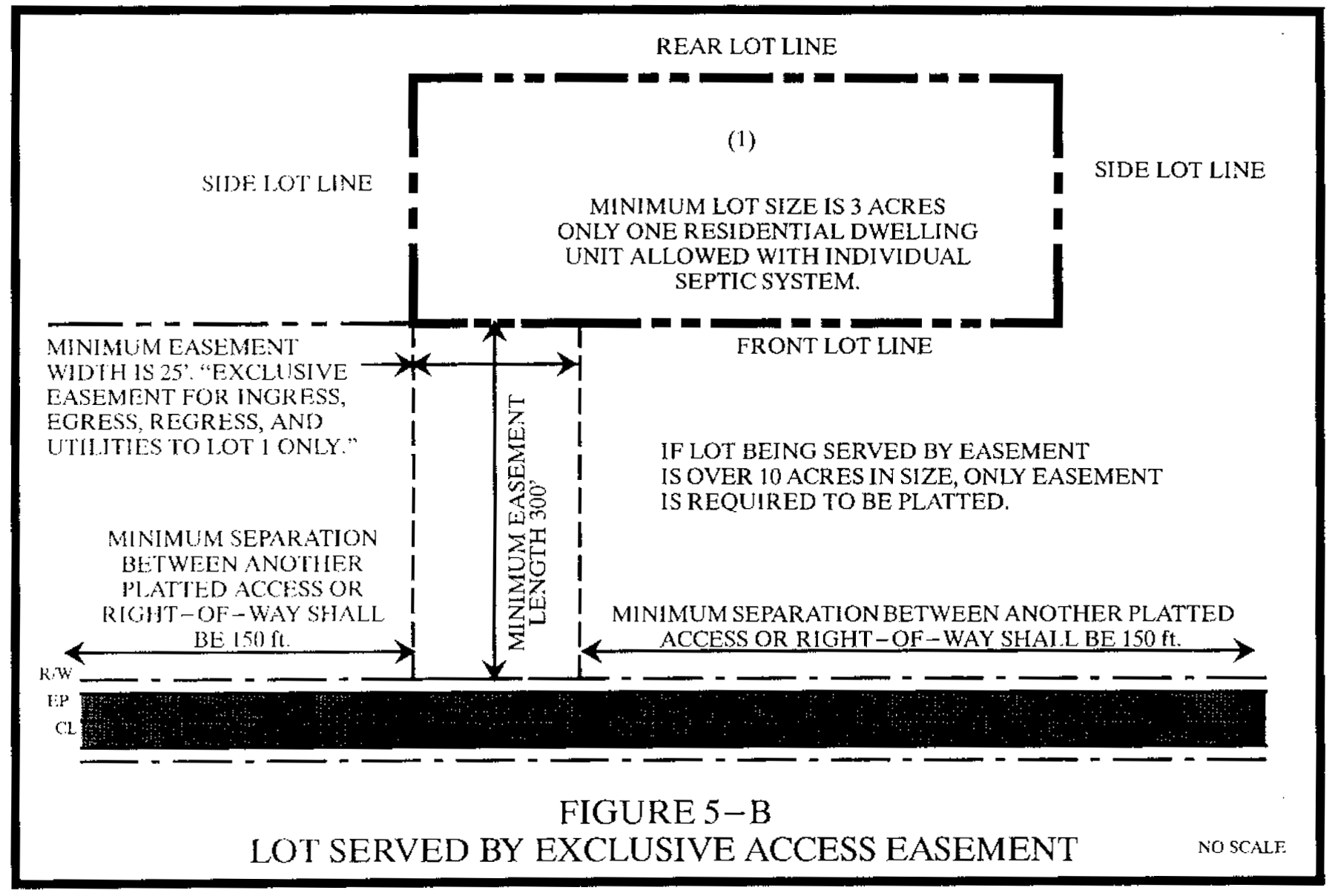
Lots served by exclusive access easements (see figure 5-B) meeting the following criteria:
1.
An exclusive access easement shall serve only one single-family dwelling and its uninhabited accessory structures;
2.
Lots to be served by an exclusive access easement shall not be created in an area served by public water or sewer or within the extraterritorial jurisdiction of a municipality;
3.
The minimum lot size shall be three acres;
4.
The minimum easement width shall be 25 feet;
5.
The minimum easement length shall be 300 feet;
6.
The minimum separation between easement and any other platted access or right-of-way shall be 150 feet;
7.
The location of the easement must be recorded on a plat; and
8.
The exclusive access easement shall permit ingress, egress, and regress and necessary utilities required to serve the lot.
c.
Lots and units located in developments with owner's associations or group developments in which permanent access is guaranteed by means of approved private street and/or drives.
d.
Lots located on an approved private lanes which are platted and recorded pursuant to the provisions of this chapter and G.S. 136-1-2.6.
e.
Lots of record provided there is recorded access and the use is limited to only one single-family dwelling and its uninhabitable accessory structures.
FIGURE 5-B LOT SERVED BY EXCLUSIVE ACCESS EASEMENT
(Ord. of 1-6-2000, § 5-13.2)
Sec. 30-860. - Streets.
(a)
Conformance with thoroughfare and collector street plans. The location and design of streets shall be in conformance with applicable thoroughfare and collector street plans. Where conditions warrant, right-of-way widths and pavement widths in excess of the minimum street standards may be required.
(b)
Conformance with adjoining street systems. The planned street layout of a proposed subdivision shall be compatible with existing or proposed streets and their classifications on adjoining or nearby tracts.
(c)
Access to adjoining property. Where in the opinion of the town council, it is desirable to provide for street access to adjoining property, proposed streets shall be extended to the boundary of such property.
(d)
Reserve strips. Reserve strips adjoining street rights-of-way for the purposes of preventing access to adjacent property shall not be permitted under any condition.
(e)
Street classification. The final determination of the classification of streets in a proposed subdivision shall be made by the jurisdiction. Street classifications are defined in article I.
(f)
Public street design criteria. The minimum street design standards for the street classifications are attached herewith as the Minimum Public Street Design Standards, Urban Area table and the Minimum Public Street Design Standards, Urban Area table below. Right-of-way dedication and paving of streets in and adjacent to the subdivision shall be in conformance with the right-of-way and pavement width requirements of the Minimum Public Street Design Standards, Urban Area table and the Minimum Public Street Design Standards, Urban Area table below; and shall be designed in accordance with the jurisdiction's street design manual, or the state department of transportation (NCDOT) Subdivision Roads Minimum Construction Standards, whichever is applicable.
MINIMUM PUBLIC STREET DESIGN STANDARDS, URBAN AREA
Notes:
Recommended design standards—exceptions may be approved due to special physical constraints on an individual basis by designated local staff.
a Unless additional width required under subsection (a) of this section.
;sup\sup; Dimension in this column are form face of curb to face of curb, except ribbon pavement.
c With 20 dwelling units or less, 26 feet.
MINIMUM PUBLIC STREET DESIGN STANDARDS, RURAL AREA
(g)
Private street design criteria.
(1)
Where permitted. Private streets shall be permitted in developments with owner's associations and group developments.
(2)
Minimum design and construction. The minimum street design standards are found in the Minimum Private Street Design Standards, Urban Area table below. The pavement design for all private streets will be equivalent to the minimum design for local residential streets of the jurisdiction or NCDOT whichever is applicable, unless the developer supplies an alternate pavement design supported by an engineering study. The developer must furnish an engineer's seal and certification that the private streets have been tested and certified for the subgrade, base and asphalt. All private streets will have a standard, 30-inch curb and gutter section, unless the street is located in the watershed critical area (WCA). Streets located in the WCA may be 22 feet of asphalt construction with shoulders and a ditch section. Common area may need to be widened to keep the ditch section within the common area. All cul-de-sacs will have a minimum 45-foot pavement radius.
(3)
Owner's association required. A owner's association is required to own and maintain all private streets allowed under this chapter. All private streets will be indicated as such on the plat.
(4)
Private through streets. No through street in a residential area connecting two public streets can be designated as a private street, unless approved by the town council.
(5)
Connections to public streets. All private streets, connecting with public streets, require an approved driveway application from the jurisdiction or NCDOT whichever is applicable. Where street returns are permitted, the developer shall construct a concrete band running parallel with the public street. The width of this band shall commence at the gutter line and extend to the right-of-way of the public street.
(6)
Sidewalks. Where sidewalks are required, they shall be constructed to meet City of Greensboro standards for width, slope and pavement thickness.
[(7)]
Connectivity. No single entrance to a residential subdivision shall serve more than 50 lots or 500 vehicle trips per day. The single entrance is defined as the point where the local street network of a major subdivision or multiple subdivisions intersects the road network outside of the major subdivision or multiple subdivisions.
MINIMUM PRIVATE STREET DESIGN STANDARDS, URBAN AREA
(h)
Private lane design criteria.
(1)
Where permitted. Private lanes shall be permitted only in minor subdivisions.
(2)
Construction standards.
a.
Roadway width and construction design. Minimum street design standards are found in the Minimum Private Street Design Standards, Rural Area table below. The base course shall comply with state department of transportation standards. A pavement surface is not required. The area outside the roadway shall be treated with stabilizing vegetation or other materials approved by the soils division.
b.
Block length. Block length shall not be longer than 600 feet.
c.
Turn around. A cul-de-sac or T-type turnaround shall be provided in accordance with state department of transportation standards.
d.
Intersection. Roads shall be designed to intersect as nearly as possible at right angles. Intersections at angles less than 60 degrees are not permitted. A private lane may not intersect with another private lane.
e.
Street off-sets. The off-set alignment of the centerline of two non-intersecting streets shall be a minimum of 125 feet.
f.
Disclosure statement. A disclosure statement in accordance with G.S. 136-102.6 shall be approved by the county attorney, recorded simultaneously with the plat, and referenced on the final plat. The disclosure statement must contain the provisions for construction and/or maintenance of the private lane.
g.
Certificate of inspection and surety. A certificate of inspection signed and sealed by a licensed professional engineer shall be filed with the planning department prior to recordation of the final plat. A surety may be posted for a private lane in which case the certificate will be required after road construction is complete. This certificate shall at a minimum state that the private road has been constructed to meet the minimum design standards set forth herein.
MINIMUM PRIVATE STREET DESIGN STANDARDS
FOR RECREATIONAL VEHICLE PARKS
MINIMUM PRIVATE LANE DESIGN STANDARDS, RURAL AREA
(i)
Intersecting street angle.
(1)
All streets shall intersect at or as near to 90 degrees as possible within topographic limits.
(2)
All streets crossing natural areas, wetlands, or stream buffers must cross at or as near to 90 degrees as possible within topographic limits.
(j)
Cul-de-sac maximum length. The maximum distance from an intersecting through street to the end of a cul-de-sac shall be 1,200 feet, except that a distance up to 1,600 feet may be approved in the watershed critical area.
(k)
Minimum street offset. Where streets are offset, the centerlines of shall be offset no less than 125 feet.
(l)
Curb and gutter. Curb and gutter shall be required in all urban subdivisions. Curb and gutter shall be constructed in conformance with the design criteria of the jurisdiction. Curb and gutter in rural subdivisions is not required unless public water and/or sewer is available.
(m)
Temporary turnarounds. Streets stubbed to adjoining property or phase lines may be required to have a temporary turnaround at the end of the street which will be sufficient to permit sanitation vehicles to turn around.
(n)
Grades at intersections. The grade on stop streets approaching an intersection shall not exceed five percent for a distance of not less than 100 feet from the centerline of the intersection.
(o)
Sight distance easements. Triangular sight distance easements shall be shown in dashed lines at all street intersections and so noted on the subdivision plat. These easements will remain free of all structures, trees, shrubbery, driveways, and signs, except utility poles, fire hydrants, and traffic control signs. The location and extent of sight distance easements will be determined by the jurisdiction and the state department of transportation.
(p)
Street names. Streets which are obviously in alignment with existing streets shall generally bear the name of the existing street. Street names shall not duplicate or closely approximate phonetically the names of existing streets in county. Street suffixes and addresses shall conform to the standards set forth in appendix A to this Code.
(q)
Street signs.
(1)
Public street intersection. At each intersection of a named public street with another named public street, the developer shall pay a fee to the jurisdiction for the installation of each street sign required.
(2)
Public to private street intersections. At each intersection of a named private street, drive, or lane with a public street, the jurisdiction shall erect a street name sign. The developer shall pay a fee to the jurisdiction for each such sign required.
(3)
Private street intersections. The developer shall be required to erect and maintain reflectorized signs at all intersections between private streets, drives, or lanes. Private street signs shall be approved by the jurisdiction as part of a master or common sign plan.
(4)
Traffic control signs. The developer shall be required to provide traffic control signs in locations designated by the jurisdiction.
(5)
Maintenance. Maintenance of signs on private streets, drives or lanes shall be the responsibility of the owner or owner's association, as appropriate.
(Ord. of 1-6-2000, § 5-13.3; Ord. of 1-5-2006; Ord. of 3-1-2017)
Sec. 30-861. - Block length.
Blocks shall not exceed a perimeter length of 6,000 feet. Perimeter length is the shortest perimeter measurement along the abutting street right-of-way lines.
(Ord. of 1-6-2000, § 5-13.4)
Sec. 30-862. - Sidewalks.
(a)
Except along controlled access facilities, sidewalks shall be required on all thoroughfares, collectors and local streets in the town core, as shown on the Oak Ridge Future Land Use Plan adopted May 2003. Where sidewalks are installed, they shall meet City of Greensboro standards and have a minimum width of five feet and be constructed just behind the street right-of-way line. Sidewalks may be constructed within the street right-of-way with approval of the town and NCDOT.
(b)
Sidewalks shall be constructed at the time of development of any single lot being used for commercial or institutional purposes, and for any subdivision of land into building lots for residential, commercial or institutional purposes. The developer or subdivider shall be responsible for sidewalk construction on all new streets or roads created as part of the development, and for existing streets or roads that abut the property being developed.
(Ord. of 1-6-2000, § 5-13.5; Ord. of 1-6-2006)
Sec. 30-863. - Utilities.
(a)
Public water and sewer construction requirements. Water and sewer lines, connections, and equipment shall be constructed in accordance with state and local regulations.
(b)
Water and sewer connection. Connection of each lot to public water and sewer utilities shall be required if the proposed subdivision is within 300 feet of the nearest adequate lines of a public system, provided that no geographic or topographic factors would make such connection infeasible. Where public sewer is not available, lots shall be evaluated in accordance with "Laws and Rules for Sanitary Sewage Collection, Treatment, and Disposal 11" G.S. 130A. Approval of the environmental health division shall be obtained after preliminary plat approval. The final plat shall show lots denied or not evaluated crosshatched and labeled "No improvement permit has been issued for this lot."
(c)
Underground utilities. Electrical, television cable, and telephone utility lines installed within major subdivisions shall be underground unless the town council determines underground installation is inappropriate.
(d)
Community wells (public) required. Community wells are required in all subdivisions of 30 dwelling units or greater. Community wells and their distribution systems shall be constructed by the subdivider and deeded to the town upon completion. Community wells are encouraged in subdivisions of less than 30 dwelling units if feasible.
(e)
The subdivider shall provide individual utility connections for each lot within the subdivision. Each subdivision lot shall be provided a connection to a power supply, a connection to an approved water supply (except individual wells) and a connection to an approved sewage waste disposal system.
(f)
No permit for the construction of or placement of a dwelling unit shall be issued in a subdivision until a water supply system has been installed and approved (unless individual wells are used as the water supply).
(g)
No dwelling unit within a subdivision shall be occupied until:
(1)
A connection to a power supply is complete;
(2)
A connection to an approved water system is complete;
(3)
A connection to an approved sewage system is complete; and
(4)
All required inspections are completed and final approvals given.
(h)
Potable water. There shall be a safe, adequate, continuous, and conveniently located potable water supply provided for each lot within a subdivision. Potable water supply shall be in compliance with the applicable edition of the North Carolina Plumbing Code.
(i)
Where a public water system is not available, or where capacity or line size is not sufficient for extension, every individual well, shared well, or private community well shall be installed, inspected, tested, approved, and maintained in accordance with state and local regulations.
(j)
Dry lines may be required to be installed where public water supplies are anticipated to become available within a reasonably short time after completion of the project.
(k)
Applications for public water supplies for new subdivisions shall contain calculations showing the maximum daily water usage of the development.
(l)
A certification shall be provided that the public water system will provide water to the development. Design standards, installation, connections, and approvals of all components of the water system shall be as required by the public water system.
(m)
Fire hydrants, where required, shall be installed in compliance with the North Carolina administrative, building, plumbing, and fire codes, local fire department requirements, and other applicable local ordinances and standards.
(n)
Utility easements.
(1)
Major subdivisions. To provide for electric, telephone, gas, and community antenna television services conduits, and sewer or water lines within the subdivision, appropriate utility easements not to exceed 30 feet in width shall be provided. The location of such easements shall be reviewed and approved by the town before final plat approval.
(2)
Minor subdivisions. Lots fronting on public streets with access to existing utilities are not required to have utility easements. All other lots shall contain a 20-foot utility easement to the front, side, or rear of each lot unless easement releases are obtained from all utility companies, in which case no utility easement will be required.
(3)
No buildings or improvements. Utility easements shall be kept free and clear of any building or other improvement that would interfere with the proper maintenance or replacement of any utility. The town shall not be liable for damages to any improvement located within the utility easement area caused by maintenance or replacement of any utility located therein.
(Ord. of 1-6-2000, § 5-13.6; Ord. No. O-2019-10, 9-5-2019)
Sec. 30-864. - Drainage.
The design of storm drainage systems and plans, including calculations, shall clearly indicate the easements and dedicated areas required for the construction and maintenance of the drainage system.
(1)
General drainage requirement.
a.
All watercourses which carry a flow of five cubic feet per second (cfs) or more during a ten-year storm, as calculated in accordance with the jurisdiction's storm sewer design manual, shall be treated in one or more of the three ways listed in subsections (2), (3) and (4) of this section. Except where subsection (2)a of this section leaves the determination to the developer, the town council shall determine the treatments to be used, based upon the pipe size necessary to handle drainage and adopted open space plan. Open drainage channel requirements shall be based upon a 100-year storm, and enclosed systems shall be based upon a ten-year storm. If the channel is a perennial stream in a water supply watershed, or is identified on the open space plan map or requires a pipe of 66-inch diameter or greater, the determination of drainage treatment shall be made by the town council. In making this determination, the town council shall consider the following factors:
1.
The type of development;
2.
The treatment employed by nearby developments;
3.
The probability of the creation of a lengthy greenway or drainageway and open space;
4.
The probability of the creation of future maintenance problems;
5.
The probability of erosion or flooding problems;
6.
The adopted open space plan; and
7.
Stream buffer requirements and channelization limitations for GWA areas.
b.
If the channel is not a perennial stream within a GWA of a designated water supply watershed, or is not identified on the open space plan and requires less than a 66-inch diameter pipe, the determination of drainage treatment shall be made by the property owner in a manner consistent with this section.
(2)
Enclosed subsurface drains.
a.
This section applies to enclosed subsurface drains. Profiles and enclosure standards shall be in accordance with the jurisdictions storm sewer design manual.
b.
A utility easement designed to accommodate stormwater shall be placed on a recorded plat when determined necessary by the jurisdiction. The required utility easement shall be centered on the enclosure when practical, but in no case shall the outside wall of the enclosure be located less than five feet from the edge of the utility easement. The utility easement shall be of a width determined necessary for maintenance purposes by the jurisdiction based upon enclosure depth, topography and location of existing and proposed improvements, but no less than 15 feet.
c.
The utility easement shall be kept free and clear of any buildings or other improvements which would interfere with the proper maintenance of the underground enclosures. The jurisdiction shall not be liable for damages to any improvement located within the utility easement area caused by maintenance of utilities located therein. Furthermore, utility easements may be used for future installations of any underground utility, provided that:
1.
Any underground utility to be installed by any utility provider other than the jurisdiction shall be subject to approval by the appropriate department;
2.
Any government agency or private company installing additional underground lines after development has been completed by the owner of the property shall be responsible for the replacement of all fencing, pavement and grassed area disturbed by such installation; and
3.
The jurisdiction shall not be responsible for damages caused by installation of additional lines by any private utility company.
(3)
Open channel on private property within drainage maintenance and utility easement.
a.
This section applies to open channels on private property within a drainage maintenance and utility easement. This method shall not be utilized in any subdivision intended for single-family detached dwellings unless the town council, determines that an open channel would not become a missing segment in a system of stormwater piping and that the open channel is well removed from all anticipated building locations.
b.
The drainage maintenance and utility easement shall include the required drainage channel and the land between the channel and the natural 100-year flood contour as determined by FEMA or by calculations approved by the US Army Corps of Engineers; or, in some cases, it may be reduced by modifying the drainage maintenance and utility casement topography to a typical required drainage channel section as provided for in this section. However, the minimum total width of a drainage maintenance and utility easement shall be no less than specified in this section.
c.
The drainage maintenance and utility easement width shall be centered on the typical required drainage channel section, unless the town council approves other drainage maintenance and utility easement alignments because of topographic conditions.
d.
In case of severe topography, additional width may be required to assure reasonable ease of maintenance.
e.
The drainage maintenance and utility easement topography may be modified if permitted under article XI. In such cases, the approved typical required drainage channel section shall include the necessary channel to accommodate a 100-year flood. The area outside of the required drainage channel may be filled; but any resulting slope shall be no steeper than two to one, unless the slope is protected by masonry paving, rip-rap, or other material which meet the jurisdictions specifications.
f.
If the town council determines suitable access to the drainage maintenance and utility easement is not otherwise provided, access shall be guaranteed by a suitably located access easement which shall be no less than 20 feet in width.
g.
It shall be the responsibility of the owner to maintain all streams located on their property. If the town council determines that it is in the public interest to alter the typical required channel section and/or profile of the stream to improve flow, the jurisdiction may enter the property within the indicated access or drainage maintenance and utility easement and carry out the necessary work without liability for any damage to the property, or improvements thereon, located within the easement.
h.
Drainage maintenance and utility easements may be utilized for any underground utility provided that:
1.
Underground utility lines to be installed by any utility provider other than the jurisdiction shall be subject to approval by the enforcement officer;
2.
The government agency or private company installing underground lines after development has been completed by the owner of the property shall be responsible for the replacement of all fencing, pavement and grassed areas disturbed by such installation;
3.
The jurisdiction shall not be responsible for damage caused by the installation of additional lines by any private utility company; and
4.
The jurisdiction shall not be liable for damages to any improvements located within the drainage maintenance and utility easement area caused by maintenance of utilities located therein.
i.
No buildings or structures except for water related improvements shall be placed or constructed within the access or drainage maintenance and utility easement. All drives, parking areas, or other improvements, shall be constructed no closer than two feet horizontally from the top of any back slope along any open watercourse.
(4)
Flood standards.
a.
All subdivision proposals shall be consistent with the need to minimize flood damage;
b.
All subdivision proposals shall have public utilities and facilities, such as sewer, gas, electrical and water systems located and constructed to minimize flood damage;
c.
All subdivision proposals shall have adequate drainage provided to reduce exposure to flood hazards; and
d.
Base flood elevation data shall be provided for subdivision proposals whenever the 100-year storm flow is 500 cubic feet per second or greater.
(Ord. of 1-6-2000, § 5-13.7)
Sec. 30-865. - Sites for public uses.
In subdividing property, due consideration shall be given by the subdivider to the reservation of suitable sites for schools and other public uses in accordance with G.S. 160D-804.
(Ord. of 1-6-2000, § 5-13.8; Amend. of 4-5-2012, § 8; Ord. No. O-2021-13, § 1, 7-1-2021)
Sec. 30-866. - Placement of monuments.
The "Standards of Practice for Land Surveying in North Carolina," as adopted by the state board of registration for professional engineers and land surveyors, shall apply when installing monuments.
(Ord. of 1-6-2000, § 5-13.9)

