
Oak Ridge City Zoning Code
ARTICLE IX
- DEVELOPMENT STANDARDS
DIVISION 2. - SIGN REGULATIONS[3]
Editor's note— An ordinance adopted Oct. 5, 2006 amended div. 2 in its entirety to read as herein set out. Former div. 2, §§ 30-924—30-933, pertained to similar subject matter, and derived from §§ 6-1.1—6-1.10 of an ordinance adopted Jan. 6, 2000.
Sec. 30-924.- General.
All signs located in the Town of Oak Ridge, with the exception of those erected by local, state or federal government, are subject to the provisions of this section. Signs under this article are treated three ways: (1) some types of signs are specifically prohibited everywhere; (2) certain signs are allowed by right and do not require permits prior to installation; (3) a third group of signs are considered to be accessory uses and may be installed provided that they meet the provisions of this section and a permit is obtained.
(Ord. of 10-5-2006, § 6-1.1)
Sec. 30-925. - Prohibited signs.
Unless otherwise permitted under this section, the following signs are prohibited in all zoning districts:
(1)
Windblown devices such as pennants, streamers, spinners, balloons, gas-filled figures and other similar devices.
(2)
Flags that display corporate emblems or insignia.
(3)
Animated signs, but not including electronic changeable copy signs.
(4)
Portable signs, but not including signs that cannot be read from the public right-of-way.
(5)
Signs that project over a public right-of-way.
(6)
Signs on vehicles that are parked in a location that are visible to the public and for a period of time which indicates that the principal use of the vehicle is for advertising rather than transport.
(7)
Signs that are affixed to utility poles, trees, rocks or other natural features.
(8)
Signs of any type that imitate traffic control devices.
(9)
Signs that extend vertically above the highest portion of the roof of any structure.
(10)
Banners, except those announcing pubic events sponsored by nonprofit organizations and being placed no more than one week before the event and removed no more than one day following the event. Banners are not to exceed two feet by eight feet and can only be displayed on the property of the event.
(11)
Signs that are abandoned, dilapidated or in disrepair.
(12)
Billboards.
(13)
Off-site advertising signs.
(14)
Internally illuminated signs, except neon window signs. Signs located in a nonresidential zoning district may be internally illuminated subject to the granting of a special use permit by the town council.
(15)
Signs with fluorescent or iridescent colors.
(16)
Signs with more than three colors.
(17)
Signs must be consistent with surrounding signage.
(18)
Flashing, blinking or moving signs.
(19)
No sign of any kind is allowed in the state right-of-way unless authorized by the State of North Carolina.
(Ord. of 10-5-2006, § 6-1.2; Ord. of 11-3-2011)
Sec. 30-926. - Signs exempt from regulation.
The following signs are exempt from regulation under this article except that lighted signs require an electrical permit and must comply with the town's lighting ordinance.
(1)
Government signs.
(2)
Works of art with no commercial message.
(3)
Lights and decorations with no commercial message temporarily displayed on traditionally adopted civic, patriotic or religious holidays.
(4)
Hand carried signs.
(5)
Signs located on the interior of buildings, courts, lobbies, stadiums, or other structures which are not intended to be seen from the exterior of such structures.
(6)
Signs affixed to vehicles and trailers used in normal transport of goods or persons where the sign is incidental and accessory to the primary use of the vehicle or trailer.
(7)
Signs affixed to windows of vehicles displaying information on the terms of sale for said vehicles.
(8)
Signs not legible from a public or private street.
(9)
Flags of the United States, North Carolina, local governmental jurisdictions, foreign nations having diplomatic relations with the United States, and any other flags adopted or sanctioned by the Jurisdiction subject to U.S. Congressional protocol.
(Ord. of 10-5-2006, § 6-1.3)
Sec. 30-927. - Signs that do not require a permit.
The following signs are permitted in all zoning districts and may be installed without obtaining a sign permit provided that the conform to the specifications shown on Table 6-1-1.
(1)
Directional, instructional or warning signs provided that such signs contain no commercial message except a business logo or name.
(2)
Flags, emblems or insignia of political, professional, fraternal, civic, religious, or educational organizations.
(3)
Certain temporary signs conforming to the provisions of Table 6-1-1. Other types of temporary signs may be allowed by permit following the provisions of Tables 6-1-2 and 6-1-3. Allowed without a permit are:
a.
Temporary yard sale signs which are posted for no longer than three days per sale.
b.
Temporary political signs located on private property that are removed within seven days after the election.
(4)
Historical or memorial plaques, tablets or markers.
(5)
Identification signs including:
a.
Name and address plates, including those identifying home occupations and rural family occupations.
b.
Directory Signs in developments with multiple occupants.
c.
Building name and address signs for buildings with multiple occupants.
d.
Building markers (cornerstones or plaques).
(6)
Signs painted or attached to vending machines, gas pumps, ice machines or similar devices that indicate the contents of the machine, name or logo or supplier, the price or operation instructions.
(7)
Information board signs in nonresidential districts and for institutional uses (e.g. churches, schools or cemeteries) permitted in residential zones that list activities or events which will take place on the premises where the sign is located, provided that no advertising on any type is displayed.
(8)
Window signs painted on or attached to window where the sign takes up no more that 25 percent of the window space (See Table 6-1-1).
(9)
Signs advertising agricultural products produced on the premises that do not exceed four square feet in area per side and during the time the harvest is available. There shall be a limit of one such sign for each street abutting the lot. Additional signs may also be placed on property of neighbors with neighbor's permission.
(10)
For sale or for rent signs pertaining to realty, on the premises offered for sale or rent, not exceeding four square feet per side in area. One sign will be allowed for each street abutting the lot. No for sale or for rent signs will be allowed off premises.
(11)
Temporary campaign signs, not to exceed four square feet per side, located only on private property with the permission on the property owner.
(12)
Commercial copy signs on ball fields shall only be mounted on outfield fences, facing toward the infield.
(13)
One project construction sign is permitted at a construction site provided the sign does not exceed 32 square feet, the sign is removed within 15 days of the completion of the project and the sign location does not interfere with pedestrian or vehicular circulation or sightlines.
Table 6-1-1
Specifications for Signs Not Requiring a Permit
Footnotes:
a Signs must be located outside public street right of way and outside any sight distance area.
;sup\sup; Electrical permit required if sign is illuminated.
c One per 200 linear feet of lot frontage or portion thereof.
Table 6-1-2
Specifications for Accessory Free-Standing Signs Requiring a Permit
Notes:
1)
Free-standing signs shall be allowed only as accessories to a principal use.
2)
All signs may be externally illuminated.
Footnotes:
a "Minimum" area refers to the minimum sign size allowed by right, regardless of the size which would be allowed by computation.
;sup\sup; Signs must be located outside public street right of way and outside any sight distance area.
c Permitted only in 1) major subdivisions, 2) developments over 15,000 square feet of gross floor area, 3) multi-family developments with more than eight dwelling units in a single building or 4) developments with more than 40,000 square feet in open uses of land.
d See subsection 30-931(c)(4).
Table 6-1-3
Specifications for Accessory Attached Signs Requiring a Permit
Note: All signs may be externally illuminated.
Footnotes:
a "Minimum" sign size refers to the minimum area allowed by right, regardless of the size which would be allowed by computation.
;sup\sup; Nine feet height to clear pedestrian walkways or 15 feet to clear vehicular drives.
c Based on the first 30 feet of height of the wall on which the sign is located. Buildings over 30 feet in height may have additional sign area based on five percent of the wall area above 30 feet in height, provided the sign is located at or near the top of the building.
d In multi-tenant buildings, the area computation shall be based on the wall area of each separate occupancy.
e When the awning, canopy or marquee is attached to a multi-tenant building, the area computation for all attached signs shall be based on the area computation for the district. Any portion of this sign allocation may be affixed to the wall, awning, canopy or marquee provided that no part of the sign projects above the top of the wall.
(Ord. of 10-5-2006, § 6-1.4)
Sec. 30-928. - Computation of sign area.
(a)
Area. The area of a sign shall be computed by means of the smallest square, circle, rectangle, triangle or combination thereof which will encompass the extreme limits of the writing, representation, emblem, or other display, together with any material or color forming an integral part of the background of the display or used to differentiate the sign from the back drop or structure against which it is placed, but not including any supporting framework, bracing, or decorative fence or wall.
(b)
Area or multi-faced signs. For multi-faced signs, the sign area shall be computed by including all sign faces visible from any one point. When two identical sign faces are placed back to back so that both faces cannot be reviewed from any point at the same time, and when such sign faces are part of the same sign structure and are not more than 42 inches apart, the sign area shall be computed by the measurement of one of the faces.
(c)
Height. Sign height shall be computed as 1) the distance from the base of the sign at finished lot grade or 2) from the nearest adjacent street grade to which the sign is oriented and the lot has frontage, whichever is higher, to the top of the highest component of the sign. Finished grade shall be the grade after construction, exclusive of any filling, berming, mounding, or excavating solely for the purpose of locating the sign.
(d)
Lots with multi-frontage. Lots fronting on two or more streets are allowed the permitted sign area for each street frontage. The total sign area that is oriented toward a particular street, however, may not exceed the portion of the lot's total sign area that is derived from that street frontage or building frontage.
(Ord. of 10-5-2006, § 6-1.5)
Sec. 30-929. - Location, construction and maintenance specifications.
All signs permitted by this article shall be constructed and maintained in accordance with the following provisions:
(1)
Obstruction. No sign shall be erected so as to obstruct any fire escape, required exit, window, door opening or wall opening intended as a means of ingress or egress.
(2)
Ventilation interference. No signs shall be erected so as to interfere with any opening required for ventilation.
(3)
Above ground clearance. All signs shall be located in such a way that they maintain horizontal and vertical clearance from all electrical power lines and communication lines in accordance with the applicable provisions of the N.C. Life Safety Code. Further, all signs shall be located so as to avoid obstruction of pedestrian and vehicular traffic and to maintain safe sight distances at the intersection of all streets, drives and sidewalks.
(4)
Ground clearance. All signs and their supporting structures shall maintain clearance from surface and underground utilities, conduits or easements for water, sewage, gas, electricity or communication equipment. In addition, the placement of signs and their supporting structures shall not interfere with natural or artificial drainageways.
(5)
Interference to warning or instructional sign. No sign shall be erected so as to interfere with any existing warning or instructional sign.
(6)
Permanence. Except for banners, flags, temporary signs and window signs conforming with the requirements of this article, all signs shall be constructed of permanent materials and shall be permanently attached to the ground, a building or another structure by direct attachment to a rigid wall, frame or structure. Banners and flags shall be constructed of a fire retardant material or treated to be fire retardant.
(7)
Maintenance. All signs shall be maintained in good structural condition, in compliance with all building and electrical codes and in conformance with this article at all times.
(8)
Minimum wind loads. All signs, except those attached flat against the wall of a building, shall be constructed to withstand minimum wind loads as specified by the NC State Building Code.
(9)
Other codes. All signs shall comply with applicable provisions of the building and the electrical code.
(Ord. of 10-5-2006, § 6-1.6)
Sec. 30-930. - Master or common signage plan.
After the effective date of this article no permit shall be issued for an individual sign requiring a permit unless and until a master signage plan or a common signage plan for the lot on which the sign will be erected has been approved. A master signage plan shall be prepared for developments containing a single principal building on a single lot, while a common signage plan shall be prepared for developments containing more than one principal building or more than one lot.
(1)
Information required for a master signage plan.
a.
Site layout plan in accordance with Appendix 2 (Map Standards) of the ordinance from which this chapter is derived.
b.
Specifications for each sign in sufficient detail to determine that the height and area requirements of this article have been met.
c.
Accurate location(s) on the site layout plan for each existing and proposed sign.
d.
For lighted signs, information sufficient to determine that the proposed lighting conforms to the town's outdoor light fixtures control ordinance.
(2)
Common sign plan information. A common signage plan shall contain all of the information required above plus provisions for shared usage of freestanding and attached signs.
(3)
Other provisions.
a.
A master or common signage plan shall be a part of any development plan, site plan, planned unit development or other plan required for development and may be processed simultaneously with such plan(s) and shall be approved prior to the issuance of any sign permit.
b.
A master or common signage plan may be amended by filing a new plan than conforms with all requirements of this article. Minor changes may be approved and noted by the enforcement officer on the existing plan.
c.
After approval of a master or common signage plan, no sign shall be erected, placed, painted or maintained except in conformance with such plan and such plan may be enforced in the same way as any other provision of this article. In case of any conflict between the provisions of such a plan and any other provision of this article, the article shall control.
d.
An additional freestanding sign in excess of the general limitation of one per frontage as shown in Table 6-1-2 will be approves provided:
1.
The lot frontage exceeds 250 linear feet.
2.
There is sufficient excess frontage to support the request for an additional sign based on the rates in Table 6-1-2. Note that if more than one sign is requested, there is no minimum area by right, and in no case shall the maximum area for a sign exceed 50 square feet.
3.
Each sign shall be a minimum of 100 feet from any other freestanding sign on the same zone lot and 100 feet from any other freestanding sign on an adjacent zone lot that contains more than one freestanding sign.
(Ord. of 10-5-2006, § 6-1.7)
Sec. 30-931. - Permits to construct or modify signs.
Signs shown as requiring a permit on Tables 6-1-2 and 6-1-3 above shall be erected, installed or created only in accordance with a duly-issued and valid sign permit. Such permits shall be issued in accordance with the requirements and procedures of Article VI (Permits and Procedures) of this chapter.
(Ord. of 10-5-2006, § 6-1.8)
Sec. 30-932. - Compliance with the article.
(a)
Removal of signs. A sign for which a certificate has lapsed, or has been revoked, or for which the time allowed for continuance of a nonconforming sign has expired, shall be removed.
(b)
Signs in the right-of-way. Any sign installed or placed on public property or right-of-way, except in compliance with this section or under an encroachment agreement with the North Carolina Department of Transportation, shall be forfeited to the public and be subject to confiscation.
(c)
Obsolete signs. Any sign that advertises a business no longer conducted on the premises shall be removed within 90 days of cessation of such business.
(d)
Unsafe signs. Any sign that is unsafe or insecure, or is a menace to the public shall be removed after due notice by the enforcement officer has been given.
(e)
Deteriorated or abandoned signs. Any sign that been abandoned or that has not been properly maintained, to include cleaning and painting of painted surfaces and replacement of damaged parts, shall be removed after due notice by the enforcement officer has been given.
(f)
Signs installed without permit. Any sign that has been installed in violation of the NC Building Code or in violation of this article shall be removed after due notice by the enforcement officer has been given.
(Ord. of 10-5-2006, § 6-1.9)
Sec. 30-933. - Enforcement procedures for prohibited signs.
(a)
Process. For temporary, portable or window signs erected in violation of this article, the enforcement officer may proceed directly to formal enforcement and remedies or may give up to three days written notice, in accordance with procedures written below, before beginning formal enforcement
(b)
Removal of signs. The enforcement officer may physically remove any temporary or portable sign, including banners, placed in violation of this article outside a building. Physical removal of the sign shall relieve the property owner or other person placing the sign of liability for fines or other remedies after the removal but not before. Any sign found in the public right of way or any off site temporary advertising sign are subject to impoundment without notice to the owner. The owner of an impounded sign or sign structures may recover the sign upon the payment of $50.00 for each sign plus the costs of removal. In the event it is not claimed within ten days from the date of impoundment, the enforcement officer or his/her designee has the authority to dispose of such sign or sign structure without compensation to the owner.
(c)
For signs on sites with recent violations. Where the violation is on a site on which there have been one or more formal notices of violation or formal enforcement actions for violations of this chapter within the previous year, the enforcement official may proceed immediately with all formal enforcement procedures.
(d)
Formal enforcement procedures. The town may assess civil penalties, in accordance to section 8-5 (Civil Penalties), for violations of this article. Imposed civil penalties may be in addition to the $50.00 fine and cost of removal fees assessed for impounded signs.
(Ord. of 10-5-2006, § 6-1.10)
Sec. 30-957.- General requirements.
(a)
Parking, stacking and loading space required. When any building or structure is erected, modified, enlarged or increased in capacity, or any open use is established, modified or enlarged, the requirements of this section shall be met. For enlargements, modifications, or increase in capacity, the requirements of this section shall apply only to such enlargements, modifications or increases in capacity.
(b)
Required number. The minimum number of required off-street parking, stacking and loading spaces is indicated in the off-street parking requirements table below and section 30-963. In cases of mixed occupancy, the minimum number of off-street parking, stacking and loading spaces shall be the cumulative total of individual use requirements unless otherwise specified.
(c)
Handicapped spaces. Spaces for the physically handicapped shall be provided as required by the North Carolina Building Code, and other applicable state and federal regulations governing van accessibility. See figure 6-C.
FIGURE 6-C HANDICAPPED & VAN ACCESSIBLE PARKING SPACE REQUIREMENTS
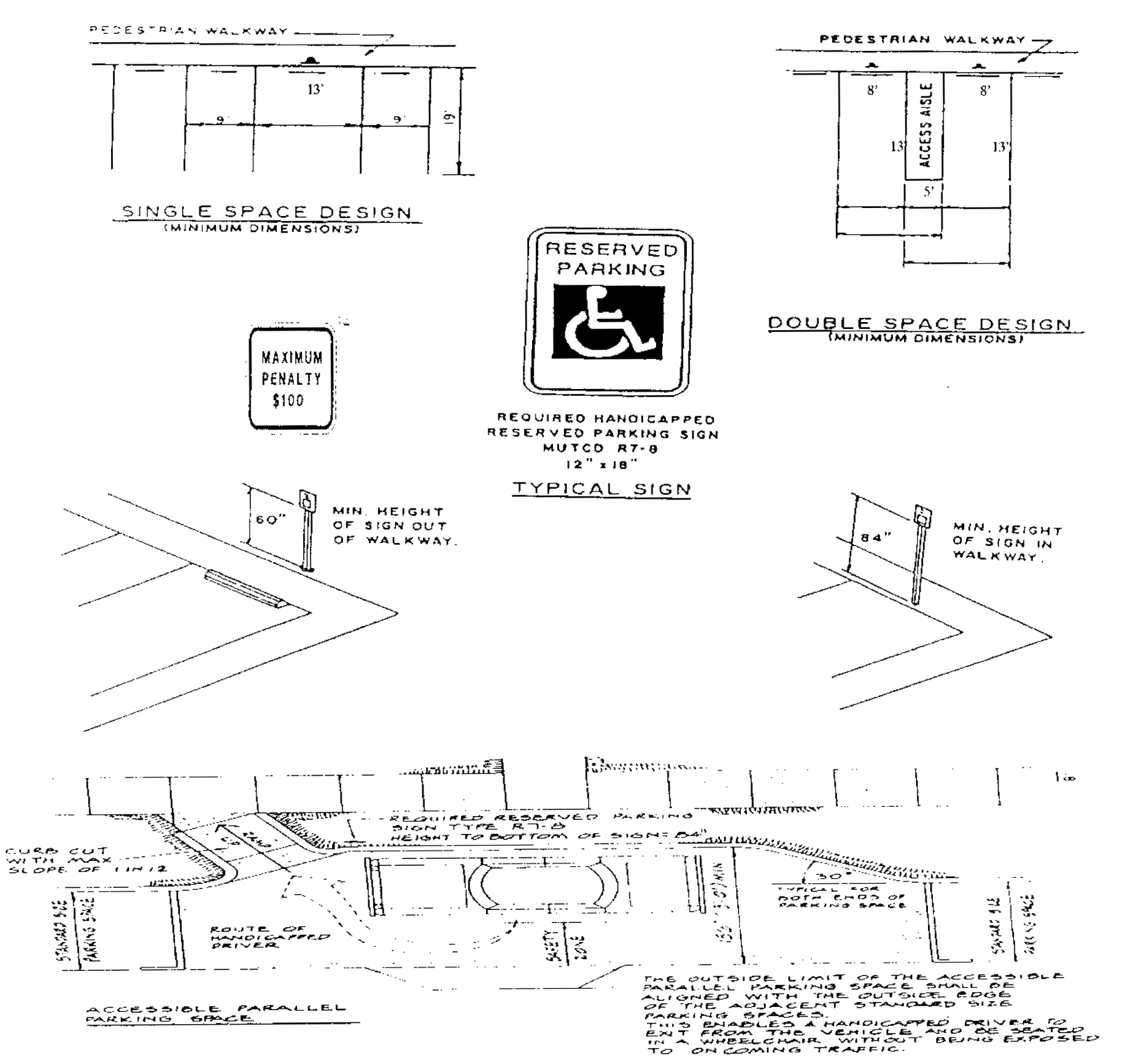
NUMBER OF REQUIRED HANDICAPPED PARKING SPACES
(d)
Minimum required. In all instances where off-street parking is required, except for residential uses, a minimum of five parking spaces shall be provided.
(e)
Reduction of minimum requirements. Unless there is a change in use requiring fewer spaces, the number of spaces shall not be reduced below the minimum requirements of this chapter except as provided for in section 30-985(c).
(f)
Maintenance. All parking, stacking and loading facilities shall be permanently maintained by the owners or occupants as long as the use they serve exists.
(g)
Access. All parking, stacking and loading facilities shall have vehicular access to a public street.
(h)
Use for no other purpose. Land used to provide required parking, stacking, and loading shall not be used for any other purposes, except for temporary events. If such land is devoted to any other purpose, the certificate of occupancy of the affected principal use shall immediately become void.
OFF-STREET PARKING REQUIREMENTS
Notes:
/ = Per
* State department of transportation may require additional stacking spaces on state or federal highways.
(Ord. of 1-6-2000, § 6-2.1; Ord. of 6-7-2007; Ord. of 3-6-2008)
Sec. 30-958. - Unlisted uses.
For any use not specifically listed in this division, the parking, stacking and loading requirements shall be those of the most similar use.
(Ord. of 1-6-2000, § 6-2.2)
Sec. 30-959. - Parking requirements for change in use.
If a change in use causes an increase in the required number of off-street parking, stacking or loading spaces, such additional spaces shall be provided in accordance with the requirements of this chapter; except that if the change in use would require an increase of less than five percent in the required number of parking spaces or fewer than five spaces, no additional off-street parking shall be required.
(Ord. of 1-6-2000, § 6-2.3)
Sec. 30-960. - Design standards for parking, stacking and loading.
(a)
Design. Parking facilities shall be designed and constructed to:
(1)
Allow unobstructed movement into and out of each parking space without interfering with fixed objects or vehicles.
(2)
Minimize delay and interference with traffic on public streets and access drives.
(3)
Maximize sight distances from parking lot exits and access drives.
(4)
All off-street parking spaces in parking lots shall have access from parking lot driveways and not directly from streets.
(b)
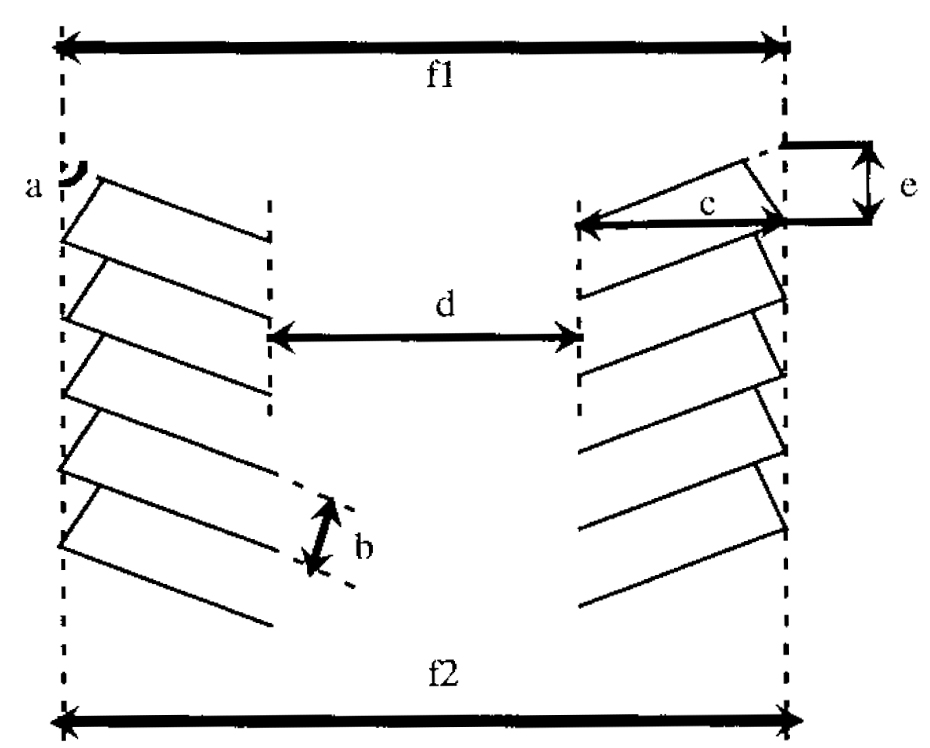
Dimensional requirements. Parking facilities shall be designed and constructed to meet minimum parking space dimensions, aisle dimensions and other standards found in the Parking Space Geometric Design Standards table below.
(c)
Improvements; paving.
(1)
Required parking spaces, access drives, and loading areas shall be paved and maintained with concrete, asphalt, or similar material of sufficient thickness and consistency to support anticipated traffic volumes and weights.
(2)
Access drives shall be paved and maintained from the curbline to a point at least ten feet beyond the public right-of-way line for all parking and loading facilities, whether paved or unpaved.
(3)
Paving shall not be required for:
a.
Parking facilities used on an irregular basis for churches, private clubs or other similar nonprofit organizations.
b.
Parking facilities for residential uses where six or fewer spaces are required.
c.
Parking areas for agricultural uses in the agricultural (AG) district.
d.
Parking areas in the heavy industrial (HI) district or manufacturing and industrial uses in the light industrial (LI) district, provided they are constructed with an all-weather surface.
e.
Parking areas for tracked heavy construction equipment, skid-mounted equipment and similar equipment, provided they are constructed with an all-weather surface.
(4)
Where parking facilities are paved, curb and gutter or an equivalent drainage system shall be provided along the periphery of the parking lot, except where it is determined by the enforcement officer that such system is not practical for storm drainage purposes.
PARKING SPACE GEOMETRIC DESIGN STANDARDS
( * ) 9'-0" Recommended (*) 8'-6" Minimum (*) 7'-6" Compact cars only, for non-required spaces only.
Stacking space geometric design standards: Stacking spaces shall be twelve feet by
20 feet.
(5)
All facilities shall be graded, properly drained, stabilized and maintained to minimize dust and erosion.
(6)
All parking spaces and stacking lanes shall be clearly identified with paint lines, bumper guards, curbs, or similar treatment.
(7)
All parking spaces shall be provided with wheel guards or curbs located so that no part of the parked vehicle will extend beyond the property line or encroach more than two feet into a required planting area.
(8)
Concrete pads for stationary refuse containers shall be provided beneath and in the approach to each container.
(9)
Parking lots shall be designed and constructed such that walkways shall maintain a minimum unobstructed width of four feet. (Vehicle encroachment is calculated as two feet beyond curb.)
(Ord. of 1-6-2000, § 6-2.4)
Sec. 30-961. - Location.
(a)
Off-site parking lots. When required off-street parking is permitted to be located off site, it shall begin within 400 feet of the zone lot containing the principal use. Required off-street parking shall not be located across an intervening major or minor thoroughfare.
(b)
Parking in nonresidential district. Automobile parking for any use may be provided in any nonresidential district.
(c)
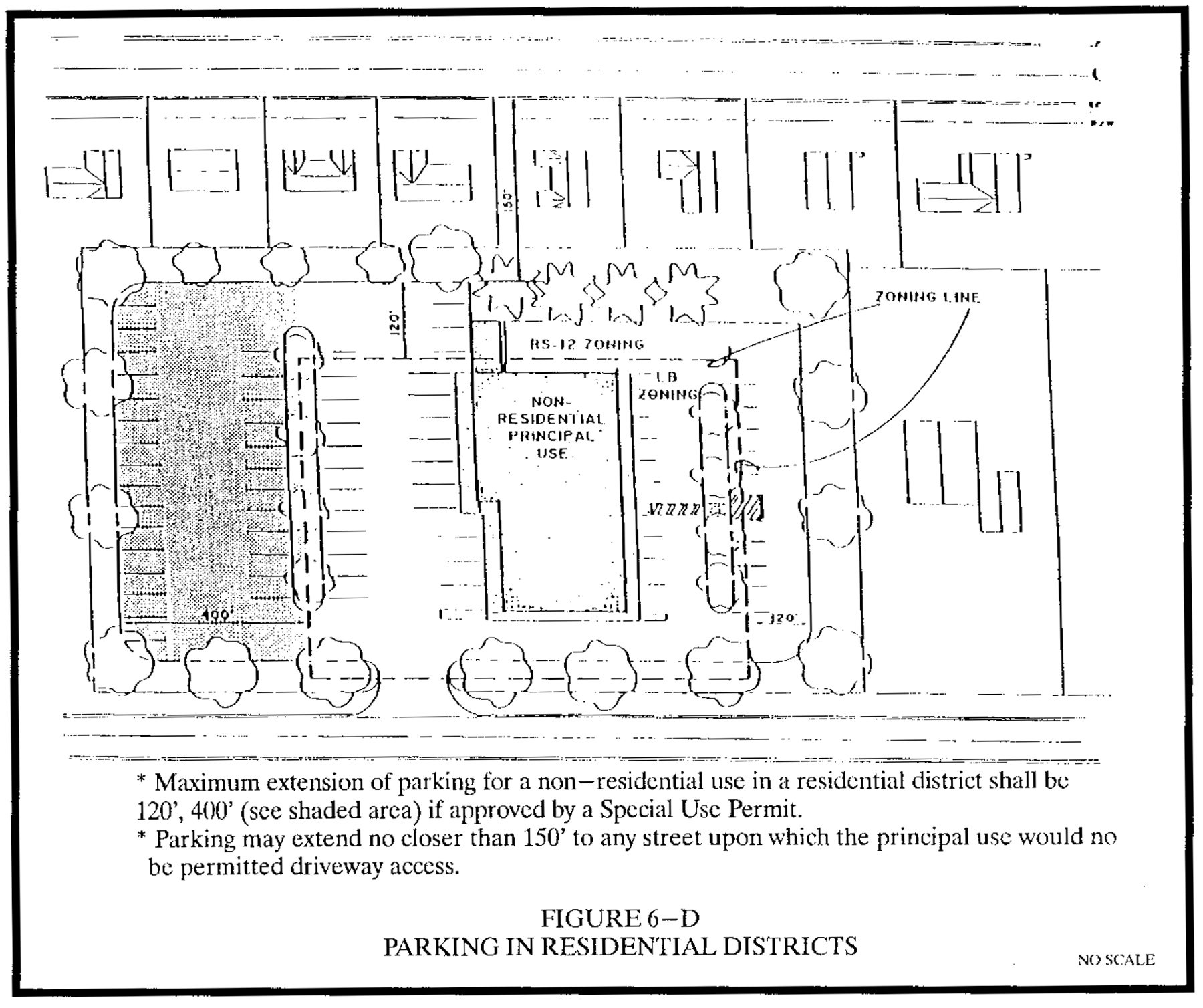
Parking in residential districts, see figure 6-D. Surface parking in a residential district for any use not permitted in that district is allowed under the following conditions:
(1)
Property on which the parking is located must abut the lot containing the use which the parking serves. The property must be under the same ownership or subject to a parking encumbrance agreement approved by the enforcement officer. All access to such property shall be through nonresidentially zoned property;
(2)
Parking shall be used only during daylight hours except by special use permit;
(3)
Parking shall be used by customers, patrons, employees, guests, or residents of the use which the parking serves;
(4)
No parking shall be located more than 120 feet into the residential zoning district. Parking may be allowed to extend up to 400 feet into the residential zoning district with approval of a special use permit;
(5)
No parking shall be permitted closer than 150 feet to any public street right-of-way upon which the principal use would not be permitted driveway access; and
(6)
Longterm or dead storage, loading, sales, repair work or servicing of vehicles is prohibited.
FIGURE 6-D PARKING IN RESIDENTIAL DISTRICTS
(d)
Townhouse developments: In developments using individual driveways and garages to meet parking requirements, visitor parking areas shall be distributed such that the front entrance to each unit is not further than 200 feet from such area. One-quarter spaces per unit shall be required for visitor parking areas.
(Ord. of 1-6-2000, § 6-2.5; Ord. of 3-6-2008)
Sec. 30-962. - Combined parking.
(a)
Separate uses. The required parking for separate or mixed uses may be combined in one facility.
(b)
Shared parking. A maximum of 50 percent of the parking spaces required for a church, theater, auditorium or assembly hall or other similar use may also serve as required spaces for another use located on the same zone lot. Shared spaces may also be located off site as allowed in section 30-961(a). In either case the enforcement officer must determine that the various activities will have peak parking demands at different periods of the day or week. Otherwise, no off-street parking required for one building or use shall be applied toward the requirements of any other building or use.
(c)
Reassignment. Required off-street parking spaces shall not be leased or otherwise assigned to another use except as provided in subsection (b) of this section.
(Ord. of 1-6-2000, § 6-2.6)
Sec. 30-963. - Loading areas.
(a)
Location. Off-street loading areas shall be located on the same zone lot as the use they serve.
(b)
Design standards.
(1)
Minimum number of loading spaces required.
a.
Retail operations, including restaurant and dining facilities within hotels and office buildings:
b.
Office buildings and hotels:
c.
Industrial and wholesale operations:
(2)
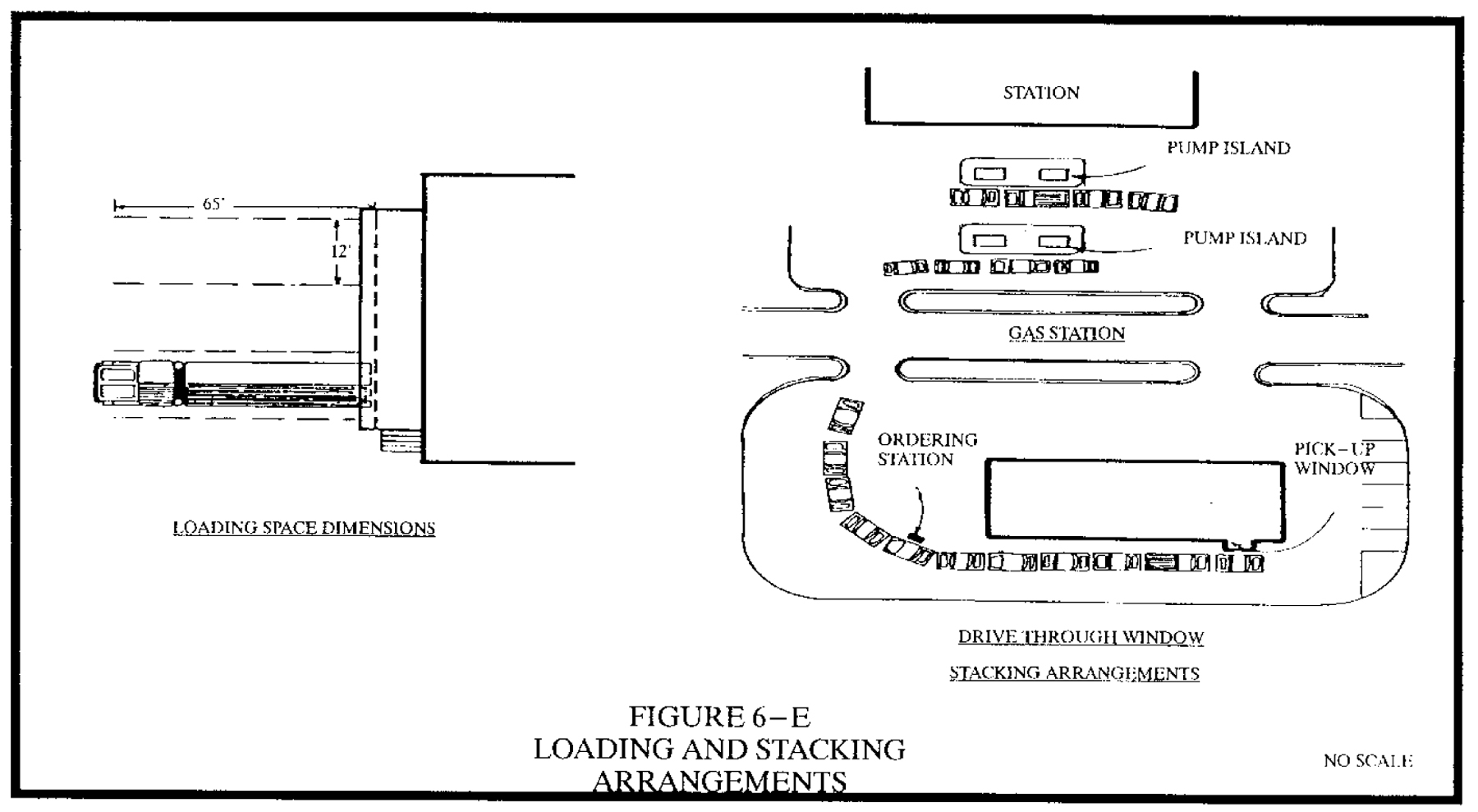
Each loading area shall be at least 12 feet wide, 65 feet long and 14 feet in clearance. See figure 6-E.
FIGURE 6-E LOADING AND STACKING ARRANGEMENTS
(3)
All off-street loading areas shall be arranged and marked to provide for orderly and safe unloading and loading, and shall not hinder the free movement of vehicles and pedestrians. All loading and unloading maneuvers shall take place on private property. No backing in from street or maneuvering on right-of-way shall be permitted.
(Ord. of 1-6-2000, § 6-2.7)
Sec. 30-985.- Applicability.
(a)
Exemptions. These requirements shall not apply to:
(1)
Single-family detached dwellings or two-family dwellings on their own lots;
(2)
Multifamily developments containing eight or fewer dwelling units in a single zone (building) lot;
(3)
Property lines abutting railroad rights-of-way and utility easements in excess of 60 feet in width;
(4)
Property lines abutting dedicated street right-of-way that has remained unopened for a period of at least 15 years; and
(5)
Property covered by an active forestry management plan written by a state registered forester, provided documentation has been furnished to the governing body or enforcement officer.
(b)
Application of tree coverage standards. After September 1, 2004, all development and land disturbing activity shall be conducted in accordance with section 30-992, except as follows:
(1)
Additions to existing residential buildings on single-family residential lots of record recorded prior to September 1, 2004 shall be exempt from the provisions of section 30-992;
(2)
Development and land disturbing activity shown on approved and continuously valid site plans, preliminary plats, final plats, development plans, and special use permits may be constructed in accordance with those approved plans;
(3)
Development for which a building permit has been issued and remains continuously valid may be constructed in accordance with the standards in effect at the time of issuance.
(c)
Application. These requirements shall apply to the following:
(1)
New principal building or use: Principal buildings or open uses of land constructed or established after the adoption of the ordinance from which this division is derived.
(2)
Changes in use: Changes in use that result in an increase of two or more in the land use classification number. The requirements of this section shall be applicable to the entire zone lot.
(3)
Expansions or reconstruction: Expansions which will result in a parking or building square footage increases of more than 3,000 square feet for developments existing on the effective date of the ordinance from which this division is derived. In such cases the landscaping requirements shall apply only to the expansion.
(4)
Reduction in parking requirements for pre-existing developments: To allow compliance with the landscaping regulations, the number of required off-street parking spaces may be reduced by the enforcement officer up to ten percent.
(Ord. of 1-6-2000, § 6-3.1; Ord. of 7-1-2004, § 6-3.1)
Sec. 30-986. - Planting yards.
(a)
Required planting areas. The following areas are required to be landscaped:
(1)
Street planting yards;
(2)
Parking lots (excluding vehicle loading, storage, and display areas); and
(3)
Planting yards.
(b)
Planting area descriptions.
(1)
Street planting yard: A planting area parallel to a public street designed to provide continuity of vegetation along the right-of-way and a pleasing view from the road. No more than 15 percent of the street planting yard may be used for walkways or signs. Parking, merchandise display and off-street loading are prohibited in the street planting yard. See "Street Planting Yard" figure below.
(2)
Parking lot plantings: Planting areas within and adjacent to parking areas designed to shade and improve the attractiveness of large areas of pavement.
(3)
Type A planting yard: A high-density screen intended to block substantially visual contact between adjacent uses and create spatial separation. A Type A planting yard reduces lighting and noise, which would otherwise intrude upon adjacent uses. See "Planting Yard Type A & B" figure below.
(4)
Type B planting yard: A medium density screen intended to partially block visual contact between uses and create spatial separation. See "Planting Yard Type A & B" figure below.
(5)
Type C planting yard: A low-density screen intended to partially block visual contact between uses and create spatial separation. See "Planting Yards Type C & D" figure below.
(6)
Type D planting yard: A peripheral planting strip intended to separate uses, provide vegetation in densely developed areas and enhance the appearance of individual properties. See "Planting Yards Type C & D" figure below.
(Ord. of 1-6-2000, § 6-3.2; Ord. of 7-1-2004, § 6-3.2)
Sec. 30-987. - Planting yard determination.
To determine the planting yards required by this division, the following steps shall be taken:
(1)
Identify the classification of the proposed or expanded land use and of any existing or proposed adjacent land use by using the permitted use schedule in section 30-331. A land use becomes existing on an adjacent property when a building permit is issued. If a zone lot contains uses with different land use classifications, select the higher numbered classification; then
(2)
Use the planting yard chart below to determine the appropriate letter designation for each planting yard; then
(3)
Match the letter designation obtained from the planting yard chart with the planting rate chart below to determine the types and numbers of shrubs and trees required.
PLANTING YARD CHART - EXISTING ADJACENT USES
Note:
*No planting yard required.
PLANTING YARD RATE CHART
Notes:
lf—linear feet
oc—on center
a Walls, a minimum of five feet in height, constructed of masonry, stone, or pressure treated lumber or an opaque fence, a minimum of five feet in height, may be used to reduce the widths of the planting yards by ten feet.
;sup\sup; In street yards, type C and D planting yards, and parking lots, understory trees may be substituted for canopy trees at the rate of two understory trees for each required canopy tree.
c One understory tree may be substituted for each required canopy tree if the technical review committee determines that there would be a major conflict with overhead utility lines.
*On lots of record less than 55,000 square feet in area, no development shall be required to place required landscaping on greater than 15 percent of the site.
FIGURE 6-F STREET PLANTING YARD
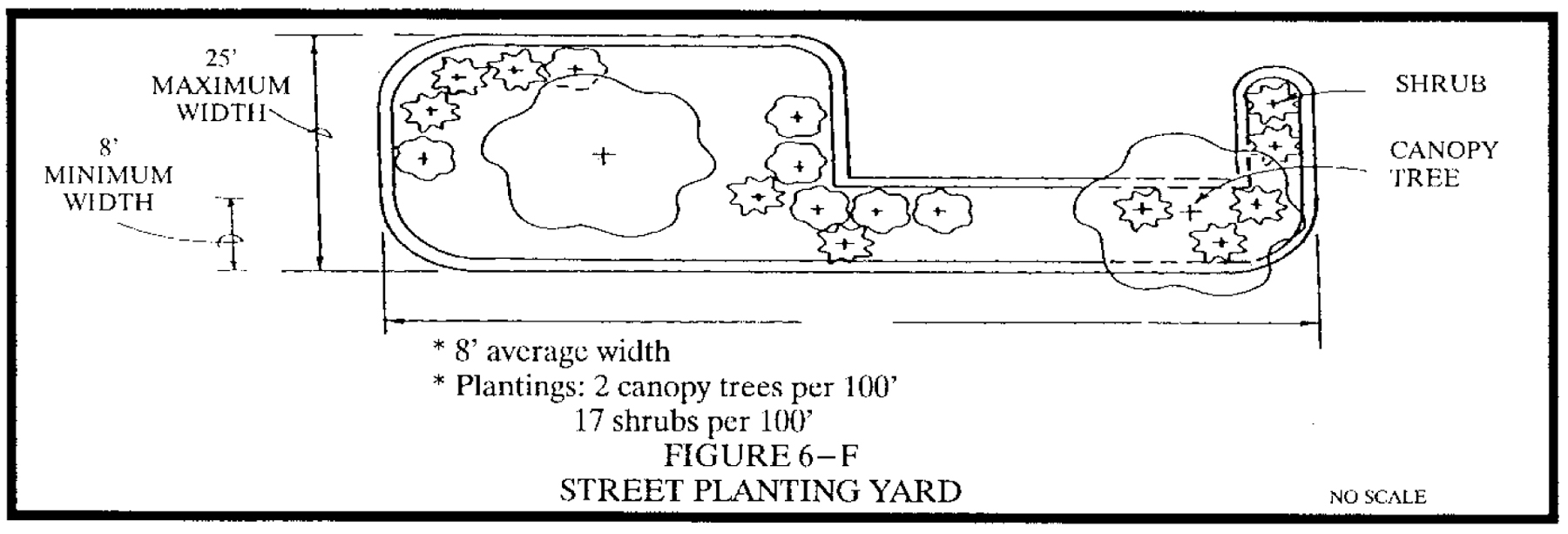
FIGURE 6-G PLANTING YARD TYPES A & B
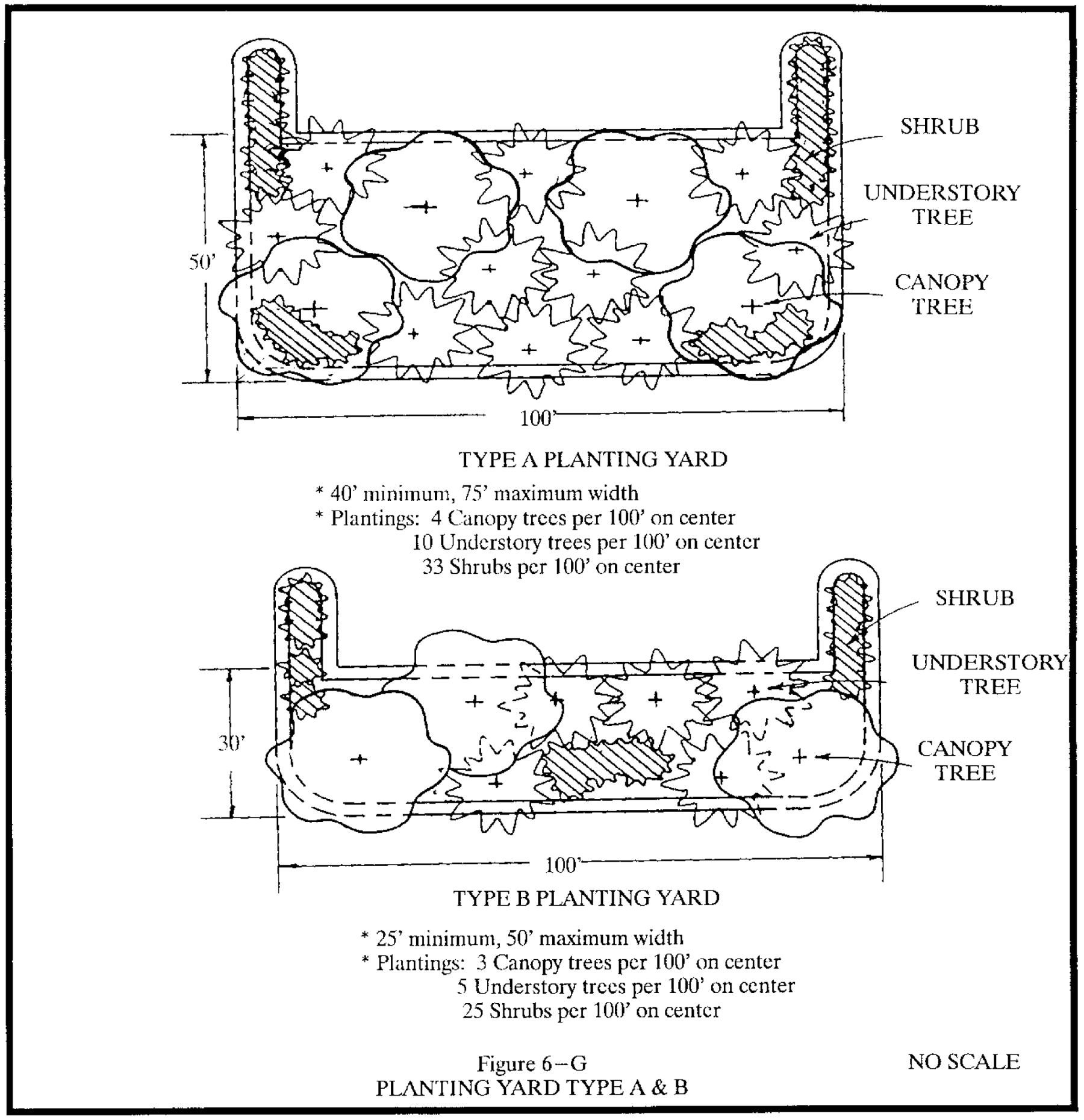
FIGURE 6-H PLANTING YARD TYPES C & D
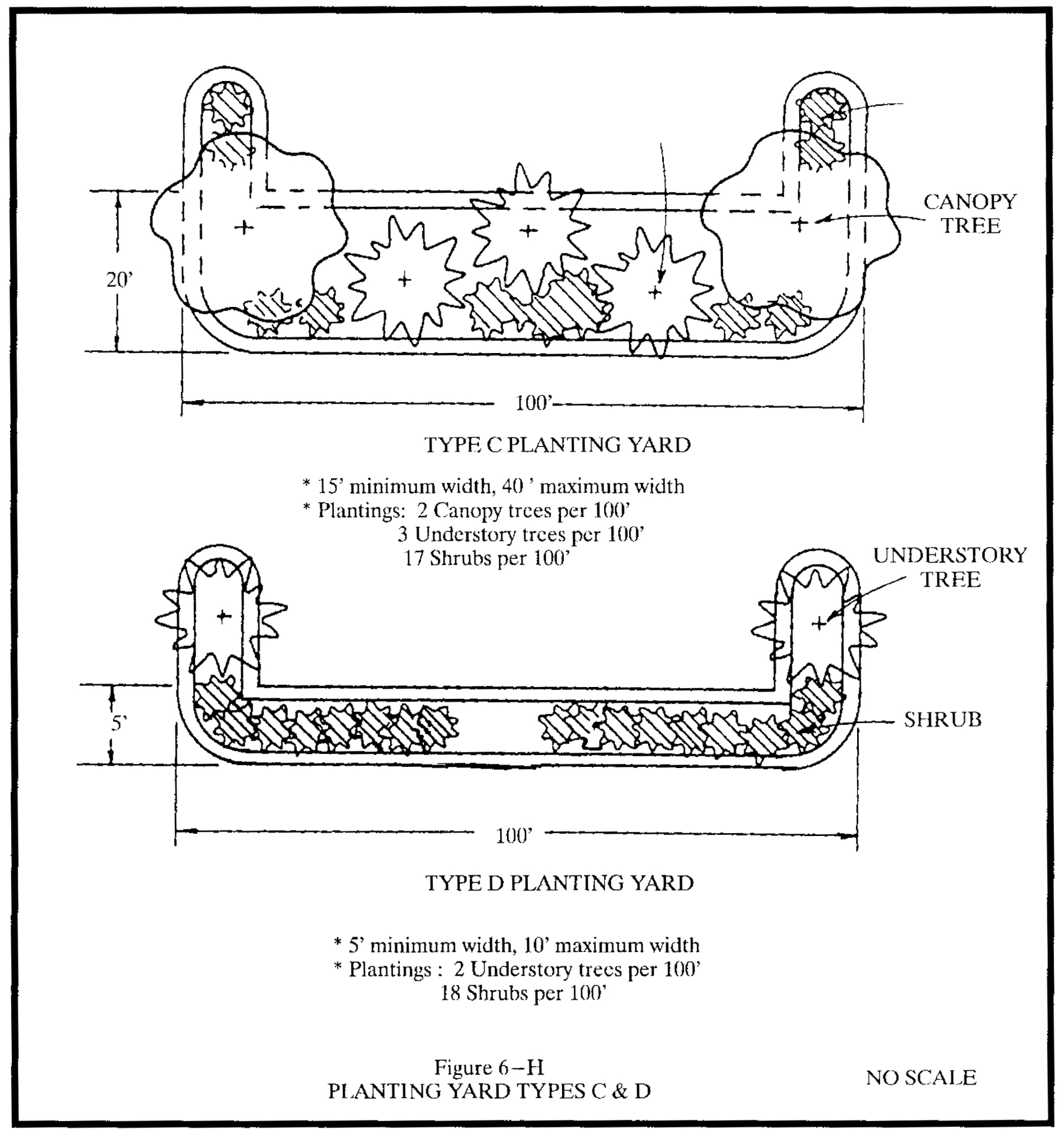
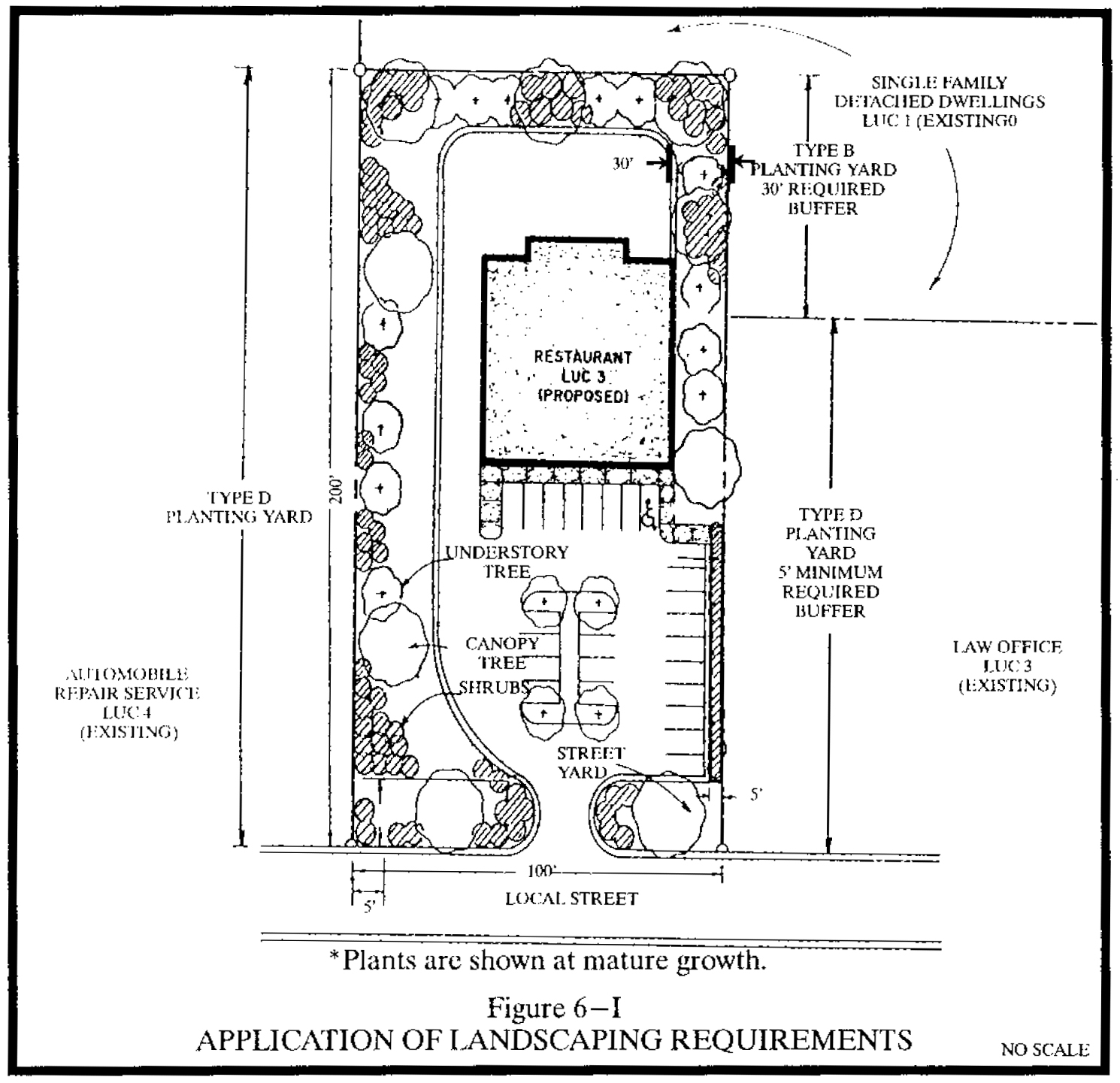
FIGURE 6-I APPLICATION OF LANDSCAPING REQUIREMENTS
(Ord. of 1-6-2000, § 6-3.3; Ord. of 7-1-2004, § 6-3.3)
Sec. 30-988. - Landscaping design and maintenance standards.
(a)
Calculation of street planting yards. Street planting yard rate and width calculations shall exclude access drives.
(b)
Plant species. Species used in required street planting yards, parking lots and planting yards shall be of a locally adapted nature. Refer to the recommended plant species list. Other species may be approved by the enforcement officer or the governing body.
(c)
Dimension of planting areas. Each planting area containing trees, including those located in parking lots, shall have a minimum inside dimension of seven feet and be at least 200 square feet in area.
(d)
Grouping. For the type B, C, and D planting yards, shrubs and trees may be grouped or clustered; however, not more than 50 percent of each required plant material may be grouped or clustered. The remainder of the materials shall be distributed throughout the planting yard. There shall be at least one row of evergreen shrubs or evergreen understory trees in all type A planting yards.
(e)
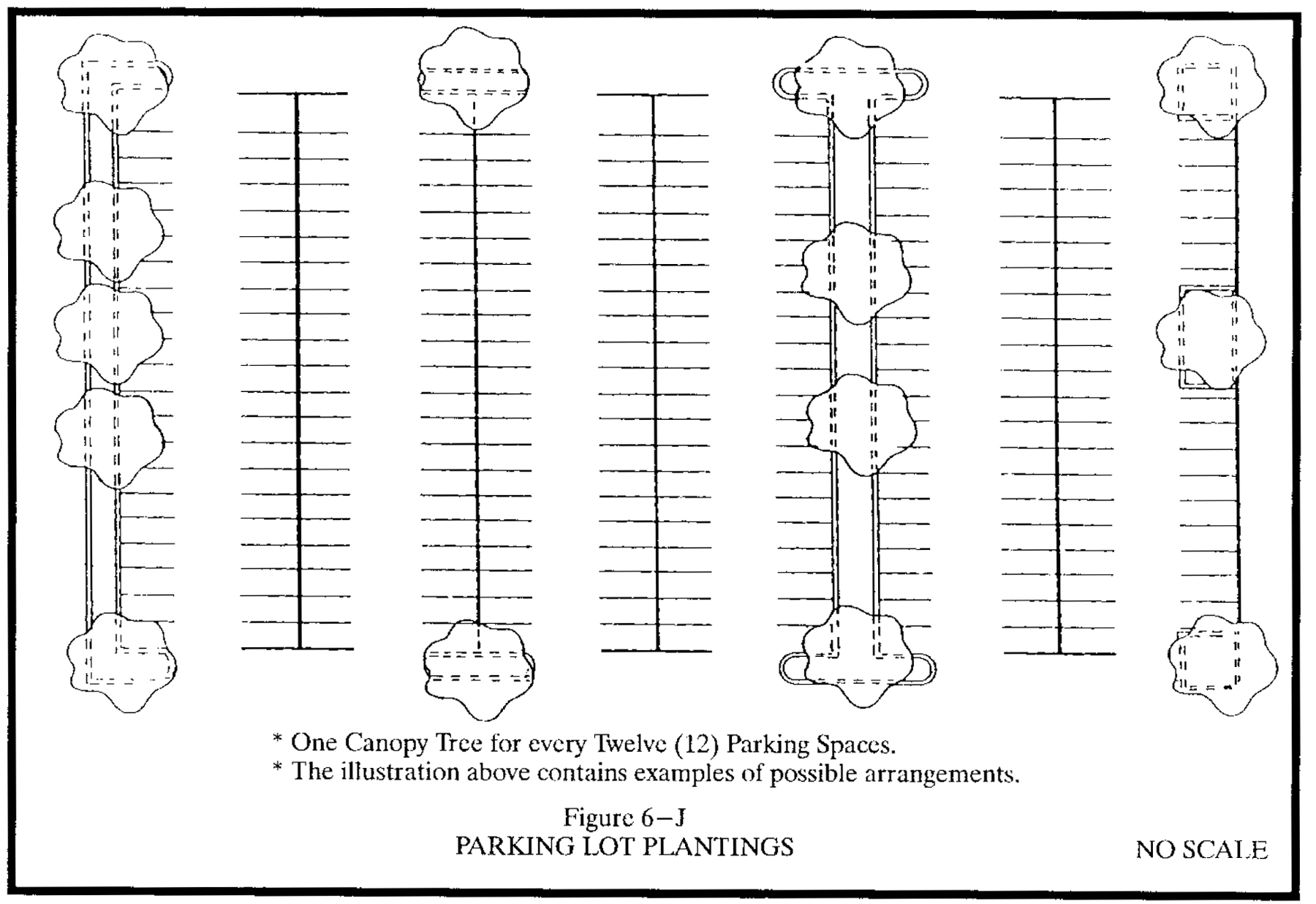
Parking lot spacing. Required canopy tree areas shall be distributed throughout parking lots and shall be located within or adjacent to parking lots as tree islands, at the end of parking bays, medians, or between rows of parking spaces. See "Parking Lot Plantings" figure below.
(f)
Canopy tree size. Canopy trees must be a minimum of eight feet high and two inches in caliper, measured six inches above grade, when planted. When mature, a canopy tree should be at least 40 feet high and have a crown width of 30 feet or greater.
(g)
Understory tree size. Understory trees must be a minimum of four feet high and one inch in caliper, measured six inches above grade, when planted.
(h)
Shrub size. All approved shrubs shall be installed at a minimum size of 18 inches, spread or height and are expected to reach a minimum height of 36 inches, and a minimum spread of 30 inches within three years of planting.
(i)
Berm. Berms may be used in an alternate planting plan as a substitute for some plant materials, subject to approval of the enforcement officer.
(j)
Wall planters. Wall planters shall be constructed of masonry, stone, or pressure treated lumber stamped for ground contact (AWPB LP-22 1980 or equivalent). The minimum height of the wall planter shall be 30 inches. The minimum height of shrubs in the wall planter shall be six inches. The effective planting area of the wall planter shall be four feet in width. If the wall planter is to contain trees, the effective planting width shall be seven feet.
(k)
Encroachments permitted in required planting yards. The following are permitted in required planting yards provided the landscaping requirements are met and there is no interference with any sight area:
(1)
Landscaping features, including but not limited to ornamental pools, planting boxes, sculpture, arbors, trellises, and birdbaths;
(2)
Pet shelters, at-grade patios, play equipment, outdoor furniture, ornamental entry columns and gates, flagpoles, lampposts, address posts, HVAC equipment, mailboxes, outdoor fireplaces, public utility wires and poles, pumps, wells, fences, retaining walls, or similar structures;
(3)
Cornices, steps, canopies overhanging eaves and gutters, window sills, bay windows or similar architectural features, chimneys and fireplaces, fire escapes, fire balconies, and fire towers may project not more than 2½ feet into any required planting yard, but in no case shall be closer than three feet to any property line; and
(4)
Permanent runoff control structures.
(l)
Fence location within required planting yards. The setback of fences within a required planting yard shall be subject to the approval of a landscaping plan.
(m)
Setback less than planting yard. If the required building setback is less than the required planting yard, the building setback shall control, reducing the required planting yard width only alongside the building. The planting rate of the required planting yard shall still apply.
(n)
Location of planting material outside shade of building. Where a building is located less than ten feet from a property line, and the planting yard would be heavily shaded by buildings on both sides of the property line, the required trees and shrubs may be planted outside the shaded area to improve survivability.
(o)
Obstructions. Landscaping shall not obstruct the view of motorists using any street, driveway or parking aisle.
(p)
Location. Required trees and shrubs shall not be installed in street rights-of-way. Required trees and shrubs may be placed in water quality conservation easements. Required trees and shrubs may be planted in electric utility easements below overhead lines and in drainage maintenance and utility easements by approval of the technical review committee.
(q)
Plant protection. Whenever planting areas are adjacent to parking lots or drives, the planting areas shall be protected from damage by vehicles, lubricants or fuels.
(r)
Maintenance. The owner is responsible for maintaining all required plant materials and planting areas in good health and appearance. Any dead, unhealthy or missing plants must be replaced within 180 days with vegetation, which conforms to the initial planting rates and standards. When plant material is severely damaged due to unusual weather conditions or other acts of God, the owner shall have two years to replant.
(s)
Water wise planting techniques. The following soil preparation techniques shall be used for all required landscape areas:
(1)
Soil preparation for the entire landscape yard includes the addition of organic amendments tilled to a depth of eight to 12 inches.
(2)
All plantings in the landscape yards shall be mulched including interior parking lot islands under 500 square feet to a depth of three to four inches and maintained weed free thereafter.
(3)
Earthen basins are constructed around the installed plants.
(4)
Plants, as permitted by this division, are grouped together where possible.
(5)
For establishment and survival, plants shall be watered in the first year of planting.
(6)
Recommended plant materials are listed in appendix F to this Code.
(t)
Irrigation. It is suggested that drip irrigation, which includes drip misters, be used for required landscaping planting beds during the required establishment period. After establishment, supplemental watering can be reduced and used on an as needed basis. Traditional spray irrigation is prohibited except for turf areas.
FIGURE 6-J PARKING LOT PLANTINGS
(Ord. of 1-6-2000, § 6-3.4; Ord. of 7-1-2004, § 6-3.4)
Sec. 30-989. - Procedures.
(a)
Landscaping plan required. Prior to obtaining a building permit, an applicant must receive approval of a landscaping plan from the enforcement officer, except that site plans submitted in accordance with section 30-300(b)(2) may include a conceptual landscaping plan and delay submission of the landscaping plan for up to 90 days after issuance of the building permit.
(b)
Installation of plant materials.
(1)
Prior to issuance. Installation of plant material shall occur prior to the issuance of a certificate of occupancy.
(2)
Request for extension of compliance.
a.
Extensions for all development except for single-family residential.
1.
In order to insure compliance and to reduce the potential expense of replacing landscaping or screening materials which were installed at an inappropriate time or under unfavorable conditions, a letter of request for extension of compliance with landscaping requirements may be filed with the enforcement officer, which states the reasons why the request is being made. If the enforcement officer finds that there are unfavorable conditions for planting, an extension of compliance with landscaping requirements may be allowed.
2.
In addition, this letter shall acknowledge that the applicant for the building permit is aware of all landscaping and screening requirements, and will comply with those requirements within 90 days, or discontinue use of the property.
3.
If the initial letter of request for extension of compliance with landscaping requirements has expired and conditions are still deemed unsuitable for planting, the applicant may request one additional extension of up to 90 days. During periods of extreme drought as evidenced by the official declaration of stage 3 or greater mandatory water conservation requirements, the enforcement officer of the governing body may authorize additional 90-day extensions beyond the one extension typically allowed. These extensions may be continued through the period in which the extreme drought conditions remain. Failure to comply with the provisions of this section within the time noted in the letter of request for the extension of compliance with landscaping requirements shall be deemed a violation of this division.
4.
The applicant shall also acknowledge that, while a conditional certificate of occupancy may be issued, no final certificate of occupancy will be issued while there is an active (pending) letter of request for extension of compliance with landscaping requirements unless a performance guarantee (such as a letter of credit or performance bond) sufficient to cover 120 percent of the installed landscaping costs has been posted with the inspections or planning department.
b.
Extensions for single-family residential development.
1.
A homebuilder who wishes to delay planting of required street trees at a new single-family home and to receive a certificate of occupancy on such home, may file an extension request with the designated planning or inspections staff.
2.
Except when sustained unfavorable planting conditions have existed in other months, such requests shall generally be received only during the period from May 15 to September 15 of each year.
3.
During periods of extreme drought as evidenced by the official declaration of stage 3 or greater mandatory water conservation requirements, the planning or enforcement officer may authorize requests for extensions beyond these dates so long as the extreme drought conditions remain.
4.
Separate extension requests must be filed for each lot and shall include:
i.
Specific details identifying the property involved;
ii.
The location, number, size, species and estimated installed cost of the street trees to be planted;
iii.
A specific extension deadline date by which the trees shall be planted;
iv.
An administrative fee handled by the planning or inspections department for each lot for which an extension is granted;
v.
A homeowner affidavit (as appropriate); and
vi.
Posting of a performance guarantee.
5.
If all conditions of the extension request are properly met, and if the homebuilder does not have outstanding violations or compliance issues, then the planting extension will be granted.
6.
The planning or inspections department shall adopt and maintain appropriate administrative guidelines to administer this program.
(Ord. of 1-6-2000, § 6-3.5; Ord. of 7-1-2004, § 6-3.5)
Sec. 30-990. - Alternate methods of compliance.
(a)
General provisions.
(1)
Alternate landscaping plans, plant materials or planting methods may be used where unreasonable or impractical situations would result from application of landscaping requirements. Such situations may result from utility easements, streams, natural rock formations, topography, lot configuration, or where other physical conditions exist, or where other site conditions exist such as unified development design.
(2)
The enforcement officer may approve an alternate plan that proposes different plant materials, planting yard widths, or methods provided that quality, effectiveness, durability and performance are equivalent to that required by this division.
(3)
The performance of alternate landscaping plans must be reviewed by the enforcement officer to determine if the alternate plan meets the intent and purpose of this division. This determination shall take into account the land use classification of adjacent property, number of plantings, species, arrangement and coverage, location of plantings on the lot, and the level of screening, height, spread, and canopy of the plantings at maturity.
(4)
Decisions of the enforcement officer regarding alternate methods of compliance may be appealed to the governing body.
(b)
Lot of record provisions. For zone lots less than 100 feet in width the following provisions may be applied:
(1)
For zone lots less than 100 feet and greater than 80 in width where type D planting yards are required, one type D planting yards may be eliminated from the landscaping plan if the enforcement officer finds that strict application of the requirements of this section prevents reasonable use of the property. However, the plantings required for this yard shall be installed in remaining planting yards.
(2)
For zone lots less than 80 feet in width where type D planting yards are required, two type D planting yards may be eliminated from the landscaping plan if the enforcement officer finds that strict application of the requirements of this section prevents reasonable use of the property. All required plants for these yards shall be installed in remaining planting yards.
(Ord. of 1-6-2000, § 6-3.6; Ord. of 7-1-2004, § 6-3.6)
Sec. 30-991. - Provisions for preservation of existing trees.
(a)
General. Any existing tree or group of trees that stands within or near a required planting area and meets or exceeds the standards of this division may be used to satisfy the tree requirements of the planting area. The protection of tree stands, rather than individual trees, is strongly encouraged.
(b)
Protection of existing trees. To receive credit, trees must be protected from direct and indirect root damage and trunk and crown disturbance. The following standards shall apply:
(1)
The protected area around trees shall include all land within the canopy drip line;
(2)
Construction site activities such as parking, material storage, soil stock piling and concrete washout shall not be permitted within tree protection areas; and
(3)
Protective fencing shall be installed around tree protection areas prior to any land disturbance. Such fences shall be at least four feet high and may consist of snow fence or polyethylene safety fencing. Fencing shall remain in place until construction is complete and other landscaping has been installed.
(c)
Dead or unhealthy trees. No credit will be allowed for any dead tree, any tree in poor health or any tree subjected to grade alterations. The death of any tree used for preservation credit shall require the owner to plant new trees equal to the number of credited trees.
(d)
Rate of credit. Credits shall be allowed at the rate of one canopy tree for every three inches of circumference measured at 4.5 feet above grade. Credits shall be subtracted from the total number of canopy and understory trees required in the same planting yard where the tree is located. In every case, however, there shall be at least one canopy tree for every 50 linear feet of street planting yard, existing or planted.
(Ord. of 1-6-2000, § 6-3.7; Ord. of 7-1-2004, § 6-3.7)
Sec. 30-992. - Tree coverage and protection standards.
The primary objectives of tree coverage and protection standards are preservation and maintenance of undisturbed tree cover and provision for replacement tree cover on development sites. Tree coverage serves to reduce glare, noise, air pollution, and soil erosion; to moderate temperatures; to reduce stormwater runoff; to preserve remnants of the town's native ecology; to provide habitat for native plants and wildlife; to provide a healthy living environment; and to make the town a more attractive place to live.
(Ord. of 7-1-2004, § 6-3.8; Ord. of 6-4-2009)
Sec. 30-993. - Tree coverage.
After September 1, 2004, new development shall include tree coverage areas on a portion of the development tract. The percentage of a tract that shall have tree coverage is as indicated in the following table. Tree coverage standards may be met either by preserving existing trees on the site or by planting replacement trees. Preserving existing trees on the site is preferable to a combination of preservation and planting and is reflected in the lower requirements. For the purposes of calculating tree coverage requirements, the water surface area of ponds, lakes and other water bodies (excluding stormwater control structures) shall be excluded from the total land area of the development tract.
TREE COVERAGE STANDARD
(1)
A tree preservation sketch plan shall be submitted in conjunction with all new development. A landscape plan prepared in accordance with article IX, division 4, or a preliminary subdivision plat shall be presumed to meet the requirements of the tree preservation sketch plan, provided it contains the following information (applicants may use current aerial photography and other photographs in conjunction with the sketch plan to indicate the location of existing vegetation):
a.
Location of wooded areas and specimen trees;
b.
Location of any wooded areas and specimen trees that will be removed or destroyed during development or construction;
c.
Location of wooded areas and specimen trees that will be retained after development or construction;
d.
Location of any required buffer strips, existing and proposed; and
e.
Location of any screening, existing and proposed.
(2)
Tree preservation and tree replacement areas as indicated on the sketch plan shall be shown on all preliminary plats, final plats, site plans, landscaping plans, development plans, and special use permits in order to clearly assign tree replacement responsibility during development. Tree preservation and tree replacement areas on any individual lot shall be clearly shown on all plot plans for the lot.
(3)
Property owners in developments other than single-family and duplex residential developments shall be responsible for protecting tree preservation and tree replacement areas in accordance with standard horticultural practice and section 30-991. Tree preservation areas located on single-family and duplex lots shall not be deemed to create an easement or enforceable obligation on owners who occupy a dwelling subsequent to issuance of a certificate of occupancy.
(4)
Where practicable, tree coverage areas in new subdivisions shall be located in common open space or buffers required by other provisions of this chapter. Where this is not practicable, tree coverage areas may be located on individual lots in the subdivision, provided that the root zone protection areas can be adequately protected and that the trees can be reasonably expected to survive the construction process.
(Ord. of 7-1-2004, § 6-3.9; Ord. of 6-4-2009)
Sec. 30-994. - Preserved tree coverage.
Tree preservation to meet the tree coverage standard in section 30-993 shall meet the following requirements:
(1)
The tree coverage area for a group of trees is determined by the exterior boundary of the total canopy for all of the trees in the group. For parcels greater than one acre, no tree preservation area for a group of trees may be counted toward meeting the tree coverage standard unless it includes a minimum of 1,000 square feet and has no individual dimension of less than 25 feet. For parcels one acre or less, no single tree preservation area for a group of trees may be counted toward meeting the tree coverage standard unless it includes a minimum of 500 square feet and has no individual dimension less than 20 feet.
(2)
The tree coverage area for an individual tree is determined by the tree's canopy area. Individual trees may be counted toward tree coverage credit provided that the tree's diameter is at least ten inches or greater measured at a point four and one-half feet above the ground. Where specimen trees of 18 inches or greater in diameter are preserved outside of other required buffers, tree coverage credit shall be granted at one and one-half times the canopy area.
(3)
Tree preservation areas shall be located in floodway areas, floodway fringe areas, stream buffers, steep slope areas, and wetlands. Additional tree preservation areas may be located outside of these areas, in which case they should be located in order to preserve areas of predominantly hardwood forest, to preserve specimen trees and to preserve groupings of trees that add to the aesthetic quality of the development as viewed from the public right-of-way.
(4)
At least 75 percent of the tree coverage included within any tree preservation area must be created by trees of greater than two and one-half-inch caliper.
(Ord. of 7-1-2004, § 6-3.10; Ord. of 6-4-2009)
Sec. 30-995. - Replacement tree coverage.
Tree replacement to meet the tree coverage standard in section 30-993 shall meet the following requirements:
(1)
For parcels greater than one acre, no tree replacement area may be counted toward meeting the tree coverage standard unless it includes a minimum of 1,000 square feet and has no individual dimension of less than 25 feet. For parcels one acre or less, no tree replacement area may be counted toward meeting the tree coverage standard unless it includes a minimum of 500 square feet and has no individual dimension less than 20 feet.
(2)
When replacement trees are provided in order to satisfy the requirements of section 30-993, coverage credit shall be accrued in accordance with the following table. In meeting this standard, at least 50 percent of replacement trees shall be two and one-half inches or greater. A minimum of 50 percent of replacement trees shall be large maturing hardwood species native to this region.
(3)
The enforcement officer and/or governing body shall have the authority to approve replacement trees of different sizes or species in order to address unique site conditions, allow design flexibility and to better meet the objectives of section 30-992.
(4)
For parcels without trees prior to September 1, 2004, replacement trees shall be planted at a rate of four trees per building lot and of caliper greater than two and one-half inches.
(5)
Replacement trees shall be planted before any certificate of occupancy is issued. However, for any lot other than an individual single-family or duplex residential lot, the planting may be postponed to the appropriate season in accordance with the requirements of subsection 30-989(b)(2).
(Ord. of 7-1-2004, § 6-3.11; Ord. of 6-4-2009)
Sec. 30-996. - Penalties for destruction of existing vegetation.
Any trees preserved on a development tract in order to meet ordinance requirements or otherwise indicated to be preserved shall meet the standards of section 30-991. Damaging or destroying any tree preservation area that is indicated on any site plan, development plan, preliminary plat, final plat, major special use permit or minor special use permit shall constitute a violation of this chapter. However, damage or destruction of trees by an act of God shall not be subject to the provisions of this section.
(1)
Where any tree with a diameter greater than ten inches measured at a point four and one-half feet above the ground in an area indicated on approved plans to be preserved is damaged, destroyed or removed, such violation shall be penalized as follows:
a.
A civil penalty in an amount equal to one and one-half times the monetary value of the trees damaged, destroyed or removed. For purposes of such determination the planning director or director's designee shall apply the most current standards of the council of tree and landscape appraisers or a similar method in common use; and
b.
Trees shall be replaced by new trees of a similar species with at least a two and one-half-inch caliper and a cumulative total caliper at least greater than the original tree.
(2)
Where tree preservation areas are damaged, destroyed or removed and no documentation exists about previous tree cover, such violation shall be penalized as follows:
a.
A civil penalty of $2.00 per square foot of disturbed area, not to exceed $40,000.00 per violation; and
b.
Replacement vegetation shall be provided in accordance with the buffer landscaping standards of the town.
Any civil penalty must be paid and required replacement trees planted before a certificate of occupancy is issued. Enumeration of these penalties shall not be construed to prohibit the use of any other remedy authorized by ordinance or law.
(Ord. of 7-1-2004, § 6-3.12; Ord. of 6-4-2009)
Sec. 30-997. - Restriction of clear cutting in anticipation of development.
The town may deny a building permit or refuse to approve a site or subdivision plan for either a period of up to:
(1)
Three years after the completion of a timber harvest if the harvest results in the removal of all or substantially all of the trees that were protected under city regulations governing development from the tract of land for which the permit or approval is sought.
(2)
Five years after the completion of a timber harvest if the harvest results in the removal of all or substantially all of the trees that were protected under city regulations governing development from the tract of land for which the permit or approval is sought and the harvest was a willful violation of the city regulations.
(Ord. of 6-4-2009)
Sec. 30-1011.- Application of development standards.
The development standards listed in this division are additional to other requirements in this chapter. These development standards are use-specific and apply to those uses designated with a "D" in the permitted use schedule in section 30-331. Uses requiring approval of a special use permit shall also be subject to these standards and any additional standards or conditions required by the special use permit.
(Ord. of 1-6-2000, § 6-4.1)
Sec. 30-1012. - Standards for all uses.
The following rules apply to all development standards and uses listed in this division:
(1)
Property separation. All measurements shall be made by drawing straight lines from the nearest point of the lot line where the proposed use is to be located to the lot line of the closest use (or zoned property) from which the proposed use is to be separated.
(2)
Use separation. All measurements shall be made by drawing straight lines from the nearest point on the wall of a proposed or existing principal building or edge of a proposed use to the nearest point on the wall of the principal building from which the subject building is to be separated, unless otherwise specified.
(3)
Outdoor lighting. Outdoor lighting structures shall be located, angled, shielded, or limited in intensity so as to cast no direct light upon adjacent property and to avoid the creation of a visual safety hazard to passing motorists.
(4)
Public street access. Any non-residential use which will produce greater than 100 vehicle trips-per-day as defined by the Institute of Traffic Engineers shall be located on a collector street or higher capacity roadway.
(Ord. of 1-6-2000, § 6-4.2)
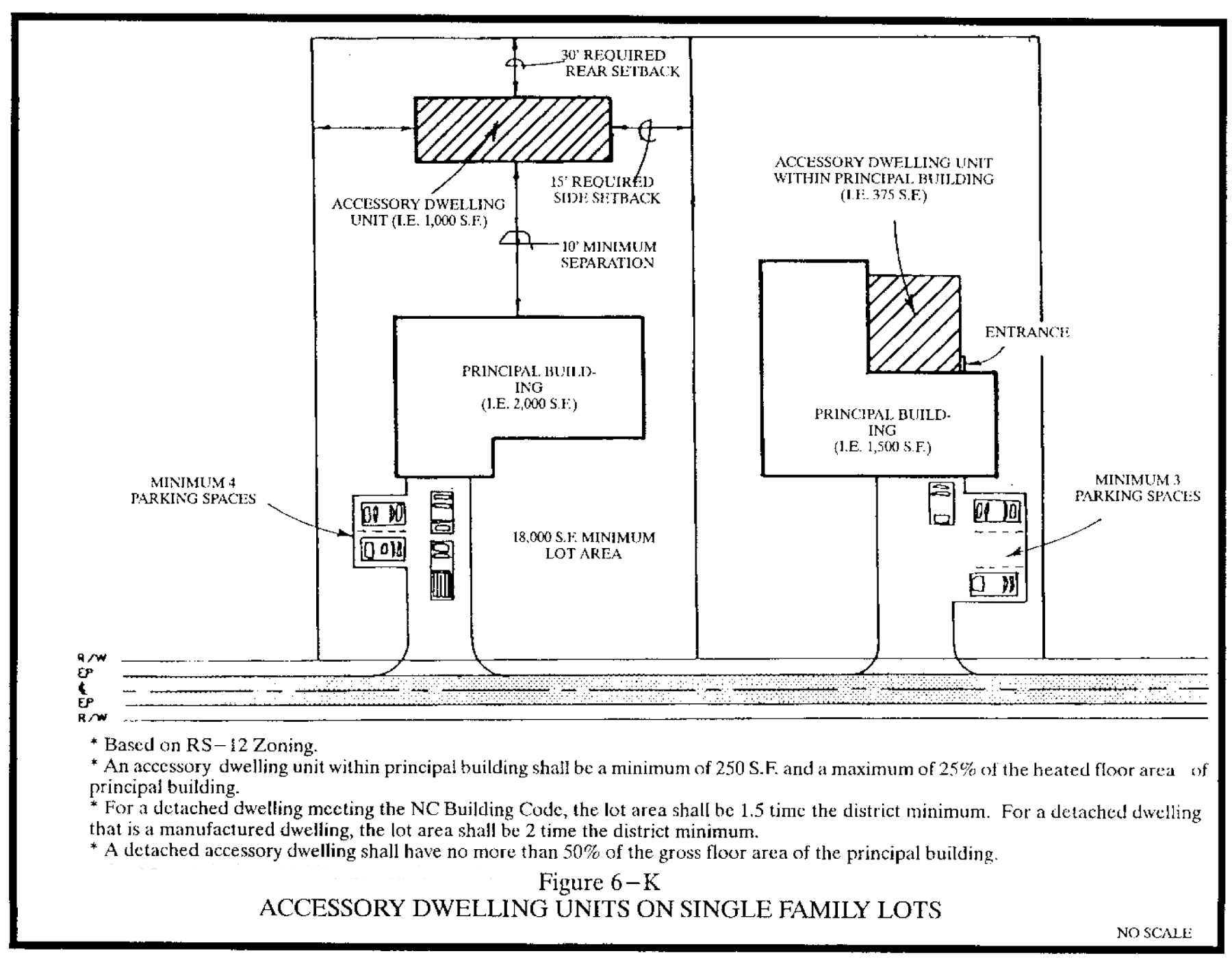
Sec. 30-1013. - Accessory dwelling units on single-family lots, see figure 6-K.
(a)
Where required. AG, all residential, LO, and GO-M districts.
(b)
General requirements.
(1)
The accessory dwelling unit and principal dwelling unit shall have the same address.
(2)
No more than one accessory dwelling unit is permitted on the same lot with a principal dwelling unit.
(3)
No accessory dwelling unit shall be permitted on the same zone lot with a two-family or multifamily dwelling or family care home.
(c)
Accessory dwelling unit within a principal single-family dwelling;
(1)
The principal building shall not be altered in any way so as to appear from a public or private street to be multifamily housing. Prohibited alterations include, but are not limited to, multiple entranceways, or multiple mailboxes. Access to the accessory dwelling unit shall be by means of an existing side or rear door, except where a new entrance is required by the state building code. No new doorways or stairways to upper floors are permitted if they are attached to the side of a building facing a public or private street.
(2)
An accessory dwelling unit shall occupy no more than 25 percent of the heated floor area of the principal building. The sum of all accessory uses (including home occupations) in a principal building shall not exceed 25 percent of the total floor area.
(3)
The minimum size of an accessory dwelling unit shall be 250 square feet.
(4)
The accessory dwelling unit shall have, water, sanitary sewer, and electrical utilities as part of the principal building.
(d)
Detached accessory dwelling units.
(1)
A detached accessory dwelling unit may be:
a.
A manufactured dwelling in zones which permit this use and subject to issuance of a special use permit;
b.
A dwelling unit which is part of an accessory detached garage; or
c.
A freestanding dwelling unit meeting the state building code.
(2)
The detached accessory dwelling unit shall:
a.
Have an approved sewage disposal connection or system;
b.
Meet all setbacks applicable to the principal building;
c.
Be erected behind and at least ten feet from the principal building; and
d.
Not exceed the maximum lot coverage when added to the square footage of all accessory buildings on the lot.
(3)
Minimum lot area.
a.
When the detached accessory dwelling unit is part of an accessory detached garage or is a freestanding accessory dwelling unit meeting the state building code, the lot containing both the principal and accessory dwelling units shall have 1½ times the minimum lot area required for the district.
b.
When the detached accessory dwelling unit is a manufactured dwelling, the lot containing both the principal and accessory dwelling units shall have two times the minimum lot area required for the district in which they are located.
(4)
Size and type of accessory dwelling unit.
a.
When the detached accessory dwelling unit is part of an accessory detached garage or a freestanding accessory dwelling unit meeting the state building code, the gross floor area of the accessory dwelling unit shall be limited to the maximum of 50 percent of the gross floor are of the principal building.
b.
When the detached accessory dwelling unit is a manufactured dwelling, the principal dwelling unit shall be a class AA double-wide manufactured dwelling or a freestanding principal dwelling unit meeting the state building code. (In no case shall a class A or B manufactured dwelling be accessory to another class A or B manufactured dwelling.)
FIGURE 6-K ACCESSORY DWELLING UNITS ON SINGLE-FAMILY LOTS
(Ord. of 1-6-2000, § 6-4.3)
Sec. 30-1014. - Adult-oriented establishment, principal or accessory use.
Adult-oriented establishments include, but are not limited to, the following: adult arcades, adult bookstores or adult video stores, adult cabarets, adult massage parlors, adult motels, adult motion picture theaters, adult theaters, escort agencies, nude model studios, sexual encounter centers, or any combination of these uses.
(1)
Where required. GB district.
(2)
Property separation. No adult-oriented establishment shall locate within 1,000 feet of a church, public or private elementary or secondary school, child day care center or nursery school, public park, or residentially zoned property.
(3)
Prohibition of sleeping quarters. Except for an adult motel, no adult-oriented establishment may have sleeping quarters.
(4)
Restriction of uses on the same property or in the same building. There shall not be more than one adult-oriented establishment in the same building, structure, or portion thereof. No other principal or accessory use may occupy the same building, structure, property, or portion thereof with any adult-oriented establishment.
(5)
Signs. Except for business signs permitted by division 2 of article IX, promotional materials shall not be visible to the public from sidewalks, walkways, or streets.
(Ord. of 1-6-2000, § 6-4.4)
Sec. 30-1015. - Agricultural production, livestock.
(a)
Where required. RS-40, RS-30, and HI districts.
(b)
Setback. Fencing shall meet the requirements of division 6 of this article. Shelters for such animals shall meet the principal structure setbacks for the district in which they are located.
(c)
Minimum area. The minimum lot size shall be five acres.
(Ord. of 1-6-2000, § 6-4.5)
Sec. 30-1016. - Advertising service, outdoor.
(a)
Where required. GB and HB districts.
(b)
Outdoor storage. No outdoor storage of any materials related to outdoor advertising shall be permitted.
(Ord. of 1-6-2000, § 6-4.6)
Sec. 30-1017. - Agricultural chemicals, pesticides, and fertilizers; agricultural products; animal and animal products; farm supplies; flowers nursery stock and florist supplies; forest products; grain and field beans; and livestock; wholesale trade of.
(a)
Where required. AG district.
(b)
Use separation. All structures, buildings or enclosed areas, used for the operation shall be a minimum of 100 feet from all property lines.
(c)
Noise. Equipment-producing noise or sound in excess of 70 decibels shall be located no closer than 100 feet to the nearest residence.
(d)
Dust. All unpaved storage areas shall be maintained in a manner which prevents dust from adversely impacting adjacent properties.
(e)
Fencing. Security fencing shall be provided around all outside storage areas.
(Ord. of 1-6-2000, § 6-4.7)
Sec. 30-1018. - Agricultural products, other, wholesale trade of.
See section 30-1017.
(Ord. of 1-6-2000, § 6-4.8)
Sec. 30-1019. - Airports and flying fields.
(a)
Airport and flying field, commercial (principal use).
(1)
Where required. PI district.
(2)
Minimum area. 50 acres for basic utility stage 1 airport with 2,000-foot runway. More area is required for larger airports. Airport size and layout shall conform to current FAA requirements.
(3)
Use separation. There shall be a minimum 300-foot distance between airport property and the nearest residence.
(4)
Fencing. Security fencing shall be provided sufficient to control access to runways and taxiways. The fencing shall be a minimum of six feet in height.
(b)
Flying field, private (accessory use).
(1)
Where required. AG, HI, and PI districts.
(2)
Minimum area. Ten acres and/or airstrip size and layout shall conform to current FAA requirements. The appropriate FAA permits shall be included with site plan submission.
(3)
Use separation. There shall be a minimum 300-foot distance between the private flying field and the nearest existing residence.
(Ord. of 1-6-2000, § 6-4.9)
Sec. 30-1020. - Ammunition, small arms.
(a)
Where required. HI district.
(b)
Use separation. No such facility shall locate within a 500-foot radius of any residential or public-institutional zoning district.
(c)
Security fencing. Security fencing shall be provided along the entire boundary of such a facility.
(d)
Operation. The facility and its operation shall observe all fire prevention and protection requirements.
(Ord. of 1-6-2000, § 6-4.10)
Sec. 30-1021. - Amusement park.
(a)
Where required. AG, HB, LI districts.
(b)
Minimum area. Minimum lot size shall be five acres.
(c)
Use separation. No buildings or structures, temporary or otherwise, shall be located within 50 feet of any property line.
(d)
Security fencing. Security fencing, a minimum of six feet in height, shall be provided along the entire boundary of the park activities.
(e)
Use separation. No amusement equipment, machinery or mechanical device of any kind may be operated within 200 feet of any developed residentially or public-institutionally zoned property.
(Ord. of 1-6-2000, § 6-4.11)
Sec. 30-1022. - Animal services, other, kennels, and pet grooming.
(a)
Where required. GO-M, LB, GB, HB, SC, and CP districts.
(b)
Outside storage. Pens and runs located outdoors are prohibited.
(Ord. of 1-6-2000, § 6-4.12)
Sec. 30-1023. - Animal and animal products, other, wholesale trade of.
See section 30-1017.
(Ord. of 1-6-2000, § 6-4.13)
Sec. 30-1024. - Athletic fields.
(a)
Where required. AG, all residential, LO and NB districts.
(b)
Access. All athletic fields shall have access to collector or higher capacity street.
(Ord. of 1-6-2000, § 6-4.14)
Sec. 30-1025. - Automotive towing and storage service.
(a)
Where required. GB, HB, LI and HI districts.
(b)
Maximum automotive storage.
(1)
In the GB and HB districts no more than 20 motor vehicles shall be stored on the premises at any one time.
(2)
In the LI district no more than 100 motor vehicles shall be stored on the premise at any one time.
(3)
In the HI district there is no maximum number.
(c)
Screening. The automotive storage area must be screened with a six-foot-high opaque fence in addition to the required planting yard.
(d)
Operation. No outdoor disassembly or salvaging shall be permitted.
(Ord. of 1-6-2000, § 6-4.15)
Sec. 30-1026. - Banks, savings and loan, or credit unions.
(a)
Where required. GO-M, GO-H, and CP districts.
(b)
Maximum area. The total direct customer service floor space shall not exceed 4,000 square feet.
(c)
Drive-through teller services. The point of service for window tellers, remote tellers, or automated teller machines (ATMs) shall be located no closer than 75 feet to residentially zoned property.
(Ord. of 1-6-2000, § 6-4.16)
Sec. 30-1027. - Bars.
(a)
Where required. GB, HB and SC districts.
(b)
Property separation. No such establishment shall be located within 200 feet of a church, elementary or secondary school, day care, public park or residentially zoned property.
(c)
Frontage. The main entrance of the building shall be toward a street zoned predominantly for nonresidential uses.
(d)
Screening. A minimum six-foot-high opaque fence shall be erected adjacent to the property line of abutting residences.
(e)
Parking. Parking areas related to the establishment shall be located no closer than 30 feet to the property line of abutting residences.
(Ord. of 1-6-2000, § 6-4.17)
Sec. 30-1028. - Barber shop, beauty shop.
(a)
Where required. CP district.
(b)
Operation. Operated as an accessory use and limited to two operators per establishment.
(Ord. of 1-6-2000, § 6-4.18)
Sec. 30-1029. - Batting cages.
(a)
Where required. HB, LI and HI districts.
(b)
Security fencing. Fencing, netting, or other control measures shall be provided around the perimeter of the batting area to prevent balls from leaving the designated area.
(Ord. of 1-6-2000, § 6-4.19)
Sec. 30-1030. - Beauty shop.
See section 30-1028.
(Ord. of 1-6-2000, § 6-4.20)
Sec. 30-1031. - Beneficial fill area.
(a)
Where required. All districts.
(b)
Maximum area. Two acres.
(c)
Maximum duration. The beneficial fill area shall be in operation no longer than one year.
(Ord. of 1-6-2000, § 6-4.21)
Sec. 30-1032. - Building supply sales with storage yard.
(a)
Where required. GB, HB, and SC districts.
(b)
Screening. All outside storage shall be completely screened from view from all streets and adjacent residentially zoned property.
(c)
Security fencing. Security fencing, a minimum of six feet in height, shall be provided around all outside storage areas.
(d)
Dust. All storage areas shall be maintained in a manner so as to limit dust from drifting onto adjoining properties.
(Ord. of 1-6-2000, § 6-4.22)
Sec. 30-1033. - Caretaker dwelling.
(a)
Where required. AG and all nonresidential districts.
(b)
Operation. A building permit for the principal building must be obtained or principal use is engaged, prior to occupancy.
(c)
Number. No more than one caretaker dwelling unit shall be permitted per lot.
(Ord. of 1-6-2000, § 6-4.23)
Sec. 30-1034. - Carwash.
(a)
Where required. GB, HB, and SC districts.
(b)
Use separation. Buildings shall be not less than 75 feet from any interior side or rear property line which adjoins residentially or public-institutionally zoned property.
(c)
Screening. A minimum six-foot-high opaque fence shall be provided adjacent to all residentially zoned property.
(d)
Operation.
(1)
All washing operations shall be contained in a building.
(2)
Specific areas shall be provided for the manual drying, waxing, polishing and vacuuming of automobiles and other motor vehicles when these services are offered on the site. These areas shall not conflict with on-site circulation patterns.
(3)
Hours of operation shall be between 7:00 a.m. and 10:00 p.m. when adjoining developed residentially zoned property.
(e)
Waste. Adequate provision shall be made for the safe and efficient disposal of waste products.
(Ord. of 1-6-2000, § 6-4.24)
Sec. 30-1035. - Cemetery/mausoleum.
(a)
Where required. All districts.
(b)
Minimum area. A minimum of three contiguous acres shall be required to establish a cemetery or mausoleum not located on the same tract of land as a church.
(c)
Location. Principal access must be from a collector street or higher capacity street.
(Ord. of 1-6-2000, § 6-4.25)
Sec. 30-1036. - Church.
(a)
Where required. All residential districts.
(b)
Location. Within urban areas, church facilities located on sites of three acres or more shall have direct access to a collector or higher capacity street.
(Ord. of 1-6-2000, § 6-4.26)
Sec. 30-1037. - Club or lodge.
(a)
Where required. AG, all residential, and NB districts.
(b)
Location. Except in the AG district, clubs and lodges shall have direct access to a collector or higher capacity street.
(Ord. of 1-6-2000, § 6-4.27)
Sec. 30-1038. - Computer sales.
(a)
Where required. CP district.
(b)
Maximum area. A maximum of 3,000 square feet of gross floor area shall be permitted per establishment.
(c)
Outside storage. No outside storage of materials shall be permitted.
(Ord. of 1-6-2000, § 6-4.28)
Sec. 30-1039. - Congregate care facility.
(a)
Where required. GO-M and PI districts.
(b)
Operation.
(1)
The facility shall provide centrally located shared food preparation, service and major dining areas.
(2)
Common recreation, social and service facilities shall be provided at a minimum rate of 30 square feet per dwelling unit or per rooming unit.
(3)
All facilities shall be solely for the use of residents and their guests.
(4)
Facilities for administrative services and limited medical services for the exclusive use of the residents shall be located on the site.
(c)
Density requirements. Conversions of existing hotels or motels to a congregate care facility shall be exempt from the density requirement found in this chapter.
(Ord. of 1-6-2000, § 6-4.29)
Sec. 30-1040. - Convenience store with gasoline pumps.
(a)
Where required. CP district.
(b)
Maximum area. A maximum of 3,000 square feet of gross floor area shall be permitted per establishment.
(c)
Outside storage. No outside storage of materials shall be permitted.
(d)
Gasoline service islands/pumps. There shall be no more than one gasoline service island containing no more than four gasoline pumps.
(Ord. of 1-6-2000, § 6-4.30)
Sec. 30-1041. - Convenience store without gasoline pumps.
(a)
Where required. CP districts.
(b)
Maximum area. A maximum of 3,000 square feet of gross floor area shall be permitted per establishment.
(c)
Outside storage. No outside storage of materials shall be permitted.
(Ord. of 1-6-2000, § 6-4.31)
Sec. 30-1042. - Country club with golf course, swim and tennis club.
(a)
Where required. AG, all residential, GO-M, HB, CP, LI, and PI districts.
(b)
Minimum area. The minimum area shall be two acres in addition to the golf course. The minimum shall be one acre if located on common area within a development.
(c)
Use separation. Fifty-foot minimum distance between clubhouse, swimming pool, lighted tennis court, or athletic field and any adjacent residentially zoned property.
(d)
Security fencing. Outdoor swimming pools shall be protected by a fence, or equal enclosure, a minimum of four feet in height and equipped with a self-closing and positive self-latching gate provided with hardware for permanent locking.
(Ord. of 1-6-2000, § 6-4.32)
Sec. 30-1043. - Day care center, child or adult.
(a)
As a home occupation:
(1)
Where required: All districts.
(2)
Maximum number of attendees for a child day care: A child day care home with five or fewer attendees, including after school attendees, may be operated as a home occupation subject to the development standards for a home occupation.
(3)
An adult day care with a maximum of five attendees may be operated as a home occupation, subject to the development standards for a home occupation.
(4)
Open space and recreation: Play space and open space requirements for a child daycare shall be provided in accordance with the regulations of the North Carolina Department of Human Resources, Child Development Division.
(5)
Security fencing: Outdoor activity area(s) for children shall be provided in accordance with the regulations of the North Carolina Department of Human Resources, Child Development Division. Fences shall comply with the requirements in article IX, division 6 (Fences) of this chapter and shall be located outside the street setback.
(6)
No more than one program, including after school care, may be operated at the same location during a 24-hour period.
(b)
As a principal use: An adult or child day care center not operated as a home occupation or as an accessory use shall be operated as a principal use and is subject to the following development standards:
(1)
Where required: AG, and all nonresidential districts, except HI.
(2)
Open space and recreation: Play space and open space requirements for a child daycare shall be provided in accordance with the regulations of the North Carolina Department of Human Resources, Child Development Division.
(3)
Security fencing: Outdoor activity area(s) for children shall be provided in accordance with the regulations of the North Carolina Department of Human Resources, Child Development Division. Fences shall comply with the requirements in article IX, division 6 (Fences) of this chapter and shall be located outside the street setback.
(4)
Location: Centers on a site greater than three acres shall have frontage on a collector or thoroughfare street.
(Ord. of 1-6-2000, § 6-4.33; Amend. of 2-7-2013, § 5)
Sec. 30-1044. - Drugstore.
(a)
Where required. CP district.
(b)
Maximum area. A maximum of 3,000 square feet of gross floor area shall be permitted per establishment.
(c)
Outside storage. No outside storage of materials shall be permitted.
(Ord. of 1-6-2000, § 6-4.34)
Sec. 30-1044.5. - Electronic gaming operation/sweepstakes.
(a)
Where required. GB district.
(b)
Property and use separation. No electronic gaming operation or electronic gaming machine used as an accessory to a principal use shall locate within 1,000 feet of a church, public or private elementary or secondary school, child day care center or nursery school, public park or private residence or residentially zoned property.
(Amend. of 8-2-2012)
Sec. 30-1045. - Elementary or secondary school.
(a)
Where required. AG, all residential and LO districts.
(b)
Access. All elementary or secondary schools shall have direct access to a collector street or higher capacity street.
(c)
Minimum area. All elementary or secondary schools shall be located on a minimum of three acres.
(Ord. of 1-6-2000, § 6-4.35)
Sec. 30-1046. - Equestrian facility.
(a)
Where required. AG, RS-40, and PI districts.
(b)
Minimum area. Minimum area required for an equestrian facility to be established is 25 acres.
(c)
Use separation. There shall be minimum 100-foot distance between manure storage areas, barns or stables and any adjacent residentially zoned property.
(d)
Dust. All unpaved areas shall be maintained in a manner which prevents dust from adversely impacting adjoining properties.
(Ord. of 1-6-2000, § 6-4.36)
Sec. 30-1047. - Equipment repair, light.
(a)
Where required. GB and HB districts.
(b)
Outside storage. Outside storage is prohibited.
(Ord. of 1-6-2000, § 6-4.37)
Sec. 30-1048. - Farm supplies, other, wholesale trade of,
See section 30-1017.
(Ord. of 1-6-2000, § 6-4.38)
Sec. 30-1049. - Flowers, nursery stock and florist supplies, wholesale trade of.
See section 30-1017.
(Ord. of 1-6-2000, § 6-4.39)
Sec. 30-1050. - Forest products, wholesale trade of.
See section 30-1017.
(Ord. of 1-6-2000, § 6-4.40)
Sec. 30-1051. - Garden center or retail nursery.
(a)
Where required. SC district.
(b)
Outside storage. No outside storage of non-plant material shall be permitted.
(Ord. of 1-6-2000, § 6-4.41)
Sec. 30-1052. - Golf course.
(a)
Where required. All residential, HB, CP, LI, and PI districts.
(b)
Use separation. Fifty-foot minimum distance between clubhouse or other principal building and any adjacent residentially zoned property.
(Ord. of 1-6-2000, § 6-4.42)
Sec. 30-1053. - Golf driving range.
(a)
Where required. AG, HB, LI, and HI districts.
(b)
Minimum area. The minimum lot depth from the tees to the end of the driving area shall be 1,000 feet or the end shall be controlled with netting and/or berms to prevent golf balls from leaving the property.
(c)
Security fencing. Fencing, netting, trees, berms, or other control measures shall be provided around the perimeter of the driving area so as to prevent golf balls from leaving the driving area.
(Ord. of 1-6-2000, § 6-4.43)
Sec. 30-1054. - Grain and field beans, wholesale trade of.
See section 30-1017.
(Ord. of 1-6-2000, § 6-4.44)
Sec. 30-1055. - Group care facility.
(a)
Where required. GO-M and PI districts.
(b)
Property separation. No such facility shall be located within one-half mile of an existing group care facility.
(c)
Operation. The facility shall be limited to not more than 30 persons.
(Ord. of 1-6-2000, § 6-4.45)
Sec. 30-1056. - Home occupations including renting of rooms.
(a)
Where required. AG, all residential, GO-M and NB districts.
(b)
Maximum area. Area set aside for home occupation shall occupy no more than 25 percent of the gross floor area of the dwelling unit.
(c)
Outside storage. No outside storage or display of items associated with the home occupation is permitted.
(d)
Operation.
(1)
The home occupation must be conducted entirely within a dwelling unit. It must be a use which is clearly incidental and secondary to the use of the dwelling unit for residential purposes and does not change the character of the residence. Home occupations are not permitted in a detached garage or other accessory structure, except for accessory dwelling units.
(2)
Permitted home occupations include, but are not limited to, typing services, telephone sales, barber/beauty services, doctor/dentist office, architects, accountants, family day care (five or fewer persons), food catering, and handcrafting etc.
(3)
No display, stock-in-trade, nor commodity sold not made on the premises shall be permitted.
(4)
Only one person may be employed who is not an occupant of the residence.
(5)
Activities shall not generate traffic, parking, noise, vibration, glare, fumes, odors, or electrical interference beyond what normally occurs in the district in which it is located.
(6)
Instruction in music, dancing, art or similar subjects shall be limited to no more than five students at one time.
(Ord. of 1-6-2000, § 6-4.46)
Sec. 30-1057. - Junked motor vehicle as an accessory use.
(a)
Where required. All districts.
(b)
Screening.
(1)
AG district. Up to two vehicles meeting the definition of "motor vehicle, junked," are allowed, but must be located behind the rear building line of the principal building. All vehicles in excess of two vehicles meeting the definition shall be enclosed within a building which meets the dimensional requirements of the district.
(2)
Residential districts. Any vehicle meeting the definition of "motor vehicle, junked," shall be enclosed within a building which meets the dimensional requirements of the district in which it is located.
(3)
Nonresidential districts. Any vehicle meeting the definition of "motor vehicle, junked," shall be stored, parked or placed on the property in such a manner so as to be totally screened from view from any street and/or from any adjacent residentially or public institutionally zoned property. Total screening shall be effected by placement of the vehicle either within or behind a building and/or by plant materials, fences, berms or a combination thereof with a minimum height of six feet.
(Ord. of 1-6-2000, § 6-4.47)
Sec. 30-1058. - Kennels.
See section 30-1022.
(Ord. of 1-6-2000, § 6-4.48)
Sec. 30-1059. - Landfills, construction or demolition/land clearing and inert debris.
(a)
Construction or demolition debris landfill(C-D), minor.
(1)
Where required. All districts.
(2)
Area, siting, and location requirements.
a.
Waste disposal area cannot exceed one acre and must be at least four feet above the seasonal high groundwater table.
b.
The landfill must be located at least one-quarter mile from any other landfill of any type.
c.
The perimeter of the landfill must be at least 50 feet from the boundary of the property and 500 feet from the nearest existing drinking water well at time of approval.
(3)
Closure and post closure.
a.
Within 30 days of the completion or termination of demolition activities, the landfill must be closed pursuant to G.S. 130A-301.2.
b.
The site must be covered with at least two feet of compacted earth, graded to minimize erosion, and planted with suitable vegetation.
c.
No building may be built or located immediately above any part of the landfill and no construction on any part of the site may in initiated before the landfill is closed.
d.
The property owner is responsible for filing with the county registry and with the state department of environment, and natural resources a survey of the site and proper notice for disclosure purposes pursuant to G.S. 47-30 and G.S. 130A-301.2.
(b)
Land clearing and inert debris (LCID) landfill.
(1)
Land clearing and inert debris landfill, minor.
a.
Where required. All districts.
b.
Maximum area. Two acres.
c.
Maximum duration. Landfills are limited to a maximum period of operation of three years from the date of issuance of the certificate of occupancy by county, provided that the town council may upon request grant one or more three-year renewals.
d.
Use separation. One-hundred feet minimum from any property line to the edge of the fill area and 300 feet minimum from any residence not on the same tract as the landfill.
e.
Buffer. Where possible a minimum 15-foot tree buffer shall be retained around the exterior property line.
f.
Access. Access to the landfill shall be from a state maintained paved road, provided that the town council may grant a waiver to the paving requirement upon reasonable conditions and shall be controlled with gates, chains, fences, ditches and/or trees to prevent unregulated dumping.
g.
Dust. All unpaved areas shall be maintained in a manner which prevents dust from leaving the property.
h.
Operation.
1.
No filling is permitted in the 100-year floodplain of any stream. Filling to the edge of the 100-year floodplain is permitted only if the back slope is stable and no steeper than 3:1;
2.
No filling is permitted in minor drainageways unless the drainage has been piped or otherwise diverted in accordance with approved plans; and
3.
No filling is permitted in utility easements, except electrical transmission easements for 44kv or greater lines.
i.
Closure. Landfills shall be closed with a minimum of one foot of clean soil, graded to a maximum slope of 3:1, and stabilized with vegetation or by other approved means.
(2)
Land clearing and inert debris landfill, major.
a.
Where required. AG and HI districts.
b.
Use separation. One-hundred feet minimum from any property line to the edge of the fill area and 300 feet minimum from any residence not on the same tract as the landfill.
c.
Buffer. Where possible a minimum 15-foot tree buffer shall be retained around the exterior property line.
d.
Access. Access to the landfill shall be controlled with gates, chains, fences, ditches and/or trees to prevent unregulated dumping.
e.
Dust. All storage areas shall be maintained in a manner which prevents dust from leaving the property.
f.
Operation.
1.
No filling is permitted in the 100-year floodplain of any stream. Filling to the edge of the 100-year floodplain is permitted only if the back slope is stable and no steeper than 3:1;
2.
No filling is permitted in minor drainageways unless the drainage has been piped or otherwise diverted in accordance with approved plans; and
3.
No filling is permitted in utility easements, except electrical transmission easements for 44kv or greater lines.
g.
Closure. Landfills shall be closed with a minimum of one foot of clean soil, graded to a maximum slope of 3:1, and stabilized with vegetation or by other approved means.
(Ord. of 1-6-2000, § 6-4.49)
Sec. 30-1060. - Laundry or dry cleaning plant.
(a)
Where required. LB and SC districts.
(b)
Maximum area. A maximum of 5,000 square feet of gross floor area shall be permitted per establishment.
(c)
Outside storage. No outside storage of materials shall be permitted.
(Ord. of 1-6-2000, § 6-4.50)
Sec. 30-1061. - Livestock, wholesale trade of.
See section 30-1017.
(Ord. of 1-6-2000, § 6-4.51)
Sec. 30-1062. - Market showrooms.
(a)
Where required. GB and HB districts
(b)
Display area. Display areas shall exist within permanent buildings only.
(Ord. of 1-6-2000, § 6-4.52)
Sec. 30-1063. - Migrant labor housing.
(a)
Where required. AG district.
(b)
Minimum area. Each site shall contain not less than two acres of land. An additional 2,000 square feet of land shall be required for each worker in excess of 20 people.
(c)
Setback.
(1)
Minimum required front yard shall be 100 feet.
(2)
Minimum required interior yard shall be 50 feet.
(d)
Building area. Rooms or compartments for sleeping shall contain not less than 39 square feet of floor space for each person.
(e)
Health and safety.
(1)
Not more than ten people shall be housed in any one room or compartment for sleeping purposes.
(2)
Separate toilet and shower facilities shall be provided for male and female workers. A minimum of one toilet and one shower shall be provided for each ten workers.
(3)
A laundry room shall be required with one wash sink of at least ten gallons capacity for each ten workers. Adequate clothes drying lines shall be provided.
(4)
Dining and food service facilities shall be provided and shall contain at least 12 square feet of floor space per worker and shall be approved by the county health department.
(5)
All water, sewer and sanitary facilities shall be approved by the county health department.
(6)
All garbage and refuse shall be stored in watertight and fly-tight receptacles and it shall be the responsibility of the owner of the property to insure that all garbage and refuse is regularly disposed of in a sanitary manner acceptable to the county health department.
(7)
Class C manufactured dwellings used as migrant labor housing as part of a bona fide farm operation must be certified as housing for migrant labor in accordance with department of labor regulations.
(Ord. of 1-6-2000, § 6-4.53)
Sec. 30-1064. - Mixed development.
(a)
Where required. GB, HB, SC, and CP districts.
(b)
Location of residential use. No residential use shall be permitted on or below the ground floor.
(c)
Percentage of mix. Where residential and nonresidential uses are mixed in a principal building, at least 20 percent of the gross floor area shall be devoted to the permitted nonresidential office and/or commercial use.
(d)
Dimensional requirements. Any building must conform to the nonresidential dimensional requirements of the district in which it is located.
(Ord. of 1-6-2000, § 6-4.54)
Sec. 30-1065. - Newsstand.
(a)
Where required. CP district.
(b)
Maximum area. A maximum of 3,000 square feet of gross floor area shall be permitted per establishment.
(c)
Outside storage. No outside storage of materials shall be permitted.
(Ord. of 1-6-2000, § 6-4.55)
Sec. 30-1066. - Optical goods sales.
(a)
Where required. GO-M district.
(b)
Maximum area. A maximum of 3,000 square feet of gross floor area shall be permitted per establishment.
(Ord. of 1-6-2000, § 6-4.56)
Sec. 30-1067. - Paintball gaming facility.
(a)
Where required. AG, HB, LI and PI districts.
(b)
Minimum area. Minimum lot size shall be five acres.
(c)
Use separation. No buildings or structures, temporary or otherwise erected as part of the gaming area, or designated gaming area shall be located within 100 feet of any property line or street right-of-way line. This area maybe reduced to 50 feet if a type A planting yard, netting or berms are installed to restrict projectiles or participants from leaving the property.
(d)
Boundary demarcation. The boundaries of the gaming area shall be clearly identified by a fence, netting, trees or berms or combination thereof.
(e)
Lighting. No part of the gaming area shall be lighted that is located in the AG zoning district.
(Ord. of 1-6-2000, § 6-4.57)
Sec. 30-1068. - Pet grooming.
See section 30-1022.
(Ord. of 1-6-2000, § 6-4.58)
Sec. 30-1069. - Private dormitory.
(a)
Where required. GO-M districts.
(b)
Use separation. The property on which the use is located shall be within a one-half mile radius of property developed as the primary campus of a college, business college, trade school or university.
(Ord. of 1-6-2000, § 6-4.59)
Sec. 30-1070. - Public park; public recreation facility.
(a)
Where required. All districts.
(b)
Parking. Overflow parking (in addition to required parking) must be designated on the site plan and be kept available to handle all traffic from special events such as softball tournaments and outdoor concerts.
(c)
Access. All parks greater than ten acres shall have primary access to a collector or higher capacity street.
(Ord. of 1-6-2000, § 6-4.60)
Sec. 30-1071. - Public recreational facility.
See section 30-1070.
(Ord. of 1-6-2000, § 6-4.61)
Sec. 30-1072. - Radio, television principal.
(a)
Where required. AG, GB, GO-M, HB, CP, LI, HI, and PI districts.
(b)
Location.
(1)
In the GO-M, HB, CP, LI, HI, and PI districts the tower shall be a minimum of 100 feet from any residentially zoned property.
(2)
In the AG district the distance of the nearest portion of the tower to any existing residence or RM or RS zoned property shall be one and one-half times the height of the tower for unguyed freestanding towers; or for guyed towers, the area necessary to contain all guy wires and appurtenances plus the district's required setback for guyed towers.
(3)
All towers shall be set back twice the height of the tower from all scenic corridor boundaries.
(c)
Landscaping. Where adjacent to RM or RS zoned property, the required planting yard shall be landscaped at a type A planting rate.
(d)
General.
(1)
Guy wires, anchors, and supporting cables shall be contained on the same zone lot with the tower and shall not encroach more than one-half the width of the planting yard.
(2)
The lot shall be of sufficient size to accommodate the intended use and the planting yard if required.
(3)
The provisions of division 7 of article VII regarding special-purpose lots may be applied.
(4)
New towers shall be permitted only if there is no prudent or feasible method to share an existing tower. No triangular platforms greater than 15 feet on a side shall be permitted. Triangular or T-bar platforms shall not be permitted if mounting of required antennas can be accomplished without such platforms.
(5)
Any existing tower or any tower approved for erection on or before the effective date of this amendment is exempt from nonconforming use of land and nonconforming structure provisions in subsections (b) and (c) of section 30-303.
(Ord. of 1-6-2000, § 6-4.62; Ord. of 2-4-2010(1))
Sec. 30-1073. - Recreational vehicle park.
(a)
Where required. HB district.
(b)
General requirements. The following requirements apply to recreational vehicle parks:
(1)
Unlawful to construct without approved site plan. It shall be unlawful for any person to construct a new park or to make an addition or alteration to an existing park, unless a site plan for the park has been approved by the town council.
(2)
Minimum tract area. Five acres.
(3)
Minimum and maximum number of spaces. At least 15 spaces but not more than 300 spaces.
(4)
Setback. All spaces shall be located a minimum of 100 feet from all public rights-of-way and property lines.
(5)
Number of homes and vehicles in each space. No more than one recreational vehicle may be parked or set up on any one space.
(6)
Access.
a.
No space shall have direct vehicular access to a public street.
b.
All spaces shall directly abut a private street contained within the park.
c.
Adequate access for shall be provided to each space, with a minimum access width of 20 feet unless more is deemed necessary because of topographical conditions or street curvature.
(7)
Recreational areas and facilities. Recreational areas and facilities to serve the needs of the anticipated population within the recreational vehicle park shall be provided and shall consist of at least the following:
a.
A play lot for preschool children containing a minimum size of 1,200 square feet provided within 500 feet of every space.
b.
One or more playgrounds for school-age children and adults, containing a minimum size of one acre per 100 spaces.
These recreation areas shall not be in an area utilized for septic tank fields.
(8)
Recreational vehicle sales. The sales of manufactured dwellings or recreational vehicles in the parks on a commercial basis shall not be permitted.
(9)
Drainage and grading.
a.
The spaces shall be located on ground with an elevation that is not susceptible to flooding and which is graded to prevent any water from ponding or accumulating on or around the manufactured home park. Where storm drainage pipes are located in adjacent streets, underground drainage facilities with connections to the storm drainage system shall be provided for the manufactured home park.
b.
Each space shall be graded and grassed to prevent erosion and provide adequate storm drainage away from the recreational vehicle pad.
c.
The slope of the surface of the stand or pad shall not exceed three percent.
d.
No banks, except along drainage ditches, in the park shall have a slope steeper than three feet to one foot.
(10)
Garbage and refuse disposal.
a.
Containers. All refuse shall be stored in conveniently located, and leakproof containers with tight-fitting lids. Containers shall be provided in sufficient number and capacity for proper storage of all refuse.
b.
Storage racks or platforms. Racks or concrete platforms shall be provided on which to store containers for refuse. Dumpsters shall be required in lieu of individual containers in areas where municipal water or sewer are available. Such containers racks or platforms shall be so designed as to prevent tipping, to minimize spillage and container deterioration, and to facilitate cleaning.
c.
Collection. All refuse shall be collected at least twice weekly, or more often if the need is indicated.
(11)
Registration. It shall be the duty of the operator to keep an accurate register containing a record of all occupants. The register shall contain the following information:
a.
Name, address and space number of each occupant.
b.
The date the recreational vehicle entered the park.
c.
The license number of each recreational vehicle and/or car, truck, etc., with state of issuance, make and type of vehicle.
The operator shall keep the register available at all times for inspection by the enforcement officer, public health officials, and other officials whose duties necessitate acquisition of the information contained in the register.
(12)
Park manager residence. A single-family detached dwelling may be constructed for the manager of the park.
(13)
Preexisting dwellings. Preexisting dwellings on the site may remain provided they occupy approved spaces.
(14)
Minimum space requirements.
a.
Each recreational vehicle space shall consist of a minimum of 2,000 square feet.
b.
Each recreational vehicle space shall be designated on the ground by permanent markers or monuments.
(15)
Setbacks. All structures, buildings, and sewage facilities shall meet the setbacks requirement for the district in which they are located.
(16)
Roads and drives.
a.
The RVP shall have all-weather roads and driveways that directly abut all spaces.
b.
Entrance and circulation drives must meet the minimum design standards of article VIII.
(17)
Parking. Parking space sufficient to accommodate at least one automobile and camping vehicle shall be constructed within each space and shall be paved.
(18)
Installation, alteration, and use of utilities.
a.
Conformance with applicable codes. The installation, alteration, or use of all utilities including, but not limited to, electrical service, plumbing fixtures, and sewage disposal systems shall conform with all applicable codes.
b.
Water supply.
1.
A safe, adequate, and conveniently located water supply must be provided for each park in compliance with applicable regulations.
2.
Areas around faucets or drinking fountains shall be properly drained.
c.
Sanitary facilities.
1.
Each park shall have a central structure or structures that will provide separate toilet and bathing facilities for both sexes.
2.
The minimum number of facilities per sex to be provided shall follow the schedule below:
3.
All toilet, shower, lavatory, and laundry facilities shall be provided and maintained in a clean, sanitary condition and kept in good repair at all times. They shall be safely and adequately lighted. Facilities shall be easily accessible to all persons and conveniently located.
d.
Sewage disposal. Each park shall provide a sewage dumping station. In accordance with county health department regulations, all sewage wastes from the park, including waste from toilets, showers, bathtubs, lavatories, wash basins, refrigerator drains, sinks, faucets, and water-using appliances not herein mentioned, shall be piped into the park's sewage disposal system approved by the county health department.
(19)
Insect and rodent control measures. Insect and rodent control measures to safeguard the public health and comfort shall be practiced for all uses, structures, etc., used in the park.
(20)
Retail sales. The recreational vehicle park may contain a retail sales counter and/or coin-operated machines for the park residents' use only, provided they are completely enclosed within a structure and there is no exterior advertising.
(21)
Permanent sleeping quarters. Permanent sleeping quarters shall not be permitted within the park for guests.
(22)
Manufactured dwellings in recreational vehicle parks. It shall be unlawful for a person to park or store a manufactured dwelling in a recreational vehicle park, except that one manufactured dwelling may be located within the park for exclusive use as the dwelling quarters for the park manager or operator. Such a manufactured dwelling shall be located in an area designated on the site plan, and approved by the town council.
(Ord. of 1-6-2000, § 6-4.63)
Sec. 30-1074. - Recycling processing centers.
(a)
Where required. LI district.
(b)
Use separation. No such facility shall locate within a 500-foot radius of any residentially or public institutionally zoned property.
(c)
Outside storage. No outside storage of materials shall be permitted.
(d)
Operation. The facility shall be operated in a wholly enclosed building except that loading to a flatbed railcar may take place outside the building provided no materials remain on the loading area for more that 24 hours.
(e)
Dust. All unpaved areas shall be maintained in a manner which prevents dust from adversely impacting adjacent properties.
(Ord. of 1-6-2000, § 6-4.64)
Sec. 30-1075. - Refrigerator or large appliance repair.
(a)
Where required. GB and HB districts.
(b)
Outdoor storage. No outdoor storage of appliances, equipment or parts shall be permitted.
(Ord. of 1-6-2000, § 6-4.65)
Sec. 30-1076. - Restaurant, no drive through.
(a)
Where required. LB district.
(b)
Maximum area. A maximum of 3,000 square feet of gross floor area shall be permitted per establishment.
(c)
Outside storage. No outside storage of materials shall be permitted.
(Ord. of 1-6-2000, § 6-4.66)
Sec. 30-1077. - Rural family occupation, see figure 6-L.
(a)
Where required. AG district.
(b)
Minimum area.
(1)
The rural family occupation (RFO) must be located on a tract of two acres or more.
(2)
A portion of the tract measuring 40,000 square feet with 150 feet of width must be designated and reserved as exclusively residential.
(c)
Maximum area. The total floor area of all buildings occupied by the RFO shall not exceed 5,000 square feet. The total land area that may be used in conjunction with the rural family occupation is 15,000 square feet.
(d)
Use separation. All operations of the RFO shall observe a 100-foot setback from all property lines.
(e)
Location. All operations of the RFO shall be located behind the rear line of the building occupied as the principal residence.
(f)
Landscaping. All operation of the RFO, including buildings, outside storage areas, and parking shall be treated as a separate use and subject to the landscaping provisions of this chapter.
(g)
Environmental review. The county environmental health division shall evaluate each RFO request to determine the occupation's impact on the surrounding area with respect to excessive noise, dust, air emissions, odors and surface or groundwater discharge. The RFO shall mitigate the impact of these and other environmental concerns. A written evaluation of these potential impacts is required by the environmental health division prior to the consideration of any request for an RFO.
(h)
Operation.
(1)
The RFO must be owned by the landowner who must reside on the property.
(2)
No more than five persons shall be employed other than those residing on the property.
(3)
There shall be no more than two commercial vehicles operating in and out of the property.
(4)
The RFO shall not be operated between the hours of 9:00 p.m. to 6:00 a.m.
(5)
Permitted uses shall be limited to those products assembled or manufactured on site for resale elsewhere, services sold or provided on premises, or stock-in-trade clearly incidental to such services. Commercial retail or wholesale operations which bring to the site goods specifically for the purpose of resale shall be prohibited.
FIGURE 6-L RURAL FAMILY OCCUPATION
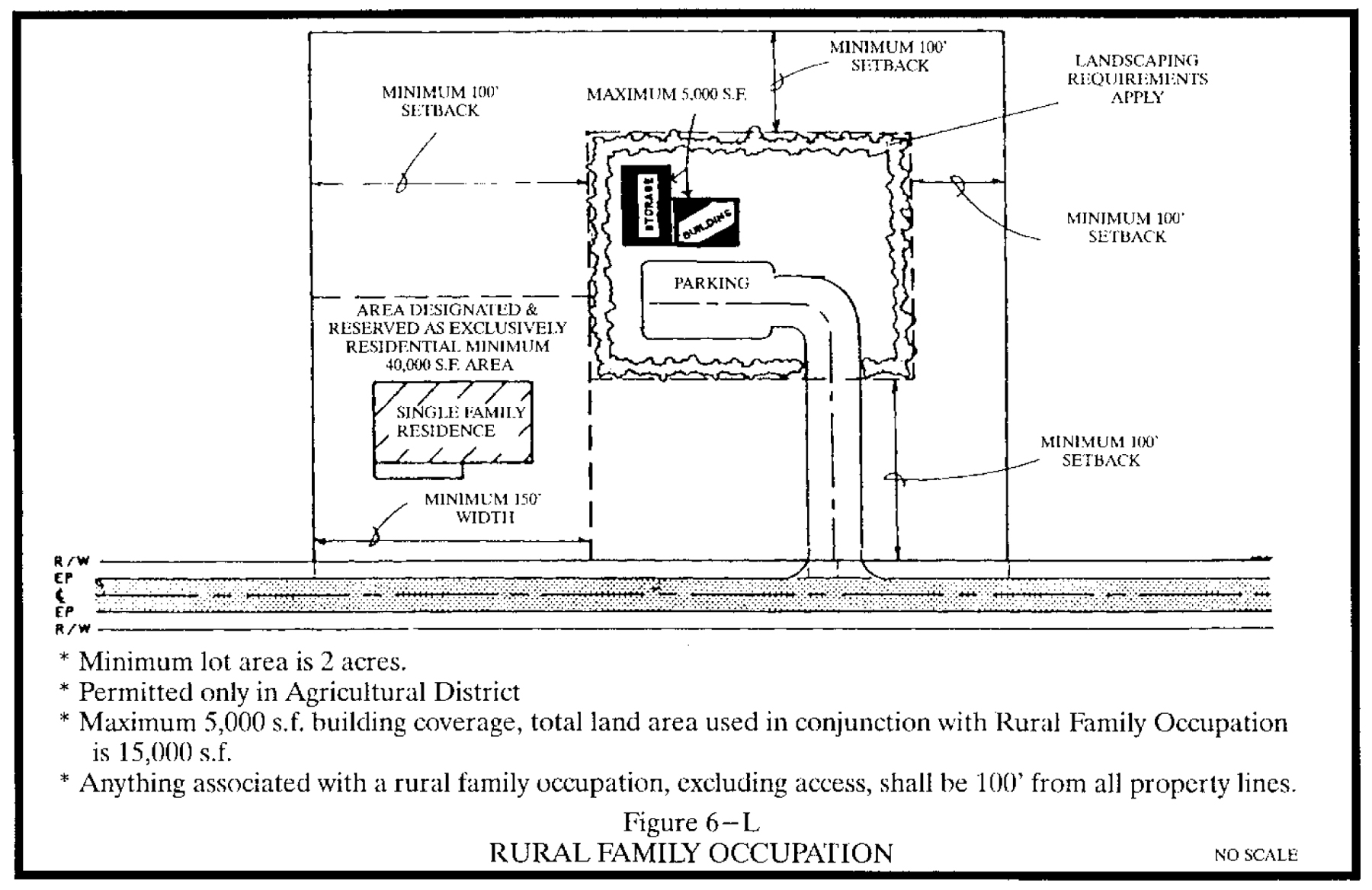
(Ord. of 1-6-2000, § 6-4.67)
Sec. 30-1078. - Salvage yards, auto parts and scrap processing.
(a)
Where required. HI district.
(b)
Minimum area. The minimum area required to establish a salvage yard shall be five acres.
(c)
Outside storage. An approved opaque fence of uniform construction not less than six feet in height shall be required around the perimeter of the activity. Such fencing shall be located between the salvage yard and the required planting yards.
(d)
Operation. The facility operator shall provide continuous on-site supervision by an employee and/or volunteer during the hours of operation.
(e)
Use separation. No salvage yard, scrap processor, or auto wrecking shall be located within 300 feet of any residence existing or under construction at the time of installation of such operation or business.
(Ord. of 1-6-2000, § 6-4.68)
Sec. 30-1079. - Satellite dish, accessory.
(a)
Where required. All districts.
(b)
Location.
(1)
All supporting cables and anchors shall be contained on the property.
(2)
In residential districts, structures shall not be located or placed in any street yard or side yard.
(3)
Attached and detached satellite dishes 18 inches in diameter or less shall be exempt from the requirements of subsection (b)(2) of this section. Detached satellite dishes 18 inches in diameter or less shall not exceed six feet in height and shall not be located within 15 feet of any public or private street right-of-way or private lane.
(Ord. of 1-6-2000, § 6-4.69; Ord. of 2-4-2010(1))
Sec. 30-1080. - Shelter for the homeless.
(a)
Where required. GO-M, GB, HB, LI, HI, and PI districts.
(b)
Property separation. No such facility shall be located within one-quarter mile of an existing shelter for the homeless.
(c)
Minimum floor area. A minimum floor space of 50 square feet shall be provided for each individual sheltered.
(d)
Operation.
(1)
The facility shall be contained within the building of and operated by a government agency or nonprofit organization.
(2)
The facility operator shall provide continuous on-site supervision by an employee and/or volunteer during the hours of operation.
(Ord. of 1-6-2000, § 6-4.70)
Sec. 30-1081. - Shoe repair or shoeshine shop.
(a)
Where required. CP district.
(b)
Maximum area. A maximum of 3,000 square feet of gross floor area shall be permitted per establishment.
(c)
Outside storage. No outside storage of materials shall be permitted.
(Ord. of 1-6-2000, § 6-4.71)
Sec. 30-1082. - Shooting range, indoor.
(a)
Where required. AG, GB, HB, LI, and HI districts.
(b)
Noise. The facility shall be designed to absorb sound to the maximum extent feasible.
(Ord. of 1-6-2000, § 6-4.72)
Sec. 30-1083. - Shooting range, outdoor.
(a)
Where required. AG and PI districts.
(b)
Use separation. Separation shall be a minimum 300 feet between range and closest exterior property line.
(c)
Access. Controlled to prevent unregulated entrance to firing area.
(d)
Security fencing. Security fencing to prevent an individual from crossing the property downrange.
(e)
Dikes (berms). Dikes shall be of sufficient height and thickness to stop all rounds fired downrange. Elevation control is required along the shooting stands to prevent rounds from being fired over the berm.
(Ord. of 1-6-2000, § 6-4.73)
Sec. 30-1084. - Single room occupancy residence.
(a)
Where required. GO-M and PI districts.
(b)
Minimum area. Rooming units shall be a minimum of 70 square feet with an additional minimum of 50 square feet for each additional occupant.
(c)
Minimum common area. The building shall contain common space such as recreation areas, lounges, living rooms, dining rooms, or other congregate living spaces at a rate of five square feet per rooming unit, but totaling not less than 250 square feet. Bathrooms, laundries, hallways, the main lobby, vending areas, and kitchens shall not be counted as common space.
(d)
Operation. On-site management shall be provided on a 24-hour basis.
(e)
Density requirements.
(1)
Conversions of existing hotels or motels to a single room occupancy residence shall be exempt from the density requirement found in this chapter.
(2)
After January 1, 1994, a newly constructed single room occupancy residence in the GO-M or GO-H district shall be exempt from the density requirements found in this chapter. The residential capacity of the facility shall be determined by provisions of the state building code in conjunction with the applicable setbacks, planting yards, and minimum off-street parking requirements of this chapter.
(Ord. of 1-6-2000, § 6-4.74)
Sec. 30-1085. - Sports instructional schools.
(a)
Where required. SC district.
(b)
Location of instruction. No outside instruction shall be allowed.
(Ord. of 1-6-2000, § 6-4.75)
Sec. 30-1086. - Swim and tennis club.
See section 30-1042.
(Ord. of 1-6-2000, § 6-4.76)
Sec. 30-1087. - Swimming pools.
(a)
Where required. All districts.
(b)
Use separation.
(1)
Pools shall be located so as to comply with the minimum setback requirement for accessory structures for the district in which it is located.
(2)
Pools which are not an integral part of the principal building shall be located a minimum of ten feet from the principal building.
(c)
Security fencing. Swimming pools located outdoors shall be protected by a fence, or equal enclosure four feet in height and equipped with a self-closing and positive self-latching gate provided with hardware for permanent locking.
(Ord. of 1-6-2000, § 6-4.77)
Sec. 30-1087.5 - Temporary family healthcare structures.
(a)
Where required. AG, RS-40, RS-30, LO, TC-R, and NB districts.
(b)
Accessory to a single-family detached dwelling. One temporary family healthcare structure shall be permitted as an accessory to an existing principal single-family detached dwelling on the lot. The caregiver shall obtain a permit, which shall be valid for one year and renewed annually as long as the structure remains on the lot, and shall provide necessary documentation to show compliance with this section.
(c)
[Requirements.] The temporary family healthcare structure shall:
(1)
Contain no more than 300 gross square feet;
(2)
Not be installed on a permanent foundation;
(3)
Be connected to water, sewer, or electric utilities serving the lot;
(4)
Be occupied by one mentally or physically impaired person;
(5)
Comply with setback requirements applicable to the principal dwelling;
(6)
Comply with applicable state building code and G.S. 140-139.1(b).
(d)
Caregiver. The caregiver shall reside in the principal single-family detached dwelling and must be a first or second degree relative of the mentally or physically impaired person.
(e)
Signage. No exterior signage advertising or otherwise promoting the temporary healthcare structure is allowed on any structure or the property.
(f)
Removal of structure.
(1)
The temporary family healthcare structure shall be removed within 60 days in which the mentally or physically impaired person is no longer receiving or in need of the assistance as provided for in this section.
(2)
If the temporary family healthcare structure is needed for another mentally or physically impaired person, it may continue to be used or may be reinstated on the lot within 60 days of removal.
(Ord. of 3-1-2017)
Editor's note— An ordinance adopted Mar. 1, 2017, set out provisions intended for use as § 30-1088. To preserve the numbering style of this Code, and at the editor's discretion, these provisions have been included as § 30-1087.5.
Sec. 30-1088. - Tourist home, bed and breakfast.
(a)
Where required. AG, all residential districts, NB, and LB districts.
(b)
Use separation. No such facility shall be located within 400 feet of a rooming house, boarding house or another tourist home.
(c)
Operation.
(1)
The tourist home must be owned by the landowner who also resides on the property.
(2)
The use shall be located in a structure which was originally constructed as a dwelling.
(3)
Meals served on the premise shall be only for guests of the facility.
(d)
Signs. There shall be no exterior advertising except that which is permitted for a home occupation.
(Ord. of 1-6-2000, § 6-4.78)
Sec. 30-1089. - Truck stops.
(a)
Where required. HB district.
(b)
Maximum area. The maximum area shall be for four acres.
(c)
Lighting. The maximum height of any outdoor lighting source or structure shall be 30 feet.
(d)
Screening. A minimum six-foot-high opaque fence shall be provided adjacent to residentially zoned property.
(Ord. of 1-6-2000, § 6-4.79)
Sec. 30-1090. - Turkey shoots.
(a)
Where required. AG district.
(b)
Setbacks.
(1)
No turkey shoot shall be allowed within a required setback.
(2)
All turkey shoots shall be established with the line of fire perpendicular to and away from a road right-of-way. The line of fire is a line which passes through the firing point and bisects the target. The back stop or target area shall be located not less than 500 feet from the road right-of-way.
(3)
Sites adjacent to more than one road right-of-way must designate the higher classified road as the front, and set the line of fire perpendicular thereto. Any resultant line of fire parallel to a road must be a minimum distance of 200 feet from and parallel to the road right-of-way.
(4)
All backstops shall be constructed a minimum of 500 feet from a residence located to the rear and/or side of the backstop.
(c)
Parking. An off-street parking area adequate in size to store two cars for every backstop shall be provided.
(d)
Operation.
(1)
Backstops shall be constructed of a material that will allow the shot to penetrate and not pass through. It shall be of a minimum thickness of two feet and maintained at a height of four feet above the target.
(2)
The firearms used in turkey shoots shall be limited to shotguns firing shot no larger than number eight. No firearms may be used which have been altered from manufacturer's specifications.
(3)
The operators of the turkey shoot shall be responsible for maintaining adequate fire protection by notifying the local fire department as to the dates and times of the turkey shoot.
(4)
Turkey shoots shall be limited to Thursdays, Fridays, and Saturdays and be in operation no later than 11:00 p.m.
(5)
Provisions for sanitation and refuse disposal must be made in accordance with health standards.
(e)
Event permit. The enforcement officer shall issue an event permit not to exceed 90 days in a given year for a qualifying turkey shoot.
(Ord. of 1-6-2000, § 6-4.80)
Sec. 30-1091. - Utility substations including transformer stations, telephone exchanges, repeater stations, pressure regulator stations, pump and lift stations, and similar structures.
(a)
Where required. All districts.
(b)
Dimensional requirements. All buildings shall be considered accessory buildings or structures.
(c)
Noise. Equipment producing noise or sound in excess of 70 decibels shall be located no closer than 100 feet to the nearest residence.
(d)
Security fencing. Security fencing, a minimum of six feet in height, shall be provided around the entire facility.
(e)
Outside storage. If the facility has no outside storage or placement of materials or equipment the land use classification (LUC) shall be considered a one, otherwise the LUC shall be considered a four.
(Ord. of 1-6-2000, § 6-4.81)
Sec. 30-1092. - Veterinary service, other.
(a)
Where required. GO-M, LB, GB, HB, SC, and CP districts.
(b)
Outside storage. Pens and runs located outdoors are prohibited.
(Ord. of 1-6-2000, § 6-4.82)
Sec. 30-1093. - Warehouse, general storage/enclosed.
(a)
Where required. GB and HB districts.
(b)
Maximum area. A maximum of 10,000 square feet of gross floor area shall be permitted for warehouse or wholesaling per establishment per lot.
(c)
Outdoor storage. No outdoor storage of warehousing or wholesaling items is permitted.
(d)
Land use classification. Warehousing or wholesaling uses shall have a land use classification of three.
(Ord. of 1-6-2000, § 6-4.83)
Sec. 30-1094. - Warehouse, self-storage.
(a)
Where required. GB and HB districts.
(b)
Minimum size. Minimum lot size shall be two acres.
(c)
Maximum size. Maximum lot size shall be five acres.
(d)
Lot coverage. The total ground area covered by buildings shall not exceed 50 percent of the site.
(e)
Maximum height. Maximum height of buildings shall be 20 feet.
(f)
Storage.
(1)
No outside storage shall be permitted.
(2)
Storage of hazardous, toxic or explosive substances shall be prohibited.
(g)
Operation.
(1)
No business activity other than the rental of storage units shall be conducted on the premises.
(2)
One residential dwelling unit shall be allowed on the same lot for use as a caretaker dwelling.
(Ord. of 1-6-2000, § 6-4.84)
Sec. 30-1095. - Watch or jewelry repair shop.
(a)
Where required. CP district.
(b)
Maximum area. A maximum of 3,000 square feet of gross floor area shall be permitted per establishment.
(c)
Outside storage. No outside storage of materials shall be permitted.
(Ord. of 1-6-2000, § 6-4.85)
Sec. 30-1096. - Wireless communications facility.
(a)
Where required:
(1)
AG, GB, GO-M, HB, CP, LI, HI, and PI districts: Stealth design or camouflage design required.
(2)
All other districts: Camouflage design required.
(3)
Scenic corridor overlay district: Camouflage design required.
(b)
Definitions:
(1)
Stealth design: Wireless communications facilities that use alternative mounting structures rather than tower mounts.
(2)
Camouflage design: Wireless communication facilities that, in the judgment of the planning and zoning board, do not have discernible antennas or ground mounted equipment, and have support structures and infrastructure that could be reasonably expected to exist regardless of the presence of a wireless communications facility.
(c)
Additional standards:
(1)
The principal use of the structure to be used for the placement of the antenna shall be for a use not associated with the wireless communications facility as determined by the planning and zoning board, unless the structure is a new support structure designed to mimic structures normally expected to occur within a given built environment. Examples include antennas attached to water towers, telephone/power poles, power transmission lines, sign support structures, and similar structures or uses which create no additional visual obtrusions, and which appear in context within a given landscape. New support structures designed to mimic structures normally expected to occur within a given built environment must appear, in the judgment of the Oak Ridge Planning and Zoning Board, in appropriate context with respect to the landscape.
(2)
In addition to the height limitations of the underlying zoning district, the antennas mounted on alternative mounting structures shall conform to the following requirements:
a.
All panel antenna shall be no more than five feet measured to the outermost point of the panel antenna from any surface of the existing structure at the point of attachment;
b.
All whip antenna shall be no more than ten feet measured to the tip of the whip antenna above the mounting surface of the existing structure at the point of attachment; and
c.
All parabolic or dish antenna shall be no more than five feet measured to the outermost point of the dish from any surface of the existing structure at the point of attachment.
(3)
Equipment enclosures shall be camouflaged or screened from view by a Type A landscape yard or other such measures that appear, in the judgment of the planning board, to provide equal or better performance in providing screening of the equipment enclosure.
(4)
Where a buffer is provided to camouflage the wireless communications facility, the buffer shall remain undisturbed until the wireless communications facility is removed, except for any access drives and utilities necessary for the wireless communications facility and other improvements or timbering activities that do not alter the visual effect of the buffer as determined by the planning and zoning board.
(5)
If the camouflaged wireless communications facility is intended to have the appearance of vegetation native to the North Carolina Piedmont, the wireless communications facility shall be located and designed so as to appear to be a naturally occurring tree which is not noticeably dissimilar to nearby vegetation in terms of height, scale, texture, or color.
(d)
[Information request.] The planning and zoning board may request information from the applicant sufficient to make a determination if the proposed facility meets the definition of a stealth or camouflage facility. This information could include, but is not limited to, a digital or artist's rendering of the proposed facility, an on-site balloon test to approximate height and visibility, or examples of similar facilities at other locations.
(e)
[Site plan requirement.] A site plan meeting the standards of appendix 2 shall be required for all wireless communications facility requests. Stealth design and camouflage design facilities incorporated into existing structures must satisfy all applicable North Carolina Building Code requirements.
(f)
[Prior tower approval.] Any existing tower or any tower approved for erection on or before the effective date of this amendment is exempt from nonconforming use of land and nonconforming structure provisions in subsections 30-303(b) and (c).
(Ord. of 2-4-2010(2))
Sec. 30-1114.- Applicability.
This section regulates all fences unless otherwise provided in this chapter. Fences are permitted in required setbacks according to section 30-414, provided the requirements of this section are met.
(Ord. of 1-6-2000, § 6-5.1)
Sec. 30-1115. - Permitted fence types.
The following fence types are permitted in all zoning districts:
(1)
Masonry or stone walls;
(2)
Ornamental iron;
(3)
Chain-link or woven wire; and
(4)
Wood or similar material.
(Ord. of 1-6-2000, § 6-5.2)
Sec. 30-1116. - Prohibited fence types.
The following fence types are prohibited:
(1)
Fences constructed primarily of barbed or razor wire, except for the purpose of enclosing livestock in agricultural zoning districts;
(2)
Fences carrying electrical current, except for the purpose of enclosing livestock in agricultural zoning districts;
(3)
Fences constructed in whole or in part of readily flammable material such as paper, cloth or canvas;
(4)
Fences topped with barbed wire or metal spikes in residential zoning districts, except those serving a public institution requiring a security fence for public safety purposes; and
(5)
Fences constructed of concertina wire.
(Ord. of 1-6-2000, § 6-5.3)
Sec. 30-1117. - Maintenance required.
Any fence which, through neglect, lack of repair, type or manner of construction, method of placement or otherwise, constitutes a hazard or endangers any person, animal or property is hereby deemed a nuisance. If such conditions exist, the enforcement officer shall require the owner or occupant of the property upon which the fence is located to repair, replace or demolish the fence causing the nuisance.
(Ord. of 1-6-2000, § 6-5.4)
Sec. 30-1118. - Height.
(a)
Residential uses.
(1)
Before front setback. No fence shall exceed four feet in height up to the front setback line.
(2)
Behind front setback. No fence shall exceed seven feet in height behind the front setback line.
(3)
Exceptions.
a.
No fence shall exceed four feet in height within 15 feet of any public or private street right-of-way line in a group housing development unless the sole purpose is to enclose a patio; a patio enclosure shall not exceed seven feet in height.
b.
On through lots where a front setback abuts a major or minor thoroughfare and there is no driveway access or sight distance interference, a fence may be seven feet in height as long as such fence is no closer than 15 feet from the thoroughfare right-of-way.
(b)
Recreational uses. No fence shall exceed 12 feet in height if the fence is within the required setback. Otherwise, no fence shall exceed eight feet in height.
(c)
Commercial, industrial, institutional or office uses. No fence shall exceed eight feet in height.
(d)
Measurement.
(1)
Fence height shall be measured in the same manner as buildings. However, where fences are located on retaining walls or manmade berms, the height of the retaining wall or berm shall be considered as part of the overall height of the fence.
(2)
Fence height limitations do not apply to fences built in conjunction with electric or gas substations, utility facilities, sewer plants or facilities, radio and television masts, towers and similar structures, municipal water storage facilities, public correctional and mental institutions, or military facilities, or hazardous or radioactive waste, storage, and disposal facilities.
(Ord. of 1-6-2000, § 6-5.5)
Sec. 30-1119. - Temporary fences.
Nothing in this section shall preclude the installation of temporary fences around construction works, erected or maintained pursuant to the state building code or the soil erosion and sedimentation control regulations.
(Ord. of 1-6-2000, § 6-5.6)
Sec. 30-1120. - General fence requirements.
(a)
Obstruction of view. No fence shall be placed or retained in such a manner as to obstruct vision at any intersection of public or private streets.
(b)
Obstruction of drainageway. Fence construction shall not alter or impede the natural flow of water in any stream, creek, drainage swale or ditch.
(c)
Historic districts. Fences in historic districts shall meet the standards for the particular historic district in which it is located.
(d)
Obstruction of access. No fence shall block access from doors or windows. Fences must have a clearance of at least two feet from building walls, except where fences project from or to a building wall.
(e)
Orientation of barbed wire. On fences topped with barbed wire, the bottom strand must be at least six feet above grade with vertical supports slanting inward away from the property line.
(f)
Location within required planting yards. The setback of fences within a required planting yard shall be subject to the approval of a landscaping plan.
(Ord. of 1-6-2000, § 6-5.7; Ord. No. O-2021-13, § 1, 7-1-2021)
Sec. 30-1149.- Purpose and intent.
The purpose of this division is to regulate the placement, orientation, distribution and fixture type and size of outdoor lighting. The intent of this division is to encourage lighting that provides safety, utility and security, as well as preventing glare on public roadways, and to protect the privacy of adjoining properties.
(Ord. No. 2002-01, § 6-6.1, 3-7-2002; Ord. of 5-29-2002)
Sec. 30-1150. - Conformance with applicable codes and ordinances.
All outdoor artificial devices shall be installed in conformance with the provisions in this division, and applicable provisions of the zoning ordinance. Where there is conflict between the provisions of this division and applicable provisions of the zoning ordinance, the most restrictive shall govern.
(Ord. No. 2002-01, § 6-6.2, 3-7-2002; Ord. of 5-29-2002)
Sec. 30-1151. - Approved materials and methods of installation.
The provisions of this division are not intended to prevent the use of any equipment, material or method of installation not specifically prescribed by this division provided the zoning board has approved the alternative. The zoning board may approve any such alternative provided the proposed design provides the approximate equivalence to the specific requirements of this article.
(Ord. No. 2002-01, § 6-6.3, 3-7-2002; Ord. of 5-29-2002)
Sec. 30-1152. - Definitions.
The following words, terms and phrases, when used in this division, shall have the meanings ascribed to them in this section, except where the context clearly indicates a different meaning:
Footcandle. Quantitative units of measure referring to the measurement of illumination incident to a single point. One footcandle is equal to one lumen uniformly distributed over an area of one square foot.
Full cutoff angle. The angle formed by a line drawn from the light source and a line perpendicular to the ground from the light source, beyond which no light is emitted. Refer to example graphics. Refer to the Cutoff Fixtures figure below.
CUTOFF FIXTURES
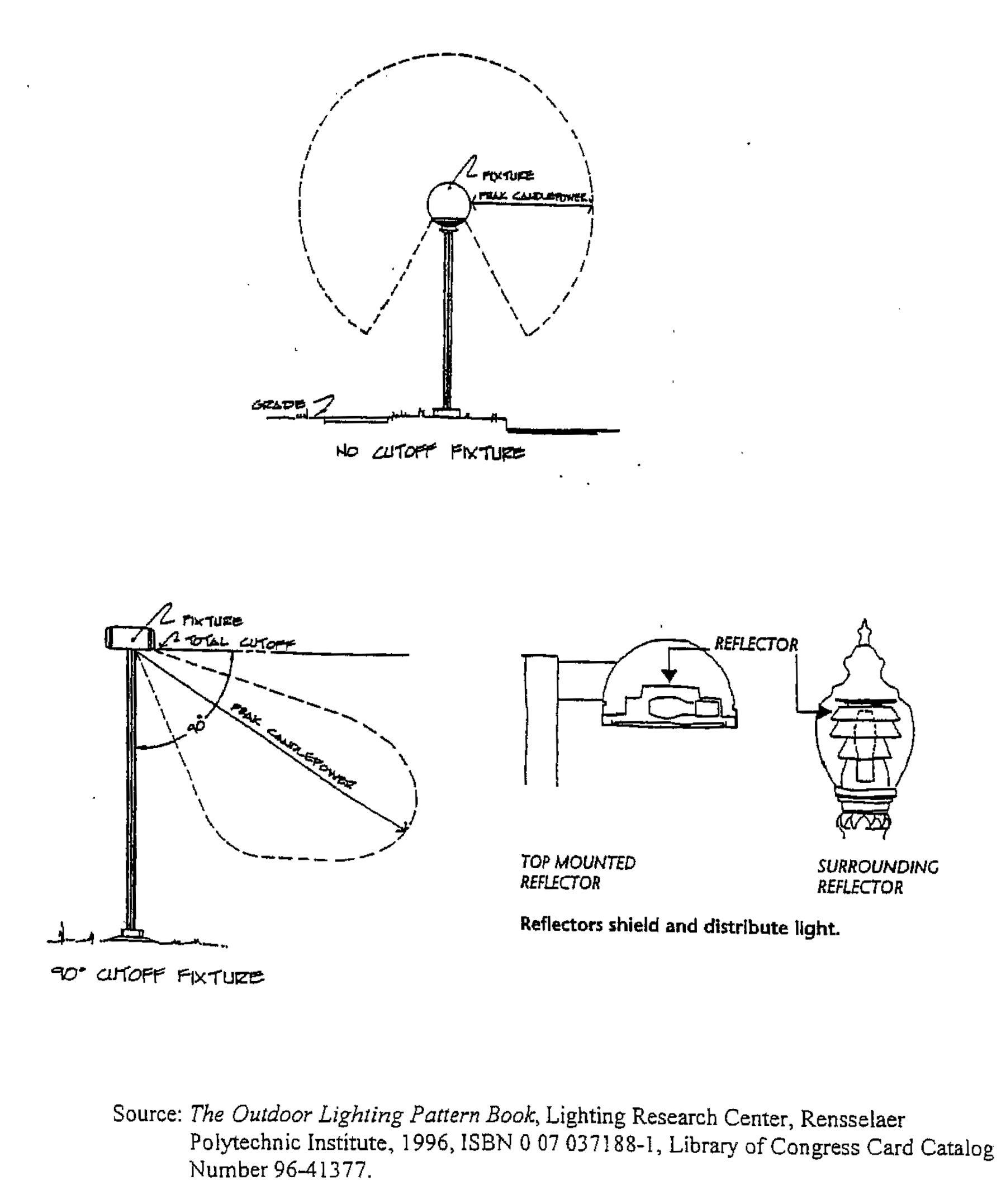
Installed. The initial installation of outdoor light fixtures defined herein, following the effective date of the ordinance from which this division is derived, but shall not apply to those outdoor light fixtures installed prior to such date.
Isofootcandle. A line plotted on any appropriate set of coordinates to show all the points on a surface where the illuminance is the same. A series of such lines for various illuminance values is called an isolux (isofootcandle) diagram.
Lamp. The component of a luminaire that produces light. A lamp is also commonly referred to as a bulb.
Lumen. A standard unit of measurement referring to the amount of light energy emitted by a light source, without regard to the effectiveness of its distribution.
Luminaire. A complete lighting unit consisting of a lamp or lamps together with the components designed to distribute the light, to position and protect the lamps, and to connect the lamps to the power supply. A luminaire is also commonly referred to as a fixture.
Outdoor light fixtures. Outdoor artificial illuminating devices, outdoor fixtures, lamps or other devices, permanent or portable, used for illumination, direction or advertisement. Such devices shall include, but are not limited to searchlights, spotlights, or floodlights for:
(1)
Buildings and structures, including canopies and overhangs;
(2)
Recreational areas;
(3)
Parking lot lighting;
(4)
Landscape lighting;
(5)
Signs, including billboards;
(6)
Display and service areas.
Outdoor luminaire. A luminaire which is permanently installed outdoors including, but not limited to, devices used to illuminate any site, structure, or sign.
Photometric plan. A point-by-point plan depicting the intensity and location of lighting on the property.
Shielded, fully. Fixtures that are shielded in such a manner that light emitted by the fixture, either directly from the lamp or indirectly from the fixture, are projected below a horizontal plane running through the lowest point on the fixture where light is emitted. This means that a fully shielded fixture is one used in such a way that it allows no direct or internally reflected light to shine above the light fixture.
(Ord. No. 2002-01, § 6-6.4, 3-7-2002; Ord. of 5-29-2002)
Sec. 30-1153. - Shielding.
All outdoor light fixtures except those exempted by section 30-1155 and those regulated by section 30-1154(b) shall be fully shielded as identified in section 30-1154. A fully shielded fixture must be a full cutoff luminaire or a decorative luminaire with full cutoff optics, and is defined as an outdoor lighting that is shielded or constructed so that all light emitted is projected below a horizontal plane running through the lowest part of the fixture. The light source visibility shall be shielded from the adjoining property.
(Ord. No. 2002-01, § 6-6.5, 3-7-2002; Ord. of 5-29-2002)
Sec. 30-1154. - General requirements for all zoning districts.
(a)
Public or private recreational facilities.
(1)
Primary playing areas. Where playing fields or other recreational areas are to be illuminated, there shall be a lighting plan submitted which shows the lighting fixtures. These lights should be mounted and aimed so that the illumination falls within the primary playing area and immediate surroundings so that no direct light illumination is directed off site.
(2)
Recreational parking areas. Lighting for these parking areas shall meet the requirements identified in subsection (g) of this section.
(b)
Outdoor illumination of building, landscaping and signs. The unshielded outdoor illumination of any building or landscaping is prohibited. The lighting should cause neither direct nor reflective glare at the normal viewing position.
(c)
Canopies/awnings shall not be internally lit. Canopies/awnings used for building accents over doors, windows, etc. shall not be internally lit (i.e., from underneath or behind the canopy/awning). Luminaires may be placed within or beneath the canopy/awning for down-lighting purposes, providing the luminaries do not illuminate the canopy/awning itself.
(d)
Signs to be turned off. All commercial outdoor lighting fixtures, including display lighting, shall be turned off after the close of business, unless needed for safety or security, in which case the lighting shall be reduced to the minimum level necessary.
(e)
Wall packs. Wall packs on buildings may be used at entrances to a building to light unsafe areas. They are not intended to draw attention to the building or provide general building or site lighting. "Wall packs" on the exterior of the building shall be fully shielded (true cut-off type bulb or light source not visible from off-site) to direct the light downward and be of low wattage (preferably 100-watt or lower). Other accent lighting projected onto buildings may be allowed provided that it is approved through the development plan process.
(f)
Gasoline station/convenience store aprons and canopies.
(1)
Lighting fixture bulbs. The lighting fixture bulbs shall be recessed into a canopy ceiling so that the bottom of the fixture is flush with the ceiling so that light is restrained to no more than 85 degrees from vertical as shown in Gasoline Station/Convenience Store Aprons and Canopies figure below.
GASOLINE STATION/CONVENIENCE STORE
APRONS AND CANOPIES
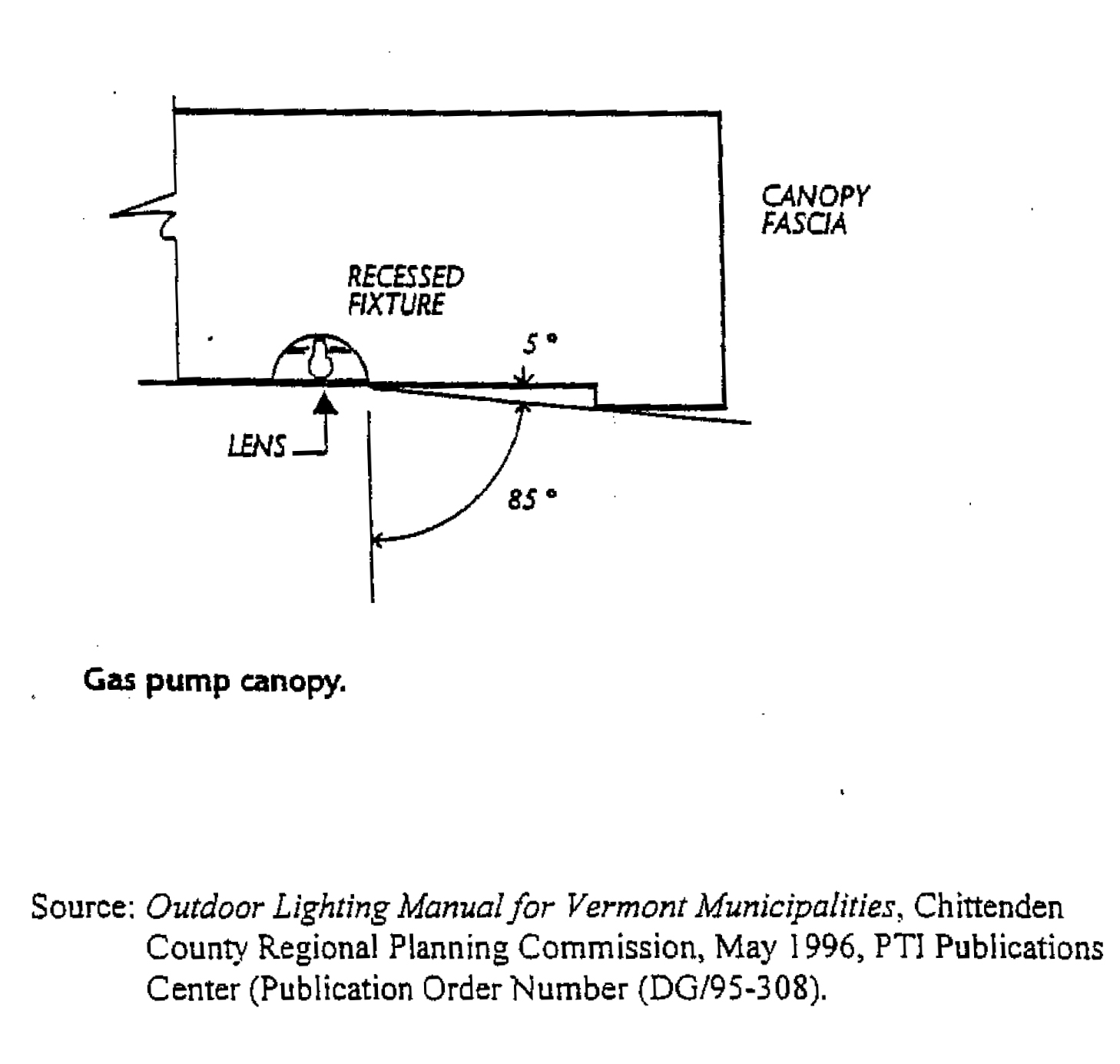
(2)
Indirect lighting. As an alternative to recessed ceiling lights, indirect lighting may be used where the light is directed upward and then reflected down from the underside of the canopy. In this case, light fixtures shall be shielded so that direct illumination is focused exclusively on the underside of the canopy.
(3)
Prohibited. Lights shall not be mounted on the top or sides (facia) of the canopy, and the sides of the canopy shall not be illuminated internally or externally.
(4)
Minimum footcandle; average horizontal illumination. Installed lighting (pump islands and under canopies) shall have a minimum of 1.0 footcandle at grade, and the average horizontal illumination cannot exceed 30 footcandles at grade level, subject to a uniformity ratio (ratio of average to minimum illuminance) no greater than 4:1. The standards herein are based on the Illuminating Engineering Society of North America (IESNA) RP-33, Lighting for Exterior Environments.
(g)
All parking lots, loading and display areas.
(1)
This lighting requirement applies to townhouses and multifamily, educational, institutional, commercial recreation, public, commercial business and retail, motor vehicle related, wholesaling, and limited and general industrial use categories identified within the zoning ordinance.
(2)
For parking lots the minimum light level shall be no less than 0.2 footcandles for low activity areas, 0.6 footcandles for medium activity areas, and 1.0 for high activity areas. The average level, maintained to the minimum footcandle ratio, shall be no greater than 4.1 (upper to lower limits). The upper limit for the light level shall not exceed six footcandles. All footcandles are to be measured at ground level. General parking lot lighting shall not exceed a maintained average of 2.5 footcandles.
(3)
General site lighting, meaning entrances, exits, drives behind buildings, etc. shall not exceed a maintained average of 2.5 footcandles. Lighting for all parking, display, and loading areas shall not exceed an average horizontal illumination level of 5.0 footcandles. All lighting fixtures serving these areas shall be cut-off fixtures as defined by the Illuminating Engineering Society of North America (IESNA); RP-33.
(4)
Maximum mounting height.[4]
Residential: 25 feet
Nonresidential: 30 feet
(h)
Mercury vapor. The installation of mercury vapor fixtures is prohibited, except for agricultural buildings, paddocks and similar use areas in AG and RS and RPD zoning districts. For residential structures on agricultural property, lighting must be full cutoff fixtures, or retrofitted with, for example, the Hubble SkyCap and illumination shielded downward.
(i)
Spillover light. Spillover light, vertical or horizontal, from parking area luminaries beyond the property line in residential or agricultural (AG) and residential (RS) or rural preservation district (RPD) zoning districts shall not exceed 0.5 footcandle at the property line.
(1)
Requirements: All commercial exterior lighting, such as that used in and around buildings, recreation areas, parking lots, and signs, shall be designated to protect against the spillover of light to adjacent properties. It shall also be designed to protect against glare onto public rights-of-way thereby impairing the vision of motorists and adjoining properties. All exterior lighting shall be shielded from adjacent properties by thick evergreen vegetated buffers, berms, walls, or fences, and/or the use of directional lighting, lighting shields, special fixtures, timing devices, appropriate light intensities, luminaries, and mountings at appropriate heights in accordance with this article.
(2)
All outdoor lighting shall conform to the following standards:
a.
Incandescent lights under 50 watts are not a regulated item. Lights above 50 watts are subject to this division.
b.
All outdoor lighting shall be designed and located such that the maximum illumination measured in footcandles at the property line shall not exceed 0.5 footcandle for property lines adjacent to residential zoning, and 5.0 footcandles for property lines adjacent to nonresidential zoning.
(Ord. No. 2002-01, § 6-6.6, 3-7-2002; Ord. of 5-29-2002)
Height is measured from the ground surface to the bottom of the lighting fixture.
Sec. 30-1155. - Exemptions.
(a)
Outdoor light fixtures installed prior to the effective date of the ordinance from which this division is derived are exempt from the provisions of this division, provided, however, that no change in use, replacement, and structural alteration of outdoor light fixtures shall be made unless it thereafter conforms to the provisions of this division.
(b)
Lighting which is not subject to this chapter by state or federal law.
(c)
Roadway and airport lighting and security lighting controlled and activated by motion sensor devices for a duration of 15 minutes or less.
(d)
Lighting of the United States of America or North Carolina flags or other noncommercial flags expressing constitutionally protected speech. Proper shielding is still required as per section 30-1154.
(e)
Temporary circus, fair, carnival or civic uses.
(f)
The zoning board may grant an exemption to the requirements of section 30-1154 only upon a written finding that there are conditions warranting the exemption, and that there are no conforming fixtures that would suffice.
(g)
Lighting necessary for construction or emergencies is exempt from the provisions of this division, provided said lighting is temporary and is discontinued immediately upon completion of the construction work or abatement of the emergency necessitating said lighting.
(h)
Lighting associated with agricultural use structures, such as a barn, paddock area. Residential buildings and parking associated with a farm or other agricultural uses are not exempted from the lighting requirements contained herein.
(Ord. No. 2002-01, § 6-6.7, 3-7-2002; Ord. of 5-29-2002)
Sec. 30-1156. - Applications.
(a)
Any person submitting a site plan or applying for a building, electrical or sign permit to install outdoor lighting fixtures shall, as a part of said application, submit evidence that the proposed work will comply with this division.
(b)
The lighting plan application shall include at least the following:
(1)
A site plan drawn to scale showing buildings, landscaping, parking areas and proposed exterior lighting fixtures;
(2)
Location of post, canopy, supports and light fixtures, including the height of each fixture, for any building, structure, parking, display and loading areas;
(3)
Specifications of the illuminating devices, lamps, supports, and other devices, including designation as Illuminating Engineering Society of North America (IESNA) cutoff fixtures. This description may include, but is not limited to, manufacturers' catalog cuts and drawings including sections where required;
(4)
Plan shall show locations of all pole-mounted and building-mounted fixtures and a numerical grid of lighting levels, in footcandles that the fixtures will produce on the ground (Isofootcandle reading). The Isometric report will indicate the minimum and maximum footcandle levels within the lighted area of the site. The minimum (lowest number) is usually at the outer edges of the illuminated area or between two fixtures. The average light level is determined by adding the footcandle value of all the points in the grid and dividing by the total number of points;
(5)
Locations of all pole-mounted and building-mounted fixtures and a numerical ten-foot by ten-foot grid of lighting levels, (20-foot by 20-foot grid for parking lots and playing fields) in footcandles, both initial and maintained, that the fixtures will produce on the ground (photometric report). The photometric report will indicate the minimum, maximum and average footcandle levels with the lighted areas of the site. The average light level shall be determined by adding the footcandle value of all the points in the grid and dividing by the total number of points. Location, dimensions and details of proposed clubhouses, pools, tennis courts, tot-lots and other common area recreation facilities must also be shown;
(6)
An isolux lighting plan is required for site plan approval that indicates the footcandles at grade by contour diagram or grid points that cover the site. The town can waive this requirement for small independent projects on less than an acre, if the fixture types are specified on the plan;
(7)
This information is available from the manufacturer of the specified fixture. Refer to the Computer Generated Light Level Grid Example for Parking Lot Lighting Plans figure below for an example of this report style.
COMPUTER GENERATED LIGHT LEVEL GRID EXAMPLE
FOR PARKING LOT LIGHTING PLANS
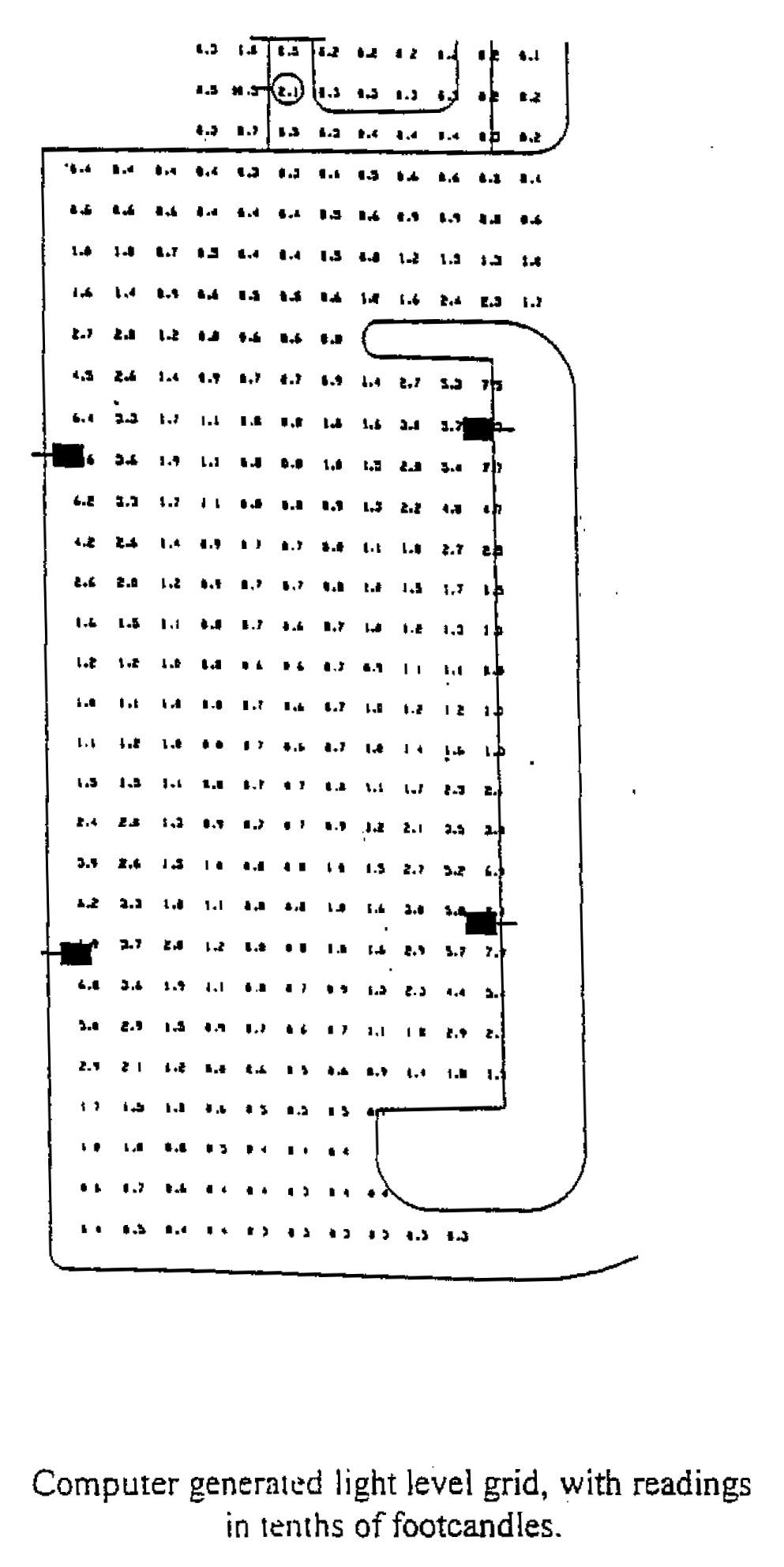
(c)
The required plans and descriptions of this section shall be sufficiently complete to enable the zoning board to readily determine whether compliance with the requirements of this division will be secured. If such plans and descriptions cannot enable this ready determination, by reason of the nature or configuration of the devices, fixtures or lamps proposed, the applicant shall submit evidence of compliance by certified test reports as performed by a recognized testing lab.
(Ord. No. 2002-01, § 6-6.8, 3-7-2002; Ord. of 5-29-2002)
Sec. 30-1157. - Issuance of permit for lighting.
The county planning department in conjunction with Professional Lighting will review the construction plans for lighting construction. They will ensure that the plan meets the specifications described in this division. Professional Lighting will perform a footcandle measurement after the installation of the fixtures. Upon completion of the plan review and installation, a lighting permit will be issued for this project.
(Ord. No. 2002-01, § 6-6.9, 3-7-2002; Ord. of 5-29-2002)
Sec. 30-1158. - Amendment to permit for lighting.
Should the applicant desire to substitute outdoor light fixtures or lamps after a permit has been issued, the applicant shall submit all changes to the zoning board for approval, with adequate information to assure compliance with this division.
The town, through a development plan submittal, must approve any changes to the lighting plan. This plan will go first to the town planning and zoning board and then to the town council. If the plan receives a unanimous favorable recommendation from the planning and zoning board, it will be considered approved without going before the town council. The governing board may adjust the standards for the maximum illumination at the edge of a property adjacent to another nonresidential use, if the governing board determines that the design and nature of the adjacent use creates a need to either reduce or increase the maximum illumination.
(Ord. No. 2002-01, § 6-6.10, 3-7-2002; Ord. of 5-29-2002)
Sec. 30-1159. - Appeals.
Except for street lighting within the right-of-way and for temporary exemptions, as provided in section 30-1155, any applicant's appeal to the zoning board's decision shall be made to the town board of adjustment.
(Ord. No. 2002-01, § 6-6.11, 3-7-2002; Ord. of 5-29-2002)
Sec. 30-1160. - Request for temporary exemption.
(a)
Request. Any person may submit a written request to the zoning board for a temporary exemption to the requirements of this article. The request for temporary exemption shall contain the following information:
(1)
Specific exemptions request;
(2)
Type and use of exterior light involved;
(3)
Duration of time for requested exemption;
(4)
Type of lamp and calculated lumens;
(5)
Total wattage of lamp or lamps;
(6)
Proposed location of exterior light;
(7)
Previous temporary exemptions, if any;
(8)
Physical size of exterior light and type of shielding provided.
(b)
Additional information. In addition to the data of this section, the zoning board may request any additional information, which would enable a reasonable evaluation of the request for temporary exemption.
(c)
Fee. The fee for a temporary exemption may be required for a variance to the zoning ordinance.
(Ord. No. 2002-01, § 6-6.12, 3-7-2002; Ord. of 5-29-2002)
Sec. 30-1161. - Enforcement.
See article V of this chapter.
(Ord. No. 2002-01, § 6-6.13, 3-7-2002; Ord. of 5-29-2002)

