
Olmos Park City Zoning Code
ARTICLE II
SINGLE-FAMILY RESIDENCE DISTRICTS
Sec. 40-39 - Description.
A.
Regulations applicable to SD-1 single-family residence districts are found in the Olmos Park Code of Ordinances, sections 40-39—40-74.
B.
Regulations applicable to the single family residence district SD-2: Unless otherwise specified the Olmos Park Zoning Ordinances, sections 40-39—40-74 shall apply to the new SD-2.
C.
Regulations applicable to the single family residence district SD-3: Unless otherwise specified the Olmos Park Zoning Ordinances, sections 40-39—40-74 shall apply to the new SD-3.
D.
Regulations applicable to the single family residence district SD-4: Unless otherwise specified, the Olmos Park Zoning Ordinances, sections 40-39—40-74 shall apply to the new SD-4.
E.
The following described lots and block or metes and bounds shall constitute the single family residence districts in the city:
(a)
Single family residence district I (SD-1): Unless otherwise specified in this chapter, SD-1 includes all single-family residential properties.
(b)
Single family residence district II (SD-2): [RESERVED].
(c)
Single family residence district III (SD-3):
i.
Lots 25 through 32, Block 1, County Block 5717, Replat of Park Place II Subdivision of record in Book 9674, Page 89, of the Deed and Plat Records of Bexar County, Texas.
ii.
Lots 27 through 35, Block 2, County Block 4038, Replat of Park Place II Subdivision of record in Book 9674, Page 89, of the Deed and Plat Records of Bexar County, Texas.
iii.
Lots 33 through 41, Block 1, County Block 5717, Replat of Park Place III Subdivision of record in Book 9687, Page 168, of the Deed and Plat Records of Bexar County, Texas.
(d)
Single family residence district IV (SD-4):
i.
Lot 5, Block 8, Olmos Park Estates, in the City of Olmos Park, Bexar County, Texas, according to plat thereof recorded in Volume 980, Page 16, Deed and Plat Records of Bexar County, Texas, otherwise known as "100 Alameda Circle."
ii.
Lot 5, Block 9, Olmos Park Estates, in the City of Olmos Park, Bexar County, Texas, according to plat thereof recorded in Volume 980, Pages 16-17, of the Deed and Plat Records of Bexar County, Texas, otherwise known as "200 Alameda Circle."
iii.
Lot 11, Block 10, Olmos Park Estates, in the City of Olmos Park, Bexar County, Texas, according to plat thereof recorded in Volume 980, Page 16, of the Deed and Plat Records of Bexar County, Texas, otherwise known as "300 Alameda Circle."
iv.
Lot 1, Block 15, County Block 5700, Olmos Park Estates, in the City of Olmos Park, Bexar County, Texas, according to plat thereof recorded in Volume 980, Pages 16-17, of the Deed and Plat Records of Bexar County, Texas, otherwise known as "400 Alameda Circle."
v.
Lot 1, Block 16, Olmos Park Estates, in the City of Olmos Park, Bexar County, Texas, according to plat thereof recorded in Volume 980, Page 16, of the Deed and Plat Records of Bexar County, Texas, otherwise known as "500 Alameda Circle."
(Code 1985, § 31.400; Ord. No. 1997-06, 7-16-1997; Ord. No. 2000-19, 12-13-2000; Ord. No. 2008-11, 10-16-2008; Ord. No. 2010-04, 2-18-2010; Ord. No. 2010-14, 10-21-2010; Ord. No. 2014-12, § 1, 9-18-2014; Ord. No. 2016-10, § 1, 6-16-2016 Ord. No. 2020-07, § 1, 8-19-2020)
Sec. 40-40. - Building and land use restrictions.
No building or land shall be used and no building shall hereafter be erected or structurally altered which is arranged or designed to be used for other than one or more of the following uses:
(1)
Single-family residence. No more than one single-family dwelling per lot. In the event such dwelling is to be constructed on portions of two or more lots, prior to such construction, the property owner shall apply to the board of adjustment for such variances as may be necessary to facilitate such construction.
(2)
Public park or playground.
(3)
Accessory building.
a.
A detached accessory building shall be located not less than ten feet from the main structure, not less than 60 feet from the front property line and not less than three feet from any rear or side property line, except as specifically allowed in section 40-48.
b.
When attached to the main structure in any manner, including by open or closed breezeway or passageway, an accessory building shall be considered part of the main structure and shall be subject to the same front, side, and rear setback requirements as the main structure.
c.
Where a side yard abuts a street on a corner lot, no garage, carport or other motor vehicle storage structure with access to the street may be erected nearer to the curb line of said street than 25 feet.
d.
On the rear of an accessory building, no clear glass may be used for any exterior windows above the first story of the accessory building unless the bottom of said clear glass exterior window is located at least seven feet above the floor, and all such exterior windows regardless of height or opacity must be inoperable and unable to be opened. On the sides of an accessory building, no clear glass may be used for any exterior windows above the first story of the accessory building unless the exterior window is located at least 40 feet from the side property line toward which the exterior window faces or unless the bottom of said clear glass window is located at least seven feet above the floor. On the rear and sides of an accessory building, above the first story of the accessory building, the only exterior windows which may be located within seven feet of the floor shall be exterior windows with obscured glass that does not permit an occupant of the accessory building to see outside the window from the accessory building. The provisions of this section shall not apply to exterior windows on an accessory building located on a corner lot where such exterior windows only overlook a public street and do not overlook a residential lot. The purpose and intent of this section is to enhance the privacy, safety, and security of residents by ensuring that rear windows of accessory buildings do not provide a vantage point that allows for a direct line of sight from the accessory building to any rear window on any adjacent residential structure, such that a person inside an accessory building looking out through a rear window cannot clearly see into any rear window of an adjacent residential property.
e.
Except as provided in this section, other sections [of] this article shall apply to accessory buildings. In the event of a conflict between this section and other sections of this chapter, this section shall govern matters as to accessory buildings.
f.
Considering only the accessory building in question and only its location on the lot, an accessory building can have only a single or two stories with no more than a maximum height of 25 feet measured from the lowest ground level of the accessory building in question to the peak of the roof of the accessory building in question.
g.
Any person or entity violating this chapter shall be punished, upon conviction, in accordance with the provisions of section 8-40. Each day of such violation shall constitute a separate offense.
(4)
Antennas. No permanently installed base-mounted antenna, whether ground, roof or otherwise mounted, shall be located within 60 feet from the front property line or within three feet from any other property line or street and must be screened from public view. Applicants for permits must follow the procedures outlined in sections 8-24 through 8-26.
(5)
Customary uses. Uses customarily incidental to any of the above uses when situated in the same dwelling.
(6)
Portable storage units.
a.
All portable storage units must be located:
(1)
On a paved all-weather surface except for approved construction sites; and,
(2)
Completely off any and all public rights-of-way.
b.
Portable storage units shall be removed from the property within 30 calendar days from the date of receipt of notification from the city.
(1)
Upon request, one extension to (6)b. not to exceed 30 days, may be approved by the city building official.
c.
In no event, shall the continuous or intermittent use of portable storage units exceed 60 cumulative days during any 12-month period.
d.
Portable storage units associated with an approved construction project shall be permitted to remain on-site until the approval of the projects building final inspection or the expiration of the master building permits' expiration date if less. Portable storage units permitted under this section 6(d) shall not be visible from any residential street, unless good cause is found by the city building inspector.
e.
All portable storage units:
(1)
Shall not be placed in locations that may cause hazardous conditions, constitute a threat to public safety, or create a condition detrimental to surrounding land uses and development;
(2)
Shall be secured from entry by children and general public when not attended; and
(3)
Shall not have hazardous material stored within the containers.
f.
All existing portable storage units within the city limits will be subject to the requirements of this article as of its effective date.
g.
Any person or entity violating this chapter shall be punished, upon conviction, in accordance with the provisions of section 40-8. Each day of such violation shall constitute a separate offense.
(7)
Home occupations.
a.
Purpose and intent. The purpose of these home occupation regulations is to:
(1)
Protect residential areas from adverse impact of activities associated with home occupations;
(2)
Permit residents of the community a reasonable choice in the use of their homes as a place of livelihood and the production or supplementing of personal and family income; and
(3)
Establish criteria and development standards for home occupations conducted in dwelling units.
b.
Home occupation regulations. All home occupations shall comply with the following:
(1)
The area set aside for home occupations shall be incidental and secondary to the primary use of the property for residential use.
(2)
No exterior business signs shall be permitted.
(3)
No mechanical equipment shall be used except of a type that is similar in character to that normally used for purely domestic or household mechanical equipment as for hobby purposes in conjunction with the home occupation.
(4)
Retail sales shall be prohibited on the premises.
(5)
The operation of on-site retail stores, beauty culture schools, beauty parlors, barber shops, vehicle repair, lawn mower or other small or large engine repair, boarding house/rooming house, or other similar land uses shall not be permitted as a home occupation.
(6)
A home occupation may be carried on within the principal building or accessory buildings.
(7)
There shall be no exterior indication of the home occupation or variation from the residential character of the principal building.
(8)
The home occupation shall not create any increased traffic generation in greater volumes than would normally be expected in a residential neighborhood, and any shipping or deliveries for the home occupation shall not be in greater volumes than would normally be expected in a residential neighborhood.
(9)
Exterior storage of materials to be used in conjunction with a home occupation shall not be located within the front yard and shall be screened from any public right-of-way or adjacent property.
(10)
A home occupation shall produce no offensive noise, vibration, smoke, electrical interferences, dust, odors, or heat detectable beyond the property limits or beyond the walls of the dwelling unit and shall comply with all provisions related to controlling nuisances within city ordinances.
c.
Home occupation registration.
(1)
Purpose. To establish a method to allow the city to regulate and control nonresidential activities and maintain a record of the types and numbers of home occupations in the city.
(2)
Registration required. Each resident within the city who has, or desires to establish an authorized home occupation, is required to register the home occupation with the city.
(3)
Application for home occupation registration.
(1)
Applicant shall apply to the city manager or his/her designee to register a home occupation using an application provided by the city manager or his/her designee.
(2)
The city manager or his/her designee may accept the registration if the home occupation meets all the requirements established in subsection (7)b above.
(4)
Conditions applicable to home occupation registration.
(1)
Duration. A home occupation registration remains valid for as long as the home occupation use is in operation.
(2)
Termination. When a home occupation is found to be in noncompliance with the requirements outlined in this subsection (7), the registration will be terminated immediately and the property may be subject to enforcement actions for a violation of this chapter, pursuant to section 40-8.
(3)
Renewal of terminated home occupation. The procedure for renewal of a terminated home occupation shall be the same as required for a new registration under this section.
d.
Appeals.
(1)
The judgment of the city manager or his/her designee pertaining to a violation or decision under this subsection shall be considered determinative and final unless formally appealed to the board of adjustment within 20 days after the city manager or his/her designee's written determination. The board of adjustment will have the final action on appeals.
(Code 1985, § 31.401; Ord. No. 1997-06, 7-16-1997; Ord. No. 2000-19, 12-13-2000; Ord. No. 2008-11, 10-16-2008; Ord. No. 2010-04, 2-18-2010; Ord. No. 2010-14, 10-21-2010; Ord. No. 2013-02, § IV, 2-13-2013; Ord. No. 2014-12, § 1, 9-18-2014; Ord. No. 2016-07, § 1, 5-18-2016; Ord. No. 2019-02, § 1, 5-16-2019; Ord. No. 2024-04, § 2 (Exh. A), 3-20-2024)
Sec. 40-41. - Building height.
No building or structure nor the enlargement of any building or structure shall be hereafter erected or maintained which exceeds 35 feet in height.
(Code 1985, § 31.402; Ord. No. 1997-06, 7-16-1997; Ord. No. 2000-19, 12-13-2000; Ord. No. 2008-11, 10-16-2008; Ord. No. 2010-04, 2-18-2010; Ord. No. 2010-14, 10-21-2010)
Sec. 40-42. - Yard area requirements.
No building or structure shall be hereafter erected or maintained unless the following standard yard and lot areas are provided and maintained in connection with such building or structure; provided, however, if a plat has been previously approved by the city containing non-standard yard and lot areas under applicable amendments to this chapter which were adopted after the plat was approved, such platted non-standard yard and lot areas shall prevail over the standard yard and lot areas hereinafter provided. Any structure located on a previously approved plat with non-standard yard or lot areas may be repaired or replaced with new construction, provided that any such repairs or new construction must comply with all other applicable requirements in this Code or other applicable law, including requirements set forth in Chapter 8 of this Code. All areas designated as utility easements shall not have structures of any type built upon them, including but not limited to any primary or accessory structure, fence, shed, outbuilding, swimming pool, or other improvement to real property. Any variance granted by the city to allow construction or installation of a building or structure within any part of a utility easement owned by the city shall not waive any property rights or easement rights belonging to the city or another public entity, including a public utility, and any rights granted by such variance shall forever be considered subordinate to and subject to the utility easement rights of the city and/or other public entity. Upon request by the city or another public entity that owns a utility easement upon which any building or structure is constructed or installed pursuant to a variance granted by the city, the owner of such building or structure shall be required to promptly remove said building or structure at the owner's sole expense. Any fence, wall, or other barrier constructed within a utility easement pursuant to a variance granted by the city shall provide a means of ingress and egress at the rear of the lot to allow authorized persons to access the utility easement as needed, and must comply with all other applicable local and state laws.
[Notes:]
(1)
All dimensions measured from property line.
(2)
See [subsection] 40-40(3) for setback exceptions for accessory building exceptions.
(3)
Eaves or other minor building extensions; setback of primary walls of structure is four feet.
(4)
See [section] 40-48 for SD-3 carport exception.
(Code 1985, § 31.403; Ord. No. 1997-06, 7-16-1997; Ord. No. 2000-19, 12-13-2000; Ord. No. 2008-11, 10-16-2008; Ord. No. 2010-04, 2-18-2010; Ord. No. 2010-14, 10-21-2010; Ord. No. 2014-12, § 1, 9-18-2014; Ord. No. 2015-01, § 1, 3-19-2015; Ord. No. 2020-07, § 1, 8-19-2020; Ord. No. 2021-13, § 1, 10-20-2021)
Sec. 40-43. - Short-term rental use prohibited.
Real property in the Single-Family Residence Districts may not be used for short-term rental.
(Code 1985, § 31.404; Ord. No. 1997-06, 7-16-1997; Ord. No. 2000-19, 12-13-2000; Ord. No. 2008-11, 10-16-2008; Ord. No. 2010-04, 2-18-2010; Ord. No. 2010-14, 10-21-2010)
Sec. 40-44. - Regulation of lot size.
Any subdivision plan affecting land situated in an area which has been zoned as a single-family residence district shall provide that each lot shall comply with Table 40-44.1:
[Notes:]
(1)
Distance measured along the curved property line that faces the center of Alameda Circle.
(Code 1985, § 31.800; Ord. No. 2014-12, § 1, 9-18-2014; Ord. No. 2020-07, § 1, 8-19-2020)
Sec. 40-45. - Impervious cover.
Impervious cover includes roads, parking areas, buildings, swimming pools, patios, sheds, driveways, private sidewalks, and other impermeable construction covering the natural land surface. The term "percent impervious cover" is calculated as the area of impervious cover within the front yard area of a lot, tract, or parcel, or development, divided by the total area within the front yard area of such lot, tract, parcel or development. The front yard area is defined as the area contained within the boundaries of the front building setback line, the side property lines and the back of the front curb line of such lot, tract, parcel, or development.
(i)
Impervious cover area requirements for single family residence district lots shall be as follows: All impervious cover shall not cover in the aggregate more than 50 percent of the front yard area of a lot, tract, parcel, or development as defined above.
(Ord. No. 2013-19, § 1, 10-3-2013; Ord. No. 2014-08, § 1, 6-19-2014)
Sec. 40-47. - Single family residence district II (SD-2).
(a)
Applicability. Properties meeting the following conditions are eligible to be considered to be rezoned to SD-2:
(1)
Currently zoned AD apartment district, or
(2)
Currently zoned SD-3 single family residence district 3.
(b)
Access, parking, and site configuration.
(1)
That portion of a private driveway outside of the property line shall have a maximum width of 12 feet.
(2)
Detached garages shall be subject to the requirements of subsection 40-40(3).
(3)
A four feet wide sidewalk shall be installed along the entire street frontage of the property. This shall include the side street at corner lots, unless waived by the city review board. The sidewalk shall align with existing sidewalk(s) on adjacent lot(s) and be of similar configuration. The sidewalk shall be located outside the property line except as specifically approved by the city review board.
(4)
Maintenance and upkeep of the yard area between the property line and street curb shall be the responsibility of the property owner.
(c)
Architectural requirements.
(1)
Development of properties within the SD-2 district shall comply with the general character and ambiance of that depicted in illustration 40-47.1, based on color palate, massing, architectural style, and landscaping.
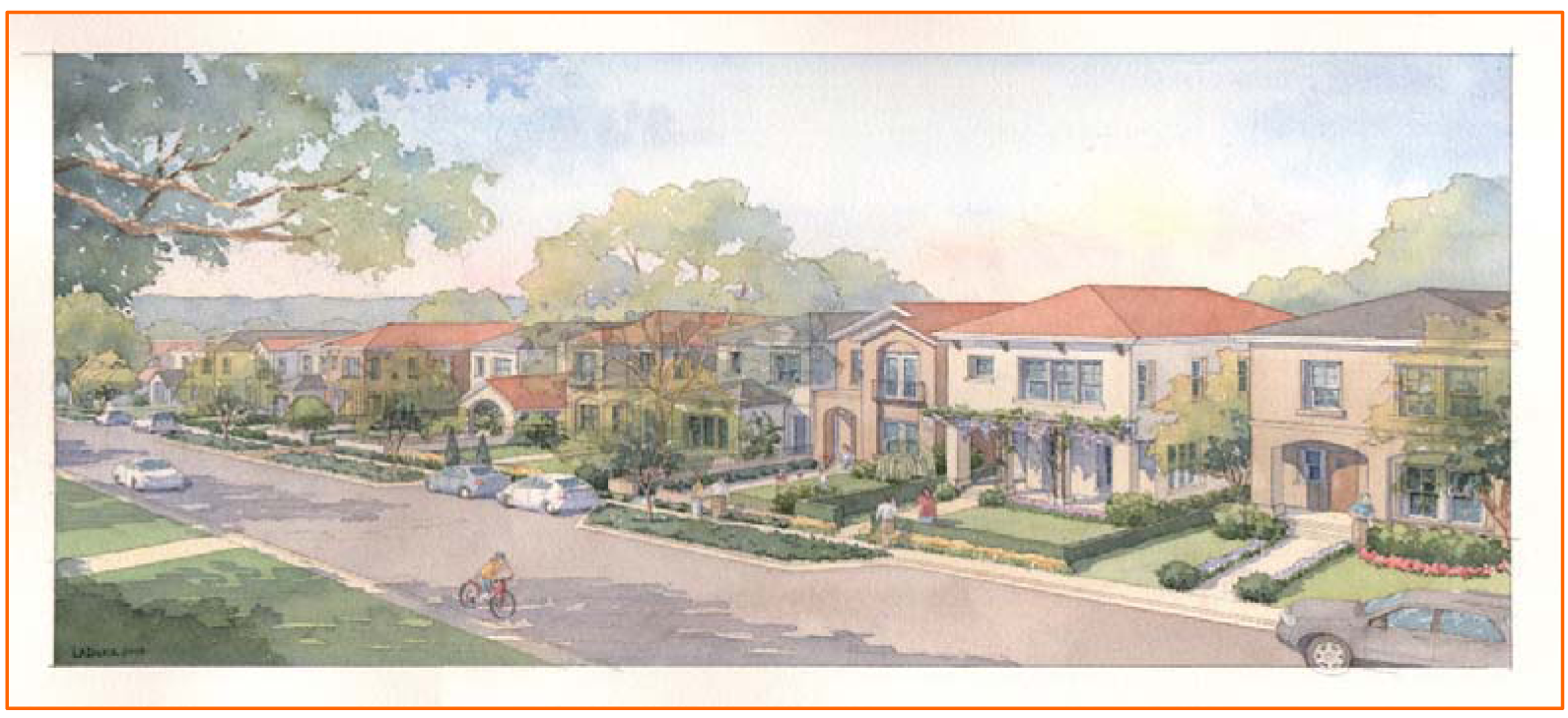
Illustration 40-47.1
(2)
Exterior building materials shall be primarily or entirely three-part stucco with cast stone or natural stone accents. Stone or brick may also be considered, subject to city review board approval. Quarry tile, concrete tile or similar materials are encouraged for ground plane surfaces such as highly visible porches, walkways and driveways.
(3)
Acceptable roofing materials include clay tile, metal formed into shape of Spanish tiles, dimensional architectural shingles, or comparable material as approved by the city review board.
(4)
Roof configuration shall be traditional hipped or gabled.
(5)
Windows shall be Anderson 100 series, or comparable as approved by the city review board.
(6)
On properties that include parking in front of the home, decorative fencing shall be provided at the property line to provide visual screening. Fencing shall comply with one of the following:
i.
Two feet, six inches high solid material to match the home construction, plus one foot, six inches of vertical metal pickets ("wrought iron" appearance), or
ii.
Four feet tall masonry posts of stone or stucco with four-foot high vertical metal picket infill ("wrought iron" appearance).
iii.
A baffle means plantings that slightly obstruct the view into or out of an area. Where a front fence is required a three-foot baffle can be used instead.
iv.
To insure safety for drivers and pedestrians landscape in the front yards shall be maintained so that when exiting a driveway the visibility of the sidewalk and street are unobstructed.
(7)
Exterior doors, including but not limited to pedestrian and garage doors, shall be of natural wood, wood-like material or painted wood and shall be subject to approval by the city review board.
(8)
Landscape design.
i.
Each home shall have at least one four-inch diameter tree in the front yard,
ii.
Plants shall be placed and maintained around the front base of a home and/or along the edge of the front walkway or driveway, and
iii.
Irrigation: Each home shall have an irrigation system in the front yards.
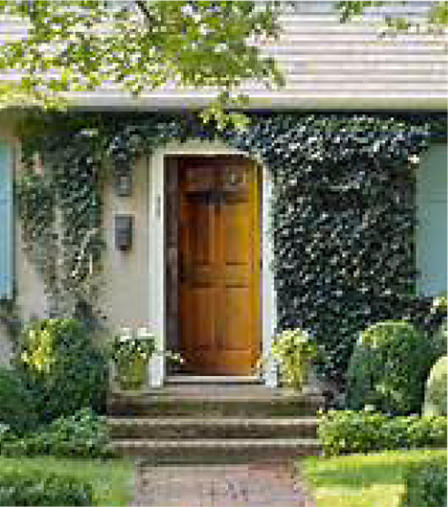
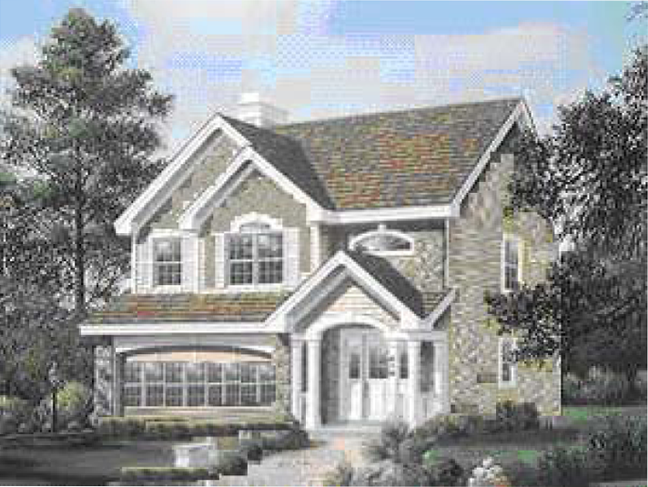
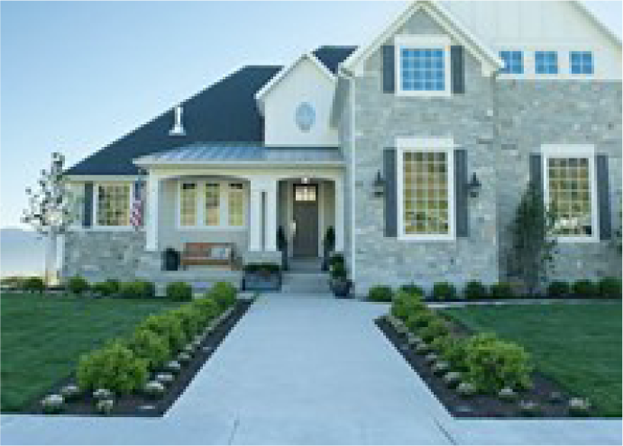
Representations of front yard landscape designs
 |  |  |
(d)
Design approval. Prior to any home or structure being constructed, a preliminary design submittal shall be submitted to the Olmos Park City Review Board composed of the city building official, a registered design profession and other members to be appointed at the discretion of the city council. Submittal shall include, as a minimum, a site plan, elevations, sections, expansion joints, color palates, and sheet specifications for building materials. The city review board shall approve or deny, with comments, the package within 21 days of submittal of a complete package. Final and complete construction documents sealed by a registered architect shall be submitted to the building department for building permit, at which time the city review board shall review for compliance with this article prior to issuance of permit.
(Ord. No. 2014-12, § 1, 9-18-2014)
Sec. 40-48. - District SD-3.
(a)
Applicability. Properties meeting the following conditions are eligible to be considered for rezoning to SD-3:
(1)
Currently zoned AD;
(2)
Properties to be adjacent and continuous for 300 feet; and
(3)
Abut a paved alley along the full rear width of all properties. Said alley shall be on a city right-of-way and shall intersect a city street at both its ends.
(b)
Access, parking, and site configuration:
(1)
Access: A maximum of 40 percent of homes with vehicular access to Olmos Drive shall be contained on platted lots that share a curb cut (via joint use easement or similar instrument) and are at least 65 feet wide when combining two adjoining lots. All other homes must take vehicular access via the rear alley. Private drives off Olmos Drive shall have a maximum of 12 feet in width as measured at the property line (unless required to be wider at the curb to provide a safe turning radius, as determined by the city).
(2)
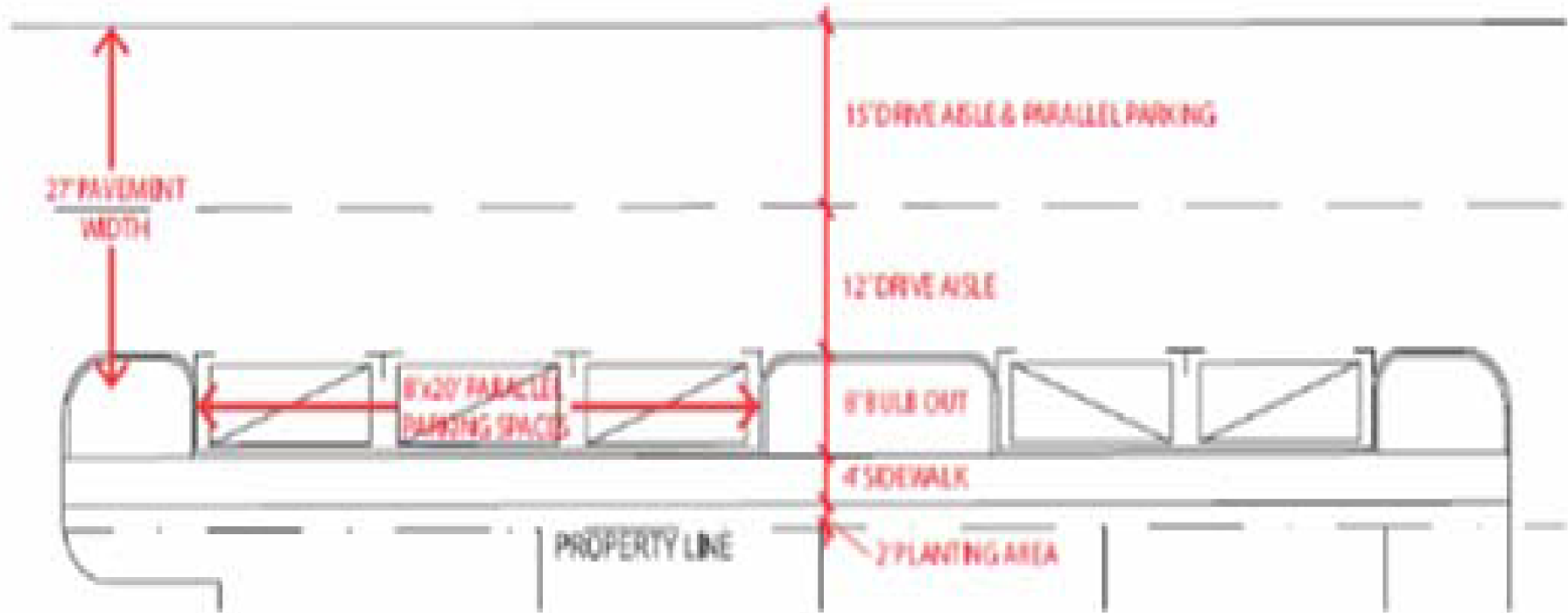
Sidewalk and parking in the right-of-way: Each lot shall be required to have in the right-of-way, beginning at the front property line, a two-foot wide planting area followed by a four-foot wide standard concrete sidewalk (including a curb where it adjoins the street) followed by either an eight-foot wide parallel street parking or a five-foot to eight-foot "bulb-out" planting zone and curb, as shown in illustration 40-48.1:
(3)
Setbacks for carports and garages: A side-load single-story carport meeting the design elements described herein may exceed the minimum front setback required by Table 40-42.1 by up to five feet. Such exception may not occur on more than 20 percent of the lots included in the SD-3 district. Garages or carports accessed from the rear alley are exempt from the minimum side setback requirements of Table 40-41.1. However, each lot may only be exempt from the minimum side setback for garages or carports on one side of the lot. Garages and carports must be located a minimum of 22 feet from the opposite boundary of the rear alley.
(c)
Architectural and aesthetic characteristics.
(1)
Style: The architectural style of all homes and structures shall be in substantial accordance with illustration 40-48.2 "Representation of Exemplar Elevation Configurations".
(2)
Variation: Variations of homes shall be made by color, material, roof line, roofing color, archways, metalwork, balconies and other features so that no two homes within the district contain identical architectural details. In accordance with illustration 40-47.1.
(3)
Exterior building materials: Shall be primarily or entirely three-part stucco and cast stone accents. Stone or brick shall be a permitted material as well. Accent quarry or concrete tile is encouraged in small quantities at highly visible locations such as the front entry porch.
(4)
Roof composition: Shall be traditional hipped or gabled and two or more different roof slopes shall be used.
(5)
Roof materials: Shall be dimensional composition shingle, concrete tile, slate, standing seam metal or Spanish clay tile. A minimum of two types of roof materials shall be used within the district and a minimum of 25 percent of the homes or structures within the district shall utilize barrel concrete tile roofing. Gutters and downspouts shall not be made of plastic.
(6)
Windows: Front facade windows shall be Anderson Series 100 or equivalent. Windows shall be detailed in a manner that provides a two-inch setback from facade to window frame, where exterior facade material or cast stone wraps at jamb, head and/or sill. Window sill should project forward two inches from facade, and two inches or more to either side of the window, projecting beyond the alignment of the vertical opening.
(7)
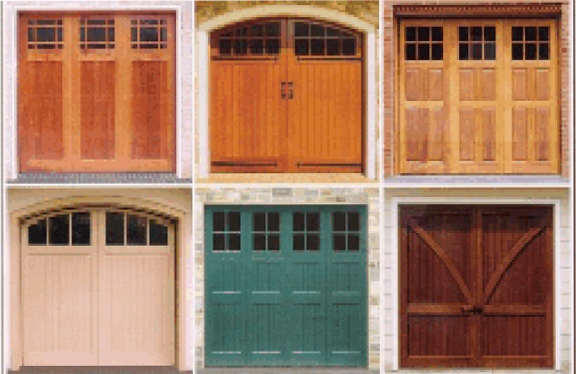
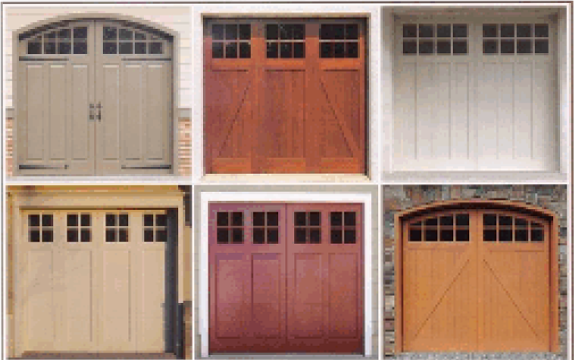
Front doors and garage doors: Shall be solid stain-grade wood doors with or without a small amount of window or glass lites. Front-facing garage doors shall be in substantial accordance with the design shown in illustration 40-48.3.
Representations of garage "barns doors"
 |  |
(8)
Covered arch: Homes within 35 feet of the curb shall contain a covered arch entry to the front door or porch area of the home.
(9)
Carports: Carports on front-loaded homes shall be of material and design to match the home and are limited to one story. Carports must consist of solid sidewalls on the side facing the house and on the rear so that the carport is fully enclosed on three sides. Additionally, carports must be positioned to have entry perpendicular to the public street.
(10)
Front yard fencing: Homes with front parking shall have a front yard fence consisting of either 30 inches tall solid material matching the home and 18 inches tall vertical metal picket fence detailing, or four feet tall masonry posts with vertical metal picket fencing.
(11)
Garages: Detached garages shall be limited to one story.
(12)
Carports, garages, and accessory structures: Accessory structures, garages.
(13)
Trees: Each home shall have at least one four-inch diameter tree in the front yard. Such tree(s) must be Lacey Oak, Coast Live Oak, Canby Oak, Chinquapin Oak, Monterrey Oak, Thornless Mesquite, or Cedar Elm.
(14)
Irrigation: Each home shall have irrigation systems in the front yard.
(15)
Design development approval: Prior to any homes or structures being constructed, a design development package must be submitted to the mayor or his/her designee(s) and the building official for approval. Submittal must include, as a minimum, a site plan, landscape plan for right-of-way and front yard, elevations, sections, expansion joints, color palates and sheet specifications for building materials. The mayor or his/her designee(s) and the building official shall approve or deny with comments the package within 21 days of submittal of a complete package.
(Ord. No. 2014-12, § 1, 9-18-2014; Ord. No. 2015-02, § 1, 3-19-2015)
Sec. 40-49. - Outdoor lighting.
A.
Definitions.
Fully shielded light: A fixture or luminaire emitting no light above the horizontal plane. Fixtures are shielded in such a manner that light rays emitted by the fixture, either directly from the lamp (shielded or indirectly from the fixture), are projected below a horizontal plane running through the lowest point on the fixture where light is emitted.
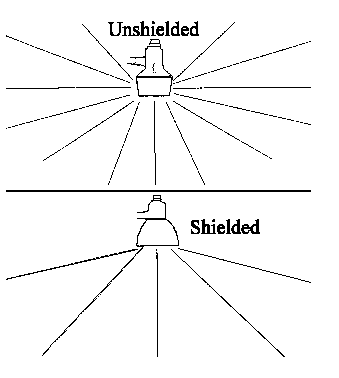
Point light source: The element of a lighting fixture that is the point of origin of the lumens emitted by the fixture (i.e., a light bulb filament or discharge capsule).
Light trespass: The shining of light produced by a light fixture beyond the boundaries of the property on which it is located.
Fixture: The assembly that houses the lamp or lamps and can include all or some of the following parts: a housing, a mounting bracket or pole socket, a lamp holder, a ballast, a reflactor or mirror and/or a refractor or lens
Outdoor light fixture: Outdoor electrically powered illuminating devices, outdoor light or reflective or refractive surfaces, lamps and similar devices including all parts used to distribute the light and/or protect the lamp, permanently installed or portable, used for flood lighting, general illumination or advertisement. Such devices shall include, but are not limited to, lights for:
(1)
Building and structures, including canopies and overhangs;
(2)
Recreational facilities;
(3)
Parking lots lighting;
(4)
Landscape lighting;
(5)
Advertising signs;
(6)
Displace and service areas; and
(7)
Walkway lighting.
B.
Intent and purpose.
(1)
The city has experienced a significant increase in the use of exterior illumination. City residents value small town character and the qualities associated with this character. The purpose of the ordinance to regulate outdoor lighting within the residential district of the City of Olmos Park is to illuminate obtrusive aspects of lighting created when light extends beyond the boundaries of the area in which the lighting is installed and intended for use. The obtrusive aspects such as glare and light trespass create a nuisance and negatively affect public health, safety and welfare.
(2)
This section is intended to help maintain the health, safety and welfare of the residents of Olmos Park through regulation of exterior lighting in order to:
(a)
Promote safety and security;
(b)
Help preserve the small town character;
(c)
Eliminate the escalation of nighttime light pollution;
(d)
Reduce glaring and offensive light sources;
(e)
Provide clear guidance to builders and developers;
(f)
Encourage the use of improved technologies for lighting;
(g)
Conserve energy; and
C.
Applicability. The lighting standards of this section shall be applicable to all outdoor lighting within the district. Existing outdoor lighting shall be considered legal nonconforming lighting for one year from the effective date of this section.
D.
Lighting requirements/standards. Outdoor lighting must be installed and operated to reduce or avoid light trespass, and must be fully shielded by fixture or otherwise, in such a manner that the point of light source is not visible from any street right-of-way or above grade level from any point on an off-site residential or multi-family lot.
(1)
Exception A: Unshielded lights completely behind translucent material, such as frosted glass or plastic, etc., which defuses the light, shall only be permitted if each lamp in a fixture have the equivalent color temperature - Kelvin, wattage, and light quality as specified/verified in writing by the manufacturer on the packaging, and does NOT exceed the following values for LED or incandescent bulbs:
(2)
Exception B: Unshielded lights shall only be permitted if each lamp in a fixture have the equivalent color temperature - Kelvin, wattage, and light quality as specified/verified in writing by the manufacturer on the packaging, and does NOT exceed the following values for LED or incandescent bulbs:
(3)
Exception C: If the light is actively controlled by a motion detector with dual-technology or otherwise so as to only be activated when a person is moving on the owners property, the point light source may be visible up to any point five feet above grade as measured from any point on an off-site residential or multi-family lot
E.
Exemptions. The following types of lighting installations shall be exempt from the provisions, requirements and review standards of this section:
(1)
Holiday lighting. Holiday lighting which is temporary in nature and which is illuminated during holiday periods shall be exempt from the provisions of this section, provided that such lighting does not create dangerous glare on adjacent streets or properties and use does not exceed 60 days in any one calendar year.
(2)
Municipal lighting. Municipal lighting installed for the benefit of public health, safety and welfare including, but not limited to, traffic control devices, street lights and construction lighting.
(3)
Temporary lighting. Any person may submit a written request to the building official for a temporary exemption request. If approved, the exemption shall be valid for not more than 14 days from the date of issuance of a written and signed statement of approval. An additional 14 day temporary exemption may be approved by the building official. A temporary exemption request shall contain at least the following information:
a.
Specific exemption or exemptions requested;
b.
Type, use and purpose of outdoor lighting fixtures involved;
c.
Duration of time requested for exemption;
d.
Type of lamp and calculated lumens;
e.
Total wattage of lamps;
f.
Proposed location on premises of the outdoor light fixtures;
g.
Previous temporary exemptions, if any;
h.
Physical size of outdoor light fixtures and type of shielding provided; and
i.
Such other information as may be required by the community development department director.
(4)
Historic lighting features: All outdoor light fixtures producing light directly *by the combustion of fossil fuels, such as, kerosene lanterns or gas lamps, are exempt from the requirements of this article.
F.
Prohibitions:
(1)
Notwithstanding any provisions in this article, light sources shall not create a nuisance to adjacent properties.
(2)
Strobes, colored light sources or blinking, flashing, moving, flickering, changing intensity and changing color lights all prohibited, except for temporary holiday lighting or lighting for public safety or traffic control.
(3)
No beacon or search light shall be installed, illuminated or maintained.
(4)
No outdoor lighting that interferes with the safe movement of motor vehicles on public thoroughfares, including but not limited to:
(a)
Any fixed light that produces direct light or glare that could disturb motorists.
(b)
Any light that may be confused with or construed as a traffic control device.
G.
Implementation and enforcement: The implementation and enforcement of a lighting code will be the responsibility of the city staff responsible for planning and code enforcement. For new construction, or when a building permit shall be required that involves replacement/alteration/repair of three or more outdoor lighting fixtures, the applicant shall submit (as part of the application for permit) evidence that all outdoor lighting will comply with this the city lighting code. In case of alleged violation, building official will provide written notice of alleged violation allowing 14 days to come into compliance. For the purpose of this section,
written notice is deemed to have been completed if building official: 1) mails notice to owner as stated in most recent tax roll via certified mail return receipt requested; or 2) notice affixed to the main entry door.
(Ord. No. 2017-04, § 3-16-2017)

