
Olmos Park City Zoning Code
ARTICLE IV
LOCAL RETAIL DISTRICTS
Sec. 40-106.- Description.
The lots and blocks or metes and bounds which follow shall consist of the Local Retail District of the City of Olmos Park, Texas:
(1)
Denverside addition: Lots 1 through 19, Block 1; Lots 1 through 6 and 14 through 26 inclusive, Block 3; Lots 1 through 26 inclusive, Block 5, according to the accompanying map and recorded in Volume 5, page 289, of the General Plat Records of the city engineer's office in San Antonio, Bexar County, Texas.
(2)
Block A, Lots 1 to 22, inclusive.
(3)
The west 150 feet of the City of Olmos Park lying between Mariposa Drive West on the north, McCullough Avenue on the east, the corporate limits of the City of San Antonio and the south boundary line of the City of Olmos Park on the south and west boundary line of the City of Olmos Park on the west, and being a strip 150 feet wide lying within the City of Olmos Park west of McCullough Avenue.
(4)
All of that triangular tract lying between McCullough Avenue on the east, Mariposa Drive on the south, and the right-of-way of the Missouri Pacific Railroad on the north and west.
(5)
Lots 1 to 33 inclusive, Block A and Lots 1 to 23 inclusive, Block B, including public arcades, public parking space and walks of a re-subdivision of Block 24 and Block 1 respectively of Olmos Park Estates, said re-subdivision having been filed for record on June 7, 1928, with the County Clerk of Bexar County, Texas.
(Code 1985, § 31.600; Ord. No. 1994-01, 3-15-1994)
Sec. 40-107. - Building and land use restrictions.
No building or land shall be used and no building shall be erected or structurally altered which is arranged or designed to be used for other than one or more of the following uses:
(1)
Residential or apartment uses. Any use permitted in an apartment district may only be permitted in the local retail district pursuant to a valid application for, and any subsequent granting of, a special use permit under Chapter 40 Zoning, Article VI Special Use Permits which shall include a portion of the building or land to be used for a "use" not permitted under this section (2)—(9).
(2)
Banks, etc. Banks, office, studio, ice delivery station, beauty salon, antique shop, clothing store.
(3)
Retail store or shop. Retail store or shop for custom work for the making of articles to be sold at retail on the premises.
(4)
Service station. Automobile service station for the sale of gasoline, oil and services connected with these sales only, but not to include the sale or offering for sale of automobiles of any kind.
(5)
Bakery. Bakery employing less than six persons; restaurant; retail grocery outlet.
(6)
Cleaners. Dyeing or cleaning works, employing less than six persons on the premises.
(7)
Garages. Garages for the repair of motor vehicles and services in connection with these services only, but not to include the sales or offering for sale of automobiles or motor vehicles of any kind, nor storage in the open of motor vehicle parts or motor vehicles not in running condition which are not being restored to operation.
(8)
Building materials store. Building materials where the major business is in connection with the display and sales of new materials only, but provided that the storage of building materials and lumber shall not be closer than 30 feet from the front line of the building.
(9)
Sexually oriented businesses. Notwithstanding any other provision of the zoning code, no sexually oriented business, as defined in the Local Government Code, shall be established or maintained within 1,000 feet of any school, regular place of religious worship or residence. Measurements shall be made in a straight line from the nearest boundary of the property used for a school, regular place of religious worship or residence to the nearest part of the building in which such sexually oriented business is conducted.
(Code 1985, § 31.601; Ord. No. 1994-01, 3-15-1994; Ord. No. 2016-06, § 1, 5-18-2016)
Sec. 40-108. - Building height.
No building or structure nor the enlargement of any building or structure shall be hereafter erected or maintained or exceed three stories, nor shall it exceed 45 feet in height.
(Code 1985, § 31.602; Ord. No. 1994-01, 3-15-1994)
Sec. 40-109. - Yard and lot areas.
No building or structure nor the enlargement of any building or structure shall be hereinafter erected or maintained unless the following yard and lot areas are provided and maintained in connection with such building, structure or enlargement:
(1)
Rear. Where the lot abuts upon a lot zoned for other than local retail or mixed retail commercial, the rear yard shall not be less than ten feet; in all other cases, a rear yard for a local retail commercial building shall not be required.
(2)
Side. Where the lot abuts upon a lot zoned for other than mixed retail commercial or local retail, the side yard shall be not less than ten feet in width; in all other cases, a side yard for a local retail commercial building shall not be required. The side yard shall be used for parking and/or landscaping.
(3)
Front. There shall be a maximum front yard 35 feet to the front line of the building and from the front property line. There shall be minimum front yard ten feet to the front line of the building and from the front property line, and under no circumstances shall any part of the city right-of-way be used for any such purposes. No part of the city's right-of-way may be used for parking.
(Code 1985, § 31.603; Ord. No. 1994-01, 3-15-1994; Ord. No. 2015-05, § 1, 7-30-2015)
Sec. 40-110. - Off-street parking regulations.
Off-street parking shall hereafter be provided on each lot or tract upon which a building is erected or upon a contiguous lot or tract, or upon a non-contiguous lot or tract within the city limits and under permanent control of property owner, or upon presentation of an acceptable parking agreement to the city. No building or structure or any part thereof shall be erected, altered, converted or enlarged for any permitted use in the local retail district unless one off-street parking space is provided for each 200 square feet of gross floor area in the building. At least 75 percent of the spaces must be standard sized spaces while the remaining spaces may be compact sized spaces. When calculating the number of required parking spaces based on square footage in this section, square footage shall not include storage areas as described below. Storage areas as used in this section means those areas to which the public does not have access; and where the store's 'wares' are not 'on display' to the public.
(1)
Area requirements. Such parking requirement shall apply only to additions, enlargements, major renovations, or new constructions, and an off-street parking space shall be defined as an enclosed or unenclosed all-weather surface area not on a public street or alley, and designed and sized according to subsection A. and B. of this section. Any parking adjacent to a public street wherein the maneuvering is done on the public street shall not be classified as off-street parking in computing the parking area requirements for this use.
(2)
Surface of parking lot and driveways. Whenever any lot or part thereof is used for off-street parking purposes incidental to any lawful use of the property, the parking area and all access drives shall be surfaced with asphalt, concrete, or other all-weather permanent paving materials consistent with this subsection and the pavement surface shall be maintained in good repair and free of debris, trash, dirt, or similar material. The area shall be marked so as to designate the placing of vehicles thereon in a manner and method approved by the city. Maintenance shall be the responsibility of the property owner.
(3)
The building inspector or his/her designee, shall conduct an annual inspection of all off-street parking areas and shall make the determination that the paved surfaces are in good repair and free of debris, trash, dirt, or similar materials. The city will enforce the provisions of this section in the manner prescribed by this Code.
(4)
All retail and commercial structures shall provide and maintain off-street facilities for the loading and unloading of merchandise and goods within the building or on the lot adjacent, or from a public alley or private service drive. An approved agreement with adjoining retail and/or commercial structures for the shared use of a facility for loading and unloading may also satisfy this requirement.
A.
Parking space dimensions and configuration:
1)
Table 40-110.1 (off street vehicle parking space dimensions) sets forth minimum size requirements for individual parking spaces. Design standards for handicapped parking stalls shall be provided in compliance with current requirements of the state and the building codes as currently adopted and amended by the City of Olmos Park.
2)
Parking spaces that are parallel and adjacent to a building, fence/wall, property line or other door swing or pedestrian access obstruction, shall be nine and one-half feet wide.
3)
All off-street parking spaces shall be indicated by white or yellow painted stripes not less than four inches wide.
4)
A compact off-street parking space must measure at least eight feet wide by 16 feet long.
Table #40-110.1
Off-Street Vehicle Parking Space Dimensions
1. Angle measurements shown in degrees maximum, i. e. 30°[.]
2. Dimensional measurements shown in feet, i.e. 9.0′[.]
3. Dimensional measurements shall apply to each maximum angle increment as listed. If the angle increment is exceeded, then next greater angle increment shall apply. All compact parking spaces shall be clearly identified.
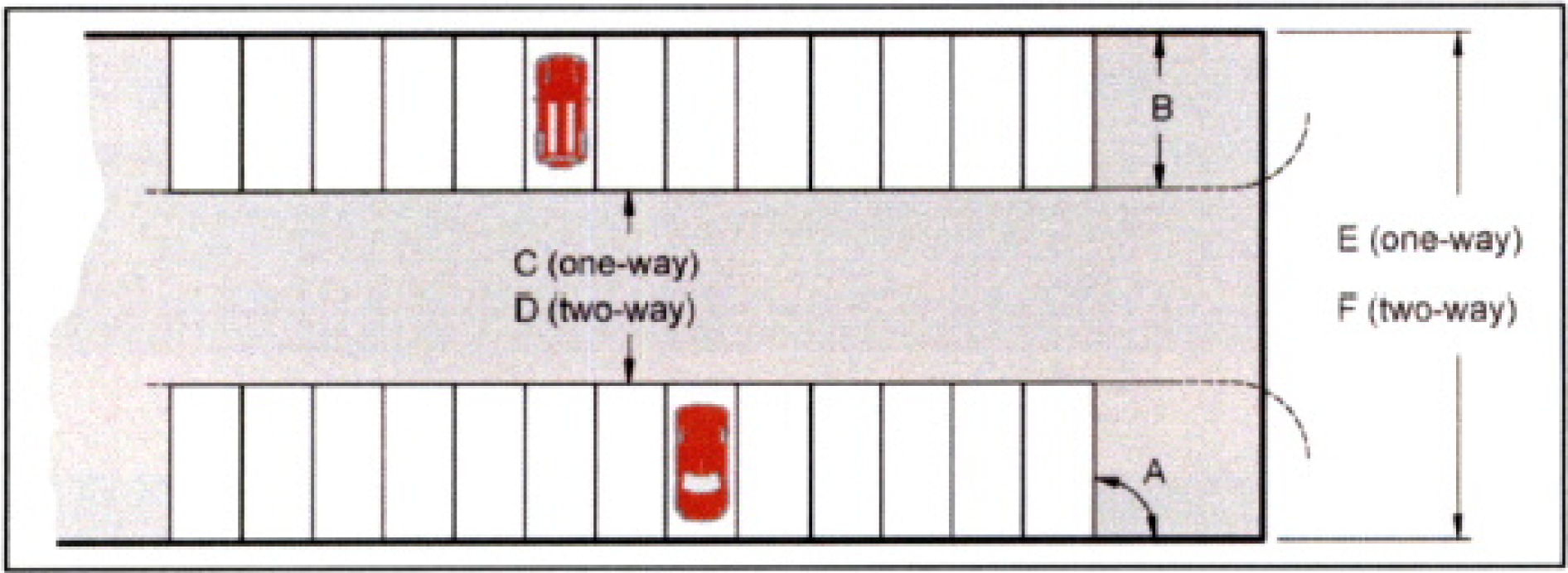
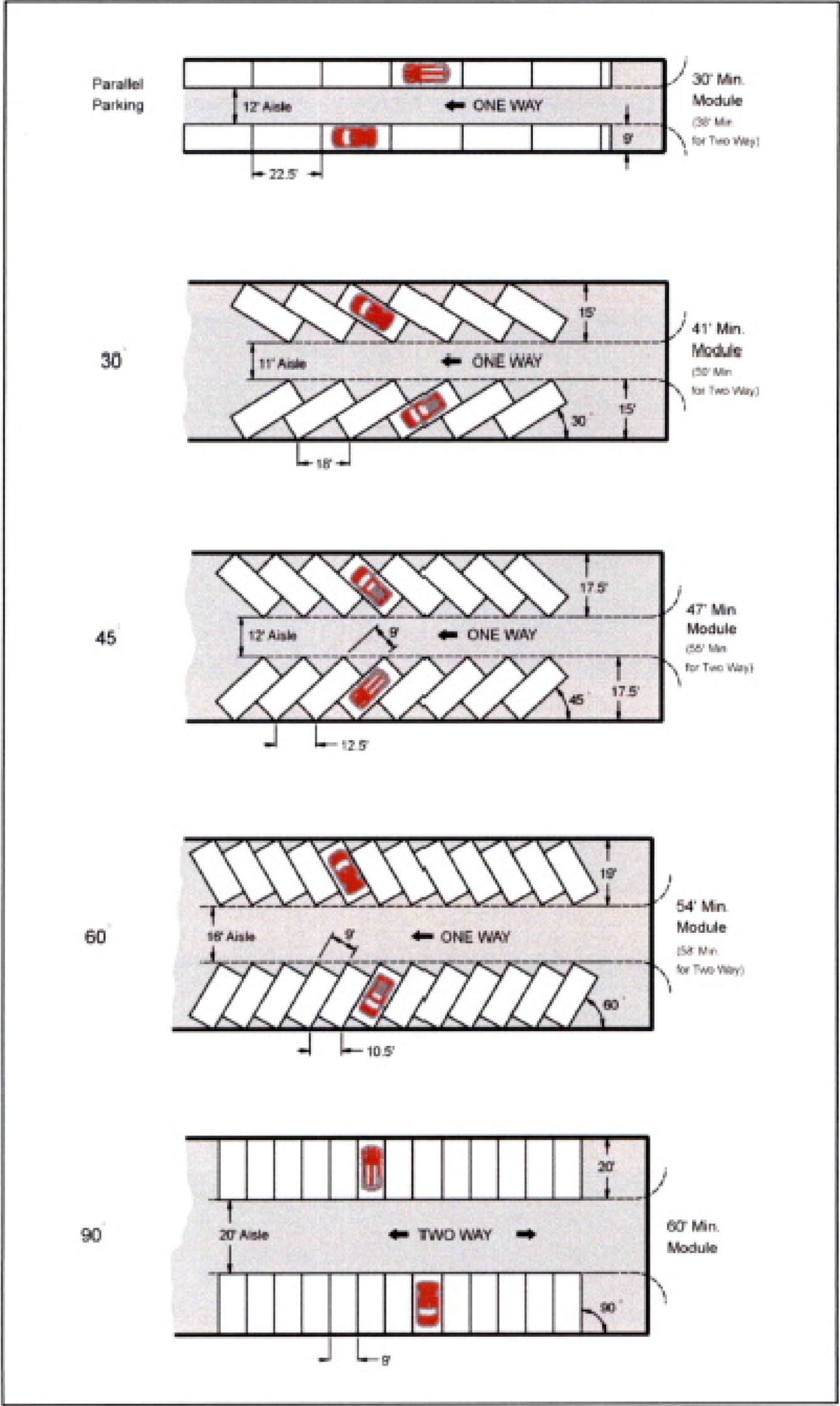
Figure C
B.
Vehicular access/and circulation:
1)
Accessibility and usability: Driveways and/or parking areas shall not be used for any purpose that would prevent vehicles access to parking spaces, or inhibit circulation or emergency service response.
2)
Access to adjacent roadways and circulation: Parking spaces within a designated parking lot shall be designed to provide the minimum required turning and maneuvering areas, so vehicles can enter an abutting street in a forward direction (alleys may be used for maneuvering space). A vehicle shall not enter a public street backwards.
3)
Visibility at driveways: Driveways shall be designed and located in such a manner so as to ensure proper visibility to on-street traffic. Drive design shall take into consideration slopes, curvature, speed, and conflicting turning movements in the area. Clear visibility shall be maintained from the driveway by keeping the designated 'sight distance triangle' free of obstacles such as signs, landscaping, parked vehicles, and structures.
4)
Except in the case of individual tree well planter, the minimum 20 feet paved depth of a parking space shall not be reduced by an overhang into a planter.
5)
Double parking, tandem parking, or parking in any other manner which blocks the ingress or egress of other vehicles shall not be permitted.
The following shall not be granted unless one off-street parking space is provided for each 200 square feet of gross floor area in the building: new construction building permit; accessory structure permit; addition building permit or alteration building permit requiring the seal of a registered engineer or architect; or, the issuance of a storm water pollution prevention plan (SWPPP).
(Code 1985, § 31.604; Ord. No. 1994-01, 3-15-1994; Ord. No. 2015-05, § 1, 7-30-2015; Ord. No. 2018-04, § 1, 2-15-2018)
Sec. 40-111. - Landscaping.
No building or structure nor the enlargement thereof shall be permitted unless the following landscaping requirements are met:
(1)
At least five percent of the total area of each parking space area shall be composed of pervious landscaped islands, peninsulas, medians or planters. Perimeter landscaped areas shall not be included in the required percentage.
(2)
The property owner shall maintain all landscaping in a commercially reasonable manner.
(Ord. No. 2015-05, § 1, 7-30-2015)
Sec. 40-112. - Sidewalks, curbs, curb cuts, driveway entrances.
Pedestrian safety shall be the primary consideration in designing sidewalks, curbs, curb cuts and driveway entrances. Sidewalks, curbs, curb cuts and driveway entrances shall be provided by the property owner subject to the following requirements; however, nothing herein shall relieve the owner from satisfying Americans with Disabilities Act (ADA) minimum standards:
(1)
Property owners shall be responsible for the installation, maintenance, and repair of sidewalks, curbs, curb cuts, and driveway entrances adjacent to any public right-of-way.
(2)
In the event of new construction, the property owner shall install new sidewalks, curbs, curb cuts and driveway entrances adjacent to any public right-of-way.
(3)
For any new construction or for an expansion constituting more than 50 percent of the size of an existing structure, the property owner shall be required to install and maintain a six-foot minimum width sidewalk on any side of the property abutting a public right-of-way. Sidewalk must be located in the public right-of-way and the six feet shall commence at the private property line into the public right-of-way.
(4)
Such sidewalk shall be a continuous connection from one side of the property to the other, generally parallel to the public right-of-way. Such sidewalks shall link with existing sidewalks on adjoining properties, if such adjacent sidewalks exist.
(5)
Sidewalks shall be paved with a slip-resistant surface such as brush-finished concrete and all construction shall conform to the latest criteria of the Americans with Disabilities Act.
(6)
The curbing on sidewalks on the right-of-way facing the building or structure shall meet the curbing height requirements as provided in section 8-32.
(7)
To protect the safety of pedestrians, city-approved barriers must be installed to separate off-street parking from sidewalks. Barriers such as fences and curbs prevent vehicles from encroaching into pedestrian walkways.
(8)
Driveway entrances must be at least 16 feet and no more than 32 feet in width as measured between curb cuts along the line of convergence of the driveway approach and the street. In no instance, may one property owner have more than 32 feet in curb cuts on the property.
(Ord. No. 2015-05, § 1, 7-30-2015; Ord. No. 2015-10, § 1, 10-15-2015; Ord. No. 2016-08, § 1, 5-18-2016; Ord. No. 2016-19, § 1, 10-20-2016; Ord. No. 2018-04, § 1, 2-15-2018; Ord. No. 2018-14, § 1, 12-20-2018; Ord. No. 2021-05, § 1, 6-16-2021)
Editor's note— The user's attention is directed to the end of Ch. 40 regarding Attachment "A" as referenced in § 40-112(9)a.
Sec. 40-113. - Limited use of right-of-way.
In order to achieve pedestrian safe parking standard, businesses shall be required to meet the standards for angled parking as required by section 40-110 (table #40-110.1). If a business property is unable to meet any of the parking angles required by section 40-110, the city shall grant use of the public right-of-way for the sole purpose of egress and ingress.
(Ord. No. 2016-01, § 1, 1-21-2016)
Sec. 40-114. - Driveway cuts.
Considering conditions of topography, traffic flow, traffic and pedestrian safety, each business property with a lot width of 50 feet or less shall be permitted one driveway cut. Business property with a lot width of 60 feet or more may be permitted two driveway cuts.
(Ord. No. 2016-01, § 1, 1-21-2016)
Sec. 40-115. - Shared driveways and cross-access drives
A.
Driveway approaches and shared driveways. Shared access driveways are encouraged and may be required by the city manager or designee in order to ensure public safety access by providing mutual/common access, to minimize the number of driveway cuts on streets, thereby maintaining street mobility, and to facilitate traffic flow between adjacent lots.
1.
A development plat shall be required when any person proposes crossing lot lines to develop a tract of land located within the limits or in the extraterritorial jurisdiction of the city. A development plat of the tract shall be prepared in accordance with the requirements of the Local Government Code Chapter 212, subchapter B (Local Government Code § 212.041 et seq.), as now existing or hereafter amended and in accordance with the applicable plans, rules, and ordinances of the city. (Section 32-260).
2.
A shared mutual access easement(s) for driveways(s) may be required between adjacent lots fronting on to McCullough Avenue. The location and dimensions of such easement(s) shall be determined by the city.
3.
Easement on plat. Such easements shall be noted on the preliminary plat and final plat with the language specified as part of the city's application requirements.
B.
Driveway approaches and cross access internal driveways. Cross access easements for internal driveways are encouraged and may be required as part of the preliminary and final plat approval by the city manager, or designee in order to minimize the number of driveway cuts on streets, thereby maintaining street mobility, and to facilitate traffic flow between adjacent lots.
1.
A cross access easement(s) for internal driveways(s) may be required. Such easement shall be required between adjacent lots within the same plat, phases of plats or ownership when the following conditions exist:
a.
On McCullough Avenue frontages between adjacent parking lots;
b.
Between lots when one or more lots do not have direct access to the thoroughfare; and
c.
When accessing shared driveways.
2.
Location and dimension. The location and dimensions of such easements(s) shall be determined by the city.
3.
Easement on plats. Such easements shall be noted on the preliminary plat and final plat with the language specified as part of the city's application requirements
(Ord. No. 2016-01, § 1, 1-21-2016)
Sec. 40-116. - Electrical service equipment.
Service-entrance conductors, metering equipment, or service equipment shall not be located on front building face or in any location between the front building face and McCullough Avenue, except as required by subsection (3.) Any new electric service connections shall be located and installed as follows:
1.
Underground installation of the service lateral shall be required as a condition to the granting of the following: new construction building permit; accessory structure permit; addition building permit or alteration building permit requiring the seal of a registered engineer or architect; or the issuance of a storm water pollution prevention plan (SWPPP).
2.
For new electric service connections other than those identified in subsection 1. herein, the new electric service connection shall only be made using one of the following options:
a.
A meter pole installed wholly outside of any city right-of-way; and no less than 50 feet from the lot property line immediately adjacent to McCullough Avenue;
b.
A padmount transformer located immediately adjacent to any side of the building not constituting the front building face, and shall be reasonable shielded from view from any city street;
c.
An underground service lateral; or
d.
Service drop which shall not be located on the front building face.
All terms used in this section not defined in section 40-113 of the Municipal Ordinances, shall have the meaning ascribed to them by the CPS Energy Electric Service Standards, 2012 Edition, or as amended and superseded therein.
3.
For any construction activity that is subject to the requirements of subsection 40-112(9) and subsection 40-264(2), property owner shall be required to install electrical conduits, wiring, light fixture(s), anchor bolts and mounting base for pole-mounted lighting fixtures which shall be installed in accordance with the following provisions, subject to approval by the building official:
a.
The property owner shall be responsible for installation of electrical underground PVC conduits along the entire frontage of McCullough Avenue from the lot's North property line to the South property line. At each property line, the conduit should terminate at an accessible grassy area for future light or connection, and a pull string and cap should be installed along with marking conduit stub up location with Building Official. Conduits shall be installed 30" below finished grade, tight to the edge of the required sidewalk within the Interior Parkway as defined and required in Sec. 40-264(2) of Article X—Landscape Requirements in the City of Olmos Park Code of Ordinances or as amended, and sleeves must be installed at all roadway/drive crossings. Conduits shall be size 1 ½" and type EMT. Sleeves shall be size 3" and type Sch 40. Conduits not connected to abutting properties or installed to light fixture shall be capped with appropriate PVC cap and pull string. Property owner shall install appropriate wiring based on the loading and in generally conformance with Exhibit A [2] and strict conformance with all applicable codes and regulations and sound electrical workmanship.
b.
The property owner shall be responsible for installation of the required unpainted concrete pole base with galvanized anchor bolts, rebar, conduits and, grounding wire/conduit/ground rod as generally shown in Detail 1, page ES200 of Exhibit A entitled "City of Olmos Park, McCullough Phase 1," dated 8/18/2020, attached [to the ordinance from which this section is derived,] for general illustrative purposes only and requiring confirmation of all information therein contained, and all necessary engineering and design provided by property owner or developer. Such poles bases shall be installed in the following location(s):
i)
At 70-foot intervals beginning at each block's northern corner at the city right-of-way. In the event such location is in conflict (located within or closer to ten feet) with proposed facilities such as sidewalks, street signs, monument signs or drives, the location will be identified by building official with the intent of creating generally uniform spacing on each lot and block.
ii)
Generally centered (east to west) within the interior parkway as defined and required in section 40-264(2) of Article X—Landscape Requirements in the City of Olmos Park Code of Ordinances or as amended.
c.
The property owner shall be responsible for furnishing, installing, and wiring the lighting fixture, lamp and a photocell in substantial conformance with that which is specified in the Lighting Fixture Schedule on, page ES200 of Exhibit A. In the event such light fixture is unavailable or delayed; building official will provide a list of suitable substitutions. Property owner shall cause the lighting fixture to be wired and connected pursuant to all applicable codes and requirements and as generally shown in Exhibit A.
d.
The property owner shall be required to maintain all equipment and improvements required in this section in good operating condition.
e.
A property owner who complies with this section may request reimbursement for costs incurred due to compliance with this section, and the city or economic development corporation of the city may make such reimbursement payments available at the city's or city economic development corporation's sole discretion.
f.
A property owner or other person obligated by law to maintain surface conditions, including landscaping requirements, shall be required to maintain electrical utility service to each light fixture once such fixture has been installed by the city upon said property. The property owner shall run a conduit and wiring suitable for electrical service from the lighting conduit required in section 3.a., above, to their metered service drop, or a service drop at a location with coordination of CPS and building official.
g.
The building official shall coordinate with the city engineer to facilitate, to the extent practicable, the installation of pedestals and lighting fixtures along McCullough Corridor in a manner that results in uniform distribution, height, and appearance of all pedestals and lighting fixtures required to be installed under this section.
(Ord. No. 2016-18, § 1, 10-20-2016; Ord. No. 2018-04, § 1, 2-15-2018; Ord. No. 2023-08, § 1, 3-22-2023)
Editor's note— Exhibit A is not set out herein, but is on file with the city and available for general illustrative purposes only and requires confirmation of all information therein contained.
Sec. 40-117. - Aesthetic requirements.
(1)
Purpose, scope and enforcement. The purpose of these regulations are to provide a uniform aesthetic using building materials and screening to enhance the appearance of the City of Olmos Park and its main corridor, McCullough Avenue, by creating certain standards for design and development of property that is consistent with the culture, history and architectural style of Olmos Park.
(a)
The standards in this section apply only to property in the local retail district and mixed retail commercial district immediately abutting McCullough Avenue.
(b)
The standards in this section apply to any new construction or structures painted after the effective date of this article.
(c)
The provisions of this section shall be administered by the building official or his/her designee.
(d)
No permits shall be issued for building or construction until a detailed site plan is submitted and approved by the building official or his designee. A conceptual or generalized screening plan and schedule of materials on exterior elevations shall be shown as part of the site plan as required in Chapter 8 of this Code. Prior to the issuance of a certificate of occupancy for any building or structure, all screening shall be in place in accordance with the requirements herein with the exception of vegetative screening which shall be allowed 12 months to mature and comply.
(e)
For all the requirements of this section, alternative design options and materials of comparable quality, function and appearance may be approved by the zoning board of adjustments if the intent of this section is not met.
(2)
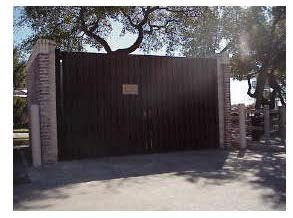
Utility equipment and structures. Outdoor storage, dedicated loading areas, refuse or recycling storage areas, air conditioning, ventilation and heating equipment, utility boxes, solar panels, and antennas shall be placed in the rear of the property where possible and shall be completely screened from public view when viewed from the McCullough Road right-of-way. Screening may be achieved by a solid screen or wall consistent with permitted building materials, evergreen plant materials with irrigation, or landscaped earthen berm. Illustration:
(3)
Exterior wall and roof colors.
a.
The use of high intensity colors, metallic colors, or fluorescent colors are prohibited in excess of five percent on any exterior wall face.
b.
The following regulations apply to any exterior wall (or roof) that is wholly or partially visible from the McCullough Road right-of-way. For the purposes of this subsection, the primary wall finish color shall refer to the color applied to ten percent or more of a building elevation.
i.
Allowable primary wall finish colors:
1.
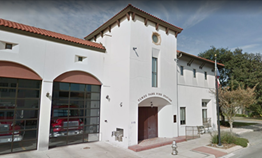
When painted, exterior surfaces (including roofs) may only be painted in muted colors (including shades of white) compatible with the historical character of Olmos Park.
2.
Approved Olmos Park color palette.
3.
The colors included in the Olmos Park approved color palette as kept at Olmos Park City Hall from the Sherwin Williams color-palette, or their match in other paint company palettes.
(Ord. No. 2019-11, § 2, 11-21-2019)

