
Orinda City Zoning Code
CHAPTER 17
15 - DEVELOPMENT STANDARDS FOR ALL USES
Sections:
17.15.1 - Applicability and compliance.
The development standards set forth in this chapter apply to every use classification in every zoning district unless otherwise specifically provided. The Zoning Administrator may require evidence of ability to comply with development standards before issuing an entitlement.
(Ord. 99-5 § 2 Exh. A (part))
17.15.2 - Performance standards for all uses.
A.
Air Contaminants. Every use must comply with rules, regulations and standards of the Bay Area Air Quality Management District (BAAQMD). An applicant for a zoning approval or a use, activity or process requiring BAAQMD approval of a permit to construct, must file a copy of the BAAQMD permit with the Zoning Administrator. An applicant for a use, activity or process that requires BAAQMD approval of a permit to operate must file a copy of such permit with the Zoning Administrator within thirty (30) days of BAAQMD approval.
B.
Hazardous Materials, Combustibles and Explosives. Any use involving handling and storage of hazardous materials, combustibles and explosives that is subject to a permit under the fire code as adopted by the city, the County Hazardous Waste Management Plan (HWMP) or state law. In addition to the provisions contained within the County HWMP, the city adopts the following additional siting requirements for all hazardous waste facilities:
1.
Any application to establish a hazardous waste facility shall require an amendment to the Orinda general plan text and map to establish a land use designation which allows for such a facility; and
2.
A hazardous waste facility may not be located in an area which may adversely impact a drinking water reservoir, either directly or indirectly.
C.
Glare.
1.
From Glass. Mirror or highly reflective glass may not cover more than twenty (20) percent of a building surface visible from a street unless an applicant submits information demonstrating to the satisfaction of the Zoning Administrator that use of such glass will not significantly increase glare visible from an adjacent street and property or pose a hazard for moving vehicles.
2.
From Outdoor Lighting. Parking lot lighting must comply with Chapter 17.16 of this title. Security lighting may be indirect or diffused, or be shielded or directed away from an R district within one hundred (100) feet. Lighting for outdoor court or field games within three hundred (300) feet of an R district or Scenic Corridor requires approval of a use permit, processed in accordance with provisions of this title.
Table 17.15.2
Maximum Noise Standards By Zoning District
1 (Ldn is a measurement of day/night noise equivalent)
1.
Duration and Timing. The noise standards above shall be modified as follows to account for the effects of time and duration on the impact of noise levels:
a.
In R districts, the noise standard shall be five dB lower between ten p.m. and seven a.m.
b.
Noise that is produced for no more than a cumulative period of five minutes in any hour may exceed the standards above by five dB.
c.
Noise that is produced for no more than a cumulative period of one minute in any hour may exceed the standards above by ten dB.
2.
Zoning Administrator May Require Acoustic Study. The Zoning Administrator may require an acoustical study, prepared at the expense of an applicant or property owner, for any proposed project which could have, or create, a noise exposure greater than that deemed in conflict with the above standards. Complaints alleging project violation of noise standards shall be accompanied by a detailed account of the nature of the violation, including an assessment of the extent to which noise standards have been exceeded. An acoustical study and necessary noise-level mitigation shall be required for new multifamily residential or single-family residential projects involving four or more units, or commercial development (new construction involving at least five thousand (5,000) gross square feet) proposed within three hundred (300) feet of State Route 24 or adjacent to major arterials where project noise contours are sixty (60) dBA (Ldn) or more, consistent with the noise element of the general plan.
3.
Noise Measurement. Noise shall be measured at an appropriate distance from the source, sufficient to identify noise characteristics of the noise source and to determine compliance with the noise standards of this section, with a sound level meter, which meets the standards of the American National Standards Institute (ANSI Section S1.4-1979, Type 1 or Type 2). Noise levels shall be measured in decibels. The unit of measurement shall be designated as dB, weighted to an Ldn equivalent. A calibration check shall be made of the instrument at the time any noise measurement is made.
4.
Noise Attenuation Measures. The Zoning Administrator may require the incorporation into a project of any noise attenuation measures deemed necessary to ensure that noise standards are not exceeded.
5.
Appeals. Decisions of the Zoning Administrator concerning noise may be appealed to the Planning Commission in accord with Chapter 17.43.
D.
Swimming Pool Discharges. It is unlawful to discharge chemically treated water from a swimming pool to the storm drainage system or a watercourse unless all chemicals (including but not limited to chlorine and bromine) are undetectable before discharge occurs. Where practicable, swimming pool discharges shall be dispersed by approved infiltration methods into landscaped areas, lawns, soil, or other permeable surfaces so as not to create surface runoff or disposed of through the sanitary sewer system so long as a permit has been obtained for such disposal from the Central Contra Costa Sanitary District.
E.
Water Pollution. A person may not discharge and no use may result in the discharge of liquids of any kind into a public or private sewage system, watercourse, body of water, or the ground, except in compliance with applicable law and regulations (including National Pollutant Discharge and Elimination System requirements of Contra Costa County, and California Regional Water Quality Control Board, California Code of Regulations, Title 23, Chapter 3 and California Water Code, Division 7).
(Ord. 04-08 § 4; Ord. 04-03 § 4 (part); Ord. 99-5 § 2 Exh. A (part))
17.15.3 - Fences and retaining walls.
A.
General. Fences and retaining walls are permitted in every district and are allowed in conjunction with specific uses as provided in this section.
B.
Maximum Height. The height of a fence or retaining wall is measured from the point at which the fence posts, wall pilasters or wall footing intersects the ground on the lowest side of the wall or fence to the top of the wall or fence directly above. Where a fence is built on top of a retaining wall, the fence height is measured from the point that the ground is retained by the wall. The maximum fence or retaining wall height in a required yard or setback area is as follows:
1.
R Districts. As regulated within Chapter 17.4 of this title.
2.
D Districts. The maximum height is six feet, except within the front yard, where it is three feet.
(Ord. 99-5 § 2 Exh. A (part))
17.15.4 - Height limitation at intersections.
Refer to following graphic entitled "Section 17.15.4 Graphic, Minimum Clearance Guidelines."
Section 17.15.4 Graphic
MINIMUM CLEARANCE GUIDELINES
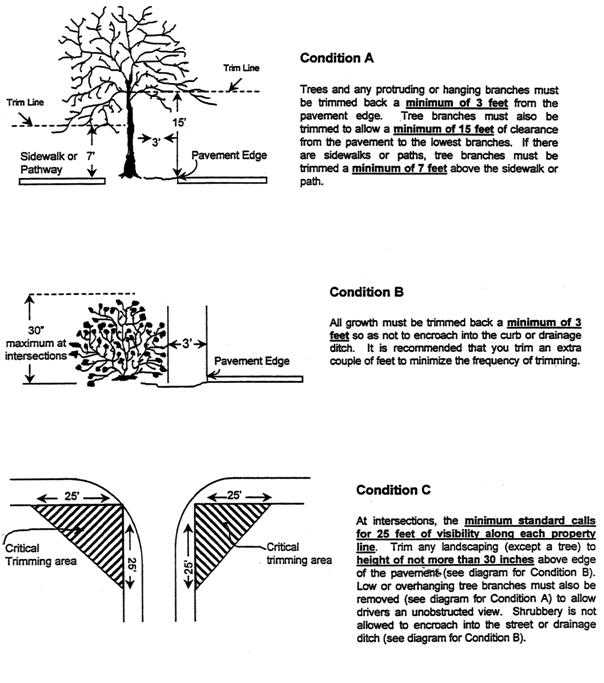
(Ord. 99-5 § 2 Exh. A (part))
17.15.5 - Construction across property lines.
No new development, including construction of accessory structures or building or structure repairs, shall be allowed which results in or otherwise perpetuates a structure's crossing one or more lot lines, unless a variance is obtained from the Planning Commission pursuant to the provision of Chapter 17.33 or unless the lots in question are first voluntarily merged by the property owner. If a variance is approved, a deed restriction shall be recorded which requires removal of the structure(s) in question or approval of a lot line adjustment to correct the encroachment prior to sale of one lot separate from the other of the property. All development shall otherwise be required to adhere to the standards of the applicable zone.
(Ord. 02-03 § 15: Ord. 00-2 § 8; Ord. 99-5 § 2 Exh. A (part))

