
Orinda City Zoning Code
CHAPTER 17
8 - DOWNTOWN DISTRICTS
17.8.1 - Intent.
In addition to the general purposes listed in Chapter 17.1, the specific purposes of the downtown district regulations are to:
A.
Create every opportunity for the downtown area to function as a vital, thriving yet traditional Main Street area, serving local needs and providing for specialty retail activities, consistent with the general plan;
B.
Create a vibrant community center by encouraging a variety of businesses which will create pedestrian interaction and pedestrian-scale activities. Emphasize uses which involve pedestrian spaces, including outdoor dining, garden settings, walkways and seating areas;
C.
Encourage areas of distinctive character by identifying preferred uses and development standards unique to these locations;
D.
Regulate development so as to achieve a vibrant community center over time. All development, including incremental development, small building additions or increases in intensity of existing land uses, shall be consistent with this goal;
E.
Establish incentives, such as additional building height, higher floor area or broader range of permitted uses to help achieve a vibrant community center;
F.
Discourage and eventually terminate nonconforming office uses in retail spaces;
G.
Establish development standards which define desired character, but which allow and encourage flexibility in how this character is to be achieved, including standards involving building heights, setbacks, site planning, building bulk/mass, landscaping, parking, lighting and architecture, as presented in the downtown design guidelines;
H.
Protect adjoining residential areas from inappropriate or disruptive commercial or office activities;
I.
Encourage parking solutions which will serve long-term needs and will minimize the adverse effects of parking, traffic and circulation on the function and viability of downtown;
J.
Encourage activities and development which will showcase the creek, where possible, for low-intensity pedestrian-oriented activities and strolling;
K.
Provide for multifamily housing, including affordable housing, in downtown areas, consistent with the housing element of the general plan.
(Ord. 99-5 § 2 (Exh. A (part))
17.8.2 - Definitions of retail floor and mixed-use.
A.
"Mixed-use" means a combination of different uses, including at least one residential use, on a single site. Specifically, a site may be:
1.
"Vertical mixed-use," which combines different uses within a single building; and/or
2.
"Horizontal mixed-use," which combines multiple buildings with different uses on a single site.
B.
"Retail floor" means a floor in a building in the downtown commercial district or the downtown core district that meets one or more of the following definitions:
1.
A floor with an entrance at street level or an entrance from a mall, plaza or parking lot at any level;
2.
The first floor of Theatre Square; or
3.
A floor that is likely to serve retail customers by encouraging pedestrian traffic and interaction and pedestrian-scale activities, considering all relevant factors, including but not limited to easy access and visibility.
(Ord. 99-5 § 2 (Exh. A (part); Ord. No. 25-05, § 2(Att. A § 3), 11-3-25)
17.8.3 - Downtown commercial district—Description.
The downtown commercial district ("DC district") provides sites in downtown Orinda for retail shopping at ground level. Development standards are intended to enhance the "village character" of the downtown.
(Ord. 99-5 § 2 (Exh. A (part))
17.8.4 - Downtown commercial district—Uses allowed.
Retail and office uses are allowed in the downtown commercial district as set forth in this chapter. Temporary uses are allowed with a temporary use permit under Chapter 17.37. Government offices and facilities are allowed with a general use permit under Chapter 17.31. Multifamily dwellings are allowed with a general use permit under Chapter 17.31, provided they are built at a density that does not exceed ten units per acre and are part of a mixed-use development. All other uses are prohibited.
(Ord. 99-5 § 2 (Exh. A (part); Ord. No. 13-03, § 2(Att. A), 12-17-13; Ord. No. 25-05, § 2(Att. A § 3), 11-3-25)
17.8.5 - Downtown commercial district—Use restrictions.
In the downtown commercial district, certain uses are permitted, permitted with a use permit, or prohibited in certain locations as follows:
A.
Types of Interior Spaces. There are three types of interior commercial space in the downtown commercial district:
1.
Type I Space. Type I space is a retail floor in a building or a portion of a building that:
a.
Faces or abuts a street or street segment listed below; or
b.
Faces a mall, plaza or parking lot which faces or abuts a street or street segment listed below.
Type I space excludes a retail floor in a building that meets the criteria listed in subsections A.1.a. or A.1.b. of this section, solely because of driveway access to such a street or street segment.
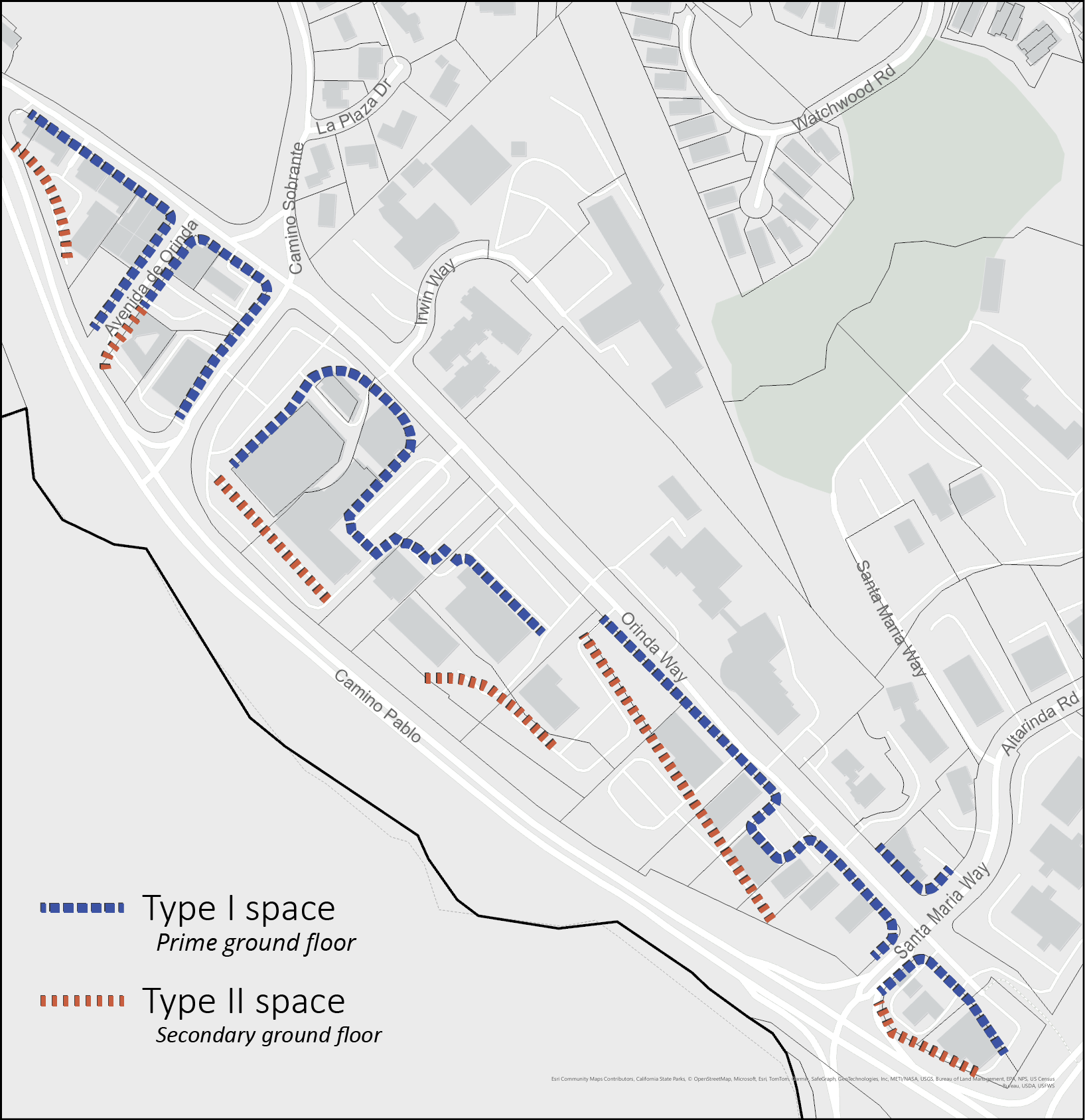
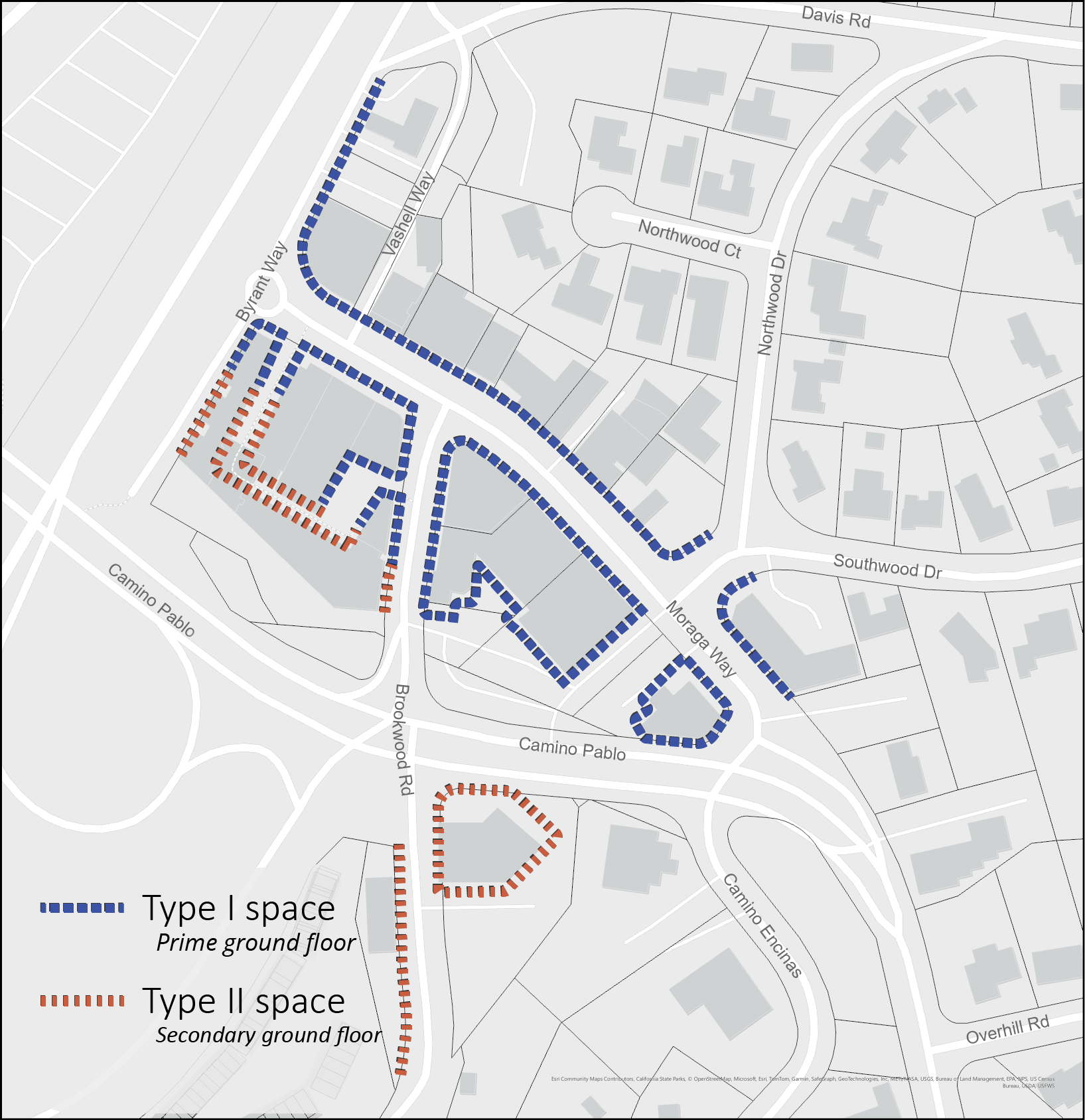
Type I space is located on the following streets and street segments within the downtown commercial and downtown core zoning districts: Orinda Way; Avenida De Orinda (both sides of the eastern half and the north side of the western half); Camino Sobrante; Santa Maria Way; Moraga Way; Bryant Way (between Moraga Way and Davis Road); Brookwood Road (between Moraga Way and Camino Pablo except for the unit near the garage entrance in the Theatre Square Complex); Camino Pablo (east side between Highway 24 and Moraga Way).
2.
Type II Space. Type II space is a retail floor that is not in a building or a portion of a building that faces or abuts any of the streets and street segments listed in subsection A of this section or a building or portion of a building that faces or abuts a mall, plaza, or unenclosed parking lot facing or abutting any of the streets and street segments listed above. Examples include but are not limited to the rear side of buildings along the west side of Orinda Way, Camino Pablo's west side south of Brookwood Road, and Brookwood Road west of Camino Pablo.
3.
Type III Space. Type III space is any other space in the downtown commercial and downtown core zoning districts.
Section 17.8.5 Graphics
Graphics within this section demonstrate Type I and Type II spaces within the existing built environment of Downtown Orinda as of August 12, 2025.
17.8.5 Downtown Space Utilization Map: "The Village"
17.8.5 Downtown Space Utilization Map: "The Crossroads"
B.
Classification of Commercial Uses. There are three general classes of uses permitted in the downtown commercial district.
1.
Class A Uses. Retail sales and restaurants, restaurants with take-out*, and restaurants with outdoor dining*;
*Take-out restaurants and outdoor dining are subject to additional regulations set forth in subsection I of this section.
2.
Class B Uses. Personal care, personal development services (excluding health care), and business and automotive services, including service stations, if the use will tend to create substantial pedestrian interaction with surrounding businesses (including, but not limited to, beauty parlors, barber shops, fitness centers, dry cleaners, travel agencies, dance, music, and martial arts studios), and retail financial institutions such as banks, savings and loans, credit unions, and freestanding automatic teller machines; and
3.
Class C Uses. Office uses compatible with a village atmosphere such as medical and professional offices, real estate sales, and financing.
C.
Uses Not Requiring a Commercial Use Permit. Except as otherwise provided in subsection G of this section, in all spaces, Class A uses are allowed without a commercial use permit. Class B uses are allowed without a commercial permit in Type II and III spaces; and Class C uses are allowed without a commercial use permit in Type III spaces. Where a single space has multiple frontages that, considered separately, would be classed as more than one space type, the entire space is subject to the rules applicable to the higher type, e.g., Type I rather than Type II. Where a single space is proposed to be divided into more than one space, creating one or more new and less-restrictive spaces, a commercial use permit is required.
D.
Commercial Use Permit Requirement.
1.
Class B Uses. A use permit under Chapter 17.36 is required for a Type B use in a Type I ground floor space.
2.
Class C Uses. A use permit under Chapter 17.36 is required for a Class C use in Type II spaces. A Class C use is prohibited in Type I space.
3.
Other Uses. Certain uses described in subsection G of this section require a use permit under Chapter 17.36.
4.
Extended Hours. A commercial use permit is required for any use which operates before 5:00 a.m. or after 11:00 p.m.
E.
Use Prohibition. All uses not specifically permitted in this Chapter 17.8 are prohibited in the downtown commercial district.
F.
Space Utilization Chart. The following chart illustrates the provisions of Sections 17.8.5C. and D:
G.
Supplemental Restrictions for Specific Uses. The following specific uses are also permitted in the downtown commercial district, subject to the contents of the chart above and subject to obtaining a commercial use permit under Chapter 17.36. Those uses marked by an asterisk are subject to additional regulations set forth in Section 17.8.5.H:
1.
Adult business;*
2.
Animal sales and services;
3.
Bar and tavern;
4.
Commercial recreation and entertainment;
5.
Convenience market;
6.
Convenience market and other ancillary retail at a service station;*
7.
Farmer's market;
8.
Game center;*
9.
Liquor store;
10.
Live entertainment;*
11.
Maintenance and repair services;
12.
Outdoor sales;*
13.
Service stations;*
14.
Vehicle sales and services;
15.
Visitor accommodations;
16.
Ancillary retail uses.*
*Uses marked by an asterisk in subsection G of this section are subject to additional regulations set forth in subsection H of this section.
H.
Supplemental Restrictions for Specific Uses. The following uses are permitted in the downtown commercial district subject to particular restrictions for such uses as described below and subject to obtaining a commercial use permit under Chapter 17.36:
1.
Adult Businesses.
a.
Purpose.
i.
In adopting these provisions, the City Council recognizes that certain types of adult businesses possess certain objectionable operational characteristics which, if such uses are allowed to concentrate, will have adverse effects upon the character of such areas and adjacent neighborhoods. The City Council further recognizes that locating adult businesses in close proximity to establishments frequented by minors will cause the exposure of minors to adult material that may adversely affect such minors due to their immaturity. Additionally, the City Council recognizes that, while certain adult entertainment enjoys limited protection under the First Amendment to the United States Constitution, substantial numbers of citizens of the city are offended by the public display of sexually-oriented material.
ii.
Special and limited regulation of adult businesses, consistent with the First Amendment rights of such uses, is therefore necessary. This will ensure that the adverse effects of adult businesses will not contribute to the blighting or downgrading of the DC district in which they are permitted and the downgrading of surrounding neighborhoods; will not adversely affect minors; and will not offend those citizens of the city who do not wish to be exposed to sexually-oriented material.
b.
Location of Adult Businesses. No adult businesses, including adult bookstores, adult movie theaters, and massage establishments, shall be located:
i.
Within four hundred (400) feet of any R district;
ii.
Within three hundred (300) feet of the boundaries of a parcel of a real property site occupied by a public or private school, a religious assembly facility that conducts religious education classes for minors, or a park and recreation facility;
iii.
Within six hundred (600) feet of any other adult business; or
iv.
On the ground level of a building.
c.
Public Display of Certain Matter Prohibited. No business shall display or exhibit any material depicting private anatomical areas or sexual activities in such a way as to be visible by persons outside the building in which the adult business is located.
2.
Convenience Markets and Other Ancillary Retail Uses at a Service Station. Ancillary retail use, including a convenience market, may be permitted at a service station if a noticed hearing is held under Chapter 17.42 in conjunction with the application under Chapter 17.36 for a commercial use permit (or commercial use permit amendment) for a service station. The proposed use may be approved if findings of fact are made to support each of the listed criteria and use permit conditions are imposed consistent with the listed requirements:
a.
Criteria:
i.
The existence of the proposed use will not significantly and adversely alter the impact and the character of the primary service station use;
ii.
The proposed use will enhance the pedestrian environment in the vicinity of the service station;
iii.
The proposed use will enhance the availability of food in the City; including fresh food;
iv.
The proposed use will not adversely impact any of the policies set forth in Section 17.8.1;
v.
The proposed use will substantially further City goals for downtown Orinda as identified in adopted plans, including, but not limited to, the ConnectOrinda Streetscape Master Plan.
b.
Requirements:
i.
The proposed use shall occupy only ground floor space and not exceed twenty (20) percent of the total lot area;
ii.
The proposed use shall provide and maintain one or more seating areas (minimum of eight aggregate seats) to accommodate food and/or beverage consumption;
iii.
The building containing the proposed use shall include a pedestrian entrance from a sidewalk in the public right-of-way. This entrance shall be located:
1.
No more than thirty-five (35) feet from the public sidewalk;
2.
On an exterior primary wall that runs roughly parallel to the public sidewalk for a distance of at least twenty-five (25) feet.
iv.
The proposed use must be at least two thousand two hundred fifty (2,250) square feet and no larger than three thousand (3,000) square feet;
v.
To the extent that outdoor seating is provided, it shall comply with all outdoor dining requirements contained in Section 17.8.5(I)(1) except for any outdoor dining permit requirement;
vi.
To the extent the proposed use comes within the definition of take-out restaurant, it shall comply with all take out restaurant requirements contained in Section 17.8.5(I)(2).
3.
Game Centers. The following supplemental regulations shall apply to the operation of game centers, including mechanical or electronic games or any other similar machine or device:
a.
Purpose. The intent of these regulations is to control the location and hours of operation of game centers so as not to allow school children to play the games during school hours nor to encourage minors to congregate in areas close to commercial establishments that sell alcoholic beverages.
b.
Permit Required. A commercial use permit shall be required to install, operate or maintain four or more mechanical or electronic games. The permit is valid only for the number of games specified; the installation or use of additional games requires a new or amended permit. The permit shall be permanently and conspicuously displayed.
c.
Duration and Renewal of Permit. Initially, the permit shall be valid only for one year. Thereafter, the Community Development Director may renew the permit for periods of not more than two years. The procedure for renewal is the same as that for the initial application, and the same factors considered for the initial application shall be considered for the renewal.
d.
Adult Manager. At least one adult manager shall be on the premises during the time a game center is open to the public.
e.
Hours of Operation for Minors Under Eighteen (18) Years of Age. No game center owners, manager or employees shall allow a minor under eighteen (18) years of age to play a mechanical or electronic game machine during the hours of public schools in the district in which the center is located are in session, or after 9:00 p.m. on nights preceding school days, or after 10:00 p.m. on any night. It is the responsibility of the owner or manager of the game center to obtain a current schedule of school days and hours.
f.
Locational Criteria. A game center shall not be permitted within three hundred (300) feet of a public or private school site or the boundary of an R district, or within five hundred (500) feet of a liquor store, a cocktail lounge, tavern or bar. The distance shall be measured in a straight line from the main public entrance to the game center to the property line of the school site, the district boundary, or the main public entrance of the liquor store or cocktail lounge, as the case may be.
g.
Restrictions. The Planning Commission may impose reasonable restrictions on the physical design, location, and operation of a game center in order to minimize the effects of noise, congregation, parking, and other nuisance factors that may be detrimental to the public health, safety and welfare of the surrounding community.
4.
Live Entertainment. The following regulations shall apply to any use offering scheduled live entertainment, as defined, more than three times per calendar year:
a.
Exits not limited to emergency use only shall not be opposite an R district adjoining the site.
b.
A use permit shall establish conditions ensuring that no litter problem will exist.
c.
A use permit for live entertainment shall apply only to the type of entertainment approved, and a different type of entertainment shall require approval of a new use permit.
d.
A noise analysis specifying areas affected and sound proofing or other mitigation that will be employed to eliminate excessive noise exposure on adjacent property shall be submitted with a use permit application.
5.
Outdoor Sales. Outdoor sales specified in subsection (H)(5) of this section are allowed with a commercial use permit.
a.
Permanent outdoor storage and display of merchandise, materials or equipment, including display of merchandise, materials and equipment for customer pick-up.
6.
Service Station.
a.
All repair work shall be conducted within a building. No outside storage of parts, equipment or vehicles which have been damaged or dismantled completely or partially, is permitted.
b.
Activities permitted in a service station include tire sales, installation of mufflers, exhaust and suspension systems, electronic tune-ups, oil/lubrication and filter replacement, wheel alignment, tire rotation and balancing, battery installation or charging, hose replacement, belt replacement, carburetor adjustment, installation and repair of brakes, auto radio and electronics installation and service, alarm installation, or air conditioning or heater service.
c.
Activities prohibited in a service station include other major repair activities such as engine overhauls involving body and fender work, painting and undercoating.
7.
Ancillary Retail Use. An ancillary retail use is permitted in the downtown commercial district if a noticed hearing is held under Chapter 17.42 in conjunction with the application for a commercial use permit and findings of fact are made to support each of the following criteria:
a.
The existence of the ancillary retail use will not significantly and adversely alter the impact and the character of the primary retail use;
b.
The ancillary use will not adversely affect the use of more than twenty (20) percent of the existing floor area;
c.
The ancillary use will not create a significant adverse impact on parking and pedestrian and vehicular traffic;
d.
The ancillary use will not adversely impact any of the policies set forth in Section 17.8.1.
For special rules applicable to ancillary retail uses at service stations, see subsection 2, above.
I.
Additional Regulation for Uses Not Requiring a Commercial Use Permit.
1.
Outdoor Dining. Outdoor dining is allowed with an outdoor dining permit.
a.
The following regulations apply to all outdoor dining permit applications:
i.
The operator shall furnish tables, chairs, umbrellas, and portable heaters (outdoor dining furniture) as necessary.
ii.
Outdoor dining furniture shall not be secured to public streetlights, trees, or other furniture.
iii.
No outdoor dining furniture may be located at a street intersection within a triangular area formed by the street curb lines and their projections and a line connecting them at points forty (40) feet from the intersection of the projected curb lines. In cases where curbs do not exist, the edge of street pavement shall be used for measuring purposes.
iv.
Outdoor dining furniture shall meet the following standards:
(A)
Tables and chairs shall be made of a safe, sturdy, durable material such as wrought iron, wood, steel, or cast aluminum.
(B)
No plastic tables or chairs and no vinyl tablecloths are permitted.
(C)
All tables and chairs shall be commercial grade and manufactured for outdoor commercial use.
(D)
Tables shall be square, rectangular or round to seat two to four people.
(E)
All furniture shall be properly maintained and cleaned regularly.
v.
No umbrella signage is permitted.
vi.
At least seven feet ground clearance shall be provided under umbrellas.
vii.
If portable heaters are used, they shall be located a minimum of two feet from the pedestrian zone.
viii.
The outdoor dining area shall be maintained in a clean and safe condition at all times.
ix.
All Americans with Disabilities Act (ADA) requirements shall be met.
b.
The following regulations apply to applications for outdoor dining located in the public right-of-way:
i.
All requirements of subsections I.1. of this section must be met;
ii.
Approval of a revocable encroachment permit per Chapter 12.08 must be obtained;
iii.
Furniture must be located immediately in front of the business it serves or shall have the consent of the businesses in which the outdoor dining area is abutting;
iv.
Tables shall be fastened to the ground, in a manner acceptable to the City Engineer;
v.
Outdoor dining furniture, except for the tables, shall not be left in the public right-of-way during non-business hours;
vi.
Outdoor dining areas shall remain on the same side of the pedestrian zone along public sidewalks not wide enough to accommodate outdoor dining areas on both sides of the pedestrian zone unless there is a ten-foot separation between dining areas;
vii.
A two-foot vehicle buffer zone between the curb and the outdoor dining area or the pedestrian zone shall be maintained;
viii.
A minimum pedestrian zone of four feet and six inches shall be maintained;
ix.
Outdoor dining areas shall not cause the pedestrian zone to encroach into the radius of a door swing;
x.
Outdoor dining furniture shall not encroach into the vehicle buffer zone or the pedestrian zone.
2.
Take-out restaurants are allowed with a take-out restaurant permit.
a.
The following regulations apply to all take-out restaurant permit applications:
i.
Identifiable containers and napkins shall be used for all carry-out food, and all litter resulting shall be promptly removed.
ii.
A trash receptacle shall be provided near each public restaurant exit unless there is an existing trash receptacle within twenty-five (25) feet of each exit. If in the public right-of-way, the type of trash receptacle shall be subject to approval by the Public Works Department.
iii.
The business owner shall keep the area in front of the restaurant clean and litter-free and ensure that the trash receptacle does not overflow. In the event that receptacles in the public right-of-way overflow and are emptied by the city, the applicant shall be charged the cost of emptying the receptacle.
iv.
The applicant must provide documentation showing that the requirements for off-street parking in Section 17.16.4 of the Orinda Municipal Code are met.
v.
Walk-up service is allowed, provided access is not directly to the public right-of-way.
vi.
A restaurant which offers food and beverages, or either one, for sale to a customer in a motor vehicle for consumption off-site is prohibited.
J.
Prohibition of Specified Uses.
1.
Commercial Marijuana Land Uses. Commercial marijuana land uses are a prohibited use in the downtown commercial district.
2.
Outdoor Marijuana Cultivation. The outdoor cultivation of marijuana is a prohibited use in the downtown commercial district.
(Ord. 07-07 §§ 2—7; Ord. 02-03 §§ 13, 14, 33 (part); Ord. 99-5 § 2 Exh. A (part); Ord. No. 09-01, §§ 4, 5, 5-19-09; Ord. No. 11-04, § 1, 5-3-11; Ord. No. 17-05, § 2(Att. A), 9-5-17; Ord. No. 25-05, § 2(Att. A § 3), 11-3-25; Ord. No. 25-06, § 2(Att. A), 1-20-26)
17.8.6 - Downtown commercial district—Property development standards.
The following Schedule 17.8.6, entitled "DC District—Property Development Standards" prescribes minimum lot dimensions and property development regulations for the downtown commercial (DC) district. New construction, additions and replacement construction (excluding tenant improvements) in the DC district shall require a use permit under Chapter 17.36, to assure compliance with the intent of Section 17.8.1.
Schedule 17.8.6
DC District—Property Development Standards
(Ord. 99-5 § 2 Exh. A (part))
17.8.7 - Downtown office district—Description.
In addition to the general purposes set forth in Chapter 17.1 and at the beginning of this chapter, the specific purpose of the downtown office district ("DO district") is to provide sites for professional uses that offer services primarily to the needs of Orinda residents and visitors and for businesses at appropriate locations, consistent with the general plan and subject to development standards that ensure consistency with adjoining land uses.
(Ord. 99-5 § 2 Exh. A (part))
17.8.8 - Downtown office district—Use restrictions.
A.
Uses By Right—No Use Permit Required. Offices for all forms of business, for the services of licensed professionals, and for government offices and facilities are permitted in the DO district without a use permit. Limited manufacturing is permitted as an ancillary use in medical and dental practices.
B.
Temporary Uses. A temporary use is permitted in the DO district if a temporary use permit is obtained under Chapter 17.37.
C.
Permit Required. The following uses are allowed in the DO district if a general use permit is obtained under Chapter 17.31: Clubs and other private associations, educational facilities, residential congregate care for elders, convalescent facilities, and day care.
D.
Other Uses Prohibited. All uses not specifically permitted in this zoning district are prohibited.
E.
Prohibition of Specified Uses.
1.
Commercial Marijuana Land Uses. Commercial marijuana land uses are a prohibited use in the downtown office district.
2.
Outdoor Marijuana Cultivation. The outdoor cultivation of marijuana is a prohibited use in the downtown office district.
(Ord. 99-5 § 2 Exh. (part); Ord. No. 11-04, § 1, 5-3-11; Ord. No. 17-05, § 2(Att. A), 9-5-17; Ord. No. 25-05, § 2(Att. A § 3), 11-3-25)
17.8.9 - Downtown office district—Property development standards.
The following Schedule 17.8.9, entitled "DO District—Property Development Standards" prescribes minimum lot dimensions and property development regulations for the downtown office (DO) district.
Schedule 17.8.9
DO District—Property Development Standards
(Ord. 99-5 § 2 Exh. A (part))
17.8.10 - All downtown districts—Additional property development standards.
A.
Planting Areas. Visible yards not used for parking shall have a three-foot planting strip adjoining an interior property line within fifty (50) feet of a street property line. Front and corner side yards that are not used for drives or walks shall be planting area. Perimeter planting strips around parking lots shall be five feet wide, and ten percent of the interior of parking lots shall be landscaped. See Chapter 17.17 for general landscaping requirements.
B.
Location of Parking. No parking shall be allowed in a front or corner side setback area unless the Planning Commission, as part of development plan approval, determines that no alternate location is feasible, parking lot landscaping will provide adequate screening, and the site plan and design conforms to the downtown design guidelines.
C.
Accessory Structures.
1.
Timing. Nonresidential accessory structures are prohibited prior to the start of construction of a principal structure on a site, except that construction trailers may be placed on a site at the time site clearance and grading begins. Construction trailers may remain on the site only for the duration of construction.
2.
Location. Except as provided in this subsection, nonresidential accessory structures shall not occupy a required front or corner side yard, or project beyond the front building line of the principal structure on a site. No accessory uses shall be permitted off-site.
3.
Maximum Height. The maximum height of a nonresidential accessory structure shall be twelve (12) feet, subject to the provisions of this subsection; provided, that pitched roofs shall not exceed a height of sixteen (16) feet.
4.
Relation to Property Lines. A nonresidential accessory structure in a required rear yard shall be located on a property line or shall be not less than three feet from a property line. A structure on a property line shall not exceed six feet in height at the property line and shall not intercept an inclined daylight plane sloping inward from a point six feet above the property line and rising one foot for each foot of distance for the property line.
5.
Garages on an Alley. Garages facing an alley shall be set back twenty-five (25) feet from the alley centerline; garages siding on an alley shall be set back fifteen (15) feet from the alley centerline.
D.
Fences and Retaining Walls. No fence shall exceed six feet in height. The combined height of a retaining wall and a separate fence on a property line shall not exceed eight feet unless the fence is set back from the retaining wall a minimum of half the distance of the required setback but no more than five feet. However, if the fence is on one property and the retaining wall on the abutting property, the maximum fence height is six feet regardless of the retaining wall height.
E.
Walk-up Facilities. In order to maintain free flow of pedestrian circulation, walk-up facilities, including window service and bank ATM machines, shall be set back at least three feet from the property line and shall be wheelchair accessible at all locations. Where a vehicular circulation area or parking area separates the building from the property line, the walk-up facility shall be located so that it does not impede pedestrian circulation or create conflicts between pedestrian and vehicular circulation flows. A walk-up facility that does not conform to these requirements may only be permitted upon approval of a use permit.
F.
Mechanical Equipment.
1.
General Requirement. Exterior mechanical equipment (except solar collectors) and operating mechanical equipment must be screened from off-site views. Equipment to be screened includes, but is not limited to, heating, air conditioning, refrigeration equipment, plumbing line, ductwork and transformers. Placement of mechanical equipment is limited by the setback requirements of the base zoning district, unless otherwise provided for within this title.
2.
Utility Meters. A utility meter must be screened from view from the public right-of-way. A meter or transformer in a required front yard or in a corner side yard must be enclosed in a subsurface vault.
3.
Screening Specifications. Screening material may have evenly distributed openings or perforations not exceeding fifty (50) percent of the surface area and must effectively screen mechanical equipment so that it is not directly visible from off-site. Heavy, evergreen landscaping may be used to meet these requirements.
G.
Refuse Storage Areas. A refuse storage area located within a building or screened on all sides by a six-foot high concrete, masonry wall or similar screening mechanism and an access gate must be provided before occupancy for uses other than a single-family or multifamily dwelling. The Planning Director may waive this screening requirement for refuse collection and storage equipment, including the use of a dumpster and waste storage container, if the collection/storage area is not visible from a street.
(Ord. 02-03 § 33 (part); Ord. 00-2 § 7; Ord. 99-5 § 2 Exh. A (part); Ord. No. 14-04, § 2(exh. A), 5-20-14; Ord. No. 25-05, § 2(Att. A § 3), 11-3-25)
17.8.11 - Downtown Core districts—Description.
In addition to the general purposes set forth in Chapter 17.1 and at the beginning of this chapter, the specific purpose of the Downtown Core ("DCOR") districts is to generally provide sites for community-serving retail, restaurant, and personal services on the ground floor, and multifamily residential and other uses on upper floors. Development standards are intended to enhance the "village character" of the downtown. The two DCOR districts listed in Section 17.8.12.B are differentiated only in their permitted residential densities.
(Ord. No. 25-05, § 2(Att. A § 3), 11-3-25)
17.8.12 - Downtown Core districts—Uses permitted.
A.
All uses permitted in the Downtown Commercial district are also permitted in the Downtown Core districts, subject to the same regulations. When uses allowed in the Downtown Commercial district are proposed in the Downtown Core districts, Section 17.8.5 will determine whether a site is Type I, II or III Space, and the regulations in Sections 17.8.5, 17.8.6, and 17.8.10 apply.
B.
Multifamily residential uses are permitted by right in the Downtown Core districts. Such residential uses are permitted only in Type II and Type III spaces (as specified in Section 17.8.5). Up to thirty percent (30%) of the linear building façade containing Type I spaces (as specified in Section 17.8.5) may include uses ancillary to multifamily residential uses, including access, common areas, and amenity spaces. Residential uses are not otherwise permitted in Type I spaces. Residential uses in the Downtown Core districts shall be subject to the following densities:
1.
DCOR-30 (Downtown Core—Thirty (30) dwelling units per acre). Residential development in the DCOR-30 district requires a minimum density of twenty (20) units per acre and a maximum density of thirty (30) units per acre.
2.
DCOR-55 (Downtown Core—Fifty-five (55) dwelling units per acre). Residential development in the DCOR-55 district requires a minimum density of twenty (20) units per acre and a maximum density of fifty-five (55) units per acre.
C.
Other Uses Prohibited. All uses not specifically permitted in this zoning district are prohibited.
(Ord. No. 25-05, § 2(Att. A § 3), 11-3-25)
17.8.13 - Downtown Core districts—Property development standards.
A.
Development with no Residential Uses. Property development standards for development with no residential uses are as specified in Section 17.8.6 and Section 17.8.10.
B.
Development with Residential Uses. Property development standards for development with residential uses are specified in the Objective Design Standards for Multifamily Residential Housing in the Downtown Core and Downtown General Zoning Districts, dated September 29, 2025. Multifamily residential shall be developed in a vertical mixed-use configuration (as defined in Section 17.8.2) except in the following cases:
1.
When existing development that will be retained on the same site contains Type I Space and the proposed development is located on the site such that no space within the proposed development is a Type I Space, development may alternatively use a horizontal mixed-use configuration (as defined by Section 17.8.2).
2.
When the site proposed for development does not contain Type I space, development may alternatively use a horizontal mixed-use configuration (as defined by Section 17.8.2) or a multifamily residential-only configuration.
(Ord. No. 25-05, § 2(Att. A § 3), 11-3-25)
17.8.14 - Downtown General district—Description.
In addition to the general purposes set forth in Chapter 17.1 and at the beginning of this chapter, the specific purpose of the Downtown General ("DG") district is to provide sites for professional uses that offer services primarily to the needs of Orinda residents, visitors, and businesses at appropriate locations, and to allow for multifamily residential development consistent with the general plan and subject to development standards that ensure consistency with adjoining land uses.
(Ord. No. 25-05, § 2(Att. A § 3), 11-3-25)
17.8.15 - Downtown General district—Uses permitted.
A.
All uses permitted in the Downtown Office district are also permitted in the Downtown General district, subject to the same regulations. When uses allowed in the Downtown Office district are proposed in the Downtown General district, the regulations in Sections 17.8.8 through 17.8.10 apply.
B.
In addition, multifamily residential is permitted by right in accordance with the development standards of Section 17.8.16. Multifamily residential development proposed within the Downtown General district shall meet the minimum and maximum units per acre as described below:
1.
The minimum density is twenty (20) units per acre.
2.
The maximum density is twenty-five (25) units per acre.
C.
Other Uses Prohibited. All uses not specifically permitted in this zoning district are prohibited.
(Ord. No. 25-05, § 2(Att. A § 3), 11-3-25)
17.8.16 - Downtown General district—Property development standards.
A.
Development with no Residential Uses. Property development standards for development with no residential uses shall be as specified in Section 17.8.9 and Section 17.8.10.
B.
Development with Residential Uses. Property development standards for development with residential uses are specified within the Objective Design Standards for Multifamily Residential Housing in the Downtown Core and Downtown General Zoning Districts, dated September 29, 2025.
(Ord. No. 25-05, § 2(Att. A § 3), 11-3-25)
17.8.17 - Objective Design Standards incorporated.
The provisions of the Objective Design Standards for Multifamily Residential Housing in the Downtown Core and Downtown General Zoning Districts, dated September 29, 2025, are incorporated in this chapter by reference. The Objective Design Standards apply only insofar as provided in this chapter.
(Ord. No. 25-05, § 2(Att. A § 3), 11-3-25)

