
Ormond Beach City Zoning Code
ARTICLE III
- GENERAL REGULATIONS
Sec. 2-50. - Accessory uses.
(a)
In general. Accessory structures and uses are permitted in conjunction with any principal use, provided that they are recognized as clearly incidental and subordinate to the principal use and do not alter the characteristics of the lots. The following regulations shall apply to all accessory uses:
(1)
No accessory structure or use shall be permitted on any lot which does not have an existing or permitted principal use or structure. Accessory uses may be permitted simultaneously with the issuance of building permits for the principal use or structure.
(2)
Unless otherwise specified within this article:
a.
All accessory structures and uses in residential districts shall be set back at least seven and one-half feet (7½') from the rear lot line and seven and one-half feet (7½') from one (1) interior side lot line, provided that the other side conforms to the district regulations for the principal structure.
b.
All accessory structures and uses in nonresidential districts shall be required to meet the principal building setbacks for the subject property.
c.
Accessory structures and uses in all zoning districts shall be prohibited in the required front yard or side corner setback and are encouraged to be located at the side or behind the principal structure on the lot.
(3)
All accessory uses are required to be located on the same lot as the principal structure or use.
(4)
Except as otherwise specifically permitted within this article, accessory uses shall be similar in design, materials and colors to the principal structure occupying the site.
(5)
For double frontage lots and corner side yards, accessory structures or uses shall not be located within the required rear yard setback unless screened by a hedge or wall at least four feet (4') in height.
(6)
Accessory uses and/or structures for all uses requiring site plan review shall be located in accordance with the final approved plan and shall not be permitted in any other areas not so designated.
(7)
No accessory structure or use shall be permitted in any platted easement, unless otherwise specifically permitted by the easement dedication. Fences may be located within certain easements with the condition that if the fence is required to be removed, the property owner is solely responsible for replacement of the fence.
(8)
Unless otherwise expressly permitted in this section, any structure with a hard roof is required to meet the principal building setbacks for the respective zoning district.
(9)
All accessory structures require the issuance of building permits by the city building and code division, as specified in section 1-14(6).
(b)
Accessory dwelling units. One (1) accessory dwelling unit is permitted for properties within residential zoning districts and shall meet the conditions below:
(1)
All utilities must be metered through the same meter serving the single-family dwelling unit.
(2)
The setbacks of the accessory apartment structure shall be the same as the principal building setbacks of the respective zoning district.
(3)
The building materials and color of the accessory apartment structure shall be consistent with the principal residential structure.
(4)
Secondary kitchens are permitted.
(5)
All accessory dwelling units shall have a deed restriction on the title to be recorded in the public records of the county; it shall be the responsibility of the property owner to provide proof of recordation to the city when requesting use of the accessory dwelling unit.
(6)
The property owner shall reside on the property when utilizing the accessory dwelling unit as a rental unit; members of the owner's family, a renter or caregiver shall occupy either the principal structure or the accessory dwelling unit.
(7)
The maximum total square footage permitted for the accessory detached dwelling unit shall be limited to forty-nine percent (49%) of the square footage of the principal structure.
(8)
Principal structures less than three thousand, two hundred sixty-six (3,266) square feet: accessory dwelling units are permitted to have a total building footprint of eight hundred (800) square feet, with a total maximum square footage of one thousand, six hundred (1,600) square feet, and shall have a first floor garage.
(c)
Amateur radio antennas. Amateur radio transmitting/receiving towers may extend an additional ten feet (10') above the maximum building height permitted in any residential district, except that in no situation shall any amateur radio transmitting/receiving tower exceed seventy-five feet (75') when measured from the average median lot elevation to the highest point of any part of the structure and/or attached services. The foregoing notwithstanding, no restriction shall be applied to amateur radio antennas in violation of the limited preemption entitled "Amateur Radio Preemption, 101 FCC 2d 952 (1985)," as issued by the FCC. One (1) amateur radio antenna structure shall be permitted on any residential lot or nonresidential site. The antenna structure shall be located on-site in a manner that will minimize the extent to which the structure is visible to nearby residents and members of the general public. Antenna structures shall be considered to satisfy these criteria if:
(1)
No portion of the antenna structure or mast is located within any required setback area;
(2)
No portion of the antenna structure or mast is within the front forty percent (40%) of that portion of the site that abuts a street; and
(3)
In the event a site abuts two (2) or more streets, the mast is not located within the front forty percent (40%) of that portion of the site where primary access is provided to the property.
(d)
Boats and watercraft. The regulations set forth in this subsection (d) shall apply in all zoning districts. The following use of boats and the use or construction of docks, and boathouses shall be conducted in a manner that is consistent with the intent of the city to conserve, protect and restore coastal and natural resources:
(1)
Boats and watercraft. This subsection shall apply to boats, motor boats, float houses, sailboats or any other kind of boat or watercraft.
a.
No boat or watercraft, moored or docked in any of the waterways, shall be used as a business or for professional services. However, this provision shall not apply to any boat used for the construction or maintenance of a waterway, marina construction, charter fishing and sightseeing boats that have been issued business tax receipts by the city or to boats being displayed for sale.
b.
No boat, float house or other watercraft shall be used as a dwelling for a period greater than twenty-four (24) hours after the time such boat, float house or watercraft was brought into the city.
c.
All boats or watercraft docked, moored or tied to land, docks, piers or wharves, abutting the public waterways in the city shall be subject to all applicable health and sanitary regulations of the city, and all applicable ordinances of the city relating to the conduct of persons and prohibiting acts contrary to public health, safety or welfare, including ordinances prohibiting disorderly conduct and loud and boisterous noises which disturb the peace of the neighborhood.
d.
It shall be unlawful for persons upon boats to dump or throw garbage, paper, bottles, cans, refuse or debris into such waterways in the city. It is unlawful for any boat or watercraft containing wastewater facilities to be on the waters of any stream, river, lake, or other waterway or waterbody, unless such wastewater facilities are sealed to prevent a discharge into any waters.
e.
No boat or watercraft of any kind whatsoever which is likely to damage a dock or any appurtenances thereto, or is a menace to navigation, shall be permitted to moor or tie up at said docks. Such boat or watercraft is hereby declared to be a public nuisance.
f.
Outdoor storage of watercraft in upland portions of the property shall comply with all applicable provisions of this Land Development Code.
g.
No boat or watercraft shall moor to or tie up to any seawall or dock or be beached upon private property without the permission of the owner of such property.
(e)
Docks, boathouses and boat lifts. Docks, piers, boathouses, boat lifts and other similar structures shall be constructed, expanded and maintained in a manner which will protect the natural resources and the public health, safety and welfare.
(1)
Permit required.
a.
No piers, docks, boathouses, or other similar structures extending into any surface water body shall be built until plans and specifications have been submitted to and approved by the chief building official and a permit for such construction issued.
b.
Copies of all appropriate permits from other agencies, including the Department of Environmental Protection and the U.S. Army Corps of Engineers, shall be submitted to the city in conjunction with the building permit application. No permit or written authorization will be needed from the state department of environmental protection if the dock project is eligible for consent by rule per F.S. § 403.813(1)(b), (d) or (i).
c.
Any structures proposed in or within one hundred feet (100') of a regulated wetland system will also require a wetlands protection permit. A determination as to whether a wetlands protection permit is required will be made by the engineering division, consistent with the criteria of chapter 3, article II of this Land Development Code.
d.
No permit shall be required for the nonstructural replacement of existing walkway or terminal platform boards or maintenance or repair of existing boatlifts.
(2)
General standards.
a.
No more than one (1) boathouse or combination of boathouse and dock, dock, gazebo or other similar structure shall be permitted for each single-family residence on a waterfront lot, or a group of waterfront lots under unified ownership.
b.
Stilt houses, boathouses with living or sleeping quarters, and other such residential structures are prohibited in the waterways of the city. No boathouse, dock, gazebo, fueling or storage facilities or other similar structure shall be used for dwelling purposes or contain any sleeping or living quarters.
c.
No boathouse, dock, pier or other structure in the waterways of the city shall have any provision for retail sales or commercial boat sales except as provided for in an approved site plan and except for properly sited marinas and multislip docking facilities provided that the upland riparian areas are appropriately zoned for nonresidential use. All proposed activities must be water-dependent and must not be contrary to the public interest.
d.
All submerged lands shall be considered as single use lands and shall be managed primarily for the maintenance of essentially natural conditions, propagation of fish and wildlife, and traditional recreational uses such as fishing, boating, and swimming. Compatible secondary purposes and uses which will not detract from or interfere with the primary purpose may be allowed.
e.
Activities which will result in adverse impacts to submerged lands and associated resources including wetlands shall not be approved unless there is no reasonable alternative and adequate mitigation is proposed.
f.
Proposed development activities shall be designed and maintained consistent with the wetlands protection permit requirements, the Tomoka Marsh Aquatic Preserve Management Plan and rules, the outstanding state water requirements and the Tomoka River Manatee Sanctuary requirements, as applicable.
g.
Any landscaping or vegetation that is disturbed during the construction process shall be restored to approximately its original condition within sixty (60) days of final approval of the structure.
h.
To the maximum extent practical, the proposed development activity shall address existing erosion problems and stabilization of the shoreline through the establishment of appropriate native wetland vegetation in littoral areas.
i.
Boathouses, docks and other similar structures extending into any water body shall not be permanently enclosed.
j.
During construction, turbidity must be controlled on-site to prevent reduction in water quality.
(3)
Docks within the jurisdiction of Ormond Beach with lots within unincorporated Volusia County. For the land area from 1130 John Anderson Drive to 3132 John Anderson Drive where the lots are located in unincorporated Volusia County and the Halifax River is located within the City of Ormond Beach, the following standards shall apply:
a.
The dock and boathouses regulations of the Zoning Ordinance of Volusia County, Florida, as contained in section 72-278 or as amended, shall apply to land area located within Volusia County with the Halifax River located within Ormond Beach. Annexation of any lot currently in unincorporated Volusia County shall require that the docks, boathouses and boat lifts standards of this section to be applicable to lots within Ormond Beach.
b.
In addition to the permit requirements of this section, the City permit application for docks, boathouses and boat lifts shall include:
1.
A Volusia County Wetland Alteration permit or a determination from Volusia County that no permit is required as part of the City permit application.
2.
A Volusia County Manatee protection permit or a determination from Volusia County that no permit is required as part of the City permit application.
3.
Evidence of a Volusia County permit or a determination from Volusia County that no permit is required for any structure on land, including rip rap, seawall, or any alteration of the shoreline.
(4)
Setback requirements.
a.
If the length of the shoreline is sixty-five feet (65') or more, a minimum twenty-five-foot (25') setback from the riparian lines of adjacent owners is required for all structures. If the shoreline length is less than sixty-five feet (65'), a setback of less than twenty-five feet (25') may be permitted provided the abutting neighbors provide the city a notarized affidavit that there is no objection to the reduced setback and all structures are to be centered between the riparian lines. These provisions, however, shall not preclude adjoining property owners from agreeing to locate a shared dock (on land and in the water) located along a common property line. The owners shall be required to enter into an agreement (based on a valid survey) which shall be recorded that stipulates that no other dock shall be located on either property, that each property owner grants an easement to each other for access/use of the dock, and that defines the maintenance obligation of each property owner. Property owners choosing to locate docks on common property lines shall ensure that there are no utility or other easements precluding the construction of the dock.
b.
Marginal docks shall have a minimum setback of fifteen feet (15') from the riparian lines of all adjacent owners if the length of the shoreline is sixty-five feet (65') or more. If the shoreline length is less than sixty-five feet (65'), a setback of less than fifteen feet (15') may be permitted provided the abutting neighbors provide the city a notarized affidavit that there is no objection to the reduced setback and all structures are to be centered between the riparian lines.
c.
Setbacks from other activities, channels and structures shall be required to ensure safety, facilitate enforcement abilities and ensure resource management.
d.
No such structure shall extend within one hundred feet (100') of a marked channel without prior state or federal permit approval.
e.
No boathouse, walkway, terminal platform or other similar structure, or any combination of boathouse and dock shall extend farther than a maximum water depth of four feet (4') below mean low water or one foot (1') below the lowest part of the vessel, or more than twenty-five percent (25%) of the width of the waterbody, opposite a buildable shoreline or fifty percent (50%) opposite a nonbuildable shoreline, whichever is more restrictive.
(5)
Water depths requirements. Docking facilities shall have adequate water depths to accommodate the proposed boat use consistent with permit conditions of appropriate state and federal agencies.
(6)
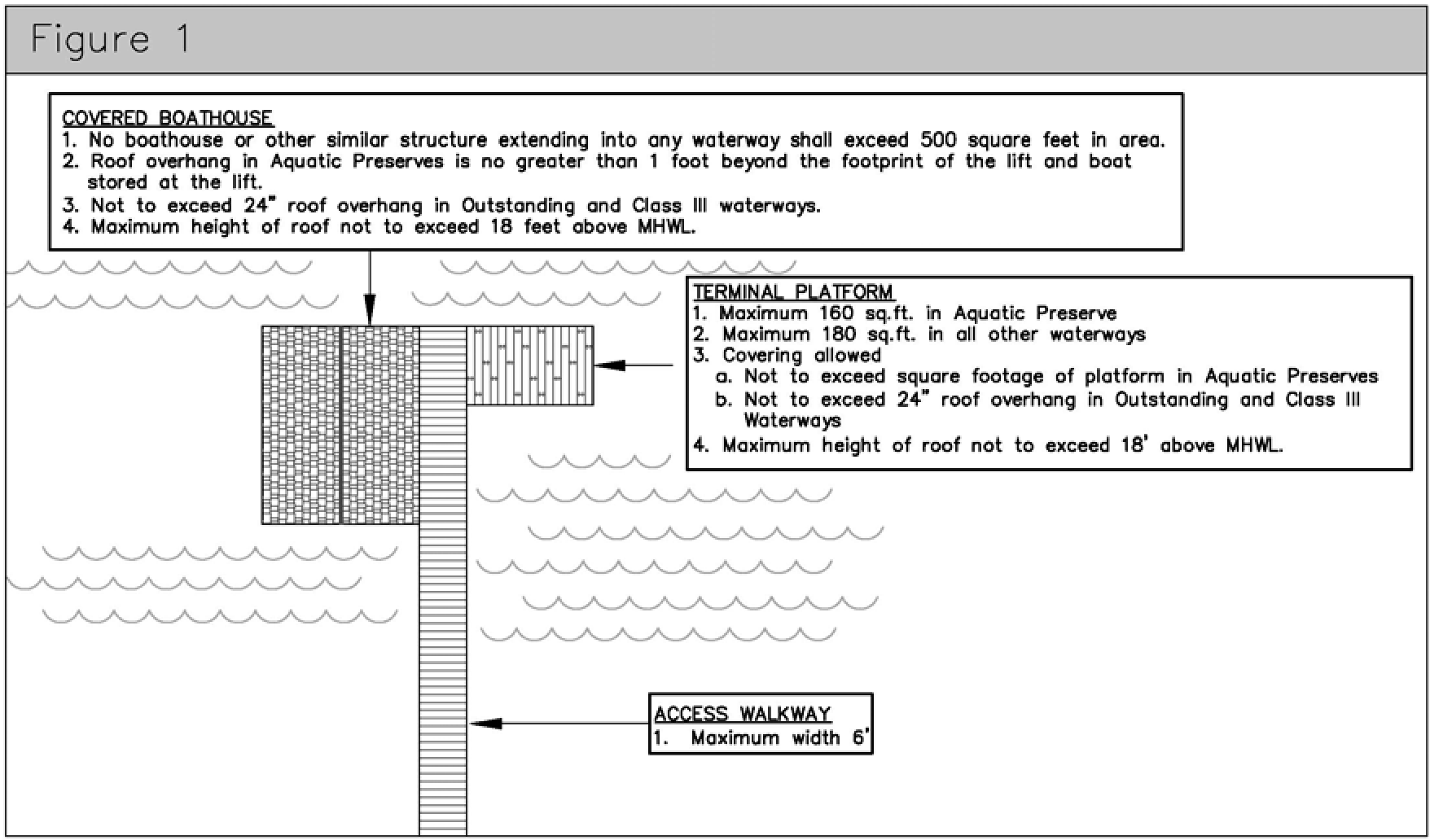
Dimensional requirements. The following criteria, as well as, figure 1 shall apply in review and approval of all docks, boathouses or other such structures.
a.
Access walkway.
1.
The main access pier or catwalk shall be considered a walkway and shall not exceed six feet (6') in width. Catwalks and finger docks extending off the main access walkway shall not exceed three feet (3') in width.
2.
The square footage limitations established herein are exclusive of the area of the main access walkway providing ingress or egress from the boathouse, dock, terminal platform or other similar structure.
b.
Terminal platform.
1.
In the Tomoka Marsh Aquatic Preserve, no terminal platform shall exceed one hundred sixty (160) square feet in area.
2.
In all other waterways other than the aquatic preserves, no terminal platform shall exceed one hundred eighty (180) square feet in area.
3.
Terminal platforms may be covered, not to exceed the square footage in area of the terminal platform in the aquatic preserves. Nor shall a covered platform exceed a twenty-four-inch (24") roof overhang beyond the square footage of the platform in Florida Outstanding and Class III Waterways. The maximum height at its highest point, shall not exceed eighteen feet (18') above the water level at mean high tide.
c.
Boathouse.
1.
No boathouse or other similar structure extending into any waterway shall exceed five hundred (500) square feet in area. The roof overhang in the aquatic preserves shall not exceed one foot (1') beyond the footprint of the lift and the boat stored at the lift. The roof overhang shall not exceed twenty-four inches (24") in Florida Outstanding and Class III Waterways.
2.
The roof of any boathouse or similar structure, at its highest point, shall not exceed eighteen feet (18') above the water level at mean high tide.
d.
Vegetative disturbance. If five percent (5%) or more of the floor area of a boathouse, dock, catwalk or other similar structure is proposed to be located over beds of native submerged aquatic vegetation consisting of any of the following listed species, the structure shall be located so as to minimize any disturbance to such vegetation in compliance with state and federal guidelines: widgeon grass (Ruppia maritina); eel grass (Zostera marina); manatee grass (Cymodocea filiformis or Syringadium filiformis); sea grass (Halophila spp.); shoal grass (Halodule wrightii); and eel grass (Vallisneria spp.).
(f)
Carports. The following restrictions shall apply to carports in all zoning districts:
(1)
Commercial/multifamily. Commercial and multifamily carports are permitted and are required to meet the following conditions:
a.
All materials, including roofing, shall be similar to and consistent with the materials used in the principal building with regard to type and color.
b.
No portion of a carport or any supporting member thereof shall be so located as to cause interference with access to or egress from adjoining parking spaces or with vehicles using the parking lot or service drive.
c.
A mitigation plan for the protection of trees and other plant materials shall be submitted if such vegetation will be substantially affected by a change in exposure to sunlight and/or drainage patterns.
d.
The setbacks for the carport shall be the same as the principal building setbacks of the zoning district in which the property is located.
(2)
Single-family residential. Carports in residential zoning districts are permitted under the following conditions:
a.
The setbacks for the carport structure shall be the same as principal building setbacks of the zoning district in which the property is located.
b.
Carports are required to meet all applicable state building code regulations.
c.
Carports are required to be of colors and building materials similar to the principal structure.
d.
Metal carports are permitted, provided conditions subsections (f)(2)a and b of this section can be met.
e.
Canopy carports or shade structures, typically with a cloth or soft cover, are permitted in the side interior and rear yards and shall meet the condition of subsection (f)(2)a of this section.
f.
No garage or carport shall be converted into additional living space unless a similar permanent garage or carport structure is provided. All replacement structures shall have improved driveways leading to the public rights-of-way. No temporary canvas shelter is permitted as a replacement for an existing garage or carport.
(g)
Commercial vehicle storage/parking.
(1)
Commercial vehicles which are used daily by residents of the household for transportation but which do not exceed manufacturer's standard one-ton (1) size pickup truck may be parked outdoors in a residential district provided that only one (1) such commercial vehicle may be located at any one (1) dwelling unit.
(2)
Commercial vehicles prohibited from outdoor parking in all residential areas.
a.
Any commercial vehicles not meeting the standards described in subsection (g)(1) of this section.
b.
Step vans.
c.
Flatbed and stakebed trucks.
d.
Wreckers, except for those time periods when the owner of the wrecker is the on-call towing company, pursuant to a wrecker service agreement between the city and that towing company.
e.
Tractor, including truck tractors.
(3)
Commercial vehicles shall not be used as a form of signage and shall be parked in a manner such that prohibits visibility from a public right-of-way. All commercial vehicles shall comply with the standards established in chapter 3, article IV of this Land Development Code, signage.
(h)
Composting. Composting is permitted on any residential property under the following conditions, in addition to all applicable local, state or federal laws, rules and regulations:
(1)
Composting shall take place in a compost bin or compost pile.
(2)
Compost bins shall be permitted on any residential lot. Composting piles shall be permitted on residential lots exceeding one (1) acre in size.
(3)
Compost bins shall be plastic, vinyl or steel, commercially prefabricated and of enclosed, rolling or tumbler type.
a.
Wood bins are prohibited.
b.
Multiple-bin systems are permitted.
(4)
Compost piles shall be contained within a wire-mesh holding unit made of galvanized chicken wire.
(5)
Compost sites shall be located in the rear yard, at least seven feet (7') from any property line, fifty feet (50') from any water body or area designated as floodplain or wetland, and seventy-five feet (75') from any well. Compost sites are not permitted in any drainage or utility easement.
(6)
The composting site shall be located or designed and constructed to prevent the composting material and/or composting bin/pile from sitting in ponded surface water.
(7)
All generated compost is for use on-site.
(8)
The presence of insects, rodents, birds and other vectors or pests shall be controlled through specific measures, including grinding of ingredients and by providing screens or netting.
(9)
In no event shall any composting activities be conducted in a manner which creates an odor, litter, dust, noise, or other nuisance in violation of the city's Code of Ordinances.
(10)
Guidance provided by the planning department, as amended from time to time, shall determine which items may and may not be placed in composting bins or piles.
(i)
Construction trailers/offices. Construction trailers and offices are permitted in association with a building permit for new development or significant redevelopment under the following conditions:
(1)
The location of the construction trailer/office must be shown on the site plan.
(2)
The construction trailer shall be removed prior to the issuance of a business tax receipt.
(3)
To the maximum extent practical, the construction trailer should not be placed along site landscaping buffers or within the Greenbelt/Gateway Preservation District.
(4)
The construction trailer/office is for the sole use of construction-related activity and no members of the general public are permitted to access the trailer.
(j)
Customer-end communication antennas. Antennas that receive or transmit signals which service only the occupants or residents within a parcel shall be subject to the standards set forth below unless otherwise exempt. No personal communication antenna shall function to serve radio transmission or reception from wireless communication service provider on a broader service basis than the customer located on that site.
(1)
Exemptions. Reception-only, customer-end antennas meeting the following criteria are exempt from building permitting, but shall comply with the minimum requirements set forth in subsection (j)(2) of this section:
a.
A dish antenna shall not exceed one (1) meter (thirty-nine point ninety-seven inches (39.97")) or less in diameter and designed to receive direct broadcast satellite service, including direct-to-home satellite service, or to receive fixed wireless signals via satellite;
b.
An antenna that is one (1) meter or less in diameter or diagonal measurement and is designed to receive video programming services via MDS (wireless cable) or to receive fixed wireless signals other than via satellite;
c.
An antenna that is designed to receive local television broadcast signals and the combined height of the antenna is less than twelve feet (12') above the roofline.
(2)
Standards for exempt antennas.
a.
An antenna shall not be placed within five feet (5') of any public sidewalk or public passageway.
b.
Distance between an antenna, including any mast therewith supporting, and power lines shall avoid potential contact should the antenna and/or support mast fall.
c.
Any antenna placed in a manner or location that is a clear threat to public safety or to inhabitants or occupants within a property or adjacent property, as determined by the building official, shall be removed and relocated within fourteen (14) calendar days upon written notification from the city.
d.
Preferred location for dish antenna is recommended according to the following priorities:
1.
Locations not visible from the street;
2.
The rear yard or wall; or
3.
The side yard or wall.
e.
Dish or panel antenna affixed to nonresidential buildings shall have a similar color as the building unless demonstrated by the communication service provider that painting the antenna impairs quality of reception.
(3)
Transmitting fixed wireless signal antenna. For antennas that function to transmit fixed wireless signals, either as a transmit-only or a receive and transmit antenna, a city building permit is necessary prior to installing such any antenna. To minimize and avoid any threat to public safety resulting from radio frequency radiation, such antenna shall only be installed by a qualified professional business holding a business tax receipt to install such antenna within the city. Upon receipt of application fees and a certification that the antenna meets all FCC regulations for radio frequency transmission, the building official shall issue a building permit to the licensed installer.
(4)
Ground-mounted satellite dish antennas.
a.
Size. The diameter of a ground-mounted dish antenna shall not exceed ten feet (10').
b.
Height. The height of any portion of a ground-mounted dish antenna shall not exceed twelve feet (12') from the ground in residentially zoned property or fifteen feet (15') from the ground in all other zoning districts.
c.
Location. In all residential zones a ground-mounted dish antenna shall be located on the rear one-half (½) of the site; provided, however, if a site borders a public street and any waterfront, beach or park, the satellite dish antenna shall be located in the middle one-third (⅓) of the lot measured from the property line adjacent to the public street to the rear property line, actual high tide line or bulkhead line, whichever is closest to the property line adjacent to the public street. In any zoning district, nonexempt satellite dishes shall not be allowed in any yard abutting a beach or waterfront area unless completely screened by vegetation, fencing or both.
d.
Visual screen. All satellite dishes shall be screened from view from adjacent properties or public right-of-way by landscaping planted at a minimum height of three feet (3') and reaching a height of six feet (6').
e.
Other requirements. Ground-mounted dish antennas shall not reduce area required, by provisions of this Land Development Code, for parking, internal circulation, landscaping or other development standard criteria.
f.
Permanent mounting. All dish antennas shall be permanently mounted and no antenna may be installed on a portable or movable structure. All installation shall comply with adopted building codes.
(5)
Roof-mounted antennas.
a.
Size. The diameter of any roof-mounted satellite dish antenna shall not exceed ten feet (10').
b.
Height. Roof-mounted antennas shall not exceed twelve feet (12') above the roofline or the height limit for the district, whichever is less.
c.
Location. Roof-mounted dish antennas shall be mounted on the rear one-half (½) of the site or the rear one-half (½) of the building furthest from the primary access to the site, whichever is furthest from the front property line; provided, however, if a site borders a public street and any waterfront, beach or park, the satellite dish antenna shall be located in the middle one-third (⅓) of the building measured from the property line adjacent to the public street to the rear property line, mean high-tide line, actual high tide line, or bulkhead line, whichever is closest to the property line adjacent to the public street. The dish shall be located at least ten feet (10') from any roof edge. Roof-mounted (nonexempt) antennas are not allowed on building roofs that area pitched.
d.
Wiring. All electrical and antenna wiring shall be placed underground or otherwise screened from view.
e.
Screening. All roof-mounted antennas shall be visually screened from view from ground level areas on adjacent property or from public rights-of-way.
(k)
Donation bins. The location of donation bins shall be limited to commercial shopping centers greater than one hundred twenty thousand (120,000) square feet within the B-2, B-4, B-5 and B-8 commercial zoning districts and planned business developments approved for retail uses, subject to the following conditions:
(1)
The owner of the property is responsible for the maintenance of the bins, such that the area is kept neat and orderly and in compliance with the approve site plan for the subject property. This shall mean that all items are located within the bins; no trash is left on the site and there is no graffiti or other visible damage to the bins.
(2)
Donation bins shall not be used for off-site advertising of commercial activities and shall be limited to a maximum of four (4) square feet of sign area advertising the sponsoring charitable nonprofit organization.
(3)
Donation bins shall be painted with natural, earth-tone or pastel colors, as defined by this Land Development Code.
(4)
Donation bins shall not be located in any required parking space or in any access aisle, walkway or landscape buffer.
(5)
Donation bins shall be required to be located in a manner that does not pose a safety threat to pedestrian or vehicular traffic.
(6)
Sponsoring agencies shall register with and be evaluated annually by the building department for compliance with the standards contained in this section. The sponsoring agencies shall provide proof of authorization by the property owner, a site plan detailing where the bins are to be located and the size and overall dimensions of the bins. Sponsoring agencies have to provide proof of being a nonprofit, charitable organization registered as a 501(c)3, in order to place donation bins in the city.
(7)
The restrictions set forth in this subsection (k) of this section do not apply to recycling bins or other similar public collection bins located on city property or otherwise authorized by the city.
(l)
Dumpster pads.
(1)
Dumpster pads shall be sized to meet potential maximum future demands based on the uses allowed within the zoning district. To the maximum extent feasible, pads shall be so located as to allow service vehicles to leave the site in a forward position.
(2)
To the maximum extent feasible, dumpster pads shall be so located as to minimize public view, particularly from public rights-of-way. However, where in the opinion of the site plan review committee, a pad site providing safe and adequate access and egress for sanitation trucks cannot be located in the interior of the site, the pad may be located in the front, side or rear yard buffer or setback area.
(3)
Dumpster pads shall be required to meet the design standards contained within the standard construction details and construction specifications manual. The dumpster pad shall be enclosed on the sides and rear by a brick or other finished masonry enclosure at least six feet (6') in height. Dumpster pad enclosures may be increased to a maximum of eight feet (8') in height, under certain conditions, as determined by the site plan review committee. Dumpster pads located within front yard setback areas shall be additionally screened by landscaping designed to achieve seventy-five percent (75%) opacity within three (3) years. When located within public view, the SPRC may require that doors be provided.
(4)
Where doors are provided, they shall be designed to allow easy operation and shall have durable stops to hold the doors open against the wind. Where walled enclosures are provided, bracing shall be on the outside of the enclosure to facilitate pickup operations.
(5)
Where appropriate, the interim use of garbage container cans may be allowed where anticipated volumes of solid waste generated by the current user are below levels requiring a dumpster as determined by the solid waste coordinator. Storage areas for such garbage container cans shall be appropriately screened.
(m)
Farm ponds. Farm ponds may be established as an accessory use to an agricultural activity within the REA district as provided in article II of this chapter, subject to the following conditions:
(1)
Farm ponds shall be three-quarters (¾) of an acre or less in size.
(2)
The total area of all farm ponds on a site shall not exceed three-quarters (¾) of an acre per five (5) acres of land, included within the site.
(3)
The boundaries of excavation shall be entirely within the building setback lines of all land included within the site.
(4)
Off-site drainage may not be adversely affected.
(5)
Farm ponds shall be constructed to the standards and specifications promulgated by the U.S. Department of Agriculture, Soil Conservation Service, and shall be approved by that agency. The landowner shall forward a copy of the approved plans to the SPRC for approval prior to beginning construction of the pond.
(n)
Fences and walls. Fences and walls are intended to promote privacy, screening, separation, security, erosion control, or to serve other necessary and reasonable functions.
(1)
Building permit required.
a.
All fences shall require a permit prior to installation or erection. It shall be unlawful for any person to erect, alter or locate a fence within the city without first having made application for and having been issued a permit. A building permit is required for fence replacement or any repair of existing fences exceeding fifty percent (50%) of more of the linear frontage. Repair of existing fencing shall be required to be the same material as currently exists. An application for a fence permit shall include a full site plan showing:
1.
All structures on the site;
2.
All easements, rights-of-way and dedications;
3.
Location of the fence in relationship to the property boundary lines and all building and structures on the lot;
4.
Height and material of the fence;
5.
Scaled drawing of a fence section, if the fence must comply with openness requirements;
6.
Any other information requested by the city manager or designee which is necessary to make a compliance determination.
(2)
In general.
a.
Other than for retaining walls deemed necessary by the city engineer, all height, location and design restrictions are addressed pursuant to this Land Development Code.
b.
No fence or wall shall be erected, altered, or located in any way that violates the clear sight triangle. (See definition and illustration 1 in subsection (n)(17)a of this section.)
c.
Fences and walls are not permitted in the conservation easement.
d.
Fences and walls may be permitted in the drainage easement provided approval is granted by the engineering and utilities division of the city.
e.
Fences and walls may be placed within the utility easement provided such fencing can be removed, if necessary, by the requesting utility agency and shall conform to the provisions in this Land Development Code. Replacing the fence shall be the property owner's responsibility and shall also conform to the provisions in this Land Development Code.
f.
No fence or wall shall be any closer than three feet (3') to any right-of-way line unless approved by the site plan review committee for a lesser setback based on site specific conditions. In reviewing requests for a reduced setback to a right-of-way, the site plan review committee shall consider the existence of sidewalks, site visibility, utilities, and any other condition that would impact a fence or wall setback.
(3)
Permitted fence and wall maximum heights.
(4)
Chainlink fences.
a.
Development on nonresidential and multifamily property adjacent to FDOT or the county retention ponds shall be required to replace any chainlink fencing around said ponds with decorative fencing, subject to the approval of those jurisdictions.
b.
Chainlink fences are permitted in the I-1 zoning district, recreational facilities, vacant and undeveloped lots, public utilities/facilities, and telecommunications tower sites, and shall be no higher than ten feet (10'). Chainlink is prohibited in the front and side corner yards.
c.
No chainlink fence shall be located on an arterial or collector roadway.
d.
Chainlink fencing shall be prohibited within all commercial zoning districts (B-1, B-2, B-4, B-5, B-6, B-7, B-8, B-9, and B-10).
e.
Chainlink fencing is prohibited in the front and side corner yards in single-family zoning districts. Chainlink fencing is allowed in the side yard, not extending beyond the principal structure and the rear yard.
(5)
Commercial/multifamily fence and wall height exceptions.
a.
Masonry walls may be located no closer than seven feet (7') to the property line at the side corner setback. The area between the wall and the property line shall be adequately landscaped.
b.
Within the B-5, Service Commercial District and the I-1, Industrial Zoning District, masonry walls or precast walls with columns are permitted to be six feet (6') in height within the front yard setback to allow site screening.
c.
Where a masonry wall is required for non-residential uses abutting single-family uses, the Site Plan Review Committee may allow a maximum wall height of eight feet (8') to promote privacy and reduce noise, glare, and visual impacts of the non-residential use.
(6)
Vacant and undeveloped lots.
a.
Parcels not located on arterial or collector roadways may be permitted to fence the perimeter of a lot for security purposes with a green or black vinyl coated chainlink fence, having a maximum height of six feet (6').
b.
For parcels located on arterial or collector roadways, fencing that is not chainlink will be permitted to six feet (6').
(7)
Temporary construction fencing.
a.
Temporary construction fencing shall be permitted for all construction sites.
b.
Temporary construction fencing shall be required in areas where construction activities create impacts to adjoining properties and arterial and collector rights-of-way such as debris, glare, and noise, which cannot otherwise be mitigated. The SPRC may waive the requirement for construction fencing upon demonstration by an applicant of the provision or existence of other buffering materials or vegetation.
c.
A building permit shall be obtained prior to the erection of the temporary construction fence.
d.
Temporary construction fencing is allowed to be chainlink fencing and shall be a maximum of six feet (6') in height. The fencing shall be constructed according to the adopted standard construction detail for a temporary construction fence. Approved fence materials shall include opaque privacy fencing or other semi-permanent materials deemed appropriate by the chief building official. The fabric material may contain advertisement of the project or the project contractors.
e.
If the fence or gate is not properly maintained in an upright position with all fabric materials fully attached, or the fence or gates are not in working order, a stop work order shall be issued for the construction site until the fence or gate is determined to be in proper working order as originally permitted.
f.
The temporary construction fence shall be removed prior to the issuance of a Certificate of Completion or Occupancy of the project.
(8)
Noise attenuation barriers.
a.
Noise attenuation barriers shall be permitted along Interstate 95.
b.
Noise attenuation barriers shall be designed by an acoustical engineer and demonstrate that the proposed barrier will reduce noise impacts and not reflect onto other properties.
c.
The maximum height of a noise attenuation barrier shall be determined by an acoustical engineer and reviewed and approved by the city engineer in order to reduce noise from the interstate.
d.
Noise attenuation barriers shall be architecturally treated to the maximum extent practical while maintaining the ability to reduce noise from the highway.
(9)
Wall columns.
a.
Wall columns shall have a maximum spacing of thirty feet (30') on walls less than two hundred feet (200') in length and forty feet (40') on walls more than two hundred feet (200') in length.
b.
Wall columns may extend up to twelve inches (12") above the height of the wall or eighteen inches (18") above the height of a wall framing a sign.
c.
Light fixtures may extend up to forty-two inches (42") above the height of the wall.
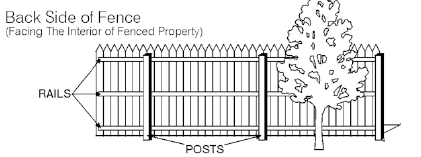
(10)
Orientation. All fencing and walls shall be erected with the finished side facing the adjacent lot. The face of any fence or wall visible to the public shall also be finished.
(11)
Materials.
a.
All walls, including retaining walls, shall have a finished surface such as stucco or brick, similar to the principal building.
b.
Broken glass, steel spikes and other sharp objects intended to restrict access shall not be permitted along the top edge of a fence or wall, except that barbed wire and wrought iron shall be permitted.
c.
Fences or walls topped with barbed wire shall be permitted only in the I-1 zoning district or in conjunction with an industrial or warehouse use in the B-5 zoning district. The barbed wire shall be angled in toward the site. V-shaped barbed wire can be used for public utility buildings.
d.
Wall construction, including, but not limited to, precast walls, in close proximity to existing trees must not result in damage to the root system as determined by the city's landscape architect.
(12)
Entrance gates.
a.
Access shall have an unobstructed width of not less than twenty feet (20') and an unobstructed vertical clearance of thirteen feet, six inches (13'6"). Minimum width may be reduced to meet special access with the approval of the fire official.
b.
Entrance gates for all uses shall not exceed a height of ten feet (10') except when approved by the city, based on drawings which demonstrate that additional height is required to achieve specific design objectives.
(13)
Entrance walls.
a.
Entrance walls shall be permitted as a landscaped feature of any development, including subdivisions, planned office parks, mobile home communities or apartment complexes. Such walls shall not exceed a height of six feet (6').
b.
Entrance walls and landscaping shall be located within a ten-foot (10') wide easement or common area. Maintenance responsibility by the HOA is to be clearly established in the HOA documents.
(14)
Buffer walls required.
a.
In order to promote privacy and reduce noise, glare, and visual impacts when nonresidential uses abut residential uses, a minimum six-foot (6') high wall with decorative columns shall be constructed along the property line of any side or rear yard buffer under the following conditions:
b.
For the purpose of meeting these requirements, the rear yard wall requirement shall be applied to the rear yard of the impacting development and to any other yard that abuts the rear yard of the site being impacted.
c.
Where noted as SPRC, the requirement for a wall may be waived by the SPRC or a wooden fence may be allowed in lieu of a wall where there are large areas of natural vegetation to remain or other distinct topographical features such as waterways, wetlands, stormwater retention areas, bridges, highways or sharp changes in elevation which would make construction of walls difficult and not necessary for the reduction of noise or increased privacy. In all other situations, wall requirements may be waived through the special exception process based on the same findings as noted in this subsection.
d.
The height of a required buffer wall shall be at least six feet (6') in height. The Site Plan Review Committee may allow a maximum wall height of eight feet (8') to promote privacy and reduce noise, glare, and visual impacts of the non-residential use.
(15)
Double frontage walls. Privacy walls shall be constructed in conjunction with subdivision plats along the rear of double frontage lots. Based on anticipated traffic volumes and type of traffic, a combination of plant materials, wrought iron features, and/or brick and masonry walls may be used, subject to approval by the SPRC.
(16)
Maintenance.
a.
All fences and walls shall be maintained in good repair and free of any graffiti.
b.
All fences and walls shall be maintained in their original upright condition.
c.
Missing boards, pickets or posts shall be replaced in a timely manner with material of the same type and quality.
(17)
Clear sight triangle.
a.
A triangular area of clear vision as shown on illustration 1 shall serve as the minimum standard for the clear sight triangle in order to provide a clear view from private access drives (such as from a residence, an apartment complex, shopping center, etc.). The city engineer reserves the right to adjust the legs of a particular sight triangle to ensure the safety of the general public.
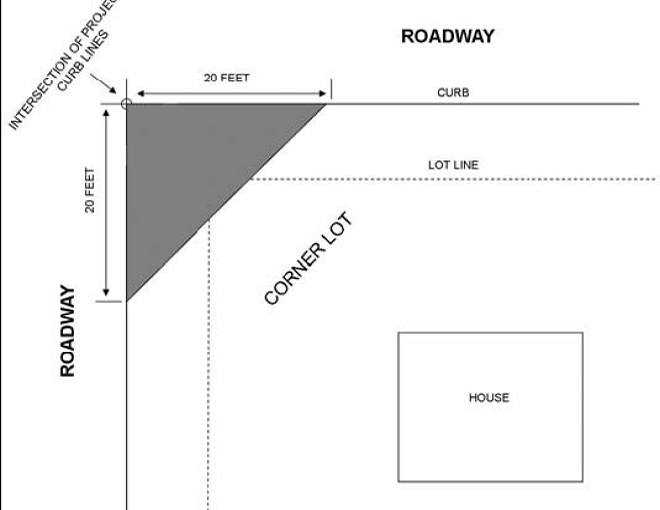
Illustration 1. Clear Sight Triangle
b.
For all other intersecting rights-of-way and connections to public roadways, sight distance requirements shall adhere to FDOT Roadway and Traffic Design Standards, Index No. 546, sight distance at intersections. Deviations from this standard may be made on a case-by-case basis, as approved by the city engineer.
c.
No structures, fencing, berms or shrubs taller than three feet (3') and no trees with branches lower than ten feet (10') above grade shall be permitted in the area and is to remain free and clear of obstructions. This prohibition is also applicable to the location of vehicle parking spaces and signs. Generally, to avoid obstructing the sight triangle, signs and other possible obstructions should be placed a minimum of twenty feet (20') away from the front edge of curb.
(o)
Garages. All single-family residences are required to have a garage or carport structure. No garage may be enclosed for additional living area, unless an additional garage or carport is constructed or presently exists on the subject property.
(1)
Attached garages. The following are the standards for attached garages:
a.
The attached garage may not exceed fifty percent (50%) of the total square footage of the principal structure.
b.
The building setbacks of the attached garage shall conform to the principal building setbacks of the zoning district.
c.
The attached garage is required to have similar architectural features, construction type and color, similar to the principal house structure.
(2)
Detached garages. Detached garages are permitted in residential zoning districts under the following conditions:
a.
The detached garage may not exceed fifty percent (50%) of the total square footage of the principal structure.
b.
The building setbacks of the detached garage shall conform to the principal building setbacks of the zoning district.
c.
Garages that provide an accessory apartment shall be required to meet all the requirements contained in subsection (b) of this section.
d.
Architectural standards. Detached garages shall comply with the following architectural standards:
1.
For properties over one (1) acre the following standards shall apply:
a.
Within the R-1 (Residential Estate) and R-2 (Single-Family Low Density) zoning district:
b.
The detached garage is required to have architectural features, construction type and color similar to the principal house structure.
c.
All other zoning districts:
1.
The detached garage shall have colors similar to the principal house structure.
2.
The detached garage shall have a roof pitch that is consistent with the principal house structure. The pitch of the detached garage roof is not required to be the same slope. Flat roofed principal structures are allowed to have pitched roof slopes on the detached garage.
2.
For properties under one (1) acre where the detached garage is located to the side or rear of the principal house structure the following standards shall apply:
a.
The detached garage shall have colors similar to the principal house structure.
b.
The detached garage shall have a roof pitch that is consistent with the principal house structure. The pitch of the detached garage roof is not required to be the same slope. Flat roofed principal structures are allowed to have pitched roof slopes on the detached garage.
3.
For properties under one (1) acre where the detached garage is located in front of the principal house structure the following standards shall apply:
a.
The detached garage is required to have architectural features, construction type and color similar to the principal house structure.
(p)
Garage sales. Garage sales may be conducted on any residential property subject to the following conditions:
(1)
No such sale may be conducted unless a permit has been obtained from the city.
(2)
A permit shall be issued in the form of a placard which shall be posted on the property where the sale will occur to identify and advertise the garage sale. No other sign shall be authorized or used.
(3)
Prior to issuance of any garage sale permit, the person responsible for conducting such sale shall pay the prescribed application processing fee as set forth in section 8-10 of the Code of Ordinances, and agree to all provisions required by the city as set forth on the garage sale permit. The permit placard shall contain this statement:
"Length of sale may not exceed a maximum of three (3) consecutive days. The property to be sold is not intended for resale. Items offered for sale are not to be displayed earlier than sunrise on the first day of the sale and must be removed by sunset of the final day of the sale. Items shall be placed on the property at least fifteen feet (15') from the road or sidewalk. Permit holder is responsible for attendees parking in a lawful and respectful manner, with no damage to surrounding property. This permit shall be displayed at all times during the operation of the sale. Any deviation from these provisions may constitute a Code violation subject to enforcement."
(4)
No more than three (3) garage sales may be conducted at the same address by the same owner or lessee in any calendar year with the third (3rd) one also requiring a permit, however being at no additional cost. No additional sales may be held thereafter in that calendar year by the same person at the same address.
(5)
A sale that is ordered by any court of competent jurisdiction is not regarded as a garage, yard, tag or any other named residential sale and is not held to the requirements of this Land Development Code.
(q)
Gas tanks.
(1)
Underground liquid propane (LP) gas tanks are permitted in any yard.
(2)
No gas tank shall be permitted in a required landscape buffer.
(3)
Aboveground gas tanks are prohibited in the front and side corner yards. Aboveground gas tanks are required to be set back a minimum of seven and one-half feet (7½') from the rear or side interior yards. Aboveground tanks shall be screened with the use of fences, walls, or landscaping and shown on the site plan or building permit application.
(4)
Gas tanks shall comply with all applicable Florida Building Code regulations.
(r)
Generators. Generators are permitted as follows:
(1)
Permanent generators shall be located to minimize the impacts to surrounding properties.
(2)
In residential zoning districts, generators are prohibited from being located in the front of the single-family house or multifamily structure, or within the side corner yard setback.
(3)
In residential zoning districts, generators may be located within the side interior yards and shall not encroach more than four feet (4') into the side interior setback.
(4)
In residential zoning districts, generators shall have a five foot (5') rear yard setback.
(5)
In nonresidential zoning districts, generators shall not be located in front of the existing or proposed structure or the side corner yard.
(6)
In nonresidential zoning districts, generators are permitted to be located in the rear or side interior setbacks, but no closer than seven and one-half feet (7½') from the rear or side property line.
(7)
In nonresidential zoning districts, generators shall be screened with the use of fences, walls, or landscaping and shown on the site plan or building permit application.
(s)
Greenhouses.
(1)
REA zoning district. Greenhouses can only be allowed as an accessory use to a permitted residential use or as a principal use in the REA district.
a.
Setbacks shall be the same as those for the principal building.
b.
The applicant shall demonstrate that anticipated water usage will not have an adverse impact on the local aquifer.
(2)
All other residential zoning districts. Greenhouses are allowed as follows:
a.
Greenhouses that are less than one hundred fifty (150) square feet and ten feet (10') or less in height are permitted with a rear and side yard setback of seven and one-half feet (7½').
b.
Greenhouses greater than one hundred fifty (150) square feet and/or greater than ten feet (10') or more shall be required to meet the principal building setbacks in which the property is located.
(t)
Home occupations. Home occupations are to be conducted entirely within a dwelling unit, and/or accessory buildings, and/or accessory structure and are subject to the following regulations:
(1)
Permitted home occupations.
a.
Professional and business office activities that do not involve clients, customers, or employees visiting the premises except as otherwise provided by this Land Development Code.
b.
Customary hobby crafts produced at home by residents and shall be sold off-site only. Such hobby crafts may include, but are not limited to needlework, woodworking (excluding furniture) or visual arts.
c.
Instruction such as, but not limited to, nonamplified musical instrument, dance, tennis, art instruction, tutoring, etc.; and swimming instruction (excluding water survival instruction, which shall require a conditional use approval), subject to the following conditions:
1.
Days of operation: Monday through Saturday.
2.
Hours of operation: 9:00 a.m. to 4:00 p.m.
3.
Number of people: No more than three (3) people shall receive swimming instructions at the same time.
d.
Cottage food sales as allowed in F.S. § 500.80.
(2)
Prohibited home occupations. The following shall be prohibited as home occupations: motor vehicle, boat and small engine repair, on-site customer sales and/or delivery of product, upholstering, welding, photography studio, amplified music instruction, and outdoor repair of vehicles or storage of items.
(3)
Restrictions. Home occupations are permitted as an accessory use in all residential zones and subject to the following restrictions:
a.
The home occupation shall be clearly incidental and subordinate to the residential use and shall under no circumstances change the residential character of the dwelling.
b.
Lessons shall be limited to five (5) days a week, a maximum of six (6) hours a day.
c.
There shall be no employment or help other than members of the resident family and one (1) clerical employee.
d.
Multifamily dwelling units shall be limited to professional and business office uses, hobby crafts produced at home by residents and cottage food sales.
e.
There shall be no on-site customer sales and/or delivery of products at the residence.
f.
For instructional home occupational uses the following conditions shall apply:
1.
Lessons shall be limited to five (5) days a week, a maximum of six (6) hours a day.
2.
Any musical instrument lessons must be provided inside the residential structure.
g.
No vehicular traffic shall be generated by the home occupation in greater volumes than would normally be generated by the dwelling unit.
h.
Commercial vehicles may be allowed subject to the restrictions outlined in subsection (g) of this section.
i.
Other than office supplies, there shall be no visible outside storage of tools, machinery, equipment, etc. in size or number beyond that customarily found in a residence.
j.
In any advertisements for the business, the applicant cannot include the residential address of the business.
k.
One (1) nonilluminated on-premises sign, not to exceed one and one-half (1½) square feet in area is allowed provided it is mounted flat against the front wall of the dwelling or accessory structure used for the home occupation. For single-family homes of five (5) acres or greater, one (1) nonilluminated on-premises sign, not to exceed two (2) square feet in area is allowed provided it is mounted flat against the wall of the dwelling or accessory structure used for the home occupation.
k.
No equipment shall be used in the home occupation that creates fire hazards, electrical interference, noise, vibration, glare, fumes or odors detectable to the normal senses off the lot. In the case of electrical interference, no equipment or process shall be used which creates visual or audible interference in any radio or television receivers off the premises, or causes fluctuations in line voltage off the premises, unless authorized by the FCC.
l.
Any violation of these regulations may result in the revocation of any home occupation permit, in addition to any other remedy for such violation provided by this Land Development Code.
m.
A business tax receipt is required.
(4)
Procedural requirements. The applicant shall submit the following information for review prior to issuance of a home occupation approval and business tax receipt:
a.
Letter that describes the proposed home occupation in detail including:
1.
Type of business;
2.
Type of supplies and materials required to be maintained on-site in order to conduct the home occupation;
3.
Number of members of the resident family involved in the home occupation;
4.
Outside clerical staff involved in home occupation;
5.
Days and hours of operation;
6.
Floor area used in dwelling unit and/or accessory buildings and/or structures for the home occupation including active and storage areas.
b.
Dimensional site plan of property that shows location and size of dwelling and all accessory buildings and structures on-site.
c.
Dimensional floor plan that identifies rooms in a dwelling unit and/or accessory buildings and/or structures to be used for the home occupation with floor area or size of each.
d.
If use is a food cottage, describe the types of food being prepared, food storage and preparation area and location for food cottage sales.
e.
Notarized letter of approval for the home occupation from the property owner and/or property manager if the location is tenant occupied.
(5)
Expiration. The home occupation and business tax receipt shall expire on September 30 of each year and shall be subject to the same renewal requirements as specified in chapter 12 of the Code of Ordinances and the Florida Statutes with regard to renewal of the business tax receipt.
(6)
Nontransferability. A home occupation approval shall not be transferred to another person through the sale, lease or rental of the property on which the home occupation is located or in any other manner.
(7)
Revocation of approval. Any violation of these regulations may result in the revocation of any home occupation permit, in addition to any other remedy for such violation provided for by this Land Development Code and the Florida Statutes with regard to renewal of the business tax receipt.
(u)
Manager's residence in commercial and industrial districts.
(1)
One (1) unit may be provided in motels, hotels or timeshares.
(2)
One (1) unit may be allowed in conjunction with industrial use involving extensive high-cost equipment or national security interests. Applicant shall demonstrate the need for such unit.
(3)
Occupant must be an employee or principal of the business.
(v)
Mobile food dispensing vehicles.
(1)
Permit required:
a.
Mobile food dispensing vehicles are permitted within the city limits as part of a special event or mobile food dispensing vehicle host permit under the conditions of this section.
(2)
Permit submittal requirements:
a.
The following information shall be required:
1.
Sketch and picture of the area designated for the mobile food dispensing vehicles. The sketch shall include the separation distance of vehicles if more than one (1) mobile food dispensing vehicle is proposed.
2.
Location of public restrooms.
3.
On private property, provide the area and percentage of parking lot dedicated to the mobile food dispensing vehicles.
4.
On private property, if the applicant is not the property owner, a written and notarized authorization from the property owner shall be provided to allow mobile food dispensing vehicles.
5.
On private property, the property owner shall provide a statement that the property owner is responsible for ensuring the state licensing of the mobile food dispensing vehicles operating on the host property and operational standards in subsection (5) of this section.
(3)
Permit timeframes:
a.
The special event permit timeframe shall be specified in the approved permit.
b.
The mobile food dispensing vehicle host permit shall be valid from October 1 st to September 30 th . A permit fee is required per section 8-10 of the Code of Ordinances.
(4)
Locations allowed:
a.
Mobile food dispensing vehicles are allowed as follows:
1.
On city property as approved in association with a city sponsored event, or as approved by the leisure services department with a special event permit. Permits are contingent on providing proof of liability insurance required for permittees and other conditions of a special event permit.
2.
Houses of worship special events that are designed for over five hundred (500) people with a special event permit.
3.
Within the Interlocal Service Boundary Agreement area (ISBA) with recognized itinerant vending during recognized special events per chapter 2, article VII of this Code.
4.
Within the B-8 (Commercial) and I-1 (Light Industrial) zoning district with a mobile food dispensing vehicle host permit.
5.
Single-family and multi-family developments with residential club houses or community centers with a special event permit. The number of mobile food dispensing vehicle events shall not exceed twelve (12) in a calendar year.
6.
No mobile food dispensing vehicles shall be permitted on vacant land or properties with no principal use. A principal use shall be demonstrated with an active business tax receipt.
(5)
Operational standards for mobile food dispensing vehicles:
a.
Hours of operation: Shall be limited to 8:00 a.m. to 10:00 p.m.
b.
Define sales area: Shall be shown on the special event or mobile food dispensing vehicle host permit and cannot be over thirty percent (30%) of the parking lot area. Temporary dining areas may be provided in association with mobile food dispensing vehicles as shown on the special event or mobile food dispensing vehicle host permit application.
c.
Storage and parking: Mobile food dispensing vehicles shall not be allowed overnight.
d.
Trash disposal: The special event or mobile food dispensing vehicle host permit holder is required to provide trash receptacles and ensure that mobile food dispensing vehicles are kept clean.
e.
The special event or mobile food dispensing vehicle host permit holder shall be responsible for the provision of rest room facilities for public use.
f.
Mobile food dispensing vehicles shall not block vehicular or pedestrian circulation for ingress or egress to the site.
g.
Mobile food dispensing vehicles shall not park or otherwise impact existing landscaped areas.
h.
It is prohibited for mobile food dispensing vehicles to create a nuisance condition to include, but not limited to, displaying flags, creating loud noises, shouting, or outdoor music.
i.
Signage: An A-frame sign in accordance with the maximum size limit and number of signs under the A-frame sign regulations provided under Section 3-46 of the Land Development Code is permitted within fifteen feet (15') of the mobile food dispensing vehicles. No other flags, pennants, balloons or other signage is permitted.
j.
No alcoholic beverages are allowed.
k.
Setback: The minimum required setback for mobile food dispensing vehicles from the public right-of-way shall be at least twenty feet (20'). Within the Greenbelt and Gateway Preservation Districts of section 2-73 of this Land Development Code, the setback shall be at least thirty-six feet (36').
(w)
Outdoor activities. Nonresidential uses in commercial and industrial zoning districts are prohibited from having outdoor events, including exhibitions, concerts, festivals, product display or sales, except as permitted under the following regulations:
(1)
The permanent display and/or sale of merchandise outside of the exterior walls of any business premises shall be prohibited in all zoning districts except where expressly permitted through the issuance of a special exception, planned development, or a special event permit complying with this subsection.
(2)
Retail special event permits. Temporary outdoor display of merchandise by retailers may be permitted up to fourteen (14) consecutive days, no more than four (4) times per calendar year, provided:
a.
An application is submitted to the planning department a minimum of five (5) business days prior to the planned outdoor display of merchandise. Applications that propose to use parking areas for product display must be submitted twenty-one (21) days prior to the event.
b.
The display is limited to the goods sold by the sponsoring business. The sale of items not sold by the sponsoring business shall be prohibited. The planning director shall consult with the chief building official in determining the goods sold by the sponsoring business, as well as approved site plans, building permits and business tax receipt.
c.
The display area shall be located on the same lot or parcel as the principal commercial use. The use of vacant parcels for temporary merchandise sales or outdoor activity is prohibited, except for those parcels specifically permitted under subsection (3) of this section.
d.
The display area shall not be located so as to diminish the utility of any required parking space unless approved through the special event permit.
e.
The flow of traffic on designated on-site traffic lanes on or off the lot or parcel shall not be obstructed in a manner that would create an unsafe condition.
f.
Adequate area for safe pedestrian movement shall be maintained.
g.
Submittal information shall be provided as required in subsection (7) of this section.
h.
The area encompassed by a temporary sales shelter shall not exceed three thousand (3,000) square feet as measured from the perimeter of the temporary structure.
i.
A temporary sign may be approved by the planning director or his designee, in association with outdoor activities. All temporary signage shall conform to the requirements of section 3-46.
j.
Prohibited activities related to retail special event permits:
1.
The following uses are prohibited from outdoor merchandise sales or activities:
a.
Service stations and convenience stores types A, B and C.
b.
Office uses.
c.
Industrial uses.
d.
Restaurants types A, B, C and D, outdoor seating is permitted.
2.
The sale of food or beverages, other than as promotional items, is prohibited.
3.
The temporary sales of cars, trucks or vans on property not approved for an automobile sales facility is prohibited.
k.
A permit fee, as established in section 8-10 of the Code of Ordinances, shall be required for each outdoor sales event.
(3)
Seasonal or holiday items. Outdoor merchandise sale by any retail establishment or house of worship of seasonal or holiday items, such as Christmas trees, Halloween pumpkins or sparklers, as defined in F.S. § 791.01(8) shall be permitted thirty (30) days prior to the holiday, as long as the outdoor display is concluded after the respective holiday. Seasonal items do not include garden supplies and equipment, landscape materials, bicycles, children's pools, lawn furniture, sporting goods and other merchandise associated with outdoor activities. A special event permit shall be required and submitted to the planning department with the information required in subsection (7) of this section. A permit fee, as established in section 8-10 of the Code of Ordinances, shall be required.
(4)
Non-profit outdoor activities. Carwashes, motorcycle washes, bake sales, cookie sales, charitable solicitation, running or walking events, outdoor church events and other such sales and fundraising events conducted by a nonprofit organization (schools, churches, girl/boy scouts, etc.) shall be allowed with a special event permit and shall submit an application to the planning department with the information required in subsection (7) of this section. A permit fee shall not be required if the organization provides proof of its nonprofit status.
a.
Motorcycle/car wash events, and associated activities, of a temporary or itinerant nature may be allowed for non-profit organizations subject to the following conditions:
1.
Compliance with the application requirements provided in subsection (7) of this section.
2.
The event shall be limited to no more than six (6) continuous hours between 8:00 a.m. and 5:00 p.m. in any single day.
3.
The event must at all times be contained within the legal boundaries of the real property described in the permit. All activities shall be prohibited within public rights-of-way, easements and other public property.
4.
All event participants must fully comply with all permit conditions and with all applicable rules, regulations and laws. Any violation during an event may result in the revocation of the permit. Violations by a permit holder or an event participant may be cause for the denial of future event permits by the violator and/or at the subject real property.
5.
No more than twelve (12) event permits shall be issued in a calendar year for the subject real property.
6.
Motorcycle/car wash events of a temporary or itinerant nature are prohibited within the North U.S. Highway 1 Municipal Service Area and Joint Planning Area, as more particularly described in article VII, of chapter 2 of this Code.
7.
Motorcycle/car wash events of a temporary or itinerant nature are prohibited throughout the city during recognized special events, which are defined as: Daytona Beach Bike Week Festival, as established by the Bike Week Executive Committee; Daytona Beach Biketoberfest Special Event, as established by the Biketoberfest Development Committee of the Daytona Beach Area Convention and Visitors Bureau; Daytona Speed Weeks, encompassing that time period commencing with the Rolex 24-Hour Race and ending with the Daytona 500 Race, as established by the Daytona International Speedway; Jeep Week; organized Truck events; and other specially licensed outdoor entertainment activity involving more than one (1) property owner or that includes five hundred (500) or more participants.
(5)
Corporate outdoor events. Businesses and corporations may host an outdoor event no more than four (4) times a calendar year that is not open to the general public. A special event permit shall be required and submitted to the planning department with the information required in subsection (7) of this section. A permit fee, as established in section 8-10 of the Code of Ordinances, shall be required.
(6)
Mobile food dispensing vehicle (food trucks). Shall be allowed in accordance with subsection (v) of Section 2-50 of the Land Development Code.
(7)
Required submittal information for outdoor activities. Outdoor special events shall provide the minimum information listed below. The planning director may amend the submittal requirements for small scale retail activities, such as a sidewalk sale. For large scale special event permits, additional information may be required.
a.
Applications must be submitted twenty-one (21) days prior to the event.
b.
Proof of non-profit status if applying for a non-profit special event.
c.
Days of the events.
d.
Hours of operation.
e.
Expected number of participants.
f.
Types of temporary structures.
g.
Number of portable toilets provided.
h.
Security plan. Emergency services personnel such as fire safety and police officers may be required at the expense of the applicant to help ensure public safety as determined by the Fire Chief and Police Chief. The applicant shall be responsible for the cost of providing any life safety requirements.
i.
Pedestrian and vehicle movement plan. Demonstrate that the proposed events do not impede pedestrian or vehicular traffic. Events located in public rights-of-way, such as walking and running events, shall provide applicable Volusia County and Florida Department of Transportation permits or a determination that no permit is required.
j.
A scaled sketch detailing the location of the special event planned activities and parking areas.
k.
Location of any temporary structures. Any temporary structure shall not be erected more than two (2) days before the event is to occur, at which time a fire safety inspection shall be performed. The structure shall be removed within two (2) days following the event.
l.
Demonstrate that there are no public safety hazards.
m.
Location of any mobile food dispensing vehicle (food trucks). Note any mobile food dispensing vehicle must be in compliance with the regulations in subsection (v) of section 2-50 of the Land Development Code.
(x)
Outdoor storage, parking or use of personal property in a residential district.
(1)
The outdoor storage, parking or use of any item of personal property not listed in subsection (x)(2) of this section is prohibited in all residential zoning districts. Items of personal property listed in subsection (x)(2) of this section shall be permitted to be stored, parked or used in the manner prescribed.
(2)
The use of personal property items that are customarily associated with and incidental to residential premises, such as swings, slides and lawn chairs, lawn ornaments, picnic tables, grills and the like.
a.
The necessary outdoor storage of personal property during the construction or repair of permanent improvements on the premises.
b.
All vehicles shall be in operable condition at all times and, where applicable, shall evidence such condition by displaying the vehicle's license plate with current year registration validation sticker.
c.
The display of one (1) vehicle for sale on a single-family lot, subject to the following conditions:
1.
The vehicle shall be registered to the owner of the lot or to a resident of the dwelling located on that lot.
2.
No more than one (1) vehicle shall be displayed per day.
3.
No vehicle shall be displayed for more than thirty (30) consecutive days.
4.
No vehicle or combination of vehicles shall be displayed for more than sixty (60) days in a calendar year.
(3)
The use of personal on-site storage structures shall be limited to situations where a person or business is moving to a new location. The personal storage unit shall not be placed on the site for a period over thirty (30) days.
(4)
There shall be no parking of vehicles, licensed or unlicensed, in the front yard of any residential property or in the side yard of a corner lot property except as:
a.
On driveways constructed in accordance with an approved driveway permit and that meet the requirements of this Land Development Code.
b.
Vehicles that are parked for a period of seventy-two (72) hours or less for occasional social gatherings (including, but not limited to: weddings, family reunions, holidays, parties, etc.) that do not occur more than four (4) times a calendar year.
c.
On driveways that are widened up to a maximum of four hundred (400) square feet in area, provided the driveway widening is contiguous to the existing driveway extends from the existing driveway toward the side lot line away from the front of the house, is improved as defined in subsection (x)(4)d of this section, does not extend into the right-of-way, and complies with all other driveway and setback requirements of this Land Development Code.
d.
A widened parking is improved if it is constructed with one (1) of the following approved materials: asphalt, bituminous brick, concrete, turf block, brick pavers or pervious concrete. Stone gravel or mulch is allowed for a period not to exceed twelve (12) months, and may be granted for one (1) additional period of twelve (12) months.
e.
An improved parking area must be maintained in substantially the same condition to that which has been authorized by the planning director.
f.
The diagrams at the end of this subsection illustrate the correct placement of parking in the front and side yard areas.
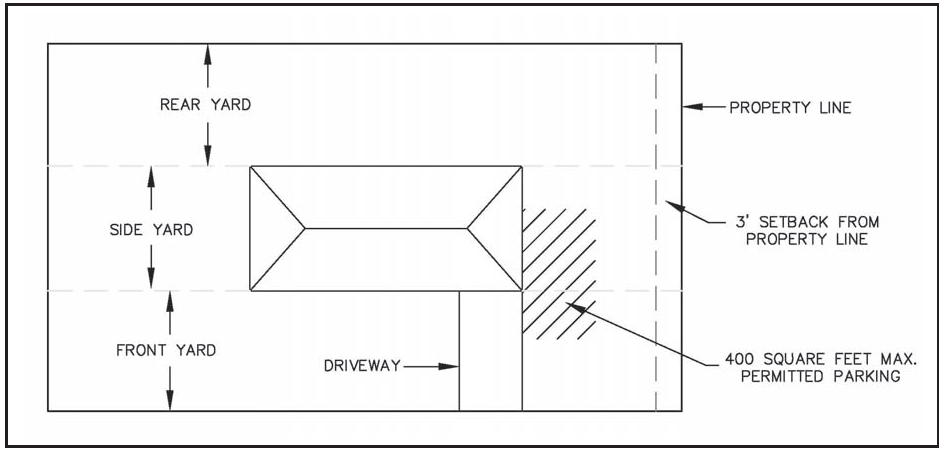
Interior Residential Lot
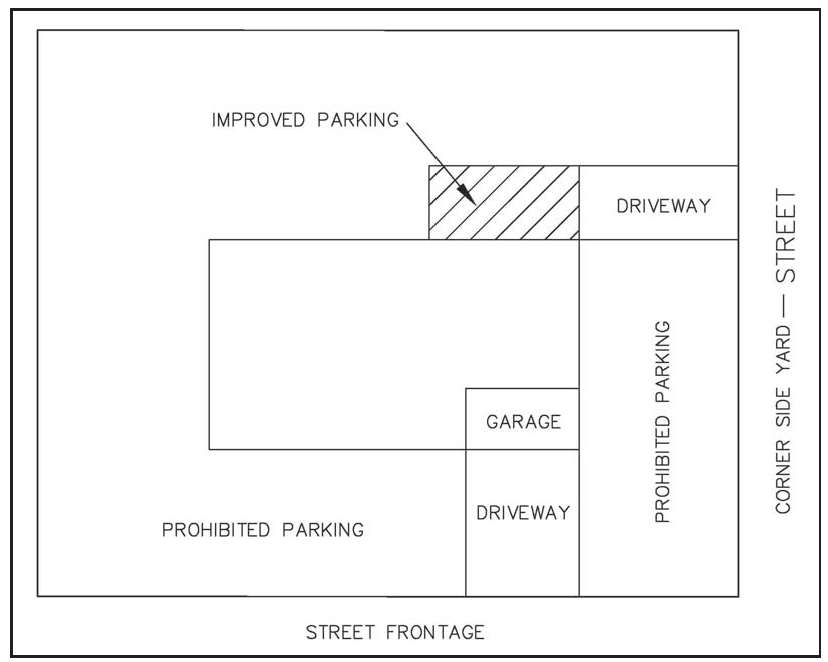
Corner Lot
(y)
Patios/decks.
(1)
No patio, deck or sidewalk shall be closer than five (5) feet to side interior or rear property line.
(2)
Patios/decks are prohibited within the principal front yard or side corner setback of the principal structure.
(z)
Pools. In addition to the requirements of this article, swimming pools, whether public or private, shall comply with chapter 3, articles I and II of this Land Development Code, the state building code, all applicable regulations of the state department of health and other state agencies, and to the following:
(1)
Setbacks. No pool or screen enclosure shall be permitted to encroach into any platted easement.
a.
Front yard. Swimming pools or appurtenances thereto shall be prohibited in any required principal front yard building setback.
b.
Side corner yard. Swimming pools or appurtenances thereto shall be prohibited in any required side yard building setback.
c.
Rear yard.
1.
No screen enclosure. The edge of water for swimming pools with no screen enclosure shall not be closer than seven and one-half feet (7½') from the rear property line. The edge of deck for swimming pools with no screen enclosure shall not be closer than five feet (5') from rear property line.
2.
Screen enclosure. Screen enclosures for pools shall not be closer than five feet (5') from the rear property line.
d.
Interior side yard.
1.
The edge of water for swimming pools with no screen enclosure shall not be closer than seven and one-half feet (7½') from the required interior side yard property line. The edge of deck for swimming pools with no screen enclosure shall not be closer than five feet (5') from the required interior side yard property line.
2.
Screen pool enclosures shall be located no closer than five feet (5') from the required interior side yard property line.
(2)
Location in relationship to the principal structure. No swimming pool shall be constructed closer than five feet (5') from any building; provided, however, that this subsection shall not apply to swimming pools which are an integral part of new construction and provided that the plans therefore have been certified as structurally sound by a registered architect or engineer.
(3)
Waterfront lots. On waterfront lots (excluding oceanfront), pools and screen enclosures shall be set back ten feet (10') from the rear lot line except that where the rear yard requirement is greater than thirty feet (30), one (1) additional foot of setback for each two (2) feet of required rear yard in excess of thirty feet (30') is required. There shall be a minimum of fifteen feet (15') from edge of deck to normal water line.
(4)
Oceanfront lots. Patios, sun decks or pools shall be allowed with the following requirements:
a.
The edge of water for swimming pools shall not be closer than ten feet (10') from the seawall.
b.
Pools shall be prohibited in the front yard or side corner setback.
c.
Patios and sun decks shall not be closer than ten feet (10') to either side of the property line.
d.
Other than railings of open design, no enclosure or covering shall be allowed.
e.
Any structure proposed seaward of the coastal construction control line shall comply with F.S. ch. 161, and the permitting requirements of the state department of environmental protection.
f.
All such development shall be consistent with chapter 3, article II of this Land Development Code.
(5)
Existing nonconforming screen enclosures. Existing nonconforming screen enclosures shall be allowed to be removed and reconstructed in the same footprint as existed provided that the nonconforming screen enclosure footprint is not enlarged.
(aa)
Ranger's residence. A ranger's residence can only be allowed as an accessory use if the applicant demonstrates compliance with the following provisions:
(1)
One (1) dwelling unit necessary for security for a public or institutional use including, but not restricted to public recreation areas, schools, houses of worship and hospitals may be permitted in conjunction with such principal use in any district.
(2)
The color, materials, landscaping and siting of the residence shall be compatible with the principal use and structures.
(3)
A mobile home may be used for this purpose, provided that it is an accessory use to a principal use located on a minimum parcel size of five (5) acres and is screened from view of the street by the principal building or through the use of fences, hedges, trees or a combination of such items.
(bb)
Recreational vehicle/boat storage.
(1)
In general.
a.
For the purpose of this section, the term "recreational vehicle" includes motor homes, utility trailers, boats, boat trailers, overnight travel trailers and similar vehicles or pieces of equipment.
b.
Recreation vehicles may be stored on single-family and duplex lots provided such storage is in conformance with the standards of this section, or in areas identified for such purposes on an approved site plan.
c.
No recreational vehicle or equipment shall be used for living, sleeping, or housekeeping purposes when parked or stored on a residential lot or in any location not approved for such use.
d.
Long-term storage is limited to those recreational vehicles owned by the occupant of the dwelling unit.
e.
Any recreational vehicle shall be stored as close to the dwelling as possible, subject to the provisions of this section.
(2)
Temporary storage.
a.
Resident owned vehicles may be temporarily parked on the driveway of any residence for the purpose of repair, maintenance, or being prepared for use. However, such temporary parking shall not occur more than seventy-two (72) hours during any continuous thirty-day (30) period.
b.
For temporary periods, not to exceed seven (7) days, recreational vehicles owned by guests of the residents of single-family or duplex homes may be parked in driveways as far from the street right-of-way as practicable, but shall in no event be used for overnight lodging.
(3)
Long-term storage. Any recreational vehicle not used daily by residents of the household for transportation shall be parked or stored within a side or rear yard, provided:
a.
No portion of the vehicle or equipment shall extend into any part of the front yard.
b.
No vehicle or equipment shall exceed ten feet (10') in height, plus one foot (1') for roof-mounted air conditioning units and other accessory appurtenances, such as, including without limitation roof racks, satellite dishes or antennas.
c.
No vehicle or equipment shall be parked or stored in a manner which obstructs access to any door, window or other entrance to or exit from the dwelling.
d.
No vehicle or equipment shall be parked or stored in any part of the required rear yard of a double frontage lot unless properly screened in accordance with subsection (bb)(4) of this section.
e.
On corner lots, no vehicles or equipment shall be parked or stored in any part of the required side yard abutting any street unless properly screened in accordance with subsection (z)(4) of this section and provided that no vehicle or equipment shall be parked or stored within twenty feet (20') from any street right-of-way.
f.
Long-term storage shall be limited to those recreational vehicles that are owned by the occupant of the dwelling unit, and no more than one (1) motorized axle recreational vehicle may be parked on the property at any time. Further, parking or storage inside a completely enclosed garage or building is permitted.
(4)
Screening required.
a.
Vehicles and equipment shall be screened on all sides that have a view to surrounding property owners, including the view to the street, except screening shall not be required in the REA district when the vehicle or equipment is located to meet the minimum setback requirements for a principal building in that district. Unless screened one hundred percent (100%), all recreational vehicles must meet the side and rear yard setback requirements applicable to the primary structure. However, all recreational vehicles that are parked in the side and rear yard setback areas of the primary structure as of November 17, 1998, shall be deemed nonconforming uses in accordance with article V of this chapter and shall be grandfathered from compliance with this setback provision. Further, the grandfathering provision shall only apply to the person who owns legal title to the real property as of November 17, 1998.
b.
Screening may consist of fences, walls, gates, doors, hedges, trees, or a combination of such items. Canvas, tarpaulin or other similar materials may not be used for this purpose. The use of natural landscaping for buffering and screening is encouraged.
c.
Plant materials shall be selected, located and maintained to provide a visual barrier that is no less than fifty percent (50%) opaque.
d.
Screening must be at least the same height as the vehicle or equipment, provided that if fences, walls, gates or doors are used for screening, they must be of a permanent nature and shall not exceed six feet (6') in height. Further, no variance from the six-foot (6') height requirement shall ever be allowed or permitted.
e.
Screening not in compliance with provisions of this section shall be provided, within thirty (30) days, a notice of noncompliance issued by the neighborhood improvement division. Screening with plant materials shall have one hundred eighty (180) days from the date of notice to effect compliance.
(cc)
Screen porches/enclosures.
(1)
Location, all residential districts. No screen enclosure shall be permitted to encroach into any platted easement. Screen enclosures (e.g., entirely enclosed with screening) shall be located as follows:
a.
Front yard. Screen enclosures shall be prohibited in any required principal front yard building setback.
b.
Side corner yard. Screen enclosures shall be prohibited in any required principal side corner building setback.
c.
Rear yard. Screen enclosures shall not be closer than five feet (5') from the rear property line.
d.
Side yard. Screen enclosures shall be located no closer than five feet (5') from the required interior side yard property line.
(2)
Townhouse/multifamily. For residential developments other than detached single-family subdivisions, the location of screen porches (e.g., screened on the sides but having an impervious roof) shall be identified on the plat or site plan.
(3)
Existing developments. Where screen porches are not indicated on an approved site or development plan for uses requiring such approvals, application for screen porches shall be as follows:
a.
The homeowners' association shall submit a request to amend the development order. Such request shall include a drawing clearly illustrating the location of all possible screen porches and stating the types of construction materials that may be used, and any necessary amendments to the declaration of covenants and restrictions.
b.
The city commission may reduce the setback requirement for screen porches, provided:
1.
The distance the screen porch would infringe on the setback would be the minimum necessary;
2.
The addition of the screen porch will not have a detrimental effect on surrounding properties; and
3.
The twenty-foot (20') minimum distance between buildings is maintained.
c.
The city commission may require additional landscaping and/or fencing if necessary to negate the impact of the screen porch.
d.
In addition to the drawing required by subsection (aa)(3)a of this section, the homeowners' association shall submit a legal opinion from its attorney that the request was duly approved and executed by the association and that the request is not in conflict with any deed restrictions or covenants applicable to the development.
e.
Following approval of the amended development order by the city commission, an individual unit owner may request a building permit from the chief building official, provided that such request is consistent with the conditions of the amended development order.
(4)
Existing nonconforming screen enclosures. Existing nonconforming screen enclosures shall be allowed to be removed and reconstructed in the same footprint as existed, provided that the nonconforming screen enclosure footprint is not enlarged.
(dd)
Sheds, utility structures, playhouses and gazebos. Each of the aforementioned accessory structures shall comply with the use limitations applicable in the zoning district for which it is located and are permitted under the following conditions:
(1)
An approved building permit shall be issued prior to the erection of any accessory structure.
(2)
The rear and side yard setbacks for a utility structure, shed, playhouse and gazebo shall be seven and one-half feet (7½').
(3)
Area requirements.
a.
For purposes of this section any utility structure/shed over one hundred fifty (150) square feet shall be considered a garage and must meet the principal building setbacks for the zoning district in which the property is located.
b.
Any gazebo over one hundred fifty (150) square feet shall be required to meet the principal building setbacks for the zoning district in which the property is located.
(4)
Number.
(5)
Height.
a.
The utility structure/shed or gazebo shall not exceed ten feet (10') in height.
b.
Playhouses shall not exceed eighteen feet (18') in height.
(6)
Sheds, utility structures, playhouses, and gazebos are permitted to have hard roofs.
(ee)
Solar energy systems.
(1)
Solar energy systems are permitted in any zoning district.
(2)
All systems shall be roof mounted with orientation to the south or within forty-five degrees (45;deg;) east or west of due south.
(3)
All systems shall be finished in a rust resistant, nonobtrusive finish and color that is nonreflective. The colors used in the construction materials or finished surface shall be muted and visually compatible with the surroundings.
(4)
All electrical connections or distribution lines shall be underground and comply with all applicable codes and public utility requirements. No system shall be installed until evidence is submitted to the city that the utility company has approved the interconnection pursuant to IEEE-929, UL-1741, and the current edition of the Florida Electrical Code. Off-grid systems shall be exempt from this requirement.
(5)
All systems shall be compliant with the current editions of OSHA, the state building code, the Florida Electrical Code, the National Electrical Safety Code and any other applicable codes required by the building official, as well as manufacturer specifications.
(ff)
Tailwater recovery system. Excavated material from a tailwater recovery system or farm pond may be transferred from one (1) parcel of land to a noncontiguous parcel when such system or pond is designed to meet the standards and specifications of the United States Department of Agriculture Soil Conservation Service, or is designed by a professional engineer licensed to practice in the state. In order to qualify for said exemption, the design for such system or pond shall be approved by the USDA Soil Conservation Service and submitted for approval by the site plan review committee.
(gg)
Tennis courts. Tennis courts are permitted as an accessory use as follows:
(1)
They are prohibited in the front yard or side corner yard setback of the zoning district.
(2)
Are required to be set back ten feet (10') from the side and rear yard.
(3)
If lighting is proposed, a lighting plan is required to ensure that the adjoining properties are not negatively impacted.
(4)
Fencing surrounding the tennis court is permitted to a maximum height of ten feet (10').
(5)
Multifamily and subdivision complexes shall require the review of the site plan review committee.
(hh)
Temporary sales office. Trailers or similar structures, used as temporary predevelopment sales offices, may be permitted on the proposed development site provided the following minimum requirements are met.
(1)
The proposed development must receive final approval by the SPRC and the city commission.
(2)
Following city commission approval, the applicant shall submit a $500.00 permit fee to the building division prior to locating the trailer on the site, or making other associated improvements. If the trailer is removed within the time period specified, $400.00 shall be returned to the applicant, or, if construction commences within the time period specified within the ordinance from which this Land Development Code is derived, $400.00 shall be credited toward the building permit. If the temporary trailer is not removed within the time period specified, the fee shall be forfeited.
(3)
A minimum of five (5) off-street parking places shall be provided. Such spaces shall be designed to meet the dimensional and circulation requirements of chapter 3, article III of this Land Development Code, except as specifically waived by the SPRC, but can be surfaced with gravel or other similar material. Each space provided must be marked with a wheelstop.
(4)
The perimeter of the trailer shall be landscaped with plant materials at least three feet (3') in height. The perimeter landscaping shall be at least three feet (3') in width. The area between the trailer and the parking area shall be mulched or sodded to provide safe access for pedestrians.
(5)
The SPRC and the city commission shall review and approve a site plan that includes the required landscaping and parking to serve the temporary trailer.
(6)
The trailer shall be permitted on the development site for a period not to exceed six (6) months from the date of city commission approval. The applicant may request one (1) six (6) month extension from the city commission. If construction commences and is continuous within the permitted time period specified in the development order, the trailer may remain on the site as a sales office for a period of up to one (1) year from commencement of construction, or until seventy-five percent (75%) of the individual lots or dwellings are sold, or seventy-five percent (75%) of the units are constructed, whichever shall first occur.
(7)
If a violation of this Land Development Code is found, the violator may be brought before the special magistrate.
(8)
The applicant shall provide bonding in an amount to be established by the city engineer for removal of the trailer and site restoration in the event the trailer is not removed in accordance with time period for removal, as specified in the development order.
(9)
The trailer shall be so located as to not interfere with the construction activity or use of the site.
(ii)
Temporary structure.
(1)
The proposed development must receive final review by the SPRC and approval of the city commission.
(2)
A temporary structure may be allowed only in association with the issuance of a building permit.
(3)
The applicant shall provide bonding in an amount to be established by the city engineer for removal of the temporary structure and site restoration in the event the structure is not removed in accordance with appropriate time period for removal, as specified in the development order.
(4)
The city commission shall establish time limits for removal in the development order.
(5)
All development review, building permit, and impact and connection fees shall be paid on the same basis as for permanent structures. Impact fees may be credited to the permanent structure.
(Ord. No. 2012-05, §§ 1—7, 2-7-2012; Ord. No. 2012-19, §§ 1—5, 5-17-2012; Ord. No. 2012-24, §§ 1, 2, 7-3-2012; Ord. No. 2015-12, §§ 1, 2, 4-7-2015; Ord. No. 2018-02, § 1, 1-16-2018; Ord. No. 2018-03, § 1, 1-16-2018; Ord. No. 2018-04, § 1, 1-16-2018; Ord. No. 2018-11, § 3, 5-15-2018; Ord. No. 2018-16, § 1, 6-5-2018; Ord. No. 2020-30, § 1, 7-28-2020; Ord. No. 2020-31, § 1, 7-28-2020; Ord. No. 2021-20, § 2, 8-4-2021; Ord. No. 2021-32, § 1, 9-22-2021; Ord. No. 2021-35, § 1, 10-5-2021; Ord. No. 2022-39, §§ 1, 2, 1-10-2023; Ord. No. 2023-17, § 1, 3-21-2023; Ord. No. 2024-31, § 1, 11-6-2024)
Sec. 2-51. - Public safety.
(a)
In general. This article establishes a process and standards for development to ensure that the public health, safety and welfare are protected. The focus of this article is on the airport, fire safety, flood hazard areas, hazardous materials and substances, and the hurricane vulnerability zone.
(b)
Airport hazard zone.
(1)
Purpose and intent. The purpose of this section is to prevent the creation or establishment of structures, lighting facilities, antennas, or other elements dangerous to air navigation.
(2)
Scope. The regulations imposed by this section shall be enforced within the area on the map entitled Ormond Beach Airport Hazard Zone, which is shown on the city's zoning map.
(3)
Airspace height zones standards.
a.
No structure shall be permitted that exceeds the current Federal Aviation Regulations and Obstruction Standards concerning objects lying beneath approach, transitional, horizontal, primary and conical surface zones, as depicted on the zoning map.
b.
There shall be a prohibition against the placing of any obstruction which lies within two thousand feet (2,000') in any direction from the Federal Aviation Administration (FAA) VOR facility presently situated on the city's airport property. For the purpose of this prohibition, an obstruction is defined to be any structure over six feet (6') in height or any metal fence or other metal object or structure which would adversely affect the operations of the said FAA VOR facility.
c.
No structure shall be erected that raises the published minimum descent or decision height for an instrument approach to any runway, nor shall any structure be erected that causes the minimum obstruction clearance altitude or minimum en route altitude to be increased on any federal airway.
(4)
Lighting. Notwithstanding the preceding provisions of this section, the owner of any structure over two hundred feet (200') above ground level shall install lighting in accordance with FAA advisory circular 70-7460-1D and amendments thereto on such structure. Additionally, high intensity white obstruction lights shall be installed on a high structure which exceeds 700 feet above ground level. The high intensity white obstruction lights must be in accordance with FAA advisory circular 70-7460-1D.
(5)
Hazard marking and lighting. Any permit or variance granted shall require the owner to mark and light the structure in accordance with FAA advisory circular 70-7460-1D. The permit may be conditioned to permit the city at its own expense to install, operate and maintain markers and lights as may be necessary to indicate to pilots the presence of an airspace hazard if special conditions so warrant.
(6)
Airport variance. No application for variances to the requirements of this section may be considered by the Board of Adjustment and Appeals unless a copy of the application has been furnished by certified mail, return receipt requested, to the state department of transportation, bureau of aviation, and by regular mail or hand delivery to the city planning board for review and comment. If no comments are received within sixty (60) days after the postmarked date, the board may act without comment from the bureau of aviation and/or the airport advisory board.
(c)
Fire safety standards. All development shall comply with the applicable provisions of the city's fire safety standards as set forth in chapter 9 of the Code of Ordinances, which provisions are incorporated herein by reference. Such provisions may be subsequently amended in accordance with the procedures set forth in section F.S. § 166.041(3)(a).
(d)
Hazardous substances and materials.
(1)
Purpose and intent. It is the purpose and intent of this section to protect and safeguard the public health, safety and welfare of the residents and visitors by providing criteria for regulating and prohibiting the use, handling, production, disposal and storage of regulated hazardous materials and wastes as defined in subsection (d)(2) of this section and hereafter referred to as regulated substances.
(2)
Reserved.
(3)
Applicability.
a.
The use, handling, production, disposal, or storage of hazardous or harmful substances and materials directly associated with nonresidential activities is prohibited unless approved by the city engineer and fire chief in conjunction with a site plan, building permit, or business tax receipt review.
b.
All existing nonresidential activities which handle, produce, store or dispose of hazardous or harmful materials and substances shall be required to apply for an operating permit to be issued by the building division following review and approval of the city engineer and fire chief at the time a business tax receipt is reviewed.
(4)
Permit procedure. The operating permit and/or building permit application shall include the following:
a.
A list of regulated hazardous or harmful materials or substances in use at the site.
b.
A site plan of the facility including all storage, piping, dispensing, and shipping facilities.
c.
Identification of operations involving regulated hazardous or harmful materials or substances.
d.
An operating plan that outlines the procedure for storing, producing, handling or disposing the regulated hazardous or harmful materials or substances and a contingency plan for spills or other accidents.
e.
Any other pertinent information that may be required by the city engineer or fire chief.
(5)
General standards.
a.
New business or industrial development parks shall establish localized storage/transfer facilities for hazardous wastes generated by individual businesses or groups of uses within a development. Each business or development shall provide to the businesses information which:
1.
Identifies the types of hazardous wastes and materials that are to be stored and disposed of in accordance with applicable federal, state and local regulations;
2.
Indicates the location of the hazardous waste storage area, the conditions and procedures for storing waste material, and pickup dates; and
3.
Identifies various waste exchange and management/disposal options which may lead to a reduction in the volume of material requiring disposal.
b.
Business or industrial development storage/transfer facilities shall, at a minimum, conform to FDEP transporter permitting requirements.
c.
Each business or industrial development shall secure, prior to leasing or selling any lots or parcels, arrangements with an FDEP permitted hazardous waste management company to pick up and transfer waste on a regularly scheduled basis.
d.
All regulated material users and waste generators shall properly store and dispose of hazardous materials and waste in accordance with the plan under subsection (d)(3) of this section and section 4-06(6) of this Land Development Code, if applicable. The following criteria shall apply in the implementation of this policy:
1.
Large quantity generators (companies that generate in excess of two thousand pounds (2,000 lbs.) per month) and industrial/commercial parks containing generators that produce waste not suitable for recycling, exchange or reuse shall be encouraged to reduce hazardous waste volumes and to obtain necessary permits to develop on-site treatment facilities to render the waste nonhazardous.
2.
Existing federal, state and local regulations relating to storage, production, handling, transfer, treatment and/or disposal shall be stringently enforced through coordinated efforts at both state and local levels.
3.
On-site verification of compliance with applicable rules and regulations shall be made, at a minimum, once a year by the city engineering division, fire department and utilities division, as appropriate. If violators are detected, the appropriate state or federal agency will be notified.
e.
Those types and quantities of industrial wastes that are harmful or damaging to the structures, processes, or operation of city-operated sewage works are prohibited. No person shall make or maintain any connection with any public or private sewer, or appurtenance thereof, whereby there may be conveyed into the same suffocating, corrosive, inflammable or explosive liquid, gas, vapor, substance or material.
f.
The industrial user of the sewer system shall provide such preliminary treatment or handling of its waste as may be necessary to modify any objectionable characteristics or constraints.
(6)
Containment standards for storage systems. The following containment standards shall apply for any one (1) of a combination of tanks, sumps, wet floors, waste treatment facilities, pipes, vaults or other portable or fixed containers used, or designed to be used, for the storage of hazardous substances at a facility:
a.
General containment requirements. Primary and secondary level of containment shall be required for all storage systems intended for the storage of hazardous substances, except as otherwise excluded.
b.
Primary containment. All primary containment shall be product-tight.
c.
Secondary containment.
1.
All secondary containment shall be constructed of materials of sufficient thickness, density and composition so as not to be structurally weakened as a result of contact with the discharged hazardous substances. Leakproof trays under containers, floor curbing or other containment systems to provide secondary liquid containment shall be installed. The secondary containment shall be of adequate size to handle one hundred ten percent (110%) of the total volume of all of the containers in order to contain all spills, leaks, overflows and precipitation until appropriate action can be taken. The specific design and selection of materials shall be sufficient to preclude any hazardous substances loss to the external environment such as may occur through evaporation. Secondary containment systems shall be sheltered so that the intrusion of precipitation is prohibited. These requirements shall apply to all areas of use, production and handling, to all storage areas, and to aboveground and underground storage areas.
2.
Vacuum suction devices, absorbent scavenger materials or other devices designated and approved by the city shall be present on-site or available seven (7) days a week, twenty-four (24) hours a day and within a time approved by the city normally not to exceed four (4) hours. Devices or materials shall be available in sufficient supply so as to control and collect the total quantity of hazardous substances. Emergency containers shall be present and of such capacity as to hold the total quantity of hazardous substances plus absorbent material.
3.
The secondary containment shall be impervious and shall have monitoring wells or detector located therein.
4.
Procedures shall be established and incorporated within the operating plan for periodic in-house inspection and maintenance of containment and emergency equipment. Such procedures shall be provided to the city in writing. A checklist and schedule of regular maintenance shall be established and a log shall be kept of inspections and maintenance. As long as the storage system is in operation, such logs and records shall be kept available for inspection by the city during regular business hours.
d.
Maintenance, repair or replacement.
1.
Any modification or repair of a storage system, other than minor repairs or emergency repairs, shall be in accordance with plans to be submitted to the city and approved prior to the initiation of such work.
2.
A facility owner or operator may make emergency repairs to a storage system in advance of seeking an approval whenever an immediate repair is required to prevent or contain an unauthorized discharge or to protect the integrity of the containment.
3.
Replacement of any existing storage system for hazardous substances must be in accordance with the new installation standards.
e.
Out-of-service storage systems.
1.
Storage systems which are temporarily out of service, and are intended to be returned to use, shall continue to be monitored and inspected.
2.
Any storage system which is not being monitored and inspected in accordance with this section shall be closed or removed consistent with subsection (d)(7) of this section.
3.
Whenever an abandoned storage system is located, a plan for the closing or removing or upgrading and permitting of such storage system shall be filed by the owner of the property at a reasonable time as determined by the city; provided, however, such reasonable time for filing shall be not more than six (6) months.
f.
Monitoring capacity. All storage systems intended for the storage of hazardous substances shall be designed with the capability of detecting that the hazardous substance stored in the primary containment has entered the secondary containment. Visual inspection of the primary containment is the preferred method; however, other means of monitoring may be approved by the city.
(7)
Closure of hazardous substance storage facilities.
a.
Upon closure of a hazardous substance storage system for any reason, the facility owner or operator shall submit to the city a notice of intention to close the storage system. Said notice shall be referred to the city engineer and no activity shall commence until it is approved in writing by the city.
b.
The property owner is held responsible to adhere to the closure procedures as outlined in this subsection.
c.
A notice to close a hazardous substance storage facility shall include the following:
1.
A schedule of events to complete the closure of this activity which does or did store, handle, use, or produce hazardous substances.
2.
Outline of the disposition of all hazardous substances and contaminated containers.
3.
Documentation of the cleanup of the activity and environs to preclude leaching of hazardous substances into the aquifer.
d.
The city engineer shall certify that disposal and cleanup have been completed in a manner acceptable to the city. Certification may be waived if the applicant provides evidence to the city that all of the following conditions apply to the subject land use facility or activity:
1.
The entire operation is maintained inside the building of the facility.
2.
The method of removing operating waste is not a septic tank, sewer main, or floor drain.
3.
There is no evidence of spills permeating floors or the environs.
4.
There are no previous outstanding violations of any regulatory agency concerned with hazardous, industrial or special waste.
5.
There is no evidence of past contamination in the public drinking water wells associated with a facility located in the primary or secondary protection zones.
e.
All closure activities shall provide a sworn statement that disposal and cleanup have been completed in a manner acceptable to the city engineer.
f.
The city engineer shall inspect the facility to determine whether or not the requirements of this subsection have been met.
(8)
Violations.
a.
Any discharge from any facility is prohibited if it causes the city's public utility system to violate its NPDES or FDEP permit standards or causes a violation of the sludge disposal permits or causes the city to exceed its water-quality based effluent limitations of receiving waters is prohibited. Any facility which is determined to be the source of such degradation to the city utility system shall be required to remedy the degradation or detrimental impact within a reasonable period of time as established by the city engineer and the utilities manager based upon the severity of the circumstances. A remedial plan shall be submitted to the city engineer and utilities manager.
b.
Any person or enterprise violating the terms of this section will be required to rectify the matter in a manner necessary to ensure that the public health, safety and welfare are protected. The city commission, at a duly advertised public hearing, may, upon a showing of noncompliance, order the sewer service be discontinued or certificate of occupancy be revoked.
c.
The city is hereby authorized to clean up or abate the effects of any hazardous or harmful substance or material which is deposited or discharged upon or onto property or facilities within the city, and any person who intentionally or negligently caused such deposit or discharge shall be liable to the city for the payment of all costs incurred by the city as a result of such cleanup or abatement activity. The remedy provided by the section shall be in addition to any other remedies provided for by law.
d.
For purposes of this section, costs incurred by the city shall include, but shall not necessarily be limited to, the following: actual labor costs of city personnel, including workers' compensation benefits, fringe benefits, administrative overhead, cost of equipment operation, cost of materials obtained directly by the city, cost of any contract labor and materials, and attorney's fees in the event litigation is required to recover the costs specified in this section. The authority to recover the costs shall not include actual fire suppression services which are normally or customarily provided by the city fire department.
e.
The recovery of costs under this article shall not release the responsible parties from all or any legal liability incurred as a result of hazardous or harmful material or substance cleanup or abatement as defined under any other local, state or federal statute or regulation.
(e)
Hurricane vulnerability zone.
(1)
Purpose and intent. This section focuses on a methodology to review future development based upon the development's exposure to hurricane and coastal storm hazard conditions.
a.
Hurricane hazards are generally divided into three (3) types:
1.
Hurricane force winds in excess of seventy-four miles per hour (74 mph).
2.
Freshwater flooding of low lying areas caused by heavy rainfall.
3.
Storm surge resulting from exceptionally high sea levels.
b.
Methods to review future developments include:
1.
Assessment of property vulnerability.
2.
Impact on evacuation time or hazard clearance time.
3.
Consideration of proposed project mitigation provisions.
4.
Impact on shelter space availability.
c.
It is the purpose of this subsection to ensure that the impacts of new development do not jeopardize the public health, safety and welfare during hurricane and coastal storm hazard conditions.
(2)
Definitions. In construing the provisions of this section, the following definitions shall apply:
Coastal barrier means barrier islands, spits, peninsulas, or similar land forms which front on the Atlantic Ocean and which separate the Intracoastal Waterway from the open waters of the Atlantic Ocean.
Coastal high hazard area means the Federal Emergency Management Association (FEMA) designated V zones, lands seaward of the coastal construction control line as described in F.A.C. ch. 62B-26, and inlets not structurally controlled.
Evacuation routes means routes designated by the county civil defense authority or the local peacetime emergency plan as necessary for the movement of persons to safety in the event of a hurricane or coastal flood hazard.
Hurricane shelter means a structure designated by the city or county as a place of safe refuge during a coastal storm or hurricane.
Hurricane vulnerability zone and areas subject to coastal flooding means the areas delineated by the regional or local hurricane evacuation plan as requiring evacuation in the event of a one hundred year (100-year) storm or category three storm (3) event.
(3)
Exemptions.
a.
A lot or parcel of land under unified ownership on which a single-family home is used as a residence. This shall not be construed to exempt any future residential subdivisions or multifamily development.
b.
Existing development except where redevelopment converts the land to a higher and more intensive land use such that it generates an additional one hundred (100) or more average daily trips.
(4)
Standards for review of development in hurricane vulnerability zones.
a.
Any development proposed in the hurricane vulnerability zone shall identify the potential impacts of the project upon life and property during hurricane hazard conditions.
b.
Level-of-service standards.
1.
14 hours is hereby established as the maximum time to evacuate the population-at-risk within the city's hurricane vulnerability zone and six (6) hours is hereby established as the maximum clearance time.
2.
Land development decisions affecting the barrier island and hurricane zone shall consider the impact of the development upon evacuation times. Consequently, no development order shall be issued if the impact of such development reduces the levels-of-service below those herein established, unless mitigation is provided.
c.
Hurricane evacuation times impact analysis. New development shall provide the city with a transportation analysis describing the impact on the existing evacuation time or clearance time. The analysis shall be based predominantly on the traffic generation rates and flows within the evacuation zone in which the project is located and impacts on the critical roadways or links on prescribed evacuation routes leading out of vulnerable areas.
1.
All new development located in the hurricane vulnerability zone generating an average daily traffic (ADT) of one thousand (1,000) trips in or more shall prepare a report indicating the impacts of such development on the hurricane evacuation time standards, hereby adopted.
2.
In order for an applicant to conduct a transportation analysis and determine the impacts of development on the hazard clearance time, the following shall be submitted by the applicant for development:
(i)
An analysis of the vulnerability of the project site within predetermined evacuation zones.
(ii)
A determination of the build-out population of the project and a computation of the vehicle productions based upon a one and one-half to one (1½ to 1.0) vehicle to household ratio (single-family household), as noted in the ECFRPC hurricane evacuation study or some other ratio as accepted by the city.
(iii)
A behavioral response curve which indicates how fast or slow the population may enter the highway network as reviewed and approved by the director of planning.
(iv)
Determine vehicle production for the hurricane evacuation zone in which the project is located. Vehicle productions in the 1984 evacuation study are based upon 1980 U.S. Census figures and should be updated as needed.
(v)
Add background traffic based upon historical growth trends in the area.
(vi)
Determine the roadway capacity adjacent to the project or determine the capacity of the nearest critical link. Factor in any roadway improvements proposed by the applicant which will increase capacity.
(vii)
Add the anticipated vehicle production to the current vehicle production for the evacuation zone.
(viii)
Perform a carry-over analysis based upon vehicle productions and behavioral responses.
d.
An applicant for development in the hurricane vulnerability zone may propose mitigation to reduce project vulnerability and reduce impacts of the project on hurricane evacuation times. Mitigation may consist of roadway improvements or other similar actions such as bus service for the evacuation population.
e.
The applicant shall provide an analysis of the project's impact on hurricane shelter spaces. Demand for shelter space is based upon the number of individuals evacuating and behavior surveys (one (1) reference is the ECFRPC evacuation study). If it is determined that a particular project may overburden shelter capacity, mitigation shall be provided.
f.
The applicant shall demonstrate that all hazardous substances, materials and wastes are properly managed and stored to prevent possible contamination during a coastal storm event.
g.
The director of planning will review the material submitted by the applicant and determine its completeness and compliance with this section.
(5)
Public facilities and infrastructure.
a.
Nonessential public infrastructure, except those for public beach access, such as parks, vehicular and pedestrian accessways and parking, shall not be located in the coastal high hazard area. The city shall limit the expansion of public infrastructure in the coastal high hazard area. The CHAA is defined as the FEMA-designated V zones, lands seaward of the state-designated coastal construction control line and inlets not structurally controlled.
b.
The city shall not extend infrastructure into and within designated units of the federal coastal barrier resource system.
c.
All public facilities in the hurricane vulnerability zone shall be floodproofed, as practical, to minimize damage from storms and hurricanes.
(6)
Building permit. All structures and development in the coastal high hazard area must be designed, constructed and located in conformance with the National Flood Insurance requirements and the city's flood hazard control regulations.

