
Ormond Beach City Zoning Code
ARTICLE IV
- CONDITIONAL AND SPECIAL EXCEPTION REGULATIONS
Sec. 2-54. - Purpose and intent.
The intent of this article is to ensure that conditional uses and special exceptions as designated in article II of this chapter shall only be permitted on specific sites where the proposed use may be adequately accommodated without generating adverse impacts on properties and land uses within the immediate vicinity. Therefore, the city's purpose is to establish and enforce review criteria and standards to ensure that proposed development of conditional uses and special exceptions:
(1)
Is compatible with the character of the surrounding area;
(2)
Has sufficient land area to accommodate the proposed type of use, including its scale, mass, density and/or intensity, as well as requisite project amenities, infrastructure, parking and internal vehicular and pedestrian circulation;
(3)
Provides adequate screening and buffering; and
(4)
Avoids or successfully mitigates nuisance and other adverse impacts.
Sec. 2-55. - Application and review procedures.
Written application should be made to the planning department for a conditional use or special exception and shall be accompanied by any fees required in chapter 1, article IV. The following standards shall apply:
(1)
Review of use and site plan required. An applicant may receive concurrent action on a conditional use or special exception application and site plan application by processing the applications for the conditional use or special exception concurrently pursuant to procedures established in chapter 4, article I for site plan review. Notwithstanding, all applications for a special exception will follow the review process established in chapter 1, article II of this Land Development Code.
(2)
Notice and hearing procedures. The procedures for notice, review, and approval shall be as set forth in chapter 1, article II of this Land Development Code.
(3)
Final site plan application. A conditional or special exception shall be subject to approval of a final site plan that reflects compliance with the special development criteria and conditions contained in this article, as well as other conditions established by the city commission.
(4)
Transfer of conditional and special exception approvals. Approved conditional uses and special exceptions run with the property and not the owner. Therefore, an approved conditional or special exception can be transferred to another owner.
(5)
Abandonment of an approved conditional or special exception. An approved conditional or special exception, for which a final site plan application has not been approved within two (2) years from the date of said approval, shall be considered abandoned and a new application consistent with provisions in this article and chapter 4, article I shall be required.
Sec. 2-56. - General review criteria.
In addition to the standards contained in article II of this chapter, applications for a proposed conditional use or special exception shall provide plans that demonstrate compliance with the following general criteria:
(1)
Off-street parking, loading and service areas. Off-street parking, loading and service areas shall be provided and located such that there is no adverse impact on adjoining properties, beyond that generally experienced in the district.
(2)
Required yards, screening or buffering, and landscaping. Required yards, screening or buffering, and landscaping shall be consistent with the district in general, the specific needs of the abutting land uses, chapter 3, article 1 and other applicable provisions of this Land Development Code.
(3)
Size, location or number of conditional and special exceptions. Size, location, or number of conditional and special exceptions in an area shall be limited so as to maintain the overall character of the district in which said conditional or special exceptions are located.
(4)
Hours of operation. Hours of operation may be limited and the city may require additional information on structural design and site arrangement, to ensure the compatibility of the development with existing and proposed uses in the surrounding area. For instance, hours of operation may be restricted to avoid potential adverse impacts on a conforming residential use or on an adjacent residential district.
(5)
Hazardous waste. The conditional or special exception shall not generate hazardous waste or require use of hazardous materials in its operation without use of city-approved mitigative techniques.
(6)
Development within or adjacent to an historic district. All development proposed as a conditional special exception within or adjacent to an historic district shall be reviewed based on applicable criteria stated herein for residential, commercial, or mixed use development and shall also comply with appearance and design guidelines for historic structures, contributing structures, and/or shall be required to provide special mitigative site and structural appearance and design attributes or amenities that reinforce the appearance, historic attributes and amenities of structures within the historic district.
(7)
Outdoor lighting shall have no spill-over nor produce glare onto adjacent properties and rights-of-way. Outdoor lighting shall have no spillover onto adjacent property or rights-of-way beyond the building site property line and the lumens shall not exceed two (2) footcandles at the property line. The lighting plan shall indicate all outdoor lighting, including lighting for streets, access drives, parking lot, building access points and additional security lighting. The plan shall indicate fixture heights, type and rating by wattage or lumens. The plan shall include characteristics of all lighting whether freestanding or wall mounted; type of illumination, vendor specifications, method of shielding light and light source, photometric plan, measures of illumination with contours indicating light source at the property lines and ten feet (10') into adjoining properties, including right-of-way. Lighting specifications for all signage shall be submitted and shall be compatible with land uses in the immediate vicinity.
(8)
Special location criteria to protect residential areas, public uses, and community facilities. The following location criteria shall be applicable to wine, beer or liquor stores in a freestanding structure, bars and lounges, houses of worship, nightclubs, public parks and recreation facilities, pool or billiards halls and private schools:
a.
No bar, lounge, or nightclub, as defined in chapter 1, article III of this Land Development Code, shall be located within one thousand feet (1,000') of any of the following uses permitted by this Land Development Code:
1.
House of worship.
2.
Public park.
3.
Public recreation area.
4.
School.
b.
None of the following uses permitted by this Land Development Code, shall be located within one thousand feet (1,000') of any bar, lounge or nightclub, as defined in this Land Development Code:
1.
House of worship.
2.
Public park.
3.
Public recreation area.
4.
School.
c.
The distances specified in this section shall be measured by measuring the shortest route of ordinary pedestrian travel along the public thoroughfare between the main entrances to each of the respective uses under consideration.
d.
The restrictions in this section do not apply to any type of restaurant, as defined in this Land Development Code, which is licensed as such by the division of hotels and restaurants, department of business and professional regulations, and which is also licensed to serve alcoholic beverages for consumption on the premises by the division of alcoholic beverages and tobacco of the department of business and professional regulation.
e.
No bar, lounge, or nightclub, as defined in this Land Development Code, shall be located within one thousand feet (1,000') of an existing bar, lounge or nightclub, except when part of a hotel or motel having one hundred (100) or more rooms, with access limited to the hotel or motel lobby, and where parking is provided on the basis of one (1) additional space per six (6) seats.
Sec. 2-57. - Criteria for review of specific conditional and special exception.
In addition to demonstrating compliance with all general criteria included in chapter 2, article II of this Land Development Code, any applicant for a proposed conditional or special exception must submit plans that demonstrate compliance with the following specific criteria which shall apply within all districts. In considering whether to approve a conditional or special exception the city shall consider whether the respective application demonstrates such compliance.
(1)
Adult day care centers.
a.
In all residential districts allowing such use, the following minimum standards shall apply:
1.
The center shall comply with all rules adopted by the state department of elderly affairs pursuant to F.S. ch. 429, pt. III (F.S. § 429.90 et seq.), adult day care centers.
2.
The use is contained within a house of worship, a community center, or an existing residential structure, provided that if the use is within a residential structure, the following additional conditions shall be met:
(i)
The lot shall be a minimum of fifteen thousand (15,000) square feet in area.
(ii)
The center shall be limited to a maximum of five (5) persons, including the staff, as a conditional use. Any use that proposes over five (5) persons shall require a special exception.
(ii)
The original character of the residential structure shall be maintained in accordance with the residential character of the area in which it is located.
(iv)
Any additional parking spaces required for the center shall be provided in the side or rear yard and shall be adequately buffered from abutting residential properties.
b.
In all other districts permitting adult day care centers, the following standards shall apply: the center shall comply with all rules adopted by the state department of health and rehabilitative services pursuant to F.S. ch. 400, adult day care centers.
(2)
Adult family care home.
a.
The home shall comply with all rules adopted by the state department of elderly affairs pursuant to F.S. ch. 429, pt. II (F.S. § 429.60 et seq.), Adult Foster Home Care Act.
b.
The home may provide services to no more than three (3) nonrelatives.
c.
The original character of the residential structure shall be maintained in accordance with the residential character of the area in which it is located.
(3)
Agricultural use, major.
a.
Any agricultural use that does not meet the conditions established for agriculture uses, minor, shall be processed as a special exception.
b.
Screening and buffering in excess of that required under chapter 3, article I, may be required in order to minimize impact on nearby residential uses to the maximum extent feasible, particularly with regard to noise, odor, fumes and glare impacts.
(4)
Agricultural use, minor. The following agricultural activities shall be allowed within the SR and REA districts, provided the following minimum standards are complied with:
a.
Minimum lot size: five (5) acres.
b.
Setbacks.
1.
Front: fifty feet (50').
2.
Rear: fifty feet (50').
3.
Side: fifty feet (50').
4.
Waterfront: fifty feet (50').
c.
The minimum distance between a house, coop, barn, shed, yard, runway, building, beehive or enclosure in which bees or livestock are confined and any inhabited dwelling on an adjacent property shall be fifty feet (50').
d.
All livestock must be securely fenced or otherwise confined within the boundaries of the site.
e.
All houses, barns, coops, sheds, yards, runways, buildings, or enclosures in which poultry or livestock are maintained shall be kept clean, dry and free from offensive odors that have a negative impact on adjoining properties.
f.
Existing agricultural activities that do not conform to codes and ordinances in place prior to the date of the ordinance from which this Land Development Code is derived, shall be considered nonconforming uses, and allowed to remain as such.
g.
Any livestock kept or housed upon any premises prior to annexation into the city may remain thereupon until its death or removal. No such livestock shall be replaced nor shall any offspring of such livestock be kept or housed on the premises except as permitted under a development of regional impact (DRI) or other provision of this Land Development Code. This provision shall not apply to lands zoned SR or REA which are five (5) acres or more.
h.
Landscape buffer areas adequate to minimize visual and odor impact to neighboring residential structures shall be provided, except on parcels having an area of five (5) acres or more.
i.
Agricultural activities in the SR district are limited to the keeping of equine or bovine livestock for noncommercial purposes. The construction of barns, sheds or other buildings or structures built expressly for housing and keeping of said equine or bovine livestock shall be permitted.
j.
Sales of agricultural products grown or raised on the premises, including the sales of insecticides and fertilizers, when integral and subsidiary to sales of other agricultural products, are permitted.
k.
Sales of hay and livestock raised on- or off-premises, when integral and subsidiary to an existing agricultural use.
l.
Livestock feed lots up to ten (10) animals per acre.
(5)
Assisted living facility (ALF).
a.
For an ALF in the SR, R-3 and NP districts, the following minimum standards shall apply:
1.
The use shall be limited to the conversion of existing residential structures.
2.
The lot shall be a minimum of fifteen thousand (15,000) square feet in area for all assisted living facilities created after the date of the ordinance from which this Land Development Code is derived.
3.
The facility shall be limited to a maximum of ten (10) occupants, including the staff.
4.
The original character of the residential structure shall be maintained in accordance with the residential character of the area in which it is located.
5.
Any additional parking spaces required for the facility shall be provided in the side or rear yards and shall be adequately buffered from abutting residential properties.
b.
For ALFs in all other districts, all dimensional, buffer and landscape requirements for multifamily use shall apply.
(6)
Auction business.
a.
In any district permitting auctions businesses, by special exception or as a conditional use, the following minimum requirements shall apply:
1.
Entrances and exits shall be designed to ensure that vehicles waiting to enter will not back up into the public right-of-way and that exiting vehicles will not cause extensive backup on-site.
2.
Up to fifty percent (50%) of the required parking spaces may be reserved in a grassed or other approved pervious surface area; all associated accessways, driveways and aisles shall be surfaced as provided in chapter 3, article III of this Land Development Code.
3.
The site plan submittal shall identify pedestrian and vehicular circulation areas, exits and entrances; restrooms; lighting; and hours of operation.
4.
The city commission may limit hours of operation, and require additional information on structural design and site arrangement, in order to ensure the compatibility of the development with existing and proposed uses in the surrounding area.
5.
In accordance with article III of this chapter, outdoor product display, auction businesses are prohibited from displaying goods outside the exterior walls of the business premises. All items shall be properly stored within the principal structure.
b.
In the B-4 district, the following minimum requirements shall apply:
1.
Entrances and exits shall be designed to ensure that vehicles waiting to enter will not back up into the public right-of-way and that exiting vehicles will not cause extensive backup on-site.
2.
Up to fifty percent (50%) of the required parking spaces may be reserved in a grassed or other approved pervious surface area; all associated accessways, driveways, and aisles shall be surfaced as provided in chapter 3, article III of this Land Development Code.
3.
The site plan submittal shall identify pedestrian and vehicular circulation areas, exits and entrances; restrooms; lighting and hours of operation.
4.
Auctions shall be limited to specialty retail items.
5.
Auctions shall not include the sale of heavy equipment, cars, boats, recreational vehicles or any similar mechanic equipment.
6.
All auctions shall be conducted within a building suitable for such use.
7.
Auctions shall be prohibited during normal business hours (Monday through Friday, 8:00 a.m. through 5:00 p.m.); auction activities shall cease at 11:00 p.m., seven (7) days a week.
8.
Auctions shall provide enough parking spaces to meet the minimum requirements contained in chapter 3, article III of this Land Development Code for houses of worship, theaters, auditoriums, funeral homes and other places of assembly not listed.
9.
In accordance with article III of this chapter, outdoor product display, auction businesses are prohibited from displaying goods outside the exterior walls of the business premises. All items shall be properly stored within the principal structure.
(7)
Automatic amusement centers/game rooms. In all districts allowing such use, the following minimum standards shall apply:
a.
When the sole business operated on the premises is the operation of any automatic amusement devices, said premises must be located more than one thousand feet (1,000') from any school, house of worship, public park or youth activity building. No two (2) amusement centers shall be located closer than one thousand feet (1,000') from one another. The distance shall be measured by following the shortest route of ordinary pedestrian travel along the public thoroughfare from the main entrance of the premises wherein the automatic amusement devices are located to the main entrance of the said school, house of worship or youth activity building.
b.
Each automatic amusement device shall be located at least ten feet (10') from the entranceway to the premises in which located and placed so that it does not obstruct or interfere with the free and unfettered passage of patrons or users of the premises.
c.
The maximum number of automatic amusement devices shall be limited to one (1) amusement device per fifty (50) square feet of premises used for the operation of such devices. The computation shall exclude any portion of the premises used for the storage or sales of automatic amusement devices or the conduct of any business other than the operation of automatic amusement devices.
d.
Specific hours of operation may be established, if the use may impact adjacent or nearby residential uses.
e.
Shall be screened to minimize noise and glare impacts to neighboring residential uses.
f.
No person shall in any automatic amusement center permit gambling in connection with the playing of any automatic amusement device.
g.
Automatic amusement centers shall provide a current inventory of all games kept on the premises, including the name of the game which appears on the screen when the automatic amusement device is in attract mode, the manufacturer, serial number, the actual owner of the machine with the owner's address and phone number, and attachment of license to each machine.
h.
The inventory required in subsection (7)g of this section shall be kept on file with the planning department as part of the approved development order. Any change whatsoever in games or machines on the premises must be so indicated on an updated inventory which shall be provided to the planning department within ten (10) business days of such changes.
i.
The general public shall be allowed in all automatic amusement centers. No automatic amusement center shall restrict access to the site by the use of age restrictions or membership to the center.
j.
No automatic amusement center shall offer prizes, tickets, or other merchandise over $5.00 in value. Automatic amusement centers shall not allow customers to maintain a running tally of points for prizes or other goods.
k.
Automatic amusement centers shall be prohibited from offering gift certifications, gift cards or other cash substitutes.
l.
There shall be no alcohol beverages, dispensed, sold or otherwise consumed, on the premises.
m.
Automatic amusement devices are prohibited from having switchable, programmable or random generator devices to allow a rate of return to business operators or machine owners.
n.
All applicable state permits shall be submitted to the city prior to the final release of the certificate of occupancy.
o.
All licensing requirements contained within chapter 12, article V of the Code of Ordinances, automatic amusement devices, shall be complied with at all times.
p.
Prior to the issuance of a certificate of occupancy, city neighborhood improvement and law enforcement officials shall inspect the automatic amusement devices for compliance with F.S. ch. 849.
q.
Once a certificate of occupancy has been issued, city officials shall be allowed to conduct random inspections of the automatic amusement devices, games, and the failure to cooperate with the inspections shall be grounds to revoke the certificate of occupancy and/or business tax receipt.
r.
Automatic amusement centers/game rooms contained within the principal building shall be permitted as an accessory use to transient lodging facilities, bowling centers, skating centers and in type A restaurants, and shall not be subject to the requirements set forth in this subsection (7), provided that the accessory use does not provide any type of prizes, tickets or other merchandise. When the operation of automatic amusement devices is conducted on the premises as an accessory use, the maximum number of automatic amusement devices shall be no more than two (2) except that more than two (2) automatic amusement devices may be allowed provided that:
1.
The automatic amusement devices are placed in an enclosed room separate and apart from the primary business conducted on the premises; and
2.
Access to the said room is only through the entrance to the primary business itself.
If the use awards prizes, tickets, or other merchandise, then they shall be subject to provisions of subsections (7)a through q of this section.
(8)
Bars.
a.
Proximity of premises to various uses. The locational criteria of section 2-56(8) shall apply.
b.
If located adjacent to a conforming residential use, screening and buffering shall be provided to minimize noise and glare impact to the maximum extent feasible.
(9)
Bed and breakfast.
a.
The property shall be within five hundred feet (500') of any area considered commercial or mixed use in nature.
b.
The structure shall be either listed on the local list of historic landmarks or be uniquely sited with respect to scenic views, including the Halifax River, Atlantic Ocean or other natural, historic or archaeological place of significance.
c.
Exterior alterations, additions or changes to the structure in order to accommodate or facilitate a bed and breakfast shall retain the character of the structure and the surrounding area.
d.
The maximum number of guestrooms within a bed and breakfast shall be limited to five (5), and the maximum number of guests permitted on any given date shall be ten (10).
e.
The facility shall have a state-issued license for lodging and food service, and comply with all health, safety, building and fire codes as may be required or applicable.
f.
The property upon which the operation is established shall be the principal residence of the owner, and said owner shall physically reside on-premises during all periods when the facility is open to the public and guests are registered.
g.
The bed and breakfast shall be operated by the owner and members of the owner's family who reside on-premises, except that one (1) additional person not in residence may be employed.
h.
Parking for guests shall be provided on-site at a ratio of one (1) parking space per unit, plus two (2) parking spaces for the resident owner, family and/or additional staff person.
i.
Parking areas shall be developed in accordance with the standards of chapter 3, article III of this Land Development Code.
j.
Recreational vehicles, trailers, campers and other similar vehicles shall not be parked on the premises by the owner, family, additional staff person or guests.
k.
Commercial vehicle traffic for services, such as laundry, food delivery and refuse collection, shall not exceed that customarily associated with the surrounding uses.
l.
The applicant shall develop a management plan, demonstrating the absence of adverse impacts on adjoining properties, particularly with relation, but not limited to, land use compatibility, scale, property value, lighting, noise, traffic, hours of operation, programmed and nonprogrammed outdoor activities, alcohol consumption, service vehicles, public facilities, adequate screening and buffering. The planning director reserves the right to require the inclusion of additional items.
m.
On-site features such as swimming pools, outdoor seating and dining areas, and parking, specifically used for the operation of the bed and breakfast, shall be screened to minimize impact on adjacent properties.
n.
Unless approved as a restaurant or bar, such services shall be provided to overnight guests only.
o.
No cooking facilities shall be allowed in any guestroom.
p.
The maximum rental term allowed for a specific guest shall be fourteen (14) consecutive days within a thirty-day (30) period.
q.
All bed and breakfasts shall maintain a guest register, which shall be made available for city officials upon request. Said register shall include guest name and address, date of arrival and departure, and license plate number. Current registers and those for the immediately preceding twelve-month (12) period shall be available for inspection.
r.
Signage or any form of printed verbal advertising shall advertise the facility as a bed and breakfast, not as a roominghouse, boardinghouse or any other type of lodging facility. Signage shall be subject to the limitations of chapter 3, article IV of this Land Development Code.
s.
Incidental sale of art works, antiques or other sundry items related to the history and/or culture of the greater Ormond Area to registered guests may be permitted.
t.
Commercial use or rental of the property for business meetings, seminars, receptions or other similar events and activities is prohibited. Noncommercial activities, additional to simple lodging, must be approved as part of the special exception.
(10)
Bingo parlors.
a.
May be allowed under a lease agreement in accordance with F.S. § 849.0931, in the B-5 district or any district as an accessory use in conjunction with the primary place of operation of an eligible nonprofit corporation licensee.
b.
Parking shall be provided in accordance with the standards for places of assembly.
c.
If located adjacent to a residential district, hours of operations shall be established.
(11)
Bowling centers. In all districts allowing such use, the following minimum standards shall apply:
a.
If located adjacent to a residential district or within one thousand feet (1,000') of a house of worship, school, child care facility, public park or playground or other public or semipublic youth facility, hours of operation may be limited and other restrictions may be imposed.
b.
Additional screening and/or buffering as required under this Land Development Code shall be provided as necessary to minimize noise and glare impacts to neighboring residential uses.
c.
Bowling centers shall be located in compliance with section 2-56(8), as the same now exists or may hereafter be amended.
d.
Houses of worship, schools, child care facilities and youth facilities located within one thousand feet (1,000') of the proposed facility shall be notified of the public hearings at which the proposal will be considered.
(12)
Campground.
a.
The area designated for camping on the site plan shall be set back a minimum of one hundred feet (100') from the property boundaries.
b.
A utility plan is required.
(13)
Cemetery.
a.
If the site abuts a residential area, a six-foot (6') brick or finished masonry wall and a landscape buffer shall be provided in accordance with the standards specified in chapter 3, article I of this Land Development Code.
b.
Cemeteries existing prior to 1990 in the R-3 and NP zoning classifications are considered conforming. No new cemeteries shall be permitted in the R-3 and NP zoning districts.
(14)
Child care facility. In all districts allowing child care facilities, the following minimum standards shall apply:
a.
County health department approval shall be obtained.
b.
Minimum lot size is one (1) acre, if located in a residentially zoned area or associated with a school, house of worship, quasi-public recreation facility or commercial recreation facility having peak operational hours that would not conflict with the child care hours of operation, and shall be deemed to include the entire site. For all other child care facilities, including those located in nonresidentially zoned areas, minimum lot size is one-half (½) acre (twenty-one thousand seven hundred eighty (21,780) square feet), and shall also be deemed to include the entire site.
c.
Outdoor play areas shall be located in the rear yard and visually screened from adjoining property.
d.
Adequate off-street parking, drop-off, pickup and stacking areas shall be provided in accordance with chapter 3, article III of this Land Development Code.
e.
Child care facilities may be developed in conjunction with a school or house of worship as a conditional use in all zoning districts.
f.
The facility shall comply with all applicable rules adopted by the state department of children and family services and the state fire marshal.
g.
Hours and days of operation and maximum number of children may be limited to ensure compatibility with adjacent uses.
(15)
Clubs and fraternal organizations.
a.
Hours of operation may be limited in order to minimize adverse impacts on adjacent residential areas.
b.
Screening and buffering in excess of that required under chapter 3, article I of this Land Development Code may be required in order to minimize impacts on nearby residential areas to the maximum extent feasible.
(16)
Cluster subdivisions, single-family. In any district permitting single-family cluster subdivisions, the following minimum standards shall apply:
a.
Minimum floor area.
1.
One-bedroom (1): eight hundred (800) square feet.
2.
Two-bedroom (2): one thousand (1,000) square feet.
3.
Three-bedroom (3): one thousand two-hundred (1,200) square feet.
4.
Each additional bedroom: one hundred fifty (150) square feet.
b.
Maximum length of structures: one hundred eighty (180) feet.
c.
Common open space, exclusive of regulated wetlands (except as specified in subsection (16)(d) of this section, stormwater retention/detention areas, perimeter buffer areas, and side, rear or front yards, shall be provided at a minimum of one hundred (100) square feet per dwelling unit. Fifty percent (50%) of the open space provided shall be readily accessible to all residents.
d.
Protected wetlands, water bodies and other unbuildable areas may only be used to satisfy a maximum of fifty percent (50%) of the common open space requirement.
e.
Lots shall be clustered so that no more than sixteen (16) lots appear in any one (1) row unless broken up by common open space having a minimum width of sixty feet (60'). Larger open space areas at the entryway to the cluster area from the collector road may be used to substitute for up to thirty percent (30%) of the open space area required by this subsection if the cluster is serviced by a local access street or cul-de-sacs only.
(17)
Community residential home.
a.
The home shall comply with all applicable rules adopted by the state department of health.
b.
Where services are provided for six (6) or fewer unrelated residents, the home shall not be located within a radius of one thousand feet (1,000') of another existing community residential home with six (6) or fewer residents.
c.
Where services are provided for seven to fourteen (7 to 14) unrelated residents, the following conditions shall apply:
a.
The facility shall not be located within a radius of one thousand two hundred feet (1,200') of another existing community residential home in a multifamily zone.
b.
The facility shall not be located within a radius of five hundred feet (500') of a single-family zoning district.
(18)
Convenience food store, type A.
a.
Hours of operation may be limited in order to minimize adverse impacts on adjacent residential areas.
b.
Screening and buffering shall be required to the degree necessary to minimize the impact on residential areas to the maximum extent feasible.
c.
If applicable, the store operation shall comply with the Convenience Business Security Act (F.S. § 812.1701 et seq.), as amended from time to time.
d.
Shall be located at the intersection of two (2) public rights-of-way; this provision may be waived by the city commission, subject to the applicant demonstrating that the site will not have detrimental impacts to the traffic flow on the adjacent street.
(19)
Convenience food store, type B. All the requirements for convenience stores, type A shall apply in addition to the following:
a.
Traffic circulation shall be designed so as to provide safe ingress and egress.
b.
The site is designed to provide a distinct separation of internal traffic and parking bay locations between the convenience store use and the gasoline pump area.
(20)
Convenience food store, type C. All the requirements for convenience stores, type A and B shall apply, in addition to the following:
a.
The minimum lot area shall be at least one and one-quarter (1¼) acres.
b.
All pump island canopies shall comply with all setback requirements of the Greenbelt Overlay District as amended.
c.
Traffic circulation shall be designed so as to separate convenience store traffic from gasoline sales traffic and drive-through traffic.
d.
The principal structure housing all uses on the site shall be a minimum of two thousand (2,000) square feet in area.
(21)
Dry cleaning plants and systems.
a.
An operating plan shall be submitted to the city for review and approval in accordance with article III of this chapter, hazardous material.
b.
No person shall engage in the business of dry cleaning without first obtaining an operating permit issued in accordance with article III of this chapter, hazardous material.
c.
Air emissions permit shall be obtained from the department of environmental protection (FDEP).
d.
The class of solvent used in the dry cleaning process shall not be changed to a more hazardous class unless permission for such change is first obtained from the fire chief and a new permit is issued.
e.
The use shall comply with the most recent edition of the standard fire prevention code.
(22)
Dwelling, multifamily.
a.
A landscaped buffer of a minimum width as provided in chapter 3, article I of this Land Development Code, or as stated in a development order shall be provided along all perimeters of the project.
b.
Parking areas shall be buffered and screened from abutting single-family residential properties adequate to provide a visual and headlight barrier.
c.
No multifamily building shall be located within fifty feet (50') of a conforming single-family home or a residential district which is restricted to a single-family use.
d.
No building shall be closer than ten feet (10') to any parking area.
e.
If the project includes more than one (1) building, the distance between buildings (D) shall not be less than twenty feet (20'), plus an additional five feet (5') for each story over two (2). However, where a planned development rezoning is obtained, the minimum separation (D) shall be measured along the diagonal (b) extending between the closest corner of each building; in addition, where the face of one (2) building angles away from the adjacent building, the minimum separation (D) shall be measured as the length of the diagonal (b), plus one-half (½) the sum of the length of the angled face (c) and the length of the additional separation (d). (See figure 3.1 at the end of this subsection.)
f.
No structure shall exceed one hundred eighty feet (180') in length, unless a planned development is obtained.
g.
The multifamily development shall be compatible with the existing character of the area. The architectural design of the buildings shall be developed with consideration given to the relationship of existing adjacent development in terms of building height, mass, texture and pattern.
h.
Maximum possible privacy shall be provided for each dwelling unit through the use of structural screening and landscaping and building orientation. Auditory privacy shall be enhanced through the use of sound-absorbing building materials.
i.
The landscaping and architecture shall be coordinated to establish an optimum environment with regard to compatibility of materials, scale, and access and utility of open spaces.
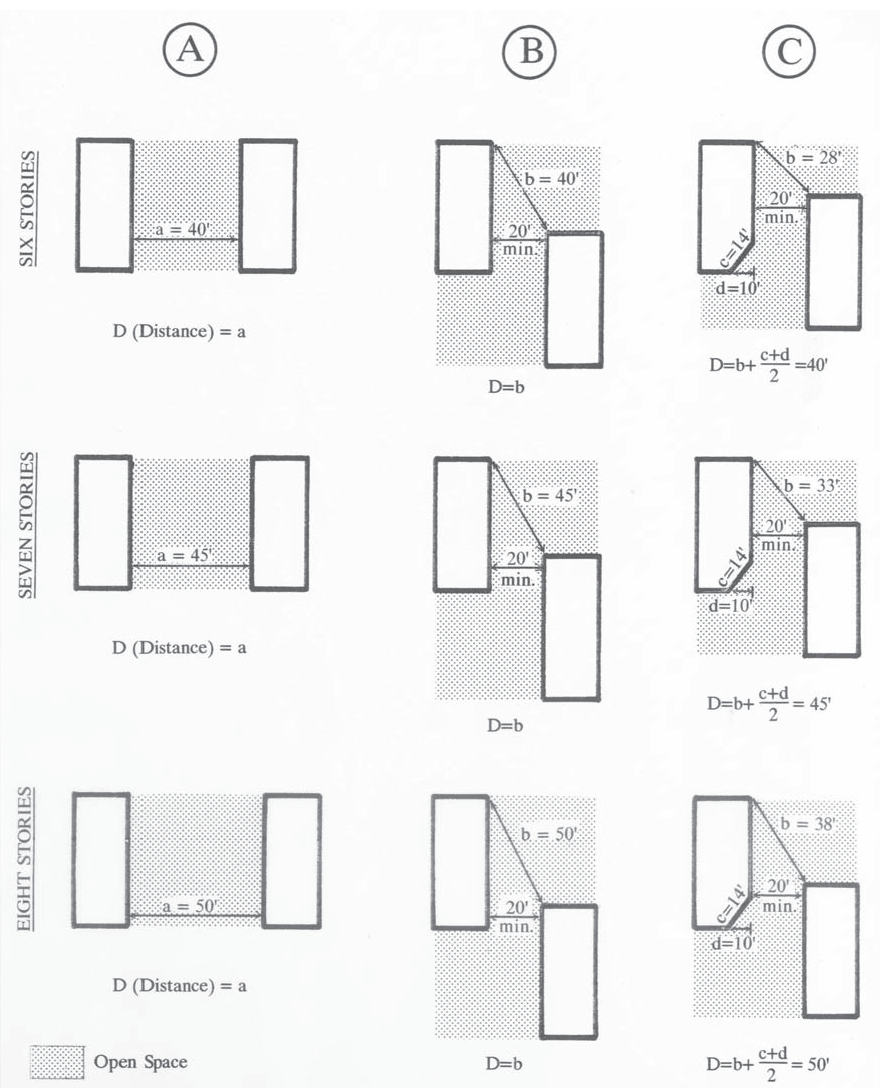
Figure 3.1
(23)
Dwelling, quadraplex. Used exclusively to replace existing multifamily dwelling units, provided that the overall number of units does not exceed the units replaced.
(24)
Reserved.
(25)
Farmer's markets.
a.
In general.
1.
Parking shall comply with the requirements of county or flea markets, as listed in chapter 3, article III of this Land Development Code, as amended.
2.
Sites shall comply with the required landscape buffers and minimum setbacks. Where farmer's markets are adjacent to residentially zoned property the landscaping, buffers and setbacks for commercial uses shall apply.
b.
In addition to the criteria contained in subsection (25)a of this section, the following criteria apply to farmer's markets operating in the B-4 zoning district or Downtown Overlay District.
1.
Markets are allowed only in conjunction with existing public/institutional uses (schools, churches, state, county or city property).
2.
Entities operating the market shall apply for a business tax receipt prior to beginning operation.
3.
All requests to operate a farmer's market shall be reviewed and approved by the SPRC prior to the issuance of a business tax receipt. All applications shall indicate the location of the market; traffic and parking; booth and sale areas; garbage or dumpster locations.
4.
All products sold on-site shall be limited to seafood, agriculturally or horticulturally grown products and home manufactured products.
5.
Hours of operation shall be limited to seven (7) days per week, starting no earlier than 6:00 a.m. and ending no later than 3:00 p.m.
6.
All markets shall comply with applicable federal, state and county laws. Violation of any applicable law shall be grounds for terminating any and all city licenses, business tax receipts, and site plan approvals.
7.
All sites shall be properly maintained and kept in a clean state at all times.
(26)
Flea markets. In any district permitting country markets/flea markets, the following minimum requirements shall apply:
a.
There shall be a landscaped buffer of at least twenty-five feet (25') between the site and any adjoining residential district or conforming residential use.
b.
Entrances and exits shall be designed to ensure that vehicles waiting to enter will not back up into the public right-of-way and that exiting vehicles will not cause extensive backup on-site.
c.
A traffic report shall be provided by a licensed traffic engineer or transportation planner indicating any off-site improvements needed, including turning lanes, signalization and acceleration and deceleration lanes. In order to mitigate against such adverse impacts, the applicant shall be required to construct said off-site improvements
d.
Up to fifty percent (50%) of the required parking spaces may be reserved in turf block, grassed or other approved pervious surface area. All associated accessways, driveways and aisles shall be surfaced as provided in chapter 3, article III of this Land Development Code.
e.
The site plan submittal shall identify all booth, table or partitioned spaces; pedestrian aisles, exits and entrances; restrooms; lighting; hours of operation and structure design and materials.
f.
The city commission may limit hours of operation and require additional information on structural design and site arrangement in order to ensure the compatibility of the development with existing and proposed uses in the surrounding areas.
(27)
Foster home. Foster homes shall be limited to three (3) residents.
(28)
Funeral homes.
a.
The site plan shall show stacking lanes in addition to visitor/employee parking areas.
b.
Screening and buffering in excess of that required under chapter 3, article I of this Land Development Code may be required in order to minimize impact on nearby residential uses.
c.
Where an existing home in a residential area is converted to funeral home use, the residential character of the existing structure is to be preserved.
(29)
Garden center/nursery.
a.
Outdoor display and sales areas shall be screened and buffered to a minimum height of three feet (3') so as to separate the front yard from on-site activities.
b.
All required side and rear yard buffer areas shall consist of permanent plantings.
c.
All facilities and utilities required for any retail use shall be provided.
d.
Site to be served by an approved central water supply. Within the REA zoning district, if no City water lines are located within 100' of the subject property, a well may be used as a central water supply.
e.
Shall be located on street improved to city standards.
f.
Fencing and/or walls to conform to guidelines set forth in chapter 3, article I of this Land Development Code, tree protection, landscaping, fences or walls, clearing and grading. When site is located in Granada/Bovard Streetscape Overlay District, a wrought iron fence is required, specifically when use fronts on Granada Boulevard.
g.
Outdoor storage of lawn equipment, including, but not limited to, lawn mowers, edgers, tractors, cultivators, fertilizer spreaders, harvesters, shall be screened from view by use of buffers as prescribed by chapter 3, article I of this Land Development Code.
h.
Storage areas for noxious or combustible materials such as fertilizers, pesticides, and/or chemicals shall be located so that there are no adverse safety impacts both on- and off-site.
(30)
Golf courses/country clubs.
a.
A golf course/country club, including customary accessory uses, such as a clubhouse, driving range, tennis courts, swimming pools, and other related uses, is allowed in all districts, subject to special exception procedures and to the minimum requirements in this subsection (30). Submittal of a natural resources protection plan prepared by a licensed environmental engineer or qualified biologist, including:
1.
A fertilizer, fungicide and pesticide use and storage program.
2.
A water use and storage program.
3.
An analysis of potential impacts on adjoining and nearby surface waters, wetlands, xeric communities and aquifers.
4.
An on-site tree and natural vegetation protection plan.
5.
An operating plan.
b.
A statement describing anticipated noise, glare, and traffic impacts on nearby uses and proposed mitigation measures.
(31)
Golf courses, contoured.
a.
Contoured golf courses shall be designed as miniature golf courses which require skills associated with golfing and which utilize only natural materials and landscaping features usually found on golf courses. Plaster materials and other features commonly associated with miniature golf courses are specifically prohibited.
b.
If located in close proximity to a resident use, appropriate screening and buffering shall be provided to minimize noise and glare impact.
c.
A detailed lighting plan shall be provided showing all outdoor light fixtures, type and wattage. Glare shall be minimized.
d.
Hours of operation may be limited if the site is adjacent to a residential use.
(32)
Greenhouses.
a.
Setbacks shall be the same as those for the principal building.
b.
The applicant shall demonstrate that anticipated water usage will not have an adverse impact on the local aquifer.
(33)
Group home. Group homes shall be limited to a maximum of six (6) residents.
(34)
Historic preservation mixed use. In any district permitting such use, any single-family dwelling listed on either the National Register of Historic Places or the city's local landmarks list may be used for professional office occupancy, provided the following standards are met:
a.
A maximum of two (2) practicing professionals are permitted per residence, provided that one (1) must be an owner-occupant. For each professional, one (1) support person (secretary, aide, technician, etc.) shall be permitted. However, for every ten thousand (10,000) square feet above the minimum lot size required in the district in which the historic structure is located, and for every two thousand (2,000) square feet of floor area above the minimum floor area required in the district in which the historic structure is located, one (1) additional professional and one (1) additional support person may be permitted, not to exceed a total of four (4) professionals and four (4) support persons operating within the structure.
b.
Professional services shall be limited to low traffic generating types of uses; specifically, the fields of law, architecture, engineering, accounting, psychology, psychiatry, planning or consulting in the aforesaid fields.
c.
Historic structures must be listed on either the National Register of Historic Places or the city's local landmarks list prior to establishment of, and at all times during, the professional office use.
d.
Applications to permit professional office use of an historic structure shall include a site plan which meets the requirements of chapter 4, article I of this Land Development Code and includes the following:
1.
A floor plan of the professional office area;
2.
An exterior restoration plan approved by the Historic Landmark Preservation Board. The appearance of the premises may not be altered and the conduct of the professional occupation within it may not be such that the premises may be recognized as primarily serving a nonresidential use, either by color, light, materials, sounds, noises or vibrations; and
3.
A landscape plan which shall be approved by the SPRC and which shall emphasize natural and "era" vegetation. All historic preservation mixed use uses that require approval of a special exception shall prepare a landscape plan that will be reviewed by the SPRC and the planning board during the processing of the special exception.
e.
Four (4) parking spaces per professional, not to exceed sixteen (16) spaces, shall be provided. Parking spaces shall be located in the side or the rear yard only and shall be screened on all sides that have a view to surrounding property owners, including the view to the street. Hedges, trees, other plant materials, landscape treatments or a combination of such items shall be used for screening. Any screening shall be selected, located, and maintained to provide a visual barrier that is seventy-five percent (75%) or more opaque and between three feet (3') and six feet (6') above the average ground level of the buffer area when viewed horizontally. The parking spaces may be located no closer than five feet (5') to the side and rear lot lines.
f.
Signage shall be in conformance with chapter 3, article IV of this Land Development Code.
g.
Any professional office, permitted by terms of this section, may only be open between the hours of 9:00 a.m. and 6:00 p.m., Monday through Friday, and 9:00 a.m. and 12:00 noon on Saturday.
(35)
Hobby breeder.
a.
Facility owners must live on the premises.
b.
The facility, whether it is a private residence, portion of a private residence or a separate structure not physically connected to a private residence, shall be structurally sound and maintained in good repair to protect the animals from injury, to protect the animals against overexposure to the elements, to contain the animals and to restrict the entrance of other animals.
c.
The owner shall be licensed or authorized as a hobby breeder by the county animal control board.
(36)
Hospital.
a.
The applicant must demonstrate that roads, parking and access points are adequate to handle anticipated traffic volumes.
b.
Hours of operation may be limited in order to minimize adverse impacts on adjacent residential areas.
c.
Screening and buffering in excess of that required under chapter 3, article I of this Land Development Code may be required in order to minimize impacts on nearby residential areas.
(37)
Houses of worship. Houses of worship, including customary accessory uses, are allowed as specified in article II of this chapter, subject to the following minimum requirements:
a.
The predominant frontage shall be oriented toward an arterial or collector street as identified in the traffic circulation element of the comprehensive plan.
b.
The building height may not exceed that allowed in the district in which the use is located. However the bell tower, steeple, spire or other attached or freestanding accessory structure may be a maximum of seventy-five feet (75') above the mean site elevation based on a finding that the approved height will not have a negative impact on the character of the neighborhood or create a dangerous condition.
c.
Where the use abuts a residential district or an existing conforming residential use not separated from the site by a public right-of-way, the minimum setback for the principal building, including schools and child care facilities, shall be one hundred feet (100') from the side and/or rear property line abutting such district or use; otherwise, the minimum side and rear property setback shall be thirty feet (30'). If the subject property abuts a residential zoning district or an existing conforming residential use not separated from the site by a public right-of-way and desires a setback less than one hundred feet (100'), then setback reduction allowances may be made through the special exception process and site-specific review. No accessory use or structure shall be located closer than thirty feet (30') to any property line.
d.
Outdoor play areas may not be located within thirty feet (30') of a single-family home or district permitting such use and shall have a buffer area, fence, or wall as provided for commercial uses adjoining such districts in chapter 3, article I of this Land Development Code, landscaping, for the area impacted by such use.
e.
The facility shall be located in compliance with section 2-56(8), as the same now exists or may hereafter be amended.
f.
Child care facilities may be allowed as use in association with a house of worship as a conditional use reviewed by the SPRC. All conditions listed under the child care facility shall be complied with.
(38)
Hunting dog. Up to ten (10) dogs per five-acre (5) parcel are permitted.
(39)
Hunting lodge. If located adjacent to a residential use, appropriate screening and buffering shall be provided to minimize noise and glare impact to the maximum extent feasible.
(40)
Industrial uses, light.
a.
Outdoor activities shall be limited to storage only and shall be screened and buffered to the degree necessary to minimize adverse impacts on-site and on adjoining properties.
b.
The use is compatible with other uses allowed in the district, and emits a minimal amount of noise, dust, odors and/or glare.
c.
Screening and buffering in excess of that required under chapter 3, article I of this Land Development Code may be required in order to minimize impact on nearby residential uses to the maximum extent feasible.
(41)
Instructional artistic activity.
a.
A conditional use authorizing instructional artistic activity may also allow customers to bring and consume beer and/or wine into the business premises for the customer's own personal consumption, but only under the following conditions:
1.
Shall be located within the Downtown Community Redevelopment Area.
2.
The applicant must obtain and display a bottle club license from the state of Florida in accordance with the requirements of F.S. § 561.14, and other applicable laws and regulations.
3.
Beer and/or wine only shall be allowed; no other alcoholic beverage shall be allowed.
4.
Consumption of beer and/or wine to be allowed only by the customer bringing the alcoholic beverage to the business premises.
5.
Consumption of beer and/or wine must occur inside the place of business where the artistic activity occurs, and shall only be allowed in conjunction with the instructional artistic activity.
6.
The sale of alcoholic beverages and food items are prohibited.
7.
Live entertainment, including, but not limited to, live music performances, is prohibited.
8.
Sexually oriented or adult-themed activities are prohibited.
9.
Occupancy shall be limited to no more than fifty people at any one time.
10.
Hours of operation shall be limited to, between:
(i)
10:00 a.m. and 10:00 p.m., Sunday through Thursday; and
(ii)
10:00 a.m. and 11:00 p.m., Friday through Saturday.
(42)
Kennels.
a.
All activities must be conducted indoors.
b.
Facility must be air conditioned.
c.
Screening and buffering in excess of that required under chapter 3, article I of this Land Development Code, landscaping, may be required in order to minimize impact on nearby residential uses to the maximum extent feasible.
d.
No nighttime operation except for emergencies only.
e.
Pet cemeteries may only be located in the B-5 or REA zoning district in conjunction with a kennel, with the following conditions:
1.
If abutting a residential district or a conforming residential use either a fifty-foot (50') landscaped or agriculture buffer or a six-foot (6') high brick or finished masonry wall with a commercial/residential landscaped buffer shall be provided.
2.
The setbacks shall be the same as for the principal building.
(43)
Malted beverage producer.
a.
Shall operate in full compliance with F.S. § 561.221(2).
b.
Shall operate in full compliance with 27 CFR 25.25.
c.
Shall be permitted to operate a tasting room on-premises to showcase and promote products as well as the tourist industry of the state.
d.
Shall be permitted a retail area to sell accessories of the brewery including, but not limited to, shirts, hats, glassware, and malt beverages.
e.
The tasting room and retail area shall not exceed 50 percent of the gross floor area of the brewery of the malted beverage producer.
f.
The hours of operation of the tasting room and retail area shall be approved as part of the business tax receipt and the use shall not operate as a bar as defined by this Land Development Code.
g.
Shall be permitted to allow Mobile Food Dispensing Vehicles (MFDV) at the location of the malted beverage producer, under the following conditions:
1.
Shall only operate within the I-1 (Light Industrial) zoning district;
2.
Shall not be visible from any arterial or collector road;
3.
Shall not block any public traffic flow;
4.
Shall comply with F.S. ch. 500, F.A.C. ch. 5(k)(4), and FDA Food Code; and
5.
Shall not use public parking or land for the MFDV.
(44)
Manufactured home community (MAHC). The following regulations apply to MAHCs:
a.
Previously existing manufactured home parks. Individual units within manufactured home parks shall be authorized to site any size manufactured home and appurtenances on a manufactured home lot in accordance with the lot sizes, separation and setback distances, and other requirements in effect at the time of the approval of the manufactured home park, provided that the uniform fire safety standards, as set forth in the Florida Administrative Code, are fully complied with.
b.
Interior roads/sidewalks.
1.
All manufactured home communities shall be provided with safe and convenient vehicular access from an arterial or collector street as identified in the traffic circulation element of the comprehensive plan. Such access shall be designed to minimize traffic congestion and hazards.
2.
Interior drives shall be designed and constructed to provide safe and convenient vehicular access to each manufactured home space and subject to the following:
(i)
All units located within the community shall have access only from the internal street system.
(ii)
All collector drives shall be located within a minimum fifty-foot (50') easement, and all access drives shall be located within a minimum forty-foot (40') easement, in order to allow adequate room for utilities and walkways.
(iii)
All paved drive surfaces shall meet the following minimum requirements:
A.
Collector drives: twenty-four-foot (24') minimum width, excluding curbs and minimum radii at intersection consistent with chapter 3, article V of this Land Development Code;
B.
Access drives: twenty-foot (20') minimum width excluding curbs; and
C.
Any street with a landscaped median shall be required to have two (2) sixteen-foot (16') driving lanes.
(iv)
All drive pavement and subbase shall be designed and constructed in accordance with city subdivision standards, or equal. The type of pavement shall be approved and inspected by the city engineer.
(v)
Grades of all streets shall be sufficient to ensure adequate surface drainage but shall not exceed eight percent (8%).
(vi)
High-back curbs, Miami curbs or ribbon curbs shall be used. The type of curb shall be approved and inspected by the city engineer.
(vii)
A sidewalk shall be required along collector drives. Such sidewalks shall have a minimum width of five feet (5') and be consistent with the standards contained in chapter 3, article V of this Land Development Code.
(viii)
Each unit shall be provided with a single width driveway at least twelve feet (12') wide. The driveway shall be a minimum of twenty feet (20') in length if a full depth carport is utilized. If a full carport is not utilized, the driveway shall have a minimum length of thirty feet (30').
c.
Landscaping and buffers.
1.
All common areas, open space, parking lot islands and other land not otherwise developed (excluding landscape buffers) shall be accordance with section 3-05.
2.
All perimeter landscape buffers shall be a design type 3, twenty feet (20') in width and contain four (4) trees, forty (40) shrubs and forty (40) ground covers per one hundred (100) linear feet in accordance with section 3-06. Special provisions will apply if the project abuts a designated Greenbelt Overlay District.
3.
A six-foot (6') high masonry wall is required where the property abuts an arterial and/or collector roadway. The wall shall be in accordance with chapter 3, articles I and III of this Land Development Code. The SPRC has the ability to waive and/or modify this requirement, based on existing conditions.
4.
All single-family lots shall have two (2) existing or planted trees per lot. At least one (1) required tree must be in the front yard and at least one (1) tree must be planted in the rear yard.
5.
An underground irrigation system shall be installed in all landscaped areas of the development, except for preserved natural areas. The irrigation system must be in accordance with the adopted county waterwise ordinance and section 3-05.
d.
Recreational facilities. Areas for passive and active recreation shall be provided. Such areas shall be designed and improved to serve their intended use and shall reflect the recreational needs of community residents. Recreational areas shall meet the following minimum requirements:
1.
They shall be located and designed with adequate access to encourage use by the residents.
2.
There shall be at least one (1) central community building. This building shall have at least three thousand (3,000) square feet of area. For each dwelling unit over three hundred (300) units there shall be an additional fifteen (15) square feet of indoor recreational space provided.
3.
Outdoor facilities shall be designed to accommodate the size and character of the development. At a minimum, outdoor recreation shall provide the following facilities to accommodate the total number of units:
(i)
Court facilities (tennis, shuffleboard, etc.);
(ii)
Pool/spa facilities; and
(iii)
Outdoor active recreation (hiking/jogging trails, volleyball courts, golf courses, etc.).
The site plan shall indicate the type, number and location of outdoor facilities. In addition, the plan shall indicate the number of persons the facility can accommodate, based on current standards and reasonable hours of operation. Other areas designated for open space, landscaping and/or retention/detention shall not be counted toward the outdoor recreation requirement. Impact fee credits for any specific outdoor recreation site shall be limited to three hundred (300) dwelling units.
4.
For developments of more than three hundred (300) dwelling units, satellite recreational facilities shall be provided in addition to the central community building described in subsection (44)d2 of this section. Covered pavilions or shelters can be counted toward meeting the indoor recreational space requirement for dwelling units in excess of three hundred (300). These satellite facilities may consist of a covered pavilion or shelter, cookout areas, shuffleboard courts, horseshoe courts, playgrounds, and similar facilities. On a case-by-case basis, the SPRC may allow the combination of indoor recreation based upon site layout and design.
5.
Recreation sites which include indoor and outdoor activities shall comply with all general site plan design and construction standards with regard to buffer areas, landscaping, interior landscaping, parking arrangement, lighting, signing, and drainage. Up to fifty percent (50%) of the required parking may be designed as overflow spaces utilizing grass or any other approved pervious surface.
6.
The minimum parcel size of any single active recreational area shall be five thousand (5,000) square feet in area or not less than sixty feet (60') in its smallest dimension. No designated active recreation area shall be closer than thirty feet (30') to a dwelling unit within the development at its closest point and shall be adequately buffered to reduce noise, glare and visual impacts on adjoining homesites. Active recreation facilities shall not be located in any required buffer area.
7.
Thirty (30) square feet of common open space shall be provided for each dwelling unit.
(i)
Common open space shall be available to all the residents of the manufactured home community. At the option of the developer, subject to the approval of the city commission, common open space may be dedicated to the use of the general public.
(ii)
Common open space must be adequately landscaped and irrigated.
(iii)
Natural features worthy of preservation may be left unimproved.
(iv)
Water bodies may be utilized to meet up to twenty-five percent (25%) of the open space requirement provided significant recreational use of the waterbody can be demonstrated. Water retention areas shall not be included as open space.
8.
Parking areas shall be shown on the site plan and the applicant shall justify the number of spaces permitted.
e.
Management rules. All management rules and covenants and restrictions shall be subject to review by the city and shall be consistent with the general intent of these regulations.
f.
Project perimeter setback. More or less restrictive setbacks than the T-1 zoning classification may be permitted by the SPRC through an approved site plan.
(45)
Marinas and multislip docking facilities.
a.
In general. Marinas and multislip docking facilities shall be designed, constructed and operated to meet stringent environmental protection standards which require an applicant to provide reasonable assurances that such facilities will not adversely impact water quality standards, designated species wildlife habitat, or wetland or submerged aquatic vegetative communities. Such facilities shall also be designed to ensure compatibility with adjacent land uses.
b.
Development and performance standards.
1.
In residential districts, only ownership-oriented docking facilities are permitted, subject to the following minimum standards:
(i)
Use is limited to residents of the subdivision or development.
(ii)
The use is designed to minimize noise, glare, traffic and odor impacts on-site and on adjoining properties.
(iii)
The use is buffered and provided with fences and walls as required for commercial buildings under chapter 3, article I of this Land Development Code.
(iv)
The marina or multi-slip dock facility shall be completely within or immediately adjacent to the residential area which it serves. No portion of the primary facility shall be within one hundred feet (100') of the riparian line adjoining a residential district and use or within fifty feet (50') of the riparian line of any other development, district or use.
2.
All applicable rules and permit requirements of the department of environmental protection, U.S. Army Corps of Engineers, and St. Johns River Water Management District shall be complied with.
3.
The number of wet slips shall be limited as follows:
(i)
One (1) to six (6) approved upland residential units: four (4) slips or one (1) slip per unit, whichever is less.
(ii)
Seven (7) to fourteen (14) approved residential units: five (5) slips or one (1) slip per two (2) units, whichever is less.
(iii)
Fifteen (15) to twenty-eight (28) approved upland residential units: seven (7) slips or one (1) slip per three (3) units, whichever is less.
(iv)
For the Halifax River, twenty-nine (29) or more approved upland residential units: one (1) slip per four (4) units; for development on the Tomoka River and its tributaries with twenty-nine (29) or more approved upland residential units: ten (10) slips or one (1) slip per four (4) units, whichever is less. For the Tomoka River and its tributaries the wet slips allowed shall not exceed the width of the shoreline between riparian lines divided by one hundred feet (100') or the number allowed under subsection (45)b1(i) through (iv) of this section, whichever is less.
4.
Regardless of the number of units, any multifamily, hotel/motel, timeshare resort or commercial development located within the boundaries of the Tomoka River Manatee Sanctuary and the Tomoka Marsh Aquatic Preserve shall be limited to one (1) wet slip.
5.
The use shall be designed and operated to maintain compatibility with natural resources and to minimize impacts on adjoining properties with regard to noise, traffic, glare, odor and dust.
(i)
All new or expanded marinas shall demonstrate compliance with state water quality standards by maintaining a water quality monitoring program as approved by the state department of environmental protection and the city engineer.
(ii)
Grass beds and other submerged habitat deemed valuable by the department of environmental protection will be subject to protection regardless of size. Immediate access (ingress and egress) points shall be delineated by channel markers, indicating speed limits, manatee area warnings, and any other applicable regulations.
(iii)
All new and expanded marinas must provide treatment of stormwater runoff from upland areas to the extent necessary to ensure that state water quality standards are met at the point of discharge to waters of the state. In addition, all requirements of the St. Johns River Water Management District and state department of environmental protection shall be met.
(iv)
Boat maintenance activities in new or expanded marina sites shall be located as far as possible from open water bodies in order to reduce contamination of water bodies by toxic and hazardous substances common to boat maintenance. Runoff from boat maintenance activities must be collected and treated prior to discharge.
(v)
Open wet slips shall be preferred to covered wet slips in marina design in order to reduce shading of water bodies which results in lowered biological productivity.
(vi)
Marina design shall incorporate natural wetland vegetative buffers whenever possible near the docking area and in ingress/egress areas for erosion and sediment control, runoff purification, and habitat purposes.
(vii)
All existing and new marina or multi-slip docking facility operators shall undertake the following manatee protection measures in areas where manatees are known to occur:
A.
Implement and maintain a manatee public awareness program (in consultation with FDEP) which will include the posting of signs to advise boat users that manatees are an endangered species which frequent the waters of the region's estuaries and lagoons and the provision of manatee literature at conspicuous locations. The signs shall be displayed in a conspicuous place on the structure and shall be maintained in good order by the owner or operator;
B.
Declare the waters in and around marinas as idle speed zones; and
C.
Post telephone numbers to report injured manatees.
(viii)
No portion of the primary facility shall be within one hundred feet (100') of the riparian line of an adjoining residential or institutional district and development or within fifty feet (50') of an adjacent professional office/commercial use or twenty-five feet (25') of any other use.
(ix)
All structures and other activities must be within the riparian rights area of the applicant and must be designed in a manner that will not restrict or otherwise infringe upon the riparian rights of adjacent riparian owners.
(x)
Any buffer zones established by FDEP's shellfish environmental assessment section shall be maintained and, where necessary, enhanced or expanded by FDEP or the city through the site plan review process.
(xi)
The extension into the respective waterway of docks, moorings, pilings or other such structures shall be limited as follows:
A.
The shall not extend within one hundred feet (100') of a federal navigation project channel as defined by F.S. § 253.03(10).
B.
The shall not extend more than twenty percent (20%) of the width of the Halifax River at that location.
C.
The shall not extend more than ten percent (10%) of the width of any waterway other than the Halifax River.
D.
Marinas shall be located in areas where the least dredging and maintenance are required and where aquatic resources shall not be adversely affected.
E.
Sufficient upland areas shall be available to accommodate needed support facilities such as required parking, dry storage, work areas, utilities, stormwater management facilities, sewage pump-out facilities and other non-water-dependent uses.
F.
The shall be located in areas which require minimal or no dredging or filling to provide access by either canal, channel or road. Dredging and filling of wetlands or open water in order to accommodate uses which are not water-dependent shall not be allowed. Exceptions may be granted in cases shown to be overwhelmingly in the public interest, such as the presence of sensitive upland systems.
G.
The marina areas and navigation access channels shall not be dredged to depths greater than necessary to prevent prop dredging.
H.
New marinas shall be located where there is an existing basin and access channel and adequate depths to accommodate the proposed use for ingress and egress with no dredging of productive submerged (vegetated or unvegetated) areas. A minimum natural depth of four feet (4') below mean low water shall be required. Greater depth shall be required for those facilities designated for or capable of accommodating boats having greater than a three-foot (3') draft. These depth requirements shall apply to the area between the proposed facility and any natural or navigation channel, inlet, or deep water where necessary marking of navigational channels may be required.
I.
Facilities shall be designed to maximize or improve water circulation patterns. Improvement of circulation shall be a priority consideration when expanding or upgrading existing facilities.
J.
Marinas shall not be permitted in areas where approved or conditionally approved shellfish harvesting would be severely impacted or in areas which have been determined by FDEP, USFWS, or the city to be critical to the survival of the manatee. These areas shall include, but are not limited to, manatee sanctuaries, feeding areas or areas which have been identified in manatee recovery plans.
K.
Cumulative effects of several marinas and/or boat ramps in one (1) area shall be considered in the review of proposed marina projects.
(xii)
A fuel management/spill contingency plan and a hazardous materials management plan shall be developed and implemented for all marina or other watercraft fueling facilities. The plan shall be consistent with the criteria of article III of this chapter, hazardous material, and shall describe methods to be used in dispensing fuel and all the procedures, methods, and materials to be used in the event of a spill. Documentation shall include a list of cleanup equipment and hazardous substances on the site and where they will be stored; fuel pump operation and emergency shutdown procedures; spill contamination and removal procedures; and a description of the training which will be provided to marina personnel who will operate the pumps, deploy cleanup equipment, and handle the hazardous substances.
(xiii)
Sewer pump-out and treatment service and facilities shall be made available and accessible to all new boat slips constructed. Existing boat slips shall have sewer pump-out and treatment service and facilities by January 1, 1995. Applicants shall document the availability and capacity to handle the anticipated volume of wastes. Waste treatment facilities shall be properly maintained and shall avoid contamination of surface water in accordance with F.A.C. ch. 62-600.
(xiv)
Only docking facilities which require minimal or no dredging and/or filling to provide access by canal, channel or road shall be approved. This restriction shall also apply to widening and/or deepening any existing canal or channel, but not to regular maintenance dredging and filling to meet depth standards of existing canals or channels. Preference shall be given to marina sites with natural channels. In the event that dredging is required, the mooring areas and the navigation access channels shall not be dredged to depths greater than those necessary to prevent prop dredging. Any required dredging shall utilize construction techniques and materials which comply with state water quality standards (e.g., turbidity screens, hydraulic dredges, properly sized and isolated spoil deposition area to control spoil dewatering).
(xv)
In reviewing applications for new or expanded docking facilities, ways to improve, mitigate or restore adverse environmental impacts caused by previous activities shall be explored. This may include swallowing dredged areas, restoring wetland or submerged vegetation, or marking navigational channels. Such mitigation or restoration may be required as a condition of approval for new, renewed or expanded facilities.
c.
Maintenance and enforcement. Marina and multislip docking facilities shall be maintained and enforced in accordance with those standards provided under article III of this chapter, boats, docks and boathouses.
(46)
Massage parlors.
a.
Any licenses required by F.S. ch. 480 and the Code of Ordinances shall be posted in a prominent place within the work area.
b.
The hours of operation shall be restricted to 8:00 a.m. to 10:00 p.m., if located adjacent to a residential district.
c.
Screening and buffering in excess of that required under chapter 3, article I of this Land Development Code, may be required in order to minimize impact on nearby residential uses to the maximum extent feasible.
(47)
Mausoleums.
a.
The use shall not be located closer than one hundred feet (100') from any residential district or conforming single-family home.
b.
Screening and buffering in excess of that required under chapter 3, article I of this Land Development Code, may be required in order to minimize impact on nearby residential uses to the maximum extent feasible.
(48)
Mining and excavation.
a.
The excavation and mining of lands for the primary purpose of transporting material off-site for use elsewhere is permitted only in the REA district; provided, however, that mining and excavation operations determined to be in the public interest, such as public works, roads and utilities, is permitted in all districts, subject to the requirements of subsection (46)c of this section.
b.
Those mining and excavation operations existing at the time of adoption of this Land Development Code may continue subject to such operation continuing in good faith and subject to the condition of any interlocal or legal agreement with the city or other governmental agency.
c.
Other than in conjunction with an approved development order, mining activities which transport materials off-site may be allowed in the REA district by conditional use permit, provided that the applicant can demonstrate that the primary intent of the excavation is directly related to the beneficial use of the property and all requirements of the REA district and this section are complied with.
d.
Mineral extraction activities shall be accomplished in a manner consistent with applicable aesthetic, engineering, environmental, health, noise, recreation and safety standards.
e.
Prior to the initiation of any mining or excavation activities, a reclamation plan shall be prepared and sealed by a licensed civil engineer and/or landscape architect registered under F.S. ch. 481, pt. II (F.S. § 481.301 et seq.), and approved by the city.
1.
The plan shall include provisions for revegetation and reclamation.
2.
The plan shall achieve an aesthetically pleasing landscape compatible with adjacent land uses and shall minimize soil erosion by the use of native vegetative buffers. Landscaped buffers shall also be established between the mining activity and adjacent existing and planned future land uses.
f.
The applicant shall secure all necessary permits from the FDEP and SJRWMD.
g.
Any mining or excavation activity that requires dewatering shall meet the following criteria:
1.
Submit proof of permitting from SJRWMD.
2.
Applicant to submit a dewatering plan to be reviewed and approved by the city engineer.
3.
The discharge shall occur from one (1) cell of the project site to another cell.
4.
Off-site discharge is prohibited.
5.
Discharges shall be conducted in a manner that minimizes or avoids disturbances to wetlands and water bodies and shall be consistent with chapter 3, article II of this Land Development Code.
6.
The use of erosion and sedimentation containment practices is required.
7.
Demonstrate that any areas disturbed during the dewatering process will be restored to approximate predevelopment conditions.
h.
Any excavation or mining activity which uncovers or appears to be disturbing archaeological or paleontological resources shall be stopped until a preliminary assessment can be made to determine the probability of significant archaeological or paleontological assets.
i.
The fire chief may require dry hydrants to be installed at appropriate sites adjacent to strategically located borrow pits, to ensure an adequate means of water supply for fire protection.
j.
There shall be no commercial excavation of minerals within the Tomoka Marsh Aquatic Preserve.
k.
No commercial or industrial mining shall be allowed in prime groundwater recharge areas identified by the SJRWMD or in the watersheds of surface waters used as potable water supplies in order to prevent potentially adverse effects of water quality.
l.
Removal of the confining layer of material separating the upper surficial aquifer from the Floridan Aquifer shall be prohibited in the excavation of borrow pits or any other surface excavations for the purpose of disposal or storage of waste. A buffer shall be established above any confining unit or above the aquifer if a confining unit is not present.
(49)
Mobile home community (MOHC). The following regulations apply to MOHCs:
a.
Previously existing mobile home parks. Individual units within mobile home parks shall be authorized to site any size new or used mobile home and appurtenances on a mobile home lot in accordance with the lot sizes, separation and setback distances, and other requirements in effect at the time of the approval of the mobile home park and provided that the uniform fire safety standards for mobile home parks, as set forth in F.A.C. ch. 69A-42, as the same may be amended from time to time, are fully complied with.
b.
Internal streets width. All mobile home parks shall comply with this Land Development Code regarding internal street and driveway design.
c.
Entrances and exits. Entrances and exits shall be limited in number and when combined, shall be separated with a landscaped median strip not less than five feet (5') wide. There shall be no direct vehicle access from any space to any exterior street.
d.
Recreation area. There shall be at least one (1) passive or active recreational area. It shall constitute at least five percent (5%) of the total land area of the project. The recreation area shall be easily accessible to all residents of the project.
e.
Landscaping and buffers.
1.
All common areas, open space, parking lot islands and other land not otherwise developed, excluding landscape buffers, shall be in accordance section 3-05.
2.
All perimeter landscape buffers shall be a design type 3, twenty feet (20') in width and contain four (4) trees, forty (40) shrubs and forty (40) ground covers per one hundred (100) linear feet in accordance with section 3-06. Special provisions will apply if the project abuts a designated Greenbelt Overlay District.
3.
A six-foot (6') high masonry wall is required where the property abuts an arterial and/or collector roadway. The wall shall be in accordance with chapter 3, articles I and III of this Land Development Code. The SPRC has the ability to waive and/or modify this requirement, based on existing conditions.
4.
All lease areas shall have two (2) existing or planted trees per lot. At least one (1) required tree must be in the front yard and at least one (1) tree must be planted in the rear yard.
5.
An underground irrigation system shall be installed in all landscaped areas of the development, except for preserved natural areas. The irrigation system must be in accordance with the adopted county waterwise ordinance and section 3-05.
f.
Water supply, sewage disposal and garbage and refuse handling. All mobile home communities shall comply with this Land Development Code regarding water supply and sewage disposal and the applicable provisions of the Florida Administrative Code regarding garbage and refuse handling.
g.
Project perimeter setback. No structure shall be located within thirty feet (30') of the project's perimeter.
(50)
Nightclubs.
a.
Nightclubs shall be located in compliance with section 2-56(8), as the same now exists or may hereafter be amended.
b.
Unless located within a hotel or motel having one hundred (100) or more rooms and with access limited to the hotel or motel lobby, shall not be located within one thousand feet (1,000') of another nightclub, bar or lounge.
c.
Hours of operation may be restricted if located adjacent to a residential district or adjacent, conforming residential use.
d.
If located adjacent to a residential use, appropriate screening and buffering shall be provided to minimize noise and glare impact to the maximum extent feasible.
e.
Applicants requesting approval to establish a new nightclub shall submit a description of the proposed operation, including hours of operation, any special features or activities, the target market group and the ambient character to be created. Upon change of ownership, the new owner shall submit a description of all proposed changes in the manner in which the facility will be operated.
f.
One additional parking space per six (6) seats shall be provided when located within a hotel or motel having one hundred (100) or more rooms.
(51)
Nonemergency medical transport services.
a.
Screening and buffering in excess of that required under section 3-06, may be required in order to minimize impact on nearby residential uses to the maximum extent possible, particularly with regard to noise, odor, fumes and glare impacts.
b.
The vehicles must be used exclusively for nonemergency medical transportation and are prohibited from using emergency lights and sirens.
c.
The number of parking areas for vehicles may be limited to ensure compatibility with adjacent uses.
d.
The provider of nonemergency medical transportation services must be licensed in accordance with state law.
(52)
Nursing homes.
a.
Nursing homes shall be buffered and provided with fences and walls as required for commercial buildings under chapter 3, article I of this Land Development Code.
b.
The number of residents may be limited to ensure compatibility with adjacent uses.
(53)
Outdoor activity.
a.
If located adjacent to a residential use, appropriate screening and buffering shall be provided to minimize noise and glare impact to the maximum extent feasible.
b.
A site plan displaying the area for activity and pedestrian movement shall be required.
c.
Outdoor music shall provide a sound study demonstrating compliance with the adopted maximum decibel levels.
(54)
Outdoor storage.
a.
Provide screening and buffering from abutting residential areas. All outdoor uses and storage shall comply with the landscape buffer and wall/fencing requirements contained in chapter 3, article I of this Land Development Code.
b.
Parking areas shall be paved and identified on the site plan. The SPRC may waive the requirement for paving of the parking areas, if the site plan indicates that all of the access aisle is paved, but actual parking areas are a stabilized pervious surface, such as grass, shell or paver brick. The SPRC shall not waive this requirement if the design does not result in reduction of paved, impervious area.
c.
Storage areas shall be identified by type of storage.
d.
Fencing for outdoor storage areas shall be installed along the interior line of the front or rear buffers, as established by chapter 3, article I of this Land Development Code. This requirement may be waived if there is specific language within an approved development order for a special exception or planned industrial development.
e.
No fencing shall be located within the minimum side corner yard buffer, as required by chapter 3, article I, buffer area requirements.
f.
In the B-5 and I-1 zoning districts, outdoor storage is permitted up to 49 percent of the principal building floor area. Outdoor storage exceeding this limitation shall require a special exception or a planned development.
(55)
Parking lots.
a.
If outdoor, a three-foot (3') high buffer with a minimum depth of ten feet (10'), unless a greater buffer depth is required under article II of this chapter or chapter 3, article I of this Land Development Code shall be provided in the front yard to screen parking areas from the road.
b.
A lighting plan shall be provided showing all outdoor lighting fixtures, type and wattage. Glare shall be minimized.
c.
Hours of operation may be limited if located adjacent to a residential district.
d.
Additional buffering and screening in excess of that required under chapter 3, article I of this Land Development Code shall be provided as needed to minimize impacts on nearby residential uses.
(56)
Parking garage.
a.
Shall not exceed a height of forty-five feet (45');
b.
Shall be designed to comply with the architectural standards of this Land Development Code;
c.
Additional buffering and screening in excess of that required under chapter 3, article I of this Land Development Code, shall be provided as needed to minimize impacts on nearby residential uses.
(57)
Parks and recreation facilities, private. On-site park and recreation facilities for the exclusive use of the occupants of any residential or nonresidential development are permitted, provided that:
a.
The facilities, including parking, landscaping, building footprints and other site design features are shown on an approved site plan.
b.
Any structures, playground, and active play areas and lights shall be located and screened in a manner which will minimize noise and glare impacts on adjoining properties to the maximum extent feasible.
c.
One (1) parking space is provided for service and persons with disabilities access; one (1) space is provided for each ten (10) dwellings up to one hundred (100) units which are serviced by the facilities and located more than six hundred feet (600') from the facilities; and one (1) space is provided for each twenty (20) units thereafter. Under no circumstances shall there be less than three (3) total parking spaces, including one (1) for service and persons with disabilities access.
d.
An operating plan describing specific activities and hours of operation is submitted for review and approval.
e.
Buffering and screening is not required for bikepaths or pedestrian walkways located within the road right-of-way.
f.
Park and recreation facilities shall be designed and used in a manner that protects the quality of environmentally sensitive areas as defined in the comprehensive plan and including, but not limited to, floodways, waterbodies and designated species wildlife habitat areas.
(58)
Parks and recreation facilities, public.
a.
Impact on adjoining conforming residential uses or residential districts shall be minimized.
b.
Activity areas shall be set back from conforming residential uses to the maximum extent feasible.
c.
Hours of operation may be limited if located adjacent to a residential district or conforming residential use.
d.
The facilities shall be located in compliance with section 2-56(8), as the same now exists or may hereafter be amended.
(59)
Patio home subdivisions, single-family. In any district permitting single-family patio home subdivisions, the following minimum standards shall apply:
a.
Minimum floor area.
1.
Two-bedroom: one thousand two hundred (1,200) square feet.
2.
Three-bedroom: one thousand four hundred (1,400) square feet.
3.
Each additional bedroom: one hundred fifty (150) square feet.
b.
Common open space shall be provided at a minimum of one hundred (100) square feet per dwelling unit. Common open space shall not include regulated wetlands (except as specified in article VI of this chapter), stormwater retention/detention areas, perimeter buffer areas, and side, rear or front yards. At least fifty percent (50%) of the open space provided shall be readily accessible to all residents.
c.
Protected wetlands, water bodies and other unbuildable areas may only be used to satisfy a maximum of fifty percent (50%) of the common open space requirement.
d.
All perimeter lots within a patio home subdivision shall include a landscape buffer of at least ten feet (10') in width along the rear property line. This buffer area shall consist of at least one (1) tree planted every forty (40) linear feet, together with a contiguous hedge, so that there is a natural, opaque perimeter buffer.
e.
In situations where a patio home subdivision is adjacent to a single-family development that has an average lot size of seven thousand, five hundred (7,500) square feet, a wood fence shall be required to be installed with the perimeter landscape buffer. The fence shall be located on the rear/side property line adjacent to the large lot single-family home, with the finished side facing the adjacent development. The fence shall be maintained in good condition at all times by the homeowners' association of the patio home subdivision. The developer may request that the wood fence requirement be waived by the city commission during the review of the special exception if there is existing sufficient natural vegetation to effectively buffer the two (2) uses, and the existing natural vegetation will be permanently retained in the perimeter landscape buffer.
f.
The fence otherwise required by subsection (57)e of this section shall not be required if all of the lots in the patio home subdivision have an area of at least six thousand nine hundred (6,900) square feet, with a maximum width of sixty feet (60') and a minimum lot depth of one hundred fifteen feet (115').
(60)
Personal services.
a.
Personal services shall be the principle use of the establishment.
b.
The personal services use may serve complimentary beer and wine to customers only, during normal business hours (2-COP license).
c.
No live indoor or outdoor entertainment is allowed.
d.
No outside advertising or signage is allowed beyond what is allowed for the principle use.
(61)
Pawnshop.
a.
Pawnshops shall be located in compliance with section 2-56(8), as the same now exists or may hereafter be amended.
b.
The use shall not be located along Granada Boulevard or within the Granada/Bovard Streetscape Overlay District as delineated in article IV of this chapter.
c.
No drive-through window or similar device is allowed.
d.
Screening and buffering shall be required to the degree necessary to minimize the impact on adjacent residential areas to the maximum extent feasible.
e.
All existing pawnshops that are inconsistent with the foregoing provisions shall be deemed nonconforming uses pursuant to article V of this chapter, and shall be grandfathered from compliance with the provisions of this subsection (58) until otherwise required by the provisions of article V of this chapter.
(62)
Petroleum products storage.
a.
Provide screening and buffering from abutting residential areas. All outdoor uses and storage shall comply with the landscape buffer and wall/fencing requirements contained in chapter 3, article I of this Land Development Code.
b.
The selected site has be reviewed and approved by the police and fire department for public safety.
(63)
Pool halls/billiards. In all districts allowing such use, the following minimum standards shall apply:
a.
If located adjacent to a residential district or within one thousand feet (1,000') of a house of worship, school, child care facility, public park or playground or other public or semipublic youth facility, hours of operation may be limited and other restrictions may be imposed.
b.
Additional screening and/or buffering as required under this Land Development Code shall be provided as necessary to minimize noise and glare impacts to neighboring residential uses.
c.
The facility shall be located in compliance with section 2-56(8), as the same now exists or may hereafter be amended.
d.
Churches, schools, child care facilities and youth facilities located within one thousand feet (1,000') of the proposed facility shall be notified of the public hearings at which the proposal will be considered.
(64)
Public facilities/utilities. Public facilities/utilities, other than parks and recreation areas or schools, are permitted in all districts, subject to the following minimum standards:
a.
A finding that the use will have no negative impacts on adjoining properties, or the character of the neighborhood, in terms of noise, odors, glare, intensive traffic volumes or extensive visual impacts.
b.
Where such findings cannot be made by the SPRC, it shall be processed as a special exception with approval based on a finding that the facility:
1.
Will have no substantive negative impacts, or where such impacts are noticeable the use is in the overriding public interest;
2.
Any adverse impacts have been mitigated to the maximum extent economically and physically feasible; and
3.
Cannot be reasonably and economically located on an alternate site.
c.
All utility installation, construction or repair within the right-of-way shall require a permit in accordance with chapter 3, article V of this Land Development Code.
(65)
Recreation facilities, indoor.
a.
Glare shall not extend off-site or impact neighboring residential uses.
b.
Parking areas shall be adequately screened from the street and adjacent uses by a continuous hedge and other materials at least three feet (3') in height for the depth of the required buffer area. A wall may be used to reduce the amount of required landscaping.
c.
Hours of operation may be restricted if located adjacent to a conforming residential use.
(66)
Recreation facilities, outdoor.
a.
Except for bikepaths and pedestrian walkways located within the road right-of-way, outdoor recreation facilities provided for the exclusive use of residents of a residential development may be permitted, provided that:
1.
They are reviewed in conjunction with site plans or plats.
2.
Facilities shall be so located, walled, fenced or screened as to minimize noise and glare impacts to neighboring residential uses.
b.
Commercial or private outdoor recreation facilities shall be permitted in districts allowing such use, subject to the following:
1.
Located on an arterial or major collector road.
2.
Designed to minimize noise and glare impacts on adjoining conforming residential uses and residential districts.
c.
Hours of operation may be limited if the site is adjacent to a residential use.
d.
A detailed lighting plan shall be provided showing all outdoor lighting fixtures, type and wattage. Glare shall be minimized.
(67)
Recreational vehicles/boat storage. In all districts allowing such use, the following minimum standards shall apply:
a.
Use limitation.
1.
RV and boat storage uses are intended exclusively for the storage of boats and RVs by the general public and for incidental storage by small commercial users.
2.
Additional uses, such as recreational vehicle or boat sales and service, are permitted in conjunction with this use, provided that they are permitted in the zoning district and all conditions are satisfied.
3.
No signage, other than for the storage use itself, shall be allowed.
b.
Storage.
1.
All RVs and boats shall be kept within the designated storage areas as shown in the approved site plan.
2.
Each user shall have direct access to his RV or boat during all hours of operation.
c.
On-site circulation and driveway widths.
1.
All single-loaded driveways shall have a minimum width of twenty feet (20').
2.
All double-loaded driveways shall have a minimum width of thirty feet (30').
3.
Traffic direction shall be designated by signing and/or painting on driveway surfaces.
4.
Access to storage spaces shall only be provided from the interior of the site. Interior circulation shall be designed to permit all vehicles to leave the site in a forward direction.
d.
Off-street parking. One (1) parking space per each twenty-five (25) storage spaces shall be required.
e.
Landscaping. Landscape buffer areas shall be provided as required in chapter 3, article I of this Land Development Code. In addition, in order to reduce the visual impact of vehicles/boats, driveways, storage buildings and security fences, a combination landscape screen and decorative masonry wall ranging from three feet (3') to six feet (6') in height may be required in the front yard, along the front yard setback, and along any property line that abuts a residential district or public right-of-way. Interior landscaping may be transferred to outside of the storage area, with priority given to softening end walls visible from a public right-of-way through foundation plantings, and to the landscaping of perimeter, entryway and management office areas.
f.
Lighting. All lights shall be shielded to direct light onto the development and away from adjacent property, but may be of sufficient intensity to discourage vandalism and theft.
g.
Hours of operation. Access to storage facilities shall not be allowed except during approved hours of operation. Hours of operation shall be noted on-site plan submittals and designed to provide maximum safety for users while not interfering with existing or potential users of adjoining properties.
(68)
Riding stables, horse.
a.
All buildings and structures shall be located at least one hundred feet (100') from any property line.
b.
In order to prevent adverse impact on adjoining uses, the city may limit:
1.
Hours of operation.
2.
Number of horses that may be rented for recreation riding or instruction.
3.
On-site lighting.
(69)
Restaurant types.
1.
The following criteria by restaurant type apply as denoted in the table below:
2.
Each restaurant type which has outdoor seating may be granted a separate permit to allow an exemption to the Food and Drug Administration Code provisions which prohibit dogs on restaurant premises. The permitted exemption would permit patrons' dogs within certain designated outdoor portions of restaurants provided the following criteria is met:
a.
No dog shall be in a restaurant unless allowed by state law and the restaurant has received and maintains an unexpired permit pursuant to this subsection allowing dogs in designated outdoor areas of the establishment.
b.
Restaurants must apply for and receive a permit from the City of Ormond Beach before patrons' dogs are allowed on the premises. The City Commission shall adopt a reasonable fee by resolution to cover the cost of processing the initial application, permitting, inspections, renewals, and enforcement.
c.
The application for a permit shall require the following information:
1.
Name, location, mailing address and division-issued license number of the restaurant.
2.
Title, name, mailing address, and telephone contact information of the permit applicant. Applications are accepted from only the owner of the restaurant or the owner's authorized agent, which authorization must be in writing and notarized. The name, mailing address, and telephone contact information of the owner of the restaurant shall be provided if the owner is not the permit applicant.
3.
A diagram and description of the outdoor area which is requested to be designated as available to patrons' dogs, including dimensions of the designated area; a depiction of the number and placement of tables, chairs, and restaurant equipment, if any; the entryways and exits to the designated outdoor area; the boundaries of the designated area and of the other outdoor dining areas not available for patrons' dogs; any fences or other barriers; surrounding property lines and public rights-of-way, including sidewalks and common pathways.
4.
The diagram shall be accurate and to scale but need not be prepared by a licensed design professional. A copy of the approved diagram shall be attached to the permit.
5.
Days of the week and hours of operation that patrons' dogs will be permitted in the designated outdoor area of the restaurant.
d.
Restaurants that receive a permit to allow dogs in a designated outdoor area pursuant to this subsection shall require that:
1.
Employees wash their hands promptly after touching, petting, or otherwise handling any dog.
2.
Employees be prohibited from touching, petting, or otherwise handling any dog while serving food or beverages or handling tableware or before entering other parts of the restaurant.
3.
Patrons in a designated outdoor area be advised by appropriate signage, at conspicuous locations, that they should wash their hands before eating and waterless hand sanitizer be provided at all tables in the designated outdoor area.
4.
Patrons keep their dogs under control and on a leash at all times.
5.
Employees and patrons not allow dogs to come into contact with serving dishes, utensils, tableware, linens, paper products, or any other items involved with food service operations.
6.
Employees and patrons not allow any part of a dog to be on chairs, tables, or other furnishings.
7.
Employees clean and sanitize all table and chair surfaces with an approved product between seating of patrons.
8.
Employees remove all dropped food and spilled drink from the floor or ground as soon as possible but in no event less frequently than between seating of patrons at the nearest table.
9.
Employees and patrons remove all dog waste immediately and the floor or ground be immediately cleaned and sanitized with an approved product. Employees shall keep a kit with the appropriate materials for this purpose near the designated outdoor area.
10.
Employees and patrons not permit dogs to be in, or to travel through, indoor or non-designated outdoor portions of the restaurant.
11.
At all times while the designated outdoor portion of the restaurant is available to patrons and their dogs, at least one sign be posted in a conspicuous and public location near the entrance to the designated outdoor portion of the restaurant, notifying patrons that the designated outdoor portion of the restaurant is currently available to patrons accompanied by their dog or dogs. The mandatory sign shall be not less than eight and one-half inches in width and eleven inches in height (8½" × 11") and printed in easily legible typeface of not less than twenty (20) point font size. Such signs shall be exempt from the sign regulations of this Land Development Code.
12.
At least one sign reminding patrons of the applicable rules, including those contained in this part, and any permit conditions, which may be imposed by the City, be posted in a conspicuous location within the designated outdoor portion of the restaurant. The mandatory sign shall be not less than eight and one-half inches in width and eleven inches in height (8½" × 11") and printed in easily legible typeface of not less than twenty (20) point font size. Such sign shall be exempt from the sign regulations of this Land Development Code.
13.
At least one sign reminding employees of the applicable rules, including those contained in this part, and any permit conditions, which may be imposed by the City, be posted in a conspicuous location frequented by employees within the restaurant. The mandatory sign shall be not less than eight and one-half inches in width and eleven inches in height (8½" × 11") and printed in easily legible typeface of not less than twenty (20) point font size.
14.
Ingress and egress to the designated outdoor area not require entrance into or passage through any indoor area or non-designated outdoor portions of the restaurant.
15.
The restaurant and designated outdoor area comply with all permit conditions and the approved diagram.
16.
Employees and patrons not allow any dog to be in the designated outdoor areas of the restaurant if the restaurant is in violation of any of the requirements of this subsection.
17.
Permits be conspicuously displayed in the designated outdoor area.
18.
A permit issued pursuant to this subsection shall expire automatically upon the sale of the restaurant and cannot be transferred to a subsequent owner. The subsequent owner may apply for a permit pursuant to this subsection if the subsequent owner wishes to continue to allow patrons' dogs in a designated outdoor area of the restaurant. Permits shall expire on September 30th of each year.
e.
Administration.
1.
It shall be the responsibility of the City to provide the Division of Hotels and Restaurants of the Department of Business and Profession Regulations a copy of all applications and permits issued.
2.
The Planning Department shall provide the Neighborhood Improvement Division (NID) with a copy of all approved applications and permits issued.
3.
All applications, permits, and other related materials shall contain the Planning Department's issued permit number for the restaurant.
f.
Enforcement and Penalties.
1.
Complaints shall be processed in accordance with chapter 2, article VII, Code Enforcement, of the Code of Ordinances.
2.
It shall be unlawful to fail to comply with any of the requirements of this subsection. Each instance of a dog on the premises of a restaurant that does not have a valid permit authorizing dogs at the restaurant is a separate violation. Each violation of a permit condition shall also be deemed a separate violation.
3.
A permit may be revoked if, after notice and reasonable time in which the grounds for revocation may be corrected as specified in the notice, the restaurant fails to comply with any condition of the permit, fails to comply with the approved diagram, fails to maintain any required state or local license, or is found to be in violation of any provision of this subsection. If the ground for revocation is a failure to maintain any required state or local license, the revocation may take effect immediately upon giving notice of revocation to the permit holder.
4.
If a restaurant's permit for allowing dogs is revoked, no new permit may be approved until the expiration of 180 days following the date of revocation.
5.
Any restaurant that fails to comply with the requirements of this subsection shall be guilty of a Class III violation and shall be subject to any and all enforcement proceedings consistent with the Code of Ordinances and general law.
(70)
Reserved.
(71)
Retail sales and service. Within the B-1, B-9, and B-10 zoning districts, no combination of restaurants, retail sales, and personal services uses shall exceed a 0.2 FAR on any parcel of land.
(72)
Retail sales and service, daily needs. Neighborhood commercial uses shall meet the following minimum standards:
a.
A maximum land area of five (5) acres.
b.
Are located at the intersection of an arterial road and another arterial road or major collector.
c.
The use is designed, in terms of architecture, site arrangement, lighting and signing, to be compatible with conforming residential development in the surrounding area.
d.
Use occupancy is limited to those uses which serve the daily needs of residents in the immediate area.
e.
Business site identification signs shall conform to the standards for monument signs, except where the use is located at the intersection of two (2) arterial roads. In such cases, the citywide regulations shall apply.
(73)
Retail sales and service, showroom. Daily needs retail sales and services are permitted within the I-1, Light Industrial Zoning District, subject to:
a.
In conjunction with the application for a business tax receipt, the applicant shall submit for SPRC approval, floor plans showing the location of all uses within the development and the specialty retail use being applied for.
b.
Maximum floor area shall be two thousand (2,000) square feet for any single use.
c.
The total of all daily needs retail sales and service uses shall not exceed 20 percent of the total gross floor area of all buildings in the development.
d.
Daily needs retail sales and service uses are not permitted as a freestanding use in the I-1 zoning district.
(74)
Schools, private.
a.
Landscaping buffers, fences and walls shall be required as provided under chapter 3, article I of this Land Development Code.
b.
No principal building shall be located within one hundred feet (100') and no accessory use or structure may be located within thirty feet (30') of any existing conforming residential use or a residential district or within thirty feet (30') of the perimeter boundary of any other district.
c.
Drop-off/pickup areas shall be provided in accordance with chapter 3, article III of this Land Development Code.
d.
The facilities shall be located in compliance with section 2-56(8), as the same now exists or may hereafter be amended.
(75)
Silviculture. Bona fide silviculture operations may be allowed in the REA district and the I-1 district provided that they meet the following criteria:
a.
Provide certification from the county property appraiser that the property has an agricultural exemption and will be used for a bona fide silviculture operation.
b.
Submit a detailed replanting and operation plan consistent with the following criteria:
1.
Provide a tree survey to identify any unique or specimen trees on the site which are to be preserved in accordance with chapter 3, article I of this Land Development Code and estimate the total number of trees to be removed by type. Consideration shall be given to preserving unique specimens, which provide high wildlife habitat value. Specify all tree preservation methods.
2.
Identify erosion control measures.
3.
Delineate wetland boundaries and water bodies if applicable and demonstrate consistency with chapter 3, article II of this Land Development Code.
4.
Provide a map of areas to be cleared and areas to be left undisturbed.
5.
Outline a timetable that indicates the schedule for clearing and grubbing the area to be planted, and the estimated planting and harvesting dates.
6.
The harvesting and replanting plan shall, at a minimum, meet or exceed silviculture best management practices, state department of agriculture, 1993, as revised.
c.
The applicant cannot remove any trees in a manner that is not consistent with this harvesting plan. The applicant shall contact, in writing, city staff prior to removal of any tree not in accordance with the approved plan. The city shall review the request and within three (3) working days determine if the proposed removal may occur.
d.
A minimum fifty-foot (50') wide buffer of undisturbed trees and understory vegetation around the perimeter of the property shall be established.
e.
A one hundred foot (100') undisturbed buffer is required from the right-of-way of a principal or minor arterial road.
f.
A minimum seventy-five-foot (75') undisturbed buffer is required from any waterbody or watercourse and twenty feet (20') from the Tomoka River.
g.
A minimum area of twenty (20) acres shall be designated for the proposed silviculture use.
h.
Tree removal permit is required for removal of any trees designated for preservation.
i.
There shall be no mitigation required for the removal of protected trees other than specimen trees located outside the buffer areas.
j.
All silviculture operations to comply with chapter 3, article II of this Land Development Code, surface waters and marine life habitat, and wetlands protection.
k.
All mitigation for tree removal and damage, if required, to comply with chapter 3, article I of this Land Development Code.
l.
A minimum tree replanting ratio of trees per acre will be required in accordance with standard silviculture practice (i.e., five hundred (500) to eight hundred (800) seedlings per acre for a pulpwood plantation).
m.
Open burning is not permitted unless otherwise approved by the chief building official and fire chief. All firebreaks shall be adequately maintained.
n.
Site Plan Review Committee (SPRC) to review and approve of the proposed plan.
o.
Any violation of this section will require two to one (2:1) mitigation for the estimated number of trees that were removed (as based on the stated number in the tree removal permit). Priority for mitigation shall be on-site but may, if not practical, include tree bank credits.
p.
Tree replanting on the site shall commence within nine (9) months after harvesting is completed and shall be carried on to completion without unreasonable delay.
(76)
Shopping center.
a.
Screening and buffering in excess of that required under chapter 3, article I of this Land Development Code may be required in order to minimize impact on nearby residential uses to the maximum extent feasible, particularly with regard to noise, odor, fumes and glare impacts.
b.
Hours of operation may be restricted if located adjacent to a conforming residential use or residential district.
(77)
Skating centers. In all districts allowing such use, the following minimum standards shall apply:
a.
If located adjacent to a residential district, hours of operation shall be established.
b.
Additional screening and/or buffering as required under this Land Development Code shall be provided as necessary to minimize noise and glare impacts to neighboring residential uses.
(78)
Tattoo establishment.
a.
All body illustrations or tattooing of any kind shall be performed in strict compliance with F.S. §§ 381.00771—381.00791.
b.
The hours of operation shall be restricted to 8:00 a.m. to 8:00 p.m., Monday through Saturday, and 10:00 a.m. to 5:00 p.m. on Sunday, if located adjacent to a residential district or multifamily residential development. Hours of operation shall be restricted to 8:00 a.m. to 11:00 p.m., Monday through Saturday, and 9:00 a.m. to 6:00 p.m. Sunday, when a tattoo establishment is adjacent to a nonresidential district.
c.
Screening and buffering for tattooing establishments adjacent to residential districts or multifamily projects within nonresidential districts shall include an additional ten-foot (10') wide landscaped buffer in order to minimize impacts on these adjacent residential uses. This buffer is in addition to all other buffer and screening requirements contained in chapter 3, article I of this Land Development Code.
d.
All signage shall be consistent with the requirements of chapter 3, article IV of this Land Development Code. The use of tattoos and examples of tattoos shall be considered a prohibited form of signage.
e.
All tattooing shall be performed inside the principal structure and shall not be visible to the public.
f.
Parking for tattooing establishments shall abide by the requirements for intensive retail uses, as contained in chapter 3, article III of this Land Development Code.
g.
Tattooing establishments shall not be located within one thousand feet (1,000') of a school, church or public park.
h.
No temporary vending or operation of tattooing establishments is allowed within the city. All tattooing shall be conducted on a permanent basis on a property that meets all applicable city codes.
i.
Outside display of tattoos by persons, as a form of advertising, is prohibited.
(79)
Taxi barn.
a.
Screening and buffering in excess of that required under chapter 3, article I of this Land Development Code may be required in order to minimize impact on nearby residential uses to the maximum extent feasible.
b.
A minimum three-foot (3') high brick wall and landscape buffer shall be located as necessary to reduce views of vehicles from any right-of-way.
(80)
Telecommunications towers and antennas. The purposes of this section are twofold. It sets forth a policy that all telecommunication towers and antennas shall employ stealth technology if commercially practicable. Towers and antennas cause harmful effects upon the community; therefore, camouflaging towers and antennas is the primary means of minimizing adverse aesthetic and visual impacts on the land, property, buildings, and other facilities adjacent to, surrounding, and in general the same area as the requested location of such wireless telecommunication facilities. Using the least visually and physically intrusive facility that is not technologically or commercially impracticable under the facts and circumstances at the time of approval shall be the primary standard for review. To establish regulations governing the siting and construction of telecommunications towers and telecommunications antennas, these standards are intended to: provide administrative processing incentives to offset the increased costs of requiring camouflaged or stealth towers and antennas; and where placement of camouflaged towers and antennas are deemed to be technologically or commercially impracticable, encourage location of nonstealth telecommunications towers in nonresidential areas, minimize the number of telecommunications towers, encourage collocation of telecommunications antennas on existing telecommunications towers or alternative support structures, and minimize adverse visual impacts of telecommunications towers and telecommunications facilities through careful design, siting, landscaping, and innovative camouflaging techniques. All new telecommunications towers and antennas shall be subject to the provisions of this section.
a.
Article II of this chapter specifies the zoning districts in which stealth and nonstealth telecommunications towers and telecommunications antennas may be located. Nonstealth telecommunication towers and antennas may be permit-ted by special exception, provided it can be satisfactorily demonstrated that subsection (80)n of this section has been met. Self-supporting antennas that do not require a telecommunications tower shall be subject to the supplemental regulations contained in article II of this chapter. Any site on which a preexisting telecommunications tower and/or a preexisting telecommunications antenna is located, which preexisting telecommunications tower and/or preexisting telecommunications antenna does not comply with this section, shall be deemed to be a nonconforming developed site and subject to the provisions of article V of this chapter, and the preexisting telecommunications tower and/or preexisting telecommunications antenna shall be deemed a nonconforming structure and subject to the provisions of article V of this chapter. This subsection notwithstanding, additional telecommunications antennas may be attached to any preexisting telecommunications tower provided such additional telecommunications antennas are in full compliance with the provisions of this section.
b.
Telecommunication towers, whether camouflaged or non-camouflaged, shall not be permitted in the following areas:
1.
The area comprising the Downtown Overlay District;
2.
The area extending from Beach Street (north and south) eastward to the Atlantic Ocean;
3.
Any area currently or hereafter designated as an historic district pursuant to article VI of this chapter.
Collocation of camouflaged antennas may be permitted on all multifamily and nonresidential structures within these areas, if the camouflaged antennas comply with all applicable provisions of this Land Development Code.
c.
In determining whether the installation of a telecommunications tower or telecommunications antenna complies with the district regulations, the dimensions of the entire lot shall control, even though telecommunications antennas or telecommunications towers may be located on leased parcels within the lot. The following tables list minimum distances between:
1.
New telecommunications towers and other existing telecommunications towers; and
2.
Telecommunications towers located adjacent to specific areas within the city. All telecommunications towers shall comply with the following minimum separation requirements and special setback standards:
Table 1. Minimum Separation Requirements Between Existing
and New Telecommunications Towers
1
Table 2. Special Setback Standards 1
1 Note: Setbacks established in tables 1 and 2 shall be measured at the base structure or any portion thereof, including, but not limited to, guy wires.
d.
In any planned development subject to article II of this chapter and located in a zoning district which allows telecommunications towers, a telecommunications tower may be located in any nonresidential area of the development, subject to being shown on the approved master development plan; and being included in the development order issued by the city commission for the development project.
e.
In order to encourage collocation of facilities, each applicant for a telecommunications tower and/or telecommunications antenna shall provide the city with an inventory of all existing telecommunications towers, telecommunications antennas, and sites approved for telecommunications towers or telecommunications antennas, that are located inside, and within one (1) mile outside, of the corporate limits of the city. This inventory shall specify the location, height, type and design of each telecommunications tower, and the ability of the telecommunications tower to accommodate additional telecommunications antennas. This information is available for public use in encouraging the collocation of telecommunications antennas on existing telecommunications tower facilities. By requiring and using this information, the city is not in any way representing or approving such sites as available or suitable.
f.
Telecommunications towers and telecommunications antennas shall not have signs, banners or other forms of commercial advertisement attached or otherwise affixed to the telecommunications tower or telecommunications antenna.
g.
Telecommunications towers shall either maintain a galvanized steel finish appearance, or, subject to any applicable standards of the FAA, be painted so as to reduce the visual obtrusiveness of the structure.
h.
The design of the buildings and related structures associated with the operation of the telecommunications tower and located on the telecommunications tower site shall use materials, colors, textures, screening, and landscaping that will enable the telecommunications tower to blend with the natural setting, as well as the surrounding built environment.
i.
If a telecommunications antenna is installed on a structure other than a telecommunications tower, the telecommunications antenna and supporting electrical and mechanical equipment must be of a color that is identical to, or closely compatible with, the color of the supporting structure, so as to make the telecommunications antenna and related equipment as visually unobtrusive as possible.
j.
All telecommunications tower and telecommunications antenna locations, construction, and maintenance shall comply with all applicable federal, state and local regulations.
k.
Any application for a telecommunications tower located within the SE Special Environmental Zoning District must include an environmental assessment report and any other report as required in chapter 3, article II, resource protection.
l.
Owners of telecommunications tower sites shall apply for and obtain a business tax receipt from the city's building division. The owner shall state the number of telecommunications antennas and users occupying the telecommunications tower. If a telecommunications tower ceases to operate, in that there are no operational antennas located thereon for a period of six (6) consecutive months, then the telecommunications tower will be deemed to be abandoned. The owner/operator of the abandoned telecommunications tower shall be given six (6) months after being provided with written notice, to either reactivate, or dismantle and remove, the telecommunications tower.
m.
Temporary telecommunications towers associated with a special event shall be permitted for a limited period of time by the city as part of the event, not to exceed the time of the special event. Temporary telecommunications towers necessary to aid in post disaster relief efforts are exempt from this permitting process.
n.
The special exception application shall demonstrate that, in lieu of employing camouflage or other stealth technology, the proposed facility has been sited and designed so as to employ the least visually and physically intrusive means that are not commercially impracticable under the facts and circumstances. Such report must include evidence that fair and thorough consideration was given to the following:
1.
Sharing an existing tower or other facility with another provider;
2.
Locating the facility atop or within an existing structure;
3.
Making any new tower accessible to collocation of additional antennas of other providers;
4.
Locating the facility so as to minimize the impact upon the following types of zoning districts in the following order:
(i)
Historical districts.
(ii)
Single-family residential districts.
(iii)
Multifamily residential districts.
(iv)
Commercial districts.
(v)
Manufacturing and industrial districts.
5.
Minimizing the height of towers and other structures;
6.
A demonstration of the ability of any proposed new tower to accommodate future demand for at least five (5) additional commercial applications, such as future collocations, without causing interference. This requirement may be waived, provided that the applicant demonstrates that the provisions of future shared usage of the tower is not technologically feasible, is commercially impracticable or creates an unnecessary and unreasonable burden, based upon:
(i)
The foreseeable number of FCC licenses available for the area.
(ii)
The kind of wireless telecommunications facilities site and structure proposed.
(iii)
Agreements between providers limiting or prohibiting collocation shall not be accepted as a valid basis for a claim of commercial impracticability or hardship. An assertion that the proposed site is the only site under option or lease shall not be accepted as a valid basis for a claim or commercial impracticability or hardship.
o.
Balloon testing, simulated photographic imaging, and the filing of a propagation study shall be required for all telecommunication towers whether camouflaged or not in accordance with the following:
1.
A balloon test shall use a balloon that is a minimum of five feet (5') in diameter and be of a highly visible color. The balloon shall be flown during daylight hours for two (2) consecutive days during the week the neighborhood meeting is established. An alternate date shall be planned for in the event that the weather is not conducive to a balloon test. Photographs of the balloon test shall be taken from the same location points on the ground as the required simulated photographic image is to be taken. The applicant is responsible for securing all FAA approvals prior to this demonstration.
2.
Photographs of the site and surrounding area that include a simulated photographic image to scale of the proposed wireless telecommunication facility to show the impact on other predominate land uses. The photograph with the simulated image should include the foreground, midground and the background of the site. A map should be provided indicating the location and distance from the point at which the photograph was taken to the proposed site.
3.
A propagation study with a radio frequency engineer's statement that specifically describes the coverage area objective, the hands-off sites, equipment specifications, methodology, assumptions, constraints and other factors used in the design. The engineer's statement should be supported by propagation maps that include a legend referencing signal strength. At a minimum, the coverage maps should depict:
(i)
Existing network coverage minimum five-mile (5) radius surrounding the proposed site.
(ii)
Proposed coverage from the proposed site.
(iii)
Composite network coverage (existing and proposed coverage).
(iv)
Composite network coverage (existing and proposed coverage) demonstrating the effect on coverage as the height of the proposed structure is reduced at twenty-foot (20') increments to a minimum height of eighty feet (80') AGL.
4.
Capacity.
p.
Outside consultant. To assist the city in the review of a telecommunication application and in particular the propagation study and related documents in support of a specified height, the city may elect to engage outside consultants to review and make recommendations to the SPRC.
In order to recover in accordance with F.S. § 365.172 "specifically identified reasonable expenses" associated with the use of an outside consultant to provide technical review services, a review charge in addition to the application fee shall be charged to the applicant prior to staff reviewing an application. The review charge shall be limited to specifically identified reasonable expenses incurred by the outside consultant in reviewing the propagation study and related documents in support of a specified height. The applicant shall also reimburse any additional costs relating to additional reviews, errors, omissions, discrepancies, delays or extensions as the result of actions or requests by the applicant.
(81)
Terminal, bus passenger.
a.
The applicant shall demonstrate the absence of adverse impacts on adjoining uses that may result from vehicles entering, idling on or leaving the premises.
b.
Bus loading zones and storage areas shall be identified on the site plan.
c.
Visitor/employee parking shall be identified on the site plan.
d.
Hours of office and vehicle operations to be described by applicant. Such hours may be restricted to avoid adverse impacts on adjoining uses.
(82)
Terminals, truck.
a.
The applicant shall demonstrate the absence of adverse impacts on adjoining uses that may result from vehicles entering, idling on or leaving the premises.
b.
Parking areas for visitors/employees shall be identified on the site plan.
c.
Truck storage areas shall be provided separate from parking areas and shall be identified as such on the site plan.
d.
Truck storage areas may be on turf block or any other approved pervious surface.
e.
Provide additional buffering and screening beyond that required under chapter 3, article I of this Land Development Code, in order to minimize noise, odors and glare impacts on nearby residential uses to the maximum extent feasible.
(83)
Theater.
a.
If there are less than five (5) viewing screens in a given complex, there shall be a minimum of three hundred (300) seats per viewing screen; or if there are five (5) or more viewing screens in a given complex, there shall be a minimum of one hundred (100) seats per viewing screen, and an average of at least one hundred fifty (150) seats per viewing screen.
b.
Hours of operation may be restricted if located adjacent to a conforming residential use or a residential district.
(84)
Townhouses.
a.
All townhouses shall provide a garage with a minimum area of eighteen feet (18') by twenty feet (20') to provide parking for two (2) vehicles.
b.
No townhome building shall be located within fifty feet (50') of the property line of a conforming single-family home or a residential district which allows a single-family use.
c.
New townhouse developments shall have a perimeter setback of thirty feet (30') which shall not allow any lots or building improvements.
d.
Townhouse developments shall have a twenty foot (20') wide landscape buffer (design type 3) along all property boundaries as specified in section 3-06(d). Where townhouse developments abut a conforming single-family home or a residential district which allows a single-family use, a thirty foot (30') wide landscape buffer (design type 4) as specified in section 3-06(d).
e.
New townhouse developments shall require a minimum of twenty-five percent (25%) of the total project area dedicated as common area, such as natural preservation areas, recreational areas, dry stormwater areas, exclusive of wet stormwater ponds and roads.
f.
Where a townhome development abuts a single-family home, a residential district which allows a single-family use, or a commercially zoned area, a PVC vinyl or similar fence material acceptable to the SPRC is required.
g.
There shall be a minimum of twenty (20') feet separation between townhome buildings within the development.
h.
Townhome buildings shall not contain less than three (3) units or more than eight (8) units in any one building.
i.
All townhouse lots shall maintain a minimum ten-foot (10') rear yard setback for accessory and principal uses.
j.
Architectural standards of article VI, architectural design standards, shall apply to townhome buildings.
(85)
Vehicle rental.
a.
All vehicle rental areas shall be identified on the site plan.
b.
Tandem parking for two (2) vehicles shall be permitted.
c.
Screening and buffering in excess of that required under chapter 3, article I of this Land Development Code may be required in order to minimize impact on nearby residential uses to the maximum extent feasible.
(86)
Vehicle repair, types A and B.
a.
All repair work and permanent storage of materials, merchandise, and lubrication, repair and servicing equipment shall be conducted within the principal building.
b.
No operator shall permit the storage of motor vehicles for a period in excess of twenty-four (24) hours unless the vehicles are enclosed in the principal building.
c.
Service or customer vehicles shall be parked on the premises in a manner that will not create traffic hazards or interfere with vehicular maneuvering area necessary to enter or exit the site.
d.
No outdoor work shall be performed except in areas designated for such activity on an approved site plan. Such areas shall be fenced, walled and screened to minimize on and off-site noise, glare, odor, or other impacts.
e.
Additional buffering and screening may be required where such use is located in close proximity to residential or retail commercial uses.
f.
Additional uses, such as RV/boat storage and vehicle sales, are permitted in conjunction with this use, provided that they are permitted in the zoning district and all conditions are satisfied.
(87)
Vehicle sales, including heavy.
a.
All outdoor vehicle display areas shall be identified on the site plan.
b.
Visitor/employee parking shall be provided separately from display areas, and shall also be identified on the site plan.
c.
All display areas visible from a public right-of-way or adjacent residential use shall be screened such that there is a minimum ten-foot (10') wide landscape buffer planted with a minimum of one (1) shade tree every fifty (50) linear feet and a continuous hedge with a minimum height of three feet (3') at time of planting. If the property is located such that the minimum buffer as required by chapter 3, article I of this Land Development Code, landscaping, then the more conservative requirement shall apply.
d.
A lighting plan shall be provided showing all outdoor lighting fixtures, type and wattage. Glare shall be minimized.
e.
Hours of operation shall be restricted if located within two hundred feet (200') of a residential district, such that the business hours are 8:00 a.m. to 9:00 p.m., Monday through Saturday, and 10:00 a.m. to 6:00 p.m. on Sundays.
f.
A minimum rear yard buffer area of fifty feet (50') shall be required if adjacent to a residential district or conforming residential use.
g.
All dealership related activities, including office, repair, new car displays and similar uses, other than used car sales, shall be on contiguous property.
h.
Outdoor vehicle display areas may be on turf block or any other approved pervious surface in accordance with the standards provided in chapter 3, article III of this Land Development Code.
i.
Tandem parking for two (2) vehicles shall be permitted for vehicle display areas.
j.
Additional uses, such as RV/boat storage and vehicle repair, are permitted in conjunction with this use, provided that they are permitted in the zoning district and all conditions are satisfied.
(88)
Vehicle washing or detailing. Provided that the following minimum standards are met:
a.
The site shall be located in a B-5 or I-1 district.
b.
No runoff of wash water onto adjoining properties shall be permitted.
c.
Entrances and exits shall be designed to ensure that waiting lines will not extend into the public right-of-way.
d.
Driveways shall be located at least fifty feet (50') from any intersection.
e.
No lighting shall be permitted which shall constitute a nuisance or shall in any way impair safe movement of traffic on any street or highway.
f.
Except for uses limited to hand washing of ten (10) or fewer cars a day, all washwater shall be recycled.
g.
Stacking shall comply with the standards contained in chapter 3, article III of this Land Development Code.
(89)
Veterinarian.
a.
Hours of operation may be limited if located adjacent to a residential area.
b.
Screening and buffering in excess of that required under chapter 3, article I of this Land Development Code may be required in order to minimize impact on nearby residential uses to the maximum extent feasible.
c.
All activities must be conducted indoors.
d.
No nighttime operation shall be permitted except for emergencies.
e.
Animal hospitals and pet cemeteries are allowed as an accessory use.
(90)
Virtual golf centers.
a.
Virtual golf center shall be the principle use of the establishment.
b.
Hours of operations shall be from 8:00 a.m. to 9:00 p.m.
c.
The virtual golf center use is permitted to sell beer and wine, with a 2 COP alcohol license, to customers who are actively engaged (or participating) in a round of virtual golf during normal business hours.
d.
Customers that are not participating in a round of virtual golf shall not be allowed to purchase or consume beer or wine on premises.
(91)
Warehouse, indoor mini-rental.
a.
If located on an arterial or collector road, a 36-foot landscape buffer is required consistent with the Greenbelt and Gateway Preservation Districts, section 2-73 of this Code, planting requirements.
b.
The building shall have a finished architectural appearance per the architectural style, section 3-69 of this Code, requirements of buildings.
c.
The building square footage shall not exceed the land use floor area ratio establish by the property's land use designation.
d.
No exterior storage unit's doors shall face a public right-of-way.
(92)
Warehouses, mini. Mini-warehouse developments shall de designed and constructed to comply with the following minimum requirements:
a.
Use limitation. Mini-warehouses are intended exclusively for the storage of personal property and goods by the general public and for incidental storage of goods by small commercial uses. Each user shall have direct access to his rented space during all hours of operation. For each cubicle, no utility service other than lighting and one (1) electrical outlet shall be permitted, except for air conditioning, dehumidifying, or similar equipment. Multiple storage cubicles collected into a single building for the purpose of air conditioning or dehumidification may be distinguished from commercial warehouses by the provisions of direct access to a secured storage space by the renter. Mini-warehouse developments shall be limited to storage use only. No business activities, such as sales or service, shall be conducted on the premises. The operation of such a facility shall not be deemed to include a transfer and storage business where the use of vehicles is part of the business. Signs advertising individual businesses shall be prohibited. A mini-warehouse shall not be used as a business address for purposes of obtaining a business tax receipt, except for the mini-warehouse development itself. Manufacture, auto repair or other similar activities are expressly prohibited.
b.
Storage. All storage on the property shall be kept within an enclosed building. No unattended vehicles shall be permitted on the premises unless stored within an enclosed building.
c.
On-site circulation and driveway widths.
1.
All single-loaded driveways shall be a minimum of twenty feet (20') in width.
2.
All double-loaded driveways shall be a minimum of thirty feet (30') in width.
3.
Traffic direction shall be designated by signing and/or painting on driveway surfaces.
4.
Access to storage cubicles shall only be provided from the interior of the site.
d.
Off-street parking. Off-street parking shall be in accordance with chapter 3, article III of this Land Development Code, on-site parking.
e.
Landscaping. Landscape buffer areas shall be provided as required in chapter 3, article I of this Land Development Code. In addition, in order to reduce the visual impact of driveways, storage buildings and security fences common to mini-warehouse developments, a combination landscape screen and decorative masonry wall ranging from three feet (3') to six feet (6') in height may be required in the front yard, along the front yard setback, and along any property line that abuts a residential district or public right-of-way. Where interior landscaping is to be provided, priority shall be given to softening end walls visible from a public right-of-way through foundation plantings, and to landscaping perimeter, entryway and management office areas.
f.
Lighting. All lights shall be shielded to direct light onto the mini-warehouse development and away from adjacent property, but it may be of sufficient intensity to discourage vandalism and theft.
g.
Building treatment.
1.
Only muted earth-tone colored buildings and doors shall be permitted. Color selection shall be subject to the approval of the chief building official.
2.
Garage doors or simulated garage doors shall not be permitted on the side of a storage building facing a public right-of-way.
h.
Hours of operation. Access to storage facilities shall not be allowed except during approved hours of operation. Hours of operation shall be noted on the site plan submittals and designed to provide maximum safety for users while not interfering with existing or potential users of adjoining properties.
i.
Maximum height. One (1) story, not to exceed fifteen feet (15'). Multiple-story buildings, exceeding fifteen feet (15') in height, to a maximum height of forty feet (40') may be approved as a planned business development. In order to exceed the fifteen-foot (15') height limitation, buildings shall include architectural elements typically associated with office/professional buildings, including, but not limited to, archways, windows, banding, decorative roof, and masonry or other finished exterior. Detailed building elevations indicating these elements, as well as materials, colors and dimensions shall be included in the PBD development order. Loading areas and overhead doors shall not be visible from the public right-of-way. Mini-warehouse developments with two (2) or more buildings shall have consistent and coordinated architectural design. The design of the buildings shall be consistent and compatible with surrounding development. In addition to the architectural requirements, the development will be limited to a maximum impervious area of forty percent (40%) on a site encompassing a minimum area of five (5) acres. When located within the Granada/Bovard Streetscape Overlay District, Greenbelt Preservation District or Arterial Roadway Design Overlay District, as defined in this Land Development Code, additional front and side corner setbacks or landscape buffers may be required as follows: five feet (5') of additional setback or buffer for each story over one (1) story, not to exceed ten feet (10') per building story.
(93)
Water survival instruction. Instructional services for survival swimming or water survival techniques shall be permitted as a home occupation in all single-family residentially zone[d] districts which meet the following additional regulations:
a.
Lot size. The minimum lot size is at or exceeds twenty thousand (20,000) square feet.
b.
Certification. The instructor must have a current instructor certification by an appropriately recognized certifying organization based upon the method of instruction taught.
c.
Hours of operation. Instruction shall occur only between the hours of 9:00 a.m. and 4:00 p.m., Monday through Saturday.
d.
Insurance. Proof of liability insurance in the amount of at least $300,000.00 covering the instructional service shall be required.
e.
Number of students. A maximum of one (1) student at a time in the pool shall be permitted to receive instruction during a lesson. No other non-instructed person shall be in the pool during instruction in the pool. There shall be a fifteen-minute break between each beginning and ending session.
f.
Parking. Vehicles associated with the person receiving the instruction shall be permitted to be parked only in the driveway at the home where the instruction is provided.
g.
Acceptance of alternative standard. The planning director may accept an alternative standard to lot size, hours of operation, parking location restrictions and the fifteen-minute break between sessions when the instructor is performing water survival instruction on a lot that has an indoor pool and meets one (1) of the following conditions:
1.
A minimum of one (1) acre in size.
2.
Not part of a platted residential subdivision.
3.
The setting is rural in character.
h.
Resident. The instruction must be conducted by the resident of the dwelling where the lessons are provided. Only one (1) instructor shall be permitted to provide instruction at any one (1) time.
i.
Business tax receipt (BTR). A BTR is required for water survival instruction. The BTR shall be issued to the instructor of and for the home where the instruction is to occur. A copy of the required instructor certification, proof of liability insurance and a notarized release from the property owner if the applicant is a tenant shall be provided to the city official issuing the BTR at the time the BTR is issued.
(94)
Wind energy systems.
a.
Wind energy systems are permitted in any zoning district.
b.
All systems shall be roof-mounted, except those located on properties zoned REA, Rural Estate/Agriculture and RR, Rural Residential Districts, which may install roof-mounted systems, tower-mounted systems or a combination thereof.
c.
Single-family residential lots are permitted one (1) roof-mounted system for each one-half (½) acre of property. Any accessory dwelling unit on the same lot is permitted one (1) system for each three-quarter (¾) acre of property.
d.
Multifamily residential, commercial and industrial lots are permitted multiple roof-mounted systems, provided each system meets the fall zone requirement of this section.
e.
Roof-mounted systems.
1.
All roof-mounted systems shall be omni-directional.
2.
Where possible, systems installed on flat-roof structures shall be positioned toward the center of the structure.
3.
Where possible, systems installed on pitched-roof structures shall be positioned toward the rear of the structure.
4.
No part of the system shall extend beyond a height of fifteen feet (15') above the maximum height limit of the zoning district in which the structure is located. Further, no part of the system shall extend beyond the citywide maximum height limit of seventy-five feet (75').
5.
All systems shall be encircled with a minimum fall zone, equal to one and one-half (1½) times the system height, including the wind turbine generator, any wind-measuring device or the highest vertical extent of any blade.
f.
Tower-mounted systems.
1.
All tower-mounted systems shall be located in the rear yard.
2.
Lots one (1) acre or less in size are permitted one (1) system with rotors three feet (3') or less in diameter.
3.
Lots greater than one (1) acre in size are permitted one (1) system per acre with rotors three feet (3') or greater in diameter.
4.
The lowest tip of the blade shall be a minimum of thirty feet (30') above any physical wind barrier, except that no part of the system shall extend beyond the citywide maximum height limit of seventy-five feet (75').
5.
All systems shall be encircled with a minimum fall zone between the system and any property line, public right-of-way, utility line, sidewalk, or parking area, equal to one and one-quarter (1¼) times the tower height, including the wind turbine generator, any wind-measuring device, or the highest vertical extent of any blade.
6.
All systems shall be encircled with a minimum fall zone between the system and any inhabited structures, equal to one and one-half (1½) times the tower height, including any wind turbine generator, any wind-measuring device or the highest vertical extent of any blades.
g.
No system shall be located within, or over, drainage, utility, or other established easements, sidewalks or parking areas.
h.
No system shall be located under overhead utility lines.
i.
The planning director or designee, shall have the authority to require any additional setbacks deemed necessary to protect the general public.
j.
All systems shall be finished in a rust-resistant, nonobtrusive finish and color that is nonreflective. The colors used in the construction materials or finished surface shall be muted and visually compatible with the surroundings.
k.
All systems shall bear a sign, limited to eighteen inches (18") in length and twelve inches (12") in height, to include a warning of high voltage and the phone number of the property owner and utility company in the event of any emergency. Tower-mounted systems shall also include a notice of no trespassing. No other signs, banners or other forms of advertisement shall at any time, be attached.
l.
All electrical interconnections or distribution lines shall be underground and comply with all applicable codes and public utility requirements. No system shall be installed until evidence is submitted to the city that the utility company has approved the interconnection pursuant to IEEE-929, UL-1741, and the current edition of the Florida Electrical Code. Off-grid systems are exempt from this requirement.
m.
The applicant shall provide evidence that the system will not interfere with emergency services, neighboring television, radio, and cell phone operation. If signal interference occurs, the system's owner shall make reasonable efforts to resolve the cause.
n.
All systems shall be equipped with manual (electronic or mechanical) and automatic over-speed controls, so as to limit the system's rotation speed to within design limits.
o.
All systems shall be compliant with current editions of OSHA, the state building code, the l Florida Electrical Code, the most recent edition of National Electrical Safety Code, and any other applicable codes required by the building official, as well as manufacturer specifications.
p.
No system, or combination of systems, shall exceed:
1.
Fifty-five (55) dBAs on residential properties;
2.
Sixty (60) dBAs on commercial or tourist properties; and
3.
Seventy-five (75) dBAs on manufacturing properties.
q.
Installation shall be contingent upon receiving site plan approval. The application for site plan review shall include the following:
1.
Site plan, drawn to scale, showing the location of the proposed system, fall zone, and the locations of all existing buildings, structures, property lines and easements.
2.
Elevations of the site, showing the height, design, fall zone and configuration of the system and the height and distance to all existing buildings, structures, utility lines, property lines and easements.
3.
Standard anchor design. Tower-mounted systems shall include actual and theoretical soil conditions at the site.
4.
Standard drawing and an engineering analysis of the system, including, but not limited to, weight, dead load, live load and wind load capacities, uplift values and anchorage to roof structure details.
5.
Details of the system type, size, material, rated power output, performance, safety and noise specifications, including the name and address of the manufacturer, mode and serial number.
6.
A schematic of the electrical components, in sufficient detail to establish whether the installation conforms to all applicable electrical codes.
7.
Evidence that the utility provider for the property has been notified of the intent to install an interconnection, or that the system is not intended to be connected to the grid.
8.
Emergency and normal shutdown procedures.
r.
All wind energy system applications shall include a written statement of understanding that any modifications or significant repairs, other than those considered minor or emergency, shall be subject to prior review by the city, and shall be performed in accordance with approved plans.
s.
All drawings and calculations must be signed and sealed by a professional engineer (PE) registered in the state.
(95)
Wine, beer or liquor store in freestanding structure.
a.
The facility shall be located in compliance with section 2-56(8), as the same now exists or may hereafter be amended.
b.
Provide additional buffering and screening beyond that required under chapter 3, article I of this Land Development Code, in order to minimize noise, odors and glare impacts on nearby residential uses to the maximum extent feasible.
c.
No consumption of alcohol or loitering shall be permitted on the premises.
(96)
Zero lot line development. In any district permitting such use, zero lot line development is permitted through the platting process subject to the following:
a.
Lot dimensions shall conform to the requirements of the district in which the parcel is located.
b.
One (1) wall of the dwelling unit shall be located on a side property line and windows shall be prohibited on that wall and any other wall that is parallel to and within eight feet (8') of the zero lot line. However, where a zero lot line wall is not adjacent to a side yard of another dwelling unit, windows may be provided in the zero lot line wall.
c.
The distance between the structure and any adjacent structure shall not be less than twenty feet (20').
d.
A permanent wall maintenance easement of at least three feet (3') in width shall be provided on the lot adjacent to the zero lot line property line which, with the exception of freestanding walls and/or fences, shall be kept clear of structures. This easement shall be recorded in the public records either on the plat or by separate instrument and incorporated into each deed transferring title to the property.
e.
The wall shall be maintained in its original color and treatment unless otherwise agreed to in writing by the two (2) affected lot owners.
f.
Roof may overhang the easement on the adjacent lot to a maximum of two feet (2'), but shall be designed to limit any water runoff therefrom to the easement area.
g.
Lots shall be clustered so that no more than ten (10) lots appear in any one (1) row unless broken up by common open space having a minimum width of forty feet (40'), except that larger open space areas at the entryway from the collector road may be used to substitute for the required open space areas required in this subsection within a cluster serviced by a local access street or cul-de-sac only.
(Ord. No. 2011-14, § 3, 4-20-2011; Ord. No. 2012-06, § 2, 2-7-2012; Ord. No. 2012-23, §§ 1, 2, 6-19-2012; Ord. No. 2012-36, §§ 1—3, 11-7-2012; Ord. No. 2013-03, § 1, 1-15-2013; Ord. No. 2013-13, § 15, 2-5-2013; Ord. No. 2013-38, § 4, 6-18-2013; Ord. No. 2013-51, § 3, 9-3-2013; Ord. No. 2014-39, § 9, 1-6-2015; Ord. No. 2015-11, § 9, 4-7-2015; Ord. No. 2015-16, § 12, 4-21-2015; Ord. No. 2016-12, §§ 1, 2, 4-19-2016; Ord. No. 2018-23, 10-2-2018; Ord. No. 2019-09, § 3, 4-2-2019; Ord. No. 2020-41, § 9, 8-18-2020; Ord. No. 2021-36, § 3, 10-19-2021; Ord. No. 2022-22, § 3, 8-3-2022; Ord. No. 2022-38, § 4, 1-10-2023; Ord. No. 2023-41, § 1, 8-1-2023; Ord. No. 2023-56, § 1, 12-19-2023; Ord. No. 2024-26, § 1, 10-2-2024)

