
Owosso City Zoning Code
ARTICLE XV
OFF-STREET PARKING AND LOADING STANDARDS
Sec. 38-182.- Purpose.
The purpose of this article is to ensure adequate and well-designed parking and loading areas are provided in all districts at the time of erection, enlargement, or change in use, of any principal building or lot. Off-street parking and loading areas are to be designed, maintained and operated in a manner that will ensure their efficient use, promote public safety, improve aesthetics and, where appropriate, protect surrounding uses from undesirable impacts. Off-street parking spaces, in conjunction with all land or building uses, shall be provided prior to the issuance of a certificate of occupancy as hereinafter prescribed. All commercial parking shall be on a paved surface with curb and gutter according to the city engineering standards.
(Ord. No. 844, § 2, 3-18-24)
Sec. 38-183. - General requirements.
(1)
Residential parking.
(a)
Single-family residential off-street parking spaces shall consist of a parking strip, driveway, garage, or combination thereof, and shall be located on the premises they are intended to serve.
(b)
No parking shall be permitted on lawns or other unpaved areas on residential lots. Gravel parking area allowed for single or two-family residential.
(c)
A minimum three (3) feet wide lawn or landscape strip shall be required between the edge of parking area pavement and all property lines to provide adequate room for drainage, snow storage and privacy screening.
(d)
Commercial and recreational vehicle parking in residential districts shall comply with the standards in article II, general provisions.
(e)
Garage doors facing the front yard shall be setback twenty (20) feet from the road right-of-way.
(2)
Location.
(a)
Except within the CBD district, off-street parking for multiple-family and nonresidential uses shall be either on the same lot or within lots under the same ownership and control within three hundred (300) feet of the building it is intended to serve, measured from the nearest point of the building or use entrance to the nearest point of the off-street parking lot, except as otherwise permitted in this article.
(b)
Within the CBD district, off-street parking shall be either on the same lot, lot(s) under the same ownership and control, open public parking lots, or on the street within five hundred (500) feet of the building it is intended to serve, measured from the nearest point of the building entrance to the nearest point of the off-street parking lot. The planning commission may, however, require that some or all of the parking required by section (38-186), parking space numerical requirements, be provided outside of municipal parking lots or on-street if it is determined that sufficient capacity is unavailable within the municipal parking lot(s) or on-street. The planning commission can require a parking supply and demand study if necessary, to make this determination.
(3)
Change in use or intensity.
(a)
Whenever the use of a building or lot is changed, parking facilities shall be provided as required by this article for the new use.
(b)
If any building, structure, or lot is increased through the addition of dwelling units, increase in floor area, increase in seating capacity, or through other means, additional off- street parking shall be provided to bring the site into compliance.
(c)
Any area once designated as required off-street parking shall not be changed to any other use unless and until equal facilities meeting the standards of this article are provided elsewhere, or the parking requirements of the site change as determined by the zoning administrator.
(4)
Storage and repair. The use of required parking and loading areas for the material storage, refuse storage stations/ dumpsters, storage, or display of vehicles and/or merchandise, or for vehicle or machinery repair or maintenance is expressly prohibited.
(5)
Control of off-site parking. It shall be unlawful to park or store any motor vehicle on private property without the expressed or implied consent of the owner, holder, occupant, lessee, agent, or trustee of such property.
(6)
Shared parking. The provision for shared off-street parking for two (2) or more buildings or uses is permitted subject to the following:
(a)
The total number of spaces provided collectively shall not be less than the sum of spaces required for each separate use. However, the planning commission may reduce the total number of spaces by up to twenty-five (25) percent if they determine that the operating hours of the buildings or uses do not overlap.
(b)
Where buildings are located on separate lots, written easements which provide for continued use and maintenance of the parking shall be submitted to the city for approval. Such agreement shall include provisions to address any changes in use which shall be reviewed in accordance with subsection (c), change in use or intensity.
(c)
Where shared parking between two (2) or more lots is utilized, provisions for pedestrian connection(s) must be provided.
(7)
Reduction of parking requirements. The planning commission may reduce the parking requirements based upon a finding that there will be a lower demand for parking due to one (1) or more of the following:
(a)
Shared parking by multiple uses where there will be a high proportion of multipurpose visits or uses have peak parking demands during differing times of the day or days of the week. Pedestrian connections shall be maintained between the uses. Where uses are on separate lots, the lots shall be adjacent to each other. Pedestrian and vehicular connections shall be maintained between the lots and shared parking agreements shall be filed and recorded with the Shiawassee County Register of Deeds and a copy provided to the city.
(b)
Expectation of walk-in trade due to sidewalk connections to adjacent residential neighborhoods or employment centers. The site design shall incorporate pedestrian connections to the site and on-site pedestrian circulation shall provide safe and convenient access to the building entrance.
(c)
Availability of other forms of travel such as transit. The planning commission may require that the site design incorporate transit stops, pedestrian connections to nearby transit stops or bicycle parking facilities.
(8)
Parking lot deferment.
(a)
Where the property owner can demonstrate that the required amount of parking is excessive, the planning commission may approve a smaller parking area, provided that area of sufficient size to meet the parking space requirements of this article is retained as open space, and the owner agrees in writing to construct the additional parking based on observed usage within six (6) months of being informed of such request in writing by the zoning administrator.
(b)
The site plan shall note the area where parking is being deferred, including dimensions and dotted parking lot layout.
(c)
Storm water calculations shall be provided based on the required amount of parking to verify adequate capacity if an expansion is necessary.
(9)
Additional parking. To minimize excessive areas of pavement which depreciate aesthetic standards and contribute to high rates of storm water runoff, the number of spaces provided shall not exceed twenty (20) percent beyond the number required by this article, except as approved by the planning commission. In granting such additional space, the planning commission shall determine that such parking will be required, based on documented evidence of actual use and demand provided by the applicant.
(10)
Construction. During construction, off-street parking shall be provided on-site for all construction vehicles and employees. Gravel surfacing may be permitted by the zoning administrator for such temporary parking.
(11)
Carports and garages. Cloth-covered, temporary carports are not permitted in the city. Carports for single-family may not be forward of the front plane of the residential dwelling and must be a permanent structure with footings. Cloth covered carports are not permitted in the city. Carports and garages for multiple-family dwellings and other non-single-family residential uses shall be calculated as parking spaces on a one-to-one basis. Carports and garages in such developments shall have a maximum height of fourteen (14) feet, measured from the grade to the peak of the structure. Carports shall be enclosed or obscured at least 25 percent along sides visible from public streets, residential districts or vehicular drives within the site. All details must be provided on the site plan and reviewed and approved by the planning commission.
(12)
Stacking space requirements.
(a)
Stacking spaces, as required by section 38-186, parking space numerical requirements, which block access to parking spaces shall not be included in calculating the required number of spaces.
(b)
Each required stacking space shall be a minimum of twenty-four (24) feet long and nine (9) feet wide.
(c)
Stacking space shall be designed so that an efficient circulation pattern is maintained on the site and a sufficient width is available to allow a vehicle to maneuver around another vehicle waiting in line.
(13)
Uses not cited. For uses not specifically listed in section 38-186, parking space numerical requirements, the requirements for off-street parking facilities shall be in accordance with a similar use as determined by the zoning administrator based on documentation regarding the specific parking needs for the particular use, as determined by the planning commission.
(Ord. No. 844, § 2, 3-18-24)
Sec. 38-184. - Parking units of measurement.
The following standards shall be used in determining the required number of parking spaces:
(1)
Floor area.
(a)
Where floor area is the unit for determining the required number of off-street parking and loading spaces, such unit shall mean the gross floor area (GFA), unless otherwise noted.
(b)
Where the floor area measurement is specified as gross leasable floor area (GLA), parking requirements shall apply to all internal building areas excluding the floor area used for incidental service, storage, mechanical equipment rooms, heating/cooling systems and similar uses, and other areas nor intended for use by the general public. Where these areas are not yet defined, leasable floor area shall be considered to be eighty-five (85) percent of the gross floor area.
(2)
Bench seating. In calculating bench seating for places of assembly, each twenty-four (24) inches of benches, pews or other such seating, shall be counted as one (1) seat.
(3)
Employees. Where the number of spaces required is based on the number of employees, calculations shall be based upon the maximum number of employees likely to be on the premises at any one (1) time and may include overlap of employees during shift changes.
(4)
Fractional spaces. When units of measurements determining the number of required parking or loading spaces result in a fractional space, any fraction shall be counted as one (1) additional space.
(Ord. No. 844, § 2, 3-18-24)
Sec. 38-185. - Parking space numerical requirements.
The minimum number of off-street parking spaces shall be determined by the type of use in accordance with the following schedule:
(Ord. No. 844, § 2, 3-18-24)
Sec. 38-186. - Barrier-free parking requirements.
Each parking lot that serves a building or use, with the exception of single and two-family dwelling units, shall provide barrier free spaces in compliance with the state building code.
(Ord. No. 844, § 2, 3-18-24)
Sec. 38-187. - Off-street parking space design and setback requirements.
Where required, off-street parking facilities containing more than five (5) parking spaces shall be designed, constructed, and maintained according to the following standards and regulations:
(1)
Ingress and egress.
(a)
Adequate ingress and egress to the parking facility shall be provided by clearly define driveways in accordance with article XVI, access management and driveway standards.
(b)
All spaces shall be provided adequate access by means of maneuvering lanes.
(c)
Spaces backing directly onto a street use of the street for maneuvering between parking rows shall be prohibited. Access to off-street parking which serves a nonresidential use shall not be permitted across the land that is zoned or used for residential purposes.
(2)
Surfacing, drainage, and grading.
(a)
Grading, surfacing, and drainage plans shall comply with the City of Owosso Engineering Standards and subject to the review and approval of the city engineer. All driveways, parking lots, access lanes, and other vehicle maneuvering areas shall be hard-surfaced with concrete or plant-mixed bituminous material, in accordance with specifications of the city.
(b)
Off-street parking areas, access lanes, and driveways shall be graded and drained so as to dispose of surface waters. Surface water shall not be permitted to drain onto adjoining property, unless in accordance with an approved drainage plan.
(c)
All driveways, parking lots, and loading-unloading areas shall not be less than one (1) percent and not exceed a grade differentiation of four (4) percent.
(3)
Curbs. A raised or rolled concrete curb a least six (6) inches in height shall be installed with the construction of all driveways, parking lots, access lanes, and other vehicle maneuvering areas to prevent motor vehicle conflicts with abutting landscape areas, sidewalks, streets, buildings, or adjoining property.
(4)
Parking lot setbacks.
(a)
From street rights-of-way. In accordance with section 38-183, paragraph b, location, the planning commission may determine that parking lots may be appropriate in the front yard and grant a waiver.
1.
Determination of front yard placement by the planning commission may apply if the application meets the following:
(b)
Size of the parcel is insufficient to meet the dimensional standards.
(c)
The spacing of existing, adjacent driveways or environmental constraints prohibit adherence to the parking lot location at a reasonable cost.
(d)
There is no other reasonable location for parking.
2.
If such determination has been made, parking lots, including drives and maneuvering aisles but excluding driveways, must be set back a minimum of twenty (20) feet from any adjacent street right-of-way line in all zoning districts except the CBD, wherein the setback shall be a minimum of ten (10) feet. Required parking lot setback areas shall be landscaped according to the standards of article XVII, landscape standards and tree replacement.
(e)
From non-residential districts. Parking lots shall have a minimum setback of ten (10) feet from any nonresidential property line that is not a street right-of-way line. This requirement may be waived by the planning commission where a shared access driveway, connected parking lots, frontage road, or rear service drive, designed in accordance with article XVI, access management and driveway standards, is provided.
(f)
From residential districts. Parking lots shall have a minimum rear and side yard setback of ten (10) feet from any residential zoning district. This setback area shall include either berming, a wall and/or landscaping, designed according to the standards of article XXI, landscape standards and tree replacement.
(g)
CBD district. The above setback requirements may be reduced in the CBD by the planning commission upon showing that adequate buffering and/or screening is provided.
(5)
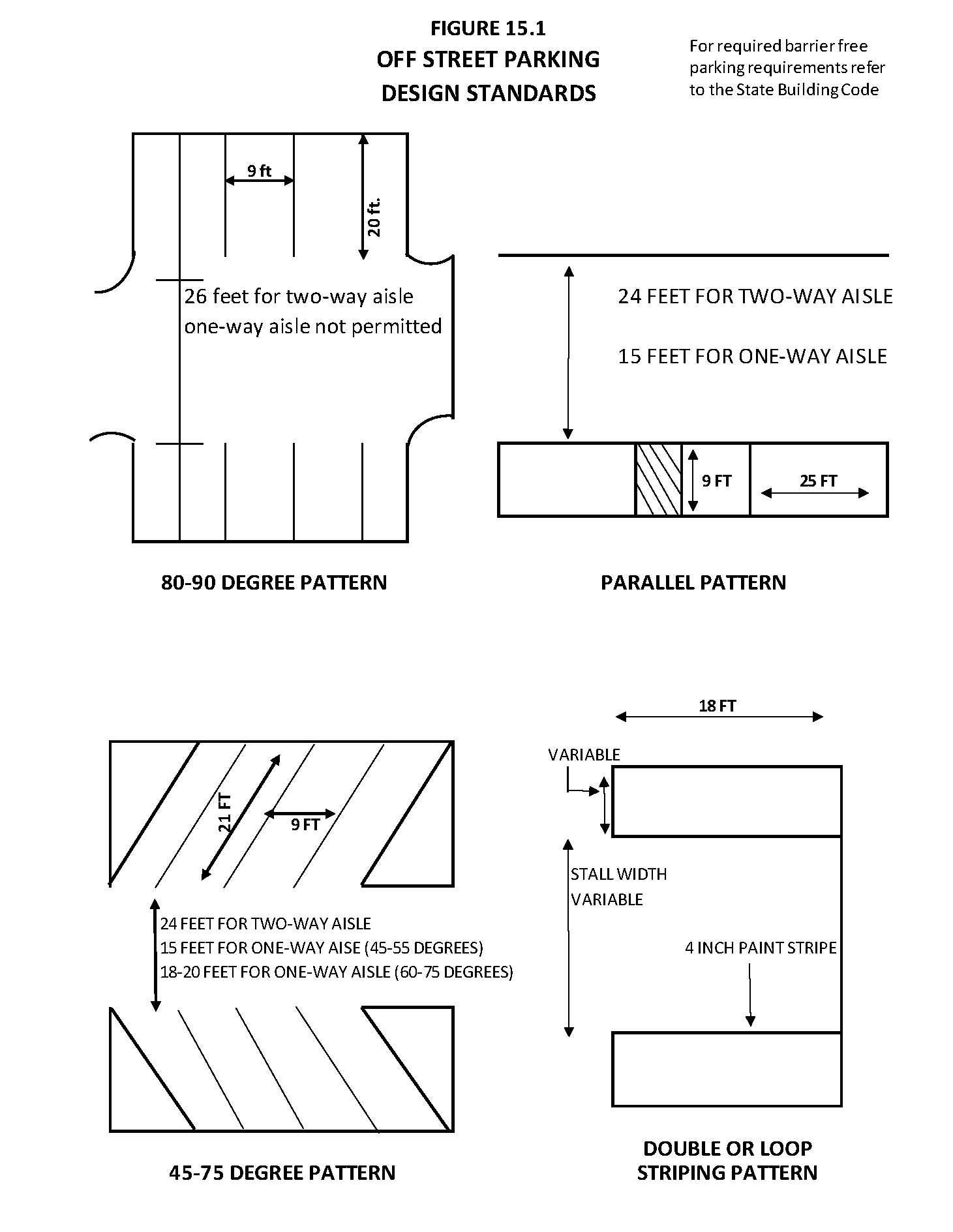
Dimensions. All spaces shall be designed and marked with dimensions described below and shall meet the standards of the City of Owosso Engineering Standards.
(6)
Parking lot marking. All parking spaces must be marked with a single four-inch stripe or double (or loop) stripes three (3) to four (4) inches wide and spaced not less than eighteen (18) inches apart and no greater than twenty-four (24) inches apart where appropriate.
(7)
Walkways. In accordance with section 38-56, sidewalks, bike paths, and walkways, walkways shall be located within the parking areas and provide access to the entrances of the building(s).
(Ord. No. 844, § 2, 3-18-24)
Sec. 38-188. - Parking lot construction and maintenance.
(1)
Plans and specifications for parking and loading areas shall be submitted to the zoning administrator prior to the issuance of a building permit. These plans shall at a minimum:
(a)
Show existing and proposed grades.
(b)
Be designed to ensure that storm water runoff shall be accommodated on-site through approved drainage facilities, including catch basins, runoff calculations, pipe sizes and connections to existing drainage structures.
(c)
Provide specifications on surface and base materials to be used for construction.
(2)
Required parking lots shall be installed and completed within six (6) months of receipt of a building permit and before issuance of an occupancy permit. The zoning administrator may grant a single extension for an additional six (6) months in the event of adverse weather conditions or unusual delays beyond the control of the property owner.
(3)
All parking areas shall be maintained free of dust, trash, and debris. Surfacing, curbing, lighting fixtures, signs, and related appurtenances shall be maintained in good condition.
(4)
The visibility of pavement markings delineating parking spaces and directional control shall be maintained.
(5)
All off-street parking and loading facilities required by this article shall be maintained free of accumulated snow or standing water which prevent full use and occupancy of such facilities, except for temporary periods of no more than five (5) days in the event of heavy rainfall or snowfall.
(Ord. No. 844, § 2, 3-18-24)
Sec. 38-189. - Off-street loading and unloading requirements.
(1)
General applicability. On-premises space for standing, loading and unloading vehicles shall be provided for each use involving the receipt or distribution of goods. Compliance with the loading space regulations set forth herein shall be required in order to avoid interference with the public use of streets, alleys, parking areas, driveways, sidewalks, and other public areas.
(2)
Change in use and intensity. Whenever use of a building, structure, or lot is changed, loading space shall be provided as required by this article for the new use, regardless of any variance which may have been in effect prior to change of use.
(3)
Location.
(a)
Loading/unloading areas and docks shall be prohibited in the front yard or on any building side facing and directly visible from a public street.
(b)
Loading/unloading operations shall not interfere with traffic on public streets or off-street parking.
(c)
The vehicular path and turning radii to the loading area must be shown on the site plan to verify truck maneuverability for the largest truck intended to serve the use.
(4)
Size. The size of all required loading/unloading spaces shall be at least ten (10) feet by fifty (50) feet or five hundred (500) square feet in area for office uses and at least ten (10) feet by seventy (70) feet or seven hundred (700) square feet in area for commercial and industrial uses, with a clearance of at least fourteen (14) feet in height.
(5)
Surfacing and drainage.
(a)
Loading areas shall be hard-surfaced with concrete or plant-mixed bituminous material.
(b)
Loading areas shall be graded and drained so as to dispose of surface waters.
(c)
Surface water shall not be permitted to drain onto adjoining property, unless in accordance with an approved drainage plan.
(d)
Grading, surfacing, and drainage plans shall be subject to review and approval by the engineer.
(6)
Storage and repair. The storage of merchandise, sale of motor vehicles, storage of inoperable vehicles, or repair of vehicles is prohibited in required loading space.
(7)
Central loading. Central loading facilities may be substituted for individual loading spaces serving businesses on separate lots provided that all of the following conditions are fulfilled:
(a)
Each business served shall have direct access to the central loading area without crossing streets or alleys. Loading from a public street is not permitted.
(b)
Total loading space provided shall meet the minimum requirements specified herein, in consideration of total floor area of all businesses served by the central loading space.
(c)
No building served shall be more than three hundred (300) feet from the central loading area.
(8)
Loading space requirements. The minimum number of loading spaces shall be provided in accordance with the following table. The planning commission may modify these requirements upon making the determination that another standard would be more appropriate because of the number or type of deliveries experienced by a particular business or use.
(9)
Screening. When required off-street loading in a nonresidential district is visible from public view or abuts a residential district, the off-street loading shall be screened by a solid, ornamental masonry wall at least six (6) feet in height above the grade elevation at the residential district line, in addition to the landscape requirements of article XVII, landscape standards and tree replacement.
(10)
Calculations. Required loading areas shall not be included in calculations for off-street parking space requirements.
(Ord. No. 844, § 2, 3-18-24)

