
Owosso City Zoning Code
ARTICLE XX
SIGNS
Sec. 38-250. - Short title.
This chapter shall be known as and may be cited as the City of Owosso Sign Ordinance.
(Ord. No. 844, § 2, 3-18-24)
Sec. 38-251. - Purpose.
(1)
The purpose of this article is to regulate signs and to minimize outdoor advertising within the city so as to protect public safety, health and welfare; minimize abundance and size of signs to reduce visual clutter, motorist distraction, and loss of sight distance; promote public convenience; preserve property values; support and complement land use objectives as set forth in the City of Owosso Master Plan and this article; and enhance the aesthetic appearance and quality of life within the city. The standards contained herein are intended to be content neutral.
(2)
These objectives are accomplished by establishing the minimum amount of regulations necessary concerning the size, placement, construction, illumination, and other aspects of signs in the city so as to:
(a)
Recognize that the proliferation of signs is unduly distracting to motorists and non-motorized travelers, reduces the effectiveness of signs directing and warning the public, causes confusion, reduces desired uniform traffic flow, and creates potential for accidents.
(b)
Prevent signs that are potentially dangerous to the public due to structural deficiencies or disrepair.
(c)
Reduce visual pollution and physical obstructions caused by a proliferation of signs which would diminish the city's image, property values, and quality of life.
(d)
Recognize that the principal intent of commercial signs, to meet the purpose of these standards and serve the public interest, should be for identification of an establishment on the premises, and not for advertising special events, brand names, or off-premises activities; alternative channels of advertising communication and media are available for advertising which do not create visual blight and compromise traffic safety.
(e)
Enable the public to locate goods, services and facilities without excessive difficulty and confusion by restricting the number and placement of signs.
(f)
Prevent placement of signs which will conceal or obscure signs of adjacent uses.
(g)
Protect the public right to receive messages, especially noncommercial messages such as religious, political, economic, social, philosophical and other types of information protected by the First Amendment of the U.S. Constitution.
(3)
The regulations and standards of this article are considered the minimum necessary to:
(a)
Achieve a substantial government interest for public safety, aesthetics, protection of property values, and are intended to be content neutral.
(b)
Allow for adequate and effective signage for business identification and other commercial speech, noncommercial speech, and dissemination of public information, including but not limited to, public safety information and notification as may be required by law.
(c)
Prevent off-premises signs from conflicting with other allowed land uses.
(d)
Maintain and improve the image of the city by encouraging signs of consistent size which are compatible with and complementary to related buildings and uses, and harmonious with their surroundings.
(e)
Prohibit portable commercial signs in recognition of their significant negative impact on traffic safety and aesthetics.
(f)
Preserve and enhance the image of the city.
(g)
To prohibit all signs not expressly permitted by this chapter.
(h)
To provide for the permitting of signage and the enforcement of the provisions of this chapter.
(i)
Permit signs containing noncommercial speech are permitted anywhere that advertising or business signs are permitted, subject to the same regulations applicable to such signs.
(Ord. No. 844, § 2, 3-18-24)
Sec. 38-255. - Sign definitions.
The following words, terms and phrases, when used in this article, shall have the meanings ascribed to them in this article, except where the context clearly indicates a different meaning.
Abandoned sign: Any sign which is still on the premises six (6) months after a business ceases to operate or moves from the location.
Accessory sign: A sign which pertains to the use of the premises on which it is located.
Address sign: Address numbers attached to the building or sign which are readily visible from the street.
Administrator: The city manager or his designated representative within the city.
Alteration: Any construction or repair which significantly changes a sign, including additions or deletions to the sign structure.
Animated sign: A sign which uses lights, moving parts, or other means to depict action, create an image of a living creature or person, or create a special effect or scene.
Awning: A roof-like cover, typically constructed of canvas, vinyl or similar fabric stretched over a framework, that projects from the wall of the building for the purpose of shielding a doorway, a window, or pedestrians from the elements.
Awning sign: A permanent sign painted on, printed on, or attached flat against the surface of an awning.
Balloon sign: A type of temporary, portable sign filled with air or gas.
Banner: A fabric, plastic or other sign made of non-rigid material without enclosing structural framework. National flags, state or municipal flags, or the official flag of any institution or business shall not be considered banner signs.
Barber pole sign: A permanent sign attached to the building in a vertical cylinder shape with moving and/or alternating colors.
Building marker: Any sign indicating the name of a building and date of construction which is typically cut into a masonry surface and part of the building wall construction.
Business or campus center: A grouping of two (2) or more buildings on one (1) or more parcels of property which may share parking, access and are linked by ownership giving the appearance of a unified grouping of uses.
Changeable message sign: A sign on which the message is changed mechanically, electronically or manually. The elements may be internally illuminated or may be illuminated by reflected light. The sign may be framed by permanent, nonmoving signage. Reference electronic message sign (EMS) definition.
Commemorative plaque: A memorial tablet, commemorative plaque, or sign including historical identification sign, designating the name and date of significance, cut into or raised on any masonry surface, or when constructed of cast metal, with a total maximum sign area of ten (10) square feet.
Community special event sign: Signs and banners, including decorations and displays celebrating a traditionally-accepted patriotic or religious holiday, or special municipal, school or other nonprofit activities.
Construction sign: A temporary sign identifying the name(s) of project owners, contractors, developers, realtors representing developers, architects, designers, engineers, landscape architects, and financiers of a project being constructed or improved; and not including any advertising of any product or announcement of availability of leasing space.
Directional sign: A sign which assists motorists in determining or confirming a correct route such as, enter, exit and parking signs.
Display time: The amount of time a message and/or graphic is displayed on an electronic message sign.
Double faced sign: Signs with two (2) parallel or nonparallel sign surfaces not more than twenty-four (24) inches apart at any point on the opposite face.
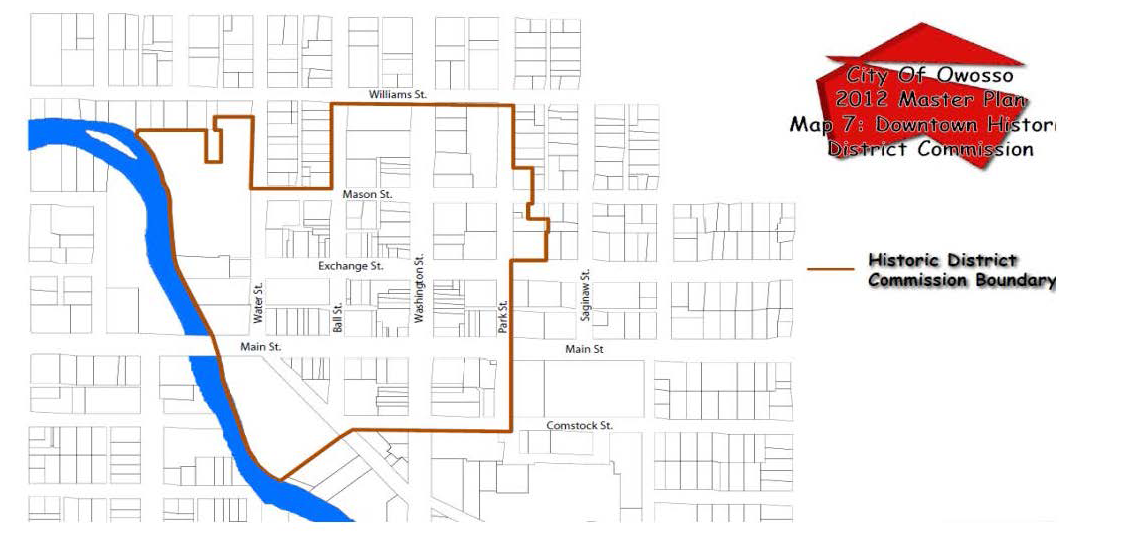
Downtown historic district boundary: As shown in the map.
Electronic message sign (EMS): A sign or portion of a sign, that displays an electronic image or video, which may or may not include text, including any sign or portion of a sign that uses changing lights or similar forms of electronic display such as LED to form a sign message with text and or images wherein the sequence of messages and the rate of change is electronically programmed and can be modified by electronic processes. This definition includes without limitation television screens, plasma screens, digital screens, flat screens, LED displays, video boards, and holographic displays.
Fade: A mode of message transition on an electronic message sign accomplished by varying the light intensity, where the first message gradually reduces intensity to the point of not being legible and the subsequent message gradually increases intensity to the point of legibility.
Feather or flutter sign: Any sign that is comprised of material that is suspended or attached in such a manner to a pole or stake as to attract attention by waving, moving or fluttering from natural wind currents. It also includes similar signs that do not move or flutter. Feather or flutter signs are considered temporary signage.
Festoon: Temporary signage that is a string of ribbons, tinsel, small flags, pinwheels, streamer, pennants, or balloons, typically strung overhead.
Flag: Any sign printed or painted on cloth, plastic, canvas, or other like material with distinctive colors, patterns, or symbols attached to a pole or staff and anchored along only one (1) edge or supported or anchored at only two (2) corners.
Flashing sign: A sign which contains an intermittent or sequential flashing light source.
Gas station canopy: A freestanding, open-air structure constructed for the purpose of shielding service station islands from the elements.
Gas station canopy sign: Any sign that is part of, or attached to, the vertical sides of the gas station canopy roof structure.
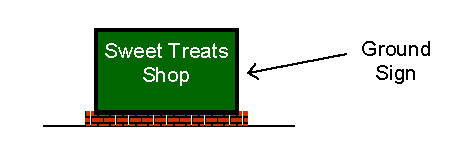
Ground or monument sign: A sign extending upward from grade that is attached to a permanent foundation with either stone or masonry or is wrapped in a material so that the support structure is concealed.
Historical marker: A historical marker or historic marker is an indicator such as a plaque or sign to commemorate an event or person of historic interest and to associate that point of interest with a specific locale one can visit. Historical marker designation and plaque or sign size and placement may be regulated by local, state, or federal regulations and standards.
Illegal sign: A sign which does not meet the requirements of this article and does not have legal nonconforming status.
Illuminated sign: Any sign that provides artificial light directly on or through any transparent or translucent material, from a source of light connected with such sign, or a sign illuminated by a light with a source so obscured and shielded that no direct rays from it are visible from a public right-of-way or from an abutting property.
Incidental sign: A small sign, emblem, or decal informing the public of goods, facilities, or services available on the premises. Examples of incidental signs include credit card signs, signs indicating the hours of business, no smoking signs, signs used to designate bathrooms, and signs providing information on credit cards and business affiliations.
Inflatable sign: A sign that is an air-inflated object, which may be of various shapes, made of flexible fabric, resting on the ground or structure and equipped with a portable blower motor that provides a constant flow of air into the device.
Institutional uses: Meaning a use by public or quasi-public institution such as a religious organization, church, nonprofit organization, academic institution, library or hospital.
Maintenance: For the purposes of this chapter, the cleaning, painting, repair or replacement of defective parts of a sign in a manner that does not alter the basic copy, design, or structure of the sign.
Mansard: A sloped roof or roof-like Facade. Signs mounted on the face of a mansard roof shall be considered roof signs.
Marquee: A permanent roof-like structure or canopy, supported by and extending from the face of the building.
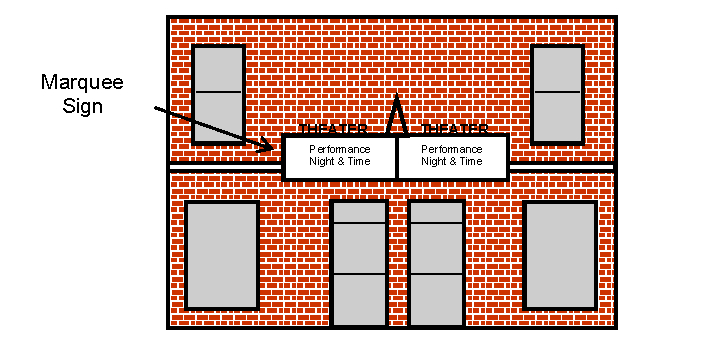
Marquee sign: A permanent sign attached to any part of a marquee other than the roof.
Menu board sign: A sign oriented to the drive through lane for a restaurant that advertises the menu available from the drive through window.
Moving sign: A sign in which the sign itself, or any portion of the sign, moves or revolves. A "rotating sign" is a type of moving sign. This definition does not include "changeable message signs."
Mural: A design or representation which is painted or drawn on the exterior surface of a structure and which does not advertise a business, product, service, or activity.
Nonconforming sign: A sign that does not comply with the size, placement, construction or other standards or regulations of this article, but were lawfully established prior to its adoption. Signs for which the zoning board of appeals has granted a variance are exempt and shall not be defined as nonconforming.
Obsolete sign: A sign that advertises a product that is no longer made or that advertises a business that has closed.
Off-premises sign: A sign which identifies a use or advertises products and services not available on the site or parcel on which the sign is located; a sign which directs travelers or provides a message unrelated to the site on which the sign is located, e.g. billboards.
On-premises sign: A sign providing the address and name of owner of a parcel of land; a sign advertising a business, service or product sold or produced on the same site or parcel.
Outline tubing sign: A sign consisting of glass tubing, filled with a gas such as neon, which glows when electric current is sent through it including neon and luminous tube. Outline tubing signs shall also apply to signs consisting of LED tubing. Accent lighting not spelling words shall not be considered signage.
Owner: A person regarded as such on city tax records, or a tenant of the premises so designated by the administrator.
Owosso Historic District Commission: Formed in the fall of 2010, this regulatory commission is responsible for reviewing all applications for exterior work that is completed in within the downtown historic district commission (HDC) boundaries.
Parapet: The extension of a false front or wall above a roof line. Signs mounted on the face of a parapet shall be considered wall signs.
Pennant: A flag or banner that tapers to a point. A pennant is considered a temporary sign.
Permanent sign: A sign designed to be installed permanently in the ground or wall of a building that is constructed out of durable materials.
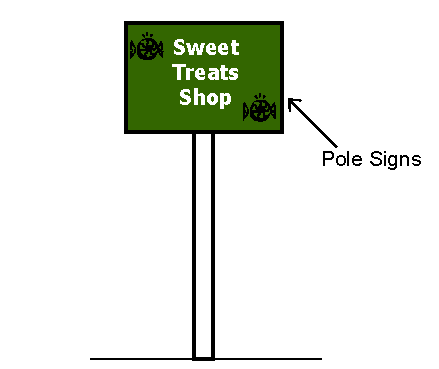
Pole sign: A sign supported on the ground by a pole, braces, and not attached to any building or other structure.
Portable sign: A temporary sign designed to be moved from place to place by wheels, whether or not it is attached to the ground or a structure. Portable may include changeable signage area.
Premises: The contiguous land in the same ownership or control which is not divided by a public street.
Principal building: The building in which is conducted the principal use of the zone lot on which it is located. Zone lots with multiple principal uses may have multiple principal buildings, but storage buildings, garages, and other clearly accessory uses shall not be considered principal buildings.
Projecting sign: A sign, other than a wall sign, that is affixed to any building or wall and whose leading edge extends more than twelve (12) inches beyond such building or wall. The leading edge may extend over the public right-of-way.
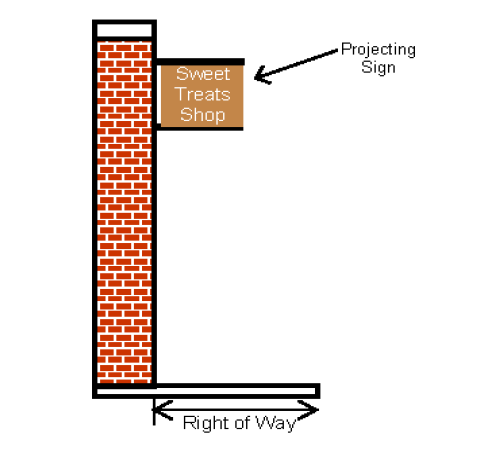
Public sign: A sign erected in the public interest by or upon orders from a city, state, or federal public official. Examples of public signs include: legal notices, safety signs, traffic signs, memorial plaques, signs of historical interest, and similar signs.
Real estate development sign: A sign that is designed to promote the sale or rental of lots, homes, or building space in a real estate development (such as a subdivision or shopping center) which is under construction on the parcel on which the sign is located.
Real estate sign: An on-premises temporary sign advertising the property or structure's availability for sale or lease.
Regulatory sign: A sign installed by a public agency to direct traffic flow, regulate traffic operations and provide information in conformance with the state manual of uniform traffic-control devices.
Residential entranceway sign: A permanent sign which marks the entrance to a subdivision, apartment complex, condominium development, or other residential development.
Roof line: The top edge of a roof or building parapet, whichever is higher, excluding cupolas, pylons, chimneys, or similar minor projections.
Roof sign: A temporary sign or permanent sign erected upon, against, or directly above a roof or on top of or above the parapet of a building, or signs where any portion of the sign extends above the roof of the building where the sign is located.
Sandwich board sign: A temporary sign containing two (2) separate faces which are attached to one another at the top by one (1) or more hinges or fasteners and which when placed upon the ground will stand upright without any additional support.
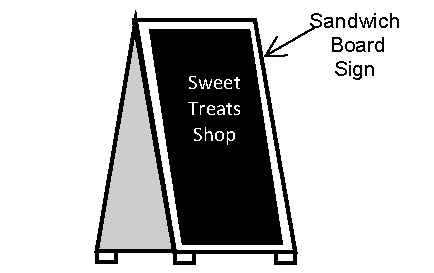
Sign: A sign means any structure or wall or other object used for the display of any message, and includes but is not limited to any bill, poster, placard, handbill, flyer, painting, balloon, streamer or other similar object in any form whatsoever which may contains printed or written matter in words, symbols, or pictures, or in any combination thereof attached to or affixed to the ground or any structure.
Temporary sign: A sign constructed of paper, cloth, canvas, plastic, cardboard, wall board, plywood, or other like material that are constructed for limited time use, lack a permanent foundation or mounting, or is determined by the ordinance enforcer to be displayed for a limited time.
Time and temperature sign: Signs which display the current time and/or temperature only.
Vehicle sign: Signs affixed to a parked vehicle or truck trailer which is being used principally for advertising purposes. This does not include the use of business logos, identification or advertising on vehicles primarily and actively used for business purposes and/or personal transportation on a daily basis.
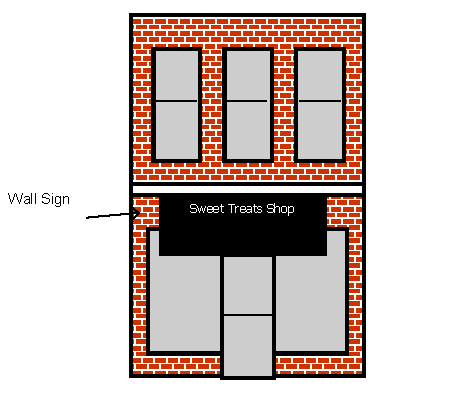
Wall sign: A sign attached parallel to and extending not more than twelve (12) inches from the wall of a building.
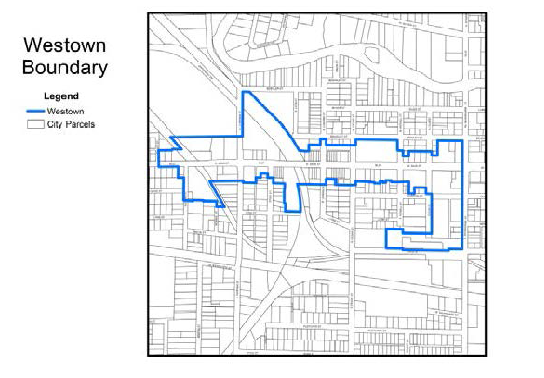
Westown boundary: As shown in the map.
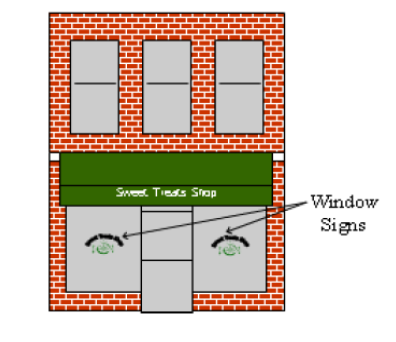
Window sign: A sign located in or on a window which is intended to be viewed from the outside. This includes TV or computer screens placed in the window visible from the outside.
(Ord. No. 844, § 2, 3-18-24)
Sec. 38-256. - Applicability; effect and scope.
The regulations of this chapter shall apply to all signs visible from a public right-of-way, private road, public park or residentially zoned property located within the city.
(Ord. No. 844, § 2, 3-18-24)
Sec. 38-257. - Sign permits.
(1)
All signs are subject to the general and specific regulations of this chapter whether they require a permit or not. Any sign permitted under the chapter may contain either a commercial or noncommercial message.
(2)
Any signs within the downtown historic district shall meet and be reviewed for all requirements of the city historic district commission prior to submittal of a permit to the city.
(3)
It shall be unlawful for any person to erect, re-erect, change panels, make an alteration, or relocate any sign unless a permit shall have been first obtained from the administrator, and a permit fee paid in accordance with the schedule adopted by resolution of the city council. Electrical signs shall, in addition, require an electrical permit.
(4)
Applications for sign permits and the appropriate nonrefundable fee shall be made upon forms provided by the building department for this purpose and in accordance with application specifications published by the administrator. These specifications shall be as complete in form as necessary for evaluation of the sign in relationship to the requirements of this chapter.
(5)
Within ten (10) days of receiving an application for a sign permit, the administrator shall review it for completeness. If the administrator finds that it is complete, the application shall then be processed. If the administrator finds that it is incomplete, the administrator shall, within such ten (10) day period, send to the applicant a notice of the specific ways in which the application is deficient, with appropriate references to the applicable sections of this chapter. If it is discovered that the sign permit application contains any false information, the administrator may revoke the permit or deny the application, whichever is appropriate.
(6)
The administrator shall issue a permit within ten (10) days of receipt of a valid application, provided that the sign complies with all applicable laws and regulations of the city. In all applications, where a matter of interpretation arises, the more specific definition or higher standard shall prevail.
(7)
When a permit is denied, the administrator shall within ten (10) days, give a written notice to the applicant along with a brief statement of the reasons for denial, citing code sections and interpretation of possible nonconformity.
(8)
Unless otherwise indicated, no person shall conceal any portion of such work until it has been inspected and approved by the administrator. The administrator shall inspect the work completed in conformance with the approved permit and applicable codes. If the construction is not complete within six (6) months of the permit issuance date, the permit shall expire.
(Ord. No. 844, § 2, 3-18-24)
Sec. 38-258. - Signs exempt from permit regulations.
The following signs are exempted from permit requirements but must be in conformance with all other requirements of this chapter:
(1)
Address signs.
(2)
Building marker.
(3)
Commemorative plaque.
(4)
Historical marker sign.
(5)
Directional signs.
(6)
Public signs and regulatory signs.
(7)
Temporary signs as detailed in this chapter.
(8)
Time and temperature signs.
(9)
Window signage.
(Ord. No. 844, § 2, 3-18-24)
Sec. 38-259. - Prohibited signs.
The following signs are prohibited in all districts:
(1)
Abandoned signs.
(2)
Balloon signs.
(3)
Festoons.
(4)
Flashing signs.
(5)
Illegal signs.
(6)
Inflatable signs.
(7)
Moving signs excluding barbershop poles.
(8)
Obsolete signs.
(9)
Off-premises signs, unless otherwise specified in this chapter.
(10)
Outline tubing signs.
(11)
Pennants.
(12)
Portable signs.
(13)
Roof signs.
(14)
Vehicle signs.
(15)
Non-regulatory signs placed in any public right-of-way; attached to a utility pole; or affixed to a tree, street furniture, or waste receptacles.
(16)
Any sign which simulates or imitates in size, color, lettering, or design, any traffic sign or signal or other word, phrase, symbol, or character in such a manner as to interfere with, mislead, or confuse the drivers of motorized vehicles.
(17)
Signs which obstruct or impair the vision of motorists or non-motorized travelers at any intersection, driveway, within a parking lot or loading area.
(18)
Signs which obstruct the minimum five (5) feet of clearance required for barrier free accessibility.
(19)
Signs which obstruct free access or egress from any building, including those that obstruct any fire escape, required exit way, window, or door opening or that prevent free access to the roof by firefighters.
(Ord. No. 844, § 2, 3-18-24)
Sec. 38-260. - General standards for permitted signs.
The following regulations shall apply, unless otherwise specifically stated in this chapter, to all signage erected or located in any zoning district within the city:
(1)
The current edition of the state building code shall be in full force and effect in the city as if set out fully herein. Complete printed copies of the code are available for public use and inspection at the office of the city clerk.
(2)
Sign setbacks.
(a)
All signs, unless otherwise provided for, shall be set back a minimum of five (5) feet from any public or private street right-of-way line or access drive in all districts. This distance shall be measured from the nearest edge of the sign, measured at a vertical line perpendicular to the ground to the right-of-way.
(b)
Side yard setbacks for signs shall be the same as that required for the main structure or building.
(3)
Adequate sight distance. In order to ensure adequate sight distance for motorists, bicyclists and pedestrians, a minimum clear vision area shall be maintained between a height of twenty-four (24) inches and six (6) feet within a triangular area measured twenty-five (25) feet back from intersection of public right-of-way lines. Furthermore, signs shall not be permitted where they obstruct motorist vision of regulatory signs, traffic-control devices or street signs.
(4)
Illumination.
(a)
Signs may be illuminated, but only by steady, stationary, shielded light sources directed solely at the sign or internal to the sign.
(b)
Use of glaring undiffused lights, bare bulbs, or flames is prohibited.
(c)
External sources of illumination shall be shielded and directed to prevent glare onto neighboring properties or the public right-of-way.
(d)
Underground wiring shall be required for all illuminated signs not attached to a building.
(5)
Maintenance, construction and design.
(a)
All signs shall be maintained in good structural condition at all times.
(b)
All signs shall be kept neatly painted, stained, sealed or preserved including all metal, wood or other materials used for parts and supports.
(c)
All signs, including any cables, guide wires, or supports shall have a minimum clearance of four (4) feet from any electric fixture, electric line, street light, or other public utility pole or standard.
(d)
Signs shall not be constructed from materials that are remnants or manufactured for a different purpose.
(6)
Addresses. Addresses shall be in compliance with the International Fire Code requirements for number size and visibility from the public right-of-way.
(7)
Noncommercial speech. Signs containing noncommercial speech are permitted anywhere that advertising or business signs are permitted, subject to the same regulations applicable to such signs.
(8)
Directional signs.
(a)
Private on-premises directional signs.
1.
Not more than one (1) directional sign shall be permitted for each approved driveway entrance from a right-of-way, with a maximum sign area of six (6) square feet per sign, and a maximum height of six (6) feet.
2.
Any directional sign which includes a business name, symbol or logo shall be calculated as part of the allowable sign square footage.
3.
Directional signage located within a business center not adjacent to a public right-of-way shall be governed by the property owner.
(b)
Private off-premises directional signs. Private off-premises directional signs which provide directions to a commercial or industrial establishment which is not located on a primary street within the city shall be allowed on private property provided there exists a written agreement between the property owner and the business/industry. Said agreement shall be filed with the city.
1.
Off-premises directional signs shall be no greater than twelve (12) square feet.
2.
Sign lettering may only display the off-premises business name, address, and an arrow indicating direction.
3.
Off-premises directional signs shall only be located in the CBD, COR, GBD, O and I-1, and I-2 districts.
(c)
Public off-premises directional signs. Public off-premises directional signs erected by the city, city affiliated organization or state shall be permitted in the street right-of-way.
(9)
Temporary signs. Temporary signs as defined in section 38-255 are allowed with a permit subject to the following:
(a)
Size of temporary signs: The total aggregate sign area of all temporary signs on any one (1) site shall not exceed thirty (30) square feet. The maximum size of individual temporary signs shall not exceed twenty (20) square feet in area. Temporary signs shall not be higher than forty-two (42) inches above average mean grade of the yard on which it is placed.
1.
Exceptions:
a.
For uses other than one- and two- family dwellings, temporary signs for buildings under construction shall be a maximum size of ten (10) percent of the square foot area of the front of the structure, and not more than twenty (20) feet in height.
b.
One (1) temporary sign located on vacant land that is for sale or for lease, when the parcel exceeds two (2) acres in area, shall be allowed to have a size equal to sixty-four (64) square feet of sign area (total), but not more than thirty-two (32) square feet per sign face and not more than eight (8) feet in height.
(b)
Location of temporary signs:
1.
Temporary signs shall not be attached to any utility pole or be located within any public right-of-way.
2.
Temporary signs shall not be erected in such a manner that they will or reasonably may be expected to interfere with, obstruct, confuse or mislead traffic.
3.
Temporary signs cannot be placed or constructed so as to create a hazard of any kind.
4.
Prior to the erection or placement of a temporary sign, the permission of the property owner where the sign is to be located must be secured.
5.
Signs shall be located so as to comply with the corner clearance requirements of the chapter.
6.
Temporary signs shall not be illuminated.
(c)
Time limitations for temporary signs: Temporary signs shall be removed within sixty (60) days of placement, except for temporary signs that are located on real property that is for sale or lease. Temporary signs are permitted for sixty (60) days in a one-hundred-twenty-day period.
(10)
Measuring sign area and height.
(a)
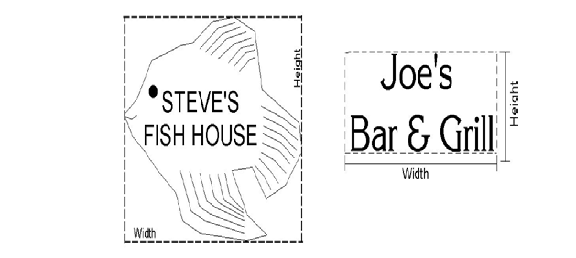
Measurement of allowable sign area (see figure 26.10a. guidelines for measuring sign face square footage below).
Figure - 38-260.10a Guidelines for measuring sign face square footage.
(b)
The sign area shall include the surface area which encloses the extreme limits of the sign copy together with the frame or other material or color forming an integral part of the display or used to differentiate the sign from the background against which it is placed, excluding only the structure necessary to support the sign.
(c)
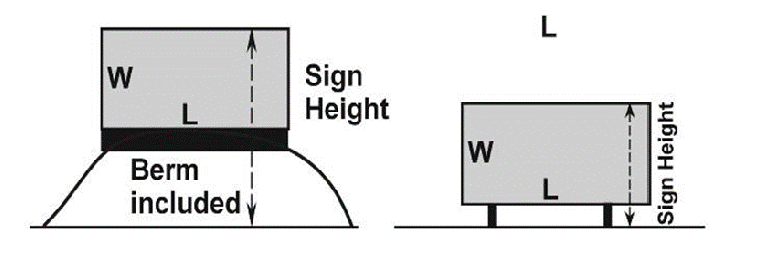
Measurement of sign height. Sign height shall be the vertical distance measured from the point of ground immediately beneath the sign to the highest point of the sign, including decorative embellishments. Where the ground elevation beneath a sign varies, the average grade of the ground within a five-foot radius of the sign structure shall be used. The average grade shall be the highest point within said radius plus the lowest point within said radius, divided by two (2). Any filling, berming, mounding or excavating solely for the purpose of locating the sign shall not be included in the calculation of average grade.
Figure - 38-260.10b
(Ord. No. 844, § 2, 3-18-24)
Sec. 38-261. - Nonconforming signs.
Nonconforming signs are those signs that do not comply with the size, placement, construction or other standards or regulations of this chapter, but were lawfully established prior to its adoption. Signs for which the board of appeals has granted a variance are exempt and shall not be defined as nonconforming. It is the intent of this article to encourage eventual elimination of nonconforming signs in a timely manner. This objective is considered as much a subject of public health, safety and welfare as the prohibition of new signs in violation of this article. Therefore, the purpose of this article is to remove illegal nonconforming signs while avoiding any unreasonable invasion of established private property rights. A nonconforming sign may be continued and shall be maintained in good condition as described elsewhere in this article, however, the following alterations are regulated:
(1)
A nonconforming sign shall not be structurally altered or repaired so as to prolong its useful life or so as to change its shape, size, type or design unless such change shall make the sign conforming.
(2)
A nonconforming sign shall not be replaced by another nonconforming sign.
(3)
A nonconforming sign shall not be reestablished after abandonment as defined in subsection 38-262(3), dangerous, unsafe, abandoned, and illegally erected signs.
(4)
A nonconforming sign must not be reestablished after damage or destruction if the estimated expense of reconstruction exceeds fifty (50) percent of the appraised replacement cost as determined by the building official/zoning administrator or if fifty (50) percent or more of the face of the sign is damaged or destroyed.
(Ord. No. 844, § 2, 3-18-24)
Sec. 38-262. - Dangerous, unsafe, abandoned, and illegally erected signs.
(1)
Dangerous signs. Any sign constituting an immediate hazard to health or safety shall be deemed a nuisance and may be immediately removed by the city and the cost thereof charged against the owner of the property on which it was installed.
(2)
Unsafe signs. Any sign that becomes insecure, in danger of falling, or otherwise unsafe but not considered an immediate danger by the building official/zoning administrator to the health or safety of the public shall be removed or repaired according to the process outline in paragraph (e) below.
(3)
Abandoned signs. Any sign that advertises a business that has been discontinued for at least ninety (90) days or that advertises a product or service that is no longer offered shall be deemed abandoned. Permanent signs applicable to a business temporarily suspended by a change in ownership or management shall not be deemed abandoned unless the structure remains vacant for at least six (6) months. An abandoned sign shall be removed by the owner or lessee of the premises. If the owner or lessee fails to remove the sign, the building official/zoning administrator shall initiate the process noted in paragraph (e) below.
(4)
Illegally erected signs. The building official/zoning administrator shall order the removal of any sign erected illegally in violation of this article, according to the process outlined in paragraph (e) below.
(5)
Process for enforcing violations of section 38-262, dangerous, unsafe, abandoned, and illegally [erected] signs. For violations of section 38-262, the building official/zoning administrator shall notify the owner of the property on which the sign is located. Verbal notices or those sent by first class mail shall be sufficient notice. Where a sign erected in violation of this article is considered dangerous or unsafe, the notice shall inform the owner to remove said sign(s) immediately and property owners of other illegal signs on private property shall be granted a reasonable period of time within which to remove the sign, as determined by the building official/zoning administrator. Should the property owner fail to remove the sign(s) within the time specified, or if a sign is erected within any right-of-way or public property, the building official/zoning administrator, or their designee, shall have the authority to remove the sign, and the property owner shall be liable for the cost thereof.
(Ord. No. 844, § 2, 3-18-24)
Sec. 38-263. - Administration of sign ordinance standards.
(1)
Generally. The regulations of this article shall be administered and enforced by building official/zoning administrator.
(2)
Signs in the public right-of-way. In addition to the penalties prescribed below, any sign erected in the public right-of-way may be removed by the ordinance enforcer and stored in a safe location for at least forty-eight (48) hours. During this period of time, the sign owner may obtain the sign from the city upon request and payment of a fee established in the city's fee schedule which will cover the cost of removal and storage. After forty-eight (48) hours, the city may dispose of the sign.
(3)
Violations. It shall be unlawful for any person to erect, construct, enlarge, alter, repair, move, use or maintain any sign in the city, or cause or permit the same to be done, contrary to or in violation of any of the standards and regulations of this article. Any such violation, including the failure to remove a sign when directed under the authority of this article, shall constitute a misdemeanor punishable in accordance with section 34-231 of the Owosso Code of Ordinances.
(Ord. No. 844, § 2, 3-18-24)
Sec. 38-264. - Board of appeals.
(1)
Organization. The sign board of appeals shall be the zoning board of appeals as organized in chapter 38.
(2)
Powers and duties.
(a)
Hear and decide appeals by the sign permit applicant from a decision of the administrator denying or failing to grant a sign permit within thirty (30) days of application.
(b)
Grant variances from the requirements of this chapter as part of the disposition of an appeal from action of the administrator denying or failing to grant a sign permit.
(c)
Hear and decide appeals of a determination by the administrator that a sign must be removed for noncompliance with this chapter.
(d)
Interpret the provisions of this chapter.
(3)
Grounds for variance. The board of appeals may grant a variance from the provisions or requirements of this chapter only where:
(a)
The literal interpretation and strict application of the provisions and requirements of this chapter would cause undue and unnecessary hardship to the sign user because of unique or unusual conditions pertaining to the specific building or parcel of property in question.
(b)
The granting of the requested variance would not be materially detrimental to the property owners in the vicinity.
(c)
The unusual conditions applying to the specific property do not apply generally to other properties in the city.
(d)
The granting of the variance will not be contrary to the general objective of this chapter of moderating the size, number and obtrusive placement of signs and the reduction of clutter.
(e)
Support for hardship. Where there is insufficient evidence, in the opinion of the board of appeals, to support a finding of "undue and unnecessary hardship" under subsection (a) of this section, but some hardship does exist, the board may consider the requirement fulfilled if:
1.
The proposed sign is of particularly good design and in particularly good taste.
2.
The entire site has been or will be of particularly good design and in granting a variance, the board may attach thereto such conditions regarding the location, character and other features of the proposed sign as it may deem necessary to carry out the spirit and purpose of this chapter in the public interest.
3.
Notice of hearing. Shall be done in accordance with the Michigan Zoning Enabling Act, Act 110 of 2006 and any amendments to said Act.
(Ord. No. 844, § 2, 3-18-24)
Sec. 38-270. - Signs permitted in one-family residential (R-1), two-family residential (R-2), and multiple-family residential (RM) districts signage table.
(Ord. No. 844, § 2, 3-18-24)
Sec. 38-271. - Signs permitted in one-family residential (R-1), two-family residential (R-2), and multiple-family residential (RM) districts signage.
The following signs are permitted in the R-1, R-2, and RM zoning districts subject to the following requirements:
(1)
Wall sign.
(a)
One (1) wall sign per business not to exceed ten (10) percent of front Facade for all uses other than single-family homes, duplexes, and attached condominiums.
(b)
No wall sign shall extend above the roof or parapet of the structure to which it is attached. No wall sign shall have a thickness greater than twelve (12) inches measured from the wall to which it is attached.
(c)
No wall sign shall be attached to a wall at a height less than eight (8) feet above any sidewalk.
(2)
Awning signs may be used as an alternative or in addition to wall signs for all uses other than single-family homes, duplexes, and attached condominiums, provided that they meet the following standards:
(a)
Awning signs and wall signs must not exceed ten (10) percent of front Facade.
(b)
Any sign area on an awning shall be included in calculations of maximum wall sign square footage.
(c)
Awning signs shall be set back at least two (2) feet from any street curb-line, shall not extend more than six (6) feet over the public right-of-way, and shall leave a minimum clearance of eight (8) feet above the ground and shall not project over an alley or private access lane.
(d)
No awning sign shall extend above the roof or parapet of the structure to which it is attached.
(e)
Awning signs shall not be internally illuminated.
(3)
Home occupations as allowed and defined in section 38-40 shall be permitted a sign not to exceed a size of two (2) feet by three (3) feet mounted flush to the building. The sign may be illuminated, provided such illumination is concentrated on the surface of the sign and is so located as to avoid glare or reflection onto any portion of an adjacent street or highway, into the path of oncoming vehicles, or on any adjacent premises. In no event, shall any home occupation sign have flashing or intermittent lights, nor shall the lights be permitted to rotate or oscillate.
(4)
Bed and breakfast signs as detailed in chapter 7 of the Owosso City Code.
(5)
Ground signs shall be permitted as follows for all uses other than single-family homes, duplexes and attached condominiums:
(a)
Not more than one (1) ground sign is permitted per parcel.
(b)
The top of the ground sign shall be no more than six (6) feet above ground level.
(c)
A ground sign shall not extend closer than five (5) feet to any part of the public right-of-way and shall meet the adequate sight distance requirements of this chapter.
(d)
No ground sign shall have an area exceeding twenty-four (24) square feet per side.
(e)
A ground sign shall be located on the same parcel as the use.
(f)
In order to ensure adequate sight distance for motorists, bicyclists and pedestrians, the location of the sign shall be such that a minimum clear vision area shall be maintained between a height of twenty-four (24) inches and six (6) feet within a triangular area measured twenty-five (25) feet back from intersection of public right-of-way lines. Furthermore, signs shall not be permitted where they obstruct motorist vision of regulatory signs, traffic-control devices or street signs.
(6)
One (1) electronic message sign, meeting the above requirements, may be permitted for institutional uses located in a residential district when meeting the following requirements:
(a)
The institutional use is located on a major or minor arterial or collector road.
(b)
The size of the electronic message sign shall be no greater than fifty (50) percent of the allowable ground sign square footage.
(7)
Residential entryway/ground signs shall be permitted as follows at the entrance of a residential subdivision:
(a)
Entryway sign:
1.
The top of the ground sign shall be no more than six (6) feet above ground level.
2.
A ground sign shall not extend closer than five (5) feet to the adjacent public right-of-way and shall meet the adequate sight distance requirements of this chapter.
3.
No ground sign shall have a single surface area exceeding twenty-four (24) square feet per side.
4.
A ground sign shall be located on the same parcel or at the vehicular entrance to identify subdivisions, apartment complexes, condominium communities, senior housing complexes, manufactured housing communities, or similar residential uses.
(b)
Real estate sales sign:
1.
One (1) temporary sign located on vacant land that is for sale or for lease or a residential development that has site plan approval and is under construction, and when the parcel exceeds two (2) acres in area, shall be allowed to have a size equal to sixty-four (64) square feet of sign area (total), but not more than thirty-two (32) square feet per sign face and not more than eight (8) feet in height.
2.
Real estate sales signs must be removed after the last lot/parcel/residence is sold/leased in the development.
(8)
Temporary signs per subsection 38-260(9) of this chapter and:
(a)
Temporary signs include, but are not limited to the following:
1.
For a single dwelling or building or vacant land: an on-site real estate sign, advertising the premises for sale, rent or lease.
2.
An on-site sign advertising an on-going garage, estate or yard sale.
3.
Noncommercial signs which contain noncommercial information or directional messages.
4.
Political signs.
5.
Holiday or other seasonal signs.
6.
Construction signs for buildings under construction. See real estate development sign requirements.
7.
All temporary signs must comply with the sign size and height standards as specified in the sign dimensional standards and regulations table.
(b)
Location of temporary signs shall comply with the following:
1.
Temporary signs shall not be attached to any utility pole or be located within any public right-of-way.
2.
Temporary signs shall not be located closer than twenty (20) feet to the edge of the traveled portion of the roadway, nor shall they be located within any dedicated right-of-way.
3.
Temporary signs shall not be erected in such a manner than they will or may reasonably be expected to interfere with, obstruct, confuse or mislead traffic.
4.
Temporary signs cannot be placed or constructed so as to create a hazard of any kind.
5.
Temporary signs may not be posted on private property without first obtaining the permission of the property owner.
6.
Signs shall not be located within any clear vision triangle, as described in section 38-41, intersection visibility.
(c)
Time limitations for temporary signs. Each temporary sign shall be removed within sixty (60) days of placement. Furthermore, no sign may be erected on a single parcel for more than sixty (60) calendar days out of every one hundred twenty (120) calendar days.
(Ord. No. 844, § 2, 3-18-24)
Sec. 38-272. - Signs permitted.
[Notes:]
1Lots fronting on two (2) or more streets are allowed the permitted signage for each street frontage, but signage cannot be accumulated and used on one (1) street in excess of that allowed for lots with only one street frontage.
2Additional wall signage is permitted per subsection 38-273(1)(b)3.
3Additional pole sign may be permitted per subsection 38-273(5).
4The percentage figure here shall mean the percentage of the area of the wall of which such sign is a part or to which each such sign is most nearly parallel.
(Ord. No. 844, § 2, 3-18-24)
Sec. 38-273. - Signs permitted in central business district (CBD), corridor district (COR) and general business (GBD) districts signage.
(1)
Wall sign.
(a)
Any signs within the downtown historic district shall meet and be reviewed for all requirements of the city historic district commission prior to submittal of a sign permit, and prior to installation of new signage or modification of existing signage.
(b)
Wall signs may be used provided that they meet the following standards:
1.
One (1) wall sign per business not to exceed ten (10) percent of front Facade or one hundred (100) square feet, whichever is less is permitted.
2.
No wall sign shall extend above the roof or parapet of the structure to which it is attached.
3.
Businesses located on a second public right-of-way, public parking lot or public alley shall be allowed up to two (2) wall signs, one (1) for each front Facade. The maximum wall sign area shall not exceed ten (10) percent of the front Facade of the building per use or business establishment.
4.
Additional wall sign square footage is permitted when the following is met:
a.
Two hundred one (201) to four hundred (400) linear feet of building frontage facing a public street and having a public entrance is allowed a maximum wall sign area of one hundred fifty (150) square feet.
b.
Greater than four hundred (400) linear feet of building frontage facing a public street and having a public entrance is allowed a maximum wall sign area of two hundred (200) square feet.
5.
No wall sign shall have a thickness greater than twelve (12) inches measured from the wall to which it is attached.
6.
No wall sign shall be attached to a wall at a height less than eight (8) feet above any sidewalk.
(2)
Ground sign.
(a)
Ground signs may be used provided that they meet the following standards:
1.
The top of the ground sign shall be no more than six (6) feet above ground level.
2.
A ground sign shall not extend closer than five (5) feet to the public right-of-way.
3.
No ground sign shall have an area exceeding forty (40) square feet per side.
4.
A ground sign shall be located on the same parcel as the building or use to which it is accessory.
5.
An additional ground sign may be permitted if access to the parcel is provided from two (2) public streets.
6.
In order to ensure adequate sight distance for motorists, bicyclists and pedestrians, the location of the sign shall be such that a minimum clear vision area shall be maintained between a height of twenty-four (24) inches and six (6) feet within a triangular area measured twenty-five (25) feet back from intersection of public right-of-way lines. Furthermore, signs shall not be permitted where they obstruct motorist vision of regulatory signs, traffic-control devices or street signs.
(3)
Changeable or electronic message sign.
(a)
Changeable or electronic message signs as part of a wall or ground sign when the following requirements are met:
1.
Changeable or electronic message signs are not permitted within the historic district boundary.
2.
One (1) changeable or electronic message signs sign shall be permitted per premises, but not both.
3.
The area of a changeable or electronic message sign shall not exceed half the total area of the sign.
4.
Illumination shall be concentrated within the face of the sign to prevent glare upon adjoining properties and thoroughfares.
5.
Electronic messages shall not flash, fade in or out, or scroll.
6.
Any voids or burned out bulb in an electronic display shall be replaced within ten (10) days of city notification.
7.
One (1) gasoline price sign is permitted for a gas station canopy with an area not to exceed ten (10) percent of the canopy Facade.
(4)
Pole signs.
(a)
Pole signs may be used provided that they meet the following standards:
1.
Pole signs are not permitted within the historic district boundary.
2.
A pole sign may stand no higher than the building it represents or twenty (20) feet above the level of the ground, upon which the sign is mounted, whichever is less.
3.
A pole sign shall not extend closer than five (5) feet to the public right-of-way.
4.
The lower edge of the pole sign shall be is eight (8) feet or more above the ground level.
5.
No pole sign shall have a single surface area exceeding forty (40) square feet per side.
6.
A pole sign shall be located on the same parcel of property as the building or use to which it is accessory.
7.
Changeable or electronic message signs as part of a pole sign when the following requirements are met:
a.
Changeable or electronic message signs are not permitted within the historic district boundary.
b.
One (1) changeable or electronic message sign shall be permitted per premises, but not both.
c.
The area of a changeable or electronic message sign shall not exceed half the total area of the sign.
d.
Illumination shall be concentrated within the face of the sign to prevent glare upon adjoining properties and thoroughfares.
e.
Electronic messages shall not flash, fade in or out, or scroll.
f.
Any voids or burned out bulb in an electronic display shall be replaced within ten (10) days of city notification.
g.
One (1) gasoline price sign is permitted for an overhead gas pump awning with an area not to exceed ten (10) percent of the awning Facade.
(5)
Number of pole or ground signs. Not more than one (1) pole or ground sign may be erected accessory to any single building, structure, or shopping center regardless of the number of separate parties, tenants or uses contained therein; provided however, a property may have two (2) pole or ground signs when the following is met:
(a)
If fronting along two (2) or more rights-of-way, one (1) ground sign is allowed on each right-of-way.
(b)
If there is greater than three hundred (300) feet of frontage along one (1) right-of-way, two (2) ground signs are allowed on such right-of-way.
(6)
Awning.
(a)
Projecting and awning signs may be used as an alternative or in addition to wall signs provided that they meet the following standards:
1.
Any sign area of an awning or projecting sign shall be included in calculations of maximum wall sign square footage.
2.
Awning or projecting signs shall be set back at least two (2) feet from any street curb-line, shall not extend more than six (6) feet over the public right-of-way, and shall leave a minimum clearance of eight (8) feet above the ground and shall not project over an alley or private access lane.
3.
No awning or projecting sign shall extend above the roof or parapet of the structure to which it is attached.
4.
Wood posts or supporting arms shall not be used in conjunction with any projecting sign.
5.
Awning signs shall not be internally illuminated.
6.
If any projecting sign is suspended over a public property, public street, sidewalk or alley, the owner shall at all times carry liability insurance in such amounts as are satisfactory to the city, and issued by companies acceptable to the city, licensed in the state naming the city as an additional insured on any such policy. The owner will file with the city certificates or policies evidencing such insurance coverage. The insurance policies or certificates shall provide that the city shall be given thirty (30) days' written notice before a cancellation in coverage may occur.
7.
If at any time the insurance policy obtained to subsection 38-273(6) is canceled, the projecting sign shall be immediately removed. In the event the projecting sign is not removed, the city shall have the right to remove the sign and repair the Facade at the expense of the property owner.
(7)
Marquee.
(a)
Marquee signs shall be permitted within the historic district and Westown district for theater uses as follows:
1.
The bottom of the marquee sign shall be a minimum of eight (8) feet above the ground.
2.
A marquee shall not project over a public street. For purposes of this section, a public sidewalk is not considered to be a public street.
3.
A marquee sign shall not project greater than forty-eight (48) inches beyond the property line. In measuring the sign's projection, the measurement shall be taken from the building from which it protrudes, including any open area between the wall face and the sign face.
4.
One (1) marquee shall be permitted per public entrance.
5.
The total size of a marquee sign shall not exceed one and one-half (½) square feet per lineal foot of building frontage. The total square feet of a marquee sign shall be subtracted from the total allowable wall signage square footage for the district.
6.
No marquee sign shall project into an alley or truck service driveway.
7.
If any marquee sign is suspended over a public property, public street, sidewalk or alley, the owner shall at all times carry liability insurance in such amounts as are satisfactory to the city, and issued by companies acceptable to the city, licensed in the state naming the city as an additional insured on any such policy. The owner will file with the city certificates or policies evidencing such insurance coverage. The insurance policies or certificates shall provide that the city shall be given thirty (30) days' written notice before a cancellation in coverage may occur.
8.
If at any time the insurance policy obtained to subsection 38-273(7) is canceled, the marquee shall be immediately removed. In the event the marquee is not removed, the city shall have the right to remove the sign and repair the Facade at the expense of the property owner.
(8)
Menu boards.
(a)
Menu board signs may be used provided that they meet the following standards:
1.
Menu display boxes shall be constructed of high-quality materials, and their size, location, and design shall be appropriate to the character of the building and the restaurant.
2.
Menu signs, including display box, shall not exceed twenty-five (25) square feet in area and six (6) feet in height.
(9)
Sandwich board.
(a)
Sandwich board signs are permitted within the historic district and Westown district subject to the following requirements:
1.
One (1) sign per entrance shall be permitted regardless of the number of tenants on the premises.
2.
The sign shall be located on the sidewalk.
3.
The sign is permitted only during operating business hours and must be stored inside when the establishment is not open to the general public.
4.
Each sign shall not exceed an overall height of four (4) feet and a maximum square footage of eight (8) [feet] per side.
5.
No sign shall be located in such a manner as to interfere with vehicular traffic flow or visibility.
6.
Sign placement shall permit for the minimum five (5) feet of clearance required for barrier free accessibility, which includes but is not limited to placement on a sidewalk.
7.
No sign shall be placed as to obstruct any door or opening used as a means of egress or as to prevent free passage.
8.
All signs must be constructed of weather-proof, durable material, have a professionally-made appearance and be kept in good repair.
9.
Sandwich board signs may not be illuminated by any means and may not have moving parts.
10.
The owner of a sidewalk/sandwich board sign shall at all times carry liability insurance in such amounts as are satisfactory to the city, and issued by companies acceptable to the city, licensed in the state naming the city as an additional insured on any such policy. The owner will file with the city certificates or policies evidencing such insurance coverage. The insurance policies or certificates shall provide that the city shall be given thirty (30) days' written notice before a cancellation in coverage may occur.
11.
If at any time the insurance policy obtained pursuant to subsection 38-273(10) is canceled, the sidewalk/sandwich board sign shall be immediately removed. In the event the sign is not removed, the city shall have the right to remove the sign at the expense of the property owner.
12.
Temporary signs per subsection 38-260(9) of this chapter.
(Ord. No. 844, § 2, 3-18-24)
Sec. 38-274. - Light industrial (I1) and general industrial (I2) districts signage.
The following signs are permitted in the I1 and I2 zoning districts subject to the following requirements:
(1)
Wall signs.
(a)
Wall signs may be used provided that they meet the following standards:
1.
One (1) wall sign per business not to exceed twenty (20) percent of front Facade or two hundred (200) square feet, whichever is less is permitted.
2.
No wall sign shall extend above the roof or parapet of the structure to which it is attached.
3.
Businesses located on a corner lot shall be allowed up to two (2) wall signs, one (1) for each front Facade. The maximum wall sign area shall not exceed ten (10) percent of the front Facade of the building per use or business establishment.
4.
Additional wall sign square footage is permitted when the following is met:
a.
Two hundred one (201) to four hundred (400) linear feet of building frontage facing a public street and having a public entrance is allowed a maximum wall sign area of one hundred fifty (150) square feet.
b.
Greater than four hundred (400) linear feet of building frontage facing a public street and having a public entrance is allowed a maximum wall sign area of two hundred (200) square feet.
5.
No wall sign shall have a thickness greater than twelve (12) inches measured from the wall to which it is attached.
6.
No wall sign shall be attached to a wall at a height less than eight (8) feet above any sidewalk.
(b)
Projecting signs and awning signs may be used as an alternative or in addition to wall signs provided that they meet the following standards:
1.
Any sign area of an awning or projecting sign shall be included in calculations of maximum wall sign square footage.
2.
Awning or protecting signs shall be set back at least two (2) feet from any street curb-line, shall not extend more than six (6) feet over the public right-of-way, and shall leave a minimum clearance of eight (8) feet above the ground and shall not project over an alley or private access lane.
3.
No awning or projecting sign shall extend above the roof or parapet of the structure to which it is attached.
4.
Wood posts or supporting arms shall not be used in conjunction with any projecting sign.
5.
Awning signs shall not be internally illuminated.
(2)
Pole signs.
(a)
Pole signs may be used provided that they meet the following standards:
1.
A pole sign may stand no higher than the building it represents or twenty (20) feet above the level of the ground, upon which the sign is mounted, whichever is less.
2.
A pole sign shall not extend closer than five (5) feet to any part of the public right-of-way.
3.
The lower edge of the pole sign shall be eight (8) feet or more above the ground level.
4.
No pole sign shall have a single surface area exceeding forty (40) square feet for a single face sign.
5.
A pole sign shall be located on the same parcel of property as the building or use to which it is accessory.
6.
Changeable or electronic changeable message signs as part of a pole sign when the following requirements are met:
a.
One (1) changeable message sign shall be permitted per premises.
b.
Message changes may occur electronically or manually.
c.
The area of a changeable message sign shall not exceed half of the total area of the sign.
d.
Illumination shall be concentrated within the face of the sign to prevent glare upon adjoining properties and thoroughfares.
e.
Electronic messages shall not flash, fade in or out, or scroll.
f.
Any voids or burned out bulb in an electronic display shall be replaced within ten (10) days of city notification.
(3)
Ground sign.
(a)
Ground signs may be used provided that they meet the following standards:
1.
The top of the ground sign shall be no more than six (6) feet above ground level.
2.
A ground sign shall not extend closer than five (5) feet to any part of the public right-of-way.
3.
No ground sign shall have an area exceeding forty (40) square feet per side.
4.
A ground sign shall be located on the same parcel as the building or use to which it is accessory.
5.
In order to ensure adequate sight distance for motorists, bicyclists and pedestrians, the location of the sign shall be such that a minimum clear vision area shall be maintained between a height of twenty-four (24) inches and six (6) feet within a triangular area measured twenty-five (25) feet back from intersection of public right-of-way lines. Furthermore, signs shall not be permitted where they obstruct motorist vision of regulatory signs, traffic-control devices or street signs.
6.
Changeable or electronic message signs as part of a ground sign when the following requirements are met:
a.
One (1) changeable message sign shall be permitted per premises.
b.
Message changes may occur electronically or manually.
c.
The area of a changeable message sign shall not exceed half of the total area of the sign.
d.
Illumination shall be concentrated within the face of the sign to prevent glare upon adjoining properties and thoroughfares.
e.
Electronic messages shall not flash, fade in or out, or scroll.
f.
Any voids or burned out bulb in an electronic display shall be replaced within ten (10) days of city notification.
(4)
Number of pole or ground signs.
(a)
Not more than one (1) pole or ground sign may be erected accessory to any single building or structures regardless of the number of separate parties, tenants or uses contained therein; provided however, a property may have two (2) pole or ground signs when the following is met:
1.
If fronting along two (2) or more rights-of-way, one (1) ground sign is allowed on each right-of-way.
2.
If there is greater than three hundred (300) feet of frontage along one (1) right-of-way, two (2) ground signs are allowed on such right-of-way.
(5)
Temporary signs per subsection 38-260(9) of this chapter.
(Ord. No. 844, § 2, 3-18-24)
Sec. 38-275. - Planned unit development district (PUD) signage.
(1)
The following signs are permitted in the PUD subject to the following requirements:
(a)
Signage in PUD zoning districts established prior to the adoption of this amendment shall utilize the sign regulations for the CBD, COR, GBD and O zoning districts.
(b)
PUD zoning districts established after the adoption of this chapter amendment will state allowable signage in the approved development program for the PUD.
(Ord. No. 844, § 2, 3-18-24)
Sec. 38-276. - Conservation/open space district (C-OS) signage.
(1)
The following signs are permitted in the C-OS zoning district subject to the following requirements:
(a)
Ground signs may be used provided that they meet the following standards:
1.
The top of the ground sign shall be no more than six (6) feet above ground level.
2.
A ground sign shall not extend closer than five (5) feet to any part of the public right-of-way.
3.
No ground sign shall have an area exceeding forty (40) square feet per side.
4.
A ground sign shall be located on the same parcel.
5.
In order to ensure adequate sight distance for motorists, bicyclists and pedestrians, the location of the sign shall be such that a minimum clear vision area shall be maintained between a height of twenty-four (24) inches and six (6) feet within a triangular area measured twenty-five (25) feet back from intersection of public right-of-way lines. Furthermore, signs shall not be permitted where they obstruct motorist vision of regulatory signs, traffic-control devices or street signs.
(2)
Number of ground signs. Not more than one (1) ground sign may be erected; provided however, a property may have two (2) ground signs when the following is met:
(a)
If fronting along two (2) or more rights-of-way, one (1) ground sign is allowed on each right-of-way.
(b)
If there is greater than three hundred (300) feet of frontage along one (1) right-of-way, two (2) ground signs are allowed on such right-of-way.
(3)
Temporary signs per subsection 38-260(9) of this chapter.
(Ord. No. 844, § 2, 3-18-24)

