
Palm Beach City Zoning Code
ARTICLE I
- IN GENERAL
Sec. 134-1.- Purpose; objectives; division of town into districts to accomplish purposes.
(a)
The purpose of this chapter is to establish comprehensive controls for the development of land in the town based on the comprehensive plan for the town, and this chapter is enacted in order to protect, promote and improve the public health, safety, morals and the general welfare of the people.
(b)
The objectives of this chapter are to provide for the following:
(1)
Efficiency and economy in the process of development;
(2)
The appropriate and best use of land;
(3)
Preservation, protection, development and conservation of the natural resources of land, water, and air;
(4)
Convenience of traffic and circulation of people and goods;
(5)
The use and occupancy of buildings;
(6)
Healthful and convenient distribution of population;
(7)
Adequate public utilities and facilities;
(8)
Promotion of the civic amenities of beauty and visual interest;
(9)
Promotion of planned unit developments as a means of achieving better land use and design; and
(10)
Development in accord with the comprehensive plan.
(c)
To accomplish these purposes, the town council shall divide the entire town into districts of such number and shape as may be deemed best suited to carry out the purposes of this chapter, and within these districts may regulate, determine and establish:
(1)
Height, number of stories, size, bulk, location, erection, construction, repair, reconstruction, alteration and use of buildings and other structures for trade, profession, residence and other purposes;
(2)
Use of land and water for trade, profession, residence and other purposes;
(3)
Size of yards, and other open spaces;
(4)
Percentage of lot that may be occupied;
(5)
Density of population;
(6)
Conditions under which various classes of nonconformities may continue, including authority to set fair and reasonable amortization schedules for the elimination of nonconforming uses;
(7)
Use and type and sizes of structures in those areas subject to seasonal or periodic flooding and/or storm damages so that danger to life and property in such areas will be minimized;
(8)
Performance standards for use of property and location of structures thereon.
(d)
All the regulations stated in subsection (c) of this section shall be uniform throughout each district, but the regulations in one district may differ from those in other districts. For each district designated for the location of trades, callings, commercial enterprises, residences or buildings designed for specific use, regulations may specify those uses that shall be excluded or subjected to reasonable requirements of a special nature.
(Ord. No. 2-74, § 1.20, 3-26-74)
Sec. 134-2. - Definitions and rules of construction.
(a)
Rules of construction. For the purpose of this chapter, the regulations are structured so as to be strictly permissive. As such, only those uses and structures which are specifically permitted in the Code of Ordinances are allowed. If there is no specific language in the Code which addresses a use or a structure, then said use or structure is not permitted.
The term "used for" shall include the term "designed for", the term "structure" shall include the term "building", the term "lot" shall include the terms "plot" or "tract", and the term "shall" is mandatory and not permissive.
In the interpretation or application of any provision of this chapter, it shall be held to be the minimum requirement adopted for the promotion of the public health, safety, comfort, convenience and general welfare. Where any provision imposes greater restrictions upon the subject matter than the general provision imposed by the Code, the provision imposing the greater restriction or regulations shall be controlling.
(b)
Definitions. The following words, terms and phrases, when used in this chapter, shall have the meanings ascribed to them in this section, except where the context clearly indicates a different meaning:
Accessory use or building or structure means a subordinate use or structure customarily incident to the principal use or structure located on the lot or located on a contiguous lot when a unity of title has been provided.
Acre means, for the purpose of calculating dwelling units, an area or parcel of land containing 40,000 square feet.
Alley means a facility which affords only a secondary means of access to abutting property and not intended for general traffic circulation.
Attic means non-habitable, unfinished space within the roof system of a building or structure with less than seven feet of head room, access by only pull down, non-mechanical stairs and used only for storage, mechanical or machinery use.
Auto rental lot means a lot or parcel of land on which passenger automobiles for active rental purposes only are stored or parked.
Awning means an accessory structure either temporary or permanent which is supported by an open framework and is covered by cloth material.
Awning, sidewalk means an awning that projects over a public sidewalk or walkway.
Banks and financial institutions means establishments providing saving, lending, trust, and other financial services to the public. Banks and financial institutions shall include, but not necessarily be limited to, banks, brokers and brokerage firms, savings and loan associations, mortgage companies, loan offices, credit unions, and trust companies.
Bar/lounge means an establishment dispensing alcoholic beverages for on-site consumption.
Basement means floor area situated under a building, such floor area having exterior perimeter walls and having a floor level two or more feet below the level of the contiguous exterior ground outside of the building and having one-half or more of its floor-to ceiling height below the average level of all of the exterior ground of the lot comprising the subject building development site. For additional regulations and the exceptions to the regulations of basements see sections 134-1608, 134-1609 and 134-1611. See also sub-basement.
Beach house means a permanent structure which may contain a bathroom and other rooms, but not a kitchen or any sleeping rooms, and not used as a dwelling unit.
Building. See Structure.
Building angle of vision means a bulk regulation used to manage the bulk and mass of a building at or near the front setback line. The wider the house, the more it will have a greater front setback. This requirement helps to reduce the shape of the building as it is perceived from the street. A triangular field defined on a site plan that generates the area in which a two-story structure may be sited in the front of a property in an effort to limit the visual mass of the building when viewed from the street. It is determined by a line drawn from the front yard property line (as determined in section 134-1636(2)) 50 degrees either side of a line drawn perpendicular or radial to the front yard property line. No portion of any individual two-story building that is not on a lot fronting on a cul-de-sac shall extend beyond a line drawn from the front property line 50 degrees either side of a line drawn perpendicular or radial to the front yard property line.
Building, height of means the maximum height of the building measured from the point of measurement to the highest point of the roof system. It excludes chimneys. skylights, spires, cupolas, and similar architectural features that are usually carried above the rooflevel and not used for human occupancy. provided that each of the feature shall be erected only to such height and size as is necessary to accomplish the purpose it serves. The height of the outside exterior walls is measured from the point of measurement to the point at which the outside wall meets the horizontal eave of the roof or the bottom of a parapet wall. The lowest habitable finished floor elevation shall be at or above the point of measurement applicable to the subject lot.
The building height point of measurement (zero datum) shall be the greater of the following conditions as applied to the location of the subject lot:
(1)
For lots in the Special Flood Hazard Area, and not seaward of the CCCL. the point of measurement shall be at the current FEMA base flood elevation plus one foot of freeboard.
(2)
For lots seaward of the Coastal Construction Control Line (CCCL), the point of measurement shall be 15.9 feet NAVD (13.9 feet NAVD plus two feet above the lowest horizontal structural member).
(3)
For lots outside the Special Flood Hazard Area and lots that are not seaward of the CCCL. the point of measurement shall be a maximum of 18 inches above the highest street elevation of the crown of the public or private street or road, measured along the front property line of the subject lot.
(4)
For through lots and comer lots, the point of measurement (zero datum) related to the crown of the abutting public or private street, shall be measured only along the street with the primary entrance for the proposed building on the subject lot. For the purpose of constructing additions to landmarked buildings and structures, the Planning, Zoning, and Building director or designee shall determine the point of measurement (zero datum) to ensure visual compatibility.
Building height plane means a height limiting plane extending at an inclined angle from the intersection of the front yard property line as determined in section 134-1636(2) and the zero datum as defined in "height of building" and "overall height of building", or the minimum floodplain elevation as established in chapter 50 of this Code, whichever is higher.
Building line means the line, established by law, beyond which a building shall not extend, except as specifically provided by law.
Building, overall height of includes the height of a building, as defined in the definition of the term "building, height of (applicable to all districts except the R-B districts)"; the definition of the term "building, height of (applicable only in the R-B district)"; the definition for the term "building, height of, corner lot"; the definition of "building, height of, through lot"; and the definition of "building, height of, lot abutting low streets," plus the vertical distance from the building height to the highest point of the building's roof system.
Business services means establishments providing support services to other business concerns. Business services would include, but not necessarily be limited to, print shops, secretarial services, travel agents, drafting services, and advertising agencies, etc.
Cabana (pool house) means an accessory structure usually used in connection with outdoor bathing, providing enclosed space for showering or changing clothes, with recreational cooking and/or bar facilities, but no sleeping rooms.
Cannabis cultivation means a use of any property, in whole or in part, including inside buildings, for the growing or cultivation of Cannabis plant(s), whether or not such growing or cultivation is lawful under federal or state law.
Carport means an unenclosed accessory structure for the sheltering of an automobile(s).
Change in generic use means the change in the use of a parcel or structure thereon or portion thereof from one generic category of use to another, but not including a change of activity within a generic use category.
Club, private means buildings and/or facilities, not open to the general public, owned and operated by a corporation or association of persons for social or recreational purposes for members and their bona fide guests and which may render, as an accessory use, services that are customarily carried on as a business. Within residential zoning districts, a private club may provide living quarters for its bona fide employees only.
Commercial use means use of land or structures thereon or portions thereof, for the purpose of conducting business, including the provision of goods and/or services, not otherwise identified under the definition of other generic uses, to the general public or segments thereof. For the purposes of this definition, timesharing, motel and/or hotel uses and occupancy of residential properties for periods of less than three months more frequently than three times per calendar year shall be considered commercial uses.
Common open space means that area of a development site which is unencumbered by buildings, other structures, driveways for vehicular access, or automobile parking areas and storage. This area shall include all yard areas as well as those other open land areas located within the planned unit development site.
Cubic content ratio (CCR) means a measure of land use intensity, expressing the mathematical relationship between the cubic content of a building and the unit of land. It is arrived at by dividing the gross cubic content, as calculated by multiplying building height as stated in the definition of the term "building, height of (applicable only in the R-B district)" in this section times exterior building width times exterior building depth of all structures by the gross area of the lot.
Declaration of use means a town agreement signed under oath and recorded against the title of land in order to provide notice that the use of the land or structure is subject to certain limitations and/or conditions of approval, which unless otherwise determined by the town council, shall include provisions for remedies for violation of said limitations, conditions of approval and/or the Code of Ordinances and that the use will remain in compliance with the limitations in the Code of Ordinances and conditions of approval by the submittal of a certificate of compliance each year.
Dining room means any building or part thereof or any room or part thereof in which food is dispensed or served for profit or gratis to a restricted and limited clientele consisting of tenants and residents of the same premises and their bona fide guests, and private club members and their bona fide guests.
Dish antenna, television and communication means an accessory structure consisting of a satellite earth station designed to receive television or other broadcasts relayed by microwave signals from earth-orbiting communications satellites.
Distribution electric substation means an electric substation which takes electricity from the transmission grid and converts it to a lower voltage so it can be distributed to customers in the local area on the local distribution grid through one or more distribution lines less than 69 kilovolts in size.
Dock means an unenclosed accessory structure built on piling over the water, which is designed or used to provide dockage for and access to one or more boats and which may have davits, vertical lifts, gates, water and electrical service, other similar public utility services and additional accessory uses customarily incident to a dock, such as but not limited to storage chests and low-intensity lighting approved by the town and installed in a manner as to not have an adverse effect upon adjacent properties.
Drive-in use means an establishment that, by design, physical facilities, service, or by packaging procedures, encourages or permits customers to receive goods or services in their motor vehicles.
Dwelling means a building or portion thereof designed or used exclusively for residential occupancy, but not including trailers, campers, mobile homes, hotels, motels, motor lodges, boardinghouses and lodginghouses, tents, tourist courts or tourist homes.
Dwelling, multiple or multifamily, commonly known as an apartment house, means a building or portion thereof used or designed as a residence for three or more families living independently of each other, having individual living units with each unit having cooking facilities and containing a living room and/or one or more bedrooms.
Dwelling, single-family means a detached building designed and used exclusively for residential purposes by one family.
Dwelling, townhouse means an attached building, not over two stories in height, which is designed for or occupied exclusively by one individual or family and attached to two or more other buildings of similar design and in which each dwelling unit is separated from adjacent dwelling units by party walls extending vertically from the ground upward through the roof in a manner so that there shall be no interconnection of or overlapping between any part of individual dwelling unit walls, floors, roofs, basements or other portions of the building structure, and in which each dwelling unit shall have separate and individual sewer, water and public utilities connections. Townhouses may or may not be located on land belonging exclusively to the individual dwelling unit owner.
Dwelling, two-family means a detached building designed and used exclusively for residential purposes by two families living independently of each other.
Dwelling unit (D.U.) means a room or group of rooms designed, used exclusively or occupied as separate living quarters by a single family.
Employee means any person generally working on site for the establishment and includes sole proprietors, partners, limited partners, corporate officers and the like.
Essential services means public utility facilities related to water supply, telephone, cable television, gas and electrical distribution systems, town-owned town-operated services such as sanitary sewer, stormwater drainage and solid waste collection and disposal systems, and town-owned municipal buildings and structures, including any necessary appurtenant structures serving the town, but not including buildings housing employees.
Executive/employee/group vacation retreat means simultaneous use or occupancy of a dwelling unit by a group of individuals other than a family.
Executive office suites means a tenant space shared by separate office and professional services, each of which has a fixed desk. The executive office suite and each office and professional service business within said suite is licensed and has a fixed desk for each employee.
Family means an individual; or two or more persons related by legal adoption, blood, or a licit marriage; or a group of not more than three persons who need not be related by blood or marriage, living together as a single housekeeping unit in a dwelling.
Floor area total means the sum of the gross horizontal area of all the floors of a building, except a basement or subbasement as defined, measured from the exterior faces of exterior walls and/or supporting columns.
Formula restaurant means a restaurant that is one of a chain or group of three or more restaurants in the nation, and which satisfies at least two of the following three descriptions:
(1)
It has the same or similar name, trade name, or trademark as others in the chain or group;
(2)
It has standardized and limited menus, ingredients, food and beverage preparation;
(3)
It offers any of the following characteristics in a style that is distinctive to and standardized among the chain or group:
a.
Exterior design or architecture;
b.
Interior design; or
c.
Uniforms, except that a personal identification or simple logo will not render the clothing a uniform.
Foster care facility means a facility, licensed or funded by the state department of children and family services, housing foster residents and providing a family living environment for the residents, including such supervision and care as may be necessary to meet the physical, emotional and social needs of the residents and serving either children or adult foster residents.
Frontage means all the property on one side of a street or place between two intersecting streets or places measured along the line of the street or place, or, if the street or place is dead-ended, all of the property abutting on one side between an intersecting street or place and the dead end of the street or place.
Garage, private means a building or space used as an accessory to or part of a main building permitted in any residence district and providing for the storage of motor vehicles and in which no business, occupation or service for profit is in any way conducted.
Garage, storage means any building or premises, other than a private garage, used exclusively for the parking or storage of motor vehicles.
Generic use is the broad description for the use of a parcel or structure or portion thereof. There are but three generic uses in the town: residential, commercial and public/private group use.
Gross leasable area (GLA) means the sum of the gross horizontal area of all floors on one building, which are leased, rented or owned areas within a building, measured from the interior faces of exterior walls and from the interior faces of common interior walls, exclusive of common areas. For the purposes of this definition, the gross leasable area of a given use shall include all floor areas being used, advertised or operated under a single commercial use name which are adjacent to one another; or all floor areas being used, advertised or operated under a single commercial use name which are within 1,500 feet of one another; or all floor areas being used or operated under different commercial use names, but for which interior access between/among them is provided.
Group home means a facility, licensed or funded by the state department of children and family services, providing a living environment for unrelated residents who operate as the functional equivalent of a family, including such supervision and care as may be necessary to meet the physical, emotional and social needs of the residents.
Habitable space means space in or on a structure used or intended to be used for occupancy, for living, sleeping, lounging, eating, cooking or recreation. Finished or unfinished floors above the maximum number of stories allowed containing an elevator, permanent or mechanically operated stairs and seven feet or more of head room shall be considered habitable space. Closets, hallways, storage rooms, attics, machinery rooms, mechanical equipment rooms, utility space and similar areas shall not be considered habitable space.
Historically or architecturally significant multifamily structure means a structure designated by the town council as an historic or architecturally significant structure and which is proposed for conversion to a multifamily structure under a PUD-4 application.
Hotel/motel means an establishment which provides, for pay, lodging and other services to transient and semipermanent residents. A hotel provides meals, convenience shops, entertainment, lounges and recreational facilities as well as maid, laundry, valet, telephone, desk, limousine and other personal services. A hotel may consist of one or more buildings and/or accessory buildings.
House of worship means a structure owned and/or utilized by a religious organization for worship, religious training or education. A house of worship, for the purposes of this chapter, may include, in addition to the principal structure, accessory structures and/or dwelling units for religious organization personnel located within an accessory structure which is utilized primarily for religious training or educational purposes.
Institutions means public and public/private group use of a nonprofit nature typically engaged in public service, e.g., houses of worship, nonprofit cultural centers, charitable organizations.
Landscaped open space means open space which is covered and maintained with natural growth in a permeable soil.
Landscaping, required means landscaping that shall consist of those plantings required by this chapter, including beautification strips, hedges, trees, planted ground cover, sodded and grassed areas and planted floral installations, all of which must be composed of natural plantings only as distinguished from artificial manufactured planting reproductions.
Logo means a graphic representation, letter, character, symbol, trademark, design or crest or combinations thereof used to identify a business or organization.
Lot means a parcel of land, vacant or occupied. For the purpose of this chapter, the word "lot" shall be taken to mean any number of contiguous lots of record or unplatted parcels of land or portions thereof not separated by a street or public way, upon which one or more principal structures for a single use are erected or are to be erected. When the lot is situated immediately adjacent to the ocean front, for the purpose of this chapter, the east lot line shall be the town's bulkhead line as provided in chapter 62 of this Code or the mean high water line, whichever is most westerly. When the lot is situated immediately adjacent to the waters of Lake Worth, the west lot line shall be the existing bulkhead wall or mean high water line, whichever is most easterly. The exception to this definition is that town-owned or town-leased property is exempt from this definition. The following is an illustration of this definition:
Lot Definitions—General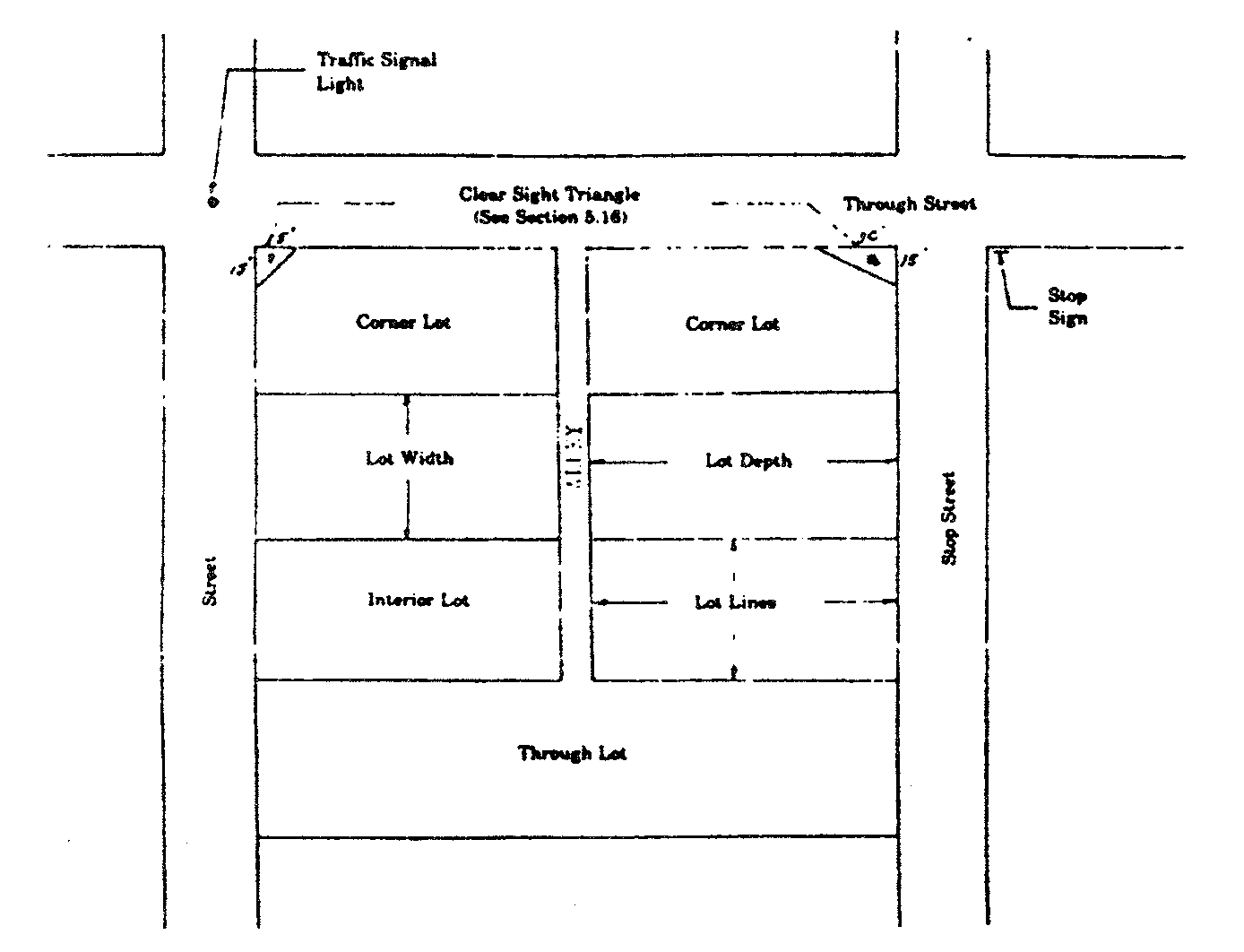
Lot, corner means a lot abutting upon two or more streets at their intersection which is illustrated as follows:
Yard Definitions—Corner Lot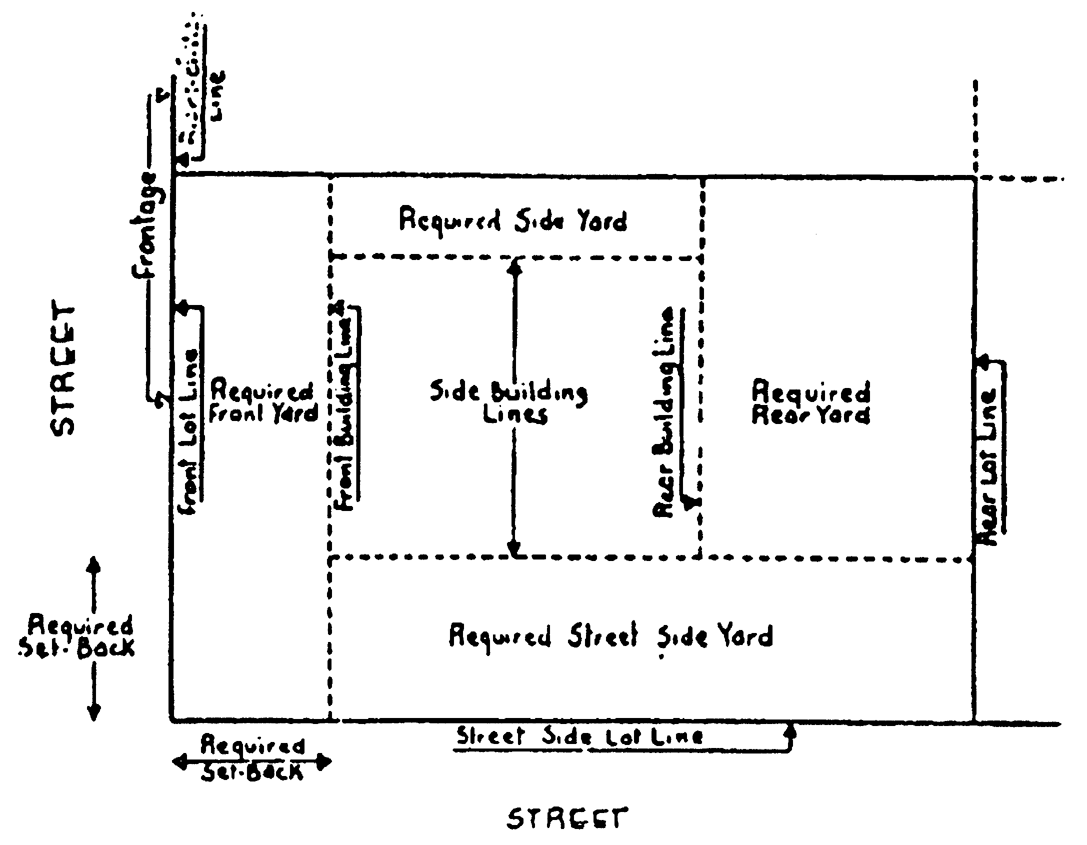
Lot coverage means that percentage of the lot area covered or occupied by the buildings or any part of the buildings, excluding therefrom any projections permitted to extend into yard areas elsewhere by this chapter.
Lot depth means the distance from the midpoint of the front lot line to the midpoint of the mean rear lot line.
Lot, interior means a lot other than a corner lot having frontage on one street, illustrated as follows:
Yard Definitions—Interior Lot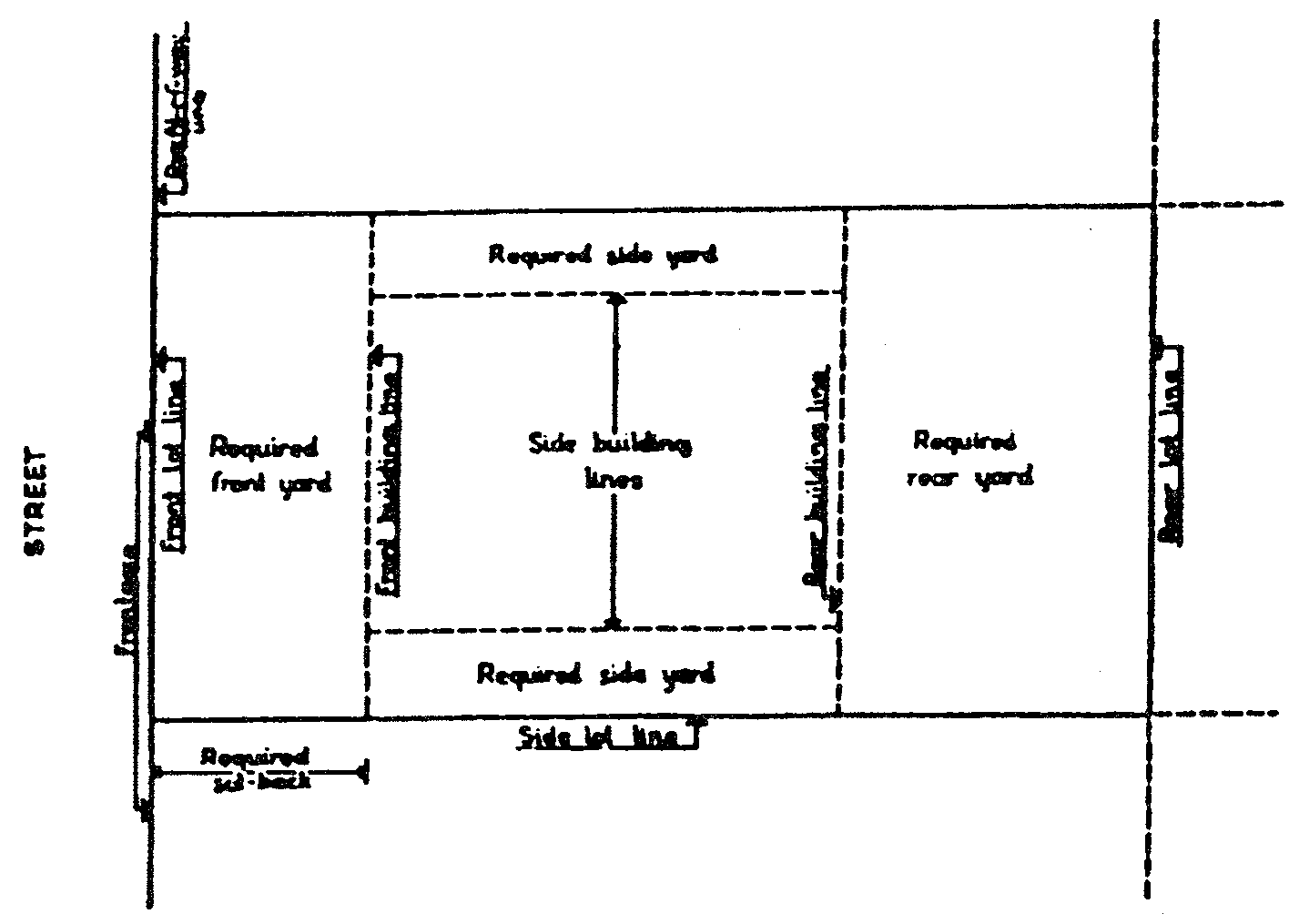
Lot lines means the lines bounding a lot as established by ownership.
Lot of record means a parcel of land as originally subdivided or subsequently resubdivided and properly recorded as a lot within a subdivision or plat.
Lot, street lot line means the front street lot line, side street lot line or rear street lot line of any lot, which shall be the right-of-way line of the abutting street. For public streets this shall consist of the dedicated right-of-way line of public streets plus any additional street widths as required by section 134-1636; for private streets, such right-of-way line shall consist of the platted or unplatted right-of-way line of such private streets plus any additional street width as required by section 134-1636. Note: Refer to section 134-1636 for street lot lines.
Lot, through means an interior lot having frontage on two streets, other than a corner lot, illustrated as follows:
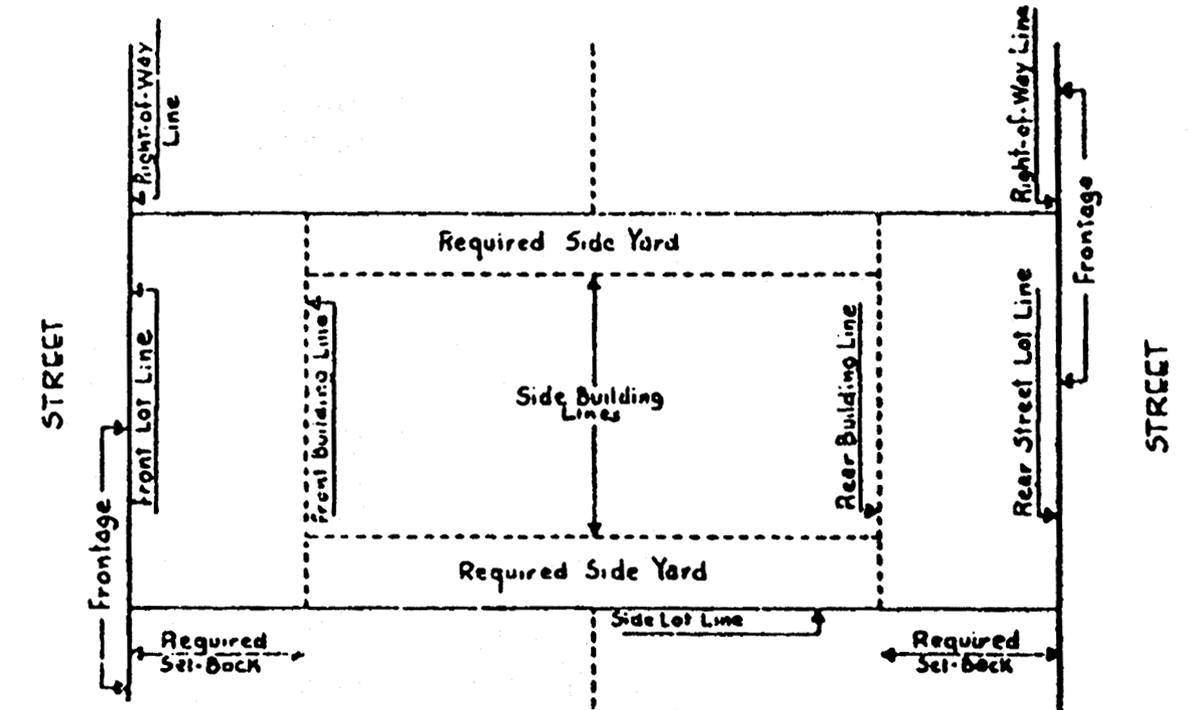
Lot width means the distance measured along the front building line between the side lot lines of a lot.
Manufactured housing means a structure, transportable in one or more sections, which, in the traveling mode, is eight body feet or more in width, or panels, and which is built on a frame and designed to be used as a dwelling with a permanent foundation and connected to all required utilities and may include plumbing, heating, air conditioning, and electrical systems contained therein. If fabricated after June 15, 1976, each section shall bear a U.S. Department of Housing and Urban Development label certifying that it is built in compliance with the federal Manufactured Home Construction and Safety Standards.
Marijuana shall mean all parts of any plant of the genus Cannabis, whether growing or not; the seeds thereof; the resin extracted from any part of the plant; and every compound, manufacture, salt, derivative, mixture, or preparation of the plant or its seeds or resin, including low-THC cannabis as defined in F.S. § 381.986(1)(f), which are dispensed from a medical marijuana treatment center for medical use by a qualified patient pursuant to F.S. § 381.986.
Medical marijuana dispensary means a facility that is operated by an organization or business holding all necessary licenses and permits from which marijuana, cannabis, cannabis-based products, or cannabis plants are delivered, purchased, possessed, or dispensed for medical purposes and operated in accordance with all local, federal, and state laws. Physicians authorized by state law to order low-THC cannabis, as defined in Florida Statutes, for qualified registered patients' medical use are not included in the definition of medical marijuana dispensary.
Medical marijuana treatment center means an entity that acquires, cultivates, possesses, processes (including development of related products such as food, tinctures, aerosols, oils, or ointments), transfers, transports, sells, distributes, dispenses, or administers marijuana, products containing marijuana, related supplies, or educational materials to qualified registered patients or their personal caregivers and is registered by the state department of health and regulated under chapter 134 of the Town Code of Ordinances.
Municipally owned or operated refers to the town.
Museum means an institution for collecting, preparing, and exhibiting rare, interesting, or typical specimens of works of art, science, invention, manufacturers, etc., or of antiquities, curiosities; or objects of natural history; also, the collection of such articles or their repository.
Nightclub means an establishment dispensing alcoholic beverages for on-site consumption, whether or not food is served, and which is a place of entertainment that is usually open late at night, offering live music, dancing, drinks, and a floorshow:
(1)
By one or more performing artists;
(2)
By one or more live entertainers singing to prerecorded music or
(3)
A deejay playing recorded music;
provided, however, that a restaurant that provides only background dinner music, or entertainment, or where dancing is conducted to live or recorded music does not constitute a nightclub.
Nonconforming building or structure means a building or structure lawfully in existence on the effective date of the ordinance from which this chapter is derived that does not conform to the regulations contained in this chapter for the zoning district in which the building or structure is situated.
Nonconforming land means a parcel of land lawfully in existence on the effective date of the ordinance from which this chapter is derived that does not conform to the regulations contained in this chapter for the zoning district in which the land is situated.
Nonconforming use means a use lawfully in existence on the effective date of the ordinance from which this chapter is derived that does not conform to the regulations contained in this chapter for the zoning district in which the use is situated.
Nonprofit cultural center means an institution for promoting education and the refinement of taste, intellectual and/or aesthetic matters, not including museum uses, operated without profit.
Office and professional services means administrative offices and establishments providing professional services such as lawyers, doctors, insurance agents, real estate brokers, consultants, interior designers, architects, and engineers.
Office, veterinarian means an establishment which provides medical and surgical care for animals, and may provide overnight facilities.
Open space means that area of a lot which is unencumbered by buildings, other structures, driveways, or automobile parking areas, except for garden walls and fences as provided in this chapter.
Outdoor cafe seating is the placing or locating of furniture outdoors, including tables, chairs, and umbrellas, adjacent to a business licensed as a restaurant dining room, retail specialty food including the sale of prepared foods for takeout only, or private, social, swimming, golf, tennis or yacht club, with the purpose of providing outdoor seating.
Outdoor promotional events means events sponsored and managed by a property owner where the event is to be held in the C-TS, C-WA or C-PC Zoning District for the purpose of providing a public event or promoting business on said private property. Such event shall be limited in scope and size by special exception approval by the town council and the criteria as set forth in section 134-2115 of this Code.
Parapet wall means a low wall to protect the edge of a roof.
Parking lot, public or private means an open area or plot of land used for the storage or parking of motor vehicles to provide off-street parking, either for profit or gratis, for commercial or residential uses, other than single-family.
Parking, principle of equivalency, as it relates to a method of establishing an inventory of required off-street parking spaces for a conforming or nonconforming use of an existing building, or structure for the purpose of determining the net off-street parking requirement for the establishment of a proposed new use to be permitted in the existing building or structure, is based on the "schedule" in section 134-2176.
Parking, required means those parking facilities determined as the minimum facilities necessary to comply with this chapter as set forth in the schedule of off-street parking requirements.
Parking, supplemental means those parking facilities provided as a permitted or special exception and which are in addition to existing required parking as set forth in the schedule of off-street parking requirements. Supplemental off-site parking in an underground garage or surface, enclosed, partially enclosed, or a rooftop parking facility that is a permitted use in the C-TS, C-WA and C-OPI zoning districts is not required to be parking that is in addition to what is required in the schedule of off-street parking requirements in the code. This definition will sunset on March 13, 2024 and revert back to the definition prior to the adoption of Ordinance Nos. 1-2021 and 20-2021 unless extended or modified by the town council.
Pergola means an open, accessory structure comprised of a structural framework over an outdoor area usually covered with climbing shrubs or vines.
Personal service establishments means establishments primarily engaged in the provi-sion of services to individuals dealing with their personal or immediate effects. Personal services would include, but not necessarily be limited to, hairstyling or beauty services, tailor/dressmaker, travel agent, cleaning services, interior decorator services, dance studio or similar personal instruction services.
Public/private group use means use of land or structures thereon or portions thereof for public structures, governmental operations, education, essential services, recreation and cultural amenities generally beneficial to the public health, safety and general welfare of the town's residents.
Public structures means municipally owned and/or operated structures used for public purposes such as, but not limited to, administrative offices, recreational buildings, police and/or fire stations and other public safety facilities.
Quasi-commercial means any activity that would seemingly or to some degree be normally considered commercial in nature.
Rear height plane means a height limit of a building in the R-B district as measured by the maximum overall height permitted on the abutting lot to the rear. When a lot abuts more than one lot to the rear, an average maximum overall height will be used to establish the rear height plane.
Residential use means use of land or structures thereon or portions thereof for residential occupancy of a permanent or semipermanent nature with an intended occupancy period, by any one individual or family, with or without bona fide nonpaying guests, of not less than three months; except that residential uses may be occupied by any one individual or family for periods of less than three months not more frequently than three times per calendar year; and except that this definition does not include occupancy of a transient nature such as in hotel, motel or timesharing uses.
Restaurant means every building or part thereof and all accessory buildings used in connection therewith or any place or location kept, used or maintained as, advertised as or held out to the public to be a place where meals and foodstuffs are prepared and served.
Retail establishments means establishments selling commodities or goods to ultimate consumers.
School, academic means a structure or portions thereof designed or used for instructing one or more persons, either children or adults, in either general or specialized education, and including accessory uses such as administrative offices, physical education facilities and group housing facilities for students or staff; provided, however, that instruction received by children or adults in their place of residence shall not constitute a school.
School, professional or studio-type means a structure or portion thereof designed and used for the business of instructing one or more persons, either children or adults, in a specialized subject such as voice, language, dancing or modeling.
Service station means a building or lot where gasoline, oil, greases, batteries and tires are supplied and dispensed to the motor vehicle trade and where repair services other than body work and painting are rendered and where motor vehicles are washed and/or polished manually but not by machinery.
Shade tree means a tree having a height of not less than 12 feet and a spread of not less than ten feet at the time of planting.
Sign means signs and/or lettering, pictures, illustrations or trademarks, logograms, posters or characters, visible from a public or private roadway and/or sidewalk, which shall be classified as signs regardless of whether they are freestanding or attached or painted to or on a building, structure, display board, screen surface or wall or are projected thereon by artificial lighting.
Sign, artisan means a temporary sign of mechanics, painters or other artisans or artisan concerns erected and maintained only during the period such persons or concerns are actively performing work on the premises on which such signs are erected or placed.
Sign, awning. See Sign, banner.
Sign, banner means a sign possessing characters, letters, illustrations, ornamentations, or that is designed so as to attract attention by a scenic effect, including pennants, balloons, and flags with or without lettering or characters, including streamers and wind-driven whirligigs, propellers or other devices, and applied to cloth, paper, fabric or like kind of material, either with or without frame, and which sign is not of permanent construction.
Sign, building identification means a sign designed and intended readily to indicate the location of a certain and specific multifamily or commercial building.
Sign, business directory means a wall mounted sign which identifies only the names of the businesses located in a via or building in a via. Said directory sign at the entrance to a via or building in a via may include the name of the via and the via address.
Sign, development means a temporary sign advertising the sale, rental or development of the premises as a whole upon which it is placed or erected.
Sign, illuminated means a sign which is lighted by electrical lighting installed thereon or therein or lighted by remotely located lights or that is produced and/or displayed by means of artificial projected light or lighted by reflected light.
Sign, individual business means a flat wall-mounted identification sign permitted for each individually town-licensed business with street or parking lot frontage and having direct ground level walk-in access from a public or private roadway, sidewalk, or parking lot in a commercially zoned district. Sign, institutional means a sign for building identification of schools, colleges, museums, libraries, houses of worship, or other institutions of a similar public or semipublic nature.
Sign, menu means a restaurant or take-out food establishment wall or pedestal mounted sign which identifies the menu and prices within said establishment.
Sign, official traffic means a sign placed or erected by a municipal, county, state, or federal governmental agency as a regulatory, aid-to-traffic or informational sign, in connection with control of vehicular or pedestrian traffic over a bridge, roadway, pathway or sidewalk.
Sign, property identification yard means a detached and freestanding identification sign for a Commercial zoned property supported on a monument, pillar or similar supporting structure.
Sign, sale or rental means a temporary sign advertising the sale or rental of the premises upon which it is placed or erected by the owner or broker or any other person interested in the sale or rental of the premises.
Sign, tow-way means a sign which provides notice as required by Florida Statute for any property owner, lessee, or person authorized by a property owner or lessee to tow or remove any vehicle or vessel from private property without the consent of the owner or other legally authorized person in control of that vehicle or vessel.
Sign, yard means a detached and freestanding identification sign supported on a pole or similar supporting structure.
Special exception. Special exception uses are allowable as conditional uses authorized in a zone only under the specific conditions specified in sections 134-227 through 134-233 and article III of this chapter and pursuant to the procedures in divisions 3 and 4 of article II of this chapter, but which use cannot be located in a zone as a matter of right and which may be revoked if any of the required conditions to approval and operation are violated.
Special exception structure means a structure approved as a special exception subject to sections 134-227 through 134-233, 134-897, 134-952, 134-1008, 134-1063, 134-1115, 134-1165 and 134-1214.
Statue or sculpture means an object which is fashioned, shaped and formed by hand or machine into a work of art, including but not limited to contemporary, modern, classical and/or abstract design, and that may or may not be a likeness of a person or thing.
Story means that portion of a building, other than an attic, included between the surface of any floor and the surface of the next floor above it or, if there is no floor above it, the space between such floor and the ceiling next above it. Habitable space, open patios, accessible roof decks not used exclusively for mechanical equipment, observation decks and/or similar areas located above the first or second story shall be considered a story for the purpose of this definition.
Street means a facility, either public or private, that affords the primary access to abutting property and that is intended for general traffic circulation. A street includes the entire area between street lines (right-of-way lines), including provisions for culs-de-sac.
Street line means the line between the street and abutting property. Also referred to as right-of-way line.
Structural alteration means any change, except the repair or replacement, in the supporting members of a building, such as bearing walls, columns, beams or girders, or the rearrangement of any interior partitions affecting more than 50 percent of the floor area of the building.
Structure means anything constructed, placed or erected on land, submerged land or over water, the use of which requires permanent or temporary location on the land, submerged land or over water, or attachment to something having permanent or temporary location on or over the land, submerged land, or water.
Structure, principal means a main and foremost building or structure located on a lot and in which is conducted the main and foremost use of the lot on which the building or structure is situated.
Structure, public means anything constructed, placed or erected on land, submerged land or over water by a Federal, State, County, City of West Palm Beach and City of Lake Worth governmental entities, the use of which requires permanent or temporary location on the land, submerged land or over water, or attachment to something having a permanent or temporary location on or over the land, submerged land, or water.
Sub-basement means a facility that is located underground and does not exceed in height the lowest point of the public sidewalk abutting the property or, alternately, the lowest point of the public street if there is no public sidewalk and no portion which is located beyond the confines of the outer walls of the main building located above ground level. For additional regulations and the exceptions to the regulations of sub-basements see sections 134-1610, 134-1611 and 134-2179.
Timesharing use means the use of any unit under which the exclusive right of use or occupancy of the unit for a period of less than three months circulates among various occupants in accordance with a fixed time schedule on a periodically recurring basis for a period of time established by such schedule. Such a use is permitted in the town only by special exception in the C-OPI, C-PC, C-B and R-D(2) zoning districts.
Townpersons means all full-time and seasonal residents as well as visitors staying at accommodations and employees working in establishments located within the town.
Town-serving means establishments principally oriented to serving the needs of townpersons which would not substantially rely upon the patronage of persons not defined as townpersons. Town-serving establishments, by definition, would typically contain 4,000 or less square feet of interior gross leasable area (GLA) in the C-WA district, 3,000 or less square feet of interior GLA in the C-TS and C-B districts and 2,000 or less square feet interior GLA in the C-PC district. Establishment would also not engage in advertising designed to attract other than townpersons.
Trellis means an ornamental accessory structure of lattice work over which vines are trained, usually made of narrow strips of wood which cross each other at regular intervals.
Use, principal means a main and foremost use of improved or unimproved property, such use established on the property and which may be within or without any building on the property.
Vacant land means any lot or parcel of land which is completely open, has no use associated with it or upon it and is not utilized as the required yard area for any adjoining uses.
Variance means a modification from the literal interpretation of this chapter, other than those sections relating to use requirements, subject to the procedures of divisions 3 and 4 of article II of this chapter.
Yard means an open space on the same lot with a building, such space unoccupied by structures and unobstructed from the ground upward except by trees or shrubbery or as otherwise provided in this chapter. The term "yard" may also apply to that area of the lot required to remain in open space by percentage of lot coverage regulations contained in this chapter in addition to the required front, required side or required rear yard open spaces.
Yard, front means a yard across the full width of the lot, extended from the front building line, including open porches, to the front street line of the lot.
Yard, rear means a yard extending across the full width of the lot and measured between the rear line of the lot and the rear building line of the main building. For corner lots, the rear yard shall be the yard opposite the front street line of the lot. For through lots, the rear yard fronting on the street opposite the front street line of the lot shall be the rear street yard. (Note: Refer to section 134-1636 for street lot lines.)
Yard, side means an open unoccupied space on the same lot with a building between the building line and the sideline of the lot extending through from the front building line to the rear yard or to the rear line of the lot, where no rear yard is required.
Zero datum means the point of measuring all zoning code calculations related to building height, building overall height, building height plane and cubic content ratio.
Zoning in progress means a period of time during the zoning procedures which begins with active and documented efforts by those authorized to do the zoning work which, in the normal course of municipal action, may culminate in the requisite zoning change.
(Ord. No. 2-74, § 2.10, 3-26-74; Ord. No. 3-77, § 1, 3-29-77; Ord. No. 5-78, § 1, 3-31-78; Ord. No. 7-79, §§ 1, 4, 3-30-79; Ord. No. 4-80, § 1, 3-31-80; Ord. No. 6-81, § 1(a), 3-31-81; Ord. No. 7-82, § 1(a), (b), 3-31-82; Ord. No. 2-83, § 1(a), (b), 2-23-83; Ord. No. 1-84, § 1(a), (b), (d)—(i), 3-1-84; Ord. No. 2-84, § 1(c), 3-1-84; Ord. No. 1-85, § 1(a)—(i), 2-11-85; Ord. No. 1-86, § 1(a), (c)—(e), 2-10-86; Ord. No. 1-87, § 1(a)—(d), 2-9-87; Ord. No. 1-89, § 1(a)—(i), 2-6-89; Ord. No. 1-90, § 1(a), (b), 2-5-90; Ord. No. 1-91, § 1(a), (b), 4-23-91; Ord. No. 1-92, § 1(a), 2-3-92; Ord. No. 1-93, § 1(a)—(c), 2-8-93; Ord. No. 9-93, § 1(a)—(h), 6-8-93; Ord. No. 1-94, § 1(a), 2-7-94; Ord. No. 1-96, §§ 2, 18, 19, 2-5-96; Ord. No. 1-98, § 1,
2-9-98; Ord. No. 1-99, §§ 1, 2, 4-5-99; Ord. No. 1-01, §§ 3, 5, 2-19-01; Ord. No. 1-02, §§ 3, 4, 3-12-02; Ord. No. 3-02, § 1, 7-9-02; Ord. No. 1-03, § 1, 3-11-03; Ord. No. 1-04, §§ 7, 21, 3-9-04; Ord. No. 1-06, § 1, 3-14-06; Ord. No. 1-07, § 1, 4-10-07; Ord. No. 4-08, §§ 1, 4, 7, 4-7-08; Ord. No. 11-08, §§ 1, 2, 5-12-08; Ord. No. 5-09, § 29, 4-15-09; Ord. No. 26-10, § 1, 12-15-10; Ord. No. 14-2011, § 1, 6-15-11; Ord. No. 2-2011, § 1, 7-13-11; Ord. No. 3-2012, § 1, 4-11-12; Ord. No. 10-2012, § 1, 9-11-12; Ord. No. 7-2014, § 1, 5-14-14; Ord. No. 25-2015, § 1, 11-12-15; Ord. No. 31-2015, § 1, 2-10-16; Ord. No. 24-2016, § 1, 1-11-17; Ord. No. 15-2017, § 1, 7-12-2017; Ord. No. 04-2018, § 1, 4-11-18; Ord. No. 30-2017, § 1, 1-10-18; Ord. No. 11-2018, § 1, 7-11-18; Ord. No. 02-2019, § 1, 3-19-19; Ord. No. 01-2021, § 1, 2-10-21; Ord. No. 16-2021, § 1, 8-11-21; Ord. No. 19-2021, § 1, 9-13-21; Ord. No. 20-2021, § 1, 9-13-21; Ord. No. 011-2023, § 1, 8-9-23; Ord. No. 034-2024, § 1, 12-11-24; Ord. No. 011-2025, § 2, 10-15-25; Ord. No. 30-2025, § 2, 12-10-25)
Editor's note— Ord. No. 25-2015 § 8, adopted November 12, 2015 provided that the amendment to section 134-2 contained in § 1 of said ordinance shall sunset on December 13, 2017, whereupon section 134-2 as it existed prior to adoption of said ordinance shall remain in full force and effect.
Cross reference— Definitions generally, § 1-2.
Sec. 134-3. - Interpretation.
(a)
Minimum requirements. In interpreting and applying the provisions of this chapter, they shall be held to be the minimum requirements for the protection, promotion, and improvement of the public health, safety, morals and general welfare of the community. It is not intended by this chapter to interfere with or abrogate or annul any easements, covenants or other agreements between parties; provided, however, where this chapter imposes a greater restriction upon the use of buildings, premises, or upon the height of buildings or requires larger open spaces than are imposed or required by other ordinances, rules, regulations or by easements, covenants, or agreements, the provisions of this chapter shall control. If, because of error or omission in the zoning map, any property in the town is not shown as being in a zoning district, the classification of such property shall be deemed to be R-A unless changed by amendment to this chapter.
(b)
Effect of old ordinance. This chapter is adopted for the purpose of revising, amending and bringing to date the zoning laws and ordinances of the town in existence since the enactment of Zoning Ordinance Number One of March 1929, and subsequent amendments, and it is expressly declared and determined that it is the intention of the mayor and town council that this chapter shall supersede only such parts of the existing zoning laws and ordinances of the town as are in direct conflict with and not reconcilable to the provisions of this chapter. It is expressly declared and determined that if for any reason this chapter is found by any court of competent jurisdiction to be invalid or unenforceable, the provisions of the zoning ordinances of the town in force and effect as of the effective date of the ordinance from which this chapter is derived shall continue to be in full force and effect, it being the intention of the town council that there shall exist no period of time in which the town shall not be comprehensively zoned.
(Ord. No. 2-74, § 12.10, 3-26-74)
Sec. 134-4. - Classification of districts into less restrictive classifications on finding of unconstitutionality; severability.
(a)
If any court of competent jurisdiction holds that any provision of this chapter, or the zoning map which is made a part of this chapter, is unconstitutional or unenforceable as to any particular parcel of land or building within the town, because the use allowed for such parcel of land or building under this chapter amounts to taking property without the due process of law or for any other reason, such piece or parcel of land or building is declared to be and is classified under the town's zoning laws in the next less restrictive classification. For example, if any property is classed as R-A and any court holds such classification to be arbitrary and unreasonable, it shall thereupon fall into classification R-B. For the purpose of this section, the zoning district classifications in the descending order of their restrictions shall be considered as follows: R-AA, R-A, R-B, R-C, R-D(1), R-D(2), C-B, C-TS, C-WA, C-OPI and C-PC. If any property classified as PUD-B is held by any court of competent jurisdiction to be arbitrary and unreasonable, it shall thereupon fall into classification R-C. If any property classified as PUD-C is held by any court of competent jurisdiction to be arbitrary and unreasonable, it shall thereupon fall into classification R-B.
(b)
If any article, section, clause or provision of this chapter shall be declared by a court to be invalid, the article, section, clause or provision shall not affect the validity of this chapter as a whole or any part thereof, other than the part so declared to be invalid.
(Ord. No. 2-74, § 12.20, 3-26-74; Ord. No. 5-78, § 22, 3-31-78; Ord. No. 7-78, § 5, 5-9-78; Ord. No. 4-80, § 4, 3-31-80)
Sec. 134-5. - Effective date.
The effective date of the ordinance from which this chapter was derived is March 26, 1974.
(Ord. No. 2-74, § 15.10, 3-26-74)
Sec. 134-6. - Violations.
(a)
Complaints of violations. Any person may file a complaint if there is any reason to believe a violation of this chapter exists. All such complaints must be in writing and shall be filed with the building official, who shall properly record such complaint and immediately investigate.
(b)
Procedures for abatement of violations. If any building or structure is erected, constructed, reconstructed, altered, repaired, converted, or maintained or if any building, structure or land is used in violation of this chapter or of any ordinance or regulation made under authority conferred by this chapter, the town council or, with their approval, the building official or other proper official, in addition to other remedies, may institute any appropriate legal action or proceedings to prevent such unlawful erection, construction, reconstruction, alteration, repair, conversion, maintenance or use to restrain, correct, or abate such violation; to prevent the occupancy of the building, structure or land; or to prevent any illegal act, conduct, business or use about such premises.
(Ord. No. 2-74, § 13.10, 3-26-74)
Sec. 134-7. - Violations and penalties.
(a)
Violations of this chapter or failure to comply with any of the requirements of this chapter, including violations of conditions and safeguards established in connection with grants of variances, special exceptions or site plan reviews, shall constitute a zoning violation, and the violator shall be prosecuted under the provisions of article V of chapter 2 by the town code enforcement board. Each day such violation continues shall be considered a separate offense.
(b)
The owner or tenant of any building, structure, premises, or part thereof and any architect, builder, contractor, agent, or other person who commits, participates in, assists in, or maintains such violation may each be found guilty of a separate offense and suffer the penalties provided in this section.
(c)
It shall be a violation of this chapter for any person to destroy, move, remove, or deface or obscure any sign or notice erected or posted by town officials pursuant to the requirements of this chapter.
(d)
Nothing contained in this section shall prevent the town from taking other lawful action necessary to prevent or remedy any violation of or failure to comply with the regulations contained in this chapter, including but not limited to the issuance of a citation pursuant to section 1-14 and/or the commencement of a civil action in a court of appropriate jurisdiction.
(Ord. No. 2-74, § 13.20, 3-26-74; Ord. No. 1-84, § 10, 3-1-84; Ord. No. 1-91, § 7(a), (b), 4-23-91; Ord. No. 26-10, § 10, 12-15-10)

