
Palm Beach City Zoning Code
ARTICLE IX
OFF-STREET PARKING AND LOADING16
Cross reference— Parking lots, § 22-431 et seq.; parking, stopping and standing generally, § 118-86 et seq.
Sec. 134-2171. - Illustration.
(a)
The following illustration is designed solely to illustrate the requirements for aisles in off-street parking areas as regulated in this division. In design of elevated or depressed parking structures, the maximum slope of floors or ramps shall not exceed 12-percent grade. The turning radius dimension for approach drive aisleways shall not be less than 30 feet.
_____
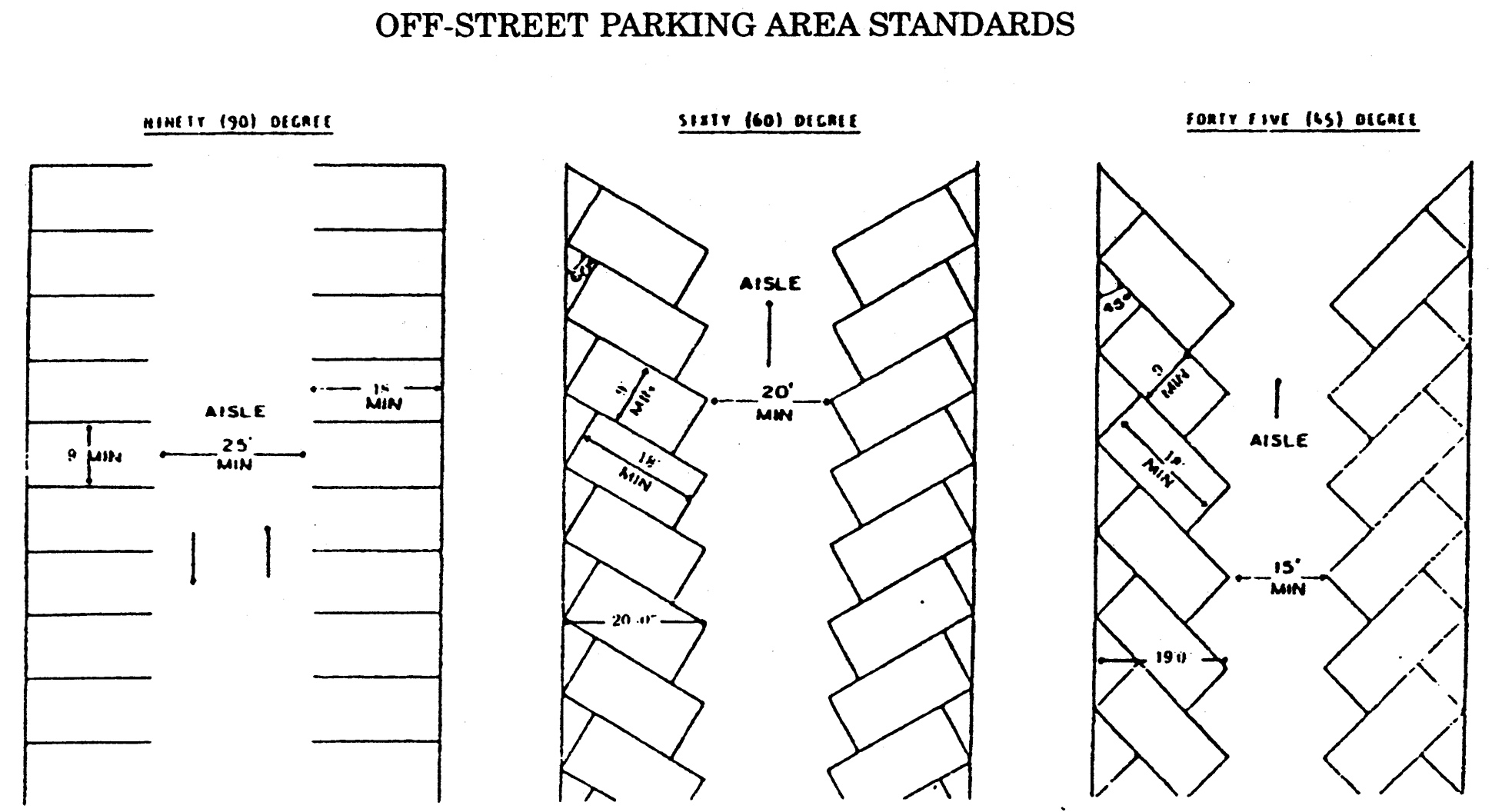
Off-Street Parking Area Standards
(b)
Additional regulations governing setbacks, minimum dimensions for parking spaces, and other requirements are covered in subdivision II of division 7 of article VIII of this chapter, division 9 of article VIII of this chapter, and in this article.
(Ord. No. 2-74, attachment two, 3-26-74; Ord. No. 3-77, § 17, 3-29-77; Ord. No. 1-86, § 4(b), 2-10-86)
Sec. 134-2172. - Size of spaces and access.
An off-street automobile parking space shall consist of a parking space having minimum dimensions of nine feet in width and 18 feet in length for the parking of each automobile, exclusive of access drives or aisles thereto. Minimum width of an access drive shall be ten feet for one-way traffic. Minimum width of an aisle designed and intended for the maneuvering into a 90 degree parking space shall be 25 feet; 20 feet into a 60 degree parking space; and 15 feet into a 45 degree parking space. Minimum width of an aisle designed and intended for the maneuvering of an automobile into a parking space shall be in conformance with the illustration set forth in section 134-2171. The parking plan must be so arranged that each automobile may be placed and removed from the parking space assigned thereto and taken to and from the property without the necessity of moving any other automobile to complete the maneuver.
(Ord. No. 2-74, § 6.21(A.1), 3-26-74; Ord. No. 1-84, § 4(d), 3-1-84; Ord. No. 1-86, § 4(a), 2-10-86; Ord. No. 26-10, § 26, 12-15-10)
Sec. 134-2173. - Street and sidewalk areas.
Street and/or sidewalk areas shall not be used for off-street parking purposes as defined in this article. Individual ingress and egress drives extending across the public sidewalks and curbs and connecting the off-street parking spaces to the public street areas shall not exceed a maximum of 30 feet. The design, number and placement of such drives shall be subject to the approval of the superintendent of public works before being installed.
(Ord. No. 2-74, § 6.21(A.2), 3-26-74; Ord. No. 1-84, § 4(d), 3-1-84)
Sec. 134-2174. - Requirements for construction.
All parking lots or off-street parking areas or areas used for off-street parking, whether for profit or gratis, with the exception of temporary parking for special events such as private parties, shall be surfaced with suitable paving. Those areas serving multifamily or commercial areas shall be provided with adequate stormwater drainage to meet paving and drainage specifications approved by the town engineer and shall be provided with proper landscaping and irrigation facilities as provided in this chapter. The illustration in section 134-2171 shall be used as a minimum guideline for parking lot design.
(Ord. No. 2-74, § 6.21(A.3), 3-26-74; Ord. No. 1-84, § 4(d), 3-1-84)
Sec. 134-2175. - Number of parking spaces required—Generally.
(a)
Under this division, the following shall be provided:
(1)
At the time of the erection of any building or structure, minimum off-street parking facilities shall be required with adequate provisions for ingress and egress, in accordance with sections 134-2172 through 134-2174 and the schedule of off-street parking requirements, as prescribed in section 134-2176.
(2)
At the time any building or structure is enlarged or increased in capacity by adding dwelling units, guestrooms, floor area or seats, minimum off-street parking facilities with adequate provisions for ingress and egress shall be required, in accordance with section 134-2 and sections 134-2172 through 134-2174 and the schedule of off-street parking requirements, as prescribed in section 134-2176.
(3)
Except as provided in subsection (f), at the time any use or occupancy of an existing building is changed to a new use or occupancy having differing off-street parking requirements, the parking requirement for the new use or occupancy shall be computed on the basis of the schedule of off-street parking requirements in the section 134-2176. This requirement shall be compared to the requirements of the existing use or occupancy, and, if the total number of spaces required under the new use or occupancy exceeds that of the existing use or occupancy, the difference shall constitute that number of additional off-street parking spaces to be provided, with adequate provisions for ingress and egress, in accordance with sections 134-2172 and the schedule of off-street parking requirements as prescribed in section 134-2176.
(b)
Except as provided in subsection (f), a use, building or structure, lawfully in existence at the effective date of this division, which shall be made nonconforming on the effective date of the ordinance from which this division derives or any applicable amendment thereto, may be continued even though off-street parking may not be provided in full compliance with this division, but the degree of nonconformity due to a deficiency in providing the required off-street parking spaces may not be increased, either by reducing the number of parking spaces which are provided on the effective date of the ordinance from which this chapter is derived or by changing the use or occupancy of an existing building to a use or occupancy which increases the requirement for off-street parking. For existing buildings or establishments therein which are nonconforming with respect to the current parking requirements, and which involve only those uses requiring one space per 200 or 250 square of gross leasable area, whichever is applicable, and which may be required under this chapter to provide additional parking spaces as a result of a change in use, such establishments shall be required only to provide that number of spaces over and above the number of spaces that would have been required at one space per 200 or 250 square feet of floor area gross leasable area, whichever is applicable.
(c)
Continued availability of required number of off-street parking spaces. After providing for the proper number of required off-street parking spaces so as to permit a principal use of property to be established as set forth in the schedule of off-street parking contained in section 134-2176, such required off-street parking shall continue to be available in undiminished number for sole use as an integral part of the continuance of the principal use(s) unless meeting the shared parking as provided for in sections 134-2177, 134-2178 and 134-2182. If for any reason such required off-street parking is not available at all times in connection with the principal use, such principal use shall be discontinued until such time as the proper number of required off-street parking spaces shall again be made available for use in connection with the principal use.
(d)
The principle of equivalency for evaluating off-street parking in existing uses is as follows:
(1)
Definition of principle of equivalency as applied to the schedule of off-street parking requirements. The principal of equivalency, as it relates to the schedule of off-street parking requirements, shall be defined as an automobile parking space required by section 134-2176 for establishing an inventory of automobile parking spaces for a conforming or nonconforming use of an existing building, or structure or use, for the purpose of determining the net off-street parking requirement for the establishment of a proposed new use to be permitted in the building, or structure or use.
(2)
In evaluating off-street parking for existing uses, the principle of equivalency shall be applied when the use or occupancy of an existing building is being changed to a new use or occupancy having a differing off-street parking requirement for the purpose of establishing compliance with this chapter.
(3)
The following floor area equivalencies may be used as a minimum guide in the application of the schedule of off-street parking requirements:
a.
One permanent seat equals six square feet of floor area in seating areas of occupancies requiring seating.
b.
One moveable seat equals 15 square feet of floor area in seating areas of occupancies requiring seating.
c.
The remainder of areas external to actual seating areas shall provide required parking according to the schedule of applicable parking requirements.
d.
One school student equals 20 square feet of floor area.
(e)
For the purpose of this section, a landmarked commercially zoned building is exempt from providing additional required off-street parking if increased occupancy or use is created by interior building improvements which create more gross leasable area. However, all other provisions of subsections (a) through (d) apply.
(f)
In the 200 Block of Peruvian Avenue and Bradley Place in the C-TS zoning district, existing buildings or establishments therein which are nonconforming with respect to the current parking requirements, and which involve only those uses requiring one space per 200 or 250 square feet of gross leasable area, whichever is applicable, shall not be required to provide additional parking spaces as a result of a change from a use which alters the parking ratio from one space per 250 square feet to a use which requires one space for every 200 square feet of gross leasable area.
(Ord. No. 2-74, § 6.21(C), 3-26-74; Ord. No. 1-99, § 2, 4-5-99; Ord. No. 1-00, § 8, 2-22-00; Ord. No. 1-04, § 37, 3-9-04; Ord. No. 5-09, § 30, 4-15-09; Ord. No. 5-2011, § 5, 3-9-11; Ord. No. 25-2015, § 3, 11-12-15)
Sec. 134-2176. - Same—Schedule.
The schedule of off-street parking required by this division shall be as follows:
Footnote 1: An off-street parking exception application may be approved or denied by the director of planning, zoning and building or designee after 15 days of a legal notice being published in a newspaper of general circulation in Palm Beach or West Palm Beach with a summary of the request for such off-street parking exception. Said notice shall be paid by the applicant and shall not be part of the application fee. Any approval or denial of an application for an exception to the off-street parking requirements in subsection (15) of this section may be appealed to the town council based on sections 134-141—134-145 of the Code. There shall be no fee associated with this type of an administrative appeal.
(Ord. No. 2-74, § 6.21(C), 3-26-74; Ord. No. 1-84, § 4(d), 3-1-84; Ord. No. 1-92, § 4(a), 2-3-92; Ord. No. 1-94, § 4(a), (e), 2-7-94; Ord. No. 1-95, § 2(a), 1-23-95; Ord. No. 1-96, § 10, 2-5-96; Ord. No. 1-97, § 3, 2-17-97; Ord. No. 1-99, § 27, 4-5-99; Ord. No. 1-00, § 9, 2-22-00; Ord. No. 1-01, § 7, 2-19-01; Ord. No. 1-04, § 11, 3-9-04; Ord. No. 5-09, § 24, 4-15-09; Ord. No. 7-09, § 7, 5-13-09; Ord. No. 25-2015, § 4, 11-12-15)
_____
Sec. 134-2177. - Location of parking spaces.
Parking spaces for all uses or structures which are provided as required parking in conformance with the schedule of off-street parking and other applicable sections shall be located on the same lot and shall have the same district classification as the principal use or structure they are intended to serve, except as specifically excepted as follows:
(1)
The town council may permit, as a special exception, the establishment of such required off-street parking facilities for commercial uses within 500 feet of the premises, as measured along the nearest public or permanent private pedestrian walkway they are intended to serve when:
a.
Practical difficulties prevent the placing of the facilities on the same lot as the premises they are designed to serve;
b.
The proposed location is located within the same zoning district as the principal use it is designated to serve;
c.
The owner of the parking area shall enter into a written agreement with the town, with enforcement running to the town, providing that the land comprising the parking area shall never be disposed of except in conjunction with the sale of the building which the parking area serves so long as the facilities are required; and
d.
The owner agrees to bear the expense of recording the agreement and agrees that the agreement shall bind his heirs, successors and assigns. The written agreement shall be voided by the town if other off-street facilities are provided in accordance with this chapter.
(2)
The town council may permit, as a special exception, the establishment of supplemental off-street facilities which are in addition to those facilities required in accordance with the schedule of off-street parking for a permitted or approved special exception use. Such supplemental off-street parking facilities may be permitted only after the required parking for the principal use involved has been provided in full at current standards as contained in the schedule. This additional parking may be supplemental parking located on the same lot or supplemental off-site parking located on a directly adjoining lot or a lot which would be directly adjoining except for the location of a street or public way; provided, however, that all other provisions for special exceptions as set forth in sections 134-227 through 134-233 are complied with and, further, that the granting of such supplemental on-site or supplemental off-site parking is not construed as permission to expand, enlarge, alter, renovate, or modify the use of structure except in accordance with the requirements of this chapter. The exception is that supplemental off-site shared parking within an underground parking garage, or supplemental off-site shared parking within a surface, enclosed, partially enclosed or rooftop parking facility is exempt from this section of the code provided the conditions in section 134-2182(a) are met.
(3)
The town council may permit, as a special exception, the establishment of required off-street parking facilities for commercial uses in zoning districts differing from the district of the principal uses of structures they are intended to serve if the following conditions are met:
a.
The owner of the parking area shall enter into a written agreement with the town with enforcement running to the town providing that the land comprising the parking area shall never be disposed of except in conjunction with the sale of the buildings with which the parking area serves so long as the facilities are required.
b.
The owner of the parking area shall agree to bear the expense of recording the agreement, and agrees that the agreement shall bind his heirs, successors and assigns. The written agreement shall be voided by the town if other off-street facilities are provided in accordance with this chapter.
c.
The parking area shall have been used as a parking area for the entirety of each of the five calendar years immediately preceding the application for special exception.
d.
The parking area shall abut the property on which is situated the principal structure for which it is to furnish the required off-street parking.
e.
The provisions for special exceptions as set forth in sections 134-227 through 134-233 are complied with.
f.
The said parking area shall be located at ground level or below ground level and shall not be located within any structure above ground.
(Ord. No. 2-74, § 6.21(D), 3-26-74; Ord. No. 1-85, § 4(a), 2-11-85; Ord. No. 1-99, § 28, 4-5-99; Ord. No. 25-2015, § 5, 11-12-15; Ord. No. 01-2021, § 9, 2-10-21; Ord. No. 20-2021, § 5, 9-13-21)
Editor's note— Ord. No. 25-2015 § 8, adopted November 12, 2015 provided that the amendment to section 134-2177 contained in § 5 of said ordinance shall sunset on December 13, 2017, whereupon section 134-2177 as it existed prior to adoption of said ordinance shall remain in full force and effect.
Sec. 134-2178. - Collective use.
As provided for in this division, two or more owners or operators of buildings or uses of the same type of zoning classification requiring off-street parking facilities may make collective provision for such facilities, provided that the total of such parking spaces, when combined or used together, shall not be less than the sum of the requirements computed separately, and provided that the combined facility is compatible with the zoning uses being served.
(Ord. No. 2-74, § 6.21(E), 3-26-74; Ord. No. 25-2015, § 6, 11-12-15)
Sec. 134-2179. - Utilization of yards.
(a)
Underground facilities in sub-basements. Underground facilities in sub-basements. Provided the ground level at the lowest point of the public sidewalk abutting the property or the public street, if there is no public sidewalk, is maintained, required off-street parking facilities may be located in a sub-basement under required yards. Roofs of such sub-basements shall be sodded, landscaped and maintained, and there shall be no visible evidence of such underground facility from a public street or sidewalk. No such underground facility shall be closer than five feet to any property line.
(b)
Residential districts. In the R-AA, R-A, R-B, R-C, R-D(1) and R-D(2) zoning districts, one and two-family dwellings shall provide the required parking set forth in section 134-2176. The following number of those required off-street parking spaces shall be located in an enclosed garage:
(1)
Lots which are 75 feet or more in width shall provide two parking spaces.
(2)
Lots under 75 feet in width shall provide one parking space, however, lots 50 feet or less in width shall not be required to provide any of the required off-street parking spaces in a garage.
All required and supplemental parking spaces shall be designed so that both required and supplemental parking spaces are nine feet wide by 18 feet deep and have a minimum eight-foot free and clear drive aisle width into each space.
Supplemental off-street parking for one-family and two-family development may be permitted in any setback area or yard area. All such supplemental parking spaces not located within an enclosed garage structure shall require effective screening by hedges and/or a wall permit-ted by this Code not less than six feet in height, which shall be placed between said off-street parking and any street and/or interior lot lines.
(c)
Townhouse development in certain residential districts. In the R-C, R-D(1), and R-D(2) districts, required parking (except guest spaces) for all town house development shall be located within a garage. Supplemental parking may be permitted in any setback area or yard area provided, however, that all such supplemental space, not located within a structure, shall require effective screening by hedges and/or walls permitted by this Code not less than six feet in height, which shall be placed between the off-street parking and any street and/or interior lot lines.
(d)
Application of requirements for the parking. The foregoing requirement for garage or screened parking applies only to new construction, redevelopment or major remodeling involving more than 50 percent of the existing cubic content of the structure.
(e)
Multifamily development. In all districts where permitted, multifamily development of less than five dwelling units shall provide all required parking (excluding guest spaces) within a garage. For all other multifamily development and in all districts for all other permitted or approved special exception uses, required front, street and street rear yards may not be used for off-street parking, but all other yards may be used for such purposes. If a side or rear yard or nonrequired front, street side or street rear yard is used for parking purposes, it shall be effectively screened with hedges or walls or a combination thereof placed at the appropriate building line between the off-street parking and any street. Such screening shall not be less than six feet high and shall laterally extend across the entire building line which separates the parking area from the street except for the access way.
(f)
Other permitted and special exception uses. In all districts for all other permitted or approved special exception uses, required front, street side, and street rear yards may not be use for off-street parking, but all other yards may be used for such purposes. In addition, no required or supplemental off-street parking shall be located closer than 15 feet from a front, street side, or street rear property line. Required or supplemental off-street parking shall be effectively screened with hedges or walls or a combination thereof placed at the appropriate building line between the off-street parking and any street. Such screening shall not be less than six feet high and shall extend across the entire building line which separates the parking areas from the street except for the access way. Such screening shall also be required along the interior lot lines and shall not be less than four feet in height and shall not encroach upon the rear easement line. The height of said required screening shall be measured as set forth in section 134-1666 et seq. Each parking space shall have an adequate and substantial wheel stop or curb, not less than six inches in height, located at least four feet from the abutting side or rear property line and not less than two feet from required landscaping. Such two-foot setback may be part of the nine-foot by 18-foot parking space. Further, all required interior landscaping not already protected by wheel stops shall be protected by a curb, a minimum of six inches in height, around the perimeter of such landscaped area to prevent damage by vehicles maneuvering within the parking area. Such curbing must be so designed as not to prevent the drainage of water from the paved area into the landscaped area. In addition to the screening requirements in this subsection, the interior of the parking area must have suitable landscaping, including the provision of shade trees, such landscaped area to be not less than ten percent of the parking and drive aisle area. The total devoted to landscaping, comprising both the screening and the interior landscaping, must be at least 15 percent of the parking and drive aisle area. A site plan showing the landscaping and the irrigation facilities for the landscaping must be submitted.
(Ord. No. 2-74, § 6.21(F), 3-26-74; Ord. No. 7-82, § 5(b), 3-31-82; Ord. No. 1-84, § 4(d), 3-1-84; Ord. No. 1-89, § 4(a), 2-6-89; Ord. No. 1-94, § 4(d), 2-7-94; Ord. No. 1-97, § 8, 2-17-97; Ord. No. 1-98, §§ 10, 12, 2-9-98; Ord. No. 2-05, § 6, 5-10-05; Ord. No. 1-06, § 4, 3-14-06; Ord. No. 16-09, § 1, 11-12-09; Ord. No. 26-10, § 27, 12-15-10)
Sec. 134-2180. - Approval of plan for ingress, egress and landscaping.
The plan for ingress and egress to and from any lot or parcel of land is subject to the approval of the director of public works. No landscaping associated with parking or ingress and egress, curbs or sidewalks shall be cut or altered in any manner without a permit from the director of public works. In addition, all lots or parcels of land are further regulated by the town's right-of-way manual as adopted by reference in section 106-4 of the Code of Ordinances.
(Ord. No. 2-74, § 6.21(G), 3-26-74; Ord. No. 1-04, § 27, 3-9-04)
Sec. 134-2181. - Utilization of structures.
When off-street parking facilities are located within a structure, the following conditions and restrictions shall apply:
(1)
The structure shall conform to all lot, yard and bulk requirements of the district in which it is located except as follows: In the R-C, R-D(1) and R-D(2) districts, when multifamily development of five or more units includes all required off-street parking, other than required guest spaces, in parking located underground or wholly under the building, using the town's minimum base flood elevation as the starting point, the first eight feet of such understory parking shall not count towards allowable building height, and maximum allowable building coverage may be increased by five percent.
(2)
The parking facilities shall be designed so as to conform to all other town ordinances and all other sections of this chapter.
(3)
All nonstructural portions of the exterior elevations, except for vehicular ingress and egress areas, shall, in addition to any required safety provisions, be screened by a sight block of at least 50 percent solidity for the total areas between deck levels, such sight blockage to be determined by elevation. A solid wall for 50 percent of the distance between deck levels will not be acceptable.
(4)
The town council may permit as a special exception the establishment of required off-street parking facilities for commercial and multifamily uses on the roof of a building. When parking facilities are located on the roof of a structure, a four-foot high balustrade sight block wall shall be provided having at least 25 percent but no more than 50 percent solidity. The area between the top of the balustrade wall and the underside of any overstructure shall be open, providing at least three feet and six inches of vertical clearance. Further, a horizontally installed sight block framework having at least ten percent but not more than 25 percent solidity shall be installed to cover such rooftop parking. Such horizontal sight block framework shall cover the entire roof deck including ramps and shall be no higher above the roof deck parking spaces than necessary to provide a seven-foot six-inch headroom clearance. The definition for height of a building in section 134-2 shall apply except that the top story shall be determined as the story immediately below the rooftop parking deck of such structure. Landscaping for all facades shall be provided at each parking level to aid the sight block and shall be subject to the review and approval of the architectural commission.
(5)
The parking structure or portions of a building devoted to automobile parking uses must be sight screened from public view by approved landscaping; provided, however, that enclosed garage areas of a building shall conform to the same architectural appearance as the remainder of the building. Automobile parking structures detached from the principal structure shall be compatible in appearance to the principal structure and shall comply with lot, yard, and bulk regulations applicable to the principal structure.
(Ord. No. 2-74, § 6.21(H), 3-26-74; Ord. No. 4-75, §§ 2, 3, 3-24-75; Ord. No. 3-76, § 4, 3-23-76; Ord. No. 3-77, §§ 7, 8, 3-29-77; Ord. No. 5-78, § 12, 3-31-78; Ord. No. 4-80, § 6, 3-31-80; Ord. No. 6-81, § 5(a), 3-31-81; Ord. No. 7-82, § 5(a), (b), 3-31-82; Ord. No. 1-85, § 4(b), 2-11-85; Ord. No. 1-86, § 4(a), (c), 2-10-86; Ord. No. 1-89, § 4(b), 2-6-89; Ord. No. 1-92, § 4(a), 2-3-92; Ord. No. 1-94, § 4(b), 2-7-94; Ord. No. 1-96, § 9, 2-5-96; Ord. No. 1-98, § 12, 2-9-98)
Sec. 134-2182. - Shared parking in C-TS, C-WA, C-OPI and C-PC commercial zoning districts.
(a)
Off-site supplemental shared parking as a permitted use. Off-site supplemental shared parking within an underground garage or within a surface, enclosed, partially enclosed or rooftop parking facility is permitted by right in the C-TS, C-WA and C-OPI zoning districts without the requirement of first providing all required parking. However, said shared parking shall not be used to expand or intensify a use; shall not exceed 50 percent of the existing parking inventory in said underground garage or parking facility. In addition, if a surface, enclosed, partially enclosed or rooftop parking facility abuts a residential use, said shared parking shall only be allowed between the hours of 8:00 a.m. and 6:00 p.m.
(b)
Special exception for shared parking. With the exception as provided for in subsection (a) above, there is no entitlement to shared parking, however, arrangements for shared parking may be allowed in the CT-S, C-WA and C-OPI commercial zoning districts, subject to the review and approval of a special exception as set forth under sections 134-227 through 134-233 and under the circumstances provided in this section.
(c)
Special exception approval for on-site shared parking. When a new use is proposed to occupy existing floor space and the new use would require a greater number of parking spaces than required by the former use, the new use may request sharing of on-site parking to meet the town's off-street parking requirements subject to the review and approval of a special exception as set forth under sections 134-227 through 134-233 and under the circumstances provided as follows:
(1)
A traffic planner or traffic engineer clearly establishes to the town council, at the applicant's expense, that:
a.
All uses utilizing the existing parking facilities will primarily utilize these parking spaces at different times of the day, week, month or year;
b.
The sharing of such parking spaces will not result in conflicting or overlapping usage of the parking facilities; and
c.
The available parking will be adequate to serve the needs of the proposed use.
(2)
If the building official determines that professional advice and/or consultation is required to review the applicant's parking findings, the expense of such professional advice shall be borne by the applicant.
(3)
The applicant provides to the town, at the applicant's expense, a recorded three-party agreement, including the town as one of the parties, with enforcement running to the town, guaranteeing the continuing availability of the shared parking spaces during the period of operation of the applicant's use. The term of the agreement shall approximate the life of the building or use for which the shared parking spaces fulfill the town's off-street parking requirement. If the shared parking ever ceases to be available or becomes inadequate due to a change in the uses' respective schedules of operation that results in conflicting or overlapping usage, the proposed use shall be required to obtain a new occupancy permit and provide proof that sufficient parking will be provided or shall be required to immediately reduce the intensity of the use served to the extent that it will be conforming to the town's off-street parking requirements.
(d)
Special exception approval for supplemental off-site shared parking. With the exception as provided for in subsection (a) above, a conforming use may lease to another existing conforming use the former's required or supplemental parking spaces for use by patrons or employees of the latter, subject to the review and approval of a special exception as set forth under sections 134-227 through 134-233 and under the circumstances provided as follows:
(1)
The area to be used for off-site shared parking shall be in the C-TS, C-WA, C-PC or C-OPI zoning district, and, except for shared parking within a parking garage or underground/underbuilding parking area, any area used for off-site shared parking shall be accessible only to and used by parking attendants and shall have controlled access in the form of gates or other barriers acceptable to the town that can be accessed and used only by parking attendants.
(2)
Off-site shared parking shall be located no more than 500 feet from the use the off-site shared parking is intended to serve.
(3)
The applicant shall provide evidence which shall prove to the satisfaction of the town council that the off-site shared parking use shall not increase noise, light or traffic impacts upon neighboring residential districts.
(4)
A traffic planner or traffic engineer establishes to the satisfaction of the town council, at the applicant's expense, that all other establishments using the existing parking spaces will primarily utilize these spaces at different times of the day, week, month or year from that of the applicant's use, and that the sharing of such parking spaces will not result in conflicting or overlapping usage of the parking facilities.
(5)
If the director of planning, zoning and building department should determine that professional advice and/or consultant is required to review the applicant's parking findings, the expense of such professional advice shall be borne by the applicant pursuant to sections 134-171 and 134-172.
(6)
Off-site shared parking shall only be supplemental, and such parking shall not be used to meet required parking for new construction or expansion or addition to existing floor area.
(7)
The town may impose such additional conditions that it deems necessary to minimize noise, light and traffic impacts upon neighboring residential districts.
(8)
The approval shall initially be limited to a period of six months, whereupon a subsequent review shall be made at a public hearing of the town council at which the interim approval may be renewed, modified or revoked.
(e)
Sunset provision. The provisions in section 134-2177 and 134-2182 related to supplemental off-site shared parking within an underground garage or within a surface, enclosed, partially enclosed or rooftop parking facility abutting a residential use as a permitted use in the C-WA, C-TS and C-OPI zoning district will sunset on March 13, 2024 unless extended or modified by the town council.
(Ord. No. 1-96, § 1(6.21(I)), 2-5-96; Ord. No. 1-97, § 7, 2-17-97; Ord. No. 1-98, § 11, 2-9-98; Ord. No. 4-10, § 2, 2-10-10; Ord. No. 25-2015, § 7, 11-12-15; Ord. No. 01-2021, § 10, 2-10-21; Ord. No. 20-2021, § 6, 9-13-21)
Editor's note— Ord. No.25-2015 § 8, adopted November 12, 2015 provided that the amendment to section 134-2182 contained in § 7 of said ordinance shall sunset on December 13, 2017, whereupon section 134-2182 as it existed prior to adoption of said ordinance shall remain in full force and effect.
Secs. 134-2183—134-2210. - Reserved.
Editor's note— Ord. No. 25-2015 § 8, adopted November 12, 2015 provided that the sunset provision would expire on December 13, 2017, repealing § 134-2183, and reinstating §§ 134-2, 134-38, 134-2177 and 134-2182, as existed prior to adoption of said ordinance.
Sec. 134-2211. - Number and dimensions of berths for commercial uses.
(a)
In any zoning district, in connection with every building or building group or part thereof erected and having a gross floor area of 4,000 square feet or more, which is to be occupied by commercial uses or other uses similarly requiring the receipt or distribution by vehicles of material or merchandise, there shall be provided and maintained, on the same lot with such building, off-street loading or unloading berths in a number not less than the following:
(b)
The loading berth required in each instance shall be not less than 12 feet in width, 25 feet in length, and 14 feet in height, and may occupy all or any part of any required yard except for a required front yard, provided, however, that the loading berth shall be screened from the street or public way.
(Ord. No. 2-74, § 6.22, 3-26-74)
Sec. 134-2236. - Site plan review.
Applications for public or private parking lots, either as a special exception use or as required off-street parking, shall require site plan review in accordance with article III of this chapter. The material submitted with the application shall include the location, number and size of spaces; type of surfacing material and method of drainage; size and location of access drives and maneuvering aisles; and location and type of screening and landscaping in accordance with this chapter and other applicable town ordinances, together with any other elements as may be deemed essential by the building official.
(Ord. No. 2-74, § 6.26, 3-26-74; Ord. No. 5-78, § 12, 3-31-78; Ord. No. 4-80, § 6, 3-31-80)
Sec. 134-2237. - Alternate guidelines for operation as principal use of land.
For a public or private parking lot which is to be operated as the principal and sole use on the parcel of land, the following may be utilized as alternate guidelines in reviewing the site plan:
(1)
Size and access. An off-street parking space shall have minimum dimensions of nine feet in width and 18 feet in length for the parking of each automobile, exclusive of access drives or aisles thereto. Minimum width of an access drive shall be ten feet for one-way traffic. Minimum width of an aisle designed and intended for the maneuvering into a 90 degree parking space shall be 25 feet; 20 feet into 60 degree parking space; and 15 feet into a 45 degree parking space (see illustration in section 134-2171). Individual ingress and egress drives extending across the public sidewalks and curbs and connecting the parking lot to the public street areas shall not exceed a maximum of 30 feet. The design, number and placement of such drives are to be subject to the approval of the director of public works before being installed.
(2)
Tandem parking. Tandem parking may be permitted on a parking lot with a full-time attendant, provided that not more than two cars may be parked in tandem at each parking space location.
(3)
Location of spaces. Required front, street side or street rear yards may not be used for off-street parking, but all other areas, exclusive of easements, may be used for such purposes, providing parking lot paving shall not extend closer than four feet to any abutting side or rear property line.
(4)
Landscaping. Screening shall be provided in accordance with division 2 of this article.
(Ord. No. 2-74, § 6.26, 3-26-74; Ord. No. 5-78, § 12, 3-31-78; Ord. No. 4-80, § 6, 3-31-80; Ord. No. 26-10, § 28, 12-15-10)

