
Palm Beach City Zoning Code
ARTICLE VIII
- SUPPLEMENTARY DISTRICT REGULATIONS
DIVISION 4. - STREETS[11]
Cross reference— Streets, sidewalks and other public places, ch. 106.
DIVISION 12. - TELECOMMUNICATION TOWERS AND ANTENNAS[12]
Cross reference— Telecommunications, ch. 116.
DIVISION 14. - CONDITIONAL APPROVAL OF A SPECIAL EXCEPTION FOR SIDEWALK AND/OR PRIVATE PROPERTY OUTDOOR CAFE SEATING ONLY FOR RESTAURANTS, DINING ROOMS, RETAIL SPECIALTY FOOD INCLUDING THE SALE OF PREPARED FOOD FOR TAKEOUT ONLY, AND PRIVATE SOCIAL, SWIMMING, TENNIS AND YACHT CLUBS. [13]
Editor's note—Ord. No. 16-2021, § 17, adopted August 11, 2021, repealed the former Div. 14, §§ 134-2104—134-2109, and enacted a new Div. 14 as set out herein. The former Div. 14 pertained to administrative approval of outdoor seating and derived from Ord. No. 5-09, § 1, adopted April 15, 2009.
DIVISION 15. - CONDOMINIUM-HOTELS[14]
Editor's note— Ord. No. 5-09, § 18, adopted April 15, 2009, enacted provisions intended for use as division 15, §§ 134-2109 and 134-2110. Inasmuch as there is already a section 134-2109, and at the discretion of the editor, said provisions have been redesignated as division 15, §§ 134-2110 and 134-2111.
DIVISION 17. - MARIJUANA, INCLUDING MEDICAL MARIJUANA TREATMENT CENTERS AND DISPENSARIES, AND OUTDOOR EVENTS[15]
Editor's note—Ord. No. 034-2024, § 3, adopted December 11, 2024, amended the title of Div. 17 to read as herein set out. The former Div. 17 title pertained to medical marijuana treatment centers and medical marijuana dispensaries.
Sec. 134-1516.- Underground location of utility service lines.
(1)
Boxes housing essential services in the front, street side and street rear yard setbacks shall be screened from, view from the street in so much as possible by either a wall or hedge planted and maintained at a height the same as or greater than said essential service box. An essential service is defined in section 134-2 of this Code.
(2)
At the time that any new buildings or structures are being constructed or located on any privately owned property or at the time that any existing buildings or structures on privately owned property are being reconstructed, substantially extended and enlarged or structurally altered, such buildings or structures shall have an entirely underground location for all utility service lines, electrical distribution systems, wires and cables, which connect to and service such buildings or structures.
(3)
Boxes housing essential service, including their pads, shall not count against the maximum lot coverage or minimum landscape open space of a lot.
(Ord. No. 2-74, § 5.41, 3-26-74; Ord. No. 5-78, § 11, 3-31-78; Ord. No. 4-80, § 4, 3-31-80; Ord. No. 1-84, § 3(c), (d), 3-1-84; Ord. No. 1-06, § 2, 3-14-06; Ord. No. 16-2016, § 7, 12-14-16; Ord. No. 10-2019, § 1, 5-15-19)
Editor's note— Ord. No. 1-06, § 2, adopted March 14, 2006, repealed section 134-1516 in its entirety and renumbered former sections 134-1517, 134-1518, as new sections 134-1516, 134-1517. Former section 134-1516 pertained to basements and derived from Ord. No. 2-74, § 2.10(6), adopted March 26, 1974; Ord. No. 1-84, § 1(b), adopted March 1, 1984; Ord. No. 1-91, § 1(a), adopted April 23, 1991.
Sec. 134-1517. - Places of assembly.
Applications for houses of worship, academic schools, theaters, auditoriums, nonprofit cultural centers, and private clubs, either as a special exception use or as a permitted use, shall require a site plan review in accordance with article III of this chapter. Such site plan shall show all structures, roadways, pathwalks, parking areas, recreation areas, utility and exterior lighting installations and landscaping on the site; all existing structures and uses within 200 feet of the site boundaries; and any other elements as may be deemed essential by the building official. The following shall be utilized as guidelines in reviewing the proposed development:
(1)
Site size. A minimum site of 20,000 square feet exists with a minimum lot width of 100 feet, except that for such uses in the C-PC and for such uses involving not more than 2,000 square feet of gross leasable area in the C-TS district, only the minimum lot area and minimum lot width for the district in which said use is located shall be required.
(2)
Lot, yard and bulk. Such development shall not exceed the least restrictive covenants of the schedule of lot, yard, and bulk regulations in article VI of this chapter for the appropriate district.
(Ord. No. 2-74, § 6.62, 3-26-74; Ord. No. 1-85, § 4(i), 2-11-85; Ord. No. 1-04, § 10, 3-9-04; Ord. No. 1-06, § 2, 3-14-06)
Editor's note— See Editor's note following section 134-1516.
Sec. 134-1518. - Shared mobility scooters.
The following regulations shall apply to all zoning districts in the town.
(1)
Docking or storage mobility stations for shared scooters and dockless shared scooters is prohibited in the town.
(Ord. No. 10-2019, § 2, 5-15-19)
Sec. 134-1519. - Shared mobility bicycles.
The following regulations shall apply to all zoning districts in the town.
(1)
Docking and parking of shared bicycles and storage stations for shared bicycles and dockless bicycles is prohibited in the Town.
(Ord. No. 17-2019, § 13, 6-12-19)
Sec. 134-1606.- General application.
No building or structure shall have a greater number of stories or have an aggregate height of a greater number of feet, whichever of the two is least of the permitted heights in the district in which such building or structure is located, except as noted elsewhere in this chapter.
(Ord. No. 2-74, § 5.21, 3-26-74)
Sec. 134-1607. - Permitted exceptions.
Permitted exceptions to height regulations in this chapter in districts other than R-AA, R-A and R-B shall be as follows:
(1)
In all zoning districts other than R-AA, R-A and R-B districts, structures for the housing of elevators, stairways, tanks, and skylights not exceeding 30 percent in total area of the roof area on which they are placed, skylights not more than four feet in height above the roof; ventilating fans, generators and similar equipment to operate and maintain a building not more than ten feet in height above the roof; air conditioning equipment not more than ten feet in height above the roof; radio and television antennas for reception purposes only; and church steeples, flagpoles and chimneys no more than 40 percent above the height limits for the district within which they are located as prescribed by this chapter. Flagpoles in excess of this height may be permitted by special exception on properties of greater than five acres provided the flagpole is not in excess of 70 feet in height and is set back at least 120 feet from any lot line. Such structures and equipment located upon the roof area shall not cover in the aggregate a roof area greater than 30 percent of the ground floor area of such building or structure. Radio and television antennas for reception purposes, air conditioning equipment, the housing of elevators, stairways, tanks, ventilating fans or similar equipment to operate and maintain a building which are permitted on the roof shall be centrally located and sight screened from view in so far as possible, as determined by the architectural commission or landmarks preservation commission. Solar material shall be permitted on the roof provided said material is approved by the architectural commission or landmark preservation commission.
(2)
When any building is constructed on a tract of land extending from Lake Worth to any north-south street, for the purposes of identifying height, if there is a subbasement and a basement, the basement shall be considered a story. This subsection does not allow any increase in building or story heights as measured from the public street.
(Ord. No. 2-74, § 5.22, 3-26-74; Ord. No. 3-76, § 3, 3-23-76; Ord. No. 7-79, § 9, 3-30-79; Ord. No. 4-80, § 4, 3-31-80; Ord. No. 7-82, § 4(c), 3-31-82; Ord. No. 2-83, § 4(c), 2-23-83; Ord. No. 1-84, § 3(a), 3-1-84; Ord. No. 1-85, § 3(a), 2-11-85; Ord. No. 1-90, § 3(b)—(d), 2-5-90; Ord. No. 1-96, § 13, 2-5-96; Ord. No. 1-03, § 8, 3-11-03; Ord. No. 1-04, § 36, 3-9-04; Ord. No. 7-09, §§ 4, 6, 5-13-09; Ord. No. 16-09, §§ 6, 10, 11-12-09; Ord. No. 04-2018, § 22, 4-11-18; Ord. No. 009-2025, § 2, 10-15-25)
Editor's note— Section 6 of Ord. No. 7-09, adopted May 13, 2009, states the following: "Section 6. The newly adopted provisions contained herein relating to flag poles and flags shall not be applicable retrospectively to flags or flag poles permitted prior to the adoption of Ordinance No. 7-09 or, in the event not granted by permit, which have been in continuous existence for a period of three years or more prior to the adoption of this ordinance."
Sec. 134-1608. - Basements.
(a)
In all zoning districts except the R-B zoning district, a basement as defined in section 134-2 shall not be considered a story with regards to height regulations contained in this chapter if the basement ceiling does not exceed plus four feet above zero datum for the subject lot.
(b)
The exterior walls of a basement shall be setback from all property lines as required for the building situated over the basement, and minimum door openings in the basement walls shall be limited to those essential to permit one automobile entry access driveway and one automobile exit driveway for each separated under building parking area, plus pedestrian lobby entries and required fire escape exit ways.
(Ord. No. 2-74, § 2.10(6), (42), 3-26-74; Ord. No. 5-78, § 1, 3-31-78; Ord. No. 1-84, § 1(b), (f), 3-1-84; Ord. No. 1-91, § 1(a), 4-23-91; Ord. No. 1-02, § 3, 3-12-02; Ord. No. 1-06, § 3, 3-14-06)
Sec. 134-1609. - Multilevel and split level structures.
(a)
Multilevel or split level structures may be constructed in the R-B district under the following conditions:
(1)
No portion of the structure may have more than two stories in vertical alignment;
(2)
A basement entirely located under and hidden by the dune shall not count as a story; and
(3)
The structure must meet all applicable lot, yard and bulk regulations for two-story construction in the district.
(b)
Where single-family and two-family multilevel or split level structures may be constructed in R districts, other than the R-B district, they may be so constructed under the following conditions:
(1)
No portion of the structure may have more than two habitable stories in vertical alignment;
(2)
A basement entirely located under and hidden by the dune shall not count as a story; and
(3)
The structure must meet all applicable lot, yard and bulk regulations for two-story construction in the district.
(Ord. No. 2-74, schedule A, 3-26-74; Ord. No. 7-79, §§ 2, 6, 3-30-79; Ord. No. 4-80, § 3, 3-31-80; Ord. No. 6-81, § 2(e), (f), 3-31-81; Ord. No. 7-82, § 3(e), 3-31-82; Ord. No. 2-83, §§ 3(a), (b), 2-23-83; Ord. No. 1-84, §§ 2(a)—(e), 3-1-84; Ord. No. 1-85, § 2(b)—(f), 2-11-85; Ord. No. 1-86, § 2(a), 2-10-86; Ord. No. 1-88, § 1, 2-8-88; Ord. No. 1-89, § 2(b)—(d), 2-6-89; Ord. No. 1-90, § 2(a)—(e), 2-5-90; Ord. No. 1-92, § 2(a)1, 2, 2-3-92; Ord. No. 9-93, § 2(b), 6-8-93; Ord. No. 1-94, § 2(a), 2-7-94; Ord. No. 1-96, § 8, 2-5-96; Ord. No. 1-97, § 1, 2-17-97; Ord. No. 1-02, § 2, 3-12-02)
Sec. 134-1610. - Basement exception.
(a)
In all R zoning districts, including the R-B zoning district, a basement as defined in section 134-2 which is entirely under and hidden by the dune shall not count as a story.
(b)
A portion of a basement may be situated outside the outer walls of the main building above it provided the following conditions are met:
(1)
The basement shall have at least 51 percent of its floor area within the confines of the outer walls of the main portion of the building located above the basement;
(2)
The portion of the basement outside walls, outside of the outside walls of the main portion of the building located above the basement, shall be hidden from view from outside all elevations of the building;
(3)
The developed grade outside the walls of that portion of the basement that is outside of the walls of the main portion of the building located above the basement shall not be raised or altered more than two feet above the natural grade in order to be hidden from view;
(4)
The portion of the basement outside walls of the main building above the basement shall be excluded in the calculations for landscape open space requirements and shall count toward required setbacks and lot coverage.
(Ord. No. 1-06, § 3, 3-14-06)
Editor's note— Ord. No. 1-06, § 3, adopted March 14, 2006, amended the Code with the addition of new sections 134-1609, 134-1610. In order to avoid duplication of section numbers, the provisions of said ordinance have been included herein as sections 134-1610, 134-1611, at the discretion of the editor.
Sec. 134-1611. - Sub-basement exception.
(1)
For residential and, time-share development or redevelopment, and for commercial development within the C-PC, planned commercial district. No portion of a sub-basement may be located beyond the confines of the outer walls of the first floor above it except under the following conditions:
a.
The sub-basement shall have at least 51 percent of its floor area within the confines of the outer walls of the main portion of the building located above the sub-basement.
b.
The sub-basement shall be entirely hidden from view from any elevation of the building.
c.
The developed grade outside the walls of that portion of the sub-basement that is outside the walls of the main portion of the building located above the sub-basement shall not be raised or altered in order to be hidden from view, more than two feet above the natural grade.
d.
The portion, of the sub-basement outside of the outside walls of the main building above the sub-basement shall not be allowed to count in the calculations for landscape open space requirements and shall count toward lot coverage.
e.
The sub-basement shall be setback a minimum of five feet from a property line.
(2)
For development or redevelopment in commercial, zoning districts with the exception of the C-PC, planned commercial district, a sub-basement shall be allowed under the following conditions:
a.
The maximum lot coverage of a proposed sub-basement shall not exceed a maximum of 70 percent. Said lot coverage shall only be for the sub-basement and shall not count toward the maximum lot coverage of the portion of the buildings above said sub-basement.
b.
The sub-basement shall be entirely hidden from view from any elevation of the building.
c.
The portion of the sub-basement outside of the outside walls of the main building above the sub-basement shall be allowed, to count in the calculations for landscape open space requirements.
d.
The sub-basement shall be setback a minimum, of five feet from a property line.
(Ord. No. 1-06, § 3, 3-14-06; Ord. No. 16-2016, § 6, 12-14-16)
Editor's note— See Editor's note following section 134-1610.
Sec. 134-1636.- Street lot lines.
Under this chapter, the front lot line, side street line or rear street line of any lot shall be the right-of-way line (the street line) of the abutting street except when the following conditions exist:
(1)
When a lot abuts a private street where the right-of-way width is not, in the opinion of the building official, clearly determined, the street lot lines, for the purposes of this chapter, shall be located 15 feet from and parallel to or concentric with the centerline of the street.
(2)
For the purpose of uniformity in administration of regulations contained in this ordinance, no portion of a public or private street right-of-way as defined herein shall be used as the front property line when calculating the required front yard, street side yard, street rear yard areas or in building angle of vision and building height plane for determining required building setbacks, nor shall any portion of a public or private street right-of-way be used in the computations of required minimum abutting lot areas. Further, culs-de-sac and street transitions at street intersections, as shown on the town council approved subdivision plats having public or private streets therein, shall likewise not be included as a portion of required setback areas, required minimum lot area, or in the calculation of building angle of vision or building height plane.
(3)
Any structure on any lot which abuts a public or private alley or platted access walkway, except Lake Trail, shall be set back from that alley or platted walkway a distance equal to the side or rear yard setback requirements, as the case may be, for that district. A principal structure shall not front on such an alley or walkway.
(Ord. No. 2-74, § 5.14, 3-26-74; Ord. No. 6-81, § 3, 3-31-81; Ord. No. 2-83, § 4(a), 2-23-83; Ord. No. 1-86, § 3(a), 2-10-86; Ord. No. 1-91, § 3(a), 4-23-91; Ord. No. 1-99, § 22, 4-5-99)
Sec. 134-1637. - Intersection sight triangle areas for residential districts.
As an aid to free and safe movement of vehicles at or near street intersections and in order to promote protection for the safety of children, pedestrians, and operators of vehicles in the town, the following provisions are required.
All corner lots and street right-of-way at the intersection of a through street within all residential zoning districts shall be required to have a clear intersection sight triangle area as illustrated in figures 1 through 3 of this section as follows:
(1)
Upon construction of a new residential dwelling(s).
(2)
As an existing residential dwelling(s) is renovated, added onto, demolished, and/or reconstructed in which the value of the work is 50 percent or more of the appraised value of the structures on the property.
(3)
Notwithstanding the regulations above, the architectural commission or the landmark commission, whichever is pertinent, may grant a waiver from these provisions provided that said commission deems the existing impediment in the intersection sight triangle is of value to the aesthetics of the town and does not create a public safety issue after prior review and recommendation by the public works department.
The building permit plans for work contemplated in subsections (1) and (2) shall include the work required in the intersection sight triangle area. The property owner shall be required to install and maintain the white and yellow reflective pavement markers as identified in figures 1 through 3 which identify the intersection sight triangle area. All obstructions, vegetation or structures shall be maintained at a maximum height of 30 inches within the intersection sight triangle area, as measured from the street elevation where the yellow reflective pavement marker is placed for the intersection sight triangle area.
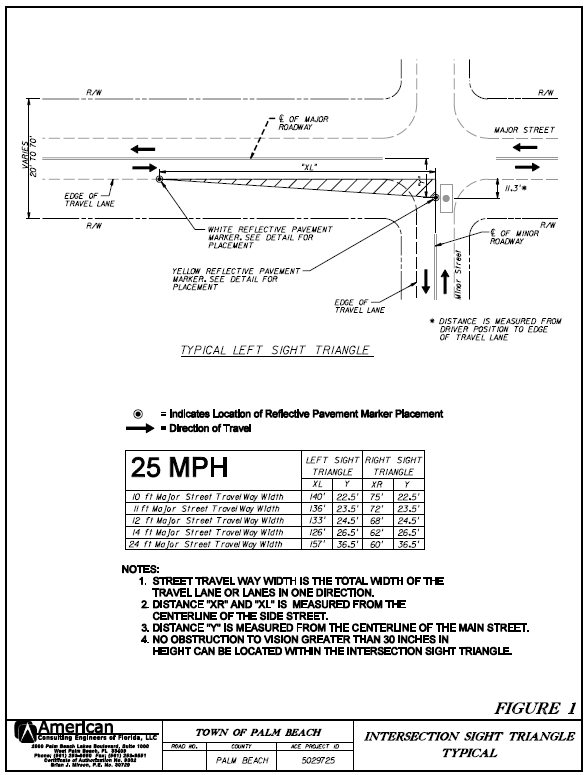
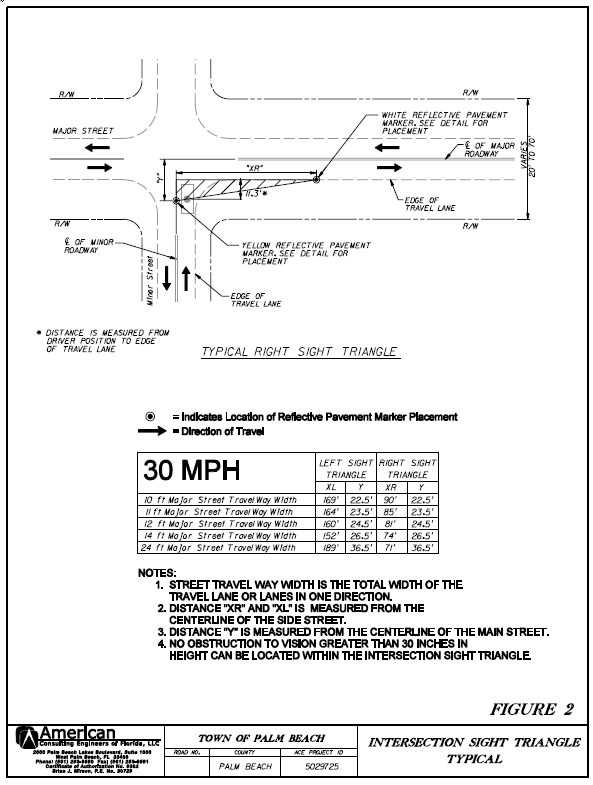
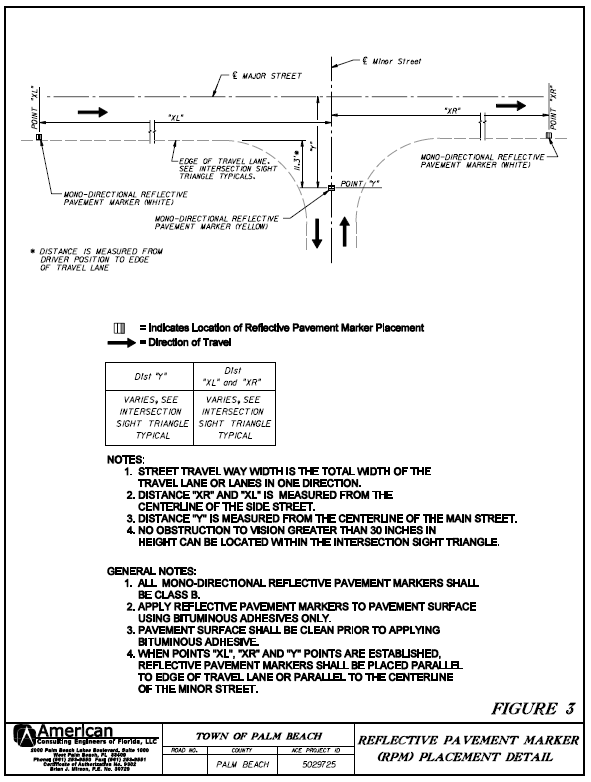
(Ord. No. 5-09, § 17, 4-15-09)
Editor's note— Ord. No. 5-09, § 17, adopted April 15, 2009, amended section 134-1637 in its entirety to read as herein set out. Formerly, section 134-1637 pertained to intersection vision, and derived from Ord. No. 2-74, § 5.16, adopted March 26, 1974, and Ord. No. 2-83, § 4(b), adopted February 23, 1983.
Sec. 134-1666.- Location generally; compliance.
Except as otherwise provided herein, walls or fences may be located or constructed within the required yard areas and shall conform to the following regulations except where special requirements are set forth for specific screening purposes elsewhere in this ordinance:
(Ord. No. 2-74, § 5.36, 3-26-74; Ord. No. 1-84, § 3(b), 3-1-84; Ord. No. 1-86, § 3(c), 2-10-86; Ord. No. 1-87, § 3(c), 2-9-87; Ord. No. 1-90, § 3(e), 2-5-90; Ord. No. 1-93, § 3(c)—(e), 2-8-93; Ord. No. 1-98, § 8, 2-9-98; Ord. No. 1-00, § 4, 2-22-00)
Sec. 134-1667. - Front, street side or street rear yards.
(a)
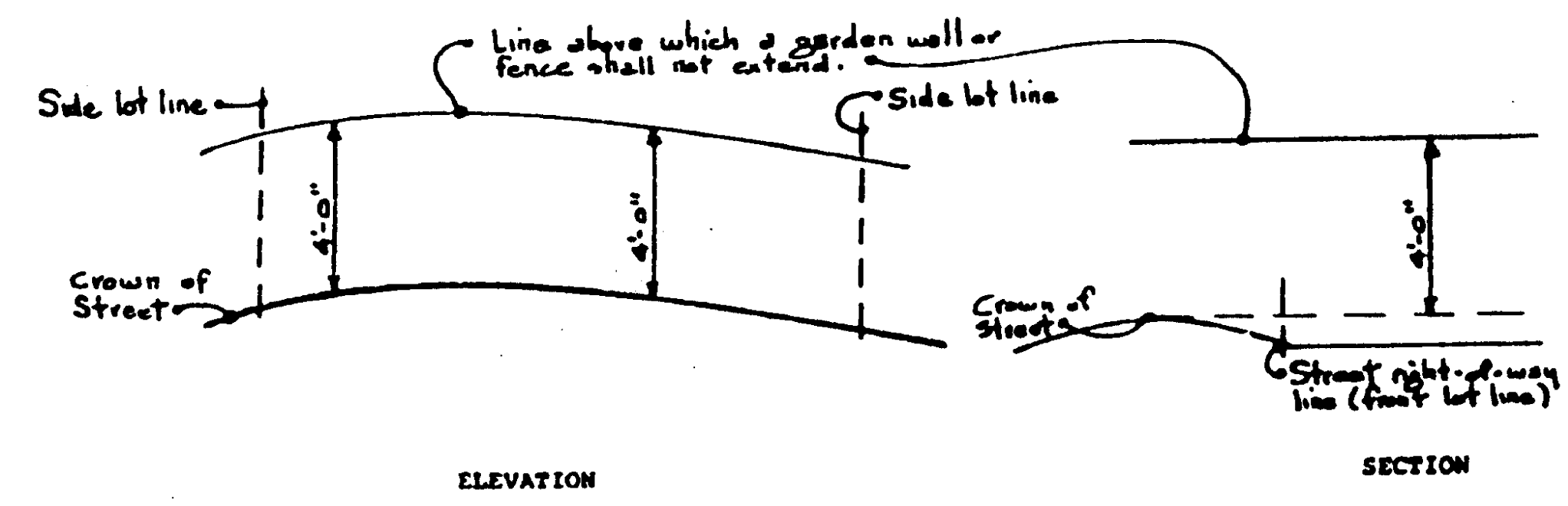
All walls and/or fences located in a front, street side or street rear setback areas shall not exceed six feet in height. The height of a wall or fence located in a front, street side or street rear set back areas, fronting on a street, shall be measured on the street side of the wall or fence from the top of the wall or fence and shall not exceed six feet in height above the crown of the street at a point directly opposite such points of measurement. (See following illustration.) If the wall or fence in a front, street side or street rear setback area is not fronting on a street, said wall or fence shall be measured from the lowest grade on either side of the property line adjacent to said wall or fence. The natural grade along the side property line within the front setback area may not be artificially changed to raise the height of said wall.
_____
(b)
Walls and fences in a required front yard, street side yard, or rear street yard more than four feet in height shall be set back three feet from the street property line and have landscaping on the street side of the wall or fence consisting of a continuous hedge at least three feet in height at the time of planting.
(Ord. No. 2-74, § 5.36(a), 3-26-74; Ord. No. 2-83, § 4(b), 2-23-83; Ord. No. 1-84, § 3(b), 3-1-84; Ord. No. 1-86, § 3(c), 2-10-86; Ord. No. 1-87, § 3(c), 2-9-87; Ord. No. 1-90, § 3(e), 2-5-90; Ord. No. 1-93, § 3(c)—(e), 2-8-93; Ord. No. 1-98, § 8, 2-9-98; Ord. No. 1-00, § 4, 2-22-00)
Sec. 134-1668. - Gateposts and gates located in front, street side and rear street yard areas.
Gateposts not exceeding three feet in any horizontal dimension may be erected and/or constructed in connection with the erection and/or construction of a wall, fence, or in connection with an existing or proposed hedge. Such gateposts and gates shall not exceed a height of two feet above the maximum wall height permitted in this division. If gates are to be erected at driveway entrances, the gates must be provided with a minimum driveway area in front of and perpendicular to the gates of nine feet wide by 18 feet deep, as measured from the street pavement. For a property with a driveway located on a cul-de-sac or dead-end street, the required setback may be reduced provided it is approved as a special exception by the town council under the standards of sections 134-227 through 134-233.
(Ord. No. 2-74, § 5.36(b), 3-26-74; Ord. No. 1-84, § 3(b), 3-1-84; Ord. No. 1-86, § 3(c), 2-10-86; Ord. No. 1-87, § 3(c), 2-9-87; Ord. No. 1-90, § 3(e), 2-5-90; Ord. No. 1-93, § 3(c)—(e), 2-8-93; Ord. No. 1-97, § 2, 2-17-97)
Sec. 134-1669. - Side and rear yards.
All walls and/or fences located within ten feet of the side or rear property line shall not exceed seven feet in height except walls and/or fences located in a required street side yard setback of a corner lot and the required rear street yard setback for a through lot where they shall conform to the provisions of section 134-1667. The height of a wall or fence located in a side or rear yard shall be measured from the lowest grade on either side of the side or rear property line adjacent to said wall or fence to the top of the wall or fence and shall not exceed seven feet in height. This section prohibits an artificial change in the natural grade in any way to raise the height of said wall. (See the following illustration.)
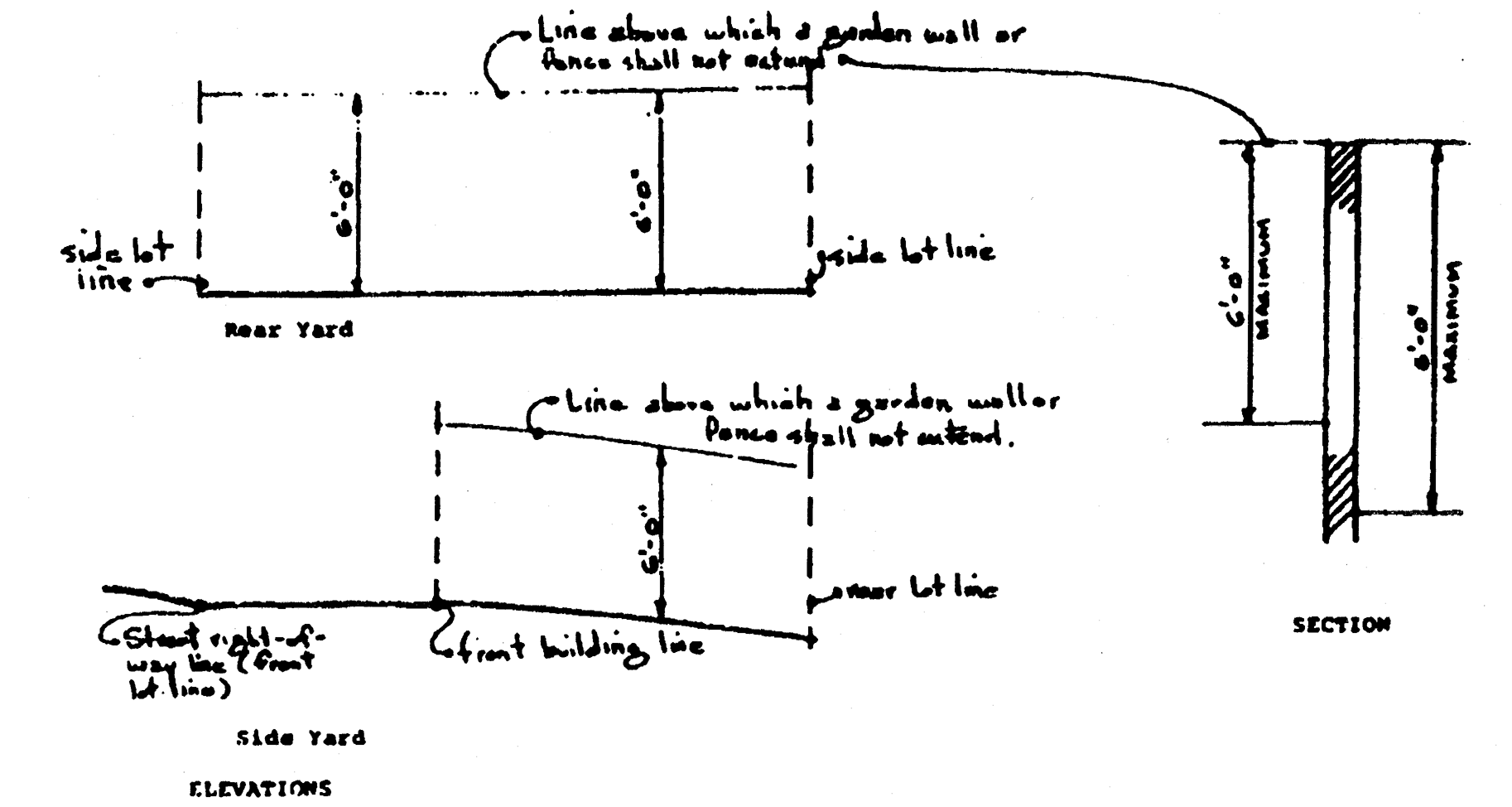
HEIGHT MEASUREMENT OF GARDEN WALLS, SIDE OR REAR YARD
(Ord. No. 2-74, § 5.36(c), 3-26-74; Ord. No. 1-84, § 3(b), 3-1-84; Ord. No. 1-86, § 3(c), 2-10-86; Ord. No. 1-87, § 3(c), 2-9-87; Ord. No. 1-90, § 3(e), 2-5-90; Ord. No. 1-93, § 3(c)—(e), 2-8-93; Ord. No. 1-98, § 8, 2-9-98; Ord. No. 1-00, § 4, 2-22-00)
Sec. 134-1670. - Retaining walls.
(a)
Retaining walls which front on a street and which are located in the street front, street side or street rear setback shall not exceed a maximum height of six feet as measured from the lowest grade on either side of the retaining wall to the top of said wall at that location in that setback. In addition, if a retaining wall is within ten feet of a wall and/or fence in the same front, street side or street rear yard setback, said retaining wall and wall and/or fence shall not exceed a total combined height of nine feet as measured from the lowest grade adjacent to said retaining wall to the top of said wall and/or fence at that same location in that setback. However, in no instance shall a retaining wall, wall, fence or combination thereof exceed, or be contrary to, the maximum and minimum requirements in section 134-1667.
(b)
If a retaining wall in the front setback area is not fronting on a street, said retaining wall shall not exceed a maximum height of six feet as measured from the lowest grade on either side of the retaining wall to the top of said retaining wall at any location in that setback. In addition, if a retaining wall is within ten feet of a wall and/or fence in the same front setback not fronting a street, said retaining wall and wall and/or fence shall not exceed a total combined height of nine feet as measured from the lowest grade adjacent to the retaining wall to the top of the wall or fence at that same location in that setback nor six feet in height as measured from the abutting property. In addition, if said retaining wall, and wall and/or fence within the front setback area are within ten feet of each other and their combined height exceeds six feet, said retaining wall shall have a minimum four foot high hedge located on the inside portion of the retaining wall.
(c)
A retaining wall within ten feet of the side or rear property line shall not exceed a maximum height of seven feet from the lowest grade on either side of the retaining wall to the top of said retaining wall. In addition, if a retaining wall, and wall and/or fence is within ten feet of the side or rear property line, they shall not exceed a total combined height of ten feet as measured from the lowest grade adjacent to the retaining wall to the top of the wall or fence at that same location nor seven feet in height as measured from the abutting property.
(Ord. No. 1-00, § 4, 2-22-00; Ord. No. 1-02, § 17, 3-12-02; Ord. No. 1-04, § 44, 3-9-04)
Sec. 134-1671. - Restrictions.
In addition to the other requirements in this division, a wall or fence shall conform with section 134-1637 and shall in no case be located closer than 2½ feet of the rear lot line unless previously approved by the town engineer, and execution and recordation of an acceptable removal agreement. In addition, no fence or wall shall be located within the street right-of-way or streetward of the front lot line as provided for in section 134-1636.
(Ord. No. 2-74, § 5.36(d), 3-26-74; Ord. No. 1-84, § 3(b), 3-1-84; Ord. No. 1-86, § 3(c), 2-10-86; Ord. No. 1-87, § 3(c), 2-9-87; Ord. No. 1-90, § 3(e), 2-5-90; Ord. No. 1-93, § 3(c)—(e), 2-8-93; Ord. No. 1-00, § 4, 2-22-00; Ord. No. 1-02, § 17, 3-12-02)
Sec. 134-1816.- Auto rental lots.
(a)
Prior to the issuance of a permit for the use of any property as an auto rental lot, the town's engineer or other designated officer shall certify in writing that all of the conditions required as a prerequisite to the granting of such permit have been completed in accordance with such conditions and requirements.
(b)
Servicing of the licensee's vehicles, consisting of washing and lubrication only, may be permitted on an auto rental lot, provided that the servicing facilities are housed in a building with no opening directly onto the street, and such servicing shall not be visible or audible from the street or adjoining property.
(c)
On auto rental lots an office structure, which shall include toilet facilities, shall be erected. One gas pump for the sole purpose of serving the rental vehicles owned by the licensee may be installed. Such pump shall be located not more than ten feet or less than five feet from the designated rear lot line. Where one or more lot lines abut a residential district, a wall not less than five feet in height shall be erected along such rear lot line.
(d)
No automobiles shall be sold or held for sale on an auto rental lot.
(Ord. No. 2-74, § 6.23, 3-26-74)
Sec. 134-1817. - Service stations.
(a)
Location of exits and entrances. No gasoline service station shall have an entrance or exit for vehicles within 350 yards, which distance shall be measured by following the curbline or edge of roadway where no curb exists, of the shortest vehicular route to the nearest point of the grounds of any school, public recreation area, church, chapel or residential district, and such access shall not be closer than 30 feet to any intersection.
(b)
Location of oil drainage pits and hydraulic lifts. All oil drainage pits and hydraulic lifts shall be located within an enclosed structure and shall be located no closer than 50 feet to any property line.
(c)
Mechanical repair. All permitted mechanical repair work shall be conducted within an enclosed structure and shall be located no closer than 50 feet to any property line.
(d)
Gasoline pumps. Gasoline service stations shall have their gasoline pumps, including other service facilities, set back at least 30 feet from any street line.
(e)
Storage of vehicles. Service station premises shall not be permitted to be used as public or private parking lots unless so licensed by the town for motor vehicles other than those vehicles belonging to employees of the service station or those vehicles receiving or about to receive service.
(Ord. No. 2-74, § 6.24, 3-26-74; Ord. No. 4-75, § 4, 3-24-75)
Sec. 134-1996.- Use of open areas of lot or vacant lots within commercial districts.
When open areas of lots or vacant lots within the commercial district are used for the open air display of merchandise or for open air seating for more than 30 consecutive calendar days or 60 total calendar days in any 12-month period, these areas shall be subject to all of the same regulations of the town's ordinances which are applicable to merchandise display areas or seating areas contained within buildings, including but not limited to the provision of off-street parking, such parking to include the number of spaces necessary to accommodate the total open air merchandise display areas or open air seating, and, further, the provision of a structure to house required toilet facilities and salesmen or attendant office space.
(Ord. No. 2-74, § 5.42(b), 3-26-74; Ord. No. 4-80, § 4, 3-31-80; Ord. No. 1-85, § 3(b), 2-11-85)
Sec. 134-1997. - Electronic banking machines.
The construction, installation and use of all electronic banking machines and/or automatic bank teller equipment shall be located only in a commercially zoned district of the town. With the exception of banks and financial institutions, such machines and equipment must be located entirely on the interior of businesses in the commercially zoned districts, and there shall he no exterior advertising provided therewith.
(Ord. No. 2-74, § 6.52, 3-26-74; Ord. No. 1-84, § 4(e), 3-1-84)
Sec. 134-2103.- Purpose.
(a)
The purpose of this division is to ensure that any proposed new substation is in an appropriate location and that any new construction, upgrade or expansion of a distribution electric substation is regulated as to setbacks, landscaping, buffering, screening, lighting and other aesthetic compatibility issues. New distribution electric substations shall be a special exception use in all zoning districts, except the conservation district where that use is prohibited.
(b)
Review and approval. Distribution electric substations shall be reviewed by the town for compliance with the applicable setback, landscaping, buffering, screening, lighting, and other established aesthetic compatibility-based standards, as well as conflicts with existing and proposed utilities. A utility requesting to construct a new electric substation within the town shall submit a special exception with site plan review application as required within this chapter.
The town council shall grant or deny the application for the special exception with site plan review to construct a distribution electric substation. In determining whether to grant or deny the application, the town council shall review the plan and the comments of the planning, zoning and building department and determine whether the proposed development plan is complete and complies with the requirements of these regulations and the purpose and intent in the code. The issuance of a permit to locate a new distribution electric substation does not relieve the applicant from complying with applicable federal or state laws or regulations and other applicable local land development, right-of-way or building regulations. The time schedule set forth in this section may be modified as agreed to in writing between the applicant and the town manager.
(c)
Setbacks and landscape buffers.
(1)
Residential zoning districts. There shall be a minimum 50-foot front, street side yard, street rear yard and/or side yard and rear yard setback for any building, structure or equipment on the substation property. In addition, there shall be a minimum 100-foot separation between any building, structure or equipment on the substation property and adjacent or abutting residential dwelling. An open green space buffer shall be required which is a minimum of 25 feet in width. Said landscape material, size, quantity and location shall be reviewed and approved by the town's architectural commission.
(2)
Commercial zoning districts. There shall be a minimum 25-foot front, street side yard, street rear yard and/or side yard and rear yard setback for any building, structure or equipment on the substation property. In addition, there shall be a minimum 100-foot separation between any building, structure or equipment on the substation property and adjacent or abutting residential dwelling. An open green space buffer shall be required which is a minimum of 15 feet in width. Said landscape material, size, quantity and location shall be reviewed and approved by the town's architectural commission.
(d)
Supplemental requirements. In addition to the requirements of this section, the following additional zoning requirements shall be met:
(1)
For residentially zoned property there shall be a minimum 55 percent landscape open space of which 80 percent of that percentage is required to be perimeter landscaping within 25 feet of the property line. For commercially zoned property there shall be a minimum 50 percent landscape open space of which 70 percent of that percentage is required to be perimeter landscaping within ten feet of the property line.
(2)
For residentially zoned property, a security and buffer wall of not less than eight feet high nor more than 14 feet high shall be erected and maintained around the perimeter of the substation and be setback 50 feet from all property lines. In addition, a minimum eight-foot high hedge, not more than four feet from said security and buffering wall shall be required between said wall and property line. Said wall's material and design shall be required to be reviewed and approved by the architectural commission.
(3)
An automated irrigation system shall be installed and maintained for all required landscape improvements.
(4)
Regular landscape maintenance (i.e. mowing, edging, mulching, weeding, pruning, trimming, fertilizing, replacement of dead, dying or diseased plant materials and other necessary plant and property maintenance) shall be performed in addition to the standard routine maintenance of the substation, substation structures and equipment, the buffer wall and the open green space.
(e)
Substation site selection. Prior to submitting an application for a special exception with site plan review for a new electric substation in a residential zoning district, the applicant shall provide the director of the planning, zoning and building department with a preferred site justification statement, legal description and survey, evidence of title, and other documents and data supporting the applicant's preferred site, together with the same documentation pertaining to not less than three available alternative sites ("site selection documents"), including sites within nonresidential areas that are technically and electrically capable of accommodating the load to be served. Site selection documents which are deemed to be incomplete by the director of the planning, zoning and building department will not be reviewed, and in such event, the applicant must resubmit complete site selection documents and a $500.00 filing fee in order to proceed with the site selection process. After reviewing the site selection documents and consulting with the applicant on the proposed site and alternative sites, the director shall make a recommendation to the town council as to the location of the substation. The recommendation of the director shall be reviewed and either approved or denied by the town council within 90 days of the submission of complete site selection documents by the applicant. In the event that the applicant disagrees with the town's selection of an appropriate location, the selection of the substation site shall be submitted to mediation to be conducted pursuant to F.S. §§ 44.401—44.406, unless otherwise agreed to in writing by the parties, and the mediation shall be concluded within 30 days after notice of intent to mediate is given by one of the parties, unless extended by written agreement by both the applicant and the town. The 90-day time period within which the town council is required to render a final decision on the site location shall begin from the date a notice of intent to mediate the site selection issue is served by either the applicant or the town, until the mediation is concluded, terminated, or an impasse is declared. The town council and the applicant may agree to waive or extend this 90-day time period. Upon rendition of a final decision by the town council, the applicant may pursue available legal remedies in accordance with state law, and the matter shall be considered on an expedited basis.
(Ord. No. 4-08, § 6, 4-7-08)
Sec. 134-2104.- Requirements fees and security deposit.
(a)
It shall be unlawful for any person to provide outdoor cafe seating without an outdoor cafe seating permit from the town. Outdoor cafe seating shall only be permitted in the R-D(2), C-TS, C-WA, C-OPI, and C-B zoning districts if conditions of approval set forth in sections 134-2105 through 134-2108 are met and an outdoor cafe seating permit is issued by the town.
(b)
There is an annual outdoor cafe seating permit fee established in the town's master fee schedule and included in the annual business tax receipt.
(c)
Prior to the issuance of an outdoor cafe permit, the permittee shall provide a security deposit to the town in the amount as identified in the town's master fee schedule if any portion of the outdoor cafe seating is located within a town right-of-way or on town property.
(Ord. No. 5-09, § 1, 4-15-09; Ord. No. 16-2021, § 17, 8-11-21)
Sec. 134-2105. - Application.
After town council approval of a special exception zoning application, the applicant shall file for an outdoor cafe seating permit application to the director of the planning, zoning and building department or his or her designee (individually or collectively referred to in this chapter as "director"). The permit application shall be provided by the planning, zoning and building department.
(Ord. No. 5-09, § 1, 4-15-09; Ord. No. 16-2021, § 17, 8-11-21)
Sec. 134-2106. - Standards and criteria for special exception and outdoor cafe permit application review.
The standards and conditions required to be met as part of the special exception application and outdoor cafe seating permit approval are those provisions provided for in section 123-229 and the following criteria and conditions:
(a)
Criteria and conditions required to be met for approval of outdoor cafe seating on a street sidewalk.
(1)
Outdoor cafe seating is not allowed to increase the capacity of a restaurant, dining room, retail specialty food including the sale prepared foods for takeout only, or private, social, swimming, golf, tennis or yacht club. The exception is that a specialty food use, including the sale of prepared foods for takeout only that is under 2,000 square feet in gross leasable area may request up to eight [additional] outdoor cafe seats over the inside capacity provided that the seating meets the conditions herein.
(2)
Bars/lounges and nightclubs are not permitted to have outdoor cafe seating.
(3)
An outdoor cafe seating area is restricted to the area abutting the boundary lines of the property on which the business owned by the applicant is located.
(4)
Outdoor cafe seating shall not be allowed where the outdoor seating furniture would be placed within five feet of bus stops, loading zones, valet parking stands, sight triangles or other structures or areas determined by the director to require clearance for the public. For the purpose of this chapter outdoor cafe seating furniture is defined as tables, chairs, umbrellas, portable heaters, mist sprayers and any other customarily usual objects used in the outside cafe seating area.
(5)
No outdoor cafe seating furniture shall be allowed within five feet of a pedestrian crosswalk.
(6)
All outdoor cafe seating furniture shall be located in such a manner that a minimum five foot-wide unobstructed pedestrian path is maintained at all times.
(7)
No outdoor cafe seating furniture shall be permitted around the perimeter of an outdoor seating area that would have the effect of forming a physical or visual barrier discouraging the use of the pedestrian sidewalk.
(8)
An outdoor cafe seating area is prohibited from having music.
(9)
No wait stations shall be allowed outside on the sidewalk. All wait stations on private property shall not be visible from a sidewalk or street.
(10)
All kitchen equipment used to service the outdoor cafe seating shall be located within a building.
(11)
All outdoor cafe seating furniture and associated lighting shall be aesthetically and architecturally pleasing and approved by either the Architectural Commission or Landmark Preservation Commission, whichever is applicable.
(12)
An outdoor cafe seating area shall not count toward any maximum square footage limitations.
(13)
All outdoor cafe seating furniture, including all accessary appurtenances including but not limited to approved space heaters, misters and portable umbrellas that are located within the outdoor seating area shall be stored inside a building after close of business.
(14)
No outdoor cafe seating furniture located within the public right-of-way shall be attached, chained or in any manner affixed to any tree, post, sign or other fixtures, curb or sidewalk within or near the permitted area.
(15)
The area covered by an outdoor cafe seating permit, and the sidewalk and street immediately adjacent to it, shall be maintained in a clean, neat and orderly appearance at all times and clear of any trash or refuse by the permittee. The area of the sidewalk, curb and gutter immediately adjacent to the sidewalk cafe shall be cleared of all debris during hours of operation and again at the close of each business day, or as may otherwise be determined by the director.
(b)
Criteria and conditions required to be met for approval of outdoor cafe seating on private property not within a street sidewalk:
(1)
Outdoor cafe seating is not allowed to increase the capacity of a restaurant, dining room, retail specialty food including the sale of prepared food for takeout only, or private, social, swimming, tennis or yacht club. The exception is that a specialty foods use, including sale of prepared foods for takeout only that is under 2,000 square feet in gross leasable area may request up to eight [additional] outdoor cafe seats over the inside capacity provided that the seating meets the conditions herein.
(2)
Bars/lounges and nightclubs are not permitted to have outdoor cafe seating.
(3)
Outdoor cafe seating is restricted to boundary lines of the property on which the business owned by the applicant is located.
(4)
All tables, chairs, umbrellas, mist sprayer, space heaters or other customarily usual outdoor cafe seating furniture shall be located in such a manner that a minimum four foot-wide unobstructed pedestrian path is maintained at all times.
(5)
No objects shall be permitted around the perimeter of an outdoor cafe seating area occupied by tables and chairs that would have the effect of forming a physical or visual barrier discouraging the use of the pedestrian path.
(6)
An outdoor cafe seating area on private property shall only be allowed to have low-level, background music that does not exceed the maximum noise decibel requirements in sections 42-226 through 42-228 if approved by the town council as part of the special exception application approval.
(7)
No wait stations shall be allowed outside on a street sidewalk. All wait stations on private property shall not be visible from a sidewalk or street.
(8)
All kitchen equipment used to service the outdoor cafe seating shall be located within a building.
(9)
All outdoor cafe seating furniture, including all accessary appurtenances including but not limited to approved space heaters, misters and portable umbrellas that are located within the outdoor seating area shall be stored inside a building after close of business.
(10)
All outdoor cafe seating furniture, including the tables, chairs, awnings and space heater equipment shall be aesthetically and architecturally pleasing and approved by either the Architectural Commission or Landmark Preservation Commission, whichever is applicable.
(11)
The area covered by an outdoor cafe seating permit, and the sidewalk and street immediately adjacent to it, shall be maintained in a clean, neat and orderly appearance at all times and clear of any trash or refuse by the permittee. The area of the sidewalk, curb and gutter immediately adjacent to the sidewalk cafe shall be cleared of all debris during hours of operation and again at the close of each business day, or as may otherwise be determined by the director.
(12)
Areas associated with the outdoor cafe seating shall not count toward any maximum square footage limitations.
(Ord. No. 5-09, § 1, 4-15-09; Ord. No. 16-2021, § 17, 8-11-21)
Sec. 134-2107. - Liability and insurance.
(a)
Prior to the issuance of a business tax receipt the applicant shall furnish the town with a signed statement that the permit shall hold harmless the town, its officers, employees, Palm Beach County or the Florida Department of Transportation (FDOT) (if within or abutting either governmental entities rights-of-way) for claims of damages to property or injury to person which may be occasioned by any activity carried out under the terms of the business tax receipt and approved outdoor sidewalk cafe permit. The statement shall include that the permittee shall be responsible, shall indemnify and shall hold the Town, Palm Beach County and/or FDOT harmless for performance of and payment for any environmental remediation that may be necessary, as determined by the FDOT, as a result of permittee's use of the area of the outdoor sidewalk cafe.
(b)
Permittee shall furnish and maintain public liability, food products liability, liquor liability, and property damage insurance for the benefit of the Town and/or Palm Beach County or FDOT (if within or abutting either governmental entities rights-of-way) from all claims and damage to property or bodily injury, including death, which may arise from operations under the business tax receipt or in connection therewith. Such insurance shall provide coverage of not less than $1,000,000.00 for bodily injury or death to any one person or any number of persons in any one occurrence and property damage, respectively, per occurrence, or a combined coverage of not less than $2,000,000.00. Such insurance shall be without prejudice to coverage otherwise existing therein and shall name as additional insureds the town, Palm Beach County and/or FDOT, their officers and employees, if within or abutting either's rights-of-way and shall further provide that the policy shall not terminate or be canceled prior to the completion of the business tax receipt period without 45 days written notice to the risk manager at the address shown on the business tax receipt.
(c)
Damage to the public sidewalk or any public structure as a result of the outdoor cafe seating operation shall be the responsibility of the property owner to repair to the satisfaction of the town.
(d)
The town and its officers and employees shall not be responsible for sidewalk seating components relocated or damaged during emergencies.
(Ord. No. 5-09, § 1, 4-15-09; Ord. No. 16-2021, § 17, 8-11-21)
Editor's note— Ord. No. 16-2021, § 17, adopted August 11, 2021, amended the title of § 134-2107 to read as herein set out. The former § 134-2107 pertained to conditions specific to outdoor seating on public rights-of-way.
Sec. 134-2108. - Denial, revocation or suspension of approval.
(a)
An outdoor cafe seating permit shall be denied if all of the requirement and/or conditions in sections 134-2106 and 134-2107 are not met. An outdoor cafe seating permit may be modified, suspended or revoked by the planning, zoning and building director if it is determined that the business is violating the requirement and/or conditions in sections 134-2106 and 134-2107 or if it is determined by the town that the outdoor cafe seating is negatively impacting neighboring property owners or tenants.
(b)
The director may require the temporary removal of sidewalk cafe outdoor seating when street, sidewalk or utility repairs necessitate such action.
(c)
If found to be necessary for the protection of the health, safety and welfare of the public, the departments of public works, police and fire-rescue or other emergency service providers may require the applicant to immediately remove or relocate all or parts of the sidewalk outdoor cafe seating and, if necessary, the town may remove or relocate same in emergency situations.
(Ord. No. 5-09, § 1, 4-15-09; Ord. No. 16-2021, § 17, 8-11-21)
Sec. 134-2109. - Appeal of denial, suspension or revocation by the director of planning, zoning and building department.
The town council shall hear any appeal of a denial, suspension or revocation of an outdoor cafe seating permit by the planning, zoning and building director or designee pursuant to sections 134-141 through 134-145 of the code.
(Ord. No. 5-09, § 1, 4-15-09; Ord. No. 16-2021, § 17, 8-11-21)
Sec. 134-2110.- Purpose.
The purpose of this division is to provide general guidelines for the establishment of and conversion to condominium-hotels a.k.a. condo-hotels.
(Ord. No. 5-09, § 18, 4-15-09)
Sec. 134-2111. - Requirements.
A condo-hotel shall satisfy the following requirements:
(1)
All overnight resident units in a condo-hotel shall be considered transient accommodation units and not as a permanent residential unit.
(2)
A central management operation (reservation system) shall be required as an integral part of the condo-hotel facility for the rental units.
(3)
There shall be a lobby/front desk area that is internally oriented and must be operated as a hotel.
(4)
A condo-hotel may be permitted in any land use/zoning district where a hotel is permitted, except for the C-PC district where condo-hotels shall not be permitted.
(5)
A condo-hotel shall be allowed the same exterior signage as a traditional hotel facility.
(6)
Overnight resident units in a condo-hotel may not be occupied by their owner for more than a total of six months in any consecutive 12-month period.
(7)
The books and records of the condo-hotel pertaining to the rentals of each overnight resident unit in the condo-hotel or hotel facility shall be open for inspection by authorized representatives of the town, upon reasonable notice, in order to confirm compliance with these regulations as allowed by general law.
(8)
A conversion from hotel to condo-hotel shall not result in any new or expanded kitchen facilities in individual overnight resident units.
(Ord. No. 5-09, § 18, 4-15-09)
Sec. 134-2112.- Reasonable accommodation procedures.
(1)
This section implements the policy of the Town of Palm Beach for processing of requests for reasonable accommodation to its ordinances, rules, policies, and procedures for persons with disabilities as provided by the federal Fair Housing Amendments Act ("FHAA") and the Americans with Disabilities Act ("ADA"). For purposes of this section, a "disabled" individual or person is an individual that qualifies as disabled and/or handicapped under the FHAA and/or ADA. Any person who is disabled (or qualifying entities) may request a reasonable accommodation with respect to the town's land use or zoning laws, rules, policies, practices and/or procedures as provided by the FHAA and the ADA pursuant to the procedures set out in this section.
(2)
A request by an applicant for reasonable accommodation under this section shall be made in writing by completion of a reasonable accommodation request form, which form is maintained by (and shall be submitted to) the town clerk. The reasonable accommodation form shall contain such questions and requests for information as are necessary for processing the reasonable accommodation request. The reasonable accommodation request form shall be substantially in the form set forth in subsection (10) below.
(3)
Should the information provided by the disabled individual to the town include medical information or records, including records indicating the medical condition, diagnosis or medical history of the disabled individual, such individual may, at the time of submitting such medical information, request that the town, to the extent allowed by law, treat such medical information as confidential information of the disabled individual. The town shall thereafter endeavor to provide written notice to the disabled individual, and/or their representative, of any request received by the town for disclosure of the medical information or documentation which the disabled individual has previously requested be treated as confidential by the town. The town will cooperate with the disabled individual, to the extent allowed by law, in actions initiated by such individual to oppose the disclosure of such medical information or documentation, but the town shall have no obligation to initiate, prosecute or pursue any such action, or to incur any legal or other expenses (whether by retention of outside counsel or allocation of internal resources) in connection therewith, and may comply with any judicial order without prior notice to the disabled individual.
(4)
The town manager, or his/her designee, shall have the authority to consider and act on requests for reasonable accommodation, after a minimum of 30-day notice to all property owners within 300 feet of the property proposed for a reasonable accommodation and after a public hearing to receive comments, input and information from the public (provided, however, the town manager or designee shall not be required to render his or her decision at said public hearing). Each applicant submitting a reasonable accommodation request form shall be responsible for providing a notice affidavit to the town manager, or his/her designee, verifying that all property owners within the 300-foot radius of the proposed property was mailed a proper notice outlining the specific nature of the reasonable accommodation request, including the date time and location of the public hearing in which said request will be considered and a listing of all property owners; and a corresponding map of property owners within the 300-foot radius. Said property owner list and map is required to be provided from information provided by the Palm Beach County Property Appraisers Office. When a reasonable accommodation request form has been completed and submitted to the town clerk it will be referred to the town manager, or designee, for review and consideration. The town manager, or designee, shall issue a written determination within 45 days of the date of receipt of a completed application and may, in accordance with federal law: (a) grant the accommodation request; (b) grant a portion of the request and deny a portion of the request, and/or impose conditions upon the grant of the request; or (c) deny the request, in accordance with federal law. Any such denial shall be in writing and shall state the grounds therefor. All written determinations shall give notice of the right to appeal. The notice of determination shall be sent to the requesting party (i.e. the disabled individual or his/her representative) by certified mail, return receipt requested. If reasonably necessary to reach a determination on the request for reasonable accommodation, the town manager, or designee, may, prior to the end of said 45-day period, request additional information from the requesting party, specifying in sufficient detail what information is required. The requesting party shall have 15 days after the date of the request for additional information to provide the requested information. In the event a request for additional information is made, the 45-day period to issue a written determination shall no longer be applicable, and the town manager, or designee, shall issue a written determination within 30 days after receipt of the additional information. If the requesting party fails to provide the requested additional information within said 15-day period, the town manager, or designee, shall issue a written notice advising that the requesting party had failed to timely submit the additional information and, therefore, the request for reasonable accommodation shall be deemed abandoned and/or withdrawn and no further action by the town with regard to said reasonable accommodation request shall be required. The deadlines referenced herein may be extended by mutual agreement between the town and the applicant.
(5)
In determining whether the reasonable accommodation request shall be granted or denied, the requesting party shall be required to establish that they are protected under the FHA and/or ADA by demonstrating that they, or the party they represent, are handicapped or disabled, as defined in the FHA and/or ADA. Although the definition of disability is subject to judicial interpretation, for purposes of this section the disabled individual must show: (i) a physical or mental impairment which substantially limits one or more major life activities; (ii) a record of having such impairment; or (iii) that they are regarded as having such impairment. Next, the requesting party will have to demonstrate that the proposed accommodations being sought are reasonable and necessary to afford handicapped/disabled persons equal opportunity to use and enjoy housing. The foregoing (as interpreted by the courts) shall be the basis for a decision upon a reasonable accommodation request made by the town manager, or designee, or by the town council in the event of an appeal.
(6)
Within 30 days after the town manager's, or designee's, determination on a reasonable accommodation request is mailed to the requesting party, such applicant may appeal the decision. All appeals shall contain a statement containing sufficient detail of the grounds for the appeal. Appeals shall be to the town council who shall, after public notice and a public hearing, render a determination as soon as reasonably practicable, but in no event later than 60 days after an appeal has been filed.
(7)
There shall be no fee imposed by the town in connection with a request for reasonable accommodation under this section or an appeal of a determination on such request to the town council, and the town shall have no obligation to pay a requesting party's (or an appealing parties, as applicable) attorneys' fees or costs in connection with the request, or an appeal.
(8)
While an application for reasonable accommodation, or appeal of a determination of same, is pending before the town, the town will not enforce the subject zoning ordinance, rules, policies, and procedures against the applicant.
(9)
The following general provisions shall be applicable:
a.
The town shall display a notice in the town's public notice bulletin board (and shall maintain copies available for review in the town clerk's office), advising the public disabled individuals (and qualifying entities) may request reasonable accommodation as provided herein.
b.
A disabled individual may apply for a reasonable accommodation on his/her own behalf or may be represented at all stages of the reasonable accommodation process by a person designated by the disabled individual.
c.
The town shall provide such assistance and accommodation as is required pursuant to FHA and ADA in connection with a disabled person's request for reasonable accommodation, including, without limitation, assistance with reading application questions, responding to questions, completing the form, filing an appeal, and appearing at a hearing etc. to ensure the process is accessible.
d.
Reasonable accommodation request form shall be filed with the town to include the following information:
1.
Name of applicant:
2.
Telephone number:
3.
Address:
4.
Address of housing or other location at which accommodation is requested:
5.
Describe qualifying disability or handicap:
6.
Describe the accommodation and the specific regulation(s) and or procedure(s) from which accommodation is sought:
7.
Reasons the reasonable accommodation may be necessary for the individual with disabilities to use and enjoy the housing or other service:
8.
Name address and telephone number of representative if applicable:
9.
Other information:
10.
Signature of disabled individual or representative, if applicable, or qualifying entity:
(Ord. No. 24-2016, § 4, 1-11-17)
Sec. 134-2113.- Prohibition.
Cannabis cultivation, the operation of a medical marijuana treatment center or medical marijuana dispensary, and the sale or dispensation of marijuana (including medical and non-medical marijuana), cannabis, cannabis-based products and cannabis plants, are prohibited uses in all zoning districts of the town.
(Ord. No. 24-2016, § 5, 1-11-17; Ord. No. 034-2024, § 3, 12-11-24)
Sec. 134-2114. - Reserved.
Editor's note— Ord. No. 034-2024, § 3, adopted December 11, 2024, repealed § 134-2114, which pertained to development standards and derived from Ord. No. 24-2016, § 5, 1-11-17.
Sec. 134-2115. - Requirements for outdoor promotional events.
Outdoor promotional events shall only be allowed in the C-TS, C-WA and C-PC Zoning Districts by special exception approval. It shall be unlawful for any person to have an outdoor promotional activity without approval by the town council of a special exception application and a Declaration of Use Agreement which identifies any conditions of approval and remedies for violation of those conditions as provided under sections 134-226 through 134-230 of the Code. Said events are subject to the additional requirements set forth below:
(1)
A special exception application for outdoor promotional events shall only be allowed to be filed by the property owner where outdoor promotional events are to be held.
(2)
The property owner shall be responsible for sponsoring and managing any outdoor promotional event on a property.
(3)
The number of outdoor promotional events per year shall be determined by the town council and provided in the required Declaration of Use Agreement.
(4)
The hours and days in which outdoor promotional events may occur shall be determined by the town council and provided in the Declaration of Use Agreement.
(5)
Amplified music or sound shall only be allowed if said event is held 200 feet or more from any residential use. Such event shall meet the town's noise regulations as provided in sections 42-196 through 42-229 of the Code.
(6)
There shall be no outdoor sales of alcoholic beverages other than the sales related to town approved outdoor seating for the licensed businesses on the property.
(7)
Any approval of a special exception to allow outdoor promotional events shall be required to be reviewed by the town council one year following approval and recordation of the Declaration of Use Agreement. Said approval may be amended or revoked by the town council at that time should it be determined that said use has a negative impact on surrounding properties.
(8)
Approval of outdoor promotional events may be revoked or modified by the town council at any time should it be determined that said use has a negative impact on surrounding properties.
(Ord. No. 30-2017, § 5, 1-10-18)
Sec. 134-1547. - Lot, yard and bulk.
(a)
Under this chapter, all lot, yard and bulk regulations for both the principal and accessory uses shall be calculated within the confines of a contiguous lot, except for a beach house constructed within the beach area where the provisions of division 15 of article VI of this chapter shall apply.
(b)
Lot, yard and bulk regulations for lots abutting the Atlantic Ocean used for other than beach houses shall be calculated utilizing the Beach Area Boundary, as set forth in division 15 of article VI of this chapter as the easterly lot line for the lot.
(Ord. No. 2-74, § 5.15(a), (b), 3-26-74; Ord. No. 1-93, § 3(a), 2-8-93; Ord. No. 1-95, § 1(a), 1-23-95)
Sec. 134-1548. - Yard regulations.
Every part of a required front, side and rear yard must be open to the sky, unobstructed, except for accessory buildings in a rear or side yard, garden walls and fences, as permitted, and except for the ordinary projections of first floor first floor entry ramps, landings, open terraces, unenclosed porches, balconies, steps, sills, belt courses, cornices and for ornamental features as identified in sections 134-795, 134-845, 134-895, 134-950, 134-951, 134-1006, 134-1007, 134-1061, 134-1062, 134-1114, 134-1164, 134-1213, 134-1263, 134-1308, 134-1576, 134-1577 and division 5 of article VIII of this chapter.
(Ord. No. 2-74, § 5.30, 3-26-74; Ord. No. 1-89, § 3(a), 2-6-89; Ord. No. 6-93, § 3(c), 2-9-93; Ord. No. 19-2021, § 6, 9-13-21)
Sec. 134-1576. - Corner lots.
(a)
Where any lot is located on any street intersection or where two or more intersecting street lines outline any lot, or where any lot is located upon any corer, or side of the lot facing a street shall be determined to be the front street line of the lot by the orientation of the building facing a street and the other side of the lot facing a street shall be determined to be the side street of the lot, provided that such choice, in the opinion of the director of planning, zoning and building shall not be injurious to the existing or desirable future development of the surrounding property. Except in the R-B district, the required street side yard shall have the same setback as the front street yard of such lot, and shall have the same provisions, requirements and restrictions as a required front street yard (see following illustration).
In the R-B district, the required street side yard setback for the first story shall be 25 feet except that a one-story garage shall be set back at least 18 feet, any second story portion of the structure shall be set back at least 30 feet.
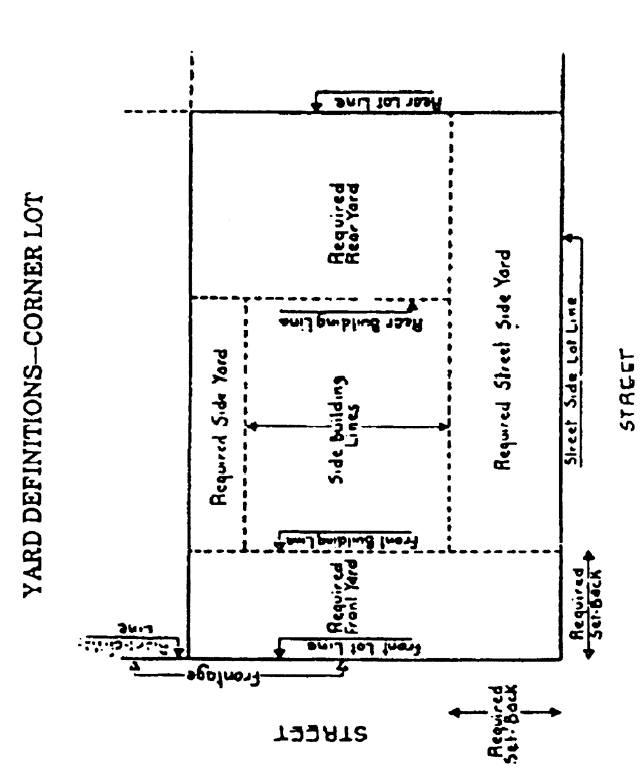
(b)
The provisions of section 134-1636 shall apply to the street side yard for a corner lot.
(Ord. No. 2-74, § 5.34, 3-26-74; Ord. No. 1-99, § 21, 4-5-99; Ord. No. 26-10, § 8, 12-15-10)
Sec. 134-1577. - Through lots.
(a)
Where any lot extends the entire depth or width of a block and has frontage on more than one street at opposite ends of the lot, one side of the lot facing a street shall be determined to be the front street line of the lot by the orientation of the building facing a street and the other side of the lot facing a street shall be determined to be the rear street frontage, providing that such choice, in the opinion of the director of planning, zoning and building, shall not be injurious to the existing or desirable future development of surrounding property. The required rear street yard shall have the same setback as the front of such lot and shall have the same provisions, requirement and restrictions as a required front yard.
(b)
The provisions of section 134-1636 shall apply to the rear street yard for a through lot.
(Ord. No. 2-74, § 5.35, 3-26-74; Ord. No. 26-10, § 9, 12-15-10)
Sec. 134-1600. - Maximum yard elevation requirements.
(a)
The maximum elevation of any required yard shall not exceed a grade elevation height of half the difference between the lowest habitable finished floor of the principal structure and the highest crown of the road in front of the lot. In case of a through or corner lot, the highest crown of road from the street determined to be on the front property line. The equation is as follows:
COR: highest crown of road where the principal structure fronts onto
FFE: Lowest habitable finished floor elevation of the principal structure
FFE-COR ÷2 = Maximum amount of fill allowed within any required yard.
(Ord. No. 19-2021, § 7, 9-13-21; Ord. No. 31-2025, § 2, 12-10-25)
Editor's note— Ord. No. 31-2025, § 2, adopted December 10, 2025, amended the title of § 134-1600 to read as herein set out. The former § 134-1600 title pertained to maximum lot fill allowed.
Sec. 134-1696. - Abuse of property by excess number of inhabitants; limitation on number of basement bathrooms.
(a)
Abuse of property by excess number of inhabitants. The use of any property or of any building by a larger number of persons than such property or building is zoned for or designed to accommodate is declared to be a violation of this chapter.
(b)
Limitation on number of basement bathrooms. In a single-family dwelling the number of bathrooms and/or toilet compartments in the basement or subbasement areas shall not exceed one.
(Ord. No. 2-74, § 5.49, 3-26-74; Ord. No. 3-76, § 3, 3-23-76; Ord. No. 1-84, § 3(f), 3-1-84)
Sec. 134-1697. - Buildings and structures over Lake Worth.
With the exception of essential services, landing docks and piers related to town-owned municipal property, buildings, and structures, no buildings or structures shall be erected or constructed west of the established bulkhead or bulkhead line or over the water of Lake Worth except one pier or land docks on a lot, which shall meet the requirements in chapter 62, article III, sections 62-74, and 62-75, of the Code. No cooking, sleeping, or business activity shall be permitted or conducted on a dock except as associated with the town's operation of its municipal docks.
(Ord. No. 2-74, § 5.43, 3-26-74; Ord. No. 1-85, § 3(c), 2-11-85; Ord. No. 1-03, § 11, 3-11-03; Ord. No. 2-05, § 9, 5-10-05; Ord. No. 02-2019, § 15, 3-19-19; Ord. No. 16-2021, § 16, 8-11-21)
Sec. 134-1698. - Structures, signs and landscape material west of Lake Trail.
No buildings or other structures of any nature, other than buildings or structures for essential services and docks, shall be constructed upon
land lying west of the Lake Trail. No signs shall be permitted west of the Lake Trail except property protection signs as approved by the Architectural Commission. In addition, a Lake Trail scenic vista shall be maintained for the entire width and depth of all properties that abut the west side of Lake Trail with the exception of those properties used to provide essential services. The following standards shall apply to such properties:
(1)
In no instance shall hedge or bush material be planted or maintained at a height greater than 30 inches above the grade of the trail.
(2)
Except for palm trees, trees shall be planted with a minimum lineal separation perpendicular to Lake Trail of 30 feet from any other tree.
(3)
The trunks of trees shall be maintained at six feet above the grade from where the tree is planted.
(4)
Palm trees may be clustered with one canopy tree and two palm trees, or a maximum of three palm trees, no further apart than eight feet, and a cluster separation perpendicular to Lake Trail of not less than 25 feet.
(Ord. No. 2-74, § 5.44, 3-26-74; Ord. No. 5-78, § 2, 3-31-78; Ord. No. 1-06, § 5, 3-14-06; Ord. No. 04-2018, § 23, 4-11-18)
Sec. 134-1699. - Lake Trial access.
No driveway shall be allowed to connect to any bicycle and pedestrian access to Lake Trial.
(Ord. No. 1-04, § 20, 3-9-04)
Editor's note— Ord. No. 1-04, § 20, adopted March 9, 2004, added a new section 134-1699 and renumbered former sections 134-1699—134-1701 as new sections 134-1700—134-1702.
Sec. 134-1700. - Structures and signs along Lake Trail.
No signs shall be permitted within said 25-foot area easterly of said lake trail except property protection signs approved by the architectural commission. No structure over four feet high (as measured on the lake trail side of the structure from the top of the structure to the crown of the existing paving of the lake trail directly opposite of such point of measurement) shall be erected or constructed along the easterly side of the Lake Trail within 25 feet of the easterly right-of-way line of said Lake Trail, as the same is now laid out, established and used, except as provided below.
A wall or fence within 25 feet of the easterly right-of-way of the Lake Trail, shall be allowed four feet in height as measured from the highest grade directly adjacent to said wall or fence to the top of the wall or fence directly opposite such point of measurement. The natural grade along the side property line within the Lake Trail setback area may not be artificially changed to raise the height of said wall or fence.
(Ord. No. 2-74, § 5.45, 3-26-74; Ord. No. 5-78, § 3, 3-31-78; Ord. No. 7-79, § 10, 3-30-79; Ord. No. 1-99, § 13, 4-5-99; Ord. No. 1-04, § 20, 3-9-04)
Editor's note— See Editor's note following section 134-1699.
Sec. 134-1701. - Structures east of ocean bulkhead line.
No structure shall be erected in the town east of the town's bulkhead line along the ocean front except erosion control devices such as jetties or groins.
(Ord. No. 2-74, § 5.46, 3-26-74; Ord. No. 1-04, § 20, 3-9-04)
Editor's note— See Editor's note following section 134-1699.
Sec. 134-1702. - Structures adjacent to ocean bulkhead.
No structure of any nature that is to be constructed on land situated southward of Southern Boulevard (State Road No. 80) shall be constructed closer than 150 feet from the designated ocean bulkhead line established in chapter 62 nor shall any such structure be constructed on land situated northward of the Southern Boulevard roadway closer than 50 feet from the designated ocean bulkhead line established in chapter 62, unless a proper ocean bulkhead exists or is constructed in conjunction with the structure at a location and of a type of construction as approved by the town council.
(Ord. No. 2-74, § 5.46a, 3-26-74; Ord. No. 3-76, § 3, 3-23-76; Ord. No. 7-82, § 4(e), 3-31-82; Ord. No. 1-87, § 3(d), 2-9-87; Ord. No. 1-04, § 20, 3-9-04)
Editor's note— See Editor's note following section 134-1699.
Sec. 134-1726. - Supplementary and incidental to principal structure and use; location.
An accessory building or structure shall be clearly supplementary and incidental to the principal structure and use on the lot and shall be located on the same lot as the principal structure and use to which it is subordinate or located on a contiguous lot when a unity of title is provided under the same ownership. Sale, rental or use, of either the accessory building or principal structure, separately from each other, is prohibited.
(Ord. No. 2-74, § 5.50(a), 3-26-74; Ord. No. 1-88, § 2, 2-8-88; Ord. No. 1-89, § 3(c), 2-6-89; Ord. No. 1-94, § 3(b), 2-7-94)
Sec. 134-1727. - Statue and/or sculpture.
Any statue and/or sculpture exceeding six feet in height shall be an accessory structure and shall be constructed, erected or placed in compliance with all of the sections of this chapter applicable thereto. No statue and/or sculpture shall exceed 12 feet in height. Further, when such statue and/or sculpture exceeds six feet in height, the construction, erection or placement thereof shall require prior review and approval by the landmark commission if it is proposed to be located on landmarked property, otherwise by the architectural commission if visible from the street.
(Ord. No. 2-74, § 5.50(b), 3-26-74; Ord. No. 1-88, § 2, 2-8-88; Ord. No. 1-89, § 3(c), 2-6-89; Ord. No. 1-94, § 3(b), 2-7-94; Ord. No. 1-96, § 20, 2-5-96)
Sec. 134-1728. - Air conditioning and swimming pool, and fountain equipment.
(a)
Air conditioning/chiller equipment (excluding cooling towers). Air conditioning equipment shall not be allowed in a required front yard setback. Said equipment may be allowed in a required side yard, rear yard, street-side yard and street-rear yard setback provided the following requirements are met:
(1)
The equipment shall have a minimum five-foot side yard and rear yard setback.
(2)
The equipment shall have a minimum 15-foot street-side yard and street-rear yard setback.
(3)
A maximum of two pieces of air conditioning equipment not exceeding six feet in height above grade or the minimum flood elevation, whichever is higher, are permitted within each setback.
(4)
The equipment shall be completely screened from the neighboring property and the street by a concrete wall as high as said equipment. Said wall cannot exceed the maximum height allowed by the Zoning Code. When the Florida Building Code requires equipment to be elevated to comply with Federal Emergency Management Agency (FEMA) flood-zone requirements, and this elevation causes the top of the equipment to extend up to 12 inches above a screening wall constructed to its maximum permitted height, landscape material must be installed to further screen the exposed equipment from neighboring properties and rights-of-way. The required landscape material must be of sufficient height and density at the time of planting to fully screen the equipment. If conditions cause equipment to extend more than 12 inches above the top of the maximum height screening wall, a variance shall be required. A neighbor's existing concrete wall can satisfy the screening requirement provided that the wall meets the height requirement to completely screen said equipment from the adjacent neighbor and the applicant enters into a recorded agreement with the town to construct said wall as provided for in the Zoning Code to meet the screening requirement should the neighbor remove their wall.
(5)
If the equipment can be seen from the street, said equipment shall be adequately screened from the street as approved by either the architectural commission or landmark preservation commission, whichever is applicable.
(6)
Where required setbacks for principal structures are increased based on a larger lot width or depth, the air conditioning equipment (not including cooling towers) shall meet the same requirements as the standard size lots in the district it is located.
(b)
Cooling tower equipment. Cooling tower equipment shall meet the following requirements:
(1)
The equipment and screening wall, as required below, shall meet the same minimum required yard setbacks as the principal structure.
(2)
The equipment shall be screened from the neighbors and/or a street by a concrete wall at least as high as said cooling tower. When the Florida Building Code requires equipment to be elevated to comply with Federal Emergency Management Agency (FEMA) flood-zone requirements and this elevation causes the top of the equipment to extend up to 12 inches above a screening wall constructed to its maximum permitted height, landscape material must be installed to further screen the exposed equipment from neighboring properties and rights-of-way. The required landscape material must be of sufficient height and density at the time of planting to fully screen the equipment. If conditions cause equipment to extend more than 12 inches above the top of the maximum height screening wall, a variance shall be required.
(3)
If the equipment and required screening wall can be seen from the street without intervening landscape material, said equipment and wall shall be approved by either the architectural commission or landmark preservation commission, whichever is applicable.
(c)
Swimming pool and fountain equipment. Swimming pool and fountain equipment may be allowed in a required side yard, rear yard, street-side yard and street-rear yard setback, provided the following requirements are met:
(1)
Swimming pool and fountain pump and filter equipment and pool heater equipment shall have a minimum five-foot side and rear yard setback.
(2)
Swimming pool heater and pump equipment and fountain equipment (excluding filters) shall not exceed four pieces of equipment.
(3)
Swimming pool heater, pump and filter equipment and fountain equipment shall not exceed a maximum height of four feet above grade or the minimum flood elevation, whichever is higher.
(4)
All swimming pool and fountain equipment, and filter equipment, and heater equipment shall have a minimum 15-foot street-side yard and street-rear yard setback.
(5)
Swimming pool equipment shall be completely screened from a neighboring property and a street by a building or concrete wall as high as said equipment. Said wall cannot exceed the maximum height allowed by the Zoning Code. When the Florida Building Code requires equipment to be elevated to comply with Federal Emergency Management Agency (FEMA) flood-zone requirements and this elevation causes the top of the equipment to extend up to 12 inches above a screening wall constructed to its maximum permitted height, landscape material must be installed to further screen the exposed equipment from neighboring properties and rights-of-way. The required landscape material must be of sufficient height and density at the time of planting to fully screen the equipment. If conditions cause equipment to extend more than 12 inches above the top of the maximum height screening wall, a variance shall be required. A neighbor's existing concrete wall can satisfy the screening requirement provided the wall meets the height requirement to completely screen said equipment from the adjacent neighbor and the applicant enters into a recorded agreement with the town to construct said wall as provided for in the Zoning Code to meet the screening requirement should the neighbor remove their wall.
(6)
If the equipment can be seen from the street, said equipment shall be adequately screened from the street as approved by either the architectural commission or landmark preservation commission, whichever is applicable.
(7)
Where required setbacks for principal structures are increased based on a larger lot width or depth, the swimming pool and fountain pump, filter and heating pool equipment shall meet the same requirements as the standard size lots in the district it is located.
(Ord. No. 2-74, § 5.50(c), 3-26-74; Ord. No. 1-88, § 2, 2-8-88; Ord. No. 1-89, § 3(c), 2-6-89; Ord. No. 1-94, § 3(b), 2-7-94; Ord. No. 1-99, § 24, 4-5-99; Ord. No. 1-00, § 5, 2-22-00; Ord. No. 1-03, § 9, 3-11-03; Ord. No. 16-09, § 11, 11-12-09; Ord. No. 4-2016, § 7, 4-13-16; Ord. No. 16-2020, § 1, 12-9-20; Ord. No. 009-2025, § 3, 10-15-25; Ord. No. 033-2025, § 2, 1-14-26)
Sec. 134-1729. - Generators.
Generators are subject to the following regulations, except for generators serving a public purpose and owned and operated by the town or temporary generators used during or after a natural disaster such as a tropical storm or hurricane event, and which are therefore exempt from these regulations.
(1)
One generator with an output of not more than 60 KW may be permitted within a required side yard or rear yard. Said generator shall be setback at least five feet from a side or rear property line and at least 15 feet from a street-side or street-rear property line, provided said generator meets the following requirements:
a.
There is only one generator within each required yard area.
b.
The generator(s) shall not, at any time or for any purpose, exceed the maximum decibels allowed at the property line as set forth in section 42-228.
c.
The highest point on the generator(s) shall not exceed a maximum of seven feet above the neighboring property owner's grade or zero datum as defined in the appropriate definition of building height in section 134-2.
d.
The generator(s) shall be completely screened from the street and the neighboring properties by a concrete wall the same height as the generator(s) (including the height of the exhaust muffler). When the Florida Building Code requires equipment to be elevated to comply with Federal Emergency Management Agency (FEMA) flood-zone requirements and this elevation causes the top of the equipment to extend up to 12 inches above a screening wall constructed to its maximum permitted height, landscape material must be installed to further screen the exposed equipment from neighboring properties and rights-of-way. The required landscape material must be of sufficient height and density at the time of planting to fully screen the equipment. If conditions cause equipment to extend more than 12 inches above the top of the maximum height screening wall, a variance shall be required. An adjacent property owner's existing side or rear concrete wall that completely screens the generator from the neighbor adjacent to that generator can satisfy the screening requirement provided the wall meets the height requirement to screen the generator and the applicant enters into a recorded agreement with the town to construct said wall as provided for in the Zoning Code to meet the screening requirement should the neighbor remove their wall.
e.
If the equipment can be seen from the street, said equipment shall be adequately screened from the street as approved by the architectural commission or landmarks preservation commission, whichever is applicable.
f.
The generator's exhaust shall, as much as practically feasible, be vented upwards or directed away from neighboring properties.
g.
The generator(s) shall be used only during periods of power outages or for periodic testing and necessary maintenance operation and shall not be used to sell power back to a power company or for use by power customers during periods of peak demand.
h.
The generator(s) shall be operated for routine testing and maintenance purposes not more than one time in any seven-day period and no test shall exceed 30 minutes. Testing of emergency generators is permitted Monday through Thursday only (excluding holidays), between the hours of 11:00 a.m. and 12:00 p.m. or 2:00 p.m. and 3:00 p.m.
i.
Testing may be conducted when the unit is being repaired, provided that such testing period shall not exceed 30 minutes and shall be conducted only between the hours of 10:00 a.m. and 5:00 p.m. Monday through Saturday, excluding holidays.
j.
Generators shall not be permitted on the roof of a building in the R-AA, R-A, and R-B districts.
(2)
Generators with an output of greater than 60 KW may be permitted, provided, said generator(s) meets the following requirements:
a.
The generator(s) shall meet the minimum setback requirements applicable to the principal structure of the subject property. Where required setbacks for structures are increased based on building height or lot size, the setback of the generator shall be exempt from any increased setbacks.
b.
The generator shall not, at any time or for any purpose, exceed the maximum decibels allowed at the property line as set forth in section 42-228.
c.
If the generator exceeds an output capacity of 100 KW or the combined output capacity of multiple generators exceeds 120 KW, said generator(s) shall be subject to site plan review as defined in sections 134-326—134-330. If any individual generator output capacity exceeds 100 KW it shall be housed in an enclosed building with landscaping as approved by the ARCHITECTURAL COMMISSION OR LANDMARKS PRESERVATION COMMISSION, WHICHEVER IS APPLICABLE.
d.
If the generator exceeds 60KW and is 100KW or less, it shall be screened from view at the street and from the neighboring properties by a concrete block wall, at least the same height as the generator (including the height of the exhaust muffler). When the Florida Building Code requires equipment to be elevated to comply with Federal Emergency Management Agency (FEMA) flood-zone requirements and this elevation causes the top of the equipment to extend up to 12 inches above a screening wall constructed to its maximum permitted height, landscape material must be installed to further screen the exposed equipment from neighboring properties and rights-of-way. The required landscape material must be of sufficient height and density at the time of planting to fully screen the equipment. If conditions cause equipment to extend more than 12 inches above the top of the maximum height screening wall, a variance shall be required. An adjacent property owner's side or rear concrete wall that completely screens the generator from the neighbor adjacent to said generator can count towards screening provided that the wall meets the height requirement to screen the generator and the applicant enters into a recorded agreement with the town to construct said wall as provided for in the Zoning Code to meet the screening requirement should the neighbor remove their wall.
e.
If the equipment can be seen from the street, said equipment shall be adequately screened from the street as approved by the architectural commission or landmarks preservation commission, as applicable.
f.
The generator'(s) exhaust shall, as much as practically feasible, be vented upwards or directed away from neighboring properties.
g.
The generator(s) shall be used only during periods of power outages, periods of power reductions resulting from the exercise of utility load control programs or for periodic testing and necessary maintenance operation and shall not be used to sell power back to a power company.
h.
The generator(s) shall be operated for routine testing and maintenance purposes not more than one time in any seven-day period and no test shall exceed 30 minutes. Testing of emergency generators is permitted Monday through Thursday only (excluding holidays), between the hours of 11:00 a.m. and 12:00 p.m. or 2:00 p.m. and 3:00 p.m.
i.
Testing may be conducted when the unit is being repaired, provided that such testing period shall not exceed 30 minutes and shall be conducted only between the hours of 10:00 a.m. and 5:00 p.m. Monday through Saturday, excluding holidays.
j.
Generators shall not be permitted on the roof of a building in the R-AA, R-A, and R-B districts.
(Ord. No. 1-99, § 25, 4-5-99; Ord. No. 1-00, § 6, 2-22-00; Ord. No. 1-03, § 10, 3-11-03; Ord. No. 5-07, § 1, 5-8-07; Ord. No. 8-07, § 4, 5-8-07; Ord. No. 4-2016, § 5, 4-13-16; Ord. No. 16-2020, § 2, 12-9-20; Ord. No. 009-2025, § 4, 10-15-25; Ord. No. 033-2025, § 3, 1-14-26)
Sec. 134-1730. - Freestanding awnings, carports, portable beach or swimming pool cabanas.
Freestanding awnings, carports, and freestanding portable beach or swimming pool cabanas are permitted provided they are not in a required setback and do not exceed the maximum lot coverage allowed for the district.
(Ord. No. 1-04, § 6, 3-9-04)
Sec. 134-1731. - Outdoor lighting equipment.
The maximum height for poles or structures for purpose of supporting lighting fixtures and lighting equipment shall be 15 feet above finished grade.
Any exterior or landscape lighting that creates the following conditions shall be deemed in violation of this section of the Code and shall be subject to action by the code enforcement board.
(1)
Lighting or fixtures that allow more than one half foot-candle to spill off the property.
(2)
Lighting that is directed or aimed in such a manner as to create a nuisance or glare to any abutting property.
(3)
Lighting that is installed and/or aimed in such a manner as to create a nuisance or glare to passers-by, either by foot or in a moving vehicle.
(Ord. No. 1-06, § 8, 3-14-06; Ord. No. 16-2016, § 8, 12-14-16; Ord. No. 24-2016, § 3, 1-11-17)
Sec. 134-1732. - Temporary storage units.
A temporary roll-off storage unit, such as a portable on demand storage unit, temporary storage unit is permitted on a property for a maximum period of five business days, three time per calendar year, provided the property owner obtains a permit from the town prior to said roll-off or portable on demand storage unit being placed on the property. The permit fee shall be established by resolution of the town council and may be amended from time to time by resolution of the town council. The time limit and permit provisions for temporary roll-off storage unit or vehicle used for storage shall be suspended for such time that a state of emergency is declared by the state or town council.
(Ord. No. 8-07, § 3, 5-8-07; Ord. No. 26-10, § 25, 12-15-10)
Sec. 134-1733. - Commercial, institutional and multi-family dumpsters and recycle containers.
(a)
Applicability. The requirements pertaining to the location and screening of dumpsters established in this section shall apply to all zoning districts within the town having or using dumpsters for sanitation service or recycling service. Temporary dumpsters, such as those which are placed on job sites during construction activity, are not subject to this section.
(b)
Minimum requirements. The location and use of dumpsters and recycle containers shall comply with the standards established below.
(1)
Location. All dumpsters recycle containers shall be located so as to be reasonably accessible for trash collection by the sanitation vehicles. Dumpsters and recycle containers shall not be located within a required front street side or street rear yard setback or right-of-way of a public street or alley.
(2)
Screening.
a.
All dumpsters and recycle containers shall be screened from public view, from public rights-of-way and from abutting properties.
b.
Dumpsters and recycle containers shall be screened on all four sides. Gates shall be closed when the dumpster or recycle containers are not being filled or dumped, and shall be maintained in good repair.
c.
Dumpsters and recycle containers shall be screened with a minimum six-foot-high masonry wall and six-foot-high solid gates of the same architectural style, color, and materials as the principal use. Dumpster and recycle container screening enclosures shall be maintained in good repair. Landscaping is required to screen dumpster enclosures as much as feasibly possible from a public right-of-way.
d.
All dumpsters and recycle containers must be placed on a hard surface, of adequate size to accommodate the dumpster and garbage trucks.
e.
Commercial dumpsters and recycle containers shall be located a minimum of 15 feet from a residential zoning district or residential use.
(Ord. No. 26-10, § 39, 12-15-10)
Sec. 134-1734. - Playground equipment.
Playground equipment shall only be allowed in residential zoning districts. Playground equipment, including but not limited to, slides, swing sets and tether balls shall not be allowed in a required front yard setback. Said equipment shall be allowed in all residential districts with a minimum side and rear yard setback of ten feet and a street side yard and street rear yard setback of 15 feet. Said equipment shall not exceed a maximum height of 15 feet above existing grade. Said equipment shall be completely screened from a street with either a hedge, wall or other combination of wall or other landscape material. Tree houses are specifically prohibited.
(Ord. No. 24-2015, § 1, 10-14-15)
Sec. 134-1735. - Basketball goals.
Basketball goals shall only be allowed in residential zoning districts. One basketball goal shall be allowed on a property provided that it is setback a minimum of 15 feet from a front, street side or street rear property line and ten feet from a side or rear property line. In addition, said goal shall be restricted to be used only from 9:00 a.m. to 8:00 p.m. If the town receives three or more valid written noise complaints from a property owner within 200 feet of the property in which the basketball goal is located within a 12-month period, as determined by the Code Enforcement Division of the Public Safety Department, said basketball goal shall be removed no later than 30 days after written notice by the town. If three legitimate complaints are verified, said basketball goal shall be removed unless approved by special exception approval by the town council. Any decision by the staff to remove the basketball goal may be appealed to the town council based on sections 134-141 through 134-145 of the Code. In the event of the filing of an appeal or upon the filing of an application for special exception within 30 days of the decision of the administrative official, the requirement to remove the basketball goal shall be stayed until final determination by the town council in regard to the appeal or the application for special exception.
(Ord. No. 24-2015, § 2, 10-14-15)
Sec. 134-1756. - Supplemental and incidental to principal use; location.
For commercial, multi-family, townhouse and two-family uses under this chapter, an accessory use shall be clearly supplementary and incidental and shall not be separated from the principal use of the lot and shall be located on the same lot as the principal use to which it is subordinate or located on an abutting lot when a unity of title, acceptable to the town, is provided under the same ownership.
For single-family uses under this chapter, an accessory use shall be clearly supplementary and incidental and shall not be separated from the principal use of the lot and shall be located on the same lot as the principal use to which it is subordinate or located on a contiguous lot when a unity of title, acceptable to the town, is provided under the same ownership. For the purpose of this section contiguous shall mean directly across a street or public way or abutting the lot on which the principal structure is located and to which the accessory use is subordinate. If the lot on which the accessory use is located does not abut the property on which the principal use is located, said lot shall not be used in the calculation of lot, yard and bulk regulations.
(Ord. No. 2-74, § 6.11, 3-26-74; Ord. No. 1-84, § 4(a), 3-1-84; Ord. No. 1-00, § 7, 2-22-00)
Sec. 134-1757. - Swimming pools.
A swimming pool, and if applicable, infinity pool catch basin, and/or a spa/hot tub, not to be enclosed by a structure other than a fence as required or permitted by this Code, may be constructed within every yard area, except the required front yard as prescribed by this chapter. Except as provided in this subsection, no part of the pool structure may protrude more than six inches above the finished ground level. The exception is that a spa/hot tub shall not exceed a height three feet above the exterior finished grade. In addition, a swimming pool or spa/hot tub may have an infinity edge on not more than one side of said swimming pool or spa/hot tub which can be no higher than three feet above drop into a swimming pool or water trough below said infinity edge. A swimming pool, and if applicable an infinity pool catch basin, and spa/hot tub interior, shall be at least ten feet from the side and rear lot lines and 15 feet from the street side and street rear lot lines. All setbacks as set forth in this section of the Code shall be measured from the water's edge to the property line.
A swimming pool, and if applicable infinity pool catch basin, and/or spa/hot tub in the required street side or street rear yard shall be screened by a continuous hedge six feet in height at the time of planting, located adjacent to and exterior of a solid wall six feet in height and maintained at a minimum of said height. Said hedge shall be located between the street and adjacent to and exterior of a solid wall six feet in height. In the percentage of coverage of a lot by buildings, swimming pools shall not be counted in such computation.
(Ord. No. 2-74, § 6.12, 3-26-74; Ord. No. 5-78, § 5, 3-31-78; Ord. No. 1-96, § 15, 2-5-96; Ord. No. 4-2016, § 6, 4-13-16; Ord. No. 04-2018, § 24, 4-11-18)
Sec. 134-1758. - Beach houses.
A beach house shall be used only for occupancy of the legitimate nonpaying guests of the owners of the main residence to which it is accessory or bona fide members of the family or servants, and no kitchen or sleeping rooms shall be constructed or used therein. Sale, rental or use of either the beach house or principal structure, separately from each other, is prohibited.
(Ord. No. 2-74, § 6.14, 3-26-74; Ord. No. 1-84, § 4(b), 3-1-84; Ord. No. 1-88, § 3, 2-8-88)
Sec. 134-1759. - Tennis, shuffleboard and racquetball courts.
(a)
Tennis, shuffleboard and racquetball courts and similar uses shall not be counted in lot coverage computations.
(b)
Tennis courts or shuffleboard courts and similar accessory' uses, not enclosed by a structure, may be constructed within yard areas, except the required front yard, required street side yard and required street rear yard as prescribed by this chapter.
(c)
Tennis courts shall include as an integral part of the construction thereof proper fence or wall enclosures contiguous to the court. Such fence or wall enclosures are to be at least ten feet in height. Said fence or wall enclosure shall be out of the required principal structure setback if said enclosure exceeds the maximum height allowed in section 134-1666 through 134-1670 of the Code. Where visible from adjacent properties or the public or private street right-of-way, tennis courts shall be screened with plantings at least the same height as the tennis court fence enclosure.
(d)
The construction of any facility involving the use of a ball backboard or rebound wall in any district of the town shall be subject to an application for special exception as specified in section 134-227 through section 134-233.
(e)
The construction of any tennis court, shuffleboard court or similar use upon any structure in the town shall be subject to an application for special exception as specified in section 134-227 through section 134-233.
(f)
Racquetball courts shall be considered unenclosed accessory structures and may be constructed, provided the court complies with all open yard requirements for the principal structure to which it is accessory and the racquetball court shall be subject to an application for special exception. Racquetball courts shall be screened with plantings, where visible from adjacent properties or the public or private street right-of-way.
(g)
The town council may permit, as a special exception with site plan review, minimal state of the art night lighting from 9:00 a.m. to 9:00 p.m. for tennis, shuffleboard and racquetball courts, provided that the applicant shall demonstrate to the town council that the light and noise created by the tennis court, shuffleboard or racquetball court will be adequately mitigated as it relates to adjacent residential structures and vehicular right-of-way. All tennis, shuffleboard and croquet court lighting shall be equipped with a locked, light timer switch to ensure that the lighting will be controlled to operate only within the hours established in this subsection.
(Ord. No. 2-74, § 6.15, 3-26-74; Ord. No. 3-77, § 6, 3-29-77; Ord. No. 6-81, § 4, 3-31-81; Ord. No. 2-83, § 5(a), 2-23-83; Ord. No. 1-84, § 4(c), 3-1-84; Ord. No. 1-90, § 4(a), 2-5-90; Ord. No. 1-97, § 6, 2-17-97; Ord. No. 04-2018, § 25, 4-11-18)
Sec. 134-1760. - Storage facility.
A storage facility use (including, but not limited to, storage of inventory and supplies, office for shipping and receiving of merchandise, employee break room and/or employee restroom) is allowed in the C-TS, C-WA, C-OPI and C-B commercial zoning districts provided the following conditions are met.
(1)
It is related to an existing permitted or special exception use in the same zoning district;
(2)
It is not located within a tenant space which has windows fronting a main road, esplanade or via;
(3)
It is located behind a door in a manner that its contents cannot be seen from a main road, esplanade or via;
(4)
It does not independently exceed the maximum town-serving threshold for the zoning district in which it is located;
(5)
Movement of merchandise from the accessory storage facility use to the principal use shall not unduly block or otherwise interfere with orderly pedestrian movement or commercial enterprise.
(Ord. No. 8-2017, § 5, 4-12-17)
Sec. 134-1786. - Permitted as special exception use.
Drive-in facilities may be permitted by the town council as a special exception use only when the provisions of this subdivision are complied with and approved by the town.
(Ord. No. 2-74, § 6.25, 3-26-74; Ord. No. 7-79, § 8, 3-30-79)
Sec. 134-1787. - Location and arrangement of exits and entrances.
No drive-in use shall have an entrance or exit for vehicles which is located closer than 30 feet to any intersection. Individual ingress and egress drives extending across public sidewalks and curbs shall be subject to the same standards and approvals as those for off-street parking access contained within sections 134-2172 through 134-2174.
(Ord. No. 2-74, § 6.25(a), 3-26-74; Ord. No. 7-79, § 8, 3-30-79)
Sec. 134-1788. - Size and arrangement.
No drive-in use shall project into any front yard or, if applicable, street side yard further than the principal building. A maximum of three drive-in stalls are permitted and shall be so located so as not to restrict pedestrian access to any public entrance of the principal building. Any portion of the drive-in facilities, including access drives, which is located between the principal building and the required off-street parking facilities, shall have adequate pedestrian safeguards.
(Ord. No. 2-74, § 6.25(b), 3-26-74; Ord. No. 7-79, § 8, 3-30-79)
Sec. 134-1871. - Required.
Every application for a multifamily dwelling, hotel or timesharing use shall be subject to site plan review procedures in accordance with article III of this chapter. Such site plan shall show all structures, roadways, sidewalks, parking areas, recreation areas, utility and exterior lighting installations and landscaping on the site; all existing structures and usages within 200 feet of the site boundaries; and any other elements as may be deemed to be essential by the building official. No certificate of occupancy shall be issued for any such building unless all facilities included in the site plan have been provided in accordance therewith. In addition to the findings required by article III of this chapter, the town council shall consider the guidelines and development requirements in this subdivision.
(Ord. No. 2-74, § 6.53, 3-26-74; Ord. No. 3-77, §§ 12, 13, 3-29-77; Ord. No. 5-78, § 6, 3-31-78; Ord. No. 5-78, § 12, 3-31-78; Ord. No. 7-82, § 5(c), 3-31-82; Ord. No. 1-85, § 4(f), 2-11-85)
Sec. 134-1872. - Arrangement of buildings.
The site plan required by this subdivision shall show that adequate provision has been made for light, air, access, and privacy in the arrangement of the buildings to each other. Each dwelling unit shall have a minimum of one exterior exposure. Laundry facilities, including washing machines and clothes dryers, shall be available on the premises for use by all occupants of the premises. Exterior clotheslines shall not be permitted.
(Ord. No. 2-74, § 6.53)(a), 3-26-74; Ord. No. 3-77, §§ 12, 13, 3-29-77; Ord. No. 5-78, § 6, 3-31-78; Ord. No. 5-78, § 12, 3-31-78; Ord. No. 7-82, § 5(c), 3-31-82; Ord. No. 1-85, § 4(f), 2-11-85)
Sec. 134-1873. - Supplemental controls.
In reviewing the proposed site plan for one or more multifamily structures or hotel buildings, the building official shall be guided by the requirements in sections 134-1874 through 134-1877.
(Ord. No. 2-74, § 6.53(b), 3-26-74; Ord. No. 3-77, §§ 12, 13, 3-29-77; Ord. No. 5-78, § 6, 3-31-78; Ord. No. 5-78, § 12, 3-31-78; Ord. No. 7-82, § 5(c), 3-31-82; Ord. No. 1-85, § 4(f), 2-11-85)
Sec. 134-1874. - Maximum dimension.
Under this subdivision, the maximum dimension of any structure or group of attached structures shall not exceed 150 feet for any one building face. However, for multifamily structures where not more than four dwelling units per story are contained along the building face having the maximum dimension, the dimension may be increased to not more than 175 feet. A building group may not be so arranged as to be inaccessible by emergency vehicles. In addition to such maximum dimension contained in this section, a one-story entrance canopy or marquee, consisting of a roof only and its essential column supports, may be constructed over the main entrance to a multifamily dwelling building, provided that such canopy or marquee projects no more than 30 feet from the face of the building it serves, such canopy does not exceed 30 feet in width, and provided further that such canopy complies with all yard setbacks and percentage of lot coverage as are applicable to the principal building it is attached to. (Note: refer to sections 134-1114, 134-1164, 134-1213, 134-1262 and 134-1308 for regulation of entrance canopies and/or marquees in connection with hotels.)
(Ord. No. 2-74, § 6.53(b)(1), 3-26-74; Ord. No. 3-77, §§ 12, 13, 3-29-77; Ord. No. 5-78, § 6, 3-31-78; Ord. No. 5-78, § 12, 3-31-78; Ord. No. 7-82, § 5(c), 3-31-82; Ord. No. 1-85, § 4(f), 2-11-85)
Sec. 134-1875. - Distance between buildings.
Under this subdivision, the distance between buildings shall be no less than 40 feet. This distance shall apply to the front, rear, and side of any buildings within the site development plan. Further, in order to preserve open vistas for the flow of light and air and to preserve a sense of openness, open vistas must exist from the front to rear lot lines equal to 25 percent of the aggregate width of the lot, such open spaces to be measured by their projection at 90 degrees from the front lot line. For purposes of this computation, required side yard setbacks may be included and considered as open vistas.
(Ord. No. 2-74, § 6.53(b)(2), 3-26-74; Ord. No. 3-77, §§ 12, 13, 3-29-77; Ord. No. 5-78, § 6, 3-31-78; Ord. No. 5-78, § 12, 3-31-78; Ord. No. 7-82, § 5(c), 3-31-82; Ord. No. 1-85, § 4(f), 2-11-85)
Sec. 134-1876. - Distance between buildings and driveways.
Under this subdivision, no driveway or parking lot shall be closer than 25 feet to the front of any building or ten feet to the side or rear of any building, except when the story at ground level is either a basement or a story designed and used for other than residential occupancy. When an enclosed garage or carport is provided as a portion of the main structure, distance requirements for driveways providing access to these accommodations shall not apply.
(Ord. No. 2-74, § 6.53(b)(3), 3-26-74; Ord. No. 3-77, §§ 12, 13, 3-29-77; Ord. No. 5-78, § 6, 3-31-78; Ord. No. 5-78, § 12, 3-31-78; Ord. No. 7-82, § 5(c), 3-31-82; Ord. No. 1-85, § 4(f), 2-11-85)
Sec. 134-1877. - Recreation space.
Under this subdivision, there shall be provided on the site of such development an area devoted to the joint recreational use of the residents thereof, of which at least 50 percent of the area shall be located outside the residential structures in other than a front yard, and of which at least 25 percent shall be unpaved and in natural cover. Such recreational space shall consist of not less than 400 square feet of space per dwelling unit. Each recreational space shall be developed with passive and active recreation facilities.
(Ord. No. 2-74, § 6.53(b)(4), 3-26-74; Ord. No. 3-77, §§ 12, 13, 3-29-77; Ord. No. 5-78, § 6, 3-31-78; Ord. No. 5-78, § 12, 3-31-78; Ord. No. 7-82, § 5(c), 3-31-82; Ord. No. 1-85, § 4(f), 2-11-85)
Sec. 134-1906. - Permitted as special exception uses.
Accessory commercial uses, except for outdoor seating which is permitted in accordance with sections 134-2104 through 134-2108, designed primarily but not necessarily exclusively for the convenience of hotel and condo-hotel guests may be permitted within hotels and condo-hotels in the R-C, R-D(1), R-D(2), C-TS and C-B districts as special exception uses, provided the town council shall make the following findings:
(1)
The proposed special exception uses are in conformance with sections 134-227 through 134-233.
(2)
The proposed special exception uses are and shall be located entirely within the principal building with no outside entrances thereto, and there shall be no exterior or external advertising of such uses.
(3)
The proposed special exception uses are permitted uses within the C-TS, C-WA, C-OPI or C-PC commercial district.
(4)
The proposed special exception uses do not occupy more than 15 percent of the total floor area of the principal building; provided, however, that accessory commercial uses legally in existence on the effective date of the ordinance from which this chapter is derived within hotels located in the R-D(1) or R-D(2) district which occupy more than 15 percent of the total floor area may continue, but shall not be expanded or in any way occupy more floor space than occupied on the effective date of this chapter.
(5)
The proposed special exception uses meet all other requirements of this chapter, including but not limited to division 2 of article IX of this chapter pertaining to off-street parking and article XI of this chapter pertaining to signs.
(Ord. No. 2-74, § 6.54(a), 3-26-74; Ord. No. 1-93, § 4(a), 2-8-93; Ord. No. 1-95, § 2(c), 1-23-95; Ord. No. 5-09, § 23, 4-15-09)
Sec. 134-1907. - Display or sale of merchandise.
The display or sale of merchandise in a hotel in any zoning district on a temporary or permanent basis, unassociated with a conference or exposition being held at the hotel, shall be prohibited except in those areas of the hotel having met the requirements of section 134-1906.
(Ord. No. 2-74, § 6.54(b), 3-26-74; Ord. No. 1-93, § 4(a), 2-8-93; Ord. No. 1-95, § 2(c), 1-23-95)
Sec. 134-1936. - Manufactured housing.
Manufactured housing must comply with all town building codes, hurricane wind velocity codes and U.S. Department of Housing and Urban Development Body and Frame Construction Requirements as applied to hurricane resistive design standards and shall be subject to the review of the architectural commission or landmarks commission as provided in this Code.
(Ord. No. 2-74, § 2.10(37.1a), 3-26-74; Ord. No. 1-90, § 1(a), 2-5-90)
Sec. 134-1961. - Purpose.
To encourage and facilitate attractive design of townhousing, the general set of standards in this subdivision shall be used by the building official in reviewing plans for such development. The following is an illustration of the application of these general standards:
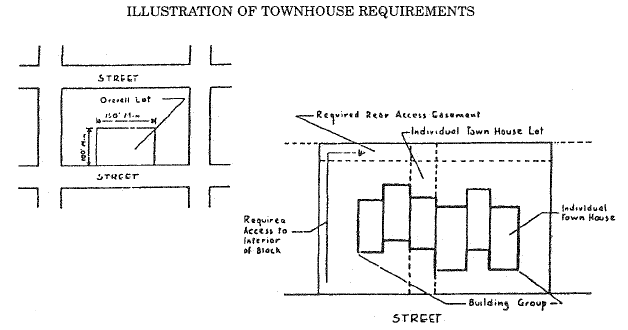
(Ord. No. 2-74, § 6.51, 3-26-74; Ord. No. 7-79, § 13, 3-30-79)
_____
Sec. 134-1962. - Site plan review.
All applications for townhouses shall require concurrent site plan review in accordance with article III of this chapter.
(Ord. No. 2-74, § 6.51(h), 3-26-74; Ord. No. 7-79, § 13, 3-30-79)
Sec. 134-1963. - Density.
The overall density for townhouses shall not exceed the maximum permitted in the district as set forth in the schedule of lot, yard and bulk regulations in article VI of this chapter for each district or section 134-620.
(Ord. No. 2-74, § 6.51(a), 3-26-74; Ord. No. 7-79, § 13, 3-30-79)
Sec. 134-1964. - Lot depth, width, area and coverage.
(a)
For a townhouse, the minimum lot depth shall be 100 feet, the minimum lot width shall be 150 feet, the minimum lot area shall be 20,000 square feet and the maximum lot coverage shall be 40 percent for the building grouping.
(b)
The minimum individual lot width, if applicable, shall be 25 feet, and the maximum coverage for an individual lot, if applicable, shall be 40 percent.
(Ord. No. 2-74, § 6.51(b), (c), 3-26-74; Ord. No. 7-79, § 13, 3-30-79)
Sec. 134-1965. - Building groups; access.
(a)
No less than four townhouses shall be located within a building group, and no interconnection or overlapping between individual dwelling units shall be permitted. No part of any exterior wall of any building group shall be nearer than 20 feet to any part of any exterior wall of any other building group. No portion of a one-story portion of any building shall be closer than ten feet and no portion of any two-story portion of any building shall be closer than 15 feet from any side lot line of the overall lot. The maximum building dimension of any building group shall not exceed 150 feet.
(b)
Each building group shall have provided on the overall lot a 20-foot access to the interior of the block with at least one such access for each 15 townhouses or portion thereof.
(c)
Each interior individual townhouse lot not having a street front access shall have a minimum access easement of ten feet provided along the rear property line of such lot.
(Ord. No. 2-74, § 6.51(d)—(f), 3-26-74; Ord. No. 7-79, § 13, 3-30-79; Ord. No. 1-99, § 26, 4-5-99)
Sec. 134-1966. - Land transfer and ownership of development.
Townhouse developments, in addition to complying with all applicable sections of this chapter, shall comply with one of the following methods of land transfer and ownership:
(1)
The subdivision of the whole tract into individual parcels in accordance with this chapter, together with the platting of the property for record in accordance with F.S. ch. 1777 plat law and division 2 of article II of chapter 110; or
(2)
Providing for the development of the entire tract in accordance with this chapter, retaining, however, title to all of the lands in the name of a condominium corporation and providing for all other usual condominium documents and procedures; or
(3)
Providing for the development of the entire tract in accordance with this chapter, retaining, however, title to all of the lands in single ownership by recording a duly executed unity of title in the office of the clerk of the circuit court of the county, thereby stipulating that the tract shall not be eligible for further subdivision.
(Ord. No. 2-74, § 6.51(g), 3-26-74; Ord. No. 7-79, § 13, 3-30-79)
Sec. 134-1968. - Lot area, lot coverage, and landscaped open space.
(a)
The lot area associated with each individual dwelling unit in a two-family use shall be computed as the land area lying between the center of the common wall outward to the side lot line between the front property line and the rear property line.
(b)
Neither initial construction and improvements, nor subsequent improvements, shall result in lot coverage for the lot area associated with each individual two-family unit that exceeds the maximum lot coverage for a two-family use as set forth in the zoning district in which the use is located.
(c)
Neither initial construction and improvements, nor subsequent improvements, shall result in landscaped open space for the lot area associated with each individual two-family unit that is less than the minimum landscaped open space requirements for a two-family use as set forth in the zoning district in which the use is located.
(Ord. No. 1-04, § 12, 3-9-04)
Sec. 134-2026. - Purpose.
(a)
The purpose of this division is to establish general guidelines for the siting of wireless communications towers and antennas. The goals of this division are to:
(1)
Protect residential areas and land uses from potential adverse impacts of towers and antennas;
(2)
Encourage the location of towers in nonresidential areas;
(3)
Minimize the total number of towers throughout the community;
(4)
Strongly encourage the joint use of new and existing tower sites as a primary option rather than construction of additional single-use towers;
(5)
Encourage users of towers and antennas to locate them, to the extent possible, in areas where the adverse impact on the community is minimal;
(6)
Encourage users of towers and antennas to configure them in a way that minimizes the adverse visual impact of the towers and antennas through careful design, siting, landscape screening, and innovative camouflaging techniques;
(7)
Enhance the ability of the providers of telecommunications services to provide such services to the community quickly, effectively, and efficiently;
(8)
Consider the public health and safety of communication towers; and
(9)
Avoid potential damage to adjacent properties from tower failure through engineering and careful siting of tower structures.
(b)
In furtherance of these goals, the town shall give due consideration to the town's comprehensive plan, zoning map, existing land uses, and environmentally sensitive areas in approving sites for the location of towers and antennas.
(Ord. No. 2-97, § 1(6.27), 3-11-97)
Sec. 134-2027. - Definitions.
The following words, terms and phrases, when used in this division, shall have the meanings ascribed to them in this section, except where the context clearly indicates a different meaning:
Alternative tower structure means manmade trees, clock towers, bell steeples, and similar alternative-design mounting structures that camouflage or conceal the presence of antennas or towers.
Antenna means any exterior stealth designed device used for transmitting and receiving, mounted on a tower, alternative tower structure, building or structure and used in communications that radiate or capture electromagnetic waves, digital signals, analog signals, radio frequencies excluding radar signals, wireless telecommunications signals or other communication signals. This definition does not include over-the-air reception devices which deliver television broadcast signals, direct broadcast signals, direct broadcast satellite services or multichannel multipoint distribution services, as defined and regulated by 47 CFR 1.4000, as amended.
Backhaul network means the lines that connect a provider's towers/cell sites to one or more cellular telephone switching offices, and/or long distance providers, or the public switched telephone network.
Engineer means a registered engineer licensed in the state to provide any information of an engineering nature, whether civil, electrical or mechanical.
FAA means the Federal Aviation Administration.
FCC means the Federal Communications Commission.
Height means, when referring to a tower or other structure, the distance measured from the zero datum of the lot, as defined in this chapter, to the highest point on the tower or other structure, including any antenna.
Preexisting tower and preexisting antenna mean any tower or antenna for which a building permit has been properly issued prior to the effective date of the ordinance from which this division derives, including permitted towers or antennas that have not yet been constructed so long as such approval is current and not expired.
Stealth design means a method that would hide or conceal an antenna, supporting electrical or mechanical equipment, or any other support structure that is identical to or closely compatible with the color of the supporting structure so as to make the antenna and related equipment as visually unobtrusive as possible.
Tower means any ground mounted structure that is designed and constructed primarily for the purpose of supporting one or more antennas for telephone, radio and similar communication purposes, including self-supporting lattice towers, guyed towers, or monopole towers. The term includes radio and television transmission towers, microwave towers, common-carrier towers, cellular telephone towers, alternative tower structures, and the like. The term includes the structure and any support thereto.
(Ord. No. 2-97, § 1(6.27(A)), 3-11-97)
Cross reference— Definitions generally, § 1-2.
Sec. 134-2028. - Applicability.
(a)
New towers and antennas. All new towers or antennas in the town shall be subject to this division, except as provided in section (b) of this section.
(b)
Preexisting towers or antennas. Preexisting towers and preexisting antennas shall not be required to meet the requirements of this division, other than the requirements of sections 134-2096 and 134-2099.
(Ord. No. 2-97, § 1(6.27(B)), 3-11-97)
Sec. 134-2029. - Permitted or special exception use.
Towers shall be either a permitted use on town owned property or a special exception use in the town's commercial zoning districts, provided approval is granted by the architectural commission and landmark commission, whichever is pertinent.
Antennas shall be a permitted use on all town owned property and in all the town's commercial, R-D(1), R-D(2) and PUD-A zoning districts, provided approval is granted by the architectural commission or landmark commission, whichever is pertinent. In addition, antennas shall be a permitted use for all private clubs in the R-AA, R-A and R-B zoning districts provided said antennas are set back a minimum of 50 feet from all property lines; and provided approval is granted by the architectural commission or landmark commission, whichever is pertinent. A different existing use of an existing structure on the same lot shall not preclude the installation of an antenna or tower on such lot.
(Ord. No. 2-97, § 1(6.27(C)(1)), 3-11-97; Ord. No. 1-05, § 6, 3-8-05; Ord. No. 1-07, § 3, 4-10-07; Ord. No. 4-08, § 2, 4-7-08)
Sec. 134-2030. - Inventory of existing sites.
Each applicant for an antenna or tower shall provide to the building official an inventory of his existing towers, antennas, or sites approved for towers or antennas that are either within the jurisdiction of the town or within one mile of the border thereof, including specific information about the location, height, and design of each tower.
(Ord. No. 2-97, § 1(6.27(C)(2)), 3-11-97)
Sec. 134-2031. - Multiple antenna/tower plan.
So as to lessen proliferation, the town encourages the users of towers and antennas to submit a single application for approval of multiple users on a single site. Applications for approval of multiple user sites shall be given priority in the review process.
(Ord. No. 2-97, § 1(6.27(C)(11)), 3-11-97)
Sec. 134-2032. - Franchises.
Owners and/or operators of towers or antennas shall certify that all franchises required by law for the construction and/or operation of a wireless communication system in the town have been obtained and shall file a copy of all required franchises with the building official.
(Ord. No. 2-97, § 1(6.27(C)(9)), 3-11-97)
Sec. 134-2033. - Signs.
No signs shall be allowed on an antenna or tower.
(Ord. No. 2-97, § 1(6.27(C)(10)), 3-11-97)
Sec. 134-2034. - Removal of abandoned antennas and towers.
Any antenna or tower that is not operated for a continuous period of two years shall be considered abandoned, and the owner of such antenna or tower shall remove the antenna or tower within 90 days of receipt of notice from the town notifying the owner of such abandonment. Failure to remove an abandoned antenna or tower within such 90 days shall be grounds to remove the tower or antenna at the owner's expense. If there are two or more users of a single tower, this section shall not become effective until all users cease using the tower.
(Ord. No. 2-97, § 1(6.27(G)), 3-11-97)
Sec. 134-2035. - Permitted uses.
The uses listed in this section are deemed to be permitted uses and shall not require special exception approval. An antenna or tower located on property owned, leased, or otherwise controlled by the town is a permitted use, provided:
(1)
A license or lease authorizing an antenna or tower has been approved by the town council.
(2)
Prior to the granting of a building permit for the construction of a tower, a duly noticed and advertised public hearing shall be required by the town council. Such due notice and advertisement of the public hearing shall be provided as in subsections 134-172(c) through (f), except that property owner notification shall be to all property owners within 1,000 feet from any part of the subject property on which the tower is located. These notice and public hearing requirements shall not pertain to the placement of antennas.
(Ord. No. 2-97, § 1(6.27(D)), 3-11-97)
Sec. 134-2061. - Criteria for review and approval of applications.
The following shall govern the review and approval of special exception applications for towers by the town council:
(1)
If the tower is not a permitted use, special exception approval for towers shall be allowed for the construction of a tower only in the commercial zoning districts of the town.
(2)
Applications for special exception approval under this section shall be subject to the procedures and requirements of divisions 3 and 4 of article II of this chapter, except as modified in this section.
(3)
In granting a special exception approval, the town council may impose conditions to the extent the town council concludes such conditions are necessary to minimize any adverse effect of the proposed tower on adjoining properties.
(4)
Any information of an engineering nature that the applicant submits, whether civil, mechanical, or electrical, shall be certified by a state-licensed professional engineer.
(5)
An applicant for a special exception use shall submit the information described in this section and a nonrefundable fee as established in the fee schedule in section 134-38 to reimburse the town for the costs of reviewing and providing legal notice for the application.
(Ord. No. 2-97, § 1(6.27(E)(1)), 3-11-97; Ord. No. 1-07, § 3, 4-10-07)
Sec. 134-2062. - Information required.
In addition to any information required for applications for special exception use approval pursuant to divisions 3 and 4 of article II of this chapter, applicants for a special exception for a tower shall submit the following information:
(1)
A scaled site plan clearly indicating the location, type and height of the proposed tower, on-site land uses and zoning, adjacent land uses and zoning including when adjacent to other municipalities, comprehensive plan future land use designation of the site and all properties within the applicable separation distances set forth in section 134-2066, adjacent roadways, proposed means of access, setbacks from property lines, elevation drawings of the proposed tower and any other structures, topography, parking, and other information deemed by the building official to be necessary to assess compliance with this division.
(2)
Legal description of the parent tract and leased parcel, if applicable.
(3)
The setback distance between the proposed tower and the nearest residential unit, platted residentially zoned properties, and unplatted residentially zoned properties.
(4)
The separation distance from other towers described in the inventory of existing sites submitted pursuant to section 134-2030 shall be shown on an updated site plan or map. The applicant shall also identify the type of construction of the existing tower and the owner/operator of the existing tower, if known.
(5)
A landscape plan showing specific landscape materials.
(6)
Method of providing security enclosure and finished color and, if applicable, the method of providing stealth design and illumination.
(7)
A description of compliance with all applicable federal, state or local laws including all sections of this chapter.
(8)
A notarized statement by the applicant's engineer as to whether construction of the tower will accommodate co-location of additional antennas for future users.
(9)
Identification of the entities providing the backhaul network for the tower described in the application and other cellular sites owned or operated by the applicant in the town.
(10)
A description of the suitability of the use of existing towers, other structures or alternative technology not requiring the use of towers or structures to provide the services to be provided through the use of the proposed new tower.
(11)
A description of the feasible locations of future towers within the town based upon existing physical, engineering, technological or geographical limitations if the proposed tower is erected.
(Ord. No. 2-97, § 1(6.27(E)(2)(a)), 3-11-97; Ord. No. 1-07, § 3, 4-10-07)
Sec. 134-2063. - Factors considered in granting special exception approval.
In addition to any standards for consideration of special exception applications pursuant to divisions 3 and 4 of article II of this chapter, the town council shall consider the following factors in determining whether to approve a special exception:
(1)
Height of the proposed tower;
(2)
Proximity of the tower to residential structures and residential district boundaries;
(3)
Nature of uses on adjacent and nearby properties;
(4)
Surrounding topography;
(5)
Surrounding tree coverage and foliage;
(6)
Design of the tower, with particular reference to design characteristics that have the effect of reducing or eliminating visual obtrusiveness;
(7)
Proposed ingress and egress; and
(8)
Availability of suitable existing towers, other structures, or alternative technologies not requiring the use of towers or structures, as discussed in section 134-2064.
(Ord. No. 2-97, § 1(6.27(E)(2)(b)), 3-11-97; Ord. No. 1-07, § 3, 4-10-07)
Sec. 134-2064. - Availability of suitable existing towers, other structures or alternative technology.
No new tower shall be permitted unless the applicant demonstrates to the reasonable satisfaction of the town council that no reasonable alternative technology exists that can accommodate the applicant's proposed antenna. An applicant shall submit information requested by the town council related to the availability of suitable existing towers, other structures or alternative technology. Evidence submitted to demonstrate that no existing tower, structure or alternative technology can accommodate the applicant's proposed antenna may consist of any of the following:
(1)
No existing towers or structures are located within the geographic area which meet the applicant's engineering requirements.
(2)
Existing towers or structures are not of sufficient height to meet the applicant's engineering requirements.
(3)
Existing towers or structures do not have sufficient structural strength to support the applicant's proposed antenna and related equipment.
(4)
The applicant's proposed antenna would cause electromagnetic interference with the antenna on the existing towers or structures, or the antennas on the existing towers or structures would cause interference with the applicant's proposed antenna.
(5)
The fees, costs, or contractual provisions required by the owner in order to share an existing tower or structure or to adapt an existing tower or structure for sharing are unreasonable. Costs exceeding new tower development are presumed to be unreasonable.
(6)
The applicant demonstrates that there are other limiting factors that render existing towers and structures unsuitable.
(7)
The applicant demonstrates that an alternative technology that does not require the use of towers or structures, such as a cable microcell network using multiple low-powered transmitters/receivers attached to a wire line system, is unsuitable. Costs of alternative technology that exceed new tower or antenna development shall not be presumed to render the technology unsuitable.
(Ord. No. 2-97, § 1(6.27(E)(2)(c)), 3-11-97)
Sec. 134-2065. - Setbacks.
The following setback requirements shall apply to all towers for which a special exception is required:
(1)
Towers must be set back a distance equal to at least 110 percent of the height of the tower from any adjoining commercially zoned property lot line.
(2)
Towers must be set back a distance equal to at least 130 percent of the height of the tower from any adjoining residentially zoned property lot line.
(3)
Guys and accessory buildings must satisfy the minimum zoning district setback requirements.
(Ord. No. 2-97, § 1(6.27(E)(2)(d)), 3-11-97)
Sec. 134-2066. - Separation.
(a)
Applicability. The separation requirements in this section shall apply to all towers for which a special exception approval is required.
(b)
Separation distances between towers. Separation distances between towers shall be applicable for and measured between the proposed tower and preexisting towers. The separation distances shall be measured by drawing or following a straight line between the base of the existing tower and the proposed base, pursuant to a site plan, of the proposed tower. The separation distances (listed in linear feet) shall be as shown in table 1 as follows:
TABLE 1
EXISTING TOWERS—TYPES
(Ord. No. 2-97, § 1(6.27(E)(2)(e)), 3-11-97)
_____
Sec. 134-2067. - Security enclosure.
Towers shall be enclosed with a security enclosure not less than six feet in height, and the towers shall also be equipped with an appropriate anticlimbing device.
(Ord. No. 2-97, § 1(6.27(E)(2)(f)), 3-11-97)
Sec. 134-2068. - Landscaping.
The following requirements shall govern the landscaping surrounding towers for which a special exception is required:
(1)
Tower facilities shall be landscaped with a buffer of plant materials that effectively screens the view of the tower compound from property used for residences. The standard buffer shall consist of a landscaped strip at least four feet wide outside the perimeter of the compound. The minimum landscaping within the buffer shall be a continuous four-foot-high hedge at the time of planting and an ultimate height of six feet and one tree, 12 feet in height at the time of planting, every 25 linear feet.
(2)
Existing mature tree growth and natural land forms on the site shall be preserved to the maximum extent possible. In some cases, such as towers sited on large, wooded lots, natural growth around the property perimeter may be sufficient buffer.
(Ord. No. 2-97, § 1(6.27(E)(2)(g)), 3-11-97)
Sec. 134-2069. - Nonconforming uses.
(a)
Expansion. Towers that are constructed and antennas that are installed in accordance with this division shall not be deemed to constitute the expansion of a nonconforming use or structure.
(b)
Preexisting towers. Preexisting towers shall be allowed to continue their usage as they exist pursuant to section 134-2028(b). Routine maintenance, including replacement with a new tower of like construction and height, shall be permitted on such preexisting towers. New construction other than routine maintenance on a preexisting tower shall comply with the requirements of this division.
(c)
Rebuilding damaged or destroyed nonconforming towers or antennas. Nonconforming towers and antennas that are damaged or destroyed shall be required to meet the requirements as set forth in article IV of this chapter pertaining to nonconformities.
(Ord. No. 2-97, § 1(6.27(H)), 3-11-97)
Sec. 134-2096. - State or federal requirements.
All towers/antennas must meet or exceed current standards and regulations of the FAA, the FCC, and any other agency of the state or federal government with the authority to regulate towers and antennas. If such standards and regulations are changed, the owners of the towers and antennas governed by this division shall bring such towers and antennas into compliance with such revised standards and regulations within six months of the effective date of such standards and regulations, unless a different compliance schedule is mandated by the controlling state or federal agency. Failure to bring towers and antennas into compliance with such revised standards and regulations shall constitute grounds for the removal of the tower or antenna at the owner's expense.
(Ord. No. 2-97, § 1(6.27(C)(5)), 3-11-97)
Sec. 134-2097. - Aesthetics.
Towers and antennas shall meet the following requirements:
(1)
Towers shall either be maintained with a galvanized steel finish or, subject to any applicable standards of the FAA, shall be painted a color so as to reduce visual obtrusiveness.
(2)
At a tower or antenna site, the design of the buildings and related structures shall, to the maximum extent possible, have materials, colors, textures, screening, and landscaping that will blend them into the natural setting and surrounding buildings. The towers, antennas, buildings and related structures shall require approval by the landmark or architectural commission, whichever is applicable.
(3)
If an antenna is installed on a structure other than a tower, the antenna and supporting electrical and mechanical equipment must be, to the maximum extent possible, of stealth design.
(Ord. No. 2-97, § 1(6.27(C)(3)), 3-11-97)
Sec. 134-2098. - Lighting.
Towers/antennas shall not be artificially lighted, unless required by the FAA or other applicable authority. If lighting is required, the lighting alternatives and design chosen must cause the least disturbance to the surrounding views.
(Ord. No. 2-97, § 1(6.27(C)(4)), 3-11-97)
Sec. 134-2099. - Construction standards.
Prior to the issuance of a building permit to construct an antenna or tower, the owner/applicant shall provide the town with all applicable approvals from federal, state and county agencies. To ensure the structural integrity of towers, the owner of a tower shall ensure that it is maintained in compliance with standards contained in applicable state or local building codes and the applicable standards for towers that are published by the Electronic Industries Association, as amended from time to time. If, upon inspection, the town engineer or his designee concludes that a tower fails to comply with such codes and standards and constitutes a danger to persons or property, upon notice being provided to the owner of the tower, the owner shall have 30 days to bring such tower into compliance with such standards. Failure to bring such tower into compliance within 30 days shall constitute grounds for the removal of the tower or antenna at the owner's expense.
(Ord. No. 2-97, § 1(6.27(C)(6)), 3-11-97)
Sec. 134-2100. - Measurement of setbacks and separation distances.
Measurement of tower setbacks and separation distances shall be calculated and applied in relation to all adjacent facilities, whether located inside or outside the boundaries of in the town.
(Ord. No. 2-97, § 1(6.27(C)(7)), 3-11-97)
Sec. 134-2101. - Compliance with division.
Towers and antennas shall be regulated and permitted pursuant to this division and shall not be regulated or permitted as essential services, public utilities or private utilities.
(Ord. No. 2-97, § 1(6.27(C)(8)), 3-11-97)
Sec. 134-2102. - Equipment storage; location.
(a)
Antennas mounted on structures or rooftops. The equipment cabinet or structure used in association with antennas shall comply with the following:
(1)
The cabinet or structure shall not contain more than 350 square feet of gross floor area or be more than ten feet in overall height, assuming at all times that a structural engineer has declared that the structural integrity of the structure or rooftop will not be compromised by the cabinet or structure.
(2)
If the equipment structure is located on the roof of a building, the area of the equipment structure and other equipment and structures shall not occupy more than ten percent of the roof area.
(3)
Equipment storage buildings or cabinets shall comply with all applicable building codes.
(b)
Antennas mounted on utility poles or light poles. Antennas shall be prohibited on utility or light poles.
(c)
Antennas located on towers. The related unmanned equipment structure shall not contain more than 350 square feet of gross floor area or be more than 12 feet in overall height and shall be located in accordance with the minimum yard requirements of the zoning district in which located.
(Ord. No. 2-97, § 1(6.27(F)), 3-11-97)

