
Paso Robles City Zoning Code
ARTICLE 4
- REGULATIONS AND STANDARDS APPLICABLE TO ALL ZONING DISTRICTS
21.41.010 - Purpose and applicability.
This chapter provides general rules for measurement and calculation applicable to all zoning districts unless otherwise stated in this title.
(Ord. No. 1144 N.S., § 3(Exh. A), 10-1-2024)
21.41.020 - Fractions.
Whenever this code requires consideration of distances, parking spaces, dwelling units, or other aspects of development or the physical environment expressed in numerical quantities, and the result of a calculation contains a fraction of a whole number, the results will be rounded as follows:
A.
General Rounding. Fractions exceeding one-half or greater shall be rounded up to the nearest whole number and fractions less than one-half shall be rounded down to the nearest whole number, except as otherwise provided.
B.
Fractional Density Rounding. See Subparagraph 21.41.080(A)2.c. (Calculating Fractional Density).
C.
Exception for State Affordable Housing Density Bonus. When calculating fractions related to permitted bonus density units for projects eligible for bonus density pursuant to Chapter 21.61 (Density Bonus), any fractional number of units shall be rounded up to the next whole number.
(Ord. No. 1144 N.S., § 3(Exh. A), 10-1-2024)
21.41.030 - Measuring distances.
A.
Measurements Are Shortest Distance. Where a required distance is indicated, such as the minimum distance between a structure and a lot line, the measurement shall be made at the closest or shortest distance between the two objects, unless otherwise specifically stated.
B.
Distances Are Measured Horizontally. When determining distances for setbacks, all distances shall be measured along a horizontal plane from the appropriate line, edge of building, structure, storage area, parking area, or other object. These distances shall not be measured by following the topography or slope of the land unless otherwise specifically stated.
C.
Measurements Involving a Structure. Measurements involving a structure shall be made to the closest vertical support element of the structure. Structures or portions of structures that are underground shall not be included in measuring required distances unless otherwise specifically stated.
D.
Measuring Radius. When a specified land use is required to be located a minimum distance from another land use, the minimum distance is measured in a straight line from all points along the lot line of the subject project, in all directions.
Figure 21.41.030-1: Measuring Distances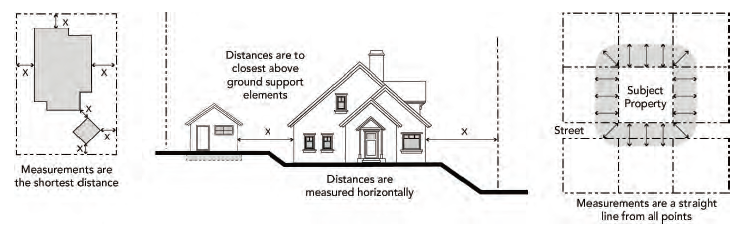
(Ord. No. 1144 N.S., § 3(Exh. A), 10-1-2024)
21.41.040 - Measuring height.
A.
Structures.
1.
General. Building height is measured from the average level of the highest and lowest points where the vertical plane of the exterior walls touches finished grade to the highest point on the roof.
Figure 21.41.040-1: Measuring Height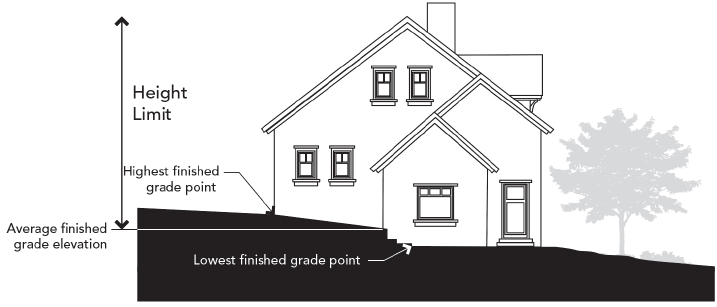
2.
Allowed Projections/Modifications. The structures listed in Table 21.41.040-1 (Allowed Projections Above Height Limits) may exceed the maximum allowed building height for the zoning district in which they are located, subject to the limitations stated; and further provided, that no portion of a structure in excess of the building height limit may contain habitable areas. In approving such a request, the review authority shall make the findings required for a development plan modification (Subsection 21.16.020(D)) or site plan modification (Subsection 21.17.020(C)) as indicated in Table 21.41.040-1 (Allowed Projections Above Height Limits).
Table 21.41.040-1: Allowed Projections Above Height Limits
B.
Fences, Walls, and Hedges. Except as provided in Chapter 21.44 (Fences, Walls, and Hedges), the height of a fence or hedge shall be measured from the highest adjacent grade.
(Ord. No. 1144 N.S., § 3(Exh. A), 10-1-2024)
21.41.050 - Measuring lot width and depth.
A.
Lot Width. Lot width is the measured distance between the side lot lines, measured at the front building setback line.
B.
Lot Depth. Lot depth is the measured distance along an imaginary straight line drawn from the midpoint of the front property line of the lot to the midpoint of the rear property line or to the most distant point on any other lot line where there is no rear lot line.
Figure 21.41.050-1: Measuring Lot Width and Depth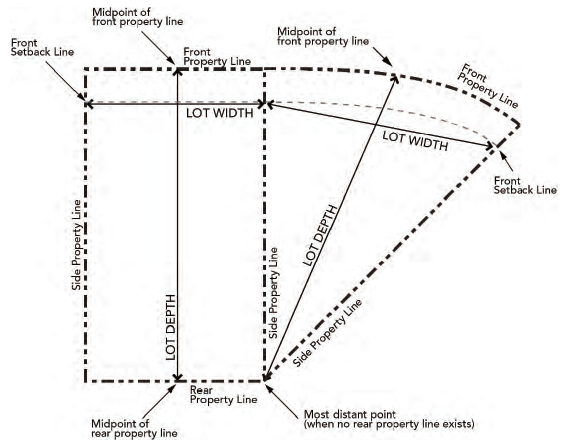
(Ord. No. 1144 N.S., § 3(Exh. A), 10-1-2024)
_____
21.41.060 - Determining average slope.
A.
Average Slope. One of the following methods for determining average slope shall be used:
1.
Basic Method. Where a line drawn between highest and lowest points on a parcel is adequate to represent direction and extent of slope for the entire parcel, the difference in elevation between the high and low points, divided by the horizontal distance between the points, shall determine the average slope.
2.
Sectional Method. Where the parcel contains distinct sections of differing slope, the average slope of each section may be determined according to either the basic method in Paragraph 21.41.060(A)1. of this section or the contour measurement method in Paragraph 21.41.060(A)3. of this section. The average slope of each section is then used in proportion of the section's area to the total area to determine the average slope of the entire parcel.
3.
Contour Measurement Method. Where precise measurement of the average slope is required due to varied slope conditions or complex topography, the following formula will be used:
Average slope (%) = 100(I)(L)/A Where:
I = Contour interval in feet. Contour intervals shall not exceed five feet.
L = Combined length of contour lines measured within the developable area.
A = Developable area of subject parcel (in square feet).
(Ord. No. 1144 N.S., § 3(Exh. A), 10-1-2024)
21.41.070 - Determining developable area.
The "developable area" of a lot is the area where development shall be allowed to occur. The following excluded areas shall be deducted from developable area:
A.
Any area of the lot with natural slopes of thirty-five percent or greater;
B.
Any area of the lot within the critical root zones of a compact grouping of ten or more mature oak trees ("mature" as defined in Chapter 10.01 of this Municipal Code), where critical root zones between trees in the grouping are separated by ten feet or less; and
C.
Any dedication necessary to provide for the full rights-of-way of arterial and/or collector streets, as designated by the circulation element of the general plan, adjacent to and/or within a proposed subdivision, parcel map or lot line adjustment, in accordance with adopted standards for city streets.
(Ord. No. 1144 N.S., § 3(Exh. A), 10-1-2024)
21.41.080 - Determining density.
A.
Residential Density Calculation.
1.
General Density Calculation.
a.
R-A, R-1, AG, and POS zoning districts.
i.
In the R-A, R-1, AG, and POS zoning districts, each single-unit dwelling (excluding accessory dwelling units [Chapter 21.58] and urban dwelling unit projects [Chapter 21.65]) counts as one density unit.
ii.
Site topography lot size limitations and resulting density limitations are outlined in Table 21.33.030-1 (Development Standards for R-A, R-1, and R-1 Combining Districts).
2.
Fractional Density.
a.
Purpose and Applicability. To encourage smaller units that are affordable by design, the city recognizes fractional density units. Fractional density units do not apply to adopted specific plan areas that are associated with development agreements unless specifically amended to allow fractional density.
b.
Density Units. Density units differ from dwelling units as a dwelling unit with less than one thousand square feet of habitable area is counted as less than one density unit. The following density unit values apply to all multi-family residential zoning districts (R-2 through R-5), Uptown/Town Centre Specific Plan districts, and in the mixed-use (mu) overlay zoning district.
i.
Studio and one-bedroom dwelling units six hundred square feet or less = 0.50 density unit.
ii.
Studio and one-bedroom dwelling units six hundred one to one thousand square feet = 0.66 density unit.
iii.
Two-bedroom and greater dwelling units and all dwelling units over one thousand square feet = 1.00 density unit.
iv.
All dwelling units approved prior to January 1, 2021 shall be counted as one density unit.
c.
Calculating Fractional Density.
i.
Fractions. Maximum residential development potential shall be the lot area (in whole and fractional acres), multiplied by the maximum density allowed. The resulting number (in density units, carried out to the nearest one hundredth unit) shall be the maximum residential development potential. For example, when a calculation results in a density of 4.74 units, up to nine units that are less than six hundred square feet in size would be permitted; when a calculation results in a density of 4.75 units, up to ten units less than six hundred square feet in size would be permitted. Any combination of dwelling types and numbers may be developed, so long as their combined density unit values do not exceed the maximum residential development potential.
ii.
Order of Operations. The densities permitted by Paragraph 21.41.080(A)1. (General Density Calculation) of this section shall be modified based on site topography/slope, then density bonus (if requested by an applicant), prior to any fractional density calculation.
iii.
For all regulations other than maximum density, (such as parking requirements, minimum lot size, etc.), regulations shall be based on the number of units, not based on the number of fractional density units.
B.
Densities for Residential Care Facilities (General and Assisted Living). See Paragraph 21.69.200(B)1. (Density).
(Ord. No. 1144 N.S., § 3(Exh. A), 10-1-2024)
21.41.090 - Determining floor area.
A.
Generally. The floor area of a building is the sum of the gross, habitable space of the horizontal areas of all floors of a building or other enclosed structure, measured from the outside perimeter of the exterior walls and/or centerlines of party walls separating such buildings or portions thereof.
B.
Excluded from Floor Area: Nonresidential Uses. Net floor area, for the purposes of determining floor area and calculating parking requirements for nonresidential uses, is the sum of the gross horizontal areas of all floors, mezzanines, and lofts of the building, including all enclosed and conditioned areas except the following, which are excluded from floor area:
1.
Covered or enclosed stairways, stairwells, and elevator shafts;
2.
Mechanical, electrical, and communication equipment rooms that do not exceed two percent of the building's gross floor area;
3.
Areas that qualify as usable open space such as balconies and outdoor terraces;
4.
Areas normally used for drive-in customer service such as drive-in windows and as pump service areas; and
5.
Areas used for off-street parking spaces or loading spaces, driveways, ramps between floors of a multilevel parking garage, and maneuvering aisles that are located below the finished grade of the property.
C.
Excluded from Floor Area: Residential. Net floor area for residential uses, for the purposes of determining the maximum allowable size of detached accessory structures, is the sum of the gross horizontal areas of all floors, mezzanines, and lofts of the building, including all enclosed and conditioned areas (including attached garages) except the following, which are excluded from floor area:
1.
Basements if the top of the finished floor above the basement is less than two feet above existing grade.
(Ord. No. 1144 N.S., § 3(Exh. A), 10-1-2024)
21.41.100 - Determining lot coverage.
A.
General. Lot coverage is the ratio of the total footprint area of all structures on a lot to the net lot area, typically expressed as a percentage. The footprints of all principal and accessory structures, including garages, carports, covered patios, and roofed porches shall be summed to calculate lot coverage.
B.
Exemptions. Exempted from lot coverage computation are:
1.
Unenclosed and unroofed decks, uncovered patio slab, porches, landings, balconies and stairways that are thirty inches or less in height, as measured from the adjacent existing grade;
Figure 21.41.100-1: Lot Coverage Exemption for Certain Decks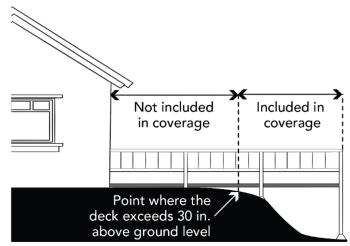
2.
Eaves, roof overhangs, and awnings projecting up to three feet from a wall;
3.
Swimming pools and hot tubs that are not enclosed in roofed structures or decks over thirty inches in height;
4.
Up to eight hundred square feet of an accessory dwelling unit. Any additional square footage of an accessory dwelling unit shall be included in lot coverage.
(Ord. No. 1144 N.S., § 3(Exh. A), 10-1-2024)
21.41.110 - Determining parking requirement.
See Subsection 21.48.020(A) (Calculation of Required Parking Spaces).
(Ord. No. 1144 N.S., § 3(Exh. A), 10-1-2024)
21.41.120 - Determining setbacks.
A.
General.
1.
Measurement. A setback line is parallel to and at the specified distance from the corresponding front, side, or rear property line.
2.
Unobstructed. Required setbacks shall be unobstructed from the ground to the sky except as allowed by Section 21.41.130 (Projections into Setbacks).
B.
Front and Street—Side Setbacks on Private Streets. On private streets, front setback line and street-side setback lines and minimum distance to garage doors are measured from the edge of pavement if no sidewalk exists.
C.
Rear Setbacks for Five-Sided Lots. The rear setback on five-sided lots may be measured from either property line that is not contiguous to the front property line.
_____
Figure 21.41.120-1: Rear Setback for Five-Sided Lots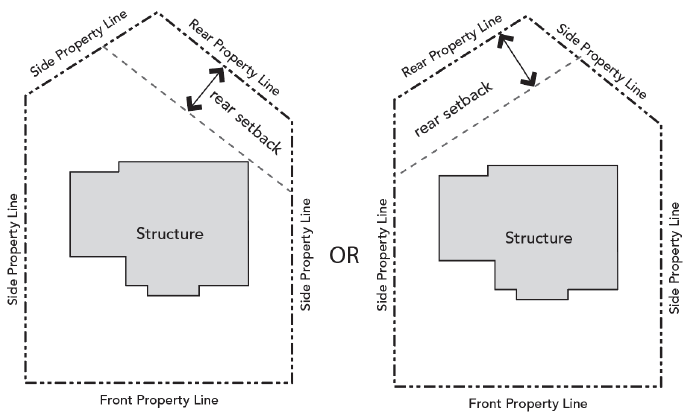
D.
Determination of Front Setback for Flag Lots. The front setback for flag lots shall be measured from that property line adjacent and perpendicular to the driveway/access strip, excluding the driveway/access strip.
Figure 21.41.120-2: Determination of Front Setback for Flag Lots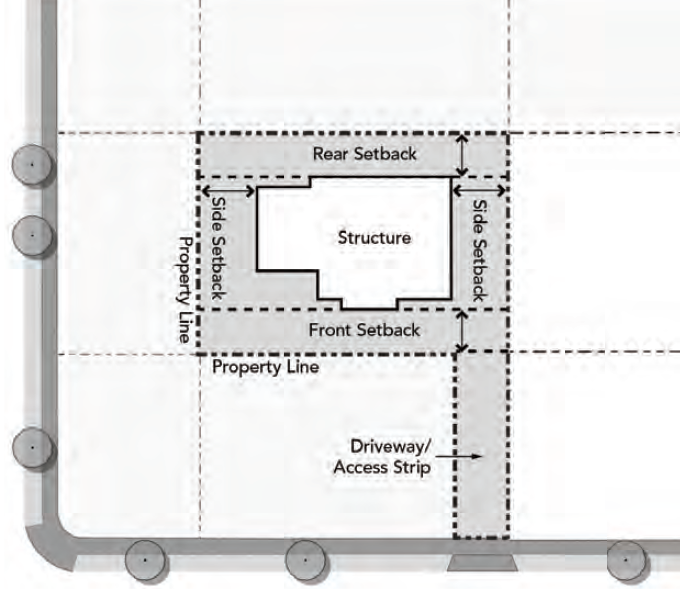
(Ord. No. 1144 N.S., § 3(Exh. A), 10-1-2024)
21.41.130 - Projections into setbacks.
A.
Allowed Projections into Setbacks. Building projections may encroach into required setbacks according to the standards of Table 21.41.130-1 (Allowed Projections into Required Setbacks), subject to all applicable requirements of the building code.
Table 21.41.130-1: Allowed Projections into Setbacks
B.
Attached Accessory Structures in R-A and R-1 zoning districts. Attached accessory structures such as patio covers consistent with Subsection 21.42.030(D) (Attached Accessory Structures) are allowed to encroach into rear setbacks up to ten feet from the rear property line in R-A and R-1 zoning districts. Any eaves associated with attached accessory structures shall comply with allowed encroachments listed in Table 21.41.130-1 (Allowed Projections into Setbacks).
C.
Detached Accessory Structures. Detached accessory structures shall comply with setback requirements listed by zoning district in Article 3 (Zoning Districts, Allowable Uses, and Development Standards). Any eaves associated with detached accessory structures shall comply with allowed encroachments listed in Table 21.41.130-1 (Allowed Projections into Setbacks) and Subsection 21.41.130(E) (Stormwater Protection Setback).
D.
Mechanical Equipment at Grade. See Paragraph 21.47.020(B)3. (Setbacks).
E.
Stormwater Protection Setback. No projection listed in Table 21.41.130-1 (Allowed Projections into Setbacks) may extend closer than three feet from a property line or encroach into a public utility easement unless the projection does not slope toward the property line or easement boundary, or a gutter is provided. In that case, the projection may extend to one foot from the property line or to the easement boundary.
F.
Conflict with Building Code. Where any allowance of this title conflicts with applicable building codes, the more restrictive shall apply.
G.
Measurement. Projections are measured from the exterior wall of the building to the applicable property line unless otherwise noted.
(Ord. No. 1144 N.S., § 3(Exh. A), 10-1-2024)
21.41.140 - Determining the front and side of corner lots.
A.
The narrowest frontage of the corner lot facing the street is the front, irrespective of the direction in which the building faces.
B.
The zoning administrator shall determine the front of a lot if there is a difference of five feet or less between the side and front dimensions.
C.
Modification to which property line is the front when the difference in the side and front dimensions are greater than five feet may be approved through a development plan modification (Section 21.16.020). In approving such a request, the review authority shall ensure the project observes the appropriate setbacks and meets the rear yard usable space requirements.
(Ord. No. 1144 N.S., § 3(Exh. A), 10-1-2024)
21.42.010 - Purpose and applicability.
Regulations applicable to accessory structures are established to ensure that the development and use of accessory structures do not adversely impact abutting properties with respect to drainage, aesthetics, noise, and safety.
(Ord. No. 1144 N.S., § 3(Exh. A), 10-1-2024)
21.42.020 - Permit requirements.
The provisions of Chapter 21.15 (Development Review) of this title shall apply.
(Ord. No. 1144 N.S., § 3(Exh. A), 10-1-2024)
21.42.030 - Development standards.
A.
General Detached Accessory Structure Standards. The provisions contained in the following sections of Article 3 (Zones, Allowable Uses, and Development Standards) shall apply where specific to detached accessory structures:
1.
Section 21.33.030 (Development Standards in Single Family Residential Zoning Districts).
2.
Section 21.33.040 (Additional Development Standards in Single-Family Residential Zoning Districts).
3.
Section 21.33.050 (Development Standards in Multi-Family Zoning Districts).
4.
Section 21.33.060 (Additional Development Standards in Multi-Family Zoning Districts).
5.
Section 21.34.030 (Development Standards).
6.
Section 21.34.040 (Additional Development Standards in OP Zoning District).
7.
Section 21.35.030 (Development Standards).
8.
Section 21.35.050 (Additional Development Standards in AG Zoning District).
B.
Relation to Existing Structures. A detached accessory structure may only be constructed on a lot on which there is a permitted primary structure to which the accessory structure is related.
C.
Additional Standards for Awnings, Canopies, and Patio Covers. Patio covers in residential zoning districts are considered attached accessory structures if the eave is located within one foot of the primary structure, and are not required to share a common wall or roof structure. See Chapter 21.43 (Awnings, Canopies, and Patio Covers).
(Ord. No. 1144 N.S., § 3(Exh. A), 10-1-2024)
21.43.010 - Purpose and applicability.
Regulations applicable to awnings and patio covers as defined in Article 9 (General Definitions) are established to ensure that the development and use of awnings and canopies do not adversely impact abutting properties with respect to aesthetics and projections.
(Ord. No. 1144 N.S., § 3(Exh. A), 10-1-2024)
21.43.020 - Permit requirements.
The provisions of Chapter 21.15 (Development Review) shall apply.
(Ord. No. 1144 N.S., § 3(Exh. A), 10-1-2024)
21.43.030 - Development standards.
A.
Awnings. Awnings shall comply with the setback encroachment allowances of architectural features such as cornices, eaves, and awnings per Table 21.41.130-1 (Allowed Projections into Setbacks).
B.
Attached Patio Covers in Residential Zoning Districts. Attached patio covers consistent with Subsection 21.42.030(C) (Attached Accessory Structures) shall comply with the following standards:
1.
Open Sides. Attached patio covers shall be open on two or more sides. Patio covers that are open on only one side or enclosed shall comply with the minimum requirements for setbacks associated with the structure.
2.
Allowed Encroachments. Attached patio covers shall comply with the setback encroachment allowances described in Section 21.41.130 (Projections into Setbacks), except eaves and cornices of patio covers shall comply with the setback encroachment allowances of architectural features such as eaves and cornices.
3.
Lot Coverage. Attached patio covers shall count toward maximum lot coverage requirements.
4.
Materials. Attached patio covers shall not use corrugated metal or fiberglass roofing materials except when accessory to a single-family use.
C.
Detached Patio Covers and Canopies in Residential Zoning Districts. Detached patio covers and canopies shall comply with the following standards:
1.
Location. In all residential zoning districts, canopies and detached patio covers shall not be located within any front yard, street side yard, or driveway.
2.
Setbacks. Setbacks for canopies and detached patio covers shall be the same as for detached accessory structures.
3.
Height. The maximum height for canopies and detached patio covers shall be no greater than ten feet.
4.
Projections. See Section 21.41.130 (Projections into Setbacks).
5.
Number. No residential property shall have more than three canopies and/or detached patio covers, regardless of size (small or large, as defined in Section 21.92.030 ["C" Definitions]).
6.
Lot Coverage. Canopies and detached patio covers shall count toward maximum lot coverage requirements.
7.
Materials. Reflective or mirrored type covering material shall be prohibited on canopies and detached patio covers.
8.
Repair and Maintenance. Canopies, canopy structures, and detached patio covers shall be maintained in good condition. Any structure considered to be in disrepair, as determined by the zoning administrator, shall be repaired, replaced, or removed from the site.
9.
Small Canopies.
a.
The length on any one side of a small canopy, as defined in Section 21.92.030, shall not exceed twelve feet.
b.
Small canopies are not required to comply with maximum cumulative gross floor area requirements of detached accessory structures (Paragraph 21.33.040(C)1.a. and Paragraph 21.33.060(C)1.a.).
10.
Large Canopies. Large canopies, as defined in Section 21.92.030, shall comply with maximum cumulative gross floor area requirements of detached accessory structures (Paragraph 21.33.040(C)1.a. and Paragraph 21.33.060(C)1.a.).
11.
Modifications.
a.
Large Canopies and Detached Patio Covers. Modifications to standards for canopies or detached patio covers that are larger than one hundred twenty square feet may be approved through a development plan modification (Section 21.16.020). In approving such a request, the review authority shall consider impacts on the views, privacy, and other concerns of abutting property owners, and make the required findings (Subsection 21.16.020(D)).
b.
Small Canopies and Detached Patio Covers. Modifications to standards for canopies or detached patio covers that are one hundred twenty square feet or smaller may be approved through a site plan modification (Section 21.16.020). In approving such a request, the review authority shall consider impacts on the views, privacy, and other concerns of abutting property owners, and make the required findings (Subsection 21.17.020(C)).
12.
Modifications for Shelters for Recreational Vehicles, Boats, Campers, Travel Trailers, or Similar Recreational Vehicles.
a.
An application for a development plan modification (Section 21.16.020) shall be required for any canopy, carport, or similar shelter to be used for recreational vehicles, boats, campers, travel trailers, or similar vehicles, but specifically excluding automobiles, trucks, motorcycles, all-terrain vehicles, and nontravel trailers, proposed to be placed:
i.
Within the interior side setback and rear setback (not allowed within the front setback and street side setback), or
ii.
Within the structure separations prescribed in Subsections 21.33.040(B) or 21.33.060(D).
b.
In approving such a request, the planning commission shall consider impacts on the views, privacy, and other concerns of abutting property owners, make the required findings (Subsection 21.16.020(D)), and find that:
i.
All of the materials used in the construction of the shelter are noncombustible (such as steel or aluminum).
ii.
The shelter structure is open on all four sides to prevent gasoline or other fuel fumes from collecting to a point where a heater or refrigerator pilot in the vehicle might ignite them.
iii.
The shelter structure does not exceed fourteen feet in height as measured from the top of floor to the ridge or highest point of the roof.
iv.
The shelter structure shall not be used for conducting maintenance on the vehicle (such as overhaul, draining of fluids, tune-ups or other mechanical work).
(Ord. No. 1144 N.S., § 3(Exh. A), 10-1-2024)
21.44.010 - Purpose and applicability.
The purpose of these regulations is to achieve a balance between concerns for privacy and public concerns for enhancement of the community appearance, visual image of the streetscape, and overall character of neighborhoods. These regulations apply to any type of visible or tangible obstruction that has the effect of forming a physical or visual barrier between properties or between property lines and the public right-of-way, including, but not limited to, any type of artificially constructed barriers of wood, metal, or concrete posts connected by boards, rails, panels, wire, or mesh, and any type of natural growth such as hedges and screen plantings.
(Ord. No. 1144 N.S., § 3(Exh. A), 10-1-2024)
21.44.020 - Permit requirements.
The provisions of Table 21.15.030-1 (Review Authority for Development Review) in Chapter 21.15 (Development Review) of this title shall apply.
(Ord. No. 1144 N.S., § 3(Exh. A), 10-1-2024)
21.44.030 - Development standards.
A.
General. Fences (including masonry walls, hedges, and screen plantings) shall be subject to the following regulations:
1.
Front Yard. Fences in the front yard (between the front property line and the nearest line of a primary building) shall not exceed three feet in height except in the following cases:
a.
Modifications—Residential and Office Professional Uses. Modification to the front yard fence height requirement for residential and office professional uses may be modified through a site plan modification (Section 21.17.020) to allow for a fence in the front yard up to four feet in height, provided that the fence shall be constructed in a manner to allow reasonable visibility through it. In approving such a request, the review authority shall make the findings required for a site plan modification (Subsection 21.17.020(C)).
b.
Modifications—Commercial and Industrial Uses.
i.
Six Feet. Modification to the front yard fence height requirement for commercial and industrial uses may be allowed through a site plan modification (Section 21.17.020) to allow for a fence in the front yard up to six feet in height.
ii.
Eight Feet. Modification to the front yard fence height requirement for commercial and industrial uses may be allowed through a development plan modification (Section 21.16.020) to allow for a fence up to eight feet high.
iii.
Findings. In approving such a request, the review authority shall make the applicable findings required for a site plan modification (Subsection 21.17.020(C)) or development plan modification (21.16.020(D)) as well as the following:
(a)
The fence is constructed in a manner to allow reasonable visibility through it; and
(b)
The fence is constructed with decorative material, such as ornamental metal, masonry wall with a stucco finish, or similar.
2.
Side and Rear Yard. Fences located in the side yard (between a primary building and side property line not including the front yard) and rear yard (between a primary building and the rear property line) shall not exceed six feet in height except in the following cases:
a.
Residential and Office Professional Uses. Modification to the side and/or rear yard fence height requirement for residential and office professional uses may be allowed through a development plan modification (Section 21.16.020) for a fence up to eight feet high in those side and rear setbacks that abut commercial and/or industrial uses.
b.
Commercial and Industrial Uses. Modification to the side and/or rear yard fence height requirement for commercial and industrial uses may be allowed through a development plan modification (Section 21.16.020) for a fence up to eight feet in height in a side and/or rear yard.
c.
Findings. In approving such a request, the review authority shall make the findings required for a development plan modification (Subsection 21.16.020(D)).
3.
Outdoor Storage Areas. Refer to Subsection 21.69.170(C) (Outdoor Storage Areas).
4.
Fences Atop Retaining Walls. Where a fence is placed on top of, or is an integral part of, a retaining wall, the height of a fence shall be measured from the higher of the finished grades on either side of the retaining wall.
5.
Fence Material Limitations. In residential zoning districts, barbed wire and electric fences may only be used on properties zoned for single-family use (for example, R-1 or R-A) that are at least one-half acre in area or larger. In residential zoning districts, razor wire may not be used for fencing.
6.
Retaining Wall Heights. See Section 21.81.040 (Hillside Development Standards) for additional restrictions on retaining wall heights.
7.
Driver's Visibility. Fences shall be constructed so as to not interfere with traffic safety sight areas or public safety consistent with Chapter 21.55 (Visibility at Intersections).
B.
Fence Restrictions in R-1 Zoning District: Reverse Corner Lots.
1.
Fence Height. Where the street side yard of a reversed corner lot fronts onto a local street, no fence higher than three feet shall be placed in the street side yard.
Figure 21.44.030-1 Fence Restrictions in R-1 Zoning District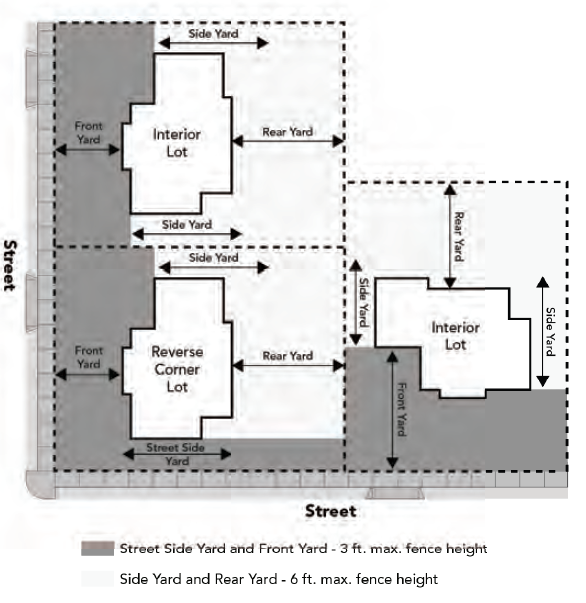
2.
Modification. Modification to the fence height requirement may be allowed through a site plan modification (Section 21.17.020) for a fence height not to exceed four feet. In approving such a request, the review authority shall make the findings required for a site plan modification (Subsection 21.17.020(C)) and find that it can be demonstrated that such a height will not impair the sight distance of vehicles on the street or on the driveway of the lot to the rear of a reversed corner lot.
C.
Nonconforming Fences. See Section 21.78.020 (Nonconformities Regarding Fences).
(Ord. No. 1144 N.S., § 3(Exh. A), 10-1-2024)
21.45.010 - Purpose and applicability.
A.
Purpose.
1.
To establish a framework to review landscape and irrigation plans consistently and improve the physical appearance of the city by providing visual and ecological relief in the urban environment;
2.
To establish minimum landscape development standards for the design, provision, and maintenance of landscaped areas, and encourage irrigation methods and suggested plant species to develop a measure of uniformity and quality in overall landscaping design; and
3.
To promote the value and long-term benefits of landscapes to provide an attractive living, working and recreating environment, while recognizing the need to invest water and other resources as efficiently as possible.
B.
Applicability. The requirements within this chapter apply to new construction and rehabilitated landscapes for commercial, industrial, and residential projects.
(Ord. No. 1144 N.S., § 3(Exh. A), 10-1-2024)
21.45.020 - General provisions.
A.
Required Landscape Planting Areas.
1.
Landscaping in Setbacks.
a.
R-1 Zoning Districts. All front yard areas shall be landscaped.
b.
All other Zoning Districts. Outside the R-1 zoning district, all visible yards shall be landscaped.
2.
Unused Areas. All areas of a building site not identified on a site plan intended for a specific use or purpose, except where enclosed and blocked from the view of public streets by solid fencing and/or buildings, shall be landscaped.
3.
Parking Areas. Parking areas shall be landscaped in compliance with Chapter 21.48 (Parking and Loading Regulations).
B.
Landscaping Materials.
1.
Live Plant Requirement. A minimum of thirty percent of required landscaped area shall be covered with live plant materials at maturity.
2.
Mixture of Plant Materials. Landscaping shall consist of combinations of trees, shrubs, and ground covers with careful consideration given to eventual size and spread, susceptibility to disease and pests, durability, and adaptability to existing soil and climatic conditions.
3.
Natural Turf Limitations. See Section 21.56.030 (Turf Limitations for New Construction and Rehabilitated Landscapes).
4.
Non-Plant Materials. The following may be used to meet the minimum required landscape planting areas (Subsection 21.45.020(A)) but shall not be used to meet the minimum live plant area required by Paragraph 21.45.020(B)1. unless otherwise allowed by a site plan modification or development plan modification (Subsection 21.45.020(H)):
a.
Pervious Materials. Non-plant materials such cinder, bark, gravel, and similar materials.
b.
Hardscape. Embellished pavement, fountains, and similar hardscape.
C.
Maintenance. Landscaping shall be maintained in an orderly and healthy condition in compliance with this chapter. This includes proper pruning, staking, sowing of lawns, weeding, removal of litter, fertilizing, monitoring for pests and disease, replacement of plants when necessary, and regular watering.
D.
Driver's Visibility. Trees and shrubs shall be planted and maintained so that at maturity they do not interfere with traffic safety sight areas or public safety. Notwithstanding other provisions of this section, landscaping shall comply with Chapter 21.55 (Visibility at Intersections).
E.
Residential Open Space Areas.
Location. Required common and private residential open space may be located on the ground, on terraces, or on rooftops, shall be landscaped or developed for active or passive recreation and may include roofed recreation areas, swimming pools, or unenclosed porches where not otherwise prohibited.
Minimum Dimensions. Private open space shall have a minimum dimension of eight feet at the ground floor and five feet if located on the second story or above. Shared open space shall have no minimum horizontal dimension less than fifteen feet.
Usability. Open space should be designed with the functional use as the primary goal, not as left over or awkwardly designed space.
F.
Oak Tree Preservation and Street Trees. Oak tree preservation and street tree requirements shall be as required by Title 10 of this Municipal Code.
G.
Hillside Landscaping. See Paragraph 21.81.040(D)5. (Landscaping).
H.
Landscape Modifications. Designs, materials, or methods of installation not specifically prescribed by this chapter may be approved by the review authority through a site plan modification (Section 21.17.020). In approving such a request, the review authority shall find, in addition to the findings associated with a site plan modification (Subsection 21.17.020(C)), that the proposed design, material, or method provides approximate equivalence to the specific requirements of this chapter or is otherwise satisfactory and complies with the intent of these provisions.
I.
Nonconforming Landscaping. See Section 21.78.030 (Nonconforming Landscaping).
(Ord. No. 1144 N.S., § 3(Exh. A), 10-1-2024)
21.45.030 - Water efficient landscaping.
See Chapter 21.56 (Water Efficient Landscaping) for water efficient landscaping requirements.
(Ord. No. 1144 N.S., § 3(Exh. A), 10-1-2024)
21.47.010 - Purpose and applicability.
A.
Purpose. For the purposes of this chapter, mechanical equipment shall include machines and devices, including backflow devices, HVAC units, fans, vents, generators, and elevator motors integral to the regular operation of climate control, electrical, plumbing, and similar building systems.
B.
Applicability. The standards of this chapter apply to:
1.
New development;
2.
New equipment that is added to serve existing buildings; and
3.
Condominium conversions.
(Ord. No. 1144 N.S., § 3(Exh. A), 10-1-2024)
21.47.020 - General provisions.
A.
General Screening. All exterior mechanical equipment shall be screened or incorporated into the design of buildings so as not to be visible from the public right-of-way, highways, passenger railways, or abutting residential zoning districts.
B.
Location. Exterior mechanical equipment shall be screened to the height of the particular piece of equipment, as follows:
1.
Roof-Mounted Equipment. Mechanical equipment may be mounted on roofs, provided the equipment is concealed from view from adjacent at-grade public streets with solid architectural features that are integrated into the overall architectural design, such as a roof well or parapet wall.
Exception. For detached single-family residences (and accessory dwelling units), air-conditioning and evaporative cooling systems shall not be mounted on the roof.
2.
Equipment at Grade. When located on the ground adjacent to a building, mechanical equipment shall be:
a.
Located behind the front face of the building unless determined to be infeasible by the city utilities and emergency services departments; and
b.
Screened by landscaping or an architecturally compatible screen or a combination of materials from the view of the street or surrounding properties.
A mechanical equipment screen shall fully block the view of the equipment with structural/architectural materials that match the architectural style and materials of the adjacent structure.
When landscaping is used, proposed plant materials shall have the capability of achieving sixty percent of total view blockage within eighteen months of planting, and one hundred percent of total view blockage within three years of planting.
Backflow devices shall utilize a combination of fencing and landscape screening unless determined to be infeasible by the city utilities and emergency services departments.
3.
Setbacks. Mechanical equipment may be located within required setbacks, provided building code requirements are met.
C.
Height Limit Projection. Roof-mounted equipment and related architectural screening that exceed maximum height limits are subject to the provisions of Table 21.41.040-1 (Allowed Projections Above Height Limits) in Paragraph 21.41.040(A)2.
D.
Screening Modifications. Modifications to the provisions of this chapter may be allowed through a site plan modification (Section 21.17.020). In approving such a request, the review authority shall find, in addition to the findings associated with a site plan modification (Subsection 21.17.020(C)), that screening is infeasible due to health and safety, structural limitations, or utility requirements.
(Ord. No. 1144 N.S., § 3(Exh. A), 10-1-2024)
21.48.010 - Purpose and applicability.
A.
Purpose. The purpose of this chapter is to:
1.
Require parking spaces and loading spaces for all land uses that are sufficient in number, size, and arrangement;
2.
Minimize the negative environmental and urban design impacts of parking lots, driveways, and drive aisles within parking lots;
3.
Establish standards and regulations for safe and well-designed parking, unloading, and vehicle circulation areas that minimize conflicts within parking lots and, where appropriate, create buffers from surrounding land uses;
4.
Offer flexible means of minimizing the amount of area devoted to parking by allowing reductions in the number of required spaces in transit-served locations, shared parking facilities, and other situations expected to have lower vehicle parking demand; and
5.
Reduce urban run-off and heat island effect.
B.
Applicability.
1.
New Buildings/Uses. At the time of erection of any building or structure, off-street parking spaces associated with the building's use, with adequate and proper provision for ingress and egress by standard size automobiles shall be provided.
2.
Reconstruction, Expansion, and Change in Use of Existing Buildings.
a.
Nonresidential. When a change in use, expansion of a use, or expansion of floor area creates an increase of twenty percent or more in the number of required on-site parking or loading spaces, on-site parking and loading shall be provided according to the provisions of this chapter.
b.
Residential. When any building is remodeled, reconstructed, or changed in use by the addition of dwelling units, such additional garage or parking facilities as may be required must be provided, except for accessory dwelling units pursuant to Chapter 21.58 (Accessory Dwelling Units) or urban dwelling unit projects pursuant to Chapter 21.65 (Urban Dwelling Units).
c.
General.
i.
Existing parking shall be maintained, and additional parking shall be required only for such addition, enlargement, or change in use and not for the entire building or site.
ii.
If the number of existing parking spaces is greater than the requirements for such use, the number of spaces in excess of the prescribed minimum may be counted toward meeting the parking requirements for the addition, enlargement, or change in use.
iii.
A change in occupancy is not considered a change in use unless the new occupant is in a different land use classification than the former occupant pursuant to Table 21.32-1 (Zoning District Use Regulations).
3.
Parking Provisions of Uptown/Town Center Specific Plan. Buildings or land uses within the boundaries of the Uptown/Town Center Specific Plan are subject to the parking requirements of said specific plan.
4.
Nonconforming Parking. See Section 21.78.010 (Nonconforming Parking).
(Ord. No. 1144 N.S., § 3(Exh. A), 10-1-2024)
21.48.020 - General provisions.
A.
Calculation of Required Parking Spaces.
1.
Area—Based Standards.
a.
Area-based parking space ratios shall be computed based on floor area in square feet. Floor area shall be calculated in compliance with Section 21.41.090 (Determining Floor Area).
b.
The zoning administrator is authorized to determine the area measurement for uses or portions of uses not located within buildings or structures.
2.
Bedroom-Based Standards. Where a parking requirement is stated as a ratio of parking spaces to bedrooms, any rooms having the potential of being a bedroom and meeting the standards of the building code as a sleeping room shall be counted as a bedroom.
3.
Vehicle Service and Repair Standards. For vehicle services and repair uses, floor area shall include all onsite structures, including office and lobby space, garages, and automotive service bays.
4.
Multiple Uses.
a.
Multiple Uses. When two or more uses are located on the same lot or within the same building or structure, the required parking for each use shall be calculated separately. The number of on-site parking spaces required shall be the sum total of the requirements for the individual uses, unless as otherwise provided for by this chapter.
b.
Mixed Functions. Where a building occupied by a single use contains several functions, such as sales, office, and storage areas, parking shall be as required for the principal use for the floor area (calculated consistent with Subsection 21.41.090(B)); except that when storage areas are larger two thousand square feet, the parking requirement is to be determined separately for those areas, as specified for warehouse, wholesale, and distribution.
B.
Spaces for Handicapped. Handicapped spaces shall be provided as required by state statute.
C.
General Requirements.
1.
Accessibility. Parking and loading areas shall be accessible for its intended purpose during all hours of operation.
2.
Parking Charge. The parking of motor vehicles shall be without monetary charge when such parking is required in conjunction with uses permitted by this chapter.
3.
Storage of Vehicles Prohibited. The parking facilities required by this chapter shall be only for the temporary parking of vehicles used in conjunction with the uses they serve. This chapter does not apply where vehicle storage is permissible as a primary or accessory land use.
(Ord. No. 1144 N.S., § 3(Exh. A), 10-1-2024)
_____
21.48.030 - Required parking spaces.
A.
Parking Space Requirements. The number of required spaces for land uses are as set forth in Table 21.48.030-1 (Off-Street Parking Spaces Required). These provisions are established as the maximum number of parking spaces required. Where specific parking requirements are not listed, an interpretation of parking impacts and spaces needed based on a similar use may be determined by the director.
Table 21.48.030-1: Off-Street Parking Spaces Required
(Ord. No. 1144 N.S., § 3(Exh. A), 10-1-2024)
_____
21.48.040 - Parking reductions and modifications.
A.
Mixed-Use Parking Standards. In a mixed-use development (residential and nonresidential uses within the same building or on the same parcel), sixty-six percent of the parking spaces required for commercial use may be used to meet the parking requirement for residential use.
B.
Joint Use Parking Standards. When a primarily weekday and daytime use (for example, office, daycare center) is located within three hundred feet of a primarily weekend or nighttime use (for example, assembly facility), up to sixty-six percent of the parking spaces for the daytime use may be used to meet the parking requirement for the nighttime use. The reverse is also true: up to sixty-six percent of the parking spaces for a night time use may be used to satisfy the parking requirement for the daytime use subject to the following conditions:
1.
The applicant shall demonstrate to the satisfaction of the review authority that there is no substantial conflict in the principal operating hours of the buildings or uses for which the joint use of off-street parking facilities is proposed.
2.
Parties concerned in the joint use of off-street parking facilities shall enter into a legally binding agreement for such joint use. The agreement, when approved as conforming to the provisions of this chapter, shall be recorded in the office of the county recorder and copies filed with the city. The minimum term for such an agreement shall be fifteen years.
C.
Historic Resources. A reduction in parking requirements may be permitted as an historic preservation incentive per Subsection 21.62.090(B) (Parking Requirement Reduction).
D.
Major Parking Modifications. The number of required parking spaces for any use may be reduced by up to twenty percent through a development plan modification (Section 21.16.020) as follows:
1.
Criteria for Approval. A development plan modification for a parking reduction may be approved if the review authority finds, in addition to the findings associated with a development plan modification (Subsection 21.16.020(D)) that special conditions exist that will reduce parking demand at the site. Special conditions might include, but are not limited to, the nature of the proposed operation; proximity to frequent transit service; transportation characteristics of persons residing, working, or visiting the site; or because the applicant has undertaken a transportation demand management program.
2.
Parking Demand Study. In order to evaluate a proposed project's compliance with the above criteria, submittal of a parking demand study prepared by a licensed traffic engineer, or as approved by the city engineer, that substantiates the basis for granting a parking reduction shall be required.
3.
Exception. This subsection allowing for a reduction in parking shall not be used for any of the following:
a.
Any use located within the Uptown/Town Center Specific Plan area;
b.
Any residential use (excepting an age-restricted development); or
c.
Any hotel or motel.
E.
Minor Parking Modifications. Modifications to specific parking standards may be approved through a site plan modification (Section 21.17.020) as follows:
1.
Tandem Parking. Tandem parking may be allowed through a site plan modification. In approving a request for tandem parking, the review authority shall find, in addition to the findings associated with a site plan modification (Subsection 21.17.020(C)), that tandem parking is appropriate for the specified use and site.
(Ord. No. 1144 N.S., § 3(Exh. A), 10-1-2024)
21.48.050 - Off-site parking.
A.
Provisions for Off-Site Parking. Parking facilities shall be located on the lot on which the principal land use is located unless such spaces cannot reasonably be located on such lot. In such a case, parking spaces may be located on any land within three hundred feet of the property with the principal land use; provided, that the following conditions are met:
1.
A legally binding written agreement between the owner of the property with the parking spaces and the principal land user assuring the retention of the parking spaces for the principal use shall be properly drawn and executed by the parties concerned, approved as to form by the city attorney and shall be recorded in the office of the county recorder and copies filed with the city prior to issuance of a building permit or certificate of occupancy for the principal use. The term of such an agreement shall be a minimum of fifteen years.
2.
The principal use shall be permitted to continue only as long as its parking requirements are met.
(Ord. No. 1144 N.S., § 3(Exh. A), 10-1-2024)
21.48.060 - Bicycle parking.
A.
Multi-family development with ten or more units shall provide a minimum of two bicycle rack spaces for every ten units on site.
B.
Nonresidential development projects shall provide a minimum of two bicycle rack spaces for each twenty thousand square feet of gross floor area. In addition, for sites with fifty thousand square feet of gross floor area, two secured locker bike parking facilities shall be provided for each increment of fifty thousand square feet of gross floor area.
C.
For parking lots that require twenty or more parking spaces, a five percent reduction in parking spaces shall be allowed in exchange for providing four bike rack spaces.
(Ord. No. 1144 N.S., § 3(Exh. A), 10-1-2024)
21.48.070 - Motorcycle parking.
One motorcycle parking space shall be provided for each twenty vehicle spaces required. Motorcycle spaces shall be a minimum of six feet wide and ten feet long. Projects that provide more motorcycle spaces than required may reduce the required car spaces at the rate of one car space for each five additional motorcycle spaces.
(Ord. No. 1144 N.S., § 3(Exh. A), 10-1-2024)
21.48.080 - Parking for electric vehicles.
A.
Parking spaces for electric vehicles shall be provided for all new developments in accordance with the requirements of the CalGreen Building Standards Code and/or successor code and local city codes, whichever yields the greater number of spaces. These dedicated parking spaces shall count toward the minimum required parking spaces for the associated use.
B.
All electric vehicle spaces shall be equipped with electric vehicle charging equipment as set forth in the CalGreen Building Standards Code and/or successor code and local city codes the use of which the property owner or operator may require payment at his or her discretion.
C.
Any charging or similar equipment shall not be placed within the required parking space dimensions and shall not obstruct any pedestrian path of travel.
(Ord. No. 1144 N.S., § 3(Exh. A), 10-1-2024)
21.48.090 - Parking for storage of commercial vehicles, recreational vehicles, and boats.
The parking and storage of commercial and recreational vehicles (including recreational vehicles, boats, campers, trailers, farm equipment, or similar) as an accessory use on private property is subject to the following standards.
A.
Commercial Vehicles and Equipment. See Municipal Code Chapter 12.38 (Parking Restrictions) and Chapter 21.69.170(C) (Outdoor Storage Areas).
B.
Recreational Vehicles and Boats.
1.
Public Streets. See Municipal Code Chapter 12.38 (Parking Restrictions).
2.
Paving and Surfacing. Recreational vehicles shall be stored on a permanent surface listed in Subparagraph 21.48.100(D)2.a.
3.
Dwelling Use Prohibited. No recreational vehicle or tiny home on wheels shall be used for dwelling purposes on any site for any amount of time with the following exceptions:
a.
Within a permitted recreational vehicle park; or
b.
Subject to approval of a temporary use permit (see Chapter 21.20), a recreational vehicle may be used as caretaker residences in commercial and industrial districts for temporary events such as pumpkin or Christmas trees sales or on the site of a construction project with an approved and active building permit provided that the recreational vehicle be removed within seven days of the end of the temporary event or before final occupancy for a construction project.
4.
Fluid Collection Systems. Drip pans or other fluid collection systems shall be used on any recreational vehicle that shows evidence of leaky fluids.
(Ord. No. 1144 N.S., § 3(Exh. A), 10-1-2024)
21.48.100 - Parking area design and development standards.
A.
Parking Space Minimum Dimensions.
1.
General. Parking spaces shall be designed in compliance with the provisions in Table 21.48.100-1.
Table 21.48.100-1: Parking Space Standards
2.
Compact Spaces. Compact spaces may be provided for up to thirty percent of required spaces.
3.
Measurement.
a.
The width of enclosed parking spaces may be measured from the outer wall of a garage or the outer edge of a support post for a carport. Garage door openings shall be at least eight feet in width for a one-car opening and sixteen feet for a two-car opening.
b.
A two-foot overhang for bumpers is permitted into landscaping or walkways provided that wheel stops are provided and minimum widths for disabled access are maintained.
B.
Parking Lot Design.
1.
Maneuvering Aisle Minimum Dimensions. Parking drive aisles shall be designed in compliance with the provisions in Table 21.48.100-2 and with fire department standards including for truck turning radii and turnarounds.
Table 21.48.100-2: Parking Lot Aisle Standards
2.
Slope. Parking spaces shall not have front-to-back or side-to-side grades that exceed five percent slope.
3.
Parking Area Surface Materials.
a.
General. Parking area surface materials shall minimize impervious surfaces and be constructed from permanent materials such as asphalt, porous asphalt, concrete, porous concrete, pavers, or turf block. Decomposed granite is not considered a permanent surface.
b.
Modifications for Residential Uses. On residential lots larger than one acre, non-permanent parking area materials such as gravel, roadbase, or other suitable materials may be allowed through approval of a site plan modification (Section 21.17.020). In approving such a request, the review authority shall make the findings required for a site plan modification (Subsection 21.17.020(C)), and all of the following findings:
i.
The parking surface is compacted to resemble a paved surface, located in the rear half of the lot and/or located behind the primary structure, and accompanied by adequate landscape screening, and
ii.
Adequate mechanisms are installed and maintained to prevent track out of non-permanent parking area materials from tires before reaching any public right-of-way.
c.
Modifications for Nonresidential Uses. Non-permanent parking area materials such as gravel, roadbase, or other suitable materials may be allowed through approval of a development plan modification (Section 21.16.020). In approving such a request, the review authority shall make the findings required for a development plan modification (Subsection 21.16.020(D)), and all of the following findings:
i.
The parking spaces are overflow parking spaces provided above the required number of parking spaces; and
ii.
Adequate mechanisms are installed and maintained to prevent track out of non-permanent parking surface materials from tires before reaching any public right-of-way.
4.
Location in Setbacks and Required Screening. Required parking spaces may be located in required setbacks in all zoning districts. Parking areas located in setbacks shall provide a landscape buffer of ten feet between the front property line and the parking area, five feet between a street side property line and the parking area, and three feet between an interior (side or rear) property line and the parking area.
5.
Drainage.
a.
Parking area drainage shall be designed in compliance with city stormwater control and drainage requirements.
b.
Parking lots shall include perimeter curbing. Flat edge curbing is acceptable if wheel stops are provided.
6.
Backing Out onto Arterials. Parking areas and driveways on an arterial or greater road as designated in the circulation element of the general plan shall be designed so that vehicles do not back out of parking spaces directly onto the street or highway, unless determined to be infeasible by the city engineer.
7.
One-Way Signs. Directional signs shall be installed for one-way driveways and ramps to indicate one-way circulation.
8.
Maintenance. Parking areas, driveways, maneuvering aisles, ramps, and turnaround areas shall be kept free of obstructions at all times.
9.
Wheel Stops. Wheel stops shall be installed for parking spaces at least two feet from any adjacent walkway, sidewalk, street, or alley.
10.
Access. The location and design of all street or alley entrances and exits to off-street parking facilities shall be designed in accordance with city engineering standards.
11.
Striping. All parking spaces shall be striped in a manner clearly showing the layout of the spaces.
12.
Screening. Parking lots with six or more parking spaces shall be screened from view from any adjacent residentially zoned or developed property on all sides of the parking lot. Screening materials may include solid opaque fencing (excluding chain link with slats), masonry, or earth berms in combination with landscaping and shall be at least five feet in height, and not more than six feet in height, either for fence or walls and/or combination of fencing and walls and earth berm.
13.
Temporary Parking. The parking facilities required by this chapter shall be for the temporary parking of vehicles used in conjunction with the uses they serve. For long-term storage of vehicles, see Subsection 21.69.170(C) (Outdoor Storage Areas).
C.
Landscaping.
1.
In addition to the landscaping required by Subsection 21.45.020(A), eight square feet of landscape area shall be provided for every parking space in parking lots with six or more spaces. Emphasis shall be given to shade tree installation to inhibit heat buildup in parking areas. In parking areas with twenty or more cars, the design shall demonstrate a minimum of twenty-five percent shade cover within five years through selection of shade tree species.
2.
Design of landscaping for parking areas in all zoning districts (except for one single-family residence) is subject to development review committee approval.
3.
Landscape areas shall be designed to function as bioretention areas designed to filter, store and infiltrate storm water, utilizing mulch, soil and plant root systems, to retain, degrade and absorb pollutants. These can include bioretention swales, rain gardens or storm water planters. The use of an engineered soil mix and appropriate vegetation is important to facilitate bioretention functions. Where infiltration into underlying native soils is not appropriate, a perforated underdrain can convey treated runoff to a storm drain or surface drainage.
D.
Off-street Parking, Driveways and Vehicle Storage.
1.
Single-Family Residential Development.
a.
General. All uses shall provide off-street parking spaces and facilities as required by Section 21.48.030 (Required Parking Spaces). The number and location of all driveways shall be subject to approval of the city engineer.
b.
Landscaped Setback. Driveways parallel to a street (such as circular driveways and hammerhead turnarounds) shall be designed to provide a minimum ten-foot-wide maintained landscaped setback between the street right-of-way and the parallel edge of the driveway closest to the street right-of-way.
c.
Parking Location. No automobile, truck, motorcycle, recreational vehicle, boat, camper, trailer, farm equipment or similar vehicle, materials or equipment shall be parked or stored between a dwelling and the street except on paved driveways.
d.
Paved Area. Except for lots with circular drives, pavement of the front yard shall be limited to fifty percent of the front yard. On corner lots, pavement of the street side yard shall be limited to ten percent of the street side yard unless the garage/carport is accessed via the side street. In such a case, pavement of the street side yard may be increased to provide direct access to the garage/carport. Pavement in front and street side yard areas shall not exceed what is necessary to access off-street parking facilities. The balance of all areas between the main building and each street frontage shall be landscaped and maintained in a neat and orderly manner.
e.
Parking Space Slope for Single Family Residential Uses.
i.
General. Where provided, off-street parking spaces created in front of a garage door shall comply with Paragraph 21.48.100(D)1. (Slope).
ii.
Modification. Parking space slope may be modified through a site plan modification (Section 21.17.020) to allow parking spaces on slopes of up to fifteen percent. In approving such a request, the review authority shall make the findings required for a site plan modification (Subsection 21.17.020(C)). and find that the creation of the parking spaces would otherwise necessitate extensive grading.
2.
Multi-Family Residential Development.
a.
General. All uses shall provide off-street parking spaces, drives and facilities as required by Section 21.48.030 (Required Parking Spaces).
b.
Landscaped Setback. Driveways parallel to a street (such as circular driveways and hammerhead turnarounds) shall be designed to provide a minimum ten-foot-wide landscaped setback between the street right-of-way and the parallel edge of the driveway closest to such street right-of-way.
c.
Screening. Parking lots located between public streets and multi-family dwellings shall be screened with either a three-foot-high decorative masonry wall or a three-foot-high landscaped earthen berm.
d.
Parking Location. Parking and storage for automobiles, trucks, motorcycles, recreational vehicles, boats, campers, trailers, farm equipment or similar vehicles or equipment shall only be parked or stored on paved parking spaces designated for residential units and may not be parked or stored in parking spaces designated for visitors.
E.
Maintenance of Parking Facilities.
1.
All parking areas shall be kept clean and free of dust, mud, and trash. Parking areas shall be used only for the purpose of parking vehicles. Where landscaping is provided within or along parking areas, adequate irrigation and maintenance shall be provided.
2.
Striping, marking, directional signs, lighting, screening and all other improvements required by this chapter shall be adequately maintained.
(Ord. No. 1144 N.S., § 3(Exh. A), 10-1-2024)
21.48.110 - Driveway standards.
A.
Generally. The following standards are applicable to all driveways.
1.
Minimum Width.
a.
Driveways serving four or fewer residential dwelling units shall have a minimum width of twelve feet. (Exception: Accessory dwelling units developed in accordance with Chapter 21.58 [Accessory Dwelling Units] shall not be included in this calculation.)
b.
Driveways serving five or more residential dwelling units or a nonresidential development shall have a minimum width of twenty-four feet.
2.
Minimum Back-Up Distance. The minimum back-up distance between a detached garage or carport shall be twenty-four feet to a sidewalk or side or rear property line. Garages and carports that back up to a paved alley may include the twenty-foot-wide alley in back up distance measurement.
3.
Vertical Clearance. Driveways shall have a minimum vertical clearance of thirteen feet six inches.
4.
Long Driveways. Driveways exceeding one hundred fifty feet in length shall provide a turnaround in compliance with the California Fire Code and subject to approval of the fire marshal.
5.
Driveway Surface Materials.
a.
General. Driveways shall be constructed with permanent surfacing with materials such as asphalt, porous asphalt, concrete, porous concrete, bricks, pavers, or turf block. Decomposed granite (DG) is not considered a permanent surface.
b.
Modifications for Single-Family Residential Uses. On single-family residential lots larger than one acre, non-permanent driveway materials such as roadbase may be allowed through a site plan modification (Section 21.17.020). In approving such a request, the review authority shall make the findings required for a site plan modification (Subsection 21.17.020(C), and all of the following findings:
i.
Adequate mechanisms are installed and maintained to prevent track out of non-permanent driveway materials from tires before reaching any public right-of-way; and
ii.
The driveway material alternation complies with fire department and city engineering standards.
6.
Drainage. Driveway drainage shall be designed to comply with city stormwater control and drainage standards.
7.
Slope. Driveways shall not exceed a maximum slope of fifteen percent. Driveways shall have either a continuous cross slope that conveys runoff to adjacent landscaping or a crowned surface which conveys each side to landscape areas.
8.
Access. Driveways shall not be located more than five hundred feet from the street or alley to the parking area served.
9.
Common Driveways. Common driveways shared by more than one lot shall be allowed when proper easements or agreements have been executed and filed with the city, and recorded with the county recorder.
10.
Backing Out onto Arterials. Driveways that serve five or more residences, any nonresidential land uses, and any use on an arterial or greater road as designated in the circulation element of the general plan shall be designed so that vehicles do not back out of parking spaces directly onto the street or highway, unless determined to be infeasible by the city engineer.
B.
Driveway Gradient and Width Modifications. Where topography or other physical factors such as existing setbacks, lot dimensions, and oak trees, combine to make development in accordance with driveway standards infeasible, Modifications may be allowed through a site plan modification (Section 21.17.020). In approving such a request, the review authority shall make the findings required for a site plan modification (Subsection 21.17.020(C)), and the following finding:
1.
The project is subject to and will comply with any mitigation measures necessary to ensure adequate fire protection. The fire department reserves the right to require that residential fire sprinkler systems be installed when emergency access is restricted.
(Ord. No. 1144 N.S., § 3(Exh. A), 10-1-2024)
21.48.120 - Off-street loading requirements.
A.
Required Loading Spaces. Every structure or part thereof erected or occupied for retail business, service, manufacturing, storage, warehousing, hotel, mortuary, or any other use similarly involving the receipt or distribution by vehicles of space in accordance with the following requirements:
1.
Commercial Zoning Districts. Within any commercial zoning district, one loading space is required for each ten thousand square feet of gross floor area.
2.
Industrial Zoning Districts. Within any industrial zoning district, one loading space is required for each fifteen thousand square feet of gross floor area.
B.
Size. For the purpose of this section, an off-street loading space, exclusive of adequate access drives and maneuvering space, shall have minimum dimensions of twelve feet by forty feet and an overhead clearance of fourteen feet in height above the alley or street grade.
C.
Modifications. Modifications to off-street loading requirements may be allowed through a site plan modification (Section 21.17.020). In approving such a request, the review authority shall make the findings required for a site plan modification (Subsection 21.17.020(C)).
(Ord. No. 1144 N.S., § 3(Exh. A), 10-1-2024)
21.50.010 - Purpose.
This section establishes objective design standards (ODS) intended to facilitate high-quality site planning and building design and to accelerate housing production through the clear communication of design objectives and efficient permitting process for qualifying residential and mixed-use development projects.
(Ord. No. 1144 N.S., § 3(Exh. A), 10-1-2024)
21.50.020 - Applicability.
A.
Applicable State Laws. This chapter applies to projects conducted pursuant to any provision of state law that references objective design standards for residential development, including but not limited to California Government Code Section 65589.5 (Housing Accountability Act) and California Government Code Section 65913.4 (SB 35), as may be amended from time to time.
B.
Applicable Projects. This chapter applies to the following development projects in the multi-family residential districts (R-2-R-5) and to mixed-use developments in the office professional zoning district and mixed-use overlay zoning district:
1.
New development of residential units; and
2.
The following remodels and additions:
a.
Any second story addition;
b.
An addition of more than forty percent of the existing floor area;
c.
Remodels where alterations remove more than fifty percent of the exterior walls or remove more than fifty percent of the roof framing; and
d.
Conversion of existing nonresidential space to a residential use.
3.
Additions of forty percent or less of the existing floor area are not subject to this chapter, but shall utilize the same exterior colors and materials as the existing structure to which the addition is applied.
(Ord. No. 1144 N.S., § 3(Exh. A), 10-1-2024)
21.50.030 - Alternative review process/modifications.
Applicants who elect to provide alternative design approaches to the objective design standards in this chapter can do so by filing an application for a development plan modification (Section 21.16.020). If the applicant elects to utilize an alternative design approach, the review authority shall use these objective design standards as guidelines for the quality of design required in the city, and make the findings required for a development plan modification (Subsection 21.16.020(D)).
(Ord. No. 1144 N.S., § 3(Exh. A), 10-1-2024)
21.50.040 - Relationship to other standards and requirements.
Development projects subject to this chapter shall also comply with all other applicable standards and requirements of Title 21 (Zoning) for the zoning district in which a proposed project is located. Where a conflict exists between the objective design standards set forth in this chapter and other Title 21 requirements, these provisions shall apply.
(Ord. No. 1144 N.S., § 3(Exh. A), 10-1-2024)
21.50.050 - Building design and articulation.
A.
Number of Strategies Required by Building Type. Building designs shall incorporate the number of design strategies indicated in Table 21.50.050-1 (Minimum Required Number of Design Strategies by Building Type). Where "all" is indicated, all design strategies in that subsection shall be incorporated. Where a number is indicated, projects must include that number of design strategies, choosing from the design strategy options listed in Subsections C—E below.
Table 21.50.050-1: Minimum Required Number of Design Strategies by Building Type
B.
Tier 1 Design Strategies. Required Components. Projects shall comply with all standards listed in this subsection, as required by Table 21.50.050-1 (Minimum Required Number of Design Strategies by Building Type).
1.
Building Orientation. Buildings visible from the public right-of-way shall have at least one pedestrian entry oriented toward the primary street. On corner parcels, additional pedestrian entries may be oriented toward both the primary street and a secondary street. (See Section 21.50.070 [Frontage Standards].)
2.
Minimum Ground Floor Height for Nonresidential Uses. The minimum interior floor-to-floor height of nonresidential ground floor spaces shall be twelve feet. Minimum ground floor height shall be measured from the ground floor of the first story to the finished floor elevation of the second story.
3.
Transparencies. Façades shall incorporate windows and openings providing light to adjacent spaces, rooms, and uses as follows:
a.
Nonresidential Ground—Floor Uses.
i.
Windows and openings of nonresidential uses on the ground floor visible from the primary street shall constitute a minimum of thirty percent of the ground-floor building faces.
ii.
Windows and openings of nonresidential uses on the ground floor visible from any secondary street shall constitute a minimum of twenty percent of the ground-floor building faces.
Figure 21.50.050-1: Ground Floor Nonresidential Transparencies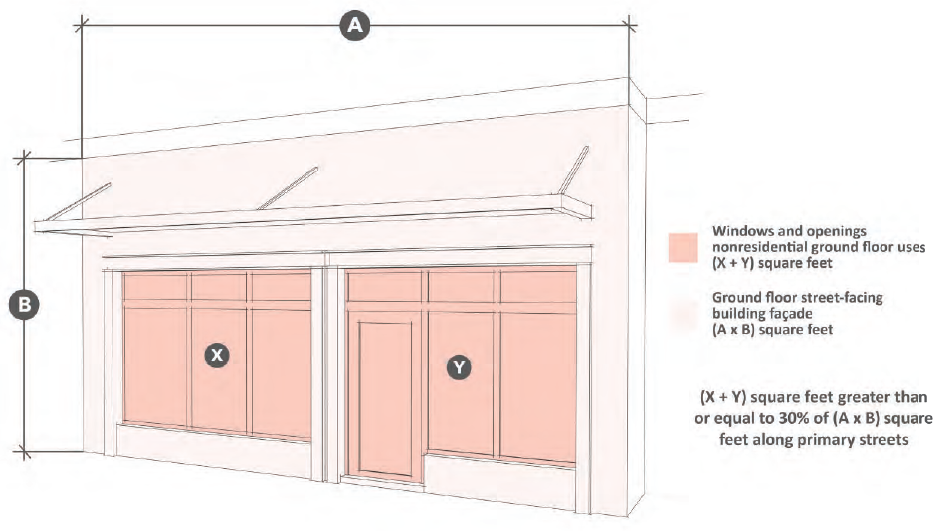
iii.
Windows shall provide a clear and transparent view into ground-floor nonresidential uses or shall display merchandise to reinforce a pedestrian scale.
b.
Nonresidential Upper—Floor Uses. Windows and openings of nonresidential uses on upper floors that face streets shall constitute a minimum of ten percent of upper floor building faces visible from the public right-of-way.
c.
Residential Uses. Windows and openings of residential uses shall constitute a minimum of fifteen percent of all building faces.
4.
Blank Walls. The maximum length of any blank wall visible from the public right-of-way, meaning without a window, opening, or other massing break, shall be limited to twenty feet in length.
5.
Building Corner Treatments. For mixed-use and multi-family projects with eleven or more units, the corners of a building on street-facing facades shall incorporate at least one of the following, located within twenty-five feet of the corner of the building, which may also be used to satisfy wall plane requirements of Subsection 21.50.050(C) (Tier 2 Variation Design Strategies: Wall Plane):
a.
Change in material, color, fenestration pattern or a combination of these, varied from the rest of the façade.
i.
Materials and colors shall be returned at least four feet or ten percent of the building façade, whichever is more, from exterior corners or may dead end into a projecting or recessed façade feature.
ii.
Materials and colors shall be vertically applied to a minimum of eighty percent of the building height.
b.
Plaza with a minimum area of two hundred square feet and located within two feet of the adjacent sidewalk grade. The corner plaza open space shall be designed as an accessible outdoor space with seating and canopy trees or small shade structures. As part of a mixed-use building, the plaza may be designed as an outdoor dining area connected to an adjacent restaurant on the ground floor. The outdoor area may be partially covered by a canopy or awning but must be open to the air on two sides;
c.
A three-dimensional tower element, which extends between three and six feet in height above the top of the adjacent building façades;
d.
A change in height of at least four feet greater or less than the height of the abutting adjacent façade.
e.
A different roof style from the roof style associated with the abutting adjacent façade.
f.
Massing break with minimum dimensions of one foot in depth by three feet in length by eight feet in height located within twenty-five feet of the corner.
C.
Tier 2 Variation Design Strategies: Wall Plane. All façades facing the public right-of-way shall include variation that cumulatively equals at least twenty-five percent of the total façade plane area that faces the public right-of-way. To achieve the twenty-five percent wall plane variation, projects shall incorporate, at a minimum, the number of design strategies identified in in Table 21.50.050-1 (Minimum Required Number of Design Strategies by Building Type) for Tier 2 (Wall Plane), choosing from the list of design strategies in Paragraph 21.50.050(C)1.
1.
Menu of Wall Plane Variation Design Strategy Options.
a.
Plaza or Forecourt. Provide a plaza or forecourt framing the entrance. The minimum dimensions of a plaza or forecourt shall be twelve feet in depth by twelve feet in length, designed as an accessible outdoor space with seating and canopy trees or small shade structures. As part of a mixed-use building, the plaza may be designed as an outdoor dining area connected to an adjacent restaurant on the ground floor. The outdoor area may be partially covered by a canopy or awning but must be open to the air on two sides.
b.
Upper Story Stepback. Provide an upper story (top-most) front stepback, a minimum of five feet in depth by fifteen percent of the façade's total length.
c.
Balconies. Provide balconies in compliance with Subsection 21.50.060(B) (Balconies), which may be recessed or projected.
d.
Bay Windows. Provide bay windows that project at least sixteen inches and not more than three feet from the façade nor exceed eight feet in length. If more than one bay window is provided on a façade, there shall be at least four feet of horizontal separation between the two bay windows.
e.
General Massing Break. Provide a general massing break, which may extend the height of a building's façade; extend the height of a building's upper stories; and/or may be recessed or projected from the façade with minimum dimensions of one foot in depth by three feet in length by eight feet in height.
Figure 21.50.050-2: Wall Plan Variation Options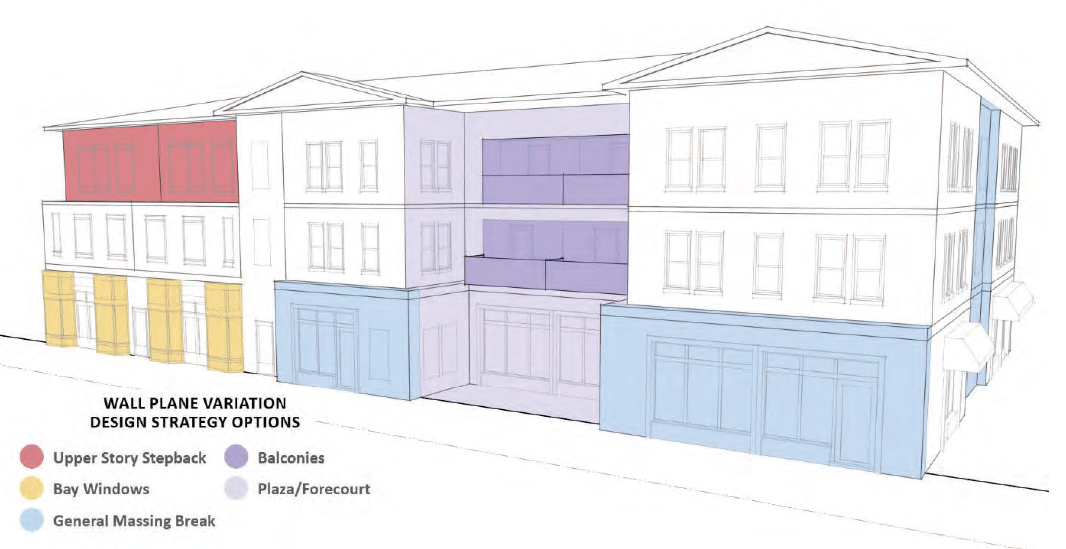
Figure 21.50.050-3: How to Measure Wall Plane Variation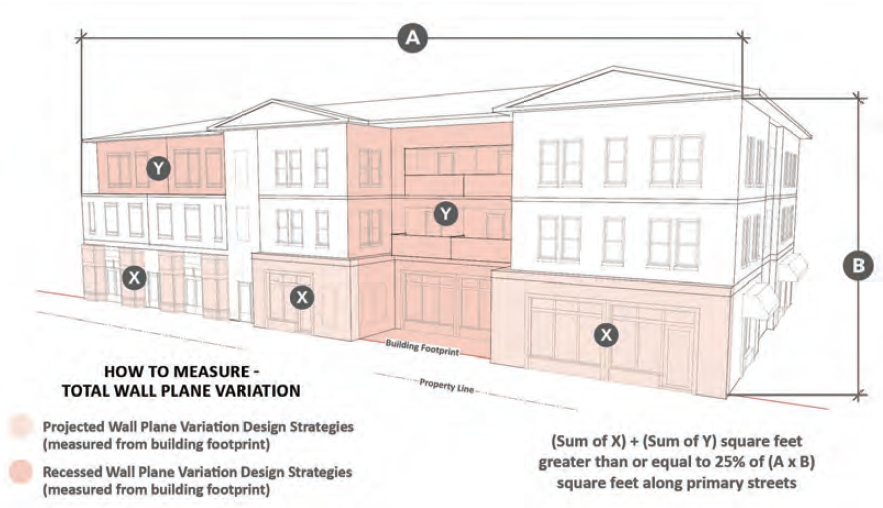
2.
Vertical Elements on Horizontal Buildings. Where Tier 2 strategies are required, buildings longer than one hundred feet shall include at least one design strategy that adds a vertical element to offset the horizontal length of the building. The vertical element shall be taller than it is wide.
Figure 21.50.050-4: Vertical Elements on Horizontal Buildings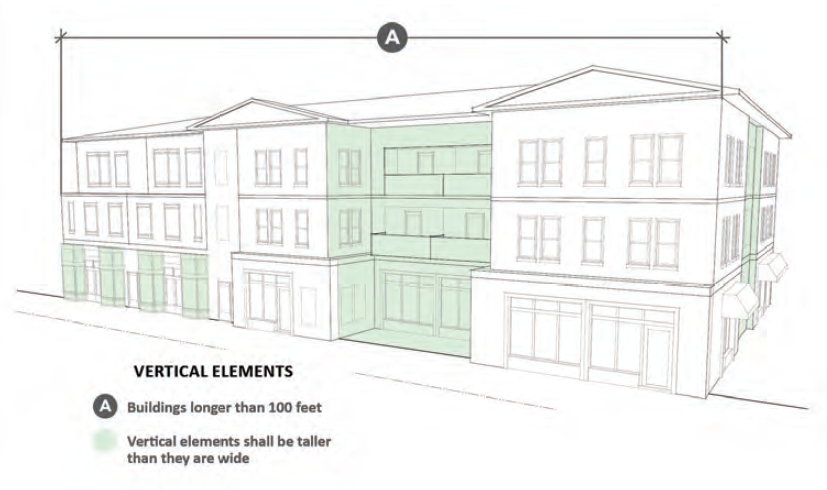
3.
Wall Plane Variation Projections into Front Setbacks. Up to fifty percent of the wall plane variation requirement shall be allowed to encroach into a required front setback by a maximum of two feet, if an equivalent area is set back two feet or more beyond the required front setback. However, in no case shall a building encroach into the public right-of-way.
Figure 21.50.050-5: Wall Plane Variation Projections into Front Setbacks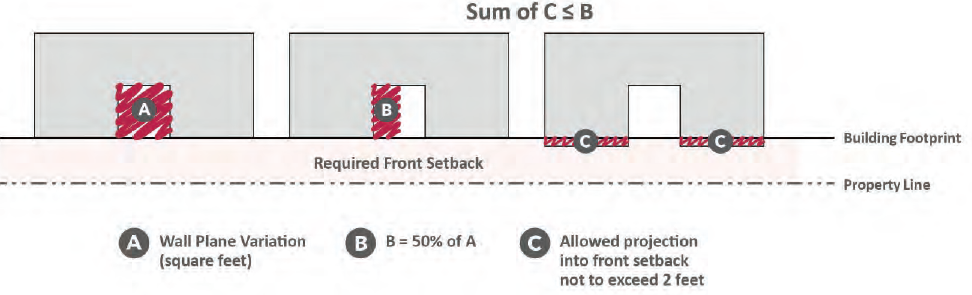
_____
Measurement. Massing breaks shall be measured from the building footprint, regardless of the setback.
D.
Tier 3 Design Strategies: Fenestration and Materials. Projects shall incorporate, at a minimum, the number of design strategies identified in Table 21.50.050-1 (Minimum Required Number of Design Strategies by Building Type) for Tier 3 (Fenestration and Materials), choosing from the list of strategies below. Design strategies shall be applied to all building façades, including those not facing the public right-of-way.
1.
For nonresidential uses, provide awnings with a minimum three-foot depth, covering at least seventy-five percent of windows and doors on the ground floor (see Subsection 21.50.060(A) [Awnings]).
2.
Exceed all applicable minimum transparency requirements (per Paragraph 21.50.050(B)3. [Transparencies]) by an additional five percentage points.
3.
Inset all windows by at least two inches from face of glass to face of window trim (or to face of exterior wall if there is no trim).
4.
Window trim on all windows, with a minimum width of 3.5 inches.
5.
Non-vinyl window frame material on all windows.
6.
Lintels applied over all window openings.
7.
Windowsills projecting a minimum of two inches beyond the building façade on all windows.
8.
Wood detailing applied to define a façade plane change between stories (not at the roof level) applied as either:
a.
Corbeled end beams or rafter tails, projecting a minimum of eighteen inches beyond the building façade, running the length of the façade plane change, which shall be applied to no less than fifty percent of the façade length; or
b.
Post and beam supports, with a minimum dimension of six inches, applied under all balconies. Post and beam supports shall extend a minimum of eighteen inches from the building facade.
_____
Figure 21.50.050-6: Corbeled End Beams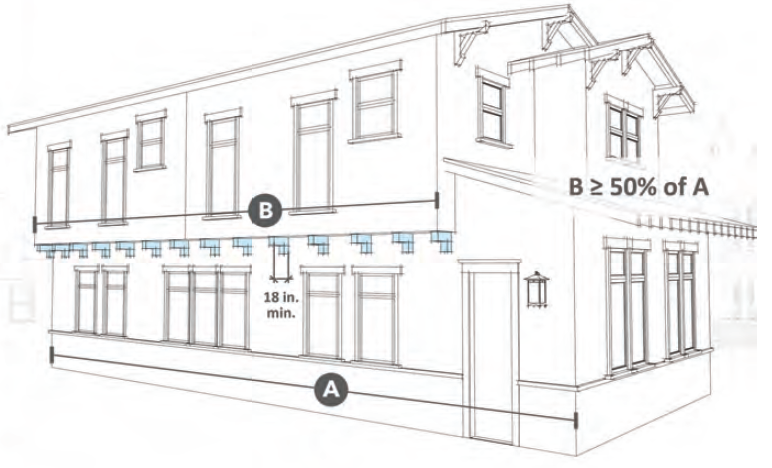
Figure 21.50.050-7: Post and Beam Supports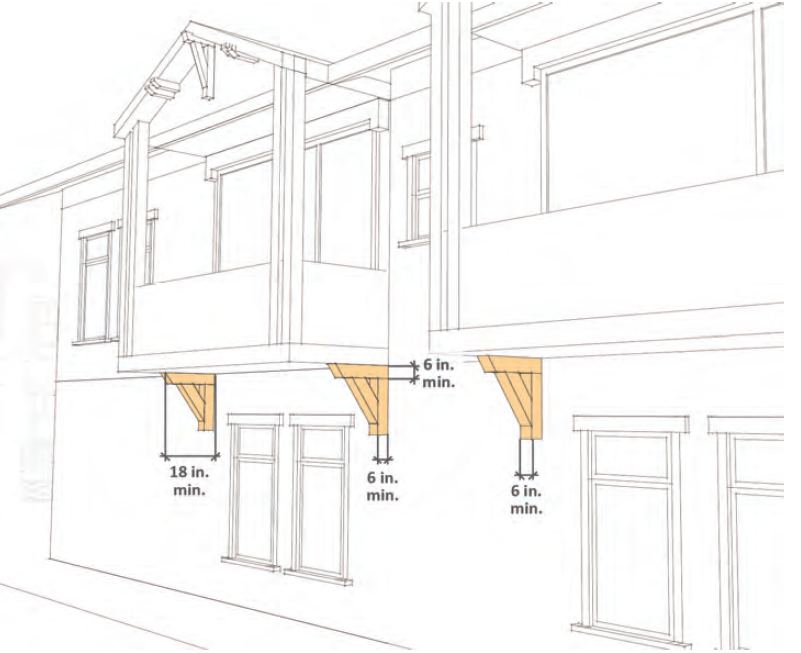
9.
Use of a secondary cladding material (per Subsection 21.50.080(A) [Exterior Building Wall Materials]) that is different from the primary cladding material (per Section 21.50.080(A) [Exterior Building Wall Materials]). Secondary cladding material shall be applied for a minimum of ten percent of all façade areas, or three feet of cladding along the base for the full length of all façades. Exception: where window sills are lower than three feet, secondary cladding shall be applied up to the level of the lowest window sill.
10.
Exceed porch width minimum requirements (per Paragraph 21.50.070(C)3. [Porch Frontage Requirements]) by an additional width equal to at least ten percent of the length of the building façade on which the porch is located.
Figure 21.50.050-8: Exceed Porch Width Minimum Requirements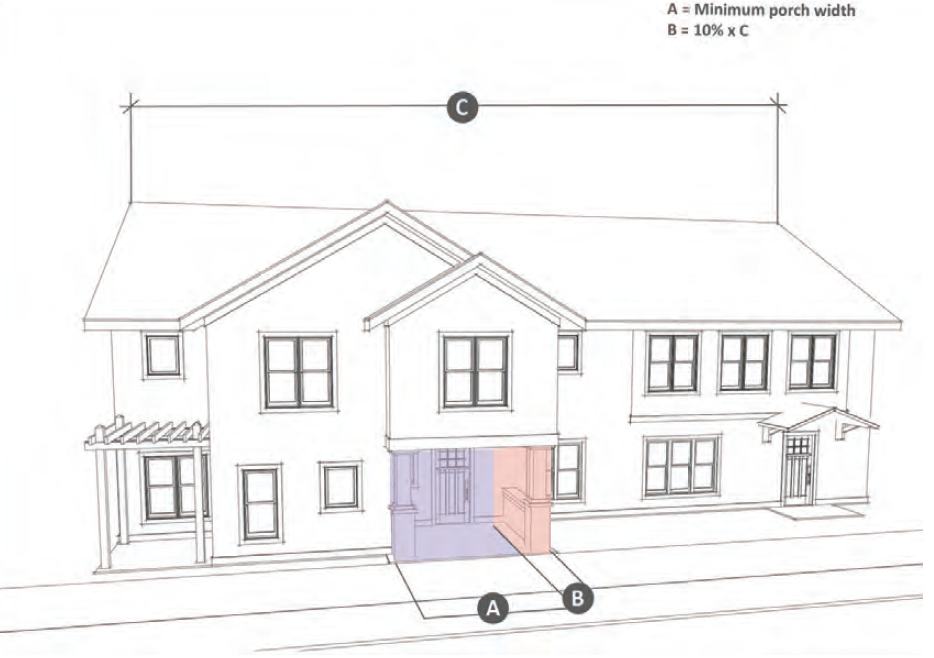
E.
Tier 4 Design Strategies: Roofs. Projects shall incorporate, at a minimum, the number of design strategies identified in Table 21.50.050-1 (Minimum Required Number of Design Strategies by Building Type) for Tier 4 (Roofs), choosing from the list of strategies below.
1.
Dormers applied to at least fifty percent of the windows of an upper floor visible from the public right-of-way, but no less than two windows.
2.
Eaves and rakes, with a twenty-four-inch minimum projection, applied on all roof sections.
3.
Corbeled end beams or rafter tails at provided eaves, projecting a minimum of sixteen inches beyond the building façade and placed at a distance of between two and three feet between each corbeled end beam/rafter tail, for the length of each roof eave.
4.
A cornice projecting a minimum of four inches and a maximum of eight inches, extending the length of the building.
5.
Combining more than one roof type; the secondary roof type shall represent at least twenty-five percent of the total roof line. See Subsection 21.50.060(C) (Roofs) for allowed roof types.
6.
Variation in the roof profile, by either:
a.
Varying the height of the same roof type by at least eighteen inches in height for each one to three units exposed on that elevation;
b.
Varying the pitch of the same roof type by at least twenty-five percent; or
c.
Gables equal to at least forty percent of the façade length.
Figure 21.50.050-9: Gabled Roof Profile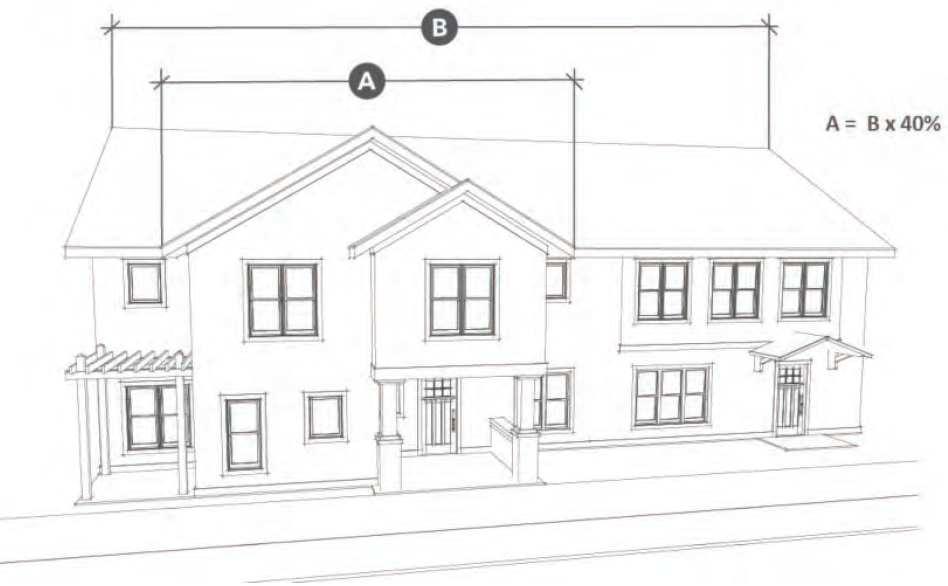
7.
Installing either clay tile or standing seam metal roof for at least fifty percent of roof area.
(Ord. No. 1144 N.S., § 3(Exh. A), 10-1-2024)
_____
21.50.060 - Requirements for all awnings, balconies, roofs, mechanical equipment, and detached accessory structures.
The following standards shall apply to all roofs, awnings, balconies, mechanical equipment, and detached accessory structures incorporated into development projects subject to this chapter:
A.
Awnings. The following standards shall apply to awnings:
1.
Awnings shall be placed above storefront doors and may be placed above windows.
2.
Awnings shall be a minimum of five percent larger than the width of the opening to emphasize building proportions.
3.
Awnings shall be constructed of canvas, wood, or metal.
4.
Awnings or canopies may encroach into the public right-of-way over the sidewalk, extending to a distance within two feet of the face of a curb. Any awnings that encroach into the public right-of-way shall maintain eight feet clear as measured from grade and shall be required to be reviewed and approved by the city engineer.
B.
Balconies. The following standards shall apply to balconies:
1.
Where visible from the public right-of-way, occupiable private balcony guardrails/enclosure walls shall not be transparent and shall maintain a minimum of fifty percent and a maximum of seventy-five percent opacity. Materials used to create opacity materials shall be permanent fixtures, not fabric.
2.
When private balconies project from a building façade, the maximum depth shall be ten feet, measured from the building footprint, regardless of the setback.
3.
To count toward required open space, balconies shall be a minimum of eight feet in width, five feet in depth, and eight feet in height.
4.
Unoccupiable balconies, such as Juliet balconies, can be used to fulfill a Tier 2 wall plane variation requirement per Subsection 21.50.050(C), but shall not count toward required open space. Unoccupiable balconies shall be a minimum of three feet wide and twelve inches deep.
Figure 21.50.060-1: Balcony Projection/Recess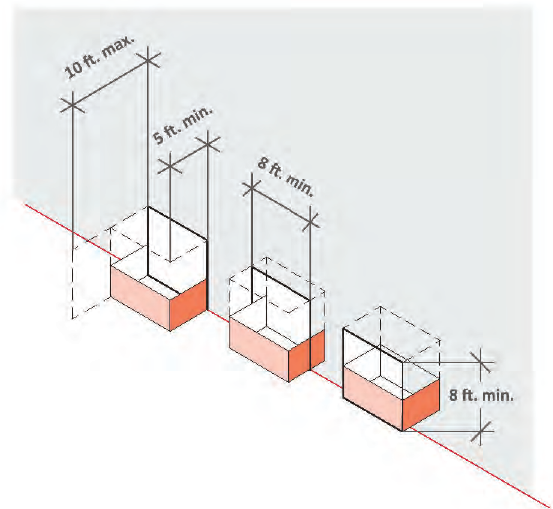
C.
Roofs. The following standards shall apply to roofs:
1.
Allowed Roof Types. Roofs shall be one of the following types:
a.
Gable;
b.
Flat;
c.
Shed; or
d.
Hipped.
2.
Regulations for All Roofs. All roofs shall:
a.
Have a pitch of at least 3:12 when not flat (flat roofs shall require the minimum slope for drainage per California Building Code);
b.
Have at least two planes/orientations; and
c.
Have eaves, rakes, or overhangs, extending the length of the roof, with an eighteen-inch minimum projection.
3.
Regulations for Gable Roofs. Where the nonvertical end of a gable roof faces the street, gables equal to at least twenty-five percent of the façade length are required along the street-facing side. If fewer gables are provided, the vertical side of a gable shall be oriented toward the street.
4.
Regulations for Flat Roofs. Flat roofs, applied as a secondary roof type and not exceeding fifty percent of the roof line, are allowed, provided the flat roof incorporates at least one of the following:
a.
A cornice, projecting a minimum of four inches and a maximum of eight inches, extending the length of the flat roof;
b.
An eave with a twenty-four-inch minimum projection, extending the length of the flat roof;
c.
A three-dimensional tower element, which extends between three and six feet in height above the top of the adjacent building façades; or
d.
A change in height of at least four feet greater or less than the height of the abutting adjacent façade for at least twenty-five percent of the roofline in each elevation visible from a public right-of-way.
5.
Regulations for Shed Roofs. Shed roof types, applied as either a primary or secondary roof type, shall comply with at least one of the following measures:
a.
Vary the pitch of the roof by at least twenty-five percent;
b.
Vary the orientation of roofs;
c.
Vary height by at least four feet greater or less than the height of the abutting adjacent façade; or
d.
Use a shed roof as a secondary roof type (coupled with a different primary roof type).
D.
Mechanical Equipment. Mechanical equipment shall be located and screened pursuant to Chapter 21.47 (Mechanical Equipment and Screening).
E.
Detached Accessory Structures. Detached accessory structures shall be designed to be consistent with the architecture of the main building, using the same materials and colors.
(Ord. No. 1144 N.S., § 3(Exh. A), 10-1-2024)
21.50.070 - Frontage standards.
A.
Allowable Frontage Types by Building Type. All building designs shall incorporate at least one of the frontage types allowed for that building type for each street-facing elevation, as identified in Table 21.50.070-1 (Allowed Frontage Types by Number of Residential Units) and described in Subsections B. and C. below.
Table 21.50.070-1: Allowed Frontage Types by Number of Residential Units
B.
Requirements for All Frontage Types.
1.
Entries associated with individual ground-floor dwelling units or a lobby entrance serving several units shall be oriented toward a street or internal pathway/courtyard.
2.
Within vertical mixed-use buildings, pedestrian access to the residential uses shall be separate, such as via a lobby, from access points to commercial uses.
C.
Standards for Individual Frontage Types.
1.
Storefront Frontage Requirements.
a.
The minimum dimensions for storefront frontage elements shall be as in Table 21.50.070-2.
Table 21.50.070-2: Storefront Frontage Elements
Figure 21.50.070-1: Storefront Frontage Requirements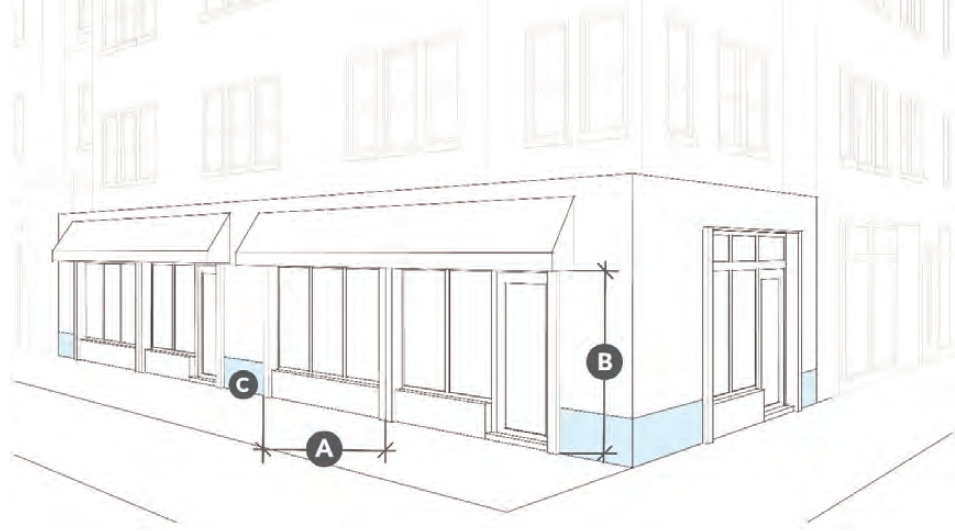
b.
A storefront frontage may be recessed or in line with required front setback.
c.
Storefront glass shall be clear without reflective coating or dark tinting. Lightly tinted glazing that is less than fifteen percent and low emissivity is acceptable.
d.
Glass in transom and clerestory windows may be clear, stained glass, or frosted glass.
e.
Doors shall use the same materials and design as display windows and framing.
f.
Bulkheads, where used, may include any of the following materials: ceramic tile, wood panels, polished stone, or glass tile.
g.
Awnings shall comply with Section 21.50.060(A) (Awnings).
2.
Arcade Frontage Requirements.
a.
The minimum dimensions for arcade frontage elements shall be as in Table 21.50.070-3.
Table 21.50.070-3: Arcade Frontage Elements
Figure 21.50.070-2: Arcade Frontage Elements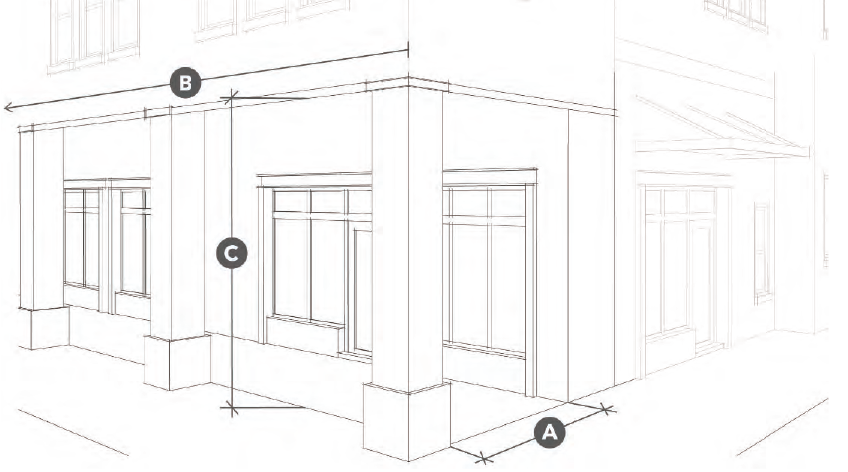
b.
Along primary frontages, arcade column spacing shall correspond to storefront openings.
c.
Column height shall be between four to six times the column width. Column spacing and colonnade detailing, including lighting, shall be consistent with the style of the building to which it is attached.
3.
Porch Frontage Requirements.
a.
The minimum dimensions for porch frontage elements shall be as in Table 21.50.070-4.
Table 21.50.070-4: Porch Frontage Elements
b.
Porches shall correspond directly with the building entry(s) to which the porch provides access.
c.
Porches shall include a gabled entry, distinct change in roof line or columns, or have some other significant architectural distinction to define the entryway.
d.
Exterior stairs leading to the porch may be perpendicular or parallel to the adjacent sidewalk.
e.
For projecting porches, porch depth shall be measured between the wall and the outside column face. Porch width shall be measured from the outside of corner columns. Where no columns exist (in the case of a cantilever or half wall), porch width and depth shall be measured from the edge of any stoop and the inside edge of any half wall.
f.
For recessed porches, porch depth shall be measured between the recessed portion of the wall and the ultimate building façade. Porch width shall be measured between the walls, with no point being less than the required minimum width.
Figure 21.50.070-4: Projecting Porch Entry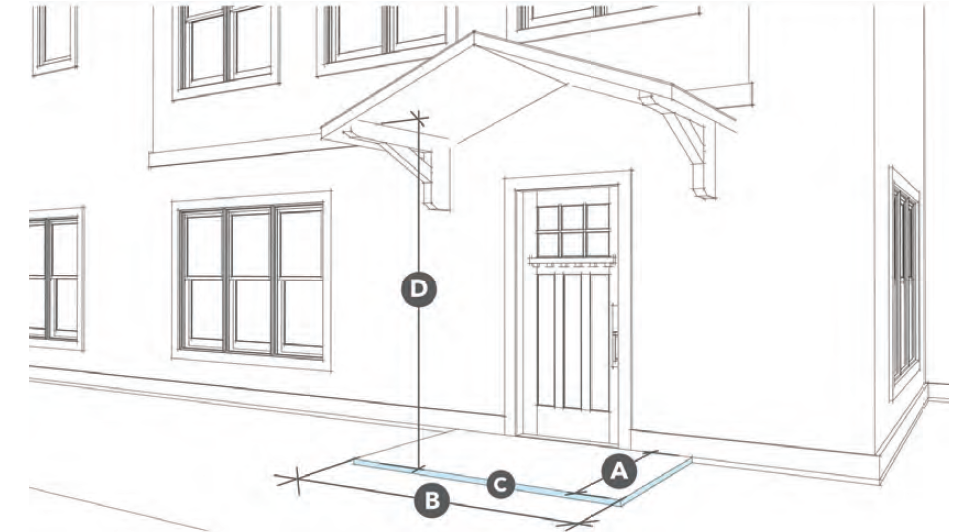
Figure 21.50.070-5: Recessed Porch Entry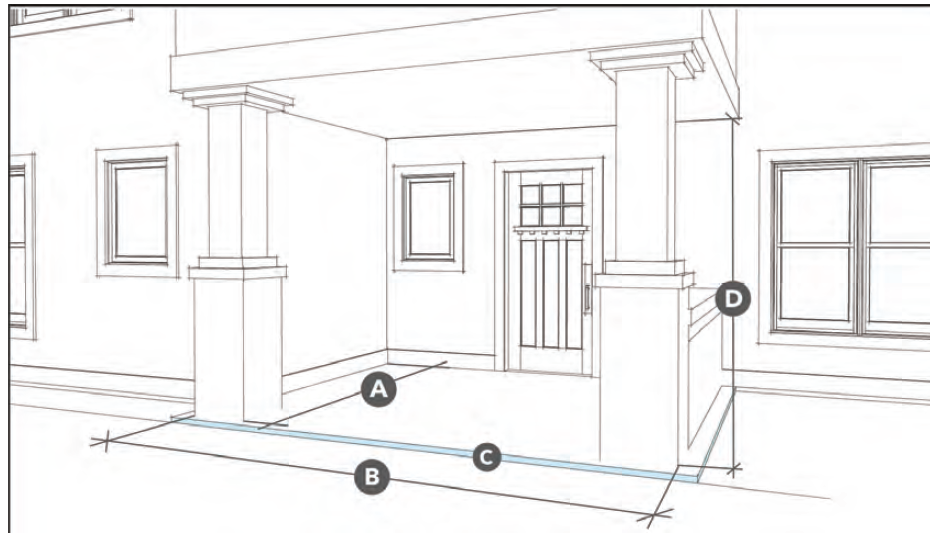
(Ord. No. 1144 N.S., § 3(Exh. A), 10-1-2024)
_____
21.50.080 - Building materials and colors.
A.
Exterior Building Wall Materials.
1.
Allowed and Prohibited Materials. Table 21.50.080-1 (Exterior Building Materials) identifies allowed and prohibited exterior building wall materials. Materials not listed are prohibited unless approved through a discretionary review process. Veneers, where applied, shall be returned at least four feet from exterior corners or dead end into a projecting or recessed façade feature, whichever is less.
Table 21.50.080-1: Exterior Building Materials
P: Primary or secondary material
S: Secondary or accent material only
A: Accent material only
N: Not allowed/prohibited
2.
Application Requirement. Detailed drawings shall indicate how sheet or panelized materials will be joined, and how lines formed by control joints related to other architectural details shall be provided.
B.
Windows and Doors. Mirrored glass is prohibited.
C.
Polyurethane Foam. Exterior decorative molding, cornices, and trim constructed with exposed polyurethane foam are prohibited.
D.
Roof Materials. Roof materials shall not be reflective, glossy, or polished.
E.
Color Variety.
1.
The number of colors appearing on the entire building exterior shall be at least two and not more than four (or four tones of the same color). This color variety requirement may be met with trim, eaves and rakes, rafter tails, secondary cladding materials, or other accent materials of a different color or colors that differ from the primary facade color. A different color roof shall not count as a different color for the purposes of this subsection.
2.
Certain materials (such as brick or stone) have distinct coloring in their natural state and shall count as an element of color, to be incorporated into the overall design.
(Ord. No. 1144 N.S., § 3(Exh. A), 10-1-2024)
21.50.090 - Transition to adjacent R-1 zoning district.
Where the side or rear property line abuts a property in the R-1 zoning district, the following standards shall apply.
A.
Setbacks Adjacent to R-1 Zoning District. Where a property line abuts an R-1 zoning district, the abutting setback (either rear or side) shall be twenty feet for buildings taller than two stories, except that buildings that house only pool spa filter and heating systems may be set back five feet.
B.
Window Orientation. Projects that are more than two stories in height and that contain eleven or more units shall orient less active uses (such as bedrooms and bathrooms) toward the adjacent R-1 zoning district property line. Windows associated with kitchens and living areas shall not be oriented toward the adjacent R-1 zoning district property line.
C.
Balcony Orientation. Upper story balconies on buildings visible from the adjacent R-1 zoning district shall not be oriented toward the adjacent R-1 zoning district property line.
D.
Landscape Buffer. A minimum five-foot-wide landscape buffer (clear of any wall footings) shall be provided adjacent to an R-1 zoning district. evergreen screening trees shall be:
1.
Planted at a minimum interval of fifteen feet along interior property lines abutting an R-1 zoning district;
2.
Consist of species that attains a twenty-foot minimum height at maturity; and
3.
Minimum fifteen-gallon size at time of planting.
Figure 21.50.090-1: Transitions to Adjacent R-1 Zoning District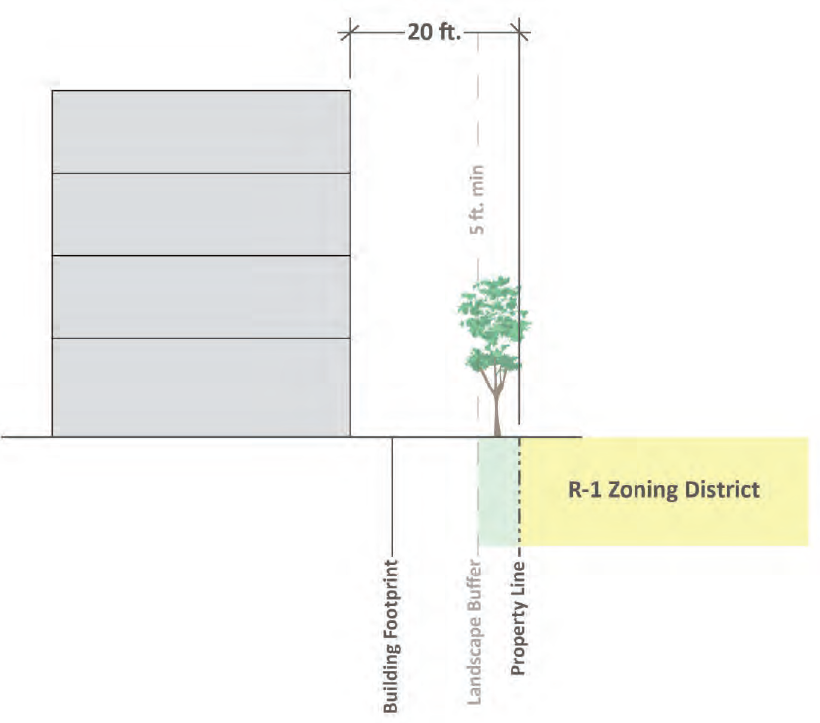
(Ord. No. 1144 N.S., § 3(Exh. A), 10-1-2024)
21.51.010 - Purpose and applicability.
A.
Purpose. This chapter establishes standards for the location, development, and operations of refuse and recycling enclosures to ensure that the storage of trash, green waste, and recyclable materials does not have significant adverse health consequences, minimizes adverse impacts on surrounding properties, and complies with state law.
B.
Applicability. All new and expanded commercial and industrial projects with a floor area exceeding five hundred square feet, all intensifications of commercial and industrial uses, all new multi-unit residential projects located in any zoning district, and all new mixed-use projects shall be required to provide and maintain at least one trash enclosure. Trash enclosures may be located indoors or outdoors to meet the requirements of this chapter.
(Ord. No. 1144 N.S., § 3(Exh. A), 10-1-2024)
21.51.020 - General provisions.
A.
Maintenance. Maintenance of each enclosure area and any bins and containers shall be the responsibility of the property owner. The property owner shall be responsible for keeping the area clean and free of litter, rodents and insects. Enclosures that are damaged to the point of non-use will result in a service interruption if the hauler cannot access the containers and shall be repaired within ninety days.
B.
Regular Collection. The property owner is responsible for arranging the regular collection or pick-up of refuse and recyclable and/or organic materials stored in the container area. Materials shall not be allowed to accumulate such that a visual, public health, or safety nuisance is created.
(Ord. No. 1144 N.S., § 3(Exh. A), 10-1-2024)
21.51.030 - Development standards.
A.
Notwithstanding the standards listed in this section, solid waste management and the siting and design of garbage enclosures shall be subject to any garbage enclosure standards adopted by the city solid waste and recycling manager and/or city engineer.
B.
Size and Location. Refuse, including organic waste and fats, oils, and grease, and recycling collection areas shall be sized and located as provided below. Additional storage area and alternative designs may be required based on the types and quantities of materials to be generated by the proposed land use and the mode of collection. Additional design requirements may be applied for the purposes of preventing stormwater pollution discharges.
1.
Size and Number. Refuse and recycling collection areas shall be adequate in capacity, number, and distribution to accommodate all trash, garbage, recyclables, green waste, organic waste, and any other waste until such items are picked up by the city or its contracted collector. The city solid waste and recycling manager shall determine the minimum numbers of bins/enclosures necessary for all required waste containers for a multi-family and nonresidential development as a function of the proposed design.
2.
Location.
Refuse and recycling collection areas shall be located outside the required front yard and street side yard, parking spaces, landscaped areas, and any other area required by the Municipal Code to be constructed or maintained unencumbered according to fire codes and other applicable building and public safety laws.
Detached enclosures shall be located a minimum of ten feet from any structure and, in commercial areas, twenty-five feet from any residentially zoned property line.
C.
Design of Enclosure Area.
1.
Enclosures shall be constructed of the same architectural design and materials of the primary structures on site, or shall be constructed of a darker earthtone textured block. Trash enclosures shall use opaque materials that obscure views of the trash containers. Chain link fencing is prohibited in enclosures and doors when visible from the public right-of-way or abutting residential properties.
2.
The interior dimensions of the enclosure shall provide convenient and secure access to the containers to prevent access by unauthorized persons and to minimize scavenging, while allowing authorized persons safe access for disposal and collection of materials.
All outdoor enclosures shall have full roofs with adequate height clearance to enable ready access to any containers.
3.
All outdoor enclosures shall incorporate stormwater pollution reduction measures as required by the stormwater manager.
D.
Modification. Modifications to development standards for refuse and recycling areas may be allowed through a site plan modification (Section 21.17.020). In approving such a request, in addition to the findings associated with a site plan modification (Subsection 21.17.010(C)), the review authority shall find that the proposed design, material, or method provides approximate equivalence to the specific requirements of this chapter or is otherwise satisfactory and complies with the intent of these provisions. The city solid waste and recycling manager reserves the right to require specific safety measures, interior dimensions, openings, grades, and other numerical proportions to ensure the city or its contracted collector can service the enclosure in compliance with state law.
(Ord. No. 1144 N.S., § 3(Exh. A), 10-1-2024)
21.52.010 - Purpose and applicability.
A.
Purpose. These regulations and standards for signs are established to provide a comprehensive system of reasonable, effective, consistent, content-neutral, and nondiscriminatory sign standards and requirements to:
1.
Protect the general public health, safety, welfare, and aesthetics of the city;
Provide for the identification of uses in a manner appropriate to the activity conducted on a site and consistent with the purposes of the zoning district in which the site is located;
2.
Eliminate confusing, distracting, or dangerous sign displays that interfere with vehicular and pedestrian movement;
3.
Prevent damage to or interference with the normal use of public property;
4.
Ensure the proper maintenance of signs;
Ensure freedom of expression for sign uses, including noncommercial speech, by maintaining a content-neutral approach and appropriately regulating the time, place, and manner under which signs may be displayed;
5.
Preserve and improve the appearance of the city, protect the city from visual clutter and blight, and promote attractive and harmonious structures and environments by regulating the design, character, location, type, quality of materials, scale, illumination, and maintenance of signs; and
6.
Balance the rights of individuals to convey their messages and the right of the public to be protected against the unrestricted proliferation of signs and to provide for fair and equal treatment of sign users.
B.
Applicability. The regulations of this chapter apply to all signs as defined in Section 21.52.020 (Definitions) that are placed on private property, including but not limited to signs that are specifically exempted in this chapter and:
Billboards, which are addressed in Title 19 (Billboard Signs), and
a.
Bench signs and sandwich board/A-frame signs in the public right-of-way, which are addressed in Chapter 11.30 (Street Furniture).
Content-based restrictions may be imposed in limited instances where the city has a compelling governmental interest in such restrictions and the restrictions are narrowly tailored to achieve that interest.
C.
Severability. If any part, section, subsection, paragraph, subparagraph, sentence, phrase, clause, term, or word in this chapter is held to be invalid, unconstitutional, or unenforceable by a court of competent jurisdiction, such decision shall not affect the validity or enforceability of the remaining portions of this chapter.
(Ord. No. 1144 N.S., § 3(Exh. A), 10-1-2024)
21.52.020 - Definitions.
A.
Signs. The following definitions shall apply to signs and sign-related regulations:
1.
A-Frame Sign. A temporary freestanding sign constructed of two rigid signs connected on one edge, typically the top. For A-frame signs in the public right-of-way, see Chapter 11.30 (Street Furniture).
2.
Architecturally Integrated Base. A support structure for a monument sign that is constructed from materials compatible with the building or development.
3.
Awning Sign. An identification sign that is painted or applied to the face, valance, or side panel of an awning or canopy.
4.
Banner. A temporary sign composed of cloth, canvas, plastic, fabric, or similar lightweight, nonrigid material that can be mounted to a building with screws, cord, rope, cable, or a similar method. This sign type does not include flags (see "flags") or feather signs (see "feather signs").
5.
Bench Sign. A prohibited sign located on a bench or similar structure.
6.
Billboard. As defined in Section 19.01.040 of Title 19 (Billboards).
7.
Commercial Sign. A sign that is meant to draw attention to a commercial use.
8.
Conforming Sign. A sign that is legally installed in accordance with federal, state, and local permit requirements and laws.
9.
Construction Site Sign. A temporary sign at an active construction site.
10.
Content-Neutrality; Time, Place, and Manner Regulations. Consistently applicable, nondiscriminatory sign regulations that specify—without reference to the content of the message—when, how, and where a sign can be displayed, with physical standards such as but not limited to height, size, and location, that allow the sign to be readable.
11.
Copy. The message or content of a sign, which may include letters, numbers, logos, figures, and/or images.
12.
Directory Sign. A wall-mounted sign located at a multi-tenant center intended to list the location of multiple businesses within the structure or business center.
13.
Door and Window Sign. Any sign affixed to, painted to, or in contact with a door and/or window, and which is intended to be seen from the exterior.
14.
Double-Faced Sign. A sign constructed to display its message on two parallel opposing (back-to-back) faces.
15.
Exception. An approval to deviate from the criteria of this chapter.
16.
Face. See "sign face".
17.
Feather Sign. A prohibited temporary sign constructed of cloth, canvas, plastic fabric, or similar lightweight, non-rigid material, typically taller than it is longer, and supported by a single vertical pole mounted into the ground or on a portable structure. This sign type does not include flags (see "flag").
18.
Flag. A fabric, cloth, plastic, vinyl, canvas, leather, or other similar material sheet of square, rectangular, or triangular shape that is attached to a staff cord and mounted on a pole. This sign type includes official flags of national, state, or local governments. This sign type does not include commercial speech, feather signs (see "feather sign"), banners (see "banners"), or pennants (see "pennants").
19.
Floor Treatment. Special exterior floor treatment on private nonresidential properties, such as paint indicating the name of the business and/or a business logo.
20.
Freestanding Sign. A sign supported by a structure connected permanently to the ground or displayed directly upon a base connected permanently to the ground that is not structurally connected to a building or other structure.
21.
Governmental Sign. A governmental sign for control of traffic and other regulatory purposes, including street signs, danger signs, railroad crossing signs, and signs of public service companies indicating danger and aids to service or safety.
22.
Hanging Sign. An identification sign hung from an awning, canopy, or other building projection.
23.
Highway-Oriented Sign. A freestanding sign exceeding six feet in height, located within the highway-oriented sign overlay zoning district as indicated on the city's zoning map. Highway-oriented signs are permitted only on properties with a business that is associated with vehicle fuel sales, restaurant, motel, hotel, or vehicle sales uses.
24.
Illuminated Sign. A sign for which an artificial source of light is used to make the message readable. This definition shall include internally and externally lighted signs and reflectorized, glowing, or radiating signs.
25.
Inflatable Sign. A prohibited sign consisting of any object intended to draw attention to a commercial business that is enlarged or inflated and floats, is tethered in the air, is activated by air or moving gas, or is located on the ground or on a building with or without copy or other graphic.
26.
Informational Sign. A sign erected for the safety or convenience of the public including, but not limited to, signs such as "one way", "entrance", "exit", "restrooms", "telephone", "No Smoking", "Manager's Office", house numbers, business addresses, historic designation plaques, and other signs of a similar nature that do not include commercial speech.
27.
Interior Sign. A sign located completely within a building or structure, except for window signs.
28.
Master Sign Program. A uniform design for signs within a multi-tenant center.
29.
Message. See "Copy."
30.
Multi-Faced Sign. A sign constructed to display its message on three or more connected faces.
31.
Multi-Tenant Center. A commercial, office, or industrial building or complex of buildings that accommodates three or more tenants (businesses or activities). Multi-tenant centers may be located on a single lot or on several lots that were developed under a master development plan.
32.
Monument Sign. See "freestanding sign."
33.
Noncommercial Sign. Any sign that does not draw attention to any commercial use and instead contains a noncommercial message related to Debate or commentary on topics of public concern; for example, politics, religion, philosophy, science, or art.
34.
Nonconforming Sign. A sign that was legally established prior to the effective date of Chapter 21.52 (Signs) and that does not conform to the provisions of that chapter. Signs that require city approval but have been established without the benefit of city approval are considered illegal signs and are subject to abatement pursuant to Subsection 21.52.110(A) (Abatement).
35.
Off-Premises or Off-Site Sign. A prohibited sign that promotes a business, activity, product, or service available on property other than that on which the sign is located, or which directs the public to a business or activity on another property.
36.
Parapet. A wall or railing that protects the edge of a platform or roof.
37.
Pennant. A temporary sign generally made of flexible materials, usually cloth, paper or plastic. This definition does not include a flag of any nation, state or political subdivision.
38.
Permanent Sign. A sign constructed of durable materials and attached to a building, structure, or the ground in a manner that will resist environmental loads such as wind, precludes ready removal or movement of the sign, and is intended to exist for the duration of time that the use or occupant is located on the premises.
39.
Pole Sign. A prohibited freestanding sign that is greater than six feet in height and mounted on an elevated pole(s), does not include "highway oriented signs". See Subsection 21.52.080(E) for existing pole signs.
40.
Projecting Sign. A sign that is mounted to a building perpendicular to the plane of the building surface.
41.
Roof Sign. A sign erected on or above the roofline of a building or a sign painted on or attached directly to the roof.
42.
Sign. Any physical form of visual communication (including, but not limited to, objects, pictures and architectural features) that is intended to be viewed from outdoor public areas. A sign includes all parts, portions, units and materials composing same, together with illumination, frame, background, structure, support and anchorage.
43.
Sign Face. The area of a sign on which copy is intended to be placed.
44.
Sign Area. The area contained within a single continuous perimeter enclosing all parts of such sign copy, excluding any structural elements outside the limits of the sign required to support the sign.
45.
Single Face Sign. A sign with only one face plane.
46.
Temporary Sign. A sign which is designed, constructed and intended to be on display for a limited period of time, typically made of lightweight or flimsy materials that can be easily and quickly mounted or removed. Does not include signs in the public right-of-way (which are subject to the requirements of Chapter 11.30 for Street Furniture).
47.
Three-Dimensional Sign. Any sign which is a three-dimensional, sculptured, or molded representation of an animate or inanimate object that identifies, advertises, or otherwise directs attention to a product or business.
48.
Traffic Control Sign. See "governmental sign."
49.
Vehicle-Mounted Sign. A prohibited sign that is affixed to an automobile, truck, trailer or other vehicle where the primary purpose of the vehicle relates to its use as a sign, whether parked on public or private property. A vehicle-mounted sign does not include a sign on a vehicle that is used for the purpose of lawfully making deliveries of sales or merchandise or rendering services from such vehicles. A vehicle-mounted sign also does not include a sign that advertises the sale of the vehicle to which it is affixed.
50.
Wall-Mounted or Building-Mounted Sign. An identification sign mounted on an exterior wall of a building.
51.
Window Sign. See "door or window sign."
(Ord. No. 1144 N.S., § 3(Exh. A), 10-1-2024)
21.52.030 - Signs exempt from permit requirements.
Signs specified in this section are exempt from the fee and permit requirements of Section 21.52.060 (Sign Permit, Sign Program, and Modification Requirements) to the extent allowed by this chapter. Signs specified in this section shall not count towards cumulative allowable sign area, but must satisfy all other construction permit requirements, as applicable (such as building, electrical, plumbing, grading, encroachment, etc.).
A.
Directory Sign. One directory sign per street frontage as follows:
1.
Maximum area: One square foot per tenant, up to four square feet.
2.
Maximum height: Six feet.
3.
Internal illumination prohibited.
B.
Door and Window Signs. Signs on doors and/or windows are allowed, provided such signs cover no more than thirty percent of the total glass area of the window and/or door on which they are placed and further provided such signs are not be placed above a height of six feet from the adjacent exterior building grade.
C.
Flags. Flags of any nation, state, or municipality may be flown. This exemption does not apply to commercial speech, feather signs, or pennants as defined in Section 21.52.020 (Definitions).
D.
Floor Treatments. Floor treatments, as defined in Section 21.52.020 (Definitions) shall have an area of no more than one square foot per lineal foot of building or tenant space frontage, be completely flush with the surrounding pavement, and shall be on a floor or pavement that is completely horizontal.
E.
Governmental Signs. Governmental signs required by law are exempt from the fee and permit provisions of this chapter.
F.
Informational Signs. No such sign shall exceed two square feet in area.
G.
Interior Signs. Any interior sign placed within the window perimeter and within three feet of the glass is subject to the limits for window signs specified in Subsection 21.52.030(B) (Door and Window Signs) of this section.
H.
Repair and Change of Copy of Conforming Signs. No fee or permit shall be required to repair, clean, repaint or refurbish any lawful conforming sign or to change the copy of any conforming sign.
I.
Temporary Signs. As allowed in Section 21.52.090 (Temporary Signs).
(Ord. No. 1144 N.S., § 3(Exh. A), 10-1-2024)
21.52.040 - Prohibited signs.
Those classes of signs designated in this section are expressly prohibited and shall not be erected in any zoning district.
A.
Bench Signs. Bench signs as defined in Section 21.52.020 (Definitions) are prohibited.
B.
Conflict with Traffic Control Signs. Any sign or sign structure that by color, wording, or location resembles or conflicts with any traffic control sign or device is prohibited.
C.
Feather Signs. Feather signs as defined in Section 21.52.020 (Definitions) are prohibited.
D.
Inflatable Signs. Inflatable signs as defined in Section 21.52.020 (Definitions) are prohibited.
E.
Flashing Signs. Any sign that rotates (except for flags, pennants, and other similar types of signs), flashes, changes, reflects, blinks, or appears to do any of the foregoing-except for those signs that only portray time and temperature-is prohibited.
F.
Off-Premises Signs. Off-premises signs are prohibited, except for billboards (see Title 19), authorized temporary signs, and directory signs that are in conformance with this chapter, or any other off-premises sign that is allowed by this chapter.
G.
Pole Signs. New pole signs are prohibited except as approved as a highway-oriented sign consistent with Subsection 21.52.080(H) (Highway Oriented Signs).
H.
Traffic Hazard. Any sign that creates a safety hazard by obstructing the clear view of pedestrian and vehicular traffic is prohibited.
I.
Vehicle-Mounted Signs. Vehicle-mounted signs as defined in Section 21.52.020 (Definitions) are prohibited. This section is not intended to prohibit the display of commercial message that may cover all or part of a vehicle and that serves the purpose of advertising a commercial message as long as that vehicle is in operation and whose primary purpose is for regular transportation. The following criteria may be used in determining whether the primary purpose of the motor vehicle is a sign. It is not necessary that any one or all the listed criteria are met in order to determine that a sign is a prohibited vehicle-mounted sign:
1.
Whether the vehicle is in operating condition, currently registered, and licensed to operate on public streets when applicable.
2.
While the business is open, the vehicle is not moved, and the vehicle is so parked or placed that the signs thereon are displayed to the public.
3.
Whether the vehicle is regularly parked in a location and in a manner so as to be observed by passers-by.
4.
Whether the vehicle is actively used as a vehicle in the daily function of the business to which such signs relate.
5.
Whether the sign includes directional copy that would only be applicable if parked in the vicinity of the use.
(Ord. No. 1144 N.S., § 3(Exh. A), 10-1-2024)
21.52.050 - Signs on public right-of-way or public property.
A.
No person, other than a city official or city staff member, shall cause a sign to be placed or projected into the right-of-way of a public street or on any public property without the express permission of the city.
B.
It is unlawful at any time to erect or place upon or maintain upon any utility pole, traffic regulating sign, lamppost, street, sidewalk, or appurtenance thereto, any advertising material of any nature whatsoever, unless allowed pursuant to Chapter 11.30 (Street Furniture). This provision shall not apply to or restrict any public utility or public authority from erecting any signs or other markers that may be necessary for public health, safety, or welfare.
(Ord. No. 1144 N.S., § 3(Exh. A), 10-1-2024)
21.52.060 - Sign permit, sign program, and modification requirements.
A.
Review Authority. Table 21.52.060-1 (Sign Permit Review Authority Summary) identifies the review authority responsible for reviewing and making decisions on each type of application required by this chapter. In addition to sign permit review, applicants must also satisfy all other permit requirements, as applicable (such as building, electrical, plumbing, grading, encroachment, etc.).
_____
Table 21.52.060-1: Sign Permit Review Authority Summary
_____
B.
Sign Permit. A sign permit is required to erect, move, alter, replace, or reconstruct any sign except those exempted by Section 21.52.030 (Signs Exempt from Permit Requirements). An application for a sign permit shall be filed and processed on the prescribed application forms in accordance with the procedures in Chapter 21.09 (Application Processing and Common Procedures).
C.
Sign Programs. A sign program is intended to unify all signs within a multi-tenant project with signs that are architecturally compatible with the architectural theme of the buildings.
1.
A master sign program is required for a commercial center or building with five or more tenants.
2.
A master sign program shall comply with the standards of this chapter unless a development plan modification is approved by the review authority (development plan modification [Section 21.16.020]).
3.
A master sign program shall include criteria for the size, type, location, colors, materials, illumination, and design of all signs allowed in the center.
4.
The master sign program shall describe the review and approval process for amendment to the master sign program.
D.
Development Review Process.
1.
Possible Actions. The review authority shall review an application for a sign permit for conformance with this chapter.
a.
Approval. If the application meets the requirements of this chapter, the review authority shall approve the application, which will result in the issuance of a sign permit.
b.
Conditional Approval. If the application does not meet the requirements of this chapter, the review authority may issue a conditional approval and require that the sign comply with this chapter. If a conditional approval is granted, the review authority may require specific amendments to a sign permit application before a permit will be issued.
c.
Denial. If the review authority determines that the sign permit application does not comply with the provisions of this chapter and an exception is not approved pursuant to Section 21.52.060(E) (Modifications), the review authority shall deny the application.
2.
Notice of Action. Within ten working days of the decision, the city shall provide a written notice to the applicant. In the case of a denial or conditional approval, the written notice shall inform the applicant of the manner in which the application fails to conform to the requirements of this chapter and any adopted conditions of approval.
3.
Appeal. An applicant whose application has been denied by the review authority's decision may be appealed in compliance with Chapter 21.25 (Appeals and Calls for Review).
4.
Written Record. The community development department shall prepare and maintain a written record of decisions regarding the approval (including any modifications), conditional approval, or a denial of sign permit applications.
E.
Modifications.
1.
Allowed Modifications. Modifications to sign standards may be allowed through either a site plan modification (Section 21.17.020), development plan modification (Section 21.16.020), or special planned development (Section 21.11.020) as indicated in Table 21.52.060-2 (Sign Modifications), provided:
a.
No modification from the provisions of Section 21.52.040 (Prohibited Signs) is allowed.
b.
No modification shall allow signage in the public right-of-way.
c.
A site plan modification (Section 21.17.020) shall not allow any increase in sign area.
Table 21.52.060-2: Sign Modifications
2.
Findings. In approving such a request, the review authority shall make the applicable findings required for a site plan modification (Subsection 21.17.020(C)) or development plan modification (21.16.020(D)) as well as determining that there are practical difficulties, physical restrictions, unusual building features (or similar characteristics) not generally shared by other properties in the same zoning district.
(Ord. No. 1144 N.S., § 3(Exh. A), 10-1-2024)
21.52.070 - Sign measurement.
A.
Sign Height. The height of a sign shall be measured from the average ground level adjacent to the base of a sign to the highest part of the sign. Where a sign is placed on an earth berm, raised planter, or similar feature, the height of a sign shall include all or a portion of such a feature.
Figure 21.52.070-1 Calculating Sign Height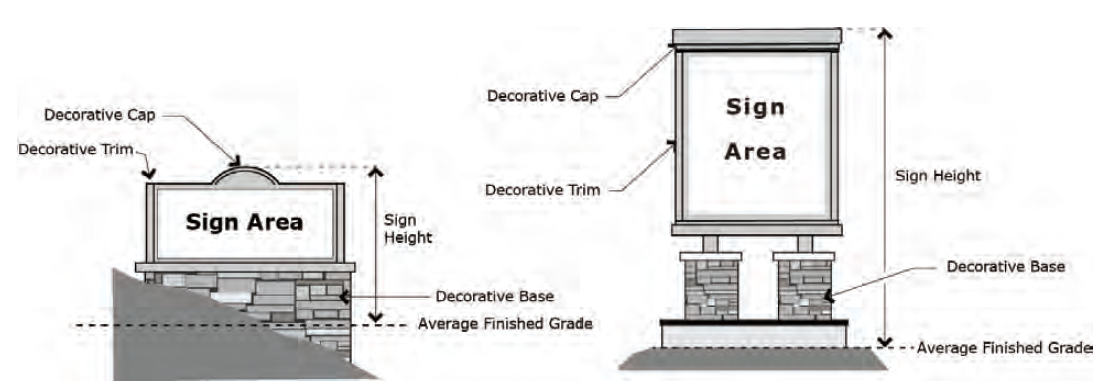
B.
Sign Area.
1.
Calculating Sign Area—Generally. Supporting structures, such as sign bases, columns, and decorative features shall not be included in any calculation of sign area, provided that they contain no lettering, graphics, or brand colors except for addresses. See Figure 21.52.070-2.
Figure 21.52.070-2 Calculating Sign Area—Generally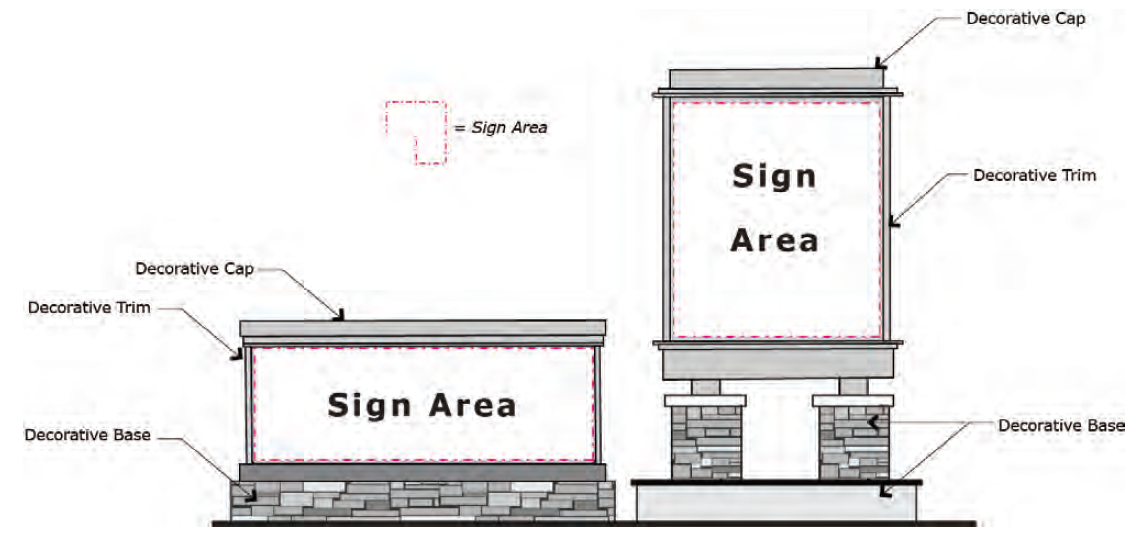
2.
Calculating Sign Area—Single-Faced Signs. Sign area for single-faced signs shall be calculated by enclosing the extreme limits of all sign backing and borders, brand colors, emblem, logo, representation, writing, or other display within a single continuous perimeter composed of horizontal and vertical lines with no more than eight corners.
Figure 21.52.070-3 Calculating Sign Area—Single-Faced Signs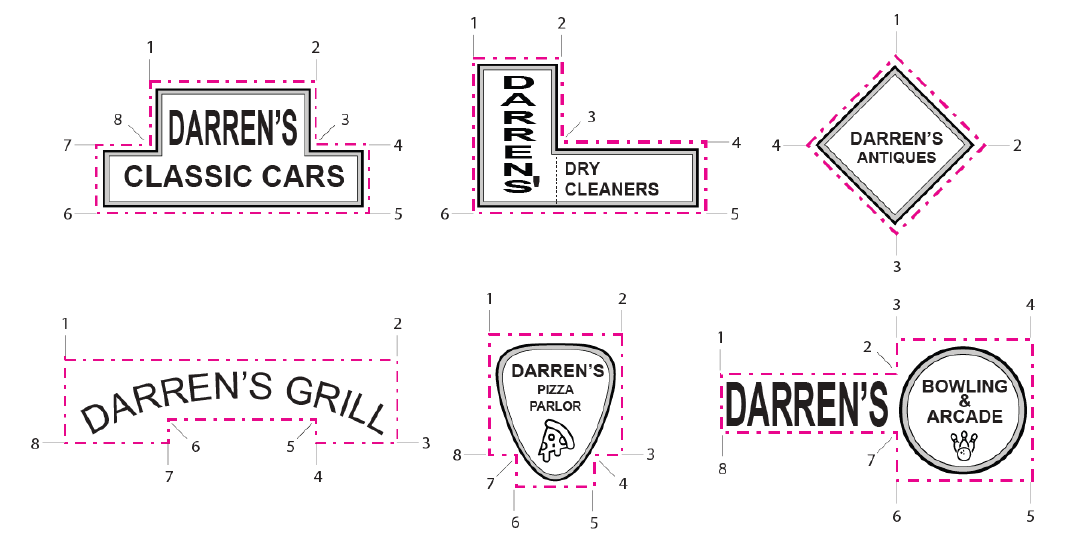
_____
3.
Calculating Sign Area—Double-Faced Signs. Only one face of a double-faced sign shall be used to calculate the permitted area of a double-faced sign. Double-faced (back-to-back) signs shall be regarded as a single sign when the sign is mounted on a single structure. Where the two faces are not equal in size, the larger sign face shall be used.
4.
Calculating Sign Area—Multi-Faced Signs. On a multi-faced sign, the combined sum of the area of all faces shall be used to calculate the permitted area of the sign.
5.
Calculating Sign Area—Three-Dimensional Signs. Signs that consist of, or have attached to them, one or more three-dimensional objects (for example, balls, cubes, clusters of objects, sculpture, or statue-like trademarks) may have a sign area that is the sum of two adjacent sides of the smallest cube (rectangular cuboid) that will encompass the sign. Signs with three-dimensional objects that project six inches or less from the sign face shall be measured as a single-face sign. See Figure 21.52.070-4.
Figure 21.52.070-4 Calculating Sign Area for Three-Dimensional Sign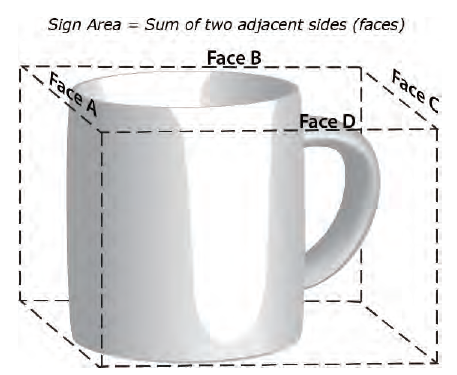
(Ord. No. 1144 N.S., § 3(Exh. A), 10-1-2024)
21.52.080 - Permanent signs.
A.
Signs Requiring a Permit. This section identifies the types of permanent signs allowed, zoning districts where specific sign types are allowed, and the limitations on the establishment of such signs. All signs described in this section shall require a sign permit.
B.
General Sign Standards. All signs under this section shall be subject to the following sign standards, unless a modification is granted, pursuant to Section 21.52.060(E) (Modifications).
1.
Building-Mounted Maximum Sign Area. For any building or tenant space frontage, the total maximum sign area for all building-mounted signs, except window signs and not including freestanding signs, shall not exceed one square foot of sign area for every linear foot of building with street frontage, except as otherwise required by Subsection 21.52.080(L) (OP Zoning District - Additional Regulations).
2.
Compatibility with Architecture. Signs shall utilize materials, colors, and design motifs that are compatible with the architecture and color of the buildings on-site.
3.
Proportional to Building. Signs shall be designed in scale and proportion to the building they serve.
4.
Colors. Sign colors and materials shall complement the colors and architecture of the building. The use of fluorescent colors for sign backgrounds are not allowed. The use of stark white for an internally illuminated background is not allowed.
5.
Illumination. All illuminated signs shall be designed in such a way as to avoid undue glare or reflection of light on private property in the surrounding area. High-intensity lights shall be avoided. Instead, lighting shall be directed at the sign and placed in the least visible manner possible.
6.
Residential Zoning Districts. In a residential zoning district, permanent signs are allowed as follows:
a.
To identify a subdivision or multi-unit project; and/or
b.
To identify a legally established business that is the primary use on the property (specifically excluding home occupation businesses, family day care homes, limited residential care facilities, and similar uses where residential use is the primary use on the property.
7.
Noncommercial Signs. In each instance and under the same conditions to which this chapter permits any sign, a sign containing an ideological, religious, or other noncommercial speech shall be permitted wherever commercial signage is permitted.
C.
Awning Signs. Awning signs shall be painted or applied flat against the awning surface. Awning signs shall count toward the square footage limit of building-mounted signs (Paragraph 21.52.080(B)1. [Building-Mounted Maximum Sign Area]).
D.
Billboards. Billboard sign criteria are listed in Title 19 (Billboards).
E.
Existing Pole Signs. Existing pole signs, as defined by this chapter, may be restored and refaced with new sign text, provided that all of the following criteria are met:
1.
Location. The existing pole sign shall not be located within the public right-of-way.
2.
Size. The sign's size and/or height shall not be increased.
F.
Freestanding Signs. Freestanding signs shall be subject to the following requirements:
1.
Location. Freestanding signs shall not be placed in the public right-of-way, or any location that would obstruct motorists' clear view of pedestrian and vehicular traffic, as determined by the city engineer. Wherever possible, freestanding signs shall be located within landscaped areas.
2.
Support Structure. The supporting structure of a freestanding sign shall be an architecturally integrated base, posts, or a decorative block wall. If mounted on a block wall, the top of the sign face shall not exceed six feet in height and the wall shall meet the height and setback requirements for a fence listed in Chapter 21.44 (Fences, Walls, and Hedges) including any modifications approved by the applicable review authority.
3.
Fueling Stations. Price signs shall be incorporated into freestanding signs. Fueling station signs shall not exceed twenty-four square feet in area and six feet in height. Fueling station signs shall comply with all applicable state laws.
4.
Small Centers. Freestanding signs on properties with one or two businesses or activities shall be subject to the following regulations:
a.
Number of Signs. No more than one sign per street frontage.
b.
Sign Area. Freestanding signs shall not exceed thirty-two square feet in sign area, except for service station signs as specified in Paragraph 21.52.080(F)3. (Fueling Stations) of this subsection.
c.
Height. Freestanding signs shall not exceed six feet in height.
5.
Multi-Tenant Centers. Freestanding signs in a multi-tenant center with three or more tenants shall be subject to the following regulations:
a.
Number. No more than one freestanding sign shall be permitted per three hundred linear feet of street frontage.
b.
Sign Area. Freestanding signs shall not exceed thirty-two square feet in sign area, except for service station signs as specified in Paragraph 21.52.080(F)3. (Fueling Stations) of this subsection.
c.
Height. Freestanding signs shall not exceed six feet in height.
d.
Spacing. Freestanding signs shall be at least two hundred feet apart from any other freestanding sign.
e.
Master Sign Program. The theme of a sign in a multi-tenant center shall be approved as part of the master sign program during the development review for the center.
f.
Design. A freestanding sign in a multi-tenant center shall be consistent in terms the of graphics, materials, and color with the signage of the entire center.
6.
Development of Ten Acres or More. In developments of ten acres or more, one freestanding sign that meets the following standards shall be allowed in addition to freestanding signs allowed in multi-tenant centers:
a.
Size. The freestanding sign shall not exceed one hundred square feet in sign area.
b.
Height. The freestanding sign shall not exceed twelve feet in height.
c.
Placement. The freestanding sign shall only be placed on exterior public streets that surround the project. Such freestanding sign shall not be placed on the interior streets within the subdivision.
d.
Spacing. The freestanding sign shall be at least two hundred feet from any other freestanding sign.
G.
Hanging Signs.
1.
Maximum Sign Area. Hanging signs shall count toward the square footage limit of building-mounted signs (Paragraph 21.52.080(B)1.).
2.
Clearance and Projection Limits. A hanging sign shall have a minimum vertical clearance of eight feet and six inches above a public or private sidewalk or driveway. A hanging sign shall comply with applicable building and fire codes.
H.
Highway-Oriented Signs. Highway-oriented signs are subject to the approval of a conditional use permit and may be placed only in the highway-oriented sign overlay zoning district as indicated on the city's zoning map. Highway-oriented signs shall be allowed in additional to any allowed freestanding signs as specified in Subsection 21.52.080(F) (Freestanding Signs) when such signs meet the following requirements:
1.
Purpose. Highway-oriented signs may be approved for properties with businesses that are vehicle fuel sales, restaurants, motels, hotels, and vehicle sales and other regional commercial/highway-oriented uses, as determined by the planning commission as part of the conditional use permit process, or by the development review committee for sign copy changes on existing highway-oriented signs.
2.
Design. The city shall limit the number, height, and visual impact of highway-oriented signs when considering the conditional use permit. Highway-oriented signs shall be discouraged if adequate signs can be provided on the sides of buildings and in the form of monument signs.
3.
Height. The height of highway-oriented signs shall be limited to thirty feet. Height may be measured from the adjacent ground or to the adjacent highway surface measured where the highway is closest to the sign, whichever is higher. In the case where the sign is within five hundred feet of more than one highway, the sign height shall be measured to the higher of the two highways.
4.
Maximum Sign Size. The highway-oriented sign shall not exceed:
a.
Highway Oriented-Signs on Highway 46 East:
i.
One hundred fifty square feet in sign area for a multi-tenant center; or
ii.
Sixty square feet in sign area for a single tenant property.
b.
Highway Oriented-Signs on Highway 101:
i.
Three hundred square feet in sign area for a multi-tenant center; or
ii.
One hundred fifty square feet in sign area for a single tenant property.
5.
Number of Signs. No more than one highway-oriented sign per acre of property shall be permitted. Combining multiple signs onto a single sign structure is strongly encouraged.
6.
Minimum Property Size. Highway-oriented signs are permitted on sites with a one-acre minimum size unless the highway-oriented sign was approved as a part of a comprehensive sign program for a multi-use center (under which the city may approve pole signs for smaller parcels).
I.
Projecting Signs.
1.
Maximum Sign Area. A projecting sign shall be limited to a maximum sign area of twenty-five square feet, and shall count toward the square footage limit of building-mounted signs (Paragraph 21.52.080(B)1).
2.
Limitation on Placement. Projecting signs shall be attached at right angles to a building and shall have no more than two faces.
3.
Clearance and Projection Limits. A projecting sign shall have a minimum vertical clearance of eight feet and six inches above a public or private sidewalk or driveway. A projecting sign shall comply with applicable building and fire codes.
J.
Roof Signs. Roof signs shall count toward the square footage limit of building-mounted signs (Paragraph 21.52.080(B)1.). Roof signs shall not project above the highest ridge or parapet.
K.
Wall-Mounted Signs. Wall-mounted signs shall count toward the square footage limit of building-mounted signs (Paragraph 21.52.080(B)1.). For shopping centers with buildings that have entrances oriented toward a parking lot, they shall be allowed an additional fifty percent more sign area, provided that the additional sign area is not added to the base sign area permitted in one sign.
L.
OP Zoning District—Additional Regulations. Notwithstanding the above regulations, signs on 12th Street within the OP zoning district are limited to the following signage:
1.
Wall-Mounted Signs. Wall-mounted signs shall not exceed two square feet in size, and their placement on the building shall be architecturally integrated.
2.
Freestanding Signs. Freestanding signs may not exceed twenty-four square feet in area and four feet in height in order to be in proper scale and proportion to the residential character of this area.
3.
Illumination. Signs shall not be internally illuminated. Exterior sign illumination shall be kept to a minimum and reviewed for appropriateness by the development review committee.
4.
Awning, Hanging, and Projecting Signs. Awning signs, hanging signs, and projecting signs shall adhere to the sign standards of the Uptown/Town Centre Specific Plan.
(Ord. No. 1144 N.S., § 3(Exh. A), 10-1-2024)
21.52.090 - Temporary signs.
A.
Purpose. In addition to Section 21.52.010 (Purpose and Applicability) of this chapter, the purpose of this section is to ensure that temporary signs do not create a distraction to the traveling public by limiting the proliferation of temporary signs and eliminating aesthetic blight and litter that are detrimental to the public's health, safety, and general welfare.
B.
General Standards for All Temporary Signs.
1.
Temporary Sign Content Neutrality. All regulations and standards in this section are to be exercised in light of the city's content neutrality policy. These provisions are not intended to limit, censor, or restrict free speech.
2.
Relationship to Permanent Sign Regulations. The number and area of temporary signs shall not be included in the calculation of permanent sign area.
3.
Illumination Prohibited. Temporary signs shall not be illuminated.
4.
Secure Placement. All temporary signs shall be installed securely in the ground or attached to a building. Banner signs shall be installed on a building wall.
5.
Sign Placement. Temporary signs are allowed on private property only subject to permission of the property owner.
6.
Design Standards. "Day-glow" and fluorescent colors are prohibited. Lettering shall be of professional quality, done in uniform, readily legible characters. Signs shall be constructed of materials that can withstand outdoor weather conditions, such as cloth, canvas, or vinyl plastic. Paper and cardboard are prohibited materials.
7.
Noncommercial Signs. In each instance and under the same conditions to which this chapter permits any sign, a sign containing an ideological, religious, or other noncommercial speech shall be permitted wherever commercial signage is permitted.
8.
Permitting. Temporary signs shall be exempt from fee and permit requirements unless a modification is requested for temporary commercial signs consistent with Section 21.52.060 (Sign Permit, Sign Program, and Modification Requirements).
C.
Temporary Sign Standards: Location, Size, and Quantity. Temporary commercial signs shall conform to the following regulations unless a modification is approved by the applicable review authority consistent with Section 21.52.060 (Sign Permit, Sign Program, and Modification Requirements).
1.
Location.
a.
Temporary Commercial Signs. Temporary commercial signs shall be allowed:
i.
In residential zoning districts:
(a)
On properties with a legally established business that is the primary use on the property (specifically excluding home occupation businesses, family day care homes, limited residential care facilities, and similar uses where residential use is the primary use on the property);
(b)
On properties where a city building permit has been issued and is actively under construction;
(c)
On properties where there is a garage, yard, estate sale; and
(d)
On properties listed for sale or lease.
ii.
In nonresidential zoning districts.
b.
Temporary Noncommercial Signs. Temporary noncommercial signs shall be allowed on any property in residential zoning districts.
2.
Size and Quantity. Temporary signs shall not in the aggregate exceed one square foot per linear foot of building or tenant space frontage. For properties without a building, temporary signs shall not in the aggregate exceed thirty-two square feet in area.
3.
Quantity. No property shall have more than two temporary signs at one time. In the case of a multi-tenant center, no business shall have more than two temporary signs at any one time.
4.
Duration and Removal. Temporary signs shall be posted for no more than thirty consecutive days, separated from other occasions by a period of not less than thirty days, and for no more than a cumulative ninety days within any calendar year. Any such sign shall be removed within seven days of the conclusion of any time-specific event associated with such signage. Temporary construction signs shall be removed at time of issuance of the certificate of occupancy. Temporary noncommercial signs may be posted for a total of ninety days in a calendar year. If a temporary noncommercial sign is related to a specific event, it shall be removed no later than seven days following said event.
5.
Exception for New Businesses. During the first thirty days that a new business is open, there are no limitations on the size, location, and nature of a banner sign, as long as the sign(s) does not adversely affect the public health, safety, or welfare.
(Ord. No. 1144 N.S., § 3(Exh. A), 10-1-2024)
21.52.100 - Nonconforming signs—Copy changes.
A nonconforming sign shall not be structurally altered, increased in area, relocated, or used or modified in a manner that would change the physical characteristics of the sign. Changes to sign copy on nonconforming signs shall require a sign permit subject to review and approval by the development review committee.
(Ord. No. 1144 N.S., § 3(Exh. A), 10-1-2024)
21.52.110 - Administration and enforcement.
A.
Abatement.
1.
Nuisance Abatement. Signs not in compliance with this chapter may be declared to be a public nuisance, and be abated in compliance with the requirements of the city's Municipal Code Chapter 9.06 (Nuisance Abatement). Alternatively, signs not in compliance with this Chapter and deemed to be a minor violation by the enforcement officer may be enforced through the city's administrative citation process as set forth in Chapter 1.03 (Administrative Citation) of the Municipal Code.
2.
Summary Abatement. Signs located in the public right-of-way may be declared to be a public nuisance subject to summary abatement by the city's enforcement official, as defined in Municipal Code Chapter 9.06 (Nuisance Abatement). In addition to any criminal or civil penalties prescribed by law, the actual costs of abatement of such signs shall become a debt owed to the city by the person responsible for or causing placement of the sign.
B.
Abandoned Signs. A sign shall be deemed abandoned in the following circumstances:
1.
Change in Use. Any sign advertising a use, occupancy or product that has not existed for a period of one hundred eighty consecutive calendar days shall be deemed obsolete or abandoned. It shall be unlawful for any sign owner, the occupant of such premises, or the owner of any such premises to fail or refuse to remove an abandoned or obsolete sign or sign support, pole or structure following an order to do so.
2.
Expiration of Event. The property owner or person responsible for the installation of a temporary sign authorized by this chapter relating to a specific event shall remove the sign promptly following the expiration of the event unless different time limits apply to the sign as specifically provided for in this chapter. Any such sign relating to a specific event shall be deemed obsolete or abandoned seven days following said event. If the city removes the sign following its abandonment, the removed sign will be held by the city for a period of thirty days and the property/sign owner notified of the same. Failure to respond to the notification may result in the destruction of the sign or disposal by the city.
C.
Failure to Maintain. All signs shall be kept in a good state of repair and preservation. A sign may be deemed abandoned if, after ninety days written notice to the permit holder, the permit holder has failed or refused to maintain the sign. Upon such declaration, the sign may be considered abandoned and abated as provided in Subsection 21.52.110(B) (Abandoned Signs) of this section.
D.
Hazardous or Unsafe Signs. The enforcement official, upon identification of a hazardous or unsafe sign, shall give written notice to the property owner and/or party responsible for the sign or the condition or conditions that render the sign hazardous or unsafe, and an order to abate the public nuisance caused by the existence of the hazardous or unsafe sign. Hazardous and unsafe signs include, but are not limited to, signs that obstruct views of pedestrian and vehicular traffic at street intersections or driveways, signs that create a glare or other visual distraction that impedes a driver's ability to see, and signs that are dilapidated, structurally unsound or pose a fire threat. The enforcement official shall determine an appropriate time period for abatement of the public nuisance based on the degree of hazard. At the expiration of the time period, if the hazard has not been voluntarily abated, the enforcement official shall proceed to abate the nuisance in compliance with the procedures contained in Municipal Code Chapter 9.06.
E.
(Right of Entry). When it is necessary to make an inspection to enforce the provisions of this chapter, or when the enforcement official has reasonable cause to believe that there exists any sign or a condition that makes such sign unsafe, abandoned, illegal or nonconforming, the enforcement official may petition the court to enter the lot, building, or premises on which such sign is located at all reasonable times to inspect the sign or to perform any duty imposed by this chapter.
(Ord. No. 1144 N.S., § 3(Exh. A), 10-1-2024)
21.52.120 - Murals.
The provisions of Chapter 21.63 (Murals) of Title 21 (Zoning) shall apply.
(Ord. No. 1144 N.S., § 3(Exh. A), 10-1-2024)
21.53.010 - Purpose and applicability.
This chapter establishes consistent and uniform requirements for the design of swimming pools, spas, and any body of water having a depth of more than eighteen inches and related equipment.
(Ord. No. 1144 N.S., § 3(Exh. A), 10-1-2024)
21.53.020 - Development standards.
A.
Swimming Pool Fencing. All swimming pools shall be completely enclosed by a permanent fence or building at least five feet in height. The fence shall comply with the provisions of Chapter 17.12 (Security of Bodies of Water to be used for the Purpose of Human Immersion) of Title 17 (Buildings and Construction). Fabric mesh fencing shall not meet the requirements of this section.
B.
R-1 Zoning Districts.
1.
Swimming pools and spas shall comply with the front and street side setback and shall not extend farther into the front yard setback than the front wall of the main building.
2.
Swimming pools shall be located a minimum of three feet from any side or rear property line, as measured from the edge of the water.
3.
Filter and heating systems for pools and spas shall not be located closer than twenty feet to any dwelling other than the property owner's and shall be fully screened from view offsite by a solid fence.
C.
Multi-Family Zoning Districts (R-2, R-3, R-4, and R-5).
1.
Swimming pools and spas and their filter and heating systems are considered to be accessory buildings and shall comply with the setbacks established for such structures in Chapter 21.33 (Residential Zoning Districts) of Article 3 (Zoning Districts, Allowable Uses, and Development Standards).
(Ord. No. 1144 N.S., § 3(Exh. A), 10-1-2024)
21.54.010 - Purpose and applicability.
This chapter establishes standards for the siting of all electrical, telephone, cable television, and similar distribution lines providing direct service to a development site.
(Ord. No. 1144 N.S., § 3(Exh. A), 10-1-2024)
21.54.020 - General provisions.
A.
All new utility service lines shall be under-grounded unless determined to be infeasible or unduly cost prohibitive as determined by the city engineer.
B.
Transformers, control points, and other utility housings shall be located so as to minimize their visual impact and shall be screened in a manner approved by the review authority.
(Ord. No. 1144 N.S., § 3(Exh. A), 10-1-2024)
21.55.010 - Purpose and applicability.
A.
Purpose. This chapter is intended to maintain clear sight visibility at street intersections by minimizing obstructions caused by vegetation and structures.
B.
Applicability. Visibility requirements are applicable to every intersection of two or more public or private streets and alleys.
(Ord. No. 1144 N.S., § 3(Exh. A), 10-1-2024)
21.55.020 - General provisions.
Vegetation, fences, and structures located on a property at any corner from intersecting streets shall comply with city engineering standards.
(Ord. No. 1144 N.S., § 3(Exh. A), 10-1-2024)
21.56.010 - Purpose and applicability.
A.
Purpose. Consistent with California State Law, it is the purpose of this chapter to:
1.
Promote the values and benefits of landscapes while recognizing the need to use water resources as efficiently as possible;
2.
Establish a structure for planning, designing, installing, maintaining, and managing water efficient landscapes in new construction and rehabilitated projects.
B.
Applicability. The requirements within this chapter apply to new construction and rehabilitated landscapes for commercial, industrial, and residential projects that are subject to the development review process (Chapter 21.15) and/or a building permit.
1.
Development Review Process. In conjunction with the submittal of a project for development review (Chapter 21.15), conceptual landscape plans shall be provided that demonstrate that the design of the landscaping complies with the standards within this chapter. These plans shall be reviewed by the applicable review authority.
2.
Building Permit. In conjunction with the submittal of a project for building plan check, final landscape and irrigation plans shall be submitted with the project in compliance with this chapter. After a plan check review by the planning and/or public works departments for compliance with this chapter, a building permit may be issued. Fees consistent with the fees established for building plan check will be applied for staff review of the landscape and irrigation plan.
3.
Certificate of Completion. Once the landscape and irrigation plans and necessary documentation have been provided in substantial compliance with the landscape documentation package (LDP), a certificate of completion may be issued. A certificate of completion shall be issued prior to the project receiving a certificate of occupancy by the building division.
4.
Landscape and Irrigation Installation. Landscaping and irrigation shall be installed per the approved plans prior to the issuance of a certificate of occupancy or "final" of the building/project.
5.
Landscape Bond. For projects that have a landscape area of one-half acre or greater, a bond may be posted, which would allow a building to be finalized and a certificate of occupancy to be issued prior to the site landscape and irrigation being completed. The bond shall be based on an estimate for labor and materials to complete the landscape and irrigation project per the approved plans, plus an additional twenty-five percent. The applicant shall fill out the landscape bond security agreement along with the necessary bonding information, to the community development department for review and approval to determine the specific bond amount. For projects that have a landscape area of less than one-half acre, the community development director or his or her designee may approve a bond to be posted, which would allow a building to be finalized and a certificate of occupancy to be issued prior to the site landscape and irrigation being completed.
(Ord. No. 1144 N.S., § 3(Exh. A), 10-1-2024)
21.56.020 - Definitions.
The following definitions shall apply within Chapter 21.56:
A.
"Estimated Total Water Use" (ETWU) means the total water used for the landscape as calculated in the Water Efficient Landscape Worksheet.
B.
"Evapotranspiration adjustment factor" (ETAF) means a factor of 0.55 for residential areas and 0.45 for nonresidential areas, that, when applied to reference evapotranspiration, adjusts for plant factors and irrigation efficiency, two major influences upon the amount of water that needs to be applied to the landscape. The ETAF for new and existing (non-rehabilitated) special landscape areas shall not exceed one. The ETAF for existing non-rehabilitated landscapes is 0.8.
C.
"Flow sensor" means an inline device installed at the supply point of the irrigation system that produces a repeatable signal proportional to flow rate. Flow sensors must be connected to an automatic irrigation controller, or flow monitor capable of receiving flow signals and operating master valves.
D.
"Irrigation efficiency" means the measurement of the amount of water beneficially used divided by the amount of water applied. Irrigation efficiency is derived from measurements and estimates of irrigation system characteristics and management practices.
E.
"Landscape architect" means a person who holds a license to practice landscape architecture in the state of California as described in the Business and Professionals Code Section 5615.
F.
"Landscaped area" means all the planting areas, turf areas, and water features in a landscape design plan subject to the maximum applied water allowance calculation. The landscape area does not include footprints of buildings or structures, sidewalks, driveways, parking lots, decks, patios, gravel or stone walks, other pervious or non-pervious hardscapes, and other non-irrigated areas designated for non-development (for example, open spaces and existing native vegetation).
G.
"Landscape contractor" means a person licensed by the state of California to construct, maintain, repair, install, or subcontract the development of landscape systems.
H.
"Landscape water meter" means an inline device installed at the irrigation supply point that measures the flow of water into the irrigation system and is connected to a totalizer to record water use.
I.
"Master shut-off valve" is a valve installed at the irrigation supply point which controls water flow into the irrigation system. When this valve is closed water will not be supplied to the irrigation system. A master valve will greatly reduce any water loss due to a leaky station valve.
J.
"Maximum Applied Water Allowance" (MAWA) means the upper limit of annual applied water for the established landscaped area as calculated as calculated in the Water Efficient Landscape Worksheet.
K.
"Rehabilitated landscape" means any re-landscaping project that requires a permit, plan check, or development review.
L.
"Runoff" means water which is not absorbed by the soil or landscape to which it is applied and flows from the landscape area. For example, runoff may result from water that is applied at too great a rate (application rate exceeds infiltration rate) or when there is a slope.
M.
"Soil moisture sensing device" or "soil moisture sensor" means a device that measures the amount of water in the soil. The device may also suspend or initiate an irrigation event.
N.
"Turf" means a ground cover surface of mowed grass, which may include annual bluegrass, Kentucky bluegrass, perennial ryegrass, red fescue, tall fescue, Bermudagrass, Kikuyu grass, seashore paspalum, St. Augustinegrass, zoysiagrass, and buffalo grass.
O.
"Valve" means a device used to control the flow of water in the irrigation system.
P.
"Water conserving plant species" means a climate-adapted plant species identified as having a low plant factor (Water Use Classification of Landscape Species plant factor of 0.3 or less).
Q.
"Water Efficient Landscape Worksheet" means calculations of the maximum applied water allowance and estimated total water use using specific landscape hydrozone areas, plant factors in accordance with the water use classification of landscape species, and irrigation efficiencies, evapotranspiration adjustment factors, and regional evapotranspiration rate. The worksheet is on file with the community development department.
R.
"Water Use Classification of Landscape Species" (WUCOLS) means the water use classification of landscape species list published by the University of California Cooperative Extension and the Department of Water Resources.
(Ord. No. 1144 N.S., § 3(Exh. A), 10-1-2024)
21.56.030 - Turf limitations for new construction and rehabilitated landscapes.
A.
General. All new construction projects (residential, commercial, industrial) shall comply with the following limitations:
1.
Turf areas less than ten feet in width in any direction are prohibited, unless subsurface irrigation is used and maximum turf areas do not exceed the percentages outlined in this chapter.
2.
Turf shall be prohibited within the public right-of-way, including parkways.
3.
Developments shall be graded to maximize the on-site distribution of runoff to planted areas.
4.
For non-turf areas, drip irrigation methods and water conserving plant species shall be used.
5.
Landscapes and irrigation systems shall comply with the requirements of Section 21.56.040 (Landscape and Irrigation System Design and Information Requirements).
6.
Covenants, conditions and restrictions (CCRs) shall not require turf landscaping nor have the effect of prohibiting low-water use landscaping.
B.
Commercial and Industrial Projects.
1.
Water conserving plant species irrigated with a drip irrigation system shall be used for one hundred percent of the development's landscaped area, excluding edibles and areas using recycled water.
2.
Exceptions. This subsection does not apply to cemeteries, plant collections as part of botanical gardens and arboretums open to the public, city parks, and school sports fields.
C.
Single Family Residences.
1.
Turf grass installed with spray irrigation shall be limited in new and rehabilitated single family residential front yards, street side yards and back yards, to twenty-five percent of the landscaped area. Providing turf in the front or street side yard, will trigger the requirement for the submittal of the landscape documentation package listed in Subsection 21.56.040(B).
2.
The common areas in residential subdivisions (including landscape and lighting district areas) shall be planted with water conserving plant species irrigated with drip irrigation (excepting active play areas such as ball fields, playgrounds, and picnic areas).
D.
Model Homes.
1.
Turf grass shall be prohibited in the front yards of model homes and shall be limited to twenty-five percent of the landscaped area in back and side yards.
2.
Model homes shall be used to educate future homeowners about water efficient landscape and irrigation techniques. Education features for model homes shall include:
a.
The installation of interpretive landscape information signs that describe the principles of water efficient landscapes including features such as hydrozones, appropriate irrigation equipment. and others techniques that contribute to the overall water efficient irrigation theme.
b.
Information shall be provided to new homeowners that includes techniques on designing, installing, managing, and maintaining water efficient landscapes, and complying with this chapter.
E.
Multi-Family Residential Projects. Turf grass shall be limited to twenty percent of the landscaped area. The twenty percent limitation shall be exclusive of areas designed as active play surfaces (for example, ballfields, playgrounds, and picnic areas).
F.
Rehabilitated Landscapes. Rehabilitated landscapes shall comply with the turf limitations outlined in Subsections A—F, as appropriate to the property type.
(Ord. No. 1144 N.S., § 3(Exh. A), 10-1-2024)
21.56.040 - Landscape and irrigation system design and information requirements.
A.
All project landscaping and irrigation plans/designs shall comply with the following standards:
1.
The following documents and plans shall be submitted prior to the issuance of a building permit for the associated project:
a.
Project Information.
b.
Water Efficient Landscape Worksheet (on file with the community development department).
c.
Landscape design plans.
d.
Irrigation design plans.
2.
The estimated total water use (ETWU) calculated in the Water Efficient Landscape Worksheet shall not exceed maximum applied water allowance (MAWA).
3.
The evapotranspiration adjustment factor (ETAF) calculated in the Water Efficient Landscape Worksheet shall not exceed 0.55 for residential projects and 0.45 for nonresidential projects.
4.
The irrigation design plans shall utilize rain sensors, either integral or auxiliary, that suspend irrigation during and after rainfall events, shall be required on all irrigation control systems.
5.
Prohibit turf on slopes greater than twenty percent where the toe of the slope is adjacent to an impermeable hardscape.
6.
Water features shall use recirculating water systems.
7.
Prohibit overhead spray irrigation within twenty-four inches of non-permeable surfaces such as, but not limited to, concrete sidewalks and driveways. Subsurface irrigation may be used as long as other requirements of this chapter are met. Allowable irrigation within the setback from non-permeable surfaces may include drip, drip line, or other low-flow non-spray type of systems. The setback area may be planted or non-planted. The surfacing of the setback may be mulch, gravel, cobles, or other permeable material. These restrictions may be modified if the landscape area is adjacent to permeable surfacing, and no runoff occurs or the adjacent non-permeable surface drains entirely to landscaped areas.
8.
Incorporate compost at a rate of at least four cubic yards per one thousand square feet to a depth of six inches into the landscape area (unless contra-indicated by soil test).
9.
Irrigation systems shall be designed and constructed to achieve a minimum efficiency of seventy-five percent for overhead spray devices and eighty-one percent for drip systems.
10.
All irrigation systems shall include pressure regulators and a master shut-off valve. All irrigation emitters shall meet the requirements set in the ANSI standard, ASABE/ICC 802-2014, "Landscape Irrigation Sprinkler and Emitter Standard". All sprinkler heads installed in the landscape must document uniform distribution with a low quarter of 0.65 or higher using the protocol defined in ASABE/ICC 802-2014.
11.
For irrigations systems serving nonresidential landscape areas, a dedicated landscape meter or submeter may be required, depending on the water meter size required to serve the total water demand for the project (indoor and outdoor potable water demands). Refer to public works standards to determine if a separate landscape meter is required.
12.
Irrigation systems serving nonresidential landscape areas greater than one thousand square feet shall incorporate dedicated flow sensors that detect and report high flow conditions due to broken pipes, sprinkler heads, or other malfunctions.
13.
Apply a minimum three-inch layer of mulch on all exposed soil surface of planting areas.
14.
The architectural guidelines and covenants, conditions, and restrictions of common interest developments shall not have the effect of prohibiting the use of low-water use plants or requiring turf grass in landscaped areas.
B.
Projects with a landscape area equal to or greater than one-half acre shall submit the following information and shall comply with the following standards and conditions. Please note that the landscape area for new residential subdivisions will be calculated on an individual lot basis as each lot develops, not a total of landscape areas prior to subdivision. If there are common areas, or areas within a landscape and lighting district that have landscape areas one-half acre or greater, there will be a requirement for an LDP for those areas to be completed prior to the recordation of the final map.
1.
All of the items identified in Subsection 21.56.040(A) shall apply.
2.
Weather-based irrigation controllers, soil moisture-based controllers, or other self-adjusting irrigation controllers shall be required for irrigation scheduling.
3.
The following documents and plans shall be submitted prior to the issuance of a building permit for the associated project and for compliance with the landscape documentation package:
a.
Project information.
b.
Water Efficient Landscape Worksheet.
c.
Soil management report.
d.
Landscape design plan.
e.
Irrigation design plan.
f.
Grading design plan.
4.
The following documents and plans shall be completed and the landscape and irrigation project shall be installed prior to the issuance of a certificate of occupancy for the associated project. The certificate of completion also requires the documentation of the following items. (Please refer to the Landscape and Irrigation Design Guide for specific forms and criteria).
a.
Irrigation scheduling.
b.
Landscape and irrigation maintenance schedule.
c.
Irrigation audit, irrigation survey, and irrigation water use analysis.
d.
Irrigation efficiency.
e.
Stormwater management.
5.
The project applicant shall be responsible for costs of city audits, inspections, surveys, analyses, design changes, additional reviews, and resubmittals necessary for compliance with this chapter.
(Ord. No. 1144 N.S., § 3(Exh. A), 10-1-2024)

