
Paso Robles City Zoning Code
ARTICLE 9
- TERMS AND DEFINITIONS
21.90.010 - Purpose and applicability.
This article provides definitions of the technical and other terms and phrases used in this title (Zoning Code) as a means of providing consistency in its interpretation. Where any definition in this article may conflict with definitions in other titles of the Municipal Code, these definitions shall prevail for the purposes of this code, except as specified in Section 21.90.030 (Other Definition Sections). If a word is not defined in this chapter or in other provisions of the municipal code, the most common dictionary definition in the American Heritage Dictionary is presumed to be correct.
(Ord. No. 1144 N.S., § 3(Exh. A), 10-1-2024)
21.90.020 - Organization.
This article is subdivided into the following chapters:
A.
Chapter 21.91 (Land Use Definitions) applies to land uses and activities identified in Table 21.32-1 (Zoning District Use Regulations) of Chapter 21.32 (Land Use Regulations in Zoning Districts)
B.
Chapter 21.92 (General Definitions) applies to all other terms used in Title 21 (Zoning Code).
(Ord. No. 1144 N.S., § 3(Exh. A), 10-1-2024)
21.90.030 - Other definition sections.
In addition to the definitions provided in this chapter, definitions are contained in the following sections of this title. Where any definition of this article may conflict with definitions in other titles of the Municipal Code, these definitions shall prevail, except in the chapter in which they are located.
A.
Section 21.58.030 of Chapter 21.58 (Accessory Dwelling Units).
B.
Section 21.59.020 of Chapter 21.59 (Adult Business Uses).
C.
Section 21.60.020 of Chapter 21.60 (Cannabis).
D.
Section 21.64.020 of Chapter 21.64 (Short-Term Rentals).
E.
Section 21.52.020 of Chapter 21.52 (Signs).
F.
Section 21.56.020 of Chapter 21.56 (Water Efficient Landscaping).
G.
Section 21.66.020 of Chapter 21.66 (Wireless Communications Facilities).
H.
Section 21.80.030 of Chapter 21.80 (Floodplain Management).
I.
Section 21.81.030 of Chapter 21.81 (Hillside Development).
J.
Section 21.83.030 of Chapter 21.83 (Noise).
K.
Section 21.86.030 of Chapter 21.86 (Surface Mining and Reclamation).
(Ord. No. 1144 N.S., § 3(Exh. A), 10-1-2024; Ord. No. 1151 N.S., § 5(Exh. B, § 2), 11-19-2024)
21.91.010 - General land use classifications.
This chapter provides definitions of the land uses and activities identified in Table 21.32-1 (Zoning District Use Regulations) of Chapter 21.32 (Land Use Regulations in Zoning Districts).
(Ord. No. 1144 N.S., § 3(Exh. A), 10-1-2024)
21.91.020 - "A" definitions.
Accessory Dwelling Unit. Dwelling unit accessory to a primary dwelling unit with complete kitchen and bathroom for one or more persons regulated by Chapter 21.58 of this code.
Accessory Land Use. See "use, accessory" in general definitions (Chapter 21.92).
Adult Entertainment Uses. See Chapter 21.59 (Adult Business Uses).
Airport, Landing Strip, Helicopter, Spaceport Operations. Supply of air terminal, airfield, spaceport (site used for launching and receiving spacecrafts), and other airport, helicopter, or spaceport infrastructure operation services on a fee or contract basis.
Amphitheaters/Stadiums. Outdoor assembly facility where groups of people gather for music, sporting, and similar events.
Assembly Facility—General (Large). A facility with fifty thousand square feet or more where large groups of people gather for public or private meetings, such as convention centers. This classification includes functionally related facilities for the use of members and attendees such as kitchens, multi-purpose rooms, classrooms and storage. It does not include gymnasiums or other sports facilities uses that represent more than twenty percent of overall square footage, or facilities such as day care centers and schools that are separately classified and regulated.
Assembly Facility—General (Small). A facility with less than fifty thousand square feet or more where small groups of people gather for public or private meetings, including community centers, banquet centers, civic and private auditoriums, union halls, meeting halls for clubs, and other membership organizations. This classification includes functionally related facilities for the use of members and attendees such as kitchens, multi-purpose rooms, classrooms and storage. It does not include gymnasiums or other sports facilities uses that represent more than twenty percent of overall square footage, or facilities such as day care centers and schools that are separately classified and regulated.
Assembly Facility—Religious. Any facility specifically designed and used to accommodate the gathering of persons for the purposes of fellowship, worship, or similar conduct of religious practices and activities. This definition includes functionally related internal facilities (i.e., kitchens, multi-purpose rooms, storage, etc.) and residences for clergy.
Other establishments maintained by religious organizations, including full-time educational institutions, hospitals and other related operations, are classified according to their respective activities.
Animal Keeping, Commercial. The commercial maintenance and caring for farm animals including bees, poultry, rabbits, sheep, goats, and cattle. See Section 21.69.040. Does not include "equestrian facilities", which is defined separately. Animal keeping that is accessory to a residential use is regulated by Section 21.69.050 (Animal Keeping, Commercial).
Auto Repair. See "vehicle services and repair".
(Ord. No. 1144 N.S., § 3(Exh. A), 10-1-2024; Ord. No. 1151 N.S., § 5(Exh. B, § 3), 11-19-2024)
21.91.030 - "B" definitions.
Bed and Breakfast Inn. A residential dwelling containing three to five bedrooms rented for compensation for an occupancy period of thirty consecutive calendar days or less. May include a permit issued by the county health department for food service (not constituting a restaurant operation providing for persons other than guests) and which may be used for special events only when special events are authorized by a conditional use permit issued in compliance with this code. See Chapter 21.69.060 (Bed and Breakfast Inns) for applicable regulations.
Boardinghouse. See "communal housing".
Broadcasting Studios. An establishment containing one or more studios for over-the-air, cable or satellite delivery of radio or television programs, or studios for the audio or video recording or filming of musical performances, radio or television programs or motion pictures. Does not include "wireless communication facilities", which are defined separately.
Business, Retail. See "Retail—General".
Business Support Services. Establishments providing goods and services to other businesses and individuals on a fee or contract basis, including printing and copying, advertising and mailing, office security, custodial services, photo finishing, including associated delivery services with two or fewer fleet vehicles on site.
Business, Wholesale. See "warehousing, wholesale, or distribution".
(Ord. No. 1144 N.S., § 3(Exh. A), 10-1-2024)
21.91.040 - "C" definitions.
Camping. See "rural recreation and camping".
Car Wash. Washing, waxing, detailing, or cleaning of automobiles or similar light vehicles, including self-serve washing facilities as a primary use.
Cardrooms. Any building or structure, or any portion of a building or structure, or any premises or place where any person or persons are allowed to play commercial gambling card games as regulated by the California Gambling Control Act (Business and Professions Code Section 19800).
Caretaker Residence. A permanent dwelling unit that is secondary or accessory to a nonresidential use of the property and used for housing a caretaker employed on the site where needed for security purposes or to provide twenty-four-hour care or monitoring of people, animals, equipment, or other conditions on the site.
Cemeteries. Land primarily used for interment of human remains.
Certified Farmers Markets and Year-Round Roadside Produce Stands. Open air markets or roadside produce stands, approved by the county agricultural commissioner and county health department, in which farmers sell their crops directly to the public. Certified farmers markets are generally conducted once weekly. to participate in these markets, farmers must obtain a certificate from the county agricultural commissioner verifying that they grow the items they sell. Does not include "outdoor temporary and/or seasonal sales", which are defined separately.
Cocktail Lounges and Bars. Any establishment that sells or serves alcoholic beverages for consumption on the premises as the primary use. Includes establishments that may operate as a different use during portions of the day and as a cocktail lounge or bar during another portion of the day. Includes any connected area that is owned, leased, or rented, or controlled by the licensee. May include dancing and live amplified entertainment. Includes stand-alone tasting rooms where alcoholic beverages from multiple vendors are sold and consumed on-site. Does not include "adult entertainment businesses", or "tasting rooms", which are defined separately.
Commercial Animal Keeping. See "animal keeping, commercial."
Commercial Kitchen. A food establishment where food is stored, prepared, portioned, or packaged for service elsewhere, and from which vending vehicles selling food may be serviced.
Commercial Recreation Facility—Indoor. Establishments providing indoor amusement and entertainment services for a fee or admission charge, including bowling alleys, coin-operated amusement arcades, dance halls, clubs and ballroom, electronic game arcades (video games, pinball, etc.), ice skating and roller skating, pool and billiard rooms as primary uses. Does not include "adult entertainment uses", "cardrooms", or "theatres", which are defined separately.
Commercial Recreation Facility—Outdoor. Establishments providing permanent outdoor amusement and entertainment services for a fee or admission charge, including amusement parks, golf courses, driving ranges, go-cart courses, tennis courts, pools, and waterslides. Does not include "amphitheaters", "hot springs resort/spa", "temporary uses" (e.g., circuses, carnivals, fairs, festivals and concerts), or "public parks and recreation facilities", which are defined separately.
Communal Housing. Shared living quarters without separate kitchen facilities for each room or unit, where five or more rooms or beds are rented individually to tenants under separate rental agreements, with or without meal service included. This classification includes convents and monasteries, rooming and boarding houses, dormitories, heavy cooperatives, and other types of organizational housing intended for long-term occupancy (more than thirty consecutive calendar days) but excludes transient occupancy uses, and "residential care facilities", "supportive housing", and "transitional housing", which are defined separately.
Composting, Green Waste Facility. A solid waste facility that utilizes a controlled biological process of degrading non-hazardous solid waste. A facility may include materials processing and hauling equipment; structures to control drainage; and structures to collect and treat leachate; and storage areas for the incoming waste, the final products, and residual materials.
Contracted Services. Establishments or places of business primarily engaged in construction and maintenance activities, such as plumbing, heating and air conditioning, janitorial, and pest extermination.
Crop Production and Processing. Raising and harvesting of plants, tree crops, row crops, or field crops on an agricultural or commercial basis, including packing and processing, but not cooking. Includes horticulture establishments engaged in the cultivation of flowers, fruits, vegetables, or ornamental trees and shrubs for wholesale and incidental retail sales. Excludes uses for which other garden, nursery or landscape merchandise are stored and sold on the site. This use classification excludes "food and kindred products processing" and "wineries, breweries and distilleries", which are defined separately.
Cultural Institutions. Institutions engaged primarily in the display or preservation of objects of interest in the arts or sciences that are open to the public on a regular basis. This classification includes buildings of an educational, charitable, or philanthropic nature; libraries; museums; historical sites; art galleries, and art studios for painters, sculptors, and other artists. This use classification excludes "broadcasting studios", which is defined separately.
(Ord. No. 1144 N.S., § 3(Exh. A), 10-1-2024)
21.91.050 - "D" definitions.
Day Care Center. Establishments providing non-medical care for persons on a less than twenty-four-hour basis other than "family day care home". This classification includes nursery schools, preschools, and day care facilities for children or adults, and any other day care facility licensed by the state of California. Such use must comply with all applicable state regulations, and specifically those set forth in the California Health and Safety Code commencing with Section 1596.70, to be considered a day care center. See also "family day care home".
Domestic Violence Shelter. See "emergency shelters—domestic violence".
Drive-Through Facilities. Facilities where services and purchases of minor items may be obtained by motorists without leaving their vehicles. Examples of such facilities include drive-up bank teller windows, pharmacies, dry cleaners, coffee kiosks and other similar uses. Excludes "drive-through restaurants", which are defined separately.
Drive-Through Restaurants. See "restaurants—drive through".
Dwelling. See "single-family dwelling", "multi-family dwelling", "accessory dwelling unit", and "urban dwelling unit".
(Ord. No. 1144 N.S., § 3(Exh. A), 10-1-2024)
21.91.060 - "E" definitions.
Electricity Generation and Storage Facilities. Solar farms, battery energy storage systems (BESS), and similar uses as a primary use. Does not include standard electrical transmission poles and lines, which are defined as "public utilities facilities, major or minor". Does not include solar panels or other accessory electrical generation that is accessory to an approved residential use.
Employee Housing—Small. Employee housing per Section 17021.5 of the California Health and Safety Code for six or fewer employees. See Employee Housing Act, Sections 17000 et seq. of the California Health and Safety Code.
Employee Housing—Large. Employee housing per Section 17021.6 of the California Health and Safety Code consisting of no more than thirty-six beds in a group quarters or twelve units or spaces designed for use by a single family or household. See Employee Housing Act, Sections 17000 et seq. of the California Health and Safety Code.
Emergency Shelter—General. Housing with minimal supportive services for homeless persons that is limited to occupancy of one hundred eighty days per calendar year or less by a homeless person. No individual or household may be denied emergency shelter because of an inability to pay. (California Health and Safety Code Section 50801(e).
Emergency Shelter—Domestic Violence. A residential facility serving as a center to receive and house persons who are victims of domestic violence, including dependents of the victim, to provide temporary boarding, lodging, counseling, and day care, limited to occupancy of six months or less.
Emergency Shelter—Low Barrier Navigation Center. A Housing First, low barrier, temporary, service-enriched shelter focused on helping homeless individuals and families to quickly obtain permanent housing. Low barrier includes best practices to reduce barriers to entry, such as allowing partners, pets, storage of personal items, and privacy. See California Government Code Section 65660.
Equestrian Facility. Commercial establishment for the maintenance, boarding, training, or competing of horses. May also include riding academies and schools, boarding stables, and exhibition facilities.
Equipment Rental. Outdoor storage of construction, special event, and similar equipment for rental together with incidental maintenance. Does not include outdoor storage without rental as a primary use.
(Ord. No. 1144 N.S., § 3(Exh. A), 10-1-2024)
21.91.070 - "F" definitions.
Family Day Care Home. A day-care facility for children under the age of eighteen for periods of fewer than twenty-four hours a day licensed by the state, which is located in a dwelling unit, where a resident of the dwelling provides care and supervision for fourteen or fewer children (or capacity limits as set forth by the state, including children who reside at the home and are under the age of ten. See Health and Safety Code Section 1596.78. For larger and commercial facilities see "Day Care Center".
Farmers' Market. See "certified farmers market and year-round roadside produce stands".
Financial Institutions. A bank, savings and loan, credit union, or other financial institution that provides retail banking services to individuals and businesses. These uses include only those institutions engaged in the on-site circulation of cash money. Does not include check cashing stores.
Food and Beverage Sales. Retail sales of food and beverages for off-site preparation and consumption including groceries, supermarkets, mini-marts, delis, liquor stores, specialty food stores.
Food and Kindred Products Processing. Facilities that cook, manufacture, package, label, or store food and related products including animal processing for consumption off site but do not provide products directly to a consumer. Uses do not include any retail components unless such retail sales are permitted in the applicable zoning district. This use classification excludes "wineries, breweries and distilleries", which is defined separately. see also "industrial - artisan" for small scale facilities that include onsite sales.
Food Truck. A vending vehicle selling food and/or beverages in an operable motorized coach or trailer with current department of motor vehicles registration and a current food safety permit acceptable to the San Luis Obispo County Environmental Health Services Division.
Food Truck Court. An area designated for two or more food trucks to park for the purpose of selling food and beverages.
Fuel Sales. See "vehicle fuel sales" and "vehicle charging station".
Funeral Services. An establishment primarily engaged in the provision of services involving the care, preparation, or disposition of human remains and conducting memorial services. Typical uses may include crematories, columbaria, mausoleums, mortuaries, funeral chapels, and funeral homes.
(Ord. No. 1144 N.S., § 3(Exh. A), 10-1-2024)
21.91.080 - "G" definitions.
Garage, Automotive. See "vehicle services and repair."
Gasoline Service Station. See "vehicle fuel sales and accessory service."
Government Buildings and Facilities. A building or structure owned, operated, or occupied by a governmental agency to provide a governmental service to the public; in some circumstances, government buildings and facilities may not be open to the public. Does not include government operated day cares, schools, hospitals and similar uses.
Grazing, Temporary. The temporary use of animals for vegetation management typically for fire prevention, not exceeding six months in any year.
Group Care Homes. See "residential care facilities—limited".
(Ord. No. 1144 N.S., § 3(Exh. A), 10-1-2024)
21.91.090 - "H" definitions.
Home Occupation Business. The conduct of a business within a dwelling unit or residential site with the business activity being subordinate to the residential use of the property.
Homeless Shelter. See "emergency shelter".
Hospital. See "medical services—hospitals".
Hot Springs/Resort Spa. Establishments providing health and beauty treatment through such means as built-in spas, steam baths, and saunas as a primary use. Does not include "Lodging", which is defined separately.
Hotels and Motels. Any building or portion thereof containing six or more guest rooms rented for compensation for an occupancy period of thirty consecutive calendar days or less.
(Ord. No. 1144 N.S., § 3(Exh. A), 10-1-2024)
21.91.100 - "I" definitions.
Industrial—Artisan. The small-scale (no more than five thousand square feet) manufacture and/or processing of consumer-oriented goods in a manner that does not produce noticeable odors, air emissions, or other environmental effects; that generates limited associated trucking activity; and includes retail sales of the goods produced on site. Includes activities such as jewelry making, art glass, ceramics, paintings, sculpture, small-scale woodworking, small-scale food production, and other maker spaces.
Industrial—Heavy. The manufacture and/or processing of materials and goods utilizing large quantities of raw materials, and generally requiring high capitalization and production of large quantities of output. Heavy industry often sells output to other business users rather than consumers. Characteristics of heavy industry include, but are not limited to, heavy trucking activity, noise, emissions requiring federal or state environmental permits, use of large quantities of hazardous materials as defined the U.S. Environmental Protection Agency, and requirement for specialized permits from federal and state occupational health and safety agencies. Includes activities such as processing, fabrication, assembly, treatment, testing (e.g., laboratories), packaging, incidental office storage, and distribution of the parts or products. This classification does not include "recycling collection centers", which is defined separately.
Industrial—Light. The manufacture and/or processing of consumer-oriented goods in a manner that does not produce noticeable odors, air emissions, or other environmental effects, and that has limited associated trucking activity. Light industries generally require limited amounts of raw materials to produce goods. Examples of light industries include, but are not limited to, the manufacture of electronic instruments, equipment, and appliances; pharmaceutical manufacturing; and production apparel manufacturing. Includes activities such as processing, fabrication, assembly, treatment, testing (e.g., laboratories), packaging, incidental office storage, and distribution of the parts or products.
(Ord. No. 1144 N.S., § 3(Exh. A), 10-1-2024)
21.91.110 - "J" definitions.
Junkyard. The use of more than one hundred square feet of the area of any lot for the storage of junk, including scrap metals, salvage, or other scrap materials, or for the dismantling or wrecking of automobiles or other vehicles or machinery, whether for sale or storage.
(Ord. No. 1144 N.S., § 3(Exh. A), 10-1-2024)
21.91.120 - "K" definitions.
Kennel. The commercial provision of shelter/kenneling of four or more dogs, cats, and other household animals, including activities associated with such shelter (e.g., feeding, exercising, grooming, and incidental medical care).
(Ord. No. 1144 N.S., § 3(Exh. A), 10-1-2024)
21.91.130 - "L" definitions.
Living Groups. See "communal housing".
Lodging. See "bed and breakfast inn", "hotels and motels", "recreation vehicle parks", and "rural recreation and camping".
Low Barrier Navigation Center. See "emergency shelter—low barrier navigation center".
(Ord. No. 1144 N.S., § 3(Exh. A), 10-1-2024)
21.91.140 - "M" definitions.
Massage Parlor. See "personal services—restricted".
Medical Services—Clinic, Urgent Care. A facility other than a hospital where medical, mental health, surgical and other personal health services are provided on an outpatient basis. Examples include medical offices of five or more licenses practitioners and/or medical specialties, out-patient care facilities, urgent care facilities, and other allied health services. These facilities may also include incidental medical laboratories. Counseling services by other than medical doctors or psychiatrists are included under "Offices, Professional/Administrative".
Medical Services—Doctor Office. A facility other than a hospital where medical, dental, mental health, surgical, paramedical tattooing accessory to a medical clinic, and/or other personal health care services are provided on an outpatient basis, and that accommodates no more than four licensed primary practitioners (for example, chiropractors, medical doctors, psychiatrists, etc., other than nursing staff) within an individual office suite. A facility with five or more licensed practitioners is instead classified under "medical services, clinic, urgent care".
Medical Services—Hospitals. A facility providing medical, psychiatric, or surgical services for sick or injured persons primarily on an in-patient basis, and including accessory facilities for outpatient and emergency treatment, diagnostic services, training, research, administration, and services to patients, employees, or visitors.
Mobile Home Park. A place, area, or tract of land for the long-term accommodation of two or more mobile homes, including habitation by households. This use does not include "recreational vehicle parks" or "mobile home sales" or "vehicle storage lots", which are defined separately.
Mobile Home Sales. The sale of new or used mobile, manufactured, or modular housing. Does not include the sale of recreational vehicles, which is included in "vehicle sales", defined separately.
Multi-Family Dwelling. A building or portion thereof used and designed as a residence for two or more households living in separate dwelling units each with a kitchen. Types of multi-family residential dwellings include apartments, rowhouses, townhouses, flats, and senior housing developments.
(Ord. No. 1144 N.S., § 3(Exh. A), 10-1-2024)
21.91.150 - "N" definitions.
Nurseries and Garden Centers—Heavy Equipment. Establishments primarily engaged in retailing nursery and garden products in bulk (not packaged), including soil, fertilizer, hay, etc. This classification also includes farm supply and feed stores that deliver or provide fertilizer and soil products in bulk, nonpackaged form.
Nurseries and Garden Centers—Retail. Establishments primarily engaged in retailing nursery and garden products—such as trees, shrubs, plants, seeds, bulbs, and sod—that are predominantly grown elsewhere. These establishments may sell a limited amount of a product they grow themselves. Fertilizer and soil products are stored and sold in package form only. This classification includes wholesale and retail nurseries offering plants for sale. This classification also includes farm supply and feed stores, with products stored and solid in package form.
(Ord. No. 1144 N.S., § 3(Exh. A), 10-1-2024)
21.91.160 - "O" definitions.
Office—Professional/Administrative. Offices of firms or organizations providing professional, executive, management, or administrative services, such as accounting, real estate agents, insurance agents, architectural, computer software design, engineering, graphic design, interior design, investment advisors and brokers, insurance offices, legal offices, real estate and mortgage offices and services, and tax preparation offices. This use classification excludes "financial institutions", which is defined separately.
Outdoor Storage as an Accessory Use. Any materials, products, vehicles, equipment of supplies that are not totally enclosed within a building.
Outdoor Temporary and/or Seasonal Sales. The temporary outdoor use of property for retail sales for a specified duration of time including but not limited to Christmas tree and pumpkin sales.
(Ord. No. 1144 N.S., § 3(Exh. A), 10-1-2024)
21.91.170 - "P" definitions.
Parking Facilities. A public or private space dedicated to accommodating vehicle parking stalls, backup area, driveways, and aisles and in which vehicle parking is the primary use of the site. Includes surface parking lots and parking structures/garages.
Personal Services—General. Establishments providing non-medical services to individual as a primary use. Examples of these uses include barber and beauty shops, clothing, rental, dry cleaners, home electronics and small appliance repair, locksmiths, fortune tellers, pet grooming with no boarding, psychics, shoe repair shops, and tailors. These uses may also include accessory retail sales of products related to the services provided.
Personal Services—Restricted. Personal services that may tend to have a potentially offensive effect upon surrounding areas and which may need to be dispersed to minimize their adverse impacts. Examples of these uses include check cashing stores, massage (licensed, therapeutic, non-sexual), and tanning salons. Does not include tattoo parlors, which are defined separately (see "tattoo parlor").
Professional Office. See "offices, professional/Administrative".
Public Parks and Recreation Facilities. Non-commercial parks, playgrounds, recreation facilities, trails, wildlife preserves and related open spaces, playing fields, courts, gymnasiums, public swimming pools, picnic facilities, tennis courts, and public golf courses, botanical gardens, as well as related food concessions or community centers within the facilities, which are open to the public, maintained by a public entity, and intended for neighborhood or community use. Does not include "commercial recreation facilities, indoor" and "commercial recreation facilities, outdoor", which are defined separately.
Public Utilities Facilities—Major. Electrical substations, generating plants, solid waste collection, including transfer stations and materials recovery facilities, solid waste treatment and disposal, water or wastewater treatment plants, and similar facilities of public agencies or public utilities.
Public Utilities Facilities—Minor. Facilities necessary to support established public utilities involving only minor structures, such as substations, pump stations, switching and relay boxes, transmission lines, poles, towers, and public underground water and sewer lines.
(Ord. No. 1144 N.S., § 3(Exh. A), 10-1-2024)
21.91.180 - "Q" definitions.
Reserved.
(Ord. No. 1144 N.S., § 3(Exh. A), 10-1-2024)
21.91.190 - "R" definitions.
Recreational Vehicle Parks. Recreational areas operated and used as transient lodging and overnight stays for recreational vehicles for a period of thirty consecutive calendar days or less. Does not include "mobile home parks", which are defined separately.
Recycling Collection Centers. A facility used for the collection and temporary storage of empty beverage containers, aluminum, glass, paper or clothing or other items for recycling purposes conducted totally within an enclosed structure or container. The term does not include processing (except for "can banks" that crush cans as they are deposited), which is included in "industrial, heavy", defined separately.
Religious Assembly Facility. See "assembly facility - religious."
Residential Care Facilities. Facilities that are licensed by the state to provide permanent living accommodations and twenty-four-hour primarily non-medical care and supervision for persons in need of personal services, supervision, or assistance with daily tasks. This classification includes facilities that are operated for profit as well as those operated by public or not-for-profit institutions. Does not include "transitional housing" and "supportive housing" which are defined separately.
Residential Care—Assisted Living. A facility that provides a combination of housing and supportive services for the elderly or functionally impaired, including personalized assistance, congregate dining, and recreational and social activities. Living accommodations are shared living quarters with or without separate kitchen or bathroom facilities for each room or unit. These facilities may include medical services. Examples include assisted living facilities, convalescent care, nursing homes, skilled nursing, retirement homes, and retirement communities. The residents in these facilities may require varying levels of assistance. Facilities with six or fewer persons are included in "residential care, limited", which is defined separately.
Residential Care—General. A facility that is located in a residence and licensed by the state to provide care for more than six persons.
Residential Care—Limited. A facility that is located in a residence and licensed by the state to provide care for six or fewer persons.
Resource Extraction. Removal (or mining) of resources from the land including the extraction of sand, gravel, clay, shale, limestone, or any other deposit for profit.
Restaurants. A facility where food is prepared and served on the premises, which may include the sales of alcoholic beverages for consumption on the premises at the same time as food is consumed. Takeout or delivery service may be provided. This use includes micro-breweries, where the sale and consumption of alcoholic beverages are accessory to on-site food service. This classification also includes catering businesses or bakeries that have a storefront retail component. Does not include "cocktail lounges and bars", "commercial kitchens", "tasting rooms", or "Restaurants—Drive-through", which are defined separately.
Restaurants—Drive-through. A facility where food is prepared and served on the premises, and which also allows motorists to order and purchase food without leaving their vehicles.
Retail—General. The retail sale or rental of merchandise not specifically listed under another use classification. This classification includes department stores, and businesses retailing goods such as: clothing, furniture, pet supplies, hardware, toys, hobby materials, handcrafted items, jewelry, cameras, photographic supplies , medical supplies and equipment, pharmacies, electronic equipment, sporting goods, kitchen utensils, appliances, antiques, secondhand goods, art galleries, art supplies and services, paint and wallpaper, carpeting and floor covering, office supplies, bicycles, and new automotive parts and accessories (excluding vehicle service and installation). Does not include "retail, secondhand goods with donation drop off" or "retail—restricted", which are defined separately.
Retail—Restricted. Retail uses that may tend to have a potentially offensive effect upon surrounding areas and which may need to be dispersed to minimize their adverse impacts. Examples of these uses include tobacco/smoke/vape shops and pawn shops, but do not include adult businesses, which are regulated by Chapter 21.59 (Adult Business Uses), nor cannabis retail, which is regulated by Chapter 21.60 (Cannabis).
Retail—Secondhand Goods with Donation Drop Off. The retail sale of secondhand goods that also includes a donation drop-off on the same premises.
Roominghouse. See "communal housing".
Rural Recreation and Camping. Includes dude and guest ranches; hunting and fishing clubs; recreational camps (including incidental RV camping, but not RV parks); group or organized camps and incidental seasonal camping areas without facilities. Does not include "equestrian facilities" including riding academies and schools, boarding stables, and exhibition facilities, which are defined separately.
RV Parks. See "recreational vehicle parks".
(Ord. No. 1144 N.S., § 3(Exh. A), 10-1-2024)
21.91.200 - "S" definitions.
School—Business, Trade. Public or private post-secondary schools providing occupational or job skills training for specific occupations, including business and computer schools, trade schools and apprenticeship programs, management training, and technical training schools. Excludes personal instructional services such as music lessons and tutoring.
School—Private. Any private institution of learning, which offers instruction in those courses of study required by the California Education Code or which is maintained pursuant to standards set by the state board of education, including any preschool, kindergarten, elementary school, junior high school, senior high school, community or junior college, four-year college or university, or any special institution of learning under the jurisdiction of the state department of education.
School—Public. Any public institution of learning, which offers instruction in those courses of study required by the California Education Code or which is maintained pursuant to standards set by the state board of education, including any preschool, kindergarten, elementary school, junior high school, senior high school, community or junior college, four-year college or university, or any special institution of learning under the jurisdiction of the state department of education.
Self-Service Petroleum Sales. See "vehicle fuel sales and accessory services".
Self-Storage Facility. A facility divided into individual compartments offering enclosed storage with individual access for personal effects and household goods intended to be used principally to provide rental spaces to the general public, including mini-warehouses and mini-storage. This use excludes workshops, hobby shops, manufacturing, or commercial activity.
Senior Housing. Senior housing is a congregation of age-restricted "apartment-type" living units with kitchen facilities in each unit of which there is at least one occupant who is a minimum age of fifty-five.
Sidewalk Vendor. A person who sells food or merchandise from a vending vehicle (including a pushcart, stand, display, pedal-driven cart, wagon, showcase, rack, or other nonmotorized conveyance), or from one's person, upon a public sidewalk or city park consistent with Subsection 21.20.040(B) and California Government Code Sections 51036 through 51039.
Single-Family Dwelling. A structure designed for occupancy by one household with only one indoor kitchen, which is not attached to other dwelling units, other than an accessory dwelling unit, and not located on a lot with commercial uses. This definition also includes individual manufactured housing units installed on a foundation system pursuant to Health and Safety Code Section 18551.
Supportive Housing. Housing with no limit on length of stay that is occupied by the target population, and linked to on- or off-site services that assist the supportive housing resident in retaining the housing, improving their health status, and maximizing their ability to live and, when possible, work in the community as defined by California Government Code Section 65582(f), as may be amended from time to time). A target population means persons with low incomes having one or more disabilities, including mental illness, HIV or AIDS, substance abuse, or other chronic health conditions, or individuals eligible for services provided under the Lanterman Developmental Disabilities Services Act (Welfare and Institutions [W&I] Code Section 4500) and may include—among other populations—adults, emancipated youth, families, families with children, elderly persons, young adults aging out of the foster care system, individuals exiting from institutional settings, veterans, and homeless people. Supportive housing may be designed as a residential group living facility or as a regular residential use and includes both facilities that provide on-site and offsite services.
(Ord. No. 1144 N.S., § 3(Exh. A), 10-1-2024)
21.91.210 - "T" definitions.
Tasting Room. An establishment that offers wine for the sampling or tasting of agricultural products grown, produced, or processed in the surrounding region. Tasting rooms may include food sales as an accessory use. For uses that include manufacturing, see "wineries, breweries and distilleries", which is defined separately.
Tattoo Parlor. An establishment where the act of tattooing or body piercing of humans takes place. This includes tattooing or body piercing as a primary or accessory use. For permanent makeup and ear piercing as an accessory use, see "personal services".
Temporary Uses. A use that is designed, operated, and occupies a site for a limited specified period of time.
Theater. An indoor facility where movies or live performances are shown for public entertainment.
Transit Facility. A facility or location with the primary purpose of transfer, loading, and unloading of passengers and baggage. May include facilities for the provision of passenger services such as ticketing, restrooms, lockers, waiting areas, passenger vehicle parking and bus bays, for layover parking, and interior bus cleaning and incidental repair. Includes rail and bus terminals but does not include terminals serving airports, heliports, or spaceports.
Transitional Housing. Buildings configured as rental housing developments, but operated under program requirements that require the termination of assistance and recirculation of the assisted unit to another eligible program recipient at some predetermined future point in time, which shall be no less than six months from the beginning of the program as defined by California Government Code Section 65582(h), as may be amended from time to time.
Truck Stop. Any establishment engaged in the maintenance, servicing, storage or repair of commercial vehicles or rendered including the dispensing of motor fuel or petroleum products directly into motor vehicles, the sale of accessories or equipment for trucks and similar commercial vehicles. A truck stop also may include overnight accommodation and restaurant facilities solely for the use of truck crews.
Truck Terminals. A building, structure or place where, for the purpose of a common carrier, trucks or transports are rented, leased, kept for hire, or stored, or parked for remuneration or from which trucks or transports are dispatched.
(Ord. No. 1144 N.S., § 3(Exh. A), 10-1-2024)
21.91.220 - "U" definitions.
Urban Dwelling Unit. Dwelling unit accessory to a primary dwelling unit with complete kitchen and bathroom for one or more persons regulated by California Government Code Section 65852.21 and Chapter 21.65 (Urban Dwelling Units) of this code.
(Ord. No. 1144 N.S., § 3(Exh. A), 10-1-2024)
21.91.230 - "V" definitions.
Vehicle Charging Station. An establishment engaged in the retail sale of electricity as a vehicle fuel as a primary use. Does not include accessory uses such as retail or food sales, vehicle repair services, sales of vehicle parts or equipment, or vehicle washing. Vehicle charging stations with accessory uses are defined as "vehicle fuel sales and accessory service". Does not include electric vehicle charging stations that are located within a parking area associated with and accessory to another allowed use.
Vehicle Fuel Sales and Accessory Service. An establishment engaged in the retail sale of vehicle fuels (gasoline, diesel fuel, compressed natural gas, or other fuels for motor vehicles are sold to the public on a retail or wholesale basis); or the retail sale of these fuels in combination with activities, such as providing minor vehicle repair services; selling automotive oils, replacement parts, and accessories; and/or accessory retail and grocery sales and automated vehicle washing. Does not include electric vehicle charging stations as a primary use, which are defined separately as "vehicle charging station". Does not include body and fender work or "heavy" repair of trucks or other motor vehicles (see "vehicle services and repair"). Does not include electric vehicle charging stations that are located within a parking area associated with and accessory to another allowed use.
Vehicle Rental and Accessory Services. Rental of automobiles, motorcycles, mopeds, motorized scooters, recreational vehicles, trucks, and similar vehicles and equipment powered by a motor, including on-site storage and incidental maintenance that does not require pneumatic lifts or tools.
Vehicle Sales. A retail establishment selling new or used automobiles, motorcycles, recreational vehicles, trucks, boats, farm equipment, and similar vehicles, as well as any use that requires approval from the California Department of Motor Vehicles for vehicles displayed outdoors. May also include the sale, installation, and servicing of related equipment and parts incidental to vehicle dealerships.
Vehicle Services and Repair—Car Wash. See "car wash".
Vehicle Services and Repair—Major Repair/Body Work. Major repair of automobiles, motorcycles, recreational vehicles, or trucks including light-duty trucks (i.e., gross vehicle weights of less than ten thousand pounds) and heavy-duty trucks (i.e., gross vehicle weights of more than ten thousand pounds). Examples of uses include full-service motor vehicle repair garages; body and fender shops; servicing of cooling and air conditioning, electrical, fuel and exhaust systems; wheel alignment and balancing; tire sales, service, and installation shops; shock absorber replacement; chassis lubrication; engine tune-ups; brake shops; machine shops, painting shops; towing services, and transmission shops. Does not include vehicle dismantling or salvage and tire retreading or recapping.
Vehicle Services and Repair—Minor Repair/Maintenance. Minor repair and maintenance of automobiles, motorcycles, recreational vehicles, or light trucks, vans or similar size vehicles (i.e., vehicles that have gross vehicle weights less than ten thousand pounds) including detailing as an accessory use, installation of electronic equipment (e.g., alarms, audio equipment, etc.); relining and repairs; oil and air filter replacement; smog checks; and installation of window film, and similar accessory equipment.
Vehicle Storage Lots. The storage of operative or inoperative vehicles. These uses include storage of towed vehicles, impound yards, and storage lots for buses and recreational vehicles, but does not include vehicle dismantling or offsite parking, which are separately defined as "parking facilities".
Veterinarian. Establishments where household animals receive medical and surgical treatment and may be temporarily boarded indoors in association with such medical or surgical treatment only. Does not include "kennels, pet boarding", which is defined separately.
(Ord. No. 1144 N.S., § 3(Exh. A), 10-1-2024)
21.91.240 - "W" definitions.
Warehousing, Wholesale and Distribution. Facilities for indoor storage; distribution; or sale of goods to other firms for resale, business-to-business sales, and sales to individual consumers through mail or internet orders without sales to the public on-site or direct public access. This use normally operates from a warehouse or office having little or no display of merchandise and are not designed to solicit walk-in traffic. This classification excludes the storage of hazardous chemical, mineral, and explosive materials. Does not include personal storage (mini storage) facilities offered for rent or lease to the public ("self storage").
Wineries, Breweries, and Distilleries. An establishment, which as the primary use produces ales, beers, meads, hard ciders, wine, liquor and/or similar beverages on-site. Also includes incidental sale of beverages for on-site and off-site consumption in keeping with the regulations of the Alcohol Beverage Control (ABC) and Bureau of Alcohol, Tobacco, and Firearms (ATF). Establishments may provide food service that is subordinate to the production and sale of alcoholic beverages.
Wireless Communication Facilities. Facilities that transmit and/or receive electromagnetic or radio frequency waves, including, but not limited to towers, antennas, monopoles, distributed antenna systems, wireless utility monitoring and control services, support or accessory structures and related equipment. Amateur radio operators are not included in this definition.
(Ord. No. 1144 N.S., § 3(Exh. A), 10-1-2024)
21.91.250 - "X" definitions.
Reserved.
(Ord. No. 1144 N.S., § 3(Exh. A), 10-1-2024)
21.91.260 - "Y" definitions.
Reserved.
(Ord. No. 1144 N.S., § 3(Exh. A), 10-1-2024)
21.91.270 - "Z" definitions.
Reserved.
(Ord. No. 1144 N.S., § 3(Exh. A), 10-1-2024)
21.92.010 - "A" definitions.
Abutting. Contiguous to and having district boundaries or lot lines in common (i.e., not separated by an alley, public or private right-of-way, street, easement, or waterway). See also "Adjacent."
Access. The place or way through which pedestrians and/or vehicles must have safe, adequate, and usable ingress and egress to a property.
Accessory Building. See "structure, accessory".
Accessory Structure. See "structure, accessory".
Accessory Use. See "use, accessory".
Addition. Construction which extends or increases the building envelope.
Addition, Major. An addition equivalent to ten percent or more of the existing building square footage or ten thousand square feet, whichever is greater.
Addition, Mid-Size. An addition equivalent to less than ten percent of the existing building square footage or ten thousand square feet, whichever is greater.
Addition, Minor. An addition of less than one thousand square feet that is not visible from the public right-of-way.
Agricultural Land. All real property located within the agricultural zoning district of the city currently used for agricultural operations, or upon which agricultural operations may in the future be established.
Agricultural Operations. Any agricultural activity, operation, facility, or appurtenances thereof, and shall include, but not be limited to, the cultivation and tillage of the soil, dairying, the production, cultivation, growing and harvesting of any agricultural commodity, including viticulture, apiculture or horticulture, the raising of livestock, fur bearing animals, fish or poultry, and any practices performed by a farmer or on a farm as incident to or in conjunction with those farming operations, including preparation for market, delivery to storage or to market, or delivery to carriers for transportation to market.
Adjacent. The condition of being near to or close to but not necessarily having a common dividing line. Two properties that are separated by an alley, public or private right-of-way public access easement, or creek, river, stream, or other natural or artificial waterway shall be considered as adjacent to one another. See also "abutting".
Adjoining. See "abutting."
Alley. A low capacity thoroughfare with one shared lane and no parking lanes, designed and intended for service and/or secondary access purposes (the rural version of an alley is a "lane").
Alter/Alteration. Any change, addition, or modification that changes the exterior architectural appearance or materials of a structure or object. Alteration includes changes in exterior surfaces, changes in materials, additions, remodels, demolitions, and relocation of buildings or structures, but excludes ordinary maintenance and repairs.
Amend/Amendment. A change in the wording, context, or substance of this zoning code, or a change in the zone boundaries upon the zoning map which is a part of this title, in the manner prescribed by the zoning code.
Ancillary. See "accessory."
Annex/Annexation. To incorporate a land area into an existing district or municipality, with a resulting change in the boundaries of the annexing jurisdiction.
Applicant. The person, partnership, corporation, or state or local government agency applying for a permit, certificate, zoning approval, or other entitlement.
Arcade. A frontage type where the facade is a colonnade on the ground floor that overlaps a walkway parallel to the front elevation of a building.
Articulation. The breaking up of a flat and uniform building façade by using recessed wall areas, indents, projections, changes in building materials, and detailed projecting features such as stoops, bay windows, awnings, canopies, and/or balconies.
Artificial Turf. A man-made material that simulates the appearance of live turf, organic turf, grass, sod, or lawn.
Attached, Structure. An addition to a building or two buildings shall be considered attached when they share a common roof structure or a common wall.
Awning. A sheet of canvas or other material attached to a structure, stretched on a frame (that does not have a post that is located on the ground), and used to keep the sun or rain off a storefront, window, doorway, or deck.
(Ord. No. 1144 N.S., § 3(Exh. A), 10-1-2024)
21.92.020 - "B" definitions.
Balcony. A projecting platform on a building that is accessible from the building's interior, is not accessible from the ground, and is not enclosed by walls on more than three sides.
Bay Window. A window or series of windows projecting from the outer wall of a building and forming a recess within.
Bedroom. Any habitable room with no less than seventy square feet of floor area and no dimension less than seven feet, in a dwelling, with at least one wall located along an exterior wall with a window that can be used for emergency egress, and equipped with ventilation, heating, smoke detector and carbon monoxide detector. Egress window requirements shall be based on the California Building Code requirements at the time of original construction of the room.
Block. The aggregate of private lots, passages, common drives and, lanes, circumscribed by thoroughfares.
Block Frontage. See "frontage, block".
Building. Any structure having a roof supported by columns or walls and intended for the shelter, housing, or enclosure of any individual, animal, process, equipment, goods, or materials.
Building, Accessory. See "structure, accessory".
Building, Main. See "structure, primary".
Building Code. Any ordinance or regulations of the city governing the type and method of construction of buildings and structures, including sign structures and any amendments thereto and any substitute therefor including, but not limited to, the California Building Code and other state-adopted uniform codes.
Building Footprint. See "footprint".
Building Height. See "height".
Building Official. The building official of the city of Paso Robles, or his or her designee.
Building Site. A parcel of land occupied or to be occupied by a primary structure and accessory structures together with such open spaces as are required by the terms of this zoning code and having its principal frontage on a street, road, highway, or waterway.
(Ord. No. 1144 N.S., § 3(Exh. A), 10-1-2024)
21.92.030 - "C" definitions.
California Environmental Quality Act (CEQA). Public Resources Code §§ 21000 et seq. or any successor statute and regulations promulgated thereto (14 California Code of Regulations §§ 15000 et seq.) that require public agencies to document and consider the environmental effects of a proposed action before a decision.
Carport. An accessible and usable covered space enclosed on not more than two sides, designed, constructed, and maintained for the parking or storage of one or more motor vehicles.
Canopy. A sheet of flexible material, fabric, or membrane such as nylon, plastic, or other similar material that is supported by or attached to a frame having a location on the ground and made of fiberglass, metal, wood, or plastic or any other similar material, and generally used for the shielding or protection of vehicles or other equipment stored outside. Canopies include but are not limited to prefabricated canopies ready-made for simple assembly and canopies which are built, constructed, or composed of parts joined together in some definite manner. Canopies also include material that is supported by or attached to a natural feature, such as a tree. This definition excludes awnings attached to structures as defined in Section 21.92.010 ("Awnings").
Canopy, Large. Canopy with a floor area of more than one hundred twenty square feet.
Canopy, Small. Canopy with a floor area of one hundred twenty square feet or less.
City. The city of Paso Robles.
City Council. The city council of the city of Paso Robles.
Change of Use. The replacement of an existing use on a site, or any portion of a site, by a new use, or a change in the type of an existing use; does not include a change of ownership, tenancy, or management associated with a use for which the previous type of use will remain substantially unchanged.
Combining District. A zoning district in which the general zoning district regulations are combined with supplemental regulations and indicated on the zoning map, such as R-1, B-5.
Commercial Vehicle. Any vehicle (self-propelled and/or a towable trailer with equipment) that is used for the transportation of goods.
Commission. See "planning commission".
Community Development Department. The community development department of the city of Paso Robles.
Community Development Director. The community development director of the city of Paso Robles or his/her designee.
Compatible. That which is harmonious with and will not adversely affect surrounding buildings and/or uses.
Condition of Approval. A performance standard, required change in a project, environmental mitigation measure, or other requirement imposed by the review authority to alter or modify a project in any manner from the description in the application originally submitted for city approval.
Conditional Use. A use that is generally compatible with other uses permitted in a zoning district, but that requires individual review of its location, design, configuration, and intensity and density of use and structures, and may require the imposition of conditions pertinent thereto to ensure the appropriateness of the use at that location.
Conditional Use Permit. A discretionary permit that may be granted to provide for the accommodation of land uses with special site or design requirements, operating characteristics, or potential adverse effects on surroundings, which are not permitted as of right but which may be approved upon completion of a review process and, where necessary, the imposition of special conditions of approval by the review authority.
Conditionally Permitted. Allowed subject to approval of a conditional use permit.
Cornice. A molded and projecting horizontal feature that crowns a façade.
Cooking Facilities. See "Kitchen".
County. The county of San Luis Obispo.
Courtyard. An open space, unobstructed from the ground to the sky, that is bounded on two or more sides by the walls of a building that is on the same lot.
(Ord. No. 1144 N.S., § 3(Exh. A), 10-1-2024)
21.92.040 - "D" definitions.
Deck. A platform, either freestanding or attached to a building, which is used for outdoor space. It typically extends from the façade of a building and is supported by pillars or posts but may be located on a flat portion of a building, such as a roof or setback. It is distinct from a "balcony" and "patio."
Demolition. The destruction, dismantling or removal of a building or structure, or substantial portion of a building or structure so that it constitutes a demolition pursuant to the provisions of this title.
Density. The number of residential density units per acre of land (du/ac). Paragraph 21.41.080(A)2. (Fractional Density) allows for the use of fractional density units to provide additional dwelling units for multi-family housing. When not specifically stated as density units, the term "unit(s)" shall mean dwelling units (each physical unit and not a fraction thereof). See also Section 21.41.080 (Determining Density) and the definition for "dwelling unit".
Detached Accessory Structure. See "structure, accessory detached".
Detailing. The cleaning and restoring of the exterior of a motor vehicle or mobile equipment, limited to minor washing, spot cleaning, touch-up coating, glass repair, and application of waxes, shines, and polishes. Excludes major washing of vehicles as performed in a car wash.
Developable Area. See Section 21.41.070 (Determining Developable Area).
Development. Any manmade change to improved or unimproved real estate including, but not limited to, the division of a parcel of land into two or more parcels; the construction, reconstruction, conversion, structural alteration, relocation, expansion, or enlargement of any structure; any mining, excavation, landfill, or land disturbance; and any use or extension of the use of land.
Development Agreement. An agreement between the city and a party with legal or equitable interest in the real property relating to the development of property in compliance with Chapter 21.12 (Development Agreements).
Development Plan. A discretionary development review process of major development projects. See Chapter 21.16 (Development Plans).
Development Review. See Chapter 21.15 (Development Review).
Development Standard. A site or construction condition, including, but not limited to, a height limitation, a setback requirement, a floor area ratio, an onsite open-space requirement, or a parking ratio that applies to a development pursuant to any ordinance, general plan element, specific plan, or other local condition, law, policy, resolution, or regulation.
Director. See "community development director".
District. See "zoning district".
Dormer. A vertical window that projects from a sloping roof, which may be gabled or hipped.
Driveway. An accessway that provides direct vehicular access for vehicles between a street and the parking or loading facilities located on an adjacent property.
Dwelling Unit. One or more rooms designed, occupied, or intended for occupancy as separate living quarters, with full cooking, sleeping, and bathroom facilities for the exclusive use of a single household. Includes manufactured homes. Excludes tents, cabins, boats, trailers, recreational vehicles, dormitories, labor camps, hotels, and motels. See also "single-family dwelling", "multi-family dwelling", "accessory dwelling unit", "urban dwelling unit", "manufactured home", and "tiny home".
(Ord. No. 1144 N.S., § 3(Exh. A), 10-1-2024)
21.92.050 - "E" definitions.
Easement. A portion of land created by grant or agreement for specific purpose; an easement is the right, privilege or interest which one party has in the land of another.
Effective Date. The date on which a permit or other approval becomes enforceable or otherwise takes effect, rather than the date it was signed or circulated.
Emergency. A sudden unexpected occurrence demanding immediate action to prevent or mitigate loss or damage to life, health, property, or essential public services.
Emergency Vehicle. A self-propelled vehicle or trailer used in the discharge of duties of public districts, agencies or departments, or privately-owned public utilities responsible for fire prevention and control, policing, sanitation, sewerage, drainage, levee maintenance, flood control, public utility lines, and all essential services.
Environmental Impact Report (EIR). An Environmental Impact Report as required under the California Environmental Quality Act (CEQA).
Environmental Review. An evaluation process pursuant to CEQA to determine whether a proposed project may have a significant impact on the environment.
Erect. To build, construct, attach, hang, place, suspend, or affix to or upon any surface. Such term also includes the painting of wall signs.
(Ord. No. 1144 N.S., § 3(Exh. A), 10-1-2024)
21.92.060 - "F" definitions.
Façade. Any exterior face or wall of a building.
Family. One or more persons, related or unrelated, living together as a single household in a dwelling unit.
Feasible. Capable of being accomplished in a successful manner within a reasonable period of time, taking into account economic, environmental, social, and technological factors.
Fence. Any horizontal or vertical structural device forming a physical barrier intended to separate properties, retain soil materials, and provide security; or as defined by the building official. Fences may also be walls, hedges, and screen plantings, or constructed from wood, mesh, metal, chain, brick, stakes of plastic or similar materials.
Flat Roof. See "roof, flat".
Floor Area. The total horizontal area of all floors below the roof and within the outer surface of the walls of a building or other enclosed structure unless otherwise stipulated. See also Section 21.41.090 (Determining Floor Area).
Footprint. The area of the ground surface occupied by an existing or proposed structure, measured from exterior wall to exterior wall at the base of the structure.
Forecourt. Open area in front of a building's entrance surrounded by walls on at least three sides.
Freestanding Solar Collectors (Photovoltaic Systems). A device or structure for which the primary purpose is to transform solar radiant energy into thermal, mechanical, or electrical energy. Includes freestanding carport solar canopies.
Front Setback. See "setback, front".
Frontage, Block. All property fronting on one side of a block.
Frontage, Building. The architectural element of a building between the public right-of-way and the private property associated with the building entryway."
(Ord. No. 1144 N.S., § 3(Exh. A), 10-1-2024)
21.92.070 - "G" definitions.
Gable Roof. See "roof, gable".
Garage. An accessory structure or portion of a main structure, enclosed on three or more sides and containing accessible and usable enclosed space designed, constructed, and maintained for the parking and storage of one or more motor vehicles.
General Massing Break. See "massing break".
General Plan. The general plan of the city of Paso Robles.
Glare. The effect produced by a light source within the visual field that is sufficiently brighter than the level to which the eyes are adapted, such as to cause annoyance, discomfort, or loss of visual performance and ability.
Government Code. The Government Code of the state of California.
Grade. The location of the ground surface.
Gross Floor Area. See "floor area".
Ground Floor. The first floor of a building other than a basement that is closest to finished grade.
Guest House. A detached accessory building located on the same parcel as the main building with no utilities metered separately from those furnished to the main building, having no kitchen facilities, not used as a separate dwelling unit, and used only by the household occupying the main building, or by temporary guests of such main building occupant without charge or valuable consideration for such use.
Guest Room. Any room or group of rooms used or intended to be used by a guest or single party of guests in a commercial lodging use. A guest room may include several sleeping rooms. A guest room includes at least one bathroom. Bedrooms are defined separately for short-term rentals (see Chapter 21.64 [Short-Term Rentals]) and Bed and Breakfast Inns (See Section 21.69.060 [Bed and Breakfast Inns]).
(Ord. No. 1144 N.S., § 3(Exh. A), 10-1-2024)
21.92.080 - "H" definitions.
Habitable Space. Any structure, property, or space that is constructed for living purposes, which includes working, sleeping, eating, cooking or recreation, or a combination thereof. Does not include garages or similar accessory spaces. See also California Building Code.
Hardscape. Areas covered with impervious surfaces including but not limited to buildings, driveways, parking lots, patios, sidewalks.
Hazardous Materials. Any material, including any substance, waste, or combination thereof, which because of its quantity, concentration, or physical, chemical, or infectious characteristics may cause, or significantly contribute to, a substantial present or potential hazard to human health, safety, property, or the environment when improperly treated, stored, transported, disposed of, or otherwise managed.
Height. The vertical distance from a point on the ground below a structure to a point directly above. See also Section 21.41.040 (Measuring Height).
Hipped Roof. See "roof, hipped".
Historic District. A historic district is a significant concentration, linkage, or continuity of buildings, structures, objects, or sites unified historically or aesthetically in a distinguishable way or in a geographically definable area.
Historic Landmark. A historic landmark is a building, structure, object, or site on a state or federal historic registry, or on the state historic resources inventory (with a California Historic Resource Status Code of 1-5).
Historic Resources. A building, structure, object, or site of scientific, aesthetic, educational, cultural, architectural, or historical significance to the property owner, city, region, state, or nation, which may be eligible for local designation for historic preservation by the city pursuant to the provisions of Chapter 21.62 (Historic Preservation).
Historic Resources Inventory. A document containing a listing of buildings, structures, objects, and sites that are designated historic resources due to individual historic significance with character defining features, integrity of location, design, setting, materials, workmanship, feeling, or association, that meets certain criteria as described in Chapter 21.62 (Historic Preservation).
Historic Signs. A sign of historical significance that meets certain conditions as described in Chapter 21.62 (Historic Preservation).
Home Occupation Permit. An administrative permit authorizing the operation of a specified home-based occupation in a particular location in compliance with the provisions of this zoning code and Chapter 21.21 (Home Occupation Permits).
Horizontal Wall Plane Variation. See "wall plane variation, horizontal".
Household. See "family".
(Ord. No. 1144 N.S., § 3(Exh. A), 10-1-2024)
21.92.090 - "I" definitions.
Illegal Use. Any use of land or building that does not have the currently required permits, and was originally constructed and/or established without permits or approvals required for the use at the time it was brought into existence.
Improvement. An object affixed to the ground other than a structure.
Impervious Surface. Artificial structures—such as pavements (roads, sidewalks, driveways and parking lots, as well as industrial areas such as airports, ports and logistics and distribution centers) that are covered by impenetrable materials such as asphalt, concrete, brick, stone, etc.
Income Levels. Income levels for households whose gross incomes do not exceed the qualifying extremely low, very low, low, and moderate-income limits established in § 6932 of the California Code of Regulations, and amended periodically based on the U.S. Department of Housing and Urban Development (HUD) estimate based on the San Luis Obispo County median income levels by family size. These income limits are equivalent to the following:
Extremely Low Income Household. Under thirty percent of area median income, adjusted for household size appropriate for the unit.
Very Low Income Household. Thirty to fifty percent of area median income, adjusted for household size appropriate for the unit.
Low Income Household. Fifty to eighty percent of area median income, adjusted for household size appropriate for the unit.
Moderate Income Household. Eighty to one hundred twenty percent of area median income, adjusted for household size appropriate for the unit.
(Ord. No. 1144 N.S., § 3(Exh. A), 10-1-2024)
21.92.100 - "J" definitions.
Reserved.
(Ord. No. 1144 N.S., § 3(Exh. A), 10-1-2024)
21.92.110 - "K" definitions.
Kitchen. Food preparation areas that have a sink and an appliance for the heating and cooking of food.
(Ord. No. 1144 N.S., § 3(Exh. A), 10-1-2024)
21.92.120 - "L" definitions.
Land Use. The purpose for which land or a structure is designed, arranged, intended, occupied, or maintained, including residential, commercial, industrial, etc.
Landscaping. The planting, configuration and maintenance of trees, ground cover, shrubbery, and other plant material, decorative natural and structural features (walls, fences, hedges, trellises, fountains, sculptures), earth-patterning and bedding materials, and other similar site improvements that serve an aesthetic or functional purpose.
Lintel. A horizontal element over an opening, often found spanning doors or windows. Lintels can be structural/load bearing or ornamental.
Lot. A parcel, tract, or area of land whose boundaries have been established by a legal instrument, such as a deed or map recorded with the county of San Luis Obispo, and which is recognized as a separate legal entity for purposes of transfer of title, except public easements or rights-of-way. Lot types include the following:
Abutting Lot. A lot having a common property line, not separated by a public path or lane, private street, or easement to the subject lot.
Corner Lot. A lot situated at the intersection of two or more streets, or upon two parts of the same street forming an interior angle of less than one hundred thirty-five degrees.
Flag Lot. A lot in the approximate configuration of a flag pole or sign post, with the pole or post functioning primarily as an access way to the main body of the lot from the street of access.
Interior Lot. A lot other than a corner lot.
Reversed Corner Lot. A corner lot, corner lot whose street side lot line is substantially a continuation of the front lot line of a lot to its rear.
Through Lot. A lot having frontage on two parallel or approximately parallel streets.
_____
Figure 21.92.120-1: Lot Types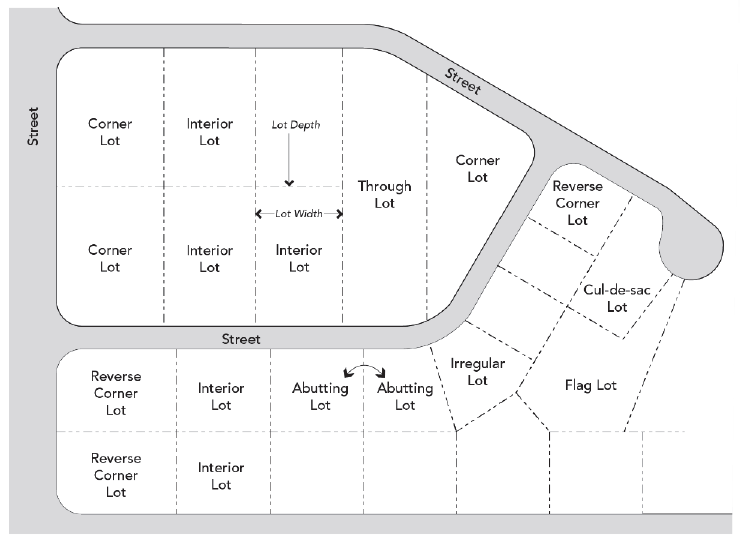
_____
Lot Coverage. See Section 21.41.100 (Determining Lot Coverage).
Lot Depth. See Section 21.41.050 (Measuring Lot Width and Depth).
Lot Line. See "property line".
Lot Size. The area of a lot measured horizontally between bounding lot lines. Lot sizes do not include fee or easement dedications for public street purposes.
Lot Width. See Section 21.41.050 (Measuring Lot Width and Depth).
(Ord. No. 1144 N.S., § 3(Exh. A), 10-1-2024)
21.92.130 - "M" definitions.
Major Addition. See "addition, major".
Manufactured Home. A structure, transportable in one or more sections, which is built on a permanent chassis and is designed for use with or without a permanent foundation when attached to the required utilities. The term "manufactured home" does not include a "recreational vehicle". "Manufactured home" shall have the same definition as set forth in California Health and Safety Code Section 18007(a), as it may be amended from time to time.
Massing. The three-dimensional bulk of a structure: height, width, and depth.
Massing Break. Recess/projection measured from the building footprint with minimum dimensions of one foot in depth by three feet in length by eight feet in height.
Mechanical Equipment. Equipment used to provide mechanical and/or plumbing functions, including, but not limited to, ventilation fans, heating, cooling and air conditioning equipment, generators, water heaters, cooling and air conditioning equipment, water heaters, spa and pool equipment and any other similar equipment.
Mid-size Addition. See "addition, mid-size".
Mined lands. Includes the surface, subsurface, and groundwater of an area in which surface mining operations will be, are being, or have been conducted, including private ways and roads appurtenant to any such area, land excavations, workings, mining waste, and areas in which structures, facilities, equipment, machines, tools, or other materials or property which result from, or are used in, surface mining operations are located.
Minor Addition. See "addition, minor".
Mixed-use. A development that has both commercial and residential land uses.
Mobile Home. A structure manufactured prior to June 15, 1976 that is designed for human habitation and for being moved on a street or highway under permit pursuant to Section 35790 of the Vehicle Code. It does not include recreational vehicles or travel trailers. See "manufactured home" for mobile homes built after June 15, 1976. "Mobile home" shall have the same definition as set forth in Civil Code Section 798.3, as it may be amended from time to time.
Mobile Vendor. A vending vehicle that sells food or food products that may stand or park only at the request of a bona fide purchaser for a period of time not to exceed ten minutes at any one place. See Section 12.32.140 (Unlawful parking - Peddlers, vendors). Does not include "sidewalk vendors" or "food trucks".
Modification. A discretionary action to allow specified exceptions to specified development standards of this zoning code for the purpose of creating flexibility in implementing those standards to accommodate unique design approaches and to recognize unique physical conditions present on individual parcels. See development plan modification (Section 21.16.020) and site plan modification (Section 21.17.020).
Motel. See "hotels and motels".
Municipal Code. The city of Paso Robles Municipal Code.
Mural. Any work of visual art painted or applied directly on a wall, ceiling, or other large permanent surface. See also Chapter 21.63 (Murals).
(Ord. No. 1144 N.S., § 3(Exh. A), 10-1-2024)
21.92.140 - "N" definitions.
Noise. Any sound that annoys or disturbs humans or which causes or tends to cause an adverse psychological or physiological effect on humans.
Nonconforming Building or Structure. A building or structure that was lawful when brought into existence, but because of subsequent amendment to this title, or annexation into the city, could not be built because of restrictions on area, lot coverage, height, yards, setbacks, parking, design requirements, location on a lot, type or construction, or other similar requirements concerning the structure.
Nonconforming Lot. A legal parcel of land having less area, frontage, or dimensions than required in the zone in which it is located.
Nonconforming Use. Any use of land or activity that was lawfully established and in compliance with all applicable ordinances and laws at the time such use was initiated but which, due to subsequently enacted ordinances or laws, no longer complies with the applicable regulations and standards for the zone in which the use is located.
Nuisance. The meaning ascribed to that term in California Civil Code Section 3479. California Civil Code Section 3479 reads, in part, as follows: "Anything which is injurious to health, or is indecent or offensive to the senses, or an obstruction to the use of property, so as to interfere with the comfortable enjoyment of life or property is a nuisance."
(Ord. No. 1144 N.S., § 3(Exh. A), 10-1-2024)
21.92.150 - "O" definitions.
On-Site. Located on the parcel that is the subject of discussion.
Open Space.
Open Space, Private. Privately-owned or controlled outdoor space for use by a single unit's residents or a single business's workers or customers, accessible by secured access only.
Open Space, Shared. The total land area within a residential development that is not individually owned nor dedicated for public use, and that is designed, intended, and reserved exclusively for the shared use of all the residents of the development and their guests.
Owner. A person or persons holding single or unified beneficial title to the property, including without limitation, the settlor of a grantor trust, a general partner, firm, or corporation.
(Ord. No. 1144 N.S., § 3(Exh. A), 10-1-2024)
21.92.160 - "P" definitions.
Parcel. The basic unit of land entitlement. A designated area of land established by plat, subdivision, or otherwise legally defined and permitted to be used or built upon. See also "lot".
Parking Area. A space dedicated to accommodate any parking and loading space/stalls, loading area, backup area, driveways, and aisles.
Parking, Bicycle. A covered or uncovered area equipped with a rack or racks designed and usable for the secure, temporary storage of bicycles.
Parking Facilities, Common. A parking facility that serves more than one use such that the shared use of the facility can be accomplished without limiting the ability of one use to occupy the facility to the detriment of the other.
Parking Space. Space within a parking area of a building exclusive of driveways, ramps, columns, office and work areas, for the temporary parking or storage of one automobile.
Parking, Tandem. An arrangement of parking spaces such that one or more spaces must be driven across to access another space or spaces.
Passenger Vehicle. As defined in the California Vehicle Code.
Patio Cover. A solid or open roof structure covering a patio, platform, or deck area, that is open on two sides or more for the purpose to be used by people.
Permanent Makeup. The application of pigments in human skin tissue for the purpose of permanently changing the color or other appearance of the skin. This includes microblading, micropigmentation, lip liner tattoos, and similar procedures.
Person. Any individual, firm, association, organization, partnership, business trust, company, or corporation.
Planning Commission. The planning commission of the city of Paso Robles.
Planning Division. The planning division of the community development department of the city of Paso Robles.
Plot Plan. A ministerial development review process of minor details and development projects. See Chapter 21.18 (Plot Plans).
Porch. A frontage type where an entry door and corresponding landing area (entrance) are provided on the front elevation of a building on the ground floor. The landing area may be designed such that it creates a usable, but not required, space beyond that needed for entry. A porch can be recessed or projected, but must be covered.
Primary Dwelling Unit. Single-family dwelling(s) or multi-family dwellings that is (are) established on a property before an accessory dwelling unit or urban dwelling unit.
Primary Street. See "street, primary".
Project. Any proposal for a new or changed use or for new construction, alteration, or enlargement of any structure that is subject to the provisions of this title. This term includes, but is not limited to, any action that qualifies as a "project" as defined by the California Environmental Quality Act.
Property Line. The recorded boundary of a parcel of land.
Public Resources Code. The Public Resources Code of the state of California.
Public Works Director. The public works director of the city of Paso Robles.
(Ord. No. 1144 N.S., § 3(Exh. A), 10-1-2024)
21.92.170 - "Q" definitions.
Qualified Applicant. The property owner, the owner's agent, or any person, corporation, partnership, or other legal entity that has a legal or equitable title to land that is the subject of a development proposal or is the holder of an option or contract to purchase such land, or otherwise has an enforceable proprietary interest in such land.
(Ord. No. 1144 N.S., § 3(Exh. A), 10-1-2024)
21.92.180 - "R" definitions.
Rear Setback. See "setback, rear".
Reasonable Accommodation. A request for a change or exception to the practices, rules, and standards for the development, siting, and use of housing or housing-related facilities that would eliminate regulatory barriers and provide a person with a disability equal opportunity to housing of their choice. See Chapter 21.27 (Reasonable Accommodations).
Recreational Vehicle. Any trailer, camper, motor home, boat, or other vehicle designed and intended for traveling and recreational purposes. Does not include homemade tiny homes.
Review Authority. The body or entity responsible for making decisions on zoning and related applications.
Right-of-Way. A strip of land acquired by reservation, dedication, forced dedication, prescription or condemnation and intended to be occupied or occupied by a road, railroad, electric transmission lines, oil or gas pipeline, water line, sanitary storm sewer, or other similar use.
Roof. The portion of a building or structure above walls or columns that shelters the floor area of the structure below.
Roof, Flat. A roof without any sloped sides, with a pitch of ten degrees or less.
Roof, Gable. A roof with two slopes joining at a single ridge line and a gable at each end.
Roof, Hipped. A roof with four sloped sides. The sides meet at a ridge at the center of the roof. Two of the sides are trapezoidal in shape, while the remaining two sides are triangular, and thus meet the ridge at its end-points.
Roof, Shed. A roof shape having only one sloping plane.
(Ord. No. 1144 N.S., § 3(Exh. A), 10-1-2024)
21.92.190 - "S" definitions.
Secondary Street. See "street, secondary".
Setback. The distance from which a structure, parking area, or other development feature must be separated from a prescribed lot line, easement, or other structure or development feature and as specified in the development regulations of each zoning district in the city. See also Section 21.41.120 (Determining Setbacks).
Front Setback. The minimum distance required between a structure and the front property line.
Rear Setback. The minimum distance required between a structure and the rear property line.
Side Setback. The minimum distance required between a structure and a side property line.
Street Side Setback. For a corner lot, the minimum distance required between a structure and a side property line that abuts a public right-of-way.
_____
Figure 21.92.190-1: Setback Types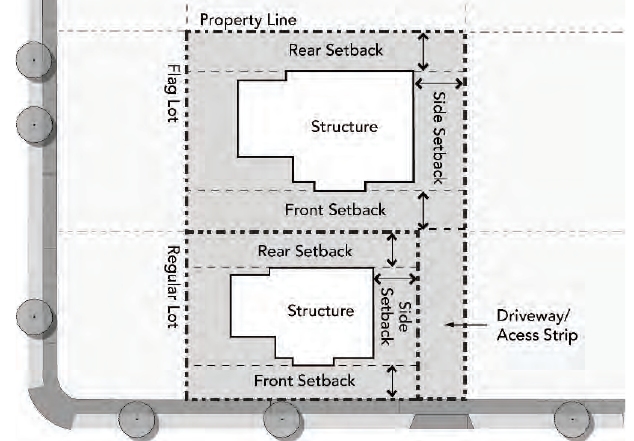
_____
Shed Roof. See "roof, shed".
Side Setback. See "setback, side".
Sign Permit. An administrative permit authorizing any sign, except those exempted per Section 21.52.030 (Signs Exempt from Permit Requirements), to be erected, moved, altered, replaced or reconstructed.
Site. A parcel, or group of contiguous parcels, that is proposed for development in accordance with the provisions of this zoning code and under single ownership or unified control.
Site Plan. A discretionary development review process of minor development projects. See Chapter 21.17 (Site Plans).
Soil. Naturally occurring superficial deposits overlying bedrock.
Slope, Average. See Section 21.41.060 (Determining Average Slope).
Slope, Existing. Slope prior to grading.
Specific Plan. A regulatory document prepared in compliance with California Government Code Section 65450 et seq. for the systematic implementation of the general plan for a particular area, as specified in Chapter 21.14 (Specific Plans).
State. The state of California.
Street Side Setback. See "setback, street side".
Storefront. Storefront is a frontage type where a storefront, including entrance(s), is provided on the front elevation of a building on the ground floor. The storefront is generally level with the adjoining ground level.
Story. That portion of any building included between the surface of any floor and the surface of the next floor above it, and if there be no floor above it, then the space between such floor and the ceiling next above it.
Street. A public right-of-way not including an alley.
Street, Primary. A primary street is identified as an arterial or collector in the general plan; or for any corner parcels located at the intersection of two streets undesignated in the general plan, the street with more lanes of traffic and/or higher traffic quantities.
Street, Secondary. A secondary street is undesignated in the general plan circulation element; for any corner parcels located at the intersection of two streets undesignated in the general plan, the street with fewer lanes of traffic and/or lower traffic quantities.
Stepback. The required or actual placement of a building a specified distance away from a road, property line, or other structure at a level above the first floor.
Structures. Anything constructed or erected that requires location on the ground or attachment to something having location on the ground, including swimming pools, but excluding driveways, sidewalks, patios, or parking spaces.
Structure, Attached Accessory. Attached accessory structures with a common wall or roof with the primary structure.
Structure, Detached Accessory. A structure that is accessory to dwellings, the use of which is incidental to the primary structure on the same parcel, including but not limited to detached garages, carports, workshops, art studios, greenhouses, gazebos, storage sheds, treehouses, shade structures, guest houses. Also includes open, unroofed structures that are over thirty inches in height and are detached from and accessory to the primary structure on the site such as treehouses, play equipment, decks and trellises. See also "canopy" and "patio cover".
Structure, Nonconforming. See "nonconforming building or structure".
Structure, Primary. A building or structure in which the primary use of the parcel on which it is located is conducted.
Swimming Pool. See Chapter 21.53 (Swimming Pools).
(Ord. No. 1144 N.S., § 3(Exh. A), 10-1-2024)
21.92.200 - "T" definitions.
Temporary Use Permit. An administrative permit authorizing specific limited term uses in compliance with specified conditions and performance criteria specified in Chapter 21.20 (Temporary Use Permits).
Tenant. A person renting or leasing a housing unit or nonresidential space.
Tiny Home. A small dwelling unit on a foundation with a minimum size of one hundred fifty square feet and no more than four hundred square feet of habitable floor area.
Trailer. A vehicle with or without motor power, which is designed or used for hauling materials or vehicles, or for human habitation, office, or storage including camper, recreational vehicle, travel trailer. Does not include mobile homes.
Transient Occupancy. Lodging for the purpose of overnight accommodations for a period of not less than one night and not more than thirty consecutive days. Transient occupancies are subject to the transient occupancy tax requirements of Chapter 3.26 (Transient Occupancy Tax) of this code. Examples of transient occupancy accommodations include, but are not limited to: hotels, motels, vacation rentals, timeshare vacation clubs, villas, cottages, casitas, hostel, bed and breakfast inns.
Transparency. The ability of a building or structure to visually transmit light, allowing for a clear view of the interior or exterior spaces via doors and windows.
Turf. A densely planted grassy area characterized by frequent mowing and fertilization and/or watering, commonly used for lawns and playing fields.
(Ord. No. 1144 N.S., § 3(Exh. A), 10-1-2024)
21.92.210 - "U" definitions.
Use. The purpose for which land or premises of a building thereon is designed, arranged, or intended or for which it is, or may be occupied or maintained.
Use, Accessory. A use that is customarily associated with, and is incidental and subordinate to, a primary use and located on the same parcel as a primary use.
Use, Nonconforming. See "nonconforming use".
Use, Permitted. Any use or structure that is allowed in a zone without a requirement for approval of a conditional use permit, but subject to any restrictions applicable to that zoning district.
Use, Primary. A primary, principal, or dominant use established, or proposed to be established, on a parcel.
(Ord. No. 1144 N.S., § 3(Exh. A), 10-1-2024)
21.92.220 - "V" definitions.
Variance. An action granting exception to the development standards of this zoning code in cases where strict compliance would result in a unique hardship in compliance with Chapter 21.22 (Variances).
Vehicle. A device by which any person or property may be propelled, moved, or drawn upon a highway, excepting a device moved by human power.
Vending Vehicle. Any mobile cart, vehicle, wagon, trailer, or similar apparatus by which any person or property may be propelled or moved upon a sidewalk, street, or highway from which food, food products, or other retail items are sold, offered for sale, displayed, bartered, exchanged, or otherwise given. See also "food truck", "food truck court", "mobile vendor", and "sidewalk vendor".
Vertical Wall Plane Variation. See "wall plane variation, vertical".
(Ord. No. 1144 N.S., § 3(Exh. A), 10-1-2024)
21.92.230 - "W" definitions.
Wall Plane Variation. Change in condition, character, or form of a continuous exterior wall, implemented through one or more options outlined in Paragraph 21.50.050(C)2. of Chapter 21.50 (Objective Design Standards for Mixed Use and Multi-Family Development). For vertical and horizontal differentiation, see "wall plane variation, horizontal" and "wall plane variation, vertical".
Wall Plan Variation, Horizontal. A plane break or other articulation that is horizontally oriented (for example, longer than it is tall).
Wall Plan Variation, Vertical. A plane break or other articulation that is vertically oriented (for example, taller than it is long).
Wet Bar. An area with running water, a sink, and a bar or serving counter, and may also include an undercounter or countertop refrigerator. The wet bar shall not include facilities for cooking.
(Ord. No. 1144 N.S., § 3(Exh. A), 10-1-2024)
21.92.240 - "X" definitions.
Reserved.
(Ord. No. 1144 N.S., § 3(Exh. A), 10-1-2024)
21.92.250 - "Y" definitions.
Yard. An open space on the same site as a structure, unoccupied and unobstructed from the ground upward, except as otherwise provided by this zoning code. A yard is not synonymous with a setback, but does include similar areas.
Yard, Front. A yard extending across the front of a parcel for its full width between the front property line and primary building.
Yard, Interior Side. A yard which does not abut a street.
Yard, Rear. A yard extending across the rear of a parcel for its full width between the rear property line and primary building.
Yard, Side. A yard extending from the front setback line to the rear setback line between the side property line and building line.
Yard, Street Side. A yard on a corner lot or reversed corner lot extending from the front setback line to the rear setback line between the side street property line and building line.
_____
Figure 21.92.250-1: Yard Types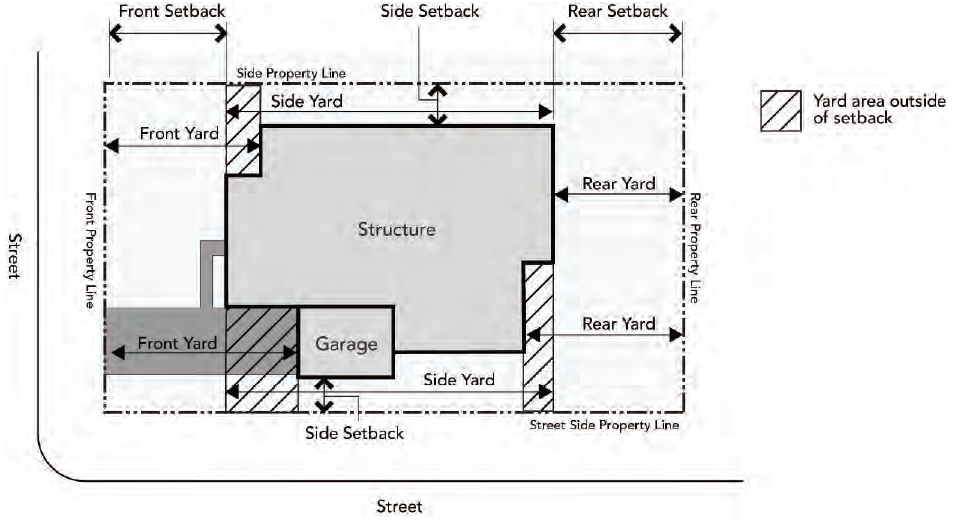
(Ord. No. 1144 N.S., § 3(Exh. A), 10-1-2024)
_____
21.92.260 - "Z" definitions.
Zoning Administrator. The city of Paso Robles Zoning Administrator as appointed by the community development director or his or her designee.
Zoning District. A portion of the city within which certain uses of land and buildings are permitted or prohibited and within which certain development standards are established for buildings, all as set forth and specified in this title.
(Ord. No. 1144 N.S., § 3(Exh. A), 10-1-2024)

