
Payson City Zoning Code
13.20 Supplementary
Provisions
13.20.010 Purpose And Intent
The intent of this Chapter is to provide for several miscel¬laneous land development standards that are applicable in all zones. The requirements of this Chapter shall be in addition to development standards contained within the various zones. Where the provisions of this Chapter may be in conflict with other provisions of this ordinance the more stringent shall prevail.
Adopted by Ord. 05-18-2022-D on 5/18/2022
13.20.020 Requirements To Be Met On One Lot Or Parcel
All required yards, setbacks and other requirements shall be situated on the same lot as the building or structure to which it applies. No required yard, area, or other open space around a building or use, which is needed to comply with the area, setback, or open space requirements of this ordinance, shall be considered as providing the required area, yard, setback, or open space for any other building or use.
Adopted by Ord. 05-18-2022-D on 5/18/2022
13.20.030 Sale Or Lease Of Required Lot Space Prohibited
The space needed to meet the area, frontage, width, coverage, off-street parking, frontage on a public street, or other requirement of this ordinance for a lot or building may not be sold or leased.
Adopted by Ord. 05-18-2022-D on 5/18/2022
13.20.040 Dwelling Requirement On A Lot Or Parcel
Only one single-family dwelling shall be located and maintained on a single-family residential lot or parcel. The dwelling shall be constructed on a permanent foundation. Human habitation is limited to the living area in any dwelling.
Adopted by Ord. 05-18-2022-D on 5/18/2022
13.20.060 Drainage
Surface water from rooftops shall not be allowed to drain onto adjacent lots or streets, except after written agreement between the two parties. In order to prevent impediment in the storm drain system, no alteration of the public right-of-way shall occur without the written consent of the Payson City Streets Superintendent including the placement of gravel, concrete or asphalt.
Adopted by Ord. 05-18-2022-D on 5/18/2022
13.20.070 Transfer Of Adequate Water
No building permit shall be issued in any zone without first conveying to the City adequate water rights in accordance with PCC 4.04, Water Ordinance, if applicable.
Adopted by Ord. 05-18-2022-D on 5/18/2022
13.20.080 Pollution Prevention
Any use shall be prohibited which emits or discharges gasses, fumes, or other pollutants into the atmosphere in amounts that exceed the standards as prescribed by the Utah State Air Conversation Board, the Board of Health, or such appropriate body as may be appointed by the City Council. Any use shall also be prohibited which emits or discharges liquids or solid material onto the soil or water in amounts which result in pollutants entering any water or drainage system in amounts exceeding the standards prescribed by the Utah State Water Pollution Control Board or the State Board of Health.
Adopted by Ord. 05-18-2022-D on 5/18/2022
13.20.090 Concessions In Public Parks And Playgrounds
Concessions, including but not limited to, amusement devices, recreational buildings, and refreshment stands, may be permitted in a park or playground owned by a public agency when approved by the City Council.
Adopted by Ord. 05-18-2022-D on 5/18/2022
13.20.100 Lots To Be Improved Prior To Issuance Of Permit
No building permit shall be issued for the construction of a dwelling or commercial or industrial structure that is to be located on a lot or parcel outside of an approved subdivision or large-scale development unless the lot or parcel is fully improved. If an extension of time is given to put in any of the improvements, the applicant shall post a performance guarantee in the form of a cash bond or an irrevocable line of credit. The performance guarantee shall be in an amount equal to one hundred ten (110) percent of the cost estimate approved by the City Engineer.
Adopted by Ord. 05-18-2022-D on 5/18/2022
13.20.110 Driveway Location
Driveways shall be located as far from the intersection of two roads as practicable. Any driveway in the clear view area must be approved by the City Engineer after a determination that access cannot be derived in any other practical manner.
Adopted by Ord. 05-18-2022-D on 5/18/2022
13.20.120 Public Benches On Public Or Private Property
Public benches may be located on public or private property when approved under a conditional use by the City Council after receiving a recommendation from the Planning Commission. Approval shall be subject to the following:
- The benches shall be located at an approved bus stop.
- Only one bench shall be permitted per bus stop.
- No public hazard or nuisance is created.
- No bench shall be located closer than fifty (50) feet from an intersection or twenty (20) feet from a driveway approach, ingress or egress to a parking lot.
- No bench shall be located on or within one (1) foot of a sidewalk.
- No bench shall be closer than two (2) feet from the back of a curb and gutter or no closer than two (2) feet from the street where no curb exists.
- The maximum height of a bench shall be three (3) feet and the maximum length shall be eight (8) feet.
- The bench shall be permanently connected to the ground.
- Bench covers may be installed over a bench to protect the bench from the environmental factors as long as the walls are of tempered glass or plastic meeting the requirements of the building code and the roof does not exceed twelve (12) feet in height or extend lower than eight (8) feet. Corners may be of wood or metal as long as they are not more than four (4) inches wide.
- The bench must have proof of liability insurance of not less than $100,000.
- The bench shall be maintained in good repair at all times by the owner as determined by the Building Official.
- Benches that are improperly located, damaged, in disrepair, or determined to be unsafe shall be repaired or removed within 24 hours of notification from the Building Official. Benches that are not removed as required above shall be removed by the City at the owner’s expense.
- The city may revoke a conditional use permit for a bench if it finds that it interferes with other desired city uses of the location, or is objectionable for any other reason.
Adopted by Ord. 05-18-2022-D on 5/18/2022
13.20.130 Fences And Walls
General Provisions And Guidelines. Some regulations apply to all fences and walls within Payson City regardless of zone or location including:
- In order to ensure correct placement to establish accurate property lines, avoid conflict with public utilities, and reduce conflict between adjacent property owners, a fence permit issued by the Development Services Department must be obtained prior to the placement of any fence or wall.
- A fence or wall, or any portion thereof shall not be installed in a manner that would restrict access to utility meters, electrical devices and other utility appurtenances. Adequate clearance must be provided around electrical utility boxes in accordance with the Electrical Construction Standard Specifications of Payson City.
- A fence or wall, or any portion thereof, shall not be constructed within three (3) feet of a fire hydrant. If construction of a fence or wall requires a notch to accommodate a fire hydrant, the fence shall be installed at a forty-five (45) degree angle beginning three (3) feet from the hydrant and angling outward to avoid a ninety (90) degree corner on the fence or wall that may result in the kinking of a fire hose.
- Fences or walls may not be used for advertising purposes or for the display of advertising with the following exceptions:
- Advertising panels may be attached to outfield or perimeter fencing on athletic fields.
- The name of a business or address may be incorporated into the materials used to construct the fence or wall but shall not be separately attached to the fence or wall.
Residential Zones. Any fence or wall found to obstruct the view of vehicular traffic shall be removed or modified to mitigate the obstruction to the satisfaction of the Code Enforcement Officer. In all other instances, no fence, wall, living fence or similar device extending into or enclosing all or part of the front setback shall be constructed or maintained at a height greater than forty-two (42) inches, unless the fence is chain link or another open mesh fence. The fence must remain non-sight obscuring (defined as at least seventy (70) percent open space when viewed from either side of the fence) and shall not exceed sixty (60) inches in height. The permitted height of any fence, wall, living fence or similar sight-obscuring device situated within any other portion of a lot shall be six (6) feet, except where the vision of an adjacent driveway may be affected.
Any fence that may affect the vision of an adjacent driveway shall satisfy the following conditions.
- The fence shall not be sight obscuring and shall be constructed of chain link or other similar material and be no less than seventy (70) percent open space; or,
- The fence shall be terminated no less than twenty (20) feet in each direction from the front corner of the lot adjacent to the effected driveway thus forming a line of sight triangle; or,
- The fence shall be no more than forty-two (42) inches in height at a point no less than twenty (20) feet in each direction from the front corner of the lot adjacent to the effected driveway thus forming a line of sight triangle; or,
- The owner of the effected driveway may, in writing, waive the fencing restrictions for the adjacent lot, if it can be shown that the backing of vehicles can be accomplished in a safe manner.
It shall be unlawful for any person to erect or to maintain any barbed wire, concertina or razor wire, or electric fence in any residential zone, unless required by federal, state, or local statute for protection purposes.
Non-Residential Zones. Fences, walls, and living fences may be constructed in non-residential zones up to six (6) feet high. Fence alignment may be at the back of sidewalk. All commercial areas on corner lots shall meet the clear view of intersecting street criteria as defined in PCC 13.20.050.
The provisions of this Section shall not apply to:
- Residential zones where the back property line of lots or developed property is adjacent to arterial roads or major highways, six (6) foot high visual barrier fences are allowed on the back property line along the road or highway right-of-way, and may be required at the discretion of the City Council as condition of site plan approval.
- Fences required by state law to surround or enclose public utility installations, hazardous areas, public schools or other public buildings.
- Other fences such as sports court enclosures or patio enclosures in the front, side or rear yards may be approved by the City Council, if the fence does not create a hazard or violation of other ordinances.
- Temporary construction fences that are installed to protect the public from injury during construction or to maintain security for the development that is under construction. Temporary construction fences must be removed as soon as construction is finished. A permit will be required before installation.
All fences and walls shall be constructed of substantial material and the design and construction shall be consistent with the quality of dwellings and other improvements within the surrounding area. It shall be unlawful for any person to erect or to maintain any barbed wire, concertina or razor wire, or electric fence in any residential zone or along or adjacent to any public street in the City, unless required by federal, state, or local statute for protection purposes.
Before commencing construction, plans for all fences, living fences and walls shall be submitted to and approved by the Development Services Department.
Where, in the opinion of the City staff, a proposed fence, living fence or wall does not conform to the above criteria, the Development Services Department shall refer the application to the City Council for action. The City Council shall have the authority to reverse, affirm or modify any decision of the Development Services Department.
Adopted by Ord. 05-18-2022-D on 5/18/2022
13.20.150 Contact With The County Health Department
The applicant for any project that requires approval from or inspections by the Utah County Health Department shall make appropriate contact with the Utah County Health Department. Appropriate contact shall be evidenced by a written letter of approval from the Utah County Health Department.
Adopted by Ord. 05-18-2022-D on 5/18/2022
13.20.160 Detached Garages And Accessory Structures
All detached garages and other accessory structures shall not be constructed closer to the front property line than the primary structure. Furthermore, all detached garages and other accessory structures must satisfy all applicable requirements of this Title specifically including setback requirements.
Adopted by Ord. 05-18-2022-D on 5/18/2022
13.20.170 Back-Lit Addresses
The numbers or letters indicating the address of any residential unit must satisfy the requirements of the adopted building code and shall be clearly visible at all times including nighttime hours. The numbers or letters should be backlit or of a highly reflective nature, contrast with the underlying color, and be readable from the public right-of-way at all times.
Adopted by Ord. 05-18-2022-D on 5/18/2022
13.20.180 Adequate Public Facilities
Projects that may have a significant impact on any infrastructure system of Payson City may be required to submit an adequate public facilities report in accordance with the regulations of PCC 12.22, Subdivision Ordinance. The City Engineer shall determine when a report is necessary and the extent of the report. In particular, large users such as religious buildings and educational structures will be required to submit an adequate public facilities report.
Adopted by Ord. 05-18-2022-D on 5/18/2022
13.20.190 Historical Locations
When a development governed by this Title is proposed in a location that is determined by the City Council to have historical significance, the City Council may require that a monument be erected indicating the historical significance of the site. The monument is expected to complement the other project details and should be constructed of quality materials. The faceplate should be engraved brass surrounded by masonry materials that either reflect the history of the site or are consistent with materials used in the construction of the primary structures in the development.
Adopted by Ord. 05-18-2022-D on 5/18/2022
13.20.200 Easements
Utility facilities anticipated to provide service to structures that are not located on the property where the facilities are located or are anticipated to traverse a parcel of private property shall be located in an easement dedicated for providing utility service. The easement shall grant ample access for maintenance and necessary upgrades to the facility.
Payson City is not obligated to provide, secure, purchase or otherwise ensure that easements across private property are obtained by an applicant for subdivision approval. When an easement is recorded in favor of Payson City, the easement shall be recorded in the office of the Utah County Recorder and include access for maintenance and necessary upgrades of the City utility.
Adopted by Ord. 05-18-2022-D on 5/18/2022
13.20.210 Second Kitchens
Kitchens shall be restricted to the following:
- Single Family Dwellings. No more than two (2) total kitchens shall be permitted. A dwelling with a second kitchen shall meet the following criteria:
- The dwelling has one (1) front entrance.
- The dwelling has one (1) address; any additional address shall be removed.
- Interior access within the entire home shall be maintained. No keyed or deadbolt locks or any other manner of blocking access may be utilized to restrict access from the additional kitchen and the remainder of the dwelling.
- The dwelling unit shall have no more than one (1) electrical meter.
- The owner shall sign a Certificate of Present Condition, stating that the presence of the second kitchen does not create a second unit or living area.
- Single Family Dwellings With An Accessory Apartment. The primary and accessory living areas shall each have not more than one (1) kitchen. Upon termination of the accessory apartment, the entire dwelling shall return to having one (1) kitchen or all provisions of paragraph A shall be satisfied.
- Duplexes, Twin Homes, And Multi-Family Dwellings. No second kitchen in any unit shall be permitted.
- Accessory Structures. No kitchens shall be permitted.
Adopted by Ord. 05-18-2022-D on 5/18/2022
13.20.230 Projections Into Setbacks
The following structures may project into the setback area, provided the structure is outside of all public utility easements, meets all impervious surface lot coverage, and the following requirements are satisfied.
- Decks, as defined in PCC 13.04, may extend five (5) feet into the front setback or project to fifteen (15) feet from the rear property line.
- Patios, as defined in PCC 13.04, may extend into a side or rear setback area but must be at least five (5) feet from the property line.
- Patio covers may be extended into a rear or side setback area but must be at least ten (10) feet from rear property line and five (5) feet from a side property line. If a patio cover is enclosed, the structure shall satisfy all standard setback requirements. Any patio cover projecting into the setback area shall not exceed twelve (12) feet in height.
- Porches, as defined in PCC 13.04, may extend five (5) feet into the front or rear setback area, except as follows:
To encourage preservation of existing dwellings and promote reinvestment in established neighborhoods, the City may reduce the front setback to fifteen (15) feet to accommodate a porch as defined herein. The request must satisfy the following requirements:
- The porch must be part of the overall house design and extend at least one-third (1/3) of the width of the dwelling or twelve (12) feet whichever is less.
- The porch must be elevated above the sidewalk grade a minimum of eighteen (18) inches.
- The new portion of the dwelling shall be architecturally compatible with the primary structure, using similar exterior materials and colors.
- Covered parking areas (i.e. garages, carports) must be clearly secondary to front porches, setting back further than the porch.
The City is not obligated to approve the request to reduce the front setback for lots that must maintain a coving line, and for projections that may reduce the visibility of driveways and other clear view areas. Furthermore, a survey may be required to accurately determine property lines and setback compliance.
Adopted by Ord. 05-18-2022-D on 5/18/2022
13.20.240 Flagpoles
A flagpole solely to display state, national, university, school, non-profit, or other civic flags, is permitted in all zones.
- The maximum height of a flagpole shall be thirty-five (35) feet in all zones, except the I-1, I-2, S-1, and BPD zones and any school or public facility located in any zone.
- A permit is required for installation of any flagpole. There is no permit fee for flagpoles thirty-five (35) feet in height and under. Flagpoles over thirty-five (35) feet in height require stamped engineered design.
- A flagpole shall not be located in a manner that may cause a safety hazard. The flag may not extend beyond the property line of the lot on which the flagpole is located.
- A “flag” is a fabric, banner, or bunting containing colors, patterns, emblems, or symbols.
- Lighting and display shall adhere to all applicable state and national regulations, with any lights shielded away from adjacent properties.
Adopted by Ord. 05-18-2022-D on 5/18/2022
13.20.250 Automatic Teller Machines (ATM's)
An automated teller machine (ATM) is an electronic banking outlet that allows customers to complete basic transactions without the aid of a branch representative or teller.
All ATM’s within Payson must be located on the same lot or parcel and be within 50 feet of the primary financial institution, unless the ATM is contained within another licensed commercial business or is of a temporary nature for an approved city event.
Adopted by Ord. 05-18-2022-D on 5/18/2022
13.20.270 Development Agreements
The City Council hereby reserves the right to require and enter into a development agreement with any applicant for development approval under the provisions of this ordinance, the Subdivision Ordinance, or any other ordinance or resolution of the City.
The development agreement may address specific details about issues that have yet to be completely resolved, issues regarding phasing of a project, or any other requirement of the City Council.
Adopted by Ord. 05-18-2022-D on 5/18/2022
13.20.280 Enforcement And Penalties
The City Council hereby declares that:
- It shall be unlawful to erect, construct, reconstruct, alter, or change the use of any building or other structure within the City covered by these regulations without obtaining a building permit from the City.
- The City shall not issue any permit unless the plans for the proposed erection, construction, or use fully conforms to the regulations then in effect.
- The penalty for violation of this ordinance shall be a Class C misdemeanor.
Adopted by Ord. 05-18-2022-D on 5/18/2022
13.20.290 Fee Schedule
Any reference to fees imposed by the regulations of this Title is subject to the fee schedule adopted by resolution by the City Council, which may be amended from time to time. If a conflict arises between a fee listed herein and the fee schedule, the provisions of the fee schedule shall take precedence.
The purpose for the collection of review fees is to cover, at least partially, the cost of development review. It is the intention of the City Council to require applicants to pay the cost of the review and not expend General Fund revenues for this purpose. In accordance with the policies of the Development Services Department, any project that requires public works inspections will be required to submit payment of a public works inspection and testing fee consistent with the Payson City Fee Resolution for the inspection and approval of the required improvements. These fees are adopted by resolution of the City Council and may be amended from time to time and are available from the Development Services Department.
The public works inspection fee will be submitted to Payson City to be placed in an interest bearing account. Payson City will draw from the account the amount necessary to complete the inspections. Payson City will keep an accurate record of withdrawals and provide such record to the applicant upon request and following the completion of the tests and inspections. Any amount not used to complete public works testing and inspections shall be refunded, with accrued interest, to the applicant.
Adopted by Ord. 05-18-2022-D on 5/18/2022
05-18-2022-D
02-21-2024-B
13.20.050.1 Clear View Area
The purpose of this Section is to establish minimum acceptable vision clearance standards for motorist and pedestrian safety at vehicular access points along streets.
The clear view area is a triangular area formed by the perpendicular intersection (A) of the curb face at the corner, or property lines on parcels without curb, and two points (B) measuring forty-five (45) feet down each curb face, or property line on parcels without curb, as indicated in the diagram below.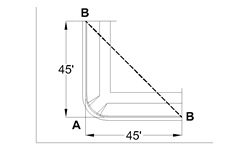
- On property at any corner formed by intersecting streets or which lie adjacent to railroad tracks, it shall be unlawful for the owner or occupant to install, set out, maintain or to permit the installation or maintenance of any sign, fence, hedge, tree, shrubbery, natural growth, building, construction or other obstructions in a clear view area, unless expressly allowed by this Title.
- Drive approaches providing access to a public street must be positioned to maintain visual clearance at the intersection.
- Planting of shrubs and landscaping materials is permitted in the clear view area, but shall not exceed thirty-six (36) inches in height, measured from the top back of curb. To maintain visual clearance at intersections, trees are not allowed in the clear view area.
- On-street parking is not allowed alongside the clear view area.
- Fencing within the clear view area must satisfy the regulations of PCC 13.20.130.
If the road has a stop sign at the relevant intersection, the clear view area may be reduced by the City Engineer. The clear view area should not be less than twenty-five (25) feet in residential zones.
In the CC-1, Central Commercial Zone, due to the historic nature of the zone, the clear view area may be reduced, or eliminated, by the City Engineer if it can be shown that safe vehicular circulation can be accomplished. In order to provide safe vehicular circulation, the City Engineer may require remedies such as, but not limited to no parking zones, and appropriate road regulatory signs.
Adopted by Ord. 05-18-2022-D on 5/18/2022
13.20.050.2 Special Concerns, Safety Concerns
There may be unique circumstances, due to topography, road alignment, or other physical feature that could cause a safety hazard even if the requirements of this Section are satisfied. In those circumstances, the City Engineer may require additional provisions to eliminate the safety concern. These provisions could include, but are not limited to, removal of all trees, shrubs, fences, and other obstructions for a distance determined to create a safe intersection. Likewise, in unique situations, the City Engineer may determine that the intersection is safe with fewer restrictions than those required by this Section. The City Engineer may consult with other members of the staff such as the Police Chief, Street Superintendent, and Fire Chief in making such a determination.
Adopted by Ord. 05-18-2022-D on 5/18/2022
13.20.140.1 Construction Trailers And Temporary Residential Sales Offices
A permit is required for construction trailers and temporary residential sales offices. The applicant must submit a complete application form and payment of all fees in accordance with PCC 13.06.070. When permitted under this Section, structures shall satisfy the following regulations:
- The use of the structure shall comply with the regulations of the zone in which it is located.
- The structure shall be connected to the water, sewer, and electric system of the City, as applicable. The applicant shall be responsible for all costs associated with extension of and connection to the utility systems.
- The structure shall be secured to the earth to prevent displacement due to seismic or wind forces.
- The structure and location shall conform to the adopted building codes and setback requirements as set forth in this Title. The structure shall not be located on any residential lot that is under construction for a residential dwelling.
- Adequate off-street parking shall be provided in accordance with PCC 13.10.
- The structure shall not be used for human habitation, except when approved to be located in a licensed mobile home park or a vacation vehicle court.
- The applicant shall obtain approval at least annually, or at any time the construction trailer is relocated. Each time a construction trailer is moved, inspections must be completed and all fees for placement of a temporary structure must be paid
- The temporary sales office must be removed from the site or the model home when the subdivision is more than eighty (80) percent developed or has been occupied as a temporary sales office for three (3) years whichever occurs first. An applicant may request an extension of a temporary sales office. The request will be reviewed by the Development Services Director in consideration of impact on the existing dwellings in the development, the appropriateness of the temporary sales office in a residential area, and traffic flow generated by the temporary sales office.
- A temporary sales office or model home may not be used as a general real estate office, construction management office, or an off-site sales office.
Adopted by Ord. 05-18-2022-D on 5/18/2022
13.20.140.2 Portable Storage Containers
In residential zones, one (1) portable storage container as defined in PCC 13.04 may be used temporarily for construction, renovation or moving, provided a building permit has been issued for the construction related activity. The container may be allowed on-site for up to one (1) year with a valid building permit and cannot be placed more than thirty (30) days before the activity and must be removed within thirty (30) days after completion.
Storage containers in non-residential areas must be used solely for transportation or shipment of goods and products and should not be used for principal business operations. Containers cannot be used as a permanent structure or an appendage to a permanent structure. The City Council, or designee, may, but is not obligated to approve long-term storage of goods in non-residential zoning districts. If allowed, the City Council will establish the location, number, appearance and timeframe in which the storage containers will be allowed.
All containers shall be maintained in good repair and placed on-site in a location that will not eliminate required parking space or public safety access. Vertical stacking is prohibited in all zones except for businesses licensed to sell containers. Storage facilities shall not be used for human habitation.
Containers used in association with a licensed fireworks business, donation center, or other non-profit collection center are exempt from these regulations.
Adopted by Ord. 05-18-2022-D on 5/18/2022
13.20.140.3 Portable Carports
A permit must be obtained from the Development Services Department prior to the installation of portable carports. When permitted under this Section, structures shall satisfy the following regulations:
- The parcel upon which the structure is placed must have an authorized primary structure.
- Portable carports must satisfy the minimum zoning requirements (i.e. setbacks, permissible lot coverage, height) of the underlying zone, with the following exceptions:
- The structure may be placed as near as three (3) feet of the property line, provided the structure is not placed on a permanent foundation.
- The structure may be placed adjacent to and fastened to a primary structure on the site.
- The structure shall not be placed in a location that would obscure the address indicator of the primary structure.
- The structure shall not be placed in a location that would inhibit the provision of public safety services.
- Installation of portable carports shall satisfy the wind shear and tie down requirements of the adopted building code.
- Storm water run-off from the structure must be retained on-site by the permit holder.
- If the structure is located within a public utility or private easement, the structure must be relocated upon request by the holder of the easement and must adhere to all provisions of the applicable easement.
- The cover shall be maintained in good condition. Any tears, fraying, or other damage to the cover may be cause for removal of the structure.
Adopted by Ord. 05-18-2022-D on 5/18/2022
13.20.140.4 Regulations Specific To Non-Residential Areas
Temporary structures for commercial purposes may be allowed for not more than one year, if a building permit has been issued for the construction of a permanent structure. In order to qualify for the use of a temporary structure to operate a business during construction, the applicant shall satisfy the following:
- Site plan approval for the construction of a permanent building must be granted in accordance with the provisions of PCC 13.18.
- The building plans for the permanent structure must be submitted, reviewed and approved by the Building Department. In order to satisfy the provisions of this Section, the building permit must be issued and all fees paid.
- A business license to operate the business must be obtained by the applicant.
- Construction must commence within thirty (30) days of the placement of the temporary structure. Failure to begin construction on the permanent structure may result in revocation of the business license and Payson City may pursue any legal action to remove the temporary structure.
Adopted by Ord. 05-18-2022-D on 5/18/2022
13.20.220.1 Purpose And Zone Characteristics
The Internal Accessory Dwelling Unit code is established to conserve and protect the residential character of neighborhoods, maintain desirable, attractive, and safe places to live, and protect investments in our communities.
Adopted by Ord. 05-18-2022-D on 5/18/2022
13.20.220.2 Internal Accessory Dwelling Unit Defined
For the purposes of this Section, internal accessory dwelling unit ("IADU") shall be defined as a living area within a single-family dwelling. The living area is within the footprint of the single-family dwelling and does not create a separate unit. An interior connection between the living area and single-family dwelling shall be maintained. No more than one (1) IADU shall be allowed in each single-family dwelling.
Adopted by Ord. 05-18-2022-D on 5/18/2022
13.20.220.3 Internal Accessory Dwelling Units
Internal Accessory Dwelling Units shall be permitted only in detached single family dwellings located in any Residential (R) or Agricultural (A) zone.
Adopted by Ord. 05-18-2022-D on 5/18/2022
13.20.220.4 General Requirements
Each of the following must be satisfied to establish an accessory apartment:
- Permits. An IADU permit shall be obtained before utilizing an IADU. A separate building permit shall be obtained for any modification to the structure.
- Number. Only one (1) IADU shall be permitted in any single-family dwelling.
- Lot Area Requirements. An IADU shall not be permitted on lots under 6000 sq. feet.
- Location. The IADU shall be located inside the single-family dwelling. No accessory apartment shall be permitted in or above an accessory structure, including a detached garage.
- Appearance. The IADU shall not alter the appearance of the structure from that of a single-family dwelling. Any addition or exterior improvement shall be similar in character to the existing dwelling.
- Access. The IADU shall have its own exterior entrance. An exterior entry into an IADU shall be located only on the side or rear of the structure and have a paved pedestrian access connecting to the driveway and/or public street.
- Occupancy. Owner occupancy of the single-family dwelling shall be required to establish and maintain an IADU. An owner’s temporary absence shall not relieve this requirement. Owner occupancy requires primary residency of at least 50% of ownership on property title. Occupancy in the single-family dwelling shall be one family as defined in Payson City Code while occupancy in the IADU shall be no greater than four (4) adults.
- Interior Connection. The IADU shall not be walled off and shall maintain an interior connection within the dwelling, including between the primary dwelling and IADU. A door with a lock or deadbolt is an appropriate form of connection. Access from a garage shall not qualify as the required interior connection.
- Second Kitchens. The aIADU and single-family dwelling shall each have no more than one (1) kitchen.
- Parking. Three (3) total off-street parking spaces are required to establish and maintain a single-family residence with an IADU (two for single-family dwelling and one for IADU). Parking spaces may be in tandem. No more than one side yard may be utilized for parking. The parking spaces shall:
- be hard surfaced and accessed by a hard surfaced driveway,
- be served by the same drive approach, with no more than one curb cut permitted in order to prevent the appearance of a duplex,
- not be located closer to the front lot line than the dwelling unless the parking space leads to covered parking,
- serve the same address if two parking spaces are in tandem, tandem spaces shall not be more than two vehicles in depth, and continuously be available for parking and not obstructed by storage or other items.
- If the garage is converted to an internal dwelling unit the two off street parking spaces for the dwelling must be replaced.
- Required Improvements. Curb, gutter, and sidewalk along the frontage of the parcel shall be installed and maintained. If a curb, gutter, or sidewalk is in a state of disrepair, it shall be repaired or replaced prior to the issuance or renewal of an accessory apartment permit.
- Utilities. Existing utility laterals and service connections will need to be inspected and upgraded as deemed necessary by the utility provider. The structure shall have no more than one (1) meter for each utility service.
- Addresses. The single-family dwelling and the IADU shall have independent addresses assigned by the city. These addresses shall be clearly visible from a public street. It is the responsibility of the property owner to install and maintain visible address placards.
- Conformance With Payson City Code. A violation of any Payson City Code may result in denial, suspension, or revocation of an IADU application or permit.
- Duration And Severance. An IADU permit is only valid for the duration of ownership of the applicant and does not run with the land. The IADU shall terminate whenever owner occupancy is not maintained or when an owner occupant elects to discontinue using the living space as an IADU. If an accessory apartment is denied, revoked, or discontinued, and the IADU address shall be removed from the structure.
- Recordation. A deed restriction outlining the permitted use of the property shall be recorded with the Utah County Recorder’s Office.
Adopted by Ord. 05-18-2022-D on 5/18/2022
13.20.220.5 Permit Process
To obtain an IADU permit, an applicant shall:
- Submit a completed application and:
- A site plan showing the location of the single-family dwelling structure and any accessory structures. The site plan shall include dimensions, setbacks, distance between the single-family dwelling and any accessory building, location of utility meters, and location and dimensions of parking spaces.
- A floor plan labeling the rooms, egress windows and their dimensions, IADU, interior connection, and exterior entrances.
- Payment of the application fee as shown in the fee schedule.
- Complete and pass a building inspection to ensure compliance with this Section, building and fire codes, and any other applicable ordinances.
- Install an address placard displaying the assigned address for the IADU.
- Sign a deed restriction establishing IADU.
Adopted by Ord. 05-18-2022-D on 5/18/2022
13.20.220.6 Non-Conformities
Any IADU legally established prior to this ordinance shall obtain an IADU permit and shall not be denied a permit due to inability to satisfy a provision of this Section if that provision was not required by the ordinance in effect at the time of legal establishment. The property owner has the burden of proof that the property was both legally established and has been maintained as an IADU since the date of establishment. The inquiry to determine legal establishment shall be met by the preponderance of the evidence based on information such as: the zoning designation and any overlays at the time of establishment, the applicable zoning ordinance, building permits, any rental records, affidavits, utility records, city and county records, tax records, and any other information indicating prior use and/or legal establishment.
Adopted by Ord. 05-18-2022-D on 5/18/2022
13.20.220.7 Determination Of Owner Occupancy Status
A determination of owner occupancy may be rebutted by documentation submitted to Development Services that shows the individual(s) claiming homeowner occupancy is (are) an owner occupant. An owner occupant possesses at least 50% ownership and has a bona fide intent to establish and maintain primary residency in the dwelling. Documentation may include loan documents, title, tax returns, residency status, driver’s license, insurance statements, rental agreements, and any other documentation indicating proof of ownership and primary residency. Once staff has made a final determination of owner occupancy status, an applicant may appeal to the Board of Adjustment.
Adopted by Ord. 05-18-2022-D on 5/18/2022
13.20.220.8 Violation
- Any violation of this Section may result in a Class C Misdemeanor.
- In addition to the criminal penalty listed above. Payson City may hold a lien against the property.
- Payson City will provide written notice of the violation(s). The notice shall include a description of the specific violation and give the property owner to cure the violation within 30 days. The notice shall be mailed to the property owner of record and/or anyone designated to receive notice on behalf of the property owner of record and be posted on the property.
- The property owner shall have the right to a hearing, if the property owner files a written objection within 14 days after the day in which the notice of violation is post-marked or posted on the property.
- The City will then hold a hearing in accordance with Title 52, Chapter 4 Open and Public Meetings Act to conduct a review and determine whether the specific violation(s) described in the written notice of violation has occurred. The property owner shall be notified in writing of the date, time and location of the hearing no less than 14 days before the hearing is to be held.
- If at the hearing the City Council determines the specific violation occurred, the City may impose a lien in an amount of up to $100 for each day of violation after the day on which the opportunity to cure the violation expires.
- The written notice of lien shall be filed with the Utah County Recorder describing the specific violation(s) and that the City provided the property owner 30 days to cure and that the property owner failed to cure the violation(s).
Adopted by Ord. 05-18-2022-D on 5/18/2022
13.20.221.1 Purpose And Zone Characteristics
The Detached Accessory Dwelling Unit code is established to conserve and protect the residential character of neighborhoods, maintain desirable, attractive, and safe places to live, and protect investments in our communities.
Adopted by Ord. 02-21-2024-B on 2/21/2024
13.20.221.2 Detached Accessory Dwelling Unit Defined
For the purposes of this Section, detached accessory dwelling unit ("DADU") shall be defined as a living area within an accessory structure located on the same parcel as a single-family dwelling. No more than one (1) DADU accessory dwelling unit, either interior or detached, shall be allowed associated with each single-family dwelling.
Adopted by Ord. 02-21-2024-B on 2/21/2024
13.20.221.3 Detached Accessory Dwelling Units
Detached Accessory Dwelling Units shall be permitted only on lots with detached single-family dwellings located in any Residential (R) or Agricultural (A) zone.
Adopted by Ord. 02-21-2024-B on 2/21/2024
13.20.221.4 General Requirements
Each of the following must be satisfied to establish an accessory apartment.
- Permits. A DADU permit shall be obtained before utilizing a DADU. A separate building permit shall be obtained for any modification to the structure.
- Number. Only one (1) DADU shall be permitted with a single-family dwelling.
- Lot Area Requirements. A DADU shall not be permitted on lots under 6,000 square feet.
- Location. The DADU shall be permitted in, but not above, an accessory structure.
- Setbacks. The DADU shall be no closer than ten (10) feet from the side and rear property lines and shall not be located within the front yard.
- Appearance. The appearance of the DADU exterior shall be similar in design, material, and character to the existing dwelling.
- Height. The DADU shall not be permitted as a two-story structure and may not exceed a maximum height of eighteen (18) feet.
- Size. The DADU shall not exceed a maximum square footage of 1,200 square feet. The DADU shall have a minimum of 300 square feet.
- Access. The DADU shall have its own exterior entrance. An exterior entry into a DADU shall have a paved pedestrian access connecting to the driveway and/or public street.
- Occupancy. Owner occupancy of the single-family dwelling shall be required to establish and maintain a DADU. Owner occupancy requires primary residency of at least fifty percent (50%) of ownership on property title. Occupancy in the single-family dwelling shall be one (1) family as defined in Payson City Code while occupancy in the DADU shall be no greater than four (4) adults.
- Second Kitchen. The DADU shall have no more than one (1) kitchen.
- Parking. Four (4) total off-street parking spaces are required to establish and maintain a single-family residence with a DADU (two (2) for the single-family dwelling and two (2) for the DADU). Parking spaces may be in tandem. No more than one side yard may be utilized for parking. The parking spaces shall:
- Be hard surfaced and accessed by a hard surfaced driveway.
- Not be located closer to the front lot line than the dwelling unless the parking space leads to covered parking.
- Serve the same address if two (2) parking spaces are in tandem. Tandem spaces shall not be more than two (2) vehicles in depth and continuously be available for parking and not obstructed by storage or other items.
- If a detached garage is converted to a detached dwelling unit, the two (2) off-street parking spaces for the dwelling must be replaced.
- Required Improvements. Curb, gutter, and sidewalk along the frontage of the parcel shall be installed and maintained. If a curb, gutter, or sidewalk is in a state of disrepair, it shall be repaired or replaced prior to the issuance or renewal of an accessory apartment permit.
- Utilities. Existing utility laterals and service connections will need to be inspected and upgraded as deemed necessary by the utility provider. The structure shall have no more than one (1) meter for each utility service.
- Addresses. The single-family dwelling and the DADU shall have independent addresses assigned by the City. These addresses shall be clearly visible from a public street. It is the responsibility of the property owner to install and maintain visible address placards.
- Conformance With Payson City Code. A violation of any Payson City Code may result in denial, suspension, or revocation of a DADU application or permit.
- Duration And Severance. A DADU permit is only valid for the duration of ownership of the applicant and does not run with the land. The DADU shall terminate whenever owner occupancy is not maintained or when the owner occupant elects to discontinue using the living space as a DADU. If an accessory apartment is denied, revoked, or discontinued, the DADU address shall be removed from the structure.
- Recordation. A deed restriction outlining the permitted use of the property shall be recorded with the Utah County Recorder's Office.
- Required Improvements. Curb, gutter, and sidewalk along the frontage
of the parcel shall be installed and maintained. If a curb, gutter, or
sidewalk is in a state of disrepair, it shall be repaired or replaced
prior to the issuance or renewal of an accessory apartment permit.
Adopted by Ord. 02-21-2024-B on 2/21/2024
13.20.221.5 Permit Process
To obtain a DADU permit, an applicant shall:
- Submit a complete application and:
- A dimensioned site plan showing the location of the single-family dwelling structure, the proposed DADU, and any accessory structures. The site plan shall include dimensions, setbacks, distance between the single-family dwelling, the proposed DADU, and any accessory building, location of utility meters, and location and dimensions of parking spaces.
- A floor plan labeling the rooms, egress, windows and their dimensions, DADU, interior connection, and exterior entrances.
- Elevation drawings of the proposed DADU that show the building height and exterior materials of the proposed DADU structure.
- Payment of the application fee as shown in the Payson City Fee Schedule.
- Complete and pass a building inspection to ensure compliance with this Section, building and fire codes, and any other applicable ordinances.
- Install an address placard displaying the assigned address for the DADU.
- Sign a deed restriction establishing the DADU.
Adopted by Ord. 02-21-2024-B on 2/21/2024
13.20.221.6 Non-Conformities
Any DADU legally established prior to this ordinance shall obtain a DADU permit and shall not be denied a permit due to inability to satisfy a provision of this Section if that provision was not required by the ordinance in effect at the time of legal establishment. The property owner has the burden of proof that the property was both legally established and has been maintained as a DADU since the date of establishment. The inquiry to determine legal establishment shall be met by the preponderance of the evidence based on information such as: the zoning designation and any overlays at the time of establishment, the applicable zoning ordinance, building permits, any rental records, affidavits, utility records, city and county records, tax records, and any other information indicating prior use and/or legal establishment.
Adopted by Ord. 02-21-2024-B on 2/21/2024
13.20.221.7 Determination Of Owner Occupancy Status
A determination of owner occupancy may be rebutted by documentation submitted to Development Services that shows the individual(s) claiming homeowner occupancy is (are) an owner occupant. An owner occupant possesses at least fifty percent (50%) ownership and has a bona fide intent to establish and maintain primary residency in the dwelling. Documentation may include loan documents, title, tax returns, residency status, driver's license, insurance statements, rental agreements, and any other documentation indicating proof of ownership and primary residency. Once staff has made a final determination of owner occupancy status, an applicant may appeal to the Board of Adjustment.
Adopted by Ord. 02-21-2024-B on 2/21/2024
13.20.221.8 Violation
- Any violation of this Section may result in a Class C Misdemeanor.
- In addition to the criminal penalty listed above, the City may hold a lien against the property.
- The City will provide written notice of the violation(s). The notice shall include a description of the specific violation and give the property owner thirty (30) days to cure the violation. The notice shall be mailed to the property owner of record and/or anyone designated to receive notice on behalf of the property owner of record and be posted on the property.
- The property owner shall have the right to a hearing if the property owner files a written objection within fourteen (14) days after the day in which the notice of violation is post-marked or posted on the property.
- The City will then hold a hearing in accordance with Utah Code § 52.4, Open and Public Meetings Act, to conduct a review and determine whether the specific violation(s) described in the written notice of violation has occurred. The property owner shall be notified in writing of the date, time, and location of the hearing no less than fourteen (14) days before the hearing is to be held.
- If at
the hearing the City Council determined the specific violation occurred, the City may impose a lien in an amount of up to $100 for each day of violation after the day on which the opportunity to cure the violation expires. - The written notice of lien shall be filed with the Utah County Recorder's Office describing the specific violation(s) and that the City provided the property owner thirty (30) days to cure and that the property owner failed to cure the violation(s).
Adopted by Ord. 02-21-2024-B on 2/21/2024
13.20.260.1 Statutory Authority And Definitions
The provisions of the Tobacco, Electronic Cigarette, and Nicotine Product Retail Permit, as cited in Utah Code 10.8; 26.57 and 26.62 and this Chapter shall govern the selling and dispensing of Tobacco, Electronic Cigarette, and Nicotine Product within Payson, Utah. The words and phrases used in this Chapter shall be consistent with the meanings specified in Utah Code 10.8; 26.57 and 26.62 and are adopted and incorporated by reference unless a different meaning is clearly evident.
Adopted by Ord. 05-18-2022-D on 5/18/2022
13.20.260.2 License Required
It shall be unlawful for any person to sell, offer to sell, or provide to the public any type of tobacco, electronic cigarette, and/or nicotine product without first obtaining the appropriate license from Payson City, the State of Utah and the local health department, where applicable. All licensees shall comply with the Electronic Cigarette and Nicotine Product Regulation Act, as cited in Utah Code 10.8; 26.57 and 26.62.
A tobacco license shall be obtained in addition to the business license required pursuant to PCC 3.04. Each applicant for a license in accordance with this Chapter shall submit a complete application form together with the payment of all applicable fees in accordance with PCC 3.04.060, Business Licenses and Regulations.
Adopted by Ord. 05-18-2022-D on 5/18/2022
13.20.260.3 Tobacco Categories
- Retail tobacco specialty business as defined in Utah Code § 10.8.41.6.1.h.
- General retail tobacco business as defined in Utah Code § 26.62.102.5.
Adopted by Ord. 05-18-2022-D on 5/18/2022
13.20.260.4 Duties
Each person or entity granted a license in accordance with the provisions of this Chapter shall comply with all provisions of the Electronic Cigarette and Nicotine Product Regulation Act.
Adopted by Ord. 05-18-2022-D on 5/18/2022
13.20.260.5 Restrictions
- Retail tobacco specialty businesses allowed within Payson, Utah is one (1) business per every 20,000 residents, as per the current census data and in accordance to the provisions in Utah Code § 10.8.1.6.a.ii.
- The location of any business that chooses to obtain a tobacco, electronic cigarette, and/or nicotine product retail permit shall satisfy the distance and location requirements of Utah Code 10.8.
Adopted by Ord. 05-18-2022-D on 5/18/2022

