
Payson City Zoning Code
13.04 Definitions
Zoning
13.04.010 Purpose And Intent
The purpose for including certain definitions as part of this ordinance is to clarify meaning specific to this ordinance. Words and phrases used in the present tense include the future; singular words include the plural as well as the singular.
Adopted by Ord. 05-18-2022-D on 5/18/2022
13.04.020 Definitions: Zoning Ordinance
The following definitions are specific to this ordinance. If there is occasion to need interpretation of any word or phrase not listed below, the Board of Adjustment shall provide the interpretation.
ACCESSORY APARTMENT. A living area within a single family dwelling that is subordinate to the single-family dwelling, has an interior connection, and does not create a separate unit.
ACCESSORY USE OR STRUCTURE. A use or structure that:
- is clearly incidental to and customarily found in connection with a primary building or use;
- is subordinate to and serves a primary building or use;
- is subordinate in area, extent, or purpose to the primary building or principal use served;
- contributes to the comfort, convenience, or necessity of occupants, business, or industry in the primary building or principal use served;
- is located on the same lot as the primary building or principal use served.
ADULT DAY CARE FACILITY. A facility that furnishes continuous care, supervision, and guidance for three (3) or more adults unaccompanied by a guardian for at least four (4) hours, but less than twenty-four (24) hours per day.
AGRICULTURE. Land used exclusively for a bona fide agricultural operation by the owner or tenant. The use of land for agricultural purposes including grazing or raising of livestock (except feed yards), sod production, orchards, plowing, tillage, cropping, seeding, cultivating, or harvesting for the production of food and the necessary accessory uses for packing, treating, or storing the produce, provided the operation of the accessory use is clearly incidental to the agricultural activity. The business of garbage feeding of hogs, fur farms, or the raising of animals for use in medical or other tests or experiments is excluded.
AGRICULTURE BUILDING. A structure on agricultural land designed, constructed, and used to house farm implements, livestock, or agricultural produce or products used by the owner or lessee, or their employees, and persons engaged in the pick up or delivery of agricultural produce or products grown or raised on the premises. The term “agricultural building” shall not include dwellings.
ALTERNATIVE TRANSPORTATION MODES. Methods of travel other than by means of a low-occupant vehicle. Alternative modes may include carpooling or vanpooling, public transit, bicycling or walking.
APPEAL AUTHORITY. The person, board, commission, agency or other body designated herein to decide an appeal of a decision of a land use application or a variance.
ARCHITECTURAL METAL PANELS. Insulated metal panels used to provide architectural enhancements through a variety of panel profiles, colors, and applied finishes designed with concealed clips and fasteners.
ASSISTED LIVING FACILITY. A residential facility, licensed by the State of Utah, with a home like setting that provides an array of coordinated supportive personal and health care services, available twenty-four (24) hours per day, to residents who have been assessed under Utah Department of Health or Utah Department of Human Services rules to need any of these services. Each resident shall have a service plan based on the assessment, which may include:
- Specified services of intermittent nursing care
- Administration of medications
- Support services promoting the resident’s independence and self-sufficiency
An assisted living facility does not include:
- A residential facility for persons with a disability
- Adult day care provided in conjunction with a residential facility for elderly persons or a residential facility for persons with a disability
AUTOMOBILE REPAIR. The repair of the mechanical functioning parts of an automobile. Automobile repair does not include the storage or impounding of vehicles with the exception of vehicles that will be repaired within forty-eight (48) hours.
AUTOMOBILE RESTORATION. The external repair of automobiles including bodywork and painting. Automobile restoration does not include the storage or impounding of vehicles with the exception of vehicles that will be restored within forty-eight (48) hours.
AUTOMOBILE IMPOUND. The secured storage of automobiles, with or without the permission of the owner, by a person licensed to hold the automobiles.
BOARDER. A person living in a rented room in a boarding house. The boarding house operator, or member of his or her immediate family who resides on the premises with the operator, shall not be deemed a boarder.
BOARDING HOUSE. A building or portion thereof operated by a person residing on the premises where, for compensation, rooms are rented together with meals for not more than fifteen (15) boarders who generally do not utilize kitchen facilities. “Compensation” shall include money, services or any other thing of value.
A boarding house does not include:
- A residential facility for the elderly or persons with a disability
- Any non-residential facility, such as a rehabilitation/treatment facility, where the primary purpose of the facility is to deliver rehabilitation, treatment, counseling, medical, protective or other similar services to the occupants thereof
BOUNDARY LINE ADJUSTMENT. See Lot Line Adjustment.
BUILDING. Any structure built for the support, shelter, or enclosure of persons, animals, chattels, or property of any kind. When any portion thereof is completely separated from every other portion thereof by a division wall or firewall, without openings, each such portion shall be considered a separate unit.
- BUILDING, ACCESSORY. A subordinate building, the use of which is incidental to that of the main building.
- BUILDING, PRIMARY OR MAIN. A building, or buildings, in which is conducted the principal use of the lot in which it is situated. In any residential district, any dwelling shall be deemed the primary building of the lot on which the same is situated.
- BUILDING, PUBLIC. A building owned and operated or owned and intended to be operated by a public agency of the United States of America, of the State of Utah, or any of its subdivisions. The use of the public building, with immunity, is nontransferable and terminates if the structure is devoted to a use other than as a public building with immunity. A public building referred to as with immunity under the provisions of this Title includes:
- Properties owned by the state of Utah or the United States government which are outside the jurisdiction of the city zoning authority as provided under Utah Code § 10-9a-304, (1953 as amended); and
- The ownership or use of a building that is immune from the city zoning authority under the supremacy clause of the United States constitution.
BUILDING HEIGHT. The vertical distance from the average finished grade surface at the building wall to the highest point of the coping of a flat roof or to the deck line of a mansard roof, or the mean height level between eaves and ridge for gable, hip, or gambrel roofs. Exclusions: Structures not used for human occupancy, including, but not limited to, chimneys, flag poles, television antennas, church towers, architectural features, and similar structures are excluded in determining height.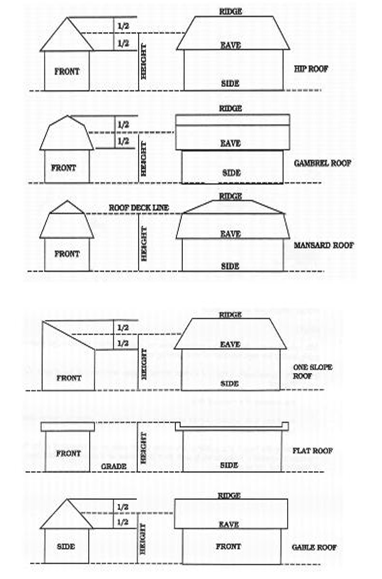
BUILD-TO-LINE. A line parallel to the street along which the primary mass of the front façade should be set. It is measured as a perpendicular distance from the street line to the nearest point of the building façade. The build-to-line identifies the precise horizontal distance, or range of distances, from a street that the front of all primary structures must be built in order to create a uniform line of buildings along a street.
CARPORT. A structure not completely enclosed by walls for the shelter of automobiles.
CERTIFICATE OF OCCUPANCY. A permit issued prior to occupancy of a structure to ensure that the structure is ready for occupancy with all defects corrected and all construction debris removed and the site graded to final grade.
CHILD CARE CENTER. A building wherein ordinary care and supervision are provided during customary daytime periods by the resident family to non-related persons. To qualify, the building and business operations must be approved by the Utah Department of Health or other appropriate State agency.
CITY COUNCIL. The legislative or governing board of Payson, Utah.
COMMON AREA. Land in a development held in common or single ownership and not reserved for the exclusive use or benefit of an individual tenant or owner. Maintenance of such areas is not the responsibility of city government and shall be set forth by the development association in the form of restrictive covenants, which shall guarantee the maintenance of these areas.
COMMUNITY CORRECTIONAL FACILITY. A facility licensed by the State of Utah to provide temporary occupancy for previously incarcerated persons, which assists such persons in making a transition from a correctional institution environment to independent living. The facility may also provide ancillary, temporary occupancy for individuals placed as part of, or in lieu of confinement rehabilitation, or treatment in a correctional institution.
COMPLETE APPLICATION. A determination by an appropriate staff member that an applicant has submitted the correct form together with all mandatory and supplementary information necessary to complete a review of the project, including the payment of the established fee.
COMPOSTING FACILITY. A facility providing an area for the accelerated biological decomposition of organic matter under managed aerobic conditions resulting in a stable, innocuous final product and specifically includes all related receiving, processing, production, curing, and storage areas, buildings equipment, facilities and other infrastructure located at the site.
CONDITIONAL USE. A land use that, because of its unique characteristics or potential impact on the municipality, surrounding neighbors, or adjacent land uses, may not be compatible in some areas or may be compatible only if certain conditions are required that mitigate or eliminate the detrimental impacts.
CONDOMINIUM. The ownership of a single unit in a multi-unit project together with an undivided interest in common in the common areas and facilities of the property.
CONDOMINIUM PROJECT. A plan or project whereby two or more units, together with an undivided interest in the common area or facility, are separately offered or proposed to be offered for sale. This definition shall apply to existing or proposed apartments, commercial or industrial buildings, or structures. Condominium project shall also mean the property when the context so requires.
CONGREGATE HOUSING. Independent living designed to integrate the housing and nonmedical supportive services of elders. Increases self-sufficiency through the provision of supportive services (i.e. meals, transportation, housekeeping, social activities) in a residential setting. Congregate housing does not offer 24-hour care and supervision; however, home health services are often arranged.
DECK. An exterior floor system adjacent and accessible to a primary building.
DENSITY. The term density shall mean the number of units obtained by multiplying the units per acre allowed in the zone in which the proposed development is located or seeking by the total number of usable acres. Usable acreage shall not include public or private roadways, school, or any similar non buildable use such as retention or detention basins if not approved as open space, public utility locations, any hazard area, any slope above 30% or any other unbuildable square footage.
DEVELOPMENT OR DEVELOPMENT ACTIVITY. Means any of the following:
- Any construction or expansion of a building, structure, or use.
- Any change in the use of a building or structure.
- Any manmade change to improved or unimproved land, including but not limited to mining, dredging, filling, grading, paving, excavation or drilling operations.
- Any change in the use of land that creates additional demand and need for capital facilities.
- The total area of a lot or parcel of land on which a building permit is to be issued or the total area of property being improved.
- The land being developed and/or subdivided.
- The act, process or result of developing.
- When the context so requires, a project plan as set forth in this Title or PCC 12, Subdivision Ordinance.
DISABILITY. A physical or mental impairment that substantially limits one or more of a person’s major life activities, including a person having a record of such impairment or being regarded as having such an impairment. The following definitions are incorporated into the definition of disability:
- DISABILITY does not include current illegal use of, or addiction to, any federally controlled substance, as defined in Section 102 of the Controlled Substances Act, Title 21 U.S.C. Section 802, or as defined under Utah Code 58-37 (1953 as amended):
- PHYSICAL OR MENTAL IMPAIRMENT includes:
- Any physiological disorder or condition, cosmetic disfigurement, or anatomical loss affecting one or more of the following body systems: neurological, musculoskeletal, digestive, genitourinary, hemic and lymphatic, skin, and endocrine.
- Any mental or psychological disorder, such as mental retardation, organic brain syndrome, emotional or mental illness, and specific learning disabilities.
- Such diseases and conditions as orthopedic, visual, speech and hearing impairments, cerebral palsy, autism, epilepsy, muscular dystrophy, multiple sclerosis, cancer, heart disease, diabetes, Human Immunodeficiency Virus infection, mental retardation, emotional illness, drug addiction (other than addiction caused by current, illegal use of a controlled substance) and alcoholism.
- MAJOR LIFE ACTIVITIES means functions such as caring for one’s self, performing manual tasks, walking, seeing, hearing, speaking, breathing, learning and working.
- HAS A RECORD OF SUCH AN IMPAIRMENT means has a history of, or has been misclassified as having, a mental or physical impairment that substantially limits one or more major life activities.
- IS REGARDED AS HAVING AN IMPAIRMENT means:
- Has a physical or mental impairment that does not substantially limit one or more major life activity but is treated by another person as constituting such a limitation.
- Has a physical or mental impairment that substantially limits one or more major life activity only as a result of the attitudes of others toward such impairment
- Has none of the impairments defined in paragraph A of this definition but is treated by another person as having such an impairment.
DOCUMENTATION. The legal instruments required under the provisions of this ordinance and applicable State law for approval of a development.
DOMESTIC STAFF. Persons employed or residing on the premises of a dwelling or other residential facility to perform domestic services or to assist residents in performing daily life activities. In single family residential zones, separate apartments or dwelling units may not be created for domestic employees, whether attached, detached, or within the single family residence structure. In multiple family residential zones, any separate apartment or dwelling unit for domestic staff must satisfy the requirements applicable to any other dwelling unit in the zone.
DRIVE-IN, RETAIL. Any form of merchandising, serving or dispensing of goods in which the customer is serviced while in an automobile.
DWELLING. A building or portion thereof designated or used exclusively for residential purposes, including one-family, two-family, multi-family, and apartment buildings; but shall not include boarding, rooming, or lodging houses, tents, trailers, mobile home parks, motels, motor courts, cottage camps, or similar structures designed or used primarily for transient residential uses. A dwelling consists of living, sleeping, housekeeping accommodations, and sanitary facilities for occupancy by an individual or family.
- DWELLING, SINGLE FAMILY. A detached dwelling unit arranged, designed for, and occupied by not more than one (1) family, and which has a kitchen and a bathroom.
- DWELLING, TWO FAMILY (DUPLEX/TWIN HOME). A building arranged, designed for, and occupied by two (2) families living independently of each other and containing two (2) separate dwelling units.
- DWELLING, MULTI FAMILY. A building designed as a single structure, containing three (3) or more separate living and housekeeping units, each of which is designed to be occupied as a separate permanent residence for one (1) family.
- DWELLING, CARETAKER'S. A dwelling which is occupied by an individual or family whose livelihood is derived primarily from watching or taking care of a farm, industry or other use which is located on the same premises as the dwelling.
DWELLING UNIT. One or more rooms in a building or portion thereof designed for and occupied by one (1) family for living or sleeping purposes and having one (1), but not more than one (1) kitchen or set of fixed cooking facilities other than hot plates or other portable cooking units.
EDUCATIONAL INSTITUTIONAL. A public elementary or secondary school, seminary, parochial school or private education institution having a curriculum similar to that ordinarily provided in grades one through twelve in a public school system. The term education institution for the purpose of this ordinance does not include post high school education facilities or education facilities that include residential facilities for its students.
ELDERLY HOUSING. A general term for the different types of age restricted residential developments and facilities allowed under the Federal Fair Housing Act, which include: senior apartments, senior condominiums, active adult community, and retirement community where residents live independently and do not require assistance with day-to-day activities.
ELDERLY PERSON. A person who is sixty (60) years old or older, who desires or needs to live with other elderly persons in a group setting, but who is capable of living independently.
EQUIVALENT RESIDENTIAL UNIT (ERU). A calculation to determine the impact of a development in comparison with single-family residential units. An ERU is equal to one (1) single-family unit. Each Payson City utility will have unique ERU calculations including, but not limited to, to the following:
- IMPACT ON TRAFFIC. One ERU = 10 vehicle trips per day.
- IMPACT ON DRINKING WATER. One ERU = the gallons of water that can be obtained through a three quarter (¾) inch service lateral.
- IMPACT ON IRRIGATION WATER. One ERU = the gallons of water that can be obtained through a one (1) inch service lateral.
- IMPACT ON POWER. One ERU = 4 Kw peak demand.
FAMILY. One of the following groups living in a dwelling unit as a single housekeeping unit and using common cooking facilities and entrances:
- Two (2) or more persons related by blood, marriage, adoption or guardianship and within three (3) degrees of consanguinity.
- Up to four (4) adults and any minor children, if any.
FENCE. A structure, solid or otherwise, intended to partition or enclose a property or portion of a property.
- FENCE, OPEN. A fence that is at least seventy-five percent (75%) open which does not present a visual barrier/hazard for pedestrians or drivers.
- FENCE, OBSCURING. A fence or wall whose vertical surface is covered by a solid or opaque material which permits vision through not more than ten percent (10%) of surface.
FINAL DECISION. A successful motion by the City Council, Planning Commission, or other land use authority to approve or deny a land use application, effective the moment the vote is taken.
FINAL PLAT. Record of Survey Map - A plat or plats of survey of land within a subdivision or other large scale development, which has been prepared in accordance with applicable city standards and/or state statutes for the purposes of recording in the office of the County Recorder.
FLOOD, 100 YEAR. A flood, the magnitude of which will probably occur only once in 100 years.
FLOOD CHANNEL. A natural or artificial watercourse with definite bed and banks to confine and conduct flood water.
FLOOR AREA. The sum of the horizontal areas of each floor of a building, measured from the interior faces of the exterior walls or from the centerline of walls separating two buildings. The floor area measurement does not include areas of unfinished basements, unfinished attics, attached garages or space used for off-street parking or loading, breezeways, enclosed and unenclosed porches, elevator or stair bulkheads, and accessory structures.
FOSTER CARE HOME. A dwelling unit wherein room, board, care, and supervision are provided by the resident family under the approval and supervision of the Department of Human Services or other placement agency licensed by the State to provide for children who are unrelated to the resident.
FRATERNITY OR SORORITY HOUSE. A building occupied by and maintained exclusively for students affiliated with an academic or professional college or university or other recognized institution of higher learning, who are associated together in a fraternity or sorority that is officially recognized by such institution and who receive lodging and/or meals on the premises for compensation.
FRONTAGE. The width of a parcel along a public road from which the parcel is accessed. The frontage shall be represented as the primary access to a structure (front or main door). In the case of a corner lot, frontage shall be calculated using the primary access to the structure. This definition also defines the front of a parcel for setback purposes. Therefore, the front setback shall be calculated using the side of the parcel determined to have frontage on a public or private street.
GARAGE AND/OR YARD SALE. An occasional sale of miscellaneous items commonly associated with residential use conducted by a property owner at the owner’s place of residence that offers personal possessions for sale but does not include items brought to the site for sale.
GENERAL PLAN (MASTER PLAN). A comprehensive long-range plan intended to guide growth and development of a community or region and includes analysis, recommendation, and proposals for the community’s population economy, housing, transportation, community facilities, and land use.
GRADE OF BUILDING.
- For buildings fronting one street only - the elevation of the sidewalk or centerline of street, whichever is higher, at right angles to the midpoint of the fronting walls.
- For buildings fronting on more than one street - the average of the elevations of the sidewalk or centerline of surrounding streets, whichever is higher.
GRADE OF STREET AND DRIVEWAYS. Grade shall mean the ratio of vertical distance to horizontal distance along such a street or driveway expressed in either percentage or degree.
GUEST. A person or persons staying temporarily within a dwelling unit without payment of compensation or remuneration to the owners, tenants, or full time inhabitants of said dwelling unit.
HEIGHT, WALLS AND FENCES. Such height shall be measured from the higher of the two grades adjacent to the wall or fence, except when the wall or fence is adjacent to a street right-of-way that has a higher grade than that on the adjacent site. For such conditions, the height of the wall or fence shall be measured from the top of the curb or the crown of the street where there is no curb.
HOME OCCUPATION. An occupation conducted entirely within the dwelling unit and carried on only by persons residing in the dwelling unit, which use is clearly incidental and secondary to the use of the dwelling for dwelling purposes, does not change the residential character of the dwelling unit, and for which a home occupation business license has been issued by Payson City.
HOSPITAL. institution licensed by the State of Utah which provides diagnostic, therapeutic, and rehabilitative services to individuals on both an inpatient and outpatient basis by or under the supervision of one or more physicians. Any medical clinic or professional office that offers any inpatient or outpatient care, or operates on a twenty-four-hour basis shall be considered a hospital. A hospital may include integral support service facilities such as laboratories, outpatient units and training and central services, together with staff offices necessary to the operation of the hospital.
HOTEL AND MOTELS. A facility offering transient lodging accommodations to the general public and which may provide additional services such as restaurants, meeting rooms, entertainment and recreational facilities.
HOUSEHOLD PETS. Cats and dogs and other domestic animals which are housed in the residence in areas occupied by the family.
IMPERVIOUS SURFACE. Any hard-surfaced area that does not allow for the natural percolation of water into the soil, including but not limited to building roofs, concrete patios, concrete or asphalt driveways, graveled areas, sidewalks, and paved recreation areas.
INDUSTRIAL LIGHT. The manufacturing, compounding, processing, assembling, packaging, or testing of goods or equipment or research activities entirely within an enclosed structure, with limited outdoor storage, serviced by a modest volume (less than 12 trips in 24 hours) of small (3/4 ton) trucks or vans and imposing a negligible impact upon the surrounding environment by noise, vibration, smoke, dust or pollutants.
INDUSTRIAL, HEAVY. Uses that are generally involved in the processing of large volumes of raw materials into refined materials and/or have significant external impacts, with potential outdoor storage that is capable of being screened from neighboring properties. Environmental impacts such as air, water, vibration, smoke, dust, pollutants and noise shall satisfy all federal and state regulations and those of Payson City.
JUNK YARD-SALVAGE YARD. A place where scrap, unused, discarded salvaged materials are bought, sold, exchanged, baled, packed, disassembled, or handled or stored, including auto wrecking yards, used lumber yards and places or yards for storage of salvaged house wrecking and structural steel materials and equipment; but not including places where such uses are conducted entirely within a completely enclosed building or where salvaged materials are kept incidental to manufacturing operations conducted on the premises.
KITCHEN. An area designed to be used for cooking and preparing food. An area is considered to meet this definition when it has more than one (1) of the following: stove, garbage disposal, sink, 220 voltage and/or gas supply lines, or other appliance used to cook or prepare food.
LANDSCAPING. The use and integration of a combination of planted trees, shrubs, vines, groundcover, lawns, rocks, foundations, pools, art works, screens, walls, fences, benches, or surfaced walkways set into an aesthetically pleasing arrangement. However, the use of structures or surfaced walkways alone, in the absence of planted trees, lawns, etc., shall not meet the requirements of this ordinance.
LAND USE AUTHORITY. A person, board, commission, agency, or other body designated by the Payson City Council to act upon a land use application.
LAND USE ORDINANCE. A planning, zoning, development or subdivision ordinance of Payson City, not to include the General Plan.
LIVING AREA. The interior habitable area of a dwelling unit, including the basement and attic, but excluding the garage and any accessory structure. A single-family dwelling with an accessory apartment has two (2) living areas.
LOT OF RECORD. Any parcel of land created as a buildable lot prior to January 1983 or subsequently amended to satisfy the regulations for a buildable lot.
LOT. A parcel of real property shown as a delineated parcel of land with a number and designation on the final plat of a recorded subdivision; or a parcel of real property defined by metes and bounds, containing not less than the minimum area and width required in the zone in which it is located.
- LOT, CORNER. A lot situated on two intersecting or intercepting streets where the interior angle of intersection or interception does not exceed 135 degrees.
- LOT, INTERIOR. A lot other than a corner lot.
- LOT, ZONING. A parcel of land which:
- Complies with all existing area frontage, width, setback, and supplementary requirements of the zone in which it is located.
- Has frontage on a city street, which street has (a) been accepted by the City Council and has been improved in accordance with city standards and is in use by the public, or (b) has frontage on a private right-of-way within an approved large-scale development.
- Is shown as a separate lot in an approved subdivision plat or large-scale development plan, which plat or plan has been approved in accordance with the applicable ordinances or which is exempted from compliance with said ordinances.
LOT AREA. The total area measured on a horizontal plane included within the lot line of the lot or parcel of land.
LOT COVERAGE. The portion of the lot or parcel that is covered by any part of a building, structure, or impervious material (i.e. concrete, asphalt) on or above the surface of the lot. The percentage is determined by dividing (a) the area of the lot or parcel covered by the total (in square feet) of: (1) the footprint of the main building; and (2) the footprints of accessory buildings; and (3) parking pads, driveways and other impervious cover; by (b) the gross area of the lot or parcel.
LOT LINE. The property line bounding the lot.
- LOT LINE, FRONT. A line separating an interior lot from a street. For corner lots, the lot owner may elect any street lot line as the front lot line unless otherwise established by a plat or covenant.
- LOT LINE, REAR. A lot line which is opposite and most distant from the front lot line. In the case of an irregular, triangular, or gore-shaped lot, the rear lot line shall be a line within the lot, parallel to and at the maximum distance from the front lot line, having a length of at least ten (10) feet.
- LOT LINE, SIDE. Any lot boundary line not a front lot line or a rear lot line.
LOT WIDTH. The horizontal distance between the side lot lines and measured at the required front yard setback line.
LOT LINE ADJUSTMENT. The relocation of a property boundary line between two adjoining parcels with the consent of the owners of record and consistent with the minimum requirements established in this Title.
MASTER PLAN. See General Plan.
MAINTENANCE FACILITIES. Facilities used for provision of public or private utilities such as: electrical substations, gas regulator stations, telephone transmission equipment buildings, sewage lift stations, water pumping stations, water reservoirs, and public safety buildings and training facilities.
MANUFACTURE HOME. A home or other building of new construction which has been assembled fully or in substantial part, upon another site or in a factory and moved to the site where it is to be placed upon a permanent foundation in compliance with the provisions of the International Building Code.
MIXED MARTIAL ARTS. A full-contact sport allowing a wide range of unarmed combat techniques such as striking and grappling. This term includes karate, wrestling, boxing, kickboxing and Jiu Jitsu forms of martial arts. Training facilities for mixed martial arts instruction are permitted in certain zoning districts. Contests, exhibitions, and club fighting are not allowed.
MOBILE HOME. A dwelling unit which complies with the Mobile Home Building Code as adopted by the State of Utah and which is designed to be transported, after fabrication, on its own wheels, or on detachable wheels, and which is ready for occupancy as an independent dwelling unit except for connection to utilities. The term "Mobile Home" shall also include any vehicle meeting the above description that is used for an office, classroom, laboratory, processing, manufacturing, retail sales, or other such use. “Mobile Home” shall not include a recreation vehicle or a house appearing to be mobile that complies with the City's adopted Building, Mechanical, Electrical, and Plumbing Codes.
MOBILE HOME PARK. An area or tract of land used to accommodate two or more mobile homes for permanent dwelling purposes, whether or not a charge is made for such accommodation.
MODULAR HOME. See Manufactured Home.
MUNICIPAL GOVERNMENTAL FACILITY. A building or structure owned, operated, and occupied by Payson City to provide a governmental service to the public.
NONCOMPLYING STRUCTURE. A structure or portion thereof that legally existed before its current land use designation and because of one or more subsequent land use ordinance changes, does not conform to the setback, height restrictions, or other regulations, excluding those regulations which govern the use of land.
NONCONFORMING LOT. A parcel of land which does not conform to the area, frontage, and/or width requirements for a zoning lot, but which was shown on the records of the County Recorder as an independent lot prior to the effective date of now controlling provision.
NONCONFORMING USE. A use of land that legally existed before its current land use designation, has been maintained continuously since the time the land use ordinance governing the land changed and because of one or more subsequent land use ordinance changes, does not conform to the regulations that now govern the use of the land.
NONRESIDENTIAL TREATMENT FACILITY. A facility wherein no persons will be housed on an overnight basis, and provides services including rehabilitation, treatment, counseling, or assessment and evaluation services related to delinquent behavior, alcohol abuse, drug abuse, sexual offenders, sexual abuse, or mental health.
OFFSITE. Shall mean of or pertaining to the territory outside of the boundaries of a particular project.
ONSITE. Shall mean of or pertaining to the territory within the boundaries of a particular project.
OPEN SPACE. Land which is open from the ground upward and which is not covered by dwellings or other buildings, or by pavement or other impervious material.
OPEN SPACE EASEMENT. The right or privilege to preserve a specific parcel of land in open space.
OUTDOOR DISPLAY. An outdoor arrangement of objects, items, products, or other materials, typically not in a fixed position and capable of rearrangement, designed and used for the purpose of advertising or identifying a business, or product for sale.
PARCEL. See Lot.
PARKING LOT. A hard surfaced, dust free, landscaped, illuminated open area other than a street, used to park four (4) or more automobiles. Storage of damaged, non-inspected, or unlicensed automobiles is prohibited except on lots approved for such purposes.
PARKING SPACE. A permanently surfaced area, enclosed or unenclosed for the parking of one (1) motor vehicle having dimensions of eight and one half (8½) feet by eighteen (18) feet, exclusive of access or maneuvering area, ramps, or columns, to be used exclusively as temporary storage space for one private motor vehicle.
PATIO. A leveled surface area directly adjacent to a principal building that is not more than eighteen (18) inches above finished grade. Typical materials include concrete, asphalt or other impervious cover.
PAWN BROKER. A person who owns and /or operates a pawnshop, and as further defined by State Law.
PAWNSHOP. An establishment that engages, in whole or in part, in the business of loaning money on the security of pledges of personal property, or deposits, or conditional sales of personal property, or the purchase or sale of personal property, and as further defined by State Law.
PAY-DAY LOAN AGENCY. An establishment providing loans to individuals in exchange for personal checks as collateral.
PERFORMANCE GUARANTEE. Security accepted by a municipality as a guarantee that improvements required as part of an application for development are satisfactorily completed.
PERMITTED USE. A use of land, building, or structure that is allowed within a zone under the terms of this ordinance.
PERSON. A corporation, company, association, firm, partnership, as well as any individuals, state, or political subdivision of a state or agency thereof.
PLANNED UNIT/RESIDENTIAL DEVELOPMENT. An integrated design for development of residential, commercial or industrial uses, or combinations of such uses, in which the density and location regulations of the district in which the development is situated may be varied or waived to allow flexibility and initiative in site and building design and location, in accordance with an approved plan and imposed general requirements.
PLANNING COMMISSION. A board of the local government consisting of such members whose functions include advisory or nontechnical aspects of planning and may also include such other powers and duties as may be assigned to it by the legislative body.
PLANTING/LANDSCAPING PLAN. A plan showing the location and dimensions of plants, irrigation equipment, curbs, and other protective features around the edge of the planting beds and the location and species of plants to be planted.
PORCH. A raised platform with a roof structurally connected to the main wall of a building.
PORTABLE CARPORT. A roofed structure, located on a non-permanent foundation, typically made from non-combustible material, that is open on both ends and fifty (50) percent open on each side.
PORTABLE STORAGE CONTAINER. A container fabricated for the purpose of transporting freight or goods on a truck, railroad or ship, including cargo containers, shipping containers, storage units or other portable structures that are placed on private property and used for storage of items, including, but not limited to clothing, equipment, goods, household or office fixtures, or furnishings, materials and merchandise.
PREMISES. A zoning lot together with buildings and structures located thereon.
PRIMARY USE. The main use or structure on a parcel. Accessory uses are not to be defined as primary uses.
PROJECT. A project in which one or more lots, tracts, or parcels of land are to be developed or redeveloped as a coordinated site for a complex of uses, units, or structures, including but not limited to planned development and/or cluster development for residential, commercial, institutional, recreational, open space, and/or mixed uses.
PROTECTIVE HOUSING FACILITY. A facility operated, licensed or contracted by a governmental entity, or operated by a charitable, non-profit organization, where, for no compensation, temporary, protective housing is provided to:
- Abused or neglected children awaiting placement in foster care.
- Pregnant or parenting teens.
- Victims of sexual abuse.
- Victims of domestic abuse.
PUBLIC. That which is owned or operated by the United States Government, the State of Utah or any subdivision thereof, Utah County, or the City of Payson (or any departments or agencies thereof).
PUBLIC FACILITIES. Transportation systems or facilities, water systems or facilities, wastewater systems or facilities, storm drainage systems or facilities, fire, police, and emergency systems or facilities, electric utilities, owned and operated by a government agency, including the City of Payson.
PUBLIC PARKS AND PLAYGROUNDS. A tract of land which is owned by the public and which has been partially or totally developed or designated for recreational purposes.
PUBLIC UTILITY EASEMENTS. The area on a recorded plat map or other recorded document that is dedicated to the use, installation, and maintenance of public utility facilities.
REASONABLE ACCOMMODATION. A change in a rule, policy, practice or service necessary to afford a person with a disability equal opportunity to use and enjoy a dwelling. As used in this definition:
- REASONABLE means a requested accommodation will not undermine the legitimate purpose of existing zoning regulations notwithstanding the benefit that the accommodation would provide to a person with a disability.
- NECESSARY means the applicant must show that, but for the accommodation, one or more persons with a disability likely will be denied an equal opportunity to enjoy housing of their choice.
- EQUAL OPPORTUNITY means achieving equal results as between a person with a disability and a non-disabled person.
RECREATION VEHICLE COURT. An area or tract of land used to accommodate two or more vacation vehicles or camper units for a short period of time (less than 30 days).
RECYCLING FACILITY. A facility that accepts recyclable materials and may perform some processing activities. The facility receives and processes trash and debris from recoverable resources, such as paper, glass, metal cans, and other products that can be returned to a condition in which they may again be used for production. The principal function is to separate and store materials that are ready for shipment to end-use markets, such as paper mills, aluminum smelters, or plastic remanufacturing plants. A recycling facility does not include salvage yards, scrap iron or other ferrous metals, or inoperable motor vehicles.
REQUIRED YARD. The yard resulting from the application of the minimum setback requirements within the zone.
REHABILITATION/TREATMENT FACILITY. A facility licensed by or contracted by the State of Utah to provide temporary occupancy and supervision of adults or juveniles in order to provide rehabilitation, treatment, or counseling services. Without limitation, such services may include rehabilitation, treatment, counseling, or assessment and evaluation services related to delinquent behavior, alcohol and drug abuse, sex offenders, sexual abuse, or mental health. Associated education services may also be provided to juvenile occupants. A Rehabilitation/Treatment Facility does not include a residential facility for persons with a disability.
RESIDENCE. A place where an individual is actually living at a given point in time and not a place of temporary sojourn or transient visit.
RESIDENTIAL FACILITY FOR ELDERLY PERSONS. A single-family or multiple-family dwelling unit that meets the requirements of Utah Code § 10-9a-516 (1953 as amended) and does not include a health care facility as defined by State Law.
RESIDENTIAL FACILITY FOR PERSONS WITH A DISABILITY. A dwelling unit or residence in which more than one person with a disability resides, conforms to the regulations of Utah Code § 10-9a-516 (1953 as amended), and is licensed or certified by:
- The Utah Department of Human Services under Utah Code 62A-2, Licensure of Programs and Facilities; or
- The Utah Department of Health under Utah Code 26-21, Health Care Facility Licensing and Inspection Act.
RESTAURANT. A commercial establishment that provides food and drink for compensation. At a minimum, a restaurant shall include cooking facilities, and facilities for employees to sanitize hands during the preparation of food by consumption by others. Restaurants shall be required to obtain an appropriate business license and satisfy all health requirements of the State.
SALVAGE YARD. See Junk Yard.
SECONDHAND MERCHANDISE. The purchase, exchange, or sale of used or previously owned personal property, including precious metals, and as further defined by State Law. Secondhand merchandise businesses are not permitted to have outdoor storage or outdoor display areas.
SECONDHAND MERCHANDISE DEALER. An owner or operator of a business that deals in secondhand merchandise, and as further defined by State Law.
SETBACK. The shortest horizontal distance between the property line and the outside surface of the foundation, wall, or main frame of the building.
SHELTERED WORKSHOP. A non-residential facility providing supervised educational or vocational training to persons with a disability.
SHORT-TERM RENTAL HOUSING. Any dwelling or portion thereof that is available for use or is used for accommodations or lodging of guests paying a fee or other compensation for a period of less than thirty (30) consecutive days; a short-term rental shall not contain more than four (4) bedrooms.
SIGN. Any device, fixture, placard, or structure that uses any color, form, graphic, illumination, symbol, or writing to advertise, announce the purpose of, or identify the purpose of a person or entity, or to communicate information of any kind to the public. Refer to PCC 13.32 for specific definitions.
SITE PLAN. A schematic, scaled drawing of a building lot or location which indicates the placement and location of yards, property lines, adjacent parcels, utilities, topography, waterways, irrigation, drainage, landscaping, parking areas, driveways, buildings, trash containers, open storage, streets, sidewalks, curbs, gutter, signs, lighting, fences or other features of existing or proposed construction or land use.
SLOPE. The average grade of the surface of land expressed either in percentage or in degrees.
STORY. That portion of a building included between the surface of a floor and the ceiling next above it.
STREET. A publicly dedicated thoroughfare that affords principal means of access to abutting property. The term shall include avenue, drive, circle, road, parkway, boulevard, highway, thoroughfare, or any other similar term.
- STREET, ARTERIAL – MAJOR AND MINOR. A street providing for through traffic movement between areas and across the city, with moderate access to abutting property subject to necessary control of entrances, exits, and curb use.
- STREET COLLECTOR – MAJOR AND MINOR. A street providing for traffic movement between major arterials and local streets, and limited access to abutting property.
- STREET, LOCAL. A street providing for direct access to abutting land, and for local traffic movements.
- STREET, PRIVATE. A thoroughfare which is designated for private travel and is in private or public agency ownership over which access may be legally denied to the public.
- STREET, PUBLIC. A thoroughfare which is in public ownership and designated for public travel.
STRUCTURE. Anything constructed or erected, the use of which requires location on the ground or attachment to something having location on the ground. A building is included in this definition.
STRUCTURAL ALTERATION. Any change, addition, or modification in construction of a building or structure, or any change in the structural members of a building or structure, such as walls, partitions, columns, beams, girders, or exits.
SUBDIVISION. Any land that is divided, re-subdivided or proposed to be divided into two or more lots, parcels, sites, units, plots, or other division of land for the purpose, whether immediate or future, for offer, sale, lease, or development either on the installment plan or upon any and all other plans, terms, and conditions.
- Subdivision includes the division or development of land whether by deed, metes and bounds description, devise and testacy, lease, map, plat, or other recorded instrument.
- Subdivision includes division of land for all residential and nonresidential uses, including land used or to be used for commercial, agricultural, and industrial purposes.
SUPPORT STAFF. Persons employed or residing on the premises of a dwelling or other residential facility to assist residents in performing daily life activities or to provide on-site treatment, rehabilitation, or habilitation services.
TEMPORARY USES. A use of land that is short term in nature and that does not involve the erection of a permanent structure or other permanent commitment of the land.
TRADE OR VOCATIONAL SCHOOL. A post high school educational or vocational training facility.
TRANSITIONAL HOUSING FACILITY. A facility owned, operated or contracted by a governmental entity or charitable, non-profit organization which provides free temporary housing to homeless persons for at least thirty (30) days while they obtain work, job skills, or otherwise take steps to stabilize their circumstances. A transitional housing facility does not include:
- A homeless shelter.
- A dwelling unit provided to a family for its exclusive use as part of a transitional housing program for more than thirty (30) days.
- A residential facility for persons with a disability.
UNBUILDABLE LAND. Any portion of a property that is encumbered by physical constraints, such as a flood plain, geologic fault, escarpment, or similar feature. In the Mountain and Hillside Zones, this definition shall also include any portion of a property that has thirty percent (30%) slope or greater.
UNINHABITABLE. A structure or property that is determined to be unfit, unsafe, or unhealthy to reside in or occupy due to dilapidation, structural damage, fire damage, exposed wires, sanitation issues, etc.
USE. The purpose for which a parcel or building is designed, arranged or intended, or for which it is occupied or maintained.
- Use, Change of:
- A change from category in the land use table to another or the addition of a new category of use to an existing use;
- Any change in the use, purpose, or level of activity within any building, or portion thereof that merits a change in application of the requirements of the present building code.
- Use, Intensification of:
- A change in the use of a structure or site, whereas the new use or a change in the operating characteristics of a use (i.e. hours of operation, parking), which generates more activity on the site may require additional improvements.
VARIANCE. A waiver or modification of the requirements of a land use ordinance as applied to a parcel of property, as set forth in this Title and State Law.
XERISCAPE. A type of landscaping that employs a mix of drought tolerant plants and organic materials. Asphalt, concrete, brick paving, and other impervious surfaces are not considered xeriscape.
YARD. The open space area on a lot or parcel, except for permitted protections and landscaping; encompassing the territory between the outer wall of the building and the closest opposite property line and extending the full width or depth, as appropriate, of the lot or parcel.
Adopted by Ord. 05-18-2022-D on 5/18/2022
Amended by Ord. 04-15-2026-C on 4/15/2026

