
Pelham City Zoning Code
ARTICLE II
DEFINITIONS
Sec. 2.01.- Generally.
2.01.01. For the purposes of this ordinance, certain words and terms are defined as herein indicated. Unless specifically defined herein or in the city Code, building code, state code, or the subdivision regulations, words or phrases used in this ordinance are interpreted so as to give them the same meaning as they have in common usage and so as to give this ordinance its most reasonable application.
2.01.02. Interpretation of commonly used terms and phrases.
A.
All words used or defined in one tense or form include other tenses and derivative forms.
B.
All words in the singular number include the plural number; and all words in the plural number include the singular number unless the natural construction of the wording indicates otherwise.
C.
The words "used for" include the meaning "designed for."
D.
The word "days" refers to calendar days, unless specifically noted as "business days," which include only those days that City of Pelham government offices are open for business and conducting regular operations.
E.
The word "structure" includes the word "building"
F.
The word "lot" includes the words "plot," "parcel" and "tract"
G.
The words "shall" and "must" are mandatory. The word "may" is permissive. However, when "may" is used in the negative (e.g., "may not"), it is prohibitive.
H.
The word "person" includes an individual, firm, association, organization, partnership, trust, company, or corporation.
2.01.03. Interpretation. The zoning official is authorized to make a final determination of the meaning of any term used in this ordinance. In the case of any dispute, an appeal of the zoning official's determination may be filed with the board of adjustment.
Sec. 2.02. - Definitions.
2.02.01. Abut or contiguous. Having property or district lines in common, to physically touch or border upon. Properties separated by a right-of-way are "adjacent," but not "abutting."
2.02.02. Accessory dwelling. See "dwelling, accessory."
2.02.03. Accessory structure. A detached, subordinate structure incidental to the primary use of the site.
2.02.04. Accessory use. A use naturally and normally incidental to and subordinate to and devoted exclusively to the main use of the premises.
2.02.05. Adaptive reuse. Any use of abandoned, underutilized, or functionally obsolete properties to a use other than its original purpose, to enable growth in established locations while preserving or restoring the architectural fabric of the community.
2.02.06. Adjacent. Either abutting or on the opposite side of a street or other right-of-way that separates it from the subject property. Properties separated by an interstate or railroad are not considered "adjacent."
2.02.07. Adult entertainment.
A.
Any business that engages for any length of time in a sexually-oriented use or any other use that emphasizes specified sexual activities or specified anatomical areas, including but not limited to adult arcades and movie theaters, adult cabarets, and adult bookstores that meet any of the following criteria, measured on a daily, weekly, monthly or annual basis:
1.
Offers live performances that involve specified sexual activities or specified anatomical areas;
2.
Has more than 25 percent of its inventory, stock-in-trade, or publicly displayed merchandise in sexually-oriented media or sexually-oriented novelties;
3.
Devotes more than 25 percent of its floor area (not including storage areas, bathrooms, basements, or any portion of the business not open to the public) to the sale, rental, display or presentation of sexually-oriented media or sexually-oriented novelties; or
4.
Derives more than 25 percent of its gross revenue from sexually-oriented media or sexually-oriented novelties.
B.
Sexually-oriented novelties. Any objects or devices that contain, depict, stimulate or describe specified sexual activities or specified anatomical areas; are marketed for use in conjunction with, or are primarily used only with or during specified sexual activities; or are designed for sexual stimulation.
C.
Sexually-oriented media. Books, video and other media that contain, depict, stimulate or describe specified sexual activities or specified anatomical areas; are marketed for use in conjunction with, or are primarily used only with or during specified sexual activities; or are designed for sexual stimulation.
D.
Specified anatomical areas. Less than completely and opaquely covered human genitals, pubic area, buttocks, anus, or female breast below a point immediately above the top of the areola; and human male genitals in a state of sexual arousal, whether or not completely and opaquely covered.
E.
Specified sexual activities. Activities including actual or simulated sexual intercourse; clearly depicted human genitals in the state of arousal; touching of specified anatomical areas; inflicting pain or physical restraint of a person for the purposes of sexual stimulation; or sexually oriented contact with an animal by a human being.
2.02.08. Agriculture. The tilling of soil, the raising of crops, forestry, horticulture and gardening, including the keeping or raising of domestic animals, fowl, and riding horses, and including sale of crops, dairy and horticultural farm products incidental to the operation of a farm.
2.02.09. Alter and alteration. Any change in occupancy or construction, including any addition to the height, width or depth of a structure; any change in the location of any of the exterior walls of a structure; or any increase in the interior accommodations of a structure.
2.02.10. Alternative financial services. Businesses including but not limited to, payday loan businesses, title loan businesses, pawnshops/pawnbrokers and check cashing businesses, as defined below.
A.
Chartered institution. Any state or federally chartered bank, savings association, credit union, industrial loan company or any retail seller engaged in the selling of consumer goods, such as consumables to retail buyers that cashes checks or issues money orders for a minimum flat fee as a service to its customers that is incidental to its main purpose or business.
B.
Check cashing business. A business, excluding a chartered institution, that engages in whole or in part in the business of cashing checks, warrants, drafts, money orders, or other commercial papers serving the same purpose for compensation or a portion of the value of the above referenced financial instrument. It does not include a business that offers check cashing as an incidental service to its customers.
C.
Pawnbroker. Any person engaged in the business of lending money on the security of pledged goods left in pawn, or in the business of purchasing tangible personal property to be left in pawn on the condition that it may be redeemed or repurchased by the seller for a fixed price within a fixed period of time. All words, terms and phrases used herein have the respective meanings ascribed to them in the Alabama Pawnshop Act, Code of Ala. 1975, § 5-19A-2, and have the same scope and effect that the same words, terms and phrases have where used in the Alabama Pawnshop Act.
D.
Payday loan business. A business, excluding a chartered institution, that is subject to the requirements and restrictions listed in Code of Ala. 1975, Tit. 5, Ch. 18A (Alabama Deferred Presentment Services Act), and involves a transaction pursuant to a written agreement involving the following combination of activities in exchange for a fee:
1.
Accepting a check or authorization to debit a checking account and, in connection with that acceptance, advancing funds to the checking account holder; and
2.
Holding the check or authorization to debit the checking account for a specified period of time.
E.
Title loan business. A business, excluding a chartered institution, that offers a short-term loan that is collateralized by the title of a vehicle in accordance with Code of Ala. 1975, Tit. 5, Ch. 19A (Alabama Pawn Shop Act). The business engages in whole or in part in making consumer loans using the equity power of a vehicle as collateral when the title to such vehicle is owned by the borrower.
2.02.11. Amateur radio tower. See "antenna."
2.02.12. Animal shelter. A facility in which a nonprofit or public organization provide shelter for dogs, cats and other small domestic animals.
2.02.13. Antenna. Electronic devices, whose purpose is to receive or transmit signals directly from groundbased sources, which are freestanding or mounted on a structure.
A.
Amateur radio tower. A tower with one or more antennas connected to radio equipment operated by a licensed amateur radio operator in accordance with applicable FCC laws and regulations.
B.
Parabolic antenna. Any antenna which has a parabolic, dish, or circular shape, is more than one meter (3.28 feet) in diameter, and is used or designed for receiving television signals as an accessory use to the principal use of the property.
C.
Small cell facilities. Low-powered antennas that provide wireless service coverage to under 1,000 feet, and are used to supplement and expand the coverage provided by the traditional, larger-scale network and as further defined in chapter 5.5, Communications, of this Code.
2.02.14. Appeal. A means for obtaining review of a decision, determination, order, or failure to act pursuant to the terms of this ordinance as expressly authorized by the provisions of section 12.04, Administrative appeals.
2.02.15. Applicable district. That zoning district in which the subject site, use or structure exists or is proposed to be located.
2.02.16. Applicant. An individual who is duly authorized to submit development plans for review, request variances or changes in zoning classification, and apply for any form of development approval with respect to a development site. An applicant may be the property owner, or any person having written authority from the property owner.
2.02.17. Approving authority. That official or body with the authority to determine final approval of development applications and requests, including the following: for development requiring only administrative approval, the zoning official; for development involving a special exception or variance, the board of adjustment; for rezoning and conditional uses, the city council.
2.02.18. Artisanal manufacturing. A business that makes high-quality or distinctive products in small quantities, usually by hand. Application, teaching, making, or fabrication of crafts or products by an artist, artisan or craftsperson either by hand or with minimal automation, including activities and processes such as small-scale fabrication, welding, and coating, and which may include direct sales to consumers.
2.02.19. Assisted living facility. A facility licensed by the Alabama Department of Public Health in which room, board, meals, laundry, assistance with personal care, supervision of self-administered medication and other services are provided for not less than 24 hours in any week to a minimum of two ambulatory adults not related by blood or marriage to the owner and/or administrator.
2.02.20. Bank or financial service. A business engaged in providing banking or financial services to business and the general public, such as a bank, savings and loan association, credit union, finance company, and similar businesses, but excluding alternative financial services.
2.02.21. Basement. A story having a part but not more than one-half of its height below grade level. A basement is counted as a story for the purpose of height regulations.
2.02.22. Bed and breakfast. See "lodging uses."
2.02.23. Bedroom. A room marketed and designed to function primarily for sleeping for a maximum of two adults and meeting building code requirements for such use.
2.02.24. Boarding house. A dwelling or portion thereof that contains guest rooms that are designed or intended to be used, let, or hired out for occupancy by individuals for compensation, for a definite period of time longer than 30 days.
2.02.25. Body art establishment. Any establishment, place or premises in which body piercing or tattooing is offered or performed.
A.
Body art artist. Any person who performs the work or procedures involving invasive methods such as body piercing or tattooing to physically adorn the body of another.
B.
Body piercing. The act of penetrating the skin of a person to make a hole, mark or scar, generally permanent in nature.
C.
Ear piercing. The puncturing of the outer perimeter or lobe of the ear with an instrument or mechanized ear-piercing system.
D.
Tattoo. To place any design, letter, scroll, figure, symbol or any other indelible mark upon or under the skin of any person with ink or any other substance resulting in the permanent coloration of the skin, including permanent make-up or permanent jewelry, by the aid of needles or any other instrument designed to touch or puncture the skin.
E.
Tattoo establishment. A body art establishment in which is offered or practiced the placing of designs, letters, scrolls, figures, symbols or any other marks upon or under the skin of any person with ink or any other substance, resulting in the permanent coloration or scarification of the skin, including permanent make-up or permanent jewelry, by the aid of needles or any other instrument designed to touch or puncture the skin.
2.02.26. Broadcast studio. An establishment primarily engaged in the provision of broadcasting and other information relay services accomplished through the use of electronic and telephonic mechanisms, including film and sound recording, such as a radio studio, TV studio, or a telegraphic service office.
2.02.27. Buffer. A strip of land that is retained for screening and separating incompatible land uses, promoting visual harmony, reducing noise, diverting emissions, reducing the effects of adjacent lighting, restricting passage, and enhancing the natural environment, thereby providing for a compatible mix of otherwise conflicting uses. Buffers may consist of existing or planted trees, shrubs or vegetation, fences, walls, or earth berms.
2.02.28. Building. Any structure enclosed on all sides having a roof supported by columns or walls designed or built for the support, enclosure, shelter, or protection of persons, animals, or property of any kind.
2.02.29. Building area. That portion of a lot occupied by the principal building, including porches, carports, accessory structures, and other structures.
2.02.30. Building height. The vertical distance from grade level to the highest point of the roofing membrane along the parapet of a flat roof or to the deck line of a mansard roof, or to the average height between eaves and ridge for gable, hip and gambrel roofs.
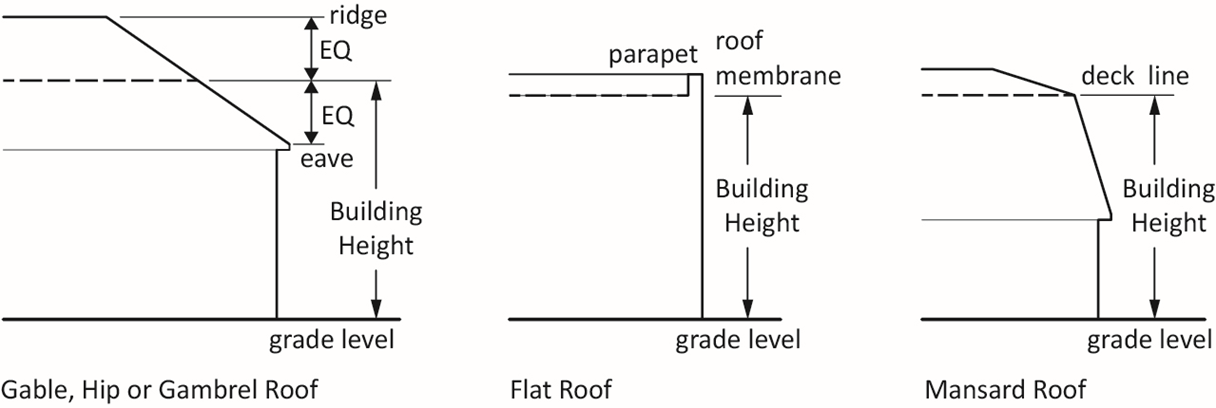
Figure 2-1. Building height.
2.02.31. Building code. The most recent building, residential construction and fire-related codes adopted by the city.
2.02.32. Building line. The outermost projection of the extreme overall dimensions of a building as staked on the ground, including all area covered by any horizontal projection or any vertical projection to the ground of overhang of walls, or of the roof or any other part of a structure which is nearest to the property line, excluding open steps, terraces, and patios. The front building line is that building line nearest the front lot line. In the case of premises with more than one building, the front building line is established by the building nearest the front lot line.
2.02.33. Building, principal. A building in which is conducted the principal use of the lot on which it is situated. In any residential district, any dwelling is deemed to be the principal building. In a commercial or business complex constructed upon a single tract of land, there may be more than one principal building.
2.02.34. Building separation or spacing. The minimum distance between buildings measured from the outermost projection.
2.02.35. Business or professional office. A place where the administrative affairs of a business or profession is conducted such as the office of a law firm, real estate agency, insurance agency, architect, secretarial services, the administrative staff of business or industry, and the like. The term includes call centers and medical, dental and similar healthcare offices for outpatient care on an appointment basis, including clinics with multiple practitioners.
2.02.36. Business support service. A place of business that provides support services primarily to other businesses, such as photocopy, computer, and office equipment, supplies and services.
2.02.37. Caliper. Diameter of a tree trunk measured in accordance with the American Standard for Nursery Stock.
2.02.38. Campground. Land on which two or more campsites are located, established or maintained for occupancy as temporary living quarters for recreation, education or vacation purposes only. See also "recreational vehicle park."
2.02.39. Caretaker dwelling. A dwelling unit, other than a manufactured home, used in combination with a nonresidential use, such as the family residence of a manager, business owner, or security guard, within the same building or on the same lot of a nonresidential use.
2.02.40. Carport. An accessory structure having a roof with one or more open sides and intended for the sheltering of motor vehicles.
2.02.41. Car wash. A commercial establishment, approved by the Alabama Department of Environmental Management and licensed by the city, engaged in washing or cleaning of automobiles and light vehicles, including automated, manual, and self-service washing.
2.02.42. CBD/vape shop. A business establishment for which more than ten percent of the gross sales is from the sale, use and storage of CBD/vape products, including electronic cigarettes, cannabinoid products and related accessories. Related accessories include any apparatus, equipment or instrument used for smoking and/or inhaling vapor from nicotine enriched solutions and/or the burning or vaporizing of controlled substances.
A.
Cannabinoid product. A product to be consumed or applied originating from the species cannabis sativa L, excluding marijuana, derived from industrial hemp, including products containing tetrahydrocannabinol (THC) in any concentration permitted by state law.
B.
E-cigarette. An electronic or battery-operated device, whether or not such device is shaped like a cigarette, that uses an atomizer, aerosol or similar device that allows users to inhale nicotine or flavored vapor, without fire, smoke or ash. An E-cigarette includes but is not limited to any electronic nicotine delivery system, electronic vaping device, personal vaporizer, electronic pipe, electronic hookah, or vapor pen.
C.
Vaping. The inhalation of vapor from any electronic oral device, such as one composed of a heating element, battery, or electronic circuit, which provides a vapor of nicotine or any other substances, and the use or inhalation of which simulates smoking.
2.02.43. Cellar. That portion of a building between floor and ceiling having more than one-half of its height below grade level. A cellar is not counted as a story for the purpose of height regulations.
2.02.44. Cemetery. Human burial grounds.
2.02.45. Chartered institution. Any state or federally chartered bank, savings association, credit union, industrial loan company or any retail seller engaged in the selling of consumer goods, such as consumables to retail buyers that cashes checks or issues money orders for a minimum flat fee as a service to its customers that is incidental to its main purpose or business.
2.02.46. City Code. The Code of Ordinances of the City of Pelham, Alabama, as amended.
2.02.47. Clinic. See "medical clinic."
2.02.48. Club, private. A building or portion thereof or premises owned or operated by a corporation, association, or persons for a social, educational, or recreational purpose, but not primarily for profit or to render a service which is customarily carried on as a business.
2.02.49. Commercial school. Private, gainful business providing instructional service in the arts, business, crafts, trades, and professions.
2.02.50. Commissary. A building where food is prepared for catering or mobile food vendor operations excluding on-site dining of food prepared.
2.02.51. Common open spaces and facilities. Open space, signage, landscaped areas, parking areas, drainage and stormwater facilities and similar site elements within or related to a development that are held in common ownership and maintained by a property owners association or other designated legal entity; subject to the applicable provisions of this ordinance. Any greenbelt, park, or recreational development or area which is.
2.02.52. Community recreation facilities. Common open spaces and recreational structures within a residential subdivision, condominium or multi-family development.
2.02.53. Comprehensive plan. The official public document prepared in accordance with Code of Ala. 1975, § 11-52-8, as amended, consisting of maps, charts, and textual material that constitutes a policy guide to decisions about the physical and social development of the city.
2.02.54. Conditional use. A use that, owing to potential danger, smoke, or noise or other special characteristics attendant to its operation or installation, may be permitted subject to special requirements different from or in addition to those normally required in the district. Conditional uses are not considered appropriate generally or without restriction throughout a particular district but which, if controlled as to number, area, location, size, lighting, noise and other considerations, would not be detrimental to the public health, safety or general welfare.
2.02.55. Condominium. One or more buildings in which units are owned individually, and the structure, common areas and facilities are owned by all of the owners on a proportional, undivided basis.
2.02.56. Construct. To build, erect, reconstruct, alteration, or move a structure upon or any physical operations on the premises required for the building, principal structure, sign or accessory use. This definition includes excavations, earthwork, fill, drainage work, utilities installations, and other work as it relates to the construction or use of a building, principal structure, sign or accessory use.
2.02.57. Construction service.
A.
Major construction service. A place of business engaged in construction activities, such as a building contractor, electrician, plumber, or similar trade, or wholesale building supplies, in which work yards and outdoor storage exceed, in area, that of the principal building.
B.
Minor construction service. A business engaged in construction-related trade activities with only incidental outdoor storage such as a building contractor, electrician, plumber or similar trade excluding any building supply sales.
2.02.58. Country club. Land and buildings containing recreational facilities and a club house for private club members and their guests.
2.02.59. Covenant. A written agreement between two or more parties for the performance of some action. When used in relation to property or real estate, it is generally an agreement executed between the buyer and seller of such real estate, and is enforced by private landowners, and not the municipality. This term also includes deed restrictions.
2.02.60. Crematorium. An enclosed facility wherein human or animal remains are cremated in a cremation retort.
2.02.61. Day care uses. The following types of day care uses, when providing care for five or more persons, are subject to additional requirements of the building code. Facilities that provide similar care after 7:00 p.m. are separately defined, see "nighttime home." Refer to section 7.12, Day care facilities, for detailed use regulations.
A.
Day care center. A facility, other than a residence, licensed by the Alabama Department of Human Resources, unless specifically exempt from such licensing, providing care on a regular basis to more than six children for only part of any 24-hour day.
B.
Family day care home. A service licensed by the Alabama Department of Human Resources, operated from a detached, single-family or duplex dwelling by the resident, providing care on a regular basis to six or less children for only part of any 24-hour day.
C.
Group day care home. A service licensed by the Alabama Department of Human Resources and operated from a detached, single-family dwelling by the resident, providing care on a regular basis to seven to 12 persons for only part of any 24-hour day.
2.02.62. Deck. An open platform built above grade level and attached to a building. In contrast to a porch, a deck is not covered by a permanent roof.
2.02.63. Density. The minimum required lot area per dwelling unit or the maximum number of dwelling units per acre of site area.
2.02.64. Development. The division of a parcel of land into two or more parcels; the construction, reconstruction, conversion, alteration, relocations, or enlargement of a structure; any mining, dredging, filling, grading, paving, excavation, drilling, or disturbance of land; and any use or extension of the use of the land.
2.02.65. District. A section of the city established by this ordinance for which the zoning regulations governing the use of buildings and premises, the height of buildings, the size of yards, and the intensity of use are distinct from other such sections.
2.02.66. Donation bin. A container, trailer, receptacle or similar device used to temporarily store items or charitable gifts that have been solicited from or donated by the public.
2.02.67. Donation center. A store operated by a nonprofit organization in which the items sold (or given away) have been obtained through donations or gifts and where the donor receives no monetary compensation upon the sale (or gift) of such merchandise to a customer, and where revenue received from selling same is retained by a nonprofit organization or institution.
2.02.68. Dormitory. A building or part thereof operated by an institution and containing one or more habitable units used or intended to be used by residents of the institution for living and sleeping, but not for cooking purposes.
2.02.69. Dripline. The area directly under the outer circumference of a tree branches.
2.02.70. Drive-in theatre. A theatre in which patrons view the performance while seated in a vehicle.
2.02.71. Driveway. A private access road, the use of which is limited to persons residing, employed, or otherwise using or visiting the parcel in which it is located.
2.02.72. Dwelling. Any building or portion thereof, which is designed or used exclusively for residential occupancy.
A.
Accessory dwelling. A subordinate, independent dwelling unit located on the same lot as a detached single-family dwelling. See section 7.03, Accessory dwellings.
B.
Caretaker dwelling. A dwelling unit, other than a manufactured home, that is incidental to a nonresidential use and is used as the residence of a caretaker, security guard or manager of the premises.
C.
Duplex. A detached building designed and arranged to provide separate sleeping, cooking, and kitchen accommodations and toilet facilities for occupancy by two families living independently of each other.
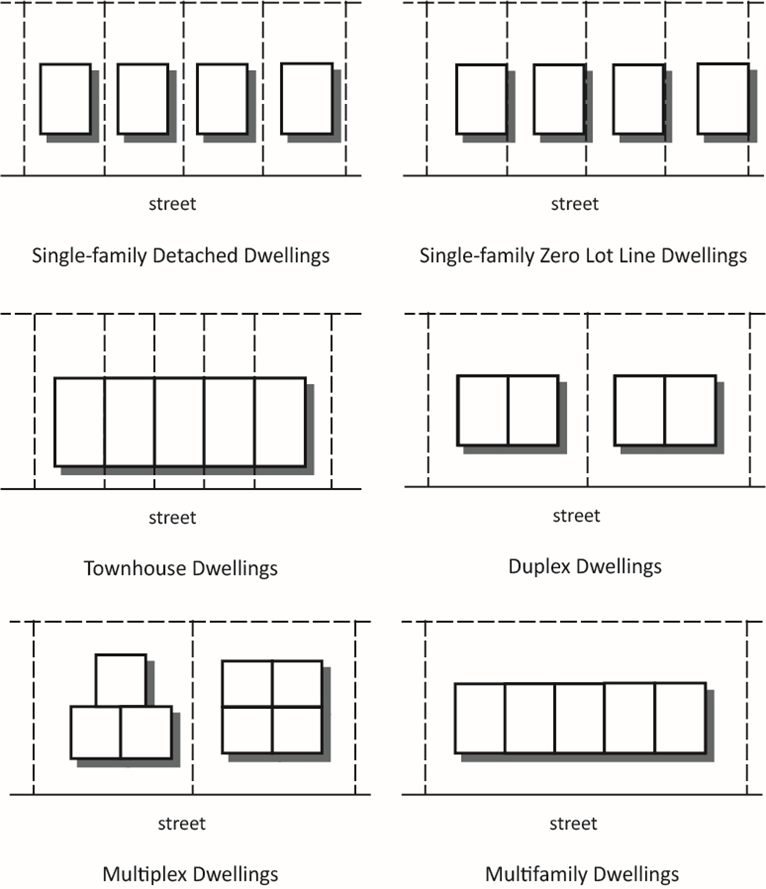
Figure 2-2. Dwelling types.
D.
Multi-family dwelling. A structure designed or used for residential occupancy by more than four families, with separate kitchen or dining facilities in each dwelling unit, but not including hotels, motels, hospitals, nor assisted living or nursing care facilities.
E.
Multiplex dwelling. A detached building designed and arranged to provide separate sleeping, cooking, and kitchen accommodations and toilet facilities for occupancy by three or four families living independently of each other.
F.
Single-family dwelling, attached. A single-family dwelling constructed in a series or group of attached dwelling units with property lines separating each unit.
G.
Single-family dwelling, detached. A detached building designed and arranged to provide sleeping, cooking, and kitchen accommodations and toilet facilities for occupancy by one family only.
H.
Single-family dwelling, zero lot line. A detached single-family dwelling located on a lot so that one of the dwelling's sides rests on a lot line.
I.
Upper-story dwelling. A dwelling located in the upper story of a building where the ground floor is devoted to nonresidential use.
2.02.73. Dwelling unit. One or more rooms located within a building and forming a single habitable unit with facilities, which are used or intended to be used for living, sleeping, cooking and eating purposes.
2.02.74. Earthwork. The breaking of ground, except common gardening and ground care.
2.02.75. Employee. In reference to parking requirements, the maximum number of persons employed at the facility regardless of the time period during which this occurs or whether the persons are full-time employees.
2.02.76. Engineer. A professional engineer registered and in good standing with the Alabama Board of Licensure for Professional Engineers and Land Surveyors.
2.02.77. Entertainment.
A.
Indoor entertainment. A commercial establishment providing spectator entertainment within an enclosed building, including movie theaters and playhouses; and art centers and similar indoor cultural facilities.
B.
Outdoor entertainment. A commercial establishment providing spectator entertainment in open or partially enclosed or screened facilities, including sports arenas, racing facilities, and amusement parks.
2.02.78. Extended stay facility. See "lodging uses."
2.02.79. Façade. Any building elevation containing the primary public entrance to the building or that faces an abutting street.
A.
Primary Façade. A building elevation containing the primary public entrance to the building.
B.
Street Façade. A building elevation that faces or is most parallel and nearest to the abutting street.
2.02.80. Family. One or more persons occupying a dwelling and living as a single housekeeping unit, all but two of whom are related to each other by birth, adoption or marriage, as distinguished from a group occupying a boarding house, dormitory or lodging establishment. However, notwithstanding the preceding, a family is also deemed to include up to three unrelated persons occupying a dwelling unit and living as a single, nonprofit housekeeping unit, if any one or more of said three unrelated occupants is handicapped as defined in Title VIII of the Civil Rights Act of 1968 as amended by the "Fair Housing Act Amendments of 1988" and the "Alabama Fair Housing Law," Code of Ala. 1975, § 24-8-1, et seq. Such unrelated individuals have the right to occupy a dwelling unit in the same manner and to the same extent as any family unit as first defined herein. (Amended per the approval of the U.S. District Court in the consent settlement of CV93-PT-1409-S.)
2.02.81. Farm. A tract of land used for the production, keeping or maintenance of plants and animals, including the following farming activities: forages and sod crops; grains and seed crops; dairy animals and products; poultry, including egg production but excluding poultry processing; livestock, such as beef cattle, sheep, or goats, including the breeding and grazing of such animals but excluding meat processing; and nursery operations involving the raising of plants, shrubs, and trees for sale and transplantation and including greenhouses and incidental sales of items customarily associated with a nursery operation; bees and apiary products; fisheries, excluding fish and seafood processing; fruits and vegetables of all kinds, including growing and harvesting of such fruits and vegetables, but excluding food processing.
2.02.82. Farmers market. Retail sales of produce and similar farm products from a premises containing a permanent building, but which includes outdoor display of items for sale. Does not include "seasonal businesses."
2.02.83. Farm support business. A commercial establishment engaged in the sale of farm support goods and services, including the following activities: the sale of feed, grains, fertilizers, pesticides, and similar farm support goods, the provision of warehousing and storage facilities for raw farm products, and the provision of veterinary services to large animals.
2.02.84. Fence. An upright structure without a roof that is intended as a barrier or enclosure.
2.02.85. Fenestration. Windows, glass curtain wall and doors on a building façade.
2.02.86. Filling. The depositing and compaction of soil or other materials by following the proper engineering standards to alter the elevation of a given site.
2.02.87. Floor area, gross (GFA). The total floor area of a building designed for both tenant occupancy and exclusive use. GFA does not include shared or common areas in multi-tenant buildings. Where a building has no shared or common area, GFA is measured using the outside dimensions of the building at each floor level, including penthouses and basements. Cellars are not included in calculating gross floor area.
2.02.88. Forestry. Operations involving the operation of timber tracts, tree farms, forest nurseries, the gathering of forest products, or performing forest services, including temporary sawmills and chippers for cutting of timber growth on the same premises but excluding lumber yards, mills, and similar activities.
2.02.89. Foundation survey. A survey prepared and certified as to its accuracy by a surveyor who is licensed by, and registered with, the State of Alabama as a surveyor, clearly showing the location of the foundation for the building or other structure, decks, porches, or any other appurtenance to the structure to be constructed on the site; the distance between such foundation and the boundary lines and rights-of- way of such lot or parcel; and all easements and building setbacks on said parcel.
2.02.90. Fowl. Domestic birds, kept on a farm for use and profit. These include chickens, turkeys, ducks, geese, quail, guineas, ostriches, etc.
2.02.91. Front or front on. To have the principal building's primary façade oriented toward and to derive access from a particular street.
2.02.92. Funeral home. A commercial establishment engaged in funeral and undertaking services for human burial, or placement in a mausoleum, excluding crematoriums.
2.02.93. Garden center. A place of business where garden-related products and produce are sold to the retail consumer. These centers, which may include a nursery and/or commercial greenhouse, bring in most items offered for sale from other locations. These items may include plants, nursery products and stock, fertilizers, potting soil, hardware, power equipment and machinery, hoes, rakes, shovels, and other garden and farm tools and utensils.
2.02.94. Gasoline station. Any structure or land used for the dispensing, sale or offering for sale at retail of any automobile fuels, or oils, but not including vehicle repair services.
2.02.95. Gold or silver business. Includes, but is not limited to, the activity of any person who by the use of radio, television, newspaper, pamphlet, sign, or other method of communication offers to buy gold, silver, or gold or silver objects.
A.
Gold or silver object. Any object that contains gold or silver in any amount whatsoever.
B.
Gold or silver object dealer. Any person engaged in the business of buying or selling tangible objects in gold or silver, or other precious metals of any kind or description, from members of the general public, including buyers of second-hand jewelry and gems, but excluding coin dealers and antique stores.
2.02.96. Grade level. The average level of the finished ground surface adjacent to the exterior walls of a structure or base of a sign.
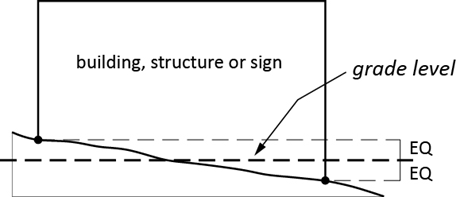
Figure 2-3. Grade level.
2.02.97. Grading. The preparation of a site for development, usually by leveling off to a smooth horizontal or sloping surface.
2.02.98. Greenway. A linear open space provided along a stream or similar natural feature for recreational use or environmental conservation purposes.
2.02.99. Gross floor area. See "floor area, gross."
2.02.100. Gross site area. The total land area to be classified as a planned unit development.
2.02.101. Group homes. Detached single-family dwellings in which up to ten persons live together as a single housekeeping unit under the supervision of one or more resident managers or caregivers, all in accordance with any applicable licensing requirements of the State of Alabama or other government agency:
A.
Class I group home. A group home operated by a nonprofit organization or government agency for persons with mental or physical disabilities. (Code of Ala. 1975, § 11-52-75.1, regulations as to housing of mentally retarded or mentally ill persons in multi-family zones, as amended.) Tenure in class I group homes is considered long-term, with residents living in such homes for more than 180 days.
B.
Class II group home. A group home operated by a nonprofit organization or government agency for elderly persons or military veterans. Class II group homes do not include group homes otherwise defined herein as class I, class III or class IV group homes. Tenure of persons in class II group homes is considered long-term, with residents living in such homes for more than 180 days.
C.
Class III group home. A group home operated by a nonprofit organization to provide housing and supportive services to victims of domestic abuse. Tenure of persons in class III group homes is considered short-term, with residents living in such homes for 180 days or less.
D.
Class IV group home. A group home operated by a nonprofit organization or government agency to provide housing and supportive services to homeless persons or persons transitioning from substance abuse treatment or incarceration back into the community. Tenure of persons in class IV group homes is considered short-term, with residents living in such homes for 180 days or less.
2.02.102. Hardship. A condition not in control of or created by the owner or applicant such as, but not limited to, topography, lot shape or size, location of public utilities or similar conditions deemed a hardship by the board of adjustment.
2.02.103. Hardship, self-imposed. A condition for which a variance is sought and that is caused or brought about by the owner or applicant, whether by their own action, inaction, knowledge or lack of knowledge. Self-imposed hardships are not considered a sufficient basis for variance approval.
2.02.104. Hazardous uses. All uses which involve the storage, sale, manufacture, processing or handling of materials which are easily ignited and likely to burn with moderate rapidity or cause smoke, including materials or chemicals which are highly flammable, explosive, noxious, toxic, or are otherwise inherently dangerous to humans, animals, land, crops, or property.
2.02.105. Home improvement center. A place of business providing building, appliance, yard and garden materials, tools, and supplies at retail and wholesale.
2.02.106. Homeless services facility. A facility, other than a homeless shelter, that provides services targeted to persons experiencing homelessness, such as meals, counseling, education and practical assistance but not housing or overnight lodging.
2.02.107. Homeless shelter. A building providing temporary housing for homeless people, which may also include the serving of meals and other forms of support.
2.02.108. Home occupation. A business, profession, occupation, or trade conducted for gain or support, and located entirely within the living area of a dwelling as an incidental activity of the residents of that dwelling. See section 7.18, Home occupations.
2.02.109. Hospital. A public or proprietary institution providing medical diagnosis, treatment, or other care of human ailments, operating under license by the Alabama State Health Department, and which, unless otherwise specified, may include institutions primarily for treatment of contagious diseases and the insane but not including nursing care facilities. Hospitals may include accessory facilities such as laboratories, pharmacies, outpatient clinics, surgery centers, training facilities, gift shops, coffee shops, cafeterias, and staff offices.
2.02.110. Hotel. See "lodging uses."
2.02.111. HUD Code. The National Manufactured Housing Construction and Safety Standards Act of 1974 and as amended by the Manufactured Housing Improvement Act of 2000, Title VI 42 U.S. Code, Section 603(6).
2.02.112. Independent living facility. A residential facility for the elderly that may provide meals, housekeeping, linen service, transportation, social and recreational activities and similar services. Such facilities do not provide, in a majority of the units, assistance with or supervision of medication, bathing, dressing, toileting and other activities of daily living.
2.02.113. Industrial park. Land 25 acres or more in size, subdivided and platted into two or more parcels, and used or intended to be used for predominantly industrial or commercial purposes of an industrial character.
2.02.114. Industrial uses.
A.
Heavy industry. An establishment engaged in the mechanical, physical, or chemical transformation of materials, substances, or components into new products that is likely to generate levels of truck traffic, noise, pollution, vibration, dust, fumes, odors, radiation, poisons, pesticides, or other hazardous materials, fire or explosion hazards, or other undesirable conditions that would be injurious to health or offensive to the senses, or would be an obstruction to the free use of surrounding property and essentially interfere with the comfortable enjoyment of life and property. Heavy manufacturing facilities use larger quantities of raw materials and may require significant outdoor storage. Examples include concrete manufacture, asphalt batch plants, mass production of commercial or recreational vehicles or large machinery, production of industrial organic and inorganic chemicals, animal slaughtering, and refining, extruding, rolling, or drawing of ferrous or non-ferrous metals.
B.
Light industry. An establishment engaged in the assembly or packaging of articles from previously prepared materials, excluding uses otherwise defined as heavy industry.
2.02.115. Inoperative motor vehicle. A motor vehicle which cannot be driven upon the public streets for reasons including, but not limited to, being unlicensed, wrecked, abandoned, in a state of disrepair or incapable of being moved under its own power.
2.02.116. Institution or institutional use. Structures or land occupied by a group, cooperative, board, agency or organization created for the purpose of carrying on nonprofit functions of a public or semipublic nature, including but not limited to hospitals, schools, places of worship, fraternal orders and orphanages, and also including residential accessory uses, such as rectories, parsonages, dormitories and caretaker dwellings. Institutional uses are further categorized as shown in the table following. Stadiums, arenas, institutions with on-premises housing and institutional facilities involving outdoor storage, work yards, or warehousing are considered major institutions.
2.02.117. Junkyard. Any land used for the collection, storage, and sale of wastepaper, furniture, household appliances, scrap metal or other discarded material; or for the collecting, dismantling, storage, or salvaging of machinery or vehicles not in running condition, or for the sale of parts thereof. This does not include a recycling center or recycling plant.
2.02.118. Jurisdiction. The corporate limits of the political subdivision known as the City of Pelham.
2.02.119. Kennel. Any facility, other than a farm or pet grooming establishment, in or at which domestic animals are brought or kept for breeding, training, buying or selling and for which care, breeding, training services are charged a fee. In addition to these services, kennels may also offer boarding and grooming.
A.
Enclosed kennel. A kennel in which all boarding, grooming, training and other kennel services occur within one or more fully enclosed structures.
B.
Unenclosed kennel. A kennel in which all or a portion of boarding, grooming, training and other kennel services occur outside of a fully enclosed structure.
2.02.120. Landfill. A facility, approved by the Alabama Department of Environmental Management, for the controlled disposal of waste.
2.02.121. Landscaping. The finishing and adornment of unpaved yard areas. Materials and treatments generally include naturally growing elements such as grass, trees, shrubs, and flowers, and may include the use of landscape timbers, rocks, fountains, water features, or contouring of the earth.
A.
Frontage landscaping. Treatment of grade, ground cover, vegetation and ornamentation between any off-street parking area and adjoining rights-of-way. See figure 10-1.
B.
Interior landscaping. Treatment of grade, ground cover, vegetation and ornamentation within an off-street parking area. See figure 10-1.
C.
Perimeter landscaping. Treatment of grade, ground cover, vegetation and ornamentation between an off-street parking area and adjoining properties. See figure 10-1.
2.02.122. Landscape architect. A landscape architect registered by the State of Alabama.
2.02.123. Laundering plant. An establishment primarily engaged in high volume laundry and garment services, including commercial and industrial laundries; garment pressing and dry cleaning; linen supply; diaper service; carpet and upholstery cleaners, but excluding laundry services.
2.02.124. Liquor store. A business in which liquor and other alcoholic beverages are sold for off-premises consumption only.
2.02.125. Livestock. Cows, horses, goats, sheep, swine and other domestic animals kept on a farm for use and profit.
2.02.126. Livestock sales. The sale of livestock within an enclosed yard or structure, including livestock markets, horse auctions, and similar activities.
2.02.127. Live-work. A building designed and used for a commercial activity and one dwelling. The commercial function may be anywhere in the unit. The dwelling is often occupied by the business operator.
2.02.128. Loading space. A space having the minimum dimensions specified in section 9.06, loading area requirements, either within the principal building or on the same lot and not extending into the road right-of-way, providing for the standing, loading or unloading of trucks.
2.02.129. Lodging uses. For the following uses, "short-term lodging" is considered stays of no more than 30 consecutive days; and "long-term lodging" is considered stays of no more than 180 consecutive days. Stays of more than 180 consecutive days are considered residential occupancy.
A.
Bed and breakfast. A detached, single-family dwelling or portion thereof where short-term lodging is offered for a fee to transient guests all in accordance with section 7.06, Bed and breakfasts.
B.
Extended stay facility. Any building or portion thereof that is specifically constructed, used, maintained, advertised, and held out to the public to be a place where long-term lodging is offered for a fee to non-transient guests, regardless of whether short-term lodging is also offered on the premises.
C.
Hotel. A building in which short-term lodging is offered to transient guests for a fee and in which access to and from all guest rooms is made through an inside lobby or office supervised by a person in charge at all hours. Hotels may include restaurants, meeting rooms, banquet rooms and gift shops, and may offer incidental services and amenities for hotel guests including but not limited to recreational, fitness and laundry facilities.
D.
Motel. A business in which short-term lodging is offered to transient guests for a fee, and in which lodging rooms are accessed directly from the building exterior. Motels may also offer dining, recreation, fitness, laundry and other incidental services to hotel guests.
E.
Short-term rental. The use of a dwelling unit or portion thereof for short-term lodging purposes not otherwise considered a bed and breakfast. See also section 7.32, Short-term rentals.
2.02.130. Lot. A parcel of land intended for transfer of ownership or for building development, which is comprised of land area or a combination of contiguous land area and water surface area.
A.
Corner lot. A lot abutting two or more streets at their intersections. Refer to figure 2-4.
1.
Double-frontage corner lot. A corner lot abutted on each side by an interior lot.
2.
Single-frontage corner lot. A corner lot abutted on one side by a corner lot and on the other side by an interior lot.
B.
Interior lot. A lot with frontage on only one street.
C.
Reverse frontage lot. A through lot abutting streets of different classifications and that is designed so that the development faces toward and is accessed from the street of lesser classification.
D.
Through lot. A lot, other than a corner lot, abutting two streets.
2.02.131. Lot depth. The mean horizontal distance between the front and rear lot lines.
2.02.132. Lot line. Each line bounding a lot which divides it from another lot, street or any public or private place. Refer to the following diagrams and the diagrams under "yard."
A.
Front lot line. The lot line separating a lot from a street right-of-way. Single-frontage corner lots have primary and secondary front lot lines. The primary front lot line is the lot line most opposite the rear lot line. The secondary front lot line is the lot line along the side street and is typically longer than the primary front lot line. Refer to figure 2-4.
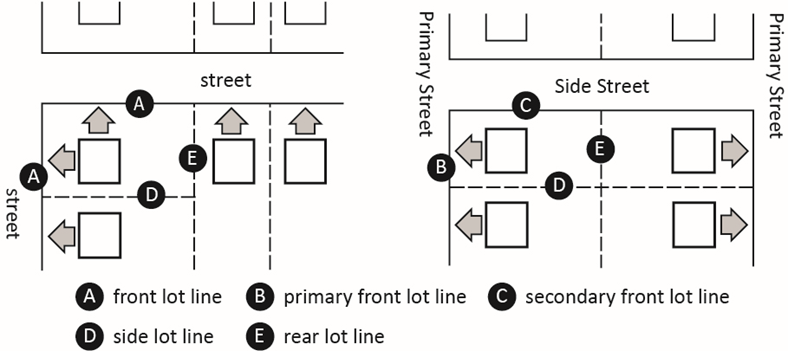
Figure 2-4. Lot lines of corner lots.
B.
Rear lot line. The lot line that is generally parallel to and most distant from the primary front lot line on a single-frontage corner lot. In case of a lot having a rear lot line less than ten feet long, for the purposes of measuring setbacks, the rear lot line is considered to be a line at least ten feet in length, parallel to and at the maximum distance from the front lot line.
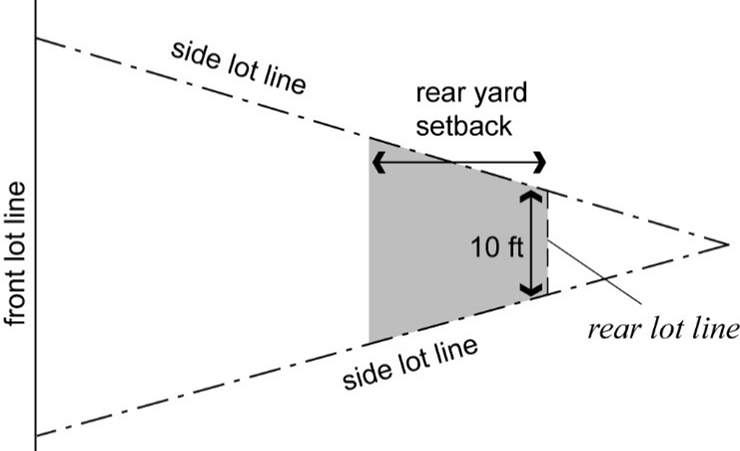
Figure 2-5. Rear lot line of a triangular lot.
C.
Side lot line. Any lot line other than front lot line or rear lot line.
2.02.133. Lot of record. A lot which is part of a subdivision, the plat of which has been recorded in the office of the judge of probate of Shelby County, Alabama, or a parcel of land described by metes and bounds, the plat of description of which has been recorded in said office. If a portion of a lot or parcel has been conveyed at the time of the adoption of this ordinance, the remaining portion of said lot or parcel is considered a lot of record.
2.02.134. Lot width. The width of the lot at the front yard setback.
2.02.135. Lounge. Any place or premises engaged in the preparation, sale or serving of liquor for consumption on the premises. This includes, but is not limited to: taverns, bars, cocktail lounges, nightclubs, discotheques, dance halls, and similar uses where the sales of liquor and other alcoholic beverages for on-premises consumption is a primary business activity. Not included in this definition are establishments such as restaurants which sell alcohol as an incidental activity on the premises, with said activity being less than 40 percent of the gross sales; and establishments which sell alcohol for off-premises consumption only.
2.02.136. Maintenance service. An establishment providing building and yard maintenance services, such as janitorial services, exterminating services, landscape services, and window cleaning services.
2.02.137. Manufactured building. A factory-built structure other than a modular structure; transportable in one or more sections; designed for storage or other purposes other than a dwelling.
2.02.138. Manufactured home. A residential structure constructed in accordance with the National Manufactured Housing Construction and Safety Standards Act of 1974 and as amended by the Manufactured Housing Improvement Act of 2000, Title VI, 42 U.S. Code, Section 603(6). "Manufactured home" further means a structure that is transportable in one or more sections, is eight body feet or more in width and 40 body feet or more in length, and which is built on a permanent chassis and designed for use as a dwelling, with or without a permanent foundation, when connected to required utilities, plumbing, heating, air conditioning and electrical systems. A manufactured home bears a HUD seal affixed to the home. A travel trailer is not considered a manufactured home.
2.02.139. Manufactured home park. An area containing one or more manufactured homes used as living facilities, or an area containing one or more spaces designed or intended for parking of manufactured homes to be used as living facilities.
2.02.140. Manufactured home space. That portion of a manufactured home park reserved and improved for the placement of a manufactured home and for the use of the occupants of said dwelling.
2.02.141. Manufacturing.
A.
Heavy manufacturing. All other types of manufacturing not included in the definitions of light manufacturing. Any uses, which are detrimental to property or to the health and safety beyond the zoning district, by reason or the emission of odor, dust, gas, fumes, smoke, noise, vibration or waste material are prohibited.
B.
Light manufacturing. The manufacture, predominantly from previously prepared materials, of finished products or parts, including processing, fabrication, assembly, treatment, packaging or testing of such products or equipment, including the incidental storage, sale, and distribution of such products, including research activities. Said uses pose no danger to health or safety in surrounding area, and do not create any objectionable noise, vibrations, smoke, dust, odor, heat, glare, or pollutants.
2.02.142. Masonry. Brick, stone, terra cotta, split face concrete block, concrete tilt wall, cement fiber board or a combination of these. Stucco and plaster are only considered a masonry material when applied using a three-step process over diamond metal lath mesh to a seven-eighth-inch thickness or by other processes producing comparable cement stucco finish with equal or greater strength and durability specifications.
2.02.143. Medical clinic. A facility providing medical, psychiatric, or surgical services for sick or injured persons with or without appointments and exclusively on an outpatient basis.
2.02.144. Mini-warehouses. One or more buildings containing separate storage spaces that are leased on an individual basis for the exclusive purpose of storing non-hazardous household goods, but not including the storage of materials for a commercial or industrial enterprise other than business records, nor used for any activity other than storage.
2.02.145. Mixed-use building. A building containing both residential and nonresidential uses.
2.02.146. Modular home. A residential structure that is composed of components substantially assembled in a manufacturing plant, transported to a building site for final assembly on a permanent foundation, and complying with the requirements of the Building Code upon completion of final assembly.
2.02.147. Motel. See "lodging uses."
2.02.148. Motor vehicle. Every vehicle which is self-propelled, but not operated upon rails.
A.
New motor vehicle. Any motor vehicle, other than a used motor vehicle, the legal title of which has never been transferred by a manufacturer, distributor, or new motor vehicle dealer to a purchaser and to which license plates have not been issued and which motor vehicle has not been registered for use on the highways by a consumer or by a dealer, and includes any motor vehicle required to be titled, trailer coaches, and trailers.
B.
Used motor vehicle. Any used or secondhand motor vehicle, the title of which has been transferred by a manufacturer, distributor, or new motor vehicle dealer to a purchaser and to which a certificate of title and license plates have been issued and which motor vehicle has been registered for use on the highways by a consumer or by a dealer, and includes any used or secondhand motor vehicle required to be titled.
2.02.149. Movie theater. A building used primarily for the presentation of motion pictures.
2.02.150. Nighttime home. A detached single-family dwelling licensed by the Alabama Department of Human Resources for the care of six or fewer persons after 7:00 p.m. and for only a portion of a 24-hour day.
2.02.151. Nonconforming lot of record. Any lot, validly recorded in the office of the judge of probate, Shelby County, Alabama, which complied with all applicable laws, ordinances, and regulations in effect on the recording date, but which does not comply with the dimensional requirements of the applicable district. See also article XI, Nonconformities.
2.02.152. Nonconforming structure. Any structure, other than a sign, legally established prior to the effective date of this ordinance or subsequent amendment thereto, but which does not fully comply with the yard, height or other dimensional regulations of the applicable district or other applicable provisions of this ordinance. See also article XI, Nonconformities.
2.02.153. Nonconforming use. The use of any structure or land which was lawful at the time of passage of this ordinance, or amendment thereto, but which use does not conform, after the passage of this ordinance or amendment thereto, with the use regulations of this ordinance. See also article XI, Nonconformities.
2.02.154. Nonresidential use. Uses including agricultural, institutional, commercial, lodging and industrial activities.
2.02.155. Nursery. An enterprise which conducts the retail and wholesale sale of plants grown on the site, as well as accessory items directly related to their care and maintenance. The accessory items normally sold are clay pots, potting soil, fertilizers, insecticides, hanging baskets, rakes and shovels.
2.02.156. Nursing care facility. An institution licensed by the State of Alabama maintained for the purpose of providing skilled nursing care and medical supervision at a lower level than that provided in a hospital, but at a higher level than provided in an assisted living facility.
2.02.157. Occupancy load. The maximum number of persons that may be accommodated by the use as determined by its design or by fire code standards.
2.02.158. Office. Space or rooms within a building for professional, administrative, clerical and similar uses.
2.02.159. Open space. A yard or other area of land not used for a structure, driveway, parking, loading or storage.
2.02.160. Open space, common. See "common open space and facilities."
2.02.161. Outdoor storage. The keeping in an unenclosed or fenced area, of any goods, materials, products, or merchandise. This does not include retail displays, vehicle and equipment sales and rental businesses, nor the keeping of construction materials and equipment in association with a valid building permit.
2.02.162. Owner. The person having the right and legal title to, beneficial interest in a lot or parcel of land.
2.02.163. Park. A public or private area of land, with or without buildings, intended for active or passive recreational uses.
2.02.164. Park and ride facilities. Parking lots or structures located along public transit routes designed to encourage transfer from private automobile to mass transit or to encourage carpooling for purposes of commuting, or for access to recreation areas.
2.02.165. Parking aisle. That portion of the parking area consisting of lanes providing access to parking spaces.
2.02.166. Parking area. An open, unoccupied space used or intended to be used for parking of vehicles, with or without charge, and in which no other business is conducted. See also article IX, Parking and Loading.
2.02.167. Parking, freestanding. A parking lot or structure providing parking for uses not located on the same premises.
2.02.168. Parking space, off-street. An accessible space, which is permanently reserved for the temporary storage of one vehicle, connected with a street by a driveway or alley and having a minimum area of 180 squre feet, a minimum width of nine feet, and a minimum length of 20 feet, exclusive of driveways, maneuvering areas, and parking structures. See also article IX, Parking and Loading.
2.02.169. Parking structure. A structure, or part thereof, used or intended to be used for the parking and storage of motor vehicles.
2.02.170. Personal service. A commercial use that provides services involving the care of a person or their personal goods or attire, including but not limited to spas; licensed massage therapists; barber shops; hair, nail and tanning salons; tailors; seamstresses; dry cleaning pick-up stations; formal wear rental; florists; and repair of keys, shoes, watches, phones and tablets.
2.02.171. Pet services, enclosed. An establishment other than a kennel that provides medical or surgical treatment, boarding, grooming or similar services for household pets all within a fully enclosed building and not including any outdoor areas for such animals.
2.02.172. Pet services, unenclosed. An establishment other than a kennel that provides medical or surgical treatment, boarding, grooming or similar services for household pets and which includes outdoor areas for animals. See also section 7.28, Pet services and kennels.
2.02.173. Place of worship. Buildings arranged for religious service purposes, including related facilities for instruction, meeting, recreation, and lodging, eating, and living such as a parsonage or rectory, and other integrally related activities.
2.02.174. Planned unit development. A development project planned as a single entity and carried out in accordance with a master plan under the regulations of the PUD district.
2.02.175. Planning commission or commission. The planning commission of the City of Pelham, Alabama.
2.02.176. Plot plan. A plat of a lot, drawn to scale and certified as to its accuracy by a surveyor who is licensed by, and registered with, the State of Alabama as a surveyor, showing the actual measurements, the size and location of any existing buildings or structures, or proposed buildings or structures, along with any easements and building setbacks, and the location of the lot in relation to abutting streets or rights-of-way, and similar information. The proposed structures are staked out by said registered land surveyor or an employee under his direct supervision.
2.02.177. Porch. A roofed open area, which may be screened, attached to and with direct access to or from a building.
2.02.178. Portable building. A prefabricated structure assembled off-site and delivered to the site as a complete unit or a building assembled on-site, which can be moved to another location without disassembly. Portable buildings are designed and constructed in accordance with the standards for relocatable modular buildings in the Building Code. Does not include manufactured homes.
2.02.179. Premises. One or more lots designed and improved in a unified manner to function together, including all associated structures, parking areas and other improvements thereon.
2.02.180. Principal building. See "building, principal."
2.02.181. Principal color. Any color that is applied to 50 percent or more of the façade, exclusive of signs and fenestration. A brick or other masonry color blend, including mortar joints, is considered one color. Uniformly stained, wood siding with natural variations in color are considered as one color.
2.02.182. Principal material. Any exterior cladding material of the same horizontal, vertical or other orientation that is applied to 50 percent or more of the façade, exclusive of signs and fenestration.
2.02.183. Principal use. The primary operation, business or other use of a property.
2.02.184. Property line. See "lot line."
2.02.185. Public assembly center. Buildings arranged for the general assembly of the public at large for community events including civic centers, places of worship, schools, coliseums, stadiums, and similar uses.
2.02.186. Public facilities. Land or buildings occupied by a federal, state or local government agency to provide public services, including parks, schools, museums, offices, post offices, transit stations, police stations, fire stations, emergency medical service stations, civil defense operations, and similar uses.
2.02.187. Public utility facilities.
A.
Major public utility facility. Electric or gas generating plants, sewage treatment ponds and plants and water treatment facilities.
B.
Minor public utility facility. Facilities that provides utility services to the public at large, including water, sewer, gas distribution facilities, electric transmission and distribution, and cable transmission and distribution facilities not otherwise defined as major public utility facility.
2.02.188. Recreation or recreational use.
A.
Indoor recreation. A commercial establishment providing recreational or sports activities to participants within an enclosed building, including bowling alleys, billiard parlors, video game centers, ice- and roller-skating rinks, and other commercial indoor recreational and sports activities.
B.
Outdoor recreation. A commercial establishment providing recreation or sports activities to participants in open or partially enclosed or screened facilities, including driving ranges, miniature golf courses, golf courses, swimming pools, tennis courts, and other commercial outdoor recreational and sports activities.
2.02.189. Recreational vehicle. A self-propelled vehicle or a unit that is mounted on or drawn by another vehicle primarily designed for temporary living. Recreational vehicles include travel trailers, camping trailers, truck campers, and motor homes.
2.02.190. Recreational vehicle park. A lot on which campsites are established for occupancy by recreational vehicles of the general public as temporary living quarters for purposes of recreation or vacation only.
2.02.191. Recycling center. A premises, other than a junkyard, where recyclable materials are collected and may be separated, packed, bailed, stored and compacted before being transported to another location for processing and eventual reuse.
2.02.192. Recycling facility. A facility, other than a junkyard, in which recoverable resources, such as newspapers, magazines, books, and other paper products; glass; plastics; metal cans; and other products, are recycled, reprocessed, and treated to return such products to a condition in which they may again be used for production.
2.02.193. Rehabilitation facility. An institutional facility providing residential and custodial care for the rehabilitation of physically or socially impaired individuals who are recovering from an accident, medical disability or surgery. This does not include "in-patient substance abuse or psychiatric facilities," which are defined separately.
2.02.194. Rental establishment. A commercial establishment, where no outside storage is allowed, engaged in the rental of a wide variety of goods, including but not limited to furnishings, appliances, audio/video equipment, meeting supplies, wedding supplies, party supplies, and tools.
2.02.195. Repair service. An establishment engaged in the repair and maintenance of electrical, electronic and mechanical equipment, and home and business appliances not otherwise defined as personal service.
2.02.196. Research lab. An establishment engaged in research of an industrial or scientific nature, excluding product testing, such as an electronics research laboratory, research and development firm, or pharmaceutical research laboratory.
2.02.197. Residential property. Property used exclusively for residential purposes in a residential, mixed-use or planned unit development district. Vacant land in a residential district is considered "residential property."
2.02.198. Restaurant.
A.
Fast food restaurant. An establishment where food is prepared for delivery to patrons in their vehicles. Fast food restaurants may also offer walk-up window service and seating for patrons to consume food on-premises.
B.
Standard restaurant. An establishment where food is cooked or prepared, patrons dine on or off the premises, and where there is no drive-up or walk-up window service.
C.
Take-out only restaurant. An establishment other than a commissary where food and drink are prepared in a permanent building for consumption off-premises only.
2.02.199. Retail establishment. The sale of goods and merchandise for a profit to the general public at large for use, benefit, or consumption, which may include incidental services related to the goods and merchandise offered only.
A.
General retail, enclosed. Retail sales of goods, not otherwise defined by this section, conducted within a permanent building, including, but not limited to, food sales, department stores, clothing stores, home furnishings sales, appliance stores, auto supplies stores, gift shops, specialty stores, jewelry stores, cosmetics sales, drug stores, variety stores, and similar retail businesses. Enclosed general retail businesses may offer products for rent and may include incidental outdoor sales or display areas.
B.
General retail, unenclosed. Retail sales of goods, not otherwise defined in this article, in which outdoor display areas are the primary use of the premises, including, but not limited to monument sales and flea markets. This does not include garden centers, farmers markets, vehicle and equipment sales, which are separately defined.
2.02.200. Satellite dish antenna. An accessory structure designed to receive television broadcasts relayed by microwave signals from earth-orbiting communications satellites.
2.02.201. School. A public or nonprofit facility providing secondary education services.
2.02.202. School, commercial. Private, gainful business providing instructional service in general education, arts, business, crafts, trades, and professions.
2.02.203. School, industrial. Private, gainful business providing instruction in industrial trades, or in the service and operation of heavy equipment or heavy trucks, or any similar school requiring outside storage.
2.02.204. Screen. To visually shield or obscure one abutting or nearby structure or use from another by means of opaque fencing, walls, berms, or densely-planted vegetation.
2.02.205. Seasonal business. A business which is operated, due to its nature, less than one continuous 60-day period during any 12-month period, including: fruit or vegetable stands, Christmas tree sales, and income tax preparation.
2.02.206. Setback. The required minimum distance between a structure and the front, side, or rear lot line.
2.02.207. Shopping center. A group of commercial establishments located on a tract of land, planned and developed in a unified manner and design, with shared parking and driveway facilities and under a common ownership or management authority. A shopping center may also include out parcels under separate ownership which share entrances and/or parking with the shopping center.
2.02.208. Short-term rental. See "lodging uses."
2.02.209. Shrub. A woody plant, either evergreen or deciduous, less than ten feet in height at maturity.
2.02.210. Sign. All sign-related terminology is defined in article VIII, Signs.
2.02.211. Site plan. A plan which outlines the use and development of any tract of land, and is signed, stamped, and dated by a professional engineer.
2.02.212. Special exception use. A use which is permitted in a particular zoning district only upon approval by the board of adjustment, and subject to any conditions set by the board. Special exceptions may not be appropriate generally or without restriction, but if controlled as to number, area, character, location or relation to the neighborhood, would not harm the general public health, safety or welfare.
2.02.213. Stable. A commercial establishment engaged in the raising, keeping, boarding, or training of horses, ponies, and similar animals, including riding academies and incidental sales of riding accessories and animals raised or regularly kept on the premises.
2.02.214. Stacking space. An off-street space for the temporary stacking of vehicles with an aisle intended to serve a drive-in teller, take-out food window, dry cleaning/laundry pick-up and similar functions.
2.02.215. Story. That portion of a building other than a cellar, included between the surface of any floor and the surface of the floor next above it, or, if there is no floor above it, then the space between the floor and the ceiling next above it.
2.02.216. Story, half. A space under a sloping roof which has the line of intersection of roof decking and wall face not more than three feet above the top floor level, and in which space not more than two-thirds of the floor area is finished off for use. A half-story containing dwelling units independent from those on another floor is counted as a full story.
2.02.217. Street screen. A freestanding wall, hedge or a combination of these, installed along the lot line, or coplanar with a façade for the purpose of concealing parking, loading, or refuse areas.
2.02.218. Street frontage. All the property on one side of a street between two streets which intersects such street (crossing or termination), measured along the line of the street, or if the street is dead-ended, then all of the property abutting on one side between a street which intersects such street and the dead end of the street. The width of a lot measured along its front lot line.
2.02.219. Structural alteration. Any change in the supporting members of a building or structure, such as bearing walls, columns, beams or girders. The application of any exterior siding to an existing building for the purpose of beautifying and modernizing is not considered a structural alteration.
2.02.220. Structure. Anything constructed or erected, the use of which requires a location on the ground or attachment to something having a location on the ground, including but not limited to buildings, signs, backstops for recreational courts and fields, fences and radio towers.
2.02.221. Subordinate color. Any exterior color, excluding that of fenestration, that is not a principal color.
2.02.222. Subordinate material. Any exterior cladding material other than fenestration, that is not a principal material.
2.02.223. Substance abuse or psychiatric facility, in-patient. A licensed facility meeting applicable state and federal standards that provides in-patient support services including counseling, rehabilitation and medical supervision for drug or alcohol treatment or psychiatric, psychological, emotional or behavioral problems or disorders to persons living temporarily on the premises. This does not include "group home" or "rehabilitation facility," which are separately defined.
2.02.224. Substance abuse treatment facility, outpatient. A licensed facility meeting applicable state and federal standards that provides outpatient support services including counseling, rehabilitation and medical supervision for drug or alcohol treatment.
2.02.225. Tattoo establishment. See "body art establishment."
2.02.226. Telecommunications facility. A facility owned or operated by a public utility or a business that transmits and/or receives electromagnetic waves, digital transmissions, or pulses of light, and may include antennas, microwave dishes, horns, fiber optic lines, cellular towers, and other types of equipment for the transmission or receipt of such signals, and may include telecommunications towers or alternative supporting structures and uses.
2.02.227. Tiny home on wheels. A pre-fabricated structure used for temporary residential occupancy that is set on a permanent trailer chassis with wheels and that does not comply with Building Code or HUD Code requirements for residential occupancy.
2.02.228. Townhouse. See "dwelling, single-family, attached."
2.02.229. Tract. A portion of land with defined boundaries created by a deed, which may consist of one or more parcels or lots.
2.02.230. Tree. A self-supporting woody plant which normally obtains a trunk diameter of at least two inches and a height of at least ten feet and typically has a main stem or trunk and many branches.
A.
Canopy tree. A tree which normally grows a top layer to create a cover (or canopy) and will generally reach a mature height of greater than 35 feet.
B.
Understory tree. A tree which normally grows to a height of less than 35 feet, with either one main trunk with many branches or multiple trunks.
2.02.231. Truck rental. The rental to the general public of moving trucks, vans, or hauling trailers that do not require a commercial driver's license issued by the State of Alabama or by any other state that issues a CDL recognized by the State of Alabama. This does not include rental of manufactured homes, recreational vehicles or portable buildings.
2.02.232. Use. The purpose for which land or structures are designed, arranged, or intended to be used, occupied or maintained.
2.02.233. Variance. Relief from zoning regulations granted pursuant to the provisions of section 12.06, Variances.
2.02.234. Vehicle and equipment sales and rental.
A.
Major vehicle and equipment sales or rental. A place of business engaged in the sale or rental of any of the following: heavy trucks, construction equipment, tractors and farm implements and equipment, including the storage, maintenance and servicing of such vehicles and equipment.
B.
Minor vehicle and equipment sales or rental. A commercial establishment engaged in the sale or rental of automobiles, light trucks, or motorcycles, including the incidental parking, storage, maintenance, servicing and repair of such vehicles in which all servicing and repair work is performed within an enclosed building.
2.02.235. Vehicle repair.
A.
Major vehicle repair. A place of business engaged in repair and maintenance of motor vehicles (see definition of "motor vehicle") including painting, body work, rebuilding of engines or transmissions, upholstery work, fabrication of parts and similar activities in which all work is performed entirely within an enclosed building. Towing and wrecking services are considered major vehicle repair regardless of whether vehicle repairs are offered.
B.
Minor vehicle repair. A place of business engaged in the sales, installation and servicing of mechanical equipment and parts, including audio equipment and electrical work, lubrication, tune-ups, front end alignment, tire balancing, brake and muffler work, battery recharging and/or replacement, and similar activities, and in which all work is performed entirely within an enclosed building.
2.02.236. Veterinary clinic. See "pet services."
2.02.237. Warehousing and distribution, enclosed. A place of business engaged in warehousing or distribution services enclosed within one or more buildings. Such activities, when occurring primarily outside of a building are categorized as "outdoor storage."
2.02.238. Wholesale business. An establishment primarily engaged in selling merchandise to other businesses, but not the general public, or acting as agents or brokers buying merchandise for, or selling merchandise to, businesses. Wholesaling establishments may include accessory retail sales of not more than ten percent of inventory or sales.
2.02.239. Yard. An open space between a building or use and the abutting lot lines; unoccupied and unobstructed by any structure or use from the ground upward, except as otherwise permitted by this ordinance. Refer also to "lot line" and figures 2-4, 2-5 and 2-6.
A.
Established yard. In contrast to a "required yard," the area between a lot line and the corresponding building line as built. For example, an established rear yard is the area between the rear lot line and the rearmost line of the principal building.
B.
Front yard. A yard extending across the full width of the lot between the front lot line and the front building line.
1.
Primary front yard. The yard of a single-frontage corner lot that corresponds with the front yard of the adjoining interior lot.
2.
Secondary front yard. A yard of a single-frontage corner lot along the secondary front lot line.
C.
Rear yard. A yard extending across the full width of the lot between the rear lot line and the rear building line.
D.
Required yard. A yard the depth of which must be provided in accordance with the area and dimensional regulations of the applicable district.
E.
Side yard. A yard between the principal building and the side lot line and extending from the required front yard to the required rear yard.
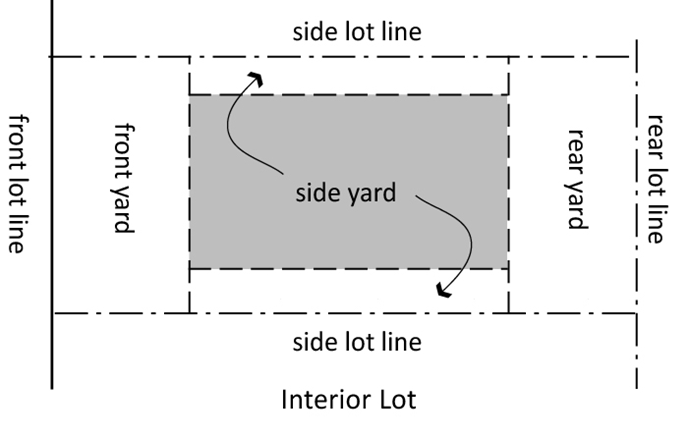
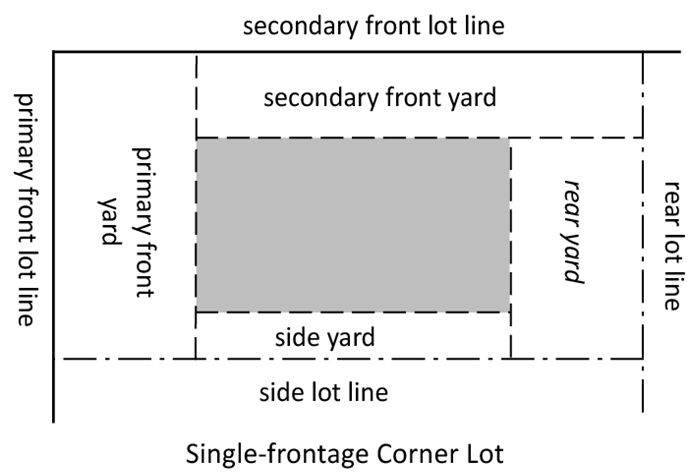
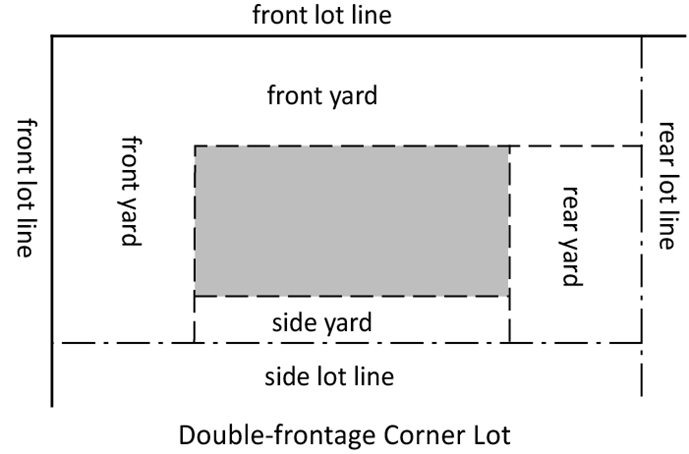
Figure 2-6. Yard configuration of interior and corner lots.
2.02.240. Zoning map. The map referred to in section 1.05, Zoning map.
2.02.241. Zoning official. The person designated by the City of Pelham to enforce the provisions of this zoning ordinance.
Sec. 2.03. - Abbreviations used in this ordinance.
2.03.01. AASHTO—American Association of State Highway and Transportation Officials.
2.03.02. BR—Bedroom.
2.03.03. DU—Dwelling unit.
2.03.04. Ft.—Feet.
2.03.05. GFA—Gross floor area.
2.03.06. Max.—Maximum.
2.03.07. Min.—Minimum.
2.03.08. MUTCD—Manual on Uniform Traffic Devices.
2.03.09. N/A—Not applicable.
2.03.10. Sf.—Square feet.
2.03.11. STR—Short-term rental.

