
Pelham City Zoning Code
ARTICLE VIII
SIGNS
Sec. 8.01.- Purposes.
The purpose of the provisions of this article is to achieve balance among the following goals:
8.01.01. To encourage the effective use of signs as a means of communication for businesses, organizations and individuals in Pelham;
8.01.02. To provide a means of wayfinding in the community, thus reducing traffic confusion and congestion;
8.01.03. To provide for adequate business identification, advertising, and communication;
8.01.04. To prohibit signs of such excessive size and number that they obscure one another to the detriment of the economic and social well-being of the City of Pelham;
8.01.05. To protect the safety and welfare of the public by minimizing the hazards to pedestrian and vehicular traffic;
8.01.06. To preserve property values by preventing unsightly and chaotic development which has a blighting influence upon the community;
8.01.07. To differentiate among those signs that, because of their location, may distract drivers on public streets and those that may provide information to them while they remain in their cars but out of active traffic;
8.01.08. To minimize the possible adverse effects of signs on nearby public and private property; and
8.01.09. To implement the following specific land use goals from the "Continuing the Progress: Pelham Comprehensive Plan 2025," as updated from time to time:
A.
Create a unique sense of place in Pelham to enhance commercial opportunities, the environment and convenience for residents;
B.
Redevelop under performing and/or vacant commercial developments along the U.S. Highway 31 corridor; and
C.
Create and maintain attractive gateways into Pelham for visitors and returning residents.
Sec. 8.02. - Definitions.
8.02.01. Abandoned sign. Either of the following:
A.
Any sign containing a commercial message which no longer advertises a bona fide business, institution, person, event, location, product, or service on the premises.
B.
A permanent sign that bears either no message, a message that is no longer legible or a message that has been covered.
C.
Any off-premises sign which is not leased by, or no longer advertises, a bona fide business, institution, person, event, location, product, or service for a continuous period of 120 days.
8.02.02. Alter. Change to a sign including but not be limited to: the addition of surface area or height, changing of permanent copy or a sign face, changing of the location or type of light source, the relocation of a sign from one position to another.
8.02.03. Animated sign. Any sign with irregular intensity of illumination or movement whether mechanical or electrical.
8.02.04. Awning sign. A sign attached to or incorporated into an awning.
8.02.05. Banner. A temporary sign bearing a commercial message printed or otherwise inscribed on fabric or a similar non-rigid material and that is larger than 16 square feet in area.
8.02.06. Building sign. Any sign which is permanently fastened, attached, or supported by a building.
8.02.07. Business center. A building, occupied by five or more wholesale or light industrial establishments under separate ownership or occupancy.
8.02.08. Canopy sign. A sign painted or otherwise depicted upon a canopy.
8.02.09. Commercial message. Any sign, wording, logo, or other representation that, directly or indirectly, names, advertises or calls attention to a business, product, service or other commercial activity.
8.02.10. Electronic message sign. A sign or portion thereof designed so that characters, letters or illustrations can be changed or rearranged electronically.
8.02.11. Freestanding sign. Any sign which is not attached to a building.
8.02.12. Illuminated signs.
A.
Directly illuminated sign. A sign illuminated by a light source within the sign, excluding "backlit" signs.
B.
Indirectly illuminated. A sign illuminated by an exterior light source. Backlit signs are also considered indirectly illuminated.
8.02.13. Install. To place, construct, erect, mount, paint, affix or attach a sign to a structure or to the ground.
8.02.14. Legible. Able to be read by a person of ordinary eyesight standing at grade level at a location on the public right-of-way or, if applicable, on another private property.
8.02.15. Main traveled way. That portion of the roadway on which a premises has frontage, including the through traffic lanes, but excluding frontage roads, auxiliary lanes, and ramps.
8.02.16. Noncommercial message. Any message other than a commercial message and any messages or types of messages considered noncommercial speech by a court of law.
8.02.17. Nonconforming sign. A sign lawfully existing on the effective date of this ordinance, which does not conform to the requirements of this ordinance.
8.02.18. Off-premises sign or off-premises message. A sign or message that advertises a business, person, activity, goods, products, or services not located on the premises where the sign is located. Signs bearing noncommercial messages are not considered off-premises signs.
8.02.19. On-premises sign or on-premises message. A permanent sign that advertises, directs attention to or provides information on a use, product, service, or activity occurring on the property where the sign is located. For the purposes of these regulations, signs bearing noncommercial messages are considered on-premises signs.
8.02.20. Portable sign. A freestanding sign greater than six square feet in area, not otherwise defined as a temporary sign, that is readily movable and is not permanently affixed to the ground, including signs mounted on weighted bases or wheeled chassis.
8.02.21. Primary façade area. The area of the primary façade calculated by multiplying the length of the wall (on unified buildings, between fire walls) and the distance between the ground level and the point where the roof attaches to or meets the wall.
8.02.22. Projecting sign. A sign which is affixed to any building wall or structure, which extends beyond the building wall or structure, more than 12 inches.
8.02.23. Roof sign. A sign, erected, constructed, or maintained above the eave roof of a building.
8.02.24. Sign. Any device, fixture, placard, display, or structure which is legible from a street or abutting parcel and that directs attention to an object, product, place, service, person, building, or entity, or to communicate information of any kind to the public. The term does not include the following objects though they may be legible from a public area: cemetery markers, vending machines, express mail drop-off boxes, decorations, a building's architectural features, or a manufacturer's or seller's markings on machinery or equipment.
8.02.25. Sign face. The surface area of a sign devoted to a message or advertising display.
8.02.26. Stanchion. A bar, pole or similar support attached to a building for the hanging of a flag.
8.02.27. Temporary sign. A sign that is not permanently attached to the ground or a structure, that is not intended for permanent display and that is designed and fabricated with materials of a temporary nature, including but not limited to paper, fabric, corrugated plastic, cardboard and vinyl.
8.02.28. Vehicle sign. Any sign attached to or painted on a vehicle or tractor trailer, which is not used in the normal day-to-day operations of the business, but that is kept for periods longer than 24 hours and on a recurring basis in a conspicuous location where the sign is legible from adjoining rights-of-way.
8.02.29. Wall sign. A building sign attached to the exterior wall of a building other than a projecting sign.
8.02.30. Wind-blown sign. Any banner, flag, pennant, spinner, streamer, inflatable sign, moored blimp, or gas-filled balloon, or similar device which may be wind activated.
8.02.31. Window sign. Any sign that is placed upon the window panes or glass or within six inches of the window panes or glass, which is legible from the exterior of the building. Merchandise in a window display is not considered a window sign.
Sec. 8.03. - General regulations.
8.03.01. Viewpoint and content neutrality, substitution.
A.
It is the policy of the city to regulate signs in a manner that does not favor commercial speech over noncommercial speech and does not regulate speech by message content. No sign will be subject to any limitation based on the viewpoint of the sign message.
B.
Any sign allowed under this ordinance may contain any lawful noncommercial message, in lieu of any other commercial or noncommercial message, so long as said sign complies with the size, height, area and other requirements of this ordinance. The purpose of this provision is to prevent an inadvertent favoring of commercial messages over noncommercial messages or favoring of any particular noncommercial message over another. This provision does not create a right to increase the total amount of signage on a lot, nor does it affect the requirement that a sign structure or mounting device be properly permitted.
8.03.02. Signs may not be located, lighted, or constructed so as to constitute a hazard to the health and safety of individuals on the public right-of-way.
8.03.03. Signs must comply with the applicable requirements of the building code, including maintenance and determination of whether a sign is unsafe.
8.03.04. Maintenance.
A.
All signs and components thereof, including structural supports, must be kept in a state of good repair, in good working order, and free of excessive rust, corrosion, rotting, or other deterioration.
B.
The ground within 25 feet of the base of all freestanding signs and off-premises signs must be kept free and clear of weeds, debris, trash, and other refuse.
8.03.05. Prohibited signs. The following signs are prohibited:
A.
Any sign determined to constitute a traffic hazard or that may be confused with or construed as a traffic control device or emergency vehicle by reason of site, location, content, color or type of illumination;
B.
Any moving, swinging, rotating, flashing, strobing, blinking, scintillating, fluctuating or otherwise animated or wind-blown signs, excluding flags installed in accordance with section 8.05.07 and electronic message signs in accordance with section 8.05.04;
C.
Signs that emit any detectable noise, smoke, vapor, odor, particles or that include any lighting or control mechanism that interferes with radio, television or electronic means of communication;
D.
Vehicle signs;
E.
Strings of lights, other than temporary holiday decorations, placed, installed or used around the perimeter of windows for the purpose of drawing attention to the building, use or window. Strings of light that are hung or otherwise placed solely to provide illumination for an outdoor area are not considered signs;
F.
Portable signs (except as temporary signs); and
G.
Roof signs.
8.03.06. Placement.
A.
Signs in public right-of-way. Signs may not be located in, nor encroach upon the public right-of-way, except as follows:
1.
Only the following signs are permitted in the public right-of-way:
a)
Signs installed by the City of Pelham, Shelby County, or State of Alabama;
b)
Signs installed by a transit company authorized to provide service to or through Pelham;
c)
Signs installed by a public utility with a franchise or other agreement with the City of Pelham;
d)
Any other person or entity expressly authorized by Alabama law to install a sign in the right-of-way; or
e)
Any sign for which an encroachment permit has been approved, in accordance with section 8.04.05, Right-of-way encroachment permits.
2.
Any other sign installed or placed in the public right-of-way is deemed an unlawful sign and is subject to immediate removal in accordance with section 8.11.04, Removal of signs. The owner or other person placing the sign is, nevertheless, subject to the penalty provisions of section 8.12, Penalties.
3.
Whenever a sign is approved to extend over a public right-of-way, a vertical clearance of at least eight feet from grade level to the bottom-most edge of the sign must be maintained.
B.
No building sign may extend above the top of the wall, mansard roof or parapet on which it is attached.
C.
Signs may not be attached to utility poles, meter posts, fences, fence posts, or street lights and may not be painted or drawn upon rocks, trees or other natural features.
D.
Signs and sign structures may not obstruct openings required for ventilation or means of egress, including any fire escape, window, door, stairway, exit, walkway, utility access or fire department connection.
8.03.07. Measurements and interpretations.
A.
For sign messages installed on a background panel, cabinet, or surface distinctively designed to serve as the background for the sign message, sign area is calculated as the smallest rectangle that encompasses the extreme limits of the background panel, cabinet or surface. See figures 8-1 and 8-2.
B.
For sign messages where individual letters or elements are installed on a building and where there is no background panel, cabinet or surface distinctively designed to serve as the background for the sign message, sign area is calculated as the smallest rectangle that encloses all the letters or elements associated with the sign. When there are multiple sign elements on the same surface, the zoning official determines the outermost boundaries of individual sign elements. See figure 8-3.
C.
For sign messages that are non-planar, the sign area is calculated as the smallest rectangle that encompasses the profile of the sign message and any background object, panel, cabinet or surface distinctively designed to serve as the background for the sign message. The profile used is the largest area of the sign message and background visible from any one vantage point. See figure 8-4.
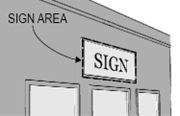
Figure 8-1. Attached sign with panel.
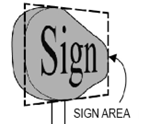
Figure 8-2. Freestanding sign.
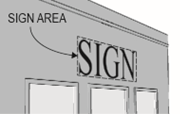
Figure 8-3. Attached sign without panel.
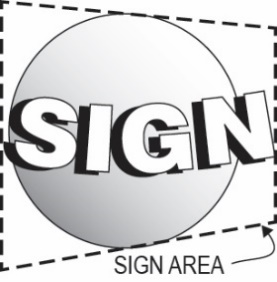
Figure 8-4. Nonplanar sign.
D.
When only one face is legible from any vantage point along the abutting street, the area of one side (the larger, if applicable) is counted toward allowable sign area. If both faces may be viewed from the same vantage point, the area of both sides is counted.
E.
Freestanding sign height is measured from the highest point of the sign structure to the elevation of the adjacent public street. Street elevation is taken at a point perpendicular to the sign along the centerline of the street.
F.
Determination of legibility.
1.
Where this ordinance requires a determination of "legibility," the standard is based on the eyesight of an adult eligible to receive an Alabama driver's license (wearing any corrective lenses required by such license). Where the height of the person is material to the determination, the person is presumed to be more than five feet and less than six feet tall.
2.
In determining legibility of a sign from a residential property, it is assumed that a two-story residence will occupy the property with second-story windows facing toward the sign.
8.03.08. Signs exempt from regulation. The following signs are exempt from regulation under this ordinance:
A.
Any sign inside a building, not attached to a window or door that is not legible from a distance of more than three feet beyond the lot line of the development site or parcel on which such sign is located.
B.
Any permanent sign with a sign area of one square foot or less.
C.
Signs required by law or governmental order, rule, or regulation. Where a sign is erected pursuant to a statute or a court order, the sign may exceed the size standards of this ordinance or otherwise deviate from the standards set forth in this ordinance to the extent that the statute or court order expressly required the larger size or other deviation. In all other respects, such signs must conform to the standards of this ordinance.
D.
Signs of a governmental body, public authority or public utility including, but not limited to, traffic and similar regulatory devices, legal devices, warnings at railroad crossings, governmental survey or boundary markers, signs indicating bus stops, taxi stands, and similar transportation facilities, notices of water lines or buried cables and any signs displayed on public property authorized by the city
E.
Seasonal decorations containing no commercial message provided they are displayed for no more than 45 consecutive days nor more than 60 days in any one year.
F.
Signs, other than electronic message signs, on an operable vehicle used in the normal course of business. However, signs on vehicles or trailers that are kept, on a recurring basis, on the premises so that the sign is oriented toward and legible to passing motorists are treated as portable signs.
Sec. 8.04. - Permitting.
8.04.01. Permits required. Except as provided in section 8.04.06, Permit exemptions, sign permits are required for the construction, relocation, or structural alteration of any permanent sign and for the installation of any banner sign.
A.
Signs and sign actions regulated by this ordinance but not exempt from permitting under section 8.04.06, Permit exemptions, must be installed only in accordance with a duly issued and valid sign permit. Sign permits are issued only in accordance with the following requirements and procedures:
B.
An application for installation of a new sign or for modification of an existing sign must be accompanied by detailed drawing to show the dimensions, design, structure, and location of each particular sign. One application and permit may include multiple signs on the same development site.
8.04.02. Procedure.
A.
Sign permit applications must be submitted to the zoning official on an application form provided for such purposes together with any applicable fees, as established from time to time by the city council.
B.
Within five business days of receiving an incomplete application, the zoning official must send notice to the applicant indicating the specific ways in which the application is deficient.
C.
Within seven days of submission of a complete application, the zoning official must either:
1.
Issue the sign permit, if the proposed sign conforms with the requirements of this ordinance and all other applicable city regulations; or
2.
Deny the sign permit if the sign does not conform to the requirements of this ordinance or other city regulations. In case of a denial, the zoning official must notify the applicant of such disapproval and specify the reasons for disapproval.
D.
Administrative procedures set forth in the building code apply to permit requirements, inspection, enforcement, penalties and appeals procedure.
E.
Any person, firm, or corporation wishing to engage in the business of altering or installing signs governed by this article, must first obtain a business license from the city.
8.04.03. A sign permit lapses automatically if the business license for the premises lapses, is revoked, or is not renewed. A sign permit lapses if the business activity on the premises is discontinued for a period of 180 days or more and is not renewed within 30 days of a notice to the last permittee, sent to the premises, that the sign permit will lapse if such activity is not renewed.
8.04.04. Temporary sign permits. Temporary signs are permitted only in accordance with the provisions of section 8.05.08, Temporary signs, and permits issued as follows:
A.
A temporary sign permit is required for all temporary signs of 32 square feet or more in sign area;
B.
A temporary sign permit allows the use of temporary signage for a specified period subject to section 8.05.08, Temporary signs, and all other applicable provisions of this article; and
C.
A temporary sign becomes an illegal sign if it is not removed upon the expiration of the period covered by the permit.
8.04.05. Right-of-way encroachment permits.
A.
Any sign proposed for a location in a public right-of-way must obtain a sign permit and a right-of-way encroachment permit.
B.
In addition to the contents required for a sign permit application, a right-of-way encroachment permit application must contain the following:
1.
A legal description of the exact portion of the right-of-way affected;
2.
Drawings showing the horizontal and physical locations and dimensions of the proposed sign and its relationship to the right-of-way;
3.
Plan and section drawings showing the proposed sign in relationship to the nearest intersection demonstrating compliance with section 3.05, Corner visibility;
4.
A proposed agreement for maintenance of the proposed sign and related landscaping, with evidence of the continuing financial capability of the proposing entity to provide maintenance costs of $1,000.00 or more per year; and
5.
An executed form, provided by the city attorney, acknowledging that the proposed sign will exist on a permit or license from the city that is revocable for the convenience of the city on 30 days' written notice and acknowledging the responsibility of the proposing entity to remove the sign revocation of such permit or license.
C.
Procedure.
1.
All right-of-way encroachment permit applications must be submitted to the zoning official on a form provided for such purposes.
2.
Within five business days of receiving an incomplete application, the zoning official must give notice to the applicant indicating the ways in which the application is deficient.
3.
Within seven business days of the submission of a complete application, the zoning official must issue or deny the permit. In case of a denial, the zoning official must notify the applicant of such disapproval and specify the reasons for disapproval. Approval of such permits requires finding all of the following:
a)
The sign will not impair the movement of traffic;
b)
The proposed sign will not impair corner visibility at the nearest intersection;
c)
The proposed maintenance agreement is adequate to ensure maintenance of the sign and related landscaping in accordance with the same standards applied by the city in maintenance of its own signs and fixtures in the right-of-way; and
d)
The proposing entity has adequate financial resources, or has provided guarantees of such resources, to provide maintenance to the sign and related landscaping at a cost of at least $1,000.00 per year for a period of ten or more years.
D.
Revocation. A right-of-way encroachment permit may be revoked by the city council after notice and a hearing. Both the entity originally proposing the sign and the entity then maintaining the sign, if not the same, will be given notice of the hearing at least ten days before the date of the hearing. The city council may revoke the permit if it finds any of the following:
1.
The entity agreeing to maintain the sign and landscaping is no longer providing such maintenance and the lack of such maintenance has resulted in deterioration of the sign or of the landscaping;
2.
The sign now interferes with the movement of traffic or will do so due to planned street improvements;
3.
The sign or related landscaping now impairs corner visibility at the nearest intersection; or
4.
The city has determined that it can no longer allow such signs due to risk management considerations and is thus revoking all such permits in the city, regardless of whether a particular sign and landscaping currently conform to the requirements of this ordinance.
8.04.06. Permit exemptions. The following signs and actions do not require a sign permit but are, to the maximum extent allowed by law, subject to the other standards of this ordinance:
A.
Temporary signs required by a valid and applicable federal, state, or local law, regulation, or ordinance or posted by a public agency, acting in accordance with an adopted law or ordinance;
B.
Signs required by an order of a court of competent jurisdiction;
C.
In or abutting areas designated for parking, loading or traffic movement, signs conforming with the Manual of Uniform Traffic Control Devices and bearing no commercial message;
D.
Signs bearing no commercial message and installed by the City of Pelham, Shelby County, or any state or federal agency;
E.
Signs that are not legible from a distance of three feet or more beyond the lot line of the premises;
F.
Temporary signs smaller than 32 square feet;
G.
Permanent signs that bear no commercial message, that are less than four square feet in size and, if freestanding, are less than four feet in height, where such signs are expressly allowed by this ordinance;
H.
Flags expressly allowed by this ordinance, although some flagpoles or flag lighting may require building permits;
I.
Painting, repainting, repair, and copy changes including removal and reinstallation but not involving changes to the sign face, structure, area, height or manner of illumination.
The above permit exemptions notwithstanding, such signs and sign actions are nonetheless subject to building, electrical and other permit requirements when applicable.
Sec. 8.05. - Standards by sign type.
8.05.01. Building signs.
A.
For any building sign which projects more than 12 inches from the wall, vertical clearance of at least eight feet must be maintained between the lowermost portion of the sign and grade level beneath the sign.
B.
No building sign may extend above the parapet wall or eave of the roof along the wall to which it is attached, except that building signs may be attached to, but not above, a mansard roof.
8.05.02. Freestanding signs.
A.
Freestanding signs must be set back at least ten feet from the public right-of-way line and may not extend into or over the right-of-way except as otherwise provided in this article.
B.
If more than one freestanding sign is permitted on a premises, the sign bases must be separated by at least 50 feet.
8.05.03. Illuminated signs.
A.
Illumination and other lighting effects may not create a nuisance to adjacent property or create a traffic hazard. Any light mounted on, within or directed toward any sign must be shielded so that no direct illumination is cast upon any surrounding property or on or toward any public right-of-way. Signs may not be illuminated in any manner that obscures or interferes with any official traffic sign, device or signal.
B.
All illuminated signs must be disconnected or turned off when storm warnings are in effect. Sign illumination must be designed and arranged so as not to cause direct glare into residentially zoned property.
C.
The following forms of sign illumination are prohibited:
1.
Any exposed incandescent lamp with a wattage in excess of 40 watts when the same is located within 15 feet of a street;
2.
Any exposed incandescent lamp with an internal metallic reflector;
3.
Any exposed incandescent lamp with an external reflector; and
4.
Any revolving beacon light.
8.05.04. Electronic message signs.
A.
Electronic message signs, regardless of the method of illumination, may not be brighter than 4,690 nits throughout the daytime until at least one-half hour before sunset and 1,675 nits throughout the nighttime until sunrise. Such signs must be equipped with a dimmer control and photocell and must automatically adjust the display intensity as required herein.
B.
To ensure driver safety, electronic message signs must include a default designed to freeze a display in one still position if a malfunction occurs. Signs must have a process for modifying displays and lighting levels where directed by the city to assure safety of the motoring public.
C.
Electronic message signs must be set back at least 50 feet from any residential district boundary. If permitted in a residential district, the sign must be set back at least 50 feet from the lot lines of the nearest dwelling or as far as practicable as determined by the approving authority.
D.
Electronic message signs may display static messages only without movement such as animation, flashing, scrolling, or intermittent or full-motion video. Strobing and other rapid changes in brightness are prohibited.
E.
Messages may not change more frequently than 15 seconds. For any period during which more frequent changes occur, each change of message is considered a separate violation. The time interval during which one message changes to another may not be longer than two seconds.
F.
No more than one such sign on a single premises may be visible at one time from a single location; two such sign sections may be installed back-to-back or on wall signs on different sides of a building.
G.
When electronic message components are incorporated into otherwise static building and freestanding signs, the electronic message component may not exceed 75 percent of the entire sign face of which it is part.
8.05.05. Off-premises signs.
A.
Off-premises signs are permitted only on premises in business or manufacturing districts that are within 600 feet of the main traveled way of Interstate 65, where such sign is oriented so that it is legible from such main traveled way.
B.
Off-premises signs may not be stacked or erected side by side on the same support structure.
C.
No face of a "V" type off-premises sign may protrude from the opposite face at an interior angle greater than 25 degrees.
D.
Electronic message signs may display multiple messages, provided the sign is static display and does not have more than two sign faces for each direction the sign is facing.
E.
Location and spacing.
1.
An off-premises sign may not be located closer than 2,000 feet to any other off-premises sign.
2.
Off-premises signs may not be located closer than 1,000 feet to property zoned for residential use, churches, schools, and other buildings used for public assembly.
3.
In addition, the location and spacing between electronic message signs must comply with the spacing requirements of the federal-state agreement. The city may require greater restrictions on location and spacing if determined appropriate to ensure the safety of the motoring public.
F.
The copy area of an off-premises sign may not exceed 672 square feet, excluding cut-out extensions. Cut-out extensions may not exceed 100 square feet in area.
G.
Off-premises signs may not exceed 40 feet in height above the centerline elevation of Interstate Highway 65. In no case may the height of the sign, as measured from grade level at the sign base, exceed 65 feet.
8.05.06. Building markers.
A.
In addition to all other signs allowed on a building, each building with a floor area of more than 10,000 square feet may bear one building marker.
B.
Building markers may not exceed three square feet in area.
C.
Building markers may bear any noncommercial message but may not bear any commercial message.
D.
Building markers must be made of permanent material, such as bronze or masonry, and must be permanently affixed to or made part of the building.
E.
There may be only one building marker on any building.
F.
Building markers must be affixed to a building wall.
8.05.07. Flags. The display of flags is allowed only on developed premises and subject to the following limitations:
A.
There may be no more than three flagpoles per principal building.
B.
No flag may bear any commercial message.
C.
There may be no more than two flags per pole.
D.
No flag may be larger than five feet by eight feet.
E.
No flagpole in a residential district may exceed 20 feet in height; no flagpole in a nonresidential district may exceed 30 feet in height.
F.
Flagpoles must be set back at least five feet from any property line.
G.
Each building may have up to two stanchions for the display of flags. Stanchions must be attached to a building wall. Stanchions and flagpoles may not be installed on roofs.
8.05.08. Temporary signs.
A.
Removal.
1.
All temporary signs that relate to an election or other specific event must be removed within 15 days after the election or event to which they pertain.
2.
The person responsible for the erection, placement or distribution of any temporary sign, including the person whose candidacy the sign supports, are jointly and severally responsible for the removal of the temporary sign and the cost thereof.
B.
Banner signs.
1.
Each nonresidential premises is permitted one temporary banner during the following time periods:
a)
For one continuous 14-day period beginning on the day of the first opening of the nonresidential use at that premises.
b)
For any one continuous seven-day period, not to exceed two such periods in any calendar year in addition to that allowed in subsection a. above.
1.
The banner must be completely secured to a building at all four corners.
2.
Such sign may bear any noncommercial message or a message related to goods, products or services offered on the premises.
3.
Banner signs must be maintained in safe, legible condition free from tears and similar signs of disrepair or deterioration.
C.
Seasonal business signs.
1.
Temporary signage installed for a seasonal business is counted toward the total allowance for the premises in accordance with the temporary sign regulations of the applicable district.
2.
Any premises used by a seasonal business for longer than 60 days during a 12-month period, is considered a permanent business location and must provide permanent signage in conformity with the provisions of this ordinance.
8.05.09. Window signs. Window signs may not exceed 25 percent of the total ground floor window area of the any street façade or primary façades.
Sec. 8.06. - A-1 district.
8.06.01. General standards.
A.
Only those signs expressly permitted in section 8.05.06, Building markers, section 8.05.07, Flags, and this section are allowed.
B.
Except for permitted electronic message signs, all other permanent signs may be indirectly illuminated only.
C.
For the purposes of this section, home occupations and group homes are not considered multi-family or nonresidential uses.
8.06.02. Building signs. Each principal nonresidential building is permitted one building sign, which may not be larger than one square foot of sign area per two linear feet of the entire length of the façade on which it is to be installed or 80 square feet, whichever is more restrictive. On lots with multiple frontages, one additional building sign is permitted on a façade oriented toward another street. Such additional sign may not be larger than 40 square feet in area.
8.06.03. Freestanding signs.
A.
Residential subdivisions. Each residential subdivision is permitted one freestanding sign per public street entrance, which may not be taller than six feet nor larger than 24 square feet of copy area. An acceptable legal entity other than the city must be responsible for perpetual maintenance of the sign. If not located on private property, refer to section 8.03.06, Placement, for applicable requirements.
B.
Each nonresidential premises is permitted one freestanding sign per street frontage that is 100 feet or greater in length.
1.
Such signs may not be taller than eight feet nor larger than 30 square feet of copy area.
2.
Permitted freestanding signs may be electronic message signs, which, regardless of the method of illumination, may not be brighter than 1,000 nits throughout the nighttime until sunrise. Such signs must be set back at least 75 feet from the nearest residential property.
C.
Each nonresidential premises is permitted one permanent, freestanding sign, no larger than four square feet in area nor taller three feet in height, at each point of ingress and egress. Such signs may not be directly illuminated.
8.06.04. Temporary signs.
A.
Illumination of temporary signs is prohibited.
B.
No temporary sign may exceed 32 square feet in area or eight feet in height.
C.
During construction of a residential subdivision containing at least five lots or a multi-family or nonresidential development, one temporary sign is permitted per street frontage. Each sign may be up to 32 square feet in area and may not be taller than eight feet. These signs must be removed within 30 days following the completion of the development. For residential subdivisions, "completion" refers to issuance of certificates of occupancy for 75 percent of the dwellings in the subdivision or phase thereof, as applicable. In all other cases "completion" refers to issuance of a certificate of occupancy for the development.
D.
At any time after initial construction, each premises is permitted one temporary sign per 50 feet of frontage but, in no case, more than four temporary signs per frontage. The combined area of temporary signs on each frontage may not exceed 16 square feet per 50 feet of street frontage.
E.
Removal. Refer to section 8.05.08, Temporary signs, for time limits and removal requirements for election and other event-based temporary signs.
Sec. 8.07. - Residential districts.
The following regulations apply in the E-1, R-1A, R-1B, R-2, R-3, R-4, and R-5 districts and in the residential subdistrict of the PUD district.
8.07.01. General standards.
A.
Only those signs expressly permitted in section 8.05.06, Building markers, section 8.05.07, Flags, and this section are allowed.
B.
Except for permitted electronic message signs, all other permanent signs may be indirectly illuminated only.
C.
For the purposes of this section, home occupations and group homes are not considered multi-family or nonresidential uses.
8.07.02. Building signs.
A.
Each multi-family building is permitted one building sign, which may not exceed 15 square feet in area.
B.
Each principal nonresidential building is permitted one building sign, which may not be larger than one square foot of sign area per two linear feet of the entire length of the façade on which it is to be installed or 80 square feet, whichever is more restrictive. On lots with multiple frontages, one additional building sign is permitted on a façade oriented toward another street. Such additional sign may not be larger than 40 square feet in area.
8.07.03. Freestanding signs.
A.
Residential subdivisions. Each residential subdivision is permitted one freestanding sign per public street entrance, which may not be taller than six feet nor larger than 24 square feet of copy area. An acceptable legal entity other than the city must be responsible for perpetual maintenance of the sign. If not located on private property, refer to section 8.03.06, Placement, for applicable requirements.
B.
Multi-family and nonresidential premises.
1.
Each multi-family and nonresidential premises is permitted one freestanding sign per street frontage that is 100 feet or more length.
a)
Such signs may not be taller than six feet nor larger than 30 square feet of copy area.
b)
For nonresidential premises, permitted freestanding signs may be electronic message signs, which, regardless of the method of illumination, may not be brighter than 1,000 nits throughout the nighttime until sunrise. Such signs must be set back at least 75 feet from the nearest residential property.
2.
Each multi-family and nonresidential premises is permitted one permanent, freestanding sign, no larger than four square feet in area nor taller than three feet in height at each point of ingress and egress. Such signs may not be directly illuminated.
8.07.04. Temporary signs.
A.
Illumination of temporary signs is prohibited.
B.
No temporary sign may exceed 32 square feet in area nor eight feet in height.
C.
During construction of a residential subdivision containing at least five lots or a multi-family or nonresidential development, one temporary sign is permitted per street frontage. Each sign may be up to 32 square feet in area and may not be taller than eight feet. These signs must be removed within 30 days following the completion of the development. For residential subdivisions, "completion" refers to issuance of certificates of occupancy for 75 percent of the dwellings in the subdivision or phase thereof, as applicable. In all other cases "completion" refers to issuance of a certificate of occupancy for the development.
D.
At any time after initial construction, each lot is permitted temporary signs in accordance with table 8-1 and the following:
1.
No corner lot nor other lot with multiple frontages may have more than five total temporary signs.
2.
Temporary signs bearing commercial messages.
a)
No more than one such sign is permitted on a residential property at any time.
b)
Such signs are permitted only for commercial activities lawfully occurring on the premises and must be removed within 30 days after the conclusion of such activity on the premises.
3.
Banners are permitted for nonresidential uses subject to section 8.05.08, Temporary signs.
Table 8-1. Temporary Signs in Residential Districts.
E.
Removal. Refer to section 8.05.08, Temporary signs, for time limits and removal requirements for election and other event-based temporary signs.
Sec. 8.08. - O-I and P-O-I districts.
8.08.01. General standards.
A.
Only those signs expressly permitted in section 8.05.06, Building markers, section 8.05.07, Flags, and this section are allowed.
B.
Not more than 40 percent of the sign area of a permanent sign may be directly illuminated.
C.
Each premises is permitted one permanent, freestanding sign, no larger than four square feet in area nor taller three feet in height, at each point of ingress and egress.
8.08.02. Building signs.
A.
Each ground floor tenant is permitted one building sign per street façade.
B.
Each ground floor tenant is allowed up to two canopy or awning signs, the area of which is counted toward the total allowed sign area for building signs.
C.
The aggregate area of building signs may not exceed one square foot of sign area per linear foot of building wall. The maximum area for any individual building sign is 100 square feet.
8.08.03. Freestanding signs.
A.
Premises with 300 feet or less street frontage are permitted one freestanding sign per street frontage. Premises with more than 300 feet along one street frontage may have one additional freestanding sign along the same street frontage provided a minimum sign spacing of 200 feet.
B.
The maximum height of freestanding signs is 20 feet except as may otherwise be provided for in section 6.03, Corridor overlay district.
C.
The aggregate area for freestanding signs may not exceed one square foot per linear foot of street frontage for the entire development. The maximum area of any individual freestanding sign is 100 square feet.
D.
Office parks. In addition to freestanding signs on individual premises, office parks are permitted one freestanding sign per public street entrance, which may not be taller than six feet nor larger than 80 square feet of copy area. An acceptable legal entity other than the city must be responsible for perpetual maintenance of the sign. If not located on private property, refer to section 8.03.06, Placement, for applicable requirements.
8.08.04. Temporary signs.
A.
Temporary signs may not be illuminated and may not exceed 32 square feet in area nor taller than six feet. However, where a temporary, noncommercial sign is erected in place of another permitted sign or is placed on an existing, lawful sign, the illumination standards otherwise applying to the sign apply to the temporary, noncommercial message.
B.
During construction, up to two temporary signs are permitted at the primary entrance to the development. Such signs may not be taller than six feet. These signs must be removed within 30 days after the certificate of occupancy has been issued.
C.
At any time after initial construction, each premises is permitted one temporary sign per 50 feet of frontage but, in no case, more than four temporary signs per frontage. The combined area of temporary signs on each frontage may not exceed 16 square feet per 50 feet of street frontage. Banners are further subject to section 8.05.08, Temporary signs.
D.
Removal. Refer to section 8.05.08, Temporary signs, for time limits and removal requirements for election and other event-based temporary signs.
Sec. 8.09. - Business and manufacturing districts.
The following regulations apply in the B-1, B-2, B-3, B-4, M-1 and M-2 districts and in nonresidential subdistricts of the PUD district.
8.09.01. General standards.
A.
Only those signs expressly permitted in section 8.05.06, Building markers, section 8.05.07, Flags, and this section are allowed.
B.
Permanent signs may be directly or indirectly illuminated.
C.
Each premises is permitted one permanent, freestanding sign, no larger than four square feet in area nor taller three feet in height, at each point of ingress and egress.
8.09.02. Building signs.
A.
Each ground floor tenant is permitted one building sign per façade along which the tenant space extends. For example, a tenant space on a building corner may have two building signs, one on each façade.
B.
The area of building signs may not exceed three square feet of sign area per two linear feet of building wall on which the sign is installed.
C.
Each ground floor tenant is allowed up to two canopy or awning signs per façade along which the tenant space extends. The area of canopy and awning signs is counted toward the total allowed sign area for building signs. For gas station canopies, whether or not attached to the principal building, the area of each canopy sign is counted toward the total allowed sign area for the façade that is most parallel with the canopy sign. See figure 8-5.
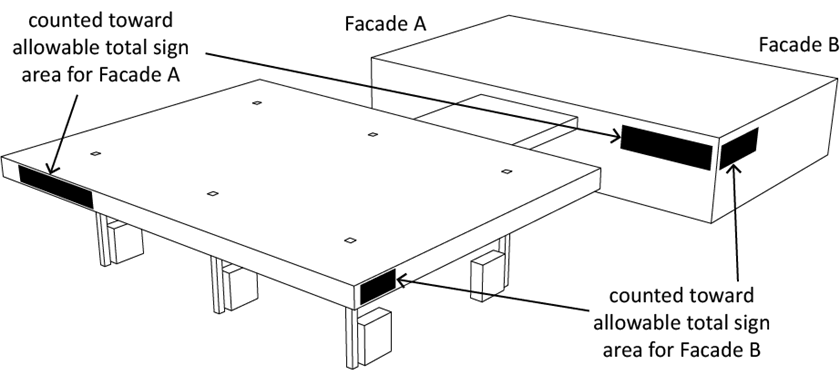
Figure 8-5. Gas station canopy signs.
8.09.03. Freestanding signs.
A.
Premises with 300 feet or less street frontage are permitted one freestanding sign per street frontage. Premises with more than 300 feet along one street frontage may have one additional freestanding sign along the same street frontage provided a minimum sign spacing of 200 feet.
B.
The maximum height of freestanding signs is 20 feet except as otherwise provided in accordance with section 6.03, Corridor overlay district.
C.
The aggregate area for freestanding signs may not exceed one square foot per linear foot of street frontage for the entire development. The maximum area of any individual freestanding sign is 380 square feet.
D.
Office and industrial parks. In addition to freestanding signs on individual premises, office parks and industrial parks are permitted one freestanding sign per public street entrance, which may not be taller than 12 feet nor larger than 60 square feet of copy area. An acceptable legal entity other than the city must be responsible for perpetual maintenance of the sign. If not located on private property, refer to section 8.03.06, Placement, for applicable requirements.
8.09.04. Temporary signs.
A.
Temporary signs may not be illuminated. However, where a temporary, noncommercial sign is erected in place of another permitted sign or is placed on an existing, lawful sign, the illumination standards otherwise applying to the sign apply to the temporary, noncommercial message.
B.
During construction, up to two temporary signs are permitted at the primary entrance to the development. Each sign may be up to 32 square feet in area and may not be taller than six feet. These signs must be removed within 30 days after the certificate of occupancy has been issued.
C.
At any time after initial construction, each premises is permitted one temporary sign per 50 feet of frontage but, in no case, more than four temporary signs per frontage. The combined area of temporary signs on each frontage may not exceed 16 square feet per 50 feet of street frontage. Banners are further subject to section 8.05.08, Temporary signs.
D.
Removal. Refer to section 8.05.08, Temporary signs, for time limits and removal requirements for election and other event-based temporary signs.
Sec. 8.10. - PUD district.
Signs in the PUD district must comply with the applicable regulations of this article except where such regulations conflict with sign standards approved by the council as part of the preliminary master plan for the PUD.
Sec. 8.11. - Nonconforming and abandoned signs, removal.
8.11.01. Nonconforming status.
A.
A building sign or freestanding sign that does not conform to the provisions of this article is considered to be a legal nonconforming sign if:
1.
The sign was covered by a sign permit on the date of adoption of this ordinance; or
2.
If no sign permit was required under prior applicable city ordinances for the sign in question, and the sign was in all respects in conformity with prior applicable city ordinances or was the subject of a variance to the terms of said ordinances, on the date of the adoption of this ordinance.
Building signs and freestanding signs which do not qualify for legal nonconforming status are deemed unlawful.
B.
Building signs and freestanding signs lose their legal nonconforming status if the sign is altered, except that a change of message or replacement of sign panels to accomplish a change of message is not considered an "alteration" for purposes of this provision. Any nonconforming sign which is damaged by any means, to the extent of more than 50 percent of its appraised value immediately prior to said damage, may not be restored except in conformity with the provisions of this ordinance.
8.11.02. Any nonconforming permanent sign becomes an abandoned sign when the use with which it is associated is abandoned. In such case, the sign must be removed or made to conform within 30 days after notification by the zoning official. Nonconforming signs which are not removed or made to conform within 30 days of notification of abandonment are deemed unlawful.
8.11.03. Nonconforming off-premises signs. Any off-premises sign that does not conform to the location restrictions in section 8.05.05, Off-premises signs, must be removed or otherwise made to conform to the applicable provisions of this article no later than January 1, 2035. Such signs, if not removed or made to conform within this time period, will be subject to section 8.11.04, Removal of signs.
8.11.04. Removal of signs.
A.
Any sign that constitutes a hazard to the public or a sign without proper certification that has been installed or placed on unimproved property, on public property or within public right-of-way may be immediately removed and impounded by the zoning official.
B.
Any temporary or portable sign that is installed or placed on private property without a required permit or otherwise in violation of this ordinance may be immediately removed and impounded by the zoning official.
C.
Unlawful signs that are not made subject to the impoundment provisions in subsection A. or B., above, are subject to removal and impoundment ten days after notice has been given. Notice is deemed to have been given if the city provides written notice to the owner or installer of the sign or other responsible person. If the notice cannot be given after reasonable efforts to identify and locate the person, the city may affix a notice of noncompliance to the sign itself. If the sign has not been removed or brought into compliance within ten days, the city may remove and impound the sign. Removal of unlawful signs must be done in a manner which, to the extent possible, preserves the value of the sign and supports.
D.
The owner or installer of any removed signs and supports, except for temporary signs, will be notified if such person can be reasonably identified. The first attempt at notice will be within five days prior to the removal of the sign and supports. The manner of notification will be that which will best achieve notice under the circumstances including the use of certified mail, hand delivery, or publication. Refusal of certified mail which has been properly addressed and posted does not void the notice. Hand delivery may be employed where the addressee is within the city limits. Publications may be used when the addressee's whereabouts are unknown. Said notice will inform the recipient that the city is in possession of the sign and supports, why they were removed, where they may be reclaimed, and applicable fees and storage period.
E.
With the exception of temporary signs, which may be disposed of immediately, removed signs and supports will be stored for a period not to exceed 30 days beginning the first day of effective notice. A storage charge of $5.00 per day will be levied beginning on the fourth day of that 30-day period. The owner of the sign may reclaim the sign and supports during the 30-day storage period only upon payment of any storage charges and the cost of removing the signs and supports. If the sign has not been reclaimed during the 30-day storage period, the sign and supports may be disposed of. If, in the opinion of the zoning official, the sign and supports are not capable of being sold, they may be discarded; but if sold, the proceeds therefrom will first be applied to the storage and removal charges, if any, and the balance will be mailed to the previous owner of the sign and supports, if possible, or if not, the balance will become property of the city.
F.
In addition to other remedies, the city has the right to recover from the owner or installer of such a sign, or the owner of the property on which it is located, or any other responsible person, the full costs of removal and disposal of the sign. The city will certify the removal and may charge the owner, installer or other responsible person for the removal, payable within ten days after receipt of a statement of charges; or the charges may be a special assessment and a lien on the property involved, subject to provisions of state law. It is presumed that the person or entity whose identity is represented on the sign is a person responsible for installing the sign, which presumption may be rebutted by affidavit.
Sec. 8.12. - Penalties.
8.12.01. Any person, firm or corporation, or other organization which violates any of the provisions of this ordinance will, upon conviction, be fined in accordance with section 1-8 of this Code (General penalty; violations of Code, ordinance, or state law); provided however, that in the event any such person, firm or corporation desires to waive a trial and enter a plea of guilty before the magistrate, the magistrate is hereby authorized to accept such plea and impose a fine as follows:
A.
First offense: $50.00.
B.
Second offense: $100.00.
C.
Third offense: Mandatory court appearance.
D.
Each day any such violation continues constitutes a separate offense.
Sec. 8.13. - Severability.
8.13.01. Generally. If any part, section, subsection, paragraph, subparagraph, sentence, phrase, clause, term, or word of this article is declared unconstitutional by the valid judgment or decree of any court of competent jurisdiction, the declaration of such unconstitutionality shall not affect any other part, section, subsection, paragraph, subparagraph, sentence, phrase, clause, term or word of this ordinance.
8.13.02. Severability where less speech results. Without diminishing or limiting in any way the declaration of severability set forth above in section 8.13.01 or elsewhere in this article, if any part, section, subsection, paragraph, subparagraph, sentence, phrase, clause, term or word of this ordinance is declared unconstitutional shall not affect any other part, section, subsection, paragraph, subparagraph, sentence, phrase, clause, term or word of this ordinance, even if such severability would result in a situation where there would be less speech, whether by subjecting previously exempt signs to permitting or otherwise.
8.13.03. Severability of provisions pertaining to prohibited signs. Without diminishing or limiting in any way the declaration of severability in section 8.13.01, or elsewhere in this ordinance, if any part, section, subsection, paragraph, subparagraph, sentence, phrase, clause, term or word of this article or any other laws declared unconstitutional by valid judgment or decree of any court of competent jurisdiction, the declaration of such unconstitutionality shall not affect any other part, section, subsection, paragraph, subparagraph, sentence, phrase, clause, term or word of this ordinance that pertains to prohibited signs, including specifically those signs and sign types prohibited and under section 8.03.05, Prohibited signs. Furthermore, if any part, section, subsection, paragraph, subparagraph, sentence, phrase, clause, term or word of this ordinance is declared unconstitutional by the valid judgment or decree of any court of competent jurisdiction, the declaration of such unconstitutionality shall not affect any other part, section, subsection, paragraph, subparagraph, sentence, phrase, clause, term or word of this ordinance.
8.13.04. Severability of limitations on off-premises advertising signs. If any part, section, subsection, paragraph, subparagraph, sentence, phrase, clause, term or word of this article or any other provision of this ordinance is declared invalid or unconstitutional by the valid judgment or decree of any court of competent jurisdiction, the declaration of such unconstitutionality shall not affect limitations on off-premises signs in section 8.05.05, Off-premises signs.

