
Pelham City Zoning Code
ARTICLE VII
DETAILED USE REGULATIONS
Sec. 7.01.- Purpose.
In this article certain land use activities are identified for special treatment. The nature of these uses is such that, when properly regulated, they may be appropriate in several zones. To bring about the proper integration of these uses into the community's land use pattern, a special set of regulations is provided for each use. Review of these regulations will tend to maintain compatibility with abutting land uses and prevent characteristics that might have negative impacts on nearby uses without these additional regulations.
Sec. 7.02. - Accessory antennas.
This section governs antennas which are accessory to the principal use of a premises. Commercial radio and television transmission antennas, television receiving antennas for cable television systems, telecommunications antennas, and other antennas which constitute a separate business from the principal use of the premises or which are an integral part of the principal use of the premises, are not accessory antennas, and are governed by chapter 5.5, Communications, of this Code.
7.02.01. Applicability. Accessory antennas are limited to the following:
A.
The following antennas are permitted as accessory to residential uses
1.
Radio and television antennas, other than parabolic antennas, which do not exceed 25 feet in height above the established height of the zoning district and are located on the same premises as the dwelling to which they are accessory.
2.
Parabolic antenna greater than one meter (3.281 feet) in diameter, which is located on the same premises as the dwelling which it serves, subject to the provisions of section 7.02.02, Parabolic antennas.
3.
Parabolic antenna less than two feet in diameter, which is attached to the dwelling and does not extend more than six feet above the roof line of the dwelling.
4.
Federally licensed amateur radio tower located upon the same premises as the dwelling to which it is accessory.
B.
The following antennas are permitted as an accessory to nonresidential uses:
1.
Radio and television receiving antennas, other than parabolic antennas, which do not exceed the maximum building height of the zoning district and are located on the same premises as the business to which they are accessory.
2.
Transmitting and receiving antennas for communication with vehicles owned by the business, which do not exceed the maximum building height of the zoning district and are located on the premises of the business to which they are accessory.
3.
Parabolic antenna which is located on the same premises as the business which it serves, subject to the provisions of section 7.02.02, Parabolic antennas.
7.02.02. Parabolic antennas.
A.
Intent. Parabolic antennas, due to their size, shape, appearance, and proliferation, have the potential to generate negative impact upon adjacent property and the general welfare of the city. Therefore, parabolic antennas are more strictly regulated than other forms of accessory antennas.
B.
General regulations.
1.
A maximum of one parabolic antenna is permitted per lot.
2.
Parabolic antennas must be located and designed to minimize negative impact on surrounding property.
3.
An antenna may not be used for advertising purposes.
4.
All parabolic antennas must be located behind the front building line.
5.
Installation of a parabolic antenna requires a building permit and must conform to the Building Code.
C.
On residential premises, antennas must be permanently attached to the ground, located in the rear yard at least 12 feet from a property line and may not exceed 16 feet in height.
D.
On nonresidential and mixed-use premises:
1.
Ground-mounted antennas must be permanently attached to the ground, located in the rear yard at least 25 feet from a public street right-of-way, ten feet from a property line and may not exceed 16 feet in height.
2.
Roof-mounted antennas may not extend more than ten feet above the roof line. Roof-mounted antennas which exceed six feet in diameter must be at least 50 feet from a single-family residential district boundary.
7.02.03. Amateur radio tower. Amateur radio towers may not extend 25 feet above the maximum building height of the applicable district. Additional height may be approved in accordance with section 12.05, Special exceptions, provided the antenna is set back from all property lines a distance equal to or greater than its height.
7.02.04. Small cell facilities. The following standards apply only to small cell facilities located on private property.
A.
Building-mounted facilities.
1.
When located on a flat roof, small cell facilities must be flush mounted, concealed behind the building parapet or otherwise concealed from street view to the degree practicable.
2.
When located on a pitched roof, small cell facilities must be flush mounted, mounted on a portion of the roof away from public view or otherwise concealed from street view to the degree practicable.
3.
When located on a building wall, small cell facilities must be flush mounted and must be located on a side of the building away from public view. Small cell facilities may be permitted on building walls in public view only if camouflaged to appear as if part of the façade design, concealed within a recess in the façade or otherwise located and design to minimize their visibility.
4.
The methods of attachment and structural support are subject to approval by the building official, who may require detailed drawings for review.
B.
Freestanding facilities.
1.
On sites with freestanding light or utility poles, small cell facilities must be attached to such poles to the degree practicable and only with written authorization by the utility provider, if applicable.
2.
Freestanding facilities are subject to the front and side yard setbacks of the applicable district. Freestanding structures must be set back from front lot lines a distance equal to or greater than their height.
3.
Freestanding facilities may not extend 25 feet above the maximum building height of the applicable district. Additional height may be approved in accordance with section 12.05, Special exceptions, provided the structure is set back from all property lines a distance equal to or greater than its height.
4.
Freestanding facilities must be internally contained within a structure or concealed by an exterior shroud. No separate ground mounted equipment, including backup power supply, is permitted.
5.
Freestanding facilities may not be located in a manner that requires removal of an existing tree nor within the critical root zone or canopy of existing trees.
6.
Freestanding facilities may not be located in a manner that obstructs vehicular or pedestrian travel.
Sec. 7.03. - Accessory dwellings.
Accessory dwellings may only be permitted as an accessory use to a permitted single-family detached dwelling in accordance with the following:
7.03.01. Permit required. An accessory dwelling permit is required for all accessory dwellings. Accessory dwellings may be maintained in perpetuity but only in compliance with these regulations. Any accessory dwelling permit will automatically expire whenever:
A.
Required off-street parking is no longer provided on the premises.
B.
In any E-1, R-1A or R-1B district, the permittee ceases to own or reside on the premises.
7.03.02. Because the E-1, R-1A and R-1B districts are intended for single-family detached dwellings, an accessory dwelling may only be permitted when the owner of the principal dwelling resides on the premises. This ensures that the accessory dwelling remains subordinate to the principal dwelling.
7.03.03. Area and dimensional requirements.
A.
Accessory dwellings are permitted only on lots of at least 18,000 square feet. If the principal dwelling is not connected to sanitary sewer service, minimum lot requirements of the health department or similar authority apply to each dwelling.
B.
Accessory dwellings must be set back from lot lines as required for the principal dwelling.
C.
The habitable floor area of an accessory dwelling must be at least 200 square feet but not more than 50 percent of the gross floor area of the principal dwelling or 1,200 square fee, whichever is more restrictive.
7.03.04. Additional Requirements.
A.
Separate water, sewer and gas utility meters are not permitted for accessory dwellings in E-1, R-1A and R-1B districts.
B.
The entrance to an accessory dwelling may not be visible from any street.
C.
No more than one accessory dwelling is permitted on the lot of a single-family detached dwelling.
D.
One parking space, in addition to that required for the principal dwelling, must be provided.
E.
Accessory dwellings must comply with the Building Code and be installed on a permanent foundation.
F.
Accessory dwellings may not have separate vehicular access along the same street frontage as the principal dwelling.
G.
An accessory dwelling may not be sold separately from the principal dwelling unless there is sufficient lot area to subdivide the property into lots meeting the area and dimensional requirements of the district.
H.
If an existing residential garage is converted to an accessory dwelling, off-street parking requirements for the principal dwelling and accessory dwelling must be met concurrently with the conversion.
Sec. 7.04. - Adult entertainment and adult novelty stores.
7.04.01. Adult entertainment.
A.
Such businesses are recognized, particularly when several are concentrated in a given area, to have deleterious effects upon adjacent areas, detract from property values and can have adverse effects on the general welfare. Therefore, no such uses are hereafter permitted within 1,500 feet of each other nor within 1,500 feet of an adult novelty store, as measured between the nearest property lines. Adult entertainment uses may not be located closer than 500 feet to the nearest residentially zoned property or the nearest property lines of the following uses to be protected: child day care center or learning center; place of assembly or worship; park; playground; and any public or private school offering prekindergarten through high school education programs. The expansion of a residential district or location of a protected use in conflict with these separation requirements will not cause an existing, permitted adult entertainment use to become nonconforming.
B.
No alcohol of any kind may be offered for sale, sold, served or consumed on the premises of an adult entertainment establishment. Adult entertainment establishments may not be located closer than 200 feet to the nearest bar or any business offering alcohol sales for off-premises consumption.
7.04.02. Adult novelty stores.
A.
Such businesses are recognized, particularly when several are concentrated in a given area, to have deleterious effects upon adjacent areas, detract from property values and can have adverse effects on the general welfare. Therefore, no such uses are hereafter permitted within 1,500 feet of each other nor within 1,500 feet of an adult entertainment establishment, as measured between the nearest property lines. Adult novelty stores may not be located closer than 500 feet to the nearest property lines of a residentially zoned property nor the following protected uses: child day care center or learning center; place of assembly or worship; park; playground; and any public or private school offering prekindergarten through high school education programs. The expansion of a residential district or location of a protected use in conflict with these separation requirements will not cause an existing, permitted adult novelty store to become nonconforming.
Sec. 7.05. - Alternative financial services.
7.05.01. Purpose.
A.
The purpose of these regulation is to prevent a concentration of these uses in any one area.
B.
It is recognized that alternative financial services have the potential to be harmful to the public welfare, both in regard to the community harmony and with respect to potential effects on the quality, aesthetics and functional aspects of the community. The purpose of regulating alternative financial services is to ensure compatibility with surrounding uses and properties and to avoid an unchecked proliferation of alternative financial services that may result in the displacement of other necessary commercial and financial services.
C.
Such businesses tailor their services to make them attractive to persons experiencing unfavorable economic circumstances, often aggravating those circumstances by the extraordinary high interest rates. Finally, when clustered in an area or strung out along an arterial street, such concentration creates an unwarranted negative impression regarding the economic vitality of a commercial corridor and the community at large. Based on their proliferation, and the negative effects of their proliferation upon adjacent areas, the city council finds that the health, safety and welfare of the residents of the city should be protected by legislation limiting the geographic proliferation of alternative financial services in any one area. This is in the best interest of the overall economic development of the city to provide for orderly growth and balance the development of all businesses to have a diverse and stable economy.
7.05.02. Applicability. These standards apply to new establishments of alternative financial services. An establishment is considered new when no previous alternative financial service business existed at that location for a period of 90 consecutive days or greater immediately preceding the filing date of an application for a building permit or business license, whichever is applicable or submitted first. Any properly licensed alternative financial service legally operating on the effective date of this ordinance that is not in compliance with this section is considered a legal nonconforming use subject to article XI, Nonconformities.
7.05.03. Discontinuance and termination. Any alternative financial service, whether existing or subsequently permitted, that voluntarily discontinues active operation for more than 90 consecutive days; does not maintain a valid city business license for more than 90 consecutive days; or ceases to be licensed by the State of Alabama or any other applicable licensing authority, is considered to have terminated such use and forfeited all privileges and rights held therein.
7.05.04. Locational requirements. The following distance requirements are measured in a straight line between the closest points of the property lines of the properties involved.
A.
No alternative financial service may be located within 2,500 linear feet of any other alternative financial service.
B.
No alternative financial service may be located within 500 feet of a residential district or residential property.
C.
No alternative financial service may be located within 500 feet of a public building, public or private school, day care center, nursery, preschool, park or playground, or place of worship.
D.
No alternative financial service may be located within 500 feet of a state or federally chartered bank, savings association, credit union or industrial loan company.
E.
No pawnshop may be located within 2,500 feet of a gold or silver object dealer.
7.05.05. Development and operational standards.
A.
The hours of operation are limited to the hours between 9:00 a.m. and 6:00 p.m. No loitering is permitted at any time.
B.
The building or portion thereof that is dedicated to the business must have a minimum floor area of 1,500 square feet.
C.
Businesses must keep a glass entrance and exit doors.
D.
The use of bars, chains, roll down doors, or similar security devices placed on the outside of the building is prohibited.
E.
Windows may not be obscured by placement of any dark window tinting, shelving, racks, advertisements or similar obstructions.
F.
The applicant must provide a security plan for review and approval by the city police department. The plan must be submitted with other related city permit applications. The security plan must include:
1.
A lighting plan for the business showing both exterior and interior lighting, including parking and access areas. The exterior of the building must be adequately illuminated on all frontages and must illuminate persons standing outside so as to be identifiable from 50 feet away.
2.
Plans for security of the cashing area of the facility.
3.
Plans for adequate security cameras and/or an alarm system, with access granted to the police department.
7.05.06. Other requirements.
A.
Zoning approval is required prior to the issuance of a business license and prior to occupancy of the premises.
B.
Pawnbrokers must comply with this section and chapter 5, Business Licenses, Taxes and Regulations, article IV, Pawnbrokers; Secondhand Dealers, of this Code, as amended.
Sec. 7.06. - Bed and breakfasts.
The following standards apply to bed and breakfast establishments in the A-1 and residential districts only:
7.06.01. Bed and breakfasts are permitted only in detached, single-family dwellings and must be operated by the owner and resident of the dwelling.
7.06.02. Bed and breakfasts may provide lodging for not more than 14 consecutive days and may contain no more than four guest rooms.
7.06.03. Meals provided to guests may not be cooked on premises and are limited to fresh, uncooked and preprepared foods except as expressly permitted by the health department and fire department.
7.06.04. Guest rooms may not contain cooking facilities and do not constitute separate dwelling units. Guest rooms must be within the principal dwelling.
7.06.05. One parking space must be provided for each guest room, in addition to the spaces required for the dwelling. Recreational vehicle parking is prohibited except on lots one acre or larger in size. If permitted, recreational vehicle parking must be located away from view from public rights-of-way and from neighboring properties to the maximum extent practicable. Recreational vehicles may not be used for overnight lodging.
Sec. 7.07. - Boarding house.
7.07.01. No more than four guest rooms may be rented or otherwise used for boarders.
7.07.02. The owner or lessee must reside within the dwelling used as a boarding house with said structure serving clearly as that person's permanent residence.
7.07.03. The living quarters of the permanent residents and boarders must be in the principal dwelling and no separate structure on the premises may be used for dwelling purposes.
7.07.04. No separate exterior doorways for individual boarding rooms are permitted.
7.07.05. Not more than two parking spaces are permitted forward of the front building line.
NOTE: Compared to single-family dwellings, boarding houses may be subject to increased Building Code requirements based on occupancy.
Sec. 7.08. - Car washes.
7.08.01. Noise levels must comply with the applicable regulations of chapter 11, article IV, Noise, of this Code.
7.08.02. A class B buffer (see section 10.01, Buffers) must be provided between vacuuming facilities and any adjoining residential use or district. If not abutting a residential use or district, vacuums must be located on site to provide the greatest separation from any nearby residential uses.
7.08.03. A class A buffer (see section 10.01, Buffers) must be provided between vacuuming facilities and any abutting commercial or institutional use.
Sec. 7.09. - CBD/vape shops.
7.09.01. Purpose. The purpose of these regulations is to provide separation and operational standards for CBD/vape shops to regulate the sale of items containing industrial hemp levels of THC and to serve the public health, safety, and welfare.
7.09.02. Applicability. These standards apply to new establishments of CBD/vape shops. An establishment is considered new when no previous CBD/vape shop existed at that location for a period of 90 consecutive days or greater immediately preceding the filing date of an application for a building permit or business license, whichever is applicable or submitted first. These regulations do not apply to a business that sells conventional cigarette and tobacco products, pipes, or cigars, chewing, rolling or dipping tobacco unless such business meets the definition of a CBD/vape shop in section 2.02, Definitions. Any properly licensed tobacco shop or vape shop legally operating at the effective date of this ordinance that is not in compliance with this section is considered a legal nonconforming use and subject to the provisions of article XI, Nonconformities.
7.09.03. Discontinuance and termination. Any CBD/vape shop, whether existing or subsequently permitted, that voluntarily discontinues active operation for more than 90 consecutive days; does not maintain a valid city business license for more than 90 consecutive days; or ceases to be licensed by the State of Alabama or any other applicable licensing authority, is considered to have terminated such use and all privileges and rights held therein.
7.09.04. Locational requirements.
A.
CBD/vape shops are not permitted in the major and minor corridor overlay districts.
B.
The following distance requirements are measured in a straight line between the closest points of the property lines of the properties involved.
1.
No CBD/vape shop may be located within 2,500 linear feet of any other CBD/vape shop.
2.
No CBD/vape shop may be located within 1,000 feet of a residential district or residential property.
3.
No CBD shop may be located within 1,000 feet of a public building, public or private school, day care center, nursery, preschool, park or playground, or place of worship.
7.09.05. Development and operational standards.
A.
The hours of operation are limited to the hours between 9:00 a.m. and 6:00 p.m.
B.
No product use or vaping is permitted on the premises.
C.
CBD/vape products, paraphernalia, electronic cigarettes and vaping devices must be kept and displayed in a secure and locked enclosure, which can only be accessed with the assistance of a clerk. Self-service displays of products and paraphernalia are prohibited.
D.
CBD/vape products, paraphernalia, electronic cigarettes and vaping devices, and electronic cigarette and vaping accessories may not be visible through storefront windows.
E.
CBD/vape shops must post clear signage stating that minors may not enter the premises unless accompanied by a parent or legal guardian. At least one such sign must be placed in a conspicuous location near each public entrance to the shop. It is unlawful for a CBD/vape shop to fail to display and maintain, or fail to cause to be displayed or maintained, such signage.
F.
Windows and doors must provide a clear and unobstructed view by law enforcement personnel of the interior of the premises, including the area in which the cash registers are maintained, from the exterior public sidewalk or entrance to the premises. No string lighting, flashing or blinking lighting may be installed or used within or around the windows.
7.09.06. Other requirements.
A.
Zoning approval is required prior to the issuance of a business license and prior to occupancy of the premises.
B.
New store operators must submit a floor plan, drawn to scale and professionally prepared by an architect, designating all interior dimensions of the premises, the proposed use of all spaces, identification of limited access areas, and areas of ingress and egress. The floor plan must be reviewed and approved by the fire chief or fire marshall for purposes of fire protection, life safety, and accessibility before the use may be approved.
C.
No CBD/vape shop may be approved within an existing building until all applicable regulations of article IX, Parking and Loading, have been met.
D.
CBD/vape shops may only be approved at fixed locations. Retailing by persons on foot or from vehicles is prohibited.
E.
Retail sales of CBD and vape products may not be approved for a temporary or recurring temporary events, including but not limited to, flea markets and farmers' markets.
F.
It is unlawful for a CBD/vape shop to knowingly allow or permit a minor, not accompanied by his or her parent or legal guardian, to enter or remain within any CBD/vape shop.
Sec. 7.10. - Conservation subdivisions.
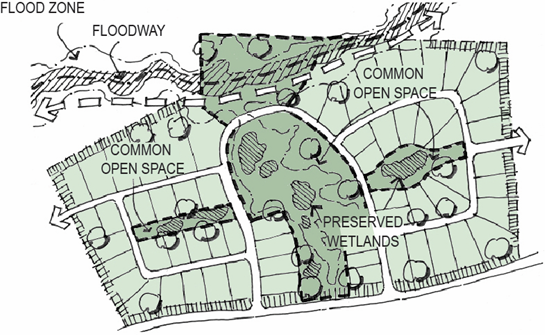
7.10.01. Intent.
A.
To provide flexibility to accommodate development on lands constrained by natural hazards that may limit the amount or type of development;
B.
To promote the creation of accessible green space;
C.
To protect sensitive, environmental land features to promote the public health and safety;
D.
To reduce erosion, sedimentation, land disturbance, and removal of vegetation;
E.
To promote development of walking and bicycling facilities and greenways within new developments that can be connected to adjacent neighborhoods and activity centers; and
F.
To reduce perceived density by providing access to and views of open space.
7.10.02. Applicability. The conservation subdivision option is available for single-family detached residential development of sites containing at least five acres. If held in multiple ownership, the site must be developed according to a single plan with common authority and maintenance responsibility.
7.10.03. Density determination.
A.
The maximum number of lots is determined by dividing the total area of the proposed subdivision tract by the following, whichever is more restrictive:
1.
6,000 square feet;
2.
The minimum lot size for detached single-family dwellings in the applicable district; or
3.
Lot requirements of the county health department if the development will not be connected to public sewer.
B.
In making this calculation, bodies of open water over 5,000 square feet of contiguous area may not be included in the total area of the tract.
C.
The minimum total area for front, rear and side yards is two and a half times the ground floor area of the dwelling unit. Separation between dwellings must be at least 14 feet as measured between nearest points of exterior walls.
7.10.04. Application requirements. Refer to appendix A-6 for specific requirements.
A.
Site analysis map. The applicant must prepare and submit a site analysis map with the preliminary plat. The purpose of the site analysis map is to ensure that important site features have been identified prior to the creation of the site design and that the proposed open space will meet the requirements herein.
B.
Conservation subdivision plan. As part of the preliminary plat, the applicant must prepare a conservation subdivision plan yielding no more lots than identified under section 7.10.03, Density determination. The conservation subdivision plan must identify open spaces to be protected and include an open space management plan, all of which must be approved by the planning commission prior to the issuance of a grading permit.
7.10.05. Open space standards. For the purposes of this section, "open space" is defined as the portion of a conservation subdivision that has been set aside for permanent protection.
A.
General standards.
1.
At least 20 percent of the total area of the tract must be maintained as open space.
2.
The following priority conservation areas must be included within the open space, unless the applicant demonstrates that this would constitute an unusual hardship and be counter to the purposes of the conservation subdivision:
a)
Floodway and any zone A;
b)
One-hundred-year floodplain;
c)
Riparian zones of at least 75 feet total width along all perennial streams;
d)
Slopes above 25 percent of at least 10,000 square feet contiguous area;
e)
Delineated wetlands; and
f)
Archaeological sites, cemeteries and burial grounds.
3.
The following are considered secondary conservation areas and should be included within the open space to the maximum extent feasible:
a)
Historic sites;
b)
Existing trails that connect the site to neighboring areas;
c)
Existing healthy, native forests of at least one-acre contiguous area; and
d)
Other significant natural features and scenic viewsheds, particularly those that can be seen from public roads.
4.
Utility rights-of-way and small areas of impervious surface may be included within the protected open space but cannot be counted towards the 20 percent minimum open space requirement (exception: historic structures and existing trails may be counted).
5.
At least 25 percent of the open space must be suitable for passive recreational use.
6.
At least 50 percent of the open space must be in a contiguous tract, which may be divided by a local street whose area is excluded from the open space. The layout of open space should allow connection to neighboring areas of open space.
7.
To the extent practicable, the open space should be accessible to the largest number of lots or buildings within the site. Non-adjoining lots must be provided with access to the open space through sidewalks or off-street paths.
B.
Permitted uses of open space.
1.
Conservation of natural, archeological and historical resources.
2.
Meadows, woodlands, wetlands, wildlife corridors, game preserves, and similar conservation- oriented areas.
3.
Agricultural and forestry activities may only be permitted when conducted according to best management practices.
4.
Passive recreation areas, walking, bicycle and similar trails.
5.
Active recreation areas, if they are limited to no more than 20 percent of the total open space and are not located within primary conservation areas. Active recreation areas may include impervious surfaces necessary to the recreational activity, excluding vehicular ways and parking and loading areas.
6.
Landscaped stormwater management facilities, community and individual wastewater disposal systems. Such facilities must be located outside of primary conservation areas.
7.
Easements for drainage, access, and underground utility lines.
8.
Other conservation-oriented uses compatible with the purposes of this section.
C.
Prohibited uses of open space.
1.
Golf courses.
2.
Streets, parking and loading areas and similar impervious surfaces, except as specifically authorized in the preceding subsections A. and B. above.
3.
Other activities as may be established by the applicant and recorded on the legal instrument for permanent protection.
7.10.06. Ownership, management and protection of open space.
A.
Responsibility for management of open spaces must be established in accordance with section 3.10, Common open spaces and facilities. The legal instrument establishing the means by which the open space will be protected and maintained must be recorded with the deed and must include restrictions on use of the open space in accordance with this section.
B.
The open space must be protected in perpetuity by one of the following binding legal instruments, which must be:
1.
A permanent conservation easement in favor of either:
a)
A land trust or similar conservation-oriented nonprofit organization with legal authority to accept such easements. The organization must be bona fide and in perpetual existence and the conveyance instruments must contain an appropriate provision for retransfer in the event the organization becomes unable to carry out its functions; or
b)
A governmental entity with an interest in pursuing goals compatible with the purposes of this subsection, and if the entity accepting the easement is not the city, then a third right of enforcement favoring the city must be included in the easement.
2.
A permanent restrictive covenant for conservation purposes in favor of a governmental entity.
3.
An equivalent legal tool that provides permanent protection, as approved by the city attorney.
Sec. 7.11. - Cottage developments.
7.11.01. General standards.
A.
Cottage developments are permitted only on sites served by public water and sewer services.
B.
Each dwelling must be on its own lot. However, this does not apply when cottages are developed in condominium format and does not apply in districts in which multi-family dwellings are permitted.
C.
The number of allowable dwellings is determined by dividing the total tract size by the minimum lot size in the applicable district. Any fraction is rounded down to the nearest whole number. In no case may the number of units be less than four nor more than 12.
D.
Not all lots are required to have street frontage, subject to the following:
1.
Each lot must front on and have a main entry facing the common open space, except those lots, nearest the fronting street, may front on the street or common open space.
2.
The rear of dwellings may not face toward a street, except in the case of a reverse frontage tract, the rear of cottage lots may be oriented toward the street of higher classification.
3.
Lots must be readily accessible for fire suppression purposes as determined by the fire chief or their designee during subdivision plat review.
7.11.02. Area and dimensional requirements.
A.
The minimum lot size, lot width and side setback prescribed for detached single-family dwellings in the applicable district do not apply, except in determining the number of allowable dwellings per section 7.11.01.C. Spacing between cottage dwellings must be at least ten feet, which may include zero-lot line arrangements.
B.
Minimum common open space: 250 square feet per unit and not less than 40 feet in width at any point.
C.
Maximum floor area per dwelling: no more than 1,600 square feet per floor.
D.
Maximum height: two stories.
E.
Minimum building setbacks:
1.
Dwellings must be set back at least 20 feet from the exterior lot lines of the overall development and must observe the front setback for the district along all street frontages.
2.
No setback is required between a dwelling and the common open space; however, no portion of a building may encroach into or over the common open space.
7.11.03. Ownership and management of open space. See section 3.10, Common open spaces and facilities.
7.11.04. Parking. Parking must be provided as required for detached single-family dwellings and may be clustered together or provided individually at the rear of each home. Clustered parking areas must be screened from the common open space and from streets and adjacent residential properties.
Sec. 7.12. - Day care facilities.
7.12.01. Day care center.
A.
Day care centers must meet all applicable state and county licensing requirements. Proof of state annual license renewal must be supplied to the city every year.
B.
The operator of a day care center must allow appropriate representatives of the municipality to enter the property to inspect such use for compliance with applicable city regulations.
C.
An outdoor play area must be provided, which may not be located in the front yard.
1.
Hours of outside play must be limited to between the hours of 8:00 a.m. and sunset, as defined by the national weather service.
2.
Fencing must be provided to physically contain the children within the outdoor play area, and to restrict children from hazardous areas, such as open drainage ditches, wells, holes, and streets or highways.
3.
Play equipment must be located at least ten feet from all abutting lot lines.
D.
All pedestrian pathways must be adequately lit for safety if utilized during non-daylight hours. Specific areas for lighting are entranceways, pedestrian access to the outdoor play areas, sidewalks, drop-off areas, merchandise delivery areas, and all parking lots. Such lighting may not produce objectionable glare on abutting properties.
E.
A written statement must be provided to the city from the health department certifying that any onsite sewage disposal system is properly designed to accommodate the use and that there are no apparent signs of system failure.
F.
Any application for a building permit or business license must include a plan showing any existing or proposed outdoor play areas, outdoor play equipment, fencing, access drives, adjacent streets, adjacent hazardous land uses, on-site hazardous areas, merchandise delivery areas, on-site sewage disposal facilities, parking spaces, and the child or adult drop-off circulation pattern.
7.12.02. Family day care homes and group day care homes. Day care homes are not subject to the requirements for home occupations, but must comply with the following requirements:
A.
General regulations.
1.
The day care home must be clearly incidental to residential use of the dwelling and may not change the essential character of the dwelling.
2.
The day care home must meet all applicable state and county licensing requirements.
3.
The day care home may not be conducted in any accessory structure.
4.
The day care home activity is limited to the hours between 6:00 a.m. and 10:00 p.m.
5.
No day care home may be located within 1,000 feet of another day care home as measured between lot lines.
6.
Each applicant for day care home approval must submit a tax notice or deed to the property on which the proposed business will be conducted. If the applicant does not own the property, the applicant must obtain from the owner a signed and notarized letter of authorization to apply for day care home approval. The letter must include name, address, and telephone number of the property owner.
7.
Outdoor play areas are permitted in the rear yard only. Such areas must be screened from all abutting residential properties by an opaque fence or wall at least six feet in height.
8.
Employment in a family day care home is limited to residents of the dwelling. Employment in a group day care home is limited to residents of the dwelling plus one person not residing on the premises.
Sec. 7.13. - Donation centers.
7.13.01. Purpose. The purpose of these regulations is to provide separation and operations standards for donation centers, since they can have a deleterious impact on neighboring properties by lowering property values and adversely affect rental rates of nearby commercial properties.
7.13.02. Applicability. These standards apply to new establishments of donation centers. An establishment is considered new when no previous donation center existed at that location for a period of 90 consecutive days or longer immediately preceding the filing date of an application for a building permit or business license, whichever is applicable or submitted first. Any properly licensed donation center legally operating on the effective date of this ordinance that is not in compliance with this section is considered a legal nonconforming use subject to article XI, Nonconformities.
7.13.03. Discontinuance and termination. Any donation center, whether existing or subsequently permitted, that voluntarily discontinues active operation for more than 90 consecutive days; does not maintain a valid city business license for more than 90 consecutive days; or ceases to be licensed by the State of Alabama or any other applicable licensing authority, is considered to have terminated the use and forfeited all privileges and rights held therein.
7.13.04. Locational requirements. No donation center may be located within 2,500 linear feet of any other donation center as measured between nearest property lines.
7.13.05. Development and operational standards.
A.
Each donation center must be a minimum of 12,000 square feet of total gross floor area and operated by a single tenant.
B.
No outdoor display of donated goods or merchandise is permitted.
C.
Collection, processing and storage of donated goods
1.
All sorting, processing, and storage of goods must be conducted within the building and may not be visible from the retail area.
2.
Donations may be collected only during regular business hours. No donated goods may be left outside. Signage prohibiting leaving of donated goods during non-business hours must be installed in conspicuous locations to the satisfaction of the zoning official. Signage must include daytime collection hours.
3.
No outdoor storage is permitted. Collection areas must be located to the rear of the building and screened from view from residential properties and public streets.
4.
If provided, donation bins must be located adjacent to the collection area where accessible during non-business hours and screened from view from residential properties and public streets.
Sec. 7.14. - Extended stay facilities.
Any building or portion thereof marketed or used as an extended stay facility may not offer leases or other rental agreements for periods greater than 180 days unless the accommodations being offered for such longer periods are designed and constructed in accordance with the applicable requirements of the Building Code for residential occupancy.
Sec. 7.15. - Gas stations and minor vehicle repair services.
7.15.01. Gas stations and minor vehicle repair services must observe all state and city regulations.
7.15.02. All permanent storage of material, merchandise, and equipment must be within the principal building. Outside of the building, all waste must be kept within a container screened in accordance with section 10.02, Screening.
7.15.03. All lighting must be arranged to prevent direct light or glare into public streets or surrounding properties.
7.15.04. No gas station or minor vehicle repair service may be located closer than 300 feet to a public assembly center as measured between property lines.
7.15.05. Lot and yard requirements.
A.
Minimum lot size: 12,000 square feet.
B.
Minimum street frontage: 120 feet.
C.
Gas pumps and pump islands may be located within a required front yard, but not closer than 15 feet to any front lot line.
D.
All driveways must be set back at least 20 feet from property corners and may not exceed 35 feet in width.
7.15.06. Additional standards for minor vehicle repair services.
A.
Drains must have approved oil/water separators in the trap.
B.
All repair work to vehicles must be performed within the principal building.
C.
Any uses conducted on the premises which is offensive or dangerous or which constitutes a nuisance to the occupants of adjacent properties, by reason of the emission of smoke, fumes, dust, odor, vibration, noise, or unsightliness are prohibited.
D.
Storage of vehicles on premises for purposes other than maintenance or repair is prohibited.
Sec. 7.16 - Gold and silver object dealers.
7.16.01. Purpose. It is recognized that the services offered by gold and silver object dealers may provide an opportunity for individuals to potentially transfer stolen property. Therefore, the purpose of these regulations is to provide separation and operational standards to mitigate the negative impacts associated with such businesses and to serve the public safety and welfare.
7.16.02. Applicability. These standards apply to new establishments of gold or silver object dealers. An establishment is considered new when no previous gold or silver object dealer existed at that location for a period of 90 consecutive days or longer immediately preceding the filing date of an application for a building permit or business license, whichever is applicable or submitted first. Any properly licensed gold or silver object dealer legally operating at the effective date of this ordinance is considered a legal nonconforming use subject to article XI, Nonconformities.
7.16.03. Discontinuance and termination. Any gold or silver object dealer, whether existing or subsequently permitted, that voluntarily discontinues active operation for more than 90 consecutive days; does not maintain a valid city business license for more than 90 consecutive days; or ceases to be licensed by the State of Alabama or any other applicable licensing authority, is considered to have terminated the use and forfeited all privileges and rights held therein.
7.16.04. Locational requirements. The following distance requirements are measured in a straight line between the closest points of the property lines of the properties involved.
A.
No gold or silver object dealer established after the effective date of this section may be located within 2,500 linear feet of any other gold or silver object dealer or pawnshop.
B.
No gold or silver object dealer may be located within 500 feet of a residentially zoned property.
C.
No gold or silver object dealer may be located within 500 feet of a public building, public or private school, day care center, nursery, preschool, park or playground, or place of worship.
7.16.05. Development and operational standards.
A.
The hours of operation are limited to the hours between 9:00 a.m. and 6:00 p.m.
7.16.06. Other requirements.
A.
Zoning approval is required prior to the issuance of a business license and prior to occupancy of the premises.
B.
Gold and silver object dealers must comply with this section and chapter 5, Business Licenses, Taxes and Regulations, article V, Gold and Silver Object Dealers, of this Code, as amended.
Sec. 7.17. - Group homes.
7.17.01. All group homes are subject to site plan review and approval (see section 13.06, Site plan review). Group homes may be subject to Building Code requirements greater than those applicable to other detached single-family dwellings.
7.17.02. Group homes must be sponsored by a public or nonprofit organization. All state, county, and city licensing and building permit requirements must be met.
7.17.03. No group home may be located within 1,000 feet of another group home.
7.17.04. The building must maintain the exterior appearance of a residence with no separate outside entrances to individual bedrooms.
7.17.05. Group homes must have full-time, 24-hour, on-site supervision.
7.17.06. Parking must be located in either the side or rear yard.
7.17.07. For class I group homes, refer also to Code of Ala. 1975, § 11-52-75.1.
7.17.08. Persons using or consuming alcohol or controlled substances are not permitted in class IV group homes for persons recovering from drug or alcohol abuse.
Sec. 7.18. - Home occupations.
7.18.01. General regulations.
A.
The home occupation must be clearly incidental to the residential use of the dwelling and may not change its essential character. Home occupations may not adversely affect the general welfare of the surrounding residential area due to smoke, odor, noise, electrical interference, increased pedestrian and vehicular traffic or any other conditions which would constitute an objectionable use of residentially zoned property.
B.
Home occupations that involve customers or clients being on-premises are not permitted, except instructional home occupations, which are limited to one client on-premises at any time.
C.
The home occupation must be operated in the existing dwelling unit, which may not be enlarged to accommodate the business activity. The home occupation may not occupy more than 25 percent of the total floor area of the dwelling regardless of whether any portion of the home occupation is conducted in an accessory structure.
D.
Noise levels must comply with the applicable regulations of chapter 11, article IV, Noise, of this Code.
E.
No persons other than those residing in the dwelling may be employed on the premises as part of the home occupation.
F.
There may be no outside display or storage of materials, goods, supplies, or equipment used in the home occupation on the premises. There may be no evidence of the home occupation visible from the beyond the property. The conduct of a home occupation does not afford additional signage for dwellings as permitted in accordance with section 8.07.04, Temporary signs.
G.
No merchandise may be distributed to customers on the premises.
H.
The repair of vehicles is not permitted as a home occupation.
7.18.02. Other provisions.
A.
Each home occupation must have a valid business license.
B.
No more than one home occupation may be approved in any one dwelling unit. Home occupations which involve no on-premises customers, clients or patrons are exempt from this provision.
C.
The issuance of a business license to a service contractor, who performs work at other locations, does not constitute permission to store materials, tools, vehicles, or construction equipment on the property of the address listed on the license.
D.
At any time after a business license has been approved for a home occupation, the zoning official has the right, following advance notice to the property owner, to enter and inspect the dwelling for compliance purposes. It is the responsibility of the license-holder to notify the city if the home occupation is no longer being conducted on the premises.
Sec. 7.19. - Hospitals.
7.19.01. Hospitals are subject to section 13.06, Site plan review.
7.19.02. A preliminary plan or engineering feasibility report providing for the site grading, storm drainage, sanitary sewerage and water supply, prepared by a professional engineer.
7.19.03. Where deemed necessary by the city engineer, a traffic analysis indicating the estimated traffic flows to and from the hospital prepared by a professional engineer.
7.19.04. At least five percent of the tract must be reserved and improved as open space for the use of employees, patients and visitors. Said outdoor open space must be open and unobstructed from the ground upwards.
Sec. 7.20. - Industrial parks.
7.20.01. Access to an industrial park must be by way of a major street.
7.20.02. Outdoor storage is permitted only when: accessory to a permitted principal use, located behind the front building line and screened in accordance with section 10.02, Screening.
7.20.03. A report of subsurface soil conditions must be provided to the building official by an engineer as evidence of suitable bearing for foundations in the construction of industrial structures.
7.20.04. A site plan, a grading, drainage and erosion control plan, best management practices for the site, a utility plan, and any other information deemed necessary by the city engineer prepared by an engineer, must be submitted with any building permit application.
Sec. 7.21. - Junkyards.
7.21.01. Junkyards must comply with all applicable federal and state regulations pertaining to the handling, storage, and disposal of waste fluids. Disposal of waste fluids is prohibited on-site.
7.21.02. Any materials or accumulation of materials must be set back from the screening fence or wall five feet horizontally for each foot in height above eight feet.
7.21.03. Screening.
A.
All outdoor storage facilities must be screened as required in section 10.02, Screening, by a continuous, opaque fence or wall without openings of any type, except as needed for vehicular access. The vehicular access may not exceed 25 feet in width. The access gate must be of a solid, opaque material.
B.
The screening wall or fence must comply with section 10.05, Design standards for fences, and must be of the same type of material throughout.
Sec. 7.22. - Manufactured home parks.
7.22.01. Manufactured home parks are subject to site plan approval under section 13.06, Site plan review. No structures or facilities may be installed or constructed until a site plan has been approved by the city. All improvements must be consistent with the approved site plan. Where an existing manufactured home park has no site plan, such a plan must be prepared and submitted to the city prior to the addition, improvement, rearrangement or replacement of park facilities or manufactured homes. All manufactured home spaces must be shown on the site plan.
7.22.02. In no case may a manufactured home park be separated into lots in fee simple ownership. All facilities, including streets, must be privately owned and may not occupy parcels of land which are deeded separately from the common facilities within any manufactured home park.
7.22.03. Occupancy. No manufactured home may be installed, stored, or otherwise located within a manufactured home park, nor may utility service be authorized, until the park has received a certificate of occupancy.
7.22.04. Allowable accessory uses.
A.
Clubhouse, laundry, swimming pool, and other shared facilities for the common use of the residents of the manufactured home park.
B.
No more than one dwelling unit of conventional construction for the use of a resident manager.
C.
Storage area for boats, recreational vehicles, and other types of vehicles that exceed 30 feet in length. The storage area must be for the use of park residents only and must be screened from view from abutting properties and streets. Such vehicles may not be stored on individual manufactured home spaces nor on streets and drives within the manufactured home park.
D.
Storage sheds and other freestanding accessory structures are prohibited in required open space areas. Accessory structures must be at least ten feet from any other structure.
7.22.05. Manufactured home parks are subject to the standards in table 7-1.
Table 7-1. Manufactured Home Park Standards.
7.22.06. Buffers, landscaping and yards.
A.
Buffers must be provided along the perimeter of the park as required in section 10.01, Buffers.
B.
Common parking areas must be landscaped in accordance with section 10.04, Landscaping for vehicular areas.
C.
Manufactured homes and structures must be set back at least ten feet from the pavement edge of any streets and drives within the manufactured home park.
7.22.07. Open space. Manufactured home parks must have an improved open space, easily accessible to all park residents, and improved for recreation purposes. At least ten percent of the gross park area must be improved as recreational open space, which must be located to be accessible to all park residents and maintained in a usable condition.
7.22.08. Parking, access and circulation.
A.
Two paved off-street parking spaces must be provided for each manufactured home space. Required parking may be provided on each home space or in common parking areas. One visitor parking space must be provided on site per six home spaces.
B.
No individual manufactured home space may have direct access to a public right-of-way.
C.
Internal park streets and drives must be paved and must be owned and maintained by the developer or owner of the park property.
7.22.09. Storm shelters. Storm shelters must be provided on-site, as provided herein, whenever (1) a new manufactured home park [is] developed, (2) an existing park is expanded by any number of dwelling units, and (3) an existing park replaces ten homes or 50 percent of the homes in the park, whichever is more restrictive.
A.
Storm shelter must have a minimum floor area of seven square feet for each home space and be located no more than 1,320 linear feet from the furthest home space in the park.
B.
Shelters must be designed by a licensed structural engineer or architect, must comply with all applicable building codes and be installed as approved by the building official. Shelters must meet all applicable requirements of the Americans with Disabilities Act and, if located within a floodplain, must meet all FEMA requirements.
C.
The park operator is responsible for making the storm shelter accessible and usable in times of need. Storm shelters may not be used for storage purposes if such storage reduces the minimum floor area required herein.
7.22.10. Lighting. All freestanding lighting must be shielded or directed away from adjoining properties.
7.22.11. Refuse containers. Common refuse containers must be provided and screened in accordance with section 10.02, Screening.
Sec. 7.23. - Massage therapy.
7.23.01. Massage services may only be performed by:
A.
State certified massage or physical therapists;
B.
State licensed athletic trainers;
C.
State licensed physicians, chiropractors or other medical practitioners or staff working under the supervision of such practitioners;
D.
Duly licensed beauty and nail salons, in which massage services are offered at no charge and are incidental to other health or beauty services provided; or
E.
Any other provider specifically exempted by the State of Alabama Massage Therapy Act.
7.23.02. All other massage services are prohibited.
Sec. 7.24. - Mini-warehouses.
A.
Storage compartments may be used only for storage purpose. No storage space may be used as a dwelling or for conducting a business of any kind.
B.
A storage area with a suitable paved bituminous or concrete surface is required, if parking is provided for boats, recreational vehicles, and similar items only. These parking areas must be screened from view in accordance with section 10.02, Screening.
C.
No storage of perishable items, highly combustible, flammable or explosive products or materials or other hazardous use items that may cause a health hazard is permitted.
D.
No display, sale or manufacture of goods, wares, or merchandise are allowed on the premises or within individual storage units, with the exception of the primary business, licensed by the City of Pelham, conducting the sale and service of merchandise associated with a moving or storage business.
E.
Mini-warehouses may not exceed a density of 15,000 square feet of mini-warehouse storage floor area per acre.
Sec. 7.25. - Motor vehicle sales or rental.
7.25.01. The lot of record must be a minimum of one-half acre (21,780 square feet) to operate a motor vehicle sales lot.
7.25.02. A permanent building, not less than 3,000 square feet of interior floor space, must be maintained on the premises for a sales office and must meet all requirements of the building code.
7.25.03. For there to be an automotive repair shop on the same property as a motor vehicle sales lot, the sales lot must offer new motor vehicles for sale, have a lot of at least one acre, and must be separately licensed to do so.
7.25.04. An on-site inventory of at least 30 vehicles must be maintained at all times.
7.25.05. Display areas must be set back from public thoroughfares for the safety of prospective buyers viewing displayed vehicles. Vehicles may not be parked, stored or displayed within five feet of any street rightof-way. Vehicles, signs, banners, tents, or other items may not be stored, parked, displayed, or otherwise placed on public rights-of-way at any time.
7.25.06. Frontage landscaping must be provided in accordance with section 10.04, Landscaping for vehicular areas.
7.25.07. Grounds must comply with the following minimum requirements upon that portion of the land to be used for display or offering for sale of motor vehicles:
A.
Improved ground must contain a gravel base of not less than four inches covered by a minimum of two inches of asphalt, concrete or other approved hard topping. The finished grade level of such improved grounds may not be less than 12 inches nor more than 36 inches above the grade level of the abutting street.
B.
Parking spaces for each vehicle must be at least nine feet by 20 feet. Required parking spaces for customers must be designated separately from those areas used to display automobiles for sale.
C.
An adequate turn-around area must be provided to discourage vehicles backing out into traffic from the sales lot.
7.25.08. The placement of vehicles for display must be within spaces striped in accordance with the dimensional requirements in section 9.03, Parking design standards.
7.25.09. Disabled or damaged vehicles may not remain in an exterior location unless screened from public view. Such areas may only be to the side or the rear of the principal structure of the business and must be screened from abutting properties and streets in accordance with section 10.02, Screening.
7.25.10. Audio amplification systems, including, but not limited to, telephone loudspeakers or paging systems, must comply with the applicable regulations of chapter 11, article IV, Noise, of this Code.
7.25.11. Other types of existing businesses requesting to operate a motor vehicle sales or rental lot may not utilize existing designated required parking spaces for that existing business for a motor vehicle sales or rental lot. Any existing business requesting license or zoning approval for a motor vehicle sales or rental lot must comply all requirements of this section.
7.25.12. The applicant must submit to the zoning official a detailed site plan including method proposed for improvement, drainage, parking and display areas, ingress and egress, landscaping, screening, signage and buildings to be built or existing buildings to be used in the operation of the business.
7.25.13. Together with the site plan, the applicant must submit a plan and inventory for the safe storage of flammable or hazardous materials to be stored or used on the property. The plan must provide for the prevention, containment, recovery, and mitigation of spilled fuel or other hazardous material. The inventory must include the type, quantity, and location of these materials. The inventory must be kept current pursuant to direction provided by the city.
7.25.14. Where permitted, motor vehicle sales and rental lot businesses must comply with chapter 5, Business Licenses, Taxes and Regulations, article XIII, Motor Vehicle Sales and Rental Lots, of this Code, as amended. All applicable zoning approvals and permits must be obtained prior to granting of a motor vehicle sales lot license.
Sec. 7.26. - Multi-family developments.
7.26.01. Multi-family buildings must be separated by at least 30 feet when one or both are two-story buildings, and at least 40 feet when one or both are three or more story buildings. The minimum dimension of a yard upon which any entrance or exit faces is 20 feet.
7.26.02. For multi-family development with multiple residential buildings, accessory structures may not extend forward of the rear building line of those residential buildings nearest the abutting street.
7.26.03. Building entrances must face and be clearly visible from streets, interior drives or interior open space and must be accessible from the street, interior drive or open space they face. This does not apply to entrances to individual dwelling units.
7.26.04. Parking.
A.
Multi-family sites may not be arranged such that all parking is located forward of the front building line. Parking must be setback at least 25 feet from the front lot line and landscaped in accordance with section 10.04, Landscaping for vehicular areas.
B.
Any garages provided on-site for resident parking must be located away from public view.
C.
Parking of boats and recreational vehicles may not take up required parking spaces and must be screened from adjoining properties in accordance with section 10.02, Screening.
7.26.05. Open space. The following requirements apply to all multi-family developments involving more than one multi-family building:
A.
At least 20 percent of the site must be reserved as open space. At least 50 percent of required open space must be improved and maintained for the use of the residents and guests. All proposed open spaces must be included in the site plan submittal.
B.
All common open spaces and recreational areas must be well maintained in a safe and orderly condition. Open spaces must be oriented to receive adequate sunlight.
C.
Improved open space should be consolidated into one or a few central locations to assure accessibility and usability.
D.
Open space and recreational areas are counted toward the improved open space requirement as follows:
1.
Required front, side and rear setbacks may only be counted toward open space requirements if they are at least 40 feet in depth.
2.
For developments of 40 or more units, children's playground area must be provided in the amount of 50 square feet per unit. This does not apply to age-restricted housing developments that prohibit children. The minimum size of any playground is 2,000 square feet. Children's play areas must be located so that they are visible from dwelling units and near pedestrian activity and may not be surrounded on all sides by parking. They must adjoin an open space or building on at least one side.
3.
Stormwater management facilities located within an open space may only be counted as improved open space if it is designed so that it need not be fenced and is landscaped with native plants along the water's edge and on side slopes.
7.26.06. Service, loading and waste collection. Each development must be provided with service areas for waste collection, each of which must be located behind the front building line and away from public views but must otherwise be accessible to waste collection vehicles and to residents. The location of such areas must minimize negative visual, noise, odor and other impacts to on-site dwellings and adjacent developments. Each such area must be paved with concrete and receptacles screened in accordance with section 10.02, Screening.
7.26.07. Storage units. At least 280 cubic feet of dedicated storage space must be provided per dwelling unit. Storage may be provided within each unit or building or elsewhere on site.
7.26.08. Pedestrian access. A pedestrian circulation system meeting the following standards must be provided:
A.
Walkways within the development must be connected to adjoining public streets. If not already provided, a sidewalk at least five feet wide must be provided along all public street frontages.
B.
Walkways must connect the main entrances of all buildings. For buildings fronting on a public street, a public sidewalk may be counted toward this standard.
C.
Walkways must be provided that connect building entrances to parking areas and common areas and facilities.
D.
Walkways must be provided to connect to any public trails or similar bicycle-pedestrian facilities adjoining the site.
7.26.09. Privacy and security standards.
A.
Exterior stairways may not be visible from a public street.
B.
For privacy, separation must be provided between windows of ground floor dwelling units and adjacent walkways, parking areas and common open spaces, including:
1.
A horizontal separation at least ten feet deep including a landscaped bed containing at least one row of evergreen shrubs; and/or
2.
Vertical separation so that the bottom edge of a ground-floor window is at least five feet above the grade of the adjacent walkway, parking area or open space. Developments are encouraged to raise the ground floor of residential buildings at least 30 inches above the sidewalk or parking area to enhance privacy to the degree practicable given applicable requirements of the Americans with Disabilities Act.
7.26.10. Architectural standards.
A.
Four-sided design. All building elevations must reflect consistent design, colors, and materials.
B.
Building articulation. Building façades facing a street, open space or parking area must be articulated at intervals of no more than 30 feet. A façade is considered articulated when there is a projection, recess or other change in depth of at least 12 inches and for a horizontal distance of at least four feet. Projecting and recessed balconies count toward this requirement.
C.
Diversity of building types. Multi-building developments must provide different architectural designs to achieve visual interest and variety, particularly where multiple buildings front on the same public street. Changes in building colors or reversal of façade designs are not sufficient to comply with this standard. To meet this requirement, façades must be distinct through a combination of at least two of the following: building articulation, fenestration pattern, building materials, or roof design.
D.
Accessory structures. Accessory structures must be of the same colors and materials as principal buildings.
E.
Roof design.
1.
Eaves must extend beyond the supporting wall at least 16 inches.
2.
All buildings must incorporate variations in the roofline. Roofs must be articulated at intervals of no more than 40 feet using dormers, gables and changes to the ridgeline. Ridgelines may not extend more than 60 feet in a straight line.
3.
Windows. Building façades facing an adjoining street must include windows. Windows must be at least 20 percent of each street-facing façade. All other façades must have a minimum window area of ten percent.
F.
Preferred building materials. Building exteriors must be constructed from high quality, durable materials as follows:
1.
Masonry. When used for the façade of any building, concrete blocks must be split-faced, ribbed or scored and may not exceed 25 percent of the masonry area of the façade. To add visual interest, the use of specialized textures or colors used effectively with other building materials and details are encouraged. Plain concrete block or plain concrete may only be used up to three feet above finished grade.
2.
Exterior insulation and finish system (EIFS) must be trimmed in wood, masonry, or other approved materials and may not be used adjacent to grade.
3.
Wood and cement board siding may be used when the board product is less than eight inches wide.
4.
Prohibited materials. The following materials are prohibited on building façades.
a)
Plywood siding (including T-111 or similar plywood), except when used as a component in board and batten siding.
b)
Highly tinted or mirrored glass (except stained glass) as more than ten percent of the building façade.
c)
Corrugated fiberglass.
d)
Metal siding and sheet metal.
5.
Vinyl siding is permitted when the board size is less than six inches wide. However, it may not be used adjacent to grade.
Sec. 7.27. - Nursing care and assisted living facilities.
7.27.01. Site development plan.
A.
A preliminary plan or engineering feasibility report providing for the site grading, storm drainage, sanitary sewerage and water supply, prepared by a registered professional engineer.
B.
Where deemed necessary by the city engineer, a traffic analysis indicating the estimated traffic flows to and from the facility prepared by an engineer.
7.27.02. Parking areas must be set back no less than 15 feet from the building. A sidewalk of no less than five feet in width must be provided between the building and parking area.
7.27.03. No certificate of occupancy may be issued prior to issuance of required permits and certificates by federal, state, and local agencies.
7.27.04. Ten percent of the total parking spaces must be designated as handicap accessible.
7.27.05. Entrances to patient rooms must be from the interior of the building. Mailboxes and laundry rooms must be within the same building.
7.27.06. Improved open space, which may include gardens, walking paths, courtyards and similar passive recreational spaces, must be provided:
A.
Nursing care facilities: at least five percent of the total tract.
B.
Assisted living facilities: at least ten percent of the total tract.
C.
Combined nursing and assisted living facilities: at least ten percent of the total tract.
7.27.07. All nursing care facilities must be served by public water and sewer. All on-site utilities must be placed underground.
Sec. 7.28. - Pet services and kennels.
7.28.01. In the B-2 district, all buildings, in which animals are kept, must be soundproofed so that noise levels comply with the applicable regulations of chapter 11, article IV, Noise, of this Code. Evidence of such soundproofing must be provided with the building permit application.
7.28.02. Emission of any offensive odors beyond the property line is prohibited.
7.28.03. All pet services and kennels must comply with applicable local, state and federal regulations governing the disposal of animal waste.
7.28.04. Outdoor animal areas.
A.
Outdoor areas must be cleaned and all animal waste collected and disposed of daily.
B.
In the B-2 district, outdoor animal areas are limited to an area that may be used only for the elimination of animal waste. Only one animal may be permitted in such outdoor area at a time.
C.
Pet services and kennels with any outdoor animal areas must be separated from residential districts and residential properties by at least 200 feet as measured between nearest property lines.
D.
In the A-1 and M-1 districts, outdoor animal areas are subject to site plan approval prior to any grading, clearing, site improvements or issuance of related permits. If outdoor animal areas are less than 400 feet from the nearest residential district or residential property, the zoning official may require such areas to be enclosed by walls, fences, berms, shrubs or trees, pre-existing or newly planted, of a type, area and height to sufficiently mitigate noise impacts from nearby streets and properties.
E.
Outdoor animal areas are not allowed in the corridor overlay districts.
7.28.05. Number of dogs in kennels. For the following, an adult dog is any dog over six months in age.
A.
No more than 30 adult dogs may be kept on the premises of a kennel at the same time, except in the A-1 district.
B.
In the A-1 district, there may be no more than three adult dogs per acre. Outdoor areas for the keeping of dogs must be fences and set back at least 200 feet from the nearest dwelling other than that of the kennel owner.
Sec. 7.29. - Recreational vehicle (RV) parks and campgrounds.
7.29.01. General requirements.
A.
A business license is required for all recreational vehicle parks and campgrounds. Proof of commercial general liability insurance must be provided with the business license application.
B.
Owners of RV parks and campgrounds are responsible for payment of all applicable lodging taxes.
7.29.02. Park and campground standards.
A.
Minimum tract size: three acres.
B.
Minimum street frontage: 60 feet.
C.
All structures, camp sites and RV spaces must be set back at least 35 feet from all property lines.
D.
No recreational vehicle may be occupied by a person or family for more than two consecutive weeks.
E.
Perimeter and frontage landscaping must be provided on all sides of a RV park as required for parking lots in section 10.04, Vehicular area landscaping.
F.
At least 5,000 square feet for the first 20 RV spaces plus 150 square feet for each additional RV space must be provided for recreational use of park occupants.
7.29.03. Standards for RV spaces.
A.
Each RV space must be at least 500 square feet in area. Spaces for non-motorized recreational vehicles must be large enough for the RV and the passenger vehicle pulling it unless parking is provided for the passenger vehicle elsewhere on site.
B.
Only one RV may be located in each RV space.
C.
Spaces must be designed to provide at least 20 feet separation between RVs in adjoining spaces.
7.29.04. Parking and access.
A.
At least one parking space must be provided for each camp site plus one parking space per employee. One visitor parking space must be provided per six RV spaces. Parking spaces are not required to be paved but must be graded and surfaced as approved by the city engineer.
B.
All RV spaces and all parking, sanitary, recreation and other common facilities must be accessed from an internal vehicular drive designed to accommodate recreational vehicles.
C.
Vehicular drives must be maintained by the park owner or operator and open for access at all times to emergency vehicles.
D.
Vehicular drives must be surfaced with asphalt, crushed rock or other suitable, dustless material and of a width as approved by the city engineer and the fire department.
7.29.05. Lighting. All vehicular drives and walkways providing access to restrooms, campground office and other common facilities must be adequately lighted for safety.
7.29.06. Sanitation.
A.
The following facilities must be provided, at a minimum, two shower facilities and a washer and dryer for the use of park occupants. In addition, two toilets and lavatories must be provided for each 15 camp sites and RV spaces or fraction thereof not provided with water and sewer connections.
B.
For any RV spaces not provided with drain inlets for discharge of toilets, dump stations designed to receive discharge of sewage holding tanks must be provided. Such stations must be set back at least 100 feet from all camp sites and RV spaces.
C.
Two-cubic yard or larger waste containers must be located within 300 feet of every RV space. Alternatively, the zoning official may approve the use of individual waste containers for each RV space provided the park operator provides for regular waste pickup from RV spaces.
D.
Dump stations and two-cubic yard and larger waste containers may not be closer than 30 feet to any property line and must be screened in accordance with section 10.02, Screening.
Sec. 7.30. - Seasonal businesses.
7.30.01. No short-term or seasonal businesses may be conducted nor any part of a structure occupied for a short-term or seasonal business without the issuance of a valid business license and the collection of all taxes applicable to the type of business.
7.30.02. All short-term and seasonal business must be located in a permanent building in accordance with the requirements set forth in section 3.03.07, Businesses, to be in permanent buildings.
7.30.03. The number of participants may not exceed the maximum capacity of the venue location.
7.30.04. Sufficient sanitary sewage facilities must be available on-site and be approved by the appropriate regulatory authority.
7.30.05. The sale of foods and beverages is subject to the applicable regulations and the approval of the Shelby County Health Department.
7.30.06. The serving of alcoholic beverages requires permits from both the city council and the Alabama Beverage Control (ABC) Board.
7.30.07. Sufficient off-street parking must be available on-site to accommodate all employee and customer parking needs. All vehicles must be parked in designated, paved parking spaces on the premises.
7.30.08. Sales from parked vehicles are prohibited.
7.30.09. Where the vendor is not the property owner, the vendor must provide the zoning official a written agreement signed by the property owner authorizing the temporary use of the property by the vendor.
Sec. 7.31. - Shopping centers.
7.31.01. No repairs or sales of vehicles of any type are permitted.
7.31.02. Convenient and safely located pedestrian walkways and marked crosswalks must be provided to connect all buildings and public entrances.
7.31.03. Shopping center sites must have a lot depth of at least 300 feet, as measured perpendicular to each front lot line.
7.31.04. A traffic analysis indicating the estimated effect of the proposed shopping center on adjacent street traffic, including volume flows to and from the proposed facility and sight distance from ingress and egress points, prepared by a registered engineer, must be submitted to and approved by the engineering and inspections department.
7.31.05. A site plan, a grading, drainage and erosion control plan, best management practices for the site, a utility plan, and any other information deemed necessary by the city engineer, which provide for the site grading, storm drainage, sanitary sewerage, and water supply, prepared by a registered engineer, must be submitted to the city engineer.
7.31.06. A copy of any deed restrictions intended for the property upon which said facility is to be constructed must be submitted to the engineering and inspections department.
Sec. 7.32. - Short-term rentals.
The following regulations apply to short-term rental of dwellings in residential districts only.
7.32.01. Licensing. The property owner must have a valid short-term rental license from the city before a property can be advertised or operated for short-term rental. An individual license must be obtained for each STR property.
A.
The property owner must provide with the STR license application the name and telephone number of an emergency contact that will respond within one hour to complaints about the condition or operation of the STR or conduct of renters or their guests. The emergency contact or their designee must be able to respond on-site within 12 hours if requested by the city. The emergency contact or their designee must answer calls 24 hours a day, seven days a week for the duration of each shortterm rental period. Prior to any change to the emergency contact, the owner must submit the revised contact information to the city finance department.
B.
Insurance. All STR licensees must obtain and maintain rental, short-term rental, vacation rental property insurance or other form of insurance adequate to cover the short-term rental use of the dwelling. Proof of insurance must be provided within 30 days of approval of the STR license and must be resubmitted each year for renewal of the STR license.
C.
Notice. Upon issuance of an STR license, the licensee must provide written notice to all owners of property adjoining the STR property that includes the following information:
1.
The names of the owner and emergency contact (if not the owner), including telephone numbers; and
2.
The telephone number of the city' code enforcement or other applicable department by which members of the public may report violations.
D.
Taxation. The licensee is responsible for collecting and reporting taxes from any rental arrangement that is not subject to an established collection agreement with the city.
7.32.02. Standards.
A.
The dwelling or portion thereof approved for short-term rental use may not be rented for weddings, concerts or similar events or used for such events during any short-term rental period.
B.
Occupancy. The dwelling or portion thereof approved for short-term rental use may not be rented to more than one guest party simultaneously. Occupancy is limited to the most restrictive of the following:
1.
No more than two persons per bedroom plus two persons; or
2.
No more than four persons per parking space.
The number of bedrooms and parking spaces are determined by the zoning official as part of the STR license. The zoning official may inspect the dwelling to verify information submitted with the STR license application. The owner must, by written agreement with the renter, limit overnight occupancy of the STR to the maximum occupancy approved with the STR license.
C.
The short-term rental must comply with all applicable city regulations including but not limited to building construction, fire safety, noise, and garbage collection and disposal.
D.
There must be adequate off-street parking to accommodate all guest parking needs. No recreational vehicles, buses or trailers may be stored on the street or forward of the front building line.
E.
Food prepared by the STR licensee for rental guests must be in accordance with the regulations of the Alabama Department of Public Health.
F.
A copy of the STR license, emergency contact information and house rules that comply with this section must be posted in a conspicuous place in the dwelling.
G.
Upon notification that a renter or a renter's guest has violated any provisions of this section or any noise, garbage, or other applicable provision of this Code, the owner or emergency contact must promptly notify the renter of the violation and take such action as is necessary to prevent a recurrence.
Sec. 7.33. - Single-family dwellings, attached.
7.33.01. Each building must contain at least three, but not more than six, contiguous dwelling units.
7.33.02. A storage space not less than 48 square feet in floor area must be provided within the dwelling or garage.
7.33.03. Driveways.
A.
Driveways forward of the front building line may not be wider than 20 feet.
B.
If garages are accessed from the front of the lot, driveways must be at least 20 feet in length between the garage entry and front lot line.
7.33.04. Attached single-family dwellings may have multiple stories or combinations of one and two-story sections; however, in no case may one unit be above another.
7.33.05. Each attached single-family dwelling must be designed and constructed to enable the sale of each as a separate dwelling.
7.33.06. A 15-foot access, drainage, and utility easement must be provided on the sides and the rear of each group of attached dwellings providing access to the rear of each unit. This easement must be unobstructed with no fences, utilities, or structures of any type. A maintenance easement, covenant or equivalent legal agreement must be secured that establishes responsibility for maintenance and repair of shared or contiguous walls, fence and roofs and provides authority for access necessary to such maintenance and repairs.
Sec. 7.34. - Special events.
Because special events may pose concerns about the health and welfare of the general public, patrons or participants of the event, or place an additional burden on the provision of normal public safety services, no special event may be conducted nor any part of a structure occupied for a special event without the written authorization from the city approved by the police chief, fire chief, and zoning official.
7.34.01. A special event is any activity not specifically approved as part of an existing business license or the certificate of occupancy for an existing structure. A special event may include the selling of goods or services, whether or not for profit, or the public assembly for the promotion, endorsement, sponsorship, or support of a particular venture.
7.34.02. The special event organizer must hire public safety security if required by the police chief and authorized under section 12-2 of this Code, or as otherwise required by the police chief; and must hire emergency personnel as required by the fire chief, and must reimburse the city for all costs associated with providing extra services as a result of the special event, as determined by the city engineer.
7.34.03. The number of participants may not exceed the maximum capacity of the venue location nor the parking capacity of the premises.
7.34.04. Sufficient sanitary sewage facilities must be available on-site and be approved by the appropriate regulatory agency or authority.
7.34.05. The sale of foods and beverages is subject to the applicable regulations and approval of the county health department.
7.34.06. The serving of alcoholic beverages requires permits from both the city council and the Alabama Beverage Control (ABC) Board.
7.34.07. Temporary signage must be in accordance with the temporary sign allowances for the applicable district in article VIII, Signs.
7.34.08. Sufficient off-street parking must be available on-site to accommodate all employee and customer parking needs. All vehicles must be parked in designated, paved parking spaces on the premises.
7.36.09. Sales from parked vehicles are prohibited unless the vehicle is expressly authorized for such activity under a valid business license or other city permit.
7.36.10. A written agreement signed by the property owner authorizing the temporary use of the property for the special event must be provided to the zoning official.
7.36.11. Businesses associated with the special event, including organizers and individual vendors, are responsible for obtaining any applicable business licenses required by the city as prescribed by chapter 5, Business Licenses, Taxes and Regulations, of this Code.
Sec. 7.35. - Tattoo and/or body art establishments.
7.35.01. Purpose. The general purpose of these regulations is to protect the public health, safety, and general welfare by requiring that all tattoo and body art establishments conform to Shelby County health and safety regulations pertaining and to city regulations that will minimize impacts to surrounding properties.
7.35.02. Applicability. The standards of this section apply to new tattoo and body art establishments. An establishment is considered new when no previous tattoo or body art business existed at that location for a period of 90 consecutive days or greater immediately preceding the filing date of an application for permit under this section. Any properly licensed tattoo or body art establishment legally operating at the effective date of this ordinance sis considered a legal nonconforming use subject to the provisions of article XI, Nonconformities.
7.35.03. Discontinuance and termination. Any tattoo or body art establishment, whether existing or subsequently granted under this section, that voluntarily discontinues active operation for more than 90 consecutive days; does not maintain a valid city business license for more than 90 consecutive days; or ceases to be licensed by the State of Alabama or any other applicable licensing authority, is considered to have terminated the use and forfeited all privileges and rights held therein.
7.35.04. Locational requirements. The following distance requirements are measured in a straight line between the closest points of the property lines of the properties involved.
A.
No tattoo or body art establishment established after the date of this section may be located within 2,500 linear feet of any other tattoo parlor.
B.
No tattoo or body art establishment may be located within 500 feet of a residentially zoned property.
C.
No tattoo or body art establishment may be located within 500 feet of a public building, public or private school, day care center, nursery, preschool, park or playground, or place of worship.
7.35.05. Development and operational standards.
A.
The hours of operation are limited to the hours between 9:00 a.m. and 6:00 p.m.
B.
Alcoholic beverages may not be sold or offered to customers.
C.
All tattoo and body art establishments are subject to the provisions of the Alabama Department of Public Health Rules of State Board of Health Bureau of Environmental Services Division of Food, Milk and Lodging, Chapter 420-3-23, Body Art Practice and Facilities, as may be amended.
D.
No tattoo or body art establishment may have an entrance or exit way providing a direct passageway to any type of business, residence or living quarters.
E.
All walls, ceilings, and floors must be smooth and easily cleanable and have a nonabsorbent surface. There may be no carpeting in the tattooing area. Walls and ceilings must be a light color. Walls, ceilings and floors must be kept clean, in good repair, and free from dust and debris. Floors, walls or ceilings may not be swept or cleaned while tattooing is in progress.
F.
Ventilation must be provided in each room or enclosure where services are performed on patrons, in accordance with the building code.
G.
Lighting must provide illumination of at least 200 foot-candles in each work area.
H.
Public restrooms must be located in such a way so that traffic to the restrooms does not occur in any area in which instruments are sterilized or on any area in which tattoo or body piercing operations are conducted.
I.
Establishments must have written procedures on the proper handling and sterilization of equipment and demonstrate that all personnel are trained in the procedure.
J.
Establishments must post and provide to customers upon request, written instructions on tattoo and/or piercing care.
7.35.06. Other requirements.
A.
All tattoo or body art establishments require approval in accordance with section 13.07, Conditional uses. Conditional use approval is required prior to the issuance of a business license and prior to occupancy of the premises.
B.
Before issuance of a business license from the city, each person proposing a tattoo or body art establishment must provide proof that they have obtained a valid permit from the Alabama Department of Health for a body art operator's permit.
C.
No permit to operate a tattoo or body art establishment may be granted unless the applicant first furnishes proof from a physician duly licensed to practice medicine in the State of Alabama, bearing a date not more than 20 days prior to the date of application, that each tattoo or body art artist working in the establishment is free from contagious, infectious or communicable disease. Such proof must be furnished annually thereafter and must include documentation of lack of infection by demonstrating negative results for the following tests:
1.
Venereal disease research laboratory (VDRL) for syphilis;
2.
Hepatitis B surface antigen (HBsAg) for hepatitis B. Documentation of receipt of a three-dose series of hepatitis B vaccine may be substituted for HBsAg testing; and
3.
Human immunodeficiency virus antibody (HIV-Ab) for HIV infection.
D.
Each permit applicant and tattoo or body art artist working in the establishment must be at least 19 years of age.
E.
The applicant must furnish proof of completion of an approved apprenticeship of 380 hours or more in a licensed establishment in Alabama or other state to include the minimum established requirements.
Sec. 7.36. - Vehicle repair, major.
7.36.01. Major vehicle repair or servicing, with damaged or inoperative items to be screened in a separate paved lot with a bituminous or concrete surface. Screening must be in accordance with section 10.02, Screening.
7.36.02. All surface areas with automobile traffic must be properly prepared using bituminous or concrete paving. No vehicles may be parked on grass or unprepared surfaces.
7.36.03. Required parking spaces for customers and employees must be designated separately from those areas used to park vehicles scheduled for repair.
7.36.04. Disabled or damaged vehicles may not remain in an exterior location unless screened from public view. Such areas may only be to the side or the rear of the principal structure.
7.36.05. An adequate turn-around area must be provided to discourage vehicles backing out into traffic from the lot. An adequate maneuvering area, located completely within the lot, must be provided for the delivery of vehicles by wrecker.
7.36.06. Any major vehicle repair establishment that voluntarily discontinues active operation for more than 90 consecutive days; does not maintain a valid city business license for more than 90 consecutive days; or ceases to be licensed by any other applicable licensing authority, is considered to have terminated the use and all privileges and rights held therein. To become licensed as a major vehicle repair establishment again, all of the necessary requirements and physical improvements described herein must be met. A site plan and landscape plan must be submitted to ensure compliance.
Sec. 7.37. - Zero lot line dwellings.
7.37.01. Zero lot line developments must contain at least six contiguous lots.
7.37.02. Any zero lot line dwelling developed abutting an existing developed lot must provide the non-zero side yard setback along the side abutting such developed lot.
7.37.03. If garages are accessed from the front of the lot, driveways must be at least 20 feet in length between the garage entry and front lot line.
7.37.04. A maintenance easement, covenant or equivalent legal agreement must be secured that establishes responsibility for maintenance and repair of walls, fence and roofs along zero lot lines and provides authority for access necessary to such maintenance and repairs.

