
Pickens City Zoning Code
ARTICLE IV
DISTRICT REGULATIONS
Sec. 401.- R-12, Single-family Residential District.
401.1. Purpose. The principal use of land is for single-family dwellings and for related recreational, educational, and religious facilities required to provide an attractive and stable residential area. The regulations for this district are intended to deny any use by commercial, industrial, or other uses would adversely affect the residential character of the district.
401.2. Permitted uses. The following uses shall be permitted in any R-12 Zoning District:
A.
Detached single-family dwelling meeting International Building Code requirements (mobile homes are not permitted).
B.
Non-commercial horticulture or agriculture, but not including the keeping of poultry, livestock, or kennels.
C.
Community recreation facilities including but not limited to golf courses, parks, playgrounds, country clubs, wildlife reservations, but not including commercial amusements park facilities, unlighted golf course, excluding miniature golf courses and driving ranges. Public park, playground or other public recreation area or community recreation building with exterior lights must be fifty (50) feet from residential property line.
D.
Publicly owned building, facilities and/or land.
E.
Churches, synagogues, and other places of worship including convents, seminaries, parish house, and Sunday school structures.
F.
Accessory uses and buildings customarily incidental to any of the permitted uses established under the provisions of section 821.1.
401.3. Conditional uses. The following uses shall be permitted in any R-12 Zoning District on a conditional basis, subject to the conditions of this section:
A.
Kindergarten, pre-school nursery, and day care for adults and children center, provided that:
1.
Such uses meet the minimum standards set forth for such facilities by the state board of health, if applicable.
2.
Such use is located on a lot not less than twenty thousand (20,000) square feet in area.
3.
No structure on the lot is closer than twenty-five (25) feet to any abutting residential property line.
4.
A five-foot wall or chain link fence is constructed around any play area.
B.
Elementary, middle, or high school or institution of higher learning provided that:
1.
The lot is at least five (5) acres in size;
2.
No structure or parking area is placed within fifty (50) feet of any property line;
3.
All of the parking requirements of Article V are provided on site.
C.
Care homes, nursing homes, and assisted living facilities, provided that:
1.
Such uses meet the minimum standards set forth for such facilities by the state board of health.
2.
Such use is located on a lot not less than forty thousand (40,000) square feet in area.
3.
No structure on the lot is closer than twenty-five (25) feet to any abutting residential property line.
D.
Cemetery, provided that such use:
1.
Consists of a site of at least five (5) acres.
2.
Includes no crematorium or dwelling unit other than for a caretaker and immediate family members.
3.
Has a front yard setback of at least forty-five (45) feet from the edge of the street right-of-way.
4.
If there is no established right-of-way, the front yard setback shall be at least seventy (70) feet from the center line of the road.
E.
Library/museum provided that:
1.
Such use is on a parcel of land that is at least two (2) acres.
2.
No building, parking area, or accessory use shall be placed within thirty (30) feet of any abutting property line.
401.4. Special exceptions. The following uses shall be permitted in the R-12 Zoning District as a special exception, subject to the conditions of this article and Article IX, Section 914:
A.
Bed and breakfast inn, provided that it meets the following conditions:
1.
The inn must be operated by members of the household living on the premises.
2.
A maximum of one (1) bed and breakfast inn shall be permitted on any parcel.
3.
The inn must be operated in a structure constructed prior to the passage of this amendment.
4.
The inn shall have no more than eight (8) guest rooms.
5.
The inn shall not require any alteration or change in the essential residential character of the dwelling.
6.
The operation of the inn shall involve no exterior storage of materials or supplies.
7.
There shall be no exterior displays or signs, except for one (1) on-site sign no larger than twenty (20) square feet stating the name of the inn.
8.
The inn shall provide at least one (1) paved parking space on the property for each guest room. Parking spaces shall be located behind the front line of the structure.
9.
The resident operator of the inn shall keep a current guest register, including the names, addresses, and occupancy dates of all guests.
10.
No guest shall occupy the inn for more than seven (7) consecutive nights.
11.
The inn may serve only a breakfast meal.
12.
The inn may only serve meals to registered guests.
13.
The Board of zoning appeals must hold a public hearing to determine if the proposed bed and breakfast inn is consistent with a quiet residential neighborhood.
B.
Garage apartment/accessory apartments, provided that such use meets the following conditions:
1.
There may only be (1) apartment per lot.
2.
An apartment may only be located on a lot with a single-family residence.
3.
A property with an apartment may not have more than two (2) residences on the property.
4.
The owner must reside in either the primary or accessory dwelling at the time of construction.
5.
As a residential unit, the district setbacks shall apply.
6.
The proposed apartment will be no larger than eight hundred (800) square feet (decks, patios, and porches without roofs will not be included in the eight hundred (800) square feet) and have no more than two (2) bedrooms.
7.
The apartment must be a complete living space, with kitchen and bathroom facilities separated from the principal unit, utilizing the same gas, electrical, and water meters as the principal dwelling.
8.
One (1) space, in addition to any parking requirements for the primary unit, shall be required, in the rear yard or in the garage.
9.
The property shall retain a single-family appearance from the street.
10.
The accessory dwelling is to be occupied by a person related by blood, marriage or legal adoption to one or more family members living in the other portion of the dwelling.
11.
No apartment shall be used for income purposes.
12.
Prior to construction, a scaled site plan must be submitted, which shows, at a minimum, the location and dimensions of the principal structure, propose accessory dwelling unit, and required off street parking spaces; colors and materials for exterior use; and all applicable setbacks.
13.
Occupancy of an accessory dwelling unit shall be limited to no more than two (2) persons.
14.
Neither the primary residence nor the accessory apartments shall be a manufactured home, mobile home, trailer, temporary building, or utility/storage shed.
15.
The board of zoning appeals shall hold a public hearing to determine if the proposed apartment meets the above conditions and is consistent with neighborhood design.
C.
Home occupations established under the provisions of Section 820.
401.5. Prohibited uses. No activity that does not fall within the parameters of Sections 401.2, 401.3 or 401.4 shall be permitted within the R-12 Zoning District. The following uses are expressly prohibited in order to increase ordinance clarity.
A.
Sexually oriented businesses;
B.
Cellular towers;
C.
Tattoo parlors;
D.
Mobile homes, modular homes, trailers, and manufactured homes.
401.6. Dimensional requirements. Uses permitted in the R-12 Zoning District shall be required to conform to the following standards, except that the use of substandard lots of record as of the effective date of this chapter may be subject to the relief provided in Article III, Section 303 of this chapter.
Sec. 402. - R-10, Single-Family Residential District.
402.1. Purpose. This district shall be developed and reserved for medium-density one-family residential purposes. The regulations which apply within this district are designed to encourage the formation and continuance of a stable, healthy environment for one-family dwellings situated on lots on ten thousand (10,000) square feet or more; and to discourage any encroachment by commercial, industrial, or other use capable of adversely affecting the residential character of the district.
402.2. Permitted uses. Any use, together with conditions attached thereto, permitted in R-12 Zoning District as shown in Section 401.2, are allowed in any R-10 Zoning District.
402.3. Conditional uses. All conditional uses permitted in the R-12 district as shown in Article IV, Section 401.3, shall be permitted in any R-10 district on a conditional basis subject to the conditions set forth in that section.
402.4. Special exceptions. The following uses shall be permitted in the R-10 Zoning District as a special exception, subject to the conditions of this article and Article IX, Section 914:
A.
Bed and breakfast inns, subject to the conditions of Section 401.4(a).
B.
Garage and accessory apartments subject to the restrictions listed in Section 401.4(b).
C.
Home occupations established under the provisions of Section 820. The home occupation can only take place at a detached single-family residence.
402.5. Prohibited uses. No activity that does not fall within the parameters of Sections 402.2, 402.3 or 402.4 shall be permitted within the R-10 Zoning District. The following uses are expressly prohibited in order to increase ordinance clarity:
A.
Sexually oriented businesses.
B.
Cellular towers.
C.
Tattoo parlors.
D.
Mobile homes, modular homes, trailers, and manufactured homes.
402.6. Dimensional requirements. Uses permitted in the R-10 Zoning District shall be required to conform to the following standards, except that the use of substandard lots of record as of the effective date of this chapter may be subject to the relief provided in Article III, Section 303 of this chapter.
Sec. 403. - R-8, Single-Family and Duplex Residential District.
403.1. Purpose. This district is intended to foster, preserve and protect areas of the community in which the principal use of land is low and medium density one-family and two-family residential dwellings and related support facilities. The regulations which apply within this district are designed to encourage the formation and continuance of a stable, healthy environment for one-family dwellings situated on lots on eight thousand (8,000) square feet or more; and to discourage any encroachment by commercial, industrial, or other use capable of adversely affecting the residential character of the district.
403.2. Permitted uses. The following uses shall be permitted in any R-8 Zoning District:
A.
Any use, together with the conditions attached thereto, permitted in the R-12 Zoning District.
B.
One (1) duplex or two-family dwelling unit meeting International Building Code requirements.
403.3. Conditional uses. All conditional uses permitted in the R-12 Zoning District as shown in Article IV, Section 401.3, shall be permitted in any R-8 Zoning District on a conditional basis subject to the conditions set forth in that section.
403.4. Special exceptions. The following uses shall be permitted in the R-8 Zoning District as a special exception, subject to the conditions of this article and Article IX, Section 914:
A.
Bed and breakfast inn, subject to the conditions found in Section 401.4(a).
B.
Garage apartments, subject to the restrictions in Section 401.4(b).
C.
Home occupations established under the provisions of Section 820. Home occupations can only be established in a detached single-family residence.
D.
Modular homes or manufactured homes as infill development subject to the conditions listed in Section 817.
403.5. Prohibited uses. No activity that does not fall within the parameters of Sections 403.2, 403.3 or 403.4 shall be permitted within the R-8 Zoning District. The following uses are expressly prohibited in order to increase ordinance clarity:
A.
Sexually oriented businesses.
B.
Cellular towers.
C.
Tattoo parlors.
403.6. Dimensional requirements.
Sec. 404. - RM-8, Low-Density Multi-Family District.
404.1. Purpose. This district is intended to accommodate medium density residential development and a variety of housing types on small lots or in multi-household settings.
404.2. Permitted uses. The following uses are permitted in any RM-8 Zoning District:
A.
Any use, together with the conditions attached thereto, permitted in the R-12, R-10, and R-8 Zoning Districts.
B.
Duplex, townhouses, and apartments.
C.
Patio and zero lot line single household dwellings.
D.
Multi-family dwelling not exceeding eight (8) units on two (2) levels in one (1) building.
404.3. Conditional uses. The following uses shall be permitted in any RM-8 Zoning District subject to the conditions of this section, unless otherwise noted, and Article IX, Sections 906 and 907.
A.
All conditional uses permitted in the R-12, R-10 and R-8 districts as shown in Article IV, Section 401.3, shall be permitted in any RM-8 Zoning District on a conditional basis subject to the conditions set forth for that district.
B.
Group housing provided such facilities conform with any applicable requirements of the state, provided plans for such facilities receive the written approval of any county boards prior to the issuance of any permits for construction and operation, copies of such approval to be attached to the building permit and to be retained in the files of the zoning administrator.
C.
Facilities of civic, fraternal, or charitable organizations where these uses are:
1.
Adjacent to lots which are zoned or used for residential purposes, the use shall comply with the following standards:
2.
They shall not be closer than fifty (50) feet from the property line.
3.
No lighting used in connection with such activities shall be closer than fifty (50) feet from the property line.
404.4. Special exceptions. The following uses shall be permitted in the RM-8 Zoning District as a special exception, subject to the conditions of this article and Article IX, Section 914:
A.
Bed and breakfast inn, subject to the conditions found in section 401.4(a).
B.
Garage and accessory apartments, subject to the restrictions listed in Section 401.4(b).
C.
Home occupations established under the provisions of Section 820. Home occupations may only be established in detached single-family units.
D.
Modular homes or manufactured homes as infill development subject to the conditions in Section 401.4(C).
404.5. Prohibited uses. No activity that does not fall within the parameters of Sections 404.2, 404.3 or 404.4 shall be permitted within the RM-8 Zoning District. The following uses are expressly prohibited in order to increase ordinance clarity:
A.
Sexually oriented businesses.
B.
Cellular towers.
C.
Tattoo parlors.
404.6. Dimensional requirements. Uses permitted in the RM-8 Zoning District shall be required to conform to the following standards, except that the use of substandard lots of record as of the effective date of this chapter may be subject to the relief provided in Article III, Section 303 of this chapter.
* Minimum lot width shall be twenty (20) feet for interior lots and thirty-five (35) feet for exterior lots.
A.
Maximum density for multi-family developments is eight (8) units per acre.
B.
Maximum development and spacing of buildings. No more than eight (8) attached dwelling units shall be constructed or attached together in a continuous row, and no such row shall exceed 200 feet in length. Detached principal or accessory buildings shall not be placed closer than twenty-five (25) feet from any other building.
C.
Maximum impervious surface. The maximum impervious surface shall not exceed sixty (60) percent of the project site.
D.
Common open space requirements. Each townhouse or apartment project in a RM-8 District shall have a minimum of twenty (20) percent of the total site area reserved and improved as common open space subject to the conditions set forth in Article VIII, Section 814.
404.7. Other district regulations.
404.7.1. Street and access. All private roadways within a multi-family development shall be paved with asphalt or concrete. The wearing surface for asphalt paving shall be one and one-half (1½) inches thick. If concrete is used, it should be a minimum of five (5) inches thick and have expansion joints where it meets driveways, walkways or curbs.
All roadways which are not to be dedicated as public streets shall have a minimum travel width of twenty (20) feet, exclusive of parking. Roads within a multi-family development which are to be dedicated as public streets shall conform to the criteria established for Pickens County roads in county ordinance number 28.
Access roads to a multi-family development shall be located at least one hundred fifty (150) feet from any public street intersection. The number of entrances and/or exits shall not exceed the ratio of one per one hundred fifty (150) feet of park frontage. Developments with less than one hundred fifty (150) feet of frontage are only allowed one (1) combination ingress and egress road.
404.7.2. Parking and loading. Uses permitted in the RM-8 Zoning District shall meet the parking and loading standards set forth in Article V.
404.7.3. Signs. Signs permitted in the RM-8 Zoning District, including the conditions under which they may be located are set forth in Article VI.
404.7.4. Bufferyard requirements. Where townhouses or apartments abut the R-12 or R-10 District or where a conditional use abuts any residential zone, a bufferyard in compliance with Article VII, shall be required along abutting property lines.
404.7.5. General and supplementary regulations. Uses permitted in the RM-8 Zoning District shall meet standards set forth in Article VIII.
404.7.6. Street planting strips. Except for single-family, duplex or fee simple townhouse structures, in all front setbacks, a strip not less than six (6) feet in width shall be provided along the street line on the property, which shall be planted and maintained in grass with street trees or in shrub planting or as may be required in approval of the site plans. Signs shall not be erected in this area with the exception of official traffic and regulatory signs.
Sec. 405. - RM-16, High-Density Multi-Family District.
405.1. Purpose. This district is intended to accommodate higher density residential development and a variety of housing types on small lots or in multi-household settings.
405.2. Permitted uses. The following uses shall be permitted in any RM-16 Zoning District:
A.
Any use, together with the conditions attached thereto, permitted in the R-12, R-10, R-8 and RM-8 Zoning Districts.
B.
Duplex, townhouses, and apartments.
C.
Patio and zero lot line single household dwellings.
405.3. Conditional uses. The following uses shall be permitted in any RM-16 Zoning District subject to conditions of this section, unless otherwise noted, and Article IX, Sections 906 and 907.
A.
All conditional uses permitted in the R-12, R-10, R-8 and RM-8 Districts shall be permitted in any RM-16 District on a conditional basis subject to the conditions set forth for that district.
405.4. Special exceptions. The following uses shall be permitted in the RM-16 Zoning District as a special exception, subject to the conditions of this article and Article IX, Section 914:
A.
Bed and breakfast inns, subject to the conditions of Section 401.4(a).
B.
Garage and accessory apartments subject to the restrictions listed in Section 401.4(b).
C.
Home occupations established under the provisions of Section 820. Home occupations can only be established in detached single-family units.
D.
Modular homes or manufactured homes as infill development subject to the conditions listed in Section 817.
E.
A short term rental development (tiny houses, small cottages, etc) can be developed in a RM-16 zone when the following conditions are met and approved by the board of zoning appeals:
1.
A minimum of two (2) acres with a maximum of eight (8) units per acre.
2.
Tiny houses or small cottages in the range of three hundred (300) to one thousand (1,000) square feet. The units must be a permanent fixture (no wheels). The units must be single units, no duplexes or multiplexes.
3.
Minimum of one parking space per unit.
4.
A community area is allowed (laundry, meeting room) but no bath houses.
5.
Each unit must have a bathroom.
6.
The units can be rented for no more than one year at a time.
7.
Site plans addressing landscaping, curb and gutter, streets, and layout must be submitted.
8.
Plans and/or photos of the types of units must be submitted for review. (The board has the right to deny any type of design they deem to not fit the City of Pickens).
(Ord. No. 2018-09, § II, 12-3-18)
405.5. Prohibited uses. No activity that does not fall within the parameters of Sections 405.2, 405.3 or 405.4 shall be permitted within the RM-16 Zoning District. The following uses are expressly prohibited in order to increase ordinance clarity:
A.
Sexually oriented businesses.
B.
Cellular towers.
C.
Tattoo parlors.
405.6. Dimensional requirements. Uses permitted in the RM-16 Zoning District shall be required to conform to the following standards, except that the use of substandard lots of record as of the effective date of this chapter may be subject to the relief provided in Article III, Section 303 of this chapter.
* Minimum lot width shall be twenty (20) feet for interior lots and thirty-five (35) feet for exterior lots.
** The minimum side setbacks for townhouses shall be fifteen (15) feet at the ends of buildings only.
A.
Maximum density for multi-family developments: Sixteen (16) units per acre.
B.
Maximum development and spacing of buildings. No more than eight (8) attached dwelling units shall be constructed or attached together in a continuous row, and no such row shall exceed two hundred (200) feet in length. Detached principal or accessory buildings shall not be placed closer than twenty-five (25) feet from any other building.
C.
Maximum impervious surface. The maximum impervious surface shall not exceed sixty (60) percent of the project site.
D.
Common open space requirements. Each townhouse or apartment project in a RM-16 District shall have a minimum of twenty (20) percent of the total site area reserved and improved as common open space subject to the conditions set forth in Article VIII, Section 814.
405.7 Other district regulations.
405.7.1. Streets and access. All private roadways within a multi-family development shall be paved with asphalt or concrete. The wearing surface for asphalt paving shall be one and one-half (1½) inches thick. If concrete is used, it should be a minimum of five (5) inches thick and have expansion joints where it meets driveways, walkways or curbs.
All roadways which are not to be dedicated as public streets shall have a minimum travel width of twenty (20) feet, exclusive of parking.
Roads within a multi-family development which are to be dedicated as public streets shall conform to the criteria established for Pickens County roads in county ordinance number 28.
Access roads to a multi-family development shall be located at least one hundred fifty (150) feet from any public street intersection. The number of entrances and/or exits shall not exceed the ratio of one (1) per one hundred fifty (150) feet of park frontage. Developments with less than one hundred fifty (150) feet of frontage are only allowed one (1) combination ingress and egress road.
405.7.2. Parking and loading. Uses permitted in the RM-16 Zoning District shall meet the parking and loading standards set forth in Article V.
405.7.3. Signs. Signs permitted in the RM-16 Zoning District, including the conditions under which they may be located are set forth in Article VI.
405.7.4. Bufferyard requirements. Where townhouses or apartments abuts the R-12 or R-10 District or where a conditional use abuts any residential zone, a bufferyard in compliance with Article VII, shall be required along abutting property lines.
405.7.5. General and supplementary regulations. Uses permitted in the RM-16 Zoning District shall meet standards set forth in Article VIII.
405.7.6. Street planting strips. Except for single-family, duplex or fee simple townhouse structures, in all front setbacks, a strip not less than six (6) feet in width shall be provided along the street line on the property, which shall be planted and maintained in grass with street trees or in shrub planting or as may be required in approval of the site plans. Signs shall not be erected in this area with the exception of official traffic and regulatory signs.
Sec. 406. - CBD, Central Business District.
406.1. Purpose and intent. In order to preserve vibrancy and activity along the CBD's street frontages and limit uses that do not operate on a daily basis and add to the street life of the area, the following use types are permitted to occupy storefronts within the district, which is defined as the front (or facade-facing) ground level floor space of a building fronting a street in the CBD. All parcels located in the CBD will have to meet the regulations of both Section 406 and all of Section 412.5.
406.2. Permitted uses.
A.
Ground floor permitted uses:
1.
General retail stores (less than twenty-five thousand (25,000) square feet).
2.
Furniture stores/repair.
3.
Carpet stores.
4.
Hardware stores.
5.
Apparel stores.
6.
Pawn shops, defined as a shop where loans are made with personal property as security.
7.
Gifts Shops.
8.
Department stores.
9.
Pharmacies.
10.
Appliance stores/repair.
11.
Interior design stores.
12.
Auto parts stores.
13.
Candy stores.
14.
Locksmith.
15.
Hobby/toy store.
16.
Sporting goods.
17.
Variety store.
18.
Antique store.
19.
Art supply store.
20.
Printing shop.
21.
Tire sales.
22.
Schools of dance, art, music, etc.
23.
Art studio/gallery with a retail component.
24.
Grocery stores (less than five thousand (5,000) square feet).
25.
Convenience stores.
26.
Gun shops/gunsmith, defined as a place where guns and other firearms are sold, made, and repaired (must be more than six hundred fifty (650) feet away from other gun shop establishments).
B.
Personal services:
1.
Laundromats.
2.
Dry cleaners.
3.
Barber shops.
4.
Salons/day spas.
5.
Alternations.
6.
Shoe repair.
7.
Utility providers (cell phone, cable, power, etc.).
8.
Florist.
9.
Gym/fitness center.
10.
Jewelry sales/repairs.
11.
Fabric store.
12.
Photography with retail component.
13.
Computer sales/repair.
14.
Real estate offices.
C.
Financial institutions:
1.
Banks.
2.
Investment companies.
3.
Credit unions.
D.
Restaurants with no drive thru.
E.
Specialty food shops, including but not limited to, coffee shops, bakeries. and smoothie shops (with or without a drive thru).
F.
Bars.
G.
Taverns.
H.
Parking lots and garages (must comply with all parking and landscaping regulations found in the overlay district regulations).
I.
Cultural and community centers:
1.
Libraries.
2.
Art galleries.
3.
Museums.
4.
Theaters.
J.
Package stores.
K.
Newspaper offices.
(Ord. No. 2013-09, § 2, 10-7-13; Ord. No. 2021-07, § 1, 5-10-21)
406.3. Conditional uses.
406.3.1. Conditional Uses for First Floor.
Conditional Uses:
A.
Community Organization and private meeting halls:
1.
One (1) parking space per three hundered fifty (350) square feet during normal hours of operation.
2.
Must make arrangements for "commuter lots" during meeting hours and special events so that other businesses are not affected.
B.
Auction house:
1.
One (1) parking space per three hundered fifty (350) square feet during normal hours of operation.
2.
Must make arrangements for "commuter lots" during meeting hours and special events so that other businesses are not affected.
C.
Churches and other religious places of worship:
1.
One (1) parking space per every four (4) seats in the general assembly area.
2.
Must make arrangements for "commuter lots" during meeting hours and special events so that other businesses are not affected.
D.
Funeral homes:
1.
One (1) parking space per every four (4) seats in the general assembly area.
2.
Must make arrangements for "commuter lots" during meeting hours and special events so that other businesses are not affected.
E.
Residential units:
1.
Must be on a level above the ground level flood within a permitted principal use.
2.
All units must have direct access to the outside of the structure.
3.
One (1) parking space for each dwelling unit in excess of the requirements of the principal use.
F.
Gas/Service stations:
1.
Parking and service areas are separated from adjoining residential property by placing a screen, fence, or wall at least six (6) feet in height.
2.
No major repairs or vehicles sales constructed on the premise.
3.
Adequate provisions are made for access and traffic safety.
4.
Two (2) parking spaces for each fuel pump, plus three (3) for each service bay.
G.
Garages for repairs and serving automobiles/motorcycles:
1.
Operations are fully enclosed building.
2.
No open storage of wrecked vehicles or dismantled parts are visible.
3.
Three (3) parking spaces for each bay.
H.
Business center:
1.
Must provide one parking space per every one hundred fifty (150) square feet.
2.
A business is center is defined as a place providing office facilities and services such as management training or office space to new and startup companies.
For Court Street, Pendleton Street, Catherine Street and Garvin Street within the CBD, the following are additional Conditional Uses for the First Floor (if located on Main Street or Jewel Street or if the property has any road frontage on either Main Street or Jewel Street, these conditional uses must be located on the second floor).
A.
Medical offices:
1.
Each office has one parking space per one hundred fifty (150) square feet or five (5) spaces per doctor and/or counselor, whichever is greater.
2.
Medical offices in this section include:
a.
Eye doctor.
b.
Dentists.
c.
Clinics.
d.
Labs.
e.
Chiropractor.
f.
Rehabilitation services.
B.
Offices:
1.
Each office must have one parking space per every three hundred fifty (350) square feet.
2.
Offices in this section include:
a.
Attorneys.
b.
Accountants.
c.
Engineer/surveyors.
d.
Architect.
e.
Insurance.
f.
Investment companies.
(Ord. No. 2014-09, § 2, 8-4-14; Ord. No. 2015-10, § 1, 4-6-15)
406.3.2. Conditional uses for 2nd floor.
A.
All conditional uses listed above in the first floor with the exception of gas stations and garages.
B.
Residential units:
1.
Must be on a level about the ground floor within a permitted use building.
2.
All units must have direct access to the outside of the structure.
3.
One (1) parking space for each dwelling unit in excess of the requirements of the principal use.
C.
Second floor permitted uses:
1.
Medical offices as long as each office has one (1) parking space per one hundred fifty (150) square feet or five (5) spaces per doctor and/or counselor, whichever is greater:
a.
Eye doctor.
b.
Dentists.
c.
Clinics.
d.
Labs.
e.
Chiropractor.
f.
Rehabilitation services.
2.
Offices as long as each office has one parking space per every three hundred fifty (350) square feet:
a.
Attorneys.
b.
Accountants.
c.
Engineer.
d.
Architect.
e.
Insurance.
f.
Investment companies.
406.3.3. Other conditional uses. The following uses shall be permitted in any CBD Zoning District subject to conditions of this section and Article IX, Sections 906 and 907.
A.
Newspaper publishing plant provided that the requirements for parking, loading, and unloading conform to those for industrial buildings, as set forth in Article V.
B.
Radio and television stations provided that the requirements for parking, loading, and unloading, conform to those for industrial buildings as set forth in Article V.
C.
Single-family residence meeting Southern Standard Building Code requirements provided it is in existence at the time of this chapter.
D.
Multi-family residence provided it is in existence at the time of this chapter.
E.
Self-storage businesses provided the following requirements are met:
1)
Hours of access to be limited from 7:00 a.m. to 8:00 p.m. after which an automated lock will not allow entry into the facility.
2)
Storage of hazardous and flammable materials will be prohibited from being stored.
3)
Self-storage businesses must be more than 300 feet away from other self-storage businesses.
4)
No business activities other than rental of storage units shall be conducted within or from the units.
5)
No outside storage allowed.
6)
Entrance to the facility cannot be located on Main Street. Access to the storage units must be from the rear or side of the building.
7)
The self-storage business cannot operate on the street level, primary floor of the business.
(Ord. No. 2016-09, § II, 9-12-16)
406.4. Prohibited uses. No activity that does not fall within the parameters of Sections 406.2 or 406.3 shall be permitted within the CBD Zoning District. The following uses are expressly prohibited in order to increase ordinance clarity:
A.
Sexually oriented businesses.
B.
Cellular towers.
C.
Tattoo parlors.
D.
Temporary buildings.
E.
Manufactured/mobile homes.
406.5. Dimensional requirements. Unless otherwise specified elsewhere in this chapter, uses permitted in the CBD Zoning District shall be required to conform to the following standards:
* Rear setback may be used for parking and service drives but must remain unobstructed by structures or buildings, and must be designed in conformance with Article V, Section 508, if used for parking.
** Thirty-five (35) feet except upon City of Pickens Fire Chief's written approval with conditions stated therein. For other exceptions to height regulations, see Article VIII, Section 812.
406.6. Other district regulations.
406.6.1. General and supplementary regulations. Uses permitted in the CBD Zoning District shall meet standards set forth in Article VIII, as well as the following requirements:
A.
No structure shall be constructed with a metal surface exceeding twenty (20) percent of the total exterior area of the structure and five (5) percent of the total area of the facade.
B.
If the exterior of the building is not constructed of brick, the exterior color must consist of the predominant exterior color of the area, such as brick red, brown, or gray.
406.6.2. External storage. Any external storage of inventory, parts, or machinery shall be established to the rear of the front line of the principal structure and shall be completely enclosed by a solid fence or wall composed of treated wood or brick.
406.6.3. Street planting strips. In all front setbacks, a strip not less than six (6) feet in width shall be provided along the street line on the property, which shall be planted and maintained in grass with street trees or in shrub planting or as may be required in approval of the site plans. Signs shall not be erected in this area with the exception of official traffic and regulatory signs.
Sec. 407. - NBD, Neighborhood Business District.
407.1. Purpose. This district is intended to meet the commercial and service needs generated by nearby residential areas. Goods and services normally available in this district are of the "convenience variety." The size of any such districts should relate to surrounding residential markets.
407.2. Permitted uses. The following uses shall be permitted in the NBD Zoning District:
A.
Any use, together with the conditions attached thereto, permitted in the R-12 District and CBD District.
B.
General offices.
C.
Government offices/buildings.
D.
Retail businesses no more than five thousand (5,000) square feet—sale of merchandise on premises including but not limited to:
1.
Drug store or pharmacy.
2.
Small convenience store.
3.
Florist shop.
4.
Antique store.
5.
Newsstand or book store.
6.
Bakery.
7.
Gift store.
8.
Arts and crafts store.
9.
Package stores.
10.
Hardware store.
11.
Hobby or toy store.
12.
Variety store.
E.
Personal services including but not limited to:
1.
Branch bank and other financial institutions.
2.
Barber or beauty shop.
3.
Alterations.
4.
Laundry/dry cleaning.
5.
Funeral homes.
6.
Jewelry/repair.
7.
Dance, music art schools.
8.
Locksmith/gunsmith.
F.
Professional services including but not limited to:
1.
Lawyers.
2.
Engineers.
3.
Architects.
4.
Accountant.
5.
Real estate.
G.
Nursing homes, assisted living facilities, and care homes.
H.
Cultural centers including but not limited to:
1.
Libraries.
2.
Museums.
3.
Theaters.
I.
Parks, playgrounds and other public recreational areas.
J.
Medical offices including:
1.
Doctors.
2.
Chiropractor.
3.
Eye doctor.
4.
Lab.
5.
Clinic.
K.
Restaurants and other eating establishments without drive thrus.
L.
Child and adult day cares.
407.3. Conditional uses. The following uses shall be permitted in any NBD Zoning District on a conditional basis, subject to conditions of this section, unless otherwise noted, and Article IX, Sections 906 and 907.
A.
All conditional uses permitted in the R-12 and RM-16 Districts as shown in Article IV, Sections 401.3 and 403.3, shall be permitted in any NBD District on a conditional basis subject to the conditions set forth for the district in which the conditional use is first listed.
B.
Animal hospital or animal boarding facility provided all board arrangements are maintained within a building and no noise connected with the operation of the facility is audible beyond the premises.
C.
public utility substation, installation, water towers, and fire towers provided that:
1.
Such use is enclosed by a painted or chain link fence or wall at least 6 feet in height about finishes grade.
2.
No office or commercial operation are on the premises.
3.
No storage of vehicles or equipment are on the premises.
4.
Landscaped strip not less than five (5) feet in width is planted and maintained.
D.
Car wash, provided an off-street paved parking area accommodating at least one-half of the hourly vehicle washing capacity for vehicles awaiting entrance to the washing process is suitably located and maintained on the premises. Such space shall contain at least two hundred (200) square feet per waiting vehicle and no safety hazard or impediment to traffic movement shall be created by the operation of such an establishment.
E.
Cemetery, provided that such use:
1.
Consists of a site at least five (5) acres in size.
2.
Includes no crematorium or dwelling unit other than for a caretaker and immediate family members.
3.
Has a front setback of at least forty-five (45) feet from the edge of the street right-of-way. If there is no established right-of-way, the setback shall be at least seventy (70) feet from the center line of the road.
407.4. Special exceptions. The following uses shall be allowed in the NBD Zoning District as a special exception, subject to the conditions of this article and Article IX, Section 914 and will have to be approved by the board of zoning appeals.
A.
Bed and breakfast inn, provided that it meets the following conditions:
1.
The inn must be operated by members of the household living on the premises.
2.
A maximum of one (1) bed and breakfast inn shall be permitted on any parcel.
3.
The inn must be operated in a structure constructed prior to the passage of this amendment.
4.
The inn shall have no more than eight (8) guest rooms.
5.
The inn shall not require any alteration or change in the essential residential character of the dwelling.
6.
The operation of the inn shall involve no exterior storage of materials or supplies.
7.
There shall be no exterior displays or signs, except for one (1) on-site sign no larger than twenty (20) square feet stating the name of the inn.
8.
The resident operator of the inn shall keep a current guest register, including the names, addresses, and occupancy dates of all guests.
9.
No guest shall occupy the inn for more than seven (7) consecutive nights.
10.
The inn may serve only a breakfast meal.
11.
The inn may only serve meals to registered guests.
12.
The board of zoning appeals must hold a public hearing to determine if the proposed bed and breakfast inn is consistent with a quiet residential neighborhood.
13.
Small functions such as weddings, receptions, teas and baby showers, may be held for groups of up to twenty-five (25) people.
14.
To ensure compatibility with surrounding residences, functions shall end no later than 8:00 p.m.
15.
The inn shall provide at least one (1) paved parking space on the property for every two (2) possible guests. Parking spaces shall be located behind the front line of the structure.
B.
Home occupation. A home occupation shall be permitted in any residential district and shall be in conformance with the requirements in Section 820. Home occupations are only allowed to be established in detached single-family units that are used as a residence.
407.5. Prohibited uses. No activity that does not fall within the parameters of Section 407.2, 407.3 or 407.4 shall be permitted within the NBD Zoning District. The following uses are expressly prohibited in order to increase ordinance clarity:
A.
Sexually oriented businesses.
B.
Cellular towers.
407.6. Dimensional requirements. Unless otherwise specified elsewhere in this chapter, uses permitted in the NBD Zoning District shall be required to conform to the following standards:
* Front setbacks may be used for parking or service drives, but must remain unobstructed by structures and buildings and must be designed in conformance with Article V, Section 508, if used for parking.
** Thirty-five (35) feet except upon City of Pickens Fire Chief's written approval with conditions stated therein. For other exceptions to height regulations, see Article VIII, Section 812.
407.7. Other district regulations.
407.7.1. General and supplementary regulations. Uses permitted in the NBD Zoning District shall meet standards set forth in Article VIII.
407.7.2. Street planting strips. In all front setbacks, a strip not less than six (6) feet in width shall be provided along the street line on the property, which shall be planted and maintained in grass with street trees or in shrub planting or as may be required in approval of the site plans. Signs shall not be erected in this area with the exception of official traffic and regulatory signs. Residential uses shall be exempt from this requirement.
Sec. 408. - GBD, General Business District.
408.1. Purpose. The intent of this district is for business development on major roadways for the convenience of local residents and for the traveling public.
408.2. Permitted uses. The following uses shall be permitted in the GBD Zoning District:
A.
Any use, together with the conditions attached thereto permitted in the CBD and NBD Zoning Districts.
B.
General retail stores, provided that any external storage of inventory, parts, or machinery is established to the rear of the front line of the principal structure and provided that such storage be completely enclosed by a solid fence or wall of at least six (6) feet in height composed of treated wood or brick.
C.
Service businesses, including, but not limited to plumbers, electricians, small engine machine shops, repair services, and similar uses, provided all services take place within an enclosed building and any external storage of inventory, parts, or machinery is established to the rear of the front line of the principal structure and provided that such storage is completely enclosed by a solid fence or wall of at least six (6) feet in height composed of treated wood, brick, or chain link fencing with privacy slats, which must be black or natural green in color, with approved shrubbery, in compliance with section 412.4.5 for landscaping information.
D.
Restaurants (with or without drive-in window).
E.
Food stores, including general grocers, produce stands, bakeries, meat markets (without slaughtering on-site).
F.
Food preparation establishments for off-premise delivery.
G.
Schools.
H.
Care homes.
I.
Funeral homes.
J.
Miniature golf course and driving range.
K.
Horticulture nurseries.
L.
Animal hospitals and/or kennels.
(Ord. No. 2017-08, § IIA, 11-6-17)
408.3. Conditional uses. The following uses shall be permitted in any GBD Zoning District, subject to conditions of this section, unless otherwise noted, and Article IX, Sections 906 and 907.
A.
Service and repair and automobile gas station, body shop, and garage, provided:
1.
There is no open storage of wrecked vehicles; dismantled parts, or parts visible beyond the premises.
2.
Such facilities shall be arranged so that all servicing is conducted on the premises and out of the public right-of-way.
3.
Gasoline pumps shall be no closer than twenty-five (25) feet to the right- of-way line of the street and all fuel tanks shall be installed underground.
B.
Combination of residential units with any use permitted herein, provided that all dwelling units have direct access to the outside of the structure. Parking provisions shall be complied with for each use.
C.
Newspaper publishing plant provided that the requirements for parking, loading, and unloading conform to those for industrial buildings, as set forth in Article V.
D.
Car wash, provided an off-street paved parking area accommodating at least one-half of the hourly vehicle washing capacity for vehicles awaiting entrance to the washing process is suitably located and maintained on the premises. Such space shall contain at least two hundred (200) square feet per waiting vehicle and no safety hazard or impediment to traffic movement shall be created by the operation of such an establishment.
E.
Automobile, farm equipment, boat and/or recreational vehicle sales, open yard for the sale, rental, and/or storage of materials or equipment excluding junk or other salvage provided that all inventory is located on the property where the sales office is located.
F.
Hospitals or clinics including any functions which relate directly to the operation of the hospitals or clinics and are contained within the confines of said hospital or clinic.
G.
Truck terminal, provided that:
1.
Paved acceleration and deceleration lanes are at least ten (10) feet in width and one hundred (100) feet in length, respectively.
2.
Are furnished and maintained where trucks enter at or leave terminal sites, and provided sites for such facilities have direct access to major streets.
H.
Cemetery, provided that such use:
1.
Consists of a site at least five (5) acres in size.
2.
Includes no crematorium or dwelling unit other than for a caretaker and immediate family members.
3.
Has a front setback of at least forty-five (45) feet from the edge of the street right-of-way. If there is no established right-of-way, the setback shall be at least seventy (70) feet from the center line of the road.
I.
Radio and television stations provided that the requirements for parking, loading, and unloading, conform to those for industrial buildings as set forth in Article V.
J.
Off premise signs subject to Article VI.
K.
Single-family residence meeting Southern Standard Building Code requirements, provided it was in existence at the time this section was adopted.
L.
Multi-family residence, provided it was in existence at the time this section was adopted.
M.
Cellular towers, subject to the conditions found in Section 825.
N.
Light manufacturing workshops: A facility accommodating manufacturing processes involving less intense levels of fabrication and/or production such as the assembly, fabrication, and conversion of already processed raw materials into products that:
1.
Do not create noise, smoke, fumes, odors, glare, or health or safety hazards outside of the building
2.
Are visually undifferentiated from an office building or a residentially-scaled garage.
3.
The premises may include secondary retail or wholesale sales.
(Ord. No. 2014-03, § 2, 4-7-14; Ord. No. 2022-03, § 1, 6-20-22)
408.4. Prohibited uses. No activity that does not fall within the parameters of Section 407.2, 407.3 or 407.4 shall be permitted within the NBD Zoning District.
The following uses are expressly prohibited in order to increase ordinance clarity:
A.
Sexually oriented businesses.
(Ord. No. 2014-03, § 3, 4-7-14)
408.5. Dimensional requirements. Unless otherwise specified elsewhere in this chapter, uses permitted in the GBD Zoning District shall be required to conform to the following standards:
* Front setback may be used for parking and service drives but must remains unobstructed by structures or buildings, and must be designed in conformance with Article V, Section 508, if used for parking. For exceptions to this requirement, see Article VIII, Sections 806 and 807.
** See Article VIII, Section 805 on side yard requirements pertaining to corner lots.
*** Rear setback may be used for parking and service drives but must remain unobstructed by structures or buildings, and must be designed in conformance with Article 5, Section 508, if used for parking. For rear yard requirements pertaining to double frontage lots see Article VIII, Section 806.
**** Maximum building height: Thirty-five (35) feet except upon City of Pickens Fire Chief's written approval with conditions stated therein. For other exceptions to height regulations, see Article VIII, Section 812.
408.6. Other district regulations.
408.6.1. General and supplementary regulations. Uses permitted in the GBD Zoning District shall meet standards set forth in Article VIII.
408.6.5. Street planting strips. In all front setbacks, a strip not less than six (6) feet in width shall be provided along the street line on the property, which shall be planted and maintained in grass with street trees or in shrub planting or as may be required in approval of the site plans. Signs shall not be erected in this area with the exception of official traffic and regulatory signs.
Sec. 409. - RLI, Research and Limited Industrial District.
409.1. Purpose. The intent of this district is to accommodate research and research related uses as well as limited industrial uses which are not significantly objectionable in terms of noise, odor, fumes, smoke, gas, dust, fire hazard, dangerous radiation, or other noxious conditions and which are able to meet the performance standards established for this district.
(Ord. No. 2024-03, § II, 4-8-24)
409.2. Permitted uses. The following uses shall be permitted in the RLI Zoning District:
A.
Research or experimental laboratory.
B.
Agricultural farm.
C.
Horticultural nursery.
D.
Noncommercial horticulture/agriculture.
E.
Radio and/or television station and/or transmission tower.
F.
Office building and/or offices for governmental, professional, or general purposes.
G.
Commercial, trade, or vocational school.
H.
Off-street commercial parking lot or garage, as well as off-street parking or storage area for customer, client, or employee-owned vehicles.
I.
Bars/taverns.
J.
Restaurants.
K.
Food preparation establishments for off-premise delivery.
L.
Retail stores or convenience stores.
M.
Grocery stores.
N.
Hospitals and clinics.
O.
Newspaper publishing plant.
P.
Automobile, farm equipment, boat and/or recreational vehicle sales, open yard for the sale, rental, and/or storage of materials or equipment, excluding junk or other salvage as long as all inventory is stored/parked on the same premises as the sales office.
Q.
Mini-warehouses.
R.
Service businesses.
S.
Publicly owned buildings.
T.
Gas stations.
U.
Care homes/nursing facilities.
V.
Cemetery.
W.
Auto sales.
(Ord. No. 2024-03, § II, 4-8-24)
409.3. Conditional uses. The following uses shall be permitted in any RU Zoning District subject to the conditions of this section, unless otherwise noted, and Article IX, Sections 906 and 907:
A.
Warehouse or other storage facility, provided that there is no external storage of junk or salvage materials of any type in conjunction with the operation.
B.
Wholesale business outlet, provided that there is no open storage of junk or salvage materials of any type in conjunction with the operation.
C.
Automobile service station provided that all fuel pumps are set back at least twenty-five (25) feet from the right-of-way line of any street; provided all fuel tanks are installed underground; and, provided that there is no open storage of junk or salvage materials in conjunction with the operation.
D.
Animal hospital and/or boarding facility provided all boarding arrangements are maintained within a building and no noise connected with the operation of the facility is audible beyond the premises.
E.
Truck terminal provided that paved acceleration and deceleration lanes of at least twelve (12) feet in width and one hundred (100) feet in length, respectively, are furnished and maintained at every point where trucks enter or leave terminal sites located adjacent to major streets, provided no safety hazard or impediment to traffic movement is created on any road, and provided there is no open storage of junk or salvage materials in connection with the operation.
F.
Garage or shop for the repair and servicing of motor vehicles, equipment or machine parts, including electricians and plumbers, provided all open yard storage incidental to such an operation conforms to the provisions of Section 408.10; and, provided no objectionable sound, vibration, heat, glare, or electrical disturbance is created which is perceptible beyond the premises.
G.
Off premise signs subject to Article VI.
H.
Cellular towers, subject to the conditions listed in Section 825.
I.
Tattoo facilities are allowed as long as the following conditions are met:
a)
The place of business must not be located within one thousand (1,000) feet of any church or religious institution, school (public or private), playground or recreational facilities, residentially zones lot, apartments, condos, retirement homes, assisted living facilities, mobile home (including mobile home parks), public park, government facility or structures, youth activity center, day care facility, any medica facilities (including dentists, optometrists, and chiropractors), any establishments which serves alcoholic beverages or another tattoo/piercing facility.
b)
The place of business must follow all license regulations that are listed in the City of Pickens code.
(Ord. No. 2014-03, § 4, 4-7-14; Ord. No. 2024-03, § II, 4-8-24)
409.4. Prohibited uses. No activity that does not fall within the parameters of Section 409.2 or 409.3 shall be permitted within the RLI Zoning District.
(Ord. No. 2014-03, § 5, 4-7-14)
409.5. Dimensional requirements. Unless otherwise specified elsewhere in this chapter, uses permitted in the RLI Zoning District shall be required to conform to the following standards:
* Minimum side setback: Fifteen (15) feet on each side, except that when the property abuts a non-industrial zoning district, at least twenty-five (25) feet on that particular side shall be required. For side setback requirements pertaining to corner lots, see Article VIII, Section 805.
** Minimum rear setback: Twenty (20) feet, except that when the property abuts a non-industrial zoning district, forty (40) feet shall be required. For rear yard requirements pertaining to double frontage lots, see Article VIII, Section 806.
*** Maximum building height: Thirty-five (35) feet except upon City of Pickens Fire Chief's written approval with conditions stated therein. For other exceptions to height regulations, see Article VIII, Section 812.
409.6. Other district regulations.
409.6.1. General and supplemental requirements. Uses permitted in RLI Zoning Districts shall meet the standards set forth in Article VIII.
409.6.2. Street planting strips. In all front setbacks, a strip not less than six (6) feet in width shall be provided along the street line on the property, which shall be planted and maintained in grass with street trees or in shrub planting or as may be required in approval of the site plans. Signs shall not be erected in this area with the exception of official traffic and regulatory signs.
409.6.3. External storage. Any external storage of inventory, parts, or machinery shall be established to the rear of the front line of the principal structure and provided that such storage shall be completely enclosed by a solid fence or wall of at least six feet in height composed of treated wood or brick.
Sec. 410. - GI, General Industrial District.
410.1. Purpose. The intent of this district is to accommodate a wide range of industrial uses which are able to meet the performance standards established for this district.
410.2. Permitted uses. The following uses shall be permitted in the GI Zoning District:
A.
Any use permitted in any RLI zoning district, subject to the standards set forth in that section.
B.
Any industrial use plus operation incidental to such use which involves manufacturing, processing, repair or assembly operations, or the storage and sale of heavy materials, products, or equipment, but not including junk or salvage yards or uses which may cause injurious or noxious noise, vibration, smoke, gas fumes, odor, dust, fire hazards, dangerous radiation or other similar conditions.
C.
Bulk storage of petroleum or chemical products.
410.3. Conditional uses. The following uses shall be permitted on a conditional basis in the GI Zoning District subject to the conditions of this section, unless otherwise noted, and Article IX, Sections 906 and 907.
A.
Any use permitted on a conditional basis in any RLI Zoning District, subject to the conditions of Article IV, Section 408.3.
B.
Any industrial use which may produce significant noise, vibrations, smoke, gas, fumes, odor, dust, fire hazard, dangerous radiation or other objectionable conditions, provided such objectionable condition does not constitute a nuisance to adjoining properties; provided such use is located at least fifty (50) feet from any abutting property line; and provided such use is located on a site at least five (5) acres in size, except that if such use borders a parcel zoned for residential usage, it shall be located at least seventy (70) feet from such property line. A buffer area in compliance with Article VII of this chapter shall be required.
C.
Open yard use for the sale, rental and/or storage of new, used or salvaged materials or equipment, provided that such use is conducted in a manner that it will be located on a site no less than one (1) acre in size, and provided no burning of materials or products is conducted on the premises except by means approved by the Fire Chief for the City of Pickens; and in the case of external storage of used or salvaged materials and/or equipment, a buffer strip in compliance with Article VII of this chapter shall be required along all property lines.
(Ord. No. 2014-03, § 6, 4-7-14; Ord. No. 2024-05, § II, 5-13-24)
410.4. Prohibited uses. No activity that does not fall within the parameters of Section 410.2 or 410.3 shall be permitted within the RLI Zoning District:
A.
Sexually oriented businesses.
(Ord. No. 2014-03, § 7, 4-7-14; Ord. No. 2024-05, § II, 5-13-24)
410.5. Dimensional requirements. Unless otherwise specified elsewhere in this chapter, uses permitted in the GI Zoning District shall be required to conform to the following standards:
* Minimum side setback: Twenty-five (25) feet on each side, except that when the property abuts a non-industrial zoning district, thirty (30) feet shall be required. For side yard requirements pertaining to corner lots, see Article VIII, Section 805.
** Minimum rear yard: Fifty (50) feet, except that where the property abuts another zoning district, seventy (70) feet shall be required. For rear yard requirements pertaining to double frontage lots, see Article VIII, Section 806.
*** Maximum building height: Thirty-five (35) feet except upon City of Pickens Fire Chief's written approval with conditions stated therein. For other exceptions to height regulations, see Article VIII, Section 812.
410.6. Other district requirements.
410.6.1. General and supplemental regulations. Uses permitted in GI Zoning Districts shall meet the standards set forth in Article VIII.
410.6.2. Street planting strips. In all front setbacks, a strip not less than six (6) feet in width shall be provided along the street line on the property, which shall be planted and maintained in grass with street trees or in shrub planting or as may be required in approval of the site plans. Signs shall not be erected in this area with the exception of official traffic and regulatory signs.
410.6.3. External storage. Any external storage of inventory, parts, or machinery shall be established to the rear of the front line of the principal structure and such storage shall be completely enclosed by a solid fence or wall of at least six (6) feet in height composed of treated wood or brick.
Sec. 412. - Overlay districts.
412.1. Purpose. The purpose of the overlay districts is to promote economic development and provide for a safe, clean, attractive environment in key area of the city. Overlay districts include regulations to protect the heritage of Pickens and to provide development standards and guidelines that will result in quality development in the city center as well as along key entryways in the City of Pickens.
An overlay district is a spate set of regulations applicable only to a specific geographic area. An overlay district may grant additional uses, restrict permitted uses, or impose development requirements differing from those in the underlying zoning district. The underlying district and overlay district together will control development.
412.2. Overlay districts identified.
412.1.1. Center district. The boundaries of the City Center Overlay District are established as:
• Main Street from Hampton Avenue to Bivens Street
• Court Street from Main Street to Cedar Rock
• Catherine Street from Main Street to Cedar Rock
• Garvin Street from Main Street to Cedar Rock
• Ann Street/178 North From Main Street to Town Creek where it crosses under 178 North
• Hampton Avenue/Highway 8 From Main Street to Lee Street
• Pendleton Street From Main Street to West Lee Street
(Ord. No. 2014-09, § 3, 8-4-14)
412.1.2. Gateway overlay district.
• All properties that have frontage on Highways 183, 178, and 8 that are not located in the City Center Overlay district.
412.3. Design principles. The narrative serves as a visual definition of the architectural building requirements that will be applied to the design overlay districts throughout the City of Pickens. This section sets out general principles intended to recognize and preserve the unique character and integrity of the community's special areas and properties while also allowing for their active use. They are intended to assist property owners, developers and city review boards with the preliminary planning, design and evaluation of proposals and approval of projects. By incorporating the standards in the early phases of design, time consuming and costly changes can often be avoided. In addition, they are intended to reduce or eliminate the more common architectural characteristics of sprawl development, and work towards a common vision for Pickens's future.
A.
Building scale. Human scale is the proportional relationship of buildings and spaces to people. When components in the built environment are ordered in such a way that people feel comfortable then human scale has most likely been used. By contrast, a place that is out of human scale, either too small or too large, will tend to make people feel uncomfortable. The reaction is to avoid such a place or to move through it quickly. Significant buildings and sites use monumental scale to create a sense of importance. In these cases, the human scale elements are often incorporated into the project as well. Human scale can be further reinforced by the choice of materials, textures, patterns, colors, and details.
The dimensions of building height and width, street width, streetscape elements, building setback, and other elements should be planned so that they establish a comfortable realm for people to move around in and interact in. Two (2) important considerations are how these elements relate to human size and how they relate to each other in terms of scale. Proportion is the relationship of one dimension to another and creates visual order among the elements of a building.
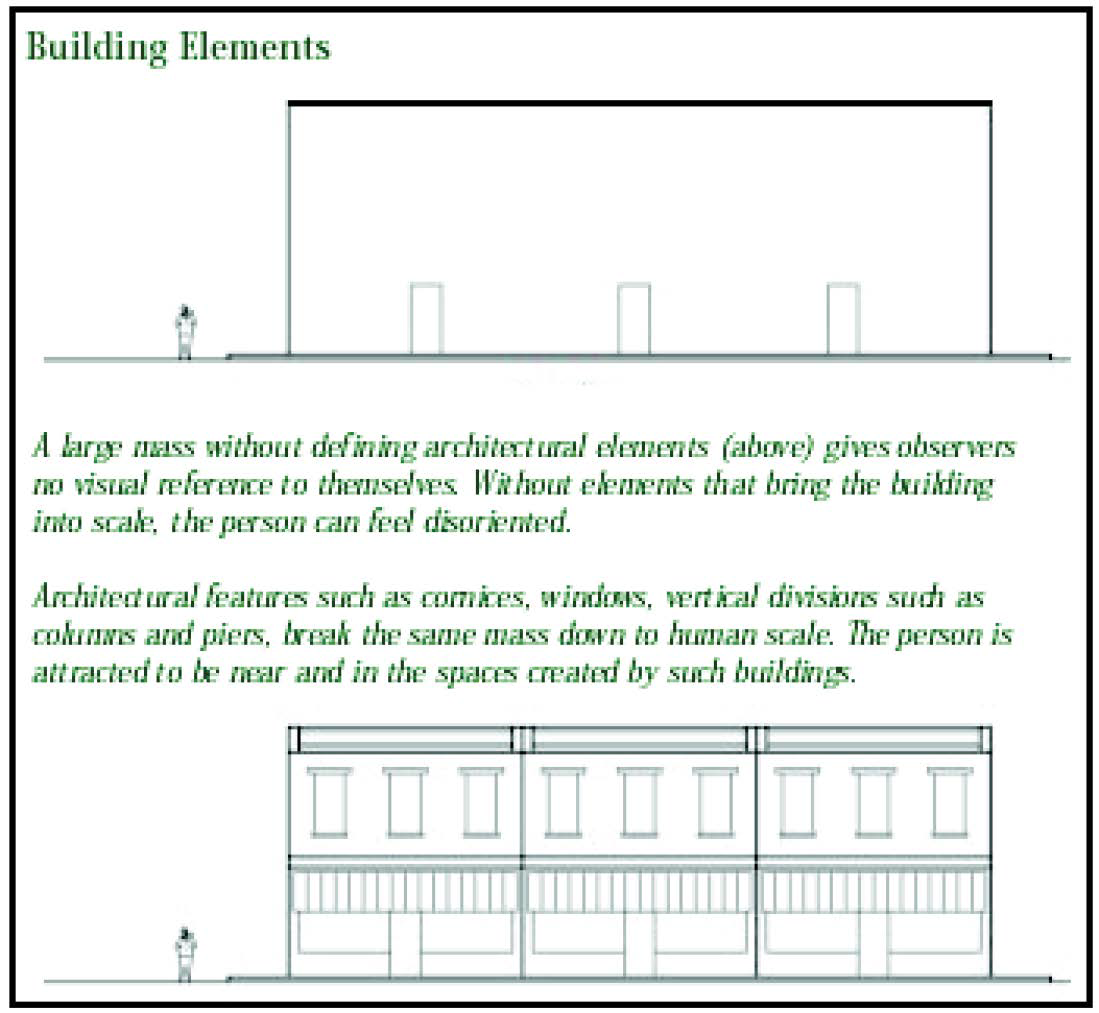
Height can lend a building dignity and grace. Conversely, it can contribute to unacceptable bulk and dominance. It is the height in combination with other features that results in a positive or negative outcome. The height and scale of each building should take into consideration its site and existing (or anticipated) neighboring buildings. Building articulation and design details can reduce the perceived mass of large buildings. Elements such as openings at street level, decorative elements that mark floor heights such as cornices, porches and awnings can be used to break the building down to human dimensions. Residential forms and proportions should be used on commercial and office buildings next to residential areas. Buildings should avoid long, monotonous, uninterrupted walls or roof planes on their visible facades. Building wall offsets, including projections, recesses, and changes in floor level should be used in order to: add architectural interest and variety; relieve the visual effect of a single, long wall; and subdivide the wall into human size proportions.
B.
Window and door proportions and design. The location of window of door size and location also contributes to a sense of visual continuity along the street. In order to maintain this sense of visual continuity, a new building should maintain the basic window and door proportions and placement seen traditionally. The arrangement of windows and doors on a house also contributes to the character of a district. Most buildings have similar amounts of glass, resulting in a relatively uniform solid to void ratio. This ratio on a new building should be similar to that of traditional buildings.
C.
Building and street lighting. The character and level of lighting that is used on a building is a special concern. Traditionally, exterior lights were simple in character and used to highlight entrances, walkways, and signs. Most fixtures had incandescent lamps that cast a color similar to daylight, were relatively low intensity and were shielded with simple shade devices. Although new lamp types may be considered, the overall effect of modest, focused light should be continued.
D.
Signs. A sign typically serves two functions: first, to attract attention, and second to convey information, essentially identifying the business or services offered within. If it is well designed, a building front alone can serve the attention-getting function, allowing the sign to be focused on conveying information in a well-conceived manner. All new signs should be developed with the overall context of the building and of the area in mind.
E.
Building materials and color. Building materials of new structures should contribute to the visual continuity of the neighborhood. They should appear similar to those seen traditionally to establish a sense of visual continuity. While color in itself does not affect the actual form of a building, it can dramatically affect the perceived scale of a structure and it can help to blend a building with its context.
All sides of the building should use materials consistent with those on the front if visible from public streets or neighboring properties, and should be carefully designed with similar detailing, and be comparable in quality and materials. Materials should be selected for suitability to the type of building and design for which they are used. Piecemeal embellishment and frequent changes in material should be avoided. Metal buildings and temporary buildings shall be prohibited.
Any portion of the front wall or facade of any buildings or structures that are visible from a public road shall be constructed of natural elements, such as brick, stone, masonry, stucco, treated wood siding, glass, or any combination of the above. No visible portion of a front wall or facade or portion of front wall or facade of any building or structure shall be constructed of corrugated metal or aluminum siding, unpainted rough sawn wood, rough sawn shake wood shingles, or exposed untreated concrete or cinder blocks. Structures visible from any public road shall architecturally complement surrounding buildings.
Temporary buildings and/or storage buildings with the exception of construction job site trailers are prohibited as the primary use on any parcel. Temporary buildings can only be use as approved accessory uses.
F.
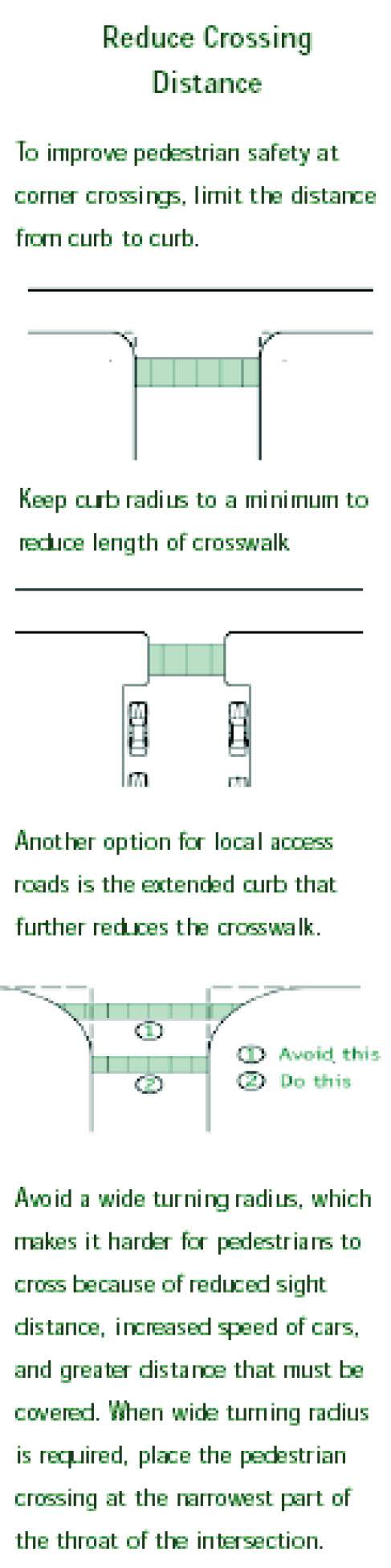
Street design, sidewalks, and trees. "Streetscape" is the general term applied to all of the elements that make up the public realm surrounding thoroughfares: street paving, sidewalks, planting strips, lighting, traffic signals, outdoor street furniture, public signs, and utilities. Street trees with protective canopies can be used to enclose and define streetscapes. Street widths should be limited when possible with bulb-outs are used at crosswalks, and medians are recommended to break the street into dimensions comfortable for pedestrians. Streetscape elements such as sidewalks wide enough for comfortable pedestrian movement, distinctive sidewalk paving, pedestrian-scale streetlights and other fixtures also help to create a comfortable human dimension.
Along arterials that connect activity centers to each other or to other major developments, use of street trees, streetlights, planted medians, underground utilities and other features to strengthen the visual and physical link between destinations is encouraged. Gateways to activity centers, and possibly neighborhoods, should be delineated with distinctive streetscape elements. These can include signs, special paving at crosswalks, grouped plantings, fountains, and other signature features.
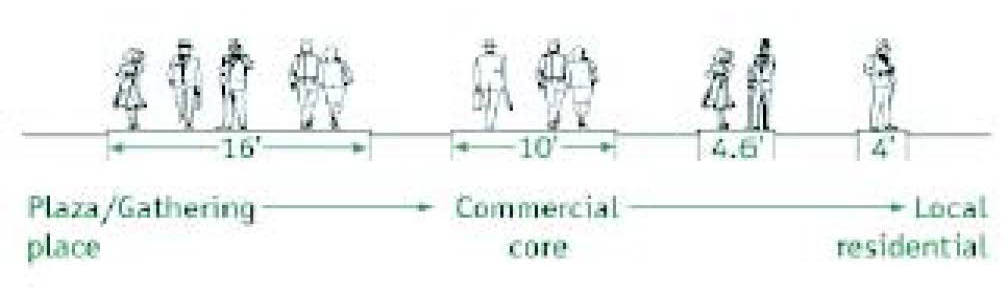
Coordinate the total visual effect of all streetscape elements within a development or along an arterial or major collector, including paving, sidewalks, street trees and plantings, lighting, traffic signals, signs, street furniture, and utilities. Develop and use a common palette of colors, materials, and design. Consideration should be given to coordinating streetscape elements of individual developments with adjacent developments. While they need not match, they should coordinate and not clash.
G.
Mechanical screening. Utilities that serve properties may include telephone and electrical lines, ventilation systems, utility meters, mechanical equipment, transformers, generators, air conditioners, and similar features or other utility hardware. Adequate space for these utilities should be planned in a project from the outset and they should be designed such that their visual impacts are minimized. Service areas for trash, recycling containers, loading facilities, and site maintenance equipment should be carefully planned as an integral part of a site. At the same time, the visual impacts of service areas should be minimized. When laying out a site, adequate provisions should be made for service areas. They should not simply be located in left over side yards, for example.
Accessory buildings, particularly in residential areas, must be of similar design, materials, and colors as the principal building and should be appropriately landscaped. Vinyl siding is discouraged but may be appropriate for some single-family attached or detached residential structures.
H.
Parking. The intent of these regulations is to offer safe pedestrian movement to and from the parking lot, to add human scale to the parking lot, to improve the physical and aesthetic integration of the parking with the building, and to ensure safety and security of the parking lot. This goal includes reducing the image of the "sea of parking" one finds along corridors at retail centers and the "garage-scape" in neighborhoods. Parking is necessary at work, at home, and at destinations throughout the city. However, there is no reason why it needs to dominate the view.
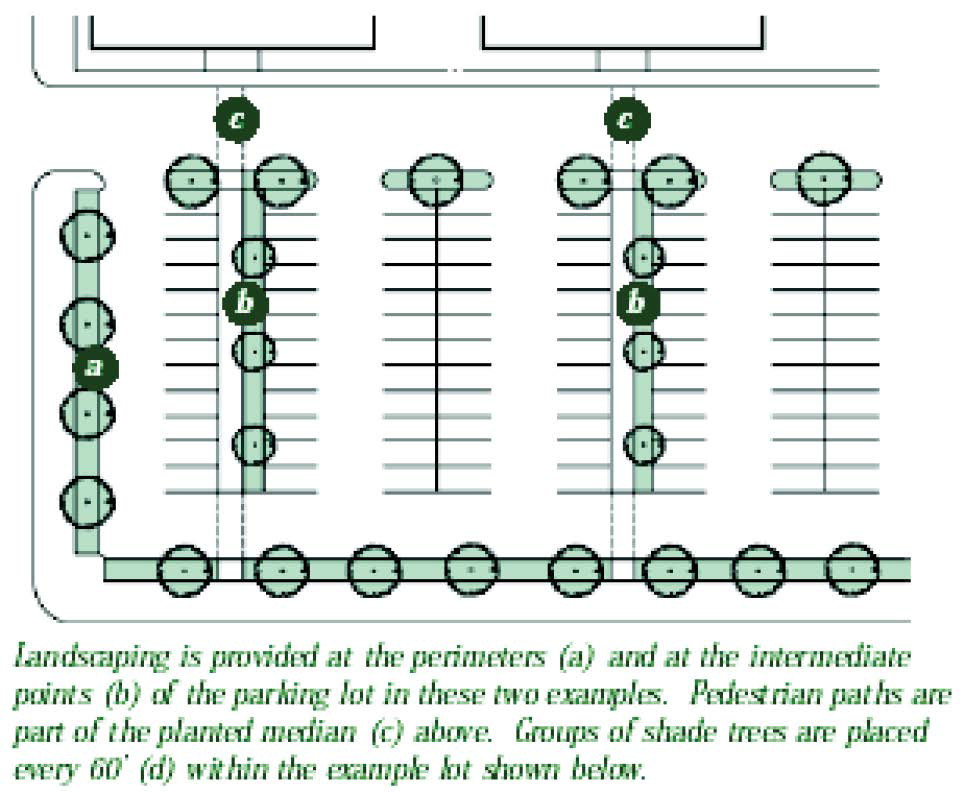
Break parking lots into modules or multiple smaller lots using techniques such as the natural topography, logically placed landscaped pedestrian paths to destinations, and by linear aisles of plantings should be utilized. Avoid large expanses of asphalt. Reducing the amount of parking lots through such methods as providing on-street parking, using offsite parking such as municipal lots, sharing parking among complementary uses, providing pull-in spaces in front of shops and creating overflow lots is also encouraged. These techniques may require some flexibility when applying parking standards.
412.4. Design guidelines.
412.4.1. Gateway overlay districts.
A.
Reduce the scale of parking lots.
1.
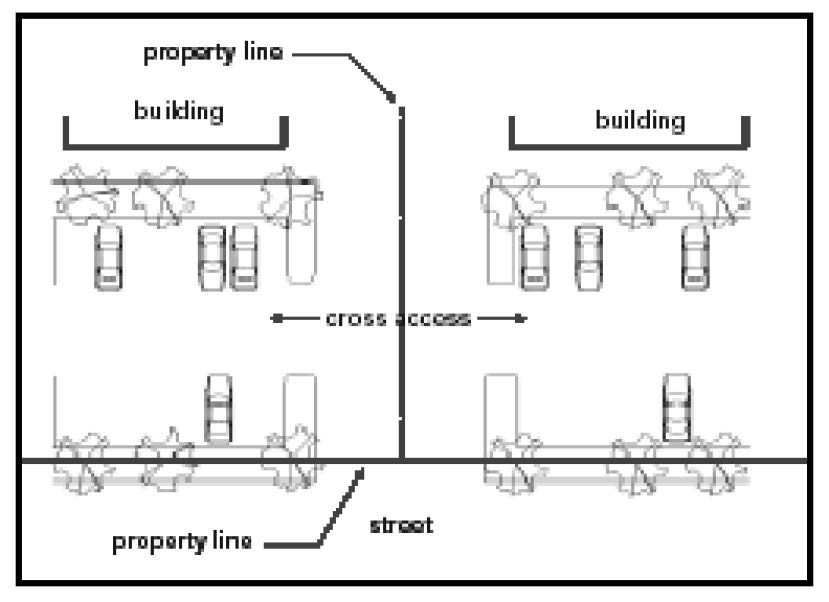
Break parking lots into pods or multiple smaller lots using techniques such as the natural topography, logically placed landscaped pedestrian paths to destinations, and by linear aisles of plantings. Avoid large expanses of asphalt.
2.
A maximum of twenty (20) spaces shall be allowed per pod. All parking areas shall be connected to building entrances with delineated pedestrian connections.
3.
In areas where parking is provided behind the front building line, one (1) canopy tree shall be provided at a ratio of one (1) tree to every four (4) parking spaces in that area.
4.
In areas where parking is provided behind the front building line, each parking space shall be within fifty (50) feet of a planted or retained tree trunk.
B.
Site a portion of parking out of view. Generally, site a minimum of twenty (20) to forty (40) percent of parking to the rear and sides of buildings.
1.
Limit the amount of parking between the street and principal buildings oriented to streets, (such as outparcels in shopping centers) to no more than one (1) double row of nose-in parking between the building and the street to which it is oriented.
2.
Screen parking lots from the street and from adjoining development, using low fences or walls, berms, or year round landscaping.
C.
Accommodate pedestrian needs around parking areas.
1.
Provide clear pedestrian paths and crossings from parking spaces to main entrances and the street.
2.
Plan parking so that it least interferes with appropriate pedestrian access and connections to adjoining developments.
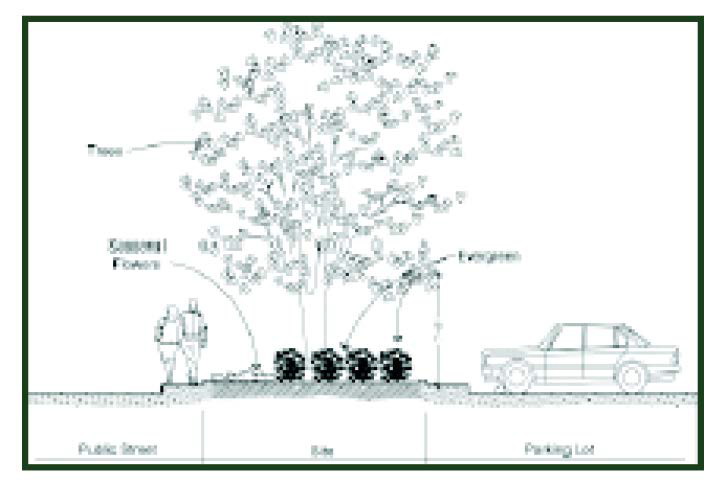
3.
Where over one hundred (100) parking spaces are provided, pedestrian pathways identified with smaller scale pavement (paver or scoring) oriented toward the principal building entrance shall be provided.
D.
Where a parking lot abuts a public sidewalk, provide a visual buffer.
1.
Use landscaped strips or planters.
2.
Consider the use of a wall as screen for the edge of the lot.
3.
Use a combination of trees and shrubs to create a landscape buffer.
4.
Where a parking lot exists that is presently not screened or landscaped, consider a landscaping program or an infill building that relates to the surrounding district context.
E.
Each separate planting area shall have a minimum of one hundred fifty (150) square feet per tree and shall have a minimum dimension of at least five (5) feet.
F.
In addition to required trees, each planting area shall be landscaped with shrubs, ground cover, or other approved landscaping material not exceeding three and one-half (3½) feet in height.
G.
Where parking is adjacent to a public right-of-way, an eight-foot wide landscape buffer shall be provided between the edge of the right-of-way and the edge of the parking lot. In addition to the required trees, the buffer shall consist of the following:
1.
Landscape requirements: at least one (1) shrub to every three (3) linear feet.
2.
Berm requirements with a two-foot minimum height. Berms shall be planted with ground covers and shrubs.
3.
All parking surfaces for clients, customers, and employees located in the Gateway Overlay District must be paved. Off street parking facilities shall be properly graded for drainage to prevent damage to abutting property and/or public streets and alleys. All surface material for parking spaces and their corresponding access drives shall consist of a suitable paving material to prevent the exposure of subsoil. Suitable paving material for parking lots include asphalt, concrete, porous paving blocks or any other maintenance material approved by the administrator that will not result in substantial maintenance problems. Parking areas that are located behind the building and are only used for storage of materials and equipment are not required to be paved as long as it cannot be seen from the road.
Alternative paving materials will be considered only if the material exhibits equivalent load bearing and wear characteristics as concrete or bituminous asphalt. For a paving space to be considered pervious at least five (5) percent of the parking area must consist of permeable pavement or surface treatment. Stormwater reductions that result from the use of permeable pavement may be considered in any kind of stormwater management plans or requirement for mitigation.
412.4.2. Signs. A sign typically serves two (2) functions: first, to attract attention, and second, to convey information, essentially identifying the business or services offered within. If it is well designed, a building front alone can serve the attention-getting function, allowing the sign to be focused on conveying information in a well-conceived manner. All new signs should be developed with the overall context of the building and of the area in mind.
These guidelines are to ensure that signs are integrated in the architectural design and consistent with the character of the development. Signs for multi-tenant or phased developments should remain consistent in terms of materials, design features, and scale. Ultimately, these guidelines are intended to reduce the visual clutter of numerous signs placed along arterial roadways:
A.
Signs not attached to buildings should be of monument design that are no more than thirty-six (36) square feet in area and ten (10) feet in height. All monument signs shall be located a minimum of five (5) feet behind the street right-of way. No ground-mounted sign greater than five (5) square feet in area shall be located closer than ten (10) feet to any adjacent lot line. A fifteen-foot side-yard setback shall be required if the side lot line abuts a residential district. All free standing signs must be at least twenty-five (25) percent brick or stone or a similar material.
B.
The total area of signs on the exterior front surface of a building shall not exceed twenty (20) percent of the front surface of the building.
C.
Multiple business freestanding signs (shopping centers):
1.
Be located on the premises of such businesses.
2.
Meet one-third (⅓) of the minimum building setback requirements for the district.
3.
Limited to one (1) freestanding monument sign per street frontage not to exceed seventy-two (72) square feet which shall contain signs for businesses on the parcel.
4.
Be no higher than fifteen (15) feet for parcels that contain more than five (5) businesses and no more than ten (10) feet for parcels with five (5) or less businesses.
5.
Contain one (1) area for changeable letters to be incorporated within the main sign assembly and to be include as part of the total allowable square feet. The area of the changeable copy may not exceed twenty-four (24) square feet.
D.
Internally illuminated signs, signs with lights inside the sign itself, will be allowed in the Gateway Overlay. However, only one (1) light color will be allowed (different colored light bulbs are prohibited). Signs which contain a high-intensity illuminating device causing it to blink, flash, pulsate, scroll, fluctuate, or animate, except signs giving public service information such as time, temperature, date, weather, or similar information with low-intensity lights are prohibited. Exceptions:
1.
Gas stations will be allowed to have one (1) low intensity lighted signs on each side of the canopy stating the price of gas and the message must remain static for at least one (1) day.
2.
Government buildings, cooperatives, and publicly owned buildings including schools are exempt. Government agencies, cooperatives and public schools in the Gateway Overlay District (NOT ALLOWED IN CITY CENTER) shall be permitted one (1) electronic message board for public information only and must not exceed fifty (50) percent of sign face. The sign must be used for information pertaining to the organization and its activities or information for the public. Signs must follow all other guidelines and sign requirements set forth with the Overlay District guidelines. No changeable copy should create a public nuisance and copy shall not change more than two (2) seconds. If complaints are received, the interval will have to be lengthened.
E.
Reader boards with removable letters will be allowed. The reader board can take up no more than fifty (50) percent of the entire square footage of the sign.
F.
Signs may not be more than five (5) colors in addition to black and white.
G.
Sandwich boards are allowed as long as they do not block pedestrian and vehicular traffic:
1.
One (1) sandwich board sign, per street frontage.
2.
The total area of the signboard shall not exceed ten (10) square feet.
3.
Any sandwich board sign shall not exceed two (2) linear feet in width, with a maximum height of forty-two (42) inches. Within these specified maximum dimensions, creative shapes that reflect the theme of the business are encouraged (i.e., ice cream shops may display a sign in the shape of an ice cream cone).
4.
The sign must be constructed of materials that present a finished appearance. Rough-cut plywood is not acceptable. The sign lettering should be professionally painted or applied and the sign may not be not be more than fifty (50) percent changeable copy where the letters are inserted onto tracks; a "yard sales" or "graffiti" look with hand painted or paint stenciled letters is not acceptable, however, chalkboard signs shall be permitted. The written message of the sign should be kept to the minimum necessary to communicate the name of the business or a special message of the business.
5.
The sign shall be located within five (5) to ten (10) feet of the main building entrance to the business and its location shall not interfere with pedestrian or vehicular circulation.
6.
The sign shall be removed at the end of the business day.
7.
Any person erecting a sandwich board sign shall indemnify and hold harmless the city and its officers, agents, and employees from any claim arising out of the presence of the sign on city property or rights-of-way.
H.
Signs should be coordinated with the composition of the overall facade and in proportion to the building such that it does not dominate the appearance. Incorporate design elements for on-site signs that are consistent with each other and with the overall architectural character of the development, in terms of their materials, height, colors, and lettering style, to reinforce visual continuity. Sign materials should be compatible with that of the building facade and should use colors that are compatible with those of the building front.
I.
Locate signs on a building such that it will emphasize design elements of the facade itself and fit within existing architectural features.
J.
The most appropriate lighting of a sign is with lights directed at the signage. All lighted signs shall have their lighting directed in such a manner as to illuminate only the face of the sign. No commercial sign within one hundred (100) linear feet of a pre-existing residential structure may be illuminated between the hours of 12:00 midnight and 6:00 a.m. A residence shall be deemed "pre-existing" for purposes of this section if it has a valid building permit in effect for construction of said structure or if construction of said structure was complete on or prior to the effective date of this provision.
K.
Flashing signs, signs with flashing or reflective disks, signs with flashing lights or lights of changing degree of intensity or color or signs with electrically scrolled messages (except government signs and signs which give time and temperature information) are prohibited. If a time and temperature sign alternates between a time message and a temperature message it shall continuously show one (1) message a minimum of three (3) seconds in time before switching to the other message.
L.
Nonconforming signs: Under the following conditions, nonconforming signs for single businesses shall be removed or brought unto conformity within thirty (30) days after a written notice by the zoning administrator:
1.
There is a change in the use of the property or the business is discontinued.
2.
There is a change in the business name.
3.
There is a change in the principal product or service advertised.
4.
The sign is abandoned for three (3) months..
5.
The sign is declared unsafe by the building official.
6.
The zoning administrator determines that he sign is deteriorated or damaged to the extent of fifty (50) percent of the reproduction costs.
7.
The sign is prohibited by Section 602.
8.
There is a change that required a new sign permit with and/or certificate of approval.
M.
Under the following conditions, nonconforming freestanding signs for multiple businesses shall be removed or brought into conformity within thirty (30) days after written notice by the zoning administrator:
1.
The project identification is changed.
2.
The sign is abandoned for three (3) months.
3.
The sign is declared unsafe by the building official.
4.
The zoning administrator determines that he sign is deteriorated or damaged to the extent of fifty (50) percent of the reproduction costs.
5.
The sign is prohibited by Section 602.
6.
There is an enlargement of any existing sign face within the sign assembly.
N.
Nonconforming lots:
1.
If a new business (owner or renter occupied) comes into the overlay districts and the use is the same as the previous owner, the parking, landscaping, and facades can be considered grandfathered in as long as the building and/or lot does not have significant changes of more than 50% of the original use.
2.
If a new business (owner or renter occupied) comes into the overlay district and the use is the different as the previous owner, all overlay regulations must be met (landscaping, parking, facades).
O.
Prohibited signs in the Gateway Overlay District:
1.
Pole signs.
2.
Portable or trailers signs with or without wheels.
3.
Electronic message signs except for time and temperature.
4.
Non corrugated metal spike signs.
P.
Portable and temporary signs may be permitted for the announcement of temporary uses such as grand-opening, special sales or events, fairs, revivals, sporting events and any nonprofit event or function. Temporary signs cannot contain only the business name or the product of the business. Such temporary signs shall be allowed for a period not to exceed sixty (60) days and shall be removed within five (5) working days after the event. A period of thirty (30) days must elapse between the removal of the temporary/portable sign and the installation of another temporary/portable sign on the same site, therefore, a business can only have six temporary sing applications a year. Applicant obtaining the sign permit shall be responsible for removal of the sign upon expiration date. Signs shall be located on the site for which they are being permitted.
1.
Temporary signs can contain only the business name or the product of the business.
2.
Banners and corrugated signs are limited to two (2) per business or one (1) per every one hundred (100) feet of frontage (whichever is greater).
3.
Businesses are allowed six (6) permits per year for banners. Permits are good for thirty (30) to sixty (60) days depending on situation.
4.
Now hiring signs, for sale signs, and for rent signs do not required a permit but must be no bigger than twelve (12) by eighteen (18) and must be a sign not a banner.
5.
Temporary signs cannot be placed on utility poles or street signs. Temporary signs cannot be placed in right of ways.
6.
An off premises temporary sign must be for a business located in Pickens County or a municipality of Pickens County.
7.
An applicant cannot have more than five (5) temporary signs in the City of Pickens at one time.
8.
Nonpolitical corrugated plastic signs with the metal wiring are prohibited within the City of Pickens.
(Ord. No. 2018-08, 10-1-18; Ord. No. 2019-11, 11-4-19)
412.4.3 Mechanical screening and service areas. Utilities that serve properties may include telephone and electrical lines, ventilation systems, utility meters, mechanical equipment, transformers, generators, air conditioners, and similar features or other utility hardware. These items are among the variety of equipment that may be attached to a building that can affect the character of the area. Adequate space for these utilities should be planned in a project from the outset and they should be designed such that their visual impacts are minimized.
Trash and recycling storage areas also are concerns. Service areas for trash, recycling containers, loading facilities, and site maintenance equipment should be carefully planned as an integral part of a site. To the greatest extent feasible, these areas should be screened from public view to reduce the visual impacts. When laying out a site, adequate provisions should be made for service areas. They should not simply be located in left over side yards, for example.
A.
Minimize the visual impacts of utility connections and service boxes.
1.
Project elements like mechanical equipment, electrical and telephone lines, utility meters, transformers, generators and similar features or other utility hardware on roof, ground, or buildings shall be screened from public view with materials similar to the structure.
2.
Ground mounted mechanical equipment shall be located to the rear or side yard and screened from off-site view.
3.
Roof-mounted mechanical equipment shall be screened from off-site view by a parapet wall and shall not be visible from the street. Unused equipment should be removed.
4.
Locate a satellite dish out of public view, to the extent feasible, and in compliance with other regulations.
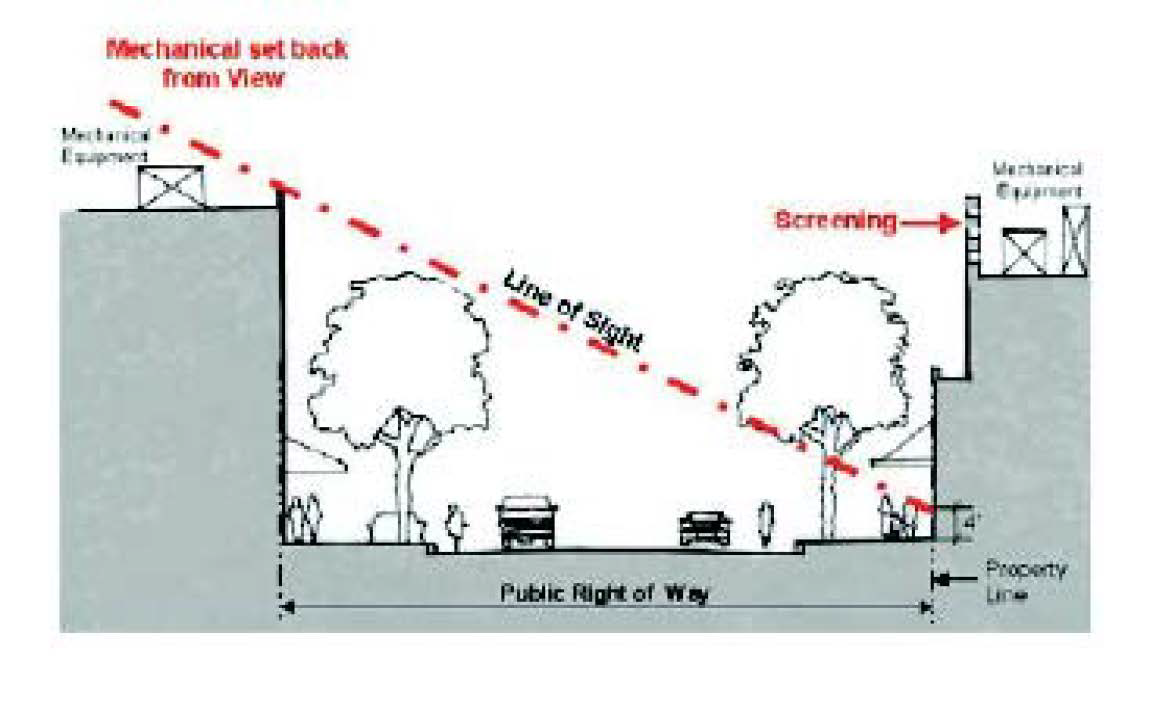
B.
Minimize the visual impacts of trash storage and service areas.
1.
Loading and service delivery areas shall be located to the rear or side yard away from the primary street frontage and away from major pedestrian routes; typically place them at the rear of a building when feasible.
2.
Locate storage, solid waste collection, and loading areas at least twenty (20) feet from any public street, public sidewalk, internal pedestrian walkway, or building with a residential use.
3.
Incorporate loading docks, truck parking, outdoor storage, trash collection, trash compaction, and other service functions into the overall design of the building and landscaping so that the visual and acoustic impacts of these functions are fully contained/screened and out of view from adjacent properties and public streets.
4.
Use screening materials for solid waste collection and loading areas that are the same and of equal quality to the materials used for the primary building and landscaping.
412.4.5. Landscaping.
A.
A landscaping plan shall be provided for the entire site.
1.
All landscaping plans approved by zoning staff or the board of architectural review must remain in compliance and therefore must be maintained to the standard established in the proposed approved plan; refer to Section 901 Administration and Enforcement for the process of code enforcement of properties in violation of the zoning ordinance.
B.
All trees planted in front of the front building line shall be at least three (3) inches in diameter for single-stemmed trees, or ten (10) to twelve (12) feet in height for multi-stemmed trees at the time of planting. All other trees shall be two and one-half (2½) inches in diameter at the time of planting, unless otherwise provided by these standards.
C.
Existing trees having a DBH (diameter at breast height), measured at four and one-half (4½) feet above ground level over eight (8) inches shall be preserved unless removal is approved by the board of architectural review. If a preserved tree dies, it must be replaced with a three-inch diameter tree of the same or similar tree species, subject to approval by the zoning administrator.
D.
Impervious materials shall not be placed over the critical root zone of a preserved tree. The critical zone is a ratio of one (1) inch DBH to one (1) foot radius around the tree.
E.
All exposed soil area shall be covered with bark, mulch or other weed control measure.
F.
Canopy trees shall be planted along property lines abutting a street at a ratio of one (1) tree for every thirty (30) linear feet in a minimum eight-foot-wide planting strip. Trees may be clustered.
G.
Shrubs shall be evergreen only.
H.
Screening walls and fencing are allowed only in side and rear yards and behind the front building line, with the exception of outdoor eating and play areas.
I.
Fencing and wall materials shall be consistent with the site and architectural design of the principal structure.
J.
Fences and walls shall be made of masonry, ornamental metal, wood, stucco, or a combination of these materials. Chain link fencing with privacy slats, which must be black or natural green in color, plus approved shrubbery will be allowed in the Gateway Overlay, reference section 412.4.5.L for approved list of shrubs. The chain link fence must be six (6) feet behind the front building line to allow for the vegetative screening. In the event the plastic slats and shrubs begin to deteriorate, the owner must replace to ensure compliance with the Gateway Overlay standards.
K.
Fences or walls greater than fifty (50) feet in length or six (6) feet in height shall have a change in plane, height, material, or material texture, or significant landscape massing.
L.
Planting requirements for vegetative screens: Where a vegetative screen is required between two (2) incompatible uses, the screen shall contain shrubs at least thirty (30) inches high at the time of planting. The screen shall be planted in the required perimeter yard. The spacing of the shrubs shall be according to the vegetative screen section contained in this article. The type of shrub used needs to be capable of attaining a height of at least six (6) feet at maturity. Maturity shall mean that, within five (5) years of planting, the entire vegetative screen shall achieve at least seventy-five (75) percent opacity from twelve (12) inches to six (6) feet above ground level. A list of plants capable of achieving this desired effect is found below.
1.
No artificial plant life or facsimile shall be permitted except by prior approval. A plant list is provided at the end of this article which gives numerous choices as to the type of plants native to the area which best suit the climatic conditions. These choices are recommended suggestions.
2.
Plants shall be sufficiently sized to ensure screening at the time of installation according to minim um container size, class and other requirements outlined in the American Standard for Nursery Stock (ANSI Z60.1-2004). Where a vegetative screen is required, plant materials shall be sufficiently sized to ensure obscurity at the time of installation. Seedling plants may be used where berms or structures are required or where the proposed use is contiguous to a street or vacant land.
Evergreen shrubs suitable for vegetative screens. The following tables shall serve as a guide for determining types of plant material to be used in vegetative screens:
a.
When used as a vegetative screen, each shrub shall be at least thirty (30) inches high at the time of installation and shall be planted at one-half (½) of the mature diameter.
b.
An evergreen shrub that is not currently on the approved list, can be reviewed and approved by the zoning administrator and board of architectural review.
i.
Plants that, once established*, can withstand considerable drought (three (3) to four (4) weeks without rainfall).
ii.
Plants that grow best in moist to average soils and will only tolerate short periods (one (1) to two (2) days) of flooding.
iii.
Plants that will tolerate longer periods of flooding (three (3) to five (5) days), but will also grow in moist to average soils.
* Establishment usually takes one (1) to two (2) years for trees and shrubs and one year for perennials.
(Ord. No. 2013-09, § 3, 10-7-13; Ord. No. 2017-08, § IIB, 11-6-17)
412.4.6 Building materials. The following chart is intended as a general guide to the materials most and least preferred for use within the overlay districts. It is not intended to be comprehensive. Actual exterior materials and colors should be approved by the city and the board of architectural review. Materials listed in the "Not Recommended" column, or materials not specifically listed in this chart, may be permitted, but are subject to review and approval by the review board to ensure appropriateness.
412.5. City center overlay districts. [2]
412.5.1. Signs. A sign typically serves two (2) functions: first, to attract attention, and second, to convey information, essentially identifying the business or services offered within. If it is well designed, a building front alone can serve the attention-getting function, allowing the sign to be focused on conveying information in a well-conceived manner. All new signs should be developed with the overall context of the building and of the area in mind.
These guidelines are to ensure that signs are integrated in the architectural design and consistent with the character of the development. Signs for multi-tenant or phased developments should remain consistent in terms of materials, design features, and scale. Ultimately, these guidelines are intended to reduce the visual clutter of numerous signs placed along arterial roadways:
A.
Signs not attached to buildings should be of monument design that are no more than twenty (20) square feet in area and five (5) feet in height. All monument signs shall be located a minimum of five (5) feet behind the street right-of way. No ground-mounted sign greater than five (5) square feet in area shall be located closer than ten (10) feet to any adjacent lot line. A fifteen (15) foot side-yard setback shall be required if the side lot line abuts a residential district. All free standing signs must be at least twenty-five (25) percent brick or stone or a similar material.
B.
The total area of signs on the exterior front surface of a building shall not exceed twenty (20) percent of the front surface of the building.
C.
Multiple business freestanding signs (shopping centers):
1.
Be located on the premises of such businesses.
2.
Meet one-third (⅓) of the minimum building setback requirements for the district.
3.
Limited to one (1) freestanding monument sign per street frontage not to exceed thirty-six (36) square feet which shall contain signs for businesses on the parcel.
4.
Be no higher than ten (10) feet for parcels that contain more than five (5) businesses and no more than five (5) feet for parcels with five (5) or less businesses.
D.
1)
Internally illuminated signs will be allowed as long as they use low/LED wattage bulbs or thee back lit method.
2)
Back lit signs, signs that are constructed with opaque material to allow no light to pass through the face of the sign or lettering will be allowed in the City Center District with the following restrictions and regulations:
a)
Restrictions:
i)
All signs must be constructed with opaque material to allow no light to pass through the face of the sign or lettering.
ii)
All signs that are shadow boxed must contain a minimum edge of two (2) inches to prevent lighting bleeding from the edge of the sign.
iii)
All signs and lettering must conceal and hide the individual LED Module and wiring from view.
iv)
No color other than LED white shall be permitted.
v)
Signs and Letters shall be mounted a minimum of two (2) inches and a maximum of six (6) inches from the wall or exterior structure.
b)
LED Regulations:
i)
All LED lighting Modules must be White. No Cool Blue White, Hyper White, Extreme White or Cool White Modules will be allowed.
ii)
The wattage rating for all LED Modules will be no less than 0.24 watts and will not exceed 1.5 watts per Module.
iii)
The total allowable wattage per one hundred (100) modules shall not exceed one hundred fifty (150) watts, thus maintaining the desired glow while remaining a "Green" product.
iv)
The maximum number of LED lights per module is 3. (Less is acceptable)
F.
Sandwich boards are allowed as long as they do not block pedestrian and vehicular traffic:
1.
One (1) sandwich board sign, per street frontage.
2.
The total area of the signboard shall not exceed ten (10) square feet.
3.
Any sandwich board sign shall not exceed two (2) linear feet in width, with a maximum height of forty-two (42) inches. Within these specified maximum dimensions, creative shapes that reflect the theme of the business are encouraged (i.e., ice cream shops may display a sign in the shape of an ice cream cone).
4.
The sign must be constructed of materials that present a finished appearance. Rough-cut plywood is not acceptable. The sign lettering should be professionally painted or applied and the sign may not be not be more than fifty (50) percent changeable copy where the letters are inserted onto tracks; a "yard sales" or "graffiti" look with hand painted or paint stenciled letters is not acceptable, however, chalkboard signs shall be permitted. The written message of the sign should be kept to the minimum necessary to communicate the name of the business or a special message of the business.
5.
The sign shall be located within five (5) to ten (10) feet of the main building entrance to the business and its location shall not interfere with pedestrian or vehicular circulation.
6.
The sign shall be removed at the end of the business day.
7.
Any person erecting a sandwich board sign shall indemnify and hold harmless the city and its officers, agents, and employees from any claim arising out of the presence of the sign on city property or rights-of-way.
G.
Locate signs on a building such that it will emphasize design elements of the facade itself and fit within existing architectural features.
H.
The most appropriate lighting of a sign is with mounted lights directed at the signage. All lighted signs shall have their lighting directed in such a manner as to illuminate only the face of the sign. No commercial sign within one hundred (100) linear feet of a pre-existing residential structure may be illuminated between the hours of 12:00 midnight and 6:00 a.m. A residence shall be deemed "pre-existing" for purposes of this section if it has a valid building permit in effect for construction of said structure or if construction of said structure was complete on or prior to the effective date of this provision. Goose neck lighting is recommended for externally lit signs.
I.
Flashing signs, signs with flashing or reflective disks, signs with flashing lights or lights of changing degree of intensity or color or signs with electrically scrolled messages (except government signs and signs which give time and temperature information) are prohibited. If a time and temperature sign alternates between a time message and a temperature message it shall continuously show one (1) message a minimum of three (3) seconds in time before switching to the other message.
J.
Nonconforming signs:
1.
Under the following conditions, nonconforming signs for single businesses shall be removed or brought unto conformity within thirty (30) days after a written notice by the zoning administrator:
a.
There is a change in the use of the property or the business is discontinued.
b.
There is a change in the business name.
c.
There is a change in the principal product or service advertised.
d.
The sign is abandoned for three (3) months.
e.
The sign is declared unsafe by the building official.
f.
The zoning administrator determines that the sign is deteriorated or damaged to the extent of fifty (50) percent of the reproduction costs.
g.
The sign is prohibited by Section 602.
h.
There is a change that required a new sign permit with and/or certificate of approval.
2.
Under the following conditions, nonconforming freestanding signs for multiple businesses shall be removed or brought into conformity within thirty (30) days after written notice by the zoning administrator:
a.
The project identification is changed.
b.
The sign is abandoned for three (3) months.
c.
The sign is declared unsafe by the building official.
d.
The zoning administrator determines that he sign is deteriorated or damaged to the extent of fifty (50) percent of the reproduction costs.
e.
The sign is prohibited by Section 602.
f.
There is an enlargement of any existing sign face within the sign assembly.
3.
Nonconforming lots:
• If a new business (owner or renter occupied) comes into the overlay districts and the use is the same as the previous owner, the parking, landscaping, and facades can be considered grandfathered in as long as the building and/or lot does not have significant changes of more than fifty (50) percent of the original use.
• If a new business (owner or renter occupied) comes into the overlay district and the use is the different as the previous owner, all overlay regulations must be met (landscaping, parking, facades).
K.
Projecting/Armed Signs. A sign, other than a flat wall sign, that projects more than twelve (12) inches from the face of the building or structure upon which it is located. Projecting signs shall adhere to the following guidelines when located in the City Center Overlay District:
1.
Projecting signs must be attached to building facades that have a public entrance and must maintain minimum clearance of ten (10) feet above the public right of any sidewalk area.
2.
A projecting sign shall be perpendicular to the building wall to which it is affixed.
3.
No face of any projecting sign shall exceed twenty-five (25) square feet in area.
4.
A projecting sign shall not exceed twelve (12) inches in thickness.
5.
No face shall exceed five (5) feet in vertical dimension.
L.
Prohibited signs in the Central Business District:
1.
Pole signs.
2.
Fluttering banners.
3.
Fluttering flags.
4.
Flashing signs.
5.
Gas or air filled figures.
6.
Portable or trailers signs with or without wheels.
7.
Electronic message signs except for time and temperature.
8.
Non corrugated metal spike signs.
M.
Portable and temporary signs may be permitted for the announcement of temporary uses such as grand-opening, special sales or events, fairs, revivals, sporting events and any nonprofit event or function. Temporary signs cannot contain only the business name or the product of the business. Such temporary signs shall be allowed for a period not to exceed sixty (60) days and shall be removed within five (5) working days after the event. A period of thirty (30) days must elapse between the removal of the temporary/portable sign and the installation of another temporary/portable sign on the same site, therefore, a business can only have six temporary sing applications a year. Applicant obtaining the sign permit shall be responsible for removal of the sign upon expiration date. Signs shall be located on the site for which they are being permitted.
1.
Temporary signs can contain only the business name or the product of the business.
2.
Banners and corrugated signs are limited to two (2) per business.
3.
Businesses are allowed six (6) permits per year for banners. Permits are good for thirty (30) to sixty (60) days depending on situation.
4.
Now hiring signs, for sale signs, and for rent signs do not required a permit but must be no bigger than twelve (12) by eighteen (18) and must be a sign not a banner.
5.
Temporary signs cannot be placed on utility poles or street signs. Temporary signs cannot be placed in right of ways.
6.
An off premises temporary sign must be for a business located in Pickens County or a municipality of Pickens County.
7.
An applicant cannot have more than five (5) temporary signs in the City of Pickens at one time.
8.
Nonpolitical corrugated plastic signs with the metal wiring are prohibited within the City of Pickens.
(Ord. No. 2015-17, § 1, 11-2-15; Ord. No. 2015-10, § 2, 9-12-16; Ord. No. 2019-11, 11-4-19)
412.5.2. Mechanical screening and service areas. Utilities that serve properties may include telephone and electrical lines, ventilation systems, utility meters, mechanical equipment, transformers, generators, air conditioners, and similar features or other utility hardware. These items are among the variety of equipment that may be attached to a building that can affect the character of the area. Adequate space for these utilities should be planned in a project from the outset and they should be designed such that their visual impacts are minimized.
Trash and recycling storage areas also are concerns. Service areas for trash, recycling containers, loading facilities, and site maintenance equipment should be carefully planned as an integral part of a site. To the greatest extent feasible, these areas should be screened from public view to reduce the visual impacts. When laying out a site, adequate provisions should be made for service areas. They should not simply be located in left over side yards, for example.
A.
Minimize the visual impacts of utility connections and service boxes.
1.
Project elements like mechanical equipment, electrical and telephone lines, utility meters, transformers, generators and similar features or other utility hardware on roof, ground, or buildings shall be screened from public view with materials similar to the structure.
2.
Ground mounted mechanical equipment shall be located to the rear or side yard and screened from off-site view.
3.
Roof-mounted mechanical equipment shall be screened from off-site view by a parapet wall and shall not be visible from the street. Unused equipment should be removed.
4.
Locate a satellite dish out of public view, to the extent feasible, and in compliance with other regulations.
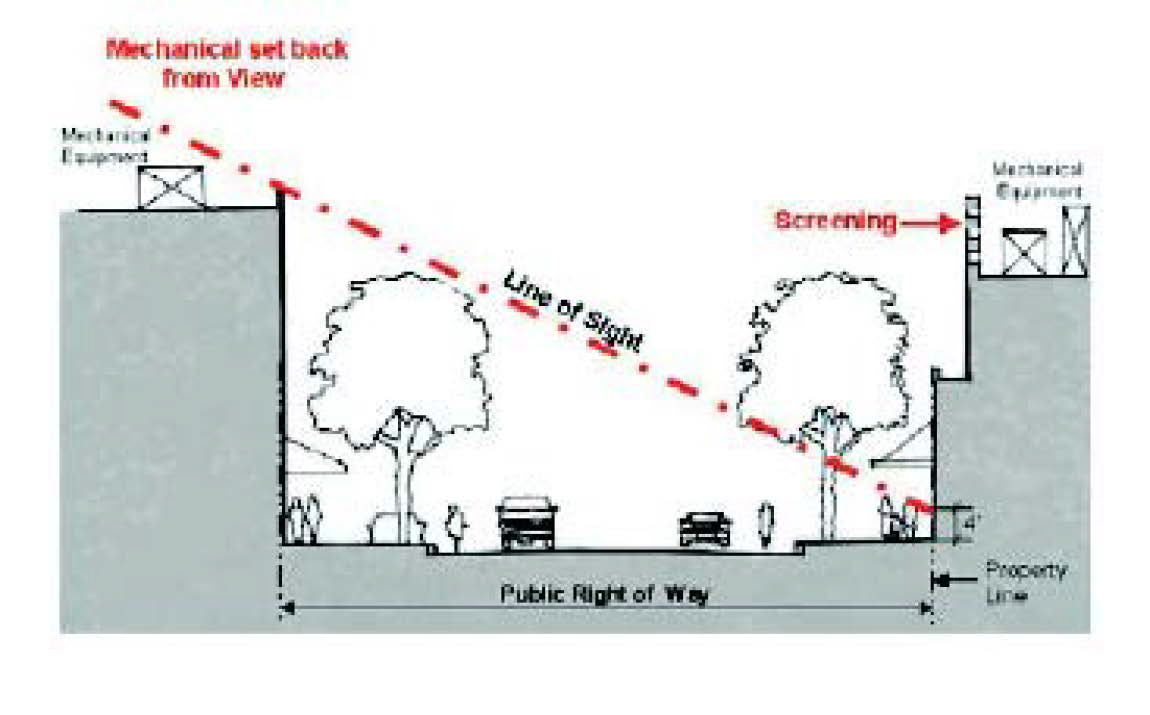
5.
Minimize the visual impacts of trash storage and service areas.
a.
Loading and service delivery areas shall be located to the rear or side yard away from the primary street frontage and away from major pedestrian routes; typically place them at the rear of a building when feasible.
b.
Locate storage, solid waste collection, and loading areas at least twenty (20) feet from any public street, public sidewalk, internal pedestrian walkway, or building with a residential use.
c.
Incorporate loading docks, truck parking, outdoor storage, trash collection, trash compaction, and other service functions into the overall design of the building and landscaping so that the visual and acoustic impacts of these functions are fully contained/screened and out of view from adjacent properties and public streets.
d.
Use screening materials for solid waste collection and loading areas that are the same and of equal quality to the materials used for the primary building and landscaping.
412.5.3. Building materials. The following chart is intended as a general guide to the materials most and least preferred for use within the overlay districts. It is not intended to be comprehensive. Actual exterior materials and colors should be approved by the city and the board of architectural review. Materials listed in the "Not Recommended" column, or materials not specifically listed in this chart, may be permitted, but are subject to review and approval by the review board to ensure appropriateness.
(Ord. No. 2015-10, § 2, 4-6-15; Ord. No. 2015-17, § 1, 11-2-15)
412.5.4. Parking. All parking surfaces for clients, customers, and employees located in the Gateway Overlay District must be paved. Off street parking facilities shall be properly graded for drainage to prevent damage to abutting property and/or public streets and alleys. All surface material for parking spaces and their corresponding access drives shall consist of a suitable paving material to prevent the exposure of subsoil. Suitable paving material for parking lots include asphalt, concrete, porous paving blocks or any other maintenance material approved by the administrator that will not result in substantial maintenance problems. Parking areas that are located behind the building and are only used for storage of materials and equipment are not required to be paved as long as it cannot be seem from the road. Alternative paving materials will be considered only if the material exhibits equivalent load bearing and wear characteristics as concrete or bituminous asphalt. For a paving space to be considered pervious at least five (5) percent of the parking area must consist of permeable pavement or surface treatment. Stormwater reductions that result from the use of permeable pavement may be considered in any kind of stormwater management plans or requirement for mitigation.
412.5.5. Fencing in city center.
A.
Screening walls and fencing are allowed only in side and rear yards and behind the front building line, with the exception of outdoor eating and play areas.
B.
Fencing and wall materials shall be consistent with the site and architectural design of the principal structure.
C.
Fences and walls shall be made of masonry, ornamental metal, wood, stucco, or a combination of these materials.
D.
Fences or walls greater than fifty (50) feet in length or six (6) feet in height shall have a change in plane, height, material, or material texture, or significant landscape massing.
(Ord. No. 2013-09, § 4, 10-7-13)
412.5.6 Façade colors. Buildings located in the City Center Overlay District must have a facade color that is listed on the color palette. These colors are listed in the Sherwin Williams Exterior Historical Colors and are available for review at City Hall.
(Ord. No. 2020-04, § I, 3-2-20)
412.6. Exceptions to the overlay district regulations. These regulations shall not apply to:
A.
Temporary uses or structures permitted by district regulations.
B.
Ordinary maintenance, painting, or repair which does not require a building permit.
C.
Demolition if any structure which the building official certifies, in writing, to the board, is required to protect the public from unsafe or dangerous conditions.
D.
Public and private utility structure permitted by district regulations.
412.7. Application for certificate of approval. In overlay districts, a certificate of approval is required before a building permit or sign application can be approved. Application or certificate of approval shall be submitted through the office of the zoning administrator and the board of architectural review will have to review the applications.
EXAMPLES OF MONUMENT SIGNS (SINGLE TENANT)
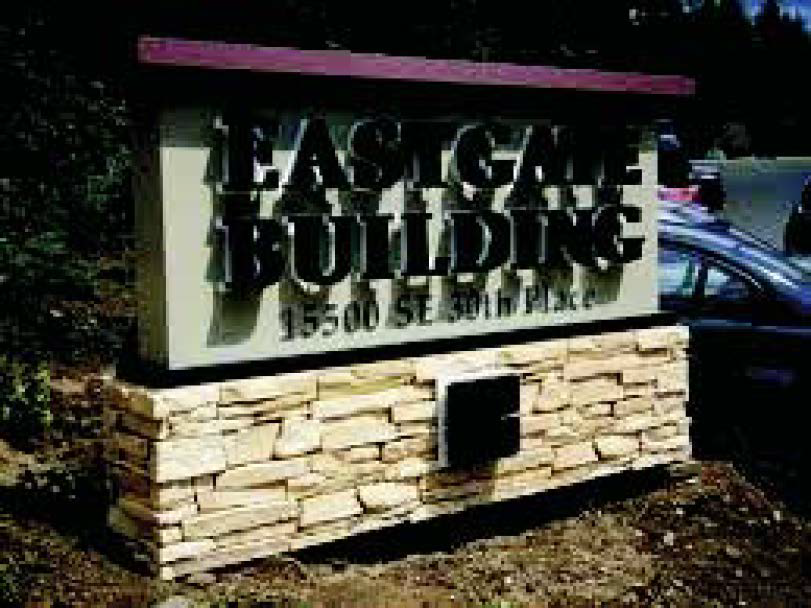



EXAMPLES OF MONUMENT SIGNS (MULTI-TENANT)
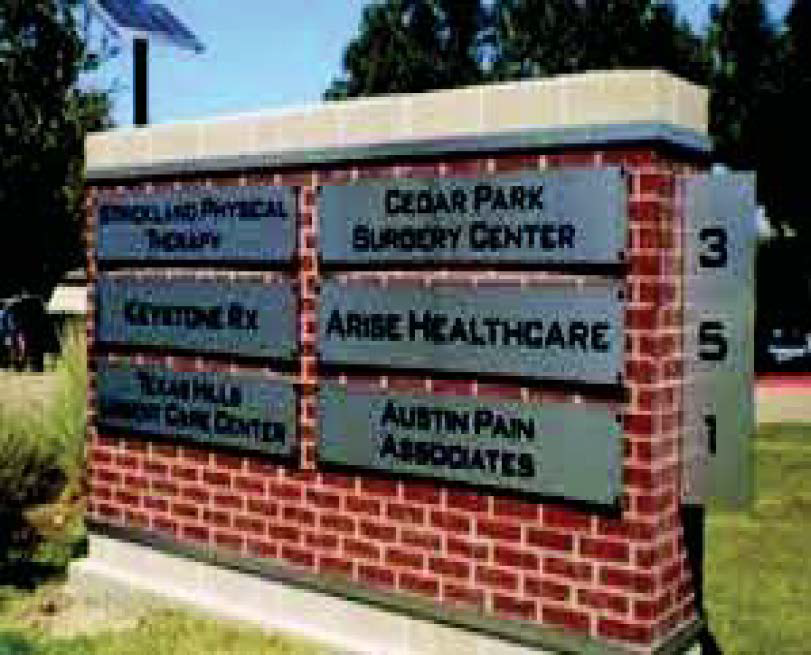

SANDWICH BOARDS


EXAMPLES OF PROHIBITED SIGNS
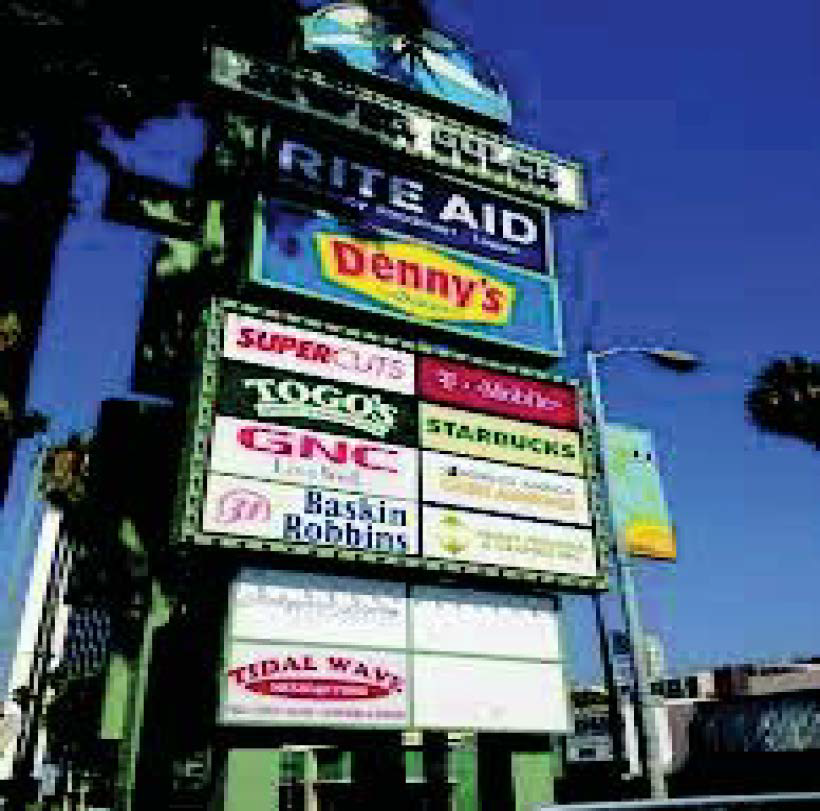
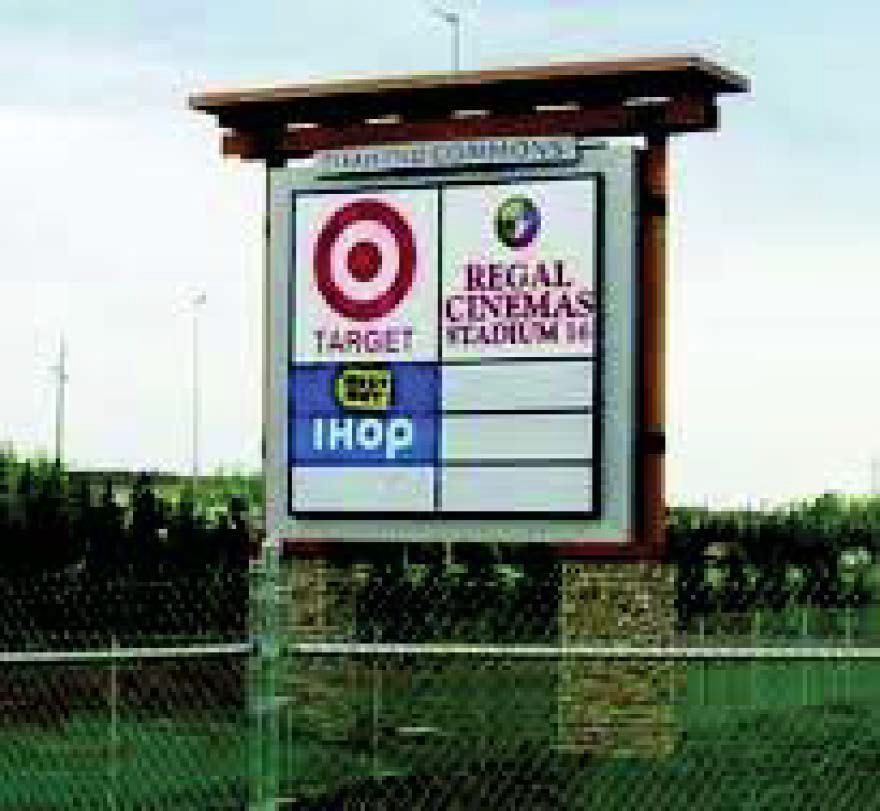

Editor's note— The City Center Overlay District is for design standards and the Central Business District is for zoning regulations. The two Districts have their own boundaries and are for two separate purposes and cannot be used interchangeably.
Sec. 413. - R20 Single-Family Residential Zone.
413.1 Intent of district. It is the intent of this section that the R-20 Zoning District be developed and reserved for low-density residential purposes. The regulations which apply within this district are designed to encourage the formation and continuance of a stable, healthy environment for one-family dwellings situated on lots having an area of a minimum twenty thousand (20,000) square feet or more and to discourage any encroachment by commercial, industrial or other uses capable of adversely affecting the residential character of the district.
413.2 Permitted uses. The following uses shall be permitted in any R-20 Zoning District:
a)
One-family dwelling.
b)
Publicly owned building, facility or land.
c)
Non-commercial horticulture or agriculture, but not including the keeping of poultry roosters or other fighting birds, livestock, or kennels.
d)
Customary home occupation established under the provisions of Section 709.
e)
Accessory use in compliance with the provisions of Sections 710 and 711.
413.3 Conditional uses. The following uses shall be permitted in any R-20 Zoning District on a conditional basis, subject to the conditions set forth in Article VIII, Section 804. For any conditional uses within the R-20 District, a buffer strip in compliance with Section 726 of this ordinance shall be installed and maintained along all property lines bordering a parcel that is zoned for residential usage.
a)
Church, synagogue, temple and other places of worship; provided that:
(1)
Such use is housed in a permanent structure which meets all building, electrical, and plumbing codes for places of public assembly;
(2)
Such use is located on a lot a minimum of twenty thousand (20,000) square feet in area;
(3)
No structure on the lot is closer than twenty-five (25) feet to any abutting property line zoned for residential use;
(4)
Exterior and parking lot lights do not reflect onto adjoining residences; and
(5)
Such use does not disturb the properties within the immediate vicinity or the residential character of the area.
b)
Private kindergarten, day-care center, or pre-school nursery; provided that:
(1)
Such uses meet the minimum standards set forth for such facilities by the State Board of Health;
(2)
Such use is located on a lot a minimum of twenty thousand (20,000) square feet in area;
(3)
No structure on the lot is closer than twenty-five (25) feet to any abutting residential property line;
(4)
A five (5) foot wall or chain link fence is constructed around any play area; and
(5)
Such use does not disturb the properties within the immediate vicinity or the residential character of the area.
c)
Public utility substation or sub-installation including water towers; provided that:
(1)
Such use is enclosed by a wall or chain link fence at least six (6) feet in height above finished grade;
(2)
There is neither office nor commercial operation nor storage of vehicles or equipment on the premises; and
(3)
Landscaped strip not less than five (5) feet in width is planted and suitably maintained around the facility.
d)
Cemetery; provided that such use:
(1)
consists of a site of a minimum of five (5) acres;
(2)
Has a front yard setback of at least seventy (70) feet from the center line of the street right-of-way; and
(3)
Maintains only a non-illuminated sign no greater than thirty (30) square feet. Temporary use in compliance with the provisions of Article VIII, Section 804.
e)
Bed and breakfast inn, providing at least three, but no more than six (6) bedrooms for paying guests and provided that such use:
(1)
Is operated by the individual owner who resides on the property and the use is subordinate and incidental to the principal residential use;
(2)
Produces no alteration or change in the character or the exterior appearance of the principal building from that of a dwelling;
(3)
Serves no meals other than breakfast to the paying guests;
(4)
Maintains a guest register containing names, addresses and dates of occupancy, and which is available upon request to the City of Pickens;
(5)
Sells only articles made on the premises or those articles custom made for the establishment and does not display products to the street or neighboring property;
(6)
Provides off-street parking, no more and no less than one (1) parking place per bedroom plus three (3) additional places (parking need not be paved);
(7)
Limits signage to one (1) sign, not to exceed three (3) square feet;
(8)
Does not sell alcoholic beverages;
(9)
Does not host commercial meetings. Commercial meetings include the following activities: Luncheons, banquets, parties, weddings, meetings, charitable fund raising, commercial or advertising activities, or other gatherings for direct or indirect compensation;
(10)
Each guest is limited to a maximum of 30-day stays with no consecutive bookings.
413.4 Prohibited uses. The following uses are prohibited:
a.
Mobile homes, trailers, manufactured homes;
b.
Sexually oriented businesses;
c.
Cell towers;
d.
Tattoo facilities;
e.
RVs and campers to be used as a permanent residence;
f.
Sheds used as a permanent residence;
g.
Tiny homes.
413.5 Other requirements. Uses permitted in R-20 Zoning Districts shall be required to conform to the following standards, except that the use of substandard lots of record as of the effective date of this ordinance may be subject to whatever relief is provided in Article IV, Section 402 of this ordinance.
Additional requirements: Uses permitted in R-20 Zoning Districts shall meet all standards set forth in Article VII, pertaining to off-street parking, loading, and other requirements.
Signs: Signs permitted in R-20 Zoning Districts, including the conditions under which they may be located are set forth in Article VI.
(Ord. No. 2024-01, § II, 2-12-24)

