
Pine Knoll Shores City Zoning Code
ARTICLE 11
- LANDSCAPE REQUIREMENTS, DUNE PROTECTION AND TREE PROTECTION
11.1 - PURPOSE
The regulations set forth in this Article are intended to regulate development and redevelopment within the Town to ensure compatibility with the environmentally sensitive nature of the unique coastal vegetation and landforms contained within the community. The Town of Pine Knoll Shores maintains its tree regulation through enabling legislation in House Bill 2317 of the North Carolina General Statutes. Development and redevelopment of property shall be regulated by the underlying zoning designation already in place as well as the regulations contained herein in order to achieve the following:
(1)
Natural Features and Attractiveness. Preserve the natural features and visual attractiveness of the area. Such features include ocean frontal dunes, naturally vegetated areas, interior dune topography, maritime forest areas, and estuarine buffer areas.
(2)
Soil Stabilization. Preserve vegetation acting as sand and soil stabilizers, and that provide wind or salt mist intrusion protection value, including the dune ridge plants and naturally vegetated forested areas, and that absorb storm water runoff and reduce flooding concerns.
(3)
Natural Topography. Preserve to the greatest extent practical the existing and natural topography of the Town.
(4)
Rights of Property Owners. Balance the rights of property owners to develop and use their property while understanding the impact of development on the natural environment.
These regulations will thereby enhance tree canopy and implement urban forest management improvements through requirements for tree protection, tree preservation, the planting of trees and the maintenance of existing and newly planted trees within the Town of Pine Knoll Shores. Additionally, this Article will establish minimum standards for landscape design to improve the community aesthetically, economically, and environmentally. The requirements are further intended to enhance the quality of life through sustainable urban forest practices and increase the benefits trees provide, including, but not limited to the following:
(1)
Absorption of carbon dioxide and returning oxygen;
(2)
Reduction of soil erosion and increase in rainwater infiltration;
(3)
Provision of shade for cooling;
(4)
Screening of noise, dust, glare, and visual intrusions;
(5)
Reduction of stormwater runoff;
(6)
Reduction of risk for both wildfires and structure fires;
(7)
Maintenance and improvement of Town appearance and aesthetics;
(8)
Provision of habitat for wildlife;
(9)
Preservation, protection and enhancement of the natural environment.
11.2 - ADMINISTRATION
The following personnel have responsibility for administering and enforcing the provisions of this section:
(A)
The Planning Administrator shall have responsibility for overseeing the administration of this article.
(B)
The Public Works Administrator shall have responsibility and control over all trees and shrubbery planted or growing upon Town property including public street right-of-way.
(C)
The Planning Administrator shall have the authority to enforce the standards of this Article in the event of compliance failure. The Planning Administrator or upon designation by the Planning Administrator, the Appearance Commission shall also have responsibility and control over all regulated, unsafe, and diseased trees located on public and private property.
11.3 - APPLICABILITY AND PERMIT REQUIRED
Regulated vegetation shall not be removed, destroyed, altered, and/or disturbed without obtaining a Tree Removal/Oceanfront Pruning Permit (TRP) per Section 11.7 of this Ordinance.
The provisions of this Article shall apply to the following:
11.3-1 All residential and non-residential development(s), including both existing lots of record, recombination of lots, and proposed new lots within the Town. The provisions also apply to all previously developed lots of record within the Town, except for those projects listed under Section 11.4 Exemptions appearing below.
11.3-2 Vehicular use areas shall be subject to the landscape requirements as outlined under the Article 12, as follows:
(A)
Any new parking lot with two (2) or more spaces.
(B)
The expanded portions of existing parking lots shall landscape the area included in and around the expansion.
(C)
Expansions exceeding 50 percent of the paved area must bring the entire vehicular use area into compliance with the Parking Lot Landscape Requirements.
(D)
Existing unpaved parking lots which are paved or existing paved lots which are demolished and repaved must bring the entire vehicular use area into compliance with the Parking Lot Landscape Requirements.
11.3-3 Any land-disturbing activities or tree removal shall require a Tree Removal/Oceanfront Pruning Permit (TRP) as per section 11.7 of this Article.
11.4 - EXEMPTIONS
Exemptions described below are limited to the activity described and shall not be construed to allow the destruction of any frontal or interior dune, and/or allow alteration of the natural topography without first obtaining a Tree Removal/Oceanfront Pruning Permit (TRP) as prescribed in this Ordinance. Any such actions creating and/or causing such destruction and/or alteration shall constitute a violation of this Ordinance.
The provisions of this Article shall not apply to the activities listed below, provided such activity is conducted in accordance with the requirements hereof:
(A)
Removal of sand, seashells, or similar small materials in such amounts as may be carried easily upon one adult.
(B)
The normal maintenance of existing non-native landscape plantings upon any lot or parcel including, but not limited to, lawn maintenance; the relocation, removal, and/or replacement of non-native shrubs; and the cutting and/or removal of non-native nuisance vegetation.
(C)
The removal of trees with a caliper less than three (3) inches at a height of thirty-six (36) inches above adjacent grade on non-oceanfront property.
(D)
Pruning of vegetation with a caliper greater than three (3) inches at a height of thirty-six (36) inches on non-oceanfront property, provided that such pruning shall not be designed to result in the eventual death of the tree or other vegetation.
(E)
The cutting of brush or vegetation with a caliper less than three (3) inches at a height of thirty-six (36) inches above adjacent grade by a registered land surveyor or engineer for the purpose of completing survey work on a parcel of property.
(F)
The cutting of brush, or vegetation and/or trees with a caliper of less than three (3) inches at a height of thirty-six (36) inches above adjacent grade to allow for the evaluation of a parcel for on-site septic wastewater system purposes.
(G)
Property covered by an active forestry management plan prepared by a North Carolina Registered Forester, provided that documentation has been furnished to the Planning Administrator.
(H)
Routine trimming by utility companies within easement areas for the preservation of utility services.
11.5-1 - Landscape Plan Approval Required
A landscape permit must be obtained prior to new development and building additions. There are four types of landscape permits depending on the type of development proposed.
(A)
Single-Family Landscape Permit. The single-family landscape permit is required when there is activity on a lot zoned for detached single-family residential use, when there is a significant change in topography of a lot that may affect off-site drainage and/or vistas of adjacent properties when tree removal is proposed. This will include new single-family residential construction and may also apply to substantial additions to existing single-family residential homes and a new swimming pool.
(B)
Minor Landscape Permit. The minor landscape permit applies when development activity takes place having little or no land disturbance, no adverse drainage impact on adjacent properties, little or no tree removal, nor other adverse impact on adjacent property. This permit is usually used for minor property improvements as determined by the Planning Administrator.
(C)
Major Landscape Permit. The major landscape permit applies for all development activity other than single-family residential use, when there is a significant change in topography of a parcel lot that may affect off-site drainage and/or vistas of adjacent properties, or when tree removal is proposed. Examples of this permit include new commercial construction, multi-family construction and subdivision development.
(D)
Tree Removal/Oceanfront Pruning Permit (TRP). The Tree Removal and Oceanfront Pruning Permit shall be required for the removal of any regulated tree identified as 3" or greater at thirty-six (36) inches above adjacent grade within Pine Knoll Shores that is not identified in a separate landscape permit application. This permit shall also apply to the trimming/pruning of oceanfront vegetation on the oceanward side of a structure on an oceanfront parcel and on the entirety of an oceanfront parcel that does not have a structure.
Landscape permits may be issued with the appropriate building permit. The Planning Administrator, after reviewing the proposed project and its impact on the site and adjacent properties, will determine which permit is required to approve the development activity. For development requiring a building permit, no landscape permit shall be issued until the applicant has obtained the corresponding building permit.
11.6 - LANDSCAPE PLAN
(A)
All applications for Major Landscape Permits and Single-Family Landscape Permits shall contain a site plan for the property drawn to a scale of one inch = 20 feet for all parcels and include the following:
(1)
An inventory of existing trees having trunks with diameters of three inches or greater, measured at 36 inches above adjacent grade;
(2)
Existing regulated trees proposed to be removed;
(3)
Trees and other native plants proposed to be retained and methods to be utilized for the purpose of protecting existing vegetation, and, the tree density per 1,000 square feet of pervious area prior to development and the resulting tree density per 1,000 square feet of pervious area excluding septic fields, Ocean Hazard Setbacks, and Estuarine Setbacks;
(4)
The location of proposed structures on the property including driveways;
(5)
The location and the design of proposed landscape areas and varieties and sizes of plant materials to be planted, including the quantity of trees;
(6)
Existing and proposed topography, clearly representing the extent of any proposed grading, excavation, and fill;
(7)
The impervious surface calculation.
(B)
If the major landscape plan or single-family landscape plan is to include excavation (other than for building footers), fill, or grading (other than minor leveling of the construction site and installation of not more than four inches of topsoil following construction) the permit applicant must submit certification from a registered surveyor, professional engineer, or landscape architect that normal and natural drainage patterns on adjacent properties (including streets) will not be changed and that the amount of stormwater runoff on or over adjacent properties (including streets) will not be increased.
(C)
All applications for a minor landscape permit shall include at least an 8½ inch × 11 inch sketch of the property, its current structures, the proposed improvement, current regulated trees near the proposed improvement, any of these trees to be disturbed, plantings to be added, any other pertinent information important to the approval process.
(D)
The landscape plan required by this Ordinance shall clearly define for oceanfront property those areas where existing dunes, berms, and maritime vegetative cover shall remain undisturbed and shall include plans for restabilizing and revegetating areas disturbed. Disturbance of the natural vegetation shall only be permitted in those circumstances in which such disturbance is necessary to allow safe construction of the proposed structure and its appurtenant facilities, such as septic tank and driveway (and in those circumstances in which property values would be significantly devalued by completely restricting view). Such special consideration must be given to preserving as much natural vegetation as possible.
(E)
For single-family landscape permit applications, notice will be sent by the Planning Administrator, or his authorized agent by first class mail, or electronic mail, to the adjacent property owners at least one week before the Planning Administrator issues such a permit. Following receipt of a recommendation from the community appearance commission regarding each permit application, the Planning Administrator will decide to approve, approve with conditions, or deny a single-family landscape permit application. To grant a single-family landscape permit, the zoning administrator, or his authorized agent must find that the activities described in the application:
(1)
Will not produce stormwater runoff that is averse to adjacent or other properties, to include streets in town;
(2)
Will not cause the removal or destruction of trees or vegetation in excess of the standards of this Ordinance; and
(3)
Meets all requirements and standards of this Ordinance for single-family homes and development on lots for the zoning district in which the property is located.
The applicant has the burden of persuasion for the required findings. In the event the Planning Administrator has insufficient information to make the required findings, he shall have the authority to require the applicant to make the required findings, he shall have the authority to require the applicant, at the applicant's cost, to provide professional certifications or opinions on the question.
(F)
Upon completion of the work authorized in a single-family landscape permit or minor landscape permit, the Planning Administrator, or his authorized agent shall re-inspect the site, and ascertain compliance with the permit. Additionally, upon completion of the work authorized in a major landscape permit or single-family landscape permit, the Planning Administrator will also re-inspect the site and advise the compliance with the permit.
(G)
Any person with standing, including the town, aggrieved by the decision of the Planning Administrator regarding a single-family landscape permit or minor landscape permit may appeal to the board of adjustment. The board of adjustment shall hold a quasi-judicial hearing on the appeal.
(H)
For major landscape permit applications, upon receipt of the Appearance Commission's recommendation, the Planning Board shall consider the application following its site inspection. Such consideration shall be scheduled after all adjacent property owners have been sent written notice at least 14 calendar days prior to the meeting where the application will be considered. If an applicant is requesting that their building height limit be considered from approved grade rather than natural grade, the notice to adjacent property owners must indicate and the request will be considered as part of the review of the permit application. After its review of the application, the Planning Board will determine whether the development proposed in the application is in substantial compliance with the applicable provisions of this Ordinance and provide its determination to the Planning Administrator. Upon receipt of the determination, the Planning Administrator will take the Appearance Commission's and Planning Board's determinations under advisement, and if the Planning Administrator is convinced the application is in substantial compliance with the applicable provisions of this Ordinance, he shall issue the permit. Otherwise he will deny the permit. Any person with standing may appeal the Planning Administrator's action to the Board of Adjustment for a quasi-judicial hearing on question of whether or not the development sought in the application is in substantial compliance with the applicable provisions of this Ordinance.
(I)
For Major Landscape Permit Applications and Single-Family Landscape Permit Applications, the applicant must provide a tree plan required by this section. The tree plan must allow for a minimum tree density standard as follows: for each 1,000 square feet of pervious surface, excluding septic field, and state regulated setbacks (i.e., CAMA setbacks), three trees three inches in diameter or greater measured at 36" above adjacent grade must be saved post development. New and/or existing trees that do not survive the development process must be replaced by trees measured 1.5" diameter or greater at 36" above adjacent grade. See the Town of Pine Knoll Shores Technical Standards & Specifications Manual for: "recommended," "not recommended" and/or "prohibited species." The Town will give additional credit to existing trees towards the density requirement based on the tree diameter at 36" above grade to be retained post-construction. Palm trees will not count towards tree density credit. Refer to Table 11.1 below for allowable credit:
(J)
Critical Root Zone. To preserve existing trees for post development density credit, the Critical Root Zone (CRZ) of the trees shall be preserved. The CRZ includes a radius around the tree equal to, or at least, one foot for every one inch of diameter at 36" above adjacent grade. It is recommended to preserve the entire CRZ of each preserved tree.
(1)
If the entire CRZ cannot be preserved, tree roots must be cut prior to the grading of the site and no closer than 10 feet from the tree trunk.
(2)
Disturbance within the CRZ will be allowed only on one side of the tree(s) to be saved and only with prior approval by the Planning Administrator.
(K)
Grading Limitations. Land-disturbing activity shall be limited to areas designated on an approved Landscape Plan.
(1)
Grading shall not disturb any watercourse, nor area below normal high-water mark inland. The finished topography of any lot altered shall be aligned with and graded with existing neighboring elevation in such a manner as to minimize erosion. In any case where two (2) feet of fill are added to a previously developed lot, the lot owner shall obtain a certified stormwater plan indicating that the use of fill shall in no way create a burden on adjacent property.
(2)
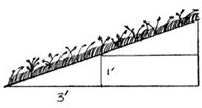
Areas where land-disturbing activities have created slopes in excess of 3:1 (three (3) horizontal linear feet for every vertical linear foot) shall require a retaining wall to stabilize the slope and preserve vegetation on, above, and below the slope.
11.6-2 - Installation of Plant Materials Required
Installation of plant material shall occur prior to the issuance of a Certificate of Occupancy.
11.6-3 - Performance Guarantee In-Lieu of Installation of Plant Materials
(A)
If at the time of a request for a Certificate of Compliance, the required planting areas are not complete the developer may provide a performance guarantee in accordance with G.S. 160D-804(g), guaranteeing the installation of the plant materials if the following conditions are met:
(1)
Plant materials are unavailable,
(2)
Completion of the planting areas would jeopardize the health of the plant materials until seasonal conditions exist, or
(3)
Weather conditions prohibit completion of the planting areas.
(B)
The Performance Guarantee shall be 125 percent of the estimated cost of installing the required plant materials, as determined by the Town. The Planning Administrator may accept a valid contract assignable to the Town containing a ninety-day (90) termination and/or cancellation notice to the Town by any party exercising such action incorporated therein for the remaining materials and turn-key installation, as a form of cost estimation. The performance guarantee shall secure the installation of the plant materials as shown on the approved landscape plan. The performance guarantee shall remain in full force and effect until such time as the installation of plant materials is completed, inspected, and accepted by the Town of Pine Knoll Shores. Failure to maintain the required performance guarantee shall result in the revocation of the site development plan's approval and any permits issued as a result of the plan approval. The performance guarantee shall be renewed by the applicant unless all parties, including the Town, agree not to renew it at least sixty (60) days prior to its scheduled expiration date.
11.6-4 - Tree Protection Plan Requirements
A Tree Protection Plan for all development projects to which these standards apply, along with all other necessary drawings, shall be submitted to the Planning Administrator. Tree protection items shall be included on all grading plans, erosion control plans, and Tree Removal/Oceanfront Pruning Permit (TRP) plans. Drawings shall identify the following items.
(A)
CRZ of each proposed protected tree or group of trees.
(B)
Limits of clearing.
(C)
Grading.
(D)
Trenching.
(E)
Required tree protection measures including protective fencing and signage.
(F)
Overhead and underground utilities, rights-of-way, and easement.
(G)
Areas of reforestation, if any.
(H)
Stream buffers, if any.
(I)
A complete survey of all trees on the site that exceed 3" inches at 36" above adjacent grade, including tree size and species.
11.6-5 - Pre-Construction Meeting
A pre-development meeting between the principal contractor on a project, the property owner, the Planning Administrator and representatives of the Appearance Commission is required for all work authorized by a Major Landscape Permits or Single-Family Landscape Permits. The Planning Administrator will schedule the meeting.
11.6-6 - Plan Review
The aforementioned plans shall be reviewed by the Planning Administrator for conformance with applicable provisions of this section and for tree and vegetation viability. The plans will either be approved or returned for revisions. Reasons for return shall be noted on the proposed plan.
11.6-7 - Installation of Protective Measures
All tree protection measures shall be installed prior to inspection by the Planning Administrator and prior to tree disturbance. All trees to be protected shall be identified on-site with a blue ribbon indicating the tree.
(A)
Removal or damage of trees identified to be retained post-development will be subject to the penalties established in Section 11.15, Enforcement, of this Ordinance.
11.6-8 - Site Inspections
The Planning Administrator will conduct follow-up site inspections for enforcement of the tree protection requirements.
11.6-9 - Permit Display
All permits issued hereunder shall be so displayed as to be clearly visible from a public right-of-way.
11.6-10 - Emergency Waiver
The Planning Administrator may waive provisions of this Article in writing in an emergency if compliance would hamper the rescue of life or property from immediate danger or the repair of utilities.
11.6-11 - Performance Guarantees
Failure to initiate installation of the plant materials within six (6) months of the date the performance guarantee was accepted by the Town of Pine Knoll Shores may result in the Town, at its sole discretion, directing and/or installing the plant materials, with the cost to be paid from the performance guarantee. The performance guarantee shall, if requested by the Town, pay all or any portion of the performance guarantee to the Town up to the amount needed to complete the installation of the plant materials based on an estimate by the Town as described above. The Town at its discretion may spend such portion of said funds as deemed necessary to complete all or any portion of the required plant installation. The Town shall return to the developer any funds not spent in completing the plant installation, less reasonable administrative, professional and legal services cost resulting from the failure of the developer. Default on a project does not release the developer from responsibility for the completion of the plant installation. The Town may release a portion or all of any performance guarantee as the plant installation is completed and approved by the Town. In the event the amount of the performance guarantee on hand is insufficient to pay for completion of the plant installation, the property owner shall pay to the Town of Pine Knoll Shores the total amount of the insufficiency. If the Town is not re-paid in full within ninety (90) calendar days of notice, the amount of the insufficiency shall be the basis for a claim against the property and constitute a lien on the property in favor of the Town upon filing with the Register of Deeds.
11.7-1 - Permit Required
No regulated tree within the town, and no oceanfront vegetation, may be cut, removed, or either subjected to root disturbance or chemicals or pruned in a manner that may cause it to die, without a permit from the Planning Administrator unless exempted by a specific provision of this Article. Cutting, removal, pruning, root disturbance and/or exposure to chemicals that may cause death of regulated trees or oceanfront vegetation is referred to in this section as a "regulated activity."
(A)
Application for permit. The Planning Administrator will create an application form for a regulated activity. The application form will require the applicant to specify the location of the tree or trees, and/or oceanfront vegetation, proposed for a regulated activity.
(B)
Appearance Commission. Upon receipt of an application for a regulated activity, the Planning Administrator will provide a copy to the Appearance Commission. The Appearance Commission may then proceed as quickly as possible to:
(1)
Inspect the site;
(2)
Photograph the site; and
(3)
Recommend to the Planning Administrator approval or denial of the permit.
In cases where the applicant does not seek to completely cut or remove one or more regulated trees or oceanfront vegetation, the Appearance Commission shall have the authority to a provide an opinion stating whether or not the desired pruning, cutting, root disturbance, or application of chemicals will cause material damage or death to the regulated tree(s) or oceanfront vegetation in question.
Approval or disapproval of the permit application must be issued within 30 days of receipt of the application by the Planning Administrator.
An applicant aggrieved by the decision of the Planning Administrator may seek an administrative review by the Board of Adjustment.
(C)
Standard for approving tree cutting. The Planning Administrator, after receipt of a recommendation from the Appearance Commission will approve an application for a regulated activity involving any regulated tree upon a finding that the activity will achieve one of the following purposes:
(1)
Protect a structure or improvement on the property from imminent damage from the tree, or any part thereof (note: possible damage from a healthy tree that could be blown over in a storm is not imminent damage);
(2)
Promote the growth and health of other more desirable vegetation;
(3)
Remove dead or diseased trees.
(D)
Standard for approving pruning/removal of oceanfront vegetation. The Planning Administrator, after receipt of a recommendation from the Appearance Commission, will approve an application for a regulated activity involving oceanfront vegetation upon a finding that the activity will achieve one of the following purposes:
(1)
Protect a structure or improvement on the property from imminent damage from oceanfront vegetation, or any part thereof;
(2)
Promote the growth and health of other more desirable vegetation;
(3)
Remove dead or diseased vegetation;
(4)
Improve the ocean vista from the top floor of a dwelling without destabilizing the soil or other oceanfront vegetation thereon or on adjacent properties; or
(5)
Protect the dunes.
(E)
Time limits on regulated activities on oceanfront parcels. Regulated activity under this section on oceanfront parcels may only take place during the period from November 1 through the following March 31.
(F)
Monitoring. The Appearance Commission and the Planning Administrator shall each have authority to monitor the regulated activity. Upon completion of the activity the Planning Administrator and the Appearance Commission may re-inspect the site, take photographs, and ascertain compliance with the permit.
11.8-1 - Screening of Dumpsters
All dumpsters must be screened if they are visible to adjacent public or private streets or any adjacent properties. Screening options include:
(A)
A single material wall or fence with a minimum height of 4 feet.
(B)
A combination of opaque materials, berming, and/or evergreen landscaping spaced at 8 feet on center that provides the required screening effect. The combination of opaque materials, berming, and/or evergreen landscaping shall have a minimum height of 6 feet within three (3) years of planting.
(C)
The wall(s) of a principal or accessory structure may also count for screening.
(D)
Chain-link fencing with woven slats of opaque material is not acceptable.
(E)
Existing Trees: See Section 11.6 (I) for information regarding credits for preservation of existing trees.
11.8-2 - Parking Lot Planting Areas
(A)
Applicability. Parking lot landscaping buffers shall be required to separate parking areas from adjacent uses for new and/or expanding parking lots with six (6) or more spaces. Required canopy trees and shrubs shall be located within the parking lot and adjacent to parking spaces in planting areas between rows of parking spaces, at the end of parking bays, in tree islands, and/or around the periphery of the parking lot.
(B)
Planting Rate. For every fifteen hundred (1,500) square feet of vehicular use area (VUA), one (1) deciduous tree and three (3) shrubs must be planted. Trees and shrubs must be planted within fifteen (15) feet of the VUA to meet the requirement.
(C)
Existing Trees. Credit for preservation of existing trees in parking lots may be available in other parts of this Article.
(D)
Reduction in Parking Requirements. To allow an existing development to retrofit parking to conform to the landscaping regulations, or for an existing or new development to preserve trees within or adjacent to a parking lot, the number of required off-street parking spaces may be reduced by the Planning Administrator by up to ten (10) percent.
(E)
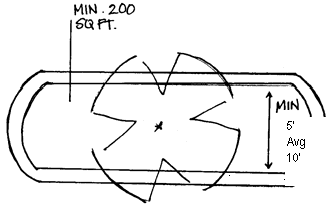
Multiple Parking Bays. When there are more than 4 bays of parking, an interior island with an average width of twenty (20) feet and a length equivalent to the parking bay shall be constructed. It should include a pedestrian walkway five (5) feet or more wide and a planted strip on one or both sides. The median should be located in such a way as to enhance pedestrian circulation within the development, leading to the entrance or to an adjacent sidewalk and/or walkway.
(F)
Perimeter Parking. All continuous runs of fifteen (15) or more parking spaces shall be interrupted by a tree island.
(G)
Grouping. Shrubs and trees may be grouped or clustered in the required planting yards, except for the perimeter landscaping adjacent to parking lots, outside storage, access drives, and loading and unloading areas. The remainder of the materials shall be distributed throughout the planting yard. There shall be at least one (1) row of evergreen shrubs or evergreen understory trees in all Type A planting yards used in parking areas.
(H)
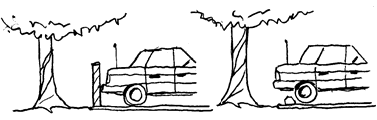
Plant Protection. Whenever planting areas are adjacent to parking lots or drives, such areas shall be protected from damage by vehicles, lubricants, or fuels. Curbing or some other structural barrier is required to be placed around trees within five feet of a car bumper. Allowances may be made if rain gardens are incorporated into the planting area. Trees and shrubs in islands should be set back at least three feet from the curb to allow for the operation of car doors.
11.9-1 - Heritage Trees on Developing Land
(A)
Heritage trees as recognized on the town's designated list shall be shown on all Tree Protection Plans if such trees are within one hundred (100) feet of areas where soil disturbance or construction activity is proposed. In addition, these trees shall be identified and located by survey on the Tree Protection Plan if such trees are located on the development site or adjacent public property. The Planning Administrator may visit the site to determine the accuracy of identification.
(B)
Proposed development shall be designed to preserve rare and specimen trees. Where rare and specimen trees exist, flexible approaches such as adjustments to lot layout, placement of buildings and paved surfaces, and location of utilities shall be pursued in order to save them.
(C)
No soil disturbance from construction, trenching, grading, paving, or storage of equipment or materials shall take place within the critical root zone of any rare or specimen tree to be preserved unless the Planning Administrator determines there is no reasonable way the property can be developed without such disturbance or unless the proposed work will be carried out in accordance with the specifications for such work in the Pine Knoll Shores Technical Standards & Specifications Manual.
(D)
No heritage tree shall be removed from land being developed unless the Planning Administrator determines there is no reasonable way the property can be otherwise developed, improved or properly maintained and the tree saved.
11.10 - PUBLIC TREES AND TREES INTERFERING WITH PUBLIC SPACE—MAINTENANCE AND PROTECTION
The following standards are hereby established for the maintenance and protection of public trees.
11.10-1 - Approved Personnel
No person except an authorized employee or contractor of public utility or other approved public personnel shall cut, prune, or remove any living tree on or in a public highway, right-of-way, public park, sidewalk, or other public property; or cut or disturb or interfere in any way with the roots of any tree on public property.
11.10-2 - Owner Responsibility for Private Trees Interfering with Public Space
Every owner of any tree overhanging any street or right-of-way within the Town shall prune the branches so that such branches shall not significantly obstruct the view of any street intersection and so that there shall be a clear space of thirteen (13) feet above the street surface or eight (8) feet above the sidewalk surface. Said owners shall remove all dead, diseased or unsafe trees, or broken or decayed limbs that constitute a nuisance to the safety of the public following approval by the Planning Administrator. The Town shall have the right to prune any tree or shrub on private or public property when it constitutes a public safety hazard, interferes with pedestrian traffic or the visibility of any traffic control device, sign, or sight triangle.
11.10-3 - Placement of Materials Around Plants
No person shall pile building or other material around any tree or shrub in a public right-of-way in any manner that will injure such tree or shrub.
11.10-4 - Paving Adjacent to Trees
No person shall pave or place gravel, soil, or other such material within eight (8) feet of any tree on public property, unless approved by the Planning Administrator. Plans which fail to identify an impacted tree shall not constitute a transfer of responsibility to the Town or its Planning Administrator.
11.10-5 - Dumping of Deleterious Matter
No person shall dump, pour or spill any oil, pesticide, or other deleterious matter upon any tree or critical root zone in any public rights-of-way, or keep or maintain upon any public rights-of-way, any receptacle from which any oil, pesticide, or other deleterious matter leaks or drips onto any soil, parking area, or concrete gutter so as to injure any tree on any public property.
11.10-6 - Disposal of Materials on Public Places
No person shall use parks, sidewalks, utility easements, or other public places to dump grass clippings, tree trimmings, rocks or other organic refuse. This shall not apply to properly placed yard waste that is intended for pickup by Town of Pine Knoll Shores Public Services or Solid Waste crews.
11.10-7 - Decoration, Posting and/or Advertising on Public Trees
No person shall decorate a tree or shrub in any public right-of-way, neutral ground, park, sight triangle or sidewalk, either with or without lights, or place advertising material, posters, political placards, rope, or wire on trees in public properties.
11.11 - HAZARD TREES
The following standards are hereby established for trees and shrubs determined to be hazardous.
11.11-1 - Removal of Trees
The Planning Administrator may order the removal of any tree, shrub, or part thereof on private or public property, which is unsafe or injurious to wastewater systems or other public improvements, structures, or to the general public.
11.11-2 - Right to Enter upon Property
The Public Works Administrator or their designee may enter upon public or private property in the Town to spray or otherwise treat any tree infected or infested by any parasite, insect, or disease to prevent the breeding or scattering of any parasite or animal pest and to prevent danger to persons or property or to trees planted on Town property.
11.11-3 - Owner Notification and Opportunity to Correct
Prior to exercising the authority conferred by this section, the Planning Administrator shall give the owner notice and an opportunity to correct the condition by requesting that corrective action be taken. The request shall be in writing and sent via First Class Mail to the owner of the property in question and shall be acted upon within twelve (12) days (or a lesser period of time if an imminent threat to life or property exists) from the date of the receipt of the request. If, after twelve (12) days, the owner has not corrected the condition or undertaken action that would lead to a timely correction of the condition, the Planning Administrator may enter upon the property, perform the work necessary to correct the condition, and bill the owner for the actual costs incurred. If the property owner fails to pay the bill for such work within thirty (30) days of such notice, the amount of the bill and any collection costs, including attorney's fees and court costs, incurred shall become a lien against the subject property and shall be collected in the same manner provided for the collection of delinquent taxes. In situations involving an immediate threat to public health, safety, or welfare, the Town may act without prior notification to the property owner.
11.12 - DUNE PROTECTION
Provisions of Section 46-26 of the Pine Knoll Shores Town Code are incorporated herein as if set forth in full. In addition to the provisions of Section 46-26, the following apply for the protection of dunes.
11.12-1 - Frontal and Primary Dunes
Development, including, but not limited to, excavation and fill by use of machinery or hand tools, is strictly prohibited on Frontal Dunes and Primary Dunes except for the following:
•
Stabilization of the Frontal Dune and Primary Dune by the Town or Carteret County as part of an engineered beach nourishment project.
•
Stabilization of the Frontal Dune and Primary Dune by the Town or Carteret County as part of an emergency project following erosion of the dune in a storm.
•
Planting of sea oats or beach grass under a plan authorized or undertaken by the Town or Carteret County.
•
Installing sand fences under a plan authorized or undertaken by the Town or Carteret County.
•
The installation and maintenance of beach access ways authorized by this Ordinance.
Installation and maintenance of driveways over and through the dunes by the Town for access to the ocean beach by emergency vehicles and equipment and vehicles necessary for beach renourishment projects or beach and dune maintenance projects authorized by the Town.
11.12-2 - Restriction on Development and Land-disturbing Activity Within the Ocean Setback
No building or other structure, unless expressly allowed by this section 11.12, shall be erected within the oceanfront setback established under the Coastal Area Management Act. This provision supersedes any provision of the Coastal Area Management Act or regulations promulgated thereunder, unless the Act preempts this restriction.
The following structures, to the extent consistent with laws and regulations adopted in accordance with the Coastal Area Management Act, shall be allowed to be constructed on improved or unimproved lots or parcels without regard to the setbacks established by this section:
•
One beach accessway for each single-family lot;
•
One beach accessway for each 100 feet of ocean frontage of multi-family, recreational, commercial or institutional property, as follows:
Zero—100 feet, one accessway;
101 feet—200 feet, two accessways;
201 feet—301 feet, three accessways; and so forth;
•
Sand fences under a plan authorized or undertaken by the Town or Carteret County;
•
Public beach accessways established by the Town.
As used within this section, the term "beach accessway" shall mean a raised pedestrian walkway with an overlook platform for viewing the beach and ocean, and a step system to allow access to the foreshore.
Each accessway must be constructed on post or piling and only the post shall be in contact with the dune. Floor planks shall be spaced to allow water, light and sand passage. Roofs are not permitted over the floor planks.
The accessway, except for the viewing platform, shall not exceed six feet in width.
The overlook platform shall not exceed 160 square feet in size on single-family residential lots, or 400 square feet in size on any other parcel.
The floor of the overlook platform shall be no more than three feet above the natural crest of the dune.
The step system shall intrude onto the beach only as required to minimize contact with the seaward face of the dune.
The step system shall be promptly relocated upon substantial erosion or accretion of the frontal dune.
Should any platform overlook be destroyed as to at least one-half of its square footage, such platform overlook, and all steps leading thereto, shall not be reconstructed without the issuance of a building permit, and until it conforms with the standards imposed by this section.
For a beach front lot with an existing house/structure, no construction, additions or other modifications to the structure shall be permitted seaward of the existing structure, except, and when permitted by the Coastal Area Management Act, and not on or over any part of a Frontal or Primary Dune, the following may be permitted: 1) uncovered porches; 2) uncovered decks; and 3) uncovered walkways.
The oceanfront setback shall be that set by the Coastal Area Management Act or regulations promulgated thereunder.
If the Coastal Area Management Act or its regulations fail to establish an oceanfront setback, the setback line shall be a straight line that connects the points on the two nearest principal structures on either side (east and west) of the lot that constitute the most seaward points on those structures. If a structure is on a keyed lot as in the Maritime Place and Forest Dunes Subdivision, the straight line will be established between the points of the two nearest principal structures on similarly keyed lots. If a greater setback is established by the coastal resources commission, that setback shall prevail.
11.13 - MAINTENANCE OF REGULATED PLANTING SPACES
A.
Owner Responsibility. The owner or lessee of the property where landscaping is required shall be responsible for the maintenance and protection of all plant and screening material. Landscaped areas shall be maintained in good condition and kept free of debris. Any dead, unhealthy, or missing plants (preserved or planted) shall be replaced with new plant material equal to the number of credited plants planted or preserved, subject to the provisions of this Ordinance. The replacement plant material shall be sized according to the requirements of this section and shall conform to the initial planting rates and standards. The replacement plant material shall be planted within one hundred eighty (180) days of the date that dead, unhealthy, or missing plants are identified. Regulated spaces include those physical areas in which trees and landscape materials are required by this section.
B.
Failure to Maintain. Failure to maintain or replace dead, damaged, or diseased material or to repair a broken fence or wall (where such fence or wall is considered a required portion of the landscape as outlined by this section) shall constitute a violation of this Ordinance and shall be subject to the provisions in Section 11.15, Enforcement, if not replaced within 30 days of notification.
C.
Reserved.
D.
Irrigation. It is suggested that drip irrigation, which includes drip misters, be used for required landscaping planting beds during the required establishment period. After establishment, supplemental watering can be reduced and used on an as needed basis. Traditional spray irrigation is prohibited except for turf areas.
E.
Pruning. All required trees shall be allowed to reach their mature size and shall be maintained at their mature size. Trimming and pruning shall be done in strict accordance with the ANSI standards. Topping is not an acceptable pruning practice. Topping is the reduction of a tree's size using heading cuts that shorten limbs or branches back to a predetermined crown limit. The Planning Administrator may require the removal and replacement of any tree(s) that have been topped or excessively trimmed.
11.14 - REGULATION OF TREE CARE PROFESSIONALS
The following standards are established for tree care professionals working within the Town of Pine Knoll Shores and its jurisdiction.
11.14-1 - Town-Owned Lands
(A)
It shall be unlawful for any person or firm to prune, treat, or remove trees within Town owned land or public rights-of-way without first applying for and procuring a Tree Removal/Oceanfront Pruning Permit (TRP).
(B)
Before any permit shall be issued, each applicant must first file evidence of possession of liability insurance and workman's compensation insurance, in the minimum amounts as required by the Town of Pine Knoll Shores, indemnifying the Town or any person injured or damage resulting from the pursuit of such endeavors as herein described.
(C)
The Planning Administrator is authorized to suspend or revoke the right of any person or business to perform work for the Town of Pine Knoll Shores that engages in work practices that do not comply with proper tree care standards. Specifically, the "topping" of trees shall be prohibited except in cases where the top of the tree has been injured beyond repair by a storm or a related incident.
11.15 - ENFORCEMENT
Enforcement of the standards and requirements set forth in this article shall be as provided below.
11.15-1 - Notice and Appeal
(A)
Notice of Violation. The Planning Administrator shall provide notice of any violation of this Article any required remedies. The notice of violation shall be served by any means authorized under G.S. 1A-1, Rule 4, and the notice shall set forth the nature of the violation, the measures required to comply with this Article, if compliance is at all practicable, and a reasonable time period (not less than 30 days and not to exceed 180 days) within which compliance must be met.
(B)
Appeal. If any aggrieved party with standing disagrees with a decision of the Planning Administrator, such party may request a hearing within twelve (12) working days of receipt of the violation. The request must be in writing and directed to the Board of Adjustment. The hearing will be conducted at a meeting scheduled by the Chairman of the Board of Adjustment.
(C)
Decision of Board of Adjustment. The Board of Adjustment may affirm, modify, amend or revise the decision appealed. The decision of the Board of Adjustment shall be served upon the appealing party by registered or certified mail, return receipt requested, or by hand delivery.
(D)
Appeal to Superior Court. If any aggrieved party with standing is dissatisfied with the decision of the Board of Adjustment, an appeal may be filed with the Carteret County Superior Court. Notice of the appeal must be filed within thirty (30) days of receipt of the Board of Adjustment decision. Any appeals to the Superior Court shall be in the nature of certiorari.
(E)
Injunction. Any aggrieved party with standing may request an injunction to preserve the status quo during the pending of any appeal in accordance with applicable North Carolina law.
11.16-1 - Grading and Tree Removal without Permit Approval
The penalty for development, prior to the issuance of a minor, single-family, or major landscape permit shall be a civil penalty of $10,000.00 per acre or prorated fraction thereof disturbed (i.e., the civil penalty for a site of 0.35 acres that is cleared prior to the issuance of a landscape permit is three thousand five hundred dollars ($3,500.00)). In addition to this penalty, any trees removed without a permit during the land-disturbing process will invoke a civil penalty and be required to be replaced per Table 11.2 below as determined by the Planning Administrator. The Planning Administrator may determine tree diameter by stump measurements if/when tree has been removed; however, if the stump has also been removed the penalty shall be the average of the minimum and maximum penalties appearing in Table 11.2 below.
11.16-2 - Removal or Damage to Individual Trees outside of an Approved Permit
The penalty for removal of or damage to the CRZ of protected trees after the issuance of a Tree Removal/Oceanfront Pruning Permit (TRP) without approval by the Planning Administrator shall result in a civil penalty as determined by the Planning Administrator, up to the amount shown in Table 11.2 below, in addition to the replacement of those trees with quality specimens native to coastal regions of North Carolina listed in the Native Tree Appendix Item. The Planning Administrator may determine tree diameter by stump measurements if/when tree has been removed; however, if the stump has also been removed the penalty shall be the average of the minimum and maximum penalties appearing in Table 11.2 below.
11.16-3 - Removal or Damage to Individual Trees after Permit Denial
If the Planning Administrator has denied a Tree Removal/Oceanfront Pruning Permit (TRP) and the applicant fails to appeal the decision to the Board of Adjustment or Carteret County Superior Court or said appeal was denied, removal of the tree(s) will result in a maximum civil penalty to be double the amount shown on Table 11.2. The Planning Administrator may determine tree diameter by stump measurements if/when tree has been removed; however, if the stump has also been removed the penalty shall be double the average of the minimum and maximum penalties appearing in Table 11.2 below.
11.16-4 - Failure to Install or Maintain Tree Protection Devices
There shall be a civil penalty of five hundred dollars ($500.00) per day for failure to install or maintain approved tree protection measures sufficient to protect the preserved trees beginning with the date the citation is issued and ending when the site is in compliance. The property owner may be subject to any penalties for damage in accordance with this Article.
11.16-5 - Failure to Comply with Landscape Requirements (Section 11.6)
There shall be a penalty of five hundred dollars ($500.00) per day for failure to install required landscape material or to replace dead landscape material beginning with the date the citation is issued and ending when the site is in compliance.
11.16-6 - Civil Penalties Considered Restorative
Civil penalties assessed under this section are considered restorative; intended to provide compensation to the Town for costs associated with the Town's program to monitor, control, prosecute, cure and/or correct the violation. As such, the amount declared herein is presumed to provide sufficient restoration to the Town for its costs. The decision of the Planning Administrator to assess a civil penalty may be delivered by personal service, by registered mail, or certified mail return receipt requested or by any means authorized under G.S. 1A-1, Rule 4. Each day of a continuing violation shall constitute a separate violation.
11.16-7 - Appeal
Every decision of the Planning Administrator to assess a civil penalty and/or require re-plantings, shall be subject to appeal to the Board of Adjustment by an aggrieved party with standing. Decisions of the Board of Adjustment on such appeals may be further appealed by an aggrieved party with standing to the Carteret County Superior Court by proceedings in the nature of certiorari. Any petition for review by the Superior Court shall be filed with the Clerk of Superior Court within 30 days after the decision of the Board of Adjustment.
11.16-8 - Failure to Appeal and/or Pay
If not paid when due, any civil penalty that is assessed against a person who violates the provisions of this Ordinance shall be recovered by the Town in a civil action in the nature of collection of a debt to be brought in the appropriate division of the General Court of Justice in Carteret County.
11.16-9 - Violations Not Criminal
A violation of this Ordinance shall not be considered a misdemeanor under N.C. General Statute 14-4.

