
Pine Knoll Shores City Zoning Code
ARTICLE 2
- GENERAL STANDARDS AND SPECIFICATIONS
2.1 - GENERAL REQUIREMENTS
No Land-Disturbing Activity shall take place, and no structure shall be erected nor use established, in conflict with this Ordinance.
2.2 - STREET FRONTAGE REQUIRED
Any lot on which a building (or buildings) is to be erected or use is to be established shall abut a public or private street.
2.3 - ONE PRINCIPAL BUILDING ON A LOT; EXCEPTIONS
Only one principal residential building and its customary accessory structure(s), including temporary family health care structure in accordance with G.S. 160D-915, may be erected on any lot in a residential district subject to the provisions applicable to Accessory Structures established by this Ordinance in accordance with Article 10 of this Ordinance. In districts where multiple buildings are permitted on a lot, those buildings may be erected and used according to the provisions of the applicable sections of this Ordinance.
2.4 - LOT SIZE
No lot, even though it may consist of one or more adjacent lots of record, shall be reduced in size such that the requirements for building and lot type cannot be met, or the standards for spacing of structures and street frontage cannot be respected. This prohibition shall not be construed to prevent the purchase, dedication, or condemnation of narrow strips of land for public utilities and/or street and/or sidewalk right-of-way purposes.
2.5 - LOT WIDTH
The required width of a lot, as set forth in Article 8 of this Ordinance, shall be measured at the required front setback line.
2.6-1 - Lots Abutting More Than One Street
On lots that abut more than one street, the building and lot shall generally front upon the more pedestrian oriented street, given the arrangement of existing and proposed streets and drives, and the orientation of buildings on adjoining lots.
2.6-2 - Multiple Buildings on a Lot
Where multiple buildings are permitted on a single platted lot, each building shall generally front upon a pedestrian oriented street, external or internal to the development; side and rear yard designations shall be determined on the basis of building orientation.
2.6-3 - Irregularly Shaped Lots
On irregularly shaped lots, the location of required front, side, and rear yards will be determined by the Planning Administrator. The determination will be based on the spirit and intent of this Ordinance to achieve an appropriate spacing of buildings and orientation to the street(s).
2.7-1 - Buildings on Corner Lots
Buildings on corner lots shall be positioned on the corner as required by the building and lot type standards for the zoning district in which the lot is located.
2.7-2 - Setbacks on Corner Lots
Buildings on corner lots shall meet the front setback for its zoning district on both sides facing a public or private street. The rear and side setbacks shall apply for the interior sides.
2.8-1 - Building Type Controls
The height of habitable buildings and components is controlled by building type as provided in this Ordinance.
2.8-2 - Building Components Exceeding Height Limitation
Structures and structural components not intended for human occupancy (including towers, steeples, flagpoles, chimneys, water tanks or similar structures) may exceed the height limit of the applicable zoning district, but only as specifically provided in this Ordinance.
2.8-3 - Exceptions to Height Limitation
(A)
The height limitations of this section shall not apply to public utility poles and lines or to municipal water towers.
(B)
Except in single-family residential districts R-1, R-2, and R-3, skylights, and roof structures for elevators, stairways, tanks, heating, ventilation and air-conditioning equipment, solar panels appurtenant to the principal structure, or similar equipment for the operation and maintenance of a building, and any device used to screen such structures and equipment may exceed the height limit for the district by fifteen feet.
2.8-4 - Height of Communication Towers
Commercial communication towers, where permitted, may exceed the height limit for structures when the standards for these towers, as set forth in Article 10, are met.
2.9-1 - No Principal Structure in Setback
No principal building or structure shall be located within any required setback or yard, forward of the build-to line for a principal structure, within any setback or yard established by a recorded plat, nor in any required buffer or screen.
2.9-2 - No Accessory Structure in Setback
Except as otherwise provided in this article, no accessory structure shall be in a setback.
2.9-3 - Setback Exemptions
The following structures will be exempt from the setback requirements: a driveway which is no closer than 5' to a side property line, one raised waterway access per lot which shall not be greater than six feet in width, a dock or pier compliant with appropriate state regulations, a patio or sitting area no greater than 100 square feet, retaining walls, fences compliant with article 2.13-2, HVAC equipment and generators which can be no closer than six feet to an adjacent property line.
2.9-4 - Signs
Signs may be in an established front setback or a side-yard abutting a public street as permitted by the provisions of Article 17, Sign Regulations.
2.9-5 - Outdoor Storage
Outdoor storage of goods and materials or refuse containers shall be located within a property building area and shall not encroach into a setback, except for the temporary placement of refuse for scheduled curbside collection.
2.10-1 - Sight Triangle Required
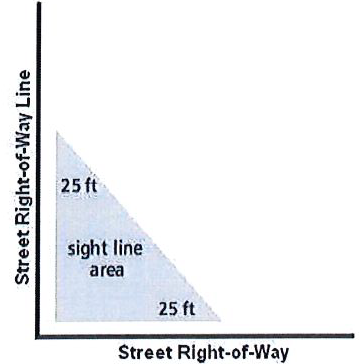
Unless provided otherwise, a clear view at each corner of an intersection shall be maintained by establishing an unobstructed "sight triangle." The extent of the required sight triangle varies according to the speed limit of streets forming the intersection. For streets signed for greater than 35 MPH, the area to be clear of view obstructions at un-signalized intersections is the triangular area formed by the point of intersection of street right-of-way lines and a point located along each right-of-way line at a distance of 25 feet from the point of intersection. For intersecting streets signed for 35 MPH or less, the area to be clear of view obstructions at un-signalized intersections is the triangular area formed by the point of intersection of street right-of-way lines and a point located along each right-of-way line at a distance of 15 feet from the point of intersection.
Site Triangle Illustration for Streets Signed for greater than 35 MPH:
2.10-2 - No Obstruction in Sight Triangle
No planting, structure, sign, fence, wall, man-made berm, or other obstruction to vision shall be installed, constructed, set out, or maintained to obstruct cross-visibility in the sight triangle between 30 inches and 60 inches above the level of the center of the street intersection.
2.10-3 - Modifications to Limitations
The limitations of this section may be modified in the instances noted below, so long as adequate visibility is maintained relative to intended speed limit:
(A)
Existing natural grades;
(B)
Trees trimmed such that no limbs or foliage extend into the area between 30 and 96 inches above the level of the adjacent intersection;
(C)
Fire hydrants, public utility poles, street markers, government signs, electrical junction boxes, and traffic control devices;
(D)
The approved and intentional use of traffic calming techniques to reduce speed. These include, but are not limited to: a series of hill crests, neck-downs, intersection diverters, and curb bulbs.
2.11 - BUILDING SEPARATION
All detached principal structures in all districts that permit more than one principal structure on a lot shall preserve a minimum building separation of 10 feet. Accessory structures in all districts shall maintain a minimum building separation of eight (8) feet from a principal structure. All separations are as measured from the closest point(s) of roof overhang.
2.12-1 - Accessory Uses and Structures
Accessory uses and structures related and incidental to residential principal structure(s) on the lot shall be setback a minimum of 7.5 feet beyond the front and/or side street facing façade(s) of the conditioned space, and setback a minimum of four (4) feet from interior side and rear lot line(s). If the accessory structure exceeds the height of the principal structure, it must meet the minimum setback for principal structures on interior side and/or rear lot line(s).
Accessory Dwellings as temporary health care structures shall be erected and used only in accordance with G.S. 160D-915.
2.12-2 - Fences and Walls
Fences and walls meeting the requirements of Section 2.9 are permitted in all districts in accordance with the following specifications:
(A)
A zoning permit issued by the Planning Administrator shall be required for all fences and walls. The process for obtaining a zoning permit is set forth in Article 7 of this Ordinance.
(B)
In all districts a fence or wall in the established front yard, side yard, and rear yard of a building abutting a street shall be a maximum of 5 feet in height, unless otherwise regulated by the building or lot type standards. Fences along interior side property lines in all districts shall not exceed 5 feet in height in front of a line parallel to the front of the principal structure on the lot. Decorative caps or spires that extend above the highest horizontal member of the fence shall not be included in the measurement of height. Chain link, welded wire, or similar fencing materials, if used, shall be placed on the interior side of a masonry wall, solid wood fence, or decorative wood or vinyl fence that is equal to or greater in height than the secure fencing and demonstrates effective screening capability. (For example, a 4 foot high welded wire fence attached to the interior of a decorative split rail fence or board farm fence of equal height or greater would perform to the standards of this section.)
(C)
Fences shall not be erected over easements such as, but not limited to, access easements, utility easements, drainage easements, or any other public easement, without the explicit approval of the Town. If fences or other barriers are allowed to cross such easements, the Planning Administrator may require the installer or landowner to install gates or other access points per standards and specifications set by the Town to ensure access to such easements in the future as necessary and to minimize damage to private property.
2.12-3 - Parking Lots
For parking lots as principal or accessory uses, the landscape and buffering standards of Article 11 shall control.
2.12-4 - Petroleum Storage
Petroleum storage, accessory to a permitted principal use or building, shall comply with the Fire Prevention Code of the National Board of Fire Underwriters.
2.12-5 - Temporary Construction-Related Uses
Temporary buildings and storage of materials, provided the use is in conjunction with the construction of a building on the same lot or on an adjacent lot; the temporary uses shall be terminated upon completion of construction.
2.12-6 - Swimming Pools
Swimming pools located on any site, including single-family residential sites, shall be:
(A)
Located in a side or rear yard only;
(B)
Located a minimum of fifteen feet from any property line;
(C)
Located outside of a state regulated setback;
(D)
Completely enclosed by a fence or wall no less than four (4) feet but no more than five (5) feet in height, except when a wall is component to the dwelling or accessory dwelling structure, in accordance with the provisions of subsection 2.12-2 Fences and Walls, herein. Height shall be measured above grade on the side of the fence or wall which faces away from the swimming pool. This fence or wall shall enclose the pool itself and may include any other additional portions of the lot. Fence design shall not be climbable or of a ladder pattern. Fences shall not be located in a way that allows any permanent structure, equipment, or similar object to be used for climbing. The fence shall not have any gaps, opening, indentations, protrusions, or structural components that allow a young child aged six (6) years or less to crawl under, squeeze through, or climb over the fence or adjacent barrier. All fence or wall openings into the pool area shall be equipped with a gate that opens outward away from the pool and shall be self-closing and have a self-latching device located on the poolside of the gate and be placed so that a young child aged six (6) years or less cannot reach over the top or through any opening or gap and operate the latch.
2.13 - STANDARDS FOR CONSTRUCTION; DEVELOPER RESPONSIBILITY
Where standards and responsibility for infrastructure construction, including but not limited to streets, sidewalks, and landscaping, are specified in this Ordinance or other Ordinances of the Town of Pine Knoll Shores, those standards shall control. Where standards are not specified, construction shall be in conformance with the standards set forth in the Town of Pine Knoll Shores Technical Standards & Specifications Manual.
2.14 - GUARANTEE IN-LIEU OF CONSTRUCTION OF IMPROVEMENTS
Provision of Guarantee. In-lieu of completion of construction of the required improvements, including but not limited to sidewalks, landscaping, parking, and utilities, prior to issuance of a Certificate of Occupancy and/or Completion, the property owner or developer may provide the Town with a performance guarantee in accordance with Article 16.
2.15-1 - Driveway Permit Required
No driveway or other point of access to a street maintained by a private entity, the Town of Pine Knoll Shores or the North Carolina Department of Transportation shall be constructed, relocated, or altered unless a driveway permit or other approval is obtained from either the Town of Pine Knoll Shores or the North Carolina Department of Transportation. The applicant shall comply with the standards for driveways established by the jurisdiction maintaining said street and/or roadway. All driveway plans shall be reviewed by the Town of Pine Knoll Shores prior to construction of the driveway.
2.15-2 - Projects Composed of Multiple Buildings and Lots
For development projects composed of multiple buildings and lots, access to the predevelopment existing public street system shall be determined by the location of proposed intersecting streets. No parcel of land which is a functional part of the overall development, even though it may be removed by the developer from the rest of the project area by subdivision or by metes and bounds description, shall be permitted to have driveway access to the public streets bounding the project area without first having secured the approval in subsection 2.15-1 above.
2.15-3 - Access to Subdivision Lots
In a residential major subdivision, access to individual lots from streets constructed as part of the subdivision shall be reviewed and approved at the time each Zoning Compliance Permit is issued.
2.15-4 - Location and Design of Access
Determination of the location and design of access to the public street system shall be made by the Planning Administrator and other regulatory and professional reviewers based on a contextual examination of the site, surrounding development, potential traffic generated on the site, current and future surface transportation system needs, special polices that might exist for the corridor being accessed, and/or state of the practice principles for access management as promulgated by the Institute of Transportation Engineers and the Transportation Research Board.
2.16-1 - Authorization
Pursuant to North Carolina General Statutes 160A-306 and 153A-326 (which state that cities and counties shall have authority to (1) classify all or a portion of the streets within their jurisdictions according to their size, present and anticipated traffic load, and other characteristics relevant to the achievement of the purposes of this section, and (2) establish by Ordinance minimum distances that buildings and other permanent structures or improvements constructed along each class or type of street shall be set back from the right-of-way line or the center line of an existing or proposed street), the following requirements shall apply.
2.16-2 - Minimum Setbacks along Highway 58
The building setback line along North Carolina Highway 58 is 50 feet notwithstanding any provision contrary in this Ordinance; however, the exemptions from setback in Section 2.9 apply.
2.17-1 - Sidewalks Required
Sidewalks shall be required along new and existing streets, in accordance with the provisions of Article 13, in the following new development and expansions of and improvements to or redevelopment of existing development.
(A)
All new commercial development.
(B)
Expansions to an existing commercial development or use where the gross floor area of the expansion is equal to or greater than 50 percent of the gross floor area of the pre-expansion development or use.
(C)
Improvements to an existing commercial development or use when the cost of the improvement is equal to or greater than 50 percent of the value of the existing development (building) or use as determined by the Carteret County Tax Office.
(D)
All new residential subdivisions.
2.17-2 - Sidewalks Along New Streets
Sidewalks shall be required along one side of new streets.
2.17-4 - Standards for Sidewalks
Sidewalks shall comply with the design and construction standards set forth in the Town of Pine Knoll Shores Technical Standards & Specifications Manual.
2.18-1 - Prohibition and Exceptions
(A)
The development and/or subdivision of land for the purpose of Manufactured Home Parks/Courts is prohibited in all primary general use districts. Exception is taken to this regulation where the Manufactured Home Overlay (MHO) District standards and specifications apply.
Manufactured Home Overlay (MHO) standards and specifications are established in Article 8 of this Ordinance.
2.19 - PROVISION OF POTABLE WATER SUPPLY AND WASTEWATER DISPOSAL INFRASTRUCTURE
All new development shall be connected to an approved potable water supply system and an approved wastewater system in accordance with Town of Pine Knoll Shores adopted policies. Extensions to serve development shall be in accordance with Chapter 46 of the Town's Code of Ordinances.
Every principal use and every lot within a subdivision not served by a public wastewater collection, transport and treatment system shall be served by an accepted wastewater system, in accordance with N.C.G.S. 130A-335, that is adequate to accommodate the reasonable needs of such use or subdivision lot and that complies with all applicable health regulations. Definitions of terms appearing in this Development Ordinance including: "maintenance," "repair," "septic tank system," "sewage," "wastewater," and "wastewater system" shall be determined in accordance with North Carolina G.S. 130A-334.
Plats, as defined by G.S. 130A-334, for new lots and/or parcels shall be submitted for review, whether subject to subdivision approval or not. Each plat shall identify the location of an accepted wastewater system and if an on-site wastewater system, then identify the location of the repair field and/or area. Plats shall identify off-site wastewater system locations and show easements where any portion of said off-site wastewater system and/or utility line providing service to the lot extends over any portion of a lot other than the lot for which said off-site wastewater system and/or utility serves. Plats representing locations of on-site and/or off-site wastewater system, utility line and requisite repair areas shall be submitted with all Exempt, Minor Subdivision and Major Subdivision Preliminary Plats and appear on all Final Plats approved for recording in the Carteret County Register of Deeds.
2.20 - MURALS AND WORKS OF ART IN OUTDOOR PUBLIC VIEW
Murals and Works of Art of any size intended for outdoor display are signs and subject to all provisions in this Ordinance restricting or regulating signs.
2.21 - RENTALS/SHORT-TERM RENTALS LIMITED
(A)
Dwellings. Short-Term rental of dwellings, whether detached single-family dwellings, or dwelling units in multi-family projects (such as a condominium unit), shall be subject to the following designations, limitations, standards, and specifications:
(1)
No signs or demarcations promoting or identifying short-term rentals or "vacation rentals" visible from the street or adjacent properties are permitted.
(2)
No more than two persons per bedroom are permitted within the dwelling, at the same time during the short-term rental.
(a)
The number of bedrooms in a dwelling is identified in the Carteret County Tax Office property card for the dwelling.
(b)
Advertisement of a sleeping capacity which exceeds the above will be a violation of this section.
(3)
Owners, their agents, and occupants shall make all reasonable efforts to minimize the impact of the following:
(a)
Noise—All occupants shall comply with Section 30-565 "Noise" of the Town of Pine Knoll Shores, Code of Ordinances.
(b)
Trash and Recycling—All occupants shall comply with Section 42-1 "Garbage and Trash Removal" of the Town of Pine Knoll Shores, Code of Ordinances.
(c)
Motor Vehicle Parking—All occupants shall comply with Section 50 "Traffic and Motor Vehicles" of the Town of Pine Knoll Shores, Code of Ordinances.
(4)
Sales and Occupancy Tax. The owner of dwelling rented for short-term rentals is subject to paying sales and occupancy tax. For more information, contact Carteret County Finance Department, Attn: Occupancy Tax, 302 Court House Square, Beaufort, NC 28516.
(5)
Owners shall provide this notice on the interior of the back of the front door of the dwelling:
Notice of Town of Pine Knoll Shores Vacation Rental Regulations
1.
Emergencies—Call 911 in the event of an emergency.
2.
Occupancy—No more than two persons per bedroom are permitted at the same time to be within this dwelling or on the zoning lot during the vacation rental.
3.
Noise—It is unlawful for any person to create, or assist in creating, an unreasonably loud noise in the town. Additionally, all occupants shall comply with Section 30-565 "Noise" of the Town of Pine Knoll Shores, Code of Ordinances.
4.
Trash and Recycling—Trash and recycling must be put in roll away carts located on the side or rear of the premises for single-family residences and in dumpsters on the campus of condominiums. Trash may not be allowed to overflow the trash receptacle. Trash receptacles must only be placed by the curbside within the contracted timeframe for pickup per Town ordinances. Additionally, all occupants shall comply with Section 42-1 "Garbage and Trash Removal" of the Town of Pine Knoll Shores, Code of Ordinances. The Town has a household trash and recycling convenience site behind Town Hall which is open 24-hours/day, seven days a week.
5.
Motor Vehicle Parking—No on-street parking is allowed. Parking within the right-of-way of any public street is prohibited between the hours of 12:00 a.m. and 6:00 a.m. Additionally, all occupants shall comply with Section 50 "Traffic and Motor Vehicles" of the Town of Pine Knoll Shores, Code of Ordinances.
6.
Enforcement—Violation of these provisions may result in an early termination of the vacation rental and an eviction of the occupants by the property owner.
(6)
Owners and their agents shall take reasonable steps to ensure the occupants' compliance with the express provisions required under subsections (1)—(5) above. As used herein, the term "reasonable steps" shall be construed to include, without limitation, the following:
(a)
Promptly contacting occupants when notified of any violation of a Town ordinance and ordering the occupants to cease and desist from such violation;
(b)
Contacting law enforcement when a reasonable person would deem the assistance of law enforcement to be necessary under conditions then prevailing on the premises; and
(c)
When applicable and reasonable, commencing expedited eviction procedures against the occupants as provided for in G.S. Ch. 42A, art. 4, Vacation Rental Act.
(7)
Repeated Violations of this Subsection.
(a)
For every violation of this subsection, the owner of the premises shall be given written notice by the Planning Administrator. Such notice will include a warning that two or more violations within a twelve-month period may result in a prohibition on short-term rentals on the premises for a one year period.
(b)
In the event of more than two violations of this subsection on a premises within a rolling twelve month period, pursuant to N.C.G.S. 160D-404, in addition to other enforcement actions authorized in this Ordinance, the Planning Administrator, by issuance of a Stop Work Order to the owner of the premises, is authorized to order the dwelling immediately closed for short-term rentals for a period of one year.
(c)
Within two years after an order to close short-term rentals of a dwelling, if such use is resumed and two violations of this subsection within a rolling twelve-month period occurs again, the Planning Administrator, by issuance of a Stop Work Order to the owner of the premises, is authorized to order the dwelling immediately closed for short-term rentals for a period of two years.
(d)
In addition to other remedies provided elsewhere in this Ordinance, or N.C.G.S 160A-175, violation of a stop work order issued under this subsection will subject the offender to a civil penalty payable to the Town in the amount of $1,000.00 per day of the period of violation.
(e)
Property owners served with a Stop Work Order or a civil penalty per this subsection have the right to file an appeal with the Board of Adjustment in accordance with the procedures for "Appeals of Administrative Decisions" contained in Article 6.

