
Pinecrest City Zoning Code
ARTICLE 4
- ZONING DISTRICT REGULATIONS2
Editor's note— See definitions, div. 9.2.
Div. 4.1.- Purpose.
This division describes the purpose and intent of each zoning district; identifies permitted, conditional, and prohibited uses by zoning district; and presents size and dimensional regulations for each zoning district.
(Ord. No. 2002-8, § 3, 11-13-02)
Div. 4.2. - Residential districts.
(a)
Purpose and densities. The purpose of the residential districts is to help implement comprehensive development master plan residential development objectives and policies. The residential districts established herein designate the maximum residential density that may be developed within the respective residential districts based upon the plan.
1.
Low density residential districts.
a.
Low density residential districts shall allow the following density:
TABLE 4.1
b.
The intent of the low density residential districts is to: Protect the quality and character of residential estates and single-family neighborhoods from encroachment by incompatible development; preserve open space; achieve and maintain densities that are compatible with existing and future developments; promote compatibility with natural features of the land; and minimize burdens on public services and facilities.
2.
Multi-family residential districts.
a.
Multi-family residential districts shall allow the following net density:
TABLE 4.2
b.
The intent of the multi-family residential districts is to: Provide opportunities for multiple family development at a density consistent with the needs and values of the village population; reserve open space; achieve and maintain densities that are compatible with existing and anticipated future developments; promote compatibility with natural features of the land; and minimize burden on supportive public services and facilities within the area.
(b)
Residential estate (EU-1C) district.
1.
Uses permitted. The following uses shall be allowed within an EU-1C district:
a.
Single-family residential dwellings;
b.
Foster care and group homes with fewer than seven residents; and
c.
Government facilities following a public hearing conducted by the village council.
2.
Conditional uses. Within the EU-1C district the following uses shall be approved by the village council but only as a conditional use.
a.
Public utilities.
3.
Accessory uses. Within the EU-1C district the administrative official may approve the following uses but only as an accessory use, pursuant to procedures set forth in this Code for the principal use of the property:
a.
Accessory units. An affidavit stating the limited purpose of the unit shall be signed and the owner shall certify that the accessory unit shall remain compliant with the land development code;
b.
Accessory structures;
c.
Limited livestock;
d.
Sale of homegrown produce limited to production and sale of produce grown on the premises; and
e.
Bee keeping.
f.
Accessory uses other than garages shall be located behind the rear wall or column of the principal structure or within an open courtyard screened from public view. Accessory structures may occupy no more than five percent of the total of 20 percent of the floor area ratio of the first story of the property.
4.
Prohibited uses. All uses not specifically or provisionally provided for herein.
5.
Dimensional regulations.
a.
Minimum lot area: Lots in the EU-1C district shall contain a minimum of 2.5 gross acres in area, including one-half of the rights-of-way adjacent to the site.
b.
Maximum density: One principal dwelling unit per 2.5 acres.
c.
Maximum height:
i.
Principal use: One-story structure or portion of the structure that is one story: 24 feet to the top of the parapet. If the roof of the one story structure has a pitch of at least 3/12, then the peak of such roof may be 28 feet in height, provided the height to the top of the tie beam does not exceed 24 feet.
Two-story structure or portion of the structure that is two stories: 35 feet. However, any portion of the building or structure with a flat roof, or sloped roof concealed by a parapet, shall not exceed 28 feet to the top of the roof or 29.5 feet to the top of the parapet.
Maximum height of the wall: 27 feet. Extensions or encroachments above the exterior wall(s) shall be limited to the roof, chimneys, and vents.
Maximum height of truss heel: 1 foot.
ii.
Accessory use: Accessory buildings that are detached or not physically and permanently attached to the principal building with a structurally interconnected roof that provides interconnectivity between the principal and accessory uses shall not exceed 14 feet in height at a minimum required setback of 15 feet and shall not exceed 18 feet in height at a minimum required setback of 20 feet.
d.
Maximum lot coverage (applied to the net lot area, exclusive of public rights-of-way):
i.
Maximum building coverage (inclusive of all structures): 20 percent for two-story structures; 25 percent for one-story structures.
ii.
Maximum impervious surface ratio: 45 percent.
iii.
Minimum green space: 55 percent.
e.
Minimum lot width and street frontage: 150 feet.
f.
Minimum lot depth: 250 feet. The measurement shall be from the centerline of the abutting front right-of-way.
g.
Minimum setbacks and maximum floor area ratios: All development must comply with setbacks for wetlands. Also, the following setbacks and floor area ratios shall apply within the EU-1C district:
TABLE 4.3
Notes:
(1) See lot, corner (division 9.2).
(2) See accessory use regulations.
(3) Lots whose frontage is less than 135 feet in width shall have an interior side yard setback on each side of 15 percent of the width with a setback of not less than 15 feet.
(4) Uncovered swimming pools, pool patios and hard-surfaced tennis courts shall be excluded from F.A.R. calculations but shall be calculated as impervious surface.
(5) Less than 100 square feet and less than eight feet in height.
(6) Lots whose frontage is less than 150 feet in width shall have a side street setback of 25 feet.
(7) Detached accessory structures that are 14 feet or less in height shall be setback a minimum 15 feet from the rear property line; detached accessory structures that are more than 14 feet in height, and no more than the maximum permitted height of 18 feet, shall be setback a minimum of 20 feet from the rear property line.
(8) Required setbacks and floor area ratio shall apply to the net lot area, exclusive of public rights-of-way.
h.
Minimum size living area: 2,000 square feet.
i.
Grandfather clause. Existing structures in EU-1C zoning districts which conform to the Miami-Dade County Code as of March 12, 1996, a copy of which is on file in the Office of the village clerk, shall conform to that Code for setback lines for building additions.
(c)
Residential estate (EU-1) district.
1.
Uses permitted. The following uses shall be allowed within an EU-1 district:
a.
Single-family residential dwellings;
b.
Foster care and group homes with fewer than seven residents; and
c.
Government facilities following a public hearing conducted by the village council.
2.
Conditional uses. Within the EU-1 district the following uses may be approved by the village council but only as a conditional use.
a.
Public utilities.
b.
Cluster developments, subject to the conditional use standards in division 3.3 and division 5.24.
3.
Accessory uses. Within the EU-1 district the administrative official may approve the following uses as an accessory use, and shall be reviewed pursuant to procedures set forth in this Code for the principal use of the property:
a.
Accessory units. An affidavit stating the limited purpose of the unit shall be signed and the owner shall certify that the accessory unit shall remain compliant with the land development code;
b.
Accessory structures;
c.
Limited livestock;
d.
Sale of homegrown produce limited to production and sale of produce grown on the premises; and
e.
Bee keeping;
f.
Accessory uses other than garages shall be located behind the rear wall or column of the principal structure or within an open courtyard screened from public view. Accessory structures may occupy no more than five percent of the total of 20 percent of the floor area ratio of the first story of the property.
4.
Prohibited uses. All uses not specifically or provisionally provided for herein.
5.
Dimensional regulations.
a.
Minimum lot area: One acre, including one-half of the rights-of-way adjacent to the site.
b.
Maximum density: One principal dwelling unit per one gross acre.
c.
Maximum height:
i.
Principal use: One-story structure or portion of the structure that is one story: 24 feet to the top of the parapet. If the roof of the one story structure has a pitch of at least 3/12, then the peak of such roof may be 28 feet in height, provided the height to the top of the tie beam does not exceed 24 feet.
Two-story structure or portion of the structure that is two stories: 35 feet. However, any portion of the building or structure with a flat roof, or sloped roof concealed by a parapet, shall not exceed 28 feet to the top of the roof or 29.5 feet to the top of the parapet.
Maximum height of the wall: 27 feet. Extensions or encroachments above the exterior wall(s) shall be limited to the roof, chimneys, and vents.
Maximum height of truss heel: 1 foot.
ii.
Accessory use: Accessory buildings that are detached or not physically and permanently attached to the principal building with a structurally interconnected roof that provides interconnectivity between the principal and accessory uses shall not exceed 14 feet in height at a minimum required setback of 15 feet and shall not exceed 18 feet in height at a minimum required setback of 20 feet.
d.
Maximum lot coverage (applied to the net lot area, exclusive of public rights-of-way):
i.
Maximum building coverage (inclusive of all structures): 20 percent for two-story structures; 25 percent for one-story structures.
ii.
Maximum impervious surface ratio: 45 percent.
iii.
Minimum green space: 55 percent.
e.
Minimum lot width and street frontage: 125 feet.
f.
Minimum lot depth: 200 feet. The measurement shall be from the centerline of the abutting front right-of-way.
g.
Minimum setbacks and maximum floor area ratios: All development must comply with setbacks for wetlands. Also, the following setbacks and floor area ratios shall apply within the EU-1 district:
TABLE 4.4
Notes:
(1) See lot, corner (division 9.2).
(2) See accessory use regulations.
(3) Lots whose street frontage is less than 135 feet in width shall have an interior side yard setback on each side of 15 percent of the width with a setback of not less than 15 feet.
(4) Uncovered swimming pools, pool patios and hard-surfaced tennis courts shall be excluded from F.A.R. calculations but shall be calculated as impervious surface.
(5) Less than 100 square feet and less than eight feet in height.
(6) Lots whose frontage is less than 125 feet in width shall have a side street setback of 25 feet.
(7) Detached accessory structures that are 14 feet or less in height shall be setback a minimum 15 feet from the rear property line; detached accessory structures that are more than 14 feet in height, and no more than the maximum permitted height of 18 feet, shall be setback a minimum of 20 feet from the rear property line.
(8) Required setbacks and floor area ratio shall apply to the net lot area, exclusive of public rights-of-way.
h.
Minimum size living area: 1,800 square feet.
i.
Grandfather clause. Existing structures in EU-1 zoning districts which conform to the Miami-Dade County Code as of March 12, 1996, a copy of which is on file in the office of the village clerk, shall conform to that Code for setback lines for building additions.
(d)
Residential suburban estate (EU-S) district.
1.
Uses permitted. The following uses shall be allowed within the EU-S district:
a.
Single-family residential dwellings;
b.
Foster care and group homes with less than seven residents; and
c.
Government facilities following a public hearing conducted by the village council.
2.
Conditional uses. Within the EU-S district the following uses may be approved by the village council but only as a conditional use.
a.
Public utilities.
3.
Accessory uses. Within the EU-S district administrative official may approve the following uses, but only as an accessory use, pursuant to procedures set forth in this Code for the principal use of the property:
a.
Accessory units. An affidavit stating the limited purpose of the unit shall be signed and the owner shall certify that the accessory unit shall remain compliant with the land development code;
b.
Accessory structures; and
c.
Other accessory uses. Accessory uses other than garages shall be located behind the rear wall or column of the principal structure or within an open courtyard screened from public view. Accessory structures may occupy no more than five percent out of the total of 30 percent of the floor area ratio of the property for a one-story.
4.
Prohibited uses. All uses not specifically or provisionally provided for herein.
5.
Dimensional regulations.
a.
Minimum lot size: Lots in the EU-S district shall contain a minimum of 25,000 gross square feet in area, including one-half of the rights-of-way adjacent to the site.
b.
Maximum density: One principal unit per 25,000 square feet in area.
c.
Maximum height:
i.
Principal use: One-story structure or portion of the structure that is one story: 24 feet to the top of the parapet. If the roof of the one story structure has a pitch of at least 3/12, then the peak of such roof may be 28 feet in height, provided the height to the top of the tie beam does not exceed 24 feet.
Two-story structure or portion of the structure that is two stories: 35 feet. However, any portion of the building or structure with a flat roof, or sloped roof concealed by a parapet, shall not exceed 28 feet to the top of the roof or 29.5 feet to the top of the parapet.
Maximum height of the wall: 27 feet. Extensions or encroachments above the exterior wall(s) shall be limited to the roof, chimneys, and vents.
Maximum height of truss heel: 1 foot.
ii.
Accessory use: Accessory buildings that are detached or not physically and permanently attached to the principal building with a structurally interconnected roof that provides interconnectivity between the principal and accessory uses shall not exceed 14 feet in height at a minimum required setback of 15 feet and shall not exceed 18 feet in height at a minimum required setback of 20 feet.
d.
Maximum lot coverage (applied to the net lot area, exclusive of public rights-of-way):
i.
Maximum building coverage (inclusive of all structures): 30 percent.
ii.
Maximum impervious surface ratio: 65 percent.
iii.
Minimum green space: 35 percent.
e.
Minimum lot width and street frontage: 125 feet.
f.
Minimum lot depth: 135 feet. The measurement shall be from the centerline of the abutting front right-of-way.
g.
Minimum setbacks and maximum floor area ratios: All development must comply with setbacks for wetlands. Also, the following setbacks and floor area ratios shall apply within the EU-S district:
TABLE 4.5
Notes:
(1) See lot, corner (division 9.2).
(2) See accessory use regulations.
(3) Lots whose street frontage is less than 135 feet in width shall have an interior side yard setback on each side of 15 percent of the width with a setback of not less than 15 feet.
(4) Uncovered swimming pools, pool patios and hard-surfaced tennis courts shall be excluded from F.A.R. calculations but shall be calculated as impervious surface.
(5) Less than 100 square feet and less than eight feet in height.
(6) Detached accessory structures that are 14 feet or less in height shall be setback a minimum 15 feet from the rear property line; detached accessory structures that are more than 14 feet in height, and no more than the maximum permitted height of 18 feet, shall be setback a minimum of 20 feet from the rear property line.
(7) Required setbacks and floor area ratio shall apply to the net lot area, exclusive of public rights-of-way.
h.
Minimum size living area: 1,500 square feet.
i.
Grandfather clause. Existing structures in EU-S zoning districts which conform to the Miami-Dade County Code as of March 12, 1996, a copy of which is on file in the office of the village clerk, shall conform to that code for setback lines for building additions.
(e)
Residential modified estate (EU-M) district.
1.
Uses permitted. The following uses shall be allowed within an EU-M district:
a.
Single-family residential dwellings;
b.
Foster care and group homes with fewer than seven residents; and
c.
Government facilities following a public hearing conducted by the village council.
2.
Conditional uses. Within the EU-M district the following uses only may be approved by the village council but only as a conditional use.
a.
Public utilities.
3.
Accessory uses. Within the EU-M district the following uses shall but only as an accessory use, pursuant to procedures set forth in this Code for the principal use of the property:
a.
Accessory units. An affidavit stating the limited purpose of the unit shall be signed and the owner shall certify that the accessory unit shall remain compliant with the land development code;
b.
Accessory structures; and
c.
Other accessory uses.
d.
Accessory uses other than garages shall be located behind the rear wall or column of the principal structure or within an open courtyard screened from public view. Accessory structures may occupy no more than an additional five percent of the total 30 percent of the floor area ratio of the property.
4.
Prohibited uses. All uses not specifically or provisionally provided for herein.
5.
Dimensional regulations.
a.
Minimum lot area: Lots in the EU-M district shall contain a minimum of 15,000 net square feet in area.
b.
Maximum density: One principal unit per 15,000 net square feet (i.e., shall not include any rights-of-way).
c.
Maximum height:
i.
Principal use: One-story structure or portion of the structure that is one story: 24 feet. If the roof of the structure has a pitch of at least 6/12, then the peak of such roof may be 28 feet in height.
Two-story structure or portion of the structure that is two stories: 35 feet. However, any portion of the building or structure with a flat roof, or sloped roof concealed by a parapet, shall not exceed 28 feet to the top of the roof or 29.5 feet to the top of the parapet.
ii.
Accessory use: Accessory buildings that are detached or not physically and permanently attached to the principal building with a structurally interconnected roof that provides interconnectivity between the principal and accessory uses shall not exceed 14 feet in height.
d.
Maximum lot coverage:
i.
Maximum building coverage (inclusive of all structures): 30 percent.
ii.
Maximum impervious surface ratio: 65 percent.
iii.
Minimum green space: 35 percent.
e.
Minimum lot width and street frontage: 120 feet.
f.
Minimum lot depth: 115 feet.
g.
Minimum setbacks and maximum floor area ratios: All development must comply with setbacks for wetlands. Also, the following setbacks and floor area ratios shall apply within the EU-M district:
TABLE 4.6
Notes:
(1) See lot, corner (division 9.2).
(2) See accessory use regulations.
(3) Uncovered swimming pools, pool patios and hard-surfaced tennis courts shall be excluded from F.A.R. calculations but shall be calculated as impervious surface.
(4) Less than 100 square feet and less than eight feet in height.
h.
Minimum size living area: 1,200 square feet.
(f)
Single-family residential (RU-1) district.
1.
Uses permitted. The following uses shall be allowed within an RU-1 district:
a.
Single-family residential dwellings;
b.
Foster care and group homes with fewer than seven residents; and
c.
Government facilities following a public hearing conducted by the village council.
2.
Conditional uses. Within the RU-1 district the following uses may be approved by the village council but only as a conditional use.
a.
Public utilities;
b.
Child and family day care services for fewer than seven persons.
3.
Accessory uses. Within the RU-1 district the administrative official may approve the following uses but only as an accessory use and shall be reviewed pursuant to procedures set forth in this Code for the principal use of the property:
a.
Accessory structures; and
b.
Other accessory uses not involving an additional dwelling unit.
c.
Accessory uses other than garages shall be located behind the rear wall or column of the principal structure or within an open courtyard screened from public view. Accessory structures may occupy no more than five percent out of the total of 35 percent of the floor area ratio of the property.
4.
Prohibited uses. All uses not specifically or provisionally provided for herein.
5.
Dimensional regulations.
a.
Minimum lot area: Lots in the RU-1 district shall contain a minimum of 7,500 net square feet in area.
b.
Maximum density: One principal unit per 7,500 net square feet.
c.
Maximum height:
i.
Principal use: One-story structure or portion of the structure that is one story: 24 feet. If the roof of the structure has a pitch of at least 6/12, then the peak of such roof may be 28 feet in height.
Two-story structure or portion of the structure that is two stories: 32 feet. Maximum height of the wall: 26 feet. However, any portion of the building or structure with a flat roof shall not exceed 24 feet including the parapet.
Wall height at side setback: 20 feet. The maximum wall height may increase by one foot for each additional one foot of side setback provided beyond the minimum side setback requirement up to the maximum permitted height.
Maximum height of truss heel height: 1 foot.
ii.
Accessory use: Accessory buildings shall not exceed 14 feet in height.
d.
Maximum lot coverage:
i.
Maximum building coverage (inclusive of all structures): 30 percent.
ii.
Maximum impervious surface ratio: 65 percent.
iii.
Minimum green space: 35 percent.
e.
Minimum lot width and street frontage: 75 feet.
f.
Minimum lot depth: 100 feet.
g.
Minimum setbacks and maximum floor area ratios: All development must comply with setbacks for wetlands. Also, the following setbacks and floor area ratios shall apply with the RU-1 district:
TABLE 4.7
Notes:
(1) See lot, corner (division 9.2).
(2) See accessory use regulations.
(3) Less than 100 square feet and less than eight feet in height.
h.
Minimum size living area: 1,000 square feet.
(g)
Residential Duplex (RU-2) district.
1.
Uses permitted. The following uses shall be allowed within an RU-2 district:
a.
Single-family residential dwellings;
b.
Two-family residential dwellings;
c.
Townhouses compliant with criteria in the Land Development Regulations;
d.
Foster care and group homes with less than seven residents; and
e.
Government facilities following a public hearing conducted by the village council.
2.
Conditional uses. Within the RU-2 district the following uses may be approved by the village council, but only as a conditional use.
a.
Public utilities;
b.
Child and family day care services for fewer than seven persons.
3.
Accessory uses. Within the RU-2 district the administrative official may approve the following uses but only as an accessory use, pursuant to procedures set forth in this Code for the principal use of the property:
a.
Accessory structures; and
b.
Other accessory uses not involving an additional dwelling unit. Accessory uses other than garages shall be located behind the rear wall or column of the principal structure or within an open courtyard screened from public view. Accessory structures uses may occupy no more than five percent of the total of 35 percent of the floor area ratio of the property.
4.
Prohibited uses. All uses not specifically or provisionally provided for herein.
5.
Dimensional regulations.
a.
Minimum lot area: Lots containing one or two dwellings shall contain a minimum of 7,500 net square feet in area.
b.
Maximum density: Two principal units per 7,500 net square feet in area.
c.
Maximum height:
i.
Principal use: One-story structure or portion of the structure that is one story: 24 feet. If the roof of the structure has a pitch of at least 6/12, then the peak of such roof may be 28 feet in height.
Two-story structure or portion of the structure that is two stories: 32 feet. Maximum height of the wall: 26 feet. However, any portion of the building or structure with a flat roof shall not exceed 24 feet including the parapet.
Wall height at side setback: 20 feet. The maximum wall height may increase by one foot for each additional one foot of side setback provided beyond the minimum side setback requirement up to the maximum permitted height.
Maximum height of truss heel height: 1 foot.
ii.
Accessory use: Accessory buildings shall not exceed 14 feet in height.
d.
Maximum lot coverage:
i.
Maximum building coverage (inclusive of all structures): 35 percent.
ii.
Maximum impervious surface ratio: 65 percent.
iii.
Minimum green space: 35 percent.
e.
Minimum lot width and street frontage: 75 feet.
f.
Minimum lot depth: 100 feet.
g.
Minimum setbacks and maximum floor area ratios: All development must comply with setbacks for wetlands. Also, the following setbacks and floor area ratios shall apply within the RU-2 district:
TABLE 4.8
Notes:
(1) See lot, corner (division 9.2).
(2) See accessory use regulations.
h.
Minimum size living area: 1,000 square feet.
(g.1)
Residential multi-family low density (RU-3).
1.
Uses permitted. The following uses shall be allowed within an RU-3 district following Village Council approval of a site plan.
a.
Multiple family residential structures:
b.
Town houses;
c.
Foster care and group homes with fewer than seven residents; and
d.
Government facilities following a public hearing conducted by the village council.
2.
Conditional uses. Within the RU-3 district the following uses may be approved by the village council, but only as a conditional use.
a.
Adult congregate living facilities;
b.
Child and family day care services for fewer than seven persons;
c.
Community residential home with seven to 14 residents: and
d.
Public utilities.
3.
Accessory uses. Within the RU-3 district the administrative official may approve the following uses but only as an accessory use, pursuant to procedures set forth in this Code for the principal use of the property.
a.
Accessory structures; accessory structures may extend above the height of screen walls, Division 5.1 of the Land Development Regulations notwithstanding, provided that no accessory structure may exceed a maximum height of 15 feet five inches; and
b.
Other accessory uses.
c.
Accessory uses other than garages shall be located behind the rear wall or column of the principal structure or within an open courtyard screened from public view. Administrative offices, clubhouses, parking structures and similar structures serving only the residents of the building site and their guests shall comply with setbacks for the principal structure.
4.
Prohibited uses. All uses not specifically or provisionally provided for herein.
5.
Dimensional regulations.
a.
Minimum lot area. Lots in the RU-3 district accommodating multi-family structures shall contain a minimum of 1.94 net acres in area.
b.
Maximum density. The maximum density shall be 9.3 dwelling units per net acre.
c.
Maximum height.
i.
Principal use: Four stories not exceeding 45 feet where adjacent to or across the street from commercially zoned property. Three stories not exceeding 35 feet where adjacent to residentially zoned property.
ii.
Accessory use: 15 feet and five inches.
d.
Maximum lot coverage:
i.
Maximum building coverage (inclusive of all structures): 26 percent.
ii.
Maximum impervious surface ratio: 60 percent.
iii.
Minimum green space: 40 percent.
e.
Minimum lot width and street frontage: 280 feet.
f.
Minimum lot depth: 265 feet.
g.
Minimum setbacks and maximum floor area ratio: All development must comply with setbacks for wetlands. Also, the following setbacks and floor area ratios shall apply within the RU-3 district:
TABLE 4.8.1
Notes:
(1) See lot corner (division 9.2).
(2) Twenty feet except where doors, windows or other openings in the building wall of a living unit face a wall of the same building and/or a wall of another building on the same site, then there shall be provided a minimum clear distance of not less than 30 feet. Said distance to be measured on a line projected at right angles at the opening to the opposite wall.
(3) See accessory use regulations.
h.
Minimum size living area: 600 square feet.
6.
Green space and landscaping.
i.
Green space. On each lot there shall be provided green space equal to at least 40 percent of the total lot area. The required green space shall be unencumbered with any structure or off-street parking and shall be landscaped and well-maintained with grass, trees and shrubbery.
ii.
Landscaping and tree protection. Landscaping and trees shall be provided in accordance with article 6 of this land development code.
(h)
Residential multi-family moderate density (RU-3M) district.
1.
Uses permitted. The following uses shall be allowed within an RU-3M district following village council approval of a site plan.
a.
Multiple family residential structures;
b.
Townhouses compliant with criteria in the land development code;
c.
Foster care and group homes with fewer than seven residents; and
d.
Government facilities following a public hearing conducted by the village council.
2.
Conditional uses. Within the RU-3M district the following uses may be approved by the village council, but only as a conditional use.
a.
Adult congregate living facilities;
b.
Child and family day care services for fewer than seven persons;
c.
Community residential home with seven to 14 residents; and
d.
Public utilities.
3.
Accessory uses. Within the RU-3M district the administrative official may approve the following uses but only as an accessory use, pursuant to procedures set forth in this Code for the principal use of the property:
a.
Accessory structures; and
b.
Other accessory uses.
c.
Accessory uses other than garages shall be located behind the rear wall or column of the principal structure or within an open courtyard screened from public view. Administrative offices, clubhouses, parking structures and similar structures serving only the residents of the building site and their guests shall comply with setbacks for the principal structure. Accessory structures may occupy no more than five percent of the total of 30 percent of the floor area ratio of the property.
4.
Prohibited uses. All uses not specifically or provisionally provided for herein.
5.
Dimensional regulations.
a.
Minimum lot area. Lots in the RU-3M district accommodating multi-family structures shall contain a minimum of 16,900 net square feet in area.
b.
Maximum density. The maximum density shall be a 12.9 dwelling unit per net acre.
c.
Maximum height:
i.
Principal use: 2 stories not exceeding 35 feet.
ii.
Accessory use: 14 feet.
d.
Maximum lot coverage:
i.
Maximum building coverage (inclusive of all structures): 30 percent.
ii.
Maximum impervious surface ratio: 65 percent.
iii.
Minimum green space: 35 percent.
e.
Minimum lot width and street frontage: 100 feet.
f.
Minimum lot depth: 100 feet.
g.
Minimum setbacks and maximum floor area ratio: All development must comply with setbacks for wetlands. Also, the following setbacks and floor area ratios shall apply within the RU-3M district:
TABLE 4.9
Notes:
(1) See lot, corner (division 9.2).
(2) Twenty feet, except where doors, windows or other openings in the building wall of a living unit face a wall of the same building and/or a wall of another building on the same site, then there shall be provided a minimum clear distance of not less than 30 feet. Said distance to be measured on a line projected at right angles at the opening to the opposite wall.
(3) See accessory use regulations.
h.
Minimum size living area: 600 square feet.
6.
Green space and landscaping.
i.
Green space. On each lot there shall be provided a green space equal to at least 35 percent of the total lot area. The required green space shall be unencumbered with any structure or off-street parking and shall be landscaped and well maintained with grass, ground cover included within the "Florida-friendly plant database," trees and shrubbery, except that ten percent of any driveway or parking area constructed of open cell unit pavers (turf block) and two percent of any driveway or parking area constructed of brick pavers with a sand and/or gravel sub base or underlayment may be counted as green space.
ii.
Landscaping and tree protection. Landscaping and trees shall be provided in accordance with article 6 of this land development code.
(i)
Residential multi-family low-medium density (RU-4L) district.
1.
Uses permitted. The following uses shall be allowed within an RU-4L district following village council approval of a site plan.
a.
Multiple family residential structures;
b.
Townhouses compliant with criteria in the land development code;
c.
Foster care and group homes with fewer than seven residents; and
d.
Government facilities following a public hearing conducted by the village council.
2.
Conditional uses. Within the RU-4L district the following uses may be approved by the village council, but only as a conditional use.
a.
Adult congregate care facilities;
b.
Child and family day care services for fewer than seven persons;
c.
Community residential home with seven to 14 residents; and
d.
Public utilities.
3.
Accessory uses. Within the RU-4L district the administrative official may approve the following accessory uses but only as an accessory use, pursuant to procedures set forth in this Code for the principal use of the property:
a.
Accessory structures; and
b.
Other accessory uses.
c.
Accessory uses shall be located behind the rear wall or column of the principal structure or within an open courtyard screened from public view. Administrative offices, clubhouses, parking structures and similar structures serving only the residents of the building site and their guests shall comply with setbacks for the principal structure. Accessory structures may occupy no more than five percent of the total of 30 percent floor area ratio (FAR) of the property.
4.
Prohibited uses. All uses not specifically or provisionally provided for herein.
5.
Dimensional regulations.
a.
Minimum lot area. Lots in the RU-4L district accommodating multi-family structures shall contain a minimum of 10,000 net square feet in area.
b.
Maximum density. The maximum density shall be 23 dwelling units per net acre.
c.
Maximum height:
Principal use: Three stories not exceeding 35 feet.
Accessory use: 14 feet.
d.
Maximum lot coverage:
i.
Maximum building coverage (inclusive of all structures): 30 percent.
ii.
Maximum impervious surface ratio: 65 percent.
iii.
Minimum green space: 35 percent.
e.
Minimum lot width and street frontage: 100 feet.
f.
Minimum lot depth: 100 feet.
g.
Minimum setbacks and maximum floor area ratio (FAR): All development must comply with setbacks for wetlands. Also, the following setbacks and floor area ratios shall apply within the RU-4L district:
TABLE 4.10
Notes:
(1) See lot, corner (division 9.2).
(2) Twenty feet, except where doors, windows or other openings in the building wall of a living unit face a wall of the same building and/or a wall of another building on the same site, then there shall be provided a minimum clear distance of not less than 30 feet. Said distance to be measured on a line projected at right angles at the opening to the opposite wall.
(3) See accessory use regulations.
h.
Minimum square footage: 600 square feet.
6.
Green space and landscaping.
a.
Green space. On each lot there shall be provided a green space equal to at least 35 percent of the total lot area. The required green space shall be unencumbered with any structure or off-street parking and shall be landscaped and well maintained with grass, ground cover included within the "Florida-friendly plant database," trees and shrubbery, except that ten percent of any driveway or parking area constructed of open cell unit pavers (turf block) and two percent of any driveway or parking area constructed of brick pavers with a sand and/or gravel sub base or underlayment may be counted as green space.
b.
Landscaping and tree protection. Landscaping and trees shall be provided in accordance with article 6 of the land development code.
(j)
Residential multi-family medium high density (RU-4M) district.
1.
Uses permitted. The following uses shall be allowed within an RU-4M district following village council approval of a site plan the:
a.
Multiple-family residential structures;
b.
Townhouses compliant with criteria presented in the land development code;
c.
Foster care and group homes with fewer than seven residents; and
d.
Government facilities following a public hearing conducted by the village council.
2.
Conditional uses. Within the RU-4M district the following uses may be approved by the village council but only as a conditional use.
a.
Adult congregate care facilities;
b.
Child and family day care services for fewer than seven persons;
c.
Community residential home with seven to 14 residents; and
d.
Public utilities.
3.
Accessory uses. Within the RU-4M district the administrative official may approve the following but only as an accessory use, pursuant to procedures set forth in this Code for the principal use of the property:
a.
Accessory structure; and
b.
Other accessory uses.
c.
Accessory uses shall be located behind the rear wall or column of the principal structure or within an open courtyard screened from public view. Administrative offices, clubhouses, parking structures and similar structures serving only the residents of the building site and their guests shall comply with setbacks for the principal structure. Accessory uses may occupy no more than five percent of the total of 30 percent of the floor area ratio of the property.
4.
Prohibited uses. All uses not specifically or provisionally provided for herein.
5.
Dimensional regulations.
a.
Minimum lot area. Lots in the RU-4M district accommodating multi-family structures shall contain a minimum 10,000 net square feet in area.
b.
Maximum density. The maximum density shall be 36 dwelling units per net acre.
c.
Maximum height:
i.
Principal use: Three stories not exceeding 35 feet.
ii.
Accessory use: 14 feet.
d.
Maximum lot coverage:
i.
Maximum building coverage (inclusive of all structures): 40 percent.
ii.
Maximum impervious surface ratio: 65 percent.
iii.
Minimum green space: 35 percent.
e.
Minimum lot width and street frontage: 100 feet.
f.
Minimum lot depth: 100 feet.
g.
Minimum setbacks and maximum floor area ratio: All development must comply with setbacks for wetlands. Also, the following setbacks and floor area ratios shall apply within the RU-4M district:
TABLE 4.11
Notes:
(1) See lot, corner (division 9.2).
(2) Twenty feet, except where doors, windows or other openings in the building wall of a living unit face a wall of the same building and/or a wall of another building on the same site, then there shall be provided a minimum clear distance of not less than 30 feet. Said distance to be measured on a line projected at right angles at the opening to the opposite wall.
(3) See accessory use regulations.
h.
Minimum size living area: 600 square feet.
6.
Green space and landscaping.
a.
Green space. On each lot there shall be provided a green space equal to at least 35 percent of the total lot area. The required green space shall be unencumbered with any structure or off-street parking and shall be landscaped and well maintained with grass, ground cover included within the "Florida-friendly plant database," trees and shrubbery, except that ten percent of any driveway or parking area constructed of open cell unit pavers (turf block) and two percent of any driveway or parking area constructed of brick pavers with a sand and/or gravel sub base or underlayment may be counted as green space.
b.
Landscaping and tree protection. Landscaping and trees shall be provided pursuant to provisions of article 6 of the land development code.
(k)
Residential multi-family high density (RU-4) district.
1.
Uses permitted. The following uses shall be allowed within an RU-4 district following village council approval of a site plan:
a.
Multiple-family residential structures;
b.
Townhouses that are compliant with criteria in the land development code;
c.
Foster care and group homes with fewer than seven residents; and
d.
Government facilities following a public hearing conducted by the village council.
2.
Conditional uses. Within the RU-4 district the following uses may be approved by the village council but only as a conditional use.
a.
Adult congregate living facilities;
b.
Child and family day care services for fewer than seven persons;
c.
Community residential home with seven to 14 residents; and
d.
Public utilities.
3.
Accessory uses. Within the RU-4 district the village council may approve the following as an accessory use and with a site plan, pursuant to procedures set forth in this Code for the principal use of the property:
a.
Accessory structures; and
b.
Other accessory uses.
4.
Prohibited uses. All uses not specifically or provisionally provided for herein.
5.
Dimensional regulations.
a.
Minimum lot area. Lots in the RU-4 district accommodating multi-family structures shall contain a minimum 10,000 net square feet in area.
b.
Maximum density. The maximum density shall be 50 dwelling units.
c.
Maximum height:
i.
Principal use: four stories not exceeding 45 feet.
ii.
Accessory use: 14 feet.
d.
Maximum lot coverage:
i.
Maximum building coverage: 40 percent.
ii.
Maximum impervious surface ratio: 65 percent.
iii.
Minimum green space: 35 percent.
e.
Minimum lot width and street frontage: 100 feet.
f.
Minimum lot depth: 100 feet.
g.
Minimum setbacks and maximum floor area ratio. All development must comply with setbacks for wetlands. Also, the following setbacks and floor area ratios shall apply within the RU-4 district:
TABLE 4.12
Notes:
(1) See lot, corner (division 9.2).
(2) See accessory use regulations. Administrative offices, clubhouses, parking structures and similar structures serving only the residents of the building site and their guests shall comply with setbacks for the principal structure.
(3) Twenty feet, except where doors, windows or other openings in the building wall of a living unit face a wall of the same building and/or a wall of another building on the same site, then there shall be provided a minimum clear distance of not less than 30 feet. Said distance to be measured on a line projected at right angles at the opening to the opposite wall.
h.
Minimum size living area: 600 square feet.
6.
Green space and landscaping.
a.
Green space. On each lot there shall be provided a green space equal to at least 35 percent of the total lot area. The required green space shall be unencumbered with any structure or off-street parking and shall be landscaped and well maintained with grass, ground cover included within the "Florida-friendly plant database," trees and shrubbery, except that ten percent of any driveway or parking area constructed of open cell unit pavers (turf block) and two percent of any driveway or parking area constructed of brick pavers with a sand and/or gravel sub base or underlayment may be counted as green space.
b.
Landscaping and tree protection. Landscaping and trees shall be provided pursuant to provisions of article 6 of the land development code.
(Ord. No. 2002-8, § 3, 11-13-02; Ord. No. 2004-7, § 2, 10-12-04; Ord. No. 2009-2, § 1, 6-9-09; Ord. No. 2011-7, § 2, 9-6-11; Ord. No. 2012-4, § 2, 3-20-12; Ord. No. 2014-02, § 2, 4-8-14; Ord. No. 2014-7, § 2, 10-14-1; Ord. No. 2016-4, § 2, 4-12-16; Ord. No. 2018-5, § 2(Exh. A), 5-8-18; Ord. No. 2021-10, § 2(Exh. A), 10-19-21; Ord. No. 2022-3, § 2, 1-11-22)
Div. 4.3. - Commercial districts.
(a)
General purpose of commercial districts. The overall purpose of the commercial districts is to help implement comprehensive development master plan commercial development objectives and policies. The location and distribution of specific types of commercial activities shall be determined based on the following considerations:
1.
Existing and desired future trends in commercial land development within the village and its environs;
2.
Require that commercial development be consistent with the comprehensive development master plan and the land development code;
3.
Maintain the existing compact linear commercial core that serves the village;
4.
Protect environmentally sensitive natural systems, especially water resources, including storm water management policies designed to preserve water quality in the man-made canals east of the commercial area;
5.
Provide and maintain transportation and infrastructure system improvements and manage impacts of future development;
6.
Establish a basis for regulating the location, intensity, scale, and design of commercial development;
7.
Ensure that future commercial development shall not encroach eastward into established residential areas;
8.
Consider trip generation characteristics, including impact on transportation facilities and off-street parking systems;
9.
Consider location and site requirements based on specific needs of respective commercial activities, their market area, anticipated employment generation and floor area requirements;
10.
Provide compatibility with and impact on the quiet enjoyment of nearby residential areas and of other surrounding commercial activities; and
11.
Provide open space, landscaping and natural vegetative buffers and screening between residential and nonresidential developments as well as developments of varying intensity such as single-family and multiple-family residential uses. Manmade walls should only be used in cases where necessary to abate noise impacts.
(b)
Generally. The BU districts shall not accommodate permanent or transient residential units, including hotels or motels. The commercial land use districts herein established are as follows:
TABLE 4.13
COMMERCIAL DISTRICTS
(c)
Office development (RU-5) districts.
1.
Intent. The RU-5 district is principally intended to accommodate office development and provide a buffer between more intense commercial (BU) districts on the east side of US 1 and west of the established residential EU and RU land use districts.
2.
Uses permitted. The following uses shall be allowed within an RU-5 district following village council approval of a site plan pursuant to the procedures established in the Code:
a.
Business and professional offices;
b.
Financial institutions without drive-in teller facilities;
c.
Government facilities following a public hearing conducted by the village council;
d.
Medical services;
e.
Mixed office and residential use. If sufficient lot area is available, an office building may contain an apartment(s) or other multi-family dwelling units. Similarly, if sufficient lot area is available, an office unit may have an accompanying residential use in connection therewith.
f.
Multiple family residential;
g.
Municipal parking lots and facilities following a public hearing conducted by the village council;
h.
Townhouses; and
i.
Foster care and group homes.
3.
Conditional uses. Within the RU-5 district the following uses may be approved by the village council but only as a conditional use.
a.
Drive-thru banking facilities;
b.
Child and family day care services for less than seven persons;
c.
Community residential home with seven to 14 residents; and
d.
Public utilities.
4.
Accessory uses. Within the RU-5 district the following uses may be approved by the administrative official, but only as an accessory use, pursuant to procedures set forth in this Code for the principal use of the property:
a.
Recreational accessory uses;
b.
Other accessory uses.
5.
Prohibited uses. All uses not specifically or provisionally provided for herein, including, medical marijuana retail centers, are prohibited. Multiple-family residential structures: The following properties shall not be developed for freestanding residential use, as each specific parcel was previously zoned RU-5A by the county prior to the enactment of this land development code. The previously applicable RU-5A County zoning policy did not allow residential use within the RU-5A district unless the residential use is in connection with an office use (i.e., mixed use as opposed to a free-standing residential structure). The intent of the village is to not change land use policies previously applicable to RU-5A properties under the county code.
a.
Two RU-5 parcels abutting the eastside of SW 69th Court, 200 feet ± south of SW 88th Street (Kendall Drive);
b.
One parcel abutting the north side of SW 104th Street, 313 feet ± east of US 1;
c.
One parcel abutting the south side of SW 104th Street, 129 feet ± east of US 1; and
d.
One parcel abutting the southwest corner of SW 104th Street and SW 77th Avenue.
6.
Dimensional regulations.
a.
Minimum lot or building site. The minimum lot or building site shall be 10,000 net square feet in area.
b.
Maximum density. The maximum density shall be 50 dwelling units.
c.
Maximum height:
i.
Principal use: Two stories not exceeding 35 feet.
ii.
Accessory use: 14 feet.
d.
Maximum lot coverage:
i.
Maximum building coverage (inclusive of all structures): 40 percent.
ii.
Maximum impervious surface: Ratio 75 percent.
iii.
Minimum green space: 25 percent.
e.
Minimum lot width and street frontage: 100 feet.
f.
Minimum lot depth: 100 feet.
g.
Minimum setbacks and maximum floor area ratio: All development must comply with setbacks for wetlands stated in the Code. Also, the following setbacks and floor area ratios shall apply within the RU-5 district:
TABLE 4.14
Notes:
(1) Twenty feet, except where doors, windows or other openings in the building wall of a living unit face a wall of the same building and/or a wall of another building on the same site, then a minimum clear distance shall be provided of not less than 30 feet. Said distance to be measured on a line projected at right angles at the opening to the opposite wall.
(2) See lot, corner (division 9.2).
(3) See accessory use regulations.
7.
Green space and landscaping.
a.
Green space. On each lot there shall be provided a green space equal to at least 25 percent of the total lot area. The required green space shall be unencumbered with any structure or off-street parking and shall be landscaped and well maintained with grass, trees and shrubbery, except that ten percent of any driveway or parking area constructed of open cell unit pavers (turf block) and two percent of any driveway or parking area constructed of brick pavers with a sand and/or gravel sub base or underlayment may be counted as green space.
b.
Landscaping and tree protection. Landscaping and trees shall be provided pursuant to article 6 of the land development code.
(d)
Restricted business development (BU-1) district.
1.
Intent. Businesses within the BU-1 district are located within the US 1 linear corridor and are intended to service neighborhood residential markets within the immediate vicinity, as opposed to village-wide or regional markets. Such businesses are also intended to cater to specialized markets with customized market demands. The BU-1 district is not intended to accommodate large-scale retail sales and trade activities generally serving a citywide or regional market. Such stores generally require a larger floor area, carry a relatively larger inventory, and require a substantially greater off-street parking area. For instance, the BU-1 district is not intended to accommodate the following: large scale discount stores or supermarkets; department stores; mini-storage, outside storage, wholesale or warehousing activities; sales, service or repair of motor vehicles, machine equipment or accessory parts, including tire and battery shops; automotive services centers; and drive through facilities.
2.
Uses permitted. The following uses shall be allowed within a BU-1 district following village council approval of a site plan:
a.
Bakeries, retail only;
b.
Business and professional offices;
c.
Dry cleaning (with cleaning off-premises);
d.
Financial institutions without drive-through facilities;
e.
Government facilities following a public hearing conducted by the village council;
f.
General retail sales and services;
g.
Medical services;
h.
Personal services;
i.
Plant and garden sales and services;
j.
Restaurants without drive-through facilities;
k.
Veterinary medical services, without outside kennels; and
l.
Retail sales of used merchandise, provided establishments offering such merchandise contain not more than 4,000 square feet of gross floor area; and
m.
Other similar uses as determined by the village council.
3.
Conditional uses. Within the BU-1 district the following uses may be approved by the village council, but only as a conditional use.
a.
Sale of alcoholic beverages for consumption on the premises;
b.
Clubs and lodges;
c.
Child and family day care services;
d.
Nursing homes, rest homes and convalescent homes; and
e.
Public utilities.
4.
Accessory uses. Within the BU-1 district the administrative official may approve as an accessory use only uses customarily incidental and subordinate to a principal permitted or conditional use. Such accessory uses shall be reviewed pursuant to procedures set forth in this Code for the principal use of the property.
5.
Prohibited uses. All uses not specifically or provisionally provided for herein including medical marijuana retail centers, are prohibited. Any use not within a fully enclosed building is strictly prohibited, except that this restriction shall not apply to maintenance services typically provided by itinerant service companies and their employees. Similarly, the sale or distribution of material or merchandise, fruit or other commodities from trucks, wagons or other vehicles parked on or along public or private streets or from open stands or vacant lots, or from outside any permanent duly approved enclosed building is prohibited.
6.
Dimensional regulations.
a.
Minimum lot area, lot frontage, and lot width. Lots within the BU-1 district shall have a minimum lot frontage and lot width of not less than 50 feet and shall have a minimum area of not less than 5,000 square feet, except on corner lots. Corner lots shall have a frontage of not less than 75 feet on a designated arterial or collector street and not less than 7,500 square feet in area. Conditional uses may require larger lot area to meet conditional use standards of this Code.
b.
Maximum height. The maximum height of a structure shall be two stories and shall not exceed 35 feet in height.
c.
Maximum lot coverage:
i.
Maximum building coverage (inclusive of all structures): 40 percent.
ii.
Maximum impervious surface ratio: 82—88 percent.
iii.
Minimum green space: 12—18 percent.
iv.
Minimum setbacks and maximum floor area ratio: All development must comply with setbacks for wetlands stated in the Code. Also, the following setbacks and floor area ratios shall apply in BU-1 districts. The floor area ratio shall not exceed the following, provided, however, that structure parking shall not count as a part of the floor area, but shall be counted in computing building height, lot coverage, and number of stories.
TABLE 4.15
Notes:
(1) See accessory use regulations.
(2) Twenty feet, except where doors, windows or other openings in the building wall of the same building and/or a wall of another building on the same site, then there shall be provided a minimum clear distance of not less than 30 feet. Said distance to be measured on a line projected at right angles at the opening to the opposite wall.
(3) Twenty feet, except where an RU or EU lot abuts a BU-1 lot, then the street setback shall be 25 feet for the entire street frontage.
(4) Five feet from a business district boundary, where any openings are provided in the wall of the proposed structure, adjacent to the rear lot line. Twenty feet from residential district boundary.
(5) Zero feet where the adjacent property is designated BU and where the use of the building is limited exclusively to business use. The wall along the side property line shall be constructed in accordance with the most current edition of the Florida Building Code: Five feet where the wall does not meet unpierced four-hour fire resistant construction standards.
(6) Except where RU or EU abuts, it shall be 15 feet.
(7) Principal and accessory structure may be located up to ten feet from the front property line by site plan approval.
7.
Green space and landscaping.
a.
Green space. The minimum landscaped green space at one story shall be in accordance with the following table. The required green space shall be unencumbered with any structure or off-street parking and shall be landscaped and well maintained with grass, ground cover included within the "Florida-friendly plant database," trees and shrubbery, except that ten percent of any driveway or parking area constructed of open cell unit pavers (turf block) and two percent of any driveway or parking area constructed of brick pavers with a sand and/or gravel sub base or underlayment may be counted as green space. The minimum landscaped green space shall be increased by one and one-half percent for each additional story or part thereof up to a maximum of four stories exclusive of penthouse and mezzanine. For the purpose of computing the amount of required landscaped green space where the building height varies, the number of stories shall be determined by that portion of the building with the highest story exclusive of penthouse and mezzanine.
TABLE 4.16
LANDSCAPED GREEN SPACE FOR THE BU-1 DISTRICT
b.
Water area. In BU districts water areas may be used as part of the required landscaped green space provided such water areas do not exceed 20 percent of the required landscaped green space.
c.
Landscaping and tree protection. Landscaping and trees shall be provided in accordance with provisions of article 6 of the land development code.
(e)
General business (BU-1A) district.
1.
Intent. Businesses within the BU-1A district are located within the US 1 linear commercial corridor and are intended to accommodate retail sales and services, including highway-oriented sales and services to residents and motorists along the US 1 corridor. The BU-1A district is not intended to accommodate manufacturing of goods or other activities which may generate nuisance impacts, including glare, smoke or other air pollutants, noise, vibration or major fire hazards, or other impacts generally associated with more intensive industrial uses. The BU-1A district is not intended to accommodate large-scale retail sales and trade activities generally serving a citywide or regional market, such as regional retail or wholesale trade and service centers, nor is it intended to attract warehousing, mini-storage, outside storage or light manufacturing activities.
2.
Uses permitted. The following uses shall be allowed within a BU-1A district following village council approval of a site plan:
a.
Bakeries, retail only;
b.
Business and professional offices;
c.
Commercial recreation (excluding adult uses);
d.
Dry cleaning (with cleaning off premises);
e.
Financial institutions with or without drive-through;
f.
Funeral home and mortuary;
g.
General retail sales and services;
h.
Government facilities following a public hearing conducted by the village council;
i.
Medical services;
j.
Package stores;
k.
Personal services;
l.
Plant and garden center sales;
m.
Restaurants, with or without drive-through;
n.
Veterinary medical services with or without outside kennels;
o.
Retail sales of used merchandise, provided establishments offering such merchandise contain not more than 4,000 square feet of gross floor area; and
p.
And other similar uses as determined by the village council.
3.
Conditional uses. Within the BU-1A district the following uses may be approved by the village council but only as a conditional use.
a.
Sale of alcoholic beverages for consumption on the premises;
b.
Clubs and lodges;
c.
Child and family day care services;
d.
Cultural/civic activities, private;
e.
Dry cleaning (with cleaning on premises);
f.
Nursing homes, rest homes and convalescent homes;
g.
Parking garages when developed in conjunction with business and professional offices, general retail sales and services and/or restaurant uses on the ground floor;
h.
Public utilities;
i.
Vehicular sales and service center;
j.
Vehicular service station, including gasoline sales, electrical vehicle charging stations, and vehicle battery exchange facilities.
4.
Accessory uses. Within the BU-1A district the administrative official may approve as an accessory use only uses customarily incidental and subordinate to a principal permitted or conditional use. Such accessory uses shall be reviewed pursuant to procedures set forth in this Code for the principal use of the property.
5.
Prohibited uses. All uses not specifically or provisionally provided for herein including medical marijuana retail centers are prohibited. Any use not within a fully enclosed building is strictly prohibited, except that this restriction shall not apply to maintenance services typically provided by itinerant service companies and their employees. Similarly, the sale or distribution of material or merchandise, fruit or other commodities from trucks, wagons or other vehicles parked on or along public or private streets or from open stands or vacant lots, or from outside any permanent duly approved enclosed building is prohibited.
6.
Dimensional regulations.
a.
Minimum lot area, lot frontage, and lot width. Lots within the BU-1A district shall have a minimum lot frontage and lot width of not less than 50 feet and shall have a minimum area of not less than 5,000 square feet, except on corner lots. Corner lots shall have a frontage of not less than 75 feet on a designated arterial or collector street and not less than 7,500 square feet in area. Conditional uses may require larger lot area to meet conditional use standards of this Code.
b.
Maximum height. The maximum height of a structure within the BU-1A district shall be four stories and shall not exceed 45 feet in height.
c.
Maximum lot coverage:
i.
Maximum building coverage (inclusive of all structures): 40 percent.
ii.
Maximum impervious surface ratio: 77.5—88 percent.
iii.
Minimum green space: 12—22.5 percent.
d.
Floor area ratio. The floor area ratio shall not exceed the following, provided, however, that structure parking shall not count as a part of the floor area, but shall be counted in computing building height, lot coverage, and number of stones:
TABLE 4.17
e.
Minimum setbacks. All development must comply with setbacks for wetlands and waterways established in the Code. In addition, the following setbacks shall apply within the BU-1A district:
TABLE 4.18
Notes:
(1) See accessory use regulations.
(2) Twenty feet, except where doors, windows or other openings in the building wall of the same building and/or a wall of another building on the same site, then there shall be provided a minimum clear distance of not less than 30 feet. Said distance to be measured on a line projected at right angles at the opening to the opposite wall.
(3) Twenty feet, except where a RU or EU lot abuts a BU-1A lot, then the street setback shall be 25 feet for the entire street frontage.
(4) Five feet from a business district boundary, where any openings are provided in the wall of the proposed structure, adjacent to the rear lot line; 20 feet from residential district boundary.
(5) Zero feet where the adjacent property is designated BU and where the use of the building is limited exclusively to business use. The wall along the side property line shall be constructed in accordance with the most current edition of the state building code.
(6) Except where RU or EU abuts it shall be 15 feet.
(7) Principal and accessory structure may be located up to ten feet from the front property line by site plan approval.
7.
Green space and landscaping.
a.
Green space. The minimum landscaped green space at one story shall be in accordance with the following table. The required green space shall be unencumbered with any structure or off-street parking and shall be landscaped and well maintained with grass, ground cover included within the "Florida-friendly plant database," trees and shrubbery, except that ten percent of any driveway or parking area constructed of open cell unit pavers (turf block) and two percent of any driveway or parking area constructed of brick pavers with a sand and/or gravel sub base or underlayment may be counted as green space. The minimum landscaped green space shall be increased by one and one-half percent for each additional story or part thereof up to a maximum of four stories exclusive of penthouse and mezzanine. For the purpose of computing the amount of required landscaped green space where the building height varies, the number of stories shall be determined by that portion of the building with the highest story exclusive of penthouse and mezzanine.
TABLE 4.19
LANDSCAPED GREEN SPACE FOR THE BU-1A DISTRICT
b.
Water area. In BU districts water areas may be used as part of the required landscaped green space provided such water areas do not exceed 20 percent of the required landscaped green space.
c.
Landscaping and tree protection. Landscaping and trees shall be provided in accordance with article 6 of the land development code.
(f)
Special business (BU-2) district.
1.
Intent. Businesses within the BU-2 district are intended to accommodate retail sales and services, including highway oriented sales and service, to village residents and motorists along the US 1 corridor. In addition, the BU-2 district is intended to accommodate larger scale retail, discount, and regional facilities serving home and office markets within an area larger than the village. The BU-2 district also includes a land use regulatory program for managing the site location process for night clubs, lounges serving alcoholic beverages, and related facilities, excluding adult uses as defined herein. The BU-2 district is not intended to accommodate manufacturing of goods or other activities, which may generate nuisance impacts, including glare, smoke or other air pollutants, noise, vibration or major fire hazards, or other impacts generally associated with more intensive industrial uses. Similarly, the BU-2 district is not intended to accommodate warehousing, mini-storage, outside storage or light manufacturing activities.
2.
Uses permitted. The following uses shall be allowed within a BU-2 district following village council approval of a site plan pursuant to the procedures established in the Code:
a.
Bakeries, retail only;
b.
Business and professional offices;
c.
Commercial recreation (excluding adult uses);
d.
Dry cleaning (with cleaning off premises);
e.
Financial institutions with or without drive-through;
f.
Funeral home and mortuary;
g.
Government facilities following a public hearing conducted by the village council;
h.
General retail sales and services;
i.
Medical services;
j.
Package stores;
k.
Personal services;
l.
Plant and garden center sales;
m.
Restaurants, with or without drive-through;
n.
Veterinary medical services with or without outside kennels; and
o.
Retail sales of used merchandise, provided establishments offering such merchandise contain not more than 4,000 square feet of gross floor area; and
p.
And other similar uses as determined by the village council.
3.
Conditional uses. Within the BU-2 district the following uses may be approved by the village council but only as a conditional use.
a.
Sale of alcoholic beverages for consumption on the premises;
b.
Child care and family day care;
c.
Clubs and lodges;
d.
Cultural/civic activities, private;
e.
Commercial recreation (excluding adult uses);
f.
Clubs and lodges;
g.
Cultural/civic activities, including assembly halls;
h.
Dry cleaning (with cleaning on premises);
i.
Hospitals and emergency care;
j.
Nursing homes, rest homes and convalescent homes;
k.
Parking garages when developed in conjunction with business and professional offices, general retail sales and services and/or restaurant uses on the ground floor;
l.
Public utilities;
m.
Vehicular sales and service center; and
n.
Vehicular service station, including gasoline sales, electrical vehicle charging stations, and vehicle battery exchange facilities.
4.
Accessory uses. Within the BU-2 district the administrative official may approve as an accessory use only uses customarily incidental and subordinate to a principal permitted or conditional use. Such accessory uses shall be reviewed pursuant to procedures set forth in this Code for the principal use of the property.
5.
Prohibited uses. All uses not specifically or provisionally provided for herein including, medical marijuana retail centers are prohibited. Any use not within a fully enclosed building is strictly prohibited, except that this restriction shall not apply to maintenance services typically provided by itinerant service companies and their employees. Similarly, sale or distribution of material or merchandise, fruit or other commodities from trucks, wagons or other vehicles parked on or along public or private streets, from open stands or vacant lots, or from outside any permanent duly approved enclosed building is prohibited.
6.
Dimensional regulations.
a.
Minimum lot area, lot frontage, and lot width. Lots within the BU-2 district shall have a minimum lot frontage and lot width of not less than 50 feet and shall have a minimum area of not less than 5,000 square feet, except on corner lots. Corner lots shall have a frontage of not less than 75 feet on a designated arterial or collector street and not less than 7,500 square feet in area. Conditional uses may require larger lot area to mitigate issues specified in this Code.
b.
Maximum height. The maximum height of a structure shall be four stories and shall not exceed 45 feet in height.
c.
Maximum lot coverage:
i.
Maximum building coverage (inclusive of all structures): 40 percent.
ii.
Maximum impervious surface ratio: 77.5—80 percent.
iii.
Minimum green space: 12—22.5 percent.
d.
Floor area ratio. The floor area ratio shall not exceed the following, provided, however, that structure parking shall not count as a part of the floor area, but shall be counted in computing building height, lot coverage, and number of stories:
TABLE 4.20
e.
Minimum setbacks. All development must comply with setbacks for wetlands and waterways established in the Code. In addition, the following setbacks shall apply within the BU-2 district:
TABLE 4.21
Notes:
(1) See accessory use regulations.
(2) Twenty feet, except where doors, windows or other openings in the building wall of a motel or hotel unit face a wall of the same building and/or a wall of another building on the same site, then there shall be provided a minimum clear distance of not less than 30 feet. Said distance to be measured on a line projected at right angles at the opening to the opposite wall.
(3) Twenty-five feet, except where an RU or EU lot abuts a BU-2 lot, then the street setback shall be 25 feet for the entire street frontage.
(4) Five feet from a business district boundary, where any openings are provided in the wall of the proposed structure, adjacent to the rear lot line. Twenty feet from residential district boundary.
(5) Zero feet where the adjacent property is designated BU and where the use of the building is limited exclusively to business use. The wall along the side property line shall be constructed in accordance with the most current edition of the state building code. Five feet where the wall does not meet unpierced four-hour fire resistant construction standards.
(6) Except where RU or EU abuts it shall be 15 feet.
(7) Principal and accessory structure may be located up to ten feet from the front property line by site plan approval.
7.
Green space and landscaping.
a.
Green space. The minimum landscaped green space at one story shall be in accordance with the following table. The required green space shall be unencumbered with any structure or off-street parking and shall be landscaped and well maintained with grass, ground cover included within the "Florida-friendly plant database," trees and shrubbery, except that ten percent of any driveway or parking area constructed of open cell unit pavers (turf block) and two percent of any driveway or parking area constructed of brick pavers with a sand and/or gravel sub base or underlayment may be counted as green space. The minimum landscaped green space shall be increased by one and one-half percent for each additional story or part thereof up to a maximum of four stories exclusive of penthouse and mezzanine. For the purpose of computing the amount of required landscaped green space where the building height varies, the number of stories shall be determined by that portion of the building with the highest story exclusive of penthouse and mezzanine.
TABLE 4.22
LANDSCAPED GREEN SPACE FOR THE BU-2 DISTRICT
b.
Water areas. Water areas may be used as part of the required landscaped green space provided such water areas do not exceed 20 percent of the required landscaped green space.
c.
Malls. The specific areas within enclosed or non-enclosed malls which are landscaped with grass, trees and/or shrubbery, water areas therein, and areas therein with permanent art display may be used as part of the required landscaped green space provided such areas do not exceed ten percent of the required landscaped green space.
d.
Landscaping and tree protection. Landscaping and trees shall be provided pursuant to provisions of article 6 of the land development code.
(g)
Intensive business (BU-3) district.
1.
Intent. Businesses within the BU-3 district are within the US 1 commercial corridor and are intended to accommodate retail sales and services, including highway oriented sales and service to residents and motorists along the US 1 corridor. In addition, the BU-3 district is intended to accommodate larger scale retail, discount, and regional facilities serving home and office markets within an area larger than the village. The BU-3 district also includes a land use regulatory program for managing the site location process for night clubs, lounges serving alcoholic beverages, and related facilities, including adult uses as defined herein. The BU-3 district is not intended to accommodate manufacturing of goods or other activities, which may generate nuisance impacts, including glare, smoke or other air pollutants, noise, vibration or major fire hazards, or other impacts generally associated with more intensive industrial uses. The BU-3 district can accommodate limited storage activities within enclosed buildings, including mini-storage, limited warehousing also within an enclosed building. The BU-3 district is not intended to accommodate outside storage or light manufacturing activities.
2.
Uses permitted. The following uses shall be allowed within a BU-3 district following village council approval of a site plan and compliance with the procedures established in the Code:
a.
Bakeries, retail only;
b.
Business and professional offices;
c.
Commercial recreation (excluding adult uses);
d.
Dry cleaning (with cleaning off premises);
e.
Financial institutions with or without drive-through;
f.
Funeral home and mortuary;
g.
Government facilities following a public hearing conducted by the village council;
h.
General retail sales and services;
i.
Medical services;
j.
Package stores;
k.
Personal services;
l.
Plant and garden center sales;
m.
Restaurants, with or without drive-through;
n.
Veterinary medical services with or without outside kennels;
o.
Retail sales of used merchandise, provided establishments offering such merchandise contain not more than 4,000 square feet of gross floor area; and
p.
Other similar uses as permitted by the village council.
3.
Conditional uses. Within the BU-3 district the following may be approved by the village council but only as a conditional use.
a.
Adult uses;
b.
Sale of alcoholic beverages for consumption on the premises;
c.
Child care and family day care;
d.
Clubs and lodges;
e.
Cultural/civic activities, private;
f.
Dry cleaning (with cleaning on premises);
g.
Electrical and mechanical repair of appliances and household goods;
h.
Hospitals and emergency care;
i.
Limited storage within enclosed building;
j.
Nursing homes, rest homes and convalescent homes;
k.
Parking garages when developed in conjunction with business and professional offices, general retail sales and services and/or restaurant uses on the ground floor;
l.
Public utilities;
m.
Vehicular, major repair, paint and body work;
n.
Vehicular sales and service center; and
o.
Vehicular service station, including gasoline sales, electrical vehicle charging stations, and vehicle battery exchange facilities.
4.
Accessory uses. Within the BU-3 district the administrative official may approve as an accessory use only uses customarily incidental and subordinate to a principal permitted or conditional use shall only be approved as an accessory use. Such accessory uses shall be reviewed pursuant to procedures set forth in this Code for the principal use of the property.
5.
Prohibited uses. All uses not specifically or provisionally provided for herein including medical marijuana retail centers are prohibited. Any use not within a fully enclosed building is strictly prohibited, except that this restriction shall not apply to maintenance services typically provided by itinerant service companies and their employees. Similarly, sale or distribution of material or merchandise, fruit or other commodities from trucks, wagons or other vehicles parked on or along public or private streets or from open stands or vacant lots, or from outside any permanent duly approved enclosed building is prohibited.
6.
Dimensional regulations.
a.
Minimum lot area, lot frontage, and lot width. Lots within the BU-3 district shall have a minimum lot frontage and lot width of not less than 50 feet and shall have a minimum area of not less than 5,000 square feet, except on corner lots. Corner lots shall have a frontage of not less than 75 feet on a designated arterial or collector street and not less than 7,500 square feet in area. Conditional uses may require larger lot area to mitigate issues specified in this Code.
b.
Maximum height. The maximum height of a structure shall be four stories and shall not exceed 45 feet in height.
c.
Maximum lot coverage:
i.
Maximum building coverage (inclusive of all structures): 40 percent.
ii.
Maximum impervious surface ratio: 77.5—88 percent.
iii.
Minimum green space: 12—22.5 percent.
d.
Floor area ratio. The floor area ratio shall not exceed the following, provided, however, that structure parking shall not count as a part of the floor area, but shall be counted in computing building height, lot coverage, and number of stories:
TABLE 4.23
e.
Minimum setbacks. All development must comply with setbacks for wetlands and waterways established in the Code. In addition, the following setbacks shall apply within the BU-3 district:
TABLE 4.24
Notes
(1) See accessory use regulations.
(2) Twenty feet, except where doors, windows or other openings in the building wall of a motel or hotel unit face a wall of the same building and/or a wall of another building on the same site, then there shall be provided a minimum clear distance of not less than 30 feet. Said distance to be measured on a line projected at right angles at the opening to the opposite wall.
(3) Twenty feet, except where a RU or EU lot abuts a BU-3 lot, then the setback shall be 25 feet on any part of the commercial structure located within 25 feet of the residential district boundary.
(4) Five feet from a business district boundary, where any openings are provided in the wall of the proposed structure, adjacent to the rear lot line. Twenty feet from residential district boundary except that credit shall be given for full width of dedicated alleys in computing this setback.
(5) Zero feet where the adjacent property is designated BU and where the use of the building is limited exclusively to business use. The wall along the side property line shall be constructed in accordance with the most current edition of the state building code. Five feet where the wall is not does not meet unpierced four-hour fire resistant construction standards. Ten feet for any portions of a business structure accommodating a residential use.
(6) Except where RU and EU abut it shall be 15 feet.
7.
Green space and landscaping.
a.
Green space. The minimum landscaped green space at one story shall be in accordance with the following table. The required green space shall be unencumbered with any structure or off-street parking and shall be landscaped and well maintained with grass, ground cover included within the "Florida-friendly plant database," trees and shrubbery, except that ten percent of any driveway or parking area constructed of open cell unit pavers (turf block) and two percent of any driveway or parking area constructed of brick pavers with a sand and/or gravel sub base or underlayment may be counted as green space. The minimum landscaped green space shall be increased by one and one-half percent for each additional story or part thereof up to a maximum of four stories exclusive of penthouse and mezzanine. For the purpose of computing the amount of required landscaped green space where the building height varies, the number of stories shall be determined by that portion of the building with the highest story exclusive of penthouse and mezzanine.
TABLE 4.25
LANDSCAPED GREEN SPACE FOR THE BU-3 DISTRICT
b.
Water areas. In the BU-3 districts water areas may be used as part of the required landscaped green space provided such water areas do not exceed 20 percent of the required landscaped green space.
c.
Malls. The specific areas within enclosed or non-enclosed malls which are landscaped with grass, trees and/or shrubbery, water areas therein, and areas therein with permanent art display may be used as part of the required landscaped green space provided such areas do not exceed ten percent of the required landscaped green space.
d.
Landscaping and tree protection. Landscaping and trees shall be provided pursuant to provisions of article 6 of the land development code.
(Ord. No. 2002-8, § 3, 11-13-02; Ord. No. 2009-5, § 1, 12-8-09; Ord. No. 2012-4, § 2, 3-20-12; Ord. No. 2014-02, § 2, 4-8-14; Ord. No. 2014-7, § 2, 10-14-14; Ord. No. 2015-7, § 2, 9-8-15; Ord. No. 2017-6, § 2, 6-6-17; Ord. No. 2018-1, § 4, 1-9-18; Ord. No. 2018-5, § 2(Exh. A), 5-8-18; Ord. No. 2022-3, § 2, 1-11-22)
Div. 4.4. - Public and semi-public services (PS) district.
(a)
Purpose. The overall purpose of the public and semi-public services (PS) district is to provide a management framework for implementing comprehensive development master plan development objectives and policies for existing and future public and semi-public services. The location and distribution of specific types of public and semi-public services shall be determined based on the following considerations:
1.
Accommodating the land needs of existing public and semi-public land uses within the village;
2.
Provision, maintenance, and conservation of quality public services required to meet the needs of existing and projected future population magnitude, distribution, and characteristics;
3.
Protecting established residential areas from encroachment by nonresidential development;
4.
Ensuring compatibility with adjacent land uses to the greatest practical extent by providing landscaping and buffer areas to protect adjacent residential development from the off-site impacts of public and semi-public land uses; and
5.
Providing and maintaining of transportation and infrastructure system improvements.
6.
The public and semi-public service (PS) zoning district is intended to accommodate existing public and semi-public services including: governmental administration buildings; public schools and not-for-profit educational institutions; arts and cultural or civic facilities; essential public services, facilities, and utilities; fire and emergency operation facilities; places of worship; and accessory facilities; and other similar activities as identified in the land development code.
(b)
Uses permitted. The following uses shall be allowed within an PS district following village council approval of a site plan pursuant to the procedures established in the Code.
1.
Public golf course facilities;
2.
Governmental facilities; and
3.
Municipal parking lots and facilities.
(c)
Conditional uses. Within the PS district the following uses may be approved by the village council, but only as a conditional use:
1.
Cultural and civic activities, private;
2.
Educational institutions, nonpublic;
3.
Places of worship; and
4.
Public utilities; and
5.
Walls exceeding four feet in height, not exceeding eight feet in height, when located within the required front or side street setback areas.
(d)
Accessory uses. Within the PS district the administrative official may approve as an accessory use only uses customarily incidental and subordinate to a principal permitted or conditional use. The temporary sale of seasonal items such as pumpkins and Christmas Trees, for example; the sale of food and beverages, including alcoholic beverages, for consumption on the premises; and the sale of other items ancillary and accessory to uses permitted within the district, shall be permitted as accessory uses when determined to be incidental and subordinate to a principal permitted or conditional use. Such accessory uses shall be reviewed pursuant to procedures set forth in this Code for the principal use of the property.
(e)
Prohibited. All uses not specifically or provisionally provided for herein are prohibited, except that maintenance services provided by itinerant service companies and their employees may be permitted.
(f)
Dimensional regulations.
1.
Minimum lot area. Development plans for sites within the PS district shall provide sufficient acreage and open space and be properly screened and buffered in order to minimize potential adverse impacts on adjacent land uses. The required acreage shall be consistent with best management principles and practices for specific public and semi-public services.
2.
Maximum height. The maximum height of a structure shall be two stories and shall not exceed 35 feet in height unless the height is approved as a conditional use and found to meet all standards governing land use and intensity within this Code.
3.
Maximum lot coverage:
a.
Maximum building coverage (inclusive of all structures): 30 percent.
b.
Maximum impervious surface ratio: 65 percent.
c.
Minimum green space: 35 percent.
4.
Floor area ratio. The maximum floor area ratio for any land use within the PS district shall be as shown below:
TABLE 4.26
5.
Minimum setbacks. All development must comply with setbacks for wetlands and waterways established in the Code. In addition, the following setbacks shall apply within the PS district:
TABLE 4.27
Notes:
(1) See accessory use regulations.
(2) Twenty feet, except where doors, windows or other openings in the building wall of a living unit face a wall of the same building and/or a wall of another building on the same site, then there shall be provided a minimum clear distance of not less than 30 feet. Said distance to be measured on a line projected at right angles at the opening to the opposite wall.
6.
Green space and landscaping.
a.
Green space. On each lot there shall be provided a green space equal to at least 35 percent of the total lot area. The required green space shall be unencumbered with any structure or off-street parking and shall be landscaped and well maintained with grass, ground cover included within the "Florida-friendly plant database," trees and shrubbery, except that ten percent of any driveway or parking area constructed of open cell unit pavers (turf block) and two percent of any driveway or parking area constructed of brick pavers with a sand and/or gravel sub base or underlayment and any artificial turf provided within a sports field or stadium may be counted as green space.
b.
Landscaping and tree protection. Landscaping and trees shall be provided in accordance with provisions of article 6 of the land development code.
(Ord. No. 2002-8, § 3, 11-13-02; Ord. No. 2012-4, § 2, 3-20-12; Ord. No. 2014-02, § 2, 4-8-14; Ord. No. 2018-1, § 4, 1-9-18; Ord. No. 2018-5, § 2(Exh. A), 5-8-18; Ord. No. 2021-10, § 2(Exh. A), 10-19-21)
Div. 4.5. - Public and private parks and recreation facilities (PR) district.
(a)
Purpose. The overall purpose of the public and private parks and recreation facilities (PR) district is to provide a management framework for implementing comprehensive development master plan development objectives and policies for existing and future public and private parks and recreation facilities. The location and distribution of specific types of public and private parks and recreation facilities shall be determined based on the following considerations:
1.
Accommodating the land needs of existing public and private parks and recreation facilities, including open space systems;
2.
Provision, maintenance, and conservation of quality parks and recreation facilities required to meet the needs of existing and future population magnitude, distribution, and characteristics;
3.
Preserving unique natural resources and areas of historic significance;
4.
Protecting established residential areas from encroachment by nonresidential development;
5.
Ensuring compatibility with adjacent land uses to the greatest practical extent by providing landscaping and buffer areas to protect adjacent residential development from the off-site impacts of parks and recreation facilities; and
6.
Providing and maintaining transportation and infrastructure system improvements.
(b)
Uses permitted. The following uses may be allowed within a PR district following village council site plan approval pursuant to procedures established in the Code:
1.
Golf course facilities, public;
2.
Governmental facilities; and
3.
Municipal parking lots and facilities.
(c)
Conditional uses. Within the PR district the following uses may be by the village council but only as a conditional use.
1.
Private golf course facilities;
2.
Private parks; and
3.
Public utilities.
(d)
Accessory uses. Within the PR district the administrative official may approve as an accessory use only uses customarily incidental and subordinate to a principal permitted or conditional use. The sale of food and beverages, including alcoholic beverages, for consumption on the premises, and the sale of other items ancillary and accessory to uses permitted within the district, shall be permitted as accessory uses when determined to be incidental and subordinate to a principal permitted or conditional use. Such accessory uses shall be reviewed pursuant to procedures set forth in this Code for the principal use of the property.
(e)
Prohibited uses. All uses not specifically or provisionally provided for herein are prohibited, except that maintenance services provided by itinerant service companies and their employees may be permitted.
(f)
Dimensional regulations.
1.
Minimum lot area. Development plans for sites within the PR district shall provide sufficient acreage and open space and be properly screened and buffered in order to minimize potential adverse impacts on adjacent land uses. The required acreage shall be consistent with best management principles and practices for specific park and recreation activities and other uses herein approved.
2.
Maximum height. The maximum height of a structure shall be two stories and shall not exceed 35 feet in height unless the height is approved as a conditional use and found to meet all standards governing land use and intensity within this Code.
3.
Maximum lot coverage:
a.
Maximum building coverage (inclusive of all structures): 30 percent.
b.
Maximum impervious surface ratio: 65 percent.
c.
Minimum green space: 35 percent.
4.
Floor area ratio. The maximum floor area ratio for any land use within the PR district shall be as shown below:
TABLE 4.28
5.
Minimum setbacks. All development must comply with setbacks for wetlands and waterways established in the Code. In addition, the following setbacks shall apply within the PR district:
TABLE 4.29
Notes:
(1) See accessory use regulations.
(2) Twenty feet, except where doors, windows or other openings in the building wall of a living unit face a wall of the same building and/or a wall of another building on the same site, then there shall be provided a minimum clear distance of not less than 30 feet. Said distance to be measured on a line projected at right angles at the opening to the opposite wall.
(g)
Green space and landscaping.
1.
Green space. On each lot there shall be provided a green space equal to at least 35 percent of the total lot area. The required green space shall be unencumbered with any structure or off-street parking and shall be landscaped and well maintained with grass, ground cover included within the "Florida-friendly plant database," trees and shrubbery, except that ten percent of any driveway or parking area constructed of open cell unit pavers (turf block) and two percent of any driveway or parking area constructed of brick pavers with a sand and/or gravel sub base or underlayment and any artificial turf provided within a sports field or stadium may be counted as green space.
2.
Landscaping and tree protection. Landscaping and trees shall be provided in accordance with provisions of article 6 of the land development code.
(Ord. No. 2002-8, § 3, 11-13-02; Ord. No. 2012-4, § 2, 3-20-12; Ord. No. 2014-02, § 2, 4-8-14; Ord. No. 2018-5, § 2(Exh. A), 5-8-18; Ord. No. 2021-10, § 2(Exh. A), 10-19-21)
Div. 4.6. - Summary tables.
The following tables present a composite overview of the use, size and dimension regulations which shall be applicable within each respective zoning district. Where the district regulations are more specific than the following tables or an apparent conflict exist, the full text shall prevail.
TABLE 4.30: LAND USES BY RESIDENTIAL DISTRICT
Notes:
P
= Allowed as a permitted use.
C
= Allowed as a conditional use.
A
= Accessory use.
TABLE 4.31: LAND USES BY NONRESIDENTIAL DISTRICTS
Note:
1.
Limited to 4,000 square feet gross.
2.
Following public hearing conducted by the village council.
P
= Permitted use.
C
= Conditional use.
A
= Accessory use.
TABLE 4.32: SETBACKS BY DISTRICT
TABLE 4.33: LOT SIZE HEIGHT AND COVERAGE BY DISTRICT
TABLE 4.34: MAXIMUM FLOOR AREA RATIOS BY DISTRICT
(Ord. No. 2002-8, § 3, 11-13-02; Ord. No. 2009-2, § 2, 6-9-09; Ord. No. 2009-5, § 2, 12-8-09; Ord. No. 2014-02, § 2, 4-8-14; Ord. No. 2014-7, § 2, 10-14-14; Ord. No. 2018-5, § 2(Exh. A), 5-8-18)
Div. 4.7. - Pinecrest Business Alternative District (PBAD).
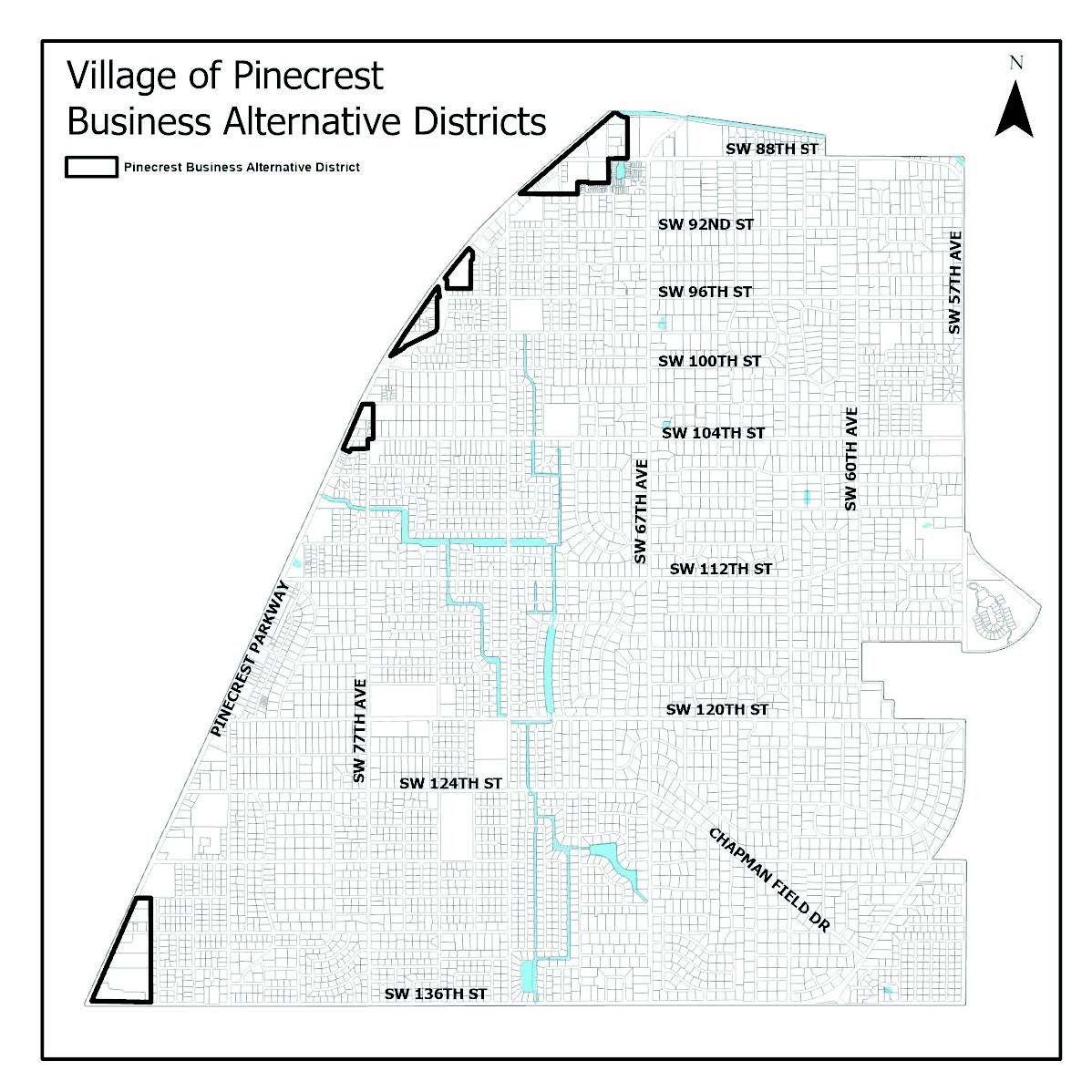
1.
(a)
Purpose. The purpose of the Pinecrest Business Alternative District (PBAD) is to provide a framework for implementation of the goals, objectives, and policies of the Village's Comprehensive Development Master Plan for development and redevelopment adjacent to Pinecrest Parkway, and to encourage development that is consistent with the Pinecrest Parkway (US 1) Vision Plan (2012), as updated and adopted by the village council on October 11, 2022. Within the (PBAD), a property owner may choose to develop the property based on either the underlying zoning categories, or based on the provisions of the "alternative" district.
(b)
Intent. Development within the (PBAD) district is intended to encourage a sense of defined space which includes a mix of uses including office, retail, personal services, restaurants, and residential. Due to the proximity to the Metro Rail and Bus Rapid Transit stations, development should result in improved use of rail transit, increased pedestrian activity, and reduced automobile reliance.
The intent of the Pinecrest Parkway Zoning Standards is to establish and maintain Pinecrest Parkway as a beautiful, appealing, efficient, sustainable corridor offering a variety of activities, events and services in a mixed-use setting. Commercial, businesses, housing, offices, entertainment, and open space co-exist in a tropical and informal setting designed for village residents and outside shoppers without affecting adjacent residential communities. It encourages the use of public transportation, including rapid transit, in a mid-density setting. Development here enhances the quality of life. Informal spaces provide a place for residents to work, eat, entertain, participate in educational activities and encourage public art. Here, activities take place at different floor levels including roofs and open terraces with abundant landscaping.
Development combines different architectural styles and promotes high quality architectural design and parking for shoppers and residents. Pedestrian oriented development provides wide and safe sidewalks, protection from the weather, abundant window shopping with transparency at the ground floor, plazas located at key locations, internal courtyards and multi-level parking structures that are screened from view.
Development provides for a mixture of incomes and age groups and offers a variety of daytime and nighttime activities and events to enhance the quality of life and encourage pedestrian connections to residential areas. The Parkway will enhance the character, identity, and quality of life of the Village of Pinecrest.
The intent of the development standards is further described by the following themes:
1.
Capitalize on market opportunities with a mix of uses.
Grow and attract new uses identified in the 2021 Market Study including offices and eating establishments.
Consider allowing mixed-use commercial and residential condominium development adjacent to Pinecrest Parkway in close proximity to transit stations.
2.
Provide a clear framework for development.
Provide guidance for transit-oriented development at station areas and development along the corridor in terms of zoning.
3.
Provide an environment for high quality design in any style.
Allow for creative design with parameters for additional oversight.
4.
Enhance the public realm around transit stations.
Create standards for different types of open spaces to enhance placemaking opportunities in a sustainable way.
5.
Ensure transitions between existing residential and commercial development.
Develop standards for existing and new development with sufficient buffers to transition down to existing residential. Development within the commercial Pinecrest Parkway corridor will provide quality services and amenities without any negative impact to village residents and residential neighborhoods.
6.
Define a character for Pinecrest Parkway and brand the corridor.
Articulate how open space, scale, architectural style and streetscape can create a specific character for Pinecrest Parkway.
7.
Enhance connectivity for pedestrians and bicycles.
Develop a street hierarchy around the station areas to improve pedestrian connections and create safe and interesting spaces for walking and biking.
All permitted development within the Pinecrest Business Alternative District (PBAD) shall be designed to provide protection of existing single-family neighborhoods from encroachment by incompatible development, and incompatible impacts including noise, glare, traffic congestion, and other associated impacts.
(c)
Uses permitted. The following uses shall be allowed within the Pinecrest Business Alternative District following approval of a site plan pursuant to the requirements of the land development regulations:
1.
Business and professional offices;
2.
General retail sales and services;
3.
Restaurants, without drive-through.
(d)
Conditional uses. The following uses shall only be permitted as a conditional use upon a finding by the village council, after a required public hearing that the use and development complies with all criteria and performance standards for the review and approval of a conditional use.
1.
Alcohol consumption on premises;
2.
Structured parking garages;
3.
Public utilities;
4.
All permitted uses incorporating a mix of residential, commercial or office uses; and
5.
Government facilities.
(e)
Accessory uses. Only uses customarily incidental and subordinate to a principal permitted or conditional use shall only be approved as an accessory use. Such accessory uses shall be reviewed pursuant to requirements of the land development regulations.
(f)
Prohibited uses. All uses not specifically or provisionally provided for herein, including, medical marijuana retail centers, are prohibited. Any use not within a fully enclosed building is strictly prohibited. Similarly, the sale or distribution of material or merchandise, fruit or other commodities from trucks, wagons or other vehicles parked on or along public or private streets, or from open stands or vacant lots, or from outside any enclosed building is prohibited.
(g)
Dimensional regulations.
1.
Mandatory development conditions.
a.
All new development must have a minimum of 75 percent of ground floor occupied by office, restaurants, institutional, covered parking, and/or retail and personal service uses;
b.
Ingress and egress from off street parking shall be designed so that all access is from or to Pinecrest Parkway unless otherwise determined by the village council.
2.
Minimum lot area, lot frontage, and lot width. Lots within the (PBAD) district shall have a minimum lot frontage of not less than 100 feet, and a lot depth of no less than 150 feet; with a minimum net lot area of not less than 15,000 square feet. Conditional uses may require larger lot area to mitigate the issues specified in article 6 (Environmental Regulations).
3.
Maximum height. The maximum height of a structure within the PBAD district shall be four stories and shall not exceed 51 feet above the finished floor elevation (underground level parking will not be considered in the height calculations).
4.
Floor area ratio. The maximum floor area ratio as a matter of right shall not exceed 0.40 for a one-story building, 0.51 for a two-story building, 0.70 for a three-story building, and 1.0 for a four-story building.
A parking structure shall not count as part of the floor area, but shall be counted in computing building height (except underground level parking), lot coverage, and number of stories (see table below).
5.
Residential density. Maximum residential density shall be 35 units per acre.
6.
Residential unit size. The minimum size of any residential unit shall be 1,000 square feet.
7.
Minimum setbacks. All development shall comply with the following setback requirements:
PBAD District Required Setbacks and FAR
Five-foot front yard setback permitted only if property is developed with an open parking lot behind building(s), screened from the view of passing vehicles or if parking is enclosed within a structure.
Any portion of the property facing or abutting a residential district shall maintain a 30-foot setback.
Townhomes or lower density residential are required when abutting existing single-family residential with limit of two stories or 27 feet.
Opaque landscape buffers are required in rear setback when abutting single-family uses.
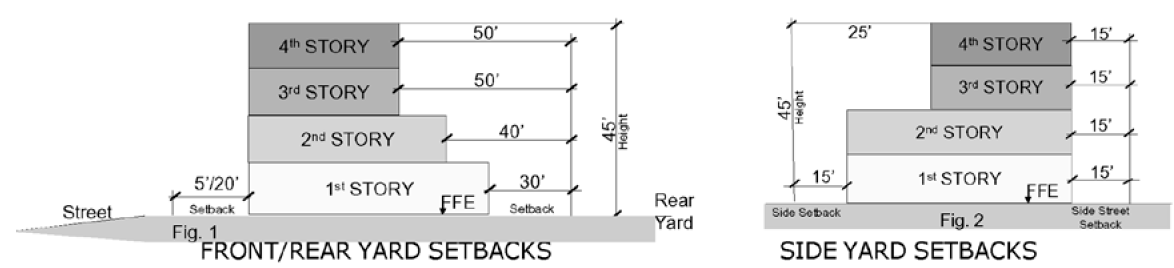
Setbacks
8.
Maximum building length. 130 feet to 165 feet
9.
Build to lines. See build to zones under open space standards.
(h)
Development features. Proposed development within the Pinecrest Business Alternative Districts shall include the following amenities and features:
1.
Dedicating or providing easements for new streets and sidewalks.
2.
Walking paths and bike trails.
3.
Mature canopy trees along all streets at a minimum 4 to 6 inches in diameter at the time of planting.
4.
Rooftop amenity deck with landscaping/green roof.
5.
Sustainable design-LEED certified or comparable certification.
6.
Colonnades at the ground floor.
7.
Installation of public art subject to review and approval of the village council; or making a payment in lieu of purchase of public art in accordance with the village's fee schedule.
8.
Structured parking: Placing parking in an above- or below-grade parking structure.
(i)
Green space and landscaping.
1.
Green space. Required green space shall be unencumbered with any structure or off-street parking and shall be landscaped and well maintained with natural grass, and ground cover included within the "Florida friendly plant database," trees and shrubbery.
2.
Water area. In the PBAD water areas (lakes, ponds, canals) may be used as part of the required landscaped green space provided such water areas do not exceed 20 percent of the required landscaped green space.
3.
Landscaping and free protection. Landscaping and tree maintenance shall be provided in accordance with article 6 of the land development regulations.
(j)
Architectural standards. Exceptional design and architecture that delivers quality settings for human life is s required.
Design Review. All development within the Pinecrest Business Alternative District shall be reviewed and approved by the architectural review board prior to consideration by the village council, if required, and prior to issuance of building permits. An architectural model of a proposed development, line of sight drawings, and simulation of proposed building heights may be required if requested by the administrative official, architectural review board, or village council.
Transparency is a measurement of visibility from the sidewalk into a building for the ground floor. This can be achieved with windows, doors and other unobstructed openings.
Active uses are uses that are open to the public on the ground floor of buildings and adjacent to a sidewalk. Active uses attract people and drive higher foot traffic for a more active and engaging street for people walking.
Building articulation is required to avoid blank walls and encourage creative designs. Articulation describes a building façade's character and the architectural elements that form a distinctive design. Horizontal and vertical building modulations and articulations are recommended to help reduce the mass of larger/taller buildings.
Architectural treatment is the continuation of fenestration patterns, architectural features and can include architectural screens, meshes, louvers, and glass, vegetated surfaces and planters and architectural lighting among others.
Blank walls are portions of a façade that exceed 20 percent of the entire façade elevation without fenestration or architectural treatments.
Building liners are active uses that conceal parking structures and other non-habitable uses. They can include commercial, residential, and office uses among others.
Development design shall include:
(k)
Open space standards.
Open space shall be sited and aggregated as usable pedestrian-oriented public space instead of a leftover "green" perimeter. Open space can include plazas, courtyards/pocket parks, passageways and parks. These are further defined below.
Plaza is a large open hardscaped space with at least one side fronting a street and one side abutting active uses like a restaurant café or retail space. A plaza has outdoor seating, a minimum of one seat per 30 square feet of area, vegetated areas of a minimum of 25 percent, and shaded areas.
Courtyard/pocket park is enclosed on three sides with active uses with one side fronting a street. A courtyard or pocket park is a small space with programmed uses like seating a minimum of one seat per 30 square feet of area, fountains or playgrounds. It can have a minimum of 25% landscaped areas and unlimited shaded areas.
Passageways are linear open spaces that connect two streets through a block and between buildings. They should be pleasant and well-lit with good visibility from end to end.
Parks are large open landscaped spaces used for recreation purposes with landscaped areas at a minimum of 50 percent and shade.
Tree canopy is the anticipated shade coverage on the ground. Trees should have a four to six inch caliper.
(l)
Streetscape standards.
All streets shall include a sidewalk and landscape zone with minimum standards specified in the table below. Primary pedestrian streets and avenues shall also have an amenity zone extending from the pedestrian sidewalk that shall include benches, trash receptacles, bicycle racks, and lighting.
Parking lanes are encouraged on all primary pedestrian, secondary and residential streets.
Landscaping required by the land development regulations shall incorporate landscaping schemes to include Dade County slash pine trees; shade trees such as the Florida Live Oak; drought tolerant plantings, and native plantings that require reduced maintenance. Creativity in landscape design is encouraged in a manner that enhances environmental sustainability through reduction in paved, impervious coverage and enhancement of green, open space and pervious natural area.
Sidewalk standards are described below. It is intent of these regulations to establish a signature "yellow" sidewalk for all development for Pinecrest Parkway.
(m)
Vehicular circulation standards.
Circulation standards for cars and trucks shall be designed to minimize conflicts between pedestrians and other vehicles by designating zones for motorized vehicle movement separate from pedestrians.
Porte cochere is a covered structure at the main entrance for passenger loading and unloading and typically includes two curb cuts on the same street.
Requirements shall be as follows:
(n)
Parking standards.
Parking for the following uses in the Pinecrest Business Alternative District shall be required. Parking spaces shall otherwise be provided as required in division 5.22 of the village's land development regulations.
Restaurant, office or retail: One space per 500 square feet.
Residential: Two spaces per unit regardless of the unit size.
Shared parking may be permitted pursuant to the shared parking requirements of the land development regulations.
(o)
Signage and lighting standards.
Signage mounted on buildings and monument signs that are visible from Pinecrest Parkway shall be designed to coordinate with the architectural style of the building existing or proposed for development on the subject property. The maximum permitted height of a monument sign shall be 15 feet from grade to the top of the sign.
Pedestrian scale lighting oriented downwards, decorative lighting, and accent lighting shall be incorporated into site plans for the redevelopment of a subject property adjacent to pedestrian walks and gathering spaces.
(p)
Loading and unloading.
Limit noise and activity behind existing buildings and new development.
All loading and unloading shall occur internal to buildings, in parking structures, or in enclosed courtyards.
(o)
Development agreement.
All terms and conditions of a permitted conditional use within the PBAD shall be included in a development agreement between the property owner and Village of Pinecrest, subject to review and approval of the village council and village attorney prior to issuance of building permits.
(Ord. No. 2004-3, § 1, 6-8-04; Ord. No. 2012-4, § 2, 3-20-12; Ord. No. 2014-02, § 2, 4-8-14; Ord. No. 2015-9, § 3, 9-8-15; Ord. No. 2018-1, § 4, 1-9-18; Ord. No. 2022-15, § 2(Exh. A), 12-13-22)
Div. 4.8. - Pinecrest Parkway (US 1) Corridor development standards.
(a)
Purpose and intent. The purpose and intent of the Pinecrest Parkway Corridor development standards is to provide procedures and standards within a planned development framework to require implementation of the Pinecrest Parkway (US 1) Vision Plan, adopted by the village council on October 9, 2012, in accordance with the planning and development objectives of the village under this Code and the comprehensive development master plan. All land development regulations and standards of the village's commercial zoning districts shall apply to a subject property pursuant to the provisions of the commercial zoning districts in which they are located with the exception of the following additional applicable standards.
The applicable Pinecrest Parkway (US 1) Corridor planning area is shown and depicted in the Pinecrest Parkway (US 1) Vision Plan, approved and adopted by the village council pursuant to Resolution 2012-61 on October 9, 2012, and updated pursuant to Resolution 2022-62, adopted by the Village Council on October 12, 2022.
(b)
Uses permitted, conditional uses, accessory uses, prohibited uses. Uses permitted, conditional uses, accessory uses, and prohibited uses shall continue to be permitted or prohibited pursuant to the regulations of the commercial zoning district and/or Pinecrest Business Alternative District (PBAD) in which the subject property is located.
(c)
Dimensional regulations.
1.
Minimum lot area, lot frontage, and lot width; maximum building height, maximum lot coverage, maximum building coverage; maximum impervious surface ratio; minimum green space; maximum floor area ratios; minimum required setbacks; and all other dimensional requirements shall continue to apply pursuant to the dimensional requirements of the commercial zoning district in which the subject property is located.
(d)
Site development standards and amenities.
1.
Landscape buffer. A landscape buffer shall be provided adjacent to Pinecrest Parkway that is a minimum of eight feet in width.
2.
Pedestrian and bicycle connectivity; hardscape. Pedestrian sidewalks, "village walks," and other hardscape areas shall be incorporated into site plans for the redevelopment of a subject property as shown and recommended for specific properties as described in the village's Pinecrest Parkway (US 1) vision plan. Walkways and hardscape features shall incorporate colors and textured patterns. Pedestrian and bicycle connections shall be provided pursuant to the goals and recommendations of the village's bicycle plan and Pinecrest Parkway (US 1) vision plan. Walkways shall be provided as necessary to internally connect a redevelopment project with adjoining commercial properties.
3.
Architectural building style and color palette. Exceptional design and architecture that delivers quality settings for human life is required.
Design Review. Development projects requiring review of a site plan by the Village Council shall be reviewed and approved by the Architectural Review Board prior to consideration by the Village Council, and prior to issuance of building permits.
4.
Street furniture. Benches, planters, bike racks, trash and recycling receptacles, and other amenities shall be incorporated into proposed redevelopment plans as described and illustrated in the village's Pinecrest Parkway (US 1) Vision Plan and Pinecrest Parkway (US 1) Vision Plan Update.
5.
Lighting. Pedestrian scale lighting oriented downwards, decorative lighting, and accent lighting shall be incorporated into site plans for the redevelopment of a subject property adjacent to pedestrian walks and gathering spaces as described and illustrated in the village's Pinecrest Parkway (US 1) vision plan.
6.
Landscaping. Landscaping required by the land development regulations shall incorporate landscaping schemes to include Dade County slash pine trees; shade trees such as the Florida Live Oak; drought tolerant plantings, and native plantings that require reduced maintenance. Creativity in landscape design is encouraged in a manner that enhances environmental sustainability through reduction in paved, impervious coverage and enhancement of green, open space and pervious natural area.
7.
Signage. Signage mounted on buildings and monument signs that are visible from Pinecrest Parkway shall be designed to coordinate with the architectural style of the building existing or proposed for development on the subject property, consistent with required architectural styles of the Pinecrest Parkway (US 1) vision plan. The maximum permitted height of a monument sign shall be 15 feet from grade to the top of the sign.
8.
Gathering spaces. Nooks, pocket parks, plazas, and other open space areas shall be incorporated into site plans for the redevelopment of a subject property as illustrated and recommended in the village's Pinecrest Parkway (US 1) vision plan. Public Art shall be included in the gathering spaces pursuant to the provisions of the Village's "Art in Public Spaces" program requirements.
9.
Parking surface. Parking spaces shall be hard surfaced, except that 15 percent of the parking spaces provided shall be constructed of porous pavement materials ("pave drain" or equivalent) or open cell unit pavers ("turf block" or equivalent).
10.
Transitional buffers. Buffer walls and landscaped buffers at the rear of commercial redevelopment projects adjacent to residentially zoned districts shall be provided as required pursuant to the land development regulations and shall be further supplemented with decorative vertical plantings and green walls that shall be installed on the rear walls of commercial buildings.
11.
Electric vehicle charging station. For every 25 required parking spaces, a minimum of one level 2, 240-volt electric vehicle charging station shall be provided within a parking space designated for electric vehicles, except that an electric vehicle charging station shall not be required within parking lots that contain 24 or fewer required parking spaces.
(Ord. No. 2014-02, § 2, 4-8-14; Ord. No. 2021-10, § 2(Exh. A), 10-19-21; Ord. No. 2022-15, § 2(Exh. A), 12-13-22)

