
Pinecrest City Zoning Code
ARTICLE 5
- ADDITIONAL REGULATIONS3
Note— Please refer to the definitions article of the Land Development Code.
Div. 5.1.- Lots.
(a)
Minimum lot areas, frontage and yards.
1.
RU districts lot area exceptions. Every residential lot in any RU district shall meet the minimum frontage lot of land area requirements of the applicable district regulations, except that a lot of record conveyed prior to August 2, 1938, or platted by an un-revoked subdivision recorded prior to August 2, 1938, may be permitted for residential use as follows:
a.
For single-family residential use, providing the lot is zoned either RU-1 or RU-2 and:
i.
The lot is less than 75 feet in width, but not less than 50 feet in width, and has a total square foot area of not less than 5,000 square feet, or is a combination of two or more lots totaling the same in width and in square foot area; or
ii.
The lot is less than 50 feet in width, and has a total square foot area of not less than 3,750 square feet; provided it is at least the same width and depth as the other lots in use in the same subdivision; and provided further, the residence does not exceed the minimum height requirement within the applicable district and does not cover more than 30 percent of the total lot area. Two or more lots may be combined to provide such a lot, subject to the same provisions.
b.
For duplex use (two-family residential dwelling), provided the lot is zoned RU-2 and the lot is at least 50 feet in width and contains at least 5,550 square feet of lot area.
2.
Business lots in new subdivisions. BU zoned lots in subdivisions created after November 27, 2000 shall have a width of not less than 50 feet, except that corner lots shall have a frontage of not less than 75 feet on each street and not less than 7,500 square feet of area. Lots having an area of less than 7,500 square feet shall be plat and deed restricted against residential use.
3.
Lots of record less than minimum size.
a.
Grandfathering. Any use on a legally platted lot of record which does not meet lot area or width requirements of this chapter may continue provided the use was legally established. This provision shall not be construed to permit the establishment of more than one dwelling unit on a lot that does not meet lot area requirements.
b.
No further reduction of minimum lot dimensions. The area or dimension of any lot, yard, parking area or other space shall not be reduced to less than the minimum required by this chapter, except as provided in this chapter, if already less than the minimum required by this chapter, such area or dimension may be continued, but shall not be further reduced.
(b)
Lot width in RU-1, EU-M, EU-S and EU-1. In the RU-1, EU-M, EU-S and EU-1 districts, the minimum width of lots in new subdivisions may be decreased from the width otherwise required under this chapter, provided the lots meet the following conditions:
1.
The decrease shall be applicable to lots containing a portion of their frontage along the curvilinear streets and cul-de-sacs where development has been platted and approved.
2.
The minimum lot frontage as defined elsewhere for the various districts must be provided at the minimum building setback line of curvilinear lots.
3.
The minimum frontage requirement at street right-of-way line and the radius requirements of exterior street right-of-way line along curvilinear streets and culs-de-sac shall meet the following requirements:
TABLE 5-1
4.
Lot area must comply with all other minimum requirements of the land development code.
5.
The design of the streets where the lot frontage occurs must conform to standards adopted by the village.
(c)
Buildings on through lots. Where a lot extends through from one street to another, the setback requirement for each such street shall be complied with and any building shall have dual facing. Lots which have an approved decorative wall along the rear property line as required by plat shall not be considered through lots. No accessory building or other structure shall be placed in the front yard setback.
(d)
Unity of title. Unity of title or other similar agreement or covenant shall not be permitted to join parcels of land separated by a road right-of-way or water body. Non-contiguous properties separated by right-of-way or water bodies shall be considered separate parcels of land for site development purposes and shall each meet all requirements of the land development regulations irrespective of the adjoining features. Within multi-family residential and commercial zoning districts, separate parcels created by a covenant in lieu of title shall not be deemed a subdivision of real property subject to the provisions of article VIII of the Land Development Regulations.
(Ord. No. 2002-8, § 3, 11-13-02; Ord. No. 2015-7, § 2, 9-8-15)
Div. 5.2. - Yard regulations and setbacks.
(a)
Yard to be unobstructed; exceptions. Every part of a required yard must be open to the sky, unobstructed, except for the ordinary projections of steps, sills, belt courses, cornices and other ornamental features projecting not more than four inches from the building wall. Where yard regulations within this division may conflict with setback requirements, the regulation requiring the largest yard shall be applicable. The following exceptions shall be permitted:
1.
Roof overhangs up to 60 inches or one-half of the required yard, whichever is less.
2.
Flag poles having a maximum height of 30 feet (one per site).
3.
Planters not exceeding 30 inches in height or having a cross section of 18 inches or less.
4.
Freestanding lamp posts having a maximum height of six feet (two per driveway or a maximum of four on any one site).
(b)
Nonresidential district transition yard requirements.
1.
Front yard. Where a residential district abuts a nonresidential district, the nonresidential district front yard shall be at least equal in depth to that required in the residential district, for a distance of 50 feet from the district boundary line along the same street.
2.
Side or rear yard. Where the side or rear yard in a residential district abuts a side or rear yard in a nonresidential district, the side or rear yard along the abutting line or lines shall be at least equal in depth to that required in the residential district. In no case, however, shall the abutting side yard or abutting rear yard of the nonresidential district be less than 15 feet. In addition to the requirements of this chapter, the nonresidential yard, shall include a landscaped hedge. Where a wall or wood fence exists, landscaping shall be installed to prevent graffiti or climbing and shall include hedges or bushes at least two feet in height at the time of planting.
(c)
Water-front yard requirements. Every lot which abuts a waterway shall have a waterfront yard. The waterfront yard shall not be utilized for any purpose other than specifically permitted in this land development code.
(d)
Street and road setbacks. Where right-of-way lines are established for streets, roads or highways, the front yards of lots and side yards of corner lots shall be measured from said right-of-way lines, effective the date such right-of-way lines are officially established.
(Ord. No. 2002-8, § 3, 11-13-02; Ord. No. 2018-5, § 2(Exh. A), 5-8-18)
Div. 5.3. - Pump islands at service stations; light poles.
(a)
Pump islands setback. Front setbacks for gasoline service pump islands shall be only 15 feet.
(b)
Freestanding pump island canopies. Detached, freestanding canopies to cover pump islands at gasoline service stations shall meet the following standards:
1.
The nearest edge of the detached canopy must be set back a minimum of 17 feet from the front property line (measured to the official right-of-way line).
2.
The nearest edge of the detached canopy must be set back a minimum of 12 feet from the side street property line (measured to the official right-of-way line).
3.
No minimum setback or spacing need be provided between the inner edge of the canopy and the gasoline service station building.
(c)
Light standards. Light standards (poles) in BU districts shall meet the setback requirements for detached signs.
(Ord. No. 2002-8, § 3, 11-13-02)
Div. 5.4. - Amateur radio station antennae.
Poles, masts and towers for supporting antennae used in the operation of amateur radio stations licensed by the Federal Communications Commission shall be governed by the following requirements:
(a)
Location on property. All poles, masts and towers shall be placed no closer than five feet to an official right-of-way line or to property under different ownership, or no closer than one foot to an easement. If beam (array) type of antenna is installed, any element or part of such beam type (array) antenna shall extend no closer than five feet to an official right-of-way line or the property under different ownership or no closer than one foot to an easement.
(b)
Permits. Permits shall be required for installation of any poles, masts or towers over 20 feet above the roof of any structure to which they may be attached, and for any installation over 35 feet in height when erected on natural ground. Permits shall be obtained from the administrative official. Applications for permits shall be accompanied by plans and specifications showing all dimensions, size and kind of members, footings and guy wires, if any; locations, depth and type of guy anchors and footings, if any; and the type and weight of antennae, apparatus or structure to be attached to or supported by the structure.
(Ord. No. 2002-8, § 3, 11-13-02)
Div. 5.5. - Fences, walls and hedges.
(a)
Placement within property lines. All walls, fences and hedges must be placed within the property lines unless approved by the administrative official or the village council. Access to overhead electrical and utility line easements shall be provided and maintained where practical, by means of a gate or other means of access, subject to review and approval of the administrative official.
(b)
Exterior finish of walls and fences. Each side of a concrete block and stucco wall shall be completely finished with stucco and paint. Each side of a decorative masonry wall shall be completely painted. The finished side of all fences shall face outward. If a wall or fence is to be placed on a shared property line, consent for access must be obtained from the adjoining property owner(s) prior to finishing the opposite side of the wall or fence. If such consent cannot be obtained, the property owner erecting the wall or fence must present proof that a request for access approval was mailed to every adjacent property owner, by certified mail, return receipt requested, to the mailing addresses as listed in the most current county tax roll, and the mailing was returned undeliverable or the adjacent property owner(s) failed to respond to the request within 30 days after receipt. Upon such a showing, the property owner erecting the wall or fence shall not be required to finish the opposite side of the wall or fence. All fences shall be maintained in good condition free of rot and mildew. Permanent chain link fences, walls, and other permitted fences, shall not be covered or draped with fabric, mesh, plastic, or other material, except that chain link gates installed within permitted chain link fences may be covered; and chain link fences within the PS, public service zoning district may be covered with living material or natural-appearing simulated vegetation screening, subject to review and approval of a fence permit. A sample of the proposed natural or simulated vegetation screening shall be submitted with the permit application and shall be approved by the administrative official prior to installation. Any permitted simulated material covering of a chain link fence or gate shall be neatly fastened and continuously maintained in an unfaded, untorn, good condition at all times, and natural vegetation shall be maintained in a living, healthy condition. An approved fence permit shall be automatically renewed on an annual basis following a required annual inspection and confirmation of compliance with applicable requirements of the village's land development regulations.
(c)
Visibility triangle. All driveway/roadway entrances and exits shall be constructed and maintained so that vehicles can enter, exit and travel along the roadways without posing danger to occupants, pedestrians or other vehicles. To this end, structures and landscaping shall not obscure the visibility triangle and shall not exceed 2.5 feet in height within the triangle of visibility. Notwithstanding the foregoing, one concrete column may be erected within the triangle next to the driveway but it may not be taller than eight feet or wider than 19 inches by 19 inches, including any finishing materials.
(d)
Measuring height of wall, fence or hedge. The height of a wall; hedge or fence shall be the vertical distance measured from the average elevation of the finished building site to the top of the wall, hedge or fence. The average elevation shall be measured along both sides of the wall, hedge or fence line. Existing grade may not be increased or decreased to affect the permitted (or required) height of a wall, hedge or fence, unless the entire building site is graded to even out the level of the site or to increase it to the required flood criteria elevation. Average elevation shall be determined by taking elevations along both sides of the wall, hedge or fence line at five-foot intervals, totaling the elevations, and then dividing the total by the number of stations at which the elevations were taken. The height of a wall adjacent to a street shall be measured from the average elevation of the adjoining crown of road. The height of a wall from other property lines shall be measured from the elevation of the established grade of the developed property.
(e)
Fences, walls or hedges abutting two distinct residential districts. Where a residential district abuts another differently zoned residential district, the height of a fence, wall or hedge that may be erected or maintained on the common property line shall be the tallest height permitted in either district.
(f)
Fences for tennis courts; fences and walls for other recreational uses. Fences for tennis courts may be erected up to 14 feet in height if they conform to accessory use setbacks. The height of fences and walls in connection with other permitted recreational uses, such as baseball backstops, handball courts, and the like, shall be permitted as necessary for the particular use, but required accessory use setbacks must be observed.
(g)
Wire fences, barbed wire and electrically charged fences. Wire fences shall not be permitted in the front of a property but may be permitted adjacent to the sides and rear. Where a chain link fence is permitted adjacent to a street, shrubs shall be planted adjacent to either side of the fence, planted 24 inches on center, at a minimum height of 30 inches at time of planting. Barbed wire fences and fences charged with electricity shall be permitted only in BU districts if approved by the village council as a conditional use. In BU districts, barbed wire fences are not permitted at in the front of the property, and must be placed on an angle extension of not more than 16 inches on top of walls or fences at least six feet in height. This extension shall contain no more than three strands of barbed wire and shall not extend over official rights-of-way or over property under different ownership.
(h)
Height in RU and EU districts. The height of any wall or fence shall not exceed six feet in height. However, walls and fences along streets, roads, and rights-of-way, and walls or fences on a side property line within the required front yard setback shall be restricted to a maximum of 36 inches of solid construction with an additional 36 inches of open non-masonry fencing, pickets, or other decorative features above, excluding columns which shall be spaced a minimum of eight feet apart.
The open, non-masonry portion of the fence shall consist of unobstructed openings that shall measure no less than 3.5 inches in width and solid structural elements that are no wider than the unobstructed openings such that a minimum of 50 percent openness is achieved. Alternative designs that are in substantial compliance with this requirement and allow a minimum of 50 percent openness may be permitted if approved by the administrative official.
(i)
Height of hedges in all districts. The height of any hedges shall be a maximum of 14 feet.
(j)
Heights of walls and fences in BU and PS districts.
1.
Wire and transparent metal picket fences.
a.
In the BU and PS districts, any wire or transparent metal picket fence shall not exceed eight feet in height.
2.
Walls and Hedges.
a.
In the BU and PS districts, walls and hedges, when located within the required front or side street setback areas, shall not exceed four feet in height, except that the maximum permitted height of a wall in the PS district when located within the required front or side street setback areas may be increased to eight feet following review and approval of a conditional use permit by the village council prior to issuance of a building permit. Walls higher than four feet in height, if approved by the village council, shall be architecturally and aesthetically appealing and compatible with neighboring development, and landscaped with trees and shrubs along the entire length of the wall. Required shrubs shall be planted at a minimum of 24 inches on center and 30 inches in height at time of planting. Shrubs required as a buffer shall not be trimmed shorter than 72 inches except where required in order to maintain a safe sight distance. Native hardwood canopy trees shall be planted at a maximum average spacing of 30 feet on center, and one native understory tree shall be planted between each canopy tree. Selected understory trees shall be expected to grow to a maximum overall height of 20 to 25 feet at maturity. Walls shall be designed to include decorative architectural features including columns, landscaped insets, scored block or surface, trellises, green vegetation, sculptural wall panels, accent lighting, stone cladding and/or other similar aesthetically appealing architectural design details. When located between the building line and other property lines, walls and hedges shall not exceed eight feet in height. Walls between dissimilar uses shall include landscaping to include shrubs and canopy trees pursuant to the requirements of division 8.1 of the land development regulations for "Buffers between dissimilar uses". When a wall is required to be landscaped, the wall shall be located a minimum of eight feet from the property line to accommodate the required landscape buffer.
(k)
Height of gates and columns. The height of any column shall not exceed eight feet in any district. Within all districts except the PS district, The height of any gate shall not exceed six feet in , height except that gates adjacent to a street or road that are designed to include an arch or other ornamental feature or design element may extend to a maximum of seven feet at the peak of such feature. Within the PS district, gates shall not exceed the height of the permitted fence or wall.
(l)
Bottom elevation. The bottom elevation of any wall or fence adjacent to the street shall not exceed the elevation of the adjoining crown of road.
(Ord. No. 2002-8, § 3, 11-13-02; Ord. No. 2014-02, § 2, 4-8-14; Ord. No. 2016-4, § 2, 4-12-16; Ord. No. 2018-5, § 2(Exh. A), 5-8-18; Ord. No. 2020-2, § 9-8-20; Ord. No. 2021-10, § 2(Exh. A), 10-19-21; Ord. No. 2024-2, § 2, 4-18-24)
Div. 5.6. - Fences and safety barriers for swimming pools.
(a)
Required for final inspection of pool. The administrative official shall not grant final inspection or approval for a swimming pool unless a safety barrier has been erected as hereinafter provided. No pool shall be filled with water unless a final inspection has been made and approved, except that testing may be approved by the administrative official.
(b)
Types permitted. The safety barrier shall take the form of a screened-in patio, a wooden fence, a wire fence, a rock wall, a concrete block wall or other materials, so as to enable the owner to blend the same with the style of architecture planned or in existence on the property.
(c)
Height. The minimum height of the safety barrier shall be not less than four feet.
(d)
Location of barrier. The safety barrier shall be erected either around the swimming pool or around the premises, or a portion thereof, on which the swimming pool is erected. In either event, it shall enclose the area entirely, prohibiting unrestrained admittance to the enclosed area. Pools located in enclosed structures or on the roofs of buildings shall not require the installation of barriers.
(e)
Gates. Gates shall be of the spring lock type and shall automatically be in a closed and fastened position at all times. Gates relying on electric closures with battery backup systems shall not be permitted for enclosure of swimming pools. Gates shall also be equipped with a safe lock and shall be locked when the swimming pool is not in use. Boards, pickets, louvers, or other such members be spaced, constructed, and erected so as to make the gate non-climbable and impenetrable. When horizontal pickets are used for a private or residential pool barrier, the horizontal pickets shall not have any gaps, openings, indentations or protrusions.
(f)
Wooden fences. For wooden fences, the boards, pickets, louvers, or other such members shall be spaced, constructed, and erected so as to make the fence non-climbable and impenetrable. When horizontal pickets are used for a private or residential pool barrier, the horizontal pickets shall not have any gaps, openings, indentations or protrusions.
(g)
Walls. Walls, whether of the rock or block type, shall be so erected to make them non-climbable.
(h)
Wire fences. Wire fences shall be the two-inch chain link or diamond weave non-climbable type, or of an approved equal, quality. Wire fences shall be constructed with a top rail, and shall be of a heavy, galvanized material.
(i)
Refusal of permit. The administrative official shall have discretion to refuse approval of a safety barrier which, in the official's opinion, does not furnish the safety requirements of this division, i.e., that is high enough and so constructed to keep the children of preschool age from getting over or through it.
(j)
Continued maintenance. It shall be the responsibility of the owner and occupant of the premises upon which the swimming pool is erected to maintain and keep it in proper and safe condition.
(k)
Statutory requirements. The requirements of this division shall be supplementary to the requirements of F.S. § 757.12, et seq.
(Ord. No. 2002-8, § 3, 11-13-02; Ord. No. 2014-02, § 2, 4-8-14; Ord. No. 2018-5, § 2(Exh. A), 5-8-18)
Div. 5.7. - Accessory buildings and structures; utility sheds; swimming pools; boat storage; recreation and camping equipment; tents; awnings and canopies.
(a)
Accessory buildings, prior construction and use thereof. No accessory building shall be constructed upon a lot until the construction of the principal use has been completed, unless construction of the principal and accessory buildings is concurrent. No accessory building shall be used unless the principal building exists on the front portion of the same lot. No permit shall be issued for an accessory building unless the principal building is in use, or unless a permit is obtained simultaneously for both buildings and construction progresses concurrently. Accessory buildings/structures or uses shall conform to the same setbacks as the principal structures except as follows:
1.
Utility sheds, not larger than 100 square feet and not exceeding eight feet in height. Utility sheds, not larger than 100 square feet, not exceeding eight feet in height and incidental to an existing single-family or townhouse residential use shall comply with the following setback requirements:
TABLE 5-2
2.
Utility sheds larger than 100 square feet. Utility sheds larger than 100 square feet shall comply with the setbacks of the accessory structure as referenced in the district regulations of article 4.
3.
Accessory buildings in a townhouse development. No accessory buildings, including sheds, shall be permitted in unwalled areas on sites containing a townhouse. Where an accessory building is located within an area enclosed with walls, it shall not extend above the height of the walls. In addition, the site of all utility sheds within a townhouse development shall provide a perpetual four feet wall-maintenance easement on the lot adjacent to the zero lot line, and with the exception of walls and/or fences, shall be kept clear of structures. This easement shall be shown on the plat and incorporated into each deed transferring title to the property. The wall shall be maintained in its original color and treatment unless otherwise agreed to in writing by the two affected lot owners. Roof overhangs may penetrate the easement on the adjacent lot a maximum of 24 inches but the roof shall be so designed that water runoff from the dwelling placed on the lot line is limited to the easement area. Building footings may penetrate the easement on the adjacent lot a maximum of eight inches.
4.
Building code. All utility sheds shall comply with the state building code or be approved by the state.
(b)
Swimming pools. Swimming pools in all districts shall be constructed no closer than 7.5 feet to any building foundation, unless both the design and construction are approved by the administrative official as safe and will not result in a weakening of or damage to the building foundation. In no event shall pools be closer than 18 inches to any wall or any enclosure.
(c)
Screen enclosures. Roofed screen enclosures shall be included in lot coverage calculations. Screen enclosures attached to the principal building shall be permitted in the rear and side yards provided that:
1.
The screen enclosure is not visible from the street and does not exceed the height of the principal building;
2.
The screen enclosure is not closer to the front property line or the side street property line than is the principal building;
3.
The screen enclosure meets required setbacks for the principal building.
4.
Screen enclosures not attached to the principal building shall meet setback requirements for accessory buildings. When used for enclosing swimming pools, screen enclosures shall meet the following setback requirements:
TABLE 5-3
(d)
Boat and personal watercraft storage. A boat of less than 26 feet in length, not more than 96 inches in width and 13 feet six 6 inches in height, and two personal watercrafts may be stored in the RU and EU districts, subject to the following conditions:
1.
Storage shall be to the rear of the front building line and behind the side street building line, in each case the building line referred to being that portion furthest from the street.
2.
No more than one boat may be stored on any one premise.
3.
Boats and place of storage shall be kept in clean, neat and presentable condition.
4.
No major repairs or overhaul work shall be made or performed on the premises.
5.
The boats shall not be used for living or sleeping quarters, and shall be placed on and secured to a transporting trailer.
(e)
Recreational vehicles. Recreational vehicles in the form of a travel and camping trailer, truck trailer and motor travel home, designed and used as temporary living quarters for recreation, camping or travel use; and off-road motor vehicles designed or intended for off-road or track racing use, unlicensed for on-road use (i.e. "Monster Trucks") may be parked on properties containing a single-family, or duplex residence, subject to the following conditions:
1.
No more than one such vehicle shall be parked on such site.
2.
Parking shall be limited to vehicle owned or leased by the occupant-owner or occupant-lessee of the site concerned, or owned or leased by a bona fide house guest of the occupant-owner or occupant-lessee of the site concerned. The parking of a vehicle by a guest shall not exceed 14 days.
3.
The location for parked vehicle shall be in either the rear yard or the side yard to the rear of a line established by the front building line farthest from the street and setback to at least the rear building line wherever possible. In no event shall the vehicle be parked in front of such front building line. The vehicle shall be setback from side property lines at least a distance equivalent to the required side setback for the principal building and shall be set back from the rear property line at least ten feet.
4.
The vehicle and the area of parking shall be maintained in a clean, neat and presentable manner and the vehicle shall be in a usable condition at all times.
5.
The vehicle shall, at all times, have attached a current vehicle registration license plate.
6.
No major repairs or overhaul work on the vehicle shall be made or performed on the site, or any other work performed thereon which would constitute a nuisance under existing ordinances.
7.
When parked on the site, the vehicle shall not be used for living or sleeping quarters, or for housekeeping or storage purposes, and shall not have attached thereto any service connections lines, except where a catastrophic event or an Act of God has rendered the permitted principal residence on the property unsafe as determined by the Building Official and except as may periodically be required to maintain the vehicle and appliances. In the event that the permitted principal residence has been determined to be unsafe by the Building Official, the vehicle may be used for living or sleeping quarters for no more than 30 days unless additional time, up to 90 days, is approved by the Building Official. If time in excess of 120 days is needed, an application must be made to the Village Council for additional time, at least 30 days prior to the expiration of the 120-day period. The applicant may continue to use the vehicle until the Village Council has made a decision on the request.
8.
The vehicle shall not exceed the maximum length, width, height and weight permitted under applicable provisions of the motor vehicle laws of the state; provided, however, the maximum length shall not exceed 30 feet and the maximum height shall not exceed ten feet.
9.
The vehicle shall be so secured so that it will not be a hazard or menace during high winds or hurricane.
10.
Any dealer or individual offering such new or used vehicle for sale must furnish and attach to such vehicle a true copy of these regulations.
11.
Except as otherwise provided herein, recreational vehicles, trailers, and campers shall not be parked or stored overnight, or used for living purposes anywhere in the Village of Pinecrest.
(f)
Tents. Tents less than 400 square feet, with or without electricity may be permitted by building permit by the administrative official for special uses such as weddings, birthdays, etc., in residential zones, for up to three consecutive days, two times per year, per property. Tents in nonresidential areas shall not be permitted.
(g)
Awnings/canopies. Landscaped and paved areas that are covered by awnings or canopies shall be counted as part of the lot coverage for the site. Awnings or canopies may project up to five feet into the required setbacks.
(h)
Little free libraries. One "little free library", defined as a small accessory structure designed to accommodate and facilitate a "take a book, return a book" free book exchange, typically sponsored by an individual or family, and housed in a small structure on the owner's lawn where neighbors and visitors may take a book or leave books for others to read may be allowed in residential zoning districts with a no-fee permit subject to the following requirements:
•
Must be located on private property
•
May not be located within the public road right-of-way
•
Must be set back ten feet from the front property line
•
May not interfere with or obstruct the view or free passage of pedestrian, bicycle, or vehicle traffic
•
May not obstruct any fire hydrant
•
Exterior dimensions be approximately 20" wide, 22" high, and 16" deep
•
Must be mounted on a sturdy post or secure base
•
Shall not exceed six feet in height
•
The number of libraries permitted shall be limited to one per property
(Ord. No. 2002-8, § 3, 11-13-02; Ord. No. 2010-3, § 1, 11-9-10; Ord. No. 2014-02, § 2, 4-8-14; Ord. No. 2018-5, § 2(Exh. A), 5-8-18)
Div. 5.8. - Commercial vehicles and equipment.
(a)
Tow trucks in residential districts are prohibited unless they are on the property or on the public right-of-way abutting the property and are for the purpose of delivery or retrieval of a vehicle either owned or leased by the occupant-owner or occupant-lessee of the site concerned, or owned or leased by a bona-fide house guest of the occupant-owner or occupant-lessee of the site concerned.
(b)
Outside storage of commercial equipment, supplies or materials are prohibited in all zoning districts, except at construction sites where building permits have been issued.
(c)
Storage of commercial containers, temporary storage containers, tractor-trailers, trucks, semi-trailers, trailers, steel containers, or portable dwelling units shall not be permitted to be stored in any zoning district except that one storage container or trailer may be temporarily located on a construction site within the commercial zoning districts to allow for the temporary storage of materials and supplies during construction. The storage container or trailer shall be permitted in conjunction with issuance of a building permit and shall be removed upon completion of construction and prior to issuance to a certificate of occupancy. Tractor-trailers may be permitted for purposes of loading and unloading. The administrative official may approve use of a construction trailer for development of subdivisions in residential districts and all commercial districts, provided the trailer is connected to a sanitary disposal system.
(d)
Within the village's residential zoning districts, the temporary parking of a Category 2 or Category 3 commercial vehicle in front of the building line shall only be permitted for the purpose of loading or unloading materials or persons engaged in providing a commercial service at the premises or for the purposes of the driver to make a temporary convenience stop at the residence. However, a temporary or convenience stop shall be limited to no more than one hour in any 24-hour period.
(Ord. No. 2002-8, § 3, 11-13-02; Ord. No. 2014-02, § 2, 4-8-14; Ord. No. 2021-10, § 2(Exh. A), 10-19-21)
Div. 5.9. - Approval of government uses.
The village council may authorize the location, construction and operation of a governmental facility without regard to the zoning district of any particular site or location subject to the following:
(a)
Public hearing. The village council may only authorize the erection, construction and operation of governmental facilities on a particular property by resolution following public hearing which has been noticed as follows:
1.
Required notice. The public hearing shall be held only following publication of notice as prescribed under section 1-12 of the Village Code, or in any other manner so authorized by law, at least 30 days prior to the hearing. The notice shall be published in a newspaper of general circulation in the village and shall include information regarding the time and place of the public hearing.
2.
Courtesy notice. A courtesy notice containing general information as to the date, time, and place of the hearing, the property location and general nature of the application may be mailed to the property owners of record within a radius of 1,000 feet of the property, or such greater distance as the administrative official may prescribe failure to mail or receive such courtesy notice shall not affect any action or proceeding taken hereunder.
3.
Posting of property. To provide additional notice to the public, the property shall be posted by a sign or signs indicating the proposed action and the time and place of the public hearing thereon. Failure to post such property shall not affect any action taken hereunder.
(b)
Village council decision. At the public hearing the village council shall consider, among other factors:
1.
The type of function involved and the public need therefore;
2.
The existing land use pattern in the area;
3.
Alternative locations for the facility; and
4.
The nature of the impact of the facility on the surrounding property.
After considering these factors, the village council shall take such action as is necessary to provide for and protect the public health, safety and welfare of the citizens and residents of the village.
(c)
District requirements. Government uses shall comply with the standards of the district in which they are listed as a permitted use; otherwise, in all other districts government uses shall comply with the standards and regulations of the RU-5 district.
(Ord. No. 2002-8, § 3, 11-13-02; Ord. No. 2014-02, § 2, 4-8-14)
Div. 5.10. - Educational and child care facilities, nonpublic.
(a)
Applicability and definitions.
1.
This division shall apply to private schools, nonpublic educational facilities, child care or family care facilities. As used in this division, the term "private school" or "nonpublic educational facility" shall mean an institution which provides instruction from kindergarten level through the college level and which does not come under the direct operation and administration of the county school board or the state. Such uses intended to be controlled by this division include, but are not limited to, the following.
a.
Kindergarten. Child care and preschool programs for children ages four through six.
b.
Private college/university. An institution of higher learning beyond the high school level.
c.
Private school. Any private institution providing child care or instruction at any level from infants through the college.
d.
Elementary, middle and senior high schools. References to these schools are to be loosely interpreted to encompass any schools, graded or ungraded, whose students are within the age ranges typically found at these school levels.
2.
As used in this division the term "child care" or "family care" shall include, but is not limited to, the following when they do not come under the direct operation and administration of the county school board or the state.
a.
After school care. Child care and recreation for children above the age of five when no formal schooling program is conducted and where the care provided is generally after school, on weekends, school holidays and vacations.
b.
Babysitting service for shoppers. Child care for limited time periods [i.e., maximum three hours], provided within a shopping center solely for the convenience of the patrons, and limited to not more than 40 children at any one time.
c.
Day nurseries. Child care for infants and children up to and including age six.
d.
Family day care homes. Child care and recreation with a maximum of five children including the day care operator's own children.
(b)
Religious activities. This division shall not apply to facilities used principally for weekend or intermittent nonacademic religious instruction or for the care of children whose parents or guardians are attending religious services or meetings on the premises.
(c)
District requirements for certain uses. All day nurseries, after-school centers, kindergartens and private schools shall meet the requirements included herein and the requirements of the particular district in which they are located if that district is one in which the facility is a permitted use; facilities in other districts shall meet RU-3 requirements.
(d)
Bonus provisions for offices providing child care facilities in commercial districts. Notwithstanding any other provisions of this division, office developments in the commercial districts shall be eligible for a floor area bonus of three square feet for each square foot of floor area dedicated to child care use if the development meets the following criteria: (i) it contains a platted lot of not less than five acres net approved under one site plan and under one ownership with a recorded unity of title agreement; and (ii) includes day nursery, kindergarten or after school care space. However, such facilities shall be required to comply with the following requirements and entitlements:
1.
Physical standards for the licensed child care facility shall be as provided in this Code.
2.
The outdoor area provided in connection with any licensed childcare facility qualifying under this division shall be included in the calculation of open space required to be provided in the district in which the facility is located. As a condition of qualifying for inclusion in the calculation of total required open space, the outdoor area shall be shown in the required site plan. The required site plan shall establish: 1) Direct proximity or protected access between the child care facility and the open area; 2) Adequate provisions for safety in the outdoor area; and 3) Reasonable provisions for integrating use and enjoyment of the outdoor area both for child care and for other uses at the site.
3.
For each square foot of floor area dedicated to child care use under this division, an additional three square feet of floor area for uses other than the child care use at the site shall be allowed in calculating the maximum floor area ratio permitted As a condition of site plan approval, the administrative official shall require a recorded covenant establishing the following:
a.
The calculations and conditions upon which the additional square footage has been permitted; and
b.
Restricting the area designated for child care to child care use only.
(e)
Private colleges and universities. Private colleges and universities with sites of 30 acres or less shall meet the minimum standards established herein for high school facilities. In addition to said minimum standards, facilities with sites exceed 30 acres shall be subject to intensive review by the village council utilizing the study entitled "Physical Standards for Proposed Private Educational Facilities in Unincorporated Dade County," adopted pursuant to county Resolution No. R-63377.
(f)
Required information for site plan approval. In addition to site plan information required pursuant the Code, all nonpublic educational facilities, shall submit the following information as part of the site plan application:
1.
Total size of the site;
2.
Maximum number of students to be served;
3.
Number of teachers and administrative and clerical personnel;
4.
Number of classrooms and total square footage of classroom space;
5.
Total square footage of non-classroom space;
6.
Amount of exterior recreational/play area in square footage;
7.
Number and type of vehicles that will be used in conjunction with the operation of the facility;
8.
Number of parking spaces provided for staff, visitors, and transportation vehicles,
9.
Grades or age groups that will be served;
10.
Days and hours of operations; and
11.
Means of compliance with requirements by the county fire and rescue department, the county department of public health, the state department of health and rehabilitative services, and any federal guidelines applicable to the specific application.
(g)
Calculation of physical space requirements for multiple-use facilities. Where a private educational facility is to be operated in a structure simultaneously used as a residence, church or other facility, the area which will be specifically used for a private school or child care facility during the hours of operation shall be clearly defined. The area so delineated shall be used as the basis for determining physical space requirements as provided in this article. No physical space credit will be given for interior or exterior areas that are not restricted to the school or child care use during the hours of operation of said facility.
(h)
Combination of residential and nonpublic educational facilities. No combination of residential use and nonpublic educational facility will be permitted on the same property except as follows:
1.
A single-family residential use will be permitted in the same building with a nursery or kindergarten use, where the same is used only by the nursery-kindergarten operator.
2.
In connection with day nursery and kindergarten facilities, a residential unit for a caretaker may be permitted only when the facility operator does not reside on said premises.
3.
A residential unit will be permitted for a caretaker on the site of an elementary, middle or senior high school.
4.
An existing multifamily apartment building or complex may incorporate a day nursery or kindergarten for the accommodation of residents only, provided that such facility will not be contrary to any site plans previously approved at a public hearing.
5.
Nonpublic educational facilities may be incorporated into a proposed apartment building or complex, provided that said schools are included in the plans submitted for approval at public hearing (in case of an apartment complex), or for permit (in case of an apartment building).
(i)
Physical standards.
1.
Minimum site sizes. The following are the minimum site sizes that shall be required, based on the proposed maximum number of children who will use the facility at any one time. All calculations for the number of children/students shall be based on the total proposed maximum enrollment. When the number of children permitted results in a fractional number, any such fraction equal to or greater than one-half shall be rounded off to the next highest whole number. When grade levels overlap, the more restrictive standard shall be used.
a.
Minimum site size for day nurseries, preschool and after school care. The maximum number of children for day nurseries, preschool and after school care shall not exceed the following:
TABLE 5-4
MINIMUM SITE SIZE FOR DAY NURSERIES, PRESCHOOL AND AFTER SCHOOL CARE
b.
Minimum site size for grades kindergarten through the sixth grade. The maximum number of children for kindergarten through the sixth grade shall not exceed sixty (60) children per acre.
c.
Minimum site size for grades seven through 12. The maximum number of students for seventh through twelfth grades shall not exceed the following:
TABLE 5-5
MINIMUM SITE SIZE FOR GRADES SEVEN THROUGH TWELVE
2.
Outdoor areas. Outdoor recreation/play areas shall meet with the following minimum standards, calculated in terms of the proposed maximum number of children for attendance at the school at any one time, unless otherwise indicated. Where there are category combinations, each classification shall be calculated individually.
TABLE 5-6
MINIMUM STANDARDS FOR OUTDOOR RECREATION AREAS
3.
Signs. Signs shall comply with district regulations as contained in the Code; provided, however, that the total square footage of all freestanding signs in any residential district shall not exceed six square feet in size.
4.
Auto stacking. Stacking space, defined as that space in which pickup and delivery of children can take place, shall be provided for a minimum of two (2) automobiles for schools with 20 to 40 children; schools with 40 to 60 children shall provide four spaces; thereafter there shall be provided a space sufficient to stack five automobiles.
5.
Parking requirements. Parking requirements shall be as provided in the Code.
6.
Classroom size. All spaces shall be calculated on the effective net area usable for instruction or general care of the group to be housed. This space shall not include kitchen areas, bathrooms, and hallways. The minimum classroom space shall be determined by multiplying the maximum proposed number of pupils for attendance at any one time by the minimum square footage, as provided in table 5-7 below. Where a private educational facility is non-graded, calculations shall be based on the age level that corresponds to the grade level in the public school system. Where a school includes more than one of the following categories, each category shall be individually computed:
TABLE 5-7
MINIMUM STANDARDS FOR CLASSROOM AREA
7.
Structure height. The structure height shall not exceed the height permitted for that site by the existing regulations.
8.
Trees. Landscaping and trees shall be provided in accordance with the Code.
9.
Exemptions. Baby-sitting services are exempted from the requirements of outdoor areas, auto stacking, parking requirements and trees of this division. Schools permitted within existing multifamily structures pursuant to subsection (h)(4) of this division are exempted from the requirements of auto stacking and parking requirements of this division, provided such schools are limited to the occupants of the subject multifamily structures.
10.
Prohibited locations for child care facilities. Child care facilities as described in this division shall be prohibited from operating on property abutting or containing a water body such as a pond, lake, canal, irrigation well, or other body of water unless a safety barrier is provided which totally encloses or affords complete separation from such water hazards. Swimming pools and permanent wading pools in excess of 18 inches in depth shall be totally enclosed and separated from the balance of the property so as to prevent unrestricted admittance. All such barriers shall be a minimum of 48 inches in height and shall comply with the following standards:
a.
Gates. Gates shall be of the spring back type so that they shall automatically be in a closed and fastened position at all times. Gates shall also be equipped with a safe lock and shall be locked when the area is without adult supervision.
b.
Safety barriers. All safety barriers shall be constructed in accordance with the standards established in this Code, except that screen enclosures shall not constitute a safety barrier for these purposes.
(j)
Additional site plan review standards. In addition to site plan review as required by this Code, the following review standards shall be utilized by the village:
1.
Study guide. The study entitled "Physical Standards for Proposed Private Educational Facilities in Unincorporated Dade County," dated 1977, shall be used as a general guide in the review of proposed nonpublic educational facilities; provided, however, that in no case shall the educational philosophy of a school be considered in the evaluation of the application.
2.
Planning and neighborhood studies. Planning and neighborhood studies accepted or approved by the village council that include recommendations relevant to the facility site shall be used in the review process.
3.
Scale. Scale of proposed nonpublic educational facilities shall be compatible with surrounding proposed or existing uses and shall be made compatible by the use of buffering elements.
4.
Compatibility. The design of the nonpublic educational facilities shall be compatible with the design, kind and intensity of uses and scale of the surrounding area.
5.
Buffers. Buffering elements shall be utilized for visual screening and substantial reduction of noise levels at all property lines where necessary.
6.
Landscape. Landscape shall be preserved in its natural state insofar as is practicable by minimizing the removal of trees or the alteration of favorable characteristics of the site. Landscaping and trees shall be provided in accordance with this Code.
7.
Circulation. Pedestrian and vehicular circulation shall be separated insofar as is practicable, and all circulation systems shall adequately serve the needs of the facility and be compatible and functional with circulation systems outside the facility.
8.
Noise. Where noise from such sources as automobile traffic is a problem, effective measures shall be provided to reduce such noise to acceptable levels.
9.
Service areas. Wherever service areas are provided they shall be screened and so located as not to interfere with the livability of the adjacent residential properties.
10.
Parking areas. Parking areas shall be screened and so located as not to interfere with the livability of the adjacent residential properties.
11.
Operating time. The operational hours of a nonpublic educational facility shall be such that the impact upon the immediate residential neighborhood is minimized.
12.
Commercial impacts. Where schools are permitted in commercial areas it shall be clearly demonstrated in graphic form how the impact of the commercial area has been minimized by design techniques.
13.
Fences and walls. Recreation and/or play areas shall be enclosed with fences and/or walls.
(k)
Certificate of use and occupancy. The certificate of use and occupancy shall be automatically renewable annually by the village upon compliance with all terms and conditions of, and including maintenance of the facility in accordance with the approved plan.
(l)
Grandfather clause. It is not the intention of this division to require any changes in any nonpublic educational facilities already in existence as of the November 27, 2000, so long as said uses have been legally established in accordance with prior applicable existing regulations. With the exceptions noted above, all nonpublic educational facilities shall comply with the requirements of this article. Any proposed minor changes to existing schools that were approved prior to the adoption of this division may be approved by the administrative official, provided that such modifications do not violate the approved site plan and any conditions affixed thereto. Such minor changes shall include, but not be limited to, enlargement of the play area, and additions such as storage areas, additional restrooms, and expansion of kitchen facilities.
(Ord. No. 2002-8, § 3, 11-13-02; Ord. No. 2014-02, § 2, 4-8-14)
Div. 5.11. - Townhouses.
(a)
Sites and lots containing townhouse units.
1.
Size of development site. The minimum size of the site to be developed for townhouses shall be 7,500 square feet.
2.
Lot area for each unit. No townhouse lot shall contain an area of less than 1,250 square feet. The average size lot for a townhouse in a group of three or more townhouses shall not be less than 1,500 square feet. The foundation of each unit shall be on an individual site, except where the units are separated by a common party wall in which event the foundation may be installed equidistant on each side of the lot line for the length of the party wall and its extension along the offset of the townhouses on abutting lots.
(b)
Location and groupings of townhouses. A townhouse unit shall be a one-family dwelling unit located within a group of three or more such units separated by a common party fire wall; provided, however, that up to ten percent of the total number of units on any individual site plan may be developed in two-unit groupings. A grouping of townhouses shall not exceed 240 feet in length. Each townhouse site must have a clear, direct frontage on public streets or to accessways complying with Village specifications for private streets.
(c)
Common party fire wall. The common party fire wall shall extend to the roof line or above the roof of units which it serves and shall have no openings therein. Where units are offset from one another and a common party wall is use, the wall may be placed equidistant on each side of the lot line, but not exceeding the length of the offset.
(d)
Siting on platted lot; roof line. Each townhouse unit shall be constructed upon a separate platted lot; provided, however, that the roof lines may overhang onto adjacent lots or common areas a maximum of 24 inches, subject to the approval of and determination by the administrative official that the roof or drainage system is designed so that runoff of water from the roof does not adversely affect adjacent units or lots. Each townhouse unit shall be serviced with separate utilities and other facilities and shall otherwise be independent of one another; provided, however, that the electrical lines or telephone lines or cables which service a particular unit may be placed through other lots where approved by the administrative official. The administrative official's approval shall be based upon his or her finding that the placement of said lines or cables will not adversely affect the lots through which they are placed.
(e)
Design and facility criteria.
1.
Utilities and services. Each townhouse shall be independently served by separate heating, air conditioning, sewer, water, electric power, gas, and other facility and utility services, wherever such utilities and services are provided, and no townhouse shall be in any way dependent upon such services or utility lines located within another unit or on or in another townhouse or townhouse site, except as may be installed in public easements. All townhouses must be connected to water and sewer lines and all electrical and telephone lines in a townhouse development site shall be placed underground. Proper and adequate access for firefighting purposes, and access to service areas to provide garbage and waste collection, and for other necessary services shall be provided.
2.
Parking/setback for parking. Where parking spaces are provided in front of townhouse buildings, the required front setback of the building shall be 25 feet from the property line. Where garages are provided, the garage portion of the structure shall be set back 20 feet from the property line. Any portion of the townhouse building that is not located directly in front of parking spaces shall be set back 15 feet from the property line.
3.
Building setbacks. Building setbacks shall be required as provided in Article 4 of the Land Development Regulations except that the rear property line setback for townhouses on the west side of SW 81 Road may be reduced to five feet.
4.
Street right-of-way width and improvements. The right-of-way width of streets serving a group of townhouses and the improvements therein shall conform to all applicable minimum village standards and requirements for such streets.
5.
Walls. All patio and outdoor living areas on each townhouse site shall be enclosed by a wall affording complete screening, except in cases where a natural feature of the site such as a lake or golf course would suggest that complete screening would not be required. Such determination shall be made as a result of the site plan review process as provided herein. Walls shall be of masonry or other material and shall be six feet in height. A walled-in patio may include a screen roof. All rear yard areas used for service, such as drying areas, shall be completely screened from view from the street and from adjoining lots by walls or landscaping.
6.
Accessory buildings. No accessory building shall be permitted in unwalled areas on sites containing a townhouse. Accessory buildings located within an area enclosed with walls shall not extend above the height of the walls.
7.
A swimming pool deck may be located no closer than five feet to the side property line.
(f)
Declaration of restrictive covenants. A declaration of restrictive covenants or association documents providing for the maintenance of the building exterior and any common areas shall be provided and shall be reviewed and approved by the administrative official and subsequently recorded in the public records of Miami-Dade County.
(Ord. No. 2002-8, § 3, 11-13-02; Ord. No. 2014-02, § 2, 4-8-14; Ord. No. 2021-10, § 2(Exh. A), 10-19-21)
Div. 5.12. - Special facilities/homes—community residential facilities, group homes and foster care facilities.
Community residential facilities having seven to 14 residents may be located in those districts where such facilities are listed as a conditional use within the provisions of article 4 of the land development code. However, such facilities must meet all of the following standards in order to be approved by the village council:
(a)
Shall be licensed by the state.
(b)
Shall not be located within a radius of 1,200 feet of another duly licensed and operational community residential home within a multiple family residential district. The home shall not be located within a distance of 500 feet of a single-family residential district. This distance shall be measured by following a straight line from the nearest portion of the existing structure to the nearest portion of the proposed home, excepting that in the case of the 500 feet requirement, the distance shall be measured from the nearest point of the single-family district to the nearest point of the proposed home.
(c)
Shall conform to the land development regulations applicable to other multi-family development.
(d)
The sponsoring agency shall notify the administrative official in writing of its intent to establish said facility. Such notice shall contain the address and legal description of the site, the number of resident clients, and a statement from the state department of children and family services indicating the licensing status of the proposed facility.
(e)
Nothing under this regulation shall permit persons to occupy a community residential home who would constitute a threat to the health and safety of other persons or whose residency would result in substantial physical damage to the property of others.
(f)
Consistent with F.S. ch. 419, group homes of six or fewer residents licensed as community residential homes by the state department of children and family services shall be deemed a single-family unit and shall be allowed in single-family or multi-family districts provided that such homes shall not be located within a radius of 1,000 feet of another existing duly licensed group home of six or fewer residents. Similarly, foster care facilities duly licensed by the state shall be allowed in both single-family and multi-family districts.
(g)
All sites for foster care and group care facilities shall contain requisite infrastructure including: potable water; adequate surface water management; and approved system of wastewater disposal; and an adequate system for solid waste collection and disposal. The sites shall also be free of safety hazards and all structures shall comply with village ordinances and applicable state laws including applicable state licensing and program requirements.
(Ord. No. 2002-8, § 3, 11-13-02)
Div. 5.13. - Historic or archaeological sites.
Development which impacts a historic or archaeological site or structure identified in the adopted comprehensive development master plan shall include a site plan which mitigates any potential adverse impacts. This site plan shall address the following:
(a)
Adverse impacts from destruction or alteration of all or part of such site;
(b)
Adverse impacts resulting from isolation from, or alteration of, the surrounding environment;
(c)
Adverse impacts resulting from introduction of visual, audible, or atmospheric elements out of character with a property or alter its setting;
(d)
Vegetation removal shall not be permitted on a historic or archaeological site unless the vegetation to be removed is a part of a duly authorized scientific excavation, or is a part of an approved development plan; and
(e)
Adverse impacts from other forms of neglect resulting in resource deterioration.
(Ord. No. 2002-8, § 3, 11-13-02)
Div. 5.14. - Public telephones.
(a)
Application, including waiver of objections. Certificates of use and occupancy must be secured for each public telephone erected. The application for a certificate must be accompanied by a location sketch, and a waiver of objection from the abutting property owners within 150 feet on each side of the location site, and from the property owner on the opposite side of any street abutting from the site location.
(b)
Fees. A fee, as set by resolution of the village council and as amended from time to time, shall be paid for each certificate issued.
(c)
Location and design. Public telephones shall be permitted on a permanent basis in all BU, PS, or PR districts and approved hotel and office developments, so long as they do not constitute a traffic hazard or a nuisance. The public telephone must be erected on private property, conform to regular setback requirements and the location must be approved by the administrative official. Each public telephone shall be properly fastened to the ground so that it shall not become a wind hazard. All public telephones shall be properly maintained and painted so that they shall not become unsightly or an eyesore. The conventional type of strip telephone signs will be permitted providing they are placed on the booth in the usual and conventional manner. Signs shall not be erected independent of the booth structure. In addition to the usual booth signs, the standard public telephone plaque signs shall be permitted. The location of signs shall meet the approval of the administrative official.
(Ord. No. 2002-8, § 3, 11-13-02)
Div. 5.15. - Open air cafe in conjunction with a restaurant.
An open-air cafe is permitted only as an accessory use to a restaurant in a business district (BU-1, BU- 1A, BU-2, BU-3). The open air cafe shall comply with all code requirements and the following additional conditions and restrictions:
(a)
Site plan. A site plan shall be prepared and submitted to the village for approval pursuant to requirements of the land development code. In addition to requirements of site plan review, such plan shall include the floor plan of the existing restaurant, including tables, chairs and restrooms, and the proposed open-air cafe. The plan shall also show the existing parking; any proposed landscaping; location of refuse containers; proposed lighting; layout of all tables, chairs, benches, and other furniture; and pedestrian ingress and egress. An open-air cafe located on sidewalks must remain at the elevation of the existing sidewalk. In the case of a lease or sublease, the site plan must be accompanied by a written statement from the landlord and owner consenting to the use of the real property as an open-air cafe.
(b)
Location, design and operation. The operation of such open-air cafe shall not be conducted in such a way as to become a public nuisance and the operation of such business shall not interfere with the circulation of pedestrian or vehicular traffic on the adjoining streets, alleys or sidewalks. The applicant shall be required to submit an application for a permit for outdoor dining, a mitigation plan that adequately addresses noise, glare, trash, odors, and all other adverse impacts to neighboring properties in proximity to the outdoor cafe or dining area. The village reserves the right to require additional mitigation when it finds identified impacts are not adequately addressed. A minimum space of 40 inches shall be allowed for pedestrian circulation. In addition, the open-air cafe shall comply with the following:
1.
Space occupied. The open-air cafe shall not occupy an area of more than 30 percent of the total area of the primary restaurant operation.
2.
Enclosure restricted. An open-air cafe shall be open, except that it may be covered with a canvas or structural canopy of a building's arcade, loggia or overhang as may be permitted by the Code.
3.
Kitchen equipment. All kitchen equipment used to service the open-air cafe shall be located within the kitchen of the primary restaurant.
4.
Appearance. The open-air cafe shall be kept in a neat and orderly appearance and shall be kept free from refuse and debris. After the close of business, all tables and chairs shall be removed from the premises unless they are properly secured.
5.
Signage. No additional signage shall be permitted in the open-air cafe area.
6.
Noise generation. External speakers shall be oriented away from residential districts of the village, landscape buffers or fencing shall be installed as necessary to ensure that noise levels are consistent with those identified in section 15-21.3 of the Village's Code of Ordinances, and no music shall be audible or discernible from any properties that are zoned or used for residential purposes.
7.
A bicycle rack capable of storing four bicycles shall be installed in close proximity to the restaurant and outdoor dining area.
(Ord. No. 2002-8, § 3, 11-13-02; Ord. No. 2024-3, § 2, 7-9-24)
Div. 5.16. - Regulations of obstructions to visibility.
(a)
Intersection visibility triangle. There shall be no structures or planting which materially obstructs traffic and traffic visibility. At all street intersections and at the intersection of any street, or alley, no obstruction to vision between 30 inches and seven feet in height above the established grade of the street at the property line shall be erected or maintained on any lot within the intersection visibility triangle. The intersection visibility triangle for purposes of this paragraph is formed by the street or alley frontage of such lot and a line drawn between the points along such street or alley frontage 50 feet distant from their point of street intersection. Existing trees must be cleared between 30 inches and seven feet. The triangle may include existing buildings posts or tree trunks with a maximum diameter of 12 inches, or existing buildings.
(b)
Corner lots. In any district where a corner or front yard setback is required, no structure, fence, planting or sign shall be located so as to interfere with traffic visibility across a corner between a height of 2½ and ten feet above the average grade within the intersection visibility triangle. For purposes of this paragraph, the intersection visibility triangle shall be bounded by the curb lines adjacent to the corner lot lines and a straight line drawn between points on each such curb line 20 feet from the intersection of said curb lines or extension thereof.
(c)
Public right-of-way. There shall be no structure or planting on public right-of-way without prior approval of the administrative official, and then only after due consideration is given to the type, height and size of such structure and planting. If violations to this division are identified, the administrative official shall provide notice that the owner shall remove the obstruction. If the owner fails to remove the obstruction, the village shall remove the obstruction and assess the property owner for costs incurred.
(d)
Vision clearance. Notwithstanding any part of this division or any permit granted, or variance granted by the village, no type of structure, vehicle, tree, planting, vegetation, sign or fence or any type of obstacle or any portion thereof shall be placed or retained in such a manner which would create a traffic hazard or would obstruct vision clearance at corners or curb cuts in any district.
(e)
Intersection visibility triangle criteria. On corners and at street intersections, the following minimum criteria for determining the required area of cross visibility shall apply:
TABLE 5-8
INTERSECTION VISIBILITY TRIANGLE TABLE
(1) Visibility distances measured from centerline of minor street, along right-of-way line of through street.
(2) Depth visibility on minor street measured from right-of-way line of through street, along center line of minor street.
(3) Visibility triangle lies within the public right-of-way.
(f)
Triangle of visibility criteria. All driveway/roadway entrances and exits shall be constructed and maintained so that vehicles can enter, exit and travel along the roadways without posing a danger to occupants, pedestrians or other vehicles. The requirements shall not apply to side access gates that are used for access to the side yard on an intermittent or infrequent basis. To this end, structures and landscaping shall not obscure the visibility triangle as shown in the following exhibit:
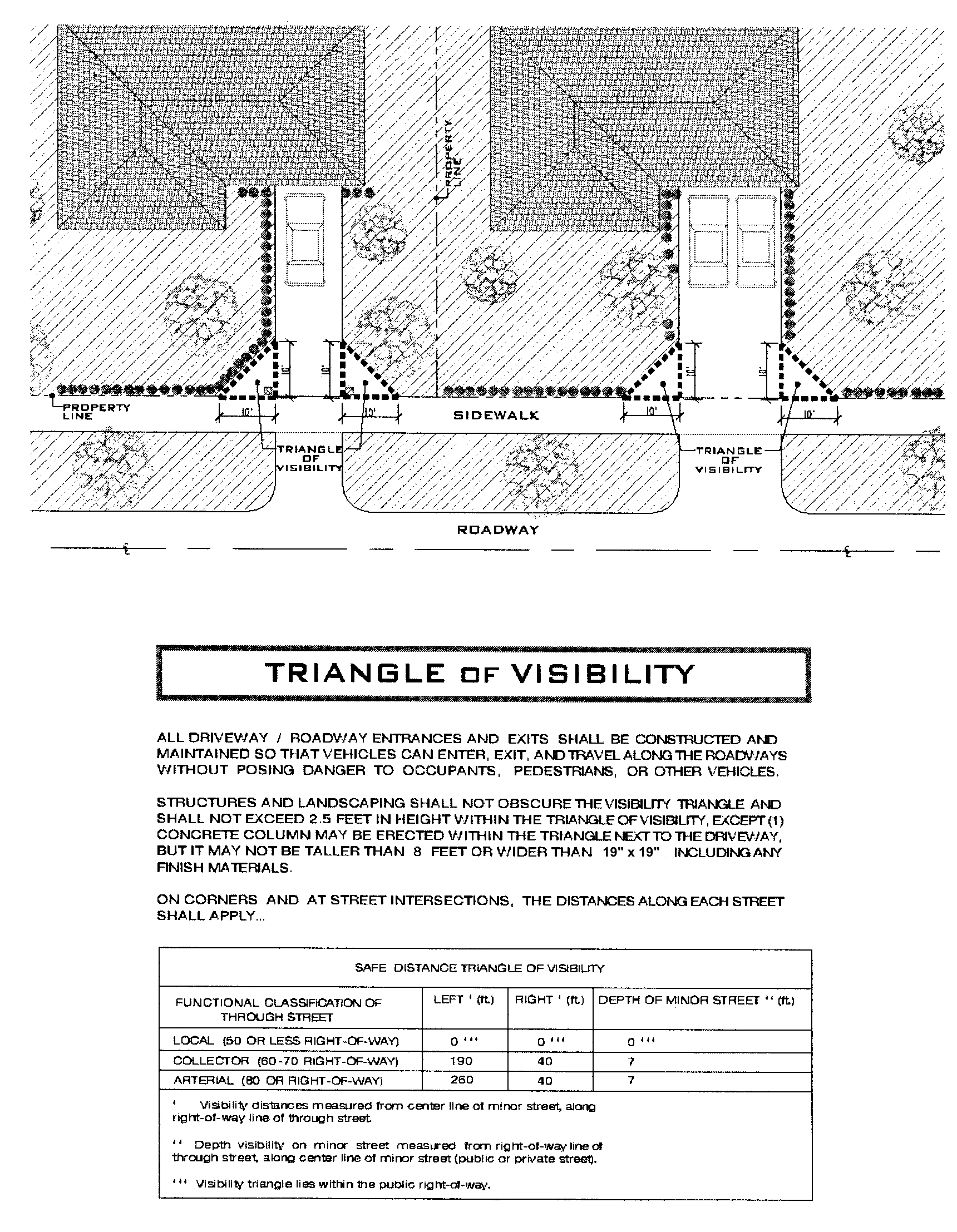
Triangle of Visibility
(Ord. No. 2002-8, § 3, 11-13-02; Ord. No. 2016-4, § 2, 4-12-16; Ord. No. 2021-10, § 2(Exh. A), 10-19-21)
Div. 5.17. - Telecommunications towers and antennae.
(a)
Purpose. The regulations and requirements set forth herein are intended to accomplish the following purposes:
1.
Provide for the appropriate location and development of communication towers and antennae within municipal limits.
2.
Minimize adverse visual effects of communication towers and antennae through careful design, siting, landscape screening and innovative techniques of camouflage.
3.
Encourage collocation or shared use to reduce the number of communication towers needed within municipal limits.
4.
Protect and promote the public health, safety and welfare of the residents of the village.
5.
Enhance the ability of providers of telecommunications services to do so through an efficient and timely application process.
(b)
Considerations in site approval. In furtherance of these goals, the village shall at all times give due consideration to the comprehensive development master plan, including the future land use map; implementing ordinances; existing land uses; and environmentally sensitive areas, including hurricane preparedness areas, in approving sites for the location of towers and antennas.
(c)
Criteria for site locations.
1.
Antennae. Rooftop or building-mounted antennae and stealth facilities may be permitted in the following districts, and shall not exceed more than 15 feet above the highest point of the roof, including mechanical rooms.
a.
Commercial districts, limited to BU-1, BU-IA, BU-2, and BU-3 districts.
b.
Residential districts, limited to RU-4, RU-4M, RU-4L, and RU-3M districts.
c.
Governmental facilities in the PS district.
d.
Public service (PS) district, provided that stealth facilities shall be limited to 50 feet in height.
2.
Communication towers. Communication towers may be permitted in the following districts.
a.
Commercial districts, limited to: BU-1A, BU-2, BU-3 districts.
b.
Residential districts, limited to: RU-4, RU-4M, RU-4L, and RU-3M districts.
c.
Governmental facilities in the PS district.
(d)
Antennae.
1.
Minimum standards. All building-mounted or rooftop antennae shall be subject to the following minimum standards:
a.
Antennae, and related equipment buildings, shall be located or screened to minimize the visual impact of the antenna upon adjacent properties and shall be of a material or color which matches the exterior of the building or structure upon which it is situated.
b.
No commercial advertising or logo shall be allowed on an antenna, tower or related equipment buildings.
c.
No signals, light, or illumination shall be permitted on an antenna, tower, or related equipment buildings, unless required by the Federal Communications Commission or the Federal Aviation Administration.
2.
Dimensions.
a.
Whip and omni-directional antennas and their supports must not exceed 15 feet in height and 13 inches in diameter and must be made of a material or color which matches the exterior of the building.
b.
Microwave dish antennas located below 65 feet above the ground may not exceed six feet in diameter. Microwave dish antennas located 65 feet and higher above the ground may not exceed eight feet in diameter. Ground-mounted dish antennae must be located or screened so as not to be visible from abutting public streets.
3.
Limitations. No more than four dish antennae shall be installed on a monopole tower.
(e)
Communication towers.
1.
All building-mounted or rooftop antennae shall be subject to the following minimum standards:
a.
Height. The height of a communication tower shall not exceed 150 feet, provided that all antennae and supplemental safety appurtenances shall not exceed an additional ten feet in height. Tower height shall be measured from the crown of the road of the nearest public street.
b.
Type. All communication towers shall be designed and constructed with the capability of supporting a minimum of two co-location connections.
c.
Aircraft hazard. Communication towers or antennas shall be approved by the Federal Aviation Administration (FAA), Miami-Dade County Aviation Authority or other appropriate agency prior to issuance of a building permit by the village.
d.
FCC emissions standards. All proposed communication towers shall comply with current radio frequency emissions standards of the Federal Communications Commission.
e.
Landscaping. All communication tower sites must comply with the landscaping requirements of the Land Development Code and Manuals, as amended.
i.
Landscaping, consistent with the above referenced criteria, as amended, shall be installed around the entire perimeter of the fence or wall. Additional landscaping may be required around the perimeter of the fence or wall and around any or all anchors or supports if deemed necessary to buffer adjacent properties. The administrative official, upon site plan review, may require landscaping in excess of the above requirements as is deemed reasonably necessary in order to enhance compatibility with adjacent residential and nonresidential land uses. Landscaping shall be installed on the outside of the perimeter wall.
ii.
Landscaping, consistent with the requirements of the village landscaping code and manuals, as amended, shall be installed around any accessory buildings or structures,
iii.
A row of shade trees, at least eight feet in height, at a maximum distance of ten feet apart, shall be planted around the perimeter of the fence.
iv.
A continuous hedge at least 30 inches in height at planting and capable of growing to a height of 36 inches within 18 months shall be planted on the outside of the perimeter fence and tree line.
f.
Warning signs for high voltage and trespassing.
i.
If high voltage is necessary for the operation of the communication tower or any accessory structures, "HIGH VOLTAGE—DANGER" warning signs shall be permanently attached to the fence or wall and spaced no more than 40 feet apart.
ii.
"NO TRESPASSING" warning signs shall be permanently attached to the fence or wall and spaced no more than forty feet apart.
iii.
The height of the lettering of the warning signs shall be at least 12 inches in height. The warning signs shall be installed at least five feet above the finished grade.
iv.
The warning signs may be attached to free-standing poles if the content of the signs may be obstructed by landscaping.
v.
Apart from warning signs, no signs, including commercial advertisement or logo and political signs or banners posted temporarily shall be allowed on any part of an antenna or tower.
vi.
Equipment storage. Mobile or immobile equipment not used in direct support of a tower facility shall not be stored or parked on the site of the communication tower, unless repairs to the tower are being made.
2.
Minimum setbacks. The minimum setbacks shall conform to the districts where the towers are situated. Notwithstanding the above, the minimum setback requirements for property zoned industrial shall be 25 feet for the rear yard and front yard and 15 feet for the side yards, as measured from base of the tower or from the guy wire anchor, whichever is the closest to the property line or right-of-way.
3.
Minimum distance separations.
a.
All communication towers shall be located no closer than 200 percent of the height of the tower from residential areas or districts, as measured on a straight line from the two closest points between the nearest residential district line and the nearest point of the proposed tower structure, provided however, if such towers are located within the commercial districts, then and in that event, this limitation shall not apply. Notwithstanding the foregoing, all structures shall comply with the minimum setback requirements for such structures in a commercial district.
b.
The minimum distance separation between an existing tower and a proposed tower within the corporate boundaries of the village shall be as follows:
TABLE 5-9
MINIMUM DISTANCE SEPARATION BETWEEN TOWERS
4.
Shared use of communication antennae/stealth facilities/microcel PCS. To minimize adverse visual impacts associated with the proliferation and clustering of communication towers, the village may deny an application for a new single-use communication tower if an available collocation is feasible.
a.
Pursuant to the intent of this chapter, co-location of telecommunication antennas by more than one provider on an existing or new telecommunication tower shall take precedence over construction of new single use telecommunication towers. Accordingly, each application for telecommunication tower shall include a certified, written evaluation of the feasibility of sharing a telecommunication tower, if an appropriate telecommunication tower is available in accordance with sections of this Code.
b.
Stealth facilities shall also be encouraged and given priority as to antenna types in order to carry out the intent of this division to minimize adverse visual impacts.
c.
Cable based "Microcel PCS" which uses cable systems and no towers to provide telecommunication services shall also be encouraged and given priority.
(f)
Aesthetics. Towers and antennae shall meet the following requirements:
1.
Towers shall either maintain a galvanized steel finish or, subject to any applicable standards of the F.A.A., be painted a neutral color so as to reduce visual obtrusiveness, except as set forth below.
2.
At a tower site, the design of the buildings and related structures shall, to the extent possible, use materials, colors, textures, screening, and landscaping that will blend them into the natural setting and surrounding building s to minimize the visual impact. All tower sites must comply with any landscaping requirements of the Code and requirements of the village, and the village may require landscaping in excess of any written requirements as is deemed reasonably necessary in order to enhance compatibility with adjacent residential and nonresidential land uses. All landscaping shall be properly maintained to ensure good health and viability at the owners expense. Well-designed stealth facilities are encouraged.
(g)
Unmanned communication buildings.
1.
Minimum setbacks. Unmanned communication buildings shall comply with the setback requirements of the district where such buildings are situated.
2.
Size limitations. An unmanned communication building shall be a permanent structure not to exceed 500 square feet in floor area. More than one unmanned communication building may be permitted on a site; provided, however, that the total square footage of such buildings, added together, do not exceed 1,000 square feet. If the site contains more than one building, the required distance separation between the buildings may be excused.
(h)
Permits.
1.
Fees. A nonrefundable fee in the amount of $1,500 to reimburse the village for its review and processing of the application shall be required. Additionally, in connection with the issuance of a building permit for the installation of antennae and communication towers, a fee shall also be charged for construction inspections to insure compliance with all applicable codes.
2.
Factors considered in granting permits for towers. In addition to any standards for consideration of permit applications pursuant to the Code, including the land development code, the village shall consider the following factors in determining whether to issue a permit, although the village may waive or reduce the burden on the applicant of one or more of these criteria if the goals of this division are better served thereby:
a.
Availability of suitable existing towers, other structures, or alternative technologies not requiring the use of towers or structures;
b.
Height of the proposed tower;
c.
Proximity of the tower to residential structures and residential district boundaries;
d.
Nature of uses on adjacent and nearby properties;
e.
Surrounding topography;
f.
Surrounding tree coverage and foliage;
g.
Design of the tower, with particular reference to design characteristics that have the effect of reducing or eliminating visual obtrusiveness;
h.
Proposed ingress and egress;
3.
Permit applications. A permit application shall be fully completed and accompanied by the following:
a.
Current survey of the property.
b.
Description of the telecommunications services currently provided and will be provided in the future by the applicant over its telecommunications facilities.
c.
Two copies of engineering plans and specifications of the facilities in sufficient detail to identify:
i.
Location of the proposed facilities.
ii.
Location of all overhead and underground public utility, telecommunication, cable, water, sewer, drainage and other facilities.
iii.
Trees, structures, improvements, facilities and obstructions, if any, that applicant proposes to temporarily or permanently remove or relocate.
d.
A certified written evaluation of the feasibility for sharing a telecommunication tower, if an appropriate telecommunication tower is available. The evaluation shall analyze all of the following considerations:
i.
Structural capacity of the tower or towers;
ii.
Radio frequency interference;
iii.
Geographical search area requirements;
iv.
Mechanical or electrical incompatibility;
v.
Inability or ability to locate equipment on the tower or tower;
vi.
Availability of towers for co-location;
vii.
Any restrictions or limitations of the Federal Communications Commission that would preclude the shared use of the tower; and
viii.
Additional information requested by the village.
e.
Written representation by applicant that there has been no objection from federal and state agencies that may regulate telecommunication tower siting, design and construction.
f.
A site/landscaping plan showing the specific placement of the communication tower on the site indicating the location of existing structures, trees and other significant site features, type and location of landscaping used to screen the tower and the proposed color of the tower, including analysis of soil samples from the base.
g.
Notarized statement that applicant shall notify all other telecommunication providers known to applicant and Village of the permit application at time application is accepted by the administrative official.
h.
The description of the suitability of other structures, other structures or alternative technology, not requiring use of a tower or structure to provide the services in accordance with this paragraph.
i.
Engineer evaluation on projected radiation, whether standards for "categorical exclusions" are met and if so why, including a notarized statement that applicants shall make periodic measurements at least every two years for compliance with FCC rules concerning such emissions.
4.
Co-location; tenant rental fees. It is the intent of this division to encourage co-location of telecommunication facilities by service providers. Applications submitted by tenants seeking to co-locate on a pre-existing tower, or to rent space on a proposed new tower, shall receive an expedited review in the application process by the village. Such review shall be completed 30 days following the filing of a completed application.
(i)
Installation. The installation and modification of a communication tower and communication antennae shall be in accordance with the manufacturer's prescribed installation and safety procedures, shall meet the requirements of the state building code, as amended, and shall be subject to the supervision of the village.
1.
Foundations. Foundations for communication towers and appurtenances thereto shall be constructed and installed so as to withstand the forces due to wind pressure, as provided in the state building code, as amended.
2.
Regulatory compliance. All such installation shall conform to the state building code, as amended; National Electrical Code, as amended; and F.A.A. and F.C.C. regulations, as amended. If such applicable standards and regulations require a retroactive application, then the owners of the towers and antennae governed by this division shall bring such towers and antennae into compliance with the revised standards and regulations within six months of the effective date of such standards, unless a different compliance schedule is mandated by the controlling state or federal agency. Failure to bring towers and antennae into compliance with such revised standards and regulations shall constitute grounds for removal.
3.
Other required permits. Regardless of whether a permit is required for the installation of the communication tower, separate building permits for structural or electrical work, pouring concrete or other work may be required as provided in the state building code, as amended.
(j)
Inspection. The building official may require periodic inspections of communication towers to ensure structural and electrical integrity and compliance with the state building code, as amended, the village Code of Ordinances, and other applicable codes and regulations. Communication monopole towers shall be inspected once every five years. All other towers shall be inspected once every two years by a state licensed engineer. The inspection results shall certify structural and electrical integrity and be submitted to the building official. Based upon the results of the inspection, the building official may require repair or removal of a communication tower.
(k)
Appeal.
1.
Zoning board. If a permit is denied by the administrative official for noncompliance with the Code, then the applicant may appeal the decision as provided by this Code.
2.
Factors to be considered. If the zoning board sustains on appeal the denial or conditions of the administrative official, then the village council on appeal taken shall consider the following factors:
a.
Reasons for denial by the zoning board.
b.
The technical and practical necessity for the installation of the communication tower.
c.
Alternative measures or modifications that could be made to preserve the character of the neighborhood and to prevent aesthetic blight if installation were permitted.
(l)
Municipal property.
1.
Lease. If an applicant requests a permit to develop a site on village-owned property, the permit granted hereunder shall not become effective until the applicant and the village have executed a written agreement or lease setting forth the particular terms and provisions under which the permit to occupy and use the public lands of the village will be granted.
a.
Indemnification. The village shall not enter into any lease agreement or otherwise authorize tower and/or antenna siting by any telecommunications service provider until and unless the village obtains an adequate indemnity from such provider. The indemnity may except gross negligence or intentional misconduct on the part of the village, but must at least:
i.
Release the village from and against any and all liability and responsibility in or arising out of the construction, operation or repair of the communications facility. Each communications facility operator must further agree not to sue or seek any money or damages from the village in connection with the abovementioned matters;
ii.
Indemnify and hold harmless the village, its trustees, elected and appointed officers, agents, servants and employees, from and against any and all claims, demands, or causes of action of whatsoever kind or nature, and the resulting losses, costs, expenses, reasonable attorneys' fees, liabilities, damages, orders, judgments, or decrees, sustained by the village or any third party arising out of, or by reason of, or resulting from or of each communications facility operator, or its agents, employees, or servants negligent acts, errors, or omissions.
iii.
Provide that the covenants and representations relating to the indemnification provision shall survive the term of any agreement and continue in full force and effect as to the party's responsibility to indemnify.
b.
Insurance. The village may not enter into any lease agreement, or otherwise authorize tower and/or antenna site by any telecommunications service provider until and unless the village obtains assurance that such operator (and those acting on its behalf) have adequate insurance. At a minimum, the following requirements must be satisfied:
i.
A telecommunications facility operator shall not commence construction or operation of the facility without obtaining all insurance required under this division and approval of such insurance by the administrative official, nor shall a communications facility operator allow any contractor or subcontractor to commence work on its contract or sub-contract until all similar such insurance required of the same has been obtained and approved. The required insurance must be obtained and maintained for the entire period the communications facility is in existence. If the operator, its contractors or subcontractors do not halve the required insurance, the village may order such entities to stop operations until the insurance is obtained and approved.
ii.
Certificates of insurance, reflecting evidence of the required insurance, shall be filed with the administrative official. For entities that are entering the market, the certificates shall be filed prior to the commencement of construction and once a year thereafter, and as provided below in the event of a lapse in coverage.
iii.
These certificates shall contain a provision that coverage afforded under these policies will not be canceled until at least 30 days prior written notice has been given to the village. Policies shall be issued by companies authorized to do business under the laws of the state.
iv.
In the event the insurance certificate provided indicates that the insurance shall terminate or lapse during the lease agreement period with the village, then in that event, the communications facility operator shall furnish, at least 30 days prior to the expiration of the date of such insurance, a renewed certificate of insurance as proof that equal and like coverage for the balance of the period.
2.
Nonexclusive grant. No permit granted under this division shall convey any exclusive right, privilege, permit or franchise to occupy or use the public lands of the village for delivery of telecommunications services or any other purpose.
3.
Rights granted. No permit granted under this division shall convey any right, title or interest in the public lands but shall be deemed a permit only to use and occupy the public lands for the limited purposes and term stated in the grant. Further, no permit shall be construed as a conveyance of a title interest in the property.
4.
Exemption. Government-owned property is exempt from the minimum distance separation and height requirements set forth herein.
(m)
Variances. Any deviation of the location, setback, type, number and height limitations shall require a variance and application for such variance shall be made pursuant to the established procedures for same. Notwithstanding the foregoing, any change of location outside a permitted district shall require the applicant to file an application for a district boundary change pursuant to established procedures for same.
(n)
Inapplicability to broadcasting facilities/amateur radio station operator/receiver only antenna/pre-existing towers or antennae. Provisions of this division shall not be applicable to the following:
1.
Amateur radio. Any tower or the installation of any antenna that is for the use of a broadcasting facility, or is owned and operated by a federally licensed amateur-radio station operator or is used exclusively for receive only antennas.
2.
Pre-existing facilities. Preexisting towers and preexisting antenna shall not be required to meet the requirements of this, division except that the construction operation and repair of such facility shall be performed in compliance with all laws, ordinances, departmental rules and regulations and practices, and all telecommunications towers and antennas shall meet and exceed current standards, regulations of the F.A.A., F.C.C. and other agencies of the local, state or federal government with authority to regulate towers and antennas.
(o)
Removal of abandoned antennae and towers. Any antenna or tower that is not operated for a continuous period of 12 months shall be considered abandoned, and the owner of such antenna or tower shall remove the same within 90 days of receipt of notice from the village notifying the owner of such abandonment. Failure to remove an abandoned antenna or tower within the 90 days shall be grounds to remove the tower or antenna at the owner's expense. Alternatively, the administrative official may require a removal bond from the owner. If there are two or more users of a single tower, then this provision shall not become effective until all users cease using the tower.
(p)
Nonconforming uses. Towers that are constructed, and antennae that are installed, in accordance with the provisions of this Code shall not be deemed to constitute the expansion of a non-conforming use or structure.
(Ord. No. 2002-8, § 3, 11-13-02; Ord. No. 2014-02, § 2, 4-8-14)
Div. 5.18. - Adult entertainment regulated.
(a)
Findings. In the development and enforcement of this division it is recognized that there are adult entertainment uses which because of their very nature are recognized as having serious objectionable characteristics, particularly when several of them are concentrated in any given locations thereby having a deleterious effect upon the adjacent business and residential areas. It is desirable, therefore, to locate adult oriented activities away from residential areas and public facilities used frequently by minors such as schools, churches, parks, libraries, and day care centers.
(b)
Definitions. For the purpose of this division the following definitions for terms used herein shall apply:
1.
Adult bookstore. Any business engaged in displaying, distributing, bartering, renting or selling printed matter, pictures, films, graphic or other materials which activity requires the exclusion of minors pursuant to F.S. ch. 847, unless such activity comprises no more than 15 percent of the total floor area and is kept from clear view of minors.
2.
Adult theater. Any business engaged in presenting films, theatrical productions, recitals, displays, printed matter or other entertainment which activity requires the exclusion of minors pursuant to F.S. ch. 847.
3.
Adult night club. Any business which features live entertainment requiring the exclusion of minors pursuant to F.S. ch. 847.
4.
Adult video store. Any business engaged in displaying, renting or selling videotapes which activity requires the exclusion of minors pursuant to F.S. ch. 847, unless such activity comprises no more than 15 percent of the total floor area and is kept from view of minors.
5.
Massage establishment.
a.
Any shop, parlor, establishment or place of business wherein all of any one or more of the following named subjects and methods of treatments are administered or practiced: Body massage either by hand or by any mechanical or electrical apparatus or device (excluding fever therapy), applying such movements as stroking, friction, rolling, vibration, kneading, cupping, petrissage, rubbing, effleurage, or tapotement.
b.
Nothing in this division shall be construed as applying to state licensed massage therapists, barbers, cosmetologists, manicurists, pedicurists, physical therapists' assistants, midwives, practical nurses, agents, servants of employees in licensed hospitals or nursing home or other licensed medical institutions, licensed physicians, osteopaths, chiropractors, podiatrists, naturopathic physicians or other licensed medical practitioners, or their agents, servants, or employees acting in the course of such agency, service or employment under the supervision of the licensee.
c.
Provided, however, that, for the purpose of this division, the terms "massage establishment" shall not include any massage establishment wherein at least one state licensed massage therapist is employed and on duty full time during the hours open for business.
6.
Adult modeling establishments. Any establishment offering nude or partially nude modeling sessions or lingerie, swimwear, or photography modeling sessions between two or more persons or private modeling sessions between two or more persons requiring the exclusion of minors pursuant to F.S. ch. 847.
7.
Encounter studio. All establishments offering nude or partially nude encounter sessions between two or more persons, and requiring the exclusion of minors pursuant to F.S. ch. 847.
(c)
Uses. The following uses shall only be permitted as a conditional use approved by the council in the BU-3 land use district:
1.
Adult bookstore;
2.
Adult theater;
3.
Adult night club;
4.
Adult video store;
5.
Massage establishment;
6.
Adult modeling establishment; and
7.
Encounter studio.
(d)
Distance and spacing. Unless approved as a variance pursuant to this land development code, none of the uses set forth in the above subsection shall be permitted:
1.
Within 1,000 feet of a private school, public school, church, public park, public library, day care center or nursery for children;
2.
Within 1,000 feet of any of the uses described within this division; and
3.
Within 660 feet of any RU or EU land use district;
Provided, however, that the spacing requirements herein established shall not apply where the adult entertainment use is separated from the uses set forth herein by a county or state road of not less than five lanes, an expressway, a river or a lake. All other distance and spacing requirements pursuant to the Code shall apply.
(e)
Measurements. The distance and spacing requirements set forth above shall be measured as follows:
1.
From a church the distance shall be measured by following a straight line from the nearest point of the proposed place of business, whether it is the structure itself or the parking lot used by the patrons of the proposed place of business, to the nearest point on the church property.
2.
From a private or public school the distance shall be measured by following a straight line from the nearest point of the proposed place of business, whether it is the structure itself or the parking lot used by the patrons of the proposed place of business to the nearest point on the school grounds.
3.
From non-church and non-school uses the distance shall be measured by following a straight line from the front door of the proposed place of business to the nearest point of the existing use.
4.
From RU or EU districts the distance shall be measured by following a straight line from the nearest point of the proposed place of business, whether it is the structure itself or the parking lot used by the patrons of the proposed place of business, to the nearest boundary of the RU or EU land use district.
5.
From a public park the distance shall be measured by following a straight line from the nearest point of the proposed place of business, whether it is the structure itself or the parking lot used by the patrons of the proposed place of business, to the nearest point on the park grounds.
6.
From a public library the distance shall be measured by following a straight line from the nearest point of the proposed place of business, whether it is the structure itself or the parking lot used by the patrons of the proposed place of business, to the nearest point on the library property.
7.
From day care centers or nurseries for children the distance shall be measured by following a straight line from the nearest point of the proposed place of business, whether it is the structure itself or the parking lot used by the patrons of the proposed place of business, to the nearest point on the property of the day care center or nursery.
(f)
Certified survey required. For purposes of establishing the distance between the uses set forth in this division, and between such uses and private schools, public schools, churches, public libraries, day care centers or nurseries for children, or RU and EU land use districts, the applicant for such use shall furnish a certified survey from a registered surveyor. Such sketch shall indicate the distance between the place of business, and any existing use as defined by this division, any church, public school, private school, public park, public library, day care center or nursery for children, or RU or EU land use district. Each sketch shall indicate all such distances and routes. In case of dispute, the measurement, scaled by the administrative official shall govern.
(g)
Exemptions. This division shall not apply to accredited universities, accredited colleges, or other accredited educational institutions, museums, art exhibits, arts and cultural performance theaters and playhouses or commercial professional photography and portrait studios which may use nude subjects for their photographs or portraits.
(Ord. No. 2002-8, § 3, 11-13-02; Ord. No. 2014-02, § 2, 4-8-14)
Div. 5.19. - Appearance of site and structures.
The following standards shall apply within all zoning districts:
(a)
Architectural style and color. All buildings constructed shall be of an architectural style and color which will harmonize with the premises and with other buildings in the same neighborhood. Facades shall be designed to reduce the mass/scale and uniform monolithic appearance of large unadorned walls, while providing visual interest that will be consistent with the community's identity and character through the use of detail and scale. Articulation shall be required and accomplished by varying the building's mass in height and width so that it appears to be divided into distinct massing elements and details that can be perceived at the scale of the pedestrian or motorist.
Residential building facades and elevations shall be designed to minimize the visual impacts of the scale of the building. Front and side facade design of the second story of two-story residential dwellings shall include building design variations at intervals no greater than seventy-five (75) feet to minimize scale impacts and promote activated elevations. Design variations or intervals shall be a minimum of 7.5 feet in length and 5 feet in depth.
Buildings constructed within the commercial zoning districts adjacent to Pinecrest Parkway shall be designed in accordance with the architectural styles and color palette of the Pinecrest Parkway (US 1) vision plan. Corporate chain building designs and prototype/generic architectural designs may be permitted to the extent that they comport with the architectural design standards of the Pinecrest Parkway (US 1) vision plan adopted by the village council on October 9, 2012.
Commercial buildings shall be fenestrated with transparent windows and doorways for no less than 60 percent of the street frontage at the ground level and allow visibility to the inside of the building.
The village council shall make the final determination of architectural harmony.
(b)
Location and screening of mechanical equipment and utility hardware. Mechanical equipment or other utility hardware at grade, on the building, or on roofs shall be harmonious with the building and they shall be located and/or screened so as not to be visible from any public ways or other properties within the impacted area.
(c)
Location and screening of solid waste containers.
1.
Permanent waste storage area. All permanent waste storage areas shall be screened from adjacent properties and public ways by appropriate fences, walls or landscaping.
2.
Required enclosure and access gate. Dumpsters shall be maintained in an enclosure with the service and access gate(s) closed except when being serviced by a commercial refuse/garbage collector or when being used to access the dumpster.
3.
Closed lid. Dumpster lids shall be kept closed at all times when the dumpster is not being used or serviced.
4.
Violations; health hazards. Garbage and trash shall be placed inside the dumpster and not on or around the dumpster or the enclosure. Loose garbage and trash in plain view is a violation of this Code, a health hazard, and aesthetically undesirable. The property owner shall be responsible for keeping the enclosure and surrounding area litter, garbage, and trash free at all times. It shall be a violation of the Code of Ordinances to allow the dumpster to be filled to over capacity so that the dumpster lid is prevented from closing on top of the garbage bags.
5.
Maintenance and repair of enclosures. Approved enclosures shall be maintained in good condition, repair and appearance at all times so as to allow for collection of materials and to eliminate odors.
6.
Location of dumpster and enclosure. The location on site of a dumpster and the dumpster enclosure shall require the prior approval of the director of public works. A dumpster shall be kept in a place easily accessible to authorized collection vehicles at all times and no service shall be given to those placing or permitting objects, ground level or overhead obstructions, or vehicles, to hinder in any way whatsoever the servicing of bulk containers by authorized collection vehicles. Unless in a public right-of-way for purposes of collection only, all dumpsters shall be placed within an approved enclosure. It shall be unlawful for any person to place or store, or allow to be placed or stored, a dumpster upon or in any public street, alley or right-of-way; provided, however, that such container or receptacle may be placed in the public right-of-way during the collection/emptying process.
7.
Dumpster space designation and enclosure requirement. All real property utilizing dumpsters in a BU or Office zoning district shall provide an enclosure of a size that would permit the moving in or out of the dumpster without damage to the enclosure. The enclosure shall be a minimum of 12 inches above the dumpster.
8.
Approved enclosure. All enclosures shall consist of walls and any fencing shall be of wood, plastic lumber or chainlink. Wood or plastic lumber shall be a minimum of 1.5 inches thick. Enclosures shall have a gate for collection equipment access, and may also have a gate for pedestrian access. All gates shall be totally opaque and the enclosures shall be constructed of one of the following materials:
a.
Masonry walls. All exterior faces of the wall shall be finished and of professional quality such as stucco, pre-finished blocks, stacked block and struck joints, shadow blocks. The wall shall be painted and installed in a workmanlike manner and meet with the approval of the administrative official.
b.
Concrete walls. Pre-cast concrete walls of quality deemed acceptable to the administrative official.
c.
Wood fencing. Substantial wood fences of durable species, incorporating architectural design features to enhance appearance, of quality and design acceptable to the administrative official. In making this determination, consideration shall be given to: i) The thickness of the wood which must be a minimum of 1.5 inches; ii) Whether the wood is pressure treated or has a finish that protects the wood from the elements; and iii) Minimum six inches by six inches corner post and four inches by four inches intermediate posts of pressure treated materials.
d.
Plastic lumber fencing. Lumber shall be plastic members of new or recycled materials able to withstand the climatic and ultraviolet conditions of the region and of a quality and design acceptable to the administrative official. In making this determination, consideration shall be given to: i) Whether the material is coated or has a finish that protects the plastic from the elements; ii) Adequacy of supporting in-ground posts; iii) The lumber must be a minimum of nominal one-inch by nominal six-inch boards and shall have a maximum spacing between boards of one inch; and iv) Compatibility of materials with existing materials on the subject property and surrounding neighborhood.
e.
Chain-link fencing. Dumpster enclosures may be made of chain-link fencing with opaque material attached to the chain-link fencing so that the dumpster is not in public view.
f.
Gates. Dumpster enclosure gates shall be constructed of a metal frame with wood or metal slats or other facing material. Servicing gates, upon opening, may not swing into the right-of-way and shall incorporate gate stops that are functional in the full open and closed positions. Hinge assemblies shall be strong and durable such that access and servicing gates do not sag and function properly. All gates for pedestrian access shall be no more than 48 inches in width and no less than 36 inches in width. Enclosure gates shall be closed at all times except for the time necessary to service the bulk container. Maze style openings shall be permitted in place of a pedestrian access gate. A maze style opening is an opaque wall or fence that can be located no more than 48 inches and no less than 36 inches from the enclosure opening and must be a minimum length of 1.5 times in length of the opening and shall be centered upon the opening. Enclosure openings shall be no more than 48 inches in width and no less than 36 inches in width.
9.
Setback. All dumpster enclosure walls and/or fences shall be located a minimum of five feet from adjoining commercial areas and ten feet from adjoining residential uses; and a minimum of five feet from public and private rights-of-way unless not physically possible.
10.
Garbage containers. All receptacles and bulk containers which receive garbage, liquid waste or food from food handling operations including, but not limited to, bakeries, meat processing plants, restaurants, or any business establishment where it is determined that garbage, liquid waste or food will be accumulated, shall have a poured to grade level concrete slab. If available, dumpster site shall have facilities for washing containers and ability to drain to an acceptable sanitary disposal system. If the aforementioned facilities are available, or can be reasonably installed then the dumpster shall have washout plugs. For purposes of this Code, storm drains shall not be considered as an acceptable sanitary disposal system. If no suitable drain, grease trap or sanitary disposal system is available, the dumpster containers shall be sealed so that no liquid gets on the pad or ground. Dumpster collection shall be frequent enough so as to keep odors to a minimum. Odors shall also be kept at a minimum through artificial means such as masking agents or whatever products are available to handle odors. Containers shall be constructed in accordance with the provisions of the state building code and must be approved by and meet the state department of health requirements.
11.
Exceptions. All dumpsters and trash receptacles must comply with this Code except for the following:
a.
Dumpsters and receptacles located in service yards, that are screened from public ways with a minimum six feet high fence or suitable dense landscaping as approved by the administrative official. The dumpsters and receptacles must not be visible from the public's view.
b.
Dumpsters and receptacles located at permitted construction sites.
12.
Time of placement and removal of receptacles. Residential trash, trash and garbage receptacles may not be placed for curbside pickup more than 24 hours before pickup and all receptacles must be removed from the curbside within 24 hours after pickup. During all other times, residential trash and recycling receptacles shall be kept within or adjacent to a carport or garage or immediately adjacent to either side of the residence, behind the building elevation facing any street. On corner lots, residential trash and recycling receptacles may be kept adjacent to the carport or garage, in front of the side building facade, provided the receptacles are screened from view from the adjoining right-of-way with landscaping shrubs and plants.
(d)
Utility lines. In new construction, all utility lines shall be placed underground. All telephone lines shall be placed underground. Service lateral electrical distribution lines serving individual installations shall be placed underground. Other high voltage electrical lines may be placed underground or on concrete poles, provided that the poles are within the street right-of-way and have provisions for street lighting. Large transformers shall be placed on the ground and be mounted on pads and contained within enclosures or vaults. Where enclosures or vaults are used, the construction and design shall be compatible with primary building design. Landscaping with shrubs and plants shall be provided to screen pad mounted transformers.
(e)
Activities conducted in enclosed buildings. All businesses and services shall be conducted within completely enclosed buildings unless otherwise permitted by the Code. If the village council determines that a demonstrated necessity exists for limited outside storage due to the impracticality and unreasonableness of enclosure of such goods, the goods shall be effectively screened by a ninety-five percent or greater opaque wall with a life expectancy of 20 years or more from the date of installation of said walls. Storage shall not occur above the height of such walls. No such storage shall be visible from a public way.
(f)
Exterior lighting. Light sources shall be shielded and arranged to eliminate glare from roadways and streets; and shall be directed away from properties lying outside the district. Shielding of lighting elements shall be accomplished by using an opaque shade to direct the light.
(g)
Wooden decks not exceeding 18 inches in height. Any side of any wooden deck above grade shall be enclosed from the edge of such deck to the existing grade, by wood slats or lattice work, in such a way as to prevent the area below the wooden deck from being visible from any adjacent property or waterway.
(h)
Air conditioning and heating units; pool pumps; above ground fuel tanks; mechanical equipment. In all districts, the exhaust or mechanical part of any air conditioning or heating unit, other than window units, pool pumps, generators, above-ground fuel tanks, and all other mechanical equipment shall not be placed or installed within five feet of any property line. All mechanical equipment including air conditioning units, pool pumps, and generators shall be baffled to reduce noise or covered to minimize noise at the property line. All such facilities shall be screened from view.
(i)
Construction fencing. A project site that meets the following standards is required to install a construction fence, which means a temporary six-foot chain link fence with a dark green color fabric. The fence and screening must remain in place, upright and in good repair throughout the construction process.
(1)
Clearing, grading, stockpiling of soil or demolition. A construction fence is required where clearing, grading, stockpiling of soil or demolition is proposed as follows:
a.
A lot located in the residential or commercial zoning districts shall install a fence on the front, side, and rear lot lines prior to commencement of clearing, grading or demolition.
b.
Fencing must be removed upon final grading and landscaping or upon replacement with a permanent fence or wall, unless new construction or major remodeling is planned to occur in which case the construction fencing may remain in place for 90 days prior to the submission of construction plans for permitting, and for the duration of the Village's plan review and permitting process.
(2)
New construction and major remodeling. New construction and major remodeling shall mean an increase in the building volume of 10,000 cubic feet or more, an increase in the building footprint of 1,000 square feet or more or new construction with a building footprint of 1,000 square feet or more. A construction fence is required for new construction and major remodeling as follows:
a.
A lot located in the residential or commercial zoning districts shall contain a fence on the front, side and rear lot lines. Fencing must be removed upon final electrical inspection;
b.
All other lots shall contain a fence on the side and rear lot lines. Fencing must be removed upon final grading and landscaping or upon final electrical inspection.
(3)
Major alteration. Major alteration shall mean a change of 50 percent or more of the gross square footage of an existing structure for reconstruction, rehabilitation, removal of walls, or other improvement excluding replacement of the roof. A construction fence is required for major alteration as follows:
a.
A lot located in the residential or commercial zoning districts shall contain a fence on the front, side, and rear lot lines. Fencing must be removed upon final electrical inspection.
b.
All other lots shall contain a fence on the side and rear lot lines. Fencing must be removed upon final electrical inspection.
(4)
Exception to installation of construction fence. Where a construction fence would be required for a residential lot pursuant to subsection (1), (2), or (3) above and the owner or contractor obtains a construction fence waiver from the owner of the property that abuts the project site, the building official may waive the requirement for all or a portion of the construction fence but retains the right to require a construction fence at any time. Any required silt and sediment barriers shall still be installed as required.
(5)
Installation. Installation of a construction fence shall occur prior to any construction activity or material deliveries. The fence shall not be placed so as to create a public safety hazard. Where the project site is enclosed by a fence, the fence gate shall not open towards the road right-of-way and shall be locked during non-working hours.
(6)
Existing temporary fences. Existing temporary fences not in compliance with these regulations shall be removed within 60 days of notification by the administrative official.
(j)
Permanently installed generators.
(1)
Setbacks. In all districts, pads for permanently installed generators shall be located or installed no less than five feet from any property line and shall otherwise be installed in accordance with the manufacturer's recommendations, provided, however, the exhaust outlet of a generator shall be located no less than ten feet from any part of any "packaged" air conditioning unit, any operable doors, windows, vent outlets, or other openings. In no event shall a generator or above-ground fuel tank be placed forward of the front or corner side building line.
(2)
Vertical elevation. When a permanently installed generator is located within an "AE" flood zone, the top elevation of the pad shall be no lower than the base flood. In "X" or "X-500" zones, the minimum elevation of the pad shall be set at an elevation no less than eight inches above the roadway crown.
(3)
Fuel tanks. All fuel tanks shall be located no less than five feet from any property line and shall be screened from view.
(4)
Screening. Generators and above-ground fuel tanks must be screened from public view by landscaping or other acceptable material.
(5)
Testing. The testing of a permanently installed generator shall be limited to once per week for a period of no more than 30 minutes between 8:00 a.m. and 6:00 p.m., and further limited to Monday through Saturday.
(k)
Maintenance of constructions sites. All construction sites shall be maintained in a safe and clean condition free from litter, abandoned and/or junk material.
(l)
Maintenance of vacant lots. All vacant lots shall be maintained in a safe and clean condition free from litter, abandoned and/or junk material. Vacant lots shall not be fenced, enclosed, or screened, except as permitted on a temporary basis during demolition and/or construction activities. A temporary barrier, not exceeding 20 inches in height, consisting of bollards, railroad ties, posts and chain, or landscaping boulders may be placed on a vacant property adjacent to the front or side street property line to prevent unauthorized access and illegal dumping. Placement of a temporary barrier shall require a fence permit and shall be subject to the review and approval of the administrative official.
(Ord. No. 2002-8, § 3, 11-13-02; Ord. No. 2006-1, § 1, 5-18-06; Ord. No. 2014-02, § 2, 4-8-14; Ord. No. 2014-7, § 2, 10-14-14; Ord. No. 2015-7, § 2, 9-8-15; Ord. No. 2015-8, § 2, 9-8-15; Ord. No. 2018-5, § 2(Exh. A), 5-8-18; Ord. No. 2021-10, § 2(Exh. A), 10-19-21)
Div. 5.20. - Nonconformities.
(a)
Continuance of lawful nonconformities.
(1)
Continuance of nonconformities. Nothing contained in this land development code shall be deemed or construed to prohibit a continuation of the particular lawful use or uses of any land, building, structure, improvement or premises legally existing in the respective districts as of November 27, 2000; provided, however, that if any such existing lawful use is changed to a different use after the date of the adoption of this Code or amendments thereto, such different use shall conform to the provisions of Code regulating the particular district in which said premises are situated.
(2)
Change in location of nonconforming building or structure. Should any nonconforming building or structure be moved for any reason or to any location other than its permitted location, it shall thereafter conform to the regulations for the district in which it is located after it is moved.
(3)
Rules for interpretation. Nothing in this land development code shall be interpreted as authorization for, or approval of, continuation of any illegal use of a building, structure, or premises in violation of any law in effect as of November 27, 2000, or any applicable amendment thereafter. The casual, intermittent, temporary, or illegal use of land, building or structure shall not be sufficient to establish the existence of a nonconformity. Any building or structure for which a lawful building permit was issued prior to November 27, 2000, or amendments thereafter, and construction of which is in conformity with approved site plans,, and building plans, shall not be affected by the changes to the Code if the planned building or structure is built in full compliance with the land development regulations existing at the time of the issuance of the building permit.
(b)
Increase in permitted nonconformities prohibited. Unless otherwise provided for in the land development code, this division is intended to prohibit nonconformities from being enlarged upon, expanded or extended or used as grounds for adding other structures or uses prohibited elsewhere in the same district. Exceptions may be approved when the nonconformity is changed to a conforming use, when improvements are required by law, or as follows:
(1)
Restoration. Any nonconforming structure which has been damaged or made unsafe or unusable to an extent less than 50 percent of its assessed value, may be restored or reconstructed for its intended use, provided the floor area of such use, building or structure shall not exceed the floor area which existed as of November 27, 2000. All repairs shall be substantially completed within one year after damages occur or such use shall not be rebuilt except as a conforming use. A nonconforming feature may not be increased or intensified.
(2)
Repairs. Normal maintenance and repair and incidental alteration of a nonconforming structure or a nonconforming use is permitted, provided it does not extend the area or volume of space occupied by the nonconforming use. A building or other structure containing residential nonconforming uses may be altered in any way to improve interior livability; provided, however, that no structural alterations shall be made which would increase the number of dwelling units or otherwise increase a nonconforming feature of the structure.
(3)
Site alterations. Site alterations, including but not limited to the management of off-street parking or the enlargement of nonbuilding recreational facilities of a nonconforming use, are permitted provided that the proposed alterations do not increase the degree of nonconformity.
(4)
Single-family dwellings. Restoration, repairs and site alterations can be made to existing single-family dwellings in districts which allow such single-family dwellings, provided that such restorations, repairs or site alterations do not increase the number of dwelling units, increase density, increase the degree of the nonconformity, or result in a different type of nonconformity from that which is already considered to be grandfathered.
(5)
Nonconforming density. Existing residential dwellings which are nonconforming as to density shall not require a variance to permit the otherwise allowable addition or alteration to the building or site, provided that the density is not increased.
(6)
Grandfather clause. Existing land uses which were lawful conforming uses prior to the adoption of the comprehensive development master plan or the land development code shall continue as lawful uses and shall be subject to and regulated by vested rights policies contained in the land development code. All duly approved and recorded lots of record which existed as legal lots of record prior to November 27, 2000 shall continue to be legal lots of record. This grandfather status may only be relinquished upon voluntary action by the vested entity.
(c)
Effect of actual construction and application for certificate of use or building permit. To avoid undue hardship, nothing in this division shall be deemed to require a change in plans, construction or designated use of any building on which actual construction was lawfully begun prior to November 27, 2000 or and upon which actual building construction has commenced and continued in compliance with the building code and applicable provisions of this the land development code. "Actual construction" is defined to include the placing of materials in permanent position and fastened in a permanent manner. Where demolition or removal of an existing building has been substantially begun preparatory to rebuilding, such demolition or removal shall be deemed to be "actual construction," provided that all such acts have commenced and continued in compliance with the building code. In addition, nothing in this division shall be deemed to require a change in plans, construction or designated use of any building on which a building permit or certificate of use and occupancy has been applied for prior to November 27, 2000. This division shall apply to any amendment to the land development code in the same manner as the Code's original adoption. Where building permits or certificates of use and occupancy are sought in compliance with this division, the applicant shall have a period not to exceed six months after the effective date of these land development regulations, or applicable amendment thereto, within which to obtain a final building permit or certificate of use and occupancy.
(d)
Change in nonconforming uses without structural alteration. If no structural alterations are made, a nonconforming use of a building or structure may be changed to another nonconforming use of a similar or higher (more restrictive) classification under the following conditions:
(1)
The change in use shall not intensify or enlarge the basic use of the building or premises by increasing the need for parking facilities; by increasing vehicular or pedestrian traffic; by creating more noise, vibration, fire hazard, smoke, dust or fumes, by increasing hours of operation or number of employees; by increasing ground coverage or adversely impacting drainage; or otherwise result in a more intensive use of the building or premises; or change the basic character of the building or premises except where to do so would bring the use further into compliance with the provisions of this land development code.
(2)
The village council, either by general rule or by making findings in the specific case, may find that the proposed use is more appropriate to the district than the existing nonconforming use. In permitting such change, the village council may require appropriate conditions and safeguards in accord with the provisions of this land development code.
(3)
When a nonconforming use of all or any part of a building, structure or premises has been changed to a conforming use, the conforming use shall not thereafter be changed to any nonconforming use.
(4)
No structural alterations shall be made to any building or structure occupied by a nonconforming use except as permitted in this Code.
(e)
Abandonment of a nonconformity. If a nonconformity is removed, abandoned, or ceases (except when government action impedes access to the premises), then any and every future use of the structure or premises shall be in conformity with the use provisions of the land development code. All material and equipment associated with the abandoned nonconformity shall be completely removed from the premises by its owner. Additional structures which do not conform to the requirements of this land development code shall not be erected in connection with such nonconformity. A nonconforming use shall be considered abandoned or having ceased when the land use has been discontinued for a period of 12 months as indicated by one or more of the following:
(1)
Allowing licenses or certificate of use to lapse;
(2)
Removing meters;
(3)
Not maintaining structure in a habitable condition;
(4)
Not making unit available for occupation (i.e., advertising or marketing through a realtor or other agent);
(5)
Failure to perform actions pursuant to the terms of an active building permit; or
(6)
Failure to occupy the site.
(Ord. No. 2002-8, § 3, 11-13-02)
Div. 5.21. - Concurrency management.
(a)
Purpose and intent. Concurrency refers to a finding that public facilities and services necessary to support a proposed development are available, or will be made available, concurrent with the impacts of the development. The concurrency management system is intended to provide a systematic process for the review and evaluation of all proposed development for its impact on concurrency facilities and services, as required by the Local Government Comprehensive Planning and Land Development Regulation Act, F.S. ch. 163, Part II, and F.A.C. Rule 9J-5.0055. Facilities in the village that are subject to these regulations include potable water, recreation, sanitary sewer, solid waste, drainage, and roads. The purpose of this concurrency management system is to ensure that development orders and permits are conditioned on the availability of concurrency facilities and services, which meet adopted level of service requirements identified in this concurrency management system (CMS). The CMS is also intended to describe the requirements and procedures for determining consistency of proposed development with the comprehensive development master plan.
(b)
Consistency with village comprehensive development master plan. All development applications shall demonstrate compliance with the comprehensive development master plan as well as with all applicable provisions of the land development code. Further, development applications shall demonstrate that specified concurrency facilities shall be available at prescribed levels of service concurrent with the impact of the development of those facilities. A development order shall be permitted only if the final development plan complies with the goals, objectives and policies established in the comprehensive development master plan.
(c)
Applicability and exemptions. All applications for development orders shall be subject to concurrency review unless specifically exempted below. However, in no case shall a development order be issued for a minimum threshold project which would impact a concurrency facility for which a moratorium or deferral on development has been placed.
(1)
Projects below the minimum threshold. The following development shall be exempt from concurrency review:
a.
Residential projects which would result in the creation of one single-family dwelling or one two-family dwelling, as well as projects that entail structural alterations, including room additions to single-family structures, which do not change the land use.
b
Construction of residential or nonresidential accessory buildings and structure, which do not create additional public facility demand.
c.
Actions administered through development orders and other development which do not increase demand on concurrency facilities, such as grading or land excavation or structural alterations which do not include a change of use and satisfy provisions of a. and b. above.
(2)
Vested projects. Projects that have valid final development orders or building permits prior to November 27, 2000, or any subsequent amendment to the land development code shall be considered vested and therefore exempt from concurrency management. This shall include the following:
a.
Any project for which a valid building permit has been issued and has not expired; and
b.
All vacant lots in single-family detached, single-family attached and two-family subdivisions which were lawfully platted in accordance with the village land development code and recorded prior to November 27, 2000; and
c.
Approved developments of regional impact with a development order that has not expired; and
d.
Any project which has obtained a determination of vested rights upon appeal to village council.
(3)
Redevelopment projects. Proposed redevelopment shall be credited for the existing demand on available capacity. If a redevelopment project generates in excess of the existing demand which it is replacing, a concurrency review shall be required; however, the concurrency review shall only address the amount by which the proposed demand generated exceeds the demand of existing development. The development plan for redevelopment must be submitted no more than one year after the prior use is discontinued in order to qualify for a concurrency credit. If the proposed redevelopment generates equal or less demand than the existing project, the applicant shall be given a concurrency credit enabling the applicant to reserve the unused capacity. The concurrency credit will expire within five years of the change or discontinuance of the use. The applicant's submission of an application for a demolition permit shall also initiate a concurrency review for the express purpose of issuing credits for redevelopment.
(4)
Public facilities. Public facilities to ensure the protection of the health, safety and general welfare of the citizens of the village, including public schools (pre-kindergarten through twelfth grade), shall be exempt from concurrency review. This shall include all public facility construction projects included in the village capital improvements program required to meet any adopted level of service standard.
(d)
Criteria for concurrency and final development orders. A final development order shall not be granted for a proposed development unless the village finds that adequate capacity for concurrency facilities exists at or above adopted level of service in order to accommodate the impacts of the proposed development or that improvements necessary to bring concurrency facilities up to their adopted level of service will be in place concurrent with the impacts of the development.
(1)
Sanitary sewer, potable water, solid waste and drainage. For sanitary sewer, potable water, solid waste, and drainage facilities, the village shall find that the following criteria have been met in order for a proposed development to be found in compliance with concurrency management requirements:
a.
A development order is issued subject to the condition that, at the time of the issuance of a certificate of occupancy or its functional equivalent, the facilities and services are in place and available to serve the new development; or
b.
At the time a development order or permit is issued, the necessary facilities and services are guaranteed, in an enforceable development agreement pursuant to F.S. § 163.3220, or an agreement or development order issued pursuant to F.S. ch. 380, to be in place and available to serve new development at the time of the issuance of a certificate of occupancy or its functional equivalent.
(2)
Parks and recreation. For parks and recreation facilities, at a minimum, the village shall find that the following criteria have been met in order for a development to be found in compliance with concurrency management requirements:
a.
At the time the development order is issued, the necessary facilities and services are in place or under actual construction; or
b.
A development order is issued subject to the condition that, at the time of the issuance of a certificate of occupancy, the acreage for the necessary facilities and services to serve the new development is dedicated or acquired by the village, or funds in the amount of the developer's fair share are committed; and
i.
A development order is issued subject to the condition that the necessary facilities and services needed to serve the new development are scheduled to be in place or under actual construction not more than one year after issuance of a certificate of occupancy as provided in the village capital improvements program; or
ii.
At the time the development order is issued, the necessary facilities and services are the subject of a binding executed agreement which requires the necessary facilities and services to serve the new development to be in place or under actual construction not more than one year after issuance of a certificate of occupancy; or
iii.
At the time the development order is issued, the necessary facilities and services are guaranteed, in an enforceable development agreement pursuant F.S. § 163.3220, or an agreement or development order issued pursuant to F.S. ch. 380, to be in place or under actual construction not more than one year after issuance of a certificate of occupancy.
(3)
Transportation facilities. For transportation facilities (roads and mass transit designated in the adopted comprehensive development master plan), at a minimum, the village shall ensure that the following standards are met to satisfy concurrency requirements, unless state authorized exceptions are enacted by the village and duly approved by the state:
a.
At the time the development order is issued, the necessary facilities and services are in place or under actual construction; or
b.
A development order is issued subject to the condition that the necessary facilities and services needed to serve the new development are scheduled to be in place or under actual construction not more than three years after issuance of a certificate of occupancy as provided in the village five-year capital improvements program. The capital improvement program may recognize and include transportation projects included in the first three years of the adopted state department of transportation five-year work program. The capital improvements element includes the following policies:
i.
The estimated date of commencement of actual construction and the estimated date of project completion.
ii.
A provision that a plan amendment is required to eliminate, defer, or delay construction of any road or mass transit facility or service which is needed to maintain the adopted level of service standard and which is listed in the five-year capital improvements program;
c.
At the time the development order is issued, the necessary facilities and services are the subject of a binding executed agreement which requires the necessary facilities and services to serve the new development to be in place or under actual construction not more than three years after issuance of a certificate of occupancy; or
d.
At the time the development order is issued, the necessary facilities and services are guaranteed, in an enforceable development agreement pursuant to F.S. § 163.3220, or an agreement or development order issued pursuant to F.S. ch. 380, to be in place or under actual construction not more than three years after issuance of a certificate of occupancy; or
e.
For the purpose of issuing a development order, a proposed development may be deemed to have a minimal impact and may not be subject to the transportation concurrency requirements, only if all the following conditions are met:
i.
The development proposal is for an increase in density or intensity of less than or equal to twice the density or intensity of the existing development, or for the development of a vacant parcel of land at a residential density of less than four dwelling units per acre or, for nonresidential uses, at an intensity of less than 0.1 floor area ratio. Isolated vacant lots in predominantly built residential areas where construction of a single-family house would be the most suitable use may be developed for single-family residential use under the minimal impact exception even if smaller than one quarter acre in size.
ii.
The transportation impact of the proposed development alone does not exceed 0.1 percent of the maximum service volume at the adopted level of service standard for peak hour of the affected transportation facility.
iii.
The cumulative total transportation impact from the minimal impact exception does not exceed three percent of the maximum service volume at the adopted level of service standard of the affected transportation facility if the proposed development does not meet the minimum level of service standard.
iv.
The village has adopted within its comprehensive development master plan policies for granting such exemptions.
f.
Proportionate fair-share: A development that has been notified of a lack of capacity to satisfy transportation concurrency on a transportation facility in the village's concurrency management system, including transportation facilities maintained by FDOT or another jurisdiction that are relied upon for concurrency determinations may petition the village council for approval of a proportionate fair-share agreement. The proportionate fair-share program does not apply to developments of regional impact (DRIs) using proportionate fair-share under section 163.3180(12), F.S., or to developments exempted from concurrency as provided in section 163.3180, F.S., regarding exceptions and de minimis impacts.
i.
Proportionate fair-share mitigation for concurrency impacts may include, without limitation, separately or collectively, private funds, contributions of land, and construction and contribution of facilities.
ii.
A development shall not be required to pay more than its proportionate fair-share.
iii.
The methodology used to calculate an applicant's proportionate fair-share obligation shall be as provided for in section 163.3180(12), F. S.
(e)
Concurrency administration. The administrative official shall be responsible for concurrency reviews as required by this concurrency management system. The administrative official in conjunction with other village staff shall determine whether adequate capacities for concurrency facilities are available to satisfy the demands of each proposed development. The concurrency management flow chart provides a graphic summary of the administrative process.
(1)
Application for concurrency review. Concurrency review shall be initiated upon submission and acceptance of an application for a development plan approval, preliminary subdivision plat, or a building permit, whichever first occurs. At the request of the applicant and pursuant to payment of a concurrency review fee as may be established by resolution of the village council, or the administrative official in concert with other staff may render concurrency findings.
(2)
Project impact assessment. The administrative official shall use the best available information to establish and evaluate existing capacities for concurrency facilities. The applicant shall be responsible for supplying the anticipated land uses, densities and/or intensities, of a proposed development and the anticipated date of completion of proposed development. The administrative official shall assess the anticipated impacts of the proposed development on concurrency facilities.
(3)
Project phasing/timing of improvements. Concurrency facilities associated with a phased development may also be phased. However, all concurrency facilities necessary to accommodate the impacts of each phase must be available or a schedule for the acquired improvements must be approved prior to the issuance of a development order. The schedule of facility improvements shall ensure that all facility improvements necessary to accommodate the impacts of the development (or portion thereof) for which a certificate of occupancy has been applied shall be in place prior to the issuance of the certificate. Under no circumstances shall the final certificate of occupancy be issued for a project unless all required facility improvements required by the development order or development agreement have been completed.
(4)
Development agreements. If the minimum requirements for concurrency cannot be met, concurrency may be achieved by guaranteeing necessary facility improvements in an enforceable development agreement. Said development agreement may include guarantees to construct required facility improvements or to provide funds equivalent to the cost of providing such facility improvements.
(5)
Concurrency review determination. Upon the conclusion of the concurrency review, the administrative official or designee shall prepare a written determination concerning the proposed development. This determination shall address, but is not limited to:
a.
The anticipated public facility impacts of the proposed development;
b.
The ability of existing facilities to accommodate the proposed development at the adopted level of service standards;
c.
Any existing facility deficiencies that will need to be corrected prior to the completion of the proposed development;
d.
The facility improvements or additions necessary to accommodate the impact of the proposed development at the adopted level of service standards and the entities responsible for the design and installation of all required facility improvements or additions; and
e.
The date such facility improvements or additions will need to be completed to be concurrent with the impacts on such facilities created by the proposed development.
(6)
Concurrency denials. In the event that the village concurrency review reveals that the proposed development would generate public facility impacts beyond that which can be absorbed by available capacity, the village shall determine whether there is a financial or other legally binding commitment to ensure that public facilities necessary to correct the anticipated deficiency will be in place concurrent with the impacts of the proposed development. If the village and/or a developer are unable to provide such assurances, the project shall be denied.
(7)
Concurrency resolution. If the administrative official or determines that an application for concurrency review cannot be supported by sufficient concurrency facility capacity, the applicant may file an application for concurrency resolution and pay the requisite filing fee as shall be established by resolution of the village council. The purpose for the concurrency resolution process shall be to enable an applicant to negotiate a development agreement, which identifies terms for resolving the capacity deficiency. The development agreement shall be consistent with F.S. § 163.3220, and applicable village ordinances. If the applicant successfully resolves capacity deficiencies, the applicant may reserve capacity pursuant to the terms of the development agreement. If the issues cannot be resolved, the application shall be deemed to be denied and, at any time, the applicant may resubmit the concurrency review application to the administrative official.
(f)
Capacity reservation.
(1)
Reservation of capacity. Following receipt of an approved development order, the capacity demand of the approved development shall be considered to be reserved. The time frame of the concurrency reservation shall be based on the time frame of the building permit or development agreement. If the time frame of the development order and/or the development agreement lapses, the available capacity assigned to the development order shall be returned to the available capacity pool.
(2)
First-come-first-served. Capacity shall be reserved on a first-come, first-served basis by the administrative official. Such reservation shall be valid only for the specific final development order and for the specified land uses, densities, intensities, construction and improvement schedules contained in the approved development order. Reservation of capacity runs with the land and is transferable to a successor in ownership. Reservation of capacity for concurrency shall expire if the underlying development order or development agreement expires or is revoked. The development order shall state the terms of the concurrency reservation, including the allocation of available capacity, the time-frame for the allocation, and other appropriate legal assurances.
(3)
Project deferrals/development moratoriums. If at any time the village inventory of the capacity of concurrency facilities indicates that a concurrency facility has dropped below its adopted level of service standard, the village shall cease to issue development orders for projects which would impact the deficient facility or the area impacted by the deficient concurrency facility, as defined within this concurrency management system. Such a suspension or moratorium on the issuance of development orders shall continue until such time as the adopted level of service standard is re-established, the comprehensive development master plan is amended to reflect an acceptable level of service standard for the facilities in question, or alternative arrangements are made to ensure capacity will be available.
(g)
Adopted level of service standards. Level of service (LOS) standards for concurrency facilities are set forth below. Prior to issuing a development order the village shall review all proposed development to ensure consistency with adopted LOS standards. No development shall be approved that is projected to decrease the existing LOS below the adopted standard, unless mitigated by the developer.
TABLE 5-10
TABLE 5-11
LOS FOR NON-FLORIDA INTERSTATE HIGHWAY ROADS
Note: Urban infill area is located east of Northwest and Southwest 77 Avenue and SR 826 excluding the area north of SR 826 and west of I-95
TABLE 5-12
LOS FOR FLORIDA INTERSTATE HIGHWAY SYSTEM ROADWAYS
Note: LOS inside brackets [ ] apply to general use lanes only when exclusive through-lanes exist (Source Solin and Associates, Inc. with Carr Smith Corradino, 1998)
(h)
Methodology for determining demands on concurrency facilities.
(1)
Roads. In determining demand for available capacity for roads, the following criteria shall be used:
a.
Residential development. For residential development (except within planned developments), the following trip generation rates shall be used to calculate the impact of the proposed development:
b.
Nonresidential development. For all other development categories allowed within the future land use element, the impacts of development shall be measured by utilizing the average peak trip generation rate associated with the land use designation in which the proposed development shall occur, using the most recent published edition of the Institute of Traffic Engineers' Trip Generation Manual. Internal capture rates may be considered in determining traffic volumes for mixed use developments; however, the applicant shall bear the burden of demonstrating any internal capture rates of the total nonresidential trips.
c.
Other methods and procedures. If the preliminary level of service information indicates a deficiency in capacity based on adopted level of service standards (reference paragraph (g) for adopted level of service standards for roads), the developer may at his option, prepare a more detailed alternative highway capacity analysis as described in the Highway Capacity Manual (Special Report 209, Transportation Research Board, National Research Council, 1985); or conduct a travel time and delay study following professional standards and procedures contained in the state department of transportation, traffic engineering office in its Manual for Uniform Traffic Studies. If the alternative methodology, after review and acceptance by the administrative official or, indicates no deficiency in the capacity based on the adopted level of service standard, notwithstanding that the comprehensive development master plan indicates a deficiency in capacity based on the adopted level of service standard, the results of the alternative methodology will be used. However, the village shall, at its discretion, reserve the option to have the methodology reviewed by a professional transportation engineer or transportation planner prior to accepting the methodology. The cost for such review shall be borne by the applicant.
i.
Required traffic analysis. For all new development, which are required to follow the site plan review process, the applicant/developer shall be required to submit a traffic analysis which identifies the development's impact on the village transportation system. The administrative official may also require the submission of a traffic analysis for developments if the site location, anticipated total trip generation, circulation patterns or other such factors warrant a more extensive review of traffic impacts.
ii.
Traffic analysis methodology. The impact area for the traffic analysis shall include adjacent and connected roadway segments as determined by the administrative official. The applicant may apply alternative trip allocations together with a statement of trip allocation methodology consistent with professional standards established in one or more of the following documents as may be updated from time to time:
a.
Highway Capacity Manual, Special Report 209, Transportation Research Board, National Research Council, 1985.
b.
Florida Highway System Plan, "Traffic Analysis Procedures," Florida Department of Transportation Bureau of Multi-Modal Systems Planning, 1987.
c.
Florida Highway System Plan "Level of Service Standards and Guidelines Manual," Florida Department of Transportation.
d.
Trip Generation, Institute of Transportation Engineers (latest edition).
e.
Transportation and Land Development, Stover, Virgil G., Institute of Transportation Engineers, 1988.
iii.
Traffic analysis requirements. The traffic analysis shall include the following:
a.
Total projected average weekday trips for the proposed development:
•
Pass-by capture rate (commercial land uses only);
•
Internal capture rate (planned development only);
•
Peak external trips based on ITE Trip Generation Manual, 5th (or most recent) Edition; and
Peak hour directional projected vehicle trips on all segments of the arterial and collector street system, which are adjacent to the development project or as determined necessary by the administrative official.
b.
Design capacity of the accessed road(s).
c.
Analysis of traffic distribution on the road network including all links impacted by more than ten percent of project traffic. The trip distribution shall be consistent with the "presets" contained in the approved trip generation model. The administrative official shall determine the approved trip generation model.
d.
Necessary operational improvements to the village, county, or state maintained transportation system in order to maintain the adopted level of service for the roadway.
e.
Other related information as required by the village.
f.
Justification, including appropriate references, for the use of any trip generation rates, adjustments factors or traffic assignment methods not previously approved by the village.
g.
The latest edition of the Institute of Transportation Engineers (ITE) Trip Generation manual shall be used to calculate these estimates. Adjustments to these estimates may be made, based on special trip generation information supplied by the applicant.
(2)
Other facilities. The applicant shall provide the administrative official with the information required to apply the adopted level of service standard. The demand on concurrency facilities generated by the applicant's development shall be determined based on the following:
a.
Solid waste. The demand for solid waste collection and disposal capacity shall be determined by multiplying the total number of persons served times 9.9 pounds.
b.
Potable water. The demand for potable water capacity shall be determined by multiplying the total number of persons served times 200 gallons.
c.
Sanitary sewer. The demand for sanitary sewer capacity shall be determined by multiplying the total number of persons served times 100 gallons.
d.
Drainage. The applicant shall provide evidence demonstrating that the proposed project shall meet the LOS established in the Code for drainage facilities.
e.
Recreation area. The demand for recreation area shall be determined by applying the village recreation area level of service standard.
(i)
Determination of available capacity. For purposes of this division, the available capacity of a facility shall be determined by adding the cumulative total supply for each public facility component described in subsection (1) below and subtracting cumulative total demand for each infrastructure component as in subsection (2) below.
1.
Add the indicators of available facility capacity:
a.
Capacity of existing facility. The total capacity of existing facilities operating at the required level of service; and
b.
Capacity of committed potable water, sewer, solid waste and drainage. The total capacity of committed new facilities, if any, that will become available on or before the date a certificate of occupancy is issued for the development. The capacity of concurrency facilities may be counted and deemed concurrent only if the following standards are met:
i.
For potable water, sewer, solid waste and drainage: The standards identified in the Code shall be met.
ii.
For parks and recreation facilities: The standards identified in the Code shall be met.
iii.
For roads: The standards identified in the Code shall be met.
2.
Subtract the committed capacity:
a.
Existing demand based on existing development. The demand for services or facilities created by existing development as provided by the village.
b.
Demand to be generated by vested development, valid capacity reservation certificates, and valid certificates of concurrency. The demand for the service or facility created by the anticipated completion of other vested and/or approved developments.
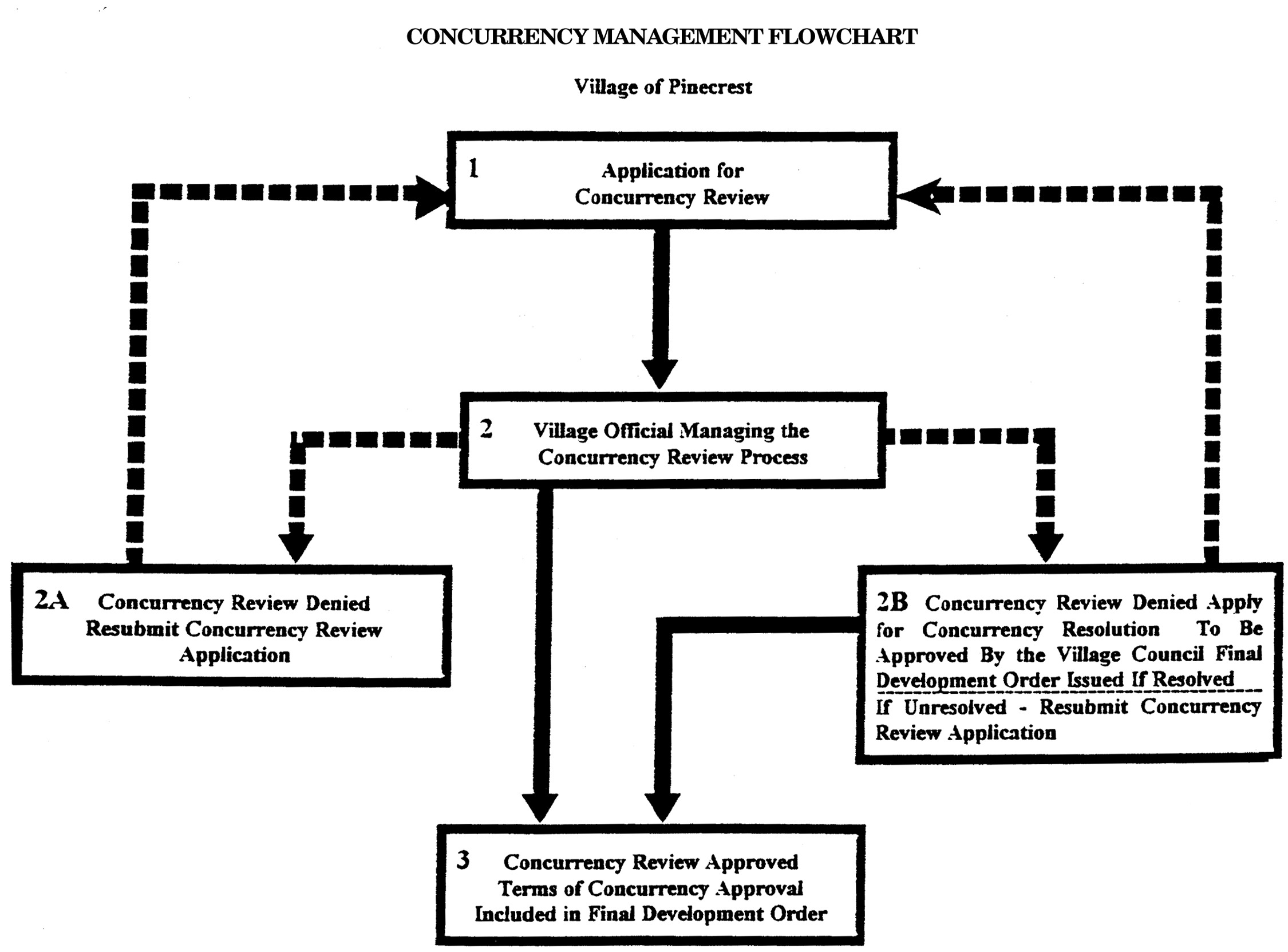
Concurrency Management Flowchart
(Ord. No. 2002-8, § 3, 11-13-02; Ord. No. 2014-02, § 2, 4-8-14; Ord. No. 2021-10, § 2(Exh. A), 10-19-21)
Div. 5.22. - Off-street parking.
(a)
Applicability. Parking shall be provided in all districts at the time any building or structure is erected or enlarged or increased in capacity by a change of use, change of tenant, or the addition of dwelling units, transient units, floor area, seats, beds, employees or other factors impacting parking demand as stated in this division. The parking spaces shall be delineated on a site plan if required. If a site plan is not required, the applicant shall submit a scaled drawing reflecting off-street parking, tenant locations, square footage and parking ratios, which shall be approved and filed by the administrative official once a determination of compliance is rendered. The land comprising approved parking spaces required by this division shall be maintained in perpetuity as off-street parking spaces, along with all its required landscaping, irrigation, lighting and drainage, and shall not be used for other purposes unless there is a village approved change in land use on the premises which warrants a change in the design, layout, or number of required parking spaces.
(b)
Required off-street parking.
1.
Schedule of off-street parking requirements. Proper parking spaces shall be provided at the time of the erection of any main building or structure, or at the time any main building or structure is increased in occupant capacity, or at the time any use or occupancy of an existing building is changed to a use or occupancy which increases the requirements for off-street parking facilities. A dust-free paving material such as asphalt, bitumen, concrete, turf block or other similar materials shall surface parking areas for all uses including single-family residential uses. With the exception of single-family and two-family dwellings, parking lots shall have each parking space and aisle marked. Where uses are mixed, the areas shall be identified and calculated by use. Credit for non-useable space shall be allowed for restroom facilities, employee break rooms, and walk-in freezers only. The number of parking spaces required is specified in the following schedule of off-street parking requirements:
2.
Size and access.
a.
All uses, except single-family and duplex dwellings. For all uses, except single-family and duplex dwellings, off-street spaces shall consist of parking spaces having minimum dimensions as required in table 5-13 below for the parallel parking of each automobile, exclusive of aisles thereto. The parking plan must be so arranged that each automobile may be placed and removed from the parking space assigned without the necessity of moving any other automobile to complete the maneuver, except for a licensed and authorized rental car agency and for a new car dealer storage building. Street or sidewalk areas may not be used for off-street parking purposes as herein defined. Individual ingress and egress drives extending across the public sidewalks and curbs and connecting the off-street parking spaces to the public street areas shall be a minimum of 12 feet and a maximum of 15 feet for a residential one-way drive, and a minimum of 24 feet and a maximum of 30 feet for any nonresidential use or residential two-way drive. The design, number and placement of such drives are subject to site plan approval by the village before being constructed. However, commercial access ways are permitted as one per 100 feet of frontage, but must be 35 feet from the any street intersection. Two or more owners and operators of commercial buildings or uses of the same type of land use classifications requiring off-street parking facilities may record ingress and egress easements approved by the village provided that the combined facility is compatible with the land use being served. Spaces marked reserved or designated for a certain use may not be counted as fulfilling the minimum number of required parking spaces. Only those parking spaces in excess of the minimum number of required spaces may be designated as "reserved".
b.
Single-family, and duplex uses. For single-family and duplex dwellings, off-street parking areas shall be equivalent to two nine-foot by 18-foot spaces, may not occupy more than 60 percent of the front yard, and the access way approach must be 15 feet from any street intersection.
c.
Drive thru lanes. Drive through lanes shall have a minimum width of 10 feet.
d.
Plan approval for ingress/egress, curbs, and sidewalks. The plan for ingress and egress, curbs and sidewalks associated with any off-street parking areas shall be subject to the approval of the village. No curbs or sidewalks may be cut or altered in any manner without a permit from the village and all other applicable county or state agencies. In approving curb or sidewalk cuts, the location of existing and proposed street trees, their spacing, the proximity to intersections or other existing traffic consideration shall be studied.
e.
Variances. A variance to the required off street parking requirements may only be granted by the Village Council.
f.
Parking dimensions. Vehicle parking shall meet the following minimum dimensions:
TABLE 5-13
OFF-STREET PARKING REQUIREMENTS
For parallel parking, minimum widths and lengths shall be nine feet by 23 feet.
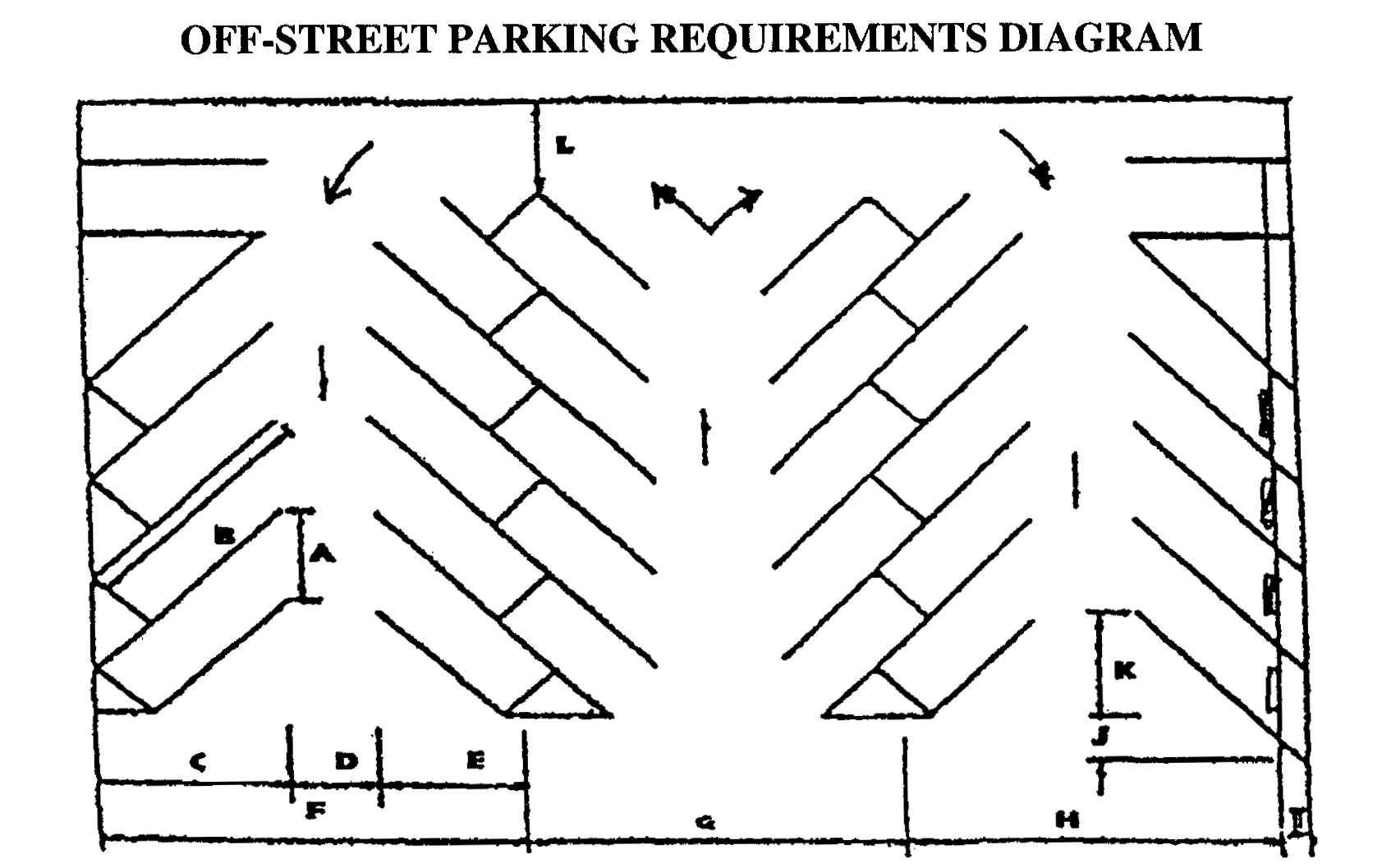
OFF-STREET PARKING REQUIREMENTS DIAGRAM 1
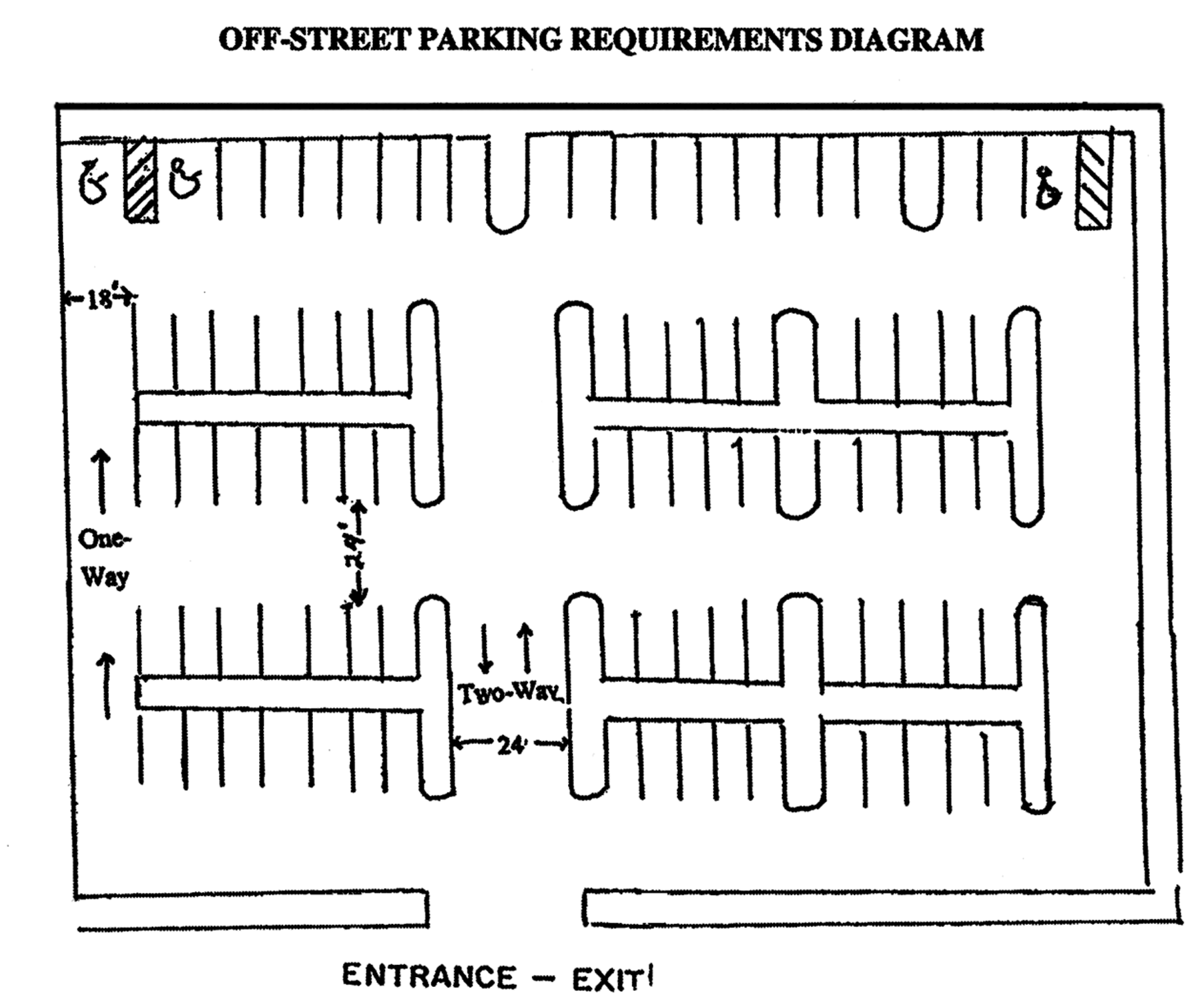
OFF-STREET PARKING REQUIREMENTS DIAGRAM 2
3.
Location of parking spaces. Parking spaces for all uses and structures which are provided as required parking in conformance with the schedule of off-street parking and other applicable provisions shall be located on the same lot and have the same zoning district as the principal use or structure they are intended to serve. Notwithstanding this provision, off-site parking may be allowed in the BU and RU-5 zoning districts after a public hearing is convened by the village council, provided the following conditions are met:
a.
The off-site parking facility is located within 100 yards of the main parcel for which permission for off-site parking is being sought.
b.
An application has been filed with and accepted by the administrative official as being in compliance with the requirements set forth herein.
c.
The application is in the name or names of the owner of the real property seeking permission to utilize an off-site parking facility, the name of any tenant or business on such real property seeking permission to utilize an off-site parking facility, and in the name of the owner of the real property proposed for use as an off-site parking facility.
d.
The applicants provide to the village an ownership and encumbrance report or policy of title insurance, acceptable to the administrative official, showing the ownership of both parcels to be listed in the names of the applicants as of the date of any action by the village council on the application.
e.
The property proposed to be utilized as an off-site parking facility is not currently required parking for any other use granted by the village or has sufficient unallocated parking available.
f.
The application reflects that all parties acknowledge that the off-site parking facility is to be used only for off-site parking as required by the proposed business, and that such off-site parking facility shall not be available for any other use.
g.
The applicants acknowledge that no grandfathered status shall attach to the business use, structure or real property having such off-site parking, and in the event such business or use shall lose its authority or permission to utilize such off-site parking, that use shall immediately cease. The agreement provided to the village shall be properly witnessed and notarized, shall be recorded in the official records of the county, and shall be binding upon the heirs, assigns and devises of the parties to the agreement.
h.
Any cost to the village for recording of such agreement or attorney's fees in the preparation, review or filing of such agreement shall be prepaid by the applicant prior to any village council action on the application.
i.
Any parking provided on any such off-site parking facility shall be upgraded to meet current village regulations for required parking (including required landscaping).
j.
The agreement shall specify that the business for which off-site parking is being sought shall have all owners, employees or agents of such business park on such off-site facility, and not park on the real estate for which permission for off-site parking is being sought and any violation of such parking restriction shall cause off-site parking approval to be revoked by action of the village council.
k.
The agreement provided to the village, or any approval for use of off-site parking facilities, shall not be assignable by the applicants. And any approval for the use of off-site parking facilities shall be subject to being revoked by the village council in the event that any of the applicants shall sell or covey the facility for which permission for utilization of off-site parking is being sought, the off-site parking facility, or the business seeking permission for utilization of an off-site parking facility. Any certificate of occupancy or occupational license issued concerning the property for which off-site is being sought shall be issued conditioned upon the owner or holder of any such license maintaining the exclusive right to use such off-site parking facility.
4.
Parking or storage of rental vehicles. Parking or storage of rental vehicles in connection with a licensed and authorized rental car agency shall be located on the same lot or parcel of property as the licensed office of the rental car agency, or such lot or parcel shall be contiguous to the lot or parcel on which the main rental agency or office is located. The storage of rental cars does not require standard parking spaces for storage areas, provided such areas are within an enclosed parking structure.
5.
Handicapped parking. Handicapped parking shall meet the requirements of the state handicapped access code, F.S, § 553.501 et seq.
6.
Utilization of parking structures. When off-street parking facilities are located within a separate parking structure, the following conditions and restrictions shall apply:
a.
The structure shall conform to all lot, yard and bulk requirements of the district in which it is located.
b.
The parking facilities shall conform to all other provisions of these regulations and all other ordinances of the village.
c.
All nonstructural portions of the exterior elevations except for vehicular ingress and egress areas shall, in addition to any required safety provisions, be screened by a sight block of no more than 60 percent solidity for the total areas between deck levels, such sight blockage to be determined by elevation. Screening shall extend the full distance between deck levels except for vehicular ingress and egress.
d.
When parking facilities are located on the roof of a structure, a seven-foot sight block shall be provided in accordance with subsection (b)(6)c. above. The definition for height of a building shall be applied with respect to feet and be measured to the top of the sight block as set forth subsection (b)(6)c.
e.
This regulation shall not apply to or be construed to prohibit the construction of freestanding carports or garages as accessory structures to single-family or two-family residential dwellings. Nothing in this regulation is intended to prohibit the installation of a fully automatic parking facility in which the placement and removal of automobiles are accomplished wholly by machinery. However, such mechanism shall be completely shielded from public view.
7.
Utilization of yards.
a.
In all EU districts and in the RU-1 and RU-2 residential districts, required parking spaces for single-family and two family dwellings may be permitted in any setback areas and shall be counted as meeting off-street parking requirements, except that within a required front yard all parking shall be located in a driveway or turnaround.
b.
In all districts, for all other permitted uses, approved permitted uses with site plan review or approved conditional uses, required front, side or rear yards may be used for off-street parking except as limited herein. A maximum of 60 percent of a required front yard may be used for off-street parking. All parking areas shall have each parking space and aisle marked and shall be landscaped in conformance with the paved area landscape requirements in these regulations. In all districts, parking area and driveway surfaces shall not extend closer than five feet from any abutting property line.
c.
All parking spaces shall be considered impervious for the purpose of calculating required green space pursuant to district requirements established in these regulations.
8.
Bicycle rack and pedestrian bench. A bicycle rack and pedestrian bench are required to be provided at the time of remodeling or redevelopment of a commercial property to an extent that exceeds 50 percent of its existing floor area. Two parking space credits shall be granted for providing the required bicycle rack and pedestrian bench on-site. The bicycle rack shall be capable of storing a minimum of four bicycles and the pedestrian bench shall be a minimum of five feet in length. Bicycle racks and benches shall be placed in a visible location within 15 feet of the front building elevation(s) or adjacent to the pedestrian access path. The area around the bicycle rack and bench shall be landscaped with one 14-foot shade tree and four 36-inch shrubs.
9.
Electrical vehicle charging infrastructure. For every 25 required parking spaces, a minimum of one Level-2, 240-volt electric vehicle charging station shall be provided within a parking space designated for electric vehicles at the time of construction of a new building, or remodeling or reconstruction of an existing building beyond 50 percent of its floor area, within the commercial and multifamily residential zoning districts, except that an electric vehicle charging station shall not be required within parking lots that contain 24 or less required parking spaces.
(c)
Off-street loading. For every building or building group or part having a gross floor area of 4,000 square feet or more, which is to be occupied by commercial or industrial uses or other uses similarly requiring the receipt of distribution by vehicles of material or merchandise, off-street loading berths or unloading berths shall be provided and maintained on the same lot with such building, as follows:
(1)
4,000—25,000 square feet: 1 berth;
(2)
25,000-40,000 square feet: 2 berths;
(3)
40,000—60,000 square feet: 3 berths;
(4)
For each additional 50,000 square feet: 1 berth.
(d)
Lighted off-street parking facilities. All required off-street parking facilities for multiple family residential development and all nonresidential land uses shall install light fixtures which project the light rays directly to the parking surface, and shall include shields which restrict projection or light rays outward to adjacent properties and also restrict the upward projection of light rays into the night sky. All lighting shall comply with minimum standards and shall not cast more than one-half foot-candle at the property line. Photometric drawings, by a certified engineer, shall be provided at time of permitting and prior to final approval. Such calculations shall certify compliance with this division.
(e)
Access driveway entrances and approaches.
1.
Residential driveways. Residential driveway approaches must be identified on site plans and shall be constructed according to approved public works standards. The driveway approach must have a minimum width of 12 feet and a maximum width of 16 feet, except for a five-foot radius on either side. The driveway must be set back at least five feet from any adjoining properties at all points. Residential driveway approaches and access ways must be 35 feet from street intersections and are subject to required triangle of visibility standards. No more than one two-way accessway shall be permitted for any street frontage up to 100 lineal feet or no more than two one-way accessways shall be permitted for any street frontage up to 100 lineal feet, such standards to be applicable to any property under one ownership. Where such ownership involves over 100 feet of street frontage, one additional two-way or two additional one-way drives may be permitted for each additional 100 feet of frontage or major fraction thereof. The balance of such street frontage not involved with accessways shall be landscaped in accordance with the provisions of this division.
2.
Commercial driveways. Commercial driveway entrances and approaches shall be paved and constructed according to approved public works standards. The driveway and approach must have a minimum width of 12 feet and a maximum width of 30 feet. The driveway and approach may not encroach upon adjoining properties and must be set back a minimum of five feet from adjoining properties. Commercial accessways must be a minimum of 100 feet apart when located on properties under common ownership. No commercial driveway curbcut shall be located within 50 feet of a street intersection.
(f)
Parking pavement markings. For all occupancies other than single-family and duplex dwellings, the parking spaces shall be marked with double striping on each side of the space to identify and facilitate their use. All striping shall be white, contrasting with the pavement, except for handicapped parking spaces that shall be painted blue and white stripe. Dimension requirements, as noted elsewhere, shall be measured to the center point of the double stripe, as shown on the "striping detail" hereby incorporated as part of this division. Notwithstanding the above provisions and striping details, where striping is required for residential users, not less than a single four-inch stripe shall be provided, with parking stall dimensions to be measured to the center line of the strip. In all instances, adequate interior driveways and ingress and egress driveways shall be provided to connect all parking spaces with a public right-of-way or alley. Where a parking space heads into and abuts a walkway, the paved parking space shall be furnished with a wheel stop or curb positioned two feet to the rear of the front end of the parking space, for purposes of protecting the walkway and its users from encroachment by vehicles. Required and surplus parking shall comply with these provisions. Parking shall not be located in any rights-of-way.
(g)
Parking lot buffers. All lots whose parking areas are adjacent to a right-of-way or private street shall be screened by a continuous hedge or wall, as provided in the land development code.
(h)
Parking spaces for persons transporting young children and strollers. For all uses other than single-family, duplex, townhouse, or multi-family uses, parking spaces specifically designated for persons transporting young children, hereby defined as ages two years or less, and strollers shall be provided as follows:
1.
Quality of specially designated parking spaces. The following provisions shall be met:
TABLE 5-14
2.
Location of parking spaces. Such spaces shall be located as close as possible to parking spaces designated for the physically handicapped or disabled persons shall take precedence. Where no parking spaces designated for the physically handicapped or disabled persons have been provided, parking spaces for persons transporting young children and strollers shall be located on the shortest accessible route of travel from adjacent parking to an accessible entrance.
3.
Sign and markings. All parking spaces for persons transporting young children and strollers shall be prominently outlined with green paint and posted with an approved permanent above-ground sign which shall conform to the figure entitled "Baby Stroller Parking Sign" hereby incorporated in this division. The bottom of the sign must be at least five feet above grade when attached to a building, or seven feet above grade for a detached sign.
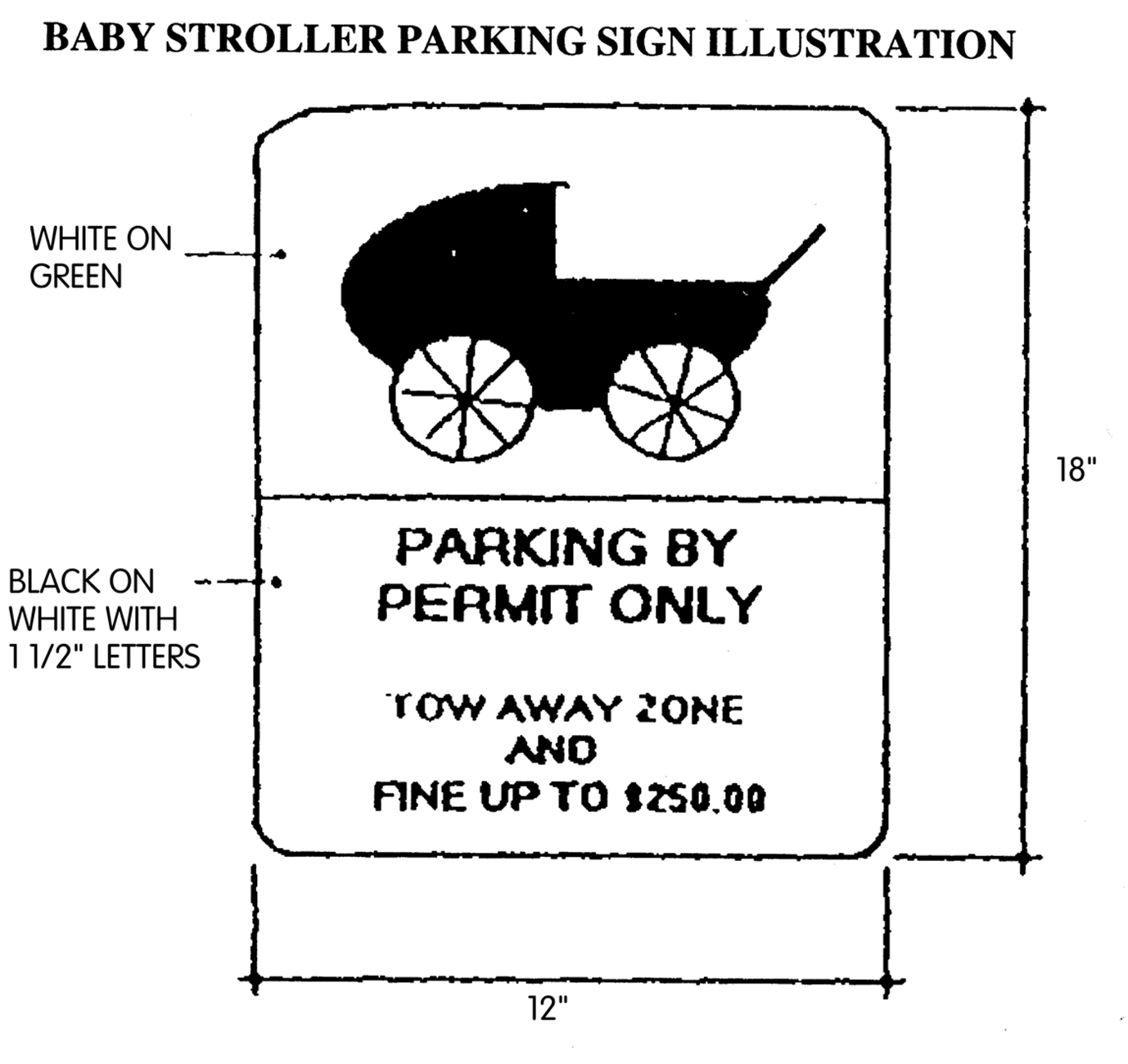
Baby Stroller Parking Sign Illustration
4.
All property owners who are required by this regulation to provide parking spaces for persons transporting young children and strollers shall provide such parking spaces within two years from November 27, 2000. In no event shall the number of parking spaces for the physically handicapped or disabled be reduced below the quantity required by the state building code.
(i)
Approval of parking plan before issuance of building permits. Prior to the issuance of any building, paving, grading, and leveling or other permits, a suitable survey and sketch must be presented to the administrative official indicating the parking layout, drainage plan for the premises, and all driveways extending beyond the property line into the public right-of-way. The driveway plan and drainage plan for the premises shall be reviewed with the public works director. In approving the plans, the administrative official with the public works director shall determine that their decision is in the interest of the public safety and welfare, taking into consideration the volume of traffic to be generated, its pattern and conflict with the adjacent road traffic; the number of driveways proposed and their proximity to others in the area; location and proximity of median cuts; visual clearances or obstructions at the driveways; angle and location of driveway and its intersection with the road; elevation of the driveway in reference to the road, and any other factors that may affect the safety and welfare of the public. In addition all driveways extending into a state road shall meet with the approval of the state department of transportation.
(j)
Parking area on application for building permit. Applications for building or use permits shall indicate the area to be used for parking and permits shall be issued stating that such area shall be so reserved and developed. Recordable restrictions so reserving such area may be at the discretion of the village council. Such area reserved for parking area will be marked on the zoning districts map and no permits for additional use of such area shall be issued. Area reserved for parking in connection with any use shall be under the same ownership as that of the use itself.
(k)
Surface of parking areas.
1.
In the RU-1, RU-2, and EU districts, the area reserved for off street parking shall be either graveled, mulched, or hard surfaced, and must be marked on the site plan, indicating dimensions. In all other zones, parking spaces shall be hard surfaced, except that ten percent of the parking spaces provided shall be constructed of porous pavement materials or open cell unit pavers (turf block). The design and specifications of proposed open cell unit pavers shall be subject to review and approval of the administrative official. Where the parking area is hard-surfaced, the same shall consist of a good rolled back base, well tamped and topped with oil and sand or with asphalt or with asphalt or surfaced with concrete. Occupancy of a given structure or premises shall be prohibited until the required parking area has been improved, inspected, and approved. Parking of vehicles in areas or on surfaces other than those designated and approved as permitted or required herein shall be prohibited.
2.
Drainage. All required off-street parking areas shall be properly drained so that no nuisance will be caused to adjacent or nearby properties. All construction shall comply with design standards as established by all applicable laws, ordinances, and regulations.
3.
Maintenance. All required off-street parking areas shall be maintained in good repair and shall be kept in a reasonably clean, sanitary, and safe condition free from trash, rodents and insects vermin, and hazards.
(l)
Parking between setback line and right-of-way. Parking areas including driveways, except for minimum ingress and egress drives in the RU, EU, AU and RU-5 districts, shall be located no closer than 25 feet to a right-of-way. Parking areas for single-family, two-family, three and four unit apartment uses may also be located no closer than 25 feet to a right-of-way.
(m)
Parking area co-located with use served. Off-street parking areas shall be located on the same lot, parcel, or premises as the use to be served.
(n)
Application of provisions to change of use. This article shall apply to changes of uses as well as the establishment of new uses.
(o)
No commercial parking adjacent to public park. Where a business is adjacent to a park, neither the driveway nor the parking area shall be located between the business structure and the public park.
(p)
Restriction on use of parking area for commercial use. No area designated as a parking area in connection with any designated use or uses shall be operated as a commercial parking lot.
(q)
Markings/restriction on back-out movements. For all uses other than single-family or duplex dwellings, the parking area shall be marked by painted lines, as otherwise provided in this division, indicating the individual parking spaces or stalls. In all districts, the parking area shall be so arranged that there is no back-out movement into adjacent properties, public streets, or rights-of-way.
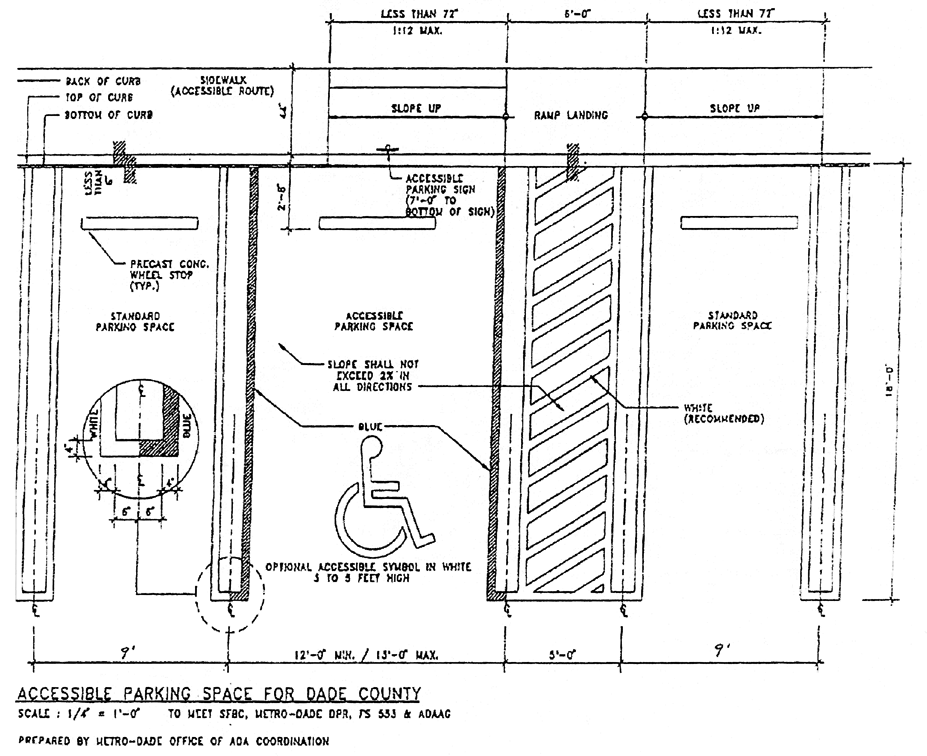
Accessible Parking Space for Dade County
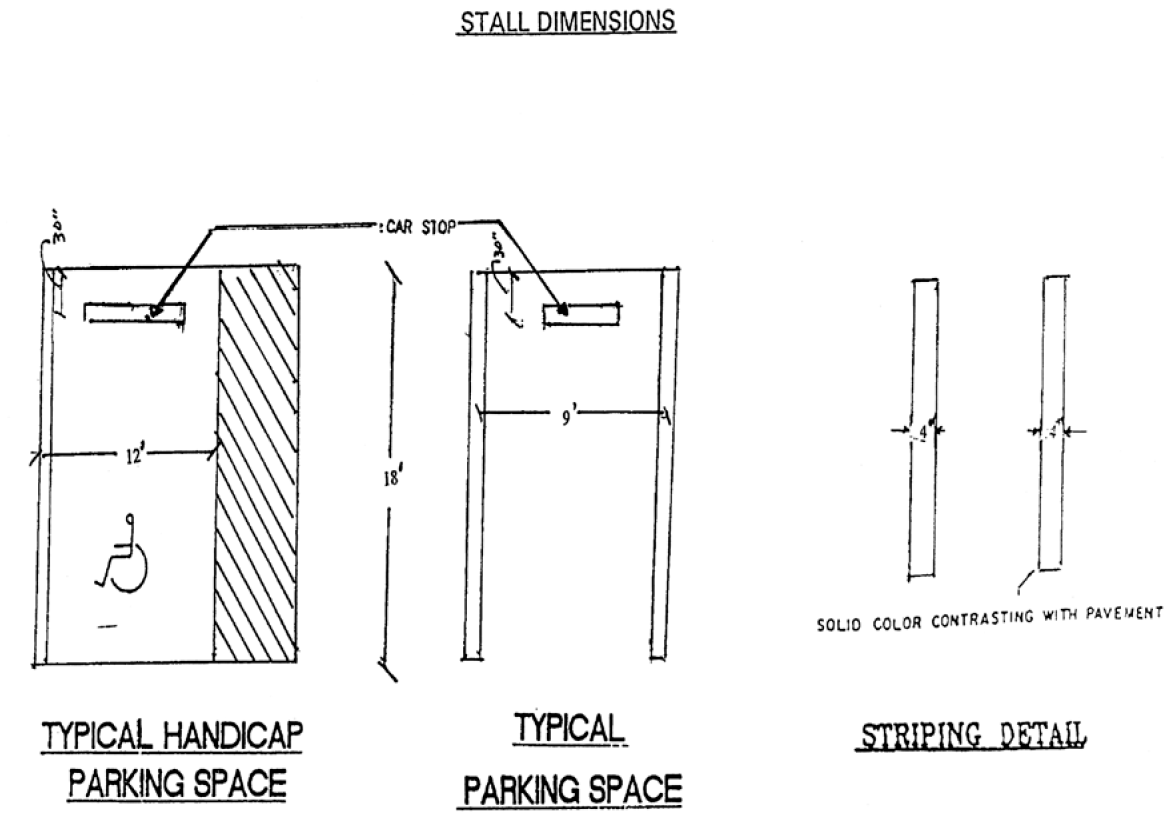
Off-Street Parking Standards
(r)
Shared parking.
1.
A shared parking plan shall be considered in conjunction with the redevelopment of commercial properties in the village to an extent greater than 50 percent of its existing floor area or 50 percent of the value of existing improvements, or for the continued use of existing commercial centers that include at least three of the following uses: retail, restaurant, office, or entertainment, or in conjunction with an application for consideration of a Pinecrest Parkway alternative site plan. Applicants wishing to use shared parking as a means of reducing the total number of required spaces may submit a shared parking analysis using the Urban Land Institute (ULI) Shared Parking Model (latest edition). The analysis must be provided in a form established by the administrative official. Reductions in the total number of required spaces for shared parking are not permitted unless the administrative official determines a reduction is appropriate on a case-by-case basis. Uses providing shared parking must have either mutually exclusive or compatibly overlapping normal hours of operation. The administrative official will determine whether hours of operation are compatibly overlapping.
2.
Joint use of required nonresidential parking spaces may occur where two or more uses on the same or separate sites are able to share the same parking spaces because their parking demands occur at different times.
3.
Two or more owners or operators of buildings or uses requiring off-street parking that share parking may be allowed to reduce the amount of required parking spaces in accordance with the following methodology:
a.
Determine the minimum parking requirements in accordance with the matrix of shared parking uses for each land use as if it were a separate use;
b.
Multiply the required minimum number of parking spaces for each separate use by the percentages for each of the eight time periods set forth in the following table;
c.
Add the resulting required minimum number of parking spaces in each of the eight vertical columns of the table;
d.
Select the vertical column with the highest total; and
e
Use this number as the required minimum number of parking spaces.
4.
Reduction of parking requirements because of joint use may be approved if the following conditions are met:
a.
The developer submits sufficient data to demonstrate that hours of maximum demand for parking at the respective uses do not normally overlap.
b.
The developer submits a legal agreement approved by the village attorney guaranteeing the joint use of the off-street parking spaces as long as the uses requiring parking are in existence or until the required parking is provided elsewhere in accordance with the provisions of the land development regulations.
c.
The structures and facilities provided for one or both of the uses are specialized to the degree that no change in use resulting in greater parking demand could take place without expensive reconstruction necessitating a development permit and development plan review.
d.
If the properties are under separate ownership and control, a written easement and agreement shall be recorded at the applicant's expense, specifying the conditions of such joint use. This agreement shall be approved by the village attorney.
Shared Parking Ratios
(Numbers are listed as percent)
6.
If a privately owned parking facility is to serve two or more separate properties, then a "shared parking agreement" shall be filed with the village for consideration by the administrative official. Unless explicitly stated to the contrary, the owner of the parking facility accepts responsibility for operating, maintaining and accepting liability for personal injury and property damage.
(Ord. No. 2002-8, § 3, 11-13-02; Ord. No. 2012-4, § 2, 3-20-12; Ord. No. 2014-02, § 2, 4-8-14; Ord. No. 2014-7, § 2, 10-14-14; Ord. No. 2015-9, § 5, 9-8-15; Ord. No. 2018-1, § 5, 1-9-18; Ord. No. 2018-5, § 2(Exh. A), 5-8-18; Ord. No. 2021-10, § 2(Exh. A), 10-19-21)
Div. 5.23. - Access, internal circulation, and other traffic impacts.
The administrative official shall advise on matters related to this division:
(a)
Internal circulation system design and access/egress considerations.
1.
Driveways, curb cuts, aisles, bicycle ways, pedestrian ways, and areas for parking and internal circulation of vehicles, bicycles, and pedestrians shall be located, designed and controlled so as to provide for safe and convenient circulation within the site and safe and convenient access from and onto adjoining streets. The administrative official shall review such design considerations based on standard traffic engineering principles and practices and such specifications as may be adopted by resolution of the village council. Among factors to be considered shall be the need for acceleration and deceleration lanes; the number, location and size of curb cuts, access drives, bicycle ways and pedestrian ways from adjacent streets, bicycle ways and pedestrian ways, together with any special markings necessary to avoid conflict among vehicles, bicycles, and pedestrians; the location and design of driveways, access aisles, and bicycle ways to parking spaces; the arrangement, delineation and marking for parking areas; and the means of access to buildings for fire-fighting apparatus and other emergency vehicles.
2.
Cross-access easements and connections.
a.
Cross-access connections between parking lots shall be required to be provided where connection is possible to allow for the efficient flow of traffic between commercial properties, thereby reducing and minimizing traffic congestion on Pinecrest Parkway (US 1) through a reduction in the number of vehicles re-entering Pinecrest Parkway for the purpose of accessing adjoining or neighboring properties. Cross-access connections shall be for the use of customers and shall not be used by service or delivery vehicles.
b.
Required cross-access connections shall be a minimum of 24 feet in width to allow for two-way ingress and egress.
c.
Upon redevelopment of a property where alterations or remodeling affect 50 percent or more of the floor area of the principal building or use, or the cost of said alterations or remodeling exceeds 50 percent of the fair market value of the improvement of the site prior to the alterations or improvements, the property owner shall provide and record a cross-access easement and build one-half of the required connection to adjoining properties. The village shall notify the adjoining property owner of an application for a permit for the construction of a cross-access connection at the time of application for said permit. Required notification shall be provided by certified mail 30 days prior to issuance of the requested permit The owner of the adjacent property will be required to build the remaining half of the required cross-access connection and record a cross- access easement upon redevelopment of the property.
d.
In instances where construction of a cross-access connection would create a dangerous condition, or where construction of a cross-access connection would serve no practical purpose, the village council or administrative official may allow a waiver of the requirement. Any decision relative to the requirement for a cross-access connection is appealable to the village zoning board and village council pursuant to article 2 of the land development regulations. In consideration of a requested waiver, the village council or administrative official shall consider the availability of alternative options for the provision of a cross-access connection and shall consider each request on a site-specific basis.
e.
Any parking spaces required to be abandoned or removed as the result of providing a cross-access connection shall be credited toward the number of required parking for the on-site development at the rate of 150 percent of the number of spaces removed. Parking space credit shall not be provided until the cross-access connection has been constructed.
f.
Any landscaped open space required to be abandoned or removed as the result of providing a cross-access connection shall be credited toward the amount of landscaped open space required for the on-site development at the rate of 150 percent of the landscaped open space removed. Landscaped open space credit shall not be provided until the cross-access connection has been constructed.
g.
Any increase in traffic on a particular property that may be associated with the construction of a cross-access connection shall not be counted against the property providing a cross-access connection when calculating generated traffic volumes and impacts on adjoining levels of service or concurrency requirements.
h.
Until both halves of a required cross-access drive are available for cross- access and connection between two properties, parking of vehicles will continue to be permitted on the unconnected cross-access drive available for future connection.
(b)
Separation of vehicles, bicycles and pedestrians. Parking areas, driveways, bicycle ways and pedestrian ways shall be clearly identified, designed, and marked, where appropriate, to achieve safe and convenient circulation for motorized vehicles, bicyclists and pedestrians. Motorized traffic should be separated from principal bicycle ways, pedestrian routes and recreation areas by curbs, pavement markings, planting areas, fences or similar features designed to promote vehicle, bicycle and pedestrian safety.
(c)
Driveway and curb-cut approvals. The village shall require that the proposed location of driveways and curb-cuts be coordinated with utility companies responsible for providing utility services in order to ensure that proposed construction activities are consistent with improvement plans as well as operation and maintenance activities and policies of utility service providers. No development plan or building permit shall be issued until proof of such coordination is presented to the village by the applicant/developer. In addition, the applicant submitting plans for driveway and curb-cut improvements shall comply with applicable surface water management regulations.
(d)
Sidewalks required—Payment of fee for construction. In order to allow for the construction of pedestrian sidewalks as necessary to provide safe routes to schools pursuant to the village's sidewalk installation policy, a fee shall be paid as required by the village's fee schedule for construction of pedestrian sidewalks prior to the issuance of a building permit. The sidewalk fee shall be required and collected for the construction of any new single-family residence or commercial building, or for the renovation or reconstruction of any existing single-family residence or commercial building beyond 50 percent of its value or 50 percent of its floor area, where such construction or improvement is adjacent to a street that does not include a sidewalk adjacent to its frontage at the time of building permit application.
(Ord. No. 2002-8, § 3, 11-13-02; Ord. No. 2012-18, § 2, 11-13-12; Ord. No. 2014-02, § 2, 4-8-14)
Div. 5.24. - Cluster developments.
(a)
Purpose and intent. This article applies only to subdivisions of 25 contiguous acres or greater that are zoned EU-1 (Residential Estate). The intention of this article is to produce an alternate development scheme for large EU-1 zoned properties that clusters development in one area of the property, thereby minimizing impact on surrounding property and preserving valuable natural resources unique to the property. This will fulfill the goals, objectives and policies of the village's comprehensive development master plan and land development regulations by:
(1)
Maintaining scenic vistas along streets classified as arterial or collector roadways in the village's comprehensive development master plan;
(2)
Maintaining compatibility with surrounding land uses by leaving unchanged the density limitation on the future land use map of the comprehensive development master plan;
(3)
Maintaining the infrastructure levels of service in the surrounding area;
(4)
Preserving and maintaining the unique natural characteristics of the property, including but not limited to, open space, native vegetation and tree canopies; and
(5)
Provide diversity in housing types and lot sizes within the village by clustering units.
(b)
Development regulations.
(1)
Use. The subdivision shall be developed with single-family detached residential units and accessory structures located on the same lot, which are customarily incidental and subordinate to the principal building or use.
(2)
Density. Shall not exceed one principal dwelling unit per one gross acre of property.
(3)
Access. Primary vehicular access shall be connected to roadways with right-of-way width of 70 feet or more. Secondary access and emergency public service access shall be permitted upon demonstration that said use will be compatible with the surrounding neighborhood.
(4)
Lot size. Single-family residential lots must contain a minimum of 7,500 square feet.
(5)
Minimum lot width and street frontage: 60 feet.
(6)
Minimum lot depth: 110 feet. This measurement shall be from the property line abutting the front roadway.
(7)
Lot frontage. Single family, residential lots may be located on private roadways, and must contain at least 60 feet of frontage along either a public or private roadway.
(8)
Building height. Shall comply with division 4.2(c) of the land development regulations.
(9)
Accessory use building height. Accessory buildings may not exceed 14 feet in height.
(10)
Lot coverage. Maximum building coverage (inclusive of all structures): 45 percent.
(11)
Maximum impervious surface ratio: 65 percent.
(12)
Minimum green space: 35 percent.
(13)
Maximum floor area ratio: One-story structure, 0.40; Second floor of two-story structure, 0.30.
(14)
Residential units. All single-family residential units shall be conveyed individually, in fee simple ownership.
(15)
Parking. The development must comply with division 5.22 of the land development regulations.
(16)
Front setback. Each residential unit must setback a minimum of 20 feet from the front property line.
(17)
Side setback. Each residential unit must setback a minimum of five feet from the side property line.
(18)
Rear setback. Each residential unit must setback a minimum of 15 feet from the rear property line.
(19)
Side street setback. Each residential unit must setback a minimum of 20 feet from the side street property line.
(20)
Accessory uses on single family lots. Accessory uses and buildings on single family lots such as Jacuzzis, decks, and trellises shall be permitted, at a setback of at least five feet from the side and rear property lines.
(21)
Unit size. Each residential unit shall have a minimum size of 2,000 square feet.
(22)
Building spacing. All unattached buildings shall be spaced a minimum of ten feet from one another.
(23)
Common accessory buildings. Accessory buildings to serve the maintenance and community meeting needs of the development shall be permitted. Such buildings shall be setback a minimum of 100 feet from the perimeter of the subdivision.
(24)
Existing legal structures on property subject to a conditional use application may be permitted by the council as a conditional use and may be subsequently modified through conditional use approval by the council.
(c)
Entrance features. Entrance features shall be permitted under division 7.17 of the land development regulations.
(d)
Design. Building design shall use energy conservation measures including, but not limited to, self-shading, natural lighting, natural ventilation, outdoor circulation, and reduced dependence on artificial lighting and air conditioning. Porches, balconies, breezeways, pergolas, deep eaves, eyebrows and other elements promoting natural ventilation and shading are encouraged.
(e)
Landscape.
(1)
Street tree size and spacing: Street tree requirements shall be imposed only within the "development area" portion of the subdivision, and not within areas where features warrant preservation of the land in its natural condition. Street tree spacing requirements may be waived by the village manager or his designee where existing mature specimen trees warrant greater spacing between trees.
(2)
Trees, shrubs and green space: Trees, shrubs and green space on single family residential lots shall be in compliance with division 6.1 of the land development regulations.
(3)
Research: Research activities related to the study and maintenance of trees shall be permitted within the conservation and preservation area.
(f)
Streets and roadways. The streets and roadways shall be maintained by a homeowner's association. Streets inside the subdivision may be privately owned, as long as access is provided to visitors and emergency vehicles. Streets shall be dimensioned and located according to plans approved by the village council. Lot(s) within the subdivision are not required to have direct street frontage on public streets, but must have frontage on private streets and must be accessible to service and emergency vehicles.
(g)
Conservation and preservation area and maintenance. In order to prevent development and/or further subdivision of the conservation and preservation area and to provide for maintenance responsibility, the following provisions shall apply:
(1)
Conservation and preservation area requirements.
a.
A minimum of 60 percent of the total development parcel must be permanently protected as conservation and preservation area. At least 60 percent of the conservation and preservation area shall be retained in contiguous areas, unless otherwise approved by the village council.
b.
No more than 25 percent of the conservation and preservation area may include watercourses, lakes, ponds and wetlands.
c.
The village council may permit up to five percent of the conservation and preservation area to be used for passive recreation uses, such as pedestrian walks, bicycle paths, or the like.
(2)
Land protection methods for conservation and preservation areas.
a.
Conservation and preservation area shall be for conservation, preservation and passive recreation use which preserve the land in essentially its natural condition, by the following method:
1.
The land shall be encumbered by a permanent conservation easement in a form acceptable to the village attorney and must be conveyed to the village, with village council approval, or to a non-profit trust or conservation organization, acceptable to the village council, whose principal purpose is to conserve open space.
2.
Further subdivision of conservation and preservation area or its use other than passive recreation, conservation or preservation use, except for easements for utilities, shall be prohibited.
(3)
Maintenance of conservation and preservation area.
a.
A plan and narrative for the use, operation, maintenance and management of the conservation and preservation area shall be provided by the property owner to, and approved by, the village council prior to development approval.
b.
Maintenance of conservation and preservation area shall insure that no hazards, nuisances, or unhealthy conditions exist.
(h)
Ownership and maintenance of common facilities and land. To ensure adequate planning for ownership, operation, and maintenance of common facilities and land, the following provisions shall apply:
(1)
Maintenance of common facilities and land.
a.
A plan and narrative for the use, operation, maintenance and management of all common facilities and land shall be provided to and approved by the village council prior to development approval.
b.
Maintenance of all common facilities and land shall insure that no hazards, nuisances, or unhealthy conditions exist.
(2)
Ownership of common facilities and land.
a.
A homeowner's association (HOA) shall be established, requiring membership of each lot owner in the cluster development. The HOA shall be responsible for the permanent operation and maintenance of all common land, utilities, facilities, open space (other than the conservation and preservation area) and capital improvements.
b.
A HOA agreement, easement agreement, restrictive covenant, or deed restriction shall be submitted with the cluster development application guaranteeing continuing maintenance of such common land, utilities, facilities, open space (other than the conservation and preservation area) and capital improvements.
c.
Such agreement, restrictive covenant, or deed restriction shall be subject to the review and approval of the village council, upon recommendation of the village attorney, and properly recorded by the applicant after approval by the village council.
d.
Such agreement or deed restriction shall provide that in the event that the HOA fails to maintain the common facilities and land in a reasonable order and condition in accordance with the agreement or covenant, the village may, after notice to the HOA, enter upon the land and maintain any part or all of the common facilities and land at its discretion in order to preserve taxable values of the properties within the development and to prevent the common facilities and land from becoming a public nuisance. The agreement or covenant shall also provide that the cost of such maintenance by the village shall be assessed equally against each of the properties within the development.
(i)
Site plan approval. The village council shall review the cluster development plans for compliance with the site plan review criteria and with the criteria in division 3.3(c) of the land development regulations, as a "conditional use" at an advertised public hearing. The purpose of the site plan review shall include the encouragement of logic, imagination, innovation and variety in the design process and ensure the congruity of the proposed development and its compatibility with the surrounding area.
(Ord. No. 2004-7, § 3, 10-12-04)
Div. 5.25. - Tennis court/basketball court/outdoor recreational area lighting.
The lighting of new or existing tennis courts, basketball courts, outdoor swimming pools and pool decks, or other outdoor recreational areas may be permitted in any zoning district as a conditional use pursuant to division 3.3. However, such facilities must meet all of the following standards in order to be approved by the village council:
(a)
A photometric plan shall be submitted which specifies the illumination levels, expressed in initial foot-candles, along all affected property lines.
(b)
The lighting shall be designed so that any overspill of lighting onto adjoining properties or street rights-of-way shall not exceed 0.5 foot-candle vertically or horizontally and shall not cause any reflected illumination onto adjacent properties, structures or rights-of-way.
(c)
Lighting standards and fixtures shall not exceed 18 feet in overall height and shall be located within the confines of the tennis court(s)/basketball court(s)s)/outdoor recreational areas. Lights in stadiums and sports fields within the PR, Parks and Recreational Facilities and PS, Public Service zoning districts may be installed at a height determined by the village council to be sufficient for the intended application, if consistent with all requirements and standards for approval of a conditionally permitted use, and if approved, subject to conditions of approval imposed by the village council.
(d)
Tennis court/basketball court/outdoor recreational area lighting shall not be used between the hours of 10:00 p.m. and 8:00 a.m.
(e)
Prior to the issuance of a certificate of use, the permittee must submit a letter of compliance from a registered engineer or architect stating that the installation has been inspected under operating conditions and found to be within the requirements set forth above.
(f)
The lighting shall not be injurious to the area involved or otherwise detrimental to the public welfare.
(Ord. No. 2005-5, § 1, 7-19-05; Ord. No. 2014-02, § 2, 4-8-14; Ord. No. 2022-3, § 2, 1-11-22)
Div. 5.26. - Home offices.
(a)
A home office may be permitted to residents of the dwelling unit or residence in any of the residential districts listed in div. 4.2 and div. 4.7 of the land development code, provided that:
(1)
No more than one person shall be employed on the premises other than the residents of the premises.
(2)
The use of the dwelling unit or residence for a home office shall be clearly incidental and secondary to its use for residential purposes. No outside display, storage or use of land is permitted.
(3)
There shall be no change in the outside appearance of the building or premises as a result of such occupation.
(4)
(a)
No equipment shall be used or stored on the premises that creates noise, vibration, glare, fumes, odors or electrical interference detectable to the normal senses outside the dwelling unit. In the case of electrical interference, no equipment or process shall be used which creates visual or audio interference in any radio or television sets off the premises or causes fluctuation in line voltage.
(b)
No trash or waste other than normal household trash and recyclables shall be generated. No commercial dumpsters or trash service shall be allowed.
(c)
No permanent or temporary storage of supplies, materials or products shall be allowed on the exterior of the premises structures.
(5)
No retail or wholesale sales on the premises shall be permitted, except for telephone, mail or internet order sales.
(6)
No traffic shall be generated by such home office in greater volume than would be normally expected in the neighborhood for residential purposes.
(7)
A home office shall not be construed to include, among other uses, personal services such as practice of medicine, chiropractic medicine, dentistry, massage, cosmetology, barbershops, beauty parlors, tea rooms, food processing for sale, kennels, animal grooming, radio and television repair, furniture refinishing or building, cabinet making, boat building, marine charter or towing service, auto servicing or rebuilding and repair for others, metal fabrication or cutting employing welding or cutting torches, or any other occupation requiring state-mandated inspection of the premises.
(8)
No more than one vehicle related to the home office shall be permitted upon the premises. Such vehicle must be 20 feet or less in overall length and must be parked off any public right-of-way.
(b)
The village manager or his designee shall determine whether the home office meets the established criteria as set out in subsections (1) through (8) of this section. The determination may be appealed to the zoning board.
(c)
An occupation license must be obtained from the building and planning department by completing the appropriate paperwork and paying any applicable fee. The licensee shall be subject to the provisions of ch. 28, art. III of the Code of Ordinances.
(d)
Nothing contained herein shall be deemed to authorize, legalize or otherwise permit a home-based business that is otherwise prohibited by a legally enforceable covenant, association document or other instrument or restriction on such use pertaining to a residence unit.
(Ord. No. 2005-7, § 1, 9-12-05; Ord. No. 2014-02, § 2, 4-8-14)
Div. 5.27. - Alternative energy systems and environmental conservation.
(a)
Accessory solar energy systems.
(1)
Purpose. The purpose of this division to promote the safe, effective, and efficient use of solar energy systems as an accessory use while protecting the health, safety, and welfare of adjacent and surrounding land uses. A solar energy system shall be permitted in any zoning district as an accessory to a principal use and subject to specific criteria provided herein.
(2)
Development and design standards.
a.
A solar energy system is permitted in all zoning districts as an accessory to a principal use.
b.
A solar energy system may be used to generate electricity for the principal use and/or accessory use of the property on which the solar system is located and shall not be used for the generation of electricity for sale to other users, although this provision shall not be interpreted to prohibit the sale of excess power generated from time to time to Florida Power and Light or other local utility company that provides electricity; and shall not be interpreted to prohibit generation of electricity for sale to other users if subsequently approved by the village and the state through a purchase power agreement or similar mechanism.
c.
A solar energy system may be roof mounted or ground mounted. If ground mounted, the solar system shall be screened from view with an opaque screen consisting of shrubbery, trees, or other non-invasive plant species.
d.
The surface area of a ground mounted system shall be calculated as part of the overall lot coverage.
e.
Height restrictions. Roof mounted solar energy systems shall not exceed the maximum permitted height of any zoning district, and shall be exempt from screening requirements. A ground mounted system shall not exceed the maximum building height for accessory buildings.
f.
A solar energy system shall not project beyond the edge of a roof.
g.
Setbacks. Solar energy systems, including associated mechanical equipment, shall meet all required building setback requirements for the district in which they are located.
h.
Any required mechanical equipment shall be screened from view with an opaque screen consisting of shrubbery, trees, or other non-invasive plant species.
i.
All power transmission lines from a ground mounted solar energy system to any building or other structure shall be located underground.
j.
A solar energy system shall not be constructed until a building permit has been approved and issued. The solar energy system shall comply with all applicable building and construction codes. The design and installation of accessory solar energy systems shall conform to applicable industry standards, including those of the American National Standards Institute (ANSI). Underwriters Laboratories (UL), Institute of Electrical and Electronics (IEEE), National Electric Code (NEC), the American Society for Testing and Materials (ASTM), or other certifying organizations, and shall comply with the Florida Building Code and with all other applicable fire and life safety requirements. The manufacturer specifications shall be submitted as part of the application for a permit.
k.
A solar energy system, including all solar panels shall be installed in a manner that prevents any glare or reflection of light to any neighboring road right of way or adjoining property.
(3)
Solar ready construction.
a.
Construction of new buildings and remodeling where the cost of remodeling is more than 50 percent of the assessed value of the building shall provide a roof layout plan that illustrates how future installation of a photovoltaic system and/or solar water heating system could be accommodated. The property owner shall be required to provide for the eventual installation of one system. Requirements are as follows:
1.
Photovoltaic systems. Installation of an appropriate sized conduit, a minimum of one-inch diameter, leading from an exterior south-facing, east-facing, or west-facing roof, where a minimum of four hours of direct sunlight is achieved, to a stubbed junction box adjacent to the electrical meter. All exposed conduit shall be capped and provided with adequate flashing. The conduit shall not be located on or in the direction of a north-facing roof. Roof reinforcements shall be addressed at the time of installation.
2.
Solar heating system. Installation of three-fourths inch diameter hot and cold copper water pipes from a south-facing, east-facing, or west-facing roof, where a minimum of four hours of direct sunlight is achieved, to an existing water heater tank. Both ends of the three-fourths inch diameter copper pipes shall be stubbed out and shall not be located on or in the direction of a north-facing roof. All exposed pipes shall be capped and provided with adequate flashing. Roof reinforcements shall be addressed at the time of installation.
(b)
Energy efficient design and construction.
(1)
Requirements. New residential structures that exceed 6,000 square feet in livable, air-conditioned area shall include the following energy efficient and environmentally conservative improvements:
a.
Either a minimum of one solar water heater, tankless water heater, or a hybrid electric water heater; or a photovoltaic solar electric system.
b.
An air conditioning system that has a minimum Seasonal Energy Efficiency Rating (SEER) of 15 and utilizes natural refrigerants or other refrigerants that contain no hydrochlorofluorocarbons (HCFC).
c.
Interior finishes that emit low/no levels of volatile organic compounds (VOC) - Site-applied finishes, including, paints, stains and varnishes, shall meet specified volatile organic compound (VOC) emissions limits in accordance with GREENGUARD Environmental Institute GGPS.001 standard for building materials and finishes; or Green Seal® standards.
d.
Permeable driveways consisting of porous concrete, open cell unit pavers (turf block), flagstone, or brick pavers, allowing the infiltration of water into the underlying soil. No individual slab of pavement or flagstone may exceed 42 square feet in area.
e.
Documentation of compliance with the Energy Efficient Design and Construction requirements shall be provided in the form of an affidavit signed by the general contractor prior to the issuance of a temporary or permanent certificate of occupancy.
(c)
Auxiliary power supply.
(1)
Requirements. New residential and Commercial structures and substantial improvements to residential structures exceeding 50 percent of the market value of the existing structure shall include one of the following improvements necessary to provide auxiliary power during electrical power outages:
a.
Permanent installation of a stand-by generator, or
b.
Installation of a power inlet and an electric panel with an interlock allowing for connection to a portable generator, or
c.
Solar panel and battery pack necessary to provide auxiliary power.
(Ord. No. 2012-4, § 2, 3-20-12; Ord. No. 2014-02, § 2, 4-8-14; Ord. No. 2014-7, § 2, 10-14-14; Ord. No. 2018-5, § 2(Exh. A), 5-8-18; Ord. No. 2021-10, § 2(Exh. A), 10-19-21)
Div. 5.28. - Building address numbers and identification.
(a)
Address identification. The owner of any residential or commercial building in the village shall install suitable identification numbers of the building to be composed of figures not less than three inches for the purpose of clearly identifying the address of the building. Address numbers shall be installed on the front of any building adjacent to a public right-of-way and also on the rear of commercial buildings and on the side of any building adjacent to a canal.
(b)
Maintenance. The owner shall maintain the numbers of the building as herein provided in good condition and in a conspicuous place where same can be seen and read from the street.
(Ord. No. 2014-02, § 2, 4-8-14)
Div. 5.29. - Outdoor lighting.
(a)
With the exception of parking lot lighting which is regulated pursuant to the requirements of division 5.22, off-street parking, and tennis court/basketball court/outdoor recreational area lighting which is regulated and permitted as a conditional use pursuant to the requirements of division 5.25, tennis court/basketball court/outdoor recreational area lighting, all other outside lighting shall not be permitted except under the following conditions:
(1)
Detailed plans shall be submitted to the administrative official showing the location, height, type of lights, shades, deflectors and beam directions.
(2)
The administrative official may issue a permit for such lighting if, after a review of the detailed plans therefor and after consideration of the adjacent area and neighborhood and its use and future development, the proposed lighting will be so located, oriented, adjusted and shielded that the lighting will be deflected, shaded and focused away from such adjacent property and will not be or become a nuisance to such adjacent property, and will not create a traffic hazard on adjacent streets by reason of glare or the like.
(3)
Outdoor lighting shall be designed so that any overspill of lighting onto adjacent properties shall not exceed one-half footcandle (vertical) and shall not exceed one-half footcandle (horizontal) illumination on adjacent properties or structures. An outdoor lighting installation shall not be placed in permanent use until a letter of compliance from a registered engineer or architect or the duly authorized representative of such engineer or architect is provided stating that the installation has been field checked and meets the requirements as set forth above.
(4)
It is not intended here to regulate permitted sign lights and it is not the intent to modify, amend or repeal any portion of the Florida Building Code.
(Ord. No. 2014-02, § 2, 4-8-14)
Div. 5.30. - Non-residential recycling.
a.
Minimum standards for recycling on non-residential property. Owners of commercial business establishments conducting business within the village's commercial zoning districts shall provide recyclable materials containers for the collection of recyclable materials and shall collect the recyclable materials placed in the recyclable materials containers and transport or contract for the transport of those materials to a recycling facility. Recyclable material containers shall be stored at the rear of commercial properties and screened from view.
(Ord. No. 2014-02, § 2, 4-8-14)
Div. 5.31. - Parking garages.
(a)
Design criteria. All parking garages shall be reviewed for compliance with the criteria for approval of a conditional use. The following additional design guidelines shall be implemented as applicable:
(1)
Use of stretched cable, open railings or an alternate design achieving the same degree of openness to allow for maximum surveillance and illumination in order to maximize openness and safety.
(2)
Use of reflective paint or materials inside.
(3)
Illumination of all pedestrian areas to increase safety as determined by the administrative official.
(4)
Detailing of the parking garage similar to the building it serves or if serving multiple buildings or uses, detailing of the parking garage to be compatible with the neighboring buildings.
(5)
Incorporation of natural light, plants, exterior landscaping, storefront details, screening, and other features to increase the aesthetic quality of the building and to improve the experience and safety of the user.
(6)
Open stairwells, appropriately illuminated as determined by the administrative official, clearly identified and located in such a way as to provide for a safe entrance and exit.
(7)
Use of additional architectural features, landscaping, fencing, buffering, courtyards, plazas, or pedestrian areas in order to provide architectural and land use compatibility with neighboring properties.
(8)
Review by the administrative official of the parking garage design for safety and recommendation of additional safety features if warranted.
(9)
For every 25 required parking spaces within a parking garage, a minimum of one Level-2, 240-volt electric vehicle charging station shall be provided within or adjacent to dedicated parking spaces reserved for electric vehicles. The required charging stations and designated parking spaces shall be located in a grouping together on the first floor of the garage.
(Ord. No. 2015-7, § 2, 9-8-15; Ord. No. 2021-10, § 2(Exh. A), 10-19-21)
Div. 5.32. - Vacation rentals.
(a)
Definitions.
Enclosed shall mean any space enclosed by a roof and four complete solid, floor to roof walls, which may include glass windows. Screening shall not count as a wall.
Fractional ownership vacation property shall mean a single-family, two-family, three-family, or four-family house or a dwelling unit for which the ownership interest is divided among three or more individuals, either individually and/or through a corporation, limited liability company, or similar entity ownership, and where the ownership structure permits the house or dwelling unit to be occupied aggregately more than three times in a calendar year for durations less than thirty days or one calendar month, whichever is less, by multiple owners.
Responsible party shall mean the owner(s) or the person designated by the owner(s) of the property to be called upon to answer for the maintenance of the property and for the conduct and acts of occupants of vacation rental properties.
Transient occupants shall mean any person, or guest or invitee of such person who occupies or is in actual or apparent control or possession of residential property registered or used as a vacation rental. It shall be a rebuttable presumption that any person who holds themselves out as being an occupant or guest of an occupant of a vacation rental, or a property used as a vacation rental is a transient occupant.
Vacation rental shall mean any unit or group of units in a condominium or cooperative or any individually or collectively owned single-family, two-family, three-family, or four-family house, or dwelling unit, including any fractional ownership vacation property, that is rented to or occupied by guests for periods of less than 30 days or one calendar month, whichever is less, or which is advertised or held out to the public as a place regularly rented to guests, but that is not a timeshare project.
(b)
Registration required. It is unlawful for any person to allow another person to occupy any residential property as a vacation rental within the village, offer, or advertise such rental services within the village, until the person has obtained a local business tax receipt, and unless the person has registered the vacation rental property with the village and the vacation rental property has been issued a certificate of compliance in accordance with the provisions of this division.
(c)
Application for registration. The application for registration of a vacation rental shall be made to the village manager or his or her designee on a form provided by the village, which shall set forth at a minimum:
(1)
The legal description of the property offered for rental, including the complete address, subdivision, or community name.
(2)
Proof of ownership of the property, including the name, address and phone number of each person or entity with an ownership interest in the property.
(3)
An approved inspection report of the Miami-Dade County Fire Rescue Department verifying compliance with the department's criteria for a residential dwelling transient lodging use.
(4)
The gross square footage of the property, including the number of rooms, bedrooms, kitchens and on-site parking spaces attributable to the vacation rental use.
(5)
A valid and current federal employer tax identification number (or social security number) for the owner(s) of the property.
(6)
Proof of registration with, or exemption from, the Florida Department of Revenue for sales tax collection under F.S. ch. 212, and Miami-Dade County for Tourist Development Tax.
(7)
Proof of licensure with, or exemption from, the Florida Department of Business and Professional Regulation for a transient public lodging establishment.
(8)
The name, address and 24-hour phone number of the person who will act as the responsible party, operating the vacation rental property. The responsible party phone number shall be answered 24 hours, seven days a week.
(9)
The name and contact information for any listing services on or through which the vacation rental is to be offered for rent.
(10)
The application shall bear the signatures of all owners, authorized agents, authorized property managers and the responsible party.
(11)
The owner of the property and the responsible party must individually acknowledge the affirmative duty to ensure compliance with the requirements of this division, including the owner and responsible party requirements of this division.
(12)
Acknowledgement that the application and any related approvals are specific to the property identified in the application and approval; other properties are not jointly shared commodities and shall not be considered available for use by transient occupants of the property which is the subject of the application.
(13)
Submission of an incomplete registration application form shall result in rejection of the application.
(d)
Responsible party required. Whenever any property is required to be registered under this division, the owner shall act as, or retain at all times, one or two appointed natural persons capable of meeting the duties provided in subsection 23-74. The designated responsible party(ies) must reside within 30 miles to serve as the responsible party(ies) for service of notices as are specified herein. Notices given to the responsible party(ies) shall be sufficient to satisfy any requirement for notice to the owner. An initial responsible party shall be designated and shall participate in the application for registration, and the village manager or his or her designee shall thereafter be notified of any change of responsible party(ies) within 15 days of such change.
(e)
Fees for registration. The village may charge reasonable fees for registration to compensate for administrative expenses. The fees for registration shall be provided for, from time to time, by resolution adopted by the village council.
(f)
Owner and responsible party requirements. In addition to general compliance with all federal, state, county and local laws, it is the affirmative duty and responsibility of the owner(s) and the responsible party, individually and collectively, to adhere to the following:
(1)
Inform all guests, in writing, prior to occupancy of the property, of all applicable Village of Pinecrest ordinances concerning noise, vehicle parking, garbage, and common area usage.
(2)
Maintain the property under their control in compliance with the occupancy limits, as specified in this division, the Certificate of Compliance, the Minimum Housing Standards of Miami-Dade County, specific requirements of the Florida Building Code noted herein and the village Code of Ordinances, as determined by the village manager, building official or respective designee;
(3)
Ensure that, at all times:
a.
All vehicles associated with the vacation rental are parked within a driveway in compliance with the Code of Ordinances of the Village of Pinecrest;
b.
The entire property, including the front, back, and side yards, is maintained free of garbage and litter, provided however, that this subsection shall not prohibit the storage of garbage and litter in authorized receptacles for collection;
c.
All transient occupants are aware that it shall be unlawful to allow or make any noise or sound that exceeds the limits set forth in the chapter 15, article II, "Noises; Unnecessary and Excessive Prohibited," of the village Code;
d.
All transient occupants are aware that unauthorized occupants of any structure or conveyance of the property that have been warned by the owner or lessee to leave and refuse to do so commit the offense of trespass of a structure or conveyance and will be charged under the State of Florida and local law; and
e.
The provisions of this division are complied with and promptly address any violations of this division or any violations of law which may come to the attention of the responsible party.
(4)
Be available with authority to address and coordinate solutions to problems with the rental of the property 24 hours a day, seven days a week and be physically present at the property within one hour of notification to respond to emergencies, noise complaints, events that are being held without required permits, maximum occupancy violations, and other occurrences determined by the Police to require the presence of the owner or responsible party.
(5)
Keep available a register of all guests, which shall be open to inspection by authorized personnel of the village at all times.
(6)
Prohibit rental to any person on the Florida Sexual Offenders and Predators (FDLE) database or any other state sex offender database consistent with the requirements of chapter 16, article IV of the Village Code.
(g)
Standards and requirements for vacation rentals.
(1)
Certificate of compliance. The village manager or his designee may issue a certificate of compliance to the applicant upon proof that the owner or responsible party has:
a.
Submitted a complete vacation rental registration application form including appropriate documentation of compliance with applicable Florida Department of Revenue and Florida Department of Business and Professional Regulation requirements;
b.
Submitted the registration fee;
c.
Obtained a local business tax receipt (LBTR) from the village pursuant to chapter 28 of the village Code of Ordinances;
d.
Obtained a LBTR from Miami-Dade County;
e.
Provided an affidavit, demonstrating initial and on-going compliance with vacation rental standards contained herein, plus any other applicable local, state and federal laws, regulations and standards to include, but not be limited to F.S. ch. 509, Chapter 61C and 69A, Florida Administrative Code; and
f.
Provided a copy of the vacation rental/lease agreement form to be used when contracting with transient occupants and guests which includes the minimum vacation rental lessee information required by subsection (2)d. below.
g.
Requested and passed a compliance inspection pursuant to this division.
h.
Provided evidence of liability insurance covering the use of the property as a rental property.
(2)
Vacation rental standards. The following standards shall govern the use of any vacation rental as a permitted use:
a.
Minimum life/safety requirements:
1.
Swimming pool, spa and hot tub safety. A swimming pool, spa or hot tub shall comply with the current standards of Residential Swimming Pool Safety Act, F.S. ch. 515.
2.
Smoke and carbon monoxide (CO) detection and notification system. If an interconnected and hard-wired smoke and carbon monoxide (CO) detection and notification system is not in place within the vacation rental unit, then an interconnected, hard-wired smoke alarm and carbon monoxide (CO) alarm system shall be required to be installed and maintained on a continuing basis consistent with the requirements of Section R314, Smoke Alarms, and Section R315, Carbon Monoxide Alarms, of the Florida Building Code - Residential.
3.
Fire extinguisher. A portable, multi-purpose dry chemical 2A:10B:C fire extinguisher shall be installed, inspected and maintained in accordance with NFPA 10 on each floor/level of the unit. The extinguisher(s) shall be installed on the wall in an open common area or in an enclosed space with appropriate markings visibly showing the locations.
4.
There shall be posted, next to the interior door of each bedroom or sleeping room a legible copy of the building evacuation map that is a minimum of 8 and ½ inches by 11 inches in size.
b.
Maximum occupancy. The maximum vacation rental occupancy shall not exceed any of the following standards:
1.
Two persons per bedroom;
2.
Ten transient occupants per vacation rental unit, regardless of the number of bedrooms;
3.
Three transient occupants per one off-street parking space legally available to the property, the exact number of which is determined by the requirement of division 5.22 of the village land development regulations of the village Code of Ordinances;
4.
Occupancy by more than one family as defined in division 9.2 of the Code; and
5.
Any person present on the property after 10:00 p.m. on any night shall be considered an overnight transient occupant for purposes of calculating maximum occupancy.
c.
Solid waste handling and containment. Village solid waste containers shall be provided for the maximum transient occupancy permitted by this division, as required by the village Code of Ordinances. Required screening and storage requirements for solid waste containers shall apply and shall be incorporated into the certificate of compliance. For purposes of this section, a solid waste container shall not be placed for curbside pickup more than 24 hours before pickup and all receptacles must be removed from the curbside within 24 hours after pickup.
d.
Minimum vacation rental lessee information. The following information shall be posted conspicuously within the establishment and shall be provided to each vacation rental lessee as part of their lease:
1.
The maximum occupancy permitted under the certificate of compliance;
2.
A statement advising the occupant that it is unlawful to allow or make any noise or sound that exceeds the limits set forth in the chapter 15, article II, "Noises; Unnecessary and Excessive Prohibited," of the village Code and such violation is subject to village code enforcement, including but not limited to fines up to $500.00 per violation;
3.
A sketch of the location of the off-street parking spaces available to the property;
4.
The days and times of trash pickup and the solid waste handling and containment requirements of this division;
5.
A delineation of those portions of the property where the owner will be residing;
6.
A list of uses prohibited on the property which shall include use of the property as a party, event or entertainment venue;
7.
The location of the nearest hospital; and
8.
The local non-emergency police phone number.
e.
Use. The following limitations apply to the use of the property:
1.
No sound amplification system shall be used outside of any enclosed or air-conditioned portion of the primary structure on the property;
2.
Noise from any amplified sound system shall not be audible after 10:00 p.m. on a Sunday—Thursday night or after 11:00 p.m. on a Friday or Saturday night when measured at the property line;
3.
The property may not be used to host more than three special events in any given 12-month period;
4.
The vacation rental may not be used or advertised for any commercial or non-residential use, including use of the property as a party, event or entertainment venue.
f.
Advertising. Any advertising of the vacation rental unit by the owner or any service shall conform to information included in the vacation rental certificate of compliance and the property's approval, and shall include at a minimum, identification of the maximum occupancy permitted on the property. The owner or responsible party shall ensure that the name and contact information for any listing services on or through which the vacation rental is to be offered for rent which was provided in the application is updated with the village to reflect any changes and maintain with the village at all times a list of current listing services.
g.
Posting of certificate of compliance. The certificate of compliance shall be posted on the back of or next to the main entrance door and shall include at a minimum the name, address and phone number of the responsible party and the maximum occupancy of the vacation rental.
h.
Other standards. The occupant shall be advised that all standards contained within the Code of Ordinances and land development regulations of the village including, but not limited to: noise, setbacks, and stormwater, are applicable to the vacation rental and may be enforced against the occupant.
(h)
Sale or transfer of dwelling unit used for vacation rentals. Whenever a dwelling used for vacation rentals is sold or otherwise changes ownership and the new owner desires to use the dwelling as a vacation rental, the new owner must, prior to allowing such use:
(1)
Schedule and obtain an inspection of the dwelling for a certificate of compliance; and
(2)
Apply for a vacation rental certificate for the vacation rental use.
(i)
Rules and procedures. The village manager or designee may create rules and procedures to assist in the implementation of this section, including but not limited to a timeline and procedure for all existing vacation rentals to apply for and obtain their first vacation rental certificate pursuant to this ordinance in a manner consistent with available staff resources.
(j)
Administration, penalties, and enforcement.
(1)
Initial and annual compliance inspections of vacation rentals. An inspection of the dwelling unit for compliance with this section, and for compliance with the requirements of the Minimum Housing Standards of Miami-Dade County and the specific requirements of the Florida Building Code as noted herein is required prior to issuance or renewal of a vacation rental certificate of compliance. If violations are found, all violations must be corrected and the dwelling unit must be re-inspected prior to issuance or renewal of a vacation rental certificate of compliance as provided herein. All violations must be corrected and re-inspected within 30 calendar days. Failure to correct such inspection deficiencies in the timeframes provided shall result in the denial of an initial application or suspension of the vacation rental certificate of compliance until such time as the violations are corrected and re-inspected.
a.
Inspections will be conducted by the village manager or his or her designee.
b.
The suspension of a vacation rental certificate of compliance shall be posted at the establishment.
(2)
Registration not transferable. No registration issued under this division shall be transferred or assigned or used by any person other than the person to whom it is issued, or at any location other than the location for which it is issued.
(3)
Expiration of registration. All registrations issued under the provisions of this division shall be valid for no more than one year, and all registrations shall expire on September 30th of each year. Fees for renewal and applicable late renewal fees shall be established by resolution of the village council.
(4)
Revocation. In addition to, or as an alternative to, the penalties of subsection (5) below, any certificate of compliance issued pursuant to this division may be denied, revoked, or suspended by the village manager upon the adjudication of a violation of this division, any Village ordinance, or state law by the responsible party, property owner or transient occupant attributable to the property for which the certificate of compliance is issued. Such denial, revocation or suspension is in addition to any other penalty or remedy available at law.
(5)
Offenses/violations.
a.
A violation of any of the provisions of this division is punishable by a fine of up to $250.00 for a first time violation and up to $500.00 for a repeat violation.
b.
Suspension of vacation rental certificate of compliance. In addition to any fines and any other remedies described herein or provided for by law, the village may suspend a vacation rental certificate of compliance for multiple violations of the maximum occupancy, parking requirements, noise ordinance, special events permitting requirements, failure to advertise the maximum occupancy, or failure of the responsible party(ies) to perform the duties required by this division in any continuous 48 month period, in accordance with the following:
1.
Suspension timeframes.
i.
Upon a second violation of the maximum occupancy, parking requirements, noise ordinance, special events permitting requirements, failure to advertise the maximum occupancy, or failure of the responsible party to perform the duties required by this division, the vacation rental certificate shall be suspended for a period of 30 calendar days.
ii.
Upon a third violation of the maximum occupancy, parking requirements, noise ordinance, special events permitting requirements, failure to advertise the maximum occupancy, or failure of the responsible party to perform the duties required by this division, the vacation rental certificate shall be suspended for a period of 12 calendar months.
iii.
For each additional violation of the maximum occupancy, parking requirements, noise ordinance, special events permitting requirements, failure to advertise the maximum occupancy, or failure of the responsible party to perform the duties required by this division, the vacation rental certificate shall be suspended for an additional 12 calendar months.
2.
Suspension restrictions. A vacation rental may not provide transient occupancy during any period of suspension of a vacation rental certificate. The suspension shall begin immediately following notice, commencing either:
i.
At the end of the current vacation rental lease or occupancy period; or
ii.
Within 30 calendar days, whichever date commences earlier, or as otherwise determined by the village.
3.
Operation during any period of suspension shall be deemed a violation pursuant to this division and shall be subject to a daily fine, up to the maximum amount as otherwise provided in Florida Statutes for repeat violations, for each day that the vacation rental operates during a period of violation.
(k)
Vesting.
1.
Vacation rentals existing as of the effective date of village ordinance 2017-4 shall be considered vested vacation rentals only as related to contracts entered prior to the effective date of said ordinance. Rental/lease agreements that were entered into prior to the effective date of village ordinance 2017-4 as evidenced by a written and validly executed rental agreement or contract provided to the village manager no later than three months following the effective date of village ordinance 2017-4 shall be considered vested.
2.
Vesting shall:
a.
Apply only to date specific rentals; and
b.
Not apply to renewals of existing rental agreements or contracts which are at the option of either of the parties.
3.
All rental agreements entered into after the effective date of village ordinance 2017-4 shall comply with the provisions of this division. No vacation rental shall be occupied pursuant to a contract/lease entered into after the effective date of village ordinance 2017-4 until the owner has obtained the required vacation rental certificate of compliance.
4.
A vested contract/lease transferred to a subsequent owner shall continue to be vested, but shall not be transferred to a different vacation rental property, provided the new owner complies with the inspection and licensing requirements of this division.
(Ord. No. 2017-4, § 2, 1-10-17; Ord. No. 2018-5, § 2(Exh. A), 5-8-18; Ord. No. 2018-6, § 2, 7-17-18; Ord. No. 2018-16, § 2, 12-11-18; Ord. No. 2021-10, § 2(Exh. A), 10-19-21; Ord. No. 2022-3, § 2, 1-11-22; Ord. No. 2022-4, § 2, 1-11-22)
Editor's note— Ord. No. 2018-1, § 6, adopted January 9, 2018, repealed div. 5.32 in its entirety. Ord. No. 2018-5, § 2(Exh. A), adopted May 8, 2018 subsequently renumbered former divs. 5.33—5.35 as divs. 5.32—5.34. Former div. 5.32 pertained to medical marijuana retail centers, and derived from Ord. No. 2015-9, § 4, adopted September 8, 2015.
Div. 5.33. - Temporary sidewalk sales.
(a)
A temporary use permit authorizing a sidewalk sale that is temporary in nature must be obtained from the Village of Pinecrest and may be granted subject to the following:
(1)
A complete permit application, application fee, and plan depicting the location of the merchandise shall be submitted to the village for review and approval. The administrative official reserves the right to deny the plan based on safety, aesthetics, or inadequate space.
(2)
A temporary sidewalk sale shall be permitted no more than two times per calendar year and each permitted sale shall be limited to two consecutive days consisting of Saturdays, Sundays, and state holidays immediately preceding or following a Saturday or Sunday.
(3)
A permit for a temporary sidewalk sale shall be issued to the owner of the property. A commercial property occupied by multiple tenants shall be considered one property and shall be limited to one temporary sidewalk sale permit twice per calendar year as specified in paragraph (1).
(4)
Temporary sidewalk sales shall be limited to the sale and promotion of goods and services made available by businesses located on the premises.
(5)
Merchandise displayed outdoors must also be available for sale inside the adjacent commercial establishment and the merchandise shall only be displayed outside of the establishment where the merchandise is sold.
(6)
Displays cannot hinder pedestrian circulation or impede emergency egress.
(7)
No required parking space, parking aisle, loading space or landscaped area shall be obstructed or used for display purposes.
(Ord. No. 2017-6, § 2, 6-6-17; Ord. No. 2018-5, § 2(Exh. A), 5-8-18)
Editor's note— Ord. No. 2018-5, § 2(Exh. A), adopted May 8, 2018, renumbered div. 5.34 as div. 5.33. See note at div. 5.32.
Div. 5.34. - Adult congregate living facilities.
(a)
Intent and purpose. It is the intent and purpose of this division to provide locational criteria and minimum standards for the use of property for an adult congregate living facility. These regulations apply to applications for adult congregate living facilities in addition to the requirements of the zoning district in which the proposed facility is to be located. These regulations do not apply to community residential homes, as such facilities are defined in and regulated by F.S. ch. 419.
(b)
Density. Due to the unconventional arrangement of adult congregate living facilities, the density permitted shall be based on the total occupancy of the property, and shall be calculated by multiplying the allocated density of the future land use designation or zoning district assigned to the property, whichever is less, by the average persons per household for the Village of Pinecrest, as determined by the most recently completed census of the U.S. population. The product resulting from this equation shall then be multiplied by the gross acreage of the property, or portion thereof, proposed for the development of an adult congregate living facility to yield the maximum occupancy of the facility.
The total occupancy approved for the facility shall include any units provided therein for the occupancy of care providers and shall be made part of the development approval.
Example calculation. For the purposes of this example, the 2010 Census estimate of average persons per unit (2.753) for the village and a two-acre parcel designated as RU-3M, Residential Multi-Family Moderate Density on the Official Zoning Map are used:
2.753 persons per unit x 12.9 units per acre = 35 persons per acre; 35 persons per acre x 2 acres = 70 persons total occupancy.
(c)
Spacing. No adult congregate living facility shall be located within 1,000 feet of another adult congregate living facility, measured from property line to property line.
(d)
Landscape buffers. All adult congregate living facilities with frontage on an arterial, collector, or local road shall provide a landscape buffer running parallel to such frontage. Adult congregate living facilities fronting on an arterial road shall have a minimum landscape buffer width of 20 feet, as measured from the right-of-way. Adult congregate living facilities fronting on a collector road shall have a minimum landscape buffer width of 15 feet, as measured from the right-of-way. Adult congregate living facilities fronting on a local road in residential zoning districts shall have a minimum width of ten feet as measured from the right-of-way.
(e)
Recreational facilities. All applications for adult congregate living facilities shall include a statement outlining the recreational amenities that such a facility shall provide for its residents, and identify any impact they will have on village recreational facilities.
(f)
Certification required. Adult congregate living facilities shall meet all applicable governmental (federal, state, county, village) requirements for operation and certification.
(g)
Kitchenette facilities. The village council may approve adult congregate living facilities which provide kitchenette facilities in the individual units provided that the following criteria are met:
(1)
The adult congregate living facility provides at least two meals per day for the residents in the common dining area and the cost of such meals shall be included in the normal charges to each of the residents.
(2)
The management of the adult congregate living facility provides protective control facilities to have the ability to discontinue the use of stoves in units where it has been deemed that the occupant or occupants thereof are no longer able to safely use same.
As part of an application for development, the applicant shall provide a written description of the meal services to be provided to the residents of the facility.
Adult congregate living facilities which provide single-family or duplex units shall be permitted one kitchenette for each such unit and shall be otherwise exempt from the requirements of this section for such units.
(h)
Transportation system. Adult congregate living facilities shall establish a managed transportation system as follows:
(1)
Access to the necessary personal services and facilities shall be available on-site, or by transportation provided by the operator of the adult congregate living facility. As part of an application for development, the applicant shall provide a written description indicating how residents of the adult congregate living facility shall have access to the necessary services and facilities, and shall provide a transportation plan, if required.
(Ord. No. 2018-2, § 2, 1-9-18; Ord. No. 2018-5, § 2(Exh. A), 5-8-18)
Editor's note— Ord. No. 2018-5, § 2(Exh. A), adopted May 8, 2018, renumbered div. 5.35 as div. 5.34. See note at div. 5.32.
Div. 5.35. - Rental of residential property for recreational use.
(a)
General prohibitions.
(1)
Any use of a residential property that (a) produces a public nuisance; (b) does not comply with the residential zoning district regulations; (c) produces noxious gases, odors or by-products; (d) or would otherwise be prohibited within commercial districts; is prohibited.
(2)
All activities occurring upon or uses of a residential property while rented that are not preempted by Florida statute are prohibited.
(Ord. No. 2021-9, § 2, 10-19-21)

