
Plantation City Zoning Code
ARTICLE X
- LANDSCAPING STANDARDS
Sec. 27-250.- Purpose.
The purpose of this article is to provide regulations for: the installation, maintenance, protection and conservation of landscaping and landscaped open space and trees; to utilize landscaping, landscaped open space and trees as an effective means of conserving energy; to preserve open space; and to maintain and improve the aesthetic quality of the City of Plantation, thereby promoting the health and general welfare of the citizenry. In addition, it is the policy of the City Council that every effort shall be made to preserve and maintain natural vegetation within the City of Plantation, as identified in the City's Comprehensive Plan and these LDRs.
(a)
Applicability. The terms and provisions of this article shall apply to real property as follows:
(1)
All vacant and undeveloped property.
(2)
All property in all zoning classifications that is intended to be redeveloped.
(3)
The yard areas of all developed property.
(Ord. No. 2597a, § 3(Exh. A), 3-24-2021)
Section 27-251 - Landscape Definitions
In construing the provisions of this Article, the clarifications of terms used in this Article shall be as follows:
Accessway means an area, excluded from the perimeter bufferyard required to be landscaped, which provides ingress or egress for vehicular and/or pedestrian traffic to a parcel, excluding single-family and dual-family driveways.
Artificial Turf see "Synthetic Turf."
Bond means security in a form acceptable to and payable to the City of Plantation in an amount equal to the equivalent value of a removed, relocated, or damaged tree as a guarantee of replacement by the applicant. Bonds shall be held by the City at least one (1) year and shall be based upon published trade wholesale price lists with the appropriate multiplier representing maintenance, installation, warranty and other costs factored in.
Bridged Sidewalk means a walkway created to avoid conflict with adjacent tree/palm roots by constructing a "bridge" utilizing surface materials such as interlocking concrete slabs, pier and beam bridges, ramps, and boardwalks as an alternative to root pruning.
Bufferyard means an area of landscaping and open space around the perimeter of a development parcel or an area adjacent to a parking lot which is used to screen and separate differing land uses from each other.
Buildable Area means the portion of a site lying outside of the required yard areas on which a structure or improvements may be erected.
Building Footprint means the area of land covered by the building foundation to the outside of the exterior walls, including exterior space if it contains occupied space on an upper level.
Building Pad means the building footprint plus the five-foot area adjacent to each of its sides.
Caliper means the diameter measurement of nursery stock tree trunks measured six inches above the ground on trees up to four inches in diameter and 12 inches above the ground for trees larger than four inches in diameter.
Clear Trunk means the point above the root ball along the vertical trunk or trunks of a tree at which lateral branching or fronds begin.
Common Area means an area in a condominium or planned development that is not owned by an is not owned by an individual owner of the condominium or cooperative residence, but shared by all owners, either be percentage interest or owned by the management organization or association. Common areas may include recreational facilities, outdoor spaces, and landscaping.
Conifer means a cone-bearing seed plant.
Crown Thinning means the thinning of mature shade tree canopies for the purpose of improving light infiltration or the reduction of wind resistance. Not more than one quarter of the crown may be removed in any given year (ANSI A-300, 5.3.1.4), and one-half of the foliage shall remain evenly distributed in the lower two-thirds of the crown (ANSI A-300, 5.3.1.5).
Designated for Conservation means trees which have been selected for conservation by Resolution of the City Council of Plantation or areas within Plantation which have been determined by Broward County or the City of Plantation to be subject to conservation.
Diameter at Breast Height (DBH) means the diameter of a tree trunk measured at four and one-half (4½) feet above grade. For multi-trunk trees, it shall be the sum of the diameter of the individual trunks measured four and one-half (4½) feet above grade.
Dicotyledonous (Dicot) Tree means a tree having a woody stems or branches, leaves with net venation, and having a distinct outer bark which can be peeled from the tree.
Drip Irrigation (also known as Trickle Irrigation) means a method of irrigation that involves controlled delivery of constantly dripping water to plants through a system of pipes, valves, tubing, and emitters where the water is delivered from a source directly to the root zone or to the surface of the soil of individual plants.
Dripline means the natural outside edge of the branches of a tree projected vertically to the ground.
Dripline Encroachment means any activity that has the effect of causing soil compaction, injury to lower limbs, grade change, contamination of soil, or damage to the root system of a tree. Specifically, this definition shall include acts such as parking of vehicles, use of heavy earth moving or grading equipment, placement of construction materials, excavation and filling, trenching and the exposure of paints, oils or chemicals within a tree's dripline. Specifically excluded from this definition are routine maintenance activities such as mowing or walking within the tree's dripline.
Dripline Encroachment Plan means a plan, presented as part of a tree removal or relocation permit, required for all trees whose dripline is planned to be encroached upon by any construction, excavation, fill or other activities associated with the development of a site. It shall include: (i) the designation of each tree subject to any dripline encroachment, (ii) the reasons for the encroachment, (iii) a detailed description of the proposed efforts to protect the tree from damage due to the encroachment, and (iv) a plan to ensure it survivability of each tree pursuant to the Builder's Manual of Department of Agriculture.
Equivalent Replacement means the replacement of a removed or damaged tree as compensation for that tree's removal or damage either with one tree of the same diameter or a combination of smaller trees that will equal the removed or damaged tree's DBH as defined herein. The minimum requirements established in the landscape code for tree planting may not count toward the equivalent replacement established here. The replacement species shall be trees of similar species to those removed as determined by the Public Works Department.
Equivalent Value means the fair market monetary value of a removed or damaged tree as compensation for that tree's removal or damage. The current fair market value of replacement trees shall be established by the Public Works Department on an annual basis.
Excessive Lifting/Overlifting means the removal of the majority of the inner lateral branches and foliage of a canopy tree thereby displacing weight and mass to the ends of the branches. The alteration of the tree's live crown ratio (the ratio of live crown to total tree height) may be considered as evidence of overlifting.
Facer Plant means a low shrub or groundcover used in front of a hedge or taller plant grouping.
Gray Wood (also known as "Grey Wood" or "Clear Wood") means the portion of the palm trunk which is mature, hard wood measured from the top of the root ball to the base of the new, green, soft, terminal growth or fronds.
Groundcover means plant material that grows close to the ground which normally reaches a maximum height of not more than 18 inches.
Hedge means an evenly-spaced planting of shrubs to form a compact, dense, visually-opaque living barrier or screen. Plantings designated or required as "hedges" must consist of plants spaced so that they will establish a continuous visual screen with no visual spaces between plants.
Historic Tree means a tree which has been determined to be of notable historic interest because of its age, type, size or historic association and has been so designated as part of the official records of the City.
Irrigation means the supply of water to landscaped areas by an automatic sprinkler system.
Land Clearing means the indiscriminate removal of trees, palms, shrubs and/or undergrowth by stripping, grubbing, or other processes with the intention of preparing real property for non-agricultural development. This definition shall not include the selective removal of non-native tree and shrub species when the soil is left relatively undisturbed, the removal of dead or nuisance trees, or normal mowing operations.
Landscape Island, Interior means a landscaped area located between parking spaces to minimize pedestrian and vehicular traffic hazards and provide visual breaks. These islands shall be located interspersed throughout the entire parking lot. Islands created to accommodate fire hydrants or related utilities may not be counted towards the landscape island requirement unless they are at least 16 feet in width and include a shade tree.
Landscape Island, Terminal means a landscaped area located at the end of a parking row where it abuts a drive aisle or driveway. Islands created to accommodate fire hydrants or related utilities may not be counted towards the landscape island requirement unless they are at least 16 feet in width and include a shade tree.
Landscape Pedestrian Zone (LPZ) means the area between the building and the adjacent vehicular use areas where foundation plantings are required.
Landscaping Material means any natural material used to cover soil for moisture conservation and weed suppression, including, but not limited to: grass, ground cover, shrubs, vines, hedges, trees or palms, and other materials (to a limited extent such as mulch, rocks, pebbles, and pavers that allow for proper drainage). Artificial plants, including trees, palms or artificial/synthetic turf are not considered to be landscape material.
Large Shrub means a shrub that exhibits a mature height of ten (10) feet or more, or a small tree with too many stems to qualify as a small tree as defined in this Code.
Map of Environmentally Sensitive Lands means a map that identifies areas of native vegetation within the City of Plantation.
Medium Tree means any self-supporting wood perennial plant, which, at maturity, normally attains an overall height between twenty-five (25) to thirty-five (35) feet.
Monocotyledonous (Monocot) Tree means a tree having fronds with parallel venation and no true woody bark.
Mulch means an organic material that does not contain arsenic products such as wood chips, pine straw or bark placed on the soil to reduce evaporation, prevent erosion, control weeds, enrich the soil, and lower soil temperatures.
Native Tree means a tree of a species approved by the PZED Department or identified as native to this area by the Association of Florida Native Nurseries, as may be amended from time to time, and incorporated herein by reference.
Natural Area means an area identified on an approved development order containing natural vegetation which will remain undisturbed when the property is fully developed.
Nuisance Plants (often termed "Exotic") means certain non-native plants or trees as determined by the Florida Exotic Pest Plant Council, that are altering native plant communities by displacing native species, changing community structures or ecological functions, or hybridizing with natives. This includes non-native trees such as, Schinus terebinthifolius (Brazilian Pepper and Florida Holly), Melaleuca quinquenervia (Punk Tree, Cajeput or Paper Bark), Casuarina spp. (Australian Pine, all species), Ricinus communis (Castor Bean), Leucaena leucocephala (Lead Tree), Brassaia actinophylla (Schefflera), and others as amended from time to time.
Optional Cash Payment means a fee equal to the equivalent value of the required replacement tree(s) which may be paid by the applicant after determination from the Public Works Department that replacement of trees on-site or off-site is not feasible.
Ornamental Tree see "Small Tree."
Palm means a monocot tree which normally attains an overall height of at least 20 feet.
Perimeter Bufferyard means an area of landscaping and open space around the perimeter of a development parcel or an area adjacent to a parking lot which is used to screen and separate differing land uses from each other.
Plant means an organism of the vegetable kingdom having cellulose cell walls, growing by synthesis of inorganic substances, and lacking the power of locomotion.
Planting Soil means planting soil defined as 50 percent (50%) sand and 50 percent (50%) organic material with a pH value between 6.5 and 7.0.
Protected Tree means a tree which has been determined to be of high value because of its type, size or other criteria and which has been so designated.
Prune or Pruning means the removal of dead, dying, diseased, weak or objectionable branches in a manner consistent with the International Society of Arboriculture standards as incorporated herein, and as may be amended from time to time.
Quality of Plants means plants that conform with or exceed the minimum standards for Florida #1 as provided for in the current edition of "Grades and Standards for Nursery Plants" prepared by the State of Florida Department of Agricultural and Consumer Services.
Retention Area means an area designed and used for the temporary or permanent storage of stormwater runoff, which may be either dry or wet retention.
Root Ball or Rootball means the earthen ball encompassing the root system of a tree or plant.
Root Barrier means a mechanical guide that redirects tree roots down and away from hardscapes to prevent root damage. Barriers shall be a minimum of 0.085 inches thick polypropylene, utilize zipper joining systems, contain rounded edges, be 24 inches in depth, and must have anti-lift pads.
Root Vault (also known as "Tree Vault" and "Soil Vault") means an underground vault, situated below pavement or a roadway, to support the pedestrian or vehicular load while providing a large volume of uncompacted soil within the vault structure for root growth.
Setback and/or Yard Areas means the front, side and rear areas or yards as established and required under this section or within the applicable zoning district requirements.
Shade Tree means a single-trunked dicot or conifer tree, usually with one vertical stem or main trunk, which naturally develops a more or less distinct and elevated crown and provides at maturity a minimum shade crown of 35 feet in diameter.
Shaping or Shearing means the illegal practice of routinely making pruning end cuts on tree branches of one-inch diameter or less for the purpose of controlling the size or shape of the tree canopy.
Shrub means a bushy, woody plant, usually with several permanent stems, and usually not over ten feet in height at its maturity.
Small Tree means any self-supporting wood perennial plant, which, at maturity, normally attains an overall height between ten (10) to twenty-five (25) feet. Trees with a multiple trunk growth characteristic shall have no more than three main trunks.
Specimen Tree means any dicot tree which has a diameter at breast height (DBH) of 18 inches or more, and any monocot tree which has a DBH of 18 inches or more and a height of 35 feet or more. Specimen trees must be well-shaped and in good health, as verified through inspection by a certified forester or the City of Plantation's landscape inspector. The following trees may not be considered specimen trees:
(1)
Fruit trees that are cultivated for the specific purpose of producing edible fruit, including, but not limited to: mangos, avocados, or species of citrus; and
(2)
Ficus species, except Ficus aurea, Ficus rubiginosa, Ficus jacquinifolia, and Ficus religiosa; and
(3)
Phoenix species and multi-trunk palms less than 15 feet in overall height.
Street Tree means shade trees defined as acceptable to the City for street tree usage, and which are located in the swale area of rights-of-way.
Suspended Pavement System or Suspended Sidewalk means a system that supports the weight of paving, thereby creating a void space underneath which can be filled with uncompacted soil and provides ample space for tree/palm root growth and healthier, larger trees/palms.
Swale means all unpaved portions of a right-of-way located between the edge of pavement and the property line or an open space easement located on property adjacent to the right-of-way line.
Synthetic Turf means a dense and continuous surface of synthetic fibers mounted on a permeable backing and of sufficient density and green color to replicate the appearance of healthy, natural grass.
Top Soil or Topsoil means a medium composed of naturally-occurring mineral particles and 30 percent organic matter which provides physical, chemical and biological properties necessary for plant growth.
Tree means any living, self-supporting woody perennial plant which at maturity attains a trunk diameter of at least three inches or more when measured at a point four and one-half (4 ½) feet above grade and which normally attains an overall height of at least twelve (12) feet, usually with one main stem or trunk and many branches.
Tree Abuse means any pruning or maintenance operations that are not in conformance with the standards found in the American National Standards Institute's documents A-300 and A-133. Tree abuse includes, but is not limited to, the following:
(1)
Improper pruning that reduces the height or spread of a tree that has not attained a height or spread of 30 feet, by altering the dominant stem(s) within the tree crown to such a degree as to remove the natural canopy of the tree; or
(2)
Improper pruning that leaves stubs (hat-racking) or results in a flush cut; or splitting of limb ends; or
(3)
Peeling or stripping of bark; or the removal of bark to the extent that, if a line is drawn at any height around the circumference of the tree, over one-third of the length of the line falls on portions of the tree where bark no longer remains; or
(4)
Using nails, climbing spikes, or hooks, except for purposes of total tree removal; or
(5)
Destroying the natural habit of growth which causes irreparable damage and permanent disfigurement to a tree such that, even with re-growth, the tree will never regain the original characteristics of its tree species, or is a danger to the public, wildlife, or property; or
(6)
Improper pruning that results in flat-cutting the top or sides of a tree, to sever the leader or leaders or to prune a tree by stubbing off mature wood (not at a growth node), or
(7)
Exception: The removal of diseased or dead portions of a tree (such as palm fronds), the removal of an interfering, obstructing or weak branch shall not constitute tree abuse under this section. Interference with or obstruction of street lights, stop signs or traffic signals is an example of pruning which, if accomplished by ANSI A-300 and A-133, is not a violation of this section.
(8)
Nuisance trees as mentioned by this article as well as Norfolk Island Pine are not exempt from tree abuse regulation.
Tree Growth Retardant (TGR) means a type of tree growth regulator which is applied as a chemical control to limit tree or shrub growth. TGRs are growth inhibitors that are applied to the soil and taken up by the plant's root system or applied to tree foliage.
Tree Permit means the application and all necessary information relating to the proposed trimming, relocation, and/or removal of existing trees and/or palms.
Tree Relocation means to transplant a tree from one location to another either horizontally or vertically.
Tree Removal means to permanently remove the trunk and/or root system of a tree.
Tree Survey means a sealed survey prepared by a Florida licensed landscape architect or land surveyor which shows, in addition to all boundary information, the exact location, size, botanical and common name, and diameter of all trees at least three inches in diameter measured at breast height within the area affected by the development, except that groups of nuisance trees, as defined herein, may be designated as "clumps," with the predominant species type shown. The tree species noted on the tree survey shall be certified by a landscape architect. The expense of the survey shall be borne by the applicant.
Tree-for-Tree Replacement means replacing a removed tree with a tree or trees, having a minimum trunk caliper of 2.5 inches and a minimum height of twelve (12) feet, so as to equal the diameter at breast height of the removed tree(s).
Trim means to reduce, shorten or diminish gradually a plant or parts of a plant without altering the natural shape.
Turfgrass means sod, grass, natural turf (or other living material) and the surface layer of earth held together by its roots.
Understory means the plant life existing under a tree canopy including ferns, bushes and groundcovers.
Undeveloped Land means land which is unimproved, in that no buildings or structures have been constructed upon it.
Vines means plants which normally require vertical support to reach mature form.
Visual Foil means a physical obstruction used to separate two areas or uses which is at least 60 percent opaque. Visual foils shall be living plant material, natural or artificial construction material, or any other combination.
Visual Screen means a physical obstruction used to separate two areas or uses which is at least 90 percent opaque. Visual screens shall be living plant material, natural or artificial construction material, or any other combination.
Xeriscape means a type of landscaping utilizing native plants and ground cover which minimizes the use of water and is detailed in the South Florida Water Management District publication, Xeriscape, Plant Guide II, and as may be amended from time to time, incorporated herein by reference.
(Ord. No. 2597a, § 3(Exh. A), 3-24-2021; Ord. No. 2620, § 2(Exh. B), 8-24-2022; Ord. No. 2023-013, § 3(Exh. C), 8-23-2023)
Sec. 27-252. - Submission of site plan and landscape plan approval.
(a)
All applicable planting plans, landscape data tables, tree disposition plans, landscape elevations, tree survey, irrigation plans, etc., shall be provided within the landscape plans set. Plans shall be drawn, signed, and sealed by a registered landscape architect, licensed in the State of Florida. See Section 27-50 for site plan requirements.
(b)
The following list of proposed plans shall be submitted with the application for site plan approval:
(1)
Proposed layout plan (site plan) with engineer's scale indicated.
(2)
Proposed conceptual grading plan.
(3)
Proposed planting plan with existing plant material noted and scale indicated.
(4)
Proposed elevation plan with dimensions.
(5)
Overhead utility lines.
(c)
All drawing submittals shall be drawn to a reasonable scale and bear the name, address, and signature of the designer. Additionally, the drawing size shall not exceed two (2) feet by three (3) feet.
(d)
Full responsibility for the design, installation, maintenance, implementation, and compliance with all applicable city codes associated with items on the landscape drawings shall fall upon the owner of the project, All plans shall be executed in a professional manner acceptable to the city landscape architect and shall contain:
(1)
Proposed layout plan (site plan). The proposed layout plan shall show the dimensions and radii of the landscape elements of the proposed development, including the location of plant material, surface material; existing and proposed landscape features and furnishings, including walls and fences; property lines, easements, right-of-way, drain fields and fire hydrant locations, and site lighting should also be shown.
(2)
Proposal conceptual grading plan. The proposed conceptual grading plan shall contain existing and proposed spot grades at all building corners, roadways, parking lot corners, pedestrian walks, and around any existing vegetation, arrows indicating drainage mound or berm construction.
(3)
Proposed planting plan. The proposed planting plan shall identify the species, size and location of plant materials. A plant list shall be included on the drawing and for each species shall include the scientific name, the common name, the installed size and height and relevant horticultural notes, such as spread and trunk diameter for trees, planting and staking technique, top soil depth as required by this chapter, mulching material and depth for trees and shrub areas, initial fertilizer application, etc. A surface materials list shall be included on the drawing and contain the materials used such as asphalt, concrete, stone, mulch, etc., with a description of each. All landscape furnishings, such as planters, benches, trellises, fountains, etc., shall be described through drawings and specifications to illustrate their construction, method of attachment, etc. Existing trees over two-inch caliper shall be shown. A number or symbol shall identify each tree. A tabular list of the existing trees shall include botanical name, common name, caliper, spread, height, general condition and disposition of tree(s).
(4)
Proposed elevation plan. The proposed elevation plan shall show architectural and landscape elements in their proper relationship with enough detail to determine the imp impact of the proposed landscape treatment at the time of the planting installation. The drawing must be accurate and to a noted scale. Approximate size of plantings after fifth year of growth shall be indicated by dashed lines.
(Ord. No. 2597a, § 3(Exh. A), 3-24-2021)
Sec. 27-253. - Issuance of Certificate of Occupancy.
(a)
Landscape plans are required as part of the building permit for all development including new single-family homes that are not part of a planned residential development.
(b)
The City has the right to inspect all properties to ensure that landscape has been installed, maintained, and irrigated in accordance with the landscape plan approved by the city and the provisions of this article and may require the property owner to make all appropriate corrections.
(c)
With respect to landscape material for a newly developed or redeveloped site undergoing construction, a final certificate of occupancy (CO) shall be issued by the Building Official once all landscape material has been planted to the satisfaction of the City, in accordance with the approved landscaping plans and certified by the Landscape Architect-of-Record.
(Ord. No. 2597a, § 3(Exh. A), 3-24-2021)
Section 27-254 - Implementation Standards
(a)
Plant Material Design and Installation Standards
(1)
All areas not covered by principal or accessory structures, walks and vehicular use areas shall be fully landscaped with living plant material. Non-living "landscape" material shall not be considered as a substitution for living plant material unless specifically approved on the landscape plan.
(2)
Landscape material shall extend to any abutting street pavement edge and to the mean water line of any abutting canal, lake or waterway, as well as all property lines, except where covered by a building or structure.
(3)
Landscaped areas shall be constructed with no more than ten percent (10%) of the total area consisting of gravel, stone, concrete, asphalt, or other similar material, excepting necessary walks and vehicular use areas. Refer to Section 27-298 for regulations for Synthetic Turf applications.
(4)
Trees or other plant material may not be planted in public rights-of-way (including swale areas). Shrub species with a mature height of up to thirty (30) inches may not be planted within 3 feet of the property/right-of-way line where it abuts a sidewalk, swale or roadway (and not within the swale area).
(5)
It shall be the duty of a property owner that all plant material and non-living durable landscaping material shall be installed and perpetually maintained in a manner consistent with proper horticultural practices found in the most recent editions of the following:
a.
Grades and Standards for Nursery Plants from the Florida Department of Agriculture Division of Plant Industry;
b.
Florida Friendly Best Management Practices for Protection of Water Resources by the Green Industries from the Florida Department of Environmental Protection;
c.
Selecting and Planting Trees for the South Florida Urban Forest from the Florida Urban Council;
d.
The Right Tree in the Right Place brochure from Florida Power and Light;
e.
American National Standards Institute A-300 and Z-133; and
f.
Principles and Practices of Planting Trees and Shrubs by Gary W. Watson and E.B. Himelick.
(6)
All plants installed shall conform to, or exceed, the minimum standards for Florida Number 1 as provided in the most current edition of "Grades and Standards for Nursery Plants," prepared by the State of Florida Department of Agriculture and Consumer Services.
(7)
All guys and staking material should be removed when the tree is stable and established, but in no case more than one year after initial planting of the tree. Stabilization shall be in accordance with ANSI A-300 and Z-133. Trees shall be re-staked in the event of blow over or other failures of the staking and guying. The use of non-biodegradable material (rubber hose, wires, Wellington tape, Arbor tape, etc.) is prohibited.
(8)
For non-residential properties, trees staked with an at-grade root ball securing system is encouraged. The system shall securely anchor the root ball while allowing the trunk and crown to move naturally. The system shall not use materials and methods that penetrate or damage the root ball.
(9)
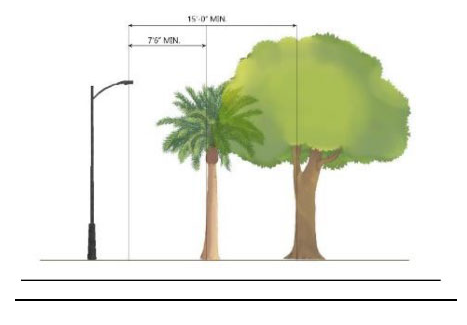
Growth of plant material at maturity shall be considered prior to planting, where future conflicts such as views, signs, overhead, above-ground and underground utilities, security lighting, fire access, drainage easements and traffic circulation, might arise. All shade trees must be located a minimum of fifteen (15) feet from street lights, and palms and small trees must be located a minimum of seven and one-half feet (7'—6").
(10)
All shade trees installed within fifteen (15) feet of public infrastructure shall utilize a root barrier system, as approved by the City.
a.
Trees or palms shall not be proposed within five (5) feet of infrastructure, hardscape, or water feature(s); and
b.
Trees/palms shall maintain a minimum trunk setback of five (5) feet from adjacent roadway, pavement, structure or dwelling.
(11)
The City may grant written permission to allow the planting of trees or shrubs less than the required sizes outlined in this Article or an allowance of a reduced tree replacement mitigation for sites that were previously unsustainably planted upon written request from the Landscape Architect-of-Record. In order to establish proposed trees and palms sustainably within limited planting area, root vaults shall be used to avoid modifying the width of a planting bed. In this situation, waivers will not be required.
(12)
All property other than the required landscaped strip lying between the right-of-way and off-street parking area or other vehicular use area shall be landscaped with at least grass or ground cover.
(13)
Turfgrass installation shall be completed by sodding and shall supply 100% coverage immediately upon installation.
(14)
Wherein sod installation is impractical, the City may allow seeding or sprigging with prior written approval. Grass seed shall be clean and at least 90% weed-free and free of noxious pests or diseases. The grass seed bags shall have Florida Department of Agriculture tags indicating compliance with the State's quality control program.
(15)
The eradication of nuisance vegetation existing on-site is required prior to the issuance of a certificate of occupancy. Ficus hedges may not be planted within utility easements.
(16)
Ground cover may be used in lieu of sod and shall provide a minimum of 75 percent coverage immediately upon planting and 100 percent coverage within one growing season after planting.
(17)
Vines shall be installed at a minimum supported height of thirty (30) inches immediately after planting and may be used in conjunction with fences, visual screens or walls.
(18)
Shrubs shall be installed at a minimum height of twenty-four (24) inches immediately upon planting, unless proposed beneath a ground sign at a lower elevation.
(19)
Hedges, where required for screening purposes, shall be planted with the intent and spacing to establish a continuous visual screen with no visual spaces between plants within six (6) months of planting. Plant spacing may be adjusted according to plant sizes so long as the preceding is achieved.
(20)
Small/ornamental trees shall be of ten (10) feet overall planting height at time of installation. Trees with a multiple-trunk growth characteristic shall have no more than three main trunks. All small trees shall have a minimum of thirty (30) inches of clear trunk at the time of planting.
(21)
Medium trees shall be a minimum height of twelve (12) feet overall, minimum spread of six (6) feet, and minimum caliper of 2.5 inches at time of installation. Medium trees shall be utilized in terminal landscape islands.
(22)
Shade trees shall be a minimum height of twelve (12) feet overall, a minimum spread of six (6) feet, and minimum caliper of 2.5 inches at time of installation. Only those shade trees specifically indicated as street trees on the City's preferred species list are permitted for street tree use. Any species planted outside of the City's preferred species list must be approved by the City in writing. Single-family residential property owners may not plant trees in the City swale without written consent from the Public Works, Utilities, and Engineering Departments.
(23)
Hurricane-pruned Sabal palms are prohibited. Exceptions, for good cause, may be granted by the City's landscape inspector in writing.
(24)
All palms that have significant gray wood characteristics at maturity shall have a minimum installed height of eight (8) feet of gray wood. All other palms must have a minimum installed height of 16 feet overall.
(25)
A minimum of 25% of the required trees shall be water-conserving, native plant material indigenous to Southern Florida. A minimum of 25% of the required shrubs shall be native plant material.
(26)
When the number of required trees exceeds five (5), no more than 30% of the required trees shall be of a single species.
(27)
Utility equipment, utility structures, and garbage and refuse areas shall be totally screened with landscape material, fences, or walls so as to not be visible from adjacent properties or rights-of-way.
(28)
Fence and Wall Landscape requirements:
a.
All opaque fences and walls abutting or parallel to a right-of-way, sidewalk, or bikeway require mulched landscaping, planted as a hedge along the outboard side of the fence or wall. Refer to Section 27-296(o)(d).
b.
With the exception of access gates, any fence or wall section four feet in length or greater, requires mulched landscaping, planted as a hedge along the outboard side of the fence or wall.
c.
Existing landscaping may be considered in satisfying the City's requirements for fence and wall screening.
d.
The landscaping for a fence or wall must be shown on the building permit submitted to the Building Department. A signed copy of the "Landscape Acknowledgement for Fences and Walls" form and supporting documents must accompany the permit application.
(29)
All elements of landscaping shall be installed to meet all other applicable City Code requirements and ordinances.
(b)
Non-living Landscape Material and Installation Standards
(1)
Organic mulch shall be installed around all trees and planting beds surrounding groundcover, shrubs, and hedges at a minimum depth of three (3) inches
(2)
Each tree shall have a ring of organic mulch at the perimeter of the root ball. Mulch shall not be installed on top of the root ball. The mulch ring shall be minimum of six (6) feet in diameter.
(3)
Cypress and/or colored mulches shall not be permitted. The use of mulch obtained from Melaleuca, Eucalyptus, or other invasive plant species, is encouraged to preserve native plant communities and reduce the impact on the environment.
(4)
Topsoil shall be clean and free of construction debris, weeds, rocks, noxious pests, and diseases, and exhibit a pH level of 6.5 to 7.0. The topsoil for planting areas shall be amended with horticulturally-acceptable organic material. All soils used shall be suitable for the intended plant material. The source of the topsoil shall be known to the applicant and shall be acceptable to the City.
(5)
The minimum planting soil depth shall be six (6) inches for ground covers, flowers, shrubs and hedges.
(6)
Trees shall receive twelve (12) inches of planting soil around the root ball.
(7)
Native topsoil on the site shall be retained on-site and used when there is sufficient quantity to cover at least some of the on-site landscaped areas.
(8)
Clean sand shall be used to backfill arid climate palms.
(9)
If berms are utilized, they shall meet the following standards:
a.
Berms without hedges shall be a minimum of two (2) feet in height and have a minimum slope of three-to-one (3:1).
b.
Berms shall be smooth, transitional, without awkward grade changes, and shall be both undulating and meandering.
c.
The height of a berm shall be measured from the grade of the adjacent paving on the public side (i.e., sidewalk, or road crown).
(10)
Underground Tree Vault Implementation: to install a tree root vault, at least nine hundred (900) cubic feet of soil volume shall be provided for large trees; five hundred (500) cubic feet for medium trees: and three hundred fifty (350) cubic feet for palms or a justification due to site limitations shall be provided with a maximum three-foot vault height or height for soil volume calculation. Utilize soil medium within the vault for a sustainable establishment of the subject trees/palms. Separate design standard/details are required for each root vault proposal to ensure the corresponding weight capacity is satisfied, i.e., sidewalk, roadway, water feature or other above-ground infrastructure as needed.
(c)
Irrigation:
(1)
All landscaped areas, including adjacent rights-of-way and street medians where they exist, shall be provided with an automatically-operating underground irrigation system. The irrigation system must be designed to have a minimum of 100 percent coverage, with 50 percent minimum overlap.
(2)
Irrigation systems shall be maintained to eliminate water loss due to damaged, missing or improperly operating sprinkler heads, emitters, pipes and all other portions of the irrigation system and shall not be installed or operated to overspray onto roads or pedestrian walkways.
(3)
All irrigation systems shall install rain sensors which must be maintained in operable condition.
(4)
All irrigation shall utilize potable or non-potable water. Non-potable systems shall include a treatment system to prevent rust stains.
(5)
Exemptions: Owners of single-family and dual-family residential properties planned and maintained as a Xeriscape landscape may be exempt from providing an automatically-operating irrigation system with an administrative waiver from the PZED Department. As part of any such request, the applicant shall provide a 1-year temporary watering plan in a manner acceptable to the City and subject to quarterly inspections for 1-year; all plantings shall be drought-tolerant material; and all properties shall be compliant with Florida Friendly landscaping principles.
(Ord. No. 2597a, § 3(Exh. A), 3-24-2021; Ord. No. 2620, § 2(Exh. B), 8-24-2022; Ord. No. 2023-013, § 1(Exh. A), 8-23-2023)
Section 27-255 - Minimum Requirements—All properties
(a)
Street Trees. Street trees are required in addition to all other landscaping requirements for properties requiring site plan approval and shall be planted at a minimum of twelve (12) feet overall height with a spread of six (6) feet, 2.5-inch caliper and a minimum of four and one-half (4½) feet clear trunk immediately after installation.
(1)
One shade tree shall be required for every 40 feet of street frontage, less driveway openings.
(2)
The spacing of trees from electric or utility lines must follow those guidelines established by the latest edition of the Florida Power and Light publication "Right Tree, Right Place." Trees shall be planted no further apart than 60-foot intervals and no closer than 35 feet center to center.
(3)
All street trees are to be placed in a location in accordance with the requirements of the City Engineer, Public Works Director and Utilities Director and require the use of root barriers when located adjacent to sidewalk(s), utilities, or within fifteen (15) feet of the paved street edge. The root barriers shall be installed per manufacturer's recommendations.
(4)
If insufficient right-of-way exists or insufficient clear recovery zones exist that prevent street tree installation, mitigation for the reduction in street trees made be made by donating an equivalent fair market value, which shall include the cost of the tree plus installation) for the trees not planted to the city's tree trust fund for the landscaping of public property in the City of Plantation. This value is established by the Public Works Department-Environmental Landscape Division, as amended from time to time.
(b)
Perimeter Landscaping:
(1)
All properties shall comply with perimeter buffer yard width requirements provided in Table 255-1. Exceptions may apply to development within the M-PM, Plantation Midtown zoning district, as designated in this article.
(2)
All properties shall provide perimeter landscaping to consist of one large shade tree spaced every 40 lineal feet, on average, as well as complementary shrubs and ground cover.
(3)
Distinct "view windows" may be created within the perimeter landscaping where significant public view is desired. View windows are not to exceed 60 feet in length and shall not be located within 80 feet of another view window. The remainder of the perimeter landscaping is to be planted at regular intervals to create a continuous streetscape pattern incorporating the view windows.
a.
Application of view windows may only be applied to properties with frontage exceeding 100 feet.

(4)
A fence, wall, hedge, or other durable landscape barrier shall be placed along the perimeter of the property planted a minimum of 3 feet in height when abutting an adjacent property and a minimum of 2 feet in height adjacent to rights-of-way. The remainder of the perimeter landscaping shall be covered with grass, ground cover, or other living landscape material.
(5)
If the durable landscape barrier is of nonliving material, such as a fence or wall, then a hedge, vine or other living material shall screen the street side of the barrier.
(6)
Perimeter landscape buffering requirements shall not apply to single-family and duplex lots.
(7)
Such perimeter buffers may not be counted toward interior landscape requirements.
Table 255-1: Perimeter Bufferyard width requirements1
1 Exception may apply to development within the Plantation Midtown, M-PM district, as noted below.
2 Ensure the water body follows the rules governing water districts i.e., Municipal, OPWMD, SFWMD.
(c)
Parking Lots and Vehicular Use Areas: Parking lot landscaping shall be installed in landscaped areas designed and arranged for the purposes of controlling traffic, providing shade, screening unnecessary views into and within the vehicular use areas, and separating the parking circulation and service areas.
(1)
Landscape islands shall be as specified below and located at the ends of all parking rows and interspersed throughout the entire parking lot. Interior landscape islands shall not be located more than ten parking spaces apart on average and shall be a minimum of 12 feet wide from inside of curb to inside of curb. Whereas, Terminal Landscape Islands shall be a minimum of 7 feet wide from inside of curb to inside of curb. Additionally, islands are not required in truck yards.
a.
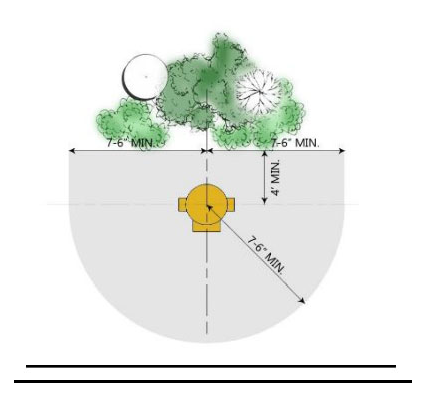
Each interior landscape island shall contain at least one shade tree in the outer half of the landscape island. Each terminal landscape island shall contain one medium tree in the outer half of the landscape island. Islands created to accommodate utilities and fire safety equipment such as fire hydrants, Siamese connections, fire department connections (FDCs) and six-inch or larger double check valves must be at least 16 feet wide measured from inside curb to inside curb, and the water line to the appurtenance must be routed immediately behind the curb to accommodate the tree planting.
b.
Islands shall be excavated a minimum 36 inches to remove all road rock and filled with clean fill and topsoil to the top of the curb.
c.
A minimum of 75 percent of the trees installed in parking islands or landscaped parking bay dividers shall be shade trees.
d.
Required shade trees in parking lots must be planted in landscape islands which are a minimum of 12 feet in width and 16 feet in depth as measured from inside curb inside curb, except where they are located contiguous with a perimeter buffer or landscaped parking bay divider, in which case they may be ten feet in width as measured from inside curb to inside curb.
e.
All landscaped areas abutting front-end parking and landscape islands shall be protected by continuous type "D" or "F" curbing. Wheel stops may be used for perimeter parking.
(2)
Fifteen percent (15%) of the total paved vehicular use area (not including truck yards, entry/exit drives, or driveway openings) must contain landscaped green space. Credit may be granted for landscaped green space located adjacent to the parking lot which is not counted towards the minimum requirement for plot or perimeter bufferyards.
(3)
Ten (10) foot wide landscaped parking dividers are required in all parking lots when parking directly abuts adjacent drive-aisles and for every other bay which has head-to-head parking and may be counted towards meeting the interior parking lot green space requirement. However, if trees are planted in the divider to meet the tree requirement, the bottom of the landscape divider shall be not less than six (6) inches below the adjacent paving edge.
(4)
With the exception of trees planted in paved areas with the use of a suspended pavement system, no landscaped area shall have a dimension less than five (5) feet.
(5)
All vehicular use areas shall be screened from the view of adjacent property with a continuous hedge except at points of vehicular and pedestrian ingress and egress. All landscaping shall be kept in a healthy growing condition at all times.
(6)
Other vehicular use areas, including areas used for parking or other vehicular uses and parking areas serving residential dwellings, shall conform to the minimum landscaping requirements herein provided.
(7)
Temporary real estate sales structures and related parking area(s) requirements. The plot area(s) to be landscaped shall be the area adjacent to the sales structure and associated parking area as follows:
a.
Fifteen (15) feet on the front, sides, and rear of the proposed sales location, as measured from the side of the building or perimeter of the parking lot, whichever is greater.
b.
Minimum plot size shall be 5,000 square feet
c.
Three (3) trees and ten (10) shrubs shall be planted for every 1,000 square feet or fraction thereof of plot area.
(d)
Landscape Pedestrian Zones (LPZs)
(1)
Principal buildings shall contain an LPZ along the full length of each building facade that fronts parking, drive aisles or other vehicular use areas (excluding truck courts/loading areas, drive-thru and escape lanes). Minor encroachments into the LPZ, that is, measuring 3 feet or less, such as building columns or balconies that do not impede the growth of the required plantings, may be acceptable. An outdoor seating area for a restaurant that is located within an LPZ may interrupt the continuity of the LPZ provided that the design is deemed acceptable during the site plan review process, if additional required greenspace and/or trees are sustainably planted elsewhere on the site.
(a)
Façade renovations that encroach into an existing LPZ will need to adhere to the Master Site Plan in terms of maintaining the required width for at least 75% of the LPZ length and having the required amount of trees, palms, and shrubs.
(2)
The width of the LPZ, except for uses as indicated in Table 255-2, shall be 50 percent of the height of the building or 10 feet, whichever is greater, up to a maximum width of 30 feet. Height for this purpose shall be measured to the top of a parapet wall or one-half of the roof height for a pitched roof.
(3)
Sidewalks may not be counted towards meeting the required LPZ width; however, walkways that connect the sidewalk parallel to the building to the building entrances shall be permitted.
(4)
Landscape pedestrian zones are not required within the Single-Family Residential, Duplex Residential, or Utility zoning districts, as defined in Section 27-71.
Table 255-21
1 Flexibility in LPZ width may be granted for properties located within the Plantation Gateway districts, as needed, as denoted in Section 27-93.
2 Use of living green walls, suspended pavement systems, or other alternative methods may be used to meet the intent of the landscape pedestrian zone with approval from the Public Works Department during site plan review.
(5)
One shade tree (or group of three palms), are required for every 30 lineal feet of the LPZ.
(6)
Installed minimum amounts and sizes of trees shall relate to the building height as per Table 255-3.
Table 255-3
1 One shade tree (or group of three palms, or one palm tree that qualifies for 1:1 usage) is required along the frontage and sides that abut public parking. These trees can be grouped where appropriate.
2 Unless there is an arcade or colonnade adjacent to the building façade.
(e)
Common Areas
(1)
Common areas within residential and mixed-use zoning districts, including, but not limited to, amenity courts, tot lots and recreational areas, shall have one (1) shade tree and twenty (20) shrubs shall be planted for every 2,000 square feet or fraction thereof of plot area.
(2)
Active recreation play courts must be screened on all sides visible from adjacent properties with a contiguous hedge at least two feet in height at the time of planting. Such plantings shall be outside the fence enclosure (where one exists) or a minimum of six feet off the outside edge of the paved court.
(3)
All ground-mounted equipment, including, but not limited to, electrical/mechanical equipment, storage areas, walls, fences, dumpster enclosures, compactors, and common trash receptacles shall be screened from view using trees, shrubs, and/or hedges in addition to the common area requirement noted above.
(4)
Perimeter landscaping, street trees, irrigation, and sod, at a minimum, is required for all demolition projects in the City. All unbuilt parcels and outparcels must be treated with such landscaping prior to issuance of the first certificate of occupancy (C.O.) on the site or within 30 days of a completed demolition on land cleared for mixed-use, retail or office development. Outparcels which are not anticipated to be developed within one year may be sodded with Bahia sod without irrigation.
(f)
Flexibility in Landscape Design In an effort to reduce requests for waivers and variances, and in recognition of practical difficulty situations, such as limited spaces for planting consistent with common horticultural practice, landscape architects-of-record may propose to shift the location of trees, palms, and shrubs utilized to satisfy the various individual requirements delineated above, between those requirements, if those subject shifted locations better conform to proper horticultural standards and if the overall quantities of plant materials remain balanced. In other words, for example, if the property is required to have 10 street trees and 12 plot trees, but there are existing conditions or proposed design challenges in the placement of the street trees, then a plan showing 8 street trees and 14 plot trees could be administratively approved by City Staff or the DRC, without the need to request landscaping variances or waivers. In addition, flexibility will be afforded to projects that provide housing that is deemed affordable/workforce.
(g)
Landscape design in the Gateway Districts Pursuant to Section 27-93(c)(5), landscape architects-of-record may propose to reduce the required amount of trees, palms and shrubs and/or the required widths of planting areas, provided that the DRC agrees that the intent of the requirements are met.
(Ord. No. 2597a, § 3(Exh. A), 3-24-2021; Ord. No. 2620, § 2(Exh. B), 8-24-2022)
Sec. 27-256. - Minimum Requirements—Non-residential properties.
(a)
Accessway landscaping. The intent of this section is to provide enriched landscaping at the public entrances to non-residential projects. The street tree requirement may be combined with the accessway planting requirements in the entryways to provide well-integrated design solutions. The following requirements are in lieu of the perimeter bufferyard requirement.
(1)
Accessway zone. The accessway zone extends from the paving edge of the entry drive (not radius) for a distance equal to half the right-of-way width of the roadway on both sides of the entry. The zone also extends perpendicularly 25 feet from the right-of-way of the adjacent roadway along the entry drive and includes medians where provided. A minimum zone length of 40 feet per side is required for rights-of-way of less than 80 feet wide.
(2)
Accessways affected. All accessways designed for public entry are included. Service drives used exclusively for service access are exempted from this regulation.
(3)
Planting requirements. The accessway zone requires two (2) shade trees and four (4) small trees per 40-foot section of the zone. The use of Florida #1 (1:1) palms is encouraged. Large shrubs may be substituted for the small tree requirement in the accessway zones. Entryway medians require three (3) trees together with shrubs or groundcovers which cover the entire zone. A minimum ten foot wide planting bed containing low shrubs and/or ground cover must also be provided fronting the taller plantings in the accessway zone and must extend a minimum of five (5) feet beyond the small tree/large shrub mass. Alternate design schemes that meet the intent of this section may be approved at the discretion of the Public Works Director.
(Ord. No. 2597a, § 3(Exh. A), 3-24-2021)
Sec. 27-257. - Minimum requirements—residential properties.
(a)
Single family Residential Properties. Shade trees are required per single family residential lot in addition to all other landscaping requirements and shall be a minimum of 12 feet overall height with a spread of 6 feet, 2.5-inch caliper, and a minimum of four and one-half feet clear trunk immediately after installation. The following requirements shall apply.
(1)
A cluster of three (3) palm trees may be used to equal one (1) shade tree. No more than 30% of required trees shall be palm trees to meet minimum shade tree requirements.
(2)
Minimum number of plantings shall be determined by Table 257-1.
(3)
Existing fruit trees reaching a mature minimum canopy spread of 30 feet or two (2) fruit trees having a minimum height of 8 feet may be used to meet one (1) shade tree requirement on a case-by-case basis with written permission from the Public Works Department.
(4)
All new single-family residential construction or modifications (not including re-roofing) to existing buildings exceeding ten (10) percent of the appraised value shall meet the minimum Landscape requirements.
Table 257-1
(b)
Multi-family Residential Properties. Shade trees are required in accordance with the pedestrian landscape zone requirements and Table 255-3. In addition, play lots and passive recreational areas must comply with the Common Areas landscape requirements found in Section 27-255(e).
(Ord. No. 2597a, § 3(Exh. A), 3-24-2021)
Sec. 27-258. - Minimum Requirements—Mixed-Use properties.
(a)
M-PM. Landscaping in a M-PM district is intended to reinforce community identity, minimize visual blight and noise, maintain building and property values, prevent soil erosion, reduce stormwater runoff, reduce air pollution, increase ground water recharge, create shade and reduce solar overheating. Landscaping requirements shall adhere to the requirements of this Article unless otherwise specified below.
(1)
A cohesive planting theme should emanate throughout the M-PM District. Plantings, layout, and style should not conflict within the M-PM.
(2)
Shade trees are required in the planting areas along all streets, particularly in the absence of colonnades or awnings that provide shade directly over a sidewalk. It is desirable for street trees opposite each other to have their branches grow into each other to create a canopy effect over the street.
(3)
Bufferyards shall not be required adjacent to areas that would offer a natural extension of the M-PM District or that are compatible with the M-PM District as determined by the Public Works Director. This is meant to facilitate the interconnectedness of compatible uses.
(b)
Reserved.
(Ord. No. 2597a, § 3(Exh. A), 3-24-2021)
Sec. 27-259. - Minimum Requirements—Monument Signs.
All monument signs shall be sufficiently landscaped to conceal the base and enhance the aesthetic value of the sign. Applicants are encouraged to exceed the minimum monument sign landscaping requirements required in Table 259-1. The following requirements shall apply:
(a)
A minimum of one tree or three palms shall be provided for each monument sign.
(b)
A combination of shrubs, ground cover, and/or annuals shall be used to enhance the design.
Table 259-1
(Ord. No. 2597a, § 3(Exh. A), 3-24-2021)
Sec. 27-260. - Tree Care and Maintenance Standards—All Properties.
(a)
All landowners, or their agents, shall be responsible for the maintenance of all landscaping including abutting rights-of-way, swales, lake and canal banks. It shall be the responsibility of the adjacent property owner to maintain the swale area to the edge of pavement or the edge of water. Landscaping shall be maintained in accordance with the following standards:
(1)
Landscaping shall be free of debris and maintained in a good condition so as to present a healthy, neat and orderly appearance at least equal to the original installation and shall be mowed or trimmed in a manner and at a frequency so as not to detract from the appearance of the general area.
(2)
Landscaping shall be maintained to minimize property damage and avoid public safety hazards and shall include removal of dead or decaying plant material, removal of low hanging branches and those obstructing street lighting, and maintenance of clear sight distance standards.
(3)
Landscaping shall be kept free of visible signs of insects and disease and appropriately irrigated and fertilized.
(4)
Landscaping shall be maintained free of invasive and nuisance species. Privately owned natural areas shall be included in this requirement.
(5)
Grass shall be maintained no higher than six inches. All roadways, curbs, and sidewalks shall be edged to prevent encroachment from the adjacent turfed areas. Line trimmers shall not be used to trim turf abutting trees or other plant material.
(6)
In no case shall grass clippings, vegetative material, and/or vegetative debris be washed, swept, or blown into stormwater drains, ditches, conveyances, water bodies, wetlands, sidewalks or roadways. Any material that is accidentally so deposited shall be immediately removed to the maximum extent practicable.
(7)
Shrubs, including hedges, shall be kept trimmed to a height not to exceed three (3) feet when adjacent to any sidewalk or pavement and shall provide unrestricted visibility at driveways and street intersections, in conformance with clear sight triangle criteria. This requirement does not apply to perimeter hedges which are included under 27-255(b)(4).
(8)
All developers, developer agents, contractors or their agents, and homeowners, must prune trees in accordance with the standards set forth in American National Standards Institute (ANSI) A-300, and Z-133, current edition and obtain a tree trimming permit from the Department of Public Works. If the pruning is tree abuse and causes tree removal due to damage, a permit for tree removal shall be required from the City and may be subject to fines as noted in Section 27-267.
(9)
Each application for tree trimming, tree relocation, or tree removal shall be accompanied by a permit fee. See Article XIII for fees.
(10)
Tree root barriers shall be installed at the sidewalk edge in those circumstances where tree roots are causing or could potentially cause a trip hazard because of sidewalk lifting.
(11)
Removal of root systems which show evidence of destroying public or private property is required. Root barriers of appropriate depth shall be utilized in lieu of removal where upheavals do not create safety problems or structural damage to buildings.
(12)
It shall be the duty of the property owner to maintain the current approved landscape and/or site plan for the property including, but not limited to, replacing dead and poorly performing plant and landscape materials. Preserved vegetation which dies following the issuance of the certificate of occupancy and/or completion shall be replaced with equivalent living plant material or trees. The City has the right to inspect all properties to ensure that landscaping has been properly installed, maintained, and irrigated in accordance with the approved landscape plan and require the property owner to make all appropriate corrections. Nuisance tree species are not required to be replaced.
(13)
The property owner has 60 days to replace all substandard and missing landscaping to ensure compliance with this section upon notice from the city. If unable to achieve scope of work within a 60-day period, an extension may be granted based on significant progress and communication with city landscape personnel.
(Ord. No. 2597a, § 3(Exh. A), 3-24-2021; Ord. No. 2620, § 2(Exh. B), 8-24-2022)
Section 27-261 - Improper Maintenance and Tree Abuse - All properties
(a)
Any pruning performed without conformance to ANSI A-300 and Z-133 Standards shall be subject to enforcement by the City. Live palm fronds initiating above the horizontal plane, as defined in the above noted reference, shall not be removed. A certified arborist shall provide a signed consent with the tree trimming application and must be on site during tree pruning or maintenance.
(b)
The City may request that Broward County revoke a local business tax receipt (LBTR) in the event standards set forth this Article are not met by the tree maintenance provider.
(c)
The removal of diseased or dead portions (such as palm fronds) of a tree or the removal of an interfering, obstructing or weak branch of a tree which is a threat to public safety or to adjacent property is allowed. Pruning to reduce or eliminate interference with or obstruction of street lights, stop signs or traffic signals is an example of an allowed pruning activity, provided tree abuse does not occur.
(d)
Lifting may be performed to eliminate a hazard to pedestrians or to protect trees from vehicular damage only. Crown thinning is recommended to increase visibility to signage. What is regarded as excessive is species dependent; however, under no circumstances may the middle one-third of the overall height of the tree contain less than 50 percent of the foliage.
(e)
Failure to remove or properly prune a tree damaged by a natural disaster within 30 days shall be a violation.
(f)
Trees damaged by construction shall be repaired by a professional arborist in a manner acceptable to the City. The monetary value of the tree(s) before the damage and after the damage will be determined using the methodology established by the Council of Tree and Landscape Appraisers "Guide for Plant Appraisal," current edition. An additional fine equal to the difference in valuation between the before and after condition using the above noted methodology will be assessed in addition to the standard violation fine.
(1)
Immediate Notification of City: The City must be notified immediately after any damage to any tree caused by construction operations.
(2)
Prompt Repair: Necessary repairs shall be made promptly after damage occurs to prevent progressive deterioration of damaged trees.
(3)
Removal and Replacement of Damaged Trees: Trees which are determined by the City to be incapable of restoration to normal growth pattern shall be removed. Such trees shall be subject to replacement under the provisions of this Code.
(4)
Preservation: Any tree designated for preservation (not including bonded trees in a dripline encroachment plan) which is damaged by development activity and dies as a result of this damage shall be subject to the tree replacement requirements contained herein.
(Ord. No. 2597a, § 3(Exh. A), 3-24-2021; Ord. No. 2023-013, § 4(Exh. D), 8-23-2023)
Sec. 27-262. - Tree Removal—All properties.
(a)
Given the many benefits provided by trees, it is the intent of the City to protect this valuable resource through permitting for land clearing and tree removal. While the destruction of one tree may not have a significant environmental impact, there can be a significant deterioration of the quality of life with the removal of larger quantities of trees. In the evaluation of a tree removal permit, all attempts shall be made to preserve, relocate, and/or protect trees in lieu of replacement and/or payment into the tree trust fund.
(b)
A tree removal/relocation permit (TRP) shall be required prior to any person, natural or corporate, cutting down, destroying, removing, relocating, destructively damaging, or causing any tree to be encroached upon (within the tree's dripline) for any tree located on commercial or planned residential properties having a DBH of two (2) inches or larger and for single-family residences having a DBH of eighteen (18) inches or larger. Also, palms with Graywood of eight (8) feet or greater as well as all other palms at an over-all height of sixteen (16) feet shall require a TRP. In the event that any tree shall be determined to be in a hazardous or dangerous condition so as to endanger the public health, welfare or safety, and requires immediate removal without delay, written authorization by email may be given by the Public Works Department and the tree removed prior to obtaining a TRP as herein required. Tree stumps must also be completely removed.
(c)
Prior to the removal of any protected tree or any land clearing activity (to include potential wetland areas as designated on the City's "Floodplains and Wetlands" map of the Comprehensive Plan), a property owner or their designated agent shall obtain a permit from the Public Works Department, subject to the conditions of this Code, and shall be responsible for obtaining the necessary permits from all jurisdictional agencies in addition to the permit required by this Code. Protected vegetation includes street trees, perimeter vegetation, vegetation in parking and vehicular use areas, historical trees, any tree in a city area of particular concern, any special status category tree, and any specimen tree.
(d)
Application for a TRP or land clearing permit shall be made to the City and shall include a legal description of the property and a map showing the size and location of the site where the tree removal or land clearing activities are to be conducted. A tree survey designating all trees over three (3) inches in caliper which are proposed to be preserved, relocated, or removed shall be required.
(e)
A TRP shall not be issued for land clearing or tree removal unless one of the following conditions exists:
(1)
A site plan submitted by the applicant shows that a proposed structure, permissible under all applicable laws and regulations, can be situated on the subject parcel only if specific trees are removed or relocated; or
(2)
The tree is in such proximity to existing or proposed structures that the structural integrity of such structures is materially impaired; or
(3)
The tree materially interferes with the location, servicing or functioning of public utility lines or service; or
(4)
The tree obstructs the view of oncoming traffic or otherwise creates a substantial traffic hazard; or
(5)
The tree is diseased, damaged, or in danger of falling; or
(6)
Any law or regulation requires removal of the tree.
(f)
Approved TRPs shall be granted for a maximum of 90 days, with an extension granted based on significant progress and communication with city landscape personnel.
(g)
The City has adopted a fee schedule that establishes the permit fees associated with the implementation of this section.
(h)
Exemptions: in accordance with State law, a permit shall not be required for the removal of a tree on residential property if and only if the property owner obtains documentation from an arborist certified by the International Society of Arboriculture or a Florida-licensed landscape architect that the tree presents a danger to persons or property and shall be exempt from replacement trees in accordance with this chapter.
(Ord. No. 2597a, § 3(Exh. A), 3-24-2021; Ord. No. 2620, § 2(Exh. B), 8-24-2022)
Sec. 27-263. - Mitigation/Replacement All Properties.
(a)
Credit for Existing Landscaping Materials. Existing trees and palms in good condition that meet the size requirements of this article may be used to satisfy the minimum Tree Requirement for Single Family Residential for single-family properties.
(b)
Replacement Trees A removed tree shall be measured in diameter inches at breast height (DBH) and replaced with an equivalent tree measured at caliper. The replacement tree(s) shall be a species that has shade potential and other positive values at least equal to that of the tree being removed. A native tree species must be replaced with a native tree species. Replacement trees shall be a minimum of 12 feet in height and two and one-half inches in caliper when planted. The value of specimen trees shall be established by the methodology contained in The Council of Tree and Landscape Appraisers "Guide for Plant Appraisal," current edition.
(1)
Prior to removal, the tree(s) shall be measured in diameter inches at breast height (DBH) and replaced with an equivalent tree measured at caliper. The replacement tree(s) shall be a species that has shade potential and other positive values at least equal to that of the tree(s) being removed. A native tree species must be replaced with a native tree species. A non-native tree may be replaced by a native tree to enhance sustainability. A minimum of 30% of the replacement trees shall be a native species. Replacement trees shall be a minimum of 12 feet in height and two and one-half (2.5) inches in caliper when planted. The value of specimen trees shall be established by the methodology contained in The Council of Tree and Landscape Appraisers "Guide for Plant Appraisal," current edition.
(2)
Palms removed shall be replaced for graywood lost at minimum 8' graywood for each replacement palm. All other palms shall be replaced for total height removed at 16' height for each.
(c)
On lots to be developed, trees within the building pad including areas reserved for driveways, shall be replaced on a caliper-for-caliper basis.
(d)
Optional Cash Payment. An optional cash payment equal to the fair market value of the required replacement tree(s) paid by the applicant after approval from the Public Works Department staff that replacement of trees on-site pursuant to this subsection is not feasible.
(e)
If the trees and palms are to be removed to facilitate construction or development activities, said relocation or replacement must be completed prior to the issuance of certificate of occupancy for the construction, development site, or phase of development, as applicable. The trees and palms to be relocated or replaced on-site or off-site on private property must be maintained in a healthy growing condition and guaranteed for a period of at least one year. Trees and palms to be relocated or replaced on public property must be guaranteed and the guarantee period shall end one year from the date of acceptance by city staff.
(Ord. No. 2597a, § 3(Exh. A), 3-24-2021; Ord. No. 2620, § 2(Exh. B), 8-24-2022)
Sec. 27-264. - Tree Trust Fund.
(a)
Establishment. A tree trust line item (hereinafter referred to as the Plantation Tree Preservation Trust Fund or the "trust") is hereby established as a depository for tree removal fees and penalty money. Such money shall be utilized solely for the purpose of funding tree replacement on public property within the City of Plantation, education and applicable Arboricultural research.
(b)
Term of Existence. The Plantation Tree Preservation Trust Fund shall be self-perpetuating from year-to-year, unless specifically terminated by the City Council.
(c)
Trust Assets. All money received pursuant to the provisions of this section from public or private concerns shall be placed in the trust for the use and benefit of the City of Planation, its successors and assigns in interest.
(d)
Trust Administration. Tree trust funds shall be expended, utilized and disbursed only for the purpose designated by the budget of the City of Plantation to administer the tree preservation program pursuant to this code.
(e)
Disbursal of Assets. Tree trust funds shall be used to educate, obtain trees, landscaping, sprinkler systems and any other items or materials necessary and proper for the preservation, maintenance, relocation or restoration of tree ecosystems, on any public land in the City of Plantation. This money may also be utilized to engage support elements, such as landscape architects and may also be used to cover the expense of relocation of trees in the City of Plantation.
(f)
Exceptions. Disbursement of tree trust account funds may be used for the preservation, maintenance, or restoration of tree ecosystems on owner-occupied, single-family residential properties and right-of-way within the City of Plantation that meet criteria for the City's tree trimming program.
(Ord. No. 2597a, § 3(Exh. A), 3-24-2021)
Section 27-265 - Standards for Tree Protection During Development
The following are minimum standards necessary to protect trees and palms designated for preservation from damage during development activities after the permit has been approved.
(a)
Protection of Existing Trees and Palms: Prior to any clearing of improved, vacant or unimproved land, unless specifically exempted from this section (including land designated for conservation by Broward County and/or the City of Plantation), existing trees and palms shall have barriers constructed around them to prevent physical damage from heavy equipment and other activities incidental to development. Required barriers shall be subject to inspection by the City as a condition of permit approval and prior to any such clearing. The barriers or barricades shall be:
(1)
Large enough to include the entire area inside the outer edge or the dripline of the tree; and
(2)
Conspicuous and high enough to be seen easily by operators of trucks and other equipment; and
(3)
The minimum barricades on commercial construction projects shall be a temporary fence constructed of a minimum of 2" × 4" posts, 48" in height, with three 2" × 4" rails spaced equally. The minimum barricades on Residential construction shall be sturdy, orange, plastic barricading. Exceptions to these barricade requirements may be granted by Public Works Department based on professional judgment that the intent of this provision will be met.
(4)
Constructed as a condition of the issuance of any land clearing, building or other development permit and prior to any construction or other development activities and required to remain in place throughout the construction period. Barriers or barricades shall be completely removed from the site at the end of the construction period (immediately prior to the issuance of a certificate of occupancy by the city), unless otherwise stipulated in the approved tree preservation plan.
(b)
Clearing Trees and Vegetation.
(1)
Within the dripline of trees designated for preservation, only clearing by hand is permissible, unless otherwise stipulated in the approved tree permit.
(2)
Trees and vegetation cleared during construction or other development activities shall be stored in an area approved by the city with such area noted on the clearing and grubbing permit application.
(3)
All trees and vegetation cleared and stored pursuant to this section shall be removed within two weeks after completion of the clearing.
(c)
Other Required Protection of Trees and Understory. The developer shall protect the trees and understory plants designated for preservation in the approved tree permit from chemical poisoning, excavation and grade changes to at least the following minimum standards:
(1)
Utility line trenches shall be routed away from trees to an area outside the dripline to the maximum extent possible.
(2)
Retaining walls and dry wells shall be utilized, where needed, to protect trees from severe grade changes. For shallow fills, the fill material shall be gently sloped down to the level of the tree roots leaving the tree in a depression larger than the spread of its crown.
(3)
Parking, vehicle maintenance, storage of construction materials or debris, or cleaning of equipment shall not take place within areas marked for preservation specifically including, but not limited to, within the dripline of any individual trees. The developer or contractor shall establish regular parking and storage areas under the supervision of the city to facilitate compliance with the above standard.
(4)
Encroachment into any barricaded area is prohibited, with the exception of activities specifically permitted by the approved tree permit, including a dripline encroachment plan as established herein.
(d)
The developer shall be permitted to cut, or prune branches and roots of trees designated for preservation only under the supervision of a certified arborist in accordance with the standards for pruning, as established by the American National Standards Institute (Publication ANSI A-300 and Z-133).
(e)
Root System Protection. The root systems of trees shall be protected as follows:
(1)
Excavation within the Dripline: The Public Works Department may approve a dripline encroachment plan (a request to excavate within the dripline of a tree).
(2)
Standards for Root Protection: the city may establish additional standards for root protection consistent with this code. If roots are exposed, the developer shall provide temporary earth cover mixed with peat moss and wrapped with burlap to prevent exposed roots from drying out before permanent backfill is placed. The developer shall also water, maintain in moist condition, and otherwise temporarily support and protect the tree or root from damage until the tree or root is permanently covered with earth.
(3)
Protection of the Tree Root System: the developer shall protect tree root systems from damage due to noxious materials in solution caused by runoff, or spillage during mixing and placement of construction materials, or drainage from stored materials. The developer shall also protect root systems from flooding, erosion or excessive wetting resulting from dewatering operations.
(f)
Trees Damaged During Construction: Trees damaged by construction must be repaired by a professional arborist in a manner acceptable to the city. The standard violation fine will be assessed for each tree damaged on site.
(1)
The Public Works Department must be notified immediately after any damage to any tree damaged by construction operations.
(2)
Such repairs as necessary shall be made promptly after damage occurs to prevent progressive deterioration of damaged trees.
(3)
Removal and Replacement: Trees which are determined by the city to be incapable of restoration to a normal growth pattern must be removed. Such trees shall be subject to replacement under the provisions of this code.
(4)
Any tree designated for preservation (not including bonded trees in a dripline encroachment plan) which is damaged by development activities and which dies as a result of this damage shall be subject to the tree replacement or removal requirements contained herein.
(g)
Exemptions:
(1)
Licensed plant and/or tree nurseries shall be exempt from the terms and provisions of this article only in relation to those trees planted and growing on site for wholesale and/or retail sale purposes in the ordinary course of said licensee's business.
(2)
All governmental and private nurseries, with respect to trees which have been planted and are growing for future relocation, are exempt from this section.
(3)
During emergency conditions caused by a hurricane or other natural disaster, or to protect the public safety, the provisions of this section may be suspended by direction of the Mayor.
(4)
Nuisance trees, as defined herein, are exempt from the provisions of this section, except for pruning standards and the requirement to obtain a TRP prior to their removal; however, a fee shall not be assessed for this TRP.
(5)
Trees destructively damaged or destroyed by an act of God or an act of war as well as small trees which are less than three (3) inches in caliper are exempt from this section.
(6)
Trees already planted on vacant residentially-zoned property may be relocated but not subjected to dripline encroachment. A TRP is required for relocation of all trees with a DBH of three (3) inches or larger. All tree removal shall require a TRP pursuant to this section.
(7)
Undue Hardship/Practical Difficulty for owners of single and dual-family residences may be considered if the following characteristics are present:
a.
Special conditions or circumstances do not result from the deliberate actions of the applicant or property owner of the subject property to establish a circumstance or condition which is not otherwise consistent with Landscape Standards.
b.
The request is due to unique circumstances of the property, the property owner, and/or the applicant which would render conformity with the Landscape Standards unnecessarily burdensome.
c.
The justification narrative, supporting documents and exhibits will need to be submitted to the Public Works—Environmental Landscape Division for administrative review.
(Ord. No. 2597a, § 3(Exh. A), 3-24-2021; Ord. No. 2620, § 2(Exh. B), 8-24-2022))
Section 27-266 - Appeals and Variances
(a)
Appeals Appeals from the decision of the Public Works Director regarding compliance with any landscaping provisions, other than those in Sections 27-255, 27-256 or 27-258, shall be filed in accordance with procedures established in subsection 27-52(1)(2)(a—d).
(b)
Variances Variances from provisions in Sections 27-255, 27-256 or 27-258 shall be filed in accordance with procedures established in subsection 27-52(a)—(i), unless the request may be resolved by mitigation methods through the DRC process or addressed through an administrative variance procedure in subsection 27-52(h).
(Ord. No. 2597a, § 3(Exh. A), 3-24-2021; Ord. No. 2620, § 2(Exh. B), 8-24-2022)
Section 27-267 - Fines
(a) Permits Tree and palm permits such as Tree Trimming, Relocation and Removal permits (TRPs) are required for all landscaping done in the City of Plantation. All planned residential developments must obtain a landscape permit for the individual lots, and a separate tree permit for the common areas including the street trees.
(b) Enforcement City staff enforces the terms of this Article by making the necessary site inspections. This includes promptly stopping any work attempting to be done without, or contrary to, any development approval required under this code, and ensuring that any work not performed in accordance with a development approval is corrected to comply.
(c) Violations and Penalties Each violation of this code, or any of its subsections, is deemed a separate and distinct infraction of the Land Development Regulations. Each violation of this code shall be punishable by a fine of $500.00 plus the costs associated with investigation and prosecution, together with the cost of replacement tree(s) and/or palms as established in Section 27-255. The removal, relocation or destruction, including dripline encroachment, of each tree or palm in violation of this code shall constitute a separate offense under this code. Each tree to be protected may be the subject of individual enforcement. The owner of any property where a tree or trees or palm(s) have been cut down, destroyed, removed, relocated or destructively damaged shall be held strictly liable for a violation of this code unless it can be proven that the damage was caused by:
(1)
An act of God;
(2)
An act of war;
(3)
Development activities on the property pursuant to an approved tree permit; or
(4)
The property owner alleges that the damage was caused by vandals or trespassers and has filed a police report for the incident and had taken reasonable security measures to prevent unauthorized access to the property.
(d)
Stop-work Order The City reserves the right to issue an order to cease and desist any work being performed in violation of this Article or any permit conditions established under this code. Upon notice of such violation, no further work shall take place until appropriate remedial action is instituted, as determined by the City.
(e)
Withholding or Revocation of City Permits Failure of any party to follow the procedures as required by this code shall constitute grounds for withholding or revoking development approval(s), building permits, certificates of occupancy or any other City approvals necessary to continue development. Such extraordinary sanctions, however, shall be instituted immediately upon the direction of the Mayor and with the approval of the City Council at its next regular or special meeting. This approval shall be considered a public hearing and be subject to the applicable procedural requirements. All interested parties shall be given proper notice and an opportunity to be heard and to be represented by legal counsel.
(Ord. No. 2597a, § 3(Exh. A), 3-24-2021; Ord. No. 2620, § 2(Exh. B), 8-24-2022)

