
Plantation City Zoning Code
ARTICLE VI
USE REGULATIONS
Sec. 27-71.- Zoning districts.
(a)
Purpose. In order to effectively protect and promote the general welfare and to accomplish the purposes of the City's comprehensive plan, land use element. The city is divided into districts of such number, shape and area, and of such common unity of purpose, adaptability and use that are deemed most suitable so as to provide for the best general civic use and promote improved wholesome, harmonious and economic results in civic service, activities and operations. There are hereby imposed upon the land and structures located and uses to be conducted within such districts, such further regulations as are necessary or appropriate to limit the location, use and occupancy of buildings, structures and land to be used for commerce, industry, residential, community or other purposes. References to the land use plan and land use plan map shall refer to those portions of the City of Plantation's adopted comprehensive plan as may be amended.
(b)
Division of city into districts. For the purpose of regulating the use of land, water, building, height, bulk, population density, the intensity of use and open space, the City of Plantation is hereby divided into the following districts:
Residential Districts (R)
Estate (RS-1EP)
Estate (RS-1A)
Single-Family Residential (RS-2B)
Single-Family Residential (RS-2K)
Single-Family Residential (RS-3C)
Single-Family Residential (RS-3D)
Single-Family Residential (RS-3F)
Single-Family Residential (RS-3G)
Single-Family Residential (*RS-3K)
Single-Family Residential (RS-3K)
Single-Family Residential (RS-4G)
Single-Family Residential (RS-4J)
Single-Family Residential (RS-4K)
Single-Family Residential (RS-5G)
Single-Family Residential (RS-5H)
Single-Family Residential (RS-5I)
Single-Family Residential (RS-5J)
Single-Family Residential (RS-5K)
Single-Family Residential (*RS-5K)
Multi-Family-Duplex (RD-6L)
Multi-Family (RM-10N)
Multi-Family (RM-10Y)
Residential Multi-Family (RM-25U)
Mobile Home Park (RP-7W)
Commercial Business Districts (B)
Neighborhood Business District (B-1P)
Limited Community Business (B-2L)
Central Business District (B-2P)
General Business District (B-3P)
Restricted Business District (B-4P)
Commercial District (B-5P)
Institutional Educational District (B-6P)
Gateway Auto Mall District (B-AM)
Gateway Healthcare Services District (B-HCS)
Gateway Professional Office District (B-PO)
Gateway Hybrid Commercial District (B-HC)
Gateway Four Corners Commercial District (B-FCC)
Gateway Artisan Commerce District (B-AC)
Mixed-Use Districts (M)
Plantation Midtown District (M-PM)
Industrial Districts (I)
Light Industrial District (I-LP)
Large Light Industrial District (I-L2P)
Office Districts (O)
Office Park Plantation District (OP-P)
Community Facilities Districts (CF)
Community Facilities (CF-P)
Utilities District (U)
Parks and Open Space District (S)
City Park (S-CP)
Golf Course District (S-GC)
Planned Community Development Districts (PCD)
Planned Residential Development (PRD-Q)
Planned Commercial Development District (B-7Q)
Planned Residential Commercial Development District (B-8Q)
The zoning districts contained herein generally correspond by name and purpose to the categories of the City of Plantation's adopted land use plan, however; some districts may be applied to more than one land use plan category.
(c)
Water area. The water surface and land under the water surface of all canals, waterways, lakes and other water areas in the city not otherwise zoned is hereby placed in the same zoning district as the land which it abuts as shown on the zoning map. When the zoning districts shown on the zoning map are different on opposite sides of the water area, then the kind of zoning district on each side shall extend to the centerline or midpoint of the water area. For convenience of mapping and clarity, the zoning of water areas is not shown on the zoning map but is determined by the provisions of this section.
(d)
Districting of vacated ways. Where a street or alley shown on the zoning district map is hereafter officially vacated by re-platting or otherwise, the land formerly in such street or alley right-of-way shall be included within the zoning district of adjoining property on either side of said vacated street or alley. In the event such street or alley was a district boundary between two or more different zoning districts, the new district boundary shall be the former centerline of the vacated street or alley.
(e)
Boundaries of districts. Unless otherwise shown, the zoning district boundaries are the centerline of streets or alleys or the extensions thereof. Where districts are approximately bounded by subdividing lines of recorded plats, such lines or the extensions thereof shall be considered to be the district boundaries.
(f)
Zoning for annexed areas. All areas hereafter annexed into the city shall be designated the City's zoning district(s) which most closely resembles the more restrictive of the land designation of the effective land use plan or the zoning district previously applicable for the annexed area under the requirements of the previous jurisdiction, providing said zoning district is consistent with the effective land use plan. The City Council at the time of annexation shall assign the zoning district applicable to the annexed area consistent with the requirements of this Code.
(Ord. No. 2597a, § 3(Exh. A), 3-24-2021)
Section 27-72 - Residential Zoning Districts
(a)
Residential Districts These residential districts are intended to provide for residential development in conformance with the parcel's land use plan designation. A residential parcel's zoning designation shall be less intense or equal to the designation of the land use plan. The number of dwelling units permitted per gross acre of a parcel shall not exceed the total number of dwelling units permitted by the City's land use plan designation for the parcel. The uses within the zoning district shall be consistent with, but may be more restrictive than, the corresponding residential land use plan category permitted uses. All ADUs in residential districts shall be subject to the requirements and limitations of Section 27-105(a)(5).
(b)
Rural Estate District (RS-1EP) The following regulations shall apply:
(1)
Purpose of District This district is intended to permit the incidental harboring of domestic animals for use by the occupants of the dwelling to provide for agriculture, farming and ranching activities on such larger-sized lots.
(2)
Uses Permitted the following specific uses are permitted:
a.
Single-family detached homes
b.
Pool houses (accessory) subject to the limitations set forth in Section 27-105(a)(2)
c.
Urban farm activities subject to the limitations set forth in Section 27-105(d)(1)
d.
Commercial agriculture activities subject to the limitations set forth in Section 27-105(d)(2)
e.
Publicly-owned recreation buildings and facilities
f.
ADUs subject to the limitations set forth in Section 27-105(a)(1)
(3)
Dimensional standards. The dimensional standards within the RS-1EP district are outlined in Table 72-1.
* Any building or structure that exceeds twenty-seven (27) feet in height shall be subject to an increased side and rear yard setback requirement. The side and rear yard setbacks shall be increased by one and one-half (1.5 feet for each foot or portion thereof of the building or structure that exceeds twenty-seven (27) feet in height (the height of the building or structure being measured from the property's average grade to the highest point of the building or structure). Buildings and structures that received permits prior to June 22, 2011, will not become non-conforming structures.
(4)
Additional Regulations See Section 27-93(b)
(c)
Single-family residential districts (RS-1A, RS-2B, RS-2K, RS-3C, RS-3D, RS-3F, RS-3G, RS-3K, RS-4G, RS-4J, RS-4K, RS-5G, RS-5H, RS-5I, RS-5J, RS-5K, RS-3K "S" and RS-5K "S" districts). The following regulations shall apply to all RS districts other than RS-1EP:
(1)
Purpose of Districts These zoning districts are established for one-family living environment with a wide range of lot sizes to be utilized for individually-owned one-family homes.
(2)
Uses Permitted the following specific uses are permitted:
a.
Single-family dwellings;
b.
Pool houses (accessory) subject to the limitations set forth in Section 27-105(a)(2)
c.
Publicly-owned recreation buildings and facilities;
d.
Clubhouse, community center, recreational buildings, or similar structures within the property for the use of the residents and their guests;
e.
ADUs subject to the limitations set forth in Section 27-105(a)(1).
(3)
Dimensional Standards The dimensional standards within these districts are outlined in Table 72-2.
* This district contains lots which were platted under County specifications. These lots are permitted a rear setback of five (5) feet from screen enclosures of pools. Screen enclosures without pools will be governed by the normal structural setback lines.
Note: Setbacks specifically indicated on an approved plat supersede the above setback restrictions.
(d)
Multi-family (Duplex) District (RD-6L) The following regulations shall apply:
(1)
Purpose of District This district is established for two-family living environments.
(2)
Uses Permitted the following specific uses are permitted:
a.
Duplexes
b.
Single-family dwellings
c.
ADUs subject to the limitations set forth in Section 27-105(a)(1).
d.
Publicly-owned recreation buildings and facilities.
(3)
Dimensional Standards The dimensional standards within this district are outlined in Table 72-3.
(e)
Multi-Family District (RM-10N). The following regulations shall apply to the RM-10N district.
(1)
Purpose of District. RM-10N district shall be designated a multifamily district and shall be developed as planned community development.
(2)
Uses Permitted. No building or structure, or part thereof, shall be erected, altered or used, or land used in whole or part for other than one or more of the following specific uses:
a.
Multi-family dwellings.
b.
Clubhouse, community center, or similar structure within the complex for the use of complex residents.
c.
Publicly owned recreation buildings and facilities.
(3)
Dimensional standards. The dimensional standards within the "RM-10N" Multi-family District are outlined in Table 72-4 and Section 27-93 (PCD).
(f)
Multi-Family District (RM-10Y). The following regulations shall apply to the RM-10Y district.
(1)
Purpose of district. The RM-10Y district shall be designated a single family and multifamily district and shall be developed as planned community development.
(2)
Uses Permitted. No building or structure, or part thereof, shall be erected, altered or used, or land used in whole or part for other than one or more of the following specific uses.
a.
Single family detached residential uses.
b.
Multi- family dwellings.
c.
Clubhouse, community center, or similar structure within the complex for the use of complex residents.
d.
Publicly owned recreation buildings and facilities, playgrounds, playfields, parks and marinas.
(3)
Dimensional standards. The dimensional standards within the "RM-10Y" residential multi-family district are outlined in Table 72-5 and in Section 27-93 (PCD).
(g)
Multi-Family District (RM-25U). The following regulations shall apply to the RM-25U zoning district.
(1)
Purpose of district. The RM-25U zoning district is established for medium high-density multi-family residential units and shall be developed as planned community development.
(2)
Uses permitted. No building or structure, or part thereof, shall be erected, altered or used, or land used in whole or part for other than one or more of the following specific uses:
a.
Multi-family dwellings.
b.
Publicly owned recreation buildings and facilities.
(3)
Conditional uses. The following uses may be established if first approved as a conditional use subject to the conditional use criteria of Section 27-45 of this Code:
a.
Apartment hotels.
b.
Hotels.
(4)
Dimensional standards. The dimensional standards within the "RM-25U" residential multi-family district are outlined in Table 72-6 and in Section 27-93 (PCD).
(h)
Reserved.
(i)
Mobile Home Park District (RP-7W). The following regulations shall apply to the RP-7W Mobile Home Park district.
(1)
Purpose of district. The Plantation zoning use district with the symbol RP-7W is intended to apply to areas to be used for the parking and placement of mobile home trailers containing living quarters intended for permanent occupancy on either individually owned plots or for occupancy on plots under a lease or rental for a minimum period of one (1) year.
(2)
Uses Permitted. No building or structure, or part thereof, shall be erected, altered or used, or land used in whole or part for other than one or more of the following specific uses:
a.
One (1) single-family dwelling in the form of a house trailer together with attached appurtenant and accessory structures.
b.
Sewage and water treatment, pumping and storage plants to serve an RP-7W district.
c.
Educational, recreational, service and social centers not operated for profit and intended to serve the surrounding neighborhood, or located on a plot having at least ten thousand (10,000) square feet of area and having at least one hundred (100) feet of street frontage. Any building or roofed structure shall be located at least twenty-five (25) feet from any other residentially zoned property.
(3)
Dimensional standards. The dimensional standards within the "RP-7W" Mobile Home Park District are outlined in Table 72-8.
(Ord. No. 2597a, § 3(Exh. A), 3-24-2021; Ord. No. 2024-002, § 2(Exh. B), 3-6-2024)
Sec. 27-85. - Commercial zoning districts.
(a)
Purpose: These commercial districts are intended to provide for commercial development in conformance with the comprehensive plan and allow for a variety of zoning districts to accommodate the city's business and commerce needs. The uses within these districts shall be consistent with, but may be more restrictive than, the commercial land use plan category permitted uses. These zoning districts may be applied to land designated Commercial on the land use plan map or to land which qualifies for small scale commercial pursuant to the land use plan's commercial flexibility rules.
(b)
B-1P Neighborhood Business District: This district is intended to provide for the concentration of commercial establishments in strategically located centers which will meet the shopping and services needs of the surrounding residential areas and shall be developed as a planned community development. Such an arrangement will permit the joint use of parking and service areas and will provide adequate protection to the adjacent residential areas. The retail stores permitted include primarily convenience goods, fashions, durable goods and the household items that are a daily necessity.
(1)
Permitted and Conditional uses. No building or land shall be used and no building shall be erected, constructed, reconstructed or structurally altered which is designed, arranged or intended to be occupied or used for any purpose unless permitted by the master list of business uses as set forth in Section 27-100.
(2)
Dimensional standards. The dimensional standards within the "B-1P" district are outlined in Table 85-1. and Section 27-93 (PCD).
(3)
Exceptions from minimum area and setback requirements. Where a neighborhood business district existed on the effective date of this ordinance which does not contain the minimum area or provide the minimum building setbacks required herein, but which is zoned B-1P by the terms of this Chapter, the existing building and uses therein shall not be deemed in violation of this ordinance, nor shall they be classified as nonconforming because of any such deficiency.
(c)
B-2L Limited Community Business District: This district is intended to provide for a viable and suitable commercial zoning district within a low-density residential area while protecting the integrity of the surrounding neighborhoods, the natural environment, and the lifestyle of the area.
The district is also intended to provide for the concentration of commercial establishments to meet the convenience needs of nearby residential areas and shall be developed as a planned community development. The district shall also provide for limited commercial, retail, office, and financial uses.
(1)
Permitted and Conditional uses. No building or land shall be used and no building shall be erected, constructed, reconstructed or structurally altered which is designed, arranged or intended to be occupied or used for any purpose unless permitted by the master list of business uses as set forth in Section 27-100.
(2)
Dimensional standards. The dimensional standards within the "B-2L" district are outlined in Table 85-2 and Section 27-93 (PCD).
(3)
Exceptions from minimum area and setback requirements. Where a neighborhood business district existed on the effective date of this ordinance which does not contain the minimum area or provide the minimum building setbacks required herein, but which is zoned B-2L by the terms of this Chapter, the existing building and uses therein shall not be deemed in violation of this ordinance, nor shall they be classified as nonconforming because of any such deficiency.
(4)
Compatibility and visual harmony. All buildings and structures located in the B-2L district shall be so designed, sited and landscaped as to be harmonious in architectural scale and character with each other and with adjoining residential areas including the use of similar roof treatment, building materials, colors and textures. There shall be no visible rooftop equipment. Any windows overlooking adjacent residential property must have the view obscured by landscaping.
(d)
B-2P Central Business District. The B-2P Central Business District is intended to apply to the principal concentration of retail, office, business and financial institutions in the City and shall be developed as a planned community development. The businesses and services of the central business district include many of those supplied in other types of business districts, but in a size, variety and number not generally found elsewhere. It is intended primarily for pedestrian shoppers, and those uses that are not consistent with this principal should be so located as not to interrupt the continuity of retail frontages.
(1)
Permitted and Conditional uses. No building or land shall be used and no building shall be erected, constructed, reconstructed or structurally altered which is designed, arranged or intended to be occupied or used for any purpose unless permitted by the master list of business uses, as set forth in Section 27-100.
(2)
Dimensional standards. The dimensional standards within the "B-2P" district are outlined in Table 85-3 and Section 27-93 (PCD).
(3)
Exceptions from minimum area and setback requirements. Where a neighborhood business district existed on the effective date of this ordinance which does not contain the minimum area or provide the minimum building setbacks required herein, but which is zoned B-2P by the terms of this chapter the existing building and uses therein shall not be deemed in violation of this ordinance, nor shall they be classified as nonconforming because of any such deficiency
(e)
B-3P General Business District. The B-3P general business district is intended to apply to certain arterial streets where business establishments, primarily not of a neighborhood or community service type, shall be developed as a planned community development located to serve large sections of the City and adjacent areas. Such businesses generally require considerable ground area, do not cater directly to pedestrians and need a conspicuous and accessible location convenient for motorists.
(1)
Permitted and Conditional uses. No building or land shall be used and no building shall be erected, constructed, reconstructed or structurally altered which is designed, arranged or intended to be occupied or used for any purpose unless permitted by the master list of business uses, as set forth in Section 27-100.
(2)
Dimensional standards. The dimensional standards within the "B-3P" district are outlined in Table 85-4 and Section 27-93 (PCD).
* Screen planting is required along such property lines.
(3)
Exceptions from minimum area and setback requirements. Where a neighborhood business district existed on the effective date of this ordinance which does not contain the minimum area or provide the minimum building setbacks required herein, but which is zoned B-3P by the terms of this chapter the existing building and uses therein shall not be deemed in violation of this ordinance, nor shall they be classified as nonconforming because of any such deficiency.
(f)
B-4P Restricted Business District. The B-4P Restricted Business District shall be developed as a planned community development and is intended primarily for these areas of the city that are appropriate for a limited type of business uses but which, for various reasons are not suitable for a full range of business activities. The business and service uses permitted are primarily those nonretail establishments which are necessary for the public convenience but which are not generally compatible with concentrated retail shopping.
(1)
Permitted and Conditional uses. No building or land shall be used and no building shall be erected, constructed, reconstructed or structurally altered which is designed, arranged or intended to be occupied or used for any purpose unless permitted by the master list of business uses, as set forth in Section 27-100.
(2)
Dimensional standards. The dimensional standards within the "B-4P" restricted business district are outlined in Table 85-5 and Section 27-93 (PCD).
(3)
Exceptions from minimum area and setback requirements. Where a neighborhood business district existed on the effective date of this ordinance which does not contain the minimum area or provide the minimum building setbacks required herein, but which is zoned B-4P by the terms of this chapter the existing building and uses therein shall not be deemed in violation of this ordinance, nor shall they be classified as nonconforming because of any such deficiency.
(g)
B-5P Commercial District. The B-5P Commercial District is intended primarily for those heavier type commercial uses and services which are not compatible with general retail activities, but which are desirable for public convenience and sound community development, and for wholesale, warehouse and repair establishments as well as certain manufacturing uses involving only limited processing or assembly.
(1)
Permitted and Conditional uses.
a.
No building or land shall be used and no building shall be erected, constructed, reconstructed or structurally altered which is designed, arranged or intended to be occupied or used for any purpose unless permitted by the master list of business uses as set forth in Section 27-100.
b.
The storage, distribution and wholesaling of any goods or products that may be sold at retail in any business district shall be permitted in a B-5P district regardless of whether or not such storage, distribution or wholesaling is specifically listed as a permitted use
(2)
Dimensional standards. The dimensional standards within the "B-5P" commercial district are outlined in Table 85-6.
(3)
Exceptions from minimum area and setback requirements. Where a neighborhood business district existed on the effective date of this ordinance which does not contain the minimum area or provide the minimum building setbacks required herein, but which is zoned B-5P by the terms of this Chapter, the existing building and uses therein shall not be deemed in violation of this ordinance, nor shall they be classified as nonconforming because of any such deficiency.
(h)
B-6P Institutional Educational District. The B-6P district is intended primarily for office, institutional and certain restricted commercial activities, having only limited contact with the general public, not involving the sale of merchandise at retail, except incidentally and which may be carried on with no offensive noise, smoke, odors, fumes or other objectionable conditions in structures surrounded by ample open space for yards and for the off-street parking and loading of vehicles.
(1)
Permitted and Conditional uses. No building or land shall be used and no building shall be erected, constructed, reconstructed or structurally altered which is designed, arranged or intended to be occupied or used for any purpose unless permitted by the master list of business uses, as set forth in Section 27-100.
(2)
Dimensional standards. The dimensional standards within the "B-6P" institutional educational business district are outlined in Table 85-7.
(i)
B-AM Gateway Auto Mall. The B-AM Gateway Auto Mall District has been created to promote the redevelopment of the Plantation Gateway District consistent with the goals of the Plantation Gateway Redevelopment Plan. The purpose of the district is to retain the automotive sale uses along the State Road 7 corridor and to harmoniously integrate them with community commercial uses.
(1)
Permitted and Conditional uses. No building or land shall be used and no building shall be erected, constructed, reconstructed or structurally altered which is designed, arranged or intended to be occupied or used for any purpose unless permitted by the master list of business uses, as set forth in Section 27-100.
(2)
Dimensional standards. The dimensional standards within the "B-AM" district are outlined in Table 85-8 and Section 27-93(c).
(j)
B-HCS Gateway Health Care Services. The B-HCS Healthcare Services District has been created to promote the redevelopment of the Plantation Gateway District consistent with the goals of the Plantation Gateway Redevelopment Plan. The purpose of the district is to promote and retain the Plantation General Hospital and associated health care uses along the State Road 7 corridor and to harmoniously integrate them with community commercial uses.
(1)
Permitted and Conditional uses. No building or land shall be used and no building shall be erected, constructed, reconstructed or structurally altered which is designed, arranged or intended to be occupied or used for any purpose unless permitted by the master list of business uses, as set forth in Section 27-100.
(2)
Dimensional standards. The dimensional standards within the "HCS" gateway district are outlined in Table 85-9 and Section 27-93(c).
(k)
B-PO Gateway Professional Office. The B-PO Professional Office District has been created to promote the redevelopment of the Plantation Gateway District consistent with the goals of the Plantation Gateway Redevelopment Plan. The purpose of the district is to promote and retain professional office uses along the State Road 7 corridor and to harmoniously integrate them with community commercial uses.
(1)
Permitted uses. No building or land shall be used and no building shall be erected, constructed, reconstructed or structurally altered which is designed, arranged or intended to be occupied or used for any purpose unless permitted by the master list of business uses, as set forth in Section 27-100.
(2)
Dimensional standards. The dimensional standards within the "B-PO" gateway district are outlined in Table 85-10.
Refer to Section 27-93(c) for additional requirements
(l)
B-HC Gateway Hybrid Commercial. The B-HC Hybrid Commercial District has been created to promote the redevelopment of the Plantation Gateway District consistent with the goals of the Plantation Gateway Redevelopment Plan. The purpose of the district is to promote and retain a healthy mix of community commercial uses along the State Road 7 corridor.
(1)
Permitted uses. No building or land shall be used and no building shall be erected, constructed, reconstructed or structurally altered which is designed, arranged or intended to be occupied or used for any purpose unless permitted by the master list of business uses, as set forth in Section 27-100.
(2)
Dimensional standards. The dimensional standards within the "B-HC" gateway district are outlined in Table 85-11.
Refer to Section 27-93(c) for additional requirements
(m)
B-FCC Gateway Four Corners Commercial. The B-FCC Four Corners Commercial District has been created to promote the redevelopment of the Plantation Gateway District consistent with the goals of the Plantation Gateway Redevelopment Plan. The purpose of the district is to promote and retain a healthy mix of general and community commercial uses along the State Road 7 corridor.
(1)
Permitted uses. No building or land shall be used and no building shall be erected, constructed, reconstructed or structurally altered which is designed, arranged or intended to be occupied or used for any purpose unless permitted by the master list of business uses, as set forth in Section 27-100.
(2)
Dimensional standards. The dimensional standards within the "B-FCC" gateway district are outlined in Table 85-12.
Refer to Section 27-93(c) for additional requirements
(n)
B-AC Gateway Artisan Commerce. The B-AC Artisan Commerce District has been created to promote the redevelopment of the Plantation Gateway District consistent with the goals of the Plantation Gateway Redevelopment Plan. The purpose of the district is to promote artisan related small businesses and community commercial uses along the State Road 7 corridor.
(1)
Permitted uses. No building or land shall be used and no building shall be erected, constructed, reconstructed or structurally altered which is designed, arranged or intended to be occupied or used for any purpose unless permitted by the master list of business uses, as set forth in Section 27-100.
(2)
Dimensional standards. The dimensional standards within the "B-AC" gateway district are outlined in Table 85-13.
Refer to Section 27-93(c) for additional requirements
(Ord. No. 2597a, § 3(Exh. A), 3-24-2021)
Sec. 27-86. - Mixed use zoning districts.
(a)
M-PM Plantation Midtown district.
(1)
Purpose. The M-PM district provides development standards for Plantation Midtown to promote an orderly transformation of the district from a predominantly suburban development pattern to a denser and more active mixed-use activity center characteristic of traditional town center environments. To that end, this section is based on the following general principles:
a.
Land uses should be more tightly integrated within an urbanized, mixed-use development pattern.
b.
Classification of various development types within the district is based on classifying the fronting streets rather than the blocks themselves.
c.
Development should emphasize pedestrian-friendly streetscapes with smaller, subdivided blocks and an expanded, more interconnected street network.
d.
Building forms and massing should address the fronting streets directly with minimal setbacks and active occupied frontages that support enhanced pedestrian activity.
e.
The design of the streets, parking areas, and the public realm should reinforce principles of safe neighborhood design and promote the objectives of crime prevention through environmental design.
f.
Parking should be de-emphasized by locating it at the interior of blocks and by several strategies designed to reduce the overall quantity of parking required.
g.
The architecture should reinforce the pedestrian experience and respond to the human scale by such devices as facade modulation, differentiation of the base zone, and provision of such elements as display windows, balconies, arcades, awnings, etc.
h.
Landscaping should concentrate on enhancing the streetscape experience and shading the pedestrian, with larger consolidation of green space into usable parks and plaza areas.
i.
Signage and graphics should be more active and prominent in selective areas where a more vital commercial environment is desired.
j.
Incentives are included to promote the advancement of the principles listed above.
(2)
Midtown boundaries. Area generally bounded on the west by Pine Island Road, on the east by University Drive, on the north by Cleary Boulevard, and on the south by the north right-of-way line of the North New River Canal, and including the following additional properties:
a.
The plat of American Convalescent Center, according to the plat thereof, recorded in Broward County Plat Book 69, at page 15;
b.
The plat of Barry-Smith of Broward, according to the plat thereof, recorded in Broward County Plat Book 90, at page 23;
c.
The plat of FRAM/EJD Plantation, according to the plat thereof, recorded in Broward County Plat Book 138, at page 38;
d.
The plat of ISOM Subdivision, according to the plat thereof, recorded in Broward County Plat Book 74, at page 4;
e.
The plat of Jacaranda Parcel 675, according to the plat thereof, recorded in Broward County Plat Book 105, at page 19;
f.
The plat of Jacaranda Parcel 813, according to the plat thereof, recorded in Broward County Plat Book 100, at page 2;
g.
The plat of Jacaranda Parcel 950, according to the plat thereof, recorded in Broward County Plat Book 95, at page 27;
h.
The plat of Office Villas of Plantation, according to the plat thereof, recorded in Broward County Plat Book 99, at page 49;
i.
The plat of Plantation Community Plaza, according to the plat thereof, recorded in Broward County Plat Book 80, at page 26; and
j.
The plat of Plantation Executive Building, according to the plat thereof, recorded in Broward County Plat Book 100, at page 19.
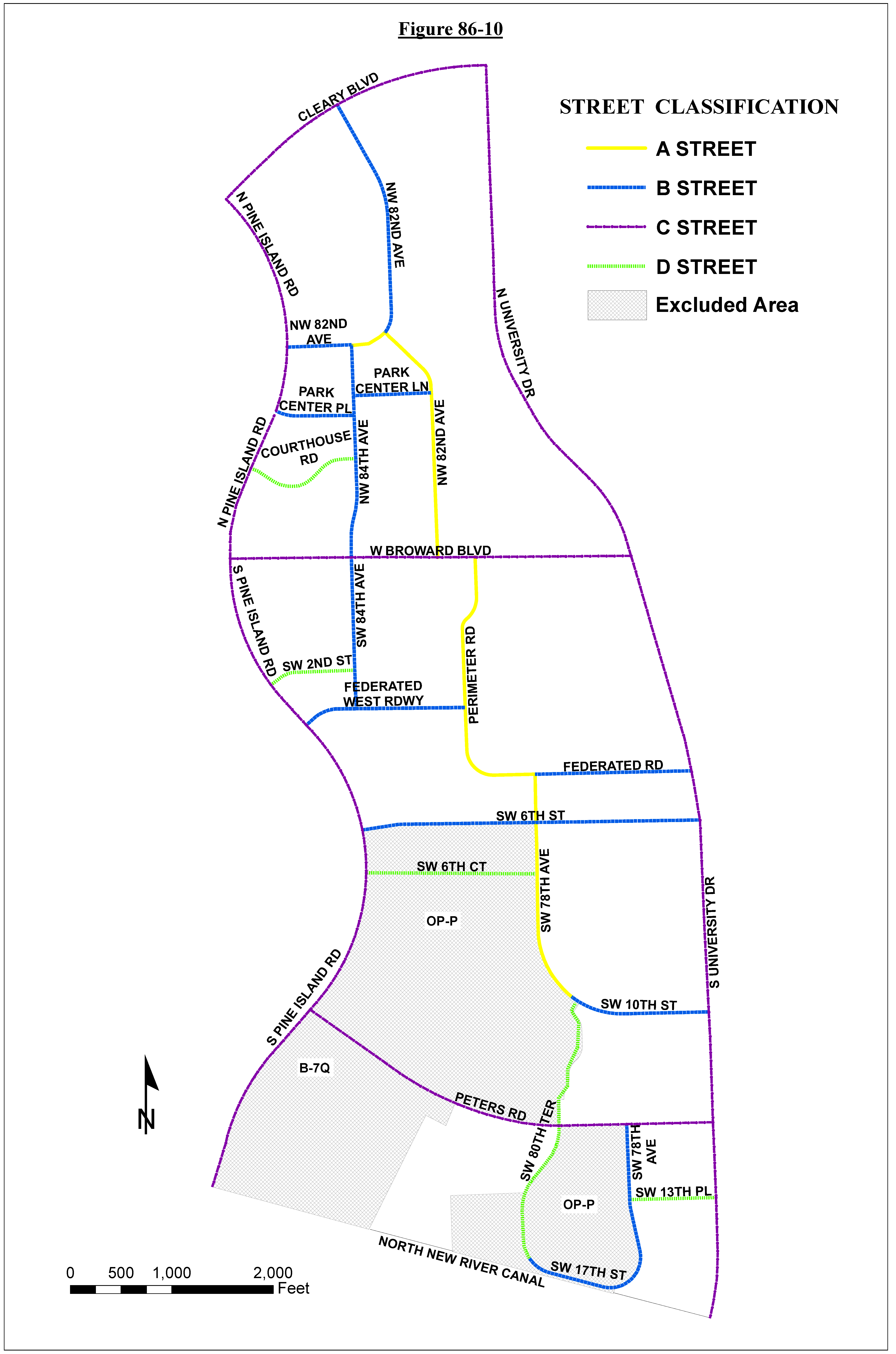
A map of the midtown district is depicted in figure 86-10.
(3)
Definitions. Terms requiring interpretation specific to this Code are defined below. These definitions are supplemental to those in the City of Plantation Land Development Regulations, Chapter 27, Article II, Section 27-11, and take precedence in the event of conflict.
Architectural feature means a structural or ornamental feature of a building or structure, including but not limited to chimneys, bay windows, cornices, coping, parapets, steps, staircases, screened utilities, and tower structures other than telecommunications towers.
Build-to line means that line to which the placement of the building frontage is mandatory.
Figure 86-1
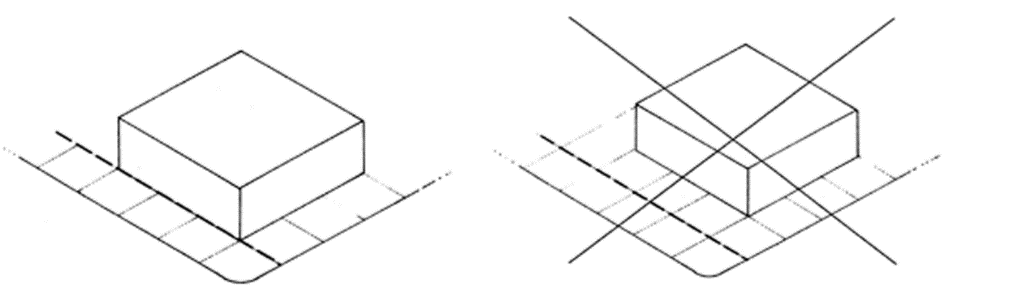
Building frontage must be placed on the build-to line
Build-to-zone means a specified area within which the placement of the building frontage is mandatory. This shall be measured from the primary building face to the back edge of the sidewalk or the property line, whichever is closer.
Figure 86-2
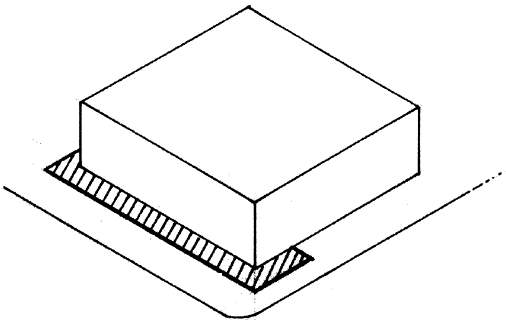
The build-to zone is shown shaded
Building footprint means the area of land covered by the building foundation to the outside of the exterior walls, including exterior space if it contains occupied space on an upper level.
Figure 86-3
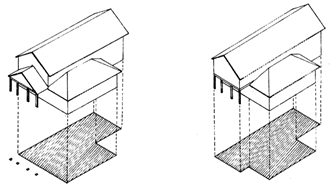
Building footprint. Exterior covered space is included if it has occupiable space
above.
Building frontage means that portion of a building's facade that fronts on a street and encompasses the ground floor elevation as well as any other floors forming a pedestal.
Figure 86-4
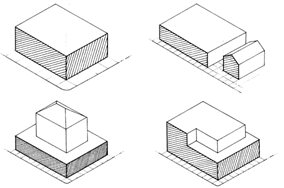
Building frontage is shown shaded.
Bulb-out means a curbed area extending into the zone otherwise occupied by curbside parking. Bulb-outs are intended to break up the length of the curbside parking lane and to provide opportunities for pedestrian crossovers or landscape beds.
Figure 86-5
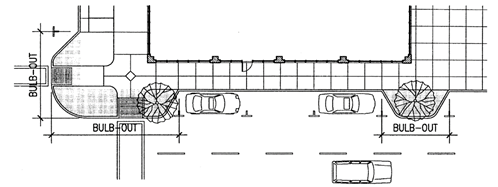
Bulb-outs are shown shaded.
Elevated building means a building that is partially or wholly constructed over a parking area. A building that is elevated not more than four (4) feet shall not be considered an "elevated building" for purposes of this Code.
Figure 86-6
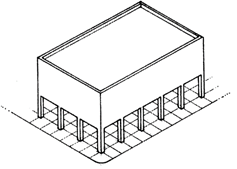
Elevated building
Equivalent site area means that portion of a site occupied by residential uses when the site accommodates several different uses in separate geographic locations.
Facade means an exterior wall of a building.
Live/work unit means a residential unit that incorporates a separate space, accessible from street level, intended for use by a business. All parts of the unit must be under common ownership and occupancy. Live/work units are not considered a residential use for purposes of density calculations.
Lot coverage means the total area covered by buildings expressed as a percentage of the total lot area. It does not include open roofed spaces such as porches, balconies, arcades, and porte-cocheres, unless those have occupied space above them.
Lot frontage means the portion of the lot abutting a public right-of-way. Where more than one (1) side of a property abuts a public right-of-way, one (1) frontage shall be designated as the primary lot frontage; generally, this will be the frontage on the highest ranked street.
Figure 86-7
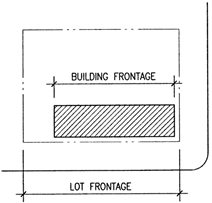
Lot Frontage and Building Frontage
Mixed-use building means a building containing two (2) or more of any permitted uses, stacked vertically. An example of a mixed-use building is one that contains ground floor retail and upper floor offices or residential or both.
Passageway means a pedestrian walkway that allows access between the front and rear of the building.
Pedestal means the lower volume of the building envelope that includes the ground floor and defines the street frontage(s.)
Figure 86-8
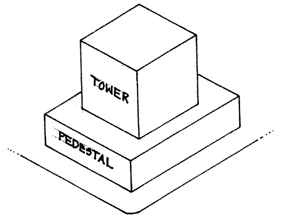
Pedestal and Tower
Public courtyard means a landscaped space or plaza on private property that has at least one side open to a public street, and is intended for public use. Building facades that face onto a public courtyard are subject to the same requirements as if facing a street.
Residential floor area means the floor space of a building that is used primarily as a dwelling unit for human habitation.
Setback means the required minimum front, side, or rear yard distance between a building or structure and the property line or private street easement line.
Story means an occupied floor or parking garage level within a building, measured vertically from its finished floor elevation to the finished floor or roof elevation immediately above.
Stoop means a set of steps and landing that lead to a building entrance.
Figure 86-9
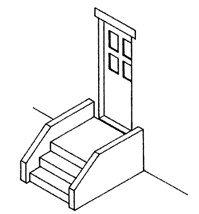
Stoop
Tower means the upper volume of the building envelope, above the pedestal.
Townhouse means any unit of a group of two (2) or more residential units built next to each other with a common party wall.
(4)
Reserved.
(5)
Administrative provisions.
a.
Administration. The provisions of this Code shall be administered and enforced by the Director in accordance with the application and approval procedures defined in this Chapter.
b.
Applicability. This Code applies to any new development in Plantation Midtown as well as any redevelopment or remodeling that alters the existing building footprint or massing on an A or B street. Interior remodeling or exterior modifications of a largely cosmetic nature need not comply with the provisions of this Section.
c.
Design approval required.
1.
Before a building permit is issued for a new or expanded building in the M-PM district, prints of drawings shall be submitted to the Planning and Zoning Board for review and recommendation.
2.
The board will review the drawings as to acceptable design of site development, buildings and aesthetic considerations intended by the requirements of this division and those described in this Section.
3.
The plan, together with the recommendation of the board, shall then be submitted to the City Council for their review and approval.
After City Council approval, application may be made to the building department for a building permit.
d.
Submittals. In addition to the normally required submittals for development approval, the developer shall include documentation for the incentives and bonuses requested along with any supporting data and calculations.
e.
Nonconforming uses. Notwithstanding anything in the City Code of Ordinances to the contrary, development constructed in accordance with a site plan approved prior to the date of adoption of this Plantation Midtown Code that is destroyed by fire, act of God, or other involuntary act may be reconstructed in accordance with that approved plan.
(6)
Permitted uses.
a.
Intent. Plantation Midtown envisions a tightly integrated mix of uses throughout the district, mainly commercial, but with a significant residential component. Uses are not allocated to specific blocks as in traditional zoning practice, but rather, are permitted throughout the district, subject to the development and performance standards established in this Code.
b.
Master list of uses. The use regulations for the district designated M-PM are found in section 27-100 of this article, entitled "master list of business and commercial uses". No building or land shall be used, and no building shall be erected, constructed, reconstructed or structurally altered which is designed, arranged, or intended to be occupied or used for any other purpose unless permitted by the provisions of section 27-100 of this article.
c.
Additional permitted uses. Certain uses are not currently included in the Master List of Business Uses of these LDR's, but are permitted in the district.
1.
Houses of worship and other related facilities such as Sunday school, rectory, parish house, etc. provided that the facilities are housed in a dedicated building or campus on land owned by the same institution.
2.
Police and public safety facilities.
3.
Drive-through lanes not associated with a food-service establishment are permitted as a conditional use.
(7)
Streets.
a.
Intent. This Code classifies the streets in Plantation Midtown according to their suitability for human-scaled, pedestrian-friendly street life. The primary focus of this Code is to promote development that reinforces the character of various streets according to the role they play in the urban whole. The type of development that occurs on any given street is determined by the street classification; this also encourages the development of both sides of the street in a consistent manner.
A central goal of the master plan is to establish a better, more coherent internal street network within the district. Many of the streets proposed in the ultimate projection of the master plan are either not existent to day or are re-aligned from their present location. Incentives are included in this Code to encourage the creation of more pedestrian-friendly streets and to break up larger redevelopment tracts into smaller blocks.
b.
Street classification. All streets, excluding undesignated streets, are classified according as A, B, C, or D streets. The classification of all designated existing streets in Plantation Midtown is indicated in Figure 86-10.
Figure 86-10
c.
General characteristics. This Code establishes development provisions intended to reinforce the qualities described below. For each street type, the right-of-way width and particular street section may vary depending on available space and other existing constraints.
1.
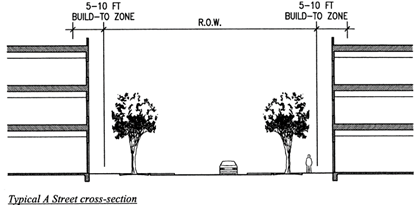
A streets. A streets are characterized by minimal setbacks, active commercial frontage at the ground floor, taller and more intensive buildings fronting the street, and a consistent streetwall. A streets typically feature a number of traffic calming measures as well as a full complement of pedestrian amenities, including wide sidewalks, onstreet parking, and well-developed streetscape. A streets are the principal "town center" streets and are intended to be well used by pedestrians, slow moving traffic, and will be the primary transit routes.
Figure 86-11
2.
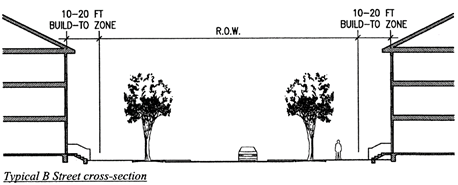
B streets. B streets are similar to A streets, although less intensively developed, but still urban in terms of pedestrian traffic, characterized by a small setback and a relatively consistent streetwall. B streets are more residential in nature, but might also have smaller scale commercial uses.
Figure 86-12
3.
C streets. C streets are the large, regional arterials bounding the district, as well as Broward Boulevard and Peters Road. They are intended primarily for efficient vehicular movement. They are characterized by large setbacks with landscape buffers, although they should also be able to accommodate access points with enhanced signage and gateway elements.
4.
D streets. D streets are more suburban in nature, characterized by larger setbacks and less building frontage. D streets are located in quieter areas, but are also used as the "back streets" for the town center areas, where elements such as surface parking, loading docks, etc. are located.
d.
Design standards. The following design standards apply to all streets within the district. They shall be used for any repaving, realignment, or other modifications, as well as for any new street segments constructed as part of a development or redevelopment project. These standards are not meant to be exhaustive; rather, they are intended to establish minimum requirements to achieve an overall design consistency. Dimensions are measured to the face of curb or to the centerline of lane, as appropriate.
1.
Roadways.
(i)
Posted speed, for any street other than the existing C streets, shall be a maximum of thirty (30) miles per hour.
(ii)
Maximum width of any vehicular moving or turning lane shall be eleven (11) feet.
(iii)
Width of any curbside parallel parking lane shall be eight (8) feet. Angled head-in parking and ninety (90) degree parking shall not be used within a street right-of-way.
(iv)
Where bicycle lanes are desired, they should occur between the curb and the right-of-way line in a manner that allocates sufficient space for pedestrians, landscaping, and bicycles with minimal conflicts.
(v)
Center medians, where provided, shall be a minimum of twelve (12) feet wide. Center medians are encouraged when feasible.
(vi)
Pavement radii shall be a minimum of fifteen (15) feet. Designs should endeavor to provide the minimum pavement radii possible.
2.
Sidewalks. Sidewalks shall be provided at all lot frontages.
(i)
Minimum sidewalk width shall be eight (8) feet. For A streets, minimum sidewalk width shall be ten (10) feet where possible. When a sidewalk is intended as a multi-use path, the minimum width shall be twelve (12) feet.
(ii)
On A and B street frontages with predominantly retail uses at the ground level, the sidewalk width should increase as needed to abut the building face directly.
3.
Curbside parking. Curbside parking should be provided wherever possible on A and B streets.
(i)
Curbside parking lane shall be designated as a dedicated use zone by the use of bulb-outs that clearly distinguish the parking from the moving lanes.
(ii)
Minimum length of any bulb-out, measured parallel to the right-of-way line, shall be twenty (20) feet when occurring at mid-block, or forty (40) feet at street intersections. The measured length of a bulb-out may include any angled curb segments, if provided.
(iii)
Parallel parking spaces shall be grouped together between bulb-outs. There shall be a minimum of two (2) and a maximum of six (6) spaces in any one (1) group. Angled parking shall be grouped a minimum of three (3) and a maximum of eight (8) spaces between bulb-outs.
(iv)
Grouping of spaces should be based on achieving a deliberate rhythm along the block face, so that, for example, bulb-outs occur at mid-block, or at the third points, or some other discernable rationale. Where a rhythm has already been established on the opposite side of the street, the parking pattern, shall, to the greatest practical extent, mirror the established rhythm.
4.
Right-of-way landscaping. The area between the curb and the sidewalk shall be landscaped in accordance with the following guidelines:
(i)
The type of landscaping shall be appropriate to the width available between the curb and the edge of sidewalk:
Less than six (6) feet: low ground cover, may be augmented by small scale trees. In general, landscape strips of less than five (5) feet in width are discouraged.
Over six (6) feet: low ground cover, augmented by larger scale trees.
Placement of any landscape materials shall maintain all required sight distances and comply with the appropriate visibility standards.
(ii)
In general, landscaping along A and B streets, or along other principal pedestrian walks, shall leave a relatively unobstructed horizontal view from normal vantage points. Dense ground covers shall remain low, and tree canopies should be well above head height.
Figure 86-13
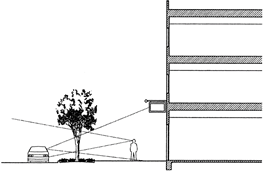
Right-of-way landscaping shall not obstruct horizontal views.
(iii)
Linear landscape elements along A and B streets should exhibit regular spacing and consistent size. Trees should be selected for their ability to shade the sidewalk.
(iv)
The amount of landscape elements should relate to the development context. Along A streets in a fairly urban commercial setting with minimal setbacks, a predominance of paving with regularly spaced trees would be appropriate, while in more residential areas with larger setbacks, larger landscape beds with more planting would be called for.
(v)
The linear elements should be augmented by accent landscaping at special features such as street intersections, entry courts, bulb-outs between parking lanes, and other such areas where opportunities for larger landscaped areas present themselves. These areas may incorporate a number of enhancements, including beds for seasonal color, benches, fountains, or public art.
(vi)
Where curbside parking abuts a landscape strip, the following should be provided:
•
A continuous paving strip abutting the back of curb, minimum two (2) feet wide, for the convenience of persons exiting the passenger side of a parked vehicle.
•
Regularly spaced paved crossovers connecting the curb and the sidewalk. Spacing should be coordinated with the specific streetscape design, but should generally not exceed forty (40) feet.
(8)
Development intensity.
a.
Residential density.
1.
Allowable density. The baseline maximum density for residential uses is twenty-five (25) dwelling units/acre.
2.
Density calculation. In general, density is calculated by dividing the total number of proposed units by the number of acres of site area. In cases where a large site under unified ownership is to be developed as several uses allocated to different areas of the site, the density calculation may be subject to an alternate method that determines the actual site area impacted by only the residential use. This calculation shall be performed as follows:
(i)
Place the actual building footprint on a site assumed to extend twenty (20) feet beyond the edges of the building on all sides. The assumed site may "fill in" irregularities in the building footprint to allow for amenity courts.
(ii)
Add site area for provided parking at the rate of four hundred (400) square feet per car, provided that no more than four (4) floors of building shall be parked on any one (1) level, e.g., eight (8) stories of residential development must be parked on at least two (2) levels of parking;
(iii)
The resulting equivalent site area to be used for density calculation is the sum of the areas determined in steps (i) and (ii) above.
(iv)
The governing density, for purposes of this Code, shall be calculated by using the lesser of the actual site area or the equivalent site area.
(v)
For sites proposing to redevelop existing structures where at least sixty (60) percent of the existing building footprint(s) will be demolished, the density calculation according to the equivalent site area is waived.
Figure 86-14
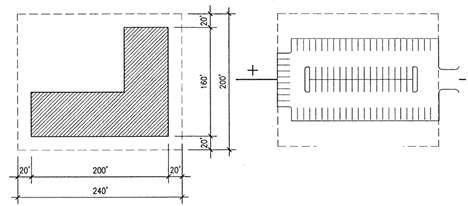
Alternative Density Calculation
If the proposed building has more than four (4) stories, the site area for parking shall assume that the parking is structured. Thus, the calculated area required for parking shall be divided by the appropriate number of parking levels (minimum of one (1) level for every four (4) floors of building) to yield the equivalent site area attributable to parking.
3.
Density increases. For sites where the equivalent site area calculation governs, the density may be increased above the baseline, up to a maximum of fifty (50) units/acre, provided that the density does not exceed the maximum gross density permitted by the City of Plantation Comprehensive Plan. The impact of the added density must be compensated by one (1) or more of the following means:
(i)
Paying a Midtown Infrastructure Fee per added unit over twenty-five (25) units/acre.
(ii)
Dedicating public open space of five hundred (500) square feet per added unit over twenty-five (25) units/acre, provided:
•
Two thousand (2,000) square feet of open space is the minimum dedication (corresponding to four (4) added units).
•
The open space must be in addition to that required by any setback and lot coverage requirements.
•
The space must be for general public use, and shall be located so that it enhances the public realm of the streets.
•
The space must be contiguous, well-proportioned, and landscaped in accordance with section 27-86 (11) of this Code.
(iii)
For buildings that integrate mixed uses vertically within the same structure:
•
Live/work units that consist of flexible office space at ground level need not be counted as units for purposes of density calculations.
•
Residential buildings that include nonresidential uses intended for independent occupancy (not related to the residential use) for at least fifty (50) percent of the ground floor area are permitted a maximum baseline density of thirty (30) units/acre. Density may be in-creased above thirty (30), to a maximum of fifty (50), by the methods described in items (i) and (ii) above.
b.
Lot dimensions.
1.
Minimum lot area.
(i)
Residential uses (including live/work units): two thousand (2,000) square feet.
(ii)
Nonresidential uses: Five thousand (5,000) square feet.
2.
Minimum lot width. Width as used here refers to the width of the lot at the front property line.
(i)
Residential uses (including live/work units): Twenty (20) feet.
(ii)
Nonresidential uses: Fifty (50) feet.
c.
Bulk and massing regulations.
1.
Building placement and frontage.
(i)
Buildings shall have their primary orientation towards the highest classified street (A is classified higher than B, and so on.)
(ii)
Building massing shall be distributed to define the block faces. A minimum width of the building, defined as a percentage of the corresponding lot frontage, shall be placed within a specified build-to zone as follows:
•
A streets: Minimum seventy-five (75) percent of lot width.
•
B streets: Minimum fifty (50) percent of lot width.
•
C and D streets: No minimum requirement.
Figure 86-15
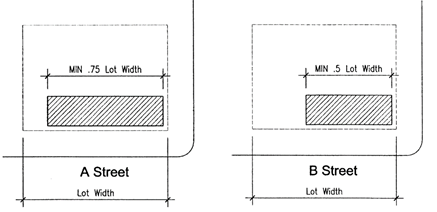
Minimum Required Building Frontage
(iii)
A minimum percentage of the lineal width of the ground floor frontage on A and B streets shall be open or glazed. Reflective or strongly tinted glazing is not permitted. The minimum aggregate width of openings is as follows:
•
A streets: minimum fifty (50) percent of building frontage. For residential uses, including live/work units, the minimum width of glazing may be reduced to thirty (30) percent of the building frontage.
•
B streets: minimum thirty (30) percent of building frontage.
Figure 86-16
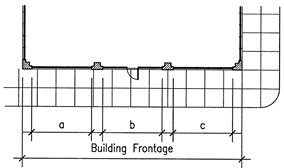
Aggregate width of opening = a + b + c
(iv)
A maximum of twenty-five (25) percent of the required frontage may be set back to form an open courtyard or plaza space. Such spaces must be continuously open to the public, and building faces defining the court space shall be considered as frontage for purposes of the minimum opening requirements stipulated above. The concentration of glazing on the courtyard elevations does not reduce the minimum glazing requirements for the street elevations.
Figure 86-17
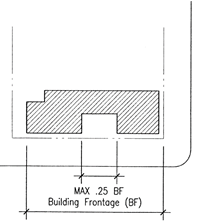
Frontage may be set back to form a courtyard or plaza space
2.
Setbacks and build-to zones.
(i)
Front:
•
A street: Build-to zone of between five (5) and ten (10) feet.
•
B street: Build-to zone of between ten (10) and twenty (20) feet.
•
C street: Setback of forty (40) feet minimum. Provided however, a minimum one hundred-foot setback shall be provided on the west side of "C Street" University Drive north of SW 10th Street and south of Broward Boulevard.
•
D street: Setback of twenty (20) feet minimum.
•
Undesignated street: Setback of twenty (20) feet minimum.
(ii)
Side: Same as front, based on the classification of the enfronting side street. Side setbacks for adjacent lots on the same block may be zero (0) feet, subject to respecting any existing easements or life safety code requirements. If at least one (1) other enfronting street of equal or higher classification is designated as the primary frontage, the build-to requirement for the street designated as the side street is waived.
(iii)
Rear: Same as front, except that if at least one (1) other enfronting street of equal or higher classification is designated as the primary frontage, the build-to requirement for the street designated as the rear street is waived.
Figure 86-18
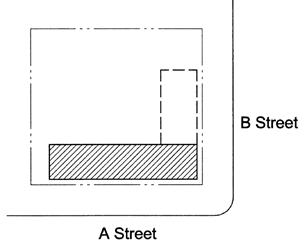
A street and B street frontage
If the frontage requirement for the A street is satisfied (hatched.) Then the B street frontage requirement (dashed) is waived.
(iv)
Notwithstanding the above, the minimum building setback for buildings abutting single family homes or a single-family zoning district shall be one and one-half (1½) times maximum building height. For the purposes of this subsection, buildings separated by a canal or local street from single family homes or a single-family zoning district shall be equivalent to abutting the single-family homes or single-family zoning district.
d.
Lot coverage and floor area ratio.
1.
The baseline maximum for lot coverage and floor area ratio (FAR) for development of a single building on a parcel of land shall be as specified in Table 86-1 below.
2.
Where multiple buildings of different heights are to be developed on a single parcel of land, the ground area to be allocated to each building for purposes of computing ground coverage and floor area ration shall bear the same relationship to the total area of the project as the floor area contained in the various buildings bear to the total floor area in the project.
For example: The total land area for a project is 20 acres. The total floor area for the project is 100,000 square feet and includes 25,000 in two story buildings (25% of the overall square footage), 30,000 square feet in three story buildings (30% of the overall square footage) and 45,000 square feet in five story buildings (45% of the overall square footage). Therefore, 25% of the total land area would be used to compute the ground coverage and floor area ratios for two story buildings, 30% of the total land area would be used to compute the ground coverage and floor area ratios for three story buildings, and 45% of the total land area would be used to compute the ground coverage and floor area ratios for five story buildings,
3.
Allowable increases. New or redeveloped projects may increase the baseline allowable coverage and FAR in accordance with the incentives listed in Section 27-86(a)(7)f below, provided that the proposed development meets all requirements for the appropriate street frontages as specified in this code.
4.
In no case shall the combined coverage of buildings and parking structures on any site exceed eighty (80) percent of the site area.
5.
The minimum floor area per dwelling unit shall be as follows:
e.
Height.
1.
Overall building height in the district is limited to twelve (12) stories, but may not exceed one hundred fifty (150) feet.
2.
For purposes of the height calculation, any minor appurtenances set back at least twenty (20) feet from the edge of the main building mass, e.g., elevator penthouses or roof-mounted equipment, need not be counted.
3.
On A streets, that portion of the building face within the required build-to zone (the street facade) shall not exceed five (5) stories or sixty-five (65) feet. Any portion of the building that exceeds this height shall be set back a minimum of twenty (20) feet from the street facade.
4.
On B streets, that portion of the building face within the required build-to zone (the street facade) shall not exceed three (3) stories or forty-five (45) feet in height. Any portion of the building that exceeds this height must be set back a minimum of twenty (20) feet from the street facade.
5.
Where a building occupies a corner at the intersection of an A and B street, the five (5) story/sixty-five-foot limit may wrap the corner along the B street for a maximum of fifty (50) feet.
Figure 86-19
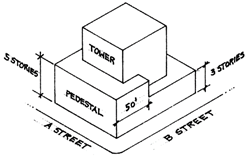
Building on corner of A street and B streets
A building on the corner of A and B streets. The tower must be set back twenty (20) feet from the building faces on both streets.
f.
Incentives. Incentives in the form of additional allowable lot coverage and floor area ratio shall be granted based on the criteria listed below.
1.
Frontage bonus. Each development parcel shall calculate the percentage of the parcel perimeter that fronts on either A or B streets. Total allowable lot coverage and FAR may be increased by that same percentage. In cases where more than one side of the lot fronts on an A or B street, the build-to requirements for the lower ranked street may be waived, but the waived frontage would not be eligible for the frontage bonus.
Figure 86-20
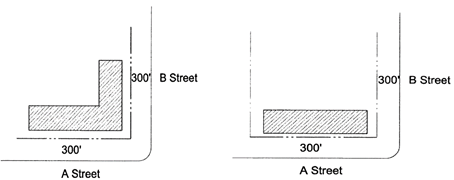
Example: A tract has twelve hundred (1,200) feet of perimeter, of which six hundred (600) feet front on streets classified as A or B. This tract is entitled to a fifty (50) percent increase in allowable coverage and FAR (600'/1200'.)
If the developer elects to waive the B street build-to requirement, only twenty-five (25) percent bonus (300'/1200') is granted.
2.
Grid bonus. Large, contiguous tracts are encouraged to be subdivided into multiple blocks, subject to the following standards:
(i)
The new street shall connect to the existing street network at both ends. No bonus is granted for culs-de-sac.
(ii)
The new street need not be deeded to the city, but it must remain accessible to the public at all times, and shall not have any access control devices.
(iii)
The minimum width of the new street right-of-way shall be sixty (60) feet.
(iv)
The minimum length of any new street segment, measured from the right-of-way lines of the intersecting streets, shall be two hundred fifty (250) feet.
(v)
The new street segments shall be reasonably straight, and shall intersect existing streets at a right angle.
(vi)
The new street segment may be classified according to the city's discretion.
(vii)
The re-alignment of an existing street segment that is considered a priority segment by the master plan shall be considered a new segment for purposes of calculating this bonus. The re-aligned segment must maintain or increase the current street classification.
(viii)
The grid bonus is calculated as follows: all new A and B street frontage created may be added to the perimeter A and B frontage and the resulting sum divided by the original parcel perimeter to determine the allowable percentage increase in coverage and FAR.
Figure 86-21
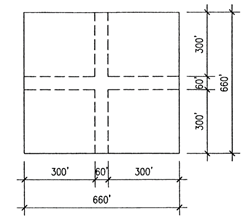
Example: A square tract six hundred sixty (660) feet on a side is subdivided into four (4) smaller square blocks three hundred (300) feet on a side by introducing two (2) new streets that bisect the tract in both directions. The original perimeter is two thousand six hundred forty (2,640) feet. The subdivided blocks create an additional twenty-four hundred (2,400) feet of street frontage. If the new streets are classified as A or B, the allowable increase in coverage and FAR is 2400/2640, or ninety-one (91) percent. The frontage and grid bonuses are cumulative, that is, if twelve hundred (1,200) feet of the original perimeter fronts on streets classified A or B, the total percentage increase would be (1200+2400)/2640, or one hundred thirty-six (136) percent.
3.
Eligibility for bonuses. The frontage and grid bonuses shall only be calculated for that portion of the frontage that is developed in compliance with the standards of this Code. In the grid bonus example cited above, the new blocks would be overly well endowed with A and B frontage. It would be difficult - but not impossible - to develop the entire frontage to the standards of this Code. For this reason, the setback requirements may be waived for A and B frontages designated as side or rear facades (subsection 27-86(a)(8)c2 above). In such cases, these side or rear frontages are not eligible to be included in the bonus calculation.
4.
Open space bonus. The allowable floor area may be increased by dedicating public open space on a two-for-one basis, i.e., the amount of allowable area increase is equal to two (2) times the area of open space dedicated. The minimum amount of open space dedication per project to be eligible for this bonus is two thousand (2,000) square feet. Open space shall comply with the design standards listed in subsection 27-86(a)(11)b.2 of this Code.
If a developer grants open space in exchange for additional density according to the provisions of subsection 27-86(a)(8)a.3.(ii), that open space may not be applied toward additional floor area.
The allowable building area may be increased by twice the area of the open space created.
Figure 86-22
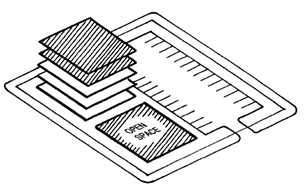
Allowable building area
(9)
Parking.
a.
Required on-site parking. All new development in the district shall provide on-site parking in accordance with the provisions of Article VIII of these LDR's. When calculating the required parking, fractional spaces shall be rounded up or down to the nearest whole number.
b.
Allowable reductions in required on-site parking. The required amount of on-site parking may be reduced in accordance with any of the following provisions. These provisions may be applied cumulatively.
1.
Curbside parking. The developer may provide curbside parallel parking spaces for any A and B street frontage abutting the site. This parking may count towards the required amount of on-site parking in a two (2) to one (1) ratio, e.g., ten (10) curbside parking spaces would reduce the on-site parking requirement by twenty (20) spaces. A minimum of four (4) curbside parking spaces must be provided to be eligible for this reduction.
2.
Mixed-use parking. For mixed uses on the same site, the parking may be shared among the uses in accordance with the following provisions:
(i)
Calculate parking required for each use separately.
(ii)
Refer to Table 86-4 for the permissible shared parking divisor for any two (2) uses. The minimum mixed-use parking requirement is determined by dividing the sum of the parking required for each use independently by the divisor indicated for that particular combination of uses.
Table 86-4
Mixed-Use Parking Divisors
Example: A mixed-use development combines residential and retail uses on one (1) site. Calculated separately, the residential requires one hundred twenty (120) spaces and the retail requires forty (40) spaces. The permissible minimum parking for both uses combined is one hundred thirty-three (133) spaces (120+40)/1.2).
(iii)
For developments that mix two (2) or more classes of uses as listed in Table 86-4 on a site (e.g., Residential and Office, Retail and Lodging, etc.), they shall be considered mixed-use, and a mixed-use parking reduction shall only be permitted for one (1) combination of uses. The developer may use whichever combination yields the largest reduction in required parking, and then add the parking required for the other uses.
(iv)
The mixed-use parking benefit is intended for uses that meet the following requirements:
•
All uses are well integrated, in close proximity, and are not physically or geographically separated,
•
Dedicated pedestrian connectivity is provided between all uses,
•
Parking for all uses is unrestricted (no temporary or permanent barriers) and equally available 24/7 without limitation, and
•
All parking areas are subject to a recordable shared parking agreement approved in advance of the building permit (excluding the foundation permit) by the city and which is binding upon all owners and mortgagees of the property affected, and which cannot be amended or released without the city's consent.
•
Regardless of the result of the shared parking calculation, the total parking on a site shall not be reduced to an amount less than that required for any use by itself.
c.
Design of surface parking areas.
1.
Surface parking areas shall be set back a minimum of fifty (50) feet from any A or B street frontage and shall, to the greatest extent practicable, be located behind the principal building face. In cases where the build-to requirements for a secondary frontage are waived (refer to subsection 27-86(a)(11)), the fifty-foot parking setback may be reduced to a fifteen-foot landscape buffer.
2.
Surface parking areas shall be separated from public rights-of-way by landscape buffers and shall have internal landscaping in accordance with the provisions of section 27-86(a)(11) of this Code.
3.
Requirements for other elements such as paving materials, lighting, drainage, etc. shall be as required by these LDR's.
d.
Design of parking garages.
1.
Parking garages are encouraged to be located at the interiors of blocks and screened from view from the street rights-of-way by being placed behind or within the principal building form.
2.
A and B streets shall have no parking garage frontage on the ground floor. For any parking garage fronting on an A or B street, the ground floor street frontage must be enclosed and occupied by some commercial use other than parking for a minimum depth of twenty (20) feet. A parking access drive may be located along such frontages, but is limited to a width not to exceed thirty (30) feet, including any associated attendant booths, ticket pedestals, etc., and may occur only once for any two hundred (200) feet of frontage.
Figure 86-23
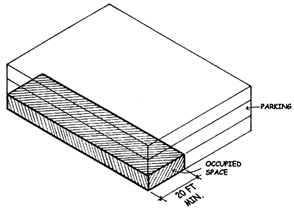
Parking garage fronting
Parking garage fronting on A or B streets shall have occupied space at the ground floor for a minimum depth of twenty (20) feet.
3.
Elevated buildings, i.e., buildings where the occupied space is located above a ground floor parking area, shall have occupied ground floor space on A and B street frontages as described in item (2) above.
4.
Upper floor elevations of parking garages fronting on A or B streets shall be treated with a high-quality architectural design and finish intended to mitigate the appearance of an open parking garage. No sloping ramps, spandrel elements, etc., shall be visible at such frontages.
(10)
Architectural requirements.
a.
Intent. Buildings shall be of substantial design and construction using high quality materials and workmanship, be site responsive, recognize local character, and have architectural features and patterns that provide visual interest from the perspective of the pedestrian.
b.
Design standards.
1.
Principal building frontage. The primary building facade must address the enfronting street, particularly when fronting on an A or B street.
(i)
A minimum percentage of the lineal frontage shall be open or glazed with clear or lightly tinted glass, as specified in subsection 27-86(a)(8)c.1.(ii) of this Code.
(ii)
Storefronts and display windows are encouraged along A frontages. There should be at least one (1) entrance accessible to the public for every one hundred (100) feet of frontage.
(iii)
Building entrances shall be architecturally emphasized.
(v)
Residential uses occurring at ground level shall have front porches or stoops when fronting on an A or B street. Units containing ground floor space shall have a principal entrance facing the street.
(vi)
The ground floor along street frontages shall be architecturally distinguished from the upper floors by such means as a change in material, scale of openings, change of plane, string courses, etc.
(vii)
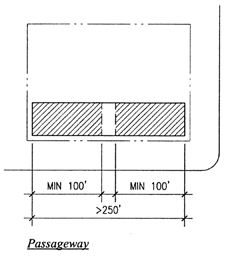
A continuous building frontage in excess of two hundred fifty (250) feet long shall include a public pedestrian passageway between the street frontage and the rear of the building, a minimum of ten (10) feet wide and located no closer than one hundred (100) feet to either end of the building.
Figure 86-24
(viii)
Arcades may be used as a means of sheltering the pedestrian way.
(ix)
The height of the frontage elevation is limited as specified in subsection 27-86(a)(8)e of this Code.
2.
Massing and composition.
(i)
Buildings should be composed of simple rectilinear forms. Overly complex or fragmented volumes should be avoided. Elements such as side wings, porticos, etc., should be clearly expressed as subordinate to the main building volume.
(ii)
Roofs may be composed of a variety of pitched roof designs, or may be flat. Flat roofs shall be screened by parapets at all street elevations. Variations in roof form and profile are encouraged for large roof areas.
(iii)
Large, blank, undifferentiated wall surfaces should be avoided. At least twenty-five (25) percent of the overall wall area should contain openings or some other means of architectural embellishment.
(iv)
Overly repetitive or monotonous facade design is discouraged. No horizontal length or uninterrupted curve of a facade should exceed one hundred (100) feet without a change in plane, material, rhythm, or scale.
(v)
Unsightly service and support elements such as loading docks, mechanical equipment, waste containers, etc., shall be located at the sides or rear of buildings and shall be screened from public view by appropriate means.
(vi)
All buildings shall incorporate a minimum of five of the following design elements:
•
Pitched roof forms.
•
Architecturally significant roof overhangs or cornices.
•
Arcades.
•
Porches. Stoops.
•
Balconies.
•
Display windows.
•
Pilasters, string courses, character lines, or other such means of subdividing the facade.
•
Structural or ornamental details clearly distinct from the primary wall surface, for example, lintels, sills, door and window surrounds, decorative panels, etc.
•
Clock or bell towers.
•
Accent elements such as porticos, cupolas, domes, or belvederes.
•
Decorative planters or planting areas a minimum of five (5) feet in width, integrated into the building design.
•
At least two (2) wall surface materials or colors.
•
Unit masonry in at least two (2) contrasting tones or textures, accomplished by a change in material or coursing.
(vii)
In special situations, architectural requirements may be waived for artistic merit, subject to the review of an independent peer group. A request for such a waiver must be made in writing to the director, stating the reasons for the request.
3.
Materials and finishes.
(i)
Exterior walls may be finished in any of the following:
•
Stucco and EIFS. EIFS should be used as a subordinate element for certain accent purposes and shall not be used at the ground floor of A or B frontages.
•
Modular unit masonry, either brick, concrete block, or cut stone.
•
Cement siding.
•
Architectural precast concrete panels.
•
Stone panels.
•
Curtain wall systems, provided that at least two (2) panel materials are included.
•
Wood siding should be limited to smaller residential buildings and should be used as a secondary material.
(ii)
Roofs may be constructed of any of the following materials:
•
Clay or cement barrel, s-shaped, or mission tiles.
•
Galvanized metal and prefinished metal panels, in standing seam, batten seam, or bermuda pattern.
•
Flat roofs may be any built-up or membrane roofing system.
(iii)
Windows and doors in a wide variety of materials and styles are permitted.
•
Curtain wall systems shall contain at least two (2) different panel materials.
•
Mirrored and reflective glass is not permitted.
•
Residential sliding glass doors are not permitted on street facades.
•
Glass block may be used for architectural accents only.
(iv)
Paving and sidewalks. Sidewalks on A and B street frontages shall consist of enhanced paving materials to be selected from the following list:
•
Concrete with integral color tone.
•
Stamped patterned concrete.
•
Brick or concrete pavers.
•
Clay tile.
•
Cut stone with an appropriately abrasive finish.
•
Washed terrazzo.
•
Plain concrete is acceptable when arranged in panels framed by other materials such as brick.
4.
Accessory buildings.
(i)
Buildings that are subordinate to the principal use on the site shall not be placed on the primary (highest ranked) frontage.
(ii)
Accessory buildings shall be architecturally compatible with the principal building.
5.
Fencing. Fencing may be used to define yard areas subject to the following provisions:
(i)
Fencing on A frontages is limited to courtyards, parking entrances, and other special conditions. In general, no fencing is permitted between the building face and the sidewalk, although ground floor residential occupancies may be fenced.
(ii)
Fencing on B frontages is permitted at ground floor residential occupancies. These fences may not be opaque.
(iii)
Opaque fencing is permitted only to screen unsightly elements such as loading zones, mechanical equipment or dumpsters and shall occur only on side or rear exposures.
(iv)
No fence shall exceed six (6) feet in height. Street frontage fencing for all-residential uses shall not exceed forty-eight (48) inches in height.
(v)
Preferred fencing material is painted metal picket fencing. Ornamental wrought iron panels and accents are also permissible. Fence panels may be separated by solid piers of brick, stone, or stucco spaced at regular intervals.
(vi)
Prohibited fence materials include chain link, wire mesh, barbed wire, plastic, and corrugated metal panels.
(11)
Landscaping.
a.
Intent. Landscaping should be appropriate for an urban context, emphasizing the built environment rather than camouflaging it. Landscaping does play an important supporting role, however, in providing shade, visual and textural relief, and recreational opportunities. Landscape design should adhere to the following principles:
1.
Landscaping at A street frontages is intended primarily to enhance the pedestrian experience and should consist of regularly spaced shade trees and low ground cover plantings. For retail frontages, no or minimal landscaping should occur between the sidewalk and the building face. In general, pedestrians should have a clear line of sight at eye level between building faces on either side of the street.
2.
On A and B streets, landscaping should play a supporting role, and help to accent and enhance the architecture. The screening of the building face with planting is neither appropriate nor desirable.
3.
For C and D streets, or for unsightly service and support functions, landscaping may be used as buffer and screen elements.
4.
Open space should be consolidated into usable park and green spaces.
b.
Design standards. These design standards are to be used in conjunction with the requirements of Article X of these LDR's. In general, this Code provides for an alternative standard that may be used in lieu of the existing standard.
1.
Landscape elements. Broadly defined, landscaping features are grouped into the following functional categories:
(i)
Screens and hedges. Dense and closely spaced plantings in a linear arrangement intended to form a visual barrier and a deterrent to access.
(ii)
Lawns. Low horizontal planting consisting of any of various species of grasses or low ground covers intended to define the ground plane.
(iii)
Trees and arbors. Trees or other plants intended to provide shade. Along streets, arbors generally take the form of a regularly spaced row of trees. In special circumstances, certain creeping or climbing plants trained onto a structure may also be used as an arbor.
(iv)
Beds. Defined areas of planting used for accent purposes that may contain a wide variety of plantings, including seasonal color. Beds may be very formal, requiring a high degree of maintenance, or may be natural areas of native species requiring minimal maintenance.
(v)
Hardscape. Any of a variety of manmade elements, including pavement, benches, lighting, waste receptacles, shade structures, public art, fountains, etc.
(vi)
Gardens. Landscaped areas containing several of the above elements arranged in a thoughtful and useful manner and suitable for passive or active use and enjoyment.
2.
Public open space. This Code is designed to place buildings close to public streets, rather than to surround buildings with yard areas. This will allow for the consolidation of the required open space into usable areas. While this open space may be in the form of private courtyards, incentives are granted in section 27-86(a)(8) to provide public open space as a community amenity. The following standards apply to public open space:
(i)
Access. The space must be for general public use at all times, with no restrictions to access. At least one (1) side shall front on a public way.
(ii)
Size. Surface area shall be a minimum of two thousand (2,000) square feet, with a minimum dimension of twenty (20) feet along any side. The area classified as open space must be open from the ground to the sky, except that up to ten (10) percent of the area may be covered by shade structures or service buildings.
(iii)
Location. Open space is most effective when contrasted against an urban context, and when defined by buildings on several sides. Open space should not be located near other open spaces. Open spaces should also be used to mark significant intersections or as forecourts for civic buildings or other buildings with a high degree of public access.
(iv)
Frontage. Any building face that fronts on a public open space shall be treated as if it fronted on an A or B street, as appropriate for the particular situation.
(v)
Design. Wide latitude is afforded the designer, but the design should be sensitive to local conditions and context. Whatever the design, the open space should be usable, people-friendly, and responsive to the local climate. Large, undifferentiated expanses of pavement or landscape areas intended primarily for ornamental use should be avoided.
(vi)
Only areas exceeding the minimum open space area requirement of twenty (20) percent of the net lot area can be considered for calculation of open space bonuses.
3.
Buffers. Landscape buffers shall be provided as described below:
(i)
The minimum width of the landscaped strip of land located between surface parking areas and an abutting public right-of-way shall be fifteen (15) feet. These buffer strips shall be planted as screens. Where they occur adjacent to a public sidewalk, they should also include an arbor.
(ii)
The width of the landscaped strip of land located between parking areas and abutting private property shall be five (5) feet. Depending on the abutting use, this buffer may be planted as a screen, lawn, arbor, or bed.
(iii)
The area between the building face and the sidewalk shall be landscaped in a manner appropriate for its use. In general, a combination of lawns and beds should be used, accented by trees, if space permits. Hardscape may also be used.
4.
Landscaping of parking lots.
(i)
At least forty (40) square feet of landscaping shall be provided for each on-site parking space. This landscaping is in addition to any buffer strips around the perimeter of the parking area, and shall be located within the overall parking lot footprint.
Figure 86-25
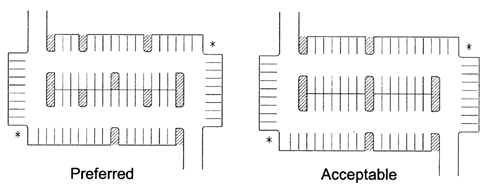
Landscape islands
Landscape islands should be distributed evenly throughout the parking lot. The corner areas indicated by asterisks (*) are considered part of the perimeter buffer and may not be counted toward the required area of parking lot landscaping.
(ii)
Landscaping and onsite water retention shall be located in such a manner as to divide and break up the expanse of paving and provide a measure of shade and visual relief.
(iii)
The minimum width of any island shall be nine (9) feet and the minimum depth shall be the equal to the depth of the adjoining parking space(s).
(iv)
Landscaping shall be located so as to enable the interconnection of parking aisles on abutting properties.
(v)
Landscape elements are generally lawns punctuated by trees, although beds may also be used. Trees used for parking lot landscaping shall be shade trees and must be a minimum of twelve (12) feet in height at the time of planting.
(vi)
The front of a vehicle may encroach upon a lawn area where the area is at least ten (10) feet in depth, immediately abuts a parking space, and is protected by wheel stops or curbing. Two (2) feet of such lawn area may be part of the required depth of each abutting parking space.
5.
Renovations. In the case of renovation development as described in this Code where the location of required landscaping is precluded by existing buildings or permanent site improvements, the placement of landscaping may occur off-site, in planters, in openings within paved areas, or in other locations as determined by the City of Plantation.
6.
The minimum open space requirement of the net lot area shall be twenty (20) percent.
(Ord. No. 2597a, § 3(Exh. A), 3-24-2021)
Sec. 27-87. - Industrial zoning districts.
(a)
Industrial Districts. These industrial districts are intended to provide for light industrial development in conformance with the comprehensive plan and allow for a variety of uses to accommodate the city's industrial and commerce needs. The uses within this district shall be consistent with, but may be more restrictive than, the industrial land use plan category permitted uses. This zoning district may be applied to land designated industrial on the city's land use plan map.
(b)
I-LP Light Industrial District. The I-LP light industrial district is intended primarily for the manufacture, processing and assembly of articles and products conducted within an entirely enclosed building and not involving the use of any materials, processes or machinery likely to cause undesirable effects upon nearby or adjacent property. The I-LP districts are also intended to encourage quality, tax base intensive, technology-based industry, including research and development, with limited office use. The I-LP districts may abut a residential or business district and the activities permitted are intended to be compatible with such neighboring districts under the yard and separation regulations provided. In order to minimize conflict and preserve the I-LP districts for their primary purposes, residential, institutional, assembly of persons, outdoor storage, personal services and retail uses are generally not permitted.
(1)
Permitted uses. No building or land shall be used and no building shall be erected, constructed, reconstructed or structurally altered which is designed, arranged or intended to be occupied or used for any purpose unless permitted by the master list of business uses, as set forth in Section 27-100.
(2)
Dimensional standards. The dimensional standards within the "I-LP" light industrial district are outlined in Table 87-1.
Note:
Area 1 That area of Section 34-49-41 lying south of N.W. 16th Street, east of N.W. 66th Avenue, north of the center line of N.W. 12th Street as shown on the plat of Plantation Sunrise Heights 3rd Addition, P.B. 50 p. 19, as extended eastward, and west of the Holloway Canal.
Area 2 - All other properties within the I-LP district.
(3)
Access and parking restrictions. Given the public street system servicing this district has been fully developed, and that most of the parcels adjacent to Sunrise Boulevard have been platted, and that Sunrise Boulevard is a major roadway, after January 1, 2010, no parcel adjacent to Sunrise Boulevard shall have additional points of vehicular access to or from Sunrise Boulevard. Provided however, that an access point existing prior to such date may be relocated, if permitted by applicable platting procedures.
(4)
Authority to defer requirements. The City Council may defer or modify the requirements of building sidewalks of this section provided the owner of the property executes an agreement which guarantees that the sidewalks will be built at such time as the City Council determines it necessary. Such agreement shall be legally binding on any subsequent owners and shall be an advance consent authorizing the city to construct the sidewalk and assess the cost of same against the property in the event the owner refuses to comply with the agreement, regardless of whether or not a special assessment relates to construction on private property. The agreement shall be capable of recordation and be satisfactory to the city attorney.
(c)
I-L2P Large Light Industrial District. The I-L2P large light industrial mixed use district is intended for the manufacture, processing and assembly of articles and products not involving the use of any materials, processes or machinery likely to cause undesirable effects upon nearby or adjacent property and large scale office uses in a campus-like setting on a parcel of forty (40) acres or more. The I-L2P district is also intended to encourage quality tax-base intensive technology-based industry, research and development, and office use. The district also permits a limited amount of commercial use to serve employees working within the campus and the general public. Shared facilities which may include an internal sidewalk network, shared driveways, plazas, shared parking areas and other amenities for the employees working within the campus are encouraged. In order to minimize conflict and preserve the I-L2P district for its primary purposes, residential, institutional, assembly of persons and outdoor storage are generally not permitted.
(1)
Permitted uses. No building or land shall be used and no building shall be erected, constructed, reconstructed or structurally altered which is designed, arranged or intended to be occupied or used for any purpose unless permitted by the master list of business uses, as set forth in Section 27-100.
(2)
Dimensional standards. The dimensional standards within the "I-L2P" large light industry district are outlined in Table 87-2.
(3)
Required conditions.
a.
Unless otherwise provided for in the Code, before any building permit is issued, development plans and information (including but not limited to a written description of proposed use or uses, site plan, floor plans, building elevations, and landscape plans) shall be submitted to the Planning Zoning, and Economic Development Department and Review Committee for comment and recommendation to the Planning and Zoning Board.
b.
The Planning and Zoning Board will review the site drawings as to acceptable design of site development, building elevations, landscaping, and lighting in accordance with the requirements of this section Article X.
c.
The plans, together with the recommendation of the Planning and Zoning Board, shall then be submitted to the City Council for its review and approval.
d.
In reviewing such site development plan, the city shall consider the following:
1.
Safe access and circulation for vehicles and pedestrians with respect to streets (public or private) and on-site parking, loading, walkways, and sidewalks (where they exist).
2.
The compatibility and impact of proposed uses upon adjacent properties. When reviewing the compatibility of a proposed use with adjacent uses, the building mass and scale, the parking impacts, degree of landscape or screening, noise, odors, and character of the uses shall be considered.
e.
The City Council may attach to its approval of the site development plan any reasonable conditions as are necessary to further the purposes of this division. After Council approval, application may be made in the Building Department for a building permit.
(4)
Architectural requirements.
a.
Intent. All buildings, regardless of use, shall be of substantial design and construction using high quality materials and workmanship, be site responsive, recognize local character, and have architectural features and patterns that provide visual interest from the perspective of the pedestrian.
b.
Design standards.
1.
Variations in color and surface texture shall be used;
2.
Buildings shall be designed to include design elements that break up the appearance of horizontal building lengths which are greater than 150 feet using design elements such as: variations in: color, materials, elevation or surface texture, by the application of cladding, banding, or other decorative elements; by the use of stepbacks; by landscape treatments or by other measures acceptable to the City Council.
3.
The face of any building fronting on a public right-of-way, as well as the face(s) of the building where the principal entrances are located, shall be treated and articulated to create a three-dimensional elevation to reduce the impact of building mass (e.g., covered entryways, recessed doors or windows [except where daylight design warrants against such elements being recessed in order to maximize the benefit of energy sources], stucco bands, stepback walls, etc.). Segmented shading or architectural elements which are allowed on the exterior of any the building facade or designed to reduce building mass may protrude into the setback area.
4.
Buildings facades fronting University Drive or Sunrise Boulevard shall contain no loading areas, overhead doors, or outdoor storage areas.
5.
Reserved.
6.
Building facades that front on University Drive or Sunrise Boulevard shall be composed of at least seventy-five (75) percent of Class 1 or 2 materials, with at least ten (10) percent of Class 1 material as the total facade. Building facades that front on other public rights-of-way shall be composed of at least thirty (30) percent Class 1 or Class 2 material, with at least five (5) percent of Class 1 material as the total facade.
7.
Metal buildings (such as butler buildings) or corrugated metal panels as a primary façade material shall not be allowed. Decorative metal panels utilized as a secondary façade material or to screen rooftop equipment shall be allowed.
8.
Corrugated metal roofs visible from the building exterior shall not be permitted. Standing seam metal roofs shall be allowed.
9.
Accessory buildings, regardless whether attached or detached from the principle building, shall be constructed of the same style, quality, and appearance as the principal building.
10.
The primary building color shall be a subdued, muted, natural or earth toned color. A brighter, non-natural color may be used for accent elements, doors, windows, and architectural details. No more than four (4) colors shall be used. Bright, highly reflective, or garish colors shall not be used. Color palates shall represent a harmonious and balanced theme, and shall not create major visual conflicts with surrounding buildings.
(Ord. No. 2597a, § 3(Exh. A), 3-24-2021)
Sec. 27-88. - Office zoning districts.
(a)
These office districts are intended to provide for institutional, service, and office uses requiring arterial or collector street access. The purpose of the districts are to accommodate well designed development sites that provide excellent transportation access and make the most efficient use of existing infrastructure. These districts restrict uses primarily to offices and ancillary uses that do not have peak weeknight or weekend usage in order to provide a buffer between residential areas and more intensive uses.
(b)
OP-P Office Park Plantation District. The primary purpose of the OP-P office park (limited commercial) district, referred to in this division as the OP-P district, is to preserve the development of large-scale planned office complexes (125 acres or more) and accessory facilities under single ownership or control which contribute to the local economy, improve the city's tax base and provide new jobs for Plantation residents and which minimize the potential traffic impact on adjoining streets and traffic and other impact on nearby areas.
The major objectives to be achieved by this district are to provide such complexes in an open space campus-like environment in harmony with adjacent and surrounding areas, to provide freedom for the designer to take a creative approach to development in a park-like setting and thereby enhance the visual quality of the city. OP-P districts may consist of a series of separate developments with special effort to coordinate design and development in terms of signage, exterior lighting, landscape and building design and architectural materials.
Districts designated OP-P shall consist entirely of offices and accessory uses in accordance with the provisions of the county land use plan and the city land use master plan; however, the entire development complex may include other separate but related developments, some with independent function and character but harmonious and integrally related to the office park though they require other zoning designations.
(1)
Permitted uses. No building or land shall be used and no building shall be erected, constructed, reconstructed or structurally altered which is designed, arranged or intended to be occupied or used for any purpose unless permitted by the master list of business uses, as set forth in Section 27-100.
(2)
Dimensional standards. The dimensional standards within the "OP-P" office park plantation district are outlined in Table 88-1.
A dash (-) means "Not Applicable"
(3)
Subdivision, Ownership and Control.
a.
Any area of land proposed for development as an OP-P office park (limited commercial) may be subdivided into lots or parcels, none of which shall be any less than two (2) acres in size.
b.
The proponent of an OP-P office park shall develop and include with the conceptual site plan for the OP-P district for the planning and zoning board and City Council review and approval, a concept description of the proposed organization and management of the office park which shall identify and define the responsibilities of any proposed management or owner or occupant association or organization and that of individual developers, purchasers or tenants.
(4)
Market data and analysis. The proponent of an OP-P district shall also submit with his application for zoning a statement of the marketability of the proposed development prepared by an economist which shall include at the minimum:
a.
The estimated market and demand for the specific type, quantity and mix of uses proposed including uses related to but not within the OP-P district, and
b.
An estimate of the rate of market absorption of the square foot area proposed in relation to the amount of completed, approved and programmed area for these uses already in the city.
(5)
Signs. A comprehensive, unified system of signage for the office park and its occupants shall be designed and presented to the planning and zoning board and to the City Council for review and approval in conjunction with the conceptual site plan for the OP-P district and related area together with details including drawings and plans showing sign dimensions, size, colors, materials, lighting, landscaping and location.
(6)
Enclosure of uses. There shall be no open outside storage of materials, supplies, products, equipment or machinery in an OP-P district except for the vehicles of employees and visitors.
(7)
Off-street parking. In a OP-P site having a minimum parcel size of 10 acres devoted to office and approved accessory retail uses, of which no more than ten (10) percent of the leasable square footage may be devoted to accessory retail uses, and where no more than twenty-five (25) percent of the leasable square footage shall consist of medical and associated uses, the parking requirements for such usages shall be reduced from whatever would otherwise be required as follows:
a.
Where such development as described herein shall be developed in phases, then the City Council of the City of Plantation may, with other approved adjacent developments, utilize the formula as described herein in the first phase or subsequent phases based on total size of such approved developments to modify or lessen the initial number of parking spaces and more reasonably allocate and locate same in relation to the total approved phased development and such uses permitted therein with such safeguards and provisions as the City Council may reasonably deem appropriate to adopt at the times of approval of the various phases of such development.
b.
In the event that the developers of two (2) or more contiguous parcels who are submitted site plans for development simultaneously propose a plan of shared parking including cross-parking agreements wherein the combined developments will provide the parking necessary for their respective use but not necessarily on the same site or parcel, a plan for such shared parking shall be prepared and submitted for planning and zoning board and city council review and approval in conjunction with site plans for the proposed developments. Cross-parking agreements shall be reviewed for compliance with any city requirements or conditions by the city attorney prior to a building permit being issued.
(8)
Compliance with ordinances. General application zoning and development ordinances, shall apply to the OP-P district. In the course of review and approval of the site and development plans, the City Council may require more restrictive conditions based on site specific considerations relating to a particular development. The City Council may waive or modify the requirements of any ordinance based upon a finding that such waiver or modification enhances the utilitarian and aesthetic aspect of a site development plan.
(9)
Unified control condition precedent to development approvals. No City Council concept approval or other development approvals are to be sought or issued until unified control documents are approved as to form acceptable to the city's legal department and recorded against such zoned lands so as to assure that such OP-P zoning will, in fact, be developed under unified control in parcels of at least one hundred twenty-five (125) acres in size so as to assure that such OP-P zoning will meet the stated purposes and intent of such districts as set forth in Section 27-88.
(Ord. No. 2597a, § 3(Exh. A), 3-24-2021)
Sec. 27-89. - Park and Open Space zoning districts (S).
(a)
S-CP City Park District. The city park district is intended to provide for the recreation and open space needs of the city. The uses within this district shall be consistent with the recreation and open space land use plan category permitted uses. This zoning district may be applied to land designated Park on the city's land use plan map. Because of the nature of uses involved and the variety of arrangements of uses and facilities, broad general regulations for plot size, yards, setbacks and height must be adequate for any location at which an S-CP district may be established.
(1)
Permitted uses.
a.
Open space and recreational uses.
b.
Parks.
c.
Swimming pools
d.
Boat ramps and docks.
e.
Outdoor cultural, educational and civic facilities.
f.
Golf course.
(2)
Dimensional standards. The dimensional standards within the "S-CP" city park district are outlined in Table 89-1.
A dash (-) means "Not Applicable"
(b)
S-GC Golf Course District. The purpose of the golf course district is to provide for major public and private golf courses within the City.
(1)
Permitted uses.
a.
Golf course.
(2)
Conditional uses. The following uses may be established if first approved as a conditional use subject to the conditional use criteria of Section 27-45 of this Code:
a.
Club house, including restaurant and bar, and live-in accommodations for caretaker, or night watchman.
b.
Country club.
c.
Hotels ancillary or accessory to the golf course or private country clubs having a maximum ratio of thirty-six (36) guest rooms or suites for each eighteen (18) holes of golf on a conditional use basis with one such condition to be that the golf course property be perpetually deed-restricted for such golf course usage to assure such conditional hotel usage is and shall remain ancillary in usage to the parcel's intended primary private golf course or private country club usage.
d.
Snack bar detached from main clubhouse which may serve alcoholic beverages and which is ancillary to the primary golf club use. The operating hours of the facility shall close no more than two and one-half (2½) hours after play and the use must be located a minimum of three hundred (300) feet from the nearest residential structure.
e.
Noise-controlled sports and recreational uses which may be appropriate as in keeping with the City of Plantation land use plan policies, objectives, and uses for commercial recreation land use designation.
(3)
Dimensional standards. The dimensional standards within the "S-GC" golf course district are outlined in Table 89-1.
A dash (-) means "Not Applicable"
(4)
Fences or walls. No fences or walls shall be located in the S-GC district without prior approval by the City.
(Ord. No. 2597a, § 3(Exh. A), 3-24-2021)
Sec. 27-90. - Community Facilities zoning district.
(a)
CF-P Community Facilities District. The community facilities (CF-P) district is intended to generally provide for institutional uses such as churches, schools, government and cultural buildings, public facilities, which benefit the community, provided that these uses shall be further regulated and reviewed through conditional use approval in order to ensure that the location of such uses is compatible with surrounding development and infrastructure. The regulations of uses within this district shall be consistent with, but may be more restrictive than, the community facilities land use plan category permitted uses. This zoning district may be applied to land designated community facilities, local activity center, residential or commercial on the city's land use plan map.
(1)
Permitted uses. No building or land shall be used and no building shall be erected, constructed, reconstructed or structurally altered which is designed, arranged or intended to be occupied or used for any purpose unless permitted by the master list of business uses, as set forth in Section 27-100.
(2)
Expressly prohibited uses. Except as specifically permitted in this division, the following uses are expressly prohibited as either principal or accessory uses:
a.
Residential uses.
(3)
Reverting to previous zoning use. From and after March 17, 1984, all land rezoned for community facility use to the CF-P zoning district designation, shall revert to the zoning use district previously attributable to said land prior to the CF-P zoning designation approval upon the cessation or abandonment of such uses as are allowed under the CF-P zoning district use as set forth in this division,. The Director of Planning, Zoning and Economic Development is instructed to then forthwith initiate such reverter zoning and any necessary land use changes through appropriate ordinance enactments as to correctly reflect such reverted land use and zoning on the official city land use master plan element and map and the official city zoning map.
(4)
Dimensional standards. The dimensional standards within the "S-CP" community facilities district are outlined in Table 90-1.
A dash (-) means "Not Applicable"
(Ord. No. 2597a, § 3(Exh. A), 3-24-2021)
Sec. 27-91. - Utilities District.
(a)
U Utilities District. The utilities district (U) is intended to provide for all public utility uses. This zoning district may be applied to land designated industrial and office, residential or business and office on the city's future land use map.
(1)
Permitted Uses. No building or structure, or part thereof, shall be erected, altered or used, or land used in whole or part for other than one or more of the following specific uses:
a.
Water and wastewater pumping stations.
b.
Wellfields.
c.
Electrical utility substations.
d.
Public utilities.
e.
Uses accessory to any of the above uses when located on the same plot.
(2)
Conditional use. The following uses if first approved as a conditional use:
a.
Waste transfer station.
b.
Water and wastewater plants.
(3)
Dimensional standards. The dimensional standards within the "U" utilities district are outlined in Table 91-1.
A dash (-) means "Not Applicable"
(Ord. No. 2597a, § 3(Exh. A), 3-24-2021)
Section 27-92 - Planned Community Development Zoning Districts
The primary purpose of planned community developments (PCD) zoning is to permit land under unified control to be planned and developed as a whole (as a single operation or an approved series of operations) with a greater amount of flexibility by removing some of the detailed restrictions of conventional zoning. This flexibility provides an opportunity and incentive to the developer to strive for excellence in physical, social and economic planning. To achieve this comprehensive planning in an orderly manner, the developer-applicant will give appropriate consideration throughout all their planning, design and development to the following:
•
The reservation of adequate areas of permanent open spaces;
•
The location of buildings to take maximum advantage of the natural and man-made environments;
•
A variety of types, spacing and location of housing to achieve a harmonious community;
•
Separation, delineation, or other effective control of pedestrian and vehicular traffic systems for achieving traffic safety;
•
The provision of cultural, educational, medical and recreational facilities available in the City of Plantation and the general area of the PCD;
•
An orderly and creative arrangement of all land uses with respect to each other and to the entire community, in relation to existing or planned residential, commercial, light industrial and institutional facilities, schools, parks, playgrounds and recreational areas, parking areas and other open spaces; and
•
The aesthetic qualities of the PCD.
There are three kinds of Planned Community Development zoning districts in Plantation, to wit: Planned Residential Development Districts (PRD-Q) and Planned Commercial Development Districts (B-7Q and B-8Q). Unless specifically stated, or unless the context warrants an alternative conclusion, the letters "PCD" in this Article refers to both kinds of Planned Community Development Districts.
(1)
Intent.
a.
The intent of this article is to promote the planned growth of viable communities, to allow greater freedom of design, to improve the opportunity for variety and creativity in land development, to schedule the expenditure of public funds, and to achieve the intent of land use as described in the City Land Use Master Plan and land use regulations. It is the intent to advance the public benefit through the process of PZB review and City Council action on comprehensive plans, prepared and submitted by the developer-applicant according to this section, for planned community developments of residential or commercial, or institutional or light industrial facilities and related uses and structures including:
1.
Principal and accessory uses and structures substantially related to the function and the character of the development itself and the surrounding area of which it is a part;
2.
Development plan specifying and clearly indicating the location, relationship, design, nature and character of all primary and secondary uses, public and private easements, public and private utilities, structures, public and private roads, parking areas and common open spaces with their respective landscape schemes, and
3.
A program for full provision, maintenance, and operation of such private improvement areas, facilities and services for exclusive common use by the occupants of the planned community development, which will not be provided, operated or maintained at public expense.
b.
Because planned community developments are equally adaptable to new development, redevelopment, and conservation of land, water and other City resources, it is the intent of these regulations for planning community developments to accomplish not only unified planning, but also to the extent not inconsistent with the intent and objectives of this Chapter the purposes of zoning and other applicable city regulations to the same degree that they are intended to control development on a lot-by-lot basis.
c.
Because of the substantial public advantage of planned community development, it is the intent of PCD regulations to promote and encourage development in this form where tracts are suitable in size, location and character for the uses and structures proposed are to be planned and developed as unified and coordinated communities.
(2)
Planned community developments defined. Planned community development under this provision is defined as land under unified control, planned and developed as a whole; a single development operation or a definitely programmed series of development operations, including all lands and buildings; principal and accessory structures and uses substantially related to the character of the district; comprehensive and detailed plans which include not only streets, utilities, building sites and the like, but also site plans, floor plans and elevations for all buildings as intended to be located, constructed, used and related to each other, and detailed plans for other uses and improvements on the land as related to the buildings; and a program for provision, operation and maintenance of such areas, improvements, facilities and services as will be for common use by some or all of the occupants of the project, but will not be provided, operated or maintained at general public expense.
(3)
Requirements.
a.
Planned community developments shall be in harmony with the land use master plan of the city and may be approved as a method of providing greater flexibility of development than otherwise allowed by other zoning classifications.
b.
The approval of the grant of PCD rezoning shall include as an enforceable condition thereto all plans, specifications, agreements, and requirements as herein set out, together with an enforceable agreement on the part of the developer that the land so rezoned shall not be developed in any other way except in substantial accord with the said plans, specifications, agreements and requirements, unless otherwise approved as hereinafter provided.
(4)
Unified control. All land included within an application to the City Council for a development permit where any requirement of the zoning or subdivision ordinances of the City of Plantation is sought to be waived (such as, but not limited to, the dedication or deeding of public road rights-of-way; deviations of building setback lines, etc.), shall be under a plan of common development and common ownership of said property (either through common ownership associations, condominium declarations, or other forms of ownership where unity of title does not exist for all lands covered by the requested development permits). The applicant shall agree to:
a.
Proceed with the proposed development according to the provisions of this ordinance and conditions attached by the City Council when such development permits are granted (approval of site plan, elevations and locations of buildings depicted thereon, landscape and parking plans, exterior finishes, etc.).
b.
The applicant shall submit to the Department prior to any request for a building permit for a primary structure pursuant to the development approval granted by the City Council under subsection (1) hereof, such unified control agreements, contracts, deed restrictions or other documentation as necessary in connection with the development, together with such financial assurances as may be required for review as to the legal sufficiency of same, so as to assure the development will comply with requirements respecting public elements servicing the property on which such development approvals are obtained; as well as to assure the continuing operation and maintenance of those private roadways and other areas and facilities of development which, pursuant to the requested development approvals given by the City Council under subsection (1) hereof are not to be operated or maintained at public expense. In reviewing such unified control documents, the Legal Department shall see that the following minimum criteria are met:
1.
That valid governmental access is provided for the servicing of the development, both during and after construction of same.
2.
That if the project is being built in phases, an adequate traffic circulation plan is depicted through the use of temporary cul-de-sac at the end of each phase of on-site road construction, so as to assure reasonable traffic flow through each phase (even if future phased constructions are not built).
3.
That no encroachment may be made into any common-owned land which would affect the outward elevations of any primary structure without prior approval by the City Council and that all such encroachments be uniform as to applicability between the developer or future unit owners under a delineated procedure approved by the Building Department which procedure shall minimally require prior approval of the owner(s) of such land of such intended encroachments and a hold harmless agreement from such owner(s) to the City for granting permits for such requested encroachments (it being understood that the City Council can delegate to the Building Department approval of any elevation changes occasioned by such encroachments within the common areas of such developments). As used within this subsection c, the word "owner(s)" shall mean those owners having beneficial use of the area wherein the encroachment is contemplated or their representative (such that, for example, if an encroachment is permissible pursuant to condominium documents in a limited common area, then the encroachment may be permitted with the approval of the beneficial unit owner together with a representative of the other owners (i.e., the association) without requiring the consent and approval of all owners of the limited common area).
4.
That the amendatory provisions of such unified control documents require approval of amendments by the City Council or its Legal Department before same are deemed effective.
5.
That the developer and subsequent owners of property within the proposed development must agree to utilize, where offered, all municipal franchised services and may not independently contract for such services without prior approval of the City Council (presently included within franchised services of the City are garbage collection and electric utility service).
6.
That no provision is included within the unified control documents which would permit a conflict with the ordinances of the City of Plantation or the regulations of other governmental agencies having any jurisdiction over the property covered by such development and affirmative assurances of compliance with such ordinances and governmental regulations are to be contained within the unified control documents (illustrious of such compliance with ordinances would be a requirement that the City's comprehensive sign ordinance be fully complied with within the development; that no less restrictive signs be permitted within the development; that no traffic regulation, directional signs or efforts to control flow of traffic or speed of traffic be allowed to be erected, emplaced or otherwise installed upon or adjacent to any private road system within the development which would conflict with the ordinances of the City of Plantation or other duly enacted governmental regulations concerning traffic, signage and control; that no surface water drainage be permitted that would conflict with the requirements of the City's ordinances for subdivision improvements or the regulations of any drainage district having jurisdictional authority over the property covered by said development, etc.)
7.
That a proper method of assessment for maintenance of commonly and/or privately owned property and improvements with lien rights and enforcement rights be created within the unified control documents so as to give the city reasonable assurance that the future maintenance of such private facilities and land will not be at public expense and that the developer bear his fair share of such expenses during the development of the property covered by such unified control documents.
8.
That all State disclosure requirements to prospective purchasers of condominium units are fairly made.
9.
That such additional requirements as are imposed by the City Council in its review of the applicant's requested development approvals, as well as such additional requirements as the administration deems proper to adequately protect the health, safety and welfare of the future occupants of primary structures within said development be included in legally enforceable form within such unified control documents.
c.
Bind his or her successors in title to any commitments made in (1) and (2) above within the land parcel owned by each successor. Nothing herein contained shall preclude the divesting of ownership or control by the applicant of all or part of the land within the area of such development approval request after approval of same is obtained from the City.
d.
Where the provisions of this Code or the conditions of development approval require Unified Control, primary structure building permits shall not be issued until the Planning, Zoning, and Economic Development Department has received a set of unified control documents which have been approved by the Legal Department.
(5)
Planned Community Development Districts
a.
PRD-Q Planned Residential Districts Since the concept of a planned community development is that the land in question shall be developed under unified control and planned and developed as a whole, and since a land owner/developer cannot plan for the development of his neighbor's property without his neighbor's consent, all development requests for land zoned planned residential districts (PRD-Q lands) shall be reviewed solely on the basis of the land owned by the developer seeking a development approval. All planned residential developments should be not less than seventy thousand (70,000) square feet in area and may be developed on a conditional use basis as determined by the City Council after review by the Planning and Zoning Board for one (1) or more of the following uses:
1.
Single-family dwellings; provided, however, that should a single-family development be granted, the only other uses that may be granted in said development order shall be recreational uses for the exclusive use of the owner/occupants of such single-family dwelling development and/or ADUs on individual lots within the PRD, which may be approved administratively, unless explicitly prohibited by any restrictive covenants, HOA or condominium association documents;
2.
Two-family dwellings or duplexes;
3.
Multifamily dwellings, townhouses, garden apartments, cluster or zero lot line housing, multi-story residential structures;
4.
Buildings and structures accessory to multiple-family planned residential developments such as recreation halls, pool cabanas, laundries and similar facilities;
5.
Medical facilities of the type usually associated with ancillary nursing care facilities in convalescent or resident care facilities which are expressly limited to the exclusive use of the owners/occupant thereof;
5.
Group homes for the physically handicapped in accordance with the standards and licensing conditions provided by the State of Florida and by Section 27-93(h)(7);
7.
Active and passive recreational facilities for the exclusive use of the owners/occupants and their invitees;
8.
ADUs subject to the limitations set forth in Section 27-105(a)(1) and Section 27-105(a)(5).
9.
Developments that have a clubhouse, community center, or similar structure within the complex for the use of complex residents shall be permitted the following as an accessory use:
i.
Business office use such as educational services, banking and financial services, (including but not limited to) investment or insurance) including, but not limited to routine preventive well-care medical or dental services including, but not limited to blood pressure testing, flu shots, mammograms, blood tests, and preliminary laboratory work) and activities customarily related thereto.
ii.
Mobile medical units including laboratory services, which perform diagnostic, therapeutic or other medical procedures of a nonsurgical nature so long as the unit does not present any obstruction to traffic or a safety hazard to vehicles or pedestrians.
iii.
Mobile libraries, voter registration units or similar mobile uses, so long as the unit does not present any obstruction to traffic or a safety hazard to vehicles or pedestrians.
The above uses shall be subject to the following regulations:
•
Business shall not be conducted longer than eight (8) hours in any twenty-four-hour period nor more than two (2) days in any seven-day period.
•
Signs or advertising for such uses shall not be displayed on any building or anywhere within the complex unless it is entirely within a building and is not visible from the outside of the building.
•
All such uses shall be of such a character and size as to clearly serve only the residents of the development and is located in the development solely for the convenience of the residents living in the development, such services may not be open to members of the general public.
•
Structural alterations to any clubhouse shall not be made in order to accommodate such use.
•
Sales of merchandise or products may not take place.
•
Such uses shall be conducted entirely within the building or mobile unit and if in a building in an area not to exceed ten (10) percent of the total gross floor area of the building being used.
b.
Planned Commercial Development (B-7Q) Districts.
1.
Planned Commercial Development (B-7Q) Districts which are developed primarily with non-residential uses should not be less than ten (10) acres in area.
2.
Planned Commercial Development (B-7Q) Districts shall not have residential structures or usage other than hotels and motels, except: (i) within Central Plantation (id est. Plantation Midtown), as defined in the adopted City Comprehensive Plan, which may have residential uses developed on parcels no greater than ten (10) acres in size, or (ii) within that portion of Plantation which is North of Cleary Boulevard, abutting Sunrise Boulevard and South of the City's northern boundary, East of Pine Island Road, and West of University Drive. Where the provisions of this paragraph (5)b.2. would permit residential structures and uses on property designated with a B-7Q zoning classification, other than hotels and motels, the following additional requirements are applicable:
i.
The size of the parcel containing residential uses shall not be less than seventy thousand (70,000) square feet in area.
ii.
The residential use shall be multi-family only, shall have a density greater than five (5) dwelling units per acre, and while the density in excess of five (5) dwelling units per acre will be established as part of the conditional use approval, such multi-family residential density will always be subject to the maximum allowable densities permitted under the parcel's Comprehensive Plan Future Land Use Designation, or as may be otherwise established by an assignment of Comprehensive Planning Flexibility.
iii.
The height of all buildings containing residential uses which are located outside of Central Plantation, as defined in the City Comprehensive Plan, shall not exceed five (5) stories with a maximum height of sixty-five (65) feet feet.
iv.
The site development criteria (including building design) that will be applicable to buildings containing residential uses shall be those that are applicable in the Planned Residential Development District (which include the Planned Community Development District requirements).
3.
Except as may be provided in paragraph 27-105(aa) below for self-storage facilities outside of the Central Plantation as defined in the City Comprehensive Plan, heavy commercial uses as defined by Section 27-11 of this Code shall not be permitted in the B-7Q zoning district. All uses listed in the B-5P zoning district business use listings in Section 27-100 of this Code, entitled "Master Business List," shall also not be permitted in the B-7Q zoning district, regardless of whether such business use listings are listed in another zoning district.
4.
Except as may be limited or prohibited elsewhere in this Code (including this Section), any use which from time to time is listed in the aforesaid City Master Business List is a candidate conditional use for B-7Q zoned property.
5.
Except as otherwise provided in Section 27-45(h) and 27-50(h) of this Code (which relates to Minor Development Approvals), all available and proposed candidate conditional uses in the B-7Q zoning district shall require conditional use approval of the City Council after review by its Planning and Zoning Board, Review Committee, and other development advisory boards and committees as may from time to time be given jurisdiction for such purposes by the City Council. Such uses shall be evaluated in accordance with the measurable standards and criteria set forth in Section 27-45 of these LDRs (entitled "Conditional and Permitted Uses") and shall require approval by the City's governing body City Council, after it specifically finds, among other things, that the candidate conditional use is appropriate and desirable for development in such Planned Commercial Development District having due regard and concern of such proposed development in relation to any surrounding and already developed areas or neighborhoods.
6.
Application of Master List of Business Uses and other regulations to Planned Commercial Development B-7Q Conditional Uses.
i.
Planned Commercial Development B-7Q candidate conditional uses are subject to the development regulations that apply to the use's business use listings in Section 27-100, entitled "Master Business List," and Section 27-105, entitled "Specific Use Regulations," except when said regulations conflict with those of this Section (in which case this Section shall control). Where a business use listing in such Master Business List (or its Specific Use Regulations) has conflicting regulations for the use (as in different zoning districts, for example), the most restrictive of such regulations shall be applicable to the candidate conditional use proposed for the B-7Q zoning district.
ii.
Additionally, Planned Commercial Development B-7Q candidate conditional uses are subject to the development regulations that appear in Articles V, VI, VIII, X, XI, and XII of these LDRs, as well as other land development regulations within other Chapters of this Code.
iii.
Notwithstanding the above, the following business use listings shall continue to be candidate conditional uses for B-7Q zoned property: bicycle stores and repair shops; camera shops; carpet, rugs, floor covering-retail; electrical appliances-retail and incidental repairs, food takeout or delivery-retail; self-storage facility (only outside of Central Plantation as defined in the City Comprehensive Plan); and schools (both business schools and specialty schools).
iv.
Fast food restaurant (as defined by Section 27-11 of this Code, entitled "Definitions") within the B-7Q zoning district, in addition to being candidate conditional uses, shall not be freestanding establishments; nor shall such fast food restaurant have a drive-through facility; instead they shall be located only within a multi-tenant building without an exterior walk-up counter or window or drive-through facility.
7.
Implementation of designated uses on specific B-7Q zoned properties. Except as provided in this section, all existing provisions in the City of Plantation Code of Ordinances, prior uncodified ordinances, or prior de jure or de facto resolutions in conflict with Ordinance No. 2254 are hereby superseded by Ordinance 2254 and are hereby repealed to the extent of such conflict and are of no further force and effect. Where the City has enacted a property specific ordinance applicable to B-7Q zoned property approving a use as a permitted use (as distinguished from approving certain uses as being allowed only as conditional uses (i.e. requiring conditional use approval in order to be employed on the property)), and where such property has received certificates of occupancy prior to the effective date of Ordinance No. 2254 [July 12, 2001] for structures that could readily accommodate such permitted use without material alterations, the property affected shall be able to employ such use as a permitted use in such structures after the effective date of Ordinance No. 2254 Where the City has enacted a property specific ordinance applicable to B-7Q zoned property approving a use as a permitted use, and where such property has not received certificates of occupancy prior to the effective date of Ordinance No. 2254 but has received site plan approval prior to the effective date of Ordinance No. 2254 for structures that could readily accommodate such permitted use, the property affected shall be able to employ such use as a permitted use in such designed structures after the effective date of Ordinance No. 2254 unless and until the site plan approval expires. Where the City has promulgated a property specific de jure or de facto resolution (a de facto resolution being an approval of the City Council by motion and vote) applicable to B-7Q zoned property approving a conditional use application, and where such property has received certificates of occupancy prior to the effective date of Ordinance No. 2254 for structures that could readily accommodate such approved conditional use without material alterations, then the property affected shall be able to employ such use in such structures as an approved conditional use after the effective date of Ordinance No. 2254. Where the City has promulgated a property specific de jure or de facto resolution applicable to B-7Q zoned property approving a conditional use application, and where such property has not received certificates of occupancy prior to the effective date of Ordinance No. 2254 but has received site plan approval prior to the effective date of Ordinance 2254 for structures that could readily accommodate such approved conditional use without material alterations, then the property affected shall be able to employ such use in such designed structures as an approved conditional use after the effective date of Ordinance No. 2254 unless and until the site plan approval or conditional use approval expires.
c.
Planned Residential Commercial Development District (B-8Q).
(6)
Internal PCD standards.
a.
Access; vehicular and pedestrian.
1.
Every dwelling unit, or other use permitted in the PCD, shall have access to a public street either directly or via an approved private road, court, or other areas maintained for use in common, which shall be owned and maintained under unified control as required in Section 27-93(f) above.
2.
Streets shall not occupy more land than necessary to provide safe and convenient access. Direct vehicular access to streets is permitted only where the street serves fifty (50) or less dwelling units. Vehicular access to other streets shall be so combined, limited, located, designed and controlled as to channel traffic as predicted in the massive plan and in a manner to minimize marginal friction at the boundaries of the project.
3.
Ways for pedestrians shall be a logical, safe and convenient system. Walkways that are likely to be used by large numbers of children shall be located to avoid contacts with normal automotive traffic, with street crossing held to a minimum and, where unavoidable at heavy traffic arterials, pedestrian overpasses shall be provided. Use of interior block walkways, designed as integral parts of common open spaces, are encouraged in lieu of conventional sidewalks. Pedestrian ways, appropriately located, designed and constructed, may be combined with other easements and used by emergency or service vehicles, but not by other automotive traffic.
b.
Internal road system and pedestrian ways.
1.
Permitted uses shall not be required to front on a dedicated public street; however, all structures regardless of use, shall be readily and easily accessible to fire, ambulance or other emergency and public service vehicles. If a private roadway system is used within the PCD it shall comply with the criteria for private roadways set forth in Section 23-44 of the City of Plantation's Code of Ordinances; and further, if the PCD is built in phases, a temporary cul-de-sac shall be provided at the end of every roadway within said phase (which said temporary cul-de-sac shall be for fire, ambulance, or other emergency and public service vehicular use until the said private roadway is extended in to the next succeeding phase of development, at which time said temporary cul-de-sac shall be removed).
2.
Pedestrian ways that are incorporated in the plan and that are likely to be used by many persons (especially children) shall be located to reduce street crossings to a minimum and to avoid exposure to automotive traffic. Pedestrian ways, appropriately located, designed and constructed, may be integral elements of common open spaces and may be combined with other easements and used as bicycle paths, access for emergency and service vehicles (but not by other automotive traffic).
3.
The quality of subbase, base and wearing surfaces for private streets, access aisles for parking areas, and driveways shall conform to city standards for streets and off-street parking. The wearing surface, if approved with the PCD, may be grass/block units, brick, tile, flocks, boulders (embedded in concrete), terrazzo, concrete, or other paving material with wearing qualities comparable to asphaltic concrete surfacing required by city standards.
c.
Internal lot areas and requirements. At the time of site development plan approval, as stated in section 27-93(k), minimum lot size, percentage of lot coverage, front, rear and side yard requirements, setbacks and limits on the heights of the buildings with in the PCD shall be determined on each application by the City Council within its sole discretion under the purview of this article. The interior perimeter of the PCD shall be developed in harmony with adjacent development, providing, where uses are not compatible, a friction-free transition by using buffering techniques to screen noise, night-lighting, intense activities and similar friction producing characteristics. Within the PCD, the adjacency of uses shall be designed compatibly, providing appropriate buffers and screening between dissimilar uses.
d.
Buffering adjoining single-family districts. Where the planned community development adjoins a single-family residential district without intervening permanent open space at least one hundred (100) feet in width to serve as a separation for buildable areas, the portion of the perimeter of the planned community development so adjoining shall be planned and developed only for uses permitted in the adjoining residential district and in accordance with all other requirements of such district, provided however, that in lieu of construction, common open space for public park use shall be permitted. Noisy nor intensive recreational use nor off-street parking shall not be permitted within seventy-five (75) feet of the district boundary in such circumstances.
e.
Off-street parking and off-street loading requirements.
1.
All uses permitted under this Article, off-street parking and off-street loading, shall be designated as set out in Article XI. In a nonresidential PCD devoted to office and approved accessory retail uses, of which no more than ten (10) percent of the leasable square footage may be devoted to accessory retail uses, and where no more than twenty-five (25) percent of the leasable square footage shall consist of medical and associated uses, the parking requirements for such usages shall be reduced from whatever would otherwise be required as follows:
2.
Where such development as described herein shall be developed in phases, then the City Council of the City of Plantation may, with other approved adjacent developments, utilize the formula as described herein in the first phase or subsequent phases based on total size of such approved developments to modify or lessen the initial number of parking spaces and more reasonably allocate and locate same in relation to the total approved phased development and such uses permitted therein with such safeguards and provisions as the City Council may reasonably deem appropriate to adopt at the times of approval of the various phases of such development.
f.
Landscaping.
1.
Landscaping shall be provided for practical and aesthetic functions. Landscaping required hereunder should be related to the general landscaping for the PCD, practical and aesthetically functional. Plant material should be used to accomplish the design objectives of the PCD (defining and intensifying spaces and routes of movement, identifying places); be appropriate for the climate; and functionally appropriate for shade, shelter, height and mass, texture, color and form. Major areas should have distinctive planting schemes using unique type trees, ground cover and paving to give identity to these areas.
2.
In nonresidential PCD's, a minimum often (10) percent of the total area of the site, excluding water, shall be landscaped; provided however, that for each floor of each building on said site which is higher than three (3) floors, an additional one (1) percent of landscaped area shall be added to the basic ten (10) percent requirement. Further, the landscaping required in off-street parking and vehicular use areas shall not be included in this required ten (10) percent open space. At the Council's discretion, art work, art forms, fountains, plazas and sitting areas may be included in the required ten (10) percent open space.
g.
Group homes for the physically disabled. Group homes, licensed or approved by the State, for not more than sixteen (16) physically handicapped persons are permitted on a conditional use basis only with City Council review and approval in residential planned community development districts (PCD) designated PRD-10Q through PRD-25Q when located on lots or parcels one and one-half (1½) acres in area or greater. The design of such facility shall be residential in character, harmonious with adjacent and surrounding areas including structure, height and profile, building materials, colors and landscaping. Parking shall be provided in street side or rear yards only on the ratio of one (1) space for each four (4) occupants of the group home. Site plans and floor plans for the proposed group home shall be submitted to the Planning and Zoning Board and the City Council prior to the issuance of a building permit.
h.
Usable open space requirement. Usable open space requirement is recognized as consisting of both open space that generally is located on site or in the immediate vicinity of a development site which said open space is of direct benefit to the proposed residents, guests and invitees, of the proposed development (hereafter called development requirements), and of additional park sites, the need for which is largely generated by the future residents to be added to a community by such proposed development (hereafter referred to as park requirements). These two (2) forms of open space requirements are not alternative but supplemental in nature.
1.
Development open space requirements. Development open space requirements for residential PCD may be public or private, but shall be not less than thirty (30) percent of the total gross acreage of the PCD. Where the application for PCD approval is a portion of a larger PCD previously approved by the City Council and the application for PCD approval complies strictly with the purpose and intent of the larger previously approved PCD, the required useable open space may lie outside the boundaries of the small PCD upon sufficient assurance, acceptable to the city, that such lands shall be so utilized. (Conversely, should any PCD be approved with an excess of required open space, in conformity to the purpose and intent of the concept development plan for a larger previously approved PCD, then the city may allow credit for all or a portion of such excess open space to be applied toward the open space requirement for a PCD within the larger previously approved PCD. In calculating useable open space, land areas for structures, public and private street right-of-way, driveways, off-street parking and loading zones, alleys, fire protection vehicular access and yards and spaces between single-family residential buildings shall not be included, and not more than forty (40) percent of the required open space may consist of lakes, streams, lagoons or other waterways (except that useable open space developed as water-oriented parks, acceptable to and deeded to the city) may have a greater percentage of water surface.
2.
Park requirements. The park requirement for each development shall consist of the greater or larger land area (to be dedicated or deeded to the city upon the earlier happening of either the platting, if any, or the final site plan approval of the proposed development by the City Council):
i.
Four (4) acres of land per each one thousand (1,000) persons of predicted population of the proposed PCD;
ii.
The acreage required for park purposes by a development order of regional impact issued by government on land located within the City of Plantation; or
iii.
The land area that would be called for by Section 27-49(k).
The areas devoted to park usage shall be maintained and operated to generally conform to the objectives of the city's master park plan. In that regard, active recreation (such as softball, football, tennis and similar noisy and vigorous sports) shall be balanced with tot lots, and passive recreation—such as trails, walks and benches in open spaces enhanced by landscaping and linked in a greenway system, ornamental and wading pools, fountains and vistas, sandboxes, game tables and similar quiet and less vigorous activities.
i.
Density. All PCD usage shall be based on dwelling unit densities per gross acre and shall conform to the overall land use master plan for the city and its density criteria. When application for PCD is for a portion of a developer-applicant's larger holdings, the applicant may elect to allocate densities within such tract consistent with the density objectives of the approved city land use master plan and the standards and criteria set forth therein.
j.
Utilities. Planned community developments shall be designed in relation to sanitary sewers, storm and surface drainage systems, and other utility systems and installations so that neither extension nor enlargement of such systems shall be required in the manner, form, character, location, degree, scale or timing resulting in high net public costs or earlier incursion of public costs than would for projects in forms anticipated by the master plan for the area, unless provisions are made to include the required facilities, utilities and services in the project development. In such case the costs shall be borne by the project for private facilities, utilities and services approved by the City Engineer, or for off-setting any added net public cost or early commitment of public funds. Insofar as possible, utilities shall be underground.
k.
Underground utilities and services. Within a PCD, all utilities and services, including telephone, television cable, and electrical systems except for primary electrical installation, shall be installed underground. Appurtenances other than fire hydrants and approved electric poles to these systems, which require above ground installation, must be effectively screened to be excepted from this requirement.
(7)
Other development requirements.
a.
Lot coverage and building height. The ground area occupied by any building or structure shall not exceed the following:
b.
Floor area ratio. The floor area ratio shall not exceed the following:
Where buildings of different heights are to be constructed in the same project the ground area to be allocated to each building for purposes of computing ground coverage and floor area ratio shall bear the same relationship to the total area of the project as the floor area contained in the various buildings bear to the total floor area in the project. For example: Total land area one hundred (100) acres, total floor area in the project one hundred thousand (100,000) square feet distributed as follows: Twenty-five thousand (25,000) square feet in two-story buildings, twenty-five thousand (25,000) square feet in three-story buildings and fifty thousand (50,000) square feet in six-story buildings. Floor area ratio and ground coverage to be computed at twenty-five (25) acres for all two-story buildings, twenty-five (25) acres, for all three-story buildings and fifty (50) acres for all six-story buildings.
c.
Yards and building setbacks. No building or structure shall be closer to an exterior property line than a distance equal to one and one-half (1½) times the height of the building, excepting where the property line abuts public park, playground, public or private golf course, public parking lot, all having no existing swimming pool or existing habitable building within the one and one-half (1½) times the height of the highest of the two (2) buildings; or where the property line abuts a public or private canal, lake or waterway. Where the property line abuts a public right-of-way or utility easement having a width of forty (40) feet or more, the building shall not be closer to an exterior property line than a distance equal to one and one-half (1½) times the height of the building, except when such requirement is deemed to be unnecessary by the City Council after consideration and review by the planning and zoning board because of the particular characteristics of the property requiring that it be given individual consideration with respect to location and relationship to adjoining property.
d.
Minimum floor area. The minimum floor area per dwelling unit shall be as follows:
e.
Minimum lot area—single-family dwellings. The minimum lot area and minimum lot dimensions of detached single-family dwelling lots established within the development shall not be less than two-thirds (⅔) of the normal minimum lot area and minimum lot dimensions of the single-family residential district of equal density in which the lot is located and in the adjacent districts contiguous to the developments boundary lines.
f.
Water area as a part of a PCD.
1.
Whenever a body of water is determined to be fit for recreational usage by having a depth of at least four (4) feet (and said water does not have an approved bulkhead wall installed) a bank slope not greater than one (1) foot vertical to each four (4) feet horizontal above either four (4) feet above mean sea level or the actual water line, whichever is higher, and two and one-half (2½) feet horizontal to one (1) foot vertical to a depth of two (2) feet below mean sea level or at least six (6) feet below the actual water line shall be maintained (beyond which depth any slope may be maintained which the natural angle of repose of the soil conditions will bear). In not event may more than forty (40) percent of the parcel's net open space (not built upon by any permanent improvement including but not limited to buildings, paved parking lots, driveways or interior street systems) be such water areas committed to recreational usage.
2.
In calculating the area of such bodies of water to be submitted for recreational usage, the water surface area shall be determined at either four (4) feet above mean sea level or the actual water line, whichever calculation produces the greater water surface area.
3.
Before any body of water is determined to be fit for recreational usage and is permitted to be calculated as a portion of the required open space area for multi-family dwelling of more than five (5) residential units, evidence must be submitted to the Council that such body of water will be under unified control, will be maintained so as to curtail the growth of noxious surface aquatic weeds and slime, and will otherwise be submitted to a specific recreational usage either for the benefit of the residents of the contemplated development (a private recreational usage) or for the public (a public recreational usage).
g.
Within the city's planned residential development zoning classifications which enjoy a density greater than five (5) units per acre and within the RM-10N, RM-10Y, and RM-25U zoning districts (which are the city's multifamily zoning districts which require design approval in accordance with the city planned community development district regulations), where detached one-family dwellings are solely proposed for development, the following site development regulations shall apply, which shall be supplemental to other site development regulations applicable in such districts and which shall control in the event of direct conflict with other site development regulations applicable in such districts:
1.
The minimum setbacks shall be as follows:
2.
Garages will be required with no conversions, and the unified control for the property, or a restrictive covenant in the event there is no unified control, will prohibit garage conversions and will allow any property owner within the development to enforce such covenant.
3.
The parking requirement shall be based in part on the number of bedrooms in the dwelling unit according to the schedule below [with the same definitions for "habitable room", and "bedroom"]:
* Two spaces must be located on the dwelling site and one space located in the parking area(s).
4.
In addition, there shall be a one-half (½) parking space requirement per unit. Spaces derived from this requirement shall be located within a convenient distance [not to exceed two hundred (200) feet] of the units from which the spaces were calculated.
5.
For purposes of this subsection, an "efficiency" shall consist of not more than one (1) structurally unsubdivided bedroom, together with a kitchen or kitchenette and sanitary facilities.
6.
In addition to interior spaces of dwelling units that are bedrooms, other kinds of interior spaces are treated as "bedrooms" for purposes of calculating the required parking. When a room such as a den, study, library, loft, home office, or sewing room is provided or designated on a plan, such room shall be considered a bedroom for purposes of calculating required parking if the room meets the following criteria:
i.
Has a minimum seventy (70) square feet in floor area; and
ii.
Is bounded along more than seventy-five (75) percent of its perimeter by vertical walls, partitions or by other types of dividers that serve to define the boundaries of the room.
7.
If the parking spaces used in meeting the subsection (7)g.3. requirement are located in a garage, driveway, or in any other manner which would imply exclusive use by a resident or dwelling unit, a minimum 0.25 additional parking spaces per unit shall be provided with a convenient distance [not to exceed two hundred (200) feet] of the units from which the spaces were calculated.
(8)
Procedure for application and review of PCD.
a.
Prior to initiating a petition for rezoning to (or submitting an application for a development permit in an existing) Planned Community Development zoning use district, a pre-application conference with the City Engineer, Director of Planning, Zoning, and Economic Development, Fire Chief, or their designees, may be held upon the request of the developer-applicant or their designated agent. The purpose of such pre-application conference shall be to assist in bringing the overall petition as nearly as possible into conformity with these and other regulations applying generally to the land involved and/or to define specially those variations from the requirements of general regulations which appear justified in view of equivalent service of the public purposes of such regulations.
b.
Applications with required supporting data should be filed with the City for processing in the same manner as any other request for a public hearing by the PZB and the City Council.
c.
The following shall be submitted with an application for any development approval subject to the Planned Community Development requirements:
1.
Identification of all property owners within the proposed development. Whenever an applicant applies for an approval for development subject to the requirements of this Article, and whenever the regulatory requirements necessary for such approval are dependent upon property not owned by the applicant being included in the application, the applicant shall have the responsibility to ensure that all owners of such other property have in writing specifically consented to the application, have consented to allocating from their lands the allowances and entitlements necessary to support the applicant's application on the applicant's lands, and have consented to memorializing such matters in legal instruments and undertakings as may be appropriate among them. The applicant shall have the responsibility to assure itself that the specific written consents are duly authorized and executed and enforceable. The requirements of this subsection shall apply to agents of owners who sign applications. The specific written consents do not need to be filed with the application, and may be evidenced by recorded documents which precede the application. An applicant's signature on the application shall certify to the City that the applicant has fulfilled the applicant's responsibilities as provided in this paragraph. The requirements of this paragraph apply regardless of whether the application is subject to the City's Unified Control requirements. Should the City or a Court later determine that the applicant did not have the consent of other property owners as required herein, the City may determine that any development previously authorized by such application is not in compliance with this Code, or may take other appropriate action.
2.
An outline master association agreement or other evidence of unified control of the entire area to be developed and documentation satisfactory to the City that the area will remain under a unified control after development.
3.
Prior to the application being reviewed by the Planning and Zoning Board, the application shall identify all areas in which the application does not satisfy the City's development requirements, and shall identify with reasonable specificity each waiver, variation, variance, special exception, use approval, subdivision approval, change of ordinance, or other type of land use or zoning condition precedent, which is necessary for the applicant to obtain development order(s) authorizing construction of the improvements as reflected in the applicant's submissions. The application shall also specify in reasonable detail in instance how the application material addresses and meets the relevant evaluative criteria for each such condition precedent.
4.
Such other data and material as this Code, the City Council or Planning and Zoning Board may require.
d.
A concept development plan shall accompany the application and shall contain the following information:
1.
The title of the project, the name of the required professional planner (a person qualified for full membership in the American Institute of Planners or person registered by the State of Florida as an architect, landscape architect or professional engineer with a degree in planning), and the developer applicant;
2.
Scale, date, north arrow, and general location map;
3.
Boundaries of the property involved, all existing streets, buildings, watercourses, easements, section lines, and other existing important physical features in and adjoining the property, as shown on a suitable current aerial photograph
4.
Plan locations of the different uses proposed by dwelling types, open spaces designations, recreational facilities, commercial uses, other permitted uses, and major pedestrian and vehicular circulation patterns;
5.
Tabulations of total gross acreage in the PCD and the percentage thereof proposed to be devoted to the several dwelling types, other permitted uses, open spaces, recreational facilities, streets, parks, schools and other reservations;
6.
Tabulations of calculated density by dwelling types and the overall estimated population;
7.
In addition, the Planning and Zoning Board or City Council may require reasonable additional material such as plans, maps and studies which are needed to make findings and determinations that the applicable standards and guidelines have been fully met.
e.
The application and supporting data shall be submitted to the Review Committee for report and recommendations.
f.
After public hearing for rezoning to a PCD usage, the PZB shall make its recommendations and suggested conditions and limitations (if any) to the City Council. In ensuing public hearings, the Council shall consider but not be limited to the following factors:
1.
That the project is so located with respect to arterials or major streets as to provide direct access to said thoroughfares, without encouraging excessive traffic along minor streets in residential districts or areas outside the PCD; that the streets proposed within the project are suitable and adequate to carry anticipated traffic; that pedestrian and vehicular traffic have been suitably separated whenever practicable with the project;
2.
That the proposed PCD is not incompatible with the surrounding area;
3.
That the proposed PCD meets all requirements for the provision of utility services (such as water, wastewater, storm water, and drainage systems and infrastructure), and other utility systems and installations (including those required for fire suppression) and that construction, extension or enlargement of such infrastructure or systems to service the PCD uses will require no public costs or expense (with the sole exception of increases to utilities plant capacity which is funded in part by the collection of impact fees);
4.
That any waiver of standard zoning requirements serves public purposes to a degree at least equivalent to the general provisions of the ordinance establishing comprehensive zoning regulations and other applicable city ordinances and regulations or the actions, design and solutions proposed, and although not in accord with a literal interpretation with the zoning and other applicable regulations and ordinances, satisfy public purposes to at least an equivalent degree;
5.
That open space is being provided for the occupants of the PCD according to this article, that desirable natural features are preserved, that open space linkage from one (1) project to another project is encouraged in accordance with city programs and criteria.
The plans for the project, together with the recommendation of the board, shall be submitted to the City Council for their review and approval. After City Council approval, application may be made for a building permit.
g.
In recommending approval for a PCD, the Planning and Zoning Board may recommend and the City Council may attach reasonable conditions, safeguards, and stipulations made at the time of approval, which shall be binding upon the applicant or any successors in interest.
h.
The Planning and Zoning Board in recommending approval of a planned community development shall also recommend to the council for their approval a schedule of construction. No permits for construction shall be issued except in accord with the adopted schedule. In the case of mixed dwelling types, the schedule shall require that lower density dwellings and higher density dwellings be constructed concurrently, or that at least fifty (50) percent of lower density dwellings be constructed or partly constructed before construction of higher density dwellings is started. Where nonresidential uses are part of the development, the schedule may require that a minimum percentage of residential be completed before construction of nonresidential uses is started.
i.
After granting approval for the PCD the boundaries of the land rezoned to PCD designation shall be recorded on the official city zoning map as provided hereinbefore.
(9)
Site development plan.
a.
Before an application for a building permit is filed for any proposed development in an area zoned for PCD usage, with the exception of developments for nonclustered single-family residences on platted lots, site development plans for all or portions of the designated areas within the concept plan (previously approved by the City) then to be developed, shall be submitted to the DRC and to the PZB for review and for further processing for the City Council in accordance with development standards and regulations then in effect, providing same does not adversely affect the density allowed when such PCD usage was rezoned. Such site plans, other than the master landscape plan for nonclustered single-family residential lots, shall clearly describe the proposed development and shall be in substantial conformity to the previously approved concept development plan and the applicable conditions incumbent upon the zoning to PCD usage in which the development is to be done.
b.
Contents of site development plan. The application for approval of site development plan within a planned community development shall be accompanied by a site development plan prepared by an architect licensed to practice in the State of Florida which shall show:
1.
Proposed circulation system—pedestrian and vehicular.
2.
Proposed reservations for parks, parkways, playgrounds and other open spaces.
3.
Topography and proposed drainage.
4.
Location, type and extent of all buildings and parking areas.
5.
A tabulation of the total number of acres in the proposed project and the percentage thereof designated for each building type.
6.
A tabulation of floor area by building type and as a percent of the total floor area, and the overall dwelling unit density per net acre.
7.
Preliminary plans and elevations of the various building types.
c.
In addition to the above, the proponent shall provide with his application the following:
1.
Identification of all property owners within the proposed development and an agreement of such owners to proceed with the development.
2.
Evidence of unified control of the entire area to be developed and documentation satisfactory to the city attorney that the area will remain under a unified control after development.
d.
Where necessary to fully describe the proposed development, the Board may require the following additional information:
1.
Plans showing proposed streets, lots, parking, curb cuts, all pedestrian ways, placement of buildings on lots, community facilities, open space location and development, and paving materials.
2.
Drawings or models delineating the three-dimensional character of the proposal in an accurate way. Drawings may be perspectives, sections, elevations, axonometric or isometric pictures in any combination or at any scale that is suitable for communicating the materials and character of the proposal. Color, texture and materials for exterior finishes shall be indicated and once exterior elevations are approved, no structure changes may be made in same without prior City Council approval.
3.
Master landscape plan depicting existing and proposed vegetation, their locations, types, initial and mature sizes, and the fences, walls, planting screens, locations, heights and materials, indicating the system for the irrigation of landscaping.
4.
Tabulations analyzing the number of total gross acres in the site development plan and the percentages thereof proposed to be devoted to the several dwelling types, nonresidential uses, off-street parking, off-street loading, streets, usable open space, recreation areas, parks, schools and other reservations.
5.
Tabulations of total number of dwelling units in the project by type and the calculated population for each type, and the calculations for the overall population per gross acre.
e.
The Board shall hold a public hearing and review the plans as to compliance with the conditions incumbent on the land by the zoning to PCD usage, site planning, buildings, amenities, landscaping and aesthetic considerations intended by the requirements of this section. The plans with the recommendations of the Board shall be submitted to the Council for its review and approval.
f.
Prior to recording a final plat, pursuant to the subdivision regulations, the developer shall file, as specified at the time of approval of the PCD, deeds for land dedicated to the city and a legally constituted maintenance association agreement, when appropriate, for improving, perpetually operating, and maintaining the common facilities, including private streets, private drives, parking area, private open spaces and private recreation facilities together with certificates of public liability insurance to defend, indemnify and save harmless the city, to the extent permitted by Florida law, from any and all claims, liability, losses and causes of action because of bodily injury or death occurring on private common facilities with coverage amounts not less than five hundred thousand dollars ($500,000.00) for injuries, including accidental death to any one (1) person and subject to the same limits for each person, and in amounts not less than one million dollars ($1,000,000.00) on account of one (1) occurrence; or he shall file such documents as are necessary to show how the said common areas are to be improved, operated and maintained. Such documents shall be subject to the approval of the City Attorney.
(10)
Phasing of construction. Public improvements and required usable open space which are shown on the approved site development plan, or the final plat for nonclustered single-family lots, must proceed proportionately to the construction of residential uses as established as a condition of approval. The developer-applicant shall furnish a performance bond, or meet such other conditions established by the city, sufficient to secure to the city the satisfactory construction, installation and dedication of all uncompleted required public improvements and private common facilities. Where the developer-applicant wishes to develop and record the final plat in portions according to the phasing of construction, performance bonds, or other conditions established by the city, for each portion are applicable and shall be in such form and terms as approved by the City Attorney.
(11)
Change in plans. Approved site development plans for approved PCD may be changed subject to the same procedures as required for new applications. The City Council may, without requiring a new application, authorize through the plans adjustment committee minor changes to approved site development plans that pertain to location, types and configuration of buildings, landscaping and similar changes when the full character and intent of the approved site plan is not violated.
(12)
Nonavailability of equitable estoppel. In reviewing applications for approvals contemplated herein for planned community developments, the planning and zoning board and City Council shall determine each such application on its own merits, under the then existing criteria set forth herein; having due regard to the impact of such development upon the then existing master land use plan of the City of Plantation and the then existent community of Plantation. However, at the time of approval of any PCD that is to be developed in phases, the city shall designate which phase or phases shall be subject to automatic subsequent review by the city. As to those such phases subject to automatic reviews, the defense of equitable estoppel shall not be available to the applicant or his successor in interest as to those phases until such time as such reviews has been concluded. As to those phases not designated as subject to such reviews, the owner may avail himself of any appropriate defense in law or equity as to which he may be otherwise entitled.
(13)
Building permits. No building permit or certificate of occupancy or zoning compliance shall be issued in or for development in a PCD except in conformity with all provisions of the approved PCD and plans submitted under these zoning regulations and under such conditions as to assure access to such permitted construction to all governmental inspections.
(14)
Commonly owned and maintained facilities. The City Council shall be entitled on a conditional use basis to permit the common ownership and maintenance of private roads, off-street parking facilities, kiosks, guardhouses and other similar commonly owned and maintained facilities identifiable to a business development neighborhood or community on a conditional use basis where the Council deems same appropriate, without requiring the rezoning of the underlying land to a Planned Community Development, so long as the landowner submits to all of the review procedures, site development plan requirements and unified control documents to assure the maintenance of such private facilities as set forth and codified within this article.
(15)
Compliance with ordinances. General application zoning ordinances, and all regulations regarding parking, landscaping, signs and similar regulations, shall apply to PCD districts unless specifically excepted by this article.
(16)
Conflicting provisions.
a.
The City Council has the prerogative of approving at the time it grants a zoning decision a practical difficulty hardship from any mandatory provision contained in any of its ordinances, adopted codes, or this subsection. as amended, which:
1.
does not directly relate to the health or safety of the citizenry of Plantation; and,
2.
relates to the physical site development of the parcel proposed to be developed, a separation requirement, or a concentration requirement.
b.
Examples of legal provisions for which a practical difficulty hardship are not available because they directly affect the health or safety of the citizenry of Plantation include, but are not limited to:
1.
Minimum design and construction criteria and standards for the use of public and private streets and driveways (including the FDOT Roadway and Traffic Design Standards, the Manual on Uniform Traffic Control and Devices, and the Institute of Transportation Engineers Trip Generation Manual)
2.
The Florida Building Code;
3.
The City's Fire Prevention Code (including Chapter 8);
4.
The City's Flood Plain Management and Stormwater Management Codes (Chapter 9);
5.
The City's Utilities Code (Chapter 26); and
6.
Other ordinance provisions which reasonably ensure that a development does not adversely impact law enforcement, fire suppression, emergency medical rescue capability, and disaster response and recovery efforts or capability.
There is a difference between issuing a practical difficulty hardship for mandatory provisions in the ordinances, adopted codes, or this Chapter 27 that meet the requirements of (1) above, and how determinations concerning the outcome of the application of such provisions are made or may be addressed. It is not the intent of the City in enacting this provision to affect how determinations concerning such outcomes are made or may be addressed.
Examples of legal provisions which do not affect the health or safety of the citizenry of Plantation include, but are not limited to: a mandatory landscape requirement, a landscape buffer zone contained within the City's comprehensive landscape ordinance, a building setback requirement, the amount of off-street parking required, or an application submittal requirement.
c.
Whenever the City Council is specifically requested to approve a practical difficulty hardship of an ordinance provision as part of its zoning decision, this Section shall apply in the event the Code does not otherwise establish any standards and criteria which are specifically applicable to the specific type of relief sought. For example, special exceptions to the City's sign code are covered in Article IX of this Code, and therefore are not subject to the provisions of this Section.
d.
Whenever the City Council grants a practical difficulty hardship under this Section, it shall consider the criteria set forth in Section 27-55(g)(2).
(Ord. No. 2597a, § 3(Exh. A), 3-24-2021; Ord. No. 2024-002, § 3(Exh. C), 3-6-2024; Ord. No. 2024-012, § 1(Exh. A), 10-23-2024)
Section 27-93 - Overlay Zoning Districts
(a)
Overlay districts. These districts are intended to provide for detailed regulations not addressed by the underlying district which are raised by specific concerns such as neighborhood conservation, environmental and natural resource protection, floodplain protection, airport safety and community revitalization. The uses within these overlay districts and their geographic boundaries shall be as provided for by the specific district. These districts may be applied to any land use plan category on the city's land use plan map, however; the application of these districts shall not be in conflict with the underlying land use plan permitted uses.
(b)
SPI-1 Plantation Acres Rural Overlay District.
(1)
Purpose and Intent. The Plantation Acres Special Public Interest Overlay district is of special and substantial public interest because of the need to develop and redevelop Plantation Acres by reason of its environmental constraints, its intended rural development under Broward County criteria prior to its annexation to the City of Plantation, and its life-style unique in the City of Plantation. This district has attributes which should be preserved while protecting the health, safety and welfare of the residents of Plantation Acres.
The intent of this article is to coordinate the Plantation Acres Improvement District (PAID) development of drainage with the existing and proposed road network appropriate for access to the land uses, public purposes, unique requirements of vehicular and equestrian traffic, and the required health, sanitary and fire protection systems; yet the purposed intent is to protect the amenities of broad open spaces, natural landscape and rural characteristics of Plantation Acres, the only city district in which the predevelopment environment of the land can be discerned and appreciated.
(2)
Boundaries. The Plantation Acres Special Public Interest SPI-1 Overlay district is bounded on the east by Hiatus Road West, on the south by the North New River Canal, on the west by Flamingo Road, and on the north by the city limits of Plantation and the City of Sunrise. The SPI-1 district consists of three (3) sub areas:
a.
Sub area A is the area of the SPI-1 district lying north of Northwest 21st Court;
b.
Sub area B is the area of the SPI-1 district lying between Northwest 21st Court and Southwest 3rd Street; and
c.
Sub area C is the area of the SPI-1 district lying south of Southwest 3rd Street.
(3)
Reserved.
(4)
Traffic circulation.
a.
The regional transportation network shall be determined by Broward County as designated on the Broward County Trafficways Plan, and shall be developed as described in the sections 20-46 through 20-50.
b.
Existing, local paved streets having pavement eighteen (18) feet or more in width are acceptable, but all new pavement shall follow current standards.
c.
Local streets in sub area A and sub area C shall conform to the approved transportation network, and shall be constructed to the appropriate standards described in Chapters 23 and 20, Article IV of the Code of Ordinances of the City of Plantation.
d.
In sub area B, the land owners, or unified control agencies organized as described in section 27-241(e), unified control may construct private roads according to the provisions of section 23-107, Plantation Acres roadway standards, for the Code of Ordinances of the City of Plantation.
e.
Road maintenance program for public roads and streets is the responsibility of the appropriate governmental agency.
f.
Road maintenance for private roads on easements is the responsibility of the owners or unified control agencies, as the case may be.
g.
Every lot or parcel shall be served from a publicly dedicated street; provided, however, that a developer may retain as private a local street or a collector nontraffic way street if the following conditions are met:
1.
Public right-of-way is not required in order to serve adjacent development that is existing or projected on the master land use plan.
2.
That unified control is established according to the provisions stated in section 27-241 (e) unified control.
3.
Public collector streets comply with all regulations for the public collectors.
h.
Where the development borders on or contains a right-of-way for an expressway, drainage canal or waterway, a street may be required approximately parallel to and on each side of such right-of-way, at a distance suitable for the appropriate use of the intervening land.
i.
Reserve strips, controlling access to streets, shall be prohibited unless dedicated to the public.
j.
New half or partial streets or roads shall not be permitted unless the half or partial street constitutes adequate public access to the development as determined by the City Council. Whenever a tract borders on an existing half or partial street or road, the other part of the street or road shall be dedicated within such tract.
k.
A developer shall be required to construct or bond for the construction of those roadway and drainage improvements on property adjacent to the proposed development necessary to adequately connect the new development to the existing adjacent street system, as determine by the appropriate agency, whether Planation Acres Improvement District, the City of Plantation, or both.
l.
Lighting shall be placed according to criteria and recommendation of the most current version of the "Manual of Uniform Standards for Design, Construction and Maintenance (Florida Greenbook)". Roadway and street lighting shall be provided at intersections of public roadways and streets at those places on public roadways and streets determined by established criteria for lighting based upon the frequency of congestion of vehicular and/or pedestrian traffic, pedestrian crossings or schools, churches, bus stops or other such pedestrian or bicycle generators, high density land use and business areas; criteria based upon analysis and investigation; and based upon accident history; according to the determination of the city department of public works or other department as part of the capital improvement program of the city department of public works. Where intersections already exist, impact fees shall fund the program, if applicable, or, where the intersection is part of a proposed development, the developer will pay for the installation of the lighting.
m.
Lighting of public and private roads and streets may be installed by any property owner or unified control agency for purposes of roadway safety or illumination for crime reduction if the following conditions are met:
1.
That proposed lighting plan is prepared by a Florida registered engineer experienced in street lighting.
2.
That the proposed lighting is compatible with the existing lighting installations to those of other streets in the area and the street lighting contemplated in the rest of Plantation.
3.
That the public works department has reviewed and approved the plan for building.
4.
That fees for review, construction permit and inspections be paid by the proponent.
5.
The cost of the installation shall be paid by the proponent. At the discretion of the city such lighting may be connected to the public system of street lighting, when such lighting is near public street rights-of-way, and the cost of electricity paid by the city.
n.
The requirements for mowed yards in the city shall not be enforced in sub area B. Here, the city will mow weeds and growth objectionable to visibility and appearance along the public street rights-of-way (within rights-of-way) and to distance approved in Chapter 23. Weeds and objectionable growth will be mowed along private streets and roads by the owners or unified control agencies as the case may be. Where there is failure to mow private streets and roads, the city will mow the rights-of-way and intersections and back-charge owners of the private roads or unified control agencies as the case may be. The owners of the private road may contract mowing service from the city.
(5)
Water, sewer and fire protection.
a.
Since Plantation Acres is a floodplain area, there will always be a risk for self-sufficient developments where water resources and waste water disposal occupy the floodplain. It is prudent for the city to exercise rigid control of potable resources and distribution.
1.
Only in sub area B will the use of onsite wells and septic tanks with drainage fields be permitted on the site and only if the site is used by a single family and is at least thirty-five thousand (35,000) square feet in net plot area. Both potable water and waste water must be approved by the county health department before the city will issue a building permit.
2.
Potable water in sub area A and sub area C shall be made a part of the public water distribution systems expeditiously when feasible as a continuing capital improvement program and funded as described in sections 26-46 et seq. and 26-146, in which those who benefit and pay for water distribution capacity, contribute-in-aid-of-construction with reimbursement for contributors who pay for oversized facilities in the construction.
3.
Waste water disposal in sub areas A and C shall be made into public systems according to the Municipal Code as soon as the development of the Broward County System becomes usable, and if and when required by the Broward County Health Department.
b.
Along with the distribution of potable water is the simultaneous provision of water for fire protection. In sub areas A and C the size of water supply mains shall be adequate for the fire flow and hydrant spacing described in chapter 26 of this Code. In sub area B, where water supply mains are not available, adequate water sources shall be provided, by the owner or owners of the properties to be served, having assured adequate fire flow based on the flow described in Chapter 26, in accessible locations approved by the city fire department.
(6)
Subdivisions and Plantation Acres. Unless specifically stated in the preceding sections of this division all requirements in Chapter 20, article IV are applicable for sub areas A, B and C of the SPI-1 district provided, however, that the City Council may in its discretion and by resolution, require or permit the construction of various municipal and developmental features to support the intent of the SPI-1 district.
(7)
Vehicle screening in Sub area B of the SPI-1, Plantation Acres Rural District. Horse trailers located on property zoned RS-1EP and located in sub area B of the SPI-1, Plantation Acres Rural District, may be parked in side or rear yard areas, without being reasonably screened or obscured from view as otherwise required by section 25-45(b) of this Code. In addition, owners of horse trailers located on property zoned RS-1EP and located in Sub area B of the SPI-1, Plantation Acres Rural District, that exceed fourteen (14) feet in height need not apply for and receive a screening permit as otherwise required by section 25-45(c) of this Code. A horse trailer is any trailer or vehicle that is utilized to transport horses which is equipped with vents in the top, windows, feed doors, feeding troughs and hay buckets, and which has a floor made of wood or made of metal with mats. Horse trailers generally have gates within the trailer or vehicle.
(8)
Definitions. The following words when used in section 27-93(b) (the SPI-1 Plantation Acres, Rural District Special Public Interest District) shall have the meanings ascribed to them in this Section:
Net plot area. The area contained within the boundary lines of a plot excluding easements or fee simple grants or dedications of rights-of-way for public or private roads. This definition will be implemented on March 1, 2007.
From and after March 1, 2007, if either of the following conditions exist such that a plot does not meet an applicable minimum area requirement as a stand-alone parcel when applying the definition of "net plot area" in the first sentence above, then "net plot area" shall have a different definition:
a.
The plot is a lot of record as of March 1, 1989 (as defined in the Broward County Administrative Rules Document and Plan Implementation Requirements of the 1989 Broward County Comprehensive Plan), receives plat or site data record approval by the City Council on or before March 1, 2015; or
b.
The plot is bounded on its sides (or sides and rear if the subject plot is a corner plot) by lots of record (as defined in the Broward County Administrative Rules Document and Plan Implementation Requirements of the 1989 Broward County Comprehensive Plan), platted lots, or approved site data record lots, all under different ownership as of March 1, 2007 and the date of the plot's application for plat or site data record approval; or
c.
The plot is specifically delineated as a lot on a plat recorded after June 4, 1953 and approved by the City Council on or prior to March 1, 2007, where no portion of such plot has been subsequently replatted or received subsequent site data record approvals by the City Council; or
d.
The plot is specifically delineated on a site data record approved by the City Council on or before March 1, 2007, where no portion of such plot has been subsequently replatted or has received subsequent site data record approvals by the City Council.
In cases where the preceding sentence applies, "net plot area" shall be the area contained within the boundary lines of such plot, increased by that portion of exterior and adjacent easements or fee simple grants or dedications of rights-of-way for public or private roads, electric transmission utilities, or canals or canal maintenance, which were part of the chain of title of the parcel from which the plot is derived at any time between January 1, 1980 and March 1, 2007, and which would, if vacated or released, become owned by the owner of the plot under principles of law.
Specifically delineated. A lot or parcel or site which has been specifically delineated in a plat or site data record is one which can be described solely by reference to such plat or site data record and one (1) or more identifying numbers such as a lot number or site number. For example, site 5 of Plantation's site data record is a specifically delineated plot; whereas, a description such as "the north 300 feet of lot 5" or "the south one-half of tracts 6 and 7" are examples of plots that are not specifically delineated. This definition is intended to be consistent with the Broward County Administrative Rules Document in effect as of March 1, 2007.
(c)
SPI-2 Plantation Gateway Special Public Interest Overlay District.
(1)
Purpose and intent. The Plantation Gateway Special Public Interest District is of special and substantial public interest because of the need to develop and redevelop the State Road 7 area. This area shall serve as a principal entry into the city, and as an important community service and business area. The overlay regulations for this district are intended to stabilize and improve property values while at the same time, protecting the capacity of State Road 7 as a major carrier of large volumes of both regional and local traffic. The overlay district includes lands enjoying a commercial and community facility comprehensive plan future land use designation. The commercial zoning districts within the overlay district will create zoning regulations to promote the goals and purposes set out in the City of Plantation Comprehensive Plan, the Carr Smith Corradino Concept Plan approved by the City Council on February 24, 1999, and other ordinances and plans adopted to promote the development and redevelopment of the State Road 7 area. Coordination of the efforts of public agencies such as the Florida Department of Transportation, Broward County or the City of Plantation and private enterprise in the improvement and renewal of the Plantation Gateway special public interest overlay is encouraged and desired.
(2)
Plantation Gateway Special Public Interest Overlay District Boundaries. The boundaries of the Plantation Gateway Special Public Interest Overlay District are hereby confirmed as set forth on Exhibit "1" of Ordinance No. 2290, and are generally described as follows:
Generally bounded on the north by municipal boundaries of the City of Plantation less properties lying within the West Broward Church of God Plat, according to the plat thereof, recorded in Broward County Plat Book 138 at Page 73, the Lauderhill Sunrise East Plat, according to the plat thereof, recorded in Broward County Plat Book 61 at Page 44; and the Universal Tract Plat, according to the plat thereof, recorded in Broward County Plat Book 78 at Page 18; on the east and the south by the municipal boundaries of the City of Plantation; and on the west, north of Sunrise Boulevard, by Northwest 47th Avenue and including the property lying within the Shell Sub No. 2 Plat, according to the plat thereof, recorded in Broward County Plat Book 71 at Page 40, on the West, South of Sunrise Boulevard by Northwest 9th Drive to the South line of the Lisa Plat, according to the plat thereof, recorded in Broward County Plat Book 71 at Page 43, and the extension Eastward of said line to the South line of the Jacqueline Plat, according to the plat thereof, recorded in Broward County Plat Book 102 at Page 12, by Northwest 46th Avenue to Northwest 8th Street, on the West, South of Northwest 8th Street by the West lines of the 2300 Plat, according to the plat thereof recorded in Broward County Plat Book 144 at Page 18, the Plantation East Plat, according to the plat thereof, recorded in Broward County Plat Book 167 at Page 21, the Landmark Plat, according to the plat thereof, recorded in Broward County Plat Book 70 at Page 14, the Kingston Towers First Addition Plat, according to the plat thereof, recorded in Broward County Plat Book 63 at Page 14, the Replat of a portion of Kingston Towers, according to the plat thereof, recorded in Broward County Plat Book 65 at Page 46, the Plantation Medical Center Plat, according to the plat thereof, recorded in Plat Book 61 at Page 13, the Plantation Professional Properties Plat, according to the plat thereof, recorded in Broward County Plat Book 62 at Page 10, and by Northwest 42nd Avenue to Broward Boulevard, and on the west, south of Broward Boulevard, by the commercial property fronting on Broward Boulevard between Southwest 44th Avenue and Bryan Boulevard, and including property fronting on State Road 7 between Broward Boulevard and Peters Road, and fronting on Peters Road between State Road 7 and Southwest 46th Avenue (in matters of district boundary interpretations the map shall prevail).
(3)
Definitions. For the purposes of this subdivision and the application of other sections of this article within the Plantation Gateway Special Public Interest Overlay zoning district, the following definitions shall be controlling:
a.
Building setback is that area measured from the ultimate right-of-way line as determined by the Broward County Trafficways Plans or for those properties served by a frontage road, the edge of the dedication or easement area associated with the frontage road, and the front of a building or structure and any projections therefrom, exclusive of uncovered stairways.
b.
State Road 7 right-of-way is defined as that area contained within a line drawn sixty (60) feet from each side of the center line of State Road 7.
c.
Trafficways corridor is defined as that area so depicted and described on the Broward County Trafficways Plan.
(4)
Site development regulations. The lots within the district are typically too small to accommodate the dimensional demands of current commercial, office, or residential development. Therefore, the following site design standards have been developed to facilitate development and redevelopment within the Plantation Gateway Special Public Interest District.
a.
Additional front setback requirements. The following additional front setback requirements shall apply to property located within the Plantation Gateway Special Interest Overlay district:
1.
Gateway B-AM Auto Mall district. For those properties located adjacent to west side of State Road 7, the first 10 feet abutting the west right-of-way line shall be a buffer zone, the next 20 feet shall be devoted to parking, the next 30 feet shall be a two-way road to provide vehicular traffic, the next 20 feet shall be devoted to parking, and the next 10 feet shall be used as a cement sidewalk which shall be continuous across the property. Cantilevered construction may project from a building over the full width of the sidewalk if the vertical clearance is not less than 12 feet. Cantilevered projection with vertical clearance from 9 to 12 feet is permitted provided the projection is a minimum of 3 feet from the road edge of the sidewalk.
2.
Gateway B-HCS Healthcare Services. For those properties located adjacent to west side of State Road 7, the first 10 feet abutting the west right-of-way line shall be a buffer zone, the next 20 feet shall be devoted to parking, the next 30 feet shall be a two way road to provide vehicular traffic, the next 20 feet shall be devoted to parking, and the next 10 feet shall be used as a cement sidewalk which shall be continuous across the property. Cantilevered construction may project from a building over the full width of the sidewalk if the vertical clearance is not less than 12 feet. Cantilevered projection with vertical clearance from 9 to 12 feet is permitted provided the projection is a minimum of 3 feet from the road edge of the sidewalk.
b.
Improvements permitted in front setbacks. Permitted improvements in front setbacks shall be limited to:
1.
Open pedestrian plazas, pedestrian furniture;
2.
Landscaping, potted plants, planter boxes;
3.
Driveways and sidewalks (crossing the setback area);
4.
Lighting;
5.
Ground signs;
6.
Bike racks;
7.
Bus shelters;
8.
Drive aisles providing for north-south access at the northwest corner only;
c.
Corner lot yard regulations. Corner lots shall provide the minimum front yard requirements for each abutting street.
d.
Outparcel Buildings. Out parcel buildings within the same overall development shall have a minimum building separation of two hundred (200) feet straight-line measurement from structure to structure. Development of out parcels created pursuant to the regulations contained herein shall be evaluated in terms of the overall development within which it is located. Access to the out parcel shall be provided from the overall development. All landscaping, parking, and open space requirements of the applicable subdistrict shall be satisfied on-site unless otherwise provided for within the overall development; the developer shall submit appropriate documents ensuring compliance.
e.
Parking deviations. In an effort to encourage redevelopment in the SPI-2 Plantation Gateway Special Public Interest Overlay District, the city wishes to establish parking deviations. All property in the district shall enjoy the deviation set forth in 1 below. Then an applicant may apply for an increased deviation in 2 or 3 below. The deviations in 1, 2, and 3 shall not be available for uses listed in 4 (unless otherwise provided in subsection 4 and shall not be available for properties, which has previously received a variation as part of a timely received, executed, confirmed as effective and implemented certificate of conformity in accordance with Ordinance Nos. 2022 and 2187.
1.
The parking requirement for uses is established elsewhere in this Code. When such uses locate in the SPI-2 Plantation Gateway Special Public Interest Overlay District, the parking requirement shall be reduced by fifteen (15) percent. This is a fifteen (15) percent reduction in the Code requirement, not a fifteen (15) percent reduction in site specific applications, since some sites have been previously given waivers or variations, or deviations.
2.
The city recognizes that the market conditions sometimes cause actual use of property to deviate from planned use. Occasionally, a particular use mix is such that there exists actual, excess onsite off-street parking in mixed use sites which can accommodate a new use or a use expansion though such new use or use expansion would be otherwise prohibited by the parking formula set forth above in this subsection. The Director may approve an application for a parking deviation so as to permit a new use or use expansion otherwise prohibited by the applicable parking formula without adding any additional onsite, off-street parking for such use; pursuant to the following:
i.
The actual number of permitted spaces on the property shall be calculated.
ii.
A site-specific parking independent analysis shall be submitted by the applicant which identifies the site's average parking space utilization during relevant periods of time for the property. The city may have same evaluated by its own consultant.
iii.
When the actual number of spaces permitted on site exceeds the average utilization, the excess is called the site's "average number of unused spaces."
iv.
A use expansion or new use may be permitted utilizing up to fifty (50) percent of the site average number of unused spaces for the proposed new use or use expansion's parking requirement. The parking requirement for the new use or use expansion shall be calculated in accordance with (i) above;
v.
The new use or use expansion must be commenced without alteration of exterior elevations or the size of the structures on the site (except for minor elevation alterations) and the utilization of this formula shall not justify a decrease in lot or site area.
vi.
The property's off-street parking requirement before and after the use expansion must be entirely satisfied by onsite, off-street parking;
vii.
The new use or use expansion is permitted by the City Code without city council use approval;
viii.
The property must be improved in order to qualify for this deviation; and
ix.
If the director does not wish to approve an application for a parking deviation pursuant to this section, the applicant may seek a review of that decision to the City Council as if the property was receiving site plan approval, and it shall be reviewed and evaluated as a site plan review.
3.
The director may allow up to a twenty (20) percent reduction in the parking requirement for uses located in the State Road 7 SPI-2 District under the following circumstances:
i.
The property must be improved;
ii.
The deviation permitted herein must not be used to justify a change to the structure increasing its floor area or a decrease in lot, area or site;
iii.
The parking requirement before the twenty (20) percent deviation must not be calculated using either of the deviations authorized in 1. or 2. above and must not be calculated using any other site specific, previously authorized waivers (put differently, it must be calculated according to the parking formula set forth elsewhere in this Code);
iv.
The director must determine that no parking study is needed to conclude that there are more than sufficient spaces on-site and off-street to accommodate a proposed use for the property when giving between the fifteen (15) percent and a twenty (20) percent deviation, and that such deviation would seemingly create no congestion;
v.
The property's total required parking is both on-site and off-street before and after any deviation is granted;
vi.
For each space waived above fifteen (15) percent of the required, the applicant shall contribute one thousand five hundred dollars ($1,500.00) to the city. The contribution above is a fraction of the cost to provide a parking space and include the estimated cost of pavement, a parking stop, limerock base, pavement striping, and an approximate value for the land comprising a space. All fees collected shall be deposited into an account designated for the provision of parking spaces in the State Road 7 SPI-2 District and such funds shall only be used for such purposes. The city may transfer these fees to the Gateway 7 development district, a local government safe neighborhood improvement district, or to a community redevelopment agency, created pursuant to Chapter 163, Florida Statutes, if such local governmental entity or local government safe neighborhood improvement district undertakes to improve land for public parking within the State Road 7 SPI-2 District boundaries. These purposes may include, but not be limited to, the cost of all labor and materials; the cost of land, leases, rights, easements and franchises; financing charges; interest prior to and during construction; discount on sale of municipal bonds; cost of plans and specifications; cost of engineering and legal services and all other expenses necessary or incidental to determining the feasibility or practicability of such construction, reconstruction or use, administrative expenses and such other expense as may be necessary or incidental to the provision of public parking spaces.
4.
The following uses will not be allowed to take advantage of the parking deviations set forth in 1., 2., or 3. above:
•
Amusement enterprise/arcade
•
Auto tag agency
•
Bar
•
Call centers
•
Convenience store
•
Dine-in restaurants
•
Fast food restaurant
•
Fitness centers
•
Garage, repair
•
Gasoline service stations
•
Hardware stores or do-it-yourself home warehouse (i.e., Home Depot) which are in excess of ten thousand (10,000) square feet in size
•
Laundries, coin-operated
•
Liquor/Package stores
•
Medical and dental offices and clinics (only get the fifteen (15) percent reduction in (1.) above)
•
Pawn shops
•
Restaurant bar
•
Restaurant entertainment facilities
•
Sale and lease of used motor vehicles
5.
The reduction in parking provided for in (2) above shall not result in an increase in gross square feet of building area above that permitted.
6.
When parking is reduced in accordance with the above and overflow parking is permitted within the public easement or dedication, the design and construction of parking and service drives shall provide continuity of circulation and cross-access easements to adjoining property to assure smooth flow for internal traffic movement within the block. In order to provide adequate, continuous cross-flow circulation between parcels or blocks in accordance with the above, the location of parking and service drives described in section 27-414(1) and (2) may be modified by the council in accordance with the plan for the State Road 7 SPI-2 District provided for under this subdivision.
f.
Off-street loading. Off-street loading and unloading facilities should be located in areas that will create the least adverse impact on adjacent land uses, particularly residential, in terms of noise, air and visual pollution. Loading activities shall not commence before 6:00 a.m., nor continue past 9:00 p.m. any day of the week.
g.
Right-of-way and easement areas. The uses which may be permitted in the dedication or easement area are limited to overflow parking, marginal service roads, cross-access roads, entry drives, nonessential landscaping, drainage facilities and structures, and signs as described in (8) above. The revocable license or permit agreement form shall be approved by city resolution. Once the form is approved, no separate resolution is required each time the form permit or license agreement is used. The essential terms of the license or permit agreement will be that the items installed pursuant thereto will be subject to removal by the private property owner (if the land within the trafficways corridor where the use is desired is owned by such owner), owner of the servient estate (if the land where the use is desired is subject to a governmental easement within the trafficways corridor), or the abutting private property owner (if the land where the use is desired is owned by a governmental agency or entity, is within the trafficways corridor, is not presently configured for public use, and the governmental owner consents to the desired interim use,) with no compensation once the dedication or easement area is taken or otherwise converted or configured for its intended purpose.
h.
Buffers. Property that directly abuts a residentially zoned property or district or lot designated for residential use on the comprehensive plan shall be separated by a continuous unpierced masonry or concrete wall six (6) feet high finished on both sides.
i.
Accessory uses and structures. An accessory building or structure shall not be of greater height than a principle building on the same lot or parcel.
j.
Building design. All buildings that front on State Road 7 shall be designed in scale and appearance similar to commercial or retail buildings. No roll down doors shall be visible from the street and buildings shall have architectural treatments and facades that result in building elevations that are not box in nature.
k.
Exclusions from height limits.
1.
Cupolas, steeples and domes not exceeding in gross area at maximum horizontal section thirty (30) percent of the roof area, and flagpoles or chimneys may exceed the permissible height limit in any district by twenty-five (25) percent.
2.
Parapet walls may extend not more than five (5) feet above the allowable height of a building.
3.
Cornices, eaves or gutters may project over one-third (⅓) of the required yard with a maximum of five (5) feet; provided, that where the yard is less than five (5) feet in width, such projections shall not exceed one-half (½) the width of the yard.
4.
Chimneys, fireplaces or pilasters may project no more than two (2) feet into a required yard.
5.
Movable awnings may be placed over doors or windows in any required yard, but such awning shall not project closer than three (3) feet to any plot line or not over five (5) feet into the setback area.
l.
Outdoor displays. Outdoor retail displays are permitted subject to the following:
1.
Outdoor retail displays must be located adjacent to the building containing the main use on property owned or leased by the business conducting the main use. No display is permitted on public rights-of-way, except when part of an approved special event.
2.
The area occupied for outdoor displays may not exceed five (5) percent of the square footage of the interior tenant space that contains the main use.
3.
The city may require the removal or modification of outdoor displays upon written order, when such displays prevent or impede adequate ingress and egress for emergency purposes.
4.
The plan adjustment committee shall approve the area occupied for outdoor displays, the type of materials displayed, and the manner in which the materials are displayed.
(5)
Nonconformities within Plantation Gateway
a.
Purpose and intent. Within Plantation Gateway (a Local Government Safe Neighborhood Improvement District, established by city ordinance, herein, the "district") are properties which have conforming uses (i.e., uses that are listed as a permitted use or as a permitted conditional use in the zoning regulations that apply to the property) but nevertheless do not conform with existing physical site development regulations such as open space, landscaping, setbacks, lot coverage, or parking (herein, "nonconforming property"). Some of these properties became nonconforming property after additional right-of-way was acquired by the Florida Department of Transportation for the State Road 7 corridor and some of the properties are nonconforming property because of other reasons. This section establishes provisions that regulate the conditions under which these nonconforming properties may be used and occupied, and which regulate the conditions under which properties which have nonconforming uses may be used and occupied.
b.
General rules.
1.
In enacting City Ordinance Nos. 2022 and 2187, the city established a procedure within which persons interested in nonconforming property within the district could apply for, receive, and implement a certificate of conformity so as to obtain authorized deviations from the city's otherwise applicable, then existing regulations pertaining to setbacks, landscape buffer width along State Road 7, business sign locations, off-street on-site parking requirements for the existing use at the time of application, and building coverage requirements. If a certificate of conformity has not been timely received, executed, confirmed as effective, and implemented, then those nonconforming properties which lost land area as a result of the State Road 7 corridor expansion have expanded or enlarged or increased the extent of their nonconformity with city law and are thereby and hereby no longer permitted to continue to be used and occupied unless compliance is obtained with this section, as required by this section.
2.
All nonconforming property within the district which has timely received, executed, had confirmed as effective, and implemented (or still may implement) a certificate of conformity is hereby no longer permitted to be used and occupied unless compliance is obtained with this section, as required by this section.
3.
All nonconforming property within the district which was not made nonconforming as a result of the expansion of State Road 7 or which could not apply for a certificate of conformity pursuant to City Ordinance Nos. 2022 and 2187, is hereby no longer permitted to be used and occupied unless compliance is obtained with this section, as required by this section.
4.
Except as provided in paragraph 5 below, all property in the district which does not meet the requirements set forth in this section, is hereby no longer permitted to continue to be used and occupied unless compliance is obtained with this section as required by this section.
5.
Property used for the sale and lease of used motor vehicles, as defined in City Ordinance No. 2165, shall continue to be subject to such ordinance and shall not be required to comply with this section, unless the condition specified in paragraph (c)(i)a. occurs, or there is a change in a building's classified group of occupancy pursuant to the Florida Building (or successor) Code, or the use of the property for the sale and lease of used motor vehicles is no longer the site's principal use or is discontinued.
c.
Applicability of law.
1.
This section applies to property which is "redeveloped" within the district. For purposes of this section, the word "redeveloped" means:
i.
A change in specific use, regardless of whether the new use is a permitted use within the applicable zoning classification; or,
ii.
A change in tenant or ownership with no change in specific use, but where permits are required pursuant to the Florida Building Code, or successor code, for interior alterations to a building to accommodate a new tenant or owner, where such permits (individually or cumulatively after the effective date of the ordinance creating this section) affect or occur within floor space of more than thirty (30) percent of the gross leasable square feet of the building; or,
iii.
Construction or reconstruction to a building site where the construction does not involve a change of the gross square feet of the building by adding stories or a change to the building footprint (such as, for example, repaving and marking drive aisles and parking areas, creation of new landscape areas, changing means of site ingress and egress, or doing other work not specified in the preceding but which has a value or cost in excess of five thousand dollars ($5,000.00)); or,
iv.
Any construction or reconstruction of a building's exterior elevations which does not change the gross square feet of the building by adding stories or altering the building footprint; or,
v.
Any construction or reconstruction of a building which does change the gross square feet of a building or alter a building footprint but which is approved by the city as undertaken pursuant to implementing a valid, not expired, certificate of conformity; or,
vi.
The passage of time such that the date is after January 1, 2002 (or such later date as is established by a specific city resolution extending such date) for all parcels of property within the district which have decreased in size after January 1, 1994 as a result of the widening of State Road 7 or the intersections thereof with Sunrise Boulevard, Broward Boulevard, Peters Road, or Davie Boulevard; or,
vii.
The passage of time such that the date is after January 1, 2004 (or such later date as is established by a city resolution specifically extending such date).
2.
Regardless of whether a property is "redeveloped" as defined above, in the event any building on a property is altered so as to change gross square feet of the building by adding stories or change the building footprint, except such alterations as are undertaken pursuant to city approval as implementing a valid and not expired certificate of conformity for a use which is not a nonconforming use, then the city's other land development regulations will apply and the required enhancements as set forth in this section shall not apply.
3.
Nonconforming uses of property are defined for purposes of this section as a principal use maintained on the property which is not listed as a permitted use or a conditional use in the zoning district use regulations that apply to the property, or which, for some reason other than the building site not complying with applicable physical site development regulations, could not be newly commenced on the property (e.g., a distance limitation from a similar use). Except as provided in the next sentence, whenever a property being used for a nonconforming use experiences redevelopment as defined in subsection c.1. above, the building site must be made to conform with the requirements set forth in paragraph e.2. below. For nonconforming uses, in the event any building is altered to change the gross square feet of the building or change the gross square feet of the building footprint, including such alterations as are undertaken pursuant to city approval as implementing a valid and not expired certificate of conformity, then the city's other land development regulations will apply and the required enhancements as set forth in this section shall not apply.
d.
Code violation. It shall be a violation of this Code for redevelopment as defined above to occur without the required enhancements being constructed as set forth in this section. No property shall be used, occupied, maintained, or redeveloped in violation of this section.
e.
Enhancement requirements/authorized waivers.
1.
In general. All nonconforming property within the district upon which redevelopment as defined in this section has occurred shall comply with the following minimum enhancement requirements (thereby receiving a waiver of otherwise applicable lot dimension, lot coverage, setbacks, open space, landscaping, parking, and physical site development requirements) and shall install improvements upon such property so as to comply with such enhancements, upon the city finding that the measurable standards and criteria in subsection f.5. have been met. The required enhancements and deviations are set forth in subparagraphs i and ii of this paragraph.
i.
Required enhancements for nonconforming properties.
ii.
Special rules for enhancements for nonconforming property seeking to implement a certificate of conformity: The city will to the greatest extent reasonably possible, seek to allow implementation of improvements reflected in the certificate of conformity and consistent with the city's approval thereof between the building (as same may be altered as demonstrated by such certificate) and State Road 7, or in areas of the site where access cuts to other adjacent right-of-way were planned or approved. All other areas of the site, however, shall comply with the enhancement requirements set forth above.
2.
Nonconforming uses. All property in the district which is used for a nonconforming use and upon which redevelopment occurs shall not be able to utilize the enhancements set forth in paragraph (i) above. Any property in the district which is used for a nonconforming use and upon which redevelopment occurs shall comply with the city's then existing development regulations for right-of-way landscape buffer requirements, perimeter landscape buffer requirements, vehicular use area landscape island requirements, vehicular use area landscape island count requirements, landscape pedestrian zone requirements, drive island width requirements, signage requirements, and perimeter wall requirements, if any. Compliance with the foregoing requirements shall be the required enhancements for these properties. When complying with these required enhancements, off-street parking may not be reduced unless such parking is in excess of Code required minimums and the plan otherwise is determined by the city to meet the factors set forth in paragraph f.5. below. Installing the required enhancements as required by this section shall not affect the status of the use as a nonconforming use or create any vested rights or otherwise constitute or form the basis of an equitable estoppel to future, additional site improvements being required of these types of uses. The provisions of subsection (f) shall be applicable to these properties.
f.
Procedure to obtain deviations and enhancements permits.
1.
Submission of application. A property owner whose property has been redeveloped or who proposes to redevelop his property shall submit an application requesting site plan review under the Plantation Gateway Enhancement Guidelines to the Planning, Zoning and Economic Development Department. Review of the application shall be conducted in accordance with the city's trust account system, and the amount of the initial tryst account deposit will be determined by the Director.
2.
Contents of application. The application shall include the following:
a.
A survey of the building site (or accurate drawings acceptable to staff) at a scale of not less than 1" = 30', showing the existing location of all structures and improvements (including landscaping and parking areas) on the building site; and,
b.
A site plan at a scale of not less than 1" = 30', showing the location of all structures and improvements proposed (including landscape areas and parking); and,
c.
The name and mailing address of the owner of the remaining property and such owner's authorized representative, and the name and address of lessees of the remaining property and business owners in possession of any portion thereof; and,
d.
Applicable review fee; and
e.
Any other information the city reasonably determines is necessary to evaluate the application.
3.
Determination of sufficiency. The Director shall determine if the application is complete.
i.
If the Director determines the application is not complete, a written notice shall be mailed to the applicant specifying the deficiencies. No further action shall be taken on the application until the deficiencies are remedied. If the deficiencies are not remedied within twenty (20) working days of the date of the Director's letter, the application shall be considered withdrawn.
ii.
If the application is determined complete, the Director shall notify the applicant that the application is ready for review pursuant to the procedures and standards of this section.
4.
Development Review Committee/affected discipline advisory review. The Development Review Committee shall review the application in accordance with this section and all other applicable standards and criteria in this Code. The Director shall require review and comment from any affected discipline on the development review committee prior to administrative approval of any site plan requesting utilization of the Plantation Gateway Enhancement Guidelines. After receiving the development review committee and other affected discipline advisory comment, the Director shall then approve or deny the site plan. The Director (only with the joint approval of the city landscape architect) shall have the power to waive landscaping enhancements set forth in paragraph e.1. above after considering criteria set forth in paragraph f.5. below, provided however, that the Director and landscape architect shall not have the authority to waive more than thirty (30) percent of the landscape enhancement guidelines as measured on a square foot basis. The Director (only with the joint approval of the city landscape architect) shall have the power to waive landscaping enhancements set forth in paragraph e.2. above after considering criteria set forth in paragraph f.5. below, provided however, that the Director and landscape architect shall not have the authority to waive more than ten (10) percent of the landscape requirements set forth in paragraph e.2. as measured on a square foot basis, and provided further, that in no event will such waiver result in less landscaping than is depicted in (or required by) the most recent development order for the site.
5.
Factors to consider in issuing administrative approval of any site plan utilizing the Plantation Gateway Enhancements. The site plan shall be evaluated in accordance with each of the following measurable standards and criteria in addition to any other applicable Code provision:
i.
Can the structure or lot as planned function adequately for its actual or intended land use?
ii.
Will the plan proposed create a traffic hazard or traffic nuisance because of turning movements in relation to its access to public roads or intersections or inadequacy of off-street parking (as used herein, inadequacy of off-street parking shall refer to a usual condition for the subject site where off-street parking is insufficient to accommodate the existing site needs (regardless of whether the provision of such parking meets the Code-required minimum) and where, as a result, customer, employee, or invitee vehicles regularly park off-site in places not approved and reserved for off-site, off-street parking for the subject site)?
iii.
Will the site plan be detrimental to the development of surrounding properties with respect to impacts of noise, pedestrian movement or any other potential negative secondary effect of the intended business operations?
iv.
Does the plan proposed, while not strictly in accord with the regulations applying generally within the district, meet public purposes in minimizing nonconformities and conflict with the Plantation Gateway Plan?
v.
In the particular circumstances of the case, is strict application of the city's other development regulations necessary for the accomplishment of public purposes or the provision of public protection services at the time or under foreseeable circumstances?
vi.
Does the proposed site plan appear to function without significant risk of any unsafe site conditions being created? (The Director may make additional waivers of the enhancements or requirements of this section, or of the Code, which may improve public safety and do not materially and detrimentally affect the site or surrounding property.)
6.
Implementing the administrative approval of a site plan utilizing the Plantation Gateway Enhancement Guidelines.
i.
Administrative approval of a site plan utilizing the Plantation Gateway Enhancement Guidelines shall be valid for twelve (12) months from the date the decision is made. The planning and zoning director may grant an extension of the approval period for a time not to exceed six (6) additional months based on an applicant's request and demonstration of good cause, which request must be received prior to the expiration of the initial period of validity.
ii.
All required enhancements shall be constructed and completed no later than:
•
The completion of any construction activity which is described in paragraphs c.1.ii , iii, iv, and v;
•
Six (6) months after the issuance of a local business tax receipt for a change in the use described in paragraph c.1.i. unless an extension of time limited to a second six-month period is granted by the director upon a showing of good cause; or,
•
January 1, 2003, in cases where paragraph c.1.vi applies (or June 30, 2003 where the director extends a site plan approval for six (6) months as provided in paragraph i above); or,
•
January 1, 2005, in cases where paragraph c.1.vii applies, or such later date as is established by city resolution (or six (6) months after such date where the director extends a site plan approval for six (6) months as provided in paragraph a above).
7.
Notice/review. The authorized waivers and required enhancements set forth in this section when property is redeveloped are hereby determined to be minor in nature and such that they do not meaningfully impact adjacent or nearby landowners or the public at large. Accordingly, in view of the legislative determination that the enhancements have little, if any, detrimental impact, that they only serve to improve the appearance and functionality of redeveloped properties as defined herein, and that the enhancements available are defined and circumscribed by this section, there is no requirement for notice or a hearing before an application is reviewed by the development review committee, reviewed by any other affected development discipline, or reviewed, approved, or denied by the director (the process, for example, being similar to the building official's review of building plans and such official's determination that the plans comply or do not comply with the South Florida Building Code). In the event a proposed enhancement site plan is denied by the director, an applicant may seek review of the decision by the City Council, in which event the matter will be noticed and advertised in the same manner as the city governing body's consideration of site plans and the city's quasi-judicial procedural rules shall apply to the City Council's hearing.
g.
Conflicts. Should any subsection, paragraph, sentence, clause, phrase, or other part of this section conflict expressly, implicitly, or by effect with any city ordinance, or City Code section, paragraph, sentence, clause, or phrase, which was in existence prior to January 31, 2001, then the provisions of this section shall control to the extent of such conflict.
(d)
Airport Overlay District. The city, pursuant to Chapter 333, Florida Statutes, adopts and incorporates by reference Chapter 39, Article LXXI, Sections 39-1164 to and including 39-1176 of the Broward County Airport Zoning Code into the City Code of Ordinances, as amended from time to time, to be applicable to that area of the city which lies within a transition zone of the Fort Lauderdale/Hollywood International Airport.
(e)
Plantation Walk Shopping, Dining and Entertainment District (PWSDE).
(1)
Applicability. The PWSDE district is an overlay district to the M-PM Plantation Midtown district. The provisions of this subsection control over all conflicting provisions in Code of Ordinances.
(2)
Purpose. The PWSDE district provides for permanent and temporary uses that complement the purpose of M-PM Plantation Midtown district to promote a denser and more active mixed-use activity center characteristic of town center environments. To achieve this purpose, the PWSDE Overlay district relaxes the use requirements and standards for various retail, dining and entertainment related uses permitted in the underlying M-PM zoning district. To that end, the PWSDE regulations are based upon the following general principles:
a.
The district as a destination for community and area residents.
b.
A mix of eating, drinking and entertainment uses among retail shops.
c.
Ambient programming to enhance the visitor experience.
d.
Incorporation of pedestrian plazas and greens.
e.
Regularly scheduled outdoor events as a focal point for the community to congregate.
f.
Signage and graphics that are more active and prominent, in keeping with the more vital commercial environment that is desired.
g.
Location entirely on private property that is actively and professionally managed.
The relaxed standards within the PWSDE Overlay district shall be voluntary. As such, property and business owners located within the Overlay district shall have the discretion to implement the relaxed standards of the Overlay district, where applicable, or to adhere to the more stringent standards of the underlying M-PM zoning district.
(3)
District boundaries. The PWSDE district is generally located north of the westerly extension of NW 2 nd Street, south of the westerly extension of NW 3 rd Place, east of NW 82 nd Avenue, and west of University Drive, legally described as follows:
LAND DESCRIPTION:
A PORTION OF TRACTS 1, 2, 3, AND 4, JACARANDA PARCEL 761 ACCORDING TO THE PLAT THEREOF AS RECORDED IN PLAT BOOK 113 AT PAGE 45 OF THE PUBLIC RECORDS OF BROWARD COUNTY, FLORIDA. TOGETHER WITH A PORTION OF TRACTS 1 AND 2 AND ALL OF TRACI'S 3 AND 4 JACARANDA PARCEL 760 ACCORDING TO nm PLAT THEREOF AS RECORDED IN PLAT BOOK 115 AT PAGE 7 OF THE PUBLIC RECORDS OF BROWARD COUNTY, FLORIDA. TOGETHER WITH A PORTION OF LOT 1 JACARANDA PARCEL 765 ACCORDING TO THB PLAT THEREOF AS RECORDED IN PLAT BOOK 99 AT PAGE 42 OF SAID PUBLIC RECORDS OF BROWARD COUNTY, FLORIDA. TOGETHER WITH A PORTION OF PARCEL B, AND A PORTION OF PARCEL A, TOYS R US PLANTATION ACCORDING TO THE PLAT THEREOF RECORDED IN PLAT BOOK 113 AT PAGE 18 OF SAID PUBLIC RECORDS OF BROWARD COUNTY, FLORIDA, TOGETHER WITH A PORTION OF VACATED NORTHWEST 2ND STREET LYING EAST OF THE EASTERLY RIGHT-OF-WAY LINE OF NORTHWEST 82ND AVENUE AND WEST OF THE WESTERLY RIGHT-OF-WAY LINE OF UNIVERSITY DRIVE, SAID WESTERLY RIGHT OF WAY LINE SHOWN ON TOYS R US PLANTATION, ACCORDING TO THE PLAT THEREOF RECORDED IN PLAT BOOK 113, PAGE 18 OF THE PUBLIC RECORDS OF BROWARD COUNTY, FLORIDA AND AS SHOWN ON JACARANDA PARCEL 760 ACCORDING TO THE PLAT THEREOF RECORDED IN PLAT BOOK 115, PAGE 7 OF THE PUBLIC RECORDS OF BROWARD COUNTY, FLORIDA SAID NORTHWEST 2ND STREET WAS VACATED BY RESOLUTION RECORDED IN OFFICIAL RECORDS BOOK 14058, PAGE 721 AND BY RESOLUTION RECORDED IN OFFICIAL RECORDS BOOK 14986, PAGE 479 AND RE-RECORDED IN OFFICIAL RECORDS BOOK 15150, PAGE 447, BEING MORE PARTICULARLY DESCRIBED AS FOLLOWS:
COMMENCE AT THE SOUTHEAST CORNER OF SAID PARCEL A, TOYS R US PLANTATION; THENCE ALONG THE EAST BOUNDARY OF SAID PARCEL A, NORTH 02 DEGREES 08 MINUTES 48 SECONDS WEST, 223.52 FEET TO THE POINT OF BEGINNING; THENCE SOUTH 87 DEGREES 48 MINUTES 51 SECONDS WEST 273.92 FEET TO A POINT; THENCE NORTH 02 DEGREES 09 MINUTES 02 SECONDS WEST, BEING A LINE PARALLEL WITH AND 386.00 FEET EAST OF THE WEST BOUNDARY OF SAID TOYS R US PLANTATION 423.08 FEET; THENCE SOUTH 89 DEGREES 33 MINUTES 11 SECONDS WEST, ALONG A LINE PARALLEL WITH AND 638.00 FEET NORTH OF THE SOUTH BOUNDARY OF SAID TOYS R US PLANTATION 386.17 FEET TO A POINT ON SAID WEST BOUNDARY OF TOYS R US PLANTATION; THENCE ALONG SAID WEST BOUNDARY, NORTH 02 DEGREES 09 MINUTES 02 SECONDS WEST, 146.89 FEET TO THE SOUTHEAST CORNER OF SAID LOT 1, JACARANDA PARCEL 765; THENCE ALONG THE SOUTH BOUNDARY OF SAID LOT 1, SOUTH 87 DEGREES 50 MINUTES 38 SECONDS WEST 279.98 FEET TO THE SOUTHWEST CORNER OF SAID LOT 1; THENCE ALONG THE WEST BOUNDARY OF SAID LOT 1, THE NORTHERLY EXTENSION OF THE WEST BOUNDARY OF SAID LOT I, AND ALONG THE WEST BOUNDARY OF JACARANDA PARCEL 761 THE FOLLOWING THREE COURSES, NORTH 02 DEGREES 10 MINUTES 16 SECONDS WEST, 852.78 FEET TO A POINT OF CURVATURE OF A CURVE CONCAVE TO THE SOUTHWEST AND HAVING A RADIUS OF 275.00 FEET, NORTHWESTERLY 215.77 FEET ALONG SAID CURVE THROUGH A CENTRAL ANGLE OF 44 DEGREES 57 MINUTES 20 SECONDS, AND TANGENT TO SAID CURVE; THENCE NORTH 47 DEGREES 07 MINUTES 36 SECONDS WEST, 445.54 FEET TO A POINT ON THE WEST BOUNDARY OF SAID JACARANDA PARCEL 761; THENCE ALONG SAID WEST BOUNDARY THE FOLLOWING TWO COURSES, NORTHERLY 34,23 FEET ALONG THE ARC OF A TANGENT CURVE, CONCAVE TO THE EAST AND HAVING A RADIUS OF 25.00 FEET THROUGH A CENTRAL ANGLE OF 78 DEGREES 27 MINUTES 15 SECONDS TO THE POINT OF CURVATURE OF A TANGENT CURVE CONCAVE TO THE NORTHWEST AND HAVING A RADIUS OF 350.00 FEET; THENCE NORTHEASTERLY 174.40 FEET ALONG SAID CURVE THROUGH A CENTRAL ANGLE OF 28 DEGREES 33 MINUTES 01 SECONDS TO THE NORTHWEST CORNER OF SAID JACARANDA PARCEL 761; THENCE ALONG THE NOR.111 AND EAST BOUNDARY OF SAID JACARANDA PARCEL 761 AND ALONG THE NORTH BOUNDARY OF JACARANDA PARCEL 760, THE FOLLOWING FIVE COURSES, NORTH 87 DEGREES 52 MINUTES 04 SECONDS EAST, 486.07 FEET; THENCE SOUTHERLY 112.79 FEET ALONG THE ARC OF A ON-TANGENT CURVE CONCAVE TO THE WEST AND HAVING A RADIUS OF 800.00 FEET THROUGH A CENTRAL ANGLE OF 08 DEGREES 04 MINUTES 42 SECONDS (SAID CURVE HAVING A CHORD BEARING SOUTH 00 DEGREES 29 MINUTES 54 SECONDS WEST AND A CHORD LENGTH OF 112.70 FEET) to A POINT OF CURVATURE OF TANGENT CURVE CONCAVE TO THE NORTHEAST AND HAVING A RADIUS OF 30.00 FEET; THENCE SOUTHEASTERLY 39.83 FEET ALONG SAID CURVE THROUGH A CENTRAL ANGLE OF 76 DEGREES 04 MINUTES 01 SECONDS; THENCE SOUTH 02 DEGREES 06 MINUTES 47 SECONDS EAST, 61.75 FEET; THENCE NORTH 87 DEGREES 51 MINUTES 17 SECONDS EAST 274.26 FEET; THENCE SOUTH 12 DEGREES 49 MINUTES 36 SECONDS WEST 122.00 FEET; THENCE SOUTH 77 DEGREES 11 MINUTES 56 SECONDS EAST, 179.84 FEET TO A POINT ON THE BAST BOUNDARY OF SAID JACARANDA PARCEL 760; THENCE ALONG SAID EAST BOUNDARY, THE SOUTHERLY EXTENSION OF SAID EAST BOUNDARY AND THE EAST BOUNDARY OF TOYS R US PLANTATION; THE FOLLOWING COURSES; THENCE SOUTH- EASTERLY 398.99 FEET ALONG THE ARC OF A NON-TANGENT CURVE CONCAVE TO THE NORTHEAST AND HAVING A RADIUS OF 1610.00 FEET THROUGH A CENTRAL ANGLE OF 14 DEGREES 11 MINUTES 57 SECONDS; (SAID CURVE HAVING A CHORD BEARING OF SOUTH 22 DEGREES 38 MINUTES 53 SECONDS EAST AND A CHORD LENGTH OF 397.97 FEET) TO A POINT OF TANGENCY; THENCE SOUTH 29 DEGREES 44 MINUTES 52 SECONDS EAST 267.30 FEET TO THE POINT OF CURVATURE OF TANGENT CUR.VE CONCAVE TO THE SOUTHWEST AND HAVING A RADIUS OF 180.00 FEET; THENCE SOUTHEASTERLY 90.32 FEET ALONG SAID CURVE 'THROUGH A CENTRAL ANGLE OF 28 DEGREES 44 MINUTES 55 SECONDS TO THE POINT OF CURVATURE OF A TANGENT CURVE CONCAVE TO THE NORTHEAST AND HAVING A RADIUS OF 220,00 FEET; THENCE SOUTHEASTERLY 200.72 FEET ALONG SAID CUR.VE THROUGH A CENTRAL ANGLE OF 52 DEGREES 16 MINUTES; 30 SECONDS; THENCE SOUTH 02 DEGREES 08 MINUTES 48 SECONDS EAST 895.25 FEET TO THE POINT OF BEGINNING.
LESS THEREFROM THE FOLLOWING DESCRIBED PARCEL: (HOTEL PARCEL):
COMMENCE AT THE SOUTHEAST CORNER OF SAID PARCEL A OF TOYS R US PLANTATION; 'THENCE RUN NORTH 02 DEGREES 08 MINUTES 48 SECONDS WEST ALONG THE EAST LINE OF SAID PARCEL A FOR A .DISTANCE OF 993.57 FEET TO A POINT; THENCE RUN SOUTH 87 DEGREES 51 MINUTES 12 SECONDS WEST FOR A DISTANCE OF 389.72 FEET TO THE POINT OF BEGINNING; THENCE RUN NORTH 47 DEGREES 01 MINUTES 29 SECONDS WEST FOR A DISTANCE OF 244.67 FEET TO A POINT; THENCE RUN NORTH 42 DEGREES 58 MINUTES 31 SECONDS EAST FOR. A DISTANCE OF 105.70 FEET TO A POINT; THENCE RUN SOUTH 47 DEGREES 01 MINUTES 29 SECONDS EAST FOR A DISTANCE OF 21.61 FEET TO A POINT; THENCE RUN NORTH 42 DEGREES 58 MINUTES 31 SECONDS EAST FOR A DISTANCE OF 56.47 FEET TO A POINT; THENCE RUN SOUTH 47 DEGREES 01 MINUTES 29 SECONDS EAST FOR A DISTANCE OF 95.81 FEET TO A POINT; THENCE RUN NORTH'. 42 DEGREES 58 MINUTES 31 SECONDS EAST FOR A DISTANCE OF 41.00 FEET TO A POINT; THENCE RUN SOUTH 47 DEGREES 01 MINUTES 29 SECONDS EAST FOR A DISTANCE OF 31.00 FEET TO A PO.INT; 'THENCE RUN SOUTH 42 DEGREES 58 MINUTES 31 SECONDS WEST FOR A DISTANCE OF 41.00 FEET TO A POINT; THENCE RUN SOUTH 47 DEGREES 01 MINUTES 29 SECONDS EAST FOR A DISTANCE OF 96.25. FEET TO A POINT; THENCE RUN SOUTH 42 DEGREES 58 MINUTES 31 SECONDS WEST FOR A DISTANCE OF 162.17 FEET TO THE POINT OF BEGINNING. SAID LANDS LYING IN THE CITY OF PLANTATION, BROWARD COUNTY, FLORIDA, CONTAINING 1,377,219 SQUARE FEET (31.6166 ACRES), MORE OR LESS.
Figure 93-1
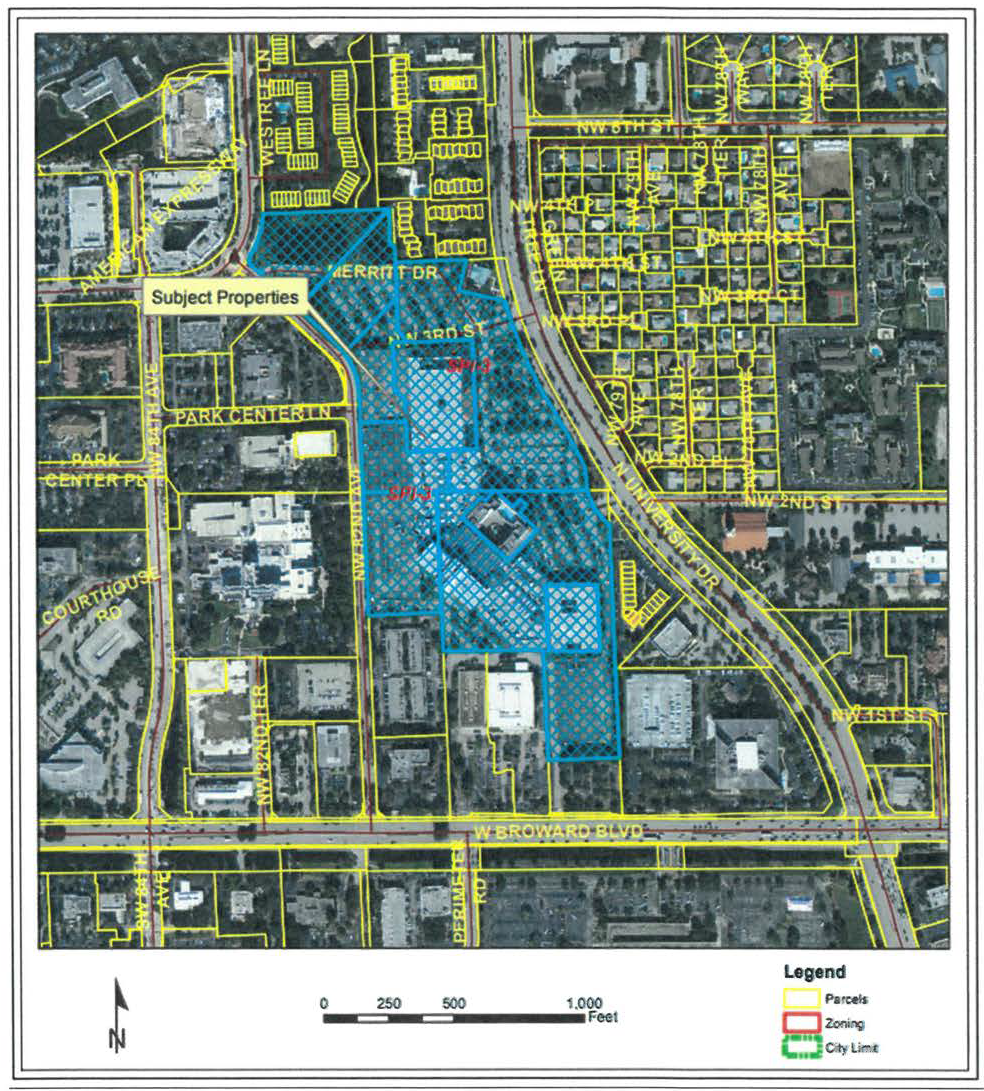
Map of the "PWSDE" district.
(4)
Definitions.
a.
The following terms used in the Code of Ordinances are specifically not applicable to the PWSDE district: amusement arcade; amusement enterprise; indoor; bar; bowling alley; brewpub or microbrewery; nightclub; restaurant bar; recreation (commercial and indoor); restaurant-dine in; restaurant entertainment facility; restaurant-fast food; restaurant-take out; and, skating rink.
b.
Terms requiring interpretation specific to the PWSDE district are defined below. These definitions are supplemental to those in Sec. 27-11 and take precedence in the event of conflict.
Alcoholic beverage establishment means an establishment that serves alcoholic beverages for consumption on the premises, which accounts for at least fifty-five percent (55%) of its gross revenue. An alcoholic beverage establishment does not require a cover charge for entry or minimum purchase requirement and may include areas for dancing and entertainment that comprise twenty percent (20%) or less of the gross floor area. Establishments that sell alcoholic beverages for consumption on premises, whose alcoholic beverage sales do not account for at least fifty-five percent (55%) of gross sales, have a cover charge and/or have a dancing and entertainment area comprising more than twenty percent (20%) of gross floor area shall not be deemed Alcoholic beverage establishments for the purposes of this ordinance. Outdoor vendors selling alcoholic beverages during a special event are not alcoholic beverage establishments.
Bar means an alcoholic beverage establishment that does not produce alcoholic beverages on the premises and is not any other type of alcoholic beverage establishment defined herein.
Beverages means any liquid intended as a drink for human consumption.
Brewpub means a restaurant where beers, wines, ciders, or other similar alcoholic beverages are brewed primarily for consumption on the premises.
Commercial recreation establishment means an indoor facility where recreational activities or facilities are provided for a fee including, but not limited to, group arts and crafts (ceramics, painting, baking, etc.), bowling, laser tag, paintball, rollerblading, amusement devices, bounce houses, batting cages, and playground equipment, and where any serving of food and beverages is incidental. The term includes an electronic gaming entertainment establishment.
Complete meal means an entrée and at least one (1) additional course.
Craft distillery means an alcoholic beverage establishment that is licensed by the Florida Department of Business and Professional Regulation, Division of Alcoholic Beverages and Tobacco to produce distilled spirits. The establishment may also include a tasting room and retail space to sell spirits produced on the premises along with related retail items and food.
Entertainment includes but is not limited to, live or pre-recorded performances, activities for participants, and amusement devices.
Entertainment venue means a place of assembly that charges patrons a fee to attend each scheduled program or performance, whereby the total number of people admitted to each program or performance does not exceed the seating capacity of the venue as approved by the fire marshal. Examples include movie theaters and comedy clubs. Entertainment venues may serve food and beverages. An entertainment venue is not an alcoholic beverage establishment.
Entrée means the main course of a meal.
Existing establishment means a business that has an executed lease agreement to occupy a building or demised portion thereof within the District, and for which an application for business tax receipt has been submitted to the City.
Greens means an open space available for unobstructed passive recreation, its landscaping consisting of grassy areas and trees.
Incidental means a product or service provided by a business that accounts for less than fifty (50) percent of its gross revenue.
Micro-brewery means an alcoholic beverage establishment that is licensed by the Florida Department of Business and Professional Regulation, Division of Alcoholic Beverages and Tobacco to manufacture malt beverages. The establishment includes a tasting or consumption room and retail space to sell malt beverages produced on the premises along with any related retail items and food that may be offered.
Micro-winery means an alcoholic beverage establishment that is licensed by the Florida Department of Business and Professional Regulation, Division of Alcoholic Beverages and Tobacco to produce wine. The establishment includes a tasting or consumption room and retail space to sell wine produced on the premises along with any related retail items and food that may be offered.
On the premises means an establishment's enclosed building area and any outdoor seating or dining area designated for the establishment.
Package store means a store that sells alcoholic beverages for consumption off-premises, and which does not produce alcoholic beverages on the premises.
Plaza means an area generally open to the public on a controlled basis and used for passive recreational activities and relaxation. Plazas are paved areas typically with amenities, such as seating, drinking and ornamental fountains, art, trees, and landscaping, for use by pedestrians.
Pop-up market means any temporary retail use held in the open, where one (1) or more individual sellers offer products or personal services for sale to the public.
Recurring event programming, or recurring events means programmed commercial or noncommercial events that typically recur on a sub-annual basis, including but not limited to, art exhibits and shows, pop-up markets, specifically advertised performances by entertainers, food trucks, and family-oriented games and activities.
Regular programming means the daily provision of amplified or nonamplified ambient music or sounds, live performances, street performers and the like, outdoors at sound levels that do not inhibit conversation.
Restaurant means any establishment that serves prepared food that is available for consumption on or off the premises, where sale of alcoholic beverages accounts for less than fifty-five percent (55%) of gross revenue. Typically, complete meals are prepared on the premises and served at all times when the establishment is open. A restaurant may offer any combination of dining on the premises or takeout and may include an area set aside for entertainment comprising less than twenty percent (20%) of the gross floor area. Any serving of alcoholic beverages is incidental to the food service, occurring only during times when food is served. An establishment that serves prepared food that is available for consumption on or off the premises, where the sale of alcoholic beverages accounts for more than fifty-five percent (55%) of gross revenue or with an area set aside for entertainment comprising more than twenty percent (20%) of gross floor area shall not be deemed a restaurant for the purposes of this PWSDE Overlay District.
Retail street means a street internal to the PWSDE district fronted by commercial establishments.
Special event means a programmed commercial or noncommercial event that does not occur more than six (6) times within a calendar year within the PWSDE Overlay District, typically oriented to a holiday or celebrated occasion, with programming similar to a recurring event except that open containers of alcoholic beverages are permitted within the district boundaries, alcoholic beverages may be dispensed within vendor kiosks licensed to dispense such beverages for the duration of the event, and the noise limits applicable to recurring events may be relaxed pursuant to the provisions herein. Prior approval shall be obtained from the City for more than six (6) special events occurring within a calendar year.
Surface parking facility means a surface parking lot within the PWSDE district that is connected to a retail street by a pedestrian plaza.
(5)
Permitted uses. The permitted uses in the PWSDE district are those permitted in the M-PM district in Sec. 27-100, "Master Business List," as the definitions applicable to the M-PM district may be modified or superseded by subsection (4) above, and the additional uses listed below. Each of the following uses is subject to any requirements listed below the use and is not subject to any other use restriction promulgated within the Plantation Code of Ordinances unless otherwise specified herein.
a.
Alcoholic beverage establishments.
1.
A total of five (5) alcoholic beverage establishments may operate within the PWSDE district at any one time by right, including not more than two (2) bars. A conditional use permit is required for a proposed alcoholic beverage establishment if there are five (5) or more such existing establishments within the District.
2.
Each establishment is permitted to set aside an area equal to twenty percent (20%) or less of its gross floor area for dancing or entertainment.
b.
Commercial recreation establishments.
1.
Amusement enterprises shall obtain, maintain and display an amusement certificate pursuant to the administrative requirements established in Section 27-105(g)(1)d., g. and h., and shall be subject to the denial or revocation provisions in Section 27-105(g)(1)j., penalties provision in 27-105(g)(1)k., and general regulations for amusement enterprises in Section 27-105(g)(1)f.
c.
Entertainment venues.
d.
Fitness center.
e.
Restaurants.
f.
Retail tobacco and tobacco accessories store; cigar bar.
1.
Permitted as a principal use or accessory to a restaurant, alcoholic beverage establishment or entertainment venue. If accessory to another use, the smoking area shall be physically separated from the main use to contain the smoke.
2.
Indoor smoking of tobacco products is permitted subject to provision of adequate ventilation as required by the Florida Building Code.
3.
Cigar making and cigarette rolling for retail sale on premises is permitted.
(6)
Supplemental regulations.
a.
Professional management. The property owner is responsible for ensuring that the district is managed by an individual or firm, inclusive of the property owner, with at least three (3) years of experience managing an entertainment complex, venue or district. The individual or firm shall operate from an office located within Broward or an abutting county and shall liaise with the offices of the tenants, property owner (if different), Mayor and city departments to ensure the smooth operation of the district. The City shall be notified within thirty (30) days whenever there is a change in the professional management by the owner.
b.
Alcoholic beverages.
1.
No alcoholic beverage may be consumed on or upon the premises of any vendor between the hours of 2:00 a.m. and 8:00 a.m.
2.
Sale of alcoholic beverages in bottles, cans or containers, for consumption off the premises, is prohibited between the hours of 2:00 a.m. and 8:00 a.m.
3.
Open containers of alcoholic beverages are permitted outdoors between 12:00 noon and 10:00 p.m. (12:00 a.m. on New Year's Eve) within the District. Alcoholic beverages may be sold and distributed at one or more temporary outdoor kiosks during special events between 12:00 noon and 9:00 p.m. (11:30 p.m. on New Year's Eve).
c.
Outdoor seating areas. Each establishment that sells food or beverages is permitted an outdoor seating area within the adjacent retail street sidewalk or pedestrian plaza subject to the standards below. An outdoor seating area may extend into the frontage of an abutting business as authorized by the property owner. No permit is required to establish an outdoor seating area within an existing retail street sidewalk or pedestrian plaza unless a structure requiring a building permit under the Florida Building Code is added to the outdoor seating area.
1.
Outdoor seating areas shall be conducted operated in such a way as to not interfere with the circulation of pedestrian or vehicular traffic on the adjoining streets, or sidewalks, or breezeways.
i.
There shall a minimum of four (4) feet of clear distance, free of all obstructions, in order to allow adequate pedestrian movement. In no event may recesses in the building frontage be used to satisfy this unobstructed width requirement.
ii.
No tables, chairs, or umbrellas shall ever be placed within seven and one-half (7½) feet of a fire hydrant or standpipe, or within five (5) feet of a pedestrian crosswalk, curb cut, street, utility pole, utility box, bike rack, or street furniture of any type. For purposes of minimum clear path, any object, regardless of whether it is associated with the outdoor seating area, shall be considered an obstruction, such as but not limited to: trees, sign poles, benches, etc. No outdoor seating area shall obstruct or interfere with sight triangles.
iii.
Outdoor seating areas shall not occupy an area of more than one hundred percent (100%) of the total enclosed floor area of the establishment to which it is accessory. No additional parking is required for the outdoor seating area unless the area encompasses more than ten percent (10%) of the establishment's enclosed area. The amount of additional parking shall be calculated pursuant to the off-street parking standards as set forth in Section 27-123 of the LDRs.
iv.
Tables, chairs, and umbrellas shall be of high-quality design, material and workmanship for aesthetics. They shall be made of metal or weather resistant and finished wood.
v.
Establishment names may be printed on umbrellas. Letter and logos may not exceed six (6) inches in height. Minimum height for umbrellas shall be eighty (80) inches.
vi.
The outdoor seating area shall not be enclosed except that it may be covered with a canvas cover, or covered with the existing walkway covering (where the area is within walkway areas).
vii.
No dirty dishes, garbage or food shall be stored outside of the enclosed establishment. All refuse associated with the outdoor seating area shall be handled indoors at all times.
d.
Outdoor entertainment, regular programming and special events. Programming of activity is encouraged as an integral part of the district. In addition to regular programming to enhance the ambiance of the District, recurring events are encouraged throughout the year, such as a pop-up markets, craft shows and the like, while up to six (6) special events are permitted per calendar year. Regular programming, recurrent events and special events are permitted in accordance with the following provisions.
1.
Daily entertainment on sidewalks and plazas is permitted subject to the noise regulations herein and maintenance of a clear pedestrian path at all times that is at least four (4) feet wide and ADA-compliant.
2.
Regular programming shall not require any additional approval.
3.
Prior to conducting any recurring or special event, an administrative event permit shall be required from the City for event security, traffic management, sufficiency of vehicle parking, and emergency vehicle access. The permit shall authorize all recurring and special events within the twelve (12)-month period following the date of issuance. The permit shall self-renew annually. The Mayor may modify the permit within forty-five (45) calendar days prior to any renewal upon issuance of written findings to the property owner and property manager demonstrating that changes to security, parking, traffic management, or emergency vehicle access protocols are necessary to protect the public health, safety and welfare. The property owner may appeal any decision of the Mayor to the City Council within ten (10) calendar days from the issuance of the decision. The fee to process an administrative appeal shall be $750.00. An appeal shall stay an administrative modification.
4.
The permit application shall include the locations of temporary structures and structure specifications deemed necessary by the Fire Marshall, hours of operation, traffic management plan, parking plan, and security personnel and protocols. Property management shall notify the Fire Marshall at least one week prior to each recurring and special event that involves temporary structures. Additional applications for each recurring and special event are not required. The timing for the submission of a permit or for processing of a permit shall be as set forth in Section 27-41 of the LDRs.
5.
Certain retail streets and surface parking lots may be repurposed as special event space and closed to vehicle traffic subject to the conditions of the master permit.
e.
Outdoor display of merchandise. Retail establishments may display merchandise for sale on retail street sidewalks and plaza areas within ten feet of the establishment's shopfront, as further regulated by the property owner.
f.
Noise.
1.
Generally. Sound levels within the District shall be governed by Chapter 16—Noise, except as provided in 2., below.
2.
Entertainment regulations. Sound generated from indoor and outdoor entertainment sources programmed by property management or individual establishments, including, but not limited to, amplified and unamplified sounds, and audience participation (ex: cheering) shall be governed exclusively by the following regulations:
i.
Sound levels shall be measured on the A-scale and averaged over a three-minute period (3-minute LA eq ).
ii.
Sound pressure levels measured outdoors from apartment balconies within the adjoining M-PM District shall be limited to 10 dBA above the ambient sound pressure level or 70 dBA, whichever is greater.
iii.
Sound pressure levels measured outdoors along the north, south and east district boundaries shall not exceed 5 dBA above the ambient sound pressure level or 65 dBA, whichever is greater.
iv.
Maximum allowable sound pressure levels specified above shall be increased by 8 dBA during special events (a maximum of 6 days per calendar year).
v.
The above sound pressure levels are permitted between the hours of 10:00 a.m. and 10:00 p.m., except on New Year's Eve the hours shall be extended to 12:30 a.m. New Year's Day. At all other times, the standards in Chapter 16 shall govern.
g.
Signs.
1.
Sandwich signs are permitted for individual businesses along the retail street frontage and plaza frontage provided they are not visible from a public right-of-way. Sandwich signs shall be removed at the end of each business day.
2.
Street light pole banners not to exceed eight (8) square feet each are permitted throughout the District.
3.
One (1) temporary sign is permitted adjacent to each University Drive entrance to the District for each recurring event. Each sign shall not exceed sixteen (16) square feet in area and seven (7) feet in height. A single sign of twenty-four (24) square feet and nine (9) feet in height on the University Drive frontage shall be permitted in lieu of two (2) signs.
4.
A single banner may be used for special events, not to exceed forty (40) square feet in area, directing the attention of the public to the special event, attached to a building housing the event, or may be attached to a perimeter wall or fence adjacent to a street frontage on the property where the event is located.
5.
A temporary sign or single banner sign, as set forth in subsections g.3. and g.4. above, may be erected no earlier than seven (7) days prior to the event and must be removed within two (2) days after the event.
(Ord. No. 2597a, § 3(Exh. A), 3-24-2021; Ord. No. 2617, § 1, 6-22-2022; Ord. No. 2024-001, § 14(Exh. N), 1-24-2024)
Section 27-100 - Master Business List.
(Ord. No. 2597a, § 3(Exh. A), 3-24-2021; Ord. No. 2601, § 1, 8-25-2021; Ord. No. 2023-006, § 1(Exh. A), 5-24-2023)
Section 27-105 - Specific Use Regulations
The specific conditions set out below shall be applied to each proposed use during site plan and/or conditional use review (if applicable).
(a)
Accessory Dwelling Units (ADUs) and Pool Houses
(1)
ADU standards: ADUs shall be permitted by-right in all single-family (RS) and duplex (RD) and PRD districts; may be attached or detached to the primary house; shall not be considered an extra unit in terms of lot density; must meet minimum housing standards of the FBC; and must meet the following design standards and other restrictions, prior to the issuance of a building permit:
a.
shall have at least one (1) bedroom, and one (1) bathroom and may have a full kitchen;
b.
the maximum area shall not exceed fifty percent (50%) of the gross area of the principal residence, including unairconditioned areas, or one thousand two hundred and fifty square feet (1,250 SF); and the minimum area shall be at least four hundred square feet (400 SF), whichever is less;
c.
may have a separate garage, driveway or carport than the primary residence, subject to the respective applicable standards; and additional parking shall not be required, provided that the primary residence has the minimum code-required parking before the ADU is constructed, unless the ADU has two or more bedrooms, in which case, one additional parking space will be required; residents and occupants shall abide by the City's parking regulations;
d.
may be freestanding or detached from the principal residence; connected to the principal residence by a breezeway or air-conditioned hallway, or otherwise attached to the principal residence; located above a garage; or within or above the principal residence, but separated from the primary living quarters such that the only access between the two living quarters is by way of an exterior entrance or a double door interior entrance; or some or all of the above;
e.
may be rented separately from the principal dwelling; however, either the primary residence or the ADU must be continuously owner-occupied implemented through a deed restriction and by the owner filing an annual statement confirming residency; and if the ADU or primary residence or portion of either structure is utilized as a vacation rental, then the owner shall comply with all regulations for hosted vacation rentals per Chapter 14 Article V with no more than one set of guests being able to rent a portion of the property at a time;
f.
may be utilized and/or rented by family members, guests and/or persons employed on site by the resident family of the principal dwelling;
g.
the owner(s) of the parcel shall file a deed restriction with a covenant recorded at the property owner's expense in the public records of Broward County, in a form approved by the City Attorney, affirming and consenting that either the primary dwelling unit or the ADU shall be owner-occupied and that the ADU will be in compliance with all applicable requirements of the City Code of Ordinances, the minimum housing standards of the Broward County Code of Ordinances, and that an ADU may be rented in conformance with the City's Code for hosted vacation rentals;
h.
must share utilities with the primary residence and separate utility meters are not permitted;
i.
shall not be located any closer to the front setback than the principal structure;
j.
shall be subject to the same required front, corner and side setbacks as the principal structure;
k.
shall have a minimum rear setback of ten (10) feet, except in the RS-1EP district where it must maintain a 25-foot rear setback, and be located outside of any dedicated or platted easements, including access, drainage, lake/canal maintenance, landscape and utility easements;
l.
shall not, together with the house and any other impervious vertical and horizontal structures, exceed a maximum of thirty-five percent (35%) lot coverage, except in the RS-1EP district, where it may not exceed twenty percent (20%);
m.
shall have a maximum height up to thirty-five (35) feet, but not be taller than the primary residence, unless the ADU is a new upper story of the existing structure and does not exceed 35 feet above ground;
n.
shall be architecturally compatible with the house in terms of exterior façades, including materials, windows, doors, and façade treatments on all facades;
o.
conversion of detached garages or other accessory buildings and structures, except for sheds which are not permitted to be used for residential purpose, for the purpose of creating an ADU shall be permitted only if the newly created dwelling unit is properly permitted and inspected by the City and all code and covered parking requirements are satisfied; and
p.
shall not be constructed on an already nonconforming parcel or create a new site non-conformity, or non-conforming building or structure.
q.
shall maintain the minimum landscaping lot requirements, which may include as an option, a medium tree in the rear or side yard, in lieu of a large tree, or other mitigation, as needed.
(2)
Other ADU provisions:
a.
A single-family property may have only one ADU per lot and a duplex property may have one ADU per duplex unit on the lot.
b.
The ADU shall be registered with the City, by completing an application form prepared by PZED, ensuring compliance with the City's ordinances, prior to the issuance of a Certificate of Occupancy.
c.
An ADU may not be sold separately from the primary residence.
d.
The PZED Department shall monitor the progress of the implementation of ADUs and review these provisions on a bi-annual basis to ensure that the intent of residents to provide affordable and/or feasible housing alternatives is consistent with the intent and purpose of this section.
(3)
Sample Graphics:
a.
Examples of ADUs are shown below:
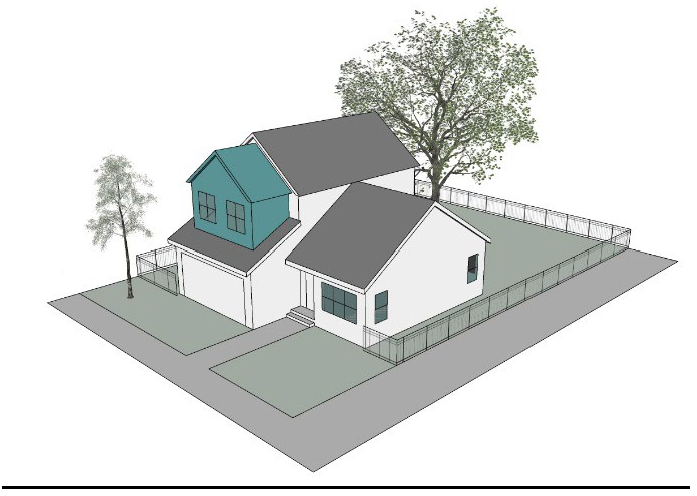
Figure 1: Addition to an upper-level of a home
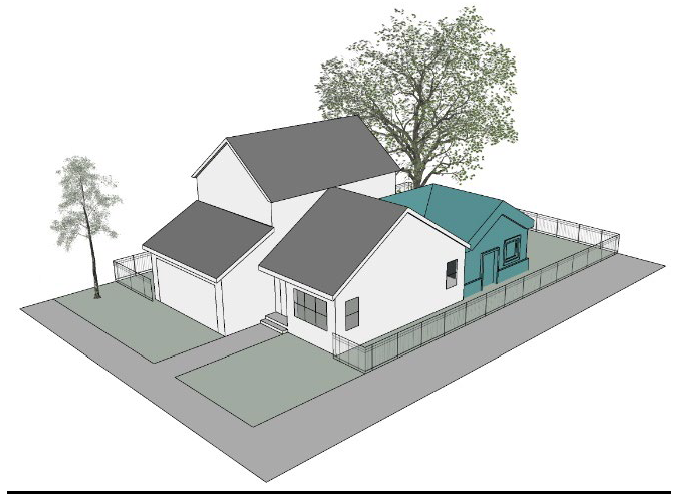
Figure 2: Addition to a lower level
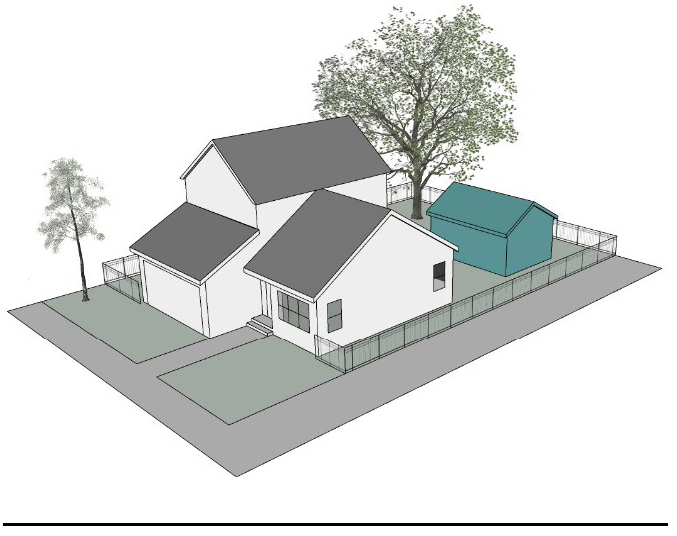
Figure 3: Detached ADU
(4)
Pool Houses A pool house is a permitted accessory use, and is an accessory building, but is not an ADU or otherwise inhabited by residents or guests. Pool houses shall meet the following standards:
a.
shall be less than three hundred fifty (350) square feet in size;
b.
shall have a bathroom and/or changing room; and
c.
may have a room which can be used for games or entertainment, but not have any sleeping rooms.
(5)
ADUs in Residential Communities Subject to Florida Statutes Chapter 720:
a.
Section 27-105(a) does not create an affirmative duty or any requirement that a community that is subject to the provision of Florida Statutes Chapter 720 amend their governing documents to permit ADUs, and does not create a right or obligation to construct or add an ADU on residential property that is subject to a declaration of restrictive covenants that prohibits or would otherwise act to restrict the construction or addition of an ADU on a parcel through minimum residence size, maximum residences per lot, or through other architectural control provisions governed by the applicable residential community.
b.
Furthermore, this Section is not intended to, and does not, preempt any restrictions contained in such declarations regarding the addition or modification of buildings, dwelling units, density, or any other improvement located in such residential communities subject to Florida Statutes Chapter 720.
c.
Communities subject to Florida Statutes Chapter 720 may opt-in to the provisions of Section 27-105(a) for the creation of ADUs in a community through an affirmative action taken by the respective community's homeowners association board of directors and membership, in accordance with the community's governing documents and Florida Statutes.
d.
Nothing contained in this Ordinance requires the City to undertake any action to determine the validity or extent that the governing documents of a community that is subject to the provision of Florida Statutes Chapter 720 permits ADUs.
(b)
Reserved.
(c)
Alcoholic beverage sales. Refer to Chapter 3.
(d)
Agricultural Activities, Farm Animals and Food Production.
(1)
Urban farm activities. Urban farm activities refer to small scale agricultural activities, farm animals and food production uses that may be permitted as accessory use in the RS-1EP district subject to the requirements and limitations noted below.
a.
Harboring of poultry and fowl (for non-commercial purposes only).
1.
The number of poultry or fowl may not exceed twenty-five (25) in total number.
2.
Any pen or roofed structure for the shelter of such animals shall be located at least fifty (50) feet from any lot line.
3.
When located within Sub-Area "B" of the Plantation Acres SPI-1 Overlay district on parcels equal to or exceeding 100,000 square feet in net plot area, the limitation on the number of poultry or fowl set forth under a.1. above may be exceeded when approved as a conditional use. Expansion from these number limits shall be in harmony with the rural character of the Acres, its floodplain function and its protection against intense development.
b.
Keeping of Horses and Cows (personal use).
1.
Horses or cattle may not exceed four (4) in total number for a plot of minimum permitted net plot area. Where the plot exceeds thirty-five thousand (35,000) square feet in net plot area, one (1) additional horse or cow may be permitted for each additional fourteen thousand (14,000) square feet of net plot area.
2.
Any roofed structure for the shelter of such animals shall be located at least fifty (50) feet from any lot line.
c.
Racing pigeons.
d.
Mushroom farms.
1.
Shall be approved as a conditional use subject to Section 27-45 (Conditional use standards).
2.
Net plot area of the subject plot shall equal or exceed seventy thousand (70,000) square feet.
e.
Beekeeping.
1.
May be permitted as a conditional use when conducted as an accessory use to any primary agricultural use.
2.
Net plot area of the subject plot shall equal or exceed one hundred thousand (100,000) square feet.
3.
In Florida, the regulating authority for beekeeping is granted to the state. Florida Statute 586.055 stipulates that apiaries are allowed to be located on agricultural land that is integral to beekeeping operations. Chapter 586 includes requirements regarding "Florida Honey Certification and Honeybee Law." Beekeepers shall be in compliance with state statutory regulations and shall be required to post signs on the property within 100 feet of the beekeeping activities advising the public of the activities. Beehives shall not be located closer than 150 feet from a property line.
f.
Commercial cattle and stock grazing and raising.
1.
May be permitted as a conditional use.
2.
Net plot area of the subject plot shall equal or exceed one hundred thousand (100,000) square feet.
3.
A total of four (4) horses or cattle shall be permitted for the first thirty-five thousand (35,000) square feet in net plot area. One (1) additional horse or cow may be permitted for each additional fourteen thousand (14,000) square feet of net plot area.
4.
Hog raising or slaughtering of animals shall be prohibited.
5.
When located within Sub-Area "B" of the Plantation Acres Overlay district, the limitation on the number of cattle set forth under f.2. above may be exceeded when approved as a conditional use. Expansion from these number limits shall be in harmony with the rural character of the Acres, its floodplain function and its protection against intense development.
g.
Commercial training and breeding horses.
1.
May be permitted as a conditional use.
2.
Net plot area of the subject plot shall equal or exceed one hundred thousand (100,000) square feet.
3.
A total of four (4) horses or cattle shall be permitted for the first thirty-five thousand (35,000) square feet in net plot area. One (1) additional horse or cow may be permitted for each additional fourteen thousand (14,000) square feet of net plot area.
4.
When located within Sub-Area "B" of the Plantation Acres Overlay district, the limitation on the number of horses set forth under g.2. above may be exceeded when approved as a conditional use. Expansion from these number limits shall be in harmony with the rural character of the Acres, its floodplain function and its protection against intense development.
h.
Commercial riding stable, livery stable, boarding stable.
1.
May be permitted as a conditional use.
2.
Net plot area of the subject plot shall equal or exceed one hundred thousand (100,000) square feet.
3.
A total of four (4) horses or cattle shall be permitted for the first thirty-five thousand (35,000) square feet in net plot area. One (1) additional horse or cow may be permitted for each additional fourteen thousand (14,000) square feet of net plot area.
4.
When located within Sub-Area "B" of the Plantation Acres Overlay district, the limitation on the number of animals boarded, set forth under h.2. above, may be exceeded when approved as a conditional use. Expansion from these number limits shall be in harmony with the rural character of the Acres, its floodplain function and its protection against intense development.
5.
Hog raising shall be prohibited
(2)
Commercial agriculture activities. Commercial agriculture activities refers to agricultural, farming, food production and related commercial activities that may be permitted as primary uses within Sub-Area "B" of the Plantation Acres Overlay district. Commercial agriculture activities are only permitted on lots equal to or exceed 200,000 square feet in net plot area. In addition, all commercial agriculture activities must obtain conditional use approval.
a.
The following commercial agriculture activities are permitted on parcels of land with an underlying zoning designation of RS-1EP. Any accessory structures used in conjunction with these activities shall have a minimum setback of fifty (50) feet from any property line.
1.
Commercial groves
2.
Beekeeping. In Florida, the regulating authority for beekeeping is granted to the state. Florida Statute 586.055 stipulates that apiaries are allowed to be located on agricultural land that is integral to beekeeping operations. Chapter 586 includes requirements regarding "Florida Honey Certification and Honeybee Law." Beekeepers shall be in compliance with state statutory regulations and shall be required to post signs on the property within 100 feet of the beekeeping activities advising the public of the activities. Beehives shall not be located closer than 150 feet from a property line.
3.
Produce farm
4.
Truck garden
5.
Floriculture
6.
Plant nursery
7.
Sod farm
8.
Hydroponic garden
9.
Greenhouse, subject to the following:
i.
Greenhouses are prohibited in a front yard and must meet structural setbacks.
ii.
The maximum permitted height of a greenhouse is 12 feet.
iii.
Mechanical greenhouses with heating plants or cooling fans associated with greenhouses shall be located to meet all of the setbacks from every property line.
iv.
Compliance with the city's noise ordinance must be observed.
10.
Slat house
11.
Aviary
12.
Chicken and fowl
b.
The following commercial agriculture activities are permitted on parcels of land with an underlying zoning designation of B-2L.
1.
Farm equipment, sales and service.
2.
Farmer's market, subject to the following standards:
i.
All farmers' markets and their vendors shall comply with all federal, state, and local laws and regulations relating to the operation, use, and enjoyment of the market premises;
ii.
All farmers' markets and their vendors must obtain all required operating and health permits, licenses, and certificates of insurance, and copies of these documents shall be in the possession of the farmers' market manager or the vendor, as applicable, on site during all hours of operation;
iii.
The predominant sales area must be for agriculture-related products.
•
Refuse disposal and sufficient trash and recycling receptacles within the area of the approved farmers' market; and
•
Litter removal within the boundaries of the approved farmers' market; and
•
Access to adequate sanitary facilities, including restrooms and/or portable sinks and toilets.
v.
Compliance with city's noise ordinance must be observed.
3.
Feed and seed supplies
4.
Fertilizer stores, retail and wholesale
5.
Fences, storage and sales
6.
Food products
7.
Fruit, flowers or vegetables from trucks, wagons, vacant property or open stands
8.
Garage, storage and mechanical service
9.
Pumps and wells, retail wholesale
10.
Sprinkler system shop, storage, sales and service
11.
Water treatment, pool equipment and chemical
12.
Veterinary office and large animal hospital
(e)
Animal care uses.
(1)
Veterinary hospital/clinic, subject to the following conditions and limitations.
a.
All facilities shall be contained within completely enclosed structures without windows in any area where animals are contained or treated.
b.
Adequate soundproofing in any area where animals are contained or treated, such that animal noises, such as for example barking, cannot be heard outside of the facility.
c.
Exterior cages shall not be permitted.
d.
Animals may not be exercised outdoors before 7:00 a.m. or after 7:00 p.m.
e.
Shall contain an approved air-handling system for disinfection and odor control.
f.
Shall contain adequate waste control facilities, such as a flush system or equal.
g.
Shall contain no crematory facilities.
h.
Medical boarding activities shall be ancillary to the primary use.
(2)
Animal grooming, subject to the following conditions and limitations.
a.
Adequate soundproofing shall be incorporated into in any area where animals are contained or treated, such that animal noises cannot be heard outside of the facility.
b.
Exterior cages shall not be permitted.
c.
Shall contain an approved air-handling system for disinfection and odor control.
d.
Shall contain adequate waste control facilities, such as a flush system or equal.
e.
Overnight boarding shall not be permitted unless there is a Kennel/Pet Hotel component within the establishment.
f.
The use shall comply with all supplementary use standards of Broward County, Animal Control entities and Florida Statutes.
(3)
Kennel/pet hotel.
a.
Adequate soundproofing shall be incorporated into in any area where animals are contained or treated, such that animal noises cannot be heard outside of the facility.
b.
Exterior cages shall not be permitted.
c.
Animals may not be exercised outdoors before 7:00 a.m. or after 7:00 p.m.
d.
Shall contain an approved air-handling system for disinfection and odor control.
e.
Shall contain adequate waste control facilities, such as a flush system or equal.
f.
Pet Boarding shall be allowed only in conjunction with and accessory to another pet-oriented use.
g.
The use shall comply with all supplementary use standards of Broward County, Animal Control entities and Florida Statutes.
h.
The selected location must provide visual buffering/fencing/sound-proofing design to mitigate the noise impact of the kennel on the surrounding properties.
i.
Shall provide an outdoor common play area of sufficient size to relieve animals.
j.
Shall provide adequate quantities of visible, clean and fresh water available at all times.
k.
All animal housing facilities shall be structurally-sound and constructed of non-toxic materials.
l.
Permanent kennel cages shall not be present (portable pet crates may be used to transport pets).
m.
Breeding animals for sale is prohibited.
n.
Records of all pet stays, including documentation of license and shots, shall be maintained on file.
o.
Animal housing shall be maintained in good repair and kept clean and sanitary at all times so as to protect animals from disease and injury.
p.
Animals shall be provided with clean bedding and other supplies such as litter pans, litter, shredded paper, towels, straw, etc., as appropriate for each species.
q.
Provisions shall be made for the removal and proper disposal of animal food, waste, bedding, dead animals and debris.
r.
Primary enclosures shall be large enough and cleaned on a schedule (no less than daily) so that the animal can stay dry and avoid contact with excrement.
s.
Waste systems shall meet State and local regulations.
t.
Each animal shall be observed daily by the animal caretaker in charge for signs of disease, injury, or distress.
(4)
Pet shops.
a.
All facilities shall be contained within completely enclosed structures without windows in any area where animals are contained or treated.
b.
All buildings used for the animals shall be soundproofed to such a degree that no noise from within the building shall be audible to any person who is within ten (10) feet of the building. Application is to be made to the planning and zoning board with full description of the project, and the board shall consider the effect on neighboring uses, safety and general welfare of the community before making recommendations to the council.
c.
Permitted on a conditional use basis only.
d.
All other regulations pursuant to Chapter 4 and Chapter 14 of the Plantation Code of Ordinances.
(f)
Business support services.
(1)
Business service center.
a.
Private mail service as a principal or accessory use shall comply with the disclosure requirements contained in the "mail box centers" classification listed in section 14-39 of this Code and provide service amenities such as copying, telephone, storage, and meeting conference room facilities (herein, "service amenities") for lessees of spaces (mailboxes) who are using such mailbox addresses as their business addresses.
b.
Private mail services may engage in express services.
c.
This use in the I-L2P zoning district is subject to an allocation of commercial flexibility for the parcel upon which the use is located, if required by the Future Land Use Element of the City's Comprehensive Plan.
(2)
Employment Agency. Does not include employment agencies providing "day labor" for construction related industries.
(3)
Office supply store. Wholesale use only in B-5P zoning district.
(g)
Commercial recreational/entertainment uses.
(1)
Amusement Arcades.
a.
Amusement arcades having more than ten (10) amusements devices shall require conditional use approval. Any conditional use approval granted to an amusement arcade shall not be transferable or assignable.
b.
An amusement arcade may only be an accessory use to a primary commercial use. By way of examples a commercial use is a bowling alley, hotel of motel, skating rink, golf course, restaurant entertainment facility, restaurant, small scale neighborhood tavern, and the like.
c.
The floor area occupied by amusement devices may not exceed twenty (20) percent of the floor area of the overall commercial use.
d.
The income realized from such amusement devices shall be reported, along with the income received from the primary permitted use, to the City Clerk, at least annually on the renewal of such amusement devices' local business tax receipts and whenever the income realized from such devices is not ancillary in amount, to the primary income received under the primary local business tax receipt (i.e., exceeds twenty (20) percent of the overall gross income realized on said permitted site from its primary permitted use), such amusement devices shall be further restricted in number until they are shown to be ancillary in use by virtue of a comparison of gross receipts from such machines not exceeding twenty (20) percent of the overall gross receipts of the primary permitted use. Should the owner or operator fail to restrict in number the amusement devices and/or income derived therefrom, then the operation shall be considered an amusement enterprise which must comply with the requirements for same. Failure to comply will result in code enforcement action if operation continues.
e.
The hours of operation for an amusement arcade shall not exceed the hours of operation of the principal use to which such arcade is an accessory.
f.
General regulations for amusement arcades. The following general regulations shall apply to all amusement arcades in accordance with this Chapter:
1.
No amusement devices shall violate any provision of Section 27-111 of the City Zoning Code.
2.
No amusement devices shall display in a simulated or pictorial manner "specified anatomical areas" or "specified sexual activities" as defined in Section 27-111(b) of this Code.
3.
It is not the intent of this section to allow adult oriented amusement arcades or enterprises that mimic the look and feel of gambling venues but are operated in accordance with F.S. Ch. 849 (Gambling). These are prohibited.
4.
Any person, firm, association, or corporation owning or operating an amusement arcade or establishment which offers amusement devices or mechanical amusement machines for public use which violates these regulations shall be subject to all of penalties, fines, and other relief set forth in sections 1-13 and 1-14 of this Code. In addition, thereto, the city may seek injunctive relief to abate the violation.
5.
Amusement devices shall at all times comply with the provisions of subparagraphs (g)(1)f., and any person, firm, association, or corporation which offers amusement devices or mechanical amusement machines for public use which violates such regulations shall be subject to all of penalties, fines, and other relief set forth in sections 1-13 and 1-14 of this Code. In addition, thereto, the city may seek injunctive relief to abate the violation.
g.
Issuance of local business tax receipt. The request for a local business tax receipt shall include an interior layout plan drawn to scale showing the location of all amusement devices, a copy of the lease agreement with a specific provision that allows the lessor to evict the lessee whenever three (3) or more law enforcement responses to the premises occur within any twelve-month period, and such other information as may be reasonably requested. The City Clerk shall issue a local business tax receipt upon approval of site inspections and upon the payment by the applicant of the local business tax fees.
(2)
Amusement enterprise.
a.
Amusement enterprises require conditional use approval in the M-PM zoning district and are subject to the regulations set forth below. Any conditional use approval granted to an amusement arcade shall not be transferable or assignable.
b.
The use shall not be located within three-fourths (¾) of a mile of another amusement enterprise. All such measurements shall be made by airline measurement, from main entrance door to main entrance door.
c.
While an amusement enterprise must be the sole use of a premises, it shall not be the sole use of a building or parcel but instead, the premises must be within a building having other types of uses (such as a mall or mixed-use center). The premises shall not be located within a building containing less that one hundred thousand (100,000) square feet of gross floor area.
d.
Hours of operation for amusement enterprises. The hours of operation of an amusement enterprise shall be the more restrictive of either:
1.
The same as for primary anchors of the other uses within the building; or
2.
Being closed between the hours of 10:00 p.m. Sunday through Thursday (and 11:00 p.m. on Friday and Saturday) to 8:00 a.m. the following day.
e.
General regulations for amusement enterprises. The following general regulations shall apply to all amusement enterprises in accordance with this Chapter:
1.
All amusement enterprises shall have a supervisor, age eighteen (18) or older, on the premises at all times in which the enterprise is open to the public.
2.
Every amusement enterprise shall provide an adequate area and number of bicycle racks for the orderly parking of bicycles, as determined by the city landscape architect, which area shall be separate from a required vehicle parking stall and shall be so located so as to not occupy any portion of a public sidewalk or to otherwise obstruct pedestrian passage to and from the premises.
3.
All enterprises shall post rules of nonacceptable patron conduct in a conspicuous location and shall order anyone violating the rules to leave the premises.
4.
The use shall operate continuously in accordance with the approved operating plan.
5.
All amusement devices shall have a numbered decal identifying such devices as being reflected on the layout plan, affixed to the upper left front of the game in a prominent position where easily viewed by zoning inspectors, fire inspectors and members of the City Clerk and the police.
6.
No amusement enterprise shall operate adjacent to a nightclub, restaurant, restaurant bar, bar, small scale neighborhood tavern, restaurant entertainment facility, or establishment which conducts live shows or live musical or other live entertainment.
7.
No amusement devices shall violate any provision of Section 27-111 of the City Zoning Code.
8.
No amusement devices shall display in a simulated or pictorial manner "specified anatomical areas" or "specified sexual activities" as defined in Section 27-111(b) of this Code.
9.
It is not the intent of this section to allow adult oriented amusement arcades or enterprises that mimic the look and feel of gambling venues but are operated in accordance with F.S. Ch. 849 (Gambling). These are prohibited.
10.
Any person, firm, association, or corporation owning or operating an amusement enterprise or establishment which offers amusement devices or mechanical amusement machines for public use which violates these regulations shall be subject to all of penalties, fines, and other relief set forth in sections 1-13 and 1-14 of this Code. In addition, thereto, the city may seek injunctive relief to abate the violation.
11.
Amusement devices shall at all times comply with the provisions of subparagraphs (g)(2)e., and any person, firm, association, or corporation which offers amusement devices or mechanical amusement machines for public use which violates such regulations shall be subject to all of penalties, fines, and other relief set forth in sections 1-13 and 1-14 of this Code. In addition, thereto, the city may seek injunctive relief to abate the violation.
f.
Issuance of local business tax receipt. The request for a local business tax receipt shall include an operating plan consisting of: (1) an interior layout plan drawn to scale (showing the location of all machines and amusement equipment and devices, and access ways), (2) a complete set of electrical plans, (3) a sound reduction plan, a copy of the lease agreement with a specific provision that allows the lessor to evict the lessee whenever three (3) or more law enforcement responses to the premises occur within any twelve-month period, and such other information as may be reasonably requested.
1.
Prior to issuance of a local business tax receipt, and as a continuing requirement thereof, the operating plan will be reviewed by the following safety departments; the building, police and fire departments. The purpose of this review will be to help ensure that the premises complies with all provisions of the current Florida Building Code and the Florida Fire Prevention Code, that all areas intended for pedestrian traffic be sufficiently wide to safely accommodate circulation and access for emergency medical rescue equipment, that the building plans indicate the premise walls contain sufficient soundproofing such that the city's noise ordinance is met immediately exterior to the premises under a normal operating scenario, that based on any prior relevant history of other site's operation the use will not likely generate a need for law enforcement services, and that any other particular safety or security concerns can be satisfied. The above safety departments may attach reasonable conditions to their approval of the operating plan which are related to the foregoing public safety and welfare policies.
2.
The City Clerk shall issue a local business tax receipt upon approval of the operating plan, inspections, and payment by the applicant of the local business tax fees.
(3)
Denial or revocation of conditional use approvals and business tax receipts associated with Amusement arcades and amusement enterprises.
a.
Following review of a conditional use request all applications that fail to meet the conditional use criteria set forth herein shall be denied. In addition, the City reserves the right to deny approval of the conditional use for any reason rationally related to protect the health, safety and welfare of citizens of the city. The City shall provide written notice to the applicant, setting forth the reasons for denial. The written notice of denial shall be deemed to have been duly given if deposited in the United States mail. Such decisions shall be final after the expiration of thirty (30) days of the duly given notice of the denial, unless appealed from.
b.
A business tax receipt issued under this regulation is subject to revocation should the applicant permit directly or indirectly the operation or maintenance of any amusement arcade or enterprise contrary to the provisions of this regulation or any law or regulation in force in the city. The business tax receipt may be revoked by the City after written notice to the applicant, setting forth the reasons therefor. The written notice of denial shall be deemed to have been duly given if deposited in the United States mail. Such decisions shall be final after the expiration of thirty (30) days of the duly given notice of the denial, unless appealed from.
c.
All conditional use and business tax receipt approvals for amusement arcades or enterprises shall be deemed conditional in nature and shall be subject to revocation upon the police department advising the issuing department and the City Clerk, respectively, that the devices, arcade, or enterprise are creating law enforcement problems or constitute a public nuisance. It shall require at least three (3) separate incident reports or complaints of unlawful assemblies, disturbances, or nuisances to be filed with the police department during any fiscal year before such advice can be transmitted by the police department to the City Clerk: provided that incident reports or complaints or responses that are the result of activity not occurring during the hours of operation shall not be included in this number. All applicants for conditional use hereunder shall accept the aforestated condition that the machines shall not constitute nuisances or create undue incidents or complaints or, if found as herein stated, shall have business tax receipt revoked and cease operation of the amusement arcade or enterprise. In addition, all amusement arcades or enterprises shall remain subject to section 14-29 of the city code. The city may require the arcade or enterprise to remove the devices from the site following revocation within a reasonable time.
d.
Revoked conditional uses may not be re-applied for until one (1) year following the date the revocation decision is final.
(h)
Reserved.
(i)
Reserved.
(j)
Day care uses.
(1)
Child day care center. Permitted in B-1P, B-2P and B-4P districts on a conditional use basis subject to the following minimum conditions:
a.
All licensing requirements of other governmental agencies on the minimum square feet per enrollee of indoor space and exterior play areas shall be observed and established with the application for such conditional use and, further, the play areas shall be fully enclosed with an appropriate form of structure so as to assure that ingress and egress to and from such play areas may only be from the structure in which the day care center is being operated.
b.
All enrollees in the day care center shall be required to be delivered by their parents or guardians who shall stop and park their vehicle in the provided off-street parking facility and shall walk such enrollees into the main entrance where a sign-in procedure with a receptionist behind a locked door shall be followed so as to deliver the enrollees to the receptionist behind such locked door, so as to preclude the enrollees from leaving the day care center and wandering into the parking lot area. Similarly, a sign-out procedure and delivery of the enrollees to the parents or guardians of such enrollees shall be followed by the receptionist who shall deliver the enrollees from behind a locked door to the parent or guardian accepting delivery of such enrollees within the day care center at the conclusion of their stay at the day care center and such parent or guardian shall then walk such enrollees to the parked vehicles of the parents or guardian.
c.
Each, every and all other requirements of other licensing authorities for day care centers shall be established and proven by the applicant and the number of students or enrollees in the day care center shall be limited as is deemed appropriate by the peculiar characteristics of the zoning districts in which such conditional use request is made as well as the surrounding area. The applicant for such conditional use shall have the full burden of proof of establishing the need for such conditional use permit at such zoning districts.
d.
Shall meet the distance separation requirements from establishments selling alcoholic beverages as set forth is Chapter 3 of the Code.
(2)
Adult day care center. Permitted in B-1P, B-2P and B-4P districts on a conditional use basis subject to the following minimum conditions:
a.
All licensing requirements of other governmental agencies on the minimum square feet per enrollee of indoor space and areas shall be observed and established with the application for such conditional use and, further, the exterior areas shall be fully enclosed with an appropriate form of structure so as to assure that ingress and egress to and from such areas may only be from the structure in which the center is being operated.
b.
Each, every and all other requirements of other licensing authorities for day care centers shall be established and proven by the applicant and the number of enrollees in the center shall be limited as is deemed appropriate by the peculiar characteristics of the B-1P, B-2P, or B-4P zoning districts in which such conditional use request is made as well as the surrounding area. The applicant for such conditional use shall have the full burden of proof of establishing the need for such conditional use permit at such B-1P, B-2P, or B-4P zoning districts.
(3)
Day nurseries. Day nurseries, or play areas for children are permitted to take care of, or entertain children on a temporary basis for the accommodation of shoppers. Requires a minimum of forty thousand (40,000) square feet when located within the B-6P Educational Institutional district.
(k)
Eating & drinking establishments.
(1)
Banquet hall.
a.
Live entertainment, dancing and music at a banquet facility is not permitted without sit down meal service sufficient to accommodate all of the guests and invitees at the banquet facility.
b.
No outside storage of materials, equipment, supplies or goods of any kind is permitted at any time.
c.
Banquet halls shall be soundproofed so as to ensure as much as reasonably possible that the usual and customary types of sounds which are expected to be generated, or are generated, by the banquet facility are contained within the structure. Failure to install soundproofing as required by the city shall, in and of itself, constitute a violation of this Code, and in addition to all other remedies afforded to the city, the banquet facility shall be deemed a nuisance abatable as provided by law
d.
For any live entertainment, music, or dancing for any event after 11:00 p.m., the facility shall notify the police department which may require the facility to have special duty police officers in attendance at the event as an additional requirement.
e.
All entertainment, music or dancing must take place on interior of the premises.
(2)
Fast food restaurant.
a.
Take-out and delivery service are permitted as an accessory use.
b.
When located within the B-2P or B-3P districts, the following additional standards shall apply:
1.
Fast food restaurants (as defined by Section 27-1) shall be a permitted use only when located as an interior establishment within a multi-tenant structure (so as to preclude any exterior drive-through facility being created on an outer wall).
2.
Freestanding fast food restaurants are not permitted.
3.
Drive-through windows shall require conditional use approval.
4.
Exterior walk-up counters are not permitted.
c.
When located within the B-2L district, the following additional standards shall apply:
1.
Fast food restaurants (as defined by Section 27-1) shall be a permitted use only when located as an interior establishment within a multi-tenant structure (so as to preclude any exterior drive-through facility being created on an outer wall).
2.
Freestanding fast food restaurants shall require conditional use approval.
3.
Drive-through windows shall require conditional use approval.
4.
Exterior walk-up counters are not permitted.
5.
All freestanding fast food restaurants shall be located a minimum of one thousand (1,000) feet from another freestanding fast food restaurant and a minimum of one thousand five hundred (1,500) feet from any public or private school. The distance measurement shall be by airline measurement from property line to property line, using the closest property lines of the parcels of land involved.
6.
The freestanding fast food restaurant drive-through lane, outdoor menu board or ordering, pickup, or pay station shall he located a minimum of two hundred (200) feet from any residentially used or zoned property.
7.
All freestanding fast food restaurants shall incorporate the following minimum design standards on all sides of the structure:
(a)
Pilasters, string courses, character lines, or other such means of subdividing the facade.
(b)
At least three (3) wall surface textures and at least two (2) colors.
(c)
Modular unit masonry such as brick or cut stone in at least two (2) contrasting tones or textures, accomplished by a change in material or coursing.
d.
When located within the B-AM, B-HCS, B-HC, B-FCC, or B-AC districts, the following additional standards shall apply:
1.
Fast food restaurants (as defined by Section 27-1) shall be a permitted use only when located as an interior establishment within a multi-tenant structure (so as to preclude any exterior drive-through facility being created on an outer wall).
2.
Freestanding fast food restaurants shall require conditional use approval.
3.
Drive-through windows shall require conditional use approval.
4.
Exterior walk-up counters are permitted provided such area is at least twenty-five (25) feet from any vehicular use area.
e.
When located within the M-PM district, the following additional standards shall apply:
1.
Fast food restaurants (as defined by Section 27-1) shall be a permitted use only when located as an interior establishment within a multi-tenant structure (so as to preclude any exterior drive-through facility being created on an outer wall).
2.
Freestanding fast food restaurants are not permitted.
3.
Drive-through windows shall require conditional use approval.
4.
The drive-through shall not be located along the principal road frontage, and in no case can face an A or B street.
5.
The entire length of the drive through between the ordering and pick-up points must be screened from view by architectural or landscape elements. Integrating the lane into the overall massing of the structure is preferable to "add-on" designs.
6.
The drive-through is limited to one (1) lane in width.
f.
When located within the I-L2P district, the following additional standards shall apply:
1.
Fast food restaurants (as defined by Section 27-1) shall be a permitted use only when less than 4,000 square feet in area and located within a multi-tenant structure with no exterior walk-up counter or drive-through facility.
2.
Fast food restaurants (as defined by Section 27-1) shall require conditional use approval when:
(a)
greater than 4,000 square feet in area; or
(b)
located within a multi-tenant structure with a drive-through facility or located within a freestanding structure with or without a drive-through facility.
3.
This use in the I-L2P zoning district is subject to an allocation of commercial flexibility for the parcel upon which the use is located, if required by the Future Land Use Element of the City's Comprehensive Plan.
(3)
Food (take-out or deliveries). Off-premise consumption only. No interior dining or outside seating.
(4)
Restaurant (dine in).
a.
Take-out and delivery service are permitted as an accessory use.
b.
In all districts except I-L2P, dine in restaurants shall require conditional use approval if:
1.
It has a drive-through facility; or
2.
It has an exterior walk-up counter or service area; or
3.
It is located in a multi-tenant building and the gross leasable floor area of the use when added to the remaining gross leasable square footage of all types of restaurant use on the site shall be less than ten (10) percent of the gross leasable floor area of the site being devoted to all types of restaurant uses. Exceeding ten (10) percent shall require conditional use approval; or
4.
It exceeds 4,000 square feet; or
5.
It proposes to operate between the hours of 12 midnight and 6:00 a.m.
c.
When located within the I-L2P district, the following additional standards shall apply to dine-in restaurants:
1.
Dine-in restaurants (as defined by Section 27-1) shall be a permitted use only when less than 4,000 square feet in area and located within a multi-tenant structure with no exterior walk-up counter or drive-through facility.
2.
Dine-in restaurants (as defined by Section 27-1) shall require conditional use approval when:
(a)
greater than 4,000 square feet in area; or
(b)
located within a multi-tenant structure with a drive-through facility or located within a freestanding structure with or without a drive-through facility.
(c)
It proposes to operate between the hours of 12 midnight and 6:00 a.m.
3.
This use in the I-L2P zoning district is subject to an allocation of commercial flexibility for the parcel upon which the use is located, if required by the Future Land Use Element of the City's Comprehensive Plan.
(5)
Restaurant bar/micro-brewery.
a.
Take-out and delivery service are permitted as an accessory use.
b.
There shall be no separation between the portion of the facility where the bar is located from the portion of the facility intended primarily for restaurant patronage.
c.
The portion of the facility where the bar is located shall not comprise more than twenty (20) percent of the portion of the facility dedicated primarily for restaurant patronage.
d.
The restaurant bar/micro-brewery shall only serve or offer for sale alcoholic beverages at such times as food service is fully available.
e.
For micro-breweries, all brewing shall be conducted in the interior of the establishment.
f.
In the I-L2P district, restaurant bars, microbreweries, and brew pubs require conditional use approval and are subject to an allocation of commercial flexibility for the parcel upon which the use is located, if required by the Future Land Use Element of the City's Comprehensive Plan.
(6)
Restaurant entertainment facility.
a.
Restaurant entertainment facilities shall be adequately sound-proofed from adjacent tenant and uses.
b.
The restaurant entertainment facility shall only serve or offer for sale alcoholic beverages at such times as food service is fully available.
c.
Must be located a minimum of four hundred (400) feet from any residential district.
d.
Outdoor seating shall require conditional use approval.
(7)
Bar/lounge (neighborhood tavern).
a.
Stand-alone bars as defined in F.S. § 386.203(11) are permitted in the M-PM zoning district, provided that they comply with the following provisions:
1.
The maximum floor area is four thousand (4,000) feet;
2.
The maximum entertainment area (as set forth in the definition of restaurant entertainment facility) is limited to no more than five (5) percent of the total floor area of the establishment; and
3.
Food must be offered for consumption at all times;
4.
The sale or consumption of alcoholic beverages shall not be allowed between the hours of 2:00 a.m. and 8:00 a.m.; provided however, that on Christmas Day and Easter Sunday, the sale or consumption of alcoholic beverages will not be allowed between the hours of 2:00 a.m. and 12:00 noon;
5.
The sale and consumption of alcoholic beverages shall occur within a totally enclosed air-conditioned indoor space; and
6.
Except to the extent provided otherwise above, the sale of alcoholic beverages shall also be regulated by Chapter 3 of this Code.
7.
A stand-alone bar shall meet the mechanical code ventilation requirements for smoking lounges contained in the Florida Building Code unless smoking is prohibited at all times and the owner executes local business tax receipt application (and accepts tax receipt) which contains a restriction that smoking will not be permitted within such establishment unless and until such mechanical ventilation is provided.
b.
Stand-alone bars as defined in F.S. § 386.203(12) are permitted in the B-2P zoning district, provided that they comply with the following provisions:
1.
Shall not be open to public between the hours of 2:00 a.m. and 8:00 a.m.
2.
Limited to 2-COP License (beer and wine only).
3.
If outdoor seating is allowed pursuant to other procedures, it will be allowed only before 8:00 p.m.
4.
Shall not have a take-out window.
5.
A dispersal requirement of 1,000 feet to another stand-alone bar.
6.
Combined seating and bar area shall not exceed 2,500 sq. ft.
7.
At least 50% of the seating must be located in the restaurant area of the facility.
8.
The restaurant portion of the facility shall be connected to the bar portion of the facility by a door. The door shall remain unlocked at all times the bar portion of the facility is operating.
9.
Bar counter top shall have a maximum of 40 total linear feet.
10.
No live entertainment.
11.
Shall meet the definitional requirements for Small Scale Neighborhood Tavern as set forth in Section 3-1 of the Code of Ordinances.
(8)
Cigar Bar/Hookah Lounge.
a.
Retail tobacco shops, within the SPI-3 zoning district, may offer alcoholic beverages for onsite consumption so long as the retail sale of tobacco constitutes eighty (80) percent or more of the gross retail sales. Food (i.e. customary bar snacks/nonperishable snack food items (as defined in the department of business and professional regulation rule #61AER03-1), etc.) must be available for consumption at all times alcohol consumption is allowed. The sales of alcoholic beverages shall be regulated by Chapter 3 in addition to Chapter 27 of this Code, except that the sale or consumption of alcoholic beverages shall not be allowed between the hours of 2:00 a.m. and 8:00 a.m.; provided however, that on Christmas Day and Easter Sunday, the sale or consumption of alcoholic beverages will not be allowed between the hours of 2:00 a.m. and 12:00 noon, and the sale and consumption of alcoholic beverages shall occur only in a totally enclosed indoor air conditioned space.
b.
These uses shall meet the mechanical code ventilation requirements for smoking lounges contained in the Florida Building Code unless smoking is at all times prohibited within the establishment and the owner executes local business tax receipt (and accepts tax receipt) which contains a restriction that smoking will not be permitted within such establishment unless and until such mechanical ventilation is provided.
c.
A retail tobacco shop is defined as a retail establishment that sells pipes, pipe tobacco, cigars, cigarettes, and other tobacco-related items. The sale, transfer, use, or display within a retail tobacco shop of drug paraphernalia (as defined in F.S. § 893.145) is prohibited.
(9)
Caterers.
a.
Catering without on-site banquet facilities is permitted in the I-L2P zoning district. Conditional use approval is required in all other districts.
(10)
Outdoor café seating.
a.
Outdoor seating may be approved as an accessory use subject to the following additional regulations:
1.
Architectural plans, drawn to scale, which accurately depict the layout and dimensions of the proposed outdoor cafe shall be submitted with the application and shall include a cafe layout plan, interior floor plan of the primary restaurant establishment to which the outdoor cafe is accessory, use of the adjacent business or property, proposed location, size, design, and number of tables, chairs, planters, umbrellas, and any other allowable object relating to the operation of the outdoor cafe, types of proposed landscaping, and pedestrian ingress and egress routes. The plan must meet all applicable access standards. A copy of the site plan, as approved in conjunction with the outdoor cafe permit, shall be maintained on the applicant's premises and shall be available for inspection by city personnel at all times.
2.
Outdoor seating areas shall be restricted to the frontage of the licensed primary restaurant use to which the permit is issued: except however, that the area of the permit may also extend from each side of the primary restaurant use to a maximum of fifty (50) feet of adjacent businesses' frontage during time period when the adjacent business is closed and only with written permission from the property owner and the affected businesses, and except for corner restaurants "frontage" may encompass the lineal footage of both external corners. When such written permission is cancelled in writing for the utilization of adjacent business frontage, the extended area shall no longer be permitted.
3.
Outdoor seating areas shall be conducted operated in such a way as to not interfere with the circulation of pedestrian or vehicular traffic on the adjoining streets, or sidewalks, or breezeways. There shall a minimum of four (4) feet of clear distance or fifty (50) percent of the sidewalk width (clear path) whichever is greater, free of all obstructions, in order to allow adequate pedestrian movement. In no event may recesses in the building frontage be used to satisfy this unobstructed width requirement. The outdoor cafe table corners may be rounded or mitered, in which event the required minimum clearance shall still be maintained. No tables, chairs, or umbrellas shall ever be placed within seven and one-half (7½) feet of a fire hydrant or standpipe, or within five (5) feet of a pedestrian crosswalk, curb cut, street, alleyway, utility pole, utility box, bike rack, bus bench, bus shelter, street furniture of any type, or in any other restricted area required by the approved permit and reflected in the approved plans. For purposes of minimum clear path, any object, regardless of whether it is associated with the outdoor cafe, shall be considered an obstruction, such as but not limited to: trees, sign poles, bus benches, etc. No area of an outdoor cafe shall be permitted upon city right-of-way, nor shall the design or layout of the outdoor cafe obstruct or interfere with sight triangles, vehicle recovery areas, or encouraged pedestrian access to and from the right-of-way, or to and from public right-of-way street furniture or transportation facilities.
4.
The consumption of food by patrons shall be at tables only. Outdoor menu boards and sandwich signs are prohibited.
5.
Outdoor seating areas shall not occupy an area of more than one hundred (100) percent of the total area of the restaurant to which it is accessory. No additional parking is required for the outdoor seating area unless the area encompasses more than ten (10) percent of the primary restaurant use.
6.
Tables, chairs, and umbrellas shall be of high quality design, material and workmanship for aesthetics. They shall be made of metal or weather resistant and finished wood.
7.
Cafe names may be printed on umbrellas. Letter and logos may not exceed six (6) inches in height. Minimum height for umbrellas shall be eighty (80) inches.
8.
The outdoor cafe shall not be enclosed except that it may be covered with a canvas cover, or covered with the existing walkway covering (where the area is within walkway areas).
9.
All kitchen and other equipment (e.g., bus service stations, remote menu computer stations, hostess stations) used to service the outdoor area shall be located within the primary restaurant use. Only items reflected in the approved plan shall be permitted in the outdoor cafe area.
10.
After the close of business of the primary restaurant use, outdoor cafe equipment shall not be allowed in the permit area or outside the structural confines of the building in which the primary restaurant use is located unless the primary restaurant use opens for business in the morning at the same hour as adjacent business or unless the restaurant is the sole occupant of a building, in which event the tables, closed umbrellas, and chairs may be permitted in the outdoor cafe area so long as they are arranged in an orderly manner and secured and stored so as to not interfere with the use of the walkway.
11.
No dirty dishes, garbage or food shall be stored outside of the primary restaurant use area. All refuse associated with the outdoor cafe shall be handled indoors at all times.
12.
In approving an outdoor cafe, the planning, zoning and economic development department may prescribe additional appropriate conditions and safeguards which are designed to minimize noise, clutter, pedestrian congestion, and vehicular congestion.
(11)
These types of food establishments may have exterior walk-up service windows and outdoor seating subject to conditional use approval. The outdoor seating regulations found in Section 27-105(k)(10) shall apply.
(l)
Education uses.
(1)
Specialty schools. Art schools shall be limited to no more than twelve (12) students when located in the B-1P district. In all other districts, art schools exceeding 20 students shall require conditional use approval. Music instruction schools shall be soundproofed.
(2)
Trade/vocational schools. Trade/vocational schools for vehicle repair/paint and body work, truck driving, and operation of heavy equipment shall not be permitted. Night classes shall be permitted only if the shopping center lighting meets the current requirements for lighting in effect at the time that such classes are to be first initiated. Trade/vocational schools in the I-L2P district shall require conditional use approval. In all other districts, trade/vocational schools exceeding 20 students shall require conditional use approval.
(3)
Business schools. Night classes shall be permitted in the B-1P district only if the shopping center lighting meets the current requirements for lighting in effect at the time that such classes are to be first initiated. Business schools exceeding 20 students shall require conditional use approval.
(4)
Driving schools. Night classes shall be permitted in the B-1P district only if the shopping center lighting meets the current requirements for lighting in effect at the time that such classes are to be first initiated. Driving schools exceeding 20 students shall require conditional use approval.
(5)
Modeling schools. Night classes shall be permitted in the B-1P district only if the shopping center lighting meets the current requirements for lighting in effect at the time that such classes are to be first initiated. Modeling schools exceeding 20 students shall require conditional use approval.
(6)
Traffic schools.
a.
The courses shall be limited to classroom instruction only.
b.
Shall not involve any on-road driving instruction.
c.
Shall be limited to a maximum of thirty-five (35) students per class.
d.
No classes shall be offered for drug or alcohol-related moving citations.
e.
Classroom hours shall be limited to 8:00 a.m. to 10:00 p.m., weekdays and Saturdays, or to the normal operating hours of the shopping center in which the school may be located, whichever hours are more restrictive.
(7)
Elementary School. Requires a minimum of five (5) acres when located within the B-6P Educational Institutional district.
(8)
Middle Schools. Requires a minimum of five (5) acres when located within the B-6P Educational Institutional district.
(9)
High Schools. Requires a minimum of five (5) acres when located within the B-6P Educational Institutional district.
(10)
Colleges and Universities. Requires a minimum of twenty (20) acres when located within the B-6P Educational Institutional district.
(m)
Reserved.
(n)
Reserved.
(o)
Health care uses.
(1)
Urgent care facility.
a.
The facility shall operate as a single business entity.
b.
Conditional use approval shall be required when the urgent care facility exceeds two thousand (2,000) square feet in size.
(2)
Mental health care facility.
a.
Mental health care establishments having a single licensed practitioner occupying less than one thousand (1,000) square feet square feet in area are permitted so long as the cumulative square footage of all mental health care establishments within any individual building does not exceed twenty (20) percent of the gross floor area of said building.
b.
Mental health care establishments having two (2) or more licensed practitioners, or occupying greater than one thousand (1,000) square feet in area, or causing a cumulative square footage of all mental health care establishments within any individual building that exceeds twenty (20) percent of the gross floor area, shall require conditional use approval, unless such expansion can be otherwise authorized by a provision in this Code.
c.
Any mental health care establishment lawfully established and operating in the city as of the effective date of Ordinance No. 2150, which does not meet the requirements of this supplemental regulation shall be permitted to expand as a permitted use; however if same was approved previously as a conditional use, it shall be permitted to expand only if conditional use approval is granted for such expansion unless such expansion can be otherwise authorized by a provision in this Code.
d.
Additionally, any lawful use in existence as of the effective date of Ordinance No. 2150 that does not meet the requirements of this supplemental regulation which is later destroyed for any reason or abandoned may be re-established at the same location, subject to conditional use approval.
e.
When located within the B-6P Educational Institutional district. Mental health care establishments which provide individual treatment, group therapy treatment or both, if use is located on property lying within one thousand (1,000) feet of any hospital located in the City and, additionally, is separated by at least one thousand (1,000) feet from any residential use, school use or day care center/day nursing establishment. All such measurements shall be made by airline measurement, from property line to property line. Any such establishment lawfully established and operating in the city as of the effective date of Ordinance No. 2150 that does not meet the requirements of this regulation shall be permitted to expand only if conditional use approval is granted for such expansion. Additionally, any lawful use in existence as of the effective date of Ordinance No. 2150 that does not meet the requirements of this regulation which is later destroyed for any reason or abandoned may be re-established at the same location, subject to conditional use approval.
(3)
Mobile medical unit.
a.
Includes dental as well.
b.
Limited to examinations only.
c.
Operators of such facilities shall be required to register with the police department, undergo fingerprinting and obtain ID cards.
d.
The applicant must be a state-licensed hospital and only one mobile lab pad may be approved for any one (1) period of time for any state licensed hospital. Site plan approval for a mobile lab may only be granted for a period up to five (5) years and at the end of such site plan approval period the state licensed hospital must either remove the mobile lab or apply to the city for an extension of time for the original site plan approval and give due reason for why such procedures as have previously been performed within such mobile lab are not now incorporated within the permanent hospital environment of said state licensed hospital
(4)
Medical or dental lab. Shall apply to and cover any facility whether located in an office complex or not, which has as its principal purpose to conduct tests for diagnosis or treatment of human conditions or illnesses (not experimental), or the manufacturing of small medical and dental devices. If located in the IL-P or IL-2P Districts, no on-site patient visits are permitted.
(5)
Nursing home/assisted living (no individual kitchens). Requires a minimum lot size of forty thousand (40,000) square feet. This use category does not include correctional or mental institutions nor institutions for the care of drug abuse or alcohol abuse patients.
(6)
Hospital. Requires a minimum of five (5) acres when located within the B-6P Educational Institutional district.
(7)
Outpatient surgical center/ambulatory care facility.
a.
The facility shall operate as a single business entity.
b.
Conditional use approval shall be required when the facility exceeds two thousand (2,000) square feet in size.
(p)
Industrial services uses.
(1)
Storage yards. Outdoor storage of construction vehicles or equipment (e.g., ladder trucks, cherry pickers, dump trucks, bulldozers, backhoes, front end loaders, and forklifts), utilities vehicles, trucks, vans, trailers, and other commercial vehicles (except those commercial vehicles described in subsection (p)(3) below), and which are accessory to a use otherwise allowed within the I-LP district and located within the building on the site where the outdoor accessory storage takes place, may be allowed subject to the following minimum conditions:
a.
The use shall be within a completely enclosed area surrounded by a solid finish masonry wall, or a fence made of wood, metal, PVC, or vinyl-covered chain link, six (6) feet in height with landscaping or hedge installed on the opposite (outside) side of the wall or fence which will grow to a height of six (6) feet at maturity and which will be maintained at such height.
b.
The use shall be located on a paved, durable, and dustless surface complying with engineering, paving, and drainage requirements.
c.
The uses shall not be permitted in areas required or designated for parking, drive aisles, or loading.
d.
The outdoor storage area shall not exceed twenty-five (25) percent of the lot area or twenty-five thousand (25,000) square feet, whichever is less.
e.
The outdoor storage of materials, supplies, scrap, or by-products waiting recycling or disposal shall not be allowed.
f.
The vehicles must be fully operable, maintain current registrations and licenses as may be required by law, window and windshield glass may not be cracked or broken, all tires shall be inflated and not bald, and the vehicles shall not have excessive rust, missing body parts, or broken lights, mirrors, or other appurtenances.
g.
Other conditions as determined pursuant to the conditional use process to prevent the outdoor storage use from adversely impacting adjacent properties or discouraging the development or redevelopment of nearby properties for technology based, research, development, service, and manufacturing uses consistent with the purpose of this division
h.
The outdoor storage of six (6) or less of these vehicles can be approved by the director as an administrative adjustment under Section 27-50 of this Chapter, and any number in excess of this amount will need to be approved by the City Council.
i.
In the event the principal use to which this accessory use pertains is a conditional use, a separate application for this accessory use will be required, however, if the two (2) applications are processed concurrently, no separate application fee for the accessory conditional use application shall be required.
(2)
Electric motor repair. Excludes electric vehicle repair.
(3)
Outdoor storage of automobiles, vans, commercial vehicles, and small trucks which can fit into a nine-foot by 18-foot parking space and which is not accessory to a principal use operating within a building on the site is permitted, subject to the requirement that the vehicles shall not contain exterior equipment (such as ladder or equipment racks, glass racks, or other exterior equipment designed to carry materials or equipment [except a tool storage box restricted to the front of a pickup truck bed behind the cab]). The vehicles must be fully operable, maintain current registrations and licenses as may be required by law, window and windshield glass may not be cracked or broken, all tires shall be inflated and not bald, and the vehicles shall not have excessive rust, missing body parts, or broken lights, mirrors, or other appurtenances. Any parking spaces devoted to this use shall be subtracted from the parking spaces available to meet the building's off-street parking requirements for its interior uses. The area used for this purpose shall not be required to be visually screened in any manner not otherwise required for an off-street parking area.
(q)
Institutional uses.
(1)
Lodge or club. If such membership-only private club that is not a civic, charitable, or fraternal organization wishes to serve regularly or periodically alcoholic beverages for consumption on premises, conditional use approval will be required.
(2)
House of Worship.
a.
House of worship, Sunday school, convents, parish house, rectory requires a minimum of two (2) acres when located within the B-6P Institutional Educational District.
b.
A house of worship use shall be presumed as allowed use only for the owner of the property in view of the increased use impact which would be created if another or several different religious associations or other organizations used the site's house of worship use facilities so as to subject the site to its fullest capacity use more frequently that [than] the normal and customary use of house of worship property [which customarily results in the site's use to its fullest capacity on a single weekly worship day, and the site's use on a decreased capacity basis on other days considering customary attendance at other worship services (if any), school calendars, and periodic sponsored activities for members of the house of worship]. Any conditional use approval for house of worship use shall not extend to and include use of the property by more than one (1) religious association or other organization which would increase the frequency of the site's expected and customary house of worship use as defined above. In order to be used by more than one (1) religious association or by another association, the additional house of worship usage would be required to undergo conditional use approval so as to enable the city to consider any necessary site or infrastructure improvements required to accommodate the additional usage; the impact upon the surrounding property, neighborhood, and area; the need for the additional usage on the site; and any other matter relevant for consideration pursuant to the city's conditional use ordinance, as amended.
(r)
Manufacturing and production uses.
(1)
Food and/or beverage product manufacturing.
a.
Includes grinding, cooking, roasting, canning, preserving, drying, smoking or airing of meats, fruits or vegetables.
b.
No objectionable smoke or odors are permitted to the exterior.
c.
When located within the B-5P zoning district, no more than five (5) persons may be employed on the premises. Larger operations of this kind shall be assigned to the I-LP district.
d.
If any portion of the gross floor area for a manufacturing, assembly (not of persons), service, or technology-based use is devoted to business or professional offices, then:
1.
Parking for that portion of office gross floor area which exceeds twenty-five (25) percent of the overall gross floor area of the manufacturing, assembly (not of persons), service, or technology-based use shall be based on the Article VIII, off-street parking requirement for business and professional offices;
2.
Parking for the portion of office gross floor area which is less than or equal to twenty-five (25) percent of the overall gross floor area of the manufacturing, assembly, service, or technology-based use shall be based on the parking requirement for the manufacturing, assembly (not of persons), service, or technology-based use. Except as may be specifically provided otherwise in this section, in all other cases, parking for all portions of floor area devoted to business and professional offices shall be based on the Article VIII, Off-Street Parking and Loading requirement for business and professional offices.
(2)
Cabinet, furniture manufacturing or woodworking.
a.
Assembly of pre-manufactured materials is permitted.
b.
Manufacturing of materials is only permitted inside of buildings and in conjunction with retail sales or office uses which non-manufacturing usage shall occupy no less than twenty (20) percent of the gross floor area of the buildings.
c.
For purposes of this section, manufacturing shall mean the manufacture, predominantly from previously prepared materials, of finished products or parts, including processing, fabrication, assembly, treatment and packaging of such products, and incidental storage, sales, and distribution of such products, but excluding basic industrial processing and custom manufacturing. The manufacturing of any chemicals or environmentally hazardous products shall be excluded from this definition and shall not be permitted. Also excluded, and therefore not permitted, is any manufacturing business that would produce excessive traffic, noise, odor, or vibrations that would be obnoxious to or produce negative impacts upon adjacent properties.
(2)
Manufacturing, assembly, and light fabrication.
a.
These uses shall include manufacturing, fabricating, processing, converting, altering, assembling, servicing, repairing, and testing of products such as aerospace components, assembled paper products, aviation technology, computer components, electronic and electrical equipment systems/components/instruments/peripherals, image recognition, medical equipment and supplies, optics, robotics, environmental, internet, software, computers, etc.
(s)
Motor vehicle sales and service uses.
(1)
New Automobile and light truck sales.
a.
Automobile lifts may not be used to display vehicles.
b.
Display vehicles shall be located within a building.
c.
Repair and servicing of vehicles may be allowed as an accessory use. All servicing and repairs shall be conducted within a completely enclosed building with windows and doors, constructed so as to prevent said servicing and repairs from becoming a public or private nuisance to adjoining property.
d.
Auto body paint and repair shall be permitted as an accessory use. Damaged automobiles must be stored either within a building or stored in an area surrounded by solid walls at least six (6) feet high, and either solid gate or passageways or buildings so arranged that damaged autos are not visible from other than the new car agency premises.
e.
Outdoor display and storage of merchandise and equipment, including new or used tires, is prohibited.
f.
Tow trucks may not be parked on premises.
g.
A minimum six-foot (6') high decorative masonry wall must be installed, separating the property from any abutting residentially-zoned property, with a minimum ten-foot (10') wide landscape buffer planted outside the wall consisting of at least three tiers of plant material (ground cover, continuous hedge and fourteen-foot (14') shade trees planted on-center).
h.
When located within the M-PM zoning district, the following additional standards shall apply:
1.
This use is not intended to allow a full-service dealership, rather, it will allow for such a dealership to establish a small satellite presence within a traditional retail environment. The facility must function essentially as an in-line retail tenant.
2.
The facility is limited to an enclosed showroom. All vehicles on display shall be limited to the showroom floor. No other inventory may be housed on-site.
3.
Sales offices and supporting uses such as restrooms and break rooms may occupy no more than twenty (20) percent of the overall floor area of the facility.
4.
The showroom may front on an A or B street, subject to meeting the glazing/fenestration requirements for such frontages and presenting an attractive display environment.
5.
The facility must be staffed and open to the public during reasonable daytime hours of operation.
6.
No service work, test drives, vehicle make-ready, or delivery may occur at the facility.
7.
The director may add additional provisions as a condition for approval.
(2)
Used Automobile and light truck sales.
a.
The sale and lease of used motor vehicles is permitted only in those B-3P zoning districts located north of Broward Boulevard within the city's Gateway overlay zoning district.
b.
Vehicles shall be operable as a complete working unit in substantially the same or better condition than they were in when they arrived on site.
c.
A use principally selling boats or motorcycles or large trucks, or recreational vehicles (see section 27-105(s)(2)f.8.) is not included within this definition. Similarly, a new car or truck dealership that engages in or has on-site accessory selling or leasing of used cars or trucks is also not intended to be included in this definition.
d.
Automotive repair and maintenance shall be prohibited on site.
e.
All lawful uses made nonconforming as a result of not being located within B-3P zoned property north of Broward Boulevard within the Gateway overlay zoning district may continue, subject to the following:
1.
If the property is used for another purpose, it cannot thereafter be used again for the sale and lease of used motor vehicles.
2.
If the nonconforming use stops all significant business activity and is effectively vacant, it will not be deemed abandoned unless the use is not operating on the property by June 1, 2001, provided the property owner can demonstrate that throughout the period of time prior to June 1, 2001, that significant business activity stopped and the property was effectively vacant, or that the property was continuously listed for sale or lease for a business concerning the sale and leasing of used motor vehicles in a newspaper or with a real estate broker.
3.
If any structure(s) used in connection with the nonconforming use is (are) damaged or destroyed to an extent of more than fifty (50) percent of its (their) replacement cost, it (they) can be replaced or rebuilt provided the site, as rebuilt, complies with all setback, lot coverage, height, landscaping, parking, fire safety, and other site development requirements.
4.
Neither the nonconforming use nor any structure used in connection therewith shall be permitted to expand; however, the use or structures used in connection therewith may be able to be altered to comply with the requirements of this section;
5.
All nonconforming uses must continuously comply with the operating requirements set forth in subsection (f) below.
f.
All existing establishments engaged in the sale and lease of used motor vehicles shall comply with the following provisions of this supplemental regulation immediately upon the Ordinance's effective date, except for section 27-105(s)(2)f.11 and 12 which shall be complied with no later than September 1, 2001:
1.
The sale and lease of used motor vehicles shall not include as accessory uses motor vehicle repair (which shall be allowed only as a principal use and which shall be regulated under the use listings for "garages") nor shall paint and body work be permitted as an accessory use. Headlight aiming, minor tune-ups, and other minor repair or maintenance associated with selling motor vehicles, and degreasing shall be conducted within a building interior. Service bays shall not be oriented towards any adjacent residential property or towards the front street. This subsection 1 shall not be read to require buildings existing on the effective date of Ordinance No. 2253 where access to service bays is not oriented as required to be rebuilt or reconfigured.
2.
Motor vehicle storage for bulk sales, export, or other purposes shall not be permitted.
3.
The outside display areas for the sale or lease of vehicles shall be consistent with approved display and parking plans approved by the planning, zoning and economic development department. The outdoor display area must be landscaped in keeping with the city landscape ordinance and must meet the city's development standards for parking lots accessory to uses, except that interior landscape islands and striping are not necessary for the outside display "bull pen areas". Bull pen areas are those areas on the site, if any, where vehicles may be stored on an approved parking surface without reference to parking stalls, stall striping, or wheel stops. This parking is only for used motor vehicle inventory, and is not to be used for employee, customer, or visitor parking, which is subject to the parking requirements set forth below. The outside edge of bull pen parking areas shall comply with the city's perimeter landscape requirements if it adjoins the outside edge of the property.
4.
The outside display area is permitted within the front setback area, provided that it does not conflict with the Gateway 7 Development District Concept Plan, and provided further that it is no closer than four (4) feet from the right-of-way.
5.
No bull pen parking will be permitted in the front street setback area, and between the front of the building and the front street (if the building is further from the street than the required setback). If bull pen parking is permitted in a side street setback area, then a hedge of a minimum height of four (4) feet shall be required along the property line. "Bull pen" parking shall not be counted towards meeting the parking requirements of customer, employee or visitor parking, and further, shall not be located, arranged, or used in such a manner as to interfere with access to the site or ingress and egress.
6.
The parking requirement for customers, owners, and employees shall be the greater of: i. One (1) parking space for each three thousand (3,000) gross square feet of lot size or portion thereof; or ii. Four (4) spaces.
7.
Any fencing material visible from an adjacent public right-of-way must be black metal picket in style, and shall comply with any special height requirements approved for the district. Fencing material which is not visible from an adjacent right-of-way, shall be black vinyl coated or painted chain link with landscape in the rear. The director may approve a different wall or fence after considering the extent to which the proposed wall or fence is compatible or similar to walls or fences of adjacent properties, the aesthetic attributes of the proposal, and the consistency of the proposed fence or wall with the district improvement plans or plan of redevelopment for the Plantation Community Redevelopment Agency. Fences shall not be used to visually screen. If bollards are installed, they must be screened by a landscape hedge in the front and must be painted a uniform color.
8.
Except for automobiles, trucks, pickup trucks, vans, jeeps, motorcycles and recreational vehicles, no other outdoor sales or display of any materials, products, or goods shall be permitted. Each site shall be limited to no more than two (2) of the following on the site per calendar year quarter for a maximum of sixty (60) days: motorcycles, recreational vehicles, or trucks equal to or larger than a one (1) ton pickup in payload capacity size. No industrial equipment shall be sold, leased, rented, or otherwise stored. However, wherever reasonably possible as determined by the city, trucks (other than pickup trucks smaller than one (1) ton in payload capacity size) and recreational vehicles (which recreational vehicles are in excess of a passenger van in size) shall be displayed in areas which are separated from a street and from any residential areas by an outdoor display area for other permitted vehicles, customer or employee parking areas, or buildings.
9.
Vehicles shall not be parked in any right-of-way, driveway, fire lane, or access area. Within any outdoor sales display or bull pen area, motor vehicles will be permitted to be advertised for sale or lease. Except as provided in this subsection 9, no motor vehicle repair or painting will be permitted in the motor vehicle display area, and vehicles shall not be parked with the hood or trunk open. Vehicles may be waxed or detailed in the rear setback area or in the rear of the building. Battery inspections, charging, and replacement, as well as flat tire replugging and patching may be made in the vehicle display area without moving the afflicted vehicle and the hood or trunk may be left open for an amount of time needed for such purposes. Except between the hours of 7:00 a.m. to 10:00 a.m., all vehicular exterior cleaning will be conducted in the rear setback area or in the rear of any building. During 7:00 a.m. and 10:00 a.m., vehicle cleaning may be conducted within any portion of the vehicle display area.
10.
Except for existing areas designated for off-loading, any areas designated for the off-loading of vehicles or for loading and deliveries shall be located to the rear of buildings. Every effort shall be made to locate these areas at least one hundred (100) feet from any residentially zoned lot, and these areas shall be appropriately designated, marked, and signed.
11.
Each used motor vehicle establishment must have a parking layout plan approved by the director of planning, zoning and economic development demonstrating where customer and employee parking, inventory, fire lanes and driveways are located, and the property shall be used in accordance therewith.
12.
Lighting restrictions: Exterior lighting shall not exceed twenty-five (25) feet in height; shall be directed away from adjacent properties; shall be a sharp cutoff, luminary; shall confine light to the site only; and shall not exceed when measured at ten (10) feet inside any property line, the following illumination: i. One hundred (100) footcandles within display areas; ii. Forty (40) footcandles within all other areas; iii. After 11:00 p.m., the illumination in display areas shall be reduced to fifty (50) footcandles.
Lights installed in the rear or side portion of the site where the rear or side portion is adjacent to residential property shall have reflectors or shall be designed to minimize light spillage onto the residential areas. The city planning, zoning and economic development department, in conjunction with the police department, may authorize deviations from the candle power illumination standards contained herein to achieve an appropriate site-specific balance between the interest of promoting security and the interest of reducing any adverse secondary negative effects that lighting may have on the residential areas adjoining a site's side or rear property line.
(3)
Auto parts store (new retail). No repair, maintenance or servicing of any kind of any motor vehicle, whether such activity is considered to be minor or otherwise. Within B-5P shall be permitted as wholesale use only.
(4)
Tire sales and mounting.
a.
Shall be limited to new tire sales only.
b.
Exterior storage of inventory, parts, and supplies are not permitted.
c.
Limited auto repair services such as tire and battery service, lubrication, window tinting and oil change, tune-ups, and auto washing and detailing are permitted as accessory uses.
d.
Repair services shall be conducted within a completely enclosed building with windows and doors, constructed so as to prevent said servicing from becoming a public or private nuisance to adjoining property.
e.
The following additional restrictions shall apply when such use is located within the M-PM zoning district.
1.
The facility shall not front on an A or B street.
2.
Free-standing facilities of a standardized prototype are not permitted. Such facilities should preferably be housed within a multi-tenant building, or shall be in a custom designed building sensitive to the context and architectural character of the area.
3.
Parking and storage of cars scheduled for service shall be in a parking lot visually screened from adjacent uses.
(5)
Automotive paint or body shop.
a.
All servicing and repairs shall be conducted within a completely enclosed building with windows and doors, constructed so as to prevent said servicing and repairs from becoming a public or private nuisance to adjoining property.
b.
Damaged automobiles must be stored either within a building or stored in an area surrounded by solid walls at least six (6) feet high, and either solid gate or passageways or buildings so arranged that damaged autos are not visible.
c.
Tow trucks may not be parked on premises.
d.
Cars for servicing may not be dropped off overnight.
(6)
Car wash or auto detailing.
a.
All work is to be done under roof and either exceptionally landscaped or enclosed within a structure so as to screen such activity from adjacent roadways, whether public or private, with the hours of operation and signage to be expressly approved and limited by the City Council when an applicant submits a site plan for such use and the requested conditional use ordinance allowing such use.
(7)
Automotive repair and maintenance facility.
a.
All servicing and repairs shall be conducted within a completely enclosed building with windows and doors, constructed so as to prevent said servicing and repairs from becoming a public or private nuisance to adjoining property.
b.
Exterior storage of inventory, parts, and supplies are not permitted.
c.
Parking and storage of cars scheduled for service shall be in a parking lot visually screened from adjacent uses.
d.
Cars for servicing may not be dropped off overnight.
e.
No automotive repair and maintenance facility shall be established within one-quarter of a mile (1,320 feet) from any other repair garage which has ceased business operations. Additionally, no such automotive repair and maintenance facility shall be established within one-half mile (2,640 feet) from another such garage. Measurement shall be made by airline measurement, from the nearest point of one property line to the nearest property line of the other use.
(8)
Automobile rental. No more than fifteen (15) cars stored on the premises at any one time
(9)
Oil/quick lube services.
a.
Available services will be limited to the following: new tires, transmission fluid changes, coolant flushes, brake fluid flushes, differential fluid changes, transfer case fluid changes, and oil changes.
b.
Oil/quick lube services may include visual inspections only (i.e. inspection of tires, windshield wipers, belts). Automotive repairs shall not be permitted with this use other than oil products.
c.
All servicing and repairs shall be conducted within a completely enclosed building with windows and doors, constructed so as to prevent said servicing and repairs from becoming a public or private nuisance to adjoining property.
d.
Exterior storage of inventory, parts, and supplies are not permitted.
e.
Parking and storage of cars scheduled for service shall be in a parking lot visually screened from adjacent uses.
f.
Cars for servicing may not be dropped off overnight.
g.
Director may add additional provisions as condition of approval.
(10)
Gasoline filling station. The following regulations of this subsection are intended to recognize that service stations are a special class of land use, distinguished by unique characteristics related to their physical appearances, their need for specialized structures, their hours of operation and both the noise and traffic they generate.
a.
The following provisions are, therefore, established for service stations to ensure that such uses are compatible with other uses in the same district and to protect the public health, safety and general welfare.
1.
The following accessory uses may be permitted in conjunction with the conditionally approved use, provided they are fully disclosed in and approved as part of the application: (i) car wash (attendant) (ii) convenience store.
2.
Minimum number of pumps shall be limited to eight (8) pumps or sixteen (16) fueling positions.
3.
Gasoline vent stacks shall be screened and not visible from adjacent rights-of-way.
4.
Fuel pumps or storage tanks shall be located a minimum of one hundred fifty (150) feet from a residential property line.
5.
The minimum setback requirements for service stations located at street intersections shall be fifty (50) feet from street right-of-way to walls of buildings, but canopies over pump service areas may extend into setback areas provided canopy supports are minimized to avoid blocking vision of traffic at intersections. Setbacks at other than street intersections shall be determined by the requirements of the particular site based on public safety, convenience, and the rights of adjoining property. If greater setback requirements are set forth elsewhere in the Code, such greater setback requirements shall apply.
6.
No gas station shall be established within one-quarter of a mile (1,320 feet) from any other service station which has ceased business operations and which has not been converted to a use which is presently in operation (i.e., an abandoned service station site). Additionally, no service station shall be established within one-half mile (2,640 feet) from another service station. Measurement shall be made by airline measurement, from the nearest point of one property line to the nearest property line of the other use. No service station existing as of the effective date of Ordinance No. 2130 shall become nonconforming solely as a result of being in violation of the distance limitations herein.
7.
Canopy roofs shall be sloped and shall match the roof of the convenience store.
(11)
Motorcycle dealer.
a.
Sales of motorcycles which are new, used or both shall be permitted.
b.
The total square footage authorized for such use, which use must be housed within a completely enclosed building, shall not exceed three thousand five hundred (3,500) gross square feet.
c.
All repairs of any kind whatsoever, including all testing of such vehicles, shall be conducted within the completed enclosed building; provided, however, that the total gross square footage of area devoted to such repair use shall not exceed twenty (20) percent of the total gross square footage of the use and provided, further, that no portion of the building devoted to such accessory use shall be closer than one hundred (100) feet to the nearest property line of any residentially zoned district.
d.
A distance separation between such uses of one-half (½) mile (2,640 feet) is required. Measurement shall be made by airline measure, from the nearest point of one property line to the nearest point of the property line of the other use.
e.
The following criteria shall be considered in any waiver or reduction request in addition to the standards and criteria that the City Council must also consider when evaluating conditional uses:
1.
The type of other uses lying within the separation limitation and their location (if that is the subject of the waiver or reduction request) and any complaints or adverse impacts caused by such other uses.
2.
The zoning district in which the proposed motorcycle dealership is to be located, and the character of the surrounding property and neighborhood (as such terms are defined in the city conditional use ordinance).
3.
The vehicular traffic patterns surrounding the proposed motorcycle dealership and the method by which such traffic enters and exits the site.
4.
The hours of operation for the proposed motorcycle dealership, including the days of operation.
5.
The testing procedures and proposed testing route for motorcycles.
6.
The extent of soundproofing of structures.
7.
Any enhancements to the site in terms of landscaping, buffering or structural enhancements that would be above and beyond that required by code.
8.
Whether the applicant is willing to record a covenant incorporating conditions of approval so as to be binding upon and run with the property
(12)
Internet automobile and light truck sales. Cars being sold must be inventoried either off-site or within a fully enclosed warehouse (with proper ventilation) on site.
(t)
Office uses.
(1)
General or professional office. No government office building usage allowed under this listing.
(u)
Personal service uses.
(1)
Beauty parlor/barber.
a.
Body wrapping is a permitted accessory use to a beauty parlor.
b.
This use in the I-L2P zoning district is subject to an allocation of commercial flexibility for the parcel upon which the use is located, if required by the Future Land Use Element of the City's Comprehensive Plan.
(2)
Dry cleaning or laundry drop-off establishment. Subject to use of noninflammable solvents in self-contained dry-cleaning units. Total boiler capacity in such use shall meet and comply with the requirements of the Florida Building Code. Dry cleaning units shall be limited to twenty-five (25) percent of total floor area of establishment. Such use in a B-1P neighborhood district shall be a "conditional use. This use in the I-L2P zoning district is subject to an allocation of commercial flexibility for the parcel upon which the use is located, if required by the Future Land Use Element of the City's Comprehensive Plan.
(3)
Reserved.
(4)
Laundromat.
a.
Laundromats shall be entirely within an enclosed building and may include self-service dry-cleaning machines.
b.
In a B-2P may only be permitted in an area peripheral to the central shopping area.
c.
All vents and exhaust outlets for removing fumes and/or heat from cleaners, washers, or dryers shall be confined either to the roof area of a building, or to the portion of an exterior wall where it will not adversely affect exterior spaces, buildings, or pedestrians. No such wall exhaust outlet shall be permitted which is less than eight (8) feet above grade and which does not discharge upward vertically.
(5)
Massage establishment.
a.
Massage establishments must continuously satisfy the requirements of F.S. § 480.043, as may be amended from time to time, Chapter 64B7-26, F.A.C. et seq., as may be amended from time to time.
b.
The operating requirements of division 7 of article IV, Chapter 14 of this Code.
c.
The city finds and determines that three (3) or more occurrences of the circumstances described in section 14-169 (1)—(4), Plantation City Code within any calendar year is adverse to the public health, safety, and welfare, and is sufficient to cause a massage establishment to lose its legal status, be classified as a public nuisance, and become illegal and a violation of the Code. Each day that the public nuisance exists as a result of the foregoing sentence shall be a new and separate offense. The city may enforce violations of the Code in any manner specified in sections 1-13 and 1-14, Plantation City Code. Any massage establishment that loses its legal status as a result of meeting the foregoing definition of public nuisance may be abated and enjoined in any manner consistent with law, in addition to all other available remedies.
d.
Massage establishments, as a primary use, are not permitted in the I-L2P zoning district.
(v)
General Retail Sales and Services.
(1)
Art, music, dance studio.
a.
Indoor, enclosed parties, birthdays and theme events" may be allowed as an ancillary use if approved as part of the conditional use application.
b.
For music and dance studios adequate soundproofing such that noise cannot be heard from exterior of premises shall be required.
(2)
Auction house. All sales shall take place in an enclosed building.
(3)
Convenience store. Convenience stores are not permitted on property developed as a regional center (as defined in Article IX, of this Code), or on property which is improved as a regional-oriented mall not having a grocery store as an anchor tenant.
(4)
Specialty Market.
a.
The sale of seafood and fish shall be permitted under the condition that there is no odor on the exterior of a building from sales, preparation or garbage.
b.
No live poultry shall be kept or sold.
c.
No slaughtering of meat or poultry.
(5)
Garden supplies.
a.
Items such as insecticides, manure, and fertilizer must be packaged to be easily handled and free from objectionable odors.
b.
Vehicles used in connection with such service if parked on-site shall be visually screened from view from any public right-of-way and from adjacent residential property.
(6)
Hardware Store. May not exceed twenty (20) percent of gross leasable space on-site. May not exceed ten thousand (10,000) square feet in size. No outside storage or display of equipment, inventory or supplies shall be permitted.
(7)
Jeweler's exchange.
a.
Shall be an integral part of a shopping center of not less than fifty thousand (50,000) square feet of leasable space and may not be a freestanding structure; nor shall more than one (1) exchange be permitted in a shopping center.
b.
All exchanges shall be permitted on conditional use basis by the City Council, having due regard for the then other tenants within such shopping center, the location of such shopping center, and the desirability of offering a jeweler's exchange within such shopping center for the business invitees of such center.
c.
Shall be no larger than five thousand (5,000) feet of leasable area.
d.
A minimum of two hundred forty (240) square feet must be available for each subtenant of the exchange.
e.
Each subtenant shall be licensed as either a retailer, wholesaler, manufacturer or repairer of jewelry, or any combination of such jewelry sales or services.
f.
Signage and interior design, layout and decorating of the exchange must be uniform, harmonious, in good taste and approved by the City Council.
(8)
Liquor/package stores. Package stores are prohibited in the Plantation Acres Overlay District, as well as within any property lying west of Flamingo Road.
(9)
Photography mini-labs.
a.
Photography mini-labs are limited to retail places of business engaged in the rapid photo-processing on site of photographic film.
b.
Such business shall be located within a retail establishment of a shopping center or mall and not in its own freestanding structure.
c.
The business shall not occupy a space in excess of one thousand five hundred (1,500) square feet of floor area.
d.
The chemical materials used in the photo-processing shall be bio-degradable and not hazardous under O.S.H.A. standards and so certified to the utility department and planning, zoning and economic development department prior to the issuance of a certificate of occupancy therefor and annually thereafter upon issuance of local business tax receipts therefor.
(10)
Pool supply store. Pool chemicals shall be kept in prepackaged sealed containers from the manufacturer. Bulk storage of pool chemicals may only be utilized in conjunction with a pool supply store and are permitted on a conditional use basis subject to the following:
a.
Tanks for the storage of bulk chemicals are restricted to chlorine (sodium hydrochloride) or muriatic acid only and may not exceed a total capacity of eight hundred (800) gallons.
b.
Tanks for the storage of bulk chemicals must meet all applicable fire, building and environmental codes and regulations, and requirements of the fire department which the fire chief may determine reasonably necessary under the circumstances.
c.
Bulk chemicals may be transferred into containers no larger than three (3) gallons in size for retail sale.
d.
All sales activities shall take place inside an enclosed building (this excludes the transfer of chemicals into containers, which shall be carried out by appropriately trained employees of the business. Customers shall not fill containers themselves).
e.
All businesses must file a contingency emergency plan with the city fire department. The emergency plan should address the following areas of concern:
1.
Chemical emergency prevention and mitigation;
2.
Emergency notification(s);
3.
Protective actions for the public;
4.
Protective equipment, actions and response of employees;
5.
Spill containment;
6.
Reaction of chemical mixtures;
7.
Cleanup;
8.
Reporting;
9.
Plan evaluation and revision;
10.
Employee education.
f.
Bulk pool chemicals consist of chlorine (sodium hypo chlorite), tri-clor eighty-nine (89) percent granular chlorine, bromine, muriatic acid, and cyanuric acid (stabilizer).
(11)
Gun range (indoor only).
a.
Application shall include, but not be limited to detailed specifications on the construction of the proposed indoor facility, including a certification by the applicant that the facility shall be constructed in accordance with the prevailing standards and specifications of the National Rifle Association and in accordance with all of the requirements and recommendations of the manufacturer of the equipment to be installed within the facility.
b.
Facility shall have adequate sound insulation, ventilation, and safety controls as may from time to time be suggested by the city.
c.
The employer shall have all employees of the business (and such employees shall be required to apply for a police identification card and to otherwise submit to fingerprinting and a background investigation showing no prior felony convictions, within forty-eight (48) hours of commencing employment, said investigation to be conducted by the police department while such employee continues on a temporary probationary basis pending satisfactory investigation and issuance of such police identification card.
d.
The business shall not be conducted between the hours of 12:01 a.m. to 8:00 a.m. and there shall be an absolute prohibition on the bringing of or consumption of any alcoholic beverages upon the premises or loitering by any person or persons on or about the premises.
e.
Access to the indoor shooting range is to be controlled and monitored by the proprietor and his employees.
f.
The business shall obtain, prior to issuance of its local business receipt, a public liability policy in an amount not less than five hundred thousand dollars ($500,000.00) per person or one million dollars ($1,000,000.00) per occurrence and shall maintain such coverage at all times.
g.
The continuous operation of the business shall be contingent upon compliance with the approved application for conditional use and subject to the periodic inspection (at least semi-annually) of the business by the city.
h.
Any violation of this subsection shall cause the suspension of the local business tax receipt of the indoor shooting range after a finding of such violation by the City Council following notice and due public hearing before the City Council, for a minimum of thirty (30) days or until the violation is corrected, whichever shall later occur, and shall otherwise be deemed a misdemeanor punishable by up to a fine of five hundred dollars ($500.00) or thirty (30) days imprisonment, or both.
(12)
Pawnshops/payday loan establishments.
a.
Any pawnshop lawfully established and operating in the city as of August 1, 1997, shall be permitted to continue business as a conditional use subject to the following conditions:
1.
The owner or operator of any such existing use may be permitted to expand such use at the existing location if conditional use permission is granted for such expansion. Such owner or operator shall submit with his application for conditional use approval a floor plan at a scale of not less than one-quarter inch equals one (1) foot showing the location of entries and exits, storage and similar principal use areas and features.
2.
Each such establishment shall be equipped with a security alarm system approved by the city police department.
3.
The owner or operator of the proposed pawn shop shall provide evidence of compliance with all applicable state and federal laws regarding the sale or acceptance for sale of gold, firearms and other similar regulated merchandise.
4.
Copies of all applications for licenses and certifications of approval, and copies of approvals thereof by appropriate state or federal agencies, shall be submitted to the city police department, for its permanent records.
5.
Any lawful use in existence which is later destroyed for any reason or abandoned may be re-established at the same location, subject to conditional use approval.
(13)
Smoke shop. The sale, transfer, use, or display within a retail tobacco shop of drug paraphernalia (as defined in F.S. § 893.145) is prohibited.
(14)
Resale Boutique. Shall be limited to wearing apparel and accessories thereto, which are clean and not stained, abraded, torn, or worn out in any area, and which (but for the sole fact that the item was previously owned) are generally merchantable as "first quality" merchandise. If the total floor area devoted to the use is greater than two thousand five hundred (2,500) square feet of gross floor area, the use is permitted only as a conditional use.
(15)
Grocery stores, department stores, drugstores and other commercial establishments. Grocery stores, department stores, drugstores and other commercial establishments that provide shopping carts to their customers must provide an outdoor cart corral, constructed with a painted finish subject to staff approval, in the parking lot for every 50 parking spaces. Such stores located within mixed-use districts, may provide some or all of the exterior shopping cart storage behind a decorative wall adjacent to the building, in lieu of or supplemental to, the corrals provided in the parking lot.
(16)
Gun shop. Permitted as accessory sales only in the M-PM.
(17)
Drugstore/Pharmacy. Pharmacy only permitted within the B-2L and B-4P zoning districts.
(w)
Retail uses in Industrial zoning
(1)
This use in the I-L2P zoning district is subject to an allocation of commercial flexibility for the parcel upon which the use is located, if required by the Future Land Use Element of the City's Comprehensive Plan.
(x)
Transportation uses.
(1)
Helistop.
a.
Shall be an accessory use only subject to conditional use approval.
b.
City Council shall be able to place parameters on the type of helicopter to be considered on an individual basis having due regard to the safety of the citizenry, and to the avoidance of undue noise pollution of the environment.
c.
Nothing in this section shall prohibit the emergency landing of helicopters in any open space or the occasional landing of a helicopter in any nonresidential use district so long as such landing occurs at least three hundred (300) feet from the nearest residential structure and one hundred fifty (150) feet from any other structure.
(y)
Reserved.
(z)
Visitor accommodation uses.
(1)
Hotels/motels.
a.
Hotels are permitted in the B-2P, B-3P or B-6P district, if such districts lie within the Central Plantation Development district.
b.
Hotels require conditional use approval in the I-L2P district.
c.
If a hotel or motel wishes to have a hotel bar, compliance with chapter 3 of the Code of Ordinances and conditional use approval will be required for the hotel bar.
d.
May be located with or without restaurant facilities when located within the B-6P district.
e.
Any hotel or motel use shall be subject to the same regulations and restrictions as are provided for such uses in the RM-25U district. Accessory uses shall be permitted, subject to the same regulations and restrictions as are provided in the RM-25U district. Any hotel or motel lawfully established and operating in the city as of August 1, 1997, shall be permitted to continue business as a conditional use and may be expanded if conditional use approval is obtained for such expansion. Any such lawful use, which is later destroyed for any reason or abandoned, may be reestablished at the same location, subject to conditional use approval. If a hotel or motel wishes to have a hotel bar, compliance with Chapter 3 of this Code and conditional use approval will be required.
(aa)
Warehouse and freight movement uses.
(1)
Self-storage facility.
a.
A self-storage facility is permitted as a conditional use in the B-HC District, only where such district lies north of Sunrise Boulevard. It is also permitted in the B-3P District only when located north of Sunrise Boulevard or west of Flamingo Road.
b.
Any self-storage facility or warehouse which has been lawfully established and is operating in the city as of August 1, 1997, shall be permitted to continue business as a conditional use. Any such lawful use which is in existence which is later destroyed for any reason or abandoned may be re-established at the same location, subject to conditional use approval.
c.
The owner or operator of any such existing use may be permitted to expand such use at the existing location if conditional use permission is granted for such expansion.
d.
Self-storage facilities shall be subject to the following requirements:
e.
The maximum building height shall be 45 feet (4 stories).
f.
Sales, service and repair uses and activities of any kind are prohibited, including but not limited to: auctions, commercial, wholesale, or retail sales, or garage sales; servicing and repair of motor vehicles, boats, trailers, lawn mowers, appliances, or similar equipment; operation of power tools, spray-painting equipment, table saws, lathes, compressors, welding equipment, or other similar equipment; and the operation of a distribution business is not permitted within the individual storage units or bays.
g.
Loading areas and overhead doors cannot be located on the primary facade of self-storage buildings or facing any single family residential zoning district.
h.
The building design of a self-storage facility shall avoid the appearance of large, blank, unarticulated surfaces for the building's faces:
1.
Variations in color shall be used;
2.
Variations in surface texture shall be used.
3.
Exterior wall planes should not exceed fifty (50) feet without a facade offset of twelve (12) inches or more;
4.
The face of any building fronting on a public right-of-way, as well as the face(s) of the building where the principal entrances are located, shall be treated and articulated to create a three-dimensional elevation to reduce the impact of building mass (e.g., covered entryways, recessed doors or windows [except where daylight design warrants against such elements being recessed in order to maximize the benefit of energy sources], stucco bands, stepback walls, etc.). Segmented shading or architectural elements which are allowed on the exterior of any the building facade or designed to reduce building mass may protrude into the setback area.
i.
The face of any building fronting on a public right-of-way, as well as the face(s) of the building where the principal entrances are located, shall have a minimum of 20% glazed. Windows must not be false or applied. If the window openings are into the storage area, translucent material must be used.
j.
The face of any building fronting on a public right-of-way, as well as the face(s) of the building where the principal entrances are located, shall be composed of at least seventy-five (75) percent of Class 1 or 2 materials, with at least ten (10) percent of Class 1 material as the total facade.
k.
The primary building color shall be a subdued, muted, natural or earth toned color. A brighter, non-natural color may be used for accent elements, doors, windows, and architectural details. No more than four (4) colors shall be used. Bright, highly reflective, or garish colors shall not be used. Color palates shall represent a harmonious and balanced theme, and shall not create major visual conflicts with surrounding buildings
l.
Exterior walls constructed with metal panels shall not be allowed, metal buildings shall not be allowed
m.
Corrugated metal roofs visible from the building exterior shall not be permitted. Standing seam metal roofs shall be allowed.
n.
Accessory buildings, regardless whether attached or detached from the principle building, shall be constructed of the same style, quality, and appearance as the principal building.
(2)
Warehouses and distribution centers. If any portion of the gross floor area for a warehouse or distribution center is devoted to business or professional offices, then; (i) parking for that portion of the office gross floor area which exceeds 15% of the overall gross floor area of the warehouse or distribution center shall be based on the Article VIII Off-street Parking and Loading requirement for business and professional offices; and (ii) parking for that portion of the office gross floor area which is less than or equal to 15% of the overall gross floor area of the warehouse or distribution center shall be based on the parking requirement for the warehouse or distribution center.
(bb)
Wholesale uses.
(1)
Wholesale sales. Showrooms for wholesale sales and limited retails sales of finished products utilized in conjunction with and accessory to warehousing or manufacturing is permitted. If greater than 25% of the gross floor area of the principal use is devoted to showroom, then the showroom area shall be a conditional use.
(cc)
Industrial Uses.
(1)
Dry cleaning plant. Subject to use of noninflammable solvents in self-contained dry-cleaning units.
(2)
Audio visual recording and production studio. In the I-L2P district, production studios for cinema, television, video and radio, sound stages, and accessory post production facilities, including without limitation, facilities for the distribution of materials produced in said studios, sound stages, or facilities are permitted subject to conditional use approval. No portion of any production studio, sound stage, or related facility shall be designed or used to allow for an audience or an observation area regardless of whether audience or observer attendance is free or for consideration. Exterior telecommunication apparatus such as dish antennas, antennas, satellites, or broadcasting or cellular communication towers require conditional use approval.
(3)
Radio or television station. Exterior telecommunication apparatus such as dish antennas, antennas, satellites, or broadcasting or cellular communication towers require conditional use approval.
(dd)
Residential Uses.
(1)
Single-family or duplex.
a.
Mixed uses of commercial, office, and residential are encouraged in the B-HCS district. Residential uses will be allocated in land use districts through the utilization of local activity center units pursuant to the Broward County and City of Plantation Land Use Plans.
b.
In the B-4P district, one (1) accessory efficiency apartment may be allowed in conjunction with those uses which customarily have a night watchman or on-call attendant. The apartment shall be for the exclusive use of said watchman or on-call attendant and be clearly incidental to the principal use.
(2)
Multi-family.
a.
Mixed uses of commercial, office, and residential are encouraged in SPI-3, B-HCS, B-HC, B-FCC, and B-AC districts. Residential uses will be allocated in land use districts through the utilization of local activity center units, flexibility or reserve units, or a land use plan amendment pursuant to the Broward County and City of Plantation Land Use Plans.
(Ord. No. 2597a, § 3(Exh. A), 3-24-2021; Ord. No. 2601, §§ 2, 3, 8-25-2021; Ord. No. 2023-006, § 1(Exh. A), 5-24-2023; Ord. No. 2024-002, § 1(Exh. A), 3-6-2024)

