
Plantation City Zoning Code
ARTICLE VIII
OFF-STREET PARKING AND LOADING
Sec. 27-120.- Purpose and Intent.
The purpose of this article is to ensure provision of off-street parking and loading facilities in proportion to the generalized parking and loading demand of the different uses allowed by this Code. The standards in this article are intended to provide for adequate off-street parking and loading while allowing the flexibility needed to accommodate alternative solutions. The standards are also intended to achieve city policies of supporting development and redevelopment of commercial corridors, accommodating appropriate infill development, and encouraging pedestrian-oriented development while avoiding excessive paved surface areas, promoting low impact development, and safeguarding historic resources.
(Ord. No. 2597a, § 3(Exh. A), 3-24-2021)
Sec. 27-121. - General Requirements.
(a)
New buildings and uses. Every building, use or structure, instituted or erected after the effective date of this article shall be provided with off-street parking facilities in accordance with the provisions of this article for the use of occupants, employees, visitors or patrons. Such off-street parking facilities shall be maintained and continued as an accessory use as long as the main use is continued.
(b)
Existing buildings and uses. Where a building existed at the effective date of this article, such building may be modernized, altered or repaired, provided there is no increase in floor area or capacity and there is no change of use, without providing additional required parking facilities.
Where a building or use, which existed at the effective date of this article, is enlarged in floor area, volume, capacity or space occupied, off-street parking facilities as specified herein shall be provided for the additional floor area, volume, capacity or space so created or so occupied in accordance with this Article.
Where a building or use, which existed at the effective date of this article, is changed in use or occupancy, additional off-street parking facilities shall be provided to the extent that the off-street parking required by this article for the new use or occupancy exceeds the off street parking which would have been required for the previous use or occupancy had the regulations of this article been applicable thereto. For the purposes of this article a change of use or occupancy shall mean a change from one category of off-street parking requirements to another such category.
It shall be unlawful for an owner or operator of any building, structure or use affected by this article to discontinue, reserve, change or dispense with, or to cause the discontinuance or reduction of the required parking facilities apart from the discontinuance, sale or transfer of such structure or use, without establishing alternative vehicle parking facilities which meet the requirements of this article. It shall be unlawful for any person to utilize such building, structure or use without providing the off-street parking facilities to meet the requirements of and be in compliance with this article.
(c)
Off-Street Parking Requirements. Any change to the off-street parking requirements of this article may cause uses to become nonconforming. Notwithstanding anything to the contrary in this article, uses made nonconforming as a result of a change to the off-street parking requirement may continue (but may not expand or enlarge) so long as the use is not abandoned or is not discontinued for a period of six (6) months or more, and so long as there is no damage to or destruction of the structure where the use is located to an extent of more than fifty (50) percent of the structure's replacement costs at the time of its damage or destruction.
(d)
Out-parcels. Outparcels, not adjacent to a common pedestrian way or common wall of a planned shopping center, and improvements thereon shall satisfy those parking requirements set forth in this section for specific use to be made of the out-parcel.
(e)
Proximity of off-street parking. Required off-street parking spaces shall be located on the same parcel they are intended to serve. As an alternative, they may be located on a separate parcel not more than 300 feet from the use they are intended to serve provided that a cooperative parking plan, as set forth in Section 27-124(e)(1), is approved by the City Council.
(f)
Parking adjacent to frontage or service roadways. In the event a frontage or service roadway is provided to serve a use requiring off-street parking by the terms of the ordinance and on-street parking is provided in conjunction with such a roadway, the parking spaces thus provided shall be considered as supplying the required off-street parking to the extent that they meet such requirements. Credit shall only be given for those parking spaces which are contained between the extension of the side property lines of the parcel on which the use is located.
(g)
Parking plan required. A parking plan shall be provided with all applications for development approval which shall clearly and accurately designate the required parking spaces, required landscaped areas and planter islands, access aisles and driveways and the relationship of the parking to the uses or structures the spaces are intended to serve.
(h)
Required handicapped spaces. Parking spaces for disabled persons shall be provided in accordance with Chapter 553, Part II, of the Florida Statutes, as amended from time to time. Handicapped spaces may be counted toward meeting the minimum off-street parking requirements.
(i)
Size and character of required parking. The following design requirements shall be observed for off-street parking:
(1)
Size. Each angled parking space required and provided pursuant to the provisions of this article shall be not less than 9 feet in width and 18 feet in length with a wheel stop when not adjacent to a landscape median or other pervious area and shall be 9 feet in width and 16 feet in length with a curb when adjacent to a landscape median or other pervious area. Parallel parking spaces shall be 9 feet in width and 23 feet in length. See Table 121-1.
MINIMUM SPACE REQUIREMENTS AT
VARIOUS PARKING ANGLES FOR SELF-PARKING FACILITIES
Table 121-1
FIGURE 121-1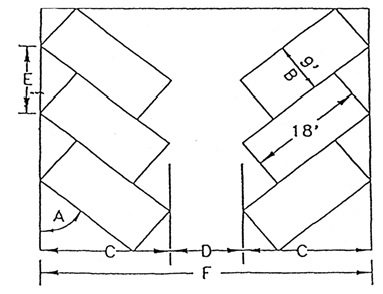
(2)
Angle and orientation. Parking stalls abutting the same continuous drive aisle shall have the same angle and orientation. Drive aisles shall be one-way only when less than 20 feet wide or which abut parking stalls with angles less than 90 degrees. Parking stall angles and drive aisle direction of flow may change only when the drive aisle is interrupted by a circulation drive or structure. Parking lots with different angles and orientation shall be discouraged.
(3)
Accessibility. Each parking space shall be directly accessible from a street, adequate drive aisle, or driveway leading to a street. In all zoning districts, the width of access aisles and driveways shall be in conformance with the standards set forth in Table 121-1. Each space shall be accessible without driving over or through another parking space. Back-out parking onto any public right-of-way is only permitted in single family zoned properties.
(4)
Composition. Parking facilities, including access aisles and driveways shall be composed of a hard dust free surface such as brick pavers, asphalt or concrete and maintained in a smooth, well-graded condition with standards set-forth according to the city engineer.
(5)
Striping. Off-street parking facilities, including access aisles and driveways, shall be marked according to city standards. All parking spaces shall be divided with painted lines except for single-family homes, zero lot line developments, townhouses and duplexes where the parking spaces are on-site or as otherwise permitted in this article with standards as set forth by the city engineer.
(6)
Drainage. All off-street parking facilities may not be drained to adjacent parcels without the recordation of appropriate drainage easements and agreements. Such drainage facilities shall be arranged for convenient access and safety of pedestrians and vehicles with standards set forth by the city engineer.
(7)
Lighting of parking facilities. All parking facilities to be developed in the future that serve Group E, F, G, H, and I occupancies (as described in the Florida Building Code) which are not illuminated by Florida Power and Light Company in a form acceptable to the city shall be illuminated according to standards contained herein by the developer of such parking facilities.
a.
For the purposes of this section, parking facilities shall include the parking surface of open parking lots and access thereto, and parking areas and other non-enclosed areas at grade level that abut or lie under buildings for which the parking facilities are a requirement.
b.
The intensity of illumination shall provide no less than one (1) footcandle (fc) equal to one (1) lumen per square foot nor more than fifteen (15) footcandles at any point on the parking areas. The current edition of the IES Lighting Handbook, published by the Illuminating Engineers Society, is hereby adopted by reference. This standard shall be used as a guide for the design and testing of parking facility lighting and the standards contained therein shall apply unless standards developed and adopted by this ordinance or subsequent amendments are more restrictive, in which case the more restrictive standards shall apply.
c.
Prior to the time a parking facility lighting system is accepted, an appropriate test report shall be submitted to the city building department that shows compliance with this section of the ordinance.
d.
All required illumination shall be controlled by automatic timing devices which will assure that the required illumination shall be provided at dusk until at least 9:00 p.m. each day and at least one-half (½) the required illumination from 9:00 p.m. to 11:00 p.m. or thirty (30) minutes after the closing time of the establishment served by the parking facility, if later than 11:00 p.m., after which the illumination will be required in areas adjacent to buildings of the establishment and at driveways where needed for security.
e.
All lighting shall be shaded, screened or aimed in such a manner that it will not be a nuisance to any residential unit. Furthermore, any device or fixture commonly known as a wall pack lighting fixture shall be installed at a height not exceeding ten (10) feet above the existing grade of the surface lying immediately below the fixture, if the fixture lies within a distance of one hundred (100) feet from any building or structure used for residential purposes.
(j)
Surface parking setback requirements and access limitations. The edge of all parking pavement and access roads (not including driveway connections to a street) shall be set back as follows:
(1)
No parking shall be allowed closer than forty (40) feet from the right-of-way of Sunrise Boulevard, N.W. 70th Avenue or Broward Boulevard east of Hiatus Road.
(2)
No direct access shall be allowed to any property from Sunrise Boulevard, N.W. 70th Avenue or Broward Boulevard east of Hiatus Road. However, the parking and direct access restrictions may be waived by the city council where it deems these restrictions impractical for the proper and effective development of a parcel of land.
(3)
Twenty (20) feet from all other major arterials;
(4)
Fifteen (15) feet from any other streets.
(k)
Landscaping of off-street parking. Parking structures and surface parking lots shall be landscaped in accordance with Article X of this Code.
(Ord. No. 2597a, § 3(Exh. A), 3-24-2021)
Sec. 27-122. - Parking garages.
(a)
Each parking space shall be directly accessible from a parking aisle. Tandem spaces designed to be located one (1) space behind the other, which are accessible from only one (1) direction, are prohibited.
(b)
Two-way drive aisles shall be a minimum of twenty-five (25) feet for ninety (90) degree angle parking. Two-way drive aisles in parking garages (regardless of whether the drive aisle abuts or does not abut parking spaces) shall be permitted to obtain a practical difficulty variance to reduce aisle width to twenty-four (24) feet. A practical difficulty variance (Sec. 27-52(g)(2)) request to reduce drive aisle width below twenty-four (24) feet shall be accompanied by a study signed and sealed by a Florida registered professional licensed engineer demonstrating that, under the circumstances presented, the reduction will not result in unsafe turning movements or driving geometry, and the affected area's planned layout will comfortably accommodate movements and driving geometry.
(c)
Access aisles for sixty (60) degree angle parking shall be one-way only and shall be a minimum of twenty (20) feet in width. Access aisles for forty-five (45) degree or thirty (30) degree parking shall be one-way only and shall be a minimum of fifteen (15) feet in width.
(d)
Parking spaces next to walls or columns shall be ten (10) feet wide by eighteen (18) feet deep.
(e)
Columns shall be setback at least three (3) feet from the entrance to a parking space.
(f)
Maximum ramp grades abutting a parking space shall not exceed 6.67 percent or the maximum otherwise provided in the Florida Building Code.
(g)
Maximum speed ramp grades (not abutting a parking space) shall not exceed twelve (12) percent. A grade difference of eight (8) percent or more shall require transition slope so vehicles do not bottom out. A minimum 10′-0″ long transition slopes shall be provided at the top and bottom of the ramp. Each transition slope shall be one-half of the differential slopes of the ramp. For instance, two (2) 10′-0″ transition ramps sloped at 6.0 percent would be required at the bottom and the top of a ramp sloped at 12.0 percent. Entry/exit areas that have parking control equipment shall have a maximum three (3) percent slope.
(h)
Minimum ground floor clear vertical clearance shall be at least fourteen (14) feet when providing access to sanitation or delivery vehicles. Minimum vertical clearance shall be compliant with Accessibility Codes and the Florida Building Code when providing handicapped vehicle access. When not providing access to sanitation, delivery, or handicapped vehicles, minimum vertical clearance shall be seven (7) feet or other minimum as required by the Florida Building Code. Clear vertical clearance shall be measured from the bottom of the lowest ceiling structural member (i.e., beam), appurtenance (i.e., piping), or clearance device (i.e., marker or bar suspended to identify minimum clearance), whichever is lowest.
(Ord. No. 2597a, § 3(Exh. A), 3-24-2021)
Sec. 27-123. - Amount of off-street parking
(a)
The minimum number of parking spaces to be provided and maintained for each use or occupancy shall be as set forth in Table 123-1 below:
TABLE 123-1
PARKING REQUIREMENTS
(b)
Supplemental parking regulations.
(1)
Single-family and duplexes (on lots under 7,500 square feet)—One (1) driveway parking space plus a carport or fully enclosed garage space designed to accommodate one (1) car.
(2)
Single-family and duplexes (on lots 7,500 square feet or more)—Two (2) side-by-side driveway parking spaces plus a fully enclosed garage space designed to accommodate two (2) cars.
(3)
Mobile homes—Spaces may be side-by-side or tandem.
(4)
Townhouse (2 bedroom or less)—Two side-by-side driveway parking spaces plus a fully enclosed garage space designed to accommodate one (1) car.
(5)
Townhouse (3 bedroom or more)—Two side-by-side driveway parking spaces plus a fully enclosed garage space designed to accommodate two (2) cars.
(6)
Multi-family guest spaces—If the parking spaces used in meeting the off-street parking requirement are located in a garage, driveway, or in any other manner which would imply exclusive use by a resident or dwelling unit, a minimum of one (1) guest space per four (4) dwelling units shall be provided. Guest spaces shall not be located beyond two hundred (200) feet of the units they serve.
(7)
Hotel or Motel—When other uses are located within and operated in conjunction with the hotel or motel portion of a building, additional off-street parking spaces shall be provided for such other uses as would be required by this section if such uses were separated from the hotel or motel.
(8)
Bowling Alleys—When other uses are located within and operated in conjunction with the bowling alley, additional off-street parking spaces shall be provided for such other uses as would be required by this section if such uses were separated from the bowling alley.
(9)
Motorcycle dealer —Parking spaces for at least six (6) motorcycles must be provided on the site. Such spaces shall be the equivalent of spaces associated with three (3) vehicle parking spaces, but each such space shall be divided in half, so that each such space can accommodate two (2) parked motorcycles. Signage and striping of the parking spaces shall also be provided to identify them as restricted to the parking of such vehicles.
(10)
New and used car sales. "Bull pen" parking shall not be counted towards meeting the parking requirements of customer, employee or visitor parking, and further, shall not be located, arranged, or used in such a manner as to interfere with access to the site or ingress and egress.
(11)
Fitness center/health club—If housed in a shopping center which has received an approved mixed-use, planned or shared parking formula, the requirements shall be those as prescribed by the formula. However, if the use exceeds twenty (20) percent of the total floor area of the shopping center or two thousand five hundred (2,500) square feet (whichever is less), or if the fitness center exists as a separate free-standing facility, then one (1) parking space for each one hundred twenty (150) square feet of floor area shall be provided. If a fitness center includes a juice bar, restaurant or similar amenity, the fitness center shall provide the number of parking spaces otherwise required for each such amenity based on the gross floor area devoted to such use, and any such use shall then be excluded from the parking calculation for the fitness center use.
(12)
Planned shopping centers—Office use within planned shopping centers - when office use exceeds ten percent (10%) of the gross floor area within a planned shopping center, the parking required for all office space exceeding 10% of the gross floor area shall be calculated at the parking required for the individual office use as set forth in this article.
Cinemas/theatres within planned shopping centers—The parking required for a planned shopping center set forth pursuant to this article less the area dedicated to theaters or cinemas, plus one (1) parking space for each three (3) seats.
Food sales within planned shopping center—The parking required for a planned shopping center less the gross floor area of buildings used for food sales, plus one (1) parking space for each one hundred fifty (150) square feet of gross floor area of buildings used for food sales (grocery stores).
(13)
House of Worship—These requirements shall apply only to auditoriums and chapels and not to rooms used only for Sunday school classes. Parking spaces for churches which are not used more than three (3) times per week may be grassed for parking areas, but not for drive aisles, general access roads or circulation roads, provided the grass is planted on soil prepared and maintained according to the city's specifications.
(14)
Restaurants, fast food restaurants, bars, hotel bars, restaurant bars, etc.: The parking requirements for restaurants, fast food restaurants, bars, hotel bars, restaurant bars, etc. shall be one (1) parking space per each four (4) seats, which parking requirement. If detailed floor and seating plans are not provided at the time of site plan approval for restaurant or bar uses, one (1) parking space shall be provided for each one-hundred (100) square feet of gross floor area.
(15)
Self storage—Such facilities are authorized to allocated, devote and use up to thirty (30) percent of the parking area otherwise required for the use for the parking and outdoor storage of motor vehicles, watercraft and similar transportation conveyances, provided, however, that all items so stored shall be totally screened, concealed or obscured from view from any location lying outside the facilities' grounds, by landscaping, the facilities' buildings, walls, fences or any combination of the foregoing.
(16)
Office uses in industrial districts. If any portion of the gross floor area for a manufacturing, assembly (not of persons), service, or technology-based use is devoted to business or professional offices, then:
a.
Parking for that portion of office gross floor area which exceeds twenty-five (25) percent of the overall gross floor area of the manufacturing, assembly (not of persons), service, or technology-based use shall be based on the article XI, off-street parking requirement for business and professional offices;
b.
Parking for the portion of office gross floor area which is less than or equal to twenty-five (25) percent of the overall gross floor area of the manufacturing, assembly, service, or technology-based use shall be based on the parking requirement for the manufacturing, assembly (not of persons), service, or technology-based use. Except as may be specifically provided otherwise in this section, in all other cases, parking for all portions of floor area devoted to business and professional offices shall be based on the requirement for business and professional offices.
(Ord. No. 2597a, § 3(Exh. A), 3-24-2021)
Sec. 27-124. - Calculating required parking spaces.
(a)
Uses not specifically mentioned: The requirements for off-street parking for any unspecified uses in this section shall be determined by the Planning, Zoning and Economic Development Director.
(b)
Fractional spaces: When units or measurements determining number of required off-street parking spaces result in requirement of fractional space, any such fraction equal to or greater than one-half shall require a full off-street parking space.
(c)
Calculating bedrooms—In addition to interior spaces of dwelling units that are bedrooms, other kinds of interior spaces shall be treated as "bedrooms" for purposes of calculating the required parking. When a room such as a den, study, library, loft, or home office is provided or designated on a plan, such room shall be considered a bedroom for purposes of calculating required parking if the room meets the following criteria: (1) has a minimum seventy (70) square feet in floor area; and (2) is bounded along more than seventy-five (75) percent of its perimeter by vertical walls, partitions or by other types of dividers that serve to define the boundaries of the room.
(d)
Multiple use developments: Except for shopping centers exceeding 25,001 square feet in area, developments containing more than one principal use shall provide parking spaces in an amount equal to the total of the requirements applied to all individual principal uses.
(e)
Shared parking: Parking spaces required under this section may be provided cooperatively for two or more uses in a development or for two or more individual uses, subject to the requirements of this section.
(1)
Cooperative parking agreements. Off-street parking requirements of a given use may be met with off-site, off-street parking facilities of another use when, and if, all of the following conditions are met:
a.
The off-site, off-street parking facilities are within 300 feet of the property. In assessing the feasibility of such cooperative parking, the city must find that the off-site parking facility is reasonably located in relation to the use it is intended to serve, based upon such factors as the type of facility, likely purpose of the trip to the facility, and any physical barriers which must be crossed to reach the use to be served.
b.
The parking demands of the individual uses, as determined by the planning, zoning and economic development director based upon minimum off-street parking requirements, are such that the total parking demand of all the uses at any one time is less than the total parking stalls required;
c.
A written agreement between the owners and lessees is executed and approved by the city council as provided in subsection d., below. The application shall be recorded at the owner's expense and a copy maintained in the project file. Should the lease expire or otherwise terminate, the use for which the off-site parking was provided shall be considered nonconforming and any and all approvals, including conditional use approvals, shall be subject to revocation. Continuation or expansion of the use shall be prohibited unless the use is brought into compliance with the parking regulations of this article;
d.
An application for approval of a cooperative parking plan shall be filed with the planning, zoning and economic development director by the owner of the entire land area to be included within the cooperative parking plan, the owner or owners of all structures then existing on such land area, and all parties having a legal interest in such land area and structures. Sufficient evidence to establish the status of applicants as owners of parties in interest shall be provided. The application shall include plans showing the location of the uses or structures for which off-street parking facilities are required, the location of the off-street parking facilities, and the schedule of times used by those sharing parking in common; and
e.
Pursuant to the same procedure and subject to the same limitations and requirements by which the cooperative parking plan was approved and registered, any such plan may be amended or withdrawn, either partially or completely, if all land and structures remaining under such plan comply with all the conditions and limitations of the plan, and all land and structures withdrawn from such plan comply with the regulations of this article.
(2)
Shared parking methodology. Developments that contain a mix of uses on the same parcel, as set forth in Table 8-6, may reduce the amount of required parking in accordance with the following methodology:
a.
Determine the minimum parking requirements in accordance with Table 124-1 for each land use as if it were a separate use;
b.
Multiply each amount by the corresponding percentages for each of the five time periods set forth in Columns (B) through (F) of Table 124-1;
c.
Calculate the total for each time period; and
d.
Select the total with the highest value as the required minimum number of parking spaces.
e.
The provision of this subsection shall not result in a reduction by more than twenty (20) percent of the requirement which would apply in the absence of this subsection.
Table 124-1
Shared Parking Standards
(f)
Alternative parking plan/parking study. The City Council may approve any alternative parking plan that proposes alternatives to providing the minimum number of off-street parking spaces required by Section 27-123. The alternative parking plan shall be submitted with an application for site plan approval (Section 27-50). Additional fees may be assessed to cover the City's additional costs in reviewing alternative parking plans and any subsequent parking agreements.
(g)
Measurements.
(1)
For the purposes of this chapter, gross floor area shall mean the floor area inside of the exterior walls excluding elevators, stair wells, common corridors, trash rooms, common lobbies, common rest rooms, meter rooms, and ancillary power equipment rooms.
(2)
In hospitals, bassinets shall not count as beds.
(3)
In stadiums, sport arenas, places of worship and other places of assembly in which occupants utilize benches, pews or other similar seating facilities, each 20 lineal inches of such seating shall be counted as one seat for the purpose of computing off-street parking requirements.
(4)
In outdoor display areas for vehicle sales or rental, only areas designated for vehicle parking shall be measured. Driveway aisles and landscaped medians are not intended to be included in the measured area.
(Ord. No. 2597a, § 3(Exh. A), 3-24-2021)
Section 27-125 - Use of permitted facilities
(a)
Permitted use. Parking spaces approved in accordance with this article may be used for the intermittent parking of licensed motor vehicles of employees, occupants, owners, tenants or customers utilizing the building or use served by said required parking space. Supplemental parking (parking facilities provided but not required) may be used for any purpose related to the use of the building it serves, subject to the conditions hereinafter set forth. Parking may be used for any purpose related to the use of the building it serves, subject to the conditions hereinafter set forth.
(b)
Limitations on use of required parking facilities. The following uses and activities shall not be permitted in required parking facilities:
(1)
Parking to serve an off-site building unless in accordance with a cooperative parking plan (Section 27-124(e)(1) or unity of title approved by the city in accordance with this article.
(2)
Storage, repair or display of any vehicles, equipment or merchandise.
(3)
Parking of vehicle, which, due to its size, shape, contents or location creates an obstruction or public safety hazard, or which cannot be contained within a single designated parking space.
(4)
Vehicles shall be required to park on paved parking surfaces approved by the City Engineer. Parking shall be prohibited in all other areas.
(c)
Commercial vehicle parking. Overnight parking or storage of commercial vehicles associated with an approved use shall be subject to the following:
(1)
A maximum of six (6) commercial vehicles may be parked on site;
(2)
All commercial vehicles must fit within a standard 9′ × 18′ parking stall;
(3)
Commercial vehicles shall be parked so as not to be visible from the public right-of-way, or on sites where this is difficult to achieve. shall be located to the rear of the building or as close to the rear as practical;
(4)
Commercial vehicle parking not consistent with the above standards shall require conditional use approval from the City Council.
(d)
Assigned spaces in certain office, industrial or commerce park developments. In an effort to allow for amenities within office park developments, the city wishes to establish parking deviations to allow for assigned covered parking spaces where permitted office use is located. Those uses shall enjoy the deviation set forth below:
(1)
Assigned spaces may be covered or uncovered.
(2)
The parking requirement for uses is established elsewhere in this Code. Assigned parking spaces may count for up to fifteen (15) percent of the required parking.
(3)
Assigned parking spaces shall not be available for properties which received a parking variation as part of a timely received, executed, confirmed as effective and implemented certificate of conformity in accordance with Ordinances Nos. 2022 and 2187, property which received a parking variation pursuant to Section 27-93(c)(5) of the City Code, pertaining to nonconformities associated with the expansion of State roads within the Plantation Gateway Overlay district, or properties which have been granted waivers, variations, or deviations which allowed for a reduction in required parking greater than five (5) percent of the existing parking requirement.
(4)
Uses other than office use will not be allowed to take advantage of the parking deviations set forth above.
(5)
Pole signage indicating said assigned parking is reserved or designated for specific users is prohibited; however, painted wheel stops or curbs are permitted.
(6)
Assigned parking shall be located in a manner, which does not unreasonably restrict the use of the off-street parking facilities by occupants, employees, visitors, or patrons.
(7)
The location and structures associated with assigned parking may be reviewed at the time of initial site plan approval or by the plan adjustment committee for offices which desire assigned parking.
(8)
Design approval required.
a.
Before any building permit is issued for assigned parking structures, drawings shall be submitted to the Planning, Zoning & Economic Development Department for review and approval by the DRC or City Council.
b.
The drawings will be reviewed for acceptable design of site layout and building material.
c.
If the approval is granted, the building permit must be in accord with conditions imposed by the DRC or City Council.
(Ord. No. 2597a, § 3(Exh. A), 3-24-2021; Ord. No. 2024-001, § 14(Exh. N), 1-24-2024)
Sec. 27-126. - Off-street loading.
(a)
General provisions. Adequate space for loading and unloading of materials, goods or things, and for delivery and shipping, shall be provided and maintained on the same plot as the building which it serves.
Where any structure is enlarged or any use is extended so that the size of the resulting occupancy comes within the scope of this section, the full amount of off-street loading space shall be supplied and maintained for the structure or use in its enlarged or extended size. Where the use of a structure or land or any part thereof is changed to a use requiring an off-street loading space, such space shall be supplied and maintained to comply with this section.
(b)
Dimensional standards for loading spaces. For the purposes of this section, each loading space shall be of sufficient size to accommodate the types of vehicles likely to use the loading area. The minimum loading space size that presumptively satisfies loading space needs is at least 10 feet wide and 25 feet long with 14 foot vertical clearance. The planning, zoning and economic development director may require a larger loading space or allow a smaller loading space on determining that the characteristics of the particular development warrant such increase or reduction and the general standard is met.
(c)
Location of loading areas. Where possible, loading areas shall be located to the rear of the use they serve. The loading area shall be located adjacent to the building's loading doors, in an area that promotes its practical use. The loading area shall be located and designed so vehicles using them can maneuver safely and conveniently to it from a public street and complete loading without obstructing or interfering with any public right-of-way or any parking space or parking lot aisle.
(d)
Specifications. The following minimum conditions shall apply; additional conditions may be imposed as part of a conditional use or final site plan approval. Off-street loading spaces shall be provided and maintained in accordance with the following schedule:
Table 126-1
Minimum Number of Off-Street Loading Spaces
NOTES:
1. See Part 2 (Principal Uses) of Article 4: Use Standards.
(Ord. No. 2597a, § 3(Exh. A), 3-24-2021)
Sec. 27-127. - Drive-through service.
Businesses that provide a drive-through service are required to provide drive-through service lane or lanes, whether for stacking or queuing, as separate and distinct lanes from the circulation lanes necessary for entering or exiting the property. Each drive-through lane shall be separated from other on-site lanes. Each such drive-through lane shall be curbed, striped, marked or otherwise distinctly delineated. A separate and distinct escape lane shall be provided. Neither a lane otherwise necessary for site circulation nor a public street or alley shall be counted as an escape lane. Drive-through lanes and escape lanes shall not conflict, or otherwise hamper access, to or from any parking space. Pedestrian walkways shall be clearly separated from drive-through lanes.
(a)
Specifications. Stacking spaces necessary for the provisions of drive-through lanes shall be determined using the following Table 127-1.
Table 127-1
Drive-Through Service Stacking Requirements
A stacking space is hereby defined as being 22 feet in length. Inbound stacking requirements shall be counted from the first stopping point. Out-bound stacking requirements shall be counted from the last stopping point. The City Engineer may modify these standards as applicable.
(Ord. No. 2597a, § 3(Exh. A), 3-24-2021)
Section 27-128 - Electric Vehicle Charging Stations and Parking Spaces
(a)
Purpose and Applicability:
(1)
Purpose - The requirements of this subsection are intended to provide electric vehicle ("EV") charging abilities distributed throughout the City to serve public mobility needs, prepare for emerging electric vehicle technologies, improve air quality, and achieve the City's sustainability goals, including climate change mitigation. Charging stations shall be open to the public, unless specifically secured and separated off for use of the employees of the building. As electric vehicle technology continues to evolve, the City's Planning, Zoning and Economic Development Director will review new systems and determine the equivalent level of electric vehicle charging station pursuant to the City's established level classifications and other adaptations that may be required.
(2)
Applicability -
(a)
The requirements of this part shall apply to new development, redevelopment, infill development or substantial enlargement and/or alteration of structures on parcels other than those that are exclusively single-family and duplex (i.e., two-family dwelling) zoned. Only the new parking spaces added as part of a substantial enlargement or alteration are subject to the requirements of this subsection. New single-family and duplex homes shall be required to install a circuit breaker and electrical outlet as per Subsection (b)(3)(j)(1).
(b)
The provisions of this subsection control over all conflicting provisions in the Code of Ordinances and all operations of electric vehicle charging stations shall comply with applicable Federal, State, and local laws, rules and regulations.
(c)
EV charging stations shall be permitted as an accessory use within all residential, non-residential and mixed-use zoning districts. EV charging stations shall be permitted as a primary use in the I-LP and I-L2P districts and via the Conditional Use process in the B-3P district.
(d)
EV charging stations shall be located within new or existing enclosed parking garages or within new or existing surface parking areas.
(e)
Operators of electric vehicle charging stations must apply for a local business tax receipt in compliance with City Code Chapter 14, unless restricted for private use to employees at no cost to the employee.
(3)
General Requirements
(a)
Electric Vehicle Parking spaces shall meet all performance standards of this subsection.
(b)
EV Readiness requirements are categorized in two (2) levels as follows:
a.
EV Capable: These parking spaces prepare for future Electric Vehicle Supply Equipment (EVSE) installation by providing dedicated electrical capacity in the service panel (40-amp breaker for every two (2) EV Capable two (2) spaces) and conduit to the EV Capable parking space. These spaces do not require wiring to the space or a receptacle.
b.
EVSE Installed: These parking spaces are reserved for EVs and provide drivers the opportunity to charge their electric vehicle using EV charging stations rated at a minimum of 32-amp 7.2 kW. These spaces should be installed per the requirements of the current National Electrical Code as adopted and amended by the State of Florida.
(b)
Parking Space Design Standards
(1)
Number of Spaces Required: The parking requirements of this subsection are intended to provide minimum standards and the designated EV capable and installed parking spaces shall count towards the parking requirements. The EV parking requirements are based on a percentage of the minimum required spaces as set forth in Section 27-123 and delineated in Table 128-1. Each EV charging station space shall be counted towards the number of required parking spaces.
* Commercial projects for fuel retailers in which automotive services is the primary use are required to have at least 2 EVSE installed charging stations.
** All partial space requirements are rounded down. These minimum thresholds are inclusive, not distinct.
(2)
Location:
(1)
Placement of the EV Capable and EVSE Installed required and future spaces must be identified during the site plan approval process.
(2)
EV charging stations shall not interfere with vehicle, bicycle or pedestrian access and circulation, or with required landscaping, above-ground or underground infrastructure.
(3)
EV charging stations shall not be located within dedicated drainage or utility easements.
(4)
All components of the EV charging station shall be elevated above the minimum flood elevation and designed so that it complies with the provisions of the Florida Building Code and the City's Floodplain Ordinance.
(5)
Pursuant to Florida Statutes Section 366.94, and as it may be amended from time to time, it is unlawful for a person to stop, stand or park a vehicle that is not capable of using an electrical recharging station within any parking space specifically designated for charging an electric vehicle.
(3)
Design:
(a)
Charging equipment must be mounted on the wall or on a structure at the end of the electric vehicle parking space provided.
(b)
Charging devices may not be placed within the dimensions of a space, on the sides, or entrance to a space. Electric vehicle parking spaces shall be marked by green painted lines or curbs.
(c)
When cords and connectors are not in use, retraction devices or locations for storage shall be located sufficiently above the pedestrian surface and the parking lot as to reduce conflicts with pedestrians and vehicle maneuvering.
(d)
Cords, cables and connector equipment shall not extend across the path of travel in any sidewalk or walkway.
(e)
Equipment mounted on structures such as pedestals, lighting posts, bollards, or other protective devices shall be located in a manner that does not impede pedestrian, bicycle, or transit travel.
(f)
For EV charging stations installed on surface parking lots, all cabinets, switchgear and other transmission equipment (other than charging posts or connectors) related to the station shall be completely enclosed. For EV charging stations installed in enclosed parking garages, all equipment (other than charging posts or connectors) related to the station shall have safety screens around the equipment.
(g)
Alternative designs may be approved by the Director. Appeals would be heard by PAC.
(h)
Additional landscape screening may be required for mechanical equipment such as transformers associated with charging equipment, consistent with mechanical equipment screening requirements and the current edition of the Florida Building Code.
(i)
Electric vehicle charging stations will be considered an amenity use when the service is offered free of charge. Amenity use electric vehicle charging stations spaces will count towards the required parking, but shall not be exclusively designated for charging an electric vehicle.
(j)
Residential electrical vehicle charging infrastructure standards:
(1)
Single-family/Two-Family (Duplex): All new residential construction that includes a carport or garage, is required to install an electrical outlet and circuit breaker dedicated for electric vehicle charging infrastructure. When locating such equipment in a residential garage or carport, the following shall be depicted on the plans:
(a)
the location where the vehicle will be typically parked;
(b)
the location of the charging station; and
(c)
electrical plans showing circuit, panel schedules and routing.
(2)
Multi-family: In addition, all new residential multi-family projects that have a common parking area are required to provide electric vehicle charging outlets and grounded alternating current outlet in at least 5% of the total number of parking spaces. All outlets shall be located within the required parking area.
(c)
Miscellaneous Design Standards
(1)
Maintenance: EV charging stations shall be maintained in good condition, appearance and repair. Protective bollards, curbing, and/or freestanding wheel stops may be installed to maximize safety of the charging space.
(2)
Accessibility:
(a)
A minimum of one (1) EVSE Installed space must be located adjacent to an ADA designated space to provide access to the charging station.
(b)
The accessible space must be designated as an EV reserved space.
(c)
The EVSE Installed accessible spaces should have all relevant parts within accessible reach, and in a barrier-free access aisle for the user to move freely between the EVSE and the electric vehicle.
(3)
Signage and Lighting:
(a)
All EVSE Installed parking spaces should be designated following MUTCD standards and in accordance with the City's Sign Code.
(b)
The charging post or connector shall be equipped with signage that contains the words: "Charging Station"; safety information; voltage and amperage levels; any applicable usage fees; and the name, or logo of manufacturer and contact information for the owner of the charging station to allow consumers to report issues relating to the charging station.
(c)
Advertising, other than information required by this subsection, is not permitted on charging station signs, cabinets and/or charging station equipment.
(d)
Illumination of charging stations at nighttime may be via bollards and/or strip lighting following the form of the charging portals using either white or green lighting, provided that they are more than five hundred (500) feet from residentially-zoned property and are deactivated after 10:00 p.m. Illumination following the form of the charging stations (i.e., strip lighting) shall not otherwise display advertising. Illuminated bollards shall be permitted by-right as part of the site plan or site plan amendment and the strip lighting may be permitted by PZB.
(Ord. No. 2597a, § 3(Exh. A), 3-24-2021; Ord. No. 2620, § 1(Exh. A), 8-24-2022; Ord. No. 2024-001, § 14(Exh. N), 1-24-2024)
Sec. 27-129. - Valet and tandem parking.
An alternative parking plan may propose to use valet and tandem parking to meet a portion of the minimum number of off-street parking spaces required for a development in accordance with the following:
(a)
Number of Valet or Tandem Spaces.
(1)
All uses, except hotels, may designate a maximum of 25% of the total number of required off-street parking spaces as valet parking. The valet spaces may be tandem.
(2)
Hotels may designate a maximum of 50% of the total number of required off-street parking spaces as valet parking. The valet spaces may be tandem.
(b)
Drop-Off and Pick-Up Areas. The development shall provide a designated drop-off and pick-up area in compliance with the following standards:
(1)
The drop-off and pickup area shall be in compliance with Table 127-1, Drive-through Service Stacking Requirements.
(2)
The drop-off and pick up area may be located adjacent to the building served, but may not be located in a fire lane or where its use would impede vehicular and/or pedestrian circulation or cause queuing in a public street or internal drive aisle serving the development.
(c)
Valet Parking Plan. The alternative parking plan requesting valet shall include, but not be limited to, the following:
(1)
Identification of the type and nature of the use for which the valet service is being provided;
(2)
The location of the valet parking and self-parking spaces, including how the valet parking area shall be isolated from use by the general public.
(3)
The pick-up and drop off area(s);
(4)
A site traffic circulation plan; and
(5)
The number of parking attendants (and any other personnel) needed to operate the valet service.
(6)
Site plan modification application.
(d)
Valet Parking Agreement. Valet parking may be established and managed only in accordance with a valet agreement. The agreement shall include provisions ensuring that a valet parking attendant will be on duty during hours of operation of the uses served by the valet parking, except for residential and hotel/extended stay uses, which shall provide valet parking attendants 24 hours a day. The agreement shall also include a legal description of the parcel where parking will be located and states the number of parking spaces utilized for valet parking. The agreement shall be submitted to the planning, zoning and economic development director, who shall forward it to the city attorney for review and approval before execution. An attested copy of an approved and executed agreement shall be recorded with the Broward County Records Division before issuance of a certificate of occupancy or business tax receipt for any use to be served by the valet parking. The agreement shall be considered a restriction running with the land and shall bind the heirs, successors, and assigns of the landowner.
(Ord. No. 2597a, § 3(Exh. A), 3-24-2021)
Sec. 27-130. - Reduced parking requirements for parking demand reduction strategies.
The minimum number of parking spaces required in Section 27-123 may be reduced through implementation of one or more of the following strategies for reducing parking demand.
(a)
Transit Accessibility. The planning, zoning and economic development director may authorize up to a 5 percent reduction in the minimum number of off-street parking spaces required by Table 123-1 for buildings located within 1,000 feet of a bus or rapid transit stop.
(b)
Transportation Demand Management. The planning, zoning and economic development director may, through approval of a Transportation Demand Management (TDM) plan, authorize up to a 10 percent reduction in the minimum number of off-street parking spaces required by Table 123-1 for nonresidential or mixed-use developments having a floor area of at least 25,000 square feet, in accordance with the standards below.
(1)
TDM Plan Requirements. The TDM plan shall include facts and/or projections (e.g., type of development, proximity to transit and/or other multi-modal systems, anticipated number of employees and/or patrons, minimum parking requirements) and indicate the types of transportation demand management activities that will be instituted to reduce single-occupant vehicle use and reduce traffic congestion.
(2)
Transportation Demand Management Activities. The TDM plan shall provide at least three of the following transportation demand management activities:
a.
Establishment of a development-specific website that provides multi-modal transportation information such as real-time travel/traffic information, bus schedules and maps, and logging of alternative commutes (e.g., bicycle, pedestrian, carpool, and vanpool).
b.
Written disclosure of transportation information and educational materials to all employees.
c.
Formation of transportation demand reduction programs such as carpooling, vanpooling, ridesharing, guaranteed ride home, teleworking, and shuttle service programs.
d.
Creation of a Preferential Parking Management Plan that specifically marks spaces for registered carpool and/or vanpool vehicles that are located near building entrances or in other preferential locations.
e.
Institution of off-peak work schedules that allow employees to arrive and depart at times other than the peak morning commute period (defined as 7:00 a.m. to 9:00 a.m.) and peak evening commute period (defined as 5:00 p.m. to 7:00 p.m.).
f.
Establishment of an office, staffed by a transportation coordinator that makes transportation and ride-sharing information available to employees, residents, and nonresidents.
g.
Any other transportation demand management activity as may be approved by the planning, zoning and economic development director as a means of complying with the parking reduction provisions of this subsection.
(3)
TDM Program Coordinator.
a.
The applicant shall appoint a TDM program coordinator to oversee transportation demand management activities.
b.
The TDM program coordinator shall be a licensed engineer or a traffic consultant that is also qualified or trained TDM professional.
c.
The TDM program coordinator shall be appointed prior to issuance of a building permit or certificate of occupancy for the buildings to be served by the transportation demand management program.
(4)
TDM Annual Report.
a.
The TDM program coordinator shall submit to the planning, zoning and economic development director an annual report that details implementation of the approved TDM plan. The report may include, but is not limited to, the following:
1.
A description of transportation demand management activities undertaken;
2.
An analysis of parking demand reductions based on employee and/or resident use of ridership programs or alternative transportation options;
3.
Changes to the TDM plan to increase transit ridership and other commuting alternatives; and
4.
The results of an employee transportation survey.
b.
A copy of the approved TDM plan shall be recorded with the Broward County Records Division before issuance of a business tax receipt (BTR) for the development to be served by the plan. The TDM plan shall be recorded against the property, and the applicant and/or successors of interest in the property shall be responsible for implementing the plan in perpetuity.
(5)
Amendments. The planning, zoning and economic development director may approve amendments to an approved TDM plan following the same process required for the initial approval.
(6)
Parking Required if TDM Terminated. If the applicant and/or successors in interest in the property covered by the TDM plan stop implementing the plan or fail to submit a TDM annual report to the planning, zoning and economic development director in a timely fashion, the TDM plan shall be considered terminated. Any such termination of the TDM plan does not negate the parties' obligations to comply with parking requirements and thus shall constitute a violation of this Code. No use served by the TDM plan may be continued unless another TDM plan is approved or all required off-street parking spaces are provided in full in accordance with this section.
(c)
Special Facilities for Bicycle Commuters. The planning, zoning and economic development director may authorize up to a five percent reduction in the minimum number of off-street parking spaces required by Table 123-1 for developments that provide both of the following:
(1)
Enclosed (indoor or locker) and secure bicycle parking spaces equal to at least five percent of the number of vehicle parking spaces provided; and
(2)
Shower and dressing areas for employees.
(d)
Other Eligible Alternatives. The planning, zoning and economic development director may authorize up to a ten percent reduction in the minimum number of off-street parking spaces required by Table 123-1 in exchange for any other strategy that an applicant demonstrates will effectively reduce parking demand on the site of the subject development, provided the applicant also demonstrates that the proposed development plan will do at least as good a job in protecting surrounding neighborhoods, maintaining traffic-circulation patterns, and promoting quality urban design as would strict compliance with the otherwise applicable off-street parking standards.
(Ord. No. 2597a, § 3(Exh. A), 3-24-2021)

