
Plantation City Zoning Code
ARTICLE XI
DEVELOPMENT STANDARDS OF GENERAL APPLICABILITY
Section 27-290 - Development Standards
All development shall conform to the specific requirements of the appropriate zoning districts and shall comply with the standards contained in this chapter and other regulations outlined in this Code. These standards shall be considered to be minimum requirements. In considering development plans, the Development Review Committee, Planning and Zoning Board and City Council shall be guided by the standards set forth hereinafter.
(Ord. No. 2597a, § 3(Exh. A), 3-24-2021; Ord. No. 2024-001, § 14(Exh. N), 1-24-2024)
Sec. 27-291. - Urban Design Standards.
(a)
Design concepts. The principles set out below are not intended to limit innovative architecture, but to establish a meaningful design guide for development and redevelopment in the City of Plantation. All development shall be designed in accordance with the fundamental concepts described in this section. The fundamental design concepts shall include:
(1)
The design of architecturally varied structures within developments through the use of building massing, varied roof-scapes, varied window design, ornamentation and color;
(2)
The linkage of landscaped exterior spaces (courtyards, loggias, arcades and plazas) to buildings; and
(3)
The linkage of separate development parcels by pedestrian and vehicular connections.
(4)
The recognition of the South Florida climate which should influence building shape and orientation, nature of roofs and overhangs and the location and size of windows.
(5)
The identification of individual subdivisions by utilizing signage.
(6)
The use of private common open space as a community design feature.
(b)
Pedestrian orientation. All nonresidential and multifamily development shall contribute to the creation of a pedestrian oriented community by providing the following:
(1)
Emphasis on the buildings' street facades as major elements of the overall street-scape; and
(2)
Street level architectural treatment including colonnades, arcades, awnings, and other shade producing elements should be provided along all pedestrian-oriented frontages.
(3)
Pedestrian oriented frontages shall be adjacent to building entrances and integrated with adjacent properties.
(c)
Minimum design standards.
(1)
Nonresidential development. All nonresidential development shall be consistent with the traditional architecture and design themes of South Florida including the following:
a.
New buildings shall be designed in a manner that is compatible with the adjacent building in height and scale.
b.
Recognition of the scale and character of adjacent structures or developments, including continuation of existing facade treatment or expression lines, and the use of similar finish materials.
c.
Roof materials shall consist of tile, metal seam or shingle. This requirement shall not apply to flat roofs with a parapet wall.
d.
All mechanical equipment (including roof-mounted equipment) shall be screened with materials consistent with those used in the construction of the building. The screening material and structure shall be architecturally compatible with the building. Mechanical equipment shall be screened from view by a parapet, masonry wall or other architectural feature of the building. Such enclosure shall be as high as or higher than the highest portion of the equipment or apparatus being screened. All existing structures for which design approval is required as a result of proposed changes to existing development shall screen rooftop equipment in accordance with these standards. Such screening shall be of the same or similar material to that which exists on the exterior of the building
e.
Pedestrian circulation systems shall be barrier-free and provide alternative ramps in addition to steps consistent with American Disabilities Act (ADA) requirements.
f.
All sides of any nonresidential structure shall have compatible facade and roof treatments.
g.
All dumpsters and trash handling areas shall have a concrete slab, and finished masonry wall as provided for in this Code, and be landscaped in accordance with Article X of this Code. Dumpsters shall be oriented in a logical fashion so as to minimize truck maneuvers. Enclosures shall be finished with similar materials and colors as the principal structure.
(2)
Residential development. All residential development shall adhere to the following standards:
a.
Multi-family roof standards. Pitched roofs shall have constructed of a metal or slate, all as defined by common usage in Broward County, Florida. Cedar shingle and asphalt shingle roofs are not permitted.
b.
All multi-family buildings which abut or are separated by a street or water body from an existing or proposed single-family district shall have hip or gable roofs.
c.
Driveways and parking areas within all residential zoning districts shall be constructed of concrete, asphalt or brick pavers.
d.
No two houses having the same elevation in any residential single-family zoning district shall be built side by side or directly across the street. In no instance, shall two houses of identical color package be side by side or directly across the street.
e.
Architecture and site development should incorporate consideration of the subtropical characteristics of the area. The provision of sun-control devices, shaded areas, vegetation, roof terraces, and similar features characteristic of subtropical design is encouraged.
f.
Open space for multi-family dwelling units should be located and designed to maximize its utility to the dwelling units.
g.
All dumpsters and trash handling areas within residential multi-family zoning districts shall have a concrete slab, be enclosed by a finished concrete block wall similar in color and detail to the principal structure as provided in this Code, and be landscaped in accordance with Article X of this Code. Dumpsters shall be oriented in a logical fashion so as to minimize truck maneuvers.
(Ord. No. 2597a, § 3(Exh. A), 3-24-2021)
Sec. 27-292. - Driveway Standards.
(a)
Design. Driveway locations, cross-sections and grades shall be in accordance with approved engineering plans, Chapter 5 of the City of Plantation Code of Ordinances, and the Florida Building Code (Broward edition) as amended from time to time. Driveway access to the street system shall be according to the subdivision design standards and street layout contained in Chapter 23 of the Code of the City of Plantation.
(b)
Minimum size. Driveways for single-family and duplex structures in all residentially zoned districts shall have minimum paved dimensions per parking space of eight (8) feet in width and eighteen (18) feet in length (clear of sidewalk).
(c)
Paving. Except as provided for below, driveways and parking areas shall be paved with a hard, dust-free paving material complying with the Florida Building Code. All uses shall use concrete, asphalt, or brick pavers.
Exception. Uses permitted to provide grass overflow parking.
(d)
Clear sight triangles. All driveways and street intersections shall provide clear sight triangles in both directions in accordance with Chapter 23 of the Plantation Code of Ordinances.
(Ord. No. 2597a, § 3(Exh. A), 3-24-2021)
Sec. 27-293. - Outdoor Lighting Standards.
(a)
General. No structure or land shall be developed, used or occupied unless all outdoor lighting conforms to the requirements of this section. The terms used in this section shall have the definition used by the Illuminating Engineers Society. Lighting shall be designed and placed to illuminate the ground, a vehicular use area, a building entrance, walkway, or a sign. All lighting shall be concentrated on the ground, building entrances, walkways, or sign it is intended to illuminate. Lighting which is designed to illuminate the building elevation or roof area shall be prohibited.
(b)
Preparation of site lighting plan. A plan which shows the photometrics of the site's lighting for vehicular use areas, outside building areas, signs and walkways shall be prepared by a registered professional engineer. The plan shall incorporate all existing and proposed sources of artificial light used on the site, including adjoining outparcels for nonresidential development. The lighting plan shall be submitted with the site plan, prepared at the same scale. The plan must indicate and be certified for compliance with the standards of this section.
(c)
Minimum illumination. All multi-family, shopping centers and office buildings shall illuminate parking lots and pedestrian areas to a minimum maintained average of 1.0 footcandle and a maximum to minimum ratio of 15 to 1, with no area below the illumination of 0.5 footcandle.
(d)
Maximum illumination. All lighting for parking areas, buildings and signs shall be located, screened, or shielded so that adjacent property, structures, and rights-of-way are not directly illuminated. All lighting for parking areas, buildings and signs shall either be shaded or screened in a manner that will limit spillover of lighting onto adjacent property and public rights-of-way. Spillover shall not exceed 0.5 footcandles measured vertically along the property line at the perimeter of the property. The maximum footcandle shall not exceed 15 at any point in a vehicular use area.
(e)
Lighting height standards. All private outdoor lighting shall be designed, located and mounted at heights no greater than:
(1)
25 feet above grade for non-cut-off type luminaries, and
(2)
30 feet above grade for cut-off type luminaries.
(f)
Exceptions. Public facilities including but not limited to parks; lighted recreation and athletic areas, courts and fields; and water and wastewater treatment facilities shall be exempted from these standards.
(g)
Hours of illumination. All required illumination shall be controlled by automatic timing devices which will assure that the required illumination shall be provided at dusk until at least 9:00 p.m. each day and at least one-half (½) the required illumination from 9:00 p.m. to 11:00 p.m. or thirty (30) minutes after the closing time of the establishment served by the parking facility, if later than 11:00 p.m., after which the illumination will be required in areas adjacent to buildings of the establishment and at driveways where needed for security.
(Ord. No. 2597a, § 3(Exh. A), 3-24-2021)
Sec. 27-294. - Natural Resource and Wellfield Protection.
(a)
Prior to the city issuing a building permit for property identified on the comprehensive plan wetlands map as "transitional wetlands," permitting shall be required by the South Florida Water Management District and Florida Department of Environmental Regulation, as determined to be necessary by those agencies.
(b)
Plans for development in areas with significant native vegetation as identified in the city's conservation element of the comprehensive plan will show the location of the vegetation and will indicate how the vegetation will be preserved.
(c)
Uses within potable water wellfield cones of influence will be restricted to those allowed under the county wellfield protection ordinance.
(Ord. No. 2597a, § 3(Exh. A), 3-24-2021)
Sec. 27-295. - Surface Water Management Standards.
(a)
Conformance with applicable laws. All structures or land shall be developed, used or occupied such that surface water is managed in conformance with Chapter 9 of the Plantation Code of Ordinances and the following laws, rules and regulations:
(1)
Chapter 27-14, Broward County Department of Natural Resource Protection, Code of Regulations, as amended, "Management of Stormwater Discharges and Non-Point Sources of Pollution";
(2)
Chapter 67-904, as amended, Laws of Florida;
(3)
Chapter 40-E, as amended, Florida Administrative Code, "Rules of the South Florida Water Management District."
(4)
Plantation Acres Improvement District rules and regulations, as amended.
(5)
Old Plantation Water Management District rules and regulations, as amended
(6)
Florida Building Code, as amended.
(Ord. No. 2597a, § 3(Exh. A), 3-24-2021)
Section 27-296 - Accessory Uses and Standards
(a)
General. Accessory uses shall not be permitted in a required yard or bufferyard area, except as set forth below. In no event shall an accessory use be construed to authorize a use not otherwise permitted in the district in which the principal use is located and in no event shall an accessory use be established prior to the principal use to which it is accessory. Permanent structures shall not be permitted in utility easements without the prior written approval of the appropriate utilities and the concurrence of the City.
(b)
Aviaries.
(c)
Awnings and canopies.
(d)
Antennas, antenna towers and dish antennas.
(e)
Barns and stables.
(f)
Bike racks. Bike racks may be permitted in any required yard setback, easement, or in front of the principal building structure, provided they are not located within any required landscaping buffer or vehicular use area landscaping.
(g)
Carports. Carports shall comply with the structural setbacks of the residential single-family zoning district in which they are proposed to be located. Carports shall also be designed to comply with the dimension standards for residential parking set forth in Section 27-123 of these LDRs. Polyvinyl chloride (PVC) pipe is expressly prohibited. Any carport lawfully established prior to the adoption of this Code which does not comply with the structural setbacks of the zoning district may remain as a nonconforming use subject to the provisions of the nonconforming chapter of this Code.
(h)
Clothesline.
(1)
A clothesline is a cord, rope, or wire stretched between two points above ground level on which clothes are hung to dry or air.
(2)
Clotheslines are allowed as accessory uses to residential use, provided they are not located in the front or street side yard.
(i)
Commercial uses in conjunction with hotels, motels, apartments, apartment hotels and office buildings. In all B-7Q, B-8Q and B-6P districts, newsstands, coffee shops, restaurants, package stores, bars, valet service, and similar convenience establishments, may be operated in conjunction with a motel, hotel, apartment, or apartment hotel, containing fifty (50) or more guest rooms and/or apartment units; and further, in all B-6P districts the above-mentioned uses may be operated in conjunction with a club or lodge and, with the exception of bars and package stores, in conjunction with office buildings containing at least twenty thousand (20,000) square feet devoted to, and maintained for, office space. It is intended that the aforesaid commercial uses be operated primarily for the convenience of the guests or tenants of the principal building, and such uses shall be subject to the following restrictions:
(1)
Access to such use shall be from the lobby or other interior portion of the building, and no outside entrance shall be permitted, except that a service entrance shall be permitted where the same opens into an enclosed courtyard or patio secluded from, and not visible from, a street.
(2)
Only those outside exits that may be required by other laws or ordinances shall be permitted and they shall be equipped with panic door hardware and locks and shall be maintained in a locked position except in an emergency.
(3)
Signs or advertisement pertaining to such uses shall not be visible from any street or sidewalk, and there shall be no indication whatsoever on the exterior of the building that such use is contained therein, except to indicate a lounge in a hotel or motel located in a B-3P general business district.
(j)
Docks; construction requirements. Prior to the construction of a dock within the city, the owner shall obtain approval of the proposed construction from the Planning, Zoning and Economic Development Department and appropriate drainage district. The amount of a dock protruding onto public property shall be at the discretion of the Department and based upon waterway width. In no case shall protrusion onto public property exceed 15 feet. Docks shall be kept in a constant state of repair by the owner. Any dock not properly constructed or maintained must be removed at the direction of the Building Official.
(k)
Domestic pet shelters. One pet shelter or pen for domestic household animals shall be permitted in any residential district, subject to the following:
(1)
Pet shelters or pen shall not be permitted within the required front yard area, or within utility, drainage or access easements.
(2)
The structure must be set back at least six feet from the side and rear lot lines.
(3)
A maximum of three dogs or other common domestic household animals over six months of age shall be permitted on any residential lot except within the Plantation Acres RS-1EP zoning district. Within the RS-1EP zoning district, domestic animals may exceed these limitations subject to Section 27-105(d) regulating "Agricultural Activities, Farm Animals and Food Production."
(4)
The maximum size of any domestic pet shelter shall not exceed 15 square feet in area. Any structure in excess of 15 square feet shall be restricted to the Plantation Acres RS-1EP zoning district and subject to the limitations for farm animals.
(5)
Domestic pet shelters and pens shall be maintained in a clean and neat manner consistent with the City Code.
(l)
Dumpsters and trash handling areas. All dumpsters and trash handling areas in development within RM and non-residential zoning districts shall have a concrete slab, be enclosed by a finished concrete block wall similar in color and detail to the principal structure as provided in this Code, and be landscaped in accordance with Article X of this Code. Dumpsters shall be oriented in a logical fashion so as to minimize truck maneuvers. Trash handling areas with multi-family and non-residential zoning districts shall include both trash and recycling containers. Within RM zoning districts, all such facilities shall be a minimum of 25 feet from a residential structure.
(m)
Electric vehicle charging station. Refer to Section 27-128.
(n)
Exclusion from height limits.
(1)
Scenery lofts, towers, cupolas, steeples and domes, not exceeding in gross area at the maximum horizontal section thirty (30) percent of the roof area, and flagpoles, airplane beacons, broadcasting towers, antennas, chimneys, stacks, tanks and roof structures, used only for ornamental or mechanical purposes, may exceed the permissible height limit in any district. Parapet walls may extend not more than five (5) feet above the allowable height of the building.
(2)
In all residential districts where development is not subject to site plan review, lights and landscape supporting ornamental features placed on walls, or which are an integral part of fences, shall not be subject to the height restrictions for fences or walls; provided, that such light fixtures shall not exceed two and one-half (2½) feet in height above the height of the fence or wall upon which same are situate; and provided further, that such landscape supporting ornamental features shall not exceed the lesser height of eight (8) feet measured from grade, or the anticipated growth height of the planting material such ornamental feature supports
(o)
Fences and walls. A fence or wall is a barrier constructed of manmade materials. Walls may be of concrete masonry, tile or similar permanent materials, and fences may be of wood or galvanized steel, or similar materials, provided any design used is properly constructed and maintained.
(1)
General Standards.
a.
Fences or walls shall not be erected or installed prior to issuance of a building permit.
b.
All surfaces of masonry walls, wood and metal fences shall be finished in the same manner with the same materials on both sides to have an equal or better quality appearance when seen from adjoining properties or a public right-of-way. The structural supports for wood and metal fences, walls and gates shall face inward toward the property.
c.
Fences or walls shall not be erected or installed in a public right-of-way.
d.
Fences, walls and landscaping shall not be permitted within a utility easement prior to the issuance of a permit. To locate a fence or wall in any easement an encroachment agreement shall be required. If a permit is issued, access to any easements shall be granted when required by any utility. A utility company or franchise shall not be responsible for damage to a fence, wall or landscaping within an easement.
e.
All permissive heights set forth herein are subject to meeting the vision clearance requirements of Section 27-299(f).
f.
The height of all fences and walls shall be measured from existing grade (as such term is defined in section 27-11 at the site of said fence or wall; provided, however that on RS-1EP zoned property where horses are harbored, such fence or wall shall be erected to a height of five (5) feet at the site of said fence or wall (so as to hinder horses jumping same).
g.
Chapter 5, Article IV of the Plantation Code of Ordinances provides for fences or walls as a safety barrier where swimming pools exist. If such walls or fences are placed in setback areas where they form an obstruction to access for fire protection of a building, they shall not exceed four (4) feet in height and have no projections or surfaces damaging to fire hose use; otherwise walls or fences built within setback areas shall not block access for fire protection.
h.
Barbed wire or similar materials shall be prohibited, except as provided for in subsection 27-296(e)(4)c. below.
i.
Razor wire components and electrically charged components of fences, walls and gates shall be prohibited in the city.
j.
In residential zoning districts, where walls or fences are located at property lines, they shall be adjacent to them unless the adjoining property owners apply jointly for a permit giving their mutual assent to the erection of the wall or fence on their common property line.
k.
When in considering any subdivision plat or site plan the Review Committee may recommend and the city council may require that a fence or wall be constructed for screening purposes and may fix the height of said wall or fence, and material which height may exceed the limitations set forth in this section when said fence or wall is required for screening purposes. The city council, in requiring a fence or wall be constructed for screening purposes, may take into consideration the following:
l.
DRC approval may be required for any fence or wall in a non-residential zoning district at the discretion of the Planning and Zoning Director.
m.
Requirements of this section may be superseded on projects subject to design approval by the Review Committee or the City Council.
(2)
Single Family Lots.
a.
In residential districts, the maximum height for a wall or fence in a front street setback area shall be four (4) feet. The front street setback area extends the full width of the lot for all interior and corner lots.
b.
On interior lots in residential districts, the maximum height for a wall or fence in the side setback areas (exclusive of the front setback area as defined above) and in the rear setback area shall be six (6) feet.
c.
On corner lots, all fences or walls may be a maximum height of six (6) feet, extending to and along the property lines, except in the front street setback areas as defined above; however, in secondary street setback areas, a six-foot height is permitted only:
1.
Within that portion of the yard area bounded by a line perpendicular to the side of the house and extended from the front corner of the house to the secondary street property line, thence to the rear property line and around the rear perimeter of the lot; or,
2.
On corner lots in residential districts, all fences and walls in the secondary street setback area are limited to a height of four (4) feet except where a six-foot height limitation is permitted within a portion of such secondary street setback area by virtue of the preceding sentence.
d.
Whenever a property line in a residential district abuts or is within one (1) foot of an existing or proposed sidewalk, bikeway or street right-of-way line, the property owner or occupant will be permitted to put along or within five (5) feet of said property line an open weave chain link fence (which does not contain plastic or other types of "slats"), an open rail fence, or such other type of fence which does not present a visual barrier by having more than twenty (20) percent of its surface area visually obstructed; any other type of fence or wall shall not be permitted within five (5) feet of the property line. If any other type of fence or wall is located a distance of five (5) feet or more from the property line, decorative live greenery shall be planted between such other type of fence or wall and the property line, with such plant species, planting intervals, and irrigation as deemed appropriate by the city.
e.
On corner lots developed with single-family homes, the "front street" for purposes of determining the "front street set back area" shall be defined in terms of the orientation of the home and not by the definition of "lot line front" as contained in Section 27-11 of these LDRs. Thus, the front street shall be that street which is in front of the building face that functions as the front of the home (as is usually practically determined by the orientation of the home, the location of the main entrance of the home, and the various elevations [and changes to elevations] of the roof). Once the front street is thus located and defined, the "secondary street" (for purposes of determining the secondary street setback area) shall be the other street segment bounding the corner lot.
f.
In RS-1EP districts any wall or fence erected within two-thirds (⅔) of the building setback line adjacent to the outer boundaries of said parcel may not have more than forty (40) percent of its surface area visually obstructed with the remainder of said surface area to be open and unobstructed; provided still further, however, that if more than forty (40) percent of such fence or wall is visually obstructed, there shall be a minimum five-foot landscaped area between such adjacent boundary line and said fence or wall with such landscaping to be approved by the city's landscape architect; provided, still further, that to the extent either such fence, wall or landscaped buffering between the outer adjacent boundary and said fence or wall may fall within a drainage easement of the Plantation Acres Improvement District (PAID), the approval of PAID will be required prior to the issuance of a permit therefore by the city.
g.
Whenever a property line in a planned residential or residential district abuts a public or private golf course, the property owner or occupant will be permitted to put along or within five (5) feet of said property line one of the following fence types as determined by the golf course abutting said property:
1.
Emory Z Rail (aluminum black or white)
2.
Scalloped picket (PVC)
3.
Three rail ranch fence (PVC)
4.
Traditional (wood) 5. Split rail (wood).
Any other type of fence or wall shall not be permitted within five (5) feet of the property line. If any other type of fence or wall is located a distance of five (5) feet or more from the property line, decorative live greenery shall be planted between such other type of fence or wall and the property line, with such plant species, planting intervals, and irrigation as deemed appropriate by the city landscape architect. The owner or occupant shall have the duty of maintaining the irrigation and live greenery required by this subsection. If applicable, the owner or occupant shall be liable to the city for costs that the city incurs with regard to removing, moving, tearing down, or reconstructing any wall or fence located on property which is subject to an easement in the city's favor.
h.
Privacy walls or fences shall be permitted in side or rear setback areas or in front yard areas provided that:
1.
They are not higher than six (6) feet from the floor elevation of the house;
2.
They protrude into the required setback no more than one-third (⅓) of the width of the required setback from the outside wall of the house;
3.
They do not extend beyond the dimension of the home; and
4.
Such privacy walls or fences are designed to shield from view from the first floor of adjacent structures or streets, bathrooms and bedrooms which incorporate open atrium or garden landscaped areas adjacent to such bedrooms or bathrooms where transparent glass separates said planted areas from said rooms where privacy from outside view is dictated by such room's normal usage.
i.
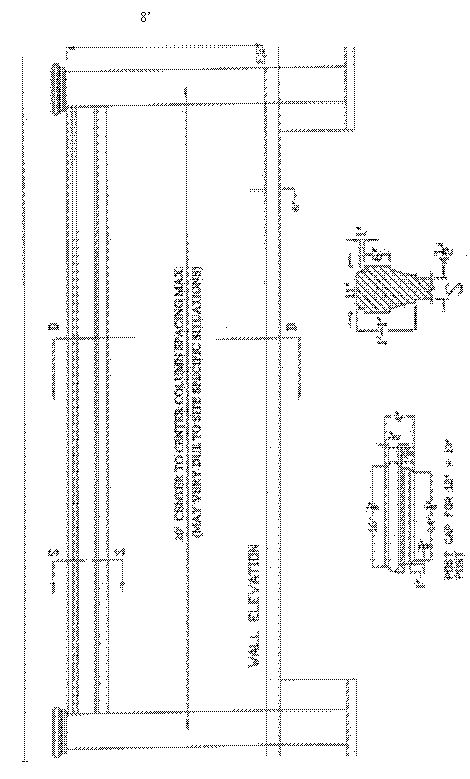
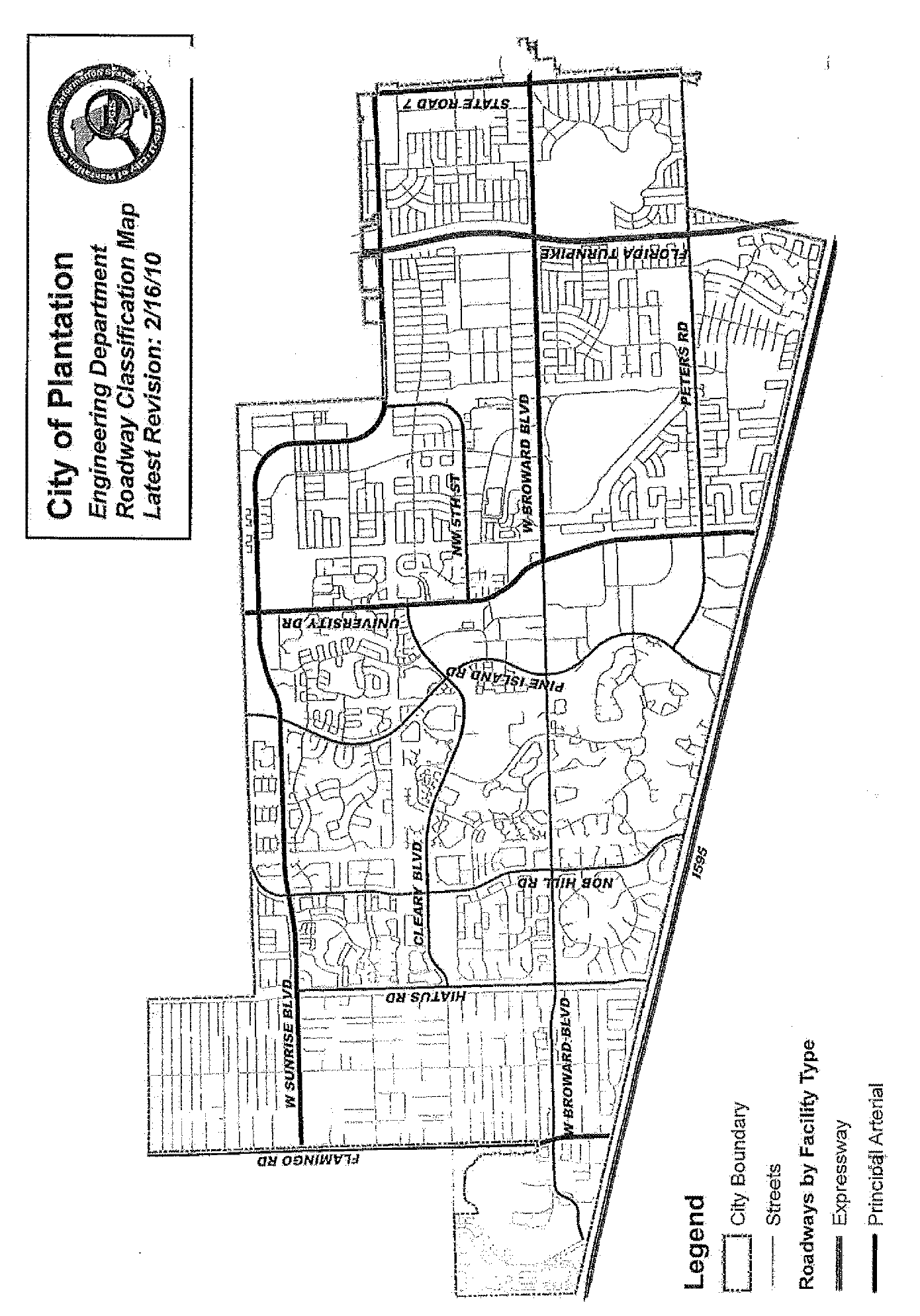
All concrete or masonry walls that are hereafter built on single family residential zoned property lines that are adjacent (or nearly adjacent) to and parallel with an expressway, principal arterial, minor arterial, or collector roadway as depicted on the City of Plantation Engineering Department Roadway Classification Map, as such Map is amended by the City Engineer from time to time. (Currently, such roadways are: Sunrise Boulevard, West Broward Boulevard, Peters Road, State Road 7 [this roadway is excluded in paragraph d below], Florida Turnpike, University Drive, Pine Island Road, Nob Hill Road, Hiatus Road, Flamingo Road, Cleary Boulevard, and NW 5th Street/NW 65th Avenue [between University Drive and Sunrise Boulevard]) shall comply with the Uniform Standard set forth below:
1.
The wall must be a precast or cast-in-place concrete wall assembly consisting of reinforced concrete wall panels supported by reinforced concrete columns. The wall structure shall be designed to withstand the minimum forces or loads established in the current edition of the Florida Building Code for Broward County.
2.
Column spacing and top of wall elevation shall be uniform to the greatest extent practicable.
3.
A decorative continuous wall cap shall be incorporated into the wall assembly. The columns, and caps of the columns, shall be decorative. The corner columns (and the foundations for the corner columns) shall be designed and constructed such that the outside face of the column [at the side property line] (and the outside face of the foundation for the corner column (at the side property line) shall terminate at the side property line, and any decorative cap on such comer columns shall not extend beyond the side property line. The preceding sentence shall not apply for shared side property lines of property owners who have concurrently applied for permitting of a uniform wall and who have recorded a Unified Wall Maintenance Easement, executed by all of such owners and consented to by all mortgagees of the property. affected and in a form acceptable to the City Engineer and City Attorney, which Unified Wall Maintenance Easement may not be released of record without notice to the City Engineer /and without the wall and columns being reconstructed so as to comply with the requirements of the preceding sentence.
4.
The top of the wall cap shall be a height of eight feet (8) measured from the average top elevation of the nearby parallel or adjacent public sidewalk (or if there is no nearby parallel or adjacent public sidewalk, the average grade of the public property along the adjacent public right-of-way line), as such average grade is determined in the exclusive discretion of the City Engineer.
5.
The wall panels shall have a stucco smooth finish (or false stucco smooth finish) on the side of the wall facing the public right-of-way. Wall panels facing the public right-of-way shall not have emblems, symbols, logos, artistic reliefs, or graphics. The color of the wall panels shall be a beige tone approved by the City Engineer, and the wall cap and columns and column caps of the portion of the wall facing the public right-of-way shall be white.
6.
The wall shall be placed as close as possible to the property line which is adjacent to or shared by the property line of the public right-of-way, recognizing any field conditions which the City Engineer determines in the exclusive exercise of his or her discretion interferes with construction at the property line, and /recognizing that when the footers for the columns are placed at the property line this causes the wall panels to be slightly set back from the property line (except for the corner columns which shall be specially designed as stated above).
7.
In addition to plan review and inspections conducted by the Building Department, the Engineering Department's approval shall be required prior to the issuance of a building permit for the wall, and an Engineering Department inspection shall be required prior to the Building Official issuing a Certificate of Completion.
8.
This subsection shall not apply to any residential property which received Site Plan Approval for a different kind of wall adjacent to the public right-of-way when the residential project was initially built.
9.
Any existing concrete or masonry wall which is damaged by any casualty or by an act of God may be rebuilt (in terms of its prior height. materials, style, and location) and will not need to comply with the requirements of this subsection (19) unless the damage exceeds or affects 50% of the surface area of the wall in question.
10.
This subsection shall not apply within Plantation Acres (Plantation Acres is that area of Plantation bounded on the east by Old Hiatus Road, on the west by New Flamingo Road, and on the north and south by Plantation's municipal boundary) or within or adjacent to the Gateway 7 Development District (wherein State Road 7 is located),
11.
The requirements of this subsection shall not apply to any wall constructed adjacent to or within any public right-of-way by the State (including FDOT), the County or the City as part of a public improvement project.
12.
This subsection shall control in the event of conflict with any other subsection of this section.
(3)
Multi-Family Residential Parcels.
a.
Whenever a property line in a planned residential or residential district abuts a public or private golf course, the property owner or occupant will be permitted to put along or within five (5) feet of said property line one of the following fence types as determined by the golf course abutting said property:
1.
Emory Z Rail (aluminum black or white)
2.
Scalloped picket (PVC)
3.
Three rail ranch fence (PVC)
4.
Traditional (wood) 5. Split rail (wood).
Any other type of fence or wall shall not be permitted within five (5) feet of the property line. If any other type of fence or wall is located a distance of five (5) feet or more from the property line, decorative live greenery shall be planted between such other type of fence or wall and the property line, with such plant species, planting intervals, and irrigation as deemed appropriate by the city landscape architect. The owner or occupant shall have the duty of maintaining the irrigation and live greenery required by this subsection. If applicable, the owner or occupant shall be liable to the city for costs that the city incurs with regard to removing, moving, tearing down, or reconstructing any wall or fence located on property which is subject to an easement in the city's favor.
b.
Notwithstanding the subsection above, the city council may grant conditional use permits for multifamily residential developments where the council holds a public hearing on such requested permits and affirmatively finds that the vision clearance requirements for unobstructed vision for traffic safety as codified in section 27-299(f) are met and such higher fences or walls facing streets or in front setback areas are not dangerous, but rather, create a more aesthetically pleasing screen or barrier to off-street parking areas servicing said multifamily residential districts without unduly interfering with or blocking the light, air and vision of the first floor residences of said multifamily residential districts; provided that such conditional use permits shall not, under any circumstances, allow a wall or fence exceeding six (6) feet in height in any residential area facing a street.
(4)
Non-Residential Districts.
a.
Fences or walls shall not be erected, placed or maintained along or adjacent to a lot line on any nonresidentially zoned property to a height exceeding eight (8) feet.
b.
Where property in a business, commercial or industrial, or B-6P district abuts, either directly or across an alley, street, drainage ditch or waterway, property in a residential district, a concrete or masonry wall shall be constructed on the side or rear of the property so abutting. Such wall shall not be less than five (5) feet nor more than six (6) feet in height. Requirements of this section may be superseded on projects subject to design approval by the Review Committee or Council.
c.
In the SPI-2, B-5P, I-LP, and I-L2P districts where a substantial portion of merchandise or equipment, associated with an allowable permitted use and structure, is stored outside the main structure within the side or rear yards, barbed wire strands or strands of material of similar character may be permitted on a fence or wall as provided herein: a. Upon the finding by the Planning, Zoning and Economic Development Director that a barbed wire strand fence should be allowed in consideration of the character of adjacent property, the orientation of a building, the need for outdoor security, the subject property's use, proposed visual screening measures, or criminal activity perpetrated against the subject property (as evidenced by police reports, insurance claims, or other justification), the property owner shall obtain the required building permits from the building department. The following regulations shall apply to the installation of barbed wire strands or strands of material of similar character: 1. The height of barbed wire or similar material shall be no less than seven (7) feet in height from grade with the combined height of fence, wall or gate and associated barbed wire not exceeding nine (9) feet from grade; 2. A maximum of three (3) strands of barbed wire are permitted with each strand to be mounted six (6) inches from the adjacent strand; 3. Barbed wire or similar material must be mounted on the fence so as to not exceed the height of the fence to which it is connected; 4. Barbed wire may not be associated with any fence, wall or gate that faces a public right-of-way, except when abutting an alley, as defined in section 27-11 of this Code, entitled definitions, where the alley and fence, wall or gate are located in the rear or side yard of the subject property. 5. Barbed wire strands or fencing along property lines adjacent to residential uses shall be discouraged and may be allowed by the Planning, Zoning and Economic Development Director when the criminal activity remains persistent notwithstanding prior fencing efforts of the subject property owner. b. Upon the finding by the Planning, Zoning and Economic Development Director that a barbed wire strand fence should not be allowed on a property, the property owner may appeal the decision to the governing body of the city. c. Any barbed wire installation installed pursuant to a permit of the city as of the date of adoption of Ordinance No. 2274 shall be permitted to remain until such material is destroyed or removed for any reason and may only be re-established according to the requirements of this section. d. Any barbed wire not installed pursuant to a permit of the city as of the date of adoption of Ordinance No. 2274 shall be permitted to remain only upon approval according to the requirements of this section together with the issuance of a building permit. e. Governmental facilities essential to public health and welfare or which present significant risks of being terrorism targets of opportunity (as determined by the Police Chief, Fire Chief, or Utilities Director) may be exempted by the Planning, Zoning and Economic Development Director from some or all of the regulations and restrictions of this section.
(p)
Flags and flagpoles Flagpoles and flags shall be permitted in all districts subject to provisions of Chapter 27, Article IX. Flagpoles in RS Zoning Districts shall not be greater than 30 feet in height above ground. In all other zoning districts, the maximum height of a flagpole shall be 50 feet.
(q)
Gazebos, Pergolas and Cabanas
(1)
Gazebos, pergolas and cabanas shall be subject to the setback, lot coverage, and all other restrictions for the district in which they are located.
(2)
The maximum height and area of a gazebo, pergola or cabana shall not exceed the height of the principal building more than twenty percent (20%), but in no instance shall it exceed twenty-five (25) feet.
(3)
The cumulative gross floor area of all accessory structures on the lot —exclusive of ADUs—shall not exceed the greater of thirty-five percent (35%) of the gross floor area of the principal building or one thousand five hundred (1,500) square feet.
(r)
Greenhouses and Shadehouses
(1)
Shall be permitted in all single family residential or PRD residential zoning districts.
(2)
Shall not be permitted within a building setback area.
(3)
Shadehouses with a screen roof and with screen sides shall not be deemed part of a building structure for purposes of measuring the rear building setback area; consequently, such shadehouses shall enjoy the same rear setback requirements as screen enclosures with screen roofs.
(4)
Shadehouses which do not have a screen roof and screen sides shall be deemed part of a building structure for measuring all setback areas.
(5)
Must be screened from view from adjacent property by either landscaping or a fence or fence-type structure. Any landscaping used as screening must hide from view the greenhouse or shadehouse from five (5) feet above grade up to sixty (60) percent of the greenhouse's or shadehouse's height from any point five (5) feet outside of the property line of the property upon which the greenhouse or shadehouse is located. These visual screening requirements must be permanently maintained.
(6)
The area of the greenhouse or shadehouse, together with the area of all other buildings and structures located upon the lot shall not exceed the applicable percentage lot coverage limitation for the zoning district in which it is located.
(7)
Greenhouses or shadehouses located upon a lot shall not exceed four hundred (400) square feet in size and ten (10) feet in height. Size or height increases may be approved by the Department if the following criteria are met:
a.
The proposed greenhouse or shadehouse meets all other requirements of this section;
b.
The aesthetics will be at least equally served;
c.
The size or height increase is justified taking into consideration surrounding residences, streets, landscaping, and other features.
(s)
Mechanical and utility equipment. Mechanical equipment refers to air conditioning units, emergency generators, pool equipment, and other similar features, whether located on a roof or on ground level. The equipment shall not be located within a utility easement unless it is equipment serving that specific easement.
(1)
Mechanical equipment and similar features may be located within an interior side yard setback or a rear yard setback.
(2)
The minimum distance from a property line to the structure shall be no less than the structure's height, but shall be located at least three (3) feet from a side or rear lot line.
(3)
All equipment shall be screened from view by a fence, wall, or landscape materials as provided for in this Code.
(4)
These requirements shall not apply to municipal or franchise utilities such as power, phone, cable, communication or drainage equipment which is located within a public utility easement.
(5)
Mechanical equipment in non-residential districts may be roof mounted provided they:
a.
Cover no more than 25 percent of the roof area of the structure to which it is attached;
b.
Extend above the applicable maximum height limit no more than 25 percent of the height limit (unless otherwise allowed in the Code.
(6)
Mechanical equipment that is roof mounted shall be screened as follows:
(t)
Patios on single-family, duplex and fee-simple multi-family lots; setback requirements and provision of on-site drainage.
(1)
Side setback: Same as required structure setback; however, patios on attached multi-family units must maintain at least a 2-foot side setback and outside any dedicated easement.
(2)
Rear setback: Five feet and outside of any dedicated easements.
(3)
Drainage provision. Rainwater runoff must be maintained on the property. Rainwater shall not be allowed to flow onto or across any adjoining property or sidewalk, either public or private. Exception: Rainwater may flow into a street gutter, storm sewer, or storm sewer catch basin if first approved by the Engineering Department.
(u)
Play equipment. Play equipment shall be permitted in any residential district, subject to the following:
(1)
Permanently installed play equipment, except basketball hoops, shall not be permitted within the front setback, ten feet of a right-of-way, or within utility, drainage or access easements
(2)
Play equipment shall not use street right-of-way as part of playing area.
(3)
Permanently installed play equipment shall be of a common playground type designed for children.
(4)
All basketball hoops and backboards in front yard areas shall be permitted on a pole in the driveway only. Basketball poles shall not be located closer than ten feet to any property line.
(v)
Rainwater cistern.
(w)
Reserved.
(x)
Screen enclosures. Screen enclosures. Screen enclosures shall be permitted in all residential zoning districts, subject to the following:
(1)
Screen enclosures shall not be permitted in the required front yard or within utility, drainage or access easements.
(2)
Screen enclosures may not be converted to an enclosed structure unless the converted structure would comply with all standards of the applicable zoning district.
(3)
Screen enclosures with a screen roof shall meet the following setback requirements:
a.
Rear setback: The rear setback for screen enclosures with screen roofs (regardless of whether the screen enclosure contains a swimming pool) on lots in single family residential or PRD residential zoning districts shall be ten (10) feet from the lot's rear property line to the enclosure's nearest structural point. Nothing herein shall change the rear building setback lines otherwise set forth in this comprehensive zoning ordinance; however, an enclosure with a screen roof shall not be hereafter deemed part of the building structure for the purpose of measuring the rear building setback line. A screen enclosure (regardless of whether the enclosure contains a swimming pool) which has a nonscreen, overhanging roof shall be deemed part of the building structure so that the rear building setback line, as otherwise established in this comprehensive zoning ordinance, shall control.
b.
Side setback: The side yard setback shall be the same as the structural setback requirement of the zoning district.
(4)
Screen enclosures with a solid roof shall meet the following setback requirements:
a.
The side yard setback shall be the same as the structural setback requirement of the zoning district.
b.
The rear yard setback shall be 15 feet or the same as the structural setback, whichever is less
(y)
Screening of rooftop equipment other than solar energy collectors; ground placement and requirements for disk or dish antennas.
(1)
Enclosures. To minimize the bulky, boxy shape of such rooftop equipment, air-cooled condensing and/or compressor equipment, water cooling towers, air conditioning equipment, fans, blowers and any other mechanical or service equipment or apparatus installed on roofs of buildings other than attic vents shall be screened from view by a parapet, masonry wall or other architectural feature of the building. Such enclosure shall be as high as or higher than the highest portion of the equipment or apparatus being screened.
(2)
Existing structures. All existing structures for which design approval is required as a result of proposed changes to existing development shall screen rooftop equipment in accordance with (a) above. Such screening shall be of the same or similar material to that which exists on the exterior of the building.
(3)
Rooftop installation of rod or spike or dish antennas. Rod or spike type or dish antennas (which dish antennas have a diameter in excess of one (1) meter in size) may be installed on a building's roof pursuant to the regulations of chapter 5.5, part 1, division B, of this Code.
(4)
Ground installation of dish antennas. Dish or disk antennas, designed to receive transmissions of signals or data are allowed in the city's various zoning districts where the owner of such dish also owns the dish satellite antenna site, subject to the requirements and conditions set forth within this subsection. Except where specifically provided otherwise, these requirements apply only to dish or disk antennas in excess on one (1) meter in diameter, as any dish or disk antenna equal to or less than one (1) meter is size are exempt from the building permit and land development regulatory requirements in view of pre-emptive federal regulations (except when these one (1) meter and smaller dish or disk antennas are mounted on a mast or pole in excess of twelve (12) feet in height (in which event they shall only be subject to obtaining a building permit)). The city's requirements as applicable to dish or disk antennas that exceed one (1) meter in diameter, are as follows:
a.
Unless installed on a building roof pursuant to the regulations of chapter 5.5, part 1, division B of this Code, the dish antenna must be ground mounted, and meet all setbacks for the zoning district in which it is installed.
b.
Installation will meet all requirements of the Florida Building Code (and applicable life safety codes).
c.
Dish antennas shall not be located in any front or side yard.
d.
The maximum diameter of dishes will be as set from time to time by resolution of the council, taking into consideration any improvements in technology which reduce the size of the dish required to receive a reasonable signal, provided that, however, maximum diameter will be twelve (12) feet until January 1, 1986, and the maximum diameter will be ten (10) feet thereafter until the maximum diameter is changed by resolution or ordinance of the council.
e.
When the technology is available such that a dish with a maximum diameter of six (6) feet can receive a reasonable signal, as determined by resolution or ordinance of the city council, all dishes with a diameter greater than six (6) feet shall be nonconforming structures and shall be removed by the owner thereof within three (3) years of passage of such resolution or ordinance. The chief building official shall notify all owners of such nonconforming dish structures upon passage of such resolution or ordinance.
f.
Dishes will be installed to minimize the height thereof, and in no case will any portion of a dish be as high as the roof line of the building which is adjacent to it, or twelve (12) feet, whichever is lower.
g.
All dishes and dish installations must be color coordinated to match the surroundings.
h.
All dishes must be screened from view from adjacent property by either landscaping or a fence or fence-type structure erected in conformance with the zoning code and the Florida Building Code (and all applicable life safety codes). Any landscaping used as screening must be such so as to totally hide from view all of the dish from any point five (5) feet outside of the property line of the property on which the dish is installed. These landscaping requirements must be permanently maintained by the applicant. If the landscaping is not adequately maintained and is not corrected within sixty (60) days of being notified to do so by the city, the dish shall be in violation and shall be removed. If not so removed by the applicant and the owner of the dish has not shown cause at a hearing before the special magistrate why the dish should not be removed, the dish may be removed by the city.
i.
In addition to the plans which must be submitted to the building department for the erection of a structure under the Florida Building Code (and all applicable life safety codes), a plan detailing the proposed installation of a dish showing dish site, neighboring structures, adjacent streets, and landscaping must be submitted to and approved by the Department. The Department will determine whether or not the proposed installation meets the requirements of this subsection. The Department may approve plans which contain minor deviations from the requirements stated in this subsection if the following criteria are met: a. Aesthetics will be at least equally served; and b. The minor deviation is justified taking into consideration surrounding residences, streets, landscaping, and other features.
j.
All applications for the installation of a dish must be accompanied by an application fee equivalent to that for minor development approvals as set forth in section 27-50 of this Code.
k.
This subsection (d) shall apply to temporary or moveable dish antennas; however, the dish antenna visual screening requirements set forth in paragraph (7) above shall not apply to temporary, moveable, or fixed dish antennas which are designed and continually maintained so as to look the same as umbrella-covered circular outdoor patio tables, having a maximum diameter of eight (8) feet, and having no portion thereof exceed a maximum height of twelve (12) feet when extended in any position for signal reception. Any temporary or moveable dish antennas once removed must be reinstalled in the approved location after a permit has been received so that the building department can ensure compliance with all Code requirements. In addition to reviewing installation plans, the Department shall determine whether a given, proposed dish antenna looks the same as an umbrella-covered circular patio table.
(5)
Dish antennas serving more than one single-family residence. Disk or dish antennas designed to receive transmission of signals and to transmit such signals to more than one (1) single-family residences by signal distribution facilities which do not use any public right-of-way are allowable. Within this section, "public right-of-way" means any right-of-way granted to the public or to any governmental body by way of conveyance, dedication, restriction, or by easement. Developers within the city have been permitted to request the waiver of dedication of rights-of-way giving access to their proposed dwellings either by means of plat dedications or conveyances, when site plan approvals are sought, when such developers will grant easements for governmental purposes. Because these easements are substitutes for dedications of right-of-way, "public right-of-way" shall include any area within an easement given for governmental purposes as a condition of the city council waiving, at developer's request, the dedication of public right-of-way to such proposed dwellings from the nearest available public road(s). These requirements, which are continuing requirements, and conditions are as follows: (1) The dish antenna must meet all requirements and conditions of subsection (d). (2) All services rendered and all rules, regulations and rates adopted by the operator of the signal distribution facility shall have general applicability throughout the service area and said operator shall give no preference or advantage to any person or subject any person to prejudice or disadvantage. (3) The operator of the signal distribution facility shall maintain a business office reasonably accessible to residents of its service area during reasonable business hours. Said operator will provide adequately trained personnel to ensure that subscriber complaints and requests for repair may be received on a twenty-four-hour per day basis. (4) Said operator shall maintain in such business office a schedule of all rates, terms and conditions and shall promptly update said schedule with any changes. (5) The operator shall preserve the privacy rights of subscribers to the same extent as required by cable television operators under section 631 of the Cable Communications Policy Act of 1984.
(z)
Shopping cart corrals. Grocery stores, department stores, pharmacies and drugstores and other commercial establishments that provide shopping carts to their customers must provide an outdoor cart corral, constructed with a painted finish subject to approval by the City, in the parking lot for every 50 parking spaces. Such stores located within mixed-use districts may provide some or all of the exterior shopping cart storage behind a decorative wall adjacent to the building, in lieu of or supplemental to, the corrals provided in the parking lot.
(aa)
Solar energy collectors.
(1)
Wherever possible, solar energy collectors shall be installed in such locations as to be effectively and permanently screened from view from adjacent property owners or pedestrians upon adjacent sidewalks or road rights-of-way. When screened from such view, permits may be issued by the Building Department upon submission of plans disclosing such permanent visual screening and an attachment of such collectors to structures or premises in full compliance with the Florida Building Code and the Plantation Code of Ordinances.
(2)
Whenever it is not possible to fully screen such solar energy collectors from the view of adjacent property owners and adjacent sidewalks and road rights-of-way, the Building Department may only issue a permit upon submission of plans showing that such solar energy collectors are either of a flat plate type to be installed flush with the pitch of the roof to give the appearance of a skylight. In the absence of a properly pitched roof to permit such flush installation of flat type solar energy collector or if a solar energy collector of a type other than a flat plate roof collector is to be installed, then all sides and supports for such solar energy collector other than the collecting surface proper shall be fully skirted with roof material identical to that used on the remaining portion of the adjacent roof to create the impression of a chimney or dormer to minimize the amount of such solar energy collector not being screened from view to the collecting surface proper. If such skirt or screen creates such visual screening impression and effectively screens additional solar energy collectors mounted behind or adjacent thereto such additional collectors need not be similarly skirted or screened where such additional screening or skirting would not accomplish any further visual screening of such collectors.
(bb)
Swimming pools and spas. Swimming pools and spas shall be permitted in all residential zoning districts, subject to the following:
(1)
Swimming pools or spas shall not be permitted within the required front yard area, or within utility, drainage or access easements. Swimming pools shall be required to have a safety barrier.
(2)
Above-ground pools and spas which exceed 24 inches in height must meet all structural setback requirements.
(3)
The following setback requirements shall apply to swimming pools and spas:
a.
The side yard setbacks to the water's edge shall be seven feet for an open swimming pool without screen enclosure.
b.
The rear yard setback shall be ten feet from the water's edge to rear lot line on an open swimming pool without a screen enclosure and ten feet to the nearest structural point for a screen enclosed pool.
c.
Any pool in a RS-1EP zoning district shall meet the setback of the district.
(cc)
Walkways on single-family, duplex and multi-family lots; setback requirements and provision of on-site drainage.
(1)
Setback requirement. All walkways or sidewalks within single-family and duplex and multi-family lots shall be set back a minimum of two (2) feet from the side or rear property line.
(2)
Drainage provision. Water runoff must be maintained on the property. Rainwater shall not be allowed to flow onto or across any adjoining property or sidewalk, either public or private. Exception: Rainwater may flow into a street gutter, storm sewer, or storm sewer catch basin, if first approved by the City Engineer.
(dd)
Yard Encroachments.
(1)
In no case shall any encroachment be permitted over utilities or drainage easements.
(2)
Every part of every required yard shall be open and unobstructed from the ground upward, except as hereinafter provided:
a.
Cornices, covers and gutters, sills or belt courses may project not over two (2) feet into a required yard's building setback line, except where such setback line in ten (10) or more feet then, such sills, belt courses, cornices, roof covers and gutters may project not over four (4) feet into such required building setback lines.
b.
Chimneys, fireplaces, or pilasters may project not over two (2) feet into a required yard.
c.
Movable awnings may be placed over doors and windows in any required yard, but no awning shall be vertically supported.
d.
Bay windows may project not over two and one-half (2½) feet into setback areas where such setback areas are less than or equal to seven and one-half (7½) feet and may project not more than three and one-half (3½) feet into setback areas where such setback areas are greater than seven and one-half (7½) feet.
(ee)
Drainage provision.
(ff)
Use of residential zoned property for access. Land which is residentially zoned shall not be used for driveway, walkway or access purpose to any land which is nonresidentially zoned and used for any purpose not permitted in a residential district.
(gg)
Public utilities. Utilities necessary to the public health and convenience such as gas, electric, telecommunications, video, data, internet, telecommunications, and telephone (including wireless service) lines, poles, towers, facilities and mains may be located in any district. Chapter 5.5, article II of this Code regulates communications facilities, and shall control in the event of any conflict with this Chapter 27.
(hh)
Municipal uses. The provisions of this chapter are not intended and shall not be construed, to preclude the use of any property owned by the City for any municipal function or purpose, provided, however, that said use is established upon recommendation of the board and approval of the City Council.
(ii)
Animals and commercial farming as permitted nonconforming uses of land. In that the grazing of livestock and the commercial farming of vacant land is a desirable method of utilizing unimproved land and keeping same sightly and free from obnoxious overgrowth which could otherwise occur if said vacant land were left unkempt and unattended, the city council finds as a declared exception to the ordinance specifying the three-year period of limitation in which nonconforming uses of land are to be made conforming that it is in the public interest to permit commercial farming, agriculture and grazing of livestock on vacant land, regardless of its zoning, on a temporary basis, in areas designated by the city council, until the land is developed under its permitted zoning uses or the character of the surrounding land so changes as to render the continued grazing of livestock or commercial farming of said land to be or constitute obnoxious or detrimental usage of the land in view of the changes to its surrounding environs. The council herewith designates all land on which livestock was permitted to graze or commercial farming was being conducted as of November 30, 1978 as permitted areas for temporary grazing of livestock and commercial farming activities. Such wells, irrigation systems, feed bins, or fencing as may be needed to efficiently continue such temporary usage shall not be deemed an expansion or an extension of a nonconforming use of land. The Council may terminate any such temporary usage upon the finding of a sufficient change in the surrounding area as would render the continuance thereof detrimental to the environs (and the then user shall be given sixty (60) days to remove any grazing livestock or shall be permitted to harvest the then crop in the ground as the case may be). Other than in the RS-1EP zoning districts of the City of Plantation and the aforedescribed council-designated areas of vacant land where commercial farming and grazing of livestock are permitted on a temporary basis as a nonconforming use of land (as herein defined and set forth), no animals, livestock, poultry or barnyard fowl of any kind shall be raised, kept, or harbored; except that dogs, cats and other household pets may be kept, provided they are not kept, bred or maintained for commercial purposes. Nothing contained in this section shall be deemed a prohibition of pony rides or other places of amusement or exhibition employing or displaying animals or animal clinics or veterinarian places of business or similar uses where such activities are permitted and comply with all other regulations or conditions imposed by the City.
(jj)
Service areas.
(1)
Service areas or yards, in all residential districts, shall be located and arranged so that clothes lines, garbage containers and similar items are hidden from the street and reasonable protection is afforded adjoining properties.
(2)
In all districts, outdoor equipment such as air condition/heating units, swimming pool equipment, and stationary emergency generators with enclosures no higher than five and one-half (5.5) feet above grade, shall not be placed in any front yard and shall provide a minimum setback of two and one-half (2.5) feet from any side or rear property line and a minimum setback of seven and one-half (7.5) feet from a sidewalk, bikeway, or street right-of-way line. The outdoor equipment shall be enclosed by a wall, fence, hedge or other device that will effectively screen such equipment from public view.
(3)
In all districts, outdoor equipment such as air condition/heating units, swimming pool equipment, and stationary emergency generators with enclosures exceeding five and one-half (5.5) feet in height from grade, shall not be placed in any front yard and shall comply with the side and rear setback requirements for the district in which it is located. The outdoor equipment shall be enclosed by a wall, fence, hedge or other device that will effectively screen such equipment from public view.
(4)
Utilities companies regulated by the state public service commission are exempt from screening and setback requirements in subsections (b) and (c) when in utility easements or utility rights-of-way.
(kk)
Temporary building or trailers.
(1)
No temporary building or trailers shall be permitted within the city except that a temporary building or trailer may be used for model, display, demonstration and office purposes only after a permit is issued therefor. Any such temporary building or trailer shall be torn down and/or removed, or in the alternative insofar as a temporary building is concerned, made to comply with the South Florida Building Code and all other applicable city ordinances prior to the issuance of any certificate of occupancy, at the time of the expiration or revocation of the temporary permit contemplated herein. Prior to the issuance of a temporary permit for the emplacement of a trailer for one of the aforedesignated uses on private property, such trailer shall have Florida Trailer Standards Code seal or decal displayed thereon. No temporary permit shall be issued for any of the aforedesignated purposes or uses for either a trailer or temporary building until a landscaping and temporary parking plan is submitted for the landscaping that will be planted upon the parcel on which a temporary permit is sought for such temporary building or trailer. The temporary permits to be issued shall be for a period of one (1) year from the date of issuance for temporary buildings, and six (6) months from the date of issuance for temporary trailers. Prior to the issuance of such temporary permit, the building official shall require the deposit of a sum in cash or its equivalent equal to the amount he deems necessary to remove or demolish the temporary trailer or building, and any specified permitted landscaping which the building official also deems necessary or advisable to remove. Such temporary permits may be extended as hereinafter provided by the city council for up to, but not to exceed, a total of two (2) years.
(2)
Upon failure of the owner or the permittee to abide by the provisions of this section and the temporary permit issued regarding the removal or destruction of the temporary trailer or building and specified permitted landscaping the city is authorized to enter upon the premises where the temporary trailer or building is located to secure such removal or destruction. In the event such monies prove to be insufficient to defray the cost of such removal or destruction, the city may institute suit against the owner or permittee for the difference between the deposited monies and the cost of removal or destruction. Any amounts so reduced to judgment by the city shall constitute a lien against property upon which the temporary building or trailer was situated. However, temporary buildings ordinarily used by a contractor or builder during construction, such as tool sheds and water closets, shall be permitted during the course of construction without the necessity of any special permit; but the buildings shall be removed when construction has been substantially completed.
(3)
However, the city council may, in its discretion, and subject to such additional conditions as it deems necessary, extend the temporary permit for temporary buildings or trailers beyond their initially stipulated term, but in no event shall temporary buildings or trailers be allowed to remain more than two (2) years from the date of issuance of the permit therefor unless made to comply with the South Florida Building Code and all other applicable city ordinances as a permanent permitted usage of the land on which same is located or emplaced.
(ll)
Nuisance. Nothing shall be permitted or maintained in any district that shall in any way be offensive or noxious by reason of the emission of odors, gases, dust, smoke, light, vibration or noise including the crowing of cocks, barking of dogs, or any noises or odors emanating from any animal, fish or fowl; nor shall anything be constructed or maintained that would in any way constitute an eyesore or nuisance to adjacent property owners or residents of the community.
(mm)
Establishments dealing in alcoholic beverages. The sale of alcoholic beverages for consumption on or off the premises shall be governed by the provisions of Chapter 3 as amended except that one (1), but not more than one (1), package store where alcoholic beverages are sold for consumption off the premises shall be permitted in a B-1P neighborhood business district, or in a shopping center containing at least five (5) acres in a B-3P district, without regard to its location in relation to other uses. With this exception, the distance requirements and all other provisions of Chapter 3 as amended shall apply.
(nn)
Duplication of exterior design. The exterior design and functional plan of all buildings and structures shall conform to the provisions of regulations of Chapter 5, article III, division 2 of this Code.
(oo)
Open storage, garbage and refuse. In all business, commercial and industrial districts the storage of vehicles, equipment, materials and supplies shall be within a building or within an area enclosed by a wall, fence, hedge or other device which will effectively screen such storage from public view. Garbage or refuse shall be stored only within a building, or within a fully enclosed container, including top, and that such storage area shall be equipped with an approved automatic sprinkler device.
(Ord. No. 2597a, § 3(Exh. A), 3-24-2021; Ord. No. 2024-002, § 6(Exh. F), 3-6-2024; Ord. No. 2024-001, § 14(Exh. N), 1-24-2024)
Sec. 27-297. - Compliance with Comprehensive Plan.
(a)
General. The Land Development Regulations together with other provisions contained in the City Code are designed to be consistent with and to further the goals, objectives and policies of the Comprehensive Plan.
(b)
Compliance. To ensure compliance with the requirements of the comprehensive plan, the following regulations shall apply to all districts:
(1)
No storage, handling use or production of hazardous or toxic substances shall be permitted which would violate Broward County's potable water supply wellfield protection ordinance.
(2)
No development shall be permitted unless the required public facilities will be available at the prescribed levels of service concurrent with the impact of the development on those facilities.
(3)
Within designated local areas of particular concern and urban wilderness areas, development permits issued by the city shall comply with all appropriate regulatory requirements.
(Ord. No. 2597a, § 3(Exh. A), 3-24-2021)
Section 27-298 - Synthetic Turf
(a)
Definitions
Artificial Turf see synthetic turf.
Pervious Areas means any portion of the ground unobstructed by a non-landscape planting surface or synthetic turf which prevents or slows down the natural seepage of water into the ground.
Synthetic Turf means a dense and continuous surface of synthetic fibers mounted on a permeable backing and of sufficient density and green color to replicate the appearance of healthy, natural grass.
Synthetic Turf Installation means an installation of synthetic turf material that is installed in conformance with the provisions contained in this Section which shall be considered a pervious surface, but shall not exceed ten percent (10%) of the total pervious area of a lot or parcel for a residentially-zoned parcel and ten percent (10%) of a park or golf course property.
Turfgrass means sod, grass, natural turf (or other living material) and the surface layer of earth held together by its roots.
(b)
Standards - Synthetic turf may be permitted only on residential properties and on City or County parks and City and private golf course property. With respect to the application on residential properties, it shall be subject to the requirements of this section:
(1)
shall only be installed on properties used for residential purposes only in the rear yard and within the side yards - provided that it meets the minimum setback and is behind a fence - except that it may be installed in the spaces of a driveway pattern of a driveway located in the front or side yard or terraces where the inlays do not exceed 4-inch width and 2-foot length;
(2)
shall be a component of the overall landscape design;
(3)
shall simulate the appearance of live turf, organic turf, grass, sod or lawn, as determined by the City and shall have a minimum eight-year "no-fade" warranty;
(4)
shall have a permeable backing;
(5)
shall be lead-free and flame-retardant;
(6)
shall be installed pursuant to manufacturer's requirements;
(7)
shall be installed over a subgrade prepared to provide positive drainage and an evenly graded mass of compacted, porous, crushed rock aggregate material that is a minimum of four inches (4") in depth;
(8)
shall be fully permeable;
(9)
shall be set back at least five feet (5') from the side and rear property lines (in the case of driveway inlays, these may be at the property line but not in the public right-of-way or driveway apron);
(10)
shall be anchored at all edges and seams;
(11)
shall have seams that are joined in a tight and secure manner;
(12)
shall have an infill medium consisting of clean silica sand or other mixture, pursuant to the manufacturer's specifications or as approved by the City Engineer that shall be brushed into the fibers to ensure their upright position; shall provide ballast that will help hold the turf in place; shall provide a cushioning effect; and shall be installed so that irrigation will not affect the synthetic material
(13)
shall be maintained in an attractive and clean condition and shall not contain holes, tears, stains, discoloration, seam separations, uplifted surfaces or edges, heat degradation or excessive wear;
(14)
shall be maintained in a green fadeless condition and free of debris and impressions;
(15)
shall comply with Section 27-265, Standards for Tree Protection vis-à-vis the artificial material;
(16)
shall meet the design standards of the City's Engineering Department approved cross sections and manual, as amended from time to time, to ensure the use and installation of high-quality material;
(17)
shall require an Engineering permit, unless it is included as part of the plans for a swimming pool and/or patio/deck permit as part of the required building permit, or shall be exempt from both an engineering and a building permit under the following conditions: (i) if the entire installation is under 50 square feet in total area coverage; (ii) if the total project cost for installation is under $1,500.00 including costs for labor and material, as per Florida Building Code (FBC) Chapter 1 Amendments 7 th Edition (2020) Section 105.2, as amended from time to time, and (iii) if the material is installed either behind the house and at least 10 feet from the rear property line or along one or both sides of the home and at least 5 feet from the side property lines and otherwise meets all other parameters of this section;
(18)
shall not exceed more than 10% of the property's area, excluding the area not covered by buildings, driveways/parking/loading spaces, and walkways, together with other nonliving hardscape material (i.e., gravel, stone, concrete, asphalt or other similar material);
(19)
is not considered to be and shall not be counted towards open space;
(20)
shall not be visible from the street, other than when incorporated in a driveway pattern, as described above;
(21)
shall not adversely affect drainage of adjacent properties, rights-of-way, or overall drainage of the site;
(22)
shall not be installed over any dedicated drainage, lake or canal maintenance, landscape, and utility easements;
(23)
shall not be installed within any public rights-of-way;
(24)
shall not be pinned or staked behind the seawall;
(25)
shall not substitute for landscaping requirements or planned landscape elements;
(26)
shall not conflict with existing trees;
(27)
existing landscaping, including trees, shrubs, hedges, shall not be removed or relocated due to its use;
(28)
shall not restrict the required landscaping, i.e., trees/palms per Section 27-257, in addition to Root Protection Section 27-265(e). A range of 10%—25% of the rear yard green space is the allowable deviation of proposed Synthetic turf within green space designated for turfgrass or ground cover per Section 27-254(a)(1). Further:
a.
the intent is that all proposed root pruning of existing trees for the purpose of Artificial Turf construction be of proper horticultural standards not to diminish the vigor or remove existing trees/palms in good condition nor create non-conformity as it relates to required tree quantity per lot.
b.
a synthetic turf area shall be in the center portion of the green space unless occupied by a pool or other amenity or in conflict with a proposed pool or amenity or existing tree/Critical Root zone. In this regard, the side yard may be utilized.
c.
the use of Synthetic turf in public right-of-way (ROW) is prohibited, even as part of a driveway design.
d.
green space adjacent to proposed Synthetic turf within the setback may be treated with Turfgrass or ground cover per Section 27-254(a)(13)(16) and must adhere to Irrigation Standards of Section 27-254(c). If such area adjacent to proposed synthetic turf is supplemented with recycled mulch within 5-foot diameter, it will not require irrigation.
e.
a dripline encroachment plan is required by an ISA Certified arborist via an arborist report to determine the appropriate Critical Root Zone (CRZ) to ensure tree/palm vigor is not adversely affected by the root pruning for sub-base installation per synthetic turf.
f.
the dripline encroachment shall not to be in conflict with the 5' trunk setback for hardscape, pavement, structure, roadway, dwelling and waterways.
g.
root vaults are encouraged where there is limited tree root area to provide uncompacted soil is available to sustain the tree.
(c)
General Procedures
Prior to the installation, the applicant shall obtain an Engineering permit from the City (or a building permit as noted in Section 27-298(b)(17)) and will be subject to proper site inspection. The permit application shall include the following information:
(a)
a complete application;
(b)
a complete landscape plan showing the area of synthetic turf; the area of living plant material; the square footage and percentage of synthetic turf; and the area and method of separation between living plant material and synthetic turf;
(c)
details regarding existing or proposed irrigation proximate to the synthetic turf;
(d)
brand and type of synthetic turf, including all manufacturer's specifications;
(e)
a scaled cross-section and details of the proposed materials and installation, including, but not limited to subgrade, drainage, base or leveling layer and infill;
(f)
a survey of the property with a signed affidavit that no modifications to the property were made since the date of the survey; and
(g)
a calculation of the pervious area and impervious area indicated on the plans that ensures compliance with the City's pervious requirement.
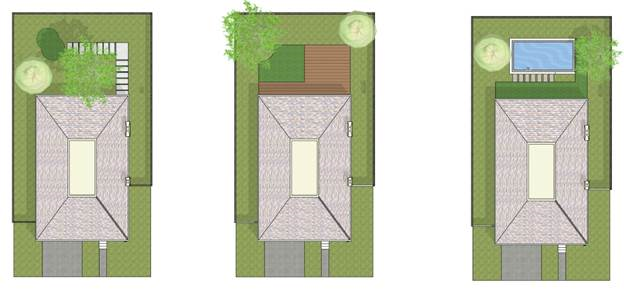
Figure 298-1 Examples of Synthetic Turf installed on a typical, rectangular-shaped
residential lot.
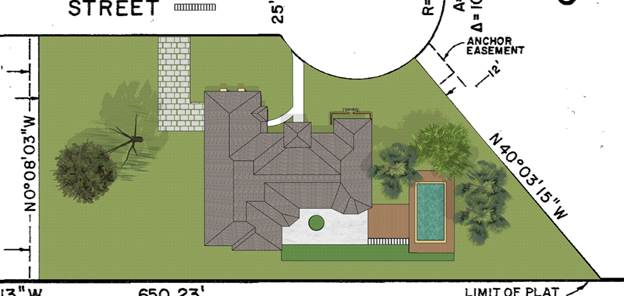
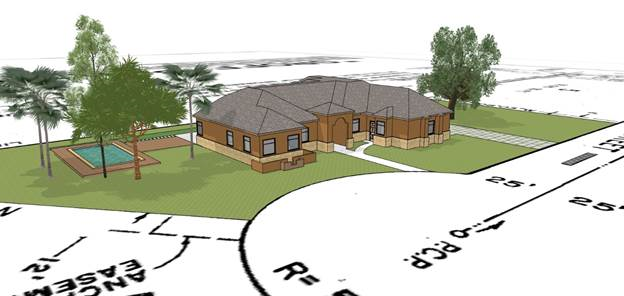
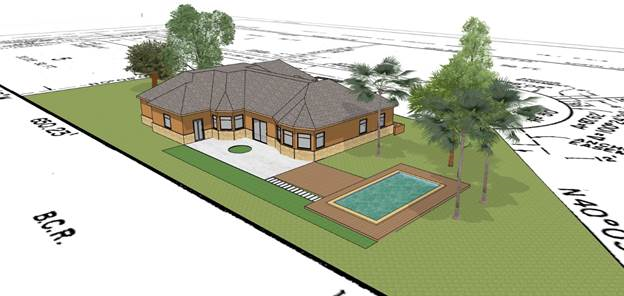
Figure 298-2 Examples of Synthetic Turf installed on an irregularly-shaped residential
lot.
(Ord. No. 2023-013, § 2(Exh. B), 8-23-2023)
Section 27-299 - General Development Requirements
(a)
Advertising requirement. If a location is included in any printed, radio or television advertisement of an approved real estate development in the city, the City of Plantation shall be noted in the text or map of said printed advertisement or be included in the description of the location in said radio or television advertisement.
(b)
Zoning map disclosure requirement. All developers of residential property are required to disclose to potential purchasers, the zoning districts of all vacant properties within 1,000 feet of the advertised residential development. Accordingly, the developer shall prominently display at least one full-size and most recent version of the city's zoning map obtained from the city's Planning, Zoning and Economic Development Department in all sales model centers. The zoning map shall accurately display the zoning districts and the size and scale of the residential property in relation to the vacant property and include a description of the permitted uses allowed in each zoning category depicted, as well as a statement that the zoning is subject to change upon the passage of an ordinance by the City Council. The developer shall also include a reduced version of said zoning map in all marketing materials used to advertise the residential development.
(c)
Development phasing requirement. All residential and non-residential multi-building developments shall provide phasing plans identifying the sequencing and timing for all principal buildings, accessory buildings and other development related amenities. Accessory buildings and amenities such as clubhouses, pools, dog parks, tennis courts, basketball courts, tot lots, guardhouses, mall kiosks/buildings shall be completed or issued a certificate of occupancy prior the issuance of certificates of occupancies for twenty-five (25) percent of all principal buildings comprising the development.
(d)
Micro-unit limitation. Micro-units shall comprise no more than twenty-five percent of a multi-family residential development.
(e)
Unified control. All land included within an application to the city council for a development permit where any requirement of the zoning or subdivision ordinances of the City of Plantation is sought to be waived (such as, but not limited to, the dedication or deeding of public road rights-of-way; deviations of building setback lines, etc.), shall be under a plan of common development and common ownership of said property (either through common ownership associations, condominium declarations, or other forms of ownership where unity of title does not exist for all lands covered by the requested development permits). The applicant shall agree to:
(1)
Proceed with the proposed development according to the provisions of this ordinance and conditions attached by the city council when such development permits are granted (approval of site plan, elevations and locations of buildings depicted thereon, landscape and parking plans, exterior finishes, etc.).
(2)
The applicant shall submit to the city's legal department at least three (3) weeks prior to any request for a building permit for a primary structure pursuant to the development approval granted by the city council under subsection (1) hereof, the applicant shall submit to the city's legal department such unified control agreements, contracts, deed restrictions or other documentation as necessary in connection with the development, together with such financial assurances as may be required for review as to the legal sufficiency of same, so as to assure the development will comply with requirements respecting public elements servicing the property on which such development approvals are obtained; as well as to assure the continuing operation and maintenance of those private roadways and other areas and facilities of development which, pursuant to the requested development approvals given by the city council under subsection (1) hereof are not to be operated or maintained at public expense. In reviewing such unified control documents, the legal department shall see that the following minimum criteria are met:
a.
That valid governmental access is provided for the servicing of the development, both during and after construction of same.
b.
That if the project is being built in phases, an adequate traffic circulation plan is depicted through the use of temporary cul-de-sacs at the end of each phase of on-site road construction, so as to assure reasonable traffic flow through each phase (even if future phased constructions are not built).
c.
That no encroachment may be made into any common-owned land which would affect the outward elevations of any primary structure without prior approval by City Council and that all such encroachments be uniform as to applicability between the developer or future unit owners under a delineated procedure approved by the building department which procedure shall minimally require prior approval of the owner(s) of such land of such intended encroachments and a hold harmless agreement from such owner(s) to the city for granting permits for such requested encroachments (it being understood that the council can delegate to the building department approval of any elevation changes occasioned by such encroachments within the common areas of such developments). As used within this subsection c, the word "owner(s)" shall mean those owners having beneficial use of the area wherein the encroachment is contemplated or their representative (such that, for example, if an encroachment is permissible pursuant to condominium documents in a limited common area, then the encroachment may be permitted with the approval of the beneficial unit owner together with a representative of the other owners (i.e., the association) without requiring the consent and approval of all owners of the limited common area).
d.
That the amendatory provisions of such unified control documents require approval of amendments by the city council or its legal department before same are deemed effective.
e.
That the developer and subsequent owners of property within the proposed development must agree to utilize, where offered, all municipal franchised services and may not independently contract for such services without prior approval of the city council (presently included within franchised services of the city are garbage collection and cable television).
f.
That no provision is included within the unified control documents which would permit a conflict with the ordinances of the City of Plantation or the regulations of other governmental agencies having any jurisdiction over the property covered by such development and affirmative assurances of compliance with such ordinances and governmental regulations are to be contained within the unified control documents (illustrious of such compliance with ordinances would be a requirement that the city's comprehensive sign ordinance be fully complied with within the development; that no less restrictive signs be permitted within the development; that no traffic regulation, directional signs or efforts to control flow of traffic or speed of traffic be allowed to be erected, emplaced or otherwise installed upon or adjacent to any private road system within the development which would conflict with the ordinances of the City of Plantation or other duly enacted governmental regulations concerning traffic, signage and control; that no surface water drainage be permitted that would conflict with the requirements of the city's ordinances for subdivision improvements or the regulations of any drainage district having jurisdictional authority over the property covered by said development, etc.)
g.
That a proper method of assessment for maintenance of commonly and/or privately owned property and improvements with lien rights and enforcement rights be created within the unified control documents so as to give the city reasonable assurance that the future maintenance of such private facilities and land will not be at public expense and that the developer bear his fair share of such expenses during the development of the property covered by such unified control documents.
h.
That all state disclosure requirements to prospective purchasers of condominium units are fairly made.
i.
That such additional requirements as are imposed by the city council in its review of the applicant's requested development approvals, as well as such additional requirements as the administration deems proper to adequately protect the health, safety and welfare of the future occupants of primary structures within said development be included in legally enforceable form within such unified control documents.
(3)
Bind his successors in title to any commitments made in (1) and (2) above within the land parcel owned by each successor. Nothing herein contained shall preclude the divesting of ownership or control by the applicant of all or part of the land within the area of such development approval request after approval of same is obtained from the city.
(4)
Reimburse the building department for all fees charged by the legal department reviewing such unified control documents and no primary structure building permits shall issue until the legal department has submitted to the building department an approved set of unified control documents, together with its advice letter on the fees charged the city for which such reimbursement is to be made by the applicant to the building department.
(f)
Variation on setback requirements.
(1)
All front setbacks shall be provided as required by the district regulations, except that the board may vary the front yard setback requirement in order to encourage a more diversified building alignment on small residential lots, such variation, however, shall not exceed five (5) feet and shall be accomplished only by the establishment of a building setback line on a plat of proposed subdivision at such time as said plat is submitted to the board for review.
(2)
Where the rear of a lot in a single-family residential district abuts a public or private canal, lake or waterway right-of-way of less than seventy (70) feet in width, the depth of the required rear yard setback may be reduced in accordance with the following schedule:
(3)
Where the public or private canal, lake or waterway right-of-way is seventy (70) feet or more in width the depth of the required rear yard setback may be reduced in accordance with the following schedule:
(4)
Where the rear of a lot in a residential district is contiguous to a public park, or playground or a public or private golf course, or to a public right-of-way, the depth of the required rear yard may be reduced in accordance with the following schedule:
(5)
Where the rear of a lot in a residential district is contiguous to a utility easement in excess of one hundred thirty-five (135) feet in width, the rear setback shall be six (6) feet.
(6)
The minimum side yard setback on the side street of corner lots in all residential districts shall be twenty (20) feet except where a greater width is required for buildings in excess of two (2) stories. For the purpose of the following regulations a waterway shall mean any drainage ditch twenty (20) feet or more in width, canal, lake or waterway.
a.
All lots are herewith established as conforming as to dimensional and area requirements of their zoning waterways established as platted easements in the following subdivisions in Section 11, Township 50S, Range 41E, of Broward County; Plantation Park 4th, 8th and 10th Additions; and in Section 14, Township 50S, Range 41E, of Broward County; Plantation Iles Section One, Two, Three, Four and Five.
b.
Where a rear or side line of a lot in a single-family zoned district extends into a private waterway established by platted easement, the line which separates the lot from the easement shall become the rear line (or side line as the case may be) of the lot for the purpose of establishing minimum setbacks, and (except as provided in (f)(1) herein) for establishing the dimensional and area requirements of zoning classifications. The minimum rear setbacks shall be as set forth in subsection (b) herein. The minimum side setback from a waterway easement line shall be ten (10) feet.
(7)
The front setback on single family lots fronting on a cul-de-sac may be reduced to a minimum of twenty (20) feet where the front line of the lot forms a portion of the circular line of the turning circle of the cul-de-sac, and the setback lines shall be shown on the plat.
(8)
Swimming pools.
a.
The rear setback for swimming pools on lots in single family residential or PRD residential zoning districts shall be ten (10) feet from the rear of the lot to the nearest water's edge on an open swimming pool without a screen enclosure. The rear setback for screen enclosures with screen roofs (regardless of whether the screen enclosure contains a swimming pool) on lots in single family residential or PRD residential zoning districts shall be ten (10) feet from the lot's rear property line to the enclosure's nearest structural point. Nothing herein shall change the rear building setback lines otherwise set forth in this comprehensive zoning ordinance; however, an enclosure with a screen roof shall not be hereafter deemed part of the building structure for the purpose of measuring the rear building setback line. A screen enclosure (regardless of whether the enclosure contains a swimming pool) which has a nonscreen, overhanging roof shall be deemed part of the building structure so that the rear building setback line, as otherwise established in this comprehensive zoning ordinance, shall control.
This paragraph (1) shall be subject to those rear setbacks established in City of Plantation Ordinance No. 1322 [section 27-153], adopted on second reading and signature by the mayor on May 8, 1985, as amended, pertaining to clarification of smaller rear setbacks for screen enclosed pools in single family residential areas platted under Broward County zoning standards.
b.
The side setback for swimming pools on lots in single family residential zoning districts shall be seven (7) feet from the side of the lot to the nearest water's edge for an open swimming pool; however, in the undersized residential lots in the RS-3K and RS-5K zoning districts which were platted under Broward County zoning prior to being annexed into the City of Plantation (such areas being identified by a dotted line on the City of Plantation Official Zoning Map), the side setback for open swimming pools shall be five (5) feet from the side property line to the water's nearest edge.
(9)
Whenever more than fifty (50) percent of rear property lines on lots in single-family residential districts abut public or private canals, lakes, or waterway rights-of-way, public parks, playgrounds, or utility easements having a right-of-way or public easement in excess of forty (40) feet, then and in such event open swimming pools or screened enclosures having screened roofs on such abutting lots may be permitted to encroach within up to ten (10) feet of any portion of such property's rear boundary line. Nothing herein shall change the rear building setback lines otherwise set forth in this comprehensive zoning ordinance, nor shall any screened structure with screened roof be hereafter deemed part of the building structure for the purpose of measuring the rear building setback line.
(10)
Whenever more than fifty (50) percent of rear property lines on lots in a single-family residential district abut public or private golf courses with open space distances in excess of forty (40) feet, then and in such event open swimming pools on such abutting lots may be permitted to encroach within ten (10) feet of any portion of such property's rear boundary line (as measured from the nearest water's edge), and screened enclosures or patios having screened or nonscreened (i.e., covered) roofs on such abutting lots may be permitted to encroach within up to five (5) feet of any portion of such property's rear boundary line. Nothing herein shall change the rear building setback lines otherwise set forth in this comprehensive zoning ordinance.
(g)
Vision clearance.
(1)
Residential districts.
a.
Unobstructed vision for traffic safety at all intersections shall be maintained between two and one-half (2½) feet and eight (8) feet above the street grade level on all corner lots within an area formed by a line connecting two (2) points on and twenty-five (25) feet from the intersection of the front and side property lines, or extensions thereof, and the front and side property lines.
b.
If the rear and side property lines of a corner lot abut an intersection, unobstructed vision for traffic safety at that intersection shall be maintained between two and one-half (2½) feet and eight (8) feet above the street grade level on that corner lot within an area formed by a line connecting two (2) points on and twenty-five (25) feet from the intersection of the rear and side property lines, or extensions thereof, and the rear and side property lines.
(2)
Nonresidential districts.
a.
Unobstructed vision for traffic safety at all street intersections shall be maintained between two and one-half (2½) feet and eight (8) feet above street grade level on all corner lots within an area formed by a line connecting two (2) points on, and ten (10) feet from the intersection of the front and side property lines, or extensions thereof, and the front and side property lines.
b.
If the rear and side property lines of a corner lot abut an intersection, unobstructed vision for traffic safety at that intersection shall be maintained between two and one-half (2½) feet and eight (8) feet above the street grade level on that corner lot within an area formed by a line connecting two (2) points on and ten (10) feet from the intersection of the rear and side property lines, or extensions thereof, and the rear and side property lines.
(h)
Use of premises without buildings. Where a lot is to be occupied for a permitted use without buildings, the side setback and front setback required for such lot shall be provided and maintained unless otherwise stipulated in the ordinance, except that side setback shall not be required on lots used for public recreation areas.
(i)
Multi-family residential other than planned community developments.
(1)
Where two (2) or more separate buildings used for dwelling purposes are erected or placed on the same lot, minimum front, side and rear yards and open spaces shall be provided and maintained as required by this section.
(2)
The minimum space between buildings on the same property shall be as follows:
a.
Where blank exterior end walls of buildings face each other the minimum distance between such walls shall be thirty (30) feet. Apartment buildings end to end not exceeding three (3) stories may be connected by open balcony treatment across this thirty-foot minimum separation may incorporate doors from corridors to connecting balconies, and may erect an open stairway in the separation space, provided the treatment keeps the space between buildings open in character.
b.
Where windows or doors in a room of a dwelling unit face a blank wall in another building—thirty (30) feet.
c.
Where windows or doors in a room of a dwelling unit look into windows or doors or open corridors or usable decks or balconies, or another wing of the same building, or of another building—fifty (50) feet for one (1) or two (2) stories, plus five (5) feet additional for each floor above the second until seventy-five (75) feet is attained.
d.
All dimensions shall be measured at a ninety (90) degree angle from the window, door, or wall in question.
e.
The total length of an apartment building shall not exceed two hundred seventy-five (275) feet unless approved as a part of a planned community development.
(3)
In all existing multiple family zoning districts within the City of Plantation, clusters or other distinguishable cohesive groupings of four (4) or more single or multiple family dwellings or mixture of same may be permitted at the discretion of the city council, subject to the following:
a.
In order that a building permit may be issued for such developments, final site and landscaping plans shall be submitted to the planning and zoning board for review and recommendation to the city council. No building permit shall be issued unless the plan is approved in final form by the city council.
b.
In considering whether to grant approval, the city council shall review such plans, amenities and aesthetic considerations intended by the requirements of this section and shall otherwise utilize and be guided by those described in article IX planned community developments; provided, however, that any development requirement including building setback lines, minimum lot sizes, etc., may be partially or totally waived by the council where space and orientation of the proposed buildings and the aesthetic consideration of architecturally harmonizing this contemplated group or cluster development with other buildings in the same neighborhood dictates the waiver of such requirements; provided further that no plan shall be approved or permit allowed to issue which would not conform with and be in compliance with the then existing terms of the Florida Building Code and the city fire prevention code and master land use plan.
(Ord. No. 2597a, § 3(Exh. A), 3-24-2021; Ord. No. 2024-001, § 14(Exh. N), 1-24-2024)
Section 27-300 - Architectural Design Guidelines
(a)
Requirements. In reviewing such site development plan, the city shall consider the following:
(1)
Safe access and circulation for vehicles and pedestrians with respect to streets (public or private) and on-site parking, loading, walkways, and sidewalks (where they exist).
(2)
The compatibility and impact of proposed uses upon adjacent properties. When reviewing the compatibility of a proposed use with adjacent uses, the parking impacts, degree of landscape or screening, noise, odors, and character of the uses shall be considered.
(3)
Building facades fronting adjacent rights-of-way or located in front yard setbacks shall not contain loading areas, overhead doors, or outdoor storage areas.
(4)
Buildings within the all zoning districts, with the exception of single family districts, shall comply with the following:
a.
In order to avoid the appearance of large, blank, unarticulated surfaces for the building's faces:
1.
Variations in color shall be used;
2.
Variations in surface texture shall be used;
3.
Exterior wall planes should not exceed fifty (50) feet without a facade offset of eight (8) inches or more; and
4.
The face of any building fronting on a public right-of-way, as well as the face(s) of the building where the principal entrances are located, shall be treated and articulated to create a three-dimensional elevation to reduce the impact of building mass (e.g., covered entryways, recessed doors or windows [except where daylight design warrants against such elements being recessed in order to maximize the benefit of energy sources], stucco bands, stepback walls, etc.). Segmented shading or architectural elements which are allowed on the exterior of any the building facade or designed to reduce building mass may protrude into the setback area.
b.
Building facades that front on adjacent rights-od-way shall be composed of at least seventy-five (75) percent of Class 1 or 2 materials, with at least ten (10) percent of Class 1 material as the total facade. Building facades that front on other public rights-of-way shall be composed of at least thirty (30) percent Class 1 or Class 2 material, with at least five (5) percent of Class 1 material as the total facade.
TABLE 300-1
c.
Exterior walls constructed with metal panels shall not be allowed, metal buildings shall not be allowed.
d.
Corrugated metal roofs visible from the building exterior shall not be permitted. Standing seam metal roofs shall be allowed.
e.
Accessory buildings, regardless whether attached or detached from the principal building, shall be constructed of the same style, quality, and appearance as the principal building.
f.
The primary building color shall be a subdued, muted, natural or earth toned color. A brighter, non-natural color may be used for accent elements, doors, windows, and architectural details. No more than four (4) colors shall be used. Bright, highly reflective, or garish colors shall not be used. Color palates shall represent a harmonious and balanced theme, and shall not create major visual conflicts with surrounding buildings.
(5)
Division 3 of article III of this chapter allows minor development approvals, which can be approved without PZB or Council review. In these types of approvals, the same substantive standards for acceptable site and building design shall apply.
(6)
In situations where a proposed use is less than or equal to twenty thousand (20,000) gross square feet in size and is not listed as a permitted, conditional, or prohibited use, the Planning, Zoning and Economic Development Director may determine the specific use is allowable on the basis that it is substantially similar to a permitted use and complies with all parking requirements associated with said substantially similar use. In making such a determination, the Planning, Zoning and Economic Development Director may require the applicant proposing such a use to submit documentation fully explaining and describing the proposed use. If the property owner disagrees with the Planning, Zoning and Economic Development Director's determination, the matter can be appealed pursuant to the provisions for appealing an administrative determination as set forth elsewhere in this chapter. The provisions of this subsection (f) shall be narrowly construed and applied so as to limit the Planning, Zoning and Economic Development Director's authority. Unless it is clearly apparent that reasonable minds cannot disagree as to whether a proposed use is substantially similar to a permitted use, the Planning, Zoning and Economic Development Director's refusal to allow a proposed use shall be upheld.
(7)
Building permit applications or business receipts tax applications associated with a change of use within an existing building shall be subject to the following:
a.
The applicant shall provide a use letter providing sufficient information for staff to determine if the proposed use is listed as a permitted or conditional use.
b.
The property owner shall provide written documentation demonstrating that sufficient on-site parking is provided to meet the collective demand for both the proposed new use and all existing uses in accordance with this division and Article IX, Off-Street Parking and Loading.
(Ord. No. 2597a, § 3(Exh. A), 3-24-2021; Ord. No. 2024-001, § 14(Exh. N), 1-24-2024)
Section 27-301 - Home Businesses
(a)
A home-based business that operates from a residential property may operate in an area zoned for residential use in compliance with this Section and § 559.955, Florida Statutes, as amended. All home-based businesses shall apply for and obtain a Local Business Tax Receipt issued by the City of Plantation, in accordance with Chapter 14 of this Code. For purposes of this section, a business is considered a home-based business if it operates, in whole or in part, from a residential property and meets the following criteria:
(1)
The employees of the business who work at the residential dwelling must also reside in the residential dwelling, except that up to a total of two employees or independent contractors who do not reside at the residential dwelling may work at the business. The business may have additional remote employees that do not work at the residential dwelling.
(2)
Parking related to the business activities may not be greater in volume than would normally be expected at a similar residence where no business is conducted.
(3)
The parking of commercial vehicles and trailers related to home-based businesses shall be regulated in the same manner as any other commercial vehicle or trailer parked or stored on residential property and shall not be parked:
(a)
within the right-of-way;
(b)
on or over a sidewalk; or,
(c)
on any unpaved surfaces.
(4)
Heavy equipment, which includes but is not limited to commercial, industrial, or agricultural vehicles, equipment, or machinery shall not be permitted to be parked or stored at any time on a residential property in connection with any home-based business.
(5)
All home-based businesses must obtain a local business tax receipt before the business may begin to operate
(6)
The home-based business may not conduct retail transactions at a structure other than the residential dwelling; however, incidental business uses and activities may be conducted at the residential property.
(7)
The activities of the home-based business are secondary and ancillary to the property's use as a residential dwelling.
(8)
The activities of the home-based business must comply with any and all relevant local or State regulations.
(9)
The home-based business shall be subject to all applicable codes, laws, and ordinances of the zoning classification where the business is located which regulate nuisances, noise, vibration, heat, smoke, dust, lighting, glare, fumes, odors, and all other similar property maintenance standards and requirements.
(10)
As viewed from the street, the use of the residential property is consistent with the uses of the residential areas that surround the property. External modifications made to a residential dwelling to accommodate a home-based business must conform to the residential character and architectural aesthetics of the neighborhood.
(11)
Commercial signs of any type may not be posted or displayed on or at the residence.
(12)
Traffic shall not be generated by such home-based business in greater volume than would normally be expected in the neighborhood.
(13)
There shall not be any display of goods, machinery, equipment nor any performance of work visible or audible from any street or adjoining property, nor shall there be any sign or display identifying or providing any information of any nature regarding the home-based business.
(b)
The application of this ordinance does not supersede any current or future declaration of condominium, cooperative or homeowner's association, adopted pursuant to Florida Statutes, Chapters § 718, § 719, or § 720, respectively.
(Ord. No. 2597a, § 3(Exh. A), 3-24-2021; Ord. No. 2621, § 2(Exh. B), 8-24-2022)
Sec. 27-302. - Principal arterials.
Any site plan which has direct frontage on any street designated, "principal arterial—120' R.O.W." by the city land use master map shall be subject to the following limitations:
(1)
A forty-foot strip of land beyond the right-of-way shall remain unencumbered by buildings or any type of principal building.
(2)
This strip of land may be deeded to the city, conveyed to the city as an easement, retained by the owner of the subject parcel, or may become part of the common area of any condominium association which may be established in accordance with the statutes of the State of Florida.
(3)
This area may be used for amenities, including but not limited to sidewalks, bikeway, frontage or access roads, bus turnoffs, bus benches, bus shelters, landscaping, screening or fences.
(4)
This section is not applicable for those parcels of land which were platted and recorded before August 15, 1979.
(5)
The forty-foot strip shall be designed and developed as a functional part of the development, and the amenities provided shall complement the intended use.
(6)
Where the zoning district designation for the parcel in question end in "Q," the requirements of this section shall become a part of the review process established in Article IX.
(7)
The final determination for the amenities permitted in the forty-foot strip shall be made by the City Council.
(Ord. No. 2597a, § 3(Exh. A), 3-24-2021)
Sec. 27-303. - Access to streets of one hundred feet or more.
No access shall be permitted from any property onto any street which either has or is intended to have a right-of-way width of one hundred (100) feet or more unless such access shall have been approved by the City Council.
(Ord. No. 2597a, § 3(Exh. A), 3-24-2021)
Sec. 27-304. - Access and parking restrictions.
No parking shall be allowed closer than forty (40) feet from the right-of-way of Sunrise Boulevard, N.W. 70th Avenue or Broward Boulevard east of Hiatus Road. No direct access shall be allowed to any property from Sunrise Boulevard, N.W. 70th Avenue or Broward Boulevard east of Hiatus Road. However, the parking and direct access restrictions may be waived by the city council where it deems these restrictions impractical for the proper and effective development of a parcel of land.
(Ord. No. 2597a, § 3(Exh. A), 3-24-2021)
Sec. 27-305. - Restriction of hours of retail sales by commercial establishments on commercially zoned property for sales on a wholesale or more limited basis.
Whenever requested by the applicant operator of a commercial establishment and the city council deems it desirable on such conditions as are imposed by the council, any commercially zoned property may restrict its hours of sale of the service or product offered to the public on a retail basis and provide for the sale of such services and products during the remaining operating hours of such commercial enterprise on a wholesale or more limited basis than retail to the general public.
(Ord. No. 2597a, § 3(Exh. A), 3-24-2021)
Section 27-306 - Special Events
(a)
Definitions
(1)
Carnivals means commercial enterprises, not-for-profit entities, and public entities, where the revenue realized flows to private owners or operators as intended profit and where such enterprises have as any part of their operation sideshows, games of chance, hawkers, barkers, rides, games, and refreshments operated by vendors many of whom are nonresident, transitory and employees of such commercial enterprise.
(2)
Limited Special Event means an event sponsored by a shopping center, business or office park, or by not-for-profit guilds or organizations, fraternal groups, or civic associations.
(3)
Local-operated means an educational, charitable, recreational or religious organization who has paid its local business tax to the City of Plantation at least six (6) months prior to special event date; does business in the city community by providing educational, charitable, recreational or religious services; and maintains a physical business address located within the jurisdictional limits of the city in an area zoned for the conduct of such business from which the entity operates or performs business on a day-to-day basis. Post office boxes shall not be used for the purpose of establishing said physical address.
(4)
Net Square Feet of Site Area means the surface area of the parcel of real property on which the shopping center is located, exclusive of public rights-of-way.
(5)
Noise-Controlled means that no "excessive, unreasonable, or offensive sound" as defined in Chapter 16 of this Code is generated by the entertainment, and that all amplified noise generated by the entertainment shall be capable (by use of a switch, button, knob, remote control, or other device) of having loudness (volume) reduced upon being requested to do so by the Police Department.
(b)
Bazaars, Carnivals, Exhibitions, Fairs and Festivals
(1)
Carnivals: The applicant shall obtain event approval in advance from the Administration, and the Administration may attach such conditions and safeguards, including dates and times of operation, as it deems necessary and advisable to the granting of such approval, given due consideration to the advice of the public safety departments and PZED. Rides may be permitted, per the Mayor's discretion, provided that the applicant obtain the appropriate State and local permits and inspections. Approved activities may be wholly outdoors. In the event an applicant does not agree with the action of the Administration, the applicant may ask the City Council to conduct a discretionary review of the matter.
(2)
Bazaars, Exhibitions, Fairs, and Festivals: Bazaars, exhibitions, fairs, or festivals of a non-commercial nature may be permitted on private property that is not zoned with a residential zoning classification. It is the stated intent of the City to permit local educational, charitable, recreational or religious organizations consisting largely of resident citizens of the City to be permitted to conduct noise-controlled, low-intensity, locally-sponsored and locally-operated social or charitable events which are open to the public, and where all profit realized from such events is to be channeled into local religious, charitable, educational, or recreational usage of direct benefit and impact to the citizens of Plantation. Each site principally devoted to religious, charitable, educational, or recreational use shall be limited to twelve (12) permits during the January 1 through December 31 calendar year for such events where any portion of the event is to be located outside of buildings. Bazaars, exhibitions, fairs, or festivals shall be permitted to have noise-controlled entertainment. Entertainment shall be limited to music, dancing, small stage performances or contests, games, booths, exhibits, amusement devices, and food and refreshments as are permitted by the City after obtaining prior approval of same (and of the intended beneficiary of the profit realized therefrom if other than a Plantation house of worship, or a charitable or educational program having a direct substantial impact on the citizens of Plantation). Rides shall not be permitted. Locally-sponsored and locally-operated fairs, festivals, or bazaars will not be permitted without obtaining event approval in advance from the Administration, and the Administration may attach such conditions and safeguards, including dates and times of operation, as it deems necessary and advisable to the granting of such approval, given due consideration to the advice of the public safety departments and PZED. Approved activities may be wholly outdoors. In the event an applicant does not agree with the action of the Administration, the applicant may ask the City Council to conduct a discretionary review of the matter.
(c)
Shopping Centers and Office/Business Parks This paragraph regulates limited special events of both a commercial and a non-commercial nature in shopping centers and office and business parks.
(1)
The Administration may permit Shopping Center property owners to: (i) host outdoor sidewalk arts and crafts shows or exhibits; or (ii) conduct seasonal or special events with noise-controlled entertainment being limited to movies, music, dancing, small stage performances, and food and refreshments as are permitted by the City after obtaining prior approval of same [(i) and (ii) collectively referenced as "limited special events"]. The Property Owner or designated Property Manager of the Shopping Center shall make the application required for the Administration's review. The Administration must determine that each special event promotes the hosting shopping center and directly benefits such center's businesses and merchants, that such special event does not include rides, amusements devices, or other sideshow components, and that such limited special event has such security personnel, parking requirements, hours of operation and be located on-site and arranged as deemed appropriate so as to minimize any adverse effect of noise, traffic or lights upon residential communities in the vicinity of such permitted event. The Administration may attach such conditions and safeguards, including times of operation, as it deems necessary and advisable to the granting of such approval, given due consideration to the advice of the public safety departments and PZED. In the event an applicant does not agree with the action of the Administration, the applicant may ask the City Council to conduct a discretionary review of the matter. Shopping centers shall be limited to the following cumulative maximum number of permits for each calendar year (January through December), which maximum shall be applicable to all permits:
Table 306-1
Note: Applies only to the described outdoor activities and shall not operate to restrict shopping centers from hosting similar limited special events which are totally enclosed indoors.
(2)
The Administration may permit Business Park and Office Park (i.e., "Park") property owners to:
(i)
host outdoor sidewalk arts and crafts shows or exhibits; or
(ii)
conduct seasonal or special events with noise-controlled entertainment being limited to movies, music, dancing, small stage performances, and food and refreshments; or (iii) private indoor/outdoor events geared towards employees and customers of the on-site businesses, as are permitted by the City after obtaining prior approval.
The property owner or designated property manager of the Park shall make the application required for the Administration's review. The Administration must determine that each special event promotes the hosting Park and directly benefits such center's businesses, that such special event does not include rides, amusements devices, or other sideshow components, and that such limited special event has such security personnel, parking requirements, hours of operation and be located on-site and arranged as deemed appropriate so as to minimize any adverse effect of noise, traffic or lights upon residential communities in the vicinity of such permitted event. The Administration may attach such conditions and safeguards, including times of operation, as it deems necessary and advisable to the granting of such approval, given due consideration to the advice of the public safety departments and PZED. In the event an applicant does not agree with the action of the Administration, the applicant may ask the City Council to conduct a discretionary review of the matter.
Parks shall be limited to the following cumulative maximum number of permits for each calendar year (January through December), which maximum shall be applicable to all permits:
Table 306-2
(Ord. No. 2597a, § 3(Exh. A), 3-24-2021; Ord. No. 2023-011, § 1(Exh. A), 7-19-2023)
Sec. 27-307. - Storage of airplanes or airplane parts in residential districts.
There shall be no open storage of airplanes or airplane parts in any residentially zoned district of the city.
(Ord. No. 2597a, § 3(Exh. A), 3-24-2021)
Sec. 27-308. - Garage sales in residentially zoned areas.
(a)
No more than two (2) garage sales herein defined as the offering of sale of moveable personal property located on any portion of residentially zoned property shall be permitted or allowed in any calendar year without obtaining the prior conditional use permit of the city council. With a condition precedent of such use permit being satisfying to the city council all such prior sales, together with additional sales so requested of the council, constitute solely and exclusively the personal property of the occupant of such residentially zoned property. As used herein, each successive day that such personal property is offered for sale shall be deemed an additional sale, so as to limit to four (4) days per year the offering of personal property for sale by the occupant of residentially zoned property without prior city council conditional use approval as herein required.
(b)
The City Clerk shall be charged with the reviewing of all advertised garage sales in the city and the keeping of a list of such advertised sales by residential common address. Employees of the city who frequent or patrol the residential districts of the city, including, but not necessarily limited to, police personnel, building department personnel, and contract utility meter personnel, shall report their list weekly to the City Clerk on residentially zoned property by common street address where obvious sales or offering of personal property is being conducted by the occupants thereof. The City Clerk shall issue citations to any occupant of residentially zoned property on which in excess of four (4) days of sale offerings of personal property in any calendar year are held and advertised in the paper or reported by representatives of the city traveling the streets of the city as hereinabove set forth. Should the citation be referred to the city's code enforcement board or the city prosecutor as the City Clerk determines or as he may from time to time be instructed by the city council, it shall be subject to a mandatory inspection. To the extent that mandatory injunctions may be sought hereunder, excessive garage-type sales as herein defined on residentially zoned property are herein legislatively declared to be nuisances and the injunctive relief is herein designed to abate such nuisances. The full cost of any attorney's fees and courts incurred by the city in such injunctive relief are herein declared assessable against the violator of this section.
(c)
The goods or products to be offered for sale at a garage sale in a residentially zoned area shall be used goods or products normally found in a residential home such as, but not limited to, household clothing, furniture, fixtures, appliances, and toys, bikes, etc. No new unused products, clothing furniture, appliances, etc., normally found in a household shall be offered for sale at any garage sale in residentially zoned property.
(d)
Should the occupant of residentially zoned property be found in violation of any portion of Section 27-661, garage sales in residentially zoned areas, such occupants shall thereafter be barred from applying for or obtaining licenses for future garage sales and no further garage sales may be held from the home occupied by the occupant found in violation of this ordinance for a period of one year for each such violation.
(Ord. No. 2597a, § 3(Exh. A), 3-24-2021)
Sec. 27-309. - Vending machines in residentially zoned areas.
Subject to the limitations of this section, up to two (2) coin-operated vending machines are permitted to be placed in or about a clubhouse facility or similar common use amenity which is intended to serve the inhabitants of a residential area. If the area consists of three hundred (300) or more dwelling units, up to a maximum of four (4) such machines are permitted. Such machines shall be installed at locations which are not readily accessible or visible from public roadways. They shall also be installed at locations which do not interfere with ingress to or egress from the clubhouse or amenity, in a manner which complies with all applicable fire safety standards, and in a manner which discourages or eliminates use of the vending machine area as a congregating place for nonresidents, trespassers, or gang members, including, but not limited to, securing the area where the machines are located during times determined appropriate by the director of building and zoning. The director of building and zoning or designee shall review and approve each such proposed location, after a determination is made that the location meets the limitations set forth in this section. Such machines shall be confined to those which vend snacks, foods and nonalcoholic beverages, and the director of building and zoning shall have the right at any time to order the removal of machines that engender a congregation of nonresidents, trespassers, or gang members, after reasonable steps to prevent such congregations have proved inadequate.
(Ord. No. 2597a, § 3(Exh. A), 3-24-2021)
Section 27-310 - Accessory Buildings and Structures in Residential Districts
(a)
Definitions
(1)
"Accessory Buildings or Structures" means garages, carports, utility sheds, ADUs, pool houses, shadehouses, greenhouses, gazebos, cabanas, pergolas and similar roofed structures which are clearly incidental or subordinate to the principal residence, and customary within residential home sites of the same zoning district.
(2)
"Rural Accessory Building" means a building located in the SPI-1, Plantation Acres Rural Overlay District on property zoned for single-family residential use which does not have metal sides or a corrugated metal or fiberglass roof and which is a:
(a)
barn, stable, aviary, or other building customarily used to shelter animals; or
(b)
an air-conditioned building for the storage of art, artifacts, or valuable collections; or
(c)
a building for the storage of farming or ranching supplies, vehicles, seed, produce, fertilizer, machinery or equipment.
Any other building or structure in the SPI-1, Plantation Acres Rural Overlay District, on property zoned for single-family residential use which is not either a home, ADU or a rural accessory building shall be an accessory building.
(3)
Accessory buildings, rural accessory buildings, and accessory structures shall not mean or include the permanent installation of the following prohibited structures which are listed for emphasis and clarity:
a.
A tractor-trailer, recreational vehicle, travel trailer, bus, or mobile home modified to be permanently attached to the ground, regardless of whether said vehicle is tied down, placed on a poured slab, or includes interior electrical or plumbing systems.
b.
Storage containers, shipping or cargo containers, Portable On-Demand Storage ("PODS") containers, or any other container that can be delivered to or picked up from the site by a motorized vehicle (or trailer attached to a motorized vehicle), regardless of whether said container is tied down, placed on a poured slab, includes interior electrical or plumbing systems, or which is physically modified to have a sloped roof. These structures may only be used temporarily for certain purposes, provided permitting is received in accordance with Chapter 5.
(4)
"Integrated garages, ADUs, pool houses and carports" means those garages, ADUs, pool houses and carports which are structurally part of the principal building (and thus are not a separate building from the standpoint of the Florida Building Code), or which are a separate building from the standpoint of the Florida Building Code, but nevertheless aesthetically appears not to be a separate building by reason of being connected to the principal building with matching walls, architectural treatments, and roofing systems.
(5)
Utility Sheds: while utility sheds may be constructed of other materials, any building with metal sides or a metal or fiberglass roof, and which is not prohibited under subsection (a)(3) above, shall be deemed a utility shed for purposes of this section.
(b)
General Regulations:
(1)
Except as provided in Sections 27-296 and 27-310, accessory buildings and rural accessory buildings, shall comply with setback, lot coverage, and all other restrictions for the district in which they are located.
(2)
Accessory buildings shall not be erected before the principal building.
(3)
The maximum height and area of an accessory building shall be as follows:
a.
shall not exceed the height of the principal building by more than twenty percent (20%); and
b.
In no instance, shall the height exceed twenty-five (25) feet; provided however, that when the accessory building is an ADU located above the garage, the height shall not exceed thirty-five (35) feet; and,
c.
The cumulative gross floor area for all accessory buildings on a lot—exclusive of ADUs—shall not exceed the greater of thirty-five percent (35%) of the gross floor area of the principal building or One Thousand Five Hundred (1,500) square feet.
The maximum limits established in this paragraph (3) may be reduced in specific cases by the application of the provisions of paragraph (5) below, or by other more restrictive and specific code provisions (such as, for example, the reduced height limitation and cumulative gross square feet limitation for sheds).
(4)
ADUs shall additionally be subject to the regulations contained in Section 27-105(a) and Section 27-105(a)(5), as applicable.
(5)
In determining whether a proposed accessory building or rural accessory building is clearly incidental or subordinate to the principal residence, and customary in residential home sites of the same zoning district, the PZED Director shall evaluate whether the proposed accessory building or proposed rural accessory building is consistent and compatible with other accessory buildings of the same type in the same zoning district (or if there are none, a similar zoning district), in terms of mass, scale, size, components, and function. A property owner wishing to construct an accessory or rural accessory building may appeal the administrative determination of the PZED Director to the PZB in accordance with and subject to the provisions of Article III, Sections 27-22 and 27-52.
(c)
Additional Prohibited Locations: In single-family residential zoning districts the following shall apply:
(1)
Accessory buildings or rural accessory buildings shall not be permitted in that portion of the lot between: (i) a street lot line and (ii) a line parallel to such street lot line and adjacent to and touching the building face of the principal residence fronting such street lot line, as extended, except in the following cases:
a.
When a lot abuts a street on three or more sides, notwithstanding the prohibition contained in (c)(1) above, the building may be located in the portion of such lot which functions as the rear yard, between the street and the residence, subject to meeting all other requirements in this Code.
b.
In the RS-1EP zoning district, notwithstanding the prohibition contained in (c)(1) above, the building may be permitted within corner lots containing a home between the street and the portion of the home that functions as its side or rear, subject to meeting all other requirements in this Code. The district setback requirements cannot be reduced pursuant to this section or Article III, Section 27-52.
c.
When the accessory building is an integrated garage, ADA, pool house, carport.
(d)
Interior Side or Rear Yard Setback Relief for all single-family zoning districts except RS-1EP, shadehouses, gazebos, cabanas, pergolas, greenhouses, and utility sheds may intrude into the side or rear yard setback, provided: (i) such setback is not a street setback, and (ii), a minimum setback of ten (10) feet is maintained (except for those districts where a lesser side or rear yard setback is specifically allowed by this Code and where such lesser set back is met).
(e)
Additional Regulations for Utility Sheds:
(1)
the cumulative gross area of floor space allowed on a single-family residential lot shall not exceed one hundred fifty (150) square feet or five percent (5%) of the gross area of the home, whichever is greater;
(2)
shall not exceed ten (10) feet in height; and
(3)
shall have sloped, hip or gable roofs, but need not match the principal structure's roof design, coverings, and color, or have side surface materials and colors which match the principal structure's side surface materials and colors.
(f)
Aesthetic Regulations: Subject to the exceptions below, all carports, garages, and pool houses must have the same color, type (cement tile, shingle, etc.), and style (gable, hip, mansard, etc.) of roof, as well as wall, window, and door materials, finishes, colors and styles, as the principal residence.
(1)
The first sentence above shall not be required to be met if the proposed type and extent of construction of an attached carport, garage, pool house, or guest house would, in the opinion of the Building Official cause the existing home to need to be upgraded so as to meet the then existing requirements of the Florida Building Code, and in such event the property owner shall have the option of:
a.
Detaching the buildings and complying with the aesthetics regulation;
b.
Changing the elevation of the roof of the accessory building in relation to the roof of the principal structure to the minimum extent reasonably needed so as to permit the accessory building roof to be treated as an independent roof system (in which case the roofing materials shall match the roofing materials of the principal structure to the greatest reasonable extent).
(2)
The first sentence of this subsection (f) shall not apply in cases where an existing carport with a flat roof is attached to a home and is proposed to be enclosed and made into a garage. In these cases, the carport can be converted to a garage without modifying the roof; however, it shall have sides which are finished with the same surface materials and colors as the principal structure's side surface materials and colors.
(Ord. No. 2024-002, § 5(Exh. E), 3-6-2024; Ord. No. 2024-001, § 14(Exh. N), 1-24-2024)

