
Port Allen City Zoning Code
ARTICLE 6
- DEVELOPMENT STANDARDS
Section 6.1. - Structure height.
A.
Measuring height.
1.
The height of a building is the vertical distance from the grade, as defined in paragraph 2 below, to the highest point on a flat roof, the deckline of a mansard roof or the mean height between eaves and ridge for gable, hip and gambrel roofs.
2.
Grade is the average level of the finished surface of the ground for buildings more than five feet from a street line. For buildings closer than five feet to a street, the grade is the sidewalk or street elevation at the center of the building.
3.
A story is the part of a building other than a basement from one floor to the next floor above or to the ceiling above if there is no floor above. A half-story is space under a sloping roof, all of which space must be at least three feet high but not more than 60 percent of which floor area may be finished off for use.
B.
Allowed exceptions to maximum height requirements.
Figure 6.1. Exceptions to Height Requirements
(Ord. No. 1-2016, § 1, 4-13-2016)
Section 6.2. - Supplemental setback requirements.
A.
Clear vision area for corner lots.
1.
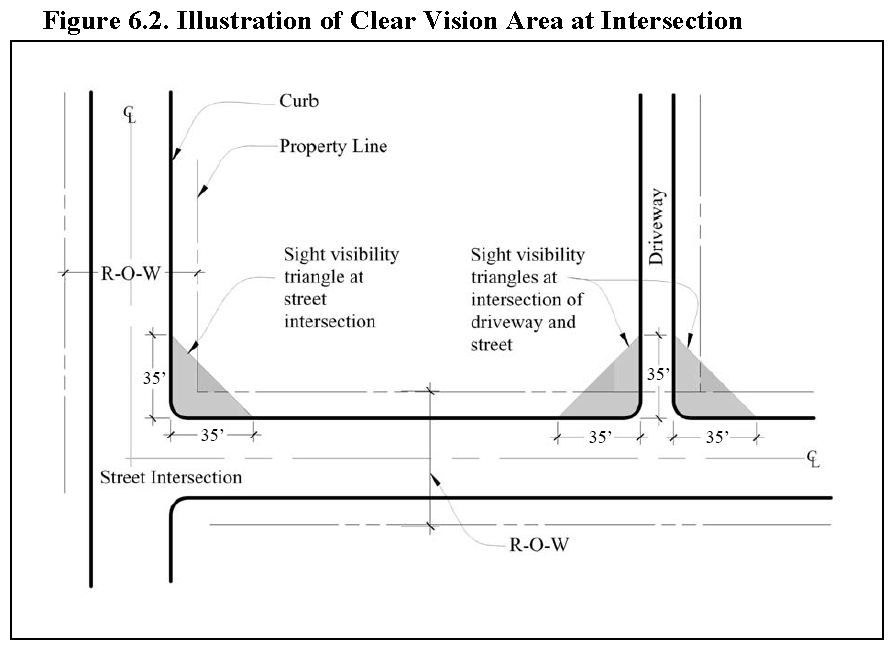
A clear-vision area shall be maintained on the corners of all property at the intersection of two streets.
2.
A clear-vision area shall consist of a triangular area:
a.
Two sides of the triangular area are lot lines measured 35 feet from the intersection of the street lot lines (or, if lot lines have rounded corners, the lot lines extended in a straight line to a point of intersection and so measured);
b.
The third side of the triangular area is a line across the corner of the lot joining the nonintersecting ends of the other two sides.
3.
A clear-vision area shall contain no planting, fence, wall, structure, or temporary or permanent obstruction exceeding three feet in height, measured from the established street center-line grade, except that trees exceeding this height may be located in this area, provided that all branches and foliage are removed to a height of eight feet above grade.
B.
Through lots.
1.
For a through lot which lies between a street and an alley, a front setback shall be required from the street and a rear setback shall be required from the alley.
2.
For a through lot which lies between two streets, a front setback shall be required from both streets.
C.
Permitted yard encroachment. The following encroachments into the minimum setback for principal structures shall be permitted in all zoning districts:
1.
All yards: Chimneys, bay windows and eaves: Not more than two feet into any required setback.
2.
Front and corner side yards:
a.
Open, unenclosed porches and stairs: Not more than eight feet into the required setback;
b.
Enclosed vestibule: Not more than four feet into the required setback.
3.
Side and rear yards:
a.
Stairs from a side or rear door: Not more than three feet into the required setback;
b.
Canopy over a side or rear door entrance: Not more than three feet into the required setback;
c.
Ground level patios and terraces: Must be at least two feet from the lot line;
d.
Basketball poles, hoops and backboards: Must be at least five feet from any lot line.
4.
Rear yards: Unenclosed porches, stairs and decks: Not more than eight feet into the required setback.
D.
Minor structures not subject to setbacks. The following shall not be subject to structure setback requirements:
1.
Awnings, bus shelters, exterior lighting fixtures, fire hydrants, mail boxes, utility equipment boxes, newspaper boxes and survey monuments;
2.
Gardens, driveways, walks, patios, and parking surfaces;
3.
Signs;
4.
Stormwater management facilities;
5.
Similar minor structures as determined by the planning commission.
E.
Fences and walls.
1.
Fences shall be classified in the following categories:
a.
Open fences are fences that do not restrict visibility. Open fences include post and rail, picket, wrought iron, and other fences in which more than 50 percent of the fence area is left open.
b.
Closed fences include board on board, privacy fences, brick or stone walls, or other fences in which 50 percent or less of the fence area is open. Chain link fences, with or without slats, shall be considered closed fences for purposes of this ordinance.
c.
For determining whether a fence is open or closed, the fence area is defined as the surface area from the bottom to the top of the fence section, including stringers supporting the section but not the post area above or below the fence section.
2.
Fences and walls shall comply with setback requirements as provided in the following chart.
Figure 6.3. Setbacks for Fences and Walls
(Ord. No. 1-2016, § 1, 4-13-2016)
Section 6.3. - Parking and loading.
A.
Applicability.
1.
Off-street parking and loading spaces shall be provided in accordance with this section for:
a.
New buildings or uses;
b.
Additions to or enlargement of existing buildings or uses; and
c.
Changes in the use of a building or site.
2.
Facilities used for off-street parking and loading on the effective date of this chapter shall not be reduced in capacity or area to less than the minimum standards prescribed in this section.
3.
For enlargement of an existing building or use, or for a change of use that would increase the number of parking spaces required, additional parking complying with the standards of this section shall be required only for the addition, enlargement, or change and not for the entire building or use.
4.
Off-street parking required by this section is intended to be sufficient for residents, employees, customers and visitors. These required spaces shall be provided in addition to areas used for:
a.
Parking of trucks or vehicles owned or used in a business and stored on the site,
b.
Display or storage of vehicles for sale or rent, or
c.
Vehicles being stored while awaiting repair.
5.
Unless off-site parking is approved in accordance with section 6.3.D. below, the required parking shall be provided on the same lot or parcel as the principal use.
B.
Minimum parking standards.
1.
Calculation of ratios.
a.
Mixed uses: Developments containing more than one use shall provide parking spaces in an amount equal to the total of the requirements for all uses.
b.
Fractional measurements: Where fractional spaces result, the parking spaces required shall be rounded up to the next highest whole number.
c.
Unlisted uses: The parking space requirements for a use not specifically listed in the table shall be the same as for the listed use deemed most similar to the proposed use by the planning commission.
2.
Minimum required parking spaces. Abbreviations used in this table: du = Dwelling unit; sf = square feet; GFA = gross floor area
Figure 6.4. Minimum Required Parking Spaces
C.
Parking design standards.
1.
General.
a.
Except for parking facilities serving single-family residences, off-street parking areas shall be designed so that vehicles can enter and exit the parking area without backing onto a public road.
b.
Off-street parking spaces shall not be located in required buffer or landscaped areas.
c.
Vehicle accommodation areas shall be designed to provide access for sanitation, emergency, and other public service vehicles without necessitating backing unreasonable distances or making other hazardous turning movements.
d.
Driveways and parking aisles shall be designed so that vehicles can proceed safely without posing a danger to pedestrians or other vehicles and without interfering with parking areas.
2.
Parking space layout and minimum dimensions.
a.
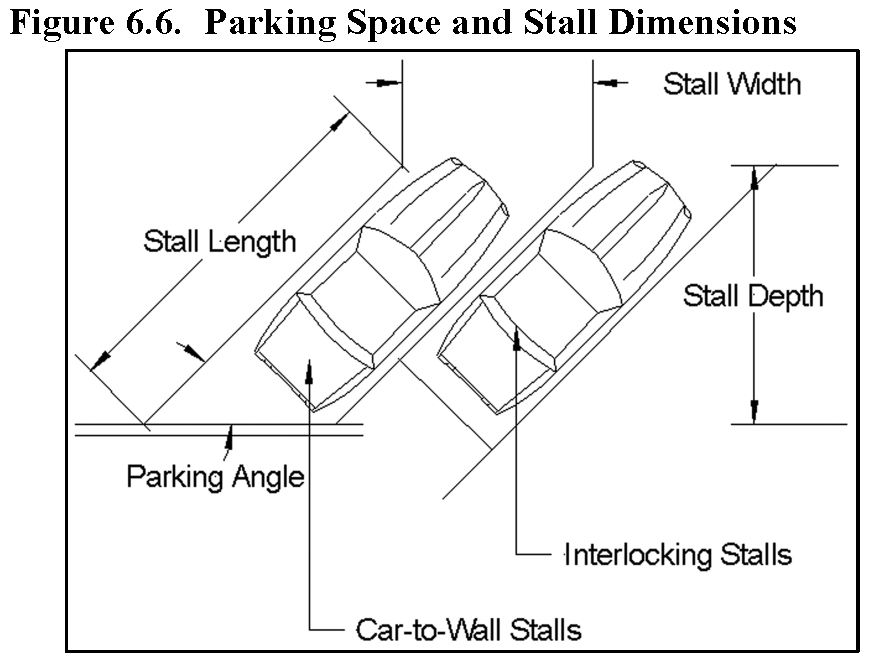
Off-street parking spaces shall have a width of nine feet and depth as shown in figure 6.5 below.
b.
Up to 20 percent of the required parking spaces may be designated for use by compact vehicles with minimum dimensions of eight feet in width and 16 feet in length. Compact vehicle spaces shall be clearly identified by labelling each parking space surface. Aisle width shall be the same as for standard parking spaces.
c.
Parking spaces and drive aisles shall comply with the following minimum dimensions:
Figure 6.5. Minimum Parking Space Depth and Aisle Width (Feet)
Source: 21 st Century Land Development Code, Freilich, White and Murray, APA, 2008
3.
Accessible parking shall be provided in compliance with the Americans with Disabilities Act Accessibility Guidelines, as determined by the state fire marshal.
4.
Surfacing.
a.
Parking facilities or any other vehicular use area, except for driveways accessory to a single-family detached dwellings, shall be surfaced with asphalt bituminous, concrete or other dustless material approved by the administrator, and shall be maintained in a smooth, well-graded condition. Pervious surfaces may be permitted as provided below.
b.
Pervious parking surfaces.
i.
All parking spaces may be surfaced with pervious parking surface that is engineered for parking or driveways.
ii.
Where provided, pervious parking surfaces shall be maintained in a smooth, well-graded condition.
5.
Striping. In all parking areas over 2,000 square feet or containing more than five individual off-street parking spaces, parking spaces shall be striped.
6.
Separation, curbs and wheel stops.
a.
Parking facilities or other vehicular use areas shall have curbs or wheel stops to prevent vehicles from overhanging adjacent property or landscaped areas. Where vehicles will hang over medians or islands, shrubs and trees shall be planted a minimum of two feet from back of the curb or wheel stop.
b.
Where parking abuts a walkway, sidewalk or street, the parking shall be separated by curbs or other protective device with a minimum distance of five feet between the protective device and the edge of the walkway, sidewalk or street.
c.
Where parking is adjacent to a building, the parking shall be separated from the building by curbs or other protective device with a minimum distance of three feet between the protective device and the building.
7.
Pedestrian walkways. In parking lots with over 100 parking spaces, separate pedestrian walkways shall be provided to allow safe movement within the lots.
a.
Walkways should generally be oriented perpendicular to and between parking bays.
b.
One walkway can serve as a collector for up to four bays of parked cars.
c.
The walkways shall be a minimum of four feet wide and separated from parking spaces by 30 inches on each side for overhanging of automobiles.
d.
Walkways shall be raised to a standard sidewalk height and constructed of a different paving material than the parking lot.
D.
Parking reductions and alternative parking solutions.
1.
Credit for on-street spaces.
a.
On-street parking spaces located immediately abutting the subject parcel, lying entirely within the extension of the side lot lines into the roadway, may be counted toward meeting parking space requirements.
b.
One parking space may be credited to the use per 23 feet of on-street parallel parking space.
2.
Parking reductions in downtown mixed-use district. In the DMU zoning district, parking requirements shall be as provided in article 2, section 2.3.
3.
Parking needs study. The planning commission may modify the parking requirements of this section when an applicant submits parking data, prepared and sealed by a registered engineer in the State of Louisiana with transportation expertise, which illustrates that the standards of this section do not accurately apply to a specific development. The data submitted for an alternative parking plan shall include, at a minimum, the size and type of the proposed development, the mix of uses, the anticipated rate of parking turnover and the anticipated peak parking and traffic loads of all uses.
4.
Shared parking. Developments that contain a mix of uses on the same parcel may reduce the amount of required parking in accordance with the following method:
a.
Determine the minimum parking requirement for each land use as if it were a separate use;
b.
Multiply each amount by the corresponding percentage for each of the five time periods in columns (B) through (F) of figure 6.7 below.
c.
Calculate the total for each time period.
d.
Select the total with the highest value as the required minimum number of parking spaces.
Figure 6.7. Shared Parking Standards
5.
Off-site parking. Required parking spaces may be located on a separate lot from the lot on which the principal use is located if the off-site parking complies with all of the following standards.
a.
Location. Off-site parking spaces shall be located within 300 feet of the primary entrance of the use served unless shuttle bus service is provided to the remote parking area.
b.
Zoning classification. Off-site parking areas shall be located in a district that permits the use to which such parking is accessory.
c.
Agreement.
i.
When an off-site parking area is not under the same ownership as the principal use served, a legally binding written agreement is required between the record owners of the property establishing the duration and conditions associated with the off-site parking.
ii.
An off-site parking agreement may be rescinded only if all required off-street parking spaces will be provided in accordance with this section.
iii.
An attested copy of the approved parking plan and associated agreements shall be recorded in the deed records for the City of Port Allen. The applicant shall provide proof of recording prior to approval of the certificate of occupancy.
d.
Ineligible activities.
i.
Off-site parking may not be used to satisfy the off-street parking requirements for residential uses (except for guest parking), convenience stores or other convenience-oriented uses.
ii.
Required parking spaces reserved for persons with disabilities may not be located off-site.
6.
Loading spaces.
a.
Every commercial or industrial use, and institutional uses that will have truck deliveries or pick-ups, shall have adequate off-street loading requirements to meet the needs of the operation, except that businesses in the DMU district are not required to provide off-street loading spaces.
b.
Loading spaces shall be of adequate size for trucks expected to service the facility, and shall not be smaller than 12 feet by 35 feet.
c.
All access drives and maneuvering areas for loading spaces shall be completely on the property of the commercial or industrial use.
d.
Loading areas shall not be used to satisfy off-street parking requirements, nor shall off-street parking areas be used to satisfy loading area requirements.
e.
Loading areas shall be located on the same lot as the use served.
f.
Loading areas shall be:
i.
Located to the side or rear of buildings; and
ii.
Provided with protective fencing or buffering such that occupants of adjacent structures are not unreasonably disturbed by the movement of trucks.
(Ord. No. 1-2016, § 1, 4-13-2016)
Section 6.4. - Access.
A.
Every building shall be on a lot with access to a public road.
B.
Driveways for residential use.
1.
Driveways on lots less than 35 feet in width may be no less than eight feet and no more than 12 feet in width in the required setback from the road.
2.
Driveways on lots greater than 35 feet in width may be no less than eight feet and no more than 20 feet in width in the required setback from the road.
3.
Unless otherwise approved or required by the West Baton Rouge Parish Engineer, residential driveways may intersect a street no closer than 20 feet from the intersection of two street right-of-way lines.
C.
Driveways for nonresidential and mixed-use development.
1.
A driveway may be no less than eight feet and no more than 30 feet in width.
2.
Driveways shall be separated by a distance of not less than 150 feet measured centerline to centerline of the driveways. In the event that an infill lot is unable to meet this separation requirement due to the location of existing driveways on adjacent lots, the infill lot shall be permitted one driveway.
3.
Unless otherwise approved or required by the West Baton Rouge Parish Engineer, driveways may intersect a street no closer than 50 feet from the intersection of two street right-of-way lines.
4.
As a condition of site plan approval, the planning commission, upon the recommendation of the West Baton Rouge Parish Engineer, may require improvement and consolidation of existing access points to a commercial, industrial or institutional use, where the improvements will enhance vehicular and pedestrian safety.
D.
Lighting.
1.
The maximum height for any exterior, freestanding light fixture is 25 feet.
2.
Lighting must be oriented inward, toward the development or structures, and downward to minimize intrusion into surrounding property and avoid light pollution.
(Ord. No. 1-2016, § 1, 4-13-2016)

