
Port Allen City Zoning Code
ARTICLE 9
- NONCONFORMITIES
Section 9.1. - General.
A.
Types of nonconformity. There are several types of nonconformities that may exist, as follows:
1.
Nonconforming uses: A legally existing use that is not permitted by the current use provisions of the applicable zoning district.
2.
Nonconforming structures: A legally existing structure that does not comply with setback, height, or other numerical standards of the zoning ordinance.
3.
Nonconforming sites: A legally developed site with parking, landscaping, access or other site features that do not comply with the current provisions of this ordinance.
4.
Nonconforming lots of record: A lot of record that does not comply with the current lot area or width requirements of this ordinance.
B.
Evidence of status. Evidence of the status of a nonconformity shall be supplied by the owner of the property upon request of the administrator.
(Ord. No. 1-2016, § 1, 4-13-2016)
Section 9.2. - Nonconforming uses.
A.
Continuation. A lawful use made nonconforming by the adoption of this zoning code or other ordinances may continue so long as such use is not expanded, increased or changed.
B.
Change of use.
1.
The nonconforming use of a building may not be changed to another nonconforming use except where the change is to a nonconforming land use substantially the same or of a more restricted classification than the prior nonconforming use. The planning commission shall determine whether a proposed new use complies with this standard.
2.
Any nonconforming use changed to a permitted use, shall thereafter conform to the regulations for the district, and the nonconforming use may not thereafter be resumed.
C.
Expansion of nonconforming uses. Nonconforming uses shall not be extended or enlarged by external additions to the structure in which nonconforming uses are located, or by expansion onto additional land area.
D.
Maintenance and repair.
1.
The repair and maintenance of structures containing nonconforming uses shall be permitted, provided the repairs do not enlarge or expand the nonconforming use, shall be permitted.
2.
Repair and maintenance of said structures typically include actions such as painting, landscaping, paving, the replacement and addition of windows and doors, and other acts that promote the livability and usability of the structure.
3.
Nothing in this ordinance shall be deemed to prevent the strengthening or restoring to a safe condition of any building or part thereof declared to be unsafe by any city official charged with protecting the public safety, upon order of such official. Repairs and alterations shall restore a building to the same condition that existed prior to damage or deterioration, altering the building in such a manner that does not extend or increase an existing nonconformity.
E.
Restoration. If a structure housing a nonconforming use is damaged or destroyed by storm, fire or other natural cause, it may be restored and the use continued, provided that:
1.
The restoration is accomplished with no increase in square footage, cubical area or intensity over the building existing immediately prior to the damage.
2.
Application for a building permit to restore a damaged structure housing a nonconforming use is made within six months of the destruction.
3.
Restoration is completed within 12 months from the date of the issuance of the building permit.
4.
The nonconforming use must restore operation within six months of the completion of construction or the nonconforming status shall cease and the use must thereafter conform to the regulations for the district.
5.
A single, six-month extension of one of these time periods may be granted by the administrator in response to a written request from the property owner detailing the steps taken in restoration and the reason for the requested extension.
F.
Abandonment.
1.
A nonconforming use shall be deemed abandoned when that particular nonconforming use is discontinued or becomes vacant or unoccupied for a continuous period of 12 months.
2.
An abandoned use may not be re-established or resumed regardless of intent. Any subsequent occupancy shall comply with all regulations of the zoning district in which the land or structure is located.
3.
Where a nonconforming use has ceased operation for renovations in conjunction with a lawfully issued building permit, the nonconforming use must restore operation within six months from the issuance of the building permit, subject to one six-month extension subject to approval by the director of public services.
4.
This calculation of the period of abandonment does not include any period of discontinuance caused by government action.
G.
Nonconforming use of land.
1.
Any nonconforming land use not enclosed within a building shall be discontinued, unless the land use is enclosed and screened from view by walls, fences or plantings and such screening is continuously maintained in a manner prescribed by the administrator.
(Ord. No. 1-2016, § 1, 4-13-2016)
Section 9.3. - Nonconforming structures.
A.
Alterations.
1.
A nonconforming structure may not be enlarged or altered in a way that increases its nonconformity.
2.
Any structure or portion thereof may be altered in a way that does not increase its nonconformity or that decreases its nonconformity.
3.
A nonconforming structure which is moved shall thereafter conform to the regulations of the district in which it is located after such move.
B.
Maintenance and repairs.
1.
The repair and maintenance of nonconforming structures that does not enlarge or expand the nonconforming structure shall be permitted. Repair and maintenance of said structures typically include actions such as painting, landscaping, paving, the replacement and addition of windows and doors, replacement of wiring or plumbing and other acts that promote the livability and usability of the structure.
2.
Nothing in this ordinance shall be deemed to prevent the strengthening or restoring to a safe condition of any building or part thereof declared to be unsafe by any city official charged with protecting the public safety, upon order of such official. Repairs and alterations shall restore the building to the same condition that existed prior to damage or deterioration, altering the building in a manner that does not extend or increase an existing nonconformity.
3.
A nonconforming structure which is damaged or destroyed may be replaced by the owner of the structure, provided that:
a.
Application for a building permit to restore the damaged structure is made within six months of the damage.
b.
Restoration is completed within 12 months from the date of the issuance of the building permit.
c.
A single, six-month extension of one of these time periods may be granted by the administrator in response to a written request from the property owner detailing the steps taken in restoration and the reason for the requested extension.
(Ord. No. 1-2016, § 1, 4-13-2016)
Section 9.4. - Nonconforming sites.
A.
Continuation. A site existing as of the effective date of this zoning code that is nonconforming due solely to failure to meet the site development standards of this zoning code may be used for any purposes permitted in the district provided the use is in conformance with the provisions of this section.
B.
Maintenance and restoration. A nonconforming site may be maintained or restored provided no expansion of the nonconformity occurs.
C.
Expansion.
1.
Additions to structures or additional paving or parking on nonconforming sites shall require correction of existing nonconforming parking, landscaping and screening.
2.
Removal and replacement of a building, or any expansion that results in a 50-percent or greater increase in gross square footage of the existing structure, requires the entire property to meet all of the landscaping and screening requirements of this zoning code.
3.
Expansions that result in less than a 50-percent increase of the gross square footage of the existing structure require a corresponding percentage increase in compliance for landscaping and screening requirements of this zoning code until the site achieves 100 percent compliance.
4.
Any building or use expansion that results in an increased number of required parking spaces shall be required to provide 100 percent of the required parking spaces for the site in accordance with this zoning ordinance.
5.
All newly added parking areas shall comply with all associated parking design and landscaping standards of articles 6, development standards, and article 7, landscaping standards.
6.
Properties that are physically constrained from complying with these provisions shall comply with the maximum extent practicable as determined through site plan approval by the planning commission.
D.
Change of use.
1.
Changes of use that require an increase in the number of parking spaces shall be required to provide the full number of required parking spaces for the site.
2.
The newly added parking area shall comply with all associated parking design and landscaping standards of articles 6, development standards, and 7, landscaping standards.
(Ord. No. 1-2016, § 1, 4-13-2016)
Section 9.5. - Nonconforming lots of record.
A.
A lot of record that does not comply with the lot width or area requirements of this ordinance may be used in compliance with all other provisions of this ordinance, provided that the nonconforming lot of record is not of continuous frontage with other lots of record in the same ownership. Side setbacks may be reduced as provided by paragraph B below.
B.
For each foot by which the width of a lot of record at the time of enactment of this ordinance is less than the minimum lot width required under this ordinance, three inches may be deducted from the side or rear setback requirement. No side or rear setback, however, shall be less than three feet, under any circumstances (see Figure 1). This reduction in setback requirements, also, does not apply to the street side of corner lots which must adhere to the minimum setback requirement for the zoning district.
C.
Where a nonconforming lot of record is used together with one or more contiguous lots for a single use or unified development, all of the lots so used are deemed a single, undivided lot for purposes of this ordinance. No part of the property shall thereafter be used, transferred or conveyed to create a lot with width or area less than the requirements of this ordinance (see Figure 2).
D.
Where two or more contiguous lots of record are in single ownership and have continuous road frontage, and one or more of the lots does not meet minimum lot dimension or area requirements, the nonconforming lot of record must be used in combination with contiguous lots as a single lot for purposes of this ordinance. No part of the land shall be used, sold or conveyed to create a lot with width or area less than the requirements of this ordinance (see Figure 3).
Figure 1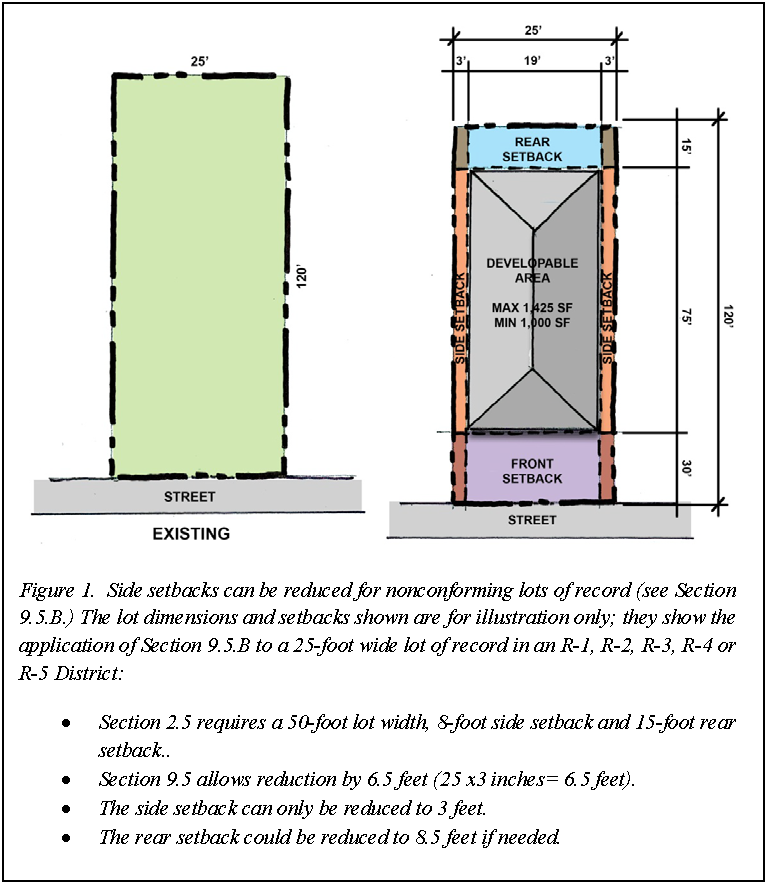
Figure 2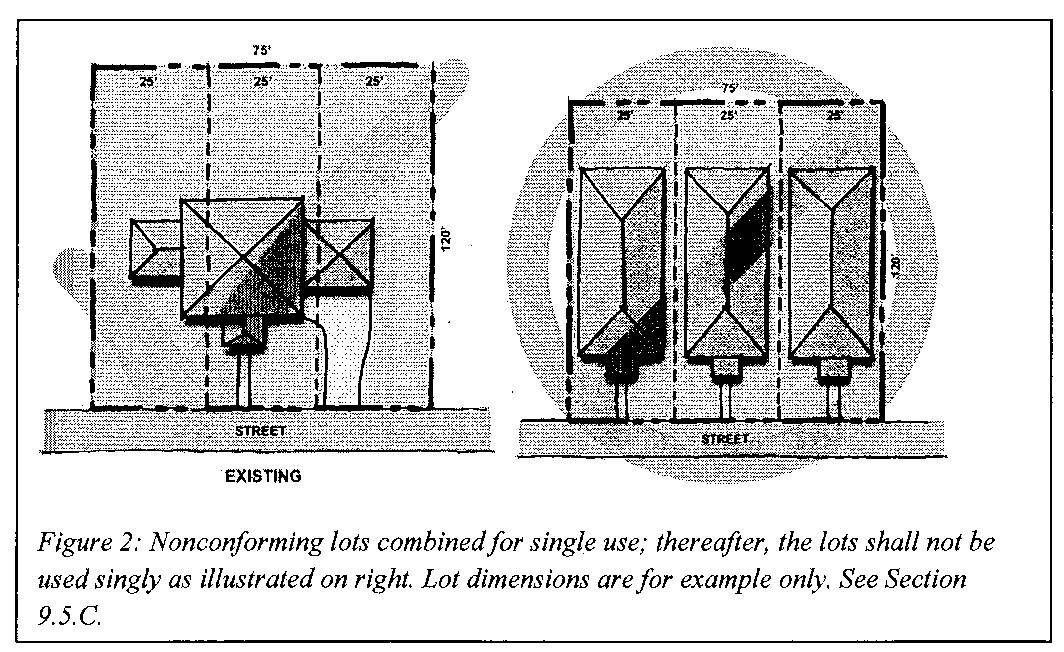
Figure 3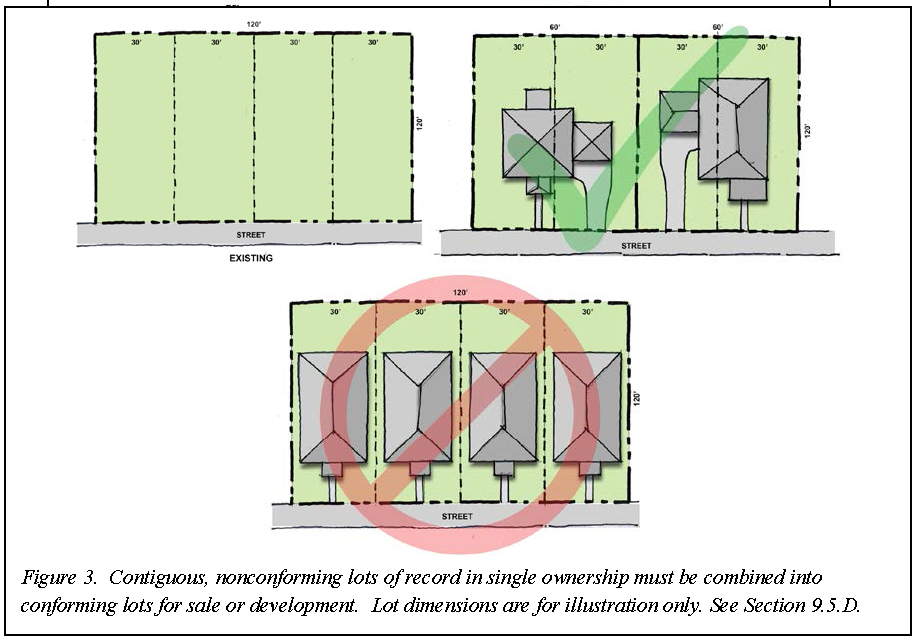
(Ord. No. 1-2016, § 1, 4-13-2016)

